

Introduction: An Aggressive Military Ideology Cloaked in Peace
In the political and social context of the modern world, Islam is often presented as a ‘religion of peace’. Yet this appealing description conceals those systematic sections of classical Islamic scripture, hadith, and jurisprudence that articulate a highly aggressive and expansionist military ideology. This Islamic doctrine of warfare is not confined to self-defense or defensive war; it provides a religious framework for deliberately attacking non-Muslim territories to establish Islamic rule and impose absolute domination over conquered populations.
The central purpose of this article is to examine Islam’s ‘offensive jihad’ (jihad al-talab), in which not only fighting armed combatants but also asserting control over the lives and property of non-Muslim civilians is fully legitimized. Here, war means not merely territorial conquest: seizing the women and children of conquered populations as ‘spoils of war’ and enslaving their men are established as a religious duty or ‘Sunnah.’ Rules regarded in the modern era as war crimes or human rights violations are described with great emphasis in classical Islamic jurisprudence as ‘divine rewards.’
Through classical sources, this article will examine how seeking paradise beneath the shadow of swords and achieving victory by instilling fear were made principal instruments of Islam’s expansion. In particular, the horrifying scriptural authorization in Islam for plundering the lives and property of non-Muslim civilians who took no direct part in battle, and binding their families in slavery, requires dispassionate analysis today. This discussion concerns more than historical circumstances: it will also help us understand the magnitude of the challenge these original Islamic rules pose to contemporary fundamentalist thinking and global security.
Islamic Authorization for Attacking and Plundering Civilian Populations
One particularly horrifying and controversial aspect of Islamic military doctrine is the establishment of absolute control over civilian lives and property in ‘dar al-harb,’ or the territory of war. Greater emphasis is placed on financially crippling the enemy and destroying its social structure than on military victory alone. The underlying philosophy of this offensive jihad is not confined to armed combatants; it is total war, in which the enemy’s property, families, and means of survival are also legitimized as targets.
1. Attaining Paradise through the Sword and Terror: In Islamic doctrine, jihad is portrayed not merely as warfare but as a principal path to paradise. When paradise is said to lie beneath the flash of swords, the message conveyed to believers is that the road to happiness in the afterlife runs through bloodshed and conflict [3] [4]. Here, terrifying the enemy, rather than mercy or accommodation, is made the measure of victory. Even the livelihood obtained through war is declared to have been placed ‘beneath the shadow of the spear,’ directly sanctifying the acquisition of wealth through plunder and seizure [4]. Part of this philosophy is to instill ‘terror’ or ‘fear’ in the enemy’s heart, which, according to the Prophet Muhammad, was one of the principal divine strategies that brought him victory [5].
Sahih al-Bukhari (Tawhid)
Book: 56/ Jihad and Conduct during Warfare
Chapter: 56/22. Paradise lies beneath the flash of swords.
Mughirah ibn Shu‘bah (may Allah be pleased with him) said: The Prophet (peace and blessings of Allah be upon him) conveyed to us the message of our Lord: whoever among us is martyred enters paradise.
‘Umar (may Allah be pleased with him) said to the Prophet (peace and blessings of Allah be upon him): Are not our martyrs in paradise and their dead in hell? Allah’s Messenger (peace and blessings of Allah be upon him) said: Yes.
2818. Narrated Salim Abu al-Nadr (may Allah have mercy on him), the freed slave and secretary of ‘Umar ibn ‘Ubaydullah (may Allah have mercy on him): ‘Abdullah ibn Abu Awfa (may Allah be pleased with him) wrote to him that Allah’s Messenger (peace and blessings of Allah be upon him) said: Know that paradise lies beneath the shadow of swords.
Al-Uwaysi (may Allah have mercy on him), narrating through Ibn Abu Zinad (may Allah have mercy on him) from Musa ibn ‘Uqbah (may Allah have mercy on him), followed the narration of Mu‘awiyah ibn ‘Amr (may Allah have mercy on him) through Abu Ishaq (may Allah have mercy on him) from Musa ibn ‘Uqbah (may Allah be pleased with him). (2833, 2966, 3024, 7237) (Muslim 32/6, Hadith 1742; Ahmad 19136) (Adhunik Prakashani: 2608; Islamic Foundation: 2620)
Hadith grading: Sahih (Authentic)
Hadith Sambhar
20/ Jihad (in the Path of Allah)
Chapter: The Obligation of Jihad and the Merit of Going Forth Morning and Evening
(1900) Narrated Ibn ‘Umar (may Allah be pleased with him): Allah’s Messenger (peace and blessings of Allah be upon him) said: I was sent (before the Hour) with the sword, so that Allah would be worshipped without any partner. My livelihood has been placed beneath the shadow of my spear. Humiliation and abasement have been assigned to those who oppose my command. Whoever imitates a people is one of them.
(Ahmad 5114–5115, 5667; Shu‘ab al-Iman 98; Sahih al-Jami‘ 2831)
Hadith grading: Sahih (Authentic)
Narrator: ‘Abdullah ibn ‘Umar (may Allah be pleased with him)
Sahih al-Bukhari (Tawhid Publication)
56/ Jihad and Conduct during Warfare
Chapter: 56/122. The saying of Allah’s Messenger (peace and blessings of Allah be upon him): Even in enemies a month’s journey away, the arousal of fear and terror of me has been a means of helping me.
وَقَوْلِهِ جَلَّ وَعَزَّ )سَنُلْقِيْ فِيْ قُلُوْبِ الَّذِيْنَ كَفَرُوا الرُّعْبَ بِمَآ أَشْرَكُوْا بِاللهِ ( قَالَهُ جَابِرٌ عَنْ النَّبِيِّ صلى الله عليه وسلم
The saying of Allah, the Most High: I shall cast terror into the hearts of the disbelievers because they have associated partners with Allah. (Al ‘Imran 151)
Jabir (may Allah be pleased with him) narrated a hadith from Allah’s Messenger (peace and blessings of Allah be upon him) on this subject.
2977. Narrated Abu Hurayrah (may Allah be pleased with him): Allah’s Messenger (peace and blessings of Allah be upon him) said: I have been sent with the power to express extensive meanings in few words, and I have been helped by instilling fear in the enemy’s heart. Once, while I was asleep, the keys to the treasures of the earth were placed in my hand. Abu Hurayrah (may Allah be pleased with him) said: Allah’s Messenger (peace and blessings of Allah be upon him) has departed, and you are bringing those treasures forth. (6998, 7013, 7273) (Muslim 5/5, Hadith 523; Ahmad 7758) (Adhunik Prakashani: 2756; Islamic Foundation: 2766)
Hadith grading: Sahih (Authentic)
Narrator: Abu Hurayrah (may Allah be pleased with him)
Now let us look at the English translation of this hadith. Here the Prophet says, ‘I have been made victorious with terror.’ An accurate Bengali translation would mean, ‘I have been granted victory through terror.’ But look above at how it has been translated!
Narrated Abu Huraira:
Allah’s Messenger (ﷺ) said, “I have been sent with the shortest expressions bearing the widest meanings, and I have been made victorious with terror (cast in the hearts of the enemy), and while I was sleeping, the keys of the treasures of the world were brought to me and put in my hand.” Abu Huraira added: Allah’s Messenger (ﷺ) has left the world and now you, people, are bringing out those treasures (i.e. the Prophet did not benefit by them).
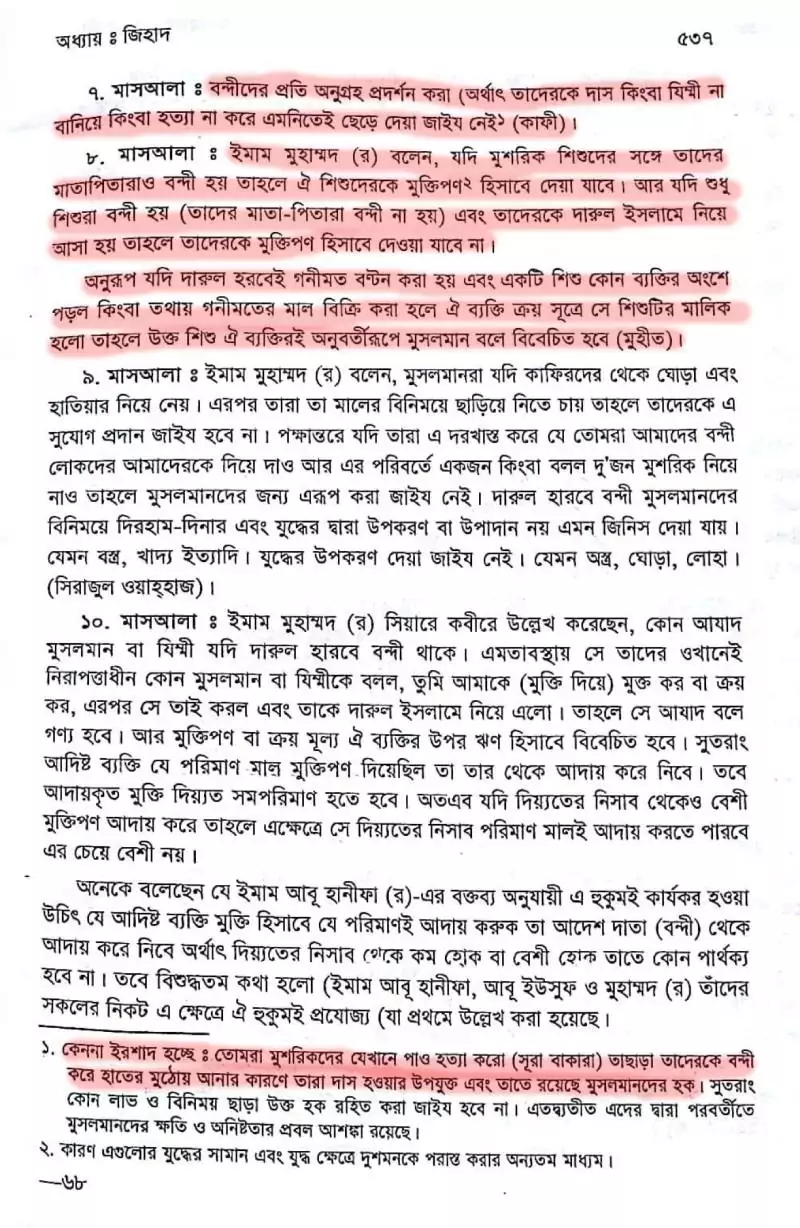
2. Authorization to Destroy Civilian Infrastructure and Property: The horrifying methods of jihad described in authoritative works of jurisprudence such as Fatawa-e-Alamgiri are deeply disturbing to modern humanitarian sensibilities. They explicitly state that if the unbelievers refuse the invitation to Islam or the payment of jizya, cannons or catapults may be used against them, their homes may be set on fire, and dams may be breached to release water and flood their settlements. Even destroying their crop fields, killing their livestock, and felling their fruit-bearing trees are recognized as essential parts of jihad (the full account will be discussed below). The primary purpose of this destruction is to provoke anger and despair among the unbelievers and compel their submission. Islamic domination is given far greater priority here than civilians’ fundamental right to subsistence.
3. Surprise Attacks and the Economy of Plunder: In Islam, jihad was not only declared warfare; in many cases, it involved surprise attacks on unprepared populations. If a tribe had previously received the invitation to Islam even once, it was entirely lawful to attack it subsequently without warning, in the darkness of night or in broad daylight [6]. The principal purpose of such attacks was to gather vast quantities of ‘ghanima,’ or booty. The example of the Battle of Hunayn shows how thousands of women and children were taken captive, and livestock numbering over a hundred thousand, along with silver, were plundered [7].
4. Sectarian Division against Humanity: Under Islamic military doctrine, a person’s identity is determined by religion. According to Fatawa-e-Alamgiri, even if Muslim captives or merchants are inside an unbelievers’ fortress, setting it on fire or shooting arrows into it must not be suspended—even if the unbelievers use Muslim children as shields, attacks must continue to be directed at them [6]. This cruel rule demonstrates that, in pursuing broader Islamic political objectives, an individual’s life is treated as profoundly secondary, even when that individual is a Muslim.
Section Three: The Enslavement of Women and Children—An Institutionalized Crime
The most inhumane and darkest aspect of Islamic jihad is revealed in the extreme humiliation and chains of slavery imposed on prisoners of war, especially women and children. Whereas modern human rights and rules of warfare call for the protection of innocent civilians, women, and children, classical Islamic law treated these vulnerable groups en masse as ‘mal-e-ghanima,’ or war assets, obliterating their personhood and rights. This is not an isolated crime; jurisprudence transformed it into a legitimate economic and social institution.
1. Erasing the Personhood of Women and Children and Turning Them into Commodities: Under Islamic law, when a territory is attacked and its non-Muslims defeated, it becomes lawful for the mujahids to seize their wives and children along with their property and land. Fatawa-e-Alamgiri explicitly states that when Arab polytheists who do not possess a revealed scripture are defeated, their men must be compelled to accept Islam or be killed—but their women and children have no alternative: they must be treated as ‘mal-e-ghanima,’ or plundered property [8]. At the Battle of Hunayn, 6,000 women and children were taken captive on the Prophet Muhammad’s orders and included in the inventory of plundered property. This demonstrates that innocent women and children were nothing more than exchangeable commodities in the course of Islam’s expansion [9].
2. The Religious Prohibition on Showing Mercy: Islamic military doctrine scripturally prohibits releasing prisoners unconditionally as an act of kindness or mercy. According to the ruling in Fatawa-e-Alamgiri, it is impermissible simply to release prisoners without benefit or compensation, because they are then ‘eligible for enslavement’ and ‘Muslims’ rights’ over them have arisen [10]. Even if a ruler believes someone should be released, he remains religiously constrained. This rule demonstrates that keeping the enemy degraded and bound in slavery, rather than forgiveness or mercy, is viewed in Islam as the path to Allah’s pleasure.
3. Determining Prisoners’ Fate and Authorizing Their Killing: Describing the ruler’s or imam’s ultimate authority over prisoners of war, Fatawa-e-Alamgiri states that the ruler may choose to kill them or enslave them [11]. Even if a prisoner accepts Islam out of fear for his life, he is not released; he is kept as a slave. This is calculated coercion in the name of religion, in which keeping someone enslaved is deemed more important than that person’s life. For Arab polytheists, no third, humane option is provided beyond the two extremes of ‘accept Islam or die’ [11].
4. Extreme Mercilessness toward Incapacitated Prisoners: If it becomes impossible to bring prisoners back from the battlefield of jihad, Islamic rules become still more brutal. Fatawa-e-Alamgiri directs that, in such circumstances, the men are to be killed outright unless they accept Islam. Women, children, and the elderly—whose direct killing is subject to certain restrictions—are instead to be abandoned in an uninhabited, deserted place without food or drink, so that they waste away from hunger and thirst [10]. This rule of driving people slowly toward death instead of killing them directly with a sword turns the claim of Islamic mercy into a ridiculous and cruel mockery.
The Execution of ‘Uqbah, a Prisoner of Badr: Muhammad’s Answer of ‘Fire’ to the Question about Helpless Children
One particularly brutal instance of Muhammad’s treatment of prisoners in early Islamic history is the execution of ‘Uqbah ibn Abi Mu‘ayt after the Battle of Badr. The most significant aspect of this event is not merely the order to kill a prisoner, but the answer Muhammad gave when that condemned prisoner asked about the future of his helpless children. ‘Uqbah asked who would care for his children after his death. Muhammad answered, النار — ‘Fire.’ Although the captive father’s question clearly expressed concern for his children’s lives, sustenance, and safety, Muhammad’s answer offered no sympathy for them or assurance that responsibility would be taken for their care.
This incident is not confined to some obscure or isolated Islamic folktale. The exchange is preserved in numerous classical Islamic works, including Ibn Ishaq’s biography, Ibn Hisham’s compilation, Sunan Abu Dawud, ‘Abd al-Razzaq’s Musannaf and Tafsir, al-Tabari’s history, al-Tabarani’s Mu‘jam, al-Bayhaqi’s Sunan, al-Hakim’s Mustadrak, Ibn Kathir’s Al-Bidaya wa al-Nihaya, al-Qurtubi’s Tafsir, and Tafsir al-Mazhari. The accounts in these works are not all independent; in many cases, the same early transmission was incorporated into later books. Nevertheless, the exchange’s long preservation in hadith, prophetic biography, military histories, Quranic commentary, and jurisprudential discussion is historically significant.
‘Uqbah’s Captivity after Badr and the Order for His Execution
‘Uqbah ibn Abi Mu‘ayt was a member of the Quraysh of Mecca who opposed Muhammad. Islamic biographies and Quranic commentaries recount various insulting acts he directed against Muhammad. After the Battle of Badr, he was taken prisoner by the Muslims. Although arrangements were made after the battle to release some prisoners for ransom, ‘Uqbah was sentenced to death. This execution did not occur during direct combat between the two sides on the battlefield. He was killed in captivity, after coming under the Muslim army’s control.
Ibn Ishaq’s account is preserved in Ibn Hisham’s Al-Sira al-Nabawiyya. It states that, on the return journey from Badr, al-Nadr ibn al-Harith was killed at a place called al-Safra. Then, at a place called ‘Irq al-Zabya, the order was given to kill ‘Uqbah ibn Abi Mu‘ayt. It was after this order that ‘Uqbah asked Muhammad about his children. According to Ibn Ishaq’s account, the executioner was ‘Asim ibn Thabit. Ibn Hisham also names ‘Ali ibn Abi Talib on the authority of other narrators. [12]
The key exchange in the Arabic original:
فَقَالَ عُقْبَةُ حِينَ أَمَرَ رَسُولُ اللَّهِ بِقَتْلِهِ: فَمَنْ لِلصِّبْيَةِ يَا مُحَمَّدُ؟ قَالَ: النَّارُ.
English translation:
Ibn Ishaq related that, after reaching a place called al-Safra, Muhammad had al-Nadr ibn al-Harith killed. According to information received from several knowledgeable people of Mecca, ‘Ali ibn Abi Talib killed him. Muhammad then proceeded from there, and when he reached a place called ‘Irq al-Zabya, ‘Uqbah ibn Abi Mu‘ayt was killed. According to Ibn Ishaq’s account, ‘Uqbah had been captured by ‘Abdullah ibn Salama of the Banu ‘Ajlan.
When Muhammad ordered ‘Uqbah’s execution, ‘Uqbah asked, O Muhammad, who, then, will look after the children? Muhammad answered, Fire.
‘Uqbah was then killed by the Ansari ‘Asim ibn Thabit ibn Abi al-Aqlah of the Banu ‘Amr ibn ‘Awf. Ibn Ishaq stated that Abu ‘Ubayda ibn Muhammad ibn ‘Ammar ibn Yasir supplied him with this information. Ibn Hisham further noted that, according to another account received from Ibn Shihab al-Zuhri and other knowledgeable people, ‘Ali ibn Abi Talib killed ‘Uqbah.
Ibn Ishaq’s account presents a clear sequence. First the battle ended, then the prisoners were brought under the Muslim army’s control, and then a decision was made to kill a particular prisoner. Facing that decision, ‘Uqbah asked about his children. His question meant something very ordinary: if the father is killed, who will assume responsibility for his dependent children? He was not asking about military strategy or the outcome of the battle. He was placing before Muhammad the peril his death would create for his children.
In response, Muhammad neither appointed a guardian for the children, nor promised their upkeep, nor mentioned any measures to ensure their safety. His answer was a single word: ‘Fire.’ There is no reasonable basis for treating such an answer about the future of a captive father’s helpless children as evidence of a humane sense of responsibility. Alongside the execution, this incident reveals the ruler’s ruthless indifference to the consequences of leaving a family fatherless.
Sunan Abu Dawud: The Statement ‘Fire’ Repeated before ‘Uqbah’s Son
A particularly important account of this incident appears in Sunan Abu Dawud, Hadith 2686. The chapter is titled باب في قتل الأسير صبرا, meaning the execution of prisoners while in captivity. It does not merely recount ‘Uqbah’s execution; it also describes how the incident was invoked again many years later during a political dispute between his son ‘Umara ibn ‘Uqbah and a man named Masruq. Muhammad’s answer was also used against a child of the following generation. [13]
Key passage from the Arabic original:
أَنَّ النَّبِيَّ لَمَّا أَرَادَ قَتْلَ أَبِيكَ قَالَ: مَنْ لِلصِّبْيَةِ؟ قَالَ: النَّارُ.
English translation:
It is narrated through ‘Ali ibn al-Husayn al-Raqqi, ‘Abdullah ibn Ja‘far, ‘Ubaydullah ibn ‘Amr, Zayd ibn Abi Unaysa, ‘Amr ibn Murra, and Ibrahim: al-Dahhak ibn Qays expressed his intention to appoint Masruq to an administrative post. ‘Umara ibn ‘Uqbah then said to al-Dahhak: Will you appoint a man who is among the surviving killers of ‘Uthman?
In reply, Masruq told ‘Umara: ‘Abdullah ibn Mas‘ud narrated an incident to us. We regarded him as trustworthy in narrating hadith. He reported that when Muhammad intended to kill your father, your father said: Who will look after my children? Muhammad answered: Fire.
Masruq then said to ‘Umara: I, too, am content with what Allah’s Messenger chose for you.
Al-Albani classified the narration of this hadith as ‘hasan sahih.’
Sunan Abu Dawud (Al-Albani Academy)
9/ Jihad
Chapter: 128. Killing a Prisoner with Hands and Feet Bound
2686. Narrated through Ibrahim (may Allah have mercy on him), who said: al-Dahhak ibn Qays Umamah (may Allah be pleased with him) intended to appoint Masruq (may Allah have mercy on him) as an official. ‘Umara ibn ‘Uqbah said to him: Will you appoint as an official one of the surviving killers of ‘Uthman (may Allah be pleased with him)? Masruq (may Allah have mercy on him) said to ‘Umara: ‘Abdullah ibn Mas‘ud (may Allah be pleased with him) narrated a hadith to us. He was a trustworthy authority on hadith among us. When the Prophet (peace and blessings of Allah be upon him) intended to execute your father (‘Uqbah), your father said: What will become of my children? He answered: Fire. Masruq said: I, too, have chosen for you what Allah’s Messenger (peace and blessings of Allah be upon him) chose for you.[1]
بَابٌ فِي قَتْلِ الْأَسِيرِ صَبْرًا
حَدَّثَنَا عَلِيُّ بْنُ الْحُسَيْنِ الرَّقِّيُّ، قَالَ: حَدَّثَنَا عَبْدُ اللَّهِ بْنُ جَعْفَرٍ الرَّقِّيُّ، قَالَ: أَخْبَرَنِي عُبَيْدُ اللَّهِ بْنُ عَمْرٍو، عَنْ زَيْدِ بْنِ أَبِي أُنَيْسَةَ، عَنْ عَمْرِو بْنِ مُرَّةَ، عَنْ إِبْرَاهِيمَ، قَالَ: أَرَادَ الضَّحَّاكُ بْنُ قَيْس أَنْ يَسْتَعْمِلَ مَسْرُوقًا فَقَالَ لَهُ عُمَارَةُ بْنُ عُقْبَةَ: أَتَسْتَعْمِلُ رَجُلًا مِنْ بَقَايَا قَتَلَةِ عُثْمَانَ؟ فَقَالَ لَهُ مَسْرُوقٌ: حَدَّثَنَا عَبْدُ اللَّهِ بْنُ مَسْعُودٍ وَكَانَ فِي أَنْفُسِنَا مَوْثُوقَ الْحَدِيثِ، أَنَّ النَّبِيَّ صَلَّى اللهُ عَلَيْهِ وَسَلَّمَ لَمَّا أَرَادَ قَتْلَ أَبِيكَ قَالَ: مَنْ لِلصِّبْيَةِ؟ قَالَ: النَّارُ، فَقَدْ رَضِيتُ لَكَ مَا رَضِيَ لَكَ رَسُولُ اللَّهِ صَلَّى اللهُ عَلَيْهِ وَسَلَّمَ
حسن صحيح
حدثنا علي بن الحسين الرقي، قال: حدثنا عبد الله بن جعفر الرقي، قال: اخبرني عبيد الله بن عمرو، عن زيد بن ابي انيسة، عن عمرو بن مرة، عن ابراهيم، قال: اراد الضحاك بن قيس ان يستعمل مسروقا فقال له عمارة بن عقبة: اتستعمل رجلا من بقايا قتلة عثمان؟ فقال له مسروق: حدثنا عبد الله بن مسعود وكان في انفسنا موثوق الحديث، ان النبي صلى الله عليه وسلم لما اراد قتل ابيك قال: من للصبية؟ قال: النار، فقد رضيت لك ما رضي لك رسول الله صلى الله عليه وسلم حسن صحيح
[1]. Hasan Sahih.
Hadith grading: Hasan (Good)
Narrator: Ibrahim al-Nakha‘i (may Allah have mercy on him)
It is noteworthy in this hadith that ‘Uqbah’s son ‘Umara was alive in later years and expressing opinions on political matters. In that dispute, Masruq invoked his father’s execution and reused Muhammad’s answer of ‘Fire.’ The statement therefore did not remain merely a spontaneous remark uttered on the battlefield; it was subsequently used as material for insulting and attacking ‘Uqbah’s family. Here the father’s offense was invoked to hurt the son, although no offense committed by the children themselves was mentioned at the time of ‘Uqbah’s execution.
Another significant feature of this hadith is its use of ‘Uqbah’s execution as an example of killing a prisoner. Abu Dawud himself placed the incident in the chapter on killing prisoners of war while in custody. The execution therefore cannot be equated with being killed in direct combat on the battlefield. ‘Uqbah was defeated, captive, and under the Muslim army’s control. The decision to spare his life or execute him lay in Muhammad’s hands.
Musannaf ‘Abd al-Razzaq: Killing a Prisoner Instead of Accepting Ransom
‘Abd al-Razzaq al-San‘ani’s Al-Musannaf contains several further accounts of the incident. Reports 9390 and 9394, in particular, describe the circumstances of ‘Uqbah’s execution. One account describes ‘Uqbah being tied to a tree. Another states that, although ransom was accepted for the other prisoners of Badr, ‘Uqbah was killed before ransom was taken. This information is particularly significant because it presents a concrete picture of different decisions being made about prisoners from the same battle. [14]
Key passage from the Arabic original:
وَقَتَلَ عُقْبَةَ بْنَ أَبِي مُعَيْطٍ قَبْلَ الْفِدَاءِ، فَقَامَ إِلَيْهِ عَلِيُّ بْنُ أَبِي طَالِبٍ فَقَتَلَهُ صَبْرًا.
English translation:
It is narrated through ‘Abd al-Razzaq, Ma‘mar, Qatada, ‘Uthman al-Jazari, Miqsam, and Ibn ‘Abbas that Muhammad accepted ransom for the prisoners of the Battle of Badr. The ransom for each prisoner was four thousand.
But the decision was made to kill ‘Uqbah ibn Abi Mu‘ayt before accepting ransom. ‘Ali ibn Abi Talib approached him and killed him in captivity. At that moment, ‘Uqbah said: O Muhammad, who will care for my children? Muhammad answered, Fire.
According to this account, death on the battlefield and captivity were not the only two possibilities facing ‘Uqbah. Arrangements had been made to release other prisoners in exchange for ransom. In other words, an established mechanism for releasing prisoners was in operation. In ‘Uqbah’s case, execution was carried out instead. ‘Uqbah himself raised the question of how a prisoner’s execution would affect his dependent children. Muhammad’s answer of ‘Fire’ was given in that situation.
In ‘Abd al-Razzaq’s report 9390, it is stated on the authority of Ibrahim al-Taymi that ‘Uqbah had been tied to a tree. He asked whether he alone among the Quraysh would be singled out for killing. When the answer was affirmative, he again asked about his children and received the answer ‘Fire.’ This account makes his state of captivity before the killing still clearer. The same incident also appears in report 297 of Abu Dawud’s Al-Marasil. [15] [16]
Tafsir ‘Abd al-Razzaq: A Detailed Account of the Reasons for the Execution and the Question about the Children
‘Abd al-Razzaq’s Tafsir provides a fuller account of ‘Uqbah’s story in its commentary on verses 27–29 of Surah al-Furqan. It preserves details of ‘Uqbah’s earlier religious position, his relationship with Ubayy ibn Khalaf, his opposition to Muhammad, and the exchange concerning his execution in captivity. It also includes an additional exchange, before ‘Uqbah’s question about the children, explaining why Muhammad had decided to kill him. [17]
Key passage from the Arabic original:
قَالَ: بِكُفْرِكَ وَفُجُورِكَ وَعُتُوِّكَ عَلَى اللَّهِ وَعَلَى رَسُولِهِ … فَمَنْ لِلصِّبْيَةِ؟ قَالَ: النَّارُ.
English translation:
‘Abd al-Razzaq narrated from Ma‘mar, from ‘Uthman al-Jazari, from Miqsam, the freed slave of Ibn ‘Abbas, from Ibn ‘Abbas: ‘Uqbah ibn Abi Mu‘ayt and Ubayy ibn Khalaf were close friends in the age of ignorance. ‘Uqbah used to visit Muhammad and listen to accounts of Islam. His relationship with his friend led to his opposition to Muhammad and an incident in which he insulted him.
Then, on the day of the Battle of Badr, ‘Uqbah ibn Abi Mu‘ayt was taken among the prisoners. Muhammad ordered him to be killed. ‘Uqbah then said: O Muhammad, am I to be killed out of all these prisoners? Muhammad said: Yes. ‘Uqbah asked: Why? Muhammad answered, Because of your unbelief, wickedness, and insolence toward Allah and His Messenger.
Miqsam then said that, according to the information that had reached them—and Allah knows best—‘Uqbah asked: Who, then, will look after the children? It is related that Muhammad answered: Fire. ‘Ali ibn Abi Talib then stood up, struck ‘Uqbah’s neck, and killed him.
This account contains an important detail about the reason for the execution. When ‘Uqbah asked why he was being killed, Muhammad’s answer referred to his unbelief, wickedness, and insolence toward Allah and the Messenger. Thus the Islamic account itself presents ‘Uqbah’s religious opposition and personal enmity with Muhammad as grounds for execution. What ‘Uqbah did and what punishment was justified for it are two separate questions. The fact that someone opposed or insulted a religious leader does not automatically establish the moral legitimacy of killing him in captivity.
In this lengthy account in Tafsir ‘Abd al-Razzaq, Miqsam presents the part concerning the question about the children as information that had reached him. The same exchange also appears in Sunan Abu Dawud on the authority of Ibn Mas‘ud, and is preserved in Ibn Ishaq’s biography. Accounts of the incident thus appear in different transmission strands, although their wording and scope of information are not identical.
Tafsir al-Qurtubi: The Question of Killing ‘Uqbah while Sparing Other Prisoners
In his Al-Jami‘ li-Ahkam al-Qur’an, Imam al-Qurtubi mentions ‘Uqbah’s execution in his commentary on verse 27 of Surah al-Furqan. Al-Qurtubi’s account first presents ‘Uqbah’s question about why he was being killed while the other prisoners were spared. It then records Muhammad’s answer and the question about the children. Al-Qurtubi connects this incident to his explanation of the relevant Quranic verse. [18]
Key passage from the Arabic original:
فَقَالَ: أَأُقْتَلُ دُونَهُمْ؟ فَقَالَ: نَعَمْ، بِكُفْرِكَ وَعُتُوِّكَ. فَقَالَ: مَنْ لِلصِّبْيَةِ؟ فَقَالَ: النَّارُ.
English translation:
Al-Qurtubi states that, according to commentators including Ibn ‘Abbas and Sa‘id ibn al-Musayyab, the Quranic verse ‘On the day when the wrongdoer will bite both his hands’ refers to ‘Uqbah ibn Abi Mu‘ayt. Umayya ibn Khalaf is named as his close friend.
‘Uqbah was among the prisoners of Badr. When Muhammad ordered him to be killed, he asked, Am I to be killed while the others are spared? Muhammad answered: Yes, because of your unbelief and insolence. ‘Uqbah then said, Who, then, will look after the children? Muhammad answered, Fire. ‘Ali ibn Abi Talib then stood up and killed him.
Al-Qurtubi connects this incident to the account of the religious opposition of ‘Uqbah and his close friend. In his commentary, ‘Uqbah’s execution is discussed in relation to the fate of unbelievers described in the Quran and the signs of Muhammad’s prophethood.
One point in al-Qurtubi’s account is particularly significant: ‘Uqbah asked why he was being singled out for killing compared with the other prisoners. Muhammad’s answer was his unbelief and insolence. ‘Uqbah then raised the question of his children. Thus, in the same conversation, execution for religious opposition and the future of dependent children following that execution confront one another directly. Although Muhammad explained the reason for the execution in response to the first question, he described no arrangements for protecting the children in response to the second.
The Accounts of al-Tabari, al-Bayhaqi, al-Tabarani, al-Hakim, and Ibn Kathir
‘Uqbah’s execution and the exchange about ‘Fire’ are preserved in several other important Islamic works. In his Tarikh al-Rusul wa al-Muluk, al-Tabari follows Ibn Ishaq’s account, stating that the order to kill ‘Uqbah was given at ‘Irq al-Zabya on the return journey from Badr. ‘Uqbah then asked who would take responsibility for the children, and Muhammad answered ‘Fire.’ Al-Tabari names ‘Asim ibn Thabit as the executioner. The same historical account was later preserved in the chapter on the killing of prisoners after Badr in Ibn Kathir’s Al-Bidaya wa al-Nihaya. That discussion considers accounts from Musa ibn ‘Uqbah and other narrators as well as Ibn Ishaq. [19] [20]
Al-Bayhaqi’s Al-Sunan al-Kubra contains separate chains of transmission for the incident. One, through Ibn Ishaq, recounts ‘Uqbah’s execution, the question about the children, and his killing by ‘Asim ibn Thabit. Another preserves, through Ibn Mas‘ud, the incident and Masruq’s later exchange with ‘Uqbah’s son ‘Umara. The first account belongs to the biographical tradition, while the second is related to the hadith tradition found in Abu Dawud. These two sources cannot be counted as separate eyewitness testimonies of the same kind; their transmission paths can be identified separately. [21] [22]
In al-Tabarani’s Al-Mu‘jam al-Kabir, report 12154 states on the authority of Ibn ‘Abbas that the ransom for the prisoners of Badr was four thousand, but ‘Uqbah was killed in captivity before ransom was taken. ‘Ali carried out his execution, and Muhammad answered ‘Fire’ to ‘Uqbah’s question about his children. The same incident appears in report 3027 of al-Tabarani’s Al-Mu‘jam al-Awsat. Both reports use the Ibn ‘Abbas transmission strand received through ‘Abd al-Razzaq and Ma‘mar. They are therefore retransmissions of ‘Abd al-Razzaq’s account, not entirely independent new testimony. [23] [24]
Al-Hakim al-Naysaburi’s Al-Mustadrak ‘ala al-Sahihayn also preserves, through Ibn Mas‘ud, the account of ‘Uqbah’s execution and his question about the children. Al-Hakim classified the hadith as authentic according to the criteria of al-Bukhari and Muslim, although al-Bukhari and Muslim did not include this particular report in their Sahih collections. Although versions of the incident differ over the executioner’s name, the question preceding the exchange, and the circumstances of the execution, ‘Uqbah’s question about his children and Muhammad’s answer of ‘Fire’ recur as the same central incident. [25]
Tafsir al-Mazhari: ‘Uqbah’s Story in the Rules on Killing and Enslaving Prisoners of War
In Tafsir al-Mazhari’s commentary on verse 67 of Surah al-Anfal, ‘Uqbah’s execution appears within a discussion of the rules on killing and enslaving prisoners of war. The commentary discusses the Muslims’ decision about the prisoners of Badr, the acceptance of ransom, and the rules governing the killing of prisoners. In that context, it gives the examples of the executions of Banu Qurayza, al-Nadr ibn al-Harith, and ‘Uqbah ibn Abi Mu‘ayt. In other words, Tafsir al-Mazhari uses ‘Uqbah’s story not merely as an account of personal enmity, but as an example of the authority under Sharia to kill prisoners of war. [26]
Key passage from the Arabic original:
قَالَ عُقْبَةُ بْنُ أَبِي مُعَيْطٍ: يَا مُحَمَّدُ مَنْ لِلصِّبْيَةِ؟ قَالَ: النَّارُ.
English translation:
Ibn ‘Abbas said that the incident occurred at the time of the Battle of Badr, when Muslim soldiers were few in number. Later, when the Muslims’ numbers increased, the verse ‘Then either show favor or take ransom’ was revealed. This verse gave Muhammad and the Muslims authority to decide what to do with prisoners of war. They could choose to kill the prisoners, turn them into male and female slaves, accept ransom, or release them.
Ruling: According to the consensus of the scholars, the ruler or commander of the Muslims may kill prisoners of war. The examples given for this rule are Muhammad’s order to kill the men of Banu Qurayza and the executions in captivity of al-Nadr ibn al-Harith, Tu‘ayma ibn ‘Adi, and ‘Uqbah ibn Abi Mu‘ayt.
According to the quotation from Subul al-Huda wa al-Rashad, ‘Uqbah ibn Abi Mu‘ayt said: O Muhammad, who will look after the children? Muhammad answered: Fire. A difference is noted between Ibn Ishaq’s and Ibn Hisham’s accounts concerning the identity of ‘Uqbah’s executioner.
Ruling: It is also lawful to enslave prisoners. Citing the consensus of Islamic jurists, the text states that this prevents harm from the polytheists and protects Muslim interests. According to Abu Hanifa, the authority to decide to kill a prisoner belongs to the ruler; an ordinary soldier cannot make that decision on his own. However, if someone does kill a prisoner, he is not required to pay financial compensation.
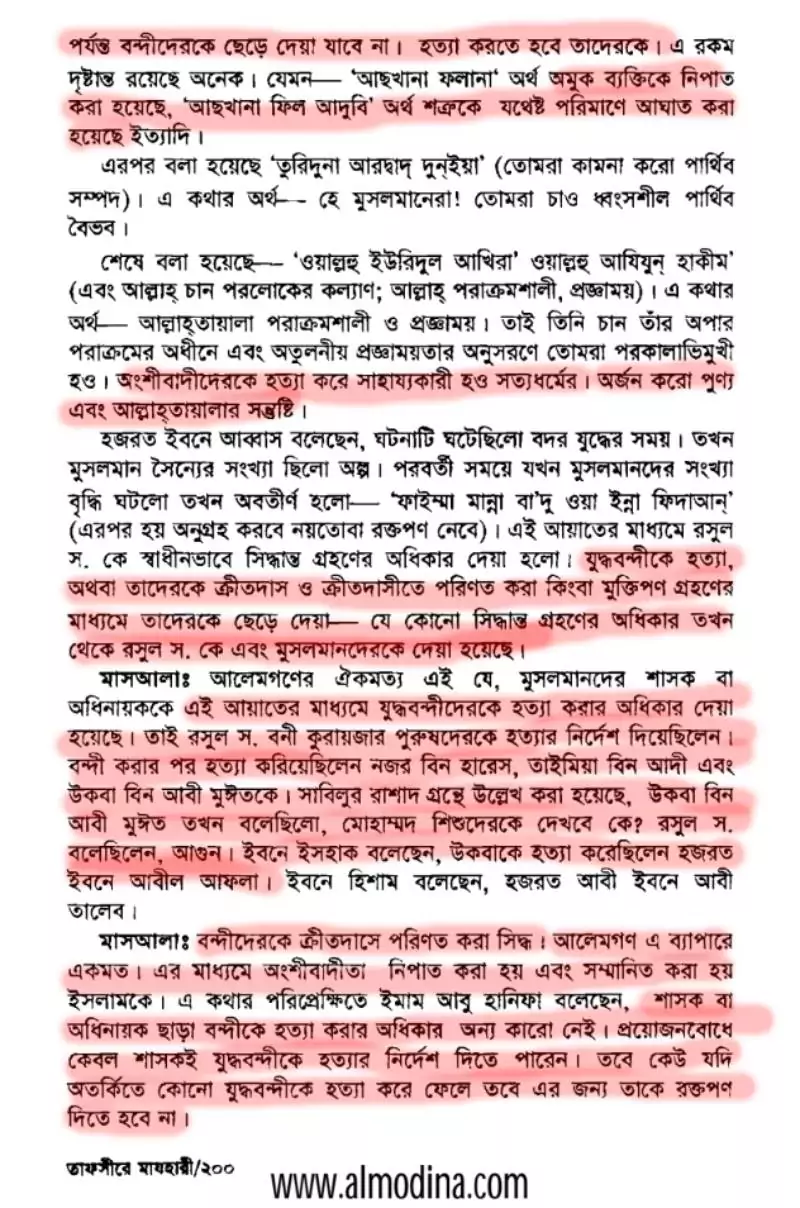
… until then, the prisoners must not be released. They must be killed. There are many such examples. For instance, ‘athkhana fulanan’ means that such-and-such a person has been struck down; ‘athkhana fi al-‘aduww’ means that the enemy has been dealt a sufficiently severe blow, and so on.
It then says ‘turiduna ‘arada al-dunya’ (you desire worldly wealth). This means: O Muslims! You desire the perishable riches of this world.
Finally, it says: ‘wa-Allahu yuridu al-akhirah; wa-Allahu ‘azizun hakim’ (and Allah desires the welfare of the hereafter; Allah is mighty and wise). This means that Allah Most High is mighty and wise. He therefore wishes you to turn toward the hereafter under His boundless might and in accordance with His incomparable wisdom. Support the true religion by killing the polytheists. Earn virtue and the pleasure of Allah Most High.
Hazrat Ibn ‘Abbas said that the incident occurred at the time of the Battle of Badr. Muslim soldiers were then few in number. Later, when the number of Muslims increased, the verse ‘fa-imma mannan ba‘du wa inna fida’an’ (then either show favor or take ransom) was revealed. Through this verse, the Messenger (peace be upon him) was given the right to decide freely. From then on, the Messenger (peace be upon him) and the Muslims were granted the right to choose any course: killing prisoners of war, turning them into male and female slaves, or releasing them in exchange for ransom.
Ruling: The scholars agree that this verse gives the Muslim ruler or commander the right to kill prisoners of war. Accordingly, the Messenger (peace be upon him) ordered the men of Banu Qurayza to be killed. He had Nazr ibn Harith, Taymiyya ibn ‘Adi, and ‘Uqbah ibn Abi Mu‘it killed after their capture. Sabil al-Rashad mentions that ‘Uqbah ibn Abi Mu‘it then said: Muhammad, who will look after the children? The Messenger (peace be upon him) said: Fire. Ibn Ishaq said that Hazrat Ibn Abi al-Afla killed ‘Uqbah. Ibn Hisham said: Hazrat Abi ibn Abi Talib.
Ruling: Enslaving prisoners is permissible. The scholars agree on this. Through it, polytheism is crushed and Islam is honored. In this connection, Imam Abu Hanifa said that no one except the ruler or commander has the right to kill a prisoner. Only the ruler may order a prisoner of war to be killed if necessary. However, if someone suddenly kills a prisoner of war, he will not have to pay blood money for it.
Two points in this discussion in Tafsir al-Mazhari are noteworthy. First, ‘Uqbah’s execution is used as an authorized example of killing a prisoner of war. Second, the same discussion presents killing and enslaving prisoners as alternatives at the ruler’s discretion. The prisoner’s individual rights, access to justice, or the safety of children dependent on him after his death are not primary considerations. Authority is centered on the victorious side’s ruler and his decision.
The relationship between these rules and ‘Uqbah’s story is direct. Muhammad ordered a prisoner of war to be executed, the prisoner asked who would take responsibility for his children, and the execution was carried out. Tafsir al-Mazhari uses that very incident to explain the lawfulness of killing prisoners of war. The incident therefore cannot be separated from the broader legal framework of Islamic military doctrine and the ruler’s power over captives.
‘Who Will Look after the Children?’—‘Fire’: The Meaning and Ethical Significance of the Statement
‘Uqbah’s question was من للصبية—Who will look after the children? The ordinary meaning of the Arabic sentence is: who will take responsibility for the children, care for them, and act as their guardian in their father’s absence? The man asking was a prisoner whose execution order was about to be carried out. Muhammad’s answer was النار—Fire. The most important consideration in determining the contextual meaning of the exchange is that the question concerns children, and the answer is a word whose ordinary meaning is fire.
The statement contains no promise of beneficial arrangements, shelter, or responsibility for the children. To a father facing execution, the answer ‘Fire’ is an extremely harsh and cruel response concerning his children. Whatever a person’s religious beliefs or offenses, dismissing the question of his children’s sustenance and safety with such an answer is contrary to a humane sense of responsibility. No offense by the children themselves is described; the situation they faced was a consequence of their father’s execution. Yet no humane reassurance was offered in answer to the question about that consequence.
More significantly, Muhammad was not a powerless spectator in this situation. The authority to decide whether the prisoner would be killed lay in his own hands. The victorious side possessed the administrative and military power to decide what would happen if the prisoner remained alive, whether ransom would be accepted, and whether he would be released. It was to the person possessing this power that the condemned father put his question about his children. The question therefore was not a matter of supernatural prophecy; it was a question of practical human responsibility put before a powerful ruler.
The Islamic accounts accuse ‘Uqbah of unbelief, insolence, and opposition to Muhammad. These accusations were not directed at his children. Even if a father is guilty, his children do not automatically bear responsibility for his offense. Executing a father creates the possibility of hunger, insecurity, loss of guardianship, and social vulnerability for his children. This harm had been raised in advance. It was therefore neither unknown nor unexpected. ‘Uqbah’s question confronted Muhammad directly with that consequence, and Muhammad’s answer was ‘Fire.’
The account in Sunan Abu Dawud also shows that ‘Uqbah’s son ‘Umara was alive in later years. During his dispute with Masruq, his father’s execution and the statement about the children were invoked again. This shows that not all of ‘Uqbah’s children were killed at the time of his execution or immediately afterward. But ‘Umara’s survival does not change the ethical character of Muhammad’s answer at the time of ‘Uqbah’s execution. The central question here is what was said about the children’s safety at the time of their father’s death.
Likewise, the central moral problem remains unchanged despite historical differences concerning how ‘Uqbah was executed, whether the executioner was ‘Asim or ‘Ali, or which narrator used which words. A captive father was killed after the battle had ended. Against the decision to kill him, he raised the question of his dependent children. Muhammad answered that question with ‘Fire.’ The father’s execution and such a response about the children’s future constitute an important historical example of cruel treatment of prisoners of war and indifference to children’s welfare.
‘Uqbah’s Story and Islam’s Military Policy toward Prisoners of War
‘Uqbah’s execution is a specific example of the victorious side’s power over prisoners of war. Although ransom was accepted for other prisoners of Badr, ‘Uqbah was killed. His religious opposition and insolence toward Muhammad were given as the reasons for his killing. His execution in captivity is preserved in classical hadith and historical works and was also used in later Islamic jurisprudence in discussions of the lawfulness of killing prisoners of war.
When this incident is considered alongside the killing of prisoners, slavery, and war’s consequences for women and children discussed earlier in the article, a broader structure becomes clear. The victorious side established control over the defeated side’s lives, freedom, property, and family security. Some prisoners were released for ransom, some were killed, and later Islamic jurisprudence also established rules for enslaving prisoners. At the center of decisions about which prisoner would be kept alive, killed, or enslaved stood the Muslim ruler’s power and the victorious side’s interests, rather than the prisoner’s free will or equal human rights.
Muhammad’s answer of ‘Fire’ to the question about ‘Uqbah’s children reveals a particularly brutal aspect of this system. Killing a prisoner of war does not merely end an individual’s life; it also directly affects his family, dependent children, and social relationships. A father asked about that effect at the moment of his death. The person answering was the very man on whose orders the father was being killed. When religious authority and the power of military victory become more important than the future of innocent children, the claim that such a system embodies universal justice or humanity clashes with its own historical records.
Fatawa-e-Alamgiri: Appallingly Brutal Rules
In the history of Islamic jurisprudence, or fiqh, Fatawa-e-Alamgiri (also known as Al-Fatawa al-Hindiyya) is an exceptionally influential and authoritative text. Compiled in the seventeenth century at the command of the Mughal emperor Aurangzeb, it is regarded as ‘the greatest monument of Muslim law produced in India.’ This is no ordinary book; it is a comprehensive legal code or constitution designed for governing a state on the basis of the Sunni Hanafi school.
To complete this compilation, Aurangzeb appointed 500 of the leading scholars of the world at that time. Under the leadership of Sheikh Nizam Burhanpuri, this vast body of scholars spent several years producing the work on the basis of the Quran and authentic hadith. Yet reading its chapters on ‘jihad’ and ‘spoils of war’ makes modern humanitarian sensibilities recoil. The forms of cruelty against non-Muslims legally authorized here correspond precisely to the definition of war crimes in today’s civilized world.
Let us briefly examine the terrifying instructions this work gives concerning jihad and non-Muslims: [27] –
During war against unbelievers, setting their homes on fire, destroying settlements with cannons, and breaching dams to flood their towns are entirely lawful. There are even instructions to destroy their crop fields and fell fruit-bearing trees. [6]
When Arab polytheists or those without a revealed scripture are defeated, there is no humane compassion for their women and children; they must be treated as ‘mal-e-ghanima,’ or plundered property, and distributed among the mujahids as slaves. [8]
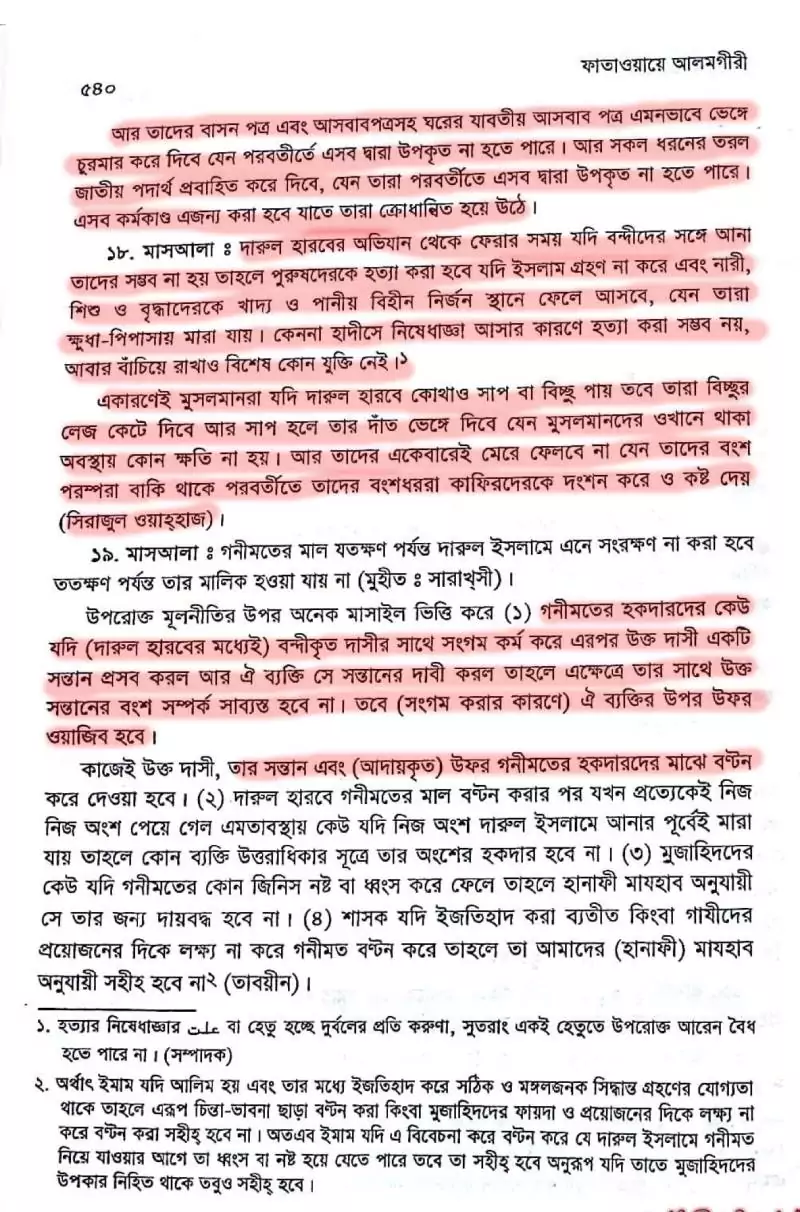
If it is impossible to bring prisoners back from the battlefield, the men are to be killed with the sword. Women, children, and the elderly, however, are to be abandoned in an uninhabited wilderness without food or drink so that they waste away from hunger and thirst. [10]
If unbelievers use a Muslim prisoner or child as a shield during battle, the attack must still not stop. Arrows must continue to be shot at the unbelievers, even with certain knowledge that those Muslims will die. [6]
It is impermissible simply to release prisoners without benefit or compensation, because they are then ‘eligible for enslavement.’ Even if a prisoner accepts Islam out of fear for his life, he is not released but remains a slave. [28]
Snakes and scorpions are invoked as analogies for the treatment of non-Muslims. Just as a snake’s fangs are broken so that it cannot bite, unbelievers are to be crushed so thoroughly that, even if their descendants survive, they cannot raise their heads. [10]
Section Two
Methods of Jihad and Fighting
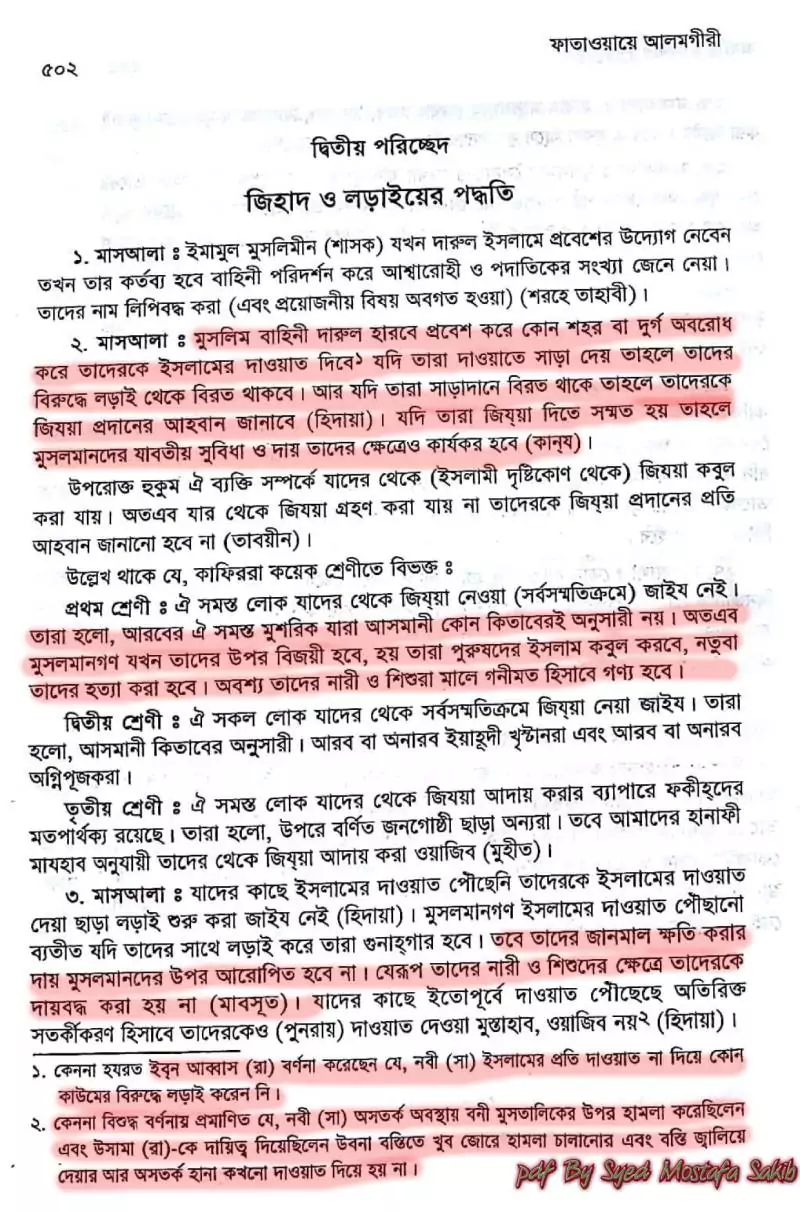
1. Ruling: When the imam of the Muslims (the ruler) prepares to enter dar al-Islam, his duty is to inspect the army and ascertain the numbers of cavalry and infantry, record their names, and obtain the necessary information (Sharh al-Tahawi).
2. Ruling: When the Muslim army enters dar al-harb and besieges a city or fortress, it shall invite its inhabitants to Islam.1 If they respond to the invitation, it shall refrain from fighting them. If they refuse to respond, it shall call upon them to pay jizya (Al-Hidaya). If they agree to pay jizya, all the privileges and liabilities of Muslims will apply to them as well (Kanz).
The above rule applies to those from whom jizya may be accepted from an Islamic standpoint. Those from whom jizya cannot be accepted shall therefore not be invited to pay it (Al-Tabyin).
It should be noted that unbelievers are divided into several categories:
First category: Those from whom taking jizya is, by unanimous agreement, impermissible.
These are the Arab polytheists who follow no revealed scripture. Accordingly, when Muslims defeat them, their men must either accept Islam or be killed. Their women and children, however, will be treated as spoils of war.
Second category: Those from whom taking jizya is, by unanimous agreement, permissible. These are the followers of revealed scriptures: Arab or non-Arab Jews and Christians, and Arab or non-Arab fire-worshippers.
Third category: Those concerning whom jurists disagree about the collection of jizya. These are people other than the groups described above. According to our Hanafi school, however, collecting jizya from them is obligatory (Al-Muhit).
3. Ruling: It is impermissible to begin fighting those whom the invitation to Islam has not reached
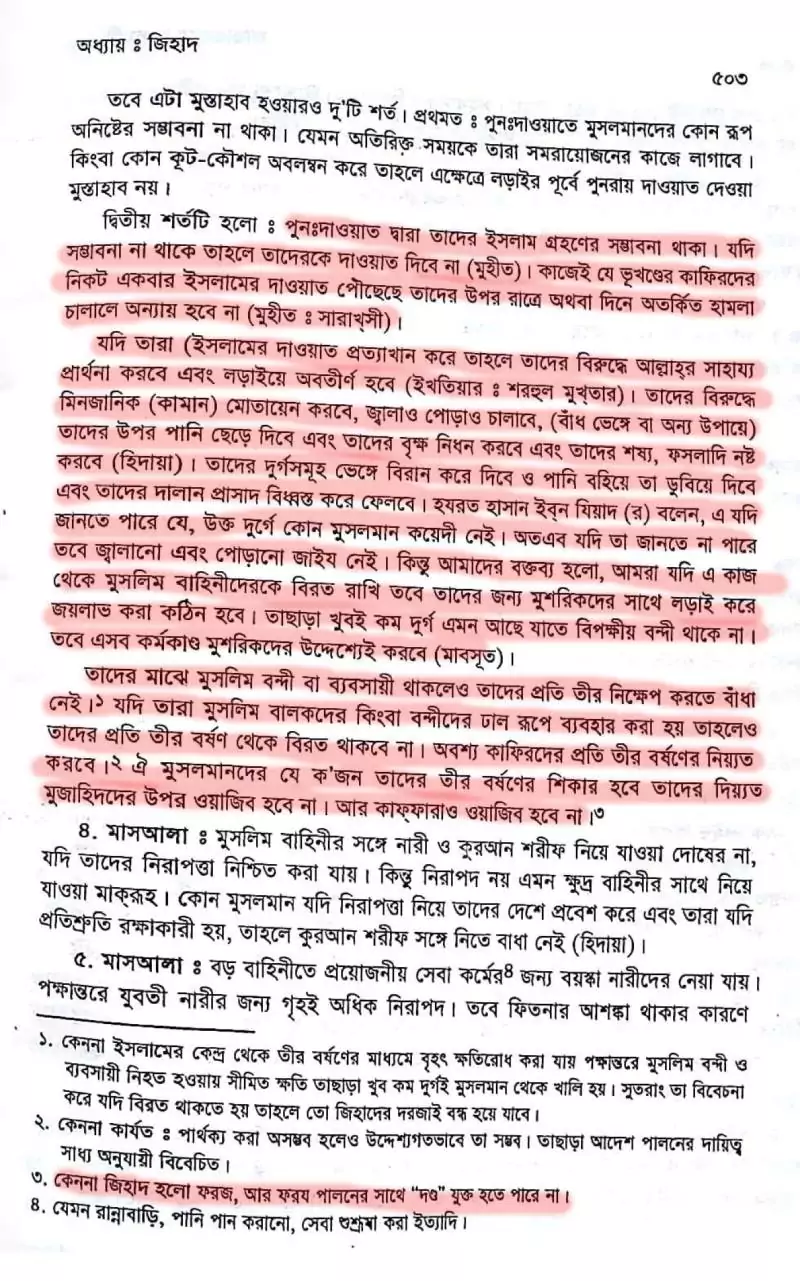
without first inviting them to Islam (Al-Hidaya). If Muslims fight them without conveying the invitation to Islam, they will be sinful. However, the Muslims will bear no liability for harm to their lives and property, just as they are not held liable in the case of their women and children (Al-Mabsut). For those who have already received the invitation, inviting them again as an additional warning is recommended, not obligatory.2 (Al-Hidaya).
………
1. For Hazrat Ibn ‘Abbas (may Allah be pleased with him) narrated that the Prophet (peace be upon him) never fought a people without first inviting them to Islam.
2. For authentic narration establishes that the Prophet (peace be upon him) attacked Banu al-Mustaliq while they were off guard, and instructed Usama (may Allah be pleased with him) to launch a forceful attack on the settlement of Ubna and burn it down. A surprise raid is never conducted after issuing an invitation.
………
However, its recommended status is subject to two conditions. First, renewing the invitation must pose no risk of harm to the Muslims. For example, if the enemy would use the additional time for military preparations or adopt some stratagem, then renewing the invitation before fighting is not recommended.
The second condition is that renewing the invitation should offer a prospect of their accepting Islam. If there is no such prospect, they should not be invited (Al-Muhit). Thus there is no wrongdoing in launching a surprise attack, by night or day, on unbelievers in a territory where the invitation to Islam has already reached them once (Al-Muhit: Sarangi).
If they reject the invitation to Islam, seek Allah’s help against them and engage in battle (Al-Ikhtiyar: Sharh al-Mukhtar). Deploy catapults (cannons) against them, carry out burning and destruction, release water upon them by breaching dams or other means, fell their trees, and destroy their grain and crops (Al-Hidaya). Demolish their fortresses and lay them waste, inundate them with water, and destroy their buildings and palaces. Hazrat Hasan ibn Ziyad (may Allah have mercy on him) says this applies if it is known that there are no Muslim prisoners in the fortress. If that is not known, burning and setting fires are impermissible. But our position is that if we prohibit the Muslim forces from doing this, it will be difficult for them to fight and defeat the polytheists. Moreover, very few fortresses contain no enemy prisoners. These actions, however, must be directed at the polytheists (Al-Mabsut).
There is no impediment to shooting arrows at them even if Muslim prisoners or merchants are among them.1 Even if Muslim boys or prisoners are used as shields, shooting arrows at them must not cease. The intention, however, must be to shoot at the unbelievers.2 The mujahids will not be obligated to pay blood money for any of those Muslims struck by their arrows. Nor will expiation be obligatory.3
4. Ruling: There is no fault in taking women and the Holy Quran with the Muslim army if their safety can be ensured. But taking them with a small force whose safety is uncertain is reprehensible. If a Muslim enters their country under a guarantee of safety, and they honor their pledges, there is no impediment to taking the Holy Quran along (Al-Hidaya).
5. Ruling: Elderly women may be taken with a large army to perform necessary service duties. For young women, however, the home is safer. But because of the risk of temptation
………
1. For shooting arrows can avert great harm to the center of Islam, whereas the killing of Muslim captives and merchants causes limited harm. Moreover, very few fortresses are empty of Muslims. If this consideration required abstention, the very door of jihad would be closed.
2. For although making the distinction in practice is impossible, it is possible in intention. Moreover, the duty to carry out a command is assessed according to one’s ability.
3. For jihad is obligatory, and ‘punishment’ cannot be attached to the performance of an obligation.
4. Such as cooking, providing drinking water, nursing, and so on.
………
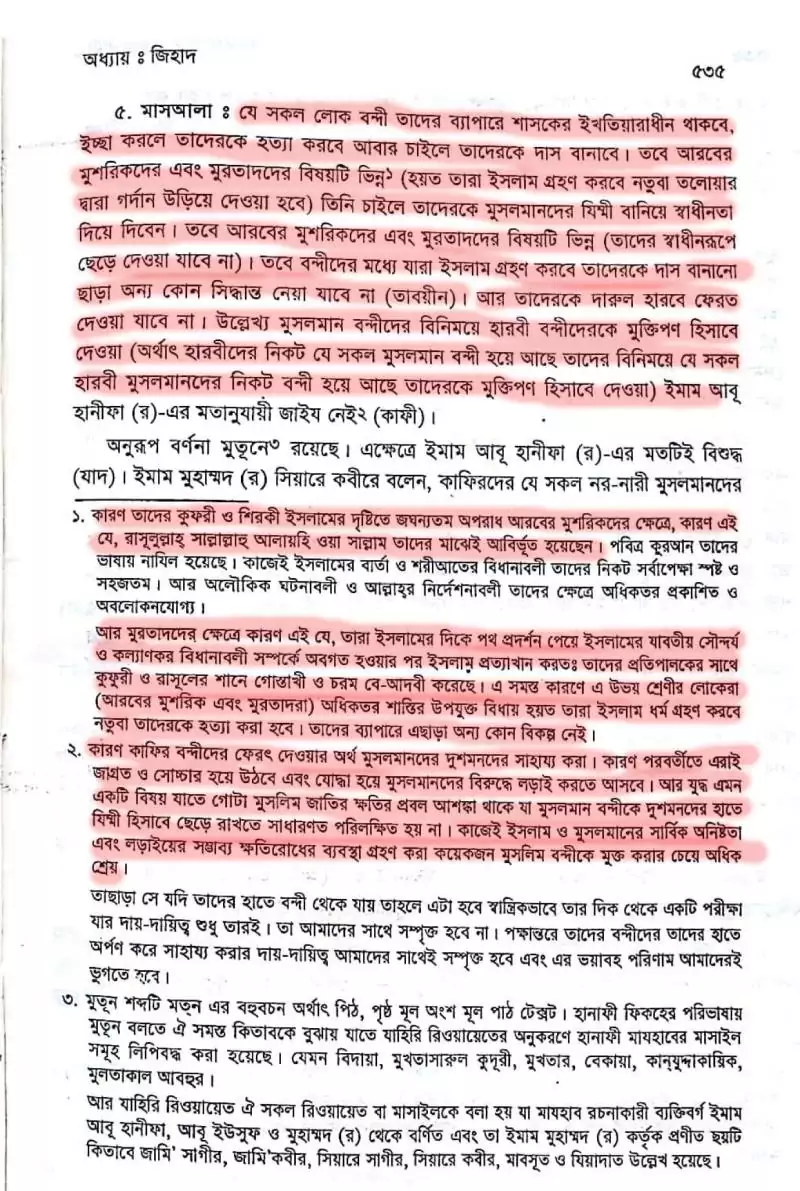
5. Ruling: The fate of those taken prisoner shall lie within the ruler’s discretion:
he may kill them if he wishes, or enslave them if he wishes. Arab polytheists and apostates, however, are treated differently1 (they must either accept Islam or have their heads struck off with the sword). If he wishes, he may make them dhimmis under the Muslims and grant them freedom. Arab polytheists and apostates, however, are treated differently (they cannot be released as free people). For prisoners who accept Islam, no decision other than enslavement may be made (Al-Tabyin). Nor may they be returned to dar al-harb. According to Imam Abu Hanifa (may Allah have mercy on him), it is impermissible to release harbi prisoners as ransom in exchange for Muslim prisoners—that is, to give the harbis held captive by Muslims in exchange for Muslims held captive by harbis.2 (Al-Kafi).
A similar statement also appears in the mutun. In this matter, Imam Abu Hanifa’s view is the correct one (Zad). Imam Muhammad (may Allah have mercy on him) states in Al-Siyar al-Kabir: those men and women of the unbelievers whom the Muslims
………
1. Because their unbelief and polytheism are the most heinous offenses in Islam’s eyes. In the case of Arab polytheists, the reason is that Allah’s Messenger (peace and blessings of Allah be upon him) appeared among them. The Holy Quran was revealed in their language. Thus the message of Islam and the rules of Sharia are clearest and most accessible to them. Miraculous events and Allah’s signs are also more manifest and observable to them.
In the case of apostates, the reason is that, after receiving guidance toward Islam and becoming acquainted with all its beauties and beneficial rules, they rejected Islam, disbelieved in their Lord, and showed insolence and extreme disrespect toward the Messenger. For all these reasons, both groups—Arab polytheists and apostates—deserve greater punishment: they must either accept Islam or be killed. There is no other alternative for them.
2. Because returning unbelieving prisoners means helping the Muslims’ enemies. These very people will later become active and outspoken and return as warriors to fight the Muslims. War carries a serious risk of harm to the entire Muslim community, which is generally not present when a Muslim prisoner is left hostage in enemy hands. Therefore, taking measures to prevent overall harm to Islam and the Muslims and the potential damage of warfare is more
desirable than freeing a few Muslim prisoners.
Furthermore, if he remains their prisoner, it is a trial personal to him, the responsibility for which is his alone. It does not attach to us. By contrast, responsibility for helping them by handing their prisoners back to them attaches to us, and we must suffer its terrible consequences.
3. The word mutun is the plural of matn, meaning back, surface, main part, original wording, or text. In Hanafi jurisprudential terminology, mutun refers to books in which the rulings of the Hanafi school are recorded following the zahir al-riwaya. Examples include Al-Bidaya, Mukhtasar al-Quduri, Al-Mukhtar, Al-Wiqaya, Kanz al-Daqa’iq, and Multaqa al-Abhur.
Zahir al-riwaya refers to the reports or rulings transmitted from the founders of the school—Imam Abu Hanifa, Abu Yusuf, and Muhammad (may Allah have mercy on them)—and recorded in the six books composed by Imam Muhammad (may Allah have mercy on him): Al-Jami‘ al-Saghir, Al-Jami‘ al-Kabir, Al-Siyar al-Saghir, Al-Siyar al-Kabir, Al-Mabsut, and Al-Ziyadat.
………
7. Ruling: Showing favor to prisoners—that is, simply releasing them without enslaving them, making them dhimmis, or killing them—is impermissible.1 (Al-Kafi).
8. Ruling: Imam Muhammad (may Allah have mercy on him) says: if the parents of polytheist children are captured along with them, those children may be given in ransom.2 But if only the children are captured, without their parents, and are brought to dar al-Islam, they cannot be given in ransom.
Likewise, if the spoils are distributed in dar al-harb and a child falls to someone’s share, or the spoils are sold there and someone acquires ownership of that child by purchase, the child will be regarded as Muslim by following that person’s status (Al-Muhit).
9. Ruling: Imam Muhammad (may Allah have mercy on him) says: if the Muslims seize horses and
weapons from the unbelievers, and the latter then wish to redeem them for money, granting them that opportunity is impermissible. If, on the other hand, they request, ‘Return our prisoners to us and take one—or, they say, two—polytheists in exchange,’ it is impermissible for Muslims to do so. Dirhams, dinars, and articles that are neither implements nor materials of war, such as clothing and food, may be given in exchange for Muslims held captive in dar al-harb. Giving equipment of war, such as weapons, horses, and iron, is impermissible (Siraj al-Wahhaj).
10. Ruling: Imam Muhammad (may Allah have mercy on him) states in Al-Siyar al-Kabir: if a free Muslim or dhimmi is held prisoner in dar al-harb and tells a Muslim or dhimmi who is there under a guarantee of safety, ‘Secure my release by ransom or purchase me,’ and that person does so and brings him to dar al-Islam, he will be considered free. The ransom or purchase price will be considered a debt owed by him. The person instructed will therefore recover from him the amount paid as ransom. However, the recoverable ransom must be within the amount of blood money. If a ransom greater than the prescribed blood money was paid, only the amount of the prescribed blood money may be recovered, and no more.
Some have said that, according to Imam Abu Hanifa’s statement, the applicable rule should be that whatever the instructed person paid as ransom may be recovered from the person who gave the instruction (the prisoner), regardless of whether it was less or more than the prescribed blood money. But the most correct position is that, according to all of them—Imam Abu Hanifa, Abu Yusuf, and Muhammad (may Allah have mercy on them)—the rule first stated applies in this case.
………
1. For it is declared: Kill the polytheists wherever you find them (Surah al-Baqarah). Moreover, by being captured and brought under control, they become eligible for enslavement, and Muslims have a right in this. It is therefore impermissible to relinquish that right without benefit or compensation. There is also a strong possibility that they will later harm and injure the Muslims.
2. Because these are equipment of war and among the means of defeating the enemy on the battlefield.
………
Their utensils, furnishings, and all household goods shall be smashed so that they cannot benefit from them afterward. All kinds of liquids shall be poured out so that they cannot benefit from them afterward. These actions shall be carried out to enrage them.
18. Ruling: If, on returning from an expedition into dar al-harb, bringing the prisoners with them
is impossible, the men shall be killed unless they accept Islam, and the women, children, and elderly women shall be abandoned in a deserted place without food or drink so that they die of hunger and thirst. For killing them is not possible because of the prohibition in hadith, while there is no particular reason to keep them alive.1
For this reason, if Muslims find snakes or scorpions anywhere in dar al-harb, they shall cut off the scorpions’ tails and break the snakes’ fangs so that they cause no harm while the Muslims remain there. They shall not kill them outright, so that their lineage survives and their descendants later bite the unbelievers and cause them suffering (Siraj al-Wahhaj).
19. Ruling: Ownership of spoils of war is not acquired until they have been brought into dar al-Islam and secured (Al-Muhit: Sarangi).
Many rulings rest on the above principle: (1) If someone entitled to a share of the spoils has intercourse with a captured slave woman while still in dar al-harb, and she subsequently gives birth to a child whom he claims as his own, the child’s lineage will not be established through him. However, he will be obligated to pay ‘uqr because of the intercourse.
Accordingly, the slave woman, her child, and the collected ‘uqr shall be distributed among those entitled to the spoils. (2) If, after the spoils have been distributed in dar al-harb and everyone has received their share, someone dies before bringing his share into dar al-Islam, no one will be entitled to inherit that share. (3) If one of the mujahids damages or destroys an item of booty, he will not be liable for it according to the Hanafi school. (4) If the ruler distributes the spoils without exercising ijtihad or considering the warriors’ needs, the distribution will not be valid according to our Hanafi school.2 (Al-Tabyin).
………
1. The reason or underlying cause of the prohibition on killing is compassion for the weak. For the same reason, the above order cannot be lawful. (Editor)
2. That is, if the imam is a scholar qualified to exercise ijtihad and reach a correct and beneficial decision, distributing the spoils without such deliberation or without considering the mujahids’ benefit and needs will be invalid. If, therefore, the imam distributes them on the consideration that they might be destroyed or spoiled before reaching dar al-Islam, the distribution will be valid. Likewise, it will be valid if it benefits the mujahids.
Surprise Attacks under Cover of Darkness: When Civilian Women and Children Become Spoils of War
In any civilized society or modern international rules of warfare, there is a definite dividing line between guerrilla attacks and ordinary robbery. In guerrilla warfare, only armed enemy soldiers are targeted. But when an attack targets sleeping, unarmed civilians, deprives children of security for their lives, and treats women as property, it can no longer be called ‘war’; it becomes organized ‘robbery’ or a ‘war crime.’ The surprise attacks of early Islam—called ‘tabyit’ in the terminology of prophetic biography—were precisely this brutal. Under cover of darkness, while people were fast asleep, Muslim forces suddenly descended on their settlements. These attacks offered neither the opportunity nor the willingness to distinguish women and children. The Prophet Muhammad’s instruction was exceptionally clear: since it is difficult to distinguish friend from foe in the darkness, harm to women and children in unbelievers’ families during such attacks is indifferently turned into collateral damage. In other words, night raids were authorized even when the deaths of women and children were inevitable or foreseeable; their lives were not treated as having independent moral value. Those who survived these brutal attacks met an even more tragic fate: they were captured, used as sex slaves, and sold in markets. From the standpoint of modern human rights, this is not merely inhumane but a horrific war crime.
Surprise Night Attacks Dependent on Hearing the Call to Prayer
The following hadith shows that Muhammad’s criterion for attack was neither justice nor self-defense, but a particular form of religious aggression. If the call to prayer was heard in a settlement, its people were spared; otherwise, a bloody attack was launched against them. In other words, the security of people’s lives depended on whether they had accepted Muhammad’s religion. [29]
Sahih Muslim (Islamic Foundation)
4/ Book of Prayer
Chapter: 6. Refraining from Attacking a Tribe in Dar al-Kufr, or a Non-Muslim Country, if the Call to Prayer Is Heard among Them
Islamic Foundation number: 733; International number: 382
733. Zuhayr ibn Harb (may Allah have mercy on him) … narrated from Anas ibn Malik (may Allah be pleased with him), who said: Allah’s Messenger (peace and blessings of Allah be upon him) used to attack the enemy at dawn. He would wait to hear the call to prayer. If he heard it, he would refrain from attacking. If he did not hear it, he would attack. Once he heard a man saying اللَّهُ أَكْبَرُ اللَّهُ أَكْبَرُ. Allah’s Messenger (peace and blessings of Allah be upon him) then said: You are upon the fitra (the religion of Islam). The man then said أَشْهَدُ أَنْ لاَ إِلَهَ إِلاَّ اللَّهُ أَشْهَدُ أَنْ لاَ إِلَهَ إِلاَّ اللَّهُ. Allah’s Messenger (peace and blessings of Allah be upon him) said: You have come out of hell. The noble Companions looked at the man and found that he was a shepherd.
Hadith grading: Sahih (Authentic)
Narrator: Anas ibn Malik (may Allah be pleased with him)
Inviting Non-Muslims to Islam and Attacking Them if They Do Not Accept
This hadith drives the final nail into the coffin of Islam’s claims to be ‘peaceful’ and ‘defensive.’ Here, the Banu al-Mustaliq were not preparing for war; they were peacefully watering their animals. While they were unprepared, an attack was launched without any declaration, their warriors were killed, and their women, including Juwayriyya, daughter of al-Harith, were taken captive. This was not bravery but a glaring example of extreme deception and betrayal. In seeking to justify this attack in various ways, Islamic preachers say that Banu al-Mustaliq must have committed some grave wrong and that the attack was punishment for it. But even if that claim is accepted for the sake of argument, it is incomprehensible how they consider attacking and killing civilian women and children, enslaving them for use or selling them in markets, to be moral acts. [30]
Sahih Muslim (Islamic Foundation)
Book: 33/ Jihad and Its Rules
Chapter: 1. It Is Lawful to Attack without Prior Notice Those Non-Muslims Whom the Invitation to Islam Has Reached
4370. Yahya ibn Yahya al-Tamimi (may Allah have mercy on him) … narrated from Ibn ‘Awn (may Allah have mercy on him), who said: I wrote to Nafi‘ (may Allah have mercy on him) asking whether it was necessary to invite non-Muslims to the religion before fighting them. He said: He wrote back to me that this rule applied in the early days of Islam. Allah’s Messenger (peace and blessings of Allah be upon him) attacked Banu al-Mustaliq while they were unprepared (and unaware of it). Their animals were being watered. He then killed their warriors (adult men) and captured the rest (women and children). On that day he acquired (Yahya said: I think he said) Juwayriyya, or he definitely said Ibnat al-Harith (the daughter of al-Harith). The narrator said: ‘Abdullah ibn ‘Umar (may Allah be pleased with him) narrated this hadith to me. He had been in that army.
Hadith grading: Sahih (Authentic)
Narrator: Ibn ‘Awn (may Allah have mercy on him)
This was not the only example. Almost the same thing happened during the attack on Awtas. In that case, the unbelieving tribe had brought their wives and children with them because their departure for war had left their territory unprotected. But those women and children were in no sense participants in the battle. They had merely accompanied the warriors, pitching tents at a designated place away from the battlefield and waiting there. The Muslims took those women and children as spoils of war and took the women to bed while their husbands were still present. [31]
Sahih Muslim (Hadith Academy)
18. Breastfeeding
Chapter: 9. Intercourse with a Female War Captive Is Permissible after Istibra’, and Her Marriage Is Annulled Even if Her Husband Is Still Living
Hadith Academy number: 3500; International number: 1456
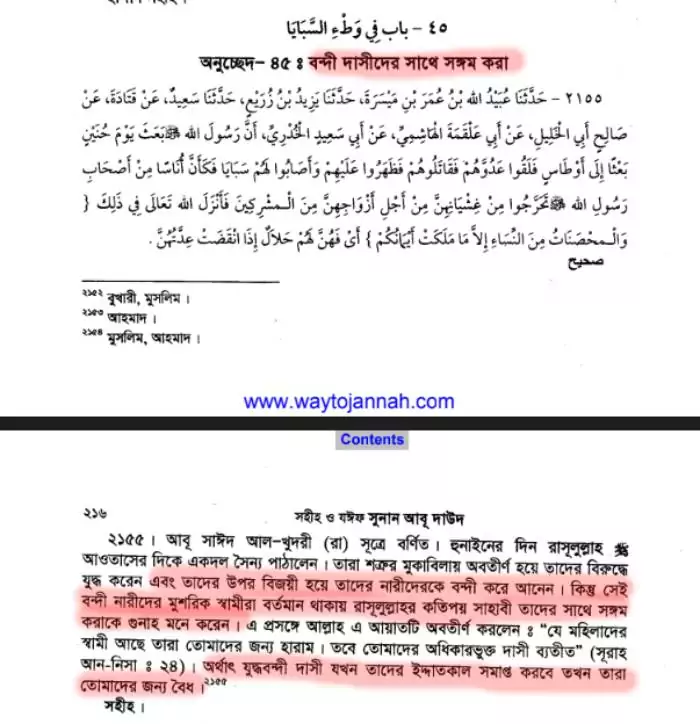
3500-(33/1456) ‘Ubaydullah ibn ‘Umar al-Maysara al-Qawariri (may Allah have mercy on him) ….. narrated from Abu Sa‘id al-Khudri (may Allah be pleased with him) that Allah’s Messenger (peace and blessings of Allah be upon him) sent a detachment toward Awtas during the Battle of Hunayn. They encountered the enemy, fought and defeated them, and took many captives. Some Companions of Allah’s Messenger (peace and blessings of Allah be upon him) apparently considered sexual intercourse with the slave women among them impermissible because their polytheist husbands were still living. Allah Most High revealed this verse: ‘And all married women are forbidden to you except the slave women whom you possess’—meaning that they are lawful for you once they have completed their waiting period (‘iddah). (Islamic Foundation 3473; Islamic Centre 3472)
[Istibra’ means waiting until childbirth if the woman is pregnant, or otherwise until one menstrual period has passed.]
Hadith grading: Sahih (Authentic)
Narrator: Abu Sa‘id al-Khudri (may Allah be pleased with him)
How Captive Women and Children Were Divided
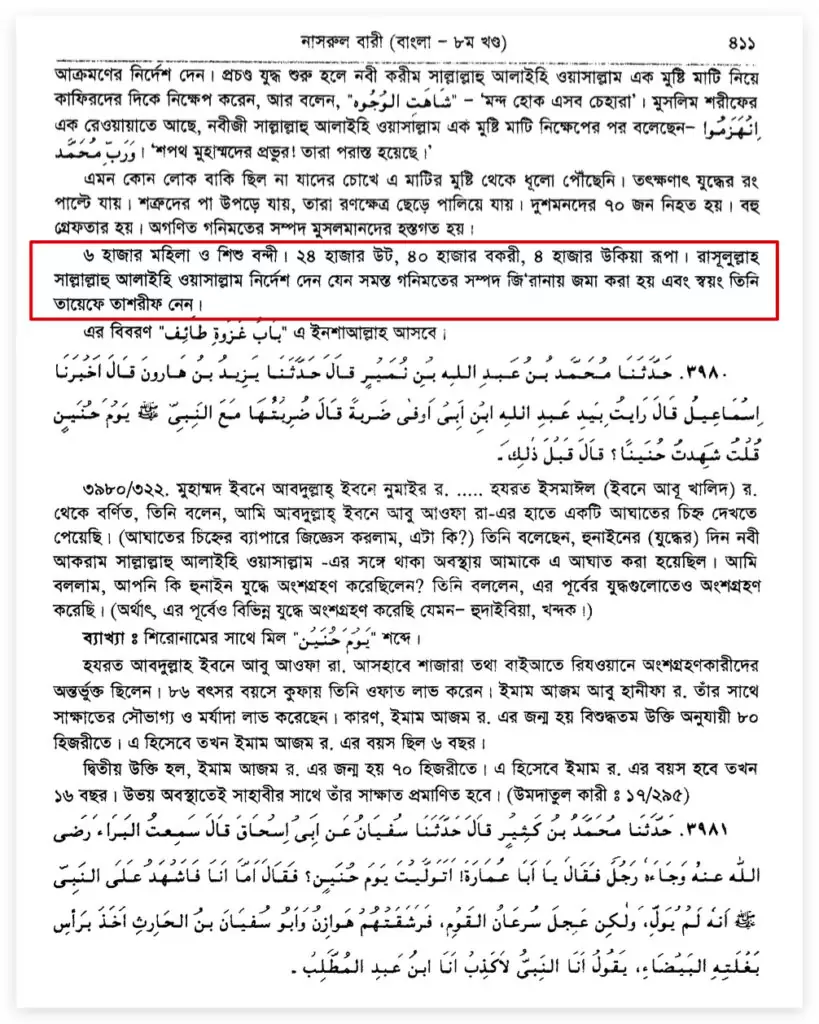
Attacking the unbelievers, the Prophet Muhammad and his Companions plundered spoils on a scale illustrated by the following example. Muhammad and his Companions carried out countless such attacks and plundered the property of countless tribes. [9]
Nasrul Bari (Bengali, Vol. 8), p. 411
He ordered the attack. When fierce fighting began, the noble Prophet (peace and blessings of Allah be upon him) took a handful of earth and threw it toward the unbelievers, saying, “شاهت الوجوه”—‘May these faces be disfigured.’ One narration in Sahih Muslim states that, after throwing a handful of earth, the Prophet (peace and blessings of Allah be upon him) said: انْهزموا ورب محمد . ‘By the Lord of Muhammad! They have been defeated.’
Not a single person remained whose eyes were untouched by dust from that handful of earth. The course of the battle changed immediately. The enemy lost its footing and fled the battlefield. Seventy enemies were killed. Many were captured. Countless spoils came into Muslim hands.
Six thousand women and children were taken captive. Twenty-four thousand camels, forty thousand goats, and four thousand uqiyyas of silver. Allah’s Messenger (peace and blessings of Allah be upon him) ordered all the spoils to be gathered at Ji‘rana, while he himself proceeded to Ta’if.
The account of this will appear, Allah willing, in “باب غزوة طائف”.
مُحَمَّد بن عبد الله بن نُمَيْرٍ قَالَ حَدَّثَنَا يَزِيدُ بن هَارُونَ قَالَ أَخْبَرَنَا ۳۹۸۰. حَدَّثَنَا مُحَمَّد بن عَبدِ ال اسْمَاعِيلُ قَالَ رَايْتُ بَيْدِ عَبدِ اللهِ ابْنِ أَبِي أوفى ضَربَةً قَالَ ضُرِبَتُهَا مَعَ النَّبِيِّ اللَّهِ يَوْمَ حُنين قلت شهدتُ حُنَيْنَا ؟ قَالَ قَبْلَ ذَلِكَ .
3980/322. Muhammad ibn ‘Abdullah ibn Numayr (may Allah have mercy on him) narrated from Hazrat Isma‘il (ibn Abu Khalid) (may Allah have mercy on him), who said: I saw the mark of a wound on the hand of ‘Abdullah ibn Abu Awfa (may Allah be pleased with him). I asked about the scar: What is this? He said: I received this wound on the day of the Battle of Hunayn, while I was with the noble Prophet (peace and blessings of Allah be upon him). I asked: Did you take part in the Battle of Hunayn? He replied: I also took part in the battles before it. (That is, I had participated in various earlier battles, such as Hudaybiyya and the Trench.)
Explanation: The correspondence with the chapter heading lies in the words “يَوْمَ حُنَيْن”.
The allocation of one-fifth (khums) of this vast plunder to the Prophet himself demonstrates that this jihad was not merely ideological; a powerful economic greed also lay behind it. [32]
Sahih al-Bukhari (Tawhid)
Book: 57/ Khums (One-Fifth)
Chapter: 57/7. The saying of Allah Most High: ‘Indeed, one-fifth belongs to Allah and the Messenger’ (Al-Anfal 41). The right to distribute it belongs to the Messenger. Allah’s Messenger (peace and blessings of Allah be upon him) said: I am the distributor and custodian, while Allah Most High is the giver.
3117. Narrated Abu Hurayrah (may Allah be pleased with him): Allah’s Messenger (peace and blessings of Allah be upon him) said: ‘I neither give to you nor withhold from you. I am only a distributor; I spend as I am commanded.’ (Adhunik Prakashani: 2883; Islamic Foundation: 2894)
Hadith grading: Sahih (Authentic)
Narrator: Abu Hurayrah (may Allah be pleased with him)
When Female War Captives Became the Companions’ Sex Slaves
Let us examine some more hadith: [33] [34] [35] [36] [37] [38] –
Sunan Abu Dawud (Islamic Foundation)
6/ Marriage
Chapter: 139. Intercourse with Captive Women.
2152. ‘Ubaydullah ibn ‘Umar ibn Maysara …… narrated from Abu Sa‘id al-Khudri (may Allah be pleased with him), who said: Allah’s Messenger (peace and blessings of Allah be upon him) sent a military detachment to a place called Awtas during the Battle of Hunayn. They confronted their enemies, killed them, and prevailed over them. At that time, they captured some women of the Hawazin tribe as prisoners. Some Companions of Allah’s Messenger (peace and blessings of Allah be upon him) then considered it sinful to have intercourse with them without entitlement, because their polytheist husbands were then prisoners. Allah Most High then revealed this verse: (Meaning) Women who have husbands are forbidden to you. Except the slave women whom you possess—that is, women who come under your control as war captives are lawful for you after completing their menstrual waiting period (‘iddah).
Hadith grading: Sahih (Authentic)
Narrator: Abu Sa‘id al-Khudri (may Allah be pleased with him)
Sunan Abu Dawud (Islamic Foundation)
6/ Marriage
Chapter: 139. Intercourse with Captive Women .
154. ‘Amr ibn ‘Awn …… narrated from Abu Sa‘id al-Khudri (may Allah be pleased with him), who said: Allah’s Messenger (peace and blessings of Allah be upon him) declared: Do not have intercourse with a pregnant captive woman until she gives birth, or with another woman until she becomes clean after her menstrual period.
Hadith grading: Sahih (Authentic)
Narrator: Abu Sa‘id al-Khudri (may Allah be pleased with him)
Sahih Muslim (Hadith Academy)
17. Marriage
Chapter: 22. The Ruling on ‘Azl (Withdrawal)
Hadith Academy number: 3436,
International number: 1438
3436-(125/1438) Yahya ibn Abu Ayyub, Qutayba ibn Sa‘id, and ‘Ali ibn Hujr (may Allah have mercy on them) ….. narrated from Ibn Muhayriz (may Allah have mercy on him), who said: Abu Sirma (may Allah have mercy on him) and I went to Abu Sa‘id al-Khudri (may Allah be pleased with him). Abu Sirma asked him: O Abu Sa‘id! Did you hear Allah’s Messenger (peace and blessings of Allah be upon him) discuss ‘azl? He said: Yes. We fought Banu al-Mustaliq alongside Allah’s Messenger (peace and blessings of Allah be upon him). In that battle, we captured the most beautiful slave women of Arabia. We had long been deprived of our wives’ company, and we were also eager for wealth. In these circumstances, we wished to satisfy ourselves with the slave women and practice ‘azl. But we also discussed whether we should do this while Allah’s Messenger (peace and blessings of Allah be upon him) was among us. Should we not ask him about it? So we asked Allah’s Messenger (peace and blessings of Allah be upon him). He said: There is no harm to you in not doing that. For every human being whom Allah Most High has decreed to create until the Day of Resurrection will certainly be created. (Islamic Foundation 3409; Islamic Centre 3408)
Hadith grading: Sahih (Authentic)
Narrator: Ibn Muhayriz (may Allah have mercy on him)
Sahih al-Bukhari (Tawhid Publication)
64/ Military Expeditions [Battles]
Chapter: 64/32. The Battle of Dhat al-Riqa‘.
قَالَ ابْنُ إِسْحَاقَ وَذَلِكَ سَنَةَ سِتٍّ وَقَالَ مُوْسَى بْنُ عُقْبَةَ سَنَةَ أَرْبَعٍ وَقَالَ النُّعْمَانُ بْنُ رَاشِدٍ عَنْ الزُّهْرِيِّ كَانَ حَدِيْثُ الإِفْكِ فِيْ غَزْوَةِ الْمُرَيْسِيْعِ
Ibn Ishaq (may Allah have mercy on him) said this battle took place in the sixth year of the Hijra. Musa ibn ‘Uqbah (may Allah have mercy on him) said it took place in the fourth year of the Hijra. Nu‘man ibn Rashid (may Allah have mercy on him) narrated from al-Zuhri (may Allah have mercy on him) that the incident of the slander occurred during the campaign of al-Muraysi‘.
4138.Narrated Ibn Muhayriz (may Allah have mercy on him): Once I entered the mosque, saw Abu Sa‘id al-Khudri (may Allah be pleased with him), sat beside him, and asked about ‘azl. Abu Sa‘id al-Khudri (may Allah be pleased with him) said: We took part in the campaign against Banu al-Mustaliq with Allah’s Messenger (peace and blessings of Allah be upon him). In that campaign, many Arab captives came into our possession. We felt desire for the women, and being unmarried and without wives was difficult for us. So we preferred to practice ‘azl and decided to do so. Then we said to one another: Allah’s Messenger (peace and blessings of Allah be upon him) is among us, yet we are about to practice ‘azl without asking him. When we asked him about it, he said: What harm is there to you if you do not do it? Every soul that is to come into existence until the Day of Resurrection will certainly come into existence. [2229; Muslim, Divorce/21, Hadith 1438; Ahmad 11839] (Adhunik Prakashani: 3826; Islamic Foundation: 3829)
Hadith grading: Sahih (Authentic)
Narrator: Ibn Muhayriz (may Allah have mercy on him)
Sahih Muslim (Hadith Academy)
17. Marriage
Chapter: 22. The Ruling on ‘Azl (Withdrawal)
Hadith Academy number: 3451; International number: 1440
3451-(136/1440) Abu Bakr ibn Abu Shayba and Ishaq ibn Ibrahim (may Allah have mercy on them) ….. narrated from Jabir (may Allah be pleased with him), who said: We practiced ‘azl while the Quran was being revealed. Ishaq added that Sufyan (may Allah have mercy on him) said: If there had been anything in it that warranted prohibition, the Quran would have forbidden it. (Islamic Foundation 3424; Islamic Centre 3423)
Hadith grading: Sahih (Authentic)
Narrator: Jabir ibn ‘Abdullah al-Ansari (may Allah be pleased with him)
Authorization for Killing Women and Children in the Darkness of Night
The brutality of jihad reaches a further extreme when even attacks on unbelievers’ children under cover of darkness are lawful under Islamic rules. When Muhammad’s Companions hesitantly asked him about women and children being killed in night raids, Muhammad answered without remorse or caution: ‘They too (the women and children) are of them (the polytheists).’ In other words, because they were non-Muslims, children’s lives had no separate value to Muhammad. Such collective punishment is regarded as one of the most heinous crimes in modern civilization. [39] [40] [41] [42]!
Sahih Muslim (Islamic Foundation)
Book: 33/ Jihad and Its Rules
Chapter: 9. In Surprise Night Attacks, There Is No Fault in the Unintentional Killing of Women and Children
4399. Yahya ibn Yahya, Sa‘id ibn Mansur, and ‘Amr al-Naqid (may Allah have mercy on them) … narrated from al-Sa‘b ibn Jaththama (may Allah be pleased with him) that Allah’s Messenger (peace and blessings of Allah be upon him) was asked about the women and children of the polytheists: when surprise attacks are launched in the darkness of night, their women and children are also struck. Allah’s Messenger (peace and blessings of Allah be upon him) then said: They too are of them (the polytheists).
Hadith grading: Sahih (Authentic)
Sahih Muslim (Hadith Academy)
Book: 33. Jihad and Expeditions
Chapter: 9. In Surprise Night Attacks, There Is No Fault in the Unintentional Killing of Women and Children
4442-(27/…) ‘Abd ibn Humayd (may Allah have mercy on him) ….. narrated from al-Sa‘b ibn Jaththama (may Allah be pleased with him), who said: I asked Allah’s Messenger (peace and blessings of Allah be upon him): O Messenger of Allah! We also strike the children of the polytheists during surprise attacks in the darkness of night. Allah’s Messenger (peace and blessings of Allah be upon him) said: They too are counted among them (the polytheist warriors). (Islamic Foundation 4400; Islamic Centre 4400)
Hadith grading: Sahih (Authentic)
Sunan Ibn Majah
Tawhid Publication
Book: 18/ Jihad
1/2839. Narrated al-Sa‘b ibn Jaththama (may Allah be pleased with him): The Prophet (peace and blessings of Allah be upon him) was asked about surprise attacks on the polytheists’ settlements at night in which women and children are killed. He said: They too (the women and children) are of them.
Hadith grading: Sahih (Authentic)
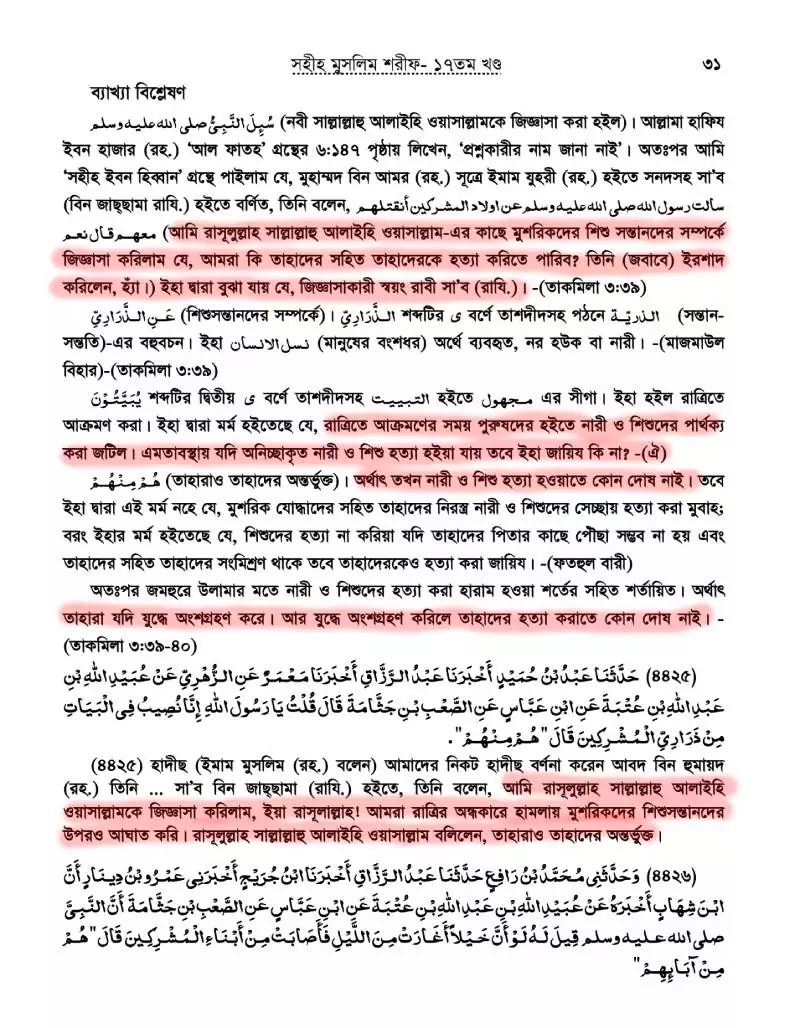
No Further Need for the Charade of Invitation
When contemporary apologists or popular preachers promote Islam as a religion that grants women exalted dignity, they deftly sidestep horrific events such as the fate of the women and children of Banu al-Mustaliq or Awtas who became spoils of war. The hadith below proudly admits, with all shame cast aside, that the charade of invitation is no longer necessary: launching an attack at any time without warning against those whom the name of Islam has reached even once is a lawful Islamic military tactic. This is neither a spiritual revolution nor an invitation to the faith, but a naked form of imperialist aggression. [30] [43] –
Sahih Muslim (Islamic Foundation)
Book: 33/ Jihad and Its Rules
Chapter: 1. It Is Lawful to Attack without Prior Notice Those Non-Muslims Whom the Invitation to Islam Has Reached
4370. Yahya ibn Yahya al-Tamimi (may Allah have mercy on him) … narrated from Ibn ‘Awn (may Allah have mercy on him), who said: I wrote to Nafi‘ (may Allah have mercy on him) asking whether it was necessary to invite non-Muslims to the religion before fighting them. He said: He wrote back to me that this rule applied in the early days of Islam. Allah’s Messenger (peace and blessings of Allah be upon him) attacked Banu al-Mustaliq while they were unprepared (and unaware of it). Their animals were being watered. He then killed their warriors (adult men) and captured the rest (women and children). On that day he acquired (Yahya said: I think he said) Juwayriyya, or he definitely said Ibnat al-Harith (the daughter of al-Harith). The narrator said: ‘Abdullah ibn ‘Umar (may Allah be pleased with him) narrated this hadith to me. He had been in that army.
Hadith grading: Sahih (Authentic)
Narrator: Ibn ‘Awn (may Allah have mercy on him)
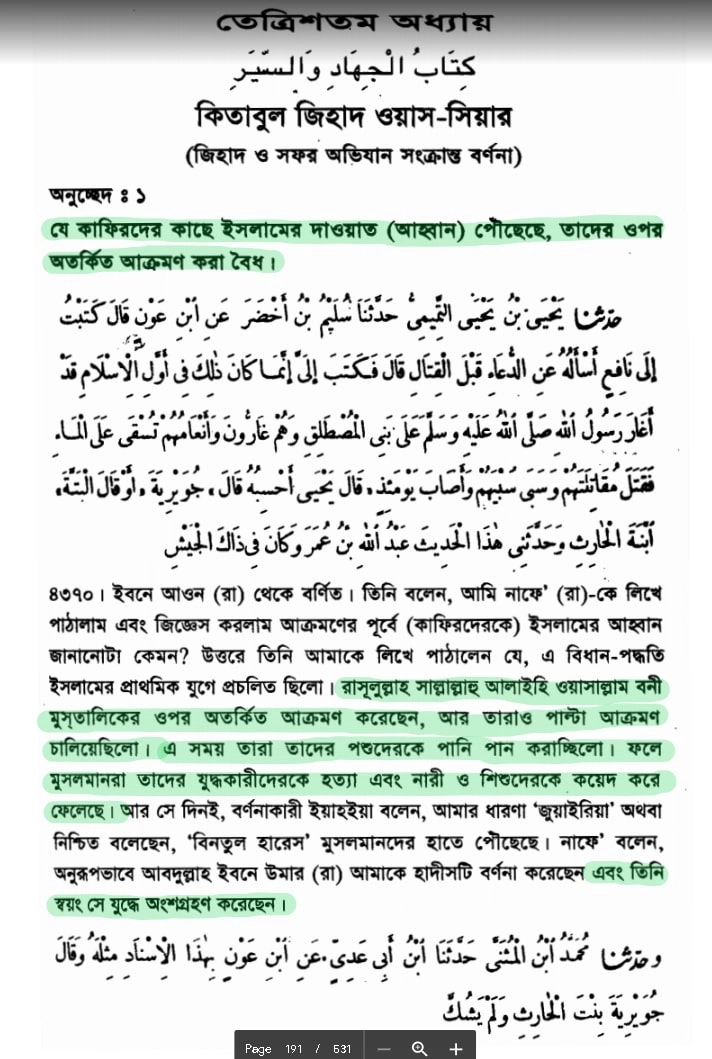
According to Abu Hanifa, one of the leading imams of Islamic jurisprudence, and his disciples, since Islam’s message has reached most parts of the world, there is no longer any need to warn non-Muslims. A deadly attack may be launched against them at any time. This outlook demonstrates that the existence of non-Muslims alongside an Islamic state was always under threat, and offensive jihad was the only language of engagement with them.
Now let us read a hadith from Tahawi Sharif, which shows that, since the invitation to Islam has now reached everyone, there is no particular need to call them to Islam again. Offensive jihad or a surprise attack is entirely permissible. [44] –
4724. Muhammad ibn Khuzayma (may Allah have mercy on him) ….. narrated from Mansur (may Allah have mercy on him), who said: I asked Ibrahim (may Allah have mercy on him) about inviting the Daylamites. He said: They are aware of the invitation to Islam.
Imam Abu Ja‘far al-Tahawi (may Allah have mercy on him) says: Everything we have narrated on this subject makes it
clear that the invitation was necessary in the early days of Islam, because it had not yet reached everyone and they did not know why war was being waged against them. Thus the command to invite them was intended to convey the message to them and inform them why they were being fought. Subsequently, he ordered attacks on other people. This means that they did not need an invitation, because they knew what they were being called to. Had they responded to the invitation, they would not have been fought. The invitation therefore serves no purpose. Imam Abu Hanifa, Imam Abu Yusuf, and Imam Muhammad (may Allah have mercy on them) likewise said that the invitation to Islam has reached every community. The imam may now fight them without issuing an invitation beforehand. As for communities whom the call to Islam has not reached, it is not appropriate to fight them until it is made clear to them why, or for what reason, war is being waged against them and what they are being called to.
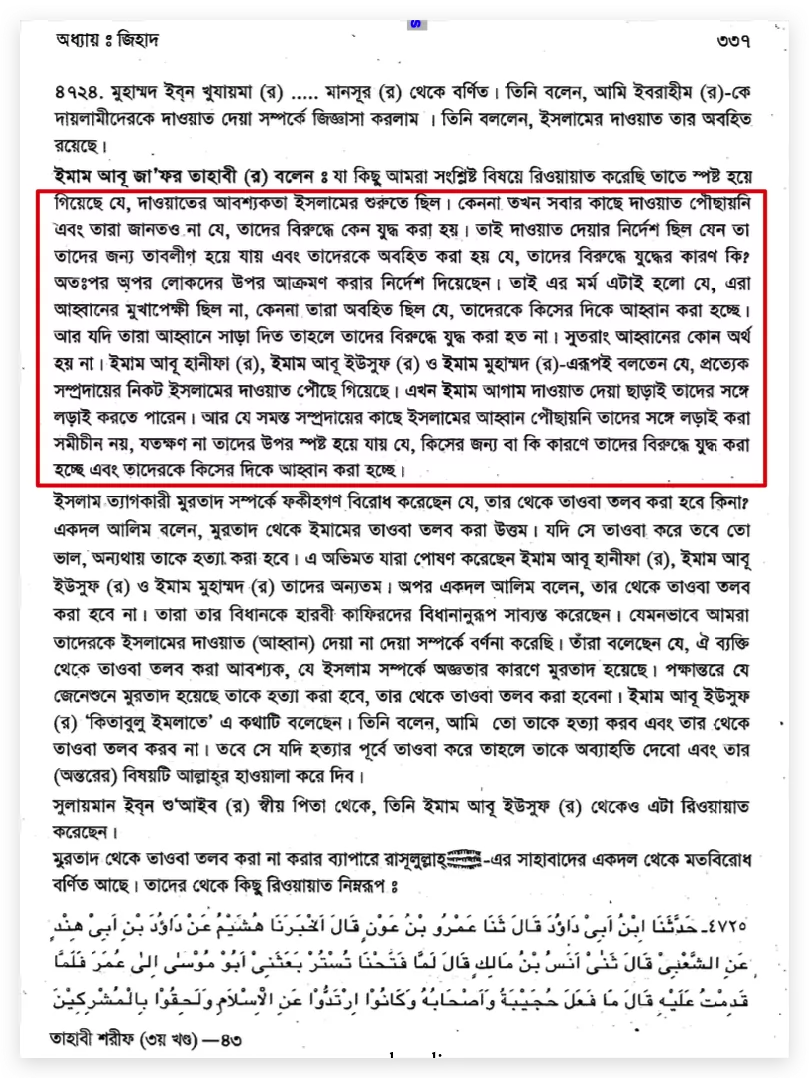
The Rape of Female War Captives as Punishment for Their Unbelief
Now let us hear the Islamic reason for raping female war captives:
Now let us listen to some sermons by Ahmadullah and other clerics:
Now let us listen to a Pakistani Muslim making an advance booking for the Indian actress Madhuri as spoils of war if India and Pakistan go to war:
The Distribution of Spoils, Slave Markets, and Public Auctions
The accounts of Islamic rules we have read above should horrify any sane person. Their substance is that turning civilian women and children into war property rather than treating them as human beings by making them ‘captives/slaves’ is among Islam’s important rules, and the Prophet himself carried out these acts [45]. But the question is: what happened to these slaves afterward? This is where religious romanticization shatters: these civilian women and even children received no ‘humane protection’; some were sold like market commodities, and with the proceeds the Prophet’s followers bought weapons and horses—turning human beings into cash and investing it in the machinery of war [46]. There is no trace of morality in these transactions; there is only the brutal use of force to reduce human beings to objects or things.
The Sunnah of Selling Captive Women and Children as Slaves in Markets
Now let us see what the Prophet Muhammad did to civilian women and children. The biographies clearly describe how he sold the civilian women and children of Banu Qurayza and bought weapons and horses with the proceeds. [47]
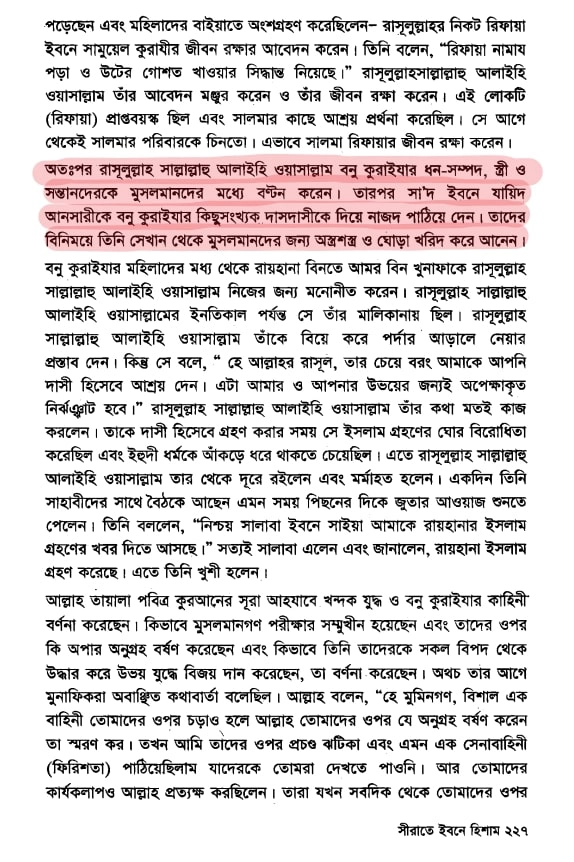
At the same time, we need to recognize that we may never know fully what happened to these women acquired as spoils of war. Their fate, however, is easy to imagine. It is not possible to discuss everything in this article; other articles discuss these matters in greater detail. Interested readers are encouraged to read them [48] [49] [50]. Now let us examine another reference. Ibn Ishaq’s Sirat Rasul Allah describes the distribution of the spoils. It states that the Prophet Muhammad kept one-fifth for himself and also took a woman. [51] –
[ Thabit ibn Qays said concerning this:
My duty is done; I have shown generosity,
I have made many efforts,
While all the others lost patience.
Jabir has a greater claim upon me than anyone else;
His hands were bound with rope.
I went to the Messenger (peace be upon him) to secure his release.
He was our ocean of mercy. ]
The Messenger’s (peace be upon him) order was that all their adults should be killed.
Shu‘ba ibn al-Hajjaj told me on the authority of ‘Abd al-Malik ibn ‘Umayr, who narrated from ‘Atiyya al-Qurazi:The order was given to kill all the adult members of Banu Qurayza. I was a minor at the time, so I was spared.
Salma bint Qays, the mother of al-Mundhir and sister of Salit ibn Qays, was the maternal aunt of the Messenger (peace be upon him). She had prayed with him facing both Jerusalem and Mecca. Ayyub ibn ‘Abd al-Rahman, a brother of Banu ‘Adi ibn al-Najjar, told me that Rifa‘a ibn Samaw’al, who was under Salma’s protection, was an adult. She pleaded with the Messenger (peace be upon him) to spare his life, saying that the man had sworn he would pray and eat camel meat. The Messenger (peace be upon him) granted her request.
The Messenger (peace be upon him) distributed the property, wives, and children of Banu Qurayza among the Muslims. The shares for camels and men were fixed that day. He took one-fifth. A horseman received three shares: two for the horse and one for the rider. The total number of horses in the expedition against Banu Qurayza was thirty-six. This was the first occasion on which lots were drawn for war booty and one-fifth was set aside. This precedent was followed in other battles afterward.
The Messenger (peace be upon him) selected for himself a woman of Banu ‘Amr ibn Qurayza named Rayhana bint ‘Amr ibn Khunafa. She remained under his authority until death. The Messenger (peace be upon him) offered to marry her and place her in seclusion.But Rayhana said: ‘Instead, keep me under your authority. That will be easier for both you and me.’ At the time of her capture, she expressed disrespect for Islam and held firmly to Judaism. This displeased the Messenger (peace be upon him), and he kept her apart. One day he was sitting with his Companions when the sound of sandals was heard behind him. He said: ‘Tha‘laba ibn Sa‘ya is coming with the good news that Rayhana has accepted Islam.’ Tha‘laba did indeed announce that good news, and he was pleased. Regarding the Trench and Banu Qurayza, Allah spoke in Surah al-Ahzab of their judgment and of His favor and assistance to them. He says: ‘O believers, remember Allah’s favor to you when enemy armies came against you and I sent against them wind and unseen forces. Allah sees all your deeds.’ The enemy armies were Quraysh, Ghatafan, and Banu Qurayza. Allah’s forces sent with the wind were the angels.
– 1. Surah 33.
– 506 ● Sirat Rasul Allah (peace be upon him)
The Public Display of Women’s Bodies: A ‘Return Policy’ for Buying Sex Slaves
Imam al-Quduri explicitly treated a slave woman as ‘goods’ in his work. Just as we return a defective product today, jurisprudence provided exactly the same rule for slave women. If, after purchasing a slave woman, the buyer found that her mouth or armpits smelled unpleasant, he could return that ‘product,’ or woman, to the seller.
The rationale offered is profoundly degrading: a slave woman is said to be purchased for sexual intercourse, so bodily odor constitutes a ‘defect’ or impediment to that intercourse. By contrast, the same odor in a male slave is not considered a particularly serious defect because his principal role is backbreaking labor. In other words, a woman’s personhood is measured here solely by her scent or her ability to satisfy sexual desire. [52]
Al-Quduri (Arabic–Bengali) 230 Book of Sales
Discussion of …: The reason a purchased article may be returned, or retained as complete, after a defect is discovered is that an unrestricted contract requires it to be free of defects. This is, however, subject to several conditions: (1) The defect existed while the article was with the seller and did not arise after the buyer’s intervention. (2) The buyer was unaware of the defect at the time of purchase. (3) The buyer was also unaware of it when taking possession. (4) The buyer cannot remove the defect without difficulty. (5) No condition of exemption from this and all other defects was stipulated, and it is not possible to remove the defect before the contract is rescinded.
Discussion of ‘lo ta JS’: Not every fault or deficiency in merchandise may arbitrarily be called a ‘defect’; only what merchants’ customary practice recognizes as a defect will count as one. A defect reduces an article’s quality and price, and judging whether its value has diminished is the merchants’ responsibility. This explanation of ‘ayb, or defect, is a fundamental principle from which many other rulings can be derived. The author himself presents several rulings derived from it.
Discussion of …: If bad habits such as running away existed in a slave during childhood but did not reappear while he was with the owner after reaching puberty, their recurrence after coming into the buyer’s possession will not count as a defect. That is, it is certainly a defect, but it cannot be claimed to have originated while the slave was with the seller, and the slave cannot be returned; these must instead be regarded as newly arising defects. On the other hand, if these childhood bad habits appear while the slave is still a minor in the buyer’s possession, or reappear with the buyer after having appeared with the seller after puberty, they will be considered defects warranting return. The causes of these defects in childhood and after puberty are not the same; they are entirely different. In childhood, a slave runs away out of a desire to play, whereas after puberty he does so from theft or a reckless disposition. Because the causes differ, the defects differ as well. The defect appearing with the buyer cannot therefore be claimed as the earlier defect.
Discussion of …: That is, if, after purchasing a slave woman, an unpleasant smell is detected from her mouth or armpits, or she is found to be an adulteress or illegitimate by birth, she may be returned. This is because a slave woman is often also purchased for sexual enjoyment, and these physical and moral defects and weaknesses then impede intercourse. They are therefore defects in a female slave. By contrast, the purpose of a male slave is to perform household work, and these deficiencies generally do not obstruct such work. Nevertheless, if the odor is excessive or adultery has become his habit, it will count as a defect. This clearly shows that a deficiency from which an article ordinarily cannot be free—for example, a quarter to three-eighths of a seer of paddy or pulses in a maund of mustard seed—is not objectionable. But if the amount of dust or pulses is one or two kilograms, it will certainly count as a defect.
Touching and Display: The Erasure of Every Boundary of Modesty
Although Islamic ethics describes ‘haya,’ or modesty, as part of faith, a major question remains: where was that modesty or covering in the slave market? According to the ruling in Ashraf al-Hidaya, if a buyer intends to purchase a slave woman, he may touch those parts of her body that it is permissible to look at. These include her chest, back, and lower legs. Even if touching her arouses intense sexual excitement or desire in the buyer, it is declared ‘ja’iz,’ or lawful, under the religious law.
The horror of this display is most evident in the case of adolescent slave girls. Before puberty, they could be displayed in the market with their upper bodies—the chest and back—uncovered. Even young children deemed suitable for intercourse, who might be seven or nine years old, were displayed in the market with only their lower bodies covered. This is not merely a historical account; it demonstrates that human dignity was sacrificed to the profits of buying and selling. [53] –
Imam al-Quduri (may Allah have mercy on him) says in his Mukhtasar al-Quduri: If someone intends to purchase a slave woman, it is permissible for him to touch those parts of her body that it is permissible to look at, even if touching her arouses desire in the buyer.
The author (may Allah have mercy on him) says: Imam Muhammad (may Allah have mercy on him) states the ruling in precisely this way in Al-Jami‘ al-Saghir. Its wording is: ‘Imam Muhammad and Abu Yusuf (may Allah have mercy on them) both narrate from Imam Abu Hanifa (may Allah have mercy on him): There is no harm or fault in someone who intends to purchase a slave woman touching her lower legs, chest, and hands, nor is there any problem in seeing these parts uncovered.’ ‘Touching is lawful even if desire is aroused.’
‘Touching is permissible even if there is a fear that it will arouse desire. According to them, looking at a slave woman for the purpose of purchasing her is lawful, even if there is a fear of becoming aroused.’
‘The imams of earlier times permitted touching slave women when purchasing them in order to assess their skin, because people in those days were generally pious.’
‘Later scholars permitted touching in the absence of desire. The current fatwa is based on this.’
‘Once an adolescent slave girl has her first menstrual period, she may no longer be taken to the market for sale and displayed wearing only a single cloth that covers her lower body. Menstruation means that she has reached puberty. The abdomen and back of a slave woman who has reached puberty are part of her ‘awrah, as discussed earlier. If she now wears only a lower garment, her chest and back will remain exposed, so she must wear an upper garment or shirt. An izar is a garment that covers only the area below the navel.’
‘This discussion makes clear that there is no fault in taking younger slave girls to the market with their chests and backs uncovered’.
‘An adolescent slave girl who has reached the stage of sexual desirability—that is, who is suitable for intercourse, with no stipulated age of seven or nine—may not be presented for sale wearing only one cloth.’
Examining a Slave Woman’s Vagina when Buying Her
The Companions of the Prophet Muhammad, the guide of all humanity, would buy beautiful virgin slave girls from the slave market for their enjoyment. Virgin slave girls also fetched higher prices in their market. Sometimes, however, a purchased slave woman turned out not to be a virgin. Since virgin vaginas were greatly favored by Muhammad’s Companions—Allah Most High also enticed them with houris with virgin vaginas in paradise—if, after taking a slave woman to bed, they found that the hymen did not rupture with enough bleeding, or that intercourse was not sufficiently pleasurable because her vagina was not tight enough, the Prophet’s Companions would become enraged. After all, they had paid for a virgin girl! They thought their money had been wasted!
The ruling given on this subject in Ashraf al-Hidaya is that, in such a case, the owner may inspect the slave woman’s private parts, or vagina, to verify the matter. These jurisprudential rules show that demand for, and the price of, ‘virgin’ slave girls in the slave market were sky-high among the Companions. Around this demand arose another diabolical legal rule: if an owner, after buying a woman as a virgin, claimed that she was not one, examining her private parts or vagina to verify the matter was made lawful. The question is: how was the examination performed? A two-finger test?
Consider a woman who has lost her family in war and must now expose her genitals for examination before an unfamiliar man merely to verify her ‘commodity value.’ Modern ethics explicitly calls this Sexual Assault, or sexual abuse, yet jurisprudence legitimized it as ‘commercial justice.’ Here, a woman’s virginity was no honor; it was merely a ‘criterion’ used to determine her market price. [54] –
6. Likewise, if someone buys a slave woman as a virgin and then finds that her virginity has been lost, but the seller denies this, then, to verify the matter in such a case, at a certain stage it is lawful to look at the slave woman’s private parts for the purpose of examination.
Violations of International Human Rights and Conflict with Modern Civilization
Islam’s rules on offensive jihad and spoils of war stand at the opposite pole from the humanitarian values and legal frameworks on which the modern world order rests. In particular, a comparison of classical Islamic military doctrine with the Geneva Conventions of 1949 and the Universal Declaration of Human Rights (UDHR) of 1948 shows that, while one seeks to guarantee people’s inherent dignity and the security of their lives, the other encourages turning human beings into commodities or slaves to establish religious superiority.
1. The Geneva Conventions versus the Ruler’s Whims: Under modern international law, attacking or torturing those who take no direct part in an armed conflict (civilians), and those who lay down their arms and surrender, is a grave war crime. Under Article 3 of the Geneva Conventions, prisoners of war must always be treated humanely, and their lives and physical safety must be fully guaranteed. Yet, as we have seen, classical works such as Fatawa-e-Alamgiri leave the fate of surrendered prisoners to the ruler’s discretion. Killing or enslaving them is retained as a lawful administrative option, something modern civilization directly regards as a crime against humanity.
2. Institutionalized Slavery versus Article 4 of the Human Rights Declaration: Article 4 of the Universal Declaration of Human Rights explicitly states: ‘No one shall be held in slavery or servitude; slavery and the slave trade shall be prohibited in all their forms.’ Yet offensive jihad under Islamic Sharia not only sustained slavery but also gave religious glory to using non-Muslim women and children as ‘spoils of war’ in reward for victory. Abducting an innocent woman against her will and selling her in a market as a ‘slave,’ or making sexual relations with her lawful, is not merely a human rights violation in the modern era; it amounts to sexual slavery and human trafficking. Legitimizing such inhumanity in the name of religion runs contrary to global ethics.
3. Destruction of Infrastructure and Environmental Crimes: Modern rules of warfare prohibit destroying civilian infrastructure, agricultural land, and water sources. In particular, the ‘scorched earth’ policy is now a crime in the eyes of international law. Yet Islamic jurisprudence permits burning the enemy’s homes, felling trees, and destroying water sources as tactics of jihad to crush the enemy. This method destroys not only a people’s present but also the means of survival for their future generations. It can in no way signify a ‘religion of peace’ or a humane system.
4. Sectarian Discrimination and the Concept of Citizenship: The modern system of states recognizes equal rights for all citizens regardless of ethnicity, religion, or race. But the Islamic philosophy of jihad divides the world into ‘dar al-Islam’ (the land of Islam) and ‘dar al-harb’ (the land of war). Under this division, non-Muslims’ lives and property have no independent value until they submit or pay jizya. This sectarian and divisive philosophy poses an enormous threat to the stability of modern pluralistic societies and the democratic world order. A doctrine that identifies one side as ‘holy mujahids’ and the other as ‘unbelievers available for plunder’ can never meet the standards of universal human rights.
Conclusion and Overall Critique: Theological Brigandage and Moral Bankruptcy
The primary sources of classical Islam and the authoritative jurisprudential documents examined in this series make one point abundantly clear: Islam’s political and military philosophy is in no sense compatible with modern civilization. The Prophet’s own claims that ‘paradise lies beneath the shadow of swords’ or that victory is attained ‘through terror’ are no longer hidden matters. They constitute a systematic ‘theological supremacism’ that defines those of different beliefs as plunderable ‘objects’ rather than human beings. The offensive wars waged by Muhammad and during the caliphate convey precisely that brutal truth.
One of the driving forces of Islamic jihad is the attraction of spoils, or plundered wealth. When a theology recognizes enslaving other people’s wives and children and seizing their property as ‘sacred’ rewards for military victory, it ceases to be merely defensive warfare and becomes an organized ‘predatory system.’ The rules described in Fatawa-e-Alamgiri—which authorize destroying crops, inundating settlements, and driving innocent women and children toward death by starvation—show no divine mercy. They are records of extreme medieval barbarity that has survived to this day clothed in religion.
In Islamic ethics, ‘humanity’ is confined to Muslims. These principles change entirely when it comes to non-Muslims. The same Islam that speaks of human rights also licenses selling the women and children of other faiths in markets. This sectarian division—where being an ‘unbeliever’ means losing security for one’s life and property—strikes at the root of modern rational thought. If a religion rests on truth and justice, why should its expansion require the creation of ‘terror’ or ‘fear’? Must truth rely on the sword to sell paradise?
In the twenty-first century, when we speak of human rights, gender equality, and the Geneva Conventions, these Islamic rules of offensive jihad confront us as a tremendous travesty. They are not confined to the pages of history; they remain an ideological inspiration for many extremist groups today. Those who wish to practice this barbarity as ‘Sunnah’ are, in effect, seeking to destroy modern pluralistic society and return it to a dark Middle Ages. Treating the existence of people of other faiths as ‘fitna,’ or a disturbance, and shedding their blood or enslaving them cannot constitute a religion; it is a supremacist political manifesto.
Finally, it is undeniable today that a religious philosophy that considers abducting innocent women and children and binding them in slavery to be the highest moral message sent by God, or an act of religious worship, has an extremely unstable moral foundation. In the light of reason, conscience, and universal human rights, these Islamic rules on offensive jihad and slavery must not only be rejected but strongly condemned. To build a better and more humane world, people must free themselves from such medieval cruelty and sectarian domination. Modern standards of truth and justice cannot be confined to blind obedience to an ancient text; they must stand for human freedom and equal dignity.
References
- Sahih al-Bukhari, Hadith: 2652 ↩︎
- Sahih Muslim, Hadith: 2533 ↩︎
- Sahih al-Bukhari, Tawhid Publication, Hadith: 2818 ↩︎
- Hadith Sambhar, Hadith: 1900 1 2
- Sahih al-Bukhari, Tawhid Publication, Hadith: 2977 ↩︎
- Fatawa-e-Alamgiri, Vol. 3, p. 503 1 2 3 4
- Sahaj Nasrul Bari, Sharh Sahih al-Bukhari, Vol. 8, Arabic–Bengali, Simple Translation and Detailed Explanation and Analysis, Hazrat Maulana Muhammad Usman Ghani, Al Kawsar Publications, p. 411 ↩︎
- Fatawa-e-Alamgiri, Vol. 3, p. 502 1 2
- Sahaj Nasrul Bari, Vol. 8, p. 411 1 2
- Fatawa-e-Alamgiri, Vol. 3, p. 540 1 2 3 4
- Fatawa-e-Alamgiri, Vol. 3, p. 537 1 2
- Ibn Hisham, Al-Sira al-Nabawiyya, Battle of Badr: The Killing of al-Nadr and ‘Uqbah ↩︎
- Sunan Abu Dawud, Hadith 2686, Book of Jihad, Chapter on Killing Prisoners in Captivity ↩︎
- Musannaf ‘Abd al-Razzaq, Book of Jihad, Hadith 9394 ↩︎
- Musannaf ‘Abd al-Razzaq, Hadith 9390 ↩︎
- Abu Dawud, Al-Marasil 297 and Related Reports ↩︎
- Tafsir ‘Abd al-Razzaq, Vol. 2, pp. 68–69, Commentary on Surah al-Furqan 29 ↩︎
- Tafsir al-Qurtubi, Surah al-Furqan, Verse 27 ↩︎
- Tarikh al-Tabari, Account of the Prisoners of Badr ↩︎
- Ibn Kathir, Al-Bidaya wa al-Nihaya, The Killing of al-Nadr and ‘Uqbah ↩︎
- Al-Bayhaqi, Al-Sunan al-Kubra, Reports Concerning the Killing of Prisoners ↩︎
- Al-Bayhaqi 18486 and Sources for Related Hadith ↩︎
- Al-Tabarani, Al-Mu‘jam al-Kabir, Hadith 12154 ↩︎
- Al-Tabarani, Al-Mu‘jam al-Awsat, Hadith 3027 ↩︎
- Al-Hakim al-Naysaburi, Al-Mustadrak ‘ala al-Sahihayn ↩︎
- Tafsir al-Mazhari, Commentary on Surah al-Anfal, Verse 67 ↩︎
- Fatawa-e-Alamgiri, Islamic Foundation Bangladesh, Vol. 3, pp. 502, 503, 535, 537, 540 ↩︎
- Fatawa-e-Alamgiri, Vol. 3, pp. 537, 540 ↩︎
- Sahih Muslim, Islamic Foundation, Hadith: 733 ↩︎
- Sahih Muslim, Islamic Foundation, Hadith: 4370 1 2
- Sahih Muslim, Hadith Academy, Hadith: 3500 ↩︎
- Sahih al-Bukhari, Tawhid Publication, Hadith: 3117 ↩︎
- Sunan Abu Dawud, Islamic Foundation, Hadith: 2152 ↩︎
- Sunan Abu Dawud, Islamic Foundation, Hadith: 154 ↩︎
- Sahih Muslim, Hadith Academy, Hadith: 3436 ↩︎
- Sahih al-Bukhari, Tawhid Publication, Hadith: 4138 ↩︎
- Sahih Muslim, Hadith Academy, Hadith: 3451 ↩︎
- Sunan Abu Dawud, Critical Verification: ‘Allama Nasir al-Din al-Albani, Allama Albani Academy, Vol. 3, pp. 215–216, Hadith: 2155 ↩︎
- Sahih Muslim, Islamic Foundation, Hadith: 4399 ↩︎
- Sahih Muslim, Hadith Academy, Hadith: 4442 ↩︎
- Sunan Ibn Majah, Tawhid Publication, Hadith: 2839 ↩︎
- Sahih Muslim Sharif (Bengali Translation with Necessary Explanations), Al Hadith Publications, Vols. 17 and 18, p. 31 ↩︎
- Sahih Muslim, Bangladesh Islamic Centre, Vol. 6, p. 181, Hadith: 4370 ↩︎
- Tahawi Sharif, Islamic Foundation, Vol. 3, p. 337 ↩︎
- Muhammad and Many of the Companions and the Successors’ Successors Were Prominent Slave Traders ↩︎
- Slave Markets and the Buying and Selling of Female Slaves in Islam: Public Auctions of Women’s Bodies ↩︎
- Sirat Ibn Hisham, Original: Ibn Hisham, Translation: Akram Faruq, Bangladesh Islamic Centre, p. 227 ↩︎
- According to Islam, a Female Slave’s ‘Awrah, or Required Covering, Extends from the Navel to the Knees ↩︎
- The Rape of Female Slaves in Islam: Is Consent Required for Intercourse with a Slave Woman? ↩︎
- Legal Authorization for Pedophilia in Islamic Sharia: The Permissibility of Intercourse with an Underage Slave Girl ↩︎
- Sirat Rasul Allah (peace be upon him), Ibn Ishaq, Translation: Shahid Akhand, Prothoma Publications, p. 506 ↩︎
- Al-Misbah al-Nuri, Sharh Mukhtasar al-Quduri, Vol. 1, Islamia Kutubkhana, p. 230 ↩︎
- Ashraf al-Hidaya, Islamia Kutubkhana, Vol. 9, pp. 618, 619 ↩︎
- Ashraf al-Hidaya, Islamia Kutubkhana, Vol. 9, p. 596 ↩︎