
Introduction
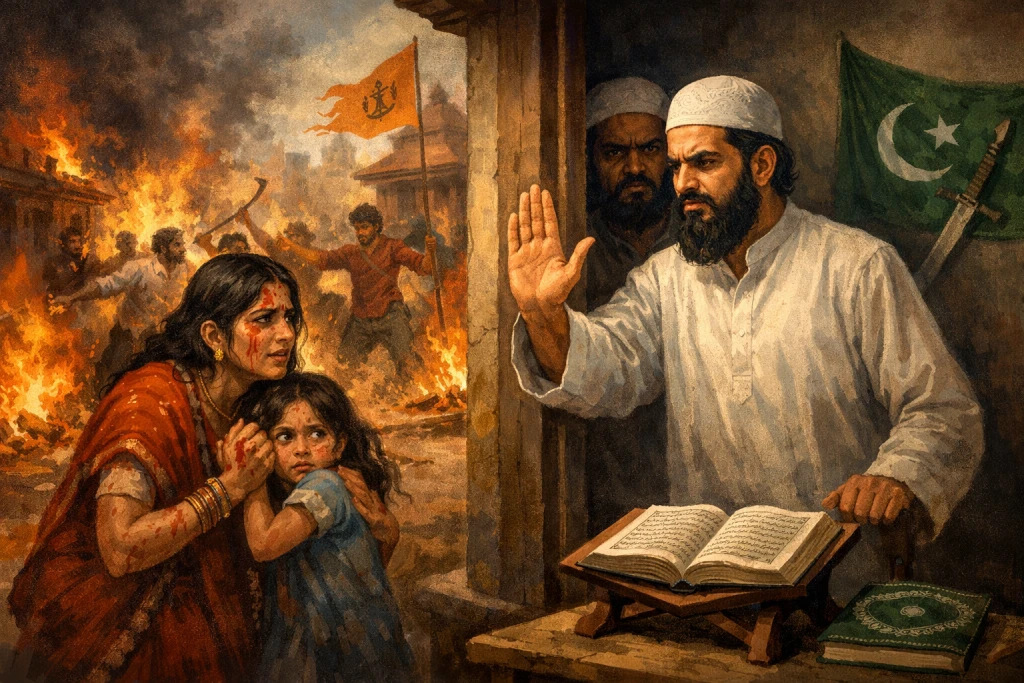
Saving the life of a person in danger is widely regarded as one of humanity’s highest moral responsibilities. Standing beside the helpless regardless of nationality, religion, or ethnicity is captured by the Bengali maxim ‘Humanity above all.’ Particularly during riots or wars, when vulnerable people such as women and children seek refuge in fear for their lives, opening one’s door to them is seen as a fundamental humanitarian duty. Yet subjecting this humanitarian act to the requirements of a particular religious legal framework can create a profound moral conflict.
An examination of certain classical interpretations of Islamic law and Qur’anic commentaries reveals a strong tendency to restrict the scope of assistance and friendship to fellow believers. When the question concerns how Muslims should respond to conflict among non-Muslims, or whether they may grant refuge to non-Muslims fearing for their lives, numerous Islamic legal texts privilege religious allegiance—often framed through the doctrine of al-wala’ wa-l-bara’ (loyalty and disavowal)—over universal humanitarian solidarity. This is not merely a theoretical dispute: in a moment of real danger, such rules can profoundly influence a believer’s decisions and conduct.
The Prohibition in Tafsir-e Mazhari and al-Mabsut: A Legal and Ideological Examination
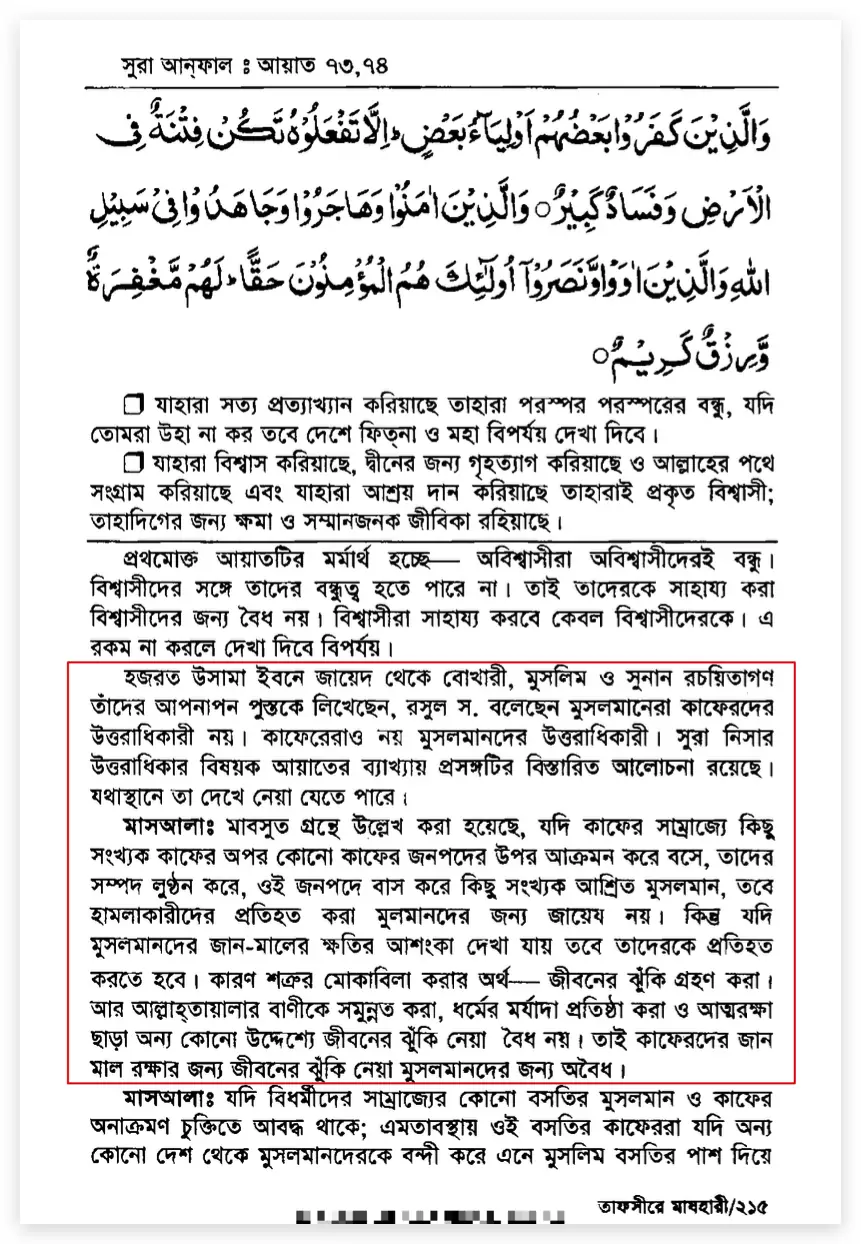
A closer look at Islamic jurisprudence shows that assistance and cooperation are not governed by humanitarian concern alone, but by a defined ideological framework. In its discussion of verses from Surat al-Anfal, the authoritative commentary Tafsir-e Mazhari presents a legal ruling that challenges the notion of universal brotherhood. It declares that those who reject the truth, or disbelievers, are allies of one another. Under this interpretation, Muslims cannot establish with non-Muslims the kind of intimate friendship or cooperative relationship that transcends religious boundaries and gives priority solely to humanity [1].
যাহারা সত্য প্রত্যাখ্যান করিয়াছে তাহারা পরস্পর পরস্পরের বন্ধু, যদি তোমরা উহা না কর তবে দেশে ফিত্না ও মহা বিপর্যয় দেখা দিবে।
যাহারা বিশ্বাস করিয়াছে, দ্বীনের জন্য গৃহত্যাগ করিয়াছে ও আল্লাহের পথে সংগ্রাম করিয়াছে এবং যাহারা আশ্রয় দান করিয়াছে তাহারাই প্রকৃত বিশ্বাসী; তাহাদিগের জন্য ক্ষমা ও সম্মানজনক জীবিকা রহিয়াছে।
প্রথমোক্ত আয়াতটির মর্মার্থ হচ্ছে- অবিশ্বাসীরা অবিশ্বাসীদেরই বন্ধু।
বিশ্বাসীদের সঙ্গে তাদের বন্ধুত্ব হতে পারে না। তাই তাদেরকে সাহায্য করা বিশ্বাসীদের জন্য বৈধ নয়। বিশ্বাসীরা সাহায্য করবে কেবল বিশ্বাসীদেরকে। এ রকম না করলে দেখা দিবে বিপর্যয়।
হজরত উসামা ইবনে জায়েদ থেকে বোখারী, মুসলিম ও সুনান রচয়িতাগণ তাঁদের আপনাপন পুস্তকে লিখেছেন, রসুল স. বলেছেন মুসলমানেরা কাফেরদের উত্তরাধিকারী নয়। কাফেরেরাও নয় মুসলমানদের উত্তরাধিকারী। সুরা নিসার উত্তরাধিকার বিষয়ক আয়াতের ব্যাখ্যায় প্রসঙ্গটির বিস্তারিত আলোচনা রয়েছে। যথাস্থানে তা দেখে নেয়া যেতে পারে।
মাসআলাঃ মাবসুত গ্রন্থে উল্লেখ করা হয়েছে, যদি কাফের সাম্রাজ্যে কিছু সংখ্যক কাফের অপর কোনো কাফের জনপদের উপর আক্রমন করে বসে, তাদের সম্পদ লুণ্ঠন করে, ওই জনপদে বাস করে কিছু সংখ্যক আশ্রিত মুসলমান, তবে হামলাকারীদের প্রতিহত করা মুলমানদের জন্য জায়েয নয়। কিন্তু যদি মুসলমানদের জান-মালের ক্ষতির আশংকা দেখা যায় তবে তাদেরকে প্রতিহত করতে হবে। কারণ শত্রুর মোকাবিলা করার অর্থ- জীবনের ঝুঁকি গ্রহণ করা। আর আল্লাহতায়ালার বাণীকে সমুন্নত করা, ধর্মের মর্যাদা প্রতিষ্ঠা করা ও আত্মরক্ষা ছাড়া অন্য কোনো উদ্দেশ্যে জীবনের ঝুঁকি নেয়া বৈধ নয়। তাই কাফেরদের জান মাল রক্ষার জন্য জীবনের ঝুঁকি নেয়া মুসলমানদের জন্য অবৈধ।
English translation: Those who reject the truth are allies of one another. If you do not act accordingly, there will be persecution and great disorder in the land.
Those who have believed, emigrated for the sake of religion, and struggled in the way of Allah, and those who have given them shelter, are the true believers; for them are forgiveness and an honorable provision.
The meaning of the first verse is that disbelievers are allies only of other disbelievers.
They cannot be friends with believers. Therefore, it is not lawful for believers to help them. Believers will help only fellow believers. Failure to do so will cause disorder.
Al-Bukhari, Muslim, and the compilers of the Sunan have narrated in their respective books from Usama ibn Zayd that the Messenger said: Muslims do not inherit from disbelievers, nor do disbelievers inherit from Muslims. This question is discussed in detail in the explanation of the inheritance verses in Surat al-Nisa; the reader may consult it there.
Legal ruling: It is stated in al-Mabsut that if, in a land ruled by disbelievers, some disbelievers attack another settlement of disbelievers and plunder their property, while some Muslims live there under protection, those Muslims are not permitted to repel the attackers. But if the lives or property of the Muslims are threatened, they must resist. The reason is that confronting an enemy means risking one’s life, and such risk is not lawful for any purpose other than exalting Allah’s word, upholding the honor of the religion, and self-defense. Therefore, it is unlawful for Muslims to risk their lives to protect the lives and property of disbelievers.
A direct legal example of this religious division appears in al-Mabsut, by the influential Hanafi jurist Shams al-A’imma al-Sarakhsi. In volume ten, pages 97–98, al-Sarakhsi discusses Muslims living under a guarantee of safety in a non-Muslim-ruled territory. If another group of non-Muslims attacks that territory, those Muslims may not fight on behalf of the local non-Muslims. Fighting entails risking one’s life, and al-Sarakhsi identifies exalting Allah’s word and upholding the religion as the legitimate purposes for taking such a risk. He regards a war fought to preserve non-Muslim rule as a war to uphold the dominion of polytheism. If the attackers endanger the Muslims themselves, however, fighting in self-defense is permitted. Thus, during the same attack, joining the defense of an endangered non-Muslim population is prohibited, whereas fighting becomes permissible when Muslims’ own safety is threatened. The distinction rests not on the attacked population’s legitimate need for defense, but on whether fighting advances Islamic religious authority. [2] [3]
وإذا كان قوم من المسلمين مستأمنين في دار الحرب فأغار على تلك الدار قوم من أهل الحرب لم يحل لهؤلاء المسلمين أن يقاتلوهم لأن في القتال تعريض النفس فلا يحل ذلك إلا على وجه إعلاء كلمة الله عزوجل وإعزاز الدين وذلك لا يوجد ههنا لأن أحكام أهل الشرك غالبة فيهم فلا يستطيع المسلمون أن يحكموا بأحكام أهل الإسلام فكان قتالهم في الصورة لإعلاء كلمة الشرك وذلك لا يحل إلا أن يخافوا على أنفسهم من أولئك فحينئذ لا بأس بأن يقاتلوهم للدفع عن أنفسهم لا لإعلاء كلمة الشرك.
English translation: If some Muslims are residing under a guarantee of safety in the territory of the people of war and another group of the people of war raids that territory, it is not lawful for those Muslims to fight them. Fighting involves exposing oneself to danger, which is lawful only for exalting the word of Allah, Mighty and Exalted, and strengthening the religion. That purpose is absent here, because the laws of the polytheists prevail among them, and the Muslims cannot administer the laws of Islam. Their fighting would therefore, in effect, serve to exalt the word of polytheism, which is not lawful. If, however, they fear for their own lives because of the attackers, there is no objection to fighting them in self-defense, not to exalt the word of polytheism.
The moral inconsistency of this rule is stark. When a non-Muslim population is attacked, defending it is religiously prohibited; when Muslims face danger in that same attack, fighting becomes permissible. The attackers’ wrongdoing, the losses suffered by the victimized population, and the non-Muslim residents’ need for security are not the determining considerations. What matters is the establishment of Islamic authority. The moral responsibility to resist an assault on a population is consequently made subordinate to religious identity. By equating the protection of non-Muslim political authority with the protection of polytheism, this ruling turns the legitimate defense of an endangered population into a question of religious opposition. Such a rule lends legal recognition to religious division rather than mutual protection and cooperation among people living in the same society. Giving priority to the question of which religious group will retain power, rather than judging an attack by universal standards of right and wrong, provides an institutional foundation for sectarian distrust and hostility.
Imam Muhammad al-Shaybani’s Ruling: Both Non-Muslim Sides Are the Party of Satan
This worldview of religious hostility and sectarian division also appears in older, highly influential works of Hanafi jurisprudence. Muhammad ibn al-Hasan al-Shaybani, a student of Abu Hanifa and one of the principal figures in the establishment of Hanafi law, discusses Muslims fighting in conflicts between non-Muslim groups in his al-Siyar al-Kabir. In his commentary on that work, Sharh al-Siyar al-Kabir, al-Sarakhsi explicitly states that Muslims should not join one group of non-Muslims in fighting another. The reasoning is particularly revealing: both opposing non-Muslim groups are described as the ‘party of Satan.’ Muslims are told not to join either side, swell its ranks, or fight in its defense. The explanation is that the rule of polytheism would remain dominant, while Muslims are supposed to fight to secure victory for the people of truth, not to establish the rule of polytheism. Rather than evaluating the justice of the parties’ causes, who is attacking and who is being attacked, or the oppression that either side might be experiencing, the ruling makes their shared religious identity the basis for condemning both. [4]
بَابُ قِتَالِ أَهْلِ الْإِسْلَامِ أَهْلَ الشِّرْكِ مَعَ أَهْلِ الشِّرْكِ
٢٩٦٩ – قَالَ: لَا يَنْبَغِي لِلْمُسْلِمِينَ أَنْ يُقَاتِلُوا أَهْلَ الشِّرْكِ مَعَ أَهْلِ الشِّرْكِ.
لِأَنَّ الْفِئَتَيْنِ حِزْبُ الشَّيْطَانِ، وَحِزْبُ الشَّيْطَانِ هُمْ الْخَاسِرُونَ، فَلَا يَنْبَغِي لِلْمُسْلِمِ أَنْ يَنْضَمَّ إِلَى إِحْدَى الْفِئَتَيْنِ فَيَكْثُرُ سَوَادُهُمْ وَيُقَاتِلُ دَفْعًا عَنْهُمْ، وَهَذَا؛ لِأَنَّ حُكْمَ الشِّرْكِ هُوَ الظَّاهِرُ، وَالْمُسْلِمُ إِنَّمَا يُقَاتِلُ لِنُصْرَةِ أَهْلِ الْحَقِّ، لَا لِإِظْهَارِ حُكْمِ الشِّرْكِ.
English translation: Chapter: Muslims Fighting Polytheists Alongside Polytheists.
2969. He said: Muslims should not fight one group of polytheists alongside another group of polytheists. For both groups are the party of Satan, and the party of Satan are the losers. A Muslim should therefore not join either group, increase its numbers, or fight to defend it. This is because the rule of polytheism prevails there, and a Muslim fights only to support the people of truth, not to establish the rule of polytheism.
This statement provides an unmistakable framework for religious hostility. The fact that neither party is Muslim is the basis for labeling both the ‘party of Satan.’ Yet when two non-Muslim communities fight, it does not follow that both are equally guilty. One side may be the aggressor and the other the victim; one may be the oppressor and the other the oppressed. Here, however, both are assigned the same derogatory religious identity before their moral or political positions are considered. Such teaching reduces non-Muslim individuals to a collectively condemned religious category rather than treating them as independent moral agents. A person’s integrity, honesty, courage, or struggle against injustice cannot remove them from this classification unless their religious identity changes. Defining entire populations through such a negative religious label establishes an ideological basis for sectarian hatred, distrust, and hostility.
Another significant feature of al-Shaybani’s ruling, as explained by al-Sarakhsi, is the claim that fighting in defense of a non-Muslim side would establish the rule of polytheism. Defending the security of a non-Muslim population is thus equated with defending its religious and political authority. As a result, a Muslim’s responsibility for the collective defense of a society shared with non-Muslim residents becomes subject to religious allegiance. Resisting an attack on non-Muslims is not accorded independent moral value; it is measured against whether Islamic rule will be established. The ruling obstructs civic solidarity across religious boundaries because the religious identity of other residents becomes a basis for deciding whether to take part in their common defense.
Alliance with Muslim Rebels Is Possible, but Fighting for Non-Muslims Is Not
The next ruling in the same work makes an even more telling distinction. Discussing the Kharijites in conflict with the followers of Muslim rulers, it states that Muslims identified as the people of justice may join the Kharijites in fighting non-Muslim combatants. Such fighting is regarded as a struggle to repel the threat of unbelief and establish Islam. Thus, despite serious political and theological disputes within the Muslim community, a joint campaign against non-Muslims may be permissible. In the same discussion, joining non-Muslims against other non-Muslims is prohibited, while opposing Muslim groups may fight together against non-Muslims. The distinction turns on which religious authority the war will establish. [5]
٢٩٧٠ – وَلَا بَأْسَ بِأَنْ يُقَاتِلَ الْمُسْلِمُونَ، مِنْ أَهْلِ الْعَدْلِ مَعَ الْخَوَارِجِ، الْمُشْرِكِينَ مِنْ أَهْلِ الْحَرْبِ.
لِأَنَّهُمْ يُقَاتِلُونَ الْآنَ لِدَفْعِ فِتْنَةِ الْكُفْرِ، وَإِظْهَارِ الْإِسْلَامِ، فَهَذَا قِتَالٌ عَلَى الْوَجْهِ الْمَأْمُورِ بِهِ، وَهُوَ إِعْلَاءُ كَلِمَةِ اللَّهِ تَعَالَى، بِخِلَافِ مَا سَبَقَ، فَالْقِتَالُ هُنَاكَ لِإِظْهَارِ مَا هُوَ مَائِلٌ عَنْ طَرِيقِ الْحَقِّ، وَهَا هُنَا لِإِثْبَاتِ أَصْلِ الطَّرِيقِ.
English translation: 2970. There is no objection to Muslims belonging to the people of justice fighting the polytheists of the people of war alongside the Kharijites. They are now fighting to repel the turmoil of unbelief and make Islam prevail. This is therefore fighting in the prescribed manner, namely to exalt the word of Allah Most High, unlike the preceding case. There, fighting served to establish what had departed from the path of truth; here, it serves to establish the very foundation of that path.
Taken together, these two rulings reveal the nature of allegiance centered on the religious group. Muslim factions may have profound disagreements and even fight one another, yet they may unite against non-Muslims. By contrast, fighting to defend one side in a conflict between two non-Muslim factions is prohibited on grounds of religious authority. The universal distinction between justice and injustice does not determine the moral and legal legitimacy of the war; the determining objectives are establishing Islam and resisting the authority of polytheism. By describing non-Muslim populations as the party of Satan and their political authority as the rule of polytheism, the texts normalize hostility toward them in religious language. This teaching supplies an ideological foundation for permanently dividing people into competing groups on the basis of religion.
Imam Malik’s Ruling: Muslims Must Not Shed Blood in a Non-Muslim War That Does Not Advance Islam
The prohibition on Muslim participation in wars between non-Muslims is not confined to the Hanafi school. The same religion-centered reasoning is found in the statements of Malik ibn Anas, founder of the Maliki school. Al-Mudawwana, an early and influential work of Maliki jurisprudence, discusses Muslims who are captives or merchants in non-Muslim territory. The local ruler asks them to assist him in fighting another non-Muslim group. The question even contemplates the captives being returned to Muslim territory after the fighting. Malik does not authorize Muslims to take part in such a war. He describes bringing non-Muslims from polytheism into Islam as a legitimate purpose of fighting and rejects Muslims shedding blood merely to bring one group of non-Muslims under the rule of another. Even where the Muslims’ own release and interests might be involved, the religious purpose of warfare takes precedence. [6]
قُلْتُ: أَرَأَيْتَ لَوْ أَنَّ قَوْمًا مِنْ الْمُسْلِمِينَ أُسَارَى فِي بِلَادِ الشِّرْكِ أَوْ تُجَّارًا اسْتَعَانَ بِهِمْ صَاحِبُ تِلْكَ الْبِلَادِ عَلَى قَوْمٍ مِنْ الْمُشْرِكِينَ نَاوَءُوهُ مِنْ أَهْلِ مَمْلَكَتِهِ أَوْ مِنْ غَيْرِ أَهْلِ مَمْلَكَتِهِ، أَتَرَى أَنْ يُقَاتِلُوا مَعَهُ أَمْ لَا؟
قَالَ: سَمِعْتُ مَالِكًا يَقُولُ فِي الْأُسَارَى يَكُونُونَ فِي بِلَادِ الْمُشْرِكِينَ فَيَسْتَعِينُ بِهِمْ الْمَلِكُ عَلَى أَنْ يُقَاتِلُوا مَعَهُ عَدُوَّهُ وَيُجَاءُ بِهِمْ إِلَى بِلَادِ الْمُسْلِمِينَ؟
قَالَ: قَالَ مَالِكٌ: لَا أَرَى أَنْ يُقَاتِلُوا عَلَى هَذَا وَلَا يَحِلُّ لَهُمْ أَنْ يَسْفِكُوا دِمَاءَهُمْ عَلَى مِثْلِ ذَلِكَ، قَالَ مَالِكٌ: وَإِنَّمَا يُقَاتَلُ النَّاسُ لِيُدْخَلُوا فِي الْإِسْلَامِ مِنْ الشِّرْكِ، فَأَمَّا أَنْ يُقَاتِلُوا الْكُفَّارَ لِيُدْخِلُوهُمْ مِنْ الْكُفْرِ إِلَى الْكُفْرِ وَيَسْفِكُوا دِمَاءَهُمْ فِي ذَلِكَ، فَهَذَا مِمَّا لَا يَنْبَغِي وَلَا يَنْبَغِي لِمُسْلِمٍ أَنْ يَسْفِكَ دَمَهُ عَلَى هَذَا.
English translation: I asked: What is your view if a group of Muslims, held captive or engaged in trade in the land of polytheism, are asked by the ruler of that country to assist him against a group of polytheists opposing him, whether from within his realm or from outside it? Should they fight alongside him or not?
He replied: I heard Malik speak about captives held in the lands of the polytheists, whose king seeks their help in fighting his enemy and undertakes to return them to Muslim territory.
Malik said: I do not think they should fight for such a purpose, nor is it lawful for them to shed their blood for it. Malik said: People are fought so that they may be brought from polytheism into Islam. As for fighting disbelievers merely to move them from one state of unbelief into another and shedding one’s blood for that, it is not appropriate. A Muslim should not shed his blood for that purpose.
Malik’s statement on the purposes of warfare is fundamentally at odds with modern religious freedom and equal human dignity. In his words, people are fought in order to bring them from polytheism into Islam. The right of people to retain their beliefs, religious identities, and political self-determination is not made central to the legitimacy of warfare; bringing them into Islam is presented as an acceptable objective. Fighting merely to transfer non-Muslims from one political authority to another is rejected, while bringing them from polytheism into Islam is recognized as a legitimate purpose. Religious identity therefore becomes a criterion for the justice of war. Accepting military force as a means of changing people’s beliefs conflicts with freedom of religion and endorses the establishment of religious authority over those who believe differently.
Here, hostility toward non-Muslims is more than personal dislike: it is a legal principle governing war, allegiance, and cooperation. Muslims living under a non-Muslim ruler are not required to regard defending his state as a religious obligation, because that war would preserve non-Muslim rather than Islamic authority. Even the possible release of Muslim captives is evaluated in light of the war’s religious purpose. Consequently, establishing religious authority takes precedence over the security of actual people, reciprocal responsibilities, and political cooperation. Such a rule can cultivate a mentality in which cooperation with people of another religion is preceded by calculations about their religious identity and which religion’s authority would benefit. This strengthens sectarian division at the expense of civic equality and mutual trust.
The Contemporary Application of Classical Jurisprudence’s Sectarian Divisions
These rulings have not remained confined to the pages of old legal books. On February 19, 2014, Islamweb published fatwa no. 241042 in response to a question about a Muslim joining the army of a non-Muslim state and swearing to defend it. The fatwa declared such military service impermissible. It reasoned that the army of a non-Muslim state operates to establish the authority of unbelief, whereas a Muslim fights to exalt Allah’s word. In support, it quoted the above rulings from al-Sarakhsi’s al-Mabsut, al-Shaybani’s al-Siyar al-Kabir, and Malik’s al-Mudawwana. Thus, even a twenty-first-century Islamic fatwa portrays a non-Muslim state’s army as an instrument for establishing the authority of unbelief and rejects Muslim participation in that state’s defense. [7]
The social and political significance of this fatwa is profound. A Muslim may be born in a non-Muslim-majority state, be its citizen, enjoy the rights and benefits of citizenship, and live alongside its non-Muslim citizens for many years. Yet under this fatwa, joining that state’s armed forces and pledging to defend it is religiously forbidden. Civic responsibility to the state is set against religious allegiance. Separate religious obligations for Muslim and non-Muslim citizens in matters of collective security weaken the principle of equal citizenship. Members of the same political community acquire different responsibilities toward its shared security because of their faith. The fatwa thus extends religious division beyond private belief into the sphere of citizenship and state obligations.
A consistent ideological position emerges from the statements of al-Sarakhsi, al-Shaybani, Malik, and contemporary Islamweb: religious identity and the objective of establishing Islamic authority are made primary standards for determining cooperation and military responsibility. Calling both non-Muslim parties the ‘party of Satan,’ characterizing the preservation of their political authority as the establishment of polytheism, and prohibiting participation in their state’s defense confer legitimacy on religious division. Assigning people a negative collective identity on religious grounds marginalizes their individual character, actions, and moral standing. This creates an ideological environment in which distrust, hatred, and hostility toward people of other religions can emerge and persist. Such teaching directly conflicts with equal human dignity, religious liberty, civic solidarity, and the duty to protect people in danger regardless of their faith.
Rhetoric of Harmony versus Reality: Contemporary Sermons and Clerical Views
In a contemporary world that regards pluralism and nonsectarian coexistence as important social ideals, many modern Islamic thinkers and preachers traveling to Europe or America claim that Islam emphasizes profound brotherhood and friendship among people of every religion. By citing selected passages from the Qur’an, they seek to present Islam as an ideal for building a nonsectarian society. Yet an examination of conservative clerical statements and classical legal prescriptions shows how such claims of ‘nonsectarianism’ function as a polished apologetic narrative. At the foundation of the relevant Sharia doctrines, relations with non-Muslims are organized more around maintaining ‘ideological distance’ than establishing unconditional solidarity.
The sermons and fatwas of prominent and influential Bangladeshi Islamic scholars reveal strong opposition to forming ‘sincere friendships’ with non-Muslims. In their view, ordinary dealings or humane treatment between a Muslim and a non-Muslim may be permissible, but accepting a non-Muslim as a true friend or loved one from the depths of one’s heart violates Islamic creed. The doctrine of al-wala’ wa-l-bara’ (loyalty and disavowal) teaches that a believer’s love and allegiance belong to the followers of Allah, while those who deny Allah should be met with hatred or distance. Some widely admired preachers even declare unambiguously that a sinful or ‘immoral’ Muslim is superior in status to the most virtuous non-Muslim or disbeliever.
The roots of this mentality lie in rulings such as the one cited in Tafsir-e Mazhari, which declares non-Muslims to be allies of one another and instructs Muslims to maintain their distance [1]. These teachings create a sectarian division in popular consciousness, splitting society into the opposing categories of ‘us’ and ‘them.’ When modern believers claim to promote nonsectarianism, they often conceal the harsher aspects of these classical prescriptions. But when a crisis raises the question of helping non-Muslims or protecting their lives, this notion of ‘religious superiority’ and the prohibition on close friendship can obstruct humanitarian duties. Treating a non-Muslim simply as a human being, or offering refuge to someone in danger, can become entangled in religious legal disputes. This contradiction reveals how little room the relevant theological framework leaves for full social and humanitarian solidarity with non-Muslims. Consider the statements of several of Bangladesh’s most prominent Islamic scholars:
Now consider two more sermons:
Sacrificing One’s Life to Save a Non-Muslim: How Religious Identity Determines the Value of Human Life
One of the most severe manifestations of religion-based discrimination in Islamic jurisprudence concerns the rules of self-sacrifice to save someone in danger. When a person faces death, classical Islamic legal discussions assign particular importance to the person’s religious identity in deciding whether someone else may endanger themselves to rescue them. A distinction is drawn between Muslims and non-Muslims even when the proposed sacrifice involves surrendering food essential to one’s own survival. The value assigned to saving a life is therefore not determined only by the person’s peril or need to survive; whether the endangered person is Muslim becomes a condition for permitting self-sacrifice. An explicit example appears in the writings of the influential Shafi’i jurist Yahya ibn Sharaf al-Nawawi.
Al-Nawawi’s Ruling: Self-Sacrifice for a Muslim Is Permitted, but Not for a Non-Muslim
In volume nine of al-Majmu’ Sharh al-Muhadhdhab, al-Nawawi discusses the provision of food to someone facing death by starvation. He considers a situation in which a person possesses only a small amount of food essential for survival, while another starving person also needs it. If the owner would themselves face death, the other person has no right to seize the food by force. But if the owner wishes voluntarily to endanger their own life by giving the food away, the permission to do so is differentiated by religion. Quoting Shafi’i jurists, al-Nawawi states that prioritizing another Muslim at the risk of one’s own life is permissible, whereas extending the same preference to a non-Muslim is not. The prohibition applies whether the non-Muslim belongs to a hostile belligerent group or is a protected dhimmi living under Muslim rule. [8]
قالوا : وإنما يجوز أن يؤثر على نفسه مسلما ، فأما الكافر فلا يؤثره حربيا كان أو ذميا وكذا لا يؤثر على نفسه بهيمة ، والله أعلم .
English translation: They said: It is permissible to prefer a Muslim over oneself. As for a disbeliever, one must not give him such preference, whether he is a harbi (a belligerent non-Muslim) or a dhimmi (a protected non-Muslim). Likewise, one must not prefer an animal over oneself. Allah knows best.
This ruling directly contradicts the principle of equal human dignity. Two people may be equally close to death from starvation. Their hunger, suffering, fear of death, and need to survive do not fundamentally differ because of religion. Yet the rule permits a Muslim to surrender life-preserving food and endanger themselves for another Muslim, while prohibiting the same sacrifice for a non-Muslim. The threatened person’s humanity counts for less than religious identity in determining the moral status of self-sacrifice. What is deemed praiseworthy when done for a Muslim is denied permission when done for a non-Muslim. There is no humanitarian justification for this distinction. It is direct discrimination between endangered people based on religion.
An even more significant feature of al-Nawawi’s ruling is that it makes no distinction, for this particular act of self-sacrifice, between a hostile non-Muslim and a protected dhimmi. A dhimmi was a non-Muslim granted protection under Muslim rule, not necessarily an enemy combatant. Yet even such a person is excluded from receiving the owner’s life-sustaining food at the owner’s own mortal risk. The prohibition in this ruling therefore does not rest solely on the person’s status as a wartime enemy. Their non-Muslim identity itself is decisive. Whether the endangered non-Muslim is a neighbor, an acquaintance, or someone with whom the Muslim has lived for years, this religious barrier remains in the question of self-sacrifice. Instead of promoting human solidarity, the ruling gives legal force to a hierarchy of religious identities.
Rawdat al-Talibin: Religious Discrimination in the Allocation of Life-Saving Resources
Al-Nawawi also records a related ruling in volume three of another influential work, Rawdat al-Talibin wa ‘Umdat al-Muftin. In its discussion of food, the book examines various situations involving the provision of food to a person in extreme need. It distinguishes between retaining food necessary for one’s own survival, permission to sacrifice it for another, and an obligation to provide food. In one ruling, al-Nawawi states that just as wealth must be spent to preserve the life of a person whose life is legally protected, it must also be spent to preserve the life of a protected animal. That obligation is then denied in the cases of a belligerent non-Muslim, an apostate, and a vicious dog. Thus, even where a human life is threatened, the obligation to provide assistance is denied to particular legal and religious categories. [9]
كما يجب بذل المال لإبقاء الآدمي المعصوم ، يجب بذله لإبقاء البهيمة المحترمة ، وإن كان ملكا للغير . ولا يجب البذل للحربي ، والمرتد ، والكلب العقور .
English translation: Just as it is obligatory to spend wealth to preserve the life of a legally protected human being, it is obligatory to spend it to preserve the life of a protected animal, even if the animal belongs to someone else. But such expenditure is not obligatory for a harbi, an apostate, or a vicious dog.
The central point is that religious and legal identity determines whether saving a threatened human life is obligatory. Classifying someone as an apostate or a belligerent non-Muslim removes the duty to spend resources on preserving their life. In the same discussion, the obligation to protect an animal is affirmed while certain categories of human beings are excluded. A universal humanitarian responsibility is thus made dependent on religious and legal recognition. Instead of treating suffering, the risk of death, and the practical need for rescue as the relevant criteria, the law makes religious status decisive. Such a distinction violates the principle of equal human dignity.
Contemporary IslamQA Fatwa: No Permission for Self-Sacrifice on Behalf of a Non-Muslim
This discriminatory classical ruling reappears explicitly in contemporary Islamic fatwas. On December 1, 2018, IslamQA published fatwa no. 289924 in response to a question about whether a Muslim could lawfully sacrifice their own life if that were the only way to save a non-Muslim. The question concerned the permissibility of self-sacrifice to save a human life. The answer first discussed the general duty to rescue legally protected people. It then considered circumstances in which the rescuer faced a serious likelihood of death. The fatwa generally prohibited rescuing another person at the cost of one’s own death. Yet it also cited the exceptional position preferred by Ibn al-Qayyim, allowing such sacrifice under the specific condition that the person rescued be Muslim. Thus, even where an exception permitting self-sacrifice is recognized, it is not extended to non-Muslims. [10]
أنه لا يجوز للمسلم أن ينقذ أحدًا ويهلك نفسه ، وعلى القول بجواز ذلك – وهو اختيار ابن القيم- فإنه يقيد بما إذا كان المنقَذ مسلمًا .
English translation: A Muslim may not rescue someone by destroying his own life. According to the opinion that permits this—and this is the view chosen by Ibn al-Qayyim—the permission is restricted to cases in which the person being rescued is a Muslim.
The religion-based distinction in this fatwa is unmistakable. The question asked whether one could sacrifice one’s life to save a non-Muslim. The exceptional permission mentioned in the answer is restricted to a Muslim beneficiary. Consequently, a Muslim may, according to the cited exceptional view, be allowed to give up their life to save another Muslim, but not to make the same sacrifice for a non-Muslim. Even when the danger and urgency of rescue are identical, the religious identity of the person at risk changes the legal status of self-sacrifice. If human lives are equally valuable, the endangered person’s beliefs cannot be a valid determinant of the moral permissibility of such sacrifice. Yet the fatwa preserves precisely this distinction in the language of religious law.
Another revealing aspect of the fatwa is its classification of those entitled to obligatory life-saving protection. Muslims, dhimmis, mu’ahads (people covered by treaties), and musta’mans (people granted safe-conduct) are identified as protected persons. Belligerent non-Muslims, apostates, and people deemed liable to execution for particular offenses fall outside that classification. The religious obligation to rescue a person therefore depends not only on the reality of their peril but also on their religious and legal status. Under modern human rights principles, a person’s fundamental right to life does not disappear because they change their beliefs. Within this legal framework, however, apostasy may itself be a reason to lose protected status. Making protection of life conditional on religious allegiance directly conflicts with freedom of belief and equal human dignity.
How Religion-Based Rules on Self-Sacrifice Institutionalize Sectarian Division
The rulings of al-Nawawi and contemporary IslamQA share a principle: religious identity is treated as an important condition when permission for self-sacrifice and special duties of life-saving assistance are determined. The central moral problem is that basic human qualities such as love, compassion, and self-sacrifice become subordinate to religious group loyalty. Under one juristic opinion, sacrificing oneself for an endangered Muslim is permissible, while the same permission is withheld if the endangered person is not Muslim. Likewise, the obligation to spend resources to preserve life changes according to the recipient’s religious and legal classification. Such a system teaches people to classify one another first as Muslim, disbeliever, dhimmi, harbi, or apostate, rather than recognizing their common humanity.
Sectarian hostility is not created only through explicit commands to hate. Giving particular populations a lower moral priority, restricting the sacrifices one may make for them, and making duties of rescue conditional on religion also construct an institutional foundation for discrimination and hostility. A non-Muslim who knows that a Muslim neighbor’s religious law may permit sacrifice for a fellow Muslim while forbidding the same sacrifice for them has a concrete reason to see that law as damaging to mutual trust and equal status. The non-Muslim’s character, morality, humane conduct, and personal relationships become secondary to religious identity.
The moral value of saving a human life cannot be the exclusive possession of a religious community. A child dying of starvation, a person drowning, or a family threatened by violence does not have a greater or lesser need to survive because of religion. Yet the rulings discussed above establish different standards of sacrifice and protection based on religious identity. When such discrimination is presented as sacred law, it gives ideological legitimacy to religious superiority, distance, and distrust instead of equal human dignity. Rather than encouraging universal solidarity, it reinforces the division of humanity into separate moral categories. The fundamental humanitarian principle is that endangered people matter because they are human. Differentiating their worth and the permissibility of sacrifices on their behalf by religion is direct discrimination.
Judging Human Dignity and Respect Through the Lens of Belief
A central feature of Islamic legal doctrines and contemporary conservative sermons is the idea of ‘superiority through belief.’ Under this view, a person’s ultimate worth depends less on their actions, character, or humane qualities than on their religious identity. One of its most contentious expressions is the claim that ‘Even the most morally corrupt Muslim is superior to the most virtuous disbeliever or non-Muslim.’ This is not simply an abstract theological position; it shapes how non-Muslims are viewed throughout society and the state. When a non-Muslim is treated as inherently inferior or accursed because of belief, the importance attached to saving that person’s life is also made secondary to religious prescriptions.
The most severe expression of this religious hierarchy appears when the permission to sacrifice oneself to save a person, or to take part in military defense, depends on that person’s religious identity. The rulings cited in Tafsir-e Mazhari and al-Mabsut prohibit risking one’s life to defend non-Muslims in their wars against other non-Muslims because such fighting would maintain non-Muslim rather than Islamic authority. Al-Nawawi’s ruling, meanwhile, expressly distinguishes Muslims from non-Muslims when a person wishes to surrender food essential to their own survival. Even a protected non-Muslim dhimmi is excluded from this permission for self-sacrifice. Thus, a non-Muslim may be innocent, peaceable, and trustworthy, yet their religious identity becomes the basis for prohibiting someone from endangering themselves to give them priority. The moral injustice lies in subordinating the importance of preserving endangered human life to religious allegiance rather than acknowledging the person’s humanity.
Human dignity and the right to life do not depend on religious belief. Muslim and non-Muslim lives are of equal value; their hunger, suffering, fear of death, and need to survive are not altered by faith. Yet the juristic rulings examined here place people into distinct legal categories—Muslim, dhimmi, mu’ahad, musta’man, and harbi—when addressing protection, self-sacrifice, and cooperation. Especially revealing are the description of fighting to preserve non-Muslim political authority as establishing the dominion of polytheism, and the denial of permission to endanger oneself by surrendering essential food for a non-Muslim. These are direct examples of unequal moral priority based on religion. They encourage people to assess one another through communal religious identities instead of individual character and actual conduct. Sectarian distance, distrust, and inequality thereby acquire the support of religious law.
Companions, Successors, and Their Successors: Hostility and Religious Division in Early Interpretations
Religious restrictions on friendship, affection, and mutual cooperation with non-Muslims were not merely inventions of medieval jurists. Their foundations appear in several Qur’anic verses and in interpretations attributed to the Companions, the Successors, and the generation after the Successors. Particularly notable are prohibitions on intimate relations with non-Muslims because of their religion, instructions concerning hostility and hatred toward them, and attempts to make mutual allegiance among Muslims a condition of social stability. Such teachings make religious belief, rather than integrity, honesty, personal character, or conduct toward others, the primary criterion for relationships. Instead of allowing Muslim–non-Muslim relations to develop on the basis of equal human dignity, they place those relations within a framework of religious allegiance and disavowal.
The Qur’anic Ideal of Lasting Hostility and Hatred Toward Disbelievers
In verse 4 of Surat al-Mumtahanah, Abraham and his followers are presented as an excellent example for Muslims. Abraham and his companions are described as declaring themselves free of their people and of what those people worshipped besides Allah. They then openly proclaim hostility and hatred, making belief in Allah alone the condition for that hostility to end. No particular criminal act, violence, or violation of others’ rights by those people is named as the reason for the conflict. Their religious beliefs and practices are the stated grounds for enmity and hatred. Crucially, the Qur’an presents this conduct as a model for Muslims to follow. [11]
وَبَدَا بَيْنَنَا وَبَيْنَكُمُ الْعَدَاوَةُ وَالْبَغْضَاءُ أَبَدًا حَتَّىٰ تُؤْمِنُوا بِاللَّهِ وَحْدَهُ
English translation: And hostility and hatred have appeared between us and you forever, until you believe in Allah alone.
The moral problem with this statement is plain. Hostility and hatred are proclaimed against people merely because they follow another religion or do not worship Allah alone. Making religious belief the condition for ending hostility establishes religious opposition, rather than mutual respect, as the default basis of relations with people who believe differently. Here hatred is not a response to a specific wrong; it arises from disagreement in belief. The text presents the continuation of enmity toward those who do not change their religion as an ideal. Making love or hatred conditional in this way conflicts directly with freedom of belief. Treating another person’s religion as sufficient reason for hostility supplies a clear ideological foundation for sectarian hatred.
In his famous Qur’anic commentary al-Kashshaf, al-Zamakhshari further explains the grounds for the hostility and hatred mentioned in this verse. According to his interpretation, Abraham and his followers openly displayed enmity and hatred toward their people. The sole reason was those people’s unbelief in Allah. As long as that unbelief persisted, the hostility would remain; if they came to believe in Allah alone, hostility would turn into friendship and hatred into love. Changing religious belief is thus made the condition for an intimate relationship. [12]
وصرحوا بأن سبب عداوتهم وبغضائهم ليس إلا كفرهم بالله، ومادام هذا السبب قائما كانت العداوة قائمة
English translation: They explicitly declared that the only reason for their hostility and hatred was those people’s unbelief in Allah; as long as that cause remained, the hostility would remain.
Al-Zamakhshari’s explanation does not restrict hostility to an abstract rejection of a form of worship. He explicitly identifies people’s unbelief as the cause of enmity toward them. A person may be honest, just, benevolent, and peaceable; yet, under the ideal discussed here, the cause of hostility remains as long as their unbelief remains. Conversely, once the person accepts Islamic monotheism, the hostility is said to become love. Allegiance in matters of belief, rather than moral character, is thus made the central determinant of affection and hatred. Giving hatred a religiously sanctioned status on the basis of identity makes hostility toward other believers more than a private prejudice: it can become conduct endorsed by religion.
An Interpretation Attributed to Ibn Abbas: The Prohibition of Intimate Relations with Non-Muslims
Qur’an 3:28 instructs Muslims not to take disbelievers as protectors or intimate allies instead of believers. An important interpretation of this verse is preserved under the name of the Companion Ibn Abbas. Both al-Tabari, in Jami’ al-Bayan, and Ibn Abi Hatim, in his Qur’anic commentary, record the statement. It prohibits establishing cordial intimacy with non-Muslims or taking them as confidants in place of Muslims. An exception is described for circumstances in which non-Muslims hold greater power and Muslims must display courtesy outwardly. The interpretation thus distinguishes genuine allegiance from external behavior within a religious framework. [13]
نهى الله سبحانه المؤمنين أن يلاطفوا الكفار، ويتخذونهم وليجة من دون المؤمنين إلا أن يكون الكفار عليهم ظاهرين
English translation: Allah, Glorified is He, prohibited the believers from showing affectionate intimacy to the disbelievers and taking them as confidants instead of the believers, except when the disbelievers hold power over them.
The restriction on relations with non-Muslims in this report is based not on the character of the people concerned but on their religious identity. Even if a non-Muslim is trustworthy, just, and devoted to the welfare of others, the prohibition still applies to taking that person as an intimate ally in place of Muslims. Ordinary relationships of trust and closeness are thereby subjected to a test of religious allegiance. Making belief, rather than personal honesty and reliability, a determinant of relationships is an important element of sectarian division.
In explaining the same verse, al-Tabari states still more explicitly that when Muslims are subject to non-Muslim power, they may outwardly display friendship for the sake of safety while maintaining hostility toward those people inwardly. His discussion separates public displays of allegiance from internal enmity. The resulting framework permits outward courtesy and private feeling to stand in direct opposition on the basis of religion. Such a rule—maintaining religious hostility within while showing social friendliness without—undermines mutual trust and sincere relationships. When religious teaching encourages people to harbor hostility toward another community even while living alongside it, visible coexistence cannot by itself guarantee genuine social solidarity. [14]
فَتُظْهِرُوا لَهُمُ الْوِلَايَةَ بِأَلْسِنَتِكُمْ، وَتُضْمِرُوا لَهُمُ الْعَدَاوَةَ
English translation: You may display allegiance to them with your tongues while concealing hostility toward them in your hearts.
An Incident Attributed to the Companions: Instructions to Abandon Close Relations with Jews
Another report attributed to Ibn Abbas, concerning the occasion on which the same verse was revealed, refers to social relationships between Muslims and Jews in Medina. The commentaries of al-Tabari and Ibn Abi Hatim describe close ties developing between several Ansar and Ka’b ibn al-Ashraf, Ibn Abi al-Huqayq, and Qays ibn Zayd. The report alleges that the Jewish individuals sought to turn the Muslims away from their religion. In this setting, Rifa’a ibn al-Mundhir, Abdullah ibn Jubayr, and Sa’d ibn Khaythama urged those Muslims to abandon their close association with the named Jews. The Muslims nevertheless maintained the relationships. The report then associates the revelation of the verse prohibiting intimate allegiance to non-Muslims with this incident. [15]
اجْتَنِبُوا هَؤُلَاءِ الْيَهُودَ، وَاحْذَرُوا لُزُومَهُمْ وَمُبَاطَنَتَهُمْ لَا يَفْتِنُوكُمْ عَنْ دِينِكُمْ
English translation: Avoid these Jews, and beware of frequenting them and becoming intimate with them, lest they tempt you away from your religion.
This report is a significant early attestation of social relations being regulated through religious identity. Close ties between certain Muslims and Jews are portrayed as a matter of religious security. The alleged attempt to induce conversion belongs to the particular circumstances of this account, but subsequent commentators use the incident to explain the broader prohibition against intimate relations with non-Muslims. A restriction arising from a specific religious dispute thus becomes part of a general doctrine of religious allegiance. Such teaching makes closeness with people of another faith readily appear to be a threat to one’s belief and loyalty. Its social effect can be to foster suspicion and distance rather than greater familiarity and mutual trust.
The Successor Qatada: Social Separation Between Muslims and Polytheists
The Successor Qatada ibn Di’ama offers an important account of religious allegiance in his interpretation of Qur’an 8:73. According to a report preserved in al-Tabari’s commentary, certain people positioned themselves between Muslims and polytheists, intending to side with whichever party prevailed. Qatada’s explanation rejects this stance and emphasizes separation between Muslims and polytheists. It even refers to their fires not being visible to one another, while making an exception for a person paying the jizya. Political allegiance is thereby linked to a boundary defined by religion. [16]
فَلَا تَرَاءَى نَارُ مُسْلِمٍ وَنَارُ مُشْرِكٍ، إِلَّا صَاحِبَ جِزْيَةٍ مُقِرٍّ بِالْخَرَاجِ
English translation: Let not the fire of a Muslim and the fire of a polytheist be visible to one another, except for someone subject to the jizya and acknowledging the tax.
In Qatada’s explanation, religious division does not end with private belief: it extends to residence, allegiance, and political position. The language about the two fires not being visible to each other symbolizes separation between the communities. The exception for non-Muslims paying jizya is also revealing, since their place is defined through a particular political and fiscal relationship. Religious identity consequently becomes a basic boundary governing social and political relations. Rather than giving priority to mutual trust and cooperation among residents of one society, the teaching privileges separate allegiances defined by religion. It conflicts with the ideal of building a united social relationship on equal citizenship.
Ibn Jurayj, of the Generation After the Successors: Religious Solidarity as a Condition of Social Stability
Abd al-Malik ibn Abd al-Aziz ibn Jurayj, from the generation after the Successors, also stresses mutual assistance and support among Muslims in his interpretation of Qur’an 8:73. The verse warns that failure to maintain the prescribed arrangements of allegiance will lead to turmoil and great corruption on earth. Ibn Jurayj explains this warning in terms of Muslims supporting and cooperating with one another in religion. Solidarity among members of the religious group is thereby presented as an indispensable condition of social order. In the same discussion, an interpretation attributed to Ibn Ishaq associates allegiance to non-Muslims over Muslims with turmoil and corruption. [17]
إِلَّا تَعَاوَنُوا وَتَنَاصَرُوا فِي الدِّينِ
English translation: Unless you cooperate and support one another in matters of religion.
Read alongside Ibn Ishaq’s explanation, Ibn Jurayj’s statement reveals the social implications of religious allegiance. Cooperation among Muslims is presented not merely as solidarity within one community; it is also linked to warnings of social disorder when loyalty is directed toward non-Muslims rather than Muslims. This approach relegates cooperation across religious boundaries to a secondary place. Instead of grounding social solidarity in justice, honesty, mutual assistance, and responsibility toward people in danger, religious identity becomes the principal criterion of allegiance. As a result, partiality toward members of one’s own religion and distance from others can acquire the status of religious duty.
From Religious Allegiance to Social Hostility: The Continuity of Division
The Qur’anic declaration of hostility and hatred, interpretations attributed to Ibn Abbas prohibiting intimate relationships with non-Muslims, reports of Companions telling others to end close relationships with Jews, Qatada’s explanation of separate allegiances, and Ibn Jurayj’s concept of religion-based cooperation belong to a broader ideological framework. Within it, religious identity is not simply an individual’s private conviction: it is a standard for friendship, allegiance, mutual aid, and political responsibility. Treating relations with non-Muslims with suspicion and establishing special allegiance to the religious community as a duty are central features of this framework.
The most damaging feature of such teaching is that it ties hostility toward people of other religions to their identity rather than to any wrongdoing. Whether a person has committed a crime, violated others’ rights, or fulfilled humanitarian duties can become irrelevant when religious affiliation itself is accepted as grounds for enmity and distance. Giving priority to members of one’s own religion while regarding others with suspicion divides a society along communal lines. It can make questions of religious allegiance more important than sincere relationships even among people who have lived beside one another for years. When collective hostility is established on religious grounds, individual moral character gradually loses importance and sectarian distrust may become normalized.
Compassion, friendship, and cooperation should rest on people’s humanity and actual conduct. Religious belief is not automatic proof of honesty, justice, or fitness to protect others. Equally, unbelief or adherence to another religion does not provide a legitimate reason to hate a person. When religious identity determines who deserves friendship and hostility, people are judged by group membership rather than individual qualities. This is the moral problem with the Qur’anic directives and classical interpretations discussed here. The ideological tendency to place religious allegiance above equal human dignity and sincere social relationships offers a powerful basis for granting religious legitimacy to sectarian hatred, enmity, and separation.
The Companions, Shelter for Non-Muslims, Attempts to Kill Them, and the Religious Boundaries of Protection
A significant incident from the lives of Muhammad’s Companions concerns the protection of non-Muslims, the granting of asylum, and the role of religious identity in determining security. During the conquest of Mecca, Umm Hani, a cousin of Muhammad and sister of Ali, granted asylum to several non-Muslim men. Ali opposed her decision and attempted to kill the men she had sheltered. Umm Hani intervened and later went to Muhammad to obtain a guarantee of safety for them. The core incident is preserved in Sahih al-Bukhari, Sahih Muslim, Sunan Abi Dawud, and Jami’ al-Tirmidhi. Later jurists used it to discuss whether a Muslim woman may grant protection to non-Muslims, whether a ruler must approve that protection, and the legality of killing a person who has been granted safe-conduct. The incident matters not only because lives were saved, but because one Companion’s attempt to kill people already protected by a Muslim woman was resolved through an appeal to religious authority.
Ali Declares His Intention to Kill a Non-Muslim Under Umm Hani’s Protection
In hadith 3171 of Sahih al-Bukhari, Umm Hani relates her own experience. On the day of the conquest of Mecca, she went to Muhammad and found him bathing while Fatima screened him from view. After bathing, Muhammad performed eight units of prayer. Umm Hani then complained about her brother Ali. Ali had declared that he intended to kill a man to whom she had already granted asylum. The report identifies the man as Ibn Hubayra. Muhammad then affirmed the protection Umm Hani had granted. Notably, Umm Hani was making a complaint against Ali in order to save the life of the man she had sheltered: one Companion was forced to resist another Companion’s declaration of intent to kill. [18]
زَعَمَ ابْنُ أُمِّي عَلِيٌّ أَنَّهُ قَاتِلٌ رَجُلًا قَدْ أَجَرْتُهُ فُلَانُ بْنُ هُبَيْرَةَ فَقَالَ رَسُولُ اللَّهِ قَدْ أَجَرْنَا مَنْ أَجَرْتِ يَا أُمَّ هَانِئٍ
English translation: My brother Ali claims that he will kill a man to whom I have granted protection, so-and-so son of Hubayra. The Messenger of Allah said: ‘We have granted protection to whomever you have granted protection, Umm Hani.’
The most serious aspect of this incident is that a non-Muslim man’s life was endangered even after he had been given refuge by a Muslim woman. Umm Hani reported that Ali had announced his intention to kill him. The narration does not describe a trial for a particular offense, the presentation of evidence, or a judicial verdict against the man. The proposed killing is related in the military circumstances of the conquest of Mecca, with the man’s non-Muslim status forming part of that setting. Umm Hani ultimately had to approach Muhammad to secure the man’s safety. What proved effective here was the refuge offered by a Muslim woman and Muhammad’s endorsement of it, rather than an independently articulated right of the threatened person to protection.
Umm Hani’s position is also significant. She opposed Ali’s threat in order to protect the person she had sheltered. Her conduct demonstrates a sense of responsibility toward someone in danger. Ali, by contrast, is reported to have announced an intention to kill despite her grant of protection. Though they belonged to the same religion and the same family, they took conflicting positions on protecting this person’s life. The dispute shows that the limits of security and authority in the protection of non-Muslims were contested even within the early Muslim community. The endangered person’s safety was not established in the account as an unconditional right arising from common humanity; it was made effective through the asylum granted by a Muslim and its subsequent recognition.
The Expanded Report in al-Mabsut: Umm Hani Expels Ali and Protects Those Seeking Refuge
In volume ten, pages 69–70 of al-Mabsut, the Hanafi jurist Shams al-A’imma al-Sarakhsi preserves a more detailed version of the incident involving Umm Hani. It states that during the conquest of Mecca she offered protection to two polytheist men to whom she was related. Ali entered the house intending to kill them and asked Umm Hani whether she was sheltering polytheists. Umm Hani explicitly declared that he would have to kill her first if he intended to kill the two men she had protected. She then drove Ali out of the house and closed the door to secure the safety of the men inside. She subsequently complained to Muhammad that her brother had intended to kill the people under her protection. In the account preserved by al-Sarakhsi, Muhammad did not endorse Ali’s action and affirmed the guarantee of safety she had given. [19]
Al-Sarakhsi’s expanded version makes the nature of Umm Hani’s resistance even clearer. She did not merely object verbally to the proposed killings; she expelled Ali from the house and took steps to keep those she had sheltered safe. By her own declaration, Ali would have to kill her before killing them. The account therefore provides a direct example of a person risking her own life to save non-Muslims. Confronted by Ali’s attempt to kill them, Umm Hani acted on a humanitarian responsibility that did not abandon those in danger because of their religion. The outcome is also significant: Muhammad recognized the refuge she had granted, but the report does not proclaim a universal rule of equal protection for all people regardless of religion. Jurists chiefly used the incident to determine who had the authority to grant safe-conduct and whether that grant was legally effective.
Denying a Dhimmi the Authority to Grant Protection: Distrust Based on Shared Religious Belief
In the same discussion in al-Mabsut, al-Sarakhsi presents an even more direct rule of discrimination based on religion. A Muslim woman’s grant of security to non-Muslims may be legally valid. A protected non-Muslim dhimmi, however, is not recognized as having the same authority to grant protection to belligerent non-Muslims. Al-Sarakhsi explicitly cites their shared religious beliefs as the reason. He assumes that because a dhimmi agrees with other non-Muslims in matters of belief, the dhimmi will incline toward them. This assumption is used to deny the dhimmi the legal power to grant security. No evidence of personal treachery, dishonesty, or harmful conduct is required. The person’s non-Muslim identity and religious commonality with other non-Muslims are themselves made sufficient grounds for distrust. [20]
فأما الذمي لم يوجد في حقه سبب ولاية الامان وهو موافق لهم في الاعتقاد فالظاهر أنه يميل إليهم وأنهم لا يخافونه
English translation: As for the dhimmi, the basis for the authority to grant safe-conduct is absent in his case. He shares their beliefs, so it is presumed that he will incline toward them and that they will not fear him.
This is direct evidence of distrust based on religious identity. In the case of a Muslim, belonging to the religious community confers the legal capacity to grant security. In the case of a non-Muslim, religious identity itself becomes a reason to deny that capacity. The dhimmi’s honesty, reliability, and fairness are not assessed. Instead, agreement in belief with other non-Muslims is presumed to produce partiality toward them. A negative conclusion about likely conduct is therefore drawn from religious identity alone. This is a defining feature of religious discrimination: a person’s communal label substitutes for evidence about their individual behavior.
The social implications of this rule are serious. A dhimmi may have lived under Muslim government for years, observed agreements with its ruler, and proved trustworthy in practice. Yet under al-Sarakhsi’s reasoning, religious identity alone is enough to raise the presumption of bias toward other non-Muslims. This establishes an ideological basis for treating non-Muslims as permanently suspect. When Muslim identity functions as a reason for trust and non-Muslim identity as a reason to presume partiality, residents of the same society are assigned unequal standing. Such legal classifications reinforce religious division rather than mutual trust and solidarity, normalizing institutional distrust toward non-Muslims.
Aisha, Malik, Sufyan al-Thawri, and al-Awza’i: Who Has Authority to Grant Safe-Conduct?
A wide-ranging discussion of who may grant security to non-Muslims appears in Ibn al-Mundhir’s al-Awsat fi al-Sunan wa-l-Ijma’ wa-l-Ikhtilaf. It preserves a statement attributed to Aisha affirming the validity of safe-conduct granted by a Muslim woman. Ibn al-Mundhir also records the views of Malik, Sufyan al-Thawri, al-Awza’i, al-Shafi’i, Ahmad ibn Hanbal, Ishaq, and Hanafi jurists. Most accepted a Muslim woman’s grant of safety as valid. The incidents of Umm Hani and of Muhammad’s daughter Zaynab are cited in support. A different opinion is attributed to Abd al-Malik ibn al-Majishun, however, placing ultimate authority over such guarantees in the hands of the ruler or military leadership. [21]
وممن قال بأن أمان المرأة جائز: مالك بن أنس، وسفيان الثوري، والأوزاعي، والشافعي، وأحمد، وإسحاق، وأصحاب الرأي.
English translation: Among those who said that a woman’s grant of security is valid are Malik ibn Anas, Sufyan al-Thawri, al-Awza’i, al-Shafi’i, Ahmad, Ishaq, and the adherents of the school of opinion [Hanafi jurists].
An important feature of these rulings is that protecting a non-Muslim asylum seeker becomes a question of authority within the Muslim community. The debate centers on whether a Muslim woman may grant safety and whether her grant is effective without the ruler’s authorization. The applicant’s own right to life is not made the decisive foundation of the discussion. The endangered non-Muslim’s protection therefore depends on a structure of power in which the status and religious and social standing of the person granting it are central.
Ibn Rushd’s Juristic Discussion: A Woman’s Grant of Asylum May Depend on the Ruler’s Approval
In Bidayat al-Mujtahid wa Nihayat al-Muqtasid, the Maliki jurist Ibn Rushd discusses disagreements among legal schools over the authority to grant safe-conduct. He states that the validity of security granted by the ruler is accepted. Most jurists also accept the guarantee offered by a free Muslim man. The cases of women and enslaved persons, however, are disputed. Although most jurists accept a woman’s authority to grant security, Ibn al-Majishun and Sahnun make it conditional on the ruler’s permission. The same discussion attributes to Abu Hanifa the view that a slave who lacks permission to fight cannot validly grant protection. Thus, the religion, free or enslaved status, sex, and military standing of the person offering protection become legal criteria for guaranteeing a non-Muslim’s safety. [22]
واختلفوا في أمان العبد وأمان المرأة : فالجمهور على جوازه ، وكان ابن الماجشون وسحنون يقولان : أمان المرأة موقوف على إذن الإمام .
English translation: They differed over the safe-conduct granted by a slave and by a woman. The majority held it to be valid, whereas Ibn al-Majishun and Sahnun said that a woman’s grant of safety depends on the imam’s permission.
Despite these disagreements, a fundamental feature is shared: the effectiveness of security for a non-Muslim is determined within the Muslim legal system’s hierarchy of authority. Questions about a female grantor’s powers, an enslaved person’s military status, and the need for the ruler’s approval can leave an endangered person in uncertainty. In particular, the view that a woman’s grant is ineffective without the ruler’s permission makes an asylum seeker’s safety depend on a later decision by political authority. Subordinating the protection of human life to such gradations of status and power conflicts with the principle of universal human rights.
Religious Superiority and Sectarian Distrust in the Rules of Asylum and Protection
The incident involving Umm Hani and the later juristic rulings together demonstrate the importance of religious identity in determining human security. The attempted killing of non-Muslims whom Umm Hani had sheltered, her intervention to protect them, the subsequent dispute over a Muslim woman’s authority to grant safety, and the refusal to recognize a dhimmi’s equivalent authority all involve religious and legal status. Most revealing is al-Sarakhsi’s explicit treatment of the non-Muslim’s beliefs as grounds for presuming bias. This goes beyond defining legal powers: it is a collective negative assumption about the trustworthiness of members of a religious community.
Whether a person is trustworthy can be judged by their actions, decisions, and record of fulfilling responsibilities. Simply belonging to a particular religion provides no rational basis for regarding someone as less reliable than people of another faith. Nor does the need to save a person’s life depend on their beliefs. When religious identity determines the authority to grant safety and the limits of trust, equal civic relationships give way to a hierarchy of religious standing. Teaching inherent trust in one community and suspicion of another lays the groundwork for hostility. When religious law endorses such suspicion, private prejudice becomes institutional discrimination.
If non-Muslims’ security in a society depends on asylum granted by Muslims and the legal recognition of that asylum, while non-Muslims themselves are denied equivalent authority because of religion, relationships in that society are not founded on equal standing. The power to grant safety is concentrated in one religious community. This inequality reinforces claims of religious superiority and normalizes distrust of others. Umm Hani’s grant of asylum is a concrete instance of saving endangered non-Muslims. The juristic classifications built around such incidents show how refuge and security become subject to religious power, rank, and unequal rights. Applying religion-based distinctions to the protection of human life supplies an institutional foundation for sectarian division and hostility.
Conclusion: Universal Humanity Beyond Religious Boundaries
The rules preserved in classical Islamic jurisprudence, Qur’anic commentaries, and contemporary fatwas reveal a clear structure of discrimination based on religion in interpersonal relations and matters of safety. Al-Mabsut and al-Siyar al-Kabir prohibit joining non-Muslims in their wars against other non-Muslims, describing such participation as establishing the rule of polytheism. Malik rejects Muslims shedding blood merely to move non-Muslims from one political authority to another, while describing bringing them from polytheism into Islam as a legitimate purpose of warfare. Al-Nawawi permits surrendering vital food at personal risk for a Muslim but not for a non-Muslim. Al-Sarakhsi denies a dhimmi authority to grant protection on the assumption that religious commonality will produce bias. These rules privilege religious identity and the establishment of Islamic authority over people’s integrity, trustworthiness, and actual peril. This discrimination directly conflicts with equal human dignity, freedom of religion, and civic solidarity.
Religious hatred is not established only through direct instructions to kill or attack someone. Labeling people of other religions the ‘party of Satan,’ promoting lasting hostility and hatred until they change their beliefs, prohibiting participation in their political defense on religious grounds, and establishing different rules for sacrificing oneself to save them all provide powerful ideological foundations for sectarian animosity. Such teachings make religion, rather than individual character, the criterion for friendship, cooperation, and allegiance. They create conditions in which a society’s residents are assigned unequal responsibilities and encouraged toward religious superiority and mutual suspicion instead of equal standing. Giving religious identity priority in determining the value of human life and security is incompatible with universal humanitarian principles. No person’s belief, unbelief, or decision not to convert can provide an ethical justification for denying them justice, compassion, or a duty of rescue.
A peaceful and just world requires people to be valued for their humanity rather than their religious affiliation. When the fundamental moral responsibility to preserve life is confined by religious rules, what remains is a form of intellectual and moral rigidity rather than genuine humanity. The true measure of civilization should be whether people stand beside those in danger, not whether someone wears a religious mark on their forehead or a cap on their head. Rejecting the justification of inhumanity in the name of religion, and building a society grounded in reason and compassion, remains one of the defining challenges of our time.
References
- Tafsir-e Mazhari, vol. 5, p. 215 1 2
- al-Sarakhsi, al-Mabsut, vol. 10, pp. 97–98, Kitab al-Siyar ↩︎
- Islamweb, Fatwa 241042: Quotation of the ruling in al-Mabsut ↩︎
- al-Sarakhsi, Sharh al-Siyar al-Kabir, vol. 4, p. 1515, chapter on Muslims fighting polytheists alongside polytheists, ruling 2969; Shamela ↩︎
- al-Sarakhsi, Sharh al-Siyar al-Kabir, vol. 4, p. 1515, ruling 2970; Shamela ↩︎
- Imam Malik, al-Mudawwana, vol. 1, p. 518, Kitab al-Jihad, chapter on the imam inviting people to fight for compensation; Islamweb ↩︎
- Islamweb, Fatwa 241042, February 19, 2014: Joining the military of a non-Muslim state and pledging to defend it ↩︎
- Imam al-Nawawi, al-Majmu’ Sharh al-Muhadhdhab, vol. 9, p. 48, Kitab al-At’ima, ruling on food and a person in dire need; Islamweb ↩︎
- Imam al-Nawawi, Rawdat al-Talibin wa ‘Umdat al-Muftin, vol. 3, p. 288, Kitab al-At’ima, chapter on dire necessity; Islamweb ↩︎
- IslamQA, Fatwa 289924, December 1, 2018: Sacrificing one’s life to rescue another from drowning or starvation ↩︎
- Qur’an, Surat al-Mumtahanah 60:4: Abraham’s and his followers’ declaration of hostility and hatred ↩︎
- al-Zamakhshari, al-Kashshaf, vol. 6, commentary on Surat al-Mumtahanah 60:4; Islamweb ↩︎
- Ibn Abi Hatim, Tafsir al-Qur’an al-‘Azim, vol. 2, p. 629, report 3375, commentary on 3:28; Islamweb ↩︎
- al-Tabari, Jami’ al-Bayan, vol. 6, commentary on Qur’an 3:28; Islamweb ↩︎
- al-Tabari, Jami’ al-Bayan, vol. 6, Qur’an 3:28, report 6826, an incident attributed to Ibn Abbas; Islamweb ↩︎
- al-Tabari, Jami’ al-Bayan, vol. 14, Qur’an 8:73, report 16346, interpretation of Qatada; Islamweb ↩︎
- al-Tabari, Jami’ al-Bayan, vol. 14, Qur’an 8:73, reports 16350–16351, interpretations of Ibn Ishaq and Ibn Jurayj; Islamweb ↩︎
- Sahih al-Bukhari, hadith 3171, Kitab al-Jizya wa-l-Muwada’a, chapter on security and asylum granted by women ↩︎
- al-Sarakhsi, al-Mabsut, vol. 10, pp. 69–70, Kitab al-Siyar, ruling on granting safety to non-Muslims; Islamweb ↩︎
- al-Sarakhsi, al-Mabsut, vol. 10, p. 70, discussion of a dhimmi’s authority to grant safe-conduct; original Arabic text ↩︎
- Ibn al-Mundhir, al-Awsat fi al-Sunan wa-l-Ijma’ wa-l-Ikhtilaf, vol. 6, pp. 276–278, chapter on granting safe-conduct; Islamweb ↩︎
- Ibn Rushd, Bidayat al-Mujtahid wa Nihayat al-Muqtasid, vol. 1, Kitab al-Jihad, discussion of security granted to enemies; Islamweb ↩︎