

Summary
This article concerns neither an isolated historical incident nor the marriage of any particular individual. Its subject is a specific rule of Islamic jurisprudence—a rule specifying how much financial compensation a husband must pay if, during intercourse with his underage wife, he severely tears her genital organs. The horror of this rule lies not merely in its description of physical injury. More seriously, the law accepts several circumstances as ordinary legal realities from the outset: an underage girl can be the wife of an adult man; that man can have sexual intercourse with her; she can be so young that girls of her age are not ordinarily subjected to intercourse; yet sexual penetration can still occur. When that penetration tears apart her body, the question becomes how much diyah, or financial compensation, the husband must pay. The law does not remove the child from that sexual situation. It accepts the situation and assigns a monetary value to the physical destruction it produces.
The moral character of this rule becomes clear here. A child is not a smaller version of an adult. Her body and brain are developing; her understanding of sexuality is incomplete; her capacity to comprehend power relationships is limited; and her ability to make independent decisions against an adult’s social, familial, religious, or economic authority is unequal. A child’s purported “consent” is therefore not equivalent to an adult’s sexual consent. A guardian’s power to marry off a child does not create the child’s sexual consent; a marriage contract does not complete her psychological development; the designation “wife” does not transform her body into that of an adult woman. When an adult man sexually penetrates a child who cannot give meaningful sexual consent, calling that act “marital intercourse” does not change its actual character. It is sexual violence against a child; as nonconsensual penetration, it is properly characterized as rape.
The central questions are therefore not “Did everyone do this in those days?”, “At what age did people marry in other societies?”, or “Did Sharia grant girls rights in other areas?” None of these questions changes the moral assessment of this particular law. The prevalence of a harmful practice does not make it harmless. A religious legal system that presents itself not as a temporary human convention but as the embodiment of God-given or divine justice invites an even greater moral expectation. People can make mistakes, societies can be cruel, and eras can be ignorant. But when a law established in the name of an omniscient and merciful God calculates compensation after a child’s genitals have been torn apart, rather than protecting her from sexual exploitation, its claims to “eternal morality” and “the best system of justice” are gravely undermined.
The discussion begins with the precise language of this rule in Islamic jurisprudence and the connections between the concepts of “minor girl,” “fitness for intercourse,” ifda, diyah, and the husband’s liability. It then examines the same problem across different legal schools. Some prescribe full blood money, others partial compensation or a court-assessed payment, while some impose no compensation under specified circumstances. These disagreements matter, but their common premise matters even more. The central question in these juristic discussions is not why an underage child was exposed to such sexual penetration in the first place. It is what financial liability follows from the injury caused by that penetration.
This examination is consequently more than a criticism of child marriage; it tests the moral priorities of a legal system. A humane law protects the child first: lost childhood cannot be restored, money cannot erase sexual trauma, and a sum of blood money cannot return a torn body to its former condition. Child protection means more than safeguarding a child from murder or abduction. It also means protecting her body, psychological development, education, independent personhood, freedom from fear, and right to be free from adults’ sexual demands. A law that instead accepts a child as a legitimate subject of marital sexuality and assigns a price to the ensuing damage cannot be described as protective of children or founded on justice. That is the central conclusion.
Introduction: A Husband’s Sexual Rights Cannot Outweigh a Child’s Childhood
The most valuable possession in a child’s life is her childhood. Childhood is not an idle waiting period whose sole function is to prepare a person for adulthood. It is the period in which her body grows, her brain develops, her sense of safety takes shape, her trust in the world develops, and she learns the boundaries of her own body, the meaning of relationships, and the gradual capacity to make independent decisions. Giving a child a safe childhood entails more than providing food, clothing, and shelter. It also means protecting her from powerful adults who may use family, religion, money, social standing, or authority to establish control over her body and future. Her physical, sexual, and psychological safety are not three unrelated matters. They are aspects of one fundamental right: the opportunity for her life to become her own.
That is why a civilized state does not regard a child simply as the property of her parents. Families care for children, but they do not own their bodies. Guardians may choose schools, make medical decisions, and decide many matters of daily life on a child’s behalf. Their authority is nevertheless limited. A guardian has no right to hand a child over for another person’s sexual use, any more than to hand her over for torture. This is the foundation of the state’s duty to protect children: when a person lacks the power to defend her own rights, the state must set boundaries on her behalf. In an unequal relationship, saying “the family agrees,” “society agrees,” or “religion permits it” is no substitute for protecting the child. If the state remains neutral at that point, it effectively sides with the powerful adult and abandons the vulnerable child to his control.
Such protection is even more necessary in matters of sexuality. Sexual relations are not merely physical acts; they involve bodies, intimacy, fear, trust, power, the possibility of pregnancy, the risk of disease, and long-term psychological consequences. A mature adult can consider these matters before entering a sexual relationship, express desires and objections, reject the relationship, and withdraw when she senses danger. A child is not in that position. Her practical ability to say “no” diminishes still further when the other person is her husband, someone chosen by her guardian, a powerful family member, or a person said to possess religiously sanctioned “rights” over her. A child’s silence, fear, coerced obedience, or rehearsed agreement cannot therefore be treated as sexual consent. Consent is not simply the absence of a spoken refusal. It is a free decision based on comprehension, maturity, and the real freedom to refuse.
The central moral deception of child marriage occurs precisely here. First a child is designated a “wife”; then that designation is used to legitimize sexual acts that would readily be identified as child sexual abuse outside marriage. Changing a word does not change a body. Calling a ten-, eleven-, or twelve-year-old child a “wife” does not mature her pelvis, accelerate her psychological development by several years, create an understanding of sexual risks, or eliminate the power imbalance between her and an adult man. If a stranger penetrates a child’s body without meaningful consent, we call it rape. Performing a religious marriage ceremony with that same child first does not suddenly change the moral character of the penetration. A written contract cannot turn a child’s body into an adult’s sexual entitlement.
For this reason, nonconsensual sexual penetration of a minor wife by her adult husband is identified here as rape [1]. The term “marital intercourse” will not be used to conceal what happened rather than describe it [2]. If the child has not acquired the capacity to give meaningful sexual consent, penetration is not consensual sex. A guardian’s consent is not her sexual consent; a marriage officiant’s permission is not her sexual consent; religious rules are not her sexual consent; and her husband’s demands certainly are not her consent. The notion that one person can transfer rights over another person’s body for sexual use is morally unacceptable. In a child’s case, the danger is greater still because the power imbalance is so extreme that marriage itself can leave her virtually incapable of resistance.
The Islamic legal provision examined here is particularly important because it does not stop at recognizing the marriage of underage girls in theory. It also contemplates a husband having intercourse with an underage wife and horribly tearing her genitals. The injury discussed is not minor pain or discomfort. It can involve the rupture of internal anatomical partitions and the destruction of the body’s normal structure. More importantly, the legal wording explicitly identifies a girl who is so young that girls like her are not ordinarily subjected to intercourse. The law thus recognizes that she may be of an age or physical condition in which her body is not naturally prepared for penetration. Yet its central prohibition is not “You may not have intercourse with this child.” Instead, jurists proceed to calculate how much compensation must be paid after intercourse has already caused the injury.
That distinction is fundamental. A law designed to protect children is not the same as a law designed to assess compensation. A child-protection law prevents the danger in advance: it tells the adult that he has no sexual right over the child, that her body is not his marital property, and that she has not reached an age at which she can independently and meaningfully consent to sex with him. By contrast, a law that asks how much blood money is due after a child’s body has been torn apart has already lost the central moral battle. It has permitted her body to enter a sexual arrangement in which catastrophic physical injury becomes a foreseeable legal problem.
Providing compensation after injury is not inherently wrong; remedies for harm are an ordinary part of law. But the central question here is not whether compensation exists. It is why the conduct producing such devastating harm was placed within the scope of a lawful sexual entitlement to begin with. Compensation for an injured worker and compensation after the sexual exploitation of a child tears her body apart are not morally equivalent situations. In the latter case, the first duty of the state or religious law should have been to prohibit the sexual exploitation itself. Assessing blood money after the child’s genitals have been torn is no moral victory. The overriding accusation concerns how the situation was allowed to reach that point.
Protecting a child’s life means more than keeping her alive. It means enabling her to reach adulthood with a body and mind that have not already been damaged by an adult’s sexual desires, family interests, or religious rules. Childhood is priceless precisely because its lost years cannot be returned. Sexual experiences imposed upon her cannot be erased with the assurance that “everything will be fine when she grows up.” No calculation of blood money can cancel the fear, humiliation, loss of bodily control, and destruction of her sense of security. The purpose of child protection is therefore not to calculate the price of harm, but to build the barriers that prevent it.
This is the point at which the Islamic legal rule must face the most severe moral scrutiny. If a law can recognize an underage wife whose body is unfit for ordinary intercourse, and if it can also formulate provisions governing her husband’s penetration and the resulting rupture of her body, then that law has not adopted the child’s sexual safety as its first principle. The child’s body has first been brought under marital sexuality, and the destructive consequences of that sexuality have then been calculated. The statement most essential to that child—“No adult man has a sexual right over your immature body”—is absent at the outset.
Al-Shafi’i’s Al-Umm: An Underage Girl Has No Authority to Consent to Her Marriage
The issue of a child’s sexual consent becomes still more fundamental when we find that Islamic jurisprudence does not even place the decision about an underage girl’s marriage in her own hands. Muhammad ibn Idris al-Shafi’i, founder of the Shafi’i school, discusses a father’s authority to marry off his daughter in volume five of Al-Umm. He states that a father may marry off his underage virgin daughter because she has no authority over her own affairs while she remains a minor. He distinguishes between an underage virgin and a girl who has previously experienced sexual intercourse. In his account, the father has authority over the marriage of an underage virgin, while the rules governing the girl’s consent differ if intercourse has already occurred. A girl can therefore be considered too young to decide independently whether to marry, yet that very lack of decision-making authority empowers her father to arrange the marriage. [3]
إِنَّمَا يُزَوِّجُ الصَّغِيرَةَ إِذَا كَانَتْ بِكْرًا لِأَنَّهُ لَا أَمْرَ لَهَا فِي نَفْسِهَا إِذَا كَانَتْ صَغِيرَةً وَلَا بَالِغًا مَعَ أَبِيهَا
English translation: A father may arrange the marriage of a young girl if she is a virgin, because while she is young she has no authority to decide for herself; even an adult virgin, in the presence of her father, does not possess that authority.
Al-Shafi’i’s position exposes a grave moral contradiction. The girl’s immaturity is acknowledged as a reason she cannot decide for herself, yet that incapacity is not used as grounds to protect her from marriage. Instead, it becomes the legal basis for her father to place her within marriage. Although the child cannot grasp the meaning of marriage, the prospect of sexual relations, the risks of pregnancy, or long-term physical and psychological consequences, her guardian can make the decision for her. Within this arrangement, the absence of the child’s own decision is not a barrier to marriage; it is the condition under which the guardian’s authority takes effect. A guardian can care for and protect a child, but cannot manufacture her sexual consent. Legal authority to arrange a girl’s marriage and her independent consent to sexual intercourse with an adult husband are entirely different matters. The former cannot replace the latter.
Read alongside other juristic provisions on intercourse with an underage wife, this marriage rule reveals the structure of power imposed upon the child. First, the child’s inability to make her own decisions is recognized, and her father is granted the authority to marry her off. Once the marriage has taken place, the husband’s marital sexual entitlement enters the discussion. Physical capacity to endure intercourse is emphasized over adulthood and freely given sexual consent as a criterion of permissibility. If the resulting intercourse tears her body, compensation, blood money, or legal liability is calculated. At every stage—from deciding on the marriage to sexual intercourse and the assessment of injuries—the guardian’s and husband’s legal powers take precedence over the child’s autonomy and sexual safety. Bringing a child under marital sexuality in this way fundamentally conflicts with her independent rights over her own body.
Islamic Rulings on the Waiting Period of Minor Wives and Genital Rupture During Intercourse
Qur’an 33:49 and 65:4: The Waiting Period of Divorced Underage Wives and Sexual Intercourse
Two Qur’anic verses provide foundational evidence of how Islamic law accommodates sexual relations with underage wives. In Surah Al-Ahzab, verse 49, Allah states that a wife divorced before intercourse has no waiting period (iddah). The language is direct: if a woman is divorced before she has been touched, there is no waiting period to calculate for her. Here, “touching” refers to sexual intercourse. Marriage and divorce alone are therefore insufficient to impose a post-divorce waiting period under this verse. The Qur’an exempts a woman divorced before intercourse from iddah. [4]
يَا أَيُّهَا الَّذِينَ آمَنُوا إِذَا نَكَحْتُمُ الْمُؤْمِنَاتِ ثُمَّ طَلَّقْتُمُوهُنَّ مِنْ قَبْلِ أَنْ تَمَسُّوهُنَّ فَمَا لَكُمْ عَلَيْهِنَّ مِنْ عِدَّةٍ تَعْتَدُّونَهَا فَمَتِّعُوهُنَّ وَسَرِّحُوهُنَّ سَرَاحًا جَمِيلًا
English translation: O believers! When you marry believing women and then divorce them before touching them, you have no waiting period to count concerning them. So give them a provision and release them graciously.
Surah At-Talaq, verse 4, meanwhile, prescribes a three-month waiting period not only for women who have ceased menstruating but also for girls whose menstruation has not yet begun. The verse explicitly includes “وَاللَّائِي لَمْ يَحِضْنَ”—“and those who have not menstruated.” Thus the legal framework governing marriage and divorce includes girls who have not reached menarche. Qur’an 33:49 removes the waiting period where divorce occurs before intercourse, while 65:4 specifies a waiting period for those who have not menstruated. Together, these provisions accommodate sexual intercourse with premenstrual married girls within the Qur’anic legal system. [5]
وَاللَّائِي يَئِسْنَ مِنَ الْمَحِيضِ مِنْ نِسَائِكُمْ إِنِ ارْتَبْتُمْ فَعِدَّتُهُنَّ ثَلَاثَةُ أَشْهُرٍ وَاللَّائِي لَمْ يَحِضْنَ وَأُولَاتُ الْأَحْمَالِ أَجَلُهُنَّ أَنْ يَضَعْنَ حَمْلَهُنَّ
English translation: As for your women who have despaired of menstruation, if you are in doubt, their waiting period is three months; and likewise for those who have not menstruated. For pregnant women, their term ends when they give birth.
Al-Tabari clarifies the connection between these verses in his Jami’ al-Bayan. Interpreting Qur’an 65:4, he identifies girls who have not menstruated as those who have not done so because of their young age, and states that their waiting period is three months if their husbands divorce them after consummation. This is not merely an explanation of a word in the verse: al-Tabari explicitly includes marital intercourse before divorce. According to his explanation, young girls who have not begun menstruating still have a three-month waiting period when divorced after intercourse. [6]
وَكَذَلِكَ عِدَدُ اللَّائِي لَمْ يَحِضْنَ مِنَ الْجَوَارِي لِصِغَرٍ إِذَا طَلَّقَهُنَّ أَزْوَاجُهُنَّ بَعْدَ الدُّخُولِ
English translation: The same applies to the waiting periods of young girls who have not menstruated because of their age, if their husbands divorce them after consummating the marriage.
In the same discussion, al-Tabari preserves a statement attributed to the early commentator al-Dahhak. His explanation explicitly describes intercourse occurring before the onset of menstruation. He says that these girls have not yet reached the age of menstruation, yet they have been touched or had intercourse, and their waiting period is three months. This is therefore not merely an inference about the marriage or iddah of minors. The language of early Qur’anic exegesis itself acknowledges sexual intercourse before menstruation has begun. [7]
قَالَ: الْقَوَاعِدُ مِنَ النِّسَاءِ، وَاللَّائِي لَمْ يَحِضْنَ: لَمْ يَبْلُغْنَ الْمَحِيضَ، وَقَدْ مُسِسْنَ، عِدَّتُهُنَّ ثَلَاثَةٌ
English translation: He said: Elderly women, and those who have not menstruated—that is, those who have not yet reached the age of menstruation, although they have been touched or had sexual intercourse—have a waiting period of three months.
Early exegesis also directly acknowledges the physical immaturity of underage girls and the injuries that intercourse may cause, demonstrating that early scholars were aware of such harm. In his Ma’ani al-Qur’an wa-I’rabuhu, discussing Qur’an 65:4, al-Zajjaj refers to a girl so young that girls of her age are not ordinarily subjected to intercourse. He describes intercourse with such a girl as effectively inflicting serious bodily injury upon her. He then examines a position attributed to Malik in which such a girl is not treated like a wife whose marriage has been ordinarily consummated, because her body is unfit for intercourse. Crucially, the destructive character of penetration into an immature body is recognized within the juristic interpretation itself. [8]
فَأَمّا الصَّغِيرَةُ الَّتِي لا يُوطَأُ مِثْلُها فَإنْ دَخَلَ بِها ووَطِئَها مَكانَهُ فَإنَّما عَقَرَها
English translation: As for a young girl who is not ordinarily subjected to intercourse, if her husband consummates the marriage with her and has intercourse with her, he has effectively injured and mutilated her.
The sources establish a consistent pattern. The Qur’an prescribes a waiting period for divorced girls who have not begun menstruating; al-Tabari’s and al-Dahhak’s interpretations explicitly describe intercourse with them; and al-Zajjaj acknowledges the physical damage inflicted by intercourse upon a girl too young to endure it. Yet the child’s capacity to consent to sex is not the central issue in this legal framework. The questions instead concern whether menstruation has begun, whether her body can endure penetration, and how long she must observe iddah after intercourse. A religious marriage does not produce physical maturity or the capacity for freely given sexual consent. Bringing sexual relations with premenstrual girls within the scope of marital entitlement therefore fundamentally conflicts with child sexual safety.
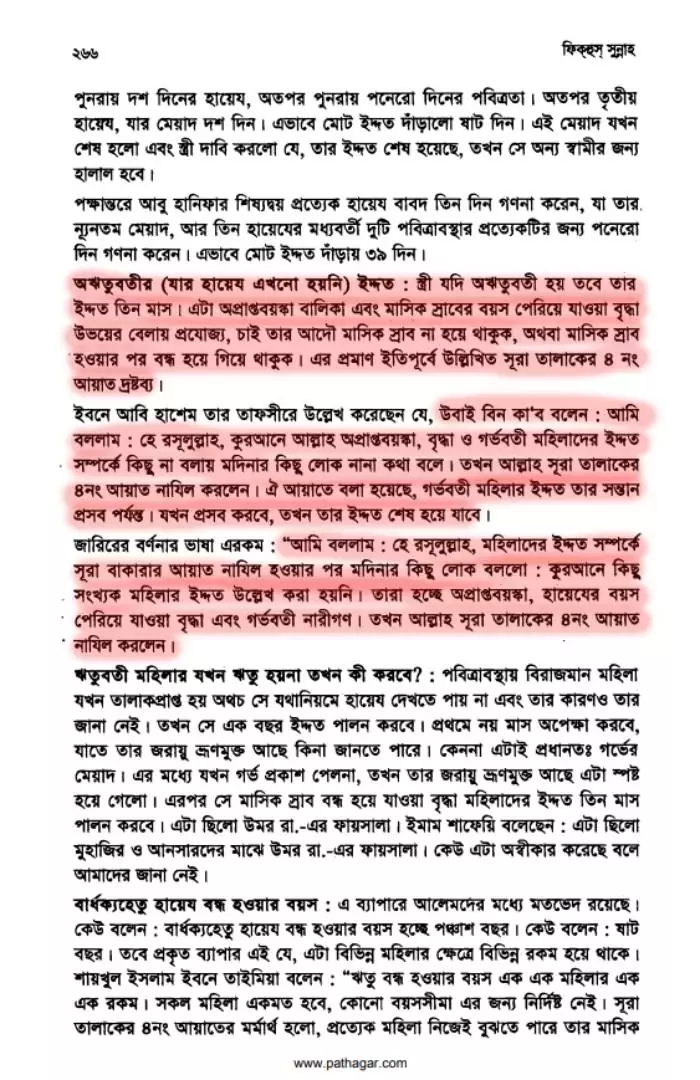
Fiqh al-Sunnah, by the Al-Azhar scholar and Islamic legal writer Sayyid Sabiq, likewise prescribes a three-month waiting period for underage girls. Its Bengali edition explains this rule through Qur’an 65:4 and a report attributed to Ubayy ibn Ka’b. [9]
The Waiting Period of a Woman Who Has Not Menstruated (one whose menstrual periods have not yet begun): If a wife has not menstruated, her waiting period is three months. This applies to both an underage girl and an elderly woman past the age of menstruation, whether she has never menstruated at all or her menstruation stopped after previously occurring. The evidence is verse 4 of Surah At-Talaq, cited earlier.
Ibn Abi Hashim mentioned in his commentary that Ubayy ibn Ka’b said: I said, “O Messenger of Allah, some people in Medina have been speaking about the fact that the Qur’an has not mentioned the waiting period for underage girls, elderly women, and pregnant women.” Then Allah revealed verse 4 of Surah At-Talaq. That verse states that the waiting period of a pregnant woman continues until she delivers her child; once she gives birth, her waiting period ends.
In Jarir’s narration, the wording is as follows: “I said, O Messenger of Allah, after the revelation of the verse on women’s waiting periods in Surah Al-Baqarah, some people in Medina said that the Qur’an had not specified the waiting periods of certain women: underage girls, elderly women past the age of menstruation, and pregnant women. Then Allah revealed verse 4 of Surah At-Talaq.”
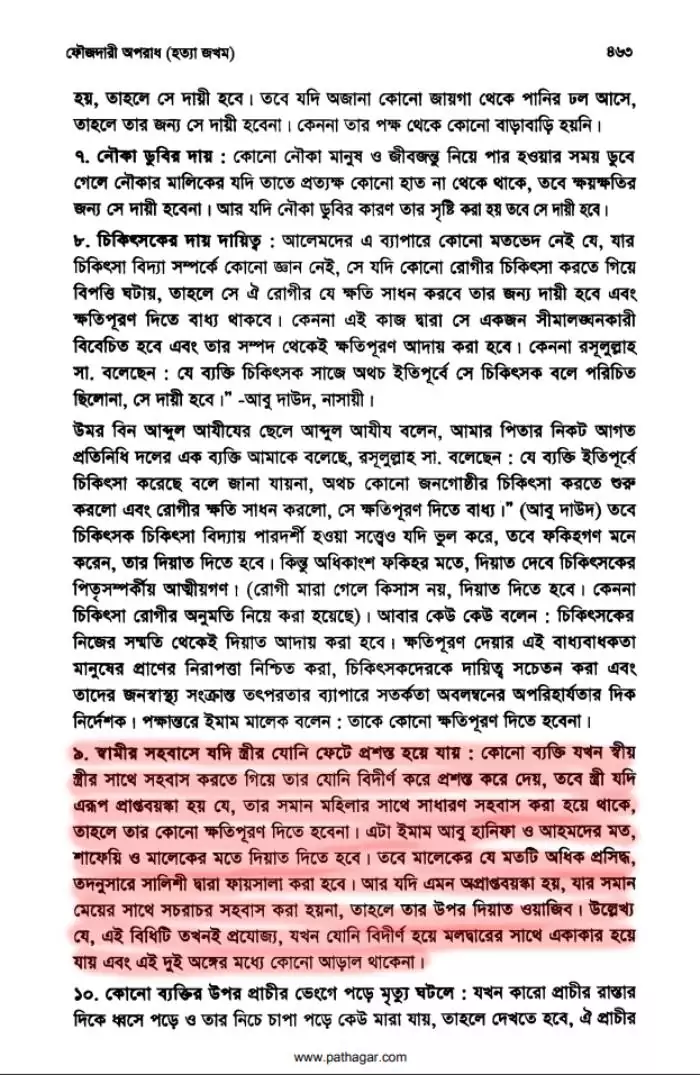
The same book also states that a husband incurs a financial penalty if intercourse with an underage girl tears her vaginal passage. The stated condition is that the vaginal and anal passages must have become continuous: if a partition remains between them, no such penalty is due. Although these rules were elaborated by jurists long after Muhammad, they nevertheless demonstrate how explicitly Islamic jurisprudence legitimized sexual access to children. In effect, believers need only ensure that intercourse does not rupture the little girl’s vaginal and anal passages into one opening. As long as that does not happen, no problem; and if it does, they can simply pay a fine. [10]
1. When a husband’s intercourse tears and widens his wife’s vagina. If a man has intercourse with his wife and thereby tears and widens her vagina, and the wife is an adult woman of an age at which women like her ordinarily have intercourse, he owes no compensation. This is the opinion of Abu Hanifa and Ahmad. According to al-Shafi’i and Malik, blood money is due. According to Malik’s better-known opinion, compensation is to be determined by adjudication. But if she is an underage girl so young that girls like her are not ordinarily subjected to intercourse, blood money is obligatory. This provision applies when the tearing causes the vagina and anus to merge, leaving no separating partition between the two organs.
Not an Isolated Opinion of Sayyid Sabiq: Hanbali Jurisprudence on “Having Intercourse with a Young Wife and Tearing Her Body”
The rule found in Fiqh al-Sunnah concerning a husband’s tearing of his underage wife’s genitals during intercourse cannot be dismissed as Sayyid Sabiq’s personal interpretation, an isolated modern fatwa, or a peculiar addition made by a Bengali translator. The same problem was discussed explicitly as a legal case in major Islamic juristic texts centuries earlier. In Ibn Qudamah’s Al-Mughni, one of the Hanbali school’s most authoritative works, the heading itself reads “Having intercourse with his wife while she is young, and tearing her”—وطئ زوجته وهي صغيرة ففتقها. Thus “child wife” or “young wife” is not terminology imposed by a critic of Islam. The original Arabic describes the wife as صغيرة—a young or underage girl—and specifies the legal rule governing intercourse with her and the resulting bodily rupture. Case 6985 of Al-Mughni states: “ومن وطئ زوجته وهي صغيرة ففتقها لزمه ثلث الدية”—whoever has intercourse with his young wife and tears her body must pay one-third of the blood money. [11] [12]
In the major Hanbali legal text Al-Mughni, Ibn Qudamah discusses in detail genital rupture resulting from intercourse with an underage wife, the obligation to compensate, the husband’s knowledge and intention, the loss of urinary control, and the rules governing compensation even after an injury heals. Cases 6985–6989 include positions attributed to Abu Hanifa, al-Shafi’i, Qatadah, Umar ibn al-Khattab, and Umar ibn Abd al-Aziz. [13]
( 6985 ) مسألة ; قال : ( ومن وطئ زوجته ، وهي صغيرة ، ففتقها ، لزمه ثلث الدية ) . معنى الفتق ، خرق ما بين مسلك البول والمني . وقيل : بل معناه خرق ما بين القبل والدبر ، إلا أن هذا بعيد ; لأنه يبعد أن يذهب بالوطء ما بينهما من الحاجز ، فإنه حاجز غليظ قوي . والكلام في هذه المسألة : في فصلين ; ( 6986 ) الفصل الأول ، في أصل وجوب الضمان . والثاني : في قدره : أما الأول ، فإن الضمان إنما يجب بوطء الصغيرة أو النحيفة التي لا تحمل الوطء ، دون الكبيرة المحتملة له . وبهذا قال أبو حنيفة .
وقال الشافعي : يجب الضمان في الجميع ; لأنه جناية ، فيجب الضمان به ، كما لو كان في أجنبية . ولنا ، أنه وطء مستحق ، فلم يجب ضمان ما تلف به كالبكارة ، ولأنه فعل مأذون فيه ممن يصح إذنه ، فلم يضمن ما تلف بسرايته ، كما لو أذنت في مداواتها بما يفضي إلى ذلك ، وكقطع السارق ، أو استيفاء القصاص ، وعكسه الصغيرة والمكرهة على الزنا . إذا ثبت هذا ، فإنه يلزمه المهر المسمى في النكاح ، مع أرش الجناية ، ويكون أرش الجناية في ماله ، إن كان عمدا محضا ، وهو أن يعلم أنها لا تطيقه ، وأن وطأه يفضيها .
فأما إن لم يعلم ذلك ، وكان مما يحتمل أن لا يفضي [ ص: 373 ] إليه ، فهو عمد الخطإ ، فيكون على عاقلته ، إلا على قول من قال : إن العاقلة لا تحمل عمد الخطإ ، فإنه يكون في ماله .
( 6987 ) الفصل الثاني : في قدر الواجب ، وهو ثلث الدية . وبهذا قال قتادة ، وأبو حنيفة . وقال الشافعي : تجب الدية كاملة . وروي ذلك عن عمر بن عبد العزيز ; لأنه أتلف منفعة الوطء ، فلزمته الدية ، كما لو قطع إسكتيها . ولنا ، ما روي عن عمر بن الخطاب رضي الله عنه أنه قضى في الإفضاء بثلث الدية . ولم نعرف له في الصحابة مخالفا . ولأن هذه جناية تخرق الحاجز بين مسلك البول والذكر ، فكان موجبها ثلث الدية ، كالجائفة . ولا نسلم أنها تمنع الوطء ، وأما قطع الإسكتين ، فإنما أوجب الدية ; لأنه قطع عضوين فيهما نفع وجمال ، فأشبه قطع الشفتين .
( 6988 ) فصل : وإن استطلق بولها مع ذلك ، لزمته دية من غير زيادة . وبهذا قال أبو حنيفة . وقال الشافعي : تجب دية وحكومة ; لأنه فوت منفعتين ، فلزمه أرشهما ، كما لو فوت كلامه وذوقه . ولنا ، أنه أتلف عضوا واحدا ، فلم يفت غير منافعه ، فلم يضمنه بأكثر من دية واحدة ، كما لو قطع لسانه فذهب ذوقه وكلامه . وما قاله لا يصح ; لأنه لو أوجب دية المنفعتين ، لأوجب ديتين ; لأن استطلاق البول موجب الدية ، والإفضاء عنده موجب الدية منفردا ، ولم يقل به ، وإنما أوجب الحكومة ، ولم يوجد مقتضيها ، فإننا لا نعلم أحدا أوجب في الإفضاء حكومة .
( 6989 ) فصل : وإن اندمل الحاجز ، وانسد ، وزال الإفضاء ، لم يجب ثلث الدية ، ووجبت حكومة ، لجبر ما حصل من النقص .
English translation: Case 6985: He said: Whoever has intercourse with his wife while she is young or underage and thereby tears her genitals must pay one-third of the blood money.
The meaning of fatq, or rupture, is the tearing of the partition between the urinary passage and the passage for semen. Another opinion holds that it means the tearing of the partition between the vagina and the anus. However, the second explanation is considered remote or unlikely, because it is difficult for intercourse to destroy the partition between those two passages, as that partition is thick and strong.
The discussion of this case is divided into two sections. The first concerns whether liability for compensation arises at all; the second concerns the amount due.
Case 6986 — Section One: Establishing liability for compensation. First, liability arises when intercourse occurs with a young or underage wife, or a thin and frail wife who cannot endure intercourse. It does not arise for an adult woman capable of enduring intercourse. Abu Hanifa also held this opinion.
Al-Shafi’i, by contrast, said compensation is obligatory in every case. This is because the act causes a punishable injury, for which compensation is owed just as it would be if the woman were a stranger rather than the man’s wife.
Our argument is that the intercourse is a legally established entitlement of the husband. Consequently, compensation is not owed for harm arising from it, just as compensation is not owed for the loss of virginity during intercourse. Moreover, the act was authorized by a person legally competent to give authorization, so no compensation is due for injury resulting from its consequences. This is analogous to a woman’s consenting to medical treatment that causes similar injury, or to the amputation of a thief’s hand or the implementation of retaliatory punishment. The contrasting cases are those of a young girl and a woman forced into illicit sexual intercourse.
Once this is established, the husband owes the dower specified in the marriage contract together with compensation for the injury. The injury compensation must come from his own property if the act was entirely intentional—that is, if he knew that the wife could not endure intercourse and that intercourse would cause ifda, the rupture of her genital passages.
But if he did not know this, and the circumstances were such that the injury might not have occurred, it is classified as amd al-khata, an intentional act resulting in an unintended injury. Liability then falls upon his aqilah, the kinship group responsible for compensation under the applicable rules, except according to those who hold that the aqilah does not bear liability for this category of injury. On that view, compensation is payable from the husband’s own property.
Case 6987 — Section Two: The amount of compensation due. The amount is one-third of the full blood money. Qatadah and Abu Hanifa held the same opinion.
Al-Shafi’i, by contrast, said that the full blood money is due. This opinion is also reported from Umar ibn Abd al-Aziz. Their reasoning is that the husband destroyed the wife’s sexual function, and so the full blood money is owed, as it would be if he severed her two labia.
Our argument is based on a report that Umar ibn al-Khattab awarded one-third of the blood money for ifda. We know of no Companion who opposed his ruling.
Furthermore, the injury tears the partition between the urinary passage and the genital passage. Its prescribed compensation is therefore one-third of the blood money, as in the case of a ja’ifah, a serious wound penetrating a body cavity.
We also do not accept that ifda necessarily destroys the capacity for intercourse. Full blood money is due for the severing of the two labia because it removes two organs possessing both utility and beauty, analogous to severing both lips.
Case 6988 — Compensation where urinary control is lost. If the wife also loses control over urination as a result of the injury, the husband must pay one full blood money, with no additional compensation. Abu Hanifa held the same view.
Al-Shafi’i, by contrast, said that full blood money is due along with an additional judicially assessed award, or hukuma. His reasoning is that the husband destroyed two separate bodily functions and therefore owes compensation for each, just as one would owe compensation for destroying another person’s abilities to speak and to taste.
Our argument is that only one organ has been damaged, and only its functions have been lost. Compensation therefore cannot exceed one full blood money. This is analogous to severing someone’s tongue and thereby destroying both speech and taste, for which more than one full blood money is not payable.
Al-Shafi’i’s reasoning is unsound. If the destruction of two functions necessitated separate blood-money awards, two full blood-money payments would be obligatory. Loss of urinary control independently requires full blood money, and according to al-Shafi’i, ifda independently requires full blood money as well. Yet he does not prescribe two full payments, instead prescribing one with an additional hukuma. There is no basis for imposing a hukuma here, for we know of no one who has prescribed one for ifda.
Case 6989 — Compensation after the injury heals. If the torn partition heals, closes again, and the ifda is resolved, one-third of the blood money is no longer due. A judicially assessed payment, or hukuma, is nevertheless due to compensate for the remaining diminution or injury.
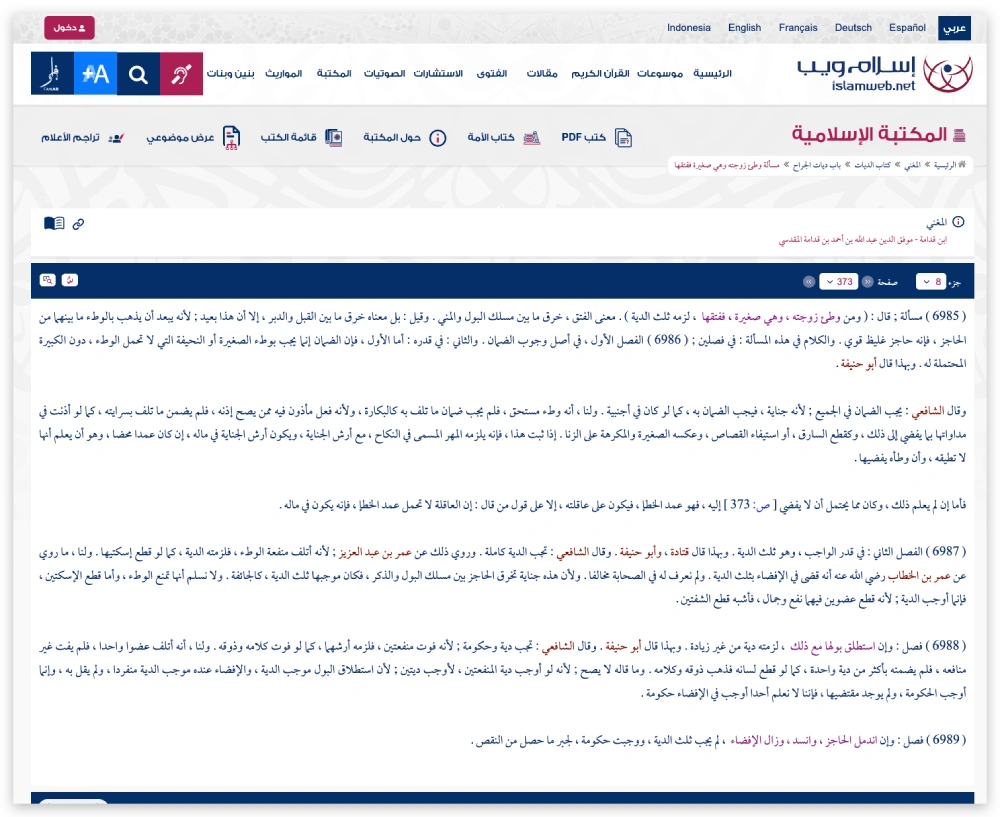
The ensuing explanation is even more significant. Ibn Qudamah expressly states that liability for compensation arises principally in cases involving “الصغيرة أو النحيفة التي لا تحمل الوطء”—“a young girl or a frail woman unable to endure intercourse”—and not an “older woman capable of enduring it.” He adds “وبه قال أبو حنيفة”—Abu Hanifa also adopted this position—whereas al-Shafi’i considers compensation generally payable when a wife’s body is ruptured by intercourse. The juristic discussion thus expressly contemplates a girl whose body cannot endure penetration. Yet it does not declare intercourse between an adult husband and such a wife inherently impossible or categorically forbidden under Islamic law. Nor is the case dismissed as inconceivable. Instead, after intercourse takes place and tears her body, the law calculates whether there is financial liability and how much must be paid. [14] [15]
Here, fatq or ifda does not mean ordinary discomfort from intercourse or a minor injury. Al-Mughni initially defines it as rupture of the partition between the urinary and genital passages, while noting another view that defines it as rupture of the wall between the vagina and anus. In other words, the subject is a devastating injury in which penetration destroys an internal anatomical partition, effectively joining two passages that normally remain separate. The later Hanbali work Al-Insaf repeats the same definition and the same rule governing intercourse with a “young wife” resulting in rupture. Al-Mardawi writes that if a husband has intercourse with a wife who is “young, or so frail that women like her are not ordinarily subjected to intercourse” and causes such injury, one-third of the blood money is due; loss of urinary control raises the question of greater financial liability. [16]
More importantly, Al-Insaf does not present this provision as an isolated opinion of a single jurist. It refers to numerous Hanbali texts, including Al-Mughni, Al-Sharh, Al-Zarkashi, Al-Hidayah, Al-Madhhab, Al-Khulasah, and Al-Kafi, demonstrating that “having intercourse with and rupturing a young wife or a wife unable to endure intercourse” was an established subject of Hanbali jurisprudence. The later Kashshaf al-Qina’ elaborates on the same rule: “ومن وطئ زوجته وهي صغيرة لا يوطأ مثلها لمثله، أو نحيفة…”—if a man has intercourse with his wife when she is so young that girls like her are not ordinarily subjected to intercourse, or if she is too frail to endure it, and thereby tears the partition between urinary and genital passages or between vagina and anus, the amount of blood money depends on whether urinary control is lost. The text even examines the nature of the husband’s liability according to whether he knew she could not endure intercourse. [17]
Nor can this ancient rule be dismissed as “dead medieval law.” The contemporary Salafi fatwa website IslamQA continues to articulate essentially the same juristic principle concerning child marriage and intercourse with underage wives. It explicitly states: “لا علاقة للبلوغ بالجماع”—puberty is not a necessary prerequisite for intercourse. If the girl is deemed “fit for intercourse,” her husband may have intercourse with her, even before puberty; reaching puberty is not a prerequisite. In another answer it cites Malik, al-Shafi’i, and Abu Hanifa for the position that no fixed age is stipulated; the criterion is whether the girl can “endure” intercourse. Thus, even in contemporary Islamic legal guidance, the foundational criterion is not adulthood but the ability to endure penetration. [18] [19] [20]
The moral distortion of this law becomes clearest here. Jurists knew that some girls’ bodies were so immature that penetration could tear internal organs. They named the injury, defined its anatomy, classified its severity according to urinary continence, calculated one-third or full blood money, and debated these amounts across centuries. Yet the moral conclusion that should have come first—an underage child’s body must not be made available for penetration by an adult husband—was not made the governing principle. Even today, Islamic fatwas state that puberty is not required and that the question is whether a child can “endure” penetration. Measuring a child’s sexual safety by whether her genitals can withstand penetration, instead of her autonomy, consent, and adulthood, is not a child-protection ethic. It is a system that evaluates a child’s body according to its suitability for an adult husband’s marital sexual entitlement. A more detailed discussion is available in this comprehensive article.
The Same Law in Hanafi, Shafi’i, and Maliki Jurisprudence: The Dispute Concerns the Amount of Compensation
If the rule appeared only in Hanbali jurisprudence, it might at least be portrayed as an unusual doctrine of a single school. The evidence is the opposite. The major Hanafi text Bada’i al-Sana’i fi Tartib al-Shara’i, by al-Kasani, contains a detailed law of ifda. Al-Kasani first explains the injury as the destruction of the partition separating a woman’s normal bodily passages, then distinguishes between compensation for injuries inflicted on a wife and those inflicted on a woman who is not the man’s wife. He attributes the following position to Abu Hanifa and Muhammad: “إذا كانت زوجته فأفضاها فلا شيء عليه”—“If she is his wife and he causes her ifda, he owes nothing.” Under their position, no such compensation is due whether she retains urinary control or not. Abu Yusuf disagrees: he holds that full blood money is owed if she loses urinary control, and one-third if she does not. [21]
Still more disturbing is the reasoning preserved in support of the opinion attributed to Abu Hanifa and Muhammad. Bada’i al-Sana’i states: “الوطء مأذون فيه شرعاً فالمتولد منه لا يكون مضموناً كالبكارة”—sexual intercourse is authorized under Sharia, so harm arising from it does not generate liability for compensation, just as the loss of virginity does not. The text also preserves Abu Yusuf’s counterargument: the husband was authorized to have intercourse, not to cause ifda. Consider the nature of the internal Hanafi disagreement. A woman’s genitals have been catastrophically torn by penetration, yet the dispute concerns whether this should be treated as a consequence of the husband’s “Sharia-authorized intercourse,” without compensation, or whether he exceeded the lawful scope of intercourse and therefore owes blood money. [22]
The later authoritative Hanafi text Radd al-Muhtar ‘ala al-Durr al-Mukhtar, by Ibn Abidin, raises the problem still more explicitly. It states that if a wife dies or suffers ifda as a result of her husband’s intercourse, and she was “صغيرة أو مكرهة أو لا تطيق”—young, coerced, or unable to endure it—then blood money is due. The same discussion states that intercourse conducted in a way that harms her is impermissible, and that the husband must limit himself to what she can tolerate, as assessed by a judge or experienced women. It even separately discusses the risk of injury caused by the size of the man’s penis. The wording demonstrates once again that the “young wife,” penetration of her body, her ability to endure it, and the possibility of death or ifda are not scenarios invented by critics of Islam. They are legal problems addressed within Hanafi jurisprudence itself. [23]
Within Shafi’i jurisprudence, al-Mawardi’s Al-Hawi al-Kabir provides a particularly important comparative treatment of the same issue. Citing al-Shafi’i, it states that when a husband causes ifda during intercourse with his wife, blood money is owed. Al-Mawardi describes the situation as “رجل وطأ زوجته فأفضاها بشدة المبالغة في الإيلاج”—a man has intercourse with his wife and causes ifda through exceptionally forceful or excessive penetration. He then directly cites Abu Hanifa’s position: “إن أفضى زوجته، فلا شيء عليه في الإفضاء”—if a man causes ifda to his wife, he owes no compensation for that injury. The same passage gives Malik’s view as “في الإفضاء حكومة”—the amount of compensation for ifda is determined by judicial assessment. [24]
Al-Hawi preserves the Hanafi reasoning in particularly stark terms. In defense of Abu Hanifa’s position, the text describes intercourse with a wife as “وطء مستحق”—sexual intercourse to which the husband is legally entitled. On that basis, an argument is made against compensating for ifda arising from the exercise of this entitlement. The Shafi’i side replies that although the husband has a right to ordinary intercourse, inflicting ifda is not within the scope of that right; the injury results from excessive force during penetration and therefore constitutes a separate offense requiring blood money. Thus the central disagreement is not over the child’s or woman’s independent sexual consent. It is about where the limits of the husband’s legitimate penetration lie, and at what point tearing her body becomes a legally compensable injury. [25]
The rule did not disappear from later Shafi’i jurisprudence. Ibn Hajar al-Haytami’s Tuhfat al-Muhtaj prescribes blood money for a wife who suffers ifda and gives as its principal anatomical definition the destruction of the partition between vagina and anus, merging the sexual and anal passages. The same work states that if intercourse cannot occur without causing ifda because of the size of the husband’s penis or the narrowness of the wife’s vaginal passage, the husband may not have intercourse with her, nor may the wife permit such intercourse. The horrific account in the Bengali edition of Fiqh al-Sunnah, in which vagina and anus become one passage, is therefore not a Bengali translator’s invention: an important later Shafi’i text gives the same anatomical definition. [26]
Ifda is also an established compensable injury in Maliki jurisprudence. Hashiyat al-Dasuqi ‘ala al-Sharh al-Kabir defines it as the destruction of the partition between the genital and urinary passages so that the two become one, and also discusses judicially assessed compensation, or hukuma, when the urinary and anal passages become connected. Importantly, the text expressly states that compensation for ifda is not subsumed into the marriage dower, whether the injury was caused by the husband or by another man. Thus even a husband can owe separate compensation for ifda. Maliki jurists also preserved differing views on whether hukuma or full blood money should apply. [27] [28]
The rule in Fiqh al-Sunnah is therefore no isolated statement. Islamweb’s jurisprudential index contains a separate category titled “دية الإفضاء”, or “blood money for ifda,” listing numerous works from different schools, including Bada’i al-Sana’i, Al-Mughni, Al-Hawi, and Hashiyat al-Dasuqi. An even earlier comparative text, Ibn al-Mundhir’s Al-Awsat, contains a separate chapter titled “باب الإفضاء” (“Chapter on Ifda”), preserving jurists’ views concerning full and partial compensation. In other words, Islamic jurisprudence treated this catastrophic genital injury as such an established legal problem that it developed its own terminology, dedicated chapters, school-specific disagreements, and centuries of legal discussion. [29] [30]
The most disturbing conclusion is that these schools disagree principally not over the fundamental moral question, but over liability and the amount of compensation. Some prescribe one-third of the blood money, others the full amount; some prescribe a hukuma, while others impose no compensation when the victim is the man’s wife because the intercourse was authorized under Sharia. Yet the fundamental question remains: if a girl is described as “صغيرة”—a young wife—and the same juristic tradition acknowledges that her body may be unable to withstand penetration, why should an adult man possess a legal opportunity to penetrate her body at all? Even today IslamQA explicitly states that puberty is not a prerequisite for intercourse: if a girl is deemed able to “endure” penetration, her husband may have intercourse with her before puberty. [31] [32]
This is not a system of child protection. It is a legal framework that makes the central criterion for intercourse not the child’s adulthood, freely given sexual consent, or control over her own body, but whether her body is physically capable of enduring a man’s penetration. If that penetration tears her body, jurists then calculate whether the consequence is one-third blood money, full blood money, a hukuma, or nothing at all. Presenting this law as “protecting a child’s dignity” is not merely false; it contradicts the language of the legal texts themselves.
Death of a Married Girl After Intercourse in Al-Muhalla: The Legal Treatment of Catastrophic Injury in Early Islamic Jurisprudence
Islamic jurisprudence does not confine the discussion of genital rupture caused by intercourse with an underage wife to hypothetical calculations of injury. Volume eleven of Ibn Hazm’s Al-Muhalla bil-Athar, case 2064 on blood money for ifda, preserves a report of a girl whose body was torn during intercourse with her husband and who died from the bleeding. The incident is narrated through Hisham ibn Amr al-Fazari. According to Hisham, he was present with Umar ibn Abd al-Aziz when a letter arrived from the governor of Najran. It reported the marriage of a poor father’s daughter to a wealthy man and the girl’s subsequent death. The narration does not specify the girl’s exact age, but expressly includes concerns about her physical immaturity and a later legal discussion of whether she had reached the stage of physical maturity ordinarily associated with women. This is a report preserved in early Islamic legal literature. [33]
According to the account, a wealthy man married the daughter of a poor father. After marriage, he wanted to take the girl into his household and promised to increase his financial support for her. The father, however, feared that the man might have intercourse with his daughter. In response, the husband promised that he would not approach her sexually. Relying on that promise, the father entrusted his daughter to him. The husband then broke his promise and had intercourse with her. Her body was torn, she bled, and she died. The father had already feared the possible injury intercourse could cause. The husband had promised to refrain from intercourse in order to allay that concern, but subsequently broke the promise. In this account, the position established by marriage placed the girl in circumstances that ended in her death. [34]
فَقَالَ إِنِّي أَخَافُكَ عَلَيْهَا أَنْ تَقَعَ بِهَا، فَقَالَ لَا تَخَفْ لَا أَقْرَبُهَا، فَدَفَعَهَا إِلَيْهِ، فَوَقَعَ بِهَا فَخَرَقَهَا، فَهُرِيقَتْ دَمًا وَمَاتَتْ
English translation: The father said, “I fear that you will have intercourse with her.” The man replied, “Do not be afraid; I will not go near her.” So the father entrusted her to him. But the man had intercourse with her and tore her body apart. She bled and died.
After the incident, the issue of compensation was raised in the presence of Umar ibn Abd al-Aziz. Abdullah ibn Ma’qil ibn Muqarrin and Abdullah ibn Amr ibn Uthman expressed the view that liability for compensation existed. Umar ibn Abd al-Aziz questioned whether the marriage dower and blood money could be due together. Aban ibn Uthman then stated that if the girl had reached the physical maturity ordinarily associated with women, no blood money was due, but if she had not reached that stage, compensation was owed. Umar ibn Abd al-Aziz referred the matter in writing to al-Walid ibn Abd al-Malik. Thus, even where intercourse had caused the girl’s death, the central judicial question became liability according to her physical maturity. Her age and customary fitness for intercourse became the categories governing the assessment of blood money. [35]
Aban ibn Uthman and Umar ibn Abd al-Aziz: No Compensation If the Girl Was Considered Fit for Intercourse
A separate legal decision corresponding to the report preserved by Ibn Hazm appears in Ibn Abi Shaybah’s Al-Musannaf. It describes a case brought before Aban ibn Uthman in which a man married a girl and caused ifda by having intercourse with her. According to a ruling attributed to Aban ibn Uthman and Umar ibn Abd al-Aziz, if the girl was of an age or physical condition at which girls like her were ordinarily subjected to intercourse, the husband owed no compensation. If she had not reached that stage, he owed one-third of the blood money. The decisive criterion for compensation was thus not the girl’s freely given sexual consent but whether her body was conventionally considered fit for intercourse. [36]
إِنْ كَانَتْ مِمَّنْ يُجَامَعُ مِثْلُهَا فَلَا شَيْءَ عَلَيْهِ، وَإِنْ كَانَتْ مِمَّنْ لَا يُجَامَعُ مِثْلُهَا فَعَلَيْهِ ثُلُثُ الدِّيَةِ
English translation: If she was someone whose peers would ordinarily have intercourse, he owes nothing. But if she was someone whose peers would not ordinarily have intercourse, he owes one-third of the blood money.
The moral character of this decision is significant. A girl’s genitals have been torn through intercourse, yet the question of compensation turns on whether girls of her age or condition are customarily subjected to intercourse. Whether she gave meaningful sexual consent, whether she had the real ability to refuse her husband’s authority, or whether she could freely express her wishes at the time of marriage are not decisive considerations in this rule. Instead, liability is determined by the legal scope of the husband’s marital entitlement and the girl’s physical capacity. Even after severe injury, the husband may be exempted from compensation if girls like her are ordinarily deemed fit for intercourse. The principle prioritizes marital sexual entitlement over the child’s independent consent.
Early Rulings Attributed to Umar ibn al-Khattab and Zayd ibn Thabit
Discussions of compensation for ifda are also preserved under the names of still earlier figures. In Abd al-Razzaq al-San’ani’s Al-Musannaf, a report transmitted through Amr ibn Shu’ayb states that a man sexually coerced a woman and caused her ifda. Umar ibn al-Khattab then imposed the prescribed punishment on the perpetrator and awarded the woman one-third of her blood money as compensation. This is not specifically a case involving a married underage wife; it is a separate report about ifda caused by sexual coercion. Its importance lies in the fact that the recognition of serious sexual injury as a separately compensable wrong is attributed to figures from the early Islamic period. [37]
عَنْ عَمْرِو بْنِ شُعَيْبٍ أَنَّ رَجُلًا اسْتَكْرَهَ امْرَأَةً فَأَفْضَاهَا، فَضَرَبَهُ عُمَرُ بْنُ الْخَطَّابِ الْحَدَّ، وَأَغْرَمَهُ ثُلُثَ دِيَتِهَا
English translation: It is reported from Amr ibn Shu’ayb that a man forced a woman into sexual intercourse and caused her ifda. Umar ibn al-Khattab imposed the prescribed punishment upon him and ordered him to pay one-third of her blood money.
Ibn Abi Shaybah’s Al-Musannaf also preserves a report attributed to Zayd ibn Thabit concerning compensation where a husband’s intercourse caused his wife’s ifda. It distinguishes between one-third and full blood money according to whether normal bodily functions remain intact. Compensation was thus determined not merely by the existence of a genital rupture but also by the extent to which the injury destroyed bodily function. These are legal positions attributed to different early figures. The repetition of a report across several books does not automatically turn it into multiple independently corroborated historical events. [38]
Ibn Hazm himself examines these positions and distinguishes between deliberate injury and accidental harm. In his view, retaliatory punishment (qisas) may apply where a husband knowingly has intercourse that his wife cannot endure and intentionally causes ifda. He also prescribes full blood money when death occurs unintentionally. Even in this position, the central questions are the classification of the offense and liability after the injury has occurred. Disputes over compensation, retaliation, or other penalties do not replace the question of a child’s independent sexual consent. The fundamental problem—why an immature girl should be brought under marital sexual entitlement in the first place—is not resolved merely by assigning punishment according to the degree of injury. [39]
Taken together, Ibn Hazm’s report of a death; rulings attributed to Aban ibn Uthman and Umar ibn Abd al-Aziz that determine compensation by customary fitness for intercourse; and statements attributed to Umar ibn al-Khattab and Zayd ibn Thabit on blood money for ifda reveal an important feature of early Islamic law. Serious injuries caused by intercourse were recognized, their physical consequences discussed, and compensation or punishment prescribed in various circumstances. Yet the legal recognition of marital sexual entitlement over an underage wife was not categorically rejected on the basis of the child’s autonomy and independent consent. Most disturbing is the way a girl’s age and physical capacity became the criteria for classifying compensation after intercourse, rather than for questioning whether she should be subjected to marital sexual use in the first place. This prioritization of the husband’s established legal sexual entitlement over the girl’s bodily safety directly conflicts with modern principles of child protection and sexual consent.
Compensation Is Not Child Protection
The evidence leaves little room for confusion. Islamic jurisprudence did not treat intercourse with an underage wife and the catastrophic rupture of her genital organs as an accidental observation by a single author. Major Hanafi, Hanbali, Shafi’i, and Maliki texts all discuss the same problem, differing principally over the type and amount of compensation. Some prescribe one-third of the blood money, others the full amount or judicially assessed compensation, while some impose no compensation on the husband because the intercourse is treated as a lawful marital entitlement. Beneath these differences lies the fundamental point: Islamic law recognized a marital framework in which a girl could be so young that her body was unable to endure intercourse, yet she remained a man’s wife, and her body a potential object of marital sexuality.
At this point the argument “But there is blood money if she is injured” is entirely beside the point. Compensation and protection are not the same. If a law first permits conduct that exposes a child to a serious risk of devastating harm and then assigns a monetary value to the damage, it is managing the injury rather than preventing it. Suppose a law authorized a child laborer to work in a toxic factory and then assessed how much the owner would pay if the child’s lungs were destroyed. No one would call the compensation child protection, because the prior moral question is why the child was placed in such danger. Similarly, before calculating blood money for the genital rupture of an underage girl caused by penetration, the question must be asked: how did an adult man acquire the right to penetrate that immature body in the first place?
The severity of the problem becomes clearer when the juristic language makes the girl’s ability to “endure intercourse,” rather than adulthood or free sexual consent, the decisive criterion. It is difficult to imagine a more brutal reduction of a child’s personhood to physical endurance. The inquiry does not ask whether she understands sexual relations, is free to refuse, has the practical power to resist an adult husband, or might suffer long-term psychological damage. It asks whether her body can withstand penetration—as though her sexual rights could be determined by how much physical pressure her vaginal passage can tolerate rather than by her mind, autonomy, and maturity.
A child’s ability to endure penetration does not establish that she is morally or psychologically ready for sex. These are entirely different things. Sexual consent is not a physical durability test. The ability to withstand pain, become pregnant, or be penetrated does not establish that a person understands the meaning and consequences of sexual relations or possesses the psychological and social capacity to decide freely. This distinction lies at the heart of modern child-protection principles, yet in the juristic framework under discussion, the child’s “capacity to endure intercourse” is given such prominence that independent sexual consent becomes virtually invisible.
This is where the deception in the argument “But they were married” becomes apparent. Marriage is not a magical process that transforms a child into an adult. A guardian arranging a child’s marriage does not create her capacity to make sexual decisions. A marriage officiant reciting the nikah does not accelerate her physical or neurological development by several years. The determination of a dower does not make her the equal of an adult man in power. Indeed, marriage may aggravate the power imbalance, because the man is now not only older and physically stronger but also invested with religious, social, and familial authority as a “husband.” The first question should therefore be how freely the child could possibly consent in such circumstances. When jurisprudence begins with the husband’s right to intercourse and ends by assessing blood money for the child’s injured body, the legal system’s priorities become unmistakable.
Even the most favorable interpretation of these Islamic legal doctrines fails to remove the basic problem. Suppose a school says that intercourse must not injure a child. Suppose a jurist says that the husband must wait until she can endure intercourse. Suppose even full blood money is awarded when she is injured. The underlying question remains: why was an underage child placed within a framework of marital sexual entitlement in which the “fitness” of her body for intercourse becomes a legal question at all? Modern child protection supplies a fundamentally different answer: a child’s body is not a husband’s sexual property. No one can declare her “fit” for penetration before she has become a person capable of giving meaningful sexual consent as an adult. This principle is absent from the rules under examination.
Physical and Psychological Harm of Child Sexual Abuse in Modern Medicine
The moral problem of sexual relations between an adult and a child extends well beyond visible genital injury. In its 2017 publication Responding to Children and Adolescents Who Have Been Sexually Abused: WHO Clinical Guidelines, the World Health Organization identified child and adolescent sexual abuse as a serious human-rights violation and a global public-health problem. The guidelines address psychological trauma, sexual and reproductive health conditions, and long-term health consequences alongside physical injury. They also emphasize safety and respect for the wishes and autonomy of the person subjected to abuse. Modern child protection therefore does not stop at asking whether genitals were ruptured or how much compensation an injury warrants. Bodily integrity, psychological well-being, safety, and individual autonomy are integral to protecting children. [40]
Sexual abuse of children and adolescents is a gross violation of their rights and a global public health problem.
The WHO guidelines discuss both short- and long-term consequences of sexual abuse, including post-traumatic stress, anxiety, depression, sleep disturbances, thoughts of self-harm, sexually transmitted infections, and reproductive-health complications. For girls, the risks include unintended pregnancy and gynecological problems. These harms do not depend solely on the tearing of a particular anatomical partition. Sexual abuse can have psychological and medical consequences even in the absence of a severe visible injury. Accordingly, whether ifda occurred, whether urinary continence was lost, or whether the partition between genital and anal passages remained intact cannot provide a complete assessment of a child’s sexual safety. [41]
The conflict between the Islamic juristic doctrines discussed here and modern child-protection standards is fundamental. Classical jurisprudence gave importance to whether an underage wife’s body could endure intercourse when determining fitness for sexual relations. Once an injury occurred, compensation was assessed according to genital rupture, the loss of urinary control, and other damage to bodily functions. But a child’s ability to survive penetration does not mean she has acquired psychological maturity, independent sexual consent, or the capacity to comprehend its consequences. Sexual abuse can damage a child’s sense of security and mental health even when no obvious physical injury is visible. Using the body’s endurance as the measure of a child’s suitability for intercourse is therefore not a comprehensive protective principle. It reduces her personhood to her physical suitability for an adult man’s sexual use.
Conclusion: A Law That Calculates the Price of a Child’s Torn Body
The moral assessment of the rules discussed here requires no complicated philosophy. We need only consider the questions the law itself asks. A husband has had intercourse with an underage wife whose body cannot even endure ordinary sexual intercourse. The penetration has torn the internal partitions of her genital organs, potentially causing permanent harm such as the loss of urinary control. Islamic jurists then debate whether the amount due is one-third of the blood money, full blood money, a hukuma, or nothing. The first question for any civilized moral system should not be how much money must be paid after a child’s body has been so badly damaged. It should be why an adult man was granted the right to penetrate that child’s body in the first place.
The rule cannot be excused merely as a “social reality of the seventh century.” Islam does not present itself as a fallible legal system created by the people of a particular age. Its Sharia is presented as divine guidance, justice, and the best way of life for humanity. The collision between that claim and this provision is what matters most. If the religious claim is that an omniscient and infinitely merciful God knows morality better than human beings do, the laws established in His name should have transcended the cruel social practices of their time. Protecting a child from the sexual use of adult men, refusing to turn her body into an object of marital entitlement, and preserving her childhood are not moral truths that modern humans could discover but an omniscient deity could not comprehend.
Once a child’s childhood has been destroyed, it cannot be restored. Blood money cannot erase the memory of sexual violence. A price may be assigned to a torn genital organ, but no ledger can capture the full value of the child’s lost security, loss of control over her body, fear, and psychological injury. This is why the goal of a civilized society must be to prevent the harm rather than calculate its price afterward. Keeping a child out of marriage and sexual relations at an age when she cannot give meaningful consent is not a cultural luxury; it is a minimum requirement of humanity.
The most severe charge against this Islamic rule emerges here. It did not protect the child first; it first made her a wife. It recognized her body as a potential object of an adult man’s marital sexual entitlement. Then, when the exercise of that entitlement tore her body, it calculated the amount of compensation. That sequence demonstrates the moral bankruptcy of the system: the husband’s sexual entitlement before the child’s safety, the marriage contract before the child’s independent consent, and the calculation of damages before the protection of her body. There is no intellectually honest way to portray such a law as humane.
Sexual penetration of a child by an adult man, when the child cannot give independent and meaningful sexual consent, is sexual abuse; nonconsensual penetration is rape. Words such as “nikah,” “husband,” “halal,” or “Sharia-compliant” do not change that reality. Religious authorization does not alter the child’s nervous system, psychological development, or physical immaturity. When a religion attaches a seal of sanctity to such sexual use, the need for criticism does not diminish. It increases.
This provision of Islamic jurisprudence is therefore not merely an antiquarian legal curiosity. It is a moral mirror. It reflects a legal system that first brought an underage girl’s body within the scope of a man’s marital sexual entitlement and then assessed its financial value after the exercise of that entitlement destroyed it. A law that calculates how badly a child’s body has been torn by rape-like marital sexual acts, rather than protecting the child from rape, cannot be presented as child-protective, favorable to women, or an ideal of eternal morality without making a mockery of history, reason, and humanity.
No religion has a claim of ownership over a child’s body. Neither does any guardian, husband, or jurist. A child’s body belongs to the child. Protecting her safety, childhood, and future is a greater moral obligation than any religious ruling. A law that failed to understand this elementary truth cannot claim the authority to teach humanity morality.
References
- Child Marriage, Pedophilia, and Islam: Had Aisha Reached Puberty at Nine? ↩︎
- Islamic Authorization of Marital Rape ↩︎
- Al-Shafi’i, Al-Umm, vol. 5, pp. 19–20, “Ma Ja’a fi Nikah al-Aba’”; Islamweb ↩︎
- The Qur’an, Surah Al-Ahzab 33:49 ↩︎
- The Qur’an, Surah At-Talaq 65:4 ↩︎
- Al-Tabari, Jami’ al-Bayan, vol. 23, p. 452, commentary on 65:4; Islamweb ↩︎
- Al-Tabari, Jami’ al-Bayan, vol. 23, p. 453, al-Dahhak’s explanation of 65:4; Islamweb ↩︎
- Al-Zajjaj, Ma’ani al-Qur’an wa-I’rabuhu, vol. 5, pp. 185–186, commentary on 65:4 ↩︎
- Fiqh al-Sunnah, vol. 2, Sayyid Sabiq, Shatabdi Prakashani, p. 266 ↩︎
- Fiqh al-Sunnah, vol. 2, Sayyid Sabiq, Shatabdi Prakashani, p. 463 ↩︎
- Al-Mughni, Ibn Qudamah, vol. 8, Book of Blood Money, case 6985–6986 — Islamweb: “وطئ زوجته وهي صغيرة ففتقها” ↩︎
- Shamela: Al-Mughni ↩︎
- Ibn Qudamah, Al-Mughni, vol. 8, pp. 372–373, Book of Blood Money, cases 6985–6989; Islamweb ↩︎
- Al-Mughni, case 6986 — Original Arabic text at Islamweb ↩︎
- Shamela edition ↩︎
- Al-Insaf, al-Mardawi, vol. 10, p. 113–114 — Islamweb: Al-Insaf, باب الشجاج وكسر العظام ↩︎
- Kashshaf al-Qina’, al-Buhuti, vol. 6, باب الشجاج وكسر العظام — Original text at Islamweb ↩︎
- IslamQA, fatwa no. 176799 — “The Wisdom Behind Permitting Marriage of a Minor Before Puberty” ↩︎
- IslamQA, fatwa no. 127176 — “Discussion of Marriage and Consummation with a Minor Girl Among Sunni Jurists” ↩︎
- IslamQA, fatwa no. 22442 — “The Ruling on Marrying Young Daughters” ↩︎
- Bada’i al-Sana’i, al-Kasani, vol. 7, p. 319–320, Book of Offenses — Original Arabic text at Islamweb; Shamela: Bada’i al-Sana’i ↩︎
- Bada’i al-Sana’i, vol. 7, p. 320 — Islamweb edition; Shamela edition ↩︎
- Radd al-Muhtar, Ibn Abidin, Book of Marriage, باب القسم بين الزوجات — Original Arabic text at Islamweb ↩︎
- Al-Hawi al-Kabir, al-Mawardi, vol. 9, “القول في إفضاء الزوجة” — Original text at Islamweb; Shamela: Al-Hawi al-Kabir ↩︎
- Al-Hawi al-Kabir, vol. 9, p. 538–539 — Islamweb: Ifda of the Wife; Shamela edition ↩︎
- Tuhfat al-Muhtaj, Ibn Hajar al-Haytami, vol. 8, p. 482 — Original text at Islamweb ↩︎
- Hashiyat al-Dasuqi, vol. 4, p. 278 — Original text at Islamweb ↩︎
- Minah al-Jalil, vol. 9 — Islamweb: Detailed Maliki discussion ↩︎
- Islamweb: Index on Diyah al-Ifda ↩︎
- Al-Awsat, Ibn al-Mundhir, vol. 13, p. 296, “باب الإفضاء” — Text at Islamweb ↩︎
- IslamQA, fatwa no. 176799 — Permitting intercourse before puberty if the girl is deemed “fit for intercourse” ↩︎
- IslamQA, fatwa no. 127176 — Juristic discussion of intercourse with an underage wife ↩︎
- Ibn Hazm, Al-Muhalla bil-Athar, vol. 11, pp. 87–88, Book of Bloodshed, Retaliation and Blood Money, case 2064: دية إفضاء الرجل المرأة; Islamweb ↩︎
- Ibn Hazm, Al-Muhalla, vol. 11, p. 87, case 2064, report of Hisham ibn Amr al-Fazari ↩︎
- Ibn Hazm, Al-Muhalla, vol. 11, pp. 87–88, case 2064 ↩︎
- Ibn Abi Shaybah, Al-Musannaf, vol. 6, p. 427, Book of Blood Money, chapter الرجل يستكره المرأة فيفضيها, report 2; Islamweb ↩︎
- Abd al-Razzaq al-San’ani, Al-Musannaf, vol. 9, p. 378, Book of Compensation, chapter on Ifda, report 17670; Islamweb ↩︎
- Ibn Abi Shaybah, Al-Musannaf, vol. 6, p. 427, report 3, ruling on Ifda attributed to Zayd ibn Thabit ↩︎
- Ibn Hazm, Al-Muhalla, vol. 11, p. 88, case 2064: deliberate and accidental Ifda ↩︎
- World Health Organization, Responding to Children and Adolescents Who Have Been Sexually Abused: WHO Clinical Guidelines (2017) ↩︎
- World Health Organization, Responding to Children and Adolescents Who Have Been Sexually Abused, 19 October 2017, “Consequences of Sexual Abuse” ↩︎