
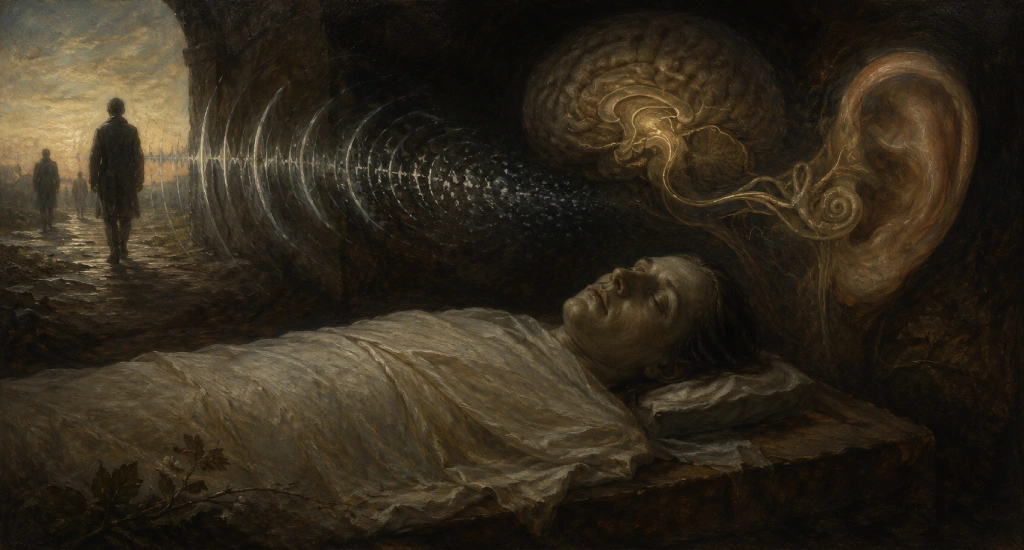
Introduction: Footsteps in the Solitude of the Grave and a Theory of Miraculous Hearing
There is a fundamental difference between asking what happens to the human body after death and making claims about what a dead person hears, thinks, and suffers. The first question can be investigated through observation of dead bodies, physiological knowledge, and experimentation; the second asserts the existence of a personal experience that the deceased is not communicating to the living. The Islamic grave narrative supplies highly specific details about this unseen experience. As the mourners depart, the dead person hears their shoes, angels sit him up and question him, he answers about his beliefs, and, if he fails to give the prescribed answer, he cries out under a blow from an iron hammer. Every stage attributes capacities to the deceased that, in living humans, depend on a functioning body and nervous system. Yet no independent evidence beyond the account itself is presented for how those capacities returned after death. The belief makes extremely detailed claims; the basis offered for establishing their truth remains confined to repeating them.
The reference to shoes directly connects this narrative to the physical world. Shoes are not supernatural objects, and the sound of walking is not an unknown occurrence in an unseen realm; it is a familiar physical stimulus produced by living people moving about. The claim is that this worldly sound reaches a person’s perception even after death. The same person is then credited with understanding questions, retrieving his former beliefs from memory, and answering in language. The issue therefore extends beyond the presence of ears or the transmission of vibrations through soil: it becomes a claim that integrated consciousness and personal identity remain functional in a dead human being. Adding the names of souls, angels, or barzakh to the explanation does not reduce the need for evidence. Each additional entity and capacity introduces a further burden of proof. One unknown event can explain another within a story; establishing knowledge of reality requires evidence that the explanation itself is true.
Because the threat of torture accompanies this hearing and conversation in the grave, the claim also directly affects people’s beliefs and behaviour. The question put to the deceased centres on his position concerning Muhammad; the approved answer brings safety and reward, while the unbeliever’s or hypocrite’s answer brings a blow from an iron hammer. The idea that even death offers no escape from interrogation and punishment under religious authority is presented to the living as their own future. At the same time, the cries of punishment are placed beyond human hearing: people are required to feel fear without being able to examine the alleged horror for themselves. This arrangement binds religious allegiance to the prospect of invisible torture instead of establishing it through evidence. Whether a belief is true is a matter of facts and reasoning; threatening that rejection will bring a hammer blow to the head after death adds no evidence in its favour. Fear can secure belief, but it cannot establish the existence of the event being threatened.
The Central Hadith: From Footsteps to Interrogation and the Iron Hammer
The funeral section of Sahih al-Bukhari preserves an account attributed to Muhammad in which the deceased hears footsteps, is questioned by two angels, and is struck with an iron hammer. Bukhari also titles the relevant chapter, “The dead person can hear the sound of shoes.” The sequence is explicit: the person is placed in his grave, his companions leave, he hears their shoes, and the angels then sit him up and question him about Muhammad. One answer testifies that Muhammad is Allah’s servant and messenger; the unbeliever’s or hypocrite’s answer expresses ignorance and repeats what others used to say. The consequence of the latter is a blow between the ears with an iron hammer and a cry. Hearing, belief, and torture form part of the same sequence. [1]
الْعَبْدُ إِذَا وُضِعَ فِي قَبْرِهِ، وَتُوُلِّيَ وَذَهَبَ أَصْحَابُهُ حَتَّى إِنَّهُ لَيَسْمَعُ قَرْعَ نِعَالِهِمْ، أَتَاهُ مَلَكَانِ فَأَقْعَدَاهُ فَيَقُولاَنِ لَهُ مَا كُنْتَ تَقُولُ فِي هَذَا الرَّجُلِ مُحَمَّدٍ صلى الله عليه وسلم فَيَقُولُ أَشْهَدُ أَنَّهُ عَبْدُ اللَّهِ وَرَسُولُهُ. فَيُقَالُ انْظُرْ إِلَى مَقْعَدِكَ مِنَ النَّارِ، أَبْدَلَكَ اللَّهُ بِهِ مَقْعَدًا مِنَ الْجَنَّةِ ـ قَالَ النَّبِيُّ صلى الله عليه وسلم فَيَرَاهُمَا جَمِيعًا ـ وَأَمَّا الْكَافِرُ ـ أَوِ الْمُنَافِقُ ـ فَيَقُولُ لاَ أَدْرِي، كُنْتُ أَقُولُ مَا يَقُولُ النَّاسُ. فَيُقَالُ لاَ دَرَيْتَ وَلاَ تَلَيْتَ. ثُمَّ يُضْرَبُ بِمِطْرَقَةٍ مِنْ حَدِيدٍ ضَرْبَةً بَيْنَ أُذُنَيْهِ، فَيَصِيحُ صَيْحَةً يَسْمَعُهَا مَنْ يَلِيهِ إِلاَّ الثَّقَلَيْنِ
English translation: Sahih al-Bukhari (Islamic Foundation)
20 / Funerals
Chapter: 850. The dead person can hear the sound of the mourners’ shoes.
1257. Ayyash and Khalifah (may Allah have mercy on them) … narrated from Anas (may Allah be pleased with him) that the Prophet, peace and blessings be upon him, said: When a servant is placed in his grave and his companions leave him behind, he can still hear the sound of their shoes. At that moment, two angels come to him and sit him up. They then ask, “What did you used to say about this man, Muhammad?” He will say, “I testify that he is Allah’s servant and His Messenger.” He will then be told, “Look at your place in Hell, for which Allah has appointed a place in Paradise for you instead.”
The Prophet, peace and blessings be upon him, said: He will then see both places at the same time. Those who are unbelievers or hypocrites will say, “I do not know. I used to say what other people said.” He will then be told, “You neither knew for yourself nor learned through recitation.” He will then be struck so hard between his ears with an iron hammer that he will cry out, and everyone around him except humans and jinn will hear it.
Hadith classification: Sahih
Narrator: Anas ibn Malik (may Allah be pleased with him)
In this account, the deceased’s ability to hear is not an isolated embellishment; it is a functional prerequisite for everything that follows. He cannot answer without hearing and understanding the question, cannot state his position without remembering his former beliefs, and cannot meaningfully be described as crying under punishment without the capacity to feel pain. Muhammad’s claim therefore has hearing, language comprehension, memory, self-identity, and sensation functioning together after death. What begins with footsteps ultimately asserts an integrated mental life in a dead person. Invoking a soul does not establish this integrated functioning. The soul’s existence, its capacity to receive external sounds, its connection to the body, and its ability to answer in language each require separate evidence. Assigning several further unproven capacities to an unproven entity increases the evidential deficit concerning hearing. The capacities employed in the narrative require evidence of their actual existence beyond the narrative itself.
The subject of the interrogation also reveals the system’s religious purpose. The quoted question concerns neither the person’s honesty, his treatment of others, nor torture he inflicted on them; it asks what he used to say about Muhammad. The approved answer acknowledges his status as messenger. Safety is thus directly tied to accepting Muhammad’s religious authority. No procedure is described for evaluating the unbeliever’s or hypocrite’s answer of not knowing through inquiry, doubt, or reasoning; the humiliating response and hammer blow follow immediately. Ethically, this is coercion over belief: the absence of a particular religious acknowledgement is linked to physical suffering. Striking someone on the head cannot be an answer to his inability to believe a proposition true. The blow supplies none of the missing evidence for belief; it merely makes the consequences of disbelief terrifying.
Attaching punishment to the answer “I used to say what other people said” presents another serious problem. Repeating others does not establish a proposition’s truth; yet accepting what one hears from religious authority without verification leaves precisely the same epistemic deficit. Seeking the answer to whether Muhammad spoke truthfully in Muhammad’s own words supplies no independent foundation. Assuming his statements infallible in advance and then declaring the events he describes true is circular reasoning: the truth of the conclusion has been inserted as a premise. The hadith’s statement is not obscure; what remains obscure is the factual basis for its events. Knowing with certainty what an account says and knowing that the event it describes is true are different matters. The narrative of the deceased’s hearing and interrogation supplies the former; it does not supply the independent information needed to establish the latter.
Excluding humans and jinn from hearing the cry deepens this evidential problem. After describing a sequence in which the person is struck, cries out, and his cry reaches the surroundings, the account denies its own audience the ability to hear it. Thus the absence of any cry in ordinary human experience cannot be used to challenge the narrative on its own terms, because not hearing has already been incorporated into it. Yet no independent explanation or demonstration supports this exclusion. “The event occurs” and “you will not be able to hear it” are both declarations from the same authority. The second does not provide evidence for the first; it places the first beyond direct verification. Maintaining a claim to certain knowledge of the deceased’s suffering while withholding its audible consequences from the living makes belief dependent on authority rather than evidence.
The Hadith Commentators: Restoring Life, the Sleep Analogy, and the Claim of Concealment
In al-Nawawi’s explanation, restoring life to part of the body is proposed as the solution to the problem of the deceased’s hearing and punishment. He argues that it is not rationally impossible for Allah to restore life to part of a body and punish it; since revelation reports this, accepting and believing it is obligatory. In the same discussion, he quotes his Shafi‘i scholars against the position that restoring the soul is unnecessary: pain and sensation occur only in the living. His explanation therefore also recognises the problem of sensation in the dead; it adds the claim of life being recreated to resolve it. [2]
ولا يمتنع في العقل أن يعيد الله تعالى الحياة في جزء من الجسد ويعذبه ، وإذا لم يمنعه العقل وورد الشرع به وجب قبوله واعتقاده ، وقد ذكر مسلم هنا أحاديث كثيرة في إثبات عذاب القبر ، وسماع النبي صلى الله عليه وسلم صوت من يعذب فيه ، وسماع الموتى قرع نعال دافنيهم ، وكلامه صلى الله عليه وسلم لأهل القليب ، وقوله : ما أنتم بأسمع منهم ، وسؤال الملكين الميت ، وإقعادهما إياه ، وجوابه لهما ، والفسح له في قبره ، وعرض مقعده عليه بالغداة والعشي ، وسبق معظم شرح هذا في كتاب الصلاة ، وكتاب الجنائز ، والمقصود أن مذهب أهل السنة إثبات عذاب القبر كما ذكرنا خلافا للخوارج ، ومعظم المعتزلة ، وبعض المرجئة نفوا ذلك ، ثم المعذب عند أهل السنة الجسد بعينه أو بعضه بعد إعادة الروح إليه أو إلى جزء منه ، وخالف فيه محمد بن جرير وعبد الله بن كرام وطائفة فقالوا : لا يشترط إعادة الروح ، قال أصحابنا : هذا فاسد ; لأن الألم والإحساس إنما يكون في الحي
English translation: It is not rationally impossible for Allah to restore life to part of the body and punish it. When reason does not rule it impossible and revelation reports it, accepting and believing it is obligatory. Muslim has mentioned many hadiths here concerning the establishment of grave punishment; the Prophet hearing the sound of someone being punished; the dead hearing their buriers’ shoes; his speaking to those thrown into the well; his statement, “You do not hear better than they do”; the two angels’ questioning, sitting the deceased up, and his answering them; space being expanded for him in his grave; and his abode being shown to him morning and evening. Most of this has already been explained in the sections on prayer and funerals. The point is that Ahl al-Sunnah affirm grave punishment, whereas the Kharijites, most Mu‘tazilites, and some Murji’ites deny it. According to Ahl al-Sunnah, the body itself, or part of it, is punished after the soul is restored to it or to part of it. Muhammad ibn Jarir, Abdullah ibn Karram, and a group disagreed, saying that restoring the soul is not a condition. Our scholars say this is false, because pain and sensation occur only in the living.
Al-Nawawi’s reasoning moves from possibility to the truth of an actual event. His transition from “restoring life is not impossible” to “life is restored in the grave” is logically invalid. Concluding that life actually returns requires evidence that it actually returns. There is an evidential gap between saying that an event can occur and saying that it has occurred. Al-Nawawi fills that gap with the authority of revelation; but when Muhammad’s claim about the deceased’s hearing is itself under examination, restating it as a report from revelation adds no new evidence. The explanation assumes the narrative trustworthy and describes a possible arrangement for it. No independent sign of life returning to a dead body, identifiable activity, or verifiable result is demonstrated. A further claim of restored life has thus been attached to the original hearing claim; the evidential deficit of the first remains unresolved.
In the same discussion, al-Nawawi also raises the absence of visible signs that the deceased has been seated or struck with a hammer. He answers with the example of a sleeper’s sensations: a sleeping person experiences pleasure and pain, while someone beside him does not perceive those feelings. His explanation also invokes the feelings a living person experiences through thinking or hearing something. The familiar inability to observe another person’s inner experience directly is thus used as an analogy for the unseen experience in the grave. [3]
فإن قيل فنحن نشاهد الميت على حاله في قبره ، فكيف يسأل ويقعد ويضرب بمطارق من حديد ، ولا يظهر له أثر ؟ فالجواب أن ذلك غير ممتنع ، بل له نظير في العادة وهو النائم ، فإنه يجد لذة وآلاما لا نحس نحن شيئا منها ، وكذا يجد اليقظان لذة وألما لما يسمعه أو يفكر فيه ولا يشاهد ذلك جالسوه منه ، وكذا كان جبرائيل يأتي النبي صلى الله عليه وسلم فيخبره بالوحي الكريم ولا يدركه الحاضرون ، وكل هذا ظاهر جلي ، قال أصحابنا : وأما إقعاده المذكور في الحديث فيحتمل أن يكون مختصا بالمقبور دون المنبوذ ، ومن أكلته السباع والحيتان ، وأما ضربه بالمطارق فلا يمتنع أن يوسع له في قبره فيقعد ويضرب . والله أعلم .
English translation: If it is said, “We observe the deceased remaining in the same condition in his grave; how, then, is he questioned, seated, and struck with iron hammers without any visible trace?” the answer is that this is not impossible. There is a familiar parallel in the sleeper, who experiences pleasure and pain of which we feel nothing. A waking person likewise experiences pleasure or pain from what he hears or thinks, while those sitting beside him do not see it. Similarly, Gabriel would come to the Prophet and convey revelation without those present perceiving him. All this is clear. Our scholars say that the seating mentioned in the hadith may be particular to the buried person, excluding someone left exposed or consumed by wild animals or sea creatures. As for striking him with hammers, it is not impossible for his grave to be expanded so that he is seated and struck. Allah knows best.
This sleep analogy does not establish hearing in the dead, because it omits the feature essential to the conclusion: the sleeper is alive. The shared fact that others cannot directly feel his sensations does not justify concluding that the same kind of experience exists in a corpse. Knowing about an unobserved sensation in a living person and declaring that sensation has arisen in a dead person are different matters. The sleeper can awaken and report his experience; sleep also permits observations of breathing, bodily activity, and neurological states. That route to verification is absent from the grave claim. A further inconsistency is that the hadith describes more than sensation: it describes seating, an iron hammer blow between the ears, and a cry. The fact that another person’s feelings cannot be directly observed does not explain the absence of traces of these events. The analogy lacks the feature needed for the conclusion it is used to establish.
In Ibn Hajar’s discussion, bodily participation is acknowledged even more explicitly. He cites hearing footsteps, the displacement of ribs under the grave’s pressure, a sound after the hammer blow, a blow between the ears, and seating the deceased, and says that these are all bodily properties. The explanation therefore goes beyond an abstract, disembodied experience. The same discussion presents the restoration of the soul to the body or part of it as the majority scholarly position. The events in the grave are explained through bodily properties. [4]
وقد ثبتت الأحاديث بما ذهب إليه الجمهور كقوله : إنه ليسمع خفق نعالهم . وقوله : تختلف أضلاعه لضمة القبر . وقوله : يسمع صوته إذا ضربه بالمطراق . وقوله : يضرب بين أذنيه . وقوله : ” فيقعدانه ” . وكل ذلك من صفات الأجساد .
English translation: Hadiths support the majority position. Examples include his statements: he certainly hears the sound of their shoes; his ribs interlock under the grave’s pressure; his voice is heard when he is struck with the hammer; he is struck between his ears; and “the two of them sit him up.” These are all bodily properties.
Acknowledging bodily properties also makes the explanatory burden specific. Where is the change in position of the body being seated? What is the effect of the blow between its ears? How does the crying person’s capacity to produce a voice function? These questions arise from the account’s own content. The claimant bears the burden of showing the identifiable consequences of these bodily claims. Using ears, ribs, a seated posture, and blows to convey the event’s reality makes questions about that body’s functioning relevant as well. One cannot simultaneously make the scene concrete through bodily details and relocate it to a wholly unknown realm when asked about those details’ consequences. The more specific bodily events an explanation asserts, the more specific its answers must be about what is happening and how it is known.
Ibn Hajar’s discussion offers another explanation for the absence of observable traces: Allah has prevented human eyes and ears from seeing and hearing these events and concealed them so that people will not stop burying one another. Concealment here is not an independently identified obstacle; it is assigned as part of the religious explanation. The account of bodily events is retained, while special divine intervention is added to explain why human observation does not reveal them. [5]
والحامل للقائلين بأن السؤال يقع على الروح فقط أن الميت قد يشاهد في قبره حال المسألة لا أثر فيه من إقعاد ولا غيره ، ولا ضيق في قبره ولا سعة ، وكذلك غير المقبور كالمصلوب . وجوابهم أن ذلك غير ممتنع في القدرة ، بل له نظير في العادة وهو النائم ، فإنه يجد لذة وألما لا يدركه جليسه ، بل اليقظان قد يدرك ألما أو لذة لما يسمعه أو يفكر فيه ولا يدرك ذلك جليسه ، وإنما أتى الغلط من قياس الغائب على الشاهد ، وأحوال ما بعد الموت على ما قبله ، والظاهر أن الله تعالى صرف أبصار العباد وأسماعهم عن مشاهدة ذلك ، وستره عنهم إبقاء عليهم لئلا يتدافنوا ، وليست للجوارح الدنيوية قدرة على إدراك أمور الملكوت إلا من شاء الله .
English translation: Those who hold that questioning concerns only the soul are motivated by the fact that the deceased may be observed in his grave at the time of questioning without any trace of seating or anything else, and without the grave appearing narrower or wider. The same applies to an unburied person, such as someone crucified. The answer is that this is not impossible within divine power; there is a familiar parallel in the sleeper, who experiences pleasure and pain that the person beside him does not perceive. Even a waking person may experience pain or pleasure from something he hears or thinks, without the person beside him perceiving it. The error comes from measuring the unseen against the seen and postmortem conditions against those before death. Apparently, Allah has diverted people’s sight and hearing from observing this and concealed it to spare them, lest they cease burying one another. Earthly faculties cannot perceive the affairs of the unseen realm except for those whom Allah wills.
This explanation adds a second event—the concealment—to the original one. There is no evidence of the deceased being seated and struck; the answer to why such evidence cannot be seen is that Allah prevents people from seeing it. Yet the concealment is equally unsupported. The absence of information for one claim has thus been managed through another claim. An unproven assertion of concealment shields the belief from testing by covering the absence of evidence. People would not see the event if it occurred, and would not see it if it did not occur: when experience is identical in both cases, non-observation cannot determine whether it happened. Even saying “they were prevented from seeing” requires a basis for distinguishing actual concealment from the event’s nonexistence. Ibn Hajar’s quoted explanation supplies no independent means of making that distinction; it keeps the original narrative true by assigning a religious cause to the lack of observation.
Ibn Taymiyyah also attempts to explain the possibility of sensation in the grave through sleep. His statement quoted by IslamQA invokes a sleeper’s pleasure, pain, fear, and cries, then connects the example to the deceased’s hearing and punishment. He specifies what his example is intended to do: illustrate possibility. In his words, it is an “illustration and establishment of its possibility.” The analogy’s declared purpose is therefore to make possibility conceivable in response to objections, rather than to supply independent evidence that the event actually occurs. [6]
والنائم يحصل له في منامه لذة وألم وذلك يحصل للروح والبدن حتى إنه يحصل له في منامه من يضربه فيصبح والوجع في بدنه، ويرى في منامه أَنّه أُطْعِم شيئاً طيباً فيصبح وطعمه في فمه، وهذا موجود، فإذا كان النائم يحصل لروحه وبدنه من النعيم والعذاب ما يحس به والذي إلى جنبه لا يحس به حتى قد يصيح النائم من شدة الألم أو الفزع الذي يحصل له ويسمع اليقظان صياحه وقد يتكلم إما بقرآن وإما بذكر وإما بجواب واليقظان يسمع ذلك وهو نائم عينه مغمضة ولو خوطب لم يسمع: فكيف ينكر حال المقبور الذي أخبر الرسول أنه (يسمع قرع نعالهم)، وقال: (ما أنتم أسمع لما أقول منهم؟)، والقلب يشبه القبر، ولهذا قال لما فاتته صلاة العصر يوم الخندق: (ملأ الله أجوافهم وقبورهم ناراً)، وفى لفظ: (قلوبهم وقبورهم ناراً)، وَفرَّق بينهما في قوله: (بعثر ما في القبور وحصل ما في الصدور) وهذا تقريب وتقرير لإمكان ذلك. ولا يجوز أن يقال ذلك الذي يجده الميت من النعيم والعذاب مثلما يجده النائم في منامه، بل ذلك النعيم والعذاب أكمل وأبلغ وأتم وهو نعيم حقيقي وعذاب حقيقي، ولكن يذكر هذا المثل لبيان إمكان ذلك، إذا قال السائل: الميت لا يتحرك في قبره والتراب لا يتغير ونحو ذلك مع أن هذه المسألة لها بسط يطول وشرح لا تحتمله هذه الورقة والله أعلم وصلى الله على محمد وآله وصحبه وسلم
English translation: The sleeper experiences pleasure and pain in his dreams, and this affects both soul and body. Someone may strike him in a dream, and he awakens with pain in his body; or he dreams that he was fed something delicious and awakens with its taste in his mouth. Such things occur. If the sleeper’s soul and body experience pleasure and punishment that the person beside him does not feel—even crying out from severe pain or fear, which the waking person hears; or speaking Quran, remembrance, or a reply, which the waking person hears while the sleeper’s eyes remain closed and he does not hear when addressed—how can one deny the condition of the person in the grave, about whom the Messenger said, “He hears the sound of their shoes,” and “You do not hear what I say better than they do”? The heart resembles the grave; hence, when he missed the afternoon prayer on the day of the Trench, he said, “May Allah fill their bellies and graves with fire”; another wording says, “their hearts and graves.” The statement “what is in the graves is raised and what is in the breasts is disclosed” distinguishes the two. This is an illustration and establishment of the event’s possibility. It must not be said that the deceased’s pleasure and punishment are like the sleeper’s dream experience; rather, they are more complete, intense, and perfect—real pleasure and real punishment. The example illustrates possibility when someone objects that the dead person does not move in his grave or that the earth does not change. A detailed treatment would be lengthy and beyond this paper. Allah knows best. May Allah’s blessings and peace be upon Muhammad, his family, and his companions.
The limit of this attempt to illustrate possibility is clear: devising a conceivable explanation does not establish actual existence. Arranging an account so that it is internally consistent does not prove that its events occurred. Besides failing to answer the question about the grave, the sleep example creates another problem: an example drawn from familiar life is used to assert a wholly different life for the dead; yet questions about the evidence and functioning of familiar life are answered by declaring that the later life is different. Living experience is invoked where the comparison facilitates belief, and difference is asserted where that experience introduces conditions for verification. On this approach, analogy ceases to be a reliable explanatory foundation and becomes a way of making a previously accepted claim conceivable.
In IslamQA’s explanation, this dependence on authority becomes a direct instruction. After discussing grave life and the return of the soul, it states that these are matters of the unseen that a Muslim must accept without asking how they occur. The same answer quotes Ibn Uthaymin in describing barzakh life as different from worldly life and its true nature as unknown. Specific reports of hearing, questioning, and punishment are thus made objects of certain belief, while ignorance and the obligation to submit are invoked when their mechanism is investigated. [7]
هذه الأمور من أمور الغيب التي يجب على المسلم فيها التسليم ، ولا يسأل عن الكيفية ، فإن حياة البرزخ لا يعلم أحد كيفيتها وكنهها إلا الله .
English translation: These are matters of the unseen concerning which the Muslim must submit and must not ask about their modality, for no one except Allah knows the manner and true nature of barzakh life.
This instruction to submit is not evidence for the claim; it prescribes what believers must do when confronted with the question of evidence. “How does it happen?” and “How is it known to happen?” are different questions, but both remain unresolved. Instead of establishing the events’ existence, the instruction closes inquiry: reports of hearing, restored life, angelic interrogation, blows, and the concealment of all these depend on the same religious authority. Ordering acceptance of that authority is no substitute for testing its statements. When an explanation ends by requiring submission instead of inquiry, the deficit in knowledge remains; the deficit is acknowledged while continued belief is imposed. The claim that the dead hear required information. What is offered is an assumption of restored life, an incomplete sleep analogy, a declaration of concealment, and an instruction not to question. None of these turns an absence of evidence into evidence.
The Decomposing Bodies at Badr: Muhammad’s Declaration and Umar’s Objection
Muhammad’s claim about hearing in the dead extends beyond hearing shoes after burial. Sahih Muslim describes the dead at Badr being left for three days and then addressed by name. Muhammad calls Abu Jahl, Umayyah, Utbah, and Shaybah and asks whether they have found their Lord’s promise true; he declares that he has found his own Lord’s promise true. Hearing this address, Umar directly objects: how can they hear or answer when their bodies have decomposed? Muhammad replies that the living people present do not hear better than the dead; the dead are simply unable to answer. In response to an objection arising from the ordinary condition of dead bodies, he therefore declares his special knowledge of their hearing. [8]
أَنَّ رَسُولَ اللَّهِ صلى الله عليه وسلم تَرَكَ قَتْلَى بَدْرٍ ثَلاَثًا ثُمَّ أَتَاهُمْ فَقَامَ عَلَيْهِمْ فَنَادَاهُمْ فَقَالَ ” يَا أَبَا جَهْلِ بْنَ هِشَامٍ يَا أُمَيَّةَ بْنَ خَلَفٍ يَا عُتْبَةَ بْنَ رَبِيعَةَ يَا شَيْبَةَ بْنَ رَبِيعَةَ أَلَيْسَ قَدْ وَجَدْتُمْ مَا وَعَدَ رَبُّكُمْ حَقًّا فَإِنِّي قَدْ وَجَدْتُ مَا وَعَدَنِي رَبِّي حَقًّا ” . فَسَمِعَ عُمَرُ قَوْلَ النَّبِيِّ صلى الله عليه وسلم فَقَالَ يَا رَسُولَ اللَّهِ كَيْفَ يَسْمَعُوا وَأَنَّى يُجِيبُوا وَقَدْ جَيَّفُوا قَالَ ” وَالَّذِي نَفْسِي بِيَدِهِ مَا أَنْتُمْ بِأَسْمَعَ لِمَا أَقُولُ مِنْهُمْ وَلَكِنَّهُمْ لاَ يَقْدِرُونَ أَنْ يُجِيبُوا ” . ثُمَّ أَمَرَ بِهِمْ فَسُحِبُوا فَأُلْقُوا فِي قَلِيبِ بَدْرٍ .
English translation: Allah’s Messenger left those killed at Badr for three days. He then came, stood over them, and called them by name: “O Abu Jahl ibn Hisham, O Umayyah ibn Khalaf, O Utbah ibn Rabi‘ah, O Shaybah ibn Rabi‘ah! Have you not found your Lord’s promise true? I have found my Lord’s promise true.” Umar heard the Prophet’s words and said, “O Messenger of Allah, how can they hear and how can they answer when their bodies have decomposed?” He replied, “By Him in whose hand is my soul, you do not hear what I say better than they do; but they cannot answer.” He then ordered that they be dragged away and thrown into the well of Badr.
Umar’s question raises a fundamental causal problem: how does hearing occur in someone whose body is dead and decomposing? Muhammad’s answer offers no explanation of a mechanism; it reasserts hearing under oath. More significantly, the same declaration includes the dead people’s inability to reply. The narrative thus closes the route to testing whether they hear through an identifiable response. The living learn that the dead hear by listening to Muhammad, rather than by observing the dead. The speaker’s statement is both the report of the event and the principal basis for believing that report. An oath can express conviction, but it supplies none of the missing information about hearing in the dead. However certain a claimant may be, his certainty does not become independent evidence of the event for others.
The chronology also specifies the nature of the claim. This is not an account of an ambiguous response from an injured but living person, temporary unconsciousness, or a near-death state; it describes an address to bodies dead for three days. The report of their hearing does not come from medical observation either. Against the bodily incapacity Umar identifies, Muhammad attributes hearing equivalent to that of the living without demonstrating it. The evidential requirement therefore becomes clearer: what sign identified hearing in the dead? What information reached them and produced an outcome that would not have occurred without hearing? No such outcome appears in the account. A question about incapacity is answered by asserting the opposite capacity; establishing the assertion’s truth remains undone.
Bukhari’s Badr account makes the address’s religious and retaliatory significance more explicit. Muhammad asks the dead whether obeying Allah and His Messenger would have pleased them. At the end of the same report, Qatadah explains that Allah revived them to hear Muhammad’s words for rebuke, humiliation, vengeance, remorse, and regret. In Qatadah’s own explanation, this alleged revival serves rebuke, humiliation, and vengeance. The explanation is explicit enough: the defeated people’s deaths do not end their humiliation; they are made to hear again so that understanding the religious meaning of their defeat causes them suffering. [9]
حَتَّى قَامَ عَلَى شَفَةِ الرَّكِيِّ، فَجَعَلَ يُنَادِيهِمْ بِأَسْمَائِهِمْ وَأَسْمَاءِ آبَائِهِمْ ” يَا فُلاَنُ بْنَ فُلاَنٍ، وَيَا فُلاَنُ بْنَ فُلاَنٍ، أَيَسُرُّكُمْ أَنَّكُمْ أَطَعْتُمُ اللَّهَ وَرَسُولَهُ فَإِنَّا قَدْ وَجَدْنَا مَا وَعَدَنَا رَبُّنَا حَقًّا، فَهَلْ وَجَدْتُمْ مَا وَعَدَ رَبُّكُمْ حَقًّا ” . قَالَ فَقَالَ عُمَرُ يَا رَسُولَ اللَّهِ، مَا تُكَلِّمُ مِنْ أَجْسَادٍ لاَ أَرْوَاحَ لَهَا فَقَالَ رَسُولُ اللَّهِ صلى الله عليه وسلم ” وَالَّذِي نَفْسُ مُحَمَّدٍ بِيَدِهِ، مَا أَنْتُمْ بِأَسْمَعَ لِمَا أَقُولُ مِنْهُمْ ” . قَالَ قَتَادَةُ أَحْيَاهُمُ اللَّهُ حَتَّى أَسْمَعَهُمْ قَوْلَهُ تَوْبِيخًا وَتَصْغِيرًا وَنَقِيمَةً وَحَسْرَةً وَنَدَمًا .
English translation: He stood at the edge of the well and began calling them by their own and their fathers’ names: “O so-and-so, son of so-and-so, O so-and-so, son of so-and-so! Would you not have been pleased to have obeyed Allah and His Messenger? We have found our Lord’s promise true. Have you found your Lord’s promise true?” Umar said, “O Messenger of Allah, you are speaking to bodies without souls!” Allah’s Messenger replied, “By Him in whose hand is Muhammad’s soul, you do not hear what I say better than they do.” Qatadah said that Allah revived them so that they would hear his words for rebuke, humiliation, vengeance, remorse, and regret.
In this explanation, miraculous hearing is not a neutral capacity; it is a means of displaying the victor’s religious authority. The slain opponent cannot explain his position or offer any reply, yet is compelled to hear the victor’s words and recognise their truth. Living followers are thus presented with a scene in which even dying in rejection of Muhammad’s authority offers no escape from his rebuke. Qatadah’s references to humiliation and vengeance directly ground this social significance. Ethically, it extends the opponent’s humiliation and suffering beyond death. Being able to kill someone does not establish the truth of a theological claim against him; depicting the slain person as invisibly acknowledging that truth does not fill the gap either. Military defeat is an event; turning that defeat into acknowledgement of divine truth is an additional claim.
The Badr narrative therefore contains several interdependent declarations: the dead hear, they have recognised the promise’s truth, and the address rebukes them on the basis of that recognition. Yet there is no independent report of their hearing or awareness. Even an established victory by Muhammad does not disclose what happens within the dead. Declaring an invisible acknowledgement on behalf of an opponent who can no longer answer is particularly convenient: the claim is publicised among the living, while verification by the person whose experience is asserted remains unavailable. The dead effectively become witnesses whose testimony is supplied by the victorious speaker’s declaration rather than their own words. Accepting that declaration as evidence establishes dependence on Muhammad’s authority, rather than the independent truth of hearing in the dead.
Aisha’s Objection to Muhammad’s Hearing Claim: From “Hear” to “Know”
The objection of Muhammad’s own wife Aisha directly obstructs the claim that Badr’s dead were hearing him. After mentioning the statement “They now hear what I say,” Bukhari preserves Aisha’s response: Muhammad said that they now knew his statements were true. Aisha then recited the Quranic statement about the inability to make the dead hear. She did not retain the hearing formulation and explain its supernatural mechanism; she replaced “hear” with “know” and applied the Quran in denying hearing in the dead. An objection to the content of Muhammad’s recorded declaration thus emerges from within his own household. [10]
وَقَفَ النَّبِيُّ صلى الله عليه وسلم عَلَى قَلِيبِ بَدْرٍ فَقَالَ ” هَلْ وَجَدْتُمْ مَا وَعَدَ رَبُّكُمْ حَقًّا ” ثُمَّ قَالَ ” إِنَّهُمُ الآنَ يَسْمَعُونَ مَا أَقُولُ ” فَذُكِرَ لِعَائِشَةَ فَقَالَتْ إِنَّمَا قَالَ النَّبِيُّ صلى الله عليه وسلم ” إِنَّهُمُ الآنَ لَيَعْلَمُونَ أَنَّ الَّذِي كُنْتُ أَقُولُ لَهُمْ هُوَ الْحَقُّ ” . ثُمَّ قَرَأَتْ { إِنَّكَ لاَ تُسْمِعُ الْمَوْتَى } حَتَّى قَرَأَتِ الآيَةَ .
English translation: The Prophet stood beside the well of Badr and said, “Have you found your Lord’s promise true?” He then said, “They now hear what I say.” When this was mentioned to Aisha, she said that the Prophet had only said, “They now certainly know that what I used to tell them was the truth.” She then recited the verse, “You cannot make the dead hear.”
Aisha’s objection is no minor verbal correction. Hearing is a specific sensory event: the speaker’s utterance reaches the listener’s perception. Knowing is a different claim: possessing knowledge of a statement’s truth. Saying that the dead now hear Muhammad and saying that they now know his statements were true are different propositions. Inferring hearing from a claim of knowledge is invalid. Aisha’s correction puts precisely that distinction into effect. She does not leave the hearing claim attributed to Muhammad intact; to align it with the Quran’s language, she substitutes a statement of knowledge for one of hearing. This sharpens the underlying problem: Aisha herself did not accept the miraculous hearing that others are told to accept without hesitation. Simply declaring again that the dead heard cannot answer her objection; repeating the disputed claim does not refute the objection to it.
Surah al-Rum states that Muhammad cannot make the dead hear. Aisha applies this language to Badr’s dead. Alongside the dead, the verse invokes deaf people turning their backs; both examples convey the inability to make an address reach its recipients. Her objection to hearing in the dead therefore rests on more than personal reluctance or a vague impression: the scripture Muhammad preached is placed against the hearing claim preserved in his name. [11]
فَإِنَّكَ لَا تُسْمِعُ الْمَوْتَىٰ وَلَا تُسْمِعُ الصُّمَّ الدُّعَاءَ إِذَا وَلَّوْا مُدْبِرِينَ
English translation: You cannot make the dead hear, nor can you make the deaf hear the call when they turn their backs and leave.
Surah Fatir likewise distinguishes the living from the dead and states the inability to make those in graves hear. The verse’s statement that “Allah makes whom He wills hear” supplies no evidence that Badr’s dead heard. It mentions neither those dead people, that address, nor that time. Attributing the power to grant hearing to Allah does not justify concluding that this power was exercised at Badr. Merely invoking divine power in answer to Aisha’s Quranic language against hearing in the dead does not establish the specific event’s truth. [12]
وَمَا يَسْتَوِي الْأَحْيَاءُ وَلَا الْأَمْوَاتُ ۚ إِنَّ اللَّهَ يُسْمِعُ مَنْ يَشَاءُ ۖ وَمَا أَنْتَ بِمُسْمِعٍ مَنْ فِي الْقُبُورِ
English translation: The living and the dead are not equal. Allah makes whom He wills hear; you cannot make those in graves hear.
The conflict between Aisha’s position and Muhammad’s declaration is specific. One formulation guarantees that words addressed to the dead reach them; the other denies that hearing and reformulates the statement in terms of knowledge. Saying “both statements are true” does not remove the conflict; the conditions under which each is true and the basis for those conditions must also be shown. The inference that the dead hear because they know is equally invalid, since knowing and hearing have no such necessary connection. Knowing something does not establish the capacity to hear an external voice at a particular moment. Confronted with Aisha’s objection, Muhammad’s hearing claim therefore becomes dependent on a further explanation. Conditions subsequently added to preserve the declaration of a certain event must themselves be established as facts; devising them to achieve reconciliation is insufficient.
Ibn Hajar’s Fath al-Bari describes one method of resolving this conflict. The address to Badr’s dead is assigned to the period of grave interrogation, when the soul had returned to the body; Aisha’s denial is applied to conditions outside that period. The explanation produces agreement by assigning the two opposing positions on hearing in the same event to different times. The commentator’s own wording explicitly states this restriction of Aisha’s denial. [13]
( تنبيه ) : وجه إدخال حديث ابن عمر وما عارضه من حديث عائشة في ترجمة عذاب القبر أنه لما ثبت من سماع أهل القليب وتوبيخه لهم دل إدراكهم الكلام بحاسة السمع على جواز إدراكهم ألم العذاب ببقية الحواس بل بالذات ، إذ الجامع بينهما وبين بقية الأحاديث أن المصنف أشار إلى طريق من طرق الجمع بين حديثي ابن عمر وعائشة بحمل حديث ابن عمر على أن مخاطبة أهل القليب وقعت وقت المسألة وحينئذ كانت الروح قد أعيدت إلى الجسد ، وقد تبين من الأحاديث الأخرى أن الكافر المسئول يعذب ، وأما إنكار عائشة فمحمول على غير وقت المسألة ، فيتفق الخبران .
English translation: Note: Ibn Umar’s hadith and Aisha’s conflicting hadith are included in the chapter on grave punishment because, once the hearing of those in the well and their rebuke are established, their perception of speech through hearing shows the possibility of perceiving the pain of punishment through the other senses, or indeed directly. Their connection with the other hadiths is that the compiler points to one way of reconciling Ibn Umar’s and Aisha’s reports: Ibn Umar’s report is taken to mean that the address to those in the well occurred during questioning, when the soul had been restored to the body. Other hadiths show that the unbeliever being questioned is punished. Aisha’s denial is applied to times other than the questioning; the two accounts are thus reconciled.
This division of time does not directly answer the objection, because Aisha did not say, “They do not hear except during questioning.” She said “know” and recited the verse about the inability to make the dead hear in direct response to the specific hearing claim at Badr. Moving her objection to another time changes its target. The very moment of hearing to which she objected is placed outside the scope of her denial by the reconciliation. This makes it possible to imagine agreement between the opposing statements, but supplies no new information that the imagined timing actually occurred. The particular time of the soul’s return, its coincidence with the address at Badr, and the limits of Aisha’s statement all require further establishment. Making reconciliation possible and proving it true are different tasks.
The price this explanation pays to preserve Muhammad’s declaration is to narrow the direct meaning of Aisha’s objection. The desired agreement appears only by removing her statement from the event to which it responded. Its applicability is changed instead of its objection being refuted. A specific miraculous exception is introduced against the Quran-based denial, without independent evidence for that exception. Muhammad’s assertion that the dead heard ultimately depends once again on his declaration; the claim is protected by placing Aisha’s contrary statement under separate conditions. This process adds no evidence for hearing. It shows instead that preserving the claim requires imposing a new interpretation on the plain meaning of the objection preserved against it.
Inaudible Cries: Concealing Evidence and Misusing Science as a Witness
The claim that the dead speak while humans cannot hear them extends beyond the earth of the grave. Sahih al-Bukhari 1380 describes the righteous deceased asking to be carried forward after men lift the bier onto their shoulders, while the unrighteous cries out about where he is being taken. Everything except humans is said to hear the voice; a human hearing it would faint. The body is still on living people’s shoulders and has not been buried. The narrative’s own setting therefore rules out grave depth, obstructing soil, or distance as explanations for human non-hearing. The event is described by specifically excluding human hearing. [14]
إِذَا وُضِعَتِ الْجَنَازَةُ فَاحْتَمَلَهَا الرِّجَالُ عَلَى أَعْنَاقِهِمْ، فَإِنْ كَانَتْ صَالِحَةً قَالَتْ قَدِّمُونِي قَدِّمُونِي. وَإِنْ كَانَتْ غَيْرَ صَالِحَةٍ قَالَتْ يَا وَيْلَهَا أَيْنَ يَذْهَبُونَ بِهَا. يَسْمَعُ صَوْتَهَا كُلُّ شَىْءٍ إِلاَّ الإِنْسَانَ، وَلَوْ سَمِعَهَا الإِنْسَانُ لَصَعِقَ ”
English translation: When the bier is set down and men lift it onto their shoulders, if the deceased is righteous, it says, “Take me forward, take me forward.” If unrighteous, it says, “Woe to it! Where are they taking it?” Everything except humans hears its voice; if a human heard it, he would faint.
Two separate claims operate together in this account: the deceased speaks, and humans cannot hear that speech. The second does not prove the first. Against the experience of someone carrying the body and hearing no voice, he is told that a voice exists, others hear it, and only his hearing has been excluded. Yet the information that others hear is not independently available to him either; it is another declaration within the same account. One unobserved event is thus supported through another. The existence of the deceased’s voice, others’ hearing, and the exclusion of humans must all be accepted together. None is independent testimony for another. Declaring an exclusion may explain human non-hearing within the account, but devising that explanation does not establish the voice’s actual existence.
Sahih Muslim 2867 couples this inaudible punishment with a claim of Muhammad’s special hearing. When his mount startles and swerves near graves in a garden of Banu Najjar, questions are asked about the people buried there. Muhammad then declares that he hears grave punishment and would ask Allah to let others hear it too, were it not for the fear that people would cease burying one another. In the same incident, living followers are instructed to seek refuge from grave punishment. The declaration that he hears and the reason others do not are thus statements by the same speaker. [15]
بَيْنَمَا النَّبِيُّ صَلَّى اللَّهُ عَلَيْهِ وَسَلَّمَ فِي حَائِطٍ لِبَنِي النَّجَّارِ عَلَى بَغْلَةٍ لَهُ ، وَنَحْنُ مَعَهُ ؛ إِذْ حَادَتْ بِهِ فَكَادَتْ تُلْقِيهِ ، وَإِذَا أَقْبُرٌ سِتَّةٌ أَوْ خَمْسَةٌ أَوْ أَرْبَعَةٌ ( كَذَا كَانَ يَقُولُ الْجُرَيْرِيُّ ) فَقَالَ : مَنْ يَعْرِفُ أَصْحَابَ هَذِهِ الْأَقْبُرِ ؟ فَقَالَ رَجُلٌ : أَنَا ، قَالَ : فَمَتَى مَاتَ هَؤُلَاءِ ؟ قَالَ : مَاتُوا فِي الْإِشْرَاكِ ، فَقَالَ : إِنَّ هَذِهِ الْأُمَّةَ تُبْتَلَى فِي قُبُورِهَا ، فَلَوْلَا أَلا تَدَافَنُوا لَدَعَوْتُ اللَّهَ أَنْ يُسْمِعَكُمْ مِنْ عَذَابِ الْقَبْرِ الَّذِي أَسْمَعُ مِنْهُ . ثُمَّ أَقْبَلَ عَلَيْنَا بِوَجْهِهِ فَقَالَ : تَعَوَّذُوا بِاللَّهِ مِنْ عَذَابِ النَّارِ ، قَالُوا : نَعُوذُ بِاللَّهِ مِنْ عَذَابِ النَّارِ ، فَقَالَ : تَعَوَّذُوا بِاللَّهِ مِنْ عَذَابِ الْقَبْرِ ، قَالُوا : نَعُوذُ بِاللَّهِ مِنْ عَذَابِ الْقَبْرِ ، قَالَ : تَعَوَّذُوا بِاللَّهِ مِنْ الْفِتَنِ مَا ظَهَرَ مِنْهَا وَمَا بَطَنَ ، قَالُوا : نَعُوذُ بِاللَّهِ مِنْ الْفِتَنِ مَا ظَهَرَ مِنْهَا وَمَا بَطَنَ ، قَالَ : تَعَوَّذُوا بِاللَّهِ مِنْ فِتْنَةِ الدَّجَّالِ ، قَالُوا : نَعُوذُ بِاللَّهِ مِنْ فِتْنَةِ الدَّجَّالِ .
English translation: The Prophet was riding his mule in a garden of Banu Najjar, and we were with him. Suddenly the mule swerved and nearly threw him off. There were six, five, or four graves—this is how al-Jurayri used to put it. He asked, “Who knows the people in these graves?” A man said, “I do.” He asked, “When did they die?” He answered, “They died in a state of polytheism.” He then said, “This community is tried in its graves. Were it not that you would cease burying one another, I would ask Allah to let you hear some of the grave punishment that I hear.” He then turned to us and said, “Seek refuge in Allah from the punishment of the Fire.” They said, “We seek refuge in Allah from the punishment of the Fire.” He said, “Seek refuge in Allah from grave punishment.” They said, “We seek refuge in Allah from grave punishment.” He said, “Seek refuge in Allah from all trials, manifest and hidden.” They said, “We seek refuge in Allah from all trials, manifest and hidden.” He said, “Seek refuge in Allah from the trial of the Dajjal.” They said, “We seek refuge in Allah from the trial of the Dajjal.”
A startled mount does not identify torture in the grave. An animal’s behaviour and a supernatural cause assigned to that behaviour are separate pieces of information. Observing it swerve does not establish the successive conclusions that it heard a dead person’s cry, that the cry resulted from torture, and that the torture was religious punishment. Each step requires an additional explanation. In the account, those explanations rest on Muhammad’s statement; the mount itself does not confirm them. Using the animal’s reaction as independent support for Muhammad’s hearing claim therefore counts an interpretation as evidence. Assuming the cause that needs to be established in order to interpret the animal’s behaviour is circular reasoning. The presence of graves alongside an animal’s startled reaction does not establish the asserted supernatural causation between them.
The statement that people “would cease burying one another if they heard” does not fill the evidential gap either. How people would behave after hearing punishment is another claim about future behaviour. That claim supplies a reason for withholding audible evidence. But describing a purpose for not showing evidence and establishing the truth of what that missing evidence supposedly concerns are different tasks. In this arrangement, Muhammad’s special knowledge stands above his ordinary followers’ experience: he declares that he hears, while their inability to hear is also used to prevent denial. At the same time, they are told to fear punishment and seek refuge from it. Obligations of belief and conduct remain despite the absence of a right to verify. The connection between authority over unseen events and the living person’s fear under that authority is explicit.
Attempts to give this inaudible voice scientific support have also been published. Islamweb’s article on the deceased’s condition on the bier identifies the claim that others hear some sounds humans cannot hear as a miracle and says modern science has proved it. The same article discusses hadiths about the deceased speaking and beings other than humans hearing. Yet it provides no study, measurement, or experimental finding identifying the deceased’s voice. Placing a general statement about human auditory limitations beside the alleged speech creates the impression of scientific support. [16]
وأن بعض الأصوات يسمعها غير الإنسان، ولا يستطيع الإنسان سماعها، وهذا من المعجزات، وقد أثبت العلم الحديث ذلك، والإخبار بهذا من المعجزات النبوية..
English translation: Some sounds are heard by beings other than humans, while humans cannot hear them; this is one of the miracles, and modern science has proved it. Reporting this is also one of the prophetic miracles.
This reasoning is misleading because the existence of sounds outside human hearing and a corpse speaking are entirely different claims. The first can be true without the second following. A particular voice’s inaudibility to humans does not establish that it exists; it must first be shown that the voice was produced and that it is the dead person’s speech. Similarly, another animal’s ability to hear certain sounds does not establish that it hears cries from the dead. An invalid inference has been drawn from general auditory capacity to a specific supernatural event. A sound’s existence, source, and meaning—three distinct matters—have been conflated. Modern science explaining the limits of human hearing does not make the deceased’s voice, its verbal content, or postmortem punishment scientific facts. Relevant evidence would reliably identify that voice; the general fact that humans cannot hear certain sounds is no substitute.
The entire arrangement of inaudible cries thus reverses the relationship between evidence and belief. An event people cannot hear is assumed true, and a religious reason is devised for their failure to hear it; general limitations of human hearing are then used to support that specific event. Yet not hearing establishes only not hearing: it does not establish that the dead speak, are tortured, or are heard by other creatures. Each requires separate information. Explaining its absence through miraculous concealment may remove the claim from verification, but does not establish its truth. However detailed the terrifying punishment and however forcefully it is linked to directing people’s feelings and behaviour, the missing evidence remains missing. Invoking science as a witness conceals that deficit; it does not remedy it.
From Sound Vibrations to Hearing: A Conversion That Requires Living Cells
The production of a sound and a person’s hearing that sound are separate events. The first concerns vibrations in the environment; the second concerns receiving those vibrations, converting them into signals, and processing them through the nervous system. In normal human hearing, external sound travels through the ear canal to the eardrum. Its vibrations pass through three tiny middle-ear bones—the malleus, incus, and stapes—to the fluid-filled cochlea. There, movement of the basilar membrane moves fine projections on sensory hair cells and initiates electrical signalling. The US hearing research institute NIDCD explains this sequence clearly: hearing results from several steps that convert airborne sound waves into electrical signals. Answering whether footsteps can reach a grave therefore does not establish the deceased’s hearing. External vibrations reaching the body constitute only one possible stage in the overall process. [17]
As the hair cells move up and down, microscopic hair-like projections (known as stereocilia) that perch on top of the hair cells bump against an overlying structure and bend. Bending causes pore-like channels, which are at the tips of the stereocilia, to open up. When that happens, chemicals rush into the cells, creating an electrical signal. The auditory nerve carries this electrical signal to the brain, which turns it into a sound that we recognize and understand.
English translation: As the hair cells move up and down, microscopic hair-like projections (known as stereocilia) that perch on top of the hair cells bump against an overlying structure and bend. Bending causes pore-like channels, which are at the tips of the stereocilia, to open up. When that happens, chemicals rush into the cells, creating an electrical signal. The auditory nerve carries this electrical signal to the brain, which turns it into a sound that we recognize and understand.
Cochlear hair cells are not ordinary hairs; they are specialised sensory cells bearing fine projections called stereocilia. Changes in tension in the protein links between these projections open or close ion channels in the cell membrane. This changes the cell’s electrical state and activates signalling in connected nerve fibres. OpenStax’s anatomy and physiology textbook explains this transition from mechanical stimulation to an electrical response. A vibrating membrane or moving fluid alone is insufficient; functioning cell membranes, an appropriate ionic environment, and connected neural machinery are necessary. Seeing the shape of an ear on a corpse does not establish that these processes continue. The persistence of an organ’s structure and the persistence of its functioning biological processes are different matters. [18]
The stereocilia extend up from the hair cells to the overlying tectorial membrane, which is attached medially to the organ of Corti. When the pressure waves from the scala move the basilar membrane, the tectorial membrane slides across the stereocilia. This bends the stereocilia either toward or away from the tallest member of each array. When the stereocilia bend toward the tallest member of their array, tension in the protein tethers opens ion channels in the hair cell membrane. This will depolarize the hair cell membrane, triggering nerve impulses that travel down the afferent nerve fibers attached to the hair cells. When the stereocilia bend toward the shortest member of their array, the tension on the tethers slackens and the ion channels close.
English translation: The stereocilia extend up from the hair cells to the overlying tectorial membrane, which is attached medially to the organ of Corti. When the pressure waves from the scala move the basilar membrane, the tectorial membrane slides across the stereocilia. This bends the stereocilia either toward or away from the tallest member of each array. When the stereocilia bend toward the tallest member of their array, tension in the protein tethers opens ion channels in the hair cell membrane. This will depolarize the hair cell membrane, triggering nerve impulses that travel down the afferent nerve fibers attached to the hair cells. When the stereocilia bend toward the shortest member of their array, the tension on the tethers slackens and the ion channels close.
This conversion also requires a particular electrical environment within the cochlea. Nin and colleagues’ 2008 experimental study measured potassium concentrations, electrical potentials, and resistance in different compartments of the stria vascularis. They showed that a particular arrangement of ion transport and electrical isolation maintains the endocochlear potential; oxygen deprivation and interference with ion transport reduce it. This animal experiment measured the dependencies of the electrochemical machinery required for hearing. Its findings show that inner-ear function depends on more than intact structures or the presence of fluid: a maintained electrochemical state is also necessary. That state results from active cellular work. Concluding that sound perception remains because cochlear fluid or the ear bones remain is therefore physiologically incomplete. [19]
Vibration of the basilar membrane opens mechanosensitive channels in hair-cell stereocilia; the ensuing K+ influx from endolymph excites the cells.
English translation: Vibration of the basilar membrane opens mechanosensitive channels in hair-cell stereocilia; the ensuing K+ influx from endolymph excites the cells.
Evidence concerning hearing loss in living people also demonstrates this bodily dependence. NIDCD explains that most noise-induced hearing loss results from damage to and eventual death of sensory hair cells. Hearing is therefore not an unrestricted capacity that operates independently of the ear’s functioning condition. Damage to particular cells disrupts particular capacities. Establishing hearing in the dead against this relationship requires more than naming an afterlife; it requires showing what functioning system has replaced the inactive sensory system. The narrative reports hearing, but provides neither measurements nor verifiable results of that alternative system. [20]
Most NIHL is caused by the damage and eventual death of these hair cells. Unlike bird and amphibian hair cells, human hair cells don’t grow back. They are gone for good.
English translation: Most NIHL is caused by the damage and eventual death of these hair cells. Unlike bird and amphibian hair cells, human hair cells don’t grow back. They are gone for good.
At least three matters therefore remain distinct in the claim about shoes at the grave: whether sound was produced, whether vibrations reached the body, and whether the deceased heard them. The first two do not establish the third. An inert object may vibrate; vibration does not produce sensation within it. The known causal process of human hearing operates through sensory cells and the nervous system. Asserting the same experience despite the absence of that process proposes a new causal mechanism. The new claim must be established by its own evidence. Employing the familiar name and experience of hearing to attribute the same capacity to the dead, then offering no tested information about its bodily conditions, does not establish hearing. The physical reality of footsteps is no evidence that the dead hear them; it is only the external stimulus of the alleged hearing.
From Ear to Brain: The Neural Requirements for Detecting Sound, Understanding Meaning, and Answering
Generating signals in the cochlea does not complete hearing. Auditory information travels through the vestibulocochlear nerve to the cochlear nuclei in the brainstem; subsequent processing involves the inferior colliculus in the midbrain, the medial geniculate nucleus of the thalamus, and the auditory cortex in the temporal lobe. Differences in the timing and intensity of information arriving at the two ears also help locate a sound. Even determining where an external sound originates therefore depends on more than the ear’s shape: the central nervous system compares and processes information. OpenStax connects these stages to specific neural pathways and brain regions. The existence of footsteps outside the grave and two ears on the deceased does not justify concluding that he hears. Beyond functioning sensory organs, an extensive system for carrying and processing information is required. [21]
The sensory pathway for audition travels along the vestibulocochlear nerve, which synapses with neurons in the cochlear nuclei of the superior medulla. Within the brain stem, input from either ear is combined to extract location information from the auditory stimuli. Whereas the initial auditory stimuli received at the cochlea strictly represent the frequency—or pitch—of the stimuli, the locations of sounds can be determined by comparing information arriving at both ears. Sound localization is a feature of central processing in the auditory nuclei of the brain stem. Sound localization is achieved by the brain calculating the interaural time difference and the interaural intensity difference. A sound originating from a specific location will arrive at each ear at different times, unless the sound is directly in front of the listener.
English translation: The sensory pathway for audition travels along the vestibulocochlear nerve, which synapses with neurons in the cochlear nuclei of the superior medulla. Within the brain stem, input from either ear is combined to extract location information from the auditory stimuli. Whereas the initial auditory stimuli received at the cochlea strictly represent the frequency—or pitch—of the stimuli, the locations of sounds can be determined by comparing information arriving at both ears. Sound localization is a feature of central processing in the auditory nuclei of the brain stem. Sound localization is achieved by the brain calculating the interaural time difference and the interaural intensity difference. A sound originating from a specific location will arrive at each ear at different times, unless the sound is directly in front of the listener.
Clinical observation also reveals the distinction between detecting a sound and clearly understanding speech. In the hearing disorder called auditory neuropathy, the inner ear may detect sound while transmission of information to the brain is impaired. According to NIDCD, affected people may hear sounds yet struggle to recognise spoken words; their difficulty understanding speech may exceed what their measured hearing sensitivity would suggest. Diagnosis separately tests outer hair-cell responses and the brainstem’s responses to sound. This shows that detecting function in one part of the auditory system does not establish fully functional hearing or language comprehension. Identifying a limited cellular response in a body therefore cannot be directly equated with the capacity for conscious conversation. [22]
When their hearing sensitivity is tested, people with auditory neuropathy may have normal hearing or hearing loss ranging from mild to severe. They always have poor speech-perception abilities, meaning that they have trouble understanding speech clearly. People with auditory neuropathy have greater impairment in speech perception than hearing health experts would predict based upon their degree of hearing loss on a hearing test. For example, a person with auditory neuropathy may be able to hear sounds, but would still have difficulty recognizing spoken words. Sounds may fade in and out or seem out of sync for these individuals.
English translation: When their hearing sensitivity is tested, people with auditory neuropathy may have normal hearing or hearing loss ranging from mild to severe. They always have poor speech-perception abilities, meaning that they have trouble understanding speech clearly. People with auditory neuropathy have greater impairment in speech perception than hearing health experts would predict based upon their degree of hearing loss on a hearing test. For example, a person with auditory neuropathy may be able to hear sounds, but would still have difficulty recognizing spoken words. Sounds may fade in and out or seem out of sync for these individuals.
Experimental research also distinguishes sensory cells from neural connections. Kujawa and Liberman’s 2009 mouse study used noise exposure that temporarily worsened hearing thresholds before they returned to normal. Yet loss of peripheral auditory nerve connections and subsequent neural degeneration occurred despite intact sensory cells. Restored sensitivity on a simple test, or the survival of some cells, therefore does not establish that the entire auditory system remains intact. This mouse experiment separately identified damage to different auditory components; even intact sensory cells did not guarantee intact neural connections. Establishing integrated hearing from the presence of any single component is thus an invalid method. [23]
acoustic overexposures causing moderate, but completely reversible, threshold elevation leave cochlear sensory cells intact, but cause acute loss of afferent nerve terminals and delayed degeneration of the cochlear nerve.
English translation: acoustic overexposures causing moderate, but completely reversible, threshold elevation leave cochlear sensory cells intact, but cause acute loss of afferent nerve terminals and delayed degeneration of the cochlear nerve.
Cochlear implants demonstrate this neural dependence through technological intervention. The device bypasses damaged parts of the ear and electrically stimulates the auditory nerve; when those signals reach the brain, the user may obtain a useful representation of sound. It does not reproduce normal hearing exactly, and interpreting the generated signals requires learning. Even a functioning alternative route therefore requires specific signals, a site of stimulation, and a living nervous system capable of using them. Here the explanation does more than name a capacity: the bypassed part, the site where signals are delivered, and the resulting effects can be identified. [24]
A cochlear implant is very different from a hearing aid. Hearing aids amplify sounds so they may be detected by damaged ears. Cochlear implants bypass damaged portions of the ear and directly stimulate the auditory nerve. Signals generated by the implant are sent by way of the auditory nerve to the brain, which recognizes the signals as sound. Hearing through a cochlear implant is different from normal hearing and takes time to learn or relearn. However, it allows many people to recognize warning signals, understand other sounds in the environment, and understand speech in person or over the telephone.
English translation: A cochlear implant is very different from a hearing aid. Hearing aids amplify sounds so they may be detected by damaged ears. Cochlear implants bypass damaged portions of the ear and directly stimulate the auditory nerve. Signals generated by the implant are sent by way of the auditory nerve to the brain, which recognizes the signals as sound. Hearing through a cochlear implant is different from normal hearing and takes time to learn or relearn. However, it allows many people to recognize warning signals, understand other sounds in the environment, and understand speech in person or over the telephone.
The grave interrogation described in the hadith requires capacities beyond this basic hearing. The deceased does more than notice a noise: he understands the question’s meaning, remembers his former beliefs, formulates a statement about himself, and answers. Even establishing the detection of external vibrations would not automatically establish these additional functions. The claim involves the integrated use of language comprehension, memory, and personal identity. Yet no tested account identifies what system receives and uses this information in place of a permanently nonfunctioning brain. Saying that the soul has been restored is another assertion of that system’s existence, rather than an independent demonstration of its functioning. No identified alternative signalling route comparable to a cochlear implant is shown. Familiar hearing terminology describes the event, while evidence for the coordination required by that hearing and conversation is left absent.
This distinction makes the criticism of the deceased hearing shoes precise: the question concerns functioning information processing, not merely the presence of ears. The survival of parts of an organ, tissue moving under vibration, or a limited electrical response cannot establish the ability to understand and answer questions. Claiming the complete function requires evidence of the complete function. The grave narrative confidently attributes that full capacity, yet presents no verifiable manifestation of it to the living. An unknown capacity thus fills the absence of the familiar bodily system. Naming an unknown capacity can organise a narrative, but the name does not establish the capacity’s actual existence or functioning. The assertion that integrated hearing and linguistic life have returned to the deceased requires independent information, rather than merely a detailed story of conversation.
The Dying Brain: The End of Electrical Activity and the Failure of the Hearing Claim
The brain’s neural activity depends on energy-maintained electrochemical conditions. Direct recordings during dying have shown how that system breaks down under severe oxygen and blood-flow deprivation. Dreier and colleagues’ 2018 study observed electrical changes in the brains of nine patients with severe brain injuries during withdrawal of life-sustaining treatment. Declining oxygen and blood flow were accompanied by the silencing of spontaneous activity and a subsequent phase of spreading depolarization. Treating this depolarization as evidence of heightened awareness or newly arising sensations is wrong: complete neuronal depolarization obstructs normal signal generation itself. What is being measured is the crisis and breakdown of a functioning nervous system. [25]
SD induces a spreading depression of spontaneous electrical activity in tissue that is healthy or only mildly ischemic, as complete neuronal depolarization precludes the generation of action potentials and postsynaptic potentials.
English translation: SD induces a spreading depression of spontaneous electrical activity in tissue that is healthy or only mildly ischemic, as complete neuronal depolarization precludes the generation of action potentials and postsynaptic potentials.
Detecting electrical change and detecting meaningful information processing are different matters. Measurable changes can occur while a system breaks down; they do not establish that it is performing its normal functions. Hearing requires receiving, correctly transmitting, and using information related to sound; an electrical event alone is insufficient. For the same reason, observing neural activity at some stage of dying cannot justify concluding that hearing and language comprehension continue after burial. Conclusions must relate to the time, conditions, and activity actually observed. Turning cellular changes during dying into evidence of questions and answers in the grave adds a complete personal experience absent from the study to its findings. That is an additional assertion imposed on the findings, rather than a finding of the research.
Death determination likewise distinguishes the moment the heart stops, the death of individual cells, and the permanent death of the person. The 2023 Canadian clinical guideline defines death around the permanent cessation of brain function—function that will not resume spontaneously and will not be restored through intervention. Death cannot be declared while consciousness or brainstem function remains; nor does death determination require proof that every brain cell has completely disintegrated. Residual cellular activity and the person’s integrated conscious functioning are different matters. Using the persistence of some cellular activity after death as evidence of the person’s hearing is wrong. When the integrated brain activity required for functional hearing and consciousness permanently stops, that person’s conscious hearing also ceases. [26]
Death is defined as the permanent cessation of brain function (i.e., brain function is lost, will not resume spontaneously, and will not be restored through intervention) and is characterized by the complete absence of any form of consciousness (wakefulness and awareness) and the absence of brainstem reflexes, including the ability to breathe independently. This can result from cessation of blood circulation to the brain after circulatory arrest and/or from devastating brain injury.
English translation: Death is defined as the permanent cessation of brain function (i.e., brain function is lost, will not resume spontaneously, and will not be restored through intervention) and is characterized by the complete absence of any form of consciousness (wakefulness and awareness) and the absence of brainstem reflexes, including the ability to breathe independently. This can result from cessation of blood circulation to the brain after circulatory arrest and/or from devastating brain injury.
The distinction between this permanent cessation and recovery through treatment after a temporary circulatory arrest is fundamental. Someone whose functioning has been restored cannot supply, through his experience, evidence of the same experience in someone who has permanently lost it. Likewise, assuming that someone is dead because he is outwardly unresponsive is wrong. The capacity to respond, neural reactions to sound, and conscious perception must be investigated separately. The grave narrative presents its subject as possessing full experience without these distinctions: he hears, understands, remembers, and answers. Yet no independent observation establishes that this integrated capacity has been restored after death. Extending partial functioning near the end of life into full functioning after permanent death makes the conclusion stronger than the evidence.
A 2020 study of hearing in dying people provides a practical example of this distinction. Blundon, Gallagher, and Ward analysed data from nine patients, five of whom were recorded while unresponsive. Brain responses to changes in sound were found in patients who were unresponsive before death. Some of the measured responses relate to automatic sound processing; detecting them does not establish conscious understanding of everything relatives say. Most specifically, the participants were living, dying patients rather than permanently dead, buried people. Presenting the findings as “the dead can hear” changes the study population, timing, and conclusion alike. [27]
This study attempts to answer the question: “Is hearing the last to go?” We present evidence of hearing among unresponsive actively dying hospice patients. Individual ERP (MMN, P3a, and P3b) responses to deviations in auditory patterns are reported for conscious young, healthy control participants, as well as for hospice patients, both when the latter were conscious, and again when they became unresponsive to their environment. Whereas the MMN (and perhaps too the P3a) is considered an automatic response to auditory irregularities, the P3b is associated with conscious detection of oddball targets.
English translation: This study attempts to answer the question: “Is hearing the last to go?” We present evidence of hearing among unresponsive actively dying hospice patients. Individual ERP (MMN, P3a, and P3b) responses to deviations in auditory patterns are reported for conscious young, healthy control participants, as well as for hospice patients, both when the latter were conscious, and again when they became unresponsive to their environment. Whereas the MMN (and perhaps too the P3a) is considered an automatic response to auditory irregularities, the P3b is associated with conscious detection of oddball targets.
A dying brain’s response to sound is evidence of residual activity in a functioning nervous system, rather than evidence of hearing without a nervous system. The research did not show that hearing’s known biological system was unnecessary; it instrumentally detected that system’s responses. No conclusion follows that a person in the grave understands questions, recalls beliefs, or cries under a hammer blow. Leaping from limited neural responses to fully conscious conversation and from a pre-death condition to permanent post-death existence are two separate logical errors. Using a study whose title concerns hearing near the end of life to endorse postmortem experience is not scientific interpretation; it attributes findings to research that did not produce them.
Normal human hearing is supported by interconnected bodily processes, observations of lost capacity after damage, the effects of interventions at specific sites, and the relationship between hearing and brain function. The grave-hearing claim attributes the same personal capacity after the permanent cessation of that functioning system. As a claim about ordinary physiological capacity, it is false. Adding a restored soul or an unknown barzakh system introduces a new supernatural claim that also requires independent evidence. Neural responses in dying patients, the temporary survival of some cells, and electrical changes during dying do not provide it. Declaring that an effect persists after its established causal process has disappeared does not establish the effect’s existence. The buriers’ footsteps may be real; the cited scientific information supplies no support for the additional conclusion that a permanently dead person hears them.
The Deceased’s Pain and Cries: The Separate Problems of Injury, Sensation, and Voice Production
The description of a dead person crying under an iron hammer blow claims more than the production of a sound: it asserts a sequence of being struck, experiencing pain, and producing a vocal sound in response. These events are not identical. Striking an object may produce a sound, but that sound does not prove the object experiences pain. Likewise, damage to bodily tissue and a personal experience of that damage are separate matters. The International Association for the Study of Pain, IASP, distinguishes pain from the neural encoding of harmful stimuli; sensory-neuron activity alone cannot establish an experience of pain. Simply attributing a blow to the body in a grave-punishment claim therefore does not establish suffering. A basis for knowing that the experience occurs is also required. [28]
Pain is always a personal experience that is influenced to varying degrees by biological, psychological, and social factors. Pain and nociception are different phenomena. Pain cannot be inferred solely from activity in sensory neurons.
English translation: Pain is always a personal experience that is influenced to varying degrees by biological, psychological, and social factors. Pain and nociception are different phenomena. Pain cannot be inferred solely from activity in sensory neurons.
The problem becomes more specific for someone who has permanently lost brain function. This concerns the permanent cessation of the integrated brain functioning required for sensation, rather than a living person’s inability to express it. The 2023 Canadian death determination guideline explicitly identifies the absence of consciousness, environmental awareness, and the capacity to experience pain as consequences of this condition. Joining an experience of suffering to a description of blows on a corpse therefore requires evidence that the capacity for that experience has been restored. Remaining body parts or temporarily surviving limited cellular activity cannot establish the person’s integrated capacity to feel pain. Postmortem suffering is therefore a claim attributing a new capacity beyond known physiology, rather than a conclusion derived from that physiology. [29]
Functionally, and to aid in the public’s understanding, the cessation of brain function equates to functions of the brain, including the brainstem, and means the person is
• without consciousness, and is unable to ever regain this, and
• unable to breathe on their own (unaided by a mechanical ventilator), and
• unable to experience any pain, and
• unable to communicate or interact in any capacity, and
• unable to feel, see, hear, and
• unaware of their surroundings.
English translation: In functional terms, and to aid public understanding, cessation of brain function means the cessation of the brain’s functions, including those of the brainstem. This means the person is
• without consciousness and unable ever to regain it;
• unable to breathe independently without a mechanical ventilator;
• unable to experience any pain;
• unable to communicate or interact in any capacity;
• unable to feel, see, or hear;
• unaware of their surroundings.
The claim of crying creates a distinct biological problem alongside sensation: how is the voice produced? Normal human vocal-fold phonation involves airflow from the lungs, the positioning and vibration of the vocal folds, and coordinated brain control. NIDCD explains that the brain coordinates several events during speech; air flowing from the lungs makes the vocal folds vibrate, producing sound waves. The persistence of a vocal tract and mouth is therefore insufficient for speech or cries of pain. Attributing voice production to a dead person whose normal breathing and brain control have permanently stopped requires evidence of what performs those necessary functions. Simply saying “he cries” does not answer this biological deficit. [30]
When you are not speaking, the vocal folds are open so that you can breathe. When it’s time to speak, however, the brain orchestrates a series of events. The vocal folds snap together while air from the lungs blows past, making them vibrate. The vibrations produce sound waves that travel through the throat, nose, and mouth, which act as resonating cavities to modulate the sound.
English translation: When you are not speaking, the vocal folds are open so that you can breathe. When it’s time to speak, however, the brain orchestrates a series of events. The vocal folds snap together while air from the lungs blows past, making them vibrate. The vibrations produce sound waves that travel through the throat, nose, and mouth, which act as resonating cavities to modulate the sound.
Abu Dawud’s lengthy account intensifies the scene of punishment. Jarir’s additional wording describes an iron hammer that would turn a mountain to dust; it then describes striking the deceased, the blow being heard between east and west except by humans and jinn, his becoming dust, and the restoration of his soul. Bodily destruction and the soul’s return are added to the claims of hearing and suffering. [31]
زَادَ فِي حَدِيثِ جَرِيرٍ قَالَ : ” ثُمَّ يُقَيَّضُ لَهُ أَعْمَى أَبْكَمُ مَعَهُ مِرْزَبَّةٌ مِنْ حَدِيدٍ، لَوْ ضُرِبَ بِهَا جَبَلٌ لَصَارَ تُرَابًا ” . قَالَ : ” فَيَضْرِبُهُ بِهَا ضَرْبَةً يَسْمَعُهَا مَا بَيْنَ الْمَشْرِقِ وَالْمَغْرِبِ إِلاَّ الثَّقَلَيْنِ فَيَصِيرُ تُرَابًا ” . قَالَ : ” ثُمَّ تُعَادُ فِيهِ الرُّوحُ ” .
English translation: Jarir’s account further adds that he said: “Then a blind and speechless person is appointed over him, carrying an iron hammer with which a mountain, if struck, would become dust.” He said: “He strikes him with it a blow heard by everything between east and west except humans and jinn, and he becomes dust.” He said: “Then the soul is restored to him.”
As the account becomes more horrific, the need for evidence increases. The claim that the dead person hears supports the claim that he understands questions; on top of that comes suffering, then voice production, then the body becoming dust and the soul returning. Their succession within one story does not make these events independent support for one another. If the first is unestablished, adding subsequent events cannot fill its evidential gap. It instead increases the number of events requiring verification. Explaining one supernatural capacity through another may create continuity within a story, but does not establish a reality outside it. The entire scene is presented as true without independent observation of sound, pain, bodily destruction, or the soul’s return. Its detail represents the extent of the claims, rather than the strength of the evidence.
Ethically, this scene also centres on establishing torture as an acceptable method of religious punishment. A merely mechanical blow on a corpse would not fulfil punishment’s purpose; the person must feel pain for punishment to occur. That is why the narrative preserves sensation and crying in the deceased. The afterlife is thus described as a system that restores someone’s capacity to feel in order to inflict suffering. An assertion of authority cannot establish that system’s justice. Who is punished and why, how punishment relates to the offence, and why torture is necessary remain ethical questions. Increasing the hammer’s size or the blow’s horror cannot establish a belief’s truth; it can only make the imagined consequences of rejecting it more terrifying.
Punishment Even When the Body Is Ash: Extending the Claim from the Grave to Barzakh
The grave hadith presents a specific scene of burial, departing companions, footsteps, seating, and a blow between the ears. Scholarly explanations, however, extend punishment beyond that scene. In Sharh al-Aqidah al-Tahawiyyah, Ibn Abi al-Izz states that grave punishment is essentially barzakh punishment; anyone deserving it receives his share whether buried or not. Even if animals consume him, fire reduces him to ash scattered in the wind, or he drowns at sea, punishment reaches his soul and body. The body’s location, integrity, and burial are therefore none of them made necessary conditions for punishment. [32]
وليس السؤال في القبر للروح وحدها ، كما قال ابن حزم وغيره ، وأفسد منه قول من قال : إنه للبدن بلا روح ! والأحاديث الصحيحة ترد القولين . وكذلك عذاب القبر يكون للنفس والبدن جميعا ، باتفاق أهل السنة والجماعة ، تنعم النفس وتعذب مفردة عن البدن ومتصلة به . واعلم أن عذاب القبر هو عذاب البرزخ ، فكل من مات وهو مستحق للعذاب ناله نصيبه منه ، قبر أو لم يقبر ، أكلته السباع أو احترق حتى صار رمادا ونسف في الهواء ، أو صلب أو غرق في البحر – وصل إلى روحه وبدنه من العذاب ما يصل إلى المقبور .
English translation: Questioning in the grave does not concern the soul alone, as Ibn Hazm and others have said. Still more false is the view that it concerns the body without the soul. Sahih hadiths refute both positions. Likewise, according to the consensus of Ahl al-Sunnah wa-l-Jama‘ah, grave punishment affects both soul and body. The soul experiences pleasure and punishment both separately from the body and in connection with it. Know that grave punishment is barzakh punishment. Whoever dies deserving punishment receives his share, whether buried or not. Whether wild animals consume him, he burns to ash scattered through the air, he is crucified, or he drowns at sea, punishment reaches his soul and body as it reaches the buried person.
Under this extension, the original account’s bodily properties no longer determine the claim’s applicability. Whether an intact body lies in the grave, whether it remains coherent enough to sit, or whether its ears or ribs remain, the conclusion of punishment stays unchanged. Yet these very properties were used to make the grave scene concrete and specific. Visible components clarify the narrative, but their absence is not accepted as limiting the claim. This expands its scope without increasing the explanation’s testability. Asserting an equivalent experience in scattered ash to the event described in a coherent body is an additional claim. Merely using the name “barzakh” does not supply the information it requires.
Al-Nawawi answers this problem by invoking the power to restore life to part of the body. His discussion does not accept bodily dismemberment or consumption by animals as obstacles; it compares the restoration of life to bodily parts with the power of resurrection for the final gathering. When the familiar bodily condition becomes unsuitable for punishment, an assertion of special revival overcomes that unsuitability. [33]
قال أصحابنا : ولا يمنع من ذلك كون الميت تفرقت أجزاؤه كما نشاهد في العادة أو أكلته السباع أو حيتان البحر أو نحو ذلك ، فكما أن الله تعالى يعيده للحشر وهو سبحانه وتعالى قادر على ذلك ، فكذا يعيد الحياة إلى جزء منه أو أجزاء وإن أكلته السباع والحيتان
English translation: Our scholars say: the dispersal of the deceased’s bodily parts—as we ordinarily observe—or his consumption by wild animals, sea creatures, or the like does not prevent this. Just as Allah will restore him for the final gathering and has the power to do so, He likewise restores life to one or more of his parts even if wild animals and sea creatures have consumed him.
This comparison uses the truth of one unproven religious event to establish another unproven event. Assuming resurrection at the final gathering certain in advance permits an analogy with revival in the grave, but that analogy supplies no independent evidence for the grave event. A further problem is that creating life in part of a body and restoring the former person’s memory, language comprehension, and pain experience in that part are separate claims. Activating a cell or tissue does not create a complete personal experience. Answering grave questions requires more than life: it requires understanding questions and expressing one’s beliefs. The explanation supplies no verifiable information about where or how that integrated capacity has been established in dispersed remains. Attributing a power of revival is treated as also establishing every necessary condition for experience.
IslamQA’s answer 225913 quotes Ibn Uthaymin in interpreting the mention of burial as a description of what ordinarily happens. In his view, the matter concerns more than the buried: angels also come to someone left on land or dead at sea. “When he is buried” therefore ceases to limit the event. This explanation establishes a broader postmortem system from the burial scene. [34]
والجواب: أن هذا ليس خاصا بالمقبور ، بل يشمل كل ميت، وقوله صلى الله عليه وسلم: (إذا دفن الميت … ) إلخ ، بناءً على الأغلب، وما قيد بقيد أغلبي فلا مفهوم له .
English translation: The answer is that this is not exclusive to the buried person, but includes every deceased person. His statement “When the deceased is buried,” and so forth, describes the usual case. When a statement is qualified by a condition reflecting what usually happens, the condition’s absence does not imply the absence of the ruling.
Reinterpreting the mention of burial as a description of ordinary circumstances is no evidence that angels visit the unburied. How a sentence’s limits are understood and whether an event extended beyond those limits actually occurs are separate inquiries. Explaining the first does not meet the second’s evidential requirement. Similarly, using “grave” as a broader designation for barzakh supplies no independent evidence that barzakh exists or that particular punishments occur there. The scope of the name and event has expanded without any expanded observational basis. Whether a body is intact, dismembered, or dispersed as ash, a special divine arrangement is invoked to preserve the same conclusion. The body’s actual condition can therefore no longer function as a means of testing the claim’s truth.
A consistent explanatory strategy is apparent: when familiar physiological conditions are absent, new supernatural conditions are added while the original conclusion of punishment remains unchanged. If the body is dead, life is restored; if dispersed, life returns to its parts; if unburied, the grave event is extended into barzakh. Each addition requires separate evidence to be true. Their principal function, however, is to preserve the claim under changed circumstances. A belief’s ability to accommodate every circumstance does not establish its truth, particularly when the accommodating mechanisms are themselves unverified. An explanation that declares the same result whether bodily conditions are present or absent is not deriving that result from bodily evidence; it is adjusting the evidence to a predetermined belief.
Allegiance, Ignorance, and Torture in the Grave Interrogation
IslamQA’s relevant answer states directly what the grave questions test. After describing questions about lord, religion, and the person sent as messenger, it concludes that the two angels ask about tawhid and creed. Religious belief and acknowledgement are thus the interrogation’s explicit criteria. No inquiry is described into what evidence someone had for knowing a claim true, how reliable that evidence was, or whether he had pursued reasonable investigation. Success is tied to specific religious answers and punishment to their absence. [35]
فالصحيح أن الملكين لا يسألان الميت في قبره إلا عن أمور التوحيد والعقيدة، وهو واضح بيِّن.
English translation: The correct position is that the two angels question the deceased in his grave only about matters of tawhid and creed; this is clear and evident.
Acknowledging a belief and knowing the truth are different matters. Someone may give an approved answer without independent evidence for it; another may refuse to answer or acknowledge not knowing because he lacks sufficient reasons to accept a claim. Inquiry into knowledge must distinguish these conditions, because allegiance does not determine a proposition’s truth. In the described grave test, a statement of religious identity replaces this distinction as a condition of safety. That supplies no new reason to accept a belief; it increases the potential cost of not believing. Compelling agreement with a proposition and establishing its truth are separate tasks. Fear of punishment can accomplish the first, but not the second. This torture-linked test is therefore a punitive examination of religious acknowledgement, rather than a method of discovering truth.
Abu Dawud’s account also erases the distinction between ignorance and lying. Asked about lord, religion, and messenger, the unbeliever says, “I do not know”; a caller from heaven then declares that he has lied and orders a bed of fire prepared and a door to the Fire opened. “I do not know” describes a person’s state of knowledge; it does not itself assert the opposite of a religious proposition as true. Yet this answer leads directly to an accusation of lying and punishment. [36]
وَتُعَادُ رُوحُهُ فِي جَسَدِهِ وَيَأْتِيهِ مَلَكَانِ فَيُجْلِسَانِهِ فَيَقُولاَنِ : مَنْ رَبُّكَ فَيَقُولُ : هَاهْ هَاهْ هَاهْ لاَ أَدْرِي . فَيَقُولاَنِ لَهُ : مَا دِينُكَ فَيَقُولُ : هَاهْ هَاهْ لاَ أَدْرِي . فَيَقُولاَنِ : مَا هَذَا الرَّجُلُ الَّذِي بُعِثَ فِيكُمْ فَيَقُولُ : هَاهْ هَاهْ لاَ أَدْرِي . فَيُنَادِي مُنَادٍ مِنَ السَّمَاءِ : أَنْ كَذَبَ فَأَفْرِشُوهُ مِنَ النَّارِ وَأَلْبِسُوهُ مِنَ النَّارِ، وَافْتَحُوا لَهُ بَابًا إِلَى النَّارِ . قَالَ : فَيَأْتِيهِ مِنْ حَرِّهَا وَسَمُومِهَا . قَالَ : وَيُضَيَّقُ عَلَيْهِ قَبْرُهُ حَتَّى تَخْتَلِفَ فِيهِ أَضْلاَعُهُ .
English translation: His soul is restored to his body. Two angels come, sit him up, and ask, “Who is your Lord?” He says, “Ah, ah, ah, I do not know.” They ask, “What is your religion?” He says, “Ah, ah, I do not know.” They ask, “Who is this man sent among you?” He says, “Ah, ah, I do not know.” A caller from heaven then declares, “He has lied; prepare a bed of fire for him, clothe him in fire, and open a door to the Fire for him.” He said that its heat and scorching wind then reach him. He said that his grave is compressed until his ribs interlock.
“He has lied” does not logically follow from “I do not know.” Evidence that the person actually knows but conceals it could ground an accusation of lying; failure to give the approved answer is no substitute for that evidence. The account settles the accusation through the caller’s authority. Guilt is therefore determined without observable evidence or a procedure for examining the respondent’s statement; there is a religiously correct answer and the consequence of failing to give it. The necessary distinctions between honest ignorance, uncertainty, and deliberate deception are lost. Making uncertainty grounds for torture pressures someone to give the safe answer rather than remain truthful. The ethical value of acknowledging the limits of one’s knowledge is defeated by the threat of punishment.
Bukhari also connects success in answering with Allah keeping believers steadfast. The report that a Muslim, when questioned in the grave, testifies to Allah’s oneness and Muhammad’s messengerhood is presented as an explanation of the Quranic statement that Allah keeps believers firm with the firm word. The answer is therefore described as involving more than the person’s independent memory or reasoning after death; special divine assistance accompanies the believer’s successful response. [37]
الْمُسْلِمُ إِذَا سُئِلَ فِي الْقَبْرِ يَشْهَدُ أَنْ لاَ إِلَهَ إِلاَّ اللَّهُ وَأَنَّ مُحَمَّدًا رَسُولُ اللَّهِ، فَذَلِكَ قَوْلُهُ {يُثَبِّتُ اللَّهُ الَّذِينَ آمَنُوا بِالْقَوْلِ الثَّابِتِ فِي الْحَيَاةِ الدُّنْيَا وَفِي الآخِرَةِ}
English translation: When a Muslim is questioned in the grave, he testifies that there is no deity except Allah and that Muhammad is Allah’s Messenger. This is the meaning of His statement: “Allah keeps believers firm with the firm word in worldly life and in the Hereafter.”
The test’s outcome is closely bound to prior religious acknowledgement. Divine assistance is attached to the firmness of the answer of someone already within the approved belief, while the other person’s not knowing is made grounds for guilt. The test is therefore not discovering the belief’s truth through impartial questioning. The approved position is settled beforehand, and repeating it constitutes success. Using this as evidence for the belief counts the same acknowledgement twice: first as the test’s criterion, then as a truth supposedly supported by success on that test. No independent foundation is added. Establishing that a religious answer is acceptable within an examination does not establish that the religion’s claims are true. The examination’s authority and the validity of its criteria must themselves first be established.
Torture does not remedy this evidential deficit. When reasoning for a statement is weak, increasing the punishment for rejecting it does not strengthen the reasoning. The prospect of punishment instead makes expressed agreement harder to treat as a reflection of independent judgment about truth. It matters whether someone believes because evidence compels him or assents because disbelief threatens horrific consequences. The grave’s hammer, fire, and bodily compression present precisely those consequences to the living. Linking religious allegiance to death, relatives’ burial, and uncertainty about one’s own future increases its pressure. The declaration of horrific punishment creates pressure for allegiance by making religious acknowledgement a condition of safety. That pressure demonstrates the narrative’s social function; it does not testify to the existence of supernatural events in the grave.
Grave interrogation therefore faces an evidential and an ethical problem together. Evidentially, prescribed religious answers and declarations of punishment provide no independent testimony of hearing in the dead, angels’ presence, or events in barzakh. Ethically, linking failure to accept a belief or give a certain answer to iron hammers and fire is coercive. A person asked to acknowledge a belief must be presented with reasons for its truth; threatening suffering for withholding acknowledgement is no substitute. Removing the right to say “I do not know” and making an approved statement a condition of safety supplies no argument for truth. This system rewards allegiance and makes uncertainty punishable; neither the reward for allegiance nor the punishment for uncertainty establishes the claim’s truth.
From the Grave’s Unseen World to Authority over the Conduct of the Living
The claim that the dead hear footsteps has been used for more than describing an alleged event inside the grave; it has also generated instructions governing people outside it. A direct example is Zayn ibn al-Munayyir’s explanation quoted in Ibn Hajar’s Fath al-Bari. He interprets Bukhari’s chapter title, “The dead person hears the sound of shoes,” as an introduction to burial etiquette: maintaining composure, avoiding noise, and refraining from stamping heavily on the ground, as one behaves around a living sleeper. Rules governing living people’s footsteps and voices are thus derived from the deceased’s alleged hearing. The dependence is clear: special restraint nearby is presented as relevant because the dead person hears. Yet that hearing has not been established. Treating respect for the deceased as evidence of functional hearing is invalid. An unproven physiological assertion has supplied a religious basis for regulating the footsteps and voices of the living. [38]
قال الزين بن المنير : جرد المصنف ما ضمنه هذه الترجمة ليجعله أول آداب الدفن من إلزام الوقار واجتناب اللغط ، وقرع الأرض بشدة الوطء عليها كما يلزم ذلك مع الحي النائم ، وكأنه اقتطع ما هو من سماع الآدميين من سماع ما هو من الملائكة ، وترجم بالخفق ، ولفظ المتن بالقرع إشارة إلى ما ورد في بعض طرقه بلفظ الخفق ، وهو ما رواه أحمد ، وأبو داود من حديث البراء بن عازب في أثناء حديث طويل فيه : ” وأنه ليسمع خفق نعالهم ” .
English translation: Zayn ibn al-Munayyir says: the compiler isolated the subject of this chapter title to make it the beginning of burial etiquette—maintaining composure and avoiding noise and heavy footsteps striking the ground, as is required around a living sleeper. It is as though he separated hearing human beings from hearing angels. Although the report uses qar‘, he used khafq in the title to indicate the wording khafq found in some transmission routes. Ahmad and Abu Dawud narrate within al-Bara ibn Azib’s lengthy hadith: “He certainly hears the sound of their shoes.”
The instruction to offer a particular prayer after burial makes the relationship more direct. In Abu Dawud’s account, Uthman reports that Muhammad would stand beside the grave after burial and instruct people to pray for the deceased’s forgiveness and steadfastness because he was being questioned “now.” That “now” matters. The unseen event is presented as occurring immediately upon the completion of burial before the people present, rather than as a vague possibility in the distant future. Those standing beside the grave must therefore adopt two positions at once: believe that questioning is taking place underground and pray for the deceased’s assistance in that test. The visible act of prayer establishes the idea of invisible questioning within conduct. The buriers see themselves praying, see others praying, and hear the same declaration repeated; none of this is independent observation of questioning inside the grave. Performing a ritual around a claim does not become testimony to its truth. [39]
عَنْ عُثْمَانَ بْنِ عَفَّانَ، قَالَ كَانَ النَّبِيُّ صلى الله عليه وسلم إِذَا فَرَغَ مِنْ دَفْنِ الْمَيِّتِ وَقَفَ عَلَيْهِ فَقَالَ ” اسْتَغْفِرُوا لأَخِيكُمْ وَسَلُوا لَهُ التَّثْبِيتَ فَإِنَّهُ الآنَ يُسْأَلُ ” .
English translation: Uthman ibn Affan says: after completing the deceased’s burial, the Prophet would stand beside him and say, “Seek forgiveness for your brother and pray for his steadfastness, for he is now being questioned.”
This arrangement joins bereavement to anxiety about a test of faith. Relatives confronting the loss of a loved one face more than separation’s reality; they are also presented with an announced test whose questioners they cannot see, whose answers they cannot hear, and whose result they cannot verify. Yet the instruction to pray for steadfastness requires accepting the test as already underway. At the moment of grief, the instruction establishes the prospect of an invisible examination as a present fact. The authority structure is clear: knowledge of what the event is, when it began, and what the living must do depends on the same religious declaration. No means is offered for those present to verify it through direct experience. This dependence turns the describer of the unseen world into the director of living people’s conduct.
Islamweb’s explanation explicitly connects anticipated postmortem rewards and punishments with everyday religious obedience. From the alleged joy of the deceased carried on a bier, the site directly derives an incentive to maintain prayers, remain occupied with obedience, and avoid forbidden acts. The description of postmortem experience thus directs regular conduct during life. The incentive to obey comes not only from observable consequences of an act or its effects on people, but also from an anticipated outcome whose truth the person cannot verify while alive. The attraction of the promised reward and fear of punishment are linked to present conduct. This use of promised postmortem reward to secure daily obedience among the living is explicitly declared within the religious explanation itself. [40]
ولو لم يكن بين يدي المؤمن الا هذه الفرحة التي يفرحها بعد موته ببشريات الله عز وجل له، لحرص كل الحرص على أن يعيش حياته محافظاً على الصلوات، منشغلا بالطاعات، مبتعداً عن المعاصي والمحرمات
English translation: Even if nothing awaited the believer except this joy at Allah’s glad tidings after death, he would make every effort to live maintaining his prayers, occupied with acts of obedience, and keeping away from sins and prohibited acts.
Confusing this function of belief in the grave with the question of its truth is a serious logical error. A belief can motivate particular conduct, perpetuate communal rituals, and powerfully affect individual decisions while its content remains false. Behavioural effects establish, at most, that people take the claim seriously; they do not establish that the alleged event actually occurs. Instructions to pray, exercise restraint, and obey around the grave’s invisible test demonstrate the practical exercise of religious authority. The actual existence of hearing in the dead, angelic questioning, or punishment requires separate evidence for those events. The number of followers, the persistence of rituals, and the intensity of fear or hope cannot take its place.
Obligatory Belief Does Not Remedy the Absence of Evidence
On grave punishment and questioning, Ibn Abi al-Izz’s Sharh al-Aqidah al-Tahawiyyah takes two positions at once: belief in their existence is obligatory, and how they happen will not be discussed. His reasoning is that the intellect has no knowledge of their manner because it has no acquaintance with that experience in this world. This position acknowledges the failure to explain the process; it does not remedy the failure to establish the event’s truth. Ordering an end to discussion of modality without independent evidence that grave questioning exists conceals the problem. The explanation fails to supply information both about how it happens and about the evidence that it happens. Requiring unconditional belief in existence after acknowledging ignorance of the process is not equivalent to supplying evidence. Declaring belief obligatory specifies an internal condition of a doctrine; it does not make the declaration true of external reality. [41]
وقد تواترت الأخبار عن رسول الله صلى الله عليه وسلم في ثبوت عذاب القبر ونعيمه لمن كان لذلك أهلا ، وسؤال الملكين ، فيجب اعتقاد ثبوت ذلك والإيمان به ، ولا نتكلم في كيفيته ، إذ ليس للعقل وقوف على كيفيته ، لكونه لا عهد له به في هذه الدار ، والشرع لا يأتي بما تحيله العقول ، ولكنه قد يأتي بما تحار فيه العقول . فإن عود الروح إلى الجسد ليس على الوجه المعهود في الدنيا ، بل تعاد الروح إليه إعادة غير الإعادة المألوفة في الدنيا .
English translation: Numerous continuously transmitted reports from Allah’s Messenger establish grave punishment and bliss for those deserving them, and the questioning by two angels. Their existence must therefore be affirmed and believed. We do not discuss their modality, for the intellect has no knowledge of it, having no previous acquaintance with it in this world. Revelation does not bring what reason holds impossible, but it may bring what leaves reason bewildered. The soul’s return to the body does not follow the manner familiar in this world; it is restored in a manner different from the familiar worldly return.
The preservation of an account, historical establishment that someone made the statement it records, and the truth of its content are three separate questions. Even if a source establishes that Muhammad said something about the deceased’s hearing, concluding that the dead actually heard requires establishing the reliability of his statement on that subject. Treating evidence that a statement was uttered as evidence that it is true skips this necessary step. Likewise, later commentators’ acceptance, explanation, and derivation of rules from a hadith show the history of the belief’s reception and influence. They do not imply that each commentator independently observed events inside the grave. Ten explanations dependent on the same account are not ten independent testimonies. The proliferation of explanations cannot cover the original claim’s evidential deficit.
“It can happen miraculously” is no evidence of existence either. Moving from possibility to actuality requires additional evidence. Declaring a special power capable of something does not justify concluding that a particular dead person regained hearing. Attributing a capacity does not establish its actual exercise. Conflating capacity, occurrence, and direct knowledge permits the same method to support any imagined event. More fundamentally, the explanation progressively loosens the claim’s connection to the observable world: ordinary auditory machinery is unnecessary, normal vital activity is unnecessary, and sound need not reach humans. An alternative event is thus asserted to remove the inconsistency with familiar biology. That alternative also requires evidence; proposing it to avoid the first claim’s inconsistency does not make it true.
This is the limit of unverifiability. If a claim is defined so that its truth and falsity produce identical observable outcomes, ordinary observation cannot distinguish them. That inability adds no weight in favour of the claim’s truth. If people’s failure to hear questioning beside a grave is expected because of concealment, that failure cannot count as evidence of the questioning. Similarly, the absence of functioning ordinary auditory machinery in a corpse cannot establish a miraculous auditory system. The absence of a familiar explanation does not automatically make a preferred invisible explanation true. The burden of proof remains with the claimant; the inability of a sceptic to disprove every invisible possibility does not establish the claimant’s statement.
Making acceptance of Muhammad’s authority a prerequisite for accepting this account exposes its dependence on authority. The conclusion then rests on prior religious allegiance rather than independent verification of the grave event. Presenting that allegiance in turn as evidence of the event returns the same assumption in support of itself. This circle has no evidential value in testing truth. Using a requirement of religious allegiance as evidence of hearing, questioning, and pain in a corpse is circular reasoning. What followers have been told to believe does not establish the belief’s content as an actual reality. The more specific the claim, the more specific the evidence required: who hears, what is heard, when it is heard, and how its presence is known. Repeating instructions to believe in response leaves the informational deficit intact.
Conclusion: The Authority of Invisible Punishment over the Reality of Death
The claim that human biological hearing remains intact after death is false. The permanent loss of brain function is incompatible with a person continuing consciously to hear sounds, understand questions, and answer. The 2023 Canadian clinical guideline defines death as the permanent cessation of brain function and explicitly describes the absence of hearing, pain experience, and environmental awareness in that state. Establishing conscious hearing in the buried dead from auditory responses in living but unresponsive people, residual neural activity in dying patients, or limited biological activity in individual cells is scientifically invalid. Erasing the fundamental distinctions between these conditions in death determination distorts science. Replacing ordinary hearing with an unknown barzakh hearing introduces a separate supernatural claim; medical research supplies no evidence for it. [42]
Death cannot be declared if there is any level of consciousness remaining and/or residual brainstem function regardless of how diminished. This would include patients with unresponsive wakefulness syndrome or in persistent vegetative or minimally conscious states.
English translation: Death cannot be declared if there is any level of consciousness remaining and/or residual brainstem function regardless of how diminished. This would include patients with unresponsive wakefulness syndrome or in persistent vegetative or minimally conscious states.
The ethical structure of grave interrogation can also be judged separately from its claim to truth. Securing acknowledgement of a particular religious identity and prophethood under threat of torture cannot constitute a test of independent inquiry. Acquiring knowledge permits questions, uncertainty, and suspension of judgment when evidence is lacking. If failure to give particular religious answers brings blows and suffering, the system secures doctrinal allegiance through coercion. Declaring the punisher omnipotent does not make his acts just; the power to enforce punishment and its ethical justification are different matters. Likewise, calling someone a believer does not make all his beliefs true, and calling someone an unbeliever does not justify torturing him. Conflating religious allegiance with knowledge of truth and failure of allegiance with a punishable offence is the fundamental ethical inconsistency.
Instructions to accept Muhammad’s authority cannot establish the evidential value of these accounts preserved in his name. The claim of ordinary biological hearing is false; the claims of unknown miraculous hearing and questioning are unsupported; and a system of torture for withholding assent to a particular belief is ethically coercive. The horror of the punishment descriptions refutes none of these conclusions. It intensifies the need for evidence, because greater authority over human thought and conduct is being claimed through it. Demanding allegiance through the prospect of an unproven danger does not make that danger real. Death’s inevitability is true; the existence of particular questioners, prescribed answers, and specified torture after death does not follow from it. The authority claimed through the story of footsteps heard in the grave’s solitude rests on a religious declaration, without established evidence of hearing in the dead. Rejecting that declaration creates no additional burden beyond overcoming the fear of punishment; the burden of proving it true remains with the person making it.
References
- Sahih al-Bukhari 1338 ↩︎
- Al-Nawawi, Sharh Sahih Muslim, vol. 17; discussion of grave punishment and sensation; Islamweb ↩︎
- Al-Nawawi, Sharh Sahih Muslim; discussion of questioning and punishment in the grave; Islamweb ↩︎
- Ibn Hajar, Fath al-Bari, vol. 3, p. 278; Islamweb ↩︎
- Ibn Hajar, Fath al-Bari, vol. 3, p. 278; explanation of the events’ concealment ↩︎
- Ibn Taymiyyah, Majmu al-Fatawa, vol. 4, pp. 275–276; quoted by IslamQA ↩︎
- IslamQA, answer 200530; the return of the soul and barzakh life ↩︎
- Sahih Muslim 2874 ↩︎
- Sahih al-Bukhari 3976; the Badr account with Qatadah’s explanation ↩︎
- Sahih al-Bukhari 3980–3981 ↩︎
- Quran 30:52 ↩︎
- Quran 35:22 ↩︎
- Ibn Hajar, Fath al-Bari, vol. 3, p. 278; reconciliation with Aisha’s objection ↩︎
- Sahih al-Bukhari 1380 ↩︎
- Sahih Muslim 2867; Arabic text of the same account, cited under no. 2867 ↩︎
- Islamweb: من أحوال الميت على الجنازة ↩︎
- NIDCD: How Do We Hear? ↩︎
- OpenStax, Anatomy and Physiology 2e: Sensory Perception ↩︎
- Nin et al., PNAS, 2008; DOI: 10.1073/pnas.0711463105 ↩︎
- NIDCD: Noise-Induced Hearing Loss ↩︎
- OpenStax, Anatomy and Physiology 2e: Central Processing ↩︎
- NIDCD: Auditory Neuropathy ↩︎
- Kujawa & Liberman, Journal of Neuroscience, 2009; DOI: 10.1523/JNEUROSCI.2845-09.2009 ↩︎
- NIDCD: Cochlear Implants ↩︎
- Dreier et al., Annals of Neurology, 2018; DOI: 10.1002/ana.25147 ↩︎
- Shemie et al., Canadian Journal of Anesthesia, 2023; guideline on the definition and determination of death ↩︎
- Blundon, Gallagher & Ward, Scientific Reports, 2020; DOI: 10.1038/s41598-020-67234-9 ↩︎
- IASP: revised definition and explanation of pain, 2020 ↩︎
- Shemie et al., Canadian Journal of Anesthesia, 2023; consequences of the cessation of brain function ↩︎
- NIDCD: Taking Care of Your Voice ↩︎
- Sunan Abi Dawud 4753; Jarir’s additional wording ↩︎
- Ibn Abi al-Izz, Sharh al-Aqidah al-Tahawiyyah; discussion of punishment of soul and body ↩︎
- Al-Nawawi, Sharh Sahih Muslim; explanation of questioning and punishment despite bodily dispersal ↩︎
- IslamQA, answer 225913; Ibn Uthaymin’s explanation ↩︎
- IslamQA, answer 10403: the three questions in the grave ↩︎
- Sunan Abi Dawud 4753; punishment declared after an answer of not knowing ↩︎
- Sahih al-Bukhari 4699; the grave answer’s connection with Quran 14:27 ↩︎
- Ibn Hajar, Fath al-Bari, Book of Funerals, chapter “The dead person hears the sound of shoes” ↩︎
- Sunan Abi Dawud, hadith 3221 ↩︎
- Islamweb, “Some Conditions of the Deceased on the Bier” ↩︎
- Ibn Abi al-Izz, Sharh al-Aqidah al-Tahawiyyah, on belief in grave punishment and bliss ↩︎
- A brain-based definition of death and criteria for its determination in Canada: a 2023 clinical practice guideline ↩︎