
Introduction
Holding people morally responsible for their actions requires, at a minimum, that they have a real capacity to choose whether to perform the action in question. If someone acts within a system in which their final destination has already been determined, they are made to perform the actions appropriate to reaching that destination, and their death while performing those actions is ensured, it becomes difficult to describe their subsequent reward or punishment as the result of their freely chosen actions. Several important hadiths about Islamic predestination create precisely this problem. They do not merely say that Allah knows who will enter Paradise and who will enter Hell; they say that some people were created for Paradise and others for Hell. They then state that Allah makes the person created for Paradise perform the deeds of the people of Paradise, and the person created for Hell perform the deeds of the people of Hell, until they die doing those deeds and enter their predetermined destination.
Foreknowledge, prior inscription, and effective control are three distinct matters here. If an omniscient being merely knows in advance what a free person will decide, it is at least conceptually possible to say that the person is the source of the decision, while the omniscient being simply possesses infallible knowledge of it. But if that same being determines the person’s destination, also creates their actions, makes their will subordinate to his own, and ultimately makes them perform a particular category of deeds, that being can no longer be described as a mere observer. He becomes the active controller of the causal chain.
The problem deepens because the Islamic conception of justice simultaneously maintains that people are responsible for their actions and will be judged on the basis of those actions. But if someone is created for Hell, made to perform the deeds of its inhabitants, caused to die doing those deeds, and then sent to Hell because of them, the basis of punishment takes a circular form. First the creator determines the destination, then brings about the actions appropriate to it, and finally uses those same actions as the reason for sending the person there. In this system, immediate human action and ultimate divine control cannot be treated as causes on the same level.
The statement “people act according to their own will” does not, by itself, resolve the problem. The question is where that will’s origin, limits, and effectiveness come from. If the human will cannot operate outside Allah’s will, if human actions are included in divine creation, and if particular individuals are directed toward deeds appropriate to particular outcomes, the fact that a human being is the immediate agent of an action does not establish full moral responsibility. Responsibility requires examining whether the person really could have acted otherwise and whether the ultimate cause of their will lay within themselves.
This problem of predestination is more than an abstract theological debate. It is directly a question of justice. If a judge personally compels someone to commit an act and later punishes that person for it, the judgment cannot be called just. The problem is even more acute in the case of an omnipotent creator, because no independent power exists beyond his control that could be held responsible. If he wishes, he can bring about creation, circumstances, mental dispositions, guidance, decisions, and outcomes differently. Consequently, when Islamic sources simultaneously proclaim divine omnipotence, comprehensive predestination, and human liability to punishment, the mutual consistency of these claims requires examination. This article assesses those claims on the premise that full moral responsibility requires the ability to do otherwise or ultimate self-determination. Compatibilists dispute that premise and ground responsibility in voluntary action. The criticism that follows is an argument against that account, rather than wording explicitly stated in the hadiths themselves.
Predestination Is Allah’s Determination, Not Merely His Foreknowledge
The problem of predestination is sometimes explained simply by saying that Allah knows the future but does not determine human actions. Traditional Sunni creed’s own account does not support this explanation. An Islamweb fatwa on predestination explicitly states that its four levels are knowledge, writing, will, and creation. Alongside Allah’s prior knowledge and inscription of human actions, it states that he also willed them beforehand, that his will takes effect, and that human actions are included in his creation. Restricting predestination to knowledge and writing alone is described there as an innovation of the Qadariyya. [1]
لَهُ أَرْبَعُ مَرَاتِبَ: الْعِلْمُ، وَالْكِتَابَةُ، وَالْمَشِيئَةُ، وَالْخَلْقُ … فَمَا شَاءَ كَانَ، وَمَا لَمْ يَشَأْ لَمْ يَكُنْ … وَهُوَ تَعَالَى خَالِقُ كُلِّ شَيْءٍ، وَمِنْ ذَلِكَ أَفْعَالُ عِبَادِهِ.
English translation: “Predestination has four levels: knowledge, writing, will, and creation … Whatever Allah wills occurs, and whatever he does not will does not occur … He is the creator of everything, and that includes the actions of his servants.”
The significance of this statement is fundamental. Predestination is not described here as a system in which people decide entirely independently and Allah merely knows their decisions beforehand. After Allah’s knowledge and writing, mashi’ah, or effective will, and khalq, or creation, are added. If human actions are also among created things, then a human being is not the ultimate cause of an action’s existence. The person performs the action, but the being who created that person, their power, their capacity to will, and the existence of the action is, in the theology’s own terms, Allah, the ultimate creator.
Although the same Islamweb fatwa acknowledges human choice, it does not place that choice outside Allah’s predestination. Rather than describing people as either completely compelled or completely independent, it says that they are “facilitated for that for which they were created.” The reconciliation by which free choice and all-encompassing predestination are both held to be true is then described as a “mystery” that human reason cannot fully comprehend. [1]
IslamQA’s detailed explanation of predestination presents the same framework. It describes human choice as real, but also explicitly states that no one can depart from the cosmic decree or act contrary to what Allah has written for them. [2]
الْحِكْمَةُ الْكَوْنِيَّةُ الْقَدَرِيَّةُ لَا يَخْرُجُ عَنْهَا أَحَدٌ، وَلَا يُخَالِفُ مَا كَتَبَ اللَّهُ لَهُ.
English translation: “No one falls outside the divine wisdom governing creation and predestination, or acts contrary to what Allah has written for them.”
The same explanation divides Allah’s will into legislative will and decretive will. Allah may morally disapprove of a sin, but that sin still does not occur outside his decretive will. Consequently, saying “Allah did not command the sin” does not resolve the causal problem. If people cannot transcend the previously written decree, and their actions do not lie outside Allah’s will and creation, saying only “they did it of their own will” describes the intermediate human stage of the action; it does not establish an ultimate basis for freedom. The same explanation expressly rejects coercion: it describes facilitation as enabling a person to carry out their chosen action, and says that the prior writing does not force that choice. The objection here concerns whether that account provides ultimate self-determination.
Making Evil Deeds Appear Attractive and Controlling Misguidance
Surah Fatir 35:8 connects this problem to human moral perception. The verse describes a person whose evil deed has been made attractive to them, so that they consider that evil deed good. The same verse then states that Allah leads astray whomever he wills and guides whomever he wills. The person here is not in a position of clearly recognizing evil as evil and then choosing it solely through an independent decision; rather, evil appears good at the very level of their evaluation. [3] The expression “has been made attractive” is passive: that clause does not itself name who makes the deed attractive. Connecting it directly to divine causation is an interpretation, not an explicit identification in that clause.
The person whose evil deed is made attractive to him, so that he considers it good—is he equal to someone guided to the right path? Allah leads astray whomever he wishes and guides whomever he wishes. So do not let your life be destroyed by grief over them. Allah knows very well what they do.
— Taisirul Quran (translated from Bengali)
If someone’s evil deed is made attractive to him and he considers it good, is that person equal to someone who does good? Allah leads astray whomever he wills and guides whomever he wills. Therefore, do not destroy yourself with grief over them. Allah knows what they do.
— Sheikh Mujibur Rahman (translated from Bengali)
If someone’s evil deed is made attractive to him and he then considers it good, is he equal to the person who sees good as good and evil as evil? For Allah leads astray whomever he wills and grants guidance to whomever he wills; therefore, do not destroy yourself with sorrow over them. Surely Allah knows what they do.
— Rawai Al-bayan (translated from Bengali)
If someone’s evil deed is made attractive to him and he consequently considers it good, is that person equal to someone who does good? Allah leads astray whomever he wishes and guides whomever he wishes. Therefore, do not let your life be destroyed by grief over them. Surely Allah is fully aware of what they do.
— Dr. Abu Bakr Muhammad Zakaria (translated from Bengali)
In this verse, moral responsibility becomes a question of perception as well as action. People generally choose the action that their perception, values, desires, and judgment present as comparatively good or necessary. If an evil deed itself appears good to them, their choice will follow that distorted evaluation. In their own eyes, they are not choosing “evil”; they are choosing the option that appears good to them. The causal process by which evil comes to appear attractive therefore cannot be ignored in a discussion of moral responsibility.
The problem becomes clearer when this is combined with the same verse’s statement that “Allah leads astray whomever he wills.” If an omnipotent Allah effectively decides to lead someone astray, the idea that the person’s limited power could defeat Allah’s decision and independently attain guidance is inconsistent with divine omnipotence. Had Allah not led that person astray, or had he granted them guidance, the outcome could have been different, because the verse itself attributes ultimate control over guidance and misguidance to Allah.
The evil deed may be performed by the person, but if their perception of evil as good, their state of guidance or misguidance, the effectiveness of their will, and the entire decretive system within which the event occurs are under Allah’s control, the final human action alone cannot be isolated as the basis of full responsibility. The hadiths speak even more directly of some people being created for Paradise and others for Hell from the outset, and being made to perform the deeds of their respective categories.
Created for Paradise and Hell: “Then What Is the Point of Deeds?”
This problem of predestination emerges most clearly in a hadith in which someone, in Muhammad’s presence, asked precisely the question that follows logically from the doctrine: if Allah has already created some people for Paradise and others for Hell, what is the point of human deeds? This is not an objection invented by some later atheist, skeptic, or philosopher; within the report itself, a listener recognizes the problem and asks directly, “Then what value do deeds have?” The answer does not deny predestination. Instead, it states that Allah makes the person he creates for Paradise perform the deeds of the people of Paradise until they die doing those deeds, and makes the person he creates for Hell perform the deeds of the people of Hell until they die doing those deeds. Because of those deeds, the first then enters Paradise and the second enters Hell.
The report is particularly explicit in the critically edited Bengali edition of Sunan Abi Dawud. Its language does not merely say that Allah knows in advance what each person’s outcome will be. First it states that one group was created for Paradise and another for Hell; then it describes their being made to perform the deeds of their respective categories; finally it describes their dying doing those deeds and entering Paradise or Hell as a result. Creation, destination, action, and final outcome are thus connected in a single sequence. [4] [5] – [6]
Narrated Umar ibn al-Khattab:
Muslim ibn Yasar al-Juhani said: When Umar ibn al-Khattab was asked about the verse “When your Lord took their offspring from the backs of the children of Adam” – al-Qa’nabi recited the verse–he said: I heard the Messenger of Allah (ﷺ) say when he was questioned about it: Allah created Adam, then passed His right hand over his back, and brought forth from it his offspring, saying: I have these for Paradise and these will do the deeds of those who go to Paradise.
He then passed His hand over his back and brought forth from it his offspring, saying: I have created these for Hell, and they will do the deeds of those who go to Hell.
A man asked: What is the good of doing anything, Messenger of Allah? The Messenger of Allah (ﷺ) said: When Allah creates a servant for Paradise, He employs him in doing the deeds of those who will go to Paradise, so that his final action before death is one of the deeds of those who go to Paradise, for which He will bring him into Paradise.
But when He creates a servant for Hell, He employs him in doing the deeds of those who will go to Hell, so that his final action before death is one of the deeds of those who go to Hell, for which He will bring him into Hell.
Source: Sunan Abi Dawud 4703; Book 42, Hadith 108; English text copied verbatim from Sunnah.com.
Sunnah.com records Al-Albani’s assessment as sahih except for the passage about passing the hand over the back (صحيح إلا مسح الظهر).
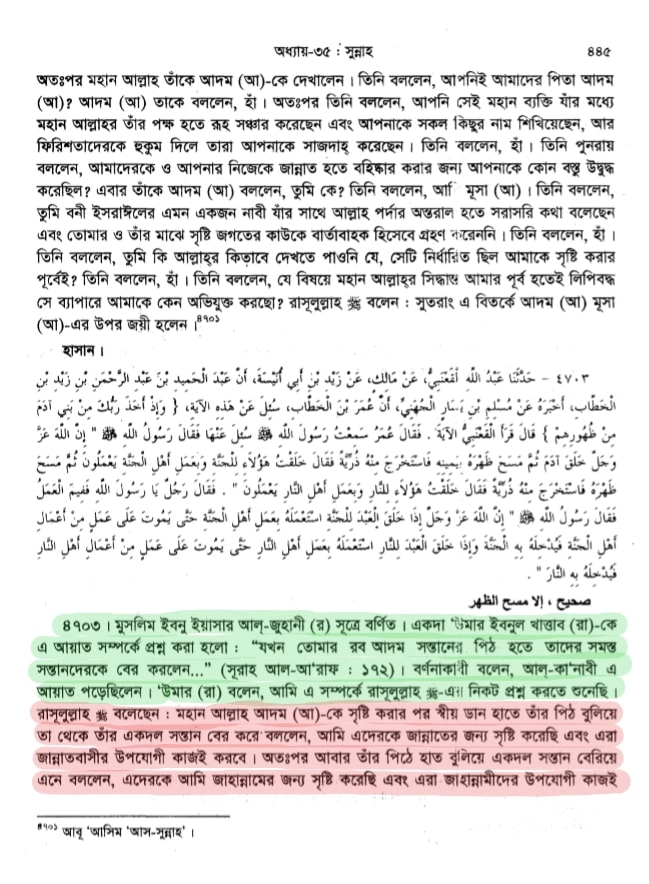
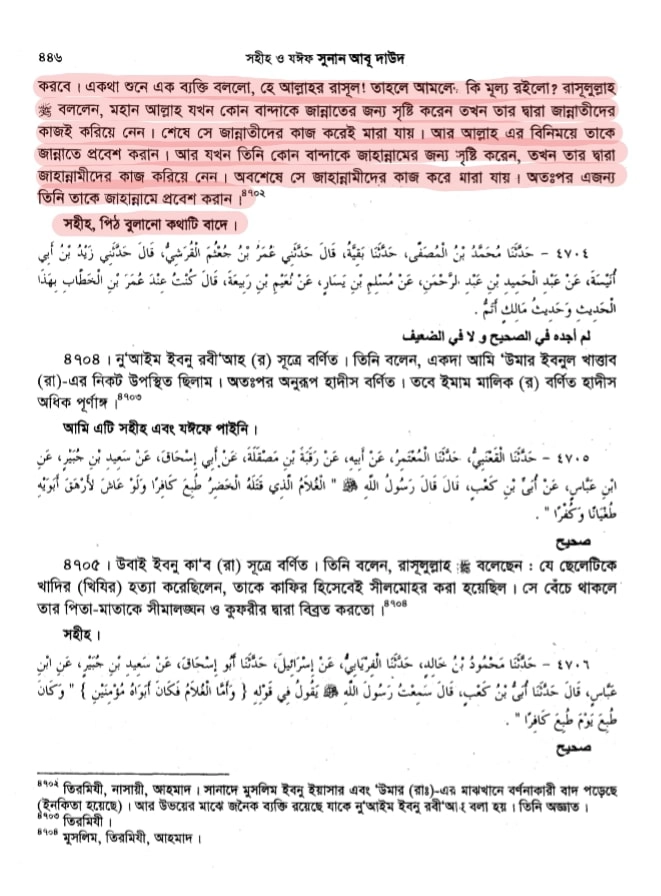
The Arabic verb استعمله used here is particularly significant. The original report states, “إذا خلق العبد للنار استعمله بعمل أهل النار”: when Allah creates a servant for Hell, he employs that person in the deeds of the people of Hell, or makes them perform those deeds. The Bengali translation therefore accurately says that he “makes him perform the deeds of the people of Hell.” The following part of the report connects dying doing those deeds and entering Hell because of them in a continuous sequence. This is not merely foreknowledge; it is language describing a divine role in the process that determines which category of deeds a person performs. The same wording is preserved in Islamweb’s Arabic text of Abu Dawud. [7] [8] The verb means “employs” or “puts to use”; it does not, by itself, specify external coercion or the cancellation of the person’s own will. That further conclusion requires theological and philosophical argument.
إِذَا خَلَقَ الْعَبْدَ لِلنَّارِ اسْتَعْمَلَهُ بِعَمَلِ أَهْلِ النَّارِ.
English translation (excerpt from Sunnah.com): “But when He creates a servant for Hell, He employs him in doing the deeds of those who will go to Hell”. [8]
The question raised within the hadith, “Fa-fima al-‘amal?”—“Then what is the point of deeds?”—is particularly important for this reason. The questioner understood the problem: if the destination has already been determined and the deeds leading to it are effectively ensured, where does the independent moral significance of deeds lie? In response, Muhammad did not say that predestination really means only Allah’s foreknowledge, or that a person could, if they wished, produce an outcome contrary to the predetermined destination. His answer described the same system again: creation for a particular destination, being made to perform that category of deeds, dying doing those deeds, and the corresponding outcome. The question’s central premise was therefore not rejected; it was clarified further. A report in Abu Dawud preserving a letter by ‘Umar ibn ‘Abd al-‘Aziz is also relevant here; the letter itself is not a direct statement by Muhammad. [9] [10]
Sufyan said (according to one chain), and Abu al-Salit said (according to another chain):
A man wrote to ‘Umar b. ‘Abd al-Aziz asking him about Divine decree. He wrote to him: To begin with, I enjoin upon you to fear Allah, to be moderate in (obeying) His Command, to follow the sunnah (practice) of His Prophet (ﷺ) and to abandon the novelties which the innovators introduced after his Sunnah has been established and they were saved from its trouble (i.e.
novelty or innovation) ; so stick to Sunnah, for it is for you, if Allah chooses, a protection ; then you should know that any innovation which the people introduced was refuted long before it on the basis of some authority or there was some lesson in it, for the Sunnah was introduced by the people who were conscious of the error, slip, foolishness, and extremism in case of (the sunnah) was opposed.
So accept for yourself what the people (in the past) had accepted for themselves, for they had complete knowledge of whatever they were informed, and by penetrating insight they forbade (to do prohibited acts); they had more strength (than us) to disclose the matters (of religion), and they were far better (than us) by virtue of their merits. If right guidance is what you are following, then you outstriped them to it.
And if you say whatever the novelty occurred after them was introduced by those who followed the way other then theirs and disliked them. It is they who actually outstripped, and talked about it sufficiently, and gave a satisfactory explanation for it. Below them there is no place for exhaustiveness, and above them there is no place for elaborating things.
Some people shortened the matter more than they had done, and thus they turned away (from them), and some people raised the matter more than they had done, and thus they exaggerated. They were on right guidance between that. You have written (to me) asking about confession of Divine decree, you have indeed approached a person who is well informed of it, with the will of Allah.
I know what whatever novelty people have brought in, and whatever innovation people have introduced are not more manifest and more established than confession of Divine decree. The ignorant people (i.e. the Arabs before Islam) in pre-Islamic times have mentioned it ; they talked about it in their speeches and in their poetry. They would console themselves for what they lost, and Islam then strengthened it (i.e. belief in Divine decree).
The Messenger of Allah (ﷺ) did not mention it in one or two traditions, but the Muslims heard it from him, and they talked of it from him, and they talked of it during his lifetime and after his death. They did so out of belief and submission to their Lord and thinking themselves weak. There is nothing which is not surrounded by His knowledge, and not counted by His register and not destined by His decree.
Despite that, it has been strongly mentioned in His Book: from it they have derived it, and from it they have and so ? they also read in it what you read, and they knew its interpretation of which you are ignorant. After that they said: All this is by writing and decreeing. Distress has been written down, and what has been destined will occur ; what Allah wills will surely happen, and what He does not will will not happen. We have no power to harm or benefit ourselves.
Then after that they showed interest (in good works) and were afraid (of bad deeds).
Source: Sunan Abi Dawud 4612; Book 42, Hadith 17; English text copied verbatim from Sunnah.com.
Grade: Sahih Maqtu‘ (Al-Albani). This is a report of ‘Umar ibn ‘Abd al-‘Aziz’s letter; maqtu‘ identifies an attribution below the level of a Companion.
The Same Report in Muwatta Malik
The same report is also preserved in the chapter on predestination in Malik ibn Anas’s Muwatta. Its linguistic structure is the same: Allah created one group for Paradise and another for Hell; the first group will perform the deeds of the people of Paradise, and the second the deeds of the people of Hell; and when a servant is created for a particular destination, that servant is made to perform the deeds of its inhabitants. Abu Dawud’s report is therefore not an isolated text. The same statement appears in an early Maliki hadith collection. [11] [12] [13] [14] These are parallel versions of a report sharing a transmission route; their appearance in several collections does not by itself establish independent chains of transmission.
Yahya related to me from Malik from Zayd ibn Abi Unaysa that Abd al-Hamid ibn Abd ar-Rahman ibn Zayd ibn al-Khattab informed him from Muslim ibn Yasar al-Juhani that Umar ibn al-Khattab was asked about this ayat – “When your Lord took their progeny from the Banu Adam from their backs and made them testify against themselves. ‘Am I not your Lord?’ They said, ‘Yes, we bear witness’
Lest you should say on the Day of Rising, ‘We were heedless of that.'” (Sura 7 ayat 172) Umar ibn al-Khattab said, “I heard the Messenger of Allah, may Allah bless him and grant him peace, being asked about it. The Messenger of Allah, may Allah bless him and grant him peace, said, ‘Allah, the Blessed, the Exalted, created Adam. Then He stroked his back with His right hand, and progeny issued from it.
He said, “I created these for the Garden and they will act with the behaviour of the people of the Garden.” Then He stroked his back again and brought forth progeny from him.
He said, “I created these for the Fire and they will act with the behaviour of the people of the Fire.” ‘A man said, ‘Messenger of Allah! Then of what value are deeds?’ The Messenger of Allah, may Allah bless him and grant him peace, answered, ‘When Allah creates a slave for the Garden, he makes him use the behaviour of the people of the Garden, so that he dies on one of the actions of the people of the Garden and by it He brings him into the Garden.
When He creates a slave for the Fire, He makes him use the behaviour of the people of the Fire, so that he dies on one of the actions of the people of the Fire, and by it, He brings him into the Fire.’ “
Source: Muwatta Malik; Book 46, Hadith 2; Arabic reference: Book 46, Hadith 1627; English text copied verbatim from Sunnah.com.
No separate grading is displayed on this Sunnah.com page.
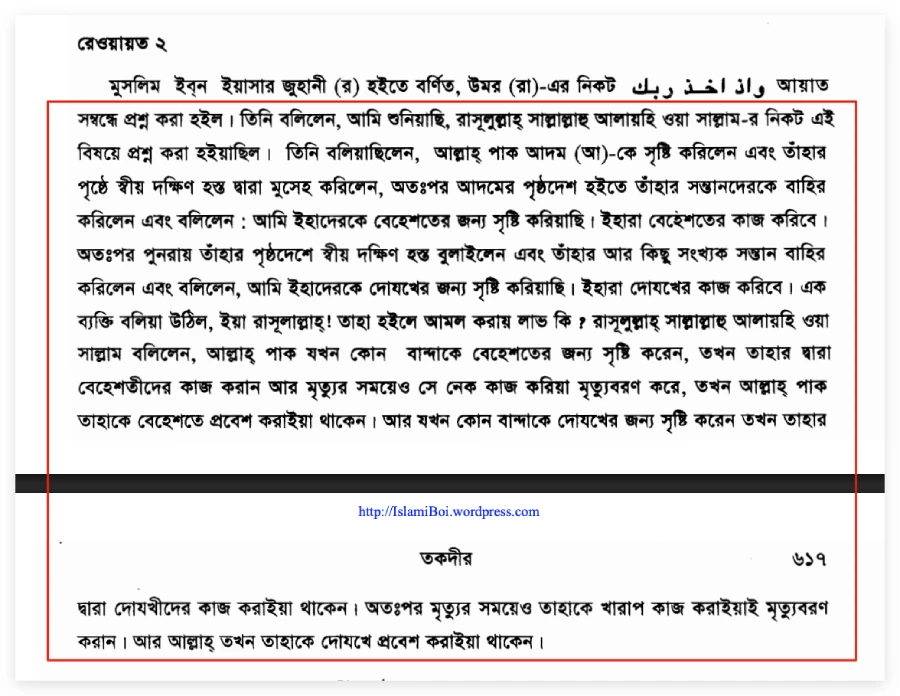
Two statements appear side by side in the Arabic text of the Muwatta: “خلقت هؤلاء للجنة وبعمل أهل الجنة يعملون” and “خلقت هؤلاء للنار وبعمل أهل النار يعملون”. They mean, “I created these for Paradise, and they will perform the deeds of the people of Paradise,” and “I created these for Hell, and they will perform the deeds of the people of Hell.” The verb استعمله is then used in the answer to the question. Thus both stages—“I created” and “he makes them perform”—are directly present in the same report.
Mishkat al-Masabih: “He Makes Them Perform the Deeds for Which They Were Created”
Mishkat al-Masabih also preserves this report and names Malik, Tirmidhi, and Abu Dawud as its sources. The assessments must be distinguished: Sunnah.com records Isnād Da‘īf (Zubair ‘Aliza’i) for Mishkat 95, while its Abu Dawud 4703 page records Al-Albani’s assessment as sahih except for the passage about passing the hand over the back. The supplied Bengali edition cites supporting reports and gives the latter qualified assessment. These are different attributed evaluations, not a single unanimous grading. [15] [8]
Muslim b. Yasar said that when ‘Umar b.
al-Khattab was questioned about the verse, “When your Lord took their offspring from the backs of the children of Adam…” ^{1} he replied that he had heard God’s messenger say when he was questioned about it, “God created Adam, then passed His right hand over his back and brought forth from it his offspring, saying, ‘I have created these for paradise and they will do the deeds of those who go to paradise.’ He then passed his hand over his back and brought forth from it his offspring, saying, ‘I have created these for hell and they will do the deeds of those who go to hell’.” A man asked, “What is the good of doing anything, messenger of God?” to which God’s messenger replied, “When God creates a man for paradise He employs him in doing the deeds of those who will go to paradise, so that his final action before death is one of the deeds of those who go to paradise, for which He will bring him into paradise.
But when He creates a man for hell He employs him in doing the deeds of those who will go to hell, so that his final action before death is one of the deeds of those who go to hell, for which He will bring him into hell.” Malik, Tirmidhi and Abu Dawud transmitted it.
Source: Mishkat al-Masabih 95; Book 1, Hadith 89; English text copied verbatim from Sunnah.com.
Grade: Isnād Da‘īf (Zubair ‘Aliza’i).
The same report also appears in the Bengali edition of the original book. [16]
![Book: Mishkat al-Masabih; Hadith [95]; Chapter: Part 1, Faith (كتاب الإيمان); Publisher: Hadith Academy](https://assets.shongshoy.com/2019/09/A9Uc2ei.jpg.webp "In Classical Islamic Interpretation, Allah Makes People Perform the Deeds of the People of Paradise or Hell 5")
The next report concerns whether the deeds people perform belong to a matter already settled. [17]
‘Asim bin ‘Ubaidullah said:
‘ I heard Salim bin ‘Abdullah narrating a Hadith from his father who said: “‘Umar said : “O Messenger of Allah! Do you see that what we do is a new matter- or a matter initiated – or it is a matter already concluded?” He (s.a.w) said: “ O Ibn Al-Khattab! It is a matter already concluded. For everyone is suited (for that for which he is created).
As for one who is among the people of happiness, then he works for happiness, and as for the one who is among the people of misery, then he works for his misery.” (Hasan)
Source: Jami‘ at-Tirmidhi 2135; Book 32, Hadith 3; English text copied verbatim from Sunnah.com.
The English body on Sunnah.com ends with “(Hasan)”; the Arabic text records Abu ‘Isa al-Tirmidhi’s assessment as “hasan sahih.”
Another hadith follows. [18]
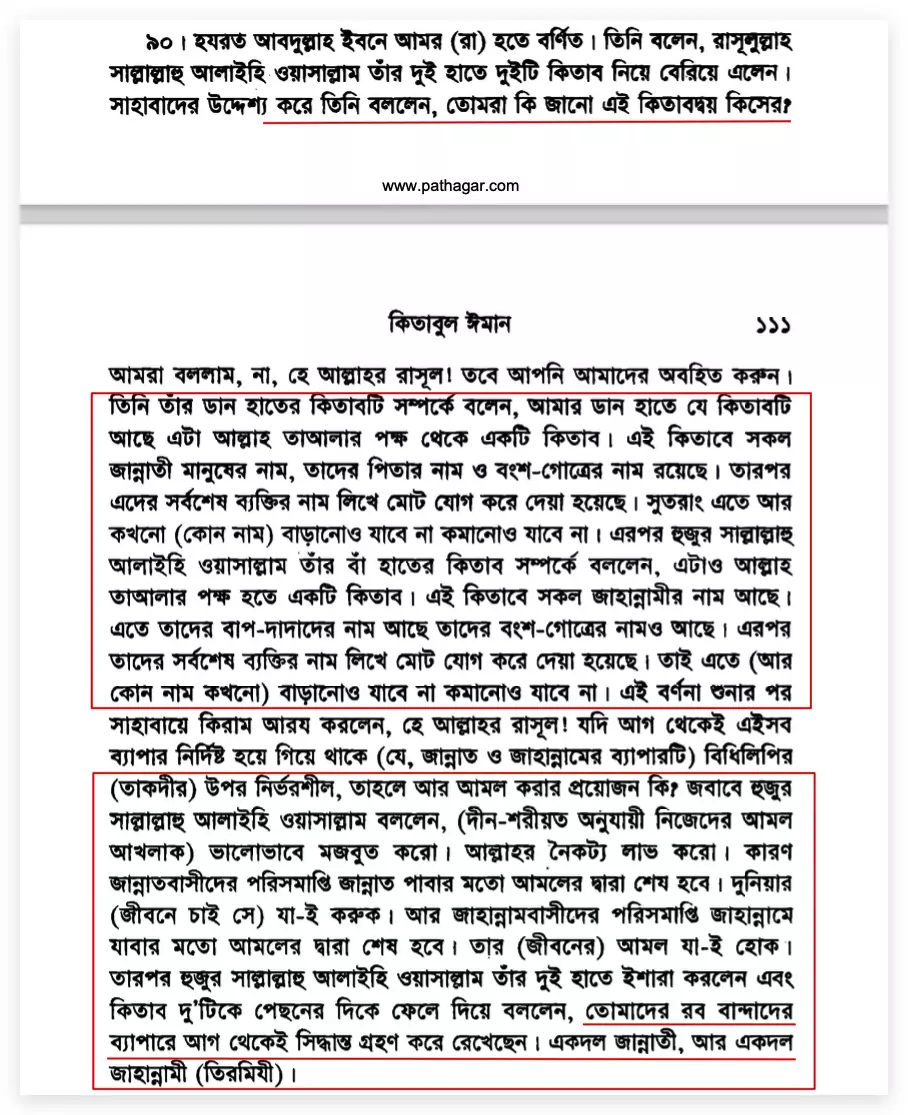
Mishkat al-Masabih 96; Book 1, Hadith 90 [19]
وَعَنْ عَبْدِ اللَّهِ بْنِ عَمْرِو بْنِ الْعَاصِ قَالَ: خَرَجَ عَلَيْنَا رَسُولُ اللَّهِ صَلَّى اللَّهُ عَلَيْهِ وَسَلَّمَ وَفِي يَده كِتَابَانِ فَقَالَ: «أَتَدْرُونَ مَا هَذَانِ الكتابان فَقُلْنَا لَا يَا رَسُولَ اللَّهِ إِلَّا أَنْ تُخْبِرَنَا فَقَالَ لِلَّذِي فِي يَدِهِ الْيُمْنَى هَذَا كِتَابٌ مِنْ رَبِّ الْعَالَمِينَ فِيهِ أَسْمَاءُ أَهْلِ الْجَنَّةِ وَأَسْمَاء آبَائِهِم وقبائلهم ثمَّ أجمل على آخِرهم فَلَا يُزَادُ فِيهِمْ وَلَا يُنْقَصُ مِنْهُمْ أَبَدًا ثُمَّ قَالَ لِلَّذِي فِي شِمَالِهِ هَذَا كِتَابٌ مِنْ رَبِّ الْعَالَمِينَ فِيهِ أَسْمَاءُ أَهْلِ النَّارِ وَأَسْمَاء آبَائِهِم وقبائلهم ثمَّ أجمل على آخِرهم فَلَا يُزَادُ فِيهِمْ وَلَا يُنْقَصُ مِنْهُمْ أَبَدًا فَقَالَ أَصْحَابُهُ فَفِيمَ الْعَمَلُ يَا رَسُولَ اللَّهِ إِنْ كَانَ أَمْرٌ قَدْ فُرِغَ مِنْهُ فَقَالَ سَدِّدُوا وَقَارِبُوا فَإِنَّ صَاحِبَ الْجَنَّةِ يُخْتَمُ لَهُ بِعَمَلِ أَهْلِ الْجَنَّةِ وَإِنْ عَمِلَ أَيَّ عَمَلٍ وَإِنَّ صَاحِبَ النَّارِ يُخْتَمُ لَهُ بِعَمَلِ أَهْلِ النَّارِ وَإِنْ عَمِلَ أَيَّ عَمَلٍ ثُمَّ قَالَ رَسُولُ اللَّهِ صَلَّى اللَّهُ عَلَيْهِ وَسَلَّمَ بِيَدَيْهِ فَنَبَذَهُمَا ثُمَّ قَالَ فَرَغَ رَبُّكُمْ مِنَ الْعِبَادِ فريق فِي الْجنَّة وفريق فِي السعير» . رَوَاهُ التِّرْمِذِيُّ وَقَالَ: هَذَا حَدِيثٌ حَسَنٌ غَرِيبٌ صَحِيح
‘Abdallah b. ‘Amr said:
God’s messenger came out with two books in his hands and asked, “Do you know what these two books are?” We replied, “No, messenger of God, unless you tell us.” Of the one in his right hand he said, “This is a book from the Lord of the universe containing the names of those who will go to paradise, as well as the names of their fathers and their tribes.
It is completed to the last man, so there will never be any increase or diminution in their numbers.” Of the one in his left hand he then said, “This is a book from the Lord of the universe containing the names of those who will go to hell, as well as the names of their fathers and their tribes.
It is completed to the last man, so there will never be any increase or diminution in their numbers.” His Companions asked, “What then, messenger of God, is the good of doing anything if the matter is already decided?” He replied, “Follow a right course and keep as near to it as you can, for the last act of one who is to go to paradise will be an act appropriate for those who go to paradise no matter what he may have done; but the last act of one who is to go to hell will be an act appropriate for those who go to hell no matter what he may have done.” God’s messenger then made a gesture with his hands throwing the books away and said, “Your Lord has decided everything about mankind; a section will be in paradise and a section in the blaze.” Tirmidhi transmitted it.
Source: Mishkat al-Masabih 96; Book 1, Hadith 90; English text copied verbatim from Sunnah.com.
Assessments displayed: Isnād Hasan (Zubair ‘Aliza’i); Sahih (Al-Albani).
Two further reports contain the expression wa-lā ubālī, rendered on Sunnah.com as “and I do not care.” They describe a prior division into two groups, providing further material for the discussion of predestination. [20] [21]
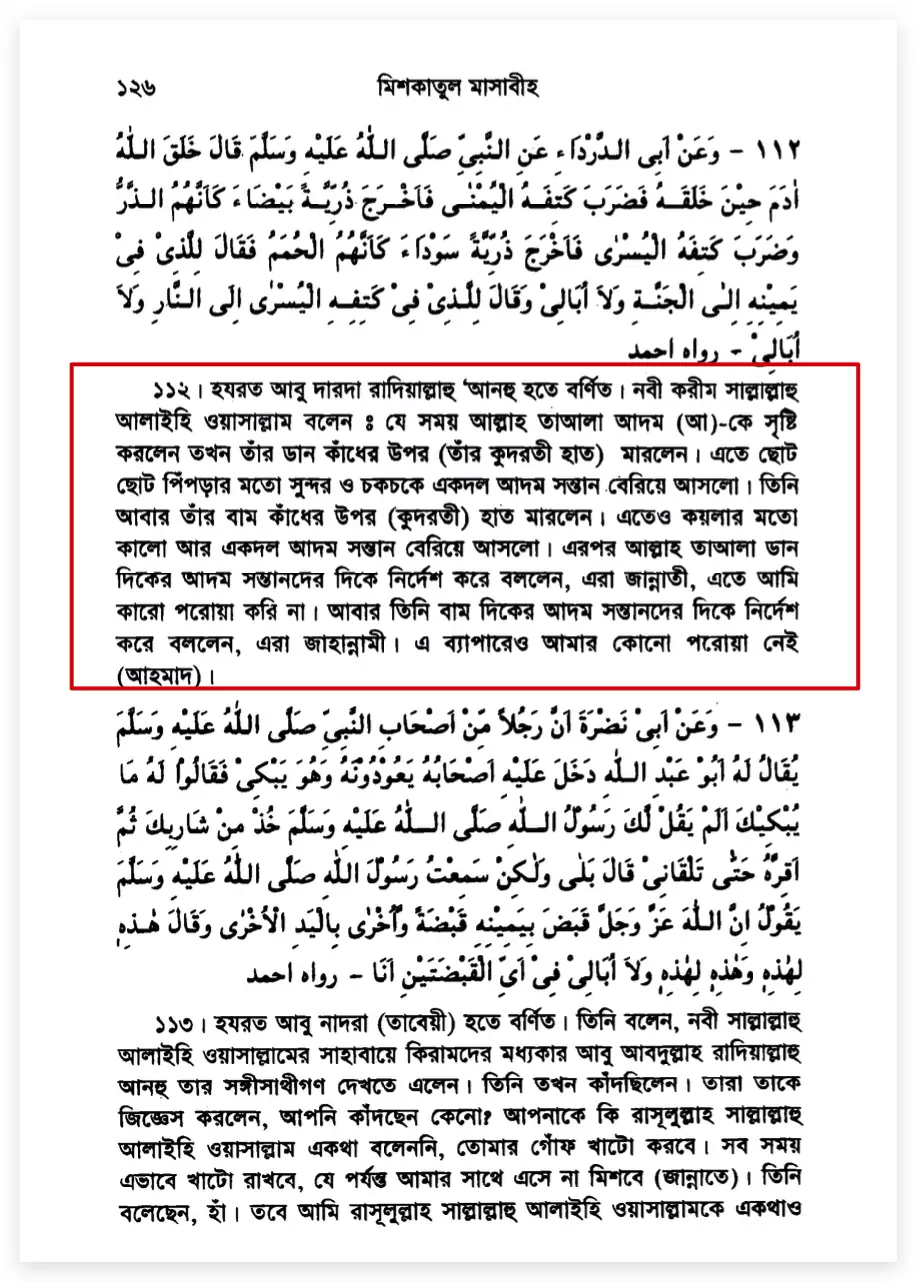
Mishkat al-Masabih 119; Book 1, Hadith 112 [22]
وَعَنْ أَبِي الدَّرْدَاءَ عَنِ النَّبِيِّ صَلَّى اللَّهُ عَلَيْهِ وَسَلَّمَ قَالَ: «خَلَقَ اللَّهُ آدَمَ حِينَ خَلَقَهُ فَضَرَبَ كَتِفَهُ الْيُمْنَى فَأَخْرَجَ ذُرِّيَّةً بَيْضَاءَ كَأَنَّهُمُ الذَّرُّ وَضَرَبَ كَتِفَهُ الْيُسْرَى فَأَخْرَجَ ذُرِّيَّةً سَوْدَاءَ كَأَنَّهُمُ الْحُمَمُ فَقَالَ لِلَّذِي فِي يَمِينِهِ إِلَى الْجَنَّةِ وَلَا أُبَالِي وَقَالَ للَّذي فِي كَفه الْيُسْرَى إِلَى النَّارِ وَلَا أُبَالِي» . رَوَاهُ أَحْمَدُ
Abud Darda’ reported God’s messenger as saying, “God created Adam when He created him and struck his right shoulder and brought forth his offspring white like small ants. And he struck his left shoulder and brought forth his offspring black as though they were charcoal. Then He said to the party on his right side, ‘To paradise, and I do not care’ and He said to the party in his left shoulder, ‘To hell, and I do not care’.” Ahmad transmitted it.
Source: Mishkat al-Masabih 119; Book 1, Hadith 112; English text copied verbatim from Sunnah.com.
Assessments displayed: Isnād Hasan (Zubair ‘Aliza’i); Sahih (Al-Albani).
Mishkat al-Masabih 120; Book 1, Hadith 113 [23]
وَعَن أبي نَضرة أَنَّ رَجُلًا مِنْ أَصْحَابِ النَّبِيِّ صَلَّى اللَّهُ عَلَيْهِ وَسَلَّمَ يُقَالُ لَهُ أَبُو عَبْدِ اللَّهِ دَخَلَ عَلَيْهِ أَصْحَابُهُ يَعُودُونَهُ وَهُوَ يَبْكِي فَقَالُوا لَهُ مَا يُبْكِيكَ أَلَمْ يَقُلْ لَكَ رَسُولُ اللَّهِ صَلَّى اللَّهُ عَلَيْهِ وَسَلَّمَ خُذْ مِنْ شَارِبِكَ ثُمَّ أَقِرَّهُ حَتَّى تَلْقَانِي قَالَ بَلَى وَلَكِنِّي سَمِعْتُ رَسُولَ اللَّهِ صَلَّى اللَّهُ عَلَيْهِ وَسَلَّمَ يَقُولُ: «إِنَّ اللَّهَ عَزَّ وَجَلَّ قَبَضَ بِيَمِينِهِ قَبْضَةً وَأُخْرَى بِالْيَدِ الْأُخْرَى وَقَالَ هَذِهِ لِهَذِهِ وَهَذِه لهَذِهِ وَلَا أُبَالِي فَلَا أَدْرِي فِي أَيِّ الْقَبْضَتَيْنِ أَنَا» . رَوَاهُ أَحْمَدُ
Abu Nadra told how a companion of the Prophet called Abu ‘Abdallah was visited by his friends who found him weeping. They asked him what made him weep, and whether God’s messenger had not told him to clip some of his moustache and keep it like that till he met him.
He replied, “Yes, but I heard God’s messenger say that God took a handful in His right hand and another in His left saying, ‘This is for this, and that is for that, and I do not care;’ and I do not know in which of the two handfuls I am.” Ahmad transmitted it.
Source: Mishkat al-Masabih 120; Book 1, Hadith 113; English text copied verbatim from Sunnah.com.
Assessments displayed: Isnād Sahih (Zubair ‘Aliza’i); Sahih (Al-Albani).
The Same Statement in Another Bengali Edition of Abu Dawud
The Bengali edition of Abu Dawud published by the Islamic Foundation contains the same report. Its translation states even more directly that when Allah creates someone for Hell, “he makes him perform deeds like those of the people of Hell”; the person dies while continuing to perform those deeds, and “because of that” Allah admits him to Hell. Thus being made to perform the action and being punished because of that action appear side by side in the same text. [24] [25]
Narrated Umar ibn al-Khattab:
Muslim ibn Yasar al-Juhani said: When Umar ibn al-Khattab was asked about the verse “When your Lord took their offspring from the backs of the children of Adam” – al-Qa’nabi recited the verse–he said: I heard the Messenger of Allah (ﷺ) say when he was questioned about it: Allah created Adam, then passed His right hand over his back, and brought forth from it his offspring, saying: I have these for Paradise and these will do the deeds of those who go to Paradise.
He then passed His hand over his back and brought forth from it his offspring, saying: I have created these for Hell, and they will do the deeds of those who go to Hell.
A man asked: What is the good of doing anything, Messenger of Allah? The Messenger of Allah (ﷺ) said: When Allah creates a servant for Paradise, He employs him in doing the deeds of those who will go to Paradise, so that his final action before death is one of the deeds of those who go to Paradise, for which He will bring him into Paradise.
But when He creates a servant for Hell, He employs him in doing the deeds of those who will go to Hell, so that his final action before death is one of the deeds of those who go to Hell, for which He will bring him into Hell.
Source: Sunan Abi Dawud 4703; Book 42, Hadith 108; English text copied verbatim from Sunnah.com.
Sunnah.com records Al-Albani’s assessment as sahih except for the passage about passing the hand over the back (صحيح إلا مسح الظهر).
Sahih al-Bukhari: Places in Paradise and Hell Are Already Written
This theological framework is not confined to the reports above. In Sahih al-Bukhari, ‘Ali attributes to Muhammad the statement that each person’s place in Paradise or Hell has already been written. The companions then ask a reasonable question: if the place is already written, why not rely on that written destiny and abandon deeds? The answer is that they must act, because everyone will be facilitated for that for which they were created. The happy will be facilitated toward the deeds of the happy, and the miserable toward the deeds of the miserable. [26] [27]
Narrated `Ali:
While the Prophet (ﷺ) was in a funeral procession. he picked up something and started scraping the ground with it, and said, “There is none among you but has his place written for him either in the Hell Fire or in Paradise.” They said, “O Allah’s Messenger (ﷺ)! Shall we not depend upon what has been written for us and give up deeds? He said, “Carry on doing (good) deeds, for everybody will find easy to do such deeds as will lead him to his destined place for which he has been created.
So he who is destined to be among the happy (in the Hereafter), will find it easy to do the deeds characteristic of such people, while he who is destined to be among the miserable ones, will find it easy to do the deeds characteristic of such people.” Then he recited: ‘As for him who gives (in charity) and fears Allah, and believes in the best….’ (92.5-10)
Source: Sahih al-Bukhari 4949; Book 65, Hadith 471; English text copied verbatim from Sunnah.com.
The central point of this hadith is that every person will perform the deeds for which they were created, or those made easy for them. [28], [29]
Narrated `Imran bin Husain:
A man said, “O Allah’s Messenger (ﷺ)! Can the people of Paradise be known (differentiated) from the people of the Fire; The Prophet (ﷺ) replied, “Yes.” The man said, “Why do people (try to) do (good) deeds?” The Prophet said, “Everyone will do the deeds for which he has been created to do or he will do those deeds which will be made easy for him to do.” (i.e. everybody will find easy to do such deeds as will lead him to his destined place for which he has been created).
Source: Sahih al-Bukhari 6596; Book 82, Hadith 3; English text copied verbatim from Sunnah.com.
Here too, foreknowledge is accompanied by both a written destination and facilitation toward deeds appropriate to that destination. If a person is written for Paradise, they are facilitated toward that category of deeds; if written for Hell, they are facilitated toward the opposite category. “Facilitating” and “making someone perform” are not identical expressions, but their theological implications point in the same direction: a predetermined correspondence has been established between the final destination and the course of the person’s actions.
Sahih Muslim: People Are Created for Paradise and Hell While Still in Their Fathers’ Loins
Sahih Muslim contains another important report from ‘A’ishah. At the funeral of an Ansari child, ‘A’ishah gives glad tidings for the child, describing him as one of the birds of Paradise because he had neither committed evil nor reached the age of doing so. Muhammad objects to this definite conclusion, saying that Allah created some people for Paradise while they were still in their fathers’ loins, and also created some people for Hell while they too were still in their fathers’ loins. The statement thus concerns categories of people created for Paradise and Hell before any actions of their own have been performed. [30] [31]
‘A’isha, the mother of the believers, said that Allah’s Messenger (ﷺ) was called to lead the funeral prayer of a child of the Ansar. I said:
Allah’s Messenger, there is happiness for this child who is a bird from the birds of Paradise for it committed no sin nor has he reached the age when one can commit sin. He said: ‘A’isha, per adventure, it may be otherwise, because God created for Paradise those who are fit for it while they were yet in their father’s loins and created for Hell those who are to go to Hell. He created them for Hell while they were yet in their father’s loins.
Source: Sahih Muslim 2662c; Book 46, Hadith 47; English text copied verbatim from Sunnah.com.
Later commentators have explained this report as a warning to ‘A’ishah against reaching a definite conclusion about the particular child’s fate. But that explanation does not remove the hadith’s central theological statement: the people of Paradise and the people of Hell were created for their respective destinations while still in their fathers’ loins. Al-Nawawi’s commentary preserves the original hadith in the same terms, while reporting scholarly consensus that Muslim children who die before accountability enter Paradise. This narration does not identify the particular child as an inhabitant of Hell. [32]
Ibn Majah: Created for Paradise and Hell While Still in Their Fathers’ Loins
Ibn Majah records the same report from ‘A’ishah: Allah created people for Paradise and people for Hell while they were still in their fathers’ loins. The point relevant to this article is that the stated creation for those destinations precedes the individuals’ own deeds. [33]
It was narrated that ‘Aishah the Mother of the Believers said:
“The Messenger of Allah (ﷺ) was called to the funeral of a child from among the Ansar.
I said: ‘O Messenger of Allah, glad tidings for him! He is one of the little birds of Paradise, who never did evil or reached the age of doing evil (i.e, the age of accountability).’ He said: ‘It may not be so, O ‘Aishah! For Allah created people for Paradise, He created them for it when they were still in their father’s loins, And He has created people for Hell, He created them for it when they were still in their fathers’ loins.'”
Source: Sunan Ibn Majah 82; Introduction, Hadith 82; English text copied verbatim from Sunnah.com.
Grade: Sahih (Darussalam).
This Is Not a Marginal Position in Classical Creed
The language of being “created for Paradise” and “created for Hell” cannot be reduced to dependence on a single weak or marginal report. In Ibn Battah’s Al-Ibanah al-Kubra, an entire chapter on predestination is titled to the effect that Allah created whomever he willed for Paradise and whomever he willed for Hell, that his knowledge had already determined this, his decree had taken effect, and the pen had written it, and that whoever denies this belongs to the doomed sects. The same chapter quotes the above hadith from ‘Umar again. [34]
فَمَنْ شَاءَ خَلَقَهُ لِلْجَنَّةِ وَمَنْ شَاءَ خَلَقَهُ لِلنَّارِ.
English translation: “Whomever he willed, he created for Paradise, and whomever he willed, he created for Hell.”
The same report appears in the chapter “Belief in Predestination” in Al-Baghawi’s Sharh al-Sunnah. It preserves the entire framework of being “created for Paradise,” being “created for Hell,” and being made to perform the deeds of the corresponding category. It is therefore not merely an isolated text in a single hadith collection; later Sunni literature on creed and hadith commentary also uses it in discussions of predestination. [35]. Detailed discussions of the works on creed will appear in other articles on the encyclopedia page.
Ibn Taymiyyah: The People of Paradise and Hell Are Known and Determined Before Their Deeds
After quoting the same hadith in his discussion of predestination in Majmu‘ al-Fatawa, Ibn Taymiyyah identifies its first level as al-qadar al-sabiq, or prior predestination. In his words, Allah knew who belonged to Paradise and who belonged to Hell before people performed their deeds; belief in this prior knowledge and inscription is obligatory. In the same discussion, he also cites the report in Bukhari and Muslim stating that everyone’s place in Paradise or Hell is already written and that everyone is facilitated for that for which they were created. [36]
اللَّهُ سُبْحَانَهُ عَلِمَ أَهْلَ الْجَنَّةِ مِنْ أَهْلِ النَّارِ مِنْ قَبْلِ أَنْ يَعْمَلُوا الْأَعْمَالَ.
English translation: “Before they performed their deeds, Allah knew who would be among the people of Paradise and who would be among the people of Hell.”
The significance of Ibn Taymiyyah’s discussion is that he neither denies the original hadith nor turns it into a metaphor. Instead, he accepts it as part of prior predestination and connects it to the reports about previously written places and being “facilitated for that for which one was created.” Although later theological explanations describe human will and action as real, the levels of prior predestination, divine creation, a written destination, and the effectiveness of deeds appropriate to that destination remain intact.
“Act”—But Can the Outcome Be Different?
The instruction to “act” in these reports is often presented as the solution to the problem of free will. But “act” is a command; it does not, by itself, prove that someone can actually bring about an outcome contrary to the predetermined one. Indeed, in Sahih al-Bukhari the command is immediately followed by the statement that everyone will be facilitated for that for which they were created. Abu Dawud and the Muwatta state that the person created for Paradise is made to perform the deeds of the people of Paradise, and the person created for Hell is made to perform the deeds of the people of Hell. The command to act and the predetermined outcome are therefore not alternatives to one another; the religious sources make the action itself the means of reaching that predetermined outcome.
This distinction is fundamental. If a person is destined for Paradise and is made to perform the deeds of its inhabitants, their good deeds do not overturn predestination; they implement it. Similarly, the sins of a person destined for Hell do not rebel against the decree to produce a new, independent outcome; through those deeds, the predetermined outcome of Hell is fulfilled. Thus the answer “people are responsible because they act” pushes the causal problem back one step: who determined and implemented the sequence in which the person performs a particular category of deeds and dies doing those very deeds?
More significantly, the sources quoted here do not state that a person can produce an outcome contrary to their predetermined destination. Instead, the different reports reinforce one another: the destination is written; the person is created for that destination; they are facilitated toward its deeds; in some reports they are made to perform those deeds; they die doing them; and through those deeds they enter their predetermined destination. This sequence does more than describe knowledge of the future: it places the future outcome and the course of actions leading to it within the same decretive framework.
Humans Have a Will—But Allah Also Creates That Will
Traditional Sunni theology does not deny human will and action altogether. People will, decide, and act in a real sense. But it also states that human will is subordinate to Allah’s will, human power is created by Allah, and human actions are also created by Allah. In the Sunni creed quoted by IslamQA, although people act in a real sense, Allah creates their actions, power, and will. [37]
الْعِبَادُ فَاعِلُونَ حَقِيقَةً، وَاللَّهُ خَالِقُ أَفْعَالِهِمْ … وَلِلْعِبَادِ قُدْرَةٌ عَلَى أَعْمَالِهِمْ، وَلَهُمْ إِرَادَةٌ، وَاللَّهُ خَالِقُ قُدْرَتِهِمْ وَإِرَادَتِهِمْ.
English translation: “The servants act in a real sense, but Allah is the creator of their actions … The servants have power over their actions and possess a will, and Allah is the creator of their power and will.”
Ibn Taymiyyah also describes human will as dependent on Allah’s will. People will, but the existence and effectiveness of their willing are not self-sufficient. [38]
مَشِيئَةُ الْعَبْدِ مُعَلَّقَةٌ بِمَشِيئَةِ اللَّهِ.
English translation: “The servant’s will depends on Allah’s will.”
Sunni Compatibilism: Making a Created Will the Basis of Freedom
Islamweb presents the Sunni position as intermediate between the Jabriyya and the Qadariyya: a person is facilitated for that for which they were created; nothing in the universe falls outside Allah’s predestination; Allah creates both the person and their will; and the person is also described as the agent of their own action. [39]
وَالْوَسَطُ ـ وَهُمْ أَهْلُ السُّنَّةِ ـ فَالْعَبْدُ عِنْدَهُمْ مُيَسَّرٌ لِمَا خُلِقَ لَهُ … يُؤْمِنُ بِقَضَاءِ اللَّهِ وَقَدَرِهِ الَّذِي لَا يَخْرُجُ عَنْهُ شَيْءٌ فِي الْكَوْنِ … فَاللَّهُ خَالِقٌ لِلْعَبْدِ وَإِرَادَتِهِ، وَالْعَبْدُ فَاعِلٌ لِفِعْلِهِ حَقِيقَةً.
English translation: “According to Ahl al-Sunnah, the servant is facilitated for that for which they were created … Nothing in the universe falls outside Allah’s decree and predestination … Allah creates the servant and their will, while the servant is also, in a real sense, the agent of their own action.”
This reconciliation does not resolve the central conflict. Humans have a will and human will is free are not the same proposition. If Allah creates human will, its effectiveness depends on Allah’s will, Allah also creates human actions, and departing from the previously written outcome is impossible, a person may be the immediate agent of an action but cannot be described as its ultimate independent source. Even without anyone forcing them externally, their internal will itself may be the means through which a predetermined outcome is implemented.
One example given by IslamQA states that people buy a car or ask a question of their own will; no one compels them externally. Yet the same explanation states that nothing in the heavens or the earth occurs without Allah’s will. [37]
وَلَكِنَّ الْعَبْدَ إِذَا أَرَادَ شَيْئًا وَفَعَلَهُ عَلِمْنَا أَنَّ اللَّهَ تَعَالَى قَدْ أَرَادَهُ … فَلِكَمَالِ رُبُوبِيَّتِهِ لَا يَقَعُ شَيْءٌ فِي السَّمَوَاتِ وَالْأَرْضِ إِلَّا بِمَشِيئَتِهِ تَعَالَى.
English translation: “When a servant wills something and does it, we know that Allah has also willed it … Because of his perfect lordship, nothing in the heavens or the earth occurs except by his will.”
The absence of external coercion does not, by itself, establish the stronger freedom required by this article’s argument. The real question is whether a person could actually have made the opposite decision under exactly the same complete circumstances. Another IslamQA explanation explicitly states that no one can change what was written before their creation, depart from that decree, or act contrary to what Allah has written for them. [2]
أَحَدًا لَا يُغَيِّرُ مَا قَدْ كُتِبَ مِنْ قَبْلِ أَنْ يُخْلَقَ، وَلَا بِإِمْكَانِهِ أَنْ يَخْرُجَ عَنْهُ … وَالْحِكْمَةُ الْكَوْنِيَّةُ الْقَدَرِيَّةُ لَا يَخْرُجُ عَنْهَا أَحَدٌ، وَلَا يُخَالِفُ مَا كَتَبَ اللَّهُ لَهُ.
English translation: “No one changes what was written before their creation, nor is it possible for them to depart from it … No one falls outside the divine wisdom governing creation and predestination, or acts contrary to what Allah has written for them.”
The logical conflict in the compatibilist explanation becomes clear here. If Hell is written for someone beforehand and they can actually enter Paradise instead, the previously written decree is not infallibly binding. If they cannot enter Paradise, Hell is not one outcome among many possibilities; it is the only actual outcome. The fact that the decisions leading to it pass through the person’s own mind does not alter the outcome’s predetermined character.
Three claims therefore cannot all remain intact: predestination is infallibly binding; human will and action are created by Allah and subordinate to his will; yet people are independent moral agents whose predetermined actions are entirely their own responsibility. If the first two are true, the independence required by the third is absent. If the independence required by the third is real, the comprehensive determination asserted by the first two must be weakened. Saying “humans are also agents of their actions” does not remove this conflict, because the question is not whether the action occurred through human hands, but whether the person could actually have done something contrary to Allah’s predetermined outcome.
Effective Predestination, Not Merely Foreknowledge
Presenting the problem of predestination solely as a problem of omniscience leaves out a substantial part of the original sources. If foreknowledge alone were involved, one could say that Allah knows what a person will do but plays no effective role in their decision. Yet traditional Sunni creed affirms four levels: Allah knows, writes, wills, and creates. Human actions are included in that creation. When this is combined with the descriptions “created for Paradise,” “created for Hell,” “facilitated for that for which they were created,” and “made to perform the deeds of the people of Paradise or Hell,” the matter is more than simply seeing the future.
Foreknowledge need not cause an event. If someone knows perfectly in advance that a solar eclipse will occur, their knowledge does not cause it. But in the framework of predestination discussed here, Allah is not an outside spectator. He creates the person, their power and will, and their actions; writes their destination; creates them for that destination; and facilitates or employs them in its deeds. The analogy that “Allah knew beforehand” therefore fails to capture this entire causal structure.
This distinction is decisive for the moral question. An observer may know the future without being the author of a person’s decision. But if a being is the ultimate creator of the person, their capacity to decide, their desires, their environment, and the existence of their actions, his role differs fundamentally from that of an observer. A human being may be the proximate cause of a human action, but in the framework of Islamic predestination, Allah is its ultimate ontological cause.
When the Same Being Determines the Destination, Creates the Deeds, and Judges
The causal chain in the hadith about creation for Paradise and Hell is particularly rigid. First, a person is created for a particular destination. Then they are made to perform the deeds of the corresponding category. Next, they die doing those deeds. Finally, because of those deeds, they enter their predetermined destination. The destination established at the outset as the purpose of creation is reached through actions brought about in the intervening stages, and those same actions are finally used as the judicial reason for the outcome.
In the case of Hell, this creates a particular moral problem. No human being decided to create themselves for Hell. Before birth, no one chose to be born among Adam’s descendants, their own psychological nature, time, society, family, genetic characteristics, intelligence, emotions, disposition toward accepting beliefs, or whether they would receive Allah’s guidance. If Islamic sources further state that the person was created for Hell from the outset and made to perform the deeds of its inhabitants, isolating their final action from the entire causal chain and saying “they alone are responsible for this action” is incomplete.
A fundamental inequality exists here. In the case of a person created for Paradise, Allah makes them perform deeds leading to reward; in the case of someone created for Hell, he makes them perform deeds leading to punishment. Both may feel that they are making decisions throughout their lives, but at the divine level their destinations and categories of action are arranged differently from the outset. The moral basis of reward and punishment then does not rest on equal opportunities for independent choice.
The Problem of a Just Basis for Punishment
For punishment to be considered just, an offender is generally held responsible for an action they performed with understanding, under their own control, and with real alternatives available. The more a person loses control, the more their moral and legal responsibility generally diminishes. Coercion, severe mental incapacity, deception, or a lack of decision-making capacity alter the degree of responsibility. Justice considers not only “through whose hands the action occurred,” but also the person’s control over the action and their ability to do otherwise.
In this account of predestination, the highest level of control does not belong to human beings. Even when people act according to their immediate wishes, their will is created by Allah, subordinate to Allah’s will, and incapable of producing an outcome contrary to the previously written decree. If a person created for Hell is made to perform the deeds of its inhabitants, the creator’s effective role in that person’s punishment is neither accidental nor peripheral; it is the center of the entire system.
Allah’s moral disapproval of a person’s sin does not remove this causal problem. Islamic theology itself distinguishes Allah’s legislative will from his decretive will. A sin may be legislatively forbidden while still being unable to occur outside Allah’s decretive will. Thus, even if “Allah did not command the sin” is true, the questions remain: why was a person created whose destination was Hell, why was the entire existence of their will and actions placed within divine creation, and why were the deeds leading to that destination brought about through them?
The Historical Background of the Predestination Conflict, the Jabriyya–Qadariyya Debate, and Sunni Compatibilism
The conflict between predestination and human responsibility was not invented by modern critics; Muslim thinkers confronted it in Islam’s earliest period. One set of statements in the Quran and hadith connects human action, will, guidance, misguidance, and final outcomes to Allah’s will and predestination; another holds people responsible for their actions and deserving of punishment or reward. Placing these two sets of statements side by side in their straightforward meanings produces a fundamental question: if human actions cannot depart from Allah’s predestination and effective will, how can full moral responsibility for those actions fall on human beings? The debate that began around this question during the Umayyad period did not remain a purely theological dispute; it quickly became entangled with the ruler’s legitimacy, political injustice, rebellion, and citizens’ moral responsibility. Encyclopaedia Iranica also notes that the debate over free will versus predestination had political implications from Umayyad times. [40]
Free will versus predestination was an important theological debate, with political implications, in Muslim society dating back to Omayyad times. At one extreme … Jabrīya [held] that man’s deeds as well as good and evil resulted from God’s decrees and pre-ordination. At the other extreme … Qadarīya … recognized the freedom of human will and the individual’s moral responsibility for his deeds.
Those identified in later works as the Jabriyya inclined toward strict predestination. In the extreme form of this tendency, human beings were not recognized as independent producers of their actions; human deeds were also considered part of Allah’s determination and creation. By contrast, the tendency known as the Qadariyya emphasized people’s actual responsibility for their own actions. Describing the Qadariyya as a single, well-organized group would oversimplify the history; early sources applied the name to different individuals, and their views also differed. But their central question was clear: if people are not the actual agents of their wrongdoing, how can they be punished, and how, in particular, can a ruler be held responsible for his oppression? The discussion of the early Qadariyya in Oxford’s Handbook of Islamic Theology addresses human free will, the movement’s politicization, and its direct relationship with Umayyad political conflicts. [41]
The reason this debate carried such political importance is clear. If the caliph’s acquisition of power, his rule, and his actions are presented as the realization of Allah’s predetermined will, the space for moral objections to the ruler’s conduct narrows. A ruler holds power because Allah allowed it to happen; rebellion against his rule can then be presented as rebellion against Allah’s ordained order. There is evidence that Umayyad political culture presented rule in the language of divinely granted legitimacy. Court poetry called the caliphs khalifat Allah—“God’s deputy”—and later Umayyad rulers also intervened actively in theological questions. In his history, Ira M. Lapidus notes that later Umayyads intervened in theological matters and that Qadari thinkers were suppressed and executed; within the same political culture, the caliph was glorified as “God’s deputy.” [42]
The later Umayyads assumed the right to intervene in theological matters … Their court poets bestowed on them the grandiose title of God’s deputy (khalifat Allah).
This political use of predestination could effectively weaken a ruler’s accountability. If the ruler’s rise, conquests, power, and actions are all part of Allah’s determined plan, he can be presented to ordinary people’s complaints as an instrument of a divine plan rather than as an accountable moral agent. Recent Cambridge research also explicitly discusses this political consequence of the Jabri position: if human actions are predetermined, an unjust ruler’s actions are part of that predestination too; in that case, the basis for rebelling against his injustice or holding him personally responsible is weakened. [43]
If humans are predestined to behave in a certain way and have no power over their actions, then believers should not revolt against the injustices of a ruler.
For this reason, the question of human freedom simultaneously became a question of the ruler’s accountability. From a Qadari position it became possible to say that the caliph’s wrongdoing was his own and could not be excused as “Allah’s predestination.” Encyclopedia.com’s historical discussion of Islamic free will explains the matter directly in these terms: if an Umayyad caliph’s evil acts came from himself rather than from Allah, Muslims could oppose those acts without thereby being accused of opposing Allah’s will. It was within this political setting that early Qadari figures such as Ma‘bad al-Juhani and Ghaylan al-Dimashqi became important. Ma‘bad participated in an armed revolt against the Umayyads and was later killed; Ghaylan’s views were also connected to a political program, and he too was killed during the reign of the Umayyad caliph Hisham. [44]
From this it would follow that the bad acts of an Umayyad caliph were from himself and not from God, and thus good Muslims could oppose such acts without making themselves unbelievers.
The debate about predestination therefore involved more than the abstract question of whether humans have a will. It also involved a more dangerous political question: who is responsible when a caliph commits oppression? If the answer is “Allah created his actions, nothing happens without Allah’s will, and Allah also granted him power,” an opportunity arises to legitimize the ruler’s conduct as part of the divine order. If the answer is “the caliph himself is the agent of his wrongdoing,” a moral basis emerges for judging, condemning, or removing him. The theological question of free will thus became directly a question of political accountability. This is where the political appeal of the Qadari position lay: a ruler’s crimes could not be hidden behind predestination.
The Qadariyya faced a difficulty in the opposite direction. If people genuinely create their own actions, this conflicts with the strong Quranic and hadith statements that Allah is “the creator of everything” and that nothing occurs outside his will. Accepting a strict Jabri position, in turn, risks making human moral responsibility, judgment, reward, and punishment meaningless. This conflict became more systematically formulated in later Mu‘tazili thought. To defend Allah’s justice, the Mu‘tazila emphasized people’s actual power over their own deeds: if Allah himself creates a person’s unbelief and then punishes them for that unbelief, the punishment cannot be called just. The Cambridge study explicitly presents this argument of the Mu‘tazili position: for moral responsibility to have meaning, people must at least possess the power to have acted otherwise. [45]
The Mu’tazilites asserted that if God were to create a man’s unbelief while commanding him to believe, He would be unjust in punishing him for unbelief, since the man could not, in this situation, help but disbelieve.
Mainstream Sunni theology ultimately did not accept the Qadari or Mu‘tazili solution. Accepting human deeds as independently created by humans weakens the conception of Allah’s all-encompassing creative power and predestination; describing people as wholly compelled, in turn, undermines moral responsibility and judgment in the afterlife. Neither of these opposing claims could simply be removed from the sources. The Quran and hadith contained strong statements supporting Allah’s all-encompassing will, prior inscription, guidance and misguidance, and creation of actions; they also contained the language of commands, prohibitions, sin, merit, punishment, and individual accountability. Later Sunni theology therefore began attempting to retain both sets of statements and reconcile them without eliminating the problem.
The Attempt at Reconciliation: Allah Creates, Humans “Acquire”
Amid the long debate involving the Jabriyya, the Qadariyya, and later the Mu‘tazila, the concept of kasb, or “acquisition,” became important in Sunni theology. The Ash‘ari school held that Allah creates human actions, but people “acquire” those actions and consequently become responsible for them. The aim was to preserve both Allah’s all-encompassing creative power and human moral responsibility. [45]
The Ash’arites taught that since God is the sole creator, He creates human actions. In order to safeguard both God’s omnipotence and man’s responsibility, al-Ash’arī … developed a theory of kasb (lit. acquisition) according to which God creates man’s actions while man appropriates them and thus becomes responsible for them.
This formula retained both sides of the historical conflict: Allah creates the action, but the human bears responsibility. Later Sunni explanations also acknowledged the limits of this reconciliation. After affirming both the four levels of predestination and human choice, Islamweb states that reconciling them is “one of Allah’s mysteries,” which human reason cannot fully comprehend; ultimately, what remains for reason is submission and belief in the unseen. [1]
وَالْجَمْعُ بَيْنَ إِثْبَاتِ الْقَدَرِ، وَبَيْنَ إِثْبَاتِ مَشِيئَةِ الْعَبْدِ وَاخْتِيَارِهِ وَكَسْبِهِ لِفِعْلِهِ، إِنَّمَا هُوَ سِرٌّ مِنْ أَسْرَارِ اللَّهِ تَعَالَى، لَا تَحْتَمِلُهُ الْعُقُولُ أَوْ أَكْثَرُهَا؛ فَيَبْقَى لِلْعَقْلِ حُكْمُ التَّسْلِيمِ وَالْإِيمَانِ بِالْغَيْبِ.
English translation: “Reconciling the affirmation of predestination with the affirmation of the servant’s will, choice, and acquisition of their action is one of Allah’s mysteries, which minds, or most minds, cannot comprehend. What remains for reason is submission and belief in the unseen.”
At this point, the reconciliation no longer provides a logical explanation; it declares the conflict a “mystery” and withdraws from the demand for an explanation. Jabri determinism weakened human responsibility, while Qadari and Mu‘tazili freedom conflicted with Allah’s all-encompassing predestination and creative power. Sunni theology retained both kinds of statement. “Kasb” is the name of that historical reconciliation, but the name itself does not answer the question: if Allah creates both will and action, and departing from his determination is impossible, why is full moral responsibility for the action borne by the human being alone?
“Facilitated for That for Which They Were Created”: Unequal Sources of Reward and Punishment
The statement that “everyone is facilitated for that for which they were created” reveals another aspect of the moral inequality. If the person of Paradise is facilitated toward the deeds of its inhabitants, divine assistance lies behind their good deeds. If the person of Hell is facilitated toward the deeds of its inhabitants, divine predestination is effective in their sins as well. The first person’s reward is therefore not solely the result of their self-produced moral excellence, nor is the second person’s punishment solely the result of their self-produced moral failure. A prior divine division lies behind both.
The language of being “created for Paradise” and “created for Hell” is particularly important here. If people were first created neutrally and then one group attained Paradise and another Hell through entirely independent decisions, the moral framework would be different. But these reports give the reverse sequence: first creation for a destination, then the deeds of that destination. This sequence connects the moral outcome to a divine decision preceding the person’s actions.
Consequently, the good deeds of the person of Paradise and the sins of the person of Hell are not “self-produced” in the same sense. The first person’s good deeds are not conceived independently of Allah’s enabling assistance and facilitation; the second person’s sins are not outside Allah’s decretive will and creation either. Yet in reward and punishment, the entire consequence is imposed on the human being. A just explanation of this inequality is not established merely by declaring “Allah is just”; logical consistency between the claim of justice and the causal structure must be demonstrated.
Creation for Hell and the Scale of Infinite Punishment
The problem becomes more severe when Hell’s punishment is understood as prolonged or everlasting. The moral proportionality of eternally punishing someone for beliefs and deeds within a finite life, when their existence, psychological constitution, willpower, circumstances, and destiny are all subordinate to the creator, requires a separate explanation. What matters here is not only the nature of the offense but also the extent of the offender’s independent control.
If someone’s destination is determined before their creation, they are created for Hell, and is then made to perform the deeds of its inhabitants, using those actions as the full moral justification for punishment creates a circular structure: they were created for a particular outcome, were also made to perform the deeds that cause that outcome, and were then sent to that predetermined outcome because of those same deeds. The action is then not an alternative to predestination; it is the means of implementing it.
The Problem Concerns Causation and Justice, Not Terminology
Debates over predestination often become dispersed among terms such as “creation,” “acquisition,” “enabling assistance,” “withholding assistance,” “will,” “permission,” “legislative will,” and “decretive will.” These distinctions have theological significance, but changing terminology does not make the central moral question disappear. The question is simple: can a person actually bring about a final outcome contrary to Allah’s predetermined destination?
If they can, the previously written decree is not infallibly binding. If they cannot, there was no actual alternative to their final destination. The same question applies to their will: is it an independent source whose existence and direction Allah did not create? If it is, this conflicts with the doctrines that “Allah is the creator of everything” and that “Allah also creates human will.” If it is not, treating human will as the ultimate moral source is problematic.
This conflict may be called a “mystery,” but calling something a mystery is not the same as demonstrating logical consistency. Declaring two statements true together is different from showing how they do not contradict each other. On one side, it is asserted that no one can escape Allah’s predestination, that human will is subordinate to Allah’s will, that Allah creates human will and action, and that some people are created for Paradise or Hell. On the other, it is asserted that people are free in a way that makes the full moral responsibility for their ultimate reward or punishment theirs alone. Explaining the causal relationship between the second claim and the first set of claims is the central problem.
Conclusion
The reports about being made to perform the deeds of the people of Paradise and Hell bring the problem of Islamic predestination into exceptionally sharp focus. They do not present a passive conception of omniscience in which Allah merely knows the human future. They speak of some people being created for Paradise and others for Hell; of everyone being facilitated for that for which they were created; and, in more direct reports, of the person created for Paradise being made to perform the deeds of its inhabitants, and the person created for Hell being made to perform the deeds of its inhabitants. They die doing those deeds and reach their predetermined destinations through them.
Traditional Sunni theology does not deny human will and action altogether. It acknowledges that people will, choose, and act in a real sense. Yet the same system also maintains that Allah creates human will and power, that Allah creates human actions, that human will depends on Allah’s will, and that no one can depart from Allah’s predestination. Thus human will is real but not self-sufficient; human action is real, but its ultimate existence and causation are not created by humans themselves.
Within this framework, the statement “the person did it of their own will” is only a partial description of the problem. People may act according to their own will, but if that will’s existence, nature, power, and effectiveness are created and controlled by another omnipotent being, the person cannot be described as its ultimate source. The absence of external coercion and ultimate self-determination are not the same thing. Someone may act without being forced at gunpoint while still operating within a predetermined causal chain in which the opposite outcome has no real possibility of occurring.
The reports about creation for Paradise and Hell deepen the problem because the destination is not determined after the actions; rather, creation for the destination comes first, followed by deeds appropriate to it. As a result, good deeds or sins do not create alternatives to the predetermined outcome; they become the means of implementing it. If someone created for Hell is made to perform the deeds of its inhabitants and then sent to Hell because of those deeds, the divine decision stands at the very center of the causal structure of punishment.
The question of justice is therefore not simply whether the person performed the action. It is whether they could actually have acted otherwise, where the ultimate source of their will lies, whether an outcome contrary to their destination was within their power, and why the role of the being who ultimately controls their existence, will, power, circumstances, actions, and destiny should be excluded from the accounting of moral responsibility. Conflating the immediate agent with the ultimate cause does not answer these questions.
If Allah creates someone for Paradise and makes them perform the deeds of its inhabitants, that person’s attainment of Paradise cannot be described as an entirely self-produced moral success. Similarly, if Allah creates someone for Hell and makes them perform the deeds of its inhabitants, describing their attainment of Hell as an entirely self-produced moral failure is inconsistent. In both cases, a prior divine system operates behind human actions, a system the person did not choose and cannot escape.
These accounts of Islamic predestination therefore create a profound conflict between moral responsibility and divine justice: Allah determines the destination, creates the person for it, creates their will and capacity to act, directs or employs them in deeds appropriate to that destination, and finally rewards or punishes them because of those deeds. Although human action is real, its ultimate control in this system does not belong to the human being. The statement “the person performed the action themselves” therefore does not resolve the problem of predestination and justice; the very center of the problem is who held the ultimate source of the action the person performed and of the will to perform it.
References
- Islamweb — Everyone Is Facilitated for That for Which They Were Created 1 2 3
- IslamQA — Is There a Contradiction between Writing a Person’s Destiny and Requiring Them to Act? 1 2
- Surah Fatir 35:8 ↩︎
- Sunan Abi Dawud, critically edited Bengali edition, Allama Albani Academy, hadith 4703 ↩︎
- Sunan Abi Dawud, Volume 5, Allama Albani Academy, pp. 445–446 ↩︎
- Sunnah.com — Sunan Abi Dawud 4703; Book 42, Hadith 108 ↩︎
- Sunan Abi Dawud — The Book of Sunnah — Belief in Divine Decree ↩︎
- Sunnah.com — Sunan Abi Dawud 4703 1 2 3
- Sunan Abi Dawud, critically edited Bengali edition, hadith 4612 ↩︎
- Sunnah.com — Sunan Abi Dawud 4612; Book 42, Hadith 17 ↩︎
- Muwatta Malik, Bengali edition, hadith 1660 ↩︎
- Muwatta Imam Malik, Islamic Foundation, Volume 2, pp. 616–617 ↩︎
- Muwatta Malik — The Comprehensive Book — Predestination — Prohibition of Discussing Predestination ↩︎
- Sunnah.com — Muwatta Malik, Book 46, Hadith 2; Arabic reference 1627 ↩︎
- Sunnah.com — Mishkat al-Masabih 95 ↩︎
- Tahqiq Mishkat al-Masabih, Volume 1, p. 80 ↩︎
- Sunnah.com — Jami‘ at-Tirmidhi 2135; Book 32, Hadith 3 ↩︎
- Mishkat al-Masabih [Mishkat Sharif], Adhunik Prakashani, Volume 1, pp. 110–111 ↩︎
- Sunnah.com — Mishkat al-Masabih 96; Book 1, Hadith 90 ↩︎
- Sunnah.com — Mishkat al-Masabih 119 ↩︎
- Sunnah.com — Mishkat al-Masabih 120 ↩︎
- Sunnah.com — Mishkat al-Masabih 119; Book 1, Hadith 112 ↩︎
- Sunnah.com — Mishkat al-Masabih 120; Book 1, Hadith 113 ↩︎
- Sunan Abi Dawud, Islamic Foundation Bengali edition, hadith 4630 ↩︎
- Sunnah.com — Sunan Abi Dawud 4703; corresponding to Islamic Foundation Bengali edition 4630 ↩︎
- Sahih al-Bukhari — Commentary on the Quran — “We Will Make Smooth for Him the Path for Evil” ↩︎
- Sunnah.com — Sahih al-Bukhari 4949; Book 65, Hadith 471 ↩︎
- Sahih al-Bukhari, Tawhid Publication Bengali edition, hadith 6596 ↩︎
- Sunnah.com — Sahih al-Bukhari 6596; Book 82, Hadith 3 ↩︎
- Sahih Muslim — The Book of Destiny — The Meaning of Every Child Being Born upon Fitrah and the Ruling on the Deaths of Children of Disbelievers and Muslims ↩︎
- Sunnah.com — Sahih Muslim 2662c; Book 46, Hadith 47 ↩︎
- Al-Nawawi’s Commentary on Sahih Muslim — The Report about the Creation of the People of Paradise and Hell While in Their Fathers’ Loins ↩︎
- Sunnah.com — Sunan Ibn Majah 82 ↩︎
- Ibn Battah’s Al-Ibanah al-Kubra — Allah Created Whomever He Willed for Paradise and Whomever He Willed for Hell ↩︎
- Al-Baghawi’s Sharh al-Sunnah — Faith — Belief in Predestination ↩︎
- Ibn Taymiyyah’s Majmu‘ al-Fatawa — Predestination — The Meaning of the Report about the Creation of the People of Paradise and Hell ↩︎
- IslamQA — Are Humans Predetermined or Free to Choose? 1 2
- Ibn Taymiyyah’s Majmu‘ al-Fatawa — The Servants Have Will, Power, and Action ↩︎
- Islamweb — The Servant Has a Will and Volition by Which They Deserve Praise or Blame ↩︎
- Encyclopaedia Iranica — Free Will ↩︎
- Oxford Handbook of Islamic Theology — The Early Qadariyya ↩︎
- Ira M. Lapidus — Islamic Societies to the Nineteenth Century ↩︎
- God, Evil, and Suffering in Islam — Moral Evil, Freedom, and Predestination ↩︎
- Encyclopedia of Religion — Free Will and Predestination: Islamic Concepts ↩︎
- A Re-examination of al-Ashʿarī’s Theory of Kasb 1 2