
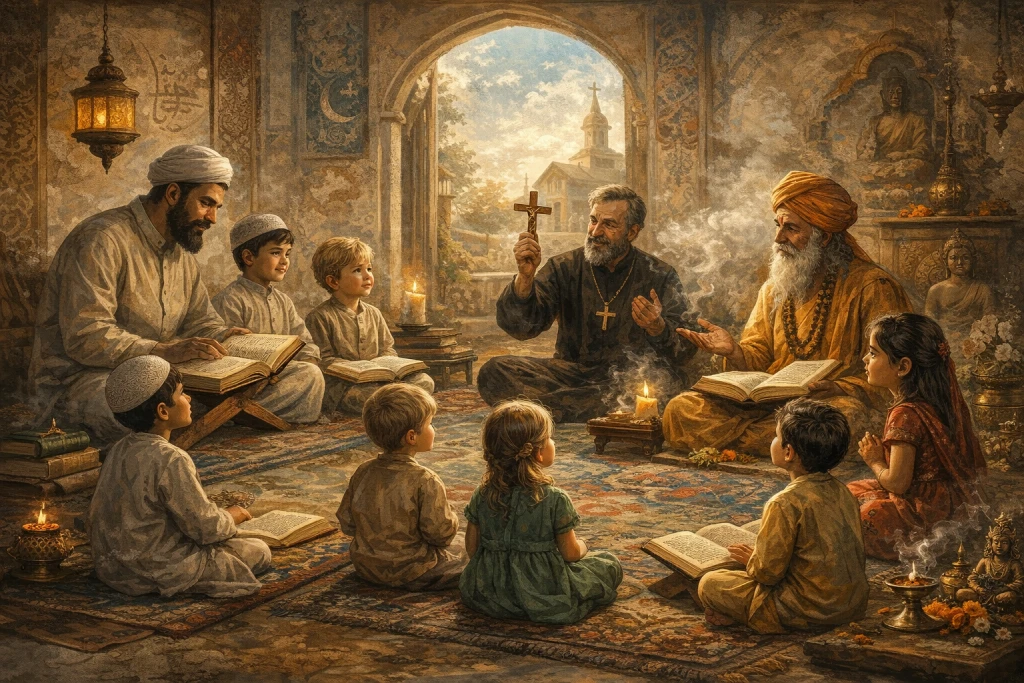
Introduction: Human Psychology and the Inheritance of Belief
A child does not enter the world with a predetermined ideology, religious faith, or philosophical theory. In the language of sociology and psychology, a newborn’s mind is like a ‘tabula rasa’, or unwritten slate, on which the surrounding environment begins to make its first marks. Children naturally grow up imitating their parents and the adults around them. Families use this instinctive tendency to imitate, together with children’s dependence, to impose their own religious and cultural frameworks on them. The ethical problem is that when a child grows up in a family belonging to a particular religion, the child accepts its practices as fixed truths of life, although this acceptance is not the product of independent reasoning or extensive inquiry. Rather, it is simply an accident of geography and family, over which the individual has no say, choice, or control.
Although children embody our hopes for the future, their world of thought is confined within particular boundaries from early childhood. Parents regard their own beliefs as absolute truths and embed them so deeply in a child’s mind that thinking beyond them becomes difficult. As a result, a child who grows up considering the religion taught by their parents superior is unknowingly carrying an ‘intellectual inheritance’, with no initial opportunity to exercise independent judgment or wisdom. In this process, shaping the child to fit an ‘ideological mould’ takes precedence over the child’s mental development.
The Social Construction of Religious Belief: Research and Family Inheritance
Children’s judgments about reality and fiction are also related to the kinds of stories presented to them as true. A study by Kathleen Corriveau, Eva Chen, and Paul Harris compared the religious environments of five- and six-year-old children in Cambridge, Massachusetts, and the surrounding area with their judgments about characters in stories. The first study involved 66 children. Children who attended church or religious schools tended to accept characters in miraculous religious stories as real people. Children who experienced neither family church attendance nor religious schooling tended to judge those characters as fictional. These differences across environments of Christian instruction and schooling show a relationship between familiar religious teaching and the accounts children accept as real. The study was published in 2015 in Cognitive Science, volume 39, issue 2, pages 353–382. [1]
The ethical significance of these findings concerns teachers’ responsibilities towards children. When a miraculous account is taught from an early age as unquestionable truth, acquiring the habit of accepting it and acquiring the ability to examine it become two distinct educational outcomes. Adults’ assurances can then take the place of evidence for a child. It is logically inconsistent to equate the eventual agreement of a child who repeatedly hears the same account through family loyalty, school authority, and the language of religious rewards and punishments with independent verification. How that agreement was formed, what alternative explanations were available, and what opportunities the child had to object are central questions in determining the freedom of their belief.
There are also empirical data on similarities in religious belief across generations. In a 2020 United States survey by the Pew Research Center, 48 percent of teenagers aged 13–17 said that all their religious beliefs were the same as those of the parent participating in the survey. Another 43 percent said that they shared some beliefs, while 8 percent said that their beliefs were quite different. These figures are based on the teenagers’ own answers. Their significance for the inheritance of family beliefs is that similarities in religious belief are visible in actual social data. [2]
This close relationship between children’s beliefs and those prevailing in their families makes the criteria for determining truth even more pressing. One family regards a religion as true, while the family next door regards a completely different religion as true. Children in both families may learn the same language of certainty from adults. The intensity of that certainty cannot determine the truth of competing claims; the same method can reinforce contradictory beliefs. It is therefore necessary to examine separately how a religious identity was transmitted and what evidence supports the claims contained within that identity.
Family Structure and the One-Sided Construction of Truth: The Crisis of Children’s Intellectual Freedom
During early childhood, a child’s world revolves largely around parents and close relatives. At this initial stage, ‘truth’ and ‘falsehood’ are not abstract or complex philosophical concepts. What parents say, and the way they teach the child to understand the world, appear instead as fixed truths. According to sociologists, what a child learns through this process of ‘primary socialization’ becomes so deeply embedded in the subconscious that breaking free of it later becomes extremely difficult.
A child growing up in a Muslim family naturally acquires Islamic beliefs and rules from their parents. Similarly, a child born into a Hindu, Buddhist, or Christian family treats the religious beliefs of that family environment as an inseparable part of life. The problem is that comparing different theologies, checking information, or reaching a conclusion through independent reasoning and wisdom is practically impossible for a young child. If parents teach that their religion alone is true and that all other paths are false or inspired by Satan, the child accepts that one-sided instruction as absolute knowledge.
This process leaves no room for the child to exercise independent judgment. It is fundamentally a form of intellectual domination, in which ancestral beliefs are imposed on the child through force or custom. Ethically, every person should have the fundamental right to obtain an objective understanding of all kinds of philosophies of life and worldviews. When a child reaches adulthood and their capacity for reasoning matures, they should be free to decide through their own judgment. But confining a child within a particular religious mould from early childhood and depriving them of the opportunity to choose another path freely severely violates the right to personal freedom. Instead of freely accepting truth, the child grows up as a slave to tradition.
Fitrah and Family Religion: Hadith and al-Ghazali’s Observations
The role of parents in forming a child’s religious identity also appears explicitly in a narration in Sahih al-Bukhari. It describes the child’s initial condition as fitrah and attributes the child’s upbringing as a Jew, Christian, or Magian to the parents. The complete narration also includes the comparison with an animal born intact and Abu Huraira’s recitation of a Quranic verse. [3]
حَدَّثَنَا عَبْدَانُ ، أَخْبَرَنَا عَبْدُ اللَّهِ ، أَخْبَرَنَا يُونُسُ ، عَنِ الزُّهْرِيِّ ، أَخْبَرَنِي أَبُو سَلَمَةَ بْنُ عَبْدِ الرَّحْمَنِ ، أَنَّ أَبَا هُرَيْرَةَ ـ رضى الله عنه ـ قَالَ قَالَ رَسُولُ اللَّهِ صلى الله عليه وسلم ” مَا مِنْ مَوْلُودٍ إِلاَّ يُولَدُ عَلَى الْفِطْرَةِ، فَأَبَوَاهُ يُهَوِّدَانِهِ أَوْ يُنَصِّرَانِهِ أَوْ يُمَجِّسَانِهِ، كَمَا تُنْتَجُ الْبَهِيمَةُ بَهِيمَةً جَمْعَاءَ، هَلْ تُحِسُّونَ فِيهَا مِنْ جَدْعَاءَ ” . ثُمَّ يَقُولُ أَبُو هُرَيْرَةَ ـ رضى الله عنه {فِطْرَةَ اللَّهِ الَّتِي فَطَرَ النَّاسَ عَلَيْهَا لاَ تَبْدِيلَ لِخَلْقِ اللَّهِ ذَلِكَ الدِّينُ الْقَيِّمُ}
English translation: Abdan narrated to us; Abdullah informed us; Yunus informed us, from al-Zuhri, who said: Abu Salama ibn Abd al-Rahman informed me that Abu Huraira (may Allah be pleased with him) said: Allah’s Messenger (ﷺ) said, “Every child is born with a true faith of Islam (i.e. to worship none but Allah Alone) but his parents convert him to Judaism, Christianity or Magainism, as an animal delivers a perfect baby animal. Do you find it mutilated?” Then Abu Huraira recited the holy verses: “The pure Allah’s Islamic nature (true faith of Islam) (i.e. worshipping none but Allah) with which He has created human beings. No change let there be in the religion of Allah (i.e. joining none in worship with Allah). That is the straight religion (Islam) but most of men know, not.” (30.30)
This narration reveals the family process through which people acquire a religious identity. The identity of a person raised in a particular religious teaching after birth is connected to the family around them. Al-Ghazali included the experience of growing up in a Muslim family within the same observation. In his al-Munqidh min al-Dalal, the fact that Christian, Jewish, and Muslim children grow up in their respective family religions appears as a reason for questioning his inherited beliefs. He then discusses the nature of beliefs acquired by imitating parents and teachers, and the criteria for certain knowledge. [4]
وقد كان التعطش إلى درك حقائق الأمور دأبي وديني، من أول أمري، وريعان عمري، غريزة وفطرة من الله وضعها في جبلتي لا باختياري وحيلتي، وحتى انحلت عني رابطة التقليد، وانكسرت علي العقائد الموروثة على قرب عهد سن الصبا، إذ رأيت: صبيان النصارى لا يكون لهم نشوء إلا على التنصُر، وصبيان اليهود لا نشوء لهم إلا على التهود، وصبيان المسلمين لا نشوء لهم إلا على الإسلام. وسمعت الحديث المروي عن رسول الله صلى الله عليه وسلم حيث قال: ” كل مولودٍ يولدُ على الفطرةِ فأبواهُ يُهودانهِ، وينُصرانهِ، ويُمجِّسَانِهِ ” فتحرك باطني إلى طلب حقيقة الفطرة الأصلية، وحقيقة العقائد العارضة بتقليد الوالدين والأستاذين، والتمييز بين هذه التقليدات، وأوائلها تلقينات، وفي تمييز الحق منها عن الباطل اختلافات فقلت في نفسي: أولاً إنما مطلوبي العلم بحقائق الأمور، فلا بد من طلب حقيقة العلم ما هي؟ فظهر لي: أن العلم اليقيني هو الذي ينكشف فيه المعلوم انكشافاً لا يبقى معه ريب، ولا يفارقه إمكان الغلط والوهم، ولا يتسع القلب لتقدير ذلك، بل الأمان من الخطأ ينبغي أنا يكون مقارناً لليقين، مقارنة لو تحدى بإظهار بطلانه – مثلاً – من يقلب الحجر ذهباً والعصا ثعباناً، لم يروث ذلك شكاً وإنكاراً، فإني إذا علمت: أن العشرة أكثر من الثلاثة، فلو قال لي قائل: لا بل الثلاثة أكثر، بدليل أني أقلب هذه العصا ثعباناً، وقلبها، وشاهدت ذلك منه، لم أشك بسببه في معرفتي، ولم يحصل لي منه إلا التعجب من كيفية قدرته عليه! فأما الشك بسببه فيما علمته فلا ثم علمت أن كل ما لا أعلمه على هذا الوجه ولا أتيقنه هذا النوع من اليقين، فهو علم لا ثقة به ولا أمان معه، وكل علم لا أمان معه فليس بعلم يقيني.
English translation: Thirsting to grasp the true nature of things had been my habit and pursuit from the beginning of my life and the earliest days of my youth. It was an instinct and disposition that Allah placed in my nature; I did not produce it through my own choice or contrivance. As I was emerging from childhood, the bonds of imitation loosened their hold on me, and inherited beliefs fell apart before me. For I saw that Christian children grew up in Christianity, Jewish children in Judaism, and Muslim children in Islam. I heard the hadith narrated from the Messenger of Allah (peace and blessings be upon him): ‘Every child is born upon fitrah; then his parents make him a Jew, a Christian, or a Magian.’ This stirred within me a desire to investigate the nature of the original fitrah and the nature of the beliefs subsequently acquired through imitation of parents and teachers. I also wanted to distinguish between these forms of imitation: they begin with inculcation, or accepting what one is taught, while there is disagreement over which of them is true and which is false. I said to myself: Since my purpose is to know the true nature of things, I must first discover what knowledge itself is. It became clear to me that certain knowledge is that in which the object known is disclosed so completely that no doubt remains, no possibility of error or illusion accompanies it, and the heart has no room even to imagine such a possibility. Rather, security against error must be so inseparable from certainty that even if someone capable of turning stone into gold and a staff into a serpent challenged it as false, this would produce neither doubt nor rejection. For example, if I know that ten is greater than three, and someone says to me, ‘No, three is greater; my proof is that I shall turn this staff into a serpent,’ and he does so before my eyes, that would not cause me to doubt my knowledge. It would only make me marvel at how he possessed such a power; it would not make me doubt what I knew. I then understood that whatever I do not know in this way, and am not certain of with this kind of certainty, is knowledge in which there is neither confidence nor security. Knowledge without security is not certain knowledge.
Al-Ghazali placed Muslim children within the same social pattern: they generally grow up in the religion present in their family. His autobiographical account also raises the question of family instruction in the origin of Muslim identity. If parents and teachers are the first sources of belief, the authority of those sources must be examined before an inherited religion can be claimed as the outcome of independent inquiry. When the same family process makes a Christian child Christian and a Muslim child Muslim, the existence of that process alone gives no particular religion a special advantage in proving itself true.
Al-Ghazali used the comparison between ten and three to illustrate certain knowledge. Even witnessing a staff turn into a serpent would not change a numerical truth: his account distinguishes the certainty of evidence from the effect of an extraordinary event. The same test applies to religious education. To what extent do a parent’s standing, a teacher’s confidence, or the deep emotions of childhood provide independent evidence for a claim? When a belief depends for its survival on keeping learners away from competing accounts, its persistence must first be examined as a product of its educational environment. The question of testing its claim to truth still remains.
Al-Ghazali’s Educational Method: Memorized Belief, Habit, and the Treatment of Doubt
In al-Ghazali’s Ihya Ulum al-Din, the second chapter of Kitab Qawaid al-Aqaid presents an explicit method for forming a child’s beliefs. He prescribes a sequence: first memorizing the creed, then understanding its meaning, and strengthening that belief through the Quran, hadith, worship, and the company of righteous people. He also instructs that beliefs acquired through imitation must be made lasting, since they may change under the influence of contrary statements. The consecutive passages below bring together inculcation, the stability of belief, shielding children’s ears from debate, and subsequent religious discipline. [5]
اعلم أن ما ذكرناه في ترجمة العقيدة ينبغي أن يقدم إلى الصبي في أول نشوه ليحفظه حفظًا ثم لا يزال ينكشف له معناه في كبره شيئًا فشيئًا فابتداؤه الحفظ ثم الفهم ثم الاعتقاد والإيقان والتصديق به وذلك مما يحصل في الصبي بغير برهان فمن فضل الله سبحانه على قلب الإنسان أن شرحه في أول نشوه للإيمان من غير حاجة إلى حجة وبرهان وكيف ينكر ذلك وجميع عقائد العوام مباديها التلقين المجرد والتقليد المحض نعم يكون الاعتقاد الحاصل بمجرد التقليد غير خال عن نوع من الضعف في الابتداء على معنى أنه يقبل الإزالة بنقيضه لو ألقى إليه فلا بد من تقويته وإثباته في نفس الصبي والعامي حتى يترسخ ولا يتزلزل وليس الطريق في تقويته وإثباته إن يعلم صنعة الجدل والكلام بل يشتغل بتلاوة القرآن وتفسيره وقراءة الحديث ومعانيه ويشتغل بوظائف العبادات فلا يزال اعتقاده يزداد رسوخًا بما يقرع سمعه من أدلة القرآن وحججه وبما يرد عليه من شواهد الأحاديث وفوائدها وبما يسطع عليه من أنوار العبادات ووظائفها وبما يسري إليه من مشاهدة الصالحين ومجالستهم وسيماهم وسماعهم وهيآتهم في الخضوع لله عز وجل والخوف منه والاستكانة له فيكون أول التلقين كإلقاء بذر في الصدر وتكون هذه الأسباب كالسقي والتربية له حتى ينمو ذلك البذر يقوى ويرتفع شجرة طيبة راسخة أصلها ثابت وفرعها في السماء وينبغي أن يحرس سمعه من الجدل والكلام غاية الحراسة فإن ما يشوشه الجدل أكثر مما يمهده وما يفسده أكثر مما يصلحه بل تقويته بالجدل تضاهي ضرب الشجرة بالمدقة من الحديد رجاء تقويتها بأن تكثر أجزاؤها وربما يفتتها ذلك ويفسدها وهو الأغلب والمشاهدة تكفيك في هذا بيانًا فناهيك بالعيان برهانًا فقس عقيدة أهل الصلاح والتقى من عوام الناس بعقيدة المتكلمين والمجادلين فترى اعتقاد العامي في الثبات كالطود الشامخ لا تحركه الدواهي والصواعق وعقيدة المتكلم الحارس اعتقاده بتقسيمات الجدل كخيط مرسل في الهواء تفيئه الرياح مرة هكذا ومرة هكذا إلا من سمع منهم دليل الاعتقاد فتلقفه تقليدًا كما تلقف نفس الاعتقاد تقليدًا إذ لا فرق في التقليد بين تعليم الدليل أو تعلم المدلول فتلقين الدليل شيء والاستدلال بالنظر شيء آخر بعيد عنه ثم الصبي إذا وقع نشوه على هذه العقيدة إن اشتغل بكسب الدنيا لم ينفتح له غيرها ولكنه يسلم في الآخرة باعتقاد أهل الحق إذ لم يكلف الشرع أجلاف العرب أكثر من التصديق الجازم بظاهر هذه العقائد فأما البحث والتفتيش وتكلف نظم الأدلة فلم يكلفوه أصلًا وإن أراد أن يكون من سالكي طريق الآخرة وساعده التوفيق حتى اشتغل بالعمل ولازم التقوى ونهى النفس عن الهوى واشتغل بالرياضة والمجاهدة انفتحت له أبواب من الهداية تكشف عن حقائق هذه العقيدة بنور إلهي يقذف في قلبه بسبب المجاهدة تحقيقًا لوعده عز وجل إذ قال والذين جاهدوا فينا لنهدينهم سبلنا وإن الله لمع المحسنين وهو الجوهر النفيس الذي هو غاية إيمان الصديقين والمقربين وإليه الإشارة بالسر الذي وقر في صدر أبي بكر الصديق رضي الله عنه حيث فضل به الخلق وانكشاف ذلك السر بل تلك الأسرار له درجات بحسب درجات المجاهدة ودرجات الباطن في النظافة والطهارة عما سوى الله تعالى وفي الاستضاءة بنور اليقين وذلك كتفاوت الخلق في اسرار الطب والفقه وسائر العلوم إذ يختلف ذلك باختلاف الاجتهاد واختلاف الفطرة في الذكاء والفطنة وكما لا تنحصر تلك الدرجات فكذلك هذه
English translation: Know that the account of the creed we have given should be presented to a child at the beginning of their upbringing, so that they memorize it thoroughly. Then, as they grow older, its meaning will gradually become clear to them. The beginning is memorization, followed by understanding, then belief, certainty, and assent. These are acquired by a child without demonstration. It is among the favours of Allah, exalted is He, towards the human heart that He opens it to faith at the beginning of its development without any need for argument or demonstration. How can this be denied, when all the beliefs of ordinary people begin with mere inculcation and pure imitation? Admittedly, belief acquired by imitation alone is initially subject to a kind of weakness: it can be displaced if its opposite is presented. It must therefore be strengthened and established in the minds of children and ordinary people until it takes firm root and ceases to waver. The way to strengthen and establish it is not to teach the techniques of disputation and speculative theology, but to occupy oneself with reciting the Quran and its interpretation, and reading hadith and their meanings. One should also occupy oneself with the duties of worship. Belief will then grow ever firmer through the Quranic arguments and proofs that reach one’s ears, the testimony and benefits of hadith that come to one, the light that shines from worship and its duties, and what is conveyed by seeing righteous people, keeping their company, observing their appearance and speech, and witnessing their humility before Allah, their fear of Him, and their submission to Him. The initial inculcation is like planting a seed in the breast; these means are like watering and tending it, until the seed grows, strengthens, and rises into a good, firmly rooted tree, with its roots secure and its branches in the sky. The child’s hearing should be guarded with the greatest care against disputation and speculative theology. For disputation unsettles more than it establishes, and corrupts more than it repairs. Indeed, trying to strengthen belief through disputation resembles striking a tree with an iron mallet in the hope of strengthening it by increasing its parts. Instead, this may shatter and destroy it, as happens in most cases. Observation is sufficient to explain this; the evidence of one’s own eyes is proof enough. Compare the beliefs of righteous and pious ordinary people with those of speculative theologians and disputants. You will see that the ordinary person’s belief is as stable as a towering mountain, unmoved by calamities or thunderbolts. The belief of the theologian who guards it through the divisions of disputation is like a thread suspended in the air, blown this way and that by the wind. The exception is someone among them who hears a proof of belief and accepts it through imitation, just as they accepted the belief itself through imitation. For, as far as imitation is concerned, there is no difference between learning the proof and learning what it proves. Being taught a proof by rote is one thing; reaching a conclusion through one’s own examination and reasoning is another, far removed from it. If a child grows up with this creed and becomes occupied with worldly earnings, nothing beyond it will be disclosed to them. Yet they will attain salvation in the hereafter by holding the creed of the people of truth. For religious law required no more of the uncultivated Arabs than firm assent to the apparent meanings of these beliefs. They were never required to investigate, scrutinize, or undertake the labour of arranging proofs. If, however, someone wishes to follow the path of the hereafter, and divine assistance enables them to devote themselves to action, adhere to piety, restrain the self from its desires, and practise spiritual discipline and striving, doors of guidance will open to them, revealing the realities of this creed through a divine light cast into the heart as a result of that striving. Thus the promise of Allah, exalted is He, is fulfilled: ‘Those who strive for Our sake, We shall surely guide them to Our paths; surely Allah is with those who do good.’ This is the precious jewel that is the ultimate goal of the faith of the utterly truthful and those brought near to Allah. It is indicated by the secret that settled in the breast of Abu Bakr al-Siddiq (may Allah be pleased with him), through which he excelled others. The disclosure of that secret—or rather, those secrets—has different degrees, according to the degrees of spiritual striving, the heart’s cleanliness and purification from everything other than Allah, and its illumination by the light of certainty. This resembles people’s differences in understanding the secrets of medicine, jurisprudence, and other sciences: those differences arise from differences in effort and in innate intelligence and discernment. Just as those degrees have no fixed limit, neither do these.
In this method, the initial educational goal is to establish a predetermined creed in the child’s mind. Education does not begin by presenting several possible explanations and asking which withstands the evidence. A conclusion is first memorized, and its meaning and supporting materials are supplied afterwards. Al-Ghazali states even more explicitly that proofs, too, can be accepted by rote: teaching someone a proof and having them investigate through their own judgment are different activities. His own distinction makes clear that memorizing a list of religious arguments and acquiring independent judgment are different things. A child may recite many statements in support of their beliefs while remaining deprived of the experience of examining those statements.
The comparison of belief to a seed, and of one-sided religious practice to watering and tending it, reveals a method of reproducing belief through habit. At the same time, the instruction to guard the child’s ears against debate defines the boundaries of that environment. Parents and teachers decide which statements the child will repeatedly encounter and which will be kept out. The resulting firmness is rooted partly in a selected flow of information and repeated practice. To conclude from the fact that a belief has become deeply established that every one of its claims is true would go beyond the evidence. The same habits and repetition can establish competing beliefs in an opposing religious environment.
A later passage in the same chapter gives more specific instructions for handling questions and doubts. He recommends limiting instruction to a brief creed where differences between schools are few, providing arguments as needed when doubts arise, and moving to the next prescribed doctrinal text if questions increase. To describe a child’s intelligence detecting a question, or a doubt arising in the mind, he uses the language of illness, disease, and the physician. [6]
وأما في بلاد تقل فيها البدعة ولا تختلف فيها المذاهب فيقتصر فيها على ترجمة الاعتقاد الذي ذكرناه ولا يتعرض للأدلة ويتربص وقوع شبهة فإن وقعت ذكر بقدر الحاجة فإن كانت البدعة شائعة وكان يخاف على الصبيان أن يخدعوا فلا بأس أن يعلموا القدر الذي أودعناه كتاب الرسالة القدسية ليكون ذلك سببًا لدفع تأثير مجادلات المبتدعة إن وقعت إليهم وهذا مقدار مختصر وقد أودعناه هذا الكتاب لاختصاره فإن كان فيه ذكاء وتنبه بذكائه لموضع سؤال أو ثارت في نفسه شبهة فقد بدت العلة المحذورة وظهر الداء فلا بأس أن يرقى منه إلى القدر الذي ذكرناه في كتاب الاقتصاد في الاعتقاد وهو قدر خمسين ورقة وليس فيه خروج عن النظر في قواعد العقائد إلى غير ذلك من مباحث المتكلمين فإن اقنعه ذلك كف عنه وإن لم يقنعه ذلك فقد صارت العلة مزمنة والداء غالبًا والمرض ساريًا فليتلطف به الطبيب بقدر إمكانه وينتظر قضاء الله تعالى فيه إلى أن ينكشف له الحق بتنبيه من الله سبحانه أو يستمر على الشك والشبهة إلى ما قدر له فالقدر الذي يحويه ذلك الكتاب وجنسه من المصنفات هو الذي يرجى نفعه
English translation: In lands where religious innovation is rare and the schools do not differ, instruction should be confined to the account of belief we have given, without entering into proofs; one should wait for a doubt to arise. If one does arise, proofs should be mentioned according to need. If religious innovation is widespread and there is fear that children may be deceived, there is no harm in teaching them the amount we have included in al-Risala al-Qudsiyya, so that it may repel the influence of the innovators’ disputes if these reach them. This is a brief amount, and we have included it in this book because of its brevity. If a child is intelligent and, through that intelligence, notices a point that raises a question, or if a doubt arises within them, the feared illness has manifested itself and the disease has appeared. There is then no harm in advancing them to the amount we have set out in al-Iqtisad fi al-Itiqad. This is about fifty leaves in length, and does not go beyond examining the principles of belief into the other investigations of speculative theologians. If that satisfies them, stop there. If it does not, the illness has become chronic, the disease has gained the upper hand, and the sickness has spread. The physician should then deal gently with them as far as possible and await Allah’s decree concerning them, until the truth is disclosed to them through an awakening from Allah, or they remain in doubt and uncertainty for as long as has been decreed for them. The amount contained in that book and works of its kind is what may be hoped to prove beneficial.
Al-Ghazali describes doubt as an illness and continued dissatisfaction with doctrinal explanations as a chronic disease. Judging whether an answer is satisfactory is itself subordinated to a particular religious destination. If the learner becomes certain of the prescribed creed, treatment has succeeded; if not, the disease has become chronic. Within this arrangement, the possibility that the creed’s claim might be wrong has no place as an ordinary part of educational inquiry. The learner’s disagreement and doubt themselves become symptoms of illness. Both the right to question and the limits of acceptable answers therefore remain under religious authority’s control.
The question of intellectual freedom becomes acute here. Treating a child who asks questions as someone suffering from an illness, rather than examining their reasoning, changes the relationship between teacher and child. Instead of accompanying the learner in seeking the correct conclusion among competing explanations, the teacher assumes the task of returning them to a predetermined belief. How much argument to teach, when to stop, and how far doubt must go before it is called chronic disease all become part of that task. Although the learner may be given access to arguments for religion, the reasonable possibility of rejecting religion remains absent from the permitted outcomes of education.
Religious Education in Childhood: Ibn Khaldun and Ibn al-Qayyim
In the Muqaddimah, in the section ‘The Education of Children and Differences in Its Methods across Islamic Regions’, Ibn Khaldun connects Quranic instruction with establishing faith and doctrine. His central point is that childhood learning endures more firmly, and that what first enters the heart lays the foundation for later mental habits. [7]
اعلم أن تعليم الولدان للقرآن شعار من شعائر الدين، أخذ به أهل الملة ودرجوا عليه في جميع أمصارهم، لما يسبق فيه إلى القلوب من رسوخ الإيمان وعقائده من آيات القرآن وبعض متون الأحاديث. وصار القرآن أصل التعليم الذي ينبني عليه ما يحصل بعده من الملكات. وسبب ذلك أن تعليم الصغر أشد رسوخاً وهو أصل لما بعده، لأن السابق الأول للقلوب كالأساس للملكات. وعلى حسب الأساس وأساليبه يكون حال ما ينبني عليه. واختلفت طرقهم في تعليم القرآن للولدان، باختلافهم باعتبار ما ينشأ عن ذلك التعليم من الملكات.
English translation: Know that teaching children the Quran is one of the distinguishing practices of the religion. Its adherents have adopted and practised it in all their cities, because Quranic verses and the texts of certain hadith establish faith and its doctrines firmly in the heart from the outset. The Quran has become the foundation of education, on which subsequent skills and mental habits are built. The reason is that childhood learning takes firmer root and forms the basis of what follows. What first enters the heart is like the foundation of skills and mental habits; the condition of what is built upon it depends on that foundation and its methods. Methods of teaching the Quran to children have differed across regions according to the skills and habits expected to result from that instruction.
This explanation shows the educational framework through which religious identity passes from generation to generation. If what a child first learns becomes the foundation of later understanding, making the Quran the initial foundation of education also relates subsequent knowledge to a particular religious framework. Which text will serve as the standard of truth has already been decided before the learner begins their own comparative assessment. A person who develops on this foundation may later ask questions in a familiar religious language while regarding questions outside that language as unfamiliar, dangerous, or unacceptable. Here, primary socialization and control over information complement one another.
Towards the end of the same section, Ibn Khaldun calls a proposal to teach language, poetry, and arithmetic first a good approach, and explains the social reasons for the customary priority given to Quranic instruction. His account mentions making use of the period when a child remains under parental control, and the fear that the child may abandon study when that control loosens after puberty. The passage below brings together the proposed curriculum and the rationale for customary control. [8]
ولقد ذهب القاضي أبو بكر بن العربي في كتاب رحلته إلى طريقة غريبة في وجه التعليم، وأعاد في ذلك وأبدأ، وقدم تعليم العربية والشعر على سائر العلوم كما هو مذهب أهل الأندلس. قال: ” لأن الشعر ديوان العرب ويدعو إلى تقديمه وتقديم العربية في التعليم ضرورة، فساداً للغة، ثم ينتقل منه إلى الحساب فيتمرن فيه حتى يرى القوانين، ثم ينتقل إلى درس القرآن، فإنه يتيسر عليه بهذه المقدمة ” ثم قال: ” ويا غفلة أهل بلادنا في أن يؤخذ الصبي بكتاب الله في أول عمره، يقرأ ما لا يفهم وينصب في أمر، غيره أهم عليه منه ” . قال: ” ثم ينظر في أصول الدين ثم أصول الفقه ثم الجدل ثم الحديث وعلومه ” . ونهى مع ذلك أن يخلط في التعليم علمان، إلا أن يكون المتعلم قابلاً لذلك بجودة الفهم والنشاط. هذا ما أشار إليه القاضي، أبو بكر رحمه الله، وهو لعمري مذهب حسن، إلا أن العوائد لا تساعد عليه وهي أملك بالأحوال ووجه ما اختصت به العوائد، من تقديم دراسة القرآن، إيثاراً للتبرك أو الثواب، وخشية ما يعرض للولد في جنون الصبا من الآفات والقواطع عن العلم ، فيفوته القرآن، لأنه ما دام في الحجر منقاد للحكم. فإذا تجاوز البلوغ وانحل من ربقة القهر، فربما عصفت به رياح الشبيبة، فألقته بساحل البطالة، فيغتنمون في زمان الحجر وربقة الحكم تحصيل القرآن له لئلا يذهب خلواً منه. ولو حصل اليقين باستمراره في طلب العلم، وقبوله التعليم، لكان هذا المذهب الذي ذكره القاضي أولى ما أخذ به أهل المغزب والمشرق. ولكن الله يحكم ما يشاء، لا معقب لحكمه سبحانه.
English translation: In the book recounting his travels, Qadi Abu Bakr ibn al-Arabi adopted an unusual approach to education and discussed it repeatedly. Following the practice of the people of al-Andalus, he placed the teaching of Arabic and poetry before all other sciences. He said: ‘Poetry is the repository of Arab knowledge, and should therefore be taught first. The deterioration of the language makes it necessary to give Arabic priority in education. One should then move to arithmetic, practising it until its rules are understood. After that, one should proceed to the study of the Quran, which this preparation will make easier.’ He then said: ‘How heedless are the people of our country, who make a child begin with the Book of Allah at the start of life, reading what they do not understand and labouring at something when another subject is more important for them at that time.’ He said: ‘Then one should study the principles of religion, then the principles of jurisprudence, then disputation, and then hadith and its sciences.’ He also prohibited combining two subjects in instruction unless the learner’s understanding and enthusiasm made them capable of it. This was the advice of Qadi Abu Bakr, may Allah have mercy on him. By my life, it is a good method. But established customs do not support it; custom exercises greater authority over people’s circumstances. The reasons for the customary priority given to Quranic study are a preference for blessing or reward, and fear that the recklessness of childhood may bring afflictions and obstacles to learning, so that the child misses the Quran. For as long as a child remains under guardianship, they submit to authority. Once they pass puberty and are released from the bonds of compulsion, the winds of youth may toss them onto the shore of idleness. People therefore make use of the period of guardianship and the bonds of authority to secure the child’s learning of the Quran, lest they be left entirely without it. If there were certainty that the child would continue seeking knowledge and accepting instruction, the method mentioned by the qadi would be the most appropriate for the people of the Maghrib and the Mashriq to adopt. But Allah decrees what He wills; none can overturn His decree.
Ibn Khaldun’s account makes a power relationship within customary education clear: a child’s religious education is secured at the age when parental commands remain effective, because the child may later move beyond those commands. The child’s potential independence is one reason for the timing of the educational method. Explaining the urgency of childhood religious instruction solely in terms of the advantages for learning therefore conceals this element of control. Adults use the period of their authority to determine the next generation’s religious identity; his discussion directly describes that process.
In Ibn al-Qayyim’s Tuhfat al-Mawdud bi-Ahkam al-Mawlud, the instruction is tied to an even more specific stage of development. The same passage that discusses caring for children as they learn to speak instructs that they be taught the declaration of faith and introduced to Allah. The educational goal is that, once the child can understand, they should know themselves to be Allah’s servant. [9]
فصل فإذا قربوا من وقت التكلم وأريد تسهيل الكلام عليهم فليدلك ألسنتهم بالعسل والملح الاندراني لما فيهما من الجلاء للرطوبات الثقيلة المانعة من الكلام فإذا كان وقت نطقهم فليلقنوا لا إله إلا الله محمد رسول الله وليكن أول ما يقرع مسامعهم معرفة الله سبحانه وتوحيده وأنه سبحانه فوق عرشه ينظر إليهم ويسمع كلامهم وهو معهم أينما كانوا وكان بنو إسرائيل كثيرا ما يسمون أولادهم ب عمانويل ومعنى هذه الكلمة إلهنا معنا ولهذا كان أحب الأسماء إلى الله عبد الله وعبد الرحمن بحيث إذا وعى الطفل وعقل علم أنه عبد الله وأن الله هو سيده ومولاه
English translation: When children approach the time of speech, and one wishes to make speaking easier for them, their tongues should be rubbed with honey and Andarani salt, because these clear away the thick moisture that impedes speech. When the time comes for them to speak, they should be taught: ‘There is no god but Allah; Muhammad is the Messenger of Allah.’ The first things to reach their ears should be knowledge of Allah, exalted is He, and His oneness: that He is above His throne, looking at them and hearing their speech, and that He is with them wherever they are. The Children of Israel often named their children Immanuel, a word meaning ‘Our God is with us.’ For this reason, the names most beloved to Allah are Abdullah and Abd al-Rahman, so that when a child becomes aware and understands, they know that they are Allah’s servant and that Allah is their Lord and protector.
This instruction places the teaching of belief at the very beginning of language acquisition. While a child is learning words for surrounding objects, people, and identities, a religious definition of their own existence is already being fixed: whose servant they are, who is watching them, and who their Lord is. Later, these statements will not arrive as an external doctrine; they will already be familiar parts of the child’s identity. Rejecting religion therefore becomes more than a question of changing a theory. It becomes a question of reconsidering relationships with family, name, personal identity, and authority. The depth of this childhood instruction gives ethical importance to the right to learn about alternatives and the opportunity to question.
Habituation to Worship and the Command to Punish
The Quran expresses the responsibility to guide one’s family into a particular religious life in terms of protecting them from Hell. Verse 6 of Surah al-Tahrim commands believers to protect themselves and their families from the Fire. [10]
يَـٰٓأَيُّهَا ٱلَّذِينَ ءَامَنُوا۟ قُوٓا۟ أَنفُسَكُمْ وَأَهْلِيكُمْ نَارًۭا وَقُودُهَا ٱلنَّاسُ وَٱلْحِجَارَةُ عَلَيْهَا مَلَـٰٓئِكَةٌ غِلَاظٌۭ شِدَادٌۭ لَّا يَعْصُونَ ٱللَّهَ مَآ أَمَرَهُمْ وَيَفْعَلُونَ مَا يُؤْمَرُونَ ٦
English translation: O you who believe, protect yourselves and your families from a Fire whose fuel is people and stones. Over it are stern and powerful angels who do not disobey Allah in what He commands them, and do whatever they are commanded.
In explaining this verse, Ibn Kathir discusses educating and disciplining the family, commanding obedience to Allah, and turning them away from disobedience. The same continuous explanation includes teaching children to pray, beating them for prayer at ten, and the aim of habituating them to religious practice before puberty. The relevant passages below connect the verse’s instruction concerning the family directly with children’s education and punishment. [11]
قال سفيان الثوري عن منصور عن رجل عن علي رضي الله عنه في قوله تعالى “قوا أنفسكم وأهليكم نارا” يقول أدبوهم وعلموهم وقال علي بن أبي طلحة عن ابن عباس “قوا أنفسكم وأهليكم نارا” يقول اعملوا بطاعة الله واتقوا معاصي الله وأمروا أهليكم بالذكر ينجيكم الله من النار. وقال مجاهد “قوا أنفسكم وأهليكم نارا” قال اتقوا الله وأوصوا أهليكم بتقوى الله وقال قتادة تأمرهم بطاعة الله وتنهاهم عن معصية الله وأن تقوم عليهم بأمر الله وتأمرهم به وتساعدهم عليه فإذا رأيت لله معصية قذعتهم عنها وزجرتهم عنها وهكذا قال الضحاك ومقاتل حق المسلم أن يعلم أهله من قرابته وإمائه وعبيده ما فرض الله عليهم وما نهاهم الله عنه. وفي معنى هذه الآية الحديث الذي رواه أحمد وأبو داود والترمذي من حديث عبدالملك بن الربيع بن سبرة عن أبيه عن جده قال: قال رسول الله صلى الله عليه وسلم “مروا الصبي بالصلاة إذا بلغ سبع سنين فإذا بلغ عشر سنين فاضربوه عليها” هذا لفظ أبي داود وقال الترمذي هذا حديث حسن وروى أبو داود من حديث عمرو بن شعيب عن أبيه عن جده عن رسول الله صلى الله عليه وسلم مثل ذلك قال الفقهاء وهكذا في الصوم ليكون ذلك تمرينا له على العبادة لكي يبلغ وهو مستمر علي العبادة والطاعة ومجانبة المعاصي وترك المنكر والله الموفق.
English translation: Sufyan al-Thawri narrated through Mansur, from a man, from Ali (may Allah be pleased with him), that Allah’s words, ‘Protect yourselves and your families from a Fire’, mean: discipline them and teach them. Ali ibn Abi Talha narrated from Ibn Abbas that the meaning is: act in obedience to Allah, avoid disobedience to Him, and command your families to remember Allah; Allah will save you from the Fire. Explaining this verse, Mujahid said: Fear Allah and advise your families to fear Allah. Qatada said: You command them to obey Allah and forbid them to disobey Him; you supervise them according to Allah’s command, order them to fulfil it, and help them to do so. When you see any disobedience to Allah, you turn them away from it and rebuke them to restrain them. Al-Dahhak and Muqatil said the same. It is a Muslim’s duty to teach their household, including relatives, female slaves, and male slaves, what Allah has made obligatory for them and what He has forbidden them. Related to the meaning of this verse is a hadith narrated by Ahmad, Abu Dawud, and al-Tirmidhi, through Abd al-Malik ibn al-Rabi ibn Sabra, from his father, from his grandfather, who said: The Messenger of Allah (peace and blessings be upon him) said: ‘Command a child to pray when he reaches seven years; when he reaches ten years, beat him for it.’ This is Abu Dawud’s wording. Al-Tirmidhi said: This hadith is hasan. Abu Dawud narrated a similar account from the Messenger through Amr ibn Shuayb, his father, and his grandfather. The jurists said that the same applies to fasting, so that it trains the child in worship, and they reach puberty continuing in worship, obedience, avoidance of sins, and rejection of wrongdoing. Allah is the one who grants success.
The command to beat children, with the age limits of seven and ten, also appears in Abu Dawud’s narration. Here the command serves to establish the child’s religious practice: instruction in prayer and physical punishment to enforce that prayer are placed within the same directive. [12]
حَدَّثَنَا مُؤَمَّلُ بْنُ هِشَامٍ، – يَعْنِي الْيَشْكُرِيَّ – حَدَّثَنَا إِسْمَاعِيلُ ، عَنْ سَوَّارٍ أَبِي حَمْزَةَ ، – قَالَ أَبُو دَاوُدَ وَهُوَ سَوَّارُ بْنُ دَاوُدَ أَبُو حَمْزَةَ الْمُزَنِيُّ الصَّيْرَفِيُّ – عَنْ عَمْرِو بْنِ شُعَيْبٍ ، عَنْ أَبِيهِ ، عَنْ جَدِّهِ ، قَالَ قَالَ رَسُولُ اللَّهِ صلى الله عليه وسلم ” مُرُوا أَوْلاَدَكُمْ بِالصَّلاَةِ وَهُمْ أَبْنَاءُ سَبْعِ سِنِينَ وَاضْرِبُوهُمْ عَلَيْهَا وَهُمْ أَبْنَاءُ عَشْرِ سِنِينَ وَفَرِّقُوا بَيْنَهُمْ فِي الْمَضَاجِعِ ” .
English translation: Muammal ibn Hisham—meaning al-Yashkuri—narrated to us; Ismail narrated to us, from Sawwar Abu Hamza. Abu Dawud said: He is Sawwar ibn Dawud Abu Hamza al-Muzani al-Sayrafi. He narrated from Amr ibn Shuayb, from his father, from his grandfather, who said: The Messenger of Allah (ﷺ) said: Command your children to pray when they become seven years old, and beat them for it (prayer) when they become ten years old; and arrange their beds (to sleep) separately.
This arrangement connects the formation of religious identity with compulsory behaviour. A child is subjected to the command to pray before independently assessing why they should pray; at a specified age, beating is also authorized for noncompliance. In Ibn Kathir’s explanation, the goal is to form habits that keep the child firmly committed to that religious practice upon reaching puberty. Even if freedom to decide is formally acknowledged at the moment of adulthood, the ethical question remains of shaping a person towards a particular decision through years of punishment and habituation beforehand.
Parents may view this as promoting their child’s welfare or protecting them from Hell; that does not change the reality of the physical coercion imposed on the child. Here, the definition of the child’s welfare comes from the parent’s religious belief, and the child is compelled to accept that definition. A child of the same age in a family of another religion would receive different behavioural instructions and different teachings about God. This power of an authority determined by birth cannot be excluded when assessing the freedom of religious consent. Presenting regular behaviour formed under the threat of punishment as evidence of accepting a religion’s rational truth is also misleading.
One-Sided Information and Restrictions on Learning about Other Religions
The free flow of information is essential to intellectual development, yet many religious frameworks deliberately and systematically block this path for children. An examination of Islamic jurisprudence and fatwas in particular shows the construction of an ‘intellectual protective wall’ instead of opportunities for Muslim children or ordinary adherents to obtain objective knowledge of other religions. At the root of this outlook is the belief that reading other religions or ideologies may create doubts or confusion about one’s own religion.
According to a basic principle of Islamic sharia, reading or teaching so-called ‘distorted scriptures’—such as the present-day Bible or Torah—or any other ‘false’ theology is generally forbidden to Muslims. The restriction is so strict that conditional permission is reserved for specialists or scholars with profound knowledge, so that they can demonstrate those religions’ falsity [13]. Haashiyat Ibn Aabideen prohibits reading anything from the religious books under discussion, whether they are transmitted by disbelievers or by those among them who have accepted Islam [14].
This control over information appears in historical sources as well as modern fatwas. Kitab al-Ibana relates that the Prophet Muhammad himself became angry on seeing a page of the Torah in Umar’s hand, and asked whether he was in doubt about the truth [15]. According to al-Hafiz Ibn Hajar al-Asqalani, reading other scriptures is entirely inappropriate for those whose faith or religious belief is not yet firm, because it may weaken the foundation of that belief [16]. The modern Salafi scholar Shaykh Ibn Baz held the same view, stating that reading the Torah or Gospel may give rise to doubts, which should be avoided [17].
Al-Buhuti’s Kashshaf al-Qina an Matn al-Iqna explicitly prohibits reading other religious scriptures. The account of Umar’s reading of the Torah is presented in this work as a reason for the prohibition. The source of the quotation below is Kashshaf al-Qina; it brings together the prohibition, the reference to Umar’s incident, the books of religious innovators, and the concern that beliefs may be corrupted. [18]
( ولا يجوز النظر في كتب أهل الكتاب نصا ) ; لأنه صلى الله عليه وسلم { غضب حين رأى مع عمر صحيفة من التوراة ، وقال أفي شك أنت يا ابن الخطاب } الحديث ( ولا ) النظر في ( كتب أهل البدع ، و ) لا النظر في ( الكتب المشتملة على الحق والباطل ، ولا روايتها ) لما في ذلك من ضرر إفساد العقائد ( وتقدم في نواقض الوضوء جملة من أحكام المصحف ) فينبغي مراجعتها .
English translation: According to the explicit ruling, it is not permissible to read the books of the People of the Book. For the Prophet (peace and blessings be upon him) became angry when he saw a page of the Torah with Umar and said: ‘Are you in doubt, O son of al-Khattab?’—the hadith. Nor is it permissible to read the books of religious innovators, or to read or transmit books that mix truth with falsehood, because of the harm of corrupting beliefs. Some rulings concerning the Quranic codex have already appeared in the discussion of what nullifies ablution; they should therefore be consulted.
The criterion for this ruling is the potential effect of reading on the adherent’s creed. Even books that mix truth and falsehood are included in the prohibition. Instead of being taught how to distinguish truth in new information, ordinary adherents are kept away from an entire field of information. Religious authorities first decide which beliefs must remain intact, then determine permission to read on the basis of that fixed conclusion. This selection limits the outcome of inquiry in advance: before readers have the freedom to reach a conclusion, the conclusion they will not be allowed to abandon has already been determined.
This entire arrangement reveals a profound ‘double standard’ or ‘intellectual monopoly’. Muslims regard inviting people of other religions to Islam or teaching them Islam as a moral duty, while fiercely opposing opportunities for children in their own community to learn about any other religion or philosophy of life. This outlook denies children’s right to reasoned judgment. If a religion truly possesses ‘absolute truth’, reading a mistaken doctrine should not shake the foundations of that truth. Accepting a belief as true in the absence of contrary information is instead tantamount to ‘blind obedience’. Children’s educational environment should enable them to learn impartially about the world’s major religions and later, on reaching adulthood, decide through their own wisdom. This systematic censorship of information raises children with a closed outlook that obstructs the development of a universal perspective.
Following Ancestral Religion and the Demand for a Consistent Standard
The Quran also criticizes presenting birth into an ancestral religion as sufficient reason to follow it. Verse 170 of Surah al-Baqarah rejects the appeal to following the ancestors’ path in response to the Islamic call. [19]
وَإِذَا قِيلَ لَهُمُ ٱتَّبِعُوا۟ مَآ أَنزَلَ ٱللَّهُ قَالُوا۟ بَلْ نَتَّبِعُ مَآ أَلْفَيْنَا عَلَيْهِ ءَابَآءَنَآ ۗ أَوَلَوْ كَانَ ءَابَآؤُهُمْ لَا يَعْقِلُونَ شَيْـًۭٔا وَلَا يَهْتَدُونَ ١٧٠
English translation: When they are told, ‘Follow what Allah has revealed,’ they say, ‘Rather, we shall follow what we found our forefathers following.’ Even if their forefathers understood nothing and were not rightly guided?
In explaining the verse, Ibn Kathir discusses following the worship of one’s ancestors, walking in their footsteps, and appealing to ancestral religion in response to the call to Islam. [20]
يقول تعالى : ( وإذا قيل ) لهؤلاء الكفرة من المشركين : ( اتبعوا ما أنزل الله ) على رسوله ، واتركوا ما أنتم فيه من الضلال والجهل ، قالوا في جواب ذلك : ( بل نتبع ما ألفينا ) أي : وجدنا ( عليه آباءنا ) أي : من عبادة الأصنام والأنداد . قال الله تعالى منكرا عليهم : ( أولو كان آباؤهم ) أي : الذين يقتدون بهم ويقتفون أثرهم ( لا يعقلون شيئا ولا يهتدون ) أي : ليس لهم فهم ولا هداية ! ! . وروى ابن إسحاق عن محمد بن أبي محمد ، عن عكرمة أو سعيد بن جبير ، عن ابن عباس : أنها نزلت في طائفة من اليهود ، دعاهم رسول الله صلى الله عليه وسلم إلى الإسلام ، فقالوا : بل نتبع ما ألفينا عليه آباءنا . فأنزل الله هذه الآية .
English translation: Allah, exalted is He, says: When these unbelieving polytheists are told to follow what Allah has revealed to His Messenger and abandon their error and ignorance, they reply: ‘Rather, we shall follow what we found’—meaning, what we discovered—’our forefathers following’—namely, the worship of idols and rivals to Allah. Rejecting their statement, Allah says: ‘Even if their forefathers’—those whom they imitate and in whose footsteps they walk—’understood nothing and were not rightly guided’—meaning that they had neither understanding nor guidance? Ibn Ishaq narrated from Muhammad ibn Abi Muhammad, from Ikrima or Said ibn Jubayr, from Ibn Abbas, that the verse was revealed concerning a group of Jews. When the Messenger called them to Islam, they said: ‘Rather, we shall follow what we found our forefathers following.’ Allah then revealed this verse.
That one’s ancestors followed a belief is a historical and familial fact. That the belief’s claims are true requires separate evidence. If this distinction applies to Jewish or idol-worshipping families, the same logical standard applies to Muslim families. The fact that a Muslim child accepted Islam through parental teaching cannot establish Islam’s truth, just as Christianity is not established by the fact that a Christian child accepted it through parental teaching. The distinction between an identity acquired by birth and a verified conclusion is the same for every family.
Unequal permission to obtain information creates a double standard here. Adherents of other religions are asked to reconsider their family instruction and listen to Islam, while ordinary adherents and children within Islam are required, before hearing competing religions’ accounts, to satisfy the conditions of intending to prove those religions false and keeping their own faith intact. In the first case, breaking family authority is desirable; in the second, protecting the belief established by that authority takes priority. A principle of equal inquiry would give everyone the opportunity to examine evidence for and against all claims, including those of their own religion. In a system that treats the possibility of abandoning one’s own belief as a danger of reading, freedom of decision remains confined to outcomes approved by authority.
The Islam Q&A Fatwa and Its Bengali Translation
Let us examine Islam Q&A’s fatwa no. 217084 on this subject [21]. The source page for fatwa no. 217084 identifies the publisher as Islam Q&A and gives the publication date as 7 June 2014. The published answer, together with the jurisprudential works and scholars it quotes, provides direct documentation of the restrictions discussed here. [22]
Ruling on teaching false religions to children
217084
Publication : 07-06-2014
Question
Im a student, becoming a teacher in religion to teach children. I live in Europe, in a Christian country, but my studies teaches the five main world religions (Islam, Christianity, Judaism, Hinduism and Buddhism). I’ve never thought that it could be haram to teach other religions to children, because I don’t see non-Islamic religions as the truth and I will never tell it is. I believe children need to know what other people believe in this world.
However, many people have been telling me my studies are haram and it’s definitely haram to teach to other children, especially muslim children. I’ve been searching, but I couldn’t find any source clarifying anything. I hope you can clarify it. Thank you very much in advance!
Answer
Praise be to Allah.
The basic principle is that it is not permissible to study or teach the distorted Scriptures, false religions or schools of thought that are contrary to the truth, unless that is done with the aim of teaching people that they are corrupt and false, and that they are contrary to reason and common sense, and contrary to the religion of truth which Allah, may He be glorified, has chosen for His slaves, namely Islam. In addition to that, the one who is studying that should also have sound knowledge of the truth and the ability to distinguish truth from falsehood, error from right guidance, and there should be no fear that he will be tempted or confused by that. This kind of study should be limited to specialists who it is hoped will play a role in combatting these distorted and devilish religions; the door should not be left open to everyone, especially the common folk and children, lest that create in them doubts and uncertainty about their religion. It says in Haashiyat Ibn ‘Aabideen (1/175): We were instructed not to look into any of that, whether it was transmitted to us by the disbelievers or by those among them who became Muslim. End quote.
In Kashshaaf al-Qinaa‘ ‘an Matn al-Iqnaa‘ (1/434) it says: It is not permissible to read the books of the People of the Book – this was stated by Imam Ahmad – because the Prophet (blessings and peace of Allah be upon him) got angry when he saw ‘Umar carrying a page of the Torah, and he said to him: “Are you doubting, O son of al-Khattab?” … It is not permissible to read the books of those who follow innovation or the books that contain both truth and falsehood, or to narrate them, because that comes under the heading of corrupting beliefs. End quote.
Al-Haafiz Ibn Hajar (may Allah have mercy on him) said, when discussing this issue – namely reading the books of the People of the Book: With regard to this issue, it is more appropriate to differentiate between the one whose faith is not deeply-rooted, in which case it is not permissible for him to read any of those books, in contrast to the one whose faith is deeply rooted, for whom it is permissible to do so, especially when there is a need to refute the arguments of those whose view is opposed to the truth. That is indicated by the fact that the imams (leading scholars) of the past and present quoted from the Torah and challenged the Jews to believe in Muhammad (blessings and peace of Allah be upon him) on the basis of what they quoted from their books. If they did not believe that it is permissible to read it, they would not have done that and they would all have reiterated this view.
End quote from Fath al-Baari by Ibn Hajar, 13/525
Shaykh Ibn Baaz (may Allah have mercy on him) was asked: Is it permissible for us to read the books of religions other than Islam, out of a desire to study and learn about other religions? He replied: That is not appropriate. It is not appropriate to read the Torah or the Gospel or any other books, because that may lead to doubt, and it was narrated from the Messenger (blessings and peace of Allah be upon him) that when he saw ‘Umar reading a page of the Torah, he said: “Are you doubting, O son of al-Khattab? I have brought it to you white and pure; if Moosa were alive he could not but follow me.” What is meant is that the Muslim should not read other books, such as the Torah, the Gospel or any others, except in the case of those who need to read them, such as scholars who want to refute the Jews and Christians from their own books. If there is a need to do so, the scholar who is refuting them and highlighting their falsehood may read their books so that he may refute them on that basis. In that case there is nothing wrong with doing that when there is a need for it, in the case of those who have knowledge and insight.
End quote from the Shaykh’s website
http://www.binbaz.org.sa/mat/10748
If this is the ruling for adults, then it is more applicable in the case of children, because their reasoning is still immature, so teaching them these religions is a wrong action in which there is nothing good. You will never be allowed, whilst teaching, to criticize these false religions and highlight their falseness; even if this is allowed, children will never be able to understand that, because specious arguments and refutation thereof will be above their level of understanding.
And Allah knows best.
A translation of part of this answer is given below. Translator: Farhan Chowdhury.
Guidelines on Teaching False Religions to Children
Question
I am a student training to become a teacher of religion for children. I live in Europe, in a Christian country, but my curriculum includes the world’s five main religions: Islam, Christianity, Judaism, Hinduism, and Buddhism. I never thought that teaching children other religions could be harmful, because I do not consider religions other than Islam true, and I will never say that they are. I believe children should also know what other people in the world believe.
However, many people tell me that my field of study is haram and that teaching it to other children is certainly haram, especially Muslim children. I have searched but found no clear source that explains it. I hope you can explain the matter in detail. Thank you in advance.
Answer
All praise belongs to Allah.
The basic principle is that reading or teaching distorted scriptures, false religions, or ideas contrary to the truth is not permitted, unless they are taught to make people understand that they are corrupt or false, contrary to reason and common sense, and contrary to the true religion called Islam, which Allah Himself has chosen for His servants. Furthermore, the person studying this must have profound knowledge of the truth and the ability to distinguish truth from falsehood and the right path from error, with no fear of being tempted or confused by that knowledge. Such study must be reserved for specialists who are expected to combat these distorted and devilish religions; its doors should not be open to everyone, especially ordinary people and children, lest it create doubts or uncertainty about their religion.
Haashiyat Ibn Aabideen (1/175) states: ‘We have been instructed not to look into any of these matters, even if they come from disbelievers or from those among them who have become Muslim.’
Kashshaf al-Qina an Matn al-Qina (1/434) states: It is not permissible to read the books of non-Muslims—this statement was made by Imam Ahmad—because the Prophet (peace and blessings be upon him) once became angry when he saw Umar carrying a page of the Torah, and said to him: ‘Have you fallen into doubt, Ibn al-Khattab?’ … It is not permissible to read or recite the books of those who follow innovations, or books containing both truth and falsehood, because these come from corrupted beliefs.’
Al-Hafiz Ibn Hajar (may Allah have mercy on him), discussing this matter—namely, reading the books of non-Muslims—said: In considering this issue, those whose faith is not deeply rooted should be distinguished from others; in their case, reading these books is not permissible at all. By contrast, someone whose faith is deeply rooted is permitted to do so, especially when it is necessary to refute the arguments of those whose opinions oppose the truth. This is indicated by the fact that past and present imams (leading scholars) quoted from the Torah to persuade Jews to believe in Muhammad (peace and blessings be upon him), using quotations from their books. If they had not believed it permissible to read them, they would not have done so and would have reiterated that view.
The last quotation is from Fath al-Bari, 13/525.
The Ethical Necessity of Reason, Wisdom, and Independent Decision-Making
Human distinction lies in the capacity for judgment and rational analysis. An ideology or belief becomes meaningful when it results from a person’s conscious decision. Yet imposing a specific religious belief in childhood destroys the opportunity for that ‘conscious decision’ at its inception. According to the philosopher Immanuel Kant’s principle of ‘Sapere Aude’, or ‘Dare to know’, a person’s true enlightenment begins when they learn to use their own judgment beyond the guardianship or direction of others. When guardianship of children extends beyond physical protection and becomes ‘intellectual censorship’, it obstructs their development into fully realized human beings.
An analysis of the Islamic fatwas and religious rulings mentioned in the preceding sections reveals an intense fear of ‘doubt’ or ‘confusion’ arising [13]. Yet from a logical standpoint, if a truth is absolute and unshakeable, it should not collapse merely through contact with another ideology or body of information. Rather, truth should be strong enough to withstand every opposing argument and establish itself. Preventing children from learning about other religions or philosophies of life implicitly concedes that the belief prescribed for them may lack the rational capacity to withstand competition from other information. The prohibitions issued by Shaykh Ibn Baz and Ibn Hajar al-Asqalani essentially seek to protect belief like a glass vessel that could break at the slightest blow [17] [23].
Ethically, accepting a belief or ideology as ‘verified truth’ carries far greater dignity than accepting it as an ‘inheritance’. A child should have the right to explore the full breadth of the vast store of knowledge called the world. Only if, on reaching adulthood, they have impartial knowledge of all the paths before them—Islam, Hinduism, Judaism, Christianity, Buddhism, or atheism—will their decision truly be ‘their own’. Otherwise, they remain merely an echo of their parents’ beliefs, which must be defined as blind faith. Allowing a child to think freely does not mean leading them astray; it means raising them to learn for themselves how to distinguish truth from falsehood. A society can become progressive only when its members develop into wise, independently minded people rather than remaining blind followers.
Children’s Own Rights: Thought, Conscience, and Information from Diverse Sources
In decisions about a child’s religious identity, the child must be recognized as an individual who holds rights. Article 14 of the United Nations Convention on the Rights of the Child recognizes freedom of thought, conscience, and religion as the child’s own right. The same article relates parents’ right and duty to provide guidance to the child’s evolving capacities. The child’s development and rights therefore also stand at the centre of determining the scope of that guidance. [24]
المادة 14 1. تحترم الدول الأطراف حق الطفل في حرية الفكر والوجدان والدين. 2. تحترم الدول الأطراف حقوق وواجبات الوالدين وآذلك، تبعا للحالة، الأوصياء القانونيين عليه، في توجيه الطفل في ممارسة حقه بطريقة تنسجم مع قدرات الطفل المتطورة. 3. لا يجوز أن يخضع الإجهار بالدين أو المعتقدات إلا للقيود التي ينص عليها القانون واللازمة لحماية السلامة العامة أو النظام أو الصحة أو الآداب العامة أو الحقوق والحريات الأساسية للآخرين.
English translation: Article 14. 1. States Parties shall respect the right of the child to freedom of thought, conscience and religion. 2. States Parties shall respect the rights and duties of the parents and, when applicable, legal guardians, to provide direction to the child in the exercise of his or her right in a manner consistent with the evolving capacities of the child. 3. Freedom to manifest one’s religion or beliefs may be subject only to such limitations as are prescribed by law and are necessary to protect public safety, order, health or morals, or the fundamental rights and freedoms of others.
Reducing this right to a promise that takes effect only after adulthood leaves the educational power relationship of childhood intact. As children’s capacity to question grows, they must increasingly have opportunities to hear answers, understand differences, and form their own positions. The parent’s role then consists of providing explanations, protection, and support appropriate to the child’s age and abilities. Withholding information to guarantee that the child’s future opinions will mirror the parent’s beliefs subordinates the child’s individual rights to parental preference.
On access to information, Article 17 also calls for children to have access to information and material from a variety of national and international sources. Alongside information conducive to social, spiritual, and moral well-being and physical and mental health, the same article provides for protection against harmful material. [25]
المادة 17 تعترف الدول الأطراف بالوظيفة الهامة التي تؤديها وسائط الإعلام وتضمن إمكانية حصول الطفل على المعلومات والمواد من شتى المصادر الوطنية والدولية، وبخاصة تلك التي تستهدف تعزيز رفاهيته الاجتماعية والروحية والمعنوية وصحته الجسدية والعقلية، وتحقيقا لهذه الغاية، تقوم الدول الأطراف بما يلي: (أ) تشجيع وسائط الإعلام على نشر المعلومات والمواد ذات المنفعة الاجتماعية والثقافية ، للطفل ووفقا لروح المادة 29 (ب) تشجيع التعاون الدولي في إنتاج وتبادل ونشر هذه المعلومات والمواد من شتى المصادر الثقافية والوطنية والدولية، (ج) تشجيع إنتاج آتب الأطفال ونشرها، (د) تشجيع وسائط الإعلام على إيلاء عناية خاصة للاحتياجات اللغوية للطفل الذي ينتمي إلى مجموعة من مجموعات الأقليات أو إلى السكان الأصليين، (ه) تشجيع وضع مبادئ توجيهية ملائمة لوقاية الطفل من المعلومات والمواد التي تضر بصالحه، مع وضع أحكام المادتين 13 و 18 في الاعتبار.
English translation: Article 17. States Parties recognize the important function performed by the mass media and shall ensure that the child has access to information and material from a diversity of national and international sources, especially those aimed at the promotion of his or her social, spiritual and moral well-being and physical and mental health. To this end, States Parties shall: (a) Encourage the mass media to disseminate information and material of social and cultural benefit to the child and in accordance with the spirit of article 29; (b) Encourage international co-operation in the production, exchange and dissemination of such information and material from a diversity of cultural, national and international sources; (c) Encourage the production and dissemination of children’s books; (d) Encourage the mass media to have particular regard to the linguistic needs of the child who belongs to a minority group or who is indigenous; (e) Encourage the development of appropriate guidelines for the protection of the child from information and material injurious to his or her well-being, bearing in mind the provisions of articles 13 and 18.
Learning about another religion and adopting it are different activities. When children learn what other people in the world believe, they gain the basic materials for comparison. Making even that knowledge conditional on prior allegiance to their own religion turns education into an instrument for policing religious boundaries. Developing the capacity to accept or reject a statement rationally requires familiarity with its claims, evidence, and objections. Teaching a competing view solely through one’s own religion’s selected account gives no experience of hearing the competing view speak for itself.
Arguments for shielding children from information must themselves have testable content. If the answer to what harm a particular piece of information will cause a child is merely ‘They may begin to doubt their own religion’, the definition of harm becomes allegiance to a prescribed belief. A reasonable question, a weakness in a religious claim, or familiarity with another philosophy of life may be part of a child’s intellectual development. Identifying these in advance as dangers and excluding them permanently places the task of judging on the child’s behalf in the hands of adult authorities. Making the right to determine the future of one’s own beliefs a reality also requires opening access, from childhood, to the means of acquiring that judgment.
Conclusion: Intellectual Liberation and the Outline of a Free Society
Ultimately, moulding children solely into a particular religious or ideological form is an affront to their fundamental humanity. When we raise a child merely as an heir to our own beliefs, we confine a world of thought with limitless potential within a narrow boundary. The discussion in this article makes clear that the systematic restrictions on learning about other religions, particularly in Islamic fatwas and traditional religious rulings, arise fundamentally from a profound intellectual fear: the fear of confronting alternative philosophies or of one’s beliefs being shaken by a free flow of information [13] [23] [17].
True education and ethics require raising a child as a seeker of truth rather than a blind follower. If truth is indeed eternal and irrefutable, it has no need to be guarded by an ‘intellectual protective wall’ or censorship. Its true stature emerges through testing against opposing arguments. Imposing religious belief on children from an early age both violates their right to decide freely and forces them to grow up with a one-sided, narrow worldview.
Ensuring children’s freedom of thought is essential to building a progressive and just society. The doors to information must remain open so that children can obtain objective knowledge of the world’s diverse religions, philosophies, and ideologies. Only when, as adults, they choose a path through their own wisdom, reasoning, and experience will that belief or philosophy of life become meaningful in the fullest sense. Let modern civilization commit itself to giving children the opportunity to develop as free human beings, instead of subjecting them to intellectual domination.
References
- Corriveau, Chen & Harris, Judgments About Fact and Fiction by Children From Religious and Nonreligious Backgrounds ↩︎
- Pew Research Center, Shared beliefs between parents and teens, 10 September 2020 ↩︎
- Sahih al-Bukhari, 1359 ↩︎
- Al-Ghazali, al-Munqidh min al-Dalal, opening discussion ↩︎
- Al-Ghazali, Ihya Ulum al-Din, 1/94, Kitab Qawaid al-Aqaid, Original text and commentary preserved in al-Zabidi’s Ithaf ↩︎
- Al-Ghazali, Ihya Ulum al-Din, 1/98, The relevant original text and commentary in Ithaf ↩︎
- Ibn Khaldun, Muqaddimah, section 39: Fi Talim al-Wildan ↩︎
- Muqaddimah, concluding passage of the same section ↩︎
- Ibn al-Qayyim, Tuhfat al-Mawdud, chapter 16, passage on learning to speak and religious instruction ↩︎
- Quran, 66:6 ↩︎
- Tafsir Ibn Kathir, commentary on Surah al-Tahrim, verse 6 ↩︎
- Sunan Abi Dawud, 495 ↩︎
- Ruling on teaching false religions to children, IslamQA, 217084 1 2 3
- Haashiyat Ibn ‘Aabideen, 1/175 ↩︎
- Kashshaaf al-Qinaa‘ ‘an Matn al-Iqnaa‘, 1/434 ↩︎
- Fath al-Baari by Ibn Hajar, 13/525 ↩︎
- Fatwa of Shaykh Ibn Baaz 1 2 3
- Al-Buhuti, Kashshaf al-Qina, 1/434 ↩︎
- Quran, 2:170 ↩︎
- Tafsir Ibn Kathir, commentary on Surah al-Baqarah, verse 170 ↩︎
- Ruling on teaching false religions to children ↩︎
- Islam Q&A, fatwa 217084, publication and source details ↩︎
- Fath al-Baari, 13/525 1 2
- UN Convention on the Rights of the Child, Article 14, official Arabic text, English text on UNICEF ↩︎
- UN Convention on the Rights of the Child, Article 17, English text on UNICEF ↩︎