
Introduction
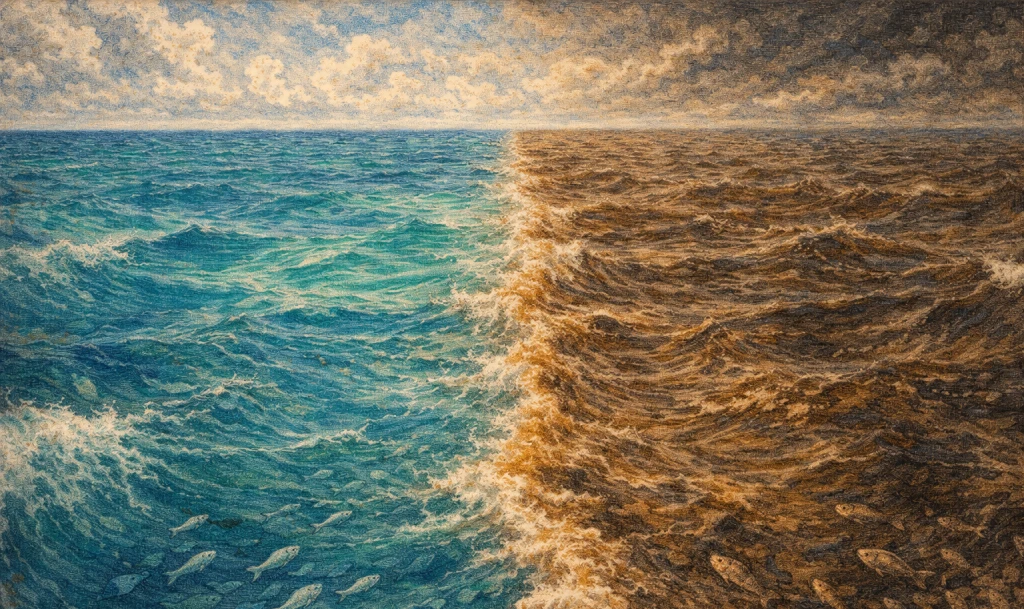
The sight of waters of different colours, densities, and tastes flowing alongside one another or forming separate layers where rivers, lakes, and seas meet has been familiar for centuries. Freshwater is generally less dense than seawater and can therefore form a surface layer; a strong river plume may also retain distinctive visible features for some distance after entering the sea. Viewed from a ship or from above, the two bodies of water may appear to remain separate. Modern oceanography, however, establishes that such stratification is not an impermeable wall. Differences in salinity and density can slow mixing or maintain layers, but water, dissolved salts, and other substances are exchanged across those layers. Tides, currents, winds, and turbulence accelerate that process. Estuaries consequently contain substantial regions of brackish water, whose salinity lies between that of river water and seawater.
At estuaries, less dense freshwater from a river mixes with denser saline water from the sea. During a flood tide, seawater may penetrate upstream into the river; during an ebb tide, the distribution shifts again. The Sundarbans, on the coast of the Bay of Bengal, form the world’s largest mangrove forest. Its waterways experience varying salinity as well as varying freshwater discharge. This variation supports specialized vegetation and ecosystems. The waters of the Sundarbans therefore provide a familiar example of the presence and interaction of freshwater and saltwater rather than their absolute separation.
Ancient Accounts of the Separation of Two Seas
The notion that “the waters of two seas do not mix”, or that an “invisible wall” separates them, is not an observation unique to Islam. Centuries before the Qur’an, Greek and Roman authors had discussed comparable observations and ideas concerning the different densities of fresh and saline water, stratified layers, and flows that retain distinctive features over considerable distances.
Aristotle: The Density Difference Between Freshwater and Saltwater
Centuries before the Qur’an, Aristotle discussed the physical differences between freshwater and saltwater. In Book II of his Meteorologica, he described freshwater as lighter and saltwater as heavier. His subject was the salinity of the sea, evaporation, and the water cycle, not a miraculous wall at a river mouth. The idea is expressed in this rendering of his discussion: [1]
“Fresh drinking water is light and rises above; saline water is heavier and remains below.”
Aristotle also knew that solar heat causes water to evaporate, after which it condenses and returns as rain. Thus the difference in density between fresh and saline water, as well as the broad concept of the water cycle, was known well before the seventh century. Ancient natural philosophy was not as accurate as modern oceanography; the relevant historical point is that these observations concerning the distinct behaviour of the two kinds of water were already recorded before the Qur’an.
Pliny the Elder: A Layer of Freshwater Above the Sea
In the first century CE, Pliny the Elder described phenomena in his Naturalis Historia that can now be understood in terms of stratification and density-driven flow. He mentioned freshwater floating on the surface of the sea and attributed it to freshwater’s lower density. He also described rivers whose waters appeared to maintain a distinguishable course for long distances across lakes. [2]
“Fresh water floats on the surface of the sea—evidently because it is lighter; seawater is heavier.”
This account matters because the formation of visibly distinct layers through differences in the densities of fresh and saltwater was recorded approximately six centuries before the Qur’an. Pliny did not possess a modern understanding of diffusion, turbulent mixing, or estuarine circulation; nevertheless, he was familiar with the apparent separation of the waters and the tendency of freshwater to remain above denser seawater.
Seneca: Ancient Ideas About Rivers and Seawater
The first-century Roman philosopher Seneca also preserved contemporary explanations of rivers and seas in his Naturales Quaestiones. He did not endorse every view he reported. One theory maintained that the sea did not simply absorb the water carried into it by rivers: water returned through hidden underground channels, lost its salinity, and became fresh again. Elsewhere, when recounting the legend of the Alpheus and Arethusa, Seneca cited lines by Virgil suggesting that a freshwater course could remain free of the “bitter waves” of the sea.
These accounts are not accurate descriptions of modern hydrology. They nevertheless establish that questions about how freshwater retains its identity within the sea, why river inflows do not steadily make the whole sea fresh, and how the two kinds of water may remain distinct were being discussed in the Mediterranean intellectual world centuries before the Qur’an. [3]
Alexander of Aphrodisias: Salinity, Density, and Aristotelian Explanations
Alexander of Aphrodisias, the Aristotelian commentator of the second and third centuries CE, revisited the physical differences between fresh and saline water in his discussion of Aristotle’s theory of the sea. In the “About the Sea” section of his Quaestiones, the finer and sweeter part of water is described as lighter and purer and therefore more readily evaporated by the sun, while the heavier saline portion remains below. He also discussed the greater density of saline water and the effects of substances dissolved in it.
Greek and Roman natural philosophy thus offered an identifiable conceptual framework for discussing differences in density, physical behaviour, and visible stratification of waters centuries before the Qur’an. These theories were not modern accounts of diffusion and circulation, but they demonstrate that the basic phenomena and questions were by no means unknown in antiquity. [4]
The Qur’anic Barzakh: Religious Interpretations That Prevent Mixing
Qur’an 25:53 describes one body of water as fresh and palatable and another as salty and bitter, placing between them a barzakh and a ḥijran maḥjūran—a barrier and a prohibited or inviolable partition. Qur’an 55:19–20 speaks of two bodies of water that meet, yet have a barzakh between them and “lā yabghiyān”—they do not transgress. English Qur’an translations use expressions such as a “barrier,” a “forbidding ban,” and a partition that cannot be crossed. As the classical commentaries below demonstrate, a substantial interpretive tradition went further and declared that the waters do not mix with each other. Modern oceanography establishes that waters may be strongly stratified by density and salinity while still exchanging dissolved material and mixing. Brackish water in estuaries is direct evidence of that process. [5] [6] [7] [8] [9] [10] [11]
Qur’an 25:53 (Arabic):
وَهُوَ ٱلَّذِى مَرَجَ ٱلْبَحْرَيْنِ هَـٰذَا عَذْبٌ فُرَاتٌ وَهَـٰذَا مِلْحٌ أُجَاجٌ وَجَعَلَ بَيْنَهُمَا بَرْزَخًا وَحِجْرًا مَّحْجُورًا
Independent English rendering: He is the one who set the two bodies of water in motion: one fresh and pleasant to drink, the other salty and bitter; and placed between them a barrier and an inviolable prohibition.
Comparative verbatim excerpts from Quran.com’s translations (water properties and barrier wording):
“one fresh and sweet and one salty and bitter” — barrier wording: “a barrier and prohibiting partition”
— Sahih International
“one palatable, sweet, and the other saltish, bitter” — barrier wording: “a bar and a forbidding ban between them”
— M. Pickthall
“One palatable and sweet, and the other salt and bitter” — barrier wording: “a partition that is forbidden to be passed”
— A. Yusuf Ali
“one fresh and palatable and the other salty and bitter” — barrier wording: “a barrier they cannot cross”
— Dr. Mustafa Khattab (The Clear Quran)
Verses 19–20 of Surat ar-Rahman first describe two bodies of water meeting, then state that a barrier between them prevents them from transgressing. This wording is reflected in several English translations published by Quran.com. [12] [13] [14] [15] [16]
Qur’an 55:19–20 (Arabic):
مَرَجَ ٱلْبَحْرَيْنِ يَلْتَقِيَانِ بَيْنَهُمَا بَرْزَخٌ لَا يَبْغِيَانِ
Verse 19 — English translations:
“He released the two seas, meeting [side by side];”
— Sahih International
“He hath loosed the two seas. They meet.”
— M. Pickthall
“He has let free the two bodies of flowing water, meeting together:”
— A. Yusuf Ali
“He merges the two bodies of ˹fresh and salt˺ water,”
— Dr. Mustafa Khattab (The Clear Quran)
Verse 20 — English translations:
“Between them is a barrier [so] neither of them transgresses.”
— Sahih International
“There is a barrier between them. They encroach not (one upon the other).”
— M. Pickthall
“Between them is a Barrier which they do not transgress:”
— A. Yusuf Ali
“yet between them is a barrier they never cross.”
— Dr. Mustafa Khattab (The Clear Quran)
Analysis of Classical Tafsir
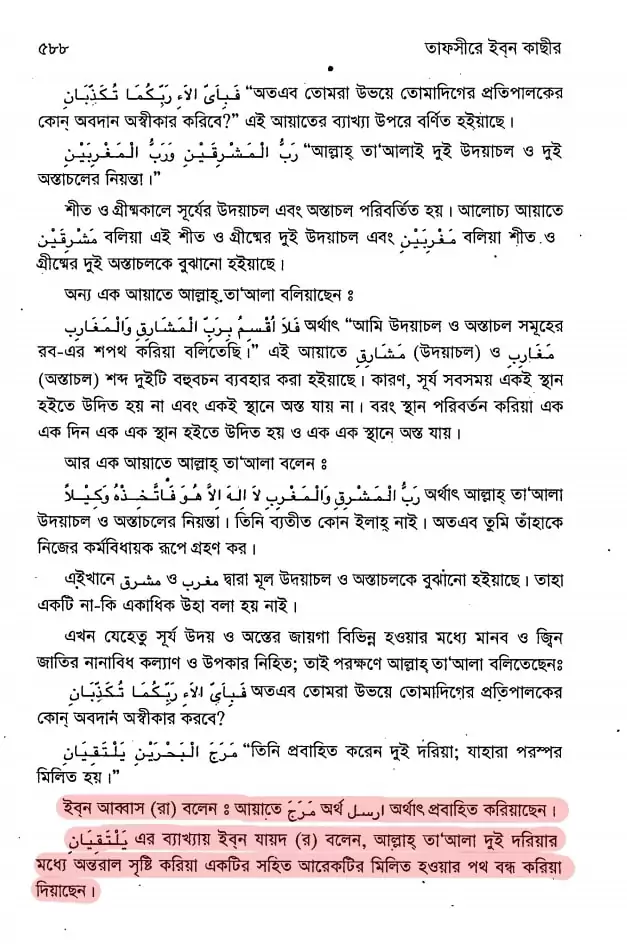
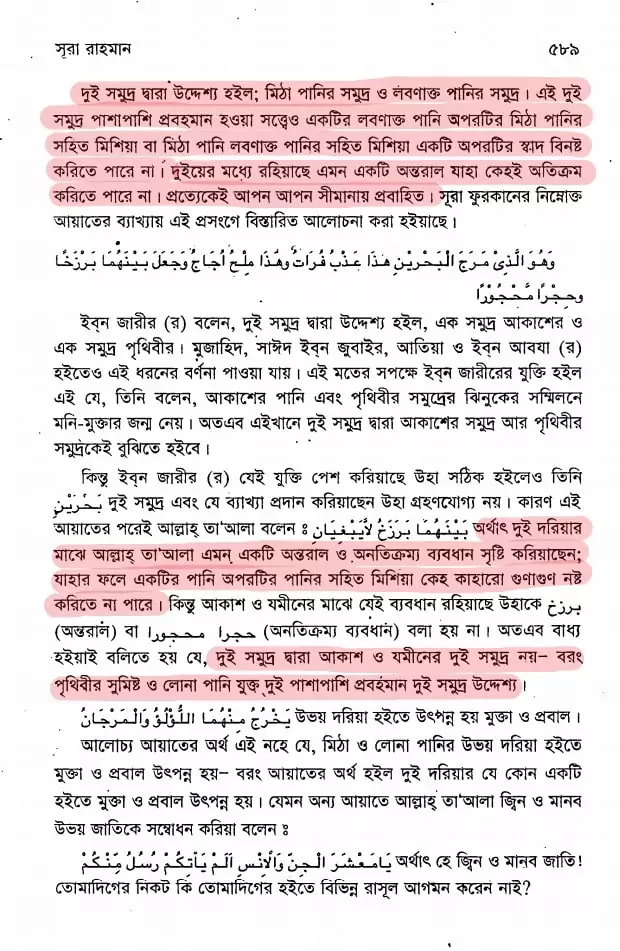
The following passages are taken from the printed Bengali edition of Tafsir Ibn Kathir, Islamic Foundation, vol. 8, p. 227, and vol. 10, pp. 588–589. The English below translates the cited Bengali edition; the page photographs are retained immediately afterward. [17]
He has placed a covering and a firm barrier between them—that is, between the saline and sweet seas and waterways—so that the water of one cannot mix with that of the other. As is stated elsewhere:
“He has set the two seas flowing together, and between them is a barrier so that they do not overstep their respective bounds. Which, then, of the favours of your Lord will you deny?” (Surat ar-Rahman 55:19–20).
It is also stated:
“Or the One who made the earth a dwelling place, placed rivers through it, set mountains upon it, and created a barrier between the two seas? Is there any deity alongside Allah? Yet most of them do not know.” (Surat an-Naml 27:61).
… Ibn Abbas said that the expression means that He set them flowing. … Explaining another part, Ibn Zayd said that Allah created an intervening barrier between the two seas and blocked the way for one to meet the other.
On Surat ar-Rahman, p. 589:
The two seas mean a sea of freshwater and a sea of saltwater. Even though these two seas flow side by side, the saline water of one cannot mix with the freshwater of the other, nor can the freshwater mix with the saline water so as to destroy the taste of either. Between them is a barrier that neither can cross. Each flows within its own bounds. This matter has been discussed in greater detail in the explanation of the verse from Surat al-Furqan.
Although the argument presented by Ibn Jarir is correct, the explanation he gave regarding the two seas cannot be accepted. For Allah then says that He has placed between them a barrier and an inviolable separation, so that the water of one cannot mix with the other and destroy its qualities. The separation between heaven and earth, however, is not called such a barrier or inviolable partition. We are thus compelled to conclude that the two seas do not mean the sea of heaven and the sea of earth, but rather two adjoining bodies of freshwater and saltwater on earth.
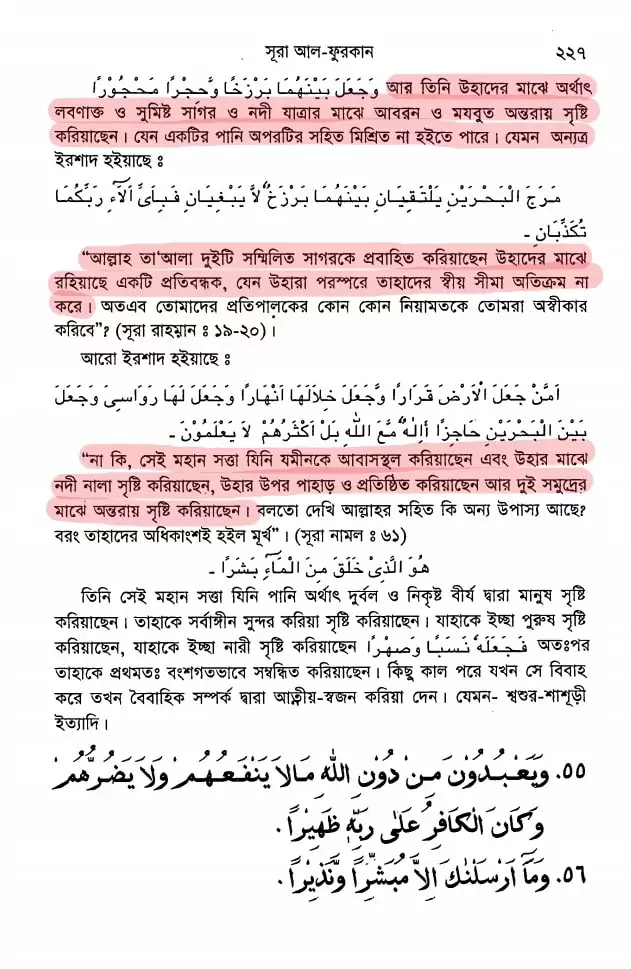
The following passage is taken from the Bengali edition of Tafsir Mazhari, vol. 8, pp. 563–564. Its corresponding printed page is preserved below. [18]
→ He is the One who has let the two seas flow, one fresh and palatable, the other salty and bitter, and has placed between them a barrier and an inviolable partition.
→ He is the One who created humankind from water, then established relations of blood and marriage among them. Your Lord is all-powerful.
The first statement says: “He is the One who has let the two seas flow, one fresh and palatable, the other salty and bitter, and has placed between them a barrier and an inviolable partition.” Here, maraja al-bahrayn denotes the concurrent flow of two seas possessing different properties. Such a meeting should cause the two seas to become one homogeneous body, yet that does not happen. Although they flow side by side, Allah’s intention is to preserve the distinct characteristics of their respective currents. His self-sufficient will can never be frustrated.
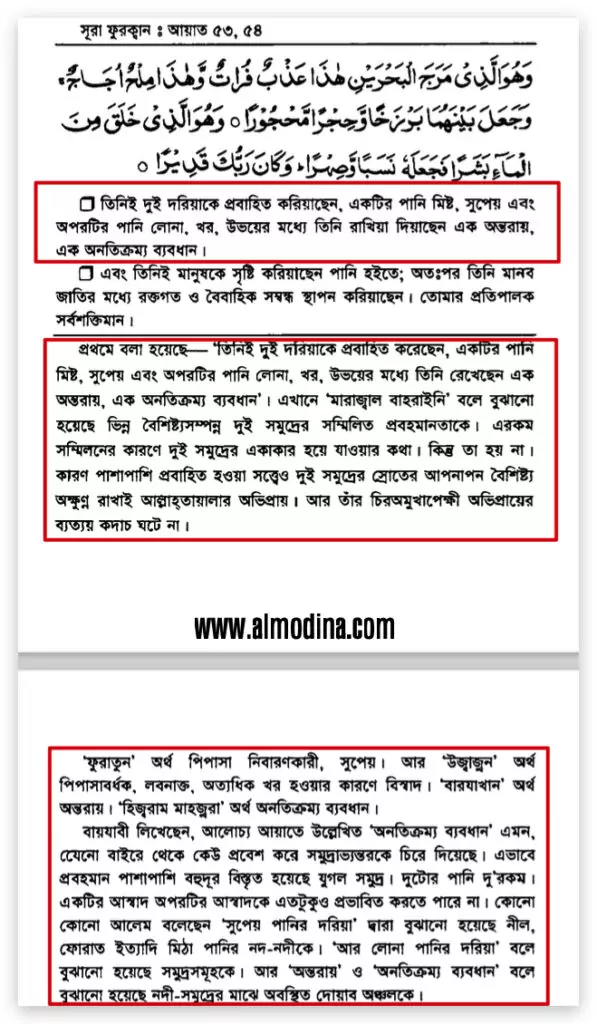
Ibn Kathir’s Original Arabic Text: The Barrier as Dry Land
There is a significant difference between the statement in the printed Bengali Tafsir Ibn Kathir quoted above—whose photographs have been retained—and the wording of a particular passage in Ibn Kathir’s original Arabic commentary. In his explanation of Qur’an 25:53, the Arabic text identifies the barzakh as dry land lying between freshwater and saltwater. Land as a separating barrier also appears in his explanation of Qur’an 55:19–20. The preserved Bengali passage and the original Arabic text must therefore be distinguished; a translated edition should not automatically be assumed to reproduce every point of the original verbatim. [19] [20]
﴿وَجَعَلَ بَيْنَهُمَا بَرْزَخًا وَحِجْرًا﴾ أَيْ: بَيْنَ الْعَذْبِ وَالْمَالِحِ ﴿بَرْزَخًا﴾ أَيْ: حَاجِزًا، وَهُوَ اليَبَس مِنَ الْأَرْضِ
English translation: “And He placed between them a barzakh and a barrier”—that is, a barzakh, or dividing obstacle, between freshwater and saltwater; this is the dry land of the earth.
The problem with this Arabic explanation is somewhat different from the scientific issue of mixing. The presence of a land barrier is not a scientific discovery: many rivers and water bodies are separated by land, whereas river water actually meets and mixes with seawater at river mouths. Ibn Kathir’s land-based interpretation does not establish the existence of an invisible and impermeable wall preventing mixing in estuaries. Conversely, the mixing-prevention language of the Bengali quotation should not simply be presented as a verbatim sentence from his Arabic original. This discrepancy reveals additional variations within the history of interpretation.
The Barzakh in Early Tafsir: A Barrier Preventing Mixing
Many modern interpreters attempt to identify the Qur’anic barzakh, the barrier between two bodies of water, with a halocline, a gradient in salinity, or a temporary transition zone. A substantial tradition of early and classical Qur’anic commentary did not understand it this way. These exegetes repeatedly asserted that waters meet but “do not mix”, that God has placed an invisible obstacle between them that prevents their intermingling, or that the tastes and distinguishing qualities of the two waters cannot be altered by one another. Such claims do not come from modern oceanography. They are explicitly attested in the early Islamic exegetical tradition. [21]
One of the most significant early statements is transmitted in the name of Mujahid ibn Jabr. Al-Tabari preserves the explanation «لا يختلط البحر بالعذب»—“The seawater does not mix with the freshwater.” Another report attributed to Mujahid speaks of «حاجزًا لا يراه أحد، لا يختلط العذب في البحر»—“a barrier no one sees; freshwater does not mingle with the sea.” A further report puts it even more plainly: «البرزخ أنهما يلتقيان فلا يختلطان»—“The barzakh means that the two bodies meet without mixing.” Ibn Abi Hatim also preserved a version of Mujahid’s explanation in his Tafsir al-Qur’an al-‘Azim, with related reports about the words used for the waters and their obstruction. Multiple compilations transmitting the views of the same exegete do not constitute multiple independent observations of the sea. [22] [23]
قال: الْبَرْزَخُ أَنَّهُمَا يَلْتَقِيَانِ فَلَا يَخْتَلِطَانِ، وَقَوْلُهُ ﴿حِجْرًا مَحْجُورًا﴾: أَيْ لَا تَخْتَلِطُ مُلُوحَةُ هَذَا بِعُذُوبَةِ هَذَا، لَا يَبْغِي أَحَدُهُمَا عَلَى الْآخَرِ.
English translation: In the account attributed to Mujahid, barzakh means that the two bodies of water meet but do not mix. The expression “an inviolable prohibition” means that the saltiness of one does not mix with the sweetness of the other; neither exceeds its bounds against the other.
In al-Tabari’s compilation, this is not an isolated remark. Reports attributed to Mujahid first explain maraja al-bahrayn as setting one body of water in motion towards another. They then describe barzakh as a barrier or restraining device and understand ḥijran maḥjūran as a prohibition that prevents saltwater and freshwater from intermingling. Together, these elements specify a physical claim: the waters approach each other, yet the salinity of one supposedly cannot mix with the sweetness of the other at their point of contact. No mere temporary density difference between surface and deep water is being described. Actual intermixing is denied.
Other reports attributed to Mujahid describe this barrier as invisible. That claim makes the issue directly testable. If an unseen but effective obstruction truly prevented mixing between two fluids, salt could not be transported across their interface. Yet measurements at estuaries show precisely such transport. Salinity changes continuously with current direction, flow rate, depth, and tidal stage. Mujahid’s specific interpretation is therefore a false account of a natural phenomenon. Its testable physical content does not disappear merely because the assertion appears in religious exegesis.
The invisible-barrier report attributed to Mujahid is especially explicit in Ibn Abi Hatim’s collection. This is another compilation of the same exegetical tradition, not an independent experiment in oceanography. Ibn Abi Hatim first preserves Mujahid’s explanation of maraja as directing one body of water towards another; later, his explanation of barzakh describes an unseen obstruction preventing freshwater from mixing with the sea. The same transmission therefore combines physical contact with an assertion of non-mixing. [24]
عَنْ مُجَاهِدٍ: ﴿بَرْزَخًا﴾ حَاجِزًا لَا يَرَاهُ أَحَدٌ، لَا يَخْتَلِطُ الْعَذْبُ بِالْبَحْرِ، وَلَا يَخْتَلِطُ بَحْرُ الرُّومِ وَفَارِسَ، وَبَحْرُ الرُّومِ مِلْحٌ.
English translation: From Mujahid: “Barzakh” is a barrier that no one can see. Freshwater does not mix with the sea; nor do the sea of the Romans and the sea of Persia mix with one another. The sea of the Romans is salty.
The earlier exegete Muqatil ibn Sulayman offered a similar explanation. In his commentary the words «حجابًا محجوبًا فلا يختلطان» describe a partition or veil as the reason the two waters do not mix. Commenting on Surat ar-Rahman, he likewise stated that God restrained one body of water from the other by His power: «فلا يختلطان، ولا يتغير طعمهما»—“they do not mix, and neither one’s taste changes.” [25] [26]
﴿بَيْنَهُما بَرْزَخٌ﴾ يَعْنِي: حَاجِزًا، حَجَزَ اللَّهُ أَحَدَهُمَا عَنِ الْآخَرِ بِقُدْرَتِهِ، ﴿لَا يَبْغِيَانِ﴾ يَعْنِي: لَا يَبْغِي أَحَدُهُمَا عَلَى الْآخَرِ، فَلَا يَخْتَلِطَانِ، وَلَا يَتَغَيَّرُ طَعْمُهُمَا.
English translation: Muqatil says: “Between them is a barzakh”—that is, a barrier by which God, through His power, holds one body of water back from the other. “They do not transgress” means that neither encroaches upon the other; consequently they do not mix, nor does the taste of either change.
Muqatil’s explanation combines two claims. First, the waters do not mix—a claim about the physical mixing process. Second, their tastes do not change—a claim about an observable result of mixing. Even if the second proposition can be made true in some limited sense, it cannot rescue the first when the first is false. Freshwater remaining fresh far upstream is not the same phenomenon as freshwater remaining entirely unmixed where it enters the sea. Likewise, the fact that an enormous sea remains predominantly saline does not show that river water has failed to enter and mix with it. Large bodies of water can retain their general characteristics while undergoing extensive local mixing.
Muqatil did not identify the barrier as a natural consequence of a density gradient. He described God as using His power to restrain one body of water from the other. Taken literally, the explanation denies the transfer of water between the adjoining bodies. In reality, freshwater disperses into the ocean, marine salt can penetrate substantial distances up an estuary, and mixing produces water with intermediate salinity. These processes contradict his categorical description. The historical importance of Muqatil’s text is that this interpretation of the Qur’anic barrier as a prohibition on mixing was already in circulation during an early period of Islamic exegesis.
The fourth-century AH exegete Abu al-Layth al-Samarqandi stated the matter still more explicitly in Bahr al-‘Ulum. He said that God forbade freshwater to become salty, saltwater to become fresh, and «وحرم على كل واحد منهما أن يختلط بصاحبه»—“forbade either of them to mix with the other.” This is not merely a statement that their distinctive tastes remain recognizable; the wording explicitly prohibits mutual mixing. [27] [28]
وَحِجْرًا مَحْجُورًا أَيْ حُرِّمَ عَلَى الْعَذْبِ أَنْ يَمْلُحَ، وَحُرِّمَ عَلَى الْمَالِحِ أَنْ يَعْذُبَ، وَحُرِّمَ عَلَى كُلِّ وَاحِدٍ مِنْهُمَا أَنْ يَخْتَلِطَ بِصَاحِبِهِ، وَأَنْ يُغَيِّرَ كُلُّ وَاحِدٍ مِنْهُمَا طَعْمَ صَاحِبِهِ.
English translation: “An inviolable prohibition” means that freshwater has been prohibited from becoming salty, saltwater from becoming fresh, either from mixing with the other, and either from changing the other’s taste.
The end of al-Samarqandi’s passage also prohibits one body of water from altering the taste of the other. His account therefore presents non-mixing and unchanged taste as two results of the same divine arrangement. The language of prohibition is not a moral injunction addressed to human beings: it is deployed as a supposedly unalterable rule governing water. The testable physical implication is that freshwater and saltwater cannot mix on contact and cannot change one another’s chemical properties.
Both propositions are contradicted by actual water behaviour. River water that mixes into the sea no longer retains its original freshwater salinity, while nearby seawater is diluted by freshwater inflow. Many estuaries have relatively fresh upper layers and more saline lower layers, and these distributions vary over time. A sample with intermediate salinity demonstrates that the initial properties have influenced one another. The precision of al-Samarqandi’s statement makes it historically useful—and just as clearly makes its physical assertion scientifically false.
The wording of al-Baghawi in Ma’alim al-Tanzil is equally unambiguous: «حاجزًا بقدرته لئلا يختلط العذب بالملح ولا الملح بالعذب»—God created a barrier by His power so that freshwater would not mix with saltwater, nor saltwater with freshwater. [29]
﴿وَجَعَلَ بَيْنَهُمَا بَرْزَخًا﴾ أَيْ: حَاجِزًا بِقُدْرَتِهِ لِئَلَّا يَخْتَلِطَ الْعَذْبُ بِالْمِلْحِ وَلَا الْمِلْحُ بِالْعَذْبِ، ﴿وَحِجْرًا مَحْجُورًا﴾ أَيْ: سِتْرًا مَمْنُوعًا فَلَا يَبْغِيَانِ.
English translation: “He placed a barzakh between them”—that is, by His power, a barrier so that freshwater cannot mix with saltwater and saltwater cannot mix with freshwater. “An inviolable prohibition” means a restraining screen, so that neither encroaches upon the other.
At the start of his discussion, al-Baghawi considered maraja to mean mixing or directing one body of water into another. This makes his subsequent explanation particularly significant. He accepts that the waters flow towards each other but then posits a divine obstacle preventing them from mixing. Thus contact without mixing is presented as a consequence of supernatural power. This is a definite assertion about how nature behaves, not a neutral description of seasonal stratification.
Al-Baghawi also stated that the saltwater cannot spoil the freshwater. Yet a water body not completely destroying the other’s taste is different from no portion of either body mixing with the other. The enormous freshwater discharge of the Ganges–Brahmaputra system does not make the entire Bay of Bengal fresh; that is no evidence that mixing has stopped. The actual amount of mixing and the resulting salinity depend on water volume, tides, and flow. Al-Baghawi attributed a false physical mechanism to divine power; invoking a divine cause does not establish the truth of the mechanism itself.
The same claim appears in al-Qurtubi‘s Al-Jami’ li-Ahkam al-Qur’an. He construed barzakh as a divinely created barrier and ḥijran maḥjūran as an obstruction «يمنع أحدهما من الاختلاط بالآخر»—“preventing one of them from mixing with the other.” [30]
﴿وَحِجْرًا مَحْجُورًا﴾ أَيْ سِتْرًا مَسْتُورًا يَمْنَعُ أَحَدَهُمَا مِنَ الِاخْتِلَاطِ بِالْآخَرِ، فَالْبَرْزَخُ الْحَاجِزُ وَالْحِجْرُ الْمَانِعُ.
English translation: “An inviolable prohibition”—that is, a concealed screen or partition preventing either body of water from mixing with the other. The barzakh is the barrier; the ḥijr is the restraining prohibition.
Al-Qurtubi’s discussion begins by considering several meanings of maraja, including releasing, mixing, and setting in motion. He also reports, in Mujahid’s name, the movement of one body of water into another. Against that background his explanation of barzakh is especially revealing: a divinely imposed barrier supposedly prevents either body from overrunning the other, and the wording ḥijran maḥjūran explicitly prevents mixing. He is not merely marveling at the sight of two different currents. He assigns an explanation for their apparent distinctness: divine prohibition.
Elsewhere in the same commentary, al-Qurtubi also records other views, including interpretations referring to a sea in the sky and a sea on earth. Their coexistence in his work is historically relevant, but they should not be confused with the specific freshwater–saltwater explanation quoted here. That passage categorically says one cannot mix with the other. Modern oceanography measures salinity distributions, water currents, and rates of exchange in estuaries; these observations directly contradict that physical claim. A truly effective mixing barrier would have a measurable consequence. The observations instead demonstrate ongoing exchange.
The formulation of Fakhr al-Din al-Razi is particularly noteworthy. He wrote «وأنه سبحانه بقدرته يفصل بينهما ويمنعهما التمازج»—“God, by His power, separates the two and prevents their intermingling.” In the same discussion he interpreted the Qur’anic “lā yabghiyān” as one body of water not encroaching on the other through mixing. But his subsequent questions and answers culminate in an explanation identifying dry land as the barzakh. The entire argument must be considered to understand his final position. [31]
وَأَنَّهُ سُبْحَانَهُ بِقُدْرَتِهِ يَفْصِلُ بَيْنَهُمَا وَيَمْنَعُهُمَا التَّمَازُجَ، وَجَعَلَ مِنْ عَظِيمِ اقْتِدَارِهِ بَرْزَخًا حَائِلًا مِنْ قُدْرَتِهِ.
English translation: By His power, God separates the two bodies of water and prevents their intermingling; as a manifestation of His great power, He placed an intervening barzakh between them.
Al-Razi did not end his discussion there. He asked where one could find a separate “sea” of freshwater on earth. He examined possible answers involving large rivers such as the Nile or the possibility of freshwater in one part of a sea and saline water in another. With the first, he questioned the significance of presenting an ordinary separation of river and sea as a special sign; with the second, he rejected speculative possibilities unsupported by evidence. At the end, he identified land between freshwater rivers and saltwater seas as the dividing obstacle. Quoting only the earlier sentence on the prevention of intermingling would therefore misrepresent him as an unqualified advocate of an invisible, impermeable wall in all circumstances.
The full argument makes the underlying issue clearer. An analytical exegete such as al-Razi considered markedly different explanations for the same verse: at one point a divine restraint on mixing, and elsewhere the land between rivers and seas. Land can indeed separate water bodies, but where a river actually enters the sea, mixing at the mouth cannot be denied. Conversely, if barzakh means land, that interpretation provides no basis for claiming that the Qur’an anticipated a scientific discovery about invisible boundaries within seawater. These divergences in premodern interpretation undermine the later claim that the text provided a single, determinate oceanographic prediction.
Al-Tabari’s own preferred explanation also matters. He took the root sense of مرج to include mixing and held that, even when the waters are connected or intermixed, God does not allow the saltwater to destroy the freshwater’s palatability. He described the barrier as operating «مع اختلاط كل واحد منهما بصاحبه»—“while each is mixed with the other.” This is not a modern account of quantitatively measurable mixing and salinity gradients. His central assertion is that a divine restraint prevents the distinctive qualities of one water body from being destroyed by the other. The commentary he transmitted from Mujahid, by contrast, said they “meet but do not mix.” These were different explanations already within the early tradition; neither provides a precise premodern account of modern estuarine mixing or haloclines. The following comparison brings the principal interpretations together.
Al-Tabari’s Jami’ al-Bayan reveals the coexistence of distinct interpretive strands. In one report attributed to Ibn Abbas, the barrier is land; in Mujahid’s report, an invisible obstruction that prevents mixing; in a report attributed to al-Hasan al-Basri, dry ground; and in one attributed to Ibn Zayd, the two water bodies are prevented from meeting at all. After presenting these accounts, al-Tabari declined to treat dry land as the sole barrier, because he considered physical mixing to be included in the word maraja. He therefore accepted that mixing does occur, while proposing that the useful qualities of one water body are not destroyed by the other. His selected position is not the same as Mujahid’s categorical denial of mixing. It demonstrates the presence of several mutually incompatible physical interpretations within the exegetical tradition. [32]
Two points follow from al-Tabari’s account. First, the earliest exegetes did not speak with one voice in denying mixing. Second, accepting some mixing does not establish that they understood modern diffusion, tidal salt intrusion, or measurable salinity gradients. Al-Tabari attributed the continued usefulness of particular waters despite contact to supernatural regulation; he was not reporting oceanographic experiments. Meanwhile, the categorical non-mixing statements associated with Mujahid, al-Baghawi, al-Samarqandi, and al-Qurtubi fail physical tests. Al-Tabari’s different interpretation does not make those claims correct. It further weakens the assertion that the Qur’anic verses yielded one precise scientific fact before its modern discovery.
| Exegete / Source | Date | Original Statement | Meaning and Significance | Reference |
|---|---|---|---|---|
| Mujahid ibn Jabr | Died 104 AH | «يلتقيان فلا يختلطان» | They meet without mixing; other reports describe an invisible barrier. | [33] |
| Muqatil ibn Sulayman | Died 150 AH | «فلا يختلطان، ولا يتغير طعمهما» | They do not mix, nor does their taste change. | [34] |
| Ibn Abi Hatim | Died 327 AH | «حاجزًا لا يراه أحد، لا يختلط العذب بالبحر» | An invisible barrier prevents the mixing of fresh and saline water. | [35] |
| Al-Tabari | Died 310 AH | Preserves Mujahid’s non-mixing report but stresses the preservation of taste in his own preferred reading. | Early tafsir contained competing accounts; barzakh was interpreted as divine regulation. | [36] |
| Abu al-Layth al-Samarqandi | Died 373 AH | «حرم على كل واحد منهما أن يختلط بصاحبه» | The mixing of either body of water with the other is forbidden. | [37] |
| Al-Baghawi | Died 516 AH | «لئلا يختلط العذب بالملح ولا الملح بالعذب» | An obstacle supposedly prevents freshwater and saltwater from mixing in either direction. | [38] |
| Fakhr al-Din al-Razi | Died 606 AH | «يفصل بينهما ويمنعهما التمازج» | First describes a prevention of mixing, then concludes with an interpretation based on dry land. | [39] |
| Al-Qurtubi | Died 671 AH | «يمنع أحدهما من الاختلاط بالآخر» | The obstacle prevents either body of water from mixing with the other. | [40] |
| Ibn Kathir | Died 774 AH | The Bengali edition describes a prevention of mixing and alteration of taste; the original Arabic refers to dry land. | The Bengali quotation and photographs are retained above; the Arabic reading is quoted separately. | [41] |
| Tafsir Mazhari | 12th century AH | The waters flow together, yet their distinct properties are said to be preserved by a divine barrier. | Discussed in the preserved Bengali printed edition cited above. | [42] |
When these commentaries are viewed in chronological order, one point is unmistakable: the proposition “the waters naturally mix, and barzakh simply means the salinity gradient within the mixing zone” was not the standard reading of early and classical Islamic exegesis. From reports attributed to Mujahid and Muqatil through the writings of al-Samarqandi, al-Baghawi, al-Razi, and al-Qurtubi, recurrent expressions include “they do not mix,” “they are prevented from mixing,” “an invisible barrier,” and “the prevention of intermingling.” Even where al-Tabari interpreted مرج as involving mixing, he still invoked a divine restraint that protected one body’s qualities from being spoiled by the other. Estuaries, however, are not permanently separated systems: fresh and saline waters actually mix there and produce brackish water. The contrast between modern scientific reconstructions and a major strand of classical interpretation is historically substantial.
Al-Nasafi and Badr al-Din al-Ayni: The Waters Meet Visibly but Cannot Mix
Badr al-Din al-‘Ayni quoted the explanation of Surat ar-Rahman from Abu al-Barakat al-Nasafi‘s Madarik al-Tanzil in his ‘Umdat al-Qari. In that description, the two bodies of water visibly meet and flow alongside one another, without any obvious boundary line to the eye. Nevertheless, an obstruction placed by divine power supposedly operates despite this visible contact. The account concludes by denying both mixing and the alteration of either water’s distinctive qualities. [43]
بَيْنَهُمَا بَرْزَخٌ حَاجِزٌ وَحَائِلٌ مِنْ قُدْرَةِ اللَّهِ تَعَالَى وَحِكْمَتِهِ لَا يَبْغِيَانِ لَا يَتَجَاوَزَانِ حَدَّيْهِمَا وَلَا يَبْغِي أَحَدُهُمَا عَلَى الْآخَرِ بِالْمُمَازَجَةِ وَلَا يَخْتَلِطَانِ وَلَا يَتَغَيَّرَانِ.
English translation: Between the two is an intervening barzakh, a barrier arising from God’s power and wisdom. “They do not transgress” means that they do not cross their respective limits: neither encroaches upon the other by intermixing; they do not mix and do not change.
Within the statement of al-Nasafi quoted by al-‘Ayni, lā yabghiyān is explained as the waters neither overstepping their bounds nor affecting each other through mixing: they do not mingle or change. His account thus has two stages. First the waters are observed meeting; second, that contact is said to be governed by an invisible impediment preventing their mixing. It is the second assertion that conflicts with science. Visible boundaries, or their absence, cannot determine whether molecules and currents transport material between water masses.
In ‘Umdat al-Qari, al-‘Ayni also reported other earlier exegetical views: “the two seas” might mean the seas of Persia and Rome, or a sea of heaven and a sea of earth. Those proposals about the identity of the seas should not be collapsed into al-Nasafi’s freshwater–saltwater reading. But the physical assertion in the latter is clear: the two bodies appear to meet but supposedly do not mix. Treating that statement as merely a description of ordinary salinity stratification removes the exegete’s own central claim: “they do not mix.”
In al-Nasafi’s interpretation, barzakh is not a zone of brackish water into which salt and water migrate from both sides. He denies mixing itself. The proposition that neighbouring waters remain completely unmixed directly conflicts with measurable salt exchange in real estuaries.
Surat an-Naml 27:61: The Wider Context of al-Qurtubi’s Explanation
This conception is not confined to Surat al-Furqan or Surat ar-Rahman. In interpreting Qur’an 27:61, Surat an-Naml’s statement about a “barrier between the two seas,” al-Qurtubi said that a divine obstruction prevents saltwater from mixing with freshwater. He also attributed to Ibn Abbas an explanation under which neither water can alter the properties of the other. Taken together, the interpretation of the three verses yields a concrete physical proposition: the barrier does not merely preserve some visible distinction but prevents actual intermingling. [44] [45]
﴿وَجَعَلَ بَيْنَ الْبَحْرَيْنِ حَاجِزًا﴾ مَانِعًا مِنْ قُدْرَتِهِ لِئَلَّا يَخْتَلِطَ الْأُجَاجُ بِالْعَذْبِ. وَقَالَ ابْنُ عَبَّاسٍ: سُلْطَانًا مِنْ قُدْرَتِهِ فَلَا هَذَا يُغَيِّرُ ذَاكَ.
English translation: “And He placed a barrier between the two seas”—a divinely established obstruction preventing bitter saline water from mixing with freshwater. Ibn Abbas said that it is an exercise of His power, such that neither changes the other.
Surat an-Naml presents the earth as a place of habitation, its rivers, its mountains, and the division between two bodies of water as signs of divine power. Al-Qurtubi assigns the barrier a precise function: stopping freshwater and saltwater from mixing. In his interpretation, the ḥājiz is not simply an imagined boundary line; it is an obstruction with the ability to prevent one water body from entering another. In this way, the readings of verses from al-Furqan, ar-Rahman, and an-Naml contribute to the same non-mixing doctrine.
The physical implication is straightforward. If freshwater and saltwater could not mix at their point of contact, water with an intermediate salinity could not form there. Such intermediate salinity, however, is characteristic of estuaries and closely connected with their ecosystems and changing conditions. If al-Qurtubi’s explanation is treated as a testable account of nature, it is false. Reducing his statement to the unremarkable fact that different types of water exist would erase his express wording that the barrier prevents mixing.
Preservation of Early Explanations in al-Suyuti’s Compilation
In Al-Durr al-Manthur, Jalal al-Din al-Suyuti gathered reports attributed to Ibn Abbas and Mujahid in his discussion of Surat ar-Rahman 55:19–20. Among them, the explanation of lā yabghiyān is lā yakhtaliṭān—“they do not mix.” By preserving older reports in a later compilation, al-Suyuti documented how widely the non-mixing interpretation circulated in the exegetical tradition. [46]
عَنِ ابْنِ عَبَّاسٍ فِي قَوْلِهِ ﴿مَرَجَ الْبَحْرَيْنِ﴾ قَالَ: أَرْسَلَ الْبَحْرَيْنِ، ﴿بَيْنَهُمَا بَرْزَخٌ﴾ قَالَ: حَاجِزٌ، ﴿لَا يَبْغِيَانِ﴾ قَالَ: لَا يَخْتَلِطَانِ.
English translation: In a report attributed to Ibn Abbas, “He released the two seas” means He set the two bodies of water free or caused them to flow; “between them is a barzakh” means an obstacle; and “they do not transgress” means they do not mix with one another.
A compilation such as al-Suyuti’s Al-Durr al-Manthur matters because it assembles exegetical transmissions preserved over centuries. In this report, the explicit explanation of barzakh and lā yabghiyān includes lā yakhtaliṭān—“they do not mix.” Rendering that statement as “they mix, but a difference in density is visible between them” would reverse its meaning. Al-Suyuti also collected alternative accounts, so his collection should not be treated as evidence of complete unanimity. It does, however, establish that categorical non-mixing was an identifiable reading within Islamic exegesis.
This report is not proof that Ibn Abbas personally conducted a scientific examination of seawater. It documents an early interpretation of scripture. Whether the interpretation is scientifically true is a separate question, tested by sampling river mouths and measuring salinity. The historical existence of the interpretation and its physical accuracy are distinct propositions. The compilation establishes the former; empirical observations refute the latter.
Ibn Atiyyah and Abu Hayyan: Direct Observation Challenges Non-Mixing
Some medieval Muslim commentators themselves recognized the conflict between non-mixing and observation. In Al-Bahr al-Muhit, Abu Hayyan al-Andalusi recorded the view that freshwater entering the salty sea remains distinct and unmixed. He then quoted Ibn ‘Atiyyah‘s observation-based objection: freshwater does mix with saline water, after which the resulting water can remain salty. This criticism was present within medieval Muslim exegesis, long before modern oceanography. [47]
وَقِيلَ: مَاءُ الْأَنْهَارِ لَا يَخْتَلِطُ بِالْمَاءِ الْمِلْحِ، بَلْ هُوَ بِذَاتِهِ بَاقٍ فِيهِ. وَقَالَ ابْنُ عَطِيَّةَ: وَالْعِيَانُ لَا يَقْتَضِيهِ.
English translation: It was said that river water does not mix with saltwater, but retains its separate identity within it. Ibn ‘Atiyyah remarked: direct observation does not support that claim.
In his own Al-Muharrar al-Wajiz, Ibn ‘Atiyyah raised a more pointed objection. After recording the popular view that river water remains unmixed and retains its identity even inside the sea, he demanded evidence or a reliable report and stated that visible reality did not support it. Abu Hayyan later cited this criticism and explained that the resulting water may remain salty even when freshwater has mixed into it. The whole sea need not become fresh to prove that mixing has occurred. The much greater volume of saline water can dominate the final taste even after it has received freshwater.
This is a fundamental logical objection to non-mixing. Someone who interprets the sea’s continued saltiness as evidence that river water never mixed into it confuses the occurrence of mixing with the average taste of the final mixture. Add a small quantity of freshwater to salty water in a vessel: the waters mix, but the result can still taste salty. Relative quantities matter on the vastly greater scale of rivers and seas as well. Ibn ‘Atiyyah’s criticism shows that this elementary distinction was being discussed in Muslim intellectual circles many centuries before modern oceanographic science.
Abu Hayyan also discussed the dispersal of finer portions of water after mixing. His physical theory was not modern molecular science, yet he attempted to explain how freshwater could lose its distinctive taste rather than denying the mixture. Historically, the two competing claims can therefore be distinguished: supernatural prevention of mixing on the one hand, and observable actual mixing on the other. Which accords with nature is no longer a speculative question.
The point of Ibn ‘Atiyyah’s objection in Al-Muharrar al-Wajiz was precise: an established interpretation requires credible evidence, and the observable connection between rivers and seas counts as evidence. Abu Hayyan quoted the argument in a later century. Its reappearance in another commentary does not constitute an independent natural observation, but does show that the question persisted within medieval exegesis. The idea had never been an uncontested fact accepted by everyone. [48]
وَقَدْ قَالَ بَعْضُ النَّاسِ: إِنَّ مَاءَ الْأَنْهَارِ لَا يَخْتَلِطُ بِالْمَاءِ الْمِلْحِ، بَلْ هُوَ بِذَاتِهِ بَاقٍ فِيهِ، وَهَذَا يَحْتَاجُ إِلَى دَلِيلٍ أَوْ حَدِيثٍ صَحِيحٍ.
English translation: Some people have claimed that river water does not mix with saltwater but remains independently present within it. Such a claim requires evidence or an authentic report.
Ibn Hajar: Rivers Flow Into Seas—How Can Mixing Be Denied?
In Fath al-Bari, Ibn Hajar al-‘Asqalani discussed the interpretation attributed to Mujahid that the waters “do not mix.” He then raised an empirically testable question: rivers such as the Nile and Euphrates actually empty into the saline sea. How, under those circumstances, could anyone deny that the waters mix? He also considered alternative explanations in which “the two seas” might refer to different bodies of water. His question shows that the reality of rivers emptying into and mixing with seas was already familiar. [49]
وَالْحُلْوُ وَهُوَ بَحْرُ النِّيلِ أَوِ الْفُرَاتِ مَثَلًا يَصُبُّ فِي الْمِلْحِ، فَكَيْفَ يَسُوغُ نَفْيُ اخْتِلَاطِهِمَا أَوْ يُقَالُ بَيْنَهُمَا بُعْدٌ؟
English translation: Freshwater, such as the Nile or Euphrates for example, flows into saltwater. How, then, can denying that they mix be justified, or how can it be said that they are separated by a distance?
Ibn Hajar began his Fath al-Bari discussion with exegetical word explanations transmitted in connection with al-Bukhari, including the interpretation of lā yabghiyān as “they do not mix.” He then cited an account attributed to Ibn Abbas suggesting that the waters cannot transgress because a distance separates them. Against that background he pointed to the actual courses of the Nile and Euphrates, which empty into the sea, and asked how mixing could be denied or a separating distance asserted. This was not an abstract lexical dispute. It brought the actual connection between rivers and seas to bear upon the interpretation’s factual basis.
Ibn Hajar went on to consider whether the “two seas” in Surat al-Furqan and Surat ar-Rahman might have different referents, noting the mention of pearls and coral in the later verses of ar-Rahman. That further discussion does not eliminate the importance of his original question. Rather, it demonstrates that the incompatibility between river mouths and a strict non-mixing claim had already prompted exegetes to ask whether the verses should be given the same interpretation. Recognizing that rivers enter and mix with the sea did not require satellites, laboratories, or modern imagery.
This historical evidence further weakens the modern claim that the Qur’anic barrier represented an unknown scientific discovery. At least some medieval exegetes knew that one could not insist on permanent, unchanged separation after freshwater and saltwater came into contact. The story that everyone in antiquity was ignorant of the issue and that modern science first uncovered the hidden truth of scripture is inconsistent with the historical sources themselves.
Al-Alusi: Non-Mixing Contradicts Direct Observation
The nineteenth-century exegete Shihab al-Din al-Alusi is particularly important. In Ruh al-Ma’ani he first reported the traditional view that an unseen barrier created by divine power entirely prevents freshwater and saltwater from intermixing or changing each other’s taste. He then argued that the interpretation, even though attributed to many commentators, contradicted direct observation. Where major rivers such as the Tigris and Nile enter the sea, river water changes in taste and the adjacent seawater changes too. The degree of change varies with discharge, wind, and other conditions. Al-Alusi noted that nobody had produced an actual example of adjoining fresh and saline waters in which neither changed at all. He rejected the categorical non-mixing account on the basis of the waters’ observed behaviour. [50]
وَلَمْ يُخْبِرْ أَحَدٌ أَنَّهُ شَاهَدَ فِي الْأَرْضِ بَحْرَيْنِ أَحَدُهُمَا عَذْبٌ وَالْآخَرُ مِلْحٌ، وَقَدِ اتَّصَلَ أَحَدُهُمَا بِالْآخَرِ مِنْ غَيْرِ تَغَيُّرٍ لِطَعْمِ شَيْءٍ مِنْهُمَا أَصْلًا.
English translation: No one has reported seeing two bodies of water on earth, one fresh and the other salty, connected to one another without any change whatever in the taste of either.
This observation follows a lengthy discussion in al-Alusi’s Ruh al-Ma’ani. He first outlines the received view that, although the waters appear to mingle to the eye, they remain wholly separate by divine power and neither changes the other’s taste. His objection is that such a conclusion runs counter to experience. When the Tigris, Nile, and other rivers enter the sea, the freshwater changes near the point of contact and the adjacent seawater is changed by the river inflow. Wind, the amount of water, and variations in current can alter the degree of change. He therefore described reciprocal changes in actual rivers and seas, not merely a theoretical possibility.
Al-Alusi was emphatic: no one had demonstrated the existence of two truly connected bodies of fresh and saline water whose tastes remained entirely unaffected. He rejected the idea of an invisible non-mixing wall as an unnecessary complication that exposed the Qur’an to avoidable criticism. This is an important historical admission: an influential Muslim commentator himself acknowledged that the “they do not mix” interpretation runs counter to observation. He did not need to endorse or oppose modern science to reach that conclusion; the familiar behaviour of rivers and seas was enough.
Al-Alusi also mentioned another account under which an intermediate-tasting region may exist at the meeting point, as saline water mixes into freshwater and freshwater into saline water, reducing the distinct intensity of either. Acknowledging real mixing in this respect is consistent with modern estuarine science. Al-Alusi himself did not frame this as a precise scientific prediction contained in the Qur’an. His more direct point was that an interpretation contrary to observation should not be sustained through contrived complications. Recasting words to protect a physical assertion that reality contradicts does not resolve the underlying error.
Al-Alusi’s observations establish a basic point: demonstrating that “the two waters never mix” is false did not require a modern laboratory. The changing taste of water near estuaries was already accessible to observation. Modern oceanography has confirmed and refined that observation through measurements of salinity, current structure, and the movement of material between water masses.
IslamQA’s Combined Interpretations: Invisible Barriers and Density
IslamQA’s answer no. 165094 sets out two classical explanations. According to the first, land separates rivers from seas; according to the second, an invisible barrier prevents freshwater and saltwater from mixing even where they meet at a river mouth. The answer also quotes Ibn Kathir, al-Qurtubi, al-Shinqiti, Ibn Ashur, Ibn ‘Uthaymin, and Salih al-Fawzan, ultimately presenting a difference in density as compatible with the same Qur’anic verse. But stratification resulting from density differences and the complete prevention of mixing are different propositions. The first is observed; the second is false. Calling both the same truth cannot vindicate the erroneous prediction that mixing is prevented. [51]
أن بين البحرين، العذب والفرات، حاجزا لا يظهر للعيان، خلقه الله بقدرته، يمنع به اختلاط الماء العذب بالماء المالح رغم التقاء الماءين في نهاية مصب الأنهار
English translation: Between the two bodies of water—fresh and sweet—there is an invisible barrier created by God through His power, which prevents freshwater from mixing with saltwater even though the waters meet at the end of the rivers’ mouths.
The second interpretation discussed by IslamQA expressly holds that the waters meet at a river mouth but are kept from mixing by an invisible barrier. The first interpretation, by contrast, describes intervening land that separates rivers and seas. They are not descriptions of the same physical phenomenon. Land can separate distinct water bodies; where a river flows into the sea, however, there is no continuous land wall between them. Water flows and mixes there.
In the same answer, the passage attributed to Ibn Kathir interprets the barrier as land, while the quotation from al-Sa’di accepts actual mixing of freshwater and saltwater. A passage from al-Qurtubi then describes an obstruction that stops mixing, and Ibn Ashur invokes differences of density to explain an “invisible barrier.” The final answer presents all the views as acceptable. Yet “they mix” and “they do not mix” are not interchangeable descriptions of the same testable event. The truth of one cannot erase the falsity of the other.
Differences in density can produce layers without preventing the exchange of water and dissolved salt. Describing stratification as an “impermeable barrier” distorts the physical process. Conversely, accepting that the waters mix but calling the zone of stratification barzakh abandons the earlier claim that the barrier prevents mixing. Reconciling an ancient verse with a modern scientific finding after the fact is not the same as accurately predicting that finding in advance. Conflating these approaches cannot establish a scientific miracle.
From the Salaf’s Non-Mixing Reports to Modern Density Explanations
There was no single agreed answer in early exegesis to the question of what the barzakh actually was. Several reports attributed to Mujahid and Ibn Abbas explained the verse with «لا يختلطان»—“the two waters do not mix.” Muqatil stated that neither could change the other’s taste, and al-Samarqandi went further in calling their mixing prohibited. Al-Baghawi and al-Qurtubi likewise described an obstacle preventing intermingling. Reducing those specific explanations to a modern statement that “different densities merely slow mixing” changes what these authors actually said. This is not a minor lexical variation; the two accounts make opposite, testable physical claims. [52] [53]
Alternative interpretations nonetheless existed from the outset. Al-Hasan al-Basri was reported as identifying the barrier with land; al-Tabari accepted real mixing while proposing that it would not destroy the relevant properties of the water; al-Razi considered non-mixing before arriving at a land-based interpretation; and Ibn Kathir’s Arabic text explicitly referred to dry land. The history cannot therefore be reduced to “everyone agreed at first, and everyone changed their minds later.” The more precise history is that competing views existed early on, including a highly influential categorical non-mixing account. When later exegetes sought harmony with observation and science, they could favour older alternatives or introduce new physical explanations instead of retaining the categorical ban on mixing. Presenting this selective reinterpretation as the single universally accepted ancient meaning suppresses the documentary record. [54] [55] [56]
The medieval commentator Ibn ‘Atiyyah challenged the categorical non-mixing position on observational grounds, and Abu Hayyan quoted that objection. In the nineteenth century, al-Alusi more explicitly observed that both river water and neighbouring seawater change where rivers such as the Tigris and Nile enter the sea. He also discussed water with intermediate properties near the meeting point. Thus the error of denying mixing was identified within the Islamic commentary tradition itself, not only after the rise of modern oceanography. That does not erase the historical existence of explanations attributed to Mujahid and Muqatil. It shows that observation-based and observation-defying interpretations coexisted in the same religious tradition. [57]
An especially clear example of later change appears in the twentieth-century work of ‘Abd al-Rahman al-Sa’di, Taysir al-Karim al-Rahman, commenting on Surat ar-Rahman. Al-Sa’di explicitly acknowledged that the freshwater of rivers flows into the salty sea and mixes with it. At the same time, he identified the barzakh with a land barrier and explained how freshwater remains useful and the sea retains its characteristics. The old proposition that “the two waters never mix at all” is not preserved without modification. Instead, actual mixing is admitted while the religious significance of the verse is located elsewhere. Al-Sa’di’s explanation is not identical to the categorical accounts attributed to Mujahid and Muqatil. [58]
فَيَصُبُّ الْعَذْبُ فِي الْبَحْرِ الْمَالِحِ، وَيَخْتَلِطَانِ وَيَمْتَزِجَانِ، وَلَكِنَّ اللَّهَ تَعَالَى جَعَلَ بَيْنَهُمَا بَرْزَخًا مِنَ الْأَرْضِ
English translation: Freshwater flows into the salty sea, and the two mix and intermingle. But God has placed between them a barzakh of land.
The change becomes unmistakable when al-Sa’di’s «يختلطان ويمتزجان» is compared with the «لا يختلطان» attributed to Mujahid. The former says “they mix”; the latter, “they do not mix.” These sentences cannot both be literally true of the same waters at the same point of contact. Al-Sa’di accepted actual mixing rather than making the categorical non-mixing statement of the early exegetes a necessary condition of his interpretation. Describing this as a word-for-word continuation of the earlier reading would falsify its history. Nor does al-Sa’di’s land barrier demonstrate an invisible wall within an estuary.
A further interpretive innovation appears in Muhammad al-Tahir Ibn Ashur‘s Al-Tahrir wa-al-Tanwir. He invoked the waters’ differences in specific gravity or density to explain an invisible, natural impediment. In this account, the barrier is no longer dry land; it arises from the physical properties of the waters themselves. Later natural-scientific concepts have thus been incorporated into the classical language of an “invisible barrier.” But density-driven layering is not the same as the complete cessation of mixing. Gradients of salinity, salt intrusion, and the creation of brackish water at river mouths demonstrate the difference. [59]
فَالْحَاجِزُ حَاجِزٌ مِنْ طَبْعِهِمَا، وَلَيْسَ جِسْمًا آخَرَ فَاصِلًا بَيْنَهُمَا
English translation: The barrier arises from their own nature; it is not another physical body separating the two.
In the surrounding discussion, Ibn Ashur referred specifically to their difference in specific gravity. This is the central shift in the later reading: from an invisible divine prohibition on mixing to stratification arising from differences in density. These do not express the same scientific claim. Waters of unequal density can form layers, but currents, tides, and diffusion continue to transport material across those layers. Presenting a process that can slow mixing as one that prohibits mixing altogether misrepresents the science. Ibn Ashur’s is a later physical interpretation; the early texts of Mujahid, Muqatil, and al-Samarqandi do not give a specific description of a salinity gradient or the mixing zone of an estuary.
IslamQA’s 2011 answer documents the attempt to present these historically inconsistent explanations as simultaneously true. It brings together Ibn Kathir’s and al-Sa’di’s land-barrier readings, al-Qurtubi’s categorical prevention of mixing, Ibn Ashur’s density-based account, Ibn ‘Uthaymin’s remarks about freshwater sources within the sea, and Salih al-Fawzan’s view about the preservation of taste. The answer ultimately concludes that both the barrier of land and an invisible density-related barrier are acceptable explanations, portraying the variation as compatible rather than contradictory. But the problem is evident in the sources’ own words: “the waters mix” and “the waters do not mix” cannot be equally accurate physical descriptions of the same event. [60]
وَلَا مَانِعَ مِنِ اخْتِيَارِ كِلَا الْقَوْلَيْنِ فِي تَفْسِيرِ الْآيَةِ، إِذْ يَصْدُقُ كُلٌّ مِنْهُمَا وَلَا تَعَارُضَ بَيْنَهُمَا
English translation: Nothing prevents the adoption of both opinions in interpreting the verse, since both are true and there is no contradiction between them.
What is lost in this conclusion can be stated precisely. Mujahid’s “they do not mix,” al-Samarqandi’s “mixing is prohibited,” and al-Baghawi’s “freshwater cannot mix with saltwater, nor saltwater with freshwater” cannot be reconciled with density gradients without abandoning their literal non-mixing meaning. Yet instead of acknowledging that the earlier interpretation has been displaced, the modern harmonization declares both the old and new readings true from the outset. That is not straightforward adherence to the early reports; it replaces an earlier testable claim with a later explanation. Reading scientific information about density, stratification, and estuarine mixing back into old wording after those findings have been established is not evidence of scientific foreknowledge. The historical change in the meaning assigned to barzakh shows that the modern content comes from modern observations, not from the classical assertion that waters cannot mix.
Islamweb’s 2016 Scientific-Miracle Claim: Mixing Accepted and Denied in the Same Article
A particularly revealing illustration appeared in an Islamweb article dated 4 September 2016, entitled “Wa Ja’ala Baynahuma Barzakhan” (“And He Placed a Barrier Between Them”). It argued that the Qur’an had described an invisible boundary between freshwater and saltwater fourteen centuries earlier, which scientists supposedly discovered toward the end of the nineteenth century. The article presented two old interpretations—land as the barrier and an unseen barrier—and rejected the land explanation. It then cited the Ghyben–Herzberg relation, a mathematical approximation for freshwater and saltwater in coastal aquifers, as scientific proof of the barzakh. The purported scientific prediction is not independently derived from the Qur’anic text; the verse is being read in light of a much later hydrogeological model. [61]
The article also misrepresents the history of interpretation. It groups al-Tabari’s preferred reading with Mujahid’s categorical non-mixing interpretation as though both supported the same invisible, impermeable barrier. Yet al-Tabari’s own text explicitly speaks of «مع اختلاط كل واحد منهما بصاحبه»—the barrier operating even while each body of water is mixed with the other. Ignoring this acknowledgement of mixing and portraying al-Tabari as a simple proponent of absolute non-mixing is incorrect. It obscures the disagreement contained in the early exegetical sources. [62] [63]
The article’s most serious scientific error is its treatment of the Ghyben–Herzberg relation. Fresh groundwater in coastal aquifers is less dense than saline groundwater, so it tends to occupy a position above it; a simplified mathematical relation links the freshwater head above sea level with the depth of the freshwater–saltwater interface. The relationship can provide an initial estimate of the position of that interface. It is not an impermeable membrane, nor a law preventing salt molecules from dispersing. Nevertheless, the Islamweb article describes the relation as a barrier that completely stops the spread of salt molecules. [64]
وُجُودَ مِثْلِ (الْحَاجِزِ) بَيْنَ الْمَاءِ الْمِلْحِ وَالْمَاءِ الْعَذْبِ يَمْنَعُ مَنْعًا بَاتًّا انْتِشَارَ جُزَيْئَاتِ الْمِلْحِ
English translation: The existence of such a “barrier” between saline and freshwater completely prevents the diffusion of salt particles.
That assertion is false. Studies by the United States Geological Survey (USGS) establish that the supposed dividing line between fresh and saline groundwater in coastal settings is, in reality, a zone of mixing. Groundwater movement, hydrodynamic dispersion, and molecular diffusion occur within it; salinity changes progressively across the zone. The simple Ghyben–Herzberg approximation assumes a sharp interface for ease of calculation. As a detailed USGS report from 2003 makes clear, the interface in real aquifers is not necessarily sharp, and mixing does take place. Islamweb thus repackaged scientific evidence of mixing and salt transport as though it established an impermeable barrier. This is not a minor disagreement over terminology: it reverses the meaning of the scientific result. [65] [66]
The contradiction also appears within the same Islamweb article. On the one hand it says freshwater and saline water cannot mix at all; on the other it acknowledges an intermediate region of measurable thickness in which salt concentration changes gradually and fresh and saline water intermingle. Intermediate salinity is itself evidence of mixing. To describe the same mixing zone as something that completely prevents mixing is self-contradictory. The scientific characteristics of the region have been inverted in an effort to defend Mujahid’s “they do not mix” interpretation. [67]
This example is particularly instructive because three stages of reinterpretation appear in one text. First, a report about an invisible barrier attributed to early exegetes is adopted. Second, a modern mathematical relationship describing coastal groundwater is offered as its “proof.” Third, a scientific model that involves a mixing zone and salt transport is misrepresented as proof that mixing cannot happen. The vocabulary attributed to the early authorities is retained, but modern physical concepts are inserted into it and the science is distorted when the resulting claims conflict. The claimed “scientific miracle” rests not on the observed physical facts, but on selective exegesis combined with a false account of those facts.
The ordinary Arabic meaning of barzakh must be distinguished from the specific physical claims made by commentators. A general notion of a barrier or separation does not automatically conflict with every scientific observation. The conflict arises where an exegete claims that freshwater and saltwater cannot mix even in contact, or that neither can alter the other’s taste. Such propositions are tested against the behaviour of water. When samples show material contributed by both sources and intermediate salinity at the interface, categorical non-mixing is false. The decisive issue is the comparison between a particular physical assertion and a particular set of measurements.
Which Claim Is Falsified by Observation?
“Freshwater and saltwater never mix” is a directly testable assertion. Collect samples from different positions and depths where they meet, and measure salinity. If a truly impermeable barrier prevented all mixing, one would not find water of intermediate salinity or the transport of salt and water across the interface. Yet both are observed. According to the National Oceanic and Atmospheric Administration (NOAA), estuarine water is a mixture of fresh and saline water. Brackish salinity commonly extends across a broad intermediate range, approximately 0.5 to 35 parts per thousand, varying with location, depth, tides, winds, and river discharge. [68]
The existence of separate-looking water layers in an estuary does not mean that mixing has stopped. The upper water can be fresher and the lower water more saline while exchange continues across the interface. NOAA reports that in the Hudson River, tidal currents can drive saline water more than 200 kilometres upstream. Such observed salt intrusion, circulation, and mixing directly contradict the claim that the river and sea remain physically isolated. [69]
Consider an estuary with very low salinity near the surface, moderate salinity at an intermediate depth, and seawater-like salinity near the bottom. Those layers demonstrate differing contributions from fresh and saline sources. If the two waters could never mix, water with intermediate salinity would not develop in the intervening region. Oceanography does not imply that salinity must be uniform at every depth. Mixing varies with tides, discharge, basin geometry, wind, and density. Limited mixing, slow mixing, mixing with persistent stratification, and no mixing at all are four different claims. A categorical assertion of non-mixing cannot be made true merely by pointing to any of the first three phenomena. [70]
This evidence rests on measurements rather than the visual impression of differently coloured waters. Instruments measure conductivity, salinity, temperature, and density along river reaches and at estuary mouths. Measurements at different depths can be compared, and the upstream movement of salt during flood tides and its subsequent displacement can be documented. NOAA also maintains information describing freshwater, mixed-water, and marine salinity zones in a dataset encompassing 147 estuaries. These measured distributions refute the physical claim that an impassable barrier prevents intermingling. [71]
Statements by Muslim Scholars
Consider the following statements by the contemporary Bangladeshi Islamic preacher Mizanur Rahman Azhari.
The Seas Have Not Changed; Interpretations of the Qur’an Have
The most revealing aspect of the controversy is that as scientific knowledge has advanced, the words of the Qur’an have not changed, but the interpretation assigned to them has repeatedly changed. One influential classical exegetical tradition treated the barzakh as an obstruction that kept freshwater and saltwater from mixing or changing one another’s taste; some passages even spoke of an “invisible wall.” The reading seemed plausible when the waters sometimes appeared visibly distinct. But instrument-based salinity profiles, estuarine circulation, diffusion, turbulence, and brackish water establish that the waters actually mix. The old categorical interpretation then became untenable. In one strand of modern apologetics, the older meaning was displaced: barzakh was redefined as a density gradient, a halocline, a transition zone, or even a boundary across which mixing plainly occurs.
The method is revealing. A claim is first made that the Qur’an disclosed a scientific fact unknown to humanity. When science establishes facts inconsistent with the earlier interpretation, the Qur’anic text is made to accommodate those findings. That later accommodation is then marketed as a “scientific miracle of the Qur’an.” The scientific findings effectively become the source from which the desired meaning is extracted and then read back into scripture. If the waters supposedly do not mix, the Qur’an is said to have predicted non-mixing. Once mixing is established, the same verse is said to mean “they mix but maintain a difference in properties.” If oceanographers describe a halocline, barzakh is suddenly identified with a halocline. Modern results are imported into the ancient words and then presented as knowledge the Qur’an had contained all along.
That is not a scientific prediction; it is retrospective harmonization. A genuine case of scientific foreknowledge would require a sufficiently specific and unambiguous proposition stated before the result was known and subsequently confirmed by evidence. In these modern miracle claims, the procedure runs in the opposite direction. Detailed scientific accounts of density and mixing are established first; the earlier religious language is then adjusted to resemble them. Classical commentaries contain explicit expressions such as «لا يختلطان», «لا يختلط العذب بالملح», and «يمنعهما التمازج»—“they do not mix,” “freshwater does not mix with saltwater,” and “He prevents their intermingling.” Yet modern apologetic readings sidestep those formulations and insert oceanographic mechanisms that the authors of those passages never described. The classical exegetes were not explaining the Qur’an through modern oceanography. Modern apologists are reinterpreting it after the scientific findings are already known.
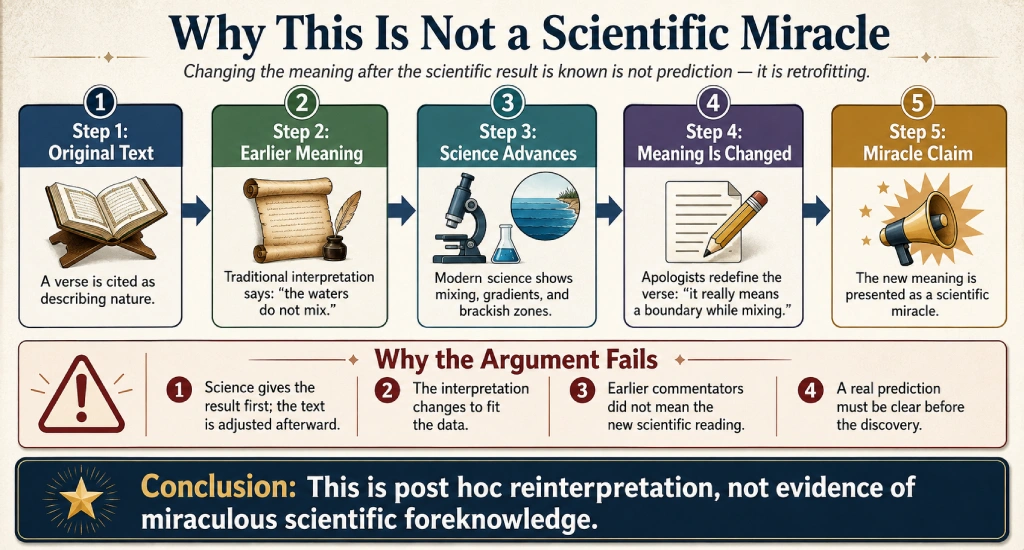
The central weakness of the “science in the Qur’an” claim is therefore not merely one word, but the continuous relocation of the interpretation. The claim becomes resistant to falsification when the verse is given a new meaning each time the evidence changes. First, “they do not mix” is proclaimed a miracle; later, “they mix but never become completely uniform” is a miracle; finally, the existence of a salinity gradient within a mixing zone becomes one. This method could immunize almost any religious text from refutation because every new scientific finding would invite a new retrospective meaning. Science is not confirming a precise Qur’anic prediction here. Science supplies the findings, and apologetic interpretation follows them by revising what the old words are said to mean.
Ibn Baz’s Contradictory Explanations: Water Mixes, and Water Does Not Mix
A particularly telling example of these interpretive inconsistencies comes from the influential Saudi Salafi scholar ‘Abd al-‘Aziz Ibn Baz. In an answer preserved in a collection of his fatwas on the same passage—Surat ar-Rahman 55:19–20—he explicitly stated that the seas mix. His words are «فالبحار تختلط» (“the seas mix”). He then stated that when God chooses to distinguish them, the waters become differentiated: river water remains fresh and seawater remains salty. [72]
فالبحار تختلط، ثم إذا أراد الله تمييزها، تميز هذا من هذا
English translation: The seas mix, and then, when God wishes to distinguish them, each becomes distinct from the other.
Yet in another explanation of the very same verses, Ibn Baz said the opposite. Asked about the meaning of maraja al-bahrayni yaltaqiyan, baynahuma barzakhun lā yabghiyān, he insisted that the verse should be understood according to its ẓāhir, its apparent or plain meaning. He said that God, by His power, placed an obstacle between freshwater and saltwater, keeping each apart, and added the categorical expression «لا يختلطان»—“they do not mix.” [73]
هذا على حدة وهذا على حدة، لا يختلطان
English translation: This remains separate, and that remains separate; the two do not mix.
The same scholar, discussing the same verses and the same issue, thus said in one place “the seas mix” and in another “they do not mix.” The statements are not synonymous; taken as descriptions of the same process, they are opposites. The first allows actual mixing while attributing the persistence of distinct qualities to God’s action. The second follows the older categorical reading that a divinely placed obstacle prevents the waters from mixing. Alternating between these claims makes it possible to align the verse with any observational result, but demonstrates inconsistency in interpretation rather than scientific precision.
Scientific Evidence: Why an Impermeable Barrier Is a False Physical Explanation
Where classical commentators interpret the Qur’anic barzakh as a barrier that completely prevents fresh and saline water from mixing, that physical proposition is scientifically false. Visible lines or density-driven layers can form where rivers meet seas, but these are not impermeable walls. Measurements of estuarine salinity, tidal movement, and brackish water demonstrate that mixing regularly occurs. Thus the literal proposition that the waters “meet but do not mix” conflicts with observation and physics.
First, molecular diffusion and turbulent flow transfer water and dissolved material between connected water bodies. Water molecules and dissolved ions are in constant molecular motion. When fresh and saline water meet, differences in salt concentration drive diffusion; currents, tides, and turbulence also transport water and dissolved salt across the interface. Even when a sea appears calm, molecular exchange can continue. [74]
Second, a layer in which salinity changes rapidly with depth is called a halocline. It is not an impermeable wall but a salinity gradient. NOAA explains that less dense river water may remain above denser seawater and form pronounced stratification. Yet the amount of mixing depends on winds, tides, river discharge, and estuary geometry. Some estuaries mix relatively little; others mix extensively. Oceanographers therefore distinguish salt-wedge, partially mixed, and vertically well-mixed estuaries. A visible interface does not establish that mixing is absent. [75]
Third, the behaviour of estuarine water does not require any permanent, impermeable obstruction. River discharge, tides, winds, density-driven currents, and turbulence continually move water and dissolved salts between the interacting bodies. Sometimes the layering is sufficiently stable that relatively fresh water remains above more saline water for extended periods. Tides, storms, or strong winds can disrupt that stratification and cause much more extensive mixing. Stratification and mixing can occur simultaneously; no impassable wall isolates the two bodies of water. [76]
.webp "According to the Quran, Freshwater and Saltwater Do Not Mix: A Scientific and Historical Critique 10")
Finally, videos circulated as depictions of the Strait of Gibraltar, river mouths, or the Gulf of Alaska often show conspicuous colour boundaries. The cause may vary by location: suspended sediment, algae, temperature, density, salinity, or distinct source waters can all contribute. The same explanation cannot be assigned to every video without verifying the location and measurements. Such visible boundaries are not fixed, and they cannot prevent molecular exchange. Therefore, if the Qur’anic “inviolable partition” is understood as the old, testable assertion that the waters physically cannot mix, that interpretation reflects an erroneous understanding of a natural phenomenon and fails against modern oceanographic evidence.
Visualizing Ocean Currents: NASA
This NASA visualization was not made by releasing tiny particles into the sea and tracking their satellite signals. It is derived from the output of ECCO2, an ocean-circulation model developed by MIT and NASA’s Jet Propulsion Laboratory. The model integrates satellite and in-situ observations to represent currents in the Mediterranean Sea and eastern Atlantic Ocean. White traces depict flows near the surface, while blue traces indicate deeper circulation. The visualization illustrates complex and interconnected ocean currents; the more direct evidence of freshwater–saltwater mixing comes from measured salinity in estuaries and the distribution of brackish water. [77]
Conclusion
People observed differences in the taste, colour, density, and movement of river, lake, and seawater long before the Qur’an. Aristotle described freshwater as lighter and saline water as heavier and discussed evaporation, condensation, and rainfall. Pliny described freshwater floating above seawater, and other Greek and Roman authors considered related phenomena. In the centuries following the Qur’an, an influential strand of Muslim interpretation maintained that the barzakh prevented the waters from “mixing.” Oceanography demonstrates that strong stratification, salt wedges, and haloclines can exist between freshwater and saline water, yet none is an impermeable wall: the waters exchange material and mix, producing brackish water. The verses therefore provide no basis for claiming advance knowledge of modern oceanography. A major classical strand made a testable and false claim of categorical non-mixing, while other early interpreters accepted land barriers or some degree of mixing. Later density-based readings cannot retrospectively turn these ancient alternatives into accurate predictions of the science. Water obeys the laws of physics, not the demands of theological interpretation.
References
- Aristotle, Meteorologica, Book II ↩︎
- Pliny the Elder, Natural History, Book II, §106 ↩︎
- Seneca, Naturales Quaestiones, Book III, §§4–5, 26 ↩︎
- Alexander of Aphrodisias, Quaestiones 3.10, “About the Sea”; R. W. Sharples, Alexander of Aphrodisias: Quaestiones 2.16–3.15 ↩︎
- Surat al-Furqan, verse 53 ↩︎
- Surat ar-Rahman, verse 19 ↩︎
- Surat ar-Rahman, verse 20 ↩︎
- Qur’an 25:53 — Sahih International ↩︎
- Qur’an 25:53 — Pickthall ↩︎
- Qur’an 25:53 — Yusuf Ali ↩︎
- Qur’an 25:53 — The Clear Quran ↩︎
- Sahih International, Qur’an 55:19–20 ↩︎
- M. Pickthall, Qur’an 55:19–20 ↩︎
- A. Yusuf Ali, Qur’an 55:19–20 ↩︎
- The Clear Quran, Qur’an 55:19–20 ↩︎
- Surat ar-Rahman 55:19–20 ↩︎
- Tafsir Ibn Kathir, Islamic Foundation Bengali edition, vol. 8, p. 227; vol. 10, pp. 588–589 ↩︎
- Tafsir Mazhari, Bengali edition, vol. 8, pp. 563–564 ↩︎
- Ibn Kathir, Tafsir al-Qur’an al-‘Azim, Surat al-Furqan 25:53, original Arabic ↩︎
- Ibn Kathir, Surat ar-Rahman 55:19–20 ↩︎
- Al-Tabari, Tafsir, Surat al-Furqan 25:53 ↩︎
- Al-Tabari, accounts attributed to Mujahid ↩︎
- Ibn Abi Hatim, Tafsir, Surat al-Furqan 25:53 ↩︎
- Ibn Abi Hatim, Tafsir al-Qur’an al-‘Azim, Surat al-Furqan 25:53, report 15267 ↩︎
- Tafsir al-Ma’thur, Surat al-Furqan 25:53, Muqatil ibn Sulayman ↩︎
- Tafsir al-Ma’thur, Surat ar-Rahman 55:20, Muqatil ibn Sulayman ↩︎
- Al-Samarqandi, Bahr al-‘Ulum, Surat al-Furqan 25:53 ↩︎
- Shamela, Bahr al-‘Ulum, vol. 2, p. 542 ↩︎
- Al-Baghawi, Ma’alim al-Tanzil, Surat al-Furqan 25:53 ↩︎
- Al-Qurtubi, Tafsir, Surat al-Furqan 25:53 ↩︎
- Fakhr al-Din al-Razi, Mafatih al-Ghayb, Surat al-Furqan 25:53 ↩︎
- Al-Tabari, Jami’ al-Bayan, Surat al-Furqan 25:53, reports and preferred position ↩︎
- Al-Tabari on 25:53, report of Mujahid ↩︎
- Tafsir al-Ma’thur, report of Muqatil ↩︎
- Ibn Abi Hatim, Tafsir 25:53 ↩︎
- Al-Tabari, Jami’ al-Bayan 25:53 ↩︎
- Al-Samarqandi, Bahr al-‘Ulum 25:53 ↩︎
- Al-Baghawi, Ma’alim al-Tanzil 25:53 ↩︎
- Al-Razi, Mafatih al-Ghayb 25:53 ↩︎
- Al-Qurtubi, al-Jami’ li-Ahkam al-Qur’an 25:53 ↩︎
- Tafsir Ibn Kathir, Islamic Foundation Bengali edition, vol. 8, p. 227 and vol. 10, pp. 588–589; see reproduced pages above ↩︎
- Tafsir Mazhari, Bengali edition, vol. 8, pp. 563–564; see reproduced page above ↩︎
- Badr al-Din al-Ayni, ‘Umdat al-Qari, vol. 15, p. 163, quoting al-Nasafi ↩︎
- Al-Qurtubi on Surat an-Naml 27:61 ↩︎
- Al-Tabari on Surat an-Naml 27:61 ↩︎
- Al-Suyuti, al-Durr al-Manthur, Surat ar-Rahman 55:19–20, vol. 14, pp. 112–113 ↩︎
- Abu Hayyan, al-Bahr al-Muhit, Surat ar-Rahman 55:19–20 ↩︎
- Ibn ‘Atiyyah, al-Muharrar al-Wajiz, Surat ar-Rahman 55:19–20 ↩︎
- Ibn Hajar al-‘Asqalani, Fath al-Bari, vol. 8, p. 490, on Surat ar-Rahman ↩︎
- Al-Alusi, Ruh al-Ma’ani, Surat al-Furqan 25:53, vol. 19, p. 35 ↩︎
- IslamQA, question 165094, May 21, 2011 ↩︎
- Early reports, Tafsir al-Ma’thur, Surat ar-Rahman 55:20 ↩︎
- Al-Samarqandi, Surat al-Furqan 25:53 ↩︎
- Al-Tabari, transmitted views and preferred interpretation ↩︎
- Al-Razi, Surat al-Furqan 25:53 ↩︎
- Ibn Kathir’s original Arabic explanation ↩︎
- Al-Alusi, Ruh al-Ma’ani, Surat al-Furqan 25:53 ↩︎
- ‘Abd al-Rahman al-Sa’di, Taysir al-Karim al-Rahman, Surat ar-Rahman 55:19–20, Islamweb ↩︎
- Ibn Ashur, al-Tahrir wa-al-Tanwir, vol. 20, p. 13, quoted by IslamQA ↩︎
- IslamQA, question 165094, May 21, 2011, competing interpretations and final ruling ↩︎
- Islamweb, “Wa Ja’ala Baynahuma Barzakhan”, September 4, 2016 ↩︎
- Islamweb, the 2016 scientific-miracle article ↩︎
- Al-Tabari, original Arabic text and preferred reading ↩︎
- Islamweb, its explanation of the Ghyben–Herzberg relation (2016) ↩︎
- USGS, Ground Water in Freshwater-Saltwater Environments of the Atlantic Coast (2003), Ghyben–Herzberg relation and mixing zones ↩︎
- USGS, saltwater intrusion and mixing zones ↩︎
- Islamweb (2016), inconsistent statements about the mixing zone ↩︎
- NOAA, what estuaries are and how salinity is measured ↩︎
- NOAA, circulation and mixing in estuaries ↩︎
- NOAA, patterns and intensities of estuarine mixing ↩︎
- NOAA, salinity-zone data from 147 estuaries ↩︎
- Shongshoy Islamic Archive, Majmu’ Fatawa Ibn Baz, vol. 24, pp. 286–290, relevant passage on p. 288 ↩︎
- Ibn Baz, “Tafsir Qawl Allah Ta’ala: Maraja al-Bahrayn Yaltaqiyan” ↩︎
- NOAA, estuarine circulation and mixing ↩︎
- NOAA National Ocean Service: Estuaries—Water Circulation and Mixing ↩︎
- NOAA National Ocean Service: Estuarine Circulation ↩︎
- NASA Scientific Visualization Studio: Ocean Current Flows around the Mediterranean Sea for UNESCO ↩︎