

Introduction
In Islamic theology, many descriptions from the Quran and hadith are intertwined with questions regarding the being of Allah, His attributes, and where and how He exists. Among these, one particularly widely discussed account is “Nuzul-e-Ilahi”: Allah’s descent to the lowest heaven every night during the last third of the night and His call to His servants. This description has been preserved in the major hadith collections, including Sahih Bukhari and Sahih Muslim. Consequently, the matter does not stand as an isolated story prevalent by word of mouth; within the religious sphere that accepts the authority of hadith, it is established as a reliable report about Allah. Therefore, this statement regarding the descent to a specific heaven at a specific time must be judged according to its own language and the significance of its claim.
Several elements are linked together in this description: the one descending is Allah; the destination of the descent is the earthly or lowest heaven; the time is a specific part of the night; and during that time, servants are called to pray, ask, and seek forgiveness. These are not merely emotional religious words. Within this lies the claim to provide specific answers to three questions: “where”, “when”, and “what does He do”. When it is said that a being descends somewhere, questions of location and direction arise; when it is said that He does so at a specific time every night, the question of time arises. Yet, that same being is declared to be infinite, omniscient, all-hearing, and beyond the limitations of creation.The relationship between the declaration of being beyond limitation and the descent tied to the local night of the earth is the center of the problem.
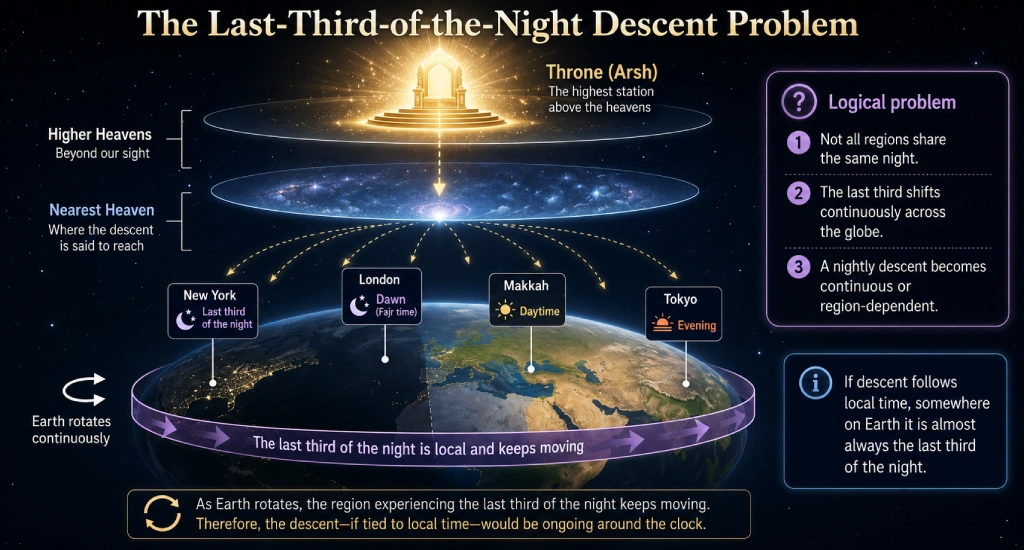
The night on earth is not a single global event that begins and ends for everyone at the same moment. The earth is spherical and rotates on its own axis. Due to that rotation, when it is the end of the night in one region, it is evening, morning, or day in another. The end of the night for all regions of the earth does not conclude just because Fajr has occurred in Bangladesh. In regions further west, the night may still be continuing, and sequentially, the last third arrives in other regions. This difference was not created by man-made clocks or administrative time zones; even without clocks, the geographical difference between sunlight and darkness would remain the same. Consequently, to determine the meaning of the phrase “the last third of the night”, the night of some specific place must be taken as the basis.
Here, the problem of expressing a local experience in the language of a universal cosmic event comes forward. The image that God descended when the end of the night arrived in a settlement and that phase of His call ended when Fajr occurred there aligns easily with the experience of the local sky and local night. But if the same claim is to be applied to every region of the earth, the time of descent is no longer confined within a few hours of one settlement. The end of the night in different regions arrives sequentially across the earth. Then the question arises: how is a single descent applicable to the different times of all regions, and if the descent is considered separately according to region, what is being said about His location at the same moment. Uttering “Allah can” does not explain these relationships; it merely adds another claim of power.
In the ancient vertical worldview, with the sky above human heads, the abode of deities or God further above the sky, and the human world below—in this arrangement, it is easy to imagine the descent of a deity and the ascent of humans. Such a scene fits naturally in a model of a layered sky over a flat earth. The descriptions of Islamic nuzul contain those same familiar elements: the God above, the lower heaven, the humans situated below, and the descent of God at a selected time of the human night. These elements also share similarities with the stories of God's descent in previous religious literature.The naturalness of this imagery comes from human local sky-observation; the global day-night system of the earth does not explain itself within it.
Whether a description exists in ancient scriptures, is believed by many people, or influential scholars have spoken in its favor—none of these make its claim about the universe true. The shape of the earth and the reality of day-night do not await religious approval. Declaring it forbidden to question when a harmony cannot be shown between that reality and a description of literal descent results in no progress of knowledge; the unresolved claim merely receives the protection of authority. This method of establishing a cosmic story as truth through obedience instead of observation and evidence is what sustains superstition. The declaration of the antiquity or sanctity of a belief does not exempt it from logical examination.
The claim of hadith accuracy: the status of the Prophet's statements as divine truth
In Islamic aqidah, the truthfulness of Muhammad and the authority of the religious reports he propagated carry fundamental importance. His statements regarding the being of Allah, His attributes, and the unseen world are not presented as the conjectures of ordinary people; they are accepted as reliable knowledge obtained under divine supervision. Within this belief, the Prophet's own declarations are also used to establish the truth of the Prophet's statements. In the narration of Abdullah ibn Amr, Muhammad declared that only truth comes out of his mouth. The instruction to write down his words even during times of anger or satisfaction is linked to that declaration. Consequently, in the place of verifying the truth of the statement, the speaker's overarching truthfulness is placed as an advance guarantee. [1]
حَدَّثَنَا مُسَدَّدٌ، وَأَبُو بَكْرِ بْنُ أَبِي شَيْبَةَ قَالاَ حَدَّثَنَا يَحْيَى، عَنْ عُبَيْدِ اللَّهِ بْنِ الأَخْنَسِ، عَنِ الْوَلِيدِ بْنِ عَبْدِ اللَّهِ بْنِ أَبِي مُغِيثٍ، عَنْ يُوسُفَ بْنِ مَاهَكَ، عَنْ عَبْدِ اللَّهِ بْنِ عَمْرٍو، قَالَ كُنْتُ أَكْتُبُ كُلَّ شَىْءٍ أَسْمَعُهُ مِنْ رَسُولِ اللَّهِ صلى الله عليه وسلم أُرِيدُ حِفْظَهُ فَنَهَتْنِي قُرَيْشٌ وَقَالُوا أَتَكْتُبُ كُلَّ شَىْءٍ تَسْمَعُهُ وَرَسُولُ اللَّهِ صلى الله عليه وسلم بَشَرٌ يَتَكَلَّمُ فِي الْغَضَبِ وَالرِّضَا فَأَمْسَكْتُ عَنِ الْكِتَابِ فَذَكَرْتُ ذَلِكَ لِرَسُولِ اللَّهِ صلى الله عليه وسلم فَأَوْمَأَ بِأُصْبُعِهِ إِلَى فِيهِ فَقَالَ «اكْتُبْ فَوَالَّذِي نَفْسِي بِيَدِهِ مَا يَخْرُجُ مِنْهُ إِلاَّ حَقٌّ».
English translation:
Sunan Abu Dawood (Islamic Foundation)
19/ Education-Knowledge, (Knowledge-Science)
Chapter: 417. Regarding the recording of knowledge.
3607. Musaddad and Abu Bakr ibn Abi Shaybah narrated. They said, Yahya narrated to us, from Ubaydullah ibn al-Akhnas, from Walid ibn Abdullah ibn Abi Mugis, from Yusuf ibn Mahak, from Abdullah ibn Amr. He said: Whatever I used to hear from the Messenger of Allah, peace and blessings be upon him, I used to write it down. I wished that I could preserve all of it. But the Quraysh forbade me from doing so and said: you write down everything you hear, yet the Messenger of Allah, peace and blessings be upon him, is a human, he may speak at times of anger and also at times of happiness. Hearing this, I stopped writing and informed the Messenger of Allah, peace and blessings be upon him, about the matter. Then he pointed towards his own mouth with his finger and said: keep writing, by Him in Whose hand is my life, whatever comes out of this mouth is all truth.
Hadith Grade: Sahih (Sahih)
Narrator: Abdullah ibn Amr ibn al-As (may Allah be pleased with him)
In the sequence of this narration, both the cause of doubt and the method of stopping the doubt are clear. The basis of the Quraysh's objection was familiar human behavior: humans get angry, become satisfied, and those emotions can influence their words. Abdullah stopped writing upon hearing that objection. In response, Muhammad did not present independent evidence in favor of the truth of any specific statement; pointing to his own mouth, he gave a guarantee of truth for all statements collectively. That is, the need to verify each claim separately was replaced by the speaker's own declaration. The person whose words' truth is questioned is the one standing as the guarantor of the ultimate truth of his own words.
The logical problem here is direct. The sentence “only truth comes out of my mouth”—this sentence itself is a statement of the speaker. If that is assumed to be true without evidence and all his other statements are called true, the main claim itself is used as its own proof. If any other preacher, saint, or guru made the same declaration, his cosmic stories would not become true simply by the force of the declaration. The standard of truth will remain the same for Muhammad as well. There must be evidence for a sentence; just because the speaker has declared his own infallibility, that sentence cannot be raised above observation.
After accepting this declaration within religious authority, its impact is not limited to a single hadith. Statements regarding where Allah is, when He descends, which heaven He descends to, and for how long He calls—all these fall under that predetermined truth. For a believer, the primary question then becomes not whether the description is true, but how it can be understood while assuming it to be true. If a conflict arises with observation, the path to rejecting the description based on observation is closed. In this way, religious obedience becomes a mechanism for placing a cosmological claim beyond rational examination.
In Surah An-Najm of the Quran, Muhammad's statements are presented as wahi rather than words based on whim. Through this declaration, the source of the statement is given a status distinct from general human knowledge and conjecture. Consequently, the claim of truth made in favor of his reports about Allah is extraordinary: the possibility of error, which is natural if the statement were man-made, is denied after accepting it as divine reports. [2]
وَمَا يَنطِقُ عَنِ ٱلْهَوَىٰٓ إِنْ هُوَ إِلَّا وَحْىٌ يُوحَىٰ
English translation: He speaks not of his own whim. It is but a revelation revealed to him.
But calling a statement wahi and that statement being true are not the same event. The first is a religious claim about the source; the second is a question of the statement's accuracy. If accuracy is established simply by identifying the claimed source, there is nothing left to examine. Then "Allah has spoken" takes the place of proof, and "the Prophet does not err" becomes the rule for canceling opposing observations. Following this method, any belief can declare its founder infallible to keep itself beyond examination. Such a system of religious certainty does not produce reliable knowledge about reality; it keeps a predetermined conclusion intact.
Calling a hadith "sahih" does not provide truth regarding its statements about the shape of the earth, the arrangement of day and night, or the structure of the sky. Calling the chain of narration acceptable and establishing the narrated cosmological event through observation are separate tasks. Even if a statement is accepted as having been spoken by Muhammad, the question of examining the content of that statement remains. If it is established that a person truly made a claim, the history of the claim is known; through that, the actual existence of the claimed event is not proven. No chain of narration can provide the answer to the question of how the earth rotates or when the last part of the night arrives in different regions.
This distinction is particularly important in the case of the hadith of Allah's descent. Making the same description a matter of mandatory belief as accurate divine reports on one hand, and stopping the questioner as soon as questions arise about its time, location, and meaning on the other, is an authority-dependent system. In that system, the path to proving the description wrong is closed in advance. Yet, the greater the claim of truth, the greater the burden of proof in its favor. If a description is circulated as news coming from an Omniscient entity, covering its inconsistencies under the pretext of limited human knowledge does not make that news accurate. An instruction of faith cannot be an alternative to reality.
Main details of the hadith: Who descends, where He descends, and when He descends
In the description of Allah's descent, the descender, the destination, and the time—all three are mentioned in specific language. The Arabic word يَنْزِلُ denotes descent; إِلَى السَّمَاءِ الدُّنْيَا indicates the destination of that descent; and كُلَّ لَيْلَةٍ links the event to the repetition of every night. Then, a specific part of the night is mentioned. These words together create a description of an action. The basis for understanding what the speaker is claiming in that description is the language of the description itself.
Bukhari's description: Descent in the last third of every night
In the description of Sahih Bukhari, it is clearly stated as "our Lord" and the time of descent is mentioned as when the last third of the night remains. Then, responding to calls, granting requested objects, and the declaration of forgiveness are added to the same subject. Descent and the call are here sequential actions of the same description. [3]
حَدَّثَنَا عَبْدُ اللَّهِ بْنُ مَسْلَمَةَ، عَنْ مَالِكٍ، عَنِ ابْنِ شِهَابٍ، عَنْ أَبِي سَلَمَةَ، وَأَبِي عَبْدِ اللَّهِ الأَغَرِّ، عَنْ أَبِي هُرَيْرَةَ ـ رضى الله عنه ـ أَنَّ رَسُولَ اللَّهِ صلى الله عليه وسلم قَالَ «يَنْزِلُ رَبُّنَا تَبَارَكَ وَتَعَالَى كُلَّ لَيْلَةٍ إِلَى السَّمَاءِ الدُّنْيَا حِينَ يَبْقَى ثُلُثُ اللَّيْلِ الآخِرُ يَقُولُ مَنْ يَدْعُونِي فَأَسْتَجِيبَ لَهُ مَنْ يَسْأَلُنِي فَأُعْطِيَهُ مَنْ يَسْتَغْفِرُنِي فَأَغْفِرَ لَهُ».
English translation:
Sahih Bukhari (Islamic Foundation)
19/ Tahajjud or night prayer
Chapter: 728. Making dua and performing prayer in the late part of the night. Allah the Almighty has said: They sleep but a little of the night, and in the last part of the night they seek forgiveness. (Surah Az-Zariyat: 18).
1079. Abdullah ibn Muslama from Malik, he from Ibn Shihab, he from Abu Salama and Abu Abdullah al-Agar, they from Abu Hurairah (may Allah be pleased with him) narrated that, Rasulullah (peace and blessings be upon him) said: The Magnificent Allah Ta'ala descends to the lowest heaven every night when the last third of the night remains and continues to declare: Who is there that will call upon Me? I will respond to his call. Who is there that will ask of Me? I will give him. Who is there that will seek forgiveness from Me? I will forgive him.
Hadith Grade: Sahih (Sahih)
Narrator: Abu Hurairah (may Allah be pleased with him)
In this text, the last third of the night is not used as a figurative adjective. It is the answer to when the event occurs. The phrase "every night" determines the repetition, and "when the last third remains" determines a time limit within that repetition. A general call for a person to pray at any time of the day and the declaration of Allah's descent at a specific time are different statements. The second statement contains a claim of an additional cosmological event. The burden of proof for that additional claim cannot be discarded with religious emotion.
Al-Lulu wal Marjan: Compiled text of the same declaration
In the citation of Al-Lulu wal Marjan, the last third of the night, the lowest heaven, and the direct call of Allah are present together. At the end of the citation, sources from Bukhari and Muslim are also given. Consequently, this shows the established compiled position of the original description; the same news has been included in subsequent compilations. [4]
Al-Lulu wal Marjan
6/ Description of the prayer of a traveler and its qasr
Chapter: 6/24. Encouragement to make dua in the last part of the night and its acceptance at that time.
434. Narrated from Abu Hurairah (may Allah be pleased with him), the Messenger of Allah (peace and blessings be upon him) said: The Magnificent Allah Ta'ala descends to the lowest heaven every night when the last third of the night remains and continues to declare: Who is there that will call upon Me? I will respond to the call. Who is there that will ask of Me? I will give him. Who is there that will seek forgiveness from Me? I will forgive him.
Sahih al-Bukhari, Book 19; Tahajjud, Chapter 14, Had: 1145; Muslim, Book 6; Description of the prayer of a traveler and its qasr, Chapter 23, Had: 758
Hadith Grade: Sahih (Sahih)
Narrator: Abu Hurairah (may Allah be pleased with him)
In the sentences "will call upon Me", "will ask of Me", and "will seek forgiveness from Me", the identity of the speaker is also kept clear. The call is in the name of the entity whose descent is being spoken of. Therefore, in the analysis of the language of the description, if the subject is removed and only the emotion of prayer is kept, the core structure of the event is discarded. Arrival at the lowest heaven and the call to humans—both are part of the declared news here.
Tirmidhi's description: Descent after the first third and the compiler's preference
In the citation of Tirmidhi, the passing of the first one-third of the night is mentioned as the starting time of descent. At the end of the same citation, Tirmidhi again calls the text of the last third remaining the most sahih description. In the same discussion of a compilation, the preserved text and the compiler's selected preference exist side by side. [5]
Sunan Tirmidhi (Islamic Foundation)
2/ Salat (Prayer)
Chapter: Every night Allah Ta'ala descends to the lowest heaven.
446. From Qutayba Yaqub ibn Abdur Rahman al-Iskandarani, he from Suhayl ibn Abi Salih, he from his father, he from Abu Hurairah (may Allah be pleased with him) narrated that, Rasulullah (peace and blessings be upon him) said: When the first one-third of the night has passed, every night Allah Ta'ala descends to the lowest heaven and says: I am the Sovereign, whoever calls upon Me, I accept his call, whoever asks of Me, I give him, whoever seeks forgiveness from Me, I forgive him.This continues until the light of Fajr appears.- Ibn Majah 1366, Bukhari and Muslim, Tirmidhi hadith number: 446 (Al Madani Publication)
Hadiths on this matter have also been narrated from Ali ibn Abi Talib, Abu Sa'id, Rifa'ah al-Juhani, Zubayr ibn Mut'im, Ibn Mas'ud, Abu al-Darda and Uthman ibn Abi al-As (may Allah be pleased with him). Imam Abu Isa Tirmidhi (may Allah have mercy on him) says: the hadith narrated from Abu Hurayrah (may Allah be pleased with him) is hasan-sahih. It is narrated through many sources from Abu Hurayrah (may Allah be pleased with him) that the Messenger (peace and blessings be upon him) said: when the last third of the night remains, Allah Ta'ala descends; this report is the most sahih.
Hadith Grade: Sahih (Sahih)
Narrator: Abu Hurairah (may Allah be pleased with him)
The passing of the first third and the beginning of the last third are not the same time. After the former, two-thirds of the night remain; after the latter, one-third remains. If the night is twelve hours long, the gap between these two starting times is four hours. Consequently, the variation in the description of time is not a mere change of words; it creates a large difference in the starting time of the announced event and the time limit of the special prayer associated with it. Since Tirmidhi himself gave preference to one reading, it also becomes clear that not all readings preserved with him were of the same level of accuracy and identical narration.
Mishkat and Adabul Mufrad: Descent, Call and the Limit of Dawn
In the citation from Mishkat, additional details from another narration in Muslim are given along with the original announcement of descent: stretching out the hand, the call to give loans, and the continuation of that statement until morning. That is, the narration does not contain only a vague notion of proximity; the content of the call and its time limit are also preserved. [6]
Mishkat al-Masabih (Mishkat)
Part-4: Salat
Chapter: 33. First Section - Encouragement towards Qiyamul Layl
1223-(5) Narrated from Abu Hurayrah (may Allah be pleased with him). He says, Rasulullah (peace and blessings be upon him) said: every night in the last third, our revered and blessed Lord descends to the lowest heaven and says, 'Whoever calls upon Me, I will respond to his call. Whoever asks something of Me, I will grant it to him. Whoever seeks forgiveness from Me, I will forgive him.' (Bukhari, Muslim)(1)
In one narration of Muslim, then he extends his hand and says, who is there that will give a loan to such a person who is not poor, nor an oppressor, and he continues to say this until morning.
(1) Sahih: Bukhari 1145, Muslim 758.
Hadith Grade: Sahih (Sahih)
In Adabul Mufrad also, through the same source of Abu Hurayrah, there is a description of descent to the lowest heaven in the last third of every night. Here, a specific time for religious practice is identified by basing it on a specific action of Allah in favor of that time. The encouragement for prayer in the late night and the cosmic explanation used in favor of that encouragement are two levels of the same claim. [7]
Al-Adabul Mufrad
Hospitality
Chapter: 320- Praying in the last third of the night.
758. Narrated from Abu Hurayrah (may Allah be pleased with him). Rasulullah (peace and blessings be upon him) says: our blessed most magnificent Lord descends to the lowest heaven every night when the last third of the night remains and continues to announce: who is there that will call upon Me, I will respond to his call? (who is there, that will pray to Me and I will accept his prayer)? Who is there, that will ask something of Me and I will grant it? Who is there, that will seek forgiveness from Me and I will forgive him. -(Bukhari, Muslim, Darimi)
Hadith Grade: Sahih (Sahih)
The presence of the narration in these collections shows its spread in Islamic literature. But a quotation in Bukhari, the description of the same source in another collection, and the presence in selected collections dependent on those books—these cannot be called separate cosmic observations. Here is a religious report preserved in many books. These quotations do not provide any observational description that independent observers saw Allah descending to the lowest heaven standing in different places.
Two more full descriptions of time in Sahih Muslim
In the 758b narration of Sahih Muslim, there is also a reading of the first third having passed. Here the sentence "I am the King" appears twice and it is mentioned that the call continues until the light of Fajr appears. Consequently, alongside the widely publicized reading of the late night, the reading after the first third is also preserved in Sahih Muslim. [8]
وَحَدَّثَنَا قُتَيْبَةُ بْنُ سَعِيدٍ، حَدَّثَنَا يَعْقُوبُ، - وَهُوَ ابْنُ عَبْدِ الرَّحْمَنِ الْقَارِيُّ - عَنْ سُهَيْلِ بْنِ أَبِي صَالِحٍ، عَنْ أَبِيهِ، عَنْ أَبِي هُرَيْرَةَ، عَنْ رَسُولِ اللَّهِ صلى الله عليه وسلم قَالَ «يَنْزِلُ اللَّهُ إِلَى السَّمَاءِ الدُّنْيَا كُلَّ لَيْلَةٍ حِينَ يَمْضِي ثُلُثُ اللَّيْلِ الأَوَّلُ فَيَقُولُ أَنَا الْمَلِكُ أَنَا الْمَلِكُ مَنْ ذَا الَّذِي يَدْعُونِي فَأَسْتَجِيبَ لَهُ مَنْ ذَا الَّذِي يَسْأَلُنِي فَأُعْطِيَهُ مَنْ ذَا الَّذِي يَسْتَغْفِرُنِي فَأَغْفِرَ لَهُ فَلاَ يَزَالُ كَذَلِكَ حَتَّى يُضِيءَ الْفَجْرُ».
English translation: Qutaiba ibn Sa'id narrated to us. Yaqub, meaning Ibn Abdur Rahman al-Qari, narrated to us from Suhayl ibn Abi Salih, he from his father, he from Abu Hurayrah, he narrates from Rasulullah (peace and blessings be upon him). He said: "Every night, when the first third of the night passes, Allah descends to the lowest heaven. Then He says: I am the King, I am the King. Who is there that will call upon Me, I will respond to his call? Who is there that will ask of Me, I will give him? Who is there that will seek forgiveness from Me, I will forgive him? He continues to say this until the light of Fajr appears."
In the 758c narration of the same hadith, the passing of half the night or two-thirds of the night is mentioned. The word "or" is also part of the reading; if that is deleted to turn the narration into a statement of a single specific time, the preserved reading will change. Here the complete statement including both alternatives of time is present. [9]
حَدَّثَنَا إِسْحَاقُ بْنُ مَنْصُورٍ، أَخْبَرَنَا أَبُو الْمُغِيرَةِ، حَدَّثَنَا الأَوْزَاعِيُّ، حَدَّثَنَا يَحْيَى، حَدَّثَنَا أَبُو سَلَمَةَ بْنُ عَبْدِ الرَّحْمَنِ، عَنْ أَبِي هُرَيْرَةَ، قَالَ قَالَ رَسُولُ اللَّهِ صلى الله عليه وسلم «إِذَا مَضَى شَطْرُ اللَّيْلِ أَوْ ثُلُثَاهُ يَنْزِلُ اللَّهُ تَبَارَكَ وَتَعَالَى إِلَى السَّمَاءِ الدُّنْيَا فَيَقُولُ هَلْ مِنْ سَائِلٍ يُعْطَى هَلْ مِنْ دَاعٍ يُسْتَجَابُ لَهُ هَلْ مِنْ مُسْتَغْفِرٍ يُغْفَرُ لَهُ حَتَّى يَنْفَجِرَ الصُّبْحُ».
English translation: Ishaq ibn Mansur narrated to us. Abul Mugira informed us. Awzayi narrated to us. Yahya narrated to us. Abu Salama ibn Abdur Rahman narrated to us from Abu Hurayrah. He says, Rasulullah (peace and blessings be upon him) said: "When half or two-thirds of the night passes, the blessed and most magnificent Allah descends to the lowest heaven. He says: Is there any supplicant to whom will be given? Is there any caller whose call will be responded to? Is there any seeker of forgiveness who will be forgiven? This continues until the light of dawn breaks."
The difference in time is easily understood across a twelve-hour night. Suppose, for example, the local night is from 6 PM to 6 AM. The first third of the night will end at 10 PM, half will end at 12 AM, and two-thirds will end and the last third will begin at 2 AM. These clock times are taken for the convenience of the example; in reality, the length of the night changes according to place and season. But the difference between one-third, half, and two-thirds remains the same.
| Narration | Mention of the start of descent | In the example of a twelve-hour night |
|---|---|---|
| Bukhari 1145 | When the last third remains | 2 AM |
| Original narration of Tirmidhi 446 | When the first third passes | 10 PM |
| Muslim 758b | When the first third passes | 10 PM |
| Muslim 758c | When half or two-thirds pass | 12 AM or 2 AM |
| Reading preferred by Tirmidhi | When the last third remains | 2 AM |
A specific conclusion is obtained from this difference: the conventional narrations have not preserved a uniform sentence regarding the starting time of the descent. The judgment of the compiler is also present in determining which reading will be given preference. By pronouncing "it is in the sahih hadith" and unifying all variations of time, both that judgment and its result are hidden. If the event is to be accepted as accurate divine reports, the same claim of accuracy applies to determining its starting time.
What claims the words of the narration are making
| Language used in the narration | Function of the language | The question that arises |
|---|---|---|
| يَنْزِلُ — descends | Declares an action | What is the meaning and practical result of this action? |
| رَبُّنَا — our Lord | Determines the subject of the action | Who is being established as the subject? |
| إِلَى السَّمَاءِ الدُّنْيَا — to the lowest heaven | Determines the destination of the action | What is the relationship of this heaven with the previous position? |
| كُلَّ لَيْلَةٍ — every night | Determines the repetition | What is the relationship of the repetition with the different nights according to place? |
| A specific part of the night remaining or passing | Determines the starting time of the event | The night of which place is the basis for that time? |
| The call until Fajr in Muslim's narration | Determines the end limit of the phase of the call | How is the Fajr of one region and the late night of another region related? |
The narrations have linked a specific descent of Allah to a certain heaven with prayer in the last part of the night. Praying in the last part of the night is an act of humans; the claim regarding the cosmic reality that Allah descends to a specific heaven at that time is a separate claim. The second claim does not become true simply because the human act is performable. Yet, in the hadith, the second claim has been made the basis for the special merit of the first act. Therefore, raising questions about the validity of that basis is a direct examination of the content of the narration.
The Established Status of the Hadith: The Declaration of Mutawatir and the Claim of Actual Descent
The discussion regarding the narrations of Allah's nuzul does not revolve around any story that the relevant scholars themselves have rejected. Along with its presence in Bukhari, Muslim, and other collections, Ibn Baz has directly called it a mutawatir hadith narrated from Muhammad. In the same statement, he establishes descent as an attribute befitting Allah and states that it is obligatory to accept the attributes described in the Kitab-Sunnah. Consequently, in his statement, the truth of the narration and the creedal obligation are established together. [10]
Page 314
Original Arabic
وإذا تيسر للمؤمن أو المؤمنة الإيتار والتهجد آخر الليل كان ذلك أفضل لأن ذلك وقت نزول الله، ووقت إجابة الدعاء لما ثبت عن رسول الله - صلى الله عليه وسلم - أنه قال: «ينزل ربنا إلى السماء الدنيا كل ليلة حين يبقى ثلث الليل الآخر، فيقول: من يدعوني فأستجيب له، من يسألني فأعطيه، من يستغفرني فأغفر له، حتى ينفجر الفجر (¬1) » وفي لفظ آخر: «يقول سبحانه: هل من سائل فيعطى سؤله، هل من مستغفر فيغفر له، هل من تائب فيتاب عليه (¬2) » وهذا الحديث العظيم متواتر عن رسول الله - صلى الله عليه وسلم -.
وهذا النزول يليق بالله لا يشابهه شيء من خلقه في جميع صفاته، لا بكيف ولا بمثل، كاستوائه على عرشه، وكسمعه وبصره، وغضبه ورضاه، ونحو ذلك، كلها صفات تليق بالله لا يشابه فيها خلقه سبحانه وتعالى، هكذا قال أهل السنة والجماعة: يجب إثبات صفات الله كما جاءت في الكتاب والسنة على وجه يليق به سبحانه وتعالى كما قال جل وعلا: لَيْسَ كَمِثْلِهِ شَيْءٌ وَهُوَ السَّمِيعُ الْبَصِيرُ (¬3) وقال سبحانه: وَلَمْ يَكُنْ لَهُ كُفُوًا أَحَدٌ (¬4)
(¬1) رواه البخاري في (الجمعة) برقم (1077) ، ومسلم في (صلاة المسافرين) برقم (1261) و (1265) ، والإمام أحمد في (باقي مسند المكثرين) برقم (7196) .
(¬2) رواه مسلم في (صلاة المسافرين) برقم (1263) و (1265) ، والإمام أحمد في (باقي مسند المكثرين) برقم (9220) .
(¬3) سورة الشورى الآية 11
(¬4) سورة الإخلاص الآية 4
English translation:
It is better for a believing man or woman, if possible, to pray Witr and Tahajjud in the last part of the night; because that is the time of Allah's descent and the time of acceptance of dua. For it has been proven from Rasulullah (peace and blessings be upon him) that he said:
"Our Lord descends every night to the earthly heaven, when the last third of the night remains. Then He says: Who calls upon Me that I may answer his call? Who asks of Me that I may give to him? Who seeks forgiveness from Me that I may forgive him? Until Fajr rises."
(1) In another narration it has come: "He (Allah Subhanahu wa Ta'ala) says: Is there any supplicant to whom his request will be given? Is there any seeker of forgiveness who will be forgiven? Is there any repentant one whose repentance will be accepted?"
(2) And this great hadith is narrated from Rasulullah (peace and blessings be upon him) through mutawatir sources.
And this descent (nuzul) is befitting for Allah, and in all His attributes, He has no resemblance to any of His creation. It must be accepted without specifying its manner and without attributing resemblance. Just like His Istiwa over His Throne (exalted position over the Throne), His hearing, His sight, His anger, and His pleasure—etc. All these attributes are befitting for Allah, such that He has no resemblance to His creation, Subhanahu wa Ta'ala.
The scholars of Ahlus Sunnah wal Jama'ah have said thus: It is obligatory to establish the attributes of Allah Subhanahu wa Ta'ala exactly as they have come in the Kitab (Quran) and Sunnah, in a manner that is befitting for Him.
As Allah Jalla wa Ala has said: "There is nothing like unto Him, and He is the All-Hearing, the All-Seeing."
(3) And He Subhanahu has said: "And there is none co-equal to Him."
(4)
(1) Bukhari (Jumu'ah) 1077, Muslim (Salatul Musafirin) 1261 and 1265, and Imam Ahmad (Baqi Musnadil Muqsirin) 7196.
(2) Muslim (Salatul Musafirin) 1263 and 1265, and Imam Ahmad (Baqi Musnadil Muqsirin) 9220.
(3) Surah Ash-Shura, Verse 11.
(4) Surah Al-Ikhlas, Verse 4.
The Significance of Calling a Narration Mutawatir
In the terminology of hadith science, mutawatir refers to a narration that has been transmitted through so many narrators that it is considered impossible, according to the relevant scholarly criteria, for them to have collectively agreed upon fabricating a lie. Therefore, the meaning of the term is not merely "there is no break in the isnad." An unbroken isnad and news transmitted through numerous narrators are different characteristics. By using this terminology, Ibn Baz is imposing a claim of the highest level of certainty upon the narration. In his position, this is not a doubtful marginal account, but news of an established attribute of Allah.
By declaring it mutawatir and accepting the content as a mandatory part of faith, Ibn Baz himself closes the path to rejecting the narration. In his position, it does not remain an optional story with the freedom to be accepted or rejected. Consequently, questions regarding time and location are linked to the content of the declared certain aqidah. The more firmly a scholar declares a narration to be true, the clearer the responsibility becomes regarding the statement about its specific time and destination. Declaring the news as certain and keeping the specific claims of that news indeterminate cannot be alternatives to each other.
Allah's Schedule Derived from Prayer Times: The Practical Claim of the Fatwa
The reason for the importance of the last part of the night in Ibn Baz's statement is also specific: it is the time of Allah's descent and the acceptance of dua. That is, the belief is influencing the selection of the actual time of worship. In answer to the question of why waking in the last part of the night is better, a time-dependent act of Allah is given as an explanation. Consequently, in his statement, nuzul does not remain an inactive symbol; the event is held to be true and effective to organize human religious practice. When human sleep, waking, and prayer times are thus linked to a cosmic event, the responsibility to explain the temporal basis of that event also arises.
In this framework, a special merit of a local time on Earth is established through the act of Allah, while the time of that act of Allah is determined by the local night of Earth. The descent of God based on the night of humans, and the special sanctity of the human night based on the descent of God—this mutual dependence gives religious time the form of a miraculous schedule. But the fact that time feels sacred to any human is not proof of the actual existence of that schedule. The experience of the believer and the truth of the event declared in heaven do not become the same thing.
Leaving the Consequence Unknown While Maintaining a Meaningful Claim
In the quoted statement, along with establishing the descent, there is an instruction not to compare its manner with creation. But to say "descent occurs," some meaning of the word must be acknowledged. If there is no change, proximity, relationship, or difference in action anywhere, then the question remains: what additional information was provided by declaring the descent at a specific time? Again, if any actual difference in action is acknowledged, questions arise regarding time, destination, and its relationship with other locations. Answers to these questions are not created by the obligation of faith.
The declaration that Allah's descent is not like the descent of creation does not itself provide a description of any alternative explanation. Specific answers are absent regarding in what sense the action is descent, due to what relationship it is linked to the lowest heaven, and what the role of the time limit is. Consequently, the reality of the narration is established with emphasis, but when the relationships of that reality come before questions, they are left as unknown. In this method of accepting the necessary meaning of the claim while abandoning the explanatory responsibility, a declaration of certain knowledge is found; the basis of certain knowledge is not found.
The main conflict here is not about the status of the narration. In Ibn Baz's own position, the news is reliable and Allah's nuzul is true. The question is, what meaning do the specific time and destination of the narration carry regarding that declared true event? The difference in night according to regions of the Earth is not a flaw in the isnad that will be removed simply by declaring a narrator reliable. No matter how acceptable the narration is said to be, the responsibility to explain the geographical and temporal relationship of the event based on the local night remains equally.
The Earthly Heaven: The Star-Studded Sky and the Position of Allah
In the hadith, where Allah descends is also noteworthy. It is not said that He merely "becomes close" to the servants; it is said that He descends to as-sama al-dunya—the earthly or lowest heaven. In the Quranic worldview, this "earthly heaven" is a distinct level. In Surah As-Saffat 37:6, it is said, "I have adorned the lowest heaven with the beauty of stars"; in Surah Al-Mulk 67:5, the same lowest heaven is mentioned as being adorned with "lamps." Al-Qurtubi, in the explanation of these verses, has described kawakib or stars as the ornaments of the earthly heaven. [11] [12] [13]
Surah As-Saffat 37:6
إِنَّا زَيَّنَّا السَّمَاءَ الدُّنْيَا بِزِينَةٍ الْكَوَاكِبِ
English translation:
Indeed, I have adorned the lowest heaven with the beauty of stars.
The lowest heaven is a specific level
The word “dunya” here does not refer to the soil of the earth; it identifies the heaven in the sense of being “nearest.” The heaven closest to the human realm is being specifically identified among the heavens. A specific characteristic is also given for it: it has an adornment of stars or lamps. In the same verse, a relationship is established between that adornment and the casting down against devils. Consequently, in the religious worldview, this heaven is a region associated with the points of light in the visible sky and the phenomenon of meteors. [14]
Surah Al-Mulk 67:5
وَلَقَدْ زَيَّنَّا السَّمَاءَ الدُّنْيَا بِمَصَابِيحَ وَجَعَلْنَاهَا رُجُومًا لِلشَّيَاطِينِ وَأَعْتَدْنَا لَهُمْ عَذَابَ السَّعِيرِ
English translation:
Indeed, I have adorned the lowest heaven with lamps and have made them missiles to drive away the devils; and for them I have prepared the punishment of a blazing Fire.
The concept of seven heavens is also directly present in the Quran. In Surah Al-Mulk 67:3, the creation of seven heavens as “tibaqan”—layer upon layer—is mentioned. In Surah Fussilat, the determination of separate commands for each heaven and the arrangement of adornment with lamps and security for the lowest heaven appear together. This provides an organized cosmic map: multiple heavens, each with a distinct identity, and among them, a heaven nearest to the earth. The hadith of nuzul uses the name of a specific destination on that map. [15] [16]
Surah Fussilat 41:12
فَقَضَاهُنَّ سَبْعَ سَمَاوَاتٍ فِي يَوْمَيْنِ وَأَوْحَىٰ فِي كُلِّ سَمَاءٍ أَمْرَهَا وَزَيَّنَّا السَّمَاءَ الدُّنْيَا بِمَصَابِيحَ وَحِفْظًا ذَٰلِكَ تَقْدِيرُ الْعَزِيزِ الْعَلِيمِ
English translation:
Then He completed them in two days as seven heavens and inspired each heaven with its command. And I have adorned the lowest heaven with lamps and have made it securely guarded. Such is the decree of the Almighty, the All-Knowing.
Al-Qurtubi's explanation: stars, meteors, and the guarding of the sky
In Al-Qurtubi's explanation, “lamps” refers to the kawakib; they are called lamps because they provide light. Then, to explain the matter of casting down against devils, he presents several views. In one explanation, the star remains intact and the associated shihab is cast down; in another, something detaches from the star and is cast down. These distinctions are fully present in the quoted section. The adornment of the heaven, the eavesdropping of devils, and the weapon to drive them away—these three concepts are linked within the same explanation. [17]
قوله تعالى: ولقد زينا السماء الدنيا بمصابيح جمع مصباح وهو السراج. وتسمى الكواكب مصابيح لإضاءتها.
وجعلناها رجوما للشياطين أي جعلنا شهبها؛ فحذف المضاف. دليله: إلا من خطف الخطفة فأتبعه شهاب ثاقب. وعلى هذا فالمصابيح لا تزول ولا يرجم بها. وقيل: إن الضمير راجع إلى المصابيح على أن الرجم من أنفس الكواكب، ولا يسقط الكوكب نفسه إنما ينفصل منه شيء يرجم به من غير أن ينقص ضوءه ولا صورته. قاله أبو علي جوابا لمن قال: كيف تكون زينة وهي رجوم لا تبقى.
قال المهدوي: وهذا على أن يكون الاستراق من موضع الكواكب. والتقدير الأول على أن يكون الاستراق من الهوى الذي هو دون موضع الكواكب. القشيري: وأمثل من قول أبي علي أن نقول: هي زينة قبل أن يرجم بها الشياطين. والرجوم جمع رجم؛ وهو مصدر سمي به ما يرجم به. قال قتادة: خلق الله تعالى النجوم لثلاث: زينة للسماء، ورجوما للشياطين، وعلامات يهتدى بها في البر والبحر والأوقات. فمن تأول فيها غير ذلك فقد تكلف ما لا علم له به، وتعدى وظلم.
English translation:
The word of Allah, “I have adorned the lowest heaven with lamps”—“masabih” is the plural of “misbah,” which means lamp. Stars are called lamps because they provide light.
“And have made them missiles to drive away the devils”—meaning I have made their shihabs [so]; here a part of the possessive construction is omitted. The evidence for this is, “But whoever steals a hearing, he will find a blazing shihab pursuing him.” According to this explanation, the lamps themselves do not shift position and are not cast down. It is further stated that the pronoun refers back to the lamps, meaning the object of casting comes from the stars. The star itself does not fall; rather, something detaches from it and is cast down, whereby its light or shape does not diminish. “If these were cast down and no longer remained, how could they be ornaments?”—Abu Ali said this in answer to this question.
Al-Mahdabi said that this explanation applies only when the eavesdropping occurs from the location of the stars. The first explanation is that eavesdropping occurs from the atmosphere below the location of the stars. Al-Kushayri said that it is more appropriate than Abu Ali's statement to say that they are ornaments before being cast down against the devils. “Rujum” is the plural of “rajm”; it is a verbal noun used to denote the object of casting. Qatada said that Allah created the stars for three purposes: as ornaments of the sky, as missiles to drive away the devils, and as guiding signs for determining land, sea, and time. Whoever provides other explanations for these involves himself in a matter of which he has no knowledge; he transgresses and commits injustice.
The sky in this explanation is like a royal area surrounded by guards: forbidden listeners attempt to enter, wanting to hear the news from above, and are driven away with blazing objects. A story of the intrusion and resistance of invisible beings is placed behind the visible lines of light. There is no tested explanation for this regarding the actual nature of stars and meteors. Rather, a familiar celestial scene is being read as a sign of supernatural conflict. This practice of explaining natural phenomena through the activities of invisible entities is the characteristic of a myth.
A star is a massive object of hot gas with its own physical structure and evolution; during its long stable phase, nuclear fusion at its center provides it with energy. A meteor is a light phenomenon created when small rocks or dust particles from space enter the Earth's atmosphere. If a streak of a meteor is seen in the sky, it does not mean that fire recently detached from a distant star is chasing a devil. Both the life cycle of stars and the origin of meteors in the atmosphere are explained through observation, measurement, and physical processes. Evidence of that nature is absent to support calling a meteor a weapon for driving away devils. Placing a story of supernatural guarding in place of explaining the natural phenomena of the sky is superstition. [18] [19]
‘Where is Allah’: Hadith accepting the sky as a location
This spatial relationship between Allah and the sky has also appeared directly in another hadith. In the narration of Muawiyah ibn Hakam as-Sulami, Muhammad asks a slave girl, “Where is Allah?” She answers, “In the sky.” Then Muhammad asks her to identify him. When the slave girl identifies him as the Messenger of Allah, he orders her to be freed as a believer. Speaking during prayer, visiting a fortune-teller, accepting bad omens, and the incident of the slave girl are all part of the same narration. [20]
حَدَّثَنَا أَبُو جَعْفَرٍ، مُحَمَّدُ بْنُ الصَّبَّاحِ وَأَبُو بَكْرِ بْنُ أَبِي شَيْبَةَ - وَتَقَارَبَا فِي لَفْظِ الْحَدِيثِ - قَالاَ حَدَّثَنَا إِسْمَاعِيلُ بْنُ إِبْرَاهِيمَ، عَنْ حَجَّاجٍ الصَّوَّافِ، عَنْ يَحْيَى بْنِ أَبِي كَثِيرٍ، عَنْ هِلاَلِ بْنِ أَبِي مَيْمُونَةَ، عَنْ عَطَاءِ بْنِ يَسَارٍ، عَنْ مُعَاوِيَةَ بْنِ الْحَكَمِ السُّلَمِيِّ، قَالَ بَيْنَا أَنَا أُصَلِّي، مَعَ رَسُولِ اللَّهِ صلى الله عليه وسلم إِذْ عَطَسَ رَجُلٌ مِنَ الْقَوْمِ فَقُلْتُ يَرْحَمُكَ اللَّهُ. فَرَمَانِي الْقَوْمُ بِأَبْصَارِهِمْ فَقُلْتُ وَاثُكْلَ أُمِّيَاهْ مَا شَأْنُكُمْ تَنْظُرُونَ إِلَىَّ. فَجَعَلُوا يَضْرِبُونَ بِأَيْدِيهِمْ عَلَى أَفْخَاذِهِمْ فَلَمَّا رَأَيْتُهُمْ يُصَمِّتُونَنِي لَكِنِّي سَكَتُّ فَلَمَّا صَلَّى رَسُولُ اللَّهِ صلى الله عليه وسلم فَبِأَبِي هُوَ وَأُمِّي مَا رَأَيْتُ مُعَلِّمًا قَبْلَهُ وَلاَ بَعْدَهُ أَحْسَنَ تَعْلِيمًا مِنْهُ فَوَاللَّهِ مَا كَهَرَنِي وَلاَ ضَرَبَنِي وَلاَ شَتَمَنِي قَالَ «إِنَّ هَذِهِ الصَّلاَةَ لاَ يَصْلُحُ فِيهَا شَىْءٌ مِنْ كَلاَمِ النَّاسِ إِنَّمَا هُوَ التَّسْبِيحُ وَالتَّكْبِيرُ وَقِرَاءَةُ الْقُرْآنِ». أَوْ كَمَا قَالَ رَسُولُ اللَّهِ صلى الله عليه وسلم قُلْتُ يَا رَسُولَ اللَّهِ إِنِّي حَدِيثُ عَهْدٍ بِجَاهِلِيَّةٍ وَقَدْ جَاءَ اللَّهُ بِالإِسْلاَمِ وَإِنَّ مِنَّا رِجَالاً يَأْتُونَ الْكُهَّانَ. قَالَ «فَلاَ تَأْتِهِمْ». قَالَ وَمِنَّا رِجَالٌ يَتَطَيَّرُونَ. قَالَ «ذَاكَ شَىْءٌ يَجِدُونَهُ فِي صُدُورِهِمْ فَلاَ يَصُدَّنَّهُمْ». قَالَ ابْنُ الصَّبَّاحِ «فَلاَ يَصُدَّنَّكُمْ». قَالَ قُلْتُ وَمِنَّا رِجَالٌ يَخُطُّونَ. قَالَ «كَانَ نَبِيٌّ مِنَ الأَنْبِيَاءِ يَخُطُّ فَمَنْ وَافَقَ خَطَّهُ فَذَاكَ». قَالَ وَكَانَتْ لِي جَارِيَةٌ تَرْعَى غَنَمًا لِي قِبَلَ أُحُدٍ وَالْجَوَّانِيَّةِ فَاطَّلَعْتُ ذَاتَ يَوْمٍ فَإِذَا الذِّيبُ قَدْ ذَهَبَ بِشَاةٍ مِنْ غَنَمِهَا وَأَنَا رَجُلٌ مِنْ بَنِي آدَمَ آسَفُ كَمَا يَأْسَفُونَ لَكِنِّي صَكَكْتُهَا صَكَّةً فَأَتَيْتُ رَسُولَ اللَّهِ صلى الله عليه وسلم فَعَظَّمَ ذَلِكَ عَلَىَّ قُلْتُ يَا رَسُولَ اللَّهِ أَفَلاَ أُعْتِقُهَا قَالَ «ائْتِنِي بِهَا». فَأَتَيْتُهُ بِهَا فَقَالَ لَهَا «أَيْنَ اللَّهُ». قَالَتْ فِي السَّمَاءِ. قَالَ «مَنْ أَنَا». قَالَتْ أَنْتَ رَسُولُ اللَّهِ. قَالَ «أَعْتِقْهَا فَإِنَّهَا مُؤْمِنَةٌ».
English translation:
Abu Ja'far Muhammad ibn Sabbah and Abu Bakr ibn Abi Shaybah narrated—their narrations are close in the wording of the hadith. They said, Ismail ibn Ibrahim from Hajjaj as-Sawwaf, from Yahya ibn Abi Kathir, from Hilal ibn Abi Maymunah, from Ata ibn Yasar, from Mu'awiyah ibn Hakam as-Sulami. He said, I was praying with the Messenger of Allah (peace and blessings be upon him). At that time, one of the people sneezed. I said, “May Allah have mercy on you.” The people began to look at me. I said, “Woe to me! May my mother be bereaved of me! Why are you looking at me?” They began to strike their thighs with their hands. When I understood they were telling me to be silent, I became silent. When the Messenger of Allah (peace and blessings be upon him) finished the prayer—may my father and mother be sacrificed for him—I have not seen any teacher better than him in teaching, whether before or after. By Allah, he did not scold me, beat me, or abuse me. He said, “Nothing of the ordinary conversation of people is appropriate in this prayer; in it there is tasbih, takbir and recitation of the Quran.” Or the Messenger of Allah (peace and blessings be upon him) said something like this. I said, “O Messenger of Allah, I was in jahiliyyah until recently. Allah brought Islam. Some people among us go to fortune-tellers.” He said, “Do not go to them.” I said, “Some people among us accept evil omens.” He said, “That occurs in their minds; let it not prevent them from their work.” In the narration of Ibn Sabbah, it is, “let it not prevent you.” I said, “Some people among us draw lines.” He said, “One of the prophets used to draw lines; whoever's drawn line matches his drawn line, then it is correct.” He says, I had a female slave. She used to graze my goats toward Uhud and Jawaniyah. One day, going to see, I found that a wolf had taken a goat from her flock. I too am one of the children of Adam; I become angry like others. I gave her a slap. Then, upon coming to the Messenger of Allah (peace and blessings be upon him), he considered this act of mine to be serious. I said, “O Messenger of Allah, should I set her free?” He said, “Bring her to me.” I brought her. He said to her, “Where is Allah?” She said, “In the sky.” He said, “Who am I?” She said, “You are the Messenger of Allah.” He said, “Set her free; she is a believing woman.”
The structure of question and answer is extremely clear. Position was asked with “where” and answered with “in the sky”. Then came the question of acknowledging the identity of Muhammad as the Messenger. After these two answers, the slave was called a believer. The narration also has religious efficacy: the instruction to free her is given after verifying the identity of her faith. That is, the answer related to the sky was accepted as part of a test of faith. In this context, the relationship of God with the sky has reached the level of determining the identity of religious faith.
Reading this narration alongside the hadith of nuzul, a similar linguistic structure is found. In one, the sky is mentioned upon asking for the position of Allah; in the other, it is said that He descends to the lowest heaven. There is no independent evidence to establish this relationship of God with the sky as verified knowledge outside of man's ancient worldview. If the visible sky above man's head is imagined as the direction of the divine realm, the origin of such language is easily explained. It is irrational to grant the status of a real map of the universe without proof to a narration consistent with that familiar imagination.
The Throne, the destination of descent and the local sky of Earth
In the Quran, there is also mention of the Istiwa of Allah upon the Throne. The short sentence of Surah Ta-Ha 20:5 is: [21]
الرَّحْمَٰنُ عَلَى الْعَرْشِ اسْتَوَىٰ
English translation:
The Most Merciful established Himself upon the Throne.
That is, in this theological map, there are multi-layered heavens, among them a “lowest heaven”, and above that, the position of Allah on the Throne. Then it is said that every night at a specific time He descends to that lowest heaven. Consequently, the question of the rotation of the Earth and the night changing according to region is not some modern concept imposed from outside upon the hadith; the hadith's own spatial and temporal language gives birth to the question.
Standing in a small area of the Earth and looking at the sky, it seems there is a vast roof in the same direction above everyone's head. But on a spherical Earth, “above the head” indicates a different direction for every position. The direction above the heads of two people standing on opposite sides of the Earth are opposite to each other. Consequently, it is wrong to assume the skyward direction of a specific place as the single “up” for the entire Earth. In the familiar image of a flat world where people are on one surface, the same sky is above them all and the abode of the deity is further above—the language of up-down works without question. If the same narration is applied to people spread around a spherical Earth, the local direction and local night calculations of each region are added.
Here, the conflict between the religious map and astronomy is real. Stars are explained as lamps of a specific heaven and meteors as weapons to drive away invisible intruders; that same lowest heaven is again called the destination of Allah's descent. In modern astronomy, the origin and position of stars and meteors are explained by completely different physical processes. There is no observational evidence for the miraculous guards and stratification used in religious narrations. In attempting to establish an ancient sky-imagination as a certain truth of the universe, stories of faith have been placed in the stead of visible nature.
The descent of God: A motif of previous Abrahamic literature
“God comes down from above to approach the human world”—this imagery did not first appear in Islamic hadith. Similar spatial language occurs in the Hebrew Bible many centuries before Islam. Genesis 11:5, in the story of the city and tower of Babel, says that the Lord “came down” to see the city and tower built by humans. Exodus 19:20 states even more directly that the Lord “descended” to the summit of Mount Sinai, then called Moses up. In these events, God establishes a relationship with humans through the language of changing position and coming close.
The city of Babel: God's coming down to inspect
In the Babel-story of Genesis, the city and tower are human constructions. The description of the Lord coming down to see it creates a scene like a ruler's inspection: construction is going on below, and God comes from above to see it. The text with the complete English translation of the original quote is: [22]
Genesis 11:5
New International Version
5 But the Lord came down to see the city and the tower the people were building.
English translation:
5. But the Lord came down to see the city and the tower which the people were building.
In the same book, in the description of verifying the accusations against Sodom and Gomorrah, there is also mention of God's coming down. News of the accusation reached Him; then a declaration is made to go down and see the event. The familiar sequence in human administrative systems—receiving a complaint, going for investigation, and deciding after seeing—the actions of God are also described in that manner. [23]
Genesis 18:20–21
King James Version
20 And the Lord said, Because the cry of Sodom and Gomorrah is great, and because their sin is very grievous;
21 I will go down now, and see whether they have done altogether according to the cry of it, which is come unto me; and if not, I will know.
English translation:
20. And the Lord said, The cry of Sodom and Gomorrah is great, and their sin is very grievous;
21. I will now go down, that I may see whether they have done altogether according to this cry of it, which is come unto me; and if not, I will know.
In this story, a distance is imagined between the world of humans and the position of God. Actions occur in the human world, news of those actions goes to God, and God comes down to see the event. The inconsistency of this investigation-scene with the concept of omniscience is clear: there is no need for inspection to know that which is already fully known. Here, the method of human knowledge acquisition and exercise of authority has been used to construct the character of God. News of humans reaching the God of the sky and God descending toward humans—in both cases, the identity of constructing the divine realm with human experience is found.
Mount Sinai: God descends, Moses ascends
The relationship of above and below is even more visible in the Sinai narrative of Exodus. God descends to the peak of the mountain, Moses ascends to the peak, and the people below are forbidden from crossing the boundary. Here, height, boundaries, and access are part of the same system. Reaching God is described as reaching a specific location. Exodus 19:20–22 states: [24]
Exodus 19:20–22
New International Version
At Mount Sinai
20 The Lord descended to the top of Mount Sinai and called Moses to the top of the mountain. So Moses went up 21 and the Lord said to him, “Go down and warn the people so they do not force their way through to see the Lord and many of them perish. 22 Even the priests, who approach the Lord, must consecrate themselves, or the Lord will break out against them.”
English translation:
on Mount Sinai
20. The Lord descended to the top of Mount Sinai and called Moses to the top of the mountain. So Moses climbed up. 21. And the Lord said to him, “Go down and warn the people, lest they force their way through the boundary to see the Lord and many of them die. 22. Even the priests who approach the Lord must consecrate themselves; otherwise the Lord will strike them.”
In this scene, the proximity to the deity is like the proximity to a controlled area. Specific individuals are permitted to go up; ordinary people remain below; the threat of death is attached to the violation of the boundary. Spiritual authority is made visible in the familiar language of architecture and royal courts: the seat above, the subjects below, and the authorized intermediary. Moses' ascent and God's descent act as opposite movements to each other. The peak of a mountain has become the place of meeting between the deity and humans.
In the description of Islamic nuzul, the destination has changed from the peak of Mount Sinai to the lowest heaven, and the event has become linked to a specific part of every night. But the visual pattern of God coming from an upper position to a level near the human world is present in both traditions. The events of accepting human appeals, responding, and coming close are arranged in the language of vertical travel. The similarity of nuzul with this familiar religious motif is clear; no unknown scientific discovery about the universe is needed to understand its language. The ancient concept of a heaven-centric divine realm provides its natural explanation.
The arrival of God within the cloud
In another account in Exodus, God descends within a cloud, stands there, and proclaims His identity and attributes. In the same passage, there are proclamations of forgiveness and punishment. God's presence is made visible here through the cloud, the taking of a position, passing before, and proclamation by voice. [25]
Exodus 34:5–7
King James Version
5 And the Lord descended in the cloud, and stood with him there, and proclaimed the name of the Lord.
6 And the Lord passed by before him, and proclaimed, The Lord, The Lord God, merciful and gracious, longsuffering, and abundant in goodness and truth,
7 Keeping mercy for thousands, forgiving iniquity and transgression and sin, and that will by no means clear the guilty; visiting the iniquity of the fathers upon the children, and upon the children's children, unto the third and to the fourth generation.
English translation:
5. And the Lord descended in the cloud, and stood with him there, and proclaimed the name of the Lord.
6. And the Lord passed before him, and proclaimed, “The Lord, the Lord God, merciful and gracious, longsuffering, and abundant in goodness and truth;
7. keeping mercy for thousands, forgiving iniquity and transgression and sin; but by no means clearing the guilty, visiting the iniquity of the fathers upon the children, and the children's children, unto the third and fourth generation.”
In Quran Surah Al-Baqarah 2:210, there is also language of the arrival of Allah and the angels within a canopy of clouds. In the verse, arrival, Allah, clouds, and angels are elements of the same scene. The similarity of these elements with the old Abrahamic tradition of celestial appearance is evident. [26]
هَلْ يَنْظُرُونَ إِلَّا أَنْ يَأْتِيَهُمُ اللَّهُ فِي ظُلَلٍ مِنَ الْغَمَامِ وَالْمَلَائِكَةُ وَقُضِيَ الْأَمْرُ وَإِلَى اللَّهِ تُرْجَعُ الْأُمُورُ
English translation:
Are they only waiting for Allah and the angels to come to them within a canopy of clouds and for the matter to be decided? And all matters are returned to Allah.
Appearance within a cloud, descending from above, the presence of messengers, and addressing humans—together these create a familiar celestial stage for the deity. In the eyes of humans, the sky is distant and rare; clouds hide the light, thunder is heard, rain falls from above. The world of this experience provides the elements for creating the language of the deity's abode and appearance. Religious narratives explain them as the actions of an invisible ruler. Since similar scenes are found in multiple scriptures, the descriptions of the deity can be identified as part of that long-standing motif.
The relationship between deity and human in the same vertical worldview
| Source and Event | Description of Place and Motion | Its function within the narrative |
|---|---|---|
| Genesis 11:5: City of Babel | God descends to see the city and the tower. | Making human construction a subject of inspection by the upper authority. |
| Genesis 18:20–21: Sodom and Gomorrah | Complaints reach God; He announces He will go down to see. | Description of the deity's actions in the human method of hearing complaints, investigating, and judging. |
| Exodus 19:20–22: Sinai | God descends to the peak of the mountain; Moses ascends; ordinary people remain below. | Determination of sacred area, authorized intermediary, and boundaries of forbidden entry. |
| Exodus 34:5–7: Descent in the cloud | God descends within a cloud, takes a position, and makes a proclamation. | Expression of the deity's presence and authority through sight and voice. |
| Quran 2:210: Arrival of Allah and the angels | Language of arrival within a canopy of clouds and decision. | Presentation of divine judgment as a scene of celestial appearance. |
| Hadith of nuzul: Descent every night | Allah descends to the lowest heaven and calls for prayer, requests, and pleas for forgiveness. | Establishing a specific time of the human night as a special moment for the deity to come and respond. |
Here too, the worldview stands on a similar vertical arrangement—God above, humans below; humans ascend toward God and God descends toward humans. The descriptions of "Allah above the Throne" and later "nuzul in the earthly heaven" in Islam are easily understood within the continuity of that old Abrahamic spatial divine-language. When this ancient vertical worldview faces the global time system of the modern spherical, rotating Earth, the temporal problem of nuzul becomes acute.
Explaining the similarities of these narratives shows why the abode of God is upward and why His communication with humans repeatedly comes in the language of descending and ascending. A world of the deity has been constructed by combining the governance system of human society, the experience of distance, and the sky above the head. The narratives of that world can create religious emotion and authority; separate evidence is required to establish its cosmic truth. The recurrence of the same scene in ancient literature shows its cultural identity. Declaring it to be divine knowledge beyond human thought adds no new observation, explanatory power, or verifiable information.
Night according to region: A problem recognized in the fatwas of scholars
The fact that the last third of the night comes at different times in different regions of the world has been directly discussed in Islamic fatwa literature. The former Grand Mufti of Saudi Arabia, Abdul Aziz Ibn Baz, was asked how the relationship between Allah's descent and His position on the Throne would be explained if the last third of the night is not at the same time for all inhabitants of the world. In the questioner's statement, the difference in time and the consequence of changing position came together. Consequently, the presence of the problem is not limited to external criticism; there is clear evidence of it in the discussions of the scholars themselves who accept nuzul as truth. [27]
س: كيف نرد على من قال: إنكم تقولون: إن الله ينزل إلى السماء الدنيا بالثلث الأخير من الليل وإن ذلك يقتضي تركه العرش؛ لأن ثلث الليل الأخير ليس في وقت واحد على أهل الأرض؟
English translation:
Question: What should we say in response to those who say that you say Allah descends to the lowest heaven in the last third of the night and this necessitates leaving the Throne—because the last third of the night does not occur at the same time for all inhabitants of the world?
Admission and limits of explanation in Ibn Baz's answer
In Ibn Baz's answer, the difference in the last third according to the regions of the world is admitted. His statement is that Allah's descent is a special kind of descent appropriate for Him; humans do not know its method; and this descent does not necessitate the Throne becoming empty. He himself gave examples that when a person descends from a roof, the roof becomes empty of their presence, and when descending from a car, the car becomes empty—but he rejected that comparison in the case of Allah. However, there is no specific detail in his answer regarding how a specific descent is related to the night of which region, what relationship separate regional descents bear with each other, and how the beginning and end of the same event are determined. [28]
The difference between the two statements is clear: that the night occurs at different times depending on the region of the earth is a determinable factual piece of information; that Allah descends in a special manner during each of those different times is an additional claim to reconcile faith with that information. For the former, the times of sunset and Fajr in different parts of the world can be measured. For the latter, the method of descent is stated to be unknown. Consequently, after accepting the verifiable information, the relationship of the descent is made to depend on a special power for which no independent proof or specific description has been provided. A known solution cannot be obtained from the declaration of an unknown method.
Whether the Throne becomes empty or not is also not synonymous with the primary temporal question. If it is accepted that Allah descends while maintaining His position on the Throne, the difference in time across various regions of the earth remains at the same moment. After Fajr has occurred in one region, the last third may still be continuing in another. Even then, it must be determined whether the descent is finished according to the calculation of one region and ongoing according to another. A theological declaration regarding the position of the Throne does not explain this temporal arrangement of the earth.
Longitude and latitude in the discussion of Ibn Taymiyyah
While discussing nuzul, Ibn Taymiyyah considered both the time difference between east and west and the change in the length of the night between north and south. The last third in an eastern region arrives before the last third in a western region; in northern regions, winter nights are long and summer nights are short. Consequently, the beginning, end, and duration of the last third of the night vary by location. This geographical question is present in detail in his statements. He used this discussion to reject the common human conception of descent while affirming the nuzul of Allah. [29]
وأما إذا كان لكل بلد ثلث غير الثلث الآخر، وأن أول كل بلد بعد الثلث الآخر يقدر ما بينهما، وكذلك آخر ثلث ليل البلد الشرقي ينقضي قبل انقضاء ثلث ليل البلد الغربي. وأيضا إن كانت مداخلة فلا بد أن يدوم النزول على كل بلد ثلث ليلهم إلى طلوع فجرهم؛ فيلزم من ذلك أن يقدر أثلاث بقدر عدد البلاد. وأيضا فكما أن ثلث الليل يختلف بطول البلد فهو يختلف بعرضها أيضا. فكلما كان البلد أدخل في الشمال كان ليله في الشتاء أطول وفي الصيف أقصر.
وما كان قريبا من خط الاستواء يكون ليله في الشتاء أقصر من ليل ذاك وليله في الصيف أطول من ليل ذاك؛ فيكون ليلهم ونهارهم أقرب إلى التساوي. وحينئذ فالنزول الإلهي لكل قوم هو مقدار ثلث ليلهم فيختلف مقداره بمقادير الليل في الشمال والجنوب كما اختلف في المشرق والمغرب. وأيضا فإنه إذا صار ثلث الليل عند قوم فبعده بلحظة ثلث الليل عند ما يقاربهم من البلاد؛ فيحصل النزول الإلهي الذي أخبر به الصادق المصدق أيضا عند أولئك إذا بقي ثلث ليلهم وهكذا إلى آخر العمارة.
فلو كان كما توهمه الجاهل من أنه يكون تحت العرش وتكون فوقه السماء وتحته السماء؛ لكان هذا ممتنعا من وجوه كثيرة. منها أنه لا يكون فوق العرش قط بل لا يزال تحته. ومنها أنه يجب على هذا التقدير أن يكون الزمان بقدر ما هو مرات كثيرة جدا ليقع كذلك. ومنها أنه مع دوام نزوله إلى سماء هؤلاء إلى طلوع فجرهم إن أمكن مع ذلك أن يكون قد نزل على غيرهم أيضا ممن ثلث ليلهم يخالف ثلث هؤلاء في التقديم والتأخير والطول والقصر.
فهذا خلاف ما تخيلوه فإنهم لا يمكنهم أن يتخيلوا نازلا كنزول العباد من يكون نازلا على سماء هؤلاء ثلث ليلهم وهو أيضا في تلك الساعة نازلا على سماء آخرين مع أنه يجب أن يتقدم على أولئك أو يتأخر عنهم أو يزيد أو يقصر.
English translation:
And if the last third of each region is different from the last third of another region, and according to the gap between two regions, the starting time of one is later than the other; similarly, the last third of the night in an eastern region ends before the last third of the western region ends. Again, even if the times overlap, it is necessary for the descent to continue in each region for one-third of their night until their Fajr rises. Consequently, the last thirds must be determined according to the number of regions. Just as the last third of the night differs according to the longitude of the region, it also differs according to the latitude. The further north a region is, the longer its winter night and the shorter its summer night.
And for the region close to the equator, its night in winter is shorter than the night of that northern region and its night in summer is longer than the night of that region; thus, its night and day are closer to equality. Then, for every community, the time of divine descent is one-third of their night. Just as its amount differs in the east and west, it also differs according to the amount of night in the north and south. Again, when the last third begins for one community, the last third begins shortly thereafter in the neighboring region. Then, for those whom the truthful and verified person has given news of divine descent, it occurs for them as well when the last third of their night remains; in this way, it continues until the end of the inhabited areas.
Therefore, as the ignorant person imagined that He would be below the Throne and the heavens would be above and below Him—if the matter were so, it would be impossible for many reasons. One of these is that He would never be above the Throne, but would always be below. Another is that for it to happen this way, time would have to be many times its current amount. Another is whether His descent is possible for another community at the same time as His descent continues in their sky until the Fajr of this community rises, for those whose last third is before or after, and longer or shorter than the last third of this community.
This is contrary to their imagination. Because they cannot imagine such a descender, like a human descent, who is descending in the sky of this community for one-third of their night and at that same time descending in the sky of another community, yet he would have to be before or after them, or the time would have to be increased or decreased.
In this statement, the scale of the problem is not limited only to the difference in clock time. Three separate issues have arisen: when the last third begins, how long it lasts, and when it ends. Additionally, the time gap between regions may be small; the gap for distant regions may be much larger; and when the season changes, the length of the night in the same region also changes. That is, if the night of a specific area is made the schedule for a cosmic event, that schedule does not automatically remain identical for the entire world. It is the discussion of Ibn Taymiyyah that has clearly documented this complexity within Islamic literature.
His conclusion is that if one imagines descent like human descent, these difficulties arise; therefore, the descent of Allah cannot be taken as such. Here, an exception is being established instead of an explanation. The difference in time according to location is determined by known calculations, but as soon as one attempts to judge the relationship of the Divine action with those calculations, the general relationships are withdrawn. No specific alternative description is found as to by what rule one of His actions is linked to different local times at the same moment. After properly identifying the geographical question, its answer has been left within an unknown specificity.
Claim of power and the explanation of an event
In an answer from IslamQA, the same strategy has been applied by quoting a conversation between Ishaq ibn Rahwayh and Ibn Tahir. First, a question is asked about the power to descend without emptying the Throne; after that power is acknowledged, it is told to stop the discussion. The original conversation is: [30]
روى النجاد عن الإمام إسحاق بن راهويه أنه قال: «دخلت على ابن طاهر فقال: ما هذه الأحاديث؟ تروون أن الله ينزل إلى السماء الدنيا؟ قلت: نعم، رواها الثقات الذين يروون الأحكام، فقال: ينزل ويدع عرشه؟ فقلت: يقدر أن ينزل من غير أن يخلو منه العرش؟ قال: نعم، قلت: فلم تتكلم في هذا؟»
English translation:
Najjad narrated from Imam Ishaq ibn Rahwayh that he said, “When I entered upon Ibn Tahir, he said, 'What are these hadiths? You narrate that Allah descends to the nearest heaven?' I said, 'Yes, those reliable persons who narrate the rulings have narrated these.' He said, 'He descends and leaves His Throne?' I said, 'Is He not capable of descending without the Throne being empty of Him?' He said, 'Yes.' I said, 'Then why are you speaking about this?'”
In the same answer, this logic has been applied to the case of local nights: whether Allah can bring about a descent that is effective in the last third of every community—from the positive answer to this question, the instruction to stop the discussion is created. Here, the possibility of the specific relationship contained within the question is being assumed as part of Allah's power. But if one descent is linked to the separate beginning and end of every region, the answer does not determine what the meaning of the word “one” remains. A single universal beginning and end and the separate beginning and end of every region are different temporal arrangements. Keeping it unknown as to which arrangement the descent is occurring in, only a declaration of power has been given. Consequently, the logical need to know the relationship of the declaration with local time remains.
| Question raised | Type of answer used in the source | The relationship that remains unexplained |
|---|---|---|
| Question to Ibn Baz: The last third is not at one time for everyone. | Special descent of Allah; method unknown; emptying of the Throne is not necessary. | The relationship of the beginning, duration, and conclusion of the same descent with the times of separate regions. |
| Discussion of Ibn Taymiyyah: Time between east–west and the length of night between north–south changes. | Rejection of imagining it like human descent; acceptance of divine descent in the last third of every community. | How regional events with different beginnings and ends at the same moment are related to a specific action. |
| Question from IslamQA: Whether one descent can occur in everyone's local last third. | Stopping the discussion by accepting the possibility based on the assumption of omnipotence. | The evidentiary connection between the power to act and the specific factual description of the event. |
Prohibition on using logic: you shall hear and accept
In Muhammad ibn Salih al-Uthaymin's Fatwa Arkan al-Islam, questions have also been raised regarding the time difference of the last third in different regions of the world. The basis of the question is very simple: the time that is the last third in one region of the world comes earlier or later in another region; consequently, if the descent is linked to the local night of each region, questions arise regarding its overall duration. In the Bengali version, the question is printed as follows: [31]
“Allah descends to the lowest heaven in the last part of the night”—explanation of this statement
Question: (4) We know that the night rotates over the surface of the earth. And Allah descends to the lowest heaven when one-third of the night remains. By this calculation, Allah Ta'ala remains in the lowest heaven throughout the night. What is the answer to this?
Obstruction to the 'why' and 'how' of the question at the very beginning of the answer
At the beginning of the answer, Uthaymin has made the acceptance of the descriptions of Allah's names and attributes from the Quran and hadith mandatory. He then advised refraining from asking why and how regarding those attributes and from imagining the method. In response to wanting to know the method of istiwa, he also brought the statement attributed to Malik: belief is mandatory and asking about the method is bid'ah. That is, the answer to the geographical question begins by defining the permitted limits of inquiry. Before judging what relationship exists between pieces of information, a category of questions is being prohibited. [32]
In this method, instead of judging the truth or logical validity of the question, the act of questioning itself becomes a matter of religious discipline. Yet, the last third is a calculable time. To know when it starts and ends in which region, it is not necessary to imagine Allah's unknown physical form. The question arises from the interval between sunset and Fajr and the time difference between various locations. By identifying that question as unauthorized curiosity regarding an unknown nature, the actual calculation of time is obscured.
The Companions did not ask: making silence the criterion for logic
In the final paragraph of the answer, Uthaymin combined the claim that the Companions did not ask, the descent according to local time in each region, and the instruction for surrender. In the Bengali version, his statement is: [33]
In the answer, we will say that no Companion asked this question. If there were a possibility of this question occurring in the heart of any Muslim, Allah and His Messenger would have certainly described it. We will say, as long as one-third of the night remains in any part of the world, the matter of Allah's descent will be certainly implemented there. Once the night ends, it will end. However, we do not know the manner of Allah's descent. We do not possess the correct knowledge of it. And we know, there is none like Allah. It would be our duty to surrender before the Book of Allah and say that we heard and believed and followed. This is what we must do.


Whether the Companions asked any question does not determine the logical truth of that question. If no question is found in the discussions preserved in their name, at most it is known from there that the question is absent from that record. From there, the conclusion does not follow that the question is invalid, unnecessary, or illogical. If a predecessor does not speak about a problem, the actual elements of the problem do not vanish. The difference of the last third across the world's regions does not depend on their list of questions.
And in the logic that “if such a question were to come to a believer's mind, Allah and the Messenger would explain it”—the conclusion is assumed at the start. Holding the belief that all necessary explanations are present in religious reports as true, the need for absent explanations is denied. But the question is whether all necessary explanations are indeed present. If not finding an explanation is declared as no need for an explanation, then no incomplete claim can ever be called incomplete. In any case of ambiguity, it would be possible to say by the same rule that if an answer were needed, the authority would have given it beforehand. This closes the path of inquiry and places the authority's declaration above verification.
‘Say He descends, then be silent’: a clear instruction to stop questioning
In IslamQA, Uthaymin's Majmu Fatawa, volume 1, pages 204–205, the question of the Throne becoming empty has been rebuked as an exaggerated inquiry. By drawing a comparison of whether the questioner is more interested than the Companions, his right to question has been limited. Then came the direct instruction: [34]
قُلْ يَنْزِلُ وَاسْكُتْ
English translation:
Say, He descends; and be silent.
In this instruction, the acceptable behavior is clear: the report must be repeated and questions related to it must stop. There is permission to certainly state the claim “He descends”; wanting to know how that descent relates to the position of the Throne is being discouraged. The declaration of the same sentence is used as proof of faith, but as soon as one attempts to examine the relationship of its meaning, the accusation of unauthorized practice arises. Thus, the criterion for facing criticism is shifted from proof to obedience.
In the 67th session of Liqa al-Bab al-Maftuh preserved on Islamweb, Uthaymin was asked more specifically: if the last third changes from one city to another such that at any time of the day that time is present somewhere, does the descent become permanent? At the beginning of the answer, he reminds of the previous instruction not to speak on such matters. Then he tells to acknowledge the descent in the local last third; he gives a description that since it is before noon at his own location, there is no descent there, yet there is descent in the last third of another region. [35]
In this regional description, the actual difference in time is acknowledged. But the questioner's inquiry was what the combined meaning of these regional statements is, taking the whole world together. Saying the same sentence separately for each region does not answer that combined question. Local conditions can be repeated as being effective in one place and not in another; from there, the temporal form of the event across the entire world is not determined by itself. The instruction to stop the discussion keeps that undetermined relationship outside the scope of inquiry.
Ibn Rajab: approval of punishment in response to objection
In Ibn Rajab's Fadlu Ilmis Salaf alal Khalaf book, an even harsher position is found against the question of the night across regions. He called this objection religiously hideous and expressed his assessment that if Muhammad or the Caliphs heard such an objection, they would not debate but would punish the questioner. The full paragraph is: [36]
وقد اعترض بعض من كان يعرف هذا على حديث النزول ثلث الليل الآخر وقال ثلث الليل يختلف باختلاف البلدان فلا يمكن أن يكون النزول في وقت معين. ومعلوم بالضرورة من دين الإسلام قبح هذا الاعتراض. وأن الرسول صلى الله عليه وسلم أو خلفاءه الراشدين لو سمعوا من يعترض به لما ناظروه بل بادروا إلى عقوبته وإلحاقه بزمرة المخالفين المنافقين المكذبين.
English translation:
Some who knew about this have raised objections against the hadith of descent in the last third of the night. They said, the last third of the night differs by region; consequently, it is not possible to descend at a specific time. It is inevitably known from the religion of Islam that this objection is hideous. If the Messenger (peace and blessings be upon him) or the rightly guided Caliphs heard the words of such an objector, they would not debate with him; rather, they would quickly punish him and include him among the ranks of the opponents, hypocrites, and liars.
Here, after quoting the questioner's logic, no calculation of time was given in response. Instead of explaining at which step the assumption is wrong, which information was used incorrectly, or by what rule regional times are linked to a single event, religious condemnation and approval of punishment arrived. The identity of the questioner is being changed: he raised a logic, but he is being placed in the category of opponent, hypocrite, and liar. In the place of judging the truth of a statement, the judgment of the person's credibility and religious obedience has been substituted.
The power to punish does not refute an argument. An objector can be silenced by intimidation; that does not change the difference in the timing of sunset and Fajr in different parts of the world. Ibn Rajab's approved reaction is therefore an example of applying authority against intellectual inquiry. In his own words, punishment was prioritized over debate. If a doctrine is established through such a method, its persistence cannot be called proof of its truth; because the opportunity to raise objections is being suppressed.
| Method | Its expression in the source | Impact on the verification of arguments |
|---|---|---|
| Using the silence of predecessors as a benchmark | Uthaymin's statement: The Companions did not ask this question. | Limiting the scope to a list of old questions instead of examining the information and logic of the current question. |
| Control over why and how questions are asked | Instruction in the fatwa Arkanul Islam to refrain from questioning and thinking about the methods of the attributes. | Equating the investigation of the temporal relationship of events with the forbidden investigation of methods. |
| Direct instruction of silence | Sentence quoted by Uthaymin: Say He descends, be silent. | Allowing the declaration to be accepted, but stopping questions related to it. |
| Punishment instead of debate | The expected reaction of Muhammad or the Caliphs in Ibn Rajab's evaluation. | Approval of religious and repressive reactions against the questioner instead of a logical response to the objection. |
The social consequences of these positions are also specific. Followers learn which words to repeat to receive recognition of their faith and which questions will make them liable for reprimand or punishment. In such a case, it is a mistake to infer spontaneous intellectual acceptance from public consent. If the price of questioning in an environment of faith is doubt regarding religious identity, condemnation, or fear of punishment, then silence is not independent testimony in favor of the established view. In this discussion on the timing of nuzul, the admission of geographical problems, the declaration of the explanation as unknown, and the instruction to stop inquiry have worked together.
Statements of scholars: The boundaries of explanation and thought regarding nuzul
The compiled video of statements regarding nuzul by Motiur Rahman Madani, Ahmadullah, and Manjurul Ilahi is provided below. Three things are linked to the scholars' discussion: the religious propagation of the same hadith, its explanation, and the approved limit of thinking on this matter. Quoting a hadith in favor of a statement and determining the meaning of that statement are separate tasks. Even after accepting a narration, the meaning of its subject, action, destination, and time must be determined. It is in this determination of meaning that clear differences are found among the classical commentators.
Two paths of determining meaning in Nawawi's words
In the explanation of Sahih Muslim, Nawawi included the hadith of nuzul among the hadiths regarding the attributes of Allah and mentioned two well-known paths in its explanation. In the first, the narration is believed to be true in a sense befitting Allah, but it is held that the apparent meaning known to humans is not intended; displacement, movement, and other characteristics of creation are also negated. In the second, an explanation is given according to the context. Within that second stream, Nawawi mentioned both the explanation of the descent of mercy, commands, and angels, and the metaphorical explanation of responding to and favoring the supplicant. His full relevant discussion is: [37]
قوله صلى الله عليه وسلم: «ينزل ربنا كل ليلة إلى السماء الدنيا فيقول: من يدعوني فأستجيب له» هذا الحديث من أحاديث الصفات، وفيه مذهبان مشهوران للعلماء سبق إيضاحهما في كتاب الإيمان ومختصرهما أن أحدهما وهو مذهب جمهور السلف وبعض المتكلمين: أنه يؤمن بأنها حق على ما يليق بالله تعالى، وأن ظاهرها المتعارف في حقنا غير مراد، ولا يتكلم في تأويلها مع اعتقاد تنزيه الله تعالى عن صفات المخلوق، وعن الانتقال والحركات وسائر سمات الخلق.
والثاني: مذهب أكثر المتكلمين وجماعات من السلف وهو محكي هنا عن مالك والأوزاعي: أنها تتأول على ما يليق بها بحسب مواطنها. فعلى هذا تأولوا هذا الحديث تأويلين أحدهما: تأويل مالك بن أنس وغيره معناه: تنزل رحمته وأمره وملائكته كما يقال: فعل السلطان كذا إذا فعله أتباعه بأمره. والثاني: أنه على الاستعارة، ومعناه: الإقبال على الداعين بالإجابة واللطف. والله أعلم.
English translation:
His ﷺ statement, “Our Lord descends every night to the lowest heaven and says, Who will call upon Me, that I may respond to his call?”—this hadith is one of the hadiths regarding attributes. There are two well-known opinions of the scholars on this, which were explained previously in Kitab al-Iman. Briefly, the first is the opinion of most Salaf and some proponents of Kalam: these are to be believed as true in a sense befitting Allah Ta'ala; the apparent meaning known to us is not intended here; no talk will be had regarding their explanation. Simultaneously, it will be believed that Allah Ta'ala is free from the attributes of creation, displacement, movement, and all other characteristics of creation.
The second is the opinion of most proponents of Kalam and various groups of Salaf; it has also been narrated in the name of Malik and Awzai: these statements will be explained in a suitable sense according to their respective contexts. On this basis, they have provided two explanations for the hadith. The first is the explanation of Malik ibn Anas and others: it means His mercy, commands, and the angels descend. For example, if the followers of a ruler perform a task by his order, it is said that the ruler performed that task. The second is that it is metaphorical; it means focusing on responding to and favoring the supplicants. Allah knows best.
Here, the difference is not about the pronunciation of a word; it is about what is being said is happening in the hadith. The subject is not the same between the meaning that Allah Himself is performing an action and the meaning that angels are descending by His order. Again, if responding to prayer with favor is metaphorically called descent, the event of an entity reaching the lowest heaven is no longer the center of the description. Events of different natures are being determined from the same word. Consequently, the claim that the meaning becomes single and self-evident as soon as the words of the hadith are found is inconsistent with the explanations preserved by Nawawi.
The first path is also not a position without explanation. That the apparent known meaning is not intended, and there is no displacement or movement—these are themselves decisions regarding meaning. The boundaries of faith are being created by accepting some meanings and excluding others. Theological concepts have been used to determine which characteristic is unsuitable for Allah and which meaning is acceptable. That is, the work of explanation is ongoing, even within the policy of not speaking openly about explanation.
An acceptable explanation in one stream is a distortion of meaning in another
In IslamQA fatwa number 20081, nuzul has been accepted as an actual action related to the will and wisdom of Allah. There, the meaning of commands, mercy, or the descent of angels is rejected as a misinterpretation. The argument given is that descent in the hadith is directly linked to Allah, and generally, an action is attributed to its doer. It is further stated that commands and mercy always come, so there is no justification for identifying them only by this time of night; the speaker of the call for forgiveness and giving is also Allah. [38]
The explanations that Nawawi preserved as a stream of well-known scholars are called a change in the meaning of the narration in this fatwa. Therefore, the matter of conflict cannot be understood by the general division of belief and disbelief in the scriptures. Even individuals accepting the same hadith have reached contradictory conclusions regarding its specific meaning. A meaning accepted as a correct explanation in one stream becomes a wrong explanation in another. While this actual difference exists, promoting the decision of one stream as the explanation-less, direct, and inevitable meaning of the hadith for all is misleading.
The stakes of choosing a meaning here are also specific. If it is said that Allah Himself descends to the lowest heaven, the relationship of the hadith's time and destination with His action must be explained. If it is said that angels descend, the direct subject of the event changes and the textual basis for that change must be shown. If it is called a metaphor for responding to prayer, the specificity of the time and the reason for using the metaphor must be explained. Every explanation has its own claim. The truth of those claims is not determined solely by the number of followers of one opinion or the status of the propagator.
| Type of explanation | What meaning is being accepted | What decision the commentator is taking |
|---|---|---|
| The first path described by Nawawi | True in a sense befitting Allah; the meaning known to humans is not intended. | Refraining from specific explanation by negating displacement and movement. |
| The interpretation described by Nawawi | Descent of mercy, commands, or angels. | Understanding the action of the hadith as a task performed by the order of Allah. |
| The metaphorical explanation described by Nawawi | Focusing on responding to and favoring the supplicant. | Reading descent as an expression of a relationship or favor. |
| The literalist position of IslamQA | The actual descent of Allah Himself, the method of which is unknown. | Calling the explanation of commands, mercy, or the descent of angels a distortion of meaning. |
The right to provide explanation and the right to question
When a religious speaker says that the familiar meaning of a word is not intended here, he is making a judgment regarding the meaning of that word. Again, when another speaker says that the word must be taken in its literal sense, he too is making a judgment. The first determines the meaning with the help of context and conceptions regarding Allah; the second emphasizes the linguistic relationship between the subject and the verb. In both cases, thought, comparison, and decision are operational. Consequently, a system of unequal knowledge is created by the rule that the commentator's own decision-making is valid, yet asking for the reason behind that decision is invalid. The authority will apply logic, but the follower cannot examine that logic.
Within this inequality, the scholar's interpretation acquires religious power. The power to determine what a word in a hadith signifies, which meaning makes a belief count as correct, and at what point a follower is said to have crossed the limit by asking a question, remains in the hands of the commentator. Yet, when multiple meanings are preserved in authoritative commentaries, the decision to adopt one specific meaning is visible as a human interpretative act. If the criticism of that decision is identified as a crime against religion, the commentator's own opinion is protected under the guise of religious discipline.
Therefore, in the discussion of nuzul, the claim of a definitive meaning and the policy of prohibiting questions about meaning reinforce each other. First, a particular interpretation is granted the status of the only acceptable meaning; then, if questions arise regarding its necessary connections, the follower's obedience is tested. This restricts the opportunity to correct errors in interpretation. It is natural to allow the examination of the reasons for a claim whose acceptability is established upon public logic and evidence. The religious instruction to keep examination closed establishes the authority of the commentator; it does not provide proof of the statement's accuracy.
The Descent of Deities: Scenes from Ancient Mythology and Islamic Nuzul
The scene of a deity descending from the sky, coming to humans, addressing someone, or entering from one level of the universe to another exists in religious literature long before Islam. In ancient Near Eastern and Mediterranean narratives, the abode of deities, the residence of humans, and the world of the dead are described as separate regions. Deities travel between those regions. In some stories, a goddess descends from the sky to intervene in human behavior; in others, a goddess enters the world of the dead. In these descriptions, religious power is made visible in the familiar language of position, distance, boundaries, entry, and return.
The Descent of the Goddess from the Sky in the Iliad
Homer's Iliad- In the first book, Achilles, incensed by anger against Agamemnon, prepares to draw his sword. At that moment, the goddess Athena descends from the sky to restrain him. In Samuel Butler's English translation, the Roman name "Minerva" is used for Athena and "Juno" for Hera. In the quoted passage, the descent of the goddess and the characteristic of being visible only to the chosen person are present together. [39]
The son of Peleus was furious, and his heart within his shaggy breast was divided whether to draw his sword, push the others aside, and kill the son of Atreus, or to restrain himself and check his anger. While he was thus in two minds, and was drawing his mighty sword from its scabbard, Minerva came down from heaven (for Juno had sent her in the love she bore to them both), and seized the son of Peleus by his yellow hair, visible to him alone, for of the others no man could see her.
English translation:
The son of Peleus was angry. Within his hairy chest, his mind was divided—should he draw his sword, push others aside, and kill the son of Atreus, or restrain himself and suppress his rage? Amidst this hesitation, as he was drawing his great sword from its sheath, Minerva descended from the sky—Juno had sent her out of love for both of them—and she grasped the golden hair of the son of Peleus. He alone could see the goddess; none of the others could see her.
In this scene, the human is making a decision in the lower world, and the goddess comes from the upper world to intervene in that decision. The power of the deity is manifested through knowing the human situation from a distance, reaching below, and controlling a specific individual. The chosen person sees the goddess, while others present do not. Consequently, within the religious narrative, the personal encounter is established as a sign of special privilege and authority. The presence of the deity coming from above is linked to the human's internal conflict and external actions.
In the descriptions of nuzul, a structure of coming from an upper position to a level near the human world and calling out to humans is also found. The destination of the hadith is the lowest heaven and the time is a specific part of every night. The destination in the scene from the Iliad is the human location and the cause is a specific conflict. In both narratives, the language of position and descent is effective in explaining the relationship between the deity and humans. The proximity of the deity is made understandable through the human concept of coming close. This language is part of a long history of religious imagination.
Ishtar's Journey to the Underworld: Another Picture of a Stratified Universe
In the Mesopotamian Ishtar-narrative, the destination of the descent is the lower world of the dead. There are doors, guards, and rules of entry. In the introductory part of Maurice Jastrow's 1915 English translation, the fully descriptive stanza of that world is: [40]
To the land of no return, the land of darkness,
Ishtar, the daughter of Sin directed her thought,
Directed her thought, Ishtar, the daughter of Sin,
To the house of shadows, the dwelling, of Irkalla,
To the house without exit for him who enters therein,
To the road, whence there is no turning,
To the house without light for him who enters therein,
The place where dust is their nourishment, clay their food.
They have no light, in darkness they dwell.
Clothed like birds, with wings as garments,
Over door and bolt, dust has gathered.
English translation:
To the land from which there is no return, to that land of darkness,
Ishtar, daughter of Sin, set her heart;
Set her heart Ishtar, daughter of Sin,
In the house of shadows, in the abode of Irkalla;
In that house, where the enterer has no way out;
On that path, from which there is no return;
In that house, where there is no light for the enterer;
In that place, where dust is their food, clay their sustenance.
They have no light; they dwell in darkness.
Clad like birds, wings are their garments;
Dust has accumulated upon the doors and bolts.
In this cosmic picture, the lower world is constructed with elements similar to human homes, cities, and administration. Because there are doors, there is entry and exit; because there are guards, there is permission and obstruction; because there is an abode of darkness, there is a distinction between one region and another. The goddess crosses those boundaries. The arrangement of the religious world is thus an expansion of human spatial experience. Concepts of dwellings, palaces, doors, and guards present before the eyes have been placed in invisible regions as well.
Coming from the sky to humans and going from the divine realm to the underworld are different journeys. But in both types of narratives, the movement of the deity is described by dividing the universe into regions and levels. Position and boundaries become entwined with the power of God or a deity. The heaven of nuzul is also such a marked destination: it has been distinguished from other heavens and a time for descending there has been mentioned. With the help of this stratification and travel, religious narratives create a world that is an expanded form of human familiar geography.
Pre-Islamic Arabian Conceptions of Allah and Religious Continuity
Evidence of the Arabian background prior to the Islamic conception of Allah is present within the Quran itself. In Surah Al-Ankabut, it is stated that if the opponents of Muhammad are asked who created the heavens and the earth, they will say "Allah." That is, in the Quran's own description, the name "Allah" and the role of the Creator are familiar to the opponents. A scene is not found here where a new religious movement is teaching the name of a completely unknown deity for the first time. [41]
وَلَئِنْ سَأَلْتَهُمْ مَنْ خَلَقَ السَّمَاوَاتِ وَالْأَرْضَ وَسَخَّرَ الشَّمْسَ وَالْقَمَرَ لَيَقُولُنَّ اللَّهُ فَأَنَّىٰ يُؤْفَكُونَ
English translation:
And if you ask them, who created the heavens and the earth and appointed the sun and the moon, they will surely say, "Allah." Then how are they turned away?
Alongside the name, there is research on the pre-Quranic presence of the conception of Allah associated with being the Creator, the giver of rain, and linked to human fate and retribution. In Nikolai Sinai's book Rain-Giver, Bone-Breaker, Score-Settler: Allāh in Pre-Quranic Poetry, comparisons are made between ancient Arabian inscriptions, poetry, and the beliefs attributed to the opponents of the Quran. In his discussion, a significant continuity emerges between the pre-Islamic Arabian conception of Allah and Quranic theology. Here, the identity of the conception of Allah is found within a historical religious environment. [42]
In that environment, Arabian beliefs, Jewish-Christian narratives, and a broader ancient religious visuality existed side by side. Through familiar names, the concept of a cosmic ruler, the upper world, messengers, calls, and the language of responding to human prayers, the Islamic discourse also became intelligible. The arrangement of elements from various traditions under new rules and authority can be understood as a historical synthesis of religious concepts. The basis of continuity here is the evidence of specific names and roles and the comparison of scenes present in various literatures.
If the concept of Allah is presented as knowledge completely isolated and without prior introduction, outside of this history, the actual background of its language and concepts is omitted. The listeners of the Quran were familiar with the heavens, the Creator, the control of the sun and moon, and the name Allah, which is why it was possible to address them in that language. This process of using familiar religious elements in a new doctrine is traceable within human history. The narrative of nuzul is also linked to that old religious world because of its spatial language and the imagery of the deity's approach.
The cosmic map found in comparison
| Tradition or source | Arrangement of journey or position | Elements taken from human experience |
|---|---|---|
| The first book of the Iliad | The goddess comes from the sky to the human location; a specific person sees her. | Arrival from above, reaching close, touch, and addressing the chosen person. |
| Ishtar's descent to the underworld | The goddess enters the region of the dead; that region is separate from the other world. | Doors, bolts, guards, the abode of darkness, and the boundary of entry. |
| The concept of Allah among opponents in the Quran | Allah is known as the Creator of the heavens and earth and the controller of the sun and moon. | Previously known divine names and the language of cosmic authority. |
| Hadith of nuzul | At a specific part of every night, Allah descends to the lowest heaven and calls. | Abode and destination, coming close, determination of time, scenes of accepting petitions and responding. |
The language used in these sources to explain the power of the deity is the language of the human familiar world: someone comes, reaches somewhere, speaks at a specific time, hears someone's application, or crosses a boundary. The world of the deity has been created by enlarging human perceptible relationships to a superhuman scale. Consequently, the description of nuzul is readable as an Islamic expression of the ancient motif of a deity's approach. Its arrangement of sky, descent, and call coincides with that long religious imagination.
At the same time, this imagery places the deity within spatial and time-dependent actions. If actual change of position is meant, there is a difference between the previous position and the subsequent position. If the action does not occur before a specific time and occurs after, a relationship with time is also created. If that same entity is then defined as free from all relationships of spatial position and temporal change, a conflict arises between the two descriptions. Making the narrative intelligible through familiar concepts of travel and then withdrawing the meaning of that relationship at the moment of need does not create a clear cosmic description.
Herein lies the difference between the narratives of myth and the verified descriptions of the universe. A narrative can construct a world with the help of human language, social experience, and imagination. But that the world exists in reality, its levels are arranged in that way, and some entity travels there at a specific time—these are separate factual claims. They require independent evidence. The religious status or antiquity of a narrative is not a substitute for that evidence. When the claim of the time and destination of nuzul is propagated as certain news about the actual universe, the burden of that certainty is placed upon old religious visualities.
Infinity vs. Limitation: Throne, Position, and Descent
Allah resides upon the Throne, He is above the creation—alongside this description, He is also described as not being limited by space-time. Again, in the hadith of nuzul, it is said that He descends to the lowest heaven. The question of spatial relationships is directly present among these claims: where is the Throne, where is the lowest heaven, and what is the relationship between one and the other? If actual change of position is meant, the difference between the previous and subsequent positions must be acknowledged. If the same entity is defined as free from all relationships of spatial position and temporal change, that definition conflicts with the description of actual change of position.
Through words like "coming-going", "above-below", "near-distant", an intelligible event is being described. The reason these words are meaningful is that there is a relationship between them. Above and below denote different positions; near and distant denote position in comparison to something; going and coming denote change. If the work of God is called a real event in this language, it must be determined how those relationships apply. Using infinite or transcendental terminology does not end the question of those relationships created within the description.
Ibn Baz: Declaring the concept of omnipresence as kufr
In the aqidah of Ibn Baz, the statement that the entity of Allah exists in every place is rejected. According to him, Allah is above the creation, residing upon the Throne. At the same time, he accepts actual nuzul. Consequently, in his position, there is no room to omit the question of the destination of descent by speaking of an entity present equally everywhere. How strict a decision has been given against the concept of omnipresence in his own words is clear in the quoted section: [43]
Page 343
Original Arabic
وقال عز وجل: إِلَيْهِ يَصْعَدُ الْكَلِمُ الطَّيِّبُ وَالْعَمَلُ الصَّالِحُ يَرْفَعُهُ (¬1) وقال سبحانه: وَلَا يَئُودُهُ حِفْظُهُمَا وَهُوَ الْعَلِيُّ الْعَظِيمُ (¬2) في آيات كثيرة من كتاب الله الكريم، صرح فيها سبحانه في العلو وذلك موافق لما دلت عليه آيات الاستواء، وبذلك يعلم أن قول أهل البدع إن الله سبحانه موجود في كل مكان - من أبطل الباطل، وهو مذهب الحلولية المبتدعة الضالة، بل هو كفر وضلال وتكذيب لله سبحانه، وتكذيب لرسوله صلى الله عليه وسلم فيما صح عنه من كون ربه في السماء، مثل قوله صلى الله عليه وسلم: «ألا تأمنوني وأنا أمين من في السماء (¬3) » وكما جاء في أحاديث الإسراء والمعراج.
فأرجو إذاعة هذه الرسالة في البرنامج الإذاعي في الوقت المذكور وفي أوقات أخرى، حتى يعلم ذلك من سمع المقال المشار إليه.
شكر الله سعيكم وبارك في جهودكم.
والسلام عليكم ورحمة الله وبركاته.
(¬1) سورة فاطر الآية 10
(¬2) سورة البقرة الآية 255
(¬3) صحيح البخاري المغازي (4351) ، صحيح مسلم الزكاة (1064) ، سنن أبو داود السنة (4764) ، مسند أحمد بن حنبل (3/5) .
English translation:
Allah the Almighty says: To Him ascend good words, and good deeds He raises (1)
And He Subhanahu wa Ta'ala says: And His guardianship of the two does not tire Him. And He is the Most High, the Most Great (2)
In many verses of Allah's honored book, He Subhanahu wa Ta'ala has clearly declared the matter of His height (al-uluw). And this is consistent with the verses of istiwa which prove it.
Through this, it is known that this statement of the Ahlul Bid'ah—that Allah Subhanahu wa Ta'ala exists everywhere—is completely void and false. This is the doctrine of the misguided bid'ati Hululiyyah (omnipresentists). Rather, it is disbelief and misguidance and making Allah Subhanahu wa Ta'ala a liar. And making His Messenger (peace and blessings be upon him) a liar, from whom it has been proven through sahih sources that his Lord is in the heaven (the upper world).
Such as this saying of His (the Prophet peace and blessings be upon him): «Do you not believe me, while I am the trustworthy one of Him who is in the heaven?» (3) And as has come in the hadiths of Isra and Mi'raj.
Therefore, I hope that this message will be broadcast on the radio program at the mentioned time and other times, so that those who have heard that article may know this matter.
May Allah give the best reward for your efforts and grant barakah in your work. Wassalamu alaykum wa rahmatullahi wa barakatuh.
Footnotes:
(1) Surah Fatir, Verse 10.
(2) Surah Al-Baqarah, Verse 255.
(3) Sahih Bukhari, Maghazi (4351); Sahih Muslim, Zakat (1064); Sunan Abu Dawood, As-Sunnah (4764); Musnad Ahmad ibn Hanbal (3/5).
In this fatwa, a specific arrangement of position has been established as part of faith. That Allah is above the creation—this is correct; that He is everywhere—this is void, even kufr. That is to say, a person's religious identity has been made to depend on different statements regarding position. Therefore, wanting to know the relationship of that same position with the descent to the lower heaven is a meaningful question. On one hand, making the statement regarding position a fundamental criterion of faith, and on the other hand, calling the related question irrelevant, is epistemologically inconsistent.
Not contained by the six directions, yet above everything: the specific meaning of the interpretation
In the aqidah of Tahawi, there is the statement that Allah does not possess six directions like other created things. Ibn Abi al-Izz, in his explanation, interpreted this to mean that no created object encompasses Allah; He is the Encompasser of everything and above everything. Thus, in this interpretation, not being bound by any created vessel or boundary and maintaining a superior relationship with the world are accepted together. Two fully relevant paragraphs are: [44]
وقول الشيخ رحمه الله: «لا تحويه الجهات الست كسائر المبتدعات» هو حق، باعتبار أنه لا يحيط به شيء من مخلوقاته، بل هو محيط بكل شيء وفوقه. وهذا المعنى هو الذي أراده الشيخ رحمه الله، لما يأتي في كلامه: أنه تعالى محيط بكل شيء وفوقه.
فإذا جمع بين كلاميه، وهو قوله: «لا تحويه الجهات الست كسائر المبتدعات» وقوله: «محيط بكل شيء وفوقه» علم أن مراده أن الله تعالى لا يحويه شيء، ولا يحيط به شيء، كما يكون لغيره من المخلوقات، وأنه تعالى هو المحيط بكل شيء، العالي عن كل شيء.
English translation:
The statement of the Shaykh (may Allah have mercy on him), "Six directions do not contain Him like other created things"—this is true, in the sense that no created thing of His encompasses Him; rather, He is the Encompasser of all things and above all things. The Shaykh (may Allah have mercy on him) intended this meaning, because in the subsequent statement it is mentioned that Allah Ta'ala is the Encompasser of all things and above all things.
Combining his two statements—“Six directions do not contain Him like other created things” and “Encompasser of all things and above all things”—it is revealed that his intention is that nothing contains or encompasses Allah Ta'ala, as happens in the case of other creations; and He Ta'ala alone is the Encompasser of all things, above all things.
The negation and affirmation in this explanation are distinct. The negation is that no creation surrounds Allah; the affirmation is that He is above all things. The first does not negate all spatial relationships, because a relationship is directly maintained in the second. "Not bound within creation" and "no relationship of above, below, destination, or location exists"—these are different claims. In Ibn Abi al-Izz's explanation, the first claim exists and the relationship of being above also exists. Consequently, using this explanation to end all types of positional questions goes beyond its specific meaning.
Here, relationships are kept ambiguous behind the word "infinity." Even after the declaration that Allah is not bound by any created thing, the language of being above the Throne and descending to the lowest heaven remains effective. Then, answers are needed to questions such as how His relationship with the Throne changes, what new relationship is formed with the destination of descent, and at what time that relationship occurs. From a statement denying a boundary, one does not gain the right to deny all questions of position and change.
Whether there is movement and whether the Throne becomes empty: two separate disputes
Ibn Taymiyyah has documented three opinions among the followers of Ahmad ibn Hanbal and the scholars associated with the Sunnah and hadith regarding the use of words for movement and transfer. Some have accepted it, some have denied it, and some have abstained from both acceptance and denial. That is, there was no uniform language or decision among them even regarding the relationship between actual nuzul and movement. [45]
واختلف أصحاب أحمد وغيرهم من المنتسبين إلى السنة والحديث: في النزول والإتيان والمجيء وغير ذلك. هل يقال إنه بحركة وانتقال؟ أم يقال بغير حركة وانتقال؟ أم يمسك عن الإثبات والنفي؟ على ثلاثة أقوال ذكرها القاضي أبو يعلى في كتاب «اختلاف الروايتين والوجهين». فالأول قول أبي عبد الله بن حامد وغيره. والثاني: قول أبي الحسن التميمي وأهل بيته. والثالث: قول أبي عبد الله بن بطة وغيره.
English translation:
Among the followers of Ahmad and others associated with the Sunnah and hadith, there have been differences of opinion regarding nuzul, arrival, and similar matters. Should these be said to occur through movement and transfer, or should they be said to occur without movement and transfer, or should one abstain from both acceptance and denial? There are three opinions on this matter, which Qadi Abu Ya'la mentioned in his book "Ikhtilafur Riwayataini wal Wajhain." The first is the opinion of Abu Abdullah ibn Hamid and others. The second is the opinion of Abul Hasan at-Tamimi and his family. The third is the opinion of Abu Abdullah ibn Batta and others.
The difference of opinion regarding the Throne becoming empty is another. Ibn Taymiyyah mentions three types of positions here: saying the Throne becomes empty, saying it does not become empty, and not determining either of these two statements. He himself has adopted the position that the Throne does not become empty. In the relevant full paragraphs, the reasons for silence appear alongside the differences of opinion: [46]
والمقصود هنا: الكلام على من يقول ينزل ولا يخلو منه العرش وإن أهل الحديث في هذا على ثلاثة أقوال: منهم من ينكر أن يقال: يخلو أو لا يخلو كما يقول ذلك الحافظ عبد الغني وغيره. ومنهم من يقول: بل يخلو منه العرش وقد صنف عبد الرحمن بن منده مصنفا في الإنكار على من قال: لا يخلو من العرش أو لا يخلو منه العرش كما تقدم بعض كلامه. وكثير من أهل الحديث يتوقف عن أن يقول يخلو أو لا يخلو. وجمهورهم على أنه لا يخلو منه العرش.
وكثير منهم يتوقف عن أن يقال: يخلو أو لا يخلو لشكهم في ذلك وأنهم لم يتبين لهم جواب أحد الأمرين وأما مع كون الواحد منهم قد ترجح عنده أحد الأمرين لكن يمسك في ذلك لكونه ليس في الحديث ولما يخاف من الإنكار عليه.
وأما الجزم بخلو العرش فلم يبلغنا إلا عن طائفة قليلة منهم. والقول الثالث وهو الصواب وهو المأثور عن سلف الأمة وأئمتها أنه لا يزال فوق العرش ولا يخلو العرش منه مع دنوه ونزوله إلى السماء الدنيا ولا يكون العرش فوقه. وكذلك يوم القيامة كما جاء به الكتاب والسنة وليس نزوله كنزول أجسام بني آدم من السطح إلى الأرض بحيث يبقى السقف فوقهم بل الله منزه عن ذلك وسنتكلم عليه إن شاء الله وهذه المسألة تحتاج إلى بسط.
English translation:
The purpose here is to discuss those who say that He descends but the Throne does not become empty of Him. There are three opinions among the Ahlul Hadith on this matter. Some reject both types of statements—that the Throne becomes empty or does not become empty; Hafiz Abdul Ghani and others say this. Some say, rather, the Throne becomes empty of Him. Abdur Rahman ibn Manda has written a book against those who say He does not become empty of the Throne or the Throne does not become empty of Him; some of his statements appeared earlier. Many of the Ahlul Hadith abstain from deciding whether to say the Throne becomes empty or not. The opinion of the majority of them is that the Throne does not become empty of Him.
Many of them abstain from saying whether the Throne becomes empty or not because they have doubt regarding this matter and the answer to either of the two has not become clear to them. Again, even if one opinion prevails for someone, they abstain from speaking because it is not in the hadith and there is a fear that objections may arise against them.
And certain statements regarding the Throne becoming empty have reached us from only a few of them. The third opinion is correct and narrated from the Salaf and Imams of the Ummah: He is always above the Throne, and even during His proximity and descent to the lowest heaven, the Throne does not become empty of Him; nor is the Throne above Him. It is similar on the Day of Resurrection, as has come in the Kitab and Sunnah. His descent is not like a human descending from a roof to the ground, where the roof remains above them. Allah is free from this. If Allah wills, we will discuss this; a detailed explanation of the matter is needed.
Multiple reasons for silence are found in this account. For some, the answer is not clear; some, despite reaching a decision, do not speak because it is not in the hadith; in some cases, the fear of objection also works. Consequently, the conclusion that all of them knew the clear answer to that question just because the scholars did not speak on a certain question does not follow. In their preserved statements, uncertainty, different interpretations, and separate reasons for restraint in public statements are documented. The explanatory history of what is called a certain aqidah in a single sentence in religious propagation is so divided.
This dispute over movement, transfer, and the presence of the Throne shows that simply saying "actual nuzul" does not make its necessary relationships self-evident. While explaining the relationship between being somewhere and descending somewhere, the scholars added their own conceptual decisions. Some accepted a relationship, some denied that relationship, some suspended the decision. Yet, in every position, the same hadith was accepted as true. The religious acceptability of the narration does not ensure an accurate explanation of its cosmological meaning.
Prayer to the All-Hearing: How the scene of proximity works
The hadith links descent with a call: who will call, who will ask, who will seek forgiveness. This creates a scene of meeting and acceptance of appeals familiar to humans. A ruler comes to the people at a specific time, listens to them, and grants gifts or forgiveness—the statement is easily understood through this experience. But in the case of the All-Hearing and All-Knowing entity, there is no need to reach close to hear or for someone's words to remain unknown due to distance. Consequently, this scene of descent does not explain any physical process of hearing and gaining knowledge; it makes a time of grace visible through the language of proximity familiar to humans.
Declaring the religious importance of a specific time of prayer and saying that an entity actually descends to a specific level of heaven at that time are separate claims. The first determines the time of religious practice; the second gives news of an event in the universe. If the second claim is accepted literally, the question of verifying its relationship of position and time also arises. After explaining the knowledge of prayer through omniscience, the declaration of descent remains an additional cosmological claim. In place of evidence for that additional event, the familiar scene of coming to humans and hearing appeals has been used.
It is not night for everyone on Earth at the same time: local time and the timeframe of descent
To understand this problem, there is no need for the theory of relativity or higher mathematics. The Earth is spherical and completes one day-night cycle in approximately twenty-four hours relative to the sun. The side facing the sunlight is day, and the side turned away from the light is night. As the Earth rotates from west to east, the various stages of night are seen shifting westward across the Earth's surface. When the last third ends in one region, that time arrives later in a region further west. The explanation of day and night by NASA and the European Southern Observatory is also based on this rotation and the relationship with local solar time. [47] [48]
Now, the specific conditions of the hadith are: descent while the last third of the night remains, and the invitation until Fajr. Even if Fajr has occurred in some place in Bangladesh, time remains before Fajr in regions further west. When the last third ends there, the same stage may be ongoing in another region further west. That is, the last third cannot be placed simultaneously across the entire world based on a specific clock time. As the region changes, the beginning and end of that time also change.
From Sunset to Fajr: Calculation of the Last Third
In this calculation, the length of the night is determined by the interval from sunset to Fajr. This limit has also been given in the fatwa regarding time calculation on Islamweb. If that time is divided into three parts, the final part is the last third. Fajr occurs before sunrise; therefore, if sunrise is placed as the end of the night in this calculation, the count will change. [49]
Suppose, in a certain place, sunset is at 6 PM one day and Fajr is at 5 AM the next day. The length of the night is 11 hours. One-third of that is 3 hours 40 minutes. Moving back that amount from the time of Fajr, the last third begins at 1:20 AM. Here, both the start and end depend on the local sunset and Fajr.
| Calculation Steps | Time or Result |
|---|---|
| Sunset | 6 PM |
| Fajr | 5 AM the next day |
| Sunset to Fajr | 11 hours |
| One-third of the night | 3 hours 40 minutes |
| Start of the last third | 1:20 AM |
| End of the last third | Fajr at 5 AM |
If the length of the night changes, the result will also change. If the night is 9 hours in some place, the last third is 3 hours; if it is 12 hours, it is 4 hours. Even in the same region, the length of this time changes with the change of seasons. Therefore, if the descent is linked to the local last third, not only the starting moment but also the determined duration of the event changes according to place and season.
Example of Eight Places at the Same Standard Time
Now, let us take eight imaginary places along the same latitude, 45 degrees apart westward. In a simple model, the sundial time shifts back by approximately 3 hours at each step. The length of the night for all places is assumed to be 11 hours, as in the previous example. All clocks are written in a uniform standard time. This is not the schedule of any specific day in real cities; it is a mathematical example of how the stage of the same night shifts as the region changes. [50]
| Imaginary Place | Sunset | Fajr | Start of the last third | End of the last third |
|---|---|---|---|---|
| A: Base Place | 18:00 | 05:00 | 01:20 | 05:00 |
| B: 45° West of A | 21:00 | 08:00 | 04:20 | 08:00 |
| C: 90° West of A | 00:00 | 11:00 | 07:20 | 11:00 |
| D: 135° West of A | 03:00 | 14:00 | 10:20 | 14:00 |
| E: 180° away from A | 06:00 | 17:00 | 13:20 | 17:00 |
| F: Another 45° West | 09:00 | 20:00 | 16:20 | 20:00 |
| G: Another 45° West | 12:00 | 23:00 | 19:20 | 23:00 |
| H: Another 45° West | 15:00 | 02:00 | 22:20 | 02:00 |
If the clock number at the end of any row in the table is smaller, midnight has passed there. For example, in A, Fajr after 18:00 is 05:00 the next day, and in H, the last third is from 22:20 to 02:00 the next day. The last third of each place lasts 3 hours 40 minutes, but in the next place, it starts 3 hours later. Consequently, there is an overlap of 40 minutes between the times of two adjacent places. If the eight rows are taken together, no part of the twenty-four hours falls outside the last thirds of all the places.
The example used only eight places. In reality, between these places, the times of sunset and Fajr change step by step across numerous longitudes. As a result, the stages of the night do not jump like a few isolated blocks; they shift continuously with the rotation of the Earth. The rising of Fajr in one place is the end of the specific time for that place. It is not a simultaneous end of the last third of the night for the entire world.
Ibn Baz's fully preserved statement: Admission of time difference, method unknown
The basis of the question posed to Ibn Baz is also this time difference. In his statement, it is admitted that the last third is different in different regions of the world, and Allah's descent is described as distinct from the descent of creation. He rejects accepting the meaning as if a human descends from the Throne. The Arabic texts of pages 399–401 preserved in the original account, with their translations, are below; the continuing part of the last sentence is on the next page. [51]
Page 399
Original Arabic
104 - نزول الله تعالى
إلى السماء الدنيا في الثلث الأخير من الليل
س: كيف نرد على من قال: إنكم تقولون: إن الله ينزل إلى السماء الدنيا بالثلث الأخير من الليل وإن ذلك يقتضي تركه العرش؛ لأن ثلث الليل الأخير ليس في وقت واحد على أهل الأرض؟ (¬1)
ج: هذا كلام رسول الله صلى الله عليه وسلم فهو القائل عليه الصلاة والسلام: «ينزل ربنا تبارك وتعالى إلى السماء الدنيا كل ليلة حين يبقى ثلث الليل الآخر فيقول: من يدعوني فأستجيب له، من يسألني فأعطيه، من يستغفرني فأغفر له، حتى ينفجر الفجر (¬2) » . متفق على صحته، وقد بين العلماء أنه نزول يليق بالله وليس مثل نزولنا، لا يعلم كيفيته إلا هو سبحانه وتعالى، فهو ينزل كما يشاء ولا يلزم من ذلك خلو العرش فهو نزول يليق
(¬1) نشر في مجلة الدعوة، العدد 1655، بتاريخ 28 ربيع الآخر 1419 هـ.
(¬2) أخرجه البخاري في كتاب الجمعة، باب الدعاء في الصلاة من آخر الليل، برقم 1145، ومسلم في كتاب صلاة المسافرين وقصرها، باب الترغيب في الدعاء والذكر في آخر الليل والإجابة، برقم 758.
English translation:
104 - The descent of Allah Ta'ala to the lowest heaven in the last third of the night
Question: What should we say in response to those who say that you say Allah descends to the lowest heaven in the last third of the night, and by this, it is necessary to leave the Throne—because the last third of the night does not occur at the same time for all inhabitants of the earth? (1)
Answer: This is the saying of Rasulullah (peace and blessings be upon him). He is the one who said, may prayers and peace be upon him:
“Every night, when the last third of the night remains, our Lord, the Blessed and Exalted Allah, descends to the lowest heaven and says: ‘Who will call upon Me that I may respond to his call? Who will ask of Me that I may grant to him? Who will seek forgiveness from Me that I may forgive him?’ This continues until Fajr rises.” (2)
The hadith is unanimously sahih (muttafaqun alayhi).
And the scholars have made it clear that this is a descent that is befitting for Allah. It is not like our descent. Only He knows its nature (kayfiyat), Subhanahu wa Ta'ala. He descends as He wills. By this, it is not necessary for the Throne to become empty. It is a descent that is befitting for Him.
(1) Published in Majallatud Da'wah, issue 1655, dated 28 Rabi' al-Thani 1419 AH.
(2) Bukhari, Kitab al-Jumu'ah, Chapter: Supplicating in prayer in the last part of the night, Hadith/1145. Muslim, Kitab Salat al-Musafirin wa Qasruha, Chapter: Encouragement for supplication and dhikr in the last part of the night and its response, Hadith/758.
Page 400
Original Arabic
به جل جلاله، والثلث يختلف في أنحاء الدنيا وهذا شيء يختص به تعالى لا يشابه خلقه في شيء من صفاته كما قال سبحانه: لَيْسَ كَمِثْلِهِ شَيْءٌ وَهُوَ السَّمِيعُ الْبَصِيرُ (¬1) وقال جل وعلا: يَعْلَمُ مَا بَيْنَ أَيْدِيهِمْ وَمَا خَلْفَهُمْ وَلَا يُحِيطُونَ بِهِ عِلْمًا (¬2) وقال عز وجل في آية الكرسي: وَلَا يُحِيطُونَ بِشَيْءٍ مِنْ عِلْمِهِ إِلَّا بِمَا شَاءَ (¬3) والآيات في هذا المعنى كثيرة وهو سبحانه أعلم بكيفية نزوله، فعلينا أن نثبت النزول على الوجه الذي يليق بالله، ومع كونه استوى على العرش، فهو ينزل كما يليق به عز وجل ليس كنزولنا، إذا نزل فلان من السطح خلا منه السطح، وإذا نزل من السيارة خلت منه السيارة، فهذا قياس فاسد له؛ لأنه سبحانه لا يقاس بخلقه، ولا يشبه خلقه في شيء من صفاته.
كما أننا نقول: استوى على العرش على الوجه الذي يليق به سبحانه ولا نعلم كيفية استوائه، فلا نشبهه بالخلق ولا نمثله وإنما نقول: استوى استواء يليق بجلاله وعظمته.
(¬1) سورة الشورى الآية 11
(¬2) سورة طه الآية 110
(¬3) سورة البقرة الآية 255
English translation:
His glory is Exalted. And the (last) third of the night differs in different regions of the earth. This is a matter that is specific only to Allah Ta'ala. He is not similar to His creation in any of His attributes. As Allah Subhanahu wa Ta'ala has said: There is nothing like Him, and He is the All-Hearing, the All-Seeing. (1)
And He Jalla wa 'Ala has said: He knows what is before them and what is behind them, but they cannot encompass Him with knowledge. (2) And He 'Azza wa Jalla has said in Ayat al-Kursi: And they cannot encompass any of His knowledge, except as He wills. (3) There are many verses in this sense. And He Subhanahu wa Ta'ala is most knowing regarding the method of His descent.
Therefore, our duty is to affirm the descent in a manner that is befitting for Allah. And despite His being exalted above the Throne, He descends in a manner that is appropriate for Him, 'azza wa jalla, which is not like our descent. When a person descends from a roof, the roof becomes empty of him. And when he descends from a car, the car becomes empty of him. In the case of Allah, this is a flawed analogy (qiyas fasid); for He, subhanahu wa ta'ala, is not comparable to His creation, nor is He similar to creation in any of His attributes.
Just as we say: He, subhanahu wa ta'ala, is exalted above the Throne in a manner that is befitting for Him, and we do not know the modality of His being exalted. Therefore, we do not liken Him to creation nor do we establish any example for Him. Rather, we say: He is exalted in a manner that is appropriate to His majesty and excellence.
(1) Surah ash-Shura, Verse: 11
(2) Surah Ta-Ha, Verse: 110
(3) Surah al-Baqarah, Verse: 255
Page 401 and the continuing part of the last sentence on page 402
Original Arabic
ولما خاض المتكلمون في هذا المقام بغير حق حصل لهم بذلك حيرة عظيمة، حتى آل بهم الكلام إلى إنكار الله بالكلية، حتى قالوا: لا داخل العالم ولا خارج العالم ولا كذا ولا كذا، حتى وصفوه بصفات معناها العدم وإنكار وجوده سبحانه بالكلية، ولهذا ذهب أصحاب رسول الله صلى الله عليه وسلم وأهل السنة والجماعة تبعا لهم فأقروا بما جاءت به النصوص من الكتاب والسنة، وقالوا: لا يعلم كيفية صفاته إلا هو سبحانه، ومن هذا ما قاله مالك رحمه الله:الاستواء معلوم، والكيف مجهول، والإيمان به واجب والسؤال عنه بدعةيعني: عن الكيفية ومثل ذلك ما يروى عن أم سلمة رضي الله عنها وعن ربيعة بن أبي عبد الرحمن شيخ مالك رحمهما الله:الاستواء غير مجهول، والكيف غير معقول والإيمان بذلك واجبومن التزم بهذا الأمر سلم من شبهات كثيرة، ومن اعتقادات لأهل الباطل كثيرة عديدة وحسبنا أن نثبت ما جاء في النصوص وألا نزيد على ذلك.
وهكذا نقول: يسمع ويتكلم ويبصر ويغضب ويرضى على وجه يليق به سبحانه ولا يعلم كيفية صفاته إلا هو، وهذا هو طريق السلامة وطريق النجاة وطريق العلم وهو مذهب السلف الصالح.
English translation:
When the people of Kalam (philosophical theologians) entered this matter unjustly (without evidence), they fell into extreme confusion. Their discussions even led them to completely deny Allah. They began to say: He is neither inside the world, nor outside the world, neither this nor that. They even attributed to Allah qualities that imply non-existence and a complete denial of His (subhanahu wa ta'ala) existence.
For this reason, the Companions of the Messenger of Allah (peace and blessings be upon him) and their followers, Ahlus Sunnah wal Jama'ah (the followers of the Sunnah and the community), accepted what has come through the Kitab and Sunnah. They said: Only He knows the modality (kaifiyat) of His (subhanahu) attributes.
Included in this is the statement of Imam Malik (may Allah have mercy on him): 'Al-Istiwa (Allah's being exalted above the Throne) is known, but its modality (kaif) is unknown. Believing in it is obligatory, and questioning it is bid'ah.' That is, questioning its modality (kaifiyat) is bid'ah.
Similarly, it is narrated from Umm Salama (may Allah be pleased with her) and the teacher of Imam Malik (may Allah have mercy on him), Rabi'ah ibn Abi Abdur Rahman (may Allah have mercy on him): 'Al-Istiwa is not unknown, but its modality (kaif) is not comprehensible (unimaginable), and believing in it is obligatory.'
The person who remains steadfast on this principle will be safe from countless doubts and the various erroneous beliefs of the people of falsehood. It is sufficient for us to affirm what has come in the nusus (authoritative texts) and to say nothing beyond that.
Similarly, we say: He hears, speaks, sees, becomes angry, and becomes pleased—in a manner that is befitting for Him (subhanahu). And only He knows the modality (kaifiyat) of His attributes. And this is the path of safety, salvation, and knowledge; this is the method of the righteous predecessors.
In this answer, the hadith regarding the call to prayer has been repeated, regional time differences have been acknowledged, and knowledge regarding the modality of descent has been left to Allah. Consequently, the information regarding local time is accepted, but a single universal start and end of descent has not been determined based on that information. Even after stating that it is unknown how the event occurs, the truth of the event is maintained. Here, the gap between the certainty of belief and the knowledge of specific details of the event is clear.
In his answer, a large portion of the discussion was spent on determining acceptable beliefs and unacceptable theological statements. It was mentioned who has been misled, which source to trust, and which questions are bid'ah. However, if local times are arranged on a uniform timeline like a table of eight locations, no calculation is found regarding what the combined duration of descent is. The answer to this question of the earth's timeline is not determined by the criteria of religious acceptance or rejection.
Descent of each region and the timeline of the entire world
In an answer from the Saudi Permanent Committee for Ifta, it was stated that there is no contradiction between the descent in the last third of each region and the position on the Throne. In their statement, the principle of rejecting the comparison of Allah with creation and the fact that the modality of nuzul and istiwa is unknown was used. Quoted in IslamQA,Fatawa al-Lajnah ad-Da'imah, Volume 3, page 186, this answer also considers the local time of each region as applicable. [52]
If this regional application is placed on a timeline, the result is specific: before the time limit of one region ends, the time limit of another region begins. The local times of descent overlap each other. Consequently, accepting a conditional action for each region and determining a single uniform descent of a few hours for the entire world are different descriptions. Combining the times of the former provides a picture of sequential applicability across the world; the latter requires a time when the event starts or ends simultaneously for everyone. Local Fajr does not provide that universal limit.
If the last third of a specific region is made the universal time, it does not align with the last third of other regions. Again, if each region's own time is accepted, the time of universal effectiveness is not confined to a few hours. The practical importance of the question "Which region's last third?" lies here. Separate times can be stated for each region; but that does not create a uniform night or a uniform Fajr for all regions of the world.
The condition of local night during long polar days
The long days and long nights of the polar regions reveal another aspect of this local time dependency. Due to the tilt of the Earth's axis, in some regions, the sun remains continuously above the horizon at a certain time of the year. During that time, the normal daily cycle of sunset and Fajr is not found. If the two daily limits are absent, the data for determining the local last third according to the rule of dividing the night from sunset to the next Fajr into three parts is also absent. [53]
It is possible to create alternative schedules for human religious practice. But the schedule adopted by humans and the actual time of any of Allah's actions in the universe are not the same thing. If the last third is called a condition for a real regional event, then the relationship of that condition with the actual sunset and Fajr must be determined. When applying a time description created from the experience of daily Arabian nights to the entire world, these geographical differences also need to be accounted for.
In the experience of one territory, night begins, the last third arrives, and it ends at Fajr. For the entire world, different stages of the night continue in other regions at the same time. It is a mistake to assume the local experience as a uniform daily time of descent for the world. The imagery of the heaven, ascent, coming near, and calling associated with the description of nuzul carries the familiar worldview of ancient deity-descents. If it is called an accurate cosmic description of the modern world, its relationship with the observable time system must be shown. Unknown methods, the obligation of belief, and instructions prohibiting questioning do not prove that relationship.
Ancient Worldview: Geocentric Sky, Flat Land, and Local Sense of Direction
In the description of nuzul, the relationship between the sky and the earth is expressed in a vertical arrangement: humans are below, the heaven is above, and Allah descends from above to the lowest heaven. This imagery directly matches the familiar experience of a settlement. The sky is seen above the head of a person standing on the ground; the sun rises on the horizon, passes overhead, and sets on the other horizon. In a person's daily perception, their own land remains stationary, while the objects in the sky keep moving. If this visible experience is accepted as the actual structure of the universe, it becomes easy to imagine the earth as a stationary base and the sky as an upper world arranged above it. The descent of a deity is a familiar action of moving toward human habitation on that map.
In ancient geocentric astronomy, the motions of the sun, moon, and planets were explained by keeping the earth as the stationary center of the universe. In Ptolemy's system, this concept was organized into a geometric model. NASA's historical account of astronomy also mentions the stationary earth located at the center as the basis of his system. In this framework, where the daily apparent motion of the sky is taken as the actual motion around the earth, the perspective of a land-dweller becomes the central perspective of the universe. Consequently, the difference that exists between daily experience and cosmic reality is obscured. [54]
Jalalayn's explanation: The earth is flat, not a sphere
In an important example of classical tafsir, the claim of the earth's flatness is written directly. In the explanation of verse 20 of Surah Al-Ghashiyah, Tafsir al-Jalalayn did not only speak of the land being spread out; it took a clear position against calling the earth a sphere. There, the opinion of the scholars of sharia and the opinion of the astronomers are shown separately. Consequently, the statement is not about level ground within a small area; it is two competing ideas about the shape of the earth. The full verse-explanation is: [55]
وإلى الأرض كيف سطحت أي: بسطت فيستدلون بها على قدرة الله تعالى ووحدانيته وصدرت بالإبل لأنهم أشد ملابسة لها من غيرها، وقوله سطحت ظاهر في أن الأرض سطح وعليه علماء الشرع لا كرة كما قاله أهل الهيئة وإن لم ينقض ركنا من أركان الشرع.
English translation:
“And at the earth—how it has been spread out”; meaning expanded, so that they may find through it proof of Allah's power and oneness. Camels were mentioned first because their association is greater compared to the others. The apparent meaning of the phrase ‘has been spread out’ is that the earth is a flat land; this is also the opinion of the scholars of sharia—it is not a sphere, unlike the statement of the astronomers, although the statement of being a sphere does not break any fundamental pillar of sharia.
In the final part of this explanation, the concept of a spherical shape was not identified as the destruction of any fundamental pillar of sharia. But the commentator's own decision regarding the shape of the earth is unambiguous: the earth is flat, not a sphere. That is, theological tolerance and the actual truth of a statement are separate issues here. Whether a pillar of religion breaks by speaking of a round earth does not determine the shape of the earth. In the question of determining the shape, this decision of Jalalayn is wrong. Being presented as the ‘opinion of scholars’ does not make the wrong decision correct.
More significant is that the astronomers' concept of a round earth was not unknown to the commentator. He mentioned that concept and placed his tafsiri decision against it. Here, the problem of interpretive authority is more evident than the absence of knowledge: a conclusion of specialized investigation regarding the structure of the earth has been pitted in competition with the apparent meaning of the words of the scripture and the position of the scholars of sharia. Instead of seeking the answer to what the earth is like, which reading of the verse will be given authority has become the determinant.
This paragraph is a specific document of how a religious explanation can maintain an ancient worldview. Here, the critic does not have to impose the meaning of flatness from the outside; the commentator himself fixed his own meaning by saying ‘not a sphere’. Consequently, the mistake of accepting the daily experience—that the land seems level when standing on the earth—as the shape of the entire planet is captured in his own statement. The danger of making a local perspective into a universal geography is thus preserved within religious explanation.
Shape, Motion, and Central Position of the Earth: Three Separate Questions
Whether the earth is round, whether the earth rotates on its own axis, and whether the earth is the stationary center of the universe—the subjects of these three questions are different. The answer to the question of motion cannot be obtained automatically from the answer to the question of shape. It is possible to imagine a spherical object as stationary; again, the rotation of an object does not mean taking it as the center of the universe. Similarly, taking the earth as a base to determine directions around oneself and declaring the earth as the stationary center of the entire universe are separate acts. The first is the determination of a convenient position for observation; the second is a claim about the structure of the universe.
These differences mark the specific limits of the cosmic concepts used in the description of nuzul. In the phrase ‘Allah descends’, there is an upper-lower relationship. In the phrase ‘in the last third of the night’, there is a condition of local time. The statement declaring the earth flat is directly present in the quoted commentary from Tafsir al-Jalalayn. The evidence and physical significance of each claim are its own. If one is substituted for another, the actual inconsistency is not captured; rather, it becomes unclear which source contains which misconception.
| Concept | What is being claimed | Which question needs an answer |
|---|---|---|
| Flat Earth | The overall shape of the earth is not a sphere; it is an expanded flat land. | The curvature of the earth, the difference in seeing the sky from different places, and whether the claim matches the observation of the entire planet. |
| Stationary Earth | There is no rotation of the earth on its own axis or revolution around the sun. | Whether the claim matches the observation and measurement of the earth's actual motion. |
| Geocentric Universe | The earth is at the stationary center; other cosmic objects move around it. | Whether the actual orbits and motion of the planets can be correctly explained in this arrangement. |
| Layered Religious Heavens | There are multiple heavens above the earth and a specific lowest heaven for descent. | What is the independent evidence for the existence, limits, and mutual positions of these layers. |
| Local Night-Dependent Descent | The time of Allah's action is linked to a specific part of the night for people on earth. | How the relationship of that event with the different times of separate regions is determined. |
In the description of the modern world, the approximately spherical shape of the planet, its rotation on its own axis, and its revolution around the sun are interrelated yet distinct characteristics. The tilt of the Earth's axis further plays a role in the seasons and the change in the length of day and night. From this real-world picture, the fact that the ground beneath human feet feels stationary does not imply the actual stationarity of the planet. Similarly, seeing the visible sky rotate around oneself does not lead to the conclusion that the entire universe revolves around the Earth. [56]
The direction 'up' for one person is not the same direction for everyone
On a spherical Earth, 'up' and 'down' are local directions. For a person standing on the ground, the downward direction is toward the center of the Earth, and the upward direction is opposite to that. For another person standing on the opposite side of the planet, their local upward direction is opposite to the first person's local upward direction. Neither of the two is standing upside down; both are standing normally on the ground of their own area. The difference is in their positions. Consequently, it is wrong to assume that the direction above the head of one settlement is the same cosmic upward direction for the entire Earth.
In common language, when speaking of looking toward the sky or going down, meaning is derived from the local positions of the speaker and the listener. However, the claim regarding the position of an entity outside human local position, its movement to a specific heaven, and its relationship with the entire Earth is far more specific. In such cases, the meaning of these words must be determined: relative to which position is it 'above', from which center is it 'nearby', and what is the relationship between which two positions constitutes 'descending'. The familiar sense of direction of one area cannot be used to determine the same position for people on the opposite side of the Earth and for the entire space.
The vision of layered heavens can also be imagined as a covering surrounding the Earth. In that imagination, 'up' and 'down' would mean away from the center or toward the center. But drawing a geometric picture and proving the existence of the objects in that picture are separate tasks. If the seven heavens surrounding the Earth, the Throne beyond them, and the descent of Allah among them are called a real cosmic arrangement, then direct or independent indirect evidence is required for those layers and positions. Just because an imagination is neatly drawn does not make it a discovered map of space.
The historical characteristic of the descriptions of nuzul is precisely here: the human abode is below, the abode of the deity is in the upper realm, and proximity is expressed through descending. Every element of this vertical scene is familiar in the ancient religious worldview. The basis for accepting it as an accurate description of modern astronomy cannot be found in that familiarity. Along with declaring the old religious map as an immutable truth, the responsibility to establish its real existence and its harmony with the observable Earth is also created.
Subordinating reason to obedience: The teachings of faith and social influence
In the discussion of nuzul, when the phrase 'it is not known how it happens' is coupled with an instruction to stop questioning, it creates an epistemic prohibition beyond merely identifying unknown information. Instead of keeping the door open for new information regarding the unknown method, it becomes a duty to remain steadfast in the prescribed belief. In this system, the existence of a problem can be admitted, but the problem cannot be a reason for re-examining the truth of the belief. The result of the investigation is bound in advance: the acceptable answer must align with the established belief.
In such a position, the phrase 'I do not know' loses its role as an honest admission regarding the limits of knowledge. This is because, simultaneously, absolute certainty about the truth of the event is maintained, and the question of judging its relationship is called undesirable. After linking the timing of a religious event with a determinable matter like the Earth's night, prohibiting the examination of that relationship is a strategy to move away from investigation. Attention is shifted from judging which statement is true to judging who is how obedient.
Ibn Abi al-Izz: Making unquestioning surrender a condition of faith
In a widely read commentary on aqidah, this relationship of obedience has been defined in clear language. In explaining al-Tahawi's statement that 'the foot of Islam is not stable except on the foundation of surrender and obedience', Ibn Abi al-Izz says that one must surrender to the text of revelation and must not oppose it with one's own opinion, judgment, or comparative reasoning. Here, not only was a specific wrong objection refuted; a rule was established regarding under which authority judgment shall operate. The relevant statement and its full explanation: [57]
قوله: «ولا تثبت قدم الإسلام إلا على ظهر التسليم والاستسلام».
ش: هذا من باب الاستعارة، إذ القدم الحسي لا تثبت إلا على ظهر شيء. أي لا يثبت إسلام من لم يسلم لنصوص الوحيين، وينقاد إليها، ولا يعترض عليها ولا يعارضها برأيه ومعقوله وقياسه. روى البخاري عن الإمام محمد بن شهاب الزهري رحمه الله أنه قال: من الله الرسالة، ومن الرسول البلاغ، وعلينا التسليم. وهذا كلام جامع نافع.
English translation:
His statement: "The foot of Islam is not stable except on the foundation of surrender and obedience."
Explanation: This is metaphorical language; because a physical foot remains stable only on some foundation. That is, the Islam of the person who does not surrender to the texts of the two revelations, is not obedient to them, and does not refrain from raising objections and opposition against them using their own opinion, judgment, and comparative reasoning, is not stable. Bukhari narrated the statement of Imam Muhammad ibn Shihab az-Zuhri: The message is from Allah, the responsibility of the Messenger is to deliver it, and our responsibility is to surrender. This is a comprehensive, meaningful, and beneficial statement.
In this regulation, the logical acceptability of a claim and the religious acceptability of the individual are tied together. If someone raises an objection regarding the relationship between the time and position of descent, along with judging the evidentiary value of their statement, their obedience may also become a matter of judgment. Consequently, the cost of questioning increases. Along with the fear of reaching a wrong conclusion, the fear of losing one's religious standing is added. An investigative question then ceases to be merely a question of knowledge; it turns into a question of one's own identity, credibility, and religious recognition.
The reason for the shrinking of the space for critical thinking in this method is specific. Judgment is not given the right to reach a conclusion independently; its validity is determined by its consistency with a pre-accepted text. If an objection is truly wrong, it is possible to refute its logic. But if the act of raising an objection itself is identified as a lack of obedience, one party must bear an additional burden before the judgment even begins. Instead of the religious text being a subject to be tested under a decision, it becomes the grantor of permission for the test.
An analogy for making judgment a follower
Ibn Abi al-Izz gave a long analogy to explain this subordination. An ordinary person took another person to a mufti; later, if a difference of opinion arises between the guide and the mufti, the seeker will follow the mufti. The relationship between religious texts and judgment has been compared to this relationship. The two complete consecutive paragraphs of the analogy are: [58]
وما أحسن المثل المضروب للنقل مع العقل، وهو: أن العقل مع النقل كالعامي المقلد مع العالم المجتهد، بل هو دون ذلك بكثير، فإن العامي يمكنه أن يصير عالما، ولا يمكن للعالم أن يصير نبيا رسولا، فإذا عرف العامي المقلد عالما، فدل عليه عاميا آخر.
ثم اختلف المفتي والدال، فإن المستفتي يجب عليه قبول قول المفتي، دون الدال، فلو قال الدال: الصواب معي دون المفتي، لأني أنا الأصل في علمك بأنه مفت، فإذا قدمت قوله على قولي قدحت في الأصل الذي به عرفت أنه مفت، فلزم القدح في فرعه! فيقول له المستفتي: أنت لما شهدت له بأنه مفت، ودللت عليه، شهدت له بوجوب تقليده دونك، فموافقتي لك في هذا العلم المعين، لا تستلزم موافقتك في كل مسألة، وخطؤك فيما خالفت فيه المفتي الذي هو أعلم منك، لا يستلزم خطأك في علمك بأنه مفت، هذا مع علمه أن ذلك المفتي قد يخطئ.
English translation:
How beautiful is the analogy given to explain the relationship between narrated religious texts and judgment! It is: the position of judgment compared to religious texts is like that of an ordinary follower compared to a learned mujtahid; rather, it is much lower than that. Because an ordinary person can become an alim, but an alim cannot become a prophet-messenger. An ordinary follower recognized an alim and showed another ordinary person the way to go to him.
Then, if a difference of opinion arises between the mufti and the guide, the questioner must accept the statement of the mufti instead of the guide. If the guide says, 'I am correct instead of the mufti; because I am the basis of your knowledge regarding the fact that he is the mufti; if you prioritize his words over mine, you will strike the very basis through which you knew him to be a mufti, and consequently, the decision established upon it will also be struck!' Then the questioner will say to him: 'When you testified that he is a mufti and showed the way to go to him, you testified to the necessity of following him instead of you. Agreeing with you on this specific matter does not make it necessary to agree with you on every matter. In the case of opposition from a mufti more knowledgeable than you, it is not necessary that you are wrong in recognizing him as a mufti just because you are wrong in your opposition.' Yet the questioner knows that the mufti can also make mistakes.
The analogy demonstrates a limited conclusion: that obtaining the identity of one person from another does not make it mandatory to accept all the opinions of the first person. However, this conclusion does not render all the claims of the second person unquestionable. The final sentence of the analogy acknowledges the possibility of the mufti making a mistake. Consequently, the rationality of approaching an expert and the infallibility of every statement made by an expert are separate conclusions. The analogy does not provide the additional evidence required to establish the second conclusion using the first.
In the subsequent paragraph, Ibn Abi al-Izz has made submission to the Prophet's reports regarding Allah mandatory, considering them infallible. Thus, the analogy itself is not proving this infallibility; rather, the decision of the intellect's subordination is being based on the prior acceptance of infallibility. When investigating the truth of nuzul, if that same prior acceptance is made the final answer, the matter of the question must be assumed true before the investigation. The predetermined infallibility of a claim cannot serve as independent evidence in an investigation where the infallibility of that claim is the subject of inquiry.
Trust in someone's knowledge and skill is built on the basis of the reliability of their statements, the results of their work, and independently verifiable qualifications. If a new statement conflicts with previous evidence, there remains an opportunity to examine that statement. If the judgment of all subsequent statements is closed by saying 'you once accepted him,' then knowledge-based trust transforms into person-dependent obligation. Applying this analogy to claims like nuzul would mean that once religious authority is accepted, his statements regarding the geography and time system of the world can no longer be judged independently. Then, the intellect transforms from a tool for determining truth into a tool for authorizing authority.
Al-Ghazali's Instruction: Teaching Belief Before Evidence
A clear description of how belief should be established in the human mind is found in Al-Ghazali's instructions for teaching aqidah. There, it is mentioned that a child should first be made to memorize the statements of belief, then be made to understand their meaning, and thereafter be told to achieve belief and certainty. It is explicitly stated that this belief can be created in a child without evidence. The two original paragraphs of Al-Ghazali preserved in Murtada al-Zabidi's commentary are: [59]
اعلم أن ما ذكرناه في ترجمة العقيدة ينبغي أن يقدم إلى الصبي في أول نشوء ليحفظه حفظا ثم لا يزال ينكشف له معناه في كبره شيئا فشيئا فابتداؤه الحفظ ثم الفهم ثم الاعتقاد والإيقان والتصديق به وذلك مما يحصل في الصبي بغير برهان.
فمن فضل الله سبحانه على قلب الإنسان أن شرحه في أول نشوء للإيمان من غير حاجة إلى حجة وبرهان وكيف ينكر ذلك وجميع عقائد العوام مباديها التلقين المجرد والتقليد المحض نعم، يكون الاعتقاد الحاصل بمجرد التقليد غير خال عن نوع من الضعف في الابتداء على معنى أنه يقبل الإزالة بنقيضه لو ألقي إليه، فلا بد من تقويته وإثباته في نفس الصبي والعامي حتى يترسخ ولا يتزلزل.
English translation:
Know that what we have mentioned in the description of aqidah needs to be presented before a child at the beginning of their development, so that they memorize it well. Later, as they grow in age, its meaning will gradually be revealed to them. Therefore, first memorization, then understanding, then belief, certainty, and accepting it as truth. And this occurs in a child without evidence.
Allah's grace upon the human heart is that, at the beginning of development, He opens it for iman without the need for logic and evidence. How can this be denied, when the beginning of all beliefs of common people is through the mere acceptance of taught words and pure imitation? Yes, belief acquired solely from imitation is not free from a kind of weakness at the start; meaning, if a contrary idea is presented to it, there is a possibility of it being removed. Therefore, it is necessary to strengthen and establish that belief in the minds of children and common people, so that it becomes deeply rooted and does not waver.
The sequence of education here is important. No open question is first placed before the child, the answer to which they would determine by examining evidence. First, a specific answer is made to be memorized; then the meaning of that answer is explained; then instructions are given to turn it into certain belief. The final decision of the educational process is determined at the start. Growing up does not mean gaining the freedom to re-examine that decision; it means becoming firmer in the previously taught decision.
The definition of the weakness mentioned by Al-Ghazali is also noteworthy: the primary belief may change if a contrary idea appears. From the perspective of investigation, the ability to change a previous opinion upon finding new logic or information is a necessary capacity. In the quoted educational instruction, this very possibility of belief changing is the weakness that must be overcome to make the belief unwavering. Consequently, as an educational goal, the stability of the claim takes priority over the evidentiary value of the claim. The difference between how much a statement has been verified and how deeply it has been embedded in the mind is very clear in this instruction.
The story of descent taught by memorization in childhood does not remain merely a factual sentence later; worship, known teachers, family religious education, and one's own identity as a believer can become attached to it. Then, the question of verifying the statement becomes personally much heavier. A person must do two things simultaneously: examine the truth of the claim and re-examine their relationship with a long-familiar belief. The method of installing the decision first and then creating certainty in its favor creates this additional barrier.
The Study Cycle That Reinforces Belief and Its Social Cost
Al-Ghazali has also given specific instructions regarding the method of strengthening previously taught beliefs. Instead of teaching debate and kalam to children and common people, it is mentioned to keep them engaged in the study of the Quran, tafsir, and hadith. The relevant full paragraph is: [60]
وليس الطريق في تقويته وإثباته أن يعلم صنعة الجدل والكلام بل يشتغل بتلاوة القرآن وتفسيره وقراءة الحديث ومعانيه.
English translation:
The method of strengthening and establishing this belief is not to teach them debate and kalam; rather, they shall remain engaged in the recitation of the Quran and its tafsir, and the study of hadith and its meaning.
In this specific educational method, there is a system to make the belief permanent through the re-reading of the source from which the belief was initially taught. The student hears the statement of the same authority, learns its authorized meaning, and accepts firmness toward that meaning as an achievement. The diversity of independent evidence for a concept and the repetition of the authorized reading of the same concept are not the same thing. The latter can increase familiarity and trust; it does not perform the work of the former on its own. New information regarding the destination of descent or its universal relationship with time is not obtained from reading the reports of nuzul multiple times.
The social problem, therefore, is not limited to believing in a strange cosmic story. The bigger question is, what habit will the student use when a prevailing statement is questioned? Will they compare the claim with evidence, or will they view their own doubt as a flaw of obedience? If the habit of defending a decision is established instead of verifying the decision, that habit may become a barrier in the judgment of other claims. The status of the religious speaker, teacher, or institution then gets the opportunity to act as a substitute for the evidentiary value of the statement.
In the pursuit of knowledge, the discovery of an error is data for correction. In an obedience-centered learning cycle, the same event is viewed as a crisis of defending belief. Consequently, discussions may begin regarding the intention, iman, or behavior of the person who raised the question, while the core relationship of the question remains unresolved. In the case of nuzul, demanding the silence of the questioner as a solution after raising questions about the rotation of the earth and local night is an example of this shift: the examination of a cosmic claim is replaced by the examination of the questioner's submission.
The basis of critical thinking is that an acceptable decision can change according to the strength of the evidence. The unconditional submission of the intellect to a predetermined religious decision closes this opportunity. If remaining steadfast in belief is made the success instead of the work of proving the belief correct, the path to correction narrows. If any claim regarding the actual relationship between the earth and the sky is wrong or unsupported, its religious status does not remove that flaw. A statement can be kept prevailing by extracting obedience from the questioner; for the establishment of its truth, evidence is required.
Conclusion
The account of Allah's nightly descent links a familiar local human experience to the schedule of a cosmic event: the night deepens, the last third arrives, Allah descends to the lowest heaven and calls out until Fajr. But for a rotating Earth, there is no single universal night. When the last third ends in one place, that phase continues in another; the length of the night also changes as seasons and latitudes shift. Consequently, it is incorrect to accept the nightly experience of one settlement as a daily event with the same beginning and end for the entire world. If the specific time of each region is adopted, a continuous global picture of the event's applicability is obtained; if the time of one region is fixed for everyone, the local night of other regions does not align with it. Substituting 'Allah knows', 'in a manner befitting Him', or 'stop questioning' in place of a specific explanation of this temporal relationship provides no solution to the problem.
The language of the heavens, the Throne, being above, and descending also creates specific conceptions regarding the location of the Being. If descent is accepted as a real positional action, then the point of origin, the destination, and their relationship hold meaning. In that sense, Allah's action becomes related to the local time of Earth and a specific destination. If He is declared to transcend space and time and spatial relationships are withdrawn, an explanation is needed of what 'descending' still means. Establishing the same account as a real descent, then disregarding the familiar relationships between time, position, and motion whenever its meaning is examined, does not prove the claim. The demand for the status of a real event carries with it the responsibility of providing a meaningful statement about it.
The location of a deity in the upper realm and His descent into the human world is a familiar motif in ancient religious literature. The scene of nuzul also carries the language of that stratified world-picture. Clear statements rejecting the spherical shape and asserting the Earth to be flat are also preserved in classical tafsir. These documents show that the cosmic map of religious interpretation was not free from the epochal conceptions of humans. Just because an account is old, widespread, or prestigious does not make it an accurate description of modern space. To establish ancient imagery as immutable divine knowledge, independent evidence in its favor is required; inherited authority is not a substitute for that evidence.
Religious commentators have not reached a single conclusion regarding the meaning of nuzul either. There are separate positions on questions such as whether Allah Himself descends, whether His mercy descends, whether angels descend, whether the Throne becomes empty, or whether movement can be spoken of. Yet, the supporters of each position utilize religious texts and the authority of predecessors. The very real existence of this disagreement makes the human role in interpretation clear. To declare a specific interpretation unquestionable is to grant the decision of that interpreter unquestionable power. Then the problem is not limited only to the location of God; the question of power also arises as to what statements about God humans can make and which questions will lead to them being blamed.
The most harmful step is to turn this epistemological question into a test of obedience. When an inconsistency in a statement is pointed out, the answer must be given with logic and evidence. If judgment begins regarding the questioner's iman, intention, or submission, the truth of the original claim is not established. Forcing the memorization of beliefs in childhood, later running study circles to make those beliefs immovable, and portraying opposing judgment as a religious danger creates an environment where protecting a decision becomes more important than correcting it. This method makes the human capacity to question dependent on the permission of authority. Exacting silence as a condition for acceptability is a direct obstacle to the development of knowledge.
Calling a hadith sahih or mutawatir indicates its status within its religious chain of narration. Answers to questions such as whether a statement about the structure of the Earth is true, whether the alleged levels of the heavens actually exist, or whether a supernatural descent occurs, cannot be found from that classification. That a statement is reliably attributed to someone and that the content of the statement is actually true are separate claims. If the rules of acceptability of a specific tradition are made the ultimate criterion for determining truth about the entire universe, the authority of belief occupies the space of verification.
There is no independent evidence for accepting the nightly descent as a real cosmic truth; yet there is an obligation to believe it and instructions to stop questioning. In this state, the true identity of the claim is an unsupported religious belief. Teaching it as certain knowledge about the Earth and sky is misleading, and turning it into a mandatory belief by declaring it a miracle to protect it from verification is the practice of superstition. The basis for abandoning this claim as superstition is its lack of evidence and the anti-questioning method used to protect it. No religious identity, ancient text, or status of a scholar is above the verification of truth. There must be evidence for the claim; demanding human obedience to fill the lack of evidence is not knowledge.
References
- Sunan Abu Dawood, Islamic Foundation, Hadith 3607; Standard international number 3646; full Arabic text ↩︎
- Quran, Surah An-Najm 53:3–4 ↩︎
- Sahih Bukhari, Islamic Foundation, Hadith 1079; Standard international number 1145; full Arabic text ↩︎
- Al-Lulu wal Marjan, Hadith 434 ↩︎
- Sunan Tirmidhi, Islamic Foundation, Hadith 446; Jami at-Tirmidhi 446; Arabic text and compiler's comment ↩︎
- Mishkat al-Masabih, hadith 1223; Parallel reading of Mishkat 1223 ↩︎
- Al-Adabul Mufrad, Bengali version, hadith 758; Conventional international number 753 ↩︎
- Sahih Muslim, hadith 758b ↩︎
- Sahih Muslim, hadith 758c ↩︎
- Fatwa of Ibn Baz, Volume 11, Pages 311–315; Relevant fatwa on Ibn Baz's own website: Witr in the last part of the night is better ↩︎
- Tafsir al-Qurtubi, Volume 15, Pages 61–65 ↩︎
- Tafsir al-Qurtubi, Volume 18, Pages 206–210 ↩︎
- Quran, As-Saffat 37:6 ↩︎
- Quran, Al-Mulk 67:5 ↩︎
- Quran, Al-Mulk 67:3 ↩︎
- Quran, Fussilat 41:12 ↩︎
- Al-Qurtubi, Al-Jami li-Ahkam al-Quran, explanation of Al-Mulk 67:5; Islamweb ↩︎
- NASA, Star Formation and Life Cycle ↩︎
- NASA, Meteors and Meteorites ↩︎
- Sahih Muslim, Hadith 537a ↩︎
- Quran, Ta-Ha 20:5 ↩︎
- Bible, Genesis 11:5; New International Version ↩︎
- Bible, Genesis 18:20–21; King James Version ↩︎
- Bible, Exodus 19:20–22; New International Version ↩︎
- Bible, Exodus 34:5–7; King James Version ↩︎
- Quran, Al-Baqarah 2:210 ↩︎
- Ibn Baz, Majmu Fatawa wa Maqalat Mutanawwi'ah, Volume 28, page 399; Fatwa 104 ↩︎
- Ibn Baz, Majmu Fatawa, Volume 28, pages 399–402 ↩︎
- Ibn Taymiyyah, Majmu al-Fatawa, Volume 5, pages 475–476; Islamweb ↩︎
- IslamQA, Fatwa 254465; conversation quoted in the name of Ishaq ibn Rahwayh ↩︎
- Uthaymin, Fatwa Arkan al-Islam, Bengali version, pages 80–81; related question 41 in the complete Arabic book ↩︎
- Uthaymin, Fatwa Arkan al-Islam, question 41; Bengali version, pages 80–81 ↩︎
- Uthaymin, Fatwa Arkan al-Islam, Bengali version, pages 80–81; final paragraph of the answer ↩︎
- IslamQA, fatwa 12290; Uthaymin's Majmu Fatawa, volume 1, pages 204–205 ↩︎
- Islamweb, Liqa al-Bab al-Maftuh, session 67; question regarding the last third of the night and nuzul across regions ↩︎
- Ibn Rajab, Fadlu Ilmis Salaf alal Khalaf; paragraph regarding the last third of the night across regions ↩︎
- Nawawi, Al-Minhaj Sharh Sahih Muslim, explanation of hadith 758; Islamweb ↩︎
- IslamQA, Fatwa 20081: Affirming the attribute of Allah's nuzul ↩︎
- Homer, Iliad, Book 1; English translation by Samuel Butler, 1898; Project Gutenberg ↩︎
- Ishtar's Descent to the Underworld; translated from Maurice Jastrow, The Civilization of Babylonia and Assyria, 1915 ↩︎
- Quran, Al-Ankabut 29:61 ↩︎
- Nikolai Sinai, Rain-Giver, Bone-Breaker, Score-Settler: Allāh in Pre-Quranic Poetry, American Oriental Society, 2019, pp. 3–4; detailed discussion pp. 15–18 and 57–64 ↩︎
- Ibn Baz, Majmu Fatawa wa Maqalat Mutanawwi'ah, Volume 6, pages 341–345; quoted section page 343 ↩︎
- Ibn Abi al-Izz, Sharh al-Aqidah al-Tahawiyyah; Explanation of the statement "Six directions do not contain Him"; Islamweb ↩︎
- Ibn Taymiyyah, Majmu al-Fatawa, Volume 5, pages 402–403; Islamweb ↩︎
- Ibn Taymiyyah, Majmu al-Fatawa, Volume 5, pages 414–415; Islamweb ↩︎
- NASA, Earth's Rotation and the Cause of Day and Night ↩︎
- European Southern Observatory, Cause of Day and Night ↩︎
- Islamweb, Fatwa 168675: Night Timeframe and Midnight Calculation ↩︎
- NASA, Time Reference Frame and Earth's Rotation ↩︎
- Ibn Baz, Majmu Fatawa, Volume 28, pages 398–402; Fatwa 104 ↩︎
- IslamQA, Fatwa 236066; Fatwa of the Permanent Committee for Ifta, Volume 3, page 186 ↩︎
- NASA, Causes of Day and Night and Continuous Light or Darkness in Polar Regions ↩︎
- NASA, Orbits and Kepler’s Laws: Ptolemy's stationary geocentric system ↩︎
- Tafsir al-Jalalayn, Surah Al-Ghashiyah 88:20; Islamweb ↩︎
- NASA, Earth's shape, axial rotation, revolution, and axial tilt ↩︎
- Ibn Abi al-Izz, Sharh al-Aqidah al-Tahawiyyah, 'The relationship between reason and narrated religious texts', page 231; Islamweb ↩︎
- Ibn Abi al-Izz, Sharh al-Aqidah al-Tahawiyyah, pages 231–232; Islamweb ↩︎
- Ghazali, Ihya Ulum al-Din, Kitab Qawa'id al-Aqa'id; original text quoted in Ittihaf al-Sadat al-Muttaqin, Volume 2, Page 42; Islamweb ↩︎
- Ghazali, Ihya Ulum al-Din, discussion on the levels of belief; original text quoted in Ittihaf al-Sadat al-Muttaqin, Volume 2, Page 42; Islamweb ↩︎