

Introduction
Iman is commonly rendered in Bengali as “belief.” But trusting something, holding it to be true, and being required to accept Islam’s prescribed doctrines as literally and invariably true are different things. A person may believe a weather forecast, a doctor’s opinion, or an eyewitness’s testimony. That belief has information behind it, allows for error, and can change when contrary evidence emerges. In Islamic iman, religious authority determines in advance what must be believed, which conclusions are acceptable, and how doubt must be treated. Belief in Allah, angels, revealed scriptures, messengers, the hereafter, and divine decree is a basic condition of being a believer. These claims have never actually been established as true in human history, yet Islam does not recognize doubt or uncertainty about them as compatible with full iman.
“Blind faith” is belief whose acceptability is not determined by the strength of independent evidence. Instead, the word of an authority already assumed to be right is treated as final, and changing one’s mind on the basis of contrary evidence is condemned. In this sense, blind faith is a defining feature of Islamic iman. The literal meaning of the word is not “blind faith.” The features of blind faith lie in the epistemic conditions that the Quran, hadith, and theological commentary impose on iman. Grounding a claim in religious authority is not enough to make it true. One must also establish that the authority actually knows the truth and that its reports are reliable.
The main question, then, is not whether Allah is invisible or whether people believe only what they see for themselves. Many unseen things and past events can be established through indirect evidence. The question is why the Prophet’s reports about the unseen must be accepted as certain knowledge of a kind that makes doubting them, allowing for revision, or changing one’s position in light of evidence a failure of faith. Specific verses of the Quran, hadith, and Islamic commentaries make the basic structure of this system clear.
What Is Iman: A Method for Seeking Truth or a List of Prescribed Beliefs?
In the Hadith of Gabriel, Muhammad explains Islam and iman in response to separate questions. His answer about Islam lists five principal outward religious practices. His answer about iman specifies six articles of belief that the believer must accept as true. This is no open inquiry in which each conclusion is reached independently by weighing the evidence. The statements that must be accepted as true are specified from the outset. Expressing reasonable uncertainty about even one of these six articles conflicts with the claim to iman. The same hadith opens with Ibn Umar’s stern response to those who denied divine decree. [1]
قَالَ فَأَخْبِرْنِي عَنِ الإِيمَانِ. قَالَ «أَنْ تُؤْمِنَ بِاللَّهِ وَمَلاَئِكَتِهِ وَكُتُبِهِ وَرُسُلِهِ وَالْيَوْمِ الآخِرِ وَتُؤْمِنَ بِالْقَدَرِ خَيْرِهِ وَشَرِّهِ». قَالَ صَدَقْتَ.
English translation: He said, “Tell me about iman.” Muhammad said, “You are to believe in Allah, His angels, His books, His messengers, and the Last Day, and believe in divine decree, both its good and its evil.” He said, “You have spoken the truth.”
A particular creator named Allah exists; He communicates with people through angels; He sent down certain books; Muhammad is His chosen messenger; people will be judged after death; and good and evil fall within His decree. These are distinct claims. An argument for one does not automatically establish the rest. An argument for a first cause of the universe does not prove the existence of an angel named Gabriel. The preservation of the Quran’s text does not prove that it came from Allah. The historical existence of a man named Muhammad does not make his reports true accounts of the unseen. Islamic iman requires these separate claims to be accepted together, leaving no room to assign each one a degree of confidence proportionate to its evidence.
In Surah An-Nisa 4:136, those who already believe are commanded to believe in Allah, the Messenger, and the revealed scripture. Denial of Allah, the angels, the scriptures, the messengers, and the Last Day is described as going far astray. This is more than a description of what someone thinks. It also prescribes the conclusions a person must hold for their religious identity to be recognized as valid. Once a list of beliefs is prescribed as immutable truth, the freedom to accept any conclusion outside it is closed off. [2]
يَا أَيُّهَا الَّذِينَ آمَنُوا آمِنُوا بِاللَّهِ وَرَسُولِهِ وَالْكِتَابِ الَّذِي نَزَّلَ عَلَىٰ رَسُولِهِ وَالْكِتَابِ الَّذِي أَنْزَلَ مِنْ قَبْلُ وَمَنْ يَكْفُرْ بِاللَّهِ وَمَلَائِكَتِهِ وَكُتُبِهِ وَرُسُلِهِ وَالْيَوْمِ الْآخِرِ فَقَدْ ضَلَّ ضَلَالًا بَعِيدًا
English translation: O you who believe, believe in Allah, His Messenger, the Book He revealed to His Messenger, and the scripture He revealed before. Whoever denies Allah, His angels, His books, His messengers, and the Last Day has gone far astray.
The significance of this list goes beyond the fact that its subjects are unseen or lie in the future. Credible testimony about unseen matters can be examined. For claims about the future, we can assess how much the available information allows us to infer. The articles of iman leave no room to regard these beliefs as probable, uncertain, or false according to the strength of the evidence. Belief is declared a religious requirement regardless of what inquiry into its truth might conclude. This is where iman differs from ordinary trust.
Belief in the Unseen: The Issue Is Taking the Prophet’s Word as Final, Not Believing Without Seeing
The Quran puts belief in the unseen at the beginning of its description of the God-conscious. In Surah Al-Baqarah 2:3, it appears alongside prayer and giving, making it a central condition of Islamic moral and religious identity rather than an optional supposition. The next verse also speaks of revealed scriptures and certainty about the hereafter. Belief in the unseen is therefore not merely an openness to the possibility that something might exist beyond the senses. It is an affirmation that specific Islamic claims are actually true. [3]
Quran 2:3
الَّذِينَ يُؤْمِنُونَ بِالْغَيْبِ وَيُقِيمُونَ الصَّلَاةَ وَمِمَّا رَزَقْنَاهُمْ يُنْفِقُونَ
English translation: Those who believe in the unseen, establish prayer, and spend from what We have provided for them.
Tafsir al-Jalalayn explains “the unseen” as things hidden from people, such as resurrection, Paradise, and Hell. In the commentary, yu’minuna (“they believe”) means yusaddiquna (“they accept as true”). The explanation thus specifies the reports that the Quran asks people to accept as true. Accepting a claim as true and its actually being true are different things. [4]
Tafsir al-Jalalayn
﴿الَّذِينَ يُؤْمِنُونَ﴾ يُصَدِّقُونَ ﴿بِالْغَيْبِ﴾ بِمَا غَابَ عَنْهُمْ مِنْ الْبَعْث وَالْجَنَّة وَالنَّار ﴿وَيُقِيمُونَ الصَّلَاة﴾ أَيْ يَأْتُونَ بِهَا بِحُقُوقِهَا ﴿وَمِمَّا رَزَقْنَاهُمْ﴾ أَعْطَيْنَاهُمْ ﴿يُنْفِقُونَ﴾ فِي طَاعَة اللَّه
English translation: “Those who believe” means those who accept as true. “In the unseen” means in what is hidden from them, such as resurrection, Paradise, and Hell. “They establish prayer” means that they perform it as required. “What We have provided for them” means what We have given them. “They spend” means they spend in obedience to Allah.
The annotated Bengali edition of Tafsir al-Jalalayn puts the matter even more plainly. Believing that a white cloth is white or a black cloth is black is not called true iman. The commentator says that what the Prophet brought must be accepted on trust in him: in the terminology of Islamic law, iman means accepting the Messenger’s report as true solely because one believes in the Messenger. On this account, what determines whether the report is accepted as true is the religious standing of the person who reports it, rather than independent evidence for the report itself. [5]
Believing what the noble Prophet brought by placing trust in him.
Accepting someone’s word about a visible object that can be perceived by the senses is not iman: The verse uses two words to describe the believer: iman and the unseen. From this we understand that accepting someone’s word about a visible object that can be perceived by the senses is not iman. For example, suppose one person says that a piece of white cloth is white and a piece of black cloth is black, and another accepts what he says as true. That cannot be called iman. The speaker has no influence or part in it. By contrast, accepting a report from the Messenger solely out of belief in the Messenger is called iman in the terminology of Islamic law.
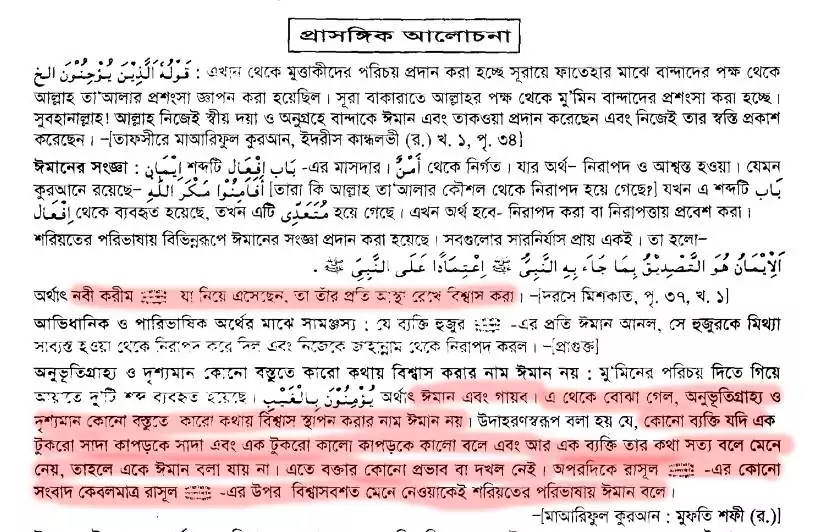
The central flaw in the example is clear. If someone says, “This cloth is white,” the report can be verified by looking at it. If someone says, “Angels question the dead in the grave,” we have no ordinary means of verifying the report. Before accepting it as true, we need answers to several questions: How did the person reporting it learn this? Why is that way of knowing reliable? What independent evidence supports the report? “He is Allah’s Messenger, so he spoke the truth” can serve as evidence only if his claim to be Allah’s Messenger in that sense is established independently of his own declaration or the claims of the book he brought. If the first claim is used to establish the second and the second is then used to establish the first, the reasoning is circular.
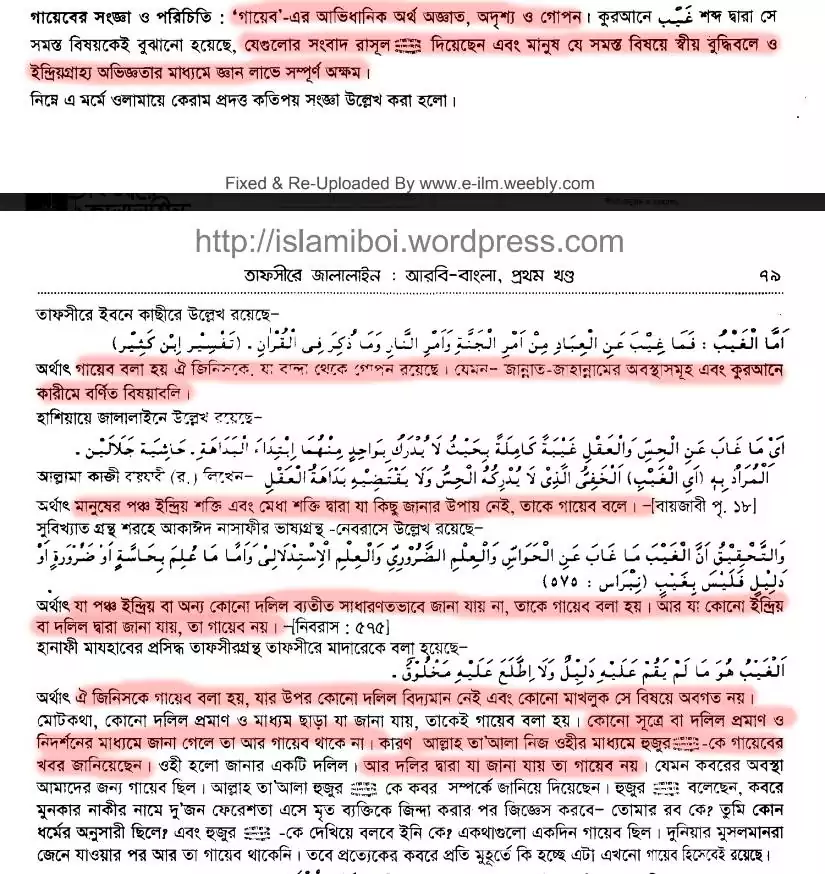
On the following pages, the same Bengali edition gives a fuller definition of the unseen. It discusses matters beyond human senses and ordinary reasoning, questioning in the grave, and how such things are known through revelation. Thus, certain knowledge of a supernatural event is claimed on the strength of “the Prophet reported it,” even though there is no independent experience of the event. The same problem is clear here: the reliability of the report rests on an authority whose own claim to knowledge has yet to be established. [6]
Definition and meaning of the unseen: The literal meaning of ghayb is “unknown,” “invisible,” or “hidden.” In the Quran the word refers to the things reported by the Messenger that people are wholly unable to learn through their own reasoning or sensory experience.
Some definitions given by the scholars are set out below.
Tafsir Ibn Kathir states:
أَمَّا الْغَيْبُ : فَمَا غَيْبَ عَنِ الْعِبَادِ مِنْ أَمْرِ الْجَنَّةِ وَأَمْرِ النَّارِ وَمَا ذَكَرَ فِي الْقُرْآنِ
That is, the unseen is whatever is hidden from Allah’s servants, such as the conditions in Paradise and Hell and the matters described in the noble Quran.
The marginal commentary on al-Jalalayn states:
أَي مَا غَابَ عَنِ الْحِسَ وَالْعَقْلِ غَيْبَةً كَامِلَةً بِحَيْثُ لَا يُدْرَكَ بِوَاحِدٍ مِنْهُمَا ابْتِدَاء الْبَدَاهَةِ
الْمُرَادُ بِهِ أَي الْغَيْبِ الْخَفِيُّ الَّذِي لَا يُدْرِكُهُ الْحِسُ وَلَا يَقْتَضِيهِ بَدَاهَةُ الْعَقْلِ
That is, what cannot be known through the five senses or the intellect is called the unseen. [Baydawi, p. 18]
Al-Nibras, a commentary on the well-known Sharh al-Aqa’id al-Nasafiyya, states:
وَالتَّحْقِيق أَنَّ الْغَيْبَ مَا غَابَ عَنِ الْحَوَاسِ وَالْعِلْمِ الضَّرُورِي وَالْعِلْمِ الْإِسْتِدْلَالِي وَأَمَّا مَا عُلِمَ بِحَاسَةٍ أَوْ ضَرُورَةِ أَوْ دَلِيلٍ فَلَيْسَ بِغَيْبِ
That is, what cannot ordinarily be known without the five senses or some other evidence is called the unseen. What is known by a sense or by evidence is not unseen. [Al-Nibras, p. 575]
Tafsir al-Madarik, the well-known Hanafi commentary, states:
الْغَيْبُ هُوَ مَا لَمْ يَقُمْ عَلَيْهِ دَلِيلٌ وَلَا اطَّلَعَ عَلَيْهِ مَخْلُوقٌ
That is, the unseen is that for which no evidence exists and of which no created being has knowledge. In short, what can be known without evidence or any means of knowing is called the unseen. If it becomes known through a source, evidence, or signs, it is no longer unseen. This is because Allah Most High informed the Prophet of the unseen through His revelation. Revelation is evidence by which something can be known. What is known through evidence is not unseen. For instance, what happens in the grave was unseen to us. Allah Most High informed the Prophet about the grave. The Prophet said that two angels named Munkar and Nakir would come to the grave, bring the dead person back to life, and ask: “Who is your Lord? What religion did you follow?” Then they would point to the Prophet and ask, “Who is this?” These matters were once unseen. Once the Muslims of the world learned about them, they were no longer unseen. What is happening at every moment in each person’s grave, however, remains unseen.
Surah Al-Jinn 72:26–27 says that Allah discloses the unseen to no one except a messenger He chooses. This statement is itself a religious claim. It does not establish that Muhammad actually received true reports of the unseen, because the verse assumes the reliability of the very channel whose reliability is at issue. [7]
عَالِمُ الْغَيْبِ فَلَا يُظْهِرُ عَلَىٰ غَيْبِهِ أَحَدًا إِلَّا مَنِ ارْتَضَىٰ مِنْ رَسُولٍ فَإِنَّهُ يَسْلُكُ مِنْ بَيْنِ يَدَيْهِ وَمِنْ خَلْفِهِ رَصَدًا
English translation: He knows the unseen. He discloses His unseen to no one except a messenger He has chosen. He then stations guards before and behind him.
Believing in something one cannot see is not in itself blind faith. Even when microbes, distant stars, or many past events are not directly accessible to everyone, experiments, measurements, records, and independent testimony allow us to reach reasonable conclusions about them. In these Islamic examples of the unseen, trust in the designated religious messenger takes the place of such verifiable means as the basis of knowledge. The problem is not that the subject is unseen. It is that an unverified report is elevated to a truth that must be held with certainty.
Angels in the Grave: Religious Accounts and Independent Testimony
Questioning in the grave is a specific example of this method. According to a report in Sahih al-Bukhari, two angels come to the deceased, question them about Muhammad, and show them their reward or punishment according to their answer. The report also describes a disbeliever or hypocrite being struck with an iron hammer. It ends by saying that others can hear the outcry but that humans and jinn cannot. The fact that humans hear nothing does not remedy the lack of evidence. The account is framed in such a way that ordinary experience is unlikely to furnish evidence against it. [8]
ثُمَّ يُضْرَبُ بِمِطْرَقَةٍ مِنْ حَدِيدٍ ضَرْبَةً بَيْنَ أُذُنَيْهِ، فَيَصِيحُ صَيْحَةً يَسْمَعُهَا مَنْ يَلِيهِ إِلاَّ الثَّقَلَيْنِ
English translation: Then he will be struck once with an iron hammer between his ears. He will cry out, and everyone around him except humans and jinn will hear him.
Whether the hadith circulated among Muslims, who narrated it, and through which chain it was preserved are historical questions. Whether two angels actually enter the grave, strike the dead person with an iron hammer, and cause an outcry inaudible to humans are separate claims about what happens. Classifying a report’s chain as sahih assesses its transmission under the criteria of Islamic hadith scholarship. It does not produce direct, independent evidence of a supernatural event inside the grave. Yet iman calls for such accounts to be accepted as certain truths.
Calling Doubt Satanic Whispering and Ordering the Questions to Stop
The relationship between doubt and fundamental beliefs matters. Doubt is natural when there is too little information about a claim. Examining evidence has a purpose only if the possibility of being wrong remains open. Islamic reports portray certain doubts as dangerous whisperings that threaten faith, rather than as reasons to find out more. In a report narrated by Abu Hurayra in Sahih Muslim, several Companions say they have thoughts that they are afraid even to utter. Muhammad calls their reaction “pure faith.” In al-Nawawi’s explanation, recognizing the gravity of the thoughts and rejecting them is a sign of faith. The response being praised is the mental rejection of the question rather than any examination of its merits. [9] [10]
عَنْ أَبِي هُرَيْرَةَ، قَالَ جَاءَ نَاسٌ مِنْ أَصْحَابِ النَّبِيِّ صلى الله عليه وسلم فَسَأَلُوهُ إِنَّا نَجِدُ فِي أَنْفُسِنَا مَا يَتَعَاظَمُ أَحَدُنَا أَنْ يَتَكَلَّمَ بِهِ. قَالَ «وَقَدْ وَجَدْتُمُوهُ؟» قَالُوا نَعَمْ. قَالَ «ذَاكَ صَرِيحُ الإِيمَانِ».
English translation: Abu Hurayra said: Some of the Prophet’s Companions came to him and asked, “We find in ourselves thoughts that any one of us would consider too grave even to utter.” He said, “Have you really experienced that?” They said, “Yes.” He said, “That is pure faith.”
This hadith concerns intrusive thoughts. It is not a direct prohibition on every intellectual question. But it clearly commends the rejection of doubt rather than treating doubt as a legitimate question. The next two hadith are more explicit about what to do when a basic question about creation arises.
Sahih al-Bukhari 3276 describes a series of questions: Who created this? Who created that? And then, who created your Lord? The last question is described as a prompting from Satan, and the instruction is to seek refuge in Allah and stop. Instead of discussing how far the reasoning used to posit a creator for the world can be taken, or why that reasoning should not apply to the creator, the questioning itself is brought to a halt. [11]
يَأْتِي الشَّيْطَانُ أَحَدَكُمْ فَيَقُولُ مَنْ خَلَقَ كَذَا مَنْ خَلَقَ كَذَا حَتَّى يَقُولَ مَنْ خَلَقَ رَبَّكَ فَإِذَا بَلَغَهُ فَلْيَسْتَعِذْ بِاللَّهِ، وَلْيَنْتَهِ
English translation: Satan comes to one of you and says, “Who created this thing? Who created that thing?” Finally he says, “Who created your Lord?” If he reaches that point, let that person seek refuge in Allah and stop.
Sahih Muslim 134a instructs believers to say “I believe in Allah” when the same kind of question arises. This does not answer the doubt. It repeats the belief that was called into question. Restating a prior belief in the face of a question does not resolve the question logically. This matters because the questioner is given no new, independent evidence. Instead, the belief is to be repeated to protect it. [12]
لاَ يَزَالُ النَّاسُ يَتَسَاءَلُونَ حَتَّى يُقَالَ هَذَا خَلَقَ اللَّهُ الْخَلْقَ فَمَنْ خَلَقَ اللَّهَ فَمَنْ وَجَدَ مِنْ ذَلِكَ شَيْئًا فَلْيَقُلْ آمَنْتُ بِاللَّهِ
English translation: People will keep asking questions until it is said, “Allah created all things, so who created Allah?” If such a question occurs to someone, let that person say, “I believe in Allah.”
If someone has sufficient evidence for a claim, a critical question provides an opportunity to test that evidence. A weak answer reduces confidence; a strong one increases it. When a question is dismissed as “Satanic whispering” and the questioning is ordered to stop, that distinction can no longer do its work. This does not prove a true claim, and it makes a false claim harder to expose. Turning a question about what we can know into a test of obedience is one of the basic ways of sustaining blind faith.
The Absence of Doubt Marks the Sincere Believer
In Surah Al-Hujurat 49:14, some Bedouins say, “We believe.” They are told that they have submitted to Islam but that iman has not yet entered their hearts. The next verse, 49:15, describes true believers as those who believe in Allah and the Messenger and then do not doubt. Read together, the verses make clear that outward religious identity is insufficient. Inner certainty and the absence of doubt are also criteria for true iman. [13] [14]
إِنَّمَا الْمُؤْمِنُونَ الَّذِينَ آمَنُوا بِاللَّهِ وَرَسُولِهِ ثُمَّ لَمْ يَرْتَابُوا وَجَاهَدُوا بِأَمْوَالِهِمْ وَأَنْفُسِهِمْ فِي سَبِيلِ اللَّهِ أُولَٰئِكَ هُمُ الصَّادِقُونَ
English translation: The believers are only those who believe in Allah and His Messenger, then do not doubt, and strive in Allah’s cause with their wealth and their lives. They are the truthful ones.
In Al-Shifa, Qadi Iyad classifies doubt about Muhammad’s truthfulness in what he proclaimed as kufr. Both accusing Muhammad of deliberately lying and being unsure whether he spoke the truth appear on his list of what constitutes kufr. In other words, even without concluding that the Prophet’s statements were false, uncertainty about his truthfulness is declared religiously unacceptable. [15]
من أضاف إلى نبينا صلى الله عليه وسلم تعمد الكذب فيما بلغه وأخبر به أو شك في صدقه
English translation: Whoever accuses our Prophet ﷺ of deliberately lying in what he conveyed and reported, or doubts his truthfulness
The belief commended here is more than a provisional conclusion reached on the strength of evidence. “Then do not doubt” ties the believer’s sincerity to remaining free of doubt after adopting the belief. Yet whether someone doubts a claim tells us nothing about whether it is true. A person can feel completely certain of a false belief or be unsure of a true claim because they have too little information. Equating truth with psychological certainty makes self-assurance, rather than evidence, the standard of belief.
The practical implication of the Quranic statement is that if new information leads a Muslim to doubt the existence of Allah, the divine origin of the Quran, or Muhammad’s prophethood, that position is seen as falling short of the ideal of full iman. In rational inquiry, however, doubt is a legitimate provisional outcome. Saying “I do not know yet” when the answer is unknown is an honest response to the evidence. Treating that position as a failure of religious identity subordinates inquiry to a predetermined answer.
“We Hear and We Obey”: Iman and Unconditional Obedience
In Surah Al-Baqarah 2:285, the declaration of belief in Allah, the angels, the scriptures, and the messengers appears alongside “We hear and we obey.” This phrase is particularly important for understanding the epistemic structure of Islamic iman. Once a source is accepted as the word of Allah, there is less room to take an independent position against its commands. A skeptic wants to examine the matter before deciding. In the ideal of iman, the chosen source’s word has the authority to settle the matter. [16]
آمَنَ الرَّسُولُ بِمَا أُنْزِلَ إِلَيْهِ مِنْ رَبِّهِ وَالْمُؤْمِنُونَ كُلٌّ آمَنَ بِاللَّهِ وَمَلَائِكَتِهِ وَكُتُبِهِ وَرُسُلِهِ لَا نُفَرِّقُ بَيْنَ أَحَدٍ مِنْ رُسُلِهِ وَقَالُوا سَمِعْنَا وَأَطَعْنَا غُفْرَانَكَ رَبَّنَا وَإِلَيْكَ الْمَصِيرُ
English translation: The Messenger believes in what has been revealed to him from his Lord, and so do the believers. Each believes in Allah, His angels, His books, and His messengers. We make no distinction among His messengers. They say, “We hear and we obey.” We ask Your forgiveness, our Lord, and to You is the return.
Surah An-Nur 24:51 defines believers in the same way: when summoned to the judgment of Allah and the Messenger, they answer, “We hear and we obey.” The freedom to understand a ruling, test its reasoning, or challenge it and seek a change is not what counts under this ideal. What counts is obedience to the ruling of religious authority. [17]
إِنَّمَا كَانَ قَوْلَ الْمُؤْمِنِينَ إِذَا دُعُوا إِلَى اللَّهِ وَرَسُولِهِ لِيَحْكُمَ بَيْنَهُمْ أَنْ يَقُولُوا سَمِعْنَا وَأَطَعْنَا وَأُولَٰئِكَ هُمُ الْمُفْلِحُونَ
English translation: When the believers are called to Allah and the Messenger so that he may judge between them, their response is to say, “We hear and we obey.” They are the ones who succeed.
In Surah An-Nisa 4:65, this obedience goes further. Taking Muhammad as judge in disputes and submitting to his ruling is not enough. Believers must not feel any inner resistance to his judgment either. Controlling outward conduct and imposing authority over inward judgment are different things. A person can comply with a decision and still disagree about whether it is just. The verse makes the absence of that inner objection a condition of iman as well. [18]
فَلَا وَرَبِّكَ لَا يُؤْمِنُونَ حَتَّىٰ يُحَكِّمُوكَ فِيمَا شَجَرَ بَيْنَهُمْ ثُمَّ لَا يَجِدُوا فِي أَنْفُسِهِمْ حَرَجًا مِمَّا قَضَيْتَ وَيُسَلِّمُوا تَسْلِيمًا
English translation: By your Lord, they will not believe until they make you judge in the disputes that arise among them. Then they must find no resistance within themselves to the judgment you give and submit completely.
Surah Al-Ahzab 33:36 says that when Allah and the Messenger decide a matter, a believing man or woman has no right to choose otherwise. This means that when a decision falls under religious authority, individual preference is no longer the final standard. The principle rests on the presumed infallibility of the source rather than on independent judgment. The word of Allah and the Messenger is treated as final from the outset, so deciding otherwise is disobedience. [19]
وَمَا كَانَ لِمُؤْمِنٍ وَلَا مُؤْمِنَةٍ إِذَا قَضَى اللَّهُ وَرَسُولُهُ أَمْرًا أَنْ يَكُونَ لَهُمُ الْخِيَرَةُ مِنْ أَمْرِهِمْ وَمَنْ يَعْصِ اللَّهَ وَرَسُولَهُ فَقَدْ ضَلَّ ضَلَالًا مُبِينًا
English translation: When Allah and His Messenger decide a matter, no believing man or woman has the right to choose otherwise in that matter. Whoever disobeys Allah and His Messenger has plainly gone astray.
These three injunctions, read together, make the relationship between iman and obedience clear. Iman involves more than holding a proposition to be true. It also means granting the purported source of the proposition such authority that even inward resistance to its rulings is ruled out. The right to examine a source’s credibility does not automatically entail the right to identify and correct its errors once the source has been accepted. This is where Islamic iman confines the exercise of reason within limits of its own making.
Ibn Qudama applies the same principle of obedience to statements in the Quran and sound hadith about Allah’s attributes. In Lum’at al-I’tiqad, he says that belief in these statements is obligatory. If a statement’s meaning is unclear, he directs believers to affirm its wording and refrain from trying to determine its meaning. Here, even clarity of meaning is not a condition for accepting a doctrinal statement. [20]
وما أشكل من ذلك وجب إثباته لفظاً، وترك التعرض لمعناه، ونرد علمه إلى قائله، ونجعل عهدته على ناقله
English translation: If any of this is unclear, its wording must be affirmed and one must refrain from trying to determine its meaning. We refer knowledge of it back to the one who uttered it and leave responsibility for it with the one who transmitted it.
Why Fear That Faith Will Change If the Evidence Points the Other Way?
The clearest example in Islamic theological discussion appears in the annotated Bengali edition of Sharh Muslim, in a section titled “Iman Is Not Founded on Evidence.” Citing the author of Ruh al-Ma’ani, it presents the view that firm iman need not result from reasoning or evidence. The fact that early Muslims were not taught formal logic is invoked against treating evidence as a necessary foundation for iman. But the most telling point is more specific: if iman rests on evidence, it could change when the evidence points the other way. That possibility is treated as a sign of “weak faith” rather than a legitimate revision of belief. [21]
Iman Is Not Founded on Evidence
The author of Ruh al-Ma’ani reports the opinion of certain learned investigators that iman is, in fact, firm belief in a truth already laid down. It enters the hearts of the fortunate in such a way that even if a person tried to cast it out, they could not do so.
Certain false sects, such as the Mu’tazila, and some practitioners of kalam say that it is obligatory to attain belief in divine unity and messengership in light of arguments and evidence, because faith free of doubt cannot be attained without knowledge of the proofs. Their opinion is astonishing. In the blessed age of the Messenger of Allah, peace and blessings be upon him, vast groups of disbelievers embraced Islam. Were they called on to learn the reasoning and proofs behind the obligations and duties of Islam? They were taught the rules of prayer, zakat, and the like, but were they ever taught the conditions for drawing a conclusion by arranging the major and minor premises of the proof that the universe is perishable? There is no doubt that the proofs of the theologians can be one means of strengthening iman. But it cannot be right for iman to depend on arguments and evidence alone. If it did, the iman of ordinary people would not be considered valid, since they did not attain it on the basis of the theologians’ proofs. Conversely, there are many examples of people for whom the proofs that Islam was right and true were as clear as daylight, yet who were denied the treasure of iman. In fact, the attainment of iman and certainty does not depend on proof. Iman is a light that Allah, the Most Merciful, pours fully and truly into the heart of His servant by His grace and mercy, whatever the outward cause may be.
It goes without saying that if iman is said to depend on arguments and evidence, there remains the possibility that, if the evidence turns in the opposite direction, iman will turn with it. What is the opposite of iman if not kufr? Moreover, evidence leaves room for doubt and uncertainty. Thus, iman that depends on arguments and evidence is not firm; what one attains through them is weak iman. Allah Most High alone knows when, or in what direction, the evidence of a person with little knowledge may turn.
The certainty, that high degree of belief, attained by an unlearned old man is in many cases unfamiliar and altogether foreign even to eminent scholars, learned men, and people versed in the sciences.
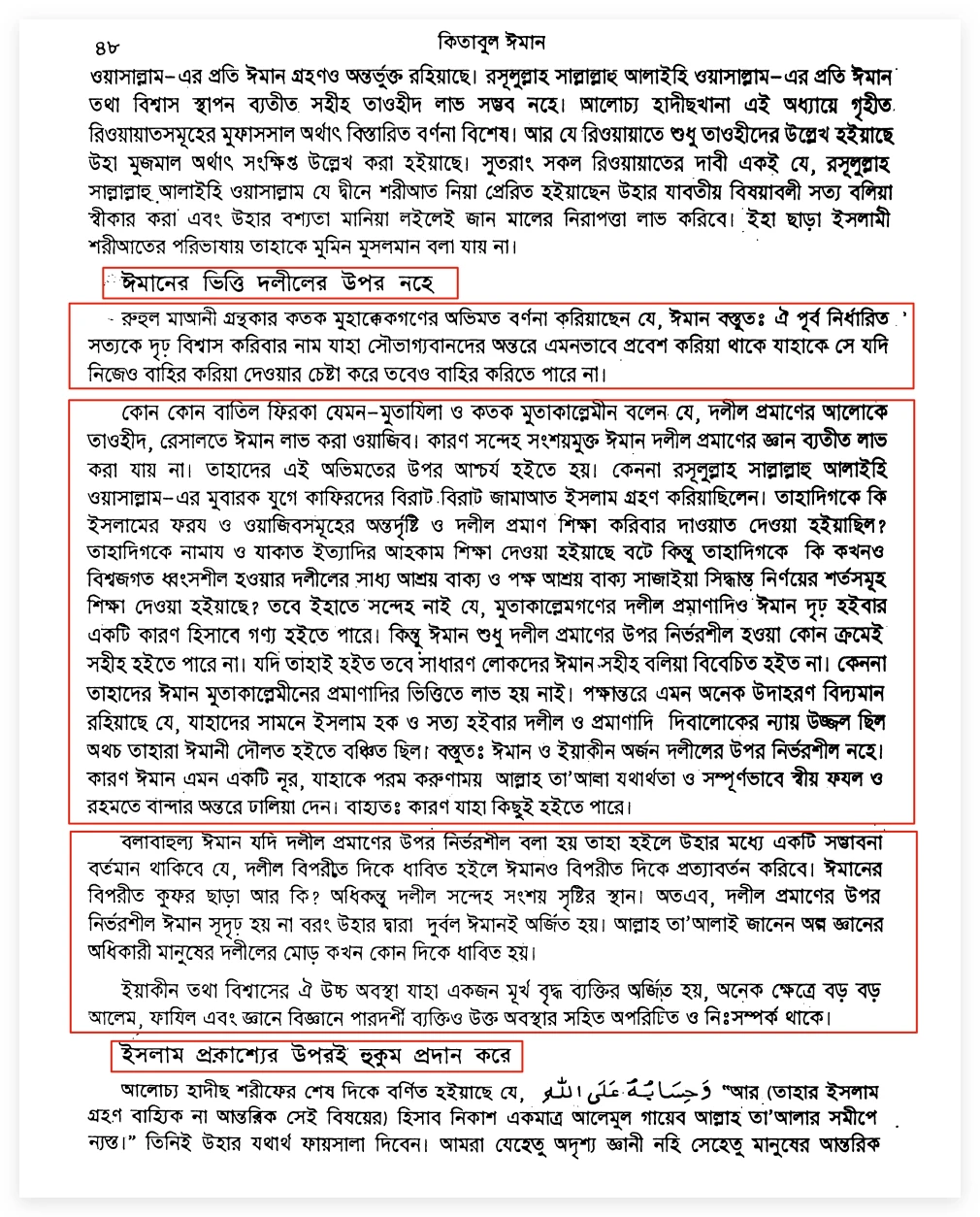
This passage describes the epistemic features of blind faith almost directly. The point of evidence is to distinguish truth from falsehood. If evidence in favor of a prior belief is admissible, reliable evidence against it should also reduce confidence in that belief. But here, changing one’s mind when contrary evidence appears is held up as a danger because it might lead to kufr. In other words, the refusal to change one’s prior belief, whatever inquiry into the truth may yield, is held up as a virtue of iman.
Whether the earliest Muslims learned formal logic does not settle the question. A person who does not know the terminology of logic can still form reasonable beliefs through reliable testimony, observation, and experience. They can also revise their conclusions when new information points the other way. This is no complicated philosophical claim. It is the ordinary principle of allowing for the possibility of error. If a method assumes from the outset that an existing belief can never be wrong, the function of new evidence is to make that belief look stronger, not to test whether it is true.
The Bengali commentary portrays changing one’s faith on the basis of evidence as a danger and holding firm without evidence as a higher form of certainty. This position is directly consistent with the Quranic injunctions on certainty and obedience. In both cases, religious truth is made a matter of unchanging allegiance rather than a conclusion open to revision.
In the “Foundations of Belief” section of Ihya’ Ulum al-Din, al-Ghazali says that a child should first memorize the creed. Understanding, belief, and firm conviction follow. In the case of a child, he says, this process requires no proof. He identifies an initial weakness of belief acquired through imitation: hearing a contrary proposition may dislodge it. He therefore says that the belief must be strengthened in the minds of children and ordinary people so that it no longer wavers. [22]
أنه يقبل الإزالة بنقيضه لو ألقى إليه فلا بد من تقويته وإثباته في نفس الصبي والعامي حتى يترسخ ولا يتزلزل
English translation: It can be displaced if its contrary is presented to the person. It must therefore be strengthened and firmly established in the minds of children and ordinary people, so that it takes root and does not waver.
In Sharh al-Maqasid, in the discussion of “the faith of the imitator,” al-Taftazani writes that, according to most scholars, a person’s iman is valid if they firmly believe the creed by following others, even without knowing its evidence for themselves. Reaching a conclusion on the basis of evidence one knows and being firmly convinced of the same conclusion by accepting someone else’s word are epistemically different. But on the view al-Taftazani presents, the latter person’s iman is not invalidated by their lack of personal knowledge of the evidence. [23]
الجمهور على صحة إيمان المقلد، لأن التصديق لا يتوقف على ثبات الاعتقاد، بل جزمه
English translation: According to the majority of scholars, the faith of the imitator is valid. Assent to a proposition as true does not depend on the stability of the belief, but on the firmness of one’s conviction in it.
When the Quran Asks Others for Proof: The Same Standard Applies to Islam
The Quran itself asks for proof in response to claims about the afterlife made by followers of other religions. Surah Al-Baqarah 2:111 calls it wishful thinking to say that no one will enter Paradise unless they are Jewish or Christian, and says, “Bring your proof if you are truthful.” The burden of proof lies with whoever makes the claim. That is a reasonable rule. But Muslim claims about Paradise, Hell, resurrection, and the Day of Judgment cannot be exempt from that same standard. If firm acceptance of a religious account is not proof in another religion’s case, it is not independent evidence in Islam’s case either. [24]
وَقَالُوا لَنْ يَدْخُلَ الْجَنَّةَ إِلَّا مَنْ كَانَ هُودًا أَوْ نَصَارَىٰ تِلْكَ أَمَانِيُّهُمْ قُلْ هَاتُوا بُرْهَانَكُمْ إِنْ كُنْتُمْ صَادِقِينَ
English translation: They say, “No one will enter Paradise unless they are Jewish or Christian.” Those are their wishes. Say, “Bring your proof if you are truthful.”
Applying this standard of evidence allows for three outcomes: finding sufficient evidence for the claim, rejecting it on the strength of contrary evidence, or suspending judgment for lack of information. Under the Islamic ideal of iman, even the third position is incompatible with full belief when it comes to the basic articles of faith, since the Quran treats the absence of doubt after believing as a mark of sincerity. This creates an asymmetry between claims to religious knowledge and ordinary claims to knowledge based on reasoning. Others are asked to produce evidence, but one’s own foundational beliefs must be held as true.
A person’s devotion, religious experience, peace of mind in prayer, or deep trust in a preacher does not determine whether a claim is actually true. Followers of different religions may also report deep trust and profound experiences. Sincerity in holding contradictory beliefs does not independently distinguish truth from falsehood. The Quran may be the final authority for a Muslim, but when the very claim under examination is that the Quran is the word of Allah, the Quran’s own declaration cannot settle it. The authority’s reliability must be established before it can determine what is true.
Iman, Obedient Belief, and the Limits of Questioning in the Words of Religious Scholars
These religious talks plainly distinguish iman from ordinary beliefs that can change and praise unconditional obedience to authority. In the following talk, Abu Bakr Muhammad Zakaria discusses the difference between iman and everyday belief. The main question is whether a belief is being insulated from the possibility of being shown wrong. If the way to revising it on the basis of evidence is closed, it cannot be put on a par with ordinary beliefs based on information.
The same test applies to Abu Toha Adnan’s remarks on Islamic epistemology. The name or religious affiliation of a way of knowing is no evidence that it leads to truth. How verifiable a claim to knowledge is depends on whether there is an independent way to detect errors in the report, what weight contrary evidence carries, and whether the conclusion can be revised.
Another speaker’s discussion of whether Islam follows reason is also relevant here. Using reason to explain what a religious rule means is different from being free to reject its truth or justice. If one may only interpret the source while assuming that it cannot be wrong, there is no independent power to criticize it.
Mufti Ibrahim illustrates the believer’s obedience with the image of a camel led by a rope through its nose. The image itself expresses the ideal of obedience: the follower does not choose the path, but goes wherever the authority leads. There is no place in this analogy for reasoned objection, revision of a decision, or independent moral judgment of an instruction.
Ahmadullah likewise speaks of accepting the Quran and hadith upon hearing them. Whether a report actually appears in the book cited, what its wording means, and whether its instruction is true and just are three different questions. Answers to the first two do not independently settle the third. If immediate acceptance upon hearing is held up as the ideal, the last question is left to religious authority.
In another talk, Abu Bakr Muhammad Zakaria treats asking for evidence against the creed as kufr. The implications are far-reaching. A person who wants to see the opposing argument is still examining the evidence. If that person is already deemed religiously at fault, holding on to belief becomes a condition of identity and obedience. The freedom to weigh contrary evidence, whether strong or weak, is thereby restricted.
These talks share a premise: belief requires accepting the decisions of a designated religious authority, and there are limits on inquiry or objections directed against that authority. As a result, even the search for evidence is subordinated to a conclusion decided in advance.
A Belief That Does Not Change When the Evidence Changes Is Not Knowledge
Accepting a claim rationally means having specific reasons for it and being prepared to revise one’s position if those reasons turn out to be mistaken. A doctor revises an earlier diagnosis in light of new tests. A historian changes an interpretation when new records contradict it. Under this approach, a lack of certainty is not a failure. Knowing the limits of the available information and leaving room for revision are fundamental to knowledge. If the basic requirement of religious iman is that a claim be deemed true in advance and that neither questions nor contrary evidence be allowed to change the belief, information no longer determines the conclusion. It serves as material for defending it.
A person may make arguments for iman, study interpretations of scripture, and try to rebut opposing arguments. Using reason does not in itself make the belief evidence-based. The test is simple: If reliable contrary evidence emerges, can that person abandon the doctrine in question and still call that decision an act of intellectual honesty? If the answer is settled in advance as “No, the doctrine cannot be wrong under any circumstances,” the belief is not grounded in an open examination of evidence. In such a system, reasoning serves only to support the authorized conclusion.
Inquiry makes sense only if we allow that some of our beliefs might be wrong. But when it comes to the required doctrines of Islamic iman, the outcome of inquiry is decided in advance: one must accept them, remain free of doubt, and submit to the commands of Allah and the Messenger. Rejecting one of these claims changes more than an opinion. It also calls into question the person’s iman and religious identity. Turning belief into such an immutable condition of identity and obedience is what makes it blind.
Conclusion
Although the literal meaning of iman in Islam is belief, its theological structure is unlike that of ordinary evidence-based belief. The Hadith of Gabriel lays down six required articles of faith. Surah Al-Baqarah makes acceptance of the truth of the unseen a mark of piety. The Bengali commentary accompanying Tafsir al-Jalalayn calls it iman to accept the Messenger’s reports solely on trust in him. The Quran depicts the sincere believer as one who does not doubt, who says “We hear and we obey,” and who feels no inner resistance to the Prophet’s rulings. Sound hadith instruct believers to stop at a fundamental question about creation and to repeat their prior declaration of faith.
The clearest epistemic consequence of this structure is expressed in the theological argument that faith based on evidence is weak because it could change if contrary evidence appeared. Changing a belief when the evidence goes against it is a normal part of rational inquiry. To turn that practice into a threat to iman is to shield belief from being tested for truth or falsehood. As long as a claim is not allowed to be wrong, and one is not free to reject it if it is shown to be wrong, the arguments offered in its favor do not amount to independent inquiry.
In this sense, Islamic iman is fundamentally blind faith: certain prescribed religious claims must be accepted as true, one must remain free of doubt, and one must submit to the decisions of authority. The validity of that belief is not determined by whether there is enough independent evidence for those claims. The strength of a conviction is no substitute for the truth of a statement. A true claim stands up to the evidence. Blind faith requires that it remain intact even in the face of contrary evidence.
References
- Sahih Muslim 8a: The Hadith of Gabriel and Belief in Divine Decree ↩︎
- Quran, Surah An-Nisa 4:136 ↩︎
- Quran, Surah Al-Baqarah 2:3 ↩︎
- Tafsir al-Jalalayn, commentary on Surah Al-Baqarah 2:3 ↩︎
- Tafsir al-Jalalayn, Islamia Kutubkhana, vol. 1, p. 77 ↩︎
- Tafsir al-Jalalayn, Islamia Kutubkhana, vol. 1, pp. 78–79 ↩︎
- Quran, Surah Al-Jinn 72:26–27 ↩︎
- Sahih al-Bukhari 1338, questioning in the grave ↩︎
- Sahih Muslim 132a ↩︎
- Islamweb: al-Nawawi’s explanation ↩︎
- Sahih al-Bukhari 3276 ↩︎
- Sahih Muslim 134a ↩︎
- Quran 49:14 ↩︎
- Quran 49:15 ↩︎
- Qadi Iyad, Al-Shifa, p. 284 ↩︎
- Quran, Surah Al-Baqarah 2:285 ↩︎
- Quran, Surah An-Nur 24:51 ↩︎
- Quran, Surah An-Nisa 4:65 ↩︎
- Quran, Surah Al-Ahzab 33:36 ↩︎
- Ibn Qudama, Lum’at al-I’tiqad, text quoted at Islamweb ↩︎
- Sharh Muslim, annotated Bengali translation, vol. 2, p. 48 ↩︎
- Al-Ghazali, Ihya’ Ulum al-Din, “Foundations of Belief” ↩︎
- Al-Taftazani, Sharh al-Maqasid, “The Faith of the Imitator,” p. 218 ↩︎
- Quran, Surah Al-Baqarah 2:111 ↩︎