Summary
Islam presents itself as a purely monotheistic religion whose fundamental declaration is that there is no deity but Allah. Yet a comparative examination of the Quran, hadith, classical exegesis and ancient Semitic religious literature reveals numerous elements of an earlier polytheistic cosmology within Islamic theology. The Quran describes Allah as the best of creators, uses the Arabic verb for creating in connection with Jesus, alternates between singular and plural divine speech, and describes subordinate celestial beings participating in supernatural acts. This language and these narratives bear profound structural similarities to the ancient Semitic divine council, heavenly royal court and conception of beings endowed with various powers under a supreme deity.
According to the Quran and authentic hadith themselves, the Arab polytheists who opposed Muhammad acknowledged Allah as the creator of the heavens and earth and as a god exercising authority over other objects of worship. Their religious invocation declared even Allah’s partners to be his possessions. By worshipping other deities, they hoped to gain proximity to Allah and obtain intercession. Muhammad’s religious movement made the worship of this familiar god exclusive and revoked the religious legitimacy of other objects of worship. At the same time, it retained the concepts of jinn, angels, devils, prophets endowed with miraculous powers, and authorized intercessors. The accounts of a female devil at al-Uzza’s sanctuary and of the jinn worshipped by Arabs converting to Islam provide clear examples of supernatural beings associated with pagan worship being assigned new theological identities.
A comparison of ancient Ugaritic and Canaanite religion, the biblical divine council, the creation of Adam in Jewish rabbinic literature, and the Quranic al-mala’ al-a’la, or heavenly assembly, reveals the literary and cultural antecedents of Islamic theology. The supreme deity’s throne, celestial attendants, disputes among council members, disobedience, punishment, divine agency and intercession all existed in religious literature centuries before Islam. Islamic monotheism developed a centralized theological framework through the reorganization of these older mythological elements.
| Subject | Principal evidence | Historical and logical significance |
|---|---|---|
| Allah as the best of creators | Quran 23:14 and 37:125; the commentaries of al-Razi, al-Tabari and al-Qurtubi. | Alongside the assertion of Allah’s exclusive creative power, plural and comparative language is used to describe him. |
| Creative acts of other beings | Quran 3:49 and 5:110; Jesus creating a clay bird and raising the dead. | Other beings participate in miraculous acts while ultimate authority is assigned to Allah. |
| Allah as the god of pagan Arabs | Quran 29:61, 29:63 and 39:38. | The Quran itself attests that recognition of Allah as supreme creator existed in the Arabian religious environment before Muhammad’s preaching. |
| Partners subordinate to Allah | Sahih Muslim 1185; the pagan talbiyah. | Pagan beliefs already contained a hierarchy of unequal status and subordination between Allah and other objects of worship. |
| Pagan intercession and Islamic shafa’ah | Quran 39:3, 10:18, 53:26, 2:255 and 34:23. | The concept of mediation before the supreme deity is retained while its legitimacy and conditions of authorization are redefined. |
| Judgment and punishment of objects of worship | Quran 21:29 and 21:98–101; classical exegesis. | Exclusive entitlement to worship is established by assigning religious status, liability and punishment to beings worshipped apart from Allah. |
| Arab worship of jinn | Quran 17:57 and 34:40–41; Sahih Muslim 3030a–d. | Islamic narratives acknowledge jinn as conscious supernatural beings on the receiving end of pagan worship. |
| Al-Uzza and the female devil | Sirah and hadith accounts of the destruction of al-Uzza; IslamQA 220320. | The pagan goddess’s divinity is rejected and the supernatural being associated with her sanctuary is reidentified as a devil. |
| Allah’s “I” and “We” | Quran 21:25, 75:1–4 and 19:64; Ibn Taymiyyah’s explanation. | Changes in grammatical number in divine speech and the concept of action through subordinate celestial beings are preserved. |
| Ancient Semitic divine council | Psalm 82; Genesis 1:26 and 3:22; 1 Kings 22:19–23; research by Mark S. Smith. | A hierarchical arrangement of celestial beings under a supreme deity is part of pre-Islamic religious tradition. |
| The Quranic heavenly assembly | Quran 37:8 and 38:69; the commentaries of al-Tabari and Ibn Kathir. | The ancient mythological framework of a celestial assembly, disputes among its members, confidential conversations and supreme divine authority is retained. |
| Literary antecedents of Adam’s creation | Quran 2:30–34; Genesis Rabbah; research by Saqib Hussain. | The story of the angels’ dispute over Adam’s creation and Adam receiving special knowledge is closely related to earlier Jewish religious literature. |
| The Satanic Verses | Early Islamic historical narratives and sirah literature. | Accounts of theological conflict over pagan goddesses’ status and intercessory powers are preserved in early Islamic preaching traditions. |
Islamic monotheism did not entirely abolish the ancient polytheistic religious cosmology; it reorganized its celestial beings, powers, authority and mediation under a single exclusive deity. These extensive historical and literary antecedents of Islamic theology’s major mythological elements call its alleged originality and supernatural origin into question. Human religious imagination, political experience and earlier cultural traditions provide a coherent historical explanation for the development of this worldview.
Introduction
Islam’s fundamental religious declaration is ‘La ilaha illa Allah’ (لا إله إلا الله), meaning that there is no deity but Allah, or that no being other than Allah deserves worship. This declaration assigns Allah the exclusive right to worship and identifies associating any other being with him as the gravest religious offense. According to Islamic belief, this monotheism is not a historically developed doctrine: every prophet, beginning with Adam, the first human on earth, preached the same divine truth, and Muhammad restored that eternal truth. Yet the religious history of the ancient Near East, Semitic mythological literature, and the Quran and hadith themselves present a very different historical picture of the origins of Islamic theology.
Monotheism was neither an isolated nor a sudden invention in the history of human civilization. Ancient Canaanite, Ugaritic and Israelite religious traditions contained a hierarchical system of other deities, celestial attendants, messengers and specially empowered beings under a supreme god. This supernatural world was imagined largely in the likeness of human royal courts. It had a supreme ruler and subordinate beings with different responsibilities, who discussed and disputed matters and carried out various tasks to implement the ruler’s decisions. As ancient Israelite religion developed, various elements of this polytheistic cosmology gradually came under monotheistic authority. Although other celestial beings lost divine status and standing as objects of worship, belief in their existence, supernatural powers and various responsibilities in heaven remained in religious literature.
The Quran and hadith describe a hierarchical supernatural cosmology centered on Allah in the religious environment of Arabia at the emergence of Islam. The polytheists who opposed Muhammad recognized Allah as creator of the heavens and earth and regarded other objects of worship as means of obtaining his favor and proximity. Their religious invocation even declared Allah’s partners to be his possessions. Muhammad’s movement therefore did not introduce an entirely unfamiliar supreme deity to the Arabs. One of its major theological changes was to make worship of the familiar Allah exclusive, revoke the religious legitimacy of other objects of worship, and redefine the powers and status of various supernatural beings. This change bears important traces of the transition from Arabian pagan religious tradition to Islamic monotheism.
Various features of this theological framework are preserved in the language of the Quran itself. On the one hand, Allah is declared the sole creator of everything; on the other, he is called the best of creators. In the description of Jesus’ miracles, the Arabic verb for creating is used, and an inanimate clay form is said to become a living creature. Allah sometimes speaks of himself in the singular “I” and sometimes in the plural “We.” The Quran also describes angels in a heavenly assembly, their questions and disputes over Adam’s creation, beings carrying Allah’s Throne, and angels assigned to perform various divine tasks. Classical Islamic interpretations acknowledge a connection between this use of the plural and actions carried out by subordinate beings at Allah’s command. This relationship between a supreme deity and subordinate supernatural beings is a familiar feature of the ancient Semitic worldview centered on the divine council.
The reidentification of supernatural beings associated with pagan deities in Islamic literature is particularly significant. Accounts preserve the story of a female devil at the sanctuary of the goddess al-Uzza and her killing by Khalid. Sahih Muslim describes the jinn worshipped by Arabs converting to Islam. The Quran likewise describes worship of jinn behind the apparent worship of angels. These narratives deny pagan objects of worship their divinity and entitlement to worship while retaining their associated supernatural beings within the religious imagination. Likewise, the pagan belief in obtaining intercession is rejected and the concept of intercession by Allah-authorized angels and other beings is established. Another important account of conflict over the status and intercessory power of pagan goddesses during early Islamic preaching is found in the narrative known as the ‘Satanic Verses’.
The concept of God’s heavenly royal court, throne, subordinate officials, messengers, guards, intercessors and agents entrusted with punishment plainly reflects human political and social experience. The relationship of ordinary people to kings or tribal leaders, mediation by influential individuals to secure a ruler’s favor, and subordinate officials implementing his commands were all familiar experiences in ancient societies, projected onto a cosmic scale by religious imagination. Religious literature offers no evidence-based explanation for why an omniscient and omnipotent being would have such a court, attendants and intercessors. Familiar antecedents of this mythical heavenly system are found in ancient human political institutions and social power structures.
The relationship with earlier religious literature is central to assessing the alleged originality of Islamic theology. Many elements of the biblical divine council, the Jewish rabbinic Adam narrative, the heavenly family of ancient Semitic religion and Arabian pagan traditions reappear in the Quran and hadith with new theological identities. Islam’s monotheistic framework was not constructed by destroying every element of the old mythological world; rather, it developed by centralizing the powers, status and entitlement to worship of that world under a supreme deity. This historical continuity provides a strong basis for interpreting Islamic theology as a particular stage in the evolution of human religious thought and culture.
Internal Tension in the Quran: “The Best of Creators” versus Exclusive Oneness
Although the Quran claims to be a perfect and internally consistent book, some of its verses appear fundamentally at odds with one another. A prominent example is Surah al-Mu’minun (23:14), which states: [1]
“فَتَبَارَكَ اللَّهُ أَحْسَنُ الْخَالِقِينَ” “Blessed, therefore, is Allah, the best creator.”
In another translation: [1]
“فَتَبَارَكَ اللَّهُ أَحْسَنُ الْخَالِقِينَ”
“Blessed, therefore, is Almighty Allah, among the creators, the greatest.”
Two words in this verse are particularly significant: “الخالقين” (al-khāliqīn) is plural, meaning “creators” or “makers”; and “أحسن” (aḥsanu) expresses comparative and superlative meanings: “better,” “greater” or “best.” Thus, in the phrase “أحسن الخالقين”, Allah is grammatically situated as the best within a group of khaliqs. The problem becomes more pronounced when the Quran elsewhere denies creative power to anyone other than Allah. Classical exegesis addresses this linguistic ambiguity by distinguishing the meanings of khaliq: for others it means “planner,” “shaper” or “maker,” while for Allah it means the actual originator of existence. Al-Qurtubi cites the poetry of Zuhayr ibn Abi Sulma as evidence of the word’s use for human craftsmanship. He also preserves Ibn Jurayj’s view that Allah is called the best of creators because Jesus was permitted to create. [2] The Mu’tazilite argument recorded in Fakhr al-Din al-Razi’s commentary likewise expressly notes that the apparent meaning of the verse entails multiple khaliqs—“ظاهر الآية يقتضي أنه سبحانه أحسن الخالقين الذين هم جمع”. [3]
| Verse | Statement about creative power |
|---|---|
| Surah al-Zumar (39:62) | “Allah is the creator of everything.” |
| Surah Fatir (35:3) | “Is there any creator for you other than Allah?” |
| Surah al-Nahl (16:20) | “They create nothing; rather, they themselves are created.” |
If Allah alone is the actual creator, what is the significance of placing his creative activity and others’ craftsmanship in the same comparative statement? The Quranic language declares Allah superior within a plural category of creators, while elsewhere assigning exclusive creative authority to him. This linguistic ambiguity gave rise to differing Islamic theological interpretations of the nature of creation and human agency. The first verse of Surah Hud claims that the Quran’s verses are made firm and explained in detail. [4] When the language of a supposedly infallible deity itself requires prolonged debate to establish the meaning of a fundamental theological term, its alleged clarity is called into question.
Is Allah a Better Creator Than Humans and Jinn?
Classical Quranic exegesis discusses the various meanings of khaliq extensively when interpreting the phrase “ahsan al-khaliqin” (the best of creators). In Arabic, the verb khalaqa, meaning to create, can also refer to determining a form, planning or making an object. On the basis of this linguistic feature, Islamic scholars have distinguished human craftsmanship from Allah’s alleged creative power. Yet the Quran itself describes the creative acts of a human whose actions were not limited to ordinary sculpture or reshaping inert matter. This individual fashioned an animal from clay, breathed into it, and the inert clay form became a living creature. The Quran also claims that he cured the congenitally blind and lepers and raised the dead. This individual is Isa, or Jesus.
In verse 49 of Surah Al Imran, the verb akhluqu (أَخْلُقُ), meaning “I create,” is directly attributed to Jesus’ own speech. In the Quranic narrative, Jesus not only shapes a bird out of clay; after he breathes into it, the form becomes a living bird by Allah’s permission. In the same verse he declares his power to raise the dead. Thus, discussion of creative activity by beings other than Allah in the Quran cannot be confined to ordinary human craftsmanship. [5]
وَرَسُولًا إِلَىٰ بَنِي إِسْرَائِيلَ أَنِّي قَدْ جِئْتُكُم بِآيَةٍ مِّن رَّبِّكُمْ ۖ أَنِّي أَخْلُقُ لَكُم مِّنَ الطِّينِ كَهَيْئَةِ الطَّيْرِ فَأَنفُخُ فِيهِ فَيَكُونُ طَيْرًا بِإِذْنِ اللَّهِ ۖ وَأُبْرِئُ الْأَكْمَهَ وَالْأَبْرَصَ وَأُحْيِي الْمَوْتَىٰ بِإِذْنِ اللَّهِ ۖ وَأُنَبِّئُكُم بِمَا تَأْكُلُونَ وَمَا تَدَّخِرُونَ فِي بُيُوتِكُمْ ۚ إِنَّ فِي ذَٰلِكَ لَآيَةً لَّكُمْ إِن كُنتُم مُّؤْمِنِينَ
English translation:
And he will be sent as a messenger to the Children of Israel, saying: I have come to you with a sign from your Lord. I create for you from clay the likeness of a bird, then breathe into it, and it becomes a bird by Allah’s permission. I heal the congenitally blind and the leper, and raise the dead by Allah’s permission. I tell you what you eat and what you store in your homes. Surely in this is a sign for you, if you are believers.
The same event is repeated in verse 110 of Surah al-Ma’idah, this time as Allah’s own speech. In reminding Jesus of the favors bestowed upon him, Allah directly uses the verb takhluqu (تَخْلُقُ), “you used to create.” Thus, in one verse Jesus speaks of his creative act, and in another Allah himself acknowledges it. Both verses describe supernatural events such as a living creature emerging from inert clay and the dead being brought to life. [6]
إِذْ قَالَ اللَّهُ يَا عِيسَى ابْنَ مَرْيَمَ اذْكُرْ نِعْمَتِي عَلَيْكَ وَعَلَىٰ وَالِدَتِكَ إِذْ أَيَّدتُّكَ بِرُوحِ الْقُدُسِ تُكَلِّمُ النَّاسَ فِي الْمَهْدِ وَكَهْلًا ۖ وَإِذْ عَلَّمْتُكَ الْكِتَابَ وَالْحِكْمَةَ وَالتَّوْرَاةَ وَالْإِنجِيلَ ۖ وَإِذْ تَخْلُقُ مِنَ الطِّينِ كَهَيْئَةِ الطَّيْرِ بِإِذْنِي فَتَنفُخُ فِيهَا فَتَكُونُ طَيْرًا بِإِذْنِي ۖ وَتُبْرِئُ الْأَكْمَهَ وَالْأَبْرَصَ بِإِذْنِي ۖ وَإِذْ تُخْرِجُ الْمَوْتَىٰ بِإِذْنِي ۖ وَإِذْ كَفَفْتُ بَنِي إِسْرَائِيلَ عَنكَ إِذْ جِئْتَهُم بِالْبَيِّنَاتِ فَقَالَ الَّذِينَ كَفَرُوا مِنْهُمْ إِنْ هَٰذَا إِلَّا سِحْرٌ مُّبِينٌ
English translation:
When Allah will say: Jesus, son of Mary, remember my favor upon you and your mother, when I strengthened you with the Holy Spirit and you spoke to people in the cradle and in maturity; when I taught you scripture, wisdom, the Torah and the Gospel; and when you created from clay the likeness of a bird by my permission, then breathed into it, and it became a bird by my permission. You healed the congenitally blind and the leper by my permission, and brought forth the dead by my permission. And when I restrained the Children of Israel from you, when you brought them clear signs, those among them who disbelieved said: This is nothing but obvious magic.
Al-Tabari’s commentary preserves an account from Ibn Ishaq in which Jesus, after making a clay bird, directly commands it to “be” a living bird. In the story Jesus invokes Allah’s permission and transforms the clay bird into a flying creature. Elsewhere in the Quran, the command kun, or “Be,” is described as a sign of Allah’s creative power. In this account preserved by al-Tabari, the same kind of miraculous creative command is attributed to Jesus. [7]
حدثنا ابن حميد قال، حدثنا سلمة قال، حدثنا ابن إسحاق: أنّ عيسى صلوات الله عليه جلسَ يومًا مع غلمان من الكُتّاب، فأخذ طينًا، ثم قال: أجعل لكم من هذا الطين طائرًا؟ قالوا: وتستطيع ذلك! قال: نعم! بإذن ربي. ثم هيّأه، حتى إذا جعله في هيئة الطائر نفخ فيه، ثم قال: “كن طائرًا بإذن الله”، فخرج يطيرُ بين كفيه. فخرج الغلمان بذلك من أمره، فذكروه لمعلّمهم، فأفشوه في الناس. وترعرع، فهمَّت به بنو إسرائيل، فلما خافت أمه عليه حملته على حُمَيرِّ لها، ثم خرجت به هاربة.
English translation:
Ibn Ishaq narrated that Jesus once sat with some schoolboys. He took some clay and asked: Shall I make a bird for you from this clay? They said: Can you do that? He replied: Yes, by my Lord’s permission. He then prepared it, and when he had given it the shape of a bird, he breathed into it and said, “Become a bird by Allah’s permission.” It then flew out from between his hands. The boys told their teacher about what had happened and spread the news among the people. As he grew older, the Children of Israel plotted against him. His mother, fearing for him, placed him on her little donkey and fled with him.
Al-Qurtubi’s commentary attempts to distinguish the roles of Jesus and Allah in this creative act. According to the explanation he preserves, shaping the clay and breathing into it were Jesus’ actions, while the actual creation was Allah’s. The same explanation compares Jesus’ breathing into the clay with Gabriel’s act of breathing. Islamic theology thus contains the concept of multiple beings participating at different stages of a miraculous creative act, with ultimate authority over it assigned to Allah. [8]
ويقال : إن سؤالهم كان له على وجه التعنت فقالوا : اخلق لنا خفاشا واجعل فيه روحا إن كنت صادقا في مقالتك ; فأخذ طينا وجعل منه خفاشا ثم نفخ فيه فإذا هو يطير بين السماء والأرض ; وكان تسوية الطين والنفخ من عيسى والخلق من الله ، كما أن النفخ من جبريل والخلق من الله .
English translation:
It is said that they challenged Jesus obstinately: If you are truthful in your claim, create a bat for us and give it life. So he took clay, fashioned a bat and breathed into it, whereupon it flew between heaven and earth. The shaping of the clay and breathing into it were Jesus’ work, and creation was Allah’s, just as the breathing was Gabriel’s and the creation Allah’s.
This explanation reveals an important structure within Islamic theology. Distinctions are made between the performer of a supernatural act, participants at different stages of that act, and the supreme authority authorizing it. Jesus forms an animal from clay, breathes into it and commands it to become a living creature. Allah is positioned as the authorizer and ultimate creator. Islamic interpretation likewise describes Gabriel as participating in a stage of divine creation. This framework clearly resembles the ancient Semitic religious worldview of various supernatural beings performing tasks under a supreme deity.
| Quranic statement | Creative act or power | Theological significance |
|---|---|---|
| Surah al-Zumar 39:62 | Allah is the creator of everything. | Ultimate creative authority is assigned to Allah. |
| Surah Fatir 35:3 | Is there any creator other than Allah? | Rejection of the idea of another creator. |
| Surah al-Mu’minun 23:14 | Allah is the best of creators. | Allah’s superiority within a plural category of creators. |
| Surah al-Saffat 37:125 | The best of creators in contrast to Baal. | Comparative language in the presence of a rival object of worship. |
| Surah Al Imran 3:49 | Jesus creates the form of a bird from clay, breathes into it and it comes to life by Allah’s permission. | Participation of a subordinate being in creation. |
| Surah al-Ma’idah 5:110 | Allah himself mentions Jesus’ creative act and bringing forth the dead. | Religious acknowledgment of authorized supernatural powers. |
There is no scientific basis for an inert clay form turning into a living creature through human breath and a verbal command. The claim that the dead can be raised through supernatural power is likewise unsupported by evidence. These narratives serve to establish the exceptional powers and status of religious figures rather than explain the actual laws of nature. Powers once associated with deities and their chosen representatives in ancient religious literature are associated in Islamic literature with prophets and angels authorized by Allah. The concept of mythical miraculous powers is retained, while their ultimate ownership and authorization are assigned to a supreme deity.
This interpretation introduces another problem. In the same sentence, the word khaliq is used in one sense for Allah and in an entirely different sense for humans or other beings. A human khaliq is a “planner” or “shaper”; Allah as khaliq means the actual creator of existence. These two differently defined beings are then placed within the same plural category of “khaliqin” and Allah is called the best among them. This interpretation employs two distinct concepts of creation to establish the meaning of the same comparative statement. The problem is so apparent in al-Razi’s discussion that it preserves differing theological interpretations of human action, Jesus’ creation and Allah’s creation. [9] More significantly, the same phrase “أحسن الخالقين” recurs in Surah al-Saffat 37:125, where Allah is called the best of creators directly in contrast to the deity Baal. [10]
Allah is called the “best of creators”; exegesis includes human craftsmanship in this comparison. What is the significance of comparing two fundamentally different powers? [1]
The Quran says, “There is nothing like him”; yet in calling Allah the “best of creators,” it places him within the same comparative framework as other khaliqs. Why is an incomparable being presented linguistically as a member of a comparative category? [11]
The superlative “best” expresses a comparison with a plural category of creators. The Quran uses the same language in rejecting the worship of Baal. [12]
Islamic creed maintains that no being resembles Allah. In Islamic theology, assigning another being a share in Allah’s divine attributes, worship or authority is called shirk. If human craftsmanship and Allah’s supposed creative power are fundamentally different in nature, what is the significance of including them in the same comparative category? In seeking to establish Allah above all other beings, the Quran’s language places him within a common comparative framework alongside other creators. This reveals the theological tension between Allah’s absolute distinctiveness and the comparative language used to describe him.
Punishment and Judgment of Objects of Worship: Implicit Acknowledgment of Existence
Some Quranic verses describe the punishment of objects of worship other than Allah, raising a theological question about their actual existence. Surah al-Anbiya (21:98–100) states: [13]
إِنَّكُمْ وَمَا تَعْبُدُونَ مِن دُونِ اللَّهِ حَصَبُ جَهَنَّمَ أَنتُمْ لَهَا وَارِدُونَ
English renderings of the Bengali translations:
You (disbelievers) and those you worship instead of Allah are fuel for Hell. You will enter it.
— Taisirul Quran
You and those you worship instead of Allah are indeed fuel for Hell; all of you will enter it.
— Sheikh Mujibur Rahman
Surely you and those you worship apart from Allah are fuel for Hell. You will enter it.
— Rawai Al-bayan
Surely you and those you worship instead of Allah are fuel for Hell; all of you will enter it.
— Dr. Abu Bakr Muhammad Zakaria
لَوْ كَانَ هَٰؤُلَاءِ آلِهَةً مَّا وَرَدُوهَا ۖ وَكُلٌّ فِيهَا خَالِدُونَ
English renderings of the Bengali translations:
Had they been gods, they would not have entered it, and all of them will remain there forever.
— Taisirul Quran
Had they been deities, they would not have entered Hell; all of them will remain there forever.
— Sheikh Mujibur Rahman
Had they been gods, they would not have entered Hell. And all of them will remain there forever.
— Rawai Al-bayan
Had they been gods, they would not have entered Hell; and all of them will remain there forever,
— Dr. Abu Bakr Muhammad Zakaria
لَهُمْ فِيهَا زَفِيرٌ وَهُمْ فِيهَا لَا يَسْمَعُونَ
English renderings of the Bengali translations:
There they will sob, and there they will hear nothing.
— Taisirul Quran
There they will groan, and there they will hear nothing.
— Sheikh Mujibur Rahman
There they will groan, and there they will not hear.
— Rawai Al-bayan
There will be the sound of their gasping [1], and there they will hear nothing;
— Dr. Abu Bakr Muhammad Zakaria
After describing worshippers and objects of worship as fuel for Hell in verses 98–100 of Surah al-Anbiya, the Quran mentions their groaning. In explaining the pronoun “their” in verse 100, al-Tabari includes both the polytheists and their deities. The significance of this wording is that the objects of worship themselves are included in the narrative of punishment. Classical commentators also had to confront the question of how inanimate idols could groan. [14]
Al-Qurtubi identifies disbelievers and devils as those who groan in this verse. Regarding inanimate idols, he preserves two views: Allah will bring them to life and punish them, or they will not groan. This mythological explanation, in which inert matter is endowed with consciousness and subjected to suffering, reveals the nature of the problem commentators faced in interpreting the language of punishment. [15]
قوله تعالى : لهم فيها زفير أي لهؤلاء الذين وردوا النار من الكفار والشياطين ؛ فأما الأصنام فعلى الخلاف فيها ؛ هل يحييها الله تعالى ويعذبها حتى يكون لها زفير أو لا ؟ قولان : والزفير صوت نفس المغموم يخرج من القلب .
English translation:
They will groan therein—that is, the disbelievers and devils who enter the Fire. There is disagreement concerning idols: will Allah bring them to life and punish them so that they groan, or will he not? There are two views on this. Zafir is the sound of breath issuing from the heart of someone burdened by grief.
Islamic narratives thus assign distinct positions to worshipped inanimate idols, conscious jinn and devils, and involuntarily worshipped individuals. Devils are assigned volition and moral responsibility; idols are described as fuel for the Fire or as beings miraculously brought to life. This strange mythological classification serves to humiliate former objects of worship and establish Allah’s exclusive claim to worship.
Allah as the Supreme God of Pre-Islamic Arabs: From Pagan Religion to Islamic Monotheism
Islamic preaching often portrays Muhammad’s emergence as a religious revolution that introduced the concept of a supreme creator to Arabs who worshipped many gods. Yet the Quran itself states that Allah was no unfamiliar god to the Arab polytheists who opposed Muhammad. They recognized Allah as creator of the heavens and earth, controller of the sun and moon, and the being who revives the earth through rainfall. Their religious beliefs included other objects of worship and intermediaries alongside Allah. Thus the theological dispute with Muhammad centered not on Allah’s existence but on the worship, religious status and intercessory power of other beings alongside him.
Verse 61 of Surah al-Ankabut directly states that if Muhammad’s pagan opponents were asked who created the heavens and earth and controlled the sun and moon, they would name Allah. Al-Tabari makes clear in his commentary that the verse refers to Muhammad’s contemporary polytheists. [16]
وَلَئِن سَأَلْتَهُم مَّنْ خَلَقَ السَّمَاوَاتِ وَالْأَرْضَ وَسَخَّرَ الشَّمْسَ وَالْقَمَرَ لَيَقُولُنَّ اللَّهُ ۖ فَأَنَّىٰ يُؤْفَكُونَ
English translation:
If you ask them who created the heavens and the earth and subjected the sun and the moon, they will surely say, Allah. How then are they turned away from the truth?
Verse 63 of the same surah likewise describes the polytheists acknowledging Allah’s power to send rain from heaven and revive the dead earth. Verse 38 of Surah al-Zumar repeats their recognition of Allah as creator of the heavens and earth. The repetition of such statements throughout the Quran makes clear that Allah was already established as a highly important and exalted deity in the religious thought of the Arabs concerned before Muhammad’s religious movement. [17] [18]
وَلَئِن سَأَلْتَهُم مَّنْ خَلَقَ السَّمَاوَاتِ وَالْأَرْضَ لَيَقُولُنَّ اللَّهُ ۚ قُلْ أَفَرَأَيْتُم مَّا تَدْعُونَ مِن دُونِ اللَّهِ إِنْ أَرَادَنِيَ اللَّهُ بِضُرٍّ هَلْ هُنَّ كَاشِفَاتُ ضُرِّهِ أَوْ أَرَادَنِي بِرَحْمَةٍ هَلْ هُنَّ مُمْسِكَاتُ رَحْمَتِهِ ۚ قُلْ حَسْبِيَ اللَّهُ ۖ عَلَيْهِ يَتَوَكَّلُ الْمُتَوَكِّلُونَ
English translation:
If you ask them who created the heavens and the earth, they will surely say, Allah. Say: Have you considered those you invoke apart from Allah? If Allah intends harm for me, can they remove his harm? Or if he intends mercy for me, can they withhold his mercy? Say: Allah is sufficient for me. In him let those who trust place their trust.
The theological structure of this verse is particularly significant. No disagreement between Muhammad and the pagan Arabs is depicted regarding acknowledgment of Allah as creator. Instead, the power and efficacy of other objects of worship are rejected on the basis of the supreme creator they already acknowledge. Rather than constructing Allah’s religious identity anew, the demand is raised to make exclusive the authority of an exalted deity already familiar among the Arabs. This kind of change is highly significant in the transition from an ancient polytheistic system to one based on exclusive worship of a supreme god.
Allah’s Supreme Authority and Subordinate Partners in the Pagan Talbiyah
Further important information about pre-Islamic Arab belief in Allah appears in the pilgrimage chapter of Sahih Muslim. A hadith narrated from Ibn Abbas preserves a religious invocation, or talbiyah, uttered by polytheists while circumambulating the Kaaba. They directly addressed Allah and declared that even his partner belonged to him. Thus Allah and other objects of worship did not possess equal status or power in their belief. Allah’s authority and ownership over the others were acknowledged. [19]
وَحَدَّثَنِي عَبَّاسُ بْنُ عَبْدِ الْعَظِيمِ الْعَنْبَرِيُّ، حَدَّثَنَا النَّضْرُ بْنُ مُحَمَّدٍ الْيَمَامِيُّ، حَدَّثَنَا عِكْرِمَةُ، – يَعْنِي ابْنَ عَمَّارٍ – حَدَّثَنَا أَبُو زُمَيْلٍ، عَنِ ابْنِ عَبَّاسٍ، – رضى الله عنهما – قَالَ كَانَ الْمُشْرِكُونَ يَقُولُونَ لَبَّيْكَ لاَ شَرِيكَ لَكَ – قَالَ – فَيَقُولُ رَسُولُ اللَّهِ صلى الله عليه وسلم ” وَيْلَكُمْ قَدْ قَدْ ”. فَيَقُولُونَ إِلاَّ شَرِيكًا هُوَ لَكَ تَمْلِكُهُ وَمَا مَلَكَ . يَقُولُونَ هَذَا وَهُمْ يَطُوفُونَ بِالْبَيْتِ .
English translation:
Narrated from Ibn Abbas through Abbas ibn Abd al-Azim al-Anbari, al-Nadr ibn Muhammad al-Yamami, Ikrimah ibn Ammar and Abu Zumayl. He said: The polytheists would say, “Here I am at your service; you have no partner.” The Messenger of Allah would say, “Woe to you! Enough, enough.” But they would say, “Except a partner who belongs to you. You own him and whatever he owns.” They would say these words while circumambulating the Kaaba.
This account in Sahih Muslim is crucial for understanding the theological structure of pre-Islamic paganism. The pagan talbiyah declares Allah’s partners subordinate to him and his possessions. The concept of a supreme deity and subordinate objects of worship thus already existed in an established Arabian religious system. This structure resembles the hierarchical heavenly order of the ancient Semitic divine council, in which other gods, celestial beings and intermediaries occupied distinct positions beneath a supreme deity. Muhammad’s movement retained the supreme authority of this hierarchical supernatural world while rejecting the entitlement of other beings to worship. A supernatural cosmology populated by numerous beings survives in Islam through its concepts of angels, jinn, devils and prophets endowed with miraculous powers.
According to the Quran and authentic hadith themselves, recognition of Allah as supreme creator and as a god exercising authority over other objects of worship existed in Arabia’s pagan religious environment before Muhammad’s emergence. Islam’s historical innovation was to make the worship of Allah exclusive within this established religious framework and revoke the religious legitimacy of other objects of worship. The process of making a familiar god’s authority absolute and exclusive was subsequently presented as the restoration of eternal divine truth.
Pagan Gods’ Intercession and Islamic Shafa’ah: Reorganizing the Same Religious Framework
Another important feature of pre-Islamic Arabian religious belief was obtaining intercession before the supreme deity Allah through other objects of worship. According to the Quran, one reason for worshipping other beings alongside Allah was to draw near to him through them. This belief is directly preserved in verse 3 of Surah al-Zumar. Some polytheists thus regarded their deities as intermediaries through whom they could secure special favors and proximity to the supreme deity. [20]
أَلَا لِلَّهِ الدِّينُ الْخَالِصُ ۚ وَالَّذِينَ اتَّخَذُوا مِن دُونِهِ أَوْلِيَاءَ مَا نَعْبُدُهُمْ إِلَّا لِيُقَرِّبُونَا إِلَى اللَّهِ زُلْفَىٰ إِنَّ اللَّهَ يَحْكُمُ بَيْنَهُمْ فِي مَا هُمْ فِيهِ يَخْتَلِفُونَ ۗ إِنَّ اللَّهَ لَا يَهْدِي مَنْ هُوَ كَاذِبٌ كَفَّارٌ
English translation:
Be aware that pure religion belongs to Allah alone. Those who take protectors apart from him say, We worship them only so that they may bring us nearer to Allah. Allah will surely judge between them concerning their disagreements. Allah does not guide the liar and disbeliever.
Verse 18 of Surah Yunus links this pagan belief more directly to intercession. It quotes them identifying their objects of worship as intercessors before Allah. According to al-Tabari, polytheists worshipped their gods and idols in the hope of obtaining their intercession before Allah. In this religious belief Allah likewise occupied the position of supreme authority, and other objects of worship were regarded as intermediaries between him and humans. [21]
وَيَعْبُدُونَ مِن دُونِ اللَّهِ مَا لَا يَضُرُّهُمْ وَلَا يَنفَعُهُمْ وَيَقُولُونَ هَٰؤُلَاءِ شُفَعَاؤُنَا عِندَ اللَّهِ ۚ قُلْ أَتُنَبِّئُونَ اللَّهَ بِمَا لَا يَعْلَمُ فِي السَّمَاوَاتِ وَلَا فِي الْأَرْضِ ۚ سُبْحَانَهُ وَتَعَالَىٰ عَمَّا يُشْرِكُونَ
English translation:
They worship apart from Allah what can neither harm nor benefit them. And they say: These are our intercessors before Allah. Say: Are you informing Allah of something he does not know in the heavens or the earth? Glorified and exalted is he above what they associate with him.
Ibn Kathir’s commentary explains in more detail the relationship between pagan idol-making, the worship of angels and obtaining intercession before Allah. In his explanation, pagans made idols in the likeness of angels whom they imagined to be close to Allah, and through worship of those idols they worshipped the corresponding angels. Their aim was to obtain intercession before Allah for various needs in earthly life. Classical Islamic interpretation itself thus identifies celestial beings and intermediaries behind pagan worship. [22]
ثم أخبر تعالى عن عباد الأصنام من المشركين أنهم يقولون : ( ما نعبدهم إلا ليقربونا إلى الله زلفى ) أي : إنما يحملهم على عبادتهم لهم أنهم عمدوا إلى أصنام اتخذوها على صور الملائكة المقربين في زعمهم ، فعبدوا تلك الصور تنزيلا لذلك منزلة عبادتهم الملائكة ; ليشفعوا لهم عند الله في نصرهم ورزقهم ، وما ينوبهم من أمر الدنيا ، فأما المعاد فكانوا جاحدين له كافرين به .
English translation:
Allah then informs us about the idol-worshipping polytheists who say, “We worship them only so that they may bring us nearer to Allah.” The reason they worshipped them was that they made idols in the likeness of angels whom they believed to be close to Allah, and treated worship of those images as equivalent to worship of the angels. This was so that they might intercede for them before Allah regarding assistance, livelihood and the various affairs of earthly life. As for the hereafter, they denied and disbelieved in it.
While rejecting pagan intercession, the Quran itself retains intercession by angels and other authorized beings. Just a few verses after rejecting claims about the divinity of al-Lat, al-Uzza and Manat, Surah al-Najm mentions intercession by angels in heaven. Its efficacy is made dependent upon Allah’s permission and approval. The pagan concept of securing benefits before the supreme deity through objects of worship is thus reconfigured in Islamic theology as the shafa’ah of authorized angels and other beings. [23]
وَكَم مِّن مَّلَكٍ فِي السَّمَاوَاتِ لَا تُغْنِي شَفَاعَتُهُمْ شَيْئًا إِلَّا مِن بَعْدِ أَن يَأْذَنَ اللَّهُ لِمَن يَشَاءُ وَيَرْضَىٰ
English translation:
How many angels there are in the heavens whose intercession avails nothing, except after Allah grants permission for whom he wills and approves.
In his interpretation of this verse, al-Tabari emphasizes Allah’s permission as the distinction between pagan intercession and the intercession of Islamic angels. According to his explanation, angelic intercession can benefit the person concerned after permission has been granted. The same principle of authorized intercession appears in Surah Saba 34:23 and Surah al-Baqarah 2:255, known as Ayat al-Kursi. The mythological idea of obtaining favor through another being at the court of the supreme deity is thus retained in Islam, with the legitimate right to intercede and the conditions of its efficacy redefined. [24] [25]
| Religious concept | Islamic account of pre-Islamic pagan belief | Islamic theology |
|---|---|---|
| Supreme creator | Allah is the creator of the heavens and earth. Quran 29:61 | Allah is the creator of everything. Quran 39:62 |
| Allah’s authority over other beings | Allah owns his partner and whatever that partner owns. Sahih Muslim 1185 | Everything in heaven and on earth belongs to Allah. Quran 2:255 |
| Intermediaries | Other objects of worship are means of drawing near to Allah. Quran 39:3 | Celestial beings authorized by Allah may intercede. Quran 34:23 |
| Intercession by celestial beings | Objects of worship are believed to be intercessors before Allah. Quran 10:18 | Angel intercession can be effective by Allah’s permission. Quran 53:26 |
| Legitimacy of worship | Subordinate objects of worship are worshipped alongside Allah. | Worship of any being other than Allah is prohibited as shirk. |
| Religious structure | A supreme god and subordinate objects of worship and intermediaries. | An exclusive deity and subordinate angels, prophets and authorized intercessors. |
This religious concept of intercession is closely connected to ancient human political and administrative experience. When ordinary people’s direct access to an all-powerful king or ruler is limited, they attempt to convey their petitions through influential officials, members of the royal family or trusted attendants. Because of their proximity to the ruler, such intermediaries may be able to secure special favors. Ancient religious imagination transferred this human royal court to the heavenly realm. There, beings of special status surround the supreme deity, and ordinary people hope to obtain divine favor through them. Both pagan intercession and Islamic shafa’ah reflect this ancient worldview centered on the royal court.
Fundamental questions also arise about the moral necessity of intercession in the case of an omniscient, omnipotent and perfectly just being. If a judge already has complete knowledge of an individual’s actions, intentions, circumstances and moral responsibility, another being’s intercession cannot add any new information to that knowledge. If the judge’s decision is already perfectly just, there is no need to change it because a specially privileged individual intercedes. And if the decision to grant favor depends on an intercessor’s status and authorized relationship rather than the individual’s own actions and moral standing, personal connections and preferential treatment enter the system of justice. The mythology of shafa’ah combines the concept of an omniscient and perfectly just judge with the intercession-dependent system of an ancient royal court.
Islamic sources themselves describe Allah, his subordinate objects of worship, celestial beings and intercession as concepts present in Arabia’s religious environment long before the emergence of Islam. Muhammad’s movement retained the central deity of this framework, revoked the legitimacy of earlier objects of worship and reassigned the power of mediation to authorized beings. Islamic monotheism can therefore be characterized not as the complete abolition of an ancient pagan cosmology, but as a centralized theological system constructed by reorganizing its authority, worship and entitlement to mediate. This historical reconfiguration of the old mythological world was subsequently accorded the status of eternal, original and infallible divine truth.
Arab Worship of Jinn: The Account in Sahih Muslim
The Islamic concept of jinn or supernatural beings behind pagan objects of worship is not confined to later exegesis or folklore. In Sahih Muslim, Abdullah ibn Masud explicitly explains Quran 17:57 by stating that a group of Arabs worshipped a group of jinn. The jinn subsequently embraced Islam, but the humans were unaware of this and continued to worship them. [26]
كَانَ نَفَرٌ مِنَ الْعَرَبِ كَانُوا يَعْبُدُونَ نَفَرًا مِنَ الْجِنِّ فَأَسْلَمَ الْجِنِّيُّونَ وَالإِنْسُ الَّذِينَ كَانُوا يَعْبُدُونَهُمْ لاَ يَشْعُرُونَ
“A group of Arabs worshipped a group of jinn. The jinn then embraced Islam, but the people who worshipped them did not know and continued to worship them as before.”
— Sahih Muslim 3030d
Within the framework of Islamic belief, this narrative leaves no ambiguity about the existence of the objects of worship. Jinn are presented not simply as names of imaginary deities but as existent, conscious supernatural beings capable of religious conversion. The hadith describes a group of Arabs worshipping those very jinn. Multiple versions of the same incident appear in Sahih Muslim 3030a–d. [27] Islamic sources thus depict a part of pagan worship not merely as a mental belief in nonexistent deities, but as involving conscious jinn on the receiving end of worship.
The Quran makes the same point more directly. In Surah Saba 34:40–41, Allah will ask the angels whether people worshipped them. The angels will answer: “بَلْ كَانُوا يَعْبُدُونَ الْجِنَّ”—“Rather, they worshipped the jinn.” Thus the Islamic claim that conscious jinn exist behind pagan worship appears in both the Quran and authentic hadith. It is also directly consistent with the Islamic explanation of a female devil behind al-Uzza.
The Involuntarily Worshipped Jesus and the Punishment of Hell
The question arises: by the same logic, would not the prophet Isa, or the Christians’ Jesus, also have to go to Hell, since a large proportion of Christians worship him as God? This question arose in Muhammad’s own time, and Allah answers it in the Quran. Zakaria’s commentary also describes this debate. [28]
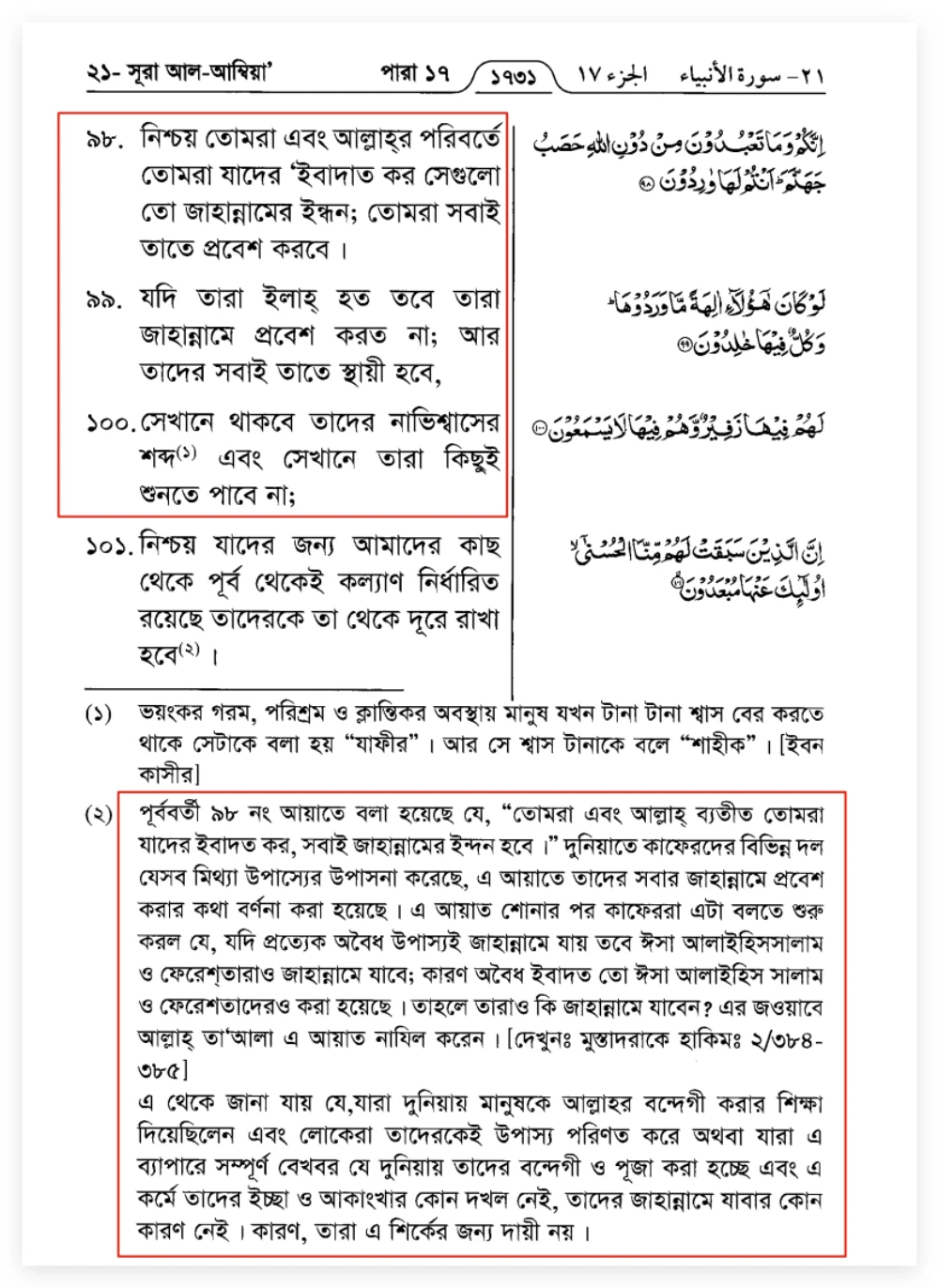
Classical commentaries on Surah al-Anbiya 21:98–101 recount this debate in detail. [29]
Tafsir Ibn Kathir (English rendering of the Bengali translation)
Commentary on verses 98–103: Allah addresses the polytheists of the Meccan Quraysh: You and your idols will be fuel for the fire of Hell. As Allah the Exalted says [Arabic omitted in the Bengali source], meaning: “Its fuel will be people and stones.” In the Abyssinian language, the [Arabic] word is called [Arabic], meaning fuel or firewood. In one reading, [Arabic] occurs instead of [Arabic]. Allah the Exalted says: You and those you worship instead of Allah are fuel for Hell; you will all enter it. Had they been deities, they would not have entered Hell.
They will all remain there forever. There they will groan. As stated elsewhere [Arabic]: “There they will groan and cry out.” They will hear nothing there except these groans and cries. It is narrated from Ibn Masud (may Allah be pleased with him) that when only the polytheists remain in Hell, they will be confined in receptacles of fire with nails of fire. Each person inside will think that no one else is in Hell. He then recited this verse [Arabic]. (This is narrated in the Musnad of Ibn Abi Hatim. Imam Ibn Jarir also narrated it.) [Arabic] means mercy and felicity.
[Relevant subsequent passage]
Some say that this refers to righteous individuals who were devoted to Allah and displeased with the polytheists.
But later people began worshipping them against their wishes, such as Uzayr (peace be upon him), Jesus (peace be upon him), the angels, the sun, the moon and Mary (peace be upon her). It is narrated from Ibn Abbas (may Allah be pleased with him) that Abdullah ibn al-Ziba’ra once approached the Prophet (peace be upon him) and said: “You claim that Allah revealed this verse [Arabic]. If that is true, will the sun, moon, angels, Uzayr, Jesus and others all go to Hell alongside our idols?” In answer to his question Allah revealed these two verses [Arabic] (43:57–58).
He then revealed this verse [Arabic]. (Abu Bakr Ibn Mardawayh narrated it.) Once the Messenger of Allah (peace be upon him) was sitting in the mosque with Walid ibn al-Mughira. Al-Nadr ibn al-Harith arrived, and many other Quraysh were present. Al-Nadr ibn al-Harith conversed with the Messenger of Allah, but was left without an answer. The Messenger then recited the verses from [Arabic] to [Arabic]. After he rose and left the gathering, Abdullah ibn al-Ziba’ra arrived. The people told him that al-Nadr ibn al-Harith had conversed with the Messenger that day but had been left without a reply.
“The Messenger of Allah (peace be upon him) then rose and left, saying that we and our deities would all become fuel for the fire of Hell.” Hearing this, Abdullah ibn al-Ziba’ra said: “Had I been there, I would have answered that we worship the angels, the Jews worship Uzayr (peace be upon him), and the Christians worship Jesus (peace be upon him). Then all of them will go to Hell.” Everyone liked his answer very much. When this was reported to the Messenger of Allah, he said: “Whoever causes himself to be worshipped will go to Hell with his worshippers. But these righteous individuals did not cause themselves to be worshipped.
In fact, these people worship devils rather than them. Satan showed them the way to worship them.” Immediately following his answer, Allah revealed the subsequent verse [Arabic] in response. Thus the righteous whom ignorant people worshipped were excluded. Allah the Exalted says [Arabic], meaning: “Whoever among them says, ‘I am a deity apart from him (Allah),’ his recompense is Hell; thus do I recompense the wrongdoers.” Because of their argument about Jesus, Allah revealed the following verses [Arabic], meaning: “When the son of Mary is presented as an example, your people raise an uproar.
They say: Are our gods better, or Jesus? They say this to you only for the sake of argument. Indeed, they are a contentious people. He was only a servant of ours upon whom we bestowed favor and whom we made an example for the Children of Israel. Had we willed, we could have made angels from among you to succeed one another on earth. Jesus is a sign of the Hour; therefore do not doubt it and follow me. This is the straight path.” (43:57–61) Ibn al-Ziba’ra was gravely mistaken, because this verse addresses the disbelievers of Mecca and speaks of the idols and stones they worshipped apart from Allah.
This statement does not concern Jesus (peace be upon him) and other holy monotheists. They forbade people from worshipping anything other than Allah! Imam Ibn Jarir says that the [Arabic] word used here in Arabic applies to inanimate and non-rational things.
Tafsir Abu Bakr Zakaria (English rendering of the Bengali translation)
98: Surely you and those you worship instead of Allah are fuel for Hell; you will all enter it.
99: Had they been gods, they would not have entered Hell; all of them will remain there forever.
100: There will be the sound of their gasping [1], and they will hear nothing there;
101: Surely those for whom goodness has already been decreed by us will be kept far from it [1].
[1] The preceding verse 98 states: “You and those you worship apart from Allah will all be fuel for Hell.” This verse describes all the false objects of worship venerated by various groups of disbelievers in this world entering Hell. Upon hearing it, the disbelievers began saying that if every unlawful object of worship goes to Hell, then Jesus (peace be upon him) and the angels will also go to Hell, since Jesus and the angels have also been unlawfully worshipped. Will they therefore go to Hell too? In answer, Allah revealed this verse.
[See: Mustadrak al-Hakim: 2/384385] This indicates that those who taught people to worship Allah but whom people subsequently made objects of worship, or those who are entirely unaware that they are being worshipped in the world and whose will and desire played no part in it, have no reason to go to Hell. They are not responsible for this shirk.
[1] When someone repeatedly exhales under severe heat, exertion and exhaustion, this is called zafir. Inhaling that breath is called shahiq. [Ibn Kathir]
Tafsir al-Qurtubi — First and second questions (English rendering of the Bengali translation)
[Surah al-Anbiya (21): verse 98] Surely you and those you used to worship instead of Allah are fuel for Hell; you will enter it. (98) There are four questions for discussion here. First: Allah’s statement, “Surely you and whatever you used to worship…” Ibn Abbas (may Allah be pleased with him) said: This is a verse that people do not ask me about! I do not know whether they refrain from asking because they understand it or because they are ignorant of it [1]. He was asked which verse it was. He said: “Surely you and those you used to worship instead of Allah are fuel for Hell; you will enter it.” When this verse was revealed, it was extremely difficult for the disbelievers of Quraysh.
They said: He (the Messenger ﷺ) has insulted our deities. They went to Ibn al-Ziba’ra and told him about it. He said: Had I been present before him, I would certainly have answered him. They asked what he would have said. He replied: I would have said that the Messiah (Jesus, peace be upon him) is worshipped, and the Jews worship Uzayr; will they also be fuel for Hell? The Quraysh found his words very pleasing and believed that Muhammad (ﷺ) had been defeated in the argument. Allah then revealed: “Surely those for whom goodness has already been decreed by me will be kept far from it (Hell)” [al-Anbiya: 101].
In this context was also revealed: “When the son of Mary was presented as an example” [al-Zukhruf: 57], that is, in the context of Ibn al-Ziba’ra’s [2] argument, “your people began raising an uproar in delight” [al-Zukhruf: 57]. Here yasiddun is read with a kasrah on the letter sad, meaning that they were making a noise or an uproar. Further details will follow [3]. Second: This verse is a foundational proof for the general scope (umum) of words and the existence of a particular form or construction for that scope. The view of those who maintain that no specific linguistic form expresses generality is refuted by this verse and other evidence.
For Abdullah ibn al-Ziba’ra, even in his state of jahiliyyah, understood ma (“whatever”) to encompass all objects of worship (things and persons), and the Quraysh, who were proficient in pure and eloquent Arabic, agreed with his understanding. Had the word not been general in scope, it would not have been appropriate to exclude anyone from it. Since an exception (istithna) has been made here, it establishes that the word is general in scope, and this is very clear.
Tafsir al-Durr al-Manthur — Relevant narration concerning the meaning of wurud (English rendering of the Bengali translation)
Ibn Jarir and Ibn Abi Hatim narrated from Ibn Abbas (may Allah be pleased with him) that he said: The word wurud occurs in four places in the Quran in the sense of entering: in Surah Hud, “How evil is the destination to which they are brought”; in Surah Maryam, “There is none among you who will not pass through it” (19:71); and in the same surah, “We will drive the criminals to Hell in thirst” (19:86); and in Surah al-Anbiya, “You are fuel for Hell; you will enter it” (21:98).
He said: All of these mean entering.
In verses 116–117 of Surah al-Ma’idah, Allah asks Jesus whether he told people to take him and his mother as two deities apart from Allah. Jesus denies the claim and says that he instructed them to worship Allah alone. [30]
وَإِذْ قَالَ اللَّهُ يَا عِيسَى ابْنَ مَرْيَمَ أَأَنتَ قُلْتَ لِلنَّاسِ اتَّخِذُونِي وَأُمِّيَ إِلَٰهَيْنِ مِن دُونِ اللَّهِ ۖ قَالَ سُبْحَانَكَ مَا يَكُونُ لِي أَنْ أَقُولَ مَا لَيْسَ لِي بِحَقٍّ ۚ إِن كُنتُ قُلْتُهُ فَقَدْ عَلِمْتَهُ ۚ تَعْلَمُ مَا فِي نَفْسِي وَلَا أَعْلَمُ مَا فِي نَفْسِكَ ۚ إِنَّكَ أَنتَ عَلَّامُ الْغُيُوبِ
English renderings of the Bengali translations:
Remember when Allah said to Jesus son of Mary: Did you tell people to take you and your mother as deities apart from Allah? He answered: Glorified are you. It is not fitting for me to say what I have no right to say. If I had said it, you would have known it. You know what is within me, but I do not know what is within you. You are fully aware of all hidden matters.
— Taisirul Quran
And when Allah will say: Jesus son of Mary, did you tell people to worship you and your mother alongside Allah? Jesus will say: Glorified are you! It was in no way fitting for me to say what I have no right to say. Had I said it, you would surely know it; you know what is within my heart, whereas I do not know what is within your knowledge. You alone know all unseen matters.
— Sheikh Mujibur Rahman
And when Allah will say, “Jesus son of Mary, did you tell people to take you and your mother as deities apart from Allah?” He will say, “Glorified and exalted are you; I cannot say what I have no right to say. Had I said it, you would certainly know it. You know what is within me, and I do not know what is within you; surely you know all unseen things.”
— Rawai Al-bayan
And remember when Allah will say, “Jesus son of Mary, did you tell people to take you and your mother as two deities apart from Allah?” He will say, “You are glorified! It is not fitting for me to say what I have no right to say. Had I said it, you would have known it. You know what is within me, but I do not know what is within you; surely you know the unseen best.”
— Dr. Abu Bakr Muhammad Zakaria
مَا قُلْتُ لَهُمْ إِلَّا مَا أَمَرْتَنِي بِهِ أَنِ اعْبُدُوا اللَّهَ رَبِّي وَرَبَّكُمْ ۚ وَكُنتُ عَلَيْهِمْ شَهِيدًا مَّا دُمْتُ فِيهِمْ ۖ فَلَمَّا تَوَفَّيْتَنِي كُنتَ أَنتَ الرَّقِيبَ عَلَيْهِمْ ۚ وَأَنتَ عَلَىٰ كُلِّ شَيْءٍ شَهِيدٌ
English renderings of the Bengali translations:
I told them nothing other than what you commanded me: that they should worship Allah, my Lord and your Lord. I was a witness to their deeds as long as I was among them. Then, when you took me up, you were the overseer of their actions, and you are a witness to everything.
— Taisirul Quran
I told them only what you commanded me: Worship Allah, my Lord and your Lord. As long as I was among them, I was aware of them. Then, when you took me up, you were their guardian; indeed, you are fully informed about everything.
— Sheikh Mujibur Rahman
“I told them only what you commanded me: Worship Allah, my Lord and your Lord. As long as I remained among them, I was a witness over them. Then, when you took me up, you were their watcher. And you are a witness over everything.”
— Rawai Al-bayan
“I told them nothing except what you commanded me: Worship Allah, my Lord and your Lord. As long as I was among them, I was a witness to their deeds, but when you took me up [1], you were the overseer of their actions, and you are a witness to everything [2].”
— Dr. Abu Bakr Muhammad Zakaria
In the Islamic narrative, Jesus’ moral responsibility is determined by his own statements and intentions. He denies having claimed worship for himself or his mother. His involuntary worship is thus distinct from the position of a conscious being who demands worship for itself.
Islamic narratives assign moral responsibility to conscious beings who demand their own worship. Surah al-Anbiya 21:29 directly specifies Hell as the punishment for claiming divinity. Inanimate idols, by contrast, are presented as fuel for Hell, and involuntarily worshipped individuals like Jesus are excluded from punishment. The most significant aspect of this classification is that Islamic belief itself retains the concept of conscious supernatural beings with volition behind some pagan objects of worship. [31]
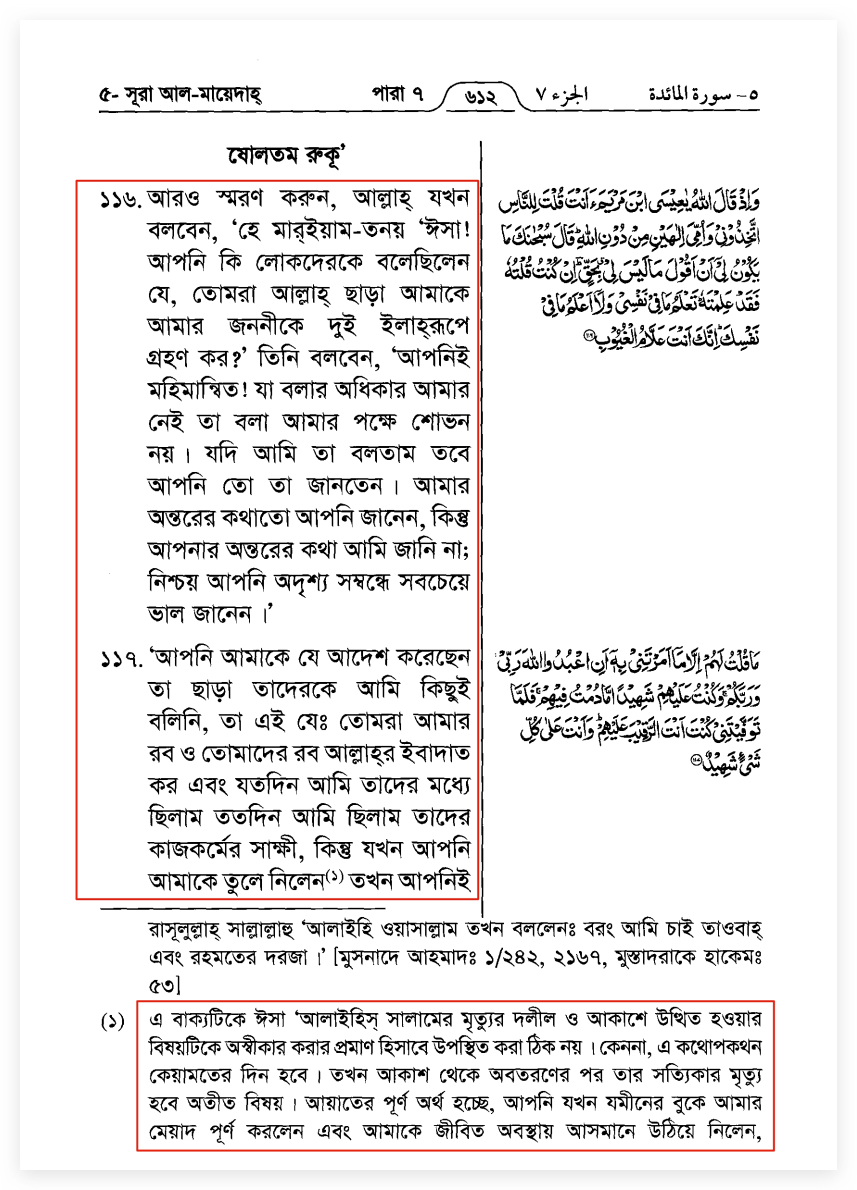
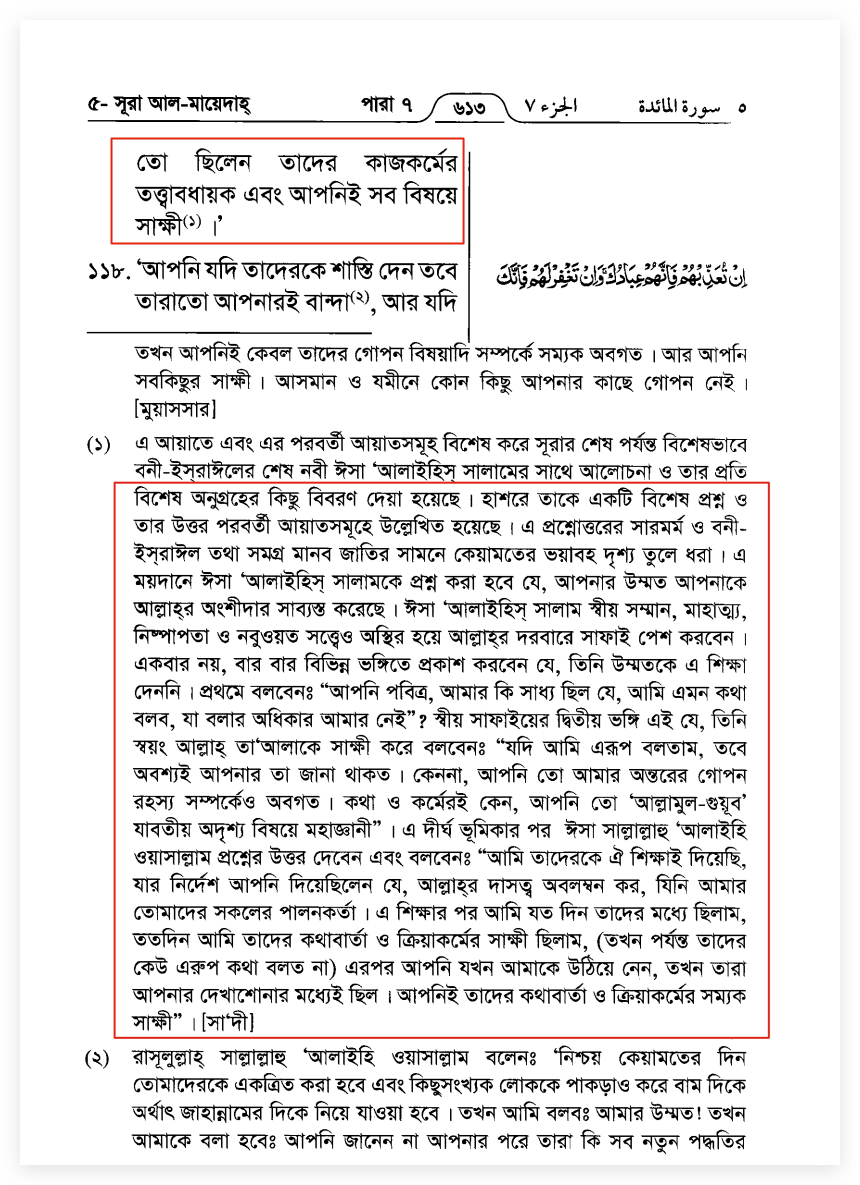
Commentators’ interpretations of Jesus’ statement and the timing of the judgment: [32] [33]
Tafsir Ibn Kathir (English rendering of the Bengali translation)
Commentary on verses 116–118: On the Day of Resurrection, Allah will address Jesus (peace be upon him) with these words in the presence of those who made him and his mother objects of worship. Through these words Allah rebukes and warns the Christians. Qatadah and others stated this. Qatadah cited as proof Allah’s statement [Arabic], meaning that this is the day on which the truthful will be rewarded for their truthfulness. Al-Suddi says that this address and answer occurred in this world. Ibn Jarir supports this view, saying that it relates to the occasion when Jesus (peace be upon him) was raised to heaven.
Imam Ibn Jarir adduces two types of evidence for this. First, the statement uses [Arabic], a past-tense verb meaning “said.” Second, [Arabic] and [Arabic] form a conditional statement, which was made in this world; the condition concerning punishment and forgiveness was deferred to the hereafter. These two arguments merit examination. What does the past tense establish? Most events of the Day of Resurrection are described with past-tense verbs to indicate the certainty of their occurrence.
As for the conditional nature of [Arabic], this expresses Jesus’ displeasure with sinners and leaves their fate to Allah’s will. Connecting a matter with a condition does not require it to have occurred. There are many examples of this in the Quran. Qatadah’s narration is very clear on this matter: the conversation will occur on the Day of Resurrection, exposing everything concerning the Christians before all present and creating fear and terror in their hearts.
Abu Musa al-Ash’ari (may Allah be pleased with him) narrates that the Messenger of Allah (peace be upon him) said: On the Day of Resurrection the prophets and their communities will be summoned. Then Jesus (peace be upon him) will be called, and Allah will remind him of his favors, which he will acknowledge. Allah will then ask: Did you tell people to take you and your mother as deities apart from Allah? He will deny it. Then the Christians will be brought and questioned about it. They will say, “Yes, he gave us this command.”
Upon hearing this, the hair of Jesus’ head and body will stand on end in fear. The angels will hold his hair. These Christians will be made to sit before Allah on their knees for a thousand years. Finally, the proof will be established against them and the truth revealed before them. The cross will be raised for them, and they will be driven toward Hell. (Hafiz Ibn Asakir narrated this hadith, and Ibn Kathir called it gharib and aziz.) [Arabic] How graciously Jesus was enabled to answer, and how beautifully his heart was filled with arguments.
He says: O Allah! How could I say something I have no right to say? Even if I had said it, you would know it well, for nothing is hidden from you. You know what is in my heart, but I have no knowledge of your will. I did not add a single letter to what you commanded me. I told them only this: Worship Allah, who is my Lord and your Lord. As long as I was among them, I supervised their deeds. Since you took me up, you have supervised their actions.
And you are fully aware of every action.
Tafsir al-Qurtubi (English rendering of the Bengali translation)
[Surah al-Ma’idah (5): verse 116]
Remember when Allah will say: Jesus son of Mary, did you tell people to take you and your mother as two deities apart from Allah? He will say: Glorified and exalted are you! It is not fitting for me to say what I have no right to say.
Had I said it, you would surely have known it. You know what is within me, but I do not know what is within you. Surely you know the unseen fully. (116) Concerning Allah’s words (Remember when Allah will say: Jesus son of Mary, did you tell people to take you and your mother as two deities apart from Allah?), there is disagreement about the timing of this conversation. Qatadah, Ibn Jurayj and most commentators say that this will be said to him on the Day of Resurrection. Al-Suddi and Qutrub say that it was said when he was raised to heaven and the Christians began making false statements about him.
They cite as evidence Allah’s words, “If you punish them, they are your servants” [al-Ma’idah: 118], because in Arabic the word idh is primarily used for the past tense. But the first view is more sound, as demonstrated by the preceding verse: “On the day when Allah gathers the messengers” [al-Ma’idah: 109].
Tafsir al-Durr al-Manthur — Relevant reports (English rendering of the Bengali translation)
One group said of Jesus (peace be upon him) that he was Allah. Another said that he was Allah’s son. Another said that he was Allah’s servant and spirit; this is the moderate group, the Muslims among the People of the Book. Ibn Jarir and Ibn Abi Hatim narrated from al-Suddi, concerning Allah’s words “Those who say Allah is the third of three have certainly disbelieved,” that Christians said Allah was the Messiah and his mother. This is Allah’s statement: “Did you tell people to take you and your mother as two deities apart from Allah?” (Surah al-Ma’idah, verse 116).
[Relevant subsequent passage]
Ibn Abi Hatim, Ibn Asakir and Ibn Mardawayh narrated from Abu Musa al-Ash’ari (may Allah be pleased with him) that the Messenger of Allah (peace be upon him) said: “On the Day of Resurrection the prophets and their communities will be summoned.
Then Jesus (peace be upon him) will be called, and Allah will remind him of the blessings bestowed upon him, which he will acknowledge. Allah will say: Jesus son of Mary, remember my favor upon you and your mother … (to the end of the verse). Then he will ask: Did you tell people to take you and your mother as two deities apart from Allah? (Surah al-Ma’idah, verse 116). He will deny it. Then the Christians will be brought and asked about it, and they will say: ‘Yes, he told us this.’”
Al-Uzza: From Pagan Goddess to Female Devil
Sirah accounts state that after the conquest of Mecca, the Prophet Muhammad sent his companion Khalid ibn al-Walid to destroy the famous idol of the goddess al-Uzza. She was the greatest and most important goddess of the Quraysh and Banu Kinanah tribes. After Khalid first went there, broke the idol and returned, Muhammad asked him, “Did you see anything?” Khalid answered no. Muhammad then said, “Then you have not destroyed the idol. Go back.” When Khalid reached the sanctuary for the second time, he saw a naked Black woman approaching him. According to the quoted sirah account, Khalid killed her. When he returned and recounted the incident, Muhammad said, “Yes, that woman was al-Uzza. She has forever lost hope of being worshipped in your land.” [34]
Dispatching military detachments and delegations (English rendering of the Bengali translation)
1. After the conquest of Mecca, on 25 Ramadan 8 AH, the Messenger (peace be upon him) sent a detachment under Khalid ibn al-Walid (may Allah be pleased with him). This expedition was sent to eliminate al-Uzza. Al-Uzza was in Nakhlah. The Quraysh and the entire Banu Kinanah tribe worshipped this idol. It was their greatest idol. The Banu Shayban tribe tended it. Khalid went to Nakhlah with thirty mounted soldiers and broke the idol. Upon his return, the Messenger (peace be upon him)
asked Khalid: Did you see anything? He answered: No, nothing. The Messenger (peace be upon him) said: Then you have not destroyed the idol, have you?
Khalid went back with his sword drawn. This time he saw a naked Black woman with a shaven head approaching him. Khalid struck her with his sword.
The woman was cut in two. Khalid then returned and informed the Messenger (peace be upon him). He said: Yes, that was al-Uzza. Now she has lost hope of being worshipped in your land.
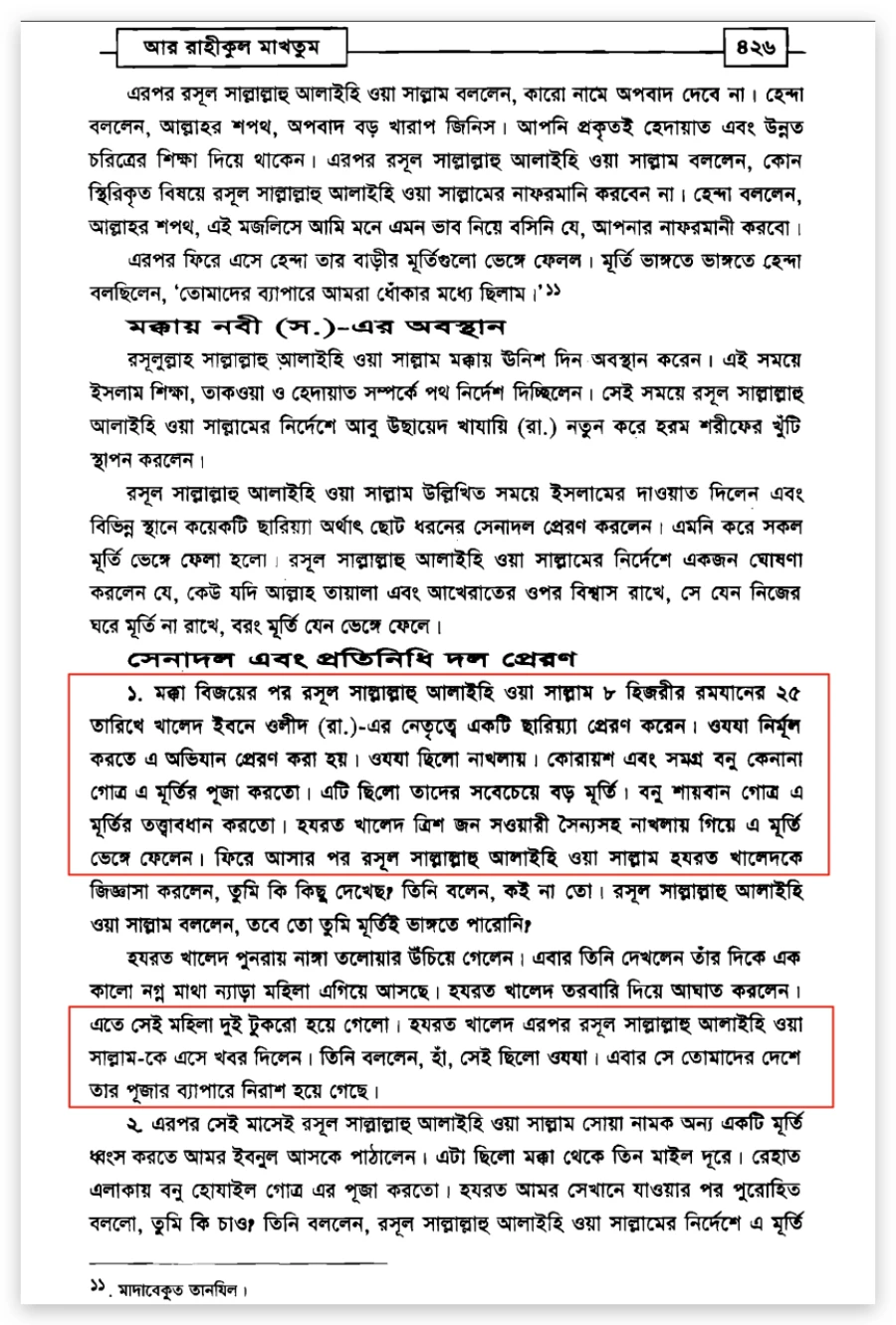
The story of al-Uzza makes the issue clearer. IslamQA discusses the accounts of al-Tabari, al-Tha’labi, Yaqut and al-Nasa’i and concludes that there was a female devil at al-Uzza’s sanctuary, who spoke to worshippers from inside it and whom Khalid killed. In its words: “فيها شيطانة”—“There was a female devil in it”; more explicitly, “وهي التي كانوا يعبدونها في الحقيقة من دون الله”—“In reality, she was the one they worshipped instead of Allah.” The chain of al-Nasa’i’s report 11483 is graded hasan there. [35] Destroying al-Uzza’s idol or sanctuary was thus not the end of the matter; Islamic interpretation itself presents a devilish being receiving worship behind it as existent.
The concept of demanding one’s own worship and being punished for it is directly related to the story of al-Uzza’s female devil.
The Islamic narrative of al-Uzza therefore creates a strange two-layered structure. Al-Uzza’s divinity as a goddess is denied, but the recipient of worship behind her sanctuary is not eliminated; she is reidentified as a devil. The name and theological status have changed, but the supernatural being on the receiving end of pagan worship remains. Comparing the worship of jinn in Sahih Muslim, Quran 34:41’s statement “they worshipped the jinn” and the account of al-Uzza, “in reality, she was the one they worshipped,” reveals a clear pattern within Islam’s anti-pagan interpretation: rather than completely erasing the existence of the old gods, it reidentifies them as jinn or devils.
“I” and “We”: Changes in Number in the Voice of the Quranic God
The God of the Quran does not consistently use the same grammatical form for himself. Sometimes he directly uses the singular “I”, “me” and “my,” while elsewhere the actions of the same God are expressed using “we”, “our” and plural verbs. A particularly significant example is Surah al-Anbiya 21:25, where the sentence begins, “We sent no messenger before you to whom we did not reveal”—and at its end the same speaker declares in the singular, “There is no deity but me; therefore worship me.” The speaker thus shifts from “we” to “I” within a few words in the same verse. [36] A similar change occurs in Surah al-Qiyamah 75:1–4: first, “I swear,” then, “Shall we not gather his bones?” Islamic interpretations generally explain this as jam’ al-ta’zim, or the majestic plural, and Quranic iltifat, or rhetorical shift. Yet it is difficult to demonstrate that this use directly continues an established form of royal speech in pre-Islamic Arabia. M. A. S. Abdel Haleem’s research on Quranic language notes that clear precedents for kings or tribal chiefs using such plural pronouns of themselves to indicate social status are not found in pre-Islamic Arabic literature or at the time of the Quran’s revelation; in his account, this usage acquired a distinctive rhetorical form in the Quran. [37]
Is “We” Merely the Majestic Plural?
It is also noteworthy that Islamic interpretation does not treat every Quranic “we” solely as a plural of majesty used by one speaker. In explaining “nahnu” or “we,” Ibn Taymiyyah says that this form can also be used by a powerful person with obedient assistants; when subordinates complete a task at his command, that powerful person can say, “We did this.” He directly includes the Quranic angels in this explanation and says that the plural can occur in reference to acts Allah has carried out through his angels. [38] IslamQA likewise quotes Ibn Taymiyyah’s explanation: Allah’s “we” is also used for tasks performed by angels at his command. [39] The familiar later Islamic theological answer, “It is merely the royal we,” is therefore not the whole picture; influential Islamic interpretation itself contains the idea of the effective participation of subordinate supernatural beings alongside the speaker.
The problem becomes clearer because the word “we” in the Quran does not always refer to Allah. In Surah al-Saffat 37:164–166, angels speak of themselves as “we”; in Surah Maryam 19:64, the speaker says, “We descend only at the command of your Lord”—here the speaker cannot be Allah because “your Lord” is separately mentioned in the third person in the same sentence. For this reason, Richard Bell and W. Montgomery Watt discussed reading “we” in a number of Quranic passages as the voice of angels or Gabriel rather than Allah’s supposed majestic plural. They even acknowledged that in many cases the boundary between Allah’s “we” and the angels’ “we” is not easy to establish. [40] Automatically translating every Quranic plural pronoun as the “majestic we” cannot settle the problem; the identity of the speaker must first be established.
From the Ancient Semitic Divine Council to the Quranic Heavenly Assembly: The Pagan Legacy of Monotheism
An investigation into the historical origins of Quranic theology leads to ancient West Semitic religious traditions. However much the concept of a supreme deity in modern Jewish, Christian and Islamic theology is promoted as an eternal and immutable truth, it has a long history of development in the religions of the ancient Near East. In ancient Canaanite and Ugaritic religion, the celestial world was conceived as an organized system of gods and goddesses with different powers and responsibilities under a supreme deity. El, the supreme god, his consort Asherah, the god Baal, Anat and other celestial beings belonged to this religious framework. Modern religious scholarship refers to this assembly of gods as a Divine Council. Clear traces of this polytheistic religious environment are also found in ancient Israelite religion. [41] [42]
In his comparative study of ancient Ugaritic religious literature and the Bible, Mark S. Smith identifies a hierarchical structure of the heavenly family and divine council. El and Asherah occupied its highest tier. The next tier comprised other members of the divine family, followed by specialist deities with particular responsibilities, and the lowest tier by celestial messengers and servants. According to Smith’s historical reconstruction, Yahweh’s position and relationship to other gods in Israelite religion changed over time. At one stage, Yahweh became identified with El, the supreme deity, and in subsequent monotheistic theology the power and status of other gods increasingly came under his exclusive authority. Many members of the ancient divine council survived in religious literature under the identities of subordinate celestial beings and messengers. [43]
This development of monotheism vividly reveals the historical character of religion. Just as an absolute monarch may be established over numerous tribal leaders in a society’s political system, one god among many was gradually established in the religious imagination as the holder of supreme and exclusive power. Although other gods were stripped of their former status, the administrative structure of the heavenly realm and the concepts of subordinate officials, messengers, guards, judges and supernatural beings assigned particular responsibilities survived in religious literature. The old pagan cosmology was given a new monotheistic form through the redistribution of divine powers and status.
| Heavenly structure | Ancient Semitic religious tradition | Analogous concept in Islamic theology |
|---|---|---|
| Supreme divine authority | The supreme deity of the divine council, such as El. | Allah, who exercises authority over all celestial beings. |
| Celestial assembly | An assembly of other gods and celestial beings around the supreme deity. | Al-mala’ al-a’la (الملأ الأعلى), or the heavenly assembly. Quran 37:8 and 38:69. |
| Heavenly royal throne | The supreme deity’s throne and the celestial attendants surrounding it. | Allah’s Throne, the angels who carry it and those around it. Quran 40:7. |
| Divine messengers | Subordinate celestial beings who convey the gods’ commands and messages. | Gabriel and the angels who convey Allah’s commands. |
| Celestial dispute | Discussions, opinions and disputes on various matters in the divine council. | The angels’ questions about Adam’s creation and the dispute in the heavenly assembly. Quran 2:30–34 and 38:69. |
| Disobedience of subordinate beings | Conflict with the supreme deity and disputes over celestial authority. | Iblis disobeying the command to prostrate before Adam and conversing with Allah. |
| Mediation and intercession | Celestial intermediaries between humans and higher deities. | Angels and other beings interceding by Allah’s permission. |
| Division of divine labor | Distinct responsibilities of the various members of the divine council and celestial family. | Angels assigned to convey revelation, take souls, record deeds, administer punishment and perform other tasks. |
One of the clearest references to the ancient divine council in the Old Testament is Psalm 82. God is depicted standing among other gods and judging them. These gods are accused of unjust judgment and sentenced to die like mortals. They are also called children of the Most High. An entire religious narrative concerning the powers, moral responsibility, judicial role and fate of the other beings present in the divine council is preserved here. [44]
God standeth in the congregation of the mighty; he judgeth among the gods.
How long will ye judge unjustly, and accept the persons of the wicked? Selah.
Defend the poor and fatherless: do justice to the afflicted and needy.
Deliver the poor and needy: rid them out of the hand of the wicked.
They know not, neither will they understand; they walk on in darkness: all the foundations of the earth are out of course.
I have said, Ye are gods; and all of you are children of the most High.
But ye shall die like men, and fall like one of the princes.
Arise, O God, judge the earth: for thou shalt inherit all nations.
English rendering of the Bengali translation:
God stands in the assembly of the mighty; he judges among the gods.
How long will you judge unjustly and favor the wicked?
Protect the poor and fatherless; do justice to the afflicted and needy.
Rescue the poor and needy; deliver them from the hands of the wicked.
They do not know or understand; they walk in darkness; all the foundations of the earth are shaken.
I said, you are gods, all of you children of the Most High. But you will die like mortals and fall like one of the princes.
Rise, O God, judge the earth, for all nations will be your inheritance.
This passage in Psalms bears a structural resemblance to an important statement in Surah al-Anbiya of the Quran. There, a subordinate celestial being who declares itself a deity apart from Allah is threatened with the punishment of Hell. In the biblical divine council, the supreme God’s judicial authority over other gods is established; in the Quranic celestial framework, an assertion of independent divinity by beings subject to that judicial authority is identified as an offense. Both religious narratives contain the idea of a supreme authority ruling over celestial beings and having the power to punish them. [45]
وَمَن يَقُلْ مِنْهُمْ إِنِّي إِلَٰهٌ مِّن دُونِهِ فَذَٰلِكَ نَجْزِيهِ جَهَنَّمَ ۚ كَذَٰلِكَ نَجْزِي الظَّالِمِينَ
English translation:
Whoever among them says, “I am a deity apart from him,” we will recompense with Hell. Thus do we recompense the wrongdoers.
Al-Tabari explicitly mentions angels in his interpretation of this verse. According to his explanation, if any angel declares itself a deity apart from Allah, it will be punished with Hell. He also preserves an interpretation identifying Iblis as the specific being intended in this verse. Ibn Jurayj’s narration states that Iblis called others to worship him. [46]
يقول تعالى ذكره: ومن يقل من الملائكة: إني إله من دون الله (فَذَلِك) الذي يقول ذلك منهم (نَجْزِيهِ جَهَنَّمَ) يقول: نثيبه على قيله ذلك جهنم (كَذَلِكَ نَجْزِي الظَّالِمِينَ) يقول: كما نجزي من قال من الملائكة إني إله من دون الله جهنم، كذلك نجزي ذلك كل من ظلم نفسه، فكفر بالله وعبد غيره، وقيل: عنى بهذه الآية إبليس، وقال قائلو ذلك: إنما قلنا ذلك، لأنه لا أحد من الملائكة قال: إني إله من دون الله سواه.
English translation:
Allah says: Whoever among the angels says, “I am a deity apart from Allah,” we will recompense the one who says this with Hell. That is, his recompense for saying this will be Hell. Just as an angel who declares himself a deity apart from Allah will be recompensed with Hell, so will every person who wrongs himself, disbelieves in Allah and worships another. It is also said that this verse refers to Iblis. Those who hold this view say that no angel other than him declared himself a deity apart from Allah.
This change is particularly significant in the transition from the divine council to a monotheistic heavenly assembly. The independent divinity and right to receive worship of various celestial beings in the old religious imagination were revoked, while their individuality, supernatural powers, relationships, responsibilities and moral accountability were retained. The reidentification of al-Uzza as a female devil, the conversion to Islam of jinn worshipped by Arabs, and the declaration that celestial beings demanding worship will be punished in Hell are consistent with this same theological reorganization. Through religious struggle against the old gods, a supreme deity has taken their place, and the heavenly realm is administered through countless subordinate supernatural beings.
This structure of Islamic theology is no unprecedented divine discovery; its fundamental elements were already present in Semitic religious literature centuries before Islam emerged. The ancient divine council, the heavenly throne, subordinate supernatural beings, their disputes and the supreme deity’s judicial authority all have a long human and cultural history. This old mythological framework has been presented in new religious terminology and accorded the status of eternal and infallible divine knowledge.
The Quranic Al-Mala’ Al-A’la: The Islamic Version of the Ancient Divine Council
One of the most important Quranic terms for investigating the relationship between Islamic theology and the ancient Semitic divine council is al-mala’ al-a’la (الملأ الأعلى), meaning the heavenly assembly or highest assembly. This celestial assembly is explicitly mentioned in Surahs al-Saffat and Sad. In verse 69 of Surah Sad in particular, members of the heavenly assembly are said to have been disputing among themselves. Subsequent verses connect this celestial dispute with Adam’s creation and the command to prostrate before him. The Quranic heavenly realm is thus not confined to describing a solitary deity: it contains an assembly, members of that assembly, exchanges of views and disputes among them, and the authority of a supreme ruler over them. [47]
مَا كَانَ لِيَ مِنْ عِلْمٍ بِالْمَلَإِ الْأَعْلَىٰ إِذْ يَخْتَصِمُونَ
English translation:
I had no knowledge of the heavenly assembly when they were disputing among themselves.
Al-Tabari’s commentary cites the statements of Ibn Abbas, al-Suddi and Qatadah in explaining this verse. The report attributed to Ibn Abbas states that the angels were consulted about Adam’s creation and disputed the matter. Qatadah’s explanation directly connects the creation of Adam in Surah al-Baqarah and the heavenly assembly’s dispute in Surah Sad as parts of the same event. This connection between the heavenly assembly and the dispute over Adam’s creation is therefore not an interpretation imposed by a modern researcher; it is preserved in one of the oldest and most influential traditions of Islamic exegesis. [48]
حدثني محمد بن سعد, قال: ثني أبي, قال: ثني عمي, قال: ثني أبي, عن أبيه, عن ابن عباس, قوله (مَا كَانَ لِيَ مِنْ عِلْمٍ بِالْمَلإ الأعْلَى إِذْ يَخْتَصِمُونَ) قال: الملأ الأعلى: الملائكة حين شوروا في خلق آدم, فاختصموا فيه, وقالوا: لا تجعل في الأرض خليفة.
حدثنا محمد, قال: ثنا أحمد, قال: ثنا أسباط, عن السديّ (بِالْمَلإ الأعْلَى إِذْ يَخْتَصِمُونَ) هو: وَإِذْ قَالَ رَبُّكَ لِلْمَلائِكَةِ إِنِّي جَاعِلٌ فِي الأَرْضِ خَلِيفَةً.
حدثنا بشر, قال: ثنا يزيد, قال: ثنا سعيد, عن قتادة, قوله (مَا كَانَ لِيَ مِنْ عِلْمٍ بِالْمَلإ الأعْلَى) قال: هم الملائكة, كانت خصومتهم في شأن آدم حين قال ربك للملائكة: إِنِّي خَالِقٌ بَشَرًا مِنْ طِينٍ … حتى بلغ سَاجِدِينَ وحين قال: إِنِّي جَاعِلٌ فِي الأرْضِ خَلِيفَةً … حتى بلغ وَيَسْفِكُ الدِّمَاءَ ففي هذا اختصم الملأ الأعلى.
English translation:
Muhammad ibn Sa’d narrated through his chain from Ibn Abbas, who explained the verse “I had no knowledge of the heavenly assembly when they were disputing” as follows: The heavenly assembly means the angels when they were consulted about Adam’s creation. They disputed the matter and said: Do not appoint a vicegerent on earth.
Al-Suddi narrated that “the heavenly assembly when they were disputing” refers to the occasion when your Lord said to the angels: I am going to appoint a vicegerent on earth.
Qatadah said: They are the angels. Their dispute concerned Adam, when your Lord said to the angels: I am creating a human from clay … up to “prostrate”; and when he said: I am going to appoint a vicegerent on earth … up to “shed blood.” It was over this that the heavenly assembly disputed.
The Quran also imagines the heavenly assembly as a place where celestial beings converse about Allah’s decisions and commands and devils attempt to listen secretly to their conversations. Verse 8 of Surah al-Saffat describes devils being prevented from hearing news from the heavenly assembly and being pelted from various directions. Al-Tabari’s explanation describes the assembly as a group of angels of higher rank than others. Ibn Kathir explains that when the angels converse about Allah’s decrees and determinations, the devils are repelled so that they cannot hear those heavenly conversations. [49] [50]
(لا يسمعون إلى الملإ الأعلى) أي : لئلا يصلوا إلى الملأ الأعلى ، وهي السماوات ومن فيها من الملائكة ، إذا تكلموا بما يوحيه الله مما يقوله من شرعه وقدره ، كما تقدم بيان ذلك في الأحاديث التي أوردناها عند قوله تعالى : (حتى إذا فزع عن قلوبهم قالوا ماذا قال ربكم قالوا الحق وهو العلي الكبير) [سبأ : 23] ولهذا قال : (ويقذفون) أي : يرمون (من كل جانب) أي : من كل جانب يقصدون السماء منها
English translation:
“They cannot listen to the heavenly assembly” means that they cannot reach the heavenly assembly. It consists of the heavens and the angels therein, when they converse about what Allah reveals to them concerning his laws and decrees. This was described previously in the hadiths cited in the explanation of verse 23 of Surah Saba. Hence it is said that they are pelted, meaning that they are struck from every direction from which they attempt to approach heaven.
This narrative contains almost every characteristic of an ancient royal court. There is a supreme ruler, subordinate officials, confidential conversations and exchanges of information among them, and guards to prevent unauthorized individuals from overhearing the news. The political and administrative experience of ancient humans is projected onto a cosmic scale to construct the idea of a heavenly royal court. Whether these imaginary beings are called gods, angels or devils, their conduct and relationships clearly reflect human social organization and political power structures.
The Heavenly Assembly in the Bible and Quran: A Verse-by-Verse Comparison
The Old Testament contains many accounts of God using plural speech about himself, announcing decisions before other celestial beings, disputes within a celestial assembly, supernatural beings surrounding the throne, and the exercise of judicial authority over them. The same kinds of religious elements appear throughout the Quran’s verses and narratives. Placing ancient biblical passages alongside Quranic statements makes the structural and linguistic similarities between the two religious traditions clear. The following table presents English renderings of the relevant Bengali passages, based on the King James Version of the Bible and the corresponding Quranic verses.
| Old Testament | Quran | Similarities in the Semitic religious framework |
|---|---|---|
| Human creation and the divine plural God said, Let us make humanity in our image, according to our likeness. Genesis 1:26 | Adam’s creation and the assembly of angels Your Lord said to the angels: I am going to appoint a vicegerent on earth. … And when we said to the angels: Prostrate before Adam. Surah al-Baqarah 2:30–34 | The association of human creation with celestial plurality and the presence of other supernatural beings. |
| Comparison of human and celestial knowledge The Lord God said: Behold, the human, having acquired knowledge of good and evil, has become like one of us. Genesis 3:22 | Comparison of Adam’s knowledge and the angels’ knowledge He taught Adam all the names. He then presented them before the angels and said: Tell me their names if you are truthful. Surah al-Baqarah 2:31–33 | The relative knowledge of humans and celestial beings is compared within a religious narrative. |
| Plural declaration by a singular speaker The Lord said, Let us go down and confound their language there. Genesis 11:5–8 | Plural and singular within the same statement We sent no messenger before you to whom we did not reveal that I alone am the deity; therefore worship me. Surah al-Anbiya 21:25 | Both religious literatures contain shifts between singular and plural divine speech. |
| Judgment and punishment in the divine council God judges among the gods. … I said, you are gods; … but you will die like mortals. Psalm 82:1, 6–7 | Punishment of a celestial being for claiming divinity Whoever among them says, I am a deity apart from him, we will recompense him with Hell. Surah al-Anbiya 21:29 | The supreme deity’s judicial power and authority to punish other celestial beings. |
| Heavenly throne and attendants I saw the Lord sitting on his throne, and all the host of heaven stood on his right and left. 1 Kings 22:19 | Allah’s Throne and beings around it Those who carry the Throne and those around it glorify their Lord with praise and ask forgiveness for the believers. Surah Ghafir 40:7 | A heavenly royal throne, surrounding attendants and an arrangement of power resembling a royal court. |
| Exchange of views in the heavenly assembly The Lord asked: Who will entice Ahab? One said one thing, and another said another. Then a spirit came forward and undertook to entice him. 1 Kings 22:20–23 | Dispute in the heavenly assembly I had no knowledge of the heavenly assembly when they were disputing. Surah Sad 38:69 | Distinct statements by celestial members, their discussions and disputes concerning decisions in the presence of a supreme deity. |
| Satan’s presence in a celestial assembly One day the sons of God came before the Lord, and Satan came among them. Job 1:6–12 | Iblis’s presence among the angels We said to the angels: Prostrate before Adam. They prostrated, except Iblis. He refused and was arrogant. Surah al-Baqarah 2:34 | The presence of an adversarial or disobedient supernatural figure in an assembly of celestial beings before the supreme deity. |
The most important feature of this comparison is the persistent presence of multiple elements of a shared religious imagination. The relationship does not rest on a single isolated pronoun or verbal resemblance. Human creation, celestial assemblies, conversations between God and other beings, divine plurality in speech, a heavenly throne, celestial disputes, the obedience and disobedience of subordinate beings, and their punishment repeatedly appear within the same cultural tradition. Together these elements form a familiar framework in ancient Semitic religious literature, a reorganized form of which is preserved in the Quran.
From Jewish Rabbinic Literature to the Quranic Story of Adam’s Creation
The relationship between the Quranic creation narrative and earlier Jewish religious literature becomes even clearer in post-biblical rabbinic literature. Chapter 8 of the Jewish exegetical work Genesis Rabbah preserves the story of consultation and debate among heavenly angels over Adam’s creation. It describes disagreements among celestial beings about whether humanity should be created. Chapter 17 of the same work also contains the story of naming various animals and comparing Adam’s knowledge with that of the angels. Both themes occur together in Surah al-Baqarah: the angels’ questions regarding Adam’s creation and the subsequent answer through the imparting of knowledge of names.
Researcher Saqib Hussain published a detailed study of this literary relationship entitled “Adam and the Names.” It was published online on 27 November 2024 and appeared in February 2025 in volume 88, issue 1 of the journal Bulletin of the School of Oriental and African Studies. Hussain analyzes the relationship between the Adam narrative in Surah al-Baqarah and the Bible, Genesis Rabbah, the Babylonian Talmud and other Jewish religious accounts. An important focus of his study is the narrative relationship between the celestial assembly’s objection to Adam’s creation and the response to that objection through the imparting of special knowledge to Adam. [51]
The Adam story in Q. 2 is a variant of the Adam creation stories found scattered in various biblical and post-biblical passages
English rendering of the Bengali translation:
The story of Adam in the second surah of the Quran is a different version of Adam’s creation narratives found throughout biblical and post-biblical writings.
Saqib Hussain’s research identifies a particular modification in the Quranic narrative. In earlier Jewish accounts, God’s consultation with the angels and their disagreement over humanity’s potential wrongdoing are central elements. The Quran reworks this familiar narrative to give greater emphasis to God’s exclusive authority and knowledge. Allah announces his decision to create Adam and responds to the angels’ questions by exposing the limitations of their knowledge. Hussain also proposes that the story of Adam being taught the names may concern the identities of his future descendants. On this reading, the emergence of righteous people alongside sinners and bloodshed among humanity also serves as a narrative justification for Adam’s creation.
Such reworking is a familiar process in the history of religious literature. A religious community adopts narratives from earlier societies, changes the roles of their characters, harmonizes them with its own theological doctrines and disseminates them under a new religious identity. The Quranic Adam narrative bears clear literary traces of this process. By replacing the ancient divine council with an assembly of angels, celestial consultation with the supreme deity’s decision, and establishing the superiority of Allah’s knowledge over that of the angels, earlier religious elements are brought within a more centralized theological framework.
Against this historical background, the Quran’s shifting use of “I” and “We” also acquires particular significance. Ancient biblical literature already contained narratives of a deity speaking in the plural, other celestial beings being present, and divine decisions being carried out through them. In the Quran, Allah sometimes asserts his authority in the singular, sometimes speaks of actions in the plural, and sometimes presents plural speech uttered by angels. In Ibn Taymiyyah’s explanation, when angels carry out a task at Allah’s command, Allah may express that act through his own plural speech. The concept of the supreme deity acting through celestial assistants is thus acknowledged in Islamic theology’s own interpretations.
The Quranic heavenly realm is a reconfigured monotheistic form of the ancient Semitic mythological worldview centered on the divine council. The powers and status of various celestial beings in the old divine council are subordinated to a supreme ruler in the Islamic framework. The concepts of a celestial assembly, throne, messengers, subordinate officials, confidential news, dispute, rebellion and punishment remain. What has changed is the definition of the system’s supreme authority and the theological identity of its subordinate beings. This mythological framework, developed over centuries in human religious imagination, is presented in the Quran as a factual description of the universe and as divine knowledge of the unseen world.
According to Islamic belief, Muhammad learned of these events in the unseen world through revelation from Allah. Yet the principal elements of his accounts of the heavenly assembly and Adam’s creation are preserved in religious literature dating long before his birth. In explaining verse 69 of Surah Sad, al-Tabari presents Muhammad’s knowledge of the heavenly dispute as evidence of the Quran’s divine origin. Comparative theology and research into ancient religious literature, however, reveal familiar antecedents of the narrative. The literary and cultural origins of knowledge presented as evidence of miraculous revelation require no supernatural explanation. The circulation, transmission, rewriting and reorganization of religious narratives within new theological frameworks provide a coherent historical explanation for these similarities.
Intercession by pagan goddesses is also central to the ‘Satanic Verses’ narrative preserved in early Islamic traditions. In his commentary on verse 52 of Surah al-Hajj, al-Tabari preserves a report from Muhammad ibn Ka’b al-Qurazi and Muhammad ibn Qays. According to that report, Muhammad referred to the intercession of al-Lat, al-Uzza and Manat as something to be hoped for while reciting Surah al-Najm; the Quraysh then prostrated with him, and the account describes the subsequent withdrawal of the statement through Gabriel. Another account from Ibn Ishaq preserved by al-Tabari also describes a desire to reduce the estrangement from his own community. These narratives present the idea of theological compromise with pagan society during early preaching. [52]
Shahab Ahmed’s study Before Orthodoxy: The Satanic Verses in Early Islam examines the traditions of the first two centuries of Islam and the history of the narrative’s widespread acceptance. That acceptance changed in later Islamic theology. This shift shows that the definition of religious authority regarding prophetic infallibility was itself constructed over time. The “best of creators” in 23:14, the same phrase used in contrast to Baal in 37:125, and the account of pagan goddesses’ intercession all relate to the same ancient religious environment. [53]
Two Contrasting Forms of Language within the Same Meccan Surahs
This problem cannot be resolved by dividing the material into two distinct Meccan and Medinan periods. Several of the strongest declarations of Allah’s exclusive creative power occur in Meccan surahs. Surah al-Zumar is Meccan and states, “Allah is the creator of everything” (39:62). Surah Fatir is also Meccan and asks, “Is there any creator other than Allah?” (35:3). The Meccan Surah al-Nahl says of beings worshipped apart from Allah, “They create nothing; rather, they themselves are created” (16:20). In Surah al-Mu’minun, from the same Meccan period, Allah is called the “best of creators” (23:14), and in Surah al-Saffat the “best of creators” in contrast to Baal (37:125). The issue thus does not concern merely a change in language following the acquisition of political power. Within the same early Quranic theology, the declaration of a sole creator and the comparative language of being the best among multiple khaliqs coexist.
Placing these five verses side by side reveals the central tension. In one place exclusive creative authority is assigned to Allah; elsewhere Allah himself is described among multiple khaliqs as “ahsan,” or best. The commentators explain this linguistic tension by distinguishing the meanings of khaliq: Allah’s creation is actual creation, whereas the creation of others is merely planning or shaping. Yet that interpretation does not alter the Quran’s original phrase: “أحسن الخالقين” is language expressing comparative superiority within a plural group.
Conclusion
Historical, linguistic and comparative analysis of Islamic theology reveals its profound relationship with the ancient Semitic religious worldview. Centuries before Islam emerged, Canaanite and Ugaritic religion contained a hierarchical system of other gods, celestial beings, messengers and attendants assigned special responsibilities under a supreme deity. As ancient Israelite religion evolved, various elements of this polytheistic cosmology gradually came under monotheistic authority. The biblical divine council, God’s plural speech, the heavenly throne, the judgment of other gods and narratives of celestial beings implementing divine decisions form part of this long religious history. The Quran likewise preserves the concepts of a celestial assembly, a throne, subordinate beings, divine agency, disputes and punishment. In particular, the relationship between the angels’ questions over Adam’s creation, the dispute in the heavenly assembly, the imparting of special knowledge to Adam, and earlier Jewish religious literature reveals familiar literary and cultural antecedents for the Quran’s alleged supernatural knowledge.
The Quran and authentic hadith themselves preserve important information about Allah’s identity in Arabia’s religious environment before Muhammad’s emergence. The polytheists who opposed Muhammad acknowledged Allah as creator of the heavens and earth. Their religious invocations declared even Allah’s partners subordinate to him and his possessions. They hoped to obtain proximity to Allah and intercession through other objects of worship. Muhammad’s religious movement made the worship of this familiar deity exclusive, revoked the religious legitimacy of other objects of worship, and redefined the powers and status of supernatural beings. The old religious system’s supreme deity, celestial hierarchy and mediation were thus reorganized under a new theological authority. Important traces of this religious transformation survive in Islam’s own sources.
Alongside declaring Allah the creator of everything, the Quran calls him the best of creators. The same Arabic verb for creating is used in describing Jesus’ miraculous acts, and the appearance of a living creature and the raising of the dead by Allah’s permission are described. Shifts between the singular “I” and plural “We” in Allah’s own speech, and the concept of various tasks being carried out through his subordinate angels, belong to the same religious structure. Classical commentators explained these statements by distinguishing different meanings of creation, stages of action, and Allah’s authorization and ultimate authority. These interpretations clearly reveal the functional relationship between a supreme deity and subordinate beings endowed with various powers. The prolonged debate within Islamic theology over the Quran’s linguistic features and their interpretation also calls into question its purportedly clear, perfect and infallible divine language.
The reidentification of supernatural beings associated with pagan gods and goddesses is another important example of this historical reorganization of Islamic theology. The presence of a female devil at al-Uzza’s sanctuary, the conversion of jinn worshipped by Arabs, the Quranic account of worshipping jinn rather than angels, and the declaration that celestial beings who demand worship will be punished all redefine the religious position of objects of worship. Islamic narratives assign different positions to inanimate idols, involuntarily worshipped people and conscious supernatural beings. Some beings are denied divinity and given the identity of jinn or devils, some are presented as obedient servants of Allah, and the desire of others to receive worship is identified as a punishable offense. By placing various figures from the old mythological world within a new religious classification, exclusive entitlement to worship is established for Allah.
A similar reorganization appears in the concepts of pagan intercession and Islamic shafa’ah. Pagan Arabs hoped to obtain Allah’s favor through their objects of worship. Islam revoked the legitimacy of that worship while retaining intercession by beings authorized by Allah. At the center of this system stands an absolute ruler, his specially favored attendants, and the expectation of obtaining favor through them. The notion that specially privileged beings need to intercede at the court of an omniscient judge who already knows every human action, intention and moral responsibility is deeply connected to ancient social experience centered on the royal court. This heavenly administration, comprising a throne, attendants, messengers, guards, judicial authority and intercessors, is a mythological extension of human earthly power structures. There is no independent and verifiable evidence for the existence of such a supernatural royal court governing the universe.
Islamic belief presents Allah as eternal, omniscient, omnipotent and beyond human limitations. Yet the religious descriptions of this being plainly reflect ancient human political institutions, social hierarchies, royal authority, obedience, rebellion, punishment and special favor. The fundamental literary elements of the celestial realm whose existence was proclaimed as miraculous knowledge received through revelation are found in religious literature long predating Muhammad’s birth. Human cultural history, the transmission of religious ideas, the rewriting of mythology, and the continuity of political and social experience provide a sufficiently powerful explanatory basis for the origins and development of these religious narratives.
Islamic monotheism is not the complete abolition of the ancient polytheistic mythological cosmology; it is a historical form of reorganizing its celestial beings, supernatural powers, entitlement to worship and system of mediation under a supreme deity. The literary history of Allah’s religious character and his celestial royal court is deeply connected to human religious imagination and cultural evolution. Presenting ancient mythological elements under new names and theological identities does not turn them into infallible divine truths. The historical and literary antecedents of Islamic theology offer a more coherent and evidence-based explanation than its claims to originality, eternity and supernatural origin.
Bibliography and Research Guide
| Author or institution | Books, religious sources and research papers | Topics used in the article |
|---|---|---|
| Primary religious sources | ||
| Islam’s primary scripture | The Quran | Allah’s creative power, exclusive entitlement to worship, the heavenly assembly, angels, jinn, pagan objects of worship and intercession. |
| Ancient Israelite and Jewish religious literature | Bible, Old Testament, King James Version | Divine council, divine plural, heavenly throne, judgment of other gods and God’s celestial attendants. |
| Jewish rabbinic literature | Genesis Rabbah (Bereshit Rabbah) | The dispute of celestial beings over Adam’s creation, naming animals and the superiority of Adam’s knowledge. |
| Muslim ibn al-Hajjaj | Sahih Muslim | The pre-Islamic pagan talbiyah, partners subordinate to Allah and accounts of Arab worship of jinn. |
| Classical Islamic exegesis, theology and sirah literature | ||
| Muhammad ibn Jarir al-Tabari | Jami’ al-Bayan ‘an Ta’wil Ay al-Quran (Tafsir al-Tabari) | Allah’s superiority among creators, Jesus’ creative acts, pre-Islamic Allah, the heavenly assembly and the angels’ dispute over Adam’s creation. |
| Abu Abdullah Muhammad ibn Ahmad al-Qurtubi | Al-Jami’ li-Ahkam al-Quran (Tafsir al-Qurtubi) | Interpretation of Arabic terms for creation, participation in Jesus’ creative acts and judgment of objects of worship. |
| Fakhr al-Din al-Razi | Mafatih al-Ghayb (Al-Tafsir al-Kabir) | The phrase ahsan al-khaliqin, creative power and Mu’tazilite–Ash’arite theological debates. |
| Isma’il ibn Umar Ibn Kathir | Tafsir al-Quran al-Azim (Tafsir Ibn Kathir) | Pagan deities, idols made in the likeness of angels, intercession, Jesus’ judgment and al-mala’ al-a’la. |
| Jalal al-Din al-Suyuti | Al-Durr al-Manthur fi al-Tafsir bi al-Ma’thur | Judgment of objects of worship and early reports on Quranic statements about Jesus. |
| Taqi al-Din Ahmad Ibn Taymiyyah | Majmu’ al-Fatawa | Theological explanation of Allah’s plural speech and action through angels at his command. |
| Safiur Rahman al-Mubarakpuri | Al-Rahiq al-Makhtum, Bengali edition published by Al-Quran Academy | The destruction of al-Uzza’s sanctuary after the conquest of Mecca and the story of the female devil. |
| Modern Islamic exegesis and fatwas | ||
| Dr. Abu Bakr Muhammad Zakaria | Al-Quran al-Karim, volumes 1 and 2 | Objects of worship apart from Allah cast into Hell, the responsibility of involuntarily worshipped individuals and Jesus’ defense. |
| IslamQA | Fatwa 220320 — The identity of al-Uzza | The female devil at al-Uzza’s sanctuary, the Islamic explanation of the pagans’ actual object of worship and the account of that being’s death at Khalid’s hands. |
| IslamQA | Fatwa 308803 — هل يقال: أعوان الله؟ | Beings subordinate to Allah, angels’ agency and Ibn Taymiyyah’s explanation of the plural. |
| Modern academic research and comparative theology | ||
| Mark S. Smith | The Origins of Biblical Monotheism: Israel’s Polytheistic Background and the Ugaritic Texts, Oxford University Press, 2001 | Ancient Israelite polytheism, Ugaritic religious literature, El, Baal, the divine family, heavenly council and the historical development of monotheism. |
| Mark S. Smith | The Origins of Biblical Monotheism, The Bible and Interpretation | The scholar’s own summary of the hierarchical ancient West Semitic divine council and the polytheistic historical background of Israelite monotheism. |
| Oxford Bibliographies, Oxford University Press | God, Ancient Israel | Review of academic research on ancient Israelite theology, the Canaanite religious environment and the history of monotheism. |
| Saqib Hussain | Adam and the Names, Bulletin of the School of Oriental and African Studies, Vol. 88, Issue 1, 2025, pp. 1–26. DOI: 10.1017/S0041977X24000600 | The relationship between the Quranic Adam narrative and biblical and rabbinic literature, the heavenly assembly’s objection and the story of Adam being taught the names. |
| M. A. S. Abdel Haleem | Grammatical Shift for Rhetorical Purposes: Iltifāt and Related Features in the Qur’an, Bulletin of the School of Oriental and African Studies, Vol. 55, No. 3, 1992, pp. 407–432 | Grammatical shifts in the Quran, changes of speaker, singular and plural usage, and linguistic discussion of the majestic plural. |
| Shahab Ahmed | Before Orthodoxy: The Satanic Verses in Early Islam, Harvard University Press, 2017 | Early Islamic narrative traditions and historical shifts in acceptance of the Satanic Verses. |
References
- Quran 23:14 1 2 3
- Tafsir al-Qurtubi, Surah al-Mu’minun 23:14 ↩︎
- Al-Tafsir al-Kabir — Surah al-Mu’minun 23:14 ↩︎
- Surah Hud 11:1 ↩︎
- Quran, Surah Al Imran, verse 49 ↩︎
- Quran, Surah al-Ma’idah, verse 110 ↩︎
- Al-Tabari, Jami’ al-Bayan, Surah Al Imran, verse 49, report 7086 ↩︎
- Al-Qurtubi, Al-Jami’ li-Ahkam al-Quran, Surah Al Imran, verse 49 ↩︎
- Al-Tafsir al-Kabir — 23:14 ↩︎
- Tafsir al-Tabari — 37:125 ↩︎
- Quran 42:11; 23:14 ↩︎
- Quran 37:125 ↩︎
- Quran 21:98–100 ↩︎
- Tafsir al-Tabari, Surah al-Anbiya 21:100 ↩︎
- Tafsir al-Qurtubi, Surah al-Anbiya 21:100 ↩︎
- Quran, Surah al-Ankabut 29:61 and Tafsir al-Tabari ↩︎
- Quran, Surah al-Ankabut 29:63 and Tafsir al-Tabari ↩︎
- Quran, Surah al-Zumar 39:38 and Tafsir al-Tabari ↩︎
- Sahih Muslim, Book of Hajj, chapter on the talbiyah and its timing, hadith 1185 ↩︎
- Quran, Surah al-Zumar 39:3 and Tafsir Ibn Kathir ↩︎
- Quran, Surah Yunus 10:18 and Tafsir al-Tabari ↩︎
- Ibn Kathir, Tafsir al-Quran al-Azim, Surah al-Zumar, verse 3 ↩︎
- Quran, Surah al-Najm 53:26 and Tafsir al-Tabari ↩︎
- Tafsir al-Tabari, Surah Saba, verse 23 ↩︎
- Tafsir al-Tabari, Surah al-Baqarah, verse 255 ↩︎
- Sahih Muslim 3030d ↩︎
- Sahih Muslim 3030a–d ↩︎
- Al-Quran al-Karim, Vol. 2 – Dr. Zakaria, p. 1731 ↩︎
- Surah al-Anbiya: 98 ↩︎
- Quran 5:116–117 ↩︎
- Al-Quran al-Karim, Vol. 1 – Dr. Zakaria, pp. 612–613 ↩︎
- Al-Ma’idah: 116 ↩︎
- Al-Ma’idah: 117 ↩︎
- Al-Rahiq al-Makhtum, Al-Quran Academy, p. 426 ↩︎
- IslamQA — What was al-‘Uzza? ↩︎
- Qur’anic Arabic Corpus — Quran 21:25 ↩︎
- M. A. S. Abdel Haleem, “Grammatical Shift for Rhetorical Purposes: Iltifāt and Related Features in the Qur’an” ↩︎
- Ibn Taymiyyah, Majmūʿ al-Fatāwā — IslamWeb ↩︎
- IslamQA — هل يقال: أعوان الله؟ ↩︎
- Discussion of Bell–Watt and Qur’anic speaker shifts ↩︎
- Oxford Bibliographies — God, Ancient Israel ↩︎
- Mark S. Smith, The Origins of Biblical Monotheism: Israel’s Polytheistic Background and the Ugaritic Texts, Oxford University Press, 2001 ↩︎
- Mark S. Smith, The Origins of Biblical Monotheism — the author’s own research summary, The Bible and Interpretation, University of Arizona ↩︎
- Bible, Old Testament, Psalm 82:1–8, King James Version ↩︎
- Quran, Surah al-Anbiya 21:29 and Tafsir al-Tabari ↩︎
- Al-Tabari, Jami’ al-Bayan, Surah al-Anbiya, verse 29 ↩︎
- Quran, Surah Sad 38:69 and Tafsir al-Tabari ↩︎
- Al-Tabari, Jami’ al-Bayan, Surah Sad, verse 69 ↩︎
- Tafsir al-Tabari, Surah al-Saffat, verse 8 ↩︎
- Tafsir Ibn Kathir, Surah al-Saffat, verse 8 ↩︎
- Saqib Hussain, Adam and the Names, Bulletin of the School of Oriental and African Studies, Volume 88, Issue 1, 2025, pp. 1–26, DOI: 10.1017/S0041977X24000600 ↩︎
- Tafsir al-Tabari, Surah al-Hajj 22:52 ↩︎
- Shahab Ahmed, Before Orthodoxy: The Satanic Verses in Early Islam, Harvard University Press, 2017; Princeton University’s book overview ↩︎