Introduction
The only acceptable basis for determining whether a claim is true is reason, evidence, and consistency with reality. Whether the speaker is a prophet, ruler, religious leader, or ordinary person, their status does not make a statement true in itself. Yet Islam grants the commands of Allah and Muhammad the status of ultimate authority, before which believers are denied the right to exercise their own judgment and make independent decisions. The ideal believer is defined by hearing instructions and obeying them, not by independently testing their truth and morality and rejecting them when warranted. This demand for obedience is explicit in Quranic verses, hadith literature, and established Islamic commentaries.
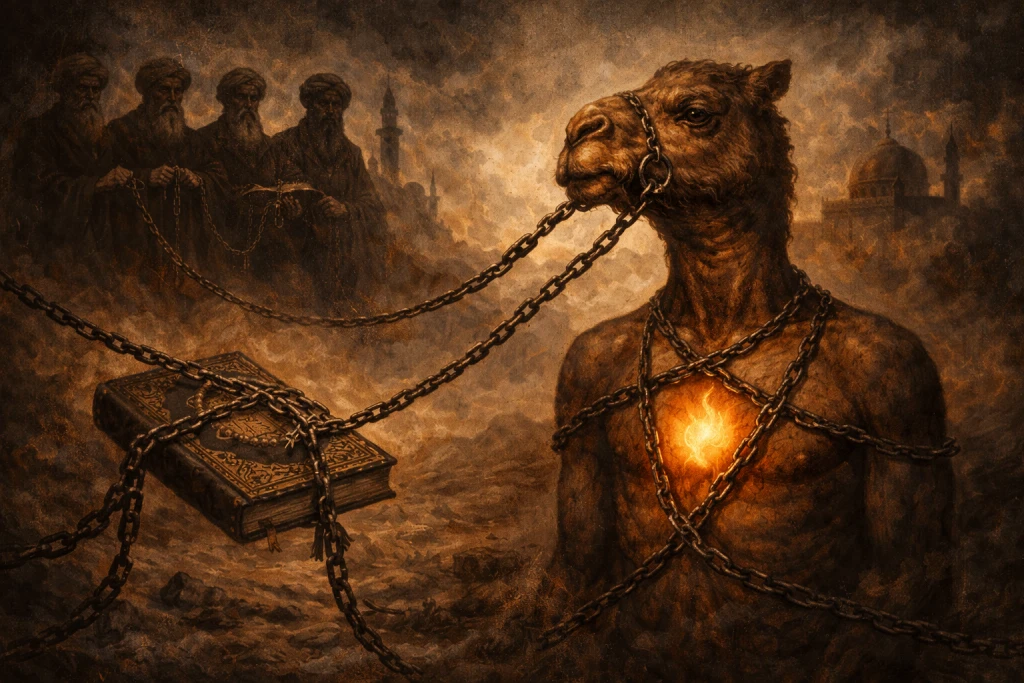
In Sunan Ibn Majah, hadith 43, the believer is compared to a camel with a rope through its nose, which goes wherever it is pulled. The same narration commands adherence to Muhammad’s Sunnah, the Sunnah of the Rightly Guided Caliphs, and obedience to the ruler. Quran 24:51 prescribes the believer’s response: “We hear and we obey”; Quran 33:36 denies believers the freedom to make their own choice after Allah and His Messenger have decided a matter; and Quran 4:65 makes acceptance of Muhammad’s judgment, without even inward objection, a condition of faith. Under these injunctions, the believer’s duty is not to retain the freedom of independent verification but to submit to the decisions of recognized religious authority.
The Believer in Hadith: A Camel with a Rope Through Its Nose
Sunan Ibn Majah, hadith 43, preserves an exhortation attributed to Muhammad on the authority of al-Irbad ibn Sariyah. Faced with future disagreements, believers are told to hold firmly to Muhammad’s Sunnah and the Sunnah of the rightly guided caliphs. After commanding obedience even if the ruler is an Abyssinian slave, the narration says: «فَإِنَّمَا الْمُؤْمِنُ كَالْجَمَلِ الأَنِفِ حَيْثُمَا قِيدَ انْقَادَ»—the believer is like a camel with a rope through its nose: wherever it is led, it follows obediently. The symbol chosen to represent the ideal of obedience is an animal that cannot determine its own destination. [1] [2]
وَعَظَنَا رَسُولُ اللَّهِ صَلَّى اللَّهُ عَلَيْهِ وَسَلَّمَ مَوْعِظَةً ذَرَفَتْ مِنْهَا الْعُيُونُ وَوَجِلَتْ مِنْهَا الْقُلُوبُ، فَقُلْنَا: يَا رَسُولَ اللَّهِ إِنَّ هَذِهِ لَمَوْعِظَةُ مُوَدِّعٍ فَمَاذَا تَعْهَدُ إِلَيْنَا؟ قَالَ: «قَدْ تَرَكْتُكُمْ عَلَى الْبَيْضَاءِ لَيْلُهَا كَنَهَارِهَا لَا يَزِيغُ عَنْهَا بَعْدِي إِلَّا هَالِكٌ، مَنْ يَعِشْ مِنْكُمْ فَسَيَرَى اخْتِلَافًا كَثِيرًا، فَعَلَيْكُمْ بِمَا عَرَفْتُمْ مِنْ سُنَّتِي وَسُنَّةِ الْخُلَفَاءِ الرَّاشِدِينَ الْمَهْدِيِّينَ عَضُّوا عَلَيْهَا بِالنَّوَاجِذِ، وَعَلَيْكُمْ بِالطَّاعَةِ وَإِنْ عَبْدًا حَبَشِيًّا، فَإِنَّمَا الْمُؤْمِنُ كَالْجَمَلِ الْأَنِفِ حَيْثُمَا قِيدَ انْقَادَ»
English translation:
Sunan Ibn Majah
Introduction
Chapter 6: Following the Sunnah of the Rightly Guided Caliphs.
2/43. Al-Irbad ibn Sariyah narrated: The Messenger of Allah delivered an exhortation to us that brought tears to our eyes and made our hearts tremble. We said, “O Messenger of Allah, this sounds like a farewell exhortation. What instructions do you leave with us?” He said, “I have left you upon a clear and radiant religion, whose night is like its day. After me, only a person destined for destruction will depart from it.
Whoever among you lives long will see many disagreements. You must therefore adhere to the Sunnah of mine that you know and the Sunnah of the rightly guided caliphs. Cling to it firmly with your molar teeth. You must obey, even if an Abyssinian slave is appointed as your leader, because the believer is like a camel with a rope through its nostril. Whichever direction it is pulled by its rope, it is compelled to go.”
Al-Albani’s assessment: Sahih.
Al-Albani’s cross-reference: al-Silsilah al-Sahihah 937.
Hadith classification: Sahih (authentic).
Narrator: Al-Irbad ibn Sariyah.
The sequence of instructions in this hadith makes the significance of the analogy plain. When disagreements arise, Muhammad’s Sunnah and the Sunnah of the rightly guided caliphs must be followed; then comes the command to obey the ruler; finally, the example of a camel led by a rope through its nose. Somebody else decides the direction in which the animal travels, rather than the animal itself. Applying this image to believers establishes submission to religious and political authority as ideal conduct. When a person’s own judgment conflicts with an instruction, it is the person who must change; the metaphor grants no freedom to subject the authority issuing the instruction to scrutiny.
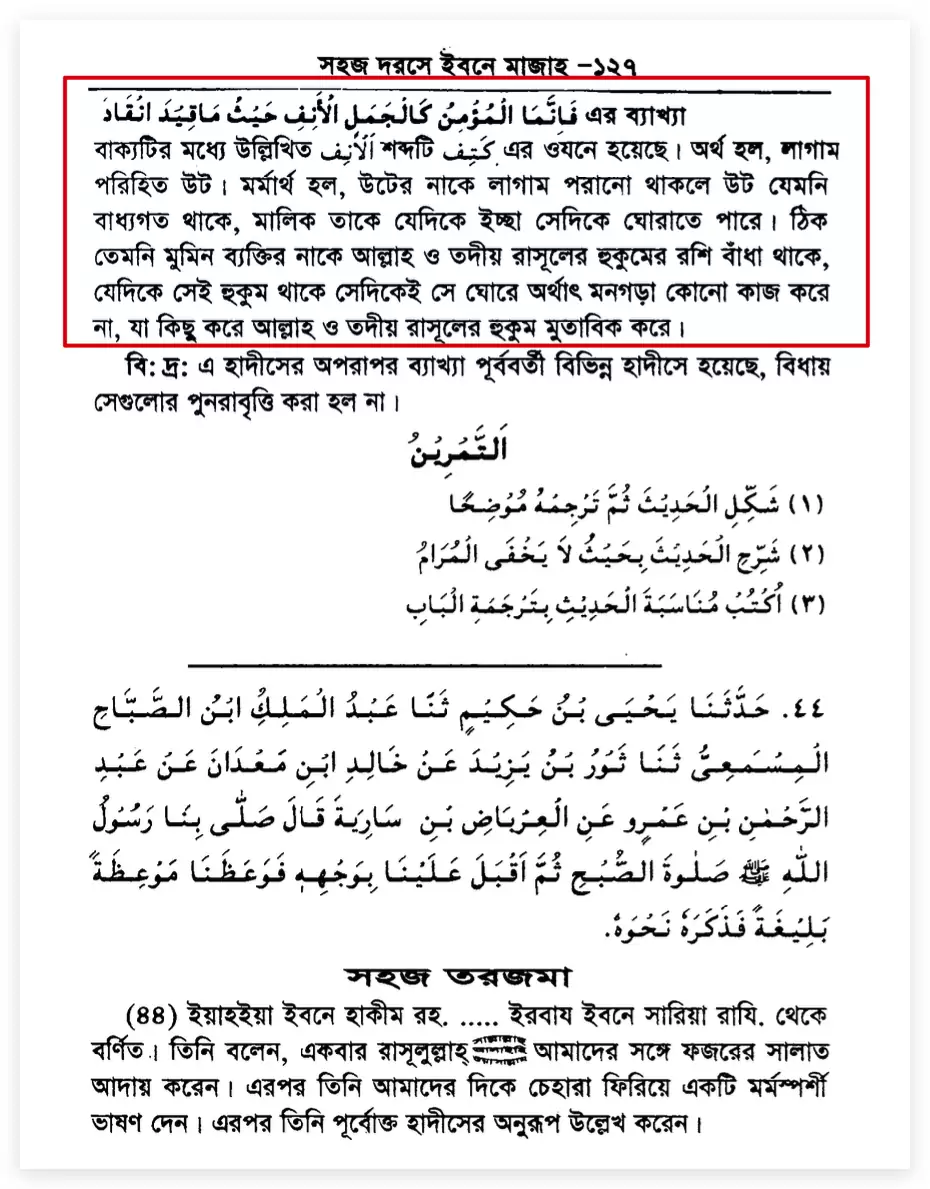
The commentary in Sahaj Dars-e Ibn Majah conveys the same meaning. Its author explicitly writes that just as the rope in the camel’s nose is controlled by its owner, so the believer has the rope of Allah’s and His Messenger’s commands tied to his nose. The camel turns wherever its owner directs it; likewise, the believer subordinates personal decisions to Allah’s and His Messenger’s commands. In this interpretation, obedience is not merely respect for a belief; it is the transfer of control over the believer’s conduct to religious authority. [3]
فَإِنَّمَا الْمُؤْمِنُ كَالْجَمَلِ الْأَنفِ حَيْثُ مَاعِيدَ انْقَادَ
English translation and commentary: The term اَلاَئِف mentioned in this sentence is said to follow the morphological pattern of كتف. It means a camel wearing a nose-rope. The intended meaning is that when a camel has a rope attached to its nose, it remains obedient and its owner can turn it in whichever direction he wishes. In exactly the same way, the rope of Allah’s and His Messenger’s commands is tied to the believer’s nose. The believer turns wherever those commands direct him. In other words, he does not act according to his own whims; whatever he does, he does in accordance with the commands of Allah and His Messenger.
The Textual Origin of the Camel Analogy: Ibn Rajab’s Account
The camel analogy appears in the commonly circulated text of Sunan Ibn Majah, and al-Albani classified the narration as sahih. In Jami al-Ulum wa al-Hikam, Ibn Rajab records that a group of early hadith specialists considered the specific final sentence containing the analogy to be mudraj—material inserted into the narration at a later stage rather than part of its original wording. He mentions Ahmad ibn Salih al-Misri and, through al-Hakim, Asad ibn Wada’ah. This shows that although the analogy was used in Islamic hadith and commentary literature, its textual origin was already disputed among earlier scholars. [4]
وروي أيضًا عن ضمرة بن حبيب عن عبدالرحمن بن عمرو السلمي عن العرباض خرجه من طريقه الإمام أحمد وابن ماجه وزاد في حديثه فقد تركتكم على البيضاء ليلها كنهارها لا يزيغ عنها بعدي إلا هالك وزاد في آخر الحديث فإنما المؤمن كالجمل الأنف حيثما قيد انقاد وقد أنكر طائفة من الحفاظ هذه الزيادة في آخر الحديث وقالوا هي مدرجة فيه وليست منه قاله أحمد بن صالح المصري وغيره وقد خرجه الحاكم وقال في حديثه، وكان أسد بن وداعة يزيد في هذا الحديث فإن المؤمن كالجمل الأنف حيثما قيد انقاد
English translation: This was also narrated from Damrah ibn Habib, from Abd al-Rahman ibn Amr al-Sulami, from al-Irbad. Imam Ahmad and Ibn Majah transmitted the hadith through this chain. This version adds: “I have left you upon the clear path, whose night is like its day. None will stray from it after me except someone who is ruined.” At the end of the hadith it further adds: “The believer is like a camel with a sensitive nose: wherever it is led, it follows obediently.” A group of hadith preservers objected to this addition at the end of the hadith, saying that it is an interpolation and not part of the hadith itself. Ahmad ibn Salih al-Misri and others stated this. Al-Hakim also transmitted the hadith, and his account says that Asad ibn Wada’ah used to add to it: “The believer is like a camel with a sensitive nose: wherever it is led, it follows obediently.”
The objection recorded by Ibn Rajab concerns specifically the final sentence containing the camel analogy, not the other instructions about Muhammad’s Sunnah, the caliphs’ Sunnah, and obedience to the ruler. This textual disagreement within hadith scholarship does not erase the circulation of the camel metaphor or the commentaries written around it. Sahaj Dars-e Ibn Majah directly describes the believer as having the rope of Allah’s and His Messenger’s commands tied to his nose. That is an explicit account of religious obedience. Independent Quranic verses also make this obedience a condition of faith. [5]
The Meaning of the Analogy: Moving Wherever One Is Pulled
The Arabic expression الْجَمَلِ الْأَنِفِ refers to a camel whose nose is fitted with a rope and which can easily be controlled. The distinctive feature of this metaphor is not the camel’s independent judgment or choice of destination but its movement under someone else’s pull. That is precisely why the selection of this animal as an example of religious obedience matters. The commentary in Sahaj Dars-e Ibn Majah explicitly compares Allah’s and His Messenger’s commands to the rope through the camel’s nose. Controlled obedience, rather than independent decision-making, is thus presented as the believer’s ideal quality.
Statements by Islamic Scholars: The Demand to Obey Religious Instructions Immediately
In the following speech, Mufti Ibrahim uses the image of a camel with a rope through its nose to explain religious obedience. The comparison is not confined to early hadith collections; the same metaphor continues to be used in contemporary religious preaching.
Ahmadullah’s speech calls for obeying commands from the Quran and hadith immediately upon hearing them. Thus, obedience, rather than an independent decision about the validity of a religious instruction, is established as the believer’s duty.
Quran 24:47–52: The Believer’s Identity—“We Hear and We Obey”
Quran 24:47–52 makes obedience a criterion for identifying genuine faith. Verse 47 says that some people profess faith and obedience but then turn away; the Quran refuses to recognize them as believers. Verses 48–50 criticize those who reject the judgment of Allah and His Messenger. In contrast, verse 51 prescribes the only acceptable response of true believers: “سَمِعْنَا وَأَطَعْنَا”—“We hear and we obey.” The following verse makes this obedience a condition of success. [6] [7] [8]
وَيَقُولُونَ آمَنَّا بِاللَّهِ وَبِالرَّسُولِ وَأَطَعْنَا ثُمَّ يَتَوَلَّىٰ فَرِيقٌ مِنْهُمْ مِنْ بَعْدِ ذَٰلِكَ وَمَا أُولَٰئِكَ بِالْمُؤْمِنِينَ
English translation: They say, “We believe in Allah and the Messenger, and we obey.” Then a group of them turns away afterward. Such people are not believers. — Surah al-Nur, 24:47.
إِنَّمَا كَانَ قَوْلَ الْمُؤْمِنِينَ إِذَا دُعُوا إِلَى اللَّهِ وَرَسُولِهِ لِيَحْكُمَ بَيْنَهُمْ أَنْ يَقُولُوا سَمِعْنَا وَأَطَعْنَا وَأُولَٰئِكَ هُمُ الْمُفْلِحُونَ
English translation: The only response of believers, when they are called to Allah and His Messenger to judge between them, is to say, “We hear and we obey.” And it is they who are successful. — Surah al-Nur, 24:51.
The following verse also identifies obedience as a condition of ultimate success. [9]
وَمَنْ يُطِعِ اللَّهَ وَرَسُولَهُ وَيَخْشَ اللَّهَ وَيَتَّقْهِ فَأُولَٰئِكَ هُمُ الْفَائِزُونَ
English translation: Whoever obeys Allah and His Messenger, fears Allah, and remains mindful of Him—it is they who are the successful ones.
In his commentary on verse 24:51, al-Tabari explains that the verse does not merely describe a past event; rather, it prescribes the conduct believers must follow. When called to the judgment of Allah and His Messenger, they are to say, “We hear and we obey.” Al-Tabari interprets the verse as a rebuke to those who disobeyed the instruction and as a lesson to others. Thus the phrase expresses a binding Quranic principle of obedience: when religious authority has rendered a decision, the believer’s task is to comply. [10]
يقول تعالى ذكره: إنما كان ينبغي أن يكون قول المؤمنين إذا دعوا إلى حكم الله وإلى حكم رسوله، لِيَحْكُمَ بَيْنَهُمْ وبين خصومهم، ( أَنْ يَقُولُوا سَمِعْنَا ) ما قيل لنا ( وأطعنا ) مَن دعانا إلى ذلك. ولم يُعن ب ( كَانَ ) في هذا الموضع الخبر عن أمر قد مضى فيقضى، ولكنه تأنيب من الله الذي أنـزلت هذه الآية بسببهم، وتأديب منه آخرين غيرهم.وقوله: ( وَأُولَئِكَ هُمُ الْمُفْلِحُونَ ) يقول تعالى ذكره: والذين إذا دعوا إلى الله ورسوله ليحكم بينهم وبين خصومهم ( أَنْ يَقُولُوا سَمِعْنَا وَأَطَعْنَا) المفلحون يقول: هم المنجحون المدركون طِلباتهم، بفعلهم ذلك، المخلدون في جنات الله.
English translation: God, exalted be His mention, says: What the believers ought to say when called to the judgment of Allah and to the judgment of His Messenger, so that he may judge between them and their opponents, is: “We have heard” what we were told “and we have obeyed” the one who called us to it. The word “was” (kana) in this passage is not intended to report a matter already past and concluded; rather, it is a rebuke from Allah to those on whose account this verse was revealed and an instruction to others besides them. His words, “And it is they who are the successful,” mean that those who, when called to Allah and His Messenger to judge between them and their adversaries, say “We hear and we obey,” are the successful: through that conduct they achieve their aims, attain what they seek, and dwell forever in Allah’s gardens.
The injunction “We hear and we obey” sets no condition requiring believers to verify a decision independently before complying. When a decision is presented as the judgment of Allah and His Messenger, accepting and carrying it out, rather than rejecting it, defines the believer. The denial of faith to those who turn away in verse 24:47 and the promise of success to the obedient in verse 24:52 establish the religious consequences of this obligation. If independent reasoning and moral judgment lead a person to oppose a decision, these injunctions provide no freedom to elevate that opposition above religious authority. [11]
Quran 33:36: No Freedom of Choice After Allah and His Messenger Have Decided
Quran 33:36 directly denies believing men and women the right to choose differently when Allah and His Messenger have decided a matter. Anyone who disobeys that decision is described as having gone clearly astray. This means that even if a believer reaches a different conclusion through reason, experience, or moral reflection, they have no right to invalidate the instruction of religious authority. Religious obedience is thus placed above the individual’s capacity to make independent decisions. [12]
وَمَا كَانَ لِمُؤْمِنٍ وَلَا مُؤْمِنَةٍ إِذَا قَضَى اللَّهُ وَرَسُولُهُ أَمْرًا أَنْ يَكُونَ لَهُمُ الْخِيَرَةُ مِنْ أَمْرِهِمْ وَمَنْ يَعْصِ اللَّهَ وَرَسُولَهُ فَقَدْ ضَلَّ ضَلَالًا مُبِينًا
English translation: It is not for a believing man or a believing woman, when Allah and His Messenger have decided a matter, to have any choice of their own in that matter. Whoever disobeys Allah and His Messenger has certainly gone clearly astray.
Al-Tabari’s commentary states this meaning directly. According to his explanation, once Allah and His Messenger have decided a matter, believers have no right to choose something contrary to that decision or disobey their commands. He also mentions the marriage of Zaynab bint Jahsh and Zayd ibn Harithah, describing an initial objection followed by acceptance of Muhammad’s decision. The obligation imposed by the verse is therefore not merely an abstract theological claim; it is shown operating in personal life and individual decision-making. [13]
يقول تعالى ذكره: لم يكن لمؤمن بالله ورسوله، ولا مؤمنة إذا قضى الله ورسوله في أنفسهم قضاء أن يتخيروا من أمرهم غير الذي قضى فيهم، ويخالفوا أمر الله وأمر رسوله وقضاءهما فيعصوهما، ومن يعص الله ورسوله فيما أَمَرا أو نَهَيا(فَقَدْ ضَلَّ ضَلالا مُبِينًا) يقول: فقد جار عن قصد السبيل، وسلك غير سبيل الهدى والرشاد.
English translation: God, exalted be His mention, says: Neither a man who believes in Allah and His Messenger nor a believing woman, when Allah and His Messenger have made a decision concerning them, may choose for themselves anything other than what has been decided, oppose the command and judgment of Allah and His Messenger, or disobey them. Whoever disobeys Allah and His Messenger in what they have commanded or forbidden “has certainly gone clearly astray,” meaning that they have deviated from the straight course and followed a path other than guidance and right conduct.
The verse’s word «الْخِيَرَةُ» itself denies the individual’s freedom of choice. When independently choosing against the decision of religious authority is called misguidance, independent moral judgment becomes subordinate. Even if someone could demonstrate through reason that the decision was wrong, the religious duty under this system would still be to obey it: following authority becomes more important than establishing truth. Rational inquiry requires the freedom to change a conclusion in light of evidence; yet this injunction does not grant believers the freedom to revise a recognized religious decision.
Quran 4:65: Not Just Compliance, but the Elimination of Inward Objection
Quran 4:65 imposes an even stricter demand for obedience. Swearing by Allah, it declares that people will not be believers until they accept Muhammad as judge in their disputes, feel no inward unease or objection about his decision, and submit completely. Obeying an instruction outwardly is therefore not enough; one’s thoughts and feelings must also be brought into line with Muhammad’s judgment. The verse rejects even inward dissent and independent judgment in the face of religious authority. [14]
فَلَا وَرَبِّكَ لَا يُؤْمِنُونَ حَتَّىٰ يُحَكِّمُوكَ فِيمَا شَجَرَ بَيْنَهُمْ ثُمَّ لَا يَجِدُوا فِي أَنْفُسِهِمْ حَرَجًا مِمَّا قَضَيْتَ وَيُسَلِّمُوا تَسْلِيمًا
English translation: But no, by your Lord, they will not believe until they make you judge in the disputes that arise among them, then find within themselves no unease or objection concerning what you have decided, and submit in complete submission.
Al-Tabari interprets the word «حَرَجًا» as inward constriction, unease, and doubt. In his explanation, denying Muhammad’s judgment and doubting one’s obligation to obey him are connected with sin. Other interpretations preserved by al-Tabari likewise demand submission to Muhammad’s decision and the removal of doubt. Thus Quran 4:65 is not merely a rule requiring compliance with a court’s judgment; it prescribes the response that a person must have inwardly toward the judge’s decision. [15]
=” ثم لا يجدوا في أنفسهم حرجًا مما قضيت “، يقول: لا يجدوا في أنفسهم ضيقًا مما قضيت. وإنما معناه: ثم لا تحرَج أنفسهم مما قضيت = أي: لا تأثم بإنكارها ما قضيتَ، وشكّها في طاعتك، وأن الذي قضيت به بينهم حقٌّ لا يجوز لهم خلافه، كما:-
English translation: “Then they find within themselves no unease concerning what you have judged” means that they find no inward distress over your judgment. Its meaning is that their souls do not become troubled by what you have decided—that is, they do not incur sin by denying your judgment or doubting their obedience to you. What you have judged between them is the truth, and they have no right to oppose it.
Even after a judicial ruling takes effect, the freedom to consider it mistaken, present evidence against it, and demand its revision is a fundamental feature of an independent judicial system. Quran 4:65 makes even that freedom incompatible with faith when it concerns Muhammad’s judgments. A person may regard a decision as unjust according to their own judgment, yet is not permitted to retain that objection inwardly. Submission is demanded not only in outward conduct but also in private thought. Obeying a ruler’s order and surrendering one’s faculty of judgment to him are not the same thing; verse 4:65 makes the latter a condition of faith as well.
Three Levels of Religious, Traditional, and Political Obedience in Hadith
Al-Irbad ibn Sariyah’s hadith links religious and political obedience. First, Muhammad’s Sunnah is established as the standard to follow in times of disagreement. Then believers are told to cling to the Sunnah of the Rightly Guided Caliphs with their molar teeth. Finally, they are instructed to obey the ruler even if he is an Abyssinian slave. Authority belonging to the founder of the religion, the authority of earlier rulers, and that of the present ruler are thus all connected to the religious virtue of following instructions rather than exercising independent choice. [1]
The political consequences of this obedience are also serious. Whether a ruler’s decision is just, whether an earlier leader acted correctly, and whether an old rule should be revised are questions that depend upon independent judgment and evidence. But when obedience itself becomes a religious ideal, submitting to authority is rewarded while questioning it is discouraged. Taken together, the Quranic principles “We hear and we obey” and “They have no choice of their own,” alongside the hadith’s instruction to obey the ruler, demonstrate how religious authority can also shape the individual’s political judgment.
Obedience Versus Critical Thinking
The truth of a claim and obedience to an instruction are not the same thing. Truth is determined by reasoning, observation, and evidence; obedience to authority rests on a recognized obligation toward the person issuing the command. A statement does not become true simply because a prophet said it, nor is a command’s divine origin established simply by calling it Allah’s command. Yet when accepting the decisions of Allah and His Messenger is made a condition of faith, the authority of the source, rather than independent verification, becomes the final standard for making decisions. This is the fundamental problem with treating religious obedience as a substitute for knowledge.
A fundamental condition of seeking truth is the freedom to revise one’s conclusions when they are shown to be wrong. When new information contradicts an old belief, that belief must be abandoned. Islam prohibits believers from making their own choice against the decisions of Allah and His Messenger; even inward objections to those decisions are incompatible with faith. Thus, even if believers conclude through their own judgment that a religious command is wrong, they lose the freedom to accept that conclusion. Islam has provided no opportunity to examine its fundamental claims through reason, facts, and evidence [11]. Treating authority as final and prohibiting conclusions reached by reason against it is not independent inquiry; it is obedience to a predetermined conclusion.
Even Asking for Evidence Against Islamic Creed Is Considered Disbelief
The question of whether one may even demand evidence supporting a claim contrary to Islamic creed brings the conflict between belief and intellectual inquiry into sharper focus. In the accompanying religious lecture, even asking for proof of a proposition contradicting established Islamic creed is called kufr (disbelief). In other words, the very attempt to test the truth of a dissenting view becomes grounds for an accusation of crossing the boundaries of faith. Instead of hearing and assessing evidence that might strongly challenge a doctrine, the person seeking to investigate is denounced as acting against belief. Such a rule does not establish truth through reasoned debate; it restricts the right to ask questions.
Islam creates an obligation for believers to submit to authority when judging the acceptability of religious claims. A person may examine Islam’s claims before accepting them but, after accepting them, is not free to reject them upon discovering contrary evidence; the outcome of inquiry is thereby fixed in advance. In an independent system of judgment, any conclusion may be revised in light of evidence, but here judging contrary to a religious decision is itself treated as a violation of faith. Using an authority’s own claim as the proof that the authority is truthful is circular reasoning. Truth requires independent evidence; obedience to belief is no substitute for such evidence.
Preaching that asking for evidence of a statement contrary to Islamic creed constitutes disbelief directly attacks freedom of thought. To demonstrate that someone is wrong, one must examine their arguments and evidence; if the mere act of asking for evidence is declared an offense, there is no longer any need to confront the argument. Submission to religious authority replaces inquiry. The accompanying video shows directly how seeking evidence is presented as incompatible with faith.
Conclusion
Quran 24:51 defines believers through the words “We hear and we obey.” Verse 33:36 denies individuals the right to make their own choice after Allah and His Messenger have reached a decision. Verse 4:65 makes the absence of inward objection to Muhammad’s judgment and complete submission conditions of faith. In al-Tabari’s explanations as well, the central meaning of these commands is obligatory obedience. Together, these provisions form a religious framework in which obeying authority is a mark of faith and opposing its instructions is misguidance.
The camel with a rope through its nose in Sunan Ibn Majah, hadith 43, is a stark image of that obedience. A rope held by someone else, movement directed by someone else: the metaphor idealizes controlled submission rather than the believer’s freedom. The received hadith text and the explanation in Sahaj Dars-e Ibn Majah portray the believer as a camel tethered by the rope of religious commands. The Quranic injunctions concerning obedience express the same authoritarian position.
In a system where the commands of religious authority take precedence over reason and evidence, the believer’s right to decide independently is curtailed. The way to distinguish false ideas from true ones is to ask questions, test claims, and revise conclusions when new evidence emerges. But when independent choice against the decisions of Allah and His Messenger is forbidden, and even inward objections to those decisions are declared incompatible with faith, the outcome of free inquiry has been fixed in advance. Obedience is not evidence of truth; it is a restriction imposed on the freedom to test what is true. The image of a believer as a camel tethered by the nose symbolizes precisely this religious ideal, in which people are encouraged not to think for themselves and choose a path but to move wherever authority pulls them.
References
- Sunan Ibn Majah, hadith 43 1 2
- Sunan Ibn Majah, hadith 43 (Bengali edition) ↩︎
- Sahaj Dars-e Ibn Majah, Al-Kawthar Publications, p. 127 ↩︎
- Ibn Rajab, Jami al-Ulum wa al-Hikam, commentary on hadith 28 ↩︎
- Al-Durar al-Saniyyah: Hadith evaluation ↩︎
- Quran 24:47 ↩︎
- Quran 24:51 ↩︎
- Quran 24:52 ↩︎
- The Quran, Surah al-Nur 24:52 ↩︎
- Al-Tabari, Jami al-Bayan, commentary on Surah al-Nur 24:51 ↩︎
- The Conflict Between Islam and Philosophy or Logic: Does Islam Allow Independent Verification? 1 2
- The Quran, Surah al-Ahzab 33:36 ↩︎
- Al-Tabari, Jami al-Bayan, commentary on 33:36 ↩︎
- The Quran, Surah al-Nisa 4:65 ↩︎
- Al-Tabari, Jami al-Bayan, commentary on Surah al-Nisa 4:65 ↩︎