

Summary
Over the centuries, specialists in Islamic jurisprudence have added numerous clauses and qualifications to the Quranic and hadith-based rules governing adult men’s marriage to, and sexual activity with, young girls. It is readily apparent that various problems arose from these practices at the time [1], prompting discussion of children’s safety as well. Yet because the Quran [2], hadith, and jurisprudence [3] provide explicit evidence for child marriage and sexual activity with children, reinforced by precedents from the lives of the Prophet and his Companions [4], none of the jurists could prohibit child marriage and the sexual activity associated with it [5]. They therefore tried to address this social problem by imposing certain conditions. One example is the rule governing mufakhkhata, or mufakhadhah, in Islamic jurisprudence.
For this reason, many juristic statements become even more horrifying when they address the sexual rights an adult man acquires over a child’s body once a marriage contract has been concluded. Mufakhadhah (المفاخذة), also known in Bengali as mufakhkhata, means sexual activity between the thighs without vaginal penetration. Published Sunni fatwas address the permissibility of this practice with an underage wife. Hanafi discussions of maintenance introduce the calculation of whether a husband can obtain sexual benefits from a child’s body. In a quoted statement by the Hanbali jurist Ibn Aqil, an enslaved girl is made a means of relieving her owner’s sexual arousal. In the works of the Shia jurists Muhammad Kazim al-Yazdi and Ruhollah Khomeini, the permission is still more explicit: penetrative intercourse is prohibited before the completion of nine years, while permission for lustful touching, embracing, and tafkhidh extends even to a nursing infant.
Adult demands stand at the center of these rules. The child is assigned a test of endurance: how much her body can withstand, which sexual acts will cause harm, and when she may be handed over to her husband. At an age when a person needs care, safety, and room to grow, her body is drawn into calculations of male desire. Describing a nursing infant as a permissible object of sexual enjoyment openly authorizes child sexual abuse. Tying an underage wife’s maintenance to her sexual usability turns her helplessness into an economic condition. These statements appear in the language of the juristic works and fatwas themselves; their moral ugliness is revealed in that very language and reasoning.
Introduction: A Husband’s Sexual Rights in Place of a Child’s Childhood
The very act of bargaining over adults’ sexual rights to a child’s body is alarming. Yet many juristic discussions of child wives accord such bargaining the status of ordinary legal business. They deliberate at length over when a girl should be sent to her husband, whether her body can withstand intercourse, how that capacity should be verified and through which examination, what sexual benefits may be obtained apart from intercourse, and whether obtaining those benefits makes the husband responsible for her expenses. The discussion is driven by the benefits due to the husband, rather than by what the child wants, whether she understands sexual activity, or whether her refusal will have any effect. Childhood has no value of its own within this framework; it becomes a period of waiting until the child is usable by an adult.
Language also plays a cruel role here. Placing familiar expressions such as “wife,” “husband,” “marital rights,” and “sexual enjoyment” alongside one another makes it easy to lose sight of the child behind them. Calling a nursing infant a “wife” cloaks the relationship in the language of adult marriage, while the infant’s actual condition remains unchanged. She is carried in other people’s arms, survives through their care, and cannot understand the relationship imposed upon her. Her body bears the consequences of decisions made by those who sign or consent to the marriage contract. Establishing sexual rights over that child’s helplessness is an abuse of adult power; devising religious rules for it gives that abuse the shelter of authority.
Permission for mufakhadhah reveals a particularly dark aspect of this system. Even after a young body is declared unfit for intercourse, the discussion of sexual use continues. In one context, enjoyment through other means is permitted; in another, a man’s sexual attraction to a child is incorporated into calculations of maintenance; elsewhere, permission extends without hesitation even to a nursing infant. In every case, adults hold the power to determine the use of the child’s body. This is where the question of safety becomes most profound: the law grants the very person from whom a child should receive protection a sexual claim over her body.
What Is Mufakhadhah? The Reality of Sexual Use behind the Terminology
In Islamweb fatwa 111399, a questioner asks about the meaning and permissibility of mufakhadhah. The answer defines it as nonpenetrative sexual enjoyment between a wife’s thighs. The subsequent part of the question also concerns a wife whose marriage contract has been concluded but whose marriage has not yet been consummated; the answer treats her becoming a wife through the contract as the basis for the permissibility of sexual activity. “Enjoyment” here has a directly sexual meaning. Reading this definition alongside the later fatwa concerning an underage wife makes clear which conduct is being authorized [6].
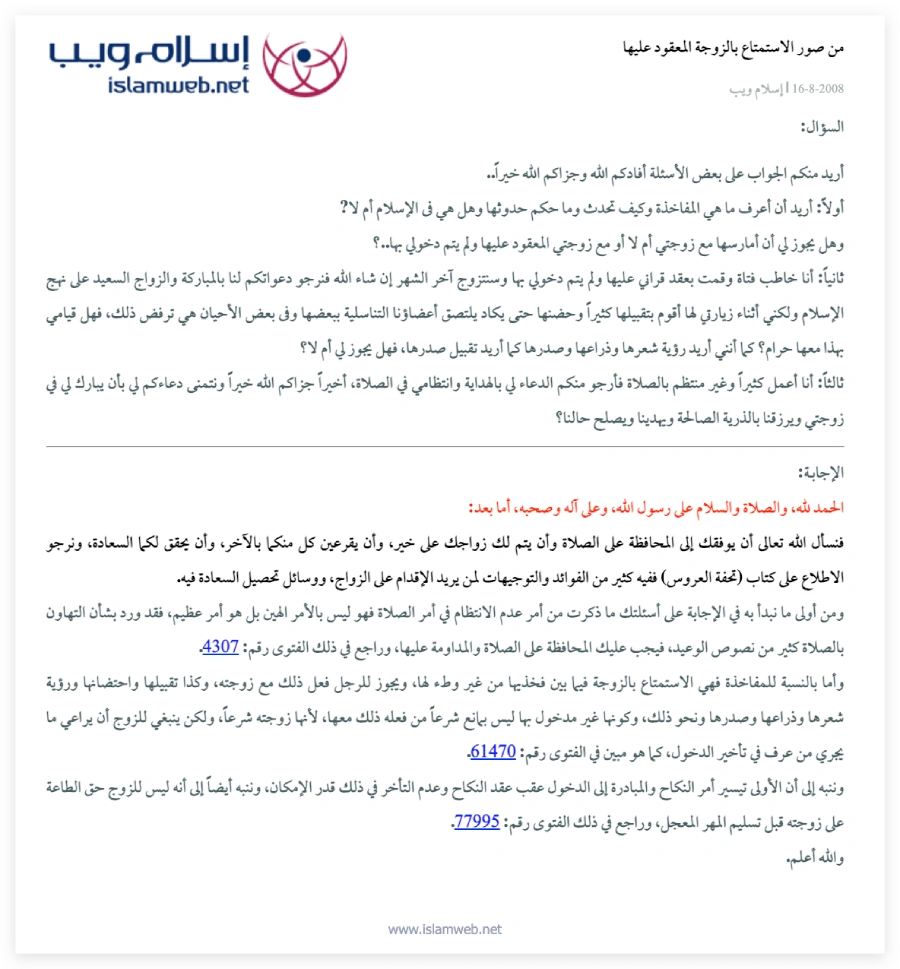
من صور الاستمتاع بالزوجة المعقود عليها
16-8-2008 | إسلام ويب
السؤال:
أريد منكم الجواب على بعض الأسئلة أفادكم الله وجزاكم الله خيراً..
أولاً: أريد أن أعرف ما هي المفاخذة وكيف تحدث وما حكم حدوثها وهل هي فى الإسلام أم لا؟
وهل يجوز لي أن أمارسها مع زوجتي أم لا أو مع زوجتي المعقود عليها ولم يتم دخولي بها..؟
ثانياً: أنا خاطب فتاة وقمت بعقد قراني عليها ولم يتم دخولي بها وسنتزوج آخر الشهر إن شاء الله فنرجو دعواتكم لنا بالمباركة والزواج السعيد على نهج الإسلام ولكني أثناء زيارتي لها أقوم بتقبيلها كثيراً وحضنها حتى يكاد يلتصق أعضاؤنا التناسلية ببعضها وفى بعض الأحيان هي ترفض ذلك، فهل قيامي بهذا معها حرام؟ كما أنني أريد رؤية شعرها وذراعها وصدرها كما أريد تقبيل صدرها، فهل يجوز لي أم لا؟
ثالثاً: أنا أعمل كثيراً وغير منتظم بالصلاة فأرجو منكم الدعاء لي بالهداية وانتظامي في الصلاة، أخيراً جزاكم الله خيراً ونتمنى دعاءكم لي بأن يبارك لي في زوجتي ويرزقنا بالذرية الصالحة ويهدينا ويصلح حالنا؟
الإجابــة:
الحمد لله، والصلاة والسلام على رسول الله، وعلى آله وصحبه، أما بعد:
فنسأل الله تعالى أن يوفقك إلى المحافظة على الصلاة وأن يتم لك زواجك على خير، وأن يقرعين كل منكما بالآخر، وأن يحقق لكما السعادة، ونرجو الاطلاع على كتاب (تحفة العروس) ففيه كثير من الفوائد والتوجيهات لمن يريد الإقدام على الزواج، ووسائل تحصيل السعادة فيه.
ومن أولى ما نبدأ به في الإجابة على أسئلتك ما ذكرت من أمر عدم الانتظام في أمر الصلاة فهو ليس بالأمر الهين بل هو أمر عظيم، فقد ورد بشأن التهاون بالصلاة كثير من نصوص الوعيد، فيجب عليك المحافظة على الصلاة والمداومة عليها، وراجع في ذلك الفتوى رقم: 4307.
وأما بالنسبة للمفاخذة فهي الاستمتاع بالزوجة فيما بين فخذيها من غير وطء لها، ويجوز للرجل فعل ذلك مع زوجته، وكذا تقبيلها واحتضانها ورؤية شعرها وذراعها وصدرها ونحو ذلك، وكونها غير مدخول بها ليس بمانع شرعاً من فعله ذلك معها، لأنها زوجته شرعاً، ولكن ينبغي للزوج أن يراعي ما يجري من عرف في تأخير الدخول، كما هو مبين في الفتوى رقم: 61470.
وننبه إلى أن الأولى تيسير أمر النكاح والمبادرة إلى الدخول عقب عقد النكاح وعدم التأخر في ذلك قدر الإمكان، وننبه أيضاً إلى أنه ليس للزوج حق الطاعة على زوجته قبل تسليم المهر المعجل، وراجع في ذلك الفتوى رقم: 77995.
والله أعلم.
Translation:
Some Ways of Obtaining Sexual Enjoyment with a Wife Whose Marriage Contract Has Been Concluded
16 August 2008 | Islamweb
Question:
I would like answers to several questions. May Allah bless you and reward you well.
First, I would like to know what mufakhadhah is, how it takes place, what its ruling is, and whether Islam permits it. May I engage in it with my wife? Or with a wife whose marriage contract with me has been concluded but with whom the marriage has not yet been consummated?
Second, I am engaged to a girl and have concluded the marriage contract with her, but the marriage has not yet been consummated. Allah willing, our wedding celebration will take place at the end of this month. Please pray that we have a blessed and happy married life in accordance with Islamic principles. However, when I visit her, I kiss and embrace her repeatedly, to the point that our genitals almost touch. Sometimes she objects. Is this behavior with her forbidden? I want to see her hair, arms, and breasts, and to kiss her breasts. Are these things lawful for me?
Third, I work a great deal and do not pray regularly. Please pray for my guidance and for me to pray consistently. Finally, I wish you the best of rewards and ask you to pray that Allah blesses my wife for me, grants us righteous children, guides us, and improves our circumstances.
Answer:
All praise is due to Allah. May peace and blessings be upon the Messenger of Allah, his family, and his Companions. To proceed:
We ask Allah to enable you to pray regularly, to bring your marriage to a good conclusion, to make you a source of delight to one another, and to grant you happiness. We recommend that you read Tuhfat al-Arus. It contains much useful discussion and guidance for those intending to marry, including ways to achieve happiness in married life.
In answering your questions, we will begin with your irregular observance of prayer. This is no trivial matter; it is extremely serious. Numerous religious texts contain stern warnings of punishment for neglecting prayer. You must therefore observe prayer regularly and consistently. On this subject, see fatwa no. 4307.
As for mufakhadhah, it means obtaining sexual enjoyment between a wife’s thighs without vaginal intercourse. A man may lawfully do this with his wife. Likewise, he may kiss her, embrace her, and look at her hair, arms, breasts, and other such parts of her body. The fact that the marriage has not yet been consummated is no legal impediment to these acts, because she is already his wife under Islamic law. However, the husband should take account of prevailing social customs concerning the postponement of consummation after the marriage contract. This is explained in fatwa no. 61470.
We also note that it is preferable to make marriage easy, to consummate it as soon as practicable after the contract, and to avoid unnecessary delay. At the same time, a husband has no right to demand his wife’s obedience before paying the immediately payable portion of her mahr. See fatwa no. 77995.
Allah knows best.
Juristic works also employ broader terms for the same discussion. «الاستمتاع بما دون الوطء» means sexual enjoyment apart from intercourse, while «الجماع فيما دون الفرج» means sexual activity without vaginal penetration. Mufakhadhah is one specific practice within this broader category; the Shia quotations use «التفخيذ», or tafkhidh, for a similar form of sexual activity involving the thighs. The broader category also includes sexual touching and other acts. These meanings expose the horror of the rules that follow: a child’s body is treated as a separate domain of sexual use apart from intercourse. A line of prohibition is drawn, and rights of enjoyment are arranged beyond it for the adult man to exercise.
The Prophet Rubbed against His Wife’s Body during Menstruation
The Prophet Muhammad had nine wives and two female slaves at the same time; accounts also describe his relationships with various other women at different points in his life [7]. Hadith indicate that, even with nine wives and two female slaves, he sought sexual pleasure with a menstruating wife. During menstruation, we generally refrain from intercourse and restrain our desires. With so many wives and female slaves, the Prophet could naturally have gone to another wife to satisfy his sexual needs at such a time. Yet he is reported to have satisfied those needs in various ways with his wives even during their periods. That is, he would have cloth wrapped around a wife’s private parts and use other parts of her body to satisfy his sexual desire. The hadith are understood to indicate that he rubbed his genitals against her knees, chest, mouth, and so forth. Let us hear Ahmadullah explain the subject:
Evidence for these matters appears in several hadith: [8] [9].
حَدَّثَنَا أَبُو بَكْرِ بْنُ أَبِي شَيْبَةَ ، وَزُهَيْرُ بْنُ حَرْبٍ ، وَإِسْحَاقُ بْنُ إِبْرَاهِيمَ، قَالَ إِسْحَاقُ أَخْبَرَنَا وَقَالَ الآخَرَانِ، حَدَّثَنَا جَرِيرٌ ، عَنْ مَنْصُورٍ ، عَنْ إِبْرَاهِيمَ ، عَنِ الأَسْوَدِ ، عَنْ عَائِشَةَ ، قَالَتْ كَانَ إِحْدَانَا إِذَا كَانَتْ حَائِضًا أَمَرَهَا رَسُولُ اللَّهِ صلى الله عليه وسلم فَتَأْتَزِرُ بِإِزَارٍ ثُمَّ يُبَاشِرُهَا .
Sahih Muslim (Islamic Foundation edition)
3. Menstruation
Chapter 1. Intimacy with a Menstruating Woman above the Waist Wrapper
572 (Islamic Foundation numbering). Abu Bakr ibn Abi Shayba, Zuhayr ibn Harb, and Ishaq ibn Ibrahim … ‘A’isha reported: When anyone amongst us (amongst the wives of the Holy Prophet) menstruated, the Messenger of Allah (ﷺ) asked her to tie a waist-wrapper over her (body) and then embraced her.
Hadith grade: Sahih (authentic)
Narrator: Aisha bint Abu Bakr al-Siddiq (may Allah be pleased with her). Sunnah.com reference: Sahih Muslim 293a; Book 3, Hadith 1. [10]
أَخْبَرَنَا إِسْحَاقُ بْنُ إِبْرَاهِيمَ ، قَالَ أَنْبَأَنَا جَرِيرٌ ، عَنْ مَنْصُورٍ ، عَنْ إِبْرَاهِيمَ ، عَنِ الأَسْوَدِ ، عَنْ عَائِشَةَ ، قَالَتْ كَانَتْ إِحْدَانَا إِذَا حَاضَتْ أَمَرَهَا رَسُولُ اللَّهِ صلى الله عليه وسلم أَنْ تَتَّزِرَ ثُمَّ يُبَاشِرُهَا .
Sunan an-Nasa’i (Islamic Foundation edition)
3. Menstruation and Irregular Bleeding
Chapter 12. Fondling the Menstruating Woman
374. Ishaq ibn Ibrahim … It was narrated that ‘Aishah said: “If one of us was menstruating, the Messenger of Allah (ﷺ) would tell her to put on an Izar (waist wrap) then he would fondle her.”
Hadith grade: Sahih (Darussalam)
Narrator: Aisha bint Abu Bakr al-Siddiq (may Allah be pleased with her). Sunnah.com reference: Sunan an-Nasa’i 374; Book 3, Hadith 26; English translation: Vol. 1, Book 3, Hadith 374. [11]
Permission for Mufakhadhah with an Underage Wife in Sunni Fatwas
The questioner in Islamweb fatwa 78529 objected to permission for sexual touching and mufakhadhah with a wife who had not reached puberty. His question raised the issues of harm to the child and sexual maturity. The current published answer states that permission for lustful kissing, mufakhadhah, and similar acts with an underage wife is subject to certain conditions, referring readers to fatwa 195133 for those conditions. The question concerns protecting a child from sexual activity; the answer establishes rules for permitting sexual activity with that child. The distance between these two positions concerning the same child reveals the fatwa’s moral stance [12].
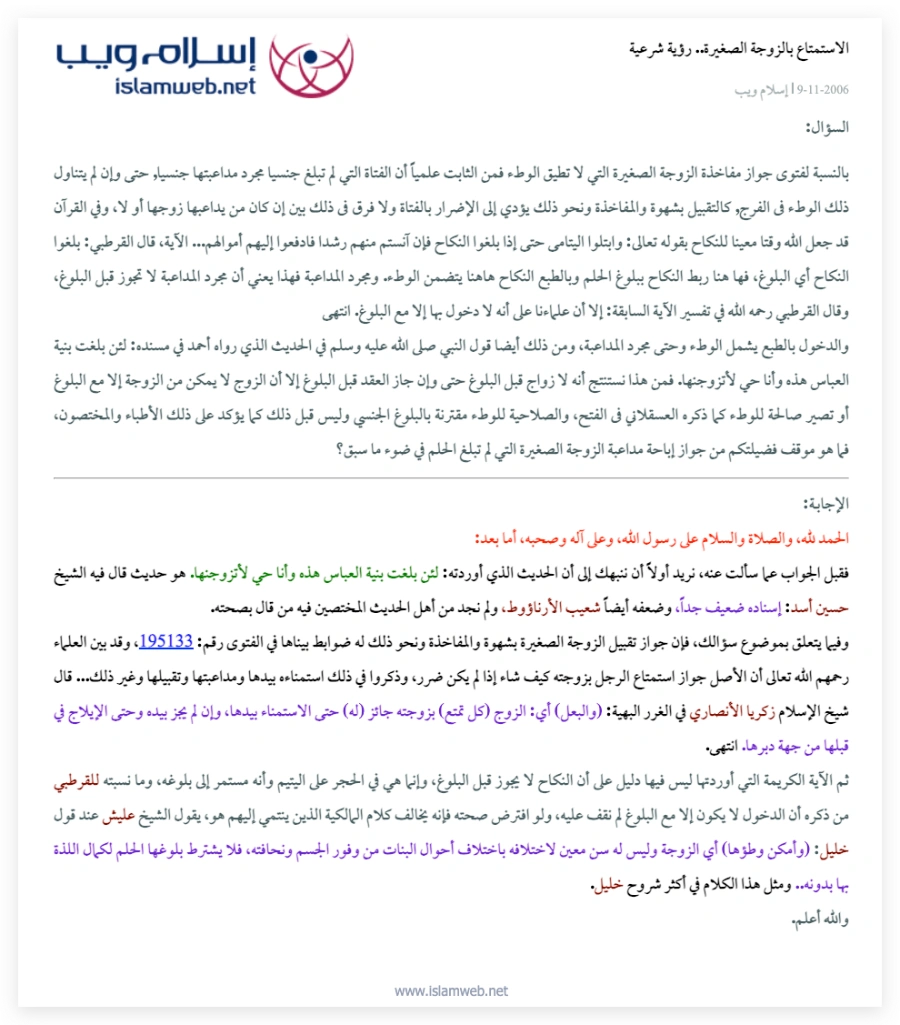
الاستمتاع بالزوجة الصغيرة.. رؤية شرعية
9-11-2006 | إسلام ويب
السؤال:
بالنسبة لفتوى جواز مفاخذة الزوجة الصغيرة التي لا تطيق الوطء فمن الثابت علمياً أن الفتاة التي لم تبلغ جنسيا مجرد مداعبتها جنسيا, حتى وإن لم يتناول ذلك الوطء فى الفرج, كالتقبيل بشهوة والمفاخذة ونحو ذلك يؤدي إلى الإضرار بالفتاة ولا فرق فى ذلك بين إن كان من يداعبها زوجها أو لا، وفي القرآن قد جعل الله وقتا معينا للنكاح بقوله تعالى: وابتلوا اليتامى حتى إذا بلغوا النكاح فإن آنستم منهم رشدا فادفعوا إليهم أموالهم… الآية، قال القرطبي: بلغوا النكاح أي البلوغ، فها هنا ربط النكاح ببلوغ الحلم وبالطبع النكاح هاهنا يتضمن الوطء. ومجرد المداعبة فهذا يعني أن مجرد المداعبة لا تجوز قبل البلوغ، وقال القرطبي رحمه الله في تفسير الآية السابقة: إلا أن علماءنا على أنه لا دخول بها إلا مع البلوغ. انتهى
والدخول بالطبع يشمل الوطء وحتى مجرد المداعبة، ومن ذلك أيضا قول النبي صلى الله عليه وسلم في الحديث الذي رواه أحمد في مسنده: لئن بلغت بنية العباس هذه وأنا حي لأتزوجنها. فمن هذا نستنتج أنه لا زواج قبل البلوغ حتى وإن جاز العقد قبل البلوغ إلا أن الزوج لا يمكن من الزوجة إلا مع البلوغ أو تصير صالحة للوطء كما ذكره العسقلاني فى الفتح، والصلاحية للوطء مقترنة بالبلوغ الجنسي وليس قبل ذلك كما يؤكد على ذلك الأطباء والمختصون، فما هو موقف فضيلتكم من جواز إباحة مداعبة الزوجة الصغيرة التي لم تبلغ الحلم في ضوء ما سبق؟
الإجابــة:
الحمد لله، والصلاة والسلام على رسول الله، وعلى آله وصحبه، أما بعد:
فقبل الجواب عما سألت عنه، نريد أولاً أن ننبهك إلى أن الحديث الذي أوردته: لئن بلغت بنية العباس هذه وأنا حي لأتزوجنها. هو حديث قال فيه الشيخ حسين أسد: إسناده ضعيف جداً، وضعفه أيضاً شعيب الأرناؤوط، ولم نجد من أهل الحديث المختصين فيه من قال بصحته.
وفيما يتعلق بموضوع سؤالك، فإن جواز تقبيل الزوجة الصغيرة بشهوة والمفاخذة ونحو ذلك له ضوابط بيناها في الفتوى رقم: 195133، وقد بين العلماء رحمهم الله تعالى أن الأصل جواز استمتاع الرجل بزوجته كيف شاء إذا لم يكن ضرر، وذكروا في ذلك استمناءه بيدها ومداعبتها وتقبيلها وغير ذلك… قال شيخ الإسلام زكريا الأنصاري في الغرر البهية: (والبعل) أي: الزوج (كل تمتع) بزوجته جائز (له) حتى الاستمناء بيدها، وإن لم يجز بيده وحتى الإيلاج في قبلها من جهة دبرها. انتهى.
ثم الآية الكريمة التي أوردتها ليس فيها دليل على أن النكاح لا يجوز قبل البلوغ، وإنما هي في الحجر على اليتيم وأنه مستمر إلى بلوغه، وما نسبته للقرطبي من ذكره أن الدخول لا يكون إلا مع البلوغ لم نقف عليه، ولو افترض صحته فإنه يخالف كلام المالكية الذين ينتمي إليهم هو، يقول الشيخ عليش عند قول خليل: (وأمكن وطؤها) أي الزوجة وليس له سن معين لاختلافه باختلاف أحوال البنات من وفور الجسم ونحافته، فلا يشترط بلوغها الحلم لكمال اللذة بها بدونه.. ومثل هذا الكلام في أكثر شروح خليل.
والله أعلم.
Translation:
Sexual Enjoyment with an Underage Wife: The Islamic Legal Position
9 November 2006 | Islamweb
Question:
Concerning the fatwa permitting mufakhadhah with an underage wife who cannot endure vaginal intercourse, my question is this: it is scientifically established that sexually stimulating conduct with a girl before she reaches sexual maturity harms her, even if it does not involve vaginal intercourse—for example, lustful kissing, mufakhadhah, and similar acts. It makes no difference whether the person engaging in this conduct with her is her husband.
In the Quran, too, Allah has specified a time for marriage. He says: “Test ˹the competence of˺ the orphans until they reach a marriageable age. Then if you feel they are capable of sound judgment, return their wealth to them.” (Quran 4:6, excerpt; Dr. Mustafa Khattab, The Clear Quran.) Al-Qurtubi said that “they reach a marriageable age” means that they reach puberty. Marriage is thus connected to puberty. Naturally, marriage here includes sexual intercourse, and sexual fondling is also included. This therefore means that sexual fondling before puberty is not lawful either.
In his commentary on this verse, al-Qurtubi also said: “Our scholars, however, hold that the marriage may not be consummated with her before she reaches puberty.” End of quotation.
Establishing marital relations naturally includes both intercourse and sexual fondling. There is also a statement of the Prophet narrated in Ahmad’s Musnad: “If this little daughter of al-Abbas grows up during my lifetime, I will marry her.”
From all this, we conclude that marriage may not take place before puberty. Even if a marriage contract before puberty may be lawful, the husband must not be given access to sexual relations with his wife until she reaches puberty or becomes fit for intercourse, as al-Asqalani mentions in Fath al-Bari. According to physicians and specialists, fitness for intercourse is associated with sexual maturity, not the period before it.
In light of the foregoing, what is your position on the permissibility of sexual fondling with an underage wife who has not yet reached puberty?
Answer:
All praise is due to Allah. May peace and blessings be upon the Messenger of Allah, his family, and his Companions. To proceed:
Before answering your question, we would first point out that Shaykh Husayn Asad described the chain of the hadith you cited—“If this little daughter of al-Abbas grows up during my lifetime, I will marry her”—as very weak. Shuayb al-Arnaut also classified the hadith as weak. We have not found any specialist in hadith who classified it as authentic.
As for the substance of your question, the permissibility of lustfully kissing an underage wife, engaging in mufakhadhah with her, and similar sexual conduct is subject to certain conditions and limits. We have explained these in fatwa no. 195133.
Scholars have explained that the basic rule is that a man may obtain sexual enjoyment with his wife in any manner he wishes, provided that no harm results. In this connection, they mention a husband’s obtaining sexual gratification through his wife’s hand, fondling her, kissing her, and similar acts.
Shaykh al-Islam Zakariyya al-Ansari states in Al-Ghurar al-Bahiyyah: “The husband”—meaning her husband—“may obtain every form of sexual enjoyment with his wife.” This includes obtaining sexual gratification through her hand, although doing so with his own hand is not permitted. Vaginal penetration from behind is likewise lawful. End of quotation.
Furthermore, the Quranic verse you cited contains no evidence that marriage before puberty is unlawful. Rather, it concerns the rules governing guardianship over an orphan’s property, which continues until the orphan reaches puberty.
We have not found the statement you attributed to al-Qurtubi—that consummation may not take place before puberty. Even assuming that he said this, it conflicts with the statements of scholars of his own Maliki school.
In explaining Khalil’s words, “if intercourse with her is possible,” Shaykh Illish says:
“That is, the wife. No fixed age applies, because this varies according to the girls’ physical constitution, whether their bodies are well developed or slender. Her attainment of puberty is not a condition for obtaining full sexual enjoyment with her, since this is possible before puberty.”
Similar statements appear in most commentaries on Khalil.
Allah knows best. [13]
Both expressions—“underage wife” and “with lust”—matter here. The subject is not the affection with which an adult holds a child; permission is being given for conduct that satisfies male sexual desire. Calling the relationship with the child “marriage” gives that desire legal recognition. The quoted permission contains no requirement that the child understand the nature of the sexual activity and make an independent decision. Other people’s decisions have placed her body within a sexual relationship, and although the scholars’ discussion of that relationship’s legality revolves around her, it does not rest on her own authority over herself. Subjecting a child to sexual claims in this way establishes adult advantage over her vulnerability.
The Maliki Jurist Muhammad Illish: Male Satisfaction Takes Precedence over a Girl’s Puberty
Muhammad Illish’s Manh al-Jalil Sharh Mukhtasar Khalil discusses compulsion in connection with the spouses’ obligations to provide the marriage payment and make the wife available for marital life. The husband’s attainment of puberty and the possibility of intercourse with the girl are separate conditions. For the man, the argument that mere capacity for intercourse is insufficient concerns the wife’s complete satisfaction; for the girl, the text states that complete satisfaction can be obtained through her even before puberty. The intrinsic value of the girl’s development disappears, replaced by calculations concerning the man’s sexual experience. The same paragraph also assesses capacity for intercourse through the fullness or slightness of girls’ bodies rather than a fixed age limit [14].
منح الجليل شرح مختصر خليل
الشيخ عليش – محمد بن أحمد بن محمد (عليش)
الجزء الثالث، الصفحات 426–429
فصل أحكام الصداق
المتن:
ومن بادر أجبر له الآخر ، إن بلغ الزوج وأمكن وطؤها ، [ ص: 426 ] وتمهل سنة إن اشترطت لتغربة أو صغر ، وإلا بطل ; لا أكثر ، [ ص: 427 ] وللمرض والصغر المانعين من الجماع [ ص: 428 ] وقدر ما يهيئ مثلها أمرها إلا أن يحلف ليدخلن الليلة [ ص: 429 ] لا لحيض.
عرض الحاشية:
( ومن بادر ) من الزوجين بتمكين صاحبه مما في جهته صداقا كان أو دخولا وطلب من الآخر تمكينه مما في جهته فامتنع ( أجبر ) بضم الهمز وسكون الجيم وكسر الموحدة ( له ) أي المبادر ، ونائب فاعل أجبر الزوج ( الآخر ) بفتح الخاء المعجمة على تمكينه مما في جهته صداقا كان أو دخولا بشرطين ، أفادهما بقوله ( إن بلغ الزوج ) الحلم على المشهور لا مجرد إطاقة الوطء لعدم كمال لذتها به وعكسه ( وأمكن وطؤها ) أي الزوجة وليس له سن معين لاختلافه باختلاف أحوال البنات من وفور الجسم ونحافته فلا يشترط بلوغها [ ص: 426 ] الحلم لكمال اللذة بها بدونه متى أمكن وطؤها وبلوغ الزوج شرط في الجبر ، سواء كان طالبا أو مطلوبا ، وإمكان وطئها شرط فيه طالبة كانت أو مطلوبة ، وفي مفهوم هذا تفصيل ، فإن كان عدم إمكانه لصغر أو مرض بلغت به السياق فلا جبر ، وإن كان لمرض لم تبلغ به السياق فالجبر كما في المواق .
وهذا في الصداق غير المعين ، وأما المعين فقد تقدم حكمه . أبو الحسن إن كان الصداق مضمونا فلا تستحق قبضه إلا أن يكون الزوج بالغا وهي في سن من يبنى بها ، وإنما يستحق قبض الثمن عند قبض المثمون إلا تعجيله قبل البناء بقدر ما تتشور فيه به .
( وتمهل ) بضم الفوقية وسكون الميم وفتح الهاء أي الزوجة أي يجبر الزوج الذي بادر بتسليم الصداق وطلب الدخول وهو بالغ وهي مطيقة على إمهالها ( سنة إن اشترطت ) بضم المثناة وكسر الراء أي السنة في العقد سواء كان الشرط من الزوجة أو من أهلها ( لتغربة ) بفتح المثناة وسكون الغين المعجمة وكسر الراء أي إرادة الزوج الانتقال بها لبلد غير بلدها ( أو ) ل ( صغر ) يمكن وطؤها معه بدليل ما بعده ، وهذا كالمستثنى من قوله أجبر الآخر والظاهر لا نفقة لها فيها .
( وإلا ) أي وإن لم تشترط السنة في العقد وذكرت بعده أو اشترطت فيه لغير تغربة وصغر ( بطل ) الشرط فلا يجبر الزوج على التوفية به ، وعطف على سنة بلا فقال ( لا أكثر ) من سنة فيبطل جميع ما اشترط لا الزائدة عن السنة فقط والعقد صحيح قطعا في المدونة قال مالك رضي الله تعالى عنه في التي شرطوا عليه أن لا يدخل بها إلى سنة إن كان لصغر أو لاستمتاع أهلها منها لتغربة بها ، فذلك لازم وإلا بطل الشرط ا هـ ، وفي العتبية سئل عمن تزوج بشرط أن لا يدخل خمس سنين قال بئسما صنعوا والنكاح ثابت وله البناء بها قبل ذلك ، واستشكل ما في المدونة بأن هذا الشرط لم يعلق عليه طلاق ولا غيره ، وكل ما كان كذلك فلا يلزم إذ لا يقتضيه العقد ولا ينافيه كشرط أن [ ص: 427 ] لا يتزوج أو لا يتسرى عليها مثلا ، وفي كلام ابن رشد إشارة إلى جوابه ونصه لما كان البناء قد يحكم بتأخيره إذا دعت الزوجة إليه وإن لم يشترط ألزم مالك رضي الله تعالى عنه الشرط فيما قرب كالسنة لأنها حد في أنواع من العلم كالعيب والخراج والعهدة .
( و ) تمهل ( للمرض ) بها قبل البناء ( والصغر ) بها ( المانعين عن الجماع ) لانقضائهما وإن زاد على سنة وإن لم يشترط فيهما وتبع في المرض ابن الحاجب والذي في المدونة أنها لا تمهل للمرض إلا إذا بلغت السياق ، وقد يقال ما ذكراه هو معنى قولها ومرضه البالغ حده كمرضها ا هـ عب .
البناني تبع في الاعتراض على المصنف الحط ونصه وأما إمهال الزوجة للمرض إذا طلبته فذكره المصنف وابن الحاجب ، ولم ينص عليه في المدونة ولا ابن عرفة ، وإنما نص فيها على أن المريضة مرضا يمنع الجماع إذا دعت الزوج إلى البناء والنفقة لزمه ذلك ، قال ومن دعته زوجته إلى البناء والنفقة وأحدهما مريض مرضا لا يقدر معه على الجماع لزمه أن ينفق أو يدخل ، إلا أن يكون مرضا بلغ حد السياق فلا يلزمه ذلك ا هـ ثم قال الحط ولم أطلع الآن على من نص عليه ا هـ .
واعترضه طفي بأمرين أحدهما أنه قصور لنقل المتيطي عن سحنون لا يلزمه الدخول إذا كان مريضا مرضا لا منفعة له فيها معه ، وهي حينئذ كالصغيرة أبو الحسن . اللخمي وهذا أحسن وهو المفهوم من قول مالك رضي الله تعالى عنه ا هـ . قلت وفيه نظر ، فإن الذي لم يطلع عليه الحط هو إمهال الزوجة إذا طلبته لمرضها وليس مسألة المتيطي ، فلا قصور إلا أن يثبت أن كل ما يمهل فيه أحدهما يمهل فيه الآخر .
الأمر الثاني أن اعتراضه بكلام المدونة اغترار منه بلفظ التهذيب ، ونص الأم قال مالك رضي الله تعالى عنه إن كان مريضا مرضا يقدر معه على الجماع فيه لزمت النفقة . قلت إن مرضت مرضا لا يقدر فيه الزوج على وطئها ، قال بلغني عن مالك رضي الله تعالى عنه ممن أثق به لها دعاؤه للبناء إلا أن تكون في السياق ولم أسمعه منه . [ ص: 428 ]
عياض ظاهره الخلاف لشرطه أولا إمكان الوطء وعدمه ثانيا . وعليه حمل اللخمي ، وحملها غير واحد من المختصرين على الوفاق . ا هـ . فالمصنف ومتبوعاه لم يخالفوا المدونة بل تبعوا اللخمي في حمل الكلام الذي بلغ ابن القاسم على الخلاف ا هـ . قلت هو وإن تبع اللخمي في حمله على الخلاف ، فإن القول الثاني المقيد بحد السياق أرجح لصراحته ولأن ابن القاسم زاد بعده في الأمهات وهو رأيي كما في أبي الحسن فعلى المصنف درك في مخالفته .
( و ) تمهل ( قدر ما ) أي زمن أو الزمن الذي ( يهيئ ) بضم المثناة الأولى وفتح الهاء وكسر الثانية فهمز أي يجهز ويحضر ( مثلها ) أي الزوجة فاعل يهيئ ( أمرها ) أي الزوجة مفعول يهيئ بشراء وعمل ما تحتاج إليه من متاع البيت ونحوه ، وذلك يختلف باختلاف أحوال الناس من غنى وفقر وحضر وبدو ، وكذا يمهل هو قدر ما يهيئ مثله أمره ولا نفقة لها في زمن التهيئة منها أو منه قاله في النوادر ، فما يكتب في وثيقة النكاح من نحو وفرض لها كذا في نظير نفقتها من يوم تاريخه لا يعتبر إذ لا يلزم شيء من الفرض المذكور إلا بدعائه للدخول بشرطه المذكور ، وتمهل قدر ما يهيئ فيه مثلها أمرها في كل حال .
( إلا أن يحلف ) الزوج ( ليدخلن الليلة ) فيقضى له ارتكابا لأخف الضررين فهذا مستثنى من الإمهال بقدر التهيئة وسواء مطله وليها بالدخول أم لا كان حلفه بطلاق أو عتق أو بالله تعالى على ظاهر إطلاق المصنف تبعا لبعضهم ، إذ حذف المعمول يؤذن بعمومه ، وقد أطلق البرزلي أيضا وقيده بعضهم بحلفه بطلاق أو عتق وبمطل الولي نقله تت عن ابن عرفة وابن غازي ، ولا يعتبر حلف الزوجة على الدخول أو عدمه وحدها أو مع الزوج لأن الحق له ، ولا يقال مقتضى ومن بادر أجبر له الآخر جبره على الدخول إن حلفت ليدخلن عليها الليلة لأنا نقول معنى جبره لها إذا بادرت جبره على دفع حال الصداق لا على الدخول . [ ص: 429 ]
ولا يعارض ما في أحمد أنه يجبر على الدخول أيضا لأنه مقيد بمضي قدر ما يهيئ فيه مثله أمره وكلام المصنف هنا في الدخول قبله . البناني فيه نظر ، فإن إمهاله قدر ما يهيئ أمره إنما هو لسقوط النفقة عنه ، وأما الدخول فلا يجبر عليه إذا دعته له إنما يجبر على إجراء النفقة كما يفيده النص ، فكلام أحمد غير ظاهر ، وكلام المصنف مقيد بما إذا لم يحلف على دخوله الليلة ليطأها وهي حائض ، فإن كان كذلك فلا يمكن من دخوله عليها لحنثه بالمانع الشرعي ، فلا تجبر على تمكينه منه إذ لا يجبر أحد على محرم اتفاقا ، وقوله السابق وفي بره في لأطأنها فوطئها حائضا قولان فيما بعد الوقوع ، وهذا غير قوله .
( لا ) تمهل ( لحيض ) بها أو نفاس أو جنابة بأن وطئها زوجها الأول ومات وهي حامل ، وضعت عقب موته أو اعتدت بالأشهر ولم تغتسل من جنابتها فلا تمهل لاستمتاعه بها بغير الوطء في الحيض والنفاس والجنابة لا تمنع الوطء.
Translation:
Manh al-Jalil Sharh Mukhtasar Khalil
Shaykh Muhammad ibn Ahmad Illish
Volume 3, pp. 426–429
Chapter: Rules Concerning Mahr
Base Text:
Whichever spouse first undertakes to fulfill their obligation may have the other compelled to fulfill theirs, provided that the husband has reached puberty and intercourse with the wife is possible. The wife is to be granted one year if such a condition was stipulated in the marriage contract because she would be taken to another country or locality, or because of her young age. Otherwise, the condition is void. A condition exceeding one year is not enforceable. If illness or young age prevents intercourse, however, she is to be granted time until that impediment ends. She is likewise to be granted the time necessary for preparations appropriate to her circumstances, except where the husband swears that he will establish marital relations that very night. No extension is granted on account of menstruation.
Detailed Commentary:
“Whichever first undertakes”—that is, whichever spouse offers to fulfill the obligation on their side, such as paying the mahr or making themselves ready and available for marital relations, and demands that the other fulfill their obligation, only for the other to refuse.
“Is to be compelled”—the word is pronounced with a damma on the hamza, a sukun on the jim, and a kasra on the ba. This means that the other party is to be compelled, in favor of the party who first undertook to fulfill their obligation, to discharge their own obligation concerning the mahr or marital relations.
Two conditions apply, as stated in the following passage.
The first condition: “If the husband has reached puberty.” According to the well-known position, the husband must have reached puberty; mere capacity for intercourse is insufficient. This is because, in that situation, full sexual satisfaction cannot be obtained through him by the wife, whereas the situation of a girl is the reverse.
The second condition: “If intercourse with the wife is possible.” No fixed age applies, because girls differ physically: some have full and robust bodies, while others are slender. Thus, if intercourse with the wife is possible, her attainment of puberty is not a condition for obtaining full sexual satisfaction through her. Full sexual satisfaction through her before puberty is regarded as possible here.
The husband’s attainment of puberty is a condition for compelling the other party, whether he is the claimant or the party against whom the claim is made. Likewise, the possibility of intercourse with the wife is a condition whether she is the claimant or the party against whom the claim is made.
The contrary situations are subject to detailed rules. If intercourse is impossible because of the wife’s young age or an illness that has reached the stage of imminent death, compulsion is not permitted. If the illness has not reached that stage, however, the rule of compulsion applies, according to al-Mawwaq’s account.
This discussion concerns a mahr that has not been assigned as a specific asset. The rule for a specifically designated mahr has already been discussed.
Abu al-Hasan says that if the mahr is a debt owed by the husband, the wife is not entitled to receive it until the husband is an adult and she has reached an age suitable for establishing marital relations. This is because entitlement to receive a price ordinarily arises when the object exchanged is delivered. An exception is an advance of part of the mahr for the wife’s necessary preparations before marital relations begin.
“The wife is to be granted time”—this means that, even where an adult husband has paid the mahr and demanded marital relations, he may be required to wait under specified conditions, despite the wife’s capacity for intercourse.
“One year, if stipulated”—that is, if a condition requiring a year’s wait was included at the time of the marriage contract, whether by the wife or her family, and the reason was that the husband wished to take her away from her locality to another, or that she was young. The young age meant here is one at which intercourse with her is nevertheless possible.
This is an exception to the general rule of compelling the other party. Apparently, the wife has no entitlement to maintenance during this waiting period.
“Otherwise”—that is, if the one-year condition was not stipulated at the time of the marriage contract but was added afterward, or if it was stipulated in the contract for a reason other than relocation or young age. In such a case, the condition is void and the husband cannot be compelled to observe it.
“Not more than one year”—if a wait exceeding one year is stipulated, the entire condition is void, not merely the excess period. The marriage contract, however, remains valid.
In Al-Mudawwana, Malik says that if, because of a girl’s young age or because her family wishes to enjoy her company for a while before she is taken elsewhere, they stipulate that the husband must not establish marital relations for one year, the condition is enforceable. Otherwise, it is void.
Al-Utbiyyah records a question about a man who married on condition that marital relations would not begin for five years. The answer states that they had acted very badly, but the marriage was valid and the husband could establish marital relations before the five years had elapsed.
An objection has been raised to the statement in Al-Mudawwana: no divorce or other consequence was attached to such a condition. Conditions of this kind are ordinarily not binding when they are neither an indispensable part of the marriage contract nor contrary to it—for example, a condition that the husband take no other wife or no enslaved concubine.
Ibn Rushd’s discussion provides an answer to this objection. He says that, at the wife’s request, a delay in establishing marital relations may sometimes be ordered even without a condition in the marriage contract. This is why Malik made a condition requiring a limited delay, such as one year, binding. A year is recognized as a time limit in various legal matters, including rules concerning defects, revenues, and liabilities.
“On account of illness and young age”—that is, an illness or young age of the wife before marital relations begin that prevents intercourse. In that situation, she is to be granted time until the impediment arising from illness or age ends, even if this takes more than a year and even if no such condition was included in the marriage contract.
On illness, the author follows Ibn al-Hajib. Al-Mudawwana, however, states that no waiting period is granted for an illness unless it has reached the stage of imminent death. It may nevertheless be said that their statement means the same as the passage in Al-Mudawwana concerning an illness of the husband or wife that has reached that stage.
Bannani follows Hattab in criticizing the author on this point. Hattab says that the author and Ibn al-Hajib mention granting the wife time if she requests a delay because of her own illness, but that this is not expressly stated in Al-Mudawwana or Ibn Arafa.
Rather, Al-Mudawwana states that if a wife has an illness preventing intercourse yet demands that her husband begin married life and provide maintenance, he must fulfill that demand.
It states: if the wife demands the commencement of married life and maintenance, and the husband or wife has an illness making intercourse impossible, the husband must provide maintenance or commence married life. This obligation does not apply, however, if the illness has reached the stage of imminent death.
Hattab then says that, at that point, he had not found anyone who expressly stated that a wife requesting a delay because of illness was to be granted it.
Tufi raises two objections to this statement. First, al-Mutayti transmits a statement from Sahnun that, if the husband is so ill that marital relations with him offer the wife no benefit, he is not to be compelled to establish them. The wife’s situation is then regarded as analogous to that of an underage girl.
Abu al-Hasan quotes al-Lakhmi: this position is preferable and is also what Malik’s statement implies.
Illish says that this objection is unsound. What Hattab had not found expressly stated was the wife’s entitlement to a delay because of her own illness, not the matter discussed by al-Mutayti. The allegation of deficient investigation therefore fails unless it is established that, whenever one party is entitled to a delay, the other must necessarily have the same entitlement.
The second objection is that Hattab’s criticism based on Al-Mudawwana relies on the wording of Al-Tahdhib. The original wording of Al-Mudawwana is that Malik says: even if the husband is ill, maintenance is obligatory upon him if he is capable of intercourse.
Ibn al-Qasim asks: what if the wife has an illness that prevents the husband from having intercourse with her?
The answer states: trustworthy persons have conveyed to me from Malik that the wife may demand the establishment of marital relations unless she is at the point of death. I did not, however, hear this statement directly from Malik.
Qadi Iyad says that, on their apparent meaning, these statements differ. The first makes capacity for intercourse a condition, whereas the second gives a different ruling even where that capacity is absent. Al-Lakhmi treats this as a disagreement. Several authors of abridgments, by contrast, interpret the two statements as compatible.
Thus, the author and the scholars he follows have not contradicted Al-Mudawwana; rather, like al-Lakhmi, they have treated the report that reached Ibn al-Qasim as a disagreement.
Illish says that, although the author follows al-Lakhmi in treating this as a disagreement, the second position is preferable, because the condition concerning imminent death is explicitly stated there. Ibn al-Qasim further says, “This is my view,” as Abu al-Hasan’s quotation records. The author is therefore open to criticism for adopting a position contrary to the second view.
“The wife is to be granted time for preparations appropriate to her circumstances”—that is, the time needed to buy or prepare household furnishings and other necessities consistent with her social and financial circumstances.
This period may vary according to wealth or poverty, urban or rural residence, and other circumstances. The husband is likewise to be granted time for preparations appropriate to his circumstances.
Al-Nawadir states that the wife is not entitled to maintenance during these preparations, whether the delay results from her preparations or those of the husband.
Consequently, if the marriage document states that a specified amount of maintenance has been allocated to the wife from a particular date, this declaration alone does not make it binding. The obligation to provide maintenance does not take effect before a demand to commence married life has been established in accordance with the stated conditions.
In every case, the wife is to be granted the time necessary for preparations appropriate to her circumstances.
“Except where the husband swears that he will establish marital relations that very night”—in that case, judgment is given in his favor under the principle of choosing the lesser harm. This is an exception to the rule granting time for preparations.
According to the apparent wording, the same rule applies whether or not the wife’s guardian has been delaying the commencement of marital relations. Under the author’s general statement, it applies whether the husband has sworn an oath of divorce, an oath of emancipation, or an oath in Allah’s name.
This is because the statement, made without specifying a type of oath, implies the inclusion of all kinds. Al-Barzali also states the rule generally.
Some scholars, however, restrict it to oaths of divorce or emancipation and to situations in which the wife’s guardian has caused delay. This view is quoted through Ibn Arafa and Ibn Ghazi.
“If the wife, either alone or together with the husband, swears to establish or not establish marital relations that night, her oath is disregarded, because the right in this matter belongs to the husband.”
It cannot be objected here that the rule, “Whichever party first undertakes to fulfill their obligation may have the other compelled,” should mean that the wife can have the husband compelled when she swears such an oath.
The answer is that, when the wife first undertakes to fulfill her obligation, compelling the husband means compelling him to pay the immediately due mahr, not compelling him to establish marital relations.
The statement in Ahmad’s work that the husband, too, may be compelled to establish marital relations does not contradict this. That statement concerns the situation after the time allowed for his appropriate preparations has elapsed; the present discussion concerns the situation before it elapses.
Bannani says that this explanation is problematic. The purpose of granting the husband preparation time is to exempt him from maintenance during that period. Even if the wife demands marital relations, he is not compelled to establish them; rather, he is compelled to provide maintenance, as the base text indicates. Ahmad’s statement is therefore unclear.
The author’s statement here applies where the husband swears to establish marital relations that night but does not intend forbidden intercourse with his wife during menstruation.
If he swears to have intercourse with her that night while she is menstruating, he is not permitted to enter upon her for that purpose, because this would violate the religious prohibition. Nor may the wife be compelled to agree, since there is unanimous agreement that no one may be compelled to do something forbidden.
Two views have already been mentioned on whether an oath is fulfilled when someone swears, “I will certainly have intercourse with her,” and then has intercourse during menstruation. That discussion concerns the situation after the act has occurred; the present matter is different.
“No extension is granted on account of menstruation”—that is, no additional time to postpone the commencement of marital relations is granted if the wife is menstruating, experiencing postpartum bleeding, or in a state of janabah, or sexual ritual impurity.
For example, her first husband may have died after having intercourse with her while she was pregnant, and she may have given birth immediately after his death; or she may have completed her waiting period by counting months but not yet performed the ritual bath required for janabah.
No additional time is granted in these circumstances, because the husband can obtain sexual enjoyment with her through means other than vaginal intercourse during menstruation and postpartum bleeding. Janabah, in itself, is not an impediment to intercourse.
The contempt for the girl’s childhood in this reasoning is direct. The possibility of intercourse with her and of obtaining complete sexual satisfaction through her is the reason puberty is deemed unnecessary. The growth of a child’s body thus ceases to concern her own healthy development and becomes an opportunity for someone else’s sexual claim. Once her body becomes a little fuller, she is “usable”; the amount of pleasure that use will provide is also a matter for assessment. The child’s understanding, fear, reluctance, and capacity to decide about her own life do not drive this reasoning. The power to hand a girl over for marital life, constructed here in the language of religious law, legitimizes adult authority over a child’s body.
Hanafi Jurisprudence: The Price of Sexual Usability in a Child’s Maintenance
The question becomes still more disturbing in the Hanafi chapter on maintenance. A child has been married; whether the husband must now pay to feed, clothe, and house her is determined by whether sexual enjoyment can be obtained from her. The basic rule discussed in Kamal Ibn al-Humam’s Fath al-Qadir states that an underage wife is not entitled to maintenance if she cannot be enjoyed sexually. The reason given is that the wife must be confined to the husband as a means of fulfilling the particular purpose to which marriage entitles him. This explanation gives priority to what the husband obtains over what the child needs. The child is a person dependent on care; in the eyes of the rule, her entitlement to expenses is determined by her capacity to provide marital benefits [15].
فتح القدير
الكمال ابن الهمام – كمال الدين بن عبد الواحد
كتاب الطلاق، باب النفقة
الجزء الرابع، الصفحات 383–385
( وإن كانت صغيرة لا يستمتع بها فلا نفقة لها ) لأن امتناع الاستمتاع لمعنى فيها ، والاحتباس الموجب ما يكون وسيلة إلى مقصود مستحق بالنكاح ولم يوجد ، بخلاف المريضة على ما نبين .
[ ص: 384 ] وقال الشافعي : لها النفقة لأنها عوض من الملك عنده كما في المملوكة بملك اليمين . ولنا أن المهر عوض عن الملك ولا يجتمع العوضان عن معوض واحد فلها المهر دون النفقة .
عرض الحاشية
( قوله لا يستمتع بها ) أي لا توطأ . وصرح في الذخيرة بأن المراد من الاستمتاع الوطء ، وبه قيد الحاكم قال : لا نفقة للصغيرة التي لا تجامع فلا نفقة لها إلى أن تصير إلى حالة تحتمل الوطء سواء كانت في بيت الزوج أو الأب . واختلف فيها ، فقيل أقلها سبع سنين ، وقال العتابي : اختيار مشايخنا تسع سنين . والحق عدم التقدير ، فإن احتماله يختلف باختلاف البنية ، وعلى قولنا جمهور العلماء والشافعي في قوله المختار عندهم .
وفي قول له : تجب وإن كانت في المهد لإطلاق النص وهو قول الثوري والظاهرية . قلنا : أما قوله تعالى { وعلى المولود له رزقهن } فمرجع الضمير للوالدات فلا يتناول الصغائر . وأما قوله تعالى { لينفق ذو سعة من سعته } فإنما فيه الأمر بالإنفاق : يعني على من يستحقها ، ولم ينص على من يستحقها ، فثبوت من يستحقها خارج على أنه لو صرح بالزوجات فيها كان المراد بعضهن ، ألا ترى أن ليس كل زوجة تستحقها كالناشزة فيعمل في تعيين ذلك البعض بالدليل الذي يعينه .
وأما حديث جابر فقوله صلى الله عليه وسلم فيه { ولهن عليكم رزقهن وكسوتهن بالمعروف } فمرجع الضمير فيه النساء اللاتي حلت فروجهن ، ونقول : لا يحل فرج من لا تطيق الجماع فإنه إهلاك أو طريقه . ولو سلم فالإنفاق على أن عمومه غير مراد ، فإن الناشزة لا نفقة لها وهي زوجة فجاز تخصيصه بعد ذاك بالمعنى وهو ما ذكره في الوجه .
وحاصله أن الزوجة أجنبية ، فاستحقاقها النفقة إما أن يكون لذلك النوع من الملك الوارد عليها على قصوره إلحاقا للمالك القاصر بالملك الكامل في المرقوقة ، [ ص: 384 ] أو لاحتباسها لاستيفاء المنفعة المقصودة من التزويج : أعني الوطء أو دواعيه ، أو لاحتباسها مطلقا لا يجوز الأول لأن إيجابها بسبب ملك كامل لا يستلزم إيجابها بسبب ملك ناقص ، إذ ليس هو في معناه إلا أن يكون إيجابها في الكامل لمعنى تضمنه وهو موجود في الناقص فتجب فيه لذلك المشترك لا للملك ، ولو عين ذلك المشترك لكان احتباسها على أحد الأوجه التي ذكرناها وسنوردها وجها وجها ، وأيضا عوض الملك هنا المهر فلا تكون النفقة أيضا عوضا وإلا اجتمع عن المعوض الواحد عوضان ، ولا يمكن جعل العوض الواحد مجموع المهر والنفقة كما لو تزوجها على ألف وعبد لأن الملك معوض يثبت جملة وهو تمام العلة لعوضه فلا بد من كون عوضه يثبت أيضا كذلك وذلك المهر دون النفقة لأنها تجب شيئا فشيئا ، ولو كانت جزءا من العوض لزم جهالة أي العوضين فإنما تجب بحادث شيئا فشيئا وهو الاحتباس نظرا إلى بقائه وهذا طريق المصنف ، وعلى هذا يجب أن يقول النفقة في المرقوقة أيضا جزاء الاحتباس لما هو من مقاصد ذلك الملك من الاستخدام الذي من جملته الوطء إن أمكن لا للملك وهذا حق ؟ ألا يرى أنه لا نفقة للآبق مع قيام الملك ولا يجوز الأخير لانتقاضه بالناشزة ، وأما الثاني فهو العلة لظهور أثره في حق القاضي والمفتي والعامل على الصدقات ومن تقدم ، وإنما لم نقل فتعين الثاني عقيب إبطال الأقسام لئلا يكون مبرأ ، فلما أثبتنا المناسبة بظهور الأثر لم يبق إلا صورة السبر وإنما هو في الحقيقة إثبات عليه ما عيناه بظهور أثره وإبطال ما عينوه .
هذا وقد نقض بالرتقاء والقرناء والتي أصابها مرض يمنع الجماع والكبيرة التي لا يمكن وطؤها لكبرها فإن لهن النفقة ولا احتباس للوطء .
وأجيب بأن المعتبر في إيجاب النفقة احتباس ينتفع به الزوج انتفاعا مقصودا بالنكاح وهو الجماع أو الدواعي والانتفاع من حيث الدواعي موجود في هؤلاء بأن يجامع فيما دون الفرج ، بخلاف الصغيرة التي لا يجامع مثلها فإنها لا تكون مشتهاة أصلا فلا تجامع فيما دون الفرج حتى إن كل عاقل يستنكر جماع الرضيعة فيما دون الفرج ، ولا يستنكر ذلك في العجوز والمريضة .
قالوا : فعلى هذا التعليل إذا كانت صغيرة مشتهاة يمكن جماعها فيما دون الفرج تجب النفقة ، كذا في الذخيرة ، وهذا على من قيد الصغيرة بكونها لا تشتهى للجماع فرض محال ، لأنها إذا لم تكن بحيث تشتهى للجماع لا تكون مشتهاة للجماع فيما دون الفرج . نعم هنا شيء وهو أن قولنا الصغيرة التي لا يوطأ مثلها هل معناه لا تشتهى للوطء أو لا تطيق الوطء ، فإن كان الأول فالملازمة حقه ، وإن كان الثاني فإن ثبت التلازم بين عدم الإطاقة وعدم الاشتهاء فكذلك وإلا فهو فرض صحيح .
والظاهر التلازم بناء على أن المراد ضم الإطاقة مطلقا ولا من واحد ممن يطيق الوطء ، والظاهر أن من كانت بحيث تشتهى للجماع فيما دون الفرج فهي مطيقة للجماع في الجملة ، وإن لم تطقه من [ ص: 385 ] خصوص زوج مثلا فتجب لها النفقة ، ومن لا فلا تجب لها نفقة . وفي خزانة الفقيه أبي الليث : عشر من النساء لا نفقة لهن : الصغيرة التي لا تحتمل الجماع ، والناشزة إذا لم يكن لها عليه مهر ، وإذا اغتصبها ظالم فذهب بها ، والمحبوسة في دين ، والمسافرة بحج إذا لم يكن معها زوجها ، والأمة إذا لم يبوئها مولاها ، والمنكوحة نكاحا فاسدا ، والمرتدة ، والمتوفى عنها زوجها ، والمرأة إذا قبلت ابن زوجها أو أباه بشهوة .
Translation:
Fath al-Qadir
Kamal al-Din Ibn al-Humam
Book of Divorce, Chapter on Maintenance
Volume 4, pp. 383–385
“If the wife is an underage girl with whom sexual enjoyment is not possible, she is not entitled to maintenance.” This is because the reason sexual enjoyment is impossible lies in her own condition. The confinement or availability to the husband that creates entitlement to maintenance must serve the particular purpose to which he is entitled through marriage. Here, that purpose cannot be achieved. An ill wife’s situation is different, as will be explained later.
Page 384:
Al-Shafi‘i says that an underage wife is entitled to maintenance, because, in his view, maintenance is compensation for the proprietary right established through marriage, as in the case of an enslaved woman held in ownership.
Our position is that the mahr is compensation for that proprietary right. Two separate compensations cannot be combined for the same right. She is therefore entitled to the mahr, but not maintenance.
Commentary:
“With whom sexual enjoyment is not possible” means someone with whom vaginal intercourse is not possible. Al-Dhakhira expressly states that sexual enjoyment here means intercourse. Al-Hakim also restricts the ruling to this meaning. He says:
“An underage girl with whom intercourse is not possible has no entitlement to maintenance. She receives no maintenance until she reaches a condition in which she can endure intercourse, whether she lives in the husband’s house or her father’s house.”
There is disagreement about the age limit. Some say that the minimum age is seven. Al-Attabi says that the position chosen by our leading scholars is nine.
The correct position, however, is to set no fixed age, because capacity to endure intercourse varies according to differences in girls’ physical constitution.
This position of ours is also that of the majority of scholars and the preferred position within the Shafi‘i school.
According to another view of al-Shafi‘i, maintenance is obligatory even if the girl is an infant in a cradle. This is because the religious texts on the subject are expressed generally. Al-Thawri and the Zahiri school also hold this view.
Our answer is that, in Allah’s words, “The child’s father will provide reasonable maintenance and clothing for the mother ˹during that period˺,” the pronoun refers to mothers who have given birth. It therefore does not include underage girls. (Quran 2:233, excerpt; Dr. Mustafa Khattab, The Clear Quran.)
Again, Allah’s words, “Let the man of wealth provide according to his means,” merely command the provision of maintenance: the expenses of those entitled to it must be met. The verse does not specify who is entitled to it. (Quran 65:7, excerpt; Dr. Mustafa Khattab, The Clear Quran.)
Even if the verse expressly mentioned wives, it would mean a particular category of wives, not every wife, because not every wife is entitled to maintenance. A disobedient wife, for example, receives none. The relevant evidence must therefore be applied to determine which wives are entitled to maintenance.
In Jabir’s hadith, the Prophet’s statement, “Their rights upon you are that you should provide them with food and clothing in a fitting manner,” uses a pronoun referring to women with whom sexual relations have become lawful. (Sahih Muslim 1218a, excerpt.)
Our position is that vaginal intercourse with a girl who cannot endure it is unlawful, because it may destroy her or lead to her destruction.
Even granting this, the hadith’s general wording does not include every wife. A disobedient wife is also a married wife, yet she receives no maintenance. The stated reasoning therefore permits a particular category to be excluded from this general rule.
Marital Rights, Sexual Enjoyment, and the Basis of Maintenance:
In essence, the wife is a woman unrelated to the husband by kinship. There are therefore three possible grounds for her entitlement to maintenance.
First, maintenance might be made obligatory by comparing the limited proprietary right over the wife established through marriage to full ownership of an enslaved woman.
Second, the wife is kept available under her husband’s authority to fulfill the purpose to which marriage entitles him. This purpose is sexual intercourse or the preliminary and associated sexual acts.
Third, merely keeping the wife confined or available to the husband, regardless of any particular purpose of sexual use.
The first ground is unacceptable. An obligation arising from full ownership does not entail the same obligation in a case of limited ownership. The two kinds of right are not equivalent.
If, however, maintenance under full ownership is obligatory because of an element also present in limited ownership, it may be obligatory on account of that common element; ownership itself would not be its cause.
If this common element is specified, it will be one of the previously discussed forms of keeping the wife available. Each is being considered in turn.
Furthermore, the mahr is compensation for the proprietary right established through marriage. Maintenance cannot also be compensation for the same right, since that would assign two distinct compensations to one right.
Nor can it be said that the mahr and maintenance together form a combined compensation, as when a woman is married in exchange for one thousand coins and a slave.
This is because the right established through marriage is established fully and at once. Its compensation must likewise be determined in that manner. The mahr has this characteristic, but maintenance does not, because maintenance becomes obligatory progressively.
If maintenance were part of the compensation for the right arising from marriage, the nature or amount of the compensation would become indeterminate. Maintenance is therefore obligatory because of a condition that arises anew over time: keeping the wife available to the husband and the continuation of that availability. This is the basis of the author’s argument.
By the same reasoning, maintenance of an enslaved woman is obligatory because she is kept available for the owner’s purposes, not because of ownership. Those purposes include labor and, where possible, sexual intercourse.
The evidence is that a fugitive slave remains the owner’s property but has no entitlement to maintenance.
The third ground is also unacceptable. If merely keeping the wife confined or available were sufficient, maintenance would also be obligatory for a disobedient wife, whereas it is not.
The second ground is the actual cause. The effect of being available for specified duties is also evident in the rules governing the entitlements of judges, muftis, collectors of sadaqa, and the other persons discussed earlier.
After eliminating the possible grounds, the second was not simply declared conclusive, lest the argument depend solely on eliminating alternatives. Rather, its validity was established by demonstrating its effect in the relevant examples. What remains is thus a comparative examination of the possible causes. In substance, the argument establishes the relevance of the chosen cause and refutes those identified by others.
Maintenance for a Wife with Whom Vaginal Intercourse Is Impossible:
An objection has been raised to this reasoning. Women whose vaginal passages are congenitally closed, those with obstructive vaginal formations, those with illnesses preventing intercourse, and elderly women incapable of intercourse because of age receive maintenance. Yet they cannot be available to the husband for vaginal intercourse.
The answer is that what matters in making maintenance obligatory is keeping the wife available in a manner that enables the husband to obtain sexual enjoyment consistent with the purpose of marriage. That purpose is intercourse or its associated sexual acts.
Although vaginal intercourse is impossible with the women mentioned, the husband can obtain sexual enjoyment through other sexual acts without vaginal penetration.
An underage girl with whom even these acts are not possible is different, because she is not regarded as sexually desirable at all. Consequently, nonpenetrative sexual acts are not performed with her either.
Indeed, every rational person regards nonpenetrative sexual acts with a nursing infant with abhorrence.
Such acts with an elderly or ill wife, however, are not regarded as abnormal in the same way.
Nonpenetrative Sexual Acts with an Underage Wife and the Rule on Maintenance:
They say that, on this reasoning, if an underage girl is regarded as sexually desirable and nonpenetrative sexual acts with her are possible, maintenance becomes obligatory. This is also stated in Al-Dhakhira.
For those who define the underage girl as one who is not desired for intercourse, however, this is an impossible hypothetical. A girl who is not regarded as desirable for intercourse cannot be regarded as desirable for nonpenetrative sexual acts either.
A question nevertheless arises here. When we say, “an underage girl with whom intercourse is not possible,” do we mean that she is not regarded as desirable for intercourse, or that she cannot physically endure it?
If the first meaning is intended, the necessary connection between the two conditions holds: a girl who is not desired for intercourse is not desired for nonpenetrative sexual acts either.
If the second meaning is intended, however, we must examine whether inability to endure intercourse is necessarily connected with not being regarded as sexually desirable. If that connection is established, the previous conclusion follows. Otherwise, the possibility of nonpenetrative sexual acts with an underage girl is a realizable hypothetical.
Apparently, the two conditions are connected, because capacity to endure intercourse is being considered generally, rather than in relation to a particular person capable of intercourse.
Apparently, an underage girl regarded as desirable for nonpenetrative sexual acts is considered capable of enduring intercourse in general, even though she may be unable to endure it with a particular husband. In that situation, she receives maintenance. A girl who is not regarded as having such capacity receives none.
Page 385:
The jurist Abu al-Layth’s Khazanat al-Fiqh states that ten categories of women are not entitled to maintenance:
1. An underage girl who cannot endure intercourse.
2. A disobedient wife, if no mahr remains due to her from the husband.
3. A woman forcibly abducted and taken away by an oppressor.
4. A woman imprisoned for debt.
5. A woman who has traveled for Hajj without her husband.
6. An enslaved woman whose owner has not made her available to live with her husband.
7. A woman married under an invalid marriage contract.
8. A woman who has left Islam.
9. A woman whose husband has died.
10. A woman who has lustfully kissed her husband’s son or father. [16]
The subsequent objection and response expose the logic of this calculation. A wife unable to have intercourse because of illness, old age, or a physical impairment still receives maintenance; why should an underage wife not receive it? The response explains the distinction through sexual benefits apart from intercourse. In other words, other wives offer the possibility of nonpenetrative sexual enjoyment, whereas a very young girl is not regarded as an attractive object of that enjoyment. On this reasoning, Al-Dhakhira is cited for the position that maintenance must be provided if an underage wife is considered desirable and suitable for nonpenetrative sexual activity. The same discussion also calls such conduct with a nursing infant reprehensible to every rational person, but does not call it prohibited or haram. The debate then turns to the relationship between attraction to an underage girl and capacity for intercourse [15].
هذا وقد نقض بالرتقاء والقرناء والتي أصابها مرض يمنع الجماع والكبيرة التي لا يمكن وطؤها لكبرها فإن لهن النفقة ولا احتباس للوطء .
وأجيب بأن المعتبر في إيجاب النفقة احتباس ينتفع به الزوج انتفاعا مقصودا بالنكاح وهو الجماع أو الدواعي والانتفاع من حيث الدواعي موجود في هؤلاء بأن يجامع فيما دون الفرج ، بخلاف الصغيرة التي لا يجامع مثلها فإنها لا تكون مشتهاة أصلا فلا تجامع فيما دون الفرج حتى إن كل عاقل يستنكر جماع الرضيعة فيما دون الفرج ، ولا يستنكر ذلك في العجوز والمريضة .
قالوا : فعلى هذا التعليل إذا كانت صغيرة مشتهاة يمكن جماعها فيما دون الفرج تجب النفقة ، كذا في الذخيرة ، وهذا على من قيد الصغيرة بكونها لا تشتهى للجماع فرض محال ، لأنها إذا لم تكن بحيث تشتهى للجماع لا تكون مشتهاة للجماع فيما دون الفرج . نعم هنا شيء وهو أن قولنا الصغيرة التي لا يوطأ مثلها هل معناه لا تشتهى للوطء أو لا تطيق الوطء ، فإن كان الأول فالملازمة حقه ، وإن كان الثاني فإن ثبت التلازم بين عدم الإطاقة وعدم الاشتهاء فكذلك وإلا فهو فرض صحيح .
Translation: This reasoning has been challenged by citing women whose vaginal passages are closed or obstructed, those with illnesses preventing intercourse, and those for whom intercourse is impossible because of old age. They are entitled to maintenance, although confinement for intercourse is absent in their case.
The answer is that what matters in making maintenance obligatory is confinement through which the husband obtains a benefit regarded as a purpose of marriage: intercourse or its associated sexual acts. With these women, the associated benefit is obtainable through nonpenetrative sexual acts. An underage girl of a kind with whom intercourse is not performed is different: she is not regarded as desirable at all, and so nonpenetrative sexual acts are not performed with her either. Indeed, every rational person condemns nonpenetrative sexual acts with a nursing infant, whereas they do not regard such acts with an elderly or ill wife in the same way.
They say that, on this reasoning, if the underage girl is desirable and nonpenetrative sexual acts with her are possible, maintenance becomes obligatory; this is stated in Al-Dhakhira. For someone who defines the underage girl as one who is not desired for intercourse, this hypothetical is impossible, because someone not desired for intercourse will not be desired for nonpenetrative sexual acts either. A question arises here: does “an underage girl of a kind with whom intercourse is not performed” mean that she is not desired for intercourse, or that she cannot endure it? If the first meaning is intended, the connection between the two conditions holds. If the second is intended, the same conclusion follows if a connection is established between inability to endure intercourse and lack of desirability; otherwise, this is a possible hypothetical.
This discussion does more than establish an age of prohibition; it classifies a child in terms of male desire. The possibility of being “desirable” acquires legal significance in the discussion of her maintenance. Ibn al-Humam’s subsequent conclusion connects desirability for nonpenetrative sexual activity with a general capacity for intercourse, even when she lacks that capacity in relation to a particular husband. However the language of the conditions changes, the economic calculation rests on the same foundation: the sexual benefits expected by the husband. The child’s need for food, clothing, and shelter becomes tied to her sexual usability. Subjecting a person’s basic care to an exchange for someone else’s desire is cruel [15].
والظاهر أن من كانت بحيث تشتهى للجماع فيما دون الفرج فهي مطيقة للجماع في الجملة ، وإن لم تطقه من خصوص زوج مثلا فتجب لها النفقة ، ومن لا فلا تجب لها نفقة .
Translation: Apparently, a girl regarded as desirable for nonpenetrative sexual acts has the capacity to endure intercourse in general, even if she cannot endure it with a particular husband. Maintenance is therefore obligatory for her. For a girl who is not in that position, maintenance is not obligatory.
Ibn Nujaym’s Al-Bahr al-Ra’iq adopts this same reasoning from Al-Dhakhira and Fath al-Qadir. The discussion also prioritizes physical endurance over a fixed age when assessing capacity for intercourse. Nonpenetrative sexual enjoyment again explains why an adult wife incapable of intercourse receives maintenance while a young wife does not. A legal argument is thus transmitted into a later work: the value of confining a wife to her husband is assessed through the kinds of sexual benefits he can obtain from her. The child is included in that calculation [17].
وقيد بالصغيرة ; لأن النفقة واجبة للقرناء والرتقاء والتي أصابها مرض يمنع الجماع والكبيرة التي لا يمكن وطؤها لكبرها سواء أصابتها هذه العوارض بعدما انتقلت إلى بيت الزوج أو قبل ذلك مع أنه لا احتباس للوطء فيهن كالصغيرة التي لا توطأ فأجبت بأن المعتبر في إيجاب النفقة احتباس ينتفع به الزوج انتفاعا مقصودا بالنكاح وهو الجماع أو الدواعي والانتفاع من حيث الدواعي موجود في هؤلاء بأن يجامع فيما دون الفرج بخلاف الصغيرة فإنها لا تكون مشتهاة أصلا قالوا فعلى هذا التعليل إذا كانت الصغيرة مشتهاة يمكن جماعها فيما دون الفرج تجب النفقة كذا في الذخيرة والظاهر أن من كانت بحيث تشتهى للجماع فيما دون الفرج فهي مطيقة للجماع في الجملة إلى آخر ما في فتح القدير
Translation: The underage wife is specified here because maintenance is obligatory for a wife whose vaginal passage is obstructed, who has an illness preventing intercourse, or for whom intercourse is impossible because of old age. The rule is the same whether these conditions arise before or after she moves to the husband’s home. Confinement for intercourse is absent in their case, too, just as it is for an underage wife incapable of intercourse. The answer is that what matters in making maintenance obligatory is confinement through which the husband obtains a benefit regarded as a purpose of marriage: intercourse or its associated sexual acts. With these women, the associated benefit is obtainable through nonpenetrative sexual acts. The underage girl’s situation is different because she is not regarded as desirable at all. They say that, on this reasoning, if the underage girl is desirable and nonpenetrative sexual acts with her are possible, maintenance becomes obligatory; this is stated in Al-Dhakhira. Apparently, a girl regarded as desirable for nonpenetrative sexual acts has the capacity for intercourse in general—through to the remainder of the discussion in Fath al-Qadir.
The child’s helplessness is doubled here. Adults hold the power to decide on her marriage; the obligation to spend money on her within that marriage is then assessed through the logic of exchange for sexual benefits. The interests of the husband responsible for protecting her determine the explanation of that expenditure. Beneath terms such as “enjoyment,” “confinement,” and “the purpose of marriage,” a simple truth about the child is buried: she must live, grow, and have her needs met. Proving her body suitable for someone’s desire cannot be a condition of her food and shelter. Imposing that condition subordinates a child’s rights to an adult’s sexual advantage.
An Enslaved Girl in a Hanbali Work: A Child as the Solution to Her Owner’s Sexual Problem
The discussion quoted from the Hanbali jurist Ibn Aqil’s Al-Fusul in Ibn al-Qayyim’s Bada’i al-Fawa’id concerns fasting during Ramadan. It establishes what a man may do if he fears physical injury from sexual arousal and the retention of semen. As a solution to this emergency, it discusses ways of relieving arousal without invalidating someone else’s fast; using an enslaved girl’s hand enters the list of permitted means. The man’s feared physical injury begins the argument, his relief is its goal, and a child becomes the means of achieving that goal. In his comment following the quotation, Ibn al-Qayyim continues the discussion of the meaning of Ahmad’s statement and the limits of permission for intercourse [18].
وفي «الفصول»: روي عن أحمد في رجل خاف أن تنشق مثانته من الشبق، أو تنشق أنثياه لحبس الماء في زمن رمضان: يستخرج الماء. ولم يذكر بأي شيء يستخرجه، قال: وعندي أنه يستخرجه بما لا يفسد صوم غيره؛ كاستمنائه بيده أو ببدن زوجته أو أمته غير الصائمة، فإن كان له أمة طفلة أو صغيرة استمنى بيدها، وكذلك الكافرة، ويجوز وطؤها فيما دون الفرج، فإن أراد الوطء في الفرج مع إمكان إخراج الماء بغيره، فعندي أنه لا يجوز؛ لأن الضرورة إذا رفعت حرم ما وراءها، كالشبع من الميتة، بل ههنا آكد، لأن باب الفروج آكد في الحظر من الأكل.
قلت: وظاهر كلام أحمد جواز الوطء؛ لأنه أباح له الفطر والإطعام، فلو اتفق مثل هذا في حال الحيض لم يجز له الوطء قولاً واحداً، فلو اتفق ذلك لمحرم أخرج ماءه ولم يجز له الوطء.
Translation: Al-Fusul states: it is narrated from Ahmad concerning a man who, during Ramadan, fears that his bladder will burst from sexual arousal or that his testicles will burst from retaining semen: he is to discharge the semen. He did not specify what he should use to discharge it. He says: in my view, he should do so by a means that does not invalidate anyone else’s fast, such as his own hand, or by masturbating against the body of a wife or enslaved woman who is not fasting. If he has an enslaved child or young enslaved girl, he may use her hand; likewise in the case of a non-Muslim enslaved woman. Nonpenetrative sexual acts with her are permissible. If he wishes to have vaginal intercourse despite having another means of discharging semen, I consider it impermissible, because once the necessity has been met, anything beyond it is forbidden—like eating carrion after one is full. The rule here is stricter, because prohibitions concerning sexual relations are stricter than those concerning food.
I say: the apparent meaning of Ahmad’s statement permits intercourse, because he permits breaking the fast and providing food. If this situation occurs during menstruation, intercourse is impermissible; there is only one position on this. If it happens to someone in a state of ihram, he is to discharge the semen, but intercourse is not permissible for him.
The imbalance of power is still more complete in the case of an enslaved girl. Slavery—subjection to another person’s ownership—is added to her young age. Within this juristic system, the man from whom the child needs protection is also her owner and the holder of sexual entitlements. The quoted rule does not treat the child’s situation as a reason to recognize an abuse of power; it includes her among the alternatives precisely because she is available for her owner’s use. A discussion of an adult’s physical problem turns a child’s body into an instrument for solving it. Reducing one person to a tool for another’s problems makes the relationship between slavery and sexual exploitation clear.
The context of Ramadan intensifies the moral inconsistency of this statement. There are subtle calculations concerning whether another person’s fast will be broken, which means exceed the limits of necessity, and which prohibitions on intercourse will remain in force. Permission to involve a child in sexual activity finds a place within those calculations. Alongside the care taken to preserve an adult’s religious observance and physical interests, the child’s independent sexual safety is not established as a foundational condition. The legal solution assumes the adult’s authority over the enslaved girl. Accepting a child’s sexual use as a way to comply with religious rules is a horrifying failure of this legal reasoning.
The 2015 Fatwa: “No Problem at All” with the Sexual Use of a Child
Islamweb answer 296044 provides a direct example of how a modern fatwa receives this statement from an older work. On the page published on 12 May 2015, the questioner quotes the passage on an enslaved girl from Bada’i al-Fawa’id and asks how such conduct with a child can be declared permissible. The answer states that there is no problem at all with what Ibn al-Qayyim relates: sexual enjoyment with a female slave or an underage wife is permissible provided it causes her no harm. The questioner’s discomfort centered on permission to use a child in sexual activity; the institution defended that permission and repeated the condition concerning harm [19].
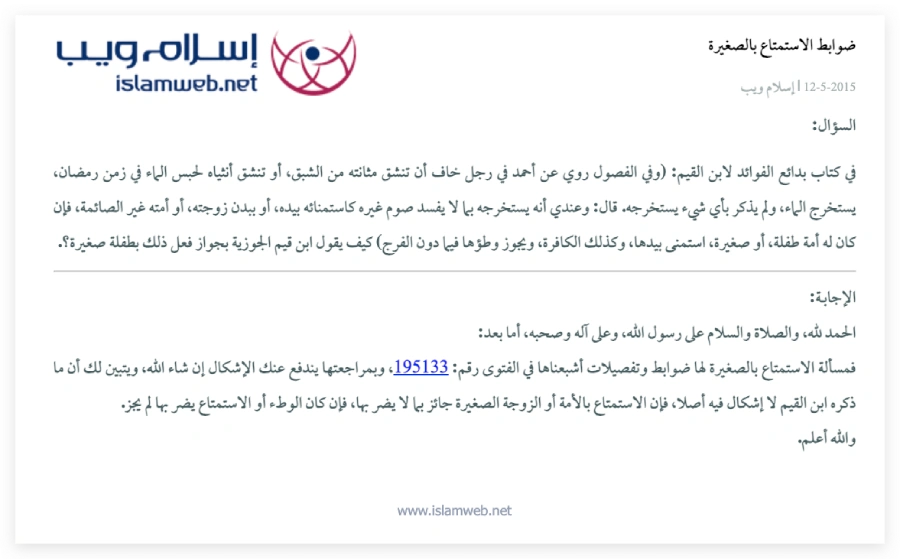
ضوابط الاستمتاع بالصغيرة
12-5-2015 | إسلام ويب
السؤال:
في كتاب بدائع الفوائد لابن القيم: (وفي الفصول روي عن أحمد في رجل خاف أن تنشق مثانته من الشبق، أو تنشق أنثياه لحبس الماء في زمن رمضان، يستخرج الماء، ولم يذكر بأي شيء يستخرجه. قال: وعندي أنه يستخرجه بما لا يفسد صوم غيره كاستمنائه بيده، أو ببدن زوجته، أو أمته غير الصائمة، فإن كان له أمة طفلة، أو صغيرة، استمنى بيدها، وكذلك الكافرة، ويجوز وطؤها فيما دون الفرج) كيف يقول ابن قيم الجوزية بجواز فعل ذلك بطفلة صغيرة؟
الإجابــة:
الحمد لله، والصلاة والسلام على رسول الله، وعلى آله وصحبه، أما بعد:
فمسألة الاستمتاع بالصغيرة لها ضوابط وتفصيلات أشبعناها في الفتوى رقم: 195133، وبمراجعتها يندفع عنك الإشكال إن شاء الله، ويتبين لك أن ما ذكره ابن القيم لا إشكال فيه أصلا، فإن الاستمتاع بالأمة أو الزوجة الصغيرة جائز بما لا يضر بها، فإن كان الوطء أو الاستمتاع يضر بها لم يجز.
والله أعلم.
Translation:
The Ruling and Conditions Concerning Sexual Enjoyment with an Underage Girl
12 May 2015 | Islamweb
Question:
Ibn al-Qayyim’s Bada’i al-Fawa’id states:
“Al-Fusul narrates from Ahmad that, if a man in Ramadan fears that his bladder will burst because of intense sexual arousal or that his testicles will burst because of retaining semen, he may discharge it. It does not specify, however, how he should do so.
He says: in my view, he should discharge it by a method that does not invalidate anyone else’s fast, such as using his own hand or obtaining sexual gratification through the body of a wife or enslaved woman who is not fasting.
If he has an enslaved child or an underage enslaved girl, he may use her hand to obtain sexual gratification. He may do likewise with a non-Muslim enslaved woman. Nonpenetrative sexual acts with her are also permissible.”
How can Ibn al-Qayyim mention such acts with a little girl as permissible?
Answer:
All praise is due to Allah. May peace and blessings be upon the Messenger of Allah, his family, and his Companions. To proceed:
Sexual enjoyment with an underage girl is subject to certain conditions and detailed rules. We have discussed them at length in fatwa no. 195133. Reading it will, Allah willing, dispel your doubt.
It will then become clear to you that there is no problem at all with what Ibn al-Qayyim mentions. Sexual enjoyment with an underage enslaved girl or an underage wife is permissible in a manner that causes her no harm. If intercourse or other forms of sexual enjoyment harm her, however, they are not permissible.
Allah knows best.
“No problem at all”—this untroubled declaration answers a question about a child. The fatwa’s reasoning first accepts a right to sexual enjoyment and then determines the limits of its exercise. The condition of causing no harm is offered in response to the foundational objection: why should a child be an object of an adult’s sexual use at all? The child’s sexual safety has become subordinate to permission for someone else to use her. The claim of the person who wants to use the child is accepted as legitimate, and the extent of that use is then measured. Giving adult entitlement priority over the child’s body, development, and inability to understand sexual conduct and make decisions about it constitutes a legal structure of sexual exploitation.
This answer also documents the continuing acceptance of religious authority. A modern questioner expresses concern about a rule quoted in a classical work; a modern fatwa declares that rule acceptable. The problem therefore does not remain confined to the language of old books. Someone seeking religious advice is told that sexual enjoyment with a child is permissible under certain conditions. The social danger of that teaching is clear: it supplies religious permission to make sexual claims over a child instead of protecting her. That authorization itself becomes the authoritative answer confronting the person who raises a moral objection.
The Detailed 2013 Fatwa: Endurance as the Criterion for Permission
Answer 195133, to which fatwas 78529 and 296044 refer, discusses an underage girl’s marriage, her transfer to her husband, intercourse, and other forms of sexual enjoyment in detail. This fatwa states that all sexual enjoyment is prohibited in the case of a very young child who lacks understanding. The institution’s preferred criterion for permission is a general capacity for intercourse, or approaching that threshold. Its assessment of age and development therefore moves in a particular direction: whether the girl has reached a stage at which she can endure sexual use. Suitability for the application of sexual acts replaces the child’s authority over her own sexual decisions [20].
والذي نميل إليه أن تجعل إطاقة الوطء في الجملة أو مراهقة هذا الحد هو الوصف المبيح لسائر أنواع الاستمتاع، درء للضرر المحتمل على الطفلة الصغيرة التي لا تدرك مثل هذه الأمور.
Translation: The position toward which we incline is to make the capacity to endure intercourse in general, or approaching that threshold, the qualifying condition for permitting all other forms of sexual enjoyment, in order to prevent potential harm to a young child who does not understand such matters.
The cruelty of the problem is captured within the same sentence. It acknowledges that the child “does not understand such matters,” while making capacity for intercourse, or approaching that threshold, the criterion for permission. Physical endurance becomes the answer to an inability to understand. The growth of a girl’s body and the maturity needed to understand sexual activity and make decisions are distinct matters, yet the former is made the basis for permitting other sexual acts. Once the body of the child whose lack of understanding is acknowledged is deemed sufficiently suitable, a path opens for the man’s sexual entitlement to take effect. Seeking sexual permission within a child’s ignorance and dependence establishes a rule that endangers her safety.
The fatwa also quotes a statement by Imam al-Nawawi concerning the transfer of an underage wife to her husband’s home and the beginning of intercourse. It discusses agreement between the husband and guardian, a position setting a threshold of nine years if they disagree, and the view of several imams that capacity for intercourse should determine the threshold. The husband and guardian become the effective parties in the discussion of the most intimate decision in the girl’s life. Instead of recognizing her as the person entitled to govern her own life, the discussion establishes rules for their decisions about when she may be handed over [20].
قال النووي: أما وقت زفاف الصغيرة المزوجة والدخول بها، فإن اتفق الزوج والولي على شيء لا ضرر فيه على الصغيرة عمل به. وإن اختلفا فقال أحمد وأبو عبيد: تجبر على ذلك بنت تسع سنين دون غيرها. وقال مالك والشافعي وأبو حنيفة: حد ذلك أن تطيق الجماع. ويختلف ذلك باختلافهن ولا يضبط بسن. وهذا هو الصحيح.
Translation: Al-Nawawi says: concerning the time when a married underage girl is sent to her husband’s home and intercourse with her begins, if the husband and guardian agree on an arrangement that does not harm her, it is to be followed. If they disagree, Ahmad and Abu Ubayd say that a nine-year-old girl may be compelled in this matter, but not a girl of another age. Malik, al-Shafi‘i, and Abu Hanifa say that the criterion is capacity to endure intercourse. This varies from girl to girl and cannot be tied to a fixed age. This is the correct position.
Agreement between a husband and guardian does not, in reality, create a child’s consent. Yet in this arrangement, other people make agreements about the child, assess her body’s capacity, and decide when she may be handed over to her husband. Their judgment that “there is no harm” takes the place of the child’s own permission. A relationship is imposed on the basis of bodily capacity and a guardian’s decision, bypassing the elements of independent consent: the practical power to object, the ability to leave the relationship, and an understanding of sexual activity. This system establishes authority over a child as an entitlement.
Custody of a Five-Year-Old Girl: Sexual Claims Intrude into a Relationship of Care
The connection between child marriage and sexual rights extends into discussions of custody. Fatwa 195133 quotes a question put to Ibn Hajar al-Haytami: after irrevocably divorcing his wife, a man has married off their five-year-old daughter; the new husband wants to remove the girl from her mother and keep her in his home or with someone he chooses. The answer explains why the mother’s custody does not end by identifying when the husband’s right to sexual enjoyment with the girl takes effect—when she can withstand intercourse. Even a five-year-old’s continued residence with her mother thus becomes tied to marital sexual rights [20].
وقد سئل ابن حجر الهيتمي عن رجل طلق زوجته طلاقا بائنا، وله منها بنت سنها خمس سنين، وزوجها والدها بشخص، وأراد ذلك الشخص أن ينزعها من والدتها وينفق عليها ويربيها عنده في بيته مثلا أو عند من يختار، فهل له ذلك وتسقط حضانة الأم بذلك أم لا ؟ فأجاب: لا تسقط حضانة الأم بذلك؛ لأن الزوج إنما يكون أولى بالحضانة من جميع الأقارب حيث كان له بالزوجة استمتاع بأن تطيق الوطء، وإلا لم تسلم له.
Translation: Ibn Hajar al-Haytami was asked: a man has irrevocably divorced his wife. He has a five-year-old daughter born to that wife. The father has married the girl to another man. That man wishes to take the girl away from her mother, provide her maintenance, and raise her in his own home or with someone of his choosing. Does he have this right, and does the mother’s custody thereby end?
He answers: the mother’s custody does not end as a result. The husband has a greater right to custody than all relatives only when he has the right to sexual enjoyment with his wife—that is, when the girl can endure intercourse. Otherwise, she is not handed over to him.
In this question concerning a five-year-old girl, the father has married her off, the husband wants to take her away, and the jurist decides whether she should remain with her mother. Several forms of adult authority descend upon the child at once. The condition under which the answer preserves her residence with her mother is itself horrifying: once the girl’s body becomes suitable for intercourse, the husband’s claim takes priority in custody. The opportunity to grow up safely with her mother thus becomes subject to the possible timing of sexual rights. Placing a man’s sexual claim above a child’s relationships of care and affection reveals the nature of power in child marriage.
The danger of this rule extends beyond involving a child in sexual activity. Marriage also changes the questions of where she lives, who cares for her, and whether she can remain close to those she loves. The man who has married her may demand control of her daily life in the name of marriage; the father who arranged it has placed her in the path of that demand. Marriage brings the full weight of an adult institution down upon an underage girl’s life. Making capacity for sexual relations the key to entry into that institution subordinates her need to develop as a complete human being to male advantage.
The Shia Jurist al-Yazdi: Permission for the Sexual Use of a Nursing Infant
The first ruling in the chapter on “intercourse with an underage girl” in the Twelver Shia jurist Muhammad Kazim al-Tabataba’i al-Yazdi’s Al-Urwa al-Wuthqa is still more direct. Penetrative intercourse is prohibited before the completion of nine years, whether the wife is free or enslaved and whether the marriage is permanent or temporary. The same prohibition applies to an owned female slave and to a female slave with whom sexual relations have been authorized. The subsequent passage declares other forms of sexual enjoyment permissible, including looking, lustful touching, embracing, and tafkhidh. The scope of that permission extends to «ولو في الرضيعة»—“even a nursing infant.” Prohibition and permission are two parts of the same rule; this is how the boundary determining which sexual acts may be inflicted upon a child is drawn [21].
( مسألة 1 ) : لا يجوز وطء الزوجة قبل إكمال تسع سنين ؛ حرّة كانت أو أمة ، دواماً كان النكاح أو متعة ، بل لا يجوز وطء المملوكة والمحلّلة كذلك ، وأمّا الاستمتاع بما عدا الوطء من النظر واللمس بشهوة والضمّ والتفخيذ فجائز في الجميع ولو في الرضيعة .
Translation: Ruling 1: penetrative intercourse with a wife before she has completed nine years is not permissible, whether she is free or enslaved and whether the marriage is permanent or temporary (mut‘a). Likewise, intercourse before that age is not permissible with an enslaved girl held in ownership or one with whom sexual relations have been authorized. Sexual enjoyment other than intercourse—such as looking, lustful touching, embracing, and tafkhidh—is permissible in all the cases mentioned, even with a nursing infant.
The words “even a nursing infant” provoke revulsion toward a morality that establishes an adult’s sexual entitlement over a helpless child’s body. Such an infant depends on adults for almost every need in life. She must be fed, cleaned, and kept safe; adults are responsible for understanding her distress and needs and caring for her. Yet permission to look at that child with sexual desire, touch her sexually, or use her for sexual enjoyment is declared in a written rule. The child’s complete dependence, which supplies the strongest reason for protection, instead becomes the setting for a right to sexual conduct toward her. Authorization of adult desire takes the place of a relationship of care.
There is no ambiguity about the child’s consent here: a nursing infant does not understand sexual activity, cannot make sexual decisions, and knows nothing of the marital identity imposed upon her. Her body is the object of permission; at this age, there is no possibility of a place for her own decision. Yet the rule untroubledly declares the conduct “permissible.” This assured authorization accords child sexual abuse the status of conduct compliant with religious law. Establishing sexual rights over a child’s extreme helplessness does the complete opposite of protecting her: it opens a path for the more powerful to use someone who has no power.
Ruhollah Khomeini’s Tahrir al-Wasila: Permission Expressed as “There Is No Problem”
A similar rule appears in ruling 12 of the second volume of Ruhollah Khomeini’s Tahrir al-Wasila. Penetrative intercourse with a wife is prohibited before the completion of nine years, whether the marriage is permanent or temporary. Concerning other forms of sexual enjoyment, his wording is «فلا بأس بها حتّى في الرضيعة»—“there is no problem with them, even in the case of a nursing infant.” The remainder of the same ruling discusses the marital relationship, permanent prohibition of intercourse, and maintenance if intercourse at a young age causes grave physical injury; the discussion of compensation continues on the next page. Before the detailed legal arrangements for what happens to the relationship after the child’s body has been injured stands this direct permission for nonpenetrative sexual use [22].
لا يجوز وطء الزوجة قبل إكمال تسع سنين ، دواماً كان النكاح أو منقطعاً ، وأمّا سائر الاستمتاعات – كاللمس بشهوة والضمّ والتفخيذ – فلا بأس بها حتّى في الرضيعة .
Translation: Penetrative intercourse with a wife before she has completed nine years is not permissible, whether the marriage is permanent or temporary. Other forms of sexual enjoyment—such as lustful touching, embracing, and tafkhidh—present no problem, even with a nursing infant.
Placing a nursing infant alongside the words “there is no problem” makes the moral emptiness of this rule clear. A list of permissible forms of enjoyment is drawn up concerning a child entitled to protection from all sexual activity. Having acknowledged an adult’s claim over the child’s body, the rule merely determines which methods are permitted and which are not. It divides the child’s body into separate domains of permission. Authorized sexual use remains outside the line prohibiting intercourse, and the child is subjected to that permission. Recognizing a child as a person entitled to full protection leaves no room for establishing such sexual claims over her.
The presence of the same permission from al-Yazdi’s ruling to Khomeini’s work demonstrates its renewed acceptance within the religious legal tradition. The nursing infant is explicitly mentioned in the language of a rule within works used as authorities. That language places an authorization in the hands of a religious follower: under a particular relationship, a child may be used sexually. The greater the standing of the work, the stronger the authority of the permission. Religiously established adult sexual benefits are thus placed in opposition to the child’s safety. The exercise of authority over a child rests on more than personal power; it is accompanied by a claim to comply with religious law. This authorization gives the exploiter another power that can be used against the child.
“Permissible If No Harm Is Caused”: The Injustice within Permission to Use a Child’s Body
Accepting a right to sexual use first, with “no harm” as a condition, starts the assessment of a child’s safety in the wrong place. The question of why a child should be used for an adult’s sexual needs is replaced by a test of how much use she can withstand. This shift is explicit in Sunni fatwas’ reasoning about capacity; the quoted rules of al-Yazdi and Khomeini give direct permission even in the case of a nursing infant. This system discusses protection as a limit on adult entitlement while establishing that entitlement as its foundation. When asserting a sexual claim over a child’s body is itself the source of the problem, assuming the claim legitimate and measuring the extent of its exercise creates rules for exploitation.
A child’s consent does not mean remaining silent, obeying adults, or being unable to resist. Consent requires understanding the act, the developmental capacity to decide, and the ability to refuse without pressure. Nursing infants and children who lack understanding have none of these capacities. Comprehension and informed consent are also central to the public health definition of sexual abuse. The United States Centers for Disease Control and Prevention describes a child’s involvement in sexual activity that the child does not fully understand, does not consent to or cannot give informed consent to, or is not developmentally prepared for. The same source also identifies long-term effects of sexual abuse on health and well-being [23].
Key points:
Child sexual abuse is a serious public health problem and an adverse childhood experience (ACE).
Child sexual abuse can have a long-term impact on health, opportunity, and well-being.
What is child sexual abuse?
Child sexual abuse refers to the involvement of a child (person less than 18 years old) in sexual activity that violates the laws or social taboos of society and that the child:
Does not fully comprehend.
Does not consent to or is unable to give informed consent to.
Is not developmentally prepared for and cannot give consent to.
Translation: Key points:
Child sexual abuse is a serious public health problem and an adverse childhood experience (ACE).
Child sexual abuse can have a long-term impact on health, opportunity, and well-being.
What is child sexual abuse?
Child sexual abuse refers to the involvement of a child (person less than 18 years old) in sexual activity that violates the laws or social taboos of society and that the child:
Does not fully comprehend.
Does not consent to or is unable to give informed consent to.
Is not developmentally prepared for and cannot give consent to.
Assessing the harm of sexual conduct toward a child also requires considering her whole life. Safety, trust in her own body, dependence on caregivers, and room to become gradually independent are parts of a child’s development. Involvement in sexual activity under adult power threatens that safety. Measuring visible injuries cannot fully capture the harm within this relationship. A child who does not understand the event or cannot speak for herself offers no basis for treating her silence as a favorable sign. Her helplessness increases adult responsibility; drawing that helplessness into a framework of sexual permission betrays her.
A marriage contract changes none of this about a child’s situation. Other people conclude the contract, while sexual acts will be imposed upon her. A guardian’s authority exists for her care and protection; he has no moral authority to sell or transfer permission for her sexual use. A law that gives the guardian’s and husband’s decisions force over the child’s body deprives her of authority over that body. It can also turn her dependence on food, shelter, and affection into an opportunity for exploitation, because her survival depends on the very people she would have to resist. Calling adult sexual benefits an entitlement within this configuration of power legitimizes oppression.
From a Child Marriage Contract to Control of a Child’s Entire Life
Discussions of child marriage foreground the wedding and the age at which intercourse begins. Rules governing mufakhadhah and other nonpenetrative sexual acts show that the interval between them is not protected from sexual claims either. Some legal interpretations treat the marriage contract as establishing a right to sexual enjoyment, whose exercise is then determined by the child’s physical capacity. The period of waiting described by saying “intercourse will happen later” may therefore still permit sexual conduct toward the child. The danger begins when she is placed within a relationship subject to another person’s sexual entitlement. Calling it marriage gives that subjection familial and religious acceptance.
Hanafi reasoning about maintenance draws this subjection into economic rules; the custody fatwa draws it into questions of residence and care; the rule concerning an enslaved girl connects it to ownership [24]. In the statements of al-Yazdi and Khomeini, the child’s age falls to a point at which consent or understanding is impossible. The connection between these rules is adult authority over a child’s body and life. Once that authority is recognized as a sexual entitlement, the girl’s body, residence, care, and continued place within the relationship all become part of calculations of someone else’s advantage. Further articles on the extensive evidence concerning child marriage in Islam and other juristic rules appear in Shongshoy’s child marriage section.
Conclusion: Divine Rules That Turn a Child into an Object of Sexual Enjoyment
The cruelty of the quoted rules lies in their conclusions. Sunni fatwas declare mufakhadhah with an underage wife permissible under certain conditions. Hanafi discussions of maintenance make a child’s sexual usability relevant to responsibility for her expenses. In Ibn Aqil’s quoted statement, an enslaved girl becomes a means of solving her owner’s sexual problem. Al-Yazdi and Khomeini write permission for lustful sexual enjoyment even with a nursing infant. In every position, adult advantage receives legal recognition, while the child’s body becomes the means of obtaining it. Instead of building protection against child sexual abuse, these rules supply language authorizing abusive conduct.
A child’s world begins with trust in other people. Adults are responsible for feeding her, removing her from danger, caring for her when she is ill, and making room for her to grow. Introducing sexual demands into that trust and dependence exercises power against the child. Declaring her helpless body a legitimate object of desire gives that exercise of power religious authorization. The clear moral judgment against a rule that turns even a nursing infant into an object of sexual enjoyment is this: it authorizes child sexual abuse and constitutes a cruel rule opposed to children’s safety and human dignity. A child’s body is her own; no adult is entitled to her childhood as a means of satisfying desire.
References
- Child Marriage, Puberty, and Adulthood: Definitions, Consent, and Health Risks ↩︎
- Child Marriage and Intercourse with Underage Wives in the Quran: Surah At-Talaq 65:4 and the Evidence of the Commentaries ↩︎
- Aisha’s Age at Marriage and Consummation: The Full Evidence from Hadith and Fiqh ↩︎
- Child Marriage in Early Islam: Historical Precedents among the Prophet, the Companions, the Successors, and the Caliphate ↩︎
- Islamic Sharia Law: Determining Compensation When a Child Wife’s Vaginal Passage Is Torn ↩︎
- Islamweb, fatwa 111399: Sexual Enjoyment with a Wife Whose Marriage Contract Has Been Concluded ↩︎
- A Detailed List of the Prophet’s Wives and Female Slaves ↩︎
- Sahih Muslim, Islamic Foundation edition, hadith 572 ↩︎
- Sunan an-Nasa’i, Islamic Foundation edition, hadith 374 ↩︎
- Sahih Muslim 293a ↩︎
- Sunan an-Nasa’i 374 ↩︎
- Islamweb, fatwa 78529: Sexual Enjoyment with an Underage Wife ↩︎
- Quran 4:6 — Dr. Mustafa Khattab, The Clear Quran ↩︎
- Muhammad Illish, Manh al-Jalil Sharh Mukhtasar Khalil, vol. 3, p. 426 ↩︎
- Kamal Ibn al-Humam, Fath al-Qadir, vol. 4, pp. 384–385, chapter on maintenance 1 2 3
- Quran 2:233; Quran 65:7; Dr. Mustafa Khattab, The Clear Quran; Sahih Muslim 1218a ↩︎
- Ibn Nujaym, Al-Bahr al-Ra’iq, vol. 4, p. 196, chapter on maintenance ↩︎
- Ibn al-Qayyim, Bada’i al-Fawa’id, pp. 1473–1474: quotation from Al-Fusul and the subsequent comment ↩︎
- Islamweb, fatwa 296044, 12 May 2015: Conditions Governing Sexual Enjoyment with an Underage Girl ↩︎
- Islamweb, fatwa 195133, 2 January 2013: Marriage to and Sexual Enjoyment with an Underage Girl 1 2 3
- Muhammad Kazim al-Yazdi, Al-Urwa al-Wuthqa, vol. 2, p. 621, ruling 1 ↩︎
- Ruhollah Khomeini, Tahrir al-Wasila, vol. 2, p. 259, ruling 12 ↩︎
- United States Centers for Disease Control and Prevention, About Child Sexual Abuse, 16 May 2024 ↩︎
- A Legal License for Pedophilia in Islamic Sharia: The Permissibility of Intercourse with Underage Female Slaves ↩︎