
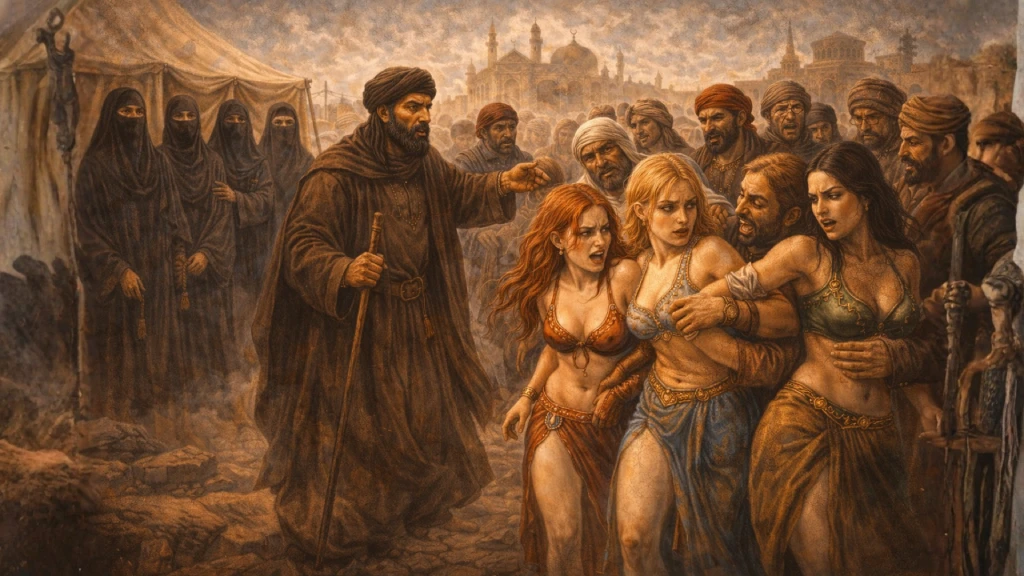
Introduction
Within the traditional framework of Islamic theology, the legal authorization of sexual relations with “owned” or “possessed” female slaves falls directly and unequivocally within the modern understanding of “sexual slavery” and “systematic rape,” judged by human rights and bodily autonomy. Various verses of the Quran, Islam’s foundational source, explicitly present sexual relations with captive or purchased women alongside free wives as not merely morally permissible, but as a God-given right, something “halal,” and a means of earning “sadaqa,” or religious merit [1] [2] [3] [4]. These verses rest on an inhumane philosophy of ownership in which one person’s absolute possession of another person’s body is glorified within a “sacred” legal framework. An examination of the translations on Quran.com [5], together with hadith, sira, fiqh, and classical Quranic commentaries, makes clear that these rules were introduced to provide religious justification for the plunder associated with tribal conflict and warfare in Arabia at the time. From a rationalist standpoint, no timeless morality can turn human dignity into a commodity; these texts instead plainly reflect the patriarchal and barbaric culture of slavery in the seventh century.
Islamic Scholars’ Statements on Intercourse with Female Slaves
When contemporary Islamic preachers and scholars explain the sexual “use” of women captured in seventh-century wars, they often make the peculiar attempt to justify it as a “reality of the time” or as “rescuing helpless women.” Yet measured against reason and universal human rights, these arguments are entirely hollow and self-contradictory. Treating a female captive as “ghanima,” or the spoils of war, represents not only moral degeneration but also the historical institutionalization of sexual abuse without consent. No sound social order grounded in reason can define one person’s body as a “reward” for another. Let us examine the supposed “reasoning” offered by these so-called scholars for this primitive rule permitting the sexual “use” of unbelieving women, as expressed in the sermons below. First, a sermon explaining that the systematic rape of unbelieving women is actually a punishment for their unbelief:
Islamic sharia very clearly treats satisfying the sexual demands of an owner or master as an obligatory duty of female slaves. The documentary evidence will follow one item at a time, but this video makes the issue clear at the outset. In it, Shaykh Mustafa al-Adawi, a prominent contemporary hadith scholar and religious authority, is asked whether it is permissible to compel one’s female slave to have intercourse. With considerable irritation, he replies, in effect: What question of consent is there for slaves? They are slaves! His irritated tone is unmistakable, suggesting that he regards the question as utterly pointless and beneath consideration. Let us watch the video:
Let us also watch the video of Shaykh Salih al-Fawzan, a highly respected Saudi Arabian scholar, speaking directly on the subject:
The Canadian Islamist Shabir Ally was asked about keeping sex slaves or concubines in Islam. He acknowledges quite plainly that a Muslim man may keep an unlimited number of female slaves:
Let us now examine statements by Ahmadullah and other scholars who declare human love and romantic relationships entirely forbidden on the grounds of unrestricted interaction between men and women, while treating the sexual use of enslaved women as a supreme moral rule ordained by Allah. They attempt to justify slavery of this kind as a “system,” which in practice amounts to erasing women’s humanity:
Transferring a human being as a “gift” is a punishable offense by modern ethical standards. Yet Islamic history shows that Muhammad himself accepted women or female slaves as gifts, and sexual intercourse with them was regarded as lawful—a rule that remains equally applicable under Islamic sharia today. Mizanur Rahman Azhari’s account of Maria al-Qibtiyya illustrates how a human life could be transferred like an inanimate object:
The terrifying forms this medieval outlook can still take become apparent when a contemporary Pakistani Muslim imagines “booking” foreign women as “spoils of war” in the context of warfare. This demonstrates how these religious teachings continue to sustain gendered violence and inhumane lust in the human subconscious:
The Quran on Sexual Relations with Female Slaves
Various Quranic verses identify two specific sources for satisfying men’s sexual desires: first, legally married wives; second, “owned female slaves” acquired through war or purchase (ma malakat aymanukum). What modern ethical language calls “sexual slavery” is not merely legalized by the Quran; it is presented as an entirely normal social institution. An examination of these verses shows that, within this supposedly divine legislation, the principal criterion for sexual relations was male “ownership,” rather than female “consent.” From a rationalist standpoint, it is clear that these rules form no part of a timeless morality; they are instruments for perpetuating the economy of seventh-century tribal warfare and patriarchal sexual exploitation.
Surah Al-Mu’minun, Verses 5–6
These verses identify “guarding the private parts” as one condition of the believers’ success. The striking point, however, is that female slaves are entirely exempted from this obligation of sexual restraint. In other words, believing men may have sexual relations with as many female slaves as they wish in addition to their wives, without attracting the slightest blame from society or God. This demonstrates that female slaves and captive women were regarded not as fully human persons, but simply as “sexual property.”
وَٱلَّذِينَ هُمۡ لِفُرُوجِهِمۡ حَٰفِظُونَ
those who guard their chastity
Dr. Mustafa Khattab, The Clear Quran (English); Taisirul Quran (Bengali)
And they who guard their private parts
Sahih International (English); Sheikh Mujibur Rahman (Bengali)
And who guard their modesty –
Marmaduke Pickthall (English); Rawai Al-bayan (Bengali)
Who abstain from sex,
Abdullah Yusuf Ali (English); Dr. Abu Bakr Muhammad Zakaria (Bengali, note 1)
إِلَّا عَلَىٰٓ أَزۡوَٰجِهِمۡ أَوۡ مَا مَلَكَتۡ أَيۡمَٰنُهُمۡ فَإِنَّهُمۡ غَيۡرُ مَلُومِينَ
except with their wives or those ˹bondwomen˺ in their possession, for then they are free from blame,
Dr. Mustafa Khattab, The Clear Quran (English); Taisirul Quran (Bengali)
Except from their wives or those their right hands possess, for indeed, they will not be blamed –
Sahih International (English); Sheikh Mujibur Rahman (Bengali)
Save from their wives or the (slaves) that their right hands possess, for then they are not blameworthy,
Marmaduke Pickthall (English); Rawai Al-bayan (Bengali)
Except with those joined to them in the marriage bond, or (the captives) whom their right hands possess,- for (in their case) they are free from blame,
Abdullah Yusuf Ali (English); Dr. Abu Bakr Muhammad Zakaria (Bengali, note 1)
Surah Al-Ma’arij, Verses 29–30
These verses identify “guarding the private parts” as one condition of the believers’ success. What deserves attention, however, is that female slaves are entirely exempted from this obligation of sexual restraint. In other words, believing men may have sexual relations with as many female slaves as they wish in addition to their wives, without attracting the slightest blame from society or God. This demonstrates that female slaves and captive women were regarded not as fully human persons, but simply as “sexual property.”
وَٱلَّذِينَ هُمۡ لِفُرُوجِهِمۡ حَٰفِظُونَ
and those who guard their chastity
Dr. Mustafa Khattab, The Clear Quran (English); Taisirul Quran (Bengali)
And those who guard their private parts
Sahih International (English); Sheikh Mujibur Rahman (Bengali)
And those who preserve their chastity
Marmaduke Pickthall (English); Rawai Al-bayan (Bengali)
And those who guard their chastity,
Abdullah Yusuf Ali (English); Dr. Abu Bakr Muhammad Zakaria (Bengali, note 1)
إِلَّا عَلَىٰٓ أَزۡوَٰجِهِمۡ أَوۡ مَا مَلَكَتۡ أَيۡمَٰنُهُمۡ فَإِنَّهُمۡ غَيۡرُ مَلُومِينَ
except with their wives or those ˹bondwomen˺ in their possession, for then they are free from blame,
Dr. Mustafa Khattab, The Clear Quran (English); Taisirul Quran (Bengali)
Except from their wives or those their right hands possess, for indeed, they are not to be blamed –
Sahih International (English); Sheikh Mujibur Rahman (Bengali)
Save with their wives and those whom their right hands possess, for thus they are not blameworthy;
Marmaduke Pickthall (English); Rawai Al-bayan (Bengali)
Except with their wives and the (captives) whom their right hands possess,- for (then) they are not to be blamed,
Abdullah Yusuf Ali (English); Dr. Abu Bakr Muhammad Zakaria (Bengali)
Surah Al-Ahzab, Verse 50
This verse lists special sexual privileges granted to Muhammad himself. Here, unbelieving women acquired as fay’, or gains obtained without battle, are made “halal” for him. A female captive may have lost her tribe and family in war and seen her home destroyed. Allocating her body to the victor instead of showing her compassion represents the ultimate expression of primitive barbarity. Under modern human rights standards, this is considered a “war crime.”
يَٰٓأَيُّهَا ٱلنَّبِيُّ إِنَّآ أَحۡلَلۡنَا لَكَ أَزۡوَٰجَكَ ٱلَّٰتِيٓ ءَاتَيۡتَ أُجُورَهُنَّ وَمَا مَلَكَتۡ يَمِينُكَ مِمَّآ أَفَآءَ ٱللَّهُ عَلَيۡكَ وَبَنَاتِ عَمِّكَ وَبَنَاتِ عَمَّٰتِكَ وَبَنَاتِ خَالِكَ وَبَنَاتِ خَٰلَٰتِكَ ٱلَّٰتِي هَاجَرۡنَ مَعَكَ وَٱمۡرَأَةٗ مُّؤۡمِنَةً إِن وَهَبَتۡ نَفۡسَهَا لِلنَّبِيِّ إِنۡ أَرَادَ ٱلنَّبِيُّ أَن يَسۡتَنكِحَهَا خَالِصَةٗ لَّكَ مِن دُونِ ٱلۡمُؤۡمِنِينَۗ قَدۡ عَلِمۡنَا مَا فَرَضۡنَا عَلَيۡهِمۡ فِيٓ أَزۡوَٰجِهِمۡ وَمَا مَلَكَتۡ أَيۡمَٰنُهُمۡ لِكَيۡلَا يَكُونَ عَلَيۡكَ حَرَجٞۗ وَكَانَ ٱللَّهُ غَفُورٗا رَّحِيمٗا
O Prophet! We have made lawful for you your wives to whom you have paid their ˹full˺ dowries as well as those ˹bondwomen˺ in your possession, whom Allah has granted you. And ˹you are allowed to marry˺ the daughters of your paternal uncles and aunts, and the daughters of your maternal uncles and aunts, who have emigrated like you. Also ˹allowed for marriage is˺ a believing woman who offers herself to the Prophet ˹without dowry˺ if he is interested in marrying her—˹this is˺ exclusively for you, not for the rest of the believers. We know well what ˹rulings˺ We have ordained for the believers in relation to their wives and those ˹bondwomen˺ in their possession. As such, there would be no blame on you. And Allah is All-Forgiving, Most Merciful.
Dr. Mustafa Khattab, The Clear Quran (English); Taisirul Quran (Bengali)
O Prophet, indeed We have made lawful to you your wives to whom you have given their due compensation and those your right hand possesses from what Allah has returned to you [of captives] and the daughters of your paternal uncles and the daughters of your paternal aunts and the daughters of your maternal uncles and the daughters of your maternal aunts who emigrated with you and a believing woman if she gives herself to the Prophet [and] if the Prophet wishes to marry her, [this is] only for you, excluding the [other] believers. We certainly know what We have made obligatory upon them concerning their wives and those their right hands possess, [but this is for you] in order that there will be upon you no discomfort. And ever is Allah Forgiving and Merciful.
Sahih International (English); Sheikh Mujibur Rahman (Bengali)
O Prophet! Lo! We have made lawful unto thee thy wives unto whom thou hast paid their dowries, and those whom thy right hand possesseth of those whom Allah hath given thee as spoils of war, and the daughters of thine uncle on the father’s side and the daughters of thine aunts on the father’s side, and the daughters of thine uncle on the mother’s side and the daughters of thine aunts on the mother’s side who emigrated with thee, and a believing woman if she give herself unto the Prophet and the Prophet desire to ask her in marriage – a privilege for thee only, not for the (rest of) believers – We are Aware of that which We enjoined upon them concerning their wives and those whom their right hands possess – that thou mayst be free from blame, for Allah is ever Forgiving, Merciful. *Fay’ means property of unbelievers acquired without battle.
Marmaduke Pickthall (English); Rawai Al-bayan (Bengali)
O Prophet! We have made lawful to thee thy wives to whom thou hast paid their dowers; and those whom thy right hand possesses out of the prisoners of war whom Allah has assigned to thee; and daughters of thy paternal uncles and aunts, and daughters of thy maternal uncles and aunts, who migrated (from Makka) with thee; and any believing woman who dedicates her soul to the Prophet if the Prophet wishes to wed her;- this only for thee, and not for the Believers (at large); We know what We have appointed for them as to their wives and the captives whom their right hands possess;- in order that there should be no difficulty for thee. And Allah is Oft-Forgiving, Most Merciful.
Abdullah Yusuf Ali (English); Dr. Abu Bakr Muhammad Zakaria (Bengali, note 1)
Surah An-Nisa, Verse 24
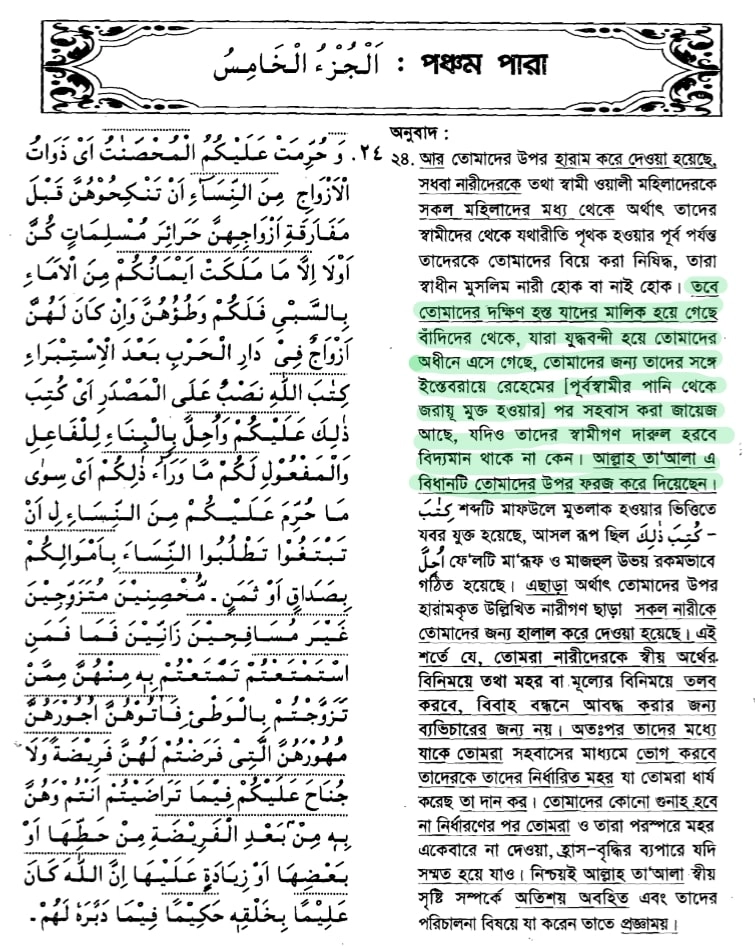
Verse 24 of Surah An-Nisa exposes one of the most controversial and darkest aspects of the history of morality. Although sexual relations with married women are forbidden, a grotesque exception is made when a woman is acquired on the battlefield as an “owned female slave.” In other words, the Quran directly authorizes taking a married woman from her husband and making her the unwilling sexual partner of a new owner. This is not only an extreme violation of human rights; it also demonstrates how the theologians of the time institutionalized wartime sexual violence under the cover of religion.
۞ وَٱلۡمُحۡصَنَٰتُ مِنَ ٱلنِّسَآءِ إِلَّا مَا مَلَكَتۡ أَيۡمَٰنُكُمۡۖ كِتَٰبَ ٱللَّهِ عَلَيۡكُمۡۚ وَأُحِلَّ لَكُم مَّا وَرَآءَ ذَٰلِكُمۡ أَن تَبۡتَغُواْ بِأَمۡوَٰلِكُم مُّحۡصِنِينَ غَيۡرَ مُسَٰفِحِينَۚ فَمَا ٱسۡتَمۡتَعۡتُم بِهِۦ مِنۡهُنَّ فَـَٔاتُوهُنَّ أُجُورَهُنَّ فَرِيضَةٗۚ وَلَا جُنَاحَ عَلَيۡكُمۡ فِيمَا تَرَٰضَيۡتُم بِهِۦ مِنۢ بَعۡدِ ٱلۡفَرِيضَةِۚ إِنَّ ٱللَّهَ كَانَ عَلِيمًا حَكِيمٗا
Also ˹forbidden are˺ married women—except ˹female˺ captives in your possession. This is Allah’s commandment to you. Lawful to you are all beyond these—as long as you seek them with your wealth in a legal marriage, not in fornication. Give those you have consummated marriage with their due dowries. It is permissible to be mutually gracious regarding the set dowry. Surely Allah is All-Knowing, All-Wise.
Dr. Mustafa Khattab, The Clear Quran (English); Taisirul Quran (Bengali)
And [also prohibited to you are all] married women except those your right hands possess. [This is] the decree of Allah upon you. And lawful to you are [all others] beyond these, [provided] that you seek them [in marriage] with [gifts from] your property, desiring chastity, not unlawful sexual intercourse. So for whatever you enjoy [of marriage] from them, give them their due compensation as an obligation. And there is no blame upon you for what you mutually agree to beyond the obligation. Indeed, Allah is ever Knowing and Wise.
Sahih International (English); Sheikh Mujibur Rahman (Bengali)
And all married women (are forbidden unto you) save those (captives) whom your right hands possess. It is a decree of Allah for you. Lawful unto you are all beyond those mentioned, so that ye seek them with your wealth in honest wedlock, not debauchery. And those of whom ye seek content (by marrying them), give unto them their portions as a duty. And there is no sin for you in what ye do by mutual agreement after the duty (hath been done). Lo! Allah is ever Knower, Wise.
Marmaduke Pickthall (English); Rawai Al-bayan (Bengali)
Also (prohibited are) women already married, except those whom your right hands possess: Thus hath Allah ordained (Prohibitions) against you: Except for these, all others are lawful, provided ye seek (them in marriage) with gifts from your property,- desiring chastity, not lust, seeing that ye derive benefit from them, give them their dowers (at least) as prescribed; but if, after a dower is prescribed, agree Mutually (to vary it), there is no blame on you, and Allah is All-knowing, All-wise.
Abdullah Yusuf Ali (English); Dr. Abu Bakr Muhammad Zakaria (Bengali, notes 1–3)
Hadith: Intercourse with Female Slaves Is Lawful
A dispassionate examination of hadith, the documentary foundation for the practical application of Islamic theology, shows that sexual domination over captive or purchased women was a routine and institutionalized feature of seventh-century tribal society. Whereas the modern concept of bodily autonomy rejects coercion and unequal relations of power, these hadith narratives define women simply as a means of satisfying men’s sexual demands. Muhammad himself kept female slaves or an umm walad and had sexual relations with them, a practice transformed from something that might be considered a moral transgression into a religious entitlement [6] [7] [8].
أَخْبَرَنِي إِبْرَاهِيمُ بْنُ يُونُسَ بْنِ مُحَمَّدٍ، حَرَمِيٌّ – هُوَ لَقَبُهُ – قَالَ حَدَّثَنَا أَبِي قَالَ، حَدَّثَنَا حَمَّادُ بْنُ سَلَمَةَ ، عَنْ ثَابِتٍ ، عَنْ أَنَسٍ ، أَنَّ رَسُولَ اللَّهِ صلى الله عليه وسلم كَانَتْ لَهُ أَمَةٌ يَطَؤُهَا فَلَمْ تَزَلْ بِهِ عَائِشَةُ وَحَفْصَةُ حَتَّى حَرَّمَهَا عَلَى نَفْسِهِ فَأَنْزَلَ اللَّهُ عَزَّ وَجَلَّ { يَا أَيُّهَا النَّبِيُّ لِمَ تُحَرِّمُ مَا أَحَلَّ اللَّهُ لَكَ } إِلَى آخِرِ الآيَةِ .
Publisher: Islamic Foundation
Collection: Sunan an-Nasa’i, Islamic Foundation edition
Book: 37, Treatment of Women (كتاب عشرة النساء)
Hadith number in the Bengali edition: 3961; Sunnah.com: 3959, Book 36, Hadith 21
3961. Chain: Ibrahim ibn Yunus ibn Muhammad, known as Harami … Anas. It was narrated from Anas, that the Messenger of Allah had a female slave with whom he had intercourse, but ‘Aishah and Hafsah would not leave him alone until he said that she was forbidden for him. Then Allah, the Mighty and Sublime, revealed: (يَا أَيُّهَا النَّبِيُّ لِمَ تُحَرِّمُ مَا أَحَلَّ اللَّهُ لَكَ) “O Prophet! Why do you forbid (for yourself) that which Allah has allowed to you.” until the end of the Verse. (Surah At-Tahrim, 66:1.)
Grade: Sahih (Darussalam)
Authentication: Sahih. [9]
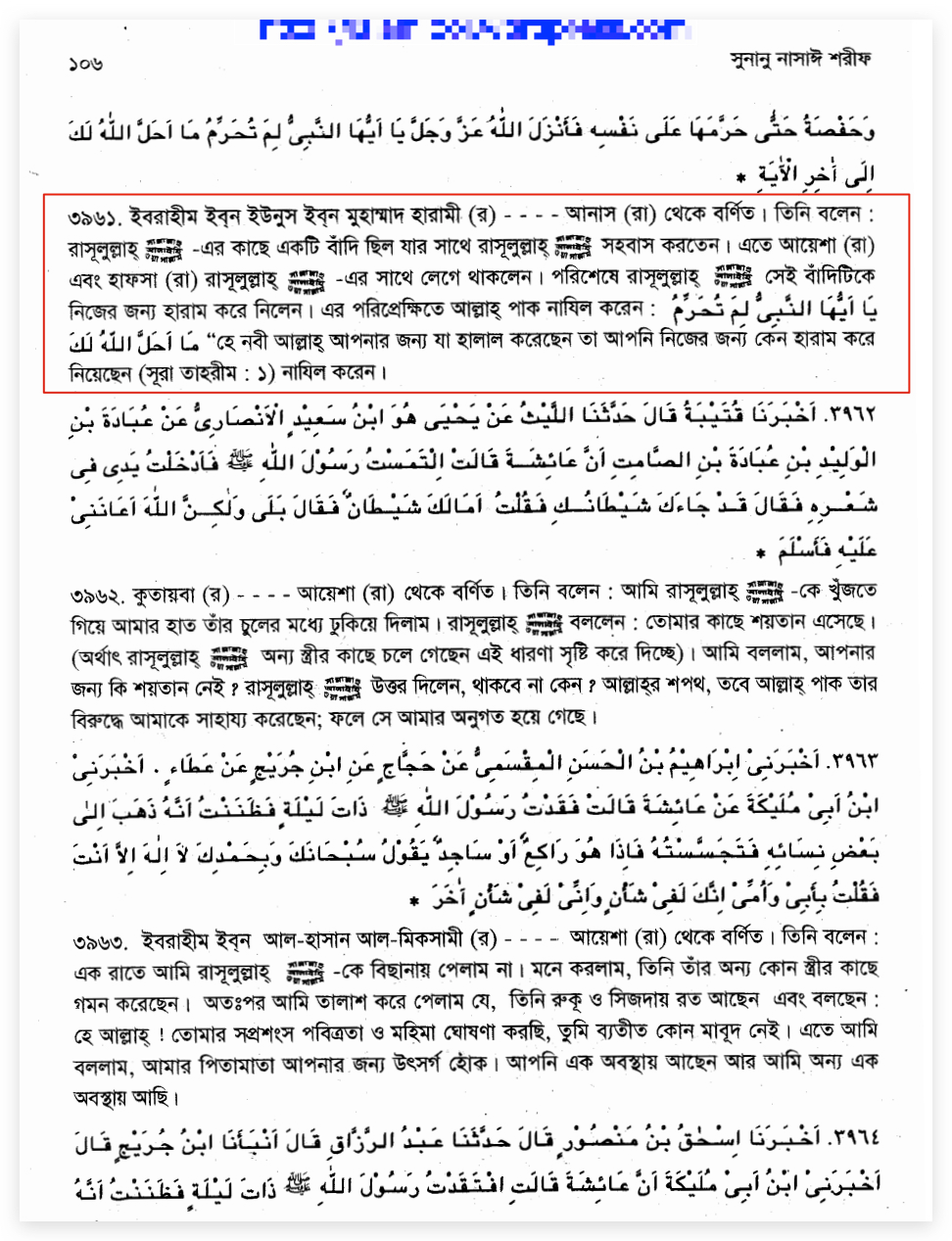
From a rational and skeptical standpoint, the preceding report is highly significant. Although Muhammad pledged to stop having intercourse with the female slave because of his wives’ distress or jealousy, a supposedly “divine revelation” commands him to resume sexual activity with her [10]. This indicates that male sexual “rights” were so absolute within the theological system of the time that women’s human feelings or consent had no place in it. A report in Sahih Muslim concerning an incident associated with Maria al-Qibtiyya, a female slave given to Muhammad as a gift, further shows a person’s life or death being determined solely on the basis of sexual jealousy or an accusation—an extreme violation of human rights and an act of barbarity by the standards of modern justice [11].
حَدَّثَنِي زُهَيْرُ بْنُ حَرْبٍ ، حَدَّثَنَا عَفَّانُ ، حَدَّثَنَا حَمَّادُ بْنُ سَلَمَةَ ، أَخْبَرَنَا ثَابِتٌ ، عَنْ أَنَسٍ ، أَنَّ رَجُلاً، كَانَ يُتَّهَمُ بِأُمِّ وَلَدِ رَسُولِ اللَّهِ صلى الله عليه وسلم فَقَالَ رَسُولُ اللَّهِ صلى الله عليه وسلم لِعَلِيٍّ ” اذْهَبْ فَاضْرِبْ عُنُقَهُ ” . فَأَتَاهُ عَلِيٌّ فَإِذَا هُوَ فِي رَكِيٍّ يَتَبَرَّدُ فِيهَا فَقَالَ لَهُ عَلِيٌّ اخْرُجْ . فَنَاوَلَهُ يَدَهُ فَأَخْرَجَهُ فَإِذَا هُوَ مَجْبُوبٌ لَيْسَ لَهُ ذَكَرٌ فَكَفَّ عَلِيٌّ عَنْهُ ثُمَّ أَتَى النَّبِيَّ صلى الله عليه وسلم فَقَالَ يَا رَسُولَ اللَّهِ إِنَّهُ لَمَجْبُوبٌ مَا لَهُ ذَكَرٌ
Sahih Muslim, Islamic Foundation edition
51, Repentance
Chapter 11: Exoneration of the Prophet’s Concubine from Suspicion
6766. Chain: Zuhayr ibn Harb … Anas. Sunnah.com: Sahih Muslim 2771, Book 50, Hadith 68. Anas reported that a person was charged with fornication with the slavegirl of Allah’s Messenger (ﷺ). Thereupon Allah’s Messenger (ﷺ) said to ‘Ali: Go and strike his neck. ‘Ali came to him and he found him in a well making his body cool. ‘Ali said to him: Come out, and as he took hold of his hand and brought him out, he found that his sexual organ had been cut. Hadrat ‘Ali refrained from striking his neck. He came to Allah’s Apostle (ﷺ) and said: Allah’s Messenger, he has not even the sexual organ with him.
Grade: Sahih
Narrator: Anas ibn Malik. [12]
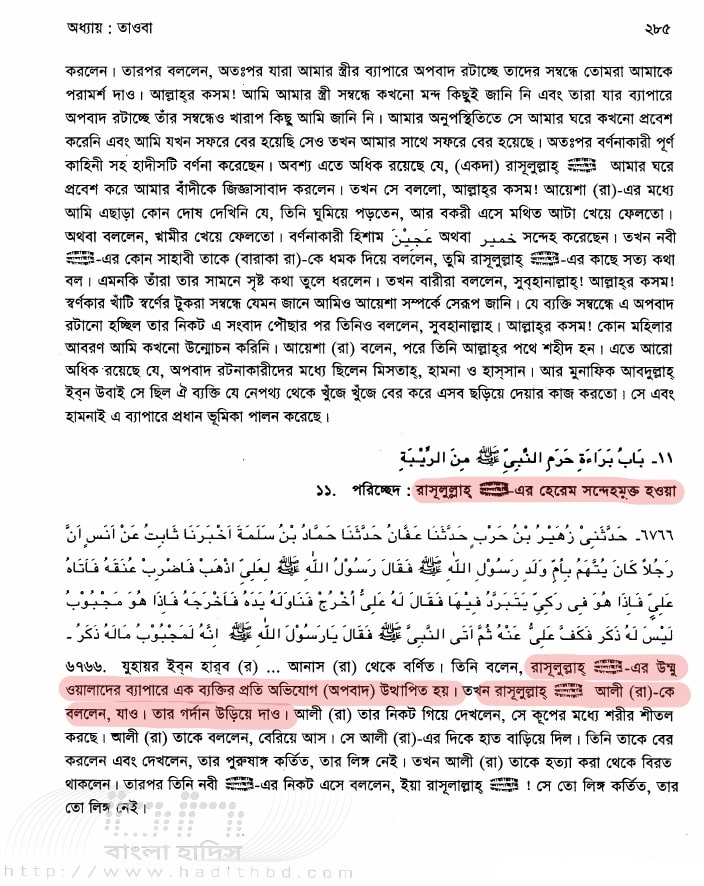
These historical sources themselves establish that Maria al-Qibtiyya’s relationship with Muhammad, from which their son Ibrahim was born, was a sexual relationship grounded in slavery. Maria was not accorded the status of Muhammad’s “wife”; rather, she spent her entire life as an “owned” woman. From the standpoint of modern science, this is a striking example of the degradation of human beings’ embodied dignity [13].
حَدَّثَنَا أَبُو الْوَلِيدِ ، حَدَّثَنَا شُعْبَةُ ، عَنْ عَدِيِّ بْنِ ثَابِتٍ ، أَنَّهُ سَمِعَ الْبَرَاءَ ـ رضى الله عنه ـ قَالَ لَمَّا تُوُفِّيَ إِبْرَاهِيمُ ـ عَلَيْهِ السَّلاَمُ ـ قَالَ رَسُولُ اللَّهِ صلى الله عليه وسلم ” إِنَّ لَهُ مُرْضِعًا فِي الْجَنَّةِ ”.
Sahih al-Bukhari, Tawhid edition
23, Funerals
Chapter 23/91: What Is Said about the Children of Muslims Who Die before Adulthood
1382. Narrated Al-Bara’: When Ibrahim (the son of Prophet) expired, Allah’s Messenger (ﷺ) said, “There is a wet-nurse for him in Paradise.” (2355, 6190.) (Adhunik Prakashani: 1291; Islamic Foundation: 1299.)
Grade: Sahih
Narrator: Al-Bara’ ibn Azib. [14] Sunnah.com: Book 23, Hadith 134.
Viewed rationally, the rule permitting exposure of the “private parts” only before a wife or female slave makes clear that the enslaved woman was not accorded the respect or privacy rights of a free person. This expresses a profound social division and a process of dehumanization in which a person’s body is defined simply as an object for the owner’s sexual use [15].
حَدَّثَنَا مُحَمَّدُ بْنُ بَشَّارٍ ، حَدَّثَنَا يَحْيَى بْنُ سَعِيدٍ ، حَدَّثَنَا بَهْزُ بْنُ حَكِيمٍ ، حَدَّثَنِي أَبِي ، عَنْ جَدِّي ، قَالَ قُلْتُ يَا رَسُولَ اللَّهِ عَوْرَاتُنَا مَا نَأْتِي مِنْهَا وَمَا نَذَرُ قَالَ “ احْفَظْ عَوْرَتَكَ إِلاَّ مِنْ زَوْجَتِكَ أَوْ مِمَّا مَلَكَتْ يَمِينُكَ ” . فَقَالَ الرَّجُلُ يَكُونُ مَعَ الرَّجُلِ قَالَ ” إِنِ اسْتَطَعْتَ أَنْ لاَ يَرَاهَا أَحَدٌ فَافْعَلْ ” . قُلْتُ وَالرَّجُلُ يَكُونُ خَالِيًا . قَالَ ” فَاللَّهُ أَحَقُّ أَنْ يُسْتَحْيَا مِنْهُ ” . قَالَ أَبُو عِيسَى هَذَا حَدِيثٌ حَسَنٌ . وَجَدُّ بَهْزٍ اسْمُهُ مُعَاوِيَةُ بْنُ حَيْدَةَ الْقُشَيْرِيُّ وَقَدْ رَوَى الْجُرَيْرِيُّ عَنْ حَكِيمِ بْنِ مُعَاوِيَةَ وَهُوَ وَالِدُ بَهْزٍ .
Sunan at-Tirmidhi, authenticated edition
41, Manners
Chapter 22: Protecting the Private Parts
2769. Narrated Bahz bin Hakim: “My father narrated to me from my grandfather, who said: ‘I said: “O Messenger of Allah! Regarding our ‘Awrah, what of it must we cover and what of it may we leave?” He said: “Protect your ‘Awrah except from your wife or what your right hand possesses.“‘ He said: “What about a man with another man?” He said: “If you are able to not let anyone see it, then do so.” I said: “What about a man when he is alone?” He said: “Allah is most deserving of being shy from Him.”
Hasan; see Ibn Majah 1920.
Abu Isa said: This hadith is hasan. Bahz’s grandfather is named Mu’awiyah ibn Haydah al-Qushayri. Al-Jurayri also transmitted it from Hakim ibn Mu’awiyah, who is Bahz’s father.
Grade: Hasan (Darussalam); Sunnah.com: Book 43, Hadith 39.
Narrator: Bahz ibn Hakim. [16]
Even when the Companions’ reports prohibit relations with married women, a grotesque exemption is made for “owned female slaves.” This means that taking another man’s wife after a military victory and making her one’s own sexual partner was not considered remotely immoral. It stands in stark opposition to the modern Geneva Conventions and wartime human rights, and by the reasoning of modern civilized people it is simply another name for rape [17] [18].
وَقَالَ لَنَا أَحْمَدُ بْنُ حَنْبَلٍ حَدَّثَنَا يَحْيَى بْنُ سَعِيدٍ، عَنْ سُفْيَانَ، حَدَّثَنِي حَبِيبٌ، عَنْ سَعِيدٍ، عَنِ ابْنِ عَبَّاسٍ، حَرُمَ مِنَ النَّسَبِ سَبْعٌ، وَمِنَ الصِّهْرِ سَبْعٌ. ثُمَّ قَرَأَ {حُرِّمَتْ عَلَيْكُمْ أُمَّهَاتُكُمْ} الآيَةَ. وَجَمَعَ عَبْدُ اللَّهِ بْنُ جَعْفَرٍ بَيْنَ ابْنَةِ عَلِيٍّ وَامْرَأَةِ عَلِيٍّ. وَقَالَ ابْنُ سِيرِينَ لاَ بَأْسَ بِهِ. وَكَرِهَهُ الْحَسَنُ مَرَّةً ثُمَّ قَالَ لاَ بَأْسَ بِهِ. وَجَمَعَ الْحَسَنُ بْنُ الْحَسَنِ بْنِ عَلِيٍّ بَيْنَ ابْنَتَىْ عَمٍّ فِي لَيْلَةٍ، وَكَرِهَهُ جَابِرُ بْنُ زَيْدٍ لِلْقَطِيعَةِ، وَلَيْسَ فِيهِ تَحْرِيمٌ لِقَوْلِهِ تَعَالَى {وَأُحِلَّ لَكُمْ مَا وَرَاءَ ذَلِكُمْ} وَقَالَ عِكْرِمَةُ عَنِ ابْنِ عَبَّاسٍ إِذَا زَنَى بِأُخْتِ امْرَأَتِهِ لَمْ تَحْرُمْ عَلَيْهِ امْرَأَتُهُ. وَيُرْوَى عَنْ يَحْيَى الْكِنْدِيِّ عَنِ الشَّعْبِيِّ وَأَبِي جَعْفَرٍ، فِيمَنْ يَلْعَبُ بِالصَّبِيِّ إِنْ أَدْخَلَهُ فِيهِ، فَلاَ يَتَزَوَّجَنَّ أُمَّهُ، وَيَحْيَى هَذَا غَيْرُ مَعْرُوفٍ، لَمْ يُتَابَعْ عَلَيْهِ. وَقَالَ عِكْرِمَةُ عَنِ ابْنِ عَبَّاسٍ إِذَا زَنَى بِهَا لَمْ تَحْرُمْ عَلَيْهِ امْرَأَتُهُ. وَيُذْكَرُ عَنْ أَبِي نَصْرٍ أَنَّ ابْنَ عَبَّاسٍ حَرَّمَهُ. وَأَبُو نَصْرٍ هَذَا لَمْ يُعْرَفْ بِسَمَاعِهِ مِنِ ابْنِ عَبَّاسٍ. وَيُرْوَى عَنْ عِمْرَانَ بْنِ حُصَيْنٍ وَجَابِرِ بْنِ زَيْدٍ وَالْحَسَنِ وَبَعْضِ أَهْلِ الْعِرَاقِ تَحْرُمُ عَلَيْهِ. وَقَالَ أَبُو هُرَيْرَةَ لاَ تَحْرُمُ حَتَّى يُلْزِقَ بِالأَرْضِ يَعْنِي يُجَامِعَ. وَجَوَّزَهُ ابْنُ الْمُسَيَّبِ وَعُرْوَةُ وَالزُّهْرِيُّ. وَقَالَ الزُّهْرِيُّ قَالَ عَلِيٌّ لاَ تَحْرُمُ. وَهَذَا مُرْسَلٌ.
Sahih al-Bukhari, Tawhid Publications
67, Marriage
Chapter 67/25: Women Whom It Is Lawful or Unlawful to Marry
وَقَوْلِهِ تَعَالَى: (حُرِّمَتْ عَلَيْكُمْ أُمَّهَاتُكُمْ وَبَنَاتُكُمْ وَأَخَوَاتُكُمْ وَعَمَّاتُكُمْ وَخَالاَتُكُمْ وَبَنَاتُ الأَخِ وَبَنَاتُ الأُخْتِ) إِلَى آخِرِ الآيَتَيْنِ إِلَى قَوْلِهِ: (إِنَّ اللَّهَ كَانَ عَلِيمًا حَكِيمًا).
Allah Most High says: “˹Also˺ forbidden to you for marriage are your mothers, your daughters, your sisters, your paternal and maternal aunts, your brother’s daughters, your sister’s daughters, your foster-mothers, your foster-sisters, your mothers-in-law, your stepdaughters under your guardianship if you have consummated marriage with their mothers … Surely Allah is All-Knowing, All-Wise.” (Surah An-Nisa 4:23–24; Dr. Mustafa Khattab, The Clear Quran.)
وَقَالَ أَنَسٌ: (وَالْمُحْصَنَاتُ مِنَ النِّسَاءِ) ذَوَاتُ الأَزْوَاجِ الْحَرَائِرُ حَرَامٌ إِلاَّ مَا مَلَكَتْ أَيْمَانُكُمْ لاَ يَرَى بَأْسًا أَنْ يَنْزِعَ الرَّجُلُ جَارِيَتَهُ مِنْ عَبْدِهِ.
وَقَالَ: (وَلاَ تَنْكِحُوا الْمُشْرِكَاتِ حَتَّى يُؤْمِنَّ).
وَقَالَ ابْنُ عَبَّاسٍ مَا زَادَ عَلَى أَرْبَعٍ فَهْوَ حَرَامٌ، كَأُمِّهِ وَابْنَتِهِ وَأُخْتِهِ.
Anas said concerning (وَالْمُحْصَنَاتُ مِنَ النِّسَاءِ) that these words prohibit marriage to free women who have husbands, but do not prohibit sexual use of female slaves. He saw no objection to a man dissolving the marriage of his female slave and subsequently having intercourse with her. In this connection, Allah says: “Do not marry polytheistic women until they believe” (Al-Baqarah 2:221; Dr. Mustafa Khattab, The Clear Quran). Ibn Abbas said that marrying more than four women is forbidden, just as marriage to one’s mother, daughter, or sister is forbidden.
5105. Ibn ‘Abbas further said, “Seven types of marriages are unlawful because of blood relations, and seven because of marriage relations.” Then Ibn ‘Abbas recited the Verse: “Forbidden for you (for marriages) are your mothers…” (4:23).
‘Abdullah bin Ja’far married the daughter and wife of ‘Ali at the same time (they were step-daughter and mother).[1] Ibn Sirin said, “There is no harm in that.” But Al-Hasan Al-Basri disapproved of it at first, but then said that there was no harm in it. Al-Hasan bin Al-Hasan bin ‘Ali married two of his cousins in one night. Jabir bin Zaid disapproved of that because of it would bring hatred (between the two cousins), but it is not unlawful, as Allah said, “Lawful to you are all others [beyond those (mentioned)].” (4:24). Ibn ‘Abbas said: “If somebody commits illegal sexual intercourse with his wife’s sister, his wife does not become unlawful for him.”
Ash-Sha’bi and Abu Ja’far are reported as saying: “If a person commits homosexuality with a boy, then the mother of that boy is unlawful for him to marry.” Ikrimah narrated from Ibn Abbas: “If one commits illegal sexual intercourse with his mother in law, then his married relation to his wife does not become unlawful.” Abu Nasr reported to have said that Ibn ‘Abbas in the above case, regarded his marital relation to his wife unlawful, but Abu Nasr is not known well for hearing Hadith from Ibn ‘Abbas. Imran bin Hussain, Jabir b. Zaid, Al-Hasan and some other Iraqi’s, are reported to have judged that his marital relations to his wife would be unlawful. In the above case Abu Hurairah said, “The marital relation to one’s wife does not become unlawful except if one as had sexual intercourse (with her mother).” Ibn Al-Musaiyab, ‘Urwa, and Az-Zuhri allows such person to keep his wife. Az-Zuhri reported that ‘Ali said, “His marital relations to his wife does not become unlawful.” This report is mursal; al-Zuhri did not hear it directly from Ali. (Adhunik Prakashani: chapter material; Islamic Foundation: chapter material.)
[1] Ali did not marry anyone else during Fatimah’s lifetime; he married subsequently.
Grade: Sahih.
Narrator: Abdullah ibn Abbas. Sunnah.com: Sahih al-Bukhari 5105, Book 67, Hadith 43. [19]
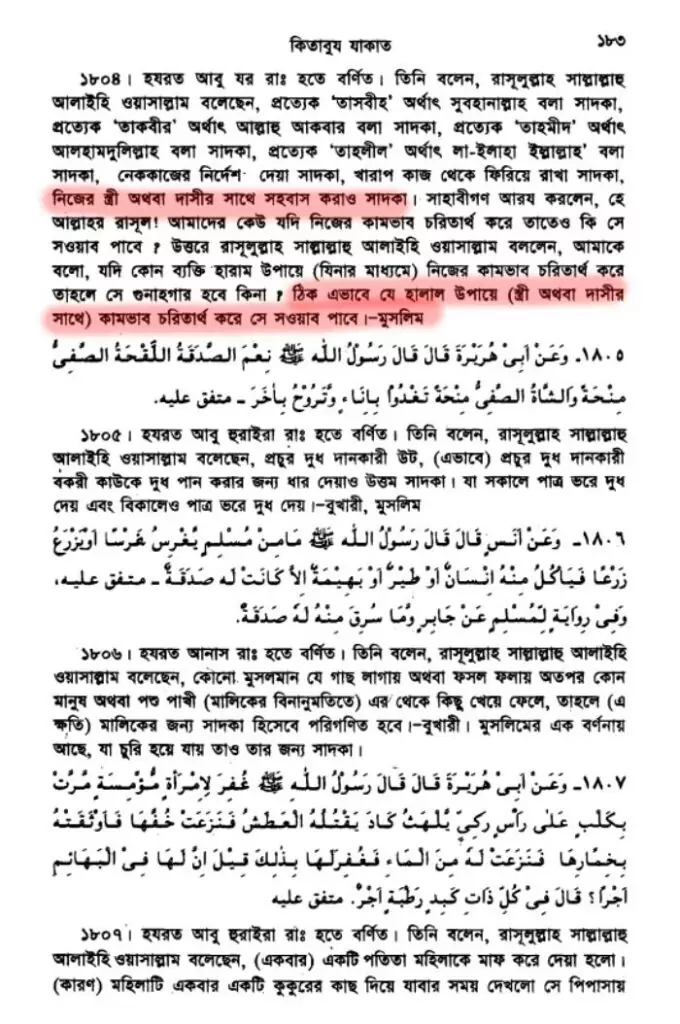
The most horrifying moral degradation appears when sexual relations with a female slave are glorified not simply as the satisfaction of a bodily impulse, but as “sadaqa,” an act that earns religious merit. When an oppressor regards sexual use of the body of the person he oppresses—the female slave—as a means of pleasing God, the moral foundations of that theological framework collapse. It confers religious sanctity on coerced sexuality, amounting, from the perspective of modern psychology, to unilateral mental and physical abuse of the slave by the owner, and to utter barbarity by the ethical standards of the twenty-first century [20] [21].
وَعَنْ أَبِي ذَرٍّ قَالَ: قَالَ رَسُولُ اللَّهِ صَلَّى اللَّهُ عَلَيْهِ وَسَلَّمَ: «إِنَّ بِكُلِّ تَسْبِيحَةٍ صَدَقَةً وَكُلُّ تَكْبِيرَةٍ صَدَقَةٌ وَكُلُّ تَحْمِيدَةٍ صَدَقَةٌ وَكُلُّ تَهْلِيلَةٍ صَدَقَةٌ وَأَمْرٌ بِالْمَعْرُوفِ صَدَقَةٌ وَنَهْيٌ عَنِ الْمُنْكَرِ صَدَقَةٌ وَفِي بُضْعِ أَحَدِكُمْ صَدَقَةٌ» قَالُوا: يَا رَسُولَ اللَّهِ أَيَأْتِي أَحَدُنَا شَهْوَتَهُ وَيَكُونُ لَهُ فِيهَا أَجْرٌ؟ قَالَ: «أَرَأَيْتُمْ لَوْ وَضَعَهَا فِي حَرَامٍ أَكَانَ عَلَيْهِ فِيهِ وِزْرٌ؟ فَكَذَلِكَ إِذَا وَضَعَهَا فِي الْحَلَالِ كَانَ لَهُ أجر» . رَوَاهُ مُسلم
Mishkat al-Masabih
Book 6: Zakat
Chapter 6, Section 1: The Excellence of Sadaqa
1898-[11] Aba Dharr reported God’s messenger as saying, “In every ascription of glory to God [tasbih: Subhan Allah], every declaration of His greatness [takbir: Allahu Akbar], every utterance of praise to Him [tahmid: Alhamdulillah], every declaration that He is the only God [tahlil: La ilaha illallah], in enjoining what is reputable, in forbidding what is objectionable, and in a man’s sexual intercourse [with his wife or female slave] there is sadaqa.” On being asked whether a reward would be given for satisfying one’s passion, he said, “Tell me; if he were to devote it to something forbidden, would it not be a sin on his part? Similarly, if he were to devote it to something lawful [with his wife or female slave], he would have a reward.” Muslim transmitted it.[1]
[1] Sahih: Muslim 1006; Ahmad 21482; As-Sunan al-Kubra by al-Bayhaqi 7823; As-Silsilah as-Sahihah 454; Sahih at-Targhib 1556; Sahih al-Jami as-Saghir 2588.
Grade: Sahih (Al-Albani); Sunnah.com: Mishkat al-Masabih, Book 6, Hadith 125.
The Sexual Use of Female Slaves in Tafsir: The Institutionalization of Sexual Slavery
Quranic commentaries, or tafsir, are indispensable for understanding the interpretation and application of Islamic law. The ways these commentators explained ambiguous Quranic verses make clear that medieval Islamic thought treated women’s bodies simply as political and military commodities. Whereas the modern Geneva Conventions guarantee the human dignity of prisoners of war and protection against sexual violence, classical commentaries establish the rape of captive women—which they describe as “intercourse”—as a lawful entitlement.
Ibn Kathir’s Tafsir: Ownership versus Rights
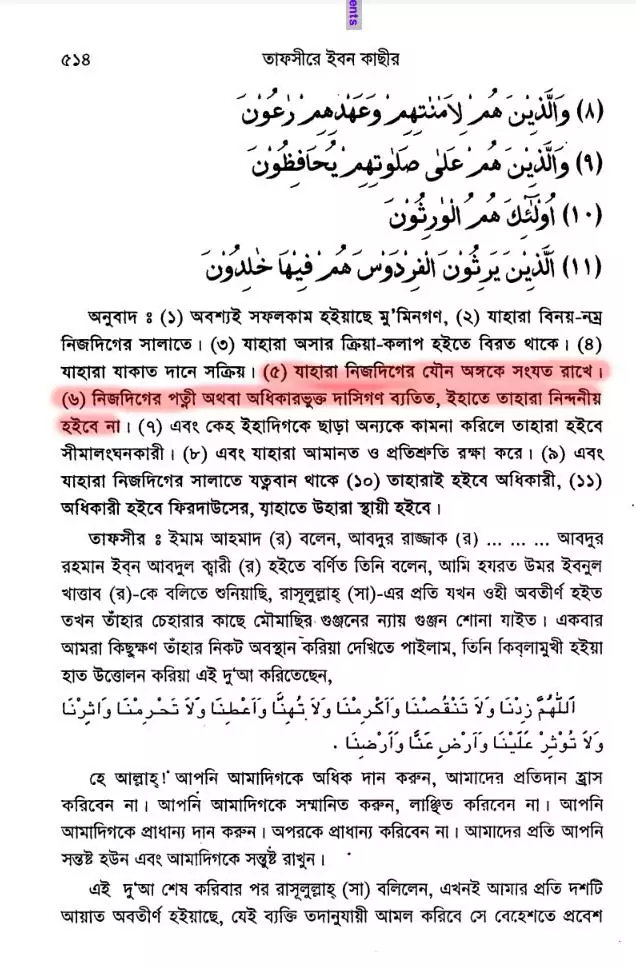
The renowned commentator Ibn Kathir’s explanation of verses 5–6 of Surah Al-Mu’minun is profoundly inhumane by modern ethical standards. According to his interpretation, there is no distinction between wives and female slaves as means for believing men to satisfy their desires. A rationalist analysis makes clear that “ownership” or “possession by the right hand” denotes a structure of power in which a person’s willingness or unwillingness carries no weight. Acquiring ownership of a person’s genitals simply by purchasing or conquering that person cannot constitute “divine justice”; it reflects a primitive culture of plunder [22].
Allah Most High says:
وَٱلَّذِينَ هُمۡ لِفُرُوجِهِمۡ حَٰفِظُونَ إِلَّا عَلَىٰٓ أَزۡوَٰجِهِمۡ أَوۡ مَا مَلَكَتۡ أَيۡمَٰنُهُمۡ فَإِنَّهُمۡ غَيۡرُ مَلُومِينَ فَمَنِ ٱبۡتَغَىٰ وَرَآءَ ذَٰلِكَ فَأُوْلَٰٓئِكَ هُمُ ٱلۡعَادُونَ
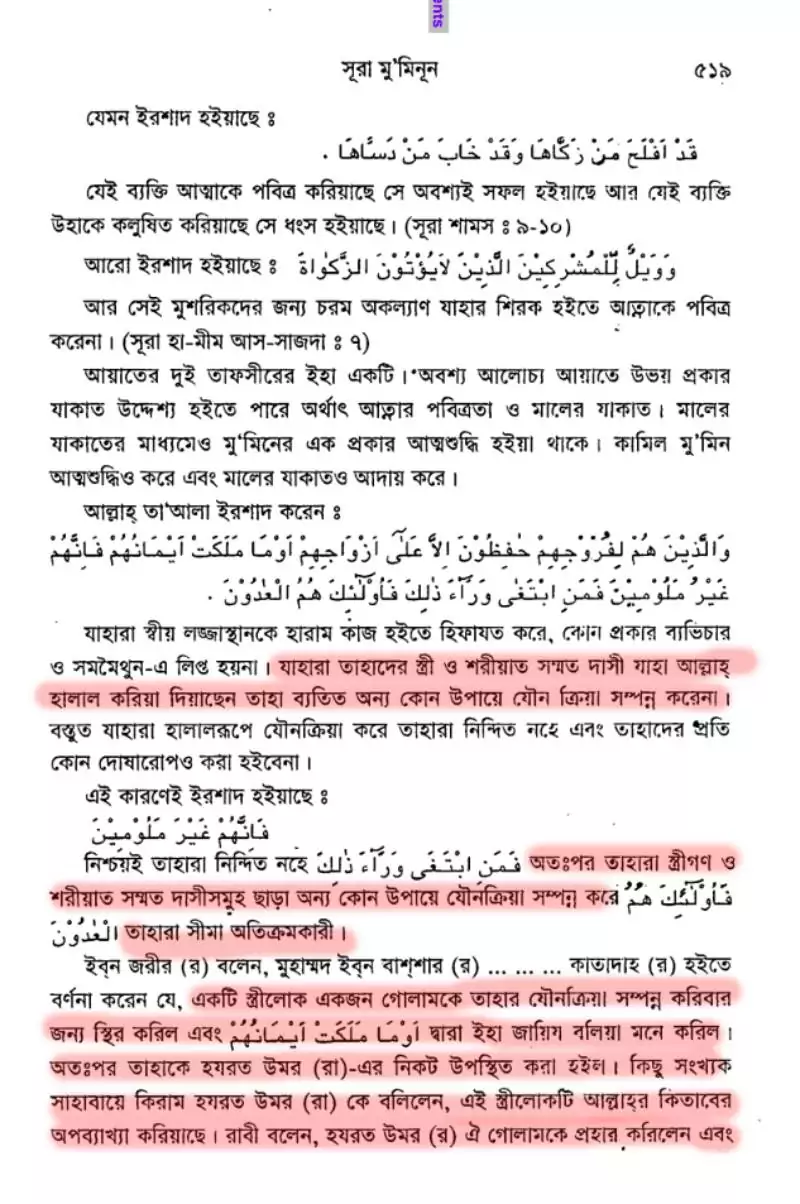
Those who protect their private parts from forbidden acts do not engage in any form of illicit intercourse
or homosexual intercourse. They engage in sexual activity only with their wives and female slaves lawfully held under sharia, whom Allah has made permissible. Those who engage in lawful sexual relations are not blameworthy and will not be reproached.
For this reason it is said:
فَإِنَّهُمۡ غَيۡرُ مَلُومِينَ
“for then they are free from blame,” فَمَنِ ٱبۡتَغَىٰ وَرَآءَ ذَٰلِكَ and those who seek sexual gratification by means other than their wives and lawfully held female slaves فَأُوْلَٰٓئِكَ هُمُ ٱلۡعَادُونَ are the transgressors.
Ibn Jarir says that Muhammad ibn Bashshar
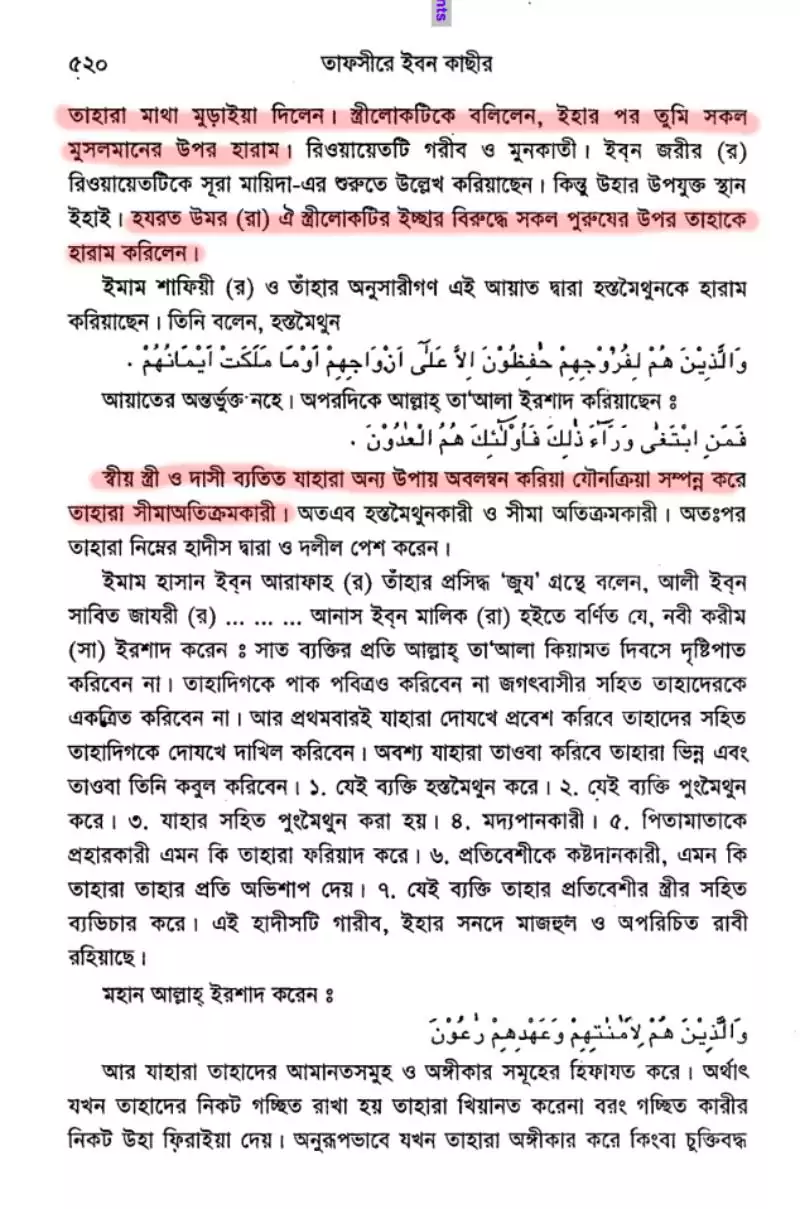
narrated from Qatada that a woman selected a male slave to satisfy her sexual needs and considered this lawful on the basis of أَوۡ مَا مَلَكَتۡ أَيۡمَٰنُهُمۡ . She was then brought before Umar. Some of the Companions told Umar that this woman had misinterpreted the Book of Allah. The narrator says that Umar beat the slave and had his head shaved. He told the woman: “After this, you are forbidden to all Muslims.” This report is gharib and munqati—unusual and disconnected in its chain. Ibn Jarir mentioned it at the beginning of Surah Al-Ma’idah, although this is its appropriate place. Umar declared the woman forbidden to all men against her will.
Imam al-Shafi’i and his followers used this verse to prohibit masturbation. He states that masturbation does not fall within the verse:
وَٱلَّذِينَ هُمۡ لِفُرُوجِهِمۡ حَٰفِظُونَ إِلَّا عَلَىٰٓ أَزۡوَٰجِهِمۡ أَوۡ مَا مَلَكَتۡ أَيۡمَٰنُهُمۡ فَإِنَّهُمۡ غَيۡرُ مَلُومِينَ
Allah Most High, moreover, says:
فَمَنِ ٱبۡتَغَىٰ وَرَآءَ ذَٰلِكَ فَأُوْلَٰٓئِكَ هُمُ ٱلۡعَادُونَ
“but whoever seeks beyond that are the transgressors;” (Surah Al-Mu’minun 23:7; Dr. Mustafa Khattab, The Clear Quran). Those who seek sexual gratification by means other than their wives and female slaves are therefore transgressors, and a person who masturbates is likewise a transgressor. They also
offer the following hadith as evidence.
In his well-known Juz’, Imam Hasan ibn Arafah states that Ali ibn Thabit al-Jazari … narrated from Anas ibn Malik that the Prophet said: “There are seven persons upon whom Allah Most High will not look on the Day of Resurrection. He will neither purify them nor gather them with the rest of humankind. He will admit them into Hell with those who enter it first—except those who repent, whose repentance He will accept: 1. A person who masturbates. 2. A person who penetrates another man. 3. A person who is penetrated by another man. 4. A person who drinks alcohol. 5. A person who beats his parents until they cry for help. 6. A person who harms his neighbors until they curse him. 7. A person who commits adultery with his neighbor’s wife.” This hadith is gharib; its chain contains unknown and unidentified narrators.
Allah Most High says:
وَٱلَّذِينَ هُمۡ لِأَمَٰنَٰتِهِمۡ وَعَهۡدِهِمۡ رَٰعُونَ
“˹the believers are also˺ those who are true to their trusts and covenants;” (Surah Al-Mu’minun 23:8; Dr. Mustafa Khattab, The Clear Quran). That is, when something is entrusted to them, they do not betray the trust but return it to the person who entrusted it. Likewise, when they make a promise or enter into an agreement…
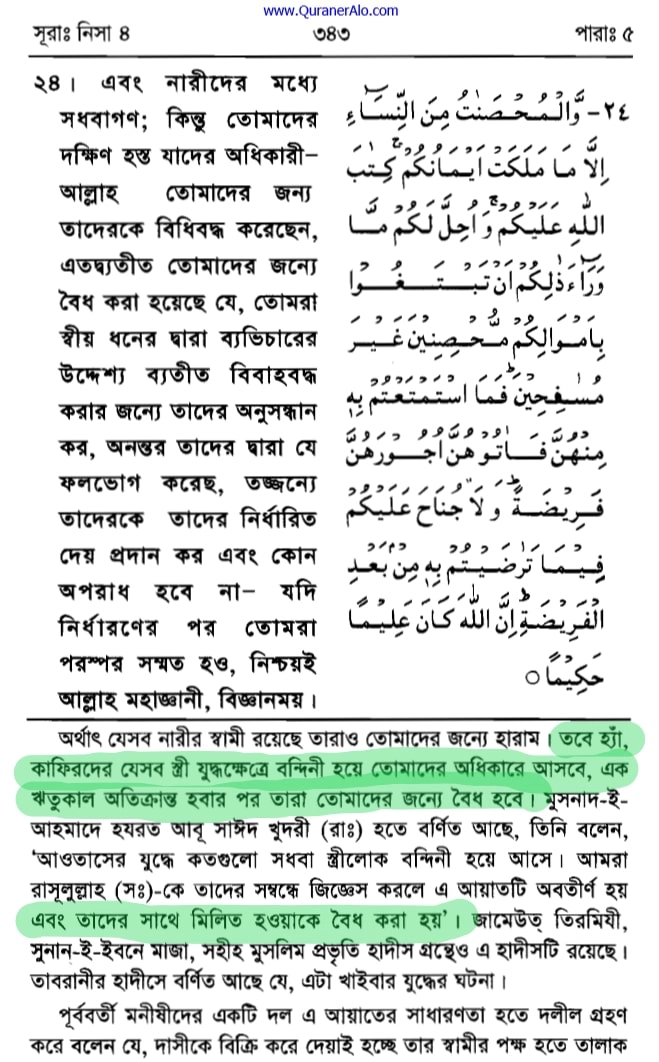
What Ibn Kathir relates in his commentary on Surah An-Nisa, verse 24, is even more horrifying. He explicitly states that captive women, even if married, are “halal,” or available for sexual use, to their new Muslim owners. This rule deals a devastating blow to the sanctity of marriage and women’s consent. Modern law regards this as a “war crime,” yet the commentary presents it as an act of religious merit [23].
This means that women who have husbands are also forbidden to you. However,
the wives of unbelievers who are captured on the battlefield and come into your possession become lawful for you after one menstrual period has elapsed. In Musnad Ahmad, Abu Sa’id al-Khudri is reported as saying: “At the battle of Awtas, a number of married women were taken captive. We asked the Messenger of Allah about them; this verse was then revealed, and intercourse with them was made lawful.” This hadith is also found in Jami at-Tirmidhi, Sunan Ibn Majah, Sahih Muslim, and other hadith collections. A report in al-Tabarani states that this occurred at the battle of Khaybar.
Tafsir al-Jalalayn: An Unequivocal Record of Inhumanity
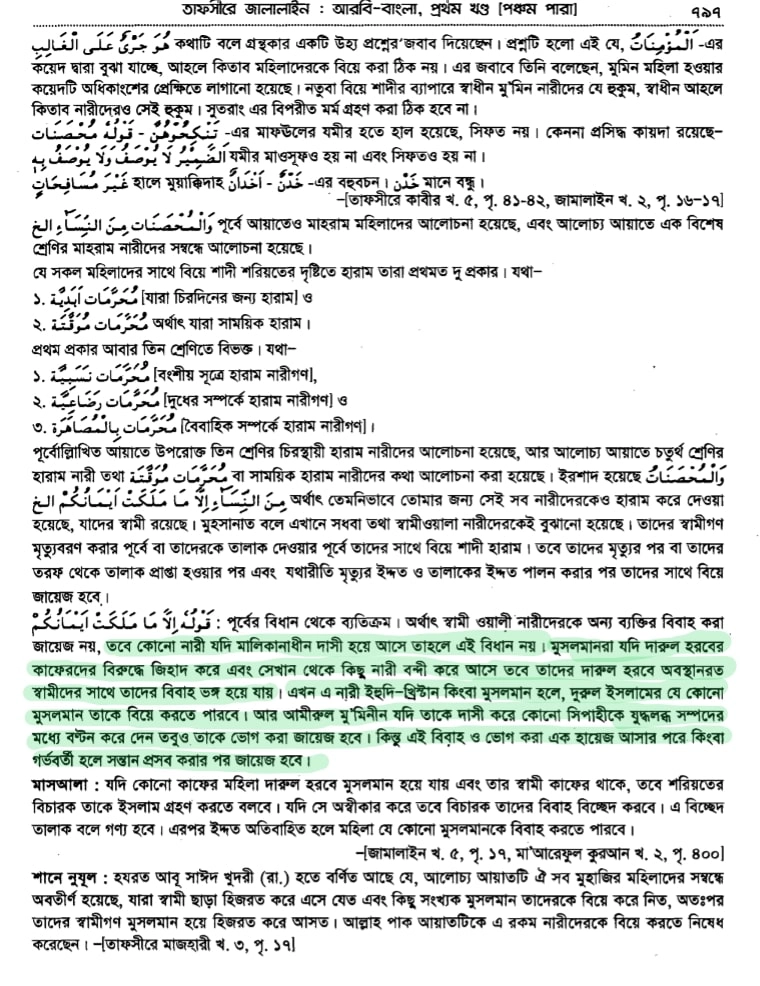
The extreme cruelty concealed behind expressions such as “the right hand” or “those possessed” is exposed in Tafsir al-Jalalayn. Jalal al-Din al-Suyuti and Jalal al-Din al-Mahalli explain with extraordinary shamelessness that even if a woman’s husband is alive in a non-Muslim country, or dar al-harb, she may lawfully be sexually used if captured in war. This is nothing other than a legal framework for systematic mass rape.
From a human rights perspective, these verses and commentaries convey no timeless message of humanity. Instead, they demonstrate how deeply the Quran was influenced by the culture of warfare in a particular period—the seventh century—and a particular geographical region. When these verses are proclaimed “unchangeable” in the modern world, they directly threaten the foundations of human rights and human dignity. If the Quran remains unalterable until the Day of Judgment, these horrifying interpretations by its commentators represent a profound moral bankruptcy for contemporary Muslim societies.[24]
And married women—that is, women who have husbands—are forbidden to you from among all women. You may not marry them until they have duly separated from their husbands, whether or not they are free Muslim women. An exception applies to the female slaves whom your right hands possess, who have come under your authority through capture in war. You may have intercourse with them following istibra’ al-rahim [the clearing of the womb of the previous husband’s semen], even if their husbands remain alive in dar al-harb. Allah Most High has imposed this rule upon you.
The word كلب takes an accusative vowel as an absolute object; its underlying form was كُتِبَ ذَلِكَ -حل . The verb is read in both the active and passive forms. All other women, apart from those just mentioned as forbidden to you, have been made lawful for you, on condition that you seek them with your wealth—that is, through a marriage payment or a purchase price—for marriage rather than fornication. Give those among them with whom you have enjoyed intercourse the marriage payments you have stipulated. There is no sin upon you if, after the amount has been fixed, you and they mutually agree to waive it entirely, reduce it, or increase it. Allah Most High has complete knowledge of His creation and is wise in what He does to govern them.
The preceding verse discusses the three categories of women permanently forbidden in marriage mentioned above. The present verse discusses a fourth category of prohibited women, namely محرمات موقتة , or women temporarily forbidden in marriage. It says: وَالْمُحْصَنَاتُ مِنَ النِّسَاءِ إِلَّا مَا مَلَكَتْ أَيْمَانُكُمْ الخَ . That is, women who have husbands are likewise forbidden to you. Here, muhsanat refers to married women, or women who have husbands. Marriage to them is forbidden before their husbands die or divorce them. Following their husbands’ deaths or their divorces, and after the appropriate waiting period for widowhood or divorce, marriage to them becomes
permissible. قَوْلُهُ إِلَّا مَا مَلَكَتْ أَيْمَانُكُمْ: This is an exception to the preceding rule. A woman who has a husband may not be married by another man;
the rule does not apply, however, if she comes into his possession as an enslaved woman. If Muslims wage jihad against the unbelievers of dar al-harb and capture women there, the women’s marriages to their husbands remaining in that territory are dissolved. If such a woman is Jewish, Christian, or Muslim, any Muslim in dar al-Islam may now marry her. If the Commander of the Faithful enslaves her and allocates her to a soldier as part of the spoils of war, sexual use of her is also permissible. But such marriage and sexual use become permissible only after one menstrual period or, if she is pregnant, after she gives birth.
Legal ruling: If an unbelieving woman becomes Muslim in dar al-harb while her husband remains an unbeliever, a sharia judge will instruct him to accept Islam. If he refuses, the judge will dissolve their marriage. This separation counts as a divorce. After the waiting period has elapsed, the woman may marry any Muslim.
—[Jamalayn, vol. 5, p. 17; Ma’ariful Quran, vol. 2, p. 400.]
Occasion of revelation: Abu Sa’id al-Khudri is reported as saying that the verse was revealed concerning emigrant women who came without their husbands and were married by some Muslims, after which their husbands accepted Islam and emigrated. In this verse, Allah prohibited marrying women of this kind. [Tafsir al-Mazhari, vol. 3, p. 17.]
Tafsir al-Mazhari: Religious Authorization of Plunder
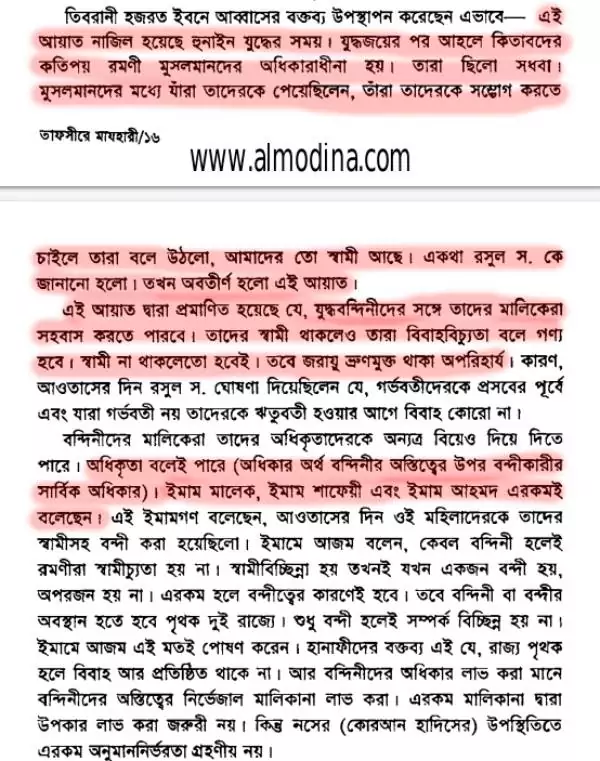
Tafsir al-Mazhari repeats the same barbaric practice, likewise sanctioning sexual domination over married female captives. Texts of this kind demonstrate that the theologians of the time invested the distribution of women’s bodies as the loot of war, or “ghanima,” with divine glory. From the perspective of modern psychology, these rules are nothing more than cruel instruments for satisfying the lust of victorious soldiers [25].
Al-Tabarani presents Ibn Abbas’s account as follows: This
verse was revealed at the time of the battle of Hunayn. After the military victory, a number of women belonging to the People of the Book came into Muslim possession. They were married. When the Muslims who had acquired them wished to have intercourse with them, the women protested: “We have husbands.” This was reported to the Messenger, whereupon this verse was revealed.
This verse establishes that the owners of female captives may have intercourse with them. Even if they have husbands, they are considered separated from their marriages; this applies all the more if they have no husbands. However, their wombs must be free of a fetus. For on the day of Awtas, the Messenger announced that pregnant women should not be married before giving birth, nor nonpregnant women before they have menstruated.
The owners of female captives may also give the women they possess in marriage to others. They may do so because of their ownership—ownership here means the captor’s comprehensive right over the captive woman’s person. Imam Malik, Imam al-Shafi’i, and Imam Ahmad stated this. These imams held that the women at Awtas had been captured together with their husbands. The Great Imam, Abu Hanifa, held that women are not separated from their husbands merely by being taken captive. Separation occurs when one spouse is captured and the other is not. In that situation, the separation is attributable to captivity, but the captive and the other spouse must be located in two different territories. Captivity alone does not dissolve the relationship. This is the position of Abu Hanifa. The Hanafis maintain that a marriage no longer subsists when the territories become separate. Acquiring possession of female captives, moreover, means acquiring complete ownership of their persons. Such ownership need not necessarily entail a right to derive benefit from them. But speculative reasoning of this kind cannot be accepted in the presence of an explicit text from the Quran or hadith.
The Rules of Sexual Ownership in Classical Fiqh
The foregoing statements in the Quran, hadith, and tafsir are organized into practical legal rules in works of fiqh. In these texts, marriage and ownership of a female slave constitute distinct legal foundations: a wife is considered a lawful sexual partner through marriage, and a female slave through ownership. This distinction affects every question concerning the enslaved woman’s refusal, previous marriage, childbearing, sale, and the number of women who may be held under one man’s authority.
The Four-Wife Limit Does Not Apply to Female Sex Slaves
In the 144th discussion of legal distinctions in Al-Furuq, the Maliki jurist al-Qarafi explicitly distinguishes the rules governing the numbers of wives and female slaves. The very subject of the discussion is that a man may possess either a small or a large number of female slaves simultaneously, whereas he may not have more than four wives. On the numerical limit for intercourse with female slaves, he writes [26].
فلذلك لم يقع العدد محصورا في جواز وطء الإماء
Meaning: For this reason, the permissibility of intercourse with female slaves was not confined to a specified number.
This shows that the restriction of marriage to four wives cannot be described as the overall limit on Islamic sexual entitlements. The separate rules of slave ownership authorize sexual rights over additional women beyond that limit. A fuller discussion of the relevant evidence and interpretations appears in What Is the Maximum Number of Female Sex Slaves Permitted under Islamic Law?
An Enslaved Woman’s Refusal: The Explicit Rules of al-Nawawi and Ibn Hazm
The question of whether an enslaved woman’s consent is necessary need not be answered merely through speculative interpretations of general Quranic language. In Rawdat al-Talibin wa Umdat al-Muftin, the Shafi’i jurist Imam al-Nawawi addresses the refusal of sexual relations by wives and female slaves [27].
وَيَحْرُمُ عَلَى الزَّوْجَةِ وَالْأَمَةِ تَحْرِيمًا غَلِيظًا أَنْ تَمْتَنِعَ إِذَا طَلَبَهَا لِلِاسْتِمْتَاعِ الْجَائِزِ
Meaning: It is strictly forbidden for a wife or female slave to refuse when she is summoned for lawful sexual enjoyment.
Here, “lawful” means sexual relations permitted under sharia’s own rules. Within those permitted relations, the woman’s refusal is itself prohibited. Her free consent is therefore not established as the principal condition determining the relationship’s legality; instead, she is required to respond to the man’s demand. The Zahiri jurist Ibn Hazm likewise answers this question directly in legal ruling 1883 of Al-Muhalla bil-Athar [28].
وفرض الأمة والحرة أن لا يمنعا السيد والزوج الجماع متى دعاهما
Meaning: It is obligatory for an enslaved woman and a free wife not to prevent the master and husband from having intercourse whenever they summon them.
In the continuation of this ruling, Ibn Hazm identifies menstruation, an illness in which intercourse causes pain or harm, and obligatory fasting as exceptions; he describes a woman who refuses without a recognized excuse as accursed. Thus, although certain physical and religious impediments are recognized, the woman’s independent decision—“I do not want to”—is not acknowledged as a general sexual right.
The discussion of slavery in the Kuwaiti Encyclopedia of Islamic Jurisprudence likewise states that an owned woman is obliged to make herself available to her master for sexual enjoyment. Exceptions apply if sharia prohibits sexual relations between her and the master, or if she has an acceptable excuse; the accompanying footnote cites al-Nawawi’s work mentioned above [29] [30]. These texts reveal the fundamental conflict between a woman’s free sexual consent and her owner’s sexual claim recognized by sharia.
Married Female Captives and Istibra’
How the exception in Surah An-Nisa, verse 24, was applied in practice is clear from Sahih Muslim’s report concerning Awtas [31].
حَدَّثَنَا عُبَيْدُ اللَّهِ بْنُ عُمَرَ بْنِ مَيْسَرَةَ الْقَوَارِيرِيُّ ، حَدَّثَنَا يَزِيدُ بْنُ زُرَيْعٍ ، حَدَّثَنَا سَعِيدُ، بْنُ أَبِي عَرُوبَةَ عَنْ قَتَادَةَ ، عَنْ صَالِحٍ أَبِي الْخَلِيلِ ، عَنْ أَبِي عَلْقَمَةَ الْهَاشِمِيِّ ، عَنْ أَبِي سَعِيدٍ، الْخُدْرِيِّ أَنَّ رَسُولَ اللَّهِ صلى الله عليه وسلم يَوْمَ حُنَيْنٍ بَعَثَ جَيْشًا إِلَى أَوْطَاسٍ فَلَقُوا عَدُوًّا فَقَاتَلُوهُمْ فَظَهَرُوا عَلَيْهِمْ وَأَصَابُوا لَهُمْ سَبَايَا فَكَأَنَّ نَاسًا مِنْ أَصْحَابِ رَسُولِ اللَّهِ صلى الله عليه وسلم تَحَرَّجُوا مِنْ غِشْيَانِهِنَّ مِنْ أَجْلِ أَزْوَاجِهِنَّ مِنَ الْمُشْرِكِينَ فَأَنْزَلَ اللَّهُ عَزَّ وَجَلَّ فِي ذَلِكَ { وَالْمُحْصَنَاتُ مِنَ النِّسَاءِ إِلاَّ مَا مَلَكَتْ أَيْمَانُكُمْ} أَىْ فَهُنَّ لَكُمْ حَلاَلٌ إِذَا انْقَضَتْ عِدَّتُهُنَّ .
Abu Sa’id al-Khudri (Allah her pleased with him) reported that at the Battle of Hanain Allah’s Messenger (ﷺ) sent an army to Autas and encountered the enemy and fought with them. Having overcome them and taken them captives, the Companions of Allah’s Messenger (may peace te upon him) seemed to refrain from having intercourse with captive women because of their husbands being polytheists. Then Allah, Most High, sent down regarding that: ” And women already married, except those whom your right hands possess (iv. 24)” (i. e. they were lawful for them when their ‘Idda period came to an end).
Collection: Sahih Muslim 1456a; Book 17, Hadith 41. Verse: Surah An-Nisa 4:24.
Fiqh also distinguishes between different circumstances of captivity. In the discussion by Ibn Muflih referred to here, a marriage is said to remain intact if both spouses are enslaved together; if the woman alone is captured, her marriage is dissolved and she becomes lawful for the owner who has taken her captive. The rule therefore rests on the legal classification of captivity and ownership, rather than the woman’s free choice [32]. Further evidence appears in The Islamic Rule Permitting the Dissolution of a Married Slave Woman’s Marriage for Sexual Use. Istibra’ means waiting to establish whether a woman is already pregnant. The instruction is found in the following report in Abu Dawud [33].
Abu Sa’id Al Khudri traced to Prophet (ﷺ) the following statement regarding the captives taken at Atwas:
لاَ تُوطَأُ حَامِلٌ حَتَّى تَضَعَ وَلاَ غَيْرُ ذَاتِ حَمْلٍ حَتَّى تَحِيضَ حَيْضَةً
There must be no intercourse with pregnant woman till she gives birth to her child or with the one who is not pregnant till she has had one menstrual period.
Collection: Sunan Abi Dawud 2157; Book 12, Hadith 112. Grade: Sahih—Al-Albani.
This waiting period is not a procedure for obtaining the woman’s consent. The report specifies time limits concerning pregnancy and menstruation; it lays down no condition requiring anyone to ask whether the captive woman wants the sexual relationship. Regulation of reproduction therefore cannot be equated with free sexual consent.
Withdrawal without Consent, Sale Price, and Changes of Ownership
Azl, or withdrawal, means withdrawing the penis before ejaculation and ejaculating outside the vagina. In Al-Mughni, Ibn Qudama writes concerning a man’s own female slave [34].
ويجوز العزل عن أمته بغير إذنها
Meaning: It is permissible to practice withdrawal with one’s female slave without her permission.
He cites the positions of Ahmad, Malik, Abu Hanifa, and al-Shafi’i in support of this conclusion, arguing that the female slave has no right to intercourse or to a child. This discussion concerns a man’s own female slave; the subsequent passage presents separate disagreements over permission when a man marries a woman enslaved by someone else. In the case of his own slave, the significance of the rule is that her permission is not indispensable to the decision to avoid pregnancy, any more than to the sexual relationship itself. The subject is discussed separately in Withdrawal without Female Slaves’ Consent in Islam and an Analysis of Its Reasons. The chapter on slave sales in Sahih al-Bukhari directly connects withdrawal with the sale price of female captives [35].
حَدَّثَنَا أَبُو الْيَمَانِ ، أَخْبَرَنَا شُعَيْبٌ ، عَنِ الزُّهْرِيِّ ، قَالَ أَخْبَرَنِي ابْنُ مُحَيْرِيزٍ ، أَنَّ أَبَا سَعِيدٍ الْخُدْرِيَّ ـ رضى الله عنه ـ أَخْبَرَهُ أَنَّهُ، بَيْنَمَا هُوَ جَالِسٌ عِنْدَ النَّبِيِّ صلى الله عليه وسلم قَالَ يَا رَسُولَ اللَّهِ إِنَّا نُصِيبُ سَبْيًا، فَنُحِبُّ الأَثْمَانَ، فَكَيْفَ تَرَى فِي الْعَزْلِ فَقَالَ ” أَوَإِنَّكُمْ تَفْعَلُونَ ذَلِكَ لاَ عَلَيْكُمْ أَنْ لاَ تَفْعَلُوا ذَلِكُمْ، فَإِنَّهَا لَيْسَتْ نَسَمَةٌ كَتَبَ اللَّهُ أَنْ تَخْرُجَ إِلاَّ هِيَ خَارِجَةٌ ”.
Narrated Abu Sa`id Al-Khudri: that while he was sitting with Allah’s Messenger (ﷺ) he said, “O Allah’s Messenger (ﷺ)! We get female captives as our share of booty, and we are interested in their prices, what is your opinion about coitus interrupt us?” The Prophet (ﷺ) said, “Do you really do that? It is better for you not to do it. No soul that which Allah has destined to exist, but will surely come into existence.”
Collection: Sahih al-Bukhari 2229; Book 34, Hadith 176.
Here, the captive woman’s body and potential pregnancy are discussed in relation to the value of saleable property and the owner’s decisions. The same woman may pass into a new owner’s possession through sale or another lawful transfer; the applicable prohibitions and rules of istibra’ then take effect separately for the new owner. Sexual slavery is consequently not confined to a permanent relationship with a single owner. This continuity is examined in Exchanging Female Slaves for Sexual Use: Changes in Sexual Rights with Changes of Ownership.
Children, Umm Walad, and Hereditary Slavery
The birth of a child to an enslaved woman does not produce the same legal outcome in every case. The discussion at 23/13 of the Kuwaiti Encyclopedia of Islamic Jurisprudence states that a child born to an enslaved woman by a man other than her owner generally follows the mother’s enslaved status and becomes the property of her owner—even if the father is free [36]. The same discussion mentions exceptions, such as a man being deceived into marrying the woman in the belief that she was free. Slavery is thus not confined to the moment of warfare; it may pass to the next generation by birth. This legal structure is examined in detail in Slavery by Birth in Islam and the Legal Framework of Hereditary Enslavement.
By contrast, a female slave who bears her own owner’s child has a distinct legal status discussed under the term “umm walad.” Childbirth, the child’s lineage, the mother’s saleability, and the timing of her emancipation are separate questions that cannot be conflated. The relevant evidence and historical changes are discussed in Umm Walad in Islamic Sharia and Umar’s Change to the Rules. These distinctions show that even a woman’s motherhood is organized within this system through legal calculations of ownership and reproduction, rather than her status as a free individual.
Slave Markets, Bodily Privacy, and the Question of Age
Sexual rights grounded in ownership are also connected to slave markets and the valuation of women’s bodies. Rules and accounts concerning the display, inspection, purchase, and sale of women’s bodies are discussed in Slave Markets and the Trade in Enslaved Women in Islam: The Public Auction of Women’s Bodies. The juristic classification that distinguishes free women from female slaves in matters of clothing and covering the body is examined separately in The Awrah of an Enslaved Woman: From the Navel to the Knees. Evidence concerning the age of owned women, the criteria applied in the name of fitness for intercourse, and the position of underage female slaves appears in The Permissibility of Intercourse with Underage Female Slaves. These issues represent different aspects of the same structure of sexual slavery: the subordination of a woman’s body, reproduction, and bodily privacy to her owner’s rights following captivity.
Conclusion: Moral Bankruptcy versus Modern Humanity
An examination of the documentary evidence and historical accounts above makes it unmistakably clear that the sexual use of female slaves under Islamic rule was not merely an ordinary social practice, but a legally authorized system of sexual slavery. Muhammad and his followers not only perpetuated this practice; they institutionalized it religiously by declaring it “halal” and an “act earning religious merit.” Islam did not simply authorize placing captive women in the chains of sexual slavery and raping them; Islamic sharia also authorized taking them to market and selling them like cattle and goats. From the standpoint of modern rationalism and human rights, the inhumane features of this system directly challenge the foundations of modern civilization.
In modern ethics, consent is the foundation of every sexual relationship. Yet under Islamic sharia, a female slave has no right over her own body; her owner’s rights over her are as absolute as those over a “commodity” or “property.” Compelling someone to engage in sexual activity against their will constitutes rape under the modern definition, yet it is legally authorized in Islam under the guise of religion [37]. Treating captive women as “spoils of war” and making them the sexual partners of new owners while their husbands remain alive deals a devastating blow to human dignity. It stands in direct conflict with the United Nations’ human rights declaration and the Convention on the Elimination of All Forms of Discrimination against Women (CEDAW) [38].
The claim that the rules of slavery remain religiously valid today is examined separately in The Islamic Legitimacy of Slavery in the Modern Age. When Islam is presented as an “unchangeable” and “eternal” ideology, these medieval barbarities risk being considered valid in the present as well. Accepting such texts as “divine” means rejecting the moral progress of modern civilization. A rationalist analysis makes clear that Islamic slavery and the rules governing sexual relations with enslaved women represent no divine justice; they are the ultimate expression of the darkness and patriarchal tribal culture of the seventh century. In the light of science, reason, and modern human rights, these practices are not merely uncivilized or barbaric; they constitute an immense dark chapter by modern ethical standards. To uphold human dignity, an advanced and civilized society must directly reject and abandon such medieval ideas.
References
- Surah Al-Mu’minun, verses 5–6 ↩︎
- Surah Al-Ma’arij, verses 29–30 ↩︎
- Surah Al-Ahzab, verse 50 ↩︎
- Surah An-Nisa, verse 24 ↩︎
- quran.com ↩︎
- Sunan an-Nasa’i, Islamic Foundation, hadith 3961 ↩︎
- Sunan an-Nasa’i, Islamic Foundation, vol. 4, p. 106 ↩︎
- Sunan an-Nasa’i 3959; narration of Anas ↩︎
- Sunan an-Nasa’i 3959 ↩︎
- Behind the Threat to Divorce the Prophet’s Wives ↩︎
- Sahih Muslim, Islamic Foundation, vol. 6, p. 285 ↩︎
- Sahih Muslim 2771 ↩︎
- Sahih al-Bukhari, Tawhid Publications, hadith 1382 ↩︎
- Sahih al-Bukhari 1382 ↩︎
- Sunan at-Tirmidhi, authenticated edition, hadith 2769 ↩︎
- Jami at-Tirmidhi 2769 ↩︎
- The Fate of Civilian Women and Children in War: Ghanima, or the Spoils of Plunder, in Islam ↩︎
- Sahih al-Bukhari, Tawhid Publications, hadith 5105 ↩︎
- Sahih al-Bukhari 5105 ↩︎
- Mishkat al-Masabih, hadith 1898 ↩︎
- Mishkat al-Masabih, Adhunik Prakashani, vol. 3, p. 183 ↩︎
- Tafsir Ibn Kathir, Islamic Foundation, vol. 7, pp. 514, 519–520 ↩︎
- Tafsir Ibn Kathir, Tafsir Publications Committee, combined vols. 4, 5, 6, and 7, p. 343 ↩︎
- Tafsir al-Jalalayn, Islamiya Kutubkhana Publications, vol. 1, pp.: 795, 797 ↩︎
- Tafsir al-Mazhari, vol. 3, pp. 16–17 ↩︎
- Al-Qarafi, Anwar al-Buruq fi Anwa al-Furuq, vol. 3, pp. 112–113; Distinction 144 ↩︎
- Imam al-Nawawi, Rawdat al-Talibin wa Umdat al-Muftin, vol. 7, p. 207 ↩︎
- Ibn Hazm, Al-Muhalla bil-Athar, vol. 9, Book of Marriage, ruling 1883 ↩︎
- Kuwaiti Encyclopedia of Islamic Jurisprudence, vol. 23, p. 23 ↩︎
- Kuwaiti Encyclopedia of Islamic Jurisprudence, vol. 23, p. 24 ↩︎
- Sahih Muslim 1456a; Book of Suckling, chapter 9 ↩︎
- Ibn Muflih, Al-Mubdi, Book of Jihad, the rules governing captives ↩︎
- Sunan Abi Dawud 2157; Book of Marriage, chapter on intercourse with female captives ↩︎
- Ibn Qudama, Al-Mughni, vol. 7, ruling 5701: withdrawal without a female slave’s permission ↩︎
- Sahih al-Bukhari 2229; Book of Sales, chapter on the sale of slaves ↩︎
- Kuwaiti Encyclopedia of Islamic Jurisprudence, vol. 23, p. 13 ↩︎
- The Rape of Female Slaves in Islam: Is Consent Required for Intercourse? ↩︎
- According to Islam, an Enslaved Woman’s Awrah Extends from the Navel to the Knees ↩︎