

Introduction: The Self-Sufficiency of an Absolute Being and Dependence on the Material World
In Islamic theology, the Creator is defined as an “absolute” being, transcending space and time and free from all human limitations. Describing him as al-Samad, or entirely self-sufficient, means that his existence depends on nothing in the universe; rather, every atom and particle supposedly depends on him for its continued existence. The conception of an omnipotent, perfect creator rests on this theoretical framework. Yet alongside this absolute definition, religious scripture portrays the Creator as asking human beings for “loans” and “help.” This creates a profound ontological contradiction—an ontological paradox.
In an actual loan, assets pass from one party to another, creating a claim for repayment in the future. The Quran elevates this familiar financial terminology into a religious injunction. Consequently, fundamental questions cannot be avoided: Where do the loaned assets actually go, who uses them, and who guarantees repayment? The lender surrenders tangible resources immediately; the expected repayment is placed in an afterlife whose very existence remains independently unproven. Within this arrangement, God’s name functions as the ultimate guarantor in the collection of funds.
The Quran itself provides an appropriate basis for comparison. In Surah al-Ikhlas 112:2, Allah is called «اللَّهُ الصَّمَدُ»; Surah Fatir 35:15 declares that human beings are needy while Allah is free of need; and Surah Muhammad 47:38, amid an appeal to believers to spend their wealth, declares «وَاللَّهُ الْغَنِيُّ وَأَنْتُمُ الْفُقَرَاءُ»—Allah is self-sufficient, while you are the needy. Yet that very verse calls upon followers to spend their wealth and threatens to replace them with another people if they turn away. Thus, the demand for financial contributions and the declaration of divine self-sufficiency occur within the same religious discourse. This juxtaposition raises the central questions of this analysis: Who actually receives the money, who benefits from it, and how is religious authority used to make financial contributions obligatory? [1] [2]
Surah Muhammad 47:38 — A Self-Sufficient Deity and the Demand for Followers’ Wealth
وَاللَّهُ الْغَنِيُّ وَأَنْتُمُ الْفُقَرَاءُ ۚ وَإِنْ تَتَوَلَّوْا يَسْتَبْدِلْ قَوْمًا غَيْرَكُمْ
English translation: Allah is free of need, whereas you are the needy. If you turn away, he will replace you with another people.
Contextual analysis: The verse instructs people to spend in Allah’s cause while linking refusal to contribute with the threat of collective replacement. This language turns religious fundraising into a matter of power and obedience.
Expanded contextual meaning of the complete passage: The full verse calls on believers to spend in Allah’s cause. It declares that anyone who is miserly harms only himself. Allah is then pronounced self-sufficient and human beings needy, followed by a warning that if they turn away another people will take their place—and that the replacements will not be like them. Financial expenditure, condemnation of miserliness, divine self-sufficiency, and the threat of replacement are all joined within a single verse.
The Rhetoric of Divine Need: A Linguistic and Logical Analysis of Quranic Verses
One of the central pillars of Islamic theology is Allah’s self-sufficiency, or samadiyyah. Yet the wording and structure of several Quranic verses create a profound “ontological paradox”, an existential contradiction with this central claim. These verses call upon humans to provide “help” and “loans” (qard) in the Creator’s name. The conflict between this wording and the proclaimed self-sufficiency of the Creator becomes materially consequential in the demand that followers surrender their wealth and labor. First, consider the following statement by a Bangladeshi Islamic preacher:
Surah Muhammad 47:7 makes Allah’s help conditional upon people helping him; Surah al-Baqarah 2:245, Surah al-Hadid 57:11 and 57:18, and Surah al-Taghabun 64:17 call on people to extend a good loan to Allah. If Allah really is the creator and owner of everything, why must he ask insignificant human beings for a “loan”? A being said to create everything merely by commanding “Be” is presented as soliciting loans and assistance from human beings. It is essential to examine both the theological meaning of this language and its real beneficiaries. Such statements expose the conceptual tension between an entirely self-sufficient being and the image of a borrower. They raise a serious philosophical question: Does asking humans for loans reveal a limitation in the nature of an allegedly omnipotent being?
Surah Muhammad, verse 7
O you who have believed, if you support Allāh, He will support you and plant firmly your feet.
— Saheeh International
O ye who believe! If ye help Allah, He will help you and will make your foothold firm.
— M. Pickthall
O believers! If you help Allah, he will help you and make your feet firm.
— Taisirul Quran
O believers! If you help Allah, Allah will help you and strengthen your position.
— Sheikh Mujibur Rahman
O believers, if you help Allah, Allah will help you and make your footing firm.
— Rawai Al-bayan
O believers! If you help Allah, he will help you and make your feet steadfast.
— Dr. Abu Bakr Muhammad Zakaria
Surah al-Baqarah, verse 245
Who is it that would loan Allāh a goodly loan so He may multiply it for him many times over? And it is Allāh who withholds and grants abundance, and to Him you will be returned.
— Saheeh International
Who is it that will lend unto Allah a goodly loan, so that He may give it increase manifold? Allah straiteneth and enlargeth. Unto Him ye will return.
— M. Pickthall
Who is the person who will grant Allah a good loan? Allah will multiply that loan for him many times over; Allah restricts and expands provision, and to him you will return.
— Taisirul Quran
Who is it who lends Allah a good loan? He will then multiply it many times over. Allah constricts or expands people’s financial circumstances, and to him all will return.
— Sheikh Mujibur Rahman
Who is there who will give Allah a good loan, so that he will multiply it many times over? Allah restricts and expands, and to him you will be returned.
— Rawai Al-bayan
Who is it who will offer Allah a goodly loan? He will multiply it many times over [1]. Allah constricts and expands, and to him you will return.
— Dr. Abu Bakr Muhammad Zakaria
Surah al-Hadid, verse 11
Who is it that would loan Allāh a goodly loan so He will multiply it for him and he will have a noble reward?
— Saheeh International
Who is he that will lend unto Allah a goodly loan, that He may double it for him and his may be a rich reward?
— M. Pickthall
Who will give Allah a good loan? He will multiply it for that person several times over, and a noble recompense awaits him.
— Taisirul Quran
Who is there to give Allah a good loan? He will multiply it manyfold, and a great reward awaits that person.
— Sheikh Mujibur Rahman
Who will give Allah a good loan? He will multiply it many times over, and that person will receive an honorable reward.
— Rawai Al-bayan
Who will give Allah a good loan? He will increase it manyfold for that person, who will receive a noble reward [1].
— Dr. Abu Bakr Muhammad Zakaria
Surah al-Hadid, verse 18
Indeed, the men who practice charity and the women who practice charity and [they who] have loaned Allāh a goodly loan – it will be multiplied for them, and they will have a noble reward.
— Saheeh International
Lo! those who give alms, both men and women, and lend unto Allah a goodly loan, it will be doubled for them, and theirs will be a rich reward.
— M. Pickthall
Charitable men and charitable women, and those who lend Allah a good loan, will have their reward multiplied and will receive an honorable recompense.
— Taisirul Quran
Charitable men and women, and those who give Allah a good loan, will be rewarded many times over and will receive a great reward.
— Sheikh Mujibur Rahman
Indeed, charitable men and charitable women, and those who lend Allah a good loan, will receive a multiplied return and an honorable reward.
— Rawai Al-bayan
Surely charitable men and charitable women who give Allah a good loan will receive a multiplied reward and a noble recompense.
— Dr. Abu Bakr Muhammad Zakaria
Surah al-Taghabun, verse 17
If you loan Allāh a goodly loan, He will multiply it for you and forgive you. And Allāh is [most] Appreciative1 and Forbearing,2
— Saheeh International
If ye lend unto Allah a goodly loan, He will double it for you and will forgive you, for Allah is Responsive, Clement,
— M. Pickthall
If you give Allah a good loan, he will double it for you and forgive you. Allah is most appreciative and forbearing.
— Taisirul Quran
If you lend Allah a good loan, he will double it for you and forgive you. Allah appreciates good deeds and is forbearing.
— Sheikh Mujibur Rahman
If you give Allah a good loan, he will double it for you and forgive you. Allah is appreciative and exceedingly patient.
— Rawai Al-bayan
If you lend Allah a good loan, he will multiply it for you and forgive you. Allah is appreciative and forbearing.
— Dr. Abu Bakr Muhammad Zakaria
The verses about lending are not confined to al-Baqarah, al-Hadid, and al-Taghabun. In Surah al-Ma’idah 5:12, the covenant with the Children of Israel includes the condition «وَأَقْرَضْتُمُ اللَّهَ قَرْضًا حَسَنًا»—“and lend Allah a good loan.” Here, lending is grouped with prayer, zakat, belief in the prophets, and assistance to them; forgiveness of sins and Paradise are promised in exchange. Surah al-Muzzammil 73:20 likewise calls for a “good loan” alongside the obligations of prayer and zakat. This demonstrates that the “divine loan” is not an isolated turn of phrase but a recurring religious vocabulary used throughout the Quran to solicit the resources of followers. [3] [4]
Surah al-Ma’idah 5:12 — Covenant, Loan, and Paradise
وَآمَنْتُمْ بِرُسُلِي وَعَزَّرْتُمُوهُمْ وَأَقْرَضْتُمُ اللَّهَ قَرْضًا حَسَنًا لَأُكَفِّرَنَّ عَنْكُمْ سَيِّئَاتِكُمْ
English translation: If you believe in my messengers, support them, and lend Allah a good loan, I will erase your sins.
Contextual analysis: Here, lending is one of the conditions of religious obedience, with absolution of sins and reward in the afterlife presented as consequences of fulfilling those conditions.
Expanded contextual meaning of the complete passage: The verse brings together the covenant taken from the Children of Israel, the appointment of twelve leaders, the obligation to perform prayers and pay zakat, belief in and support for the messengers, and the requirement to give Allah a good loan. In return, it promises forgiveness and entrance into gardens beneath which rivers flow. Subsequent disbelief is characterized as a departure from the straight path.
Surah al-Muzzammil 73:20 — Prayer, Zakat, and Loans
وَأَقِيمُوا الصَّلَاةَ وَآتُوا الزَّكَاةَ وَأَقْرِضُوا اللَّهَ قَرْضًا حَسَنًا
English translation: Establish prayer, pay zakat, and lend Allah a good loan.
Contextual analysis: The language of lending appears alongside other binding religious obligations. Financial expenditure is presented as an act directly involving God.
Expanded contextual meaning of the complete passage: This verse describes a reduction in lengthy nightly prayers and refers to the sick, those traveling in search of livelihood, and those fighting in Allah’s cause. It then instructs believers to recite as much of the Quran as is easy, establish prayer, give zakat, and lend Allah a good loan. Its conclusion promises that whatever good a person sends ahead for himself will be found with Allah as an even better reward, and instructs believers to seek forgiveness.
Surah al-Hadid 57:7 calls on believers to spend from the wealth over which Allah has appointed them temporary stewards; verse 57:10 then gives those who spent their wealth and fought before the victory a higher status than those who did the same afterward. The Quran thus explicitly links the religious valuation of financial expenditure to historical-political circumstances and the timing of military success. Spending was not merely an abstract spiritual exercise; during particular phases of conflict it supplied the money and manpower required for actual operations. [5]
Surah al-Hadid 57:10 — The Special Merit of Spending Before the Victory
لَا يَسْتَوِي مِنْكُمْ مَنْ أَنْفَقَ مِنْ قَبْلِ الْفَتْحِ وَقَاتَلَ
English translation: Those among you who spent their wealth and fought before the victory are not equal to the others.
Contextual analysis: The hierarchy of spiritual rewards explicitly privileges financial contributions and military participation during a particular historical period.
Expanded contextual meaning of the complete passage: The complete verse asks why believers would not spend in Allah’s cause when the inheritance of the heavens and the earth belongs to him. It then assigns those who spent and fought before the victory a higher rank than those who spent and fought afterward. Both groups are promised a good reward, but expenditure during the earlier military and political phase earns a special distinction.
Beyond “loans” and “help,” the Quran also employs the vocabulary of buying and selling directly. Surah al-Tawbah 9:111 declares that Allah has purchased believers’ lives and property in exchange for Paradise, then describes their fighting, killing, and being killed. Surah al-Saff 61:10–13 offers followers a “trade” that will save them from painful punishment: belief in Allah and his messenger, struggle with wealth and life, forgiveness in the afterlife, and an imminent victory. The economic meaning of “loan” is therefore not isolated. The Quran constructs a sustained system of exchanges connecting religious economic promises, warfare, and future rewards. [6]
Surah al-Tawbah 9:111 — Paradise in Exchange for Life and Property
إِنَّ اللَّهَ اشْتَرَىٰ مِنَ الْمُؤْمِنِينَ أَنْفُسَهُمْ وَأَمْوَالَهُمْ بِأَنَّ لَهُمُ الْجَنَّةَ
English translation: Allah has indeed purchased the believers’ lives and property from them in exchange for Paradise.
Contextual analysis: The relationship between Allah and his followers is expressed here in the vocabulary of buyer and seller. The same verse speaks of fighting, killing opponents, and being killed.
Expanded contextual meaning of the complete passage: According to the complete verse, Allah has purchased believers’ lives and property in return for Paradise. They fight in Allah’s cause, kill, and are killed. This promise is presented as a binding covenant in the Torah, Gospel, and Quran, and believers are instructed to rejoice in the bargain they have made. The commercial imagery turns the mortal risks of war into the terms of a promised exchange.
Surah al-Saff 61:10–11 — Trade That Saves from Punishment
هَلْ أَدُلُّكُمْ عَلَىٰ تِجَارَةٍ تُنْجِيكُمْ مِنْ عَذَابٍ أَلِيمٍ
English translation: Shall I show you a trade that will save you from a painful punishment?
Contextual analysis: The next verse identifies struggle with one’s wealth and life as the substance of that “trade,” combining an economic metaphor with fear of punishment and the expectation of reward.
Expanded contextual meaning of the complete passage: Across verses 61:10–13, the passage first offers a transaction that delivers salvation from punishment, then commands belief in Allah and his messenger and struggle with wealth and life. In exchange, it promises forgiveness, gardens beneath which rivers flow, permanent dwellings, and another reward: Allah’s support and a victory close at hand. Otherworldly rewards and worldly military success are combined in the same commercial promise.
| Quranic concept | Primary source | Socioeconomic function |
|---|---|---|
| Helping Allah | 47:7 | Demand for followers’ active participation in the messenger’s campaigns |
| Giving Allah a good loan | 2:245; 57:11; 64:17 | Promises of multiplied rewards and forgiveness in return for material contributions |
| Loan as a condition of obedience | 5:12; 73:20 | Linking the surrender of wealth to religious obligations |
| Purchase of life and property | 9:111 | Paradise in exchange for participation in war and sacrifice of property |
| Trade that saves from punishment | 61:10–13 | Reward in return for faith and struggle with wealth and life |
| Demand to spend for a self-sufficient deity | 47:38 | Threat of replacement for refusing to spend, coupled with pressure to provide funds |
The Conditional Demand for Help and the Problem of Divine Agency: Surah Muhammad 47:7 declares: “If you help Allah, he will help you.” The conditional structure makes the followers’ labor and obedience a prerequisite for the promised victory. In al-Tabari’s commentary, this assistance means supporting Muhammad against his opponents and fighting alongside him. The actual beneficiary of the help demanded in God’s name is an earthly leadership and military organization. Military success in the name of a deity credited with the power of “Be, and it is” is framed as a conditional return for human combat and labor. The central political significance of the verse is that divine omnipotence functions as religious authority through which followers are commanded to participate actively in war. [7]
Qard Hasan, or the Divine Loan: Surah al-Baqarah 2:245, Surah al-Hadid 57:11 and 57:18, and Surah al-Taghabun 64:17 ask people to extend a “good loan.” The word loan evokes the transfer of assets, a relationship between lender and borrower, and the expectation of future repayment. Although the Quran defines Allah as the owner of all property and as absolutely self-sufficient, it solicits these “loans” in his name. Human beings provide the money; human beings and religious initiatives use it; and an invisible being is declared responsible for repayment. This raises questions about the actual beneficiaries, the position of religious authorities, and the means by which repayment can be verified. At the same time, describing contributions as loans confers exceptional religious merit on them and encourages transfers of wealth by promising multiplied rewards in the afterlife.
The Model of Repayment and Commercial Exchange: The Quranic passages on loans construct a pattern in which the donor transfers wealth in return for a promise of multiplied rewards. Interest and extra repayment on human loans are condemned, yet the same scripture assures believers that a loan extended in God’s name will be multiplied many times. In Surah al-Baqarah 2:261, the image of seven ears of grain, each bearing one hundred grains, creates a promise of a 700-fold increase. Al-Qurtubi calls a prearranged requirement to return more than the principal on an ordinary loan riba, but presents the multiplied reward for spending in Allah’s cause as a virtue. The opposing moral judgments attached to the same vocabulary—“loan,” “increase,” and “repayment”—under religious authority form the center of this analysis. [8]
Ultimately, the wording of these verses shows that contributions and assistance are solicited in the name of a being declared free of all need. Referring to God as a borrower in the literal sense creates a conceptual problem; interpreting the language figuratively exposes the religious mechanism by which followers’ tangible resources and labor are mobilized. The question raised by the metaphor of the loan does not end with grammar: it leads to the actual destination of wealth collected under religious authority and to the verifiability of the promised return in the afterlife.
Classical Quranic commentaries make this question more specific by identifying the real uses of the “loan.” In his commentary on al-Baqarah 2:245, al-Tabari explains that it means spending in Allah’s cause to assist the weak or support a needy person wishing to set out for jihad. The language of a loan is employed because the giver transfers his wealth while expecting a reward in the afterlife. In al-Tabari’s account, the actual recipients are people and religious operations, not a deity suffering a material shortage. The term gives such transfers the highest possible religious legitimacy. [9]
Al-Tabari on 2:245 — Who Actually Receives the Expenditure?
مَنْ هَذَا الَّذِي يُنْفِقُ فِي سَبِيلِ اللَّهِ فَيُعِينُ مُضْعَفًا أَوْ يُقَوِّي ذَا فَاقَةٍ أَرَادَ الْجِهَادَ
English translation: Who will spend in Allah’s cause to assist the weak or equip a needy person who wishes to undertake jihad?
Contextual analysis: In al-Tabari’s interpretation, the concrete function of the loan is to spend wealth on people and the requirements of jihad, not to remedy any personal shortage of divine resources.
Source: Tafsir al-Tabari, 2:245।
Al-Qurtubi draws an even more direct connection between the military instruction in Quran 2:244 and the call for lending in 2:245. He explains that the command to fight is followed by encouragement to spend wealth on that fighting. He cites Uthman’s financing of the Army of Hardship (Jaysh al-Usrah) as an example. In al-Qurtubi’s own explanation, the Quranic “loan” is a metaphor for raising funds for a military-political system. The historical context does not demonstrate that a supposedly self-sufficient Allah lacks wealth; it exposes the machinery through which religious authority mobilizes followers’ resources for collective operations. [10]
Al-Qurtubi on 2:245 — Financing Warfare
لَمَّا أَمَرَ اللَّهُ تَعَالَى بِالْجِهَادِ وَالْقِتَالِ عَلَى الْحَقِّ … حَرَّضَ عَلَى الْإِنْفَاقِ فِي ذَلِكَ
English translation: When Allah commanded jihad and fighting for the truth, he also encouraged spending wealth on those activities.
Contextual analysis: Al-Qurtubi interprets the “good loan” as the material funding required by the preceding command to fight. His is a direct classical source supporting the article’s examination of political and military financing.
Source: Tafsir al-Qurtubi, 2:245।
Expanded contextual meaning of the complete passage: Al-Qurtubi begins by observing that the encouragement to spend in verse 2:245 follows the command to fight and undertake jihad in verse 2:244. He cites Uthman’s financing of the Army of Hardship and Abu al-Dahdah’s donation of his property. Later he discusses the lexical meaning of loans, the rewards for spending, and the rule classifying a contractually stipulated excess repayment as riba. Thus financing for warfare and the legal vocabulary of lending appear together in a single classical source.
Al-Sa’di’s commentary on al-Hadid 57:11 also directly identifies the funding required for jihad. In his account, money is necessary to equip an army and prepare for warfare, and such spending is called a loan in the verse. He adds that both the wealth and the servant belong to Allah, yet giving is named a loan and rewarded with the promise of multiplication. His explanation exposes the power of religious language: resources already declared to be God’s property are redefined as a beneficial “loan” when spent again, making the donor anticipate guaranteed future repayment. [11]
Al-Sa’di on al-Hadid 57:11 — The Material Requirements of Warfare
حَثَّ عَلَى النَّفَقَةِ فِي سَبِيلِهِ، لِأَنَّ الْجِهَادَ مُتَوَقِّفٌ عَلَى النَّفَقَةِ فِيهِ، وَبَذْلِ الْأَمْوَالِ فِي التَّجَهُّزِ لَهُ
English translation: Spending in Allah’s cause is encouraged because jihad requires expenditure and the contribution of wealth to equip and prepare for it.
Contextual analysis: The necessity identified by this scholar is the practical need of the religious-military initiative. It provides the basis for criticizing the mobilization of funds in the name of an allegedly self-sufficient deity.
Source: Tafsir al-Sa’di, 57:11।
Al-Tabari also gives an explicit explanation of “helping Allah” in Surah Muhammad 47:7. He states that if followers support Muhammad against his opponents and fight alongside him, Allah will grant them victory. This interpretation transforms the abstract expression “helping God” into human military assistance. The central criticism lies here: religious language identifies God as the beneficiary of assistance, while in practice the recipient of labor and resources is an earthly leader and the organization carrying out his campaigns. The religious promise joins these two roles. [12]
Al-Tabari on 47:7 — Whom Does “Helping Allah” Actually Help?
إِنْ تَنْصُرُوا اللَّهَ يَنْصُرْكُمْ بِنَصْرِكُمْ رَسُولَهُ مُحَمَّدًا … وَجِهَادِكُمْ إِيَّاهُمْ مَعَهُ
English translation: If you help Allah—that is, if you help his messenger Muhammad and fight alongside him—he will help you.
Contextual analysis: This interpretation directly links the condition of divine assistance to human cooperation in the activities led by Muhammad.
Source: Tafsir al-Tabari, 47:7।
Expanded contextual meaning of the complete passage: In al-Tabari’s extended explanation, helping God means supporting Muhammad against his unbelieving opponents, participating in war with him, and establishing the predominance of the Islamic movement. In exchange, victory and the courage and strength to remain steadfast in battle are promised. The abstract instruction to “help Allah” is thus given the concrete form of participation in armed religious conflict.
According to al-Tabari’s Arabic commentary, the practical act of “helping Allah” is fighting for Muhammad, confronting his enemies, and bringing his religious-political campaign to success. On one side of the verse’s promise stand human labor, military risk, and organized loyalty; on the other stand promises of victory and steadfastness in God’s name. The followers bear the tangible costs of the first immediately; the verse supplies no independent method of verifying the divine agency claimed on the second side. This asymmetrical transaction and the mobilization of obedience to leadership in God’s name are the principal political and ethical questions.
Lend Allah and Receive Many Times More: Interest, Reward, and the Contradictions of Religious Economics
The Quran uses the word “loan” and then promises repayment “many times over.” In al-Baqarah 2:245, «قَرْضًا حَسَنًا», a good loan, is rewarded with «أَضْعَافًا كَثِيرَةً», a manifold increase. Surah al-Hadid 57:11 repeats the promise; 57:18 promises multiplied rewards to charitable men and women; and 64:17 promises increase and forgiveness in return for a loan. This goes beyond the vocabulary of ordinary giving: human beings are made lenders, while the Almighty is portrayed as borrower and guarantor of future returns. Religious obedience is priced in the language of financial exchange.
Surah al-Baqarah 2:245 — Manyfold Return on a Loan
مَّن ذَا الَّذِي يُقْرِضُ اللَّهَ قَرْضًا حَسَنًا فَيُضَاعِفَهُ لَهُ أَضْعَافًا كَثِيرَةً ۚ وَاللَّهُ يَقْبِضُ وَيَبْسُطُ وَإِلَيْهِ تُرْجَعُونَ
Full contextual English translation: Who will grant Allah a good loan? He will multiply that loan many times over for the lender. Allah constricts and expands provision, and ultimately you will return to him.
Text and contextual interpretation: The verse combines four ideas in one statement: possession of wealth, solicitation of a loan, multiplication of its return, and return to God after death. By locating repayment in the afterlife, it leaves the earthly lender without a mechanism for verifying receipt of the amount owed.
Source: Quran 2:245।
Surah al-Baqarah 2:261 gives the numerical image behind multiplied returns: one grain produces seven ears, each containing one hundred grains—a total of seven hundred grains. Seven hundred units in return for one amount to a 700-fold return; deducting the original unit leaves 699 additional units, or an increase of 69,900 percent over the principal. This is a numerical analogy for the reward promised in the Quran. Its persuasive function, however, is to create an expectation of extraordinary profit-like returns on religious contributions. Al-Tabari and al-Qurtubi also discuss rewards in excess of seven hundredfold. [13] [14]
Surah al-Baqarah 2:261 — Seven Hundred Grains from Seven Ears
مَّثَلُ الَّذِينَ يُنفِقُونَ أَمْوَالَهُمْ فِي سَبِيلِ اللَّهِ كَمَثَلِ حَبَّةٍ أَنبَتَتْ سَبْعَ سَنَابِلَ فِي كُلِّ سُنبُلَةٍ مِّائَةُ حَبَّةٍ ۗ وَاللَّهُ يُضَاعِفُ لِمَن يَشَاءُ ۗ وَاللَّهُ وَاسِعٌ عَلِيمٌ
Full contextual English translation: Those who spend their wealth in Allah’s cause are compared to a grain that grows seven ears, each ear containing one hundred grains. Allah multiplies the reward still further for whomever he wills; he is boundless and all-knowing.
Text and contextual interpretation: The verse presents the explicit calculation 7 × 100 = 700 as a numerical analogy of reward. Al-Tabari’s commentary associates this multiplied return with the preceding promise of a “loan” in 2:245. His exegesis also discusses the possibility of further, unlimited multiplication.
Source: Quran 2:261।
The same surah strictly prohibits interest. Verse 2:275 rejects the claim that interest is equivalent to trade; 2:276 declares that Allah destroys riba but increases charity; and 2:278–279 orders believers to abandon outstanding interest, threatening war from Allah and his messenger if they refuse. Thus the moral status assigned to multiplied returns on a loan changes according to the identity of the authority making the promise and its religious purpose. Human loan arrangements involving increase are condemned; an increase on a loan announced in God’s name becomes an immense reward. These opposing assessments also illuminate the historical basis of Finhas’s sarcasm about interest.
Surah al-Baqarah 2:276 — Interest Destroyed, Charity Increased
يَمْحَقُ اللَّهُ الرِّبَا وَيُرْبِي الصَّدَقَاتِ ۗ وَاللَّهُ لَا يُحِبُّ كُلَّ كَفَّارٍ أَثِيمٍ
Full contextual English translation: Allah destroys interest and increases charitable contributions. Allah does not love any ungrateful sinner.
Text and contextual interpretation: The language of “destruction” is used for riba, while “increase” is used for charity. In al-Qurtubi’s commentary, this multiplication of charity is described in terms of both worldly blessings and rewards in the hereafter. The same religious vocabulary treats one kind of increase as a sin and the other as a divine reward.
Source: Quran 2:276।
Surah al-Baqarah 2:278–279 — War for Refusing to Abandon Interest
يَا أَيُّهَا الَّذِينَ آمَنُوا اتَّقُوا اللَّهَ وَذَرُوا مَا بَقِيَ مِنَ الرِّبَا إِن كُنتُم مُّؤْمِنِينَ
Full contextual English translation: O believers, fear Allah and surrender whatever remains of interest, if you are truly believers. The following verse declares that if this command is disobeyed, they must expect a declaration of war from Allah and his messenger. If they repent, they are entitled only to the principal: they shall neither commit injustice nor suffer injustice.
Text and contextual interpretation: The expression «فَلَكُمْ رُءُوسُ أَمْوَالِكُمْ» in Quran 2:279—“you are entitled to your principal”—establishes a standard for financial repayment. By contrast, verse 2:245 promises many times the principal on a loan offered to God.
Source: Quran 2:278–279।
Al-Qurtubi’s commentary supplies a particularly direct and powerful source for this discussion. In the sixth part of his explanation of al-Baqarah 2:245, he states that requiring an additional, predetermined repayment on an ordinary loan constitutes riba, however small the excess may be. Yet in interpreting the very same Quranic verse, he discusses the multiplied and potentially unlimited reward for lending to Allah. This is the force of the article’s interest-related critique: the religious vocabulary that forbids a stipulated excess on human loans turns a vastly greater return on a “loan to God” into a sacred reward. [15]
Al-Qurtubi on 2:245 — Stipulated Excess on Ordinary Loans Is Riba
وَأَجْمَعَ الْمُسْلِمُونَ نَقْلًا عَنْ نَبِيِّهِمْ أَنَّ اشْتِرَاطَ الزِّيَادَةِ فِي السَّلَفِ رِبًا
Full contextual English translation: Al-Qurtubi writes that, according to the consensus of Muslims, stipulating a repayment greater than the principal in a loan constitutes riba, even if the additional amount is no more than a small handful of animal feed or a single grain. He also discusses the rule requiring an equivalent repayment on ordinary loans and the possibility of voluntarily returning something better when no extra payment was stipulated in advance.
Text and contextual interpretation: The first and fourth discussions in the same commentary describe the “good loan to Allah” and its multiplied return. In a single book, a stipulated increase on loans between human beings is forbidden while manyfold rewards for property offered to God are celebrated—an explicit discrepancy in terminology and moral evaluation.
Source: Tafsir al-Qurtubi, 2:245।
Finhas’s mockery addressed exactly this disparity. Al-Tabari records his remarks in the commentary on Al Imran 3:181: if Allah is self-sufficient, why does he borrow human wealth, and why does he prohibit interest while promising an increase on loans? The historical importance of this accusation is that the challenge concerning loans and interest was not invented by modern critics of Islam. Islamic exegesis itself preserves it as a dispute from the religion’s earliest period. [16]
Al-Tabari on 3:181 — Finhas’s Accusation About Loans and Interest
يَنْهَاكُمْ عَنِ الرِّبَا وَيُعْطِينَاهُ! وَلَوْ كَانَ عَنَّا غَنِيًّا مَا أَعْطَانَا الرِّبَا
Full contextual English translation: In al-Tabari’s narrative, Finhas says to Abu Bakr: your companion forbids us interest, yet he offers it to us. If he did not need our property, why would he borrow it and promise an increase upon repayment? His question combines Allah’s self-sufficiency, the appeal for loans, and the promise of additional returns.
Text and contextual interpretation: In the same account, Abu Bakr angrily strikes Finhas in the face and says that their treaty prevents him from killing the man. Quran 3:181 subsequently records the words “Allah is poor and we are rich” and announces punishment for them.
Source: Tafsir al-Tabari, 3:181।
Economically, the expectations created by this promise are radically asymmetrical. The donor gives measurable money, food, gardens, or labor in the present. The repayment is placed in a future afterlife for which there is no independently accessible account book, repayment deadline, observable transfer, or legally enforceable claims process. The promise of multiplied returns therefore allows religious authorities to collect resources immediately, while verification of the reward is relegated to an undefined future.
Historical Criticism and Violence in Response to Theological Challenge: The Finhas–Abu Bakr Dispute
These Quranic claims about “loans” troubled not only modern skeptics; according to Islamic historical literature, they faced serious logical criticism during Islam’s earliest expansion in the seventh century. Jewish scholars of Medina, familiar with monotheistic theology and its ontological complications, challenged the inconsistency before the prophet’s companions. According to Ibn Hisham’s Sirah, when Abu Bakr entered a Jewish school (midrash) and invited its members to convert to Islam, a prominent Jewish scholar named Finhas (Pinhas) raised a forceful logical question. Consider the account. [17]
Abu Bakr Enters the Jewish School
One day, Abu Bakr al-Siddiq entered a Jewish school. There he found a large group of people gathered around a man named Finhas, one of their scholars and religious leaders. Another scholar named Ashya was also present with him.
Abu Bakr addressed Finhas:
“Woe to you, Finhas! Fear Allah and embrace Islam.
By Allah, you know perfectly well that Muhammad is Allah’s messenger, sent by Allah to you. You have found clear information about him in the Torah and Gospel preserved among you.”
Finhas then replied to Abu Bakr:
“By Allah, Abu Bakr! We have no need of Allah; rather, he needs us. We do not plead with him; rather, he pleads with us. We are not destitute before him; rather, he depends upon us. If he did not depend upon us, he would not ask to borrow our wealth, as your companion claims. He tells us to abstain from interest, yet takes it from us himself.”
Abu Bakr’s Angry Reaction
On hearing this, Abu Bakr became enraged and struck Finhas forcefully across the face. He said:
“By the One in whose hand is my life, if it were not for the treaty between us, I would have smashed your head, enemy of Allah!”
The narrator says that Finhas then went to the Messenger of Allah and complained:
“Muhammad, your companion has mistreated me. Please take notice of this.”
The Messenger of Allah then asked Abu Bakr:
“Why did you treat him that way?”
Abu Bakr answered:
“O Messenger of Allah! This enemy of Allah made an outrageous statement about Allah. He said that Allah is poor while they are rich. I was so offended by his words that I struck him in the face for Allah’s sake.”
But Finhas immediately denied having made that statement.
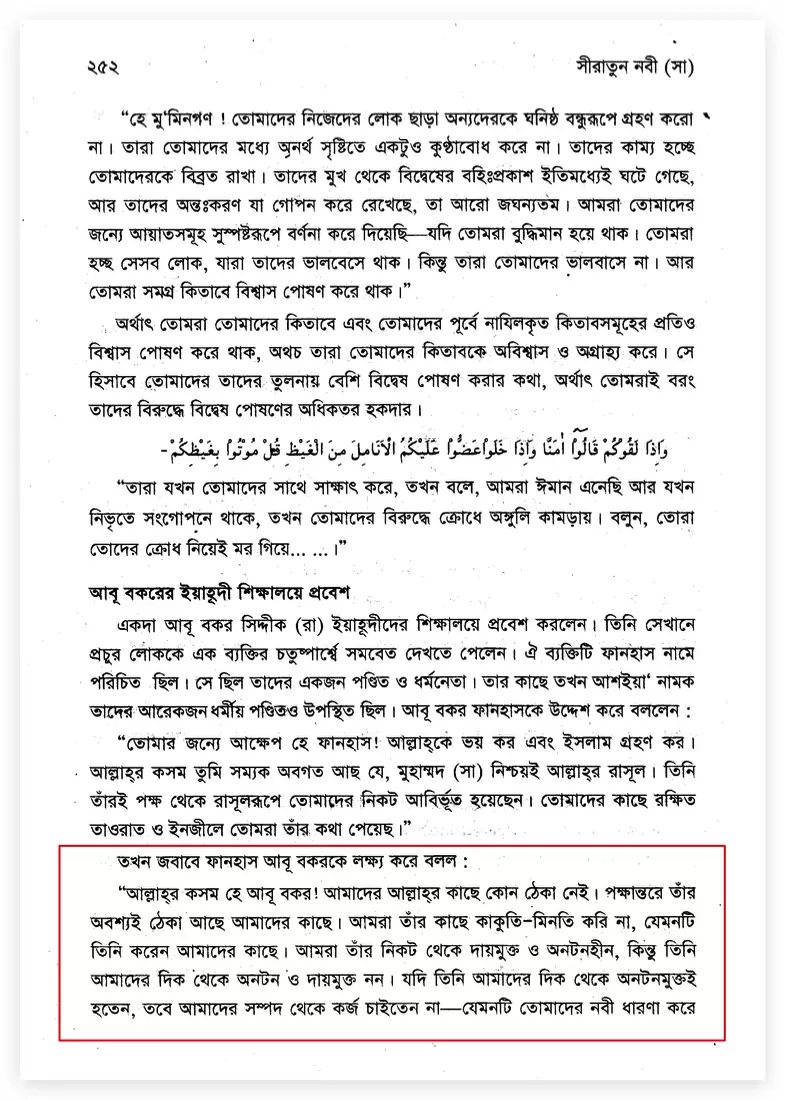
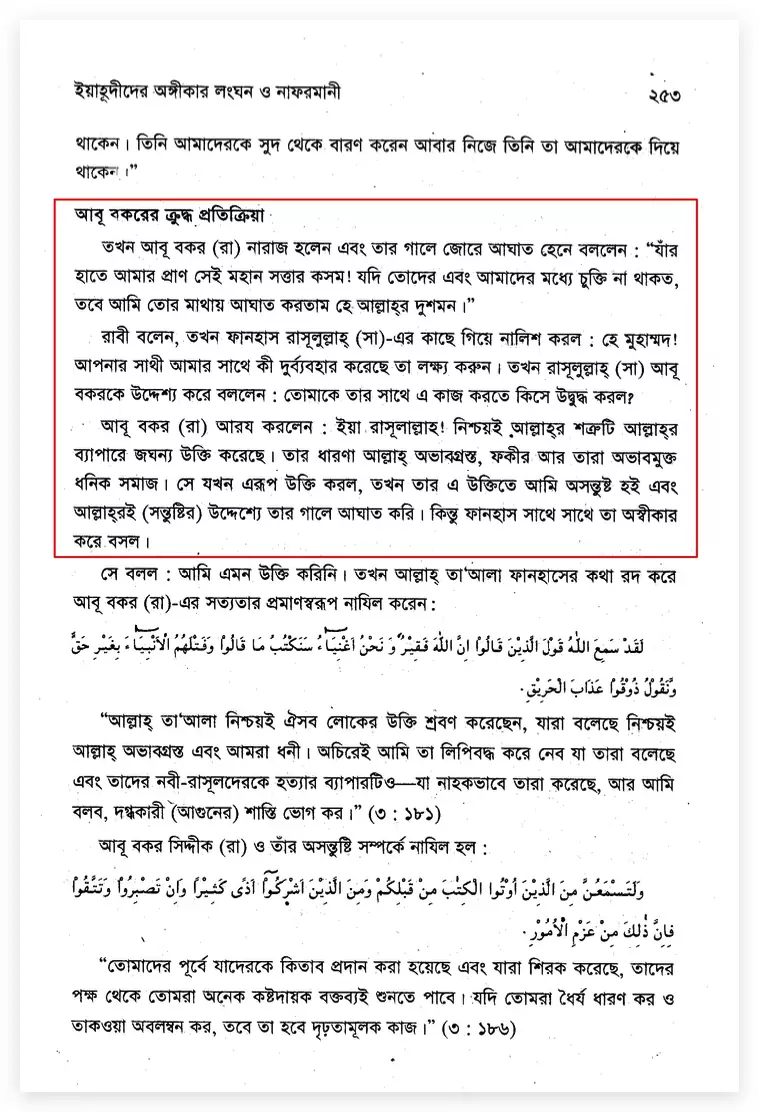
The report preserved in Ibn Hisham’s biography is important in several respects. First, Finhas is not depicted as an anonymous opponent but as a religious scholar present at a Jewish school. Second, the dispute concerns more than a general disagreement over faith: it concerns the meaning of the Quranic “loan,” divine self-sufficiency, and the comparison between interest and promised rewards. Third, in the sequence of the narrative, Abu Bakr responds to the logical question by striking the man and threatening to kill him if the treaty did not prohibit it. These three details allow us to examine a contemporary objection to religious vocabulary and the response of a follower wielding political and religious authority. [18]
Ibn Hisham — Finhas’s Objection About Loans and Self-Sufficiency
وَلَوْ كَانَ عَنَّا غَنِيًّا مَا اسْتَقْرَضَنَا أَمْوَالَنَا، كَمَا يَزْعُمُ صَاحِبُكُمْ
English translation: If he had no need of us, he would not have asked to borrow our wealth, as your companion claims.
Contextual analysis: Finhas’s remark identifies the conflict between a literal loan and God’s alleged self-sufficiency. It is an early critical reading of the wording of the Quran.
Source: Ibn Hisham, the Finhas–Abu Bakr episode।
Ibn Hisham — An Assault and a Death Threat During the Dispute
فَغَضِبَ أَبُو بَكْرٍ فَضَرَبَ وَجْهَ فِنْحَاصَ ضَرْبًا شَدِيدًا
English translation: Abu Bakr became angry and struck Finhas forcefully in the face.
Contextual analysis: The same report contains a threat to smash his head if not for the treaty. It records physical violence in response to a logical and religious disagreement.
Source: Ibn Hisham, the Finhas–Abu Bakr episode।
The source of this report can also be identified. Ibn Hisham principally preserves the biographical tradition of Ibn Ishaq. The episode also appears in al-Tabari, al-Baghawi, Ibn Kathir, and al-Wahidi’s accounts of the occasions of revelation. In the narrative tradition originating with Ibn Ishaq and preserved in these works, Finhas’s objection and Abu Bakr’s violent response form part of Islamic historical literature itself. The analysis here accurately describes the question attributed to a critic and the conduct attributed to his opponent in that tradition’s own words. [19]
The connection between Finhas’s complaint and Surah Al Imran 3:181 is especially important. The expression quoted in the verse is «إِنَّ اللَّهَ فَقِيرٌ وَنَحْنُ أَغْنِيَاءُ»—“Allah is poor, and we are rich.” The verse continues by declaring that the statement will be recorded and by threatening punishment in a burning fire. It does not present a philosophical answer to the meaning of the loan metaphor. Instead, it records the remark as an offensive transgression and announces punishment. This structure offers an explicit example of invoking punishment in response to religious disagreement. Whether a threat of punishment is used to answer a logical objection is verifiable directly from the text. [20]
Surah Al Imran 3:181 — Threats of Punishment in Response to an Objection
لَقَدْ سَمِعَ اللَّهُ قَوْلَ الَّذِينَ قَالُوا إِنَّ اللَّهَ فَقِيرٌ وَنَحْنُ أَغْنِيَاءُ
English translation: Allah has certainly heard those who said, “Allah is poor, while we are rich.”
Contextual analysis: The remainder of the verse declares that their words will be recorded and threatens the punishment of a blazing fire. It does not address the semantic objection to the word “loan.”
Expanded contextual meaning of the complete passage: The complete verse declares that Allah has heard the claim that he is poor and its speakers rich. It says that their words and the accusation of unlawfully killing prophets will be recorded, then commands them to taste the punishment of the burning fire. The verse offers no economic explanation for the question “Why does God request loans?” Instead, it associates the speaker’s objection with wrongdoing and announces punishment.
Logical Analysis and the Pattern of Responses
Deductive Logic: Finhas’s argument is straightforward and forceful. Its structure is that, if the word “loan” is being used in its ordinary, literal financial sense, the request implies a need for money or other assets; this conflicts with the assertion that Allah is entirely self-sufficient. By incorporating the terminology of lending into a religious promise, the text also creates an effective social and political mechanism for soliciting wealth from followers.
Argument versus Force (Ad Baculum): Faced with this theological challenge, Abu Bakr offered no reasoned rebuttal. Instead, he became furious, struck Finhas forcefully in the face, and threatened to kill him [21]. In intellectual disputes, people who are unable to prevail by argument sometimes resort to coercion. In this account, the logical challenge raised by Finhas is met not with an answer but with physical assault and a death threat. The narrative clearly depicts the use of force against an intellectual disagreement.
Avoiding the Question in the Divine Response: Remarkably, the revelation associated with this event (Surah Al Imran, verse 181) characterizes Finhas’s statement as blasphemy or insolence and threatens punishment. But the fundamental logical question he raised—“Why would a self-sufficient being depend on human property?”—receives no philosophical or logical resolution there.
This episode establishes that the call to “lend Allah a loan” was already treated as a major theological flaw during Islam’s early history. In the account of the confrontation with Finhas, physical assault and a death threat replace a reasoned reply, while Quran 3:181 attaches severe punishment to the objection. The ethics and epistemic adequacy of such a response are directly relevant to any assessment of religious controversy.
The core of Finhas’s objection was direct: why is human wealth requested as a “loan” in the name of a God declared to be self-sufficient and the owner of all property? He placed the claim of divine independence in direct confrontation with the wording of the loan request. In the report preserved by Islamic sources, Abu Bakr answers with violence and a death threat; Quran 3:181 announces punishment. The sequence recorded in these early sources is a stark ethical illustration of the tendency to place religious authority beyond rational criticism.
Finhas’s comparison between loans and interest belongs at the center of the article. In the account preserved by al-Tabari, he alleges that Muhammad forbids his followers to charge interest while promising increases on loans made in God’s name. This is more than sarcasm; it challenges the Quran’s own economic vocabulary. Surah al-Baqarah 2:275 forbids riba; 2:279 declares war from Allah and his messenger against those who refuse to abandon it; yet 2:245 and 2:261 promise multiplied returns on loans and expenditure for God. The opposing uses of threats and rewards, the unverified nature of the promised return, and the use of the promise in religious fundraising must all be examined together. [22]
The Actual Recipients of Divine Loans: Warfare, Religious Institutions, and the Distribution of Wealth
The religious texts themselves indicate where Quranic “loans” go. The call to lend in al-Baqarah 2:245 immediately follows the command to fight in 2:244. Al-Tabari explains 2:245 as assistance to people who wish to fight but cannot afford the necessary equipment, as well as support for campaigns against Islam’s opponents. Al-Qurtubi interprets the same sequence: a command to undertake jihad and warfare followed by encouragement to finance that activity. According to these readings, the “loan” does not reach an abstract heavenly treasury. It is used to meet earthly needs for food, transportation, mounts, weapons, and manpower. [23] [24]
Al-Tabari on 2:245 — The Concrete Beneficiaries of Expenditure
مَنْ هَذَا الَّذِي يُنْفِقُ فِي سَبِيلِ اللَّهِ فَيُعِينُ مُضْعَفًا أَوْ يُقَوِّي ذَا فَاقَةٍ أَرَادَ الْجِهَادَ
Full contextual English translation: Al-Tabari explains the verse as asking who will spend his wealth in Allah’s cause to assist a person of limited means, equip someone who wishes to go on jihad but lacks funds, and help the needy. In his extended discussion, wealthy followers are encouraged to help those prepared to fight who cannot afford transport or equipment.
Text and contextual interpretation: The earthly consequence of “lending God” is explicitly identified here as supplying equipment and personnel for a religious movement’s warfare. Actual people and campaign organizations benefit financially from the contribution.
Source: Tafsir al-Tabari, 2:245।
Surah al-Tawbah 9:60 establishes eight categories for the distribution of zakat and charity: the poor, the needy, administrators who collect and distribute funds, people whose allegiance is sought, emancipation from slavery, debtors, expenditure in Allah’s cause, and travelers. Religious funds thus move from private donors into an organized structure with authorized channels of expenditure. “Allah’s cause” is here a concrete financial category; the discussions of al-Tabari and al-Qurtubi show that its connection to religious leadership, jihad, and social expenditure became a matter of legal dispute. [25] [26]
Surah al-Tawbah 9:60 — Eight Categories of Recipients of Religious Funds
إِنَّمَا الصَّدَقَاتُ لِلْفُقَرَاءِ وَالْمَسَاكِينِ وَالْعَامِلِينَ عَلَيْهَا وَالْمُؤَلَّفَةِ قُلُوبُهُمْ وَفِي الرِّقَابِ وَالْغَارِمِينَ وَفِي سَبِيلِ اللَّهِ وَابْنِ السَّبِيلِ
Full contextual English translation: Charity is prescribed for the poor, the needy, those entrusted with collecting and distributing it, those whose hearts are to be reconciled, the emancipation of slaves, debtors, Allah’s cause, and travelers. This is an ordinance from Allah, who is all-knowing and wise.
Text and contextual interpretation: The verse specifies actual human beneficiaries and authorized categories of religious spending. It is important for understanding the relationship between the exalted claim of “lending to Allah” and the operational system of distributing wealth among people.
Source: Quran 9:60।
Property handed over as a “loan” can even take the form of an entire estate or orchard. In his commentary on 2:245, al-Qurtubi recounts Abu al-Dahdah’s story: after hearing the verse, the man asked Muhammad whether Allah truly wanted to borrow from human beings. On receiving an affirmative answer and a promise of Paradise, he donated an orchard containing six hundred date palms. The account also says that his wife and children lived in the orchard. This narrative is a specific Islamic example of how the metaphor of a divine loan could induce the transfer of substantial assets. [24]
Al-Qurtubi on 2:245 — Abu al-Dahdah’s Orchard of Six Hundred Date Palms
فَإِنِّي أَقْرَضْتُ اللَّهَ حَائِطًا فِيهِ سِتُّمِائَةِ نَخْلَةٍ
Full contextual English translation: In al-Qurtubi’s account, Abu al-Dahdah asks, after hearing the verse, whether Allah is seeking loans from them. When Muhammad confirms it, he says that he owns an orchard with six hundred date palms and gives it as a loan to Allah. He tells his wife and children to leave the orchard; his wife welcomes the decision as a profitable transaction. Another version also mentions a promise of Paradise and the instruction to retain a second orchard for the family’s sustenance.
Text and contextual interpretation: Here, the vocabulary of divine lending affects ownership of real land and productive resources. Religious leadership verbally guarantees an afterlife return, while material property is immediately relinquished as a donation.
Source: Tafsir al-Qurtubi, 2:245।
According to al-Hadid 57:10, expenditure and fighting before the victory carry higher merit than the same actions after victory. Donations and military participation are therefore ranked not only by their amount but by their political timing. By attaching greater rewards to financial contributions during the movement’s earliest and riskiest periods, the text creates an incentive to mobilize money and fighters at precisely the most difficult stage. Al-Tabari interprets the verse in the historical context of spending and warfare. [27]
Quranic “loans,” therefore, are not simply an abstract relation between Allah and the individual. The visible elements of religious financing include the follower who supplies property, authorities who collect and distribute it, categories of military or social expenditure, and promises of future heavenly recompense. God’s name is placed in the role of borrower, but the institutional use and control of the money remain in human hands. This material structure explains the political power of the lending metaphor.
The Conflict Between Omnipotence, Divine Self-Sufficiency, and the Concept of a Loan
From a logical and ontological perspective, attributing both “omnipotence” and “self-sufficiency” on one hand and the status of a “borrower” on the other to the same being produces a “theological oxymoron” or theological contradiction. If Allah created all the resources of the universe and exists entirely without need, why does he request human wealth? An answer must establish what the word “loan” means here and who actually benefits from the resources transferred. Everything that human beings might donate or lend to him is already claimed to belong to him. Thus, asking to borrow one’s own property creates, in the literal sense, a conceptual conflict involving ownership and borrowing; in the figurative sense, it becomes a particular linguistic apparatus for obtaining tangible resources from followers.
A being who possesses the power of “kun fa-yakun” (“Be, and it is”) [28] should have no need of the limited wealth or transient labor of human beings to accomplish his purposes. The ordinary lexical and practical meaning of “loan” implies meeting a temporary inability or shortfall of resources on the borrower’s part. For an absolute being to use this designation necessarily puts his “absolute perfection” into question.
If it is asserted that this is merely a “metaphor,” another question emerges: why would a supposedly “clear book” (kitab mubin) select a misleading metaphor that clashes with its own fundamental definition of divine self-sufficiency? Such language suggests that these pronouncements originated not from an infinite being but from human leadership constrained by worldly crises, which portrayed the Creator as a “borrower” to raise resources for its political and military objectives. Far from glorifying God, this reduces him to the level of an archaic tribal deity dependent on the mercy and generosity of human beings.
The relationship the Quran constructs between divine omnipotence and obligations placed on people is not a mere literary ornament. Appeals to war, financial contributions, forgiveness of sins, pardon, punishment, and victory are all organized under a single authority. Operations that in practice require human labor and money are declared to be God’s own work. In this way, the practical requirements of earthly leadership are endowed with legitimacy and necessity through the assertion of supernatural authority.
The problem is broader when ownership is considered. Surah al-Hadid 57:7 states that people hold property entrusted to them by Allah; 57:10 declares that the inheritance of the heavens and earth belongs to Allah. People are then instructed to spend those very resources, although they do not participate in a contract in which they can control the actual borrower’s title to the property or the timing of repayment. Within the framework of religious giving, the sources, uses, and terms of otherworldly recompense are controlled by parties other than the donor. In modern theories of property and economic ethics, this imbalance of power—especially transparency about the use of funds and accountability—deserves critical examination.
Quran 29:6 and 35:15 repeatedly declare Allah’s absolute independence. In 47:38, the same declaration appears within a demand for financial contributions. That juxtaposition itself generates interpretive pressure: if God is independent of human giving, the practical aim of raising money in his name must lie within the created world. Yet the vocabulary of religious reward can obscure the basic questions of which people or institutions will receive that wealth and who must account for it. [29]
Surah Fatir 35:15 — Human Need and Divine Self-Sufficiency
يَا أَيُّهَا النَّاسُ أَنْتُمُ الْفُقَرَاءُ إِلَى اللَّهِ وَاللَّهُ هُوَ الْغَنِيُّ الْحَمِيدُ
English translation: O humanity, you are the ones in need of Allah; Allah alone is free of need and worthy of praise.
Contextual analysis: Divine self-sufficiency is an explicit Quranic doctrine. Its relation to the language of seeking loans and help from human beings therefore requires examination.
Spiritual Investment versus Financial Exchange: A Philosophical Analysis
Even if the depiction of the Creator as a “borrower” in the Quran is treated solely as a spiritual metaphor, it creates a serious “ontological inconsistency”, or ontological contradiction. The central question is why a being supposedly independent of worldly resources is portrayed in a contractual “give-and-take,” or “credit-and-debit,” arrangement. The material consequence of the metaphor is that followers relinquish present wealth while expecting future supernatural rewards. The concepts of loans and donations arise in contexts of scarcity and limited resources, where a donor actually transfers assets to another person or institution. If Allah is the Creator and possesses the power of “Be, and it is,” the idea of literal borrowing conflicts with his alleged self-sufficiency; in its figurative application, the social and political purposes of managing followers’ wealth become central.
This also presents a deep moral and linguistic contradiction. Islamic law strictly prohibits riba, or interest, and declares war against those who persist in it. Yet the model of a “good loan,” or qard hasan, portrays Allah as the divine borrower and guarantor of multiplied rewards [30]. Finhas mocked precisely this tension by comparing the promised increase to “interest.” Riba in its technical legal sense and an announcement of supernatural reward in the afterlife do not constitute the same kind of transaction: one involves contractually required excess repayment on an actual loan, the other an unverifiable future reward for religious giving. Nevertheless, both employ the language of principal, lending, multiplication, and return, and both can mobilize expectations of gain to collect resources from followers. That persuasive mechanism remains a central subject of criticism.
Such language, rather than merely encouraging generosity, creates an “investment mindset”, emphasizing the prospect of future gains. It suggests that the authors of this theology placed greater weight on people’s calculations of profit and loss than on entirely selfless sacrifice. If a self-sufficient God wished to encourage human generosity, he could emphasize donations or sadaqah without this language of lending. Yet the explicit promise of profitable returns on a “loan” indicates that the rhetoric served not simply to glorify the Creator but to develop an effective mechanism for collecting followers’ resources toward particular religious-political goals.
In economic terms, “loans” and “investments” are normally assessed in relation to identifiable parties, property, terms, and returns. In the Quranic “good loan,” tangible resources must be handed over immediately, while responsibility for repayment is assigned to a supernatural authority and the quantity, timing, and observable means of verifying the promised return are unspecified. The defining characteristic of this structure is asymmetrical verifiability: the surrender of wealth is observable now, whereas the claim of multiplied rewards in the hereafter cannot be independently verified during this life. This asymmetry is important when examining power and accountability between contributors and recipient institutions.
Quran 2:261 illustrates the donor’s reward with a grain that grows seven ears, each holding one hundred grains. The calculation is 7 × 100 = 700. Economically, this extraordinary multiplication presents the expected return on giving as exceptionally high. The reward is declared subject to God’s will. The donor consequently has no practical mechanism for independently verifying the promised return or enforcing a contractual entitlement to it. [31]
Surah al-Baqarah 2:261 — The Metaphor of a 700-Fold Return
كَمَثَلِ حَبَّةٍ أَنْبَتَتْ سَبْعَ سَنَابِلَ فِي كُلِّ سُنْبُلَةٍ مِائَةُ حَبَّةٍ
English translation: Like a grain that produces seven ears, each bearing one hundred grains.
Contextual analysis: This agricultural image represents an extraordinarily multiplied return promised for religious donations. Acceptance of the promise depends upon religious belief.
Sahih al-Bukhari 5352 contains a hadith presenting the following as God’s own words: “Son of Adam, spend, and I will spend on you.” The statement creates the same pattern of expectation as the Quranic promise of multiplied returns. People expend their wealth while God promises to provide in return; this assurance encourages donors to surrender assets today in anticipation of an uncertain future reward. [32]
Sahih al-Bukhari 5352 — Spend, and I Will Spend on You
قَالَ اللَّهُ أَنْفِقْ يَا ابْنَ آدَمَ أُنْفِقْ عَلَيْكَ
English translation: Allah said: “Son of Adam, spend, and I will spend on you.”
Contextual analysis: This statement makes the expected benefit of giving still more explicit by connecting a financial contribution with God’s reciprocal provision.
Sahih Muslim 2569 provides an important comparison for understanding how the religious vocabulary of “God’s need” and “human need” is merged. In the hadith, Allah speaks of being hungry and asking for food. When the interlocutor expresses astonishment, the text explains that it was actually a needy human servant who had asked for food. The passage itself thus interprets an expression that sounds like God’s personal need as referring to the needs of another person. It demonstrates the religious technique of expressing real human needs through declarations made in God’s own name. [33]
Sahih Muslim 2569 — “I Asked You for Food”
يَا ابْنَ آدَمَ اسْتَطْعَمْتُكَ فَلَمْ تُطْعِمْنِي
English translation: Son of Adam, I asked you for food, but you did not feed me.
Contextual analysis: The succeeding dialogue explains that a human servant had asked for food. The text itself reveals the metaphorical device of attributing an actual human need to God.
This comparison distinguishes the moral value of helping others from the power relations of religious financing. Assisting vulnerable people can produce real and verifiable benefits. But not every religious appeal for donations amounts to direct aid for the poor; classical commentaries also describe military supplies, organizational needs, and fundraising for religious movements. Evaluating such giving therefore requires scrutiny of the ultimate recipients, transparency, pressure placed on unwilling contributors, and the character of the expected rewards—not merely the expression “lending to Allah.”
Religious and Philosophical Conflict: Human Circumstances and the Crisis of Divine Dignity
For an absolute and self-sufficient being to ask human beings for a “loan” creates more than a theological inconsistency: it amounts to a profound “ontological collapse”. From a philosophical perspective, asking for a loan or assistance implies a deficiency or need in the recipient’s present condition that must be met from an external source. If Allah is defined as “absolute,” such a deficiency is logically incompatible with the definition. An absolute being is self-sufficient. As soon as a being depends on another, it ceases to be absolute and becomes limited and subject to relations of cause and effect [34].
Several fundamental questions follow from this conflict:
The Contradiction Between Ownership and Borrowing: According to the Quran, the treasuries of the heavens and earth belong to Allah [35]. If all property already belongs to him, asking to “borrow” those same assets from human beings amounts to a “logical paradox”. It resembles an emperor who claims absolute ownership over everything in his realm telling a subject: “Lend me the coin in your pocket that already belongs to me.” Such a demand not only appears irrational; it also calls the coherence of the claimed being’s reasoning into question.
The Problem of Choosing This Terminology: If the objective were simply to teach compassion or generosity, the words “charity” or “donation” would have sufficed. Instead, “loan” (qard) denotes a particular financial transaction that creates an obligation on the recipient. Why would an infinite being portray himself as indebted or answerable to human beings? Does this not conflict with his own supposed majesty and greatness? This choice of words suggests not an omnipotent cosmic author but human leadership using God as a legal and financial instrument to gather material resources by appealing to the religious feelings of its followers.
Ethical and Psychological Manipulation: In philosophical terminology, this might be called “divine utilitarianism”. Believers are offered the prospect of “future profit” instead of being asked for entirely selfless sacrifice. Promises to repay many times over exploit the desire for gain and security in the afterlife to build a material fund. If Allah were truly self-sufficient, his projects would not depend on human donations. The applications of these verses appear particularly in the context of warfare and political expansion, indicating that the “loan” was collected not for the Creator but to sustain a particular political group.
Anthropomorphism, or the Projection of Human Qualities onto God: These verses present the Creator in a strikingly human and “helpless” form. Why would a being who can change the universe’s physical laws simply by commanding “Be, and it is” require the limited coins of insignificant human beings? This question cannot be evaded by reasoned argument. It demonstrates that the Quranic deity is not an impersonal or universal force, but a character shaped by the socioeconomic and political requirements of a particular time and place.
Ultimately, these linguistic and philosophical contradictions show how religious faith circumvents reason with appeals to “mystery” and “symbolism,” while critical inquiry exposes an uncomfortable reality. The dramatic image of a self-sufficient being requesting “loans” is a serious “category error”, reducing the supposed Creator to the status of a petty, materially needy being rather than glorifying him.
Al-Qurtubi and Ibn Kathir both include the example of a man named Abu al-Dahdah. After hearing the verse, he says that he will “lend Allah” one of his orchards; one version of the report describes the orchard as containing six hundred date palms. The significance goes beyond religious enthusiasm: it is an early literary example of how an abstract promise of divine lending can be translated into the transfer of actual land and productive resources. The story must also be identified as a narrative preserved in tafsir rather than treated as independently verified history. [24] [36]
Tafsir al-Qurtubi — Abu al-Dahdah’s Six Hundred Date Palms
فَإِنِّي أَقْرَضْتُ اللَّهَ حَائِطًا فِيهِ سِتُّمِائَةِ نَخْلَةٍ
English translation: I have lent Allah an orchard containing six hundred date palms.
Contextual analysis: In the account preserved in tafsir, Quranic loan terminology is transformed into a declaration donating tangible agricultural property.
Quran 47:38 characterizes refusal to contribute as miserliness and threatens to replace the disobedient with another people. Surah al-Saff 61:10–13 describes struggle with property and life as a trade that saves participants from punishment. Read together, these passages reveal a two-sided incentive structure of religious reward and punishment. The ethical question is not simply whether generosity is being taught, but where the boundary lies between voluntary giving and pressure exercised in the name of supreme moral authority through promises and threats.
Surah al-Baqarah 2:268 claims that Satan frightens people with poverty, while Allah promises forgiveness and grace. The language places the very real financial anxieties of people hesitant to donate inside a religious and moral struggle. Wealth is limited, and family obligations are real. Under those conditions, promising uncertain future rewards in exchange for surrendering present assets can influence financial decisions. No invisible supernatural process needs to be assumed to explain this persuasive effect of ancient religious rhetoric. [37]
The burden of proof within this economic and theological arrangement is precise. Followers’ donations are actual transfers of wealth, their amounts are countable, and religious institutions can use them. By contrast, claims that donors will receive rewards several times, hundreds of times, or infinitely greater in the afterlife are unsupported by measurable records, independent testimony, or verifiable outcomes. Meanwhile, those who do not give are associated with sin, miserliness, disobedience, or punishment. The exchange of visible wealth for invisible returns depends entirely on religious belief and authority. The proponents of the promised returns bear the burden of demonstrating their truth.
Invisible Returns, Coercive Incentives, and the Burden of Proof
In a loan or investment, the truth of a promise is assessed by identifying the property, recipient, deadline, and evidence of repayment. In the Quranic “good loan,” both the giver and the present expenditure are real, but claims about multiplied rewards, forgiveness, and Paradise are asserted in the name of authority exercised in the afterlife. These claims have no independently observable outcome. Institutionally, the structure places followers under obligations that take effect in the present, while opportunities to verify the promised rewards are not established even after death except by the religious account itself.
Quran 47:38 threatens to replace those who turn away from spending with another people. Verse 2:268 links fear of poverty to Satan’s influence. Verse 9:111 offers a bargain exchanging property and life for Paradise, while 61:10–13 promises rescue from painful punishment and victory through religious “trade.” Together, these passages mobilize rewards, social pressure, the promise of future security, and fear of punishment to solicit resources for religious purposes.
Surah al-Baqarah 2:268 — Fear of Poverty and Pressure to Spend
الشَّيْطَانُ يَعِدُكُمُ الْفَقْرَ وَيَأْمُرُكُم بِالْفَحْشَاءِ ۖ وَاللَّهُ يَعِدُكُم مَّغْفِرَةً مِّنْهُ وَفَضْلًا
Full contextual English translation: Satan threatens you with poverty and commands indecency, whereas Allah promises forgiveness and bounty from himself. Allah is boundless and all-knowing.
Text and contextual interpretation: The Quran associates a person’s fear for future livelihood before giving away wealth with Satan’s influence. Conversely, it reinforces the expectation of giving with the promise of divine grace and forgiveness.
Source: Quran 2:268।
The hadith literature describes this reward system even more vividly. Sahih Muslim 1014 relates that Allah receives even a donation the size of a date from lawful earnings in his right hand and causes it to grow as someone raises a young horse or camel, until the reward becomes as large as a mountain or even larger. This account uses tangible imagery to turn a tiny donation into a colossal supernatural return. The narration belongs to the same reward system as the Quran’s 700-fold image in 2:261 and the multiplication of charity in 2:276. [38]
Sahih Muslim 1014 — A Donation of One Date Growing into a Mountain
حَتَّى تَكُونَ أَعْظَمَ مِنَ الْجَبَلِ كَمَا يُرَبِّي أَحَدُكُمْ فُلُوَّهُ أَوْ فَصِيلَهُ
Full contextual English translation: In a hadith reported by Abu Hurayrah, Muhammad says that when someone gives charity from honest earnings, Allah accepts it. Even a donation equivalent to a single date is received in his right hand. He then causes it to grow, as a person raises a young foal or camel, until that small donation becomes a reward larger than a mountain.
Text and contextual interpretation: The language creates an expectation of an enormous supernatural return for an extremely small earthly contribution. The supporting hadith is itself a religiously authorized narrative, not an independently audited account of repayment.
Source: Sahih Muslim 1014a।
Another significant comparison occurs in Sahih Muslim 2569. Allah speaks there of being ill, asking for food, and asking for water. When the human listener expresses surprise, the account identifies sick, hungry, and thirsty people as the actual recipients of assistance. A clear linguistic principle emerges: a human need is announced as God’s own need, creating a religious obligation to provide help. The same principle operates in the expression “lending to Allah.” Whether resources support poor people or finance campaigns, human beings receive the property while God is named as the borrower. [33]
Sahih Muslim 2569 — Allah Claims Hunger, Thirst, and Illness as His Own
يَا ابْنَ آدَمَ اسْتَطْعَمْتُكَ فَلَمْ تُطْعِمْنِي
Full contextual English translation: The hadith says that on the Day of Judgment, Allah will tell a person: “I was ill, but you did not visit me.” The person asks how he could have visited the Lord of the worlds. Allah replies that a particular servant was ill and that visiting him would have meant finding Allah with him. Allah then says, “I asked you for food, but you did not feed me.” The reply explains that feeding a hungry servant would have brought reward from Allah. The same pattern continues with the request for water for a thirsty servant.
Text and contextual interpretation: In all three scenes, God presents human physical needs as his own requests and places the reward for meeting those needs under divine authority. The same technique is applied to financial assets in the Quranic loan narratives.
Source: Sahih Muslim 2569।
This language of reward and punishment is a powerful instrument for influencing believers’ decisions. Donate, and hundreds of times the amount, forgiveness, and Paradise are promised; hesitate to give, and the hesitation is associated with Satan’s influence; disobey, and the threat is replacement, exclusion, or punishment. This critique rests not on imagined implications but on the wording preserved in specific Quranic verses and hadiths. The question of proof is unavoidable: what independent evidence exists that the promised reward will actually be delivered after death? The testimony of religious authorities cannot itself verify their own promise.
Conclusion
The narrative of an absolute, self-sufficient, and omnipotent being requesting “loans” from human beings creates a deep and irreconcilable intellectual fracture. Religious discourse often tries to dismiss the inconsistency as “mystery” or “figurative language,” but rigorous logical examination reveals a classical ontological contradiction. If the Creator is defined as perfect and self-sufficient, every expression of desire or deficiency that implies dependency conflicts with that claim of perfection.
The Quranic verses about “loans” do not demonstrate any cosmic or supernatural wisdom; rather, they bear the imprint of particular socioeconomic and political conditions in seventh-century Arabia. When a nascent political movement lacks material resources to survive and expand, portraying the Creator as a “borrower” and the guarantor of “profit” can be an exceptionally effective psychological strategy for motivating followers. Yet this strategy, however successful, reduces the alleged dignity of an “absolute” being to the level of an ordinary human debtor in need.
If a scripture is claimed to be free of all error and a source of eternal truth, its language and logical structure should not contain gaps that undermine its own foundational definitions. The concept of qard hasan, or the divine loan, shows how free inquiry identifies contradictions where faith attempts to silence reason through supernatural claims. Ultimately, the religious-economic structure of these narratives reveals no independently verifiable need to posit a cosmic being. It instead exposes the interests, language, and methods of resource mobilization characteristic of historical religious leadership shaped by human needs and aspirations.
The direct statements of classical Quranic commentators make the conclusions more specific. Al-Tabari interprets helping Allah as helping Muhammad and fighting alongside him; al-Qurtubi identifies the funding of warfare as the setting for the “good loan”; and al-Sa’di explains that money is needed for jihad and that the appeal for contributions follows from this need. Quranic lending cannot therefore be understood solely as abstract religious language. Its immediate application included mobilizing followers’ property, labor, and allegiance.
Placing the promise of multiplied loans in Quran 2:245 and the 700-fold increase in 2:261 beside the prohibition of interest in 2:275–279 exposes a double standard in economic morality. Al-Qurtubi classifies stipulated additional repayment on ordinary loans as riba while describing multiplied returns on loans to Allah as a great reward. Finhas challenged this very tension in the early period. The notion of “lending to God” is therefore more than a metaphor: it forms part of an extensive religious-economic system of promised extra returns, military and social fundraising, submission to authority, and future rewards and punishments.
The central problem has two levels. Read literally, Quranic “loans” create a conceptual conflict by portraying a self-sufficient God as an actual borrower. Under a figurative reading, the problem changes form: followers’ material wealth and labor are mobilized in God’s name and regulated by promises of unverifiable future rewards, forgiveness, and punishment. The original Quranic wording, classical commentaries, and tangible economic consequences provide sufficient grounds for assessing both aspects; there is no need to presuppose the truth of religious claims.
The objection, assault, and threats of punishment preserved in the Finhas–Abu Bakr episode show that the question of this religious language was also remembered as controversial within the early Islamic tradition. The account of Abu al-Dahdah’s orchard illustrates how the idea of a “divine loan” was employed to encourage the transfer of actual property. Together, these facts show that Quranic religious-economic language cannot be understood apart from its social, military, and political realities. Rather than proving the existence of a self-sufficient God, these texts testify to a coherent rhetoric of fundraising and mobilization of allegiance for human-directed religious enterprises.
References
- Quran 35:15 ↩︎
- Quran 47:38 ↩︎
- Quran 5:12 ↩︎
- Quran 73:20 ↩︎
- 57:7; 57:10 ↩︎
- 9:111; 61:10–13 ↩︎
- Al-Tabari, commentary on 47:7 ↩︎
- Al-Qurtubi, commentary on 2:245 ↩︎
- Al-Tabari, commentary on 2:245 ↩︎
- Al-Qurtubi, al-Jami li-Ahkam al-Quran, 2:245 ↩︎
- Tafsir al-Sa’di, 57:11 ↩︎
- Al-Tabari, 47:7 ↩︎
- Al-Tabari, 2:261 ↩︎
- Al-Qurtubi, 2:261 ↩︎
- Al-Qurtubi, Surah al-Baqarah 2:245, sixth discussion ↩︎
- Al-Tabari, 3:181 ↩︎
- Sirat al-Nabi, Ibn Hisham, vol. 2, pp. 252–253 ↩︎
- Ibn Hisham, al-Sirah al-Nabawiyyah, the Finhas episode ↩︎
- Al-Tabari, 3:181; Al-Baghawi, 3:181; Ibn Kathir, 3:181 ↩︎
- Quran 3:181 ↩︎
- Sirat al-Nabi, Ibn Hisham, vol. 2, p. 253 ↩︎
- Al-Tabari, commentary on 3:181 ↩︎
- Al-Tabari, 2:245 ↩︎
- Al-Qurtubi, 2:245 1 2 3
- Al-Tabari, 9:60 ↩︎
- Al-Qurtubi, 9:60 ↩︎
- Al-Tabari, 57:10 ↩︎
- Quran 2:117 ↩︎
- 29:6; 35:15; 47:38 ↩︎
- Quran 2:245, 64:17 ↩︎
- Quran 2:261 ↩︎
- Sahih al-Bukhari 5352 ↩︎
- Sahih Muslim 2569 1 2
- Spinoza, Ethics, Part I ↩︎
- Quran 63:7 ↩︎
- Ibn Kathir, 2:245 ↩︎
- Quran 2:268 ↩︎
- Sahih Muslim 1014a ↩︎
