
Summary
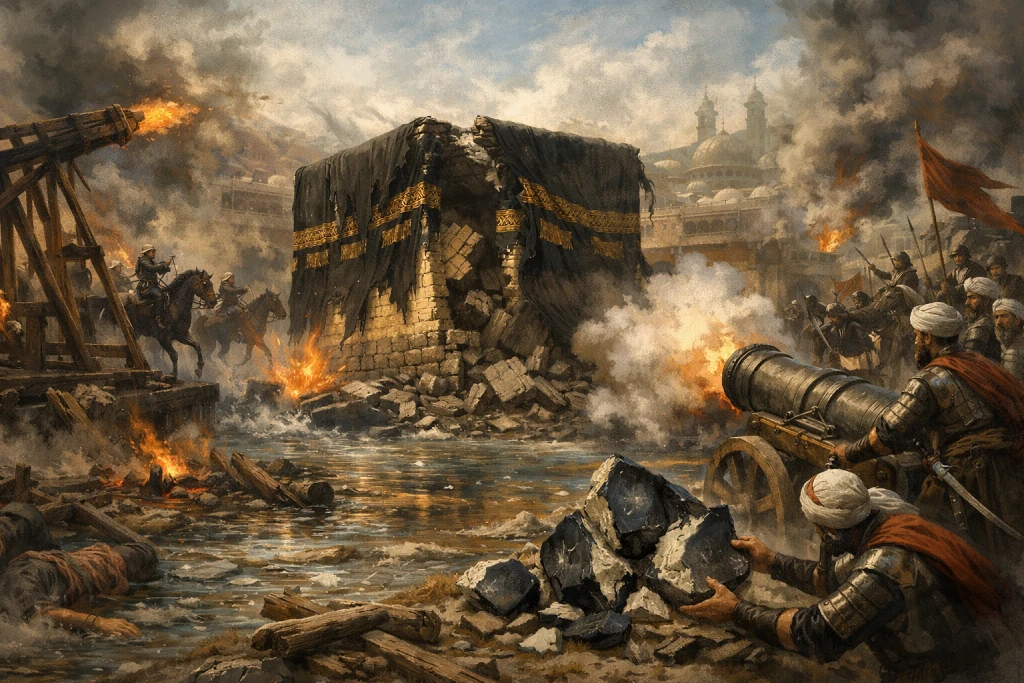
Contrary to claims that the Kaaba and the Black Stone enjoy miraculous protection and are indestructible, Islamic historical sources themselves describe the Kaaba’s walls collapsing, the building burning, damage during military sieges, and the removal of the supposedly heavenly stone. The Quraysh reconstruction, the Umayyad military conflicts of 683 and 692, the Qarmatian attack of 930, the devastating flood of 1630, and deadly disasters at the modern Grand Mosque all reveal the same reality: this sacred structure is utterly vulnerable to human weapons, political power, natural forces, and structural weaknesses. The claim that divine protection guarantees the Kaaba’s invulnerability under all circumstances has failed the test of history. The story of miraculous birds destroying Abraha’s army survives in the Quran and later biographies, while the actual history of Umayyad sieges, Qarmatian attacks, and flood damage shows no visible miraculous defense. Comparing contemporary inscriptions describing Abraha’s military activity with ancient Jewish literary narratives also exposes the evidentiary weaknesses of this allegedly miraculous history.
Christian Julien Robin’s research on Abraha’s inscriptions, Sara Raup Johnson’s work on Third Maccabees, Harry Munt’s studies of early Meccan history, and Abdullah Çakmak’s research on the flood of 1630 and Ottoman reconstruction clarify the history behind the narratives about the Kaaba. War, political rivalry, flooding, building materials, and human labor determined the building’s fate. When the miraculous language of religious narratives is set against the identifiable causes of destruction documented in history, the Kaaba’s actual status becomes clear: it is a human-built structure that human beings have repeatedly repaired.
-
605 CEPre-Islamic Damage and Reconstruction
Natural disasters and fire weakened the entire structure. The Quraysh had to demolish and rebuild the Kaaba, this time with a roof. [1]।
-
683 CESiege by the Umayyad Army (Second Fitna)
A fire broke out at the Kaaba during the Umayyad siege, damaging its wooden components and covering. Historical accounts differ over the immediate cause of the fire; the Black Stone was also damaged. [2]।
-
692 CEAttack by al-Hajjaj ibn Yusuf
On the Umayyad caliph’s orders, al-Hajjaj ibn Yusuf hurled stones at the Kaaba with siege engines, shattered its walls, and killed Ibn al-Zubayr. [3]।
-
930 CEQarmatian Plunder and Massacre
On Abu Tahir’s orders, the Black Stone was pried out with a club. Thousands of pilgrims were massacred in the Kaaba precinct, bodies were thrown into the Zamzam well, and the stone was taken away for 22 years. [4]।
-
1630 CEDevastating Flood under Ottoman Rule
The severe flood of April 3, 1630, caused two walls adjoining the Kaaba’s western and northern corners to collapse; reconstruction subsequently began on the orders of the Ottoman Sultan Murad IV. [5]।
Introduction
In Islamic belief, the Kaaba is the Bayt Allah, or House of God, and the foremost sacred site for Muslims. Surat al-Fil (105:1–5) describes birds showering stones upon an army of elephants. Later biographies and Quranic commentaries identify the army’s commander as Abraha, the ruler of Yemen, and its target as the Kaaba in Mecca. Yet none of the five verses of Surat al-Fil directly names Abraha or Mecca. Quran 3:97 states that whoever enters the sanctuary will be safe. Against this assurance stand the unmistakable historical records of massacres in Mecca’s sacred precinct and assaults on the Kaaba’s walls and stone. Religious sanctity protected neither brick nor stone from fire, weapons, or floods. [6] [7]
In it are clear signs, including the Station of Abraham (the place where Abraham stood). Whoever enters it shall be safe…
— Taisirul Quran
In it are manifest signs, of which the Station of Abraham is one. Whoever enters it obtains security…
— Sheikh Mujibur Rahman
In it are clear signs, including the Station of Abraham. Whoever enters it will be secure…
— Rawai Al-bayan
In it are many clear signs [1], including the Station of Abraham [2]. Anyone who enters it is safe [3]…
— Dr. Abu Bakr Muhammad Zakaria
The records compiled by authoritative classical Muslim historians attest to a harshly different reality. History shows that the Kaaba and the supposedly heavenly Black Stone set into its wall were repeatedly devastated by human attacks and natural disasters. The building caught fire more than once, was struck and damaged by stones fired from siege engines, and even lost walls to catastrophic floods. The most striking and contentious episode occurred in 930 CE (317 AH), when Qarmatian rebels seized the Black Stone and kept it under their control outside Mecca for 22 years. These historical events are recorded in detail in Ibn Kathir’s Al-Bidaya wa’l-Nihaya, al-Tabari’s Tarikh al-Umam wa’l-Muluk and Ibn al-Athir’s Al-Kamil fi’l-Tarikh [8]. The aura of sanctity surrounding the Kaaba, its covering, doors, and allegedly heavenly stone did not repel those attacks. The removal of the stone from the pilgrimage center, followed by its return years later through human action, directly mocks the notion of miraculous invulnerability.
The story of birds raining stones upon Abraha’s army creates a remarkable contradiction in the Kaaba’s history. Supposedly, miraculous power protected the building when it served as a pre-Islamic pagan shrine. Yet once it had become Islam’s sacred center, the armies of Muslim caliphs attacked the same building with fire and stones, the Qarmatians seized the Black Stone, and floods brought down its walls. Where was the miraculous defense against al-Hajjaj or Abu Tahir that supposedly appeared against Abraha? Here the miraculous hero of religious narrative is defeated by the military forces and natural disasters of actual history.
The Myth of the Ababil Birds versus Historical Contradictions: The Futility of Divine Protection
According to the conventional Islamic biographical account, Abraha marched against the Kaaba; Surat al-Fil describes birds destroying an army of elephants. Bukhari 2478 reports that 360 idols stood around the Kaaba at the conquest of Mecca in 630 CE. The building’s role as a pre-Islamic pagan shrine differs markedly from its later history as a monotheistic sanctuary. The question is therefore unavoidable: why is miraculous protection claimed for the Kaaba when it was a pagan shrine, while the same structure suffered repeated, severe damage during the Islamic era? The Kaaba is said to have enjoyed miraculous protection while it served pagan worship; yet its destruction, plunder, and rebuilding in the Islamic era are matters of historical record. This contrast exposes the inconsistency of claims about special divine protection. [9] [10]
Yet Islamic accounts describe the removal of idols from the Kaaba following Muhammad’s conquest of Mecca. Bukhari 2478 mentions 360 idols around the sanctuary at the time of the conquest. Even after the idols were removed, the Kaaba remained vulnerable to siege, fire, and flood. Changing the form of worship did not eliminate the building’s vulnerability to nature and war. The story of divine protection for the Kaaba during an era of idol worship—an era Islam condemns—was nevertheless elevated to the status of a miracle in subsequent Islamic belief. [9]
During the siege by Yazid’s forces in 683, the Kaaba caught fire. In 692, the forces of Abd al-Malik’s commander al-Hajjaj ibn Yusuf bombarded Mecca with siege engines and ended Ibn al-Zubayr’s rule. The walls and architecture of the Kaaba were not spared by this bloody power struggle among Muslim rulers. The building allegedly saved by heavenly birds from Abraha’s elephants received no visible miraculous shield against the caliph’s army.
In 930 CE, the Qarmatians under Abu Tahir al-Jannabi massacred and robbed pilgrims in Mecca before tearing out the Black Stone. For more than two decades it was absent from Mecca. The established facts—killings, plunder, and prolonged removal—are powerful historical evidence against claims of invulnerability. After the stone had been stolen from the Kaaba’s corner, its eventual return came not through miraculous intervention but through a lengthy process of political and human efforts. The savagery of the Qarmatian attack demonstrates that declaring a religious object sacred affords it no physical protection against an assailant. [11]
These historical events raise an important question—Why would almighty Allah send miraculous Ababil birds and make such extraordinary efforts to protect the Kaaba’s honor while it was a pre-Islamic pagan shrine, when the same sacred site was subsequently damaged and plundered under Muslim rule? No miraculous flock of birds stopped the Umayyad attack or the Qarmatian plunder. Human beings had to restore the Kaaba and the Black Stone after the destruction. A building may be declared God’s special sanctuary, but that declaration does not render its walls invincible. The repeated collapse of the Kaaba in recorded history leaves no ambiguity on this point. [9]।
The Farce of Divine Protection: When ‘Allah’ Defended Idol Worship
Abraha, as described in Islamic biographies, was a Christian ruler of Yemen. His monotheistic religious identity is historically significant, as is the political context of his military campaigns to extend control over northern Arabia. Islamic tradition, meanwhile, describes the Kaaba as a center of pre-Islamic idol worship, and Bukhari reports the presence of numerous idols around it at the conquest of Mecca. The theological question remains: On what grounds is miraculous intervention claimed to have protected a pagan shrine, while later accounts document actual attacks and disasters at the same site? Placing the story of miraculous punishment against Abraha’s army in defense of an idol-filled Kaaba alongside the historical destruction of the same sanctuary by subsequent Muslim rulers makes the theological inconsistency of this supposedly selective protection unmistakable. [12] [13]
Is it not the height of irony that miraculous stones allegedly rained down from the heavens to protect a building filled with idols—a building Muhammad was later sent to ‘purify’? Yet after the Kaaba had become the exclusive center of Islam, al-Hajjaj ibn Yusuf’s siege engines shattered its walls [14], or when the Qarmatians massacred pilgrims in Mecca and tore out the Black Stone, there was not the slightest sign of miraculous birds or divine intervention [15]।
The miraculous protection story in Surat al-Fil stands in direct conflict with the later history of destruction and plunder at the Kaaba under Islamic rule. According to the narrative, an army advancing against a religious sanctuary was miraculously thwarted. Yet within a few generations, the Kaaba was repeatedly subjected to siege, fire, bombardment, and reconstruction for political reasons. In contrast to the miraculous account of a Christian ruler’s failed attack, real military interventions by Muslim rulers damaged the Kaaba’s fabric. Muslim rulers’ weapons were able to damage the Kaaba: that is history. The birds’ bombardment of Abraha belongs to religious narrative; damage caused by Muslim rulers’ weapons belongs to documented history. That difference makes claims of special miraculous protection inconsistent.
The Kaaba’s history makes the distinction between religious status and physical security plain. A building may be sacred to believers, but sanctity cannot prevent military damage to its walls, the removal of its stone, or pressure from floodwaters. Inscriptions about Abraha attest to real military history; records of the Kaaba’s destruction and reconstruction show the building’s actual fragility. Claims that the Kaaba enjoys miraculous safety in all circumstances are directly refuted by these events. Claims of miracles cannot erase records of actual destruction.
The Story of Abraha: Original Account or Reworked Mythology?
The story of the ‘Army of the Elephant’ has clear parallels in ancient Middle Eastern religious literature, folklore, and traditions of shared mythmaking across cultures. It follows a familiar ‘literary topos’—a recurring narrative pattern in which divine intervention protects a sacred place from an arrogant ruler. Such narratives were well established in ancient Jewish and Christian literature and carried symbolic power within religious imagination [16]. Those earlier stories are essential context for the account of the Kaaba.
Parallels with Ancient Literary Motifs: Third Maccabees
The account of Abraha’s expedition against Mecca is not a unique or isolated miracle story. It is an effective example of the familiar narrative pattern, or ‘literary topos’, widespread in ancient Middle Eastern religious literature and folklore. In this pattern, an oppressive and arrogant ruler marches with a vast army to destroy a sacred site, only to have his powerful forces defeated at the last moment by divine or supernatural intervention. The tyrant’s worldly might is rendered insignificant before God’s power. This motif was popular in Jewish and Christian literature long before the rise of Islam. Similar dramas exist in many other religions as well: a proud ruler advances with an army and is humbled by divine power. Such stories resonate widely and offer a kind of psychological satisfaction to powerless and oppressed people. The following table compares Abraha’s story with the narrative in the Jewish religious work Third Book of Maccabees (3 Maccabees):
| Aspect of Comparison | Third Book of Maccabees (3 Maccabees) | Surat al-Fil (Islamic Narrative) |
|---|---|---|
| Attacking Ruler | Ptolemy IV Philopator, King of Egypt | Abraha, the Christian ruler of Yemen |
| Sacred Target | Jews assembled at the hippodrome in Alexandria (the temple episode occurs elsewhere in the book) | The Kaaba in Mecca, according to later Islamic interpretation |
| Symbol of Military Power | 500 enraged elephants | Army of elephants (including an elephant named Mahmud) |
| Prayer for Protection | Eleazar’s prayer and the Jews’ lamentations | The prayer of Abd al-Muttalib (according to tradition) |
| Miraculous Intervention | Appearance of two terrifying heavenly messengers | Ababil birds dropping stones from the sky |
| Outcome | The elephants turn back and trample their own soldiers | The army is destroyed like ‘chewed straw’ |
Several striking literary similarities connect the two accounts: a powerful ruler, elephants as symbols of military violence, a vulnerable religious community, and a catastrophe brought about by divine intervention at the climax. Although the stories differ in geography and narrative details, their shared motifs of miraculous deliverance and war elephants are unmistakable. The elephant episode in Third Maccabees concerns an attempt to kill captive Jews in the Alexandrian hippodrome; the tradition of Abraha’s expedition against the Kaaba is set in a different place and has a different outcome. Both nevertheless use the same literary arrangement of elephants, a religious community, and miraculous rescue. [17]
Abraha’s Ry 506 inscription (552 CE) and related inscriptions document his military campaigns and political power. The story of his forces being destroyed by stone-throwing birds comes from later religious literature. Conflating Abraha’s real existence and military activities with the historical truth of this miraculous story is a logical error.
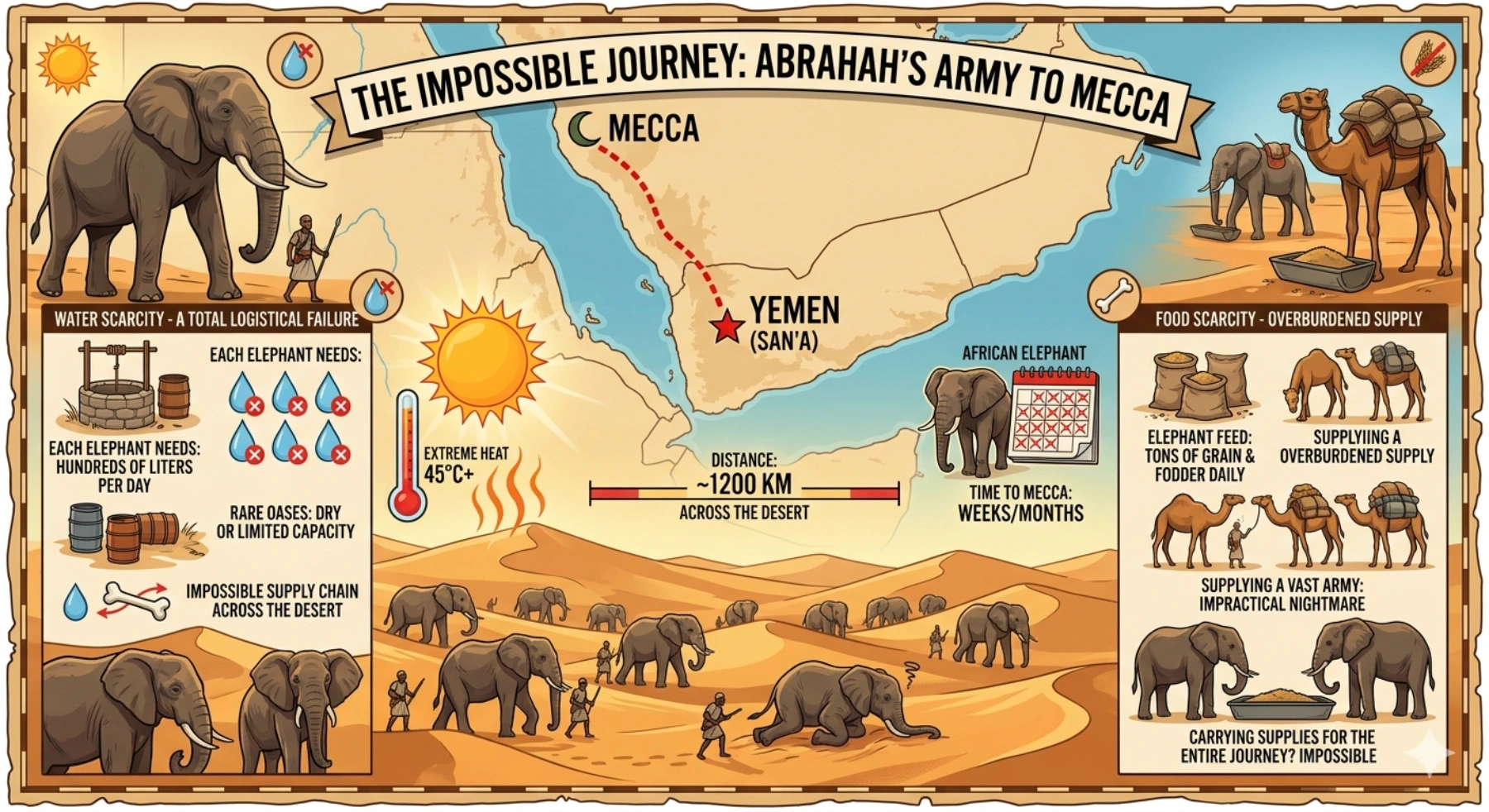
A long-distance expedition involving elephants would require water, food, rest, viable travel routes, and veterinary care. The conventional story leaves the actual route, water supplies, and enormous logistical requirements of the elephants undefined; miraculous stone-throwing takes center stage instead.
Abraha was a Christian ruler whose military campaigns formed part of a broader effort to establish political dominance. The religious motives assigned to an expedition against the Kaaba in later stories cannot simply be treated as identical to his actual military objectives. The Kaaba was a pre-Islamic pagan sanctuary; an account of 360 idols at the conquest of Mecca in 630 survives. The question is how a story of miraculous intervention to protect the Kaaba can be reconciled with the building’s documented destruction in later centuries.
Abraha’s elephant-army story, like Third Maccabees, follows a literary pattern involving a powerful ruler, elephants, a threatened religious sanctuary or community, and miraculous deliverance. This similarity illuminates the story’s religious-literary background; establishing whether a particular author directly borrowed from another requires separate textual research. To allow readers to examine the similarities, a source for the original English translation of 3 Maccabees and a selected rendering of chapters 5–7 appear below [18] [19]
The work known as 3 Maccabees is recognized as deuterocanonical scripture by the Greek Orthodox and Russian Orthodox Churches. Most other church traditions, however, classify it among the Apocrypha.
Below are selected passages from chapters 5–7 of 3 Maccabees in English (multiple verses are omitted from the source selection; this is neither a complete nor a continuous translation):
Chapter 5: The Plan Involving the Elephants and the King’s Loss of Memory
1. The king then summoned Hermon, who was in charge of the elephants, and in a rage revealed his cruel plan.
2. He ordered that the following morning five hundred elephants be given large quantities of wine, made drunk, and unleashed upon the Jews to trample them to death.
3. Having issued this order, the king joined a banquet with his friends, who intensely hated the Jews.
4. Hermon duly carried out the king’s orders.
5. The servants bound the Jews’ hands and kept them under guard throughout the night.
6. The pagans thought that the Jews were now utterly helpless.
7. But the Jews continued to pray to the merciful God with tears, begging for deliverance.
9. Their prayers were heard in heaven.
10. The following day Hermon came to the palace and reported that his preparations were complete.
11. But God kept the king in a deep sleep.
12. By this extraordinary intervention of the Lord, the king’s wicked purpose was thwarted and his plan failed.
13. When the Jews realized that the appointed time had passed, they began praising the holy God.
14. At the tenth hour (later in the afternoon), the king was awakened.
16. On waking, the king resumed drinking and reveling with his guests.
18. During the conversation the king asked Hermon why the Jews had not yet been killed.
19. Hermon answered that he had prepared everything the night before.
20. The king then grew still more cruel and said, ‘They survived today because I slept. Tomorrow, without delay, destroy them with the elephants.’
21. The guests rejoiced at this.
22. They spent the night laughing about the cruelties they could inflict upon the Jews.
23. At dawn Hermon assembled the elephants and brought them before the palace.
24. The townspeople gathered to watch the horrific spectacle.
25. The Jews again cried out and implored the Almighty for help.
26. Before sunrise Hermon summoned the king and announced that everything was ready.
27. Seeing Hermon, the king was astonished and, having forgotten everything, asked why these arrangements had been made.
28. This was the work of almighty God, who had caused the king to forget his entire plan.
29. When Hermon reminded him of his earlier command,
30. the king became furious and threatened Hermon, saying:
31. ‘If your parents or children were here, I would feed them to these beasts! Why should I kill these innocent Jews, who have served me and my ancestors faithfully?’
32. The king added that Hermon’s longstanding friendship had spared his life that day.
33. Hermon turned pale with fear and could not speak.
34. The king’s companions and the crowd returned to their respective affairs.
35. The Jews praised God for having helped them.
37. But the king again became drunk and summoned Hermon once more, threatening him: ‘How many times must I repeat myself? Tomorrow you will crush them with the elephants!’
39. Seeing the king’s instability, his relatives said, ‘Your Majesty, are you testing us? Three times you have issued these orders and then forgotten them. This is causing disorder in the city.’
42. The king stubbornly swore to send the Jews to their deaths the following day, and thereafter to invade Judea and burn their temple.
45. The elephants were driven mad with large quantities of wine and aromatic substances, and equipped with terrifying apparatus.
46. A great crowd gathered at daybreak.
47. The king went out with the elephants to enjoy the sight with his hardened heart.
48. When the Jews saw the elephants approaching, they broke down in tears and began bidding one another farewell.
50. Still, remembering help from heaven, they continued imploring the Almighty for mercy.
Chapter 6: Eleazar’s Prayer and the Appearance of Angels
1. At this point an elderly and devout priest named Eleazar calmed everyone and offered the following prayer:
2. ‘O great and almighty God, you are most merciful.
3. Look upon the descendants of Abraham and the children of your holy heir Jacob, who are now about to be unjustly destroyed in a foreign land.
4. It was you who drowned the arrogant Pharaoh and his chariots in the sea when he pursued Israel.
5. You destroyed Sennacherib, king of Assyria, with his vast army when he boasted against your holy city.
6. You saved your three companions in Babylon from the blazing furnace.
7. You brought Daniel unharmed from the lions’ mouths.
8. You rescued Jonah from the belly of the fish.
9. O Lord, you despise the arrogant and are our ultimate refuge. Deliver us swiftly from these lawless foreigners.
11. Do not let these idol worshippers laugh and say, “Their God could not save them.”‘
15. Demonstrate to all the nations of the world that you are with us, O Lord.’
16. As soon as Eleazar finished praying, the king arrived at the hippodrome with the elephants and army.
17. The cries of the Jews echoed through the surrounding valleys.
18. Then the true God opened heaven’s gates, and two fearsome angels descended, visible to everyone except the Jews.
19. They stood before the enemy army, filled its soldiers with terror and paralysis, and deprived them of the ability to move.
20. The king, too, cowered in fear, and all his rage subsided.
21. The elephants turned around and charged the king’s own forces, trampling and destroying them.
22. The king’s anger gave way to compassion, and he wept over what he had intended to do.
23. He rebuked his officials, saying:
24. ‘You have committed a despicable act and exceeded even tyrants in cruelty! You tried to deprive me of my loyal subjects, who have always served the kingdom.’
27. The king ordered: ‘Release these unjust chains! Send them home honorably and in peace, and apologize for what has happened.’
28. The king acknowledged that the God of heaven had helped them and secured their safety.
29. Released, the Jews began praising God, their holy deliverer.
30. The king ordered that they hold a feast for seven days and celebrate in the very place where they had been condemned to die.
32. They sang joyous songs in place of lamentations and began dancing in peace.
35. To commemorate the day, they decreed an annual festival, not for wine or luxury but in gratitude for God’s deliverance.
39. The supreme Judge had shown mercy and rescued them all unharmed.
Chapter 7: The Jews’ Honorable Return
1. King Ptolemy Philopator wrote the following letter to all his commanders in Egypt:
2. ‘We and our children are well. God has made our undertakings successful.
3. Certain friends maliciously incited us to punish the Jews.
5. They represented the Jews to us as traitors and sought their destruction without trial.
6. But we have realized that the God of heaven appeared as a shield of protection for the Jews, fighting for them as a father fights for his children.
7. We therefore absolve them of all accusations.
8. They have been sent home with honor. Everyone is ordered to refrain from mistreating them.
9. Remember: if we harm them, the Almighty himself will judge us, and none can escape his judgment.’
10. On receiving this letter, the Jews did not immediately depart; they asked the king for permission to punish those who had abandoned their religion.
11. They argued that people willing to violate God’s law for the sake of their stomachs could never be loyal to the king.
12. The king acknowledged their reasoning and granted them full authority.
13. The priests blessed the king, and everyone shouted ‘Hallelujah!’ in celebration.
14. They duly punished the apostates.
16. Wearing garlands of flowers and singing joyful songs, they set out through the city, praising the God of their ancestors.
18. The king covered all their travel expenses.
20. They erected a pillar at the place of their celebration and consecrated it as a place of prayer. They then returned safely to their homes by river and sea.
21. Their enemies began to respect and fear them, and no one could seize their property again.
22. Everyone recovered their lost possessions. Almighty God had performed a great miracle for their deliverance.
23. Blessed forever be the deliverer of Israel! Amen.
The book includes an earlier episode in which Ptolemy IV Philopator attempts to enter the Temple in Jerusalem, but the account of a plan to kill Jews with five hundred elephants, followed by angels turning the elephants against the army, takes place at the hippodrome in Alexandria. Although the settings of the two episodes differ, the use of elephants and the narrative pattern of miraculous protection are highly significant. Both stories employ the motif of ‘elephants + a threatened religious community + miraculous deliverance’, revealing a familiar structure of divine intervention in ancient religious storytelling. [20]
Reading Third Maccabees as a Literary Source: Sara Raup Johnson’s Research
In Historical Fictions and Hellenistic Jewish Identity: Third Maccabees in Its Cultural Context (University of California Press, 2005), Sara Raup Johnson analyzes Third Maccabees not as a straightforward and reliable chronicle of events but as historical fiction used to construct Jewish identity and political positioning in the Hellenistic period. Her fourth chapter discusses the work’s date and literary context. Although the story is set toward the end of the third century BCE, research places the composition of the text considerably later. Its literary strategy of presenting the miraculous rescue of a powerless religious community from overwhelming military force as historical narrative is central to the comparison with Surat al-Fil. Johnson demonstrates how Jewish historical fiction deliberately altered and reconstructed events of the past to advance particular religious and political messages. [21]
The curious historical distortions that abound in Jewish fictions are in no way random but are deliberately employed for rhetorical purposes.
English translation: The curious historical distortions that abound in Jewish fictions are in no way random but are deliberately employed to advance specific claims.
In Third Maccabees, Ptolemy IV Philopator, ruler of Egypt, plans to use elephants to exterminate the Jews. He orders Hermon, the keeper of the elephants, to intoxicate five hundred elephants with copious wine and aromatic substances so that they will trample the Jews to death. Here the elephants are not merely beasts of war: they are the ruler’s chosen weapons for annihilating an entire religious community. The plan appears at the beginning of chapter five of Third Maccabees. [22]
Τότε προσκαλεσάμενος Ἕρμωνα τὸν πρὸς τῇ τῶν ἐλεφάντων ἐπιμελείᾳ βαρείᾳ μεμεστωμένος ὀργῇ καὶ χόλῳ κατὰ πᾶν ἀμετάθετος ἐκέλευσεν ὑπὸ τὴν ἐπερχομένην ἡμέραν δαψιλέσι δράκεσι λιβανωτοῦ καὶ οἴνῳ πλείονι ἀκράτῳ ἅπαντας τοὺς ἐλέφαντας ποτίσαι ὄντας τὸν ἀριθμὸν πεντακοσίους καὶ ἀγριωθέντας τῇ τοῦ πόματος ἀφθόνῳ χορηγίᾳ εἰσαγαγεῖν πρὸς συνάντησιν τοῦ μόρου τῶν Ἰουδαίων.
English translation: The king, filled with intense rage and bitterness and determined to carry out his decision, summoned Hermon, the keeper of the elephants. He ordered that on the following day five hundred elephants should be given large quantities of aromatic substances and undiluted wine. Once driven into a frenzy by the wine, they were to be brought before the Jews to bring about their deaths.
Faced with this planned massacre, an elderly priest named Eleazar prays to God on the Jews’ behalf. In his prayer he recalls earlier miraculous interventions through which God rescued the Israelites. He invokes the destruction of Pharaoh’s forces in Egypt, the defeat of an Assyrian ruler, and other sacred stories of divine deliverance. At the end, Eleazar calls upon God to display his power, terrify the enemy, and save Israel. [23]
πτηξάτω δὲ ἔθνη σὴν δύναμιν ἀνίκητον σήμερον ἔντιμε δύναμιν ἔχων ἐπὶ σωτηρίᾳ Ιακωβ γένους· ἱκετεύει σε τὸ πᾶν πλῆθος τῶν νηπίων καὶ οἱ τούτων γονεῖς μετὰ δακρύων· δειχθήτω πᾶσιν ἔθνεσιν ὅτι μεθ᾽ ἡμῶν εἶ κύριε καὶ οὐκ ἀπέστρεψας τὸ πρόσωπόν σου ἀφ᾽ ἡμῶν ἀλλὰ καθὼς εἶπας ὅτι οὐδὲ ἐν τῇ γῇ τῶν ἐχθρῶν αὐτῶν ὄντων ὑπερεῖδον αὐτούς οὕτως ἐπιτέλεσον κύριε.
English translation: Let the nations tremble today before your unconquerable power, O glorious Lord, who possess the strength to save the descendants of Jacob. All the children and their parents implore you with tears. Let every nation see that you are with us, Lord, and that you have not turned your face away from us. Just as you promised not to abandon them even in the land of their enemies, fulfill that promise now, O Lord.
Immediately after Eleazar finishes praying, the story’s miraculous rescue occurs. When the king arrives at the execution ground with his armed forces and elephants, God opens the gates of heaven. Two fearsome angels descend, throwing the attacking army into terror and confusion. The elephants then attack the soldiers who had accompanied them rather than the Jews, trampling the soldiers to death. Thus, the elephants sent to exterminate a religious community destroy the attackers instead through divine intervention. Third Maccabees describes this event explicitly. [24]
τότε ὁ μεγαλόδοξος παντοκράτωρ καὶ ἀληθινὸς θεὸς ἐπιφάνας τὸ ἅγιον αὐτοῦ πρόσωπον ἠνέῳξεν τὰς οὐρανίους πύλας ἐξ ὧν δεδοξασμένοι δύο φοβεροειδεῖς ἄγγελοι κατέβησαν φανεροὶ πᾶσιν πλὴν τοῖς Ιουδαίοις· καὶ ἀντέστησαν καὶ τὴν δύναμιν τῶν ὑπεναντίων ἐπλήρωσαν ταραχῆς καὶ δειλίας καὶ ἀκινήτοις ἔδησαν πέδαις· καὶ ὑπόφρικον καὶ τὸ τοῦ βασιλέως σῶμα ἐγενήθη καὶ λήθη τὸ θράσος αὐτοῦ τὸ βαρύθυμον ἔλαβεν· καὶ ἀπέστρεψαν τὰ θηρία ἐπὶ τὰς συνεπομένας ἐνόπλους δυνάμεις καὶ κατεπάτουν αὐτὰς καὶ ὠλέθρευον.
English translation: Then the all-glorious, almighty, and true God revealed his holy face and opened heaven’s gates. Two angels of glorious and terrifying appearance descended, visible to everyone except the Jews. They stood before the attackers and overwhelmed the enemy army with panic and confusion, as though binding them in immovable chains. The king himself trembled in fear and forgot his violent arrogance. The elephants then turned on the armed soldiers following them, trampling and destroying them.
The narrative parallels between Third Maccabees and Surat al-Fil are clear. Both accounts feature a powerful ruler or military force accompanied by elephants; a religious group threatened with destruction is rescued through divine intervention; and miraculous forces overturn the attackers’ plans. In Third Maccabees, the intervention involves two angels and elephants turning against their own troops. Surat al-Fil describes birds raining stones upon an elephant army and destroying it. Despite differences in narrative detail, their central literary structures are closely related. The similarities place the Quranic elephant story within a pre-existing religious narrative tradition in which miraculous power defeats aggressors to protect God’s chosen community or a sacred site.
Third Maccabees is an important example of the historical fiction analyzed by Sara Raup Johnson. It draws upon a real ruler, familiar political circumstances, and military power to construct a story whose outcome is determined by supernatural intervention. The presence of comparable miraculous motifs in earlier literature weakens any attempt to present Surat al-Fil as a unique and independent historical witness. Stories of miraculous victory over elephant armies were already familiar in religious literature before the Quran. The Quranic elephant narrative carries the familiar motif of miraculous deliverance found in that earlier literary tradition. Treating the religious story itself as historical proof of its own miraculous truth is circular reasoning.
Theological Contradictions and the Protection of the ‘Pagan’ Kaaba
According to Islamic accounts, when the Christian ruler Abraha came to destroy the Kaaba, Allah sent a miraculous flock of birds that annihilated his army. Yet at the time the Kaaba was a center of pagan Arab idol worship. Why, then, would Allah send a miraculous army to protect a pagan shrine while subsequently permitting the same Kaaba to be repeatedly damaged and destroyed by Muslim rulers? The Kaaba was damaged during the Umayyad sieges of 683 and 692; in 930, the Qarmatians plundered it and even tore out the Black Stone. Where was Allah’s miraculous defense then? Miraculous intervention to protect a pagan Kaaba, followed by no miraculous defense against the destruction and plunder of the same Kaaba during Muslim rule—this contradiction seriously undermines claims of special divine protection. [12] [13]
Motifs in Pre-Islamic Poetry
Research has discussed echoes of stories about elephant armies, birds, and raining stones in poetry attributed to pre-Islamic Arabia and in later Islamic literature. Verses ascribed to Umayya ibn Abi al-Salt are also mentioned in this discussion. These poems bear the marks of oral transmission and later alteration in their textual history. Their real importance, therefore, lies not in inventing speculative dates for particular lines but in revealing how a miraculous elephant-army story circulated and was retold in Arab literary memory. [25]
Historical and Logical Inconsistencies in Abraha’s Elephant-Army Story
Contemporary inscriptions attest to Abraha’s existence and some of his military activities on the Arabian Peninsula. In particular, Ry 506 / Murayghān 1 (September 552 CE) records his victory in central Arabia and events involving the Ma’add tribe. Christian Julien Robin has analyzed this inscription and other recent discoveries. Abraha’s contemporary records preserve evidence of his actual military victories and political activities. Birds raining stones belong to a later religious narrative, unaccompanied by independent historical accounts of the elephant army’s route, food and water, supplies, or the actual course of the expedition. The existence of a real ruler does not establish the truth of a miraculous story. [26] [27]
The conventional story of Abraha’s elephant army being destroyed is more than a tale of miraculous birds and stones. It also presents serious problems concerning history, chronology, military logistics, religious identity, and contemporary testimony. Later biographies and Quranic commentaries expanded five brief Quranic verses into an elaborate elephant-army narrative. Its chronology, military itinerary, and miraculous destruction are separate from the contemporary military history of Abraha. The inconsistencies appear in the following table.
| Issue | Claim in the Islamic Narrative | Historical and Logical Inconsistency |
|---|---|---|
| 1. Chronology | The elephant expedition took place in the year of Muhammad’s birth, conventionally around 570 CE. | Robin’s research places the end of Abraha’s reign at approximately 565 CE. This conflicts with the traditional date of 570 for the expedition. |
| 2. Names Absent from the Quran | Abraha came from Yemen to destroy the Kaaba in Mecca. | None of the five verses in Surat al-Fil names Abraha, Yemen, Mecca, or the Kaaba. These identities and locations derive from later biography and commentary. |
| 3. Contemporary Inscriptions | Abraha’s great army came to Mecca and was destroyed by a miraculous attack. | Abraha’s own inscriptions record his military victories and conflicts with Arabian tribes. The expedition against the Kaaba and destruction by stone-throwing birds are later narratives in biographies and Quranic commentaries. |
| 4. The Elephant Army’s Long Journey | Abraha marched from Yemen toward Mecca with elephants and a massive army. | Such a lengthy campaign would have required vast amounts of elephant fodder, drinking water, rest, veterinary treatment, and provisions for soldiers. Instead of documenting an actual itinerary, the number of elephants, supply systems, and military preparations, the traditional account foregrounds a miraculous ending. |
| 5. Miraculous Behavior of the Elephant | An elephant named Mahmud refused to advance toward the Kaaba but moved when turned in another direction. | The Quran says nothing about an elephant named Mahmud or its miraculous behavior. These dramatic details appear in later religious literature. |
| 6. Stones Dropped by Birds | Flocks of birds arrive and drop baked-clay stones, destroying a vast army like chewed straw. | No independent contemporary account of such an immense miraculous military disaster, archaeological remains of the battlefield, or wreckage of the destroyed army has been identified. The miraculous explanation rests on religious narrative. |
| 7. Theological Self-Contradiction | Allah destroys the Christian ruler Abraha and protects the Kaaba. | Abraha was a monotheistic Christian ruler, whereas the Kaaba at the time was a shrine devoted to pagan idols. Islam treats idolatry as one of the gravest offenses; yet in this account Allah sends a miraculous army to defend precisely such a pagan shrine. |
| 8. No Miraculous Defense against Later Attacks | Allah personally protects the Kaaba from Abraha’s elephant army. | The Kaaba suffered severe damage during the Umayyad sieges of 683 and 692. In 930, the Qarmatians massacred people in Mecca and tore out the Black Stone. No Ababil army came to protect the Kaaba. Miraculous protection in the pagan period, followed by its absence in the Islamic period, directly challenges claims of divine defense for the same sanctuary. |
Contemporary inscriptions establish that Abraha was a real historical ruler. The miraculous elephant-army narrative built around this real ruler contains serious inconsistencies involving chronology, the expedition’s location, and military logistics. The Kaaba’s destruction and plunder in later Islamic history also contradict the story’s idea of selective divine protection. The gap between this narrative, which is used to establish the Kaaba’s sanctity and divine protection, and actual history is unmistakable. [28] [29] [30]
Contemporary Inscriptions of Abraha: Ryckmans 506 and Robin’s Research
In studies published in 2010 and 2018, the French historian Christian Julien Robin comparatively analyzed Abraha’s South and North Arabian military inscriptions. Murayghān 1 / Ry 506 The inscription is dated September 552 CE and describes military successes and political allegiances associated with Ma’add in central Arabia. Robin also attempts to reconstruct the chronology of these campaigns using other Murayghan inscriptions. These sources independently inform us about the activities of the real ruler Abraha, beyond the Quran and later biographies. The dates, locations, victories, and tribal names in these royal records provide concrete historical evidence. The tale of Abraha’s miraculous defeat by birds defending the Kaaba occurs not in those inscriptions but in later Islamic biographies and commentaries. [31]
Abraha’s inscriptions preserve records of his royal victories, the dates and geography of his expeditions, and the tribes involved. They are contemporary documentation of actual political and military activities. By contrast, the story of an army destroyed by flocks of stone-throwing birds comes from later Islamic religious literature. Treating a real ruler’s military records and a miraculous tale propagated much later as equally credible historical testimony is a logical error. [32]
A long-distance military expedition with elephants necessarily demands abundant food, water, rest, suitable routes, and animal care. Yet the conventional elephant-army narrative leaves unspecified how many elephants advanced toward Mecca, which route they followed, where they obtained water and food, and how their war supplies were transported. The essential logistics of a military campaign disappear behind the story of miraculous stones dropped by birds.
Analytical Table: The Evolution of Mythology
Placed alongside each other, Third Maccabees and Surat al-Fil employ the same literary devices: a powerful ruler, war elephants, a threatened religious identity, and deliverance through invisible forces. Abraha’s contemporary inscriptions document his real military operations; the account of destruction by miraculous birds comes from much later religious narratives.
| Aspect of Analysis | Third Book of Maccabees (Jewish-Christian Myth) | Surat al-Fil (Islamic Narrative) | Historical and Critical Assessment |
| Target of Attack | Jews detained in Alexandria; the Jerusalem Temple episode is separate. | The Kaaba in Mecca, according to later exegesis. | Scholars disagree about Mecca’s economic role; Patricia Crone’s work critically examines the conventional trade narrative. |
| Attacking Ruler | Ptolemy IV Philopator. | Abraha, ruler of Yemen. | Contemporary inscriptions describe Abraha’s military victories; later Islamic literature recounts his miraculous defeat at Mecca. |
| Symbol of Military Power | 500 trained elephants. | An elephant army (including an elephant named Mahmud). | A long-distance elephant expedition would require enormous quantities of food, water, supplies, and well-defined routes [33]. |
| Divine Intervention | Appearance of angels and elephants turning against their own troops. | Stones dropped by Ababil birds. | The stone-throwing birds belong to religious literature; the alternative epidemic explanation is likewise unsubstantiated by independent epidemiological evidence. |
| Theological Conflict | God protects his monotheistic sanctuary. | Allah protects the Kaaba’s 360 idols. | Abraha was himself a monotheist, making this purported miracle logically questionable. |
| Final Outcome | The king’s defeat and retreat. | The army completely annihilated (like chewed straw). | Scholars disagree on the precise chronology of Abraha’s later life, return, and death; this claim requires distinct contemporary documentation. |
Earlier religious literature such as Third Maccabees featured familiar motifs of elephant attacks and miraculous deliverance. Contemporary records of Abraha describe military campaigns and political victories; later Islamic literature added the story of his army being destroyed by stones dropped by birds. It is a logical error to disregard the difference between literary narrative and contemporary history and promote a miraculous event as established historical fact.
Summary Table of Historical Destruction and Reconstruction
The Kaaba’s history shows a structure that is neither untouchable nor miraculous: it has repeatedly been overcome by human actions and natural forces. Fires, military sieges, the removal of a sacred stone, flooding, and reconstruction are recorded in multiple Muslim historical works. Like any human-built wall, the Kaaba’s walls are subject to the inevitable deterioration of physical structures; belief has not exempted them from physical laws.
Chronological History of Damage to the Kaaba
| Period (CE) | Event | Nature of the Damage | Principal Historical Sources |
| 605 | Pre-Islamic damage and reconstruction | When the structure became weak, the Quraysh demolished it and rebuilt it with a roof. | Al-Azraqi, Akhbar Makka, vol. 1; Ibn Ishaq’s Sira [1] |
| 683 | Siege by Umayyad forces (Second Fitna) | Incendiary projectiles fired by siege engines burned the Kaaba’s covering and wood; intense heat split the Black Stone into three pieces. | Al-Tabari, Tarikh al-Umam, vol. 5, p. 498; Ibn Kathir, Al-Bidaya, vol. 8 [34] |
| 692 | Attack by al-Hajjaj ibn Yusuf | Stones launched from siege engines shattered the Kaaba’s walls, and Ibn al-Zubayr was killed. | Ibn Asakir, Tarikh Dimashq, vol. 12, p. 80; al-Dhahabi, Siyar A’lam al-Nubala’, vol. 4 [3] |
| 930 | Qarmatian plunder and massacre | The Black Stone was removed, and thousands of pilgrims were killed in the Kaaba precinct and thrown into the Zamzam well. | Ibn Kathir, Al-Bidaya, vol. 11, pp. 160–162; Ibn al-Athir, Al-Kamil [35] |
| 1630 | Devastating flood during the Ottoman era | Two walls adjoining the western and northern corners of the Kaaba collapsed; other parts were also severely damaged. | Ibrahim Rifat Pasha, Mir’at al-Haramayn, vol. 1, p. 251; Ba-Salamah, Tarikh al-Kaaba [36] |
The Qarmatian Revolt: The Kaaba Turned into a Mass Grave and the ‘Desecration’ of the Black Stone
One of the most disgraceful episodes in Islamic history, and among the greatest blows to claims of the Kaaba’s supposed ‘divine protection’, was the Qarmatian assault on Mecca in 930 CE (317 AH). This episode did more than challenge the idea of the Kaaba’s ‘invulnerability’; it demolished it. Led by a Qarmatian commander named Abu Tahir al-Jannabi, the attack showed that military force rather than any miraculous power determined Mecca’s fate. Declarations of sanctity achieved nothing against the armed attackers. The deaths of pilgrims who regarded the Kaaba as an invincible refuge confronted promises of religious security with brutal reality.
Massacre in the Sacred Precinct and the Absence of Protection
In Dhu al-Hijjah 317 AH, as pilgrims were performing the Hajj, Abu Tahir al-Jannabi entered Mecca with his army and ordered indiscriminate slaughter. Ibn Kathir describes in harrowing terms the killing of approximately 30,000 pilgrims in the sacred circumambulation area (mataf) and the streets of Mecca [37]. The pilgrims were performing religious rites, not taking part in a military campaign. Nevertheless, neither their religious identity nor their proximity to the Kaaba protected them from the attackers’ swords.
Desperate pilgrims clutched the Kaaba’s covering and begged for their lives, but were slaughtered there. The sacred Zamzam well was filled with corpses and the Grand Mosque’s courtyard was stained with blood. During the massacre Abu Tahir stood at the Kaaba’s entrance and cried out mockingly: ‘I am Allah! By Allah, I create and I destroy.’
Medieval accounts of Abu Tahir’s attack and the killing of pilgrims can be compared with the promise of safety in Quran 3:97. The central question is simple: how can a claim of uninterrupted physical safety or miraculous invulnerability survive when people were murdered inside the sacred precinct itself? Ibn Kathir preserves an account of this massacre and extreme desecration of the sanctuary. [38]
The Qarmatians’ Abduction of the Black Stone to Their Own Country
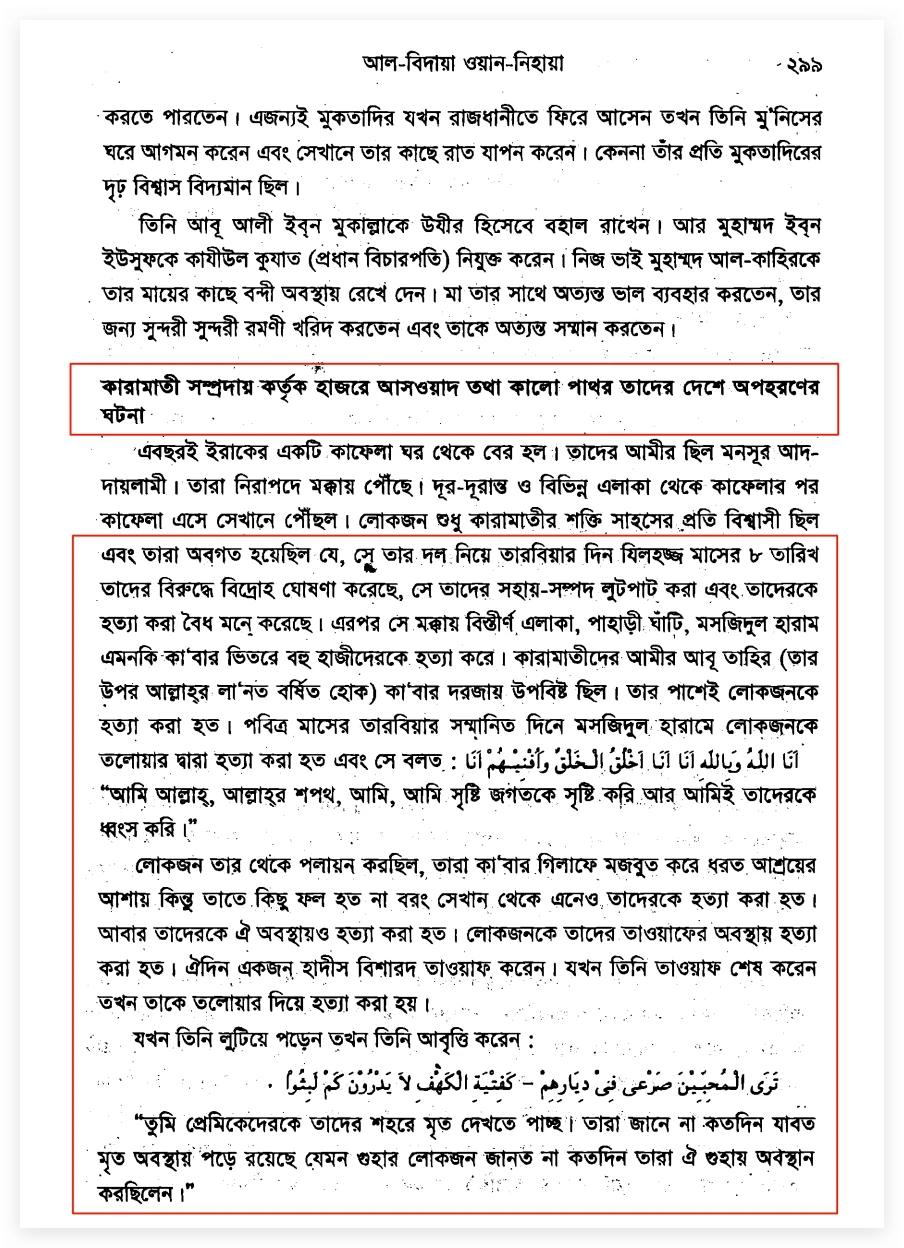
In that year, a caravan set out from Iraq under the command of Mansur al-Daylami and safely reached Mecca. Caravans came from distant lands and many regions. People believed in the Qarmatian leader’s courage and strength.
They had learned that he and his followers had launched an uprising against them on the Day of Tarwiyah, the eighth of Dhu al-Hijjah, and considered it lawful to seize their property and kill them. He then killed many pilgrims across Mecca, on the mountainous approaches, inside the Sacred Mosque, and even within the Kaaba. The Qarmatian leader Abu Tahir (may Allah’s curse be upon him) sat at the Kaaba’s entrance while people were being killed beside him. On that honored day of Tarwiyah, in the sacred month, people were being killed in the Sacred Mosque … …
‘I am Allah! By Allah, I, I created the creation, and I destroy it.’
People fled from him and gripped the Kaaba’s covering tightly, hoping for refuge, but it did them no good. They were dragged away and killed, or killed as they clung there. People were murdered while performing tawaf. That day a scholar of hadith completed his tawaf and was then struck down with a sword.
As he fell, he recited: تَرَى الْمُحِبينَ صَرْعى فِي دِيَارِهِمْ – كَفَتْيَةِ الْكَهْفِ لَا يَدْرُونَ كَمْ لَبِثُوا .
‘You see the lovers lying slain in their homes. They do not know how long they have lain there, just as the companions of the cave did not know how long they remained in the cave.’
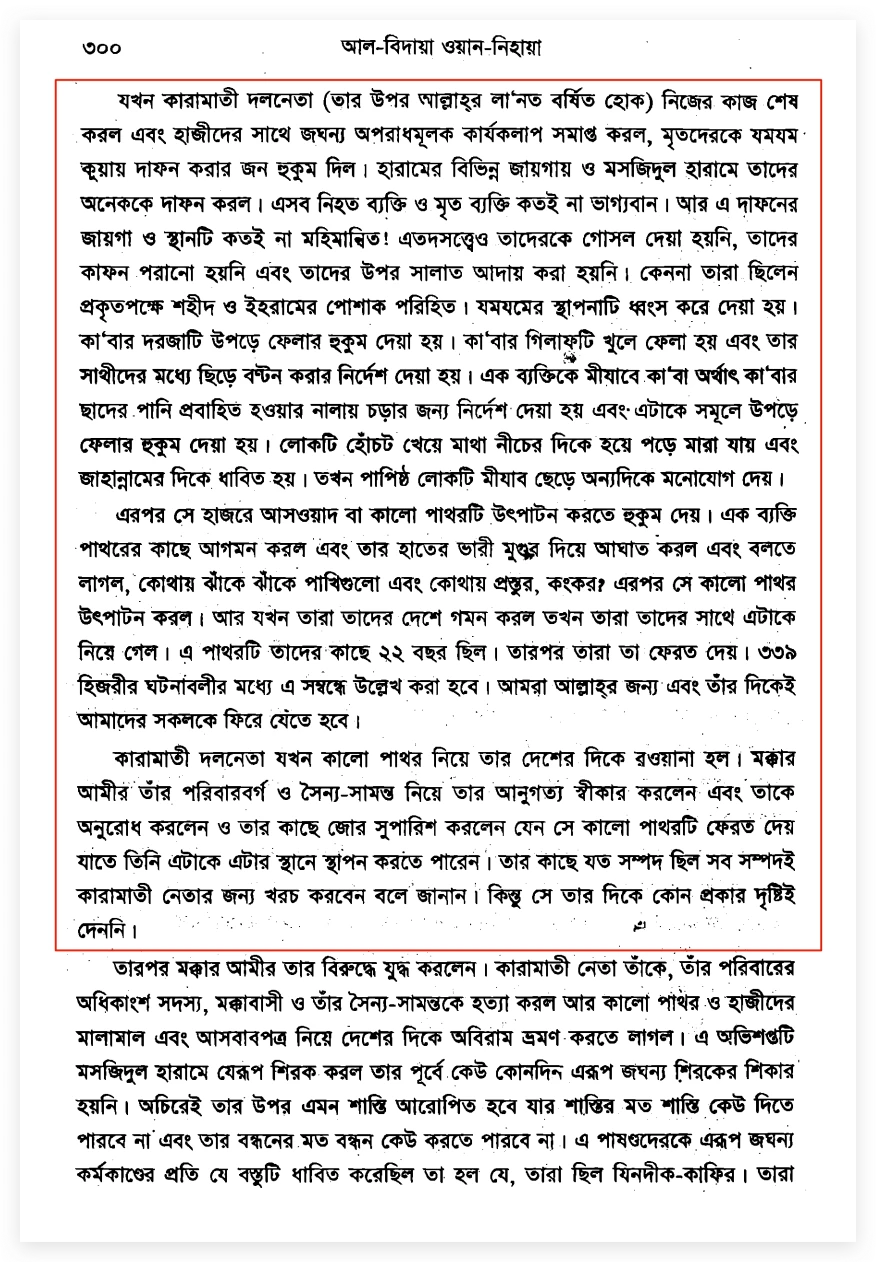
When the Qarmatian leader (may Allah’s curse be upon him) had completed his deeds and his atrocious crimes against the pilgrims, he ordered the dead to be buried in the Zamzam well. Many were buried at various places in the sanctuary and in the Sacred Mosque. How fortunate were those slain and those who died, and how glorious were their burial places! Nevertheless, they were neither washed, shrouded, nor prayed over, for they were martyrs in a state of ihram. The Zamzam structure was destroyed. Orders were issued to pull down the Kaaba’s door, remove its covering, and tear the covering into pieces for distribution among his followers. A man was ordered to climb onto the mizab of the Kaaba, the spout that drains water from its roof, and tear it out. The man stumbled, fell headfirst, died, and went to Hell. The wicked leader then turned his attention away from the spout.
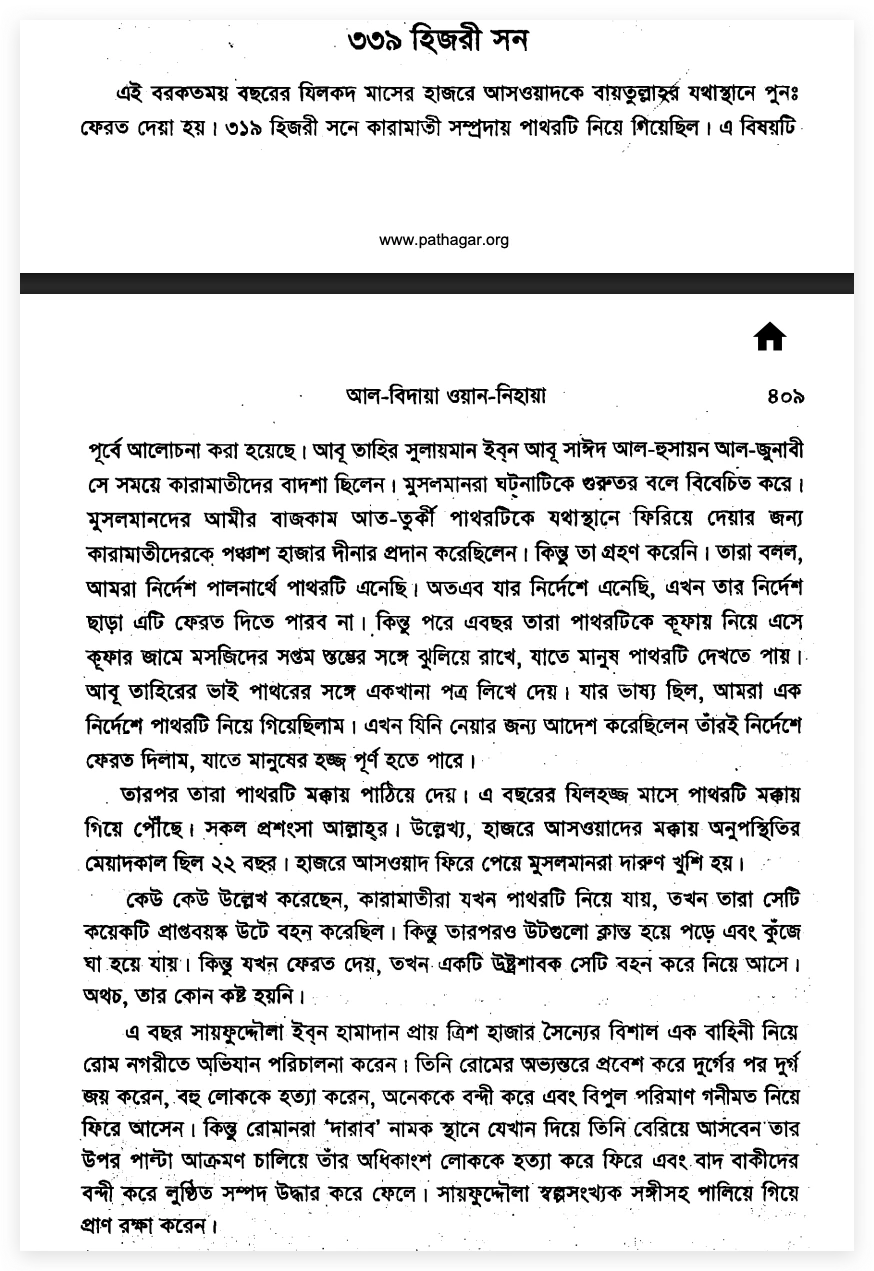
He then ordered the Black Stone to be removed. A man approached it, struck it with a heavy iron club in his hand, and said: ‘Where are the flocks of birds, and where are the stones and pebbles?’ He then removed the Black Stone. When they returned to their country, they took it with them. The stone remained in their possession for 22 years before they returned it. The account of this will be given under the events of 339 AH. Indeed, we belong to Allah and to him we shall return.
As the Qarmatian leader departed for his country with the Black Stone, the emir of Mecca approached him with his family and troops, submitted to him, and repeatedly pleaded for the stone’s return so that he could put it back in its place. He offered to spend all his wealth on the Qarmatian leader in return, but the man paid him no attention. اشر
The emir of Mecca then fought him. The Qarmatian leader killed the emir, most of his family, many inhabitants of Mecca, and his troops, and continued toward his country with the Black Stone and the pilgrims’ property and belongings. Never before had anyone committed such a vile act of polytheism in the Sacred Mosque as this accursed man. Soon he shall receive a punishment unlike any other, and no one shall bind as he is bound. What drove these wretches to such dreadful acts was that they were heretical unbelievers. They
The Plunder and Ultimate Desecration of the Black Stone
The Qarmatians did not stop at massacre. They tore the Kaaba’s covering into pieces and distributed them among themselves, and attempted to remove the golden mizab (rainwater spout). The most devastating act concerned the Black Stone. On Abu Tahir’s orders, a man struck it with a heavy club (munjur) and pried it out. The force of the blow broke the stone into several pieces [39]. This was not merely an expedition for material plunder. By striking Mecca’s best-known religious symbol, the Qarmatians challenged both its spiritual authority and the political prestige of Abbasid rule.
Medieval Muslim historians describe the Qarmatians removing the Black Stone and taking it to the Bahrain–al-Ahsa region under their control. The removal directly attacked Mecca’s religious standing and Abbasid political authority. The Qarmatians forcibly removed the Black Stone and kept it in their possession for many years. The Qarmatians demonstrated their ability to seize the central symbol of the Kaaba’s sanctity and remove it from Mecca by force. The Abbasid rulers and religious authorities of the time failed to recover it for years. It was the attackers’ military power, not any miraculous protection, that determined the outcome. [40]
Twenty-Two Years in Exile and the Fragmented Remains
From 317 AH (930 CE) until 339 AH (approximately 951–952 CE), for about 22 Hijri years, the Black Stone was outside Mecca. Ibn Kathir’s quoted account also describes the rejection of an offer of 50,000 dinars to secure its return. The stone came back in 339 AH. It suffered further attacks after its removal in 930, its fragments had to be repaired, and observers in different periods recorded different numbers of pieces. [41]
The Black Stone visible today in the corner of the Kaaba consists of fragments held together with special adhesive inside a silver frame. Ibn Kathir records the history of the stone’s removal and return. Its present appearance depends not on an intact original form but on visible fragments, fittings, and binding materials. Attempts to conceal historical damage cannot erase the records of that damage. [42]
The Year 339 AH
In Dhu al-Qadah of this blessed year, the Black Stone was restored to its proper place in the House of God. The Qarmatians had taken it in 319 AH, as discussed earlier. Abu Tahir Sulayman ibn Abu Sa’id al-Husayn al-Jannabi was the Qarmatian king at that time. Muslims regarded the incident as a grave matter. The Muslim commander Bajkam al-Turki offered the Qarmatians fifty thousand dinars to restore the stone to its proper place, but they refused, saying: ‘We took the stone in obedience to an order, and without an order from the one who commanded us to take it we cannot return it.’ Later that year, however, they brought the stone to Kufa and hung it from the seventh pillar of the congregational mosque so the people could see it. Abu Tahir’s brother attached a letter to the stone saying: ‘We took the stone by command, and now return it by command of the one who ordered its removal, so that the people’s pilgrimage can be completed.’
They then sent the stone to Mecca, where it arrived in Dhu al-Hijjah that year. All praise belongs to Allah. The Black Stone had been absent from Mecca for 22 years. Muslims rejoiced greatly upon its return.
Some have said that when the Qarmatians carried the stone away, several mature camels were needed to transport it, yet they grew exhausted and developed sores on their humps. But when it was returned, a single young camel bore it without suffering any hardship.
That year Sayf al-Dawla ibn Hamdan led an enormous army of some thirty thousand soldiers on a campaign into Roman territory. He penetrated deeply into the region, captured fortress after fortress, killed many people, took numerous prisoners, and returned with abundant spoils. The Romans then launched a counterattack at a place called Darab, through which he would withdraw, killed most of his men, captured the rest, and recovered the plundered possessions. Sayf al-Dawla escaped with a small group of companions and survived.
Chronological Discrepancy in the Bengali Edition of Ibn Kathir: Although one place in the printed Bengali edition gives 319 AH as the year the Black Stone was removed, the Qarmatian attack on Mecca and the removal of the stone occurred in 317 AH. The older printed reading is preserved in the quotation, but the correct historical chronology is 317 AH.
Destruction under the Umayyads: When the Caliph’s Own Army Became the Kaaba’s Enemy
Claims of the Kaaba’s ‘miraculous invulnerability’ and direct protection by Allah suffered some of their greatest blows in the earliest period of Islamic history, when Muslim armies acting on caliphal orders repeatedly assaulted it. Unlike the mythical account of Abraha’s elephant army in Surat al-Fil (105:1–5), under the Umayyad caliphate this Meccan sanctuary was not merely damaged but literally battered by stone-throwing siege engines (manjaniq). These two episodes (683 and 692 CE) permanently undermined the idea of a supposedly divine shield. In Islamic mythology, almighty Allah could supposedly protect the Kaaba by sending Ababil birds against Abraha, yet could not protect it under the caliphs. Muslim civil wars became a major cause of the repeated demolition and rebuilding of the structure. A building once allegedly defended by heavenly armies was later struck by the weapons of rival Muslim rulers.
683 CE: Umayyad Siege and the Burning of the Kaaba
During the Second Fitna, Abd Allah ibn al-Zubayr established Mecca as his political center. Under the Umayyad caliph Yazid, an army led by Husayn ibn Numayr besieged Mecca. During the siege, a fire broke out at the Kaaba, damaging its wooden parts and covering; Ibn al-Zubayr subsequently rebuilt the building. Historical accounts differ about how the fire started, but the burning of the Kaaba during the Umayyad siege and the ensuing need for reconstruction are established. [44]
The intense heat weakened the Black Stone, splitting it into three principal fragments. Ibn Kathir explicitly records that fire damaged the walls so severely that the entire structure became unusable. Ibn al-Zubayr subsequently had to demolish the Kaaba and rebuild it. The fire and reconstruction are described in Ibn Kathir’s Al-Bidaya wa’l-Nihaya [45].
The Account of the Demolition and Reconstruction of the Kaaba under Abd Allah ibn al-Zubayr
Ibn Jarir said: In that year, namely 64 AH, Abd Allah ibn al-Zubayr demolished the Kaaba because its walls had been damaged by stones thrown at it with siege engines. The walls were taken down to the foundation stones laid by Abraham. People circumambulated those foundations and prayed behind them. The Black Stone was wrapped in silk and kept in a large box. All the Kaaba’s ornaments, coverings, perfumes, and other belongings were held by its keeper until Abd Allah ibn al-Zubayr completed the reconstruction of the building in the form desired by the Messenger. Various chains in Sahih al-Bukhari, Sahih Muslim, the Musnads, and the Sunan report from the Mother of the Believers Aisha that the Messenger said: ‘If your people had not so recently embraced Islam, I would demolish the Kaaba, include the Hijr (Hatim) within it, and give it two doors, one to the east and one to the west, so people could enter through one and leave through the other. I would set the entrance at ground level. Your people raised the entrance so that they could admit whomever they wished and bar whomever they wished.’ Abd Allah ibn al-Zubayr then rebuilt the Kaaba according to what his maternal aunt, the Mother of the Believers Aisha, had reported from the Messenger (may Allah reward her appropriately). Later, in 73 AH, when al-Hajjaj ibn Yusuf captured the Kaaba, he demolished its northern wall and once more excluded the Hatim from the building, as before. He incorporated the demolished stones into the Kaaba and joined them to its walls. This raised the Kaaba’s entrance and closed its western door. These features remain to this day. Abd al-Malik ibn Marwan had ordered these alterations because the hadith had not reached him. When he later learned of it, he said: ‘I wish we had left the Kaaba as it was and made no alterations.’ Al-Mahdi ibn al-Mansur, the Abbasid caliph, later wished to reconstruct the Kaaba in the form built by Abd Allah ibn al-Zubayr and consulted Imam Malik ibn Anas about it. Malik replied: ‘I do not wish rulers to treat the Kaaba as a plaything’—that is, to rebuild it whenever they please: one form according to Ibn al-Zubayr, another according to Abd al-Malik ibn Marwan, and yet another according to a subsequent ruler. Allah knows best.
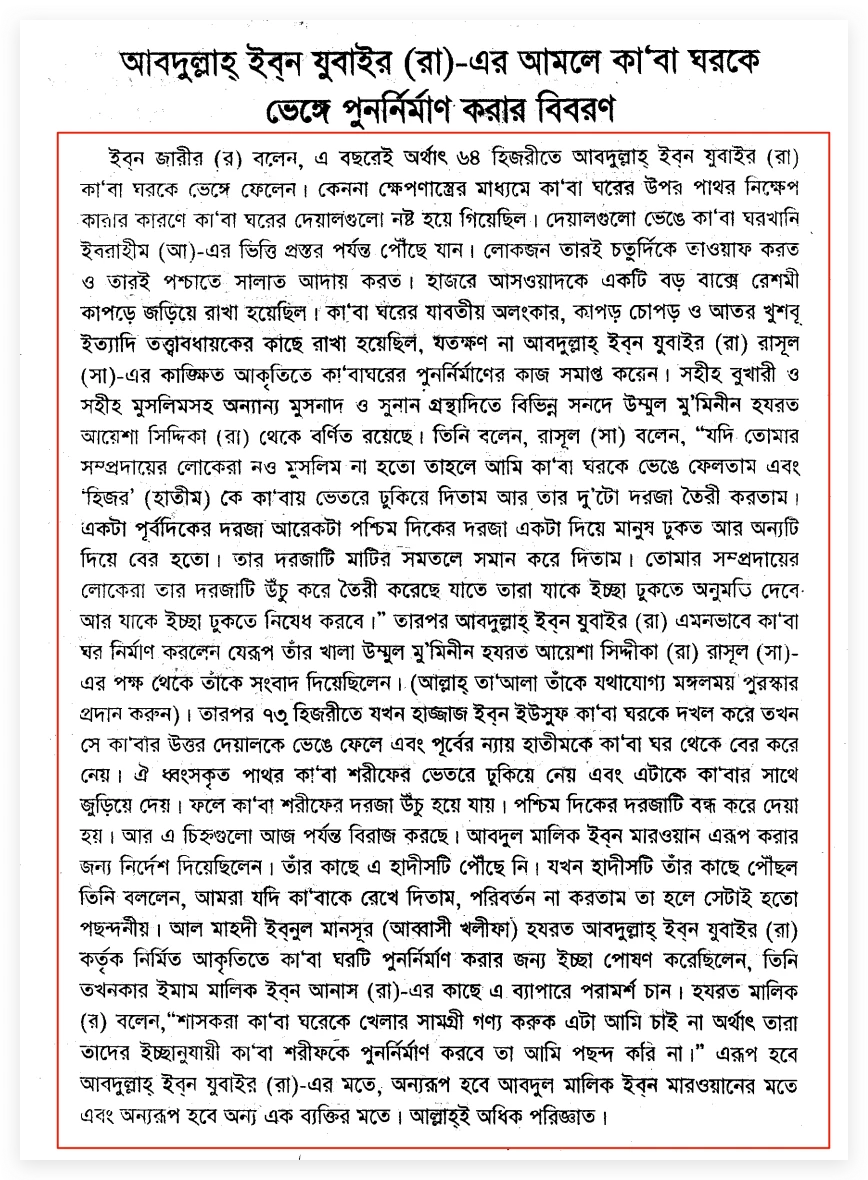
Ibn Kathir’s Al-Bidaya wa’l-Nihaya contains further accounts of damage to the Kaaba from siege, stone bombardment, fire, and political conflict. In these events, military force and subsequent human construction, rather than miraculous protection, determined the building’s physical security. [46]
Husayn ibn Numayr marched toward Mecca with his army and, according to al-Waqidi, arrived on the twenty-sixth of Muharram; some say he arrived on the seventh. Several prominent men from Medina joined Abd Allah ibn al-Zubayr. Najdah ibn Amir al-Hanafi of Yamama also joined him with troops so that together they could defend the Kaaba against the Syrians. Husayn ibn Numayr camped outside Mecca. Abd Allah ibn al-Zubayr marched out with the Meccans and his allies to confront him. Fierce fighting followed. Al-Mundhir ibn al-Zubayr and a Syrian engaged in single combat and killed each other. The Syrians pressed the Meccans so hard that they were thrown into disarray, and the mule carrying Abd Allah ibn al-Zubayr stumbled. Miswar ibn Makhrama and Musab ibn Abd al-Rahman ibn Awf rallied to repel the assault on Ibn al-Zubayr. Another group joined them, and all fought in his defense until they were killed. Ibn al-Zubayr continued fighting with the remaining men until nightfall. As darkness fell, they withdrew from the battlefield.
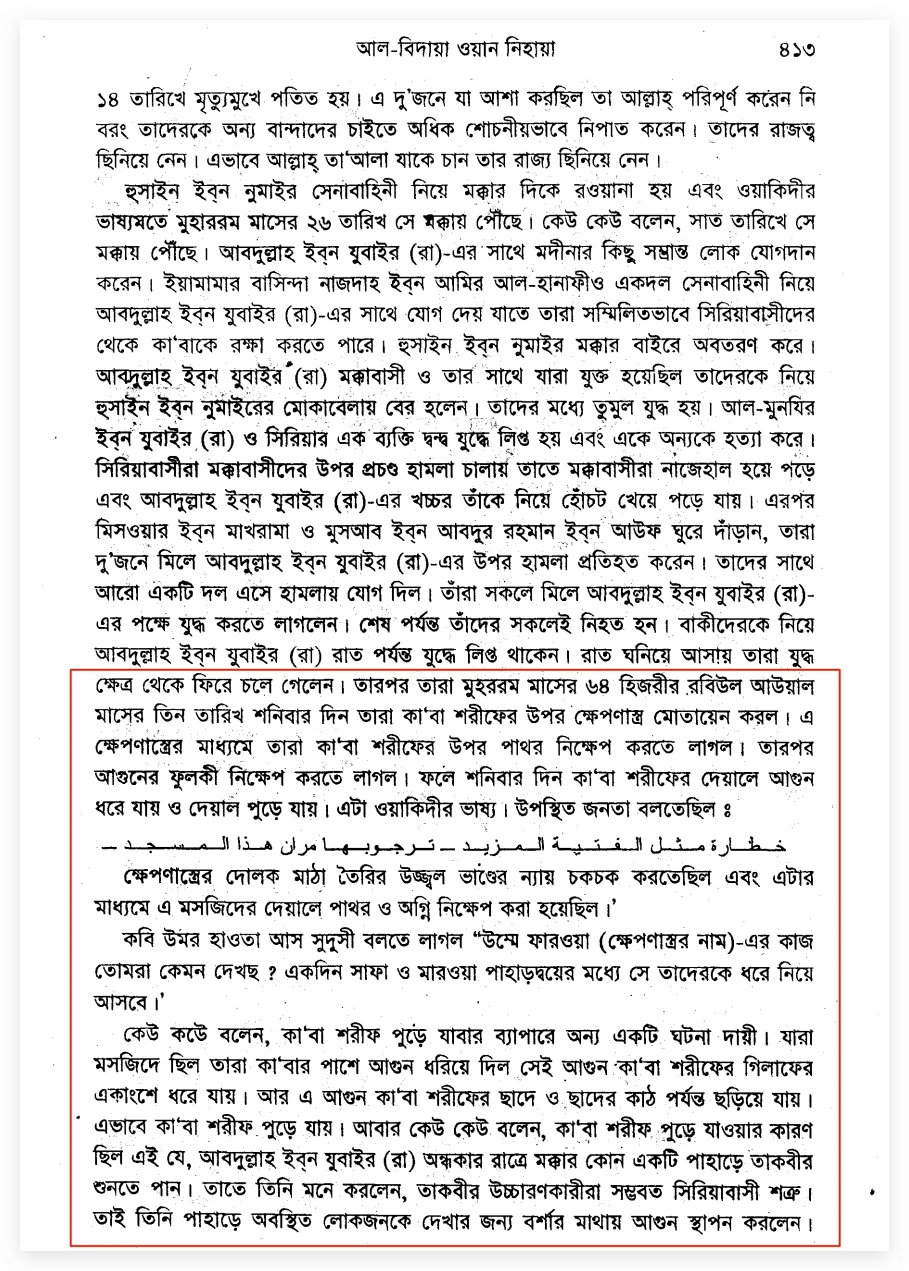
They then, on Saturday the third of Rabi al-Awwal in 64 AH, deployed siege engines against the Kaaba. They fired stones at the building and then incendiary projectiles. Thus on Saturday the Kaaba’s walls caught fire and burned. This is al-Waqidi’s account. Those present used to say:
خطارة مثل الفتية المزيد – ترجوبها مران هذا المسجد
‘The arm of the siege engine glittered like a bright vessel used for making curd, and with it stones and fire were hurled at the walls of this mosque.’
The poet Umar Hawta al-Sudusi said: ‘What do you think of the work of Umm Farwa [the siege engine]? One day she will gather them together between the hills of Safa and Marwa.’
Some attribute the Kaaba’s burning to another incident. People inside the mosque lit a fire beside the Kaaba, which spread to part of its covering and from there to its roof and roof timbers, burning the building. Others say that Abd Allah ibn al-Zubayr heard the takbir being proclaimed from a mountain in Mecca on a dark night and thought the speakers were Syrian enemies. He therefore attached fire to the tip of a spear to look at the people on the mountain.
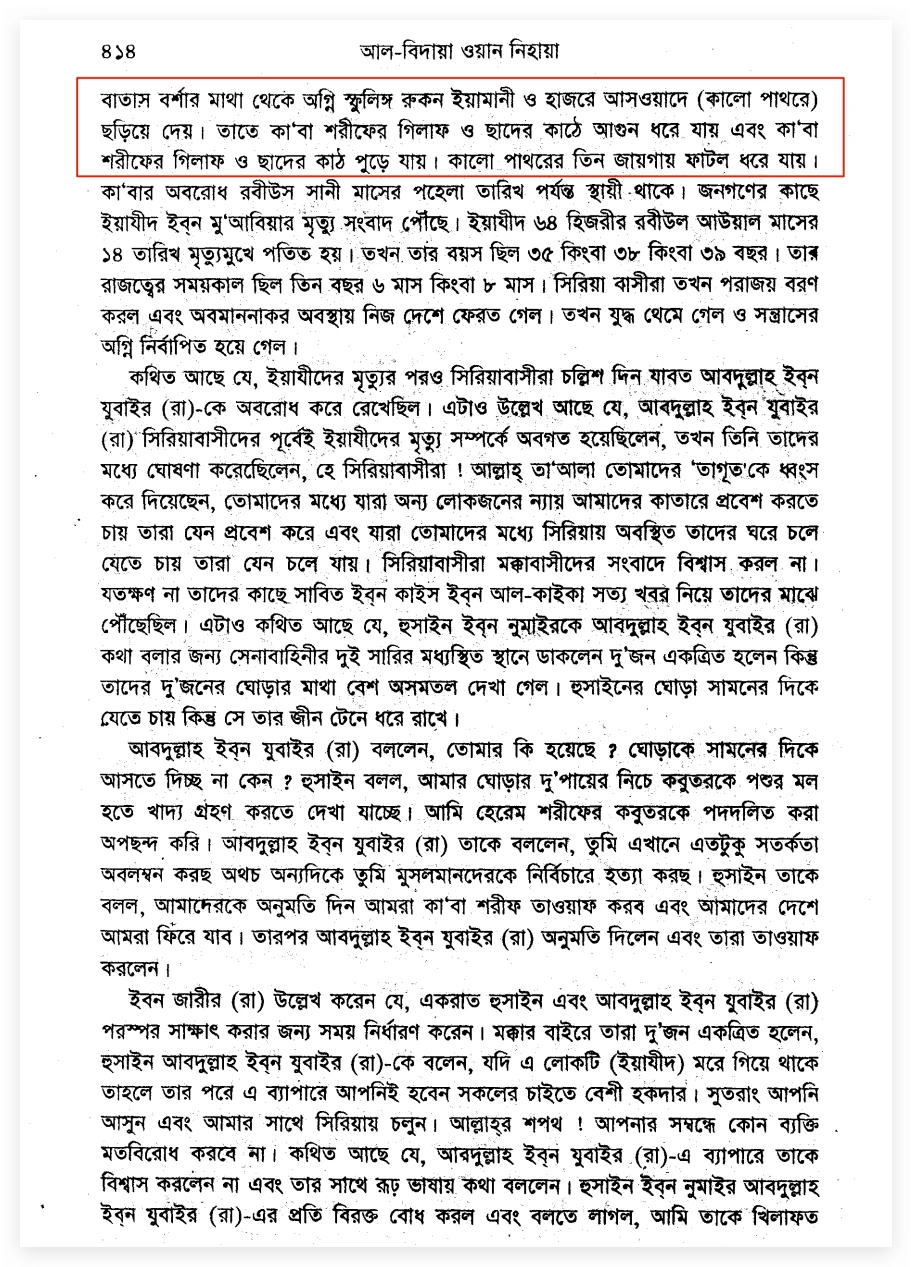
The wind carried sparks from the spearhead toward the Yemeni Corner and the Black Stone. They ignited the Kaaba’s covering and roof timbers, which burned. The Black Stone cracked in three places.
The siege of the Kaaba continued until the first of Rabi al-Thani. In the eyes of the people
692 CE: Al-Hajjaj ibn Yusuf’s Siege Engines and the Fall of the Kaaba
One of the most brutal sieges in Islamic history was carried out under al-Hajjaj ibn Yusuf, commander of Caliph Abd al-Malik ibn Marwan. In 692 CE (73 AH), al-Hajjaj surrounded Mecca and positioned manjaniq (catapults) on the mountains around the Kaaba. The Umayyad army’s professed respect for the Kaaba as Islam’s central sanctuary did not prevent it from deploying siege engines against it. In the struggle for political authority, even the ‘House of God’ became a military target.
Ibn Asakir reports that enormous stones were thrown at the Kaaba on al-Hajjaj’s orders. When one struck its wall, Ibn al-Zubayr’s supporters cried out in distress. Al-Hajjaj reportedly mocked them: ‘It is merely a stone striking an ordinary house’ [47]. The stones caused the walls to collapse and severely damaged the area near the Black Stone. Ultimately Ibn al-Zubayr was killed in the Kaaba precinct, and his body was displayed there on a cross [48]. No heavenly defense stopped the stones thrown from siege engines. Ibn al-Zubayr’s defeat and the subsequent rebuilding of the Kaaba show that the sanctuary’s fate was determined by military power and rulers’ orders.
New Academic Research: Early Meccan History in Harry Munt’s Work
Historian Harry Munt‘s 2026 study, The Kaʿba in al-Fākihī’s (d. ca. 279/892–893) History of Mecca: From Local Traditions to Universal History, Annales islamologiques, vol. 60, pp. 15–37, examines al-Fakihi’s ninth-century history of Mecca. Published on April 27, 2026, the study shows how Meccan local memory, narratives centered on the Kaaba, and wider Islamic history became intertwined in the writing of history. Alongside Ibn Kathir’s much later compilation, this offers a way to examine a comparatively earlier layer of sources. The preservation of local religious memory and political events in early Meccan historiography makes control of the Kaaba and pilgrimage a question of power as much as spiritual prestige. Authority over the sanctuary meant influence over pilgrimage and public gatherings, not merely religious honor. [49]
The Kaaba caught fire during the Umayyad siege of 683; historical accounts differ over the fire’s origin. In 692, al-Hajjaj’s campaign used siege engines to defeat a political rival. Preserved in accounts by al-Fakihi, al-Tabari, Ibn Kathir, and the canonical hadith collections, these episodes together reveal actual damage caused by warfare and the subsequent reconstruction of the Kaaba by human beings.
During the siege people used weapons, the structure was damaged, and people rebuilt it. Historical accounts of Muslim rulers battling over the Kaaba’s walls, structure, and control show that political force determined the building’s fate. The theory of miraculous protection extinguished no fires of war, prevented no walls from falling, and created no visible obstacle even when political rulers decided the building’s architectural form.
The Silence of the ‘Ababil’ Birds and the Logical Contradiction
These two events directly contradict claims of miraculous protection. Surat al-Fil is said to describe Allah sending small Ababil birds to destroy Abraha’s elephant army when it advanced against the Kaaba. Yet within roughly a century, Muslim caliphs’ own armies twice subjected the Kaaba to fire and the stones of siege engines, without any miraculous intervention from Allah. The comparison follows:
| Aspect | Abraha’s Attack (570 CE) | Al-Hajjaj’s Attack (692 CE) |
|---|---|---|
| Identity of Attacker | Christian ruler (foreign, non-Muslim) | Commander of a Muslim caliph (part of an Islamic state) |
| Means of Attack | Elephant army | Manjaniq (stone-throwing siege engines) + arson |
| Divine Response | Destruction by Ababil birds (Quranic claim) | Complete silence |
| Damage to Kaaba | None (according to the myth) | Walls collapse; Black Stone damaged |
| Outcome | Kaaba saved (claimed) | Kaaba battered into ruin; Ibn al-Zubayr crucified |
This contradiction is highly significant. If Allah could protect the Kaaba from a non-Muslim ruler like Abraha, why did he not protect it from the armies of Muslim caliphs? Miraculous protection during Abraha’s alleged assault, followed by the destruction of the Kaaba during Muslim caliphal attacks, makes assertions of constant divine security self-contradictory. In the documented conflicts, military force, political interests, and the outcome of war determined the building’s fate.
The destruction under the Umayyads establishes that the Kaaba is a human-built structure, subject to the ordinary vulnerabilities of human architecture. Whenever a faction gained sufficient military power, it did not hesitate to use the Kaaba for political ends—even when that faction was led by a Muslim caliph. These episodes expose the Ababil-bird myth as historically untenable.
The Helpless ‘House of God’ before Nature: The Devastating Flood of 1630
The Kaaba’s destruction was not confined to human swords, political conflicts, or stones launched by siege engines. Natural disasters repeatedly exposed its vulnerability as well. The devastating flood that struck Mecca in 1630 CE (1039 AH) makes this especially clear. It was not a human assault but an entirely natural event, before which the Kaaba’s supposed ‘divine protection’ was completely ineffective. Even in the absence of armed attackers, runoff through Mecca’s valley caused damage severe enough to necessitate reconstruction. Engineering and maintenance, not stone-throwing birds from heaven, provided effective responses to natural forces.
Wall Collapse and Structural Disaster
On Wednesday, the nineteenth of Sha’ban 1039 AH, unusually heavy rain began falling in Mecca. Because the city lies in a low-lying valley, runoff quickly accumulated in its center, especially the mataf area beside the Kaaba. Historical accounts state that in a short time the water rose to an abnormal height, reaching above the Kaaba’s door, where it remained for an extended period. Rainwater flowed down from the surrounding high ground into the lower portions of the Grand Mosque. Religious sanctity did not alter the laws governing water flow; the valley’s geography determined the scale of the disaster.
The pressure of deep, stagnant water progressively weakened the Kaaba’s foundations. The result came the following afternoon, Thursday, when two major walls at the northwestern and northeastern corners suddenly collapsed one after the other [50]. This was not minor damage but a full structural disaster, showing that the building’s stability depended on the quality of its construction and the environmental conditions. The Turkish Islamic Encyclopedia also records damage to part of the southwestern wall [51]. Such damage to the original structure was not a superficial blemish; human masons had to rebuild its walls.
Although some parts of the building, including the corner housing the Black Stone, survived, the entire structure required reconstruction and strengthening. The Black Stone did not remain afloat and unharmed through some miraculous protection; instead, it was nearly buried beneath the debris as the walls collapsed. Local officials and engineers later recovered it and moved it to a safer location—a clearly human intervention, not a supernatural rescue. Storms, heavy rainfall, water pressure, and weaknesses in the masonry combined to devastate Mecca’s holiest building. Planned human construction, rather than a miracle, restored its use.
Sultan Murad and the Reconstruction of the ‘House of God’
When news of the disaster reached Ottoman Sultan Murad IV, he promptly ordered the Kaaba’s reconstruction. Debris was removed and the structure was rebuilt from its foundations. The historian Ba-Salamah reports that the work was carefully planned and technically advanced, with skilled architects, engineers, and large quantities of construction materials brought from Cairo [52]. Beyond questions of religious prestige, rebuilding the sanctuary was also a matter of political legitimacy for the Ottoman administration. Leaving the pilgrimage center in ruins would have undermined the ruler’s authority and reputation as its custodian.
Significantly, the structure of the Kaaba visible today is largely the product of this seventeenth-century rebuilding. Its present form is not an ‘unchanged’ or ‘original’ structure but a reconstructed building maintained by human engineering. Behind the walls seen by pilgrims today lie the work of seventeenth-century Ottoman craftsmen, building materials, administrative decisions, and immense expenditure. Describing it as an imperishable ancient miraculous structure is a denial of history.
Logical Analysis: ‘Sanctity’ versus ‘Geographical Reality’
Religious narratives claim that when Abraha’s army marched against the Kaaba, miraculous Ababil birds stopped it. In the 1630 flood, water entered the Kaaba’s courtyard, remained there for an extended period, and brought down its walls. Restoring the allegedly miraculously protected building required human labor, building materials, and engineering.
A fundamental question follows. If the Kaaba truly is a divinely preserved building modeled on the heavenly ‘Bayt al-Ma’mur’, why do ordinary natural processes such as rain and accumulated water pose such a grave threat to it? Why did no miraculous mechanism protect this ‘sacred’ structure?
Following the flood, records describe debris removal under the supervision of Ridwan Agha, preservation of reusable stones, reconstruction of the walls, and repairs to elements of Mecca’s water supply and drainage. In rebuilding fallen walls, clearing debris, and managing the flow of water, engineers, workers, and the Ottoman administration took direct action. The building’s survival depended on practical knowledge of dangerous runoff and damaged masonry, together with technical measures addressing those problems. Sanctity was no substitute for that knowledge. [53]
The episode clearly shows that the Kaaba’s survival has depended primarily on human technical expertise, maintenance, and an understanding of the environment. Mainstream Islamic history preserves detailed accounts of the flood, confirming that the Kaaba is no inviolable, miraculously protected structure but a physical building whose continued existence depends on human action and management.
The Reconstruction of 1630–1631: A 2025 Peer-Reviewed Study
Abdullah Çakmak’s 2025 study The Rebuilding of the Kaʿba During the Period of Sulṭān Murād IV in the Context of the ʿUlamāʾ–Umarāʾ Discussions (Religions, 16(7), article 915) is among the most relevant modern investigations of this event. It discusses the flood of April 3, 1630, the collapse of two walls of the Kaaba, destruction in Mecca, Sultan Murad’s decision, Ridwan Agha’s supervision of construction, and objections from the Shafi’i mufti Ibn Allan. Contemporary accounts quoted by Çakmak report approximately one thousand deaths in Mecca. The study concerns more than stone and masonry; it also addresses who could authorize construction, which stones were permissible, and how the objections of religious scholars were resolved. Human institutions and political authorities ultimately determined who could rebuild the ‘House of God’. [54]
The study also quotes a significant statistic: from the pre-Islamic period to 1932, historical accounts document 85 floods in Mecca; the 1630 catastrophe is identified as the sixty-fifth in that series. The tally comes from events preserved in historical writings. The study also explains that because Mecca lies in a low valley surrounded by mountains, heavy rainfall can send runoff rapidly down into the city. Recurring floods expose a lasting vulnerability arising from the holy city’s terrain and drainage. Combating this danger requires ongoing drainage works, engineering, and repair; a miracle story about stone-throwing birds builds no drainage system. [55]
Besides the engineering challenges, reconstruction also sparked conflict over religious authority. Ibn Allan objected to decisions about retaining old stones, using new stone, administrative authorization to begin work, and the procedures for building in the sacred precinct. Ridwan Agha’s side ultimately gathered fatwas from muftis representing the four Sunni legal schools and proceeded with the work. The principal reconstruction was completed by 1631, and the study also describes later work on the doors and roof in 1636. The Kaaba’s reconstruction depended on stone, laborers, designs, money, and administrative permission. The debates over scholarly approval, the sultan’s decree, contractors, and the reuse of old stones reveal a building governed by human decisions. In the actual construction process behind claims of divine architecture, political and religious authority played the decisive role. [56]
The Black Stone: From a ‘Stone of Paradise’ to Broken Fragments
According to Islamic mythology, the Black Stone (Hajar al-Aswad) descended from Paradise as a stone as white as milk and turned black through human sin [57]. History and actual observation, however, tell a different story. Far from being an otherworldly shield, it is a fragile earthly material that has suffered repeated blows through history and now survives as a collection of small fragments.
Chronology of Fracture and Fragmentation
The Black Stone lost its purported original intact form long ago. The recurring history of attacks, fragmentation, removal, and subsequent repair with metal bands and adhesives reveals an actual damaged stone, not an invulnerable heavenly object. The claim that it came from Paradise did not remove its material weakness; without human repairs, the visible fragments could not have remained stable in their present condition.
During the fire at the Kaaba in Ibn al-Zubayr’s era, the intense heat split the stone into three pieces. This was its first major structural disaster. [58]।
When Abu Tahir al-Jannabi tore out the stone with a club, it was shattered. When it was returned 22 years later, it was no longer in its original intact state.
Even in the modern era, in 1932, an Afghan man tried to break off and steal part of the stone. He was subsequently executed, and the broken pieces were reattached with adhesive. [59]।
Silver Frame: Sanctity or Makeshift Protection?
The visible part of the Black Stone that pilgrims kiss is now protected within a large silver frame. The whole area inside the frame is not stone. Instead, the stone consists of eight small fragments (the largest is reportedly only about two centimeters across). They are set into a mastic compound containing wax, musk, and ambergris. It is a mistake to imagine a single large, intact stone behind the silver covering. The visible pieces are all that remains exposed after centuries of damage, and their position is maintained by human-made fittings.
- 📍 Number of Visible Pieces: Eight small fragments.
- 📍 Binding Material: Special chemical adhesive and wax.
- 📍 Protective Housing: Silver frame.
- 📍 Original Size: Only 10–15% of the purported original intact size remains.
Silver Bands and a Fragmented Existence: The Human Funeral of a Miracle
The present physical condition of the Black Stone exposes the emptiness of the aura of ‘heavenly’ and ‘indestructible’ sanctity surrounding it. It is no longer an intact stone but eight tiny fragments, of which only a few minute pieces are visible. These grains are held together with a special mastic compound incorporating wax, musk, and ambergris. In other words, the stone that supposedly lends miraculous prestige to the Creator’s own house must itself be patched together with glue to survive. The obvious question is why a stone supposedly possessing the ‘miraculous’ power to turn black from human sin should depend on ordinary chemical adhesive to preserve its own existence.
The large silver frame now visible at the Kaaba’s corner is not merely a religious ornament but a necessary mechanical protection that keeps the stone together. Repeated historical assaults, along with the touches and friction of countless pilgrims, have left it so worn that without the silver enclosure and binding material it could long ago have disintegrated into dust. The stone survives today through a sturdy frame made by human beings. It is a profound irony that an object advertised as ‘miraculous’ should depend so heavily on human maintenance and artificial supports. The frame attests to skilled craftsmanship, not supernatural power. The silver bands attached to the Kaaba’s wall advertise no heavenly protection; they are physical devices made precisely because such protection is absent in practice.
This silver frame represents a symbolic defeat. Claims that the stone is miraculously invulnerable collapse before its framed condition. In reality it is a fragile object, repeatedly struck, eroded, and repaired by people. If the Creator had directly protected it, Caliph Abd Allah ibn al-Zubayr and later rulers would not have needed to turn to metalwork to preserve it. When the survival of a supposedly heavenly stone depends on human blacksmiths and chemical adhesives, the miracle claim becomes an emotion-driven myth. The visibly fragmented, framed stone is among the clearest material witnesses against the Kaaba’s supposed ‘divine protection’.
Scientific and Theoretical Inconsistencies
Three basic facts about the Black Stone’s history are undeniable: it has repeatedly been struck and fractured; it was abducted from Mecca for many years; and its visible fragments must now be held in place using metal and binding compounds. All three facts constitute direct historical evidence against its alleged divine invulnerability.
If this stone is heavenly or divine, why does earthly fire or a man’s club break it? Does its durability, even less than that of diamond or granite, not point to an earthly origin, such as a meteorite or tektite?
Islam classifies idol worship or stone worship as shirk. Yet the special care devoted to the Black Stone and people’s prayers in its vicinity amount to a ‘rebranded’ version of pre-Islamic Arabian paganism. Caliph Umar ibn al-Khattab himself expressed this doubt when he said, ‘I know that you are only a stone; you can neither benefit nor harm…’ [60]।
When the Qarmatians took the stone, they claimed it possessed no miraculous powers. The historical events confirmed their claim: the stone could not protect itself, and even after lying for 22 long years in a place regarded as impure, it showed no supernatural power.
The Black Stone’s Material Limitations in Islamweb’s Records
According to the detailed account published by one of the most influential Islamic fatwa websites today, Islamweb.net, the Black Stone’s allegedly ‘heavenly’ and ‘imperishable’ form was shattered long ago. Islamweb reports that when Ottoman Sultan Murad reconstructed the Kaaba after the catastrophic flood of 1039 AH (1630 CE), the historian Ibn Allan al-Makki was able to examine the stone at close range. He recorded that it was then divided into approximately 13 fragments, held together precariously by silver plates. The report even states that the portion embedded inside the wall was white like the Station of Abraham, whereas its exposed surface had turned black from human contact and environmental exposure. The accounts of the stone’s damage and repair thus come from sources within the very Islamic tradition that proclaims its sanctity. There is no way to preserve the claim of imperishability by denying the documented history of fracture and restoration.
Citing the historians Muhammad Tahir al-Kurdi and Ubayd al-Hal al-Kurdi, Islamweb further reports that the visible part of the Black Stone pilgrims touch and kiss now consists of eight tiny fragments, the largest no bigger than a date. At one time fifteen fragments were visible, but thin pieces fell away during a frame replacement, leaving only eight. These worn fragments are mounted in a special adhesive compound containing wax, musk, and ambergris. Even in the modern era, when an Afghan man attempted to break off and steal a portion in 1932 (1351 AH), King Abd al-Aziz Al Saud had specialists prepare a chemical compound to restore the detached piece to its place. The surviving visible pieces and centuries of recorded damage reveal the stone’s fragility, not a history of miraculous armor. Human-made silver fittings and adhesives are a direct acknowledgment of that weakness.
These physical and historical facts reveal an unavoidable truth: the Black Stone is not preserved by a miraculous wall or divine armor. Its continued survival depends on human-made silver framing, special chemical adhesives, and artificial maintenance. When the stone that supposedly dignifies the Creator’s house survives on the ‘life support’ of human glue and a metal cage, claims that it is miraculous and ‘imperishable’ become weak religious mythology. Even the historical descriptions compiled by Islamweb detail these fractures, joins, and reconstructions. Describing as imperishable an object whose deterioration requires metal fittings and glue directly contradicts its history. [61] [62], [63]
The Black Stone — 1
A crowd of heads and hands surrounds a dark-colored stone mounted in a large oval, polished silver frame at the edge of the circumambulation area. People gather to kiss this stone, situated about one and a half meters above the ground at the southeastern corner of the Kaaba. Muslims believe that on the Day of Judgment the stone will have eyes and a tongue with which it will testify in favor of those who kissed it. One report attributes the following statement to the Prophet: ‘By Allah, on the Day of Resurrection Allah will bring it forth with two eyes with which to see and a tongue with which to speak, so that it can testify for those who touched and kissed it sincerely.’
Imam Fakhr al-Din al-Razi (d. 606 AH) stated in his Tafsir al-Quran: ‘When Adam descended to earth, he complained of loneliness. Almighty Allah then commanded him to build the Kaaba, and he circumambulated it.’
The historian Abu al-Walid al-Azraqi (d. 223 AH) narrates from Wahb ibn Munabbih in Akhbar Makka: ‘When Allah accepted Adam’s repentance, he commanded him to go to Mecca. Allah shortened and eased the journey. Before that Adam had been deeply distressed and had wept profusely over the calamity that had befallen him, so much so that even the angels were moved to tears. Allah sent a tent from Paradise to console Adam and placed it on the site of the Kaaba before the Kaaba was built. The tent was made of red ruby from Paradise and contained three golden lamps from Paradise, glowing with heavenly light. The stone at the Kaaba’s corner was sent down from the realm of Paradise as a white ruby and served as Adam’s seat.’
The Black Stone is regarded as one of the oldest objects on earth. It is said that no objects from Paradise exist on earth other than the Black Stone and the Station of Abraham. Gabriel brought it down to earth. Although many reports concern the Black Stone, their historical reliability is questionable. Numerous weak reports also concern its virtues. Islamic law nevertheless places great emphasis on its rank and merits. According to a narration, the Messenger said that it descended with light, and that had the hands of polytheists not touched it, Allah’s grace would have enabled it to cure any sick person.
Orientalists assert that the Black Stone is a meteorite that fell to earth. In his work Maqam Ibrahim, the historian Muhammad Tahir al-Kurdi wrote: ‘The Orientalists’ statements rest only on conjecture upon conjecture, while Muslim beliefs about the Black Stone are founded on certain knowledge. Although Arabs worshipped stones in pre-Islamic times, they never worshipped the Black Stone or the Station of Abraham, despite holding them in great reverence.’ He added that Allah protected these two stones from pagan worship so no one could later claim Islam had endorsed idolatry.
Authentic hadith reports affirm that the Black Stone is a ruby from Paradise that came to earth whiter than snow or milk. It was placed in the corner of the Kaaba by Allah’s command. It is embedded deep in the Kaaba’s wall, and only its front surface is visible; human sins turned it black. Abd Allah ibn Amr ibn al-As said, ‘The Black Stone was whiter than milk, and its length was one cubit.’
The historian Ibn Ishaq mentions in the story of the Kaaba’s construction that Gabriel brought the stone when Abraham was raising its walls. During Noah’s great flood, Allah had preserved it on Mount Abu Qubays and told Gabriel: ‘When you see my beloved friend [Abraham] building my house, take this stone to him.’
The Black Stone — 2
When the Kaaba collapsed in a severe flood in 1039 AH, Ottoman Sultan Murad ordered it rebuilt. Imam Ibn Allan al-Makki witnessed the event and saw the inner surface of the stone, which was white like the Station of Abraham. He reported that the stone was then divided into approximately thirteen fragments, joined with a special adhesive.
The historian and calligrapher Muhammad Tahir al-Kurdi stated about fifty years ago that the visible surface of the Black Stone comprised eight small pieces, the largest approximately the size of a date. The fragments had broken away as a result of assaults by ignorant transgressors. These small, thin pieces had been set into a mixture of wax, musk, and ambergris. In a work published in 1419 AH, Ubayd al-Hal al-Kurdi confirmed that the stone’s original intact form could no longer be described, since only eight small fragments were visible.
The Qarmatians form a dark chapter in the stone’s history. About 1,107 years ago, in 317 AH, the Kaaba was attacked under Abu Tahir al-Qarmati. The Qarmatians were described as an extremist, atheistic sect. The modern historian Muhammad Sa’id Bikdash reports that on the eighth of Dhu al-Hijjah 317 AH, Abu Tahir entered the Sacred Mosque with his forces, killed pilgrims, and filled the Zamzam well with corpses. After killing approximately 30,000 people, he struck and removed the Black Stone with a pickaxe and carried it to Bahrain. It is said that forty camels died while carrying the stone on the journey.
The Qarmatians retained the stone for 22 years and tried to establish an alternative to the Kaaba. Finally, on Eid al-Adha in 339 AH, Sanbur ibn al-Hasan al-Qarmati brought the stone back to Mecca. Silver fastenings were used to control its cracks during its return. As Sanbur placed it in position with his own hands, he reportedly said, ‘We took it by Allah’s power, and by Allah’s will we have returned it.’
It is said that the Qarmatians attempted to deceive Muslims with a counterfeit stone. But when Meccan representatives requested water to test it, they were astonished, because the real Black Stone could float on water, unlike ordinary stones. On seeing this miracle, the Qarmatian leader reportedly exclaimed, ‘This religion is truly perfect.’
The Black Stone — 3
A History of Assaults and Damage
The Qarmatian episode was not the only disaster involving the Black Stone. Several other events before and after the rise of Islam caused the stone to crack or break. The sacred Kaaba witnessed two fires during its history. The first occurred in the pre-Islamic period under the Quraysh; the Black Stone was burned, and its black color deepened. The second occurred under Abd Allah ibn al-Zubayr, when Husayn ibn Numayr al-Kindi besieged Mecca. Both the Kaaba and the Black Stone were damaged by this fire, and the stone split into three pieces. Ibn al-Zubayr later joined the fragments with silver bands. He was the first person to mount the sacred stone in a silver frame.
During Caliph Harun al-Rashid’s reign (188 AH), the stone’s silver frame became thin and began shifting from its position. Fearing that the stone might fall, Harun al-Rashid ordered repairs. The stones surrounding the Black Stone were drilled with diamond tools and molten silver was poured into the holes to secure it.
Subsequent Attacks
363 AH: In his Ithaf al-Wara, Ibn Fahd al-Makki mentions a Byzantine Roman man who had been enticed with a large sum of money to remove the Black Stone. He struck the stone violently with a pickaxe, but before he could strike again a Yemeni man performing tawaf stabbed and killed him.
413 AH: The Ubaydi (Fatimid) ruler of Egypt enticed ten fighters to remove the stone. They were led by a huge warrior with a drawn sword in one hand and a pickaxe in the other. After Friday prayers, he pretended to kiss the stone, struck it three times, and shouted, ‘How much longer will this stone be worshipped? Neither Muhammad nor Ali can stop me!’ The crowd seized and killed him, then burned his body. His blows cracked the middle of the stone and dislodged small particles. Members of the Banu Shayba subsequently gathered the fragments and filled the cracks with a mixture of musk and red coloring.
990 AH: An Iraqi man described as mentally disturbed struck the stone with a pickaxe, and Amir Nasir Jawish stopped him with a knife.
Modern Incidents and Repairs
The most recent major incident involving the Black Stone occurred in 1351 AH (the source also gives 1315 AH, probably a printing error). A Persian man from Afghanistan broke off part of the stone and tried to steal portions of the Kaaba’s covering and silver staircase. Guards caught him in the act, and he was subsequently executed.
To repair the damage, King Abd al-Aziz ibn Abd al-Rahman Al Saud prepared a special mixture of chemical compounds, ambergris, and musk and returned the stolen fragment to its place. Later, in 1375 AH, King Saud ibn Abd al-Aziz installed a new frame of pure silver around the stone, replacing one installed in 1331 AH by Sultan Muhammad Rashad Khan.
Architectural Evolution and Political Intervention: Is the Kaaba’s Design Really Divine?
Claims about the Kaaba’s supposedly ‘divine design’ become especially untenable when confronted with its architectural history. According to Islamic theology, the Kaaba was built to a particular heavenly pattern. Yet history shows that its present shape is neither original nor a divine constant; it is the product of choices made by political rulers and caliphs at different times, alongside engineering constraints. Muslim rulers repeatedly interfered with who controlled the sanctuary and what form it would take. The Kaaba’s architectural history is thus not a history of miraculous immutability, but of human conflict, economic power, and state authority.
The Hatim (Hijr Ismail) and the Myth of Incompleteness
The semicircular wall north of the present Kaaba, known as the Hatim or Hijr Ismail, was part of the original building according to Islamic tradition. An authentic hadith reports that when the Quraysh rebuilt the Kaaba, they decided to use only money earned through ‘lawful’ means. Lacking sufficient funds, they could not build over the full foundations and left part of the Kaaba—the present Hatim—outside the main walls [64].
According to this account, the Kaaba’s current structure is itself the result of an incomplete building project. More significantly, Muhammad subsequently left it unchanged, even though the hadith attributes to him the desire to rebuild it on its original foundations. Thus the tradition itself acknowledges a clear difference between the ‘ideal’ or ‘desired’ Kaaba and the actual building.
This raises a basic logical question: if the Kaaba was truly built according to a sacred design specified by an omnipotent being, would financial limitations have left its structure incomplete? Would a being supposedly capable of miraculous intervention to defend his house really be unable to provide the modest resources needed to finish its construction?
The contradiction indicates that the Kaaba’s construction and reconstruction were shaped by the social and economic realities of their time. The Hatim is not some mysterious religious symbol but visible evidence of a practical architectural limitation. It marks the Kaaba as a human-built structure whose form was determined by financial capacity, political circumstances, and historical conditions.
Ibn al-Zubayr versus al-Hajjaj: An Architectural War
After the fire of 683, Abd Allah ibn al-Zubayr took charge of the Kaaba and, in accordance with Muhammad’s reported original wish, included the Hatim within the building, gave it a rectangular form, and constructed two doors—one for entry and one for exit [65].
But when the Umayyad commander al-Hajjaj ibn Yusuf captured Mecca in 692, he rejected Ibn al-Zubayr’s building project on political grounds and demolished that section of the Kaaba once again. On Caliph Abd al-Malik’s orders, al-Hajjaj excluded the Hatim and closed one of the doors, restoring the smaller, incomplete form that had existed under the Quraysh [66]. One ruler brought the building closer to the Prophet’s purported intention; another demolished the alteration and restored the earlier arrangement. The Kaaba’s design became an object of caliphal power struggles; its supposedly eternal sanctity did not protect its walls from politics.
Analysis: The history of the Kaaba’s demolition and reconstruction shows that the ‘House of God’ became a pawn in struggles for political legitimacy within the Muslim community. If the Kaaba had a fixed ‘sacred design’, why did the Umayyad caliphs depart from Muhammad’s reported wishes, which Ibn al-Zubayr had implemented, and alter the building again? Why did Allah not intervene to prevent this ‘distortion’ of his house?
Caliph Harun al-Rashid’s Doubts and Imam Malik’s Reply
The Abbasid caliph Harun al-Rashid later considered intervening again in the Kaaba’s architectural form. He wanted to restore the so-called ‘Muhammadan design’ built by Abd Allah ibn al-Zubayr, which the hadith identifies as the Prophet’s preferred form. Imam Malik ibn Anas, however, objected. He warned that if such changes were allowed, the Kaaba would become a political instrument continually demolished and rebuilt according to rulers’ whims. In his words, ‘I do not want the House of Allah to become a plaything for kings and rulers, to be demolished and rebuilt whenever they wish.’ [67]. Malik’s concern centered on precisely this political instability: future rulers might use repeated alterations to the Kaaba to demonstrate their own authority. His concern shows that the building’s practical protection depended on human restraint.
This was more than a legal precaution; it reflected a realistic understanding of the Kaaba’s true situation. Malik did not rely on miraculous protection but acknowledged that the building’s form could be affected by political decisions and changes of power. If the Kaaba were truly a divinely preserved, unchangeable structure, there would be no reason to fear rulers’ interference with its shape. For this influential scholar, the practical way to protect the Kaaba was to restrain rulers’ unchecked interventions. No effective supernatural method of keeping the building intact appears here.
Thus even influential early Islamic thinkers treated the Kaaba as an earthly structure whose maintenance and durability depended on human conduct, political power, and social realities. Faced with competing caliphs, political advice and administrative control became the last safeguards of the sacred building.
Comparative Table of Architectural Changes to the Kaaba
| Construction Period | Architect / Initiator | Architectural Features |
|---|---|---|
| 605 CE | Quraysh tribe | Built on a smaller scale, excluding the Hatim because of insufficient funds. |
| 683 CE | Ibn al-Zubayr | Included the Hatim, extended the Kaaba’s foundations, and installed two doors. |
| 693 CE | Al-Hajjaj ibn Yusuf | Demolished Ibn al-Zubayr’s alterations, excluded the Hatim, and closed one door. |
| 1630 CE | Sultan Murad (Ottoman) | Rebuilt with new foundations and reinforced walls after the flood (present structure). |
This changing history makes clear that the Kaaba has no ‘eternal’ or ‘unchanging’ architectural form. Human hands repeatedly altered it for political purposes, decisively diminishing claims of an exceptional divine status.
Safety in the Sacred Precinct in Modern Times: The Events of 1979 and 2015
Two modern events are significant alongside the earlier political conflicts and natural disasters. In the armed takeover of 1979 and the crane collapse of 2015, the harm fell not upon the main Kaaba building but upon the sacred precinct of the Grand Mosque and the people inside it. These incidents refute claims that people in the sacred precinct enjoy miraculous safety under all circumstances. Assertions of supernatural protection of human life in the sanctuary did not survive these events. The disasters suffered by pilgrims amid modern weapons and heavy construction equipment offer contemporary examples of this vulnerability.
1979: Occupation of the Grand Mosque, Armed Conflict, and Loss of Life
On November 20, 1979, an armed group led by Juhayman al-Otaybi seized the Grand Mosque. Fighting between the occupiers and Saudi security forces lasted roughly two weeks; the siege ended around December 4. Death tolls vary across reports and periods; contemporary accounts spoke of more than 130 people killed. The lives of worshippers held inside the mosque and political control over the sanctuary were both endangered. The state had to launch a military operation to regain control; no miracle disarmed the attackers. Saving human lives at Mecca’s holiest site ultimately depended on military capabilities and state decisions. [68] [69]
During the 1979 armed occupation, the Kaaba itself did not collapse; nevertheless, armed men seized control within the sacred precinct, people were killed, and a bloody military operation was required to dislodge the occupiers. Religious sanctity stopped neither the attackers’ weapons nor the loss of life. The declaration that the place was holy posed no effective barrier to violence; restoring security required the state to use weapons, troops, and military operations.
2015: Grand Mosque Crane Collapse Kills 111 People
On September 11, 2015, amid intense wind and rain, a massive construction crane used for expansion work at the Grand Mosque collapsed. Saudi authorities initially reported 107 deaths; later reporting by the Associated Press put the death toll at 111. Many others were injured. Relevant issues include the storm, construction-equipment safety, and administrative supervision. This was not a military attack: weather hazards and failures in construction safety caused the deaths. At a site where people gather expecting religious security, the same physical laws governing mass, height, and falling objects remain in effect. [70] [71]
After the accident, investigations and legal proceedings examined the construction company’s safety practices; later Associated Press reports mentioned fines and prison terms for safety violations. Engineering standards, weather-risk assessment, investigations, and accountability are therefore essential to ensuring security in the modern sacred precinct. The practical measures against such tragedies are not declarations of miracles, but safe design, risk assessment, engineering oversight, and administrative accountability. [72]
Although the armed occupation of 1979 and the construction-crane collapse of 2015 were different disasters, in both the sacred precinct of the Grand Mosque failed to protect human lives. In the first, weapons, political extremism, and military operations by security forces drove the catastrophe; in the second, the operative causes were a storm, heavy construction equipment, and safety failures. Religious holiness stopped neither deadly event.
Historical records document attacks against the Kaaba, fires, the plunder of the Black Stone, catastrophic flooding, wall collapse, reconstruction, and lethal fighting within the Grand Mosque. In these conflicts, floods, and accidents, declarations of sanctity prevented neither damage to the structure nor the deaths of pilgrims. The historical record directly contradicts the claim that the Kaaba is forever protected and miraculously invulnerable. The isolated story of birds attacking Abraha’s army cannot conceal this repeated history of real destruction.
Conclusion
The history of the Kaaba is not a continuous tale of miraculous protection. It is the history of a building struggling to survive political power struggles, the construction of religious meaning, and the impartial laws of nature. The story of miraculous Ababil birds in Surat al-Fil helped establish an idea of ‘divine protection’ in Muslim consciousness; actual events repeatedly clash with it. The Qarmatian massacre and plunder, damage from siege engines during Umayyad caliphal sieges, walls collapsing in the flood of 1630, and repeated fracture of the Black Stone each demonstrate that the building existed under no supernatural shield. At every decisive turn, people determined its fate—as attackers, builders, or rulers. Claims of miraculous invulnerability cannot withstand these brutal and visible realities.
These events are not isolated. They follow a consistent pattern. Whenever the Kaaba was militarily exposed, it suffered attack; when its construction was vulnerable, natural disasters damaged it; and when political authority changed, so did its architecture. The forces that actually governed the building’s survival, destruction, and reconstruction were military power, the laws of nature, construction technology, and human decisions.
The Kaaba and the Black Stone have repeatedly been subjected to military attacks, plunder, fire, floods, and human demolition and rebuilding. A structure damaged by Muslim armies’ siege engines, whose sacred symbol was torn out by Qarmatians, whose walls fell in floods, and whose reconstruction required human money, technology, and labor cannot be described as an indestructible divine fortress without insulting history. The miraculous story of birds dropping stones upon Abraha’s army stopped neither al-Hajjaj’s projectiles, nor the Qarmatians’ swords, nor the pressure of the floodwaters in 1630. A building that human beings destroy, repair, rebuild, and guard derives its real security from human action and the laws of nature—not from miraculous invulnerability.
References
- Al-Azraqi, vol. 1, pp. 105–107 1 2
- Harry Munt, 2026; Ibn Kathir, events of 64 AH ↩︎
- Siyar A’lam al-Nubala’, vol. 4, p. 343 1 2
- Al-Bidaya wa’l-Nihaya, vol. 11 ↩︎
- Çakmak, Religions, 2025 ↩︎
- Quran 105:1–5 ↩︎
- Quran 3:97 ↩︎
- Al-Bidaya wa’l-Nihaya, vols. 8 and 11; Tarikh al-Tabari, vol. 5 ↩︎
- Sahih al-Bukhari 2478 1 2 3
- Surat al-Fil ↩︎
- Ibn Kathir, Al-Bidaya wa’l-Nihaya, events of 317 and 339 AH ↩︎
- Robin, 2018 1 2
- Bukhari 2478 1 2
- Al-Tabari, History of the Prophets and Kings ↩︎
- Ibn al-Athir, ‘Al-Kamil fit-Tarikh’ ↩︎
- Charles, R. H., The Apocrypha and Pseudepigrapha of the Old Testament ↩︎
- Sara Raup Johnson, 2005, chapter 4 ↩︎
- C. W. Emmet, The Third Book of Maccabees ↩︎
- World English Bible: 3 Maccabees ↩︎
- Sara Raup Johnson, Historical Fictions and Hellenistic Jewish Identity, chapter 4 ↩︎
- Sara Raup Johnson, chapter 4: Date, Literary Context, Authorship, and Audience, 2005 ↩︎
- Third Maccabees 5:1–2, original Greek text ↩︎
- Third Maccabees 6:13–15, Brenton Septuagint Translation ↩︎
- Third Maccabees 6:18–21, Brenton Septuagint Translation ↩︎
- Tor Andrae, research on the pre-Islamic religious and literary background; the precise Arabic text and edition of the poems require verification ↩︎
- Christian Julien Robin, 2018, Abraha’s military campaigns and inscriptions ↩︎
- Robin, 2010 ↩︎
- Christian Julien Robin, 2018 ↩︎
- Surat al-Fil, 105:1–5 ↩︎
- Classical commentaries on Surat al-Fil ↩︎
- Robin, Les expéditions militaires du roi Abraha…, 2018 ↩︎
- Robin, 2010, research on Abraha’s expedition against Mecca ↩︎
- Munro-Hay, 1991 ↩︎
- Al-Bidaya wa’l-Nihaya, vol. 8, p. 225 ↩︎
- Al-Bidaya wa’l-Nihaya, vol. 11, events of 317 AH ↩︎
- Tarikh al-Kaaba, p. 195 ↩︎
- Al-Bidaya wa’l-Nihaya, Ibn Kathir, vol. 11, pp. 299–300 ↩︎
- Al-Bidaya wa’l-Nihaya, vol. 11, pp. 299–300; page numbering may vary by edition ↩︎
- Al-Bidaya wa’l-Nihaya, vol. 11, p. 162 ↩︎
- Ibn Kathir, Al-Bidaya wa’l-Nihaya, accounts of 317 and 339 AH ↩︎
- Ibn Kathir, Al-Bidaya wa’l-Nihaya, events of 339 AH ↩︎
- Al-Bidaya wa’l-Nihaya, Ibn Kathir, vol. 11, p. 409 ↩︎
- Ibn Kathir, Al-Bidaya wa’l-Nihaya, events of 317 AH ↩︎
- Al-Tabari, Tarikh al-Umam wa’l-Muluk, events of 64 AH; Ibn Kathir, Al-Bidaya wa’l-Nihaya, 64 AH ↩︎
- Al-Bidaya wa’l-Nihaya, Ibn Kathir, vol. 8, p. 455 ↩︎
- Al-Bidaya wa’l-Nihaya, Ibn Kathir, vol. 8, pp. 413–414 ↩︎
- Ibn Asakir, Tarikh Dimashq, vol. 12, p. 80 ↩︎
- Al-Dhahabi, Siyar A’lam al-Nubala’, vol. 4, p. 343 ↩︎
- Harry Munt, 2026, University of York research repository ↩︎
- Ibrahim Rifat Pasha, Mir’at al-Haramayn, vol. 1, p. 251 ↩︎
- TDV İslâm Ansiklopedisi, “Kâbe” ↩︎
- Ba-Salamah, Tarikh al-Kaaba, p. 195 ↩︎
- Çakmak, 2025 ↩︎
- Abdullah Çakmak, Religions, 2025 ↩︎
- Çakmak, 2025, section 3: Kaʿba Under Water ↩︎
- Çakmak, 2025, sections 4–6 ↩︎
- Tirmidhi, hadith 877 ↩︎
- Al-Azraqi, Akhbar Makka, vol. 1, p. 145 ↩︎
- Shaykh Muhammad Tahir al-Kurdi, Tarikh al-Quran wa’l-Masahif ↩︎
- Sahih al-Bukhari, hadith 1597 ↩︎
- The Black Stone – I ↩︎
- The Black Stone – II ↩︎
- The Black Stone – III ↩︎
- Sahih al-Bukhari, hadith 1583 ↩︎
- Sahih Muslim, hadith 1333 ↩︎
- Al-Tabari, Tarikh al-Umam wa’l-Muluk, vol. 5, p. 498 ↩︎
- Imam al-Nawawi, Sharh Sahih Muslim, vol. 9, p. 93 ↩︎
- Pascal Ménoret, Fighting for the Holy Mosque: The 1979 Mecca Insurgency, Oxford University Press, 2008 ↩︎
- The Washington Post, December 5, 1979 ↩︎
- Saudi Ministry of Health, September 13, 2015 ↩︎
- Associated Press, September 15, 2015 ↩︎
- Associated Press, 2023: proceedings concerning the crane accident ↩︎