
Summary
Early Islamic sources contradict the popular claim that every written form in the present Uthmanic codex was perfect from the outset and that no one ever raised the possibility of human error in its transcription. Kitab al-Masahif, the works of al-Tabari and al-Qurtubi, al-Suyuti’s Al-Itqan, and other classical works transmit accounts from Uthman, Aisha, Ibn Abbas, Sa‘id ibn Jubayr, and others. These accounts describe some forms in the codex as lahn, the work of scribes, scribal errors, or even the result of a scribe writing while drowsy. Al-Suyuti called Uthman’s lahn reports weak, disconnected, and problematic. But when he quoted Aisha’s statement “هذا عمل الكتاب، أخطؤوا في الكتاب”, he wrote explicitly: “هذا إسناد صحيح على شرط الشيخين”. Its chain of transmission is authentic according to the criteria of al-Bukhari and Muslim.
Aisha’s statement identifies three specific forms in the present Quran: Surah An-Nisa 4:162, وَالْمُقِيمِينَ الصَّلَاةَ, Surah Al-Ma’idah 5:69, وَالصَّابِئُونَ, and Surah Taha 20:63, إِنْ هَذَانِ لَسَاحِرَانِ. Later Arabic grammarians offered analyses of all three. The basic rules of modern standard Arabic alone are therefore insufficient to establish that these forms are definite grammatical errors. Aisha’s report still stands as evidence of how these forms were understood. Early Muslim scholars explained the forms in the present codex as human scribal errors, and later works on the Quranic sciences discussed Aisha’s statement at length. The claim that the Quran’s written history never included any idea of scribal error or textual difficulty is false.
The history of Uthmanic standardization, the accounts of Uthman and Aisha, Ibn Abbas’s variant readings, and later grammatical explanations together reveal a distinct layer of variant readings, allegations of scribal error, and subsequent interpretation in the written history of the present codex. The sources vary in the strength of their transmission chains. Early Muslim literature clearly documents the idea that human error shaped some written forms of the Quran.
Introduction
The flawless preservation of the Quran is one of Islam’s strongest theological claims. Its stronger version goes beyond the antiquity of the core text. Popular religious advocacy also maintains that the Quran recited by Muhammad passed through no human copying errors, difficulties in writing, conflicts between readings, or uncertainties about correction. It pictures every word of the present codex as having come straight from the seventh century, untouched by any human complication. Early Islamic literature contradicts that picture.
Sahih al-Bukhari itself gives differences in regional recitation as the reason for Uthmanic standardization. Hudhayfa ibn al-Yaman saw that Muslims from Syria and Iraq recited the Quran differently and warned Uthman. Uthman obtained the sheets kept by Hafsa and put Zayd ibn Thabit, Abdullah ibn al-Zubayr, Sa‘id ibn al-As, and Abd al-Rahman ibn al-Harith in charge of preparing copies. He told the Qurayshi members that if they disagreed with Zayd on any point, they should write it in the language of Quraysh. The finished copies were sent to different regions, and Uthman ordered the other written Quranic materials and codices to be burned. The report describes a human editorial and administrative process aimed at bringing existing disputes over recitation under one standard written form, or rasm. [1] [2]
إِذَا اخْتَلَفْتُمْ أَنْتُمْ وَزَيْدُ بْنُ ثَابِتٍ فِي شَيْءٍ مِنَ الْقُرْآنِ فَاكْتُبُوهُ بِلِسَانِ قُرَيْشٍ … وَأَمَرَ بِمَا سِوَاهُ مِنَ الْقُرْآنِ فِي كُلِّ صَحِيفَةٍ أَوْ مُصْحَفٍ أَنْ يُحْرَقَ
“In case you disagree with Zaid bin Thabit on any point in the Qur’an, then write it in the dialect of Quraish …” Uthman then ordered that all other Quranic material, whether on loose sheets or in a codex, be burned.
Alongside the history of Uthmanic standardization, Muslim literature preserves accounts that identify some written forms in the codex as lahn, the work of scribes, or outright scribal errors. Differences in reading, standardization, and reports of scribal error all belong to the same history. The finished copy shows the form the committee selected. Al-Bukhari’s account also records the situation before that decision. Disputes over regional readings were the reason the committee was given both the task of making copies and a rule for settling disagreements.
The Evidence and the Strength of Each Report
| Report | Main Sources | Transmission and Status | Historical Significance |
|---|---|---|---|
| Uthman: أرى شيئا من لحن ستقيمه العرب بألسنتها | Ibn Abi Dawud, Al-Durr al-Manthur, Al-Itqan | Several disconnected or weak chains. Al-Suyuti himself acknowledged their weakness. | The report alone cannot establish that Uthman made the statement. It does establish that the idea circulated in early Muslim literature. |
| Uthman: لو كان المملي من هذيل والكاتب من ثقيف… | Ibn Abi Dawud, via Ikrima | A gap in transmission. The chain back to Uthman is weak. | An early explanation that linked the difficulty to the skill of the scribe or the person dictating. |
| Aisha: هذا عمل الكتاب، أخطؤوا في الكتاب | Abu Ubayd → Abu Mu‘awiya → Hisham → Urwa → Aisha. Also in al-Tabari, Ibn Abi Dawud, and al-Suyuti. | Al-Suyuti: “Authentic according to the criteria of al-Bukhari and Muslim”. Later scholars questioned Abu Mu‘awiya’s transmission from Hisham. | The strongest report on scribal error discussed here. |
| Ibn Abbas: حتى تستأنسوا described as a “scribal error” | Al-Tabari, Ibn Abi Hatim, and Sa‘id ibn Mansur, via Sa‘id ibn Jubayr | Several early chains. Ibn Kathir called the report extremely unusual (gharib). | A second important strand of early evidence for variant readings and allegations of scribal error. |
| Ibn Abbas: أفلم ييأس versus أفلم يتبين | Ibn al-Anbari, al-Tabari, and al-Suyuti | Conflicting accounts. Another report glosses ييأس as ‘يعلم’, meaning “to know.” | A variant reading of a Companion. It falls short of establishing a scribal error with certainty. |
| Ibn Abbas: وقضى ربك versus ووصى ربك | Sa‘id ibn Mansur, Ibn Ashta, and al-Suyuti | Recorded as a shadh or noncanonical reading that differs from the present standard text. | An early explanation that attributed the variant to a change in the written shape of the letters. |
| Ibn Abbas: مثل نوره versus مثل نور المؤمن | Ibn Abi Hatim and al-Suyuti | An early report with a reading that differs from the present standard text. | The report identifies the written form as a scribal error. |
Uthman on Lahn in the Codex — “The Arabs Will Correct It With Their Tongues”
Kitab al-Masahif contains a widely discussed report through Abd al-A‘la ibn Abdullah ibn Amir. When the codex was brought to Uthman after its completion, he praised the work and said he could see some lahn, which the Arabs would correct with their tongues. In Al-Durr al-Manthur and Al-Itqan, al-Suyuti collected this account alongside several related chains of transmission. [3]
قَدْ أَحْسَنْتُمْ وَأَجْمَلْتُمْ، أَرَى شَيْئًا مِنْ لَحْنٍ سَتُقِيمُهُ الْعَرَبُ بِأَلْسِنَتِهَا
“You have done well and made it fine. I see some lahn in it. The Arabs will correct it with their tongues.”
In Ikrima’s account, Uthman says the problem would not have occurred if the person dictating had been from Hudhayl and the scribe from Thaqif. Uthman links the problem to the linguistic skill of the people who dictated and wrote the text. In the preceding report, he says the readers will correct the lahn with their tongues. In Ikrima’s report, he traces the problem further back, to the writing of the codex. On his account, the written form depended on who dictated it and who wrote it down. [4]
لَوْ كَانَ الْمُمْلِي مِنْ هُذَيْلٍ، وَالْكَاتِبُ مِنْ ثَقِيفٍ، لَمْ يُوجَدْ فِيهِ هَذَا
“Had the person dictating been from Hudhayl and the scribe from Thaqif, this would not have been found in it.”
Al-Suyuti called the chains for these reports from Uthman weak, disconnected, and problematic, so they do not establish with certainty what Uthman said. They do establish that early Muslim literature on the Quran had a tradition of describing some written forms in the Uthmanic codex as lahn and linking the problem to the skill of the scribe or the person dictating. Al-Suyuti himself wrote of these reports “وهذه الآثار مشكلة جدا”, “These reports are highly problematic,” and then addressed their chains of transmission, the rasm, and the linguistic sense of the wording. [5]
The Same Reports in the Bengali Translation of Tafsir al-Mazhari
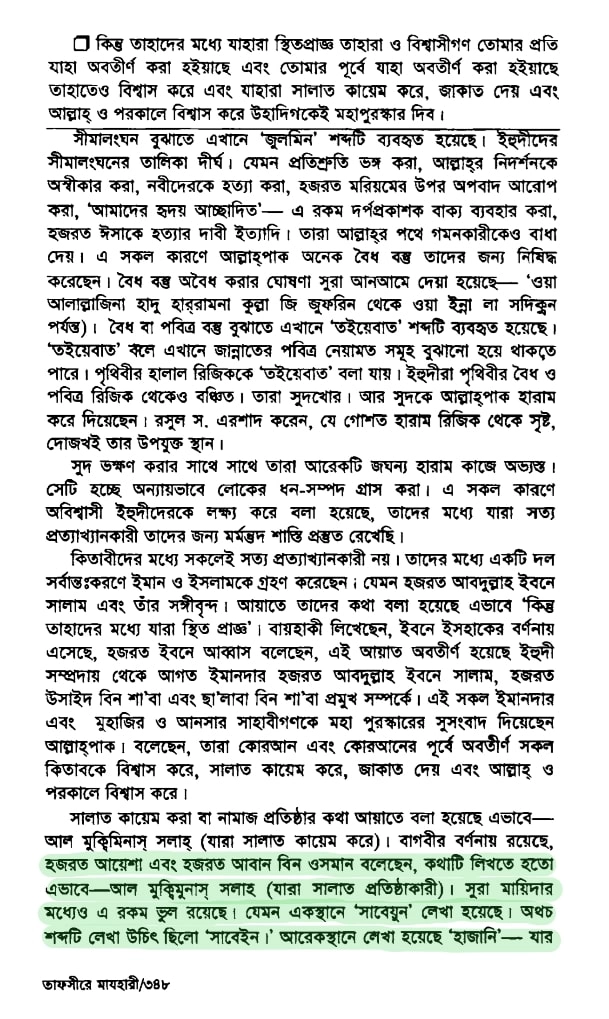
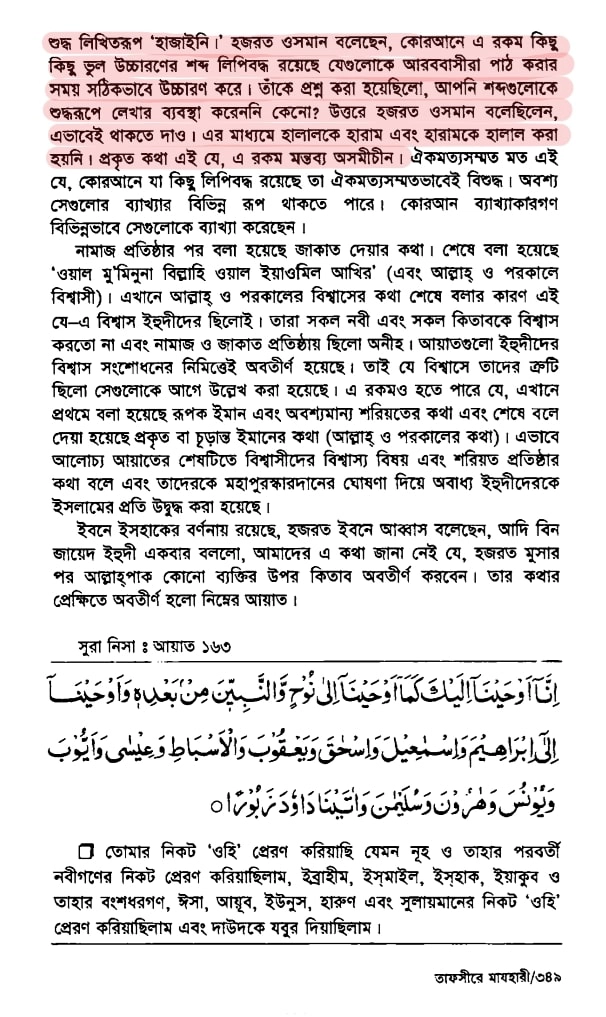
The Bengali translation of Qadi Thanaullah Panipati’s Tafsir al-Mazhari also contains these accounts from Aisha, Aban ibn Uthman, and Uthman. It discusses how the three forms under dispute, المقيمين, الصابئون and هذان, were written, then invokes consensus to reach the theological conclusion that the present Quranic forms are correct. The disputed reports survived in the Muslim exegetical tradition itself, well before modern polemics. [6]
“Lady Aisha and Aban ibn Uthman said that it should have been written … There is a similar error in Surah Al-Ma’idah … Elsewhere it is written as ‘hadhani,’ where the correct written form is ‘hadhayni.’ Uthman said that the Quran contains some words written in forms that give the wrong pronunciation, which the Arabs pronounce correctly when they recite …”
Aisha’s Report — “This Is the Work of the Scribes. They Made a Mistake in Writing the Book”
Abu Ubayd recounts the conversation in Fada’il al-Qur’an through Abu Mu‘awiya, Hisham ibn Urwa, Urwa, and Aisha. Urwa asked Aisha about three forms in the Quran. His question concerned the written text of the codex. In explaining the forms, Aisha pointed to the people who had written it. She replied: [7]
يَا ابْنَ أَخِي، هَذَا عَمَلُ الْكُتَّابِ، أَخْطَؤُوا فِي الْكِتَابِ
“My nephew, this is the work of the scribes. They made a mistake in writing the Book.”
After citing the chain, al-Suyuti writes: “هذا إسناد صحيح على شرط الشيخين”. The chain is authentic according to the criteria of al-Bukhari and Muslim. More importantly, he rejects for Aisha’s report the first answer he accepted for Uthman’s, namely that the chain was weak. “أما الجواب بالتضعيف فلأن إسناده صحيح كما ترى”. The weakness objection fails here because the chain is authentic. [8]
Some later hadith scholars raised a specific objection to Abu Mu‘awiya’s transmission from Hisham ibn Urwa, a criticism quoted by IslamWeb. Al-Suyuti judged the same chain “صحيح على شرط الشيخين”. Al-Tabari and Ibn Abi Dawud also quote Aisha’s statement “هذا عمل الكتاب، أخطؤوا في الكتاب” with a chain of transmission. Later works on the Quranic sciences and Quranic commentary discuss her statement at length. [9]
Al-Suyuti’s Own Admission — The Usual Answers Fall Short for Aisha’s Report
Al-Suyuti judged the chains of Uthman’s reports weak. He also considered whether lahn could refer to a convention of the rasm, or whether a difference between the written form and pronunciation could explain the statement. For Aisha’s report, al-Suyuti himself explains why those answers fall short. He judged the chain authentic, and Urwa was asking about three specific forms in the codex.
Al-Suyuti then quotes Ibn Ashta. On Ibn Ashta’s reading, the scribes wrote a valid form from among the seven ahruf. Their error was in failing to select the most suitable form. Aisha’s words are أخطؤوا في الكتاب, “they made a mistake in writing.” To read that as أخطؤوا في اختيار الأولى من الأحرف السبعة, “they made a mistake in choosing the best of the seven ahruf,” requires introducing both the seven ahruf and a choice between readings into Aisha’s answer. Both ideas come from Ibn Ashta’s explanation. Al-Suyuti then sets out the grammatical analyses of the three forms.
Aisha Was Not Alone — Further Reports of Scribal Errors in Early Muslim Tradition
The idea of scribal error extended beyond Aisha’s three examples. In the same discussion, al-Suyuti quotes further reports from Ibn Abbas and others. Their chains vary in strength, but taken together they show that explaining variant readings as writing errors was a familiar approach in the early Muslim tradition. The variants show that a verse could be read in more than one way. Several of Ibn Abbas’s reports go further by explaining how the differences arose. He traced the gap between the form in the codex and the one he read to the scribe’s work.
Surah An-Nur 24:27 — تَسْتَأْنِسُوا versus تَسْتَأْذِنُوا
The present codex reads حَتَّىٰ تَسْتَأْنِسُوا, a form rendered here as “until you make yourselves known or obtain permission.” Al-Tabari quotes Ibn Abbas’s reading through several chains. Ibn Abbas read حَتَّىٰ تَسْتَأْذِنُوا, “until you ask permission.” The verb specifies what people must do before entering someone else’s home. The variant thus changes how the instruction is worded. In Ibn Abbas’s reading, the verb expressly says to ask permission. In one report he says: [10]
إِنَّمَا هِيَ خَطَأٌ مِنَ الْكَاتِبِ: حَتَّى تَسْتَأْذِنُوا وَتُسَلِّمُوا
“This is a scribal error. (The reading is) ‘until you ask permission and greet them with peace.’”
Ibn Abi Hatim gives a more tentative wording in one report: “هو فيما أحسب مما أخطأت به الكتاب”, “I think this is one of the mistakes the scribes made.” Early commentators also gave an ordinary interpretation of تستأنسوا in this verse. Two distinct strands of early interpretation appear side by side. One explains the standard form, while the other takes the variant as the intended reading and attributes the difference to a scribal error. [11]
Surah Ar-Ra‘d 13:31 — أَفَلَمْ يَيْأَسْ versus أَفَلَمْ يَتَبَيَّنْ
The present codex reads أَفَلَمْ يَيْأَسِ الَّذِينَ آمَنُوا. Al-Suyuti and al-Tabari give أَفَلَمْ يَتَبَيَّنِ الَّذِينَ آمَنُوا as the reading of Ibn Abbas and Ali. The variant asks directly whether the matter has become clear to the believers. The two readings use different verbs, and Ibn Abbas gives a specific explanation for how the verb in the codex came to be written there. According to Ibn al-Anbari’s account, when Ibn Abbas was shown the reading in the codex, he replied: [12]
أَظُنُّ الْكَاتِبَ كَتَبَهَا وَهُوَ نَاعِسٌ
“I think the scribe wrote it while he was drowsy.”
In another report, Ibn Abbas explains the regional sense of ييأس as it appears in the codex. According to him, some Arab tribes used it to mean “to know.” That explanation makes sense of the verse with the word as written. In the previous report, Ibn Abbas answered how the word came to be written there. Here he explains what the same word means in a regional usage of Arabic.
Surah Al-Isra 17:23 — وَقَضَىٰ رَبُّكَ versus وَوَصَّىٰ رَبُّكَ
The present reading is وَقَضَىٰ رَبُّكَ. According to Sa‘id ibn Mansur’s account, Ibn Abbas read وَوَصَّىٰ رَبُّكَ. He explained that one of the two waw letters had joined the sad, changing the form of the word. The readings of Ubayy ibn Ka‘b and Sa‘id ibn Jubayr also contain ووصى. In Ibn Abbas’s explanation, whether one letter stood apart or joined the next was enough to change the entire verb for a later reader. [7]
إِنَّمَا هِيَ «وَوَصَّى رَبُّكَ» الْتَزَقَتِ الْوَاوُ بِالصَّادِ
“The reading is really ‘wa-wassa rabbuka.’ The waw joined the sad.”
This reading did not become canonical. Later grammarians and commentators explained قضى in its ordinary sense of “to command” or “to decree.” The early Muslim tradition still preserves an account of the standard form arising from a scribal error in which the shapes of letters merged. In translation the two verbs can be close in meaning, since both can convey a command. The written verbs in Arabic are still different. Ibn Abbas’s explanation addresses that written difference.
Surah An-Nur 24:35 — مَثَلُ نُورِهِ versus مَثَلُ نُورِ الْمُؤْمِنِ
In Ibn Abi Hatim’s commentary, Ibn Abbas calls the present form مَثَلُ نُورِهِ كَمِشْكَاةٍ a scribal error. His reading is مَثَلُ نُورِ الْمُؤْمِنِ كَمِشْكَاةٍ, “The likeness of the believer’s light is that of a niche.” The difference concerns whose light the simile describes. The codex reads “His light.” In Ibn Abbas’s reading, the word “believer” makes the referent explicit in the text itself. [13]
هِيَ خَطَأٌ مِنَ الْكَاتِبِ … إِنَّمَا هِيَ: مَثَلُ نُورِ الْمُؤْمِنِ كَمِشْكَاةٍ
“This is a scribal error … The reading is really ‘The likeness of the believer’s light is that of a niche.’”
The Three Specific Forms Aisha Identified
Urwa asked about three forms in the codex, and Aisha held the scribes responsible for all three. Each differs from what the ordinary rules of grammar would lead one to expect. Later Arabic grammarians explained each by identifying a particular construction or dialect usage. The grammatical question differs in each case. In An-Nisa, one item in a series has a different case from those around it. In Al-Ma’idah, the case differs from what the governing particle would ordinarily call for. In Taha, the issue is the form of the dual demonstrative.
Surah An-Nisa 4:162 — وَالْمُقِيمِينَ الصَّلَاةَ
لَٰكِنِ الرَّاسِخُونَ فِي الْعِلْمِ مِنْهُمْ وَالْمُؤْمِنُونَ يُؤْمِنُونَ بِمَا أُنزِلَ إِلَيْكَ وَمَا أُنزِلَ مِن قَبْلِكَ وَالْمُقِيمِينَ الصَّلَاةَ وَالْمُؤْتُونَ الزَّكَاةَ
“But those with solid knowledge among them and those with true faith … ˹especially˺ those who establish prayer … and those who pay alms-tax …” (Mustafa Khattab, The Clear Quran)
In this passage [14] الرَّاسِخُونَ, الْمُؤْمِنُونَ, and later الْمُؤْتُونَ are nominative. Between them, الْمُقِيمِينَ is accusative. A straightforward parallel construction would lead one to expect المقيمون. Early commentators also give Ibn Mas‘ud’s reading as والمقيمون الصلاة. In his reading, the middle term is nominative like those around it. The change of case at that point in the codex raises the question of what part of the sentence the term belongs to. In Aisha’s report, the present form المقيمين is an example of scribal error.
Classical Arabic offers an established grammatical analysis for the form: النصب على المدح, the use of the accusative for praise, breaking with the ordinary construction. Fakhr al-Din al-Razi adopted this explanation from the Basran grammarians. Al-Tabari listed several analyses and preferred a different syntactic connection. The form can therefore be explained grammatically. Aisha attributed its origin to a mistake by the scribes. [15] [16]
Surah Al-Ma’idah 5:69 — وَالصَّابِئُونَ
إِنَّ الَّذِينَ آمَنُوا وَالَّذِينَ هَادُوا وَالصَّابِئُونَ وَالنَّصَارَىٰ …
“Indeed, the believers, Jews, Sabians and Christians …” (Mustafa Khattab, The Clear Quran)
إِنَّ is the governing particle. If the terms after it are read as part of the same series, the expected form is الصابئين. That is exactly the accusative form found in Surah Al-Baqarah 2:62. But in 5:69, الصابئون is nominative. The same religious group appears in both verses. Explaining the nominative in Al-Ma’idah 5:69 requires a separate account of how the word fits into that sentence. Aisha’s report gives this as another example of scribal error [17].
Classical Arabic grammarians offered several ways to account for the form: الصابئون can be taken as a separate subject (mubtada’) with an implied predicate, coordinated with the syntactic position of the entire إنّ + اسمها construction, or read as part of another grammatical structure. Given these analyses, a departure from the expected case does not in itself establish that the Arabic is wrong. Aisha’s account remains clear. She calls the form a scribal error.
Surah Taha 20:63 — إِنْ هَذَانِ لَسَاحِرَانِ
إِنْ هَذَانِ لَسَاحِرَانِ
“Indeed, these are two magicians.” (Sahih International)
If إنَّ is taken as an ordinary governing particle, the usual case rule would call for the accusative dual demonstrative هذين here [18]. Abu Amr al-Basri’s canonical reading has إن هذين لساحران. Other recognized readings take different forms compatible with the rasm of هذان. Al-Farra’ notes that some readers called it lahn, although he did not want to depart from the codex. [19]
Grammarians have also explained the construction. Some Arab tribes used the dual with alif in all three cases, nominative, accusative, and genitive. Another analysis takes إن as the light form of the particle. Others posit an implied pronoun or a different syntactic construction. These positions appear in the discussions of al-Alusi, al-Samin al-Halabi, and Ibn Taymiyya. The claim that the form is impossible in any variety of Arabic is false. Its difficulty within the ordinary grammatical framework explains why early and medieval Muslim grammarians offered special analyses of it. [20] [21]
Aban ibn Uthman’s Account of How “Wal-Muqimina” Was Written
In his commentary on An-Nisa 4:162, al-Qurtubi quotes both Aisha’s report and Aban ibn Uthman’s account. Aban says the scribe wrote the first part of the verse and then asked what to write next. He was told to write والمقيمين الصلاة. That is how Aban explains the origin of the form. Aisha held the scribes responsible. In Aban’s account, responsibility extends to dictation, since someone told the scribe what to write. Al-Qurtubi rejected the scribal-error explanation and preferred grammatical accounts of the form. [22]
“Lahn Does Not Mean Error” — What the Context Shows
لحن has several meanings in Arabic. It can refer to an error, a way of speaking, a dialect, allusive speech, or a manner of reading. The word alone cannot establish that the weak report from Uthman refers to a grammatical error. The surrounding words narrow its meaning. ستقيمه العرب بألسنتها means the Arabs will “correct it” with their tongues, and لو كان المملي من هذيل والكاتب من ثقيف لم يوجد فيه هذا says that with a different person dictating and a different scribe, “this would not have been found in it.” Both expressions clearly describe a problem and how it could be corrected or avoided.
The sound objection to Uthman’s report is the weakness of its chain. The claim that lahn never means an error is linguistically false. Aisha’s report does not depend on the range of meanings of لحن. Her wording is explicit: أخطؤوا في الكتاب. Citing the dictionary meanings of one word cannot neutralize a different report that says plainly “they made a mistake.” The weak chain bears on whether the words are Uthman’s. The phrase “the Arabs will correct it with their tongues” bears on the sense of lahn in that report.
“They Chose a Less Suitable Form From the Seven Ahruf” — A Later Reading of Aisha’s Words
Ibn Ashta and later commentators interpreted Aisha’s أخطؤوا as an error in selecting a reading. In their view, the scribes wrote a valid form from the seven ahruf but failed to choose the one best suited to the people. This explanation reduces the theological tension, but it does not follow from the wording of the source. Aisha’s recorded statement mentions neither the “seven ahruf,” a “less suitable choice,” nor the claim that “both readings are revelation.”
The more serious problem is that the explanation starts with a conclusion and rewrites the report around it. It assumes that the present standard rasm cannot contain an actual scribal error, then gives أخطؤوا في الكتاب a meaning that rules out scribal error. This makes the report conform to the doctrine that the Quran was preserved without error. Historical analysis begins with the wording of the source and tests the doctrine against it.
“The Mass-Transmitted Quran Will Not Change Because of One Report” — What Does That Prove?
Later Muslim consensus gave the present rasm religious authority. Aisha’s words take their meaning from Urwa’s question and her answer. Urwa asked about three specific forms in the codex. Aisha held the scribes responsible for those forms. The forms regularly recited afterward tell us about the community’s reading practice. Aisha’s answer tells us why she objected to those forms. Using their later acceptance to interpret her objection lets a later decision determine what she meant.
Once the present reading is assumed to be error-free, Aisha’s statement that “the scribes made a mistake in writing” has to be given a different meaning. That revised meaning is then offered in support of the reading’s accuracy. The reasoning is circular because it assumes the very thing it sets out to prove. On this approach, whatever the report says, it can be made to support the same conclusion. If even “they made a mistake” becomes evidence of accuracy, there is no answer to the question of what evidence could ever count against the claim.
Grammatical Explanations and Allegations of Scribal Error
Classical grammarians explained how the three forms in the codex can be understood within Arabic syntax. Aisha’s report concerns how the forms came to be written. She says the scribes made mistakes. An account of how a form works in a sentence cannot settle how it entered the codex. Al-Suyuti judged Aisha’s chain authentic. Ibn Abbas also held scribes responsible for written forms in several other verses. The claim that early Muslim tradition never treated any written form in the codex as a scribal error is false.
Beyond Three Words — The Choices Behind Uthmanic Standardization
Sahih al-Bukhari’s account of the Uthmanic compilation, the Companions’ variant readings, Uthman’s statement on lahn in the codex, Aisha’s report of scribal error, and Ibn Abbas’s variant readings together reveal the human history of the written text. People made copies, disputed readings, selected a linguistic form, produced standard copies, and destroyed competing written materials. Later generations explained difficult forms in the rasm they inherited. This is the history of how an ancient text was standardized, complete with the human complications the account of miraculous transmission leaves out.
Uthmanic standardization gave the present Quranic text remarkable long-term stability. A text can be standardized early and remain stable for centuries while still having a history of human transmission before that point. Its later stability does not erase the earlier variant readings, editorial choices, or allegations of scribal error. If standard copies are sent to different regions and other written materials are removed, agreement among later copies is the expected result. To infer from that agreement that the earlier readings were also identical leaves unexplained the dispute Hudhayfa reported, the very reason the project began.
What the Evidence Establishes Taken Together
| Issue | Evidence | Assessment |
|---|---|---|
| Uthmanic Standardization | Sahih al-Bukhari documents regional differences, the choice of Qurayshi language, and the burning of alternative written materials. | Very strong |
| Uthman’s Acknowledgment of Lahn | Several chains in Ibn Abi Dawud and later collections | In circulation, with weak or disconnected chains |
| Three Scribal Errors in Aisha’s Report | Hisham → Urwa → Aisha. Al-Suyuti said the chain met the criteria of al-Bukhari and Muslim. | The strongest report from within the tradition discussed here |
| An-Nisa 4:162 | Report of scribal error and several classical grammatical analyses | Strong report. The form can be explained grammatically. |
| Al-Ma’idah 5:69 | Report of scribal error and several syntactic analyses | Strong report. The form can be explained grammatically. |
| Taha 20:63 | Report of scribal error, several recognized readings, and dialectal explanations | Strong report. The form can be explained grammatically. |
| An-Nur 24:27 | Ibn Abbas’s reading تستأذنوا and his allegation of scribal error | Several early reports. The standard reading also has a linguistic explanation. |
| Ar-Ra‘d 13:31 | The variant يتبين, the report of a drowsy scribe, and the dialectal explanation of ييأس | Conflicting strands of transmission |
| Al-Isra 17:23 | The variant وصى and the explanation that the written forms of two letters merged | An early noncanonical reading |
| An-Nur 24:35 | The variant نور المؤمن and the allegation of scribal error | An early report with an alternative to the present standard reading |
Conclusion
Early Muslim tradition explicitly preserves accounts that explain written forms in the present codex as scribal errors. Al-Suyuti judged Aisha’s statement “هذا عمل الكتاب، أخطؤوا في الكتاب” authentic according to the criteria of al-Bukhari and Muslim. Ibn Abbas held the scribes responsible for the written forms of several verses. Uthman’s statements about lahn also appear through several chains that al-Suyuti judged weak. The popular claim that the Quran’s written history never included the idea of human copying or scribal errors is false.
Later classical grammarians gave valid analyses of all three examples Aisha discussed. Those forms therefore cannot be shown to be grammatically impossible. The historical issue is how the same forms were understood at different points. Early Islamic reports explained them as scribal errors, while later grammarians and commentators gave them valid grammatical analyses. The later interpretation of the standard text and the earlier accounts of scribal error are distinct layers of its history.
The history of the Uthmanic codex shows the same pattern. There were disagreements over readings. A committee was formed and instructed to choose Qurayshi language in the event of disagreement. Standard copies were sent to different regions, and competing written materials were destroyed. This was a successful standardization of the text. A book said to have come down word for word without human selection, copying, variation, or dispute has a very different history. Theological advocacy that erases this human process to present a picture of flawless, trouble-free transmission distorts what the sources record.
The strongest evidence comes from the Islamic sciences of the Quran themselves. Al-Suyuti preserved a report that says “the scribes made a mistake in writing” and judged its chain authentic according to the criteria of al-Bukhari and Muslim. Later reinterpretations can try to fit the statement into the doctrine of flawless Quranic preservation. The original report remains on record. Variant readings and accusations of scribal error belong to the history preserved by Islamic tradition itself.
References
- Sahih al-Bukhari 4987, Quran Compilation and Uthmanic Standardization ↩︎
- Sahih al-Bukhari 4987 ↩︎
- Ibn Abi Dawud, Kitab al-Masahif ↩︎
- Kitab al-Masahif, اختلاف ألحان العرب ↩︎
- Al-Suyuti, Al-Itqan, on Grammatical Inflection and Lahn in the Codex ↩︎
- Tafsir al-Mazhari, Qadi Muhammad Thanaullah Panipati, Bengali edition, vol. 3, pp. 348–349 ↩︎
- Al-Suyuti, Al-Itqan 1 2
- Al-Itqan, Evaluation of the Chain of Aisha’s Report ↩︎
- IslamWeb, Criticism of a Narrator in Aisha’s Report ↩︎
- Al-Tabari, Quran Commentary, An-Nur 24:27 ↩︎
- Ibn Abi Hatim, Quran Commentary, An-Nur 24:27 ↩︎
- Al-Durr al-Manthur, Ar-Ra‘d 13:31 ↩︎
- Ibn Abi Hatim, Quran Commentary, An-Nur 24:35 ↩︎
- Quran 4:162 ↩︎
- Al-Razi, Quran Commentary, An-Nisa 4:162 ↩︎
- Al-Tabari, Quran Commentary, An-Nisa 4:162 ↩︎
- Quran 5:69 ↩︎
- Quran 20:63 ↩︎
- Al-Farra’, Ma‘ani al-Qur’an, Taha 20:63 ↩︎
- Al-Durr al-Masun, Taha 20:63 ↩︎
- Ibn Taymiyya, Taha 20:63 ↩︎
- Al-Qurtubi, Quran Commentary, An-Nisa 4:162 ↩︎