
Introduction
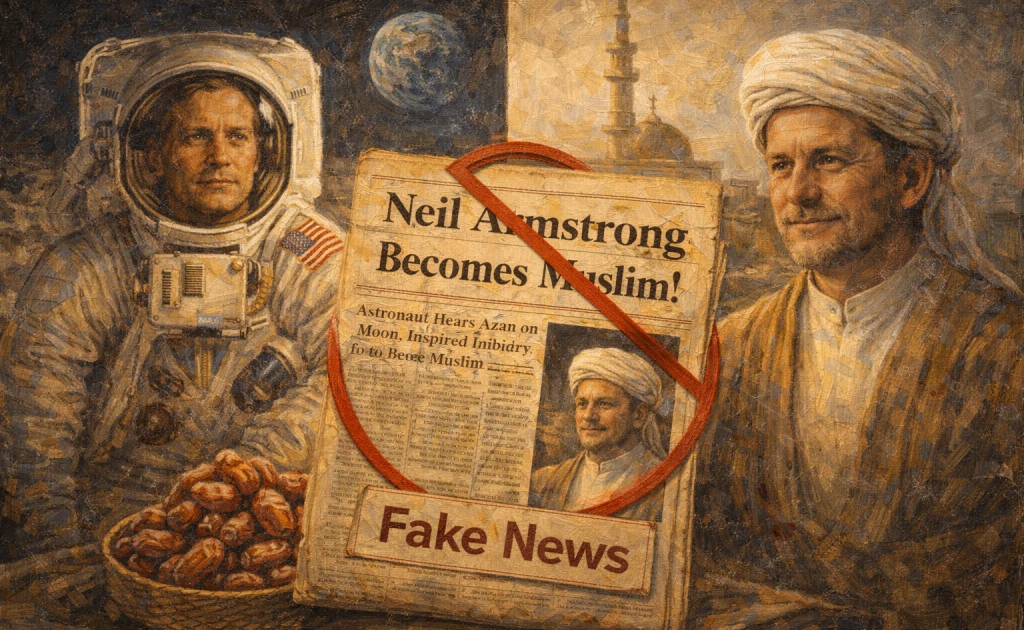
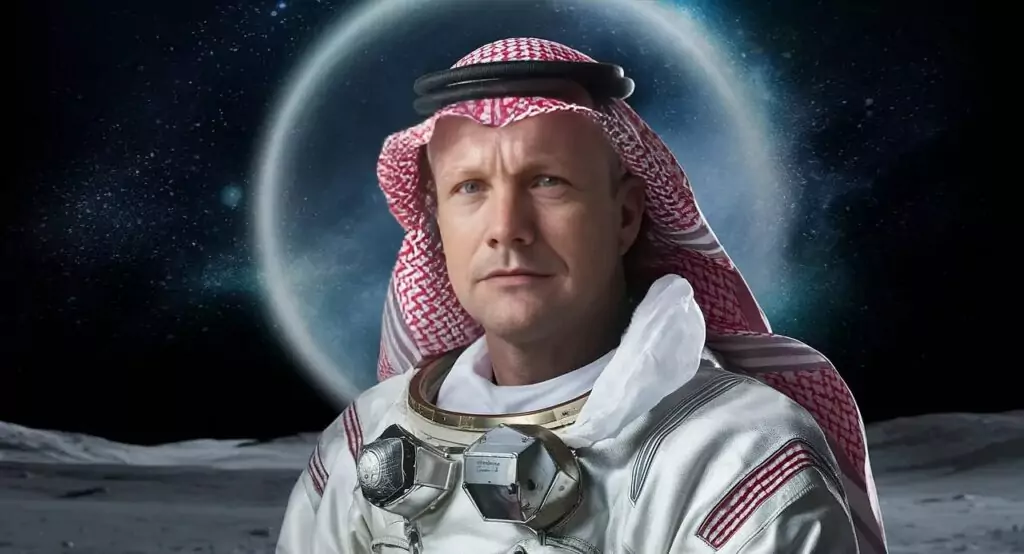
The conquest of the Moon was an extraordinary achievement in the history of human knowledge, science, and technological advancement. In 1969, human beings first set foot on the lunar surface as a result of years of labour, experimentation, and scientific research by thousands of scientists, engineers, mathematicians, and researchers. Yet Islamic preachers have turned even this unique scientific achievement of human civilisation into a means of proving the miraculous character of their religion. Numerous stories have been fabricated about Neil Armstrong, the American astronaut who first walked on the Moon, which bear no resemblance to his actual life, the history of lunar exploration, or modern astronomy.
For decades, Islamic sermons, religious discussions, newspapers, and Islamic books have circulated the claim that Neil Armstrong heard the adhan, the Islamic call to prayer, while standing on the Moon. Supposedly, after returning to Earth, he heard the same call at a mosque in Egypt and converted to Islam. Another version claims that Armstrong saw an enormous fissure stretching from one end of the Moon to the other, a remnant of the miracle in which the Prophet Muhammad split the Moon. Some have even claimed that scientists at NASA, the United States space agency, established through research that the Moon really had separated into two pieces approximately fourteen centuries ago and that the pieces had subsequently been rejoined. Stories have also circulated that Armstrong concealed his conversion for fear of the American administration.
The most significant aspect of this falsehood is that it did not remain merely an orally transmitted folk tale. Biographies of the Prophet written by Islamic scholars, hadith commentaries, and religious periodicals have attempted to establish these claims as authoritative historical and scientific facts. Statements that the scientists responsible for lunar exploration never made have been attributed to those very scientists. Research findings with no scientific basis have been attributed to the institution that investigated the geological characteristics of the Moon. Even after Neil Armstrong personally denied reports of his conversion, the same false story continued to be circulated in his name.
The conversion of a famous scientist or astronaut is not evidence of the truth of any religion. Extraordinary competence in operating spacecraft does not make a person’s religious beliefs infallible. A scientist’s conversion to Islam no more establishes the truth of Islam than a scientist’s conversion to Hinduism, Christianity, or Buddhism establishes the miraculous claims of those religions. Using an individual’s fame and competence as evidence of the truth of their beliefs is an appeal to authority. In Armstrong’s case, Islamic propaganda goes one step beyond even this fallacy: the very conversion being offered as evidence is itself false.
By attaching a religious miracle story to a well-established, documented, and scientifically verifiable event such as the Moon landing, science has been turned into an instrument of religious propaganda. Presenting a modern scientific discovery as evidence for the truth of an ancient scripture requires the actual data, research papers, and statements of the scientists concerned. Circulating fabricated statements in scientists’ names, nonexistent research findings, and imaginary conversion stories is not scientific evidence; it is a distortion of science and history.
The Claims of Islamic Preachers and the Documentary Evidence of Falsehood
The stories Islamic preachers have constructed around Neil Armstrong contain several distinct claims. Some attribute his conversion to hearing the adhan on the Moon; others attribute it to seeing a fissure on the lunar surface; still others claim that NASA scientists discovered scientific evidence that the Moon had split. Additional stories involve Armstrong losing his job, concealing his conversion for fear of the American administration, and moving to a Muslim country. Specific documentation of the circulation of these claims can be found in IslamQA’s 2003 fatwa, Islamic books, and various fact-checking reports. [1] [2]
The Bangladeshi Islamic scholar Dr Muhammad Asadullah Al-Ghalib presents Neil Armstrong’s conversion as evidence of the splitting of the Moon in his book Stories of the Prophets–3: Siratur Rasul (peace be upon him). According to him, Armstrong personally saw the dividing line on the lunar surface, was astonished, and embraced Islam. The book further claims that Armstrong did not disclose his conversion until several years later for fear of the American administration. [3] [4]
১৯৬৯ সালের ২০শে জুলাই চন্দ্রে প্রথম পদার্পণকারী দলের নেতা নেইল আর্মস্ট্রং স্বচক্ষে চন্দ্রপৃষ্ঠের বিভক্তি রেখা দেখে বিস্ময়াভিভূত হন এবং ইসলাম কবুল করেন। কিন্তু মার্কিন প্রশাসনের ভয়ে তিনি একথা কয়েক বছর পরে প্রকাশ করেন।
পাদটীকা ১৫১: লেখক নিজে উক্ত চন্দ্র বিজয়ী দলের ঢাকা সফরকালে নিকট থেকে তাদের স্বচক্ষে দেখেছেন এবং অনেক পরে বিভিন্ন পত্র-পত্রিকায় উক্ত খবরটি পড়েছেন। -লেখক।
English translation:
Neil Armstrong, leader of the first team to set foot on the Moon on 20 July 1969, saw the dividing line on the lunar surface with his own eyes, was overwhelmed with astonishment, and embraced Islam. However, for fear of the American administration, he disclosed this only several years later.
Footnote 151: The author himself saw the aforementioned Moon-conquering team at close quarters during their visit to Dhaka and read the news in various newspapers and periodicals much later. —Author.
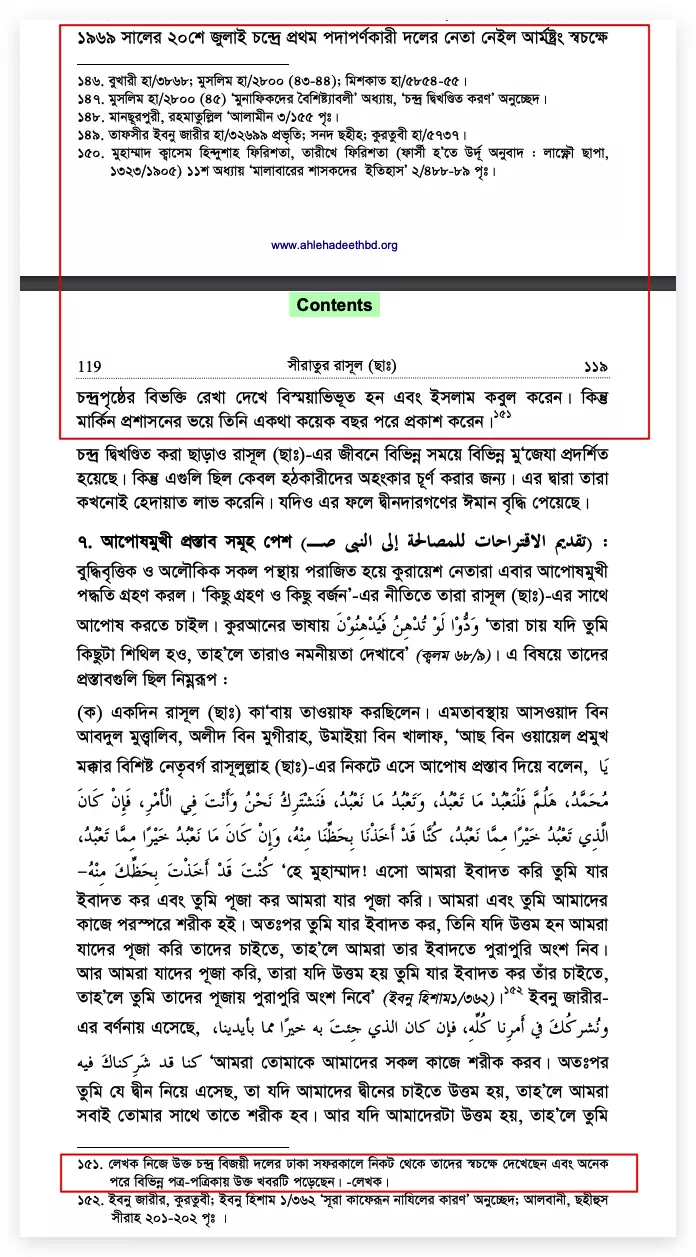
Asadullah Al-Ghalib’s own footnote is the clearest evidence of the inadequacy of his claim. In the main text he did not describe a rumour; he categorically declared that Armstrong had personally seen the dividing line on the lunar surface, converted to Islam, and concealed the news for several years out of fear of the American administration. He was not an eyewitness to any of these three separate events. Seeing the Moon-conquering team at close quarters in Dhaka and witnessing the conversion of one of its members are entirely different matters. Al-Ghalib himself admits that he read the conversion story in newspapers much later. Yet he supplies no specific newspaper, date, or interview in which Armstrong announced his conversion to a journalist. Adding the personal experience of seeing the astronauts to the footnote gives the account the appearance of firsthand knowledge, although that experience has no evidentiary bearing on the conversion claim. Incorporating a rumour into a religious book as established historical fact violates even the most elementary standards of research.
The monthly At-Tahreek, associated with the Ahl-e-Hadith movement, likewise circulated the story of Armstrong’s alleged conversion in connection with the splitting of the Moon in its discussion entitled “Signs of the Hour (Part 1).” Thus the narrative appearing in a scholar’s book reached the readers of a religious periodical as well. Finding the same statement in a book and a periodical does not amount to two independent testimonies. Both claims require Armstrong’s original statements and NASA’s actual research. Publication by religious institutions may confer additional credibility on the story in the eyes of their readers, but it does nothing to improve its factual basis. This is how unverified news spreads from one publication to another, and repetition is used to give a rumour the appearance of a truth supported by multiple sources. [5]
In Sahih al-Bukhari: Bengali Translation and Detailed Commentary, published by Hamidia Library, the commentator not only claimed that Armstrong converted to Islam but also presented supposed scientific research findings in the name of NASA scientists. According to the commentator, NASA scientists analysed evidence collected from the Moon and established that the Moon had once been completely split in two and subsequently rejoined, and that the splitting had occurred approximately fourteen centuries earlier. [6]
বিজ্ঞানের চরম উন্নতির ফলে মানুষ চন্দ্রে অবতরণ করিয়াছে। মানব জাতি হইতে ইসলামের বিপক্ষ দলকে বিজ্ঞানের এই চরম উন্নতির সুযোগ দান করিয়া তাহাদের দ্বারাই আল্লাহ তাআলা স্বীয় হাবীবের এই বিশেষ মো’জেযা চাঁদ দ্বিখণ্ডিত হওয়ার সত্যতা প্রমাণ করাইয়া দিয়াছেন।
বাংলাদেশের সর্বাধিক প্রভাবশালী ও বহুল প্রচারিত সংবাদপত্র “দৈনিক ইত্তেফাক ১৯৮১ সালের ১৪ ও ১৭ই মার্চ সংখ্যাদ্বয়ের উপসম্পাদকীয় কলাম হইতে একটি আলোচনার মূল বক্তব্য পাঠক সমক্ষে তুলিয়া ধরিতেছি-
“চাঁদে অবতরণকারী (আমেরিকার) সুপ্রসিদ্ধ মহাশূন্য বিজ্ঞানী নীল আমস্ট্রংয়ের মুসলমান হওয়ার সংবাদটা লণ্ডনের ইম্প্যাক্ট পত্রিকায় প্রায় এক বছর আগে প্রকাশিত হয়। কিছুকাল আগে স্বীয় ধর্মান্তরের এক আলোচনায় নীল আমস্ট্রংয়ের সাক্ষাতকার প্রকাশিত হয়াছিল, তাতেও বিজ্ঞানী নীল আর্মস্ট্রং স্পষ্ট ভাষায় বলেছিলেন, চাঁদে পদার্পণ করে আমার জীবনের অভিজ্ঞতা সম্পূর্ণ বদলে গেছে। চাঁদ পুরাপুরিভাবেই দ্বিখণ্ডিত।”
চন্দ্র বিজয়ী মহাশূন্যচারী নীল আর্মস্ট্রং ইসলাম ধর্মে দীক্ষিত হলেন- তাঁর সেই ইসলাম গ্রহণের পিছনে কাজ করেছিল চাঁদ দ্বিখণ্ডিত হওয়ার ঘটনাটিই।
প্রকাশ, নীল আর্মস্ট্রংরা চাঁদে পরিভ্রমণকালে দেখতে পেয়েছিলেন যে, চাঁদে একটি ফাটল রয়েছে। এর সম্ভাব্য প্রমাণ ও তথ্যাদি তাঁরা সাথে করে নিয়ে এসেছিলেন। সেই সব তথ্য প্রমাণ (আমেরিকার) মহাশূন্য গবেষণা কেন্দ্র “নাসাতে” বৈজ্ঞানিকভাবে বিশ্লেষিত হয়েছে। দেখা গেছে, চাঁদটি একবার সত্য সত্যই দ্বিখণ্ডিত হয়েছিল এবং সেই দু’খণ্ডকে পুনরায় জোড়া দেয়া হয়েছে। “নাসার” বিজ্ঞানীরা তাঁদের গবেষণার এই প্রমাণও উদ্ধার করতে পেরেছেন যে, চাঁদ দ্বিখণ্ডিত হওয়ার ঘটনাটি ঘটেছিল প্রায় ১৪০০ বছর আছে। চৌদ্দশ’ বছর আগে অলৌকিক ঘটনা হিসাবে মহানবী (সঃ) যে চাঁদ দ্বিখণ্ডিত করেছিলেন, সে বিবরণ নীল আর্মস্ট্রং এর আগেই পড়েছিল। “নাসার” বিজ্ঞানীদের এই গবেষণার ফলাফল প্রকাশের পরেই তিনি আর দেরী না করে ইসলাম কবুল করেন।
এই ধরনের অলৌকিক ঘটনা সম্পর্কে মরহুম মাওলানা মুহাম্মদ আকরম খাঁর বিরূপ অভিমত কারো অজানা নয়। কিন্তু তিনিও তাঁর “মোছলেম বঙ্গের সামাজিক ইতিহাসে এ ঘটনার উল্লেখ করে গেছেন। ইতিহাস থেকে প্রমাণ দিয়েছেন যে, দাক্ষিণাত্যের জনৈক রাজা বেরুখান পেরুমল এই চাঁদ দ্বিখণ্ডিত হওয়ার ঘটনা প্রত্যক্ষ করে স্বয়ং মহানবীর (সঃ) কাছে গিয়ে ইসলামে দীক্ষিত হয়েছিলেন।
এই হিসাব মতে দেখা যায় যে, যাঁহাদের মতে হযরতের বিরুদ্ধে মক্কাবাসী কাফেরগণের বয়কট বা অসহযোগিতা নবুয়তের অষ্টম বৎসরে আরম্ভ হইয়াছিল, তাহাদের মতানুসারে উক্ত মো’জেযা বয়কটের পূর্বে সাব্যস্ত হইবে। আর যাঁহাদের মতে বয়কট নবুয়তের সপ্তম বৎসরের প্রথম হইতেই ছিল তাহাদের মতানুসারে উক্ত মো’জেযার ঘটনা বয়কটের সময়ে সাব্যস্ত হইবে। যদিও কাফেররা হযরতের বিরুদ্ধে বয়কট ও অসহযোগিতা করিয়া যাইতেছিল, কিন্তু তিনি মুহূর্তের জন্যও ইসলামের তবলীগ কার্য ক্ষান্ত করেন নাই। (আসাহুস সিয়ার ৯৪)। এবং তাঁহারা হজ্জের সময় হজ্জের অনুষ্ঠানাদিও সম্পন্ন করিয়া থাকিতেন।
(যোরকানী ১-২৭৯)
English translation:
As a result of the tremendous advancement of science, human beings have landed on the Moon. By granting the opponents of Islam among humanity the opportunity to achieve this tremendous scientific progress, Allah the Exalted has caused those very people to prove the truth of this particular miracle of His beloved: the splitting of the Moon.
From the opinion columns of the 14 and 17 March 1981 issues of Bangladesh’s most influential and widely circulated newspaper, the Daily Ittefaq, we present to the reader the principal points of a discussion:
“The news that the celebrated American space scientist Neil Armstrong, who landed on the Moon, had become a Muslim was published in London’s Impact magazine about a year ago. Some time ago, an interview with Neil Armstrong concerning his conversion was published, in which the scientist Neil Armstrong stated clearly: Setting foot on the Moon has completely changed my experience of life. The Moon is entirely split in two.”
The Moon-conquering astronaut Neil Armstrong embraced Islam, and it was the splitting of the Moon that lay behind his conversion.
It is reported that while travelling on the Moon, Neil Armstrong and his companions discovered a fissure. They brought back possible evidence and data concerning it. Those data and evidence were scientifically analysed at NASA, the American space research centre. It was found that the Moon had indeed once been split in two and that the two pieces had subsequently been rejoined. NASA scientists were also able to establish through their research that the splitting had occurred approximately 1,400 years ago. Neil Armstrong had previously read the account of the Holy Prophet (peace be upon him) miraculously splitting the Moon fourteen centuries earlier. Upon the publication of the NASA scientists’ research findings, he embraced Islam without further delay.
Everyone is aware of the late Maulana Muhammad Akram Khan’s unfavourable views concerning miracles of this kind. Yet even he mentioned this event in his Social History of Muslim Bengal. He provided historical evidence that a king of southern India, Berukhan Perumal, witnessed the splitting of the Moon, went to the Holy Prophet himself, and embraced Islam.
According to this calculation, those who believe that the Meccan unbelievers’ boycott or non-cooperation against the Prophet began in the eighth year of his prophethood would place the miracle before the boycott. According to those who believe that the boycott began at the start of the seventh year of prophethood, the miracle occurred during the boycott. Although the unbelievers continued their boycott and non-cooperation against the Prophet, he did not cease propagating Islam for a moment (Asahhus Siyar, 94). They also performed the rites of Hajj during the pilgrimage season.
(Al-Zurqani, 1–279)
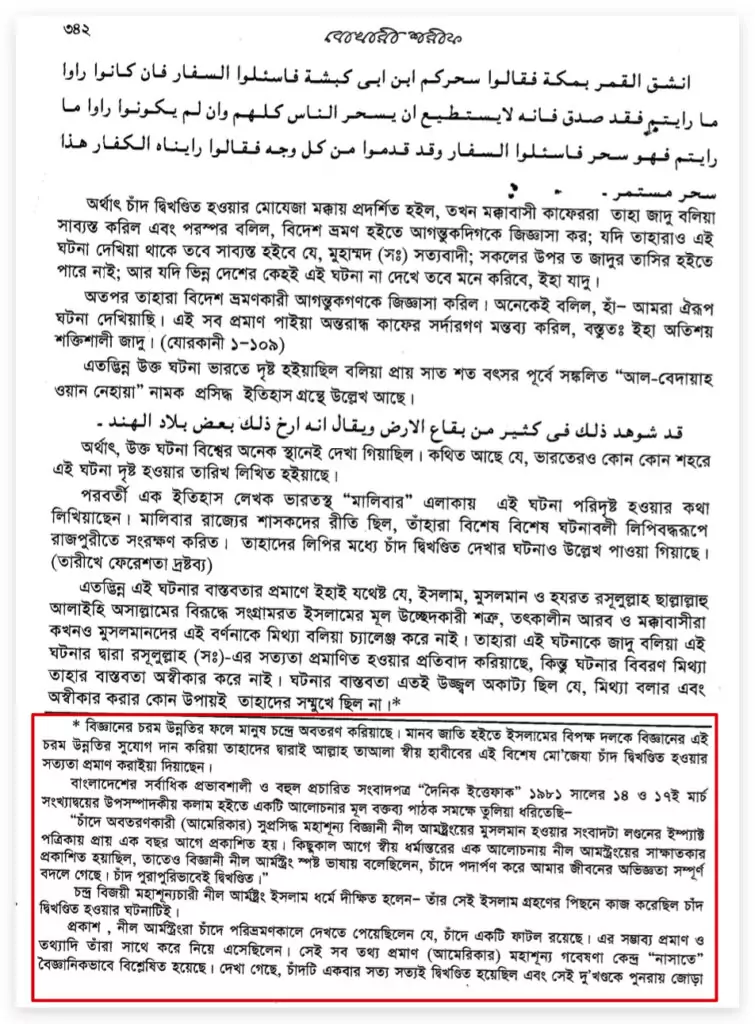
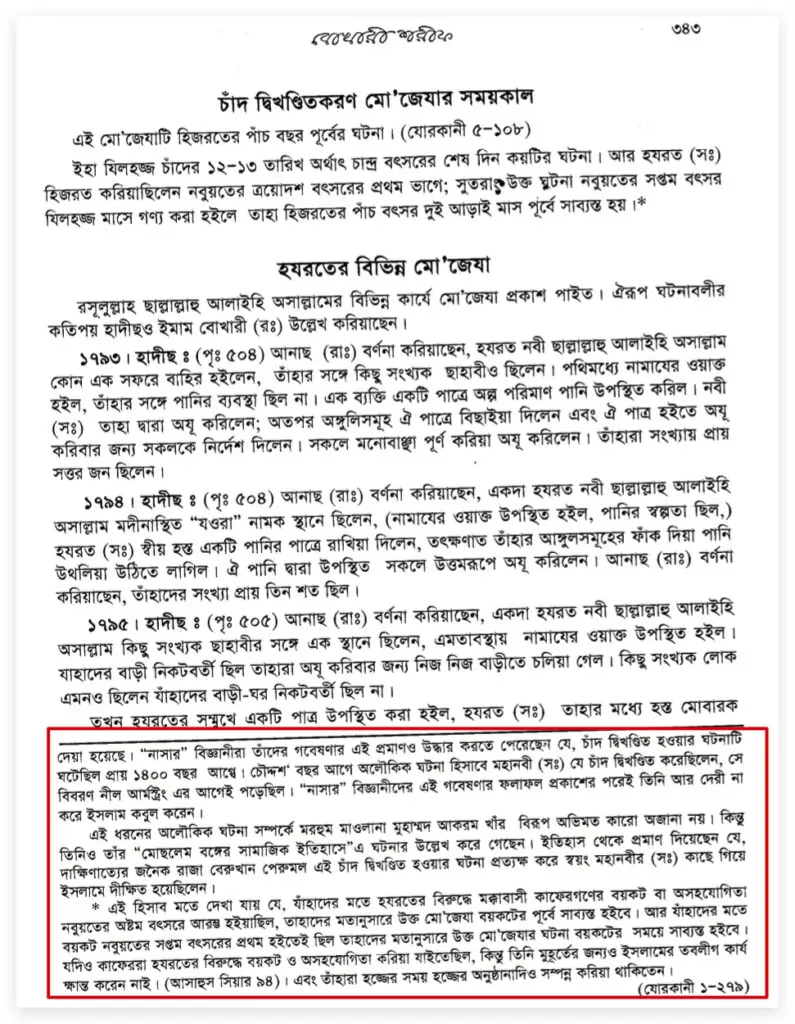
The Hamidia Library book constructs three layers of apparent evidence around a newspaper opinion piece: the names of Ittefaq and London’s Impact, Armstrong’s supposed interview, and the supposed research of NASA scientists. But where is the actual scientific evidence within these three layers? Which scientist conducted the research, which laboratory performed the tests, which scientific journal published the findings, and what samples and methods were used to date the splitting? The book answers none of these questions. It does not even supply the original English statement attributed to Armstrong. When a date as specific as fourteen centuries ago is announced, the obligation to present the dating data becomes particularly compelling. A newspaper opinion column cannot substitute for scientific experimentation. Reprinting it in a hadith commentary does not transform it into a research paper. Rather, NASA’s scientific prestige has been borrowed to dress an unsupported religious claim in the appearance of scientific fact.
The book also invokes the testimony of travellers from outside Mecca, the alleged observations of a ruler of India’s Malabar region, and royal records in support of the splitting of the Moon. By invoking the works of Al-Zurqani, Ibn Kathir, Firishta, and Maulana Muhammad Akram Khan, it connects a supposed seventh-century astronomical event with twentieth-century space research. Each of these claims, however, requires distinct historical and scientific documentation. [7]
The story of Armstrong’s conversion has also been circulated in sermons by Mizanur Rahman Azhari. Rumor Scanner’s investigation documents various versions of the story in the statements of several Islamic speakers. Listeners at a sermon generally have no opportunity to inspect the original evidence while listening. When a speaker invokes NASA or a world-famous astronaut, the credibility earned by modern science is added to his religious authority. But popularity, religious educational credentials, and a vast audience are not evidence of the truth of a speaker’s historical claims. By circulating false experiences and conversion stories in the name of a real person, these speakers give their listeners misinformation about his life. The greater the public claim to possess scientific proof of a religious miracle, the greater the speaker’s responsibility to supply reliable sources for that proof. [8]
Similar propaganda has attributed conversion to Islam and miraculous experiences of seeing Mecca and Medina from space to astronaut Sunita Williams. Shongshoy examines this subject in a separate article, Muslim Fabrications About Sunita Williams.
| Claim in Islamic Propaganda | Sources Circulating the Claim | Evidence Required |
|---|---|---|
| Hearing the adhan on the Moon | Sermons; story documented by IslamQA | Original audio, transcripts, Armstrong’s statements |
| Conversion after hearing the adhan in Egypt | Newspapers and sermons | Travel records and personal declaration |
| Seeing a fissure extending across the entire Moon | Siratur Rasul and Bukhari commentary | Mission observations, photographs, and maps |
| NASA found evidence of lunar splitting | Hamidia Library commentary | Research papers and geological data |
| The event occurred 1,400 years ago | The same commentary | Scientific dating |
| Conversion concealed for fear of the US government | Al-Ghalib and At-Tahreek | Government directives and independent testimony |
| An Indian king witnessed the event | Ibn Kathir, Firishta, later narratives | Independent contemporary documents |
| He remained Muslim until his death | Sermons and conversion stories | Personal statements and biographical records |
The conversion of a real person, his experiences during a specific space mission, a research institution’s discovery, and the history of a celestial body are all verifiable claims. Religious emotion, a speaker’s popularity, and a hadith commentator’s beliefs are not evidence for them.
The Splitting of the Moon in the Quran, Hadith, and Classical Tafsir
In Islamic belief, Inshiqaq al-Qamar (انشقاق القمر), or the splitting of the Moon, is one of the miraculous signs of Muhammad’s prophethood. Modern Islamic propaganda equates a geological line on the lunar surface with that event. Yet the first verse of Surah al-Qamar speaks of the Moon splitting, and the subsequent verse describes opponents seeing a sign and dismissing it as magic. The sahih hadith make the event more specific by describing two distinct lunar portions becoming visible and connecting it to the demonstration of a sign of Muhammad’s prophethood. The general geological fact that fissures exist on the Moon does not establish the specific event described in religious literature. Treating a local trough as evidence of lunar splitting requires demonstrating that it resulted from the separation and reassembly of the entire Moon. Instead of such evidence, only a superficial visual resemblance has been presented. [9]
اقْتَرَبَتِ السَّاعَةُ وَانْشَقَّ الْقَمَرُ وَإِنْ يَرَوْا آيَةً يُعْرِضُوا وَيَقُولُوا سِحْرٌ مُسْتَمِرٌّ وَكَذَّبُوا وَاتَّبَعُوا أَهْوَاءَهُمْ وَكُلُّ أَمْرٍ مُسْتَقِرٌّ
English translation:
The Hour has drawn near, and the Moon has split. Whenever they see a sign, they turn away and say, “Persistent magic.” They denied the truth and followed their desires. Every matter has its appointed outcome.
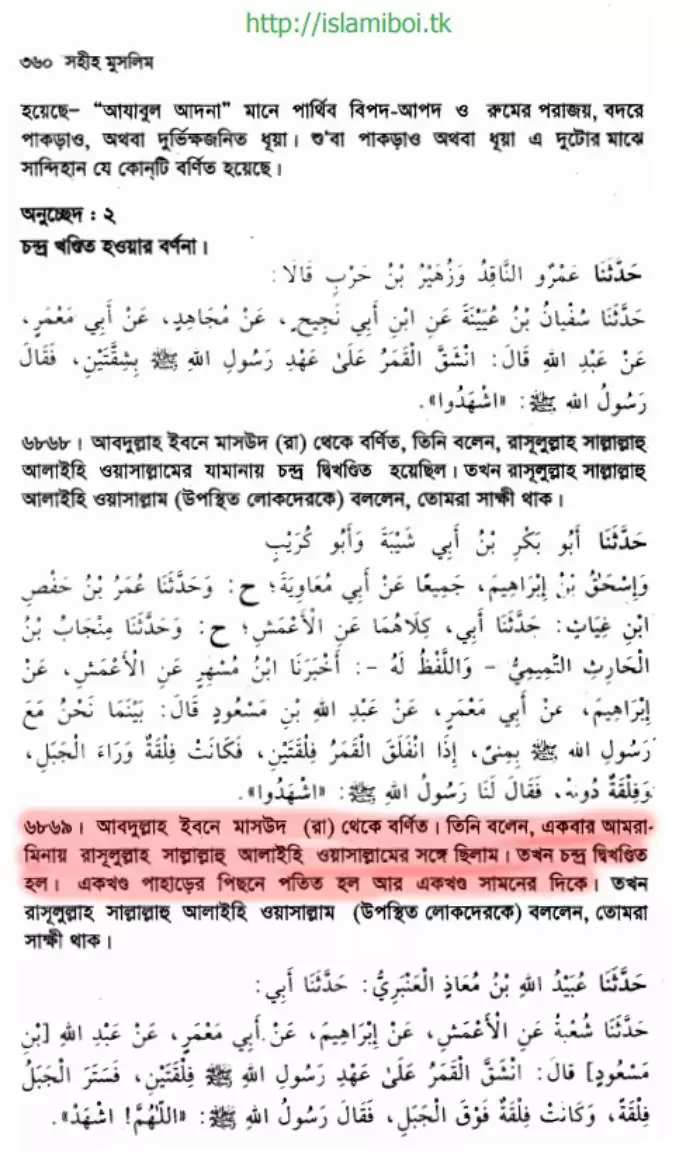
The narration attributed to Abdullah ibn Masud in Sahih Muslim makes the claim more specific. It states that the Moon split into two portions before people accompanying Muhammad at Mina, one visible behind a mountain and the other on this side of it. The Arabic word filqatayn (فِلْقَتَيْنِ) refers to two pieces, not a line on the lunar surface. Muhammad calls upon those present to bear witness. The event is therefore described as being sufficiently visible for those present to identify the two lunar portions separately. A local geological trough on an intact spherical Moon is not equivalent to such an observation. [10] [11]
عَنْ عَبْدِ اللَّهِ بْنِ مَسْعُودٍ، قَالَ بَيْنَمَا نَحْنُ مَعَ رَسُولِ اللَّهِ صلى الله عليه وسلم بِمِنًى إِذَا انْفَلَقَ الْقَمَرُ فِلْقَتَيْنِ فَكَانَتْ فِلْقَةٌ وَرَاءَ الْجَبَلِ وَفِلْقَةٌ دُونَهُ فَقَالَ لَنَا رَسُولُ اللَّهِ صلى الله عليه وسلم اشْهَدُوا
English translation:
Abdullah ibn Masud said: We were with the Messenger of Allah at Mina when the Moon split into two portions. One portion was behind the mountain and the other on this side of it. The Messenger of Allah then told us, “Bear witness.”
Another narration in Sahih Muslim attributed to Ibn Masud describes the scene in more detail. It claims that a mountain obscured one lunar portion while the other was visible above it. According to the account, the Moon had divided in such a way that the positions of the two portions could be identified separately. A local trough photographed by a high-resolution camera aboard a modern lunar spacecraft has no evidentiary equivalence to the claim that two distinct portions of the Moon were visible to the naked eye. Reducing the celestial event claimed in the original narrative to an ordinary surface fissure and then declaring that fissure proof of the miracle changes the very content of the original account. [12] [13]
عَنْ عَبْدِ اللَّهِ بْنِ مَسْعُودٍ، قَالَ انْشَقَّ الْقَمَرُ عَلَى عَهْدِ رَسُولِ اللَّهِ صلى الله عليه وسلم فِلْقَتَيْنِ فَسَتَرَ الْجَبَلُ فِلْقَةً وَكَانَتْ فِلْقَةٌ فَوْقَ الْجَبَلِ فَقَالَ رَسُولُ اللَّهِ صلى الله عليه وسلم اللَّهُمَّ اشْهَدْ
English translation:
Abdullah ibn Masud said: During the time of the Messenger of Allah, the Moon split into two portions. The mountain concealed one portion, while the other was above the mountain. The Messenger of Allah said, “O Allah, bear witness.”
The hadith attributed to Anas ibn Malik expresses the religious purpose of the splitting even more directly. According to the narration, the inhabitants of Mecca demanded that Muhammad show them a sign, and in response he showed them the splitting of the Moon. The event is presented as a particular miracle demonstrating Muhammad’s prophethood. If such a celestial event is offered as proof of a person’s prophethood, the truth of the event itself must first be independently established. Assuming Muhammad’s prophethood to be true in order to accept the account of his miracle, and then using that same account to prove his prophethood, is circular reasoning. [14] [15]
عَنْ أَنَسٍ، أَنَّ أَهْلَ مَكَّةَ سَأَلُوا رَسُولَ اللَّهِ صلى الله عليه وسلم أَنْ يُرِيَهُمْ آيَةً فَأَرَاهُمُ انْشِقَاقَ الْقَمَرِ مَرَّتَيْنِ
English translation:
Narrated Anas: The inhabitants of Mecca asked the Messenger of Allah to show them a sign, so he showed them the splitting of the Moon twice.
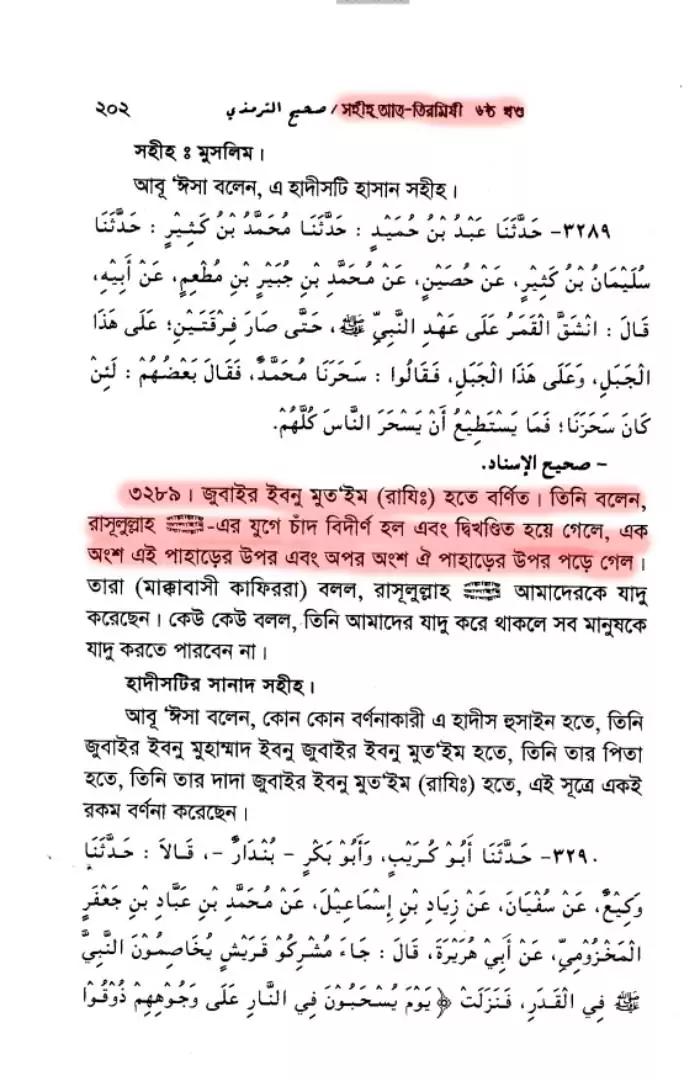
The narration attributed to Jubayr ibn Mutim in Tirmidhi describes not only two lunar portions visible above separate mountains but also the reactions of the Meccans. Some accused Muhammad of magic, while others said that even if he had bewitched the local people, he could not bewitch everyone. The need to seek testimony from independent observers thus emerges within the Islamic narrative itself. Observations from the regions of Earth where the Moon was visible at the time are also relevant to testing the truth of the event. Yet in place of such independent contemporary testimony, later religious narratives and fabricated experiences attributed to a modern astronaut have been offered as evidence. [16] [17]
عَنْ مُحَمَّدِ بْنِ جُبَيْرِ بْنِ مُطْعِمٍ، عَنْ أَبِيهِ، قَالَ انْشَقَّ الْقَمَرُ عَلَى عَهْدِ النَّبِيِّ صلى الله عليه وسلم حَتَّى صَارَ فِرْقَتَيْنِ عَلَى هَذَا الْجَبَلِ وَعَلَى هَذَا الْجَبَلِ فَقَالُوا سَحَرَنَا مُحَمَّدٌ فَقَالَ بَعْضُهُمْ لَئِنْ كَانَ سَحَرَنَا مَا يَسْتَطِيعُ أَنْ يَسْحَرَ النَّاسَ كُلَّهُمْ
English translation:
Muhammad ibn Jubayr ibn Mutim narrated from his father: During the Prophet’s lifetime, the Moon split into two portions, one above this mountain and the other above that mountain. They said, “Muhammad has bewitched us.” Some of them said, “Even if he has bewitched us, he cannot bewitch everyone.”
Further narrations have been preserved in the names of Ibn Abbas and Anas. [18] [19]
Sahih Muslim (Islamic Foundation)
Book 53: The Resurrection, Paradise, and Hell
Publisher: Islamic Foundation
Chapter 9: The Splitting of the Moon
6819. Muhammad ibn al-Muthanna and Ibn Bashshar (may Allah have mercy on them) … narrated from Anas (may Allah be pleased with him), who said: The Moon split. In Abu Dawud’s narration, however, it is stated: During the time of the Messenger of Allah (peace be upon him), the Moon split.
Hadith classification: Sahih
Sahih al-Bukhari (Islamic Foundation)
Book 50: The Prophets (peace be upon them)
Publisher: Islamic Foundation
Chapter 2077. When the polytheists asked the Noble Prophet (peace be upon him) to show a miracle, he split the Moon into two pieces and showed them.
3377. Khalaf ibn Khalid al-Qurashi (may Allah have mercy on him) … narrated from Ibn Abbas (may Allah be pleased with him) that the Moon split during the lifetime of the Prophet (peace be upon him).
Hadith classification: Sahih
The Splitting of the Moon in Ibn Kathir’s Tafsir
In his commentary on Surah al-Qamar, Ibn Kathir accepts the event as a miracle that occurred during Muhammad’s lifetime. He describes the narrations as mutawatir and the event as one of the Prophet’s manifest miracles. [20]
وهذا أمر متفق عليه بين العلماء أي انشقاق القمر قد وقع في زمان النبي – صلى الله عليه وسلم – وأنه كان إحدى المعجزات الباهرات.
English translation:
This is a matter agreed upon by the scholars: the splitting of the Moon occurred during the Prophet’s lifetime and was one of his manifest miracles.
In hadith scholarship, mutawatir is a classification of the transmission of reports, not a scientific measurement of the physical state of the Moon. The Moon’s history is determined through its rocks, crust, internal layering, gravitational field, and observable changes, not through scholarly consensus on a religious question. Ibn Kathir’s assertion of consensus reveals the status accorded to the event among Islamic scholars; it yields no information about the age of lunar rocks or the Moon’s orbit. A religious narrative may circulate through numerous transmitters, be reproduced in later commentaries, and be preserved as part of a belief for centuries. None of these processes creates new geological evidence on the lunar surface. Turning religious consensus into scientific evidence of a celestial event is entirely wrong.
Al-Qurtubi’s Tafsir and the Alleged Testimony of Foreign Observers
Al-Qurtubi identifies the view that the Moon split in the past as the opinion of the majority of scholars. He preserves a narration attributed to Ibn Abbas claiming that one half of the Moon was shown above Abu Qubays and the other above Quayqian. His commentary also mentions questioning travellers who arrived from elsewhere. [21]
فَقَالَتْ قُرَيْشٌ: هَذَا مِنْ سِحْرِ ابْنِ أَبِي كَبْشَةَ؛ سَحَرَكُمْ فَاسْأَلُوا السُّفَّارَ؛ فَسَأَلُوهُمْ فَقَالُوا: قَدْ رَأَيْنَا الْقَمَرَ انْشَقَّ
English translation:
The Quraysh said, “This is the magic of Ibn Abi Kabsha. He has bewitched you; ask the travellers.” They questioned them, and they replied, “We saw the Moon split.”
The most important missing information in Al-Qurtubi’s account is the alleged travellers’ independent testimony. What were their names, where did they come from, where were they when they saw the event, and has any written account of their own been preserved? None of these questions is answered. A narrator is speaking about the testimony of others; the statements of those individuals themselves have not been produced. Even if a writer says in his book that a hundred travellers saw an event, that statement is not equivalent to a hundred independent documents. Independent testimony is especially important for a celestial body such as the Moon, since the event should also have been observable from regions of Earth where the Moon was above the horizon at the relevant time. In place of specific contemporary astronomical documents from China, India, Persia, or the Byzantine world, Al-Qurtubi’s tafsir again supplies anonymous individuals within the Islamic narrative itself. This account does not remedy the absence of independent testimony.
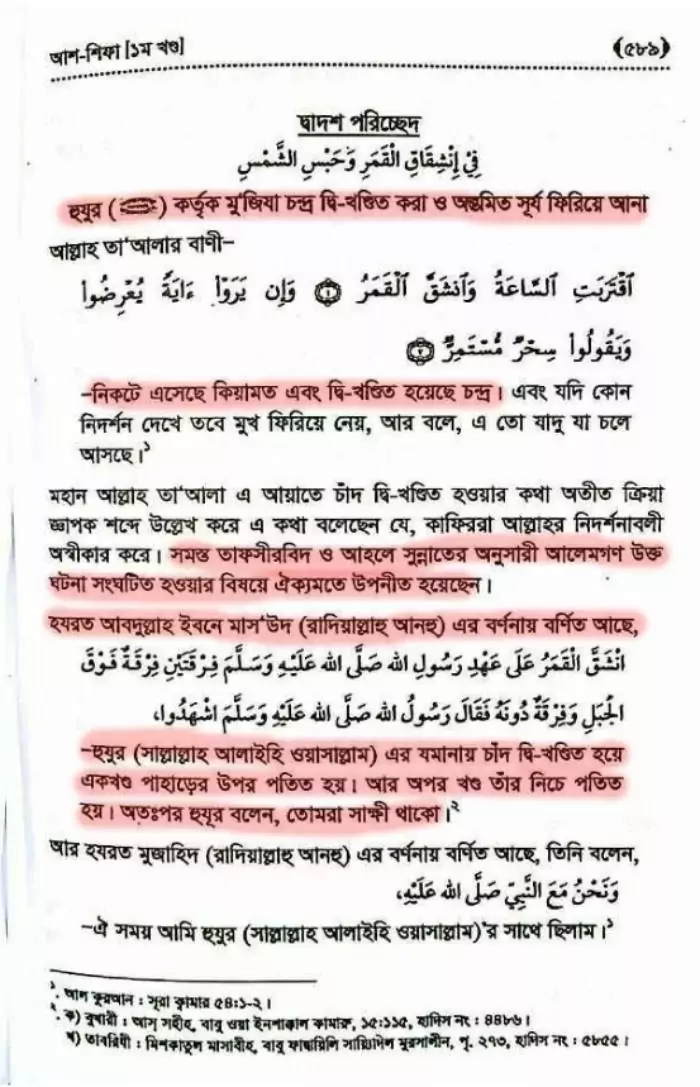
Qadi Iyad’s Al-Shifa and Modern Fatwas
The Maliki jurist Qadi Iyad of Andalusia likewise includes the splitting of the Moon among the miraculous proofs of Muhammad’s prophethood in Al-Shifa. The relevant pages of the Bengali edition demonstrate that the narrative has long enjoyed the status of a religious truth in Islamic tradition. This belief was established centuries before modern space exploration began. When high-quality lunar photographs and scientific data became available in the twentieth century, images of various lunar troughs were employed as new evidence for the old belief. Drawing a conclusion from research data and selecting a photograph because it resembles a predetermined religious conclusion are opposite methods. The latter selects evidence in favour of belief; the former revises beliefs in light of evidence. [22] [23]
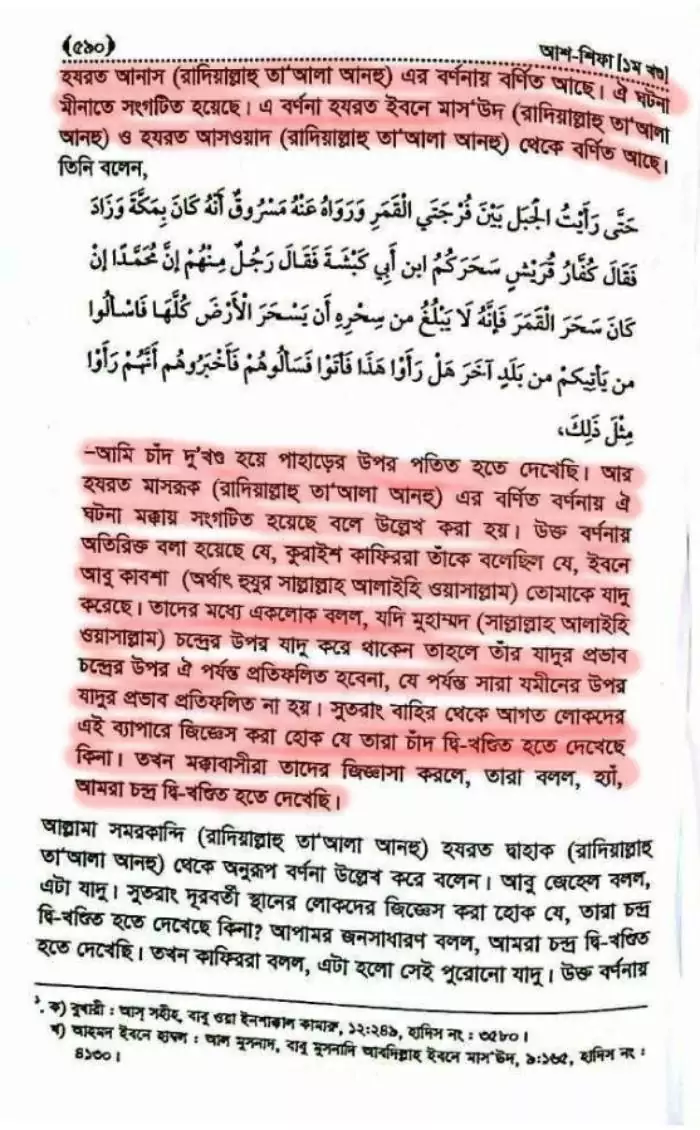
An Islamweb fatwa explains that the splitting of the Moon means that the Moon separated and states that the event actually occurred during Muhammad’s lifetime. [24]
ومعنى انشق القمر، انفلق وقد حصل ذلك فعلا في عهد النبي صلى الله عليه وسلم، وقد نقل ابن كثير في تفسيره الاتفاق على ذلك ووروده في الأحاديث المتواترة بالأسانيد الصحيحة.
English translation:
The meaning of “the Moon split” is that it separated. This actually occurred during the Prophet’s lifetime. Ibn Kathir reported in his tafsir that there was consensus on this and that the event was narrated in mutawatir hadith with sound chains of transmission.
The claim that two separate portions of the Moon became visible is clear in sahih hadith, classical tafsir, works on the proofs of prophethood, and modern fatwas. The presence of numerous local troughs and faults in modern lunar geology does not establish that claim. Inferring from a lunar trough that the Moon once split into two halves and was subsequently rejoined is just as irrational as inferring from long fissures, deep valleys, and normal faults in Earth’s crust that the entire Earth once separated into two halves and reassembled. The existence of local lunar fissures is real, but there is no evidence that they resulted from Muhammad’s miracle. The fundamental incoherence of this pseudoscientific propaganda lies in equating actual lunar geology with a religious narrative.
Apollo 11: NASA’s Original Records and the Astronauts’ Actual Experiences
Neil Alden Armstrong was born on 5 August 1930 in Ohio, United States, and died on 25 August 2012. He was an aviator, aeronautical and aerospace engineer, test pilot, and astronaut. He first travelled into space on the Gemini 8 mission in 1966. As commander of Apollo 11, he became the first human being in history to set foot on the Moon. His companions were Edwin “Buzz” Aldrin and Michael Collins. Armstrong and Aldrin landed on the Moon, while Collins remained in lunar orbit aboard the command module Columbia. The mission began on 16 July 1969 and ended with the return to Earth on 24 July. [25] [26]
Understanding Apollo 11 does not require a newspaper opinion column published decades later. NASA’s records preserve the mission’s planning, launch, trajectory, lunar module landing, astronauts’ conversations, movements, photographs, sample collection, deployment of scientific instruments, and return to Earth. The transcripts in the Lunar Surface Journal can be compared with photographs and the chronology of operations; images of particular observations can be identified in the Image Library. If a specific discovery is attributed to Armstrong, there are practical means of investigating when, where, and through what observation it supposedly occurred. Although Islamic commentaries invoke NASA’s name, they have not connected the alleged splitting of the Moon to any specific observation or investigation in this extensive body of original documentation. [27] [28]
How Far Did Armstrong Walk on the Moon?
Without an understanding of the actual scope of Apollo 11, hearing that Armstrong saw a giant fissure “while travelling on the Moon” can easily produce a false impression of the extent of his observations. Armstrong and Aldrin landed at a specific site in Mare Tranquillitatis, the Sea of Tranquillity. Although the lunar module remained there for approximately 21 hours and 36 minutes, their activities outside it lasted about two and a half hours. During this time they had to complete scheduled tasks including photography, collection of soil and rock samples, installation of scientific instruments, and reporting observations to mission control. The mission involved scientific work centred on a particular landing site, not an on-the-ground survey of the entire lunar surface. [29]
NASA’s photographic reconstruction establishes the limits of Armstrong’s movements more precisely. The farthest he ventured from the lunar module was approximately 60 metres east, near a crater called Little West Crater. After photographing the crater, approximately 33 metres in diameter, he returned to the lunar module. Photographs AS11-40-5954 through AS11-40-5961 establish the location and nature of his observations. Instead of speculating about what Armstrong saw, his precise position and the photographs taken from it can be examined. The proponents of the claim have supplied no information identifying which of these observations contains the supposed dividing line mentioned in Islamic books, what its photograph number is, or where it lies relative to the landing site. [30] [31] [32]
There is no scientific basis for accepting the claim that a mission conducted within a few dozen metres of the lunar module discovered evidence of a division extending through the entire Moon into its deep interior. Observing a local crater or fissure can provide an initial impression of its nature, but determining its extent, penetration into the crust, or whether it separates the internal layers requires distinct investigations. Islamic publications supply none of the intermediate evidence required to turn a local observation into a conclusion about the history of an entire celestial body. The credit for travelling to the Moon belongs to Armstrong; religious propagandists have no right to attach an imaginary discovery to his achievement.
Armstrong’s Actual Statements on the Lunar Surface
NASA’s mission record entitled One Small Step documents his first steps and observations concerning lunar dust, soil structure, footprints, and movement. Part of his statement at 109 hours, 24 minutes, and 48 seconds into the mission reads: [33]
Yes, the surface is fine and powdery. I can kick it up loosely with my toe.
Armstrong’s actual conversations reveal a completely different kind of experience. He reported observations about the fineness of lunar dust, how soil adhered to his boots, the ease and difficulties of movement, and the characteristics of nearby rocks and craters. When even rocks measuring a few inches and the properties of fine dust were carefully recorded in the mission documentation, the necessity of producing contemporary records for a purported discovery that the entire Moon had once separated becomes even clearer. Islamic books provide no specific timestamp, corresponding audio, photograph, or original English transcript for the experience attributed to Armstrong. Where such detailed primary records of an individual’s observations exist, a supposed statement from a later newspaper cannot be treated as their equivalent.
The 1969 Mission Report and the 1970 Scientific Conference
NASA published the Apollo 11 Mission Report in November 1969. The contemporary technical account of the mission thus appeared long before the conversion rumour spread. Chapter 11 discusses the lunar surface, the characteristics of the landing site, the mechanical properties of the soil, rock fragments, small craters, and the astronauts’ observations. The properties of regolith, the layer of accumulated dust and broken rock on the lunar surface, were also studied. A technical record that discusses the dimensions of a local crater and the behaviour of the soil in detail is directly relevant to verifying the alleged discovery of lunar splitting. Although the Hamidia Library commentary invokes NASA’s name, it does not identify any chapter or research finding in this mission report as the source of the supposed discovery. [34]
Apollo 11 returned approximately 21.5 kilograms of lunar rocks and soil to Earth. According to NASA, approximately 1,300 individual samples were distributed among 142 principal investigators from nine countries, including the United States. At the Apollo 11 Lunar Science Conference held in Houston from 5 to 8 January 1970, researchers discussed the chemical composition, mineral constituents, origins, isotopes, and dating of these samples. Testing established that lunar rocks were billions of years old. The age of rocks is not the same as the age of a particular geological event; claiming that the Moon split fourteen centuries ago requires distinct dating of traces of that particular event. The published accounts of research involving international investigators do not mention the discovery alleged by the Hamidia Library. A religious commentary has declared a precise date for the splitting without supplying the researchers’ names, experimental details, or published results. [35]
| Original Document | Information Preserved |
|---|---|
| Mission Overview | Overall mission history |
| Mission Report | Contemporary technical report |
| Lunar Surface Journal | Conversations and operations |
| One Small Step | Armstrong’s statements |
| Image Library | Original photographs |
| Moonwalk Pictures | Movements and Little West Crater |
| Landing Site From Dawn to Dusk | Later photographs of the landing site |
| Lunar Science Conference | Sample analysis results |
The statement that NASA scientists discovered evidence of the splitting of the Moon and determined its precise date is not merely a religious opinion; it is a verifiable claim attributed to a research institution. That institution’s mission report, photographic collection, transcripts of observations, and published accounts of sample analysis provide no evidence for the claim. Producing a newspaper opinion column instead and declaring it a scientific conclusion reached by NASA erases the distinction between research and hearsay. No document establishing the supposed discovery has been produced from the actual research of the institution whose name lends the statement credibility. This is not the establishment of religious truth through science; it is the dissemination of false information in the name of science.
The Claim of Hearing the Adhan on the Moon: A Refutation Based on Acoustics
Sound is a mechanical wave. When a person speaks, vibrations of the vocal cords produce successive compressions and rarefactions in the surrounding air molecules. These pressure variations propagate as waves and cause the listener’s eardrum to vibrate. Sound cannot propagate without a suitable material medium such as air, water, or a solid. The adhan, produced by the human voice, is the same kind of mechanical wave. [36] [37]
The Moon has no dense atmosphere comparable to Earth’s. It is surrounded by an extremely sparse population of gas particles known as an exosphere. The particles are so widely dispersed that they rarely collide. Compared with Earth’s atmosphere, the lunar exosphere contains approximately 1015 times fewer molecules per cubic centimetre. This environment cannot carry the human voice as ordinary airborne sound waves in the way Earth’s atmosphere does. [38]
Even if someone recited the adhan in a normal voice near Armstrong in the open lunar environment, the physical conditions necessary for sound to travel through air and reach his ears as it does on Earth do not exist there. Moreover, the astronaut’s head was enclosed in an airtight helmet supplied with oxygen at a controlled pressure for breathing. The air inside the helmet and the extremely rarefied gas outside it are not interchangeable. The ability to hear one’s own voice inside the helmet does not establish that a voice from an unknown source outside could be heard. The narrative supplies no actual source of the audible adhan, no path of acoustic propagation, and no recorded signal. It is therefore not merely a historical rumour; it is also inconsistent with the established physical mechanisms of ordinary sound transmission.
Experimental Evidence of Sound Transmission in a Vacuum
The transmission of sound through air can be directly investigated through a simple experiment. An electric bell is placed in a transparent airtight vessel, and while it continues ringing, a vacuum pump gradually removes the air inside. The movement of the bell’s hammer and its mechanical vibrations remain visible, but the intensity of airborne sound reaching a listener outside progressively diminishes. When air is readmitted to the vessel, the sound becomes clear again. Some residual vibrations may travel through solid connections, but the central result of the experiment is the dependence of airborne sound on a gaseous medium. The same bell, power supply, and listener are retained while only the condition of the medium changes. The distinction between producing sound and transmitting it can thus be tested without relying on scripture or a speaker’s personal authority.
The example of a tuning fork makes the distinction clearer. When a metal tuning fork is struck, its two prongs vibrate at a particular frequency. On Earth, the surrounding air carries these vibrations to a listener’s ears. In the near-vacuum of space, the same tuning fork can vibrate, but there is no suitable medium to carry its vibrations to a distant listener as airborne sound. Direct contact with a solid can transmit vibrations into that solid, but this is not equivalent to hearing a voice through air. Simply asserting that a sound occurred does not establish that the adhan was heard on the Moon; evidence is needed showing how it was produced and through which physical medium or device it reached the astronaut’s ears. [39]
How Do Astronauts Communicate?
Astronauts’ conversations are audible in Apollo 11 footage not because their voices travelled through air in the open lunar environment. Microphones inside their helmets converted the mechanical vibrations of their voices into electrical signals; communications equipment transmitted the information by radio waves, and receiving equipment converted it back into audible sound. Voice production, signal transmission, and reproduction of sound are separate stages. Radio waves are electromagnetic waves and can travel through space, but an ordinary human voice is not itself a radio transmission. Millions of people on Earth could hear the astronauts through an engineered communications system. Without evidence of an adhan being broadcast through that system, their conversations cannot be equated with an alleged miraculous auditory experience. [40]
| Characteristic | Sound Waves | Radio Waves |
|---|---|---|
| Nature | Mechanical | Electromagnetic |
| Material medium | Required | Not required |
| Propagation in a vacuum | Impossible | Possible |
| Directly audible to humans | At suitable frequencies and intensities | Requires conversion into sound by a device |
| Communication during lunar missions | Inside helmets | Transmission of signals through space |
The story of hearing the adhan normally in the open lunar environment contradicts established principles of acoustics. No evidence has been produced from the mission records that an adhan signal was transmitted to Armstrong’s communications equipment. The story of hearing a particular religious sound has circulated without any audio, time, source, or contemporary statement by Armstrong documenting the experience. Most decisively, Armstrong himself later denied the experience in writing. This is therefore not simply a matter of speculating about an extraordinary physical claim: the testimony of the individual concerned directly contradicts the story. Physics, the preserved mission records, and Armstrong’s personal statements all refute the false narrative of hearing the adhan on the Moon.
Lunar Fissures, Rima Ariadaeus, and Falsehoods Attributed to NASA
Images of a long fissure on the Moon circulate online with the claim that it is a surviving trace of Muhammad’s splitting of the Moon. Among the best-known images are photographs of the lunar rille Rima Ariadaeus. The image is real; the falsehood lies in its religious interpretation. NASA’s photographic description identifies the rille as a known geological fault system. [41] [42]
The Photograph Was Not Taken by Armstrong
A widely circulated image of Rima Ariadaeus was taken in May 1969 during Apollo 10. The astronauts were Thomas Stafford, John Young, and Eugene Cernan. The rille was photographed during this mission approximately two months before Armstrong set foot on the Moon. NASA published the image in its Astronomy Picture of the Day on 29 October 2002. [43]
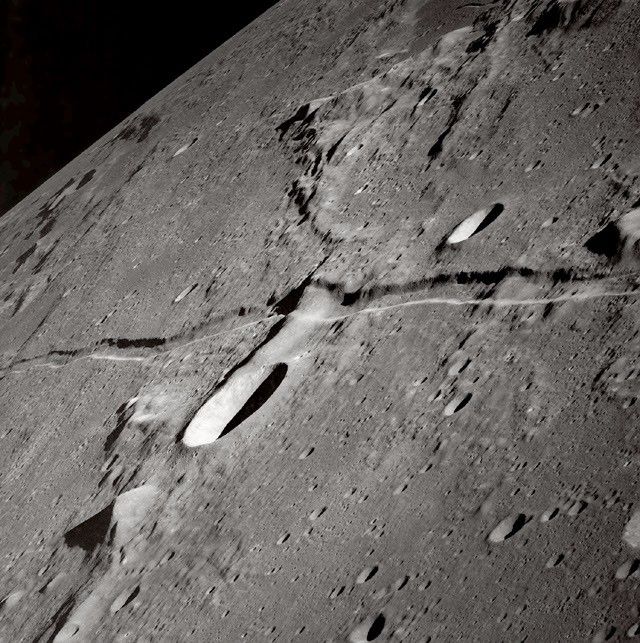
This widely circulated photograph is not evidence of a discovery made during Armstrong’s lunar walk. Its photographic history predates Apollo 11, and the history of observing lunar rilles predates the spacecraft era itself. Astronomers observed such lines and troughs through telescopes from Earth. Space exploration enabled the acquisition of better photographs; it did not discover an already known geological feature for the first time as a religious miracle. If a genuine NASA photograph is used to substantiate a story about Armstrong’s personal experience, the mission, date, and location from which it was taken are immediately relevant. The true identity of the image exposes its incompatibility with the story being circulated.
What Is Rima Ariadaeus?
Rima Ariadaeus is a linear lunar rille located between Mare Tranquillitatis and Mare Vaporum. On the basis of Lunar Reconnaissance Orbiter imagery, NASA describes it as an approximately 300-kilometre-long geological fault system. Its structure resembles normal fault systems found on Earth. [44]
Rima Ariadaeus, which extends for approximately 300 km, is a fault system exhibiting a well-developed graben typical of normal fault systems on Earth.
The Moon’s diameter is approximately 3,475 kilometres and its equatorial circumference approximately 10,920 kilometres. Rima Ariadaeus is only about 2.7 percent of that circumference in length. This local trough is not equivalent to the complete dividing line that would result from dividing a spherical body down the middle into two halves. [45]

How Does a Graben Form?
When extensional stress develops in the crust of a planet or satellite, solid rock layers may fracture and become displaced in response. If the rock between two roughly parallel normal faults subsides relative to the neighbouring portions, higher ground remains on either side and an elongated depression forms between them. Geologists call this down-dropped block a graben. Long valleys and fault systems form in Earth’s crust by the same process; it does not require the entire Earth to separate into pieces. This local crustal displacement is important in analysing the formation of Rima Ariadaeus. The shape of a structure, arrangement of its faults, and relationships between neighbouring rock layers can explain its origin. Calling a graben a trace of the complete Moon separating and reassembling conflates two fundamentally different physical processes. [46]
The block between two normal faults subsides to form a graben. The diagram is a simplified representation of the process.
Research on Rima Ariadaeus Predates the Moon Landing
The original report of the 1966 study identifies its author as George I. Smith. In A Comparison of Two Terrestrial Grabens with the Lunar Rilles Rima Ariadaeus and Rimae Hypatia I and II, he compared the arrangement of faults, morphology, and width-to-depth ratios of California’s Wildrose and Slate Range grabens with those of the lunar rilles. He used photographs from the Lick Observatory to analyse Rima Ariadaeus. His conclusion was that Rima Ariadaeus and Rimae Hypatia I and II could be interpreted as grabens produced by crustal extension. Thus approximately three years before Armstrong landed on the Moon in 1969, the rille had not only been observed but had already been the subject of published comparative scientific research into its structure and origin. This contemporary research directly refutes the story that Armstrong first discovered the structure during his lunar mission. [47] [48]
The Moon Has Numerous Geological Rilles, Not Just One
The troughs known as rilles on the lunar surface are not a single type of geological structure. Some are linear, some sinuous, and others arcuate; analysis of their shape and origin draws on evidence of crustal extension, ancient lava flows, and other geological processes. Comparing Rima Ariadaeus with similar structures elsewhere on the Moon removes any basis for portraying it as an utterly unique and inexplicable line. Selecting a photograph of one trough because it superficially resembles a religious story and ignoring other similar troughs is a clear example of cherry-picking evidence. The criterion for a scientific explanation is whether it accounts for the origin and observable configuration of the structure, not whether its appearance resembles a story in a religious text. [49] [50] [51]
| Structure | Characteristics |
|---|---|
| Rima Ariadaeus | Extensional fault system and graben |
| Rima Burg | Graben in the Lacus Mortis region |
| Vallis Schröteri | Sinuous rille associated with volcanic activity |
| Rima Hadley | Rille associated with lava flows, observed during Apollo 15 |
| Rupes Recta | Long geological fault scarp |
| Lee-Lincoln Fault | Contractional fault |
Lunar Contraction, Moonquakes, and New Faults
The Moon is contracting as it loses internal heat. This contraction causes layers of lunar crust to override one another and produces contractional faults. Earth’s gravitational tidal forces are also related to geological stresses. In 2019, Thomas Watters and colleagues reanalysed the locations of 28 shallow moonquakes recorded during the Apollo missions and found that eight were close to visible faults. The relationship between fault locations and moonquakes is important evidence of lunar geological activity. [52] [53]
Extensional grabens such as Rima Ariadaeus and faults produced by lunar contraction are not the same type of structure. In the former case, portions of the crust move apart and the intervening block subsides; in the latter, rock layers are compressed and one section can override another. The formation of such structures at different times and through different processes is characteristic of a satellite’s geological evolution. Indiscriminately calling every line a fissure and turning it into evidence for the same religious story obscures these differences. Researchers compare the locations of moonquakes, the morphology of faults, and the relationships of neighbouring rock layers to understand the processes. Religious propaganda dispenses with that methodology and simply declares a visible line to be the remnant of a miracle.
Is the Fissure Really 1,400 Years Old?
The Hamidia Library commentary does not merely claim that the Moon split; it attributes to NASA the finding that the event occurred approximately 1,400 years ago. Yet dating a geological structure requires analysis of surrounding rock layers, the relationships between earlier and later structures, impact craters, and other data. LROC’s account of Rima Ariadaeus examines the stratigraphic relationships between the trough and adjacent structures. It crosses some older features, while later impact craters have formed on its floor. Such relationships reveal which structures formed earlier and which formed later, but they do not by themselves establish that the rille formed precisely fourteen centuries ago. The research under discussion contains no such conclusion. The Islamic book’s claim required a specific dating report. Instead, a date coinciding with Muhammad’s lifetime was circulated as a finding of NASA research. [54]
A NASA Scientist’s Direct Statement
When Brad Bailey, a scientist at NASA’s Lunar Science Institute, was asked in 2010 about the claim that the Moon had split in two, he stated that there was no scientific evidence that it had separated into two or more pieces and reassembled. His statement is preserved in AFP’s fact-checking report. [55] [56]
No current scientific evidence reports that the Moon was split into two (or more) parts and then reassembled at any point in the past.
| Islamic Propaganda | Actual Facts |
|---|---|
| Armstrong discovered a mysterious fissure | The rille was studied before the Moon landing |
| Armstrong took the photograph | The widely circulated image is from Apollo 10 |
| The fissure encircles the entire Moon | A local rille approximately 300 km long |
| A trace of the Moon being rejoined | A graben within a normal fault system |
| It is the only such structure on the Moon | The Moon contains numerous geological rilles and faults |
| NASA dated it to 1,400 years ago | No specific research paper has been identified |
| NASA acknowledged that the Moon split | A NASA scientist denied the existence of such evidence |
The authenticity of NASA’s photograph is not in dispute here; the disputed claim is the religious explanation attached to it. Using NASA’s image while omitting its actual geological explanation and then circulating an entirely different conclusion under NASA’s name is a distortion of information. Finding the photograph on NASA’s website does not establish the truth of the religious statement attached to it. Reading the original description reveals that researchers explain the structure as a local fault system and have denied that scientific evidence exists for the Moon splitting and reassembling. Invoking an institution’s scientific authority while rejecting its actual scientific conclusions is the central pseudoscientific technique employed here.
The Physical Implausibility and Cosmic Consequences of Splitting the Moon
The Moon is not a small rock that can easily be broken in two by striking it. It is a celestial body with a mass of approximately 7.346 × 10²² kilograms and a diameter of approximately 3,475 kilometres. Its own gravity holds its enormous mass of material together in a roughly spherical structure. Its interior contains a crust, mantle, and metallic core. Splitting the Moon means separating this entire celestial structure into two distinct portions. It is not comparable to the formation of a local fissure on the lunar surface. [57] [58]
| Physical Property | Moon | Earth |
|---|---|---|
| Diameter | 3,475 km | 12,742 km |
| Mass | 7.346 × 10²² kg | 5.972 × 1024 kg |
| Volume | Approximately 21.97 billion km³ | Approximately 1.0832 trillion km³ |
| Surface gravitational acceleration | 1.624 m/s2 | 9.807 m/s2 |
| Escape velocity | 2.38 km/s | 11.2 km/s |
| Equatorial circumference | Approximately 10,917 km | Approximately 40,030 km |
The Moon Is Held Together by Its Own Gravity
According to Newton’s law of gravitation, matter possessing mass attracts other matter possessing mass. When a small rock breaks, the mutual gravitational attraction between its fragments is so negligible that it goes unnoticed in everyday experience. In a celestial body such as the Moon, however, its enormous mass itself holds its structure together. If the Moon were divided into two equal portions, each would have a mass of approximately 3.673 × 10²² kilograms. Two portions of such mass would exert a powerful mutual gravitational attraction, and work would have to be done against that force to separate them. Alongside fracturing the lunar rock layers, it would be necessary to account for changes in the distance between the centres of the portions, their relative motion, and the transfer of energy during subsequent reassembly. A local crustal fault and the separation of the gravitational structure of an entire celestial body are events on entirely different scales. [59]
The energy required to disperse all the material of a celestial body completely against its mutual gravitational attraction is called its gravitational binding energy. For a uniform-density sphere, the approximate calculation is:
Gravitational Binding Energy
G = universal gravitational constant
M = total mass of the Moon
R = radius of the Moon
Approximate total gravitational binding energy, assuming a uniform-density sphere.
This calculation estimates the energy required to release all lunar material from its gravitational binding; it is not a direct calculation of the energy required to divide the Moon into just two particular portions. The precise energy depends on the shapes of the portions, their separation distance, relative velocity, and method of reassembly. Nevertheless, the estimate illustrates the enormous scale of the Moon’s gravitational binding.
What Would Happen If the Two Portions Reassembled?
The mutual gravity of two separated lunar portions would draw them back towards one another. Depending on their separation, velocities, and directions of motion, they might collide, become gravitationally bound, or enter another orbital trajectory. In ordinary physical processes, kinetic energy during a collision can be converted into heat, rock deformation, seismic vibrations, and the kinetic energy of detached debris. If the collision is sufficiently energetic, some rock may melt. Simply bringing two portions back alongside one another does not automatically restore the former internal arrangement, surface structure, and dynamical state of a celestial body. How such reconstruction occurred and what physical evidence it left are central questions for the claim of actual splitting and reassembly.
Cosmic collisions, material displacement, melting, and reconstruction are likewise important in scientific studies of the Moon’s origin. NASA describes the scientific hypothesis that approximately 4.5 billion years ago a large celestial body collided with the newly formed Earth and the Moon formed from the debris. Research into this process analyses the chemical properties of rocks, isotopes, and internal structure. [60]
The claim that the entire Moon split and subsequently reassembled in the seventh century requires independent physical evidence of the separation, reassembly, and fate of the energy involved. A photograph of a rille cannot reveal what changes occurred in the lunar interior, when they occurred, or whether the rille is related to a division of the entire lunar body. Disregarding the research that supplies a natural geological explanation for the rille and turning the photograph itself into evidence of a miracle leaves the fundamental physical questions unresolved. Islamic propaganda conceals this enormous evidentiary gap between the claim of lunar splitting and the existence of a local lunar trough.
The Moon’s Internal Structure and Modern Research
One method of gathering information about the Moon’s internal structure is the analysis of seismic waves. Instruments installed during the Apollo missions collected data on vibrations produced by moonquakes and meteoroid impacts. Seismic waves travel at different speeds through materials with different densities and elastic properties; they are also reflected and refracted at boundaries between internal layers. Analysis of these data has established a scientific understanding of the lunar crust, mantle, and core. Such research provides much more relevant information about the deep lunar interior than a photograph of the surface. A claim that the whole Moon separated and reconstructed itself must be related to research into its internal structure, not merely a visible surface line. [58]
NASA’s Gravity Recovery and Interior Laboratory (GRAIL) mission measured the Moon’s gravitational field with great precision. Differences in the density and distribution of material are reflected in the gravitational field. In 2013, Mark Wieczorek and colleagues published research on lunar crustal thickness and density based on GRAIL data. [61]
Seismic research into the Moon’s interior and GRAIL’s gravitational measurements have been used to investigate longstanding questions in lunar geology. Studies of crustal thickness, variations in material density, the effects of ancient impacts, and the physical properties of different regions reconstruct the Moon’s evolutionary history. Yet Islamic preachers have not produced any research finding that the Moon completely split and reassembled in the seventh century. Selecting a geological rille in a limited region of the lunar surface as evidence for that event is no substitute for this extensive scientific data. No correspondence has been demonstrated between NASA’s actual research and the claim that NASA research established the alleged splitting.
The Contradiction Between Miracle Claims and Scientific Evidence
There is a fundamental contradiction in invoking NASA photographs as scientific evidence for the splitting of the Moon. Using a visible physical trace as evidence entails acknowledging that its nature, origin, and age can be investigated scientifically. Yet when that investigation identifies the feature as a local geological fault and it is nevertheless declared a miraculous trace of lunar splitting, the predetermined religious conclusion takes precedence over the research findings. NASA’s photographic authority is accepted, NASA’s explanation rejected, and the opposite conclusion then circulated under NASA’s name. The presence of a celestial event in a religious text does not determine the actual history of a celestial body. This method of adapting research to a predetermined religious belief rather than drawing conclusions from evidence is pseudoscience.
The Indian King Cheraman Perumal and the Alleged Historical Testimony of the Moon’s Splitting
Islamic propaganda presents Cheraman Perumal, a king of India’s Malabar region, as an independent non-Muslim eyewitness to the splitting of the Moon. According to the popular narrative, he saw the Moon split, heard about Muhammad from Arab merchants, divided his kingdom, travelled to Arabia, and embraced Islam. Examination of the story’s sources, manuscripts, and versions, however, identifies it not as a seventh-century astronomical document but as a religious narrative concerning the origins of Malabar’s Muslim community. [62] [63]
The Alleged Indian Testimony in Ibn Kathir’s Work
In the fourteenth century, Ibn Kathir claimed that an inscription on a structure in India referred to the night the Moon split. His claim relies on unnamed travellers. [64]
على أنه قد ذكر غير واحد من المسافرين أنهم شاهدوا هيكلا بالهند مكتوبا عليه : إنه بني في الليلة التي انشق القمر فيها.
English translation:
More than one traveller mentioned that they saw a structure in India upon which it was written: It was built on the night when the Moon split.
The most important information about Ibn Kathir’s alleged Indian structure is missing from his account. He provides neither the structure’s name, geographical location, builder, and construction date, nor the language and original wording of the inscription or the identities of the travellers who saw it. Mentioning an inscription on the authority of unnamed individuals in a fourteenth-century historical work is entirely different from producing an actual seventh-century inscription. Even if an inscription genuinely mentioned the splitting of the Moon, it could not be accepted as a contemporary observation without establishing its date and source of information. Here the primary document itself is missing. No contemporary documentation has been produced for Ibn Kathir’s suggestion that information might have been concealed either. Explaining the absence of independent evidence through an alleged conspiracy does not remedy the absence; it merely adds another unsupported claim.
Tarikh-i Firishta and the Chronological Gap
In footnote 150 of his biography of Muhammad, Asadullah Al-Ghalib refers to Muhammad Qasim Hindushah Firishta’s chapter on the history of Malabar’s rulers. The Hamidia Library commentary on Sahih al-Bukhari also mentions this book. Yet Firishta was a historian of the late sixteenth and early seventeenth centuries. A book written approximately a thousand years after the alleged splitting is not a contemporary eyewitness document. [65] [66]
Invoking Firishta’s history does not establish that Cheraman Perumal saw the Moon split. If an author writing approximately a thousand years later possessed reliable information about the seventh century, it is necessary to identify the older document from which he obtained it, its date of composition, and whether it can be independently examined. In this particular case, no astronomical observation log written by Cheraman Perumal, contemporary document from his royal court, or text of a specific inscription has been produced. Firishta’s name supplies the authority of a well-known historical work, but that authority cannot substitute for primary documentation. Presenting a religious narrative circulating many centuries later as a seventh-century eyewitness account violates the basic principles of historical source criticism.
Manuscripts Preserved in the British Library
One of the most detailed Arabic versions of the Cheraman Perumal narrative is the Qiṣṣat Shakarwatī Farmāḍ. It recounts the king’s conversion to Islam, division of his kingdom, journey to Arabia, marriage, death on the return journey, and the founding of mosques in Malabar by his companions. Two manuscripts preserved in the British Library bear the shelfmarks IO Islamic 2807d and Or 1738h. [67] [68]
Ines Weinrich’s research discusses the acquisition history of the two manuscripts. The first belonged to John Leyden’s collection, which the India Office Library purchased in 1824 after his death. The second was prepared at the initiative of Henry Miers Elliot around 1853. The dates of surviving copies are not the dates of the narrative’s original composition, but these copies cannot be represented as original seventh-century royal documents. [69]
Treating a manuscript’s preservation in the British Library as proof of the truth of its contents is a fundamental historical error. A library preserves written traditions; it does not declare every religious or miraculous claim contained in them to be true. Major libraries preserve creation stories, miracles, dynastic legends, and mutually contradictory religious narratives side by side. Their existence establishes that people at some point wrote, copied, or believed these stories. The two manuscripts concerning Cheraman Perumal are historical material in this sense, but their shelfmarks are not measurements of the physical condition of the seventh-century Moon. Anyone who uses the story as contemporary royal testimony bears the responsibility of establishing the actual source and date of that testimony.
Contradictory Miraculous Accounts in the Two Manuscripts
In 2023, University of Glasgow researchers Ophira Gamliel and Ines Weinrich demonstrated important differences between the moon-splitting episodes in the two manuscripts. In the first, the Moon is to descend from the sky, enter one sleeve of Muhammad’s garment and emerge from the other, and then enter the neck opening of the garment and split into two. The second omits the garment episode; the Moon is to split into two in the sky at a gesture of Muhammad’s finger. [70]
| Aspect of the Narrative | IO Islamic 2807d | Or 1738h |
|---|---|---|
| Position of the Moon | Descends from the sky | Remains in the sky |
| Muhammad’s garment | Enters through sleeves and neck opening | No such episode |
| Method of splitting | Splits after entering the neck opening of the garment | Splits in the sky at a gesture of the finger |
| Trajectory of the portions | One eastward, the other westward | One eastward, the other westward |
| Reassembly | In the middle of the sky | In the middle of the sky |
The differences between the manuscripts are not merely differences in wording: they concern the central question of how the miracle supposedly occurred. In one, the Moon descends and enters Muhammad’s garment; in the other, it splits in the sky at a gesture of his finger. The University of Glasgow researchers also investigated the relationship between such narratives and Islamic miracle literature circulating in Western Asia. Weinrich’s research discusses the formation of the Qiṣṣa from elements of multiple texts and narratives. What is present here is not an unchanged transcription of an Indian king’s independent observation but a religious narrative modified under the influence of multiple sources. The absence in one version of extraordinary miraculous elements present in another further weakens the basis for treating them as an eyewitness’s precise astronomical observations. [69]
The Moon-Splitting Episode Is Absent from Tuhfat al-Mujahidin
The sixteenth-century Malabari Islamic scholar Zayn al-Din Makhdum’s Tuhfat al-Mujahidin also recounts the origins of Islam in Malabar and the king’s conversion. According to the University of Glasgow researchers’ account, the corresponding section omits the moon-splitting episode. [71]
The fact that Tuhfat al-Mujahidin retains the king’s conversion story but omits the moon-splitting episode demonstrates the need to distinguish these claims. The conversion of a Malabari ruler and his alleged miraculous experience are separate historical claims; evidence for one does not establish the truth of the other. Likewise, the presence of ancient mosques, Muslim settlements, or Arab merchants in a region cannot establish the truth of the splitting of the Moon. Trade between India and Arabia, the formation of religious communities in local society, and the history of religious institutions are subjects of actual historical investigation. Giving a miraculous story attached to that history the same status as its other factual elements erases the distinction between religious narrative and historical evidence.
Chronological Inconsistencies in the Conversion Story
The Kerala government’s tourism department itself records different dates for the Cheraman Perumal conversion narrative. One version places the event during Muhammad’s lifetime, another about a century after his death, and others in the twelfth century. Muhammad died in 632 CE. A conversion occurring a century after his death or in the twelfth century is therefore chronologically incompatible with the story of meeting him in person. A variation of several centuries in the timing of the same story means that we do not possess a precisely dated eyewitness account. Selecting the date that coincides with the Islamic miracle narrative and declaring it true does not constitute historical verification. A conclusion about the seventh-century Moon requires evidence of independent seventh-century observations. [72]
The Origin Legend of Malabar’s Muslim Community
Scott Kugle and Roxani Eleni Margariti’s 2017 study compares the Qiṣṣat Shakarwatī Farmāḍ with origin narratives of coastal Muslim communities around the Indian Ocean. Sebastian Prange’s 2018 book Monsoon Islam also discusses the significance of the Cheraman Perumal legend in Malabar’s religious and social history. Connecting a local ruler directly to Muhammad links the origins of the local community to the foundational history of Islam; the story of the king’s journey to Arabia and the founding of mosques also establishes a connection with local political authority. The social function of the narrative can be understood from its content and history of circulation. But that function yields no astronomical conclusion that the Moon really split. The principal logical error here is to turn a community’s identity-forming origin narrative into independent testimony for its miraculous elements. [73] [74]
| Alleged Evidence | Actual Historical Status | Evidentiary Problem |
|---|---|---|
| Seventh-century royal document | No specific document has been produced | Original document and date missing |
| Ibn Kathir’s Indian structure | Fourteenth-century report | Name, location, and inscription missing |
| Tarikh-i Firishta | Seventeenth-century history | A gap of approximately a thousand years |
| Qiṣṣat Shakarwatī Farmāḍ | Religious origin narrative | Multiple texts and divergent miraculous accounts |
| IO Islamic 2807d | Acquired in 1824 | Story of the Moon entering a garment |
| Or 1738h | Copy dating to around 1853 | Differences from the other manuscript |
| Tuhfat al-Mujahidin | Sixteenth-century history | Moon-splitting episode absent |
| Ancient mosques and settlements | Evidence of social history | Not documentation of the splitting of the Moon |
The alleged testimony of Cheraman Perumal is not an observation log written by a non-Muslim king himself; it is a legend about him circulating in later religious literature. Making someone a character in a narrative and obtaining that person’s firsthand testimony are entirely different things. Just as a false conversion experience has been attributed to Neil Armstrong, a miraculous observation has been attributed to Cheraman Perumal. Repetition of different versions of the same narrative does not constitute independent historical evidence.
The Rumour of Neil Armstrong’s Conversion and the 1983 US Department of State Document
The rumour of Armstrong’s conversion did not originate in the Internet era. By the early 1980s, it had spread in Egypt, Malaysia, Indonesia, and other countries. Islamic organisations and at least one government inquired about his possible participation in Islamic activities. At Armstrong’s request, the US Department of State took steps to refute the rumour. These events are discussed in the 2020 collection of correspondence edited by historian James R. Hansen. [75] [76]
A Letter Sent from Cairo in 1982
On 10 September 1982, a person using the name Mu’allaf Subhanallah wrote from Cairo to congratulate Armstrong on his conversion to Islam. The correspondent relied on the story circulated in local newspapers and mosques that Armstrong had heard the adhan on the Moon and subsequently recognised it in Cairo. He also urged Armstrong to disregard the American government’s obstruction and declare his religious faith. [77]
Do not let the American government stop you from declaring your faith!
The letter from Cairo demonstrates that by 1982 the rumour had reached a point at which a reader treated Armstrong’s conversion as an established fact and congratulated him on it. The correspondent was not speaking from firsthand experience; he relied on statements circulated in local newspapers and mosques. He not only asserted the conversion but assumed that the American government might prevent Armstrong from declaring his faith. The letter supplies no government directive or complaint by Armstrong himself supporting this assumption. A statement resembling the story later circulated in Al-Ghalib’s book, that Armstrong concealed the news for fear of the American administration, is already present in this document from the early 1980s. The conspiracy story is not established by any public allegation made by Armstrong himself; it is documented as part of the history of the rumour’s circulation.
The Diplomatic Cable of 4 March 1983
The US Department of State’s diplomatic cable of March 1983 bore the identification number UNCLAS STATE 056309. According to the cable, reports of Armstrong’s conversion to Islam were false, and he himself requested that diplomatic posts firmly inform anyone making inquiries that he had not converted to Islam. [78] [79]
P 04085 0Z MAR 83 ZEX
FM SECSTATE WASHD C
TO ALL DIPLOMATIC AND CONSULAR POSTS PRIORITY
BI
UNCLAS STATE 056309
FOLLOWING REPEAT SENT ACTION ALL EAST ASIAN AND PACIFIC DIPLOMATIC POSTS DID MAR 02.
QUOTE: UNCLAS STATE 056309
E.O. 12356: N/A
TAGS: PREL, PGOV, US, ID
SUBJECT: ALLEGED CONVERSION OF ENIL ARMSTRONG TO ISLAM
REF: JAKARTA 3081 AND 2374 (NOT ..)
1. FORMER ASTRONAUT NEIL ARMSTRONG, NOW IN PRIVATE BUSINESS, HAS BEEN THE SUBJECT OF PRESS REPORTS IN EGYPT, MALAYSIA AND INDONESIA (AND PERHAPS ELSEWHERE) ALLEGING HIS CONVERSION TO ISLAM DURING HIS LANDING ON THE MOON IN 1969. AS A RESULT OF SUCH REPORTS, ARMSTRONG HAS RECEIVED COMMUNICATIONS FROM INDIVIDUALS AND RELIGIOUS ORGANIZATIONS, AND A FEELER FROM AT LEAST ONE GOVERNMENT, ABOUT HIS POSSIBLE PARTICIPATION IN ISLAMIC ACTIVITIES.
2. WHILE STRESSING HIS STRONG DESIRE NOT TO OFFEND ANYONE OR SHOW DISRESPECT FOR ANY RELIGION, ARMSTRONG HAS ADVISED DEPARTMENT THAT REPORTS OF HIS CONVERSION TO ISLAM ARE INACCURATE.
3. IF POST RECEIVE QUERIES ON THIS MATTER, ARMSTRONG REQUESTS THAT THEY POLITELY BUT FIRMLY INFORM QUERYING PARTY THAT HE HAS NOT CONVERTED TO ISLAM AND HAS NO CURRENT PLANS OR DESIRE TO TRAVEL OVERSEAS TO PARTICIPATE IN ISLAMIC RELIGOUS ACTIVITIES.
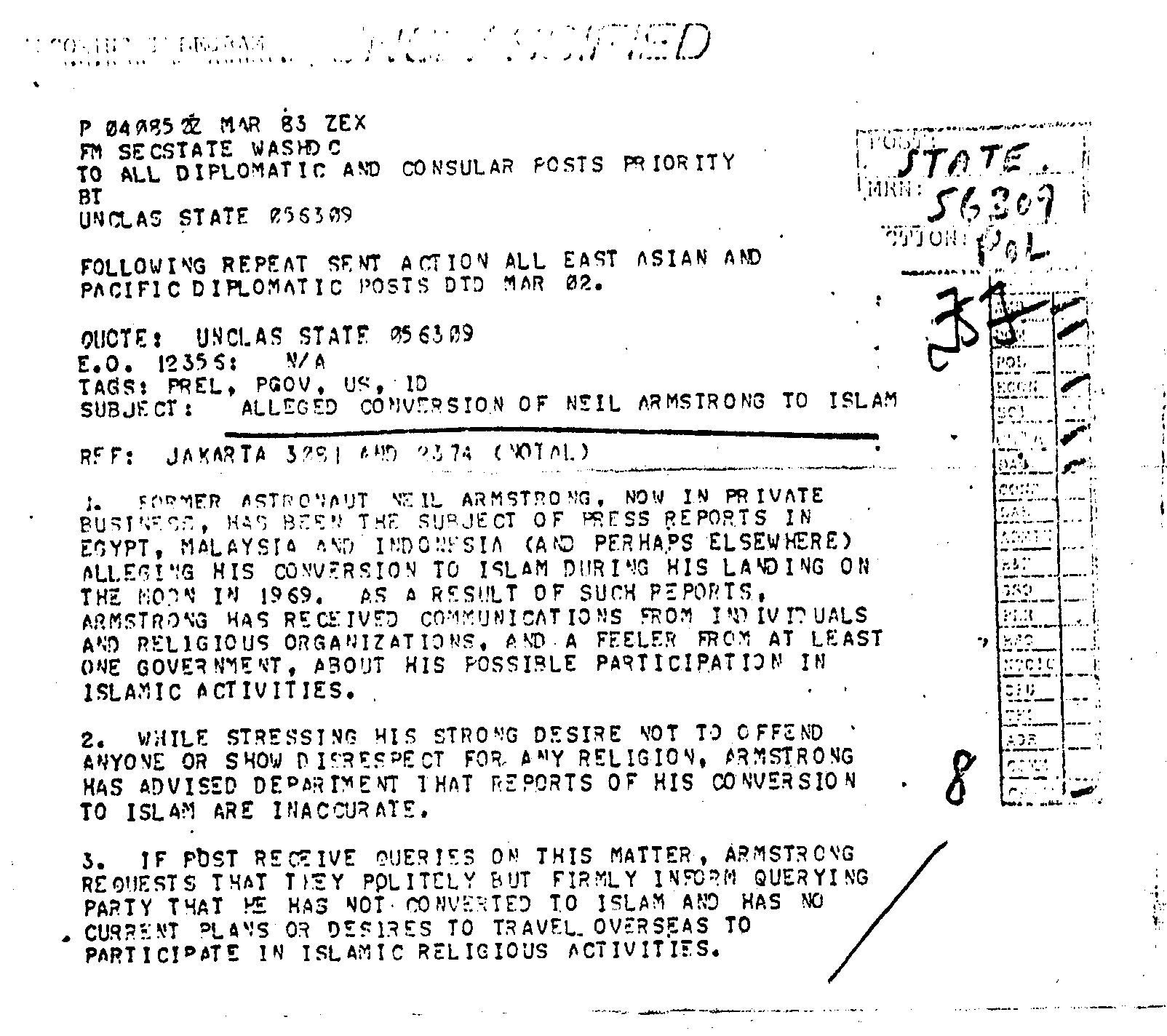
The diplomatic cable is unequivocal: Armstrong himself told the State Department that reports of his conversion to Islam were inaccurate and requested that the relevant posts refute them. This was not a declaration by the American government determining his religious beliefs for him; it was an administrative document transmitting information supplied by Armstrong himself to diplomatic posts. Al-Ghalib’s book claims that Armstrong concealed the news of his conversion for several years out of fear of the American administration. Yet the contemporary document records Armstrong’s efforts to dispel the rumour with the assistance of that very government. The records of the institution accused of concealing his conversion document Armstrong’s own initiative against the alleged conversion. There is no basis for dismissing this official refutation without supplying separate reliable evidence of government pressure.
The May 1983 Press Conference with Middle Eastern Journalists
The endnotes of James R. Hansen’s biography refer to a US Information Agency document prepared on 20 May 1983, entitled TelePress Conference: Neil Armstrong/Cairo; Topic: Disinformation in Egypt on Armstrong’s Supposed Conversion to Islam. On 23 May, Armstrong took the opportunity to refute the rumour in a telephone press conference with journalists in Cairo. [80]
The existence of this press conference contradicts the story of concealing the alleged conversion. The journalists concerned were given the opportunity to question Armstrong about the very news being circulated in Egypt in his name. Instead of concealing information, he arranged to refute the rumour publicly. The title of the government document concerning the organisation of the press conference itself identifies the subject as disinformation about Armstrong’s supposed conversion. Although later religious publications alleged concealment for fear of the American government, no reliable documentation contradicting this contemporary activity has been produced. The source of the factual distortion is the acceptance of stories invented about an individual in place of that individual’s own statements.
The Fallacy of Concealment for Fear of the US Government
Attaching a government conspiracy narrative to the false claim of conversion allows Armstrong’s denial itself to be turned into evidence of the conspiracy. If he confirms the claim, he is said to have converted; if he denies it, he is said to be lying out of fear of the government. Whatever he says, the predetermined conclusion remains unchanged. This is an example of a self-sealing claim.
Hansen’s collection of correspondence recounts an incident in which a student of Middle Eastern descent questioned Armstrong directly. Even after Armstrong denied the story, the student did not believe him, because his father had already told him that Armstrong would lie. This method of dismissing even a direct denial is the opposite of a search for truth. [81]
The story that Armstrong was dismissed from NASA because he converted to Islam is inconsistent with his actual career. He resigned from NASA in August 1971, became a professor of engineering at the University of Cincinnati, and taught there until 1979. In 1986 he also served as vice-chairman of the Presidential Commission investigating the Challenger disaster. [82] [83]
Establishing the government conspiracy claim would require a directive compelling Armstrong to conceal his religion, a dismissal order, a personal complaint by Armstrong, or other independent testimony. Instead, what exists is documentation of the government’s refutation of the rumour at his own request, and his denial before journalists. His actual career likewise supplies no support for the story of dismissal because of conversion to Islam. If Armstrong’s denial is itself taken to mean that he secretly converted, no independent standard for distinguishing truth from falsehood remains. No religious preacher has the right to dismiss the statements of the individual concerned as lies without evidence and impose another religious identity upon him.
Direct Refutations in Armstrong’s Personal Letters, Interviews, and Authorized Biography
The US Department of State’s records are not the only evidence. During his lifetime, Armstrong repeatedly denied the false reports of his conversion in letters, press conferences, interviews, and his authorized biography. These denials can be traced consistently from 1983 to 2005.
Armstrong’s Letter to Maulana Wahiduddin Khan: 5 May 1983
According to a publication of the organisation founded by Indian Islamic thinker Wahiduddin Khan, the news of Armstrong’s conversion appeared in the 10 January 1983 issue of Malaysia’s The Star and the 29 January issue of Sri Lanka’s Daily News. The news claimed that he had heard the adhan on the Moon, recognised it in Cairo, and lost his job because of his conversion. Wahiduddin Khan wrote directly to Armstrong. His reply dated 5 May 1983 was reproduced in the August 2019 issue of Spirit of Islam, published by the Centre for Peace and Spirituality. [84]
The reports of my conversion to Islam, of hearing the voice of Azan on the moon, and later in Cairo (I have never been in Egypt) are all untrue.
In his reply to Wahiduddin Khan, Armstrong rejected three central claims of the narrative at once: he had not converted to Islam, he had not heard the adhan on the Moon, and he had not heard the same adhan in Cairo. More specifically, he stated that as of the date of his letter in 1983 he had never been to Egypt. He had not even been present in the city where the alleged occasion for his conversion supposedly occurred. Refuting the story therefore does not depend solely on acoustics or NASA’s mission records; the man whose experience the story purports to describe personally declared it false in writing. This denial was given in response to an Islamic thinker’s inquiry and was reproduced in the publication of that thinker’s own organisation.
The same publication refers to a telephone press conference held at the American Center in New Delhi on 12 May 1983. Armstrong denied the claims of conversion and dismissal. Citing the following day’s Hindustan Times report, it states that Armstrong had not been exposed to Islamic teachings and had not read the Quran. This directly contradicts the Bukhari commentary’s claim that he had already read the account of the splitting of the Moon. [85]
Wahiduddin Khan’s publication also criticises the tendency to invent such stories out of a desire for the worldwide triumph of religion. The distinction between religious aspirations and actual facts is thus documented in the publication of an organisation founded by an established Islamic thinker.
The Letter from Administrative Aide Vivian White: 14 July 1983
On 14 July 1983, Armstrong’s administrative aide Vivian White sent a letter on his behalf to Phil Parshall, director of the Asian Research Center. The letter stated that reports of Armstrong’s conversion to Islam and of hearing the adhan on the Moon or elsewhere were false. [86]
NEIL A. ARMSTRONG
LEBANON, OHIO 45036
July 14, 1983
Mr. Phil Parshall
Director, Asian Research Center
International Christian
Fellowship 29524 Bobrich
Livonia, Michigan 48152
Dear Mr. Parshall:
Mr. Armstrong has asked me to reply to your letter and to thank you for the courtesy of your inquiry. The reports of his conversion to Islam and of hearing the voice of Adzan on the moon and elsewhere are all untrue.
Several publications in Malaysia, Indonesia and other countries have published these reports without verification. We apologize for any inconvenience that this incompetent journalism may have caused you.
Subsequently, Mr. Armstrong agreed to participate in a telephone interview, reiterating his reaction to these stories. I am enclosing copies of the United States State Department’s communications prior to and after that interview.
Sincerely
Vivian White
Administrative Aide
The letters sent to Wahiduddin Khan and Phil Parshall, the US Department of State’s cable, and Armstrong’s communications with journalists all arose from the same rumour. Their most important point of agreement is the rejection of the claims that Armstrong converted to Islam and heard the adhan. Vivian White’s letter also explicitly identifies the newspapers’ failure to verify their reports. When later religious publications repeated the claim, they had a responsibility to consider these written denials and to produce any contrary primary documentation. Reprinting the old rumour without such documentation does not turn it into new historical testimony. Instead, the statements of the man who protested against the false news are obscured while the same false experience is attributed to him again.
Confusing the City of Lebanon, Ohio, with the Middle Eastern Country of Lebanon
The story that Armstrong converted and moved to Lebanon in the Middle East is clearly inconsistent with the actual address on his correspondence. Vivian White’s letter reads LEBANON, OHIO 45036. Here Lebanon is a city in Warren County, Ohio, United States, not the Middle Eastern country of Lebanon. A word resembling the name of a familiar country in an address is not evidence of residence in that country; the following word, Ohio, and the American postal code identify the location. This is significant because the circulated narrative connects Armstrong’s alleged move abroad with his supposed conversion and the story of pressure from the American government. Yet his actual correspondence identifies his residence as being in the United States. The incoherence of stripping a real fact of its full meaning and turning an isolated part of it into evidence for a religious story is especially clear here. [87] [88]
The 1985 Refutation in Arabia: The Islamic World Review
In a letter to the editor of Arabia: The Islamic World Review in June 1985, Phil Parshall described the circulation, from Morocco to the Philippines, of the story that Armstrong had heard the adhan on the Moon, converted, and become a full-time Islamic preacher. He quoted the US Department of State’s cable to refute the rumour. [89]
A MUSLIM OVER THE MOON?
“Arabia” is by far the superior newsmagazine regarding what is going on in the Muslim world today. Your reporting is extremely thorough and seeks to be as objective as possible. Your willingness to criticize political policies as well as religious happenings in the Muslim world is refreshing. As an American I would feel your slant on the West is basically fair. It would be most helpful if you would dispel a misconception prevalent in almost all Muslim countries. From Morocco to the Philippines it is commonly believed that Neil Armstrong heard the Azan on the moon, converted to Islam and is now engaged in the full-time propagation of the Muslim faith.
The US State Department has issued a memo saying that the story about Armstrong’s conversion was untrue. The memo said “While stressing his strong desire not to offend anyone or show disrespect for any religion, Armstrong has advised department that reports of his conversion to Islam are inaccurate.” The memo further says, “if post receives queries on this matter, Armstrong requests that they politely but firmly inform querying party that he has not converted to Islam and has no current plans or desires to travel overseas to participate in Islamic religious activities.”
N.B. The memo was sent to all our diplomatic and consular posts.
Dr Phil Parshall
Director, Asian Research Centre Manila, Philippines
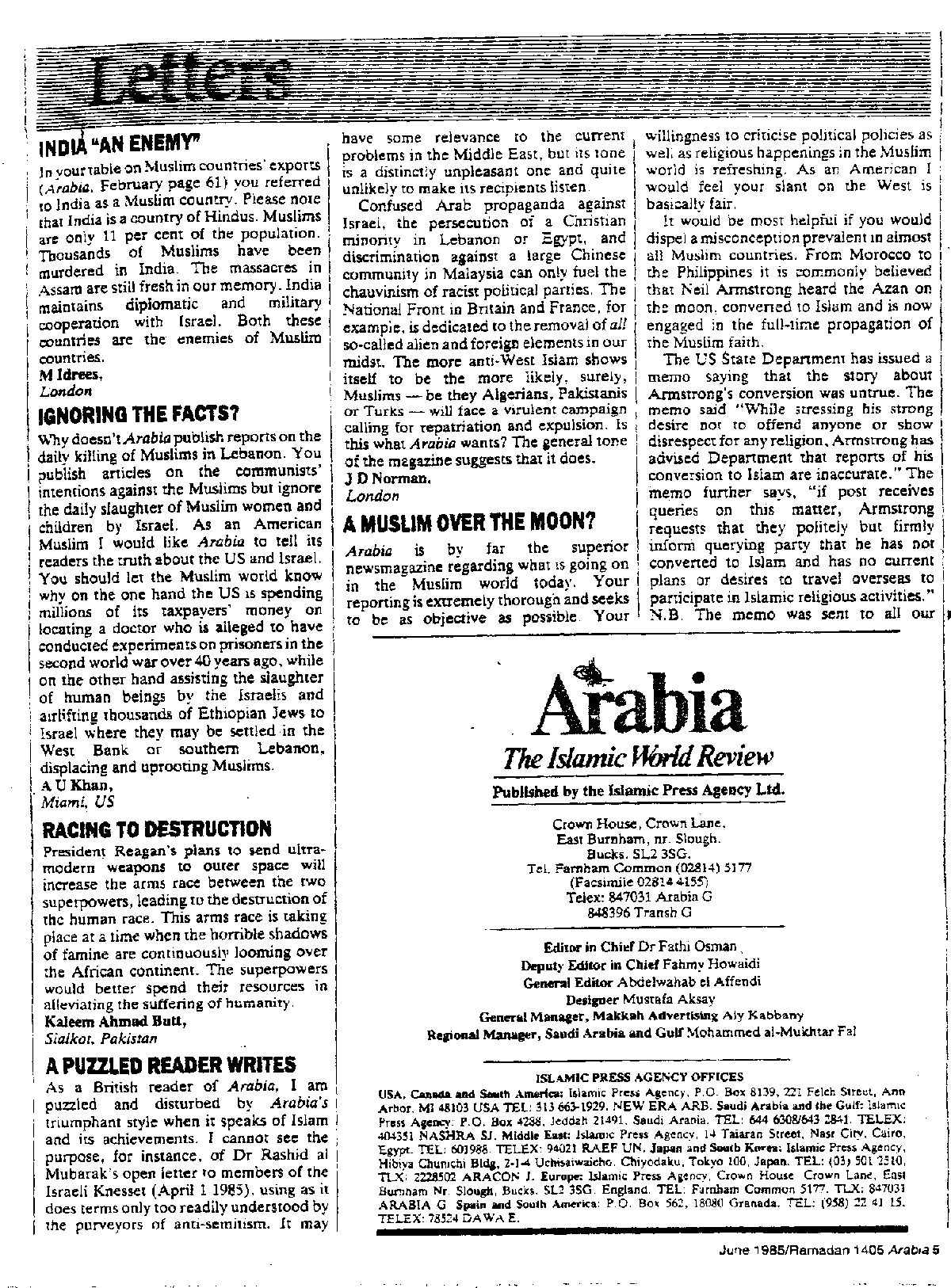
Phil Parshall’s letter shows that by 1985 the rumour had spread to such an extent that Armstrong was being portrayed as a full-time Islamic preacher. Yet full-time religious propagation is a public activity for which verifiable evidence such as speeches, publications, organisational activities, or participation in religious events could have been produced. Instead of any such evidence, what we have is correspondence from Armstrong’s office refuting false reports of his conversion. The man who was protesting through various channels to stop the rumour of his conversion was himself portrayed as an Islamic preacher, in disregard of those very activities. Parshall’s protest is not evidence of the alleged conversion; it is contemporary documentation of how widely the false news had spread.
Armstrong’s 2005 Denial in the Malaysian Press
In September 2005, Armstrong attended the Global Leadership Forum in Malaysia. The Star’s report of 7 September likewise records his denial of the claims that he heard the adhan on the Moon and converted to Islam. [90] [91]
Armstrong, 75, also denied he had heard the Muslim call to prayer on the moon and had converted to Islam.
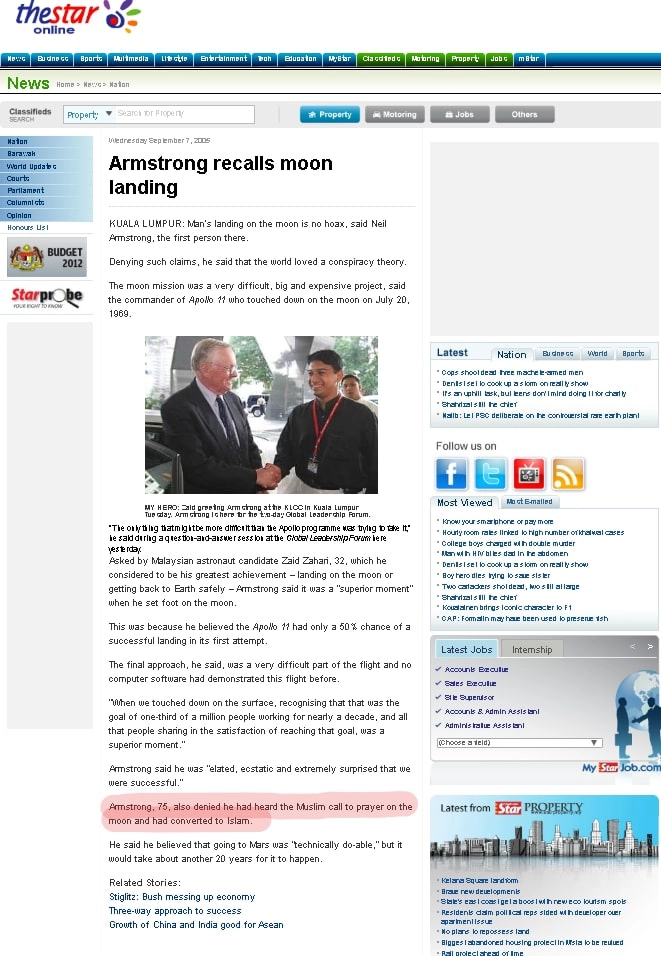
In 2005, twenty-two years after his written denial in 1983, Armstrong made the same statement again. At the time he was attending an international event in Malaysia: the media recorded his statement in one of the very countries where the conversion rumour had circulated. According to the story in Al-Ghalib’s book, after concealing his conversion for several years out of fear of the American administration, Armstrong was supposed to have disclosed that he had embraced Islam. In reality, this 2005 report contains no declaration of conversion; it contains another denial. This makes the report especially relevant to testing the story that he publicly became a Muslim several years later. Despite the passage of time, his statement remained unchanged, while Islamic propaganda substituted a nonexistent admission in his name for this consistent record of denial.
Armstrong’s Own Statement in the Authorized Biography First Man
Historian James R. Hansen’s First Man: The Life of Neil A. Armstrong, published in 2005, is Armstrong’s authorized biography. The author had access to extensive interviews with Armstrong, personal papers, and family sources. In it Armstrong identifies the conversion story as an example of false claims made by people seeking to associate themselves with his fame. [92]
I have found that many organizations claim me as a member, for which I am not a member, and a lot of different families — Armstrong families and others — make connections, many of which don’t exist. So many people identify with the success of Apollo. The claim about my becoming a Muslim is just an extreme version of people inevitably telling me they know somebody whom I might know.
Armstrong’s own statement in the authorized biography supplies a social explanation for the circulation of the conversion story in his name. Many people eager to associate themselves with Apollo’s success claimed nonexistent family relationships or organisational memberships involving him; he described the story of his becoming a Muslim as an extreme example of that tendency. Comparing this statement with Al-Ghalib’s footnote is particularly revealing. On one side, a biographer preserved the statement through direct interviews with the person concerned and the use of his personal documents. On the other, a religious author announced his conversion by citing the experience of seeing the astronauts at close quarters in Dhaka and subsequently reading the news in unspecified newspapers. The two sources are not evidentially equivalent. No reliable original statement establishing Armstrong’s conversion has been produced against his own rejection of the story.
Funeral Records and the Armstrong Museum’s Refutation
Armstrong died on 25 August 2012. After his body was cremated, his remains were committed to the Atlantic Ocean from USS Philippine Sea on 14 September. NASA preserves photographs and a description of the ceremony. Cremation is incompatible with conventional Islamic funeral rules. His funeral is inconsistent with the claim that he lived as a practising Muslim until his death; the principal evidence, of course, is his own denial. [93]
In a discussion entitled 10 Myths About Neil Armstrong, published on 18 June 2026, the Armstrong Air & Space Museum identifies the story of his conversion and hearing the adhan on the Moon as a myth. The institution refers to Armstrong’s personal aide, the US Department of State, the 2005 biography, and his funeral records. [94]
Myth: Armstrong heard the Muslim call to prayer while he was on the lunar surface and converted to Islam.
A Chronology of the Rumour’s Circulation and Refutation
| Date | Event and Document | Significance |
|---|---|---|
| 20–21 July 1969 | Apollo 11 lunar mission | Original records do not support the alleged experience |
| August 1971 | Resignation from NASA and appointment at a university | Actual career history |
| 10 September 1982 | Congratulatory letter from Cairo | Circulation of the rumour and conspiracy story |
| January 1983 | Reports in Malaysian and Sri Lankan newspapers | Conversion and dismissal story |
| 4 March 1983 | STATE 056309 | Official refutation |
| 5 May 1983 | Letter to Wahiduddin Khan | Denial of conversion, adhan, and visit to Egypt |
| 12 May 1983 | Telephone press conference in New Delhi | Denial of conversion and dismissal |
| 23 May 1983 | Press conference with journalists in Cairo | Public refutation |
| 14 July 1983 | Vivian White’s letter | Written denial |
| June 1985 | Phil Parshall’s letter in Arabia | Refutation of the rumour |
| 7 September 2005 | The Star report | Renewed denial |
| 2005 | First Man | Refutation in the authorized biography |
| 14 September 2012 | Cremated remains committed to the sea | Funeral records |
| 2020 | A Reluctant Icon | Collection of correspondence and government documents |
| 18 June 2026 | Armstrong Museum’s 10 Myths | Institutional refutation |
The chronology demonstrates that the circulation and refutation of the rumour began at approximately the same time. After the story spread in the early 1980s, Armstrong protested through his office and government communications channels; his statement did not change over the following two decades. Different documents preserve the statements of the same individual, clarifying the consistency of his position and the history of the rumour. In contrast to these documents, the religious experience circulated in Armstrong’s name is the exact opposite of his own account. Ignoring the documented protests of an individual after his death and imposing the same identity upon him distorts historical facts and denies his right to determine his personal identity.
The IslamQA Fatwa, Religious Falsehoods, and the Burden of Proof
The false story of Neil Armstrong’s conversion to Islam circulated so widely that it became the subject of a question on the Islamic fatwa website IslamQA. In fatwa 20880, published in 2003, a questioner stated that he knew about Armstrong’s conversion but some of his friends did not believe it. He asked IslamQA about the matter. IslamQA replied that it had investigated the sources of the report but had found no reliable source. [95]
وقد تتبعنا خبره هذا فلم نجد أحداً ممن نقل خبره أسنده إلى شيء يُعتمد عليه.
English translation:
We investigated this report, but found none of those who transmitted it attributing it to any reliable source.
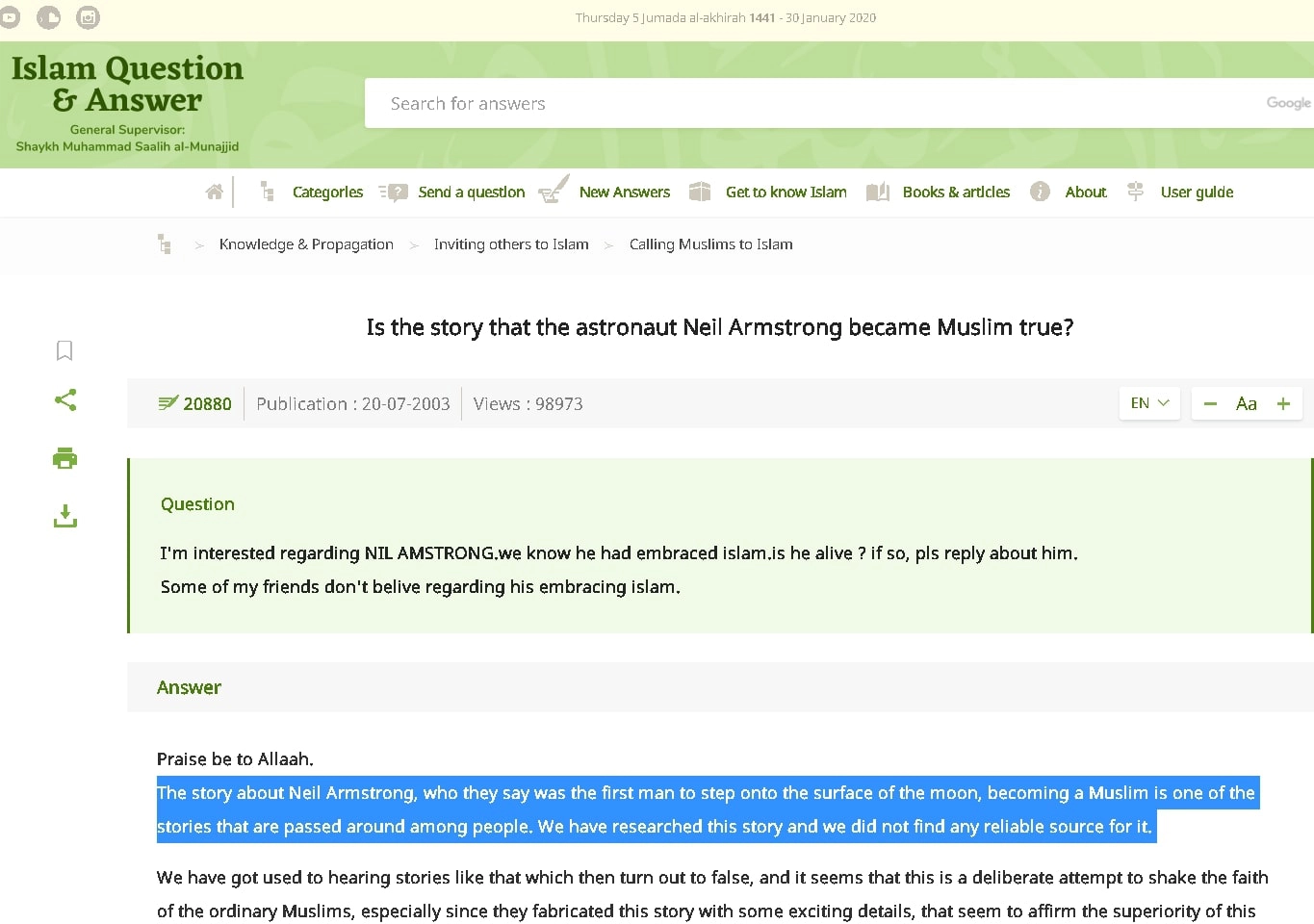
The fatwa further states that accounts of famous artists, athletes, and other individuals converting to Islam are often circulated together with fascinating stories that appear to prove Muhammad’s prophethood and the superiority of Islam over other religions. IslamQA suggests that the story connecting Armstrong’s alleged conversion with hearing the adhan on the Moon may belong to this type of propaganda. Armstrong is compared with the British singer Cat Stevens, or Yusuf Islam, as an example of genuine conversion. Yusuf Islam’s conversion is publicly documented, whereas no comparable evidence was found for Armstrong. [96]
IslamQA’s admission that it could find no reliable source is accompanied by another unsupported claim. The fatwa’s author suggests that fascinating but false stories of famous individuals converting to Islam may be circulated and later refuted for the purpose of weakening ordinary Muslims’ religious faith. No specific individual, organisation, plan, or document has been produced to support this suggestion. Identifying a false report does not by itself establish the motives of its inventor. In contrast, the direct documentation of the story’s circulation in Bangladesh shows Islamic scholars, religious publications, and speakers using it to promote the miraculous character of Islam. Establishing responsibility for these public acts does not require locating an unnamed conspirator. Offering another unsupported conspiracy theory to explain an unsupported rumour merely repeats the same disregard for evidence.
The direct evidence of the circulation of this false news in Bangladesh is entirely public. Asadullah Al-Ghalib circulated it in his Islamic biography; the Hamidia Library commentary on Sahih al-Bukhari attributed nonexistent research to NASA; the monthly At-Tahreek reproduced the story; and various Islamic sermons portrayed Armstrong as a Muslim. The statements of the authors, publishers, and religious preachers concerned are the direct documentation of the circulation of false information. Responsibility for these documented activities cannot be transferred to unnamed conspirators. Although the identity of the person who first created the false report remains uncertain, the books and speeches themselves establish who subsequently circulated it without verification.
Even the Instructions of Their Own Scriptures Were Disregarded
These activities by Islamic preachers also contradict the instructions concerning the verification of information found in their own scriptures. Verse 36 of Surah al-Isra forbids following that of which one has no knowledge. Verse 6 of Surah al-Hujurat also instructs believers to verify news received from a disreputable person. Yet in circulating an easily verifiable claim such as Neil Armstrong’s conversion, his own statements, the mission records, and the supposed scientific research papers were not sought out. [97] [98]
وَلَا تَقْفُ مَا لَيْسَ لَكَ بِهِ عِلْمٌ ۚ إِنَّ السَّمْعَ وَالْبَصَرَ وَالْفُؤَادَ كُلُّ أُولَٰئِكَ كَانَ عَنْهُ مَسْئُولًا
English translation:
Do not follow that of which you have no knowledge. Indeed, the hearing, the sight, and the heart—each of these will be questioned.
The introduction to Sahih Muslim contains an even more explicit hadith on this matter. It states that it is sufficient for a person to be a liar that he narrates everything he hears. The actions of Islamic preachers who circulated the news of Armstrong’s conversion without verification after hearing it from others or reading it in unreliable newspapers directly contradict this hadith as well. [99]
قَالَ رَسُولُ اللَّهِ صلى الله عليه وسلم كَفَى بِالْمَرْءِ كَذِبًا أَنْ يُحَدِّثَ بِكُلِّ مَا سَمِعَ
English translation:
The Messenger of Allah said: It is sufficient for a person to be a liar that he narrates everything he hears.
Armstrong issued a written statement refuting the false news as early as 1983. IslamQA’s fatwa was published in 2003. In 2005 Armstrong publicly denied the claim again. Nevertheless, the story continued to circulate in Islamic books and religious speeches. Circulating a report without knowing whether it is true and continuing to circulate it after it has been repeatedly refuted are not equivalent conduct. The former may result from a failure to verify information and irresponsibility; the latter involves the serious problem of disregarding published corrections and contrary documentation. Whether an individual speaker personally knew of these documents is a separate matter to be established, but the falsity of the statement he circulated does not depend on his personal motives.
Presenting Religious Aspirations as Facts
Several things become clear from analysing the structure of the false story circulated about Neil Armstrong. First, the person selected was world-famous and associated with an extraordinary scientific achievement of human civilisation. Second, he was credited with a miraculous experience that appeared to establish the truth of Islamic belief. Third, his alleged conversion was offered as confirmation of the truth of that miraculous experience. Fourth, a conspiracy narrative involving the American administration supplied a fabricated explanation for the absence of public evidence of his conversion. In the story of the splitting of the Moon, attaching NASA’s photographs and the name of scientific research made the claim appear more credible through the same method.
In psychology, the tendency to favour information consistent with existing beliefs and disregard contradictory information is known as confirmation bias. In a comprehensive review published in 1998, psychologist Raymond Nickerson discussed its various forms and effects. The story circulated about Neil Armstrong provides a clear example of this tendency. The statement of a religious publication that claimed Armstrong converted to Islam was taken as reliable without verification, while Armstrong’s own statement was treated with suspicion when he denied it. Accepting information that favours one’s religious beliefs and rejecting direct evidence that contradicts them is not a method of investigating the truth. [100]
Another fundamental problem with this story is the appeal to authority. Neil Armstrong was a skilled astronaut. But an astronaut’s expertise does not automatically establish the truth of his personal conclusions about theology, metaphysics, or the existence of God. Among the adherents of the world’s religions are numerous scientists, engineers, physicians, and researchers. Their personal religious beliefs are often mutually contradictory. If a famous person’s religious belief is accepted as proof of the truth of that religion, the same criterion requires accepting numerous mutually contradictory religions as true. The incoherence of this form of reasoning is discussed in detail in the article Some Common Logical Fallacies and Specious Arguments.
The Distinction Between Claims, Evidence, and Demonstrated Falsehood
Anyone claiming that an event occurred bears the responsibility of providing sufficient evidence for it. In the case of Armstrong’s alleged conversion, the claimant is responsible for producing Armstrong’s own declaration, an interview, or reliable personal documentation. If it is claimed that NASA scientists discovered evidence of the splitting of the Moon, the relevant research papers, researchers’ identities, and experimental results must be produced. This responsibility cannot be transferred to the critic by demanding that they locate nonexistent research papers. But in this particular case, the situation goes beyond the absence of supporting evidence. The statements of the individual and the research institution concerned also supply direct evidence against the claims.
| Claim Circulated | Documented Facts | Conclusion |
|---|---|---|
| Armstrong heard the adhan on the Moon. | Armstrong’s own written denial and the mission records. | False. |
| He converted after hearing the same adhan in Egypt. | In his 1983 letter he stated that he had never been to Egypt at that time. | False. |
| Armstrong converted to Islam. | Multiple denials in 1983 and 2005, personal letters, and the authorized biography. | False. |
| NASA dismissed him because he converted to Islam. | Records of his resignation in 1971 and university professorship. | False. |
| The US government prevented him from announcing his conversion. | At his own request, the US Department of State refuted the rumour. | Unsupported conspiracy claim. |
| He moved to Lebanon in the Middle East after converting. | Lebanon in the address on his correspondence is a city in Ohio, United States. | False. |
| Rima Ariadaeus is a trace of the splitting of the Moon. | Research identifies it as a local graben. | Incorrect scientific interpretation. |
| NASA determined that the Moon split approximately 1,400 years ago. | No such research paper has been found; a NASA scientist’s statement contradicts the claim. | Baseless scientific claim. |
| The Cheraman Perumal story is independent contemporary testimony. | A later religious narrative, differing manuscript accounts, and chronological inconsistencies. | Not independent historical evidence. |
| The alleged conversion proves the truth of Islam. | The conversion report is false; even an actual conversion is not independent evidence of a theological claim. | Factual falsehood and appeal to authority. |
Determining responsibility for the circulation of false information in this case does not require speculating about anyone’s secret motives. An Islamic book declares Armstrong’s conversion to be true; another commentary circulates nonexistent scientific conclusions under NASA’s name; religious periodicals and sermons repeat the narrative. Against these claims stand the written denials of the individual concerned, contemporary government communications, published biographies, and actual lunar geological research. Disregarding this contrary evidence without producing any new documentation supporting the false claim is not a search for truth. Using invented experiences attributed to scientists, unspecified newspaper references, and false conclusions attributed to research institutions to establish the truth of religious beliefs exposes the factual and intellectual bankruptcy of such religious propaganda.
Conclusion
The entire story that Neil Armstrong heard the adhan on the Moon, discovered traces on the lunar surface of Muhammad’s splitting of the Moon, and converted to Islam as a result of that experience is false. The original mission records contain no mention of such an experience. Established principles of acoustics contradict the story of hearing the adhan normally in the open lunar environment. The geological rille circulated as evidence of the splitting is a known natural geological structure. The claims that NASA scientists discovered evidence of lunar splitting or determined that it occurred approximately fourteen centuries ago likewise have no scientific basis.
Most importantly, Neil Armstrong himself repeatedly denied the story circulated in his name. In personal letters, before journalists, through the US Department of State, and in his authorized biography, he rejected the news of his conversion. The very American administration accused of concealing his alleged conversion assisted Armstrong at his own request in refuting the false news. Stories that he was dismissed from his job, moved to Lebanon in the Middle East, and became a full-time Islamic preacher are also inconsistent with his actual life.
The alleged testimony of the Indian king Cheraman Perumal is not independent contemporary historical evidence for the splitting of the Moon either. Religious narratives circulating centuries later, mutually contradictory miraculous accounts, and the alleged testimony of unnamed travellers cannot establish a seventh-century celestial event. There is no rational basis for substituting such legends for the extensive modern scientific research into the Moon’s internal structure, geological evolution, and gravitational properties.
Responsibility for these falsehoods does not rest solely with the unknown person who first created the story. The scholar who incorporated the report into his book without verification, the publisher who published claims of nonexistent research under NASA’s name, the religious periodical that reproduced the story, and the speaker who presented it as a true event before thousands of people each bear responsibility for the statements they circulated. The fact that a report favours Islam does not remove the need to verify its truth. A religious purpose does not turn a false statement into a true one.
The conquest of the Moon was an extraordinary expression of human intellectual and scientific capabilities. Behind that achievement lay mathematics, physics, engineering, extensive research, experimental verification, and the labour of countless people. Attributing fabricated experiences and a religious identity to an astronaut in order to attach the credit for this achievement to a religion’s miraculous narrative distorts the history of human intellectual endeavour. Imposing a false identity on a person after his death, despite his repeated rejection of it during his lifetime, also constitutes a profound disrespect for his personhood and right to self-determination.
Truth does not need falsehoods to establish it. Scientific evidence does not require the circulation of fabricated statements in scientists’ names. If a religious miracle claim really is demonstrable, its evidence will be established through actual research and independent verification. The false story of Neil Armstrong’s conversion and the circulation of nonexistent research into the splitting of the Moon under NASA’s name are not evidence of Islam’s miraculous character; they are a documented example of how science, history, and an individual’s personal identity have been distorted in support of religious belief.
References
- IslamQA, Fatwa 20880 ↩︎
- Rumor Scanner: Claims Circulated About Armstrong ↩︎
- Stories of the Prophets–3: Siratur Rasul (peace be upon him), Hadith Foundation Bangladesh, pp. 118–119 ↩︎
- PDF of the original book ↩︎
- Muhammad Abdur Rahim, Signs of the Hour (Part 1), Monthly At-Tahreek ↩︎
- Sahih al-Bukhari: Bengali Translation and Detailed Commentary, Hamidia Library Ltd., Vol. 5, pp. 342–343 ↩︎
- Detailed Commentary on Sahih al-Bukhari, Vol. 5 ↩︎
- Rumor Scanner, investigation of statements by Islamic preachers ↩︎
- Quran, Surah al-Qamar, 54:1–3 ↩︎
- Sahih Muslim, 2800b ↩︎
- Sahih Muslim, Islamic Foundation, 6815 ↩︎
- Sahih Muslim, 2800c ↩︎
- Sahih Muslim, Hadith Academy, 6966 ↩︎
- Sahih Muslim, 2802a ↩︎
- Sahih Muslim, Islamic Foundation, 6818 ↩︎
- Jami at-Tirmidhi, 3289 ↩︎
- Tirmidhi, Husain al-Madani, 3289 ↩︎
- Sahih Muslim, Islamic Foundation, 6819 ↩︎
- Sahih al-Bukhari, Islamic Foundation, 3377 ↩︎
- Tafsir Ibn Kathir, Surah al-Qamar, Islamweb ↩︎
- Tafsir al-Qurtubi, Surah al-Qamar, Islamweb ↩︎
- Al-Shifa, Sanjari Publications, Vol. 1, p. 589 ↩︎
- Al-Shifa, p. 590 ↩︎
- Islamweb, Fatwa 69255 ↩︎
- NASA: Apollo 11 ↩︎
- Apollo 11 Mission Overview ↩︎
- NASA: Apollo 11 Lunar Surface Journal ↩︎
- Apollo 11 Image Library ↩︎
- Apollo 11 Lunar Surface Journal, Mission Overview ↩︎
- NASA: Apollo 11 Moonwalk Pictures, Panorama Station 5 ↩︎
- NASA: Little West Crater ↩︎
- NASA: EASEP Deployment and Closeout ↩︎
- NASA: One Small Step ↩︎
- NASA, Apollo 11 Mission Report, MSC-00171, November 1969, Chapter 11 ↩︎
- NASA: 50 Years Ago — Apollo 11 Lunar Science Conference ↩︎
- OpenStax, University Physics, 17.1: Sound Waves ↩︎
- OpenStax Physics, 13.1: Types of Waves ↩︎
- NASA: The Moon’s Atmosphere ↩︎
- NASA Goddard Space Flight Center, Cosmicopia: Energy Traveling Through Space ↩︎
- OpenStax Physics: Types of Waves ↩︎
- NASA Science: Rima Ariadaeus – A Linear Rille ↩︎
- AFP Fact Check ↩︎
- NASA: A Lunar Rille, 29 October 2002 ↩︎
- NASA, PIA12908, Rima Ariadaeus – A Linear Rille, 28 September 2009 ↩︎
- NASA: Moon Facts ↩︎
- NASA: Pull Apart – Grabens ↩︎
- G. I. Smith, 1966, NASA Technical Reports Server, 19670022613 ↩︎
- George I. Smith, Astrogeologic Studies, 1966, pp. 65–85, original research report ↩︎
- NASA: A Lunar Rille ↩︎
- NASA: Grabens ↩︎
- NASA: Rupes Recta ↩︎
- Watters et al., Shallow seismic activity and young thrust faults on the Moon, Nature Geoscience, 2019 ↩︎
- NASA: Shrinking Moon May Be Generating Moonquakes ↩︎
- LROC: Rima Ariadaeus – A Linear Rille ↩︎
- AFP Fact Check, NASA scientist Brad Bailey’s statement ↩︎
- Archived NASA question-and-answer page ↩︎
- NASA: Compare Earth and the Moon ↩︎
- NASA: Moon Composition 1 2
- OpenStax: Gravitational Potential Energy and Total Energy ↩︎
- NASA: Moon Formation ↩︎
- Wieczorek et al., The Crust of the Moon as Seen by GRAIL, Science, 339, 2013, pp. 671–675 ↩︎
- Ophira Gamliel and Ines Weinrich, Reconnecting the Split Moon, University of Glasgow, 2 October 2023 ↩︎
- Sebastian R. Prange, Monsoon Islam, Cambridge University Press, 2018 ↩︎
- Al-Bidaya wa al-Nihaya, chapter on the splitting of the Moon ↩︎
- Ferishta, History of the Rise of the Mahomedan Power in India, till the Year AD 1612 ↩︎
- Ferishta, Volume IV, Chapter XI ↩︎
- University of Glasgow: HiMuJe Malabar, Sources ↩︎
- Gamliel and Weinrich, 2023 ↩︎
- Ines Weinrich, Shifting Perspectives and Methods in Researching the Moon-splitting Episodes, 2026 1 2
- Ophira Gamliel and Ines Weinrich, Reconnecting the Split Moon, 2023 ↩︎
- University of Glasgow, HiMuJe Malabar: Arabic Sources ↩︎
- Government of Kerala, Cheraman Perumal Episode ↩︎
- Scott Kugle and Roxani Eleni Margariti, Narrating Community, JESHO, 60(4), 2017, pp. 337–380 ↩︎
- Sebastian R. Prange, Monsoon Islam, 2018 ↩︎
- James R. Hansen (ed.), A Reluctant Icon: Letters to Neil Armstrong, Purdue University Press, 2020, pp. 29–31 ↩︎
- Religion and Belief, JSTOR ↩︎
- A Reluctant Icon, “Your Conversion to Islam”, letter dated September 10, 1982 ↩︎
- U.S. Department of State, UNCLAS STATE 056309, March 4, 1983, reproduced document ↩︎
- A Reluctant Icon, pp. 30–31 ↩︎
- James R. Hansen, First Man, Endnotes, Chapter 29, USIA document dated May 20, 1983 ↩︎
- A Reluctant Icon, Religion and Belief, p. 31 ↩︎
- NASA: Neil A. Armstrong, Biography ↩︎
- NASA History: Astronaut Biographies ↩︎
- Spirit of Islam, Issue 80, August 2019, Wishful Thinking: Living in Wonderland, pp. 31–32 ↩︎
- Spirit of Islam, Issue 80, p. 32, citing Hindustan Times, May 13, 1983 ↩︎
- Letter from Vivian White, Administrative Aide to Neil A. Armstrong, to Phil Parshall, July 14, 1983, reproduced correspondence ↩︎
- A Reluctant Icon, p. 30 ↩︎
- Vivian White’s correspondence ↩︎
- Phil Parshall, A Muslim Over the Moon?, Arabia: The Islamic World Review, June 1985/Ramadan 1405, p. 5, reproduced letter ↩︎
- The Star, Armstrong Recalls Moon Landing, September 7, 2005 ↩︎
- Archived report ↩︎
- James R. Hansen, First Man: The Life of Neil A. Armstrong, Simon & Schuster, 2005, pp. 630–632, ISBN 9780743256315 ↩︎
- NASA, Armstrong Burial at Sea, September 14, 2012 ↩︎
- Logan Rex, 10 Myths About Neil Armstrong, Armstrong Air & Space Museum, June 18, 2026 ↩︎
- IslamQA, Fatwa 20880: Is the Story That the Astronaut Neil Armstrong Became Muslim True? ↩︎
- Islam Question & Answer, Is the story that the astronaut Neil Armstrong became Muslim true? ↩︎
- Quran, Surah al-Isra, 17:36 ↩︎
- Quran, Surah al-Hujurat, 49:6 ↩︎
- Sahih Muslim, Introduction, Hadith 5: Prohibition of Narrating Everything One Hears ↩︎
- Raymond S. Nickerson, Confirmation Bias: A Ubiquitous Phenomenon in Many Guises, Review of General Psychology, Vol. 2, No. 2, 1998, pp. 175–220 ↩︎