Introduction
Whether a person will follow any religion at all, which religion they will believe in, whether they will abandon the religion of their ancestors, or whether they will adopt a new belief on the basis of their own conscience and judgment—these are among the most fundamental questions of freedom of thought and conscience. No one is born having read a scripture, examined a theology, or assessed arguments about the existence of a god before choosing a religion. In most cases, people are born into the religious identity of a particular family and society. If, as they grow older, they ask questions, demand evidence, change their minds, or reject religion altogether, that is a natural exercise of intellectual freedom. Yet many ancient theocratic systems treated this personal freedom as a crime against the state, the community, and God. The Old Testament contains laws prescribing death, including execution by stoning, for departing from religious allegiance or encouraging others to worship different gods.
Most modern democratic countries with Christian-majority populations do not enforce these laws. A German, British, French, Canadian, or Swedish citizen is not stoned to death for leaving Christianity and becoming an atheist, Muslim, Hindu, Buddhist, or something else. But this humane modern position cannot be credited to the biblical law itself, since the original biblical command says precisely the opposite. The farther modern states have moved away from this kind of theocratic legislation, the more firmly the individual’s freedom of religion and conscience has been established.
Article 18 of the United Nations Universal Declaration of Human Rights explicitly recognizes the freedom to change one’s religion or belief as a human right. The International Covenant on Civil and Political Rights likewise protects the freedom to adopt a religion or belief of one’s choice. The UN Human Rights Committee has explained that this freedom also includes abandoning one’s existing religion, adopting another, and embracing atheistic views. [1]
The Bible’s Command: No Mercy Even for Loved Ones—Stone Them to Death
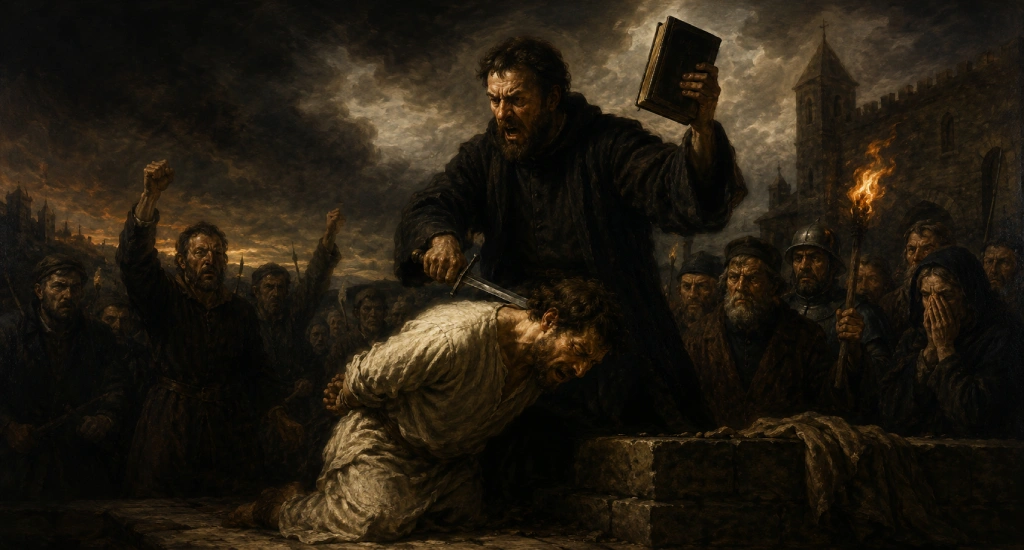
The Bible’s language against departure from religious allegiance and enticement to worship other gods is not merely severe; judged by contemporary human rights standards, it is appalling. The offense here is not murder, rape, torture, or the violation of another person’s rights. It is believing in the wrong god or inviting someone else to adopt that belief. More horrifying still, the law rejects familial affection and human compassion as forms of ‘pity’ for the offender. Whether the accused is a brother, a child, a wife, or an intimate friend, a person who defies religious allegiance must not be protected. Instead, the loved one is instructed to be the first to take part in the killing.
The Bible commands the killing of apostates, although modern Christian countries no longer follow this ancient law. One passage states:
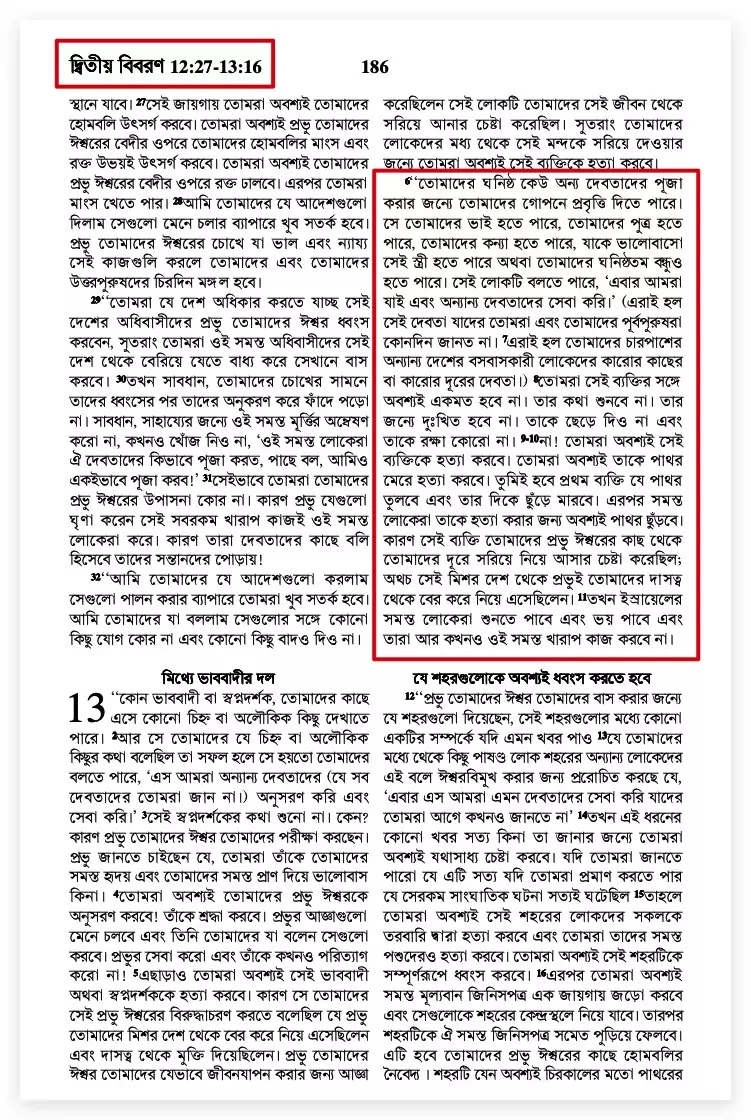
Deuteronomy 13:6–11
(According to the New King James Version)
6. ‘If your brother, your mother’s son, your son or daughter, your wife, or a friend as dear as your own soul secretly entices you, saying, “Let us go and worship other gods,” whom neither you nor your ancestors have known,
7. gods worshipped by peoples around you, whether near or distant, from one end of the earth to the other,
8. do not listen to him or consent to him; show him no pity, do not spare him, and do not conceal him.
9. You must surely kill him. Your own hand must be the first raised against him to put him to death, followed by the hands of all the people.
10. You must stone him until he dies, because he tried to turn you away from the Lord your God, who brought you out of Egypt, out of the house of bondage.
11. Then all Israel shall hear and fear, and none shall again dare to commit such wickedness among you.’
The final sentence of this law is especially significant: ‘All Israel shall hear and fear.’ The declared purpose of the punishment is therefore not merely to remove the alleged offender; it is also to instill fear in others through a public killing. In modern terms, this is a system of religious control through terror: kill one person so that others who witness or hear about the punishment will not dare to change or promote different beliefs. This is also the basic logic of state terror: punishment is directed not only at the individual but at frightening a population into submission.
Deuteronomy 13:6-11
New King James Version
6 “If your brother, the son of your mother, your son or your daughter, the wife [a]of your bosom, or your friend who is as your own soul, secretly entices you, saying, ‘Let us go and serve other gods,’ which you have not known, neither you nor your fathers, 7 of the gods of the people which are all around you, near to you or far off from you, from one end of the earth to the other end of the earth, 8 you shall not [b]consent to him or listen to him, nor shall your eye pity him, nor shall you spare him or conceal him; 9 but you shall surely kill him; your hand shall be first against him to put him to death, and afterward the hand of all the people. 10 And you shall stone him with stones until he dies, because he sought to entice you away from the Lord your God, who brought you out of the land of Egypt, from the house of bondage. 11 So all Israel shall hear and fear, and not again do such wickedness as this among you.
Not Only Enticing Others: Death for Worshipping Other Gods Oneself
Deuteronomy 13:6–11 orders the execution of someone who encourages others to worship a different god. But the Bible’s laws of religious violence do not stop at the person who entices others. Deuteronomy 17:2–7 of the same book commands that an Israelite man or woman who worships other gods, the sun, the moon, or any of the heavenly host be put to death. The allegation must be investigated, and if it is established by the testimony of two or three witnesses, the accused must be taken to the city gates and stoned to death. The witnesses are instructed to be the first to carry out the killing. Enticing somebody else is not an essential element of the offense here: changing one’s own religious worship is enough to incur the death penalty. [2]
Deuteronomy 17:5, King James Version:
and shalt stone them with stones, till they die.
English rendering of Deuteronomy 17:2–7:
2. If, in one of the towns that the Lord your God has given you, there is found among you a man or a woman who has done what is evil in the sight of the Lord your God by violating his covenant,
3. and has gone and served other gods and worshipped them, whether the sun, the moon, or any of the host of heaven, which I have not commanded,
4. and this is reported to you and you hear of it, you shall inquire carefully. If it is confirmed that this abominable thing has been done in Israel,
5. you shall bring that man or woman who has done this evil thing to your town gates and stone that person to death.
6. The person liable to death shall be executed on the testimony of two or three witnesses; no one shall be put to death on the testimony of only one witness.
7. The hands of the witnesses shall be the first against the person in carrying out the execution, followed by the hands of all the people. In this way you shall remove the evil from among you.
This provision requires evidence and investigation, but the act that the judicial process defines as a crime is not the taking of someone else’s life or property. The crime is worshipping another god. If someone chooses to worship the sun or moon, the law calls for that person to be stoned to death. This is a direct example of religious allegiance being made compulsory through state punishment in an ancient theocratic system. In the fifth century, the Christian theologian Cyril of Alexandria also invoked Deuteronomy 17 in support of the death penalty for apostates in Book VI of his early work De adoratione. This particular law thus has a demonstrable connection with its later reception in Christian theology.
Exodus 22:20: Destruction for Sacrificing to Another God
Outside Deuteronomy, Exodus also contains a direct command of destructive punishment for worshipping other gods. Exodus 22:20 requires that a person who sacrifices to a deity other than the Lord God be devoted to complete destruction. Participation in a different form of religious worship is therefore made grounds for a capital punishment. The verse does not specify stoning as the method of execution, but its command to destroy the person who sacrifices to another god is explicit. [3]
He that sacrificeth unto any god, save unto the Lord only, he shall be utterly destroyed.
English rendering: Whoever offers a sacrifice to any god other than the Lord alone shall be completely destroyed.
This law has a significant historical legacy. Seventeenth-century Massachusetts colonial capital-law codes cited Exodus 22:20 alongside Deuteronomy 13 and 17 as the biblical basis for punishing worship of other gods. The command thus did not remain merely a theological statement; it was subsequently adopted in a Christian system of government as a legal basis for religious crimes and the death penalty.
2 Chronicles 15:12–13: Death Even for Failing to Seek God
The Bible’s Second Book of Chronicles supplies an even more direct account of imposing religious allegiance. During the reign of King Asa, the people of Judah entered into a covenant to seek the God of their ancestors with all their heart and soul. The oath declared that anyone who did not seek the Lord God of Israel was to be put to death, with no exemption on account of age or sex. This is not a new legal provision attributed to Moses in the manner of Deuteronomy; it is an account of a religious covenant and an oath of capital punishment adopted during a particular reign. But it explicitly records the decision to make refusal of religious allegiance a capital offense. [4]
2 Chronicles 15:13, King James Version:
That whosoever would not seek the Lord God of Israel should be put to death
English rendering of 15:12–13:
12. They entered into a covenant to seek the Lord God of their ancestors with all their heart and all their soul.
13. Whoever would not seek the Lord God of Israel was to be put to death, whether young or old, male or female.
Comparing this episode in 2 Chronicles with the laws of Deuteronomy makes the reach of religious control clearer. Deuteronomy 13:6–11 commands killing for inviting others to worship a different god; Deuteronomy 17:2–7 prescribes stoning for personally worshipping another god; and Exodus 22:20 commands destruction for offering sacrifices to a different god. Second Chronicles 15:12–13 records an oath of capital punishment for failing to seek God as part of a royal religious reform. The principle of enforcing religious allegiance through the threat of death, rather than leaving it to people’s voluntary beliefs, is thus found in multiple books of the Bible.
The alleged offense in these cases is not murder, rape, theft, or depriving someone else of liberty. It is rejecting worship and allegiance prescribed by religious authority. The fact that somebody’s religious belief or manner of worship differs from another person’s creates no moral entitlement to kill them. These biblical laws and accounts deny that fundamental freedom by making religious allegiance a condition for remaining alive. They directly conflict with modern freedom of thought, conscience, and religion.
Not One Person, but the Destruction of an Entire City
The religious violence prescribed in Deuteronomy 13 does not end with the execution of individuals. Verses 12–18 of the same chapter contain a command to destroy an entire town. If some people in an Israelite town promote the worship of other gods and an investigation establishes the accusation, the inhabitants are to be put to the sword, the town’s livestock killed, all its possessions gathered and burned, and the settlement turned into permanent ruins. A change in religious worship thus becomes not only an individual offense but the basis for a campaign of destruction against an entire community. The most revealing element is the order to destroy all the town’s inhabitants and livestock. The command is not confined to killing the people who encouraged the worship of other gods; it targets the whole town. [5]
Deuteronomy 13:15, King James Version:
Thou shalt surely smite the inhabitants of that city with the edge of the sword
English rendering of Deuteronomy 13:12–18:
12. If you hear concerning one of the towns which the Lord your God has given you to inhabit,
13. that wicked people have emerged from among you, led the inhabitants of their town astray, and said, ‘Let us go and worship other gods,’ gods that you have not known,
14. then you shall investigate, inquire, and examine the matter carefully. If it is confirmed that such an abominable thing has occurred among you,
15. you shall surely strike the inhabitants of that town with the edge of the sword, completely destroying the town and everything in it, including its livestock, with the sword.
16. You shall collect all its plunder in the middle of its square and burn the town and all its possessions completely as an offering to the Lord your God. It shall remain a heap of ruins forever and shall never be rebuilt.
17. None of what has been devoted to destruction shall remain in your possession, so that the Lord may turn from his fierce anger, show you mercy and compassion, and multiply you as he swore to your ancestors.
18. This shall happen when you obey the voice of the Lord your God, keep all the commandments I give you today, and do what is right in his sight.
Several features of this law are unmistakable. First, allegations that people have invited others to worship a different god are made sufficient grounds for an armed attack against an entire town. Second, although an investigation is required, once the accusation is established the penalty is not confined to those who encouraged the change of worship; the town’s inhabitants are ordered to be killed. Third, the punishment does not end with human deaths. The law adds the slaughter of livestock, burning of property, and permanent destruction of the settlement. Fourth, this campaign of destruction is linked to appeasing God’s anger and receiving his subsequent mercy. The massacre of a population and destruction of its town are thus elevated into religious obligations for preserving religious allegiance.
The underlying offense is worshipping other gods. Deuteronomy 13:12–18 does not require that the inhabitants have declared war on a neighboring people, initiated a military attack, or destroyed another person’s life or property. Departure from religious allegiance is presented as the basis for punishment. In modern ethical terms, an order to kill a town’s inhabitants collectively and destroy their settlement is a command for religious violence on a mass-killing scale. Military force is used here not to protect human life and safety, but to enforce religious exclusivity.
The Talmudic Discussion: Later Attempts to Restrict the Law of Destruction
Later rabbinic literature discusses the law of destroying a town in Deuteronomy 13 in detail. Mishnah Sanhedrin 10:4 sets particular conditions for defining a town as an ‘idolatrous city.’ Those responsible for leading others astray must be members of the same town and tribe, must influence a majority of the inhabitants, and must be men. The rules also add requirements of testimony and prior warning for each accused person. These conditions restrict application of the original law. But even in this discussion of limits, execution of the inhabitants of an idolatrous town and destruction of their property remain central to the legal discussion. [6]
An even more consequential opinion appears in the Babylonian Talmud, Sanhedrin 71a. It states that such an idolatrous city never existed and never will exist. According to Rabbi Eliezer’s explanation, if a town contains even one mezuzah, the entire town cannot be destroyed under this law. Deuteronomy requires all its possessions to be burned, while destroying a sacred object containing God’s name is prohibited. The law would therefore become effectively impossible to apply in full. The same discussion also preserves Rabbi Yonatan’s contrary claim: he said he had seen such a destroyed town and sat on its ruins. One opinion thus denies that the law was ever applied, while another claims to have witnessed evidence of a past application. Rabbi Yonatan’s statement, however, is not independent archaeological or contemporary historical evidence for the destruction of an identifiable town. [7]
עיר הנדחת לא היתה ולא עתידה להיות
English translation: An idolatrous city never existed and never will exist.
This Talmudic discussion matters to the history of how the ancient law was later received and interpreted. The original biblical text orders the destruction of a town’s inhabitants, livestock, property, and settlement. Later rabbinic interpreters imposed conditions on enforcement that made the law effectively unenforceable in some interpretations. This distinction shows that the violent command in a religious text is not identical to the rules governing its later application. The later restrictions do not erase the killing ordered by the original text; they regulate its implementation.
The ethical problem with Deuteronomy 13:12–18 remains unchanged. Killing a town’s inhabitants, burning their possessions, and destroying their settlement because they have changed their religious allegiance cannot constitute a just legal system. Whether one religion is true cannot be settled by taking people’s lives. A law that makes worship of a different god grounds for the mass destruction of a community is the opposite of religious liberty and a direct assault on human life and freedom of conscience.
Apostasy or Treason? The Problem with an Apologetic Argument
A common argument offered in defense of this law is that ancient Israel was a theocratic, covenant-based state. On this view, worshipping other gods was not merely an individual change of religion but amounted to political treason. Scholars have examined linguistic and structural similarities between Deuteronomy 13 and the political treaties and laws of allegiance in the ancient Near East. Some researchers in particular have shown that the apostasy provisions in Deuteronomy can be compared with the structure of ancient imperial laws concerning loyalty and treason. [8]
But that historical setting does not remove the law’s moral problem; it makes the problem clearer. When a theocratic state declares, ‘Not believing in my god is treason,’ that is precisely the logic of religious authoritarianism. If North Korea defines rejection of the ruling leader’s ideology as treason, simply observing that ‘it was treason under that state’s system’ does not make the law moral. If the state claims ownership of its citizens’ conscience, beliefs, and religion, the very definition of treason is unjust. A person has not launched an armed rebellion, committed murder, or engaged in espionage; they have merely believed in another god or invited others to adopt that belief. Transforming this into treason is a frightening merger of religion and political power.
Was This Law Actually Enforced in History?
A significant evidentiary limit must be acknowledged. We do not possess reliable independent historical records establishing exactly how many people in ancient Israel were tried and stoned under Deuteronomy 13:6–11. Treating a biblical narrative itself as independent historical documentation and claiming that ‘this law was enforced so many times’ would be unjustified. There is no need to exaggerate its actual frequency of enforcement. Nor does a law have to be enforced thousands of times to be morally appalling. If a constitution declared, ‘Citizens who change religion must be stoned to death,’ it would be a barbaric law even if it were never applied.
Yet this law’s intellectual legacy did not disappear from history. The laws of the Hebrew Bible repeatedly reappeared in later Jewish interpretation, Christian theology, and debates over religious state power. Some later interpreters restricted these laws or read them figuratively in ways that made them more humane; others adopted them as a moral basis for violence against religious dissent. The latter tendency had especially terrible consequences in Christian history.
From Ancient Law to Christian Theocracy: The Death Penalty for Apostasy Was ‘Holy’ to Cyril
During Christianity’s first centuries, Christians themselves suffered persecution by the Roman state. But as Christianity rose to the center of state power, that situation began to change. Book VI of De adoratione, an early work by the fifth-century bishop and theologian Cyril of Alexandria, provides a direct positive reception of the violent laws of Deuteronomy. Cyril first discusses Deuteronomy 12:1–3, which calls for the destruction of sites used to worship other gods, and praises fear of divine punishment as a way to preserve religious loyalty. He then cites Deuteronomy 13:1–5, which prescribes death for a false prophet who entices people to worship other gods. Cyril praises the holiness and propriety of this law. His argument is that if physical murder deserves death, leading a person’s soul into destructive religious error may also merit the death penalty. Instead of proving the religious doctrine false, he thus seeks a moral justification for killing its promoter in the supposed harm done to the soul. [9]
Cyril did not stop there. He also cited Deuteronomy 17:2–7 and praised the death penalty for apostates who worshipped other gods. In his account, the apostate has voluntarily chosen the wrong path and therefore merits no particular sympathy. He also urges setting aside human affection in matters of religious allegiance. He presents religious severity as an expression of proper loyalty to God. The death penalty in his interpretation is therefore not simply a historical detail of ancient Israelite law. His writing positively accepts the principle that such a punishment may be justifiable in defense of religious truth.
The historical scope of Cyril’s statement is specific. He morally praised the execution of apostates and those who encouraged apostasy, but in this discussion he did not expressly instruct contemporary Christians to carry out the death penalties of Mosaic law with their own hands. He stressed God’s role as punisher and employed fear of punishment as a means of sustaining allegiance among members of the religious community. Matthew R. Crawford’s research identifies this distinction. Yet there is no denying the theological approval of killing apostates in Cyril’s language. Declaring a punishment holy and just is a form of moral endorsement even without a direct order to enforce it. Holders of religious authority can employ such an endorsement as a justification for violence.
Cyril’s later writings employ different language concerning religious violence. His Glaphyra, commentary on the Gospel of John, and commentary on the Second Epistle to the Corinthians include explicit statements against bodily attacks and coercion for religious purposes. In Glaphyra especially, he forbids members of the religious community from physically harming others in the name of defending their beliefs. Crawford documents the contrast between the language praising violent laws in the earlier work and the later prohibitions against violence. That shift does not establish with certainty that Cyril’s personal moral beliefs underwent a complete transformation; what is established is a change in the language and instructions of his writings. The ambiguous approval of violence in the early work gave way to explicit prohibitions against using physical violence for religious ends in later writings. [10]
The ethical flaw in Cyril’s early reasoning is clear. Declaring a religious doctrine harmful to the soul does not create an entitlement to kill its proponent. Every religious community can characterize rival beliefs as false or dangerous to the soul. Granting moral legitimacy to killing on that basis places claims of religious truth above human life and freedom of expression. It creates an opportunity for those who wield state power to turn their own faith into legal truth, placing dissenters at risk of punishment. The contrast between Cyril’s praise for the death penalty in his early work and his later prohibitions on violence also demonstrates how approval or rejection of religious violence depended on decisions made by religious interpreters. Calling a biblical law sacred does not establish that it is morally justified.
The Christian Roman Empire: State Penalties for Apostasy
As Christianity became intertwined with imperial authority in Rome, religious identity increasingly came under state regulation. Direct evidence survives in Book XVI of the Codex Theodosianus, or Theodosian Code. Its section 16.7 bears the title De apostatis—‘On Apostates.’ Law 16.7.1, issued on May 2, 381, took away the right to make a will from those who returned from Christianity to pagan religion, and provided for their wills to be annulled after death. A further law, 16.7.2, issued on May 20, 383, likewise restricted property and inheritance rights for Christians who reverted to pagan worship. Apostasy was no longer treated as an individual decision of conscience: it became an act punishable by the state. [11]
His, qui ex christianis pagani facti sunt, eripiatur facultas iusque testandi et omne defuncti, si quod est testamentum submota conditione rescindatur.
English translation: Those who have become pagans after being Christians shall be deprived of the capacity and right to make a will; and if any such deceased person has left a will, it shall be annulled.
The importance of this law lies in its making apostasy itself the grounds for a legal penalty. The person need not be accused of murder, theft, or armed rebellion against the state. Abandoning Christianity and participating in a different form of religious worship was sufficient grounds for depriving them of civil rights. Apostasy provisions also appeared in section 1.7 of the later Justinian Code. Although not every religious deviation under these laws carried the death penalty, the principle of state punishment for changing religious belief had been established. Where ancient biblical law prescribed death for worshipping other gods, the Christian Roman state transformed religious allegiance into a legally enforceable obligation.
When the state makes a citizen’s religious identity a condition of property ownership, inheritance, and civil rights, freedom of belief is effectively subordinated to state permission. A person who leaves Christianity for pagan religion does not necessarily harm anyone else’s life, body, or property. Yet the state can restrict even that person’s rights over their own property for making that decision. This is not punishment based on demonstrable injury from a crime; it is the use of law to secure religious allegiance. In subsequent centuries, this principle assumed still harsher and more violent forms, as documented by trials and executions of heretics and apostates in Christian-ruled territories.
The Middle Ages: Institutional Repression of Religious Dissent
Deuteronomy’s law was not itself medieval; it predates the Middle Ages by many centuries. Calling it a ‘medieval law’ without qualification is therefore chronologically wrong. More accurately, it is an ancient code of religious barbarity predating even medieval theocratic brutality. Its essential principle—that deviation from the prescribed religion is a matter for state punishment—closely resembles later medieval Christian policies of repression. Canon 3 of the Fourth Lateran Council in 1215 condemned heretics, instructed that they be handed over to secular authorities for ‘due punishment,’ provided for confiscation of property, and pressured rulers to eradicate heretics from their territories. The council also laid the groundwork for ecclesiastical and political measures against rulers who failed to ‘cleanse’ their lands in accordance with the Church’s commands. [12]
An especially ugly mechanism of this system was the division of responsibility. Religious authorities would declare somebody a heretic and then hand the person over to the state or secular authorities for punishment. The religious institution could then say, ‘We did not kill anyone; the state imposed the punishment.’ But an institution that declares a person criminal because of their beliefs, obliges the state to punish them, and orders rulers to conduct religious purges cannot escape moral responsibility. Passing the executioner’s axe to another institution does not erase responsibility for the killing. The Fourth Lateran Council’s documents themselves set out the system of handing heretics to secular authorities, confiscating their property, and obliging rulers to remove them.
The later Inquisitions developed a history of investigations, interrogations, social exclusion, confiscation of property, imprisonment, and in various cases death sentences concerning religious opinions, conversion, clandestine observance of a former religion, heresy, and doctrinal deviation. The Inquisitions were not all identical, not every accused person was executed, and ‘apostasy,’ ‘heresy,’ and ‘blasphemy’ were not the same legal offense. But they shared an authoritarian premise: beliefs were not treated as an area of independent thought but as something subject to punishment by religious authority.
From Catholics to Protestants: Power Changed, Religious Persecution Survived
Treating religious persecution as exclusively a problem of the medieval Catholic Church would leave out a major part of Christian history. The Protestant Reformation did not immediately establish religious liberty. In his Harmony of the Law, the influential reformer John Calvin discussed Deuteronomy 13:6–11 and supported the command to execute those who enticed others into apostasy. In his view, this severity was to be directed against apostates who uprooted the very foundations of religion. The passage was not treated merely as an obsolete law of ancient Israel; Calvin accepted the moral legitimacy of the death penalty for apostates under specified conditions. His interpretation also insists that affection for a family member or a close friend must not be allowed to excuse an offense against religious allegiance. [13]
this severity is only to be exercised against apostates, who pluck up religion by the roots
English rendering: This severe punishment is to be used only against apostates who uproot religion at its very foundations.
During the period associated with Calvin’s interpretation, the Protestant-ruled city of Geneva carried out an execution for heresy. On October 27, 1553, Michael Servetus was burned alive. Rejecting the Trinity and opposing infant baptism were among the theological accusations against him. The Geneva city council sentenced him to death. Servetus was not tried under Deuteronomy 13 for enticing others to worship different gods; he was convicted of heresy. His execution nevertheless demonstrates that a Protestant religious government, too, made doctrinal disagreement punishable by death. [14]
In this system of religious repression, authority to decide the truth and power to impose punishment were concentrated in the same hands. Catholic authorities executed people for heresy, and a Protestant city-state also executed a person for theological dissent. Declaring a person’s belief false creates no just connection to taking that person’s life. When claims of religious truth are joined to the coercive power of the state, doctrinal disagreements cease to be confined to reason and discussion and fall into the hands of courts, prisons, and executioners.
Historical Cases of Punishment for Apostasy, Heresy, and Religious Dissent
Specific historical records survive of state penalties in Christian-ruled territories for changing religious belief, rejecting established doctrines, and disseminating prohibited religious ideas. The cases include laws against apostasy, trials for heresy, bans on religious proselytism, and instances where biblical capital laws were explicitly adopted. It would be wrong to describe every case as the exact judicial application of Deuteronomy 13:6–11. In each, however, the boundaries of religious loyalty or officially permitted belief were enforced through state law. The examples below provide different kinds of evidence: legislation, legal sanctions, and executions actually carried out.
| Date and Location | Religious Charge or Provision | State Action and Actual Outcome | Historical Source |
|---|---|---|---|
| 381–383 CE Christian Roman Empire | Reversion from Christianity to pagan worship | Laws restricted apostates’ rights to make wills, own or dispose of property, and inherit. This was not a death penalty, but a direct state sanction for apostasy. | Codex Theodosianus 16.7.1–16.7.3 |
| 1415 Constance, Holy Roman Empire | Heresy charges against Jan Hus | The Council of Constance declared Hus a heretic and handed him over to the secular authorities. On July 6, 1415, he was burned to death. | Council of Constance: Trial and Execution of Jan Hus; Thomas A. Fudge, 2017 |
| 1553 Protestant Geneva | Michael Servetus’s anti-Trinitarian theology and rejection of infant baptism | The city council of Geneva sentenced him to death for heresy. He was burned to death on October 27. | Meeter Center, Servetus Trial and Execution |
| 1612 England | Heresy charges against Edward Wightman, including rejection of the Trinity | After an ecclesiastical trial, a death warrant issued under King James I was carried out. Wightman was burned at Lichfield in April 1612. | Atherton and Como, The English Historical Review, 2005 |
| 1639 Lima, Spanish-ruled Peru | Francisco Maldonado de Silva, baptized a Catholic, adopting and promoting Judaism | Following conviction by the Inquisition, he was burned to death on January 23, 1639. This is a directly documented execution for conversion from Christianity to Judaism. | Jewish Encyclopedia, Francisco Maldonado de Silva |
| 1641 and 1648 Massachusetts Bay Colony | Worshipping gods other than the Lord God | Capital-law codes explicitly cited Deuteronomy 13:6, 13:10, and 17:2–6 as authority for a death sentence. Enactment of the provision is established; the number executed under this particular charge has not been established. | Body of Liberties, Article 94; Laws and Liberties, 1648 |
| 1660 Boston, Massachusetts | Preaching Quaker beliefs and violating a banishment order | The Quaker Mary Dyer was repeatedly arrested and banished, then hanged on June 1, 1660, after returning. This is an actual execution for defying the established religious order through religious advocacy. | Library of Congress, Execution of Quakers |
| 1672 Massachusetts Colony | The prior capital law against worshipping other gods | The republished and revised law code retained the same capital provision and again cited the relevant verses of Deuteronomy. | General Laws and Liberties, 1672, Capital Laws |
A State Order to Kill for Religious Belief: The Execution of Edward Wightman
Edward Wightman’s trial in England is especially significant because the text of the royal warrant for his execution has survived. In 1612, he was condemned as a heretic on accusations that included rejecting established teachings concerning the Trinity and the divinity of Jesus. After trial by ecclesiastical authorities, he was handed over to the secular authorities. A warrant issued in the name of James I ordered that he be burned in public. Its wording expressly presents the punishment as an example intended to deter other Christians from committing similar offenses. Both making religious doctrinal dissent a capital crime and using public punishment to intimidate others therefore appear directly in an official document. [15] [16]
Deuteronomy 13:11 orders the killing of one person so that all Israel will hear and fear. The royal warrant against Wightman likewise used the execution of a heretic as a warning example to others. There is no need to claim that both punishments were imposed under the very same statute. What the evidence establishes is that public execution for religious offenses, with the aim of deterring others and enforcing conformity, was also used in later Christian governments.
Leaving Christianity for Judaism: The Death of Francisco Maldonado de Silva
The case of Francisco Maldonado de Silva bears even more directly on apostasy. He had been baptized into a Catholic family and practiced Catholicism in his early life. He later adopted Judaism. Because he did not conceal his beliefs and argued in favor of Jewish religious doctrine, he attracted the attention of the Inquisition. After accusations were brought against him, he was arrested in 1627. Despite a lengthy imprisonment, religious interrogation, and pressure to abandon his faith, he remained committed to Judaism. Finally, on January 23, 1639, he was burned to death in Lima, in Spanish-ruled Peru. This is a directly documented historical instance of execution by a state-supported religious court for leaving Christianity and embracing another religion. [17]
Comparing this event with Deuteronomy 17:2–7 makes the continuity in the underlying moral premise clear. Ancient Israelite law prescribed death for worshipping other gods. Under the Christian Inquisition, a baptized person was executed as a heretic for abandoning his previous religion, adopting Judaism, and standing by his new beliefs. The methods and legal frameworks were different—stoning in one case, burning in the other. In both systems, however, departure from prescribed religious allegiance was treated as an offense for which a person’s life could be taken.
From Biblical Law to Colonial Law: The Historical Significance of the Evidence
The Massachusetts law codes are particularly important documents in the history of religious violence. Christian lawmakers there explicitly cited Deuteronomy 13 and 17 when prescribing death for the worship of other gods. The claim that this biblical provision was never adopted as state law under Christian rule is therefore historically false. The initial 1641 text, the printed law code of 1648, and the revised code of 1672 demonstrate that the Old Testament’s death penalty for religious deviation obtained legal authority within a Christian colonial government even in the early modern period.
The executions of Jan Hus, Michael Servetus, Edward Wightman, Francisco Maldonado de Silva, and Mary Dyer also document actual state violence against religious belief and freedom of worship. Not all were prosecuted under the same law. Some were executed for heresy, others for religious conversion and prohibited religious practice, and others for prohibited religious preaching and disobedience of banishment orders. But in none of these cases was the death sentence based on an established offense of ordinary murder, theft, or assault upon another person’s body or property. These executions were made possible by combining claims of religious truth with the state’s power to punish.
Consequently, presenting the Bible’s violent laws against apostasy as nothing more than obsolete religious commands from a remote past gives an incomplete account of history. From ancient Israelite law through Christian theology, imperial laws against apostasy, medieval heresy trials, and Protestant colonial codes, there is a history of using state power to preserve religious allegiance. The principle of killing people for changing religious belief or disseminating dissenting opinions did not remain confined to scripture; in later Christian history it appeared both in legislation and in executions actually carried out.
Why Punishing Belief Violates Fundamental Human Rights
Punishing apostasy fundamentally violates human rights because thought and belief belong to the individual’s own mind and identity. Coercion cannot produce genuine belief. A gun can force somebody to say, ‘I believe,’ but it cannot create faith inside that person’s mind. The punishment of apostasy therefore does not produce belief; it produces hypocrisy. People may remain unbelievers inwardly while outwardly pretending to believe to protect their lives, families, property, or social security. A religious system that maintains belief through fear of death demonstrates not the strength of its truth claims but the strength of its coercion.
Article 18 of the Universal Declaration of Human Rights explicitly includes the right to change religion. Article 18 of the International Covenant on Civil and Political Rights recognizes freedom of thought, conscience, and religion, including the right to adopt a religion or belief of one’s choice. The UN Human Rights Committee has clarified that this includes adopting a religion different from one’s current religion, abandoning religion, and adopting atheistic views. No one may be subjected to coercion that would impair the freedom to choose or adopt a religion or belief. The death penalty is the ultimate form of such coercion. [18]
A civilized system of law should define crimes centrally in terms of actual harm and violations of other people’s rights. You adopt another religion—whom have you murdered? You lose faith in God—whose property have you stolen? You say, ‘My former religion is untrue’—whose physical safety have you destroyed? If the answer is ‘no one,’ the state has no moral basis for putting you to death. ‘God has been insulted’ or ‘the religious community has been offended’ cannot justify stoning a person to death. If an all-powerful god requires vulnerable human beings to stand holding stones to protect his honor, what is being protected is not God but religious power.
Turning Family Members into Executioners: The Most Appalling Aspect of the Law
One of the cruelest aspects of Deuteronomy 13:6–11 is how it draws state violence into the family. If a brother, child, wife, or a ‘friend as dear as your own life’ encourages worship of another god, that person must neither be pitied nor concealed. Instead, a loved one’s hand must be raised first in the killing. This is not merely religious intolerance; it places religious allegiance above the most basic human social relationships. Its message is explicit: not your child, not your brother, not your spouse—religious authority comes before them all. If necessary, take part in the death of someone you love for religion’s sake.
Laws of this kind produce not belief but a culture of suspicion and surveillance. People will fear speaking openly even to their own families. Someone who asks questions, voices doubts, or expresses different beliefs may see those closest to them become potential accusers. Modern totalitarian states have used the same technique: turning family members against each other, neighbors against neighbors, and friends into informants. In Deuteronomy’s law, religious loyalty is exalted to the point that ordinary compassion itself is viewed with suspicion: ‘Do not pity him.’ This is not the language of a higher morality; it is the language of ideological cruelty.
‘That Is the Old Testament; It No Longer Applies’—Does It?
One frequently heard response in modern Christian apologetics to criticism of these brutal biblical provisions is that they are Mosaic laws of the Old Testament, meant only for ancient Israel, and no longer binding on Christians after the coming of Jesus. But the New Testament’s wording is not as straightforward as this explanation suggests. In Matthew’s Gospel, Jesus explicitly says that he has not come to destroy or abolish the Law of Moses and the Prophets, but to fulfill them. He goes further: until heaven and earth pass away and all is accomplished, not even the smallest element of the law shall disappear; anyone who breaks even the least commandment and teaches others to do so will be called least in the kingdom of heaven, while anyone who keeps and teaches those commandments will be called great. In Matthew’s account, Jesus is therefore not saying, ‘The Law of Moses was wrong, and I came to repeal it.’ He rejects the idea that he came to abolish that law, and proclaims its fulfillment, continuing authority, and importance of obedience. [19] [20]
This is precisely where the excuse ‘Those laws are just the Old Testament’ encounters a major problem. If that same Old Testament prescribes stoning for worshipping other gods or encouraging others to do so, where did Jesus explicitly say these laws were morally wrong and that he was therefore abolishing them? In Matthew 5:17–20, the language goes the other way: not abolition but fulfillment; not disregarding the smallest commandment but honoring obedience and teaching others to obey. Later Christian theology divided Mosaic law into ‘moral,’ ‘ceremonial,’ and ‘civil’ categories and developed elaborate explanations of which were still binding. But those later theological classifications cannot simply be passed off as the words of Jesus. In Matthew’s passage he did not say, ‘Some of Moses’ laws were actually barbaric and unjust, and I now repeal them.’ He explicitly rejected the suggestion that he had come to abolish the Law of Moses.
More importantly, suppose a later theological interpretation establishes that Christians are no longer obliged to stone apostates. That still does not resolve the fundamental moral issue in the slightest. The question is not merely whether a Christian today follows the law. The central question is why a supposedly omniscient, eternally just, and perfectly righteous God would issue such a law in the first place—a law under which changing beliefs, worshipping other gods, or inviting others to adopt those beliefs is punishable by death. A law’s later loss of force does not retroactively justify its earlier brutality. If a god once permitted slavery, the killing of apostates, or the stoning of people with different beliefs, and the rules subsequently ceased to apply, the question remains: does perfect justice change from age to age so that an act regarded as a just execution in one era becomes a violation of human rights in another?
The excuse ‘It was right for that time’ fails for the same reason. Did a person born in the centuries before the Common Era have no claim to freedom of conscience, belief, and religious conversion? Did that same freedom suddenly become a fundamental human right merely because somebody was born in modern times? The value of human life and conscience does not depend on a calendar date. If stoning somebody to death simply for believing in another religion—without murder, torture, or an infringement of another person’s rights—is barbaric today, it was barbaric three thousand years ago as well. The passage of time cannot turn an injustice into justice.
Historical reality provides a much simpler explanation. Ancient theocratic societies sanctified their own tribal loyalties, religious exclusivism, retaliatory punishments, and authoritarian laws in the name of God. Later, as ideas of individual liberty, freedom of conscience, and human rights developed, people largely abandoned those brutal provisions in practice. Modern Christian states do not stone apostates to death, and that is unquestionably a civilizational advance. But this advance did not result from enforcing Deuteronomy’s law; it came from ceasing to enforce it. In many cases, people did not become more humane by following the Bible’s ancient cruel laws, but by overcoming and abandoning them.
Humanity Did Not Become More Humane by Following This Biblical Law
There is an uncomfortable truth about the moral progress of modern civilization. Today, most Christian societies do not kill apostates, burn heretics, or stone worshippers of other gods. That is undoubtedly good. But this humane position is not the result of obeying Deuteronomy 13; it is the result of effectively rejecting that command. Modern religious freedom rests on the principle that the state does not own its citizens’ souls, no church owns the human conscience, and prisons, stones, fire, and executioners must not be used to adjudicate the truth or falsity of a person’s beliefs.
If allowing a Christian today to leave their religion and remain alive is just, then killing an ancient Israelite for worshipping another god was not just. Moral truth does not reverse itself merely because the century changes. The life, thought, and conscience of an innocent person were valuable in antiquity too, just as they are today. Historical context can explain this law, but cannot make it morally legitimate. Slavery can also be explained in its historical context; that does not make slavery just.
Conclusion
The laws against religious deviation in Deuteronomy are plainly barbaric, authoritarian, and incompatible with human rights when assessed by modern humane standards. Stoning a person to death for their beliefs, worship, or invitation to others to adopt a different religion is not justice; it is theocratic terror. Ordering people to show no mercy to loved ones, to be the first to take part in killing a family member, and to use one person’s death to frighten everyone else reflects no universal principle of humanity. These commands reflect the legal mindset of an ancient society in which religion, state, tribal identity, and political allegiance were inseparable, and freedom of individual conscience was not recognized as an independent value.
Reliable evidence for exactly how many times this particular law was enforced to the letter in ancient Israel remains limited. That does not lessen its moral horror. More importantly, the broader ideology that criminalizes religious deviation subsequently found actual state and institutional expression in Christian history. Evidence includes the endorsement of the death penalty for apostates in early Christian theology; Roman laws determining civil rights according to religious identity; cooperation between church and state to persecute heretics in the Middle Ages; and executions for dissent during the Reformation era and afterward.
Calling this biblical provision a ‘medieval barbaric law’ is not entirely accurate chronologically: it predates the Middle Ages by many centuries. The more disturbing truth is that it is an ancient theocratic law of barbarity predating even medieval religious cruelty. Its underlying philosophy shares the same dangerous principle with centuries of subsequent religious persecution: the religion wielding power determines the truth, and dissenters pay for disagreeing with their liberty, their property, or their lives. One of humanity’s greatest moral advances came when we reversed that premise: people do not exist for religion; religion exists for people. No scripture, prophet, priest, church, or state owns a person’s conscience. People have the right to believe, and equally the right to disbelieve, ask questions, change religion, and leave religion entirely. A law that demands human life in exchange for these rights deserves to be called not a sacred law but a barbaric one.
References
- Universal Declaration of Human Rights, Article 18; International Covenant on Civil and Political Rights, Article 18; UN Human Rights Committee, General Comment No. 22 ↩︎
- Deuteronomy 17:2–7, King James Version ↩︎
- Exodus 22:20, King James Version ↩︎
- 2 Chronicles 15:12–13, King James Version ↩︎
- Deuteronomy 13:12–18, King James Version ↩︎
- Mishnah Sanhedrin 10:4, Laws of the Idolatrous City ↩︎
- Babylonian Talmud, Sanhedrin 71a, The Idolatrous City ↩︎
- Joshua Berman, “CTH 133 and the Hittite Provenance of Deuteronomy 13,” Journal of Biblical Literature, 2011; Bernard M. Levinson, studies on Deuteronomy and ancient Near Eastern treaty traditions ↩︎
- Matthew R. Crawford, “Cyril of Alexandria’s Renunciation of Religious Violence,” Church History, Vol. 92, Issue 1, 2023, pp. 1–21; Cyril, De adoratione, Book VI, Patrologia Graeca 68, cols. 417–421 ↩︎
- Matthew R. Crawford, “Cyril of Alexandria’s Renunciation of Religious Violence,” Sections I–V; Cyril, De adoratione, Glaphyra, Commentary on John and Commentary on 2 Corinthians—a comparative analysis ↩︎
- Codex Theodosianus, 16.7.1–16.7.3, De apostatis; Université Grenoble Alpes, Roman Law Collection ↩︎
- Fourth Lateran Council, 1215, Canon 3: On Heretics ↩︎
- John Calvin, Harmony of the Law, Commentary on Deuteronomy 13:6–11; Christian Classics Ethereal Library ↩︎
- H. Henry Meeter Center for Calvin Studies, The Controversy of Michael Servetus’ Execution; 1553 trial and execution chronology from ↩︎
- A True Relation of the Commissions and Warrants for the Condemnation and Burning of Bartholomew Legatt and Edward Wightman; published text of the seventeenth-century royal warrant, Oxford Text Archive ↩︎
- Ian Atherton and David Como, “The Burning of Edward Wightman,” The English Historical Review, Vol. 120, 2005, pp. 1215–1250 ↩︎
- Jewish Encyclopedia, “Silva, Francisco Maldonado de”; Cyrus Adler and George Alexander Kohut; trial records and historical bibliography ↩︎
- Universal Declaration of Human Rights, Article 18; ICCPR, Article 18; Human Rights Committee General Comment No. 22 ↩︎
- New Testament, Matthew 5:17–20 ↩︎
- Jesus Came to Fulfill the Law of Moses ↩︎