

Introduction
Nature’s mysterious yet regular changes have inspired human curiosity and wonder since ancient times. The changing seasons—particularly bitter winter cold and scorching summer heat—are recurring examples. Modern astronomy and geography explain the seasonal cycle through Earth’s axial tilt, its annual orbit around the Sun, the angle at which sunlight strikes the surface, and changes in day length. Earth’s axis is tilted about 23.5 degrees from a line perpendicular to its orbital plane. As Earth completes its annual orbit, this tilt changes the amount of sunlight received by the two hemispheres. When one hemisphere experiences summer, the other experiences winter. Although Earth’s orbit is elliptical, changes in its distance from the Sun are not the principal cause of these opposite seasonal cycles. Established through observation, measurement and calculation, this causal relationship forms part of the foundations of modern scientific knowledge.
Islamic hadith presents a completely different cause of intense heat and cold. Hell complains that one part of it is consuming another, and Allah permits it two breaths each year—one in winter and the other in summer. The greatest heat and most intense cold people experience are attributed to those breaths. Religious texts and sermons propagate this image of a fiery being that complains, seeks permission and breathes. An invisible realm of punishment is thereby added to explanations of Earth’s changing temperatures alongside sunlight and energy exchanges involving the atmosphere and surface. Subjecting an investigable question about geography and weather to religious authority in this way establishes belief in place of evidence.
Many ancient myths explain nature through analogies with human anger, complaints, hunger or breathing. In the case of Hell, these characteristics are preserved in scriptural descriptions and their literal interpretation. Declaring a statement to be divinely revealed does not establish the physical causal relationship it asserts. If Hell’s breaths affect terrestrial heat and cold, independent evidence identifying their effects is required. Substituting the prestige of a sahih collection or a speaker’s religious authority for that evidence closes off inquiry. The conflict between scientific explanation and unscientific superstition lies here: a predetermined belief is accepted as true and natural phenomena are interpreted accordingly, instead of their causes being established through evidence. This authority-based thinking creates intellectual stagnation and obstructs rational inquiry and the advancement of knowledge.
Why Do People Create Myths?
Humans have an instinctive tendency to seek causes for unfamiliar phenomena and, when understanding seems impossible, to fill the gap with imagination. In ancient times, without modern science or microscopes, people explained natural and biological events through human emotions and experiences—anger, curses and betrayal—or supernatural powers. Attributing human characteristics to nonhuman things is known as “anthropomorphism” —giving nature a human form.
The human brain continually searches for patterns. When people heard sudden thunder or saw the Sun darken, they looked for a purpose or punishment behind it. Such myths express early human curiosity and fear in imaginative form. Different cultures provide the following examples:
The Scientific Explanation of Winter and Summer
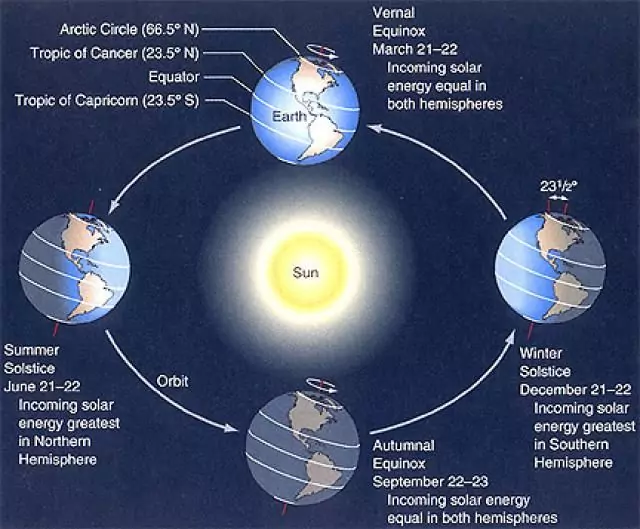
Earth’s seasonal cycle rests on its axial tilt and the seasonal changes in sunlight received as it orbits the Sun each year. The axis is tilted about 23.5 degrees from a line perpendicular to the orbital plane, or about 66.5 degrees relative to the plane itself. Earth rotates once on its axis in approximately 24 hours, producing day and night. As it orbits the Sun, the two hemispheres receive different amounts of sunlight at different times of the year. Sunlight strikes some areas more directly and others at a more oblique angle; day length also changes. This distribution of sunlight provides the physical basis of the seasonal cycle. [1] [2] [3] [4]
During summer, the relevant hemisphere is tilted towards the Sun. The Sun reaches a relatively high position in the sky and remains above the horizon for longer. During winter, that hemisphere is tilted away from the Sun; sunlight arrives at a more oblique angle and the days are shorter. Because oblique rays spread their energy across a larger area, less energy is received per unit area. This change is directly related to surface heating and cooling. [5] [6]
Earth’s distance from the Sun changes over the course of its orbit, affecting the amount of solar energy it receives. However, that distance is not the principal cause of the opposite seasonal cycles in the Northern and Southern Hemispheres. Both hemispheres orbit the Sun together, yet one experiences summer while the other experiences winter. Axial tilt, the angle of incoming sunlight and day length explain this contrast. The following video illustrates seasonal change:
Opposite Seasons and the Distribution of Sunlight in the Two Hemispheres
Summer around June in the Northern Hemisphere coincides with winter in the Southern Hemisphere; around December, this relationship reverses. The United States National Weather Service describes the hemispheres’ axial orientation in the following paragraph: [7]
For the Northern Hemisphere, the axis points most toward the sun in June (specifically around June 21), and away from the sun around December 21. This corresponds to the Winter and Summer Solstice (solstice is Latin for “the sun stands”). For the Southern Hemisphere, this is reversed.
English translation: For the Northern Hemisphere, the axis points most towards the Sun in June, particularly around 21 June, and away from it around 21 December. These positions correspond to the summer and winter solstices; the Latin term solstice means “the sun stands still.” For the Southern Hemisphere, the relationship is reversed.
This seasonal cycle can be observed by comparing the Sun’s altitude in the sky with day length. Changes in sunlight received by each hemisphere can be calculated from the orientation of Earth’s axis. The illustration below shows the relationship between axial tilt and Earth’s orbit.
Earth’s Heat: Incoming Energy, Distribution and Emission
Explaining Earth’s temperature requires accounting for sunlight, absorbed energy, heat distribution within the atmosphere and oceans, and the emission of heat into space. NASA explicitly identifies the role of solar energy in driving the climate. [8]
Solar power drives Earth’s climate. Energy from the Sun heats the surface, warms the atmosphere, and powers the ocean currents.
English translation: Solar energy drives Earth’s climate. The Sun’s energy heats the surface, warms the atmosphere and supplies the energy that powers ocean currents.
Earth’s surface and atmosphere both absorb energy and emit it through thermal radiation. These energy exchanges are investigated through observations, satellite measurements and physical models. Without axial tilt, the opposing seasonal cycles of the two hemispheres would not occur in their present form. The quantities and interactions of physical factors can be determined when explaining this process and its relationship to Earth’s weather, temperature and cycles of life.
Establishing Hell’s breaths as an effective cause of Earth’s temperature would also require identifying their contribution. Where energy enters or leaves, how much is involved, which regions are affected and how the proposed effect relates to measurements are all questions inherent in a causal claim. Repeating a scriptural statement supplies none of those measurements. Naming an invisible cause and demonstrating the cause of an observed event are separate tasks.
From Bangladeshi Textbooks
The following pages also present the explanation in a Bangladeshi textbook.
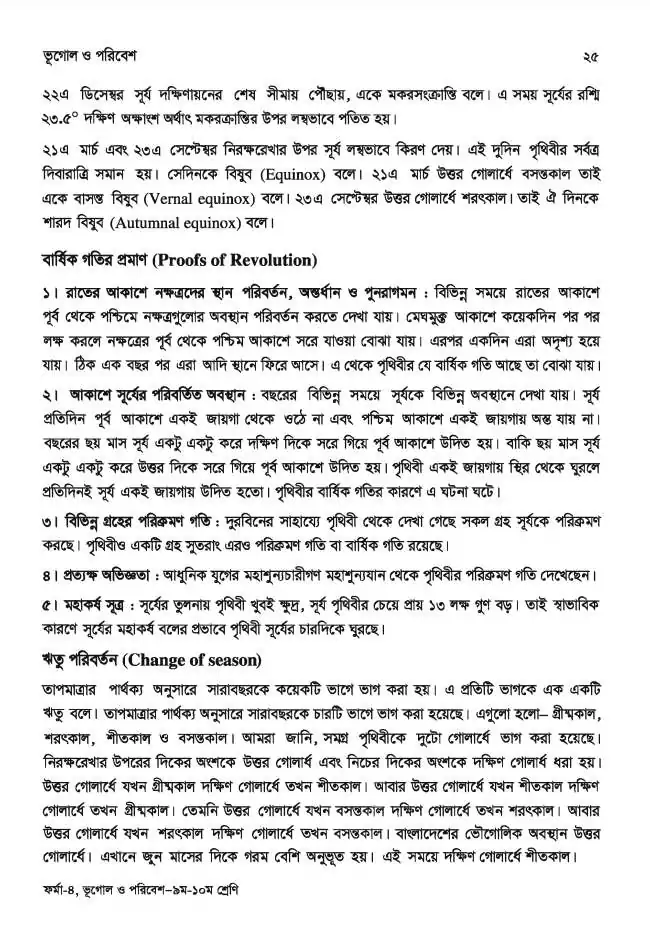
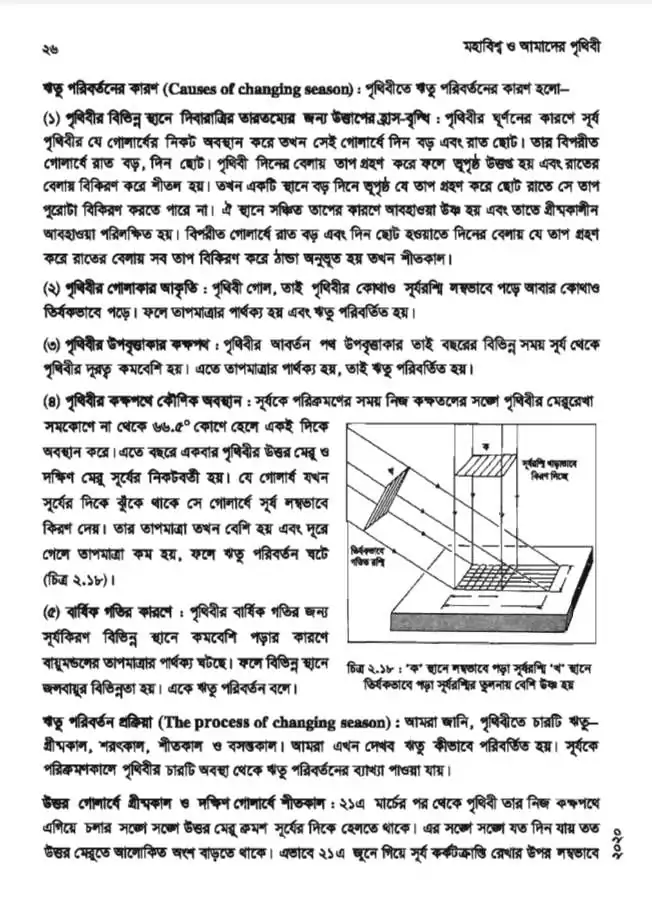
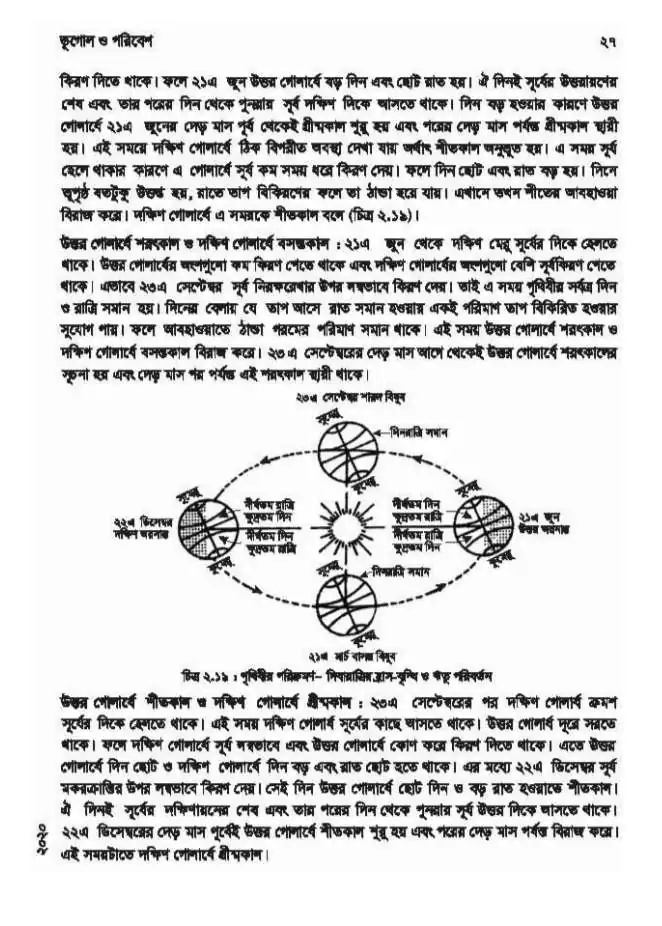
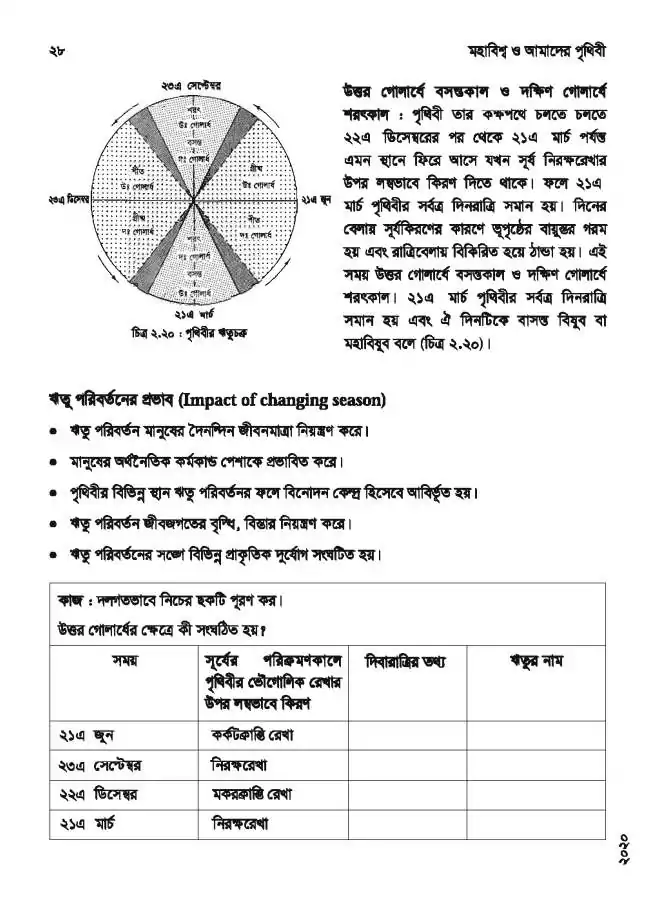
Islamic Superstition about the Causes of Winter and Summer
Islamic hadith links intense summer heat and bitter winter cold to Hell’s breaths. The Fire complains, suffers from the conflict between its parts, seeks permission for relief and breathes after permission is granted. This sequence attributes feeling, speech and agency to a fiery being. The heat and cold experienced by people on Earth are then explained as the effects of that being’s breaths. No evidence of measurable heat flow, energy exchange or atmospheric processes is supplied to support this claim. Acceptance of a religious account becomes the basis for identifying causes in nature. Comparing this superstition with modern meteorology raises specific questions: which regions are affected, when, and by how much does the breath increase heat or cold? The following video shows this hadith-based claim being promoted in a religious sermon.
Religious descriptions of Hell refer to its size, roaring, anger, sight, speech and breathing. Combining ordinary fire with human physical and mental characteristics produces the image of a punishing fiery being. This conception is directly relevant to the hadith about its complaint and breaths: seeking permission to breathe is presented as the action of a being capable of perception and speech. The following video contains a religious speaker’s account of Hell’s form and consciousness.
Complaint and Perception: Al-Nawawi’s Literal Interpretation
Qadi Iyad’s explanation, recorded by al-Nawawi, explicitly connects the Fire’s complaint and spreading heat with a capacity for perception and discrimination. [9]
قوله – صلى الله عليه وسلم – : ( اشتكت النار إلى ربها فقالت : يا رب أكل بعضي بعضا ، فأذن لها بنفسين ، نفس في الشتاء ونفس في الصيف ) قال القاضي : اختلف العلماء في معناه ، فقال بعضهم : هو على ظاهره ، واشتكت حقيقة ، وشدة الحر من وهجها وفيحها وجعل الله تعالى فيها إدراكا وتمييزا بحيث تكلمت بهذا .
English translation: Concerning Muhammad’s statement, peace and blessings be upon him: “The Fire complained to its Lord, saying: My Lord, one part of me has consumed another. It was then permitted two breaths—one in winter and one in summer.” The Qadi said: Scholars have disagreed about its meaning. Some said it is to be understood literally: the Fire truly complained, intense heat comes from its blaze and spreading heat, and Allah gave it perception and discrimination, enabling it to say this.
After discussing literal and figurative interpretations, al-Nawawi concludes that the literal reading is correct. His complete statement of that conclusion is also quoted in Islamweb’s discussion. [10]
قلت : والصواب الأول ؛ لأنه ظاهر الحديث ، ولا مانع من حمله على حقيقته ، فوجب الحكم بأنه على ظاهره . والله أعلم .
English translation: I say: The first view is correct, because it is the apparent meaning of the hadith, and there is no obstacle to understanding it literally. It must therefore be understood according to its apparent meaning. Allah knows best.
In this interpretation, the complaint expresses the Fire’s actual perception. It is understood to possess the ability to recognise its own distress, communicate it and request relief. In determining the cause of a natural phenomenon, the presumed literal truth of a scriptural account takes the place of testing and measurement. The being’s perception is established by accepting the hadith’s wording as true; the hadith’s truth is not established through independent evidence of that perception. A declaration of belief thus becomes the basis for accepting the claim.
The important phrase in al-Nawawi’s conclusion is “la mani”—there is no obstacle to understanding it literally. This argument permits an interpretation of a religious account; it does not demonstrate that the Fire actually spoke or that its breaths heated Earth. Being able to imagine an event and that event actually occurring are different matters. Even accepting the belief that an almighty Allah can make fire speak leaves separate questions: when did this particular fire speak, how was its speech known, and what effect did that conversation have on Earth’s temperature? An assertion of divine power cannot supply missing evidence of an event. [11]
Ibn al-Munayyir likewise argues for a literal interpretation on the basis of the sequence of complaint, permission and the restriction to two breaths. Islamweb quotes him as follows: [12]
وقال الزين ابن المنير: المختار حمله على الحقيقة لصلاحية القدرة لذلك، ولأن استعارة الكلام للحال وإن عهدت وسمعت لكن الشكوى وتفسيرها والتعليل له والإذن والقبول والتنفس وقصره على اثنين فقط بعيد عن المجاز خارج عما ألف من استعماله.
English translation: Zayn Ibn al-Munayyir said: The preferred view is to understand it literally, since divine power is capable of this. Although using speech figuratively to express a condition is familiar and attested, the complaint, its explanation, the reason given for it, permission, acceptance, breathing and its restriction to only two breaths are far removed from metaphor and outside its customary usage.
The argument for a literal reading here rests on details within the story. Yet however detailed a story may be, those details do not become evidence of a reality outside it. The subject of the complaint, the form of permission and the number of breaths make the account specific; they do not provide the observations necessary to establish its truth. Adding more stages to a story about Rahu swallowing the Sun or a god producing thunder does not establish the scientific cause of an eclipse or lightning. In the case of Hell, the prestige of the text conceals the same evidential gap.
Another troubling relationship emerges from the story’s sequence. The Fire complains that one part of it is consuming another; as a remedy, it receives permission to breathe; and those breaths produce the greatest heat and most intense cold experienced by humans. Relief for the Fire is thus connected to suffering for people on Earth. Accepting this arrangement makes the suffering caused by heat and cold more than a natural occurrence: it also becomes the outcome of a system authorised by Allah. The moral responsibility arising from the relationship between the described creator’s decision and human suffering does not disappear behind the word “permission.”
The damage caused by treating religious statements as explanations of nature is specific here. Because a text contains a story of the Fire’s complaint, its perception is accepted; because the Fire breathes, the cause of heat and cold is also declared settled. Yet neither the conversation with the Fire nor the effects of its breaths have been independently identified. Making each unverified stage the foundation for the next increases the number of claims without increasing the evidence. An appeal to divine power does not fill that gap; it merely extends the scope of belief.
Hell’s Sight, Anger and Speech in the Quran
Quran 25:12 describes the Fire seeing people from a distance. Its rage and roaring are also described as audible to them. Sight, emotion and vocal expression are attributed to the same fiery being. [13]
إِذَا رَأَتْهُمْ مِنْ مَكَانٍ بَعِيدٍ سَمِعُوا لَهَا تَغَيُّظًا وَزَفِيرًا
English translation: When it sees them from a distance, they will hear its rage and roaring.
Quran 67:7–8 describes the Fire’s roaring and boiling, together with its almost bursting apart in anger. The place of punishment is given an emotional response connected to the presence of those condemned to it. [14]
إِذَا أُلْقُوا فِيهَا سَمِعُوا لَهَا شَهِيقًا وَهِيَ تَفُورُ تَكَادُ تَمَيَّزُ مِنَ الْغَيْظِ كُلَّمَا أُلْقِيَ فِيهَا فَوْجٌ سَأَلَهُمْ خَزَنَتُهَا أَلَمْ يَأْتِكُمْ نَذِيرٌ
English translation: When they are thrown into it, they will hear its roaring as it boils. It will almost burst apart with rage. Whenever a group is thrown into it, its keepers will ask them: Did no warner come to you?
Quran 50:30 describes Hell being questioned and answering even more directly. Hell appears as a participant in a conversation. [15]
يَوْمَ نَقُولُ لِجَهَنَّمَ هَلِ امْتَلَأْتِ وَتَقُولُ هَلْ مِنْ مَزِيدٍ
English translation: On the day We say to Hell, “Are you full?” and it says, “Are there any more?”
These accounts attribute human-like sight, anger, roaring and responses to a place of punishment. The story of Hell’s breaths operates within the same conception of a personified being. Its feelings and behaviour are used as physical causes when explaining natural heat and cold. An invisible character in religious literature is thereby assigned the power to determine Earth’s actual temperature.
A Neck from the Fire: Eyes, Ears and a Speaking Tongue
Al-Tirmidhi’s report transmitted from Abu Hurayra describes the eyes, ears and tongue of a neck emerging from the Fire. The complete substantive account follows. [16]
يَخْرُجُ عُنُقٌ مِنَ النَّارِ يَوْمَ الْقِيَامَةِ لَهُ عَيْنَانِ تُبْصِرَانِ وَأُذُنَانِ تَسْمَعَانِ وَلِسَانٌ يَنْطِقُ يَقُولُ إِنِّي وُكِّلْتُ بِثَلَاثَةٍ بِكُلِّ جَبَّارٍ عَنِيدٍ وَبِكُلِّ مَنْ دَعَا مَعَ اللَّهِ إِلَهًا آخَرَ وَبِالْمُصَوِّرِينَ
English translation: On the Day of Resurrection, a neck will emerge from the Fire. It will have two eyes that see, two ears that hear, and a tongue that speaks. It will say: I have been assigned three kinds of people—every obstinate tyrant, everyone who invoked another deity alongside Allah, and image-makers.
Here, fire equipped with senses announces its own assignment and identifies the targets of punishment. This attribution of human characteristics to fire connects the accounts of complaint, anger and breathing within the same religious framework.
Hell’s Dispute with Paradise
Hell’s conversations are not confined to complaints about its own suffering. In Sahih Muslim, Paradise and Hell dispute over their inhabitants. Both speak in the first person, identify who enters them, and receive Allah’s response. The account transmitted from Abu Hurayra reads: [17]
احْتَجَّتِ النَّارُ وَالْجَنَّةُ فَقَالَتْ هَذِهِ يَدْخُلُنِي الْجَبَّارُونَ وَالْمُتَكَبِّرُونَ . وَقَالَتْ هَذِهِ يَدْخُلُنِي الضُّعَفَاءُ وَالْمَسَاكِينُ فَقَالَ اللَّهُ عَزَّ وَجَلَّ لِهَذِهِ أَنْتِ عَذَابِي أُعَذِّبُ بِكِ مَنْ أَشَاءُ – وَرُبَّمَا قَالَ أُصِيبُ بِكِ مَنْ أَشَاءُ – وَقَالَ لِهَذِهِ أَنْتِ رَحْمَتِي أَرْحَمُ بِكِ مَنْ أَشَاءُ وَلِكُلِّ وَاحِدَةٍ مِنْكُمَا مِلْؤُهَا .
English translation: The Fire and Paradise disputed. One said: The tyrannical and arrogant enter me. The other said: The weak and poor enter me. Allah then said to the Fire: You are My punishment; through you I punish whomever I will—the report sometimes gives the wording “through you I afflict whomever I will.” He said to Paradise: You are My mercy; through you I show mercy to whomever I will. Each of you will be filled.
Disputing requires understanding statements, expressing one’s own condition and making comparisons with the other party. A literal reading of this account therefore attributes those capacities to Paradise and Hell. The place of punishment speaks about its inhabitants and receives Allah’s address. This is a more specific personification than simply comparing human feelings to fire: the place itself is cast as a speaker.
Dragging Hell with Seventy Thousand Bridles
Another report in Sahih Muslim describes Hell being dragged on the Day of Resurrection. It will have seventy thousand bridles, with seventy thousand angels at each bridle. Seventy thousand is not the total number of angels; that number is specified separately for every bridle. [18]
يُؤْتَى بِجَهَنَّمَ يَوْمَئِذٍ لَهَا سَبْعُونَ أَلْفَ زِمَامٍ مَعَ كُلِّ زِمَامٍ سَبْعُونَ أَلْفَ مَلَكٍ يَجُرُّونَهَا
English translation: Hell will be brought on that day. It will have seventy thousand bridles. At each bridle there will be seventy thousand angels dragging it.
Bridles, dragging and the combined strength of countless angels present Hell as an immense entity capable of being moved and restrained. The preceding accounts give it speech and perception; this one adds visible presence and movement. Together with the complaining Fire, these descriptions produce a religious image of Hell as both a place of punishment and a terrifying character capable of active behaviour. Calling that character’s breath the cause of Earth’s temperature also asserts a causal connection between a mythological realm and the physical natural world.
Islamic Belief concerning Hadith
An integral element of Islamic theology, or aqidah, is accepting Muhammad’s every word and deed as absolute truth. According to orthodox Islamic belief, every word uttered by the Prophet is under divine supervision and free from error. This belief rests on the premise that Muhammad does not say anything untrue out of personal emotion, anger or pleasure. Consequently, when a sahih hadith makes a claim about everyday reality, science or the cosmos, a devout Muslim regards it as more certain than observable scientific findings. [19]
Sunan Abu Dawud (Islamic Foundation)
19 / Learning and Knowledge (Education and Scholarship)
Chapter 417: Recording Knowledge in Writing
3607. Musaddad (may Allah have mercy on him) ….. narrated from Abdullah ibn Amr (may Allah be pleased with him), who said: I used to write down everything I heard from the Messenger of Allah, peace and blessings be upon him. I wished to preserve it all. But Quraysh forbade me, saying: You write down everything you hear, although the Messenger of Allah, peace and blessings be upon him, is a human being who speaks both when angry and when pleased. Hearing this, I stopped writing and informed the Messenger of Allah, peace and blessings be upon him, about the matter. He then pointed to his mouth with his finger and said: Keep writing. By Him in whose hand is my life, nothing comes out of this mouth except the truth.
Hadith grading: Sahih (authentic)
Narrator: Abdullah ibn Amr ibn al-As (may Allah be pleased with him)
Hell Underground: Seven Earths, Seven Seas and Sijjin
Islamic texts explicitly contain statements locating Hell beneath the earth. IslamQA’s answer titled “Where Are Paradise and Hell?” quotes a statement attributed to Abdullah ibn Salam: Paradise is in heaven, while the Fire is in the earth. It cites report 8698 in al-Hakim’s collection, stating that al-Hakim classified it as sahih and al-Dhahabi agreed. [20]
إِنَّ الْجَنَّةَ فِي السَّمَاءِ، وَإِنَّ النَّارَ فِي الْأَرْضِ
English translation: Indeed, Paradise is in heaven, and the Fire is in the earth.
The same answer quotes several reports from pages 62–63 of Ibn Rajab’s Al-Takhwif min al-Nar. Among them is a statement attributed to Ibn Abbas in response to Mujahid’s question, locating Hell beneath seven layered seas. The quoted passage reads: [21]
وخرج ابن مندة، من حديث أبي يحيى القتات عن مجاهد، قال: قلت لابن عباس: أين الجنة؟ قال: فوق سبع سموات، قلت: فأين النار؟ قال: تحت سبعة أبحر مطبقة.
English translation: Ibn Mandah transmitted a report through Abu Yahya al-Qattat from Mujahid, who said: I asked Ibn Abbas, “Where is Paradise?” He replied, “Above seven heavens.” I asked, “Then where is the Fire?” He replied, “Beneath seven seas arranged in layers.”
Islamweb also quotes Ibn al-Qayyim’s Hadi al-Arwah, which records a statement attributed to Ibn Abbas placing Paradise in the seventh heaven and Hell in the seventh earth. In the same discussion, another report transmitted by Ibn Mandah distinguishes their present locations from where they will be placed on the Day of Resurrection. [22]
وروى ابن منده عن عبد الله قال: “الجنة في السماء الرابعة، فإذا كان يوم القيامة جعلها الله حيث يشاء، والنار في الأرض السابعة، فإذا كان يوم القيامة جعلها الله حيث يشاء”.
English translation: Ibn Mandah narrated from Abdullah, who said: “Paradise is in the fourth heaven; when the Day of Resurrection comes, Allah will place it wherever He wills. The Fire is in the seventh earth; when the Day of Resurrection comes, Allah will place it wherever He wills.”
These reports placing the Fire in the seventh earth or beneath it present a vertical arrangement of the cosmos: the heavens and Paradise above, and layers of earth, seas and Hell below. This arrangement supplies a framework for imagining a physical relationship between people on Earth’s surface and the realm of punishment beneath them. An underground location thus provides a spatial structure alongside the belief that Hell’s heat reaches people above.
Sijjin: From the Record of Deeds to a Location in the Lower World
Quran 83:7–9 states that the book or record of the wicked is in Sijjin. [23]
كَلَّا إِنَّ كِتَابَ الْفُجَّارِ لَفِي سِجِّينٍ وَمَا أَدْرَاكَ مَا سِجِّينٌ كِتَابٌ مَرْقُومٌ
English translation: No indeed! The record of the wicked is in Sijjin. And what will make you know what Sijjin is? A written record.
In his commentary on this verse, Ibn Kathir records the view that Sijjin lies beneath the seventh earth. The alternatives he mentions include a green rock beneath the seventh earth and a well in Hell. The relevant passage reads continuously as follows: [24]
ثم قد قال قائلون هي تحت الأرض السابعة وقد تقدم في حديث البراء بن عازب في حديثه الطويل يقول الله عز وجل في روح الكافر اكتبوا كتابه في سجين وسجين هي تحت الأرض السابعة وقيل صخرة تحت السابعة خضراء وقيل بئر في جهنم
English translation: Some have said that it is beneath the seventh earth. In al-Bara ibn Azib’s long hadith, it has already been stated that Allah says concerning the disbeliever’s soul: “Write his record in Sijjin.” Sijjin is beneath the seventh earth. It has also been said to be a green rock beneath the seventh earth, and it has been said to be a well in Hell.
In the explanation that follows, Ibn Kathir describes the breadth of the upper levels and the narrowness of the lower ones, presenting a layered arrangement extending to the centre of the seventh earth. He connects Hell, the destination of the wicked, with the lowest position. His interpretation of Sijjin thus becomes intertwined with an account of the universe’s structure and the location of the realm of punishment. [25]
Ibn Uthaymin likewise connects Sijjin with the lower earth when explaining Hell’s location. Statements quoted by IslamQA from his Fatawa Nur ala al-Darb and Al-Sharh al-Mumti place the Fire in the earth. Discussing the seas and Earth’s interior as proposed locations, he says its precise location is unknown while maintaining that it is in the earth. [26]
This interpretive tradition places the realm of punishment in the lower layers of the earth. Alongside references to “Hell’s heat,” it supplies a religious geography of Earth’s interior. Its basis for locating Hell is scriptural interpretation and transmitted accounts, rather than geological investigation. Both the existence of a place deep inside Earth and its effects on surface temperatures are claims about nature; assigning a location in a religious text does not establish that location’s physical existence. Further commentary and quotations concerning Sijjin, Hell and the underground world appear in “According to Islam, Are Hell and Sijjin Located inside the Earth?” .
The phrase “beneath the earth” does not describe an abstract moral condition. The seventh earth, seas beneath it, Sijjin at a particular depth and the location of the Fire establish relationships between objects, places and layers. Once this vertical arrangement is presented as a claim about Earth’s structure, evidence about Earth is required to determine its truth. A place being named in a text and that place existing on Earth are different matters. Nor does acceptance of an underground location by numerous commentators become geological evidence of its existence.
The Cold Water of Seven Seas Holds Back Hell’s Fire
In his commentary on Quran 20:6, al-Qurtubi preserves an account of underground fire control attributed to Wahb ibn Munabbih. The complete statement attributed to him reads: [27]
وقال وهب بن منبه على وجه الأرض سبعة أبحر ، والأرضون سبع ، بين كل أرضين بحر ، فالبحر الأسفل مطبق على شفير جهنم ، ولولا عظمه وكثرة مائه وبرده لأحرقت جهنم كل من عليها ، قال : وجهنم على متن الريح ، ومتن الريح على حجاب من الظلمة ، لا يعلم عظمه إلا الله تعالى وذلك الحجاب على الثرى ، وإلى الثرى انتهى علم الخلائق .
English translation: Wahb ibn Munabbih said: There are seven seas on the face of the earth, and there are seven earths, with a sea between every two earths. The lowest sea covers the rim of Hell. Were it not for its vastness, abundant water and cold, Hell would burn everyone above it. He said: Hell rests upon the back of the wind, and the wind upon a veil of darkness whose magnitude none knows except Allah. That veil rests upon moist earth, and the knowledge of created beings reaches only as far as that moist earth.
Here an imaginary underground sea is assigned the task of shielding against the Fire’s heat. The familiar experiences of water extinguishing fire and cold water reducing heat are extended into the depths of the cosmos. Using familiar properties of familiar materials does not establish the imagined locations of those materials. The account provides no observations showing where the seven seas are, how much water lies at particular depths, or where that water connects with the Fire.
Treating the sea’s vastness and cold as a protective barrier also raises a physical problem: when heat enters cold water, the water itself warms. A large volume of water can slow its warming; it cannot substitute for removing heat indefinitely. Keeping a system cool while it continually receives heat requires an account of where that heat goes, how it gets there and at what rate. Stacking Hell, water, wind and darkness beneath one another supplies no account of those energy exchanges. The story pushes the question to a deeper layer without resolving it.
The mechanism of fear in the account attributed to Wahb is also clear: life above ground lies within reach of a destructive fire, and everyone will burn if the intervening barrier disappears. Human safety is presented as depending on an invisible realm of punishment and its control system instead of investigable natural conditions. The social effect is to mix fear with knowledge about nature. Accepting the Fire also draws the unseen arrangement beneath Earth into the realm of belief. Further accounts of fish, rocks, seas and other layers beneath Earth are discussed in “The Earth Rests on a Fish according to Islamic Belief” .
The Mythological Underground Confronted by Seismic Waves
Knowledge of Earth’s interior does not depend solely on how deeply humans have drilled. Seismic waves change speed and direction as they pass through Earth. Differences in whether particular wave types can travel through different materials provide information about its internal layers. The United States Geological Survey explains how the outer core’s liquid state was identified: [28]
P-wave and S-wave paths through the earth. Scientists discovered that Earth’s outer core is liquid by observing seismic waves. P waves travel through solid and liquid, but S waves do not travel through liquid.
English translation: The paths of P waves and S waves through Earth. Scientists identified Earth’s outer core as liquid by observing seismic waves. P waves travel through both solids and liquids, but S waves do not travel through liquids.
Earth’s mantle is not a collection of earths suspended between seven seas. The USGS explains that mantle rock behaves as a solid over short timescales but can flow slowly over long geological periods. Localised partial melting occurs, while the major entirely liquid layer is the outer core. The behaviour of seismic waves is compared with these properties. [29]
Seven earths separated by seas do not match this observational account of Earth’s structure. Placing a vast layer of water inside Earth would have consequences for seismic wave paths; its appearance in a tafsir cannot substitute for those consequences. Religious terminology cannot impose an imaginary underground arrangement on the physical Earth. An Earth investigated through seismic waves and an underworld assembled from transmitted accounts rest on different evidential foundations. The former’s structure is inferred from nature’s responses; in the latter, the text’s statement serves as the guarantee of the arrangement.
Hadith on the Causes of Winter and Summer
Reports transmitted from Abu Hurayra connect the Fire’s complaint and Allah’s permission with the heat and cold experienced by humans. The following quotations retain the accounts in two Bengali editions of Sahih Muslim, rendered here in English.
Sahih Muslim (Hadith Academy)
Chapter 5: Mosques and Places of Prayer
Publisher: Hadith Academy
Section 32: It is recommended to offer Zuhr after the heat has subsided during intense summer heat, allowing those travelling to congregational prayer to do so in cooler conditions
1290-(187/…) Harmala ibn Yahya (may Allah have mercy on him) ….. narrated from Abu Hurayra (may Allah be pleased with him), who said: The Messenger of Allah, peace and blessings be upon him, said: Hell complained to Allah, saying, “My Lord! One part of me is consuming another. Allow me to breathe.” Allah therefore permitted it two breaths, one in the winter season and another in the summer season. The cold you experience in winter is caused by Hell’s breath. The heat or intense heat you experience is likewise caused by Hell’s breath. (Islamic Foundation 1277; Islamic Centre 1290)
Hadith grading: Sahih (authentic)
Sahih Muslim (Islamic Foundation)
5 / Mosques and Places of Prayer
Section 32: It is recommended to offer Zuhr after the heat has subsided during intense summer heat
1279. Harmala ibn Yahya (may Allah have mercy on him) … narrated from Abu Hurayra (may Allah be pleased with him), who said: The Messenger of Allah, peace and blessings be upon him, said: Hell said, “My Lord! One part of me has consumed another. Allow me to breathe.” It was then permitted two breaths, one in winter and another in summer. Therefore, the cold you experience is Hell’s breath, and the summer heat you experience is also Hell’s breath.
Hadith grading: Sahih (authentic)
Narrator: Abu Hurayra (may Allah be pleased with him)
Al-Bukhari’s Arabic Text: Complaint, Permission and Two Breaths
The same statement appears in al-Bukhari’s Book of the Beginning of Creation. The account connects the greatest heat and most intense cold with the two permitted breaths. [30]
اشْتَكَتِ النَّارُ إِلَى رَبِّهَا، فَقَالَتْ رَبِّ أَكَلَ بَعْضِي بَعْضًا، فَأَذِنَ لَهَا بِنَفَسَيْنِ نَفَسٍ فِي الشِّتَاءِ وَنَفَسٍ فِي الصَّيْفِ، فَأَشَدُّ مَا تَجِدُونَ فِي الْحَرِّ، وَأَشَدُّ مَا تَجِدُونَ مِنَ الزَّمْهَرِيرِ
English translation: The Fire complained to its Lord, saying: My Lord, one part of me has consumed another. It was then permitted two breaths—one in winter and one in summer. The greatest heat you experience and the most intense cold you experience are the effects of those breaths.
In the account’s sequence, the Fire first complains about its condition; permission follows, and the connection between its breaths and terrestrial heat and cold is then declared. A chain of causation is constructed from a complaining being’s distress to human experiences of weather. Complaint, hearing, authorisation and breathing each play an active role within the story.
Extreme Heat and Zamharir in Muslim’s Arabic Text
At the end of Muslim’s Arabic text, the word “ashaddu”—the most intense—qualifies both heat and zamharir, or extreme cold. The substantive text is quoted in full. [31]
اشْتَكَتِ النَّارُ إِلَى رَبِّهَا فَقَالَتْ يَا رَبِّ أَكَلَ بَعْضِي بَعْضًا . فَأَذِنَ لَهَا بِنَفَسَيْنِ نَفَسٍ فِي الشِّتَاءِ وَنَفَسٍ فِي الصَّيْفِ فَهُوَ أَشَدُّ مَا تَجِدُونَ مِنَ الْحَرِّ وَأَشَدُّ مَا تَجِدُونَ مِنَ الزَّمْهَرِيرِ
English translation: The Fire complained to its Lord, saying: My Lord, one part of me has consumed another. It was then permitted two breaths—one in winter and one in summer. This is the greatest heat you experience and the most intense cold you experience.
The Arabic text presents intense heat and cold as effects of Hell’s activity. The narrator’s report and the collection’s religious standing are offered as the basis for this causal claim. The statement provides no independent identification of which terrestrial heatwave came from that breath. The Fire’s complaint is first accepted as true, and Earth’s experienced temperature is then described as its result. This belief-based sequence does not supply the observation and measurement required to establish causation in scientific inquiry.
Opposite Seasons in the Two Hemispheres: Problems with the Two-Breath Explanation
Winter and summer occur simultaneously in opposite hemispheres. Around June, the Northern Hemisphere tilts more towards the Sun; around December, the Southern Hemisphere does. Consequently, southern Australia experiences winter during the Northern Hemisphere’s summer and summer during its winter. Saying “one in winter” and “one in summer” therefore raises the question of which region’s winter and summer are intended. Earth’s seasonal cycle does not change everywhere at once according to a single region’s calendar. [32]
Explaining regional heat and cold through two breaths would require specifying when the breaths occur, how they spread and which areas they affect. When one area experiences a heatwave while another experiences extreme cold, a method is needed to establish which effect comes from which breath. Physical explanations can use information about the Sun’s position, day length, air circulation and local conditions. The Hell-based explanation supplies no independent information to compare against these observations. Attaching a hot breath to heat and a cold breath to cold merely renames the phenomena; it does not explain their geographical distribution.
This problem also appears in the question addressed by Islamweb fatwa 125881. Its answer proposes that Hell’s heat arrives through the Sun and that rain or cold air currents can reduce its effects. [33]
Under this arrangement, a religious explanation can be fitted retrospectively to every observed weather condition. Heat is attributed to the Fire’s influence, while reduced heat is attributed to an obstacle to that influence. Yet no independent rule quantifies either the influence or the obstacle. The conception does not allow one to determine in advance where temperatures will rise or fall. An invisible cause is fitted to the event after it occurs. This preserves belief without increasing testable knowledge of nature.
Ibn Uthaymin’s Reconciliation: An Invisible Cause behind Physical Causes
In the explanation quoted by Islamweb, Ibn Uthaymin accepts the positional effects of sunlight while placing behind them a religious cause known through revelation. Hell’s breath increases heat and its cold cools the weather: this is how he combines the two causes. His concluding sentence reads: [34]
فيجتمع في هذا: السبب الشرعي المدرك بالوحي، والسبب الحسي ، المدرك بالحس .
English translation: Thus the religious cause known through revelation and the physical cause known through the senses operate together.
This reconciliation adds no new evidence for the claim about Hell. Observations of the Sun’s effects support the physical cause; those observations cannot also serve as evidence of an invisible Fire’s breath. Measuring the relationship between solar energy and temperature does not establish every supernatural claim attached to it. The freedom to name another cause behind an observed cause is different from evidence establishing that additional cause.
If Hell’s influence increases actual temperatures, how much does it increase them, when, and how can that contribution be separated from the effects of sunlight and atmospheric processes? These are determinate questions. Likewise, a claim that it intensifies cold requires identifying effects on heat removal or energy exchange. Calling the cause “known through revelation” answers none of these questions. The claim concerns intervention in Earth’s actual temperature. Moving its evidential basis entirely into belief asserts a physical effect while evading responsibility for verifying that effect.
This explanation also involves circular dependence. The invisible cause is accepted on the assumption that the hadith is true; that cause is then reconciled with the physical explanation to preserve the hadith’s acceptability. The success of the reconciliation depends on first accepting the disputed claim. Imagining a statement to be compatible with known natural phenomena does not provide independent evidence of its truth. Without separate evidence, invoking reconciliation grants an unsupported claim the standing of established science.
Scientific explanations remain open to correction because new measurements can reveal their errors. With this method of adding invisible causes, even opposite outcomes can be accommodated within the same belief. Increasing heat, decreasing heat or regional differences can each be followed by an explanation that adjusts the proposed invisible influence. What observation would count as showing the explanation to be wrong remains unspecified. It therefore functions as a religious claim insulated from the results of testing, rather than a conclusion derived from testing nature.
Two Annual Breaths and the Instruction to Delay Zuhr Prayer
Another report in Muslim connects the instruction to delay prayer in intense heat with Hell’s heat. The same report also includes the phrase “fi kulli am”—each year. [35]
إِذَا كَانَ الْحَرُّ فَأَبْرِدُوا عَنِ الصَّلاَةِ فَإِنَّ شِدَّةَ الْحَرِّ مِنْ فَيْحِ جَهَنَّمَ . وَذَكَرَ أَنَّ النَّارَ اشْتَكَتْ إِلَى رَبِّهَا فَأَذِنَ لَهَا فِي كُلِّ عَامٍ بِنَفَسَيْنِ نَفَسٍ فِي الشِّتَاءِ وَنَفَسٍ فِي الصَّيْفِ
English translation: When it is hot, delay prayer until the heat has eased, for intense heat comes from the spreading heat of Hell. He also mentioned that the Fire complained to its Lord, who permitted it two breaths each year—one in winter and one in summer.
Al-Bukhari likewise connects the instruction to delay Zuhr with Hell’s heat. The account of the complaint and the two breaths immediately follows the instruction about prayer. [36]
إِذَا اشْتَدَّ الْحَرُّ فَأَبْرِدُوا بِالصَّلاَةِ، فَإِنَّ شِدَّةَ الْحَرِّ مِنْ فَيْحِ جَهَنَّمَ . وَاشْتَكَتِ النَّارُ إِلَى رَبِّهَا فَقَالَتْ يَا رَبِّ أَكَلَ بَعْضِي بَعْضًا . فَأَذِنَ لَهَا بِنَفَسَيْنِ نَفَسٍ فِي الشِّتَاءِ، وَنَفَسٍ فِي الصَّيْفِ، فَهُوَ أَشَدُّ مَا تَجِدُونَ مِنَ الْحَرِّ، وَأَشَدُّ مَا تَجِدُونَ مِنَ الزَّمْهَرِيرِ
English translation: When the heat becomes intense, delay prayer until it has eased, for intense heat comes from the spreading heat of Hell. The Fire complained to its Lord, saying: My Lord, one part of me has consumed another. It was then permitted two breaths—one in winter and one in summer. This is the greatest heat you experience and the most intense cold you experience.
A supernatural cause is attached here to the practical decision to pray after the heat subsides. Identifying actual heat with Hell’s heat brings a religious realm of punishment into the causal explanation of everyday life. High temperatures can be observed; the additional claim that this heat came from Hell requires separate evidence. The hadith binds both together in a single instruction.
No independent scientific evidence has been found for this belief in Hell’s breaths. Explaining natural phenomena through the behaviour of an invisible being that complains and breathes is an unsupported supernatural causal claim. Substituting a text’s prestige for evidence suppresses rational inquiry and enables ignorance to persist. Observation, measurement and verifiable physical explanations provide effective standards for confronting this superstition in a scientifically informed society.
An Overview of the Evidence and Claims concerning Hell
A complaining Fire, a speaking realm of punishment, its underground location and its influence on Earth’s weather are conceptions developed through different statements in the Quran, hadith and later commentaries. These include scriptural declarations, statements attributed to Muhammad, reports attributed to the Companions and commentators’ conclusions. Each retains its own identifiable status.
| Topic | Source and Attribution | Statement Preserved in the Source | Specific Basis for Criticism |
|---|---|---|---|
| Complaint and speech | Sahih Muslim 617a; a statement attributed to Muhammad | The Fire complains that one part of it is consuming another; it is then permitted two breaths. | The Fire’s perception, speech and breathing are presented as real elements of the event. |
| Two breaths per year | Sahih Muslim 617b; a statement attributed to Muhammad | Permission is given for two breaths each year, one in winter and one in summer. | A specified annual arrangement is linked to human experiences of heat and cold. |
| Prayer times and Hell’s heat | Sahih al-Bukhari 536–537; a statement attributed to Muhammad | The spreading heat of Hell is given as the reason for delaying prayer in intense heat. | Supernatural causation is attached to a practical decision based on actual weather. |
| Sight, anger and roaring | Quran 25:12 and 67:7–8 | The Fire sees people; its rage and roaring are heard; it almost bursts apart with anger. | Sight and emotion are attributed to the place of punishment. |
| Answering questions | Quran 50:30 | When asked whether it is full, Hell asks whether there are any more. | Hell is portrayed as a participant in a conversation. |
| Eyes, ears and a tongue | Jami al-Tirmidhi 2574; a statement attributed to Muhammad | A neck emerging from the Fire has eyes that see, ears that hear and a tongue that speaks. | The part emerging from the Fire is given sensory capacities and speech. |
| Dispute with Paradise | Sahih Muslim 2846a; a statement attributed to Muhammad | Paradise and the Fire dispute over their inhabitants; Allah answers them. | The two places are presented as beings speaking about their own condition. |
| Being dragged with bridles | Sahih Muslim 2842; a statement attributed to Muhammad | Hell has seventy thousand bridles, with seventy thousand angels dragging it at each bridle. | Hell is described as an immense entity capable of being moved and restrained. |
| Preference for a literal interpretation | Al-Nawawi, Sharh Sahih Muslim, 5/262–263 | Al-Nawawi considers the literal reading correct; the explanation he quotes attributes perception and discrimination to the Fire. | A commentator’s conclusion cannot serve as independent evidence of the Fire’s consciousness or physical influence. |
| Location in the earth and beneath seven seas | IslamQA 215011; statements attributed to Abdullah ibn Salam and Ibn Abbas, including reports collected by Ibn Rajab | Reports locate the Fire in the earth and beneath seven layered seas. | A specific underground arrangement is established within religious narration. |
| The protective barrier of a cold sea | Tafsir al-Qurtubi, Taha 20:6; a statement attributed to Wahb ibn Munabbih | Without the lowest sea’s vastness, water and cold, Hell would burn everyone above it. | An unverified system of heat control is attached to an imaginary underground arrangement. |
| Adding an invisible cause to physical causes | Islamweb 125881; Ibn Uthaymin’s explanation | The Sun’s influence is combined with a religious cause involving Hell’s breaths. | Evidence for the physical cause does not establish an additional invisible cause. |
Accounts of complaint, anger, answers and dispute construct Hell’s character as an active being. The hadith about its breaths identifies that being’s actions as the cause of terrestrial heat and cold. Accounts of the underground world give it a spatial framework, while later reconciliations attempt to connect it with known physical causes. Together, these form an extensive system of religious conceptions. Evidence that this system exists in religious literature and evidence that each of its claims is true in the physical natural world are entirely different matters.
Conclusion
There is a fundamental difference between the scientific explanation of Earth’s seasonal cycle and the religious explanation involving Hell’s breaths. The relationships between axial tilt, Earth’s annual orbit, the angle of incoming sunlight and day length can be tested through observation and calculation. Those relationships also explain why the two hemispheres experience opposite seasons simultaneously. This knowledge does not depend on accepting a text as infallible; its acceptance rests on agreement between explanation and measurement. When new evidence reveals an error, correction remains possible.
In the account of Hell’s breaths, the Fire complains, receives permission and has its breaths linked to the greatest heat and most intense cold experienced by humans. Other Quranic and hadith accounts also attribute sight, anger, conversation and dispute to the realm of punishment. In al-Nawawi’s preferred literal interpretation, the Fire’s complaint and perception are accepted as actual occurrences. This therefore asserts that the behaviour of an invisible fiery being explains natural phenomena. Reports and interpretations support that claim within the religious tradition; no independently identified breath, route of transmission or measured contribution to temperature is supplied.
Reports concerning Hell’s underground location construct a mythological geography alongside the same conception. The seventh earth, layered seas and Sijjin’s location are established through religious interpretation. In the account attributed to Wahb and preserved by al-Qurtubi, a vast body of cold water restrains Hell’s fire; wind and darkness form further layers beneath it. An unseen underground world is assembled from familiar properties of fire, water, cold and air. Observations of seismic waves and the properties of materials used to investigate Earth’s physical structure do not support that arrangement. The presence of a geography in religious literature does not establish its existence inside Earth.
Adding an invisible religious cause behind known physical causes does not close this evidential gap. Measuring the Sun’s influence does not establish Hell’s breath as an additional influence. Being able to reconcile a story with observations of nature is different from having evidence that the story is true. Neither scriptural prestige, a commentator’s reputation nor a declaration of divine power can substitute for the independent evidence the claim requires. Filling gaps in knowledge of natural phenomena with the actions of supernatural characters supplies an answer to curiosity, but it does not supply tested knowledge.
The problem extends beyond personal belief into education and freedom of thought. When an educational system teaches that unsupported scriptural claims are more certain than observable causes, students must apply two standards to the same subject. In science classes they are told to demand evidence; before religious authority they are told to withdraw that demand. This habit weakens critical thinking and encourages explanations designed to preserve belief instead of correcting errors. Assuming that a text has already settled questions about nature also subordinates the results of inquiry to that predetermined conclusion.
The acceptability of a truth claim depends on evidence. A statement’s religious status does not exempt it from the possibility of error, and antiquity does not give a fictional narrative equal standing with a scientific explanation. Replacing supernatural characters with observable physical causes in explanations of eclipses, lightning and seasonal cycles represents an advance in human knowledge. The superstition of Hell’s breaths has no special right to exemption from the same scrutiny. Personal prestige and religious identity do not determine natural causation; what matters is the evidence supporting the claim.
The strength of scientific education lies in the freedom to question authority, identify errors and change conclusions in response to evidence. Explaining weather through fear of an invisible realm of punishment runs counter to that freedom. Observation, testing and reasoning form the foundation of knowledge about nature in a modern, progressive society. Declaring Earth’s heat and cold to be the breaths of a complaining Fire does not change the laws of nature; it merely places an unsupported story in the path of human understanding.
References
- What Causes the Seasons? ↩︎
- Reasons for the Seasons; Earth Science Facts to Make their Day ↩︎
- Seasons and Earth’s Tilt | Explanation and Review ↩︎
- A season is a period of the year that is distinguished by special climate conditions ↩︎
- Why Do We have Seasons? ↩︎
- Why Do We Have Seasons? ↩︎
- US National Weather Service: Why Do We Have Seasons? ↩︎
- NASA: Climate and Earth’s Energy Budget ↩︎
- Al-Nawawi, Sharh Sahih Muslim, vol. 5, pp. 262–263; commentary on Muslim 617 ↩︎
- Islamweb 25806; al-Nawawi’s preferred literal interpretation ↩︎
- Al-Nawawi, Sharh Sahih Muslim, vol. 5, pp. 262–263; the argument for a literal reading ↩︎
- Ibn al-Munayyir’s statement, quoted in Islamweb 25806 ↩︎
- Quran, al-Furqan 25:12 ↩︎
- Quran, al-Mulk 67:7–8 ↩︎
- Quran, Qaf 50:30 ↩︎
- Jami al-Tirmidhi 2574; the senses and speech of the neck emerging from the Fire ↩︎
- Sahih Muslim 2846a; the dispute between Paradise and Hell ↩︎
- Sahih Muslim 2842; Hell’s bridles and its being dragged ↩︎
- Sunan Abu Dawud, Islamic Foundation edition, hadith 3607 ↩︎
- IslamQA 215011; the statement attributed to Abdullah ibn Salam ↩︎
- Ibn Rajab, Al-Takhwif min al-Nar, pp. 62–63; quoted by IslamQA ↩︎
- Islamweb 314533; quotations from Ibn al-Qayyim’s Hadi al-Arwah ↩︎
- Quran, al-Mutaffifin 83:7–9 ↩︎
- Tafsir Ibn Kathir, al-Mutaffifin 83:8 ↩︎
- Tafsir Ibn Kathir, al-Mutaffifin 83:8; lower levels and the centre of the seventh earth ↩︎
- Ibn Uthaymin, Fatawa Nur ala al-Darb 4/2 and Al-Sharh al-Mumti 3/174–175; quoted by IslamQA ↩︎
- Tafsir al-Qurtubi, Taha 20:6; the account attributed to Wahb ibn Munabbih ↩︎
- USGS: P-wave and S-wave paths through the Earth ↩︎
- USGS: Solid mantle rock, partial melting and the liquid outer core ↩︎
- Sahih al-Bukhari 3260; Hell’s complaint and its winter and summer breaths ↩︎
- Sahih Muslim 617a; the Arabic account of the complaint, heat and cold ↩︎
- US National Weather Service: Opposite seasonal cycles in the two hemispheres ↩︎
- Islamweb 125881; the answer concerning opposite seasons and regional temperature differences ↩︎
- Ibn Uthaymin’s commentary on Sahih Muslim, quoted in Islamweb 125881 ↩︎
- Sahih Muslim 617b; two breaths each year and the instruction to delay prayer ↩︎
- Sahih al-Bukhari 536–537; the reason given for delaying prayer in intense heat ↩︎