
Introduction
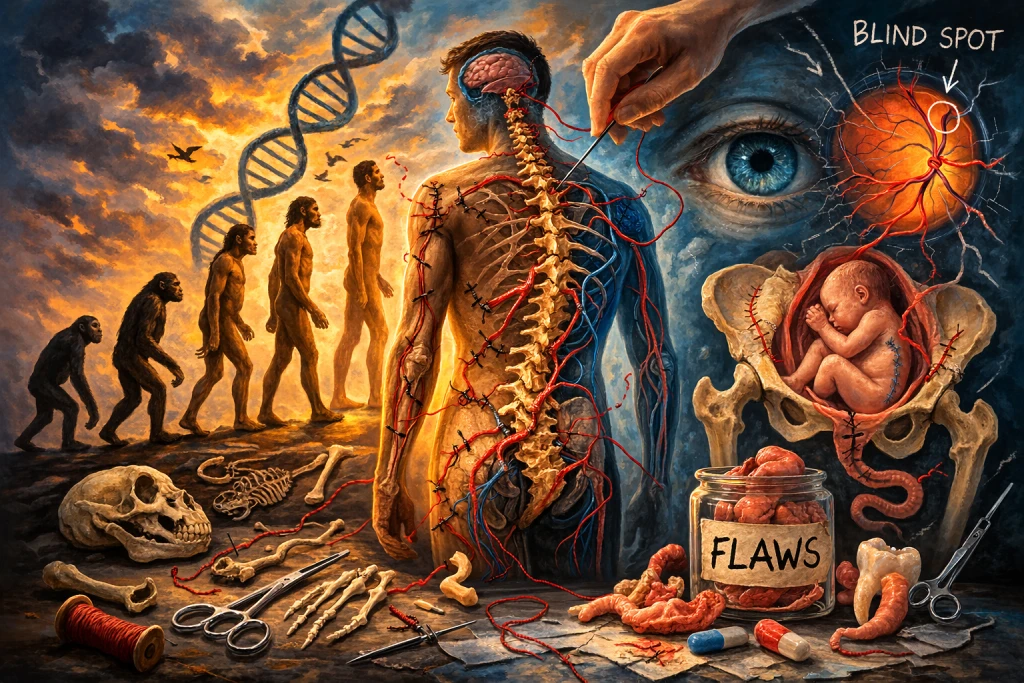
One of the most popular and frequently repeated claims among religious apologists is that the human body is a “perfect design”: a flawless feat of engineering that must be the work of an omniscient, omnipotent, and perfectly benevolent God. This is a familiar version of the argument from design. The body’s complexity, perfection, and functionality are taken to imply the existence of a creator. But detailed research in modern biology, evolutionary theory, anatomy, and genetics directly refutes the claim that the human body is flawless. The human body is no masterpiece of perfect engineering. It is the product of a long evolutionary history on Earth. Listing the remarkable things it can do does not settle the question. The eye allows us to see, but it is equally true that when light falls on one particular spot in that eye, we see nothing there. The successes and failures of the same body both call for explanation. If the evidence of failure is left out when testing whether the body is “perfect,” the claim has already been assumed true before the test begins.
Evolution is not a human engineer who can draw up a new, optimized blueprint from scratch and build everything to perfection. It is a process of bricolage, or “tinkering,” in which existing structures, genes, and organs are adapted to new environments through small changes. The French biologist François Jacob set out this idea in his famous 1977 paper: evolution modifies and reuses whatever is already at hand. Consequently, a new adaptation can retain the limitations of an older structure. The difference from designing from scratch is that each subsequent change starts with the body of the previous generation. Even after adapting to a new task, the joint between two bones or the position of a nerve relative to an artery may retain traces of the old arrangement. Such relationships give the study of evolutionary history evidence to work with, rather than leaving it to conjecture. [1]
A clear example of this “tinkering” comes from the fossil research of Neil Shubin and his colleagues. Tiktaalik was a tetrapod-like fish from the Devonian. Its pectoral fin had the features of a fin, but the arrangement of its bones and joints also showed some features of tetrapod limbs. In Your Inner Fish, Shubin discusses many examples of this long evolutionary inheritance in the human body. The human body did not spring into existence “perfect” at a single moment. It took shape step by step over hundreds of millions of years, under environmental pressures and with whatever material was already available. A fin and a hand do not have to look alike from the outside for their relationship to be established. What matters is the relative position of the bones inside and how they articulate. Some of those relationships remain recognizable even after the later structure takes on a new function. Tiktaalik’s fin is therefore more than a vague visual resemblance to a modern hand. It is fossil evidence of how the internal structure of a fin could change toward a limb capable of bearing weight. [2]
This is where the fundamental weakness of the religious claim of “perfect design” becomes apparent. If an omniscient and omnipotent designer really existed, why would he make a human hand out of an ancient fish fin? Why not build an optimized, flawless structure from scratch? The religious claim offers no logical or scientific answer. Evolution, by contrast, explains specifically why the human hand and other tetrapod limbs retain traces of an earlier skeletal arrangement. We can compare bones, arrange fossils in chronological order, and examine which features were already present and which arose later. A structure that is “good enough” can do its job; that does not erase the limitations it carries in doing it. Functional arrangements coexist in the same body with problems that arise from the way those arrangements are built. The only way to make the body look flawless is to count the benefits and leave out the problems that come from the same structure.
The Watchmaker Argument, the Human Body, and Errors in Detecting Agency
Another popular religious argument runs as follows: “If you found a watch on a deserted island or on Mars, wouldn’t you assume it had a maker? Why, then, do atheists refuse to infer a designer when they see an eye, a brain, or a human body, all far more complex than a watch?” The classic version of this analogy appears in William Paley’s Natural Theology. Paley argued that we infer a maker because the parts of the watch are arranged to work together to tell the time. He did not claim that a fault in the watch would rule out a maker. Two claims therefore have to be tested separately. Whether the human body is flawless can be assessed by looking at how its organs work and how they fail. Whether a functioning organ warrants an inference to a conscious maker depends on the evidence about how such organs come into being. The analogy itself does not establish that living organs arise by the same process as watches. [3]
that its several parts are framed and put together for a purpose
English rendering: Its different parts have been shaped and assembled to serve a purpose.
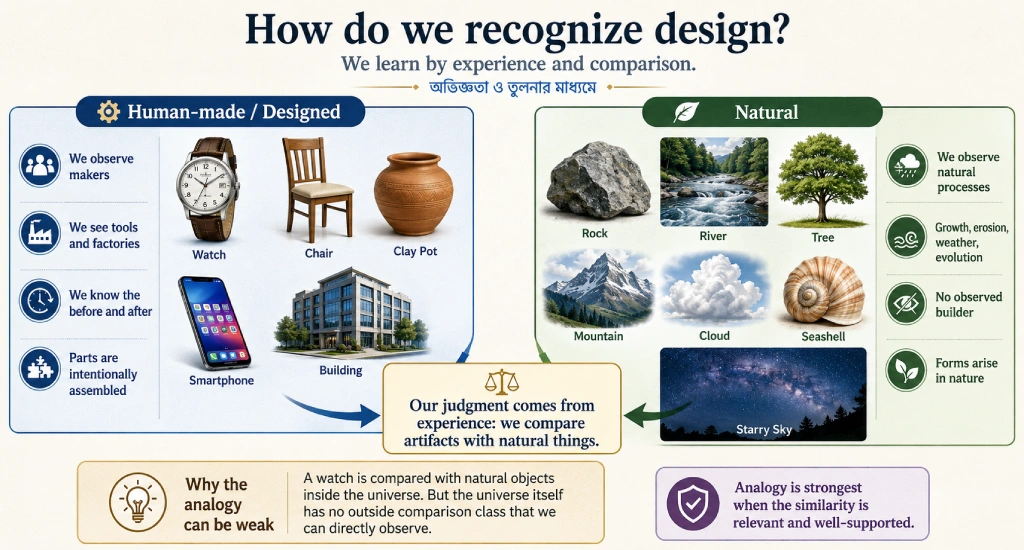
In other words, we infer a designer when we see a watch because of prior experience, traces of manufacture, and relevant comparisons, not because of “complexity” alone. We know people make watches from history, craftsmanship, factories, markets, repair shops, technology, and direct observation. Nothing comparable exists for the eye or the human body. No one has ever seen a god make an eye, observed a divine factory, or detected a supernatural engineering process. What we observe in living bodies is birth, reproduction, heredity, genetic variation, mutation, natural selection, sequences of fossils, and structural relationships among species. These are not features of a watch. They are features of living systems that evolve.
People generally distinguish what occurs naturally from what has been made by looking at the evidence. A snowflake, river delta, rock formation, lightning bolt, cloud shape, or snail shell may be complex, but we do not call it human-made because there is an explanation for how it forms naturally. A stone axe is much less complex than an eye, yet we recognize it as manufactured from the marks left by sharpening and striking the stone, its deliberate shape, and the context of human use. “Complexity equals design” is therefore no scientific rule. Complexity is neither sufficient nor necessary for design. Very simple things can be made, and extremely complex things can form naturally.
This is why inferring a maker from a watch found on a deserted island or on Mars can be reasonable. A watch is an artifact, and we already have independent evidence that objects of this kind are made by humans or other intelligent agents. The same conclusion does not follow for an eye or a human body. In Chapter II, Paley even imagined a watch capable of making another watch like itself while it ran. But making a similar object is not the same process as accumulating heritable differences among descendants. If a feature helps organisms leave more offspring in their current environment, it may become more common in the next generation. Small changes accumulating over many generations can alter what an organ does. No ancestor has to know what a future organ will do, and a change that serves a purpose now need not have served the same purpose when it arose. The watch analogy offers no alternative account of this process in living bodies. [3]
One proposed explanation for how our intuitions can lead us astray is the Hyperactive or Hypersensitive Agency Detection Device, abbreviated HADD. On this hypothesis, assuming that an active creature or agent is present in an ambiguous situation can sometimes be the safer bet. If a bush rustles, it may be the wind or a tiger. Mistakenly thinking “there’s a tiger” may cost little, whereas assuming “there’s nothing there” when there really is a tiger could cost you your life. Treating the rustle as a warning may be useful, but the sound alone does not establish that a tiger is there. Likewise, seeing apparent purpose in a structure and establishing that it was actually made by an agent are two different things. Evidence is needed to get from one to the other. [4]
The feeling that something “looks designed” is therefore no proof. The human mind readily sees purpose, but that tendency can also mislead us. Science relies on independent evidence, repeated observation, testable explanations, and comparisons with alternatives instead of personal intuition. For living bodies, “God designed them” specifies no testable process, makes no definite prediction, identifies no traces of manufacture, and supplies no independent mechanism. Evolutionary theory, by contrast, shows how small changes, inheritance, variation, natural selection, and genetic drift can produce complex organs over long periods without a conscious designer.
A deeper problem with the watch analogy emerges when both function and failure are put before the same claim. When the eye works, the maker is given credit. When a blind spot is found in that same eye, the claim about the maker remains unchanged. What feature of the eye did the claim actually predict? An explanation that claims the successes as evidence and makes the failures fit as well does not tell us why a particular outcome occurred. This is why perfection is more than a rhetorical flourish. If every limitation of an organ is declared “part of the design” in advance, examining the organ can never yield evidence against the design claim. Evolution makes a far more specific claim: related lineages should retain traces of earlier arrangements. Their location and form can be checked in fossils, anatomy, or genomes.
The fundamental weakness of the watchmaker argument is that it conflates complexity, purpose, and our experience of manufactured objects. We call a watch designed because there is independent evidence connecting watches to human manufacture. We call the eye a product of natural evolution because of evidence from genetics, anatomy, fossils, and comparative biology. Watches and eyes may have a superficial resemblance, but the evidence for their origins is entirely different. “A watch has a designer, so an eye must have a divine designer” is not a sound inference. It is a weak analogy resting on our tendency to infer agency.
The Inverted Retina and the Blind Spot
The basic structure of the vertebrate eye, including the human eye, exhibits a deep design inefficiency. It is one of the clearest refutations of “perfect design.” Our retina is inverted: the light-sensitive parts of its photoreceptors, the rods and cones, face backward toward the sclera and the retinal pigment epithelium, with several layers of nerve fibers, blood vessels, and other neural tissue in front of them. Light must pass through several inner retinal layers before reaching the photoreceptors. Those layers process and transmit neural signals. The nerve fibers converge on the light-facing side of the retina and leave the eye through the optic disc. The human optic disc has no light-detecting cells, so that eye cannot register the part of the scene whose image falls there. This limitation follows from the route by which retinal nerve fibers leave the eye. Praising what the eye can do does not make this particular limitation disappear. [5]
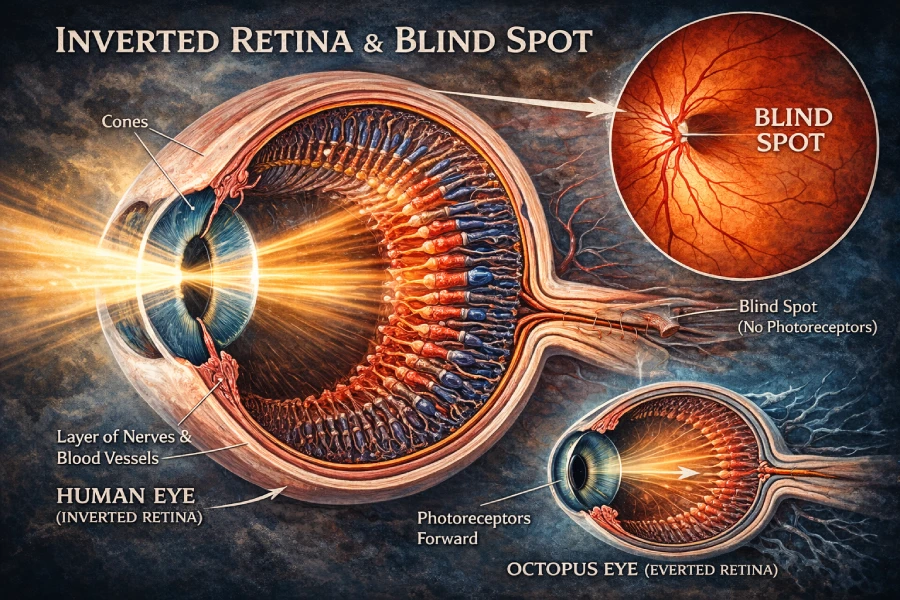
One direct consequence of this arrangement of nerve fibers in the human retina is the blind spot. There are no photoreceptors where the optic nerve leaves the retina and heads toward the brain. When light falls on that particular spot, we see nothing there. We do not usually notice the blind spot because the brain combines information from both eyes and fills in what is missing. But the blind spot is an unnecessary limitation and clear evidence that the eye was not built to perfection from scratch. You can test it yourself. Draw a cross on the left and a dot on the right, on the same line on a sheet of paper. Close your left eye, look at the cross with your right eye, and slowly move the paper closer or farther away. At a certain distance, the dot disappears. The dot is still on the page, and there is no shortage of light. Its image simply falls on a part of the retina that has no cells to detect it.
Yet cephalopods such as octopuses and squid have the same kind of camera-type eye with an everted, rather than inverted, retina. The light-sensitive parts of their photoreceptors face the incoming light, and the nerve fibers run behind the retina. Their eyes therefore have no blind spot of the kind produced by the nerve exit at the human optic disc. The two types of eye evolved independently, an instance of convergent evolution along different paths. The comparison poses a specific question: does a camera-type eye require its nerve fibers to exit through the light-sensitive layer? The octopus eye shows that it does not. The human retina has a gap in photoreceptor coverage where the nerve exits; a different arrangement can capture the same kind of scene without such a gap. [6]
If an omniscient and omnipotent designer really made both human and octopus eyes, why would he leave a blind spot in the human eye that the brain must fill in with information from the surrounding scene or the other eye? When both eyes are open, one can supply visual information that falls in the other’s blind spot. That reduces the inconvenience, but it adds no light-detecting cells to the optic disc of the first eye. In the octopus eye, the nerve fibers run behind the retina and do not create a blind spot like the one at the human optic disc. If that blind spot were necessary to form an image, the octopus arrangement would not work.
The inverted vertebrate retina does have a way of getting light to its photoreceptors. Franze and colleagues showed experimentally that Müller cells, which span the thickness of the retina, can guide light toward light-sensitive cells with little scattering. Where photoreceptors are present, light can reach them through these cells. Even if light reaches the optic disc, there are no photoreceptors there to detect it. Efficient light transmission and failure to register one part of the scene are thus features of the same retina. Müller cells can guide light; they cannot make the optic disc sensitive to it. [5]
these cells provide a low-scattering passage for light from the retinal surface to the photoreceptor cells
English rendering: These cells give light a path from the retinal surface to the photoreceptors with little scattering.
This example alone is enough to show that the human body is no “perfect design.” It bears the traces of hundreds of millions of years of imperfect history. To establish that the eye has a blind spot, you do not need to know every detail about its distant ancestors. You can see the effect by closing one eye. The next question is why the eye is built this way, and the answer lies in comparing how the retina develops, how other animals’ eyes are built, and what these structures inherited from their ancestors. “Perfect design” can tell us how wonderfully the eye works. Its anatomy tells us where it will not see, and why.
The Structure of the Spine and Back Pain
The human vertebral column is one of the clearest and most painful examples of evolutionary “tinkering.” Adaptations for walking on two legs developed over many generations on top of the basic arrangement of vertebrae and discs already present in four-legged ancestors. The change was not sudden. The curves in the human neck, upper back, and lower back help support the weight of the head and body in an upright posture. At the same time, the lower vertebrae and the discs between them have to withstand body weight, movement, and the pull of muscles. Reusing old material in a new posture does not mean that every part of it will handle the load equally well. This is why it is more useful to identify which structures do which jobs, and where problems occur, than to call the entire spine inefficient.
The discs of the lower spine, or lumbar region, do more than bear body weight. They take changing loads as we walk, bend, sit, stand, or lift. A disc that protrudes and presses on a nerve can cause back or leg pain. Not every case of lower back pain, however, can be traced to a single identifiable lesion. The World Health Organization estimates that about 619 million people worldwide experienced low back pain in 2020, and that it is a leading cause of disability globally. That figure shows the scale of the problem. Determining which kinds of pain are associated with which vertebral shapes or disc injuries requires separate evidence from anatomical specimens and comparative studies. [7]
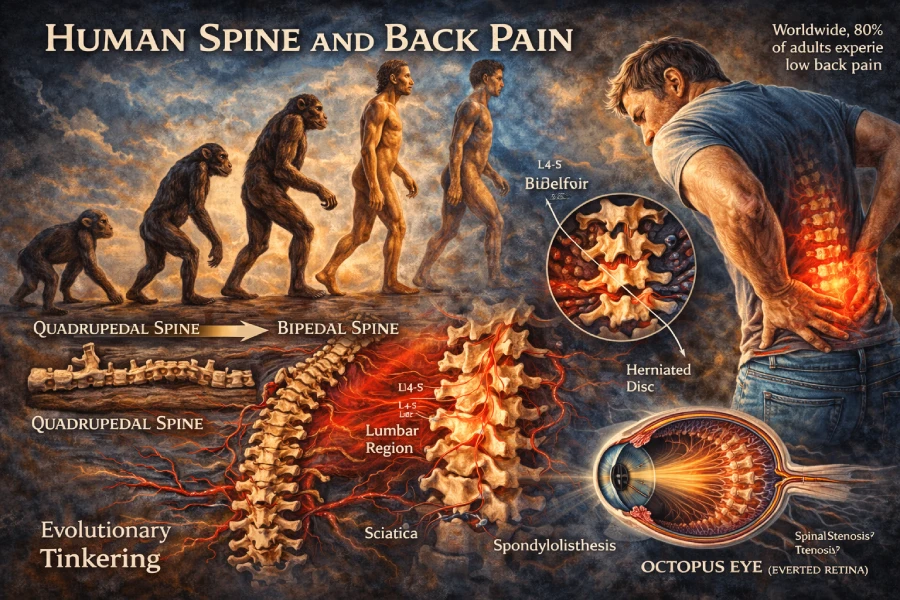
To test the “ancestral shape hypothesis,” Plomp et al. (2015) compared vertebrae from the lower thoracic and upper lumbar regions of humans, chimpanzees, and orangutans. They used a bony marker called Schmorl’s nodes, which can form when part of a disc herniates vertically into a vertebral body. Human vertebrae with this marker were more similar in shape to chimpanzee vertebrae than human vertebrae without it were. This is not a survey of all back pain, nor does it explain every case of a herniated lumbar disc compressing a nerve that serves the leg. It establishes a specific association: an ancestral-like vertebral shape and the marker of one kind of disc problem are more often found together in the same specimens. The “tinkering” here rests on a measurable anatomical comparison. [8]
If an omniscient, omnipotent, and perfectly benevolent designer really made the human body, why would he patch together and reuse such an old, inefficient structure? In a body that walks upright, we can measure how vertebrae of different shapes bear weight. We can also compare the particular shape associated with a disc lesion with the vertebrae of our evolutionary relatives. The question is therefore more specific than “Why do people have back pain?” Why is this particular spinal problem associated with a shape that resembles an older, inherited arrangement? Praising the spine as flawless, load-bearing engineering does not explain that relationship.
Walking on two legs freed our hands from locomotion. But the spine and discs of a body that bears weight upright were modified from an earlier arrangement. The curves that help keep us balanced upright did not make the structure immune to injury. This is what “good enough” means in evolution: an arrangement can persist if it allows the body to do what it needs to do. Its risks do not all have to vanish. Nor can the structural similarities visible in the vertebral specimens be dismissed by calling the spine a perfect design.
The Bizarre Route of the Recurrent Laryngeal Nerve
One of the most famous and most absurd examples of evolutionary inefficiency in the human body is the recurrent laryngeal nerve. It is a branch of the vagus nerve and controls most of the intrinsic muscles of the larynx. But the branches on the two sides loop under different blood vessels on their way there. The left branch descends into the chest, loops under the aortic arch, and climbs back into the neck. The right branch normally loops under the right subclavian artery. The nerves reach the two sides of the larynx to perform the same task. Their different routes cannot be explained by two different needs of the larynx. The difference in which artery lies on each side is what explains the difference in their detours. [9]
The detour is especially conspicuous in the giraffe. The left branch of the vagus nerve, which descends from the head, loops beneath an artery in the chest before climbing the long neck back to the larynx. As the neck lengthens, the distance traveled becomes all the more striking relative to the destination. The giraffe’s larynx is not in its chest, yet one of its nerves has to go down toward the chest to reach it. The real question is not how many feet it travels, but why it goes down into the chest and comes back at all. The left nerve in humans makes the same kind of loop. Humans and giraffes have very different neck lengths, but both routes bear the mark of an old relationship between a nerve and a major artery. [10]
To understand this bizarre route, we have to look at embryonic development. Early on, the nerves in the neck and the arteries of the pharyngeal arches lie close together. The neck then lengthens, the relative positions of the heart and major blood vessels change, and parts of some embryonic arteries disappear. Where the nerve retains its position relative to the vessel it originally looped beneath, the loop remains. The arrangement of the pharyngeal arches in fish-like vertebrate ancestors offers a comparative clue to this history. What matters is how the arteries of those arches change and which side of them the nerve stays on as they do. The route was not drawn with only the future location of the larynx in mind. It bears the imprint of the arrangement from which development began. [9]
Richard Dawkins presented this example in his book as “incontrovertible evidence” for evolution. But the human body itself offers a more direct test of the detour. In rare cases the nerve on the right goes from the neck to the larynx without looping under the artery as it normally does. This is called the non-recurrent laryngeal nerve. Henry and colleagues found in their meta-analysis that 86.7 percent of cases with this nerve variant on the right were associated with an aberrant right subclavian artery. That figure tells us how often an arterial variation was observed among cases with the variant nerve. The destination is still the same larynx; what differs is the embryonic arrangement of the blood vessels. Predicting where the nerve will loop therefore requires knowing not just where the larynx is, but how the artery developed. [9]
A right NRLN was associated with an aberrant subclavian artery in 86.7% of cases.
English rendering: An aberrant subclavian artery was associated with the right-sided non-recurrent laryngeal nerve in 86.7 percent of cases.
If an omniscient and omnipotent designer really made humans and giraffes, why would he choose such a ridiculous detour? The human body itself provides examples of the right nerve reaching the larynx without its usual loop. The destination stays the same, but the course of the nerve varies with the embryonic arrangement of the right subclavian artery. The position of the larynx alone does not predict this route. The development of the arteries gives us a clue as to which one the nerve will loop beneath. “Perfect design” explains nothing about this specific relationship.
A relationship inherited from the pharyngeal arrangement of fish-like ancestors was modified and reused in a new body. That is what evolutionary “tinkering” means in this case. The giraffe’s long loop, the difference between the left and right routes in humans, and the rare direct route in humans are not three unrelated curiosities. Understanding all three requires asking the same questions: Which blood vessel lay beside the nerve? How did it change during development? What happened to the nerve’s position as it did? An explanation of this kind specifies what arrangements we can expect to find in the body. “The designer wanted it that way” predicts none of these differences.
The Complications of Childbirth
Human childbirth is one of the most painful examples in evolutionary biology. The problem begins with the anatomy: the baby’s head and shoulders must pass through the mother’s bony birth canal, but the canal is widest in different directions at different levels. How much room the baby has therefore depends on the orientation of the head and shoulders as well as their size. The evolutionary explanation proposed for this complex arrangement is the “Obstetric Dilemma.” At its heart are two demands on the same pelvis: walking upright and giving birth. The physical risks of childbirth, however, do not depend on whether every part of that explanation has been established. [11]
The traditional account of the obstetric dilemma holds that a wider canal helps deliver a newborn with a large head, while the demands of walking on two legs influence the shape of the pelvis. This yields a testable claim: a wider pelvis should make walking or running more energetically costly. In the experiments of Warrener and colleagues, pelvic width did not predict differences in the energy cost of locomotion. The risks of childbirth therefore cannot be explained away by saying that people could not walk efficiently unless the pelvis were narrow. Understanding why human labor becomes obstructed requires considering the size and position of the fetus together with the dimensions and changing shape of the birth canal. [12]
When the baby’s head does not fit the mother’s birth canal, cephalopelvic disproportion, a mismatch between the head and the pelvis, can occur. During birth, the head and then the shoulders must rotate to fit the passage. Rotation in childbirth is not uniquely human. In video recordings of three chimpanzee births, Hirata and colleagues documented rotation of the head and body after the head had emerged. The specific risk in humans is that birth can be obstructed if the head and shoulders do not have enough space or are not favorably positioned as they pass through the canal. To understand an obstruction, what matters more than whether rotation has been observed at some stage is whether the size and position of the fetus fit the available space at that stage. [11] [13]
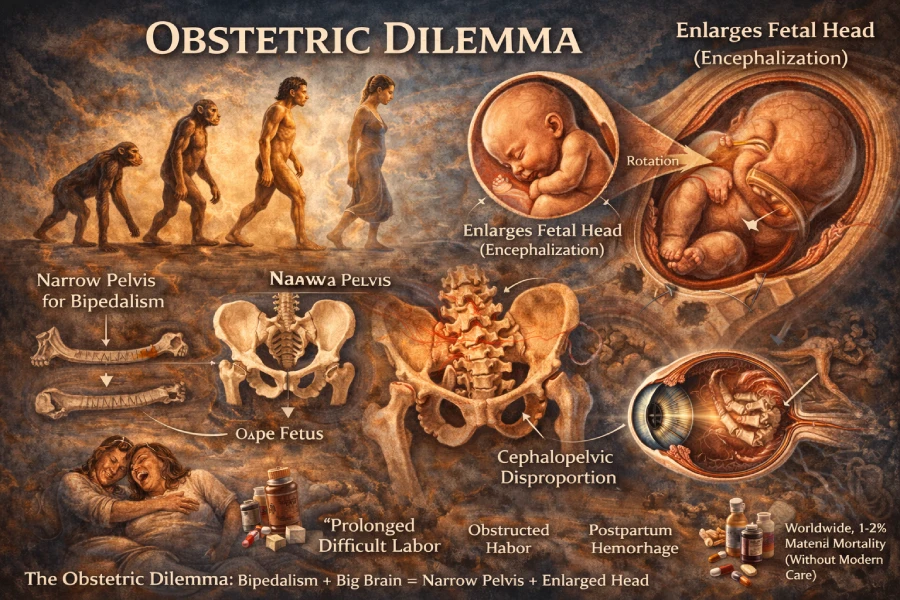
Obstructed labor can kill both mother and child. Hemorrhage, infection, and other complications of pregnancy and childbirth also cause maternal deaths. The World Health Organization and its United Nations partners estimate that about 260,000 women worldwide died in 2023 from causes related to pregnancy and childbirth. This is the total estimate of maternal deaths, not a separate count of deaths from obstructed labor. One concrete example of the biological risks behind that figure occurs when the baby stops progressing through the birth canal and saving the mother and child becomes difficult without urgent intervention. Successful vaginal births do not erase the existence of that danger. [14]
In their discussion of the evolution of human childbirth, Rosenberg and Trevathan (2002) considered the baby’s body and the mother’s birth canal together. The birth is not over once the baby’s head has passed through one part of the canal. The shoulders still have to pass through the maternal pelvis at the next stage, and they can get stuck even after the head has emerged. Head size alone cannot explain this obstruction. Progress depends on how the head and shoulders are positioned at different stages of birth and how much room is available to them at the time. The structure that allows the baby through at one stage can block it at the next. [11]
If an omniscient, omnipotent, and perfectly benevolent designer really made the human body, why would he retain a system that puts lives on the line? Why not make the woman’s pelvis as wide as necessary? The very baby about to be born can obstruct the passage with its own head or shoulders, endangering both its life and its mother’s. The baby and the birth canal can be measured. We can document when labor stops progressing and when medical intervention is needed to overcome the obstruction. The very system that delivers a child sometimes blocks its birth. To call it the flawless work of an omniscient engineer without accounting for this observable mismatch is simply to leave its failures out of the reckoning.
In human childbirth the difference between “good enough” and flawless is painfully clear. The birth canal has functioned well enough for the human species to reproduce, but it does not guarantee every mother and baby the same space, the same pace of labor, or an unobstructed delivery. In an evolutionary account, both the maternal pelvis and the fetal body vary, and new structures arise from earlier arrangements. A given birth canal can therefore be expected to yield different outcomes for fetuses of different sizes. The weakness of the design claim is that it points to successful births and declares the system “perfect,” rather than explaining how its functionality and its dangers coexist.
Ancestral Inheritance and Its Biological Costs
Some organs and genes in the human body can be understood only by looking at their earlier functions and their lineage. A feature can lose one ancestral function and still serve another. A gene can lose its function and leave only a remnant of its sequence. “Vestigial” therefore does not always mean “serving no function.” The appendix may have a role and still be liable to inflammation. Wisdom teeth help with chewing when they erupt normally, but can become impacted when there is not enough space. GULO has lost its role in producing vitamin C, yet traces of the gene remain. These three kinds of observation have to be distinguished when testing the claim of perfection.
The appendix is attached to the cecum, the first part of the human large intestine. An appendix arose independently in several mammalian lineages. The human organ therefore cannot simply be dismissed as a useless remnant of an old organ for digesting cellulose. Bollinger and colleagues proposed that the environment inside it may help beneficial gut bacteria survive. Alongside this possible role is the risk of inflammation. If an inflamed appendix bursts, a serious infection can spread inside the abdomen. Why would an omniscient designer retain an organ that can cause a deadly infection? That is the point. Having some function does not make the risk disappear. [15] [16]
Wisdom teeth are our third molars. When they erupt normally, they help with chewing. Trouble arises when there is not enough room at the back of the jaw or a tooth is poorly positioned. It can remain trapped beneath bone or gum. A partially erupted tooth can cause inflammation, pain, or infection around it. A tooth that never develops, one that develops but becomes impacted, and one that is extracted for medical reasons are three different cases. The question for design is not whether all wisdom teeth are useless. It is why the body forms a tooth without always providing enough room for it to erupt properly. That is the specific mismatch. [17]
Vitamin C production: Most mammals can make vitamin C, or ascorbic acid, in their own bodies. But the GULO gene for L-gulono-gamma-lactone oxidase has become nonfunctional in some primates, including humans. It is now a pseudogene, the remnant of a broken gene. If we do not get enough vitamin C from food, a prolonged deficiency can cause scurvy. The enzyme needed for the last step of vitamin C synthesis has a gene whose nonfunctional sequence can still be identified in the human genome. This example therefore tells us more than why we need vitamin C in our diet. It shows both why the body can no longer make it and what has been left behind in the genome. The ability disappeared, but its genetic trace did not. Why would a body supposedly made anew to perfection still carry the broken trace of a lost ability? A body built by descent has a reason to carry it. [18]
The differences among these three examples make them more revealing. The danger of appendicitis is real even if the appendix has a useful role. With wisdom teeth we can examine how the size and position of the tooth fit the available room in the jaw. With GULO, no organ has to be declared useless: the trace of a lost capacity has been identified in the genome. “Perfect design” stamps the same label on all these different problems. Evolution asks a different set of questions: what did the feature do before, what happened to it later, and how much of its old arrangement remains? The genome provides more precise ways to look for that history.
Traces of Ancestry in the Human Genome
We do not always need fossils to find traces of the past in the human body. Humans have 23 pairs of chromosomes. The other living great apes have 24. This difference raises a specific question: did two ancestral chromosomes fuse into one in the human lineage? If two chromosomes fused end to end, then sequences normally found at the ends of chromosomes should leave traces inside the resulting chromosome. The direction of those traces should also be predictable, since the two former ends would face each other. Ijdo and colleagues identified repeating telomeric sequences inside human chromosome 2 in precisely such a head-to-head arrangement. The explanation for the difference in chromosome number goes beyond a simple count: the physical traces of the event that produced the difference have been found. [19]
the relic of an ancient telomere-telomere fusion
English rendering: A remnant of an ancient fusion between two telomeres.
Another test is to look for traces of ancient viruses in the genomes of related species. When retroviral DNA becomes part of an ancestor’s germline, it can pass to descendants just like other DNA. Finding evidence of the same kind of virus is not enough. We have to check whether the sequence occupies the same corresponding position in the genome and whether the DNA on either side also matches. In Johnson and Coffin’s comparison, for instance, a viral sequence called RTVL-Ha was found in the lineages of humans, chimpanzees, bonobos, and gorillas, but not in the more distantly related primates tested in the study. This is no vague resemblance between faces or hands. It is a specific test of which lineages carry a trace of the same event in the past. [20]
multiple integrations (and subsequent fixation) of ERV loci at precisely the same location are highly unlikely
English rendering: It is highly unlikely that retroviral sequences would independently insert more than once at precisely the same site and then become fixed in the relevant populations.
Chromosome fusion and viral sequences provide two different kinds of evidence. In the first case, the prediction was that a human chromosome would contain head-to-head traces of two ancestral ends. In the second, if related lineages inherited an ancient insertion, its genomic position should match across those lineages. In both cases, we can state what we expect beforehand and then check the DNA. “The same maker used the same materials” merely gives the resemblance a name. It does not explain why the material should lie at that particular site in the chromosome and face in that particular direction, or which lineages will carry the same viral insertion. These are not items on a list of useful parts in the human body. They are records of events.
Human Vulnerability to Disease and Pathogens
The human body is vulnerable to pathogens and viruses. The cost has been visible time and again throughout human history. Influenza, tuberculosis, HIV, malaria, the Black Death, the Spanish flu, and the recent coronavirus are part of that history. Vulnerability here means more than failing to keep a pathogen out. If an immune response is inadequate, the pathogen spreads. If the response goes too far, inflammation also damages the infected person’s own tissues. In the second case, some of the harm comes from the response of the very system meant to save the body. Before calling that system perfect, we have to consider what it does to the pathogen and how much damage it does to the body in the process.
Yet some bats can carry particular viruses and still become comparatively less ill. To see why this matters, we have to distinguish two abilities. One is limiting viral replication in the body. The other is staying relatively healthy in the virus’s presence by limiting inflammation and tissue damage. The second is called disease tolerance. Irving and colleagues highlighted this balance between resistance and tolerance in their discussion of bat immunity. The comparison is specific enough: responses to infection do not differ only in strength. Different animals can also handle the resulting damage in different ways. [21]
Another striking example is the naked mole-rat. It shows unusual resistance to certain cancers. Tian and colleagues identified one mechanism experimentally: high-molecular-mass hyaluronan helps prevent cells from undergoing malignant transformation. When the researchers reduced production of this substance or accelerated its breakdown in the cells they were studying, the cells became more susceptible to malignant transformation and could form tumors in mice. Cancer has also been documented in naked mole-rats themselves. The key evidence is therefore not a claim that these animals never get cancer. It is that a specific component of their resistance was identified and that removing it experimentally produced an observable change. [22] [23]
If an omniscient, omnipotent, and perfectly benevolent designer really made the human body, why would he make humans so vulnerable? The ability of bats to tolerate infections and the mechanism that helps naked mole-rat cells resist tumor formation show that there is more than one way to limit comparable kinds of biological damage. The mere fact that humans have immune defenses does not prove that the most effective option was chosen for us. If the successes of our immune system earn the design credit, its failures and the harm it causes to our own tissues must be counted too. Otherwise the claim comes down to this: whenever the system works, it is perfect; whenever it fails, the case does not count.
Our immune system is also a product of evolutionary “tinkering.” The body has to respond to infection while preserving its own cells and tissues. A faster, more intense response does not improve the outcome of every infection. The extent of the damage depends on which pathogen has entered the body, where the reaction occurs, and how long it lasts. This is why the special features of bats and naked mole-rats make useful comparisons. Their bodies show specific mechanisms for limiting damage from infection or resisting tumors. These comparisons give us no reason to regard humans as nature’s only or best solution.
Human susceptibility to disease is therefore no evidence of “perfect design.” It is a striking example of evolution’s “good enough” trade-offs. Having defenses does not bring the risk of disease to zero, and the fact that those defenses can stop some diseases does not make their harmful reactions disappear. If a system sometimes damages its own tissues while fighting infection, that damage has to count as a flaw when the system is called flawless. This is where the claim of perfection fails. Once the successes and failures of the same body are put side by side, “perfect” no longer describes what we observe.
The Limits of the Human Senses
Human senses are no masterpiece of peak performance. This is a basic fact of evolutionary biology. Each animal’s senses evolved in relation to its own environment and way of life. Ours have been “good enough” for survival, but many animals surpass us in particular respects. Hearing, seeing in low light, and resolving fine lines at a distance are different tasks. Rather than declaring one animal’s eyes or ears superior overall, we can test particular abilities. The hearing range of a dog, the reflective layer in a cat’s eye, and the visual acuity of an eagle illustrate three different capacities. The claim that humans lead in all three does not fit the observations.
• Hearing: Dogs can hear some sounds at higher frequencies than humans can. Controlled experiments can establish the difference by playing sounds at different frequencies and measuring how intense each sound must be for the animal to detect it. Hearing high frequencies does not mean a dog can hear every distant sound better than a human; the intensity of the sound and the background noise matter too. The specific finding is that dogs can detect some signals beyond the human hearing range. [24]
• Vision in Low Light: Cats have a mirror-like layer in their eyes called the tapetum lucidum. It reflects some of the light that went undetected on its first pass through the retina. That gives the light-sensitive cells another chance to register it. The human eye has no such reflective layer. There is no need for a single figure claiming that cats see a certain number of times better in the dark. The cat’s eye has a specific structure for making better use of low light, and the human eye lacks it. [25]
• Visual Acuity: Research on the wedge-tailed eagle measured its ability to resolve fine lines at a distance through behavioral tests and analysis of the eye’s structure. In these tests, the eagle outperformed the human eye at distinguishing closely spaced fine lines. Spotting prey is a different question: lighting, the background, and the size of the prey all affect the result. For the specific visual ability the study measured, the claim of human superiority does not hold. [26]
Other animals have senses with no direct human equivalent, such as the heat-sensitive pit organs of some snakes and the ability of sharks to detect electric fields. Even color vision based on three types of cone cells is not uniquely human; many other primates have it too. The function of a sense organ is related to where an animal lives and which signals matter to it. The ability to detect electrical signals in water is no measure of the value of human color vision. Nor does color vision put humans at the top when it comes to detecting every kind of signal.
Different animals have adapted in different ways to their environments. That is a natural result of evolutionary “tinkering.” Human eyes and ears perform many tasks well, but there is no reason the upper limit of every sensory ability should be found in humans. A specialized ability in another species does not by itself show that a human organ is defective. It shows that a slogan about overall human superiority does not explain differences in specific abilities. This is where a blanket verdict of “perfect” reaches its limit. Once we ask what an animal needs to do in its environment and what changes were possible from its earlier structures, these differences cease to be a mystery.
Circumcision as Sunnah and the Question of “Perfect Design”
Religious doctrine often presents the human body as God’s creation and calls that creation perfect. Islamic tradition also includes the removal of the male foreskin among the practices of fitrah. Sahih al-Bukhari lists circumcision alongside clipping the nails, trimming the moustache, and removing hair from certain parts of the body. Circumcision is more than trimming the part of a nail that has grown out. It involves cutting away a part of the body present from birth. When the body is described as perfect and the removal of that part is also presented as a solution to a physical problem, anatomical or medical evidence is needed to establish what that problem is and whether it is actually present in a normal foreskin. [27]
الْفِطْرَةُ خَمْسٌ ـ أَوْ خَمْسٌ مِنَ الْفِطْرَةِ ـ الْخِتَانُ، وَالاِسْتِحْدَادُ، وَنَتْفُ الإِبْطِ، وَتَقْلِيمُ الأَظْفَارِ، وَقَصُّ الشَّارِبِ
English translation: There are five practices of fitrah—or five are among the practices of fitrah: circumcision, shaving the pubic hair, plucking the underarm hair, clipping the nails, and trimming the moustache.
If the human body really were perfectly designed, why would cutting away one of its parts be defended as a general rule for remedying a physical problem? Ibn Uthaymin gives a specific argument. In defending male circumcision as obligatory, he invokes ritual purity as a condition of prayer. He claims that if the foreskin remains, urine collects beneath it and causes burning and inflammation when the person moves. This is more than a prescription for a ritual. It is a general claim about what happens to the body when a normal foreskin remains intact. That claim can be tested. [28]
لأنه إذا بقيت هذه الجلدة: فإن البول إذا خرج من ثقب الحشفة بقي وتجمع، وصار سبباً في الاحتراق والالتهاب كلما تحرك
English translation: For if this skin remains, urine stays and collects there after leaving the opening of the glans, causing burning and inflammation every time he moves.
The foreskin is a normal anatomical structure. In children, being unable to retract it easily is part of normal development. This alone is not considered a disease or a sign of inflammation. Britain’s NHS distinguishes this normal condition from symptoms such as pain, swelling, infection, or trouble urinating. Ibn Uthaymin, by contrast, infers burning and inflammation from the mere presence of a normal foreskin. This is a false generalization. Specific conditions may require treatment, but that does not make the same part of a healthy body a problem from birth. [29]
A rule about ritual purity for prayer cannot diagnose disease in a normal body part. Ibn Uthaymin’s argument is that if the foreskin is left intact, urine necessarily accumulates and causes burning and inflammation. This generalization is false. Having a normal foreskin and experiencing pain, swelling, or infection in it are different conditions. Whether symptoms are present is determined by examining the body. Instead of identifying symptoms, he treats the mere presence of a normal part of the body as a cause of illness and uses that claim to support a general rule that it be cut away. His argument offers no medical evidence for that generalization.
If someone calls the human body flawless from birth and also calls removal of the foreskin a correction of a flaw in that body, the two claims contradict each other. The direct objection to Ibn Uthaymin’s argument is distinct: the claim that an intact foreskin necessarily causes burning and inflammation does not fit observations of normal foreskins. A religious rule cannot turn the normal presence of a body part into a symptom of disease. To justify a rule of removal already laid down, a physical problem has been imputed to the normal body without establishing that the problem exists.
Conclusion
An objective examination of human anatomy, biology, genetics, and the fossil record yields an inescapable conclusion: the human body is neither flawless engineering nor the masterpiece of an omniscient designer. It is the product of a long evolutionary history, in which countless trade-offs, historical constraints, and functional adaptations have accumulated in the same body. One structure works, another partly compensates for its failures, and the potential for harm remains. The brain can fill in the blind spot in ordinary vision; the blind spot is still there. The spine lets us walk upright; parts of it can still be damaged while bearing weight. The successes and weaknesses of the same body have to be counted together. There is no scientific basis for counting the first in favor of design and leaving out the second.
The inverted retina and blind spot, the recurrent laryngeal nerve’s detour through the chest on its way back to the larynx, the risk that the fetal head or shoulders will not fit through the birth canal, and our dependence on dietary vitamin C because of a broken GULO gene are different phenomena. Each raises a specific question. The location of the optic disc tells us where the eye will not detect light. The course of the nerve corresponds to the development of the blood vessels. And the very body that cannot make vitamin C retains a nonfunctional trace of its former capacity in its genome. The force of these examples is more than their number. The evidence for each can be checked independently.
If the human body really is the flawless work of an omniscient, omnipotent, and perfectly benevolent designer, why call the very structures that create a blind spot, send a nerve on a detour, or endanger mother and child flawless? If “perfect” still applies after the defects are pointed out, it no longer refers to a testable feature of the body. The genome poses a more specific challenge. The two ancestral ends facing each other inside human chromosome 2 are more than a possible flaw: they are a record of a fusion that took place in the past. Anyone who claims the body was made anew to perfection also has to account for the position and arrangement of that trace.
The claim that the human body is a “perfect design” is therefore wholly at odds with modern science. It is no scientific conclusion. It is a purely religious belief unsupported by anatomical, genetic, or evolutionary evidence. Evolution, by contrast, generates specific expectations. If one lineage descends from another, some of the old arrangement should remain somewhere. If related lineages share an event in their past, they should also share traces of that event. These expectations can be tested in the bones of Tiktaalik’s fin, in the relationship between an artery and the path of a nerve, and in the head-to-head arrangement of telomeric sequences inside a chromosome. The account is not strong because every question has been answered. It is strong because where it does give a specific answer, fossils, anatomy, or DNA can be used to test whether it is right.
The human body, then, is no god’s perfect creation. It is living evidence of a remarkable, flawed, and still unfolding evolutionary history stretching back hundreds of millions of years. Understanding the body means looking at what it does and at the older structures it had to start with to do those things. That history survives in the bones of a fin, in the detour of a nerve, and in the genome, where sequences have been lost or joined. Praising how well the body works while setting that evidence aside does not explain where it came from. “Perfect design” is a label attached to the body. Evolution explains why the traces are there.
References
- François Jacob, Evolution and Tinkering, Science (1977) ↩︎
- Shubin et al., The Pectoral Fin of Tiktaalik and the Origin of the Tetrapod Limb, Nature (2006) ↩︎
- William Paley, Natural Theology, Chapters I and II (1802) 1 2
- Barrett, Exploring the Natural Foundations of Religion (2000) ↩︎
- Franze et al., Light Guidance by Retinal Müller Cells, PNAS (2007) 1 2
- Hanke and Kelber, The Eye of the Common Octopus, Frontiers in Physiology (2020) ↩︎
- World Health Organization, Low Back Pain ↩︎
- Plomp et al., Vertebral Shape and Vertical Disc Herniation (2015) ↩︎
- Henry et al., A Meta-Analysis of the Non-Recurrent Laryngeal Nerve, PeerJ (2017) 1 2 3
- Wedel, The Route of the Recurrent Laryngeal Nerve in Long-Necked Animals (2012) ↩︎
- Rosenberg and Trevathan, Birth, Obstetrics and Human Evolution, BJOG (2002) 1 2 3
- Warrener et al., Pelvic Width and the Energy Cost of Locomotion, PLOS ONE (2015) ↩︎
- Hirata et al., Video Observations of Chimpanzee Births, Biology Letters (2011) ↩︎
- WHO and UN Partner Agencies, Estimates of Maternal Mortality, 2000–2023 ↩︎
- Smith et al., Evolution of the Mammalian Cecum and Appendix (2017) ↩︎
- Bollinger et al., Colonic Biofilms and a Possible Function of the Appendix (2007) ↩︎
- Impacted Third Molars: A Systematic Review and Meta-Analysis ↩︎
- Nishikimi et al., The Nonfunctional Human GULO Gene, Journal of Biological Chemistry (1994) ↩︎
- Ijdo et al., The Fusion Site in Human Chromosome 2, PNAS (1991) ↩︎
- Johnson and Coffin, Ancient Retroviral Sequences and Primate Phylogenies, PNAS (1999) ↩︎
- Irving et al., Bat Defenses and Viral Reservoirs, Nature (2021) ↩︎
- Tian et al., The Role of Hyaluronan in Naked Mole-Rat Cancer Resistance, Nature (2013) ↩︎
- Delaney et al., Documented Cases of Cancer in Naked Mole-Rats, Veterinary Pathology (2016) ↩︎
- Heffner, Hearing Thresholds in Large and Small Dogs (1983) ↩︎
- Ollivier et al., Comparative Morphology of the Tapetum Lucidum (2004) ↩︎
- Reymond, Visual Acuity of the Wedge-Tailed Eagle (1985) ↩︎
- Sahih al-Bukhari 5889, Five Practices of Fitrah ↩︎
- Ibn Uthaymin, Al-Sharh al-Mumti’, 1:133–134, quoted in an Arabic IslamQA ruling ↩︎
- NHS, Normal Foreskin Development and Symptomatic Phimosis ↩︎