
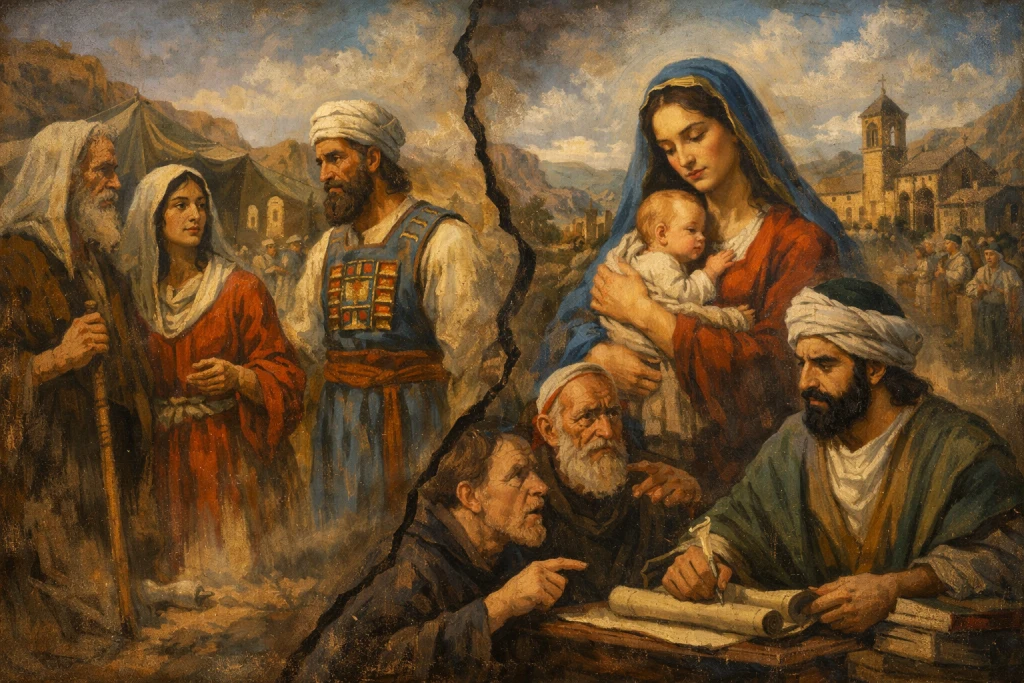
Introduction
In Surah Maryam 19:28, the Quran addresses Mary, the mother of Jesus, as يَا أُخْتَ هَارُونَ, meaning “O sister of Aaron.” In Surah At-Tahrim 66:12, she is identified as مَرْيَمَ ابْنَتَ عِمْرَانَ, meaning “Mary, daughter of Imran.” By contrast, Exodus 6:20 and Numbers 26:59 in the Hebrew Bible identify Amram as the father of Moses and Aaron, and Miriam as their sister. The repetition of both the father’s and brother’s names, alongside the similarity between the names of two women separated by centuries, raises a precise textual question: does the Quran preserve the independent family history of Jesus’s mother, or has the identity of Miriam from an earlier Jewish narrative been transferred to her? The issue is not confined to a dispute over the literal meaning of the word “sister.” Surah 3:35 also describes the wife of Imran dedicating her unborn child, making the father’s identity part of the same family narrative. The question therefore concerns the combined genealogy presented across all three passages.
Classical Muslim commentators disagreed over who “Aaron” was. Al-Tabari preserved accounts proposing several different identities. Al-Baghawi and al-Alusi distinguished Imran, the father of Jesus’s mother, from Imran, the father of Moses. Ibn Kathir explicitly called an early assertion that Jesus’s mother was the biological sister of Moses and Aaron “an outright error.” Yet none of these explanations supplies an independently documented, contemporary genealogy for the proposed second Imran and Aaron. The same combination of names found in the ancient Jewish account of Amram, Miriam, and Aaron reappears in the Quran’s description of Jesus’s mother. Attempts to explain this genealogical repetition produced conflicting identities within the Islamic exegetical tradition itself. [1] [2]
Muhammad, the Prophet Who Was “All Ears”
The Quran itself preserves contemporary accusations concerning the sources of Muhammad’s proclamations and his reliance on what he heard. In Surah At-Tawbah 9:61, the hypocrites of Medina described him as هُوَ أُذُنٌ, or “all ears.” In his Jami al-Bayan, al-Tabari associates the accusation with Nabtal ibn al-Harith. According to his commentary, the accusers said that Muhammad would listen to anyone, accept what they said, and believe it. The significance of this accusation extends beyond the suggestion that one man was credulous. Elsewhere, the Quran records allegations that Muhammad’s teachings came from other people and from stories handed down by earlier generations. Read together, 9:61, 16:103, and 25:4–5 show that the sources of his proclamations, his reception of information from other people, and the reuse of familiar religious narratives were disputed during his lifetime. [3]
﴿ويقولون هو أذن﴾ ، سامعةٌ، يسمع من كل أحدٍ ما يقول فيقبله ويصدِّقه.
English translation: “And they say: He is all ears,” meaning someone who listens, hears what everyone says, accepts it, and believes it to be true.
And among them are those who hurt the Prophet and say, “He is all ears.” Say, “He listens for your good. He believes in Allah and trusts the believers, and he is a mercy to those among you who believe.” But those who hurt the Messenger of Allah will have a painful punishment.
Surah Al-Furqan 25:4–5 records an even more explicit accusation against Muhammad. His critics alleged that he was presenting a composition of his own, that other people had helped him produce it, and that its content consisted of stories of earlier generations recited to him morning and evening. The phrases أَسَاطِيرُ الْأَوَّلِينَ, meaning “tales of the ancients,” and فَهِيَ تُمْلَىٰ عَلَيْهِ بُكْرَةً وَأَصِيلًا, meaning “they are dictated to him morning and evening,” make the substance of the accusation clear. The Quran itself preserves the allegation that Muhammad drew material for his proclamations from already circulating narratives and the assistance of other people. The recurrence of the names and familial identities of Mary, the mother of Jesus, and Miriam, the sister of Moses, provides a specific historical case in which to examine that allegation. The issue is not merely a similarity between two names, but the association of the same father and brother with women belonging to two different periods.
Surah An-Nahl 16:103 states the accusation more specifically: إِنَّمَا يُعَلِّمُهُ بَشَرٌ, meaning “It is only a human being who teaches him.” Al-Tabari collected several reports in his commentary on this verse. The alleged teacher is called Bal’am in one account, Ya’ish in another, Jabr in another, and two slaves named Yasar and Jabr in yet another. A report transmitted through Ibn Ishaq describes Muhammad sitting with a Christian slave named Jabr; another says that Muhammad listened to two slaves as they read religious scripture. The variation in names shows that the identity of the individual accused of teaching him was not transmitted consistently. These accounts also establish that early Muslim literature contained narratives of Muhammad’s direct interactions with members of other religious communities, including occasions on which religious books and stories were read aloud. The Quran replies that the alleged teacher spoke a foreign language whereas the Quran was in clear Arabic. That linguistic difference does not independently settle the question of a possible source or oral translation: material originating in another language can be recounted in Arabic. [4]
كان لهم عبدان من أهل عير اليمن، وكانا طفلين، وكان يقال لأحدهما يسار، والآخر جبر، فكانا يقرآن التوراة، وكان رسول الله ﷺ ربما جلس إليهما
English translation: They had two young slaves from a Yemeni caravan. One was called Yasar and the other Jabr. They used to read the Torah, and Muhammad would sometimes sit with them.
Sahih al-Bukhari 3617 contains a report narrated by Anas about a Christian man who embraced Islam and served as a scribe of revelation for Muhammad. He later returned to Christianity and alleged that Muhammad knew nothing beyond what the man wrote for him. The statement is attributed to someone directly involved in recording the revelations who subsequently abandoned Islam. The narrative then recounts his death and a miraculous episode in which his corpse was repeatedly expelled from its grave. The former scribe’s allegation is thus incorporated into the same story as a supernatural punishment supposedly visited upon him. His accusation does not by itself identify the sources of all Muhammad’s knowledge, but it is important evidence that authorship, the role of other people, and the recording of revelations were disputed in the early tradition. Read alongside the accusations preserved in Quran 16:103 and 25:4–5, the continuity of this controversy becomes clearer. [5]
Sahih al-Bukhari (Tawhid Publications)
61. Virtues and Merits
Chapter 61/25: Signs of Prophethood in Islam
3617. Narrated by Anas: A Christian man embraced Islam, learned Surah Al-Baqarah and Surah Al Imran, and used to write the revelation for the Prophet. Then he returned to Christianity. He used to say, “Muhammad knows nothing except what I have written for him.” (God forbid.) After some time Allah caused him to die. The Christians buried him, but the following morning they found that the earth had thrown his body out. They said that Muhammad and his companions must have done it because their companion had escaped from them. They dug a grave as deep as they could and buried him again. The next morning they again found that the earth had cast him out. Once more they blamed Muhammad and his companions for removing the body because the man had fled from them. They then dug an even deeper grave and buried him, but the next morning the earth had again expelled his body. They concluded that it was not the work of human beings and left his corpse where it lay. (Muslim 50/50, Hadith 2781; Ahmad 13323; Modern Publications 3349; Islamic Foundation 3356)
Hadith classification: Sahih
Narrator: Anas ibn Malik
Mary, Daughter of Imran
The Quran is explicit about the father of Mary, the mother of Jesus. Surah At-Tahrim 66:12 calls her “the daughter of Imran,” while Surah Al Imran 3:35–36 describes the wife of Imran dedicating her unborn child and naming the daughter Mary. Taken together, these passages make “Imran” part of the narrative’s specific family identity rather than an indistinct reference to a distant ancestor. By contrast, Exodus 6:20 and Numbers 26:59 identify Amram as the father of Moses, Aaron, and their sister Miriam. The common origin of the names Mary and Miriam, the father’s name Amram or Imran, and the identification as Aaron’s sister require examination as a connected set of correspondences. Proposing a figurative interpretation of one word does not resolve the historical question raised by the entire cluster of names.
And [Allah presents the example of] Mary, daughter of Imran, who guarded her chastity. So We breathed into her of Our spirit. She believed in the words of her Lord and His scriptures, and was among the devoutly obedient.
Taisirul Quran
And another example is Mary, daughter of Imran, who preserved her chastity. We breathed into her of Our spirit, and she affirmed the words and scriptures of her Lord. She was one of the obedient.
Sheikh Mujibur Rahman
Allah also sets forth the example of Mary, daughter of Imran, who preserved her chastity. We breathed into her of Our spirit; she affirmed the truth of her Lord’s words and scriptures and was among the obedient.
Rawai Al-bayan
And He presents the example of Mary, daughter of Imran, who guarded her chastity. We breathed into her of Our spirit. She affirmed the truth of her Lord’s words and scriptures and was among the obedient [1].
Dr. Abu Bakr Muhammad Zakaria
In his Ma’alim al-Tanzil, al-Baghawi identifies the father of Jesus’s mother as “Imran ibn Mathan” in his commentary on Surah Al Imran 3:35, explicitly stating that he was not Imran, the father of Moses. Al-Baghawi places 1,080 years between the two men. Al-Alusi’s Ruh al-Ma’ani, however, contains an account placing 1,800 years between the two Imrans. These differing chronologies belong to classical exegesis; they are not archaeologically established dates of birth and death. The central inconsistency lies elsewhere. To distinguish the Quranic Imran from the biblical Amram, commentators supplied separate genealogies and chronological calculations, yet they produced no independent contemporary testimony identifying a second Imran as the father of Jesus’s mother. Al-Baghawi’s own account also preserves alternative names, “Imran ibn Mathan” and “Imran ibn Ashham.” Disagreement over his name, ancestry, and period reveals a history of later explanatory reconstructions rather than an independently established identity. [6] [7]
وعمران هو عمران بن ماثان وليس بعمران أبي موسى عليه السلام ، وبينهما ألف وثمانون سنة ، وكان بنو ماثان رءوس بني إسرائيل وأحبارهم وملوكهم وقيل : عمران بن أشهم .
English translation: This Imran was Imran ibn Mathan, not Imran the father of Moses. There were 1,080 years between them. The descendants of Mathan were leaders, religious scholars, and kings among the Children of Israel. Another account calls him Imran ibn Ashham.
The second-century Christian work Protoevangelium of James identifies Joachim and Anna as the parents of Mary, the mother of Jesus. The four canonical Gospels of the New Testament do not name her parents. This pre-Quranic Christian genealogy is not an official record contemporary with Jesus’s birth, but it is testimony to a literary tradition about Mary that circulated centuries before the Quran. In that tradition her father is not called Imran. In the Hebrew Bible, meanwhile, Amram is the father of Moses, Aaron, and their sister Miriam. Thus the Quranic identification “Mary, daughter of Imran” resembles the family of the earlier Miriam but differs from the genealogy preserved in earlier Christian literature concerning Jesus’s mother. The claim that the Quran preserves an accurate historical identification requires evidence independent of the claim itself. [8] [9]
Mary, Sister of Aaron
In Surah Maryam 19:27–28, Mary’s people address her after she returns carrying the newborn Jesus: يَا أُخْتَ هَارُونَ, “O sister of Aaron.” In the same statement, they refer to the character of her father and mother. The address therefore appears in the context of her family’s reputation and an accusation surrounding the birth of her child. Elsewhere in the same scripture, Mary’s father is identified as Imran. The Hebrew Bible, meanwhile, provides a clear family identification for Amram and his children Aaron, Moses, and Miriam. The similarity between the two narratives is not limited to a single personal name: the names of father, daughter, and brother reappear together. Calling that coincidence “figurative” without examining the historical relationship between these accounts does not resolve the evidentiary problem.
Exodus 15:20 in the Hebrew Bible explicitly calls Miriam “the sister of Aaron.” Exodus 6:20 and Numbers 26:59 identify Amram and Jochebed as the parents of Moses, Aaron, and Miriam. Mary, the mother of Jesus, lived in an entirely different period. The Quran’s description of her as “the sister of Aaron” in Surah Maryam 19:28 and as “the daughter of Imran” in Surah At-Tahrim 66:12 reproduces the combination of names found in the older family history. A single personal name can recur, but here several related names from one family recur together. The following are English translations of the relevant verses from Surah Maryam.
Then she brought him to her people, carrying him. They said, “O Mary! You have certainly brought forth an astonishing thing!”
Taisirul Quran
Then she came to her people carrying the child. They said, “O Mary! You have indeed done a strange thing!”
Sheikh Mujibur Rahman
Then she came to her people holding him in her arms. They said, “O Mary! You have indeed brought something extraordinary!”
Rawai Al-bayan
Then she appeared before her people carrying the child. They said, “O Mary! You have committed an extraordinary deed!” [1]
Dr. Abu Bakr Muhammad Zakaria
“O sister of Aaron! Your father was not an evil man, nor was your mother an unchaste woman.”
Taisirul Quran
“O sister of Aaron! Your father was not a wicked man, and your mother was not an adulteress.”
Sheikh Mujibur Rahman
“O sister of Aaron! Your father was not an evil man, nor was your mother an adulteress.”
Rawai Al-bayan
“O sister of Aaron! [1] Your father was not a wicked man, nor was your mother an adulteress [2].”
Dr. Abu Bakr Muhammad Zakaria
In his Jami al-Bayan, al-Tabari preserves multiple conflicting accounts of who the “Aaron” mentioned in verse 19:28 was. In one report attributed to Qatadah, he was a righteous contemporary of Mary. According to al-Suddi, the phrase “sister of Aaron” referred to Mary’s descent from Aaron, the brother of Moses. Another report compares Mary with a wicked man named Aaron. The same address has thus been explained as actual or figurative siblinghood, descent from a distant ancestor, and a moral comparison. These interpretations do not establish one identifiable Aaron. Nor does the verse itself provide the father, date of birth, or specific relationship of the supposed second Aaron to Mary. The disagreement among exegetes shows that the family identity in the original text remained unsettled in later Islamic scholarship. [10]
اختلف أهل التأويل في السبب الذي من أجله قيل لها: يا أخت هارون، ومن كان هارون هذا الذي ذكره الله، وأخبر أنهم نسبوا مريم إلى أنها أخته
English translation: The interpreters differed over why she was addressed as “O sister of Aaron,” and over who this Aaron was whom Allah mentioned and to whom they attributed Mary as his sister.
In his Quranic commentary, Ibn Kathir quotes an explanation attributed to Muhammad ibn Ka’b al-Qurazi in which Mary, the mother of Jesus, was said to be the biological sister of Moses and Aaron. Ibn Kathir called that view خطأ محض, meaning “an outright error.” He further explained that al-Qurazi had read the account of Miriam, the sister of Moses and Aaron, in the Torah and mistakenly identified her as Jesus’s mother. This is highly significant: Ibn Kathir’s own account documents an actual instance of two women from different periods being confused with one another. The similarity extends beyond the personal name to the identities of the father and brother. The Quranic descriptions of Jesus’s mother as “daughter of Imran” and “sister of Aaron” contain precisely this combination of names. The possibility of a conflation of the two Marys therefore cannot be dismissed as a criticism invented in modern times; Ibn Kathir himself records a real instance of such a confusion in the earlier exegetical tradition. [11]
وهذا القول خطأ محض
English translation: This opinion is an outright error.
The Objection Was Raised During Muhammad’s Lifetime
The chronological objection to Mary’s identity can be traced back to Muhammad’s own lifetime. Sahih Muslim 2135 records al-Mughirah ibn Shu’bah reporting that Christians in Najran questioned him: how could the Quran call Mary “the sister of Aaron” when Moses had lived so long before Jesus? Their question directly raised the conflict between the Quranic expression and the chronology familiar from biblical tradition. Al-Mughirah returned to Medina and asked Muhammad about it. Muhammad replied that people used to name their children after earlier prophets and righteous people. The hadith thus preserves both a contemporary Christian objection and Muhammad’s own explanation. It does not, however, identify the ancestry, lifetime, or actual familial relationship of a second Aaron to Mary. [12]
The Christians of Najran had raised a precise chronological objection: Moses and Aaron belonged to an age long before Jesus, yet the Quran called Jesus’s mother “the sister of Aaron.” After returning to Medina, al-Mughirah ibn Shu’bah put the question to Muhammad. In the account preserved by Sahih Muslim, al-Mughirah offered no identity, genealogy, or date for a different Aaron, and Muhammad’s response supplied no documentary identification of a particular person or relationship. His sole explanation was that children were named after earlier prophets and righteous people. This establishes the existence of a naming custom, not the historical identity of Mary’s supposed brother or relative.
Sahih Muslim (Islamic Foundation)
39. Etiquette
Chapter 1: The prohibition of adopting the kunya “Abu al-Qasim” and an account of desirable names
5413. Narrated through Abu Bakr ibn Abi Shaybah, Muhammad ibn Abdullah ibn Numayr, Abu Sa’id al-Ashajj, and Muhammad ibn al-Muthanna al-Anazi … on the authority of al-Mughirah ibn Shu’bah. He said: When I went to Najran, its people asked me: “You recite in the Quran, يَا أُخْتَ هَارُونَ (‘O sister of Aaron’), referring to Mary the mother of Jesus, even though Moses lived so long before Jesus. [Aaron, the brother of Moses, lived long before Jesus. How could Mary have been his sister?]”
When I returned to the Messenger of Allah, I asked him about this. He replied, “They [the Jews and Christians] used to name their children after the prophets and righteous people who came before them.”
Hadith classification: Sahih
Narrator: Al-Mughirah ibn Shu’bah
Muhammad’s answer described a general naming practice but did not identify the particular Aaron associated with Mary. The possibility that several people shared the same name is not evidence for the actual ancestry of a particular individual. Moreover, Surah At-Tahrim 66:12 also names Mary’s father as Imran, corresponding to Amram, the father of Miriam, the sister of Moses and Aaron. The combination of two names and a sisterly relationship means that the separate existence of the Quranic family cannot be established merely by saying that people reused old names. The specific genealogical answer to the chronological question raised by the Christians of Najran is absent from this hadith.
لَمَّا قَدِمْتُ نَجْرَانَ سَأَلُونِي فَقَالُوا إِنَّكُمْ تَقْرَءُونَ يَا أُخْتَ هَارُونَ وَمُوسَى قَبْلَ عِيسَى بِكَذَا وَكَذَا . فَلَمَّا قَدِمْتُ عَلَى رَسُولِ اللَّهِ صلى الله عليه وسلم سَأَلْتُهُ عَنْ ذَلِكَ فَقَالَ ” إِنَّهُمْ كَانُوا يُسَمُّونَ بِأَنْبِيَائِهِمْ وَالصَّالِحِينَ قَبْلَهُمْ ” .
English translation: When I arrived in Najran, they asked me: “You recite, ‘O sister of Aaron,’ yet Moses lived so many years before Jesus.” When I came to the Messenger of Allah and asked him about this, he said: “They used to name their children after their prophets and the righteous people who had preceded them.”
Historical Chronology and Anachronism
Identifying a historical person requires more than matching a name; chronology, family relationships, and the sequence of written sources must also be examined. Exodus 6:20 records the marriage of Amram and Jochebed and identifies Moses and Aaron as their sons. Numbers 26:59 includes Miriam among their children. Exodus 15:20 explicitly calls Miriam “the sister of Aaron.” The Quran describes Mary, the mother of Jesus, as both “daughter of Imran” and “sister of Aaron.” The issue therefore arises from a cluster of repeated names and relationships recalling an entire family from an earlier text. According to traditional chronology, many centuries separated the age of Moses from the life of Jesus. The exact dates of Moses and Aaron are not independently established by archaeology, but there is likewise no historical basis for placing Jesus’s mother in their lifetime. Investigating how the family identities of one age came to reappear in a narrative set in another is a legitimate problem of historical textual criticism.
Mother: Jochebed.
Children: Aaron, Moses, and their elder biological sister Miriam.
*This Miriam was the biological sibling and contemporary of Aaron and Moses.
Mother: Saint Anne.
Daughter: Mary, the mother of Jesus.
Mary’s son: Jesus.
*According to pre-Quranic Christian narratives, Joachim and Anne were Mary’s parents. No independently attested genealogy identifies a contemporary brother of hers named Aaron.
In the Bible, the same names and relationships are associated with Miriam, who belonged to the era of Moses and Aaron. The correspondence between the two identities raises the historical possibility of character conflation.
The Long Chronological Gap Between Two Eras
Moses and Aaron are commonly placed in the fifteenth or thirteenth century BCE, although their exact dates of birth and death have not been independently established by archaeological evidence. Jesus is generally understood to have been born in the final years BCE or around the beginning of the Common Era. The gap between these periods is roughly a millennium or more. Al-Baghawi’s commentary places 1,080 years between the two Imrans, while an account transmitted by al-Alusi gives a gap of 1,800 years, showing that classical commentators also situated the two families in widely separated eras. Their figures are not independently verified historical dates. Whether the interval is taken as 1,080, 1,300, or 1,500 years, Miriam, the sister of Moses and Aaron, was not a contemporary of Jesus’s mother. Yet the Quran uses the same names for the mother and her supposed brother and father. This combination of chronological distance and familial resemblance is at the center of the historical inconsistency. [13] [14]
Genealogical Coincidence or Confusion of Identities?
The phrases “sister of Aaron” in Surah Maryam 19:28 and “daughter of Imran” in Surah At-Tahrim 66:12 describe the same person. Surah Al Imran 3:35–37 adds the account of her birth, her mother’s vow, and her upbringing under the guardianship of Zechariah. In Exodus 6:20 and 15:20 and Numbers 26:59, the names Amram, Aaron, and Miriam are connected within the family of Moses and Aaron. Why, then, does the Quranic genealogy so closely resemble these earlier sources when an independent contemporary genealogy of Jesus’s mother containing the same cluster of names cannot be found? This is a specific literary and genealogical problem. Each name could recur among different people, but that possibility does not establish the independent existence of the particular family presented in the Quran.
Classical Islamic exegesis offers no single answer concerning Mary’s ancestry. Al-Baghawi identifies her father as “Imran ibn Mathan”; al-Alusi calculates a different chronological gap between the two Imrans; and al-Tabari and al-Qurtubi preserve different accounts of the individuals and relationships implied by “sister of Aaron.” These explanations do not supply one uniform identification drawn from independent family records contemporary with Mary. Because the Quran applies the familiar names from the older Miriam’s family to Jesus’s mother, commentators have proposed a biological brother, descent from a distant ancestor, and figurative kinship. None of these explanations supplies a decisive historical resolution to the literary problem of one era’s family identity being attached to a figure from another. [15] [16]
اخْتَلَفَ النَّاسُ فِي مَعْنَى هَذِهِ الْأُخُوَّةِ وَمَنْ هَارُونُ ؟ فَقِيلَ : هُوَ هَارُونُ أَخُو مُوسَى ؛ وَالْمُرَادُ مَنْ كُنَّا نَظُنُّهَا مِثْلَ هَارُونَ فِي الْعِبَادَةِ تَأْتِي بِمِثْلِ هَذَا .
English translation: People differed over the meaning of this sisterhood and over who Aaron was. One opinion holds that he was Aaron, the brother of Moses; the intended meaning was: “We thought her to be like Aaron in devotion. How could she do such a thing?”
Earlier Sources versus the Quranic Account
The four canonical Gospels do not name the parents of Mary, the mother of Jesus. The second-century Protoevangelium of James preserves an account of Mary’s childhood in which her parents are called Joachim and Anna. This is Christian literature concerning Mary written several centuries before the Quran; it contains no identification of her as “daughter of Imran.” Exodus 15:20, on the other hand, clearly identifies Miriam as Aaron’s sister, while Numbers 26:59 provides the family relationships between Amram, Jochebed, and their children. Thus the names Imran, Mary, and Aaron that reappear in the Quran’s account of Jesus’s mother match the familial relationships in the earlier Jewish genealogy. Simply invoking the recurrence of names or a figurative form of address without producing a separate genealogy does not resolve the historical question. [17] [18]
Does the Explanation of Naming After Ancestors Hold Up?
In response to the Christians of Najran, Muhammad stated that people used to name their children after earlier prophets and righteous individuals. Such a practice is conceivable, but it does not establish the identity of the specific person mentioned in the verse. The only conclusion supported by the recurrence of a name is that different people could have borne it. Beyond that, the existence of a particular “Aaron, brother of Mary,” his relationship to her, and the identity of his father require separate evidence. Neither the Quranic verse nor the hadith supplies such an identification. Al-Qurtubi records interpretations involving a brother, a distant ancestor, and comparison with a pious individual. Ibn Ashur, meanwhile, regarded the explanation involving an actual brother as relatively more straightforward. Where several conflicting genealogical explanations are derived from the same naming practice, historical evidence is needed to determine which, if any, is correct. [19] [20]
Muhammad al-Amin al-Shinqiti stated in his Adwa al-Bayan that the Aaron mentioned in the verse was not the brother of Moses but another righteous man among the Children of Israel. His principal basis for this conclusion was the hadith about naming practices narrated by al-Mughirah. Yet the hadith says nothing about the birth, parentage, or actual relationship to Mary of that second Aaron. Al-Shinqiti himself acknowledged that some scholars regarded him as Mary’s brother while others considered him a righteous contemporary. Thus, in attempting to establish a particular alternative identity, he also recorded contradictory views about that very identity. A general custom of naming people after earlier figures does not prove the existence of Mary’s specific brother, and the recurrence of her father’s name, Imran, remains unexplained by this account. [21]
وَإِنَّمَا هُوَ رَجُلٌ آخَرُ صَالِحٌ مِنْ بَنِي إِسْرَائِيلَ يُسَمَّى هَارُونَ
English translation: Rather, he was another righteous man among the Children of Israel whose name was Aaron.
Logical Analysis and Summary
In the Hebrew Bible, Miriam, the daughter of Amram, is the sister of Moses and Aaron; in pre-Quranic Christian literature, Mary, the mother of Jesus, belongs to a much later period. The Quran calls Jesus’s mother both “daughter of Imran” and “sister of Aaron.” To account for this resemblance, al-Tabari, al-Qurtubi, al-Baghawi, Ibn Kathir, and Ibn Ashur recorded differing explanations. In one account Aaron is an actual brother; in another he is an ancient ancestor; elsewhere he is a righteous man with the same name, or a figure used for moral comparison. The variation shows that Islamic exegesis did not develop a single settled historical account of Mary’s family identity. The question of why the names from an earlier family reappear in a different era remains unresolved by these explanations. [22] [23]
Ibn Kathir himself preserved an unmistakable instance of the two Marys being identified as one within the Muslim exegetical tradition. In a report attributed to Muhammad ibn Ka’b al-Qurazi, Jesus’s mother was described as the sister of Moses and Aaron. Ibn Kathir called this “an outright error,” explaining that al-Qurazi had mistaken the Miriam described in the Torah for Jesus’s mother. This confusion between women belonging to different periods demonstrably occurred within the history of Quranic interpretation. The Quran’s own identification of Mary as “daughter of Imran” and “sister of Aaron” reproduces the same combination of names and relationships. The conflicting identifications proposed by al-Tabari, al-Qurtubi, Ibn Kathir, and other exegetes also arise from this chronological problem. Their explanations establish no independent contemporary genealogy for a specific second Aaron or second Imran. [24]
The genealogical difficulty created by presenting these two Quranic descriptions together is illustrated in the diagram below.
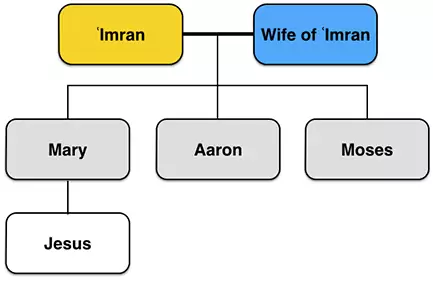
The family relationships involving Imran, Mary, and Aaron in the Quran’s description of Jesus’s mother correspond to names and relationships attached to the earlier Miriam in the Hebrew Bible. The historical problem shown in the diagram is the difference between the periods in which the two women lived. Miriam, the sister of Moses, and Mary, the mother of Jesus, were not contemporaries, yet the Quranic wording reuses the names and relationships associated with the older family. The alternative Aarons and Imrans proposed in the commentaries are not independent, contemporary solutions to this conflict. The separate chronologies of the two families, together with the correspondence between the Quranic names, strengthen the possibility that the identities of the two women became conflated.
Divine Knowledge versus Textual Ambiguity
If the Quran is claimed to be the flawless word of an omniscient creator, its references to historical persons and family relationships cannot be exempted from scrutiny. The phrases “sister of Aaron” in Surah Maryam 19:28 and “daughter of Imran” in 66:12 describe the same Mary. In biblical tradition, the combination of these identities belongs to Miriam of a much earlier period. Early Muslim exegetes proposed different individuals to explain the address and introduced the idea of two Imrans to account for the repetition of the father’s name. The central epistemological problem is why a text claimed to originate with an omniscient speaker should require such shifting and conflicting identifications. Declaring the resemblance a miraculous mystery or inventing a genealogy does not amount to historical evidence.
The Problem of Omniscience and Factual Accuracy
According to the claim of omniscience, Allah would know the identity, family, and historical period of every person of the past. Yet the two designations applied to Mary, the mother of Jesus, in Surah Maryam 19:28 and At-Tahrim 66:12 reproduce the family identifiers found in the Bible for Miriam, the sister of Moses and Aaron, who belonged to a much earlier period. On one side stand the same father’s and brother’s names; on the other, the long interval between the two eras. Such a genealogical inconsistency comes into conflict with the claim that the text is an infallible divine revelation. The issue is not merely the rhetorical question of why Allah would choose these words. The difficulty lies in the absence of an independently documented historical resolution to the discrepancy between the Quranic wording and the earlier genealogy. The resemblance strengthens the possibility of a human origin for the narrative and a conflation of previously circulating stories.
The Inadequacy of the Hadith Explanation and Its Strategic Flaw
In answer to the objection raised by the Christians of Najran, Muhammad said that children were named after earlier prophets and righteous people. But this statement does not identify a specific brother named Aaron who lived in Mary’s time. Nor does it account for the similarity between the name of her father, Imran, and the earlier Amram. Instead of providing the identity necessary to establish the Quranic account as historically accurate, Muhammad’s response invokes a general social practice. The possibility that personal names were reused is not the same as evidence for the independent historical existence of the family in question.
Later Quranic commentaries offered several competing explanations to fill this gap. In the accounts preserved by al-Qurtubi, “Aaron” is at times the brother of Moses, at times a righteous contemporary of Mary, and at times her own brother. Al-Baghawi supplies a name and period for a second Imran, while al-Alusi gives a different chronological interval. Attempts to vindicate an uncertain genealogy have therefore produced explanations that contradict one another. Declaring one possibility theologically acceptable does not turn it into historical evidence. This dispute directly challenges the assertion that the Quran’s origin and historical descriptions are infallible.
The Prophet and His Followers Confronted by the Objection
The Christians of Najran raised the question preserved in Sahih Muslim: if Moses lived so long before Jesus, how could Mary, the mother of Jesus, be “the sister of Aaron”? Al-Mughirah ibn Shu’bah returned to Medina and asked Muhammad about it. The response recorded in the hadith supplies no genealogy, only a practice of naming children after earlier people. A question concerning the identity of people from two distinct eras was answered by the general possibility that different people might share a name. This does not identify the particular Aaron mentioned in the Quran, nor does it explain the recurrence of the name Imran. The preservation of both this seventh-century Christian objection and Muhammad’s response is direct testimony to the historical difficulty posed by the Quranic genealogy.
Logical Conclusion and the Burden of Proof
The burden of proof rests with the claim that Jesus’s mother was both “daughter of Imran” and “sister of Aaron.” The Hebrew Bible identifies a family bearing precisely these relationships in the person of the much earlier Miriam. Without independent historical testimony establishing a separate Aaron and Imran for Jesus’s mother, appeals to customary naming, metaphorical sisterhood, or conjectures by exegetes cannot establish the accuracy of the Quranic genealogy. The separate identities of the two women in earlier sources, together with the recurrence of names and family relations in the Quranic account, provide a substantial basis for the hypothesis of character conflation. Neither the sacred text’s own authority nor that of later commentators removes this factual discrepancy.
Conclusion
The Quran’s descriptions of Mary, the mother of Jesus, as “sister of Aaron” and “daughter of Imran” correspond on several levels to the identity of Miriam, the sister of Moses and Aaron, in the Hebrew Bible. Exodus 15:20 identifies Miriam as Aaron’s sister, while Exodus 6:20 and Numbers 26:59 identify Amram as the father in her family. The combined resemblance between the names Mary and Miriam, the father’s name, and the sisterly relationship with Aaron leaves a specific genealogical problem. Treating these correspondences as isolated coincidences does not explain the pattern. The two women belong to different historical periods, yet key names and relationships from the earlier family reappear in the Quranic identification.
The Christians of Najran raised this chronological objection during Muhammad’s lifetime. The reply recorded in Sahih Muslim invoked the practice of naming children after earlier figures, but it identified no specific second Aaron and supplied no independent genealogy for a second Imran. Al-Tabari’s and al-Qurtubi’s competing explanations, al-Baghawi’s and al-Alusi’s differing chronologies, and the mistaken identification of the two Marys recorded by Ibn Kathir all demonstrate that later Islamic exegesis did not settle the matter through one consistent historical account. Instead of establishing the infallibility of the sacred text, the explanations repeatedly introduce new identities and new relationships.
Comparison with pre-Quranic Jewish and Christian literature provides substantial grounds for the possibility that the identities of two women from different historical periods were conflated in this genealogy. The Quran’s identification of the father and brother of Jesus’s mother has not been supported by independent contemporary evidence. Accordingly, the claim that these verses constitute an infallible historical account delivered by an omniscient being fails to meet the evidentiary burden. The combination of names and relationships from families separated by many centuries represents a serious textual and historical objection to the Quran’s claim of supernatural origin.
References
- Al-Tabari, Jami al-Bayan, 19:28 ↩︎
- Al-Baghawi, Ma’alim al-Tanzil, 3:35 ↩︎
- Al-Tabari, commentary on Surah At-Tawbah 9:61 ↩︎
- Al-Tabari, commentary on Surah An-Nahl 16:103 ↩︎
- Sahih al-Bukhari 3617 ↩︎
- Al-Baghawi, Surah Al Imran 3:35 ↩︎
- Al-Alusi, Ruh al-Ma’ani, Surah Al Imran 3:33 ↩︎
- NASSCAL, research reference for the Protoevangelium of James ↩︎
- Protoevangelium of James, English translation of the source text ↩︎
- Al-Tabari, Jami al-Bayan, Surah Maryam 19:28 ↩︎
- Ibn Kathir, Tafsir al-Quran al-Azim, Maryam 19:28 ↩︎
- Sahih Muslim 2135 ↩︎
- Al-Baghawi, commentary on 3:35 ↩︎
- Al-Alusi, commentary on 3:33 ↩︎
- Al-Qurtubi, Al-Jami li-Ahkam al-Quran, 19:28 ↩︎
- Al-Baghawi, 3:35 ↩︎
- Protoevangelium of James, Chapters 1–5 ↩︎
- Research on Christian apocryphal literature ↩︎
- Ibn Ashur, At-Tahrir wa at-Tanwir, 19:28 ↩︎
- Al-Qurtubi, 19:28 ↩︎
- Muhammad al-Amin al-Shinqiti, Adwa al-Bayan, vol. 3, p. 415, as quoted ↩︎
- Al-Tabari, Surah Maryam 19:28 ↩︎
- Ibn Ashur, Surah Maryam 19:28 ↩︎
- Ibn Kathir, Surah Maryam 19:28 ↩︎