
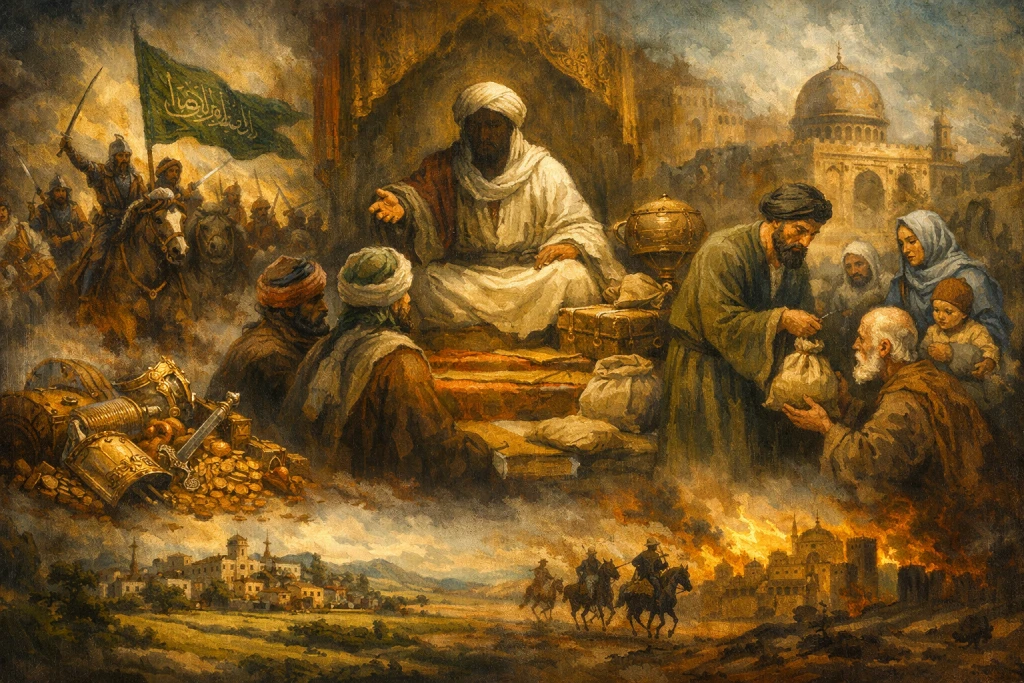
Introduction: Muhammad’s Livelihood, Wealth, and Military Economy
The question of Muhammad’s economic life extends beyond identifying the work he personally performed. His sources of income in Mecca, his role in Khadijah’s business, how his family’s expenses were met after moving to Medina, and the extent of his authority over wealth acquired through warfare are parts of the same history. When a religious preacher becomes the commander of military expeditions, the distributor of wealth, and a political ruler, the change in his economic position is connected to that transformation of power. The accounts of war booty, fay’, khums, captive people, weapons, livestock, land, date plantations, and prisoners’ ransoms in the Quran, hadith, sira, and maghazi literature concerning the Medinan period directly attest to that economic transformation.
On one hand, the Quran has Muhammad declare that he demands no payment for conveying the religious message. On the other, it explicitly establishes his authority over war booty and property acquired without battle, the rule of khums, and his power of distribution. Understanding the actual economic relationship between these statements requires considering Meccan earnings and family circumstances, the Medinan system of acquiring and distributing wealth, and the quantitative information about individual battles and expeditions together. The accounts of several expeditions from Badr to Hunayn alone show how military victories established new authority over vast quantities of livestock, monetary wealth, land, weapons, and captive people.
A shepherd, farmer, merchant, or artisan generally earns a livelihood in exchange for labor, goods, or services. Although accounts of Muhammad’s Meccan life describe shepherding and participation in Khadijah’s trade, a large and clearly documented portion of the flow of wealth in the Medinan period came from military expeditions, the seizure of trading caravans, the acquisition of opponents’ livestock and weapons, and control over the land and wealth of defeated communities. These institutional resources helped meet the expenses of multiple marriages, a large household, domestic servants and male and female slaves, military forces, and administrative followers. The Quranic allocation of one-fifth and special rights over fay’ took this flow of wealth far beyond dependence on personal gifts and donations. Excluding war booty from an analysis of Muhammad’s livelihood therefore conceals one of the most important economic sources of Medina’s political leadership.
Before the Hijrah: Shepherding, Trade, and Khadijah’s Wealth
There is a direct reference to Muhammad herding animals for wages during his Meccan life. In Bukhari’s report, he says that he received a few qirats for tending the sheep and goats of Mecca’s inhabitants. This is a specific account of income earned through his labor; it also indicates that, at least at one stage of his life, he had to earn money by caring for other people’s animals. [1]
Sahih al-Bukhari, Tawhid Publication Bengali edition
37 / Hiring
Section 37/2: Shepherding Sheep for a Few Qirats
2262. Narrated Abu Huraira: The Prophet (ﷺ) said, “Allah did not send any prophet but shepherded sheep.” His companions asked him, “Did you do the same?” The Prophet (ﷺ) replied, “Yes, I used to shepherd the sheep of the people of Mecca for some Qirats.” (Adhunik Prakashani: 2102; Islamic Foundation: 2119)
Hadith grading: Sahih.
Narrator: Abu Hurayrah.
Sira literature describes Muhammad managing a trading caravan and participating in Khadijah’s business before their marriage. Khadijah was a woman with wealth and commercial connections; marriage to her provided a basis for increased personal financial security. Quran 93:8, in Surah al-Duha, speaks of Muhammad being relieved of need after having been in need. The verse gives no specific amount or inventory of property, but the account of initial financial hardship is consistent with the subsequent circumstances dependent on Khadijah’s wealth. [2]
He found you destitute, then freed you from need.
— Taisirul Quran (translated from Bengali)
He found you in a state of destitution, then relieved your need.
— Sheikh Mujibur Rahman (translated from Bengali)
He found you destitute. Then he enriched you.
— Rawai Al-bayan (translated from Bengali)
And he found you in a state of need, then relieved your need [1].
— Dr. Abu Bakr Muhammad Zakaria (translated from Bengali)
Trading with Khadijah’s Capital: Employment, Payment, and Commercial Responsibilities
The account of Muhammad’s participation in Khadijah’s business distinguishes the owner of the capital from the person conducting the trade. According to Ibn Ishaq, Khadijah hired men to trade with her money and also entered into mudarabah, or profit-sharing agreements, with them. She offered Muhammad the opportunity to take her goods to Syria and promised him greater payment than she gave other traders. Muhammad accepted; Khadijah’s slave Maysarah accompanied him. In this account, the trading capital therefore belongs to Khadijah, while Muhammad’s role is to conduct trade with it. No precise contractual amount or percentage of profit is given here. [3] [4] [5]
قال ابن إسحاق: وكانت خديجة بنت خويلد امرأة تاجرة ذات شرف ومال. تستأجر الرجال في مالها وتضاربهم إياه، بشيء تجعله لهم، وكانت قريش قوما تجارا؛ فلما بلغها عن رسول الله صلى الله عليه وسلم ما بلغها، من صدق حديثه، وعظم أمانته، وكرم أخلاقه، بعثت إليه فعرضت عليه أن يخرج في مال لها إلى الشام تاجرا، وتعطيه أفضل ما كانت تعطي غيره من التجار، مع غلام لها يقال له ميسرة، فقبله رسول الله صلى الله عليه وسلم منها، وخرج في مالها ذلك، وخرج معه غلامها ميسرة حتى قدم الشام.
English translation: Ibn Ishaq said: Khadijah bint Khuwaylid was a merchant woman of standing and wealth. She hired men to trade with her money and entrusted her capital to them under mudarabah agreements in return for a specified share. The Quraysh were a trading people. When reports of the Messenger of Allah’s truthfulness, great trustworthiness, and excellent character reached her, she sent for him. She offered him the opportunity to travel to Syria as a merchant with some of her property, promising him more than she gave other traders. One of her slaves, named Maysarah, would accompany him. The Messenger of Allah accepted her offer and set out with that property. Her slave Maysarah accompanied him, and they reached Syria.
Two actual bases of Muhammad’s earnings in Mecca can be identified: wages for personal labor and economic opportunities obtained through working in another person’s business. Khadijah’s wealth and social position were also important during this part of his life. The later Medinan period, however, displays a flow of wealth on an entirely different scale: the accounts no longer concern a few qirats in shepherding wages, but the acquisition in individual expeditions of hundreds or thousands of camels, thousands of sheep and goats, silver, weapons, land, and captive people. This economic difference makes the social transformation of Muhammad’s leadership measurable.
Muhammad’s early livelihood clearly involved shepherding and commercial employment. Working in Khadijah’s business and marrying her changed his financial position. After he later acquired political and military leadership, the rules, sources, and scale of acquiring wealth changed radically again. Meccan income earned through labor cannot explain the hundreds or thousands of animals, vast caravan wealth, or rights to landed property acquired in Medina; those Medinan resources came from military and political power.
In Quran 6:90, Muhammad is instructed to say that he asks no one for payment in exchange for conveying the religious message. This declaration forms part of the moral claim associated with preaching during the Meccan period. Yet after the establishment of political and military leadership in Medina, regulations concerning war booty and its one-fifth share appear, alongside special rights over property acquired without battle. Placing these provisions together raises the question of how political power, and wealth dependent on that power, were acquired through religious leadership even without demanding wages for preaching. [6]
Those are the ones Allah guided; follow their path. Say: I ask you no payment for this—that is, for conveying the message. It is a message of admonition for all the people of the world.
— Taisirul Quran (translated from Bengali)
These are the ones Allah guided to the right path. Therefore follow their path. Say: I ask you no recompense for conveying the Quran and the religion. This Quran is nothing but a treasury of admonition for all the world’s inhabitants.
— Sheikh Mujibur Rahman (translated from Bengali)
These are the ones Allah guided. Therefore follow their guidance. Say: “I ask you no recompense for this. It is only an admonition for all creation.”
— Rawai Al-bayan (translated from Bengali)
These are the ones Allah guided, so follow their path [1]. Say: “I ask you no payment for this; it is only an admonition for all creation [2].”
— Dr. Abu Bakr Muhammad Zakaria (translated from Bengali)
After the Hijrah: Military Expeditions, War Booty, and Expanding Economic Power
Muhammad’s role changed after the Hijrah. In Medina, he conducted military expeditions, dispatched forces, ordered the collection of wealth after battle, determined prisoners’ ransoms or distribution, and established authority over defeated communities’ land and agricultural resources. Quran 8:1 declares war booty subject to Allah and the Messenger. This concentrates both the settlement of disputes among warriors over booty and ultimate authority over its distribution in one place. [7]
They ask you about property acquired in battle. Say: “The spoils of war belong to Allah and his Messenger; so fear Allah and establish your mutual relations on a sound and harmonious basis. Obey Allah and his Messenger if you are believers.”
— Taisirul Quran (translated from Bengali)
O Prophet! People ask you about war booty. Say: The spoils of war are for Allah and his Messenger. Therefore fear Allah in this matter and put your mutual relations right; obey Allah and his Messenger if you are believers.
— Sheikh Mujibur Rahman (translated from Bengali)
People ask you about the spoils of war. Say: The spoils of war are for Allah and the Messenger. So fear Allah, put matters right among yourselves, and obey Allah and his Messenger if you are believers.
— Rawai Al-bayan (translated from Bengali)
People ask you [1] about anfal [2], the spoils of war. Say: “The spoils of war belong to Allah and the Messenger [3]; so fear Allah, establish harmony among yourselves, and obey Allah and his Messenger if you are believers.”
— Dr. Abu Bakr Muhammad Zakaria (translated from Bengali)
Quran 8:41 then assigns one-fifth of the spoils of war to Allah, the Messenger, his relatives, and several specified categories. Alongside the conduct of warfare, a rule is therefore established for distributing its economic proceeds. Under this provision, the power to collect, retain, and spend the khums resources rests with the central leadership. Accounts of the Prophet’s personal household expenses, military expenditure, and distribution to other categories reveal the different uses of this established system of resources. [8]
Know that one-fifth of whatever you acquire in battle belongs to Allah, his Messenger, the Messenger’s relatives, orphans, the needy, and travelers, if you believe in Allah and in what I sent down to my servant on the day of decisive judgment, the day the two forces—the Muslims and the unbelievers—met. Allah has power over all things.
— Taisirul Quran (translated from Bengali)
And know that one-fifth of whatever booty you have acquired in battle belongs to Allah, his Messenger, the Messenger’s close relatives, orphans, the needy, and travelers—if you believe in Allah and in what I sent down to my servant on the day of decisive judgment, when the two forces confronted each other. Surely Allah has power over all things.
— Sheikh Mujibur Rahman (translated from Bengali)
And know that one-fifth of whatever you have acquired as booty belongs to Allah and to the Messenger, close relatives, orphans, the needy, and travelers, if you believe in Allah and in what I sent down to my servant on the day of distinction between truth and falsehood, the day* the two forces confronted each other. Allah has power over everything. *That is, the day of the Battle of Badr.
— Rawai Al-bayan (translated from Bengali)
And know that one-fifth of whatever you acquire as booty in war belongs to Allah [1], the Messenger, the Messenger’s relatives, orphans, the needy, and travelers [2], if you believe in Allah and in what we sent down to our servant on the day of decision [3], when the two forces confronted each other. Allah has power over everything.
— Dr. Abu Bakr Muhammad Zakaria (translated from Bengali)
A hadith attributed to Muhammad states directly that his livelihood was placed beneath the shadow of his spear. The same statement speaks of being sent with the sword and of humiliation for those who oppose his command. Its social meaning is clear: military power, political obedience, and economic gain are placed within a single conceptual framework. The accounts of acquiring wealth through warfare are consistent with this statement. [9]
Hadith Sambhar
20 / Jihad in Allah’s Cause
Section: The Obligation of Jihad and the Merit of Going Out Morning and Evening
(1900) Narrated by Ibn ‘Umar: The Messenger of Allah said: I was sent with the sword before the Hour so that Allah alone, without any partner, would be worshipped. My livelihood has been placed beneath the shadow of my spear. Humiliation and abasement have been assigned to those who oppose my command. Whoever imitates a people belongs to them.
(Ahmad 5114–5115, 5667; Shu‘ab al-Iman 98; Sahih al-Jami‘ 2831)
Hadith grading in the cited collection: Sahih.
Narrator: ‘Abdullah ibn ‘Umar. (English translation of the Bengali quotation in the cited collection.)
Livelihood beneath the Spear’s Shadow: War Booty and Jizya in Ibn Hajar’s Commentary
Ibn Hajar directly explains the connection between war booty and the statement “my livelihood has been placed beneath the shadow of my spear.” In his commentary, Muhammad’s livelihood was placed in booty rather than other earnings; he interprets “saghar,” or subordination, imposed on opponents of the command as the payment of jizya. The same discussion explains livelihood beneath the spear’s shadow alongside Paradise beneath the sword’s shadow. Wealth obtained through military victory, the defeated side’s financial subordination, and the religious reward for death in battle are connected within the same interpretive framework. IslamQA’s answer 128121 on Muhammad’s livelihood quotes the part of this discussion concerning booty; the fuller explanation appears in the original Fath al-Bari. [10] [11]
وفي الإسناد عبد الرحمن بن ثابت بن ثوبان مختلف في توثيقه، وله شاهد مرسل بإسناد حسن أخرجه ابن أبي شيبة من طريق الأوزاعي عن سعيد بن جبلة عن النبي صلى الله عليه وسلم بتمامه، وفي الحديث إشارة إلى فضل الرمح، وإلى حل الغنائم لهذه الأمة، وإلى أن رزق النبي صلى الله عليه وسلم جعل فيها لا في غيرها من المكاسب، ولهذا قال بعض العلماء إنها أفضل المكاسب، والمراد بالصغار وهو بفتح المهملة وبالمعجمة بذل الجزية، وفي قوله: تحت ظل رمحي إشارة إلى أن ظله ممدود إلى أبد الآباد، والحكمة في الاقتصار على ذكر الرمح دون غيره من آلات الحرب كالسيف أن عادتهم جرت بجعل الرايات في أطراف الرمح، فلما كان ظل الرمح أسبغ كان نسبة الرزق إليه أليق. وقد تعرض في الحديث الآخر لظل السيف كما سيأتي قريبا من قوله صلى الله عليه وسلم الجنة تحت ظلال السيوف فنسب الرزق إلى ظل الرمح لما ذكرته أن المقصود بذكر الرمح الراية، ونسبت الجنة إلى ظل السيف لأن الشهادة تقع به غالبا ولأن ظل السيف يكثر ظهوره بكثرة حركة السيف في يد المقاتل؛ ولأن ظل السيف لا يظهر إلا بعد الضرب به لأنه قبل ذلك يكون مغمودا معلقا.
English translation: The chain contains ‘Abd al-Rahman ibn Thabit ibn Thawban, whose reliability is disputed. It has a supporting mursal report with a hasan chain, recorded in full by Ibn Abi Shaybah through Al-Awza‘i, from Sa‘id ibn Jabalah, from the Prophet. The hadith indicates the merit of the spear, the lawfulness of booty for this community, and that the Prophet’s livelihood was placed in booty rather than other forms of earning. For this reason, some scholars said that it was the best form of earning. “Saghar,” with a fathah on the first, unpointed letter and a pointed letter following it, means paying jizya. “Beneath the shadow of my spear” indicates that its shadow extends for all time. The reason for mentioning the spear alone rather than other weapons, such as the sword, is that their custom was to place banners on the tips of spears. Since the spear’s shadow was more extensive, associating livelihood with it was more appropriate. The shadow of the sword is mentioned in another hadith, as will shortly appear in his statement, “Paradise is beneath the shadows of swords.” Livelihood is associated with the spear’s shadow for the reason I have mentioned: the reference to the spear means the banner. Paradise is associated with the sword’s shadow because martyrdom generally occurs through it, and because the sword’s shadow appears more frequently as it moves in the fighter’s hand. Furthermore, the sword’s shadow appears only after striking with it, since before that it is sheathed and suspended.
The statement “Paradise is beneath the shadows of swords,” preserved in Sahih al-Bukhari, connects military fighting with reward in the afterlife. The system of warfare thus contains two simultaneous incentives: the promise of religious reward and the distribution of wealth and captives acquired as booty after battle. The rules in maghazi accounts determining participants’ shares and the leader’s khums reveal the actual financial structure of these incentives. [12]
Sahih al-Bukhari, Tawhid Bengali edition
Chapter 56 / Jihad and Military Conduct
Section 56/22: Paradise Is beneath the Blades of Swords.
Al-Mughirah ibn Shu‘bah said: The Prophet conveyed to us our Lord’s message that whoever among us is martyred enters Paradise.
‘Umar said to the Prophet: Are not our martyrs in Paradise and their dead in Hell? The Messenger of Allah answered: Yes.
2818. Salim Abu al-Nadr, the freed slave and secretary of ‘Umar ibn ‘Ubaydullah, narrated that ‘Abdullah ibn Abi Awfa wrote to him:Allah’s Messenger (ﷺ) said, “Know that Paradise is under the shades of swords.”
Al-Uwaysi, through Ibn Abi al-Zinad from Musa ibn ‘Uqbah, also transmitted the report transmitted by Mu‘awiyah ibn ‘Amr through Abu Ishaq from Musa ibn ‘Uqbah. (2833, 2966, 3024, 7237; Muslim 32/6, hadith 1742; Ahmad 19136; Adhunik Prakashani: 2608; Islamic Foundation: 2620)
Hadith grading: Sahih.
Anfal means war booty or plunder; the surah opens with the question of authority over the spoils of war. Muhammad’s statement “I am merely a distributor” in Bukhari’s chapter on khums expresses the actual form of this economic authority. Collecting the property acquired in battle, separating one-fifth, and distributing the remainder according to specified shares was a major function of centralized political and military administration. [13]
Sahih al-Bukhari, Tawhid Bengali edition
Chapter 57 / Khums, or One-Fifth
Section 57/7: Allah’s statement, “One-fifth belongs to Allah and the Messenger” (Al-Anfal 8:41). The right to distribute it belongs to the Messenger. The Messenger of Allah said: I am the distributor and custodian, while Allah gives.
3117. Abu Huraira: Allah’s Messenger (ﷺ) said, “Neither do I give you (anything) nor withhold (anything) from you, but I am just a distributor (i.e. Qasim), and I give as I am ordered.” (Adhunik Prakashani: 2883; Islamic Foundation: 2894)
Hadith grading: Sahih.
Narrator: Abu Hurayrah.
Alongside booty, fay’ was another important method of acquiring property. According to Quran 59:6–7, property that Muslims did not have to acquire through direct battle on horseback or camelback also came under Muhammad’s authority. The land and date plantations of Banu al-Nadir and the property settlement at Fadak exemplify this method. Although acquired without battle, these resources were connected to fear of military force, siege, political surrender, and the transfer of land rights. [14]
The fay’—property acquired without battle—that Allah gave his Messenger from them required you neither to drive horses nor to ride camels; rather, Allah grants his messengers dominion over whomever he wishes. Allah has power over all things.
— Taisirul Quran (translated from Bengali)
For the fay’ that Allah gave his Messenger from them—the Jews—you did not fight on horses or camels; Allah grants his messengers authority over whomever he wills. Allah has power over all things.
— Sheikh Mujibur Rahman (translated from Bengali)
For what Allah gave his Messenger from the Jews as fay’,* you conducted no expedition on horses or camels. Rather, Allah grants his messengers authority over whomever he wills. Allah has power over everything. *Property acquired without battle is called في. It is generally deposited in the public treasury, and the Messenger used it under his supervision for state needs. What is acquired through battle is called ghanimah, غنيمت.
— Rawai Al-bayan (translated from Bengali)
And for the fay’ Allah gave his Messenger from the Jews, you did not fight on horses or camels [1]; rather, Allah grants his messengers authority over whomever he wishes. Allah has power over everything.
— Dr. Abu Bakr Muhammad Zakaria (translated from Bengali)
The wealth Allah took from the inhabitants of the settlements and gave his Messenger belongs to Allah and his Messenger, the Messenger’s relatives, orphans, the needy, and travelers, so that it does not circulate only among the wealthy among you. Accept what the Messenger gives you and refrain from what he forbids you. Fear Allah; Allah is severe in punishment.
— Taisirul Quran (translated from Bengali)
Whatever Allah gave his Messenger from the inhabitants of these settlements belongs to Allah, his Messenger, the Messenger’s relatives, orphans, the needy, and travelers, so that wealth does not circulate only among the rich among you. Therefore accept what the Messenger gives you and refrain from what he forbids you. Fear Allah; Allah is severe in punishment.
— Sheikh Mujibur Rahman (translated from Bengali)
What Allah gave his Messenger as fay’ from the inhabitants of the settlements belongs to Allah, the Messenger, relatives, orphans, the needy, and travelers, so that wealth does not circulate only among the rich among you. Accept what the Messenger gives you, refrain from what he forbids you, and fear Allah. Surely Allah is severe in punishment.
— Rawai Al-bayan (translated from Bengali)
Whatever Allah gave his Messenger as fay’ from the inhabitants of the settlements belongs to Allah, the Messenger, the Messenger’s relatives, orphans, the needy, and travelers [1], so that wealth does not circulate only among the rich among you. Accept what the Messenger gives you, refrain from what he forbids you [2], and fear Allah; surely Allah is severe in punishment.
— Dr. Abu Bakr Muhammad Zakaria (translated from Bengali)
Booty from Muhammad’s Military Expeditions: Figures by Campaign and Control over Wealth
Detailed accounts of the animals, silver, weapons, and land acquired in several Medinan military expeditions appear in Ibn Sa‘d, Al-Waqidi, Ibn Sayyid al-Nas, Al-Halabi, Al-Salihi, and hadith collections. The financial outcome was not identical in every battle. In some cases, monetary and commercial caravan assets were acquired; in others, thousands of animals; elsewhere, property and captives after armed resistance was broken, or long-term rights to the produce of land and date plantations. These quantities make the economic expansion of the Medinan leadership visible through figures.
The Battle of Badr: Livestock, Trading Goods, and Prisoners’ Ransoms (2 AH)
Before the Battle of Badr in 624 CE, Muhammad’s forces set out to intercept a Quraysh trading caravan. Although the caravan escaped by another route, a clash occurred with the Quraysh army. After the Muslim victory, the Quraysh army’s animals, weapons, clothing, leather, and other supplies were collected. Al-Halabi’s Al-Sirah al-Halabiyyah lists 150 camels and 10 horses among Badr’s booty, along with various goods. Beyond the animals, the leather and goods carried for trade also had value. [15]
وكانت مائة وخمسين من الإبل، وعشرة أفراس ومتاعا وسلاحا وأنطاعا وثيابا وأدما كثيرا حمله المشركون للتجارة
English translation: The booty included 150 camels, 10 horses, household and military equipment, weapons, leather bedding, clothing, and large quantities of leather goods that the polytheists had carried for trade.
Approximately 70 Quraysh men were taken prisoner after Badr. Collecting money for their release became part of the battle’s financial proceeds. In Subul al-Huda wa al-Rashad, Al-Salihi records ransoms of four thousand, two thousand, or one thousand dirhams, depending on the individual; some were released without payment. Total income therefore cannot be calculated by assuming that all 70 paid a fixed amount, but ransom clearly provided a means of obtaining money in addition to booty. [16]
وجعل رسول الله صلى الله عليه وسلم فداء الرجل أربعة آلاف إلى ألفين إلى ألف ، ومنهم من من عليه؛ لأنه لا مال له .
English translation: Muhammad set the ransom per prisoner at four thousand, two thousand, or one thousand dirhams. He also released some without ransom because they had no money.
The livestock figures for Badr are straightforward: 150 camels and 10 horses. Adding the weapons, leather, clothing, other portable property, and prisoners’ ransoms would increase the total value. Complete quantities of this second category of assets have not been preserved. Disputes among participants over booty immediately after Badr, together with the provisions concerning anfal, show that control over the economic proceeds of military expeditions had become a central political question for the new leadership.
The Al-Qaradah Expedition: Quraysh Caravan Assets Worth 100,000 Dirhams (3 AH)
After Badr, Quraysh traders began taking caravans to Syria by a different route. In the third year after the Hijrah, Muhammad dispatched one hundred riders under Zayd ibn Harithah. The force intercepted a Quraysh trading caravan in the Al-Qaradah area; although the principal merchants escaped, the goods were seized. According to Al-Salihi’s Subul al-Huda wa al-Rashad, when the property was brought to Medina and the khums separated, that share was worth 20,000 dirhams. The stated value of the entire caravan’s assets, calculated from this one-fifth, therefore comes to 100,000 dirhams. [17]
فخمسها ، فبلغ الخمس قيمة عشرين ألف درهم ، وقسم الباقي على أهل السرية .
English translation: He separated one-fifth of the caravan’s property. That one-fifth amounted to twenty thousand dirhams in value. The remainder was distributed among the expedition’s members.
If the total reported property was worth 100,000 dirhams, the khums was 20,000 and the remaining share for the expedition’s participants 80,000 dirhams. The caravan carried valuable silver vessels, pieces of silver, gold, and other goods. The reported gold and silver were components of the caravan’s total assets; adding them separately would count the same property twice. Acquiring this amount of wealth by seizing a single caravan also reveals the economic importance of controlling trade routes for Medina’s forces.
The expedition was accomplished through an armed interception on a trading route and the seizure of property, rather than a major pitched battle. Muhammad’s system of acquiring wealth therefore did not depend solely on full-scale warfare. Dispatching small, mobile forces to acquire caravans’ commercial goods also formed part of it. Such expeditions, identified as sariyyah in Islamic military history, served both political and economic purposes.
Banu al-Nadir: A Year’s Household Maintenance from Land and Date Plantations (4 AH)
After the Banu al-Nadir community was expelled from Medina, its land, date plantations, and property came under Muhammad’s control. In Quranic terminology, these assets were classified as fay’: rather than being divided directly on the battlefield like ordinary booty, they came under central authority. According to ‘Umar’s report in Sahih al-Bukhari, Banu al-Nadir’s property belonged especially to Muhammad, who used it to meet his family’s expenses for a year; the remainder was used for military preparations. [18] [19]
فكانت لرسول الله صلى الله عليه وسلم خاصة ينفق على أهله منها نفقة سنته ثم يجعل ما بقي في السلاح والكراع عدة في سبيل الله
English translation (full report, Sahih al-Bukhari 2904): Narrated ‘Umar: The properties of Bani An-Nadir which Allah had transferred to His Apostle as Fai Booty were not gained by the Muslims with their horses and camels. The properties therefore, belonged especially to Allah’s Messenger (ﷺ) who used to give his family their yearly expenditure and spend what remained thereof on arms and horses to be used in Allah’s Cause.
This report directly identifies a source of Muhammad’s family’s regular expenses. It concerns not a one-time share of silver or camels, but an economic basis for a recurring flow of resources from productive land and date plantations. After a year’s food was provided for the family, the remainder was spent on weapons and mounts: household finances and military expenditure were therefore connected to the yield of the same acquired landed property. Its modern value cannot be determined without precise land area and production figures, but its role in regularly maintaining the household makes its economic function clear.
Banu Qurayzah: Weapons, Land, and Captive Women and Children (5 AH)
After Banu Qurayzah’s siege and surrender, their military equipment, household property, livestock, and land came into Muslim possession. Al-Halabi’s Al-Sirah al-Halabiyyah reports that the fortresses contained 1,500 swords, 300 coats of armor, 2,000 spears, and 500 shields—a total of 4,300 countable weapons and items of protective equipment. There were also other supplies, vessels, livestock, and household property. [20]
فوجد فيها ألف وخمسائمة سيف وثلثمائة درع وألفى رمح وخمسمائة ترس وحجفة ووجد أثاثا كثيرا وآنية كثيرة
English translation: They found there fifteen hundred swords, three hundred coats of armor, two thousand spears, five hundred shields and other protective equipment, as well as large quantities of furnishings and vessels.
A large proportion of Banu Qurayzah’s men were killed, and the women and children were taken captive; sira literature records the distribution of property and captives as booty. Quran 33:26–27 speaks of bringing them down from their strongholds, killing one group, taking another captive, and inheriting their land, houses, and wealth. This expedition’s economic outcome therefore involved more than collecting weapons: it transferred control over a community’s entire way of life and property. No modern monetary market value is assigned to the captives; their captivity itself is significant in the history of dispossession and slavery. [21]
Banu Qurayzah’s Captives: Distribution, Sale, and the Acquisition of Horses and Weapons
Sira accounts also describe the economic use of Banu Qurayzah’s captive women and children. Ibn Ishaq’s report connects the distribution of property, women, and children among Muslims with the separation of khums and the determination of cavalry and infantry shares. Muhammad then sent Sa‘d ibn Zayd al-Ansari to Najd with some captives; horses and weapons were purchased in exchange for them. In this transaction, the enslavement of defeated people directly became a means of increasing the victorious army’s military capability. The same sequence also describes Muhammad selecting Rayhanah for himself. According to Ibn Ishaq’s account, she remained under Muhammad’s ownership. [22] [23] [24]
قال ابن إسحاق: ثم إن رسول الله صلى الله عليه وسلم قسم أموال بني قريظة ونساءهم وأبناءهم على المسلمين، وأعلم في ذلك اليوم سهمان الخيل وسهمان الرجال، وأخرج منها الخمس، فكان للفارس ثلاثة أسهم، للفرس سهمان ولفارسه سهم، وللراجل، من ليس له فرس، سهم. وكانت الخيل يوم بني قريظة ستة وثلاثين فرسا، وكان أول فيء وقعت فيه السهمان، وأخرج منها الخمس، فعلى سنتها وما مضى من رسول الله صلى الله عليه وسلم فيها وقعت المقاسم، ومضت السنة في المغازي. ثم بعث رسول الله صلى الله عليه وسلم سعد بن زيد الأنصاري أخا بني عبد الأشهل بسبايا من سبايا بني قريظة إلى نجد، فابتاع لهم بها خيلا وسلاحا. (شأن ريحانة): قال: وكان رسول الله صلى الله عليه وسلم قد اصطفى لنفسه من نسائهم ريحانة بنت عمرو بن خنافة، إحدى نساء بني عمرو بن قريظة، فكانت عند رسول الله صلى الله عليه وسلم حتى توفي عنها وهي في ملكه، وقد كان رسول الله صلى الله عليه وسلم عرض عليها أن يتزوجها، ويضرب عليها الحجاب، فقالت: يا رسول الله، بل تتركني في ملكك، فهو أخف علي وعليك، فتركها. وقد كانت حين سباها قد تعصت بالإسلام، وأبت إلا اليهودية، فعزلها رسول الله صلى الله عليه وسلم، ووجد في نفسه لذلك من أمرها. فبينا هو مع أصحابه، إذ سمع وقع نعلين خلفه، فقال: إن هذا لثعلبة بن سعية يبشرني بإسلام ريحانة، فجاءه فقال يا رسول الله، قد أسلمت ريحانة، فسره ذلك من أمرها.
English translation: Ibn Ishaq said: The Messenger of Allah then distributed Banu Qurayzah’s property, women, and children among the Muslims. That day he specified the shares for horses and men and separated the khums. A mounted warrior received three shares: two for his horse and one for its rider. A foot soldier, who had no horse, received one share. There were thirty-six horses in the Banu Qurayzah expedition. This was the first fay’ in which shares were assigned in this way and the khums separated. Distribution followed its precedent and the Messenger of Allah’s previous practice concerning it, and the custom continued in military expeditions. The Messenger of Allah then sent Sa‘d ibn Zayd al-Ansari, of Banu ‘Abd al-Ashhal, to Najd with some of Banu Qurayzah’s captives; he bought horses and weapons for the Muslims in exchange for them. Concerning Rayhanah: He said that the Messenger of Allah had selected for himself from their women Rayhanah bint ‘Amr ibn Khunafah, one of the women of Banu ‘Amr ibn Qurayzah. She remained with the Messenger of Allah until his death, still under his ownership. He had offered to marry her and impose the veil upon her. She said: “Messenger of Allah, rather leave me under your ownership; that is easier for me and for you.” He left her so. When she was taken captive, she had refused to accept Islam and insisted on remaining Jewish. The Messenger of Allah separated her and was distressed by her position. While he was with his companions, he heard footsteps behind him and said: “This must be Tha‘labah ibn Sa‘yah, bringing me the good news of Rayhanah’s conversion to Islam.” He came and said: “Messenger of Allah, Rayhanah has accepted Islam.” This news pleased him.
The expedition’s figures identify a total of 4,300 weapons and items of protective equipment. The quantities of household goods, livestock, land, and date plantations are unspecified. These weapons are not added directly to the livestock figures for Khaybar or Hunayn, because swords, armor, camels, and silver are different categories of assets. Modern weapons prices also do not provide an accurate comparative value for seventh-century swords.
Banu al-Mustaliq, or Al-Muraysi‘: 2,000 Camels, 5,000 Sheep and Goats, and Captive Families (5/6 AH)
In the Al-Muraysi‘ or Banu al-Mustaliq expedition, Muslims acquired large numbers of livestock and many captive people. Ibn Sayyid al-Nas’s ‘Uyun al-Athar, citing Ibn Sa‘d, reports 2,000 camels, 5,000 sheep and goats, and captives from 200 households. The number of captive households is not a count of individual people; each household could contain multiple members. Juwayriyah bint al-Harith, who later became Muhammad’s wife, was among the expedition’s captives. [25]
وكانت الإبل ألفي بعير، والشاء خمسة آلاف شاة، وكان السبي مائتي بيت
English translation: There were two thousand camels and five thousand sheep and goats, and two hundred households were taken captive.
Muhammad appointed individuals specifically responsible for collecting and distributing booty. Recording the captives, camels, and sheep and goats, separating khums, and distributing the remaining property among the expedition’s participants were financial tasks of the military organization. The livestock quantities are not the only significant feature of this battle: capturing and distributing a community’s women and children also formed part of its outcome. Juwayriyah’s transition from captivity to marriage with Muhammad occurred within this system.
This expedition’s 2,000 camels and 5,000 sheep and goats are included in the subsequent totals table. The captive household count is kept separate as a measure of military power over people. Without an independent count, “200 households” has not been turned into 200 individuals or an arbitrarily larger number.
Khaybar: Control over Fortresses, Agricultural Land, and Half the Produce (7 AH)
The economic importance of the Battle of Khaybar exceeded a few thousand animals or a one-time acquisition of monetary wealth. Authority was established over multiple fortresses, extensive farmland, date plantations, and their system of production. Al-Bayhaqi’s Dala’il al-Nubuwwah describes Khaybar’s property being divided into 36 shares: eighteen shares for the Muslim warriors and another eighteen retained under Muhammad’s control for various needs and administrative expenses. These figures are distributive shares of the acquired property, not units of land measurement. [26]
قسمها ستة وثلاثين سهما جمع فعزل للمسلمين الشطر ثمانية عشر سهما
English translation: He divided Khaybar into a total of thirty-six shares and set aside half—eighteen shares—for the Muslims.
Local Jewish farmers were allowed to work the land to manage production from Khaybar’s acquired property, with an arrangement for taking a share of the produce. Hadith accounts describe sharing the yield in return for cultivating Khaybar’s land and date plantations. Khaybar’s property thus created economic rights over continuing or recurring agricultural production. Its total present-day value cannot be calculated without precise land area, crop weights, and annual production figures, but the takeover of an agricultural economy following military conquest is clear. [27]
Annual Food Allocations for the Wives from Khaybar’s Agricultural Produce
Hadith also preserves the regular quantity of food allocated to Muhammad’s household from Khaybar’s produce. Alongside the agreement for half the fruits and crops, Ibn ‘Umar’s report states that Muhammad’s wives received one hundred wasqs annually: eighty wasqs of dates and twenty of barley. The allocation remained an issue under ‘Umar after Muhammad’s death: the wives were offered a choice between rights to land and water and continuing their annual grain allocations. ‘A’ishah and Hafsah chose land and water. Khaybar’s economic proceeds thus took the form both of regular household food supplies and, later, rights to productive property. [28] [29]
وحدثني علي بن حجر السعدي، حدثنا علي، وهو ابن مسهر، أخبرنا عبيد الله، عن نافع، عن ابن عمر، قال: أعطى رسول الله صلى الله عليه وسلم خيبر بشطر ما يخرج من ثمر أو زرع، فكان يعطي أزواجه كل سنة مائة وسق ثمانين وسقا من تمر وعشرين وسقا من شعير، فلما ولي عمر قسم خيبر خير أزواج النبي صلى الله عليه وسلم أن يقطع لهن الأرض والماء أو يضمن لهن الأوساق كل عام، فاختلفن فمنهن من اختار الأرض والماء ومنهن من اختار الأوساق كل عام، فكانت عائشة وحفصة ممن اختارتا الأرض والماء.
English translation: ‘Ali ibn Hujr al-Sa‘di narrated to me; ‘Ali, namely Ibn Mushir, narrated to us; ‘Ubaydullah informed us, from Nafi‘, from Ibn ‘Umar. Ibn Umar (Allah be pleased with them) reported: Allah’s Messenger (ﷺ) handed over the land of Khaibar (on the condition) of the share of produce of fruits and harvest, and he also gave to his wives every year one hundred wasqs: eighty wasqs of dates and twenty wasqs of barley. When ‘Umar became the caliph he distributed the (lands and trees) of Khaibar, and gave option to the wives of Allah’s Apostle (ﷺ) to earmark for themselves the land and water or stick to the wasqs (that they got) every year. They differed in this matter. Some of them opted for land and water, and some of them opted for wasqs every year. ‘A’isha and Hafsa were among those who opted for land and water.
Khaybar’s economic consequences are apparent without adding an invented figure to the livestock booty totals. Capturing fortresses changed political power; rights to farmland and date plantations changed power over the sources of production. Alongside the shares distributed to warriors, the property retained under Muhammad’s control provided for future military and administrative needs.
Fadak: Acquiring Half the Land without Battle (7 AH)
After the Khaybar expedition, rights to land and produce were established through an agreement with Fadak’s Jews. Unlike Badr or Al-Qaradah, the principal asset here was not money or animals, but long-term control over agricultural land. In his ‘Umdat al-Qari, Badr al-Din al-‘Ayni states that after Khaybar’s conquest, Fadak’s inhabitants reached an agreement based on half their land, which came under Muhammad’s exclusive control. [30]
وكذا نصف أرض فدك صالح أهلها بعد فتح خيبر على نصف أرضها، فكانت خالصة له
English translation: Likewise, half the land of Fadak: after Khaybar’s conquest, its inhabitants made a settlement for half their land, which consequently belonged exclusively to him.
Fadak’s farmland and the resources produced by its date plantations were a different category of property from monetary booty. This established more than one-time plunder: ownership of land and a continuing right to claim its produce. The reported disputes over Fadak’s property between Fatimah, Abu Bakr, and subsequent rulers after Muhammad’s death also indicate its political and economic importance. Fadak’s land is excluded from the modern market-value table because reliable figures for its area and a comparable present-day production value are unavailable.
Abu Qatadah’s Najd Expedition: 200 Camels, 2,000 Sheep and Goats, and Captive People (8 AH)
In the eighth year after the Hijrah, Muhammad sent a force under Abu Qatadah against Ghatafan in the Khadirah area of Najd. Ibn Sayyid al-Nas’s ‘Uyun al-Athar gives the force’s size as fifteen. The account states that they traveled at night, hid during the day, and attacked the settlement by surprise. It records the seizure of 200 camels and 2,000 sheep and goats and the capture of many people. [31]
واستاقوا النعم فكانت الإبل مائتي بعير والغنم ألفي شاة، وسبوا سبيا كثيرا
English translation: They drove away the livestock: two hundred camels and two thousand sheep and goats. They also took many people captive.
The 200 camels and 2,000 sheep and goats seized by a small force were substantial assets in themselves. Ibn Sayyid al-Nas further states that, after the khums was separated, the warriors received their shares and a young captive woman fell to Abu Qatadah’s share. Muhammad requested her from Abu Qatadah and later gave her to someone else. This account directly shows people being divided and transferred like military assets. No modern monetary value is assigned to the captive woman; her captivity and distribution constitute a distinct human-rights reality.
Another account gives the number of sheep and goats in this expedition as one thousand. [32] Since ‘Uyun al-Athar gives two thousand, that figure is used in the selected figures in the combined table; if the alternative account reduces the number by one thousand, the total market value also falls by the corresponding amount. This discrepancy is a real example of the quantitative uncertainty in the historical record.
The Battle of Hunayn: 24,000 Camels, over 40,000 Sheep and Goats, 4,000 Uqiyyahs of Silver, and 6,000 Captives (8 AH)
The Battle of Hunayn was one of the largest quantitatively documented acquisitions of booty by forces under Muhammad’s leadership. After Hawazin’s defeat, the collected property was ordered to be deposited at Al-Ji‘ranah. Citing Ibn Sa‘d, Al-Salihi’s Subul al-Huda wa al-Rashad records 24,000 camels, more than 40,000 sheep and goats, 4,000 uqiyyahs of silver, and 6,000 captive women and children. The quotation from the original Bengali book gives the same quantities. These figures reveal the scale of property acquired in a single battle clearly enough. [33]
كان السبي ستة آلاف رأس ، والإبل أربعة وعشرين ألف بعير ، والغنم أكثر من أربعين ألف شاة ، وأربعة آلاف أوقية فضة .
English translation: There were six thousand captives, twenty-four thousand camels, more than forty thousand sheep and goats, and four thousand uqiyyahs of silver.
Hunayn provides a clear example of how large the quantity of booty collected in a single battle could be. Accounts preserve enormous numbers of livestock and captives and quantities of silver. The quotation from the original Bengali book mentions 24,000 camels, 40,000 goats, 4,000 uqiyyahs of silver, and 6,000 captive women and children. Below, this information is compared with its Arabic sira source and the figures from other expeditions. [34]
No one remained whose eyes had not been reached by dust from this handful of earth. The battle immediately changed course. The enemy lost its footing and fled the battlefield. Seventy enemies were killed. Many were captured. Countless spoils fell into Muslim hands.
Six thousand women and children were captured. Twenty-four thousand camels, forty thousand goats, four thousand uqiyyahs of silver. The Messenger of Allah ordered all the booty to be deposited at Al-Ji‘ranah and proceeded himself to Ta’if.
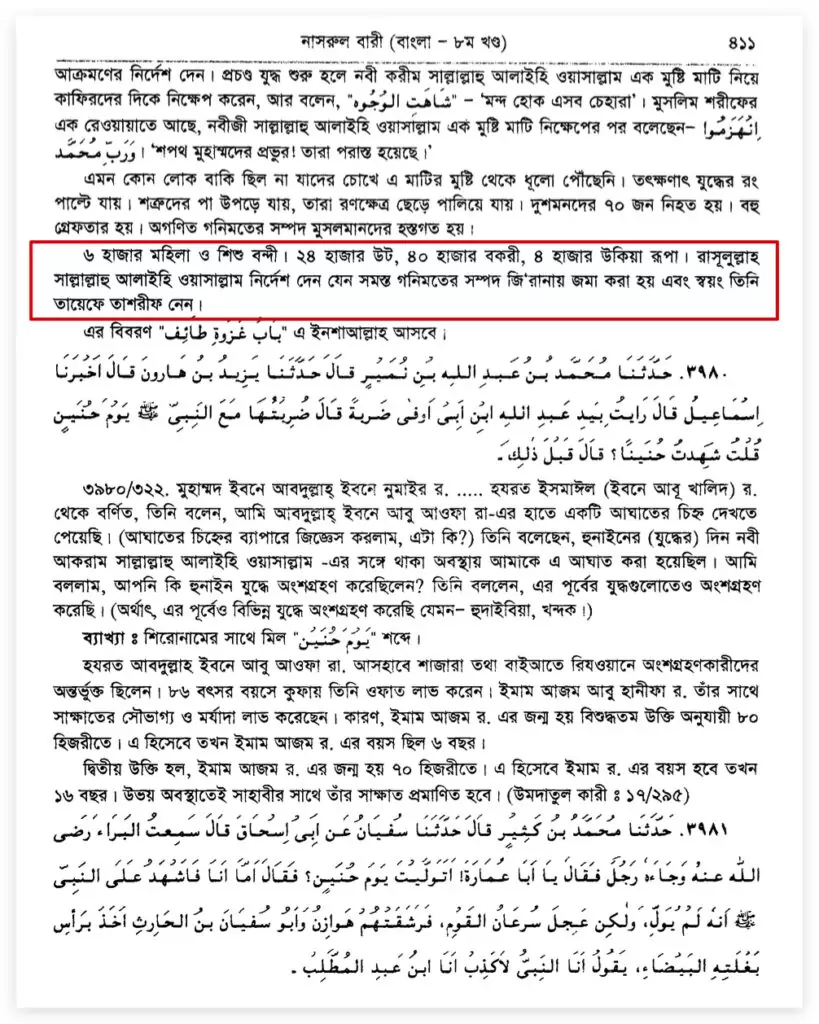
The livestock acquired in this single battle far exceeded that of the Banu al-Mustaliq and Abu Qatadah expeditions. The camels and sheep and goats alone numbered more than 64,000; separately, the 4,000 uqiyyahs correspond to approximately 476 kilograms of silver. Using the conventional measures of forty dirhams per uqiyyah and approximately 2.975 grams per dirham gives 4,000 × 40 × 2.975 grams = 476 kilograms. Since a direct silver weight is available here, its metal value alone can be calculated at modern market prices.
From part of Hunayn’s booty, Muhammad made special allocations of a hundred camels or other quantities to various tribal leaders. Maghazi literature names Abu Sufyan, Hakim ibn Hizam, and others. These gifts were not assets separate from the total of 24,000 camels collected; they were distributions to particular individuals from within the booty. Political loyalty, postwar relations, and the distribution of wealth operated together through them. [35]
Distributing Hunayn’s Booty: Attracting New Followers with Wealth
The hadith gives the purpose of distributing a hundred camels each to particular Quraysh men from Hunayn’s booty as Muhammad’s own explanation. When some of the Ansar objected, he said that he was giving wealth to attract people who had only recently left unbelief. Booty was thus used to attract new followers and strengthen religious allegiance. The military contribution of those who participated in battle and the position of individuals receiving preferential allocations were not identical; the Ansar’s complaint expresses this difference. Hunayn’s booty being used politically is therefore not merely an inference drawn by later interpreters: the reported dialogue explicitly states the purpose of drawing people closer through wealth. [36]
حدثني حرملة بن يحيى التجيبي، أخبرنا عبد الله بن وهب، أخبرني يونس، عن ابن شهاب، أخبرني أنس بن مالك، أن أناسا من الأنصار قالوا يوم حنين حين أفاء الله على رسوله من أموال هوازن ما أفاء فطفق رسول الله صلى الله عليه وسلم يعطي رجالا من قريش المائة من الإبل فقالوا: يغفر الله لرسول الله يعطي قريشا ويتركنا وسيوفنا تقطر من دمائهم. قال أنس بن مالك: فحدث ذلك رسول الله صلى الله عليه وسلم من قولهم فأرسل إلى الأنصار فجمعهم في قبة من أدم فلما اجتمعوا جاءهم رسول الله صلى الله عليه وسلم فقال: «ما حديث بلغني عنكم». فقال له فقهاء الأنصار: أما ذوو رأينا يا رسول الله فلم يقولوا شيئا وأما أناس منا حديثة أسنانهم قالوا يغفر الله لرسوله يعطي قريشا ويتركنا وسيوفنا تقطر من دمائهم. فقال رسول الله صلى الله عليه وسلم: «فإني أعطي رجالا حديثي عهد بكفر أتألفهم أفلا ترضون أن يذهب الناس بالأموال وترجعون إلى رحالكم برسول الله فوالله لما تنقلبون به خير مما ينقلبون به». فقالوا: بلى يا رسول الله قد رضينا. قال: «فإنكم ستجدون أثرة شديدة فاصبروا حتى تلقوا الله ورسوله فإني على الحوض». قالوا: سنصبر.
English translation: Harmalah ibn Yahya al-Tujibi narrated to me; ‘Abdullah ibn Wahb informed us; Yunus informed me, from Ibn Shihab, who said that Anas ibn Malik informed him. Anas b. Malik reported that when on the Day of Hunain Allah conferred upon His Apostle (ﷺ) the riches of Hawazin, the Messenger of Allah (ﷺ) set about distributing to some persons of Quraish one hundred camels Upon this they (the young people from the Ansar) said: May Allah grant pardon to the Messenger of Allah (ﷺ) that he bestowed (these camels) upon the people of Quraish, and he ignored us, whereas our swords are still dripping blood. Anas b. Malik said: Their statement was conveyed to the Messenger of Allah (ﷺ) and he sent (someone) to the Ansar and gathered them under a tent of leather. When they had assembled, the Messenger of Allah (ﷺ) came to them and said: What is this news that has reached me from you? The wise people of the Ansar said: Messenger of Allah, so far as the sagacious amongst us are concerned they have said nothing, but we have amongst us persons of immature age; they said: May Allah grant pardon to the Messenger of Allah (ﷺ) that he gave to the Quraish and ignored us (despite the fact) that our swords are besmeared with their blood. Upon this the Messenger of Allah (ﷺ) said: I give (at times material gifts) to persons who were quite recently in the state of unbelief, so that I may incline them to truth Don’t you feel delighted that people should go with riches, and you should go back to your places with the Messenger of Allah? By Allah, that with which you would return is better than that with which they would return. They said: Yes, Messenger of Allah, we are pleased. The Prophet said too: You would find marked preference (in conferring of the material gifts) in future, so you should show patience till you meet Allah and His Messenger and I would he at the Haud Kauthar. They said: We would show patience.
Although six thousand women and children were taken captive at Hunayn, accounts describe many later being returned following an appeal from Hawazin’s delegation. These accounts therefore do not establish that all 6,000 captives were permanently sold for monetary income. But taking women and children captive after military victory and retaining them as part of the booty reveals the contemporary policy of warfare and the victors’ power over defeated people. [37]
Hunayn’s important economic outcome was the simultaneous acquisition of vast quantities of livestock and silver, together with the concentration of power over their distribution. It shows that individual expeditions under Medina’s military leadership could gather tens of thousands of animals and assets equivalent to hundreds of kilograms of silver. Considering this alongside sources of recurring agricultural production such as Khaybar and Banu al-Nadir further expands the scale of the economic power acquired.
A Combined Account of Property Acquired through Military Expeditions
The figures preserved in early accounts are arranged by expedition below. Assets for which quantities are unavailable are marked unknown; the same property is not added twice. Since Hunayn’s sheep and goats numbered more than forty thousand, forty thousand is used as the minimum basis for calculation. The conversion of uqiyyahs into dirhams and the captive counts are retained in their respective units.
| Expedition | Camels | Sheep and goats | Horses | Money / silver | Captive people | Other assets | Source |
|---|---|---|---|---|---|---|---|
| Badr (2 AH) | 150 | — | 10 | — | 70 prisoners; ransom | Leather, weapons, clothing | Al-Halabi; Al-Salihi |
| Al-Qaradah (3 AH) | — | — | — | Assets worth 100,000 dirhams | Several captives | Caravan trading goods | Subul al-Huda |
| Banu al-Nadir (4 AH) | Unknown | Unknown | — | — | — | Land and date plantations; source of household maintenance | Bukhari |
| Banu Qurayzah (5 AH) | Unknown | Unknown | — | — | Captive women and children | 1,500 swords; 2,000 spears; 300 coats of armor; 500 shields | Al-Halabi; Quran 33:26–27 |
| Banu al-Mustaliq (5/6 AH) | 2,000 | 5,000 | — | — | Captives from 200 households | Other assets | ‘Uyun al-Athar |
| Khaybar (7 AH) | Unknown | Unknown | — | — | Captive people | Land, fortresses, plantations; reported division into 36 shares | Al-Bayhaqi |
| Fadak (7 AH) | — | — | — | — | — | Rights to half the land and agricultural produce | ‘Umdat al-Qari |
| Abu Qatadah’s Najd expedition (8 AH) | 200 | 2,000 | — | — | Many captives | Other assets | ‘Uyun al-Athar |
| Hunayn (8 AH) | 24,000 | More than 40,000 | — | 4,000 uqiyyahs of silver | 6,000 captives | Other goods and weapons | Subul al-Huda |
| Numerical totals | 26,350 | At least 47,000 | 10 | 4,000 uqiyyahs of silver, plus the separate Al-Qaradah valuation | Separate for each expedition | Full value of land and weapons unknown | Selected accounts |
The numerical totals above give 26,350 camels, at least 47,000 sheep and goats, and the 10 horses reported at Badr. Banu Qurayzah’s 4,300 countable weapons and items of protective equipment constitute a separate category. Hunayn’s four thousand uqiyyahs of silver, Al-Qaradah’s caravan worth approximately 100,000 dirhams, the farmland of Khaybar and Banu al-Nadir, and half of Fadak’s landed property are also distinct. These are partial figures from nine selected battles and expeditions, not a complete inventory of the property acquired in all military campaigns during Muhammad’s lifetime.
Approximate Economic Value of the Booty at Contemporary Market Prices (8 October 2026)
The historical quantities can be compared using prices for ordinary camels and sheep and goats in contemporary Arabian livestock markets. The assumed price range is 5,000–10,000 Saudi riyals for an ordinary camel and 700–1,900 riyals for a sheep or goat. Midrange calculations use 7,500 and 1,300 riyals respectively. The market comparisons draw on price information published by the Saudi Press Agency and livestock markets; individual prices vary by breed, age, weight, and season. [38] [39] [40]
For silver, Kitco’s market price of US$59.01 per troy ounce on 8 October 2026 is used. A troy ounce is 31.1035 grams. Calculations assume approximately 32.8415 Bangladeshi taka per Saudi riyal and 123.30 taka per US dollar. Camel and sheep and goat prices are therefore converted directly from riyals into Bangladeshi taka, and silver prices from dollars. [41] [42] [43]
| Expedition | Assets valued | Low price (crore BDT) | Midrange price (crore BDT) | High price (crore BDT) |
|---|---|---|---|---|
| Badr | 150 camels | 2.46 | 3.69 | 4.93 |
| Banu al-Mustaliq | 2,000 camels; 5,000 sheep and goats | 44.34 | 70.61 | 96.88 |
| Abu Qatadah’s expedition | 200 camels; 2,000 sheep and goats | 7.88 | 13.47 | 19.05 |
| Hunayn | 24,000 camels; 40,000 sheep and goats; 4,000 uqiyyahs of silver | 497.19 | 773.06 | 1,048.93 |
| Selected total | 26,350 camels; at least 47,000 sheep and goats; 4,000 uqiyyahs of silver | 551.87 | 860.83 | 1,169.78 |
The midrange market value of these selected figures is approximately 860.83 crore Bangladeshi taka; at lower market prices it is approximately 551.87 crore, and at higher prices approximately 1,169.78 crore taka. Today’s price per animal will not correspond exactly to the actual value, breed, or productive capacity of a seventh-century animal; the comparison here concerns the economic scale of the quantities. Only animals with documented quantities are included in this valuation.
Early accounts describe Al-Qaradah’s total caravan assets as worth 100,000 dirhams. Taking one dirham as 2.975 grams under a conventional monetary weight standard gives a silver-equivalent weight of 297.5 kilograms. At the silver price on 8 October 2026, its equivalent value is approximately 6.96 crore taka. This does not claim that the caravan actually contained 297.5 kilograms of silver; it compares an early monetary valuation with a modern metal value. Treating this as a separate category brings the approximate combined midrange value of the selected assets that can be quantified to 867.79 crore taka.
| Additional assets or rights | Historical account | Modern monetary value |
|---|---|---|
| Al-Qaradah caravan | Goods worth approximately 100,000 dirhams | 6.96 crore BDT (silver-equivalent) |
| Ransoms for Badr’s prisoners | 1,000–4,000 dirhams per person; some released without payment | Complete total unknown |
| Banu Qurayzah’s weapons | A total of 4,300 countable weapons and items of protective equipment | No reliable comparable unit price |
| Banu al-Nadir | Land, date plantations, and one year’s household expenditure | Land area and yield unknown |
| Khaybar | Agricultural property divided into 36 shares and rights to production | Land area and production value unknown |
| Fadak | Rights to half the land | Land area and production value unknown |
| Captive people from various expeditions | Women, men, and children; captivity, ransom, distribution | No modern market value assigned to human beings |
The total value in this financial comparison is not Muhammad’s individual personal monetary wealth. Some booty was distributed among soldiers, khums had several designated categories, and some fay’ resources supported household and administrative expenses. Muhammad’s position at the center of collecting and distributing wealth is the principal historical significance of these arrangements. Land, date plantations, weapons, other trading goods, and resources from expeditions without specified quantities are not included in the total. This figure therefore values the quantifiable assets from a few selected expeditions, rather than all the economic resources of the Medinan period.
The Connection between Booty, Household Expenditure, and Military Power
Retaining a year’s household maintenance from Banu al-Nadir’s property, separating khums from Al-Qaradah’s caravan, reserving half of Khaybar’s acquired assets for administrative needs, and giving large numbers of camels to various leaders at Hunayn were different expressions of the same economic system. Resources arrived through military expeditions under Muhammad’s leadership; political decisions then distributed them among the family, armed forces, followers, administrative functions, and other designated categories. One defining feature was the concentration of both military power to acquire resources and decisions about their use in the hands of the same leadership.
The accounts of capturing and distributing people as war booty also reveal the system’s moral character. At Badr, prisoners were released for ransom; at Banu Qurayzah, women and children were captured; Banu al-Mustaliq accounts describe captive households; in Abu Qatadah’s expedition, a captive woman was transferred from one person to another; and at Hunayn, six thousand captives were held together, with many reportedly returned later. Their identities cannot be concealed beneath the word “booty” in the history of acquiring wealth: they were members of defeated communities over whose lives and freedom the victorious forces established authority.
Economic quantities and legal and political rights are interrelated. Combining the Quran’s one-fifth provision, hadith accounts of household expenses from fay’, sira descriptions of seizing trading caravans’ property, and maghazi figures for thousands of livestock reveals the economic foundation of Medinan state power. A life whose beginnings appear in the account of earning a few qirats as a shepherd was taken to an entirely different level of income and control over resources through Medina’s military and political leadership.
Ghanimah, Fay’, and Khums: The Framework for Acquiring and Distributing Wealth
Medinan methods of acquiring resources take three principal forms: (1) ghanimah collected through warfare or armed expeditions; (2) fay’ obtained through political and military domination without direct battle; and (3) distributing these resources as khums, soldiers’ shares, household maintenance, and administrative expenditure. The economic consequence was not merely obtaining property, but establishing the power to set rules governing acquired resources and distribute them among others.
(1) Ghanimah: Animals, weapons, goods, and other property obtained through armed clashes, expeditions, sieges, or the seizure of enemy property were distributed as booty. Quran 8:1 and 8:41 place war booty under central decision-making and establish the rule of one-fifth.
(2) Fay’: Property that Muslim forces did not have to acquire through direct battle could fall under fay’. The land and date plantations of Banu al-Nadir and Fadak had lasting economic importance: they could generate recurring resources in the form of agricultural goods, rent, or a share of production. [14]
(3) Distribution and Control: Muhammad commanded expeditions and held ultimate authority over distribution. The fate of captives, ransom amounts, shares of booty, special allocations to particular individuals, and expenditure on the army’s weapons and horses fell within this centralized authority. Sahih al-Bukhari’s statement “I am a distributor” concisely expresses that system. [13]
Together, these three arrangements created an institutional economy dependent on warfare and expeditions. Although livestock and silver were distributed on individual occasions, landed property and date plantations could generate resources over long periods. Khums was a specified share of distributable assets; the framework of rights over fay’ was separate. Muhammad’s economic power therefore rested on more than the amount of any single personal share: it also included political rights to collect, retain, manage, and distribute resources among various individuals and groups.
Safi: Selecting Special Property for Muhammad before the Distribution of Booty
Alongside khums, the provision for a specially selected portion called “safi” is relevant to Muhammad’s rights over war booty. In Al-Mughni, Ibn Qudamah defines safi as something Muhammad selected from the booty before distribution; his examples include a female slave, a male slave, clothing, and a sword. The same discussion quotes ‘A’ishah’s statement that Safiyyah belonged to the safi. This provision places people and objects in the same list of selected assets. Its economic and social consequence was the establishment of Muhammad’s special rights over particular property and captive people before ordinary distribution. Ibn Qudamah also records evidence cited for and against the provision and disagreement over its continuation after Muhammad’s death. [44]
وكان لرسول الله صلى الله عليه وسلم من المغنم الصفي، وهو شيء يختاره من المغنم قبل القسمة، كالجارية والعبد والثوب والسيف ونحوه. وهذا قول محمد بن سيرين، والشعبي، وقتادة، وغيرهم من أهل العلم. وقال أكثرهم: إن ذلك انقطع بموت النبي صلى الله عليه وسلم. قال أحمد: الصفي إنما كان للنبي صلى الله عليه وسلم خاصة، لم يبق بعده. ولا نعلم مخالفا لهذا إلا أبا ثور، فإنه قال: إن كان الصفي ثابتا للنبي صلى الله عليه وسلم فللإمام أن يأخذه على نحو ما كان يأخذه النبي صلى الله عليه وسلم ويجعله مجعل سهم النبي من خمس الخمس. فجمع بين الشك فيه في حياة النبي صلى الله عليه وسلم ومخالفة الإجماع في إبقائه بعد موته. قال ابن المنذر: لا أعلم أحدا سبق أبا ثور إلى هذا القول وقد أنكر قوم كون الصفي للنبي صلى الله عليه وسلم واحتجوا بما روى عمرو بن شعيب، عن أبيه، عن جده، أن رسول الله صلى الله عليه وسلم رفع وبرة من ظهر بعيره، فقال: «ما يحل لي مما أفاء الله عليكم ولا مثل هذه، إلا الخمس»، وهو مردود عليكم رواه سعيد. ورواه أبو داود، بإسناده عن أبي أمامة، عن النبي صلى الله عليه وسلم. ولأن الله تعالى قال: «واعلموا أنما غنمتم من شيء فأن لله خمسه». فمفهومه أن باقيها للغانمين. ولنا، ما روى أبو داود، بإسناده، أن النبي صلى الله عليه وسلم كتب إلى بني زهير بن أقيش: «إنكم إن شهدتم أن لا إله إلا الله، وأن محمدا رسول الله، وأديتم الزكاة، وأديتم الخمس من المغنم، وسهم الصفي، إنكم آمنون بأمان الله ورسوله». وفي حديث وفد عبد القيس، الذي رواه ابن عباس: «وأن يعطوا سهم النبي صلى الله عليه وسلم والصفي». وقالت عائشة: كانت صفية من الصفي. رواه أبو داود. وأما انقطاعه بعد النبي صلى الله عليه وسلم فثابت بإجماع الأمة قبل أبي ثور وبعده عليه، وكون أبي بكر وعمر وعثمان ومن بعدهم لم يأخذوه، ولا ذكره أحد منهم، ولا يجمعون على ترك سنة النبي صلى الله عليه وسلم.
English translation: The Messenger of Allah had the safi from the booty: something he selected before distribution, such as a female slave, a male slave, clothing, a sword, or something similar. This was also the view of Muhammad ibn Sirin, Al-Sha‘bi, Qatadah, and other scholars. Most said that this right ended with the Prophet’s death. Ahmad said: Safi belonged exclusively to the Prophet and did not remain after him. We know of no dissenter except Abu Thawr, who said: If safi was established for the Prophet, the imam may take it as the Prophet did and place it in the same category as the Prophet’s share of one-fifth of the khums. He thus combined doubt about its existence during the Prophet’s lifetime with opposition to consensus by retaining it after his death. Ibn al-Mundhir said: I know of no one before Abu Thawr who held this view. Some denied that the Prophet had a right to safi. They cited the report of ‘Amr ibn Shu‘ayb, from his father, from his grandfather, that the Messenger of Allah lifted a tuft of hair from his camel’s back and said: “Not even this amount of what Allah has granted you is lawful for me, except the khums,” which is returned to you. Sa‘id narrated it. Abu Dawud also narrated it through his chain from Abu Umamah, from the Prophet. They also cited Allah’s statement: “Know that one-fifth of whatever you acquire as booty belongs to Allah.” Its implication is that the remainder belongs to those who acquired the booty. Our evidence is Abu Dawud’s report through his chain that the Prophet wrote to Banu Zuhayr ibn Uqaysh: “If you testify that there is no deity but Allah and that Muhammad is Allah’s Messenger, pay zakat, and render the khums of the booty and the safi share, you are secure under the protection of Allah and his Messenger.” The report about the ‘Abd al-Qays delegation narrated by Ibn ‘Abbas also states: “They shall give the Prophet’s share and the safi.” ‘A’ishah said: Safiyyah was part of the safi. Abu Dawud narrated it. Its discontinuation after the Prophet is established by the community’s consensus before and after Abu Thawr: Abu Bakr, ‘Umar, ‘Uthman, and their successors did not take it, nor did any of them mention it. They could not all agree to abandon a practice of the Prophet.
Under Al-Anfal 8:1 and 8:41, decisions about war booty and its distribution are placed “under Allah and the Messenger,” with khums, or one-fifth, specified in the distribution.
Al-Hashr 59:6–7 describes property for which “horses or camels did not have to be driven,” indicating acquisition without direct battle. It nevertheless comes under central authority, with instructions for expenditure in designated categories.
Sahih al-Bukhari 3117 states: “Neither do I give you nor withhold from you; I am a distributor.” This effectively describes an administrative structure of “resources arrive → central oversight → distribution.”
The Declaration “I Ask No Payment” and Political Authority over Wealth
Quran 6:90 declares that no payment is demanded for conveying the religious message. Yet during the Medinan period, the same leadership introduced the one-fifth share of war booty, distributions among combatants, and the special system of fay’. Although conveying the religious message was described as work without personal wages, that religious leadership became a major center of political power and wealth. The economic reality of this change is reflected in Quranic provisions and the quantitative information in maghazi literature. [6] [8]
Although payment for preaching and wealth acquired through military conquest are not legally designated by the same term, their social consequences cannot be considered in isolation. In Medina, prophethood and political leadership were concentrated in one person’s hands; decisions about military expeditions, religious authorization, the distribution of captives and property, and the use of specified resources for his household and administration were directed from the same center. The declaration “I ask no payment” therefore does not refute the existence or economic importance of the flow of wealth dependent on warfare.
Conclusion: From Shepherd and Commercial Employee to Controller of War Booty
There is a clear change in the economic foundations of Muhammad’s Meccan and Medinan lives. In Mecca, livelihood was connected to shepherding, commercial work, and Khadijah’s wealth; in Medina, to military expeditions, caravan seizures, the acquisition of livestock and silver, prisoners’ ransoms, landed property, date plantations, and political authority over their distribution. The figures from a few selected expeditions from Badr to Hunayn alone attest to the acquisition of thousands of camels and sheep and goats and vast quantities of silver. The flow of resources from the landed property of Banu al-Nadir, Khaybar, and Fadak extends this account further.
The system’s most important characteristic was the connection between military and religious authority and control over economic resources. Muhammad was not merely a recipient of other people’s gifts; he decided on authorizing expeditions, collecting property, separating khums, controlling land, and distributing booty. The comparative value calculated at contemporary market prices for the animals and silver with known quantities alone amounts to many hundreds of crore Bangladeshi taka. The full value of land, weapons, other trading goods, and regular agricultural production lies outside this figure. In this way, Muhammad’s position was transformed from personal earnings in Mecca into Medina’s political economy dependent on warfare, acquisition, and distribution of resources.
References
- Sahih al-Bukhari 2262 ↩︎
- Quran 93:8 ↩︎
- Ibn Hisham, Al-Sirah al-Nabawiyyah, Journey to Syria for Khadijah’s Trade; Islamweb ↩︎
- The same work, edited by Al-Saqqa and others, Volume 1, p. 187; Shamela ↩︎
- Continuation, Volume 1, p. 188; Shamela ↩︎
- Quran 6:90 1 2
- Quran 8:1 ↩︎
- Quran 8:41 1 2
- Hadith Sambhar 1900 ↩︎
- Ibn Hajar, Fath al-Bari, The Book of Jihad and Military Conduct, “What Has Been Said about Spears”; Islamweb ↩︎
- IslamQA, Answer 128121: How Muhammad Earned His Livelihood ↩︎
- Sahih al-Bukhari 2818 ↩︎
- Sahih al-Bukhari 3117 1 2
- Quran 59:6–7 1 2
- Al-Halabi, Al-Sirah al-Halabiyyah, The Battle of Badr ↩︎
- Al-Salihi, Subul al-Huda wa al-Rashad, Ransoms for the Prisoners of Badr ↩︎
- Al-Salihi, The Seizure of the Al-Qaradah Caravan and Its Khums ↩︎
- Sahih al-Bukhari, The Use of Banu al-Nadir’s Fay’ ↩︎
- Sunnah.com — Sahih al-Bukhari 2904; Book 56, Hadith 118 ↩︎
- Al-Sirah al-Halabiyyah, The Seizure of Banu Qurayzah’s Property ↩︎
- Quran 33:26–27 ↩︎
- Ibn Hisham, Al-Sirah al-Nabawiyyah, edited by Al-Saqqa and others, Volume 2, p. 244: Distribution of Banu Qurayzah’s Property; Shamela ↩︎
- The same work, Volume 2, p. 245: Purchasing Horses and Weapons with Captives, and Rayhanah; Shamela ↩︎
- The Same Account of Distribution and Dispatching Captives to Najd; Islamweb ↩︎
- Ibn Sayyid al-Nas, ‘Uyun al-Athar, Banu al-Mustaliq ↩︎
- Al-Bayhaqi, Dala’il al-Nubuwwah, Distribution of Khaybar’s Property ↩︎
- Ibn Sayyid al-Nas, ‘Uyun al-Athar, Distribution at Khaybar ↩︎
- Sahih Muslim 1551, The Book of Musaqah, Cultivation in Return for a Share of Fruits and Crops; Islamweb ↩︎
- Sahih Muslim 1551b, The Same Complete Report; Sunnah.com ↩︎
- Badr al-Din al-‘Ayni, ‘Umdat al-Qari, The Property of Fadak ↩︎
- Ibn Sayyid al-Nas, ‘Uyun al-Athar, Abu Qatadah’s Expedition ↩︎
- An Alternative Maghazi Account of Abu Qatadah’s Expedition ↩︎
- Al-Salihi, Subul al-Huda wa al-Rashad, The Booty of Hunayn ↩︎
- Sahaj Nasrul Bari, Commentary on Sahih al-Bukhari, Volume 8, Al-Kawsar Prakashani, p. 411 ↩︎
- Ibn al-Jawzi, Al-Muntazam, Distribution at Hunayn ↩︎
- Sahih Muslim 1059a, The Book of Zakat, Giving Wealth to Incline Hearts toward Islam and Urging Patience upon Those Firm in Faith; Sunnah.com ↩︎
- Badr al-Din al-‘Ayni, ‘Umdat al-Qari, The Return of Hawazin’s Captives ↩︎
- Saudi Press Agency, Auction Prices of Ordinary Camels, December 2025 ↩︎
- Riyadh Livestock Market, Comparative Price Information for 2026 ↩︎
- Average Saudi Livestock Prices, March 2026 ↩︎
- Kitco, Silver Market Price, 8 October 2026 ↩︎
- Saudi Riyal–Bangladeshi Taka, 8 October 2026 ↩︎
- US Dollar–Bangladeshi Taka, 8 October 2026 ↩︎
- Ibn Qudamah, Al-Mughni, Volume 6, p. 316, Section 5081: The Messenger’s Safi from Booty; Islamweb ↩︎