
Introduction
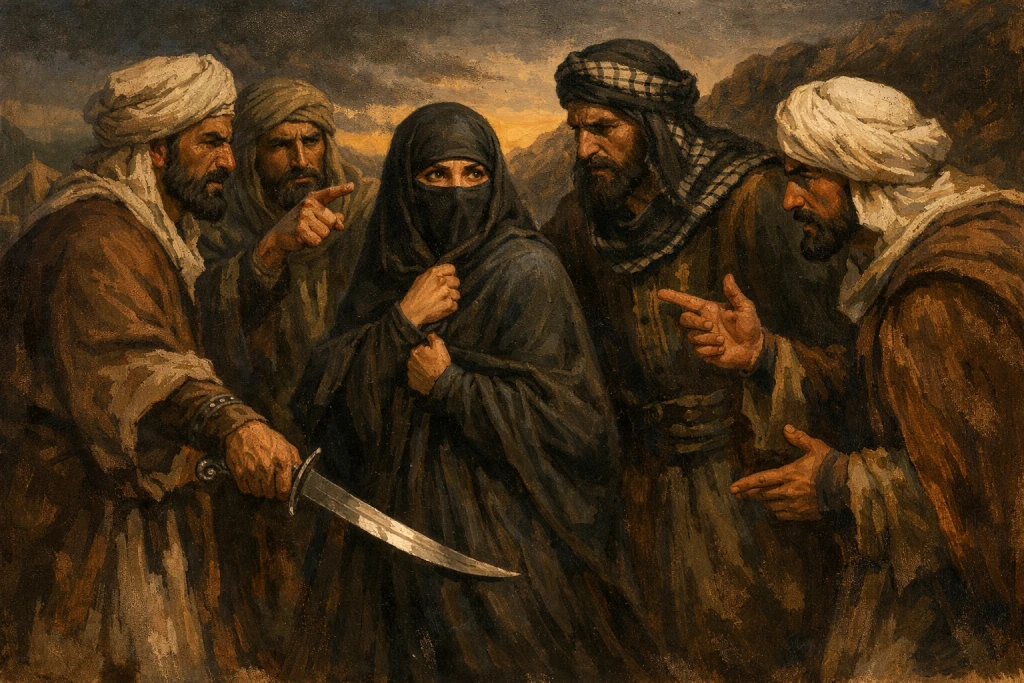
Muhammad sent Ali and two others to recover Hatib’s letter. When the woman carrying it denied having it, they searched her baggage. They found no letter, so Ali threatened to strip her. Only then did she produce it. That is where the ethical problem lies. Ali used a woman’s body as a means of coercion to get a letter. She did have the letter. Before he had it in his hands, Ali had already decided he could threaten to take her clothes off. Al-Muhallab and Ibn al-Qayyim later drew conclusions from the incident about the powers of investigators. Al-Muhallab found grounds for withdrawing a suspect’s privacy protections. Ibn al-Qayyim found an example of a threat that brought the truth to light. The way a single letter was recovered thus raises a broader question. How much power over another person’s body may an investigator claim on the basis of suspicion?
The Hadith Account of Ali’s Brutality
Muhammad sent Ali, al-Zubayr and Abu Marthad to Rawdat Khakh to recover Hatib’s letter. When they found the woman on a camel, she said she had no letter. They made the camel kneel and searched her baggage. They found nothing. When Ali’s two companions told him so, he said Muhammad had not lied. He then told the woman he would take off her clothes if she did not produce the letter. According to the hadith, she realized Ali was prepared to carry out the threat and pulled the letter from the cloth wrapped around her waist. Ali obtained what the baggage search had failed to uncover by threatening to expose the woman’s body. The woman was effectively given two choices. She could hand over the letter herself, or have her clothes taken off in front of three men. Her decision to hand it over shows how the threat worked. [1]
Sahih al-Bukhari (Bengali edition: Tawheed Publications)
79. Asking Permission
Chapter 79/23. Examining the letter of someone feared to pose a threat to the Muslims in order to ascertain the facts.
6259. Narrated by Ali (may Allah be pleased with him). He said: The Messenger of Allah (peace and blessings be upon him) sent me, al-Zubayr ibn al-Awwam and Abu Marthad al-Ghanawi on horseback. He told us, “Ride to Rawdat Khakh. You will find a polytheist woman there with a letter from Hatib ibn Abi Balta‘a to the polytheists.” We caught up with her at the very place the Messenger of Allah (peace and blessings be upon him) had told us about. She was riding a camel. We asked her, “Where is the letter you are carrying?” She answered, “I have no letter.” We made her camel kneel and searched her baggage, but found nothing.
My two companions said, “We can see no letter.” I said, “I know the Messenger of Allah (peace and blessings be upon him) did not lie.” I warned her, “By Him in whose name oaths are sworn, you will produce the letter or I will strip you.” When she saw I meant it, she reached into the fold of the cloth wrapped around her waist and pulled out the letter. We took it to the Messenger of Allah (peace and blessings be upon him).
He asked, “Hatib, what led you to do this?” Hatib replied, “I still believe in Allah and His Messenger. I have neither changed my allegiance nor abandoned my religion. I wanted to do the people of Mecca a favor so that Allah might thereby keep my family and property safe. Your other companions have people there through whom Allah can protect their families and property.”
The Prophet (peace and blessings be upon him) said, “Hatib has spoken the truth. Speak only well of him.” The narrator continued: Umar ibn al-Khattab (may Allah be pleased with him) said, “He has betrayed Allah, His Messenger and the believers. Let me strike off his head.” The Prophet (peace and blessings be upon him) said, “Umar, how do you know? Perhaps Allah looked upon those who fought at Badr and said, ‘Do as you wish. Paradise has been appointed for you.’” At that, Umar (may Allah be pleased with him) began to weep. He said, “Allah and His Messenger know best.” [3007] (Adhunik Prokashoni, 5817; Islamic Foundation, 5712)
Hadith grade: Sahih (authentic)
Narrator: Ali ibn Abi Talib (may Allah be pleased with him)
In Another Account in Sahih al-Bukhari, the Letter Is Hidden in the Woman’s Hair
Sahih al-Bukhari 3007 recounts the same incident. It names Ali, al-Zubayr and al-Miqdad as the men Muhammad sent. When the woman denied having a letter, they told her to produce it or they would take off her clothes. She then pulled the letter out of her braid. In Bukhari 6259, she takes it out of the cloth wrapped around her waist. The two accounts differ on where she hid it. In both accounts, the woman first denies having the letter and then hands it over after the threat to strip her, before any search of her body. [2] [3]
فَقُلْنَا لَتُخْرِجِنَّ الْكِتَابَ أَوْ لَنُلْقِيَنَّ الثِّيَابَ. فَأَخْرَجَتْهُ مِنْ عِقَاصِهَا، فَأَتَيْنَا بِهِ رَسُولَ اللَّهِ
English translation: Then we said, “Either you take out the letter or else we will take off your clothes.” She took the letter from her braid, and we carried it to the Messenger of Allah.
Muhammad ordered the recovery of Hatib’s letter. In this account in al-Bukhari, Ali and his companions threaten to strip the non-Muslim woman carrying it. The recovered letter showed that Hatib was sending news of Muhammad’s plans to his opponents in Mecca. The contents of the letter substantiate the charge that information was leaked. That evidence gives no justification for threatening to take off a woman’s clothes. Al-Muhallab later used the incident to argue for removing a suspect’s privacy protections. Ibn al-Qayyim treated the use of a threat to recover the letter as a precedent for judicial investigation.
The Right to Bodily Integrity and Dignity
Article 5 of the United Nations Universal Declaration of Human Rights (UDHR) states that no one may be subjected to cruel, inhuman or degrading treatment. Under that framework, for men to threaten a woman with a “strip search” is a grave violation of her bodily integrity and human dignity. Modern jurisprudence and gender-based protection standards treat this kind of intimidation as psychological and gender-based abuse. It disregards the person’s consent and uses her bodily privacy as leverage, threatening to humiliate her in front of others. Such conduct is incompatible with any civilized legal system. [4]
Fath al-Bari and the Denial of a Female Suspect’s Right to Privacy
Ali had specific information from Muhammad that the woman was carrying the letter. Even after the baggage search turned up nothing, he acted on the assumption that the information was true. In Ibn Hajar al-Asqalani’s Fath al-Bari, al-Muhallab draws a broader rule from the incident. In his view, the prohibition on reading someone’s correspondence without permission applies to people who are under no suspicion of acting against Muslims. Of the suspect, he says فلا حرمة له. In other words, the protection against having one’s correspondence read does not extend to a suspect. In the same commentary, he also permits looking at a woman’s intimate parts in cases of necessity when he sees no way to avoid it. Ali was acting on a specific tip. Under al-Muhallab’s rule, mere suspicion is enough to remove the protection of private correspondence. The right to privacy is thus withdrawn before the allegation has been proven, precisely so that the breach of privacy can be used to test the allegation. The eventual discovery of Hatib’s letter provides no grounds for giving suspicion that much power as a general rule. [5]
قال المهلب: في حديث علي هتك ستر الذنب وكشف المرأة العاصية، وما روي أنه لا يجوز النظر في كتاب أحد إلا بإذنه إنما هو في حق من لم يكن متهما على المسلمين، وأما من كان متهما فلا حرمة له، وفيه أنه يجوز النظر إلى عورة المرأة للضرورة التي لا يجد بدا من النظر إليها.
English translation: Al-Muhallab said, “Ali’s hadith provides a precedent for uncovering wrongdoing and exposing what a disobedient woman has concealed. The prohibition on looking at someone’s letter without permission concerns those who are under no suspicion of acting against Muslims. A suspect has no such protection. The incident also indicates that it is permissible to look at a woman’s intimate parts in cases of necessity when there is no way to avoid doing so.”
Ibn al-Qayyim Treats the Threat to Strip the Woman as a Model for Judicial Fact-Finding
Ibn al-Qayyim divides the judge’s task in two in I‘lam al-Muwaqqi‘in. First, the judge must determine what actually happened from the available evidence. Then the judge must decide which rule applies. To illustrate the first task, Ibn al-Qayyim cites the recovery of Hatib’s letter. The woman denied having it, so Ali threatened to strip her, and the pressure made her hand it over. Immediately afterward, Ibn al-Qayyim cites al-Zubayr’s use of torture to find hidden property and al-Nu‘man ibn Bashir’s use of beatings in response to an allegation of theft. In this sequence, he presents threats of stripping, torture and beatings as effective means of obtaining concealed information or objects. The letter was found after the threat. Its discovery therefore cannot justify the decision to issue the threat in the first place. If the same method is used when suspicion is mistaken, the humiliation or torture falls on a person against whom the allegation has yet to be proved. [6]
وَكَمَا تَوَصَّلَ أَمِيرُ الْمُؤْمِنِينَ عَلِيٌّ عَلَيْهِ السَّلَامُ بِقَوْلِهِ لِلْمَرْأَةِ الَّتِي حَمَلَتْ كِتَابَ حَاطِبٍ مَا أَنْكَرَتْهُ لَتُخْرِجْنَ الْكِتَابَ أَوْ لَأُجَرِّدَنَّك إلَى اسْتِخْرَاجِ الْكِتَابِ مِنْهَا.
English translation: Likewise, the Commander of the Faithful, Ali (peace be upon him), recovered Hatib’s letter from the woman carrying it. When she denied having it, he said, “You will produce the letter or I will strip you.”
In Madarik al-Nazar fi al-Siyasa, Abd al-Malik al-Ramadani quotes Ibn al-Qayyim’s discussion of judicial investigation. Ali’s threat appears again in the quotation as the step by which the letter was recovered. Al-Ramadani brings into his own discussion of religion and politics the very interpretation Ibn al-Qayyim used to illustrate an investigative method. [7]
The Same Hadith in a Contemporary IslamWeb Fatwa
IslamWeb fatwa 236272 concerns an incident at a company. According to the person who submitted the question, three colleagues left a phone in a restroom and kept watch in order to catch an employee. When he came out and denied taking it, they searched him and found the phone in his trouser pocket. The fatwa says the colleagues were certain he had taken the phone and that it might have been lost if they had not searched him immediately. Having permitted the search on those grounds, the ruling cites the hadith about Ali’s recovery of the letter to support searches in cases of necessity. It also quotes al-Muhallab’s denial of a suspect’s right to keep their correspondence private. The recovery of a secret letter during a military operation is used here as a precedent for searching a colleague’s body at work. The people who planted the phone were the same people who decided that their suspicions were enough to justify a search. The phone was found in the pocket afterward. Before finding it, they had already decided to search on the strength of their own certainty. [8]
جاء في فتح الباري: قال المهلب في حديث علي هتك ستر الذنب وكشف المرأة العاصية وما روي أنه لا يجوز النظر في كتاب أحد إلا بإذنه إنما هو في حق من لم يكن متهما على المسلمين، وأما من كان متهما فلا حرمة له.
English translation: Fath al-Bari quotes al-Muhallab as saying that Ali’s hadith provides a precedent for uncovering wrongdoing and exposing what a disobedient woman has concealed. The prohibition on looking at another person’s letter without permission applies only to someone who is under no suspicion of acting against Muslims. A suspect has no such protection.
Gender-Sensitive Search Procedures
UK Border Force guidance requires officers to match the passenger’s face to the photograph on their document. When a woman covers her face for religious or cultural reasons, a female officer will take her to a private area to verify her identity. If no female officer is available at the time, the passenger can consent to showing her face to a male officer or wait for a female officer. The accommodation changes where the check takes place and who conducts it. The requirement to match the passenger’s face to the photograph remains in force. When someone objects on religious grounds to uncovering her face in public, the relevant question is whether the same check can be completed another way. The same standard applies to the person conducting a search. The goal of recovering a letter or a prohibited item gives an officer no right to intrude on someone’s body as far as they please. They must establish whether a less humiliating method could have achieved the same purpose. [9]
Under Rule 19 of the United Nations Bangkok Rules, personal searches of women prisoners must be conducted by properly trained female staff. This safeguard recognizes bodily privacy and dignity. The general law on searches varies by jurisdiction and setting.
Searches must take place in a secure, enclosed space. Threatening to search someone in public or in the presence of other men violates the rule of law and undermines the person’s standing in the eyes of others.
Threatening to strip a woman to obtain information is an attack on bodily privacy and dignity through intimidation. The power to search gives no blanket license to use degrading methods. Legal safeguards and accountability still apply.
IslamQA on Women’s Veiling and Medical Examinations: Different Rules for the Same Body
IslamQA fatwa 281092 states that the basic rule for routine medical care and examinations is that women should treat women and men should treat men. It permits a practitioner of the opposite sex in cases of need or emergency. Fatwa 263354 from the same institution discusses at length strict classical views on covering a woman’s body, including her face. In IslamQA’s ruling on medical treatment, permission to expose the body to a practitioner of the opposite sex depends on the need for treatment and the availability of a practitioner of the same sex. From the recovery of the letter, al-Muhallab inferred that one may look at a woman’s covered parts when, in his view, necessity leaves no alternative. If the availability of a female practitioner matters in medical care, the equivalent question matters in recovering the letter. What other means of recovering it while respecting the woman’s privacy were available before she was threatened with being stripped? [10] [11]
والأصل أن تختص المرأة بعلاج النساء، ويختص الرجل بعلاج الرجال، وألا يعالج أحدهما الجنس الآخر، إلا عند الضرورة، أو الحاجة الماسة، لعدم الوجود المعالج من نفس الجنس.
English translation: The basic rule is that women treat women and men treat men. No one should treat a patient of the opposite sex except in an emergency or a case of compelling need, such as when no practitioner of the same sex is available.
The United Nations Bangkok Rules on Searches of Women and Strip Searches
On searches of women prisoners, Rule 19 of the United Nations Bangkok Rules explicitly requires properly trained female staff to conduct personal searches. Rule 20 calls for developing and using alternative screening methods, such as scans, in place of strip searches and invasive body searches because of the psychological and physical harm those searches can cause. The two rules place responsibility for safeguarding the bodily privacy of women in custody on the authorities conducting the search. In Ali’s case, a woman facing three armed horsemen was threatened with having her clothes taken off. The UN rules seek to protect even women in custody from that kind of treatment, while later religious jurists took the use of such a threat to obtain information as a precedent. [12]
Effective measures shall be taken to ensure that women prisoners’ dignity and respect are protected during personal searches, which shall only be carried out by women staff who have been properly trained in appropriate searching methods and in accordance with established procedures.
English rendering of the Bengali translation: Effective steps must be taken to protect the dignity and respect of women prisoners during personal searches. Only properly trained female staff may conduct these searches, and they must follow established procedures.
Coercion and the Absence of Consent
The woman took out the letter with her own hands. Ali himself explains why she did it. According to his account, she realized he was prepared to carry out the threat to take off her clothes. Only then did she reach into the cloth wrapped around her waist and pull out the letter. Ali set the price of refusing to hand over the letter. If she refused, her clothes would be taken off. Under those conditions, handing over the letter herself was her way of avoiding exposure. The threat itself was coercion. The threat had already served its purpose before any clothes were removed. Later jurists counted that result as a successful investigation, even though the success depended on turning a woman’s right to keep her body covered against her. [13]
Why the Letter’s Author Was Spared: Identity, Prior Standing and Unequal Punishment
The clearest imbalance of power appears in what happened to the writer and to the courier. The woman who carried the letter faced armed envoys who threatened to use a search of her body to get it. Hatib, who actually wrote it, had taken steps to pass Muhammad’s military plans to his opponents in Mecca. In al-Bukhari’s account, Umar regarded him as a traitor and asked permission to kill him. Muhammad accepted Hatib’s explanation and protected him by invoking his participation in the Battle of Badr. The hadith accounts record no comparable hearing for the courier, no chance for her to give her side, and no review of the threat made against her. In the same incident, the Muslim man at the center of the affair was spared on account of his military record, while the non-Muslim woman was threatened with humiliation to extract information from her. The different treatment raises the question of equality in punishment and respect for personal dignity. [14]
In his Majmu‘ al-Fatawa, Ibn Taymiyya also cites Hatib’s case and says that this grave offense was forgiven because he took part in the Battle of Badr. In its 2026 fatwa 622921 on alternatives to punishment, IslamQA likewise uses the decision to waive punishment on account of Hatib’s prior standing as a precedent. [15] [16]
فَهَذِهِ السَّيِّئَةُ الْعَظِيمَةُ غَفَرَهَا اللَّهُ لَهُ بِشُهُودِ بَدْرٍ.
English translation: Allah forgave him this grave offense because he took part in the Battle of Badr.
Al-Bukhari 4274 connects the episode of Hatib’s letter to Al-Mumtahanah 60:1. The verse describes showing affection in secret to the enemies of Allah and the believers as straying from the right path. When asked why he sent the letter, Hatib explained that, unlike other emigrants, he had no blood ties with the Quraysh in Mecca. He wanted to do them a favor in exchange for protection for his relatives. Muhammad accepted his explanation as truthful. When Umar asked permission to kill him, Muhammad brought up Hatib’s participation at Badr. The writer of the letter was heard in his own words on why he sent it. The only words the account preserves from the woman who carried it are her denial. The response to that denial was a threat to strip her. The two stages of the same incident show whose motives were considered and whose body was used as leverage to recover the letter. [17] [18]
تسرون إليهم بالمودة وأنا أعلم بما أخفيتم وما أعلنتم ومن يفعله منكم فقد ضل سواء السبيل
English translation: You show them affection in secret, though I know full well what you hide and what you make known. Whoever among you does so has strayed from the right path.
Modern Cases and Double Standards
Sultana Freeman’s case is a documented instance of a religious exemption being sought from an identity verification requirement. Florida authorities asked her to remove her niqab for a photograph so that she could be identified by her driver’s license. Under the arrangements the authorities offered, a female photographer could take the picture with no one else present. Freeman still refused to provide a photograph with her face uncovered and challenged the requirement in court on grounds of religious freedom. In 2006, the Florida appeals court upheld the cancellation of her license. Even with a female photographer available, Freeman wanted to keep a license whose photograph concealed her face. Granting that request would have left the problem of identifying her from her license unresolved. She did not establish that her religious objection justified dispensing with that identity check. [19]
In Marrakesh, Fatima El Morsli refused to remove her face covering at a French consulate security checkpoint. She later said she had been willing to uncover in front of a woman. The European Court of Human Rights declared her application inadmissible, finding the requirement to show her face briefly for identification at the entrance justified in the interest of public safety. In 2010, the US Muslim civil rights organization CAIR reported a complaint from a traveler at Dulles Airport who said she had refused to take off her hijab. According to her account, security staff then searched her person and checked her belongings. At Dulles, the traveler refused to remove her hijab and the screening proceeded by other means. In Marrakesh, El Morsli was willing to uncover her face in front of a woman. Freeman wanted to keep an identity document with a photograph in which her face remained covered. [20] [21]
At sites where public security requires searches, Muslim women wearing a hijab or burqa ask to be searched by female officers. This is a basic civil right and part of the right to privacy, which respects religious belief and bodily integrity.
IslamQA fatwa 115085 states that when a niqab must be removed for identification, only as much as necessary may be uncovered. If a female officer can verify the woman’s identity, she may not uncover her face in front of a man. If no female officer is available, necessity permits her to show her face to a man. The same reasoning about the limits of necessity applies to the non-Muslim woman who carried Hatib’s letter. Ali threatened to strip her to recover it. Al-Muhallab later inferred that a woman’s covered parts may be exposed in cases of necessity when there is deemed to be no other option. The urgency of recovering the letter does not establish that threatening to strip her in front of men was indispensable. It is a double standard to insist on a less intrusive option before seeing a Muslim woman’s face, then treat the successful recovery of a letter as sufficient justification for threatening to strip a non-Muslim woman. A non-Muslim woman facing a search deserves at least as much regard for her bodily dignity as people demand for religious beliefs during identity checks. [22] [13]
Logical standards leave no room for favoritism. Treating a threat to bodily dignity as justified in a particular case sets a dangerous precedent. In human rights terms, it is a grave ethical breach because it treats rights as privileges reserved for one’s own group.
Comparison of the Historical Account and Modern Civil Rights
| Issue | Account in al-Bukhari 6259 | Modern Human and Civil Rights |
| Sex of the Searcher | Men threatened to search a woman’s body. | International standards call for trained female staff to conduct searches, particularly in the case of women prisoners. |
| Method and Procedure | Intimidation, verbal threats and the threat of stripping. | Lawful grounds, necessity and proportionality, professional conduct, and protection of dignity. |
| Personal Dignity | Severe degradation, humiliation and violation of bodily privacy. | Full protection of privacy and human dignity. |
| Rationale | The importance of strategic information was placed above individual rights. | Prohibition of arbitrary interference with privacy and protection from inhuman or degrading treatment. |
Recovery of Evidence, Coercion and Admissibility in Court
In al-Bukhari’s account, the woman was compelled to hand over a physical document. This differs from forcing her to confess to an offense. The right against compelled self-incrimination and the admissibility of physical evidence recovered in a search are governed by separate rules. The US rule excluding evidence obtained through an unlawful search does not automatically apply to every kind of evidence in every country. In some jurisdictions the evidence may be excluded. In others, admissibility depends on the nature of the investigation and the exceptions the law recognizes. Whether evidence can be used in court is a separate question from whether threatening to strip a person is morally justified. A document can be genuine even if the way it was obtained was wrong. The sources show that Ali’s threat succeeded and that later religious jurists commended it. That success confers no moral right to exercise degrading power over the body of a woman unable to defend herself. [23] [24]
Article 12 of the Universal Declaration of Human Rights protects people from arbitrary interference with their privacy and correspondence. Article 5 prohibits inhuman and degrading treatment. The decision to search must have reasonable grounds and legal authorization. The person conducting it must limit the intrusion to what is necessary, respect the individual’s dignity and allow the decision to be reviewed. In the account of Hatib’s letter, the armed party set out to recover the message and threatened to expose the woman’s body to achieve that aim. Later commentators denied suspects the protection of privacy and credited the threat as an example of judicial skill. The episode illustrates a direct conflict between obtaining information and respecting individual liberty. [25] [26]
Conclusion
Ali’s threat secured Hatib’s letter. That outcome shows that the woman had the letter and that fear of being stripped made her hand it over. The outcome alone cannot establish whether the threat was necessary to recover it. Al-Muhallab used the incident to argue for withdrawing the protection of private correspondence from anyone under suspicion. Ibn al-Qayyim placed the incident alongside examples of using coercion to obtain hidden information or property. Once the successful recovery of the letter becomes an investigative precedent, it is the person subjected to coercion who pays the price when suspicion turns out to be wrong.
A female officer can verify the identity of a traveler wearing a face covering in a private area. The officer can match the traveler’s face to her document and preserve her privacy at the same time. The same principle applies equally to a non-Muslim woman. It is a double standard to insist on finding a less intrusive way before looking at a Muslim woman’s face, then justify threatening to strip a non-Muslim woman simply by saying that the letter was recovered. Security needs can justify a check. They give no moral grounds for using someone’s body as leverage.
References
- Sahih al-Bukhari, Asking Permission, hadith 6259 (Bengali edition: Tawheed Publications) ↩︎
- Sahih al-Bukhari 3007, Chapter on Spies ↩︎
- Ibn Kathir, Tafsir of Surah al-Mumtahanah ↩︎
- United Nations Universal Declaration of Human Rights, Article 5 ↩︎
- Ibn Hajar, Fath al-Bari, vol. 11, commentary on al-Bukhari 6259 ↩︎
- Ibn al-Qayyim, I‘lam al-Muwaqqi‘in, vol. 1, صحة الفهم وحسن القصد ↩︎
- Text reproduced from Al-Maktaba al-Shamela, Madarik al-Nazar, p. 218 ↩︎
- IslamWeb fatwa 236272, Setting a Trap and Searching a Suspect ↩︎
- UK Border Force Operations Manual, identity checks for passengers wearing face coverings, paras. 1–6 ↩︎
- IslamQA, fatwa 281092, Medical Treatment and Examinations of Women ↩︎
- IslamQA, fatwa 263354, Women’s Veiling ↩︎
- United Nations, Bangkok Rules, Rules 19–20 ↩︎
- Sahih al-Bukhari, Asking Permission, hadith 6259 1 2
- Sahih al-Bukhari 3007, Hatib’s Explanation and the Pardon on Account of Badr ↩︎
- Ibn Taymiyya, Majmu‘ al-Fatawa, vol. 35 ↩︎
- IslamQA, fatwa 622921, 2026 ↩︎
- Sahih al-Bukhari, Military Expeditions, Hatib’s Letter, hadith 4274 ↩︎
- Quran, Al-Mumtahanah 60:1 ↩︎
- Florida Fifth District Court of Appeal, Freeman v. Department of Highway Safety and Motor Vehicles, 2006 ↩︎
- European Court of Human Rights, El Morsli v. France, application no. 15585/06 ↩︎
- CAIR, Dulles Airport Traveler’s Complaint, January 6, 2010 ↩︎
- IslamQA, Uncovering a Woman’s Face for Identification During Travel, fatwa 115085 ↩︎
- United Nations Universal Declaration of Human Rights, Articles 5, 7 and 12 ↩︎
- Bangkok Rules, Rules 19–20 ↩︎
- United Nations, UDHR, Articles 5 and 12 ↩︎
- Fath al-Bari, The Rule on Suspects and Privacy ↩︎