

Introduction
Different societies have interpreted epileptic seizures, sudden loss of consciousness, unusual sounds, visions, and experiences of losing control over oneself as possession by a deity, possession by jinn, or communication with an invisible power. In our rural communities, people with psychological or neurological problems are also described as “possessed by jinn” or “possessed by Kali.” This designation makes some people objects of fear and reverence, while exposing others to beatings and exorcism. Similar experiences can confer divine status in one setting and lead to humiliation and abuse in another. Religious labels change the social consequences of an experience; they do not establish its physical or psychological cause.
Islamic accounts of Muhammad’s life contain extensive information about changes in his body, consciousness, memory, and sensations. Alongside profuse sweating, changes in facial colour, rattling sounds, intense heaviness felt against a thigh, and fainting, there are accounts of a pounding heart, fear for himself, agitation over impending danger, drowsiness, hearing voices, and claims of seeing particular forms. Reports also survive of mistaken beliefs about actions he had performed, errors in counting prayer units, and remembering verses upon hearing someone else recite them. These accounts provide material for an incident-based record of his physical and psychological experiences.
Some accounts describe bodily and behavioural changes observed by the Companions; others convey Muhammad’s own sensations; still others circulate stories of public miracles centred on him. Seeing someone sweat, hearing him describe a vision, and relating a story about a piece of wood weeping are different kinds of testimony. Different versions of the same incident may contain additional details, while separate incidents may differ in their circumstances and aftermath. This diversity provides specific grounds for questioning the reliability of his consciousness, sensations, memory, and emotions.
Muhammad’s drowsiness, sensations of touch, and claims of acquiring special knowledge are discussed in detail in “Allah’s Cold Touch on the Prophet’s Chest”; confusion about his own actions in “Kun Fayakun versus the Knots of Magic”; and his investigation of a boy suspected of being the Dajjal in “Ibn Sayyad: The Boy Muhammad Feared”.
Claims of revelation, prophethood, and rules binding on other people have been founded on Muhammad’s personal experiences. Yet an exceptionally vivid or intense sensation does not establish the truth of its content. The claim of a divine source requires independent evidence beyond bodily reactions and his own certainty. Founding a religion does not place his memory, perceptions, or decisions beyond scrutiny. These accounts are directly open to comparison with known neurological and psychological experiences, and his claims to an examination of their reliability.
What Is Epilepsy, and What Causes It?
Epilepsy is a disease of the brain involving an enduring predisposition to recurrent seizures. During a seizure, a group of neurons exhibits abnormally excessive or synchronous electrical activity. This can temporarily alter movement, awareness, sensation, emotion, or perception. Stiffening and jerking are familiar manifestations; some seizures manifest mainly through changes in sensation or awareness. The definition of epilepsy encompasses both individual seizures and the tendency for them to recur. As the International League Against Epilepsy explains, a seizure is an event, whereas epilepsy is a disease involving a tendency to recurrent seizures. [1]
Seizures and epilepsy are not the same. An epileptic seizure is a transient occurrence of signs and/or symptoms due to abnormal excessive or synchronous neuronal activity in the brain. Epilepsy is a disease characterized by an enduring predisposition to generate epileptic seizures and by the neurobiological, cognitive, psychological, and social consequences of this condition. Translation: a seizure is an event and epilepsy is the disease involving recurrent unprovoked seizures.
English translation: A seizure and epilepsy are not the same thing. An epileptic seizure is the transient occurrence of signs or symptoms caused by abnormally excessive or synchronous neuronal activity in the brain. Epilepsy is a disease characterised by an enduring predisposition to generate epileptic seizures and by the neurobiological, cognitive, psychological, and social consequences of this condition. In simple terms, a seizure is an event, while epilepsy is a disease involving recurrent, unprovoked seizures.
Causes of epilepsy include congenital and genetic conditions, brain damage from oxygen deprivation around birth, severe head injuries, brain infections, strokes, and tumours. Metabolic and immune-related causes are also possible. The World Health Organization states that the cause remains unknown in approximately half of all cases worldwide. An unknown cause marks a limit of investigation; using it as evidence for jinn, a deity, or an invisible power is a logical error. Failure to identify a natural cause does not establish a particular supernatural cause. [2]
الصرع مرض مزمن غير سار يصيب الدماغ ويؤثر على الأشخاص من جميع الأعمار.
English translation: Epilepsy is a chronic, noncommunicable disease affecting the brain, and it can affect people of all ages.
The underlying cause of the disease and circumstances that trigger a seizure are also distinct. Brain injury or infection may cause the disease; lack of sleep, fatigue, or stress may be associated with an individual’s seizures. Febrile seizures in children constitute a separate phenomenon. Distinguishing the underlying disease, potential triggers, and manifestations during an episode clarifies the nature of these events. Awareness during a seizure and subsequent memory also vary. Some people remain aware of their experience and can recall it afterwards; others do not. [3]
You might be aware of having a seizure and remember it afterwards, or you might not.
English translation: You may be aware of having a seizure and remember it afterwards, or you may not.
Sounds in the Ears, Sudden Fear, and Altered Perception
Seizures originating in the brain’s temporal lobe may involve behavioural arrest, impaired awareness, and automatic movements of the mouth or hands. Hearing sounds, fear, déjà vu, palpitations, or changes in facial colour may precede impaired awareness. Post-seizure confusion is also described. Some seizures originating in the outer part of the temporal lobe involve initial auditory experiences such as buzzing or bell-like sounds. Voices or sounds, emotions, and physical changes can thus occur in association with brain activity. [4]
Temporal lobe seizures are characterized by behavioral arrest and impaired awareness. Automatisms are common during the seizure, and include oral and/or manual automatisms. There may sensory (auditory), emotional (fear), cognitive (deja vu) or autonomic features (epigastric sensation, tachycardia, colour change) prior to onset of impaired awareness. Postictal confusion typically occurs.
English translation: Temporal lobe seizures are characterised by behavioural arrest and impaired awareness. Automatic movements are common during a seizure, including automatic movements of the mouth or hands. Before awareness becomes impaired, there may be sensory experiences—hearing; emotional experiences—fear; cognitive experiences—déjà vu; or autonomic features—an upper-abdominal sensation, rapid heartbeat, and colour changes. Confusion usually occurs afterwards.
Some seizures can also produce experiences of images or voices without corresponding external stimuli. The International League Against Epilepsy’s classification describes such complex sensory experiences occurring with awareness preserved. Fear or another interpretation may accompany the experience. A person’s certainty that they hear a voice or see an image therefore does not, by itself, establish the external existence of the speaker or entity perceived. Experiences generated by the brain can also seem immediate and real. This characteristic makes independent verification of supernatural claims important. [5]
Focal cognitive seizure with hallucination – characterized by the creation of composite perceptions without the presence of external sensory stimuli, these may be visual (e.g. formed images), auditory (e.g. hearing voices) or involve other sensory modalities, without change in awareness. The sensory phenomena may be accompanied by associated emotion or interpretation e.g. a formed visual image may be accompanied by fear, or may be experienced as persecutory or with paranoia (i.e. with unjustified suspicion / mistrust).
English translation: A focal cognitive seizure with hallucination is characterised by the creation of complex perceptions without external sensory stimuli. Without a change in awareness, these can be visual, such as seeing formed images; auditory, such as hearing voices; or associated with other senses. These sensory experiences may be accompanied by emotion or interpretation: a formed image, for example, may be accompanied by fear, experienced as persecutory, or associated with unjustified suspicion or mistrust.
The Neural Basis of Feelings of Spiritual Certainty
Direct neuroscientific research has examined sensations of acquiring special knowledge, profound tranquillity, or unity with everything. In a study published in 2022, a particular area of the anterior insula was electrically stimulated in a person with epilepsy during presurgical testing. He had not previously experienced such ecstatic states. During stimulation, he reported profound fulfilment, mental clarity, and connectedness. Similar sensations were produced through three stimulations at the particular site. Comparable testing in five other patients did not produce the same result. The study provides evidence, in one particular individual, of a relationship between intervention in the brain and a specific experience. [6]
“everything seems simplified”
English translation: “Everything seems to have become simpler.”
The significance of this research concerns the natural production of particular sensations. There is direct evidence of brain activity producing feelings of mental clarity, certain understanding, or profound connectedness. “I experienced it with exceptional clarity” therefore does not entail “I discovered the ultimate truth about the external world.” The intensity of a sensation is a psychological event; the truth of its content requires separate evidence. This distinction applies directly to claims of acquiring divine knowledge.
Treatment and Everyday Life
The main treatment for epilepsy is antiseizure medication. Brain surgery, vagus nerve stimulation, or a ketogenic diet is used in some cases. People’s experiences vary with the type of disease, the nature of their seizures, and their response to treatment. Treatment reduces the impact on everyday life for many, while seizure control remains difficult for others. Medication, specialised treatment when needed, and support in daily life can make an effective contribution to the lives of people with this disease. Observing its manifestations and their response to treatment provides information about the relationship between brain activity and experience. [7]
The World Health Organization estimates that up to approximately 70 percent of people with epilepsy could remain seizure-free with appropriate medication. Controlling seizures through treatment, remaining seizure-free for a long period, and being completely cured are distinct concepts. The reality of this disease concerns brain function, seizure types, and treatment outcomes. Explanations invoking jinn, magic, or deities require separate evidence. Religious labels cannot replace investigation and observation of the disease’s causes. [8]
Epilepsy and Tonic-Clonic Seizures
Tonic-clonic seizures involve two types of change: muscle stiffening and rhythmic jerking. Generalised tonic-clonic seizures affect both sides of the body and involve loss of consciousness. Increased muscle tension comes first, followed by the jerking phase. The International League Against Epilepsy describes this sequence and some variations. Johns Hopkins’ clinical account explains that intense muscle contraction can force air out of the lungs, producing a cry or groaning sound. Stiffening of the chest muscles can also impair breathing. Throat sounds, changes in breathing, and loss of consciousness may therefore occur together during a seizure. [9] [10]
Tonic-clonic seizures involve both tonic (stiffening) and clonic (twitching or jerking) phases of muscle activity.
English translation: Tonic-clonic seizures involve both tonic—stiffening—and clonic—twitching or jerking—phases of muscle activity.
Muscle Stiffening, Jerking, and Recovery of Consciousness
During the tonic phase, the person may fall, and intense muscle contraction can produce a sound. During the clonic phase, the face, arms, and legs jerk. The jerking then slows and the body relaxes. Afterwards, the person may remain unconscious for a time, appear asleep or snore, and subsequently experience confusion, fatigue, and bodily pain. Biting the tongue or inner cheek and loss of bladder or bowel control can also occur during a seizure. Arranging these signs chronologically clarifies the relationship between bodily changes and the subsequent condition. [11]
| Phase | Changes in the Body and Awareness | Sounds and Other Manifestations |
|---|---|---|
| Tonic phase | Muscles stiffen; loss of consciousness and falling may occur. Stiffening of the chest muscles can impair breathing. | Air expelled from the lungs may produce a cry or groan. Saliva or foam may appear at the mouth. |
| Clonic phase | Repeated rhythmic jerking occurs in the face, arms, and legs. The jerking subsequently diminishes and the body relaxes. | The tongue or cheek may be bitten; bladder or bowel control may be lost. Normal breathing begins to return after relaxation. |
| Post-seizure phase | Normal awareness and responsiveness take time to return. Confusion, fatigue, bodily pain, and gaps in memory of the event may occur. | The person may appear asleep or snore. Exhaustion and a need for rest may follow. |
There is a physiological explanation for the association of sound with muscle contraction, loss of consciousness, and the subsequent condition. To a listener, the sound might resemble a growl or an animal’s call; that is a comparative description of the sound. Identifying the clinical condition requires attention to what accompanies the sound and the person’s condition afterwards. Muscle contractions and changes in breathing can themselves explain the mechanism producing loud sounds.
Syncope or Temporary Loss of Consciousness
Syncope involves a sudden reduction in the blood and oxygen supply to the brain, causing temporary loss of consciousness. Prolonged standing, dehydration, changes in posture, and emotional shocks are familiar triggers. Dizziness, blurred vision, sounds in the ears, sweating, or nausea may occur beforehand. The International League Against Epilepsy also describes groaning or growling sounds during a fall, with brief stiffening or jerking. [12]
Syncope (fainting) describes the transient loss of consciousness, which occurs when there is an abrupt reduction in blood flow and oxygen supply to the brain. An anoxic seizure is the collapse, stiffening with or without tonic-clonic movements that occurs as a result of the lack of cortical control of the brainstem. The movements are not due to epileptic discharges.
English translation: Syncope, or fainting, is a temporary loss of consciousness caused by a sudden reduction in blood flow and oxygen supply to the brain. The fall and stiffening resulting from the loss of cortical control over the brainstem are called an anoxic seizure; tonic-clonic movements may or may not accompany it. These movements do not result from an epileptic electrical discharge.
Jerking during syncope is usually brief and non-rhythmic; subsequent confusion is generally short-lived. Tongue biting, injury, or loss of bladder control can also occur in syncope. Cardiac conditions can cause syncope as well. Accounts of unconsciousness, sounds, stiffening, and jerking can therefore relate to more than one natural phenomenon. They concern the functioning of the human brain, circulation, and breathing, and are open to investigation on that basis.
Sleep Apnoea: Breathing Obstruction and Sounds during Sleep
In obstructive sleep apnoea, narrowing or closure of the airway causes pauses in breathing during sleep. Loud snoring, gasping, snorting, or choking sounds may accompany it. Repeated awakenings, daytime fatigue, and difficulties concentrating can also occur. Losing excess weight benefits some people. A CPAP machine supplies air to prevent the airway from becoming excessively narrow. This condition involves a physical relationship between sounds, disrupted sleep, and subsequent fatigue. [13]
Symptoms of sleep apnoea mainly happen while you sleep.
English translation: The symptoms of sleep apnoea mainly occur during sleep.
The relationship with sleep is specific here. Repeated stopping and restarting of breathing, sounds, awakenings, and daytime fatigue together characterise the condition. Sounds caused by breathing obstruction during sleep are therefore distinguished from sounds produced during an event while awake. Tests monitoring breathing and heartbeat during sleep provide information about the presence and extent of these pauses.
Comparing Loss of Consciousness, Sounds, and the Subsequent Condition
| Event | Sounds and Bodily Manifestations | Timing and Features of the Subsequent Condition |
|---|---|---|
| Tonic-clonic seizure | Muscle stiffening, rhythmic jerking, loss of consciousness, and cries or groaning sounds may occur. | Recovery of consciousness may take time; confusion, sleep, and fatigue may follow. |
| Syncope | Reduced blood flow causes loss of consciousness; groaning, brief jerking, and stiffening may occur. | Triggers, brief duration, and a relatively rapid return of consciousness are important features. |
| Obstructive sleep apnoea | Pauses in breathing, snoring, gasping, or choking sounds occur during sleep. | Repeated sleep disruption, daytime fatigue, and difficulty concentrating may occur. |
It is reasonable to investigate similarities between the physical experiences described and these known conditions. The presence of a sound, its relationship with unconsciousness or movement, and subsequent changes in condition each have their own significance. A supernatural explanation adds a further claim to the event. That claim requires evidence beyond the presence of sweating, sounds, or distress. The reality of a physical change and the truth of its religious designation are separate questions.
Some Examples of Epilepsy
Let us look at some examples of epilepsy and learn how to help someone experiencing such a seizure.
During a seizure, the main task is to protect the person from injury. Placing something soft beneath their head, removing dangerous objects nearby, timing the seizure, and staying with them until they recover are helpful. Forcibly restraining them or putting anything in their mouth can cause harm. Once the jerking stops, they are turned onto their side. Food or drink is not given until full responsiveness and their normal condition have returned. [14]
Do not put anything in their mouth, including your fingers. They should not have any food or drink until they have fully recovered.
English translation: Do not put anything in their mouth, including your fingers. They should not be given any food or drink until they have fully recovered.
| Situation | How to Help |
|---|---|
| Risk of injury from falling | Place something soft under the head and remove nearby objects that could cause injury. |
| Jerking is continuing | Do not forcibly restrain the body; do not put fingers, a spoon, or anything else in the mouth. |
| The jerking has stopped | Turn the person onto their side and stay until consciousness and normal responsiveness return. |
| Timing and description of the condition | Observe when it begins and ends, how breathing changes, and the person’s condition afterwards. |
| Emergency medical help is needed | Seek emergency help for a first seizure, one lasting longer than usual—or more than five minutes if the usual duration is unknown—another seizure before consciousness returns, serious injury, or breathing difficulties afterwards. |
Physical safety and medical care are the basis of assistance during unusual movements, sounds, and loss of consciousness. Frightening or beating the person, or imposing an explanation involving an invisible power, can replace necessary care with abuse. Recording what actually happens during an episode and obtaining medical attention when needed are effective ways to help.
Symptoms during Revelation
Accounts of revelation attributed to Muhammad combine auditory experiences, bodily changes, and intense emotional reactions. His own statements mention particular sounds and the presence of a visitor; other people describe sweating, facial changes, and signs of distress. These experiences contain specific features that can be compared with known neurological and psychological phenomena.
Profuse Sweating during Revelation
Hadith accounts describe Muhammad sweating profusely during revelation. Sweat would drip from his forehead even in intense cold. Aisha mentions this sweating as the experience of revelation ended. When al-Harith ibn Hisham asked how revelation came, Muhammad described sometimes hearing something like a ringing bell and sometimes conversing with an angel in human form. Aisha added her own observation of his sweating to that personal account. [15] [16]
Sahih al-Bukhari (Tawhid Publication)
1 / The Beginning of Revelation
Chapter: 1/2. No chapter heading.
2. Narrated by the Mother of the Believers, Aisha (may Allah be pleased with her). Al-Harith ibn Hisham (may Allah be pleased with him) asked Allah’s Messenger (peace and blessings be upon him), “O Messenger of Allah! How does revelation come to you?” Allah’s Messenger (peace and blessings be upon him) said: [Sometimes it comes to me like the ringing of a bell. This is the most painful for me, and as soon as it ends, I have memorised what the angel says. At other times, the angel assumes a human form and speaks to me. I memorise what he says.] Aisha (may Allah be pleased with her) said: I saw him receiving revelation in intense cold. As soon as the revelation ended, sweat would drip from his forehead. (3215; Muslim 43/23, hadith 2333; Ahmad 25307, 26258) (Adhunik Prakashani: 2; Islamic Foundation: 2)
Hadith grade: Sahih
Narrator: Aisha bint Abu Bakr al-Siddiq (may Allah be pleased with her).
Two layers of experience are clear in this account. Hearing a ringing bell and perceiving an angel’s speech are Muhammad’s own descriptions. Sweat dripping from his forehead in intense cold is presented as Aisha’s observation. An intense bodily reaction is consistent with his description of a painful experience. Turning that distress into evidence of Gabriel’s presence requires an additional assumption: that angelic communication caused the sweating. What happened in the body and who or what caused it are questions requiring different evidence.
The long account of the Ifk accusation also contains a complete episode of severe distress and sweating on a cold day. The condition came upon Muhammad after Aisha denied the allegation against her. The drops of sweat are compared to pearls. When the condition passed, he smiled and announced Aisha’s innocence. This gives a sequence of physical reaction, its cessation, and the statement that followed. [17]
قَالَتْ فَوَاللَّهِ مَا رَامَ رَسُولُ اللَّهِ صلى الله عليه وسلم وَلاَ خَرَجَ أَحَدٌ مِنْ أَهْلِ الْبَيْتِ حَتَّى أُنْزِلَ عَلَيْهِ، فَأَخَذَهُ مَا كَانَ يَأْخُذُهُ مِنَ الْبُرَحَاءِ حَتَّى إِنَّهُ لَيَتَحَدَّرُ مِنْهُ مِثْلُ الْجُمَانِ مِنَ الْعَرَقِ، وَهْوَ فِي يَوْمٍ شَاتٍ مِنْ ثِقَلِ الْقَوْلِ الَّذِي يُنْزَلُ عَلَيْهِ، قَالَتْ فَلَمَّا سُرِّيَ عَنْ رَسُولِ اللَّهِ صلى الله عليه وسلم سُرِّيَ عَنْهُ وَهْوَ يَضْحَكُ، فَكَانَتْ أَوَّلُ كَلِمَةٍ تَكَلَّمَ بِهَا ” يَا عَائِشَةُ، أَمَّا اللَّهُ عَزَّ وَجَلَّ فَقَدْ بَرَّأَكِ ”. فَقَالَتْ أُمِّي قُومِي إِلَيْهِ. قَالَتْ فَقُلْتُ وَاللَّهِ، لاَ أَقُومُ إِلَيْهِ، وَلاَ أَحْمَدُ إِلاَّ اللَّهَ عَزَّ وَجَلَّ.
English translation: Aisha said: “By Allah, Allah’s Messenger had not left his place, nor had anyone in the house gone out, when revelation came upon him. He was seized by the intense distress that used to seize him. Under the weight of the words being revealed to him, drops of sweat like pearls rolled from his body even on a cold day. When the condition passed, he was smiling. The first thing he said was, ‘Aisha, Allah has declared you innocent.’ My mother said, ‘Go to him.’ I said, ‘By Allah, I will not go to him, and I will praise no one except Allah.’”
Sweating in cold weather indicates an intense bodily reaction. Sweating is controlled by the autonomic nervous system, and its association with seizures has also been documented. An original clinical study published in 2017 describes profuse sweating developing on the left side of a 42-year-old man’s face within seconds during focal seizures. Video-EEG monitoring identified seizure activity in his left temporoparietal region. The researchers observed the sweating at his bedside. This is a direct clinical example of visible facial sweating associated with a seizure. [18]
In conclusion, ictal unilateral sweating may occur in focal epilepsy and in our patient was ipsilateral to the epileptogenic zone.
English translation: In conclusion, sweating on one side of the body may occur during seizures in focal epilepsy; in our patient, it occurred on the same side as the origin of the epileptic activity.
This clinical evidence provides a real basis for comparing sweating with neurological events. Bodily reactions require investigation even when the external temperature is low. Declaring angels or revelation the sole explanation for Muhammad’s reported sweating excludes known physical possibilities. Sweating is an observable event; “sweating under the weight of Allah’s message” is its religious interpretation. Assuming that interpretation to be true and then citing the sweating as its proof brings the same belief back in support of itself.
The Ifk account describes not only Muhammad’s sweating and physical condition but also the reactions of Aisha and her parents. The following explanation in Nasr al-Bari first describes Aisha’s own anxiety preventing her from remembering Jacob’s name; it then mentions Muhammad’s sweating, a pillow being placed beneath his head, and the fears of Aisha’s parents. [19]
Hazrat Aisha (may Allah be pleased with her) said: Because of extreme worry, distress, and agitation, I could not remember Hazrat Jacob’s name (peace be upon him), despite trying hard. I therefore said, “Joseph’s father” (peace be upon him). Hazrat Aisha al-Siddiqa (may Allah be pleased with her) said: Having said this, I leaned over a pillow. She said: After all these words, no one in the family had yet gone outside. At that point, signs of revelation descending upon the beloved Prophet (peace and blessings be upon him) began. Sweat like pearls began to emerge from his blessed cheeks. Seeing this, I became very calm. I understood that Allah Most High would now reveal the truth. I placed a pillow beneath the head of Allah’s Messenger (peace and blessings be upon him). But my parents looked as though their lives were about to leave them. They were thinking: Allah knows what truth will be revealed!

Pressure, a Pounding Heart, and Fear for Himself during the First Revelation
The account of the first revelation describes a sequence of dreams, a growing preference for solitude, spending several nights in a cave, repeated sensations of being squeezed, and intense fear afterwards. Muhammad returned and asked to be covered with a cloak. Once his fear subsided, he told Khadija that he feared for himself. Khadija reassured him by invoking his moral qualities and took him to Waraqa. After hearing his account, Waraqa identified the visitor as the messenger who had come to Moses. [20]
Sahih al-Bukhari (Islamic Foundation)
1 / The Beginning of Revelation
Chapter: 1. How revelation began for Allah’s Messenger (ﷺ)
Islamic Foundation number: 3; international numbers: 3–4
3. Yahya ibn Bukayr (may Allah have mercy on him) narrated from Aisha (may Allah be pleased with her), who said: The first revelation that came to Allah’s Messenger (peace and blessings be upon him) was in the form of true dreams during sleep. Every dream he saw appeared as clearly as the light of dawn. Then solitude became dear to him, and he would remain alone in the cave of Hira. He would spend several consecutive nights there in worship, returning to his family and taking provisions with him.
He would then return to Khadija (may Allah be pleased with her) and take provisions for another similar period. One day, while he was in the cave of Hira, revelation came to him. An angel came and said, “Read.” Allah’s Messenger (peace and blessings be upon him) said: “I replied, ‘I do not read.’” He said: “Then he embraced me and squeezed me so hard that I suffered greatly. He released me and said, ‘Read.’ I said, ‘I do not read.’ A second time he embraced me and squeezed me so hard that I suffered greatly. Then he released me and said, ‘Read.’ I answered, ‘I do not read.’” Allah’s Messenger (peace and blessings be upon him) said: “Then, for a third time, he embraced and squeezed me. He released me and said, ‘Read in the name of your Lord who created. He created man from alaq. Read, and your Lord is most magnanimous.’” (96:1–3)
Then Allah’s Messenger (peace and blessings be upon him) returned with these verses, his heart trembling. He came to Khadija bint Khuwaylid and said, “Cover me with a cloak, cover me with a cloak.” They covered him with a cloak. Eventually his fear subsided. He then told Khadija (may Allah be pleased with her) everything that had happened and said, “I fear for myself.” Khadija (may Allah be pleased with her) said: “By Allah, never! Allah will never disgrace you. You treat your relatives well, take responsibility for the helpless and weak, help the destitute, honour your guests, and assist those in distress.”
Khadija (may Allah be pleased with her) then took him to her cousin Waraqa ibn Nawfal ibn Abd al-Asad ibn Abd al-Uzza, who had embraced Christianity during the age of ignorance. He knew how to write Hebrew and, as Allah enabled him, translated from the Gospel into Hebrew. He was very old and had become blind. Khadija (may Allah be pleased with her) said to him, “Cousin! Listen to your nephew.” Waraqa asked him, “Nephew! What do you see?” Allah’s Messenger (peace and blessings be upon him) explained everything he had seen.
Waraqa then said: “This is the messenger whom Allah sent to Moses (peace be upon him). If only I were young on that day! If only I were alive on the day your people drive you out.” Allah’s Messenger (peace and blessings be upon him) said, “Will they drive me out?” He replied: “Yes. No one in the past brought anything like what you have brought without facing hostility. If I am there on that day, I will give you strong support.” Shortly afterwards, Waraqa (may Allah be pleased with him) died, and revelation ceased for a time.
Ibn Shihab (may Allah have mercy on him) … narrated from Jabir ibn Abdullah al-Ansari (may Allah be pleased with him), concerning the interruption of revelation, that Allah’s Messenger (peace and blessings be upon him) said: “One day I was walking when suddenly I heard a voice from the sky. I looked up and saw the angel who had come to me at Hira sitting on a chair between heaven and earth. I became frightened. I immediately returned and said, ‘Cover me, cover me.’ Then Allah Most High revealed: ‘O you who are covered! Arise and proclaim a warning, magnify your Lord, purify your garments, and keep away from impurity’ (74:1–5). Revelation then began to descend frequently, one after another.”
Abdullah ibn Yusuf and Abu Salih (may Allah have mercy on them) narrated similarly. Hilal ibn Raddad (may Allah have mercy on him) also narrated similarly from al-Zuhri (may Allah have mercy on him). Yunus and Ma‘mar used the word فؤاده in place of بَوَادِرُهُ.
Takhrij: (Bukhari: Tawhid Publication 3, 3392, 4953, 4955, 4956, 4957, 6982; Muslim 1/73, hadith 160; Ahmad 26018; Adhunik Prakashani: 3; Islamic Foundation: 3).
Hadith grade: Sahih
Narrator: Aisha bint Abu Bakr al-Siddiq (may Allah be pleased with her).

The language of physical distress is explicit in the first experience attributed to Muhammad: the visitor’s pressure caused him great pain. His heart was trembling as he returned, and he asked to have his body covered as soon as he reached home. Once his fear subsided, he expressed concern for himself. Dreams during sleep, a sensation of pressure while awake, a pounding heart, and the search for refuge appear successively in this account as different experiences and reactions.
Khadija’s reassurance concerned his treatment of relatives, responsibility for the weak, hospitality, and assistance to people in distress. She reassured Muhammad on the basis of these social and moral qualities. Waraqa gave his account a religious identity by matching it to the story of a messenger who had come to an earlier prophet. Muhammad’s fear and self-doubt were thus followed by comfort from his family and an explanation from someone familiar with religion. Expressing his fears, accepting reassurance, and receiving someone else’s interpretation of his experience are three features preserved in the account of the beginning of his prophethood.
Distress, Accounts of Fatigue, and the Subsequent Condition during Revelation
Hadith 4308 in the Hadith Academy edition of Sahih Muslim is translated as describing Muhammad appearing fatigued during revelation, with signs of fatigue showing on his face. It then describes his condition changing and his announcement of a punishment. The sequence is clear: the onset of a distressing condition, its cessation, and the statement that followed. [21]
Sahih Muslim (Hadith Academy)
30. Prescribed Punishments for Offences
Chapter: 3. Punishment for unlawful sexual intercourse
Hadith Academy number: 4308; international number: 1690
4308-(13/…) Muhammad ibn al-Muthanna, Ibn Bashshar, and Muthanna (may Allah have mercy on them) ….. narrated from Ubada ibn al-Samit (may Allah be pleased with him), who said: When revelation descended upon Allah’s Messenger (peace and blessings be upon him), he seemed fatigued, and signs of fatigue appeared on his face. The narrator said: One day, when revelation descended upon him, he entered that condition. When his condition subsequently changed, he said: “Learn from me. Allah Most High has certainly provided a way for women. If a married man commits unlawful sexual intercourse with a married woman, or an unmarried man with a virgin girl, the married person is to receive one hundred lashes and then be stoned to death. The unmarried man or woman is to receive one hundred lashes and then be exiled for one year.” (Islamic Foundation 4269; Islamic Centre 4269)
Hadith grade: Sahih
Narrator: Ubada ibn al-Samit (may Allah be pleased with him).
The Arabic uses “kuriba” to describe being distressed and “tarabbada wajhuhu” to describe a change in facial colour or appearance. It then uses “surriya anhu” to describe the distress being lifted. Both the manifestation of physical and psychological strain and its cessation are therefore relevant here. The original Arabic account is as follows: [22]
حَدَّثَنَا مُحَمَّدُ بْنُ الْمُثَنَّى، وَابْنُ بَشَّارٍ جَمِيعًا عَنْ عَبْدِ الأَعْلَى، قَالَ ابْنُ الْمُثَنَّى حَدَّثَنَا عَبْدُ الأَعْلَى، حَدَّثَنَا سَعِيدٌ، عَنْ قَتَادَةَ، عَنِ الْحَسَنِ، عَنْ حِطَّانَ بْنِ عَبْدِ اللَّهِ الرَّقَاشِيِّ، عَنْ عُبَادَةَ بْنِ الصَّامِتِ، قَالَ كَانَ نَبِيُّ اللَّهِ صلى الله عليه وسلم إِذَا أُنْزِلَ عَلَيْهِ كُرِبَ لِذَلِكَ وَتَرَبَّدَ لَهُ وَجْهُهُ – قَالَ – فَأُنْزِلَ عَلَيْهِ ذَاتَ يَوْمٍ فَلُقِيَ كَذَلِكَ فَلَمَّا سُرِّيَ عَنْهُ قَالَ ” خُذُوا عَنِّي فَقَدْ جَعَلَ اللَّهُ لَهُنَّ سَبِيلاً الثَّيِّبُ بِالثَّيِّبِ وَالْبِكْرُ بِالْبِكْرِ الثَّيِّبُ جَلْدُ مِائَةٍ ثُمَّ رَجْمٌ بِالْحِجَارَةِ وَالْبِكْرُ جَلْدُ مِائَةٍ ثُمَّ نَفْىُ سَنَةٍ ” .
English translation: Muhammad ibn al-Muthanna and Ibn Bashshar both narrated to us through Abd al-A‘la. Ibn al-Muthanna said: Abd al-A‘la narrated to us. He said: Sa‘id narrated to us from Qatada, from al-Hasan, from Hittan ibn Abdullah al-Raqashi, from Ubada ibn al-Samit. Ubada said: When revelation descended upon Allah’s Prophet, he would become distressed by it and his facial colour would change. One day, when revelation descended upon him, the same condition came upon him. When the distress was lifted, he said: “Take from me. Allah has provided a way for them. The previously married with the previously married, and the unmarried with the unmarried: for the previously married, one hundred lashes followed by stoning to death; for the unmarried, one hundred lashes followed by exile for a year.”
Al-Nawawi also explains the facial change as a visible change in colour. He describes a greyish appearance coming over the face. He then supplies a religious explanation for the change: the importance and weight of revelation. [23]
قوله : ( كان نبي الله صلى الله عليه وسلم إذا أنزل عليه الوحي كرب لذلك وتربد وجهه ) هو بضم الكاف وكسر الراء ، وتربد وجهه ، أي : علته غبرة ، والربد تغير البياض إلى السواد ، وإنما حصل له ذلك لعظم موقع الوحي ، قال الله تعالى : إنا سنلقي عليك قولا ثقيلا .
English translation: His statement, “When revelation descended upon Allah’s Prophet, he would become distressed by it and his facial colour would change”: in “kuriba,” the kaf carries a damma and the ra a kasra. “His face would change” means that a greyish colour came over it. “Rabad” is a change from whiteness towards a dark colour. This happened to him because of the gravity of revelation. Allah said: “We shall cast upon you a weighty word.”
Explaining the meaning of a change in facial colour and declaring the weight of divine speech its cause are separate acts. The first concerns the words of the report; the second assigns a religious cause. Discolouration of the face, signs of distress, and subsequent relief are familiar changes in human bodies and emotions. Attributing them to revelation requires independent support for the presence of revelation. An account of bodily changes in Muhammad does not establish certainty about the source of the message he announced.
Fatigue and confusion can occur during the recovery of consciousness and normal functioning after an epileptic seizure. Johns Hopkins describes the gradual return of awareness, exhaustion, bodily pain, and various feelings lasting for several hours. This familiar clinical sequence of psychological and physical changes after a distressing episode provides one area of comparison with the accounts of revelation. [24]
Gradually the person regains awareness and may feel confused, exhausted, physically sore, sad or embarrassed for a few hours.
English translation: Gradually, the person regains awareness and may experience confusion, exhaustion, bodily pain, depression, or embarrassment for several hours.
In Ubada’s account, distress and facial changes occur during the experience of revelation; relief and speech follow its cessation. The clinical “post-seizure state,” by contrast, denotes the period after a seizure ends. Arranging these experiences chronologically makes the comparison more specific: what distress was observed, how long it lasted, what happened to awareness and responsiveness, and what changed afterwards. The information in the accounts gives rise to these questions. Assigning the cause of distress by calling it “the weight of revelation” places belief in the position of a conclusion before those questions have been investigated.
| What the Source Describes | Nature of the Account | The Question It Raises |
|---|---|---|
| Sweat dripping from the forehead even in intense cold | Described as a bodily reaction observed by Aisha. | What internal bodily process produced the sweating? |
| A bell-like sound and intense distress | Muhammad’s account of his own experience. | What independent basis identifies the perceived sound as angelic communication? |
| Asking to be covered out of fear | An account of seeking refuge and reassurance after the first experience. | How is the fear related to the interpretation of the experience and reassurance from others? |
| Facial colour changes accompanying distress, followed by relief | Changes during and after a condition identified as revelation. | Where is the evidence for inferring a divine source from a bodily reaction? |
In Ubada’s account, this personal condition is immediately followed by rules governing other people’s bodies and lives: flogging, exile, and stoning to death. The reliability of the experience is therefore a socially grave question. A person’s distress, sweating, or facial changes are observed, and his subsequent instructions are accepted as the decisions of the creator of the universe. The intensity of a bodily reaction does not establish the divine origin or moral legitimacy of those instructions. The demand for evidence becomes even more pressing when authority to take human lives is founded on a claim of personal experience.
The Account of Heaven’s Inhabitants Losing Consciousness at the Sound of Revelation
Sunan Abi Dawud contains a report connecting revelation with unconsciousness. It states that when Allah speaks to convey revelation, the inhabitants of heaven hear a sound like a chain being dragged across smooth stone and fall unconscious. Their fear subsides when Gabriel arrives, and they ask what their Lord has said. Gabriel replies that he has spoken the truth, and they repeat it. The unconsciousness described here concerns the inhabitants of heaven. This hadith does not describe Muhammad or the people around him losing consciousness. It exemplifies the supernatural explanation of revelation propagated by Muhammad. [25]
Sunan Abi Dawud (Islamic Foundation)
35 / Sunnah
Chapter: 21. Concerning the Quran.
4663. Ahmad ibn Abu Surayh (may Allah have mercy on him) ….. narrated from Abdullah (may Allah be pleased with him), who said: Allah’s Messenger (peace and blessings be upon him) said: “When Allah Most High speaks to send revelation, the inhabitants of one heaven hear a sound from another heaven like an iron chain being dragged across Mount Safa. Hearing it, they all fall unconscious and remain in that condition until Gabriel (peace be upon him) comes to them. When Gabriel (peace be upon him) comes to them, they regain consciousness and ask: ‘Gabriel! What has your Lord said?’ He replies: ‘He has spoken the truth.’ Hearing this, all the angels say: ‘He has spoken the truth, he has spoken the truth.’”
Hadith grade: Sahih
Narrator: Abdullah ibn Mas‘ud (may Allah be pleased with him).
The quoted Bengali translation says “Mount Safa.” The Arabic word «الصَّفَا» here means smooth stone. This meaning is stated explicitly in Awn al-Ma‘bud, the commentary on Abu Dawud. The same commentary explains “salsala” as the sound of iron striking iron. A familiar metallic sound is thus used as a simile to construct an account of an invisible event in heaven. [26]
«(أحمد بن أبي سريج) بالسين المهملة والجيم (عن مسلم) هو ابن صبيح كما عند البيهقي في كتاب الصفات (صلصلة) هي صوت وقوع الحديد بعضه على بعض (كجر السلسلة على الصفا) جمع صفاة وهي الصخرة والحجر الأملس.»
English translation: The name “Ahmad ibn Abi Surayj” contains an undotted sin and a jim. “Muslim” is Ibn Subayh, as stated in al-Bayhaqi’s Kitab al-Sifat. “Salsala” is the sound of one piece of iron falling upon another. “Like dragging a chain across safa”: here “safa” is the plural of “safat,” meaning rocks and smooth stones.
The narrative contains a sequence of hearing a sound, becoming frightened, losing consciousness, and then asking questions. Although expressed in terms of familiar human bodily reactions, its setting and characters are supernatural. The behaviour of heaven’s inhabitants is known through Muhammad’s statement; it is not presented as an event observed by anyone on earth. The central question therefore concerns the source of this claimed knowledge: who heard what in heaven, who remained unconscious and for how long, and what conversation took place with Gabriel—what evidence supports these details beyond Muhammad’s declaration? Accepting the account on the assumption that his prophethood is true, and then using that account to establish his prophethood, turns the same claim back into its own proof.
Another feature of the story is that, even after hearing the sound, heaven’s inhabitants ask what was said. They declare the statement true on the basis of Gabriel’s answer. Hearing, learning the meaning of the statement, and declaring it true are separate stages. Yet, upon reaching earth, the entire event is propagated as an indivisible account of divine truth. A further layer of approval from the invisible world is attached to a human being’s personal claim, but news of that approval comes from the same person. This heavenly story adds no direct observation to the investigation of visible illness; it shows the invisible sequence of events claimed in support of the concept of revelation.
Making Camel-Like Sounds during Revelation
Sahih al-Bukhari contains an eyewitness account of unusual sounds coming from Muhammad’s body. The incident took place at Ji‘rana. A man wearing a robe bearing traces of perfume or yellow colouring came and asked about umrah. Muhammad was then covered with a cloth. When Ya‘la ibn Umayya wished to see him in that condition, Umar lifted one side of the cloth. Ya‘la saw Muhammad producing “ghatit.” According to the narrator’s recollection, the sound was compared to that of a young camel. When the condition passed, Muhammad asked for the questioner and instructed him to remove his robe, wash off the perfume, and perform umrah as he performed hajj. The question, bodily change, sound, and subsequent instructions form successive parts of the same incident. [27]
Reference : Sahih al-Bukhari 1789
In-book reference : Book 26, Hadith 16
USC-MSA web (English) reference : Vol. 3, Book 27, Hadith 17
(10)Chapter: The same ceremonies in ‘Umra, as in Hajj(10)باب يَفْعَلُ فِي الْعُمْرَةِ مَا يَفْعَلُ فِي الْحَجِّ
Narrated Safwan bin Ya`la bin Umaiya from his father who said:
“A man came to the Prophet (ﷺ) while he was at Ji’rana. The man was wearing a cloak which had traces of Khaluq or Sufra (a kind of perfume). The man asked (the Prophet (ﷺ) ), ‘What do you order me to perform in my `Umra?’ So, Allah inspired the Prophet (ﷺ) divinely and he was screened by a place of cloth. I wished to see the Prophet (ﷺ) being divinely inspired. `Umar said to me, ‘Come! Will you be pleased to look at the Prophet (ﷺ) while Allah is inspiring him?’ I replied in the affirmative. `Umar lifted one corner of the cloth and I looked at the Prophet (ﷺ) who was snoring. (The sub-narrator thought that he said: The snoring was like that of a camel). When that state was over, the Prophet (ﷺ) asked, “Where is the questioner who asked about `Umra? Put off your cloak and wash away the traces of Khaluq from your body and clean the Sufra (yellow color) and perform in your Umra what you perform in your Hajj (i.e. the Tawaf round the Ka`ba and the Sa`i between Safa and Marwa). “
Sahih al-Bukhari (Islamic Foundation)
22 / Hajj
Chapter: 1121. Do in umrah what you do in hajj
Islamic Foundation number: 1674; international number: 1789
1674. Abu Nu‘aym (may Allah have mercy on him) … narrated from Ya‘la ibn Umayya (may Allah be pleased with him), who said: Allah’s Messenger (peace and blessings be upon him) was at Ji‘rana. A man wearing a robe came to him and asked, “What do you instruct me to do in umrah?” The man’s robe bore traces of khaluq or yellow colouring. At that time, Allah Most High sent revelation down upon the Prophet (peace and blessings be upon him). The Prophet (peace and blessings be upon him) was covered with a cloth. The narrator said: I told Umar (may Allah be pleased with him), “I wish to see the Prophet (peace and blessings be upon him) while Allah is sending revelation to him.”
Umar (may Allah be pleased with him) said, “Come. Do you wish to see the Prophet while Allah is sending revelation to him?” I said, “Yes.” Umar then lifted a corner of the cloth, and I looked at him. The Prophet (peace and blessings be upon him) was making a sound. The narrator said: I think he said, a sound like a camel’s. When this condition passed from the Prophet (peace and blessings be upon him), he said: “Where is the person who asked about umrah?” He said: “Remove your robe, wash off the traces of khaluq, and clean away the yellow colouring. Do in your umrah what you did in your hajj.”
Hadith grade: Sahih
Narrator: Ya‘la ibn Umayya (may Allah be pleased with him).
Sahih al-Bukhari (Tawhid Publication)
26 / Umrah
Chapter: 26/10. Do in umrah what is done in hajj.
1789. Narrated by Ya‘la ibn Umayya (may Allah be pleased with him), who said: Allah’s Messenger (peace and blessings be upon him) was at Ji‘rana. A man wearing a robe came to Allah’s Messenger (peace and blessings be upon him) and asked, “What do you instruct me to do in umrah?” The man’s robe bore traces of khaluq or yellow colouring. At that time, Allah Most High sent revelation down upon the Prophet (peace and blessings be upon him). The Prophet (peace and blessings be upon him) was covered with a cloth. The narrator said: I told Umar (may Allah be pleased with him), “I wish to see the Prophet while Allah is sending revelation to him.” Umar (may Allah be pleased with him) said, “Come. Do you wish to see the Prophet while Allah is sending revelation to him?” I said, “Yes.” Umar then lifted a corner of the cloth, and I looked at him. The Prophet (peace and blessings be upon him) was making a sound. The narrator said: I think he said, a sound like a camel’s. When this condition passed from the Prophet (peace and blessings be upon him), he said: “Where is the person who asked about umrah?” He said: “Remove your robe, wash off the traces of khaluq, and clean away the yellow colouring. Do in your umrah what you did in your hajj.” (1536) (Adhunik Prakashani: 1662; Islamic Foundation: 1671)
Hadith grade: Sahih
Narrator: Ya‘la ibn Umayya (may Allah be pleased with him).
The Arabic wording is significant: «فَنَظَرْتُ إِلَيْهِ لَهُ غَطِيطٌ وَأَحْسِبُهُ قَالَ كَغَطِيطِ الْبَكْرِ»—looking at him, the observer found him producing “ghatit”; the narrator thinks it was described as the “ghatit” of a young camel. “I think” qualifies the simile, while the sound itself is reported directly. The camel comparison is thus preserved with the uncertainty in the narrator’s recollection, while the audible sound coming from Muhammad’s body is the central observation. The English and two Bengali translations of the same incident express that observation in different languages. [28]
“Ghatit” does not mean the recitation of meaningful speech; its usual meaning is a rattling or snoring sound associated with breathing. Al-Khattabi’s explanation, quoted by IslamQA, even compares it to the sound made by someone being strangled. The account records an audible physical change involving breathing and the throat. [29]
«الغطيط: صوت يسمع من تردد النفس، كهيئة صوت المخنوق، ومنه غطيط البَكْر، والخطيط قريب منه، والغين والخاء متقاربا المخرج، وقد مر ذكر معاني هذا الحديث فيما تقدم.»
English translation: “Ghatit” is the sound heard as the breath moves in and out, resembling the sound of a person being strangled. The “ghatit” of a young camel is included in this. “Khatit” has a similar meaning; the articulation points of ghayn and kha are close to each other. The discussion of this hadith’s meaning has appeared previously.
The relationship of this sound to breathing and muscle activity is open to investigation. Johns Hopkins describes muscle contraction forcing air from the lungs at the beginning of a tonic-clonic seizure, producing a cry or groan; snoring may also occur afterwards. Ya‘la describes a rattling sound coming from Muhammad’s body during a particular condition, followed by a return to conversation when it ended. This sequence and the changes in breathing are relevant to investigating the source of the sound. [30]
Facial Reddening during the Same Incident: Ya‘la’s Eyewitness Account
Muslim’s version of the Ji‘rana incident records facial reddening alongside the sound. Ya‘la put his head beneath the cloth to see Muhammad and found his face red while he was producing “ghatit.” Before this, the account describes Muhammad looking at the questioner and becoming silent; afterwards, it describes him asking for the questioner and answering him. Facial colour, breathing or throat sounds, and an interruption in conversation occur within the same episode. Bukhari 1789 and Muslim 1180c are different versions of the same Ji‘rana incident. [31]
أَنَّ يَعْلَى كَانَ يَقُولُ لِعُمَرَ بْنِ الْخَطَّابِ – رضى الله عنه – لَيْتَنِي أَرَى نَبِيَّ اللَّهِ صلى الله عليه وسلم حِينَ يُنْزَلُ عَلَيْهِ. فَلَمَّا كَانَ النَّبِيُّ صلى الله عليه وسلم بِالْجِعْرَانَةِ وَعَلَى النَّبِيِّ صلى الله عليه وسلم ثَوْبٌ قَدْ أُظِلَّ بِهِ عَلَيْهِ مَعَهُ نَاسٌ مِنْ أَصْحَابِهِ فِيهِمْ عُمَرُ إِذْ جَاءَهُ رَجُلٌ عَلَيْهِ جُبَّةُ صُوفٍ مُتَضَمِّخٌ بِطِيبٍ فَقَالَ يَا رَسُولَ اللَّهِ كَيْفَ تَرَى فِي رَجُلٍ أَحْرَمَ بِعُمْرَةٍ فِي جُبَّةٍ بَعْدَ مَا تَضَمَّخَ بِطِيبٍ فَنَظَرَ إِلَيْهِ النَّبِيُّ صلى الله عليه وسلم سَاعَةً ثُمَّ سَكَتَ فَجَاءَهُ الْوَحْىُ فَأَشَارَ عُمَرُ بِيَدِهِ إِلَى يَعْلَى بْنِ أُمَيَّةَ تَعَالَ. فَجَاءَ يَعْلَى فَأَدْخَلَ رَأْسَهُ فَإِذَا النَّبِيُّ صلى الله عليه وسلم مُحْمَرُّ الْوَجْهِ يَغِطُّ سَاعَةً ثُمَّ سُرِّيَ عَنْهُ فَقَالَ «أَيْنَ الَّذِي سَأَلَنِي عَنِ الْعُمْرَةِ آنِفًا». فَالْتُمِسَ الرَّجُلُ فَجِيءَ بِهِ فَقَالَ النَّبِيُّ صلى الله عليه وسلم «أَمَّا الطِّيبُ الَّذِي بِكَ فَاغْسِلْهُ ثَلاَثَ مَرَّاتٍ وَأَمَّا الْجُبَّةُ فَانْزِعْهَا ثُمَّ اصْنَعْ فِي عُمْرَتِكَ مَا تَصْنَعُ فِي حَجِّكَ».
English translation: Sahih Muslim (Hadith Academy)
16. Hajj
Chapter: 1. Permissible and impermissible clothing in the state of ihram for hajj and umrah, and the prohibition on perfume during ihram
Hadith Academy number: 2690; international number: 1180
2690-(8/…) Zuhayr ibn Harb, Abd ibn Humayd, and Ali ibn Khashram (may Allah have mercy on them) ….. Ya‘la ibn Umayya (may Allah be pleased with him) used to say to Umar ibn al-Khattab (may Allah be pleased with him): “If only I could see the Prophet (peace and blessings be upon him) while revelation descends upon him!” Once, the Prophet (peace and blessings be upon him) was at Ji‘rana, shaded by a cloth. Some of his Companions were with him, including Umar (may Allah be pleased with him). A man wearing a perfumed robe came and said: “O Messenger of Allah! What is your opinion of a man who enters ihram for umrah wearing a robe smeared with perfume?” The Prophet (peace and blessings be upon him) looked at him for a while and then remained silent. Revelation then came to him.
Umar (may Allah be pleased with him) gestured to Ya‘la ibn Umayya (may Allah be pleased with him), saying, “Come here.” Ya‘la (may Allah be pleased with him) came and put his head inside the cloth. He saw that the Prophet’s face had turned red and a sound was coming from his mouth. Then the condition passed, and he said: “Where is the man who just asked me about umrah?” The man was found and brought before him. The Prophet (peace and blessings be upon him) said: “Wash off your perfume three times and remove your robe. Then perform umrah in the same way as you perform hajj.” (Islamic Foundation 2667; Islamic Centre 2666)
Hadith grade: Sahih
Narrator: Ya‘la ibn Umayya (may Allah be pleased with him).
The facial redness observed by Ya‘la is a distinct physical sign in this incident. Increased blood flow to the skin is a known physiological mechanism of facial flushing. MedlinePlus defines this sudden reddening of the face, neck, or upper chest. [32]
Skin blushing or flushing is a sudden reddening of the face, neck, or upper chest due to increased blood flow.
English translation: Skin flushing is a sudden reddening of the face, neck, or upper chest caused by increased blood flow.
Some epileptic seizures also alter functions controlled by the autonomic nervous system. The ILAE classification lists pallor or flushing of the face or skin and changes in breathing as specific features. Simultaneous changes in facial colour and breathing are therefore also open to neurological investigation. The ILAE defines this seizure type as follows: [33]
Focal autonomic seizures are characterized by alterations in systems controlled by the autonomic nervous system at seizure onset. These may occur with or without objective clinical signs of a seizure evident to the observer. Focal autonomic seizures can be further described using the following descriptors:
English translation: Focal autonomic seizures are characterised by changes in systems controlled by the autonomic nervous system at seizure onset. Clear physical signs of a seizure may or may not be visible to an observer. The following descriptors can further characterise a focal autonomic seizure.
The recorded features in Muhammad’s case include silence following a question, changes in facial colour, a rattling sound, and subsequently answering the question. Together, these provide a sequence of onset, an intervening physical episode, and resolution. Respiratory rate, pulse, blood pressure, and the precise duration of the event were not measured in the account. Facial changes and the sound are eyewitness observations; “revelation” is the episode’s religious designation. Beneath that designation lies an account of a clear change occurring in a human body.
| Stage of the Incident | Information in the Account | Physical and Behavioural Features |
|---|---|---|
| The question is asked | A man wearing a perfumed robe asks about the rules of umrah. | Muhammad initially looks at him and then remains silent. |
| The eyewitness approaches | At Umar’s gesture, Ya‘la puts his head beneath the cloth and looks. | Ya‘la provides a direct observation of the bodily change and sound. |
| Facial change | Muslim’s version explicitly describes the face turning red. | A visible colour change forms part of the same episode. |
| Audible sound | “Ghatit”; Bukhari’s version records uncertainty in the narrator’s recollection of the comparison with a camel’s sound. | A breathing or throat sound accompanies the facial colour change. |
| The condition ends | When it passes, Muhammad asks for the earlier questioner. | He returns to normal conversation after the episode of silence and sounds. |
| Subsequent instructions | He instructs the man to wash off the perfume three times, remove the robe, and perform umrah as he performs hajj. | The practical question asked at the beginning is answered at the end of the episode. |
Muhammad’s answer after the condition passed concerned the robe, perfume, and the rituals of umrah. The question had been asked earlier; the answer followed the physical episode. The relationship between a personal bodily experience and the issuing of religious instructions is directly present here. Treating facial redness or rattling sounds as evidence of the instructions’ divine origin is logically inconsistent.
Intense Heaviness Felt against Zayd’s Thigh during Revelation
Bukhari records another person feeling unusual heaviness while in physical contact with Muhammad during revelation. According to Zayd ibn Thabit, Muhammad was dictating a verse from Surah al-Nisa to him. Ibn Umm Maktum came and explained his inability to participate in jihad. The account then says that revelation came upon Muhammad. His thigh was resting on Zayd’s, and Zayd felt such heaviness that he feared his own thigh would be crushed. The end of the condition is associated with the addition of wording exempting those with disabilities. [34]
عَنْ سَهْلِ بْنِ سَعْدٍ السَّاعِدِيِّ، أَنَّهُ قَالَ رَأَيْتُ مَرْوَانَ بْنَ الْحَكَمِ جَالِسًا فِي الْمَسْجِدِ، فَأَقْبَلْتُ حَتَّى جَلَسْتُ إِلَى جَنْبِهِ، فَأَخْبَرَنَا أَنَّ زَيْدَ بْنَ ثَابِتٍ أَخْبَرَهُ أَنَّ رَسُولَ اللَّهِ صلى الله عليه وسلم أَمْلَى عَلَيْهِ لاَ يَسْتَوِي الْقَاعِدُونَ مِنَ الْمُؤْمِنِينَ وَالْمُجَاهِدُونَ فِي سَبِيلِ اللَّهِ قَالَ فَجَاءَهُ ابْنُ أُمِّ مَكْتُومٍ وَهُوَ يُمِلُّهَا عَلَىَّ، فَقَالَ يَا رَسُولَ اللَّهِ، لَوْ أَسْتَطِيعُ الْجِهَادَ لَجَاهَدْتُ. وَكَانَ رَجُلاً أَعْمَى، فَأَنْزَلَ اللَّهُ تَبَارَكَ وَتَعَالَى عَلَى رَسُولِهِ صلى الله عليه وسلم وَفَخِذُهُ عَلَى فَخِذِي، فَثَقُلَتْ عَلَىَّ حَتَّى خِفْتُ أَنْ تَرُضَّ فَخِذِي، ثُمَّ سُرِّيَ عَنْهُ، فَأَنْزَلَ اللَّهُ عَزَّ وَجَلَّ {غَيْرُ أُولِي الضَّرَرِ}.
English translation: Sahl ibn Sa‘d al-Sa‘idi said: I saw Marwan ibn al-Hakam sitting in the mosque. I approached and sat beside him. He told us that Zayd ibn Thabit had told him that Allah’s Messenger was dictating to him: “Those believers who remain seated and those who strive in Allah’s path are not equal.” Zayd said: While he was dictating this to me, Ibn Umm Maktum came and said, “O Messenger of Allah! If I were able to undertake jihad, I certainly would.” He was a blind man. Allah then sent revelation down upon his Messenger. His thigh was resting on mine. It became so heavy upon me that I feared my thigh would be crushed. Then that condition passed from him. Allah revealed: “Except those with disabilities.”
The place of contact and intensity of sensation are specific: Muhammad’s thigh rests on Zayd’s, and Zayd feels as though his thigh could be crushed. “Heaviness” here concerns pressure felt against the body. Zayd is not describing distress at the meaning of something he heard; he is feeling the weight of another person’s limb against his own body. Alongside sweating, facial colour, and sounds, this account of heaviness felt through contact forms part of the descriptions of Muhammad’s physical condition.
Before the episode, a verse was being dictated. The physical episode follows the blind man’s statement of his disability, and an exception for that disability is announced afterwards. A new circumstance, bodily change, and revised statement are preserved in a single sequence. The relationship between the practical problem raised and the subsequent religious statement is directly visible. Alongside the designation of the physical episode as divine communication, the report also records a new exception being added to the verse’s wording.
| Stage of the Incident | Preserved Information |
|---|---|
| Initial activity | Muhammad was dictating a verse to Zayd. |
| New circumstance | Ibn Umm Maktum raises the issue of his disability due to blindness. |
| Physical contact | Muhammad’s thigh was resting on Zayd’s. |
| Zayd’s sensation | He feels such heaviness that he fears his thigh might be crushed. |
| End of the episode | The account describes Muhammad’s condition passing. |
| Subsequent wording | The phrase “ghayru uli al-darar” is announced, exempting those with disabilities. |
| Physical measurements | No measurements of body weight, pressure, muscle tension, or the episode’s duration are described. |
In the Ji‘rana incident, Ya‘la observed facial colour and breathing sounds from outside. Here, Zayd describes heaviness felt against his own body. The medium of observation differs: seeing and hearing in one case, direct physical contact in the other. Zayd also describes the condition ending. The specific features are therefore a physical episode during the dictation of a verse, its felt effect on another person, and the announcement of new wording afterwards.
Other Accounts of Consciousness, Memory, Emotion, and Sensory Experience
Outside the periods of revelation, Muhammad’s life story also contains accounts of temporary loss of consciousness, confusion about his own actions, terror, and unusual sensory experiences. These events are preserved as occurring during everyday activities, after sleep, or at times of personal crisis. Their circumstances, behavioural changes, and subsequent conditions reveal different aspects of his experience.
Fainting and Falling to the Ground during Construction of the Kaaba
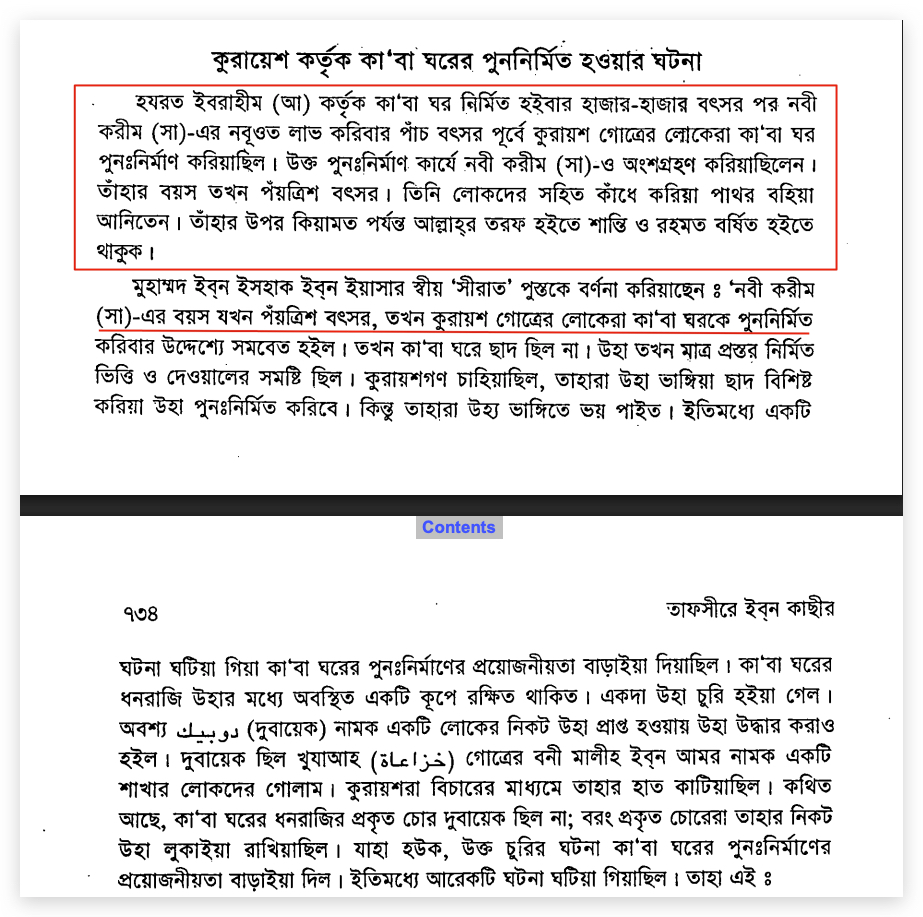
Bukhari describes Muhammad fainting while carrying stones during the rebuilding of the Kaaba. Abbas told him to put his waistcloth over his shoulders to protect them from the stones’ friction. Muhammad then fell to the ground, his eyes turning towards the sky. When he regained consciousness, he asked for his cloth and put it on again. The sequence is clear: repositioning his cloth during physical labour, a sudden fall, loss of consciousness, and recovery. [35]
Sahih al-Bukhari (Tawhid)
Book: 63 / The Merits of the Ansar (may Allah be pleased with them)
Chapter: 63/25. Construction of the Kaaba.
3829. Narrated by Jabir ibn Abdullah (may Allah be pleased with him), who said: When the Kaaba was being rebuilt, the Prophet (peace and blessings be upon him) and Abbas (may Allah be pleased with him) were carrying stones. Abbas (may Allah be pleased with him) told the Prophet (peace and blessings be upon him), “Put your waistcloth over your shoulders; it will protect you from the stones’ friction.” (Upon removing the waistcloth) he fell unconscious to the ground. His eyes were fixed towards the sky. When he regained consciousness, he began saying, “My waistcloth, my waistcloth.” His waistcloth was immediately put on him. (364) (Adhunik Prakashani: 3544; Islamic Foundation: 3549)
Hadith grade: Sahih.
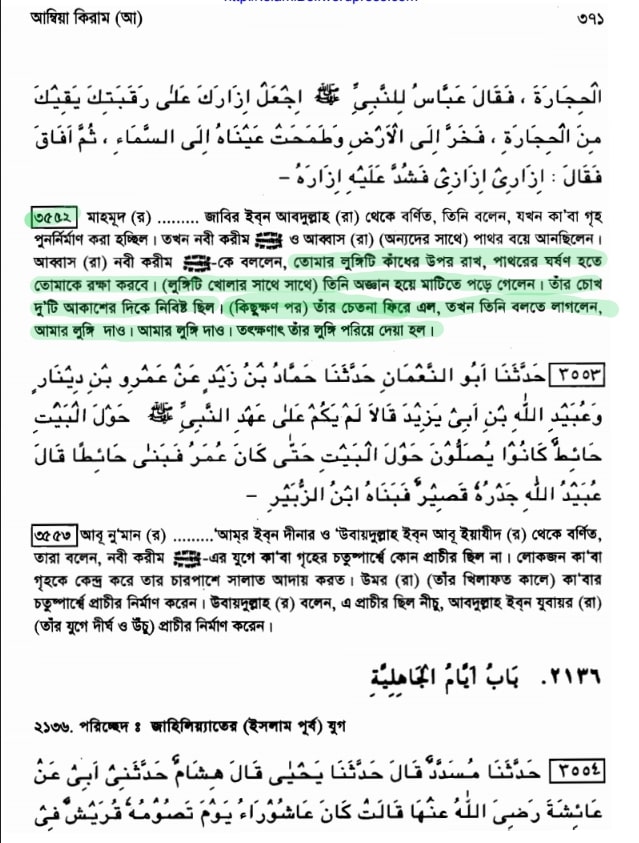
Version 364 of the same incident explicitly describes unconsciousness with the words “فَسَقَطَ مَغْشِيًّا عَلَيْهِ.” That version also clearly describes Abbas’s suggestion and Muhammad removing his own cloth. [36]
عَنْ جَابِرِ بْنِ عَبْدِ اللَّهِ، يُحَدِّثُ أَنَّ رَسُولَ اللَّهِ صلى الله عليه وسلم كَانَ يَنْقُلُ مَعَهُمُ الْحِجَارَةَ لِلْكَعْبَةِ وَعَلَيْهِ إِزَارُهُ. فَقَالَ لَهُ الْعَبَّاسُ عَمُّهُ يَا ابْنَ أَخِي، لَوْ حَلَلْتَ إِزَارَكَ فَجَعَلْتَ عَلَى مَنْكِبَيْكَ دُونَ الْحِجَارَةِ. قَالَ فَحَلَّهُ فَجَعَلَهُ عَلَى مَنْكِبَيْهِ، فَسَقَطَ مَغْشِيًّا عَلَيْهِ، فَمَا رُئِيَ بَعْدَ ذَلِكَ عُرْيَانًا صلى الله عليه وسلم.
English translation: Jabir ibn Abdullah narrated that Allah’s Messenger was carrying stones for the Kaaba with others. He was wearing a waistcloth. His uncle Abbas told him: “Nephew, if only you would remove your waistcloth and place it over your shoulders beneath the stones!” The narrator said: He removed the cloth and placed it over his shoulders. He then fell unconscious. He was never seen naked again after that incident.
Three physical features occur together in this account: falling to the ground, temporary loss of consciousness, and subsequent recovery. Version 3829 adds that his eyes turned towards the sky. His immediate action on regaining consciousness was to ask for his cloth and cover himself. The episode was preceded by the labour of carrying stones and the removal of clothing. Jabir narrates the incident; the quoted hadith does not identify him as an eyewitness to that moment.
The account places the fall immediately after removal of the cloth. It does not identify embarrassment, emotional shock, or physical exertion as the specific cause of unconsciousness. The circumstances are comparable to the relationship between emotion and circulatory changes described in discussions of syncope. Upward movement of the eyes and temporary unconsciousness also invite neurological investigation. This account of losing consciousness is a specific example of an abrupt change in Muhammad’s bodily state.
In explaining the incident, Ibn Hajar introduces another account from Abu al-Tufayl. It describes Muhammad being called and told to cover himself after his clothing slipped. Alongside Jabir’s account of unconsciousness and eye position, this version adds the element of hearing someone address him. [37]
«وفي حديث أبي الطفيل المذكور آنفًا فبينما رسول الله صلى الله عليه وسلم ينقل الحجارة معهم إذ انكشفت عورته، فنودي يا محمد غط عورتك، فذلك في أول ما نودي، فما رئيت له عورة قبل ولا بعد وقوله: طمحت عيناه إلى السماء أي ارتفعت.»
English translation: The previously mentioned hadith of Abu al-Tufayl states: While Allah’s Messenger was carrying stones with them, his private parts became exposed. He was called: “Muhammad, cover your private parts.” This was among the first occasions on which he was called. His private parts were not seen before or afterwards. “His eyes turned towards the sky” means that his eyes turned upwards.
The passage transmitted from Abu al-Tufayl describes Muhammad being called and told to cover his body when his nakedness became exposed. Jabir’s version describes falling and regaining consciousness; this separate version supplies the detail of being addressed.
| Aspect of the Incident | Preserved Account |
|---|---|
| Activity and circumstances | Carrying stones for construction of the Kaaba; advice to use the waistcloth to protect the shoulders. |
| Removing the cloth | Following Abbas’s advice, Muhammad removes his own cloth and places it over his shoulders. |
| Sudden change | Falling to the ground and temporary loss of consciousness. |
| Eye position | Version 3829 mentions the eyes turning towards the sky. |
| Recovery of consciousness | Asking for the cloth and tying it around the waist again. |
| Source of testimony | The account of Jabir ibn Abdullah; the hadith does not claim his personal presence at the scene. |
| Measurements of the episode | The duration of unconsciousness, pulse, breathing, and other physical measurements are not given. |
The Account of a Painful Punch from an Unseen Person and an Order to Tie His Cloth
In Ibn Hisham’s Sira, Ibn Ishaq preserves an account attributed to Muhammad in which a blow and a voice form part of the same experience. While carrying stones with boys of Quraysh, he placed his waistcloth over his neck and then described receiving a painful punch from someone he could not see. The same assailant told him to tie on his cloth. He obeyed and put it on again. [38]
وكان رسول الله صلى الله عليه وسلم – فيما ذكر لي – يحدث عما كان الله يحفظه به في صغره وأمر جاهليته ، أنه قال : لقد رأيتني في غلمان قريش ننقل حجارة لبعض ما يلعب به الغلمان ، كلنا قد تعرى ، وأخذ إزاره فجعله على رقبته ، يحمل عليه الحجارة ؛ فإني لأقبل معهم كذلك وأدبر ، إذ لكمني لاكم ما أراه ، لكمة وجيعة ، ثم قال : شد عليك إزارك ؛ قال : فأخذته وشددته علي ، ثم جعلت أحمل الحجارة على رقبتي وإزاري علي من بين أصحابي .
English translation: Ibn Ishaq said: As I have been told, Allah’s Messenger used to speak of how Allah protected him during his childhood and life in the age of ignorance. He said: “I was with boys of Quraysh. We were carrying stones for something the boys were doing in play. We had all taken off our clothes and placed our waistcloths over our necks, carrying stones on them. I was going back and forth with them in this way when someone I could not see struck me with a painful punch. Then he said, ‘Tie on your waistcloth.’ I took it and tied it around myself. Thereafter, among my companions, I carried stones on my neck with my waistcloth on.”
The inability to see the assailant, the pain of the punch, and hearing an instruction from him are presented as Muhammad’s own experiences. Other boys are said to have been present, but the account does not state that any of them saw the same assailant or heard the instruction. Muhammad’s behaviour changed following the command: he covered himself and continued working. This is a narrative in which a felt blow and heard words immediately change his decision and actions.
Ibn Ishaq’s opening phrase “فِيمَا ذُكِرَ لِي”—“as I have been told”—identifies how he received the account. He does not claim to have witnessed the event. From the outset, the story is presented as an example of Allah’s protection. The description of the blow and command is thus accompanied by the religious meaning of divine protection. The account provides no independent answer to how the unseen assailant was identified or what justified identifying his actions as Allah’s protection.
Classical commentary discusses whether this story and the fainting episode during construction of the Kaaba concern the same event. Al-Suhayli states that, if the childhood account is correct, they would be separate incidents. Ibn Hajar also allows the possibility of different presentations of the same story. Their complete comments in Fath al-Bari are: [37]
قال السهيلي : إنما وردت هذه القصة في بنيان الكعبة ، فإن صح أن ذلك كان في صغره فهي قصة أخرى : مرة في الصغر ومرة في حال الاكتهال . قلت : وقد يطلق على الكبير غلام إذا فعل فعل الغلمان فلا يستحيل اتحاد القصة اعتمادا على التصريح بالأولية في حديث أبي الطفيل .
English translation: Al-Suhayli said: This story has, in fact, been reported in connection with construction of the Kaaba. If the report that it happened during his childhood is correct, it would be another incident: once in childhood and once in adulthood. I [Ibn Hajar] say: An adult acting like boys may also be called a “ghulam.” It is therefore possible that this is the same story, on the basis of the explicit reference to the first occasion in Abu al-Tufayl’s hadith.
The versions differ in their features. Jabir describes carrying stones for the Kaaba, Abbas’s suggestion, falling to the ground, and recovering consciousness. The quoted version from Abu al-Tufayl contains an instruction to cover the body. Ibn Ishaq’s story describes carrying stones for play with boys, a painful punch from someone unseen, and obeying an instruction to tie on the cloth. These differences clarify the types of experiences preserved: unconsciousness in one version, being addressed in another, and a blow and voice from an unseen person in the last. Uncertainty about the number of incidents and his age exists within the sources themselves.
The Account of Going to the Mountains Intending Suicide during the Interruption of Revelation
A passage in Sahih al-Bukhari’s long account of the beginning of revelation describes an intense psychological crisis in Muhammad. It recounts his profound sorrow after Waraqa’s death and the interruption of revelation. In this condition, he repeatedly went to the mountains intending to throw himself down. Each time Gabriel appeared and reassured him of the truth of his prophethood, he calmed down and returned. When the interruption continued for a long time, he again went with the same intention. The wording presents a recurring pattern of a wish for self-destruction, movement towards that purpose, and returning after reassurance. [39]
Sahih al-Bukhari (Tawhid)
Book: 91 / Interpretation of Dreams
Tawhid Publication
… Shortly afterwards, Waraqa died, and revelation also stopped for a time. The Prophet (peace and blessings be upon him) became extremely distressed by this condition. We have learned from him concerning this that he repeatedly rushed there to fall from the mountaintops.Whenever he reached a mountaintop to throw himself down,, Gabriel (peace be upon him) appeared before him and said: “Muhammad! You are undoubtedly Allah’s Messenger.” This relieved his agitation and brought him peace of mind, so he returned. Whenever the interruption of revelation became prolonged, he rushed there with the same purpose. Whenever he reached a mountaintop, Gabriel appeared before him and spoke as before.
Hadith grade: Sahih.
The Arabic of this passage contains «فِيمَا بَلَغَنَا»—“according to the reports that have reached us.” The words “from him” in the quoted Bengali translation’s “we have learned from him” do not occur in that Arabic phrase. Ibn Hajar identifies al-Zuhri as the speaker. According to his explanation, al-Zuhri added the passage as information about Muhammad that had reached him; its full chain of transmission is not supplied here. The main long narration preserved in Bukhari and the passage identified within it as a report received by al-Zuhri therefore have distinct attributions. [40]
«ثم إن القائل “فيما بلغنا” هو الزهري، ومعنى الكلام: أن في جملة ما وصل إلينا من خبر رسول الله صلى الله عليه وسلم في هذه القصة. وهو من بلاغات الزهري وليس موصولًا، وقال الكرماني: هذا هو الظاهر.»
English translation: Al-Zuhri is the speaker of the phrase “according to the reports that have reached us.” The meaning is that this is among the reports about Allah’s Messenger in this incident that have reached us. It belongs to al-Zuhri’s received reports; its chain of transmission is not connected. Al-Kirmani said that this is the apparent meaning.
In al-Zuhri’s account, Muhammad’s emotional stability is closely associated with the arrival of revelation and reassurance about his prophethood. The interruption increases his sorrow; Gabriel’s presence and declaration, “You truly are Allah’s Messenger,” reduce his agitation. The reassurance concerns his special religious identity, rather than a general assurance that danger has passed. Self-identity, the absence of an expected experience, and an intense emotional reaction appear within the same framework. Certainty that he has been chosen is presented as central to restoring his peace.
The relationship between words and behaviour is also clear in the wish for self-destruction. The Arabic phrase «غَدَا مِنْهُ مِرَارًا كَيْ يَتَرَدَّى» describes repeatedly going with that purpose; the next sentence again states the intention to throw himself down. The crisis described is therefore more than a general remark about feeling unhappy. His distress is portrayed as reaching a point at which he takes specific steps towards ending his life. The account also says that each time he returns after reassurance. This sequence describes suicidal intent and movement towards carrying it out; it does not describe him actually jumping.
| Stage of the Account | Preserved Information | Psychological Significance |
|---|---|---|
| Interruption of revelation | The expected communication stops for a time. | The absence of the special experience is associated with the onset of psychological crisis. |
| Intense sorrow | The account describes profound sorrow and agitation. | Waiting is linked to emotional distress. |
| Intention of self-destruction | Repeated visits to the mountains with the intention of throwing himself down are described. | A wish for death is described as translating into behavioural steps. |
| Reassurance of prophethood | Gabriel addresses him as a true messenger. | Certainty about his religious identity is presented as the reason peace returns. |
| Calming down and returning | His agitation subsides; the pattern recurs when the interruption becomes prolonged. | The account conveys temporary stability through reassurance and emotional dependence on the expected experience. |
The crisis in the absence of revelation and its resolution through Gabriel’s appearance are two connected aspects of the same account. One describes psychological distress; the other provides its religious resolution. In this resolution, an experience perceived by Muhammad again assures him that he has been chosen. Calming down after reassurance shows that the statement affected his emotions. Whether an angel was actually its source is a separate historical claim. Receiving emotional comfort and establishing the comforter’s supernatural identity are not the same thing.
The need for reassurance about his prophethood is connected here with the safety of his life. Sorrow during an interruption in communication, movement towards ending his life because of that sorrow, and the restoration of peace through certainty about his religious identity form a narrative of severe emotional crisis. This self-destructive crisis has a place within the Islamic tradition concerning the beginning of Muhammad’s prophethood. Its cause and the sequence through which it was overcome directly raise questions about his psychological condition.
The Account of Waking in Terror over the Danger of Gog and Magog
Zaynab bint Jahsh describes an incident in which Muhammad awoke with a reddened face and announced an approaching danger. He repeatedly said “La ilaha illa Allah” and proclaimed impending disaster for the Arabs. According to him, an opening had appeared that day in the barrier of Gog and Magog. He indicated its size with his hand. His personal moment of awakening is linked to a change in a distant barrier and an announcement of danger to all the Arabs. [41]
Sunan al-Tirmidhi (verified edition)
Chapter: 23. The Emergence of Gog and Magog
2187. Narrated by Zaynab bint Jahsh (may Allah be pleased with her), who said: One day, Allah’s Messenger (peace and blessings be upon him) awoke from sleep, and his face had become red. He began saying, “La ilaha illa Allah.” After saying it three times, he said: “Woe to the Arabs because of an approaching disaster! Today, this much has opened in the wall of Gog and Magog.” Saying this, he formed the circular sign for the number ten with his index finger and thumb. Zaynab (may Allah be pleased with her) said: I asked, “O Messenger of Allah (peace and blessings be upon him)! Will we be destroyed even while righteous people remain among us?” He said: “Yes, when wickedness becomes widespread.”
Sahih; Ibn Majah (3953), Bukhari, Muslim.
Hadith grade: Sahih
Narrator: Zaynab bint Jahsh (may Allah be pleased with her).
Bukhari’s version directly identifies the emotional aspect of the same incident: Muhammad entered Zaynab’s presence «فَزِعًا»—in a state of terror. Tirmidhi describes awakening and a reddened face; Muslim also mentions awakening. These versions preserve different aspects of the state of awakening, facial changes, and the announcement of danger. They do not separately describe what he saw during sleep. What is directly reported is that he speaks about danger after waking, while another version describes him as terrified. [42] [43]
عَنْ زَيْنَبَ ابْنَةِ جَحْشٍ ـ رضى الله عنهن أَنَّ النَّبِيَّ صلى الله عليه وسلم دَخَلَ عَلَيْهَا فَزِعًا يَقُولُ ” لاَ إِلَهَ إِلاَّ اللَّهُ، وَيْلٌ لِلْعَرَبِ مِنْ شَرٍّ قَدِ اقْتَرَبَ فُتِحَ الْيَوْمَ مِنْ رَدْمِ يَأْجُوجَ وَمَأْجُوجَ مِثْلُ هَذِهِ ”. وَحَلَّقَ بِإِصْبَعِهِ الإِبْهَامِ وَالَّتِي تَلِيهَا. قَالَتْ زَيْنَبُ ابْنَةُ جَحْشٍ فَقُلْتُ يَا رَسُولَ اللَّهِ أَنَهْلِكُ وَفِينَا الصَّالِحُونَ قَالَ ” نَعَمْ، إِذَا كَثُرَ الْخُبْثُ ”.
English translation: Zaynab bint Jahsh narrated that the Prophet came to her in terror, saying: “There is no deity except Allah. Woe to the Arabs because of an approaching evil! Today this much has opened in the barrier of Gog and Magog.” He formed a circle with his thumb and the finger next to it. Zaynab bint Jahsh said: I asked, “O Messenger of Allah! Will we be destroyed even though righteous people are among us?” He said: “Yes, when wickedness increases.”
Waking in fear is a familiar human psychological experience. It is possible to see frightening scenes in a nightmare and remember them after waking. The United Kingdom’s National Health Service includes both awakening and remembering the dream in its definition of nightmares. The association between awakening and terror in Muhammad’s case provides grounds for inquiry; because no specific dream content is described, the preserved information centres on his reaction and statements after waking. [44]
Nightmares are bad dreams you wake up from and can remember.
English translation: Nightmares are bad dreams that wake you up and that you remember.
Muhammad’s announcement concerns a physical barrier. In the Quranic story, Dhul-Qarnayn builds a barrier between two mountains using iron and molten metal to hold back Gog and Magog. The next verse states that they could neither cross nor pierce it. Its eventual destruction is linked to Allah’s future promise. The story’s claims therefore concern real geography, construction materials, and the movement of a population. They are more than descriptions of Muhammad’s personal sensations. [45]
فَمَا اسْطَاعُوا أَنْ يَظْهَرُوهُ وَمَا اسْتَطَاعُوا لَهُ نَقْبًا قَالَ هَٰذَا رَحْمَةٌ مِنْ رَبِّي ۖ فَإِذَا جَاءَ وَعْدُ رَبِّي جَعَلَهُ دَكَّاءَ ۖ وَكَانَ وَعْدُ رَبِّي حَقًّا
English translation: They could neither cross it nor pierce it. He said: “This is a mercy from my Lord. When my Lord’s promised time comes, he will level it. My Lord’s promise is true.”
Saying after waking that “today” an opening has appeared in the barrier claims a specific event in the external world. Yet Zaynab’s account mentions no inspection of the wall, measurement of an opening, or arrival of an observer’s report. Those present hear Muhammad’s announcement and see his hand gesture. The gesture is part of his statement, not a physical measurement of the wall. His reddened face and terror reveal emotional intensity, not the condition of a distant wall. Conflating the physical content of the claim with the claimant’s emotions turns fear itself into evidence of external danger.
| Element of the Account | Its Nature | The Question It Raises |
|---|---|---|
| Awakening from sleep | A circumstance preserved in Tirmidhi’s and Muslim’s versions. | What relationship connects awakening with the subsequent terror? |
| Reddened face and terror | A visible facial change and a reported emotion. | What are the physical and psychological causes of this reaction? |
| Announcement of an opening in the barrier | A claim of information about a distant physical structure. | How was this information obtained, and how has it been independently verified? |
| Indicating its size with the fingers | A visible gesture made by the speaker. | Where is the connection between the gesture and the actual measurement of the opening? |
| Destruction including righteous people | Connecting an approaching danger to collective moral consequences. | What justifies indiscriminate disaster in place of individual moral responsibility? |
Zaynab’s question also reveals the announcement’s social effect. She asks whether they will be destroyed despite the presence of righteous people. Muhammad replies that they will when wickedness increases. An account of personal terror thus becomes an announcement about the destruction of an entire society and moral wrongdoing. Wickedness is presented as the cause of disaster, while even the presence of righteous people offers no guarantee of safety. This moral framework makes innocent people share in destruction resulting from others’ behaviour. Collective punishment replaces responsibility for one’s own actions.
Agitation at Clouds and Wind, Fear of Punishment, and Relief at Rain
In Aisha’s account, Muhammad’s agitation is not confined to moments of awakening. Clouds and wind also produced changes in his face; he would move back and forth and become calm when rain began. When Aisha asked why, he said he feared punishment descending upon his community. This provides a sequence involving an external sight, associated fear, bodily and behavioural changes, and the subsequent return of relief. [46]
عَنْ عَطَاءِ بْنِ أَبِي رَبَاحٍ، أَنَّهُ سَمِعَ عَائِشَةَ، زَوْجَ النَّبِيِّ صلى الله عليه وسلم تَقُولُ كَانَ رَسُولُ اللَّهِ صلى الله عليه وسلم إِذَا كَانَ يَوْمُ الرِّيحِ وَالْغَيْمِ عُرِفَ ذَلِكَ فِي وَجْهِهِ أَقْبَلَ وَأَدْبَرَ فَإِذَا مَطَرَتْ سُرَّ بِهِ وَذَهَبَ عَنْهُ ذَلِكَ. قَالَتْ عَائِشَةُ فَسَأَلْتُهُ فَقَالَ «إِنِّي خَشِيتُ أَنْ يَكُونَ عَذَابًا سُلِّطَ عَلَى أُمَّتِي». وَيَقُولُ إِذَا رَأَى الْمَطَرَ «رَحْمَةٌ».
English translation: Ata ibn Abi Rabah narrated that he heard Aisha, the Prophet’s wife, say: On a windy, cloudy day, its effect could be seen on Allah’s Messenger’s face. He would walk back and forth. When it rained, he became happy and that condition passed from him. Aisha said: I asked him about it. He said, “I feared that it might be a punishment imposed on my community.” When he saw rain, he would say, “Mercy.”
Muslim’s detailed version describes changes in facial colour and repeatedly going outside and coming back in. Relief returned to his face when it rained. In the same version, Muhammad connects his fear to the story of the punishment of the people of Ad. The complete account, including his prayer concerning the wind, is: [47]
عَنْ عَطَاءِ بْنِ أَبِي رَبَاحٍ عَنْ عَائِشَةَ، زَوْجِ النَّبِيِّ صلى الله عليه وسلم أَنَّهَا قَالَتْ كَانَ النَّبِيُّ صلى الله عليه وسلم إِذَا عَصَفَتِ الرِّيحُ قَالَ «اللَّهُمَّ إِنِّي أَسْأَلُكَ خَيْرَهَا وَخَيْرَ مَا فِيهَا وَخَيْرَ مَا أُرْسِلَتْ بِهِ وَأَعُوذُ بِكَ مِنْ شَرِّهَا وَشَرِّ مَا فِيهَا وَشَرِّ مَا أُرْسِلَتْ بِهِ». قَالَتْ وَإِذَا تَخَيَّلَتِ السَّمَاءُ تَغَيَّرَ لَوْنُهُ وَخَرَجَ وَدَخَلَ وَأَقْبَلَ وَأَدْبَرَ فَإِذَا مَطَرَتْ سُرِّيَ عَنْهُ فَعَرَفْتُ ذَلِكَ فِي وَجْهِهِ. قَالَتْ عَائِشَةُ فَسَأَلْتُهُ فَقَالَ «لَعَلَّهُ يَا عَائِشَةُ كَمَا قَالَ قَوْمُ عَادٍ {فَلَمَّا رَأَوْهُ عَارِضًا مُسْتَقْبِلَ أَوْدِيَتِهِمْ قَالُوا هَذَا عَارِضٌ مُمْطِرُنَا}».
English translation: Ata ibn Abi Rabah narrated from Aisha, the Prophet’s wife: When a strong wind blew, the Prophet would say, “O Allah, I ask you for its good, the good within it, and the good for which it has been sent. I seek refuge in you from its evil, the evil within it, and the evil for which it has been sent.” Aisha said: When the sky became cloudy, his colour would change. He would go outside, come back inside, and move back and forth. When it rained, his discomfort passed; I could tell by looking at his face. Aisha said: When I asked him, he replied, “Aisha, perhaps it is like what the people of Ad said: when they saw a cloud coming towards their valleys, they said, ‘This cloud will bring us rain.’”
Muhammad himself identified the connection between this reaction and a religious story. Visible clouds raised for him the possibility of an unseen punishment against his community. Aisha also noticed the difference between other people’s expectation of rain and his reaction. Bukhari preserves her question alongside Muhammad’s answer. [48]
عَنْ عَائِشَةَ ـ رضى الله عنها ـ زَوْجِ النَّبِيِّ صلى الله عليه وسلم قَالَتْ مَا رَأَيْتُ رَسُولَ اللَّهِ صلى الله عليه وسلم ضَاحِكًا حَتَّى أَرَى مِنْهُ لَهَوَاتِهِ، إِنَّمَا كَانَ يَتَبَسَّمُ. قَالَتْ وَكَانَ إِذَا رَأَى غَيْمًا أَوْ رِيحًا عُرِفَ فِي وَجْهِهِ. قَالَتْ يَا رَسُولَ اللَّهِ إِنَّ النَّاسَ إِذَا رَأَوُا الْغَيْمَ فَرِحُوا، رَجَاءَ أَنْ يَكُونَ فِيهِ الْمَطَرُ، وَأَرَاكَ إِذَا رَأَيْتَهُ عُرِفَ فِي وَجْهِكَ الْكَرَاهِيَةُ. فَقَالَ «يَا عَائِشَةُ مَا يُؤْمِنِّي أَنْ يَكُونَ فِيهِ عَذَابٌ عُذِّبَ قَوْمٌ بِالرِّيحِ، وَقَدْ رَأَى قَوْمٌ الْعَذَابَ فَقَالُوا {هَذَا عَارِضٌ مُمْطِرُنَا}».
English translation: Aisha, the Prophet’s wife, said: I never saw Allah’s Messenger laugh so that his uvula became visible; he would smile. When he saw clouds or wind, its effect could be seen on his face. Aisha said: I asked, “O Messenger of Allah! People are happy when they see clouds because they hope for rain, yet I see signs of discomfort on your face when you see them.” He said: “Aisha, who can assure me that there is no punishment in them? A people were punished by wind. A people saw the punishment and said, ‘This cloud will bring us rain.’”
Aisha’s question brings out two different meanings attached to seeing clouds: expected rain for others, potential punishment for Muhammad. By his own explanation, the object of his fear was Allah’s punishment. That fear manifested in facial expression, colour, and movement. Religious belief was thus directly connected to the explanation of his emotions and to his behaviour. Interpreting a natural sight as a signal of collective punishment generated agitation within him.
| Object of Observation | Information in the Account |
|---|---|
| External circumstances | Clouds appearing and wind blowing. |
| Bodily change | The condition is apparent on his face; Muslim’s detailed version mentions a colour change. |
| Behaviour | Going outside, coming back inside, and moving back and forth. |
| His own explanation | Fear of punishment descending on his community; comparison with the story of the people of Ad. |
| Change in circumstances | Discomfort passing and happiness returning when rain begins. |
| Form of the account | Aisha’s general description of his reactions to clouds and wind; no specific dates or number of incidents are given. |
The relationship between the beginning of rain and the easing of his discomfort is also specific. When the clouds in which he perceived possible punishment produced rain, he became happy and said, “Mercy.” The same weather situation changed in meaning for him from apprehension to reassurance, accompanied by a visible emotional change. Both the announcement of danger upon awakening concerning the barrier of Gog and Magog and the fear of punishment at the sight of clouds and wind make a religious concept of collective danger the content of his personal fear.
Believing He Had Done Things He Had Not Actually Done
A report attributed to Aisha explicitly describes Muhammad becoming confused about his own actions. He thought he had had sexual intercourse with his wives when he had not. Another version in Bukhari states more generally that he imagined he was doing something when he had not done it. The account directly contradicts his perceived experience with what actually occurred. The confusion concerns the truth of his own experience of what he had physically done. The hadith presents magic as the cause of this condition. [49] [50] [51]
Sahih al-Bukhari (Tawhid)
76 / Medicine
Chapter: 76/49. Whether magic may be treated.
Qatada (may Allah have mercy on him) said: I asked Sa‘id ibn al-Musayyab (may Allah have mercy on him): “If a man has been bewitched, or magic has created a barrier between him and his wife, may he be freed from the spell, or is it permissible to undo the magical binding?” Sa‘id said: “There is no harm in that, for they intend to make him well. What is beneficial is not prohibited.”
5765. Narrated by Aisha (may Allah be pleased with her): Allah’s Messenger (peace and blessings be upon him) was once bewitched. His condition became such that he imagined he had had intercourse with his wives, although he had not approached them at all. Sufyan said: This is an extreme effect of magic.The narrator said: One day, Allah’s Messenger (peace and blessings be upon him) awoke and said: “Aisha! Know that Allah has told me what I asked him to tell me. (In a dream I saw that) two men came to me. One sat near my head and the other near my feet. The one near me asked the other: ‘What is wrong with this man?’ The second replied: ‘He has been bewitched.’ The first asked: ‘Who bewitched him?’ The second replied: ‘Labid ibn al-A‘sam, a man of the Zurayq tribe, allies of the Jews; he was a hypocrite.’
The first asked: ‘In what was the spell placed?’ The second answered: ‘In a comb and hair that came out during combing.’ The first asked: ‘Where are they?’ The second answered: ‘In the sheath of a male date-palm spadix, under a stone inside the well of Dharwan.’” Allah’s Messenger (peace and blessings be upon him) came to that well, brought them out, and said: “This is the well I was shown in the dream. Its water is like the sediment of water mixed with henna, and the heads of the date palms beside it look like the heads of devils.” The narrator said: He brought those things out of it. Aisha said: I asked, “Will you not make this known?” He said: “By Allah, he has granted me healing, and I do not wish to incite people to something harmful.” (3175; Muslim 39/17, hadith 2189; Ahmad 24354) (Adhunik Prakashani: 5344; Islamic Foundation: 5240)
Hadith grade: Sahih
Narrator: Aisha (may Allah be pleased with her).
Al-Lu’lu’ wa al-Marjan
39 / Greetings
Chapter: 39/17. Magic.
1412. Narrated by Aisha (may Allah be pleased with her): Allah’s Messenger (peace and blessings be upon him) was once bewitched. His condition became such that he imagined he had had intercourse with his wives, although he had not approached them at all. Sufyan said: This condition is an extreme effect of magic.The narrator said: One day, Allah’s Messenger (peace and blessings be upon him) awoke and said: “Aisha! Know that Allah has informed me of what I asked him to tell me. (In a dream I saw that) two men came to me. One sat near my head and the other near my feet. The one near me asked the other: ‘What is wrong with this man?’ The second replied: ‘He has been bewitched.’ The first asked: ‘Who bewitched him?’ The second replied: ‘Labid ibn al-A‘sam, a man of the Surayq tribe, allies of the Jews; he was a hypocrite.’
The first asked: ‘In what was the spell placed?’ The second answered: ‘In a comb and hair that came out during combing.’ The first asked: ‘Where are they?’ The second answered: ‘In the sheath of a male date-palm spadix, under a stone inside the well called Dharwan.’” Allah’s Messenger (peace and blessings be upon him) came to that well, brought them out, and said: “This is the well I was shown in the dream. Its water is like the sediment of water mixed with henna, and the heads of the date palms beside it look like the heads of devils.” The narrator said: He brought those things out of it. Aisha (may Allah be pleased with her) said: I asked, “Will you not publicise this?” He said: “By Allah, he has granted me healing, and I do not wish to incite people to something harmful.”
Sahih al-Bukhari, Book 76: Medicine, chapter 49, hadith 5765; Muslim, Book 39: Greetings, chapter 17, hadith 2189.
Hadith grade: Sahih
Narrator: Aisha (may Allah be pleased with her).
Here, the phrase “coming to” his wives means sexual intercourse. The Arabic of Bukhari 5765 reads «كَانَ يَرَى أَنَّهُ يَأْتِي النِّسَاءَ وَلاَ يَأْتِيهِنَّ». Version 5763 of the same incident reads «يُخَيَّلُ إِلَيْهِ أَنَّهُ يَفْعَلُ الشَّيْءَ وَمَا فَعَلَهُ»—he imagined he was doing something, although he had not done it. The specific version concerns sexual experience; the general version conveys a misperception of doing and not doing. The wording itself provides grounds for questioning the reliability of his everyday perceptions.
Equating this discrepancy with merely forgetting a piece of information obscures the account’s actual problem. What emerges here is a mistaken belief about his own experience, rather than an inability to recall something known. What seemed to Muhammad to have happened diverges from what actually happened. The intensity of a sensation or conviction that an experience is true therefore does not establish its external reality. This gap appears within his intimate personal life in the account.
The magical explanation comes through a conversation between two men described by Muhammad. They identify the condition, the accused person, the objects used, and their location. A visit to the well follows; Bukhari 5763 also mentions Companions accompanying him. Finding a well, comb, or hair and establishing that these objects changed someone’s perceptions from a distance are claims requiring different evidence. Finding an object establishes its existence; establishing how it distorted thought and experience requires causal evidence. A sequence of events does not by itself prove the magical powers of a comb or hair.
Classical commentators directly linked this experience to the reliability of prophethood. Qadi Iyad acknowledges the possibility of perceiving unreal things in everyday life, while invoking prophetic protection and consensus to establish protection in religious communication. IslamQA quotes his statement. [52]
«وأما ما ورد أنه كان يخيل إليه أنه فعل الشيء ولا يفعله، فليس في هذا ما يدخل عليه داخلة في شيء من تبليغه أو شريعته، أو يقدح في صدقه لقيام الدليل، والإجماع على عصمته من هذا، وإنما هذا فيما يجوز طروه عليه في أمر دنياه التي لم يبعث بسببها، ولا فضّل من أجلها، وهو فيها عرضة للآفات كسائر البشر، فغير بعيد أن يخيل إليه من أمورها مالا حقيقة له، ثم ينجلي عنه كما كان.»
English translation: The report that he imagined he had done something when he had not does not introduce a flaw into the message or law he conveyed, nor undermine his truthfulness, because evidence for it has been established and there is consensus that he is protected from this. It concerns his worldly affairs, for which he was neither sent nor specially distinguished. In these matters, he can encounter afflictions like other human beings. It is therefore not impossible for something unreal concerning a worldly matter to appear to him and then pass away.
The basis used here to protect the religious message is evidence accepted as establishing prophethood, together with religious consensus. Having acknowledged misperception in worldly experience, the quoted statement places religious experience beyond its scope. Yet that boundary requires an independent foundation when assessing the truth of mental experiences. Naming a sensation “worldly” or “revelation” does not examine its source. After acknowledging that the same person can experience something unreal, assurances of religious status alone do not suffice to declare his other personal experiences infallible.
Errors in Prayer Units and Denial of His Own Mistake
In one account of an error during prayer, Muhammad ends the prayer with the salutation after only two units. When questioned, he says, “I have not forgotten, nor has the prayer been shortened.” Dhu al-Yadayn directly tells him that he has forgotten. Muhammad then performs the remaining two units. His initial statement about his own action was wrong; the correction came from another person present. [53]
عَنْ أَبِي هُرَيْرَةَ ـ رضى الله عنه ـ قَالَ صَلَّى النَّبِيُّ صلى الله عليه وسلم إِحْدَى صَلاَتَىِ الْعَشِيِّ ـ قَالَ مُحَمَّدٌ وَأَكْثَرُ ظَنِّي الْعَصْرَ ـ رَكْعَتَيْنِ ثُمَّ سَلَّمَ ثُمَّ قَامَ إِلَى خَشَبَةٍ فِي مُقَدَّمِ الْمَسْجِدِ فَوَضَعَ يَدَهُ عَلَيْهَا وَفِيهِمْ أَبُو بَكْرٍ وَعُمَرُ ـ رضى الله عنهما ـ فَهَابَا أَنْ يُكَلِّمَاهُ وَخَرَجَ سَرَعَانُ النَّاسِ فَقَالُوا أَقَصُرَتِ الصَّلاَةُ وَرَجُلٌ يَدْعُوهُ النَّبِيُّ صلى الله عليه وسلم ذُو الْيَدَيْنِ فَقَالَ أَنَسِيتَ أَمْ قَصُرَتْ فَقَالَ ” لَمْ أَنْسَ وَلَمْ تُقْصَرْ ”. قَالَ بَلَى قَدْ نَسِيتَ. فَصَلَّى رَكْعَتَيْنِ ثُمَّ سَلَّمَ ثُمَّ كَبَّرَ فَسَجَدَ مِثْلَ سُجُودِهِ أَوْ أَطْوَلَ، ثُمَّ رَفَعَ رَأْسَهُ فَكَبَّرَ، ثُمَّ وَضَعَ رَأْسَهُ فَكَبَّرَ فَسَجَدَ مِثْلَ سُجُودِهِ أَوْ أَطْوَلَ، ثُمَّ رَفَعَ رَأْسَهُ وَكَبَّرَ.
English translation: Abu Hurayra said: The Prophet performed two units of one of the two afternoon prayers and ended with the salutation. The narrator named Muhammad said: I strongly think that it was the asr prayer. He then stood by a piece of wood at the front of the mosque and placed his hand on it. Abu Bakr and Umar were there, but they hesitated to speak to him. Those in a hurry left, saying, “Has the prayer been shortened?” The man whom the Prophet called Dhu al-Yadayn said, “Have you forgotten, or has the prayer been shortened?” He replied, “I have not forgotten, nor has the prayer been shortened.” The man said, “You certainly have forgotten.” He then performed two more units and ended with the salutation. He pronounced the takbir and prostrated as in a normal prostration or longer. He raised his head and pronounced the takbir, then lowered his head again with the takbir and prostrated as in a normal prostration or longer. He then raised his head and pronounced the takbir.
The most significant statement is “I have not forgotten.” His confidence in his own memory did not identify the mistake. The incomplete action was completed after Dhu al-Yadayn’s objection. The account also mentions Abu Bakr and Umar’s hesitation to speak. Some of those present initially wondered whether the prayer had been shortened. Both the possibility of accepting a religious leader’s error as a new rule and hesitation to question him directly are visible here. The leader’s status became a social obstacle to correcting the mistake.
In another, separate incident, Muhammad performed five units of the zuhr prayer. Again, he had to be told how many he had performed. The errors run in opposite directions: in one incident he finished after too few units, and in the other he performed too many. The complete account of the second incident is: [54]
عَنْ عَبْدِ اللَّهِ ـ رضى الله عنه ـ أَنَّ رَسُولَ اللَّهِ صلى الله عليه وسلم صَلَّى الظُّهْرَ خَمْسًا فَقِيلَ لَهُ أَزِيدَ فِي الصَّلاَةِ فَقَالَ «وَمَا ذَاكَ». قَالَ صَلَّيْتَ خَمْسًا. فَسَجَدَ سَجْدَتَيْنِ بَعْدَ مَا سَلَّمَ.
English translation: Abdullah narrated that Allah’s Messenger performed five units of the zuhr prayer. He was asked, “Has the prayer been increased?” He said, “What has happened?” He was told, “You performed five units.” He then made two prostrations after ending with the salutation.
In the five-unit incident, the question “What has happened?” shows that he had not himself mentioned the additional unit before those present spoke. He then performed the religious ritual for correcting the mistake. In both accounts, other people’s counting helped correct the record of his actions. Before the error was disclosed, the followers’ question again took the form of asking whether the rules of prayer had changed.
Remembering Forgotten Verses upon Hearing Another Person Recite
There is also an account of relying on another person’s recitation to remember Quranic verses. According to Aisha, after hearing someone recite at night, Muhammad said that the person had reminded him of several verses. His own statement acknowledges prior forgetting and subsequent recollection. [55]
عَنْ عَائِشَةَ، قَالَتْ سَمِعَ رَسُولُ اللَّهِ صلى الله عليه وسلم رَجُلاً يَقْرَأُ فِي سُورَةٍ بِاللَّيْلِ فَقَالَ «يَرْحَمُهُ اللَّهُ لَقَدْ أَذْكَرَنِي كَذَا وَكَذَا آيَةً كُنْتُ أُنْسِيتُهَا مِنْ سُورَةِ كَذَا وَكَذَا».
English translation: Aisha said: Allah’s Messenger heard a man reciting from a surah at night. He said, “May Allah have mercy on him. He has reminded me of such-and-such verses from such-and-such surah that I had been made to forget.”
The Arabic “أَذْكَرَنِي” means “has reminded me”; “كُنْتُ أُنْسِيتُهَا” states that he had previously been made to forget. The sentence does not name an agent responsible for the forgetting or its cause. The sequence described is that previously known wording was not then in his memory, and hearing someone else recite brought it back. Another person’s voice thus helped him recall verses of the Quran he was propagating.
Prayer units, actions he had performed, and Quranic verses reveal different manifestations of memory and perception. In one case, the number of actions was wrong; in another, an action that had not happened appeared to have happened; in another, familiar wording was temporarily not remembered. The distinction between correction following a denial of error in the two-unit incident and directly acknowledging another person’s help with the verses is also preserved. His own statements did not always coincide with external observation.
| Incident | Form of Error or Memory Problem | Means of Correction or Recollection |
|---|---|---|
| Believing he had had intercourse with his wives | Feeling that the action had occurred; according to Aisha’s account, it had not actually happened. | The discrepancy is reported through Aisha; the incident is attributed to magic. |
| Ending the prayer after two units | The prayer remains incomplete, and an error is initially denied. | Two more units are performed after Dhu al-Yadayn’s objection. |
| Five units at zuhr | One more unit than prescribed is performed. | Someone present informs him; two prostrations follow. |
| Remembering verses again | Temporary forgetting of previously known verses. | Recollection upon hearing another person’s recitation. |
A Stone’s Greeting, Auditory Experience, and Claims of Miraculous Recognition
Sahih Muslim preserves, as Muhammad’s own statement, the claim that a stone in Mecca greeted him. He says the stone greeted him before he was sent as a prophet and that he could still recognise it. An experience of hearing is associated with a particular stone. Jabir ibn Samura transmits this statement; in this hadith, Jabir does not himself claim to have heard the stone’s greeting. [56]
Sahih Muslim (Hadith Academy)
44. Merits
Chapter: 1. The merits of the Prophet’s lineage (peace and blessings be upon him) and, before his prophethood, the stone’s greeting to him.
5833-(2/2277) Abu Bakr ibn Abu Shayba (may Allah have mercy on him) ….. narrated from Jabir ibn Samura (may Allah be pleased with him), who said: Allah’s Messenger (peace and blessings be upon him) said: “In Mecca, I know a stone that used to greet me even before I was sent as a prophet; I can still recognise it beyond doubt.” (Islamic Foundation 5740; Islamic Centre 5771)
Hadith grade: Sahih
Narrator: Jabir ibn Samura (may Allah be pleased with him).
The sensation of hearing a sound and identifying its external source are separate matters. If someone experiences a voice as a stone’s greeting, the questions are what was heard, where it came from, and who heard it. An auditory hallucination is a relevant natural possibility here. In medicine, a hallucination is an experience that appears real to the senses despite the absence of the corresponding external stimulus. The NHS definition describes such experiences across several senses, including hearing. [57]
Hallucinations are where you hear, see, smell, taste or feel things that appear to be real but only exist in your mind.
English translation: Hallucinations are experiences of hearing, seeing, smelling, tasting, or feeling things that seem real but exist only in the mind.
Identifying a stone as the source makes the claim more specific. Stones have no human-like nervous system, language-learning mechanism, or vocal apparatus. A sound from stones colliding and a meaningful verbal greeting addressed to a recognised person are different events. A greeting of “salam” is a social and linguistic act; it entails recognising the person addressed and communicating a meaningful message. Saying that a stone offered a greeting therefore describes more than hearing a noise: it attributes recognition, understanding, and linguistic expression to an inanimate object.
Al-Nawawi calls the event a miraculous sign and evidence of perceptive capacity in some inanimate objects. In his interpretation, the stone’s greeting is literal. [58]
«فيه معجزة له صلى الله عليه وسلم، وفي هذا إثبات التمييز في بعض الجمادات، وهو موافق لقوله تعالى في الحجارة: وَإِنَّ مِنْهَا لَمَا يَهْبِطُ مِنْ خَشْيَةِ اللَّهِ، وقوله تعالى: وَإِنْ مِنْ شَيْءٍ إِلَّا يُسَبِّحُ بِحَمْدِهِ، وفي هذه الآية خلاف مشهور، والصحيح أنه يسبح حقيقة، ويجعل الله تعالى فيه تمييزًا بحسبه، كما ذكرنا، ومنه الحجر الذي فر بثوب موسى صلى الله عليه وسلم، وكلام الذراع المسمومة، ومشي إحدى الشجرتين إلى الأخرى حين دعاهما النبي صلى الله عليه وسلم، وأشباه ذلك.»
English translation: This contains one of his miraculous signs and establishes discernment in some inanimate objects. It accords with Allah’s statements concerning stones, “Some fall down out of fear of Allah,” and “There is nothing that does not glorify him.” There is a well-known disagreement concerning this verse; the correct view is that things truly glorify him and Allah gives them a suitable capacity for perception, as we have mentioned previously. This includes the stone that fled with Moses’ clothes, the poisoned foreleg speaking, a tree walking towards another tree at the Prophet’s call, and other such events.
This explanation supports one miraculous claim with several other miraculous accounts. It demonstrates their compatibility within religious literature, but supplies no independent observation of a stone speaking. “Allah gave the stone special perception” is the theological cause offered for its greeting. Whether such a capacity was actually created depends, in turn, on the truth of the original event. Without verifying the claim that the stone spoke, attributing special perceptive powers to it rests on the same unproven event. Assigning a special power does not advance verification of the original account.
Another account in Tirmidhi, attributed to Ali, describes mountains and trees offering greetings in a companion’s presence. Ali says that he went with Muhammad to an area of Mecca; the mountains and trees they encountered greeted him as “Allah’s Messenger.” The form of the claim differs: rather than Muhammad’s own recollection, it describes an event occurring in Ali’s presence. Al-Tirmidhi calls it “gharib”; Darussalam’s assessment is “da‘if.” [59]
عَنْ عَلِيِّ بْنِ أَبِي طَالِبٍ، قَالَ كُنْتُ مَعَ النَّبِيِّ صلى الله عليه وسلم بِمَكَّةَ فَخَرَجْنَا فِي بَعْضِ نَوَاحِيهَا فَمَا اسْتَقْبَلَهُ جَبَلٌ وَلاَ شَجَرٌ إِلاَّ وَهُوَ يَقُولُ السَّلاَمُ عَلَيْكَ يَا رَسُولَ اللَّهِ.
English translation: Ali ibn Abi Talib said: I was with the Prophet in Mecca. We went out to one part of Mecca. No mountain or tree came before him without saying, “Peace be upon you, O Messenger of Allah.”
In Muslim’s account, Muhammad describes his own experience; in Tirmidhi’s account, Ali presents himself as a companion at the scene. The first rests on Muhammad’s personal recollection; the second claims that mountains and trees offered greetings in a companion’s presence. A personal experience and a narrative of a public miracle are preserved separately in these two versions.
In our own locality, a man also used to say that the roadside trees greeted him. A claimant’s social status is no method of verifying such a claim. Hearing an ordinary person report this kind of experience raises questions about its source; those questions still require answers when the speaker is Muhammad. “I can still recognise the stone” expresses his own certainty. That certainty does not establish a stone’s capacity for language.
The religious function of these stories is also apparent. Human beings are not alone in acknowledging Muhammad’s status; stones, mountains, and trees greet him as a messenger. Recognition of his special identity extends beyond human society throughout nature. Islamweb itself presents these accounts as signs of his prophethood. An experience of personally hearing a sound and identifying its source thus becomes a narrative of nature-wide recognition of prophethood. This literary and religious function is clear; verification of the claim that an actual stone spoke a greeting remains a separate question. [60]
A Piece of Wood’s Weeping, Grief, and Claimed Perception
The story of a piece of wood weeping for Muhammad casts an inanimate object as a grieving creature. He previously leaned against the wood while delivering sermons; when a pulpit was made and he moved to it, the wood cried out. In al-Darimi’s account, the sound resembles a bull’s cry and stops when Muhammad embraces it. He then declares that, without the embrace, the wood would have wept for him until the Resurrection. In this story, the wood does more than make a sound: it perceives his absence, suffers separation, and finds comfort in his touch. This is a clear example of attributing human emotion and understanding to an inanimate object. [61]
Sunan al-Darimi (HadithBD)
Introduction
Chapter: 6. The Prophet (peace and blessings be upon him) being honoured through the weeping of the pulpit
42. Anas ibn Malik (may Allah be pleased with him) narrated: On Fridays, the Prophet (peace and blessings be upon him) would stand leaning against a piece of wood in the mosque and deliver a sermon to the people. Then a man came from Rome and said, “Shall I make something for you on which you can sit while appearing to stand?” He then made him a pulpit with two lower steps and a third upper step on which he sat. When Allah’s Prophet (peace and blessings be upon him) sat on that pulpit, the piece of wood began to bellow like a bull, until the whole mosque shook with its grief for Allah’s Messenger (peace and blessings be upon him). Allah’s Messenger (peace and blessings be upon him) descended from the pulpit, approached it, and embraced the wailing wood. As soon as he embraced it, it became calm. He then said: “By the great Being in whose hand is Muhammad’s life! Had I not embraced it, it would certainly have continued weeping in grief for Allah’s Messenger until the Day of Resurrection.” Allah’s Messenger (peace and blessings be upon him) then ordered it buried, and it was buried.[1]
[1] Verification: Its chain of transmission is sahih.
Takhrij: Ahmad, 3/226; Tirmidhi 3631; Ibn Majah 1415.
Hadith grade: Sahih.
In Bukhari’s version narrated by Jabir, the wood’s sound is compared to a child’s cry. It further states that it wept because it could no longer hear the remembrance of Allah formerly recited beside it. A specific psychological cause is thus attached to the sound. The wood has memory, recognises the absence of a former experience, and grieves at not hearing religious speech—these imagined capacities are integral to the story. [62]
عَنْ جَابِرِ بْنِ عَبْدِ اللَّهِ ـ رضى الله عنهما ـ أَنَّ النَّبِيَّ صلى الله عليه وسلم كَانَ يَقُومُ يَوْمَ الْجُمُعَةِ إِلَى شَجَرَةٍ أَوْ نَخْلَةٍ، فَقَالَتِ امْرَأَةٌ مِنَ الأَنْصَارِ ـ أَوْ رَجُلٌ ـ يَا رَسُولَ اللَّهِ أَلاَ نَجْعَلُ لَكَ مِنْبَرًا قَالَ ” إِنْ شِئْتُمْ ”. فَجَعَلُوا لَهُ مِنْبَرًا، فَلَمَّا كَانَ يَوْمُ الْجُمُعَةِ دُفِعَ إِلَى الْمِنْبَرِ، فَصَاحَتِ النَّخْلَةُ صِيَاحَ الصَّبِيِّ، ثُمَّ نَزَلَ النَّبِيُّ صلى الله عليه وسلم فَضَمَّهُ إِلَيْهِ تَئِنُّ أَنِينَ الصَّبِيِّ، الَّذِي يُسَكَّنُ، قَالَ ” كَانَتْ تَبْكِي عَلَى مَا كَانَتْ تَسْمَعُ مِنَ الذِّكْرِ عِنْدَهَا ”.
English translation: Jabir ibn Abdullah narrated: The Prophet used to stand by a tree or date palm on Fridays. A woman or man of the Ansar said, “O Messenger of Allah! Shall we make a pulpit for you?” He said, “If you wish.” They made the pulpit. On Friday, when he went towards it, the date palm cried out like a child. The Prophet descended and embraced it against his chest. It was moaning like a child being soothed. He said, “It was weeping for the remembrance that used to take place beside it.”
The parallel report under Tirmidhi’s international number 3627 uses a camel’s sound as a simile. Ibn Majah 1415 contains the declaration that, without the embrace, the weeping would have continued until the Resurrection. Although similes and details differ, the central claim is the same: the wood grieved at Muhammad’s departure and became calm through contact with him. [63] [64]
Pressure, friction, or cracking can produce sounds in wood. A physical sound does not entail the pain of separation, memory of religious speech, or love for a particular person. A piece of wood has no animal-like nervous system governing sensation and emotion. The problem therefore extends well beyond whether wood can produce any sound: what justifies identifying that sound as grief and declaring separation from Muhammad its cause? Comparing a sound to a child’s cry does not justify concluding that its source experiences pain like a child.
Ibn Hajar also accepts the story as evidence of special perception in inanimate objects. In his explanation, Allah can create animal-like perception within them. Grief and weeping are thus taken literally and a miraculous capacity assigned to account for them. [65]
«وفي الحديث دلالة على أن الجمادات قد يخلق الله لها إدراكًا كالحيوان بل كأشرف الحيوان، وفيه تأييد لقول من يحمل وإن من شيء إلا يسبح بحمده على ظاهره.»
English translation: The hadith provides evidence that Allah may create perception in inanimate objects like that of animals, indeed like that of the noblest of animals. It also supports those who interpret literally the statement, “There is nothing that does not glorify him.”
The story combines three kinds of claim. The first concerns an audible sound. The second interprets it emotionally: the wood is grieving. The third predicts the outcome of a situation that did not occur: without the embrace, the crying would have continued until the Resurrection. The circumstances for testing the third claim never arise in the account, because it says the embrace occurred. Muhammad’s declaration alone establishes the possibility of immeasurably prolonged grief. The declaration places his own special status and power to comfort at the story’s centre.
| Level of Claim | Its Form in the Story | Question of Evidence |
|---|---|---|
| The sound | The wood produced a sound resembling an animal’s or child’s cry. | What sound occurred, and how was its source established? |
| Attribution of emotion | The wood wept because of separation and the loss of hearing the remembrance of Allah. | What evidence establishes grief, memory, and perception in the wood? |
| Effect of touch | The sound stops when Muhammad touches or embraces it. | What connects the cessation of sound with the interpretation that the wood was comforted? |
| Weeping until the Resurrection | A declaration that the weeping would have continued without the embrace. | How was this future outcome of an unrealised situation known? |
The account is preserved as a claim of a public miracle in the mosque. Its truth depends on the testimony, the forms of the account, and the history of its transmission. Its religious function is also clear: love and devotion towards Muhammad are propagated as existing even in wood. Soothing the wood like a child and declaring its endless grief in his absence establish him as the emotional centre of both living and inanimate nature. By attributing feeling to an inanimate object and elevating a religious figure’s status, the story employs familiar techniques of fairy tales. The Bengali edition of al-Bidaya wa al-Nihaya also collects the accounts of the weeping wood. [66]
The Date-Palm Trunk’s Affection for Allah’s Messenger and Its Anguish
at Separation from Him
Hadiths on this subject have been narrated through several routes from a group of Companions and are considered conclusive evidence by the imams of hadith scholarship.
The first hadith, from Ubayy ibn Ka‘b
Imam al-Shafi‘i narrated through Ibrahim ibn Muhammad …… from Ubayy ibn Ka‘b, who said: When the Prophet’s Mosque had a thatched roof, Allah’s Messenger (peace and blessings be upon him) prayed with a cut date-palm trunk in front of him and leaned against it while delivering sermons. One day, a Companion said: “O Messenger of Allah! Shall we make a pulpit for you, so that on Fridays you can stand on it to deliver the sermon and everyone can hear you clearly?” He said, “Yes.” A pulpit with three steps, as pulpits usually have, was then made for him. Once the pulpit had been made and Allah’s Messenger had placed it in position, he prepared to stand on it to deliver the sermon. As he approached it and passed the date-palm trunk, it cried out and split apart. When the noble Prophet (peace and blessings be upon him) heard its cry, he stroked it with his hand and then returned to the pulpit. Later, when the Prophet’s Mosque was demolished for rebuilding, Hazrat Ubayy ibn Ka‘b took the trunk away. It remained with him afterwards until it became old and woodworms consumed it. Imam Ahmad ibn Hanbal narrated the hadith in this way through Zakariyya ibn Adi from Ubayy ibn Ka‘b. His version states: He stroked it, and it became calm. He then returned to the pulpit. When he prayed, it stood in front of him; the rest of the hadith is as above. Ibn Majah also narrated it through Isma‘il ibn Abdullah and Ubaydullah ibn Amr.
The second hadith, from Hazrat Anas
Hafiz Abu Ya‘la narrated through Abu Khaythama …… from Anas ibn Malik that Allah’s Messenger (peace and blessings be upon him) would lean against a date-palm trunk in the mosque while delivering Friday sermons. One day, a Roman came and said, “Shall I make an elevated seat for you on which, even when sitting, you will appear to be standing?” He then made a pulpit with two steps, on whose third step he sat. When Allah’s Prophet sat on it, the date-palm trunk trembled and cried out like a lowing cow, grieving at separation from Allah’s Messenger. Allah’s Messenger descended from the pulpit and embraced it while it was crying, whereupon it stopped. He then said: “By the Being in whose mighty hand is Muhammad’s life! Had I not embraced it, it would have continued crying in grief at separation from Allah’s Messenger until the Day of Resurrection.” It was then buried in the ground by the order of Allah’s Messenger (peace and blessings be upon him). Imam al-Tirmidhi narrated the hadith through Mahmud ibn Ghaylan and Amr ibn Yunus. He then said, “Through this route it is sahih gharib.”
A different route from Hazrat Anas
Hafiz Abu Bakr al-Bazzar narrated in his Musnad through Hudba from Anas (may Allah be pleased with him) that the noble Prophet (peace and blessings be upon him) would deliver sermons while leaning against a date-palm trunk. Once the pulpit was made, he moved to it. A sorrowful lament then began to be heard from the trunk. Allah’s Messenger (peace and blessings be upon him) came and held it in his arms, and it stopped. He said: “Had I not held it in my arms, it would have continued lamenting and crying until the Day of Resurrection.” Ibn Majah narrated it in this way through Abu Bakr ibn Khallad from Anas and through Hammad ibn Ammar …… from Ibn Abbas.
Another route from Hazrat Anas
Imam Ahmad narrated through Hashim from Anas ibn Malik, who said: When Allah’s Messenger (peace and blessings be upon him) delivered the Friday sermon, he rested his back against a piece of wood. When the number of Muslims increased, he said, “Make a pulpit for me”—his intention was to make everyone hear him. A pulpit with two steps was made for him. He then moved to the pulpit in place of the wood. Al-Hasan said: Anas reported hearing the wood cry like a woman who had lost her child. Anas said: It continued crying until Allah’s Messenger (peace and blessings be upon him) descended from his pulpit, walked to it, and held it in his arms. It then became calm. Through this chain, the account is unique to Imam Ahmad. Abu al-Qasim al-Baghawi also narrated it through Shayban ibn Farrukh ….. from Anas. He added: When Hazrat Hasan al-Basri narrated this hadith, he would weep and say: “Servants of Allah! Even lifeless wood cries in affection and longing for Allah’s Messenger because of his status with Allah. You have even greater reason to long to meet him.” Hafiz Abu Nu‘aym narrated it through al-Walid ibn Muslim from Anas ibn Malik.
A different route from Hazrat Anas
Abu Nu‘aym narrated through Abu Bakr ibn Khallad ….. from Anas (may Allah be pleased with him), who said: Allah’s Messenger (peace and blessings be upon him) delivered sermons while leaning against a date-palm trunk. One day, it began crying sorrowfully. He held it in his arms and said: “Had I not held it in my arms, it would have continued lamenting until the Day of Resurrection.”
The third hadith, through Jabir ibn Abdullah
Imam Ahmad narrated through Waki‘ from Jabir, who said: Allah’s Messenger (peace and blessings be upon him) would lean against a date-palm trunk to deliver sermons. Jabir (may Allah be pleased with him) said: One day, an Ansari woman said: “O Messenger of Allah! I have a slave who is a carpenter. Shall I tell him to make a pulpit for you, so you can climb onto it to deliver your sermon?” He said, “Certainly.” A pulpit was made for him. Jabir (may Allah be pleased with him) said: On Friday, he climbed onto it and delivered the sermon. Jabir said: The trunk by which he previously stood to deliver sermons began moaning like a little child. The noble Prophet (peace and blessings be upon him) said, “This trunk is weeping because it has lost contact with the remembrance it used to hear.” Imam Ahmad narrated it in this way. Imam al-Bukhari narrated through Abd al-Wahid ibn Ayman from Jabir ibn Abdullah that Allah’s Messenger (peace and blessings be upon him) would stand leaning against a tree or date-palm trunk on Fridays. One day, an Ansari woman—or man—said, “O Messenger of Allah! Shall we make a pulpit for you?” He said, “You may, if you wish.” They made him a pulpit. On Friday, when he went towards it, the date-palm trunk cried out like a little child. While it was crying like a child, the Prophet descended from the pulpit and embraced it to quieten it. He said: “It weeps because it has been deprived of the remembrance of Allah it used to hear during the sermon.” Imam al-Bukhari also narrated the hadith in several places in his Sahih, from the collection of Abd al-Wahid ibn Ayman, on the authority of Hazrat Jabir.
A different route from Hazrat Jabir
Imam al-Bukhari narrated through Isma‘il and Anas ibn Malik, who heard Jabir ibn Abdullah say: The Prophet’s Mosque originally had its roof supported by posts made from cut date-palm trunks. When the noble Prophet (peace and blessings be upon him) delivered sermons, he leaned against one of them. When a pulpit was made for him and he climbed onto it, we heard a sound like that of a she-camel in late pregnancy. The noble Prophet (peace and blessings be upon him) approached and placed his hand on it, whereupon it became still. This account is unique to Bukhari.
Another route from him
Abu Bakr al-Bazzar said: Muhammad ibn al-Muthanna …… from Jabir ibn Abdullah, who said: There was a piece of wood in the Prophet’s Mosque against which the noble Prophet (peace and blessings be upon him) leaned to deliver sermons. One day, everyone said, “It might be good if we made something like a chair for you to stand on.” This was done, and the wood began crying like a lactating she-camel. The noble Prophet (peace and blessings be upon him) came to it, held it in his arms, and placed his hand on it, whereupon it became still. Abu Bakr al-Bazzar then discussed this hadith’s chain and its narrator Abu Kurayb.
Another route from Hazrat Jabir
Imam Ahmad narrated through Yahya ibn Adam ….. from Jabir ibn Abdullah, who said: The noble Prophet (peace and blessings be upon him) delivered sermons while leaning against a piece of wood. Once a pulpit was made for him, the wood began crying like a lactating she-camel. He came and stroked it, whereupon it stopped. This account is unique to Ahmad.
Another route from Hazrat Jabir
Hafiz Abu Bakr al-Bazzar narrated through Muhammad ibn Mu‘ammar from Jabir ibn Abdullah, who said: Before the pulpit was made, the noble Prophet (peace and blessings be upon him) delivered sermons leaning against a date-palm trunk. Once the pulpit was made, the trunk cried in pain, so loudly that we heard it. When Allah’s Messenger stroked it, it became calm. Al-Bazzar said: We know of no narrators other than Sulayman ibn Kathir who narrated this hadith from al-Zuhri. I say: This chain is of quite excellent quality. All its narrators meet Bukhari’s conditions. None of the compilers of the six canonical collections narrated it. However, Hafiz Abu Nu‘aym…


Allah’s Touch during Sleep and the Claim of Sudden Knowledge
In a long account attributed to Mu‘adh ibn Jabal, Muhammad explains his late arrival for morning prayer by describing an experience during sleep. The waiting Companions had reached a point close to sunrise. He hurried out, led a brief prayer, and told everyone to remain in their rows. He then said that, while praying during the night, he had become drowsy and fallen into deep sleep. In that state, he saw his Lord “in the best form,” conversed with him, and felt the coldness of fingers in his body. The account also describes him learning the answer to a previously unanswered question after the touch. [67]
عَنْ مُعَاذِ بْنِ جَبَلٍ رضى الله عنه قَالَ احْتُبِسَ عَنَّا رَسُولُ اللَّهِ صلى الله عليه وسلم ذَاتَ غَدَاةٍ عَنْ صَلاَةِ الصُّبْحِ حَتَّى كِدْنَا نَتَرَاءَى عَيْنَ الشَّمْسِ فَخَرَجَ سَرِيعًا فَثُوِّبَ بِالصَّلاَةِ فَصَلَّى رَسُولُ اللَّهِ صلى الله عليه وسلم وَتَجَوَّزَ فِي صَلاَتِهِ فَلَمَّا سَلَّمَ دَعَا بِصَوْتِهِ قَالَ لَنَا ” عَلَى مَصَافِّكُمْ كَمَا أَنْتُمْ ” . ثُمَّ انْفَتَلَ إِلَيْنَا ثُمَّ قَالَ ” أَمَا إِنِّي سَأُحَدِّثُكُمْ مَا حَبَسَنِي عَنْكُمُ الْغَدَاةَ إِنِّي قُمْتُ مِنَ اللَّيْلِ فَتَوَضَّأْتُ وَصَلَّيْتُ مَا قُدِّرَ لِي فَنَعَسْتُ فِي صَلاَتِي حَتَّى اسْتَثْقَلْتُ فَإِذَا أَنَا بِرَبِّي تَبَارَكَ وَتَعَالَى فِي أَحْسَنِ صُورَةٍ فَقَالَ يَا مُحَمَّدُ . قُلْتُ لَبَّيْكَ رَبِّ . قَالَ فِيمَ يَخْتَصِمُ الْمَلأُ الأَعْلَى قُلْتُ لاَ أَدْرِي . قَالَهَا ثَلاَثًا قَالَ فَرَأَيْتُهُ وَضَعَ كَفَّهُ بَيْنَ كَتِفَىَّ حَتَّى وَجَدْتُ بَرْدَ أَنَامِلِهِ بَيْنَ ثَدْيَىَّ فَتَجَلَّى لِي كُلُّ شَيْءٍ وَعَرَفْتُ فَقَالَ يَا مُحَمَّدُ . قُلْتُ لَبَّيْكَ رَبِّ قَالَ فِيمَ يَخْتَصِمُ الْمَلأُ الأَعْلَى قُلْتُ فِي الْكَفَّارَاتِ قَالَ مَا هُنَّ قُلْتُ مَشْىُ الأَقْدَامِ إِلَى الْجَمَاعَاتِ وَالْجُلُوسُ فِي الْمَسَاجِدِ بَعْدَ الصَّلَوَاتِ وَإِسْبَاغُ الْوُضُوءِ فِي الْمَكْرُوهَاتِ . قَالَ فِيمَ قُلْتُ إِطْعَامُ الطَّعَامِ وَلِينُ الْكَلاَمِ وَالصَّلاَةُ بِاللَّيْلِ وَالنَّاسُ نِيَامٌ . قَالَ سَلْ . قُلْتُ اللَّهُمَّ إِنِّي أَسْأَلُكَ فِعْلَ الْخَيْرَاتِ وَتَرْكَ الْمُنْكَرَاتِ وَحُبَّ الْمَسَاكِينِ وَأَنْ تَغْفِرَ لِي وَتَرْحَمَنِي وَإِذَا أَرَدْتَ فِتْنَةَ قَوْمٍ فَتَوَفَّنِي غَيْرَ مَفْتُونٍ أَسْأَلُكَ حُبَّكَ وَحُبَّ مَنْ يُحِبُّكَ وَحُبَّ عَمَلٍ يُقَرِّبُ إِلَى حُبِّكَ ” . قَالَ رَسُولُ اللَّهِ صلى الله عليه وسلم ” إِنَّهَا حَقٌّ فَادْرُسُوهَا ثُمَّ تَعَلَّمُوهَا ” .
English translation: Mu‘adh ibn Jabal said: One morning, Allah’s Messenger was late coming to us for the dawn prayer; we had almost reached the point of seeing the sun rise. He then hurried out, the iqama was pronounced, and he offered a brief prayer. After the salutation, he called to us: “Remain in your rows as you are.” He turned towards us and said: “I will tell you what delayed me from coming to you this morning. I rose during the night, performed ablution, and prayed as much as had been decreed for me. During prayer, I became drowsy until sleep weighed heavily upon me. Then I saw my blessed and exalted Lord in the best form. He said, ‘Muhammad!’ I replied, ‘Here I am, my Lord.’ He asked, ‘What is the assembly on high disputing about?’ I said, ‘I do not know.’ He said it three times. Then I saw him place his palm between my shoulders; I felt the coldness of his fingers between my two breasts. Everything then became clear to me, and I knew. He said, ‘Muhammad!’ I replied, ‘Here I am, my Lord.’ He asked, ‘What is the assembly on high disputing about?’ I replied, ‘The deeds that expiate sins.’ He asked, ‘What are they?’ I said, ‘Walking to congregational prayers, sitting in the mosque after prayers, and performing ablution thoroughly in difficult circumstances.’ He asked, ‘What else?’ I said, ‘Feeding people, speaking gently, and praying at night while people sleep.’ He said, ‘Ask.’ I replied, ‘O Allah, I ask you to enable me to do good deeds, abandon evil deeds, and love the poor, and to forgive me and have mercy on me. If you intend to bring tribulation upon a people, cause me to die before I am subjected to it. I ask for your love, the love of those who love you, and the love of deeds that bring me close to your love.’” Allah’s Messenger said: “This is true; study it and learn it.”
The sequence is prayer, then drowsiness, then being overcome by sleep, within which the vision and conversation occur. Ibn Taymiyya also identifies the experience in this text as occurring during sleep. IslamQA quotes his statement. [68]
«قد بينا أن ألفاظ الحديث صريحة في أن هذه الرؤية كانت في المنام، فيكون هذا الوجه هو المقطوع به، وما سواه باطل.»
English translation: We have shown that the hadith’s wording explicitly states that this vision occurred during sleep. This is therefore the meaning that must certainly be accepted; any other meaning is invalid.
Seeing, hearing speech, and feeling touch occur together in this experience during sleep. The entity speaks to him, places a hand between his shoulders, and he feels the coldness of its fingers between the two breasts of his chest. The location of the touch and the location where coldness is felt are specified separately. Identifying the entity as “my Lord” and declaring knowledge acquired after the touch are both descriptions of Muhammad’s own experience.
Images, voices, unusual bodily sensations, or a sense of someone’s presence can occur while falling asleep. Cleveland Clinic describes these sleep-onset experiences as “hypnagogic hallucinations.” It also distinguishes such brief sensations from full dreams with a sequence of events. Tirmidhi’s account describes drowsiness followed by being overcome by sleep and a lengthy sequence of questions and answers. There are therefore two specific features for comparison with sleep-related sensations: the state begins with drowsiness, and the experience combines vision, hearing, and bodily coldness. [69]
Hypnagogic hallucinations are hallucinations that happen as you’re falling asleep.
English translation: Hypnagogic hallucinations are sensory hallucinations occurring as one falls asleep.
A specific change also appears in the account of acquiring knowledge. Initially, Muhammad does not know the answer to what the highest assembly is discussing. After the question is put three times, the experience of touch and coldness occurs. He then says that everything was revealed to him and he knew. The subsequent answers concern congregational prayer, sitting in the mosque, thorough ablution despite hardship, feeding people, gentle speech, and night prayer. Physical contact experienced within a dream is thus positioned as the cause of acquiring religious knowledge. The specific matters described after his declaration of knowing “everything” remain within these rituals and ethical acts.
| Stage of the Incident | Preserved Account |
|---|---|
| Morning circumstances | Late arrival for prayer, a brief prayer, and instructions for everyone to remain in their rows. |
| Preceding condition | Drowsiness and being overcome by sleep after ablution and prayer during the night. |
| Vision and hearing | The claim of seeing his Lord in the best form and hearing questions and answers. |
| Touch and coldness | A hand placed between the shoulders and the coldness of fingers felt between the two breasts. |
| Change in knowledge | Initially not knowing the answer; declaring that everything was revealed and known after the touch. |
| Content of the answers | Congregational prayer, sitting in the mosque, ablution, feeding people, gentle speech, and night prayer. |
| Subsequent instruction | Declaring the experience true and instructing others to study and learn it. |
Suspecting Ibn Sayyad of Being the Dajjal: Testing, Eavesdropping, and a Proposal to Kill
In the Ibn Sayyad incident, a boy approaching puberty became the target of religious fear. He was playing with other boys. Muhammad approached him with a group, sought acknowledgment of his own prophethood, and tested the boy’s unusual claims. During the conversation, Umar asked permission to cut off the boy’s head. Muhammad did not grant permission; his response contained two conditions: if the boy was the Dajjal, Umar would not be able to kill him, and if he was not, killing him would bring no benefit. Uncertainty over a boy’s identity, testing his claims, and a proposal to kill him form part of the same sequence. Bukhari presents the initial encounter and later eavesdropping through Ibn Umar as follows. [70]
أَنَّ عُمَرَ انْطَلَقَ مَعَ النَّبِيِّ صلى الله عليه وسلم فِي رَهْطٍ قِبَلَ ابْنِ صَيَّادٍ، حَتَّى وَجَدُوهُ يَلْعَبُ مَعَ الصِّبْيَانِ عِنْدَ أُطُمِ بَنِي مَغَالَةَ، وَقَدْ قَارَبَ ابْنُ صَيَّادٍ الْحُلُمَ فَلَمْ يَشْعُرْ حَتَّى ضَرَبَ النَّبِيُّ صلى الله عليه وسلم بِيَدِهِ ثُمَّ قَالَ لاِبْنِ صَيَّادٍ «تَشْهَدُ أَنِّي رَسُولُ اللَّهِ». فَنَظَرَ إِلَيْهِ ابْنُ صَيَّادٍ فَقَالَ أَشْهَدُ أَنَّكَ رَسُولُ الأُمِّيِّينَ. فَقَالَ ابْنُ صَيَّادٍ لِلنَّبِيِّ صلى الله عليه وسلم أَتَشْهَدُ أَنِّي رَسُولُ اللَّهِ فَرَفَضَهُ وَقَالَ آمَنْتُ بِاللَّهِ وَبِرُسُلِهِ. فَقَالَ لَهُ «مَاذَا تَرَى». قَالَ ابْنُ صَيَّادٍ يَأْتِينِي صَادِقٌ وَكَاذِبٌ. فَقَالَ النَّبِيُّ صلى الله عليه وسلم «خُلِّطَ عَلَيْكَ الأَمْرُ» ثُمَّ قَالَ لَهُ النَّبِيُّ صلى الله عليه وسلم «إِنِّي قَدْ خَبَأْتُ لَكَ خَبِيئًا». فَقَالَ ابْنُ صَيَّادٍ هُوَ الدُّخُّ. فَقَالَ «اخْسَأْ، فَلَنْ تَعْدُوَ قَدْرَكَ». فَقَالَ عُمَرُ ـ رضى الله عنه ـ دَعْنِي يَا رَسُولَ اللَّهِ أَضْرِبْ عُنُقَهُ. فَقَالَ النَّبِيُّ صلى الله عليه وسلم «إِنْ يَكُنْهُ فَلَنْ تُسَلَّطَ عَلَيْهِ، وَإِنْ لَمْ يَكُنْهُ فَلاَ خَيْرَ لَكَ فِي قَتْلِهِ». وَقَالَ سَالِمٌ سَمِعْتُ ابْنَ عُمَرَ ـ رضى الله عنهما ـ يَقُولُ انْطَلَقَ بَعْدَ ذَلِكَ رَسُولُ اللَّهِ صلى الله عليه وسلم وَأُبَىُّ بْنُ كَعْبٍ إِلَى النَّخْلِ الَّتِي فِيهَا ابْنُ صَيَّادٍ وَهُوَ يَخْتِلُ أَنْ يَسْمَعَ مِنِ ابْنِ صَيَّادٍ شَيْئًا قَبْلَ أَنْ يَرَاهُ ابْنُ صَيَّادٍ فَرَآهُ النَّبِيُّ صلى الله عليه وسلم وَهُوَ مُضْطَجِعٌ، يَعْنِي فِي قَطِيفَةٍ لَهُ فِيهَا رَمْزَةٌ أَوْ زَمْرَةٌ، فَرَأَتْ أُمُّ ابْنِ صَيَّادٍ رَسُولَ اللَّهِ صلى الله عليه وسلم وَهُوَ يَتَّقِي بِجُذُوعِ النَّخْلِ فَقَالَتْ لاِبْنِ صَيَّادٍ يَا صَافِ ـ وَهْوَ اسْمُ ابْنِ صَيَّادٍ ـ هَذَا مُحَمَّدٌ صلى الله عليه وسلم. فَثَارَ ابْنُ صَيَّادٍ فَقَالَ النَّبِيُّ صلى الله عليه وسلم «لَوْ تَرَكَتْهُ بَيَّنَ».
English translation: Umar went with the Prophet and a group of people to Ibn Sayyad. They found him playing with boys near the fort of Banu Maghala. Ibn Sayyad was then approaching puberty. He did not notice the Prophet until the Prophet struck him with his hand. He then said to Ibn Sayyad, “Do you testify that I am Allah’s Messenger?” Ibn Sayyad looked at him and said, “I testify that you are the messenger of the unlettered.” Ibn Sayyad then asked the Prophet, “Do you testify that I am Allah’s Messenger?” He rejected this and said, “I believe in Allah and his messengers.” He asked him, “What do you see?” Ibn Sayyad replied, “Truthful ones and liars come to me.” The Prophet said, “The matter has become confused for you.” He then said, “I have concealed something for you.” Ibn Sayyad said, “It is dukh.” He said, “Be off! You will not exceed your limit.” Umar said, “O Messenger of Allah! Let me cut off his head.” The Prophet replied, “If he is that person, you will not be given power over him. If he is not that person, killing him will bring you no good.” Salim said: I heard Ibn Umar say that later Allah’s Messenger and Ubayy ibn Ka‘b went to the date-palm garden where Ibn Sayyad was. He was approaching stealthily to hear something from Ibn Sayyad before the latter saw him. The Prophet saw him lying wrapped in a cloak, from which an indistinct sound was coming. Ibn Sayyad’s mother saw Allah’s Messenger taking cover behind date-palm trunks and said to Ibn Sayyad, “Saf”—this was Ibn Sayyad’s name—“here is Muhammad.” Ibn Sayyad then rose. The Prophet said, “Had she left him alone, the matter would have become clear.”
The boy’s counter-question echoed Muhammad’s own claim: “Do you testify that I am Allah’s Messenger?” Establishing the truth of either person’s claim requires evidence beyond their statements. Muhammad judged Ibn Sayyad’s experience to be confused and positioned himself as its examiner. Yet claiming authority to assess someone else’s experience does not establish a divine source for one’s own. The weakness of proving supernatural communication through personal descriptions such as “they come to me” applies to both claims. Subjecting one person’s claim to verification while exempting one’s own leaves the justification confined within religious authority.
There is also a logical gap between the test of guessing something concealed and establishing the Dajjal’s identity. Being able to pronounce a word fully or partially does not entail that a person is the particular deceiver of the world’s last age. If a guess is correct, its source requires investigation; if it is wrong, it is a wrong answer. Several further unproven assumptions are needed to derive the boy’s supernatural identity from his utterance of “dukh.” Ibn Hajar also interprets Muhammad’s position as an attempt to test a possibility. In his words, the matter’s uncertainty was precisely why the test took place. [71]
قلت : ولا يتعين ذلك ، بل الذي يظهر أن أمره كان محتملا فأراد اختباره بذلك فإن أجاب غلب ترجيح أنه ليس هو ، وإن لم يجب تمادى الاحتمال ، أو أراد باستنطاقه إظهار كذبه المنافي لدعوى النبوة ، ولما كان ذلك هو المراد أجابه بجواب منصف فقال : آمنت بالله ورسله .
English translation: I say: That particular interpretation need not necessarily be accepted. Rather, it appears that his case remained a possibility, so he wished to test him in this way. If he responded, the probability that he was not that person would become stronger; if he did not, the possibility would remain. Alternatively, he wished to make him speak and expose his falsehood, which contradicts a claim to prophethood. For this reason, he answered fairly, saying, “I believe in Allah and his messengers.”
The attempt to hide in the garden and listen to indistinct sounds is a practical expression of the same uncertainty. After the boy’s mother warned him, Muhammad said that leaving him alone would have clarified the matter. He had therefore expected to discover an identity from spontaneous utterances. The account states no public criteria specifying which utterance would justify which conclusion. Placing whispers, self-directed speech, or indistinct sounds within a pre-existing supernatural suspicion can turn ordinary behaviour into mysterious signals. The boy is the object of suspicion, while the power to interpret his behaviour lies with the adult religious leader.
Umar’s proposal to kill is the incident’s most horrifying ethical aspect. A boy’s unusual answers and alleged invisible communications made him, in an influential follower’s eyes, a suspect who could be killed. Muhammad’s conditional refusal prevented the killing; the same answer also retained the possibility that the boy was the Dajjal. The incident offers a specific example of how quickly human safety can be endangered when suspicion, fear, and the identity of a religious enemy combine. The conversation contains no allegation that the boy had committed a killing or violent attack. Yet permission was sought to cut off his head.
The social consequences of this suspicion become clearer in Abu Sa‘id al-Khudri’s account of travelling with Ibn Sayyad later in life. Abu Sa‘id would not even accept milk from him. Ibn Sayyad complained that people’s remarks had distressed him to the point of considering hanging himself. He cited his Muslim identity, his child, and his journey from Medina to Mecca to show how he differed from descriptions of the Dajjal. At the end, he also claimed to know the Dajjal’s location; complaint, self-defence, and a new mysterious claim appear alongside one another. [72]
خَرَجْنَا حُجَّاجًا أَوْ عُمَّارًا وَمَعَنَا ابْنُ صَائِدٍ قَالَ فَنَزَلْنَا مَنْزِلاً فَتَفَرَّقَ النَّاسُ وَبَقِيتُ أَنَا وَهُوَ فَاسْتَوْحَشْتُ مِنْهُ وَحْشَةً شَدِيدَةً مِمَّا يُقَالُ عَلَيْهِ قَالَ وَجَاءَ بِمَتَاعِهِ فَوَضَعَهُ مَعَ مَتَاعِي. فَقُلْتُ إِنَّ الْحَرَّ شَدِيدٌ فَلَوْ وَضَعْتَهُ تَحْتَ تِلْكَ الشَّجَرَةِ قَالَ فَفَعَلَ قَالَ فَرُفِعَتْ لَنَا غَنَمٌ فَانْطَلَقَ فَجَاءَ بِعُسٍّ فَقَالَ اشْرَبْ أَبَا سَعِيدٍ. فَقُلْتُ إِنَّ الْحَرَّ شَدِيدٌ وَاللَّبَنُ حَارٌّ. مَا بِي إِلاَّ أَنِّي أَكْرَهُ أَنْ أَشْرَبَ عَنْ يَدِهِ أَوْ قَالَ آخُذَ عَنْ يَدِهِ فَقَالَ أَبَا سَعِيدٍ لَقَدْ هَمَمْتُ أَنْ آخُذَ حَبْلاً فَأُعَلِّقَهُ بِشَجَرَةٍ ثُمَّ أَخْتَنِقَ مِمَّا يَقُولُ لِيَ النَّاسُ يَا أَبَا سَعِيدٍ مَنْ خَفِيَ عَلَيْهِ حَدِيثُ رَسُولِ اللَّهِ صلى الله عليه وسلم مَا خَفِيَ عَلَيْكُمْ مَعْشَرَ الأَنْصَارِ أَلَسْتَ مِنْ أَعْلَمِ النَّاسِ بِحَدِيثِ رَسُولِ اللَّهِ صلى الله عليه وسلم أَلَيْسَ قَدْ قَالَ رَسُولُ اللَّهِ صلى الله عليه وسلم «هُوَ كَافِرٌ». وَأَنَا مُسْلِمٌ أَوَلَيْسَ قَدْ قَالَ رَسُولُ اللَّهِ صلى الله عليه وسلم «هُوَ عَقِيمٌ لاَ يُولَدُ لَهُ». وَقَدْ تَرَكْتُ وَلَدِي بِالْمَدِينَةِ أَوَ لَيْسَ قَدْ قَالَ رَسُولُ اللَّهِ صلى الله عليه وسلم «لاَ يَدْخُلُ الْمَدِينَةَ وَلاَ مَكَّةَ». وَقَدْ أَقْبَلْتُ مِنَ الْمَدِينَةِ وَأَنَا أُرِيدُ مَكَّةَ قَالَ أَبُو سَعِيدٍ الْخُدْرِيُّ حَتَّى كِدْتُ أَنْ أَعْذِرَهُ. ثُمَّ قَالَ أَمَا وَاللَّهِ إِنِّي لأَعْرِفُهُ وَأَعْرِفُ مَوْلِدَهُ وَأَيْنَ هُوَ الآنَ. قَالَ قُلْتُ لَهُ تَبًّا لَكَ سَائِرَ الْيَوْمِ.
English translation: Abu Sa‘id al-Khudri said: We set out for hajj or umrah, and Ibn Sa‘id was with us. We stopped at a place. The others dispersed, leaving him and me. I was very frightened of him because of what people said about him. He brought his belongings and put them beside mine. I said, “The heat is intense; if only you would put them under that tree.” He did so. Some sheep appeared before us. He went and brought a vessel and said, “Abu Sa‘id, drink.” I said, “The heat is intense, and the milk is hot.” In fact, I was reluctant to drink from his hand—or accept it from his hand. He said: “Abu Sa‘id, because of what people say about me, I have considered taking a rope, hanging it from a tree, and putting a noose around my neck. Abu Sa‘id, even if others do not know Allah’s Messenger’s hadiths, you Ansar know them. Are you not among those most knowledgeable about Allah’s Messenger’s hadiths? Did Allah’s Messenger not say that he is an unbeliever? Yet I am a Muslim. Did Allah’s Messenger not say that he is sterile and will have no children? Yet I have left my child in Medina. Did Allah’s Messenger not say that he will not enter Medina or Mecca? Yet I have come from Medina and intend to go to Mecca.” Abu Sa‘id al-Khudri said: I was almost ready to accept his explanation. Then he said, “By Allah, I certainly know him, know his birthplace, and know where he is now.” I said to him, “May your whole day be ruined!”
In this later conversation, Ibn Sayyad is an adult; the age difference from the boy of the first encounter matters. By then, suspicion that he was the Dajjal had become established in people’s behaviour. Abu Sa‘id himself admits that the excuse of heat concealed reluctance to accept milk from his hand. The accused person pays the social price of suspicion: he must explain his identity through his religion, child, and travels, and complain of thoughts of death caused by people’s remarks. His mysterious claim at the end creates fresh suspicion. This outcome shows a cruel cycle of religious fear: ambiguous claims are treated as evidence of an evil identity, that identity creates social distance, and subsequent speech is assessed through the same suspicion.
| What the Account Preserves | The Problem It Directly Raises |
|---|---|
| Testing a boy approaching puberty on suspicion that he is the Dajjal | An imagined religious catastrophe is applied to a particular boy. |
| The utterance “dukh” in response to a concealed matter | There is no verified connection between an answer and a supernatural identity. |
| Attempting to hear indistinct sounds from behind date-palm trunks | Covert observation is used to resolve suspicion; uncertainty about identity remains. |
| Umar’s request for permission to cut off his head | A proposal for lethal violence arises within an unproven religious suspicion. |
| Abu Sa‘id’s fear and Ibn Sayyad’s complaint during the later journey | Suspicion of being the Dajjal has real effects on the person’s social relationships and psychological suffering. |
Muhammad’s behaviour here involves suspicion of an evil identity, testing, covert investigation, and conditional judgment. No disease label is required to assess these specific actions. His own claims face the same scrutiny and suspicion he applied to another person’s alleged invisible communication. The proposal to behead the suspect shows how violent the consequences can become when religious imaginings fall into the hands of powerful people.
Bell-Like Sounds and Visions while Awake
The bell-like sound associated with revelation presents a specific type of auditory experience. In reply to al-Harith ibn Hisham, Muhammad states that it sometimes comes like the ringing of a bell, that this form is the most distressing for him, and that he has understood the speech by the time the condition ends. At other times, an angel speaks to him in human form. The sensation of sound, associated distress, and the claim of understanding a message occur together. Aisha’s direct observation is sweat dripping from his forehead even on a cold day. The source of the bell-like sound and the divine identity of the message come from Muhammad’s interpretation. [73]
The relationship between a bell-like auditory sensation and understanding meaningful speech raises a further question. A metallic sound and the comprehension of language are distinct features. Muhammad places both within the same experience; the hadith provides no testable mechanism explaining how a sound yielded particular words or meanings. He claims to remember the message when the experience ends. His own certainty is the principal basis for identifying its source. Accepting personal certainty as certainty of a divine source makes the claim of prophethood circular: he knows it is revelation because it appears to him to be revelation.
The sensation of hearing sounds can occur in the human auditory system without an external source. The United States National Institute on Deafness and Other Communication Disorders describes ringing, roaring, or buzzing in its account of tinnitus. Medical investigation of such sensations ordinarily concerns the auditory system and associated physical causes. This is the distinction between perceiving a bell-like sound and the actual presence of a bell or another external sound-producing entity. [74]
Tinnitus is commonly described as a ringing sound, but some people hear other types of sounds, such as roaring or buzzing.
English translation: Tinnitus is usually described as a ringing sound, but some people hear other sounds, such as roaring or buzzing.
Seizures originating in particular brain regions can also involve unusual auditory and visual experiences. The International League Against Epilepsy distinguishes simple sensations such as buzzing or ringing from more complex experiences such as hearing voices. It similarly distinguishes flashing lights from formed visual images. These distinctions matter because “hearing or seeing something unusual” is a broad description whose different forms may have different mechanisms. The auditory passage in the ILAE classification states: [75]
Focal sensory auditory seizure – characterized by elementary auditory phenomena including buzzing, ringing, drumming or single tones. More complex auditory hallucinations such as voices are considered a focal cognitive seizure. Focal sensory auditory seizures involve auditory cortex in the lateral superior temporal lobe.
English translation: Focal auditory sensory seizures are characterised by simple auditory phenomena, including buzzing, ringing, drumming sounds, or single tones. More complex auditory hallucinations, such as hearing voices, are considered focal cognitive seizures. Focal auditory sensory seizures involve the auditory cortex in the lateral superior temporal lobe.
Similarities between Muhammad’s descriptions and these clinical accounts raise the question of possible natural explanations. Bell-like sounds are compatible with several conditions; identifying a specific cause requires information about duration, recurrence, hearing ability, consciousness, and test results. The accounts preserved in hadith provide incomplete information on these points. The appropriate focus of investigation is therefore the evidential gap between his sensations and the presence of an angel. Intense distress and retaining a message in memory do not establish a supernatural source for the sound.
The visual accounts present the same problem on a larger scale. According to Muhammad’s statement transmitted through Jabir, while walking he heard a sound from the sky, looked up, and saw the angel who had come at Hira sitting on a chair between heaven and earth; he returned in fear and asked to be covered. Another account in Bukhari, transmitted through Ibn Mas‘ud, describes seeing Gabriel with six hundred wings. A personal vision is thus associated with an enormous entity possessing specific features. [76] [77]
قَالَ سَأَلْتُ زِرَّ بْنَ حُبَيْشٍ عَنْ قَوْلِ اللَّهِ تَعَالَى {فَكَانَ قَابَ قَوْسَيْنِ أَوْ أَدْنَى * فَأَوْحَى إِلَى عَبْدِهِ مَا أَوْحَى}. قَالَ حَدَّثَنَا ابْنُ مَسْعُودٍ أَنَّهُ رَأَى جِبْرِيلَ لَهُ سِتُّمِائَةِ جَنَاحٍ.
English translation: Abu Ishaq al-Shaybani said: I asked Zirr ibn Hubaysh about Allah’s statement, “Then the distance was two bow-lengths or even less. Then he revealed to his servant what he revealed.” He said: Ibn Mas‘ud told us that he [Muhammad] saw Gabriel, who had six hundred wings.
Aisha’s statement expands the scene further: Gabriel’s form covered the horizon. In the same statement, she rejects the claim that Muhammad saw Allah. The religious accounts themselves thus take a specific position on the identity of the entity seen. Aisha does not say in this hadith that she saw the scene herself; she explains the identity of Muhammad’s vision. [78]
عَنْ عَائِشَةَ ـ رضى الله عنها ـ قَالَتْ مَنْ زَعَمَ أَنَّ مُحَمَّدًا رَأَى رَبَّهُ فَقَدْ أَعْظَمَ، وَلَكِنْ قَدْ رَأَى جِبْرِيلَ فِي صُورَتِهِ، وَخَلْقُهُ سَادٌّ مَا بَيْنَ الأُفُقِ.
English translation: Aisha is reported to have said: “Whoever claims that Muhammad saw his Lord has said something grave. Rather, he saw Gabriel in his own form; his form covered the horizon.”
The vastness of a horizon-filling entity makes the question of independent verification especially direct. These particular hadiths provide no testimony that nearby people simultaneously saw the same six-hundred-winged entity and identified its features. Ibn Mas‘ud and Aisha transmit the vision; in the quoted statements, they do not identify themselves as co-observers of it. Conflating testimony that an account circulated with testimony that its scene existed externally artificially increases the apparent evidence for the claim. The intensity, vastness, and fear associated with a personal vision indicate its psychological impact; identifying an entity in the external world requires independent testimony.
The central step here is the attachment of religious meaning to auditory and visual sensations. First comes a sensation: hearing a sound, seeing a form, feeling fear. Then comes its identification: this is Gabriel; the message is Allah’s. The truth of the second step is not determined by the intensity of the first. The human brain can produce powerful sensations of sound, presence, and vision; documented clinical experiences provide a real basis for that possibility. Closing off natural investigation by assuming the supernatural explanation of Muhammad’s claims is religious bias. His own firm belief is an object of investigation; making it the investigation’s final verdict allows authority to displace evidence.
Receiving Surah al-Kawthar during Drowsiness
Anas ibn Malik describes Muhammad announcing the revelation of a new surah immediately after a brief doze. He was among those present, became drowsy for a short time, and then raised his head smiling. When asked what had made him smile, he said that a surah had just been revealed to him. He then recited Surah al-Kawthar and explained Kawthar in connection with a river and a basin promised to him. The particular feature of this incident is its specific sequence: drowsiness, raising his head, smiling, answering a question, and reciting a surah. Sahih Muslim preserves Anas’s account and the final note on variant wording as follows: [79]
بَيْنَا رَسُولُ اللَّهِ صلى الله عليه وسلم ذَاتَ يَوْمٍ بَيْنَ أَظْهُرِنَا إِذْ أَغْفَى إِغْفَاءَةً ثُمَّ رَفَعَ رَأْسَهُ مُتَبَسِّمًا فَقُلْنَا مَا أَضْحَكَكَ يَا رَسُولَ اللَّهِ قَالَ «أُنْزِلَتْ عَلَىَّ آنِفًا سُورَةٌ». فَقَرَأَ «بِسْمِ اللَّهِ الرَّحْمَنِ الرَّحِيمِ {إِنَّا أَعْطَيْنَاكَ الْكَوْثَرَ * فَصَلِّ لِرَبِّكَ وَانْحَرْ * إِنَّ شَانِئَكَ هُوَ الأَبْتَرُ}». ثُمَّ قَالَ «أَتَدْرُونَ مَا الْكَوْثَرُ». فَقُلْنَا اللَّهُ وَرَسُولُهُ أَعْلَمُ. قَالَ «فَإِنَّهُ نَهْرٌ وَعَدَنِيهِ رَبِّي عَزَّ وَجَلَّ عَلَيْهِ خَيْرٌ كَثِيرٌ هُوَ حَوْضٌ تَرِدُ عَلَيْهِ أُمَّتِي يَوْمَ الْقِيَامَةِ آنِيَتُهُ عَدَدُ النُّجُومِ فَيُخْتَلَجُ الْعَبْدُ مِنْهُمْ فَأَقُولُ رَبِّ إِنَّهُ مِنْ أُمَّتِي. فَيَقُولُ مَا تَدْرِي مَا أَحْدَثَتْ بَعْدَكَ». زَادَ ابْنُ حُجْرٍ فِي حَدِيثِهِ بَيْنَ أَظْهُرِنَا فِي الْمَسْجِدِ. وَقَالَ «مَا أَحْدَثَ بَعْدَكَ».
English translation: Anas said: One day, Allah’s Messenger was among us. He dozed briefly, then raised his head smiling. We said, “O Messenger of Allah! What made you smile?” He said, “A surah has just been revealed to me.” He then recited: “In the name of Allah, the Most Compassionate, the Most Merciful. Indeed, I have given you Kawthar. So pray to your Lord and sacrifice. Surely your enemy is the one cut off.” He then asked, “Do you know what Kawthar is?” We replied, “Allah and his Messenger know best.” He said: “It is a river my mighty and majestic Lord has promised me, containing abundant good. It is a basin at which my community will arrive on the Day of Resurrection. Its vessels are as numerous as the stars. One servant among them will be taken away. I will say, ‘My Lord, he belongs to my community.’ He will reply, ‘You do not know what new things they introduced after you.’” Ibn Hujr added “among us in the mosque” in his version and said, “what new things he introduced after you.”
The Arabic “أَغْفَى إِغْفَاءَةً” denotes a short sleep or doze. Raising his head, smiling, and answering a question follow immediately. Muhammad uses “آنِفًا”—“just now”—to specify when the surah was revealed. There is no description of going elsewhere or a new encounter between the doze and the announcement. The river Kawthar appears in the subsequent explanation; Anas does not describe exactly what Muhammad saw or heard during the doze. The preserved sequence therefore places the announcement of receiving a new religious text immediately after a brief doze.
Classical commentators also raised the relationship between drowsiness and revelation in this incident. Al-Suyuti includes the account of Surah al-Kawthar in al-Itqan fi Ulum al-Quran under revelation “in bed and during sleep.” He quotes al-Rafi‘i’s discussion: some understood the event as a surah being revealed during sleep; al-Rafi‘i also mentioned the possibility of a previously revealed surah returning to mind during sleep or Kawthar being shown. Against the interpretation of an earlier revelation, al-Suyuti invokes “has just been revealed.” He then interprets the drowsiness as a special condition during revelation rather than ordinary sleep. His complete comment is: [80]
قلت : الذي قاله الرافعي في غاية الاتجاه ، وهو الذي كنت أميل إليه قبل الوقوف عليه ، والتأويل الأخير أصح من الأول ; لأن قوله : ” أنزل علي آنفا ” يدفع كونها نزلت قبل ذلك ، بل نقول : نزلت تلك الحالة ، ليس الإغفاء إغفاء نوم ، بل الحالة التي كانت تعتريه عند الوحي ، فقد ذكر العلماء أنه كان يؤخذ عن الدنيا .
English translation: I say: What al-Rafi‘i said is highly appropriate; I inclined to this view even before seeing his statement. The final interpretation is more correct than the first, because his words “has just been revealed to me” refute the interpretation that it had been revealed earlier. Rather, we say that it was revealed in that state; the dozing was not the dozing of sleep, but the condition that used to come upon him during revelation. Scholars have mentioned that he would then be taken away from the worldly realm.
Al-Suyuti rejects the interpretation of remembering a previously revealed surah on the basis of “just now.” He then interprets Anas’s word for dozing as a special state of revelation rather than ordinary sleep. This changes the designation of the state but adds no new direct observation. He himself describes it as separation from the worldly realm. The condition Anas observed and al-Suyuti’s theological interpretation are distinct pieces of information; the latter does not determine the former’s physical mechanism.
After reciting the surah, Muhammad describes a future river, basin, and conversation about a member of his community being taken away. In that conversation, his own account acknowledges that, although he recognises the person as belonging to his community, he does not know the person’s subsequent actions. What happens before those present is his raising his head from a doze and speaking; the river and future conversation constitute the content of that speech.
| Aspect of the Incident | Information in the Account |
|---|---|
| Narrator and presence | Anas ibn Malik; “among us” describes direct presence. |
| Location | Ibn Hujr’s variant mentions the mosque. |
| Initial condition | A short sleep or doze; no precise duration is given. |
| Subsequent change in condition | Raising his head smiling, answering a question, and reciting a surah. |
| Muhammad’s own declaration | A surah has just been revealed to him. |
| Content following the declaration | An explanation of Kawthar, the future basin, and a member of his community being taken away. |
| Internal experience during the doze | No separate description of dream imagery, voices, or sensations is given. |
| Description of other physical signs | Convulsions, stiffening, falling to the ground, or prolonged confusion are not mentioned. |
| Recurrence and subsequent physical condition | This account provides no information about the episode’s frequency, long-term changes, or medical examinations. |
Conclusion
Islamic accounts of Muhammad’s life describe profuse sweating, facial colour changes, unusual sounds, fainting, intense terror, drowsiness, and the belief that he had done things he had not. These are joined by claims of hearing voices, seeing enormous forms, feeling touch during sleep, and communicating with inanimate objects. In some accounts, followers observed changes in his body; in others, they transmitted his own experiences; some events circulated as miracle stories. Together, these different kinds of account provide extensive material for investigating his physical condition, perception, memory, emotions, and beliefs. Religious status offers no justification for placing this information beyond question.
These accounts do not supply the clinical information needed to declare a definitive disease diagnosis fourteen and a half centuries later. Epilepsy is a neurological disease; treating every instance of drowsiness, fear, memory error, and unusual perception as a symptom of the same disease would also be wrong. Yet there are sufficient grounds to investigate similarities between the preserved behaviour and experiences and known neurological and psychological phenomena. The conclusion that an extraordinary sensation makes its extraordinary religious interpretation true is unsupported. The cause of a sensation, the experiencer’s interpretation, and the beliefs of later followers are three separate matters.
When an ordinary person reports invisible voices, special messages addressed to them, supernatural touch during sleep, or certainty about actions that never occurred, their experience is ordinarily open to investigation. The same inquiry applies to Muhammad. The number of his followers, the spread of the religion he established, and centuries of devotion do not determine the truth of his statements. Claims that his body and brain lie outside natural causation require separate evidence. Assuming his prophetic identity to be true and declaring every experience miraculous substitutes belief for that evidence. The claim to establish a personal experience as binding truth for all humanity bears the most rigorous burden of proof.
References
- International League Against Epilepsy, explanation of the 2014 definition for patients and caregivers ↩︎
- World Health Organization, “الصرع,” causes and disease overview ↩︎
- NHS, epilepsy: symptoms and possible seizure triggers ↩︎
- International League Against Epilepsy, clinical description of temporal lobe seizures ↩︎
- International League Against Epilepsy, cognitive seizures: description of hallucinations ↩︎
- Nencha and colleagues, “Insular Stimulation Produces Mental Clarity and Bliss,” Annals of Neurology, 2022, vol. 91, pp. 289–292 ↩︎
- NHS, epilepsy treatment and its impact on everyday life ↩︎
- World Health Organization, “الصرع,” treatment ↩︎
- International League Against Epilepsy, tonic-clonic seizures and their variations ↩︎
- Johns Hopkins Medicine, tonic-clonic seizures ↩︎
- Johns Hopkins Medicine, tonic, clonic, and post-seizure phases ↩︎
- International League Against Epilepsy, “Syncope and anoxic seizures” and “Vasovagal syncope” ↩︎
- NHS, sleep apnoea: symptoms and treatment ↩︎
- NHS, what to do if someone has a seizure ↩︎
- Sahih al-Bukhari, Tawhid Publication, hadith 2 ↩︎
- Sahih al-Bukhari, Tawhid Publication, hadith 4750 ↩︎
- Sahih al-Bukhari 4750, the episode of distress and sweating during revelation in the Ifk account ↩︎
- Ana Catarina Franco, Soheyl Noachtar, and Jan Rémi, “Ictal ipsilateral sweating in focal epilepsy,” Seizure, 2017, vol. 50, pp. 4–5 ↩︎
- Sahaj Nasrul Bari, Sharh Sahih al-Bukhari, vol. 8, Arabic–Bengali, accessible translation and detailed explanation and analysis, Mawlana Muhammad Usman Ghani, Al-Kawsar Publications, p. 224 ↩︎
- Sahih al-Bukhari, Islamic Foundation, hadith 3 ↩︎
- Sahih Muslim, Hadith Academy, hadith 4308; international number 1690 ↩︎
- Sahih Muslim 1690c, the account of Ubada ibn al-Samit ↩︎
- Al-Nawawi, Sharh Sahih Muslim, Book of Prescribed Punishments, chapter on punishment for unlawful sexual intercourse ↩︎
- Johns Hopkins Medicine, the condition following a tonic-clonic seizure ↩︎
- Sunan Abi Dawud, 4738; Islamic Foundation edition, 4663 ↩︎
- Awn al-Ma‘bud, Book of the Sunnah, chapter “Concerning the Quran” ↩︎
- Sahih al-Bukhari, 1789 ↩︎
- Sahih al-Bukhari, 1789: Arabic text ↩︎
- IslamQA, question 336780; quoting al-Khattabi, Sharh al-Bukhari, 1/479 ↩︎
- Johns Hopkins Medicine: symptoms of tonic-clonic seizures ↩︎
- Sahih Muslim, 1180c; Hadith Academy, 2690 ↩︎
- MedlinePlus: skin blushing or flushing ↩︎
- ILAE: focal autonomic seizures ↩︎
- Sahih al-Bukhari, 2832 ↩︎
- Sahih al-Bukhari, 3829 ↩︎
- Sahih al-Bukhari, 364 ↩︎
- Ibn Hajar, Fath al-Bari, chapter on construction of the Kaaba 1 2
- Ibn Hisham, al-Sira al-Nabawiyya, vol. 1, p. 184; account of protection during childhood ↩︎
- Sahih al-Bukhari, 6982; Interpretation of Dreams, the beginning of revelation ↩︎
- IslamQA, question 152611; Ibn Hajar’s explanation quoted from Fath al-Bari, 12/359 ↩︎
- Jami‘ al-Tirmidhi, 2187 ↩︎
- Sahih al-Bukhari, 3346 ↩︎
- Sahih Muslim, 2880a ↩︎
- NHS: night terrors and nightmares ↩︎
- Quran, Surah al-Kahf 18:96–98 ↩︎
- Sahih Muslim, 899a ↩︎
- Sahih Muslim, 899b ↩︎
- Sahih al-Bukhari, 4828–4829 ↩︎
- Sahih al-Bukhari, 5765 ↩︎
- Sahih al-Bukhari, 5763 ↩︎
- Al-Lu’lu’ wa al-Marjan, 1412 ↩︎
- IslamQA, question 258210; Qadi Iyad, al-Shifa, 2/160 ↩︎
- Sahih al-Bukhari, 1229; errors in prayer ↩︎
- Sahih al-Bukhari, 1226 ↩︎
- Sahih al-Bukhari, 5038 ↩︎
- Sahih Muslim, 2277; Hadith Academy, 5833 ↩︎
- NHS: hallucinations and hearing voices ↩︎
- Al-Nawawi, Sharh Sahih Muslim, 15/36; quotation on al-Durar al-Saniyya ↩︎
- Jami‘ al-Tirmidhi, 3626 ↩︎
- Islamweb: the stone’s greeting ↩︎
- Sunan al-Darimi, 42 ↩︎
- Sahih al-Bukhari, 3584 ↩︎
- Jami‘ al-Tirmidhi, 3627 ↩︎
- Sunan Ibn Majah, 1415 ↩︎
- Fath al-Bari, Book of Merits, chapter “Signs of Prophethood in Islam” ↩︎
- Al-Bidaya wa al-Nihaya, vol. 6, Islamic Foundation, pp. 192–195 ↩︎
- Jami‘ al-Tirmidhi, 3235 ↩︎
- IslamQA, question 506771; Bayan Talbis al-Jahmiyya, 7/366 ↩︎
- Cleveland Clinic: sensory experiences while falling asleep ↩︎
- Sahih al-Bukhari, 1354–1355 ↩︎
- Ibn Hajar, Fath al-Bari, “How Islam Is Presented to a Boy,” vol. 6, p. 200 ↩︎
- Sahih Muslim, 2927c ↩︎
- Sahih al-Bukhari, 2 ↩︎
- NIDCD, tinnitus ↩︎
- ILAE, sensory seizures; openly licensed clinical description ↩︎
- Sahih al-Bukhari, 4 ↩︎
- Sahih al-Bukhari, 3232 ↩︎
- Sahih al-Bukhari, 3234 ↩︎
- Sahih Muslim, 400a ↩︎
- Al-Suyuti, al-Itqan fi Ulum al-Quran, vol. 1, p. 104; fifth category: al-Firashi wa al-Nawmi ↩︎