

Introduction
Female circumcision, or female genital mutilation (FGM), refers to practices involving the partial or total removal of the external female genitalia, or other injury to female genital organs, without medical necessity. These practices range from removing part of the clitoris to cutting and sewing genital tissue in order to narrow the vaginal opening. Those subjected to the practice are predominantly girls and adolescents, most of them between birth and the age of fifteen. A normal, healthy part of a child’s body is permanently altered before she has developed the capacity to make an independent, meaningful decision about her body, sexuality, and long-term health consequences. According to the World Health Organization, FGM has no health benefits. It violates the rights of women and girls to bodily integrity, health, safety, and freedom from violence. [1]
The scale of the practice is deeply alarming. According to UNICEF’s 2024 global estimates, at least 230 million women and girls alive today have undergone some form of genital mutilation. This is approximately 30 million more than the 2016 estimate. Some 145 million affected women and girls live in Africa, more than 80 million in Asia, and around six million in the Middle East. The United Nations Population Fund estimates that approximately 4.5 million girls are at risk of FGM in 2026 alone. These figures demonstrate that female circumcision is neither an isolated nor a disappearing custom, but an ongoing global problem affecting the lives, health, and bodily autonomy of hundreds of millions of women. [2] [3]
The harm caused by FGM is not limited to pain during the procedure. Immediate consequences include severe pain, bleeding, infection, urinary problems, shock, and a risk of death. In the long term, genital sensitivity and function may be impaired, and women may experience painful intercourse, menstrual complications, chronic infections, childbirth complications, and psychological trauma. A study published in 2025 by the World Health Organization and the United Nations Human Reproduction Programme examined findings from more than 75 studies across approximately 30 countries. It found that women subjected to FGM could face more than double the risk of prolonged or obstructed labour and postpartum haemorrhage. Their risk of depression or anxiety was found to be approximately three times higher, and the risk of post-traumatic stress disorder approximately 4.4 times higher. In the face of this medical evidence, presenting female circumcision as healthy, beneficial, or necessary for women’s welfare is misleading. [4]
The persistence of this practice is driven by multiple factors, including control of female sexuality, eligibility for marriage, social beliefs about virginity, family honour, and religious and cultural conformity. In societies where subordinating women’s sexual desires to male authority is treated as a moral requirement, altering the normal anatomy of the female genitalia is portrayed as a means of ensuring modesty, purity, or sexual restraint. Girls are subjected to it as a supposed prerequisite for marriage, a marker of family status, or a religious obligation. None of these social beliefs establishes a medical necessity for injuring healthy genital tissue. Even when a doctor performs the procedure with sterile instruments, medically unnecessary removal of genital tissue does not become healthy or compatible with human rights. The World Health Organization also opposes FGM performed by healthcare professionals. [5] [6]
Female circumcision is neither unknown nor wholly alien to Islamic jurisprudence. Hadith collections mention a woman who performed female circumcision; they preserve a statement attributed to Muhammad instructing how girls should be circumcised; and Al-Adab al-Mufrad records the circumcision of Aisha’s nieces. Classical books of fiqh discuss in detail the ruling on female circumcision, its procedure, and whether it is obligatory. Al-Mawardi, an important jurist of the Shafi’i school, declared circumcision obligatory for both women and men in Al-Hawi al-Kabir. Fatwa 45528 on IslamQA, meanwhile, presents male circumcision as obligatory and female circumcision as mustahabb, or recommended. Islamweb fatwa 121681 likewise recognises female circumcision as legitimate under Sharia while recording juristic disagreement about its obligatory status. The fundamental dispute within these positions is not whether religious authority may intervene in healthy female genitalia without medical necessity, but whether that intervention is obligatory, a Sunnah, or an honourable practice. [7] [8] [9]
Islamic commentaries also explicitly acknowledge the connection between female circumcision and the control of sexuality. In Majmu’ al-Fatawa, Ibn Taymiyyah describes the purpose of female circumcision as regulating women’s sexual desire. He portrays the sexual appetite of an uncircumcised woman as excessive and proposes a degree of cutting that reduces her desire without undermining her husband’s sexual satisfaction. Female circumcision is therefore treated not merely as a matter of cleanliness, but also as a means of establishing a particular relationship between female sexual desire and male sexual demands. The woman’s own sexual pleasure, the natural functioning of her body, and her right to decide what happens to her genitals are not the determining considerations in this argument. [10]
The notion that a woman’s desire should be controlled by removing healthy genital tissue directly conflicts with modern medical science and human rights. The female genitalia are not objects to be modified for a man’s sexual satisfaction. A girl’s bodily integrity, sexual health, and ability to make independent decisions in the future do not depend on her family’s religious beliefs, a jurist’s approval, or the preferences of a prospective husband. Declaring a practice religiously permissible or praiseworthy does not establish its medical necessity; centuries of observance do not eliminate its harms. In the case of FGM, the question is not simply how much tissue will be cut, how deeply it may be cut, or what status it receives in a particular school of jurisprudence. The central question is where religious authority or social custom derives the right to inflict permanent injury on a child or woman’s healthy genitalia without any medical necessity.
Definition and Four Main Types of Female Genital Mutilation
Female circumcision does not refer to a single surgical procedure. It encompasses various practices involving the removal of normal, healthy female genital tissue, excision of the visible portion of the clitoris, removal of skin surrounding the vaginal opening, narrowing of that opening, and other injuries to the genitalia. In 1997, the World Health Organization classified these practices into four main categories. Further subdivisions were subsequently introduced to distinguish anatomical differences among the procedures. The classification considers the nature of the cutting, which organs are affected, and how much tissue is removed. What these procedures share is the alteration or injury of normal female genital anatomy without medical necessity. [11]
Type I—Clitoridectomy: This procedure involves partial or complete removal of the visible tip of the clitoris, known as the clitoral glans, and/or removal of its covering tissue, the clitoral hood. The World Health Organization subdivides it into two categories. Type Ia involves removal of the clitoral hood or prepuce alone. Type Ib involves removal of the clitoral glans together with the hood. The clitoris is a highly sensitive organ directly associated with female sexual sensation and pleasure. Its visible glans contains numerous nerve endings, while a substantial portion of the entire clitoris extends internally. Removing the visible glans is therefore not anatomically the same as removing the whole clitoris. Nevertheless, either unnecessary excision or injury to the visible portion constitutes interference with healthy genital tissue. There is no medical necessity to excise an organ central to sexual pleasure under the pretext of religious cleanliness, modesty, or social custom. [12]
Type II—Excision: This procedure involves partial or complete removal of the clitoral glans and the inner folds of skin around the vaginal opening, known as the labia minora. In some cases, the outer folds, or labia majora, are also removed. Under the WHO classification, Type IIa involves removal of the labia minora alone; Type IIb involves removal of the clitoral glans and the labia minora; and Type IIc additionally involves removal of the labia majora. These structures contribute to normal sexual sensation, protection of the external genitalia, and everyday physical comfort. Cutting tissues from multiple anatomical structures creates risks of bleeding, wound infection, abnormal scarring, chronic pain, and painful intercourse. Proclaiming this excision virtuous or a means of purification does nothing to restore the tissue that has been destroyed. [13]
Type III—Infibulation: Infibulation is among the most severe forms of FGM. It involves cutting and repositioning the inner or outer folds of skin around the vaginal opening to form a covering seal that abnormally narrows the opening. The wounded edges are often stitched together, potentially leaving only a very small passage for urine and menstrual blood. The WHO identifies two subtypes: Type IIIa, in which the labia minora are cut and repositioned, and Type IIIb, which involves the labia majora. The visible clitoral glans may also be removed. The result can be serious obstruction of normal urination, menstruation, sexual intercourse, and childbirth. An artificial barrier is imposed on genital anatomy that should remain naturally open and functional, establishing lasting control over a woman’s bodily autonomy and sexual life. [14]
The long-term consequences of infibulation may be so severe that surgery is later required to reopen the narrowed vaginal entrance. This procedure is called deinfibulation. It can be necessary for sexual intercourse, childbirth, or the treatment of other physical complications. In other words, a barrier created in childhood under the name of religious or social custom may later have to be removed by clinicians to restore normal bodily function. More disturbing still, some communities practise reinfibulation, sewing the vaginal opening closed again after it has been opened for childbirth. The World Health Organization opposes this practice and issued separate recommendations in its 2025 clinical guideline concerning the care of women affected by infibulation and the use of deinfibulation. Repeatedly cutting, sewing, and reopening a woman’s genitalia exposes her sexual and reproductive health to prolonged risks. [15] [16]
Type IV—Other Harmful Procedures: This category includes medically unnecessary pricking, piercing, incising, scratching, scraping, or cauterising of female genital tissue. It is particularly important because FGM is sometimes equated exclusively with complete removal of the clitoris or the stitching shut of the vaginal opening. In fact, even a small incision or deliberate injury to healthy female genitalia for religious or cultural purposes falls within the WHO classification. Claims that the procedure involves ‘only a small cut’, ‘just drawing a little blood’, or ‘no complete removal of an organ’ do not establish any medical necessity. The severity of harm may differ from one procedure to another, but that does not supply a medical justification for any of them. [17]
The WHO classification identifies genital cutting according to its actual anatomical characteristics. Calling it ‘circumcision’, khafd, ‘Sunnah’, an ‘honourable practice’, or a ‘requirement of purity’ does not change the nature of the injury. The decisive point is whether normal, healthy genital tissue is being removed or harmed without medical necessity. Islamic legal works discuss which parts of the female genitalia should be cut, how much should be removed, and how obligatory the practice is in different schools of law. The physical meaning of those rulings depends on which anatomical structures they authorise practitioners to cut and on the consequences of doing so. Instructions to ‘cut a little’ or ‘avoid cutting too deeply’ are not evidence of medical safety; they are instructions regulating how and to what extent healthy female genital tissue may be cut.
According to the WHO’s 2025 findings, all forms of FGM create risks of health complications, with more extensive cutting generally associated with greater risks. The amount of tissue damaged, the location of the injury, bleeding, infection, nerve damage, and abnormal scar tissue may all lead to complications later in life. Not every long-term consequence of artificially altering normal genital anatomy disappears when the initial wound heals. Accordingly, the WHO calls for the elimination not only of FGM performed in unsanitary conditions, but also of FGM performed by doctors or other healthcare workers. In medicine, a procedure requires a genuine clinical indication and evidence concerning its likely benefits and harms; religious approval or longstanding social practice does not satisfy those requirements. [1] [18]
Female Genital Mutilation: Human Rights Violations and Children’s Bodily Autonomy
FGM is not merely a harmful non-medical practice; it directly violates the bodily integrity, health, personal autonomy, and right to protection from violence of women and girls. Under fundamental human rights principles, every person has rights over their own body. Being female, being a child, or being born into a particular religious or cultural community does not make a person’s body an instrument for carrying out someone else’s decisions. Yet FGM is imposed on girls through decisions made by family members, religious authorities, local custom, or social pressure. Healthy genital tissue is altered for supposed religious purity, modesty, virginity, or the sexual satisfaction of a future husband. The affected girl’s physical needs are subordinated to other people’s beliefs and expectations. The WHO’s 2025 guideline identifies FGM as a violation of the rights of women and girls to equality, physical and mental integrity, and freedom from cruel or degrading treatment. [19]
For children, this human rights violation is even more serious. Most cases of FGM occur in childhood or adolescence. When a child’s genitals are cut, she cannot independently evaluate the long-term consequences of the procedure, its possible effects on her sexual health, or her future right to decide what happens to her body. Parental consent is not the same as the child’s own free and informed consent. Parents can make medical decisions on behalf of children, but removing healthy genital tissue without a disease to treat or a medical indication is not medical treatment. Such permanent excision imposes a bodily decision that the person may never be able to fully reverse as an adult. The issue is not confined to whether she suffered pain during the operation, developed an infection, or healed afterwards. Her opportunity to decide freely about her own body in the future has already been diminished. [1]
The United Nations Convention on the Rights of the Child, adopted in 1989, recognises children’s right to the highest attainable standard of health under Article 24. Article 24(3) specifically requires states to take effective measures to abolish traditional practices harmful to children’s health. This provision applies directly to practices such as FGM. Neither longstanding custom nor claims of religious obligation establish a right to endanger a child’s health. Article 19 of the Convention also obliges states to adopt legislative and administrative measures to protect children from physical or mental violence, injury, and abuse, including while they are in the care of parents or other guardians. Harmful genital cutting within a family therefore cannot be treated simply as a private family matter. [20]
States Parties shall take all effective and appropriate measures with a view to abolishing traditional practices prejudicial to the health of children.
The relationship between female circumcision and sex-based discrimination is also important under international human rights law. Article 5(a) of the Convention on the Elimination of All Forms of Discrimination against Women (CEDAW), adopted in 1979, requires states to modify social and cultural practices based on discriminatory ideas about women and men, beliefs in the superiority or inferiority of either sex, and stereotyped gender roles. One of the social foundations of FGM is the desire to control women’s sexual appetite, make them supposedly suitable for marriage, and subordinate their sexual conduct to male expectations. The practice treats a woman’s body not as part of her autonomous personhood, but as an object of control tied to the honour and sexual interests of her family and husband. Transforming the removal of healthy female genital tissue into a supposed moral virtue through different sexual standards for men and women is a direct expression of that discrimination. [21]
The African Union’s Maputo Protocol takes an even more explicit legal position against FGM. Article 5 of this regional treaty on women’s rights, adopted in 2003, requires the elimination of harmful practices. It calls for the prohibition of FGM, legal penalties, public education, and healthcare, legal assistance, and psychological rehabilitation for affected women. Crucially, the article also prohibits the medicalisation and paramedicalisation of FGM. The legal significance is clear: a harmful excision does not change its nature merely because a doctor carries it out. Sterilised surgical instruments, pain relief, or the presence of a medical professional cannot, by themselves, create a medical indication. The provision recognises the need both to prohibit the harmful practice and to hold those who participate in it accountable. [22]
prohibition, through legislative measures backed by sanctions, of all forms of female genital mutilation, scarification, medicalisation and para-medicalisation of female genital mutilation
European human rights law also specifically addresses FGM as a criminal offence. Article 38 of the Council of Europe’s Istanbul Convention requires states to criminalise the total or partial excision, infibulation, and other mutilation of a woman’s clitoris, labia minora, or labia majora. The article also covers compelling or procuring a woman to undergo such mutilation and inciting, coercing, or procuring a girl to undergo it. Liability is therefore not necessarily confined to the person who physically makes the cut: compelling another person to undergo the procedure or arranging for a child to be subjected to it can also incur criminal responsibility. Article 42 of the same Convention states that culture, custom, religion, tradition, or so-called honour cannot justify acts of violence covered by the Convention. [23]
excising, infibulating or performing any other mutilation to the whole or any part of a woman’s labia majora, labia minora or clitoris
These international human rights provisions raise a fundamental question: who has the right to decide what happens to a child’s body, and for what purpose? A child does not become subject to the religious leadership of a community in matters of permanent genital cutting merely by being born into that community. Nor does a parent’s authority over a child’s food, education, medical care, and safety confer unlimited power to remove healthy genital tissue for religious or social purposes. Allowing a child to reach adulthood and decide on her beliefs and way of life is fundamentally different from inflicting irreversible bodily harm before she has that opportunity. The former preserves future autonomy; the latter subjects it to a permanent physical intervention dictated by others’ beliefs and social expectations. Cutting female genital tissue to reduce desire, protect virginity, or satisfy a husband subordinates women’s bodily autonomy to the sexual and moral control of men and families.
The practice of having healthcare professionals perform FGM does not change its character as a human rights violation. According to figures cited in the WHO’s 2025 guidelines, an estimated 52 million women and girls alive today have undergone FGM performed by a healthcare provider. This means that some members of the medical profession have participated in carrying out the harmful practice. Yet the fundamental aims of medicine are to prevent and treat disease, protect health, and avoid unnecessary harm. Inflicting a permanent injury on a healthy child’s genitalia without medical necessity contradicts these aims. Medical expertise may alter certain immediate surgical risks, but it does not create a health benefit from unnecessary excision. The WHO has placed particular emphasis on healthcare worker education, professional standards, and effective enforcement of measures to prevent FGM. [24]
International human rights law’s opposition to FGM reveals a fundamental conflict between religious authority and individual bodily rights. Describing a procedure in Islamic jurisprudence as wajib, Sunnah, mustahabb, or honourable determines its classification within that religious system; it does not establish a clinical need or a justification under human rights principles. A rule presented as an order from Allah, an approval by Muhammad, or a jurist’s decision remains subject to scrutiny of its actual harms and ethical consequences. Cutting a child’s healthy genitalia requires independently verifiable medical evidence of necessity. Such evidence is absent for FGM, while substantial scientific evidence of harm exists. Religious authorisation for this cutting therefore directly conflicts with women’s bodily integrity and children’s rights. Under international human rights principles, the body of a girl or woman is not the property of religious authority; her health, safety, and physical freedom cannot be made instruments for carrying out someone else’s beliefs.
Global Prevalence of Female Circumcision and Its Religious and Social Impact
FGM has been practised for centuries in parts of Africa, the Middle East, and Asia. Despite advances in modern medicine, human rights protections, and women’s education, it has not disappeared. According to the United Nations Population Fund, cases have been documented in at least 94 countries. UNICEF routinely analyses nationally representative survey data from 31 of those countries. The findings show that in some societies female circumcision is an almost universal social requirement, while elsewhere it is concentrated in particular communities, religious groups, or regions. The total number of affected women worldwide must also be distinguished from the percentage affected within each country. In highly populated countries, even a comparatively low prevalence can correspond to a very large number of women, while in a smaller country almost all women may have undergone the procedure. [16] [25]
UNICEF’s 2024 global statistics identify Somalia, Guinea, Djibouti, Mali, Egypt, and Sudan among the countries with the highest prevalence of FGM. Among women and girls aged 15 to 49, the latest available surveys found rates of approximately 99 percent in Somalia, 95 percent in Guinea, 90 percent in Djibouti, 89 percent in Mali, and 87 percent in Egypt and Sudan. By comparison, rates were about 15 percent in Kenya, seven percent in Iraq, and less than one percent in Uganda. These figures are based on the latest available national surveys, which were not conducted in the same year in every country. Their variation shows that FGM is not simply the product of isolated personal family decisions. Where it is socially entrenched and associated with marriage, honour, religious identity, and social acceptance, large numbers of girls are subjected to it generation after generation. [26] [27]
A widespread misconception about FGM is that it is primarily an African problem. In reality, tens of millions of women in Asia have also undergone the practice. UNICEF’s 2024 estimate places more than 80 million affected women in Asia. FGM has been documented in Indonesia, the Maldives, and communities across Southeast Asia. A UNICEF statistical profile released in 2026 reports that about 51 percent of Indonesian women and girls aged 15 to 49 have undergone FGM. It places the rate among girls aged 0 to 14 at about 55 percent. There are also substantial regional differences: approximately 81 percent in Sulawesi, 73 percent in Kalimantan, and 70 percent in Sumatra, compared with about 39 percent in the Java–Bali region. These figures contradict the portrayal of FGM as an isolated tribal custom confined to Africa. [28] [26]
Indonesia is particularly significant because institutional Islamic religious authority, not only local culture, has been documented in support of female circumcision there. In Fatwa No. 9A of 2008, the Majelis Ulama Indonesia (MUI), one of Indonesia’s most influential councils of Islamic scholars, declared circumcision of both males and females to be part of Islam’s fitrah and religious symbols. Female circumcision was described as a makrumah, an honourable practice, and an act of worship that is recommended. More significantly, the fatwa declared the prohibition of female circumcision incompatible with Sharia. Religious authority was therefore not merely describing an existing custom; it took a religious stand against efforts to prohibit it. An explanation published on MUI’s own website on 9 December 2021 reaffirmed that position in the 2008 fatwa. [29] [30]
Khitan bagi laki-laki maupun perempuan termasuk fitrah (aturan) dan syiar Islam. Dan khitan terhadap perempuan adalah makrumah (kemuliaan).
English translation: Circumcision for both men and women is part of the fitrah (religious rules) and the symbols of Islam. Female circumcision is a makrumah (an honour or noble practice).
UNICEF’s recent country profile reports that Indonesia prohibited FGM through a 2024 government regulation and a 2025 Ministry of Health regulation. There is a fundamental conflict between that position and the 2008 Islamic fatwa: the practice is prohibited to protect public health and children, while influential religious authorities have recognised it as an Islamic symbol and honourable form of worship and declared prohibition contrary to Sharia. When a family believes that cutting a daughter’s genitalia is religiously praiseworthy and that banning it is religiously forbidden, a perceived religious obligation may help perpetuate the practice even in the face of information about its health risks. This is a concrete example of religious belief operating through institutional authority over decisions about people’s bodies. [31] [32]
Social pressure is a major reason female circumcision persists. According to the United Nations Population Fund, in many communities an uncircumcised girl is regarded as unsuitable for marriage, unclean, sexually undisciplined, or a threat to family honour. Even families that do not personally wish to have their daughters circumcised may change their minds because of expectations from neighbours, relatives, prospective in-laws, or local religious leaders. A harmful practice thus becomes a social obligation rather than a freely chosen personal matter. Where women’s economic security and social standing depend heavily on marriage, making circumcision a prerequisite for marriage is an effective instrument of control over girls’ bodies. Their bodily integrity is compromised in the name of protecting family honour and securing their future. To be regarded as a socially acceptable woman, a girl is expected to surrender part of her healthy genital tissue. [16] [33]
The aim of controlling female sexual desire is another well-documented social driver of FGM. According to the UNFPA, some communities believe that cutting the clitoris or other genital tissue reduces women’s sexual appetite, making it easier to preserve premarital virginity and ensure fidelity to a husband after marriage. In some societies, the practice is also associated with the belief that it increases male sexual pleasure. The priority is not the woman’s own sexual health or pleasure, but ensuring behaviour that complies with the expectations of her family and men. Social authorities, rather than the woman herself, are determining how she may express sexual desire, what sensations her body should experience, and who controls decisions about her sexual life. Reducing FGM to a mere cultural superstition obscures the gendered power relations and sexual control underlying it. [34] [35]
The addition of religious belief can further strengthen this social control. A family may reject a custom presented simply as family tradition. But when the same custom is presented as Allah’s command, the Prophet’s Sunnah, religious purity, or honourable worship, refusing it may also bring religious guilt and fear of social condemnation. Islamic hadith and fiqh literature, together with religious approvals issued by contemporary scholars, document this process. In particular, classifying female circumcision as Sunnah, wajib, or makrumah has transformed an unnecessary physical intervention into a religiously praiseworthy act. The Indonesian Council of Ulama’s fatwa is a modern institutional example. Describing such religious authorisation as ‘culture’ alone ignores the explicit statements of the jurists and religious institutions concerned.
The antiquity of FGM does not establish its legitimacy today. Historical accounts indicate that some communities practised it before the emergence of Islam and Christianity. The practice may therefore predate either religion. Yet the origin of a practice and its subsequent adoption, approval, or enforcement by a religious legal system are distinct historical questions. If Islamic jurisprudence later recognises a pre-Islamic practice, the religious and social importance of that recognition cannot be denied. When scholars establish rules supporting it through purported Sharia evidence, it ceases to be merely a continuation of earlier custom and gains a recognised place within Islamic legal thought. Classical and contemporary Islamic jurisprudence provides evidence of precisely this recognition in the case of female circumcision. [36] [37]
Advocacy and legal action against FGM have achieved significant changes in some countries. According to UNICEF’s global figures, its prevalence has declined in countries such as Burkina Faso, Ethiopia, Kenya, Liberia, the Maldives, and Sierra Leone over the last three decades. Progress has been much slower in places such as Somalia and Mali. A 2025 joint report by UNICEF, UN Women, and Plan International stated that among girls aged 15–19 in the countries monitored, prevalence declined from approximately 47 percent in 1993 to about 33 percent in 2023. This demonstrates that education, public awareness, and social mobilisation can be effective. At the same time, a joint United Nations statement in 2026 warned that around 4.5 million girls were at risk of genital cutting in that year alone. Despite falling prevalence rates, population growth and persistent social pressures mean that large numbers of children remain at risk. [38] [39]
Experience across different countries reveals a defining characteristic of FGM: it persists not through private belief alone, but through the mutually reinforcing influence of families, marriage customs, social honour, sexual norms, and religious authority. When the decision to cut a child’s genitalia is tied to family honour, social acceptance, and the promise of reward in the afterlife, her health and bodily rights may be subordinated to those authorities. This is why the classification of female circumcision as lawful, praiseworthy, or obligatory in Islamic jurisprudence matters. Understanding its social prevalence requires identifying which hadiths, jurists, and religious rules have been used to authorise genital cutting. Granting religious status to a practice does more than acknowledge its existence: it establishes a powerful social and moral authority for preserving it.
Female Circumcision in Islam: The Four Sunni Schools and Evidence from Classical Jurisprudence
Female circumcision is a recognised subject in Islamic jurisprudence and has been debated for centuries. Legal texts of the Shafi’i, Hanafi, Maliki, and Hanbali schools classify it variously as fard (obligatory), Sunnah (recommended or prescribed tradition), or makrumah (an honourable practice). These classifications carry different religious implications. An act designated fard is compulsory; one classified as Sunnah or mustahabb is regarded as religiously commendable; and the term makrumah bestows a status of honour on the cutting itself. One point is particularly significant: the jurists did not base these rulings on proof that removing healthy female genital tissue is medically necessary. Rather, they relied on the Qur’anic command to follow Abraham’s religion, hadiths listing circumcision among the practices of fitrah, the historical existence of female circumcision, and interpretations by earlier religious authorities. The central legal debate concerned how obligatory the practice should be considered.
The Shafi’i School: Circumcision Is Obligatory for Both Women and Men
Imam al-Nawawi, one of the most important jurists of the Shafi’i school, sets out the ruling on female circumcision explicitly in Al-Majmu’ Sharh al-Muhadhdhab. According to him, the established and well-known position of the Shafi’i school is that circumcision is obligatory for both women and men. He does not present this as a merely personal opinion, but as the position laid down by al-Shafi’i and accepted by most jurists of the school. Al-Nawawi also notes a minority opinion within the school that circumcision is obligatory for men but Sunnah for women, which he treats as a weak and non-preferred position. Under the predominant Shafi’i ruling, therefore, excision of a specified portion of female genital tissue is not an optional social custom but a religious obligation. [40]
الختان واجب على الرجال والنساء عندنا وبه قال كثيرون من السلف ، كذا حكاه الخطابي ، وممن أوجبه أحمد
English translation: Circumcision is obligatory for men and women according to our school, and many of the early scholars held this view, as al-Khattabi reported. Ahmad was among those who regarded it as obligatory.
The significance of al-Nawawi’s ruling is that cutting female genital tissue is elevated from a merely permitted practice to a religious duty. A girl’s individual wishes, sexual health, or medical needs are not made the decisive considerations in determining whether a normal part of her body should be removed. Instead, the religious rule supplies the basis for the decision. Describing circumcision as obligatory can lead families to regard cutting a daughter’s genitals as a religious responsibility. Under that position, refraining from the procedure amounts to failing to observe a Sharia requirement. A direct religious obligation is thus imposed on the female body.
In the same discussion, al-Nawawi also describes the Shafi’i jurists’ view of how much should be cut during female circumcision. According to them, a sufficient portion is to be removed from the tissue above the urinary opening, described as resembling a rooster’s comb, for the circumcision to count as performed. He also records the recommendation to cut only a small amount and avoid excessive cutting. The legal discussion therefore concerns not only whether circumcision is to be performed, but also the anatomical location and amount of tissue to be removed. Establishing how much healthy tissue must be cut to fulfil a religious duty itself makes the act of cutting an authorised religious procedure. [41]
Imam al-Mawardi: Obligation, the Definition of Cutting, and Punitive Authority
Another important Shafi’i jurist, al-Mawardi, also declared circumcision obligatory for both men and women in Al-Hawi al-Kabir. He uses the Arabic term خفض (khafd) for female circumcision. His discussion provides an anatomical description of the area considered the site of female circumcision and speaks of cutting the covering tissue. He also discusses the timing of the procedure. Performing it before puberty is recommended, while compliance after reaching adulthood is treated as obligatory. He even cites a report concerning circumcision on the seventh day after a child’s birth. Within this Shafi’i legal framework, genital cutting becomes part of the religious practice associated with girls from childhood onwards. [42] [43]
Al-Mawardi’s work contains an even more serious legal provision. He quotes a statement attributed to al-Shafi’i discussing the ruler’s liability where an uncircumcised man or a woman who has not undergone khafd is ordered to be punished and dies as a result. Under the ruling quoted, in specified ordinary circumstances the ruler is not held liable for such a death, because the persons concerned had been obliged to undergo circumcision. A liability to pay compensation is, however, discussed when punishment is imposed under dangerous conditions, such as extreme heat or cold, when the likelihood of death is high. This account shows that declaring circumcision a religious obligation did not always remain a matter of personal worship: in some legal discussions, it extended to state punishment and the ruler’s immunity from liability. [44]
ولو كان رجل أغلف أو امرأة لم تخفض ، فأمر السلطان فعزرا فماتا ، لم يضمن السلطان : لأنه كان عليهما أن يفعلا
English translation: If a man is uncircumcised, or a woman has not undergone khafd, and the ruler orders them to be subjected to discretionary punishment and they die as a result, the ruler bears no liability, because they were obliged to have it done.
This ruling gives the obligation of female circumcision a definite legal consequence. Refusing an unnecessary surgical intervention on a woman’s body is treated as a breach of duty for which punishment by the ruler may be contemplated. More disturbing still, under specified conditions the ruler is absolved of liability even if that punishment results in death. The historical provision directly documents how severe religious authority over women’s bodily autonomy could become. This is not simply a case of permitting cutting, but of establishing punitive authority, in a particular legal position, over the failure to undergo it.
Umdat al-Salik, also known in English as Reliance of the Traveller, by the Shafi’i jurist Ahmad ibn Naqib al-Misri, likewise contains rulings on the circumcision of both women and men. This well-known manual of Shafi’i jurisprudence includes circumcision among religious legal requirements. [45]

The Hanbali School: Female Circumcision in Ibn Qudamah’s Al-Mughni
One of the most important works of Hanbali jurisprudence is Ibn Qudamah’s Al-Mughni. Discussing circumcision, he describes it as wajib (obligatory) for men and a makrumah, or honourable practice, for women. According to him, it is not obligatory for women. In the same discussion, he quotes Ahmad ibn Hanbal and uses hadith reports and earlier accounts to establish the existence of female circumcision. In this interpretation of Hanbali law, female circumcision is therefore recognised and honoured religiously even though it is not obligatory. Calling it a makrumah is a significant moral judgement: it places the cutting of healthy genital tissue in the category of honourable religious conduct rather than an objectionable or harmful act. [46]
فأما الختان فواجب على الرجال ، ومكرمة في حق النساء ، وليس بواجب عليهن . هذا قول كثير من أهل العلم
English translation: Circumcision is obligatory for men and an honourable practice for women, but it is not obligatory for them. This is the view of many scholars.
In support of the historical practice of female circumcision, Ibn Qudamah cites the hadith «إِذَا الْتَقَى الْخِتَانَانِ وَجَبَ الْغُسْلُ»—’When the two circumcised parts meet, ritual bathing becomes obligatory.’ His argument is that the reference to the male and female circumcision sites indicates that female circumcision was practised. He also cites a report instructing the practitioner to leave some tissue intact when circumcising a female. The use of these texts shows that Hanbali jurisprudence relied on prophetic reports and established custom in the early Muslim community to authorise female circumcision as a religious practice. Although male and female circumcision differ in legal obligation under this interpretation, the religious legitimacy of intervening in female genital tissue is not rejected. [47]
The Hanafi School: Female Circumcision as an Honour for Men
Hanafi legal works also discuss female circumcision as an acceptable practice under Sharia. The Hanafi jurist Ibn Abidin writes in Radd al-Muhtar ‘ala al-Durr al-Mukhtar that female circumcision is not Sunnah but rather a makrumah, an honourable matter, for men. He also records another opinion classifying it as Sunnah. This statement is especially important because the concept of honour is explicitly tied to men. It is a woman’s genital tissue that is cut, yet its religious value is described as something honourable for men. The statement is a direct primary source for examining the social and sexual purposes attributed to female circumcision. [48]
وختان المرأة ليس سنة بل مكرمة للرجال وقيل سنة
English translation: Female circumcision is not Sunnah; rather, it is an honourable practice for men. It has also been said to be Sunnah.
The phrase «مكرمة للرجال» in Ibn Abidin’s statement means ‘an honourable practice for men’. Translating it as ‘an honour for women’ would change the meaning of the source. Associating female circumcision with men’s honour reflects the subordination of women’s genitalia to male-centred social values. Instead of questions about which parts of a woman’s body will remain intact, how much tissue will be cut, or how the procedure may affect her sexual health, the religious classification and social prestige of the practice receive priority. Describing medically unnecessary excision of healthy female genital tissue as honourable for men is an example of the male-centred language of this legal tradition.
Contemporary Fatwas: Continued Religious Endorsement of Female Circumcision
The religious approval of female circumcision did not remain confined to medieval works of jurisprudence. It continues in the statements of contemporary Islamic fatwa institutions. Islamweb fatwa 121681 explicitly asserts that the jurists agreed on the legitimacy of female circumcision under Sharia and disagreed only about whether it is obligatory, recommended, or an honourable practice. It quotes the Saudi Permanent Committee for Fatwas describing female circumcision as Sunnah and makrumah. The same fatwa cites the views of Abd al-Aziz ibn Baz and Muhammad ibn Salih al-Uthaymin, presenting female circumcision as a recommended religious practice. Thus rulings endorsing genital cutting from classical jurisprudence have continued to receive approval in contemporary fatwa literature. [49]
وقد اتفق الأئمة على مشروعيته، وإن اختلفوا في كونه واجباً أو مستحباً أو مكرمة
English translation: The leading scholars agreed that it is legitimate under Sharia, although they differed over whether it is obligatory, recommended, or an honourable practice.
IslamQA fatwa 60314 uses even stronger language to establish female circumcision’s religious legitimacy. When a questioner reported doctors’ objections concerning its physical and psychological harms, the fatwa rejected the suggestion that it was merely an inherited social custom. Instead, it declared circumcision part of divinely revealed Sharia and invoked hadiths, Shafi’i and Hanbali legal rulings, and other jurists’ statements in support of female circumcision. It identifies three positions on its legal status: obligatory for both sexes; Sunnah for both; and obligatory for men but an honourable recommended practice for women. The fatwa then addresses objections from doctors. It is an important example of how contemporary medical objections have been rejected in the course of defending the religious authorisation of female circumcision. [50]
ليس الختان عادة موروثة كما يدعي البعض ، وإنما هو شريعة ربانية اتفق على مشروعيتها العلماء
English translation: Circumcision is not an inherited custom, as some claim. Rather, it is a divine law whose legitimacy has been agreed upon by the scholars.
There is a fundamental conflict between this assertion and modern medicine. The World Health Organization recognises no medical benefit from FGM and calls for the elimination of all its forms. The IslamQA fatwa, by contrast, seeks to establish the practice as part of divinely revealed law. Religious legitimacy and medical benefit are entirely different questions. The presence of genital cutting in religious texts does not establish a medical need for it. Nor does approval by earlier jurists establish a moral right to violate a child’s bodily integrity. Once a practice has been identified as harmful through evidence, simply invoking its alleged divine origin to call it beneficial is logically inconsistent.
Under the established Shafi’i ruling, female circumcision is obligatory. In Ibn Qudamah’s Hanbali interpretation, it is makrumah. Hanafi law discusses it as Sunnah or an honourable practice, while contemporary fatwa institutions have endorsed its religious legitimacy on the basis of these legal positions. Consequently, describing female circumcision in Islam as wholly unauthorised, religiously baseless, or merely a foreign cultural practice contradicts the classical legal texts and contemporary fatwas. Differences about how much genital tissue should be removed do not alter the fact that medically unnecessary cutting has been accorded religious value. The statements of al-Nawawi, al-Mawardi, Ibn Qudamah, Ibn Abidin, and contemporary Islamic fatwa institutions establish that female circumcision is not merely a social custom but a longstanding subject of Islamic law.
Female Circumcision in Hadith: Fitrah, the Two Circumcised Parts, and Aisha’s Family
Islamic legal rulings on female circumcision did not emerge without antecedents. Hadith collections include circumcision among the practices of fitrah, or religiously defined natural disposition; they refer to the circumcised parts of both women and men; and they preserve an account of the circumcision of girls in Aisha’s family. Later jurists used these reports as evidence for the religious legitimacy of female circumcision. Their importance is not limited to demonstrating that female circumcision was known in the early Muslim community. They also show how the practice became recognised through religious terminology, rules of ritual purity, and jurisprudential interpretation. In particular, the expressions الْخِتَان (khitan, circumcision), الْخِتَانَيْنِ (the two circumcision sites), and خِفَاض (khifad, female circumcision) indicate its recognised presence in Islamic source literature.
Circumcision as Fitrah: Hadiths in Sahih al-Bukhari and Sahih Muslim
In hadiths transmitted from Abu Hurayrah in Sahih al-Bukhari and Sahih Muslim, Muhammad lists circumcision among five practices of fitrah, or natural religious conduct. Alongside circumcision, the list includes removing pubic hair, trimming the moustache, clipping the nails, and plucking armpit hair. By placing circumcision on a list of practices associated with religious cleanliness and purification, the hadith accords religious status to the removal of a normal part of the body. The Arabic wording uses the term الْخِتَانُ for circumcision. Subsequent jurists debated how this general religious instruction should apply to men and women. [51] [52]
عَنْ أَبِي هُرَيْرَةَ ـ رضى الله عنه ـ سَمِعْتُ النَّبِيَّ صلى الله عليه وسلم يَقُولُ ” الْفِطْرَةُ خَمْسٌ الْخِتَانُ، وَالاِسْتِحْدَادُ، وَقَصُّ الشَّارِبِ، وَتَقْلِيمُ الأَظْفَارِ، وَنَتْفُ الآبَاطِ ”.
English translation: Abu Hurayrah reported: I heard Muhammad say, ‘Five practices are part of the fitrah: circumcision, shaving the pubic hair, trimming the moustache, clipping the nails, and plucking the hair of the armpits.’
The same essential statement appears in Sunan al-Nasa’i hadiths 5042, 5043, and 5224; Sunan Ibn Majah hadith 292; Riyad al-Salihin hadith 1211; and related reports in the Muwatta of Malik. These collections preserve the same central assertion: circumcision is among the practices of fitrah. Its appearance across multiple collections documents how widely the classification of circumcision as religious conduct was preserved in Islamic hadith literature. Repetition of the same report from Abu Hurayrah in different compilations does not, however, establish multiple separate historical events. The relevant development is that later jurisprudence extended the scope of this religious instruction to women.
IslamQA fatwa 82859 explicitly uses this hadith on fitrah as evidence for female circumcision. According to the fatwa, the general instruction concerning circumcision applies to both men and women, except for matters specific to men, such as trimming the moustache. Thus even though the hadith does not contain a distinct command to circumcise women, the general rule is used through jurisprudential interpretation to support cutting female genital tissue. The fatwa also records disagreement about whether female circumcision is obligatory or recommended, while presenting it as a religiously permitted practice. [53]
When the Two Circumcised Parts Meet: An Explicit Reference to Female Circumcision
More direct evidence of the historical recognition of female circumcision appears in the hadiths concerning the obligation to perform the ritual bath after sexual intercourse. In Sahih Muslim hadith 349, Abu Musa al-Ash’ari describes a disagreement between the Muhajirun and Ansar about whether the ritual bath becomes obligatory after intercourse without ejaculation. To resolve the dispute, Abu Musa consults Aisha, who quotes a statement by Muhammad. It refers to contact between the male and female circumcision sites and declares the ritual bath obligatory. The female circumcision site thus appears not only in a description of social custom, but also in the terminology of Islamic ritual-purity law. [54]
قَالَ رَسُولُ اللَّهِ صلى الله عليه وسلم ” إِذَا جَلَسَ بَيْنَ شُعَبِهَا الأَرْبَعِ وَمَسَّ الْخِتَانُ الْخِتَانَ فَقَدْ وَجَبَ الْغُسْلُ ” .
English translation: Muhammad said, ‘When a man sits between her four limbs and the circumcised part touches the circumcised part, the ritual bath becomes obligatory.’ — Sahih Muslim, hadith 349.
A related report appears in Sunan Ibn Majah, hadith 608, along with Aisha’s description of her own experience. She says that when the two circumcised parts meet, the ritual bath becomes obligatory, and that she and Muhammad experienced this and then bathed. A similar version appears in Jami’ al-Tirmidhi, hadith 108, where Aisha’s statement reads «إِذَا جَاوَزَ الْخِتَانُ الْخِتَانَ فَقَدْ وَجَبَ الْغُسْلُ». The wording uses the male and female circumcision sites as distinct anatomical references. [55] [56]
عَنْ عَائِشَةَ، زَوْجِ النَّبِيِّ ـ صلى الله عليه وسلم ـ قَالَتْ إِذَا الْتَقَى الْخِتَانَانِ فَقَدْ وَجَبَ الْغُسْلُ فَعَلْتُهُ أَنَا وَرَسُولُ اللَّهِ ـ صلى الله عليه وسلم ـ فَاغْتَسَلْنَا .
English translation: Aisha, Muhammad’s wife, reported: ‘When the two circumcised parts meet, the ritual bath becomes obligatory. Muhammad and I did this, and then we performed the bath.’ — Sunan Ibn Majah, hadith 608.
There is a significant translation problem here. One Bengali translation of Sunan Ibn Majah, hadith 611, renders the passage as “when two persons of opposite sexes come together.” Yet the Arabic text explicitly reads «إِذَا الْتَقَى الْخِتَانَانِ»—’when the two circumcision sites meet’. The available English translation likewise says ‘When the two circumcised parts meet.’ ‘Two persons of opposite sexes’ and ‘two circumcision sites’ are not synonymous. The former refers generally to a male and a female; the latter specifically invokes the anatomical terminology of circumcision. Omitting that reference in Bengali removes a significant element of the hadith’s meaning. In research on female circumcision, such a translation obscures evidence that is explicit in the original Arabic. [57] [58]
Classical Islamic commentaries explicitly explain the phrase ‘the two circumcised parts’. In his Commentary on Sahih Muslim, al-Nawawi says that their meeting does not mean literal contact between two cut surfaces. Rather, it refers to penile penetration during sexual intercourse, when the relevant anatomical regions come into proximity. He also identifies the female circumcision site as located in the upper region of the external genitalia. This explanation establishes two distinct points. First, the hadith’s legal subject is the obligation of ritual bathing after intercourse. Second, its explanation treats the female circumcision site as recognised anatomical terminology. The original Arabic hadith refers to female circumcision, and classical Muslim jurists likewise recognised that meaning. [59]
قَوْلُهُ – صَلَّى اللَّهُ عَلَيْهِ وَسَلَّمَ – : ( وَمَسَّ الْخِتَانُ الْخِتَانَ فَقَدْ وَجَبَ الْغُسْلُ ) قَالَ الْعُلَمَاءُ : مَعْنَاهُ غَيَّبْتَ ذَكَرَكَ فِي فَرْجِهَا وَلَيْسَ الْمُرَادُ حَقِيقَةَ الْمَسِّ
English translation: Regarding Muhammad’s statement, ‘When the circumcised part touches the circumcised part, the ritual bath becomes obligatory’, the scholars said that it means the insertion of the penis into the woman’s vagina; literal physical touching is not what is intended.
Al-Nawawi examines the subject in greater anatomical detail in Al-Majmu’ Sharh al-Muhadhdhab. He distinguishes the location of the male circumcision site from that of the female. Concerning women, he describes cutting the particular tissue located above the genital opening, and explains that penetration brings the two circumcision sites into corresponding positions. Female circumcision is treated as a familiar physical procedure, while its relation to the rules of ritual bathing is also explained. The link between the historical practice, its religious terminology, and later jurisprudential explanation is therefore explicit. [60]
The Hanafi commentator Badr al-Din al-Ayni states even more plainly in Umdat al-Qari Sharh Sahih al-Bukhari that ‘the two circumcised parts’ means male circumcision and female khifad. He also notes the practice of female circumcision among the Arabs. The terminology of the two circumcision sites was thus treated by later Islamic commentators both as a term in religious law and as evidence of the historical practice of cutting female genitalia in Arab society. Mentioning a female circumcision site in a hadith does not itself create a separate command that every woman must be circumcised. Jurists nevertheless used that terminology to construct arguments for the prevalence and religious legitimacy of female circumcision, as their own writings record. [61]
The Circumcision of Aisha’s Nieces: A Direct Account in Al-Adab al-Mufrad
One of the most important reports about the historical practice of female circumcision is found in Imam al-Bukhari’s Al-Adab al-Mufrad. In its chapter on circumcision, Umm Alqamah reports that the daughters of Aisha’s brother had been circumcised. Aisha was then consulted about bringing in a singer to entertain them. This report describes the girls’ circumcision as an event that had occurred; it is not merely a later jurist’s inference from a general hadith that female circumcision might have existed. The circumcision of girls in Aisha’s family is stated in the report itself. The Bengali edition numbers this account 1259; on Sunnah.com it appears as hadith 1247 of Al-Adab al-Mufrad, the fourth report in the chapter on circumcision. [62] [63]
أَنَّ أُمَّ عَلْقَمَةَ أَخْبَرَتْهُ، أَنَّ بَنَاتَ أَخِي عَائِشَةَ اخْتُتِنَّ، فَقِيلَ لِعَائِشَةَ: أَلاَ نَدْعُو لَهُنَّ مَنْ يُلْهِيهِنَّ؟ قَالَتْ: بَلَى. فَأَرْسَلْتُ إِلَى عَدِيٍّ فَأَتَاهُنَّ، فَمَرَّتْ عَائِشَةُ فِي الْبَيْتِ فَرَأَتْهُ يَتَغَنَّى وَيُحَرِّكُ رَأْسَهُ طَرَبًا، وَكَانَ ذَا شَعْرٍ كَثِيرٍ، فَقَالَتْ: أُفٍّ، شَيْطَانٌ، أَخْرِجُوهُ، أَخْرِجُوهُ.
English translation: Umm Alqamah reported that the daughters of Aisha’s brother had been circumcised. Aisha was asked, ‘Shall we invite someone to entertain them?’ She replied, ‘Yes.’ A man named Adi was then brought in. As Aisha passed through the house, she saw him singing and swaying his head with excitement. He had abundant hair. She exclaimed, ‘Ugh! A devil! Throw him out! Throw him out!’
The report presents female circumcision as an ordinary event within the family. Its latter part describes an instruction to dismiss the singer, but records no objection by Aisha to the girls’ circumcision. The account states that the daughters of her brother had undergone circumcision and that the family subsequently discussed how to entertain them. It does not specify who had ordered the circumcision. This matters historically because it locates the practice not only in later juristic opinions, but in a report describing a particular event in an early Muslim household.
The account of the circumcision of Aisha’s nieces is also preserved in a printed edition of al-Bukhari’s Al-Adab al-Mufrad. The event can be checked against the original Arabic hadith and the corresponding pages of the Bengali edition.

The social significance of this hadith is more far-reaching. The genital cutting is narrated in a way that shifts attention to entertaining the girls after their circumcision and to the conduct of the singer who was invited. The report provides no information about why circumcision was performed, whether the girls consented, what parts of their genitalia were removed, or whether they experienced subsequent physical harm. It does, however, explicitly describe the cutting as having occurred. The event is significant as a report of an actual social practice, distinct from later legal discussion. Once a harmful practice becomes normal and acceptable within a community, attention can shift from the bodily experience of those subjected to it toward ceremonies, family life, and established customs. The account of the girls in Aisha’s family provides a historical illustration of that social normalisation.
From Hadith to Fiqh: Establishing the Religious Legitimacy of Female Circumcision
These three categories of hadith evidence—circumcision as fitrah, the reference to the two circumcision sites, and the circumcision of girls in Aisha’s family—became important elements in later Islamic legal arguments supporting female circumcision. The hadith on fitrah in Sahih al-Bukhari grants circumcision the status of religious practice. Reports in Sahih Muslim, al-Tirmidhi, and Ibn Majah incorporate the female circumcision site into the vocabulary of ritual-purity law. Al-Adab al-Mufrad records a particular instance of circumcision among girls in an early Muslim household. Later jurists used these sources to formulate religious rules. The continuity can be traced through the discussions of al-Nawawi, Ibn Qudamah, Badr al-Din al-Ayni, and contemporary fatwa institutions.
IslamQA fatwa 82859 cites the hadith on fitrah, the hadith on the two circumcision sites, and the report transmitted through Umm Atiyyah describing the procedure of female circumcision. It uses them collectively to establish religious legitimacy under Sharia. Contemporary Islamic fatwa institutions therefore continue to treat these hadiths as effective religious evidence when approving the practice. Historical reports, ritual-purity rules, and Sharia arguments have been combined to authorise genital cutting. [64]
The conflict between the medical harms of FGM and its religious authorisation is clear. Whether healthy genital tissue should be removed from a child should be determined by clinical necessity, physical safety, and the individual’s rights. Islamic legal arguments supporting female circumcision, however, have relied principally on the hadith calling circumcision part of fitrah, historical references to the female circumcision site, and practices found in early Muslim families and communities. These sources document the practice’s religious history and legal recognition; they do not establish any medical need for cutting. Continuing to proclaim the procedure honourable, Sunnah, or obligatory on religious authority despite the absence of medical benefit fundamentally conflicts with female bodily autonomy and evidence-based decision-making.
How Much Should Be Cut in Female Circumcision? Muhammad’s Instruction and the Husband’s Sexual Satisfaction
An important Islamic source for female circumcision is a hadith transmitted from Umm Atiyyah al-Ansariyyah. Sunan Abi Dawud, hadith 5271, reports that a woman in Medina used to circumcise girls. Muhammad instructed her not to cut too deeply. The stated reason refers to the woman’s condition and the sexual preference of her husband. The report thus does more than acknowledge the existence of the practice: it preserves an instruction attributed to Muhammad concerning the method and degree of cutting. Instead of prohibiting the removal of genital tissue, the instruction specifies its limits. More significantly, the preferences of a husband are expressly introduced into the decision about the extent of the cutting. [65]
أَنَّ امْرَأَةً كَانَتْ تَخْتِنُ بِالْمَدِينَةِ فَقَالَ لَهَا النَّبِيُّ صلى الله عليه وسلم ” لاَ تُنْهِكِي فَإِنَّ ذَلِكَ أَحْظَى لِلْمَرْأَةِ وَأَحَبُّ إِلَى الْبَعْلِ ”
English translation: Umm Atiyyah al-Ansariyyah narrated that a woman in Medina used to perform circumcision. Muhammad said to her, ‘Do not cut too deeply, for that is better for the woman and more pleasing to her husband.’ — Sunan Abi Dawud, hadith 5271.
The Arabic wording of this hadith deserves close attention. «لَا تُنْهِكِي» means ‘do not cut excessively’ or ‘do not cut down to the utmost extent’. «أَحْظَى لِلْمَرْأَةِ» refers to what is more favourable or beneficial for the woman. And «أَحَبُّ إِلَى الْبَعْلِ» means ‘more pleasing to the husband’. The mention of the husband’s preference is part of the Arabic wording itself. The husband’s sexual satisfaction is treated as relevant to how much of a woman’s genital tissue should be removed. The intervention takes place on the woman’s body, but its supposedly acceptable degree is also assessed according to male sexual preferences.
Two Bengali translations of the same hadith in Sunan Abi Dawud also preserve the connection between the degree of cutting and the husband’s preference. The Al-Allamah al-Albani Academy edition, numbered 5271, says that avoiding excessive cutting is more comfortable for the woman and more pleasing to the husband. The Islamic Foundation edition, numbered 5181, describes the female genital part as pleasing to the man. Although the wording differs, the central meaning is the same: an instruction not to remove too much tissue during female circumcision, explicitly related to the husband’s preference. [66] [67]


The Hadith’s Chain of Transmission and Later Assessments of Authenticity
Islamic hadith specialists have differed over the chain of transmission of this report from Umm Atiyyah. In Sunan Abi Dawud itself, Abu Dawud notes that the transmission is not strong, that it is also narrated through a mursal chain, and that one transmitter, Muhammad ibn Hassan, is unknown (majhul). He classifies it as weak. Muhammad Nasir al-Din al-Albani, by contrast, graded it sahih. The two assessments concern the same collected hadith and appear side by side in the version on Sunnah.com. Both the early criticism of the chain and al-Albani’s later acceptance are documented historical facts. Despite the disagreement, the report has been used in Islamic jurisprudence and hadith commentaries as evidence for determining the procedure of female circumcision. [68]
IslamQA fatwa 60314 also explicitly acknowledges this disagreement. It notes that some scholars considered the report weak while others accepted it, with al-Albani classifying it as sahih. The fatwa also invokes the hadith on fitrah and the two circumcision sites in support of female circumcision. It therefore does not rest its authorisation of the practice entirely on the report from Umm Atiyyah. IslamQA fatwa 82859 goes further and says that Muhammad taught the woman who performed circumcisions in Medina the appropriate method. This wording demonstrates how the report continues to be used in contemporary fatwa literature as an instruction concerning female circumcision. [69] [70]
The classification of a report’s transmission chain as weak does not preclude that report from having social and legal influence. Even where a narration does not conclusively establish a particular event in Muhammad’s life, its adoption, interpretation, and use by later Islamic scholars to formulate Sharia rulings can be documented independently. That distinction is important for the hadith of Umm Atiyyah. Despite Abu Dawud’s criticism, al-Baghawi, Ali al-Qari, Ibn Taymiyyah, and contemporary fatwa institutions discussed its meaning. Its use in support of female circumcision is therefore a recorded fact of Islamic religious literature.
Al-Baghawi and Ali al-Qari: Limits of Cutting and Sexual Pleasure
In his Sharh al-Sunnah, Imam al-Baghawi devotes a separate chapter to circumcision. After citing the narration from Umm Atiyyah, he explains the phrase «لَا تُنْهِكِي», ‘do not cut excessively’. His explanation relates this injunction to the word «أَشِمِّي», indicating that not all of the relevant tissue should be removed. This is not an instruction prohibiting female circumcision; it regulates the amount to be cut. The same chapter preserves statements on female circumcision from earlier scholars. This pattern of accepting genital cutting as religiously legitimate and then setting limits on how much tissue may be removed also appears in subsequent commentaries. [71]
Mulla Ali al-Qari offers a more detailed interpretation of the hadith in Mirqat al-Mafatih Sharh Mishkat al-Masabih. Referring to the woman who performed circumcisions in Medina, he explains that the discussion concerns the circumcision of girls. According to him, the prohibition against cutting too deeply means that some of the tissue at the circumcision site should be left intact rather than removing it entirely. He also associates the hadith’s expression «أَحَبُّ إِلَى الْبَعْلِ» with the husband’s sexual pleasure. His interpretation holds that excessive cutting may diminish sexual enjoyment for both women and men. Ali al-Qari thus explicitly links the degree of female circumcision to the husband’s sexual gratification, making male sexual satisfaction an important consideration in deciding how much of the woman’s genital tissue is to be removed. [72]
أَيْ لَا تُبَالِغِي فِي قَطْعِ مَوْضِعِ الْخِتَانِ ، بَلِ اتْرُكِي بَعْضَ ذَلِكَ الْمَوْضِعِ
English translation: That is, do not go to excess in cutting the area of circumcision; rather, leave some of that area intact.
This aspect of Ali al-Qari’s explanation is particularly significant. The question is not whether genital tissue should be cut, but how much should be cut. Even while acknowledging that excessive excision may interfere with sexual pleasure, the interpretation does not arrive at a prohibition of cutting. Instead, it legitimises a particular degree of female circumcision by instructing that some tissue should remain. Setting the permissible extent of a religiously authorised excision takes precedence over preserving the natural anatomy and bodily integrity of the female genitalia.
Ibn Taymiyyah: Reducing Female Sexual Desire as the Purpose of Circumcision
An even more explicit account of the purpose of female circumcision appears in Ibn Taymiyyah’s Majmu’ al-Fatawa. Asked whether women should be circumcised, he answers that they should, and that the procedure consists of cutting the covering tissue over a specified anatomical part. He then cites a version of the hadith from Umm Atiyyah and explains the instruction not to cut excessively. The most important part of his response, however, concerns the purpose of the practice. Ibn Taymiyyah states that male circumcision is intended for cleanliness, whereas female circumcision is intended to regulate or moderate sexual desire. In his view, an uncircumcised woman has excessive sexual appetite, while cutting too extensively reduces her desire to such a degree that the man’s sexual satisfaction is not fulfilled. He therefore recommends cutting to an extent that curbs the woman’s desire while preserving male sexual satisfaction. [73]
وَالْمَقْصُودُ مِنْ خِتَانِ الْمَرْأَةِ تَعْدِيلُ شَهْوَتِهَا فَإِنَّهَا إذَا كَانَتْ قَلْفَاءَ كَانَتْ مُغْتَلِمَةً شَدِيدَةَ الشَّهْوَةِ
English translation: The purpose of circumcising a woman is to moderate her sexual desire, for when she is uncircumcised she becomes excessively lustful and intensely desirous of sex.
Ibn Taymiyyah’s statement makes the connection between female circumcision and sexual control explicit rather than inferential. He directly identifies the regulation of a woman’s sexual appetite as the procedure’s purpose. His explanation characterises the desire of an uncircumcised woman as excessive and authorises cutting her genitalia to control it. He also prescribes the degree of cutting on the premise that reducing her desire too much could deprive a man of sexual satisfaction. In this framework, a woman is not treated as the autonomous owner of her sexual wishes; her desire is treated as something others should regulate. The acceptable limit of that regulation is itself set in relation to male sexual pleasure.
This position poses a profound ethical problem. A girl’s genital tissue is to be cut because others wish to control how much sexual desire she will experience in the future. The natural development of her sexual sensations, her right to make decisions about her body, and her freedom to experience sexual pleasure are not central considerations. Instead, diminishing female desire is assumed to be a religiously acceptable objective for which a healthy genital organ may be cut. The degree of cutting is then calibrated to preserve the prospective husband’s sexual interests. This juristic interpretation directly documents the exercise of male-centred sexual and moral authority over the female body.
Religious Fatwas Rejecting Medical Objections
Contemporary Islamic fatwa institutions also demonstrate the conflict between religious approval of female circumcision and modern medical evidence. In IslamQA fatwa 60314, the questioner pointed out that many doctors considered the practice physically and psychologically harmful to girls. In response, the medical objections were rejected and circumcision was proclaimed part of divinely revealed Sharia. The fatwa further states that once a ruling is established as coming from Muhammad, Muslims should accept it and be certain of its benefits and harmlessness. This reasoning substitutes the claim of religious authority for the empirical assessment of a procedure’s actual health consequences. [69]
وَنَحْنُ – الْمُسْلِمِينَ – يَكْفِينَا ثُبُوتُ الشَّيْءِ عَنِ النَّبِيِّ صَلَّى اللَّهُ عَلَيْهِ وَسَلَّمَ حَتَّى نَمْتَثِلَهُ ، وَنُوقِنَ بِفَائِدَتِهِ وَعَدَمِ ضَرَرِهِ
English translation: For us Muslims, it is sufficient that a matter be established from the Prophet for us to comply with it and to be certain of its benefit and lack of harm.
This fatwa illustrates circular reasoning. It assumes that a religious prescription is true and beneficial, and then concludes that proving its religious origin is enough to establish its benefits and absence of harm. Whether a medical procedure is beneficial, however, must be established through scientific research, observation, and the analysis of adverse outcomes. Declaring a procedure religiously permissible does not establish that it cannot cause bleeding, infection, chronic pain, or damage to sexual health. WHO research has found no health benefit from FGM and associates all its forms with risks of harm. Religious belief is therefore no substitute for medical evidence when making claims that genital cutting is harmless. [74]
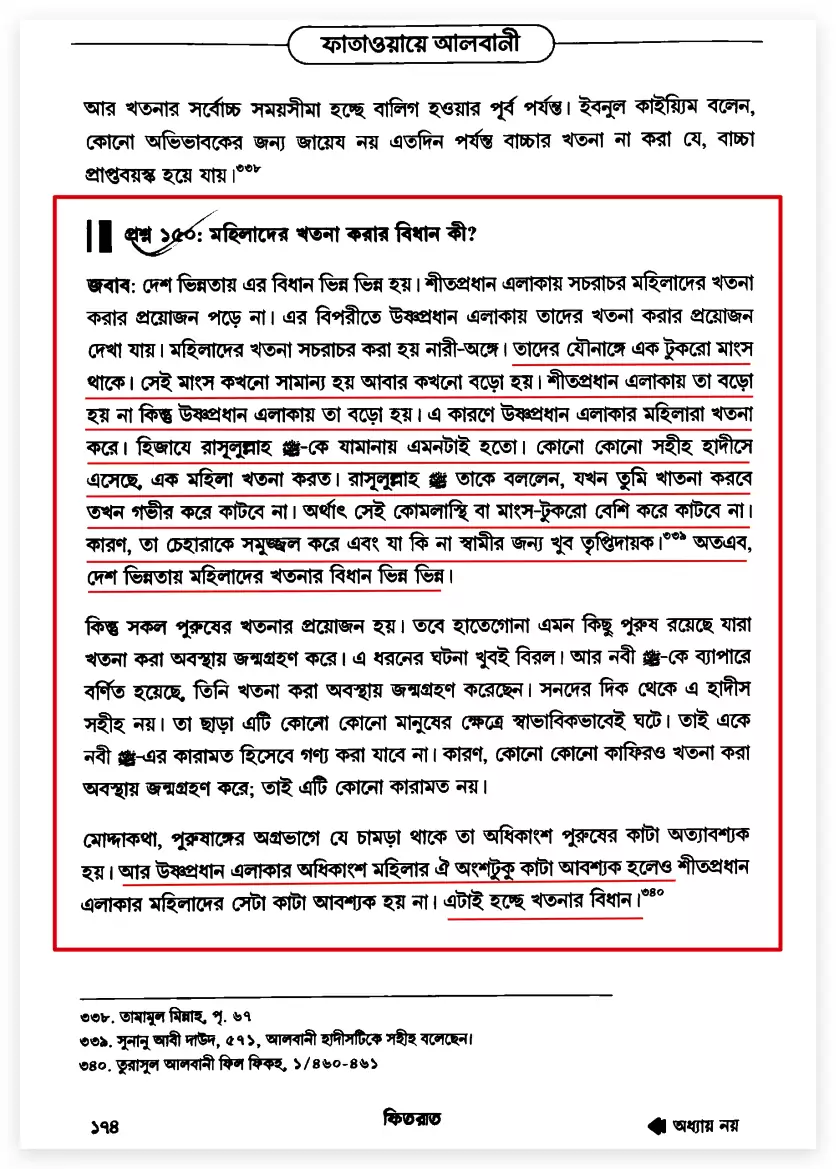
A detailed statement on female circumcision also appears on page 174 of the Bengali edition of al-Albani’s fatwa collection, Fatawa al-Albani. There he distinguishes the supposed need for female circumcision in cold and hot climates and supports cutting a specified part of the female genitalia. His grading of the relevant hadith as sahih, together with the positions taken by other contemporary Islamic scholars, demonstrates that authorisation of female circumcision based on classical sources persists in present-day religious discourse. [75]
Question 150: What is the ruling on the circumcision of women?
Answer: The ruling differs from one country to another. In cold regions, women generally have no need for circumcision. By contrast, in hot regions the need arises. Female circumcision is usually performed on the female genital organ. There is a piece of flesh on their genitals. Sometimes it is small and sometimes large. In cold regions it does not become large, whereas in hot regions it grows large. That is why women in hot regions undergo circumcision. This was the practice in the Hijaz during the time of the Messenger of Allah. Some authentic hadiths mention a woman who performed circumcision. The Messenger of Allah told her, ‘When you circumcise, do not cut deeply.’ That is, do not cut away too much of that cartilage or piece of flesh, because it brightens the face and is very satisfying to the husband. Thus the ruling on female circumcision differs according to the country.
All men, however, need to be circumcised. There are a handful of men who are born circumcised, but this is extremely rare. A report also says that the Prophet was born circumcised, but the hadith is not authentic in terms of its chain of transmission. Moreover, this occurs naturally in some people, so it cannot be regarded as a miracle of the Prophet, since some unbelievers are also born circumcised. It is therefore no miracle.
In summary, for most men cutting the skin covering the tip of the penis is necessary. And although cutting the corresponding part is necessary for most women in hot regions, it is not necessary for women in cold regions. This is the ruling on circumcision. [Footnote 340]
The same approval of female circumcision is evident in contemporary religious advocacy. Bangladeshi religious preacher Ahmadullah has also presented female circumcision as a religious practice. His remarks provide an example of present-day religious promotion of the practice in Bangladesh.
Taken together, the hadith of Umm Atiyyah, the interpretations of al-Baghawi and Ali al-Qari, Ibn Taymiyyah’s fatwa, and the statements of contemporary fatwa institutions reveal a particular religious and sexual-moral framework for female circumcision. First, cutting female genital tissue is authorised religiously. Then rules and commentaries determine how much should be cut. The regulation of female desire and preservation of a husband’s sexual satisfaction are treated as important considerations in setting these limits. Religious prescriptions and male sexual interests take precedence over women’s control of their own bodies. Issuing religious instructions about how much healthy tissue may be removed does not make the removal medically necessary. The combination of religious approval, sexual control, and bodily harm exposes the practice’s deep ethical and human rights problems.
The Origins of Female Circumcision: Sarah’s Revenge and Hagar’s Genital Cutting in Islamic Accounts
Islamic historical and exegetical literature preserves a notable story about the origins of female circumcision. Its central figures are Abraham, his wife Sarah, and Sarah’s enslaved woman Hagar. Works including Ibn Kathir’s Al-Bidaya wa’l-Nihaya, Ibn al-Athir’s Al-Kamil fi’l-Tarikh, Ibn al-Qayyim’s Tuhfat al-Mawdud, and other Islamic writings relate that Sarah became jealous of Hagar after Hagar bore Abraham a child. Sarah allegedly swore to injure three parts of her enslaved woman’s body. Abraham is said to have advised piercing Hagar’s ears and circumcising her genitals to fulfil the oath. Later Islamic authors identified Hagar as the first woman to be circumcised. The significance of the account is substantial. In this religious explanation of the practice’s origin, female circumcision did not begin as a response to disease, hygiene, or women’s health needs. It is connected instead to jealousy, threatened punishment, and bodily cutting directed against an enslaved woman by a member of the household that held her in bondage. [76] [77]
Ibn Kathir’s Al-Bidaya wa’l-Nihaya: The Oath to Cut Three Body Parts
In Al-Bidaya wa’l-Nihaya, Ibn Kathir begins the story of Abraham and Hagar by noting that Sarah was unable to bear children. She gave Hagar, whom she enslaved, to Abraham. After Hagar gave birth to Abraham’s son Ishmael, Sarah became intensely jealous. Ibn Kathir also relates the account of Hagar being removed from Abraham’s presence. He then cites a narration from Al-Nawadir by the Maliki jurist Abu Muhammad Ibn Abi Zayd. According to this report, Sarah became angry with Hagar and swore to cut three parts of her body. Abraham instructed Sarah to pierce Hagar’s ears and circumcise her, fulfilling the oath. Immediately afterwards, Ibn Kathir quotes al-Suhayli as saying that Hagar was the first woman to undergo circumcision and the first to have her ears pierced. [78]
أن سارة تغضبت على هاجر فحلفت لتقطعن ثلاثة أعضاء منها ، فأمرها الخليل أن تثقب أذنيها وأن تخفضها فتبر قسمها
English translation: Sarah became angry with Hagar and swore that she would cut three parts of her body. Abraham then instructed her to pierce Hagar’s two ears and circumcise her, thereby fulfilling her oath.
In the subsequent passage, Ibn Kathir quotes al-Suhayli identifying Hagar as the first woman circumcised and the first whose ears were pierced. The expression «تَخْفِضَهَا» is particularly important. The Arabic term خفض (khafd) is an established term for female circumcision. The passage therefore speaks explicitly of Hagar’s genital cutting as well as the piercing of her ears. Quoting only the ear piercing while omitting the genital cutting would leave out an essential part of the source. The reported cause is equally explicit: Sarah’s oath and the decision to intervene physically on Hagar to fulfil it. Within the story, female genital cutting forms part of a punitive act.
The story of Sarah and Hagar appears on pages 349–350 of volume one of the Bengali translation of Ibn Kathir’s Al-Bidaya wa’l-Nihaya. [79] [80]
After Ishmael was born to Hagar, Sarah became jealous. She asked Abraham to remove Hagar from her sight. Abraham therefore took Hagar and her son away and settled them in Mecca. It is said that Ishmael was still an infant at the time. When Abraham prepared to leave them there and return, Hagar stood up, caught hold of his clothing, and asked, ‘Abraham, where are you going, leaving us here without food or provisions?’ Abraham did not answer. She repeated her question, and when he still gave no response, she asked, ‘Has Allah commanded you to do this?’ Abraham replied, ‘Yes.’ Hagar said, ‘Then there is nothing to fear. He will not allow us to perish.’ Shaykh Abu Muhammad Ibn Abi Zayd wrote in Al-Nawadir: Sarah became angry with Hagar and swore that she would sever three parts of her body. Abraham told her, ‘Pierce her two ears and have her circumcised, and thus fulfil your oath.’ Al-Suhayli said: ‘Hagar was the first woman to be circumcised, the first to have both ears pierced, and the first to wear a long trailing garment.’
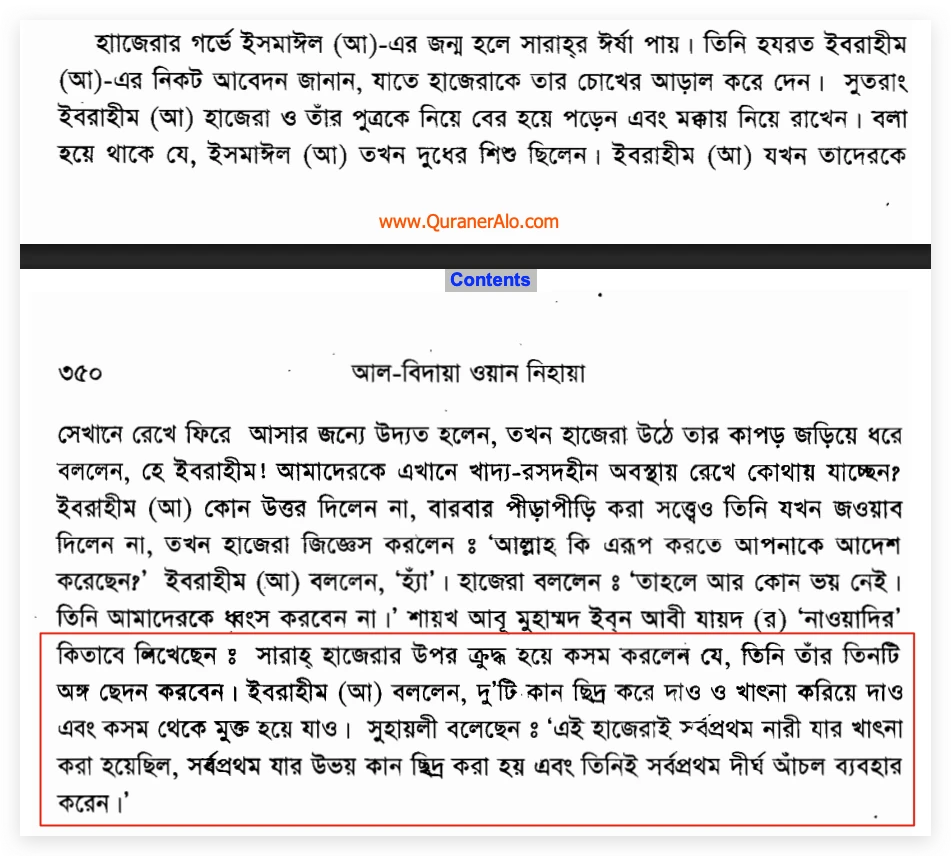
Hagar’s social position is the most significant aspect of this account. According to the Islamic historical narrative, she was enslaved by Sarah. Sarah gave her to Abraham, and Sarah’s jealousy arose after Hagar had sexual relations with Abraham and bore his child. The three figures therefore did not possess equal social power. Sarah was a free wife; Hagar was an enslaved and subordinated woman. Hagar became the target of Sarah’s anger and revenge within this unequal relationship. She was threatened with the cutting of three body parts, and piercing her ears and circumcising her genitals became the alternative means of carrying out the threat. The report does not indicate that Hagar consented, made any decision about her body, or could refuse the intervention. Sarah and Abraham made the decisions; Hagar was the person subjected to bodily injury.
Ibn al-Athir’s Al-Kamil: From Sarah’s Jealousy to the Practice of Female Circumcision
The prominent Muslim historian Ibn al-Athir also links the same event to the origin of female circumcision in Al-Kamil fi’l-Tarikh. In his version, Sarah became angry with Hagar after Ishmael’s birth and expelled her from the house. Although Hagar was brought back, Sarah again became jealous and sent her away. Sarah then swore to cut a part of Hagar’s body. She avoided cutting Hagar’s nose or ears because she did not want to disfigure her face, and instead circumcised her. Ibn al-Athir explicitly states that this is how the circumcision of women began. His version gives more emphasis to Sarah’s punitive act than to Abraham’s instruction. Although the details differ between the versions, both accounts associate the origin of female circumcision with Sarah’s jealousy and injury inflicted on Hagar. [81]
وحلفت لتقطعن منها بضعة ، فتركت أنفها وأذنها لئلا تشينها ، ثم خفضتها ، فمن ثم خفض النساء
English translation: She swore that she would cut a piece from Hagar’s body. She spared her nose and ear so as not to disfigure her, and then circumcised her. From that came the practice of circumcising women.
Ibn al-Athir’s narrative explicitly describes the substitution of one punishment for another. Cutting Hagar’s nose and ears would have visibly disfigured her face, so that option was abandoned; genital cutting was accepted instead. Violence against the female genitalia is presented as a means of fulfilling the oath without producing visible disfigurement of the face. In this account, female circumcision does not arise from a health need. It is a method of punishment. Its target is an enslaved woman whose childbirth provoked the anger of people holding power over her. This portrayal raises a difficult question about the religious explanation of the practice’s origins: how did genital cutting associated with jealousy and revenge acquire the standing of an honourable religious practice?
Ibn al-Qayyim: From Punitive Genital Cutting to a Religious Sunnah
One of the most significant attempts to connect the story of Sarah and Hagar to the religious legitimacy of female circumcision appears in Ibn al-Qayyim al-Jawziyyah’s Tuhfat al-Mawdud bi-Ahkam al-Mawlud. Discussing circumcision’s purposes, benefits, and legal rulings, Ibn al-Qayyim recounts Sarah’s jealousy and Hagar’s circumcision. According to his version, Sarah swore to cut three parts of Hagar’s body, and Abraham advised piercing her ears and circumcising her. But Ibn al-Qayyim does not stop at recounting the incident. He states that it subsequently became Sunnah among women. He then compares the origin of this practice to the origin of the pilgrimage ritual of sa’i between Safa and Marwa, associated with Hagar running between the two hills, and to the stoning ritual associated with Ishmael. His reasoning invokes the transformation of the memory of an ancient event into a later religious practice. [82]
فأمرها بثقب أذنيها وختانها وَصَارَ ذَلِك سنة فِي النِّسَاء بعد وَلَا يُنكر هَذَا كَمَا كَانَ مبدأ السَّعْي سعي هَاجر بَين جبلين
English translation: He instructed her to pierce Hagar’s ears and circumcise her, and afterwards this became Sunnah among women. There is nothing objectionable about that, just as the sa’i originated from Hagar’s running between two hills.
Ibn al-Qayyim’s argument represents a significant transformation. A story that begins with Sarah’s jealousy, a threat to punish the enslaved Hagar, and cutting her body is used to explain the origin of a Sunnah for later generations of women. He compares this origin story with the establishment of an accepted religious rite such as the pilgrimage sa’i. The ethical problem in that comparison is clear. The story of Hagar’s movement between Safa and Marwa depicts a mother searching for water for her child; the female circumcision story depicts an enslaved woman being injured because of jealousy and revenge in the household that controlled her. The causes of the events, the participants’ positions, and the nature of the injuries are not the same. Yet Ibn al-Qayyim treats both as explanations of the origins of later religious practices. His own writing thus records the process by which a story of punitive cutting was invested with the status of religious tradition.
Another significant aspect of Ibn al-Qayyim’s discussion is his association of circumcision with controlling sexual desire. His account of circumcision’s supposed benefits and the origin story involving Hagar appear within the same broader discussion. Two distinct strands of religious reasoning emerge: an ancient story is used to explain the practice’s religious origin and prestige, while the control of women’s sexual appetite and bodies is represented as a benefit of circumcision. In both, religious authority and social control take priority over a woman’s ability to make independent decisions about her body. The move from an origin story involving coercion against an enslaved woman to a later justification based on controlling female sexuality reveals a continuing relationship of power. [83]
Islamweb and IslamQA: Historical Evidence for the Story and Its Religious Reception
The story of Sarah and Hagar is not confined to ancient historical writings. Contemporary Islamic fatwa institutions discuss it as well. Islamweb fatwa 283222 collects references to the story in works by Ibn Abi Zayd, Ibn Abd al-Barr, al-Suyuti, Ibn Kathir, Ibn al-Qayyim, and Ibn Hajar. It recounts versions in which Sarah, jealous of Hagar, swore to damage three parts of her body and Abraham advised circumcision and ear piercing. IslamQA fatwa 239174 discusses a narration traced to Ali ibn Abi Talib, reports transmitted through Ibn Abd al-Hakam, al-Bayhaqi, and Ibn Asakir, and another version transmitted through al-Waqidi. The story of Hagar’s circumcision is therefore a familiar and repeatedly cited account in Islamic historical and fatwa literature. [84] [85]
There is, however, a specific problem with the historical evidence for the story. IslamQA fatwa 239174 points to a weakness involving tadlis in the chain of a report attributed to Ali ibn Abi Talib through Abu Ishaq. It also classifies another narration transmitted through al-Waqidi as extremely weak. According to the fatwa’s assessment, although early writers including Ibn Kathir and Ibn al-Qayyim cited the event, evidence sufficient to establish that it actually happened has not been produced. There is therefore no sound basis for presenting the claim that Hagar was the first circumcised woman in the world as certain historical fact. Repetition of a story in many books does not automatically amount to multiple independent attestations. Uncertainty about the event’s occurrence, however, does not erase the story’s role in Islamic religious literature. Ibn Kathir preserved it as history, Ibn al-Athir described it as the origin of female circumcision, and Ibn al-Qayyim connected it to the establishment of Sunnah among women. The historical truth of the ancient event and the use made of it by later religious writers are two distinct questions. [86]
The use of ancient narratives to establish the legitimacy of religious practices is an important social process. When the origin of a custom is connected to a prophet or a prophet’s family, it may acquire a religious standing beyond ordinary social tradition. The story of Hagar’s circumcision illustrates this process. An act described as arising from Sarah’s jealousy is tied to Abraham’s decision; it is then portrayed as the first female circumcision and the source of a Sunnah for women. A story about powerful people imposing their will on an enslaved woman’s body becomes an explanation for a religious practice. Ibn al-Qayyim’s comparison with the origin of the pilgrimage sa’i makes this elevation in religious status especially clear. Criticism of this use of the story does not depend on treating it as a verified historical event. The documented point is how Islamic authors themselves used a narrative of violence to support a religious custom.
The story of Hagar therefore reveals two serious features of the religious history of female circumcision. First, Islamic historical works preserve an origin story centred on punitive cutting of an enslaved woman’s body. Second, later religious interpretations connect that event with the origin of Sunnah among women. Although the story supplies no medical justification for the practice, associating it with the family of the prophet Abraham has helped create a language of religious legitimacy. A narrative in which the affected woman has no control over the decision to cut her body has thus been used as the origin of a religious practice for subsequent generations. This is a significant historical example of authority over women’s bodies, power relations under slavery, and the normalisation of genital cutting under the name of religious tradition.
Circumcision Is Sunnah for Men and an Honour for Women: Hadith and Juristic Interpretation
A statement frequently cited in Islamic literature to justify female circumcision is ‘Circumcision is Sunnah for men and an honourable practice for women.’ Its Arabic wording is «الْخِتَانُ سُنَّةٌ لِلرِّجَالِ، مَكْرُمَةٌ لِلنِّسَاءِ». It is collected as a hadith attributed to Muhammad in Ahmad ibn Hanbal’s Musnad. Al-Bayhaqi preserves a narration of the same statement in Al-Sunan al-Kubra, and it is quoted in al-Baghawi’s Sharh al-Sunnah, al-Qurtubi’s Qur’anic commentary, and subsequent jurisprudential discussions. Notably, female circumcision is not described simply as an existing custom; it receives the positive religious classification makrumah, or honourable practice. The term invests the cutting of female genital tissue with positive religious and social status.
Musnad Ahmad: Sunnah for Men and Makrumah for Women
The statement appears in Ahmad’s Musnad through a report from Usamah al-Hudhali. The transmission includes Surayj, Abbad ibn al-Awwam, al-Hajjaj ibn Artat, and Abu al-Malih ibn Usamah. Abu al-Malih reports it from his father as a statement by Muhammad. In the edition of the Musnad available on Islamweb, it is numbered 20195 and is given as appearing on page 75 of volume five of a printed edition. Other editions number it 20719 or 19794. The report assigns different religious classifications to male and female circumcision: Sunnah for men and makrumah for women. [87]
عَنِ الْحَجَّاجِ عَنْ أَبِي الْمَلِيحِ بْنِ أُسَامَةَ عَنْ أَبِيهِ أَنَّ النَّبِيَّ صَلَّى اللَّهُ عَلَيْهِ وَسَلَّمَ قَالَ الْخِتَانُ سُنَّةٌ لِلرِّجَالِ مَكْرُمَةٌ لِلنِّسَاءِ
English translation: Al-Hajjaj narrated from Abu al-Malih ibn Usamah, from his father, that Muhammad said: ‘Circumcision is Sunnah for men and an honourable practice for women.’
The statement does not condemn or prohibit female circumcision; it distinguishes the status assigned to the procedure for men and women. The term makrumah is especially important. In ordinary usage it denotes an honourable or dignified act. Al-Sindi, in his commentary Hashiyat Musnad al-Imam Ahmad, explicitly explains makrumah as karamah, or honour. It is thus not merely a description of a physical procedure; it also communicates a positive evaluation of the practice. [88]
In Islamic jurisprudence, Sunnah can denote the religious practice associated with Muhammad or, in particular legal classifications, an act recommended rather than obligatory. Makrumah, meanwhile, bestows the status of an honourable practice on female circumcision. Later jurists differed over the legal application of these terms and the degree of obligation they entailed. The statement’s defining feature, however, is its positive religious assessment of female circumcision.
Al-Bayhaqi’s Objection to the Chain: Al-Hajjaj ibn Artat
An important assessment of the report’s authenticity is found in al-Bayhaqi’s Al-Sunan al-Kubra. In the chapter on circumcision, he preserves the same statement through Abu al-Malih ibn Usamah from his father. His chain passes through Hafs ibn Ghiyath and al-Hajjaj ibn Artat. Immediately after quoting the report, however, al-Bayhaqi explicitly states that al-Hajjaj ibn Artat cannot be relied upon as authoritative evidence. Al-Bayhaqi therefore records the hadith while also drawing attention to the weakness of its transmission. [89]
عَنِ الْحَجَّاجِ، عَنْ أَبِي مَلِيحِ بْنِ أُسَامَةَ، عَنْ أَبِيهِ قَالَ: قَالَ رَسُولُ اللَّهِ – صَلَّى اللَّهُ عَلَيْهِ وَسَلَّمَ – : “الْخِتَانُ سُنَّةٌ لِلرِّجَالِ، وَمَكْرُمَةٌ لِلنِّسَاءِ”.
English translation: Al-Hajjaj narrated from Abu al-Malih ibn Usamah, from his father, who said that Muhammad stated: ‘Circumcision is Sunnah for men and an honourable practice for women.’
Immediately after this narration, al-Bayhaqi comments: «الْحَجَّاجُ بْنُ أَرْطَاةَ لَا يُحْتَجُّ بِهِ»—’Al-Hajjaj ibn Artat cannot be relied upon as evidence.’ Hadith scholars criticised al-Hajjaj for poor memory, inconsistencies in transmission, and tadlis. Versions of this hadith transmitted through him also differ in identifying certain narrators. One version has Abu al-Malih reporting from his father; another introduces Shaddad ibn Aws. A further version circulates through Makhul on the authority of Abu Ayyub. The existence of such variants does not automatically establish multiple independent and reliable lines of attestation.
Al-Qurtubi also cites the hadith while commenting on Qur’an 2:124 in Al-Jami’ li-Ahkam al-Qur’an. During his discussion of Abraham’s circumcision and its legal status, he says that some Maliki jurists used the version transmitted through al-Hajjaj ibn Artat and attributed to Shaddad ibn Aws. Al-Qurtubi then notes that al-Hajjaj is not a reliable source of proof. His discussion therefore documents two distinct facts: the hadith was invoked in legal reasoning, and its chain of transmission was contested. [90]
أن رسول الله صلى الله عليه وسلم قال : الختان سنة للرجال مكرمة للنساء . والحجاج ليس ممن يحتج به .
English translation: Muhammad said: ‘Circumcision is Sunnah for men and an honourable practice for women.’ But al-Hajjaj is not someone whose narrations can be relied upon as evidence.
Because of this weakness in transmission, the statement cannot be presented as a reliably established instruction from Muhammad. The weakness of its chain and its use in the religious history of female circumcision are, however, separate questions. Al-Bayhaqi and al-Qurtubi show that the hadith was preserved in Islamic literature and invoked in legal discussions about circumcision even though its weaknesses were known. Determining the influence of a statement in later religious and legal history requires attention not only to its chain of transmission but also to the uses later jurists made of it.
Al-Baghawi’s Sharh al-Sunnah: Female Circumcision, Purity, and Childhood
In the chapter on circumcision in Sharh al-Sunnah, Imam al-Baghawi preserves several important early statements about female circumcision. He begins with the hadith on fitrah and discusses whether circumcision is obligatory. He then quotes al-Hasan al-Basri as saying that circumcision is Sunnah for men and an act of purification for women. In the same discussion, he cites through Makhul the statement attributed to Muhammad that ‘circumcision is Sunnah for men and a makrumah for women’. Two positive religious evaluations of female circumcision—honour and purity—thus appear side by side. [91]
قال الحسن في الختان: هو للرجال سنة، وللنساء طهرة. وروي عن مكحول، أن النبي صلى الله عليه وسلم، قال: “الختان سنة للرجال، مكرمة للنساء”.
English translation: Al-Hasan said concerning circumcision: ‘It is Sunnah for men and purification for women.’ It is also related from Makhul that Muhammad said: ‘Circumcision is Sunnah for men and an honourable practice for women.’
The same chapter of al-Baghawi preserves a noteworthy exchange about the age at which girls should be circumcised. Zayd ibn Aslam was asked how long the khafd, or circumcision, of a girl could be postponed. He answered: until the age of eight. This is not a direct command from Muhammad, but an opinion attributed to an early religious figure. It nevertheless shows female circumcision being discussed not as an adult woman’s personal decision, but as a customary intervention carried out on young girls. The question posed was not whether a girl’s genitals should be cut, but how long the cutting could be delayed. [92]
وسئل زيد بن أسلم عن خفض الجارية إلى متى يؤخر؟ قال: إلى ثمان سنين.
English translation: Zayd ibn Aslam was asked, ‘Until what age can the khafd of a girl be delayed?’ He replied, ‘Until eight years of age.’
The significance of this exchange extends beyond a historical opinion about the appropriate age. It also reflects a social practice in which others decide before adulthood to perform medically unnecessary cutting of a girl’s genitals. An age at which a child cannot independently and meaningfully consent to permanent alterations of her sexual anatomy is treated as suitable for the religious practice. Describing the cutting in terms of purity or honour helps create an environment in which it is perceived as part of the child’s welfare and religious identity.
Makrumah in Maliki Jurisprudence: Al-Qarafi’s Al-Dhakhirah
The major Maliki jurist Shihab al-Din al-Qarafi discusses circumcision as an act of fitrah in Al-Dhakhirah. Citing Al-Jawahir, he describes male circumcision as Sunnah and female circumcision as makrumah. He then examines arguments about whether circumcision is obligatory under Maliki law and differences between legal schools. His discussion invokes the hadith on fitrah, the instruction to follow Abraham’s religion, and other circumcision-related reports. The designation makrumah thus extends beyond the wording of a particular hadith and becomes part of Maliki legal classification. [93]
وَالْخِتَانُ، وَهُوَ سُنَّةٌ فِي الرِّجَالِ مَكَرُمَةٌ فِي النِّسَاءِ، وَيُسْتَحَبُّ خِتَانُ الصَّبِيِّ إِذَا أُمِرَ بِالصَّلَاةِ مِنَ السَّبْعِ إِلَى الْعَشْرِ
English translation: Circumcision is Sunnah for men and an honourable practice for women. It is recommended that a boy be circumcised when he is instructed to perform prayer, between the ages of seven and ten.
Al-Qarafi’s assignment of different legal statuses to female and male circumcision does not amount to a rejection of female circumcision. Rather, the two sexes are placed in different categories of religious obligation. He examines legal arguments about whether circumcision is compulsory while maintaining recognition of the practice for women. The Shafi’i school discussed earlier treats female circumcision as obligatory, whereas this Maliki formulation calls it makrumah. The difference concerns the extent of religious obligation, not whether female circumcision receives positive religious recognition.
The Meaning of Makrumah: Islamweb’s Explicit Explanation
Islamweb fatwa 56891 answers an important question about the word makrumah in the hadith. A questioner asked whether describing female circumcision as a makrumah means that Islam honours women generally, rather than that the act of circumcision itself is honourable. Islamweb acknowledged that the hadith’s chain of transmission is weak. It then explained that jurists interpret makrumah to mean mustahabb, or a recommended practice. The honourable quality is thus attributed to the act of circumcision itself. The word is not a general declaration about women’s human dignity or women’s status in Islam. [94]
أما كلمة مكرمة فقد فسرها أهل العلم بمستحبة، أي خصلة مستحبة
English translation: Scholars have interpreted the word makrumah as mustahabb, that is, a recommended or praiseworthy practice.
The same fatwa explicitly rejects the alternative meaning proposed by the questioner. Islamweb states that it has found no scholar who interpreted makrumah as meaning merely that Islam honours women generally, and it describes that reading as strained. The fatwa institution’s own answer therefore resolves a specific question of meaning. It is female circumcision that is described as honourable; the wording is not simply a statement of general honour for women. [95]
وما ذكره السائل من أن معنى مكرمة أن الإسلام كرم المرأة .. فلم نطلع على من قال بهذا المعنى من أهل العلم
English translation: As for the questioner’s suggestion that makrumah means that Islam honoured women, we have not found any scholar who gave it that meaning.
A further aspect of this fatwa is noteworthy. Even after acknowledging the weakness of the hadith’s transmission, it explains female circumcision as a recommended practice and relates that classification to earlier juristic rulings. IslamQA fatwa 427 also records disagreement about the hadith’s authenticity and refers to report 1935 in al-Albani’s Silsilat al-Ahadith al-Da’ifah. Yet it invokes Ibn Qudamah’s assessment of female circumcision as makrumah to argue that it is not obligatory for women. Debate about the authenticity of the particular hadith therefore continued alongside juristic discussions authorising the practice. [96]
The religious importance of describing female circumcision as makrumah lies here. A practice can be established as praiseworthy, recommended, or honourable without being declared compulsory. Religious authority may thereby confer social approval on a custom without imposing a direct punishment for failing to observe it. A family that believes circumcising its daughter is honourable and approved by scholars receives a positive religious incentive to have her genital tissue cut. The absence of an obligation does not remove that incentive. Religious praise and the language of honour can preserve the practice’s acceptability even without compulsory enforcement.
The report in Musnad Ahmad, al-Bayhaqi’s criticism of its chain, al-Baghawi’s treatment of purification, al-Qarafi’s Maliki legal discussion, and Islamweb’s explanation of makrumah collectively document a particular historical process. A report attributed to Muhammad through a weak chain became part of the religious discourse that presented female circumcision as an honourable practice. Other hadiths and legal arguments were then used to establish approval of female circumcision across different schools. The report’s historical authenticity and its social effects are not the same issue. Even if it cannot be established as a reliable statement by Muhammad, its use and influence within Islamic religious literature are documented. Granting a practice religious honour does not change the physical nature of the act. In this case, makrumah invests medically unnecessary genital cutting with a positive religious assessment; that assessment supplies no evidence of medical necessity or ethical legitimacy.
Conclusion
Portraying female circumcision or female genital mutilation as wholly unrelated to Islam, merely a local custom, or a practice without religious basis is incompatible with the evidence preserved in Islamic hadith, historical, and legal literature. Hadiths classified as authentic refer to the female circumcision site; the circumcision of girls in Aisha’s family is recorded; and separate reports attributed to Muhammad address the method and religious status of female circumcision. Not all these reports are equally well attested. Classical hadith specialists themselves identified weaknesses in the chain of the statement calling female circumcision a makrumah, or honourable practice. But the weakness of one particular hadith does not erase the long history of recognition of female circumcision in Islamic jurisprudence. The Shafi’i school declared it obligatory; Hanbali, Hanafi, and Maliki legal discussions classified its religious status in other ways. Some contemporary Islamic fatwa institutions also continue to recognise the practice as legitimate under Sharia, recommended, or honourable. The place of female circumcision in Islamic religious literature and legal tradition is therefore a documented historical fact.
The most disturbing aspect of this religious recognition is that it did not merely permit cutting female genital tissue; it also defined the practice’s purpose, method, and permissible degree. A hadith transmitted in the name of Umm Atiyyah links the instruction not to cut too deeply to a husband’s preference. Ibn Taymiyyah explicitly identifies regulating women’s sexual appetite as the purpose of circumcision. A Hanafi legal statement describes female circumcision as an honourable practice for men. These sources subordinate the female genitalia to religious prescriptions, social honour, and male sexual interests instead of treating them as part of a woman’s own bodily and sexual autonomy. More seriously, the Shafi’i legal discussion preserved by al-Mawardi addresses punishment for remaining uncircumcised and exempts the ruler from liability under specified circumstances even if the punishment causes death. In some juristic positions, female circumcision thus extends beyond personal religious practice into the exercise of punitive authority.
The story of Sarah and Hagar reveals another significant dimension of this religious tradition. An origin story preserved in Islamic historical writing describes female circumcision as beginning with bodily cutting driven by jealousy and revenge against an enslaved woman. The actual historical occurrence of the story has not been conclusively established. Nevertheless, Ibn al-Athir presents it as the beginning of female circumcision, and Ibn al-Qayyim links it to the origin of Sunnah among later women. A story involving punitive genital cutting of a subordinated woman was thus used to explain the origin of a religious practice. The ethical problem is clear: a narrative involving violence was preserved and then given religious significance for later generations of women. The antiquity of a custom, or its alleged connection to a prophet’s household, does not establish the moral legitimacy of genital cutting.
Modern medical evidence directly conflicts with this positive religious evaluation. According to the World Health Organization, removing or injuring healthy female genital tissue without medical necessity confers no health benefit. Different forms of FGM carry immediate and long-term risks of physical and psychological complications. Reducing the extent of the cutting, using sterile instruments, or having it performed by a doctor does not establish a medical need for the procedure. Nor does classifying it as Sunnah, makrumah, mustahabb, or fard demonstrate a health benefit. The instruction in the IslamQA fatwa discussed above—that establishing a practice as coming from Muhammad is sufficient to believe in its benefits and harmlessness—contradicts the basic method of scientific inquiry. The benefits and harms of a physical procedure must be determined through observable evidence, not the proclamations of religious authority.
The most fundamental ethical question concerning FGM is whether anyone has the right to decide that a healthy part of another person’s body should be cut away. The question is especially serious for a young girl, who has not developed the capacity to give independent and meaningful consent to permanent alteration of her genitalia. Her parents’ religious beliefs, prevailing social customs, a scholar’s fatwa, or a prospective husband’s sexual preferences cannot extinguish her right to bodily integrity. Religious freedom is the right to practise one’s own beliefs; it is not an unlimited right to inflict permanent injury on someone else’s body without medical necessity. A decision that may affect the child’s future sexual health and physical autonomy is being taken by others before she has the opportunity to participate and consent. Invoking the language of religious honour does not resolve this inequality of power.
The history of female circumcision is therefore not merely the history of an ancient religious custom. It is also a history of establishing social, sexual-moral, and religious authority over women’s bodies. Classical jurisprudence classified genital cutting as obligatory or praiseworthy; religious commentaries endorsed regulating female sexual desire as one of its purposes; and some contemporary fatwas have sought to preserve its religious legitimacy against medical objections. Together, these sources leave no basis for denying the connection between female circumcision and Islamic jurisprudence. That connection, however, does not establish the practice’s ethical acceptability. When a religious rule authorises bodily harm, its religious status does not transform that harm into a benefit. Calling unnecessary cutting of female genital tissue honourable does not make it anything other than cutting, and religious authority cannot establish that it is medically necessary or morally justified.
References
- World Health Organization, Female Genital Mutilation, 31 January 2025 1 2 3
- UNICEF, What Is Female Genital Mutilation? ↩︎
- United Nations Population Fund, Female Genital Mutilation, 2026 ↩︎
- World Health Organization, New Study Highlights Multiple Long-Term Health Complications from Female Genital Mutilation, 14 April 2025 ↩︎
- United Nations Population Fund, Female Genital Mutilation ↩︎
- World Health Organization, Sexual and Reproductive Health Research: Female Genital Mutilation ↩︎
- Al-Mawardi, Al-Hawi al-Kabir, vol. 13, p. 431, Rulings on Circumcision ↩︎
- IslamQA, Fatwa 45528, Medical Benefits of Female Circumcision ↩︎
- Islamweb, Fatwa 121681, The Preferred Ruling on Female Circumcision ↩︎
- Ibn Taymiyyah, Majmu’ al-Fatawa, vol. 21, p. 114, On Whether Women Should Be Circumcised, Islamweb ↩︎
- World Health Organization, Types of Female Genital Mutilation ↩︎
- World Health Organization, Type I FGM, Subtypes Ia and Ib ↩︎
- World Health Organization, Type II FGM, Subtypes IIa, IIb and IIc ↩︎
- World Health Organization, Type III FGM: Infibulation ↩︎
- World Health Organization, WHO Guideline on the Prevention of FGM and Clinical Management of Complications, 28 April 2025 ↩︎
- United Nations Population Fund, Female Genital Mutilation: Frequently Asked Questions 1 2 3
- World Health Organization, Type IV Female Genital Mutilation ↩︎
- World Health Organization, Guidelines on FGM Prevention and Management of Complications, 2025 ↩︎
- World Health Organization, WHO Guideline on the Prevention of FGM and Clinical Management of Complications, 2025 ↩︎
- UN Convention on the Rights of the Child, Articles 19 and 24, UNICEF ↩︎
- CEDAW, Article 5(a), German Institute for Human Rights ↩︎
- African Commission on Human and Peoples’ Rights, Maputo Protocol, Article 5: Elimination of Harmful Practices ↩︎
- Council of Europe, Istanbul Convention, Articles 38 and 42 ↩︎
- World Health Organization, WHO Guideline on the Prevention of FGM and Clinical Management of Complications, Executive Summary, 2025 ↩︎
- UNICEF, Female Genital Mutilation Country Profiles, February 2026 ↩︎
- UNICEF, Female Genital Mutilation: A Global Concern, 2024 1 2
- UNICEF, Female Genital Mutilation Statistics for 31 Countries, 2026 ↩︎
- UNICEF, A Statistical Overview of Female Genital Mutilation in Indonesia, 2026, p. 1 ↩︎
- Majelis Ulama Indonesia, Apa Hukum dan Kajian tentang Sunat bagi Perempuan, 9 December 2021 ↩︎
- Majelis Ulama Indonesia, Fatwa No. 9A of 2008, Hukum Pelarangan Khitan Terhadap Perempuan ↩︎
- UNICEF, Female Genital Mutilation in Indonesia: Law and Statistics, 2026 ↩︎
- Majelis Ulama Indonesia, Fatwa on Prohibiting Female Circumcision ↩︎
- United Nations Population Fund, Female Genital Mutilation: Causes and Social Norms ↩︎
- United Nations Population Fund, Harmful Norms: Female Genital Mutilation ↩︎
- United Nations Population Fund, Social and Sexual Norms Behind FGM ↩︎
- United Nations Population Fund, Historical Origins and Social Causes of FGM ↩︎
- Majelis Ulama Indonesia, Islamic Rulings on Female Circumcision ↩︎
- UNICEF–UNFPA, 2024 Joint Programme Annual Report, 2025 ↩︎
- United Nations Joint Statement, 6 February 2026 ↩︎
- Al-Nawawi, Al-Majmu’ Sharh al-Muhadhdhab, vol. 1, p. 349, Islamweb ↩︎
- Al-Nawawi, Al-Majmu’ Sharh al-Muhadhdhab, vol. 1, pp. 349–350 ↩︎
- Al-Mawardi, Al-Hawi al-Kabir, vol. 13, pp. 430–432 ↩︎
- Al-Mawardi, Al-Hawi al-Kabir, vol. 13, pp. 433–434 ↩︎
- Al-Mawardi, Al-Hawi al-Kabir, vol. 13, pp. 430–431, Statement of al-Shafi’i ↩︎
- Umdat al-Salik (Reliance of the Traveller), Online Copy of the Legal Manual ↩︎
- Ibn Qudamah, Al-Mughni, vol. 1, pp. 63–64, Rulings on Circumcision, Islamweb ↩︎
- Ibn Qudamah, Al-Mughni, Chapter on Circumcision ↩︎
- Ibn Abidin, Radd al-Muhtar ‘ala al-Durr al-Mukhtar, vol. 6, pp. 751–752, Islamweb ↩︎
- Islamweb, Fatwa 121681, The Preferred Ruling on Female Circumcision, 11 May 2009 ↩︎
- IslamQA, Fatwa 60314, Female Circumcision and the Objections of Some Doctors, 24 August 2005 ↩︎
- Sahih al-Bukhari, Hadith 5891 ↩︎
- Sahih Muslim, Hadith 257 ↩︎
- IslamQA, Fatwa 82859, Is There an Authentic Hadith on Female Circumcision?, 14 May 2006 ↩︎
- Sahih Muslim, Hadith 349, Ritual Bath After Sexual Intercourse ↩︎
- Sunan Ibn Majah, Hadith 608 ↩︎
- Jami’ al-Tirmidhi, Hadith 108 ↩︎
- Sunan Ibn Majah, Hadith 611, Arabic Text and English Translation ↩︎
- Sunan Ibn Majah, Hadith 611, Bengali Translation ↩︎
- Al-Nawawi, Sharh Sahih Muslim, vol. 4, Ritual Bath and the Meeting of Two Circumcised Parts ↩︎
- Al-Nawawi, Al-Majmu’ Sharh al-Muhadhdhab, vol. 2, pp. 148–149 ↩︎
- Badr al-Din al-Ayni, Umdat al-Qari Sharh Sahih al-Bukhari, Explanation of the Two Circumcised Parts ↩︎
- Al-Adab al-Mufrad, Chapter on Circumcision, Report of Umm Alqamah, Sunnah.com ↩︎
- Al-Adab al-Mufrad, Ahsan Publication, Hadith 1259 ↩︎
- IslamQA, Fatwa 82859, Hadith Evidence Cited in Support of Female Circumcision ↩︎
- Sunan Abi Dawud, Hadith 5271, Chapter on Circumcision ↩︎
- Sunan Abi Dawud, Al-Allamah al-Albani Academy Edition, Hadith 5271 ↩︎
- Sunan Abi Dawud, Islamic Foundation Edition, Hadith 5181 ↩︎
- Sunan Abi Dawud 5271: Abu Dawud’s Comment and al-Albani’s Grading ↩︎
- IslamQA, Fatwa 60314, Female Circumcision and the Objections of Some Doctors 1 2
- IslamQA, Fatwa 82859, Is There an Authentic Hadith on Female Circumcision? ↩︎
- Al-Baghawi, Sharh al-Sunnah, vol. 12, pp. 110–112, Chapter on Circumcision ↩︎
- Mulla Ali al-Qari, Mirqat al-Mafatih, vol. 7, p. 2834, Commentary on Hadith 4464 ↩︎
- Ibn Taymiyyah, Majmu’ al-Fatawa, vol. 21, p. 114, On Whether Women Should Be Circumcised ↩︎
- World Health Organization, Female Genital Mutilation: No Health Benefits, Only Harm, 2025 ↩︎
- Fatawa al-Albani, Muhammad Nasir al-Din al-Albani, Bengali edition, p. 174 ↩︎
- Ibn Kathir, Al-Bidaya wa’l-Nihaya, Account of Ishmael’s Birth and Hagar, Islamweb ↩︎
- Ibn al-Athir, Al-Kamil fi’l-Tarikh, The Birth of Ishmael and Journey to Mecca ↩︎
- Ibn Kathir, Al-Bidaya wa’l-Nihaya, vol. 1, pp. 354–356, Islamweb Edition ↩︎
- Al-Bidaya wa’l-Nihaya, Ibn Kathir, vol. 1, Islamic Foundation Bengali edition, pp. 349–350 ↩︎
- Al-Bidaya wa’l-Nihaya, Arabic Original, Islamweb ↩︎
- Ibn al-Athir, Al-Kamil fi’l-Tarikh, vol. 1, pp. 92–93, Birth of Ishmael and Journey to Mecca ↩︎
- Ibn al-Qayyim, Tuhfat al-Mawdud bi-Ahkam al-Mawlud, Purpose and Benefits of Circumcision, p. 189 ↩︎
- Ibn al-Qayyim, Tuhfat al-Mawdud bi-Ahkam al-Mawlud, Benefits of Circumcision and Account of Hagar ↩︎
- Islamweb, Fatwa 283222, Story of Sarah Piercing Hagar’s Ears ↩︎
- IslamQA, Fatwa 239174, Was Hagar the First Circumcised Woman? ↩︎
- IslamQA, Fatwa 239174, The Story’s Transmission Chains and Historical Evidence ↩︎
- Musnad Ahmad, Report of Usamah al-Hudhali, vol. 5, p. 75, Islamweb ↩︎
- Al-Sindi, Hashiyat Musnad al-Imam Ahmad, vol. 12, p. 246, Commentary on Usamah al-Hudhali’s Hadith ↩︎
- Al-Bayhaqi, Al-Sunan al-Kubra, vol. 8, p. 325, Chapter on Circumcision, Report 17010 ↩︎
- Al-Qurtubi, Al-Jami’ li-Ahkam al-Qur’an, Commentary on Qur’an 2:124, Fifth Discussion on Circumcision ↩︎
- Al-Baghawi, Sharh al-Sunnah, vol. 12, pp. 110–112, Bab al-Khitan ↩︎
- Al-Baghawi, Sharh al-Sunnah, vol. 12, p. 111, Statement of Zayd ibn Aslam ↩︎
- Al-Qarafi, Al-Dhakhirah, vol. 13, pp. 279–280, The Seventh Type: Fitrah ↩︎
- Islamweb, Fatwa 56891, Female Circumcision and Islam’s Honouring of Women, 15 December 2004 ↩︎
- Islamweb, Fatwa 56891, Meaning of Makrumah and the Questioner’s Proposed Interpretation ↩︎
- IslamQA, Fatwa 427, Female Circumcision Is Not Obligatory, 4 August 1999 ↩︎