
Introduction
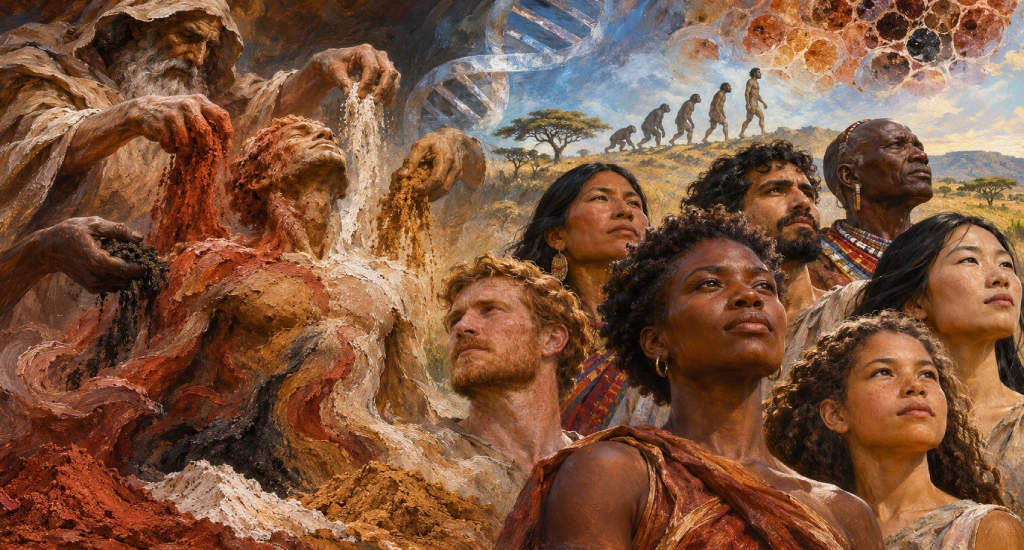
Why does human skin colour vary from one region to another? Why do different skin tones occur within the same population, and why can children of the same parents have different complexions? Modern biology has developed a well-established body of research addressing these questions. Islamic creation accounts, however, offer an entirely different explanation for human variation in skin colour. In a hadith narrated by Abu Musa al-Ash’ari, Muhammad stated that Allah created Adam from a handful of soil gathered from every part of the earth. The differing properties of that soil supposedly explain why Adam’s descendants include people of red, white, black and intermediate complexions. The same narration attributes differences in gentleness, harshness, good character and bad character to the properties of the soil. Preserved in Jami’ al-Tirmidhi 2955 and Sunan Abi Dawud 4693, this statement has been presented by later hadith commentators and Islamic fatwa websites as a direct explanation of human skin colour and temperament. The explanation offered here for human biological diversity is not based on inherited genes or natural selection; it rests on soil of different colours used to construct the body of a single original ancestor.
Human skin colour is primarily associated with the amount, type and distribution of the pigment melanin, together with the structure and activity of melanosomes. Cells known as melanocytes produce melanin, and melanin-containing melanosomes are transferred from them to keratinocytes in the skin. The two principal types of melanin are eumelanin and pheomelanin. Eumelanin, in particular, provides protection against ultraviolet radiation from the sun. The functioning of this system depends on many genes. Migration by human ancestors, natural selection, gene flow between populations and environmental history have together shaped the diversity of skin pigmentation seen today. The temporary darkening of an individual’s skin after sun exposure is not the same process as a heritable change in skin colour across many generations of a population. The former is an immediate physiological response; the latter is part of the evolutionary history of the distribution of genetic variants. [1]
is determined by the quantity, type, and distribution of melanin.
The human body contains elements such as carbon, oxygen, hydrogen, nitrogen and calcium, all of which also occur in the earth’s environment. But the presence of the same elements does not mean that soil colour determines human skin colour. Reddish soil may owe its colour to minerals such as iron oxides, whereas darker human skin results from genetically regulated melanin production. The mere fact that two substances have colour does not mean their colours arise through the same process. There is no biochemical or genetic evidence supporting a direct causal connection between soil colour and inherited human skin pigmentation. The testable element of the Islamic account—the claim that human complexion and temperament originate in the properties of the soil—is inconsistent with the biology of actual human populations.
The Evolution of Human Skin Colour
Africa is the principal centre of the evolutionary history of modern humans. In equatorial environments and other regions with high levels of ultraviolet radiation, dark skin rich in eumelanin conferred important advantages. Solar UVA and UVB radiation can damage cellular molecules and DNA; adequate melanin absorbs and scatters part of that radiation, reducing its penetration into deeper layers of the skin. In populations living for long periods in regions exposed to intense radiation, inherited traits associated with greater production of protective pigment became more prevalent through natural selection. The evolution of dark skin was not a matter of individuals voluntarily changing their colour, nor did entire populations suddenly turn black after a few years of intense sunlight. It reflects the spread of inherited traits over many generations through differences in survival and reproductive success. [2]
Since the origin of Homo sapiens, dark, protective constitutive pigmentation and strong tanning abilities have been favored under conditions of high UVR.
Natural selection involving folate, or folic acid, is another important element in accounts of skin-colour evolution. Folate is essential for cell division, DNA synthesis and repair, and normal embryonic development. Ultraviolet radiation and the reactive molecules generated by it can disrupt biological processes involving folate. Dark skin may therefore have offered reproductive advantages by providing protection in environments with intense ultraviolet radiation. Biologists have investigated the relationships between pigmentation, ultraviolet exposure, folate and reproductive success. Folate protection is an important proposed explanatory factor in the evolution of skin colour; it does not, by itself, explain the history of every pigmentation-related gene in every population. Nevertheless, the underlying process is clear: selection acting on heritable biological traits under environmental pressures. No transfer of the colour of a particular kind of soil into the human body is needed to explain inherited skin pigmentation. [3]
The article has a strong focus on the vitamin D‐folate evolutionary model.
As human populations dispersed from Africa into regions with relatively low levels of ultraviolet radiation, the selective pressures acting on them changed. At higher latitudes in particular, the UVB component of sunlight is relatively limited over long periods of the year. Yet the body can synthesize vitamin D through UVB-dependent reactions in the skin. Higher concentrations of melanin reduce the penetration of UVB under the same conditions, while less pigmented skin can provide an advantage for vitamin D synthesis when UVB is limited. Vitamin D is important for calcium metabolism and bone health. Over long periods of evolution, genetic variants associated with lighter skin became more widespread in some populations living in lower-UV environments. Diet, clothing, settlement patterns and seasonal sunlight exposure also influenced these selective pressures. A simplistic division such as ‘everyone in Europe has light skin, and everyone in Africa has dark skin’ distorts the actual diversity. Africa itself contains a broad spectrum of skin colours, and different populations at the same latitude do not necessarily share the same history.
DNA analysis of ancient human remains provides particularly important evidence for the evolution of skin pigmentation. Certain variants of the SLC24A5 and SLC45A2 genes associated with lighter skin are widespread in present-day European populations. Their frequencies, however, differed among prehistoric Europeans. A study of genetic data from 230 ancient Eurasians found that a light-pigmentation-associated variant of SLC24A5 was common among Neolithic populations of Anatolia and spread into Europe through migration; the widespread distribution of a light-pigmentation-associated SLC45A2 variant is linked to later natural selection. Thus, the skin pigmentation familiar among modern European populations is not an unchanged primordial trait. Its genetic basis has changed through migration, interbreeding and selection. This research does not depend on an assumption that all future human skin colours were already contained in the body of a single ancestor made from a mixture of soil. [4]
which contributes to light skin pigmentation and is almost fixed in present-day Europeans but occurred at much lower frequency in ancient populations.
Another feature of evolution is that similar adaptations can arise through different genetic pathways in different regions. Relatively light skin among Europeans and East Asians did not, in every case, result from precisely the same genetic changes. There are also relatively light-skinned populations in Africa and dark-skinned populations in South Asia and Australasia, including Melanesia. This variation cannot be explained by assigning a single ‘fixed colour’ to each continent. Population history, selective pressures, admixture between ancestral populations, genetic drift and the random spread of genetic variants all matter. Nor is there a genetic basis for dividing humanity into a few immutable ‘races’ with sharply defined boundaries. Skin colour is a continuous, polygenic trait; the boundaries of pigmentation variation between human populations are not rigid walls.
The Genetic Diversity of Human Skin Colour
Understanding the genetics of human skin colour requires more than naming the MC1R and OCA2 genes. Pigment production and distribution also involve SLC24A5, SLC45A2, TYR, TYRP1, KITLG, ASIP, MFSD12, DDB1, TMEM138, HERC2 and numerous other genes and regulatory regions. MC1R participates in the signalling pathways governing melanin production. Some variants of OCA2 and HERC2 are associated with differences in pigmentation and eye colour. Particular variants of SLC24A5 and SLC45A2 show strong associations with lighter skin in Europe and several other populations. The TYR gene encodes tyrosinase, an enzyme involved in a fundamental step of melanin synthesis. No single one of these genes determines the entire spectrum of human skin colour. Multiple variants of many genes, and their interactions, contribute to visible differences in pigmentation.
A study published in Science in 2017 analysed skin colour and genomic data from diverse African populations and identified statistical associations between pigmentation and variants in the SLC24A5, MFSD12, DDB1/TMEM138 and OCA2/HERC2 regions. The researchers did not merely compare outward appearances; they also conducted experiments using cells, zebrafish and mice to investigate the functions of particular genetic changes. These experiments connected MFSD12 activity to pigment production. The same research found that a light-pigmentation-associated SLC24A5 variant had entered East Africa through gene flow from populations outside Africa. The causes of variation in human pigmentation can therefore be investigated through experiments, measurements, genetic inheritance and the documented history of interactions between populations. [5]
Genetic evidence indicates that the light pigmentation variant at SLC24A5 was introduced into East Africa by gene flow from non-Africans.
In another genome-wide study published in Science in 2023, researchers identified 169 genes involved in melanin production, 135 of which had not previously been linked to pigmentation variation. The study demonstrates that pigment production is not a simple switch controlled by one or two genes: it involves many stages, including melanosome formation, intracellular transport and regulation of gene activity. New experiments and evidence can therefore yield increasingly precise explanations for why skin pigmentation varies. Science does not merely assert that people become darker or lighter because of sunlight; it identifies the genes, cellular systems and biochemical changes that produce these traits. At no stage does this research require the claim that the colours of ancient soil determine inherited human characteristics. [1]
We identified 169 functionally diverse genes that converge on melanosome biogenesis.
One directly observable consequence of this genetic explanation is inheritance within families. Children of the same parents do not receive identical combinations of genes: meiosis and genetic recombination give them different combinations of pigmentation-related variants. That is why siblings may have somewhat different skin tones, while individuals from geographically distant populations may share similar complexions. In some genetic conditions, melanin production is greatly reduced, giving rise to characteristics such as albinism; specific genetic and biochemical causes can be identified in such cases. These familial and medical findings cannot be derived from an account based on soil colour. Differences between sun-exposed and covered areas of the same person’s skin also show that pigmentation involves physiological responses in addition to inherited traits. Investigating a person’s inherited genetic variants is scientifically meaningful in explaining their skin colour; no testable method exists for determining the supposed proportions of red, white and black soil used to construct an original ancestor.
The Absurd Claims of the Hadith
In the hadith narrated through Abu Musa al-Ash’ari, Muhammad explicitly connects differences in human skin colour to the material from which Adam was created. The account first says that Allah took a handful of soil from all parts of the earth; it then states that Adam’s descendants consequently display different colours and temperaments according to the properties of that soil. Soil is thus presented not merely as the substance of the first human body but also as an explanation for differences in complexion and character. Al-Tirmidhi graded the hadith ‘hasan sahih’, and the same statement appears in Sunan Abi Dawud. The essential wording in both collections is transmitted through Abu Musa, Qasamah ibn Zuhayr and ‘Awf ibn Abi Jamilah. Repetition of the same transmission line in two books should not be mistaken for two wholly independent historical testimonies. It does, however, establish that this statement attributed to Muhammad circulated prominently within classical hadith literature. [6] [7] [8]
إِنَّ اللَّهَ تَعَالَى خَلَقَ آدَمَ مِنْ قَبْضَةٍ قَبَضَهَا مِنْ جَمِيعِ الْأَرْضِ فَجَاءَ بَنُو آدَمَ عَلَى قَدْرِ الْأَرْضِ فَجَاءَ مِنْهُمُ الْأَحْمَرُ وَالْأَبْيَضُ وَالْأَسْوَدُ وَبَيْنَ ذَلِكَ وَالسَّهْلُ وَالْحَزْنُ وَالْخَبِيثُ وَالطَّيِّبُ
English translation: Allah the Exalted created Adam from a handful of soil that He took from every part of the earth. Thus, the descendants of Adam came to reflect the properties of the earth: among them are those who are red, white, black and of intermediate complexions, and those who are gentle, harsh, bad and good in disposition.
Sunan al-Tirmidhi (critically edited)
44. Tafsir al-Qur’an
Chapter 3: Surah al-Baqarah
2955. Narrated by Abu Musa al-Ash’ari (may Allah be pleased with him), who said: The Messenger of Allah (peace and blessings be upon him) said: “Allah the Exalted created Adam from a handful of soil taken from every part of the earth. Therefore, the descendants of Adam inherited the characteristics of the soil: some are red, some white, some black, and some have complexions in between.” Some are gentle and mild-tempered, while others are harsh; some are of bad character and others of good character.
Sahih: Mishkat (100), al-Sahihah (1630).
Abu ‘Isa said: This hadith is hasan sahih.
Hadith grade: Sahih.
Narrator: Abu Musa al-Ash’ari.
The same account appears in Sunan Abi Dawud, hadith 4693, under a chapter concerned with divine decree or predestination. Human differences in temperament are thus linked to the same material supposedly used in Adam’s creation as the differences in complexion. The word السهل refers here to a gentle or easygoing disposition, while الحزن denotes a hard or rough disposition; it does not mean ‘sadness’ in this context. The words الخبيث and الطيب distinguish bad from good character. Assigning an external mineral substance as the cause of moral character creates an even greater explanatory problem than doing so for skin colour. Human dispositions develop through genetic predispositions, physiology, family, education, experience, social relationships and environment. There is no scientific evidence for causal claims such as ‘this person has a particular skin colour because they came from red soil’ or ‘this person is bad because they came from infertile soil’. [9]
إِنَّ اللَّهَ خَلَقَ آدَمَ مِنْ قَبْضَةٍ قَبَضَهَا مِنْ جَمِيعِ الْأَرْضِ فَجَاءَ بَنُو آدَمَ عَلَى قَدْرِ الْأَرْضِ جَاءَ مِنْهُمُ الْأَحْمَرُ وَالْأَبْيَضُ وَالْأَسْوَدُ وَبَيْنَ ذَلِكَ وَالسَّهْلُ وَالْحَزْنُ وَالْخَبِيثُ وَالطَّيِّبُ
English translation: Allah created Adam from a handful of soil taken from all parts of the earth. Consequently, Adam’s descendants came to reflect the properties of the earth: some are red, some white, some black and some of intermediate colours; some are gentle and some harsh, some bad and some good in character.
Abu Musa’s narration also appears as hadith 100 on page 84 of the first volume of the Bengali edition of Mishkat al-Masabih. The commentary following the hadith explains that human differences in complexion correspond to the proportions or characteristics of the handful of soil from which Adam was created. According to an explanation attributed to al-Tibi, human gentleness and harshness are compared with the smoothness and roughness of the soil. More significantly, in discussing goodness and badness, the explanation compares fertile soil to a believer and saline or barren soil to a disbeliever. The same analogy based on physical material is therefore used to explain both skin colour and moral character. [10]
إِنَّ اللَّهَ خَلَقَ آدَمَ مِنْ قَبْضَةٍ قَبَضَهَا مِنْ جَمِيعِ الْأَرْضِ فَجَاءَ بَنُو آدَمَ عَلَى قَدْرِ الْأَرْضِ مِنْهُمُ الْأَحْمَرُ وَالْأَبْيَضُ وَالْأَسْوَدُ وَبَيْنَ ذَلِكَ وَالسَّهْلُ وَالْحَزْنُ وَالْخَبِيثُ وَالطَّيِّبُ
English translation: Allah created Adam from a handful of soil gathered from all parts of the earth. Thus, Adam’s descendants came to reflect the properties of that soil: some are red, white, black or of intermediate complexions, and some are gentle or harsh, good or bad in disposition.
84
Tahqiq Mishkat al-Masabih
٩٩ – وَرَوَاهُ ابْنُ مَاجَةً نَحْوَهُ عَنْ عَمْرِو بْنِ شُعَيْبٍ عَنْ أَبِيْهِ عَنْ جَدِهِ.
99. Ibn Majah also narrated a hadith of similar meaning from ‘Amr ibn Shu’ayb, who narrated it from his father, who in turn narrated it from his grandfather. [118]
١٠٠ – وَعَنْ أَبِي مُوسَى قَالَ سَمِعْتُ رَسُولَ اللهِ لا يَقُولُ إِنَّ اللَّهَ خَلَقَ آدَمَ مِنْ قَبْضَةٍ قَبَضَهَا مِنْ جَمِيعِ الْأَرْضِ فَجَاءَ بَنُو آدَمَ عَلَى قَدْرِ الْأَرْضِ مِنْهُمُ الْأَحْمَرُ وَالْأَبْيَضُ وَالْأَسْوَدُ وَبَيْنَ ذَلِكَ وَالسَّهْلُ وَالْحَزْنُ وَالْخَبِيثُ وَالطَّيِّبُ رَوَاهُ أَحْمَدُ وَالتَّرْمِنِيُّ وَأَبُو دَاؤُدَ
100. Narrated by Abu Musa, who said: I heard the Messenger of Allah say: “Allah the Exalted created Adam from a handful of soil taken from the entire surface of the earth. Thus, Adam’s descendants (in keeping with the various colours of the soil) include those who are red, white, black and of intermediate complexions. Some are gentle in temperament and others harsh; some are righteous and others are of bad character.” [119]
Commentary: The descendants of Adam are among Allah’s finest creations. The reason some are red, some white and some black is that Adam was created from a handful of soil, and their differences correspond to the proportions or properties of that soil.
Allamah al-Tibi states that the hadith first mentions four characteristics observable both in human beings and in the soil. The following four require explanation, since السهل (easygoing), الحزن (rough or hard), الخبيث (bad) and الطيب (good) refer to inward qualities.
The term السهل means gentle or courteous. Here الحزن is explained as foolishness or stupidity. الطيب refers to fertile land, corresponding to the believer, who is beneficial in every respect; الخبيث refers to marshy or saline land, corresponding to the disbeliever, who is described as wholly devoid of good.
١٠١ – وَعَنْ عَبْدِ اللَّهِ بْنَ عَمْرٍو قَالَ سَمِعْتُ رَسُولَ اللَّهِ ﷺ يَقُولُ إِنَّ اللَّهَ خَلَقَ خَلْقَهُ فِي ظُلْمَةٍ فَأَلْقَى عَلَيْهِمْ مِنْ نُورِهِ فَمَنْ أَصَابَهُ مِنْ ذَلِكَ النُّورِ اهْتَدى وَمَنْ أَخْطَأَهُ ضَلَّ فَلِذلِكَ أَقُولُ جَفَّ الْقَلَمُ عَلَى عِلْمِ اللهِ. رَوَاهُ أَحْمَدُ وَالتَّرْمِذِيُّ
101. Narrated by ‘Abdullah ibn ‘Amr, who said: I heard the Messenger of Allah say: “Allah the Exalted created His creatures in darkness, then cast some of His light upon them. Whoever received that light was guided. As for the one whom …”
118. Hasan: Ibn Majah 82.
119. Sahih: Ahmad 18761, Abu Dawud 4073, al-Tirmidhi 2879, Silsilat al-Ahadith al-Sahihah 1630.
Imam al-Tirmidhi described the status of the hadith as “hasan sahih.” Shaykh Abu al-Faraj al-Saqqafi likewise narrated it on p. 97 of vol. 1 of his Al-Fawa’id and judged it sahih. The hadith is also recorded in Musnad Ahmad, 4/406. Thus the hadith is sahih.
Mishkat — 7/(b)

This interpretation of the hadith is not an addition peculiar to the Bengali translation. In Tuhfat al-Ahwadhi, available through Islamweb, the commentary on the relevant hadith in al-Tirmidhi explicitly links the differences between red-, white- and black-skinned people to the soil from which they were supposedly made. Those three colours are treated as primary colours, with other colours arising from their combinations. The same commentary derives differences in human temperament from the qualities of the soil. In particular, it associates fertile soil with believers and barren, saline soil with disbelievers in its discussion of good and bad characteristics. A soil-based explanatory scheme is thereby extended from physical complexion to moral and religious identity. Skin colour is treated as a bodily trait determined by the original material, while believers and disbelievers are compared to naturally good and bad kinds of soil. This is a religious evaluation, not an experimentally established discovery about the origins of human psychology, character or religious belief. [11]
(فجاء بنو آدم على قدر الأرض) أي مبلغها من الألوان والطباع (فجاء منهم الأحمر والأبيض والأسود) بحسب ترابهم
English translation: ‘(Thus the descendants of Adam came to reflect the earth)’ means its range of colours and temperaments; ‘(among them were those who were red, white and black)’ means in accordance with the soil from which they were made.
The commentary Awn al-Ma’bud on Sunan Abi Dawud, also preserved by Islamweb, explains the same hadith by stating that the soil used for Adam was gathered from different parts of the earth and that human red, white and black complexions correspond to that soil. It interprets السهل in terms of gentleness and compliance and الحزن in terms of a harsh disposition; the explanation of الخبيث and الطيب also includes a comparison between disbelievers and believers. The underlying claim is consistent across al-Tirmidhi’s hadith, the Mishkat commentary, Tuhfat al-Ahwadhi and Awn al-Ma’bud: differences in soil are identified as the origin of differences in human colour and character. Repetition of this reading demonstrates its circulation and acceptance in religious scholarship, not its scientific validity. [12]
(قبضها من جميع الأرض) : أي من جميع أجزائها (فجاء بنو آدم على قدر الأرض) : أي مبلغها من الألوان والطباع (جاء منهم الأحمر والأبيض والأسود) : بحسب ترابهم
English translation: ‘(He took it from all parts of the earth)’ means from all its different regions; ‘(thus Adam’s descendants came to reflect the earth)’ means its range of colours and temperaments; ‘(among them were those who were red, white and black)’ means in accordance with their soil.
The very subject of IslamQA fatwa no. 183891 is why people were created with white, black and other skin colours. In its answer, the site cites Abu Musa’s hadith and explicitly claims that soil varies from place to place—some red, some white, some black—and that people are consequently red, white, black or of intermediate complexions. It also says that some parts of the earth are soft and others hard, just as some people have gentle characters and others harsh ones. In explaining goodness and badness, it then identifies the believer as good and the disbeliever as bad. Thus, even in response to a direct question in the modern era, the ancient hadith’s soil-based explanation is reproduced. Instead of an experimentally testable genetic mechanism, the answer presents the colour and nature of the soil used for Adam, together with divine agency, as the cause. [13]
فتراب الأرض ، ومناحيها ، ليس كله على لون واحد ؛ بل منه الأحمر والأبيض والأسود
English translation: The soil of the earth and its various regions is not all of one colour; some of it is red, some white and some black.
Ibn Kathir also reproduces this hadith in his discussion of Adam’s creation in Al-Bidaya wa’l-Nihaya. He cites the narration from Ahmad and mentions Abu Dawud, al-Tirmidhi and Ibn Hibban. He then includes a more elaborate account transmitted through al-Suddi and attributed to Ibn Abbas, Ibn Mas’ud and others. According to that story, Gabriel was first sent to collect soil, but the earth sought refuge and he returned. Michael was sent next, with the same result. Finally, the Angel of Death gathered and mixed white, red and black soil from different parts of the earth, beginning the process of Adam’s creation. The account explicitly states that Adam’s descendants became different as a result. This is a more elaborate narrative than the first hadith; Ibn Kathir himself notes that many elements of the broader account come from Isra’iliyyat traditions. Nevertheless, the use of the soil-collection story to explain variation in human appearance shows how extensively this creation account was developed and retold in Islamic literature. [14] [15] [16]
فبعث ملك الموت ، فعاذت منه ، فقال : وأنا أعوذ بالله أن أرجع ولم أنفذ أمره ، فأخذ من وجه الأرض وخلطه ، ولم يأخذ من مكان واحد ، وأخذ من تربة بيضاء ، وحمراء ، وسوداء ، فلذلك خرج بنو آدم مختلفين ، فصعد به فبل التراب حتى عاد طينا لازبا ، واللازب : هو الذي يلزق بعضه ببعض
English translation: Then the Angel of Death was sent. The earth sought refuge from him, but he said, “I too seek refuge in Allah from returning without carrying out His command.” He took soil from the surface of the earth and mixed it. He did not take it from one place only, but gathered white, red and black soil; for that reason, the descendants of Adam came to be different. He then ascended with it and moistened the soil until it became sticky clay. The term lazib refers to material whose parts adhere to one another.
This elaborate story is also discussed in IslamQA answer no. 440474. There, a quotation from Ibn al-Qayyim’s Al-Ruh includes the account of Gabriel, Michael and the Angel of Death gathering soil of different colours. This creation narrative is therefore not confined to medieval historical works; it remains present in modern Islamic question-and-answer literature. Two distinct points emerge: Abu Musa’s hadith directly attributes human colour differences to the properties of the earth, whereas the expanded narrative transmitted through al-Suddi supplies an account of how the soil was collected. The details of the second story are not all present in the first hadith, but both share the central explanation that the material used to create Adam accounts for visible variation among his descendants. [17]
فلم يأخذ من مكان واحد، وأخذ من تربة حمراء وبيضاء وسوداء، فلذلك خرج بنو آدم مختلفين.
English translation: He did not take soil from just one place; he took red, white and black soil. That is why Adam’s descendants turned out different.
Qur’an 30:22, in Surah al-Rum, also describes differences in human languages and colours as signs of Allah. On the basis of this verse, Islamic commentators have presented variation in human pigmentation as evidence of divine creation. In al-Wahidi’s Al-Tafsir al-Wasit, preserved on Islamweb, the commentator states that human beings are black, white and red even though they descend from one man and one woman, and identifies that variation as a sign of Allah. The religious text thus connects an observable feature of humanity to its theological claim without explaining the testable biological processes by which the diversity arose. Observing a real phenomenon and declaring it a sign of a supernatural being is not independent evidence either for the being’s existence or for a supernatural cause of the phenomenon. [18]
واختلاف ألسنتكم يعني: اختلاف اللغات من العربية والعجمية، وألوانكم لأن الخلق ما بين أسود وأبيض وأحمر، وهم ولد رجل واحد وامرأة واحدة
English translation: ‘The difference in your tongues’ means differences between languages, such as Arabic and non-Arabic languages. ‘And your colours’ refers to people being black, white and red, even though they are the descendants of one man and one woman.
The Qur’an also contains several descriptions of Adam being created from dust, clay, dried clay and altered dark mud (Surah Al ‘Imran 3:59; al-Hijr 15:26; Sad 38:71). In Fakhr al-Din al-Razi’s Al-Tafsir al-Kabir, these materials are arranged as successive stages: first dust, then clay, then altered mud, and finally dried clay that makes a sound when struck. This account likewise belongs to the theological framework of Adam’s separate divine creation. It does not provide an evidence-based explanation of the biological composition of human bodies, genetic relationships with earlier ancestors, the dispersal of ancient human populations or differences in skin pigmentation. [19]
وَالْأَقْرَبُ أَنَّهُ تَعَالَى خَلَقَهُ أَوَّلًا مِنْ تُرَابٍ ، ثُمَّ مِنْ طِينٍ ثُمَّ مِنْ حَمَأٍ مَسْنُونٍ ثُمَّ مِنْ صَلْصَالٍ كَالْفَخَّارِ
English translation: The more likely explanation is that Allah first created him from dust, then from clay, then from altered dark mud, and finally from dry, resonant clay like pottery.
The conflict between the Islamic creation narrative and the scientific explanation is not a dispute over the translation of a single word. The causal phrase in the hadith, فَجَاءَ بَنُو آدَمَ عَلَى قَدْرِ الْأَرْضِ—meaning that Adam’s descendants came to reflect the properties of the earth’s soil—is immediately followed by a list of human complexions and temperaments. Tuhfat al-Ahwadhi, Awn al-Ma’bud, the Mishkat commentary and IslamQA all accept this causal connection. Genetics, by contrast, shows that particular variants of pigmentation-related genes pass from parents to children; their frequencies change over the history of populations; and ultraviolet radiation, diet, migration and natural selection are involved in these changes. The hereditary patterns of those changes cannot be explained by the proportions of different-coloured soil supposedly collected for one ancestor. The hadith’s claim is wrong as a scientific explanation of human skin-colour diversity, and the attempt to connect moral character to the fertility or barrenness of soil is unsupported by evidence.
Conclusion
Biology explains variation in human skin colour through specific processes, verifiable data and multiple lines of direct evidence. Melanin production and distribution, the functions of pigmentation-related genes, inheritance within families, the effects of ultraviolet radiation, evolutionary relationships involving vitamin D and folate, and ancient human DNA together provide a testable history of present-day pigmentation diversity. Ancient DNA also contradicts the assumption that the skin pigmentation of every modern population has remained unchanged for thousands of years. Human skin colour has evolved under interacting hereditary and environmental influences; there is no evidence that a mixture of red, white and black soil determines human complexion.
The hadith about the soil used to create Adam, transmitted in al-Tirmidhi, Abu Dawud and Mishkat al-Masabih, the classical commentaries presented on Islamweb, Ibn Kathir’s creation account and IslamQA’s modern answers all express versions of the same religious idea. Asked why humans have different skin colours, these sources identify differences in soil colour as the cause; they also draw connections between soil characteristics and human moral disposition. These explanations belong to the history of ancient religious literature and belief, not to a reliable account of how nature works. The centuries-long circulation of a claim, or its endorsement by religious authorities, cannot overturn the tested evidence of genetics and evolution. Human skin colour is not determined by the soil supposedly collected to create Adam; it arises from melanin-based biology and the long evolutionary and population history of humanity.
References
- Science (2023): A Genome-Wide Genetic Screen Uncovers Determinants of Human Pigmentation 1 2
- Jablonski (2021): The Evolution of Human Skin Pigmentation ↩︎
- American Journal of Biological Anthropology (2023): The Evolution of Human Skin Pigmentation ↩︎
- Nature (2015): Genome-Wide Patterns of Selection in 230 Ancient Eurasians ↩︎
- Crawford et al., Science (2017): Loci Associated with Skin Pigmentation Identified in African Populations ↩︎
- Jami’ al-Tirmidhi, Hadith 2955 ↩︎
- Al-Tirmidhi 2955: Bengali text ↩︎
- Sunan al-Tirmidhi (critically edited), Hadith 2955 ↩︎
- Sunan Abi Dawud, Hadith 4693 ↩︎
- Tahqiq Mishkat al-Masabih, Vol. 1, p. 84, Hadith 100 ↩︎
- Islamweb: Tuhfat al-Ahwadhi, commentary on the hadith under Surah al-Baqarah ↩︎
- Islamweb: Awn al-Ma’bud, Kitab al-Sunnah, Bab fi al-Qadar ↩︎
- IslamQA, Question 183891: Why people were created with different skin colours ↩︎
- Islamweb: Ibn Kathir, Al-Bidaya wa’l-Nihaya, Vol. 1, hadiths concerning Adam’s creation ↩︎
- Shamela: Al-Bidaya wa’l-Nihaya, Vol. 1, p. 85 ↩︎
- Shamela: Al-Bidaya wa’l-Nihaya, Vol. 1, p. 86 ↩︎
- IslamQA, Question 440474: Account of angels sent to collect soil for Adam ↩︎
- Islamweb: Al-Wahidi, Al-Tafsir al-Wasit, Surah al-Rum 30:22–23 ↩︎
- Islamweb: Fakhr al-Din al-Razi, Al-Tafsir al-Kabir, Surah al-Hijr 15:26 ↩︎
