

Introduction
The prohibition on killing women, children, and the elderly is repeatedly invoked to present Islamic warfare or jihad as a model of humane conduct. The deception lies in presenting that prohibition as though it fully recognizes the lives, freedom, and safety of the people under attack. Yet alongside the prohibition, classical Islamic sources authorize the deaths of women and children in surprise night raids, attacks on fortresses known to contain them, the distribution of captives as property, and, in specific circumstances, their abandonment to death by starvation. Quoting a prohibition in isolation from its application, exceptions, and consequences can easily produce an appealing image of humane conduct. But how a child under attack is to survive, how much control a captive woman retains over her own life, and what happens to their safety when it conflicts with the attacker’s convenience—the answers lie in the rulings concealed by that propaganda.
Declaring that people must not be killed and recognizing them as free individuals are distinct moral commitments. Keeping a captive woman alive while making her the victor’s property preserves her life, but transfers her right to decide about her body, family, and future to the victor. A child need not be the direct target of a killing for a lethal attack to be launched in the knowledge that the child is present: the language of the prohibition can remain intact while the child’s life is lost. The prohibition on direct killing is itself invoked to justify leaving people to die in a deserted place without food or water. In these arrangements, the classification of the attacker’s actions becomes paramount; the suffering and deaths of those affected cut across those classifications to reveal the same brutal reality. A policy that keeps people alive as saleable assets, or invokes the prohibition on direct killing to arrange a slow death, makes a claim to humane conduct riddled with profound moral inconsistency.
In this warfare policy, religious identity also plays a direct role in determining people’s safety. Stopping an attack upon hearing the adhan, making specific religious declarations a condition for saving life, and campaigns to destroy the places of worship of the opponent subject human belief to armed authority. When a person’s security is weakened because they practice their own religion, do not adopt another religion, or do not utter the religious declaration of the victor, the freedom of conscience is violated. Similarly, by viewing a woman’s capacity to give birth and a child’s future growth as potential sources of enemy strength and providing for their death, collective identity and future population are substituted for individual responsibility. A person is then not considered an individual responsible for their own actions; their value is determined as a current asset or future manpower of the enemy. This perspective turns the helplessness of women and children into elements of military reckoning.
Classical commentators and jurists discuss these problems in explicit language. Their discussions contain prohibitions, interpretations that narrow those prohibitions, permission for loss of life on grounds of military necessity, and objections to some cruel rulings. These disagreements clarify the nature of the acts being authorized: some describe a method as harsher than prohibited killing, while others find no problem with that same method under specific conditions. The religious validity of a ruling and its moral consequences for people are therefore distinct questions. Authorization in a religious text, a precedent set by the Prophet, or an accepted position of a school of jurisprudence neither reduces a person’s suffering nor removes the moral responsibility for taking away their freedom. A humane ethical assessment places human life, freedom, and safety first. Calling a system that subordinates them to religious identity, the victor’s ownership, and military convenience the ultimate model of humane conduct shows brutal contempt for the experiences of those affected.
Attack Based on the Sound of the Adhan
Anas ibn Malik’s account describes a clear procedure for Muhammad’s expeditions: at dawn, he would wait to hear the adhan; if he heard it, he would refrain from attacking, and if he did not, he would attack. At the moment of deciding whether to launch or halt an attack, the information sought was the settlement’s religious identity. The adhan indicated that Islamic worship was taking place, and that sign was a reason to halt the attack. The religious words heard from a tribe facing an expedition thus became a determinant of people’s safety. The account does not describe an exceptional, one-time act: its repeated use of ‘would,’ ‘would wait,’ and ‘would refrain’ presents a habitual procedure [1] [2] [3]
Sahih Muslim (IF)
Chapter: 4/ Kitab al-Salat
Section: 6. Refraining from attacking a tribe in Dar al-Kufr or a non-Muslim country if the sound of the adhan is heard from that tribe
733. Zuhayr ibn Harb (may Allah have mercy on him) … narrated from Anas ibn Malik (may Allah be pleased with him) that he said, The Messenger of Allah (peace and blessings of Allah be upon him) used to conduct attacks against the enemy at dawn. He would wait to hear the adhan. If he heard the adhan, he would refrain from attacking. If he did not hear the adhan, he would attack. Once he heard a person saying اللَّهُ أَكْبَرُ اللَّهُ أَكْبَرُ. Then the Messenger of Allah (peace and blessings of Allah be upon him) said, ‘You are upon the fitrah (the religion of Islam).’ The person then said أَشْهَدُ أَنْ لاَ إِلَهَ إِلاَّ اللَّهُ أَشْهَدُ أَنْ لاَ إِلَهَ إِلاَّ اللَّهُ. Then the Messenger of Allah (peace and blessings of Allah be upon him) said, ‘You have come out of Hell.’ The companions noticed that the man was a shepherd of sheep.
Hadith Grade: Sahih (authentic)

The sound of the adhan identifies the religious identity of the entire settlement. The inhabitants differ in their individual actions and participation in war, yet a public declaration of worship changes the military decision. When the adhan is heard, the expedition stops. A sign of Islamic worship can thus change the identity on account of which the settlement was targeted. This religious selection discriminates in matters of safety: people who retain their own beliefs and people who display the attacker’s religious sign do not receive protection on the same basis.
The adhan does not testify to an individual’s wartime conduct, guilt, or innocence. A combatant, a farmer, and a child have different relationships to an armed conflict; the sound of a settlement’s worship does not express those differences. Yet in the expedition described, that sound is the effective signal to halt the attack. Making religious worship, rather than individual conduct, a special basis for safety places noncombatants within a military classification based on religion. In deciding whether their lives will be spared, value is assigned to a religious identity separate from their individual role in war.
The explanation of this hadith in Siddiq Hasan Khan’s As-Sirajul Wahhaj is also very clear: the adhan stops the attack on the inhabitants of that place because it is proof of them being Muslim. He also discusses a person giving the adhan alone and being regarded as Muslim through uttering the shahadatayn. The relevant full commentary is: [4]
(الشرح)
(عن أنس بن مالك) رضي الله عنه: (قال: كان رسول الله صلى الله عليه وسلم يغير إذا طلع الفجر، وكان يستمع الأذان، فإن سمع أذانا أمسك وإلا أغار. فسمع رجلا يقول: الله أكبر الله أكبر. فقال رسول الله صلى الله عليه وسلم: “على الفطرة”) أي: على الإسلام (ثم قال: أشهد أن لا إله إلا الله أشهد أن لا إله [ ص: 112 ] إلا الله). فقال رسول الله صلى الله عليه وسلم: “خرجت من النار”) أي: بالتوحيد (فنظروا: فإذا هو راعي معزى).
احتج به في أن الأذان مشروع للمنفرد، وهذا هو الصحيح المشهور.
“وفي الحديث” دليل على أن الأذان يمنع الإغارة على أهل ذلك الموضع، فإنه دليل على إسلامهم.
“وفيه” أن النطق بالشهادتين يكون إسلاما، وإن لم يكن باستدعاء ذلك منه، وهذا هو الصواب.
English translation: Explanation.
Narrated from Anas ibn Malik (may Allah be pleased with him). He said, the Messenger of Allah (peace and blessings of Allah be upon him) would attack at dawn and wait to hear the adhan. If he heard the adhan, he would refrain; otherwise, he would attack. He heard someone saying ‘Allahu Akbar, Allahu Akbar’ and said, ‘Upon the fitrah,’ meaning upon Islam. Then he said, ‘I bear witness that there is no deity but Allah; I bear witness that there is no deity [page 112] but Allah.’ The Messenger of Allah (peace and blessings of Allah be upon him) said, ‘You have come out of the fire,’ meaning through tawhid. They looked and saw that he was a goat shepherd.
This narration has been used as evidence in favor of the adhan being permissible for a solitary individual. This is the correct and well-known opinion.
This hadith provides proof that the adhan prevents an attack on the inhabitants of that place; because it is proof of them being Muslim.
It further states that if the shahadatayn are uttered, one will be considered a Muslim, even if they were not requested to utter it. This is the correct opinion.
In the commentator’s explanation, the meaning of the signal is specific: the adhan is proof of their being Muslim, therefore the attack stops. A ritual of worship is thus used to identify the military position of a settlement. This is not merely a custom for announcing prayer times; it is a sign of actual protection for people facing an expedition. This military value of a religious symbol favors the public presence of the attacker’s religion and renders the position of people with different beliefs insecure.
In this decision, the force follows a publicly heard sound rather than the inner faith of the people. The pronunciation of the adhan is verifiable; the sincerity of the reciter is not directly verified at that moment. Consequently, a public religious act acquires a security value that transcends the boundaries of personal faith. People holding different beliefs according to their own conscience can also perceive this value. Such a link between the preservation of life and religious expression makes the declaration a means of staying safe and exerts pressure on the free choice of belief.
In the same hadith, Muhammad spoke of the shepherd’s liberation from Hell upon hearing his declaration of tawhid. The commentator interpreted the phrase ‘upon the fitrah’ as being upon Islam and the phrase ‘coming out of the fire’ as being due to tawhid. Consequently, in the same narrative, Islamic identity is given special status in both the criterion for refraining from attack in this world and the criterion for salvation in the hereafter. The shepherd’s character, his behavior toward other people, or the judgment of any moral crime were not mentioned as conditions for this declaration of liberation; instead, the utterance of his belief was emphasized. Placing religious dogma at the center of human evaluation renders the moral life and equal dignity of people with different beliefs secondary. Such primacy of identity in questions of behavior toward humans and people’s safety reveals a deeply group-centered morality.
In this system, the armed party determines the language of the signal and its result. People of an attacked settlement cannot claim the same special security based on the identity of their own religion. This inequality of power lies in making the call to prayer a tool for military selection: the decision of which belief’s words will stop the weapons is made according to the attacker’s religious standards.
Security Due to the Adhan
Anas’s account in Bukhari connects the rule of halting an attack upon hearing the adhan to a concrete scene from the Khaybar expedition. The army arrives at night but waits until morning to attack. No adhan is heard at dawn, and Muhammad and his companions advance. The people of Khaybar come out with their bags and hoes, see the army, and identify Muhammad and his troops in surprise. Preparations for attack, waiting for religious words, and the inhabitants setting out for their daily work appear in the same sequence. For the attackers, morning is the time for a military operation; those suddenly confronted by the army are holding the tools of their livelihood [5] [6] [7]
Sahih al-Bukhari (Islamic Foundation)
10/ Adhan
Chapter: 398. Obtaining security from bloodshed due to the adhan.
Islamic Foundation Number: 583, International Number: 610
583. Narrated from Qutaiba ibn Sa’id (may Allah have mercy on him) … from Anas (may Allah be pleased with him), that whenever the Messenger of Allah (peace and blessings of Allah be upon him) went with us to fight against any tribe, he would not conduct the operation until dawn, but rather he would keep watch; if he heard the adhan then, he would refrain from conducting the operation against them. And if he did not hear the adhan, he would conduct the operation. Anas (may Allah be pleased with him) said, we set out for Khaybar and reached there at night. When it was morning and he did not hear the adhan, the Messenger of Allah (peace and blessings of Allah be upon him) mounted his ride. I mounted behind Abu Talha (may Allah be pleased with him). My foot was touching the blessed foot of the Prophet (peace and blessings of Allah be upon him).
Anas (may Allah be pleased with him) said, they came out toward us with their bags and hoes. Suddenly, when they saw the Prophet (peace and blessings of Allah be upon him), they exclaimed, ‘This is Muhammad, by Allah! Muhammad with his army in five divisions!’ Anas (may Allah be pleased with him) said, the Messenger of Allah (peace and blessings of Allah be upon him), seeing them, exclaimed: ‘Allahu Akbar, Allahu Akbar, may Khaybar be destroyed. What an evil morning it is for those who are warned when we descend upon the courtyard of any people!’
Hadith Grade: Sahih
Narrator: Anas ibn Malik (may Allah be pleased with him)

The bags and hoes reveal the human reality of the event. Amid the account of the army, people suddenly appear carrying tools for farming and making a living. What they hold, their surprise, and their reaction to Muhammad’s force together show ordinary life colliding with a sudden military presence. An operation against a settlement affects more than the positions of forts, arsenals, or armed combatants: it strikes at people’s work, food production, families, and homes. These people face the other side’s military decision just as they begin their day’s work. For them, the army’s presence is no abstract application of a religious ruling; it is the arrival of armed danger in their lives.
In the account of Khaybar, the advance of the force after waiting to hear the adhan and the surprise of the inhabitants appear side by side. The people coming out with bags and hoes in hand had no say in the attackers’ choice of timing; they learned of the army’s presence when they saw it. It is in this gap that the advantage of a sudden operation is created. One party advances at a determined time with a prepared force, while the other party faces that force amidst the daily work of their settlement. The rule for identifying the religious identity of a settlement did not create any separate mechanism to protect these particular people in their unprepared state as they attended to their livelihoods.
Behind the two forms—’may Khaybar be destroyed’ in the printed Bengali quotation and the declarative ‘Khaybar was destroyed’—lie separate interpretations of the Arabic sentence. al-Nawawi interpreted the words «خَرِبَتْ خَيْبَرُ» in one sense as a prayer for the destruction of Khaybar, and in another as an announcement of its destruction for the unbelievers and its conquest by the Muslims. In his relevant full paragraph, the significance of the takbir during war is also explained [8]
[ ص: 560 ] قوله : ( فلما دخل القرية قال : الله أكبر خربت خيبر ) فيه دليل لاستحباب الذكر والتكبير عند الحرب ، وهو موافق لقول الله تعالى يا أيها الذين آمنوا إذا لقيتم فئة فاثبتوا واذكروا الله كثيرا ولهذا قالها ثلاث مرات ، ويؤخذ منه أن الثلاث كثير ، وأما قوله صلى الله عليه وسلم : ( خربت خيبر ) فذكروا فيه وجهين : أحدهما أنه دعاء تقديره أسأل الله خرابها ، والثاني أنه إخبار بخرابها على الكفار وفتحها للمسلمين .
English translation: His statement: ‘He entered the settlement and said, Allahu Akbar, Khaybar is destroyed’—in this is evidence that it is preferable to say dhikr and takbir during war. This is consistent with the word of Allah: ‘O believers, when you face a force, stand firm and remember Allah much.’ For this reason, he said it three times. From this, it is understood that three times is considered ‘much’. And they mentioned two interpretations of his (peace and blessings of Allah be upon him) statement ‘kharibat khaybar’. First, it is a prayer; its meaning is, I ask Allah for its destruction. Second, it is an announcement of its destruction for the unbelievers and its conquest by the Muslims.
In this interpretation, the destruction of the settlement becomes the object of a prayer or an announcement of Muslim victory. ‘Allahu Akbar’ and the mention of the evil morning of those warned are joined in the same utterance. Consequently, the morning of danger for the attacked people receives the status of religious victory in the language of the attacker. The devastation of the settlement’s livelihood and security and the success of the force become two unequal experiences of the same event. In this religious evaluation of destruction, the work, vulnerability, and ways of life of the people under attack become secondary.
Classical jurisprudence extends the relationship between the adhan and armed force further. Ibn Rajab’s Fath al-Bari discusses Muslim settlements whose residents collectively abandon the adhan. Those who regard it as a communal obligation require fighting them until it is restored. Among those who regard it as a sunnah, the positions recorded include permission to fight, opposition to fighting, and the use of beating. The question thus extends beyond identifying Muslim and non-Muslim settlements: this account has also been used to address the imposition of public religious observance on Muslims. The relevant opinions appear in the following sequence: [9]
والقول الثاني : أن الأذان سنة مؤكدة ، وهو ظاهر مذهب مالك وأبي حنيفة والشافعي ، ورواية عن أحمد .
فمن قال : الأذان فرض كفاية ، قال : إذا اجتمع أهل بلد على تركه قوتلوا عليه حتى يفعلوه .
ومن قال : هو سنة ، اختلفوا على قولين :
أحدهما : أنهم يقاتلون عليه – أيضا – لأنه من أعلام الدين وشرائعه الظاهرة ، وهو قول محمد بن الحسن وطائفة من الشافعية .
والثاني : لا يقاتلون عليه كسائر النوافل ، وهو قول أبي حنيفة وطائفة من الشافعية .
وقال أبو يوسف : آمرهم وأضربهم ، ولا أقاتلهم ؛ لأنه دون الفرائض وفوق النوافل .
واستدل بعض من قال : يقاتلون على تركه بحديث أنس هذا ؛ فإن النبي – صلى الله عليه وسلم – جعل الأذان مانعا من القتال ، وتركه مبيحا له ، فدل على استباحة القتال بمجرد تركه ، وإن جاز أن يكونوا قد أسلموا .
English translation: The second opinion is that the adhan is sunna mu’akkada. This is the explicit position of the schools of Malik, Abu Hanifa, and al-Shafi’i, and one opinion reported from Ahmad.
Those who say the adhan is fard kifaya state: if the inhabitants of a settlement collectively abandon it, they will be fought until they perform it.
Among those who call it sunnah, there are two opinions.
First, they will also be fought; because it is one of the identifying signs of the religion and its public ordinances. This is the opinion of Muhammad ibn al-Hasan and a group of Shafi’i scholars.
Second, they will not be fought for it, similar to other nafl acts. This is the opinion of Abu Hanifa and a group of Shafi’i scholars.
Abu Yusuf said: I would command them and beat them, but I would not fight them; because it is below fard and above nafl.
Some followers of the opinion that fighting is permissible due to the abandonment of the adhan have cited this hadith of Anas as evidence. This is because the Prophet (may Allah’s peace and blessings be upon him) made the adhan a reason to refrain from fighting and its abandonment a reason that permits fighting. Consequently, evidence is found that fighting becomes valid solely due to its abandonment, even if the possibility exists that they may have embraced Islam.
Here, the classification of religious discipline directly determines the limits of the application of force upon human bodies and people’s safety. Some have called the adhan fard, others an emphasized sunnah; yet even a portion of those who consider it sunnah have permitted fighting by calling it a public religious sign. In the quoted position of Abu Yusuf, beating is mentioned instead of fighting. Consequently, in the debate over determining the importance of religious behavior, authorization has been created to impose fighting and physical punishment upon the people of a settlement. If the failure to collectively issue a call to worship is made a reason for the application of force, the practice of religion no longer remains an expression of voluntary belief; it becomes linked with the fear of being struck for disobeying the orders of the authority.
The specific goal of this application of force is to establish the public practice of the adhan in the settlement. Inner belief cannot be created through commands, beating, or fighting; one can only be coerced into performing specific behaviors. Consequently, the power to ensure external obedience has been established in the name of protecting religious signs. The authorization for the authority to impose military or physical punishment on the residents if a settlement collectively abandons the adhan gives the authority the right to control the expression of worship. This control moves beyond the question of identifying non-Muslim settlements and institutionalizes the application of force even in the religious practice of Muslims.
Protection by Saying La ilaha illallah
Ibn Majah’s account expresses the link between religious identity and survival sharply through an encounter with an individual. While Muhammad was sitting with his companions, a man approached and spoke to him privately. Muhammad then ordered that the man be taken away and killed. He subsequently called him back and asked whether he testified to Allah’s oneness. When the man answered yes, Muhammad withdrew the order to kill him and ordered his release. In explaining that release, Muhammad linked the man’s religious declaration to the prohibition on interference with his life and property. Muhammad’s own words identify the explicit reason for sparing his life [10] [11]
Sunan Ibn Majah
Chapter: 30/ Tribulations and Turmoil
Publisher: Tawhid Publications
Section: 30/1. Refraining from interfering with the person who says “La ilaha illallah”
3/3929. Aws (may Allah be pleased with him) said, we were sitting with the Prophet (may Allah’s peace and blessings be upon him). He was advising us by mentioning (past) events. Meanwhile, a man came to him and said something to him in private. The Prophet (may Allah’s peace and blessings be upon him) said: Take him and kill him. After the man left, the Messenger of Allah (may Allah’s peace and blessings be upon him) called him and asked: Do you testify that “there is no deity but Allah”? He said, yes. He said: Go, let him go his way. Because I have been commanded to fight people until they say “La ilaha illallah”. Once they do so, interfering with their lives and property becomes forbidden for me.
Nasa’i 3979, 3982, 3983, Ahmad 15727, Darimi 2446. Tahqiq Albani: Sahih.
Hadith Grade: Sahih (authentic)
The sequence of the event is the order to kill, the question of religious identity, and release. The recognition of the oneness of Allah emerged as the explicit reason for exemption from the death sentence. The liability for someone’s actions is not changed by a religious declaration; the judgment of liability depends on their actions and evidence. Here, religious testimony is presented as the explanation for the withdrawal of the order. Consequently, the preservation of the individual’s life is linked to the recognition of an identity whose conditions and acceptability are determined by the very person who ordered the killing. The power to apply force upon the individual and the authority to declare the limits of that power are concentrated in the same hand.
In Muhammad’s explanation, it is not only about life; it is also about property. The statement ‘interfering with their lives and property becomes forbidden for me’ links the protection of a person’s body and livelihood together with the religious declaration. The power to exercise authority over life and property is in the hand of one man, and the limit to stop that power is his declared religious condition. Consequently, religious identity moves beyond the boundary of personal belief to become an effective status of worldly security. The declaration that can stop interference with life and property is not driven solely by religious logic; the fear of losing life and livelihood is also present as a real pressure. This position of power creates a fundamental conflict with the freedom of belief.
Here, the declaration granting security is not direct proof of the inner belief of the person. The narration contains an answer to a question and a subsequent order for release based on it. The real reason for doubt regarding the sincerity of a statement a person makes to escape danger lies within this very system: if the preservation of life is linked to the utterance of the statement, then saying it becomes a means of saving one’s own life. If a religious identity uttered under the threat of attack or killing is given the same status as free consent, the distinction between fear and belief is suppressed. This issue also appeared in the discussions of the classical jurists. There, the question was directly discussed whether a denial of the intention to embrace Islam should be accepted if someone, after giving the adhan or a religious declaration out of fear for their life, later denies that intention.
Ibn Rajab has preserved multiple positions on this matter. According to the opinion attributed to Layth ibn Sa’d and Sa’id ibn Abd al-Aziz, the claim of giving the adhan due to fear for life will not be accepted; the person will be considered an apostate. Opposing views are attributed to al-Awza’i and Malik. Ibn Rajab himself spoke in favor of accepting the explanation of fear in environments of potential danger. Different positions are reported from Ahmad: not accepting the denial, accepting it, and coercing the embrace of Islam. The full relevant passage reads: [12]
وعند أصحابنا : أنه يصير الكافر بالأذان مسلما .
وبه قال الليث بن سعد ، وسعيد بن عبد العزيز . وقالا : لو ادعى أنه فعله تقية وخيفة على نفسه أنه لا يقبل منه ، ويصير مرتدا .
وحكى الوليد بن مسلم ، عن الأوزاعي ومالك ، أنه يقبل منه ذلك ولا يقتل .
ذكره محمد بن نصر المروزي في ” كتاب الصلاة ” .
وينبغي أن يقبل هذا بموضع يحتمل فيه ذلك كدار الإسلام ، أو دار يخشى أن يغار عليها المسلمون ؛ فإن الكافر إذا أتى بالشهادتين على وجه الإسلام كالذي يجيء ليسلم ، فتعرض عليه الشهادتان فيقولهما ، فإنه يصير مسلما بغير خلاف .
وإن قالهما على غير هذا الوجه ، ثم ادعى أنه لم يرد بهما الإسلام ، فالمشهور عن أحمد ، أنه لا يقبل منه ويصير مرتدا .
وعنه رواية ، أنه يقبل منه ولا يقتل . وهو قول إسحاق .
وضعف هذه الرواية أبو بكر الخلال .
وعن أحمد ، أنه يجبر على الإسلام ، ولا يقتل إن أباه .
وللشافعية – أيضا – وجهان فيما [ إذا ] أتى بالشهادتين على غير وجه الاستدعاء ولا الحكاية : هل يصير مسلما ، أم لا ؟ وأصحهما : أنه يصير مسلما – : حكاهما صاحب ” شرح المهذب ” .
English translation: According to the scholars of our school of jurisprudence, an unbeliever becomes a Muslim by giving the adhan.
Layth ibn Sa’d and Sa’id ibn Abd al-Aziz have also stated this. Both of them said: if he claims that he did so out of self-defense and fear for his own life, his claim will not be accepted and he will be considered an apostate.
Walid ibn Muslim narrated on the authority of al-Awza’i and Malik that his claim will be accepted and he will not be killed.
Muhammad ibn Nasr al-Marwazi mentioned this in his ‘Kitab al-Salat’.
In places where such a possibility exists, this interpretation should be accepted; such as Dar al-Islam or any place where there is a risk of attack by Muslims. For if an unbeliever utters the shahadatayn with the intention of embracing Islam—as the shahadatayn are presented to a person coming to embrace Islam and he says them—then he becomes a Muslim without disagreement.
If he utters them in another manner and then claims that he did not intend to embrace Islam through this, the well-known opinion of Ahmad is that his claim will not be accepted and he will be considered an apostate.
Another report on his authority is that his claim will be accepted and he will not be killed. This is also the opinion of Ishaq.
Abu Bakr al-Khallal has called this report weak.
There is further on the authority of Ahmad that he will be coerced into embracing Islam; if he refuses, he will not be killed.
Among the Shafi’i scholars, there are two opinions: whether someone who utters the shahadatayn, not in response to a request or for the purpose of quoting someone else’s statement, becomes a Muslim. The more authentic of the two opinions is that he becomes a Muslim. The author of ‘Sharh al-Muhadhdhab’ has mentioned both opinions.
The consequence of the opinion that does not accept the explanation of fear for one’s life is terrible. A person makes a declaration to escape fear, and then speaks the truth about their belief, stating that they have not changed their religion—then that very truthful statement becomes the reason for identifying them as an apostate. The authority first considers their utterance sufficient to determine their religious identity, and later ignores their statement regarding their own intention. The authority to identify one’s own belief does not even remain in their hands. A crisis of security if the declaration is not made, and the identification of a new religious crime if they say the declaration was not a change of belief—this pressure imprisons the human conscience.
The opinion of coercing someone to embrace Islam in the cited discussion expresses this control even more directly. Even if a person denies their religious intention, permission is given to coerce them into embracing Islam. Along with this comes the imposition of belief upon them, the determination of their public behavior, and the control over the value of their statement regarding their own identity. Here, the individual’s consent is subject to the authority’s religious definition. Making a sentence uttered in danger the basis for permanent authority over a person’s conscience is a serious violation of freedom of belief. Using a person’s need to save their life as an opportunity to seize their religious identity is morally abusive.
Here, the consequences of acknowledging an identity are determined by a different party from the person explaining their own intention. The security-providing authority can determine identity by accepting the utterance, yet it can also reject the individual’s explanation of danger—this power is permitted in part of the cited opinions. Consequently, a declaration for the sake of saving one’s life becomes the basis for imposing a mandatory religious identity on the individual in their subsequent life. Losing authority over one’s own statement regarding belief is the particularly oppressive consequence of this system.
Surprise Attack on an Unprepared Settlement
In the description of the attack on the Banu Mustaliq, the scene of the inhabitants being unprepared and the livestock being watered is directly mentioned. In this state, an operation was carried out to kill their fighting men and take the women and children captive. In response to the question of whether it is necessary to issue a new call to Islam before the war, Nafi mentioned this incident as evidence. Consequently, while the account preserves the memory of a sudden attack, it has also been used to formulate the rules for subsequent attacks. Exploiting a settlement’s lack of preparation as a military advantage and then depriving its inhabitants of freedom are linked in the same event. The strike of the armed forces fell at the moment people and animals were meeting their daily needs [13] [14] [15]
Sahih Muslim (IF)
Chapter: 33/ Jihad and its Principles
Section: 1. It is permissible to conduct attacks without prior notice against those non-Muslims to whom the call of Islam has reached
4370. Narrated from Yahya ibn Yahya Tamimi (may Allah have mercy on him) … from Ibn A’un (may Allah have mercy on him). He said, I wrote a letter to Nafi’ (may Allah have mercy on him) wanting to know whether it is necessary to give the call of the Deen to non-Muslims before war? He said, then he wrote to me that this (rule) was in the early days of Islam. The Messenger of Allah (peace and blessings of Allah be upon him) attacked the Banu Mustaliq while they were unprepared (did not know). Their animals were being watered. Then he killed their warriors (adult men) and took the rest (women and children) captive. And on that very day, he acquired (Yahya says: I think he said) Juwayriya, or he definitely said the daughter of al-Harith. The narrator says, this hadith was narrated to me by Abdullah ibn Umar (may Allah be pleased with him). He was in that army.
Hadith Grade: Sahih
Narrator: Ibn A’un (may Allah have mercy on him)

Bukhari’s account of the same event mentions the surprise attack, the killing of men, the capture of children, and the acquisition of Juwayriya. It concludes by stating that Abdullah ibn Umar was in that army. The account transmitted from him describes the military operation’s results in terms of both the captivity of people and the acquisition of a woman [16] [17]
Sahih al-Bukhari (Tawhid Publications)
49/ Freeing Slaves
Section: 49/13. If an Arab owns a male or female slave and gives them as a gift, sells them, has intercourse with them, gives them as fidya, or keeps children captive, what is the ruling on this?
2541. Narrated from Ibn A’un (may Allah have mercy on him). He said, I wrote a letter to Nafi’ (may Allah have mercy on him), and he wrote back to me in response that, the Prophet (peace and blessings of Allah be upon him) conducted a surprise operation against the Banu Mustaliq tribe. Their livestock were then being watered. He killed their fighting men and took the minors captive, and on that day he acquired Juwayriya (Mother of the Believers). [Nafi’ (may Allah have mercy on him) says] Abdullah ibn Umar (may Allah be pleased with him) narrated this hadith to me. He himself was in that army. (Adhunik Prokashani: 2356, Islamic Foundation: 2373)
Hadith Grade: Sahih
Narrator: Abdullah ibn Umar (may Allah be pleased with him)
The harm of being unprepared in this attack was not limited only to the first military clash. After killing the men, women and children were taken captive. Consequently, along with defeating the opponent on the battlefield, authority was established over the families of the settlement. The lives of those who have no power to make their own military decisions also came under the decision of the victor. For a child, captivity means losing control over their known family, environment, and security; for a woman, the right to make decisions about her movement and future passes into the hands of another. In the account, these people are taken captive rather than left as free residents after the war. Accepting that captivity as a general consequence of military success treats human freedom as property to which the victor is entitled.
‘Their animals were being watered’—this brief detail reveals the presence of a living society existing beyond the attacker’s sight. Animal husbandry, water collection, and livelihood activities were ongoing; the attack arrived to establish armed authority over that everyday existence. Although the identity of fighting men and the noncombatant status of women and children are distinct, the attacker’s power became effective over the lives of both groups after the defeat: killing on one hand, and captivity on the other. The extent to which the declaration not to kill women and children guaranteed their right to survive as free humans is severely tested by this event. They were kept alive, but the decision regarding their own lives was not left in their hands.
In the same account, the mention of ‘acquiring’ Juwayriya presents human possession as a gain of war. A woman’s name appears within a sequence of attacking a settlement, killing the men, and capturing the children. This clarifies the link between military victory and personal authority over humans. Victory does not merely mean the disarmament of the opponent or the change of territorial control; the victorious party acquires power over the bodies, movements, and familial futures of humans. By describing this acquisition as a natural result of war, the individual will and freedom of the captives become secondary. Turning the helplessness of humans into the gain of other humans is a fundamental moral distortion of this system.
Attack Without a New Call: al-Tahawi’s Explanation
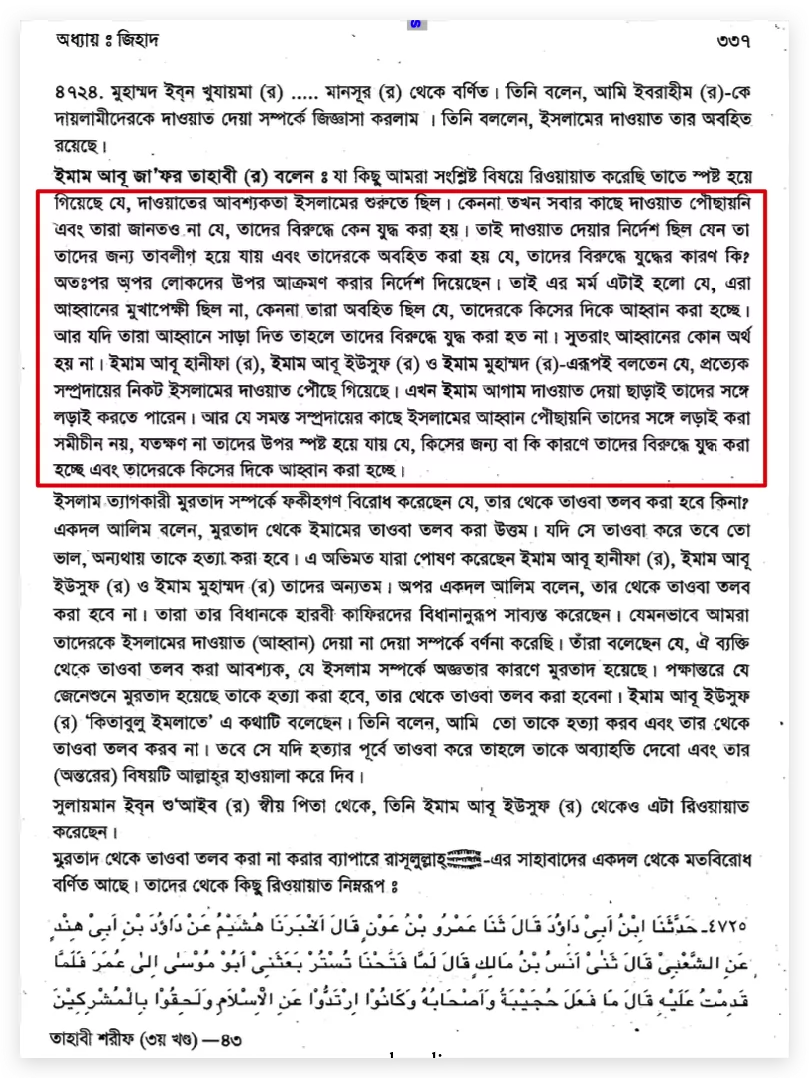
al-Tahawi explained the authorization of attack without issuing a new call based on the argument that the call of Islam had already reached them. In his statement, a call was essential at the beginning because people did not know why war was being waged against them; later, as the propagation of Islam spread, that necessity ended. He further stated that if they had responded to the call, war would not have been waged against them. Consequently, here the call is linked to military pressure alongside the presentation of religious views: since the demand of the call is known, fighting can be conducted without notifying them again. In place of these distinct matters—hearing, consenting, and knowing the news of a subsequent attack—previous religious propagation has been made the basis for authorizing a new expedition [18]
4724. Narrated from Muhammad ibn Khuzaymah (may Allah have mercy on him) ….. from Mansur (may Allah have mercy on him). He said, I asked Ibrahim (may Allah have mercy on him) regarding giving the da’wa (call) to the Daylamites. He said, the call of Islam is known to him.
Imam Abu Ja’far al-Tahawi (may Allah have mercy on him) says: It has become clear from what we have narrated regarding the relevant matter
that the need for the call was at the beginning of Islam. For then, the call had not reached everyone and they did not know why war was being waged against them. Therefore, the instruction to issue the call was so that it would be a tabligh (propagation) for them and they would be informed as to what the reason for the war against them was. Then, the instruction was given to attack the unresponsive people. Therefore, the essence of this is that they were not in need of a call, because they were informed as to what they were being called toward. And if they had responded to the call, war would not have been waged against them. Thus, a call has no meaning. Imam Abu Hanifa (may Allah have mercy on him), Imam Abu Yusuf (may Allah have mercy on him), and Imam Muhammad (may Allah have mercy on him) used to say similarly that the call of Islam has reached every community. Now the Imam can fight them without giving a prior call. And it is not appropriate to fight those communities to whom the call of Islam has not reached, until it becomes clear to them for what or for what reason war is being waged against them and what they are being called toward.
The jurists have differed regarding the apostate (murtad) who leaves Islam, whether repentance (tawba) should be sought from him. One group of scholars says it is better for the Imam to seek repentance from the murtad. If he repents, then it is good; otherwise, he will be killed. Among those who hold this opinion are Imam Abu Hanifa (may Allah have mercy on him), Imam Abu Yusuf (may Allah have mercy on him), and Imam Muhammad (may Allah have mercy on him). Another group of scholars says repentance will not be sought from him. They have applied the ruling of the harbi kafirs (belligerent unbelievers) to his ruling. Just as we have described regarding whether to give them the da’wa (call) of Islam or not. They have said that it is mandatory to seek repentance from that person who became a murtad due to ignorance about Islam. On the other hand, the one who became a murtad knowingly will be killed; repentance will not be sought from him. Imam Abu Yusuf (may Allah have mercy on him) stated this in ‘Kitab al-Imla’. He says, I will kill him and will not seek repentance from him. However, if he repents before being killed, I will exempt him and leave the matter of his (heart) to Allah.
Knowing about a religion is not consent to accept the rule of that religion. Similarly, not responding to a call is not moral permission to establish armed authority over humans. In al-Tahawi’s logic, the receipt of the call and the consequences of refusing it determine the question of war. In place of the free selection of belief, it thus becomes a mandatory demand: the fact that a person knows what he is being asked to accept can be the reason for conducting an expedition against him without a new call. Here, the spread of knowledge is not making humans more free; it is being used as an argument to omit the formal step that existed before applying armed pressure.
Hearing the call of Islam previously and knowing of the arrival of a specific expedition are two different pieces of information. Even if the first is known, it is not known when a force will arrive and strike a settlement. Nafi’s use of the Banu Mustaliq’s unpreparedness as evidence, together with al-Tahawi’s explanation for dispensing with a renewed call, reveals this military advantage. The attacker can conduct the expedition according to his own timing, preparation, and strength; the people of the attacked settlement remain unprepared for the danger of that specific moment. Authorizing this inequality because the religious call had arrived previously prioritizes the convenience of the attacker.
In the latter part of al-Tahawi’s quotation, the same controlling framework exists in the debate over whether repentance should be sought from an apostate. One view permits killing after an opportunity to return to the faith; another permits killing without a renewed call if the person apostatized knowingly. Exemption is also mentioned if the person repents before being killed. Here, the change of belief was not recognized as an individual’s free decision. Returning to an acceptable identity recognized by the religious authority is the means of saving one’s life, and remaining outside that identity is the cause for punishment. Responding to the call, attacking without a new call, and the conditions for returning after apostasy—these rulings subject human conscience to armed authority.
The Legality of Killing Women and Children in the Darkness of Night
The question of women and children being killed in a surprise night attack was raised directly before Muhammad. Their presence and loss of life are clear in the question; the answer given was, ‘They are also among them.’ Based on these words, classical commentators have made a legal distinction between targeting women and children for killing and their being killed while conducting attacks against others. Consequently, alongside the prohibition of killing women and children, authorization was created to conduct such attacks in which their death may occur. In this authorization, the primary target of the attacker has become important; the fact that the woman or child losing their life did not participate in the war was not enough alone to stop the attack [19] [20] [21] [22] [23]
Sahih Muslim (IF)
Chapter: 33/ Jihad and its Principles
Section: 9. There is no sin in the unintentional killing of women and children in a surprise night attack
4399. Narrated from Yahya ibn Yahya, Sa’id ibn Mansur, and Amr an Naqid (may Allah have mercy on them) … from Sa’b ibn Jaththama (may Allah be pleased with him) that, the Messenger of Allah (peace and blessings of Allah be upon him) was asked about the women and children of the polytheists, that when a surprise attack is made in the darkness of night, their women and children are also affected. Then the Messenger of Allah (peace and blessings of Allah be upon him) said: They are also among them (the polytheists).
Hadith Grade: Sahih (authentic)
Sahih Muslim (Hadith Academy)
Chapter: 33. Jihad and Travel
Section: 9.No sin in the unintentional killing of women and children during sudden night attacks
4442-(27/…) Narrated from Abd ibn Humayd (may Allah have mercy on him) ….. from Sa’b ibn Jaththama (may Allah be pleased with him). He said, I asked the Messenger of Allah (sallallahu alaihi wasallam), O Messenger of Allah! During sudden attacks in the darkness of night, we also strike the children of the polytheists. The Messenger of Allah (sallallahu alaihi wasallam) said, they are also counted among them (the polytheist combatants). (Islamic Foundation 4400, Islamic Centre 4400)
Hadith Grade: Sahih (authentic)
Sunan Ibn Majah (Tawhid Publications)
Chapter: 18/ Jihad
1/2839. Narrated from Sa’b ibn Jaththama (may Allah be pleased with him). He said, Regarding sudden attacks on the neighborhoods of polytheists at night, in which women and children are killed, the Prophet (sallallahu alaihi wasallam) was asked. He said: they (women and children) are also included among them.
Hadith Grade: Sahih (authentic)
The information regarding the loss of lives of women and children is present within the question itself. Therefore, this possibility of loss of life was known at the time the permission was granted. The nature of the harm was known even before the decision of whether to carry out the attack. Consequently, the ethical limit of the word ‘unintentional’ becomes apparent: even if there is no intention to kill a specific child, the decision to conduct a lethal operation in a settlement where children are present may be intentional. Not making death the primary goal and continuing the action while knowing the risk of death are separate matters. In the latter case, the attacker still makes the decision, exercises power, and bears responsibility.
In the answer ‘they are also included among them,’ the identity of the affected people is determined as members of the settlement being attacked. Their group membership takes precedence over the individual actions of the women and children or their participation in war. A child’s birth identity is not their military decision; the father’s religion is not their own chosen act of war. Using that relationship as an explanation to authorize the loss of their lives weakens the child’s individual right to safety. The child is considered part of a collective against which the operation is being conducted. This group-centered logic subsumes the individuality of vulnerable people within collective military hostility.
Ibn Hibban’s Chapter Title: Night Attacks Outside the Prohibition
Ibn Hibban has defined the limit of the prohibition in the very title of his chapter: killing women and children intentionally is prohibited, but their being killed by the widespread impact of night attacks and operations is not included in that prohibition. Here, the exception is not merely hidden behind an explanation; it is explicit in the chapter title of the compilation. Thus, the protection of the lives of women and children falls under a different ruling if the nature of the attack changes. This division—considering the same death prohibited if targeted directly and permitted if it occurs during a night operation—centers the classification of the attacker’s actions rather than the preservation of human life. His chapter title, chain of transmission, and statement are together as follows: [24]
ذكر البيان بأن النساء والصبيان من أهل الحرب إنما زجر عن قتلهم في القصد ، دون البيات وغشم الغارة
4786 – أخبرنا الحسن بن سفيان قال : حدثنا أبو بكر بن أبي شيبة قال : حدثنا سفيان عن الزهري عن عبيد الله بن عبد الله عن ابن عباس ، قال [ ص: 108 ] حدثني الصعب بن جثامة ، أن رسول الله صلى الله عليه وسلم سئل عن الذراري من دور المشركين يبيتون ، وفيهم النساء والصبيان ، فقال : هم منهم .
English translation: Explanation that the prohibition on killing the women and children of the enemy applies to killing them by intentionally targeting them, and not to the widespread impact of night attacks and operations.
4786. Hasan ibn Sufyan has informed us. He said, Abu Bakr ibn Abi Shayba narrated to us. He said, Sufyan narrated to us, on the authority of Zuhri, on the authority of Ubaydullah ibn Abdullah, on the authority of Ibn Abbas. Ibn Abbas said [page 108], Sa’b ibn Jaththama informed me that the Messenger of Allah (sallallahu alaihi wasallam) was asked about the children of the polytheist settlements—where night attacks are carried out and where women and children also reside. He said, ‘They are also included among them.’
In this arrangement, the effective limit of the prohibition is determined by the attacker’s target and the method of attack. It did not become mandatory to stop the attack because the death of women and children might occur; not targeting them directly was made the basis for the authorization of the operation. Yet, the decision of the force that determines when to attack and by what method creates the danger for the affected settlement. An attacker cannot be absolved of moral responsibility for a danger they created merely because its consequences were not their primary objective. In evaluating the decision to endanger a human life, the prior knowledge of harm and the decision to continue the operation despite that harm must be considered alongside the intention to strike.
This interpretation separates two questions in determining protection: who is targeted for killing, and whose death is foreseen when the attack is carried out. If the first is prohibited while the second is permitted, the attacker’s own intention becomes a way of keeping the prohibition formally intact. Effective protection of noncombatants also requires limits on methods of attack and known risks. The exception for night raids in Ibn Hibban’s chapter narrows those limits: it retains the prohibition while excluding one category of deaths from its scope.
al-Nawawi’s Explanation: Authorization of Killing in Situations Where They Cannot Be Identified
al-Nawawi has defined the night attack as an operation where men, women, and children cannot be identified separately. He stated that the prohibition of killing women and children applies to situations where they can be separately identified. On the other hand, he mentioned the authorization of their being killed in night attacks as the opinion of his own school of jurisprudence, Malik, Abu Hanifa, and the majority of scholars. In his explanation, the context of following the father’s ruling in inheritance, marriage, qisas, and diya also appeared. Consequently, both the limitation of identifying people during an attack and family identity are effective in the discussion of authorizing loss of life. Simultaneously, as the validity of attacking without new warning is added, the protection of the affected people in their unprepared state is reduced. His complete explanation is: [25]
قوله : ( سئل رسول الله صلى الله عليه وسلم عن الذراري من المشركين يبيتون فيصيبون من نسائهم وذراريهم فقال : هم منهم ) هكذا هو في أكثر نسخ بلادنا ( سئل عن الذراري ) وفي رواية : ( عن أهل الدار من المشركين ) ونقل القاضي هذه عن رواية جمهور رواة صحيح مسلم قال : وهي الصواب ، فأما الرواية الأولى فقال : ليست بشيء ، بل هي تصحيف ، قال : وما بعده هو تبيين الغلط فيه ، قلت : وليست باطلة كما ادعى القاضي بل لها وجه ، وتقديره : سئل عن حكم صبيان المشركين الذين يبيتون فيصاب من نسائهم وصبيانهم بالقتل ، فقال : هم من آبائهم ، أي لا بأس بذلك ; لأن أحكام آبائهم جارية عليهم في الميراث وفي النكاح وفي القصاص والديات وغير ذلك ، والمراد إذا لم يتعمدوا من غير ضرورة .
وأما الحديث السابق في النهي عن قتل النساء والصبيان ، فالمراد به إذا تميزوا ، وهذا الحديث الذي ذكرناه من جواز بياتهم وقتل النساء والصبيان في البيات هو مذهبنا ومذهب مالك وأبي حنيفة والجمهور .
ومعنى ( البيات ، ويبيتون ) أن يغار عليهم بالليل بحيث لا يعرف الرجل من المرأة والصبي .
وأما ( الذراري ) فبتشديد الياء وتخفيفها لغتان ، التشديد أفصح وأشهر ، والمراد بالذراري هنا النساء والصبيان .
وفي هذا [ ص: 408 ] الحديث دليل لجواز البيات ، وجواز الإغارة على من بلغتهم الدعوة من غير إعلامهم بذلك .
وفيه أن أولاد الكفار حكمهم في الدنيا حكم آبائهم ، وأما في الآخرة ففيهم إذا ماتوا قبل البلوغ ثلاثة مذاهب ، الصحيح أنهم في الجنة ، والثاني : في النار ، والثالث : لا يجزم فيهم بشيء . والله أعلم .
English translation: His statement: ‘The Messenger of Allah (sallallahu alaihi wasallam) was asked about the children of the polytheists; night attacks are carried out against them, as a result, their women and children are also affected. He said, they are also included among them.’ In most manuscripts of our region, the phrase ‘asked about the children’ is present in this way. In another narration, it is ‘about the inhabitants of the polytheist settlements.’ The Qadi, citing most narrators of Sahih Muslim, mentioned the second reading and said that it is correct. Regarding the first reading, he said it is nothing; rather, it is a textual corruption, and the subsequent statement reveals its error. I say, the reading is not invalid as the Qadi claimed; it also has a meaning. The meaning is, the ruling regarding the children of those polytheists upon whom night attacks are carried out and whose women and children are killed was asked. He said, they are included with their fathers; meaning, there is no sin in this. Because the rulings of the fathers apply to them in matters of inheritance, marriage, qisas, diya, and other issues. The intent is, provided they are not intentionally targeted without necessity.
The meaning of the previous hadith regarding the prohibition of killing women and children is when they can be separately identified. And the hadith I have mentioned here regarding the validity of night attacks upon them and the killing of women and children in such attacks is the view of our school and of Malik, Abu Hanifa, and the majority of scholars.
‘Bayat’ and ‘yubayyatun’ mean to attack them at night in such a way that men cannot be identified separately from women and children.
In the word ‘dharari’, there are two pronunciations—one with tashdid on the letter ya and one without. The pronunciation with tashdid is more accurate and common. Here, dharari refers to women and children.
In this hadith [page 408], there is evidence for the validity of night attacks and the validity of attacking those to whom the invitation has reached without informing them of the attack.
It further states that the worldly rulings for the children of unbelievers are like the rulings of their fathers. As for their fate in the hereafter if they die before puberty, there are three opinions: the correct opinion is that they will be in Paradise; the second opinion, in Hell; the third opinion, nothing certain can be said about them. Allah knows best.
The inability to distinguish women and children is the situation here where the authorization for loss of life becomes effective. When the capacity to identify combatants and noncombatants among people decreases, the risk of innocent people being hit increases. That increased risk did not create an obligation to suspend the operation; it was accepted within the authorization to continue the attack. Consequently, the disadvantage of darkness becomes a legal advantage for the attacker, and an added danger for the attacked people. The vulnerability of women and children and their inability to identify themselves separately increase their need for security; in the cited explanation, the opportunity to advance the military operation has been prioritized over that need.
In the same discussion, al-Nawawi stated that attacking those to whom the invitation has reached is permissible without notifying them of the attack. In this, the danger of being unprepared regarding timing and the inability to identify oneself as a noncombatant in the dark may coincide. Previous religious calls do not provide notice of this specific attack. The attacker retains the advantage of determining the timing, and the limitations of the attacked people in being identified are also accepted within the authorization of the operation.
There is also a deep ethical problem in the logic of deriving the authorization for the loss of a child’s life from the rule of following the father’s status in inheritance or family law. Determining the inheritance of property and determining the protection of a child in a lethal attack are separate questions. A family relationship does not establish another’s power to kill a child. The identity of the father—which religion he follows or which settlement he inhabits—does not end the child’s status as a noncombatant. Calling the child subject to the father’s status only provides a classification; it does not provide a moral right to endanger their life without any combat action of their own.
In the same explanation, al-Nawawi stated that the view that non-Muslim children who die before adulthood enter Paradise is correct, but he also maintained the authorization for their loss of life in earthly night attacks. Where a child is said to go in the hereafter and whether they will be protected from lethal attacks on earth are two separate questions. The promise of the hereafter does not restore the child’s life, does not remove the loss of their family, and is not an alternative to the moral evaluation of the attacker’s earthly decision. The actual question of the child’s security remains within the earthly action and its consequences.
Ibn al-Mulaqqin: Textual Variants, Targets, and Knowingly Risking Lives
In the same narration, Ibn al-Mulaqqin discussed the textual variants ‘hum minhum’—’they are also among them’ and ‘hum min aba’ihim’—’they belong with their fathers.’ In the first reading, group membership is evident, and in the second, the relationship with the father is evident. In both cases, the identity of women and children is determined by linking them to the combatant collective or the fathers. In his discussion, the differences in the paths of narration and wording of the same event have been preserved. The source of the textual variant and the related explanation are as follows: [26]
ذكر فيه حديث الزهري، عن عبيد الله، عن ابن عباس، عن الصعب بن جثامة قال: مر بي النبي – صلى الله عليه وسلم – بالأبواء – أو بودان – فسئل عن أهل الدار يبيتون من المشركين، فيصاب من نسائهم وذراريهم، قال: “هم منهم”. وسمعته يقول: “لا حمى إلا لله ولرسوله”.
وعن الزهري أنه سمع عبيد الله، عن ابن عباس : قال: ثنا الصعب في الذراري كان عمرو يحدثنا، عن ابن شهاب، عن النبي – صلى الله عليه وسلم – . فسمعناه من الزهري قال: أخبرني عبيد الله، عن ابن عباس، عن الصعب قال: “هم منهم”. ولم يقل كما قال عمرو: “هم من آبائهم”.
[ ص: 181 ] الشرح:
هذا الحديث أخرجه مسلم والأربعة، وبين الإسماعيلي هذا بقوله: قال سفيان: وكان عمه، وحدثناه أولا عن الزهري قبل أن يلقاه فقال: “هم من آبائهم” فلما ثنا الزهري فتقدمه فلم يقل: “هم من آبائهم ” قال: “هم منهم” (ورواه) الطبراني من حديث حماد بن زيد، عن عمرو، عن ابن عباس بلفظ: “هم من آبائهم” لم يذكر الزهري ولا عبيد الله ولا الصعب، رواه عن علي بن عبد العزيز، ثنا حجاج بن منهال وعارم عنه.
English translation: Here he mentioned the hadith of Sa’b ibn Jaththama through Zuhri, Ubaydullah, and Ibn Abbas. Sa’b said, the Prophet (may Allah bless him and grant him peace) passed by me at Abwa or Waddan. He was asked about the night attack on the inhabitants of the polytheist settlements, in which their women and children would also be affected. He said, ‘They are also among them.’ I also heard him say, ‘There is no protected pasture for anyone except Allah and His Messenger.’
Reported from Zuhri, who heard Ubaydullah say on the authority of Ibn Abbas: Sa’b narrated to us regarding the children. Amr used to narrate to us on the authority of Ibn Shihab from the Prophet (may Allah bless him and grant him peace). Later we heard from Zuhri; he said, Ubaydullah informed me, on the authority of Ibn Abbas, on the authority of Sa’b: he said, ‘They are also among them.’ He did not say, ‘They are among their fathers,’ as Amr had said.
[Page 181] Explanation:
This hadith has been narrated by Muslim and the four compilers. Isma’ili, explaining the matter, said: Sufyan said, he was his uncle. Before meeting Zuhri, he first narrated to us on the authority of Zuhri as ‘they belong with their fathers.’ Later, when Zuhri narrated to us, instead of the previous reading, he said ‘they are also among them’ rather than ‘they belong with their fathers.’ Tabarani narrated in the wording ‘they belong with their fathers’ on the authority of Hammad ibn Zayd, Amr, and Ibn Abbas; there, the names of Zuhri, Ubaydullah, and Sa’b are not present. He narrated this on the authority of Ali ibn Abd al-Aziz, who narrated it on the authority of Hajjaj ibn Minhal and Arim from him.
A strict boundary emerges in the legal discussion of Ibn al-Mulaqqin: targeting women and children directly versus their being killed while attempting to kill others. In the cited language of authorization, if there is no way to reach the fathers without the loss of life of their women and children, there is no fault in the attack. Again, in another preserved opinion, if the deaths of women and children cannot be avoided even while targeting others, the attack is prohibited. Consequently, the center of the disagreement is not just the intention of the attacker; it is whether the death of a noncombatant can be accepted to achieve a military objective. The full contextual explanation of the views in his book is: [27]
رابعها: معنى قوله: “هم منهم” يريد كما قال الخطابي في حكم الدين، فإن ولد الكافر محكوم له بالكفر. قال: ولم يرد بهذا القول إباحة دمائهم تعمدا لها وقصدا إليها، وإنما هو إذا لم يصل إلى قتل الآباء إلا بذلك، وإلا فلا يقصدون بالقتل مع القدرة على ترك ذلك.
ومعنى النهي عن قتل النساء والصبيان في الباب الذي بعد هذا أن يقصدوا بالقتل مع القدرة على تمييزهم، إلا أن النساء إذا قاتلن قتلن؛ لأن العلة المانعة من قتلهن عدم القتل فيهن.
وقد اختلف العلماء في العمل بهذا الحديث، فتركه قوم وذهبوا إلى أنه لا يجوز قتل النساء والولدان في الحرب على حال، وأنه لا يحل أن يقصد إلى قتل غيرهم إذا كان لا يؤمن في ذلك تلفهم، مثل أن يتترس أهل الحرب بصبيانهم ولا يستطيع المسلمون منهم إلا بإصابة صبيانهم، فحرام عليهم رميهم، وكذلك إن تحصنوا بحصن أو سفينة وجعلوا فيها نساء وصبيانا أو أسارى مسلمين، فحرام رمي ذلك الحصن وخرق تلك السفينة إذا كان يخاف تلف الأسارى والنساء والصبيان.
[ ص: 183 ] واحتجوا بعموم (نهيه عن قتل النساء والصبيان وبعموم) قوله تعالى: لو تزيلوا لعذبنا الذين كفروا منهم عذابا أليما [الفتح: 25] هذا قول مالك والأوزاعي .
وقال الكوفيون والشافعي : إنما وقع النهي عن قتل النساء والصبيان إذا قصد إلى قتلهم، فأما إذا قصد إلى قتل غيرهم ممن لا يوصل إلى ذلك منه إلا بتلف نسائهم وصبيانهم فلا بأس بذلك.
English translation: Fourth point: The meaning of the phrase ‘they are also among them,’ as Khattabi has said, is in the provisions of religion; the child of an unbeliever is considered subject to the provisions of disbelief. He says, by this, it was not meant that bloodshed is legalized by making them the intention and target. Rather, this provision is for when there is no way but to hit them to kill the fathers; otherwise, if it is possible to avoid them, they will not be targeted for killing.
The meaning of the prohibition of killing women and children in the subsequent chapter is the intention to kill them despite it being possible to identify them separately. However, if women fight, they will be killed; because the reason for not killing them is their not fighting.
There is a difference of opinion among scholars regarding acting upon this hadith. One group, not accepting this, said that under no circumstances of war is it permissible to kill women and children. It is also not permissible to attack targeting others if their deaths cannot be avoided. For example, if the enemy uses their children as shields and Muslims cannot reach them without hitting those children, it is haram to launch an attack on them. Similarly, if they take shelter in a fortress or ship and keep women, children, or Muslim prisoners there, and there is a risk of loss of life for those prisoners, women, and children, it is haram to launch an attack on that fortress or puncture the ship.
[Page 183] They have cited the general statement of the prohibition of killing women and children and the general statement of the verse of Allah ‘Had they become separated, I would have given the disbelievers among them a painful punishment’ [Fath: 25] as evidence. This is the opinion of Malik and al-Awza’i.
The scholars of Kufa and al-Shafi’i said, the prohibition of killing women and children is regarding the intention to kill them. If others are intended to be killed, there is no fault if they cannot be reached without the loss of life of their women and children.
In the cited language of authorization, the attacker’s primary target is another person; the loss of life of women and children is linked to achieving that target. This relationship is not a simple basis for reducing moral responsibility. The situation where there is no way but to hit a child near someone while attempting to hit that person does not create a right to sacrifice the child’s life. Here, the military objective of killing the father and the right to keep the child alive have come face to face. The position of authorization has chosen the fulfillment of the military objective and placed the child’s death within the acceptable results of that action. The life of the noncombatant child thus becomes subject to the objective of war against another.
The cited opinion stating that the attack is prohibited has given a different decision regarding this same danger: even if others are targeted, if it is not possible to avoid the loss of life of women and children, they cannot be hit. Consequently, using the prior knowledge of the death of women and children as a reason to stop the attack appears within this very discussion of jurisprudence. The position of authorization did not accept that limit. The moral value of the prohibition of killing women and children is tested here—whether it will be mandatory to refrain from achieving the military objective in order to save them, in addition to stopping the act of specifically targeting them for killing. The authorized exception removes the second obligation and shrinks the effective scope of their protection.
There are differences in the attribution of opinions: in the discussions of Ibn al-Mulaqqin, a prohibitive opinion is attributed to Malik and al-Awza’i, while al-Nawawi attributes permission for night raids to Malik. The limits of protection are not defined identically in the two accounts. A critical consequence of this authorization is that recognizing the identity of noncombatants and halting an attack to protect those people have become separate decisions. While targeting women and children for separate killing remains prohibited, operations that cause their loss of life are permitted. To promote the legal ruling including such permission as a guarantee of full security for their lives is to distort the meaning of the evidence.
Arson, Flooding, and Catapults in Fortresses Containing Women and Children
The authorization regarding the death of women and children in night attacks is directly related to the rulings on the siege of fortresses and settlements. Questions such as who is inside the fortress, whom the weapons used will strike, and how many noncombatants’ lives may be endangered to achieve military objectives are clearly discussed in classical fiqh. There are separate rulings there regarding arson, flooding with water, cutting off water supplies, and the use of the manjaniq or heavy stone-throwing machines. Consequently, claiming that their security was ensured by merely quoting the prohibition on killing women and children is to suppress half of the evidence. Alongside that prohibition, the fact that their death is authorized in certain attacks is also part of the same war policy.
al-Qarafi: Four Opinions on Attacking a Fortress Even if Women and Children are Present
The Maliki jurist Shihab al-Din al-Qarafi, in his discussion of methods of war, has consolidated the rulings on burning villages and fortresses, flooding them, cutting down fruit trees, and cutting off water to the besieged. Regarding the use of the manjaniq, fire, and flooding in fortresses where women and children are present, he mentions four separate opinions. The question of changes to the ruling if Muslim prisoners are present and the issue of using human shields also appear in the same discussion. The relevant passage reads: [28]
البحث السادس : في وجوه القتال ، في ( الكتاب ) : لا بأس بتحريق قراهم وحصونهم وتغريقها بالماء ، وإخرابها وقطع شجرها المثمر ، وقاله ( ش ) ، وقال [ ص: 408 ] الأئمة : يجاز قطع النخل ونحوه ، لما في مسلم أنه عليه السلام حرق نخل بني النضير . ويحمل قول الصديق – رضي الله عنه – على ما يرجى انتفاع المسلمين به ، وإذا كان مسلم في حصن أو مركب لا يحرق ولا يغرق لقوله تعالى : ( لو تزيلوا لعذبنا الذين كفروا منهم عذابا أليما ) [ الفتح 25 ] ولا يعجبني ذلك إذا كان فيهم ذرية المشركين ونساؤهم ، وإذا خرق العدو سفينة المسلمين جاز خروجهم إلى البحر فرارا من الموت إلى الموت ، ولم يره ربيعة إذا طمع في النجاة أو الأسر ، وقال ربيعة أيضا : الصبر أفضل ، ولا يلقي الرجل نفسه بسلاحه ليغرق بل يثبت لأمر الله تعالى ، وفي ( الجواهر ) : يجوز إرسال الماء عليهم وقطعه عنهم لقوله تعالى : ( وأعدوا لهم ما استطعتم من قوة ومن رباط الخيل ) [ الأنفال 60 ] وفي النار خلاف ما لم يكن عندهم أسارى المسلمين فلا يجوز ، ولو تترسوا بالنساء والصبيان تركناهم إلا أن يخاف على المسلمين ، فإن تترسوا بمسلم تركوا ، وإن خفنا على أنفسنا ; لأن دم المسلم لا يباح بالخوف ، فإن تترسوا في الصف ولو تركوا لانهزم المسلمون وخيف استئصال قاعدة الإسلام أو جمهور المسلمين وأهل القوة منهم ، وجب الدفع وسقط مراعاة الترس ، ولا يجوز حمل رءوس الكفار من بلد إلى بلد ولا إلى الولاة ، وقد كرهه الصديق – رضي الله عنه – وقال : هذا فعل العجم ، قال صاحب ( البيان ) : ترمى الحصون بالمنجنيق ، وإن كان فيهم نساء وصبيان فقد رمى أهل الطائف بالمنجنيق ، فقيل له : يا رسول الله ، إن فيهم النساء والصبيان ، فقال عليه السلام : هم من آبائهم ) وإذا لم يكن بالحصن إلا المقاتلة : أجاز في ( الكتاب ) [ ص: 409 ] رميها بالنار ، وروي عنه المنع ، وإذا كان معهم النساء والصبيان فأربعة أقوال : يجوز المنجنيق دون التغريق والتحريق ، وهو مذهب ( الكتاب ) ، ويجوز جميع ذلك عند أصبغ ، ومنع جميع ذلك مروي عن ابن القاسم ، ويجوز التغريق والمنجنيق دون التحريق عند ابن حبيب ، فإن كان معهم أسارى للمسلمين امتنع التحريق والتغريق ، قال ابن القاسم : يجوز المنجنيق وقطع الماء عنهم ، وروي منع ذلك عن مالك وأصحابه المصريين والمدنيين ، وأما السفن إن لم يكن فيها أسارى المسلمين جاز التحريق ، والفرق بينها وبين الحصون أنهم إذا لم يحرقوهم فعلوا بهم ذلك ، وهو متعذر عليهم في الحصون ، فإن كان فيهم الأسارى فمنع ابن القاسم ، وجوز أشهب وإن كان فيهم النسوان والصبيان جاز قولا واحدا ، والمدرك في هذه الأحكام قوله تعالى : ( يخربون بيوتهم بأيديهم وأيدي المؤمنين ) [ الحشر 2 ] وقوله تعالى : ( ما قطعتم من لينة أو تركتموها قائمة على أصولها فبإذن الله وليخزي الفاسقين ) [ الحشر 5 ] وقال عليه السلام : ( لا يعذب بالنار إلا رب النار )
English translation: Sixth Discussion: Methods of War. It is stated in ‘al-Kitab’: there is no harm in burning their villages and fortresses with fire, flooding them with water, destroying them, and cutting down fruit-bearing trees. Al-Shafi’i also said this. [Page 408] The Imams have stated that cutting date palms and similar trees is permissible; for it is in Muslim that he (peace be upon him) burned the date palms of Banu Nadir. The statement of the Siddiq (may Allah be pleased with him) will be considered applicable to such assets that are expected to be of benefit to the Muslims. If Muslims are in a fortress or ship, it shall not be burned or sunk; the Word of Allah: ‘Had they been separated, I would have given the disbelievers among them a painful punishment’ [al-Fath: 25]. Even if the children and women of the polytheists are there, such an action is not my preference. If the enemy punctures the ships of the Muslims, they are permitted to enter the sea to escape from one state of death to another. Rabi’a did not authorize this if there is hope of survival or being taken prisoner. Rabi’a further stated that patience is better. An individual shall not throw himself into the water with weapons to drown; rather, he shall remain steadfast awaiting the decision of Allah.
It is stated in ‘al-Jawahir’: it is permissible to direct water toward them and to cut off their water; the Word of Allah: ‘Prepare against them whatever strength and ready cavalry you can’ [al-Anfal: 60]. There is disagreement regarding the use of fire, provided they do not have Muslim prisoners; if there are Muslim prisoners, it is not permissible. If they use women and children as shields, we shall refrain from attacking, unless there is a fear of danger to the Muslims. If they use a Muslim as a shield, the attack shall be stopped, even if there is fear for oneself; for a Muslim’s blood does not become permissible due to fear. However, if they use shields in the ranks of war and if ceasing the attack would lead to the fear of defeat for the Muslims and the annihilation of the foundation of Islam, the majority of Muslims, or their powerful contingent, then resistance becomes mandatory and the obligation to consider the protection of the person used as a shield is waived. It is not permissible to carry the heads of the unbelievers from one country to another or to rulers. The Siddiq (may Allah be pleased with him) disliked this and stated that it is the practice of non-Arabs.
The author of ‘al-Bayan’ stated that the manjaniq shall be used to launch projectiles into the fortress, even if women and children are there. He used the manjaniq against the people of Ta’if. He was told, ‘O Messenger of Allah, there are women and children there.’ He (peace be upon him) said, ‘They are included with their fathers.’ If only combatants are in the fortress, ‘al-Kitab’ [Page 409] permits the use of fire; there is also a report of prohibition from him. If women and children are with them, there are four opinions: the manjaniq is permissible, but flooding and burning are not—this is the opinion of ‘al-Kitab’; according to Asbagh, all of these are permissible; all are prohibited—such an opinion is reported from Ibn al-Qasim; according to Ibn Habib, flooding and the manjaniq are permissible, but burning is not.
If Muslim prisoners are with them, burning and flooding shall be prohibited. Ibn al-Qasim stated that the use of the manjaniq and cutting off their water is permissible. There are reports of this being prohibited from Malik and his followers in Egypt and Medina. In the case of ships, burning is permissible if there are no Muslim prisoners. The difference from a fortress is that if Muslims do not burn them, they will do the same to the Muslims; in the case of a fortress, it is not possible for them to do so. If Muslim prisoners are there, Ibn al-Qasim prohibited it and Ashhab permitted it. If women and children are there, it is permissible by consensus. The basis for these rulings is the Word of Allah: ‘They destroy their own houses with their own hands and the hands of the believers’ [al-Hashr: 2], and His Word: ‘That you cut down the date-palms or left them standing on their roots was by permission of Allah and to disgrace the defiantly disobedient’ [al-Hashr: 5]. He (peace be upon him) said, ‘No one punishes with fire except the Lord of the Fire.’
| Opinions in al-Qarafi’s Account | Manjaniq | Flooding with Water | Arson |
|---|---|---|---|
| Opinion of ‘al-Kitab’ | Authorized | Prohibited | Prohibited |
| Opinion of Asbagh | Authorized | Authorized | Authorized |
| Opinion reported from Ibn al-Qasim | Prohibited | Prohibited | Prohibited |
| Opinion of Ibn Habib | Authorized | Authorized | Prohibited |
All four opinions in the table pertain to fortresses containing women and children. The opinion attributed to Asbagh authorizes all three: fire, water, and the manjaniq. According to ‘al-Kitab’, while fire and flooding are stopped, the manjaniq is not; according to Ibn Habib, flooding is authorized, but fire is prohibited. That is, despite the presence of women and children remaining the same, their protection changes according to the means of attack. Prohibiting one specific method does not protect the lives of the people inside the fortress; the impact of other authorized means still reaches them.
The manjaniq is a means of striking a fortress by launching heavy objects from a distance. If permission for this method is given while acknowledging the presence of women and children in the fortress, their shelter is kept within the scope of military strikes. In the case of fire and flooding as well, the spread of danger is not limited to the body of a specific combatant. When houses, shelters, and paths of movement are attacked, the vulnerable people there lose the opportunity to escape and protect themselves. The power to choose the authorized means lies with the attacker, but the responsibility to survive its widespread impact falls upon the besieged people.
The ethical significance of the disagreement here is that the information regarding the presence of women and children with the combatants is known in every position. The opinion of prohibition made that presence a limit to the attack; the opinion of authorization accepted the risk to them in order to maintain military means. Consequently, the dispute is not merely over the name of the weapon—but also over how much the noncombatants present there can be endangered to capture a fortress. Suppressing this part of the authorization while promoting the security of women and children conceals the actual danger to the attacked people.
In the same quotation, the conditions for removing protection in the case of using women and children as shields and using a Muslim as a shield are also different. In the first case, an exception arises due to the fear of danger to the Muslim army; in the case of a Muslim shield, ordinary fear for one’s own safety was not considered sufficient, and later an exception for a larger military disaster was mentioned. Therefore, the religious and political status of the person exposed to attack matters in determining the level of protection. The lives of two people standing before the same weapon are protected to different limits according to their relationship with the attacker. This difference gives special value to group membership over equal human dignity in the protection of life.
al-Nawawi: Siege, Flooding, and Surprise Attacks
In Rawdat al-Talibin, al-Nawawi permits the siege of settlements and forts despite the presence of women and children, including blocking entry and exit, throwing fire and naphtha, flooding, and conducting night attacks while the enemy is unaware. He also discusses the situation of using women and children as shields, distinguishing between cases where there is military necessity and where there is none. While mentioning the view that attacks are prohibited if there is no necessity, he ultimately gives priority to permission in both discussed scenarios: [29]
التاسعة : يجوز للإمام محاصرة الكفار في بلادهم ، والحصون والقلاع ، وتشديد الأمر عليهم بالمنع من الدخول والخروج ، وإن كان فيهم النساء والصبيان ، واحتمل أن يصيبهم ، ويجوز التحريق بإضرام النار ورمي النفط إليهم ، والتغريق بإرسال الماء ، ويبيتهم وهم غافلون ، ولو تترسوا بالنساء والصبيان ، نظر إن دعت ضرورة إلى الرمي والضرب ، بأن كان ذلك في حال التحام القتال ولو تركوا لغلبوا المسلمين ، جاز الرمي والضرب ، وإن لم تكن ضرورة ، بأن كانوا يدفعون بهم عن أنفسهم واحتمل الحال تركهم ، فطريقان . [ ص: 245 ] أصحهما : على قولين ، أحدهما : يجوز رميهم ، كما يجوز نصب المنجنيق على القلعة وإن كان يصيبهم ، ولئلا يتخذوا ذلك ذريعة إلى تعطيل الجهاد . والثاني : المنع ، وهذا أصح عند القفال . ومال إلى ترجيح الأول مائلون .
والطريق الثاني : القطع بالجواز ورد المنع إلى الكراهة ، وقيل : في الكراهة على هذا قولان ، ولو تترسوا بهم في القلعة ، فقيل : هذه الصورة أولى بالجواز ، لئلا يتخذ ذلك حيلة إلى استبقاء القلاع لهم ، وفي ذلك فساد عظيم ، وقيل : قولان ، وإن عجزنا عن القلعة إلا به .
قلت : الراجح في الصورتين ، الجواز . والله أعلم .
ولو كان في البلدة أو القلعة مسلم ، أو أسير ، أو تاجر ، أو مستأمن ، أو طائفة من هؤلاء ، فهل يجوز قصد أهلها بالنار والمنجنيق وما في معناهما ؟ فيه طرق ، المذهب : أنه إن لم يكن ضرورة ، كره ولا يحرم على الأظهر لئلا يعطلوا الجهاد بحبس مسلم فيهم ، وإن كانت ضرورة ، كخوف ضررهم ، أو لم يحصل فتح القلعة إلا به ، جاز قطعا ، والطريق الثاني : لا اعتبار بالضرورة ، بل إن كان ما يرمى به يهلك المسلم ، لم يجز ، وإلا فقولان ، والثالث وبه أجاب صاحب ” الشامل ” : إن كان عدد المسلمين الذين فيهم مثل المشركين ، لم يجز رميهم ، وإن كان أقل ، جاز ؛ لأن الغالب أنه لا يصيب المسلمين ، والمذهب : الجواز ، وإن علم أنه يصيب مسلما وهو نصه في ” المختصر ” لأن حرمة من معنا أعظم حرمة ممن في أيديهم ، فإن هلك منهم هالك ، فقد رزق الشهادة ، قاله أبو إسحاق ، ولو رمى بشيء منها إلى القلعة ، أو [ ص: 246 ] البلدة ، فقتل مسلما ، فإن لم يعلم أن فيها مسلما ، لم يجب إلا الكفارة ، وإن علم ، وجبت الدية والكفارة ، حكاه الروياني .
English translation: Ninth: It is permissible for the ruler to besiege the lands, forts, and castles of the unbelievers and to exert pressure on them by blocking entry and exit, even if women and children are present there and there is a risk of them being hit. It is permissible to burn them by lighting fires and throwing naphtha, to drown them by directing water at them, and to attack at night while they are unaware. If they use women and children as shields, the circumstances must be examined: if there is a need for throwing and striking—such as when close combat is ongoing and if they are left alone they will defeat the Muslims—then throwing and striking is permissible. If there is no necessity—such as if they have placed them in front for their own protection and there is an opportunity to leave them—there are two approaches. [Page 245] According to the sounder approach, there are two opinions: First, launching projectiles at them is permissible; just as it is permissible to set up a catapult against a castle even if it hits them, so that they do not make this a means to stop jihad. Second, it is prohibited; this is more authentic according to al-Qaffal. Some have given priority to the first opinion.
Second approach: Permission is unqualified, and the prohibition is taken in the sense of being disliked. It is stated that according to this approach, there are also two opinions on whether it is disliked. It is said that if they make them shields in the castle, permission in this state is more reasonable, so that they do not use this as a strategy to keep the castle in their possession; for in that there is great harm. It is also said that there are two opinions, even if capturing the castle is not possible except by this means.
I say, the preferred opinion in both cases is permission. Allah knows best.
Whether it is permissible to target the inhabitants of a settlement or castle using fire, catapults, and similar means if there are Muslims, prisoners, merchants, persons under safe-conduct, or a group of them there—there are several approaches to this. The position adopted by the school of jurisprudence is that it is disliked if there is no necessity, but according to the more explicit view, it is not haram; so that they do not stop jihad by holding a Muslim captive among them. If there is necessity—such as fear of harm from them or if the castle cannot be conquered otherwise—it is undoubtedly permissible. Second approach: Necessity is not considered; rather, if the thrown object kills a Muslim, it is not permissible; otherwise, there are two opinions. Third approach, as stated by the author of ‘al-Shamil’: if the number of Muslims there is equal to the polytheists, throwing is not permissible; if fewer, it is permissible, because the general probability is that the Muslims will not be hit. The adopted view of the school is permission, even if it is known that it will hit a Muslim. This is also his explicit statement in ‘al-Mukhtasar’; because the protection of the person with us is greater than the protection of the person in their hands. If any of them die, he has attained martyrdom—Abu Ishaq has said this. If any of these objects are thrown toward a castle or [Page 246] settlement and kill a Muslim, if it was not known that a Muslim was there, only kaffara is mandatory. If it was known, diya and kaffara are mandatory. Ruwani has narrated this.
The pressure of blocking entry and exit during a siege affects the entire settlement. Along with the combatants inside, women and children also remain trapped within those closed paths and the uncertainty of shelter. The need for food, water, and safe movement exists for people not participating in the war as well. According to al-Nawawi’s permission, the siege can be tightened despite knowing the risk of them being hit. In this, residence in the settlement itself exposes people to military pressure; while breaking the resistance of the combatants, endangering the daily survival conditions of other residents is permitted.
Regarding the use of women and children as shields, al-Nawawi distinguished between situations where military necessity exists and where it does not. Even after mentioning the opinion of prohibition when there is no necessity, he gave priority to permission in the discussed scenarios. Arguments were presented in favor of this to prevent the strategy of holding the castle or stopping jihad. Consequently, the limit of permission extends beyond the need to prevent immediate defeat. To preserve the advantage of continuing the campaign in the future, the danger to the women and children currently in front is accepted. This is where the ethical problem of placing military continuity above the protection of noncombatants lies.
Regarding the presence of Muslims inside the fort, al-Nawawi’s adopted position permits throwing even knowing that they will be hit in specific circumstances. In the same discussion, the protection of people ‘with us’ is described as greater than that of people ‘in their hands.’ Consequently, even for members of the same religion, the value of a person’s safety changes based on their position. A person captive in the hands of the enemy has the least control over their own circumstances; that helpless state places them within a reckoning where the interests of the force outside carry more weight.
In the explanation quoted from Abu Ishaq, the deceased person has attained martyrdom. This is a description of the religious status of his death; it does not answer the question of whether the individual consented to being hit. The decision to end his life was made by others. Later, provisions for determining the liability of diya and kaffara are mentioned, which distribute the liability after death. Permission to attack, the religious designation of the death, and subsequent compensation together form a complete system of jurisprudence; within that system, the right of the captive person to make decisions about their own life remains subordinate to military objectives.
Human Shields: Individual Life versus the Interests of the Military Collective
In the subsequent subsection of Rawdat al-Talibin, there is a separate discussion on making Muslim prisoners human shields. Throwing is prohibited if there is no necessity; there is a difference of opinion if the necessity of close combat arises. The preferred argument in favor of permission is that the harm of refraining from attack is greater than the harm of attacking, and for the collective protection of Islam, the harm of one group can be accepted. At the end of the discussion, the provisions for making dhimmis, persons under safe-conduct, and slaves as shields are also mentioned: [30]
فرع
لو تترس الكفار بمسلمين من الأسارى وغيرهم ، نظر إن لم تدع ضرورة إلى رميهم واحتمل الحال الإعراض عنهم ، لم يجز رميهم ، فإن رمى رام ، فقتل مسلما قال البغوي : هو كما لو قتل مسلما في دار الحرب ، إن علمه مسلما لزمه القصاص ، وإن ظنه كافرا فلا قصاص وتجب الكفارة ، وفي الدية قولان ، وإن دعت ضرورة إلى رميهم ، بأن تترسوا بهم في حال التحام القتال وكانوا بحيث لو كففنا عنهم ظفروا بنا ، وكثرت نكايتهم فوجهان ، أحدهما : لا يجوز الرمي إذا لم يمكن ضرب الكفار إلا بضرب مسلم ؛ لأن غايته أن نخاف على أنفسنا ، ودم المسلم لا يباح بالخوف بدليل صورة الإكراه ، والثاني وهو الصحيح المنصوص ، وبه قطع العراقيون : جواز الرمي على قصد قتال المشركين ، ويتوقى المسلمين بحسب الإمكان ؛ لأن مفسدة الإعراض أكثر من مفسدة الإقدام ، ولا يبعد احتمال طائفة للدفع عن بيضة الإسلام ومراعاة للأمور الكليات ، فإن جوزنا الرمي ، فرمى وقتل مسلما ، فلا قصاص ، فتجب الكفارة ، وفي الدية طرق ، أصحها وظاهر النص ، وبه قال المزني وابن سلمة : إن علم أن المرمي مسلم ، وجبت ، وإلا فلا . والثاني قاله أبو إسحاق : إن قصده بعينه ، وجبت ، سواء علمه مسلما أم لا ، وإلا فلا ، والثالث : قولان مطلقا ، والرابع قاله ابن الوكيل : إن علم أن هناك مسلما ، وجبت ، وإلا فقولان ، وإن لم نجوز الرمي ، فرمى وقتل ، ففي وجوب القصاص طريقان ، أحدهما قولان ، كالمكره ، والثاني : يجب قطعا ، كالمضطر إذا قتل رجلا ليأكله ، بخلاف المكره ، فإنه ملجأ ، ولأن هناك من يحال عليه وهو المكره .
[ ص: 247 ] ولو تترس الكفار بذمي أو مستأمن أو عبد ، فالحكم في جواز الرمي والدية والكفارة كما ذكرنا ، لكن حيث تجب دية ، يجب في العبد قيمته ، وفي ” التهذيب ” أنه لو تترس كافر بترس مسلم ، أو ركب فرسه ، فرماه مسلم فأتلفه ، فإن كان في غير التحام ، أو في التحام وأمكنه أن يتوقى الترس والفرس ، ضمن ، وإن لم يمكنه في الالتحام الدفع إلا بإصابته ، فإن جعلناه كالمكره ، لم يضمن ؛ لأن المكره في المال يكون طريقا في الضمان ، وهنا لا ضمان على الحربي حتى يجعل المسلم طريقا ، وإن جعلناه مختارا ، لزمه الضمان .
English translation: Subsection.
If the unbelievers use captives or other Muslims as shields, it must be determined: if there is no need to launch projectiles toward them and there is an opportunity to leave them be, then launching projectiles is not permissible. If someone launches a projectile and kills a Muslim, al-Baghawi stated that this is like killing a Muslim on the battlefield: if he knew the person was a Muslim, qisas is mandatory; if he thought the person was an unbeliever, qisas is not mandatory, kaffara is mandatory, and there are two opinions regarding the diya. If the need to launch projectiles toward them arises—such as during close combat when they have used them as shields and if we stop attacking, they will defeat us and cause extensive damage—there are two opinions. First, if it is not possible to strike the unbelievers without hitting a Muslim, launching projectiles is not permissible; because at most, we fear for our own lives, and fear does not make the blood of a Muslim permissible, as seen in the example of being coerced by force. Second, which is the correct and clearly narrated opinion and has been definitively accepted by the scholars of Iraq: launching projectiles for the purpose of fighting the polytheists is permissible, and Muslims must be avoided as much as possible. This is because the harm of refraining is greater than the harm of proceeding. To protect the main body of Islam and considering the overall interest, it is not impossible that one group will bear the loss.
If we say launching projectiles is permissible and someone launches one and kills a Muslim, qisas will not be mandatory; kaffara will be mandatory, and there are several views regarding the diya. The opinion consistent with the more authentic and clear statement, as mentioned by al-Muzani and Ibn Salama, is: if the person who was hit was known to be a Muslim, diya is mandatory; otherwise, it is not. The second view, stated by Abu Ishaq: if that specific person was targeted, diya is mandatory whether he was known to be a Muslim or not; if not specifically targeted, it is not. Third, there are two opinions in all cases. Fourth, Ibn Waqil stated: if it was known that a Muslim was present there, diya is mandatory; if not known, there are two opinions. Even if we do not say launching projectiles is permissible, if someone launches one and kills, there are two views regarding the necessity of qisas. First, two opinions similar to the person coerced by force. Second, qisas is undoubtedly mandatory, such as when a person driven by starvation kills another person to eat them; the matter of the person coerced by force is different, because he is forced and there is another person—the one applying the force—to whom responsibility for the act can be attributed.
[Page 247] If the unbelievers use a dhimmi, a person under safe-conduct, or a slave as a shield, the rules for permission to launch projectiles, diya, and kaffara are the same as before; however, where diya is mandatory, in the case of a slave, his value shall be mandatory. It is stated in ‘al-Tahdhib’: if an unbeliever protects himself using a Muslim’s shield or rides his horse, and the Muslim destroys it by launching a projectile—if it is outside of close combat, or if in close combat there was an opportunity to avoid the shield and horse—compensation must be paid. In close combat, if there was no way to repel him except by striking it, and if we consider him like a person coerced by force, compensation need not be paid. This is because in the case of property, the person acting under coercion serves as the intermediary through whom liability for compensation is enforced; here, the non-Muslim combatant bears no such liability for compensation for which the Muslim could be treated as the intermediary. And if we consider him a free decision-maker, compensation is mandatory.
Using someone as a human shield is placing them in front of danger against their will. The decision of whether the opposing force will strike after knowing of their presence controls their life a second time. The first oppression by the enemy does not grant the moral right to sacrifice the victim for the interests of the other party. In the permission al-Nawawi favors, the primary goal is fighting the polytheists, with the condition of avoiding Muslims as much as possible. Yet, for those who cannot be avoided, their life may become an acceptable loss in the reckoning of collective military necessity.
The inequality is significant regarding who makes the decision and who pays the price under the logic of bearing the loss of one group to protect the ‘main body of Islam’. Military decisions are made by the force and the leadership; the people trapped as shields have no opportunity to state their decision or move away. If they are assumed to be self-sacrificers, the difference between being forced into danger and voluntarily taking a risk is suppressed. Just because a larger objective is declared sacred does not mean the life of a helpless person becomes property subordinate to that objective.
At the end of the discussion, there are provisions for liability in the case of a dhimmi, a person under safe-conduct, and a slave, including payment of a slave’s value. Compensation for people killed by the same strike also receives different language according to their legal status. Specifically, the calculation of a slave’s death being determined by the value of ownership reveals a framework that regards humans as property. Consequently, in the question of human shields, alongside military necessity, religious identity, recognized protection, and property relations also determine the position of the affected person.
Ibn Qudama: Permission to Launch Projectiles, Whether Combat is Close or Not
The Hanbali jurist Ibn Qudama has given permission to launch projectiles targeting combatants if women and children are used as shields. His argument is that if they refrain, the enemy will be able to stop jihad using the same method. He clarified that whether or not close combat is taking place—permission applies in both cases: [31]
( 7757 ) ( 7577 ) فصل : وإن تترسوا في الحرب بنسائهم وصبيانهم ، جاز رميهم ، ويقصد المقاتلة ; { لأن النبي صلى الله عليه وسلم رماهم بالمنجنيق ومعهم النساء والصبيان } ، ولأن كف المسلمين عنهم يفضي إلى تعطيل الجهاد ، لأنهم متى علموا ذلك تترسوا بهم عند خوفهم فينقطع الجهاد . وسواء كانت الحرب ملتحمة أو غير ملتحمة ; لأن النبي صلى الله عليه وسلم لم يكن يتحين بالرمي حال التحام الحرب .
English translation: (7757) (7577) Subsection: If they use their women and children as shields in war, it is permissible to launch projectiles toward them and the combatants must be targeted. This is because the Prophet (may Allah’s peace and blessings be upon him) launched projectiles at them with a catapult, even though women and children were among them. And if Muslims refrain from their attack, it leads toward the cessation of jihad; because if they know this, they will use them as shields in times of danger and jihad will stop. Whether or not close combat is taking place, the ruling is the same; because the Prophet (may Allah’s peace and blessings be upon him) did not wait for the moment of close combat to launch projectiles.
Ibn Qudama clarified that whether or not close combat is taking place, the permission to launch projectiles is the same. Therefore, his argument cannot be limited only to immediate self-defense in face-to-face fighting. The primary concern is that if the enemy learns that placing women and children in front makes the Muslim force stop, it can use that method to halt jihad. That is, the fear of a military initiative being hindered in the future becomes the reason for accepting the danger to women and children present now. Here, their safety is treated as subordinate to the capability of keeping the operation going.
The instruction to target combatants determines the purpose of the strike. But it does not separate those women and children, who are in front of or behind the combatants, from the strike of the weapons. The decision to take the risk is contained within the permission not to stop the attack due to their presence. Therefore, the fact that the attacker’s target is another person does not end the question regarding the cause of the strike hitting a child’s body; the decision to launch weapons and the known danger are part of the same act.
This argument narrows the effective scope of a protective rule out of fear that observing it might give the enemy an advantage. Whenever the presence of innocent people obstructs military action, permission is created to overcome that obstacle. Protection establishes a real constraint for those affected when it remains effective even where it conflicts with military advantage. Authorizing risks to women and children in order to keep an expedition advancing shifts that constraint according to the attacker’s needs.
The Siege of Ta’if: Catapult, Protected Siege Vehicles, and Destruction of Gardens
In the account of the siege of Ta’if, Ibn Kathir has preserved the use of catapults, attempts to break the fortress walls, and orders to cut down vineyards, citing Ibn Ishaq, Ibn Hisham, and al-Waqidi. The ‘dabbaba’ used there was a protected siege vehicle that shielded the attackers to reach the walls. The same sequence of accounts includes calls for several women to come out for fear they would be enslaved if the fortress fell, as well as a request to spare a particular garden: [32]
قال محمد بن إسحاق : وكان مع رسول الله صلى الله عليه وسلم امرأتان من نسائه ، إحداهما أم سلمة ، فضرب لهما قبتين ، فكان يصلي بينهما ، فحاصرهم وقاتلهم قتالا شديدا ، وتراموا بالنبل .
قال ابن هشام : ورماهم بالمنجنيق ، فحدثني من أثق به أن النبي صلى الله عليه وسلم أول من رمى في الإسلام بالمنجنيق ; رمى به أهل الطائف .
وذكر ابن إسحاق أن نفرا من الصحابة دخلوا تحت دبابة ، ثم زحفوا [ ص: 72 ] ليخرقوا جدار أهل الطائف فأرسلت عليهم ثقيف سكك الحديد محماة ، فخرجوا من تحتها ، فرمتهم ثقيف بالنبل ، فقتلوا منهم رجالا ، فحينئذ أمر رسول الله صلى الله عليه وسلم بقطع أعناب ثقيف ، فوقع الناس فيها يقطعون .
قال : وتقدم أبو سفيان بن حرب والمغيرة بن شعبة فناديا ثقيفا بالأمان حتى يكلماهم ، فأمنوهما ، فدعوا نساء من قريش وبني كنانة ليخرجن إليهم – وهما يخافان عليهن السباء إذا فتح الحصن – فأبين ، فقال لهما ابن الأسود بن مسعود : ألا أدلكما على خير مما جئتما له؟ إن مال بني الأسود بن مسعود حيث قد علمتما – وكان رسول الله صلى الله عليه وسلم نازلا بواد يقال له : العقيق . وهو بين مال بني الأسود وبين الطائف – وليس بالطائف مال أبعد رشاء ولا أشد مؤونة ولا أبعد عمارة منه ، وإن محمدا إن قطعه لم يعمر أبدا ، فكلماه فليأخذه لنفسه أو ليدعه لله وللرحم . فزعموا أن رسول الله صلى الله عليه وسلم تركه لهم .
وقد روى الواقدي عن شيوخه نحو هذا ، وعنده أن سلمان الفارسي هو الذي أشار بالمنجنيق وعمله بيده ، وقيل : قدم به وبدبابتين . فالله أعلم .
English translation: Muhammad ibn Ishaq said, two of the wives of the Messenger of Allah (sallallahu alayhi wa sallam) were with him; one of them was Umm Salama. He set up two tents for them and would pray between them. He besieged them, fought them fiercely, and both sides shot arrows.
Ibn Hisham said, he fired projectiles at them with a catapult. Someone I trust informed me that the Prophet (sallallahu alayhi wa sallam) was the first in Islam to fire projectiles with a catapult; he used it against the people of Ta’if.
Ibn Ishaq mentioned that several companions entered under a protected siege vehicle [page 72] to penetrate the walls of the people of Ta’if. The Sakif threw heated iron rods upon them. When they emerged from there, Thaqif shot arrows at them and killed several. Then the Messenger of Allah (sallallahu alayhi wa sallam) ordered the cutting of Thaqif’s grapevines. The people began cutting them.
He says, Abu Sufyan ibn Harb and Mughira ibn Shuba stepped forward and sought safe-conduct to speak with Thaqif. They granted them safe-conduct. They asked several women of the Quraysh and Banu Kinana to come out to them; they feared that if the fortress were captured, those women would become captives. The women did not agree. Ibn Aswad ibn Mas’ud said to them, “Shall I inform you of something better than the purpose for which you have come? You know where the garden of Banu Aswad ibn Mas’ud is. The Messenger of Allah (sallallahu alayhi wa sallam) was then stationed in a valley called Aqiq, which is between the garden of Banu Aswad and Ta’if. In no garden in Ta’if must water be drawn from deeper, nor is more labor required, nor is there cultivation further away. If Muhammad cuts it, it will never be cultivated again. Tell him to either take it for himself or leave it for the sake of Allah and kinship.” According to their account, the Messenger of Allah (sallallahu alayhi wa sallam) left it for them.
Waqidi narrated a similar account through his teachers. In his account, Salman al-Farsi suggested the use of a catapult and constructed it with his own hands. It is also stated that he brought one catapult and two protected siege vehicles. Allah knows best.
In the account of Ta’if, the catapult, the protected siege vehicle, the attempt to break the walls, and the counter-attack of arrows are part of the same military operation. Here, two methods were used to break the resistance of the fortress: striking from a distance and penetrating the walls by approaching. Classical jurists have cited this campaign as a precedent for permission to use catapults. Consequently, a narrated military action became the basis for legitimacy in subsequent war policies and played an effective role in discussions regarding the permission to strike while women and children were present.
The order to cut the grapevines extends the war beyond the walls of the fortress to the sources of livelihood. Fruit-bearing trees are part of a settlement’s food, income, and future production. If they are destroyed, the loss does not fall only upon the person conducting the military resistance; the families dependent on those resources and their future way of life are also struck. Therefore, the garden owner’s claim that it would be difficult to cultivate again is significant. The duration of the loss extends beyond the immediate clash of war into future labor and livelihood.
The same account states that the specific garden was later protected. That appeal shows the owner in a state where, to save his source of livelihood, he had to request the attacker to either take the property or leave it for the sake of kinship. Control over whether the garden would be destroyed or not lay in the hands of the military leader. The same account also mentions the fear of captivity as the reason for calling several women to leave the fortress. Consequently, the danger of losing property and the danger of losing freedom were present side by side under the pressure of the siege.
Reasons for These Attacks
After military power became linked with Muhammad’s preaching, there are direct precedents for using armed force to enforce religious obedience. Campaigns were conducted under his orders to destroy the idols and places of worship of the polytheists. The freedom of people to practice their own religion and to refuse to make religious declarations became endangered in the face of this force. It is narrated in the hadith that Muhammad said that he was commanded to conduct qital or armed war against people until they acknowledge that ‘there is no god but Allah’ [33] [34] –
Sunan al-Tirmidhi (verified)
38/ Iman
Chapter: 1. I have been commanded to fight against people until they say “la-ilaha illallah”
2607. Narrated from Abu Hurayrah (may Allah be pleased with him), he said, after the death of the Messenger of Allah (sallallahu alayhi wa sallam) when Abu Bakr (may Allah be pleased with him) was elected as Caliph, a number of people in Arabia became unbelievers. Umar ibn al-Khattab (may Allah be pleased with him) said to Abu Bakr (may Allah be pleased with him), “How will you take up arms against them, whereas the Messenger of Allah (sallallahu alayhi wa sallam) said: I have been commanded to fight against people until they acknowledge that ‘there is no lord except Allah the Almighty.’ And whoever says, ‘there is no lord except Allah,’ he has made his property and blood (life) safe from me.” However, the matter regarding the rights of Islam is different. And their actual reckoning is the responsibility of Allah the Almighty.
Abu Bakr (may Allah be pleased with him) said: “By Allah, I will certainly fight against whoever makes a distinction between prayer and zakat. For zakat is the right of the property. Even if someone refuses to give a single rope of a camel, which he used to give to the Messenger of Allah (sallallahu alayhi wa sallam), by Allah! I will certainly fight against him.” Then Umar ibn al-Khattab (may Allah be pleased with him) said, “By Allah! I saw that Allah had opened the heart of Abu Bakr for war. Then I realized that his decision was correct.”
Sahih: Sahihah (407), Sahih Abu Dawud (1391-1393), Bukhari and Muslim.
Abu Isa says, this hadith is hasan sahih. Shu’ayb ibn Abi Hamza (may Allah have mercy on him) narrated from Zuhri, who narrated from Ubaydullah ibn Abdillah, who narrated from Abu Hurayrah (may Allah be pleased with him) a similar report. This hadith was narrated by Imran al-Qattan through Ma’mar-Zuhri, who narrated from Anas (may Allah be pleased with him), who narrated from Abu Bakr (may Allah be pleased with him). This report is mistaken. The report narrated from Ma’mar regarding Imran has been contradicted.
Hadith Grade: Sahih (Sahih)
Narrator: Abu Hurayrah (may Allah be pleased with him)
Sunan al-Tirmidhi (verified)
38/ Iman
Chapter: 2. I have been commanded to fight against people until they say “la-ilaha illallah” and perform prayer
2608. Narrated from Anas ibn Malik (may Allah be pleased with him), he said, the Messenger of Allah (sallallahu alayhi wa sallam) said: “I have been commanded to fight against people until they bear witness that there is no lord except Allah the Almighty and Muhammad is the servant and Messenger of Allah the Almighty, and they perform prayer facing our qibla, eat the meat of animals slaughtered by us, and perform prayer like us. If they do these, it will be forbidden for us to interfere with their lives and property. But the matter of the rights of Islam is different.” They will receive the benefits due to Muslims and the responsibilities entrusted to Muslims will also fall upon them.
Sahih: Sahihah (303) and (1/152), Sahih Abu Dawud (2374), Bukhari is similar.
Hadiths are also narrated in this chapter from Mu’adh ibn Jabal and Abu Hurayrah (may Allah be pleased with him). Abu Isa says, this hadith is hasan sahih and gharib through the above chain. Yahya (may Allah have mercy on him) narrated from Humaid, who narrated from Anas (may Allah be pleased with him) a similar hadith.
Hadith Grade: Sahih (Sahih)
Destruction of Dhu al-Khalasa: Campaigns Against Religious Sites and Conversion Under Threat
In the account of the Dhu al-Khalasa expedition in Bukhari, the destruction of a place of worship and the coercion of an individual to make a religious declaration under threat of death are contained within the same event. Muhammad told Jarir to give him ‘relief’ from Dhu al-Khalasa. Jarir went with one hundred and fifty cavalrymen and burned and demolished the place of worship. Later, he told a man who used divination arrows to break the arrows and bear witness to the oneness of Allah; otherwise, he threatened him with decapitation. The full text of the account is: [35]
حَدَّثَنَا يُوسُفُ بْنُ مُوسَى، أَخْبَرَنَا أَبُو أُسَامَةَ، عَنْ إِسْمَاعِيلَ بْنِ أَبِي خَالِدٍ، عَنْ قَيْسٍ، عَنْ جَرِيرٍ، قَالَ قَالَ لِي رَسُولُ اللَّهِ صلى الله عليه وسلم ” أَلاَ تُرِيحُنِي مِنْ ذِي الْخَلَصَةِ ”. فَقُلْتُ بَلَى. فَانْطَلَقْتُ فِي خَمْسِينَ وَمِائَةِ فَارِسٍ مِنْ أَحْمَسَ وَكَانُوا أَصْحَابَ خَيْلٍ وَكُنْتُ لاَ أَثْبُتُ عَلَى الْخَيْلِ، فَذَكَرْتُ ذَلِكَ لِلنَّبِيِّ صلى الله عليه وسلم فَضَرَبَ يَدَهُ عَلَى صَدْرِي حَتَّى رَأَيْتُ أَثَرَ يَدِهِ فِي صَدْرِي وَقَالَ ” اللَّهُمَّ ثَبِّتْهُ وَاجْعَلْهُ هَادِيًا مَهْدِيًّا ” . قَالَ فَمَا وَقَعْتُ عَنْ فَرَسٍ بَعْدُ. قَالَ وَكَانَ ذُو الْخَلَصَةِ بَيْتًا بِالْيَمَنِ لِخَثْعَمَ وَبَجِيلَةَ، فِيهِ نُصُبٌ تُعْبَدُ، يُقَالُ لَهُ الْكَعْبَةُ. قَالَ فَأَتَاهَا فَحَرَّقَهَا بِالنَّارِ وَكَسَرَهَا. قَالَ وَلَمَّا قَدِمَ جَرِيرٌ الْيَمَنَ كَانَ بِهَا رَجُلٌ يَسْتَقْسِمُ بِالأَزْلاَمِ فَقِيلَ لَهُ إِنَّ رَسُولَ رَسُولِ اللَّهِ صلى الله عليه وسلم هَا هُنَا فَإِنْ قَدَرَ عَلَيْكَ ضَرَبَ عُنُقَكَ. قَالَ فَبَيْنَمَا هُوَ يَضْرِبُ بِهَا إِذْ وَقَفَ عَلَيْهِ جَرِيرٌ فَقَالَ لَتَكْسِرَنَّهَا وَلَتَشْهَدَنَّ أَنْ لاَ إِلَهَ إِلاَّ اللَّهُ أَوْ لأَضْرِبَنَّ عُنُقَكَ. قَالَ فَكَسَرَهَا وَشَهِدَ، ثُمَّ بَعَثَ جَرِيرٌ رَجُلاً مِنْ أَحْمَسَ يُكْنَى أَبَا أَرْطَاةَ إِلَى النَّبِيِّ صلى الله عليه وسلم يُبَشِّرُهُ بِذَلِكَ، فَلَمَّا أَتَى النَّبِيَّ صلى الله عليه وسلم قَالَ يَا رَسُولَ اللَّهِ وَالَّذِي بَعَثَكَ بِالْحَقِّ مَا جِئْتُ حَتَّى تَرَكْتُهَا كَأَنَّهَا جَمَلٌ أَجْرَبُ. قَالَ فَبَرَّكَ النَّبِيُّ صلى الله عليه وسلم عَلَى خَيْلِ أَحْمَسَ وَرِجَالِهَا خَمْسَ مَرَّاتٍ.
English translation: Yusuf ibn Musa narrated to us; Abu Usama informed us, on the authority of Isma’il ibn Abi Khalid, on the authority of Qa’is, on the authority of Jarir. Jarir said, the Messenger of Allah (sallallahu alayhi wa sallam) said to me, ‘Will you not give me relief from Dhu al-Khalasa?’ I said, certainly. I set out with one hundred and fifty cavalrymen from the Ahmas tribe. They were experienced in riding horses. I could not remain steady on a horse. When I informed the Prophet (sallallahu alayhi wa sallam) of this, he struck my chest with his hand in such a way that I could see the mark of his hand on my chest. He said, ‘O Allah, keep him steady and make him a guide and rightly guided.’ Jarir said, after that, I never fell from a horse again.
Dhu al-Khalasa was a place of worship for the Khath’am and Bajila tribes in Yemen; there were idols worshipped there. It was called the Kaaba. He went there, burned it with fire, and demolished it.
When Jarir reached Yemen, there was a man there who used divination arrows. He was told that the messenger of the Messenger of Allah (sallallahu alayhi wa sallam) is here; if he catches you, he will cut your throat. While the man was using the arrows, Jarir stood before him and said, ‘You must break these and bear witness that there is no deity but Allah; otherwise, I will certainly cut your throat.’ He broke the arrows and bore witness.
Then Jarir sent a man known as Abu Artat of the Ahmas tribe to the Prophet (sallallahu alayhi wa sallam) to convey this glad tidings. He came to the Prophet and said, ‘O Messenger of Allah, by Him who sent you with the truth, I have come only after leaving it like a mangy camel.’ Then the Prophet (sallallahu alayhi wa sallam) prayed for blessings five times for the horses and cavalrymen of Ahmas.
‘Bear witness, or I will cut your throat’—under this threat, a religious declaration was imposed as a condition for saving life. The man’s breaking of the arrows and his bearing witness occurred only after the threat. The freedom to continue his own religious practice was seized through armed power. A declaration uttered out of compulsion to save one’s life does not express the free consent of a person’s conscience; it is the result of extracting obedience through fear of death. In this incident, the direct dialogue records the link between force and a declaration of religious allegiance.
In the burning and demolition of Dhu al-Khalasa, the material foundation of a community’s worship was destroyed. The place and the idols where people worshipped were ruined by the religious decision of the attacker. This blow was not only upon a building; it was upon the opportunity to continue worshipping openly according to one’s own belief. In the same expedition, the stopping of an individual’s ritual and the destruction of the place of worship reveal two levels of establishing religious authority—one controls human behavior, the other removes the place and tools of that behavior.
Jarir sent the news of the destruction of the place of worship as glad tidings. Upon receiving that news, Muhammad prayed for blessings five times for the horses and cavalrymen of Ahmas. Consequently, the destruction of the place of worship became a recognized success of the military expedition and a matter of religious blessing. This rewarding response places the destruction among the acts approved by the leadership. The incident of violating the worship rights of the attacked people is transformed into a praised achievement in the religious language of the victor.
Here, there is no free setting in which people are invited to change their views through reason. On one hand, there is a cavalry expedition to destroy a religious site; on the other, there is a threat of decapitation before a specific individual. Extracting the abandonment of rituals and declarations of faith at the point of a weapon suppresses the right to practice one’s own religion through force. If this obedience is evaluated as a success of proselytization, compulsion to save one’s life is treated as evidence of religious acceptance. In this exchange, oppression and the voluntary choice of faith are presented as one and the same.
What Was to Be Done with the Surviving Women and Children?
Islamic apologists or propagandists often claim that the provision not to kill women and children in war is a unique ‘model of humane conduct’ of Islam. Alongside this prohibition in the documentary history and war policies of classical Islam, there are descriptions of distributing women and children as ‘spoils of war’ or ghanimah, converting them into slaves, and increasing military strength with the proceeds from their sale. Survival here is not a guarantee of freedom, family security, or authority over one’s own life; the opportunity to make captive humans the tradable property of the victor was also maintained. From the perspective of the person being transferred as a commodity, this system treats human freedom as property to which the victor is entitled.
The horrific scene following the Banu Qurayza massacre starkly exposes this system of turning humans into property. There, a portion of the captive women and children were sent to Najd to be sold. With the money obtained from this sale of slaves, Muhammad’s followers purchased weapons and horses—a brutal example of directly converting humans into cash to reinvest in the war machine [36] [37] [38]. In this process, the lives, labor, and relocation of women and children became subject to the property rights of the victor. Since the proceeds from their sale were a means of buying new weapons, a direct economic link was created between captive humans and subsequent military power. This primitive practice of treating and trading humans as ‘objects’ is a direct violation of human freedom and dignity.
Then the Messenger of Allah (sallallahu alayhi wa sallam) distributed the wealth, wives, and children of Banu Qurayza among the Muslims. Then he sent Sa’d ibn Zayd al-Ansari to Najd with some of the enslaved men and women of Banu Qurayza. In exchange for them, he purchased weapons and horses from there for the Muslims.
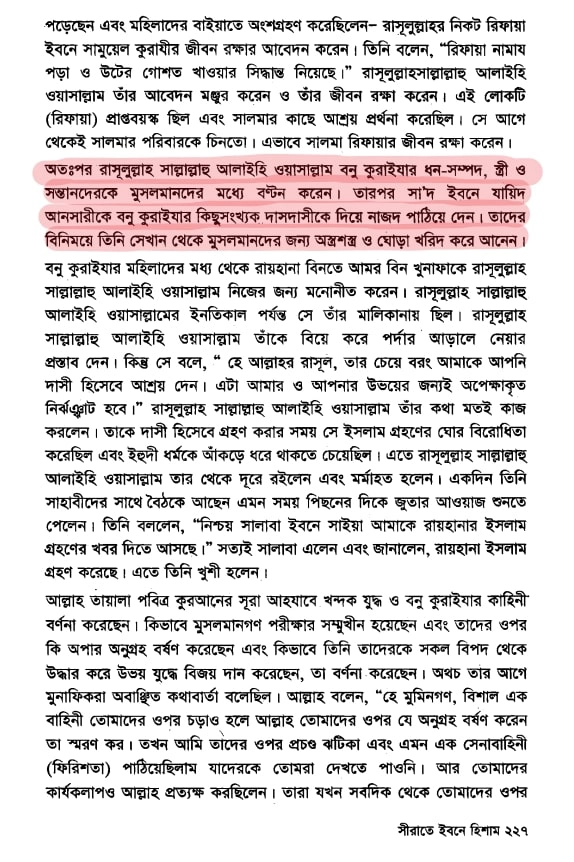
A clearer description of the distribution of spoils of war is found in Ibn Ishaq’s Sirat Rasulullah. From there, it is known that Muhammad took one-fifth separately and also selected a woman for himself [39] –
[ Thabit ibn Qays said regarding this:
My duty is finished, I have shown generosity,
I have tried a great deal
yet all others have become impatient
Jabir has a greater claim upon me than anyone else
his hands were tied with rope
I went to the Messenger (pbuh) to set him free.
He was our ocean of mercy. ]
The order of the Messenger (pbuh) was that all their adults should be killed.
Shu’ba ibn al-Hajjaj told me, on the authority of Abd al-Malik ibn Umayr, who reported from Atiyyah al-Qurazi, an order was given to kill all adult members of Banu Qurayza. I was a minor then, so I was spared.
Salma bint Qays, the mother of al-Mundhir and sister of Salit ibn Qays, was the maternal aunt of the Messenger (pbuh). She prayed with the Messenger (pbuh) facing both Jerusalem and Mecca. Ayyub ibn Abdur Rahman, brother of Banu Adi ibn al-Najjar, told me that Rifa ibn Samawal, who was under the protection of Salma, was an adult. He begged the Messenger (pbuh) for his life. He said that the man had sworn that he would pray and eat camel meat. The Messenger (pbuh) granted his request.
The Messenger (pbuh) distributed the property, wives, and children of Banu Qurayza among the Muslims. The shares of camels and people were decided that day. He took one-fifth. One horseman received three shares: two for the horse and one for the rider. The total number of horses on the side of Banu Qurayza was thirty-six. This was the first time a lottery was held over war spoils and one-fifth was set aside. This precedent was followed in other wars of later periods.
The Messenger (pbuh) selected for himself a woman from Banu Amr ibn Qurayza. Her name was Rayhana bint Amr ibn Khunafa. She remained under his authority for life. The Messenger (pbuh) proposed to marry her and keep her in purdah. But Rayhana said, ‘Rather than that, keep me under your authority. That will be easier for both you and me.’ At the time of capture, she expressed disrespect toward Islam and clung to the Jewish faith. The Messenger (pbuh) was displeased by this and kept her separate. One day while he was sitting with the companions, the sound of sandals was heard behind him. He said, ‘Tha’laba ibn Sa’ya is coming with the glad tidings that Rayhana has embraced Islam.’ Tha’laba indeed delivered that glad tidings. He was pleased. Regarding the Trench and Banu Qurayza, Allah has mentioned their judgment, His grace toward them, and help in Surah al-Ahzab. He says, ‘O believers, remember the grace of Allah upon you, when the enemy forces approached you and I sent against them wind and unseen armies. Allah is the observer of all your deeds.’ The enemy forces are the Quraysh, Ghatafan, and Banu Qurayza. The army of Allah sent with the wind were the angels.
– 1. Surah 33.
– 506 ● Sirat al-Rasulullah (pbuh)
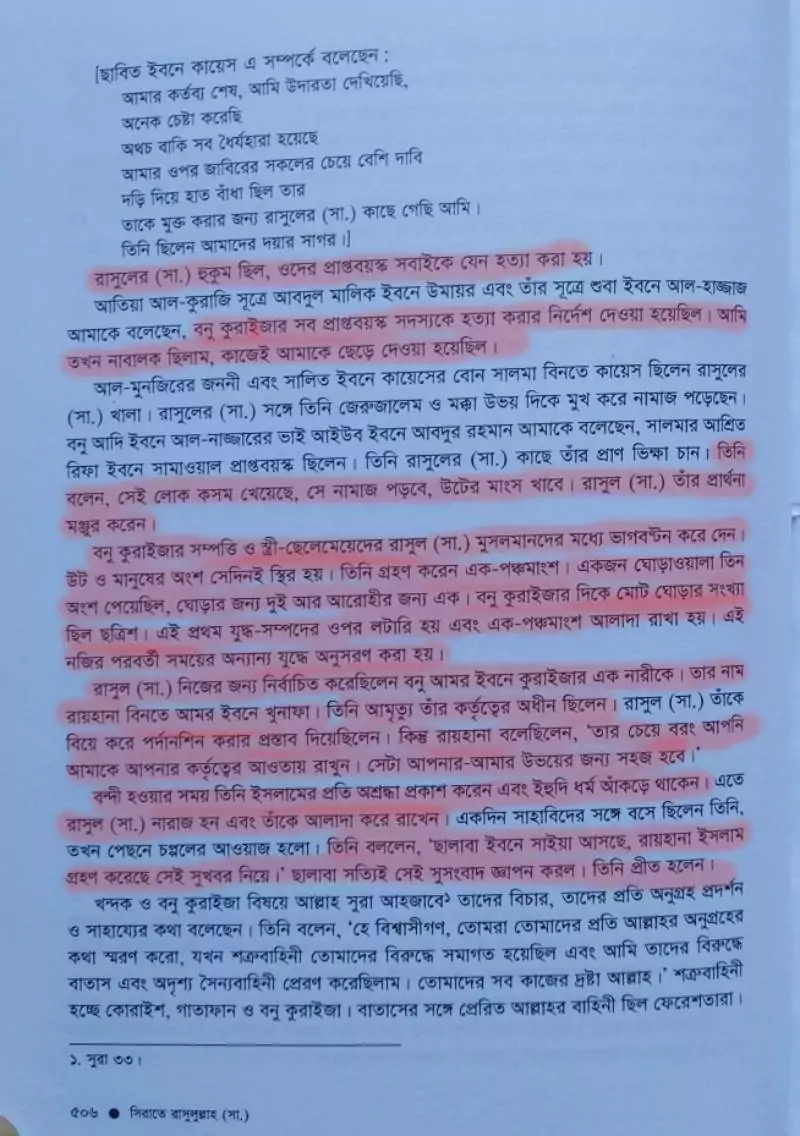
Extensive discussions on slavery, sexual ownership, and slave markets are available in the relevant separate articles: Cohabitation with Slave Girls and Sexual Slavery, Consent of Slave Girls and Sexual Coercion of Female Prisoners of War, Slave Markets and the Buying and Selling of Female Slaves in Islam and Muhammad’s Slave Trade.
When Women and Child Captives Cannot Be Brought Back
Regarding the question of what should be done with prisoners if it is not possible to bring them back from an expedition in Dar al-Harb, there is a clear ruling in Fatawa al-Alamgiriyya. In the cited mas’ala, it is stated that men should be killed if they do not embrace Islam, and women, children, and elderly women should be left in a secluded place without food and drink, so that they die of hunger and thirst. The fact that direct killing is prohibited is used as the logic for this method of death [40] –
And they shall smash their utensils and all the furniture of the house in such a way that no benefit can be derived from them later. And all types of liquid substances shall be poured out, so that they cannot benefit from them later. These actions will be done so that they become enraged.
18. Mas’ala: If it is not possible
to bring prisoners along when returning from an expedition in Dar al-Harb, then the men shall be killed if they do not embrace Islam, and the women, children, and elderly women shall be left in a secluded place without food and drink, so that they die of hunger and thirst. Because killing is not possible due to the prohibition mentioned in the hadith, and there is no particular logic in keeping them alive. 1
For this reason, if Muslims find a snake or a scorpion in Dar al-Harb, they shall cut off the scorpion’s tail and break the snake’s teeth so that no harm is caused while they are with the Muslims. But they shall not kill them entirely so that their lineage remains, and their descendants may sting and cause suffering to the unbelievers (Sirajul Wahhaj).
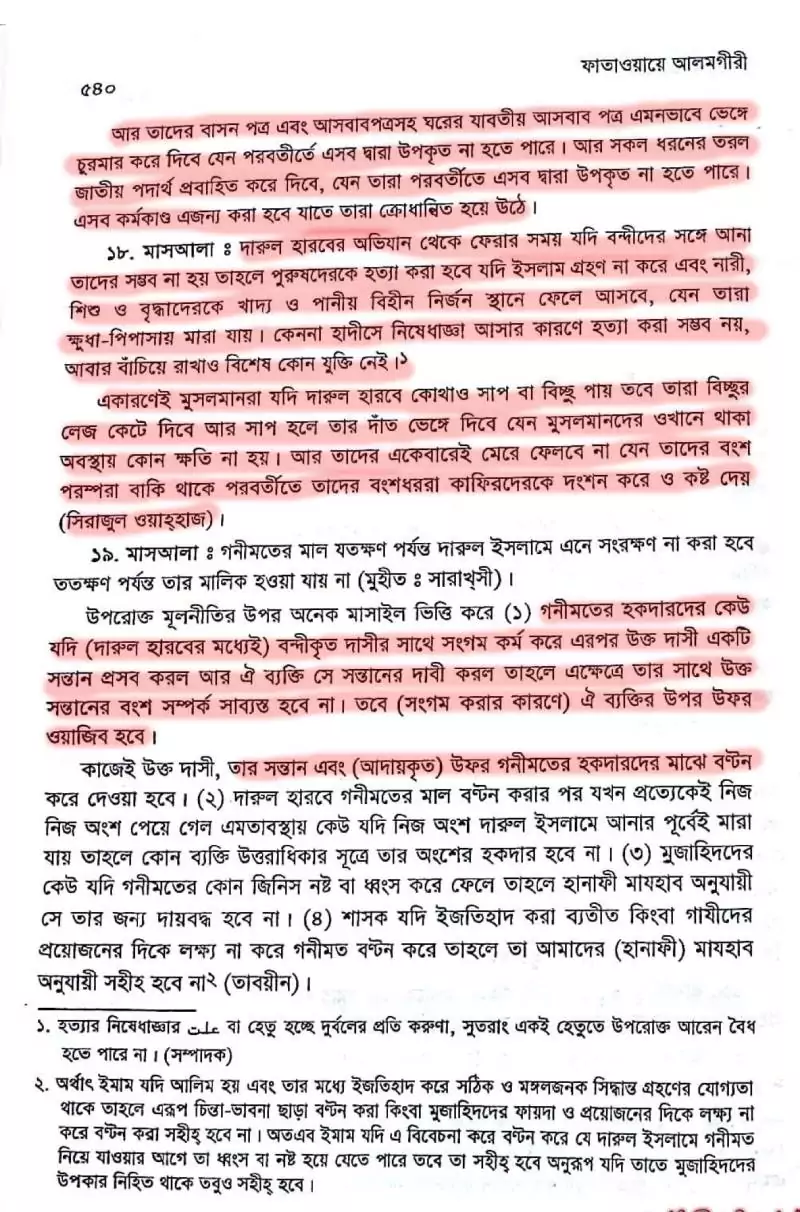
Al-Mawsili: Death by Starvation for Captives Who Cannot Be Transported
A parallel statement to the ruling cited from Fatawa al-Alamgiriyya exists in al-Ikhtiyar li-Ta’lil al-Mukhtar by Abdullah ibn Mahmud al-Mawsili. The condition here is that the prisoners are unable to walk to Muslim territory. Subsequently, the instruction is given to kill the men and leave the women and children in a deserted place to die of hunger and thirst. The author himself states the reason: women will give birth to children, and children will grow up, resulting in the creation of enemy manpower in the future. The full paragraph moves from the destruction of weapons and goods to the treatment of captives: [41]
( ويحرق الأسلحة ) والأمتعة أيضا ، وما لا يحترق منها يدفن في موضع لا يقدر الكفار عليه إبطالا للمنفعة عليهم; أما الأسارى يمشون إلى دار الإسلام ، فإن عجزوا قتل الرجال وترك [ ص: 394 ] النساء والصبيان في أرض مضيعة حتى يموتوا جوعا وعطشا ، لأنا لا نقتلهم للنهي ، ولو تركوا في العمران عادوا حربا علينا ، فالنساء يحصل منهن النسل ، والصبيان يكبرون فيصيرون حربا علينا فتعين ما قلناه ، ولهذا قالوا : إذا وجد المسلمون في دار الحرب حيات وعقارب ينزعون حمة العقرب وأنياب الحية دفعا لضررها عنهم ولا يقتلونها لئلا ينقطع نسلهم وفيه منفعة الكفار ، وقد أمرنا بضده .
English translation: ‘They shall burn the weapons’—and the goods as well. Those that do not burn shall be buried in a place where the unbelievers cannot reach; the purpose is to destroy their utility for them. The prisoners shall walk to Dar al-Islam. If they are unable, the men shall be killed and [page 394] the women and children shall be left in such a secluded place where they will die of hunger and thirst. Because of the prohibition, we do not kill them. If they are left in their settlements, they will become a fighting force against us again; descendants are born from women and children grow up to become a fighting force against us. Therefore, the ruling we have mentioned is what is decided. For this reason, they have said that if Muslims find snakes and scorpions in Dar al-Harb, they shall remove the scorpion’s sting and the snake’s venomous teeth to prevent harm to themselves, but they shall not kill them; so that their lineage is not ended and the unbelievers do not benefit from it. We have been instructed to do the opposite.
No future crime committed by these captive women and children is described. The biological facts that women can give birth and children can grow up are used to justify their deaths. Potential future descendants and future adults are treated as enemies, and the lives of people who exist now are to be ended on that basis. Treating a child as a future enemy without any act of war, and a woman’s reproductive capacity as an enemy asset, imposes collective hostility on the individual’s body. In this reasoning, membership in a religious-political population takes the place of criminal responsibility.
The inability to transport prisoners and the creation of an environment for their death are two separate decisions. al-Mawsili mentions the alternative of leaving them in settlements but rejects it based on the logic of future enemy forces. Therefore, leaving them in a secluded place is not merely a description of falling behind on the journey; it is an instruction to select an environment where death by hunger and thirst will occur. The captive’s inability becomes a basis for permission to remove their means of survival. The ultimate price of that inability—loss of life—is imposed upon the person who cannot be taken along.
In the same paragraph, the logic for preserving the lineage of snakes and scorpions and the logic for preventing the survival of women and children exist side by side. If the lineage of venomous creatures remains, it may harm the enemy, so that lineage is to be kept; if women and children survive, the enemy’s lineage and manpower will remain, so they are to be left to die. The reckoning of benefit and harm is constructed by the interests of the warring party. In this reckoning, the lives of helpless people are treated as a future danger that may be eliminated through hunger and thirst.
Ibn Nujaym: Harsher Than Prohibited Killing—An Objection and Its Rejection
Ibn Nujaym mentioned the same ruling in al-Bahr al-Ra’iq based on the fatwa of al-Walwaliji. In his citation, there is an objection from Ibn al-Humam’s Fath al-Qadir: leaving women and children in this manner is harsher than their prohibited killing. Ibn al-Humam also allowed an exception for cases of necessity due to lack of transport. Ibn Nujaym called that objection surprising; his argument is that al-Walwaliji had already provided the condition that transport be impossible, so there is no problem. The full relevant passage is: [42]
( قوله وعقر مواش شق إخراجها فتذبح وتحرق ) أي وحرم عقر المواشي لأنه مثلة فيذبحها لأن ذبح الحيوان يجوز لغرض صحيح ولا غرض أصح من كسر شوكة الأعداء ثم تحرق بالنار لتنقطع منفعته عن الكفار وصار كتخريب البنيان بخلاف التحريق قبل الذبح لأنه منهي عنه قال في المحيط وأشار إلى أنه يحرق الأسلحة والأمتعة إذا تعذر نقلها وما لا يحترق منها يدفن في موضع لا يقف عليه الكفار إبطالا للمنفعة عليهم قال في المغرب عقره عقرا جرحه وعقر الناقة بالسيف ضرب قوائمها ، والمواشي جمع ماشية وهي الإبل والبقر والغنم وقيد بالمواشي احترازا عن النساء والصبيان التي يشق إخراجها فإنها تترك في أرض خربة حتى يموتوا جوعا كي لا يعودوا حربا علينا لأن النساء يقع بهن النسل وأما الصبيان فإنهم يبلغون فيصيرون حربا علينا كذا في فتاوى الولوالجي وتعقبه في فتح القدير بأنه أقوى من القتل المنهي عنه في قتل النساء والصبيان اللهم إلا أن يضطروا إلى ذلك بسبب عدم الحمل فيتركوا ضرورة وهو عجيب منه لأن الولوالجي صرح بأنه يفعل بالنساء والصبيان ذلك عند عدم إمكان الإخراج لا مطلقا فلا إشكال أصلا والمسألة مذكورة في المحيط أيضا وذكر بعده ولهذا قال علماؤنا إذا وجد المسلمون حية أو عقربا في دار الحرب في رحالهم ينزعون ذنب العقرب وأنياب الحية قطعا للضرر عن أنفسهم ولا يقتلونها لأن فيه منفعة الكفار وقد أمرنا بضده ا هـ .
English translation: His statement: ‘Maiming livestock that are difficult to take along; they shall therefore be slaughtered and burned.’ That is, maiming livestock is haram because it is mutilation; therefore, they shall be slaughtered. Slaughtering animals for a legitimate purpose is permissible, and there is no purpose more legitimate than breaking the enemy’s strength. Afterward, they shall be burned so that their utility for the unbelievers ends. This is like destroying houses. Burning before slaughtering is different, as that is prohibited. In ‘al-Muhit’, it is stated that it is indicated that if carrying weapons and goods is impossible, they shall be burned. That which does not burn shall be buried in a place where the unbelievers cannot find it, so that it does not benefit them. In ‘al-Maghrib’, it is stated, ‘akarahu akran’ means to injure him; striking the leg of a camel with a sword is also ‘akar’. ‘Mawashi’ is the plural of ‘mashiya’; it refers to camels, cows, and goats and sheep. By mentioning livestock, women and children are distinguished, whom it is difficult to take along; they shall be left in abandoned places so that they die of hunger and do not turn into a fighting force against us again. Because descendants are born through women, and children, upon becoming adults, turn into a fighting force against us. Such is the case in the fatwa of al-Walwaliji.
In ‘Fath al-Qadir’, this is objected to on the grounds that regarding women and children, this is harsher than prohibited killing. However, if forced due to lack of transport, they may be left behind as a matter of necessity. This statement of his is surprising; because al-Walwaliji clarified that this shall be done only if it is not possible to take women and children along, not in all circumstances. Therefore, there is no problem at all. The matter is also mentioned in ‘al-Muhit’. After this, he said, for this reason our scholars have said: if Muslims find snakes or scorpions in their locations in Dar al-Harb, they shall remove the tail of the scorpion and the venomous teeth of the snake to prevent harm to themselves; but they shall not kill them, because that benefits the unbelievers and we have been instructed to do the opposite. End of quotation.
Ibn al-Humam’s objection concerns the cruelty of the method: leaving them to die of hunger is harsher than prohibited killing. Ibn Nujaym’s response concerns the condition of the ruling: it applies only if transport is impossible, so there is no problem. This response establishes that the condition was already written; however, the ethical question remains as to why this method of death becomes just if that condition is met. The difficulty of transport explains the problem of carrying a captive. The ethical right to take them to a place devoid of food and water to create the cause of death does not automatically arise from that difficulty.
Even in the statement cited by Ibn al-Humam, there is an exception for necessity; thus, his objection and Ibn Nujaym’s support are built around the same concept of necessity. But since preventing future enemy generations remains an aim of the ruling, the lives of captives were not separated from the reckoning of military assets. The harsh question of the debate here is how effective that right remains when the authority’s difficulties with travel and transport conflicts with the right of women and children to survive. The position of authorizing the slow agony of starvation has made the helplessness of the captive subject to the convenience of the attacker.
Ibn Abidin: Criticism of Creating the Cause of Death by Leaving Them in a Deserted Place
In the original text of Radd al-Muhtar, the ruling on leaving women and children in abandoned places to die of hunger and thirst is in very brief and clear language. The fact that killing is prohibited is the direct reason for using this method instead of killing: [43]
( ويترك صبيان ونساء منهم شق إخراجها بأرض خربة حتى يموتوا جوعا ) وعطشا للنهي عن قتلهم ولا وجه إلى إبقائهم
English translation: Those among them—children and women—whom it is difficult to take along shall be left in abandoned places so that they die of hunger and thirst; because there is a prohibition against killing them and there is no reason to keep them alive.
In explaining this statement, Ibn Abidin mentioned the argument that descendants are born through women and children grow up to be warriors. Then, bringing up Ibn al-Humam’s objection and Ibn Nujaym’s response, he himself criticized the response. His statement is that if it is not possible to take them along, they must be left where they are; creating the cause of their death by leaving them in a destroyed place without food and water is even harsher. The full relevant passage of the explanation is: [44]
( قوله ولا وجه إلى إبقائهم ) لئلا يعودوا حربا علينا ; لأن النساء بهن النسل والصبيان يبلغون فيصيرون حربا علينا ولوالجية ، واعترضه في الفتح بأن تركهم كذلك أشد من القتل المنهي عنه في حقهم قال : اللهم إلا أن يضطروا إلى ذلك بسبب عدم الحمل والميرة فيتركوا ضرورة ا هـ وهو عجيب فإن الولوالجي صرح بأن ذلك عند عدم إمكان الإخراج لا مطلقا ، والمسألة في المحيط أيضا بحر وفيه نظر فإن مراد الفتح أن تركهم في أرض خربة بلا طعام ولا شراب أشد من القتل ، فحيث لم يمكن إخراجهم فليتركوا في مكانهم بلا مباشرة السبب في إهلاكهم
English translation: His statement, ‘there is no reason to keep them alive’—so that they do not become a fighting force against us again. Because descendants are born through women and children, upon becoming adults, become a fighting force against us. This is the statement of al-Walwaliji. In ‘Fath al-Qadir’, this is objected to on the grounds that leaving them in this manner is harsher than prohibited killing. He said, however, if forced due to lack of transport and supplies, they may be left behind as a matter of necessity. End of quotation. This is surprising; because al-Walwaliji clarified that this applies only if taking them along is not possible, not in all circumstances. The matter is also in ‘al-Muhit’. This is the statement of ‘al-Bahr’.
There is an objection to this statement. Because the point of ‘Fath al-Qadir’ is that leaving them in a destroyed place without food and drink is harsher than killing. Therefore, if it is not possible to take them along, they should be left where they are, without directly creating the cause of their destruction.
Ibn Abidin located the problem in the act of creating the cause of death: not being able to take captives along and leaving them in a place without food and water to cause death are not the same act. His proposal is that if it is not possible to take them along, they should be left where they are. Consequently, the same discussion of jurisprudence also contains a different decision: to refrain from creating a lethal environment. This distinction is crucial to rejecting the claim that moving them to a deserted place inevitably follows from a transport problem.
In the ruling of death by hunger and thirst, the environment is made the means of loss of life instead of direct weapon strikes. The needs for human survival are known; if a person is left in a place without the opportunity to meet those needs, death will occur, which is also expected in the language of the ruling. Therefore, the ethical evaluation of the act here is not limited to the question of whether they were killed with a weapon. Where the captive was placed, what they were deprived of, and for what intended result it was done—all these are part of creating the cause of death.
For this reason, the pronouncement in the original text that killing is prohibited, and the subsequent explanation that this method is harsher than killing, are both important. While maintaining the language of prohibition, permission was created to push people toward death through longer agony. Ibn Abidin’s criticism exposes the practical consequence of that permission. For a person dying from lack of food and water, what is more decisive than the legal category assigned to the harm is whether the means of protecting their life were intentionally removed.
| Book or Jurist | Preserved Ruling or Position | Stated Reason or Objection |
|---|---|---|
| al-Mawsili, al-Ikhtiyar | Leaving women and children in a deserted place to die of hunger and thirst if they cannot make the journey on foot | Descendants will come from women; children will grow up to be opponents |
| Fatwa of al-Walwaliji, in the citation of Ibn Nujaym | Leaving women and children, whom it is difficult to take along, in abandoned places to die of hunger | Preventing the buildup of future enemy strength |
| Ibn al-Humam, Fath al-Qadir; in the citations of Ibn Nujaym and Ibn Abidin | The method is harsher than prohibited killing; mention of exception due to necessity from lack of transport and supplies | Objection regarding the severity of leaving them to starve |
| Ibn Nujaym, al-Bahr al-Ra’iq | No problem in the original ruling provided the condition that transport is impossible | al-Walwaliji provided the condition beforehand |
| Cited original text of Radd al-Muhtar | Leaving children and women in abandoned places to die of hunger and thirst | Killing is prohibited; no reason to keep them alive |
| Ibn Abidin’s own explanation | Leaving them where they are if it is not possible to take them along | Creating the cause of death by leaving them in a place without food and water is harsher than killing |
The arguments authorizing these rulings were not based on crimes committed by the people concerned. In some cases, the fear of a military operation coming to a halt, in others, future reproduction and manpower, and in some, the difficulty of transporting captives became the determining factors. Within that reckoning, the lives of women and children were used as expendable elements. Therefore, pronouncing a prohibition on killing while issuing orders to leave them to die by depriving them of food and water creates a severe moral contradiction: direct killing is prohibited in words, while means of slow death are determined in action.
Conclusion
The claim that there was unconditional security for women and children in the war policy of Islam is false. Alongside the prohibition of direct killing, authorizations remain for their death in night raids, lethal attacks on forts where women and children were present, and the distribution and sale of captives as property. Highlighting a single sentence of prohibition while concealing these authorizations is a fragmented and fraudulent presentation of history. The moral responsibility for launching an attack does not end simply because a child was not specifically targeted. The objective, method, and result of an attack collectively strike at human life. The security of women and children receives effective protection only when the necessity of saving them imposes a real limit on achieving military objectives. Permission to continue an operation by accepting their deaths makes that protection subject to the convenience of the attacker.
In the rulings where attacks are stopped upon hearing the adhan and protection of life and property is granted upon the recognition of religious testimony, people’s safety has been linked to religious identity. This system creates pressure for allegiance upon people of different beliefs. Similarly, if the authorization for the loss of a child’s life is explained by the father’s religious identity or membership in the enemy camp, the child’s individuality becomes subject to collective hostility. A child’s birth identity is not their act of war; nor does a person’s practice of their own worship grant the moral right to establish armed authority against them. Assigning different values to human life and freedom of conscience based on religious identity is profoundly discriminatory. Even if this discrimination is authorized in religious language, its moral consequence is a violation of equal human dignity.
The gap between keeping captive women and children alive and protecting their freedom is also ruthlessly revealed in this history. In the event of selling a portion of the captives after the massacre of Banu Qurayza to purchase weapons and horses with that money, humans were directly turned into economic components of war. The victorious party established ownership over human life, labor, and movement, and acquired new military strength from that ownership. Here, the captive’s own will, family security, and right to control their future are subject to the victor’s claim of property. The process of acquiring war equipment by selling humans creates a direct link between captivity and subsequent combat capability. In such a system, promoting the survival of women and children as humanitarian liberation masks the slavery and deprivation of freedom imposed upon them.
Most horrific is the ruling to leave captives to die of hunger and thirst if it is not possible to bring them along, and the arguments provided in its favor. The possibility that women can give birth and children may grow up to be the opponent’s manpower has been made the cause for the death of people who are alive now. Here, future population and military reckoning are the determinants instead of any proven act of war by the individual. Because direct killing was said to be prohibited, a system of slow death in a place without food and water was established. Among the relevant jurists, some called this method more severe than prohibited killing, some considered it problem-free under the condition of inability to transport, and others spoke of leaving the captives where they were without creating the cause of death. The nature of the cruelty is clear in this debate: the inability to take people along became a basis for permission to ensure their deaths.
At the center of these rulings, the religious authority of the victor, military advantage, and control over captive humans return repeatedly. When the life, freedom, and security of the affected person conflicted with those interests, their protection was diminished. By humane moral standards, the life and dignity of every human are equal; a child’s security cannot depend on the father’s religion, a woman’s freedom on the victor’s ownership, and a captive’s survival on their transportability. Using humans as seizable assets, future enemies, or acceptable military losses is a direct violation of this equality. Giving religious legitimacy to these acts creates authorization for oppression. And promoting that authorized oppression as a model of humane conduct is a ruthless disregard for the suffering, freedom, and right to survive of the affected people.
References
- Sahih Muslim, Islamic Foundation, Hadith: 733 ↩︎
- Sahih Muslim, Islamic Foundation, Volume 1, Page 365 ↩︎
- Sahih Muslim, International Number 382 ↩︎
- Siddiq Hasan Khan, As-Sirajul Wahhaj min Kashfi Matalibi Sahih Muslim ibn al-Hajjaj, Volume 2, Page 111–112; Chapter on the Merit of Adhan ↩︎
- Sahih al-Bukhari, Islamic Foundation, Hadith: 583 ↩︎
- Sahih al-Bukhari, Islamic Foundation, Volume 2, Page 44–45 ↩︎
- Sahih al-Bukhari, International Number 610 ↩︎
- al-Nawawi, Sharh Sahih Muslim; explanation of the words «خربت خيبر» in the account of Khaybar ↩︎
- Ibn Rajab, Fath al-Bari, Volume 3, Page 445; Chapter regarding security from bloodshed through the adhan ↩︎
- Sunan Ibn Majah, Tawhid Publications, Hadith: 3929 ↩︎
- Sunan Ibn Majah, Hadith 3929; original Arabic text ↩︎
- Ibn Rajab, Fath al-Bari, Volume 3, Page 443; discussion on being considered a Muslim through the adhan and shahadatayn ↩︎
- Sahih Muslim, Islamic Foundation, Hadith: 4370 ↩︎
- Sahih Muslim, Bangladesh Islamic Centre, Volume 6, Page 181, Hadith: 4370 ↩︎
- Sahih Muslim, International Number 1730a ↩︎
- Sahih al-Bukhari, Tawhid Publications, Hadith: 2541 ↩︎
- Sahih al-Bukhari 2541, original Arabic text ↩︎
- Tahawi Sharif, Islamic Foundation, Volume 3, Page 337 ↩︎
- Sahih Muslim, Islamic Foundation, Hadith: 4399 ↩︎
- Sahih Muslim, Hadith Academy, Hadith: 4442 ↩︎
- Sunan Ibn Majah, Tawhid Publications, Hadith: 2839 ↩︎
- Sahih Muslim 1745a ↩︎
- Sunan Ibn Majah 2839 ↩︎
- Sahih Ibn Hibban, Hadith 4786, Volume 11, Page 108 ↩︎
- al-Nawawi, Sharh Sahih Muslim, Volume 12, Page 407–408; explanation of Hadith 1745 ↩︎
- Ibn al-Mulaqqin, al-Tawdih li-Sharh al-Jami’ al-Sahih, Volume 18, Page 180–181 ↩︎
- al-Tawdih, Volume 18, Page 182–183; fourth point of discussion ↩︎
- al-Qarafi, al-Dhakhira, Volume 3, Page 407–409; Sixth Discussion regarding methods of war ↩︎
- al-Nawawi, Rawdat al-Talibin, Volume 10, Page 244–246 ↩︎
- Rawdat al-Talibin, Volume 10, Page 246–247; subsection regarding human shields ↩︎
- Ibn Qudama, al-Mughni, Volume 9, Page 231; discussion on using women and children as shields ↩︎
- Ibn Kathir, al-Bidaya wa-l-Nihaya, Volume 7, Page 71–72; Battle of Ta’if ↩︎
- Sunan al-Tirmidhi (verified), Hadith: 2607 ↩︎
- Sunan al-Tirmidhi (verified), Hadith: 2608 ↩︎
- Sahih al-Bukhari, Hadith 4357; Dhu al-Khalasa Expedition ↩︎
- Sirat Ibn Hisham, page 227 ↩︎
- Sirat Rasulullah (saw), page 506 ↩︎
- Ibn Hisham, al-Sira al-Nabawiyya, volume 2, page 244–245 ↩︎
- Sirat Rasulullah (saw), Ibn Ishaq, translation: Shahid Akhund, Prothoma Prokashoni, page 506 ↩︎
- Fatawa al-Alamgiriyya, Islamic Foundation Bangladesh, Volume 3, Page 540 ↩︎
- al-Mawsili, al-Ikhtiyar li-Ta’lil al-Mukhtar, Volume 4, Page 393–394 ↩︎
- Ibn Nujaym, al-Bahr al-Ra’iq, Volume 5, Page 90 ↩︎
- Ibn Abidin, Radd al-Muhtar ala Durr al-Mukhtar, Volume 4, Page 140; original text ↩︎
- Radd al-Muhtar, Volume 4, Page 140; explanation of the words «ولا وجه إلى إبقائهم» ↩︎