

Introduction
The most fundamental question in morality is this: on what basis is an action judged good or bad? When someone feeds a hungry person, helps the vulnerable, or protests against abuse, the moral value of that conduct is determined by the needs, rights, and harms involved, and by the reasons offered for the action. Moral judgment means examining those reasons and correcting one’s own decisions when they are unjust. If that judgment is suspended before a religious command, with the insistence that it must be obeyed simply because God has spoken, the action’s justifiability ceases to be a condition of the decision. A system that demands obedience regardless of justification fails to meet the conditions of morality itself. In this sense, so-called religious morality is no morality at all; it is unconditional obedience to a being.
Accepting moral responsibility means offering reasons for one’s actions and applying those reasons to oneself as well as to others. Unconditional obedience demands the opposite: a person must obey even when they object to the command’s justifiability. When ordered to harm innocent people, the ability to reject the instruction on the basis of the victims’ rights is part of moral judgment. If that rejection itself is declared disobedience or sin, moral autonomy is being suppressed to establish obedience. Calling the abandonment of one’s own judgment moral excellence turns the meaning of the words upside down.
A powerful ruler can make an action compulsory, but his power does not create its justifiability. The same applies to claimed divine authority. Enhancing a being’s status, power, or capacity to punish may increase the effectiveness of his commands; it creates no moral reason to deprive other people of their freedom. Identifying a command’s source and demonstrating its justification are separate tasks. Substituting the first for the second puts power in the place of morality.
Human empathy, the capacity to recognise others’ suffering, mutual cooperation, expectations of fairness, and the ability to reflect on social rules have natural and historical explanations. Evidence from evolutionary biology, developmental psychology, neuroscience, and moral philosophy shows why people can understand others’ pain, how they establish rules of cooperation, and how they subject even their own principles to criticism. These capacities operate without religious belief. The claim that religious belief is indispensable to moral conduct and judgment is therefore not merely unsubstantiated; it is also inconsistent with observable evidence about human behaviour and societies. [1]
The moral extension of Socrates’ question about piety in sections 10a–11b of Plato’s Euthyphro is this: Does God approve an action because it is good, or is the action good because God approves it? Under the second possibility, the definition of morality depends on the will of a single being; there is no independent reason for prohibiting torture—a change in the powerful authority’s command could make torture “good.” Under the first, the reason the action is good already exists independently of the command; God’s approval does not create that reason. In neither case does “God said so” itself provide an ultimate explanation of morality. [2] [3]
At the centre of this dilemma lies the meaning of “good.” If good means only “what God wills,” then “God is good” means “God acts according to his own will”—it is no longer independent moral praise. If the assertion that God would not command cruelty rests on cruelty’s immorality, a standard for judging cruelty is already being used. God’s omnipotence, omniscience, or power to punish removes none of these logical problems. [4]
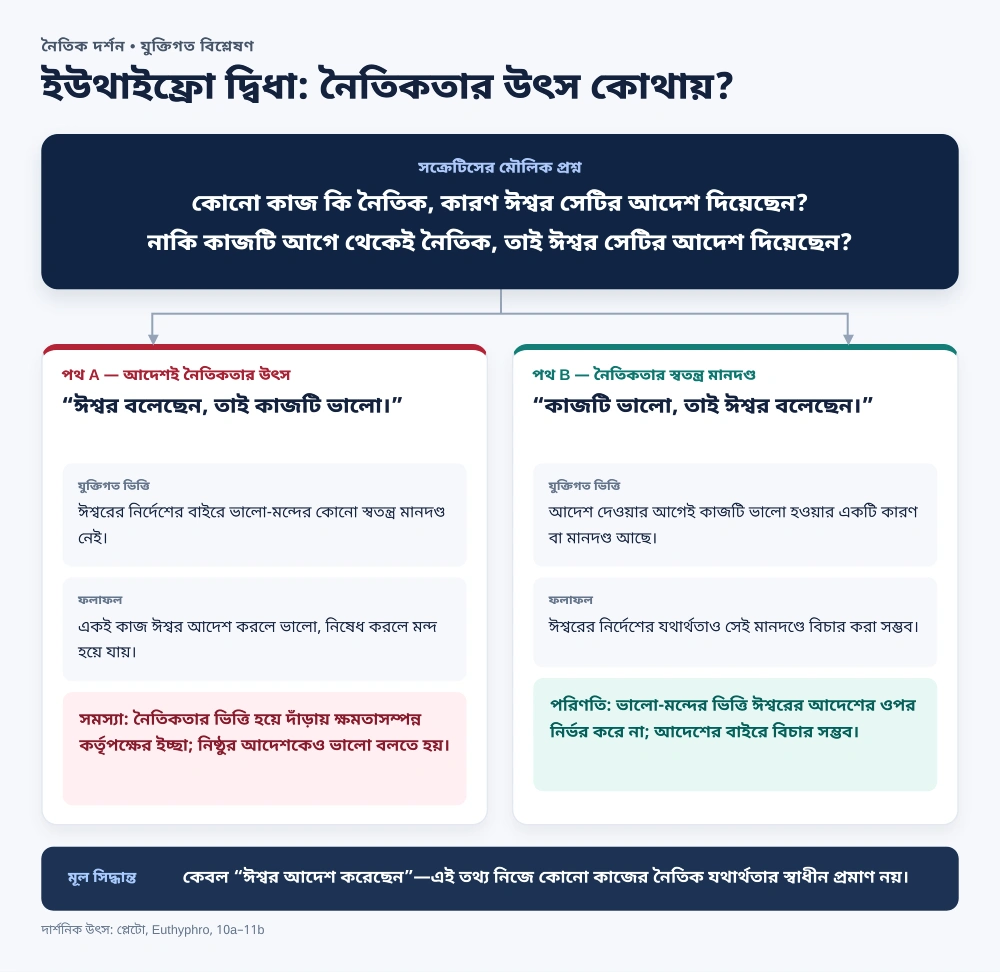
One fundamental conclusion is clear from these two explanatory paths: the source of a command and its moral acceptability are separate questions. Calling a command morally acceptable requires answers about whose interests it protects, whose rights it violates, what harm it causes, and whether independent reasons support it. Merely pointing to the commander’s power does not establish a moral claim.
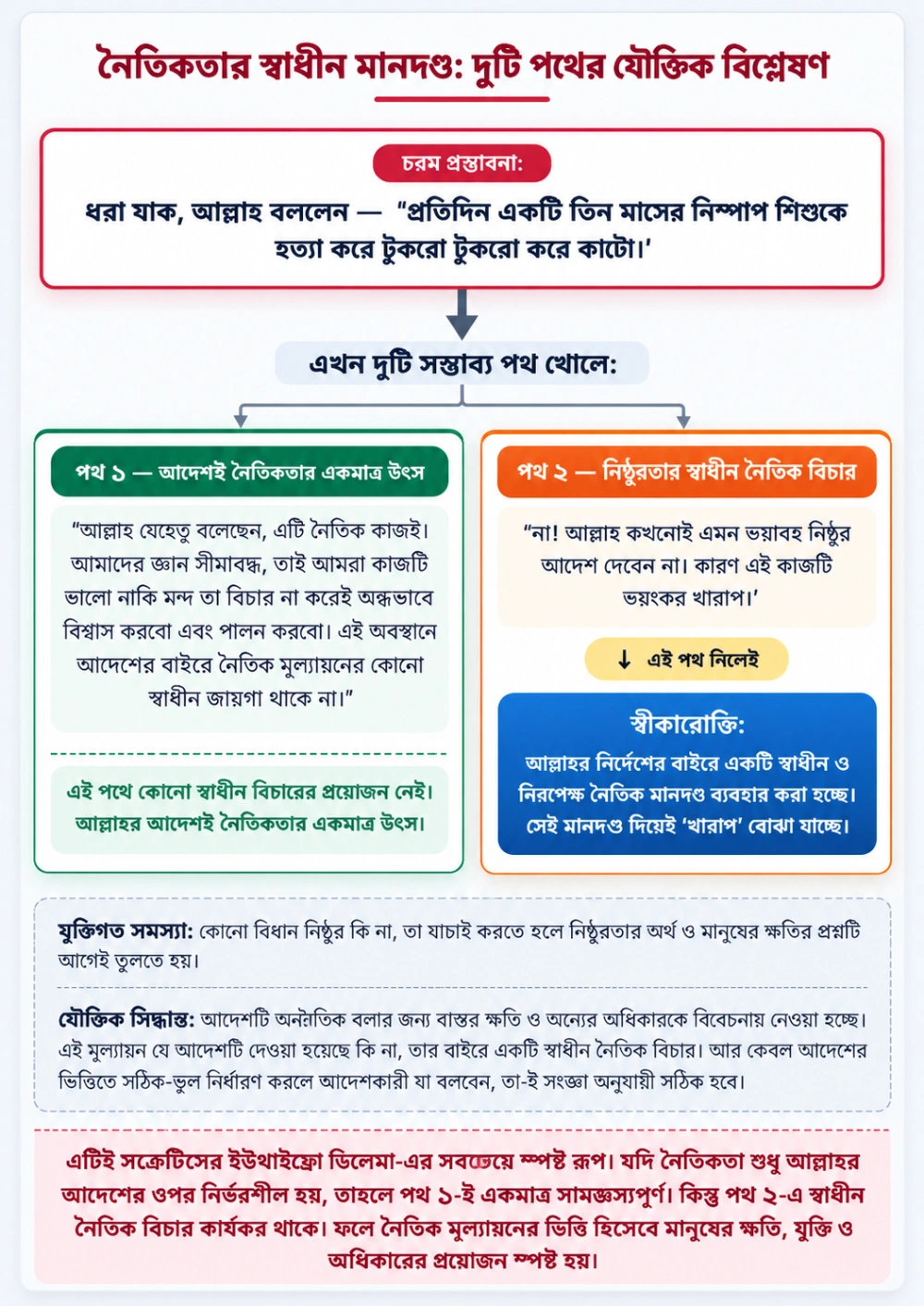
The gap between authority and morality is clearest when someone else pays the price of obedience. A ruler declares war, but soldiers and civilians die; a religious authority issues a prohibition, but those subject to it lose education, freedom, or security. Treating the commander’s status as sufficient proof eliminates even the need to hear the affected person. Placing people at the centre of morality means that reasons for a command must also be presented to those who bear its consequences. Ignoring their harm and calling the ruler’s satisfaction justice passes off the interests of power as morality.
God’s existence, the psychological effects of belief in God, and the justifiability of moral rules are three distinct claims. If a belief motivates someone to give, that establishes a motivational role; it does not make every metaphysical claim of the belief true or every rule it contains just. If believers and non-believers alike can understand others’ suffering, it is wrong to treat empathy as one religion’s exclusive property. Religious claims to ownership of morality conceal a shared human social capacity and hand an authority the credit for humane conduct.
The Origins of Morality, Moral Motivation, and Moral Judgment: Three Separate Questions
Why people help others is a question for behavioural science and psychology. Whether they ought to help is a question for moral philosophy. What provisions society should establish for that assistance is a question of policy and law. Conflating these three levels produces the mistaken claim that religious belief is morality’s sole source. Someone may help in the hope of an afterlife reward, but that hope is not what makes the assistance justified. Fear can make a child follow a rule, but the fear does not prove the rule’s moral justification.
| Level of inquiry | What is actually being examined | Means of independent investigation |
|---|---|---|
| Origins | How empathy, cooperation, and social rules develop | Evolutionary biology, psychology, history |
| Motivation | Why a person performed a particular action | Behaviour, testimony, incentives, and social circumstances |
| Justification | Whether the action ought to be performed | Rights, harm, logical consistency, and justice |
| Application | The principles on which social life should be organised | Law, social institutions, and empirical outcomes |
A religion’s teaching or requiring a behaviour does not make that instruction moral education. An institution may teach people to give, observe prohibitions, or punish others. These are, first, behavioural instructions; determining which are justified requires examining the rights, needs, and harms involved. If obedience is demanded regardless of that examination’s outcome, the institution is not developing people’s moral understanding; it is establishing authority over their capacity for judgment.
If a scripture says “feed the hungry,” the moral reason for doing so is the hungry person’s need and the relief of their suffering. Receiving an authority’s reward for the same act is a separate personal incentive. Hunger and the need for assistance remain even without the command. If that same scripture permits enslaving someone, the deprivation of that person’s freedom supplies grounds for moral objection. The standard for accepting assistance and rejecting slavery is not supplied by the text’s commands; it is established by examining the actions themselves and their consequences for people. Crediting religious approval for moral value conceals this independent basis of judgment.
One person may build a hospital to gain respect, another because they recognise the need for medical care. The hospital’s quality of treatment, patient safety, and accessibility can be assessed separately. The founder’s intentions tell us something about their character; judging the institution’s work also requires considering patients’ rights. Likewise, fear of punishment may prevent an offence without making every decision of the punishing authority just. Maintaining the distinction between causes and outcomes places actions, intentions, and human consequences in their specific roles, rather than centring morality on religious identity.
The capacity to accept moral reasons must be independent of obedience to a ruler. Standing with victims of injustice sometimes requires disobeying established instructions from family, society, or the state. If following rules were the complete definition of morality, protesting against unjust laws would become immoral by definition. Here lies the moral importance of challenging established rules in demands for emancipation, women’s freedom, or freedom of conscience: those subject to a rule can demand its justification. Requiring the authority’s permission before questioning it subordinates the right of criticism to that authority’s discretion.
The Philosophical Foundations of Morality: The Evolution of Reason and Wisdom
Across the ancient and modern history of morality, markedly different philosophical approaches share an important feature: many moral explanations do not rest on God’s commands. Some centre human happiness and suffering, others excellence of character, the universality of duty, everyone’s rights, or just social institutions. These theories disagree, but their debates do not require any party to accept “God commanded it” as the final judge. This historical reality directly demonstrates that moral thought and religious authority are different things.
Moral philosophy does more than record a society’s established rules. It also asks why an unjust convention is unjust, why a harmful rule should be revised, and how an abuse remains open to criticism even when a majority supports it. A rule’s popularity, antiquity, or proclaimed sacredness therefore supplies no independent proof of its justification.
Giving a principle a philosophical foundation means making its supporting reasons public and accepting their implications. Condemning harm while permitting the same harm for one’s own advantage creates an inconsistency. Advocating individual freedom while taking it away from dissenters creates the same problem. Reason identifies these convenient exceptions. Moral philosophy is therefore more than a collection of abstract terms; it demands an account of which principle will prevail when self-interest conflicts with another person’s equal claim.
Non-Theistic Ethics in Ancient Indian Philosophy
In ancient Indian philosophy, the Charvaka or Lokayata tradition foregrounds direct experience and the importance of life in this world. Rejecting Vedic authority, the supernatural results of sacrifice, and liberation based on an afterlife creates room to consider earthly happiness, suffering, and needs. Portraying Charvaka merely as unrestrained hedonism oversimplifies its philosophy. Pradeep Gokhale’s research identifies diversity in Charvaka values and distinct analyses of worldly aims. Since most original Charvaka writings have been lost, many accounts come through rival philosophers’ works; a fully developed modern theory of a “social contract” cannot simply be attributed to them. Their principal significance here is that ethical and practical questions were investigated outside Vedic authority. [5]
Buddhist moral philosophy places particular importance on compassion, loving-kindness, non-violence, right action, and identifying the causes of suffering. The five precepts include abstention from killing, theft, sexual misconduct, lying, and intoxication. Causes, intentions, mental habits, and consequences of conduct are discussed without requiring an omnipotent creator’s command as their foundation. Buddhism also contains its own supernatural concepts of karma, rebirth, and liberation. Arguments about experienced suffering and beliefs about supernatural consequences therefore coexist within the tradition without constituting the same kind of claim. [6]
An argument for reducing suffering that appeals to the sufferer’s experience and needs derives its moral force from those reasons. Its presence in a religious tradition is not the source of its truth. Acting because it will benefit a future rebirth, or because a religious rule must not be disobeyed, changes the basis of the decision. The same practice may be supported by humane reasons and faith-based instructions; these require separate evaluation. Using the acceptability of the humane reason to legitimise the tradition’s supernatural authority is a logical leap.
Jain philosophy emphasises non-violence, truthfulness, non-stealing, non-possession, and self-restraint. Jain cosmology requires no creator God; it explains responsibility through its own metaphysics of karma, living beings, and liberation. Anekantavada addresses the limitations of understanding something from a restricted perspective. Avoiding killing animals and caring for living beings are also part of the tradition. These facts show that monotheistic commands are not indispensable to systems of strict conduct and self-restraint. [7] [8]
Strict discipline and morality are different things. A rule’s difficulty, antiquity, or religious commendation does not establish its justification. A decision not to injure a living being because it suffers rests on that being’s circumstances; fear of supernatural karmic consequences or hope of liberation constitutes personal religious motivation. Replacing a creator’s command with another inviolable authority leaves the problem of unconditional obedience intact. Reasoned moral thought within these traditions and their demands for religious obedience must therefore be judged separately.
The moral significance of Charvaka’s worldly focus is that present life’s claims have value within present life. Feeding the hungry, treating the ill, and freeing the oppressed need not be deferred in anticipation of compensation in an invisible next life. When resources are spent on a sacrifice, one can ask who actually benefits and whose means of subsistence are diminished. Removing claims of supernatural results makes ritual power and economic costs open to scrutiny. Centring human experience rather than priestly approval subjects authority to a direct epistemic check.
Buddhist compassion and Jain non-violence distinguish the history of moral responsibility from the history of monotheistic commands. They require no prior knowledge of a creator’s command to feel responsibility towards someone in pain. Accepting a philosophy’s ideal of non-violence does not also establish the truth of its claims about karma or rebirth. Each claim is assessable on its own grounds. Without this independence, rejecting one religion’s exclusive authority risks placing another doctrine’s unsubstantiated claims above criticism.
Reason-Based Traditions in Western Philosophy
In Greek philosophy, Aristotle, in his Nicomachean Ethics, connects moral virtues to habit, practical wisdom, and the human capacity to live well. His eudaimonia is not momentary pleasure but a flourishing life guided by reason. Cultivating courage, moderation, generosity, and justice concerns character and the actual form of one’s activities. Within the same tradition, Plato independently investigated the nature of the good. Why people should act justly without following a list of divine commands has been debated extensively for centuries. [9]
Epicurean thought connects a good life to the sources of fear, anxiety about death, friendship, and reducing pain. Whatever Epicurus’s position on the gods, his account of happiness and tranquillity does not make divine punishment a necessary foundation of social justice. Different philosophies of morality’s origins yield the same practical conclusion: people can reason systematically about moral reasons beyond divine declarations. [10]
Immanuel Kant establishes the importance of reason, autonomy, and universally acceptable principles in moral judgment. One formulation of his categorical imperative asks whether the maxim on which I act could rationally become a rule for everyone. Another requires respecting people as ends in themselves, never merely as means. The reasons for moral obligation must be acceptable to a person’s own judgment; fear of external authority is insufficient. Kant discusses God in his philosophy of religion, but reducing moral obligation to a reward-giving authority’s commands contradicts his conception of moral autonomy. [11]
Kant’s principle against using people merely as means supplies a specific test against coercion. Using someone’s labour, body, or life as a resource for another’s purposes raises the question of where their own decision has a place. Withholding wages to force a worker to continue, or claiming rights over a woman’s body while disregarding her consent, is directly open to criticism under this principle. The beneficiary’s gain cannot substitute for the affected person’s independent decision. [12]
Accordingly the practical imperative will be as follows: So act as to treat humanity, whether in thine own person or in that of any other, in every case as an end withal, never as means only. We will now inquire whether this can be practically carried out.
English translation:
The practical imperative is therefore this: act so that humanity, whether in yourself or in anyone else, is always treated also as an end, never merely as a means. We shall now consider whether this principle can be implemented in practice.
Jeremy Bentham and John Stuart Mill centre the evaluation of moral actions on consequences. Utilitarianism examines how a principle or action affects the happiness, suffering, and overall welfare of everyone concerned. Mill also discusses individual liberty and qualitative differences in the quality of life. Although utilitarianism faces many objections and debates, it centres a method that tests principles against their actual consequences without requiring scriptural approval. [13] [14]
Whose happiness and whose suffering enter the accounting is central to evaluating consequences. Torturing one person for a hundred spectators’ enjoyment does not establish justice merely by adding up pleasures; the victim’s security and everyone’s exposure to the same system also matter. Welfare arguments therefore need to be examined alongside rights and the distribution of power. Declaring one group’s advancement a general improvement while concealing another’s losses produces an accounting biased from the outset. Public moral reasoning brings those excluded people back into consideration.
The most important feature in comparing these philosophies is the public character of moral reasoning. A rule can be reviewed if it harms people, rests on false claims about its effectiveness, or denies someone’s rights. The possibility of revision is no weakness; the right to correct unreasonable rules ensures the accountability of moral thought.
Friedrich Nietzsche subjects the origins of religious values, guilt, obedience, and power relations to severe historical criticism. His On the Genealogy of Morality investigates the social origins of moral values through the concepts of “master morality” and “slave morality.” He rejects the idea that “good” and “evil” have no social history. This offers a method for examining morality as evaluation formed through human experience and power relations, rather than as a pre-given, immutable command. Nietzsche’s philosophy is not synonymous with modern egalitarian humanism; the significance of his historical criticism lies in placing the origins and power-serving functions of moral claims at the centre of philosophical inquiry. [15]
These distinct philosophies help identify different weaknesses in principles. Whether a rule apparently producing good results treats someone merely as an instrument, whether unnecessary harm is imposed in duty’s name, or whether the language of justice protects a privileged class are separate questions. Treating religious identity as a final guarantee of morality halts these examinations. Reason-based principles require justification and the application of the same reasons against oneself; a thinker’s reputation exempts no conclusion from this scrutiny.
Power, Commands, and Justice
A command may bind someone without being just. A dictator’s order may operate as law without constituting justice. When innocent people are punished in a religious command’s name, the reality of punishment and its moral acceptability likewise remain separate questions. Possessing the power to punish does not make its possessor just. Denying this distinction between power and morality allows any authority to be placed above moral criticism.
Assessing an action’s wrongness involves the affected person’s harm, absence of consent, unjust discrimination, or loss of freedom. Concealing those features while foregrounding the commander’s standing changes the subject of evaluation. The central fact in judging slavery is the enslaved person’s lost freedom, not the slaveholder’s religious status. Religious approval is therefore insufficient to invalidate moral criticism of an action.
The power to punish creates a practical reason to comply: refusal may bring harm. Acting from fear and acting because something is justified, however, are different relationships. Surrendering property to an armed robber does not acknowledge the justice of his demand. By the same reasoning, fear of infinite punishment increases the commander’s coercive power without explaining why his command is just. Increasing the punishment never fills the missing step from a description of power to moral approval.
When the same group claims authority and controls its interpretation, the problem becomes institutional. A group can make its decisions final by determining whose words are divine, which interpretation is correct, and how questioning will be punished. Those harmed must then establish their injuries within the authority’s approved language. Yet bodily assault, restrictions on movement, and coerced labour are actual events. Subordinating justification to an authorised interpreter’s consent hands judgment to the beneficiary.
Objective Versus Subjective Morality
In philosophical discussion, “objective,” “absolute” or “exceptionless,” “subjective,” and “relative” or “culture-dependent” are not identical concepts. Calling a moral claim objective means that its truth does not depend solely on one person’s wishes or approval. Exceptionless means that a claim or rule applies in the same way in every circumstance. An objective principle may require different applications in different situations. For example, although gratuitously harming people is wrong, necessary force in self-defence is not judged identically. “If objective, it can never change” is therefore not a definition supplied by moral philosophy. The central question is whether reasons supporting a rule can be examined beyond personal or religious authority. [16]
| English term | Meaning | Definition and central question | Example | Important distinction |
|---|---|---|---|---|
| Objective | Objective; impersonal | A claim’s truth is not determined solely by individual or group preferences, feelings, or approval. Reasons support it beyond personal preference. The central question is: What reasons support the claim beyond “what I prefer”? | The judgment “torturing innocent people without cause is wrong” is supported by the victim’s suffering, freedom, and equal dignity. Those reasons remain even if the torturer enjoys it or society approves. | Objectivity does not mean ignoring circumstances. The same principle can prescribe different actions in different circumstances. Feelings and suffering remain relevant facts in impersonal judgment; the judge’s personal preference is not the sole standard. |
| Absolute | Absolute; unconditional; exceptionless | In moral rules, a position that admits no exception to a prohibition or duty under any circumstances. The central question is: Is the rule equally binding in every situation? | “One must never lie under any circumstances” is an exceptionless prohibition. It would also prohibit lying to save an innocent person from a murderer. | Declaring a rule exceptionless does not prove it true or justified. A principle can also be regarded as objective while differences of circumstance are recognised in applying it. |
| Subjective | Subject-dependent; dependent on personal feelings or attitudes | An evaluation’s truth or acceptability depends on the relevant individual’s feelings, preferences, or approval. In a simple form of moral subjectivism, “this is good” means “I approve of this.” The central question is: Whose feelings or approval determine the evaluation? | “I find this music beautiful” evaluates a personal experience. In morality, saying “the action is good because I approve of it” makes personal approval the basis of moral rightness. | People’s use of their own judgment does not make every conclusion subjective. Arriving personally at a conclusion and making personal preference the criterion of its truth are separate matters. |
| Relative | Relative; dependent on a specified standard; culture-dependent in cultural relativism | An evaluation is considered true or acceptable relative to a particular standard, framework, or culture. Cultural moral relativism determines moral rightness relative to the relevant culture’s standards. The central question is: Relative to which standard is the action called right or wrong? | Suppose one culture treats marrying a family-selected partner as a moral duty, while another prioritises choosing one’s own partner. Cultural relativism determines each evaluation’s rightness by its respective cultural standard. | Cultural disagreement is a descriptive fact. That fact alone does not prove that every culture’s rules are justified within that culture. Considering circumstances is not in itself moral relativism either. |
Presenting divine commands as proof of objective morality conflates two claims: that God issued the command, and that the command is just. Even if the first is true, the second does not follow automatically. Likewise, deriving a rule’s justice merely from its presence in scripture requires an additional moral premise. Reintroducing religious authority as that premise makes the argument circular. This related video may help explain the issue:
A practical problem in the history of religious rules is that the same divine authority has been invoked to legitimise actions contrary to currently recognised fundamental human rights. A command’s antiquity or religious approval and its protection of human dignity are separate matters. Scriptural approval cannot establish the morality of slavery, sexual entitlement over female war captives, discrimination on grounds of belief, or cruel corporal punishments. Assessing victims’ rights and actual harm rather than the authority of those said to have issued the commands changes the judgment.
That religious rules have subsequently changed is a historical fact. Change alone does not prove that moral reality does not exist. The deeper historical question is how the justifiability of a changed instruction is assessed when the same action is permitted in one period and prohibited in another. If the answer is “whatever was commanded at the time was just,” justice’s standard is subordinated to command. In that case, “God’s command is just” loses its meaning as an independent moral claim.
Slavery is a specific example of this conflict. The Bible’s Leviticus 25:44–46 permits acquiring slaves from foreigners and holding them as inheritable slaves; Exodus 21:20–21 contains separate rules governing the consequences of beating a slave. Qur’an 4:24, 23:5–6, and 33:50 recognise a framework of sexual entitlement involving enslaved women or women “possessed by the right hand”; 4:3 also refers to the marital and social arrangements involving enslaved women. These texts contain rules treating people as property under another’s control or as persons subject to sexual entitlement. A rule’s religious source does not establish the moral legitimacy of depriving a human being of freedom. [17] [18] [19]
Articles 1, 4, and 5 of the 1948 Universal Declaration of Human Rights affirm equal human dignity and rights, prohibit all forms of slavery and the slave trade, and prohibit cruel and degrading treatment, respectively. A general moral principle is adopted: no person may be treated as another’s property. The conflict between ancient religious legitimacy and modern rights-based standards is real; using different definitions to declare both simultaneously just does not erase it. [20]
Islamic texts contain multiple examples of changing rules. On alcohol, Qur’an 2:219, 4:43, and 5:90–91 contain instructions at different stages. The change of prayer direction appears in 2:142–150. Different reports under Sahih Muslim 1406 discuss separate occasions and decisions concerning the permission and subsequent prohibition of mut‘ah marriage. These episodes demonstrate historical changes in instructions. Accounts in tafsir of marriages among Adam’s children are not equivalent to a direct Qur’anic rule; they derive from subsequent exegetical reports. [21] [22]
The moral question is specific: when an action was permitted and later prohibited, what independent basis morally explains the earlier permission? “Allah permitted it then” does not explain why that permission was justified. If the commander’s will is the only variable determining the same activity’s moral value, the judgment is ultimately dependent on that will.
The abrogation of an earlier rule by a later one is well established in Islamic discussions of nasikh and mansukh. Qur’an 2:106 speaks of abrogating verses or causing them to be forgotten. Change in rules is therefore no external accusation against Islamic theology; the tradition has its own framework for explaining and classifying it. The question is whether divine approval sufficiently proves a rule’s moral justification. If the first rule was right because it served human welfare, those welfare-based reasons need to be examinable. If authority alone made it right, the same action acquires an opposite moral status through a change in authoritative instruction. [23]
Naskh describes a change in the applicability of religious rules; identifying it as the “evolution of moral truth” requires further argument. Ignoring abrogation and claiming that an identical, unchanged rule operated from the beginning is also wrong. The central conflict is therefore not whether rules changed, but treating changes in commands as changes in justice without identifying independent moral reasons.
Believing an authority cannot err and independently establishing the morality of every command are separate claims. Assuming the first without evidence for the second settles the issue in advance. Once torture has been identified, saying “it is not torture if divinely commanded” does not change the event; it changes moral language for authority’s benefit. The same method operates in slavery, sexual entitlement over female war captives, and belief-based punishment. Without room for independent assessment, moral language degenerates into the language of power.
Human harm, suffering, freedom, consent, equal dignity, and just social relationships can ground reason-based moral assessment. If a law denies women education simply because they are women, its harm, discriminatory structure, and violation of rights can be observed and analysed. This judgment does not depend on majority opinion for or against a scripture. What a rule does to people supplies the substance of moral reasoning. Independent morality’s strength is that it confronts everyone—rulers, religious preachers, legislators, and atheist thinkers—with the same questions. [24]
Classifying personal preferences, social conventions, and moral truth together is a logical error. Preferring mangoes to oranges is personal taste. Whether torture damages someone’s body and mental health is an observable question. Whether that harm should matter is a question of moral premises. Accepting equal human dignity as a foundation of human rights allows arguments against torture, slavery, and discrimination. Public opinion may change, but the reality of a particular harm cannot be voted out of existence.
Objective assessment does not mean mechanically obtaining a single answer to every problem. Freedom and security, justice and mercy, or individual and collective interests can conflict. Such conflicts are addressed by making the facts, principles, and affected people’s circumstances public. Acknowledging uncertainty does not prevent reasoned judgment or require religious authority to be installed as unquestionable truth.
Kant’s deontology, Mill’s utilitarianism, John Rawls’s theory of justice, and Thomas Scanlon’s account of mutual justification offer distinct methods of moral reasoning. Kant emphasises personal dignity and universal principles; Mill, overall welfare and suffering; Rawls, just social institutions; and Scanlon, principles that those affected cannot reasonably reject. None is obliged to accept “God said so, therefore it is moral” as proof. They instead present moral reasons for conduct for scrutiny in terms of people and social relationships. [25] [26] [27] [28]
Despite serious disagreements about moral ideals, one conclusion is clear: criticising a scriptural rule on the basis of reason, rights, and welfare is philosophically legitimate. Declaring scripture beyond revision does not answer the criticism; it merely denies the right to criticise.
In religious command-based morality, a rule’s validity derives from the commander’s identity. Reason-based morality uses reasons, harm, rights, fairness, and consequences to determine its acceptability. Personal and cultural preferences matter in social explanation, but “that is how our society does it” does not make conduct moral. This distinction clarifies moral concepts and prevents divine commands from being equated with moral truth without examination.
| Aspect of judgment | Unconditional obedience based on divine commands | Independent moral judgment | Personal or cultural preferences |
|---|---|---|---|
| Basis of the decision | An instruction accepted as God’s command must be obeyed | Reasons, rights, harm, consent, and justification must be examined | Individual tastes or established customs |
| Response to an unjust command | Under unconditional obedience, a command’s justifiability is not an independent criterion for disobeying it | Rejecting an unjust command and giving reasons for the rejection | Following preferences or customs requires separate moral justification |
| The authority’s position | The command is the final basis of the decision | The authority’s commands and conduct are subject to the same standards | Influential people or social habits may shape preferences |
| Judging slavery | If divine approval is final, objections about lost freedom cannot override it | Rejected because it deprives people of freedom and violates equal dignity | Local practice does not establish a rule’s justifiability |
| The role of punishment | An incentive compelling obedience | A system subject to justification, necessity, proportionality, and accountability | Preference or social custom does not legitimise cruel punishment |
| Central distinction | The authority of a command replaces the action’s justifiability | Every decision, including commands, is examined for justification | Having a preference and being morally right are separate claims |
| Question | Authority-dependent position | Independent moral judgment |
|---|---|---|
| Slavery | Whether the text permits it | Whether making people property is justifiable |
| Torture | Whether punishment has been commanded | Harm, cruelty, and justice |
| Religious discrimination | Who is subject to separate rules | Equal rights and freedom of conscience |
| Children’s education | Whether compliance can be secured | Understanding reasons and internalised values |
| Social cooperation | Whether a rule compels it | Reciprocity, trust, institutions, and mutual welfare |
The most important distinction is moral accountability. Authority-dependent rules offer no independent court of final appeal against unjust commands—the authority is the judge. Reason-based principles subject the commander’s own behaviour to the same scrutiny. If a ruler permits slavery, what is judged is slavery’s nature and the oppressed person’s rights, not the ruler’s identity. Failure to pass this test cannot be redeemed by religious labels, historical age, or social popularity.
Another requirement of objectivity is accepting the same reasons in similar cases. Demanding the right to propagate one’s own belief while denying it to others requires a separate moral justification. If “my belief is true” were sufficient, every group could claim the same exemption. The principle would then protect the privileges of the group in power rather than everyone’s freedom. Disagreement over beliefs’ content does not contradict equal rights to hold or abandon them.
Disagreement over justice is no reason to regard every judgment as equal. When doctors disagree, the patient’s actual condition, test results, and treatment risks are examined. Moral disputes likewise permit evidence-based discussion of who is harmed, whether consent exists, and how a rule creates exceptions in its own favour. A victim’s objection and a torturer’s satisfaction are not merely equivalent tastes; an actual relationship of coercion and power separates them. Identifying that relationship takes moral judgment beyond a description of personal preference.
Religious Versus Reason-Based Moral Education for Children
Whether a child obeyed and whether the child understood why an action was right or wrong are different outcomes of moral education. Fear may stop a harmful act without teaching why it is harmful. Understanding reasons, appreciating another’s position, and considering consequences may prevent the same act. External control predominates in the first case; accepting moral reasons and developing self-regulation characterise the second. Fire offers an illustration of this distinction.
Method A—Imaginary Fears and Rewards: A child is told that touching fire will bring a witch to take them away, while not touching it will earn a magical horse. Two claims without a factual basis are used to control behaviour. The child learns nothing about burns, heat injury, or personal and others’ safety, but is asked to decide on the basis of punishment stories and promised rewards. Similarly, inducing conduct through fear of hell or hope of heaven can leave its independent moral reasons absent. Producing behaviour through external incentives and accepting moral reasons as one’s own are different psychological processes.
Method B—Reasons, Facts, and Empathy: An age-appropriate explanation is given: fire burns skin and causes severe pain; if it spreads through a house, others may be injured; one must therefore keep away and seek adult help. Safe illustrations, suitable stories, safety demonstrations, or questions and answers can explain the actual events. The child learns a rule’s reason, understands the connection between personal and others’ safety, and can apply that knowledge in new situations. Education aims beyond immediate compliance to develop the ability to identify harm and decide responsibly.
Psychologists Joan Grusec and Jacqueline Goodnow’s 1994 research review shows that children’s internalisation of a principle depends on accurately understanding the parental message and finding it acceptable. Recognising the appropriateness of parental actions, participating personally, and experiencing values as one’s own are important. Grazyna Kochanska’s research links mutually responsive, caring parent–child relationships to the development of conscience and moral self-regulation. These findings directly support the importance of understanding, relationships, and participation in moral development; imaginary supernatural punishment is no scientific prerequisite. [29] [30]
Deci and Ryan’s self-determination theory emphasises autonomy, competence, and relatedness. Understanding a rule’s meaning and making it part of one’s values differs motivationally from following it under pressure. Moral education is therefore more than increasing rewards and punishments; its central work is explaining reasons, letting children think, and helping them understand how their conduct affects others. [31]
A child who stops causing harm only under surveillance has not achieved full moral self-regulation. Self-regulation develops through understanding reasons, considering others’ harm in one’s decisions, and learning responsibility for consequences. Fact-based explanation supports this judgment. Substituting fear, false supernatural stories, and blind obedience for moral education distances children from rules’ meaning. Social experience, explanations of rules, fairness, and the development of judgment also stand at the centre of Piaget’s, Kohlberg’s, and subsequent developmental research on moral reasoning. [32] [33]
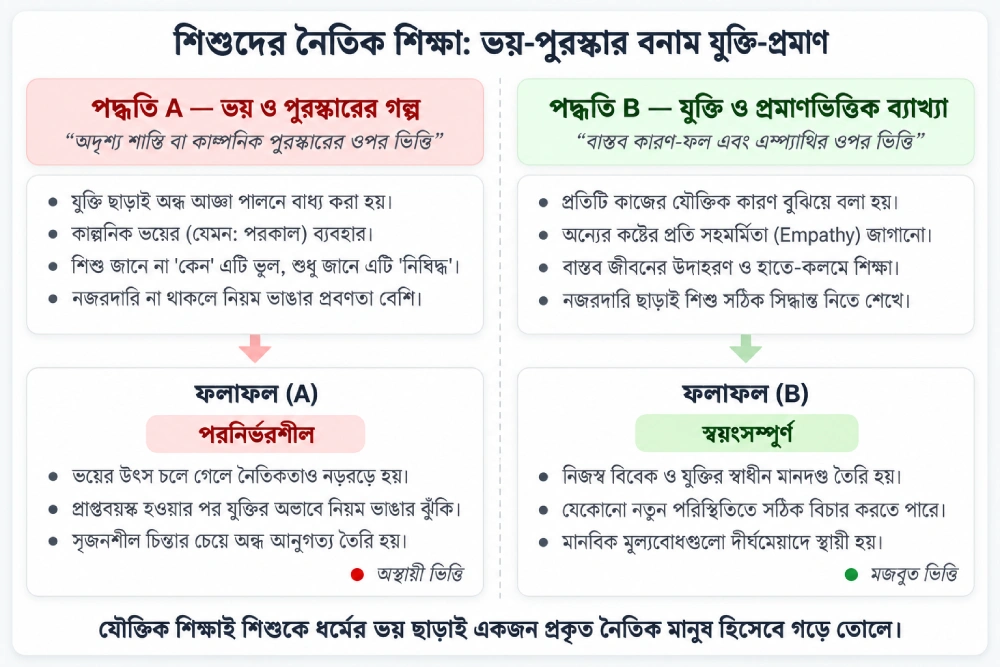
The moral dimension of the fire example becomes clearer when others’ safety is involved. If a child throws a burning object at someone, the injured person’s pain, fear, and need for treatment can be explained rather than merely threatening the child with punishment. The reason for prohibition is then grounded in another person’s experience. That pain and harm remain even when adults are absent. Understanding the affected person’s position rather than relying on surveillance gives the child a reason for deciding in new situations too.
Adults’ consistency also matters alongside explanations. Teaching children not to hurt anyone while beating them for mistakes can teach separate rules for the powerful. Humiliating questions and rewarding silence encourages obedience rather than inquiry. Explaining the harm of mistakes, showing ways to make amends, and involving children in decisions within a caring relationship makes moral responsibility an experience of real relationships. Learning to evade punishment differs from learning to take responsibility for one’s actions.
Children’s Moral Judgment Develops Before Religious Instruction
Hamlin, Wynn, and Bloom’s 2007 study in Nature examined social preferences in preverbal six- and ten-month-old infants. Infants showed greater attraction to, and a tendency to choose, a character that helped another achieve a goal rather than one that hindered it. The researchers interpreted this result as evidence of early social evaluation. This initiated extensive experimental investigation into whether preferences responding to helping and hindering develop before formal religious instruction is mastered. [34]
A large replication study published in 2025 under the ManyBabies4 project did not reproduce the earlier result using the same hill-climbing helping-and-hindering paradigm. Researchers tested 1,018 infants in 37 laboratories across five continents; the final analysis included 567. In the social condition, 49.34 per cent chose the helper, a proportion not significantly different from chance. Using this particular experiment as established proof of an innate sense of justice is therefore wrong. How infants learn social evaluation is determined through observation, replication, and identifying distinct behavioural capacities. [35]
In the social condition, 49.34% of infants chose the Helper.
English translation:
In the social experimental condition, 49.34 per cent of infants chose the helping character.
Social evaluation, understanding others’ goals, offering help, and learning about actual harm are distinct components of moral development. Choosing a puppet and trying to help a person in difficulty are different tests. Warneken and Tomasello’s 2006 research observed eighteen-month-old children helping others achieve their goals. They did not need to master religious punishments to provide that help. Moral development can therefore be investigated through actual social skills and experience; there is no basis for confining it to memorised religious rules. [36]
Children’s helping behaviour offers a practical pathway for social learning: they can recognise an unfinished task, understand a goal, and use their capacities to assist. Growing older adds questions about whether the action is just, whose need is greater, and whether anyone is excluded. Investigating this development does not require scriptural commands as a starting condition. Interpersonal life supplies the material for learning; moral education can organise those experiences through reasons, language, and equal rules.
The Inherent Problems of Religious Morality
Divine command theory connects moral obligation to God’s instructions. Within this framework, the explanation of being bound derives from the commander’s authority. But the power to instruct and the instruction’s justifiability are separate questions. Moving from “God commanded it” to “therefore it is just” first requires accepting his commands as the ultimate standard of justice. The very claim requiring proof is installed as a premise. [37]
A system that withdraws the right to examine an instruction’s justification is not moral judgment; it is a rule of obedience. Moral judgment requires reasons for one’s conduct, examination of others’ objections, and rejection of unjust commands. Unconditional obedience subordinates these activities to the authority’s permission. Prescribed compliance replaces moral responsibility: who spoke and what punishment follows disobedience, rather than why the action is just, control the decision.
Victims’ rights are at issue when enslaved women are subjected to sexual entitlement, people of different beliefs face legal discrimination, apostasy is punished, or war captives lose their freedom. Halting that examination by invoking religious approval supplies no moral answer to oppression; it exempts the oppressive authority from accountability. If objections to enslaving someone or denying their right to change belief are dismissed solely because of an authority’s command, “morality” becomes a name for surrender to power.
David Hume’s is–ought problem identifies an important logical limit: describing what has happened does not, alone, establish what ought to happen. “An ancient text permits slavery” is a textual fact; concluding “slavery is just” requires an additional moral premise. “God commanded it” likewise concerns an instruction’s alleged source; independent reasons are needed to explain why obeying is morally right. Otherwise, the commander’s power is being treated as sufficient grounds for morality. [38]
An important formal distinction arises here: “God said so” does not by itself formally yield “therefore it must be done”; the rule “one ought to obey whatever God commands” is tacitly added. That rule is precisely what is under examination. Assuming it without proof returns the argument to authority’s declaration. No religious identity completes this incomplete moral inference.
Under Kant’s conception of moral autonomy, following rules solely for external rewards calls the moral basis of a decision into question. Acting from duty and pursuing self-interest that happens to coincide with duty are different events. One person helps the vulnerable solely for a reward; another recognises their need and respects them as a person. The visible result may be identical, but the moral reasons differ. That is the problem with presenting the expectation of religious rewards as self-sufficient proof of morality. [39]
Albert Einstein emphasised sympathy, education, and the needs of social relationships as foundations of ethical conduct. The logical significance is that responsibility towards others can develop without a supernatural punishing authority. Helping out of desire for religious rewards differs in moral motivation from helping because another’s need is understood. No invisible Day of Judgment is required to explain the latter’s justification.
Considering this distinction alongside human rights clarifies the problem. Making dignity conditional—granting full rights only to those of a particular religion, allegiance, or belief—undermines equal human dignity. The reasons for respecting human beings as human beings are not subordinate to religious authority. The following video is relevant here:
In his modified divine command theory, Robert Adams connects ethical wrongness to opposition to the commands of a loving God. His account distinguishes moral value from the source of obligation; opposition to a loving God’s commands is made decisive in explaining ethical wrongness. [40]
Calling a being “loving” does not prove the justice of instructions circulated in his name. Assessing that description requires examining his conduct, response to others’ harm, and treatment of human dignity. Without such scrutiny it is merely praise. With scrutiny, moral reasons beyond the command’s source are again required. A loving identity therefore cannot place instructions beyond judgment. The moral foundation of a decision accepted for justified reasons is those reasons; accepting it by suspending judgment because of identity is obedience.
The practical problem is that commands reach people through texts, narrators, and interpreters. Even an allegedly infallible source requires human judgment about authentic texts, applicable instructions, and acceptable interpretations. The promise to remove human judgment from morality collapses in application. If an interpretation legitimises abuse, its victims cannot be answered merely with the interpreter’s rank. The route between claimed divine authority and imposed human decisions is also subject to accountability.
Modern Scientific Perspectives: The Biological and Psychological Origins of Morality
Moral sentiments and judgment are connected to the human brain, social experience, and evolved behavioural capacities. Charles Darwin, in The Descent of Man, explains the development of conscience through social instincts, sympathy, memory, habit, and reason. He also considers social animals’ behaviour important for understanding the foundations of human moral sentiments. This natural continuity does not require a supernatural explanation of morality’s origins. [41]
Alongside social instincts as early components of moral judgment, Darwin identifies memory, comparison, and consideration of others’ reactions. People can regret conduct after immediate anger or gain because they can compare past behaviour with enduring social relationships. On this account, conscience is not a list of rules implanted all at once from outside; it is an interaction of feelings, experience, and judgment. [42]
Finally the social instincts, which no doubt were acquired by man as by the lower animals for the good of the community, will from the first have given to him some wish to aid his fellows, some feeling of sympathy, and have compelled him to regard their approbation and disapprobation. Such impulses will have served him at a very early period as a rude rule of right and wrong.
English translation:
Finally, the social instincts acquired by humans and other animals for the community’s benefit have from the outset given people some desire to help their fellows, some sympathy, and an impulse to consider their approval and disapproval. At a very early stage, these impulses served as a rudimentary rule of right and wrong.
Morality is not a single biological instinct. Empathy helps us understand others’ harm; reason tests consistency; social memory preserves relationships; institutions assign responsibility for behaviour. Human moral judgment emerges through their interaction. Describing biological capacities differs from deciding which principles to adopt, but the reality of the former does not make a supernatural source indispensable to the latter.
Neuroscientist Patricia Churchland’s Braintrust analyses the neurobiological foundations of social bonding, childcare, trust, and cooperation. Hormones including oxytocin and nervous-system processes are associated with attachment and caring behaviour. These complex behaviours cannot be reduced to one hormone or purported “mirror neurons,” but observable relationships connect brain function with social care. Our responses to others’ suffering are not inexplicable supernatural events. [43]
Greene and colleagues’ 2001 brain-imaging research identified different contributions of emotional and cognitive processes when people judged different moral dilemmas. Moral decisions therefore involve more than dry calculation: emotions, social connection, and deliberation operate together. Neural evidence of this process reduces the need to attribute human moral feelings to an independent spiritual mechanism outside the brain. [44]
Jonathan Haidt’s The Righteous Mind analyses the relationships between social groups, moral intuitions, and post-hoc rationalisation. People often adopt an emotional position first and subsequently construct reasons for it. Religious identity can also strengthen social morality’s group-oriented aspects. Émile Durkheim’s The Elementary Forms of Religious Life examines religion’s social forms, collective rituals, and shared identity. These studies show that explaining religious morality’s social operation does not require assuming its divine origin is true. [45] [46]
Cooperation, care, conflict resolution, and detecting cheating were problems of social life before religious belief. Behavioural capacities evolved in addressing them supplied materials for human moral thought. Religious systems later organised these elements in various societies through rules, rewards, punishments, and authority. Thus explaining human caring does not require treating the emergence of religion as its first cause. Religion can declare a rule sacred; whether it is just remains a question for moral analysis.
The social amoeba Dictyostelium discoideum helps explain biological precursors of moral behaviour. When food is scarce, thousands of individual cells aggregate into a multicellular structure. Approximately one-fifth form a stalk rather than reproducing directly, enabling the others to disperse as spores. Strassmann, Zhu, and Queller’s 2000 research found cooperation as well as “cheating”—benefiting while contributing less. Altruism here has its biological meaning: benefits to some at reproductive cost to others. The research attributes no conscious moral ideals to amoebae. It does establish cooperative organisation in living systems long predating human religious ideas. [47]
This also carries an important lesson for morality. Altruistic behaviour in nature does not make every member selfless; opportunism also occurs. Understanding how cooperation persists therefore requires examining relatedness, reciprocity, detecting rule-breaking, and subsequent relationships. A natural account of morality is not the childish idea that everything in nature is good.
Robert Trivers provided an evolutionary account of reciprocal altruism in 1971. An individual may incur an immediate cost by helping, yet the behaviour can persist under evolutionary conditions if future cooperation is possible. Trivers analyses links with friendship, gratitude, trust, detecting deception, and responses to wrongdoing. The relationship is conditional: outcomes change with cooperation’s benefits, the likelihood of meeting again, and the costs of cheating. [48]
Human social life encompasses kinship, personal relationships, and large-scale cooperation with strangers. Different mechanisms may operate at each level. People subsequently developed values, laws, and moral arguments to decide which conduct benefits others and which rules protect everyone’s rights. Why cooperation is possible in nature can be answered without religious commands; which cooperation is just requires a separate moral judgment.
The emergence of social cooperation in evolution is an observable phenomenon with scientific explanations. Helping relatives, reciprocal exchange, reputation, and group organisation can stabilise cooperation under different conditions. Human empathy and reason have built more complex morality on these biological foundations. Here lies an initial answer to whether people can behave morally without religion: religious belief is not a prerequisite for helping, caring, reciprocity, or avoiding harm. [49]
Empathy is a natural capacity, but its reach may be uneven. Familiar people’s suffering attracts attention while distant strangers’ pain is overlooked. Explaining kinship and group advantages therefore differs from accepting everyone’s equal dignity. Reason tests whether grounds accepted for those close to us also apply to distant people. Understanding moral capacities’ natural origins also helps reveal the need to criticise and extend them.
Amoebal cooperation, animal care, and human moral reasoning operate at different levels. The first involves arrangements of reproductive costs and benefits; other levels add understanding goals, responding to feelings, and offering reasons for rules. Biological altruism does not require a cell consciously deciding to sacrifice itself. These levels can form a continuous inquiry because actual cooperative mechanisms are examinable at each. Increasing complexity supplies no argument for replacing explanation with supernatural commands.
Morality in the Animal World: The Evolution of Empathy and Social Behaviour
Other animals exhibit empathy-related responses, cooperation, and repair of relationships after conflict; rejection of unequal rewards has also been studied. Such behaviours are called “proto-morality” because they resemble some prerequisites of human moral life. Animals do not write human rights declarations or philosophical treatises, but they display social capacities needed as elements of moral conduct. No independent proof establishes that a supernatural power created every component of morality for humans all at once. [50]
Frans de Waal studied chimpanzee and bonobo social behaviour extensively. Cooperation, reconciliation after conflict, supporting familiar individuals, and food sharing form part of primate relationships. Felix Warneken and Michael Tomasello’s 2006 study in Science tested helping behaviour in young chimpanzees alongside eighteen-month-old children. Children helped others achieve goals in different situations; chimpanzees also displayed some skills and motivation to help. Helpers received no immediate material reward in the experiment. There is no reason to attribute this elementary component of moral conduct to knowledge of religious punishment. [51]
Warneken and colleagues’ 2007 study in PLoS Biology adds experimental evidence of spontaneous helping by children and chimpanzees. Opportunities for interaction, understanding others’ goals, and the capacity to perform helpful actions matter in explaining the behaviour. [52]
African elephants show distinctive social responses to injured or dead individuals. Douglas-Hamilton and colleagues’ 2006 account describes assistance, approaches, and exploratory behaviour towards a dying and subsequently dead matriarch. Responses were not restricted to close relatives. This research informs understanding of social care’s reach; animal bonds and responses to vulnerable individuals can be investigated without requiring ideas of religion or life after death. [53]
Dolphin and whale societies also exhibit group movement, assistance towards ailing companions, and mutual communication. These aquatic mammals’ social behaviour is studied for its evolutionary foundations of cooperation. Popular stories sometimes portray dolphins’ intentional rescue of humans as established moral decisions; not every such account is equivalent to verifiable experimental research. What is established is that complex social mammals exhibit helping and relationship-maintaining behaviour. These social capacities operate without hearing religious rules. [54]
Direct observations of assistance towards a distressed dolphin appear in Kuczaj and colleagues’ 2015 research. Underwater video and acoustic recordings were used to analyse the relationship between an ailing bottlenose dolphin’s distress calls and others’ helping behaviour. They reveal a specific behavioural process of responding to another’s distress. Connor and Krützen’s alliance research addresses a different question: how enduring alliances and collective strategies operate. Helping an ailing companion and forming alliances both illustrate social capacities, but their functions and motivations differ. [55]
The frequency of her whistle production was positively correlated with the frequency of the supporting behaviors the DD received from other dolphins.
English translation:
The dolphin’s rate of whistling was positively correlated with the rate of supportive behaviour it received from other dolphins.
Social memory, recognition of relationships, and post-conflict behaviour are important among corvids. Fraser and Bugnyar’s 2010 study found third-party affiliation towards ravens subjected to aggression, particularly within close relationships. The researchers examined this as possible consolation and found relationship value important. The subject is a social response to another’s condition, not abstract moral rules. It belongs to animal social life rather than imitation of religious prescriptions. [56]
Sarah Brosnan and Frans de Waal conducted one of the best-known experiments on negative responses to inequality in 2003. When capuchins received rewards of different quality for the same task, some rejected the less attractive reward, particularly when a partner received a better one for identical work. The researchers interpreted the behaviour as aversion to unequal exchange. Reward rejection for work became an important starting point for subsequent research on animal behaviour. [57]
In 2024, Ritov and colleagues pooled primary data from 23 studies, analysing 60,430 observations across eighteen species. They found no evidence of animal inequity aversion in these accept-or-reject reward tasks and also examined disappointment at receiving a less attractive reward after seeing a better one. Rejecting cucumber therefore does not directly establish a human-like sense of justice. The behaviour occurred, but identifying its cause requires separately testing reward quality, expectations, and what the partner received. [58]
We find no evidence for IA in non-human animals in these tasks.
English translation:
We found no evidence of inequity aversion among non-human animals in these tasks.
Together, these animal examples show that elementary components of moral behaviour did not await human religious institutions. Helping, responding to distress, and maintaining relationships have biological and social histories. Experimental investigation also continues into specific causes of behaviours such as reward rejection. Building on these capacities, human reason and language have enabled complex ideas of rights, justice, and universality. Claiming that scripture invented every feature of morality ignores actual biological continuity.
Animal social behaviour allows three kinds of information to be distinguished: what the animal did, the circumstances, and the behaviour’s possible function. Remaining beside an injured companion can be observed directly; inferring internal feelings requires examining patterns and alternatives. Other human minds are not directly visible either; judgments depend on behaviour, communication, and circumstances. Experiments strengthen their evidential basis. Research on animal care therefore emphasises actual social responses rather than invented human-like stories.
Human distinctiveness is especially evident in making rules themselves objects of judgment. Beyond who helps whom, people can ask whether assistance is fairly distributed and whether outsiders have the same claims. An animal’s helping does not prove a philosophy of human rights, but it reveals a natural history for some of the care, goal understanding, and social relationships needed to develop that philosophy. The distinctive development of moral reasoning and the existence of its precursors can be understood within the same account.
The Rational Mechanisms of Morality: From the Brain to Game Theory
Human moral decisions involve more than feelings: strategic reasoning, conditions of cooperation, social institutions, and specific brain functions also contribute. Game theory explains when self-interested individuals may cooperate and when the risk of cheating undermines cooperation. Neuroscience shows how emotional and decision-making processes affect moral judgment. Political philosophy examines how just institutions can be designed beyond personal advantage. None needs a supernatural punisher as a scientific ingredient in producing morality.
Explaining the benefits of cooperation differs from giving reasons for justice. Members of a criminal organisation can divide responsibilities and maintain trust efficiently; efficiency does not justify their treatment of victims. Who cooperates and who bears the costs must therefore be asked together. Mathematical models explain the conditions under which relationships persist; principles of rights and consent test whether those relationships impose injustice on others.
Game Theory and the Mathematical Conditions for Sustaining Cooperation
The prisoner’s dilemma presents two individuals with opportunities to cooperate or defect. Under a particular payoff structure, defection in a one-off interaction can benefit individuals, yet mutual defection produces a worse joint result than cooperation. Repeated encounters, future reciprocity, reputation, and responses to violations create new incentives to cooperate. Robert Axelrod and William Hamilton’s 1981 analysis and Axelrod’s 1984 book examine the conditions for cooperation’s evolution in repeated social interaction. The scientific conclusion is therefore not that cooperation is mathematically inevitable in every circumstance, but that cooperation becomes stable and advantageous under specific conditions. [59] [60]
In 2006, Martin Nowak described five mechanisms for the evolution of cooperation: kin selection, direct reciprocity, indirect reciprocity, network reciprocity, and group selection. Each has its own conditions. Religious rewards need not be installed as an indispensable causal factor in explaining human social cooperation. [61]
Repeated relationships add the cost of losing future interactions to cheating’s immediate gains. A seller may profit by deceiving a customer once but lose later customers when the deception becomes known. Reputation and shared information thus change incentives. Reliable records, access to remedies, and assurance that rules will operate equally facilitate cooperation. Part of the practical explanation for moral behaviour lies in the value of lasting relationships and social mechanisms for detecting fraud.
Equal human rights cannot be confined to possible future reciprocity. An injured stranger’s need for treatment has moral importance even if they can never return the favour. Reciprocity explains some cooperation without defining every moral duty. Accepting the recipient’s own harm and security as reasons makes responsibility towards distant people, children, and permanently disabled individuals explicable. Connecting mathematical accounts of cooperation with rights-based morality requires preserving these distinct questions.
The Physical Basis of Morality: Phineas Gage and the Prefrontal Cortex
In 1848, railway construction worker Phineas Gage survived an accident in which an iron rod passed through his head. Historical accounts describe changes in his behaviour and social decision-making. In 1994, Hanna Damasio and colleagues used his skull and modern neuroscientific methods to reconstruct the probable injury site, highlighting prefrontal regions. Popular portrayals of Gage as a criminal, liar, or wholly amoral person often lack support in primary historical sources. Malcolm Macmillan’s 2000 research identified these inaccuracies. The established conclusion is that particular brain injuries can alter social behaviour and decision-making; moral judgment depends on brain function. [62] [63]
Koenigs and colleagues’ 2007 study in Nature found a specific pattern of altered judgment in moral dilemmas among six patients with bilateral ventromedial prefrontal cortex damage. It experimentally examines how changes in emotional processing affect moral decisions. Specific moral judgments change when brain processes are damaged—strong evidence connecting moral judgment with the living nervous system. [64]
Understanding neural injury requires distinguishing knowledge of rules from the capacity to apply them. Someone may verbally state social prohibitions yet struggle to appreciate emotional significance, consider future outcomes, or regulate impulses. The altered responses to particular dilemmas in Koenigs and colleagues’ research show different mental processes contributing to different aspects of evaluation. Explaining moral judgment merely through memorised rules fails to capture these changes.
This dependence has social significance. Decision-making capacity is relevant to assigning responsibility, preventing harm, and rehabilitation. If frightening people into obedience solved every problem, specific impairments of judgment would need no investigation. In practice, treatment, care, and safe environments matter because behaviour occurs through a living nervous system. Detaching moral responsibility from evidence of capacity and harm risks turning judgment into a machinery of punishment.
Altruistic Punishment: A Strategy for Maintaining Social Cooperation
Game theory calls someone who enjoys cooperation’s benefits without contributing a “free rider.” Proliferating free riding undermines trust. In Ernst Fehr and Simon Gächter’s 2002 study in Nature, participants punished those who violated cooperative norms even at personal cost. This is called altruistic punishment because punishers incur costs to preserve collective cooperation without direct material gain. The experiment did not require a religious Judgment Day; it observed participants’ interactions and the actual consequences of violations. [65]
This research raises a further moral question: punishment can be socially effective without every punishment being just. Necessity, severity, the truth of allegations, and the accused person’s rights require separate scrutiny. Genuine social justice does not grant unlimited power to vengeful impulses; it establishes reason-based, accountable institutions.
Challenging rule-breaking at one’s own expense to preserve cooperation creates a social incentive: people cannot reap the benefits of wrongdoing at no cost. But the motives and accountability of those who wield the power to punish also matter. In Herrmann, Thöni, and Gächter’s 2008 experiment involving 16 participant pools, differences emerged in which some participants punished high contributors as well as low contributors. In several pools, this antisocial punishment undermined the benefits of punishment for cooperation. [66] [67]
Understanding antisocial punishment is an important task for future research because antisocial punishment is a strong inhibitor of cooperation.
English translation:
Understanding antisocial punishment is an important task for future research, because antisocial punishment is a powerful obstacle to cooperation.
Consequently, opportunities to impose punishment must be accompanied by evidence supporting the accusation, an opportunity to defend oneself, and proportionality in punishment. When personal resentment is elevated to the status of social justice, the same system can suppress cooperative people. Punishment by religious or state authorities is therefore not justified by the identity of those authorities. Whether punishment reduces crime, whether innocent people are harmed, and whether the same rules are enforced against the powerful are all part of determining its moral value.
John Rawls’s ‘Veil of Ignorance’ and Impartial Justice
John Rawls’s ‘veil of ignorance’ is an influential method of thinking about the construction of a just society. In the hypothetical original position, those determining the rules do not know whether they will be born rich or poor, male or female, members of a majority or minority, powerful or powerless. This weakens the grounds for devising special rules favouring their own religion, class, or privileged identity. From this position, Rawls develops principles concerning equal basic liberties and just limits on social and economic inequalities. This is a test of justice from the perspective of citizens of equal standing, rather than approval from a religious ruler. [68] [69]
The importance of this approach becomes clear through practical examples. If people do not know whether they will be born into a dominant religious group or a persecuted religious minority, it becomes difficult to justify rules that curtail civil rights on religious grounds. If, before establishing rules for slavery, they do not know whether they will be slaves or masters, the inhumanity of those rules becomes even clearer. Justice then becomes a search for rules acceptable from anyone’s position, rather than a weapon for protecting one’s own identity.
The veil of ignorance prevents a rule-maker’s privileged identity from serving as the basis of an argument. If people do not know the circumstances of their own birth when determining rights to education, property, or expression, the grounds for accepting permanent subordination for any group become weak. The same test applies to the distribution of rights by gender. When people do not know whether they will be among those controlled, giving one side permanent power to deprive others of freedom cannot stand as a just claim.
Within Rawls’s framework, basic liberties are not something to be taken away simply for the majority’s aggregate benefit. The justification of social and economic inequalities is also linked to the position of the least advantaged. Claims of progress therefore cannot be established solely by calculating increases in the wealth of the powerful. Whose opportunities are expanding and what people at the bottom of society are gaining also matter. This gives force to the demand for social rules that can be explained to everyone, instead of turning religious or hereditary status into permanent privilege. [70]
The Moral Landscape: Subjective Preferences and Objective Consequences
Sam Harris, in The Moral Landscape, places human conscious experience and well-being at the centre of moral discussion. The real effects of hunger, disease, abuse, deprivation of education, or insecurity can be investigated scientifically. For example, analysing the harm caused by violence against children or the social effects of denying women education requires no religious authorisation. Important practical consequences of moral principles can thus be assessed through observation and evidence rather than conjecture. [71]
There is a necessary step in this argument: science can tell us which behaviour increases or reduces suffering; the premise that suffering matters morally must also be openly accepted. Once that premise has been accepted, science plays an indispensable role in comparing the consequences of different policies, correcting misinformation, and selecting effective alternatives. The strength of this approach lies in publicly available reasons, revisable evidence, and the experiences of those affected, rather than authority.
If assessments of well-being consider only immediate feelings of pleasure, some harms caused by power are overlooked. Keeping someone safe while depriving them of independent decisions is not the same as giving them the security to choose their own life. A subordinate person may adapt to circumstances by lowering their expectations; what alternatives are actually available therefore matters alongside their stated satisfaction. Considering health, education, movement, and the ability to make decisions about oneself together connects well-being to the real opportunities available in life. [72]
Science’s task here is to dismantle false claims about the consequences of policies. When a punishment is said to be beneficial, its injuries, long-term fear, behavioural effects, and the outcomes of alternative methods can be compared. If someone claims that women’s education is harmful, the actual consequences of education can be examined. When the evidence changes, the causal arguments previously offered in support of a policy must also change. Declaring something sacred and prohibiting examination of its consequences gives the policy’s beneficiaries a special opportunity to sustain false claims.
Practical Tests for Moral Decisions: Harm, Rights, Consent, and Equal Rules
Four main questions are useful in assessing whether a rule is just: whom does it harm; do the people concerned have freedom and consent; does the same rule apply to everyone in the same circumstances; and are there less oppressive alternatives for avoiding harm? These questions provide a way to identify the majority’s injustices, rather than serving as substitutes for majority opinion. Specific moral arguments can be made against any rule that reduces someone’s rights solely because of religion, birth, gender, or social position.
| Example of a rule | Observable harm or condition | Basis of moral judgement |
|---|---|---|
| Slavery | Deprivation of freedom, coercion, life under ownership | The individual’s equal dignity and freedom |
| Beating a child | Physical pain, fear, risk of injury | The child’s safety and developmental needs |
| Punishment for leaving a religion | Deprivation of freedom of conscience and the freedom to change one’s beliefs | Freedom of religion and expression |
| Denying women education | Undermining opportunities for knowledge, employment, and independent decisions | Equal opportunity and non-discrimination |
| Helping someone in danger | Reducing harm, increasing safety and social trust | Empathy, need, and cooperation |
Slavery establishes one person’s ownership over another’s movement and labour; coercion overrides the will of the person concerned; discrimination gives people with the same needs and abilities fewer rights because of their identity. It is on the basis of these specific features that slavery is called slavery, coercion is called coercion, and discrimination is called discrimination. Religious authorisation explains a rule’s history and claims to authority. Using that authorisation as a licence when assessing the freedom and equal rights of those affected creates a special moral privilege for injustice.
Assessing consent requires more than a verbal yes or no; whether there is a real opportunity to refuse also matters. When saying no carries the risk of beating, food deprivation, or confinement, coercion operates behind the consent. Decisions can also be secured by withholding necessary information. Free consent therefore involves access to information, a decision made without pressure, and a real ability to change one’s mind. The satisfaction of the person in power does not establish the subordinate person’s free consent.
The question of less harmful alternatives is similarly useful in moral judgement. If explanation and correction are available as alternatives to beating in education, choosing to beat requires additional justification. Curtailing the rights of a religious group in the name of public safety requires evidence of specific harm and necessity; identity cannot serve as a substitute for an offence. Requiring disclosure of who bears a rule’s burden, on what evidence, and how that burden can be avoided makes arbitrary authority more difficult.
Atheism, Humanism, and Humane Morality
Atheism primarily means the absence or rejection of belief in God; it is not, by itself, a complete moral philosophy. But to refute the claim that belief in God is indispensable to a moral life, it is enough to show that people can develop moral principles based on empathy, rights, justice, and social responsibility without such belief. Humanism is a coherent tradition of these principles, emphasising human dignity, equal freedom, scientific knowledge, and mutual accountability. The validity of a person’s morality is assessed through their behaviour and the reasons they offer for it, rather than their religious identity.
Socrates’ questions, Charvaka’s this-worldly inquiry, Epicurus’ reduction of suffering, Kant’s autonomy, Mill’s concern for well-being, and Rawls’s justice are not identical philosophies. Together, however, they demonstrate a long philosophical history of developing moral judgement beyond religious authorisation.
The strongest argument for secular humanist morality is not the superiority of any identity; it is the independent testability of principles. If a law subjects innocent people to abuse, objecting to it does not first require proof that the perpetrator follows a particular religion. The questions are whether the affected person is human, whether they have equal rights, and whether there are justifiable grounds for their treatment. Invoking a sacred text provides no moral support for a rule that fails this test.
Richard Dawkins, in The God Delusion, questions the inseparable connection between belief in God and morality. The idea that without God there is no restraint on wrongdoing denies the reality of human social instincts, conscience, law, and responsibility towards others. Treating fear of punishment in the afterlife as indispensable to morality cannot explain the behaviour of people who make sacrifices for others without reward. [73]
Health data, social inequality, physical safety, mental well-being, consent, and freedom matter when assessing morality in terms of human welfare. The same principles apply to social institutions as well as individuals. If a law denies women equal civil rights with men, the question is whose rights are being taken away and why, rather than how ancient or religiously authorised the discrimination is. Science and moral philosophy are not substitutes for one another here: evidence establishes the nature of the harm, while moral reasoning makes that harm and those rights subject to judgement. [74]
In the authority-centred form of religious morality, the ultimate question is ‘Who issued the command?’; in humanist morality, the ultimate question is ‘What reasons justify the command?’ The answer to the first identifies the ruler. The answer to the second examines the act’s effects on other people’s lives and the principle’s justifiability. If someone refrains from harming others solely out of fear of punishment, the basis of their decision may change once that fear disappears. If someone regards another person’s suffering as morally significant, they have an independent reason for their conduct even in the absence of surveillance. This second kind of morality does not require the idea of religious punishment.
“A man’s ethical behavior should be based effectually on sympathy, education, and social ties and needs; no religious basis is necessary.” — Albert Einstein. [75]
The demand of humane morality is therefore clear: determining whether an act is justifiable requires reasons grounded in the reality of other people’s dignity, rights, interests, and suffering. One effective answer to why people should act morally is that other people also suffer, can claim freedom and security, and need the same principles to be applied justly, as we all do. The presence or absence of religious belief does not invalidate this moral reason.
If religious identity does not guarantee morality, an unbelieving identity does not place anyone above criticism either. If an atheist ruler commits an injustice, the same arguments concerning equal rights and harm apply against that ruler. Humanism gives importance to this common standard rather than loyalty to a person or group. A principle that raises the same objection to oppression committed by one’s own side creates an effective barrier to licences based on identity. Morality then returns from certificates of identity to accountability for conduct.
Future generations can also be considered when explaining the scope of human responsibility. Those who will later suffer the harms of environmental pollution or resource depletion cannot reciprocate or protest now. Yet the consequences of destroying their opportunities in life are real. Bringing that harm into the assessment of present-day benefits takes moral judgement beyond immediate rewards and familiar groups. Responsibility can be developed by accepting future people’s potential suffering and equal dignity as reasons.
Conclusion: The Possibility of Morality Without Religion
Unconditional religious obedience is not morality, because it ultimately denies the freedom to assess whether a command is justified. Morality requires offering reasons for one’s actions, considering the objections of those harmed, and rejecting instructions when they are unjust. If the command-giver’s identity is the final answer to every objection, obedience replaces judgement. Calling this system ‘religious morality’ does not change its nature.
If the only answer to why people should do good is to attain heaven or avoid hell, other people’s needs do not become reasons for decisions in their own right; one’s own rewards and punishments become the centre of the decision. In moral judgement, the hunger of the hungry, the suffering of the abused, and the demands for freedom of those deprived of rights count as reasons. Their importance does not depend on whether an authority will offer a reward. Human social evolution, children’s helping behaviour, and the neural processes of moral judgement provide natural avenues for investigating this capacity; the justification of behaviour is determined by examining the reasons offered for it and its consequences for people.
An important aspect of progress in the history of human rights is the principle that people possess equal dignity regardless of race, gender, religion, ancestry, or social position. The prohibition of slavery, the unacceptability of cruel punishment, equal rights for women and men, and freedom of religious belief have gained strength through reasoning, social struggles, legal reforms, and human experience. Attributing all these changes to a single ideology distorts history; but assessing their moral value has not required ancient religious authorisation as the ultimate standard. In particular, a rule that turns one person into another’s property is directly rejected on the basis of equal human dignity. [76]
Bertrand Russell, in Why I Am Not a Christian, argues for testing religious claims through reason and evidence rather than granting them the status of belief. This approach has the same significance for morality: a proposition’s age, sanctity, or popularity in society does not determine whether it is justified. Arguments against slavery, cruel punishment, or discrimination must be presented independently. Such judgement does not require an omniscient punisher. [77]
One sign of moral maturity is the ability to explain the reasons for one’s decisions to others and correct them when they are wrong. One person refrains from harmful actions only out of fear of punishment; another refrains because they understand the action’s immorality. The two behaviours may look alike, but the second has a moral reason that is independent, public, and open to discussion. This search for reasons lies at the heart of humanist morality.
Merely stating ‘what must be done’ and explaining ‘why it must be done’ are not the same education. Developing moral judgement requires reasons supporting rules, a just assessment of conflicting interests, the perspective of the person harmed, and the ability to revise decisions in light of new evidence. If a religious text’s rule fails this test, questioning the rule is reasonable; declaring such questioning a sin closes the path to correcting mistakes.
A just society requires equal human dignity, empathy, freedom of conscience, and the right to revise policies on the basis of evidence. A person’s full rights cannot depend on their religious beliefs; likewise, a religious instruction that deprives others of freedom cannot be placed above criticism. If the standard of morality is for everyone, it must apply equally to rulers and ruled, believers and unbelievers, majorities and minorities.
Supernatural punishment is not indispensable to people’s sense of responsibility towards one another. An acceptable basis for morality lies in reasons that can be explained to those harmed and applied justly to everyone in the same circumstances.
Moral autonomy does not mean a licence to make rules for one’s own convenience and harm others. It means providing reasons for one’s decisions, taking seriously the objections of those affected, and applying the same standards to oneself. If a doctrine rejects this accountability and treats its own authority as proof, independent reasons remain for examining its claims. Human suffering, freedom, and dignity do not have to await the command-giver’s identity to acquire moral significance; therein lies the basis of people’s mutual responsibilities.
References
- Stanford Encyclopedia of Philosophy, Theological Voluntarism, revised 2025 edition ↩︎
- Plato, Euthyphro, 10a–11b, Benjamin Jowett’s English translation, MIT Classics Archive ↩︎
- Shongshoy: Is God Moral Without a Guidebook from His Own “God”? ↩︎
- Mark C. Murphy, Theological Voluntarism, Stanford Encyclopedia of Philosophy ↩︎
- Pradeep P. Gokhale, Lokāyata/Cārvāka: A Philosophical Inquiry, chapter 6, Oxford University Press, 2015 ↩︎
- Harvey, P. (2000). An Introduction to Buddhist Ethics. Cambridge University Press. ↩︎
- Jaini, P. S. (1979). The Jaina Path of Purification. University of California Press. ↩︎
- Internet Encyclopedia of Philosophy, Jain Philosophy ↩︎
- Aristotle, Nicomachean Ethics, especially Books II and VI. ↩︎
- Epicurus, Letter to Menoeceus. ↩︎
- Kant, I. (1785). Groundwork of the Metaphysics of Morals, especially the Second Section. ↩︎
- Kant, Groundwork of the Metaphysics of Morals, Second Section; translated by Thomas Kingsmill Abbott ↩︎
- Bentham, J. (1789). An Introduction to the Principles of Morals and Legislation. ↩︎
- Mill, J. S. (1861). Utilitarianism. ↩︎
- Nietzsche, F. (1887). On the Genealogy of Morality, First Essay. ↩︎
- Stanford Encyclopedia of Philosophy, Theological Voluntarism ↩︎
- Qur’an 4:24 ↩︎
- Qur’an 23:5–6 ↩︎
- Shongshoy: Slavery in Islam ↩︎
- United Nations, Universal Declaration of Human Rights, Articles 1, 4, and 5 ↩︎
- Sahih Muslim 1406a: Mut‘ah Marriage ↩︎
- Shongshoy: Mut‘ah Marriage in Islam ↩︎
- Qur’an 2:106: The Verse on Abrogation ↩︎
- Amartya Sen, The Idea of Justice, Harvard University Press, 2009 ↩︎
- Kant, Groundwork of the Metaphysics of Morals. ↩︎
- Mill, Utilitarianism. ↩︎
- Rawls, A Theory of Justice, 1971. ↩︎
- Scanlon, What We Owe to Each Other, 1998. ↩︎
- Grusec & Goodnow (1994), Developmental Psychology, 30(1), 4–19 ↩︎
- Kochanska (2002), Current Directions in Psychological Science, 11(6) ↩︎
- Deci & Ryan (2000), Psychological Inquiry, 11(4), 227–268 ↩︎
- Piaget, J. (1932). The Moral Judgment of the Child. ↩︎
- Kohlberg, L. (1981). Essays on Moral Development, Vol. 1. ↩︎
- Hamlin, Wynn & Bloom (2007), Social Evaluation by Preverbal Infants, Nature, 450, 557–559 ↩︎
- Lucca et al. (2025), Infants’ Social Evaluation of Helpers and Hinderers, Developmental Science, 28, e13581 ↩︎
- Warneken & Tomasello (2006), Altruistic Helping in Human Infants and Young Chimpanzees, Science, 311, 1301–1303 ↩︎
- Theological Voluntarism, Stanford Encyclopedia of Philosophy ↩︎
- Hume, D. (1739–1740). A Treatise of Human Nature, Book III, Part I, Section I. ↩︎
- Kant, I. (1785). Groundwork of the Metaphysics of Morals, First Section. ↩︎
- Mark C. Murphy, Theological Voluntarism, especially the discussion of Adams’s modified divine command theory and God’s moral attributes ↩︎
- Darwin, The Descent of Man, chapter IV: The Moral Sense ↩︎
- Darwin, The Descent of Man, second edition, 1874, chapter IV ↩︎
- Churchland, P. S. (2011). Braintrust: What Neuroscience Tells Us about Morality. Princeton University Press. ↩︎
- Greene et al. (2001), Science, 293, 2105–2108 ↩︎
- Haidt, J. (2012). The Righteous Mind. Pantheon Books. ↩︎
- Durkheim, É. (1912). The Elementary Forms of Religious Life. ↩︎
- Strassmann, Zhu & Queller (2000), Nature, 408, 965–967 ↩︎
- Trivers (1971), The Evolution of Reciprocal Altruism, Quarterly Review of Biology, 46(1), 35–57 ↩︎
- Nowak (2006), Five Rules for the Evolution of Cooperation, Science ↩︎
- de Waal, F. (2006). Primates and Philosophers: How Morality Evolved. Princeton University Press. ↩︎
- Warneken & Tomasello (2006), Science, 311(5765), 1301–1303 ↩︎
- Warneken et al. (2007), Spontaneous Altruism by Chimpanzees and Young Children, PLoS Biology, 5(7): e184 ↩︎
- Douglas-Hamilton et al. (2006), Applied Animal Behaviour Science, 100, 87–102 ↩︎
- Connor, R. C., & Krützen, M. (2015). Male Dolphin Alliances in Shark Bay: Changing Perspectives in a 30-Year Study. Animal Behaviour, 103, 223–235. ↩︎
- Kuczaj et al. (2015), Underwater Observations of Dolphin Reactions to a Distressed Conspecific, Learning & Behavior, 43, 289–300 ↩︎
- Fraser & Bugnyar (2010), Do Ravens Show Consolation?, PLoS ONE, 5(5): e10605 ↩︎
- Brosnan & de Waal (2003), Monkeys Reject Unequal Pay, Nature, 425, 297–299 ↩︎
- Ritov et al. (2024), No Evidence for Inequity Aversion in Non-Human Animals, Proceedings of the Royal Society B, 291:20241452 ↩︎
- Axelrod, R., & Hamilton, W. D. (1981). The Evolution of Cooperation. Science, 211(4489), 1390–1396. ↩︎
- Axelrod, R. (1984). The Evolution of Cooperation. Basic Books. ↩︎
- Nowak (2006), Five Rules for the Evolution of Cooperation, Science, 314, 1560–1563 ↩︎
- Damasio et al. (1994), The Return of Phineas Gage, Science, 264, 1102–1105 ↩︎
- Macmillan (2000), Restoring Phineas Gage, Journal of the History of the Neurosciences, 9, 46–66 ↩︎
- Koenigs et al. (2007), Nature, 446, 908–911 ↩︎
- Fehr & Gächter (2002), Altruistic Punishment in Humans, Nature, 415, 137–140 ↩︎
- Herrmann, Thöni & Gächter (2008), Antisocial Punishment Across Societies, Science, 319, 1362–1367 ↩︎
- Gächter & Herrmann, Reciprocity, Culture and Human Cooperation, CeDEx Discussion Paper 2008–14, review of the same experiment ↩︎
- Stanford Encyclopedia of Philosophy, Original Position ↩︎
- Rawls, J. (1971). A Theory of Justice. Harvard University Press. ↩︎
- Original Position, Stanford Encyclopedia of Philosophy, discussion of equal basic liberties and the two principles of justice ↩︎
- Harris, S. (2010). The Moral Landscape: How Science Can Determine Human Values. Free Press. ↩︎
- Amartya Sen (2009), The Idea of Justice, discussion of life, freedom, and capabilities ↩︎
- Dawkins, R. (2006). The God Delusion. Bantam Press. ↩︎
- Sen (2009), The Idea of Justice ↩︎
- Einstein, Religion and Science, New York Times Magazine, 9 November 1930 ↩︎
- United Nations Universal Declaration of Human Rights, 1948 ↩︎
- Russell, B. (1927). Why I Am Not a Christian. ↩︎