
Abstract
This article examines child marriage in Islam [1] and intercourse with a wife whose menstruation has not begun, by reading Quran 33:49 in Surah al-Ahzab alongside Quran 65:4 in Surah al-Talaq. Quran 33:49 states that divorce before intercourse entails no waiting period. Quran 65:4, by contrast, prescribes a three-month waiting period for a divorced wife whose menstruation has not yet begun. Read together, these rules yield a direct conclusion: the Quran’s legal framework recognises an underage wife whose marriage has taken effect and with whom marital intercourse has occurred.
This conclusion does not rest on a single translation, an isolated commentary or a modern critic’s conjecture. Sahih al-Bukhari’s chapter headings; Ibn Kathir; al-Jalalayn; al-Mazhari; Ma’arif al-Quran; Tafhim al-Quran; Tawdih al-Quran; al-Jassas’s Ahkam al-Quran; Al-Hidaya; Ashraf al-Hidaya; Fiqh al-Sunna; Fatawa Alamgiri; classical scholars’ consensus; Islamweb; and the Saudi Permanent Committee for Fatwas establish the same reading in the language of law, exegesis and fatwa. Detailed evidence concerning the hadith of Aisha’s marriage and consummation during childhood, and the construction of jurisprudential rules from that case, is collected in a separate article [2]. The present article brings together the relevant Quranic verses, their exegesis, legal applications and contemporary consequences in fatwas.
Article Topic Map
- The central Quranic argument: Divorce before intercourse entails no waiting period, but those whose menstruation has not begun have a three-month waiting period.
- The evidence of exegesis: Classical and modern commentaries understand “those who have not menstruated” as young or minor wives.
- Application in hadith: Sahih al-Bukhari places the account of Aisha’s marriage at six and intercourse at nine under the same verse.
- Jurisprudential rules: Hanafi and other jurisprudential works derive rules on minors’ marriages, waiting periods, guardians’ authority and intercourse from this verse.
- Modern fatwas: Islamweb and the Saudi Permanent Committee continue to reaffirm this traditional interpretation.
- Social consequences: Even falsifying ages has been authorised to keep religious rules in effect.
Introduction
A familiar claim in modern Islamic apologetics concerning child marriage is that the Quran nowhere permits it, and that connecting Quran 65:4 to underage girls is supposedly a mistranslation. This claim conflicts with Islam’s own exegetical, hadith and jurisprudential tradition. The verse’s wording, its circumstances of revelation, early commentators’ explanations, Sahih al-Bukhari’s chapter arrangement and later Islamic jurisprudence converge on the same meaning. Here, “those who have not yet menstruated” refers to wives whose menstruation has not begun because of their young age.
Iddah is more than a period of waiting: it is a rule determining the legal consequences of a marital relationship after divorce. The Quran itself states that divorce before intercourse entails no waiting period for the wife. Prescribing a separate waiting period for a divorced wife whose menstruation has not begun therefore means that the possibility of intercourse with her belongs within Sharia’s legal framework. Explaining Quran 65:4 without this basic connection destroys the rule’s legal logic.
The article first examines the two relevant Quranic verses. It then presents Sahih al-Bukhari, classical and modern exegesis, Hanafi legal works, claims of consensus and contemporary fatwa institutions’ statements in sequence. Every long quotation is retained in full, leaving no room to abridge, reconstruct or soften the source’s position. The legal and logical implications are analysed separately after each quotation.
The Quran’s Rules on Divorce before Intercourse and the Waiting Period
The foundation of this discussion is the relationship between two Quranic rules. Quran 33:49 rules out a waiting period for a wife divorced before intercourse. Quran 65:4 prescribes three months for a wife whose menstruation has not begun. The category in the second verse is therefore not merely a fiancée or a wife on paper: for the waiting period to apply, her marital relationship has reached the stage of intercourse.
Under the Quranic rule, divorce before intercourse entails no waiting period. Let us begin with the relevant verse [3] –
O believers, when you marry believing women and then divorce them before intercourse, they have no waiting period for you to count. Give them some provision and release them graciously.
Let us hear Dr Manzur Elahi explain the matter more fully.
It is therefore clear that when a husband divorces his wife before intercourse, no waiting period is required. Now let us read Quran 65:4, which states that wives who have not yet reached the age of menstruation have a three-month waiting period [4] –
If you are uncertain about the waiting period of divorced women whose menstruation has ceased because of age, regard their term as three months. Likewise, those who have not reached the age of menstruation because they are young also have a waiting period of three months. For pregnant women, the waiting period following divorce or the husband’s death ends with childbirth. Whoever fears Allah by obeying His commands and prohibitions will find that He makes all their affairs and difficulties easy.
— Bengali Mokhtasar
If you are in doubt about the waiting period of those of your wives who have passed the age of menstruation, their waiting period is three months, and this rule also applies to those who have not yet menstruated because of their young age. The waiting period of pregnant wives lasts until they give birth. Whoever fears Allah, Allah makes their affairs easy.
— Taisirul Quran
If you are in doubt about the waiting period of those of your wives who no longer expect to menstruate, their waiting period is three months, as is that of those who have not yet menstruated. The waiting period of pregnant women ends with childbirth. Whoever fears Allah, Allah makes the resolution of their difficulties easy.
— Sheikh Mujibur Rahman
If you are uncertain about the waiting period of those of your wives who have passed the age of menstruation, the waiting period of those who have not yet reached the age of menstruation is also three months. The waiting period of pregnant women ends with childbirth. Whoever fears Allah, He makes their affairs easy.
— Rawai Al-bayan
If you are in doubt about the waiting period of those of your wives who no longer expect to menstruate [1], their waiting period is three months, as is that of those who have not yet reached the age of menstruation; the waiting period of pregnant women ends with childbirth. Whoever observes taqwa towards Allah, Allah makes their affairs easy.
— Dr. Abu Bakr Muhammad Zakaria
Now let us hear Shaykh Matiur Rahman Madani’s explanation of the verse.
The Quran thus clearly prescribes a waiting period for those who have not reached the age of menstruation. Yet Quran 33:49 states that divorce before intercourse entails no waiting period at all. Prescribing three months for a wife whose menstruation has not begun therefore means that Quranic law recognises the condition in which marital intercourse with her has occurred. Otherwise, a separate waiting-period rule for this category would be entirely unnecessary.
The relationship between the two verses is straightforward. Quran 33:49 gives a negative rule: divorce before intercourse entails no waiting period. Quran 65:4 gives a positive rule: divorced wives whose menstruation has not begun have a three-month waiting period. The first rule determines the second rule’s field of application. Thus, “those who have not yet menstruated” does not refer only to a child in whose name a formal marriage contract was written without a marital relationship developing. The verse determines the legal consequences of a marriage in which intercourse occurred and divorce followed.
More significantly, the Quran does not establish the onset of menstruation as an indispensable prerequisite for marriage or intercourse. Instead, before menstruation begins, it places a girl within the legal categories of “wife,” “divorced woman” and “person observing a waiting period.” The entire process—marriage, marital relations, divorce and the waiting period—can therefore fall within Quranic law while she remains prepubescent.
Quran 65:4 thus recognises more than a minor girl’s marriage contract: it also determines the legal arrangements for her divorce and waiting period after intercourse with her as a minor wife. Attempts in modern apologetics to change the verse’s meaning by completely separating contract from intercourse collapse before the Quran’s own waiting-period rule.
Sahih al-Bukhari on Surah al-Talaq
Sahih al-Bukhari is Sunni Islam’s most prestigious hadith collection. Imam al-Bukhari did more than collect hadith: he expressed jurisprudential conclusions through his chapter headings and selection of relevant verses. He places Quran 65:4 as evidence under the chapter on “marrying young children,” immediately followed by the hadith of Aisha’s marriage at six and intercourse at nine. This arrangement is highly significant for understanding the verse’s traditional meaning.
Imam al-Bukhari’s Sahih al-Bukhari explicitly sets out the meaning of Quran 65:4 [5] [6]
Sahih al-Bukhari (Tawhid)
67/ Marriage
Chapter 67/39. For whom marrying young children is permissible.
لِقَوْلِهِ تَعَالَى: وَاللاَّئِي لَمْ يَحِضْنَ) فَجَعَلَ عِدَّتَهَا ثَلاَثَةَ أَشْهُرٍ قَبْلَ الْبُلُوغِ
On the basis of Allah’s statement, “and those who have not menstruated” (Surah al-Talaq: 4), the waiting period of a minor girl is fixed at three months.
5133. Aisha narrated that when the Prophet married her, she was six years old, and he consummated his marriage when she was nine years old, and then she remained with him for nine years (i.e., till his death). (3894) (Modern Publications: 4754; Islamic Foundation: 4757)
Hadith grade: Sahih (authentic)
Narrator: Aisha
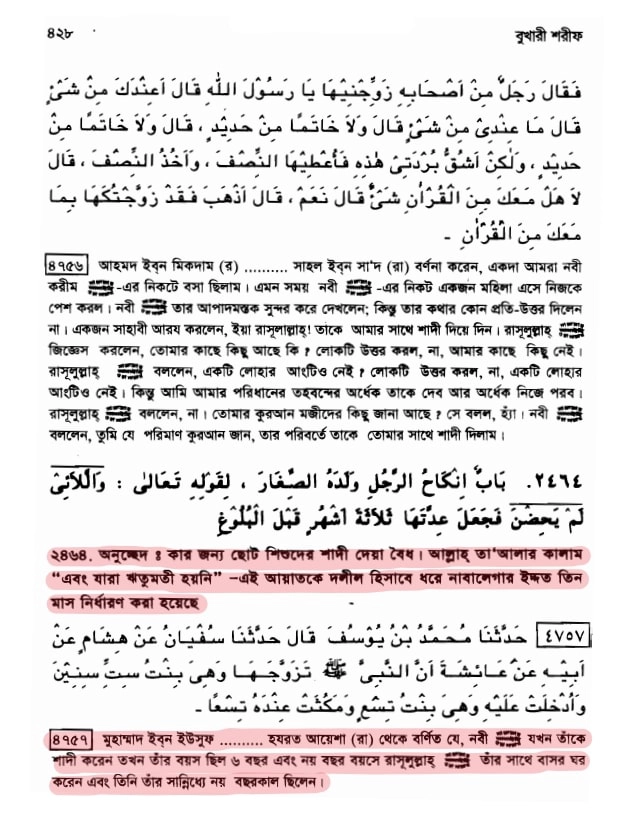
Al-Bukhari’s chapter heading leaves no ambiguity about the verse’s meaning. He reads “those who have not menstruated” as referring to prepubescent girls’ waiting periods and presents Aisha’s marriage as a concrete precedent for that rule.
The Quran and hadith are not two disconnected pieces of evidence here. In al-Bukhari’s arrangement, the verse is the general rule and Aisha’s case is its prophetic application. Calling her case “a privilege exclusive to the Prophet” therefore contradicts al-Bukhari’s own legal presentation.
Tafsir Ibn Kathir on Surah al-Talaq
Imad al-Din Ibn Kathir’s commentary is one of the Sunni world’s most widely read tradition-based works of exegesis. He explains Quranic verses through the Quran, hadith, statements of the Companions and Successors, and earlier commentaries. His explanation of Quran 65:4 is therefore not a modern translator’s personal opinion, but a representative reading within medieval Sunni exegetical tradition.
Tafsir Ibn Kathir refers to underage girls [7]
Surah al-Talaq, p. 163
4. If you are in doubt about the waiting period of those of your wives who no longer expect to menstruate, their waiting period is three months, as is that of those who have not yet menstruated. The waiting period of pregnant women ends with childbirth. Whoever fears Allah, Allah resolves their difficulties.
5. This is Allah’s command, which He has revealed to you. Whoever fears Allah, He will remit their sins and grant them a great reward.
Commentary: Allah states that a woman whose menstruation
has ceased because of old age must observe three months if divorced. Likewise, girls who have not yet menstruated also have a three-month waiting period.
إِنِ ارْتَبْتُمْ (“if you are in doubt”) may be explained in two ways. First, if blood appears after old age and you are uncertain whether it is menstrual blood or illness-related bleeding. This was the view of a group of early authorities, including Mujahid, al-Zuhri and Ibn Zayd. Second, if you are uncertain about these women’s waiting periods and do not know them, now know that their waiting period is three months. This second explanation is narrated from Sa’id ibn Jubayr and preferred by Ibn Jarir. It is, in fact, the passage’s apparent meaning.
Ibn Jarir narrates through Abu Kurayb and Ibn al-Sa’ib … from Amr ibn Salim, who relates that Ubayy ibn Ka’b
once said, “Messenger of Allah, the Quran has said nothing about the waiting periods of many women, such as underage girls, elderly women and pregnant women.” Allah then revealed وَالى يُنسن الخ. Ibn Jarir adduces this hadith as evidence.
Ibn Abi Hatim … narrates from Ubayy ibn Ka’b, who said: After the verse in Surah al-Baqara concerning women’s waiting periods was revealed, some people in Medina said that the Quran had said nothing about certain women’s waiting periods, such as underage girls, elderly women and pregnant women. Allah then revealed وَإِلَىٰ يُنسن الخ.
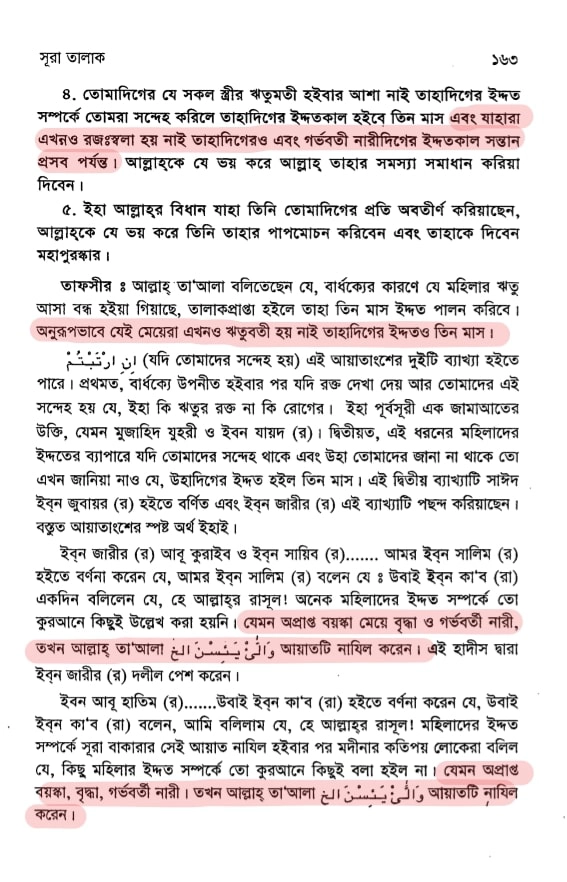
Ibn Kathir identifies three distinct legal categories in the verse: women whose menstruation has ceased because of old age, underage girls whose menstruation has not begun, and pregnant women. The first two have a three-month waiting period; the third waits until childbirth. “Those who have not yet menstruated” therefore cannot be conflated with old age, illness or temporary menstrual irregularity. Ibn Kathir presents underage girls as a separate category.
The quoted account of the circumstances of revelation reinforces the same meaning. After Surah al-Baqara described the waiting period for ordinary divorced women, a question was raised about categories whose rules had not been mentioned: “underage girls,” elderly women and pregnant women. The account presents the relevant verse of Surah al-Talaq as the answer to that question. The inclusion of an underage girl is therefore not a translator’s conjecture; she is present in the traditional account of the verse’s revelation.
The legal significance is equally clear. The verse treats the underage girl not merely as marriageable, but as a divorced wife observing a waiting period. Under Quran 33:49, divorce before intercourse entails no waiting period. Ibn Kathir’s prescription of three months for an underage girl therefore means that the rule discussed here concerns divorce after marital intercourse with her.
In Ibn Kathir’s commentary, the connection to child marriage is therefore more than one possible meaning of a word: it is a complete legal framework of an underage wife, divorce after intercourse and a three-month waiting period.
Tafsir al-Jalalayn on Surah al-Talaq
Tafsir al-Jalalayn is a concise but influential Sunni commentary. Written by Jalal al-Din al-Mahalli and Jalal al-Din al-Suyuti, it has long served as an introductory and intermediate exegetical text in madrasa education. Its significance is that it states the verse’s conventional linguistic meaning briefly, without a lengthy contentious discussion.
Tafsir al-Jalalayn also refers to girls who have not reached puberty because of their young age [8] —
Circumstances of the verse’s revelation:
1. It is narrated that Mu’adh ibn Jabal asked the Messenger of Allah, “Messenger of Allah, we have learned about the waiting period of women who menstruate; what is the waiting period of those who do not?” The verse واللي was then revealed. (Kabir, Qurtubi, Fath al-Qadir, Rawa’i)
2. Al-Hakim, Ibn Jarir, al-Tabari and al-Bayhaqi relate that when the verse in Surah al-Baqara concerning divorced and widowed women’s waiting periods was revealed, Ubayy ibn Ka’b said, “Messenger of Allah, some women in Medina say that certain women remain about whom nothing has been said.” He asked which women. Ubayy answered, “The young and the old [whose menstruation has ceased], and pregnant women.” This verse was then revealed. [Kabir, Qurtubi, Fath al-Qadir]
3. Al-Baghawi, al-Wahidi and al-Khazin relate that when the verse :الْمُطَلَّقَاتُ يَتَرَبَّصْنَ بِانْفُسِهِنَّ ثَلَاثَةَ فَرُو was revealed, Khalid ibn al-Nu’man al-Ansari asked, “Messenger of Allah, what is the waiting period of women who do not menstruate, those whose menstruation has ceased, and pregnant women?” This verse was then revealed.
—(Rawa’i, Kabir, Qurtubi, Fath al-Qadir, Ruh al-Ma’ani.)
According to Mujahid, this verse was revealed concerning the waiting period of women whose bleeding, because of istihada, cannot be identified as menstrual or illness-related. [Qurtubi]
قَوْلُهُ تَعَالَى إِنِ ارْتَبْتُمْ فَعِدَّتُهُنَّ ثَلَاثَةَ أَشْهُرٍ: Imam al-Jassas says that this cannot mean doubt about reaching menopause, because when we doubt whether a woman has reached menopausal age, we do not say that her waiting period is three months. He then says that doubt, or اِرْتِبَابُ, is used here with reference to the circumstances of revelation. The meaning is therefore: if you are uncertain about those of your wives who have ceased menstruating, know that their waiting period is three months.
Imam al-Tabari adopts this meaning, as does the author. Al-Tabari says, “If you are in doubt and do not know their ruling, know that their ruling is a three-month waiting period.”
Ikrima and Qatada say that ‘riba,’ or doubt, includes an ill woman whose menstruation is irregular: it may occur several times at the beginning of a month, or only once in several months.
Others say that it means “if you are certain.” This word belongs to the category of words with opposite meanings. (Qurtubi, Ruh al-Ma’ani, Jassas, Kabir, Rawa’i.)
خَيْرٌ مبتدأ 1 وَاللَّاتِي لَمْ يَحِضْنَ : قَوْلُهُ تَعَالَى وَاللَّائِي لَمْ يَحِضْنَ means فَمَدَّنْهُنَّ ثَلَاثَةٌ أَشْهُرٍ: those who have not yet menstruated have a three-month waiting period. Their menstruation may not have begun because of young age, or may begin much later, as happens with many women. Women who never menstruate throughout life are uncommon. Whatever the circumstances, their waiting period is the same as that of women who no longer expect to menstruate: three months from divorce.
Remember that, according to the Quran’s explicit declaration, a waiting period is required for a woman with whom her husband has been in intimate seclusion. Divorce before intimate seclusion entails no waiting period
at all. [Al-Ahzab 49]
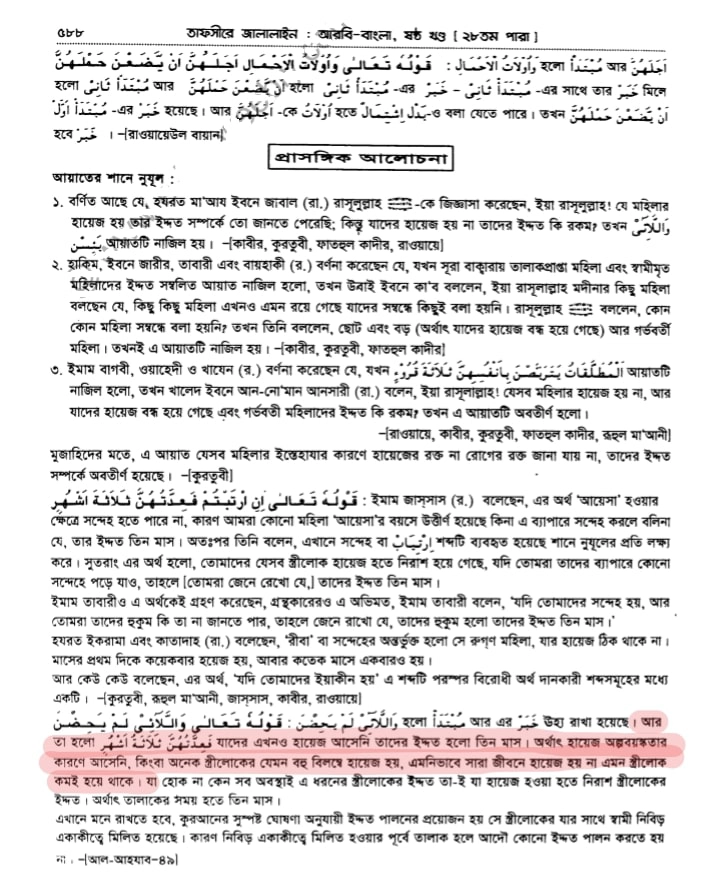
The quoted passage in Tafsir al-Jalalayn does not restrict “those who have not yet menstruated” to an unspecified medical condition. It directly states that girls whose menstruation has not begun because of young age also have a three-month waiting period. In the same discussion, “young,” “of a young age” and “have not menstruated” describe related categories. The claim that the verse concerns only older or ill women’s irregular menstruation therefore directly contradicts this commentary.
The circumstances of revelation are also important in al-Jalalayn’s explanation. After Surah al-Baqara described the waiting period of ordinary divorced women, questions arose about underage girls, women whose menstruation had ceased because of old age, and pregnant women. The relevant verse of Surah al-Talaq is described as being revealed in answer. The inclusion of an underage girl is thus not a later modern critic’s conjecture; the traditional account of revelation itself places her in a distinct legal category.
The end of the quoted explanation also recalls Quran 33:49: divorce before intimate seclusion or a marital relationship with the husband entails no waiting period. This clarifies Quran 65:4 further. If a wife whose menstruation has not begun because of her young age has a three-month waiting period, her marriage was not limited to a contract on paper. The relationship had reached a stage at which the waiting-period rule became effective.
In al-Jalalayn’s explanation, both an underage girl’s marriage and the marital relationship with her are therefore present within the verse’s legal framework. Excluding underage girls from “those who have not menstruated” for the sake of modern apologetics directly denies the commentary’s wording, its account of revelation and its explanation of the waiting period.
Tafsir al-Mazhari on Surah al-Talaq
Tafsir al-Mazhari was written by the eighteenth-century Hanafi scholar Qadi Thana Allah Panipati. As a judge, hadith scholar and exegete, he combines linguistic exegesis with extensive Hanafi legal analysis. The work has been particularly influential in South Asian Islamic education.
Qadi Muhammad Thana Allah Panipati was a renowned Islamic scholar whose commentary is called Tafsir al-Mazhari. He was a judge, hadith scholar, researcher and distinguished Quranic commentator. Let us now examine Tafsir al-Mazhari [9]:
If you are in doubt about the waiting period of those of your wives who no longer expect to menstruate, their waiting period is three months, as is that of those who have not yet menstruated. The waiting period of pregnant women ends with childbirth. Whoever fears Allah, Allah makes the resolution of their difficulties easy.
This is Allah’s command, which He has revealed to you. Whoever fears Allah, He will remit their sins and grant them a great reward.
(Tafsir al-Mazhari, p. 562)
First, it says, “those of your wives who no longer expect to menstruate.” This means wives whose menstruation has permanently ceased because of old age. Some scholars say that menstruation ceases at fifty-five; others say at sixty.
It then says, “If you are in doubt about their waiting period, their waiting period is three months, as is that of those who have not yet menstruated; the waiting period of pregnant women ends with childbirth.” The meaning is that the general
waiting period of divorced women has already been described. Now, if your divorced wives do not menstruate because they are elderly, or because they are non-menstruating minors, their waiting period is set at three months. Three menstrual periods generally occur in three months, just as the age of adulthood is generally taken as fifteen or seventeen: a girl who has not menstruated by then must nevertheless be regarded as an adult. Likewise, zakat becomes obligatory when a year passes, during which property generally increases to some extent. Just as menopause is assigned an age of fifty-five or sixty, the waiting period of elderly women and minors is set here at three months. Sharia contains other examples of fixed time limits.
Muqatil writes in his commentary that Khallad ibn Amr ibn Jamuh asked the Messenger about non-menstruating women’s waiting periods. The verse was revealed in response, informing them that the period was three months. “Their waiting period is three months” is connected to the first verse’s “divorce them with regard to their waiting period.” The definite article in ‘al-iddati’ is generic: the waiting period of elderly women and minors is also equivalent to three menstrual periods, or three months.
This rule applies only to free wives, and it is general: the same waiting-period rule applies to both irrevocable and revocable divorces. It also applies equally to a Muslim man’s Muslim and scripturalist wives. For a fully enslaved woman, a mukataba or a mudaraba slave woman who is elderly or underage—whose menstruation has ceased because of age or has not begun because she has not reached adulthood—the scholars agree on a waiting period of one and a half months. In the relevant discussion of Surah al-Baqara, I wrote that the normal full number of divorces for a slave woman would be one and a half, half the three divorces. But since divorces and menstrual periods
(Tafsir al-Mazhari, p. 563)
cannot be divided, a slave woman’s full number of divorces is two and her full waiting period is two menstrual periods. For women who do not menstruate, divorce and waiting periods must be calculated by days. For slave women, this calculation is half that for free women: one and a half months.
Through Abdullah ibn Uzza, Salman ibn Yasar, Muhammad ibn Abd al-Rahman and Sufyan ibn Uyayna, Imam al-Shafi’i relates Umar’s statement that a male slave may marry two women at once, rather than four as a free man may. He has the right to pronounce two divorces. A slave woman observes two menstrual periods, or, if she does not menstruate, two months or one and a half months.
Ruling: For a young woman who should menstruate regularly but whose menstruation stops for some reason, most scholars require waiting until it resumes; three menstrual periods must pass to complete her waiting period. If she loses all expectation of menstruating, three months will complete it. Uthman, Ali, Zayd ibn Thabit and Ibn Mas’ud say this. Ata states that Abu Hanifa and al-Shafi’i hold the same view. Umar says such a woman must wait nine months; if menstruation still has not resumed, she observes a further three months. Malik also holds this view. Hasan al-Basri says she waits six months and then observes three months.
Ruling: If a woman’s third menstrual period does not occur because of advancing age after two periods, she must begin a new three-month waiting period. But if a woman who no longer expects menstruation begins a waiting period calculated in months and menstruation resumes during or after it, the previous waiting period no longer counts. Even if she has married, that marriage becomes invalid. This applies when the blood is red or black, as it was previously. Yellow, green or brown discharge is not counted as menstruation unless she habitually had discharge of those colours before menstruation ceased; in that case it counts as menstruation.
If divorce occurs at the beginning of a month, the scholars agree that the waiting period is calculated by lunar months. If it occurs in the middle of a month, it is calculated by days.
(Tafsir al-Mazhari, p. 564)
On this calculation, the waiting period ends when ninety days are complete, not sooner. Abu Hanifa holds this view. Abu Yusuf and Muhammad say that the first month is completed by counting days and the following two by lunar months, whether each has twenty-nine or thirty days.
Ruling: These calculations apply only to divorced women, not widows. A widow who is not pregnant observes four months and ten days, whether she is underage, young or elderly. The righteous early generations’ consensus is established on this point, based on Ubayy ibn Ka’b’s hadith concerning the circumstances of these verses’ revelation.
Ubayy ibn Ka’b relates that when the Companions said that nothing had been stated about underage girls, women who do not menstruate and widows, this verse was revealed. The Companions were correct, which is why the verse expressly says, “if you are in doubt about their waiting period.” As for “those among you who die,” that verse is general and includes all categories of women. It contains no ambiguity. Ambiguity belongs to a rule derived from uncertain evidence; this verse is definitive.
An objection: The three verses discussed here have similar statements, yet this verse is said to apply only to divorced women. The same reasoning would also require ‘wa ulat al-ahmal’ to be restricted to divorced women. But no one has said this.
Answer: That these verses are specifically concerned with divorced women is established by scholarly consensus. A solitary hadith cannot restrict a definitive rule, and we do not claim that it can. Rather, consensus establishes that “and pregnant women” is general and includes pregnant widows as well.
Ibn Abbas and Ibn Aliyya say that a pregnant widow’s waiting period is completed after childbirth, and that four months and ten days must also pass afterwards. They apply both verses as a precaution. The majority, however, hold that it ends with childbirth alone. Malik relates this from Umar and Ibn Umar in his Muwatta. No one discussing pregnant women’s waiting periods has said that delivery is unnecessary.
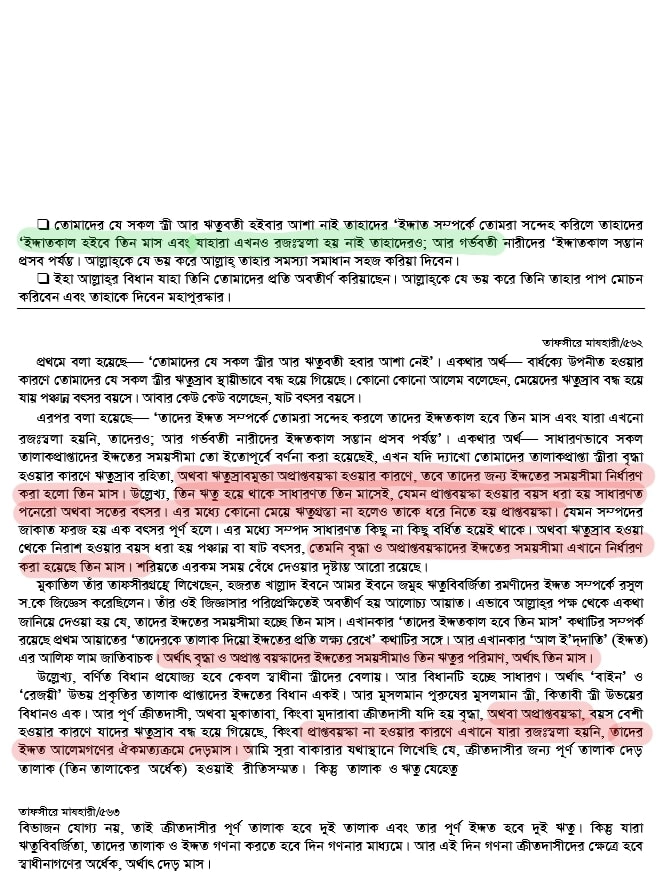
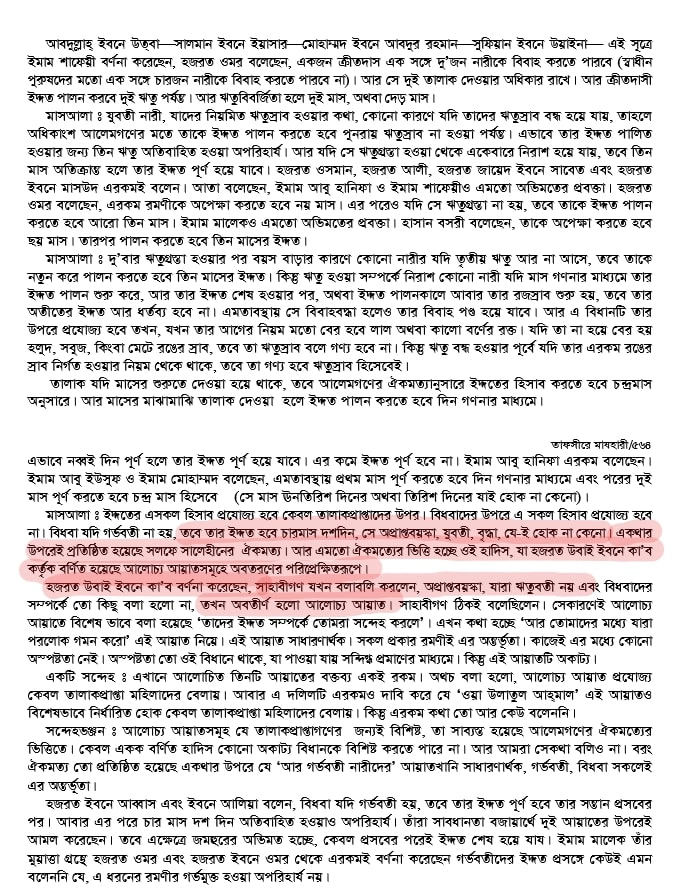
Tafsir al-Mazhari unambiguously uses the expression “a non-menstruating minor.” This does not refer merely to an adult by chronological age whose menstruation has not begun. It treats elderly women and minors as distinct categories and states that a divorced wife whose menstruation has not begun because of her young age also has a three-month waiting period.
Al-Mazhari does more than state the verse’s general meaning. He discusses the age at which Sharia regards a girl as an adult, how a waiting period is calculated without menstruation, whether its previous calculation becomes invalid if menstruation begins during it, and how widows’ and divorced women’s rules differ. Divorce of an underage wife is thus treated as an actual and routine legal event.
The work also assigns different waiting periods to a free underage wife and an underage slave woman. A free minor has three months, while a non-menstruating slave woman has one and a half. Freedom or enslavement halves the waiting period, but neither the minor girl’s marriage nor intercourse with her is declared unlawful in either case. Instead, separate calculations are made for separation after intercourse in both categories.
This extensive classification establishes that a minor wife’s waiting period is no translation accident or isolated opinion. It is a complete Sharia rule determining even the regulations of a child’s marriage, intercourse, possible pregnancy, divorce, enslavement and remarriage.
Ma’arif al-Quran on Surah al-Talaq
Ma’arif al-Quran is the commentary of Muhammad Shafi Usmani, a Hanafi scholar educated at Dar al-Ulum Deoband and a former chief mufti of Pakistan. Widely read in modern South Asian Deobandi society, it is particularly important for explaining practical Hanafi Sharia rules from Quranic verses.
Mufti Muhammad Shafi Usmani was a prominent Deobandi Hanafi scholar, a former mufti of Dar al-Ulum Deoband and Pakistan’s chief mufti after Partition. His multi-volume Ma’arif al-Quran is widely read in South Asian Deobandi circles. Let us examine its explanation of the verse [10].
The address يَا أَيُّهَا النبي would normally require the subsequent rule to be stated in the singular. Instead, اذا طلقتم النسا uses the plural while directly addressing the Messenger of Allah. This plural address expresses respect for him and indicates that the rule is not exclusive to him, but applies to the entire community.
Some commentators posit an omitted clause here and explain it as: O Prophet,
tell the believers that when they divorce their wives, they should follow the law stated below. This explanation is adopted in the summary of the commentary.
Certain rules of divorce then follow. The first rule: نطلقوهن لعد
The literal meaning of 16 is counting. In Sharia terminology, ت تهن refers to iddah, the period during which a woman, after leaving one husband’s marriage, is prohibited from marrying another. A marriage ends in two ways. First, the husband’s death: its waiting period is called ‘iddat al-wafat,’ and for a woman who is not pregnant it is four months and ten days. Second, divorce: for non-pregnant women, Abu Hanifa and several other imams prescribe three complete menstrual periods, while al-Shafi’i and several others prescribe three intervals of purity. No fixed number of days or months is assigned; however many months are needed to complete three menstrual periods or three intervals of purity constitute the waiting period. Separate rules for women whose menstruation has not begun because of young age or has ceased because of old age are given later, as are pregnant wives’ rules. For pregnancy, the waiting periods after death and divorce are the same.
و هن لعد تهن (1) فطلقو هن لعد: A hadith in Sahih Muslim states that the Messenger of Allah
recited فطلقوهن لقبل عد تهن. In narrations from Ibn Umar and Ibn Abbas,
لقبل عد تهن appears in one version, تهن in another, and مد تهن في قبل مد تهن is also reported. —(Ruh al-Ma’ani)
This indicates that divorce is not a way to vent anger or take revenge, but an arrangement for both parties’ happiness and peace when circumstances leave no alternative. At divorce, it is therefore necessary to ensure that the wife does not suffer an unnecessarily prolonged waiting period. This rule applies only to wives who must observe it by menstrual periods or intervals of purity. A wife with whom the husband has not yet been in seclusion has no waiting period, so divorcing her during menstruation is permissible. Likewise, wives who do not menstruate because of young or old age may be divorced in any condition, even after intercourse, because their waiting period is three months calculated by months. This is stated in the subsequent verses. (Mazhari)
The second rule is
احصاء واحصوا العدة
The verse means: carefully keep track of the waiting period and do not mistakenly regard it as over before it ends. Both husband and wife are responsible for remembering these days, but the verse uses the masculine form. Rules shared by men and women are generally expressed in the masculine, with women included by implication. In this particular case, there may also be the special reason mentioned in the exegetical summary: women are more absent-minded, so responsibility is directly assigned to men.
ول refle لا تُخْرِجُوهُنَّ مِن بُيُوتِهِنَّ وَلَا يَخْرُجْنَ faat o
Do not expel wives from their homes. Calling them ‘their homes’ indicates that while the husband is responsible for their accommodation, they have a right to the dwelling. Allowing them to remain is not a favour but fulfilment of an entitlement. Accommodation is one of a wife’s rights. The verse states that divorce alone does not extinguish it: she retains the right to live in the house during the waiting period. Expelling her before it ends is oppression and forbidden. Her voluntarily leaving is also forbidden, even with her husband’s permission. Observing the waiting period in this house is not only the husband’s right but Allah’s, and is obligatory for the woman. This is the Hanafi position.
The fourth rule is الا ان ياتين بفاحشة مبينة: if a wife observing the waiting
period commits an openly indecent act, expelling her is not forbidden. This is an exception to the third rule. Three views are reported concerning the meaning of an openly indecent act.
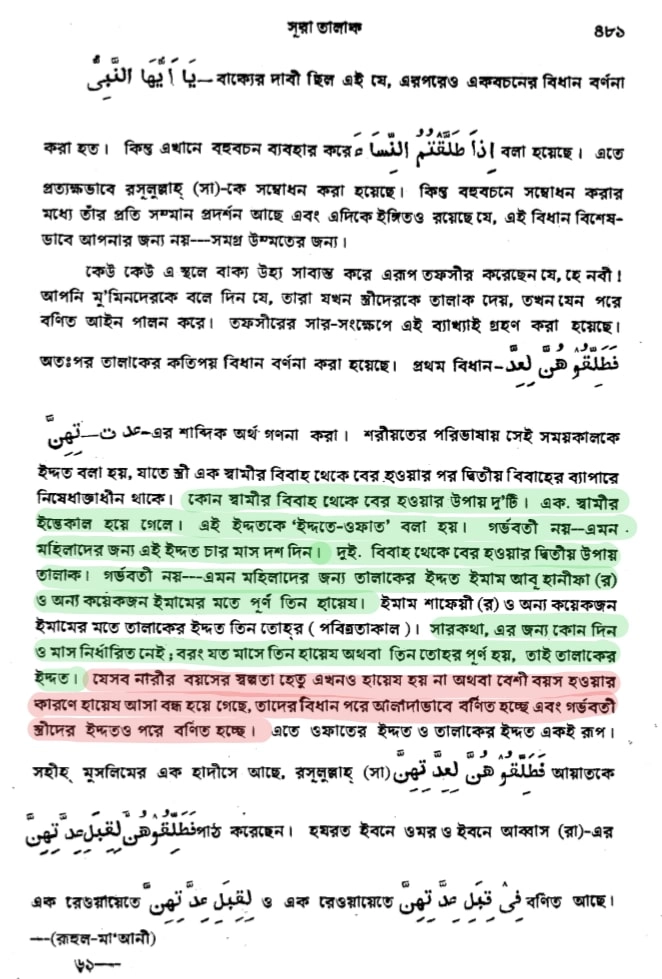
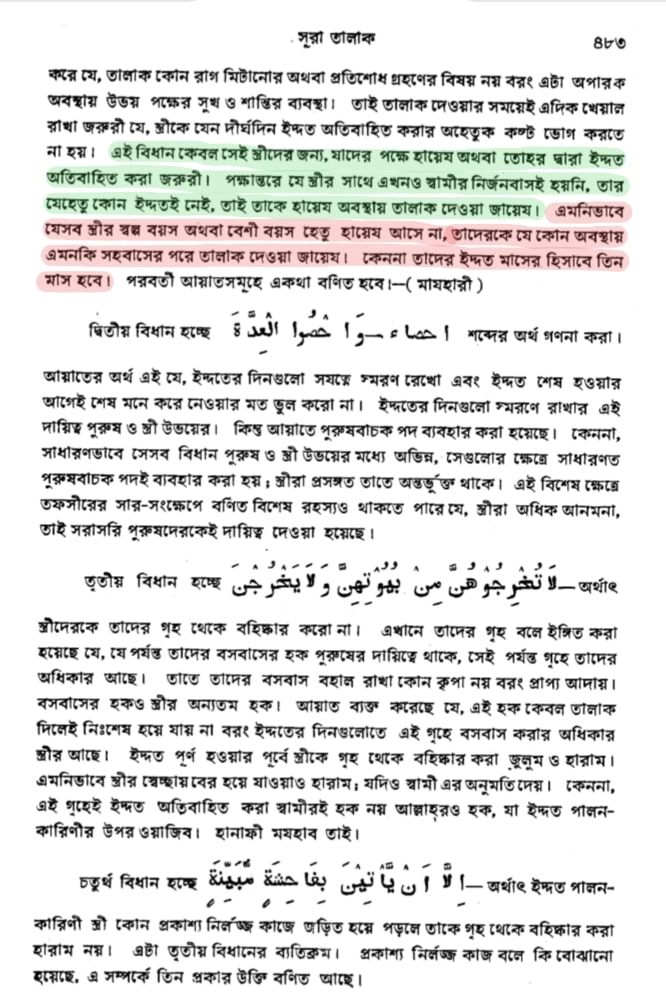
Ma’arif al-Quran explicitly states that the rules for wives whose menstruation has not begun ‘because of young age’ are separately described in the subsequent verse of Surah al-Talaq. Young age and old age are treated as two distinct causes of non-menstruation. There is therefore no room to exclude underage girls by invoking illness, irregular menstruation or an ambiguous translation.
The work also says that wives who do not menstruate because of young or old age may be divorced in any condition after intercourse, because their waiting period is three months calculated by months rather than menstruation. ‘After intercourse’ is particularly significant. It clarifies that the discussion is not limited to concluding a contract in an underage girl’s name: it explains how to calculate her waiting period when divorce follows intercourse with her.
Ma’arif al-Quran is a widely read modern Deobandi commentary. This position cannot therefore be dismissed as merely an extinct social custom of ancient Arabia. An influential twentieth-century South Asian commentary teaches the same rules on divorce and waiting periods following intercourse with young wives from the same verse.
Intercourse with an underage wife is therefore not something imposed on the text by a critic. Ma’arif al-Quran itself connects ‘young age,’ ‘after intercourse’ and ‘a three-month waiting period’ within the same legal explanation.
Tafhim al-Quran on Surah al-Talaq
Sayyid Abu al-A’la Maududi’s Tafhim al-Quran is one of the most influential commentaries in modern Islamist political thought. As the founder of Jamaat-e-Islami, Maududi explains Quranic rules as operative law for individuals and the state. The work is therefore particularly important for establishing how modern Islamist circles understand Quran 65:4.
The renowned Islamic thinker Sayyid Abu al-A’la Maududi received the King Faisal International Prize in 1979 for his contribution to Islam. His Tafhim al-Quran is one of modern South Asia’s most influential Islamist commentaries. Let us examine its explanation of the relevant verse [11].
The waiting period must be calculated by menstruation if it subsequently resumes, or by reaching the age at which menstruation ceases. Upon reaching that age, she leaves the marital bond after observing three months. This is the view of al-Shafi’i, al-Thawri and al-Layth, and the position of Ali, Uthman and Zayd ibn Thabit.
Malik adopts Umar’s and Abdullah ibn Abbas’s opinion: the wife first waits nine months. If menstruation does not begin, she then observes three months like a woman whose menstruation has permanently ceased through old age. Ibn al-Qasim explains Malik’s position as counting the nine months from when menstruation last stopped, not from divorce. (These details are taken from al-Jassas’s Ahkam al-Quran and al-Kasani’s Bada’i al-Sana’i.)
Ahmad ibn Hanbal’s position is that a woman whose waiting period began by menstruation but whose periods permanently cease through old age during it observes the period for elderly women rather than menstruating women. If menstruation stops for an unknown reason, she first waits nine months because of possible pregnancy, followed by three months. If the cause is known, such as illness, breastfeeding or another reason, she continues waiting until menstruation resumes and the period can be calculated accordingly, or until she reaches menopausal age and can observe the period for elderly non-menstruating women. (Al-Insaf)
13. Whether menstruation has not begun because of young age, is delayed as it is in some women, or never occurs throughout life in rare cases, the waiting period is the same as that of elderly women whose menstruation has ceased: three months from divorce.
Remember that, according to the Quran’s explicit statement, the question of a waiting period arises only for a wife with whom her husband has been in seclusion. Divorce before seclusion entails no waiting period at all. (Al-Ahzab 49) Describing the waiting period of girls whose menstruation has not begun thus clearly establishes that, at this age, not only marriage but the husband’s seclusion and sexual relations with her are permissible. It is now clear that no Muslim has the right to prohibit what the Quran declares permissible.
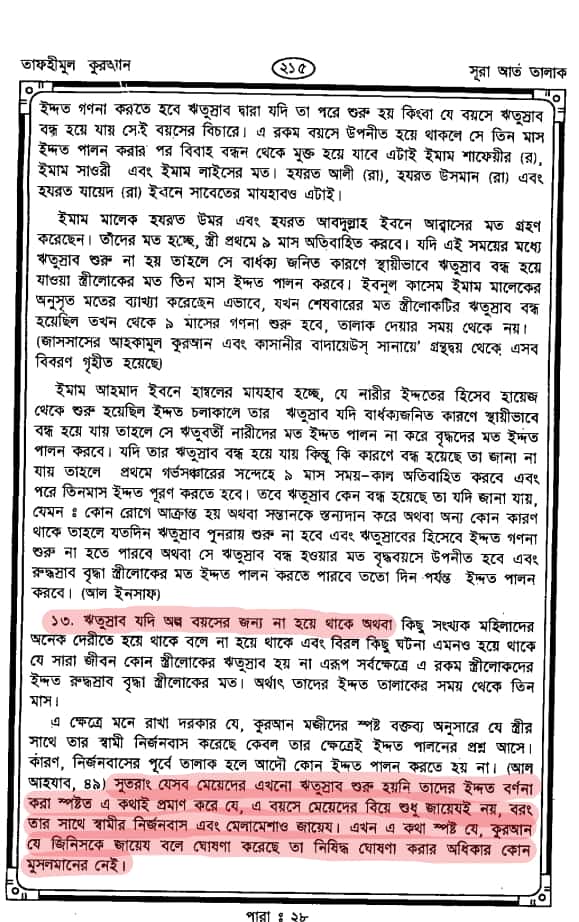
Maududi directly says that prescribing a waiting period for girls whose menstruation has not begun establishes that marriage, seclusion and sexual relations with them at this age are permissible. He presents this as the Quran’s ‘explicit statement.’
The significance is that this is not an extinct opinion from antiquity. One of the twentieth century’s most influential Islamist thinkers also declares marital sexual relations with an underage girl permissible under the same verse and denies Muslims the right to prohibit them.
Tawdih al-Quran on Surah al-Talaq
Tawdih al-Quran is the work of the contemporary Hanafi-Deobandi scholar and former judge Muhammad Taqi Usmani. Internationally known in Islamic finance, hadith and jurisprudence, he is an influential living jurist whose explanation of the verse is significant for the modern period.
Muhammad Taqi Usmani is an influential Pakistani Hanafi scholar, former judge and author on hadith, jurisprudence, Sufism and Islamic finance. The The Muslim 500 list includes him among influential Muslim figures. Let us examine the explanation in his Tawdih al-Quran [12].
وَالَي يَسْنَ مِنَ الْمَحِيْضِ مِنْ نِسَابِكُمْ إِنِ ارْتَبْتُمْ فَعِدَّتُهُنَّ ثَلَثَةُ أَشْهُرٍ وَالَّىٰ لَمْ يَحِضْنَ وَ أَوْلَاتُ الْأَحْمَالِ أَجَلُهُنَّ أَنْ يَضَعْنَ حَمْلَهُنَّ، وَمَنْ يَتَّقِ اللهَ يَجْعَلُ لَهُ مِنْ أَمْرِهِ يُسْرًا
4. If you are in doubt about the waiting period of those of your wives who no longer expect menstruation وَ, know that their waiting period is three months. Those who have not yet menstruated have the same waiting period. For pregnant women, the term ends with childbirth. Whoever fears Allah, Allah makes their affairs easy to resolve.
7. This means that Allah completes the affairs of the person who trusts Him. However, Allah Himself determines how and when they are completed, because He has assigned a measured quantity to everything.
8. Surah al-Baqara (2:228) states that divorced women’s waiting period is three menstrual periods. A question therefore arose about women whose menstruation had ceased through old age. This verse answers that they observe three months instead of three menstrual periods. Likewise, a minor girl who has not yet menstruated observes three months. The waiting period of a woman divorced during pregnancy continues until childbirth or miscarriage, whether before or after three months.
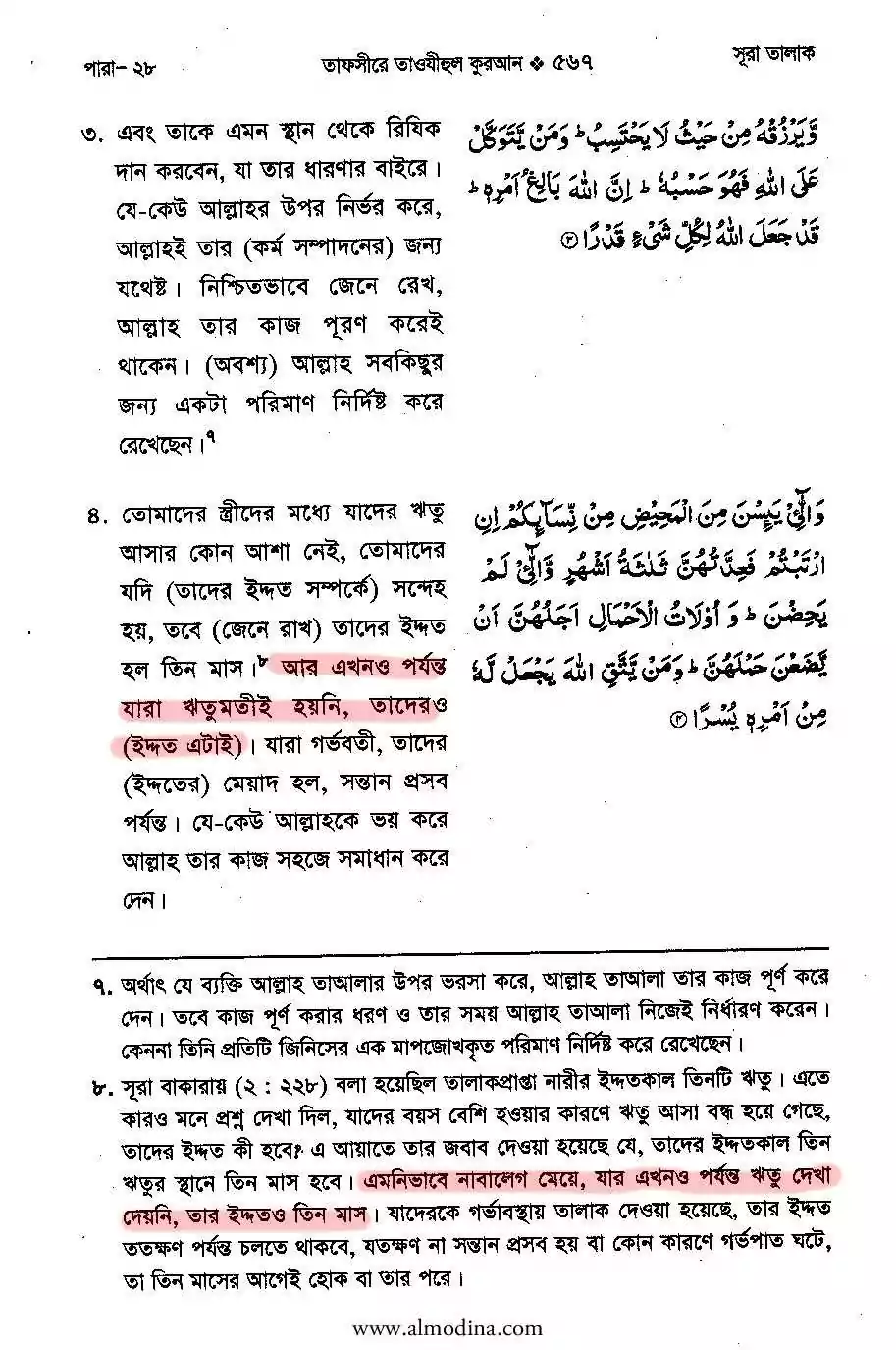
Taqi Usmani’s explanation directly uses the expression ‘a minor girl who has not yet menstruated.’ In assigning her three months, he does not mean a metaphor, illness or a special condition of an adult woman.
This shows that the classical interpretation remains unchanged in modern Deobandi exegesis. Times and standards of children’s rights and consent have changed, but the verse’s traditional Sharia meaning has not.
Ahkam al-Quran on Surah al-Talaq
Abu Bakr al-Jassas’s Ahkam al-Quran is one of the earliest and most important Hanafi legal commentaries. Al-Jassas derives jurisprudential rules directly from Quranic verses. Its discussion of Quran 65:4 is therefore more than commentary: it reveals the verse’s operative consequences in Hanafi law.
The same point appears in Ahkam al-Quran, written by the prominent Hanafi imam Ahmad ibn Ali Abu Bakr al-Razi al-Jassas [13] —
He wished to marry a woman from the People of the Book and asked the Messenger about it. The Messenger forbade it, saying: إِنَّهَا لا تخصك —“No, she will not preserve your chastity.”
This prohibition by the Messenger makes clear the harm involved in marrying a scripturalist woman. It may be said that this hadith is مقطوع, transmitted through a disconnected chain. Such a hadith cannot be used to challenge the Quran’s explicit declaration or establish a contrary view, because the Quran rejects that position and contains no restriction of this kind. Even if established, the prohibition may signify only disapproval, as Umar’s statement does. He did not prohibit Hudhayfa on the ground that it was unlawful, but because he considered it disliked. Moreover, even if the Messenger’s statement ‘she will not preserve your chastity’ لانك is established, it does not prove the marriage impermissible. The girl may have been a minor, and it is true that a minor cannot preserve his chastity. The same applies to a slave girl. Yet there is no doubt that marrying these two categories—slave girls and young girls—is permissible.
There is considerable disagreement about marrying daughters of People of the Book at war with Muslims. Ja’far ibn Muhammad al-Wasiti narrates through Ja’far ibn Muhammad al-Yaman, Abu Ubayd, Ubbad ibn al-Awwam, Sufyan ibn Husayn, al-Hakam, Mujahid and Ibn Abbas that the latter said:
لَا تَحِلُّ نِسَاءُ أَهْلِ الْكِتَابِ إِذَا كَانُوا حَرَبًا –
If the People of the Book are at war with Muslims, Muslims may not lawfully marry their daughters.
He then recited: قَاتِلُوا الَّذِينَ لَا يُؤْمِنُونَ بِاللَّهِ وَلَا بِالْيَوْمِ الْآخِرِ —
O Muslims, fight those who do not believe in Allah or the Hereafter.
(Surah al-Tawba 29)
. The final words وَهُمْ صَاغَرُونَ mean ‘they are humbled.’
Al-Hakam said: I related this to Ibrahim al-Nakha’i, and he was surprised.
Abu Bakr says that Ibn Abbas may have made this statement because he considered the practice disliked. Hanafi jurists likewise regard it as disliked, but not unlawful.
It is also narrated from Ali that he considered marrying daughters of People of the Book at war with Muslims disliked.
And Allah’s statement:
وَالْمُحْصَنَتُ مِنَ الَّذِينَ أُوتُوا الْكِتَبَ مِنْ قَبْلِكُمْ
Chaste women among those who received the Scripture before you …
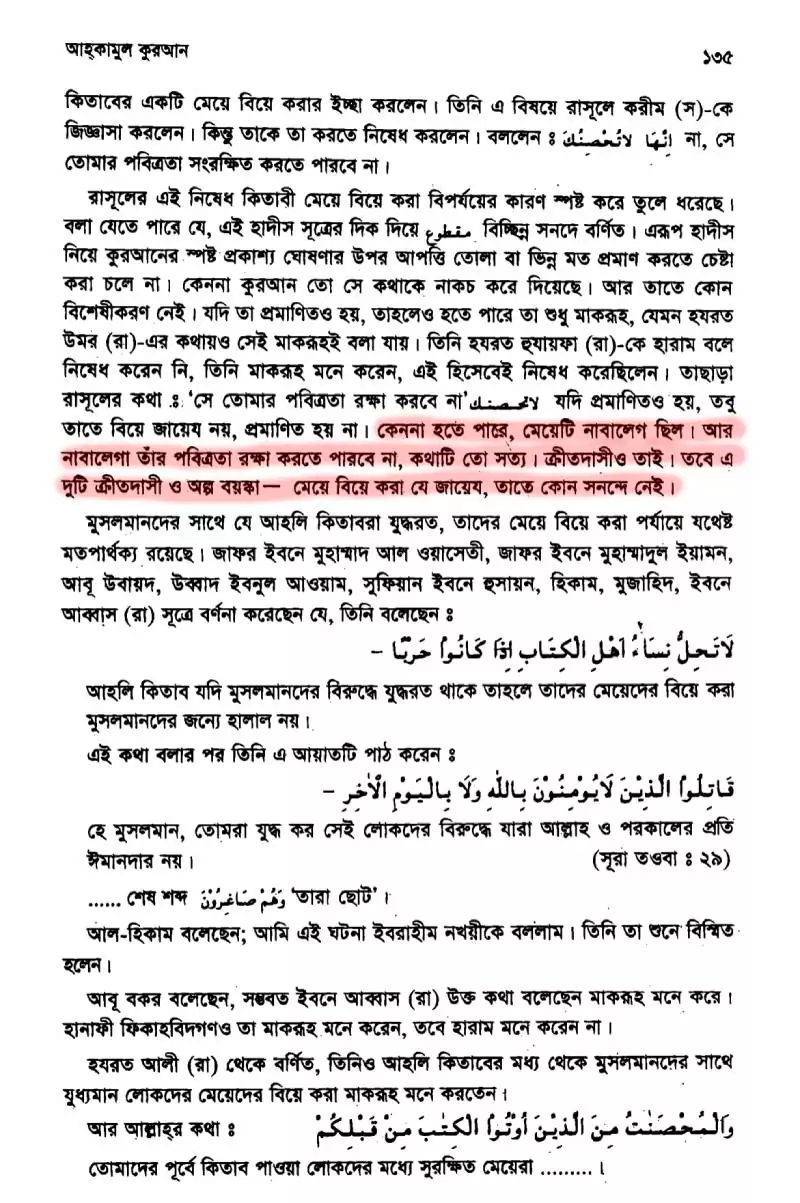
Volume 3 states even more explicitly that earlier and later scholars agree that Islam fully permits all guardians to marry underage girls. It claims consensus, or ijma, among earlier and later scholars on this matter [14] —
The verse also proves that a father has the right to marry his young daughter, since this is permissible for all guardians and the father is the closest guardian of all. We know of no disagreement about its permissibility among earlier and later jurists in different countries. However, Bishr ibn al-Walid transmitted a report from Shibramata that a father may not marry young boys or girls. This is al-Asamm’s position. We have already explained its invalidity, and this verse also establishes that it is false:
وَالَّتِي Y يَئِسْنَ مِنَ الْمَحِيضِ مِنْ نِّسَاءِ كُمْ إِنِ ارْتَبْتُمْ فَعِدَّتُهُنَّ تَلْقَةُ أَشْهُرٍ وَالَّتِي لَمْ يَحِضْنَ –
If you are in doubt about those of your wives who have ceased menstruating, their waiting period is three months. This also applies to
those whose menstruation has not yet begun.
(Surah al-Talaq 4)
Divorce of a young girl who has not menstruated is therefore valid, and divorce can be valid only within a valid marriage. The verse thus means that marrying a young girl is entirely permissible. A concrete precedent is that the Messenger married Aisha when she was only six, and her father Abu Bakr arranged the marriage. This event has two implications. First, it is entirely permissible for a father to marry his young daughter. Second, upon reaching adulthood, she will not have the right to choose whether to retain the marriage; it is binding. The Prophet did not give her that option upon reaching adulthood.
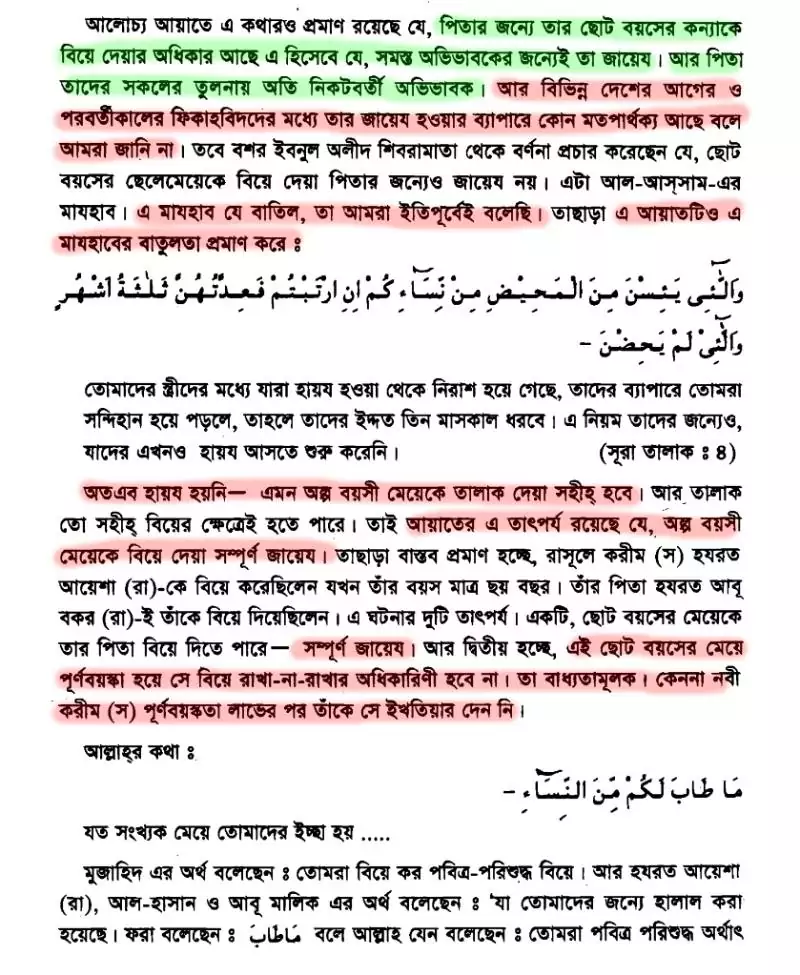
Al-Jassas’s legal argument is straightforward. Quran 65:4 prescribes a post-divorce waiting period for a young girl whose menstruation has not begun. Divorce can take effect only in a valid marriage. By prescribing her divorce and waiting-period rules, the Quran therefore recognises her marriage’s validity. Al-Jassas presents this conclusion not as an indirect possibility, but as the verse’s direct legal implication.
He then claims to know no significant disagreement among earlier and later jurists in different countries about the permissibility of marrying a young girl. He dismisses the limited opposing exception as invalid. In this Hanafi legal commentary, child marriage is therefore more than an approved opinion: the opposing position is rejected and it is presented as an established jurisprudential stance.
Al-Jassas uses Aisha’s marriage at six as the concrete prophetic precedent. According to him, Abu Bakr’s marriage of young Aisha to Muhammad establishes that a father may marry his minor daughter. He also says that she need not automatically receive a fresh right to choose whether to retain the marriage upon reaching adulthood.
The verse’s jurisprudential application therefore extends beyond an underage wife’s waiting period. It becomes a basis for marriage without a child’s consent, guardians’ coercive authority and denial of the freedom to leave that marriage even in adulthood.
Ahkam al-Hadith on Surah al-Talaq
The cited Ahkam al-Hadith is a modern Bengali compilation that presents hadith alongside established juristic rulings and the opinions of the legal schools. It is not a classical primary text, but it is an important record of how rules concerning guardianship, consent, and waiting periods are taught to Bengali-speaking religious readers.
Ahkam al-Hadith is an important work on hadith and Islamic jurisprudence. Let us examine what it says about verse 4 of Surah al-Talaq [15]
A guardian’s permission in marriage:
There is disagreement over which kinds of women are subject to وَلَايَةُ الإِجْبَار, or coercive guardianship. Note that women are divided into four categories in this context—
)1( ثَيِّمَة بَالِغَة, an adult nonvirgin. All agree that she does not require a guardian for marriage.
)2( بَاكِرَةِ صَغِيرَة, a minor virgin. All also agree that she requires a guardian for marriage.
)3( بَاكِرَةِ بَالِغَة, an adult virgin. According to Imam al-Shafi‘i, such a woman requires a guardian; according to Imam Abu Hanifa, she does not.
)8( ثَيِّبَةَ صَغِيرَة, a minor nonvirgin. According to Imam Abu Hanifa, such a woman requires a guardian; according to Imam al-Shafi‘i, she requires one درس مشكوة ج ۳ ص ۱۲)
Note that here a virgin (chبکر( means a woman who has never engaged in intercourse by any means and whose thin genital membrane has not been damaged, whether she is an adult or a minor. A nonvirgin )ثيبة( means the opposite.
According to Imam al-Shafi‘i, the criterion for ولاية الإجبار, or a guardian’s coercive authority, is بکارت, or virginity. Thus, if a woman is a virgin, whether an adult or a minor, her guardian may marry her off without her permission if he wishes. If she is ثيبة, a nonvirgin, however, he cannot marry her off without her permission, whether she is an adult or a minor.
By contrast, according to Imam Abu Hanifa, the criterion for guardianship is صفر, or young age. Thus, if a woman is a minor, whether a virgin or a nonvirgin, her guardian may marry her off without her permission if he wishes. If she is older, that is, an adult, whether a virgin or otherwise, the guardian may not exercise coercion over her. If such a woman marries on her own without her guardian’s permission, the marriage is effective (بدائع الصنائع ج ٢ ص ٢٤١ ، فتح القدير ج ٣ ص ١٦١) 21
The ruling on marriage without a guardian’s permission )حُكْمُ النَّكَاحِ بِغَيْرِ إِذْنِ وَلِيُّ( :
All the imams agree that the marriage of a minor, a woman without sound understanding, or an enslaved woman is not valid without a guardian’s permission.
The imams disagree, however, over whether the marriage of a free, adult woman of sound reason and judgment is valid without her guardian’s permission. For example—
According to Imams Malik, al-Shafi‘i, Ahmad ibn Hanbal, Ishaq, Ibn Hazm, and the majority, the marriage of women in this category is valid without a guardian’s permission بداية المجتهد ج ۲ ص ٧ ، المغني ج ٦ ص ٤٤٩ ، المحلى ج9 ص ٤٥١) ١
Evidence (1): Allah’s statement— وَأَنْكِحُوا الْآيَامَى مِنْكُمْ, meaning, those among you
who are unmarried, arrange their marriages. (Al-Nur: 32)
Looking at this verse, we see that guardians are addressed and instructed to marry women off. Thus, it is understood that women themselves have no authority in marriage; rather, responsibility rests with their guardians.
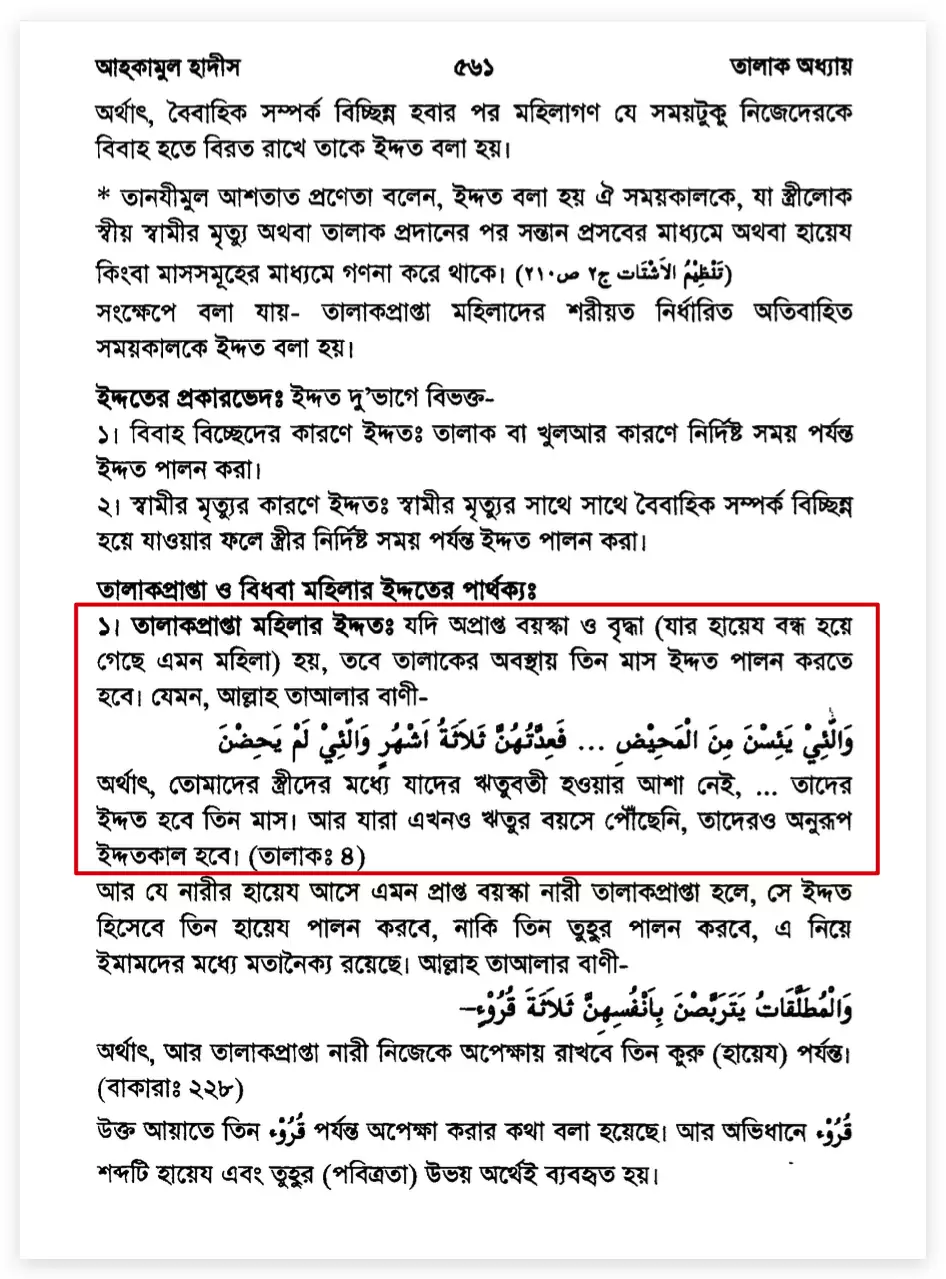
That is, the period during which women refrain from marriage after the dissolution of a marital relationship is called ‘iddah.
The author of Tanzim al-Ashtat says that ‘iddah is the period a woman counts after her husband’s death or divorce, through childbirth, menstruation, or months. )۲۱۰ تَنْظِيمُ الأَشْتَات ج ۲ ص( In brief, ‘iddah is the period prescribed by Sharia that divorced women must observe.
Types of ‘iddah: ‘Iddah is divided into two kinds—
1. ‘Iddah following marital dissolution: observing a prescribed waiting period following divorce or khul‘.
2. ‘Iddah following a husband’s death: the wife’s observance of a prescribed waiting period because the marital relationship ends immediately upon her husband’s death.
The difference between the waiting periods of divorced women and widows:
1. The waiting period of a divorced woman: if she is a minor or an elderly woman whose menstruation has ceased, she must observe three months of ‘iddah upon divorce. As Allah states—
وَالَّذِي يَئِسْنَ مِنَ الْمَحِيضِ … فَعِدْتُهُنَّ ثَلَاثَةُ أَشْهُرٍ وَالَّتِي لَمْ يَحِضْنَ … Meaning: among your wives, those who no longer expect to menstruate have a waiting period of three months. Those who have not yet reached the age of menstruation have the same waiting period. (Al-Talaq: 4)
For an adult woman who menstruates and is divorced, the imams disagree over whether her waiting period consists of three menstrual periods or three periods of purity. Allah states—
وَالْمُطَلَّقَاتُ يَتَرَبَّصْنَ بِأَنْفُسِهِنَّ ثَلَاثَةَ قُرُوءٍ
Meaning: divorced women shall keep themselves waiting for three quru’ (menstrual periods). (Al-Baqarah: 228)
This verse instructs women to wait for three قُرُوْء. In the dictionary, the word قروء is used for both menstruation and tuhr (purity).
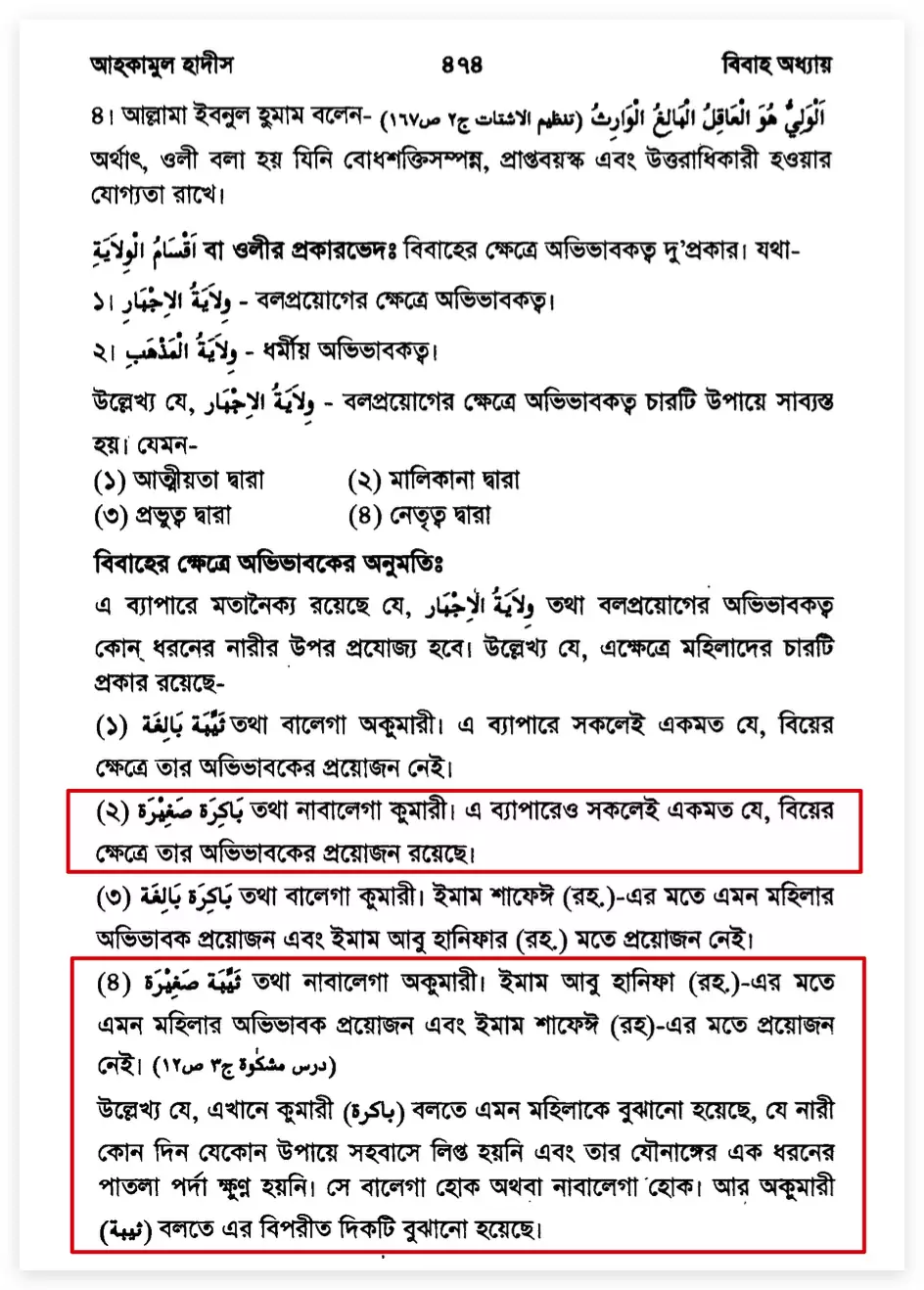
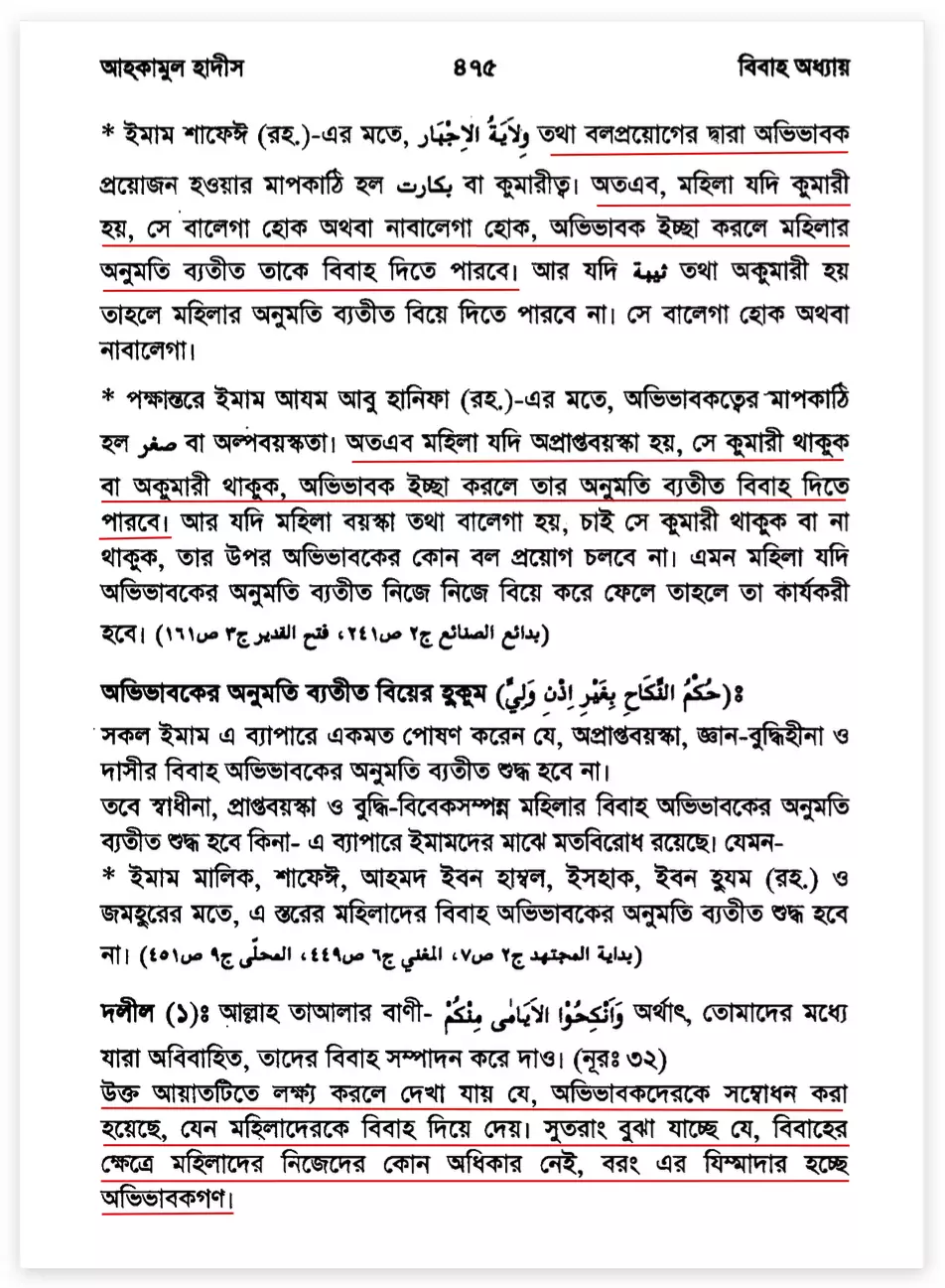
The work divides women into four categories—adult or minor, and virgin or nonvirgin—to determine who is subject to wilayat al-ijbar, or coercive guardianship. This classification includes a legal category called the “minor nonvirgin,” demonstrating that a minor girl’s previous intercourse or divorce was not an inconceivable event in jurisprudence.
The difference between the Hanafi and Shafi‘i positions concerns the basis of a guardian’s coercive authority, rather than the child’s freedom. In the Hanafi view, young age is the principal basis of this authority. Consequently, whether a minor girl is a virgin or a nonvirgin, her guardian may marry her off without her permission. In the Shafi‘i view, virginity is the principal criterion: a virgin, whether an adult or a minor, may be subject to a guardian’s compulsory authority.
It would be false to present this disagreement between the two schools as a debate over safeguarding women’s consent. The debate actually determines which characteristic—age or virginity—allows a guardian to override a girl’s decision and conclude a marriage on her behalf. A minor girl’s free, informed, and voluntary consent is not a central prerequisite in either view.
In other words, the question in juristic discussions is not “Has the child consented to marriage?” but “Which guardian may marry her off without her consent, and under what circumstances?” The conflict between this legal framework and modern consent, individual freedom, and children’s rights is therefore not peripheral; it lies at the very center of the framework.
The Rules of the Juristic Work Al-Hidayah
Burhan al-Din al-Marghinani’s Al-Hidayah is one of the most influential legal works of the Hanafi school. For centuries, it has served as an authoritative textbook in madrasas, judicial institutions, and juristic education. Its statements therefore represent institutional Hanafi law, rather than an isolated scholar’s personal opinion. Let us also examine what Al-Hidayah, a celebrated juristic work of Imam Abu Hanifa’s school, says on this issue [16]—
Chapter: ‘Iddah
If a husband gives his wife an irrevocable or revocable divorce, or they separate for a reason other than divorce, and the wife is free and menstruating, her waiting period is three menstrual periods. For Allah has said:
وَالْمُطَلَّقْتُ يَتَرَبَّصْنَ بِأَنْفُسِهِنَّ ثَلَثَةَ قُرُوءٍ
Divorced wives shall keep themselves waiting for three quru’.
Separation by a means other than divorce is equivalent to divorce. For ‘iddah has been made obligatory after separation within marriage to establish that the womb is empty. This need also exists in other forms of separation.
In our view, the word قروء in the verse means menstrual periods. According to Imam al-Shafi‘i, however, it means periods of purity free from menstruation. The word conveys contrasting meanings, and its use for either meaning is literal or primary. Ibn al-Sukayt stated this. A word with multiple meanings cannot be understood in several of those meanings simultaneously. Taking it to mean menstruation is preferable, so that the word’s plural meaning remains intact.
For if the word is taken to mean periods of purity, and divorce itself occurs during a period of purity, the plural meaning is not preserved.
Or the reason is that menstruation indicates that the womb is empty, which is the purpose of ‘iddah. The second piece of evidence is this statement of the Prophet: وعدة الامة حيضتان )an enslaved woman’s waiting period is two menstrual periods). Thus, this hadith will serve as an explanation of the word used in the Quran.
If she does not menstruate because of young age or old age, her waiting period is three months. For Allah has said:
وَالَّتِي يَبْسُنُ مِنَ الْمَحِيضِ مِن نِسَائِكُم
Among your wives, those who have despaired of menstruation—if you are in doubt about them—their waiting period is three months.
Likewise, those who have reached adulthood by the reckoning of age but have not yet begun menstruating (have a waiting period of three months).
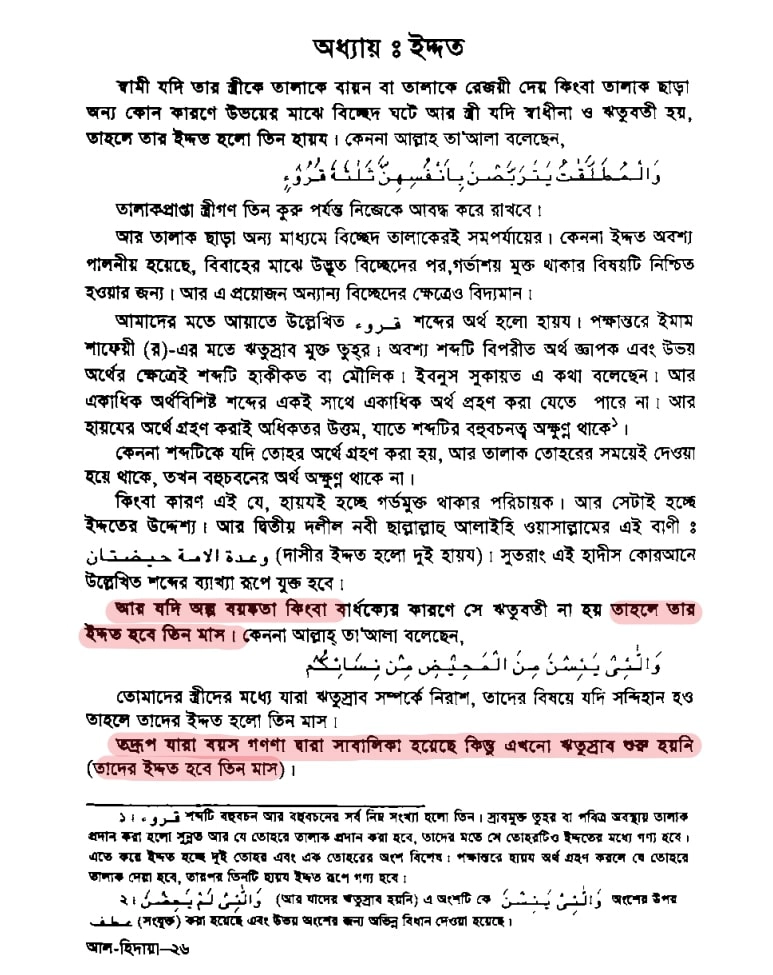
Al-Hidayah identifies young age and old age as two separate reasons for the absence of menstruation and prescribes a three-month waiting period for both. It applies the same rule to women who have reached adulthood by age but have not begun menstruating. Here, a minor wife is a recognized legal category. Rules for her divorce and waiting period are part of a regular juristic chapter, rather than an exceptional historical event.
The Rules of the Juristic Work Ashraf al-Hidayah
Ashraf al-Hidayah is an extensive Hanafi juristic work based on a commentary and translation of Al-Hidayah. By presenting the original Arabic text, translation, and related rulings side by side for readers in the subcontinent, it provides an important practical explanation of established Hanafi rules.
Ashraf al-Hidayah is a highly important work of Hanafi jurisprudence. Let us examine what it says on this matter in the edition supervised by Maulana Muhammad Ishaq Faridi and translated by several prominent scholars [17]—
وَإِنْ كَانَتْ مِمَّنْ لَا تَحِيضُ مِنْ صِغَرٍ أَوْ كِبَرٍ فَعِدَّتُهَا ثَلْثَةُ أَشْهُرٍ لِقَوْلِهِ تَعَالَى وَاللَّاتِي يَئِسْنَ مِنَ الْمَحِيضِ مِنْ نِسَائِكُمْ (الْآيَةُ) وَكَذَا الَّتِي بَلَغَتْ بِالسِّنِّ وَلَمْ نَحِضُ بِأَخِيرِ الْآيَةِ وَإِنْ كَانَتْ حَامِلاً فَعِدَّتُهَا أَنْ تَضَعُ حَمْلَهَا لِقَوْلِهِ تَعَالَى وَأُولَاتُ الْأَحْمَالِ أَجَلُهُنَّ أَنْ يَضَعْنَ حَمْلَهُنَّ – وَإِنْ كَانَتْ اَمَةٌ فَعِدَّتُهَا حَيْضَتَانِ لِقَوْلِهِ عَلَيْهِ السَّلَامُ طَلَاقُ الْأَمَةِ تَطْلِيقَتَانِ وَعِدَّتُهَا حَيْضَتَانِ وَلِأَنَّ الرِّقَ مُنَصِفُ وَالْحَيْضَةِ لَا نَتَجَزَّى فَكَمُلَتْ فَصَارَتْ حَيْضَتَيْنِ وَالَيْهِ أَشَارَ عُمَرُ (رض) بِقَوْلِهِ لَوْ اسْتَطَعْتُ لَجَعَلْتُهَا حَيْضَةً وَنِصْفَا وَإِنْ كَانَتْ لَا تَحِيضُ فَعِدَّتُهَا شَهْرُ وَنِصْفُ لِأَنَّهُ مُتَجَرٍ فَامْكَنَ تَنْصِيفَهُ عَمَلًا بِالرِّقِ .
Translation: If she does not menstruate because of young age or old age, her waiting period is three months
For Allah has said— وَاللَّاتِي بَيْسْنَ مِنَ الْمَحِيضِ مِن يُسَائِكُمْ …. الخ —‘Among your wives, those who have despaired of menstruation—if you are in doubt about them—their waiting period is three months.’ Likewise, those who have reached adulthood by the reckoning of age but have not yet begun menstruating [have a waiting period of three months). The evidence for this is the concluding part of the verse cited above. If she is pregnant, her waiting period ends with childbirth. For Allah has said— وَأَوْلَاتُ الْأَحْمَالِ أَجَلُهُنَّ أَنْ يَضَعْنَ حَمْلَهُنَّ —‘For those who are pregnant, the term (of their waiting period) is the delivery of their pregnancy.’ If the divorced wife is enslaved, her waiting period is two menstrual periods. For the Prophet stated: “An enslaved woman’s divorce consists of two divorces, and her waiting period is two menstrual periods.” Moreover, slavery halves the period, and a menstrual period cannot be divided, so it is counted in full. Consequently, it becomes two menstrual periods. Referring to this, Umar said— لو اسْتَطَعْتَ لَجَعَلْتُهَا حَيْضَةً وَيَصْنً —If I could, I would have set her waiting period at one and a half menstrual periods. If the enslaved woman does not menstruate, her waiting period is one and a half months. For months can be divided. Thus, halving the months on account of slavery is possible.
Related discussion
قوله وإِن كَانَتْ مِمَّنْ لَا تَحِبْضُ الحَ —Concerning the waiting period of women who do not menstruate: in this
passage, the author describes several situations involving women who do not menstruate: because of young age, or
because of extreme old age, or because a woman has reached adulthood by age—that is, fifteen years according to the two companions, and according to Imam
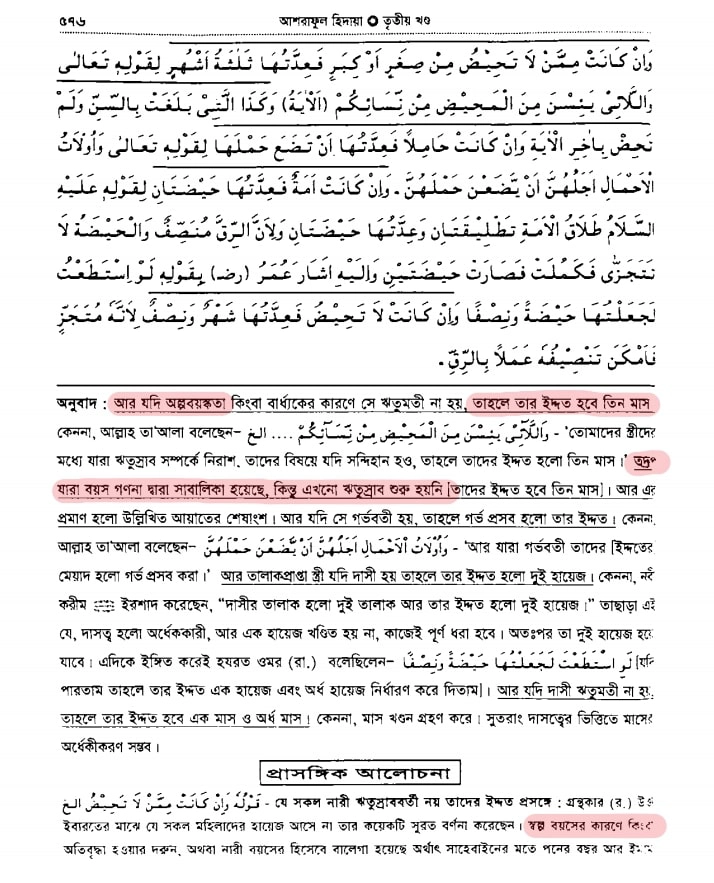
In the quoted passage, both the original Arabic text and the Bengali explanation prescribe a three-month waiting period for a wife who does not menstruate because of young age. A separate calculation is also given for halving that period if she is enslaved. This classification shows that the issue in Sharia law extends beyond permitting a child’s marriage. Separate calculations have also been devised for the separation of free and enslaved minor wives after intercourse.
The Bukhari Commentary on Surah al-Talaq
The Bengali Bukhari Sharif cited here is more than a translation of the original Arabic Sahih al-Bukhari; it also includes explanations by scholars of the subcontinent. The commentator’s statements therefore cannot be presented directly as Imam al-Bukhari’s own words. Nevertheless, this edition is highly important for understanding how Imam al-Bukhari’s chapter heading, Surah al-Talaq 65:4, and the legal significance of the hadith about Aisha have been taught in Bengali-speaking Muslim society.
The commentator first cites the verse prescribing a three-month waiting period for girls whose menstruation has not begun. He then argues directly that, if the marriage of such a girl were not permitted, there would be no question of divorcing her or prescribing a waiting period for her. In the same chapter, the hadith describing Aisha’s marriage at six and the beginning of her married life at nine is then used as a practical example of that rule.
The particular importance of this explanation does not end there. After declaring the marriage of minor boys and girls permissible under Sharia, the commentator says that calling this permission unlawful or reprehensible amounts to distorting Sharia and condemning Muhammad’s action. In other words, child marriage is defended here as a rule authorized by Allah and the Messenger for all time, rather than an unintended historical remnant. Let us examine the relevant passage [18]—
Marriage of a Minor Girl
Allah has said:—
وَالَّتِي يَئِسْنَ مِنَ الْمَحِيضِ وَالَّذِي لَمْ يَعِضُنَ
“Women who have passed the age at which menstruation may be expected, and women who have not yet menstruated—the waiting period (after divorce) for both is three
months. (Juz’ 28—Surah al-Talaq)
This verse describes the waiting period after divorce for a woman whose menstruation has not begun. It is therefore perfectly clear that her marriage is also permitted; otherwise, how could divorce and its waiting period arise?
2026. Hadith:—Aisha narrated that when the Prophet
married her, she was six years old, and her rukhsati—that is, the beginning of her married life—occurred at nine. She had the opportunity to remain with him for nine years. (Accordingly, he died when she was eighteen years old.)
Explanation:—Declaring unlawful something permitted by Sharia, and permitting something unlawful under Sharia, is called tahrif, or the distortion of Sharia, which the Jews and Christians committed.
Allah is omniscient; from the beginning, He knows everything past and future! The constitution He has given is called Sharia. By invoking any kind of reasoning or talk of benefit
Bukhari Sharif, p. 197
and harm, and so forth, distorting or altering Sharia is indirectly equivalent to finding fault with the knowledge of the omniscient Allah.
Regarding the marriage of minor boys and girls, Imam al-Bukhari has established Sharia’s permission through the Quran and hadith. Making it unlawful is, in fact, interference with Sharia—the constitution given by Allah as a way of life for His servants—and its distortion or alteration. Since the Messenger of Allah himself acted upon this permission, declaring the permission reprehensible is equivalent to declaring the Messenger’s action reprehensible.
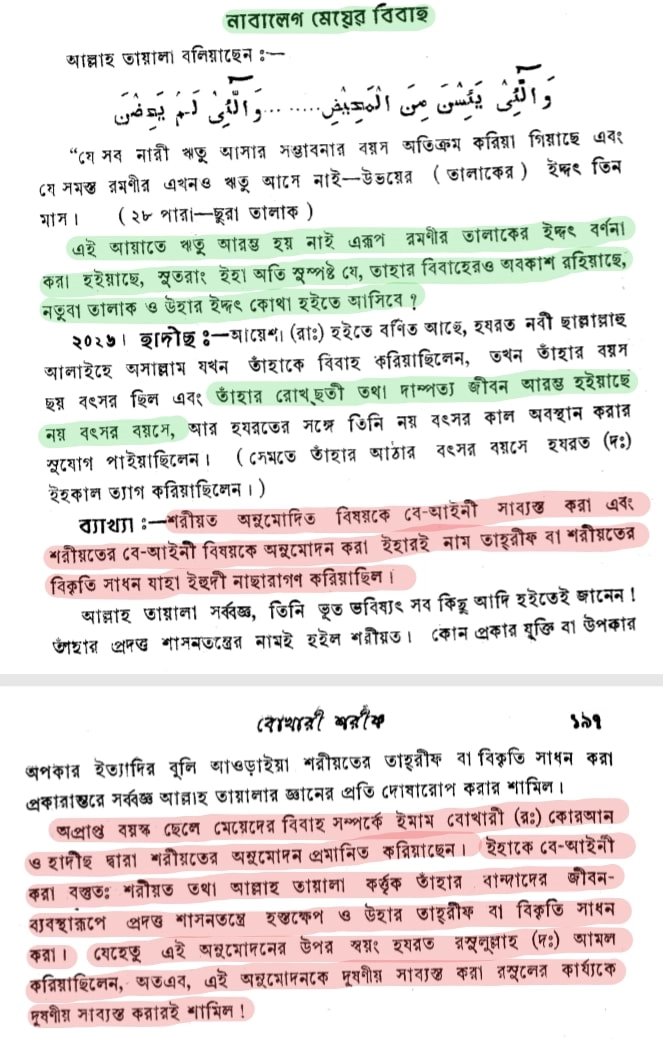
The commentator explicitly states that, because a woman whose menstruation has not begun has a waiting period after divorce, her marriage is also permitted; otherwise, divorce and a waiting period would not arise. This is a restatement, through hadith commentary, of the article’s central Quranic argument. More significantly, the explanation identifies calling this permission unlawful or reprehensible as a distortion of Sharia. Consequently, when a modern state prohibits child marriage, conflict with this traditional interpretation is inevitable.
Fiqh al-Sunnah on Intercourse with Minor Girls
The Egyptian scholar Sayyid Sabiq’s Fiqh al-Sunnah is a widely read twentieth-century work of Sunni law. Its presentation of jurisprudence with evidence in accessible language has led to extensive use in the Arab world and, through translation, South Asia. The quoted passages discuss a minor wife’s waiting period and compensation for severe physical injury caused by intercourse.
Fiqh al-Sunnah, by the Al-Azhar-educated Egyptian scholar Sayyid Sabiq, is a widely read work of contemporary Arabic jurisprudence. Here, the waiting period of a nonmenstruating minor girl is given as three months. According to Quran 33:49, there is no waiting period when divorce occurs before intercourse; certain juristic traditions also treat lawful seclusion as legally equivalent to intercourse. This rule consequently recognizes the marriage of a minor wife whose marital relationship has reached the stage of intercourse or its legal equivalent [19].
Another ten days of menstruation, followed by another fifteen days of purity. Then a third menstrual period lasting ten days. Thus, the total waiting period amounts to sixty days. When this period ends and the wife claims that her waiting period has ended, she becomes lawful for another husband.
By contrast, Abu Hanifa’s two disciples count three days for each menstrual period, its minimum duration, and fifteen days for each of the two periods of purity between the three menstrual periods. The total waiting period thus amounts to 39 days.
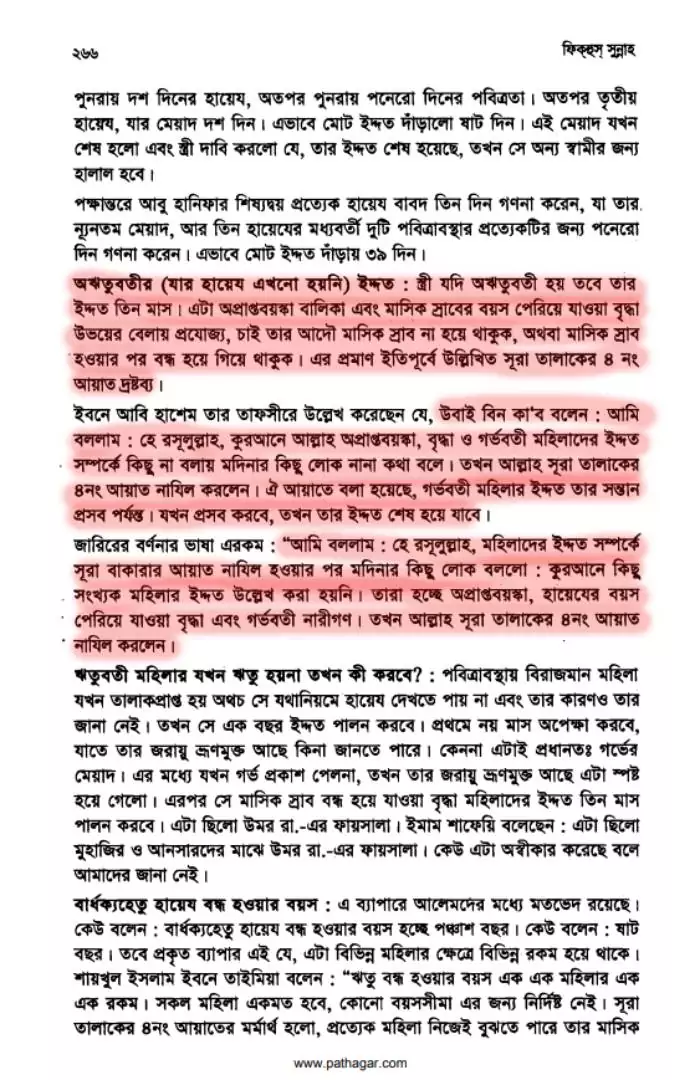
The waiting period of a nonmenstruating woman (one who has not yet menstruated): if the wife does not menstruate, her waiting period is three months. This applies both to a minor girl and to an elderly woman who has passed the age of menstruation, whether she has never menstruated or her menstruation has ceased after previously occurring. For evidence, see verse 4 of Surah al-Talaq, cited earlier.
Ibn Abi Hashim mentions in his tafsir that Ubayy ibn Ka‘b said: I
said: O Messenger of Allah, some people in Medina are making various remarks because Allah has said nothing in the Quran about the waiting periods of minor, elderly, and pregnant women. Allah then revealed verse 4 of Surah al-Talaq. That verse states that a pregnant woman’s waiting period lasts until she gives birth. When she gives birth, her waiting period ends.
Jarir’s narration is worded as follows: “I said: O Messenger of Allah, concerning women’s waiting periods,
after the verse of Surah al-Baqarah was revealed, some people in Medina said: the waiting periods of certain women have not been mentioned in the Quran. These are minor girls, elderly women who have passed the age of menstruation, and pregnant women. Allah then revealed verse 4 of Surah al-Talaq *.
What should a menstruating woman do when she does not menstruate? A woman in a state of purity,
when divorced, who does not experience menstruation as usual and does not know why, shall observe a waiting period of one year. First, she shall wait nine months to determine whether her womb is free of a fetus, for this is the usual duration of pregnancy. If no pregnancy becomes apparent during this time, it becomes clear that her womb is free of a fetus. She shall then observe the three-month waiting period of elderly women whose menstruation has ceased. This was Umar’s ruling. Imam al-Shafi‘i said: this was Umar’s ruling among the Muhajirun and the Ansar. We know of no one who rejected it.
The age at which menstruation ceases because of old age: scholars disagree on this. Some say that menstruation ceases due to old age at fifty. Others say sixty. In reality, however, it varies from one woman to another. Shaykh al-Islam Ibn Taymiyyah says: “The age at which menstruation ceases varies among women. There is no fixed age limit on which all women will agree. The meaning of verse 4 of Surah al-Talaq is that each woman herself understands whether her menstruation
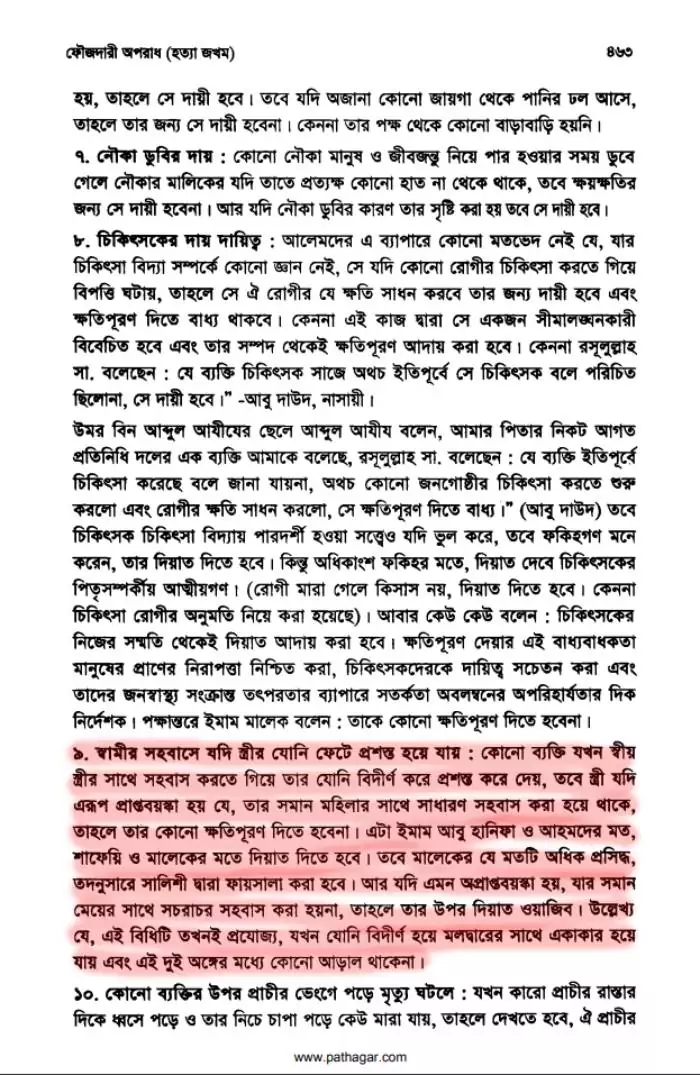
The same work states that a husband is liable for a financial penalty if a minor girl’s vaginal passage tears during intercourse. The condition here, however, is that this penalty applies only if the vaginal and anal passages become one. If a partition remains between them, there is no penalty. Although these are additions made by the imams long after Muhammad, they nevertheless provide evidence that Islam has very explicitly legitimized pedophilia. In other words, believers must take care that the minor child’s vaginal and anal passages do not tear and become one. It is enough to avoid that much. And if it does happen, one need only pay a small penalty! [20]—
happens, he will be liable. But if a surge of water comes from an unknown location, he will not be liable for it, because there was no excess on his part.
7. Liability for a boat sinking: if a boat sinks while carrying people and animals across, and the owner has played no direct part in it, he will not be liable for the losses. If he caused the sinking, however, he will be liable.
8. A physician’s liability: scholars do not disagree that someone who
has no knowledge of medicine and causes a mishap while treating a patient is liable for the harm he causes and must pay compensation. Through this act, he is considered a transgressor, and compensation will be recovered from his property. For the Messenger of Allah said: “Anyone who poses as a physician, although he was not previously known to be a physician, is liable.”—Abu Dawud, al-Nasa’i.
Abd al-Aziz, the son of Umar ibn Abd al-Aziz, says: a member of a delegation that came to my father told me that the Messenger of Allah said: “Anyone who is not known to have practiced medicine previously, but begins treating a community and harms a patient, is obliged to pay compensation.” (Abu Dawud) If a physician makes a mistake despite being skilled in medicine, however, the jurists hold that blood money must be paid. According to most jurists, it is paid by the physician’s paternal relatives. (If the patient dies, blood money, rather than retaliation, is required, because treatment was undertaken with the patient’s permission.) Some say that the blood money will be paid with the physician’s own consent. This obligation to pay compensation indicates the necessity of protecting human life, making physicians conscious of their responsibility, and exercising caution in their public-health activities. By contrast, Imam Malik says that he is not required to pay compensation.
1. If a husband’s intercourse tears and widens his wife’s vagina: when a man tears and widens his wife’s vagina during intercourse, and the wife is an adult such that intercourse is ordinarily had with women like her, he is not required to pay compensation. This is the view of Imams Abu Hanifa and Ahmad. According to al-Shafi‘i and Malik, blood money must be paid. According to Malik’s better-known opinion, however, the matter is settled through arbitration. If she is a minor such that intercourse is not ordinarily had with girls like her, blood money is obligatory upon him. Note that this rule applies only when the vagina is torn and becomes one with the anus, with no partition remaining between the two organs.
10. If a wall collapses on a person and causes death: when someone’s wall collapses toward the road and someone dies beneath it, it must be examined whether that wall
The first quotation from Fiqh al-Sunnah includes both minor girls and elderly women whose menstruation has ceased within the category of nonmenstruating women, and prescribes a three-month waiting period for both. Verse 4 of Surah al-Talaq is used directly as the basis for the waiting period of a minor girl. The account of the verse’s revelation also describes a question about the waiting periods of minor, elderly, and pregnant women. Consequently, the inclusion of minor girls in this work is no vague implication; it is an explicitly named, separate juristic category.
The second quotation is even more horrifying. It discusses the rule concerning intercourse with a minor wife whose peers do not ordinarily have intercourse. It raises the question of imposing financial compensation or blood money on the husband if intercourse tears the child’s vagina and merges it with the anus. Whether a child’s body was fit for intercourse was therefore no abstract possibility before the jurists; they had to formulate separate laws to calculate the actual consequences of severe physical injury.
The difference between the moral and legal frameworks is clear here. Under modern child-protection principles, the existence of such physical risks is sufficient to prohibit a sexual relationship. In the quoted juristic rule, however, the child’s inability did not automatically render intercourse unlawful. Judgment began only after intercourse had occurred: how far had the injury progressed, had the partition between the vagina and anus disappeared completely, and was the husband required to pay compensation?
In other words, this law did not protect the child from sexual violence; it determined how extensively her body had to be torn before the husband incurred financial liability. The child’s independent consent, psychological maturity, and safety are not central here. The central issue is whether sufficiently serious physical injury has occurred to create legal liability for the husband.
Hanafi Law in the Subcontinent: Fatawa Alamgiri
Fatawa Alamgiri, or Al-Fatawa al-Hindiyyah, is a large legal compilation prepared by numerous Hanafi scholars under the patronage of the Mughal emperor Aurangzeb. It has long served as an authoritative work in the judicial and fatwa traditions of the subcontinent.
The celebrated Islamic juristic work of the subcontinent, Fatawa Alamgiri, also describes intercourse with a minor wife and her divorce in detail [21]—
20. Ruling. Bada’i‘ al-Sana’i‘ states that if a husband has had intercourse with his minor wife, whose menstruation has not yet begun, and she is of an age at which intercourse is ordinarily possible with girls of that age, her waiting period after divorce is three months. Shaykh Abu Ali al-Nasafi says that this ruling applies only if she has not reached the stage of murahaqah, that is, an age approaching puberty. If she has reached an age approaching puberty, however, according to Abu al-Fadl, her waiting period will not be completed by reckoning months. Rather, her case will remain pending until it becomes apparent whether she conceived as a result of that intercourse. (Tamartashi) If a husband divorces a minor girl, and three months less one day pass before her menstruation begins, her waiting period will not be complete until three menstrual periods have passed. If a man gives his wife a revocable divorce, and she observes a waiting period of three menstrual periods less one day, after which her husband dies, a new waiting period of four months and ten days becomes obligatory upon her. (Ghayat al-Bayan)
21. Ruling: if a divorced woman begins observing her waiting period through menstruation, but her menstruation ceases after one or two menstrual periods, she cannot be released from her waiting period until she becomes menopausal. Once she becomes menopausal, she shall begin a new waiting period reckoned in months (three months). (Fatawa Qadi Khan) If a husband gives his enslaved wife a revocable divorce, and her master frees her during her waiting period, her waiting period changes from the moment of emancipation to that of a free woman. Thus, if she menstruates, her waiting period is three menstrual periods. If she does not, her waiting period is three months. By contrast, if her husband gives her an irrevocable divorce or three divorces, or dies leaving her behind, and she is subsequently freed during her waiting period, her waiting period does not change to that of a free wife. She must therefore observe, according to her circumstances, two menstrual periods, one and a half months, or two months and five days. (Ghayat al-Bayan) If an enslaved minor girl is divorced after intercourse, her waiting period is one and a half months. If her menstruation begins as the waiting period nears its end, her waiting period changes to one reckoned through menstruation. She shall therefore observe two menstrual periods. If she is freed as this menstruation-based waiting period nears its end, her waiting period becomes three menstrual periods. Then, if her husband dies as this waiting period nears its end, her waiting period becomes four months and ten days. (Itabiyyah.)
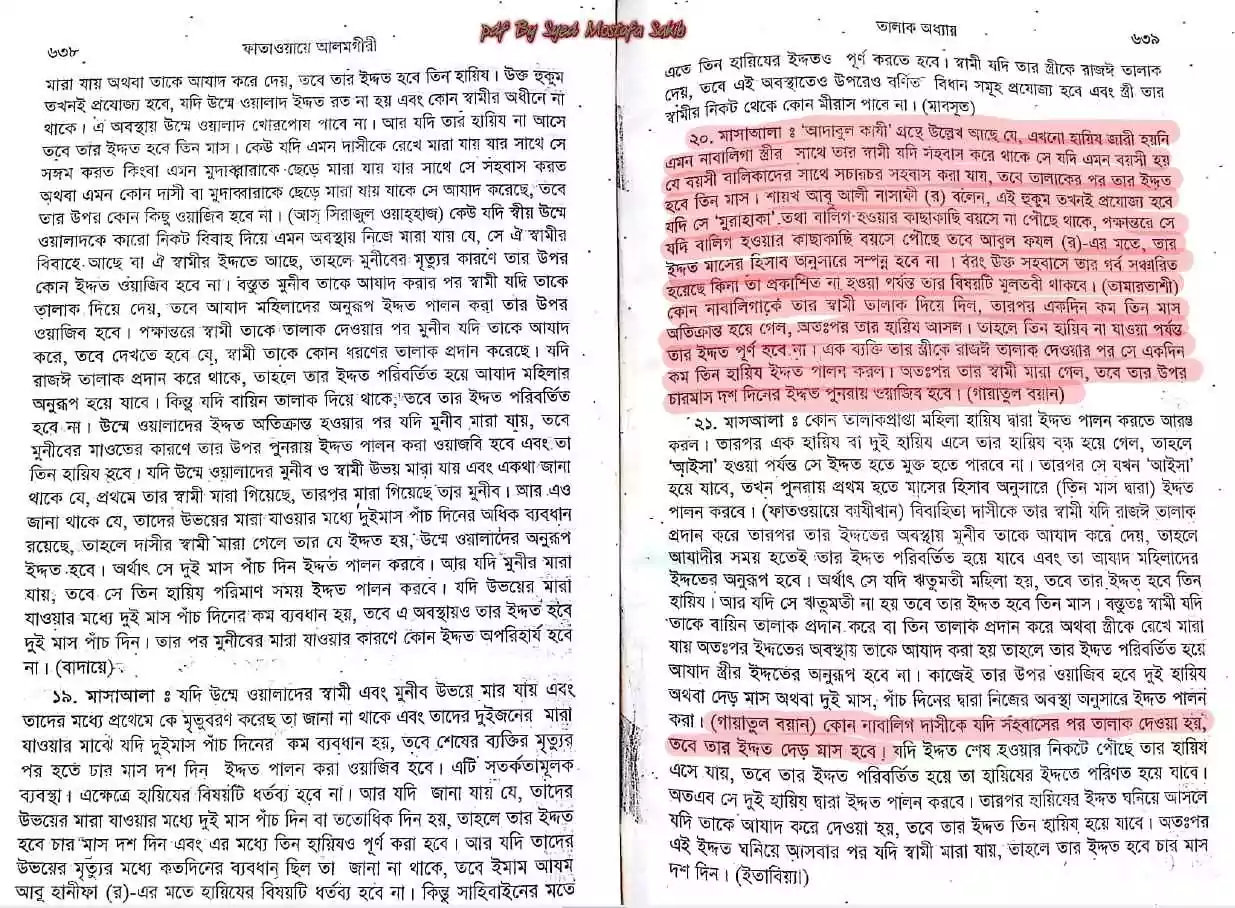
The quoted ruling assumes a husband’s intercourse with a minor wife who has not yet menstruated and calculates her waiting period after divorce. It also discusses checking for possible conception if she is approaching puberty. Child marriage here is no abstract permission. A consecutive legal framework has been developed for intercourse, possible pregnancy, divorce, and the waiting period. Claims such as “Marriage is valid, but intercourse is out of the question” are therefore directly false in light of this work’s contents.
Scholarly Consensus on Child Marriage
This section brings together the statements of Ibn Abd al-Barr, Imam Malik, Isma‘il ibn Ishaq, Ibn al-Mundhir, Ibn Hajar, and Ibn Hazm. Although they belonged to different schools and centuries, they acknowledged the validity of a father arranging his minor daughter’s marriage. Ibn Abd al-Barr, Isma‘il ibn Ishaq, and Ibn al-Mundhir describe this directly as scholarly ijma‘, or consensus. Ibn Hajar further states that the marriage of an adult man to a minor girl is valid—even if she is so young as to be in a cradle. Let us examine their statements below—
Imam Ibn Abd al-Barr (d. 423 AH) wrote— أجمع العلماء على أن للأب أن يزوج ابنته الصغيرة ولا يشاورها ، لتزويج رسول الله صلى الله عليه وسلم عائشة وهي بنت ست سنين …انتهى – Scholars agree that a father may marry off his minor child without consulting the child. For the Messenger of Allah married Aisha when she was six years old. (Al-Tamhid, Ibn Abd al-Barr—19/94)
Imam Malik (d. 179 AH) said— وإنكاح الأب جائز على الصغار من ولده ، ذكراً كان أو أنثى– A father may marry off his minor child, whether the child is a boy or a girl. (Al-Tamhid, Ibn Abd al-Barr—19/98)
Imam Isma‘il ibn Ishaq said— والأب له أن يزوج الصغيرة بإجماع من المسلمين– The Muslim community agrees that a father may marry off his minor child. (Al-Tamhid, Ibn Abd al-Barr—19/84)
Imam Ibn al-Mundhir al-Naysaburi (d. 318 AH) said— أجمع كل من نحفظ عنه من أهل العلم أن نكاح الأب ابنته الصغيرة جائز إذا زوجها من كفء– Scholars of the truth agree that a father may marry off his minor child if he marries the child to a suitable match (kufu’). (Al-Tamhid, Ibn al-Barr—19/84; Al-Mughni, Ibn Qudamah—9/398)
Imam Hafiz Ibn Hajar al-Asqalani (d. 852 AH) cited Ibn Battal’s opinion— يجوز تزويج الصغيرة بالكبير إجماعاً ، ولو كانت في المهد– According to all of them (the scholars of the truth), an adult boy may be married to a minor girl—even if the girl is extremely young. (Fath al-Bari, Ibn Hajar—9/123)
Imam Ibn Hazm (d. 456 AH) wrote— الحجة في إجازة إنكاح الأب ابنته الصغيرة البكر ، إنكاح أبي بكر رضي الله عنه النبي صلى الله عليه وسلم من عائشة رضي الله عنها وهي بنت ست سنين– The evidence that a father may marry off his minor daughter is that Abu Bakr married Aisha (his minor daughter) to the Messenger of Allah when she was a girl of six. (Al-Muhalla, Ibn Hazm—9/458)
The common basis of these claims of consensus is Aisha’s marriage at six. In other words, a personal event in the Prophet’s life became a precedent for later jurists to formulate general law. Although they disagreed over details such as suitable matches, the identity of the guardian, and subsequent options, the fundamental permission remained intact. The central focus of juristic debate is not the child’s independent consent, but which guardian may marry the child off and under what conditions.
Islamweb’s Fatwa
Islamweb is a large Qatar-based Arabic repository of Islamic fatwas and books. It is widely used in contemporary Sunni questions and answers. Fatwa no. 230518 directly asks whether there is Sharia evidence for forcing a minor virgin into marriage.
Islamweb.net is a substantial repository of Islamic fatwas. Let us examine a fatwa on this issue from the website. The fatwa is in Arabic, and an English version is also provided below (the English translation was taken from Google Translate) [22] –
الدليل على جواز تزويج الأب البنت الصغيرة دون إذنها أو رضاها
رقم الفتوى: 230518
السؤال
هل يوجد دليل في النصوص الشرعية يقول بجواز إجبار البكر الصغيرة على الزواج؟.
الإجابــة
الحمد لله والصلاة والسلام على رسول الله وعلى آله وصحبه، أما بعد:
فقد حكى بعض العلماء الإجماع على أن للأب تزويج ابنته البكر الصغيرة بغير رضاها، ولا يشترط إذنها، ونعني بالصغيرة من ليست بالغة، جاء في المغني لابن قدامة: أما البكر الصغيرة: فلا خلاف فيها، قال ابن المنذر: أجمع كل من نحفظ عنه من أهل العلم أن نكاح الأب ابنته البكر الصغيرة جائز, إذا زوجها من كفء. اهـ.
ومستند هذا الإجماع أن أبا بكر زوج عائشة ـ رضي الله عنها ـ من رسول الله صلى الله عليه وسلم ولم يشاورها، قال ابن عبد البر: أجمع العلماء على أن للأب أن يزوج ابنته الصغيرة ولا يشاورها، لتزويج رسول الله صلى الله عليه وسلم عائشة وهي بنت ست سنين…. اهـ.
ولمزيد الفائدة نرجو مراجعة الفتويين رقم: 223414، ورقم: 172491
والله أعلم.
Evidence that a father may marry off his young daughter without her permission or consent
Fatwa Number: 230518
Publication date: Thursday, 2 Safar 1435 AH — 5 December 2013
Question:
Is there any evidence in the Sharia texts establishing that a young virgin girl may be compelled to marry?
Answer:
Praise be to Allah, and may peace and blessings be upon the Messenger of Allah, his family and his Companions.
Some scholars have reported a consensus that a father may marry off his young virgin daughter without her consent and that her permission is not required. By “young” we mean a girl who has not reached puberty. Ibn Qudamah states in Al-Mughni: “As for the young virgin, there is no disagreement concerning her. Ibn al-Mundhir said: Every scholar from whom we have preserved knowledge unanimously agrees that a father’s marriage of his young virgin daughter is valid when he marries her to a compatible match.” End quote.
The basis of this consensus is that Abu Bakr married his daughter Aisha, may Allah be pleased with her, to the Messenger of Allah, peace and blessings be upon him, without consulting her. Ibn Abd al-Barr said: “The scholars unanimously agree that a father may marry off his young daughter without consulting her, because the Messenger of Allah, peace and blessings be upon him, married Aisha when she was six years old.” End quote.
For further information, please refer to Fatwas No. 223414 and No. 172491.
Allah knows best.
The fatwa leaves no ambiguity about whom it means by a “young girl.” The Arabic answer explicitly states that here saghirah means a girl who has not yet reached puberty. Her father may marry her off without her consent, and obtaining her permission is not a condition for the marriage. In other words, the absence of the girl’s consent does not create any problem for the validity of the marriage; rather, her consent is declared legally unnecessary precisely because she is a minor.
The fatwa gives two pieces of evidence. First, a claim of scholarly ijma‘, or consensus, attributed to Ibn al-Mundhir and Ibn Abd al-Barr. Second, the event in which Abu Bakr married Aisha to Muhammad at six without consulting her. Aisha’s marriage is consequently not treated here as a personal or exceptional event involving Muhammad. It has been turned into a Sharia precedent allowing an ordinary Muslim father to marry off his minor daughter without her consent.
Within this fatwa’s framework, the child’s wishes, fear, psychological readiness, and the marriage’s impact on her future life are not considerations. The discussion remains limited to the father’s authority and whether the proposed husband is considered suitable, or kufu’. In other words, the child who must bear the gravest consequences of the marriage is effectively absent from the legal decision.
This proves that the rule permitting child marriage without consent is no abandoned medieval passage; contemporary Islamic fatwa institutions still promote the same rule as religiously valid. Technology and publishing media have become modern, but the law of a guardian’s coercive authority over a child has not changed.
Fatwas of the Saudi Government and Grand Mufti
Saudi Arabia’s Permanent Committee for Fatwas is one of the country’s highest institutional religious authorities. In fatwa no. 18734, senior scholars, including its chairman Abd al-Aziz ibn Baz, determined whether Aisha’s marriage and intercourse at a young age were special privileges of the Prophet and whether the same rule applied to ordinary Muslims.
This fatwa, clearly presented on an official Saudi government website, states that child marriage is entirely lawful, intercourse is also lawful, and this permission applies to everyone, not just the Prophet. The fatwa bears the signatures of the leading scholars of the Saudi Permanent Committee at the time, including the former Grand Mufti Abd al-Aziz ibn Baz, the then deputy chairman Shaykh Abd al-Aziz Al al-Shaykh, and committee member Shaykh Salih al-Fawzan. Let us examine it as well— [23]
The first question of Fatwa no. 18734
Q 1: Is it true that the Prophet’s marriage to `A’ishah while still young was one of his particularities or was it a legislation for the whole Ummah?
Is it permissible to consummate marriage with immature girl? If not, how then should she observe three months as `Iddah (waiting period)?
A: The Prophet (peace be upon him) betrothed `Aishah (may Allah be pleased with her) while she was six years old. He consummated the marriage in Al-Madinah when she was nine years old. Actually, this was not a ruling exclusive to him. Therefore, it is permissible to contract the marriage of an immature girl and to consummate the marriage even before puberty if she is physically able.
(Part No. 18; Page No. 125)
As for the `Iddah of an immature girl, Allah (Glorified and Exalted be He) defined the `Iddah of those who have passed the age of monthly courses and those who are still immature to be three months. Allah (Exalted be He) said, And those of your women as have passed the age of monthly courses, for them the ‘Iddah (prescribed period), if you have doubt (about their periods), is three months; and for those who have no courses (i.e. they are still immature) In fact, immature girls are included under the category: …and for those who have no courses (i.e. they are still immature) their ‘Iddah (prescribed period) is three months likewise, except in case of death). May Allah grant us success. May peace and blessings be upon our Prophet Muhammad, his family, and Companions.
The Permanent Committee for Scholarly Research and Ifta’
Member: Bakr Abu Zayd Member: Salih Al-Fawzan Deputy Chairman: `Abdul-`Aziz Al Al-Shaykh Chairman:`Abdul-`Aziz ibn `Abdullah ibn Baz
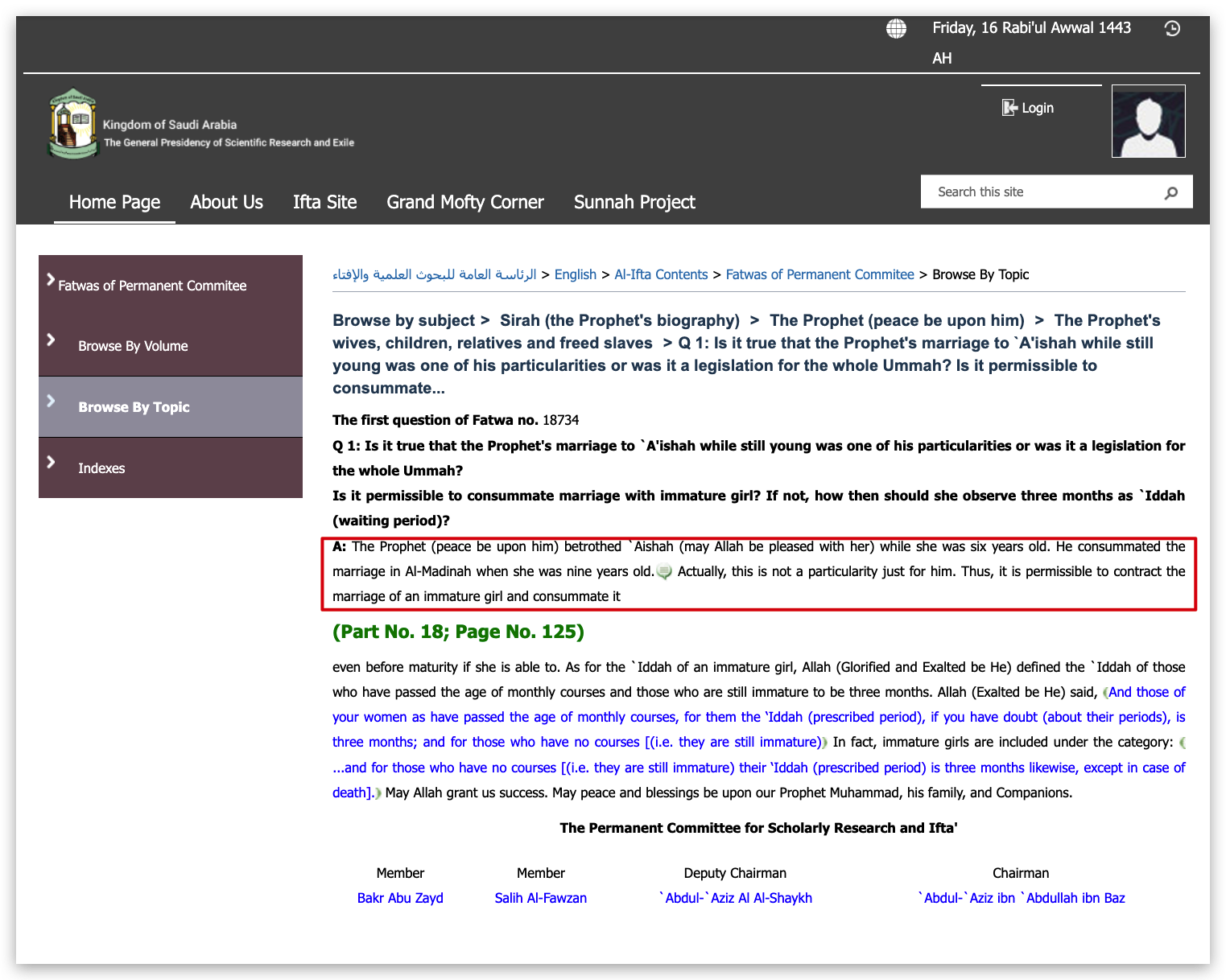
The Bengali edition of the Saudi scholar Salih al-Fawzan’s Special Rulings for Believing Women was published by IslamHouse, translated by Sanaullah Nazir Ahmad, and edited by Dr. Abu Bakr Muhammad Zakaria. Let us now examine the author’s statements on the marriage and consent of minor girls on pp. 95–96.
Obtaining a woman’s permission for marriage
Women eligible for marriage are of three kinds:
a. An unmarried minor girl.
b. An unmarried adult woman.
c. A previously married woman.
Each kind of woman has a separate ruling.
1. A father shall marry off his minor child without her permission; no one disagrees with this. For she does not yet possess the authority to give permission. Secondly, Abu Bakr married his young daughter Aisha to the Messenger of Allah when she was only six, and sent her to the bridal chamber when she reached nine.
Imam al-Shawkani says in Nayl al-Awtar (6/128, 129): “This
hadith proves that a father may marry off his daughter before she reaches adulthood. He further says: this hadith proves that it is valid to marry young girls to adults. Imam al-Bukhari devoted a chapter to this issue and cited Aisha’s hadith in it. Ibn Hajar al-Asqalani reported the community’s consensus on this issue in Fath al-Bari.” End of quotation.
Ibn Qudamah says in Al-Mughni (6/487): Ibn al-Mundhir said:
All those from whom we have acquired knowledge agree that a father may marry off his
young daughter if he marries her to a man of comparable standing
I (the author) say: Abu Bakr married his young daughter Aisha to the Prophet when she was only six. This event consigns to the rubbish heap those who deny the marriage of a young girl to an older boy, spread confusion, and consider it a crime. This may stem from their ignorance, or they may be self-serving and part of a foreign conspiracy.
2. An unmarried adult woman may not be married off without her permission, but her silence constitutes permission. For the Prophet said:
ولا تنكح البكر حتى تستأذن، قالوا: يا رسول الله فكيف إذنها ؟ قال: أن تسكت
“A virgin (that is, an unmarried adult woman) may not be married off without her permission.” They said: “O Messenger of Allah, how does she give permission?” He said: “Through her silence.”
Consequently, her permission must be obtained for marriage, even if her father is arranging it. Of the scholars’ two opinions, this is the more sound.
Ibn al-Qayyim says in Al-Hady al-Nabawi (5/96): “This is the opinion of the majority of the early generations. It is the position of Imam Abu Hanifa’s school and one of Imam Ahmad’s opinions. We worship Allah in accordance with this opinion and do not believe its opposite. This is the ruling in accordance with the Prophet’s commands and instructions.” End of quotation.
3. When a previously married woman has no husband, marrying her off without her permission
1 Sahih al-Bukhari, hadith no. 4843; al-Tirmidhi, hadith no. 1107; al-Nasa’i, hadith no. 2265; Abu Dawud, hadith no. 2092; Ibn Majah, hadith no. 1871; Ahmad (2/424); al-Darimi,
hadith no. 1186
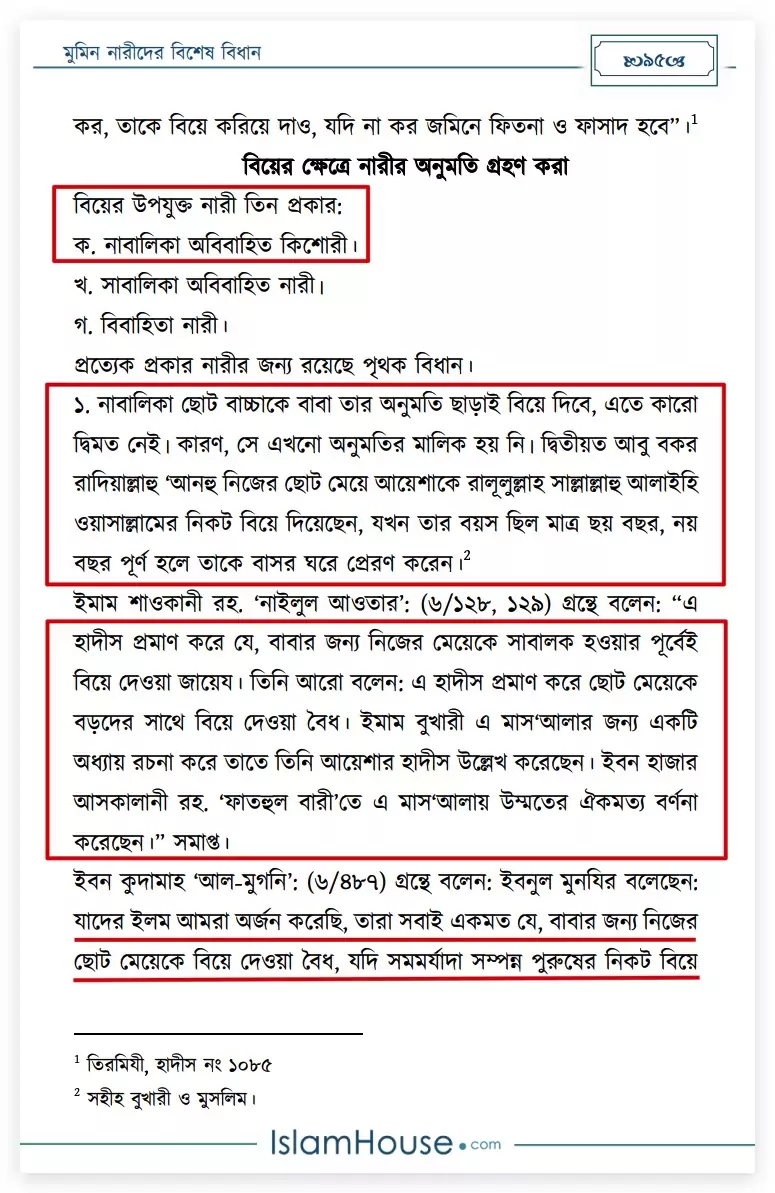
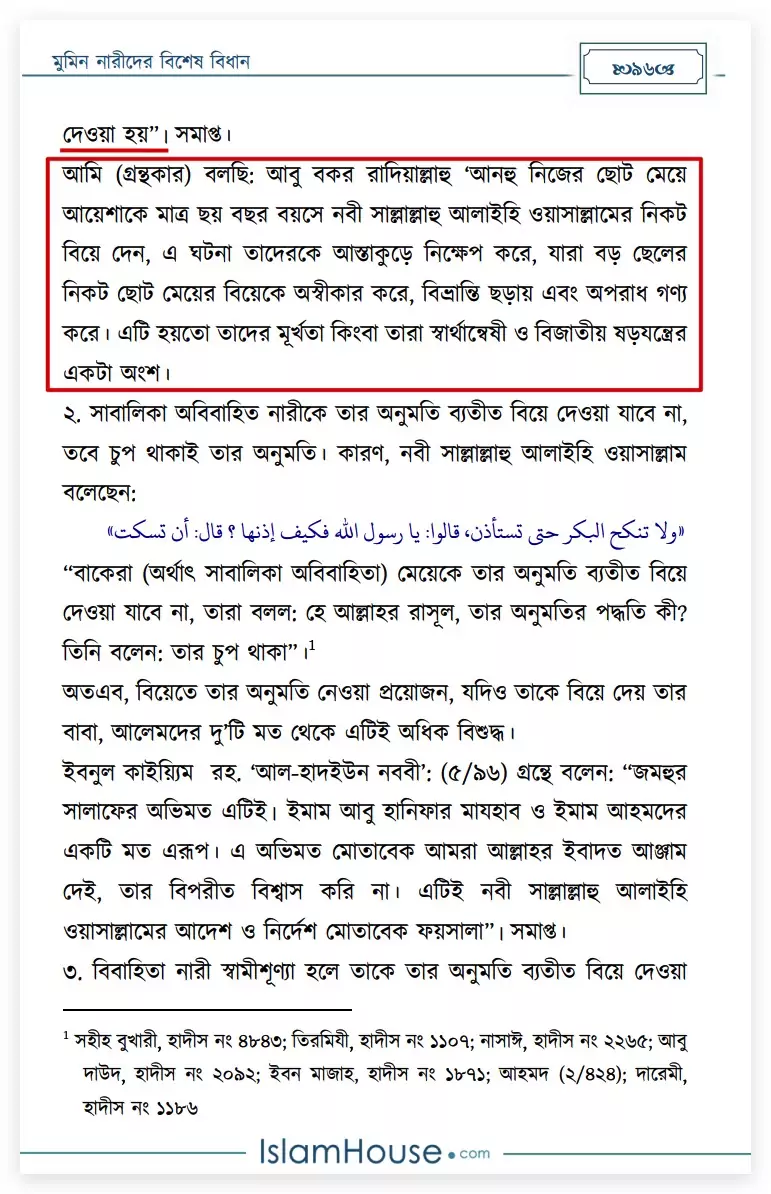
The Saudi Permanent Committee’s answer is unambiguous. First, it repeats the account of Aisha’s marriage at six and intercourse at nine. It then explicitly states that this event was not a special rule reserved for Muhammad. In other words, ordinary Muslims may also conclude a marriage with a minor girl and have intercourse with her before puberty if she is considered capable.
The committee uses Surah al-Talaq 65:4 directly as the Quranic basis for this conclusion. In its explanation, “those who have not menstruated” means minor girls who have not yet matured, and their waiting period is three months. The question itself raised the argument: if intercourse with a minor girl is not lawful, how can her three-month waiting period arise? The committee’s answer did not reject this argument; rather, it endorsed it by affirming the lawfulness of intercourse.
Salih al-Fawzan’s work then makes the question of a minor child’s consent even clearer. He states that a father shall marry off his minor daughter without her permission and that no one disagrees with this. The reason given is that the child does not yet “possess the authority to give permission.” Thus, marriage was not postponed because obtaining consent was impossible; rather, her lack of capacity to consent was precisely the reason for excluding her and granting the guardian the right to decide.
Here, the absence of a child’s consent is not a reason to invalidate the marriage; it is the Sharia basis for effectuating a marriage without consent. The Saudi Permanent Committee legitimized marriage and intercourse before puberty, while al-Fawzan established the paternal authority to conclude that marriage without the child’s permission. The marriage contract, absence of consent, and intercourse before puberty are thus all authorized within the same institutional religious framework.
A Fatwa Permitting Deception for Early Marriage
This question and answer from Fatawa Faqih al-Millat shows how a fatwa responds when Sharia’s permission for child marriage conflicts with modern Bangladeshi law. The question was whether a fourteen-year-old girl could be married off by recording her age as eighteen in official documents.
The sources above make it very clear that Islam encourages marrying off young girls. The juristic work Fatawa Faqih al-Millat also states that Islam permits not only marriage at a young age, but also lying for that purpose in violation of Bangladeshi law [24]—
Recording a Higher Age to Avoid Legal Trouble
Question: under Bangladeshi government law, marrying off a girl under eighteen is prohibited. Under Sharia law, however, concluding such a marriage is permissible. When a marriage is conducted according to Sharia, government pressure is sometimes brought to bear. The question is whether, to avoid government harassment, it would be permissible to marry a fourteen-year-old girl by recording her age as eighteen in official records.
Answer: Islamic Sharia has placed pressure on a girl’s guardians to marry her off promptly as soon as she is suitable for marriage. If anyone applies pressure to the contrary, it constitutes oppression or injustice. In observing Sharia’s rules, there is scope to adopt any method of escaping oppression or injustice.
(16/479/6618)
شعب الإيمان دار الكتب العلمية) ٦/ ٤٠١ (٨٦٦٦) : عن أبي سعيد، وابن عباس قال: قال رسول الله صلى الله عليه وسلم: ” من ولد له ولد فليحسن اسمه وأدبه، فإذا بلغ فليزوجه فإن بلغ ولم يزوجه فأصاب إثما، فإنما إثمه على أبيه “.
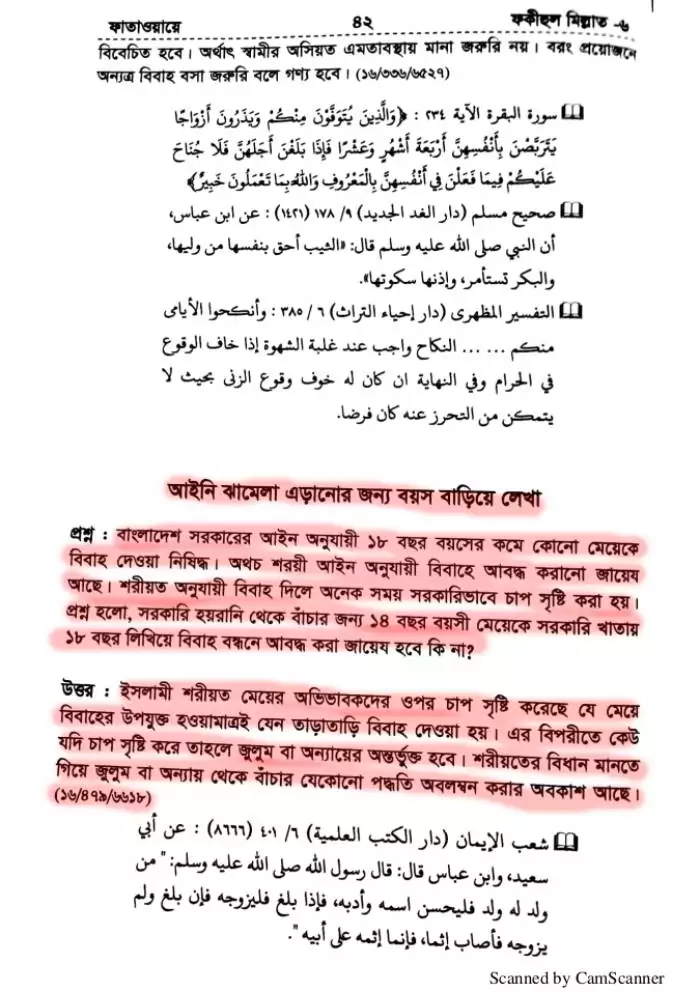
There was no ambiguity in the question. It directly asked whether a fourteen-year-old girl’s age could be recorded as eighteen in official documents in order to marry her off. The answer did not discuss a lawful administrative process for correcting age, court permission, or a legal exemption in special circumstances. Rather, the state law prohibiting marriage below eighteen was presented as an obstacle to Sharia and as oppression.
The fatwa said there was scope to adopt “any method” to escape this oppression while observing Sharia’s rules. In the specific context of the question, the meaning of this answer is clear: it is lawful to register the marriage of a fourteen-year-old girl by recording her age as eighteen in official papers. In other words, religious authorization has been given for knowingly providing false information in official documents, concealing the child’s actual age, and defeating state law through deception.
The moral distortion in this fatwa extends beyond permission to lie. The purpose of establishing an age limit against child marriage is to protect children’s education, health, physical safety, psychological development, and independent futures. Falsifying age prevents the state, schools, healthcare system, and child-protection institutions from knowing the girl’s actual circumstances. Consequently, the very law designed to protect the child is blinded in the name of religious instruction.
This is more than declaring child marriage lawful; it is religious authorization for planned deception to defeat a law that protects children. This fatwa shows that ancient juristic rules do not simply remain on the pages of books in contemporary society. Breaking the laws of a modern state, concealing a child’s age, and providing false information in official documents are also being declared lawful in order to preserve those rules.
The Combined Argument of the Two Verses
Reading Surah al-Ahzab 33:49 and Surah al-Talaq 65:4 separately can obscure their central legal relationship. The first verse establishes a negative condition: there is no waiting period if divorce occurs before intercourse. The second prescribes a three-month waiting period for a divorced wife whose menstruation has not begun. The second verse’s rule therefore concerns a marriage in which intercourse, or seclusion legally equivalent to it under Sharia, has occurred.
The argument takes this form: without intercourse, there is no waiting period; a wife whose menstruation has not begun has a waiting period; therefore, Quranic law assumes intercourse with a wife whose menstruation has not begun. Each step of this conclusion appears in Quranic verses, tafsir, and juristic application.
The Traditional Meaning of “Those Who Have Not Menstruated”
The Arabic phrase وَاللَّائِي لَمْ يَحِضْنَ literally means “and those who have not menstruated.” The phrase itself does not list every possible cause, but classical commentaries identify young girls as a principal category it includes. Al-Tabari explains that it concerns girls who do not menstruate because of young age and that their waiting period is three months if their husbands divorce them after intercourse [25]. Islamweb also acknowledges that the verse establishes the validity of the marriage of a girl below puberty and her waiting period reckoned in months if her husband has intercourse with her [26]।
Women with illnesses, irregular menstruation, or delayed menstruation may also fall under this rule in certain juristic discussions. That does not allow minor girls to be excluded. A general rule can encompass several categories; the presence of another category does not eliminate the category of children. Young or minor girls are mentioned explicitly in the statements of al-Tabari, Ibn Kathir, al-Jalalayn, al-Mazhari, al-Jassas, Mawdudi, and Taqi Usmani.
The Problem with a Defense That Separates the Marriage Contract from Intercourse
Modern apologetics often claims that Islam may have permitted a minor’s marriage contract but did not permit intercourse. This claim does not withstand the waiting-period principle in Surah al-Ahzab, Mawdudi’s “seclusion and intimate relations,” Ma‘arif al-Quran’s “after intercourse,” the physical-injury rules in Fiqh al-Sunnah, and the Saudi Permanent Committee’s declaration concerning intercourse “before puberty.”
In jurisprudence, “capacity for intercourse” is not a specified age, independent consent, psychological maturity, or a medical safety standard. It is a vague condition dependent on the assessment of a guardian, husband, or judge. Such a condition does not protect children’s rights; rather, it leaves intercourse lawful without an age limit and raises questions of liability or compensation after harm has occurred.
The Combined Evidence of the Sources
| Level of source | What has been established |
|---|---|
| Quran | A three-month waiting period for a divorced wife whose menstruation has not begun |
| Sahih al-Bukhari | The verse is presented as evidence for the marriage of a young girl, and Aisha’s case as its application |
| Tafsir | Young or minor girls are included in the category “those who have not menstruated” |
| Jurisprudence | Rules for a guardian arranging a minor girl’s marriage, the waiting period after intercourse, and compensation |
| Claims of consensus | Widespread recognition of a father’s authority to marry off his minor daughter without her consent |
| Modern fatwas | Declarations that the rule was not a special privilege of the Prophet and remains generally lawful today |
These sources did not independently arrive at the same conclusion; they are layers of a continuous religious legal system. Al-Bukhari applied the Quranic verse in a particular chapter, commentators explained its meaning, jurists developed detailed laws from it, and modern fatwa institutions reaffirmed those laws. Dismissing the matter as a mistranslation or an isolated medieval opinion is therefore factually false.
An Assessment in Terms of Ethics and Human Rights
A child cannot understand the consequences of marriage, a sexual relationship, pregnancy, divorce, and lifelong familial dependence and give free, informed consent to them. A father’s or guardian’s consent does not substitute for the child’s own. Child marriage means a formal marriage or informal union involving someone under eighteen, and UNICEF identifies it as a human-rights violation [27]. The onset of menstruation, or someone’s assumption that the genitals can withstand intercourse, is not evidence of psychological maturity, decision-making capacity, or safety.
For this reason, under modern children’s-rights and medical standards, child marriage and sexual relationships with children constitute exploitation and violence. According to the World Health Organization, mothers aged 10–19 face higher risks of eclampsia, postpartum uterine infection, and systemic infection than women aged 20–24; their babies also face higher risks of low birth weight, preterm birth, and severe neonatal complications [28]. No scripture, prophetic precedent, consensus of a legal school, or fatwa makes a harmful act ethical. What an ancient source permitted is a question of historical truth; whether that permission is just is a question of reason, harm, rights, and consent.
Conclusion
The evidence presented yields a clear conclusion. Surah al-Talaq 65:4 prescribes the waiting period of a wife whose menstruation has not begun; according to Surah al-Ahzab 33:49, that waiting period applies only after intercourse or its legal equivalent. Sahih al-Bukhari uses the verse in a chapter on the marriage of young girls. Classical and modern tafsir includes young girls within the verse. Juristic works have constructed detailed rules concerning marriage, a guardian’s coercive authority, intercourse, divorce, waiting periods, pregnancy, and physical injury. Modern fatwa institutions also reaffirm the same lawfulness.
Therefore, the claim that the Quran and Islamic jurisprudence do not permit child marriage is false. The actual debate concerns whether those rules are acceptable in light of modern children’s rights, valid consent, and humane ethics, rather than what the verses and tradition said. The evidence shows that these rules prioritized the authority of adult men and guardians over children’s rights.
References
- Child Marriage, Puberty and Adulthood: Definitions, Consent and Health Risks ↩︎
- Aisha’s Age at Marriage and Consummation: The Full Evidence from Hadith and Islamic Jurisprudence ↩︎
- Quran 33:49 ↩︎
- Quran 65:4 ↩︎
- Sahih al-Bukhari, Tawhid Publications, hadith 5133 ↩︎
- Sahih al-Bukhari, Islamic Foundation, hadith 4757 ↩︎
- Tafsir Ibn Kathir, volume 11, Islamic Foundation, p. 163 ↩︎
- Tafsir al-Jalalayn, volume 6, Islamiya Kutubkhana, p. 588 ↩︎
- Tafsir al-Mazhari, volume 11, pp. 562–563 ↩︎
- Ma’arif al-Quran, volume 8, pp. 481, 483 ↩︎
- Tafhim al-Quran, Sayyid Abu al-A’la Maududi ↩︎
- Mufti Muhammad Taqi Usmani, Tawdih al-Quran, volume 3, p. 567 ↩︎
- Ahkam al-Quran, Ahmad ibn Ali Abu Bakr al-Razi al-Jassas, translated by Muhammad Abd al-Rahim, Khairun Publications, volume 2, p. 135 ↩︎
- Ahkam al-Quran, Ahmad ibn Ali Abu Bakr al-Razi al-Jassas, translated by Muhammad Abd al-Rahim, Khairun Publications, volume 3, p. 131 ↩︎
- Ahkam al-Hadith, author: Maulana Md. Kamrul Hasan, editor: Dr. Muhammad Fazlur Rahman, Riyad Publications, pp. 474, 475, 561 ↩︎
- Al-Hidayah, vol. 2, Islamic Foundation, p. 201 ↩︎
- Ashraf al-Hidayah, vol. 3, Maulana Muhammad Ishaq Faridi, Islamia Kutubkhana Publications, p. 576 ↩︎
- Bukhari Sharif—Bengali Translation and Commentary, vol. 6, pp. 196–197 ↩︎
- Fiqh al-Sunnah, vol. 2, Sayyid Sabiq, Shatabdi Publications, p. 266 ↩︎
- Fiqh al-Sunnah, vol. 2, Sayyid Sabiq, Shatabdi Publications, p. 463 ↩︎
- Fatawa Alamgiri, Islamic Foundation, vol. 2, p. 639 ↩︎
- الدليل على جواز تزويج الأب البنت الصغيرة دون إذنها أو رضاها رقم الفتوى: 230518 ↩︎
- It is permissible to contract the marriage of an immature girl and consummate it ↩︎
- Fatawa Faqih al-Millat, vol. 6, Faqih al-Millat Foundation, Faqih al-Millat Mufti Abdur Rahman, p. 42 ↩︎
- Tafsir al-Tabari, Surah al-Talaq 65:4 ↩︎
- Islamweb, fatwa 109798 ↩︎
- UNICEF: Child Marriage ↩︎
- World Health Organization: Adolescent Pregnancy ↩︎