
Introduction
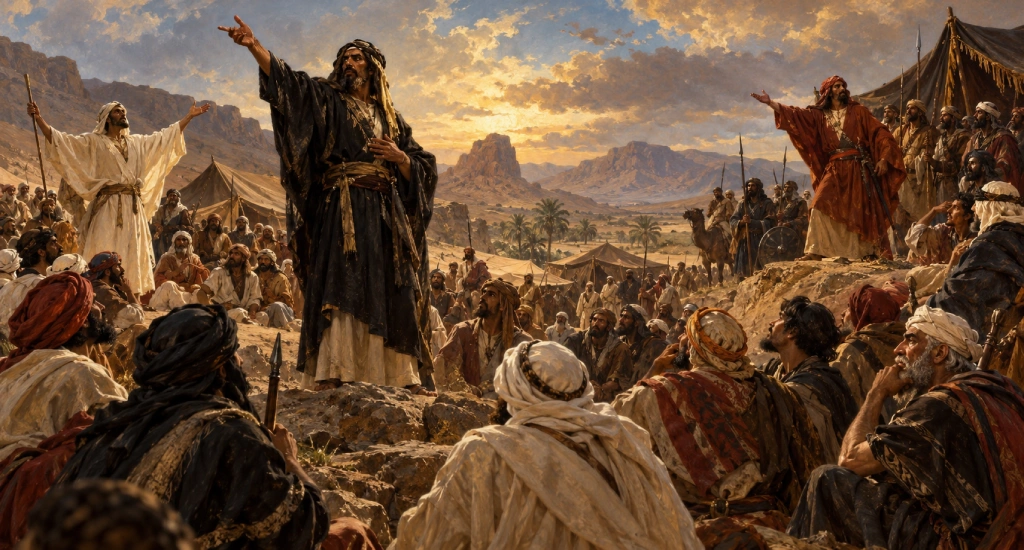
During the final phase of Muhammad’s life and immediately after his death, several individuals in different parts of Arabia rose to prominence while claiming prophethood. Among the most notable were Musaylima ibn Habib, Tulayha ibn Khuwaylid, and Sajah bint al-Harith. They were not merely isolated individuals; each had the backing of a tribe, followers, or military force. Musaylima and Tulayha began claiming prophethood during Muhammad’s lifetime, while Sajah emerged during the Ridda conflicts after Muhammad’s death. Later Islamic tradition, using the language of the victorious side, labelled them “liars,” “apostates,” and “false prophets”; historically, however, their existence, followers, and military resistance show that competition over prophetic authority in early Arabia took concrete political and military form.
In Musaylima’s case, this competition developed into direct confrontation during Muhammad’s lifetime. In his own letter, Musaylima identified himself as “the Messenger of Allah” and informed Muhammad that he had been made his partner in the “matter” of prophethood, and that half the land should belong to his followers and half to Quraysh. Muhammad rejected his claim outright, addressed him as “Musaylima al-Kadhdhab,” and when Musaylima’s two envoys affirmed the same claim, Muhammad said that were it not for the rule that envoys were not to be killed, he would have struck off their necks. [1]
Original Arabic:
أَمَا وَاللَّهِ لَوْلَا أَنَّ الرُّسُلَ لَا تُقْتَلُ لَضَرَبْتُ أَعْنَاقَكُمَا … مِنْ مُحَمَّدٍ رَسُولِ اللَّهِ، إِلَى مُسَيْلِمَةَ الْكَذَّابِ
English translation:
“By Allah, were it not that envoys are not killed, I would have struck off both your necks.” … “From Muhammad, the Messenger of Allah, to Musaylima al-Kadhdhab.”
Turning this history into evidence for the truth of Islam creates a direct logical problem. The fact that Musaylima or other claimants were defeated by Muslim forces does not entail that their claims to prophethood were false, unless it is first independently established that a true prophet can never be militarily defeated or killed. Islamic theology itself does not accept such a rule. IslamQA’s analysis, citing Qur’anic verses, explicitly concludes that Islamic sources do not rule out prophets and messengers being killed and that the Qur’an itself speaks of prophets being killed. Therefore, using the standards “the rival was killed, therefore his prophethood was false” and “our prophet may be killed without his prophethood becoming false” at the same time is a double standard. Military victory demonstrates an outcome of power; it does not demonstrate the truth of prophethood. [2]
Original Arabic—IslamQA:
ليس في نصوص الشرع، ولا أصوله ما يمنع قتل الأنبياء، وقد وقع ذلك … ولا فرق في ذلك بين الأنبياء والرسل.
English translation:
There is nothing in the texts or principles of the Sharia that makes the killing of prophets impossible; rather, such killing did occur … and there is no distinction in this regard between prophets and messengers.
The accounts preserved in Islamic historical works provide significant information about the statements of these claimants, their followers, military strength, the responses of Muhammad and later Muslim leadership, and their eventual fate.
Musaylima ibn Habib
Musaylima ibn Habib al-Hanafi was an influential figure of Banu Hanifa in Yamama and the most powerful claimant to prophethood during Muhammad’s lifetime. Ibn Ishaq’s account, preserved in Ibn Hisham’s Sira, states that in the ninth year after the Hijra a delegation from Banu Hanifa came to Medina and that Musaylima was associated with them. Ibn Ishaq also preserves two different versions of the same episode—in one, Musaylima speaks directly with Muhammad; in the other, he remains behind to guard the delegation’s belongings. The sources therefore differ over the details of his position in Medina; but Islamic tradition agrees that after returning to Yamama he claimed prophethood and came into conflict with Muhammad’s movement. [3]
Original Arabic—Ibn Hisham:
فَلَمَّا انْتَهَوْا إلَى الْيَمَامَةِ … تَنَبَّأَ … وَقَالَ: إنِّي قَدْ أُشْرِكْتُ فِي الْأَمْرِ مَعَهُ.
English translation:
When they reached Yamama … he claimed prophethood … and said: “I have been made a partner with him in this matter.”
This claim to prophethood was not limited to verbal self-identification. Near the end of the tenth year after the Hijra, Musaylima sent Muhammad a letter identifying himself as “Musaylima, the Messenger of Allah” and claiming that he had been made Muhammad’s partner in prophetic authority; half the land should belong to his followers and half to Quraysh. Muhammad replied by addressing him as “Musaylima al-Kadhdhab.” When Musaylima’s two envoys affirmed his claim, Muhammad said that if killing envoys were permitted, he would have struck off their necks. This shows that competition over prophethood had turned into direct political hostility during Muhammad’s own lifetime. [4]
Original Arabic:
لَوْلَا أَنَّ الرُّسُلَ لَا تُقْتَلُ لَضَرَبْتُ أَعْنَاقَكُمَا … إِلَى مُسَيْلِمَةَ الْكَذَّابِ
English translation:
“Were it not that envoys are not killed, I would have struck off both your necks.” … “To Musaylima al-Kadhdhab.”
Most of the surviving information about Musaylima’s own religious statements comes through hostile Muslim historical traditions. It should therefore be read not as Musaylima’s own preserved scripture, but as Muslim-source descriptions of his teachings. Ibn Ishaq’s account attributes to Musaylima several statements composed in imitation of Qur’anic rhyme. One concerns a “pregnant woman.” The same account further alleges that he removed the obligation of prayer from his followers and permitted wine and fornication. [5]
Original Arabic—Ibn Ishaq’s account:
لَقَدْ أَنْعَمَ اللَّهُ عَلَى الْحُبْلَى، أَخْرَجَ مِنْهَا نَسَمَةً تَسْعَى، مِنْ بَيْنِ صِفَاقٍ وَحَشَى.
English translation:
“Allah has bestowed favour upon the pregnant woman; He brought forth from her a living being that moves, from between the membranes and the entrails.”
Dabestan-e Mazaheb is a much later seventeenth-century work, written roughly a thousand years after the time of Muhammad and Musaylima. Therefore, information attributed to Musaylima in that work—such as worship three times a day, circumcision, or dietary rules—cannot be treated as evidence on the same level as early historical sources. More importantly, some of those later claims do not match the much earlier account preserved by Ibn Ishaq. The evidence of early sira and historical works therefore carries greater evidentiary weight for Musaylima’s religious rules than the later Dabestan.
After Muhammad’s death, Musaylima’s power developed into open military conflict. Abu Bakr first sent the forces of Ikrima and Shurahbil and later dispatched a larger army under Khalid ibn al-Walid toward Yamama. Ibn al-Athir’s Al-Kamil preserves a detailed account of the large Banu Hanifa military mobilisation and the advance of the Muslim army toward Yamama. Musaylima was ultimately killed in the Battle of Yamama, and his organised political and military power collapsed. [6]
Original Arabic—Ibn al-Athir:
وَوَجَّهَهُ إِلَى مُسَيْلِمَةَ … فَلَمَّا وَصَلُوا إِلَيْهِ سَارَ إِلَى الْيَمَامَةِ.
English translation:
Abu Bakr sent him against Musaylima … when the forces reached him, he marched toward Yamama.
Musaylima’s defeat was a historical military outcome. It does not automatically establish whether his claim to prophethood was true or false. Determining the truth of his claim requires independent evidence for that claim, just as treating Muhammad’s military victories as independent evidence of prophethood first requires establishing the additional premise that “military victory = divine truth.”
Sajah bint al-Harith
Sajah bint al-Harith’s claim to prophethood took an overt political and military form during the Ridda conflicts after Muhammad’s death. Later sources differ somewhat in how they describe her tribal identity. Ibn Kathir calls her a “Taghlibiyya” from al-Jazira and one of the Arab Christians; Ibn al-Athir describes her as a “Tamimiyya” and notes her maternal connection to Taghlib. But the central point of both accounts is the same: Sajah declared herself a prophet and had armed followers and tribal forces with her. In Ibn Kathir’s account, the initial objective of her force was an expedition against Abu Bakr. [7]
Original Arabic—Ibn Kathir:
وَهِيَ مِنْ نَصَارَى الْعَرَبِ، وَقَدِ ادَّعَتِ النُّبُوَّةَ، وَمَعَهَا جُنُودٌ مِنْ قَوْمِهَا وَمَنِ الْتَفَّ بِهِمْ.
English translation:
She was one of the Arab Christians; she claimed prophethood, and with her were troops from her own people and those who had joined them.
In Ibn al-Athir’s Al-Kamil, the episode is even clearer politically. It states that Sajah initially intended to campaign against Abu Bakr. After alliances and clashes involving different Tamimi groups, she advanced with her forces toward Yamama. On hearing the news, Musaylima regarded her as a threat to his territory, because at the same time he was also under pressure from Muslim forces and local opponents. It is therefore incorrect to portray Sajah merely as a follower of Musaylima—in Ibn al-Athir’s account, she was initially advancing toward Musaylima’s territory with her own independent claim to prophethood and her own military force. [8]
Original Arabic—Ibn al-Athir:
وَكَانَتْ سَجَاحُ تُرِيدُ غَزْوَ أَبِي بَكْرٍ … ثُمَّ خَرَجَتْ سَجَاحُ فِي الْجُنُودِ وَقَصَدَتِ الْيَمَامَةَ.
English translation:
Sajah intended to fight Abu Bakr … then Sajah set out with the troops and headed toward Yamama.
Later Muslim historical works also preserve stories of an agreement and a marriage between Sajah and Musaylima. Ibn Kathir, however, introduces the relevant part of the marriage story with the expression “ويقال”—“it is said.” The marriage story therefore has weaker evidentiary value than the accounts of Sajah’s claim to prophethood, her forces, and her advance toward Yamama. The agreement between two rival claimants to prophethood under conditions of military pressure is comparatively better attested; the details of the marriage belong to the later narrative. [9]
Original Arabic—Ibn Kathir:
وَيُقَالُ: إِنَّهُ لَمَّا خَلَا بِسَجَاحَ …
English translation:
“And it is said that when he was alone with Sajah …”
After Musaylima’s fall, Sajah’s independent political power also failed to endure. Later Muslim tradition preserves reports of her repentance and conversion to Islam. IslamQA, quoting Ibn Hajar while discussing the fates of Musaylima, Tulayha, and Sajah, notes a report that Sajah also repented. The account of Sajah’s repentance and conversion is therefore preserved in later Islamic sources. [10]
Original Arabic—Ibn Hajar, quoted by IslamQA:
وَنُقِلَ أَنَّ سَجَاحَ أَيْضًا تَابَتْ.
English translation:
“It has also been reported that Sajah repented.”
Tulayha ibn Khuwaylid
Tulayha ibn Khuwaylid al-Asadi was a leader of Banu Asad, and his claim to prophethood did not suddenly arise after Muhammad’s death. Ibn al-Athir’s Al-Kamil explicitly states that Tulayha had claimed prophethood during Muhammad’s lifetime. Muhammad sent Dirar ibn al-Azwar against him, placed him in charge of Banu Asad, and instructed him to confront those who had apostatised. After Muhammad’s death, Tulayha’s power increased further; he claimed that Gabriel came to him, and religious instructions were also circulated in his name. [11]
Original Arabic—Ibn al-Athir:
قَدْ تَنَبَّأَ فِي حَيَاةِ رَسُولِ اللَّهِ … وَتَبِعَهُ كَثِيرٌ مِنَ الْعَرَبِ عَصَبِيَّةً.
English translation:
He had claimed prophethood during the lifetime of the Messenger of Allah … and many Arabs followed him out of tribal partisanship and solidarity.
The sources do not state that Tulayha’s followers “worshipped” him as a prophet. Rather, Ibn al-Athir explicitly says that many Arabs followed him because of ‘asabiyyah, or tribal solidarity; his principal support came from Asad, Ghatafan, and Tayy. Thus, alongside religious belief, tribal power and political allegiance also played an important role in the spread of Tulayha’s movement. [12]
Original Arabic—Ibn al-Athir:
وَتَبِعَهُ كَثِيرٌ مِنَ الْعَرَبِ عَصَبِيَّةً … مِنْ أَسَدٍ وَغَطَفَانَ وَطَيِّئٍ.
English translation:
Many Arabs followed him out of tribal partisanship … especially from Asad, Ghatafan, and Tayy.
After Muhammad’s death, military operations against Tulayha’s power began under Abu Bakr. When his coalition was defeated by Khalid ibn al-Walid’s forces at the Battle of Buzakha, Tulayha fled toward Syria. According to later Islamic sources, he subsequently converted back to Islam and took part in later campaigns on the Muslim side. Al-Dhahabi’s Siyar A‘lam al-Nubala likewise preserves the account of his defeat, departure for Syria, and later conversion to Islam. [13]
Original Arabic—al-Dhahabi:
ثُمَّ انْهَزَمَ وَخُذِلَ، وَلَحِقَ … بِالشَّامِ، ثُمَّ ارْعَوَى وَأَسْلَمَ.
English translation:
Then he was defeated and abandoned, and he went … to Syria; later he reconsidered and accepted Islam.
Conclusion
In early Islamic history, claims to prophethood were not limited to Muhammad alone. Musaylima and Tulayha claimed prophethood during Muhammad’s lifetime; Sajah emerged after his death with a claim to prophethood and armed followers. Each had followers, tribal alliances, or military forces that posed a real political challenge to the emerging Muslim state. In the subsequent wars, Musaylima was killed, Tulayha was defeated and fled before later converting to Islam, and Sajah’s independent movement also disappeared. Their claims were therefore preserved in the victorious Islamic tradition as defeated rival prophecies.
But it is not logically valid to derive theological truth from these military outcomes. The fact that a claimant died in battle or that his or her followers were defeated is not an independent refutation of that person’s claim to prophethood. Islamic theology itself acknowledges that prophets and messengers can be killed. IslamQA’s discussion, based on Qur’an 2:87, 3:144, and 3:183, explicitly concludes that it is not theologically impossible for a prophet or messenger to be killed. Therefore, treating the death of a rival prophet as proof that he was a liar, while treating the death of an accepted prophet as compatible with prophethood, applies two different standards to the same type of event. [14]
Original Arabic—IslamQA:
لَيْسَ هُنَاكَ دَلِيلٌ صَرِيحٌ عَلَى عَدَمِ قَتْلِ الرُّسُلِ؛ بَلْ ظَاهِرُ النُّصُوصِ يَدُلُّ عَلَى حُصُولِ قَتْلِ الرُّسُلِ، وَإِمْكَانِيَّتِهِ.
English translation:
There is no explicit evidence that messengers cannot be killed; rather, the apparent meaning of the texts indicates that messengers were killed and that such killing is possible.
Therefore, the outcomes of the battles of Yamama or Buzakha belong to the history of Islam’s military victory; they are not tests for determining whether a claim to prophethood is true or false. If the standard for true prophethood is evidence, the independent truth of revelation, and a verifiable basis for the claim, then Muhammad, Musaylima, Sajah, and Tulayha must all be tested by the same standard. The fact that one side ultimately won the war does not by itself prove that any person was sent by Allah.
References
- Islamweb—Musaylima’s letter and Muhammad’s response ↩︎
- IslamQA—Can prophets and messengers be killed? ↩︎
- Islamweb—Ibn Hisham, the delegation of Banu Hanifa and Musaylima ↩︎
- Islamweb—Musaylima’s letter, his envoys, and Muhammad’s response ↩︎
- Ibn Hisham—rhymed statements and rulings attributed to Musaylima ↩︎
- Shamela—Ibn al-Athir, Musaylima and the Battle of Yamama ↩︎
- Islamweb—Ibn Kathir, Sajah’s claim to prophethood and her forces ↩︎
- Shamela—Ibn al-Athir, Sajah and Banu Tamim ↩︎
- Islamweb—Ibn Kathir, the agreement between Sajah and Musaylima ↩︎
- IslamQA—the fate of early claimants to prophethood ↩︎
- Shamela—Ibn al-Athir, Tulayha al-Asadi ↩︎
- Islamweb—Ibn al-Athir, the tribal basis of Tulayha’s following ↩︎
- Islamweb—al-Dhahabi, biography of Tulayha ibn Khuwaylid ↩︎
- IslamQA—the possibility of prophets and messengers being killed ↩︎