
Introduction
What was the first creation according to Islamic belief—water, the Pen, the Throne, or something else? Islamic scriptures and early Quranic commentaries preserve several accounts of the beginning of creation. The Quran describes God’s Throne as resting upon water before the creation of the heavens and the earth. Authentic hadith reports describe that pre-creation state and the writing of destiny. Another hadith states that God first created the Pen and commanded it to record the destinies of everything that would happen. One account preserved by early Quranic commentators gives a specific sequence: smoke emerged from primordial water, the heavens were formed from that smoke, and the earth was created when the water dried up. Examining these claims together makes it possible to assess the substance, mutual relationships, and scientific reliability of Islamic accounts of the earliest stages of creation.
Scientific explanations of the early universe rest on observable spectra of light, cosmic background radiation, the abundances of chemical elements, stellar evolution, and testable physics. Water is a particular chemical compound; a pen is an object used for a particular purpose. When these objects are placed in a state preceding the creation of the heavens and the earth, questions arise about the chronology of the religious accounts in relation to natural history. An essential distinction must also be retained: ‘water existed before the creation of the heavens and the earth’ does not mean ‘water was the first thing ever created.’ The analysis must preserve the difference between what the Quran, hadith, and tafsir actually say.
The First Elements in the Early Universe and the Chemical Origin of Water
The earliest state of the universe cannot be identified with any familiar molecule or chemical element. In the primordial hot phase following the Big Bang, stable atoms in their present form did not yet exist. As expansion reduced the temperature, protons and neutrons combined during the first few minutes to form mainly the nuclei of light elements. Neutral atoms formed much later when electrons joined those nuclei. Consequently, ‘the first matter,’ ‘the first element,’ ‘the first atom,’ and ‘the first molecule’ cannot be used interchangeably. The primordial abundances of hydrogen, helium, and lithium are especially important in reconstructing the chemical evolution of the early universe. [1]
Most of the hydrogen and helium in the universe was created in about 5 minutes.
English contextual rendering: Most of the universe’s hydrogen and helium nuclei formed within approximately the first five minutes. Later, when the universe cooled, these nuclei captured electrons to form atoms.
Water is not an element; it is an H2O molecule composed of two hydrogen atoms and one oxygen atom. Primordial nucleosynthesis after the Big Bang did not produce significant quantities of oxygen. After the first generation of stars formed, nuclear reactions within stars produced heavier elements, including oxygen. Those elements subsequently dispersed into interstellar space, creating conditions in which water molecules could form through chemical reactions involving hydrogen. NASA explicitly identifies the Big Bang as the origin of hydrogen and stellar interiors as the origin of oxygen. [2]
Hydrogen was created in the Big Bang, and oxygen in the cores of stars more massive than the Sun.
English contextual rendering: Hydrogen originated in the Big Bang, while oxygen was produced inside stars more massive than the Sun. The two elements composing water therefore have distinct origins and formation times in cosmic history.
The fact that water could exist only after stars and heavier elements formed does not mean that water appeared only after Earth was formed. Water molecules could form in interstellar gas and dust long before Earth existed. The first generation of stars consisted primarily of hydrogen- and helium-rich material, within which the production of heavier elements began. In the chemical history of the universe, therefore, water is not the first constituent but a later compound formed from elements that already existed. [3]
The Throne upon Water Before the Creation of the Heavens and the Earth
Quran 11:7 mentions a state preceding the creation of the heavens and the earth in six days, when God’s Throne was upon water. The verse does not directly declare water to be the first substance created, but it presents water as existing before the formation of the heavens and the earth. Early exegetes including al-Tabari, Ibn Kathir, and al-Qurtubi used this verse as evidence concerning the original state of creation. [4]
وَهُوَ الَّذِي خَلَقَ السَّمَاوَاتِ وَالْأَرْضَ فِي سِتَّةِ أَيَّامٍ وَكَانَ عَرْشُهُ عَلَى الْمَاءِ لِيَبْلُوَكُمْ أَيُّكُمْ أَحْسَنُ عَمَلًا
English translation: He is the one who created the heavens and the earth in six days, and His Throne was upon the water, so that He might test which of you is best in deeds.
Sahih al-Bukhari 3191 is directly relevant to the state preceding creation. When a delegation from Yemen asked Muhammad about the beginning of creation, he replied that God existed when nothing else existed, that His Throne was upon water, that He recorded everything, and that He created the heavens and the earth. The Throne’s position upon water, the prior writing of all events, and the creation of the heavens and the earth occur in the same hadith. Although the report places the existence of the Throne and water before the creation of the heavens and the earth, it does not specify the order in which the Throne and water themselves were created. Thus, it gives an important account of the earliest stages of creation without uniquely identifying the first thing ever created. [5]
كَانَ اللَّهُ وَلَمْ يَكُنْ شَىْءٌ غَيْرُهُ، وَكَانَ عَرْشُهُ عَلَى الْمَاءِ، وَكَتَبَ فِي الذِّكْرِ كُلَّ شَىْءٍ، وَخَلَقَ السَّمَوَاتِ وَالأَرْضَ
English translation: God existed, and there was nothing other than Him. His Throne was upon water. He wrote down everything in the Record and created the heavens and the earth. This statement is attributed to Muhammad in the narration of Imran ibn Husayn, in response to a delegation from Yemen asking about the beginning of creation.
Sahih Muslim, through Abdullah ibn Amr ibn al-As, gives a specific time frame for this primordial water. Muhammad states that God determined the destinies of all creatures fifty thousand years before creating the heavens and the earth, while His Throne was upon water. Water is thus associated with a particular state preceding the formation of the heavens and the earth. This report is an important complement to the narration in al-Bukhari when examining the chronology of creation. [6]
كَتَبَ اللَّهُ مَقَادِيرَ الْخَلاَئِقِ قَبْلَ أَنْ يَخْلُقَ السَّمَوَاتِ وَالأَرْضَ بِخَمْسِينَ أَلْفَ سَنَةٍ – قَالَ – وَعَرْشُهُ عَلَى الْمَاءِ
English translation: God recorded the destinies of created beings fifty thousand years before He created the heavens and the earth, while His Throne was upon water.
Al-Tabari’s Tafsir: Smoke from Water, the Heavens from Smoke, and the Earth from Dried-Up Water
In his commentary on Quran 2:29, al-Tabari records a detailed creation narrative through al-Suddi, attributed to Ibn Abbas, Ibn Masud, and several other companions. It says that God’s Throne was upon water and that He brought smoke out of that water to create the heavens. The water then dried up, producing first one earth and later seven earths. The same account describes the earth resting on a fish, water and rock below the fish, and mountains preventing the earth from shaking. These are not the words of the Quranic verse itself but a creation narrative preserved in early commentary on that verse. [7]
إِنَّ اللَّهَ تَبَارَكَ وَتَعَالَى كَانَ عَرْشُهُ عَلَى الْمَاءِ … فَلَمَّا أَرَادَ أَنْ يَخْلُقَ الْخَلْقَ، أَخْرَجَ مِنَ الْمَاءِ دُخَانًا
English translation: God’s Throne was upon water. When He wished to create creation, He brought forth smoke from the water; that smoke rose and became the material from which the heavens were formed. The water then dried up and produced the earth, which was divided into seven earths. Later in the report, the earth is placed upon the fish called Nun; the fish’s movement causes the earth to shake.
In this account, water is not merely a substance already present at the beginning; it also supplies the material from which the heavens and the earth are formed. Smoke is said to emerge from water, while dried-up water becomes land. In actual chemistry, neither water vapor nor smoke cools into the heavens or a rocky planet’s crust. The formation of stars and planets involves cosmic gas and dust, gravity, and the prolonged evolution of heavy elements. The creation account cited by al-Tabari does not describe these observed processes.
Al-Qurtubi and al-Baghawi: The Prior Existence of the Throne and Water
In explaining Quran 11:7, al-Qurtubi says the verse indicates that the Throne and water were created before the heavens and the earth. In the same discussion, he cites an account attributed to Ka’b: God created a green ruby, transformed it into water, created wind, placed water upon that wind, and placed the Throne upon the water. Thus, alongside the initial positions of water and the Throne, al-Qurtubi’s compilation preserves another story about the origin of water itself. That story invokes a miraculous transformation rather than a natural chemical origin. [8]
وَكَانَ عَرْشُهُ عَلَى الْمَاءِ بَيَّنَ أَنْ خَلْقَ الْعَرْشِ وَالْمَاءِ قَبْلَ خَلْقِ الْأَرْضِ وَالسَّمَاءِ
English translation: ‘His Throne was upon water’ indicates that the Throne and the water were created before the earth and the heavens. Al-Qurtubi subsequently records a report attributed to Ibn Abbas about air beneath the water, and one attributed to Ka’b about water arising from a green ruby.
Al-Baghawi quotes another sequence attributed to Damrah in commenting on the same verse: the Throne was first upon water, the heavens and the earth were then created, and afterward the Pen was created and used to record the events of creation. The chronological relationship between this account and the report that ‘the Pen was the first creation’ is not straightforward. Early sources do not place water, the Throne, and the Pen into a single consistent order. [9]
إِنَّ اللَّهَ تَعَالَى كَانَ عَرْشُهُ عَلَى الْمَاءِ ثُمَّ خَلَقَ السَّمَوَاتِ وَالْأَرْضَ، وَخَلَقَ الْقَلَمَ فَكَتَبَ بِهِ
English translation: God’s Throne was upon water. He then created the heavens and the earth, created the Pen, and used it to record what He would create and what would occur among His creatures.
The first volume of Ibn Kathir’s Tafsir published in Bengali by the Islamic Foundation Bangladesh contains a Bengali translation of the same sequence of creation. [10]
আস্ সুদ্দী স্বীয় তাফসীরে ইবন মাসউদ ও অন্যান্য সাহাবা (রা) হইতে পর্যায়ক্রমে মুরাহ, ইব্ন আব্বাস, আবু সালেহ ও আবূ মালিক হইতে বর্ণনা করেন- সৃষ্টির পূর্বে আল্লাহ্ তা’আলার আরশ পানির উপর সংস্থাপিত ছিল। পানির পূর্বে আল্লাহ্ পাক কোন বস্তুই সৃষ্টি করেন নাই। সুতরাং সৃজন পরিকল্পনা বাস্তবায়নের জন্য সর্বপ্রথম তিনি পানি হইতে বাষ্প সৃষ্টি করিলেন। উহা ক্রমান্বয়ে ঊর্ধ্বলোকে উত্থিত হইল এবং উত্থিত বাষ্প ছাদরূপ পরিগ্রহ করিয়া আকাশে পরিণত হইল। এইজন্য উহার নাম হইল ماء )উর্ধ্বলোক)। অতঃপর পানি শুকাইয়া একটি ভূখণ্ড দেখা দিল। তখন উহাকে সপ্তখণ্ডে বিভক্ত করা হইল। রবি-সোম দুই দিনে এই সপ্তখণ্ড সৃষ্টি হইল। অতঃপর পৃথিবীকে সেই মৎসের উপর স্থাপন করা হইল যাহার বর্ণনা সূরা ‘নূন ওয়াল কলম’-এ আসিয়াছে। মৎসটি পানির উপর এবং পানির নীচে সকাত জাতীয় পদার্থ বা পরিচ্ছন্ন মৃত্তিকা শিলা বিদ্যমান। মৃত্তিকা শিলার ধারক হইলেন ফেরেশতা। ফেরেশতা দণ্ডায়মান প্রস্তরের আস্তরের উপর এবং প্রস্তরের আস্তরটি বায়ুমণ্ডলের উপর ভাসমান রহিয়াছে। লুকমান হাকীম এই প্রস্তর আস্তরের কথাই বলিয়াছেন। উহা আকাশ কিংবা পৃথিবীর কোথাও স্থাপিত নহে। মৎসটি নড়াচড়া করা মাত্র পৃথিবী কম্পিত হয় এবং ভূমিকম্প সৃষ্টি হয়। তাই পৃথিবীকে পাহাড় চাপা দেওয়া হইল। ফলে পৃথিবী সুস্থির হইল। পর্বত তাই পৃথিবীর কাছে নিজের বড়াই করিয়া থাকে।
English translation: Al-Suddi narrated in his tafsir from Ibn Masud and other companions, by way of Murrah, Ibn Abbas, Abu Salih, and Abu Malik: Before creation, God’s Throne was established upon water. Before water, God had created nothing. When He decided to carry out creation, He first produced vapor from the water. The vapor gradually rose upward and formed a roof, becoming the sky, which was accordingly named sama’ (the upper realm). The water then dried, revealing a tract of land. It was divided into seven regions, which were created on Sunday and Monday. The earth was then placed on the fish mentioned in Surat Nun wa al-Qalam. The fish rests on water, and beneath the water is a kind of rock or purified clay-like stone. An angel supports that stone; the angel stands on another layer of rock; and that layer floats upon air. This is the stone referred to by Luqman, which rests neither in the heavens nor on the earth. Whenever the fish moves, the earth trembles and an earthquake occurs. Mountains were therefore placed upon the earth to press it down and steady it. That is why the mountains boast of their superiority over the earth.

Where Was God Before Creation? Clouds, Emptiness, and the Throne upon Water
An unusual account of God’s existence and location before the universe was created appears in early hadith scholarship. In Jami al-Tirmidhi 3109, Abu Razin al-Uqayli directly asked Muhammad where God had been before creating anything. Muhammad answered with the word ‘ama’ (عماء), an Arabic term that can mean a cloud or cloud-like condition. He then described a state with no air above or below it, followed by the creation of the Throne upon water. This hadith thus speaks not only of primordial water but also of a condition preceding the creation of the Throne. [11]
أَيْنَ كَانَ رَبُّنَا قَبْلَ أَنْ يَخْلُقَ خَلْقَهُ قَالَ كَانَ فِي عَمَاءٍ مَا تَحْتَهُ هَوَاءٌ وَمَا فَوْقَهُ هَوَاءٌ وَخَلَقَ عَرْشَهُ عَلَى الْمَاءِ
English translation: Where was our Lord before He created His creation? He said: He was in a state of ‘ama’, with no air below it and no air above it, and He created His Throne upon water.
Al-Tirmidhi classified this hadith as hasan. Later hadith scholars nevertheless differed about its chain of transmission. Al-Tabari considered the report acceptable, while al-Tirmidhi, al-Dhahabi, and Ibn Taymiyyah also accepted it in different ways. Al-Albani, in contrast, classified it as weak. These disagreements are mentioned in IslamQA’s answers 145809 and 443989. Its status as a historically certain statement made by Muhammad is therefore disputed within hadith scholarship. Its presence in an early hadith collection as a specific account of the state before creation, however, is established. [12] [13]
Al-Tabari’s commentary on Quran 11:7 also preserves the same exchange through Abu Razin. The question concerns where God was before the creation of the heavens and the earth; the answer invokes ‘ama’ and then the creation of the Throne upon water. Al-Tabari’s reports 17980 and 17981 contain different wordings of the episode. They are not wholly independent events corroborating al-Tirmidhi’s hadith but versions of the same exchange transmitted through Abu Razin. [14]
Was ‘Ama’ a Physical Cloud or the Absence of Anything Else?
The decisive term in this hadith is ‘ama’. Early Arabic linguists and later Islamic commentators differed about its meaning. Abu Ubayd and some other early scholars interpreted the word as ‘cloud.’ In contrast, a gloss attributed to Yazid ibn Harun in al-Tirmidhi’s narration understands ‘ama’ as a state in which nothing besides God existed. The same expression has therefore been read either as describing a cloud-like state or as denying the existence of anything created.
In his Hashiyat al-Sindi ala Ibn Majah, al-Sindi discusses this divergence. He notes that the ordinary Arabic meaning of ‘ama’ is ‘cloud,’ but that another explanation does not treat it as an actually existing thing. That reading is connected to the view that nothing other than God existed before creation. He also records an interpretation in which the report does not describe a particular location at all but rather the absence of space and other created things. [15]
وَالْعَمَاءُ بِالْفَتْحِ وَالْمَدِّ السَّحَابُ كَذَا فِي النِّهَايَةِ
English translation: The word ‘ama’, pronounced with a fatha and a long vowel, means ‘cloud’; this meaning is also given in the work al-Nihaya.
These readings do not describe the same physical state. If ‘cloud’ means an actual material cloud, there must be matter present in a particular condition. If it means that nothing else existed, ‘ama’ is not an independent material constituent. The two interpretations cannot establish a single physical structure for the pre-creation universe. The meaning of a central term in the description thus remains unsettled.
The relationship between this report and Sahih al-Bukhari 3191 is also significant. Al-Bukhari describes God’s prior existence and His Throne upon water. Abu Razin’s exchange refers first to a condition of ‘ama’ and then to the creation of the Throne upon water. Together, the reports raise further questions about which state came first in the early chronology of creation and when the Throne itself was created. The issue is not limited to the collections in which the hadiths appear or their classification; it also concerns the order of the narrated events and the meanings of the physical terms used.
Ibn Rajab: Water as the Original Substance of All Creation, Not Merely of Life
Ibn Rajab al-Hanbali’s tafsir provides significant evidence of how far the role of water extended in early Islamic cosmology. In discussing Quran 11:7, he examines a hadith attributed to Abu Hurayrah in which Muhammad is asked about the origin of everything. The answer identifies water. Ibn Rajab takes this as grounds for concluding that water is the original substance and material of everything created and that all creation derives from it. On this interpretation, water is not merely necessary for living organisms; it is the material source of the entire created universe. [16]
الْمَاءَ أَصْلُ جَمِيعِ الْمَخْلُوقَاتِ وَمَادَّتُهَا . وَجَمِيعُ الْمَخْلُوقَاتِ خُلِقَتْ مِنْهُ
English translation: Water is the origin and constituent material of all created things. Everything that has been created originated from it.
The hadith on which Ibn Rajab bases this discussion is also preserved in Musnad Ahmad and Sahih Ibn Hibban. Abu Hurayrah told Muhammad that seeing him brought peace to his heart and comfort to his eyes, and then asked to be informed about everything. Muhammad replied that everything had been created from water. Abu Hurayrah then asked how to enter Paradise, and Muhammad instructed him to spread greetings of peace, provide food, maintain kinship ties, and pray at night. [17]
كُلُّ شَيْءٍ خُلِقَ مِنْ مَاءٍ
English translation: Everything was created from water.
An important distinction here is between the hadith’s wording and Ibn Rajab’s interpretation. The hadith briefly states that ‘everything was created from water.’ Ibn Rajab uses it as the basis for treating water as the original material of all created things. He also mentions the position attributed to Ibn Masud and a group of early Muslims that water was the first thing created. His discussion cites another report attributed to Abdullah ibn Amr in which, after earth, water, mud, fire, and darkness are mentioned in relation to the beginning of creation, flowing water is identified as the initial source.
Because Ibn Rajab treats water as the source of everything, he also discusses how that relates to the reports that angels were created from light and jinn from fire. He explains that even light and fire might ultimately originate in water. In his cosmological account, therefore, not only the earth, the heavens, and living things but even apparently different constituents such as light and fire are related to water. Water assumes the role of a primordial substance capable of giving rise to every component of creation.
Modern physics and chemistry do not assign water the status of a universal parent substance. Water is itself a compound of hydrogen and oxygen. Hydrogen originated in the early universe, while oxygen was produced in later stellar evolution. Consequently, the claim that light, fire, stars, elementary particles, and all matter arose through chemical transformations of water is incompatible with the observed history of the universe. In particular, Ibn Rajab’s universal material derivation of light and fire from water is not supported by modern chemistry.
The Heavens from Water Vapor, the Earth from Foam, and the Origin of Mountains
Early Islamic commentaries offer several accounts of how the heavens, earth, and mountains emerged from water, which they treated as the underlying substance of creation. One report through al-Suddi says that the earth was formed when water dried up. A separate account attributed to Wahb ibn Munabbih describes vapor and foam arising from water: the heavens were created from the vapor, and the earths from the foam. Ibn Rajab al-Hanbali preserves this story in Lata’if al-Ma’arif. A version also appears in al-Tha’labi’s al-Kashf wa al-Bayan, though online editions show an important textual difference. One printed-edition-based text of al-Tha’labi reads ‘فصارت دما’ (‘it turned into blood’), while Ibn Rajab’s version reads ‘فصارت ماء’ (‘it turned into water’). Ibn Rajab’s reading directly supports the ensuing account in which vapor and foam from water produce the heavens and the earth. [18] [19]
وقال وهب: أول ما خلق الله تعالى مكانا مظلما، ثم خلق جوهرة فأضاءت ذلك المكان، ثم نظر إلى الجوهرة نظرة الهيبة فصارت ماء، فارتفع بخارها وزبدها فخلق من البخار السماوات ومن الزبد الأرضين.
English translation: Wahb said: The first thing God created was a dark place. He then created a jewel which illuminated that place. God looked upon the jewel with an awe-inspiring gaze, and it turned into water. Vapor and foam rose from it, and God created the heavens from the vapor and the earths from the foam.
In Wahb’s account, primordial water was not itself the first creation. A dark place and a luminous jewel were created before it. After the jewel became water, the substance from which the heavens and the earth were made emerged. By contrast, the narrative transmitted through al-Suddi describes the earth as originating when water dried up. The two stories therefore do not describe the same process. In one, dry land emerges from receding water; in the other, the earth originates from foam. Both testify to the use of water as a fundamental constituent of the universe in early Islamic cosmology.
Ibn Rajab also preserves related descriptions of the earth arising from water and mountains from the waves of water. The vapor producing the heavens, the water producing the earth, and the waves producing mountains are three distinct cosmological or geological events explained through a single substance. Yet there is no geological process in which the waves of water produce mountain ranges in this manner. Mountains generally form through tectonic movements, volcanic activity, and prolonged geological change. Ocean waves can reshape coastal landforms, but they do not generate the world’s mountain ranges.
The explanation that smoke emerged from water is not confined to Ibn Rajab. Quran 41:11 refers to the heaven as ‘smoke.’ Al-Baghawi identifies that smoke directly as water vapor. Ibn Kathir likewise describes the smoke from which the heavens were made as vapor rising from water at the time the earth was created. Thus, the belief that water vapor gave rise to the heavens is preserved in multiple medieval Quranic commentaries. [20] [21]
وَكَانَ ذَلِكَ الدُّخَانُ بُخَارَ الْمَاءِ
English translation: That smoke was water vapor.
This interpretation assigns a particular material origin to the Quran’s ‘smoke.’ The verse itself does not explicitly say that smoke came from water, but al-Baghawi and Ibn Kathir identify it as water vapor. The wording of the source and the interpretation furnished by later exegetes are distinct. Although these commentaries identify water vapor as the material from which the heavens were created, modern cosmology does not describe stars and cosmic structures as the products of condensing water vapor. The observed histories of cosmic gas, gravitational collapse, stellar nuclear reactions, and the production of heavy elements are fundamentally different from the account of heavens emerging from steam.
These accounts place water in at least three different positions in the chronology of creation. In one, it already exists before the heavens and earth. In another, a jewel is transformed into water. In separate accounts, smoke, vapor, foam, the earth, and mountains are produced from it. The reports do not all share a transmission route, nor do they describe an identical chronology. They do, however, share the idea of water as a primordial or basic constituent of the cosmos. Although widely present in early and medieval Islamic exegesis, the suggestion that the entire universe, the heavens, or mountain ranges originated from water is not supported by modern cosmochemistry or geology.
Primordial Water and the Chemical History of the Universe
The Quranic statement and the expanded creation narrative of the commentators make different claims. Quran 11:7 says that the Throne was upon water before the heavens and the earth were created. In al-Tabari’s narrative, smoke emerged from that water to form the heavens, and the earth formed as the water dried up. The former is a religious statement about chronological order; the latter makes more specific assertions about the origin and transformation of physical matter. Modern cosmochemistry requires hydrogen and oxygen for water to form, and oxygen arose during stellar evolution. The claim that ordinary chemical water existed before the first stars and the formation of heavy elements is therefore incompatible with the observed history of the universe.
The sequence in the tafsir—water drying into soil or smoke emerging from water to become the heavens—is not an established material process. When water evaporates, it remains chemically H2O. Treating its vapor as the substance that formed the heavens does not explain the actual origin of stars, cosmic gas, rocky planets, or the chemical constituents of planets. Explaining Earth’s geological materials merely as the residue of dried-up water is also false.
A belief that water could have been created miraculously at an earlier stage cannot be presented as observational evidence. Once miracles are assumed, exceptions to any physical sequence can be imagined, but that supplies no independent evidence that the particular event occurred. There is therefore no basis for presenting the account of primordial water as a scientific discovery. Religious reports claim that water was present; a testable account of water’s actual cosmic origin comes from the history of stellar chemical evolution.
Primordial Waters in Ancient Religious and Philosophical Texts
Primordial waters are not unique to Islamic writings. Mesopotamian creation myths, the biblical Book of Genesis, the Rigveda, the Valmiki Ramayana, and the Mahabharata include accounts of primordial water, the emergence of land from water, or water as the material of creation. Their creation sequences and theologies differ, but they share the important role assigned to water at the beginning. These similarities do not establish that one text directly borrowed from another; they do establish that water had been imagined as an original constituent long before Islamic works were composed. [22]
And the Spirit of God moved upon the face of the waters.
English contextual rendering: Genesis 1:1: In the beginning God created heaven and earth, and the earth was without form and void.
Genesis 1:2: Darkness covered the waters, and the Spirit of God moved upon the face of the waters.
Genesis 1:6–7: God said, Let there be a firmament to divide the waters. God made the firmament and divided the waters above from those below.
Genesis 1:9: God commanded the waters beneath heaven to gather so that dry land could appear.
In Ayodhya Kanda, canto 110, verse 3 of the Valmiki Ramayana, the earth is said to have been created from primordial water: [23]
सर्वं सलिलमेवासीत्पृथिवी यत्र निर्मिता।
तत: समभवद्ब्रह्मा स्वयम्भूर्दैवतै: सह।।2.110.3।।
English translation: In the beginning, all this was water, from which the earth was created. Then the self-existent Brahma came into existence along with the gods.
A separate account of primordial water appears in the Mokshadharma section of the Shanti Parva of the Mahabharata. In section 183, the dialogue between Bhrigu and Bharadvaja describes Brahma as first creating water for the protection of living beings. The earth, mountains, and other objects possessing form are then said to emerge from water. In this cosmogony, water is not only the element needed to sustain life; it is also the ultimate source of inanimate matter. The idea that water formed the basis of all creation was therefore also present in ancient Indian religious cosmology. [24]
For the protection then of all creatures, he first created water.
English contextual rendering: He first created water for the protection of all living beings. The same discussion states that life cannot exist without water and describes the earth, mountains, and all objects with form as transformations of water.
Primordial Waters in the Rigveda
Hymn 10.129 of the Rigveda describes a pre-creation state associated with darkness, undifferentiated existence, and a watery expanse. Hymn 10.121 of the same book also describes the germ of creation within the spreading waters. These passages do not supply an account of the formation of chemically defined water. They are primary evidence of the importance of water in ancient Indian ideas about creation. [25]
तम आसीत्तमसा गूळ्हमग्रेऽप्रकेतं सलिलं सर्वमा इदम् । तुच्छ्येनाभ्वपिहितं यदासीत्तपसस्तन्महिनाजायतैकम् ॥
English translation: In the beginning, darkness was concealed by darkness; all this was an undifferentiated expanse of water. That undifferentiated existence lay covered by emptiness, and the one arose through the power of heat or austerity.
Primordial Fresh Water and the Salt Sea in Mesopotamian Creation Mythology
At the opening of the Babylonian creation epic Enuma Elish, two primordial waters exist before the formation of heaven and earth: Apsu, representing fresh water, and Tiamat, the salt sea. Their waters mingle, and the gods are born. Thus, long before Islamic texts were written, West Asian cosmogonies already imagined water as a pre-existing substance and a source of creation. The similarity in themes does not by itself establish direct literary borrowing or any particular line of influence. [26]
Tiamat is a personification of the primordial sea from which the gods were first created.
English contextual rendering: Tiamat personifies the primordial sea from which the gods were first created. The beginning of the Enuma Elish describes the mingling of the waters of fresh-water Apsu and salt-water Tiamat.
Water in the Philosophy of Thales: The Original Substance of Everything
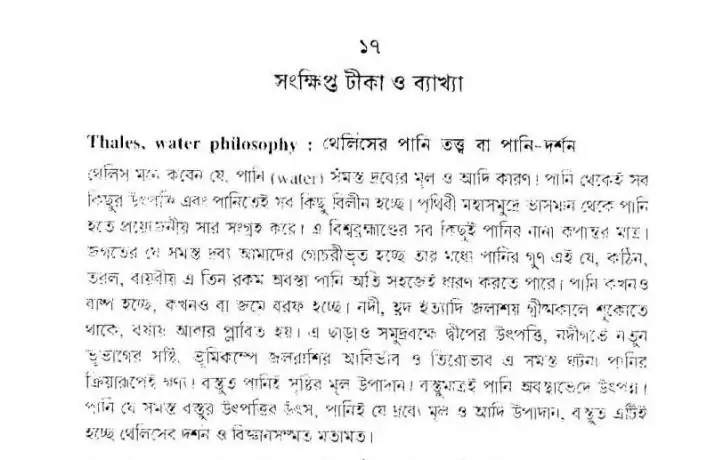
According to the view attributed to the ancient Greek philosopher Thales of Miletus, water is the original constituent or first principle of everything. Aristotle preserves this position in his Metaphysics and also says that Thales believed the earth floated on water. Aristotle suggests that Thales may have inferred this from the importance of moisture to life and the damp character of food and seeds. These are not surviving writings by Thales himself but his views as reported by the later philosopher Aristotle. [27]
Thales, the founder of this school of philosophy, says the permanent entity is water.
English contextual rendering: According to Aristotle, Thales, the founder of this philosophical school, held that water was the enduring underlying substance. Aristotle also reports that Thales believed the earth floated on water.
Thales’ position, Babylonian creation myth, Genesis, the Rigveda, and Islamic tafsir all assign water a role at the beginning of creation. Their reasoning, however, is not identical. Thales treats water as the first principle of the material world; Babylonian myth makes aquatic beings part of the genealogy of the gods; Islamic accounts describe water beneath the Throne and the heavens and earth emerging from water. These common themes, with their differences, establish how widespread the concept of primordial water was in ancient societies. They do not establish direct copying from any particular text.
The Pen as the First Creation: The Writing of Destiny and Problems of Chronology
In Sunan Abi Dawud 4700, a hadith through Ubadah ibn al-Samit attributes to Muhammad the statement that God first created the Pen and commanded it to write the destinies of all events until the Day of Resurrection. The Pen even asks what it should write. Thus the Pen is explicitly identified as the ‘first creation.’ The chronology is important when compared with the accounts of water and the Throne: one places water and the Throne before the heavens and earth, while the other speaks of the Pen’s creation as the first act. [28]
সুনান আবূ দাউদ (তাহকিককৃত)
৩৫/ সুন্নাহ
পরিচ্ছেদঃ ১৭. তাকদীর সম্পর্কে
৪৭০০। আবূ হাফসাহ (রহঃ) সূত্রে বর্ণিত। তিনি বলেন, একদা উবাদাহ ইবনুস সামিত (রাঃ) তার ছেলেকে বললেন, হে আমার প্রিয় পুত্র! তুমি ততক্ষণ পর্যন্ত প্রকৃত ঈমানের স্বাদ পাবে না যতক্ষণ না তুমি জানতে পারবে ’’যা তোমার উপর ঘটেছে তা ভুলেও এড়িয়ে যাওয়ার ছিলো না। পক্ষান্তরে, যা এড়িয়ে গেছে তা তোমার উপর ভুলেও ঘটবার ছিলো না।
আমি রাসূলুল্লাহ সাল্লাল্লাহু আলাইহি ওয়াসাল্লাম-কে বলতে শুনেছিঃ মহান আল্লাহ সর্বপ্রথম যে বস্তু সৃষ্টি করেছেন তা হচ্ছে কলম। অতঃপর তিনি তাকে বললেন, লিখো! কলম বললো, হে রব! কি লিখবো? তিনি বললেন, কিয়ামত সংঘটিত হওয়া পর্যন্ত প্রত্যেক বস্তুর তাকদীর লিখো। হে আমার প্রিয় পুত্র! আমি রাসূলুল্লাহ সাল্লাল্লাহু আলাইহি ওয়াসাল্লাম-কে বলতে শুনেছিঃ যে ব্যক্তি এরূপ বিশ্বাস ছাড়া মারা যায় সে আমার (উম্মাতের) নয়।[1]
সহীহ।
[1]. তিরমিযী, আহমাদ।
হাদিসের মানঃ সহিহ (Sahih)
English translation: Sunan Abi Dawud (critical edition), Book 35, Sunnah, Chapter 17, Regarding Divine Decree, hadith 4700. Abu Hafsah narrated: Ubadah ibn al-Samit once said to his son, ‘My dear son, you will not experience the true taste of faith until you know that what happened to you could never have passed you by, and what passed you by could never have happened to you. I heard the Messenger of God say: The first thing God created was the Pen. He then said to it: Write! The Pen asked: My Lord, what should I write? He answered: Write the destiny of everything until the Day of Resurrection. My dear son, I heard the Messenger of God say that anyone who dies without this belief is not one of my community.’ Classified as sahih. Cross-references: al-Tirmidhi and Ahmad. Hadith grade: sahih.
Jami al-Tirmidhi 3319 contains a similar version, again through Ubadah ibn al-Samit, describing the first creation of the Pen and its recording of everything that would happen. The transmission routes of these collections are closely related, so they should not automatically be treated as two independent historical attestations. Nevertheless, the language of ‘first creation’ is not peculiar to a Bengali rendering of Abu Dawud: it also appears explicitly in al-Tirmidhi’s Arabic text. [29]
إِنَّ أَوَّلَ مَا خَلَقَ اللَّهُ الْقَلَمَ فَقَالَ لَهُ اكْتُبْ فَجَرَى بِمَا هُوَ كَائِنٌ إِلَى الأَبَدِ
English translation: The first thing God created was the Pen. He told it to write, and it recorded everything that would happen for all eternity.
What Was the First Creation: Water, the Throne, the Pen, or Light and Darkness?
Early and medieval Islamic theological and historical works preserve a number of mutually divergent claims about God’s first creation. Some identify the Pen; others identify the Throne, water, or light and darkness. This dispute is not an invention of modern critics. Scholars from various periods—including al-Tabari, Ibn al-Athir, Ibn al-Jawzi, Ibn Taymiyyah, Ibn al-Qayyim, and Badr al-Din al-Ayni—adopted different positions on what came first. Differences in the grammatical reading of the same hadith also affected attempts to identify the first-created thing. This enduring dispute directly bears on the claim that accurate revealed knowledge about the universe’s origin has been preserved.
Sahih al-Bukhari 3191 describes the Throne upon water before the creation of the heavens and earth. Sahih Muslim 2653 says that the Throne was upon water when destiny was determined fifty thousand years before the heavens and earth were created. By contrast, Sunan Abi Dawud 4700 and Jami al-Tirmidhi 3319 identify the Pen as the first creation. These statements do not establish one consistent order for the origin of water, the Throne, and the Pen. The account of light and darkness as the first creation, preserved in early exegesis, introduces yet another candidate.
Three Principal Views among Classical Muslim Scholars: Water, the Throne, and the Pen
IslamQA’s extended discussion of the first-created thing also acknowledges differences among early Muslim scholars. It identifies three principal views. Under the first, the Pen was created first, a view preferred by al-Tabari and Ibn al-Jawzi. Under the second, the Throne came first, preferred by Ibn Taymiyyah and Ibn al-Qayyim. Under the third, water was created first, a position attributed to Ibn Masud and a group of early Muslims, which Badr al-Din al-Ayni favored. The disagreement is therefore not confined to whether the Throne was upon water before the heavens and earth; it also concerns the order in which the Throne and water themselves were created. [12]
والأقوال المعتبرة في المسألة ثلاثة : القلم ، كما يرجحه ابن جرير الطبري وابن الجوزي ، والعرش ، كما يرجحه ابن تيمية وابن القيم ، والماء
English translation: There are three recognized positions on this question: the Pen, preferred by Ibn Jarir al-Tabari and Ibn al-Jawzi; the Throne, preferred by Ibn Taymiyyah and Ibn al-Qayyim; and water.
These three views differ in more than the name of the first object. If the Pen was the first creation, it must have existed before the Throne and water. If the Throne came first, the Pen and water were created later, or their position must otherwise be reconciled with the Throne’s priority. If water came first, it existed before the Throne was placed upon it and might already have been present when the Pen was created. If all three were created and each is claimed to be absolutely first among all created things, those claims cannot simultaneously be true. The dispute concerns the fundamental question of which thing existed before everything else.
The same IslamQA discussion acknowledges that the Quran does not explicitly identify water or any other particular object as God’s first creation. Quran 11:7 says that the Throne rested upon water before the creation of the heavens and earth. It establishes only that water and the Throne existed at some stage preceding the creation of the heavens and the earth. The verse does not specify whether water preceded the Throne, the Throne preceded water, or both came into existence at the same stage. Subsequent hadiths, reports attributed to companions, and exegetical interpretations are used in attempts to determine that order.
Al-Tabari’s Tafsir: Light and Darkness as the Very First Creations
Al-Tabari preserves yet another statement about the first creation in his commentary on Quran 2:29. His long creation narrative attributed to Muhammad ibn Ishaq, report 590, says that God first created light and darkness. He then separated them, making darkness into black night and light into bright day. The seven heavens were subsequently formed from smoke. The narrative further describes a succession of night and day before the sun, moon, and stars were created. Later stages include spreading out the earth, placing mountains upon it, providing sustenance, and creating the sun, moon, and stars in the heavens. [7]
كان أوّلَ ما خلق الله تبارك وتعالى النورُ والظلمةُ، ثم ميَّز بينهما، فجعل الظلمة ليلا أسود مظلمًا، وجعل النور نهارًا مضيئًا مبصرًا
English translation: God first created light and darkness. He then separated them, making darkness into black, dark night and light into luminous, visible day.
Two claims in Ibn Ishaq’s account are especially significant. First, light and darkness are designated the earliest created things. Second, night and day are said to have existed before the sun, moon, and stars. Thus the account does not explain day and night as observable phenomena associated with Earth’s rotation and sunlight; instead, it depicts them as primordial states formed by separating light and darkness. In reality, Earth’s alternation between daylight and darkness is related to its rotation and illumination by the sun. There is no scientific basis for an Earth-like cycle of day and night before the sun existed.
Another distinction is worth noting. Ibn Ishaq’s narrative begins with light and darkness and then describes the formation of the heavens from smoke. Yet the following report in al-Tabari, number 591, transmitted through al-Suddi, opens with the Throne upon water; smoke emerges from that water to form the heavens, and the water dries up to produce the earth. These adjacent reports in the same commentary do not provide a single, identical chronology of primordial creation. One begins with light and darkness; the other begins with the already existing Throne upon water. Al-Tabari preserves both without converting them into one verified sequence.
Ibn al-Athir: The Pen as the First Creation and the Alternative View of Light and Darkness
In the first volume of his historical work al-Kamil fi al-Tarikh, the medieval historian Ibn al-Athir devotes a separate discussion to the beginning of creation, headed ‘The Beginning of Creation and What Was First among It.’ He cites the hadith through Ubadah ibn al-Samit that Muhammad said the Pen was the first creation, then presents Muhammad ibn Ishaq’s claim that light and darkness were first. Thus, centuries after al-Tabari, this medieval history still recorded two different views. Ibn al-Athir preferred the Pen’s priority on the basis of the hadith and noted that Ibn Ishaq’s statement was not linked to anyone through a chain of transmission. [30]
وَقَالَ مُحَمَّدُ بْنُ إِسْحَاقَ : أَوَّلُ مَا خَلَقَ اللَّهُ تَعَالَى النُّورُ ، وَالظُّلْمَةُ ، فَجَعَلَ الظُّلْمَةَ لَيْلًا أَسْوَدَ ، وَجَعَلَ النُّورَ نَهَارًا أَبْيَضَ مُضِيئًا . وَالْأَوَّلُ أَصَحُّ لِلْحَدِيثِ
English translation: Muhammad ibn Ishaq said that God first created light and darkness, making darkness into black night and light into white, bright day. Ibn al-Athir then stated that the first position—that the Pen was first—is more sound in view of the hadith.
Ibn al-Athir’s judgment matters because he does not deny the existence of two different accounts. He chooses the Pen’s priority by assigning greater evidentiary weight to a hadith. But assessing the reliability of a report’s transmission and establishing what the universe’s first creation actually was are two different questions. The former is an evaluation within hadith scholarship; the latter concerns the real history of the cosmos. The preservation of an account identifying the Pen as first—or its preference over another account—does not independently establish that a Pen was in fact the first thing created.
Ibn al-Athir also discusses a difficulty in al-Tabari’s treatment of these accounts. One report attributed to Ibn Abbas refers to the Throne’s prior existence, while another identifies the Pen as the first creation. In addressing their relationship, al-Tabari discusses differences in wording across transmission routes. One version mentions the Throne already existing; another mentions only the Pen’s first creation. Thus, the question of what came first depends partly on whether the Throne’s prior existence is included or omitted in a particular wording. This is not merely a variation in a minor word: it bears directly on identifying the first object to exist in the created universe.
Fundamental Conflicts among Different Creation Sequences
Taken together, these early and medieval Islamic sources present at least four distinct candidates for the first creation. In Abu Dawud and al-Tirmidhi, the language of first creation is attached to the Pen. In al-Tabari’s account from Ibn Ishaq, light and darkness are created first. Water was identified as first in a view attributed to Ibn Masud and a group of early Muslims. Other Muslim scholars preferred the priority of the Throne. If each is understood as an unrestricted claim to be absolutely first among all created things, the difficulty is unavoidable: four different objects or states cannot all be first in the same universal chronology.
The report about light and darkness did not surface from some otherwise unknown tradition outside Islamic theology. It is preserved within the influential early commentary of al-Tabari himself. The medieval historian Ibn al-Athir likewise acknowledges the existence of that view. Meanwhile, disagreement over the priority of water, the Throne, and the Pen continued in discussions by Ibn Taymiyyah, Ibn al-Qayyim, Ibn al-Jawzi, and other scholars. Such disagreements belong to the long history of Islamic intellectual discourse and are inconsistent with the notion that a single, universally agreed, unchanging account of the beginning of creation was preserved.
Al-Bukhari and Muslim preserve accounts in which the Throne and water existed before the heavens and the earth. The hadith about the first creation of the Pen, on the other hand, describes the recording of all destinies. A report attributed to Damrah and quoted by al-Baghawi even places the Pen’s creation after that of the heavens and the earth. Ibn Ishaq’s view that light and darkness came first introduces yet another chronology. The wordings and sequences are not identical. Preferring one narration and rejecting others may be a procedure for selecting among religious reports, but it cannot establish the cosmological truth of the selected sequence.
Modern knowledge of the early universe is based on measurable histories of light, matter, radiation, elementary particles, and cosmic expansion. There is no independent evidence in that history of a writing pen as the first creation or a throne resting upon water before the heavens. Nor does the account of creating light and darkness as distinct objects and turning them into night and day before the sun and moon existed correspond to the observed history of the universe. Early Islamic sources preserve evidence about historical religious beliefs concerning creation; they do not provide a testable account of the universe’s actual origin.
If the Pen’s ‘writing’ is treated as an ordinary physical act of writing, questions arise about the surface on which it wrote, the nature of the recorded information, and the logical implications of all future events already being fixed. The hadith does not specify ink or paper, so the presence of ink and paper cannot be inferred as an explicit claim. The central question is what freedom human action and decision retain if every future event was fixed in writing from the beginning, and how moral responsibility for those preordained acts can consistently be imposed. A cosmic Pen cannot be shown to have existed merely by analogy with a human writing instrument; nor is there independent proof that the Pen spoke or recorded destiny as a real event. Read literally, the account raises several logical questions:
Ibn al-Athir’s Question: If the Pen Was the First Creation, When Was the Tablet Created?
The account of the Pen as the first creation and its recording of every event raises an important question: where did the Pen write? The hadith describes the Pen being commanded to write, but writing also requires a medium capable of receiving the text. In Islamic belief, this medium is known as the Preserved Tablet, al-Lawh al-Mahfuz. The medieval historian Ibn al-Athir himself questioned the order of creation of the Pen and the Tablet. In volume one of his al-Kamil fi al-Tarikh, under the heading ‘What Was Created after the Pen,’ he recounts the Pen’s creation, the command to write all future events, and the subsequent creation of a cloud. He then asks where the Tablet was while the Pen was writing. He argues that the Preserved Tablet ought to have been mentioned immediately after the Pen, because writing requires both an implement and something to write on. He also suggests that the Tablet might have been left unmentioned because its existence was necessarily implied by the act of writing. His discussion identifies a genuine omission in this creation sequence. [31]
قُلْتُ هَذَا فِيهِ نَظَرٌ ، لِأَنَّهُ قَدْ تَقَدَّمَ أَنَّ أَوَّلَ مَا خَلَقَ اللَّهُ تَعَالَى الْقَلَمُ ، وَقَالَ لَهُ : اكْتُبْ . فَجَرَى فِي تِلْكَ السَّاعَةِ . ثُمَّ ذَكَرَ فِي أَوَّلِ هَذَا الْفَصْلِ أَنَّ اللَّهَ خَلَقَ بَعْدَ الْقَلَمِ ، وَبَعْدَ أَنْ جَرَى بِمَا هُوَ كَائِنٌ سَحَابًا ، وَمِنَ الْمَعْلُومِ أَنَّ الْكِتَابَةَ لَا بُدَّ فِيهَا مِنْ آلَةٍ يُكْتَبُ بِهَا ، وَهُوَ الْقَلَمُ ، وَمِنْ شَيْءٍ يُكْتَبُ فِيهِ ، وَهُوَ الَّذِي يُعَبَّرُ عَنْهُ هَهُنَا بِاللَّوْحِ الْمَحْفُوظِ . وَكَانَ يَنْبَغِي أَنْ يَذْكُرَ اللَّوْحَ الْمَحْفُوظَ ثَانِيًا لِلْقَلَمِ ، وَاللَّهُ أَعْلَمُ . وَيُحْتَمَلُ أَنْ يَكُونَ تَرَكَ ذِكْرَهُ لِأَنَّهُ مَعْلُومٌ مِنْ مَفْهُومِ اللَّفْظِ بِطَرِيقَةِ الْمُلَازَمَةِ .
English translation: I say that this deserves scrutiny. Earlier it was stated that the first thing God created was the Pen, and that He ordered it to write; the Pen proceeded to write at that very moment. But at the beginning of this chapter it was said that God created a cloud after creating the Pen and after it had written everything that would happen.
It is known that writing requires an instrument with which to write, namely the Pen, and something upon which to write, namely what is called here the Preserved Tablet. The Preserved Tablet therefore ought to have been mentioned second, after the Pen; God knows best.
It is possible that the Tablet was omitted because its existence is necessarily implied by the very expression describing the act of writing.
Ibn al-Athir’s observation matters because he identifies this chronological gap while accepting the hadith about the Pen’s first creation. If the Pen was created, instructed to write, and immediately recorded everything that would happen, the question of where the writing went is unavoidable. He argues that the existence of the Tablet should have been mentioned as following the creation of the Pen. Thus this was not an objection invented by a modern critic; it appears in the analysis of a medieval Muslim historian.
Ibn al-Athir does offer an explanation: the act of writing may itself imply the existence of a writing surface. But that does not specify when the surface was created. Was the Preserved Tablet created before the Pen, alongside it, or immediately afterward? His statement provides no definite answer. If the Pen was absolutely the first creation, no other created writing surface could have existed before it. Yet if the Pen immediately began recording all destinies upon being created, a writing medium would also have to be available at that time. This is precisely the gap Ibn al-Athir points out.
The Pen, the Footstool, the Throne, Air, Darkness, and Water: A Completely Different Creation Sequence
Another important sequence for the earliest stages of creation is preserved in Ibn al-Athir’s al-Kamil fi al-Tarikh and Ibn Kathir’s al-Bidaya wa al-Nihaya. Both quote this view from al-Tabari. It says that the Pen was created first, then the Footstool (Kursi), then the Throne, then air and darkness, and finally water. The Throne was then placed upon the water. In this sequence, the Throne’s position upon water was not the very first state of creation: the Pen, Footstool, Throne, air, and darkness had all already been brought into existence. [32]
قَالَ ابْنُ جَرِيرٍ : وَقَالَ آخَرُونَ : بَلْ خَلَقَ اللَّهُ عَزَّ وَجَلَّ الْمَاءَ قَبْلَ الْعَرْشِ رَوَاهُ السُّدِّيُّ ، عَنْ أَبِي مَالِكٍ ، وَعَنْ أَبِي صَالِحٍ ، عَنِ ابْنِ عَبَّاسٍ ، وَعَنْ مُرَّةَ ، عَنِ ابْنِ مَسْعُودٍ ، وَعَنْ نَاسٍ مِنْ أَصْحَابِ رَسُولِ اللَّهِ صَلَّى اللَّهُ عَلَيْهِ وَسَلَّمَ قَالُوا : إِنَّ اللَّهَ كَانَ عَرْشُهُ عَلَى الْمَاءِ ، وَلَمْ يَخْلُقْ شَيْئًا غَيْرَ مَا خَلَقَ قَبْلَ الْمَاءِ ، وَحَكَى ابْنُ جَرِيرٍ ، عَنْ مُحَمَّدِ بْنِ إِسْحَاقَ أَنَّهُ قَالَ : أَوَّلُ مَا خَلَقَ اللَّهُ عَزَّ وَجَلَّ النُّورُ وَالظُّلْمَةُ ، ثُمَّ مَيَّزَ بَيْنَهُمَا فَجَعَلَ الظُّلْمَةَ لَيْلًا أَسْوَدَ مُظْلِمًا ، وَجَعَلَ النُّورَ نَهَارًا مُضِيئًا مُبْصِرًا .
قَالَ ابْنُ جَرِيرٍ : وَقَدْ قِيلَ إِنَّ الَّذِي خَلَقَ رَبُّنَا بَعْدَ الْقَلَمِ الْكُرْسِيُّ ، ثُمَّ خَلَقَ بَعْدَ الْكُرْسِيِّ الْعَرْشَ ، ثُمَّ خَلَقَ بَعْدَ ذَلِكَ الْهَوَاءَ وَالظُّلْمَةَ ، ثُمَّ خَلَقَ الْمَاءَ فَوَضَعَ عَرْشَهُ عَلَى الْمَاءِ . وَاللَّهُ سُبْحَانَهُ وَتَعَالَى أَعْلَمُ .
English translation: Ibn Jarir [al-Tabari] said: Others maintained that God created water before the Throne. Al-Suddi related this through Abu Malik and Abu Salih from Ibn Abbas, through Murrah from Ibn Masud, and from some of Muhammad’s companions. According to them, God’s Throne was upon water, and nothing had been created apart from what He had created before water.
Ibn Jarir also transmitted Muhammad ibn Ishaq’s view that God first created light and darkness and then separated them, making darkness into dark black night and light into a bright and visible day.
Ibn Jarir further said that another view held that after the Pen God created the Footstool (Kursi), after the Footstool He created the Throne, after that air and darkness, and finally water; He then placed His Throne upon the water. God knows best.
In his Tarikh al-Rusul wa al-Muluk, al-Tabari evaluates these accounts and states his own preference concerning the order of water and the Throne. In his view, the account that water was created before the Throne is more correct. He appeals to Muhammad’s hadith through Abu Razin about creating the Throne upon water. Ibn al-Athir preserves both al-Tabari’s preference and a separate narration describing water as resting upon air. This allows the alternative order reported by Ibn Kathir and al-Tabari’s own preference to be identified as distinct source statements. [33] [31]
قَالَ أَبُو جَعْفَرَ: وَأَوْلَى الْقَوْلَيْنِ فِي ذَلِكَ عِنْدِي بِالصَّوَابِ قَوْلُ مَنْ قَالَ: إِنَّ اللَّهَ تَبَارَكَ وَتَعَالَى خَلَقَ الْمَاءَ قَبْلَ الْعَرْشِ.
English translation: Abu Ja’far al-Tabari said: Of these two opinions, the one I consider more correct is that of those who say God created water before the Throne.
Al-Tabari supports his preference by citing Abu Razin’s hadith about the Throne being created upon water. His reasoning is that if the Throne was created upon something, that underlying thing must already have existed when the Throne was made. Water must therefore have existed earlier, or at least at the same time, rather than only being created after the Throne. Al-Tabari favored water’s priority on this basis. That is his own interpretation and conclusion; it is not the final sentence of the passage quoted from Ibn Kathir.
These sources preserve several different creation sequences. In one, water was created before the Throne. In another, light and darkness were first. A further account places the Footstool after the Pen, the Throne after the Footstool, and air and darkness after the Throne, with water coming later still. Ibn Kathir reports these views through al-Tabari. In his own historical work, al-Tabari prefers the claim that water was created before the Throne, citing Abu Razin’s hadith. Ibn al-Athir also quotes this judgment. The accounts therefore distinguish between recording rival creation sequences and selecting one as preferable.
The fundamental conflict concerns when water was created in relation to the Throne. If water came first, it was already present when the Throne was created. But if the Pen, Footstool, Throne, air, and darkness were all created before water, the Throne existed first. In a single sequence of cosmic creation, water cannot have been created both before and after the Throne. The disagreement is not simply over the name of a narrator or an exegetical expression; it concerns the actual chronological order of events.
Although the alternative account ascribed to al-Tabari also appears in the works of Ibn al-Athir and Ibn Kathir, those works do not provide two independent historical witnesses. Both depend upon al-Tabari’s discussion. The repetition of the account in influential medieval works does show that competing sequences involving the Pen, Footstool, Throne, and water continued to be discussed in later Islamic cosmology. These differences were preserved by early and medieval Muslim authors themselves; they were not constructed by modern critics.
Ibn Abi al-Izz: How Grammatical Readings Change the Meaning of ‘The First Creation Was the Pen’
Medieval Islamic theology adopted another important method for addressing conflicts in the creation sequence: reading the Arabic sentence about the first creation of the Pen through a different grammatical construction. In his Sharh al-Aqida al-Tahawiyya, Ibn Abi al-Izz discusses whether the Pen or the Throne was created first. He considers the view that the Throne preceded the Pen to be more correct. To reach that conclusion, he analyzes two possible grammatical readings of the expression ‘The first thing God created was the Pen.’ Under one reading, the Pen is the first of all creations. Under the other, the statement means that as soon as God created the Pen, He ordered it to write. In the second reading, the Pen is not described as the absolute first creation; the instruction simply follows its creation immediately. [34]
وَاخْتَلَفَ الْعُلَمَاءُ : هَلِ الْقَلَمُ أَوَّلُ الْمَخْلُوقَاتِ ، أَوِ الْعَرْشُ ؟ عَلَى قَوْلَيْنِ ، ذَكَرَهُمَا الْحَافِظُ أَبُو الْعَلَاءِ الْهَمَذَانِيُّ ، أَصَحُّهُمَا : أَنَّ الْعَرْشَ قَبْلَ الْقَلَمِ ، لِمَا ثَبَتَ فِي الصَّحِيحِ مِنْ حَدِيثِ عَبْدِ اللَّهِ بْنِ عَمْرٍو – رَضِيَ اللَّهُ عَنْهُمَا – ، قَالَ : قَالَ رَسُولُ اللَّهِ صَلَّى اللَّهُ عَلَيْهِ وَسَلَّمَ : قَدَّرَ اللَّهُ مَقَادِيرَ الْخَلَائِقِ قَبْلَ أَنْ يَخْلُقَ السَّمَاوَاتِ وَالْأَرْضَ بِخَمْسِينَ أَلْفَ سَنَةٍ ، وَعَرْشُهُ عَلَى الْمَاءِ .
فَهَذَا صَرِيحٌ أَنَّ التَّقْدِيرَ وَقَعَ بَعْدَ خَلْقِ الْعَرْشِ ، وَالتَّقْدِيرَ وَقَعَ عِنْدَ أَوَّلِ خَلْقِ الْقَلَمِ ، بِحَدِيثِ عُبَادَةَ هَذَا . وَلَا يَخْلُو قَوْلُهُ : أَوَّلُ مَا خَلَقَ اللَّهُ الْقَلَمُ ، إِلَخْ – إِمَّا أَنْ يَكُونَ جُمْلَةً أَوْ جُمْلَتَيْنِ .
فَإِنْ كَانَ جُمْلَةً ، وَهُوَ الصَّحِيحُ ، كَانَ مَعْنَاهُ : أَنَّهُ عِنْدَ أَوَّلِ خَلْقِهِ قَالَ لَهُ : اكْتُبْ ، كَمَا فِي اللَّفْظِ : أَوَّلَ مَا خَلَقَ اللَّهُ الْقَلَمَ قَالَ لَهُ : اكْتُبْ ، بِنَصْبِ ” أَوَّلَ ” وَ ” الْقَلَمَ ” ، وَإِنْ كَانَ جُمْلَتَيْنِ ، وَهُوَ مَرْوِيٌّ بِرَفْعِ ” أَوَّلُ ” وَ ” الْقَلَمُ ” ، فَيَتَعَيَّنُ حَمْلُهُ عَلَى أَنَّهُ أَوَّلُ الْمَخْلُوقَاتِ مِنْ هَذَا الْعَالَمِ ، فَيَتَّفِقُ الْحَدِيثَانِ ، إِذْ حَدِيثُ عَبْدِ اللَّهِ بْنِ عَمْرٍو صَرِيحٌ فِي أَنَّ الْعَرْشَ سَابِقٌ عَلَى التَّقْدِيرِ ، وَالتَّقْدِيرُ مُقَارِنٌ لِخَلْقِ الْقَلَمِ .
وَفِي اللَّفْظِ الْآخَرِ : لَمَّا خَلَقَ اللَّهُ الْقَلَمَ قَالَ لَهُ : اكْتُبْ . فَهَذَا الْقَلَمُ أَوَّلُ الْأَقْلَامِ وَأَفْضَلُهَا وَأَجَلُّهَا .
English translation: Scholars have disagreed over whether the Pen or the Throne was the first created thing. Al-Hafiz Abu al-Ala al-Hamadhani mentions both views. The stronger view is that the Throne existed before the Pen, because an authentic narration from Abdullah ibn Amr reports that Muhammad said God determined the destinies of all creatures fifty thousand years before creating the heavens and the earth, while His Throne was upon water.
This makes it clear that the decree was determined after the Throne was created, while Ubadah’s hadith places that determination at the creation of the Pen. The phrase ‘The first thing God created was the Pen’ must be understood either as a single sentence or as two sentences.
If it is one sentence—which is the correct reading—it means that God said to the Pen, ‘Write,’ immediately upon creating it. In the wording awwala ma khalaqa Allahu al-qalama qala lahu uktub, both awwala and al-qalama are in the accusative case.
If it consists of two sentences, transmitted with awwalu and al-qalamu in the nominative, it must mean that the Pen was the first creation of this world. The two hadiths can then be reconciled: Abdullah ibn Amr’s hadith makes clear that the Throne preceded the determination of destiny, and that determination coincided with the creation of the Pen.
Another wording says, ‘When God created the Pen, He said to it: Write.’ Accordingly, this Pen was the first, best, and most eminent of pens.
The grammatical case of the Arabic words is crucial in Ibn Abi al-Izz’s explanation. In أَوَّلُ مَا خَلَقَ اللَّهُ الْقَلَمُ, the nominative forms awwalu and al-qalamu allow the Pen to be understood as the first created object. But in أَوَّلَ مَا خَلَقَ اللَّهُ الْقَلَمَ قَالَ لَهُ اكْتُبْ, the accusative forms awwala and al-qalama make the meaning: God told the Pen to write as soon as He created it. Under this second interpretation, there is no claim that the Pen was absolutely first. The identity of the first-created thing therefore depends on the grammatical reading of virtually the same Arabic sequence.
Ibn Abi al-Izz does more than enumerate grammatical possibilities. He himself prefers the first of these grammatical constructions, which says that the instruction to write was issued as soon as the Pen was created. His choice accords with his conclusion that the Throne existed before the Pen. If the other construction is adopted, he restricts the Pen’s priority to ‘this world.’ Here too, the unrestricted meaning of ‘first creation’ is replaced with priority within a particular realm. The direct hadith wording, its grammatical possibilities, and a subsequent theological reconciliation are three separate layers of the discussion.
This interpretation reveals a central fact: the dispute over creation’s chronology forced later theologians not only to evaluate the transmission of hadiths but also to reconcile their meanings by selecting particular grammatical readings. Under one reading, the Pen was the very first creation; under another, the Pen was simply ordered to write immediately after being created; under a third reconciliation, it was the first creation only within a particular world. These meanings are not identical. The choice of interpretation consequently changes the substantive content of the belief about the first creation.
Problems of Chronology and the Written Predetermination of Events
The discussions of Ibn al-Athir and Ibn Abi al-Izz expose two separate problems concerning creation’s beginning. The first concerns the chronology of writing: if the Pen recorded the destinies of every event, when was the Preserved Tablet, the medium holding that writing, created? The second concerns priority: if the Pen was created first, how can the earlier presence of the Throne and water be explained? If the Throne already existed, what does calling the Pen the first creation mean? Ibn al-Athir identifies the first problem directly. Ibn Abi al-Izz attempts to resolve the second by changing the grammatical reading of the hadith and restricting the scope of ‘first.’
The alternative sequence attributed to al-Tabari widens the disagreement. One version places the Footstool after the Pen, followed by the Throne, air and darkness, and finally water, so that the Throne precedes water. Another has water preceding the Throne. Yet another places light and darkness at the very beginning. Preferring one report while deeming others weak or less acceptable may be a judgment within hadith scholarship or theology, but it does not establish that the chosen sequence is the actual history of the observable universe.
The accounts of the first Pen, written destiny, the Preserved Tablet, and the existence of water beneath the Throne constitute a framework of historical religious belief. They project familiar objects—a writing instrument, a written record, a throne, and water—onto the earliest moments of cosmic creation. Yet there is no independent observational evidence for the creation of a cosmic Pen, its conversation, a written record of all future events, or a primordial Throne. Classical Islamic works themselves preserve different accounts of the first creation, conflicting chronologies, and later interpretive attempts to reconcile them. These sources provide important evidence for the history of Islamic religious thought, but not a unified, accurate, scientifically established account of the universe’s origin.
The Preserved Tablet: A Span of Five Hundred Years’ Travel, White Pearl, and Ruby Covers
The narrative in which a Pen records the destinies of all events at the beginning of creation is closely linked to another idea: the Preserved Tablet, or al-Lawh al-Mahfuz, upon which the destinies of creation and the previously inscribed Quran are said to be recorded. Quran 85:21–22 refers to the Quran as being upon a preserved tablet, but it gives no account of the Tablet’s dimensions, constituent material, or physical structure. Early Islamic commentators, however, describe it as a cosmic object with a particular composition and enormous size. Some say it was made of a white pearl-like substance with ruby covers; another account gives its breadth as the distance of five hundred years’ travel. These descriptions imagine an immense material repository for predestined events and the records of creation. [35]
Al-Baghawi preserves a detailed description of the Preserved Tablet in his commentary on Quran 13:39. He transmits a statement attributed to Ibn Abbas through Ata ibn Abi Rabah: God possesses a Preserved Tablet extending for five hundred years’ journey, made of white pearl-like material, with two ruby covers. The same account describes God looking upon it 360 times each day. Thus, the Preserved Tablet is depicted not only as an abstract figure for knowledge but as a created object with specified physical dimensions and materials. [36]
إِنَّ لِلَّهِ تَعَالَى لَوْحًا مَحْفُوظًا مَسِيرَةَ خَمْسِمِائَةِ عَامٍ، مِنْ دُرَّةٍ بَيْضَاءَ لَهَا دَفَّتَانِ مِنْ يَاقُوتٍ.
English translation: God possesses a Preserved Tablet extending the distance of five hundred years’ travel. It is made of a white pearl-like substance and has two ruby covers.
The significance of this report lies not only in the Tablet’s size but in its supposed material composition. White pearl-like substance and ruby are both named after valuable substances familiar to human beings. Terrestrial gemstones are used to describe the construction of an object on a cosmic scale. The figure of five hundred years’ journey also introduces a measure of distance. Yet that is not a fixed unit of length: without specifying travel speed, the Tablet’s actual dimensions cannot be calculated. The account expresses immensity without establishing a measurable physical size.
In the same commentary, al-Baghawi preserves another disagreement about the Umm al-Kitab, or ‘Mother of the Book.’ According to a statement attributed to Ibn Abbas through Ikrimah, there are two records: God erases or retains whatever He wills from one, while the other, the Umm al-Kitab, never changes. In a separate explanation attributed to Ka’b, the Umm al-Kitab is identified with God’s knowledge of what He will create and what His creations will do. The same verse is therefore explained in terms of an unchanging preserved record on the one hand and God’s knowledge on the other. [36]
This difference bears directly on the question of the first Pen. If the Pen physically recorded future events on an actual Tablet, the Tablet’s creation and chronological relationship with the Pen must also be accounted for. If the Umm al-Kitab is interpreted solely as divine knowledge, the issue of a physical writing surface changes. Both types of explanation are preserved in early tafsir. Under one interpretation, the cosmic writing surface is an immense object made of white pearl and ruby; under another, the Umm al-Kitab denotes divine knowledge. These are not identical physical claims.
The question raised by the medieval historian Ibn al-Athir about the timing of the writing surface becomes more specific in light of these reports. If an immense Tablet constructed from gems formed part of the sequence of creation, it too should have a time and manner of creation. Yet the hadith about the Pen being first says that the Pen was created and began writing without specifying when this vast Tablet appeared. The reports about its material composition add detail to the belief that future events were inscribed, but they do not establish a complete or consistent chronology for the earliest stages of creation.
The Structure of the Throne: Light, Fire, Ice, Water, and Four Cosmic Rivers
Alongside the Quran’s statement that God’s Throne was upon water before creation, medieval Islamic works preserve numerous accounts of its nature and structure. Some portray it as created from light; others describe it as made of red ruby or green emerald. Reports also describe special rivers around it, the positions of angels, and the Throne itself praising God with countless tongues. These are not the direct words of Quran 11:7. They are cosmological accounts attributed to early Muslim figures and preserved by later commentators.
In al-Durr al-Manthur, Jalal al-Din al-Suyuti compiles an extended account about the Throne and Footstool attributed to Wahb ibn Munabbih in connection with Quran 9:129. Preserved through Ibn Abi Hatim and Abu al-Shaykh, it states that God created the Throne and Footstool from His light and that they are joined together, with angels occupying the interior of the Footstool. Four rivers surround the Throne: a shining river of light, a blazing river of fire, a dazzling river of white snow, and a river of water. Angels stand within those rivers and praise God. [37]
وَحَوْلَ الْعَرْشِ أَرْبَعَةُ أَنْهَارٍ؛ نَهْرٌ مِنْ نُورٍ يَتَلَأْلَأُ، وَنَهْرٌ مِنْ نَارٍ تَتَلَظَّى، وَنَهْرٌ مِنْ ثَلْجٍ أَبْيَضَ تَلْتَمِعُ مِنْهُ الْأَبْصَارُ، وَنَهْرٌ مِنْ مَاءٍ.
English translation: Four rivers surround the Throne: a glittering river of light, a blazing river of fire, a dazzling river of white snow, and a river of water.
In Wahb’s account, the Throne is not merely a seat: it is the center of an elaborate cosmic environment. Light, fire, snow, and water are portrayed as four distinct rivers. Rivers of fire and snow surround the Throne at the same time, angels stand in them, and the Throne itself glorifies God with numerous tongues. Familiar natural materials, bodily organs, and acts of worship are projected into the structure of a cosmic Throne.
In the same discussion, al-Suyuti preserves several other statements about the Throne’s material. A report attributed to Sa’d al-Ta’ir calls it a construction of red ruby. Another account collected by Abu al-Shaykh through al-Sha’bi and attributed to Muhammad likewise describes it as red ruby. A statement attributed to Hammad says it is made of green emerald and has four legs of red ruby. These reports do not share a single transmission line and do not describe the same material composition, but all invoke familiar precious stones or luminous substances to describe the Throne. [37]
The accounts of a Throne made of light, red ruby, and green emerald cannot all be accepted as the same literal material description. They document different concepts circulating in early Islamic exegesis and religious cosmology. The report attributed to Wahb ibn Munabbih is not itself a hadith spoken directly by Muhammad; the narration attributed to Muhammad through al-Sha’bi raises its own question of transmission. The preservation of a report in an influential commentary does not mean it is a historically certain statement by Muhammad or observational evidence of a real cosmic object.
These reports are relevant to the central question because Islamic texts place the Throne upon water before the creation of the heavens and the earth. Yet descriptions of the Throne as made of light, ruby, or emerald, and surrounded by rivers of fire, snow, light, and water, complicate that primordial setting. Did the materials of the Throne already exist before it was created? When were they created, and were the surrounding rivers present when the Throne was placed upon water? These narratives supply no clear chronology. Although early narrators furnished detailed descriptions of the Throne, they did not preserve a unified material history of creation’s earliest stages.
The First Spiritual Creation in Shia Hadith Scholarship: Aql, or Intellect
The diversity of Islamic accounts of the first creation extends beyond Sunni hadith and tafsir. Al-Kafi, a central work in Shia hadith scholarship compiled by Muhammad ibn Ya’qub al-Kulayni, also contains distinctive accounts of the earliest stages of creation. The first section of its first volume, Kitab al-Aql wa al-Jahl (‘The Book of Intellect and Ignorance’), presents intellect, or aql, as something God created. God commanded it to approach and depart, and it obeyed. Here intellect is not merely a capacity of the human brain but an independent created entity that receives instructions and acts on them. [38]
Hadith 14 of that section, transmitted through Sama’a ibn Mihran and attributed to Ja’far al-Sadiq, presents a fuller narrative. It calls intellect the first of the spiritual creations. God created it from His light, to the right of the Throne, and commanded it to depart and approach; it obeyed and was praised as a great creation. Ignorance is then created as a dark entity from a salty, bitter sea. Intellect and ignorance are portrayed as two opposed created beings. [39]
إِنَّ اللَّهَ عَزَّ وَجَلَّ خَلَقَ الْعَقْلَ وَهُوَ أَوَّلُ خَلْقٍ مِنَ الرُّوحَانِيِّينَ عَنْ يَمِينِ الْعَرْشِ مِنْ نُورِهِ، فَقَالَ لَهُ: أَدْبِرْ فَأَدْبَرَ.
English translation: God created Intellect, the first of the spiritual creations, from His light on the right side of the Throne. He said to it, ‘Go away,’ and it went away.
The words ‘first among the spiritual creations’ are particularly significant. The narration does not call intellect absolutely first among all physical and nonphysical creations; its priority is expressly limited to the class of spiritual beings. The Throne also appears as the location relative to which intellect was created. The account therefore presupposes a spatial relationship between the Throne and intellect. It cannot simply be equated with the hadith that calls the Pen the first creation, because their stated scopes of priority are not the same.
Later Shia theological and philosophical discussions nevertheless interpret intellect as the first existent being in a wider sense. In Anwar al-Hikma, Fayd al-Kashani develops the concept of intellect as the first spiritual creation, an initial existent through which subsequent creation is explained. In one stream of Shia theological thought, therefore, intellect rather than the Pen assumes priority. That interpretation is broader than the wording of the particular report compiled by al-Kulayni. [40]
The separate creation of intellect and ignorance in al-Kafi, including the description of ignorance emerging from a bitter sea, further illustrates the account’s cosmogony. Intellect and ignorance are not merely a person’s intellectual capacity and lack of knowledge; they are created entities with individual behavior and the ability to receive commands. Intellect obeys God, while ignorance resists. Their contrasting qualities and associated forces are described afterward. Concepts such as intellect, ignorance, light, and water thus become elements in a supernatural sequence of creation.
The Sunni hadiths about the Pen, early commentaries about the priority of water or light and darkness, and Shia hadiths concerning the spiritual priority of intellect are not identical in scope or content. They do, however, demonstrate the variety of ideas preserved in different strands of Islamic scholarship. Depending on the source, the beginning is associated with a writing instrument, cosmic water, light and darkness, or a spiritual being called intellect. Later theologians selected, categorized, and interpreted these ideas to establish relationships between them. They are important historical evidence for early and medieval Islamic thought about creation, but not observational proof of what first existed in the real universe.
Conclusion
Early and medieval Islamic works do not provide a single agreed answer to the question of what God created first. The Quran describes the Throne upon water before the heavens and the earth existed. Sahih al-Bukhari and Sahih Muslim contain accounts of water, the Throne, and predetermined destiny. Abu Dawud and al-Tirmidhi speak of the Pen’s first creation and its recording of all future events. Al-Tabari preserves a separate account naming light and darkness as the first creations. Discussions by Ibn al-Athir, Ibn Kathir, Ibn Taymiyyah, Ibn al-Qayyim, and others preserve disagreements over the priority of water, the Throne, and the Pen. In Shia hadith scholarship, al-Kafi describes intellect as the first among spiritual creations. These sources do not all use ‘first’ with the same scope, nor do they establish a single universally accepted chronology of creation.
The disagreement concerns more than simply naming what came first. A sequence transmitted through al-Tabari places the Footstool after the Pen, then the Throne, air, darkness, and finally water. Other accounts have water existing before the Throne. Ibn Abi al-Izz reconciles the Pen’s supposed priority with the Throne’s earlier existence by selecting a different grammatical reading. Ibn al-Athir also questions the place of the Preserved Tablet in the narrative in which the Pen writes destiny. Al-Baghawi’s tafsir describes this Tablet as an object spanning five hundred years’ journey, made of white pearl-like material and ruby, while the Throne itself is variously described as made of light, ruby, or emerald. The differences establish that competing ideas about primordial chronology and the nature of these objects circulated among medieval Muslim scholars.
In early Islamic exegesis, the concept of water as an original element of creation was elaborated further. An account transmitted through al-Suddi describes smoke rising from water, the heavens forming from smoke, and the earth emerging as water dried up. A separate account attributed to Wahb ibn Munabbih describes the heavens being formed from water vapor, the earth from foam, and mountains from the waves of water. Ibn Rajab treats water as the original material of all creation. Another report, through Abu Razin, uses the term ‘ama’ for a state before creation, and later commentators disagree over its meaning. Such accounts explain the universe through water, vapor, foam, clouds, light, and darkness, yet they do not yield a consistent material process of creation.
Modern cosmology and chemistry establish a very different history. In the early hot universe, elementary particles emerged and the nuclei of light elements formed. Heavier elements, including oxygen, were produced in later stellar evolution, creating the chemical conditions in which water molecules could arise. Water is therefore not the original source of all matter; it is a compound assembled from elements that already existed. The accounts of an earth forming from dried-up water, the heavens from steam, or mountain ranges from waves do not correspond to established cosmic or geological processes. Likewise, there is no independent observational evidence for a Pen conversing at creation, for all future events being recorded in advance, or for an immense jewel-made cosmic tablet.
The idea of primordial water long predates Islamic writings. It appears in Mesopotamian creation myths, the biblical Book of Genesis, the Rigveda, the Ramayana, and the Mahabharata. The view attributed to the Greek philosopher Thales similarly treats water as the basic substance of everything. These traditions differ in their creation sequences and content, but they demonstrate that water was imagined as an original constituent by multiple ancient civilizations. Islamic exegetical accounts of the heavens and earth emerging from water share themes with this wider history of cosmological thought. The resemblance does not prove direct copying, but it supplies no basis for presenting the primordial-water motif as a uniquely revealed scientific discovery.
Early and medieval Islamic sources preserve a history of different creation narratives, disputes, and subsequent attempts to reconcile them. Classifying a narration as sahih, preferring a particular scholar’s opinion, or reconciling two hadiths through a grammatical reading are methods internal to Islamic hadith scholarship and theology. They do not establish that the selected narration is cosmologically true. Religious accounts describe water, the Pen, the Throne, light, and a spiritual intellect at the beginning of creation. Determining the actual origins of the universe, however, requires observation, experimentation, and verifiable evidence. By that standard, ancient Islamic creation narratives are not sources of accurate knowledge of the universe’s origin; they are historical records of premodern religious and cosmological thought.
References
- NASA Astrobiology — Are We Really Made of Star Stuff? ↩︎
- NASA Science — Ocean Worlds: Origins of Oceans ↩︎
- European Southern Observatory — First Generation Stars and the Origin of Heavy Elements ↩︎
- Quran, Surah Hud 11:7 ↩︎
- Sahih al-Bukhari, hadith 3191, Beginning of Creation ↩︎
- Sahih Muslim, hadith 2653b, Divine Decree ↩︎
- Tafsir al-Tabari, al-Baqarah 2:29, report 591 1 2
- Tafsir al-Qurtubi, Hud 11:7 ↩︎
- Tafsir al-Baghawi, Hud 11:7 ↩︎
- Tafsir Ibn Kathir, vol. 1, Islamic Foundation Bangladesh, p. 369 ↩︎
- Jami al-Tirmidhi, hadith 3109, Commentary on Surah Hud ↩︎
- IslamQA, question 145809: The Order of the First Creations 1 2
- IslamQA, question 443989: Authenticity and Meaning of the Hadith about ‘Ama’ ↩︎
- Tafsir al-Tabari, Hud 11:7, reports 17980–17981 ↩︎
- Al-Sindi, Hashiyat al-Sindi ala Sunan Ibn Majah, vol. 1, p. 78, the meaning of ‘ama’ ↩︎
- Ibn Rajab al-Hanbali, Tafsir Ibn Rajab, vol. 1, pp. 548–552, Hud 11:7 ↩︎
- Musnad Ahmad, hadith 10399; Sahih Ibn Hibban, hadith 2559, from Abu Hurayrah ↩︎
- Ibn Rajab, Lata’if al-Ma’arif, on creation and its first substances ↩︎
- Al-Tha’labi, al-Kashf wa al-Bayan, al-An’am 6:1, variant reading ↩︎
- Tafsir al-Baghawi, Fussilat 41:11 ↩︎
- Tafsir Ibn Kathir, Fussilat 41:11 ↩︎
- Bible, Genesis 1:1–10 ↩︎
- Devanagari source, Ayodhya Kanda, canto 110, verse 3 ↩︎
- Mahabharata, Shanti Parva, Mokshadharma, section 183, Bhrigu–Bharadvaja dialogue ↩︎
- Rigveda 10.129.3 ↩︎
- University of Pennsylvania, ORACC — Tiamat and the Enuma Elish ↩︎
- Aristotle, Metaphysics 1.3, 983b ↩︎
- Sunan Abi Dawud, hadith 4700, Divine Decree ↩︎
- Jami al-Tirmidhi, hadith 3319, Commentary on Surat al-Qalam ↩︎
- Ibn al-Athir, al-Kamil fi al-Tarikh, vol. 1, p. 18, the beginning of creation ↩︎
- Ibn al-Athir, al-Kamil fi al-Tarikh, vol. 1, p. 19, ‘What Was Created after the Pen’ 1 2
- Ibn Kathir, al-Bidaya wa al-Nihaya, vol. 1, Creation of the Heavens and the Earth ↩︎
- Al-Tabari, Tarikh al-Rusul wa al-Muluk, vol. 1, the order of creation ↩︎
- Ibn Abi al-Izz, Sharh al-Aqida al-Tahawiyya, vol. 2, pp. 345–346, the priority of the Pen or Throne ↩︎
- Quran, al-Buruj 85:21–22 ↩︎
- Tafsir al-Baghawi, Ma’alim al-Tanzil, al-Ra’d 13:39, vol. 4, pp. 325–326 1 2
- Al-Suyuti, al-Durr al-Manthur, al-Tawbah 9:129, vol. 7, pp. 616–617; report attributed to Wahb ibn Munabbih 1 2
- Al-Kulayni, al-Kafi, vol. 1, p. 10, Kitab al-Aql wa al-Jahl, hadith 1 ↩︎
- Al-Kulayni, al-Kafi, vol. 1, pp. 20–21, Kitab al-Aql wa al-Jahl, hadith 14 ↩︎
- Fayd al-Kashani, Anwar al-Hikma, p. 91, on the first creation of intellect ↩︎