
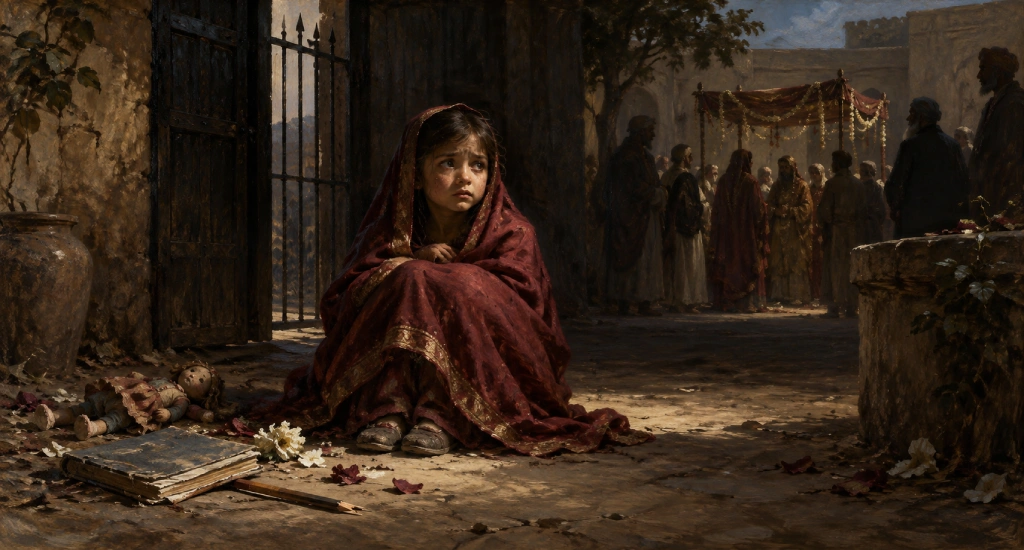
Abstract
According to several reports in Islam’s principal hadith collections, Muhammad married Aisha when she was six years old; one report gives her age as seven. The reports are almost identical, however, regarding her age at consummation: Aisha was taken into Muhammad’s household at nine, and Muhammad had sexual intercourse with her. Sahih al-Bukhari, Sahih Muslim, Sunan Abi Dawud, and Sunan an-Nasa’i preserve the event through different chains of transmission. The expressions rendered in Bengali as ‘spending the wedding night’, ‘joining her husband’, and ‘being taken into his house’, together with the Arabic terms bana biha and dakhala biha denote consummating a marriage through sexual intercourse. The claim that only a marriage ceremony took place at nine and that intercourse did not occur therefore directly contradicts the language of the original hadiths and their Islamic interpretation.
These reports contain much more than numerical ages. Aisha was playing on a swing, playing with girls her own age, and keeping dolls; she did not understand where her mother was taking her or for what purpose. Her mother and other women washed, adorned, and prepared her before handing her over to Muhammad. There is no account of anyone asking Aisha’s opinion, obtaining her consent, or explaining the meaning and consequences of a sexual relationship to her. Stated plainly, the event described in the hadiths is this: a six-year-old child was married to a man over fifty, and at nine that man had sexual intercourse with her. Islamic jurisprudence subsequently turned this event into a principal precedent for the legality of a father marrying off his minor daughter and of intercourse with her.
Introduction: Why Aisha’s Age Is More Than a Historical Question
Aisha, Muhammad’s wife, is one of the most important figures in Islam. Numerous accounts of Muhammad’s private life, rules concerning marriage and sexuality, ritual purity, family relationships, and a substantial part of Islamic law concerning women depend on hadiths attributed to her. Asking how old she was when she married Muhammad and when he had sexual intercourse with her is therefore no idle historical curiosity. The event directly concerns Muhammad’s personal morality, the legality of child marriage under Islamic Sharia, a father’s power to determine his minor daughter’s sexual and marital life, and the question of a child’s consent.
The hadith collections recognised as Islam’s principal and most reliable sources give a clear answer. Aisha is repeatedly reported as saying that Muhammad married her at six and had intercourse with her at nine. Although some reports give seven as her age at marriage, they still place consummation at nine. Different accounts of the same event also describe Aisha playing on a swing, playing with her friends, keeping dolls, not understanding her mother’s intentions, and being prepared by women and handed over to Muhammad. These are not merely numerical ages: they directly attest to her physical, psychological, and behavioural childhood.
Many contemporary Muslim apologetic writings attempt to raise Aisha’s age. Some use calculations based on Asma’s age to turn Aisha into an adult woman of eighteen or nineteen. Some question Hisham ibn Urwa’s memory. Others claim that Arabs excluded the first ten years when counting a person’s age. Still others detach expressions such as ‘spending the wedding night’, ‘being taken into his house’, or ‘joining her husband’ from intercourse, presenting them as merely a formal departure or the beginning of cohabitation. These explanations are not the direct statements of the early sources; they conflict with the original hadiths, their chapter headings, early commentators, and classical jurisprudence.
The most familiar strategy for obscuring the issue is to replace sexual intercourse with softer expressions such as ‘beginning married life’, ‘completing the marriage’, or ‘taking her into his home’. Read together, however, the relevant reports leave no ambiguity. The Bengali translation of Abu Dawud explicitly uses ‘intercourse’. An-Nasa’i uses ‘joining her husband’, Muslim uses ‘spending the wedding night’, and the English translation of al-Bukhari speaks of consummating the marriage through a sexual relationship. The Arabic expressions bana biha and dakhala biha are established terms for intercourse with a wife in the context of marriage. This article will therefore use no soft or polite language to conceal the event: Muhammad had sexual intercourse with the child Aisha when she was nine.
The moral problem is not simply the age difference. A nine-year-old child is not psychologically capable of giving free, informed, and revocable sexual consent. Aisha’s own account shows that she did not understand why she was being called or what her mother intended to do with her. She was taken from her place of play, washed and adorned, and handed over to Muhammad. Ignorance, family control, and a child’s inability to make such decisions cannot be called consent. Islamic tradition did not challenge this structure of non-consent; instead, it adopted the event as a legal precedent for marrying off a minor daughter. Here the event exceeds the limits of personal history and becomes an enduring religious and moral problem.
The Marriage Contract and Sexual Intercourse: Two Separate Events
Any discussion of Aisha’s age must begin by distinguishing the marriage contract from intercourse. The hadiths state that Muhammad married Aisha at six. She was not sent to his household at that point. Approximately three years later, at nine, she was sent to Muhammad’s household, and he had sexual intercourse with her. ‘Marriage at six’ and ‘intercourse at nine’ are therefore not contradictory accounts of the same event; they describe two separate stages of the marriage.
The Arabic reports use tazawwajani, meaning ‘he married me’, for the marriage contract, and bana bi, bana biha or dakhala biha for intercourse. In Arabic literature on marriage, the latter expressions denote completing a marriage through intercourse with one’s wife. Bengali translators variously use ‘spending the wedding night’, ‘joining her husband’, ‘being taken into his household’, and the explicit word ‘intercourse’. Despite these differences in translation, parallel accounts of the same event establish that at nine Aisha did not merely change residence: Muhammad had sexual intercourse with her.
Modern apologetic writings exploit these linguistic differences to conceal the event. ‘Being taken into his house’ is presented as though Aisha merely moved from her father’s home to her husband’s and intercourse occurred later. But the hadiths give no separate, later age for intercourse. Al-Bukhari, Muslim, Abu Dawud, and an-Nasa’i instead describe the same event in different terms, all placing it at nine. Manufacturing ambiguity about Aisha’s age at intercourse therefore distorts the primary sources.
The Testimony of Sahih al-Bukhari: Six and Nine in Aisha’s Own Words
Reports concerning Aisha’s age appear in several chapters of Sahih al-Bukhari. Aisha herself is the principal speaker in these accounts. Hadith 5133 states that Muhammad married her at six, that she was admitted to him at nine, and that she then remained with him for nine years. The Arabic wording in this particular report is udkhilat alayhi (أُدْخِلَتْ عَلَيْهِ), whereas report 5158 and other versions in al-Bukhari use bana biha (بَنَى بِهَا), an established term for consummating a marriage through intercourse. Reading the parallel reports together, rather than isolating 5133, therefore makes intercourse at nine explicit [1] [2] [3] [4]
Sahih al-Bukhari (Tawhid Publications)
67. Wedlock, Marriage
Chapter 67/39. Giving one’s young children in marriage.
لِقَوْلِهِ تَعَالَى: وَاللاَّئِي لَمْ يَحِضْنَ) فَجَعَلَ عِدَّتَهَا ثَلاَثَةَ أَشْهُرٍ قَبْلَ الْبُلُوغِ
On the basis of Allah’s statement, ‘and those who have not menstruated’ (Surah At-Talaq 65:4; Dr. Mustafa Khattab, The Clear Quran), the waiting period of a minor girl is fixed at three months.
5133. Narrated `Aisha: that the Prophet (ﷺ) married her when she was six years old and he consummated his marriage when she was nine years old, and then she remained with him for nine years (i.e., till his death). (3894) (Modern Publications: 4754; Islamic Foundation: 4757)
Hadith grade: Sahih (authentic)
Narrator: Aisha
Sahih al-Bukhari 5158 repeats the same information. More significantly, al-Bukhari places the report under a chapter explicitly entitled consummating marriage with a girl of nine. Al-Bukhari therefore did not understand the report merely as a marriage contract or as sending a daughter to her husband’s house. He used it as a legal precedent for completing a marriage through intercourse at nine [2].
باب مَنْ بَنَى بِامْرَأَةٍ وَهْىَ بِنْتُ تِسْعِ سِنِينَ
تَزَوَّجَ النَّبِيُّ صلى الله عليه وسلم عَائِشَةَ وَهْىَ ابْنَةُ سِتٍّ وَبَنَى بِهَا وَهْىَ ابْنَةُ تِسْعٍ وَمَكَثَتْ عِنْدَهُ تِسْعًا.
Chapter: Whoever consummated his marriage with a lady of nine years of age. Narrated ‘Urwa: The Prophet (ﷺ) wrote the (marriage contract) with `Aisha while she was six years old and consummated his marriage with her while she was nine years old and she remained with him for nine years (i.e. till his death).
Sahih al-Bukhari, Hadith 5158
Al-Bukhari 3894 gives a detailed account of the event as well as Aisha’s age. After arriving in Medina, Aisha became feverish; her hair fell out and later grew back somewhat. She was playing on a swing with girls her own age. Her mother called her away, but Aisha did not understand why. She was then washed, adorned, and handed over to Muhammad. She was nine at the time [5] [6] [7]
44. Witnesses
Chapter 1643. If someone testifies to another’s uprightness by saying, ‘I know only good of this person’, or ‘I know nothing about this person except good’.
2485.
2485. Abu al-Rabi Sulayman ibn Dawud … narrated from Aisha, the Prophet’s wife, about the false accusations against her and Allah’s declaration of her innocence. Narrated Aisha: (the wife of the Prophet) “Whenever Allah’s Messenger (ﷺ) intended to go on a journey, he would draw lots amongst his wives and would take with him the one upon whom the lot fell…”
I was carried in a Howdah (on the camel) and dismounted while still in it. When Allah’s Messenger (ﷺ) was through with his Ghazwa and returned home, and we approached the city of Medina, Allah’s Messenger (ﷺ) ordered us to proceed at night. When the order of setting off was given, I walked till I was past the army to answer the call of nature. After finishing I returned (to the camp) to depart (with the others) and suddenly realized that my necklace over my chest was missing. So, I returned to look for it and was delayed because of that. The people who used to carry me on the camel, came to my Howdah and put it on the back of the camel, thinking that I was in it, as, at that time, women were light in weight, and thin and lean, and did not use to eat much. So, those people did not feel the difference in the heaviness of the Howdah while lifting it, and they put it over the camel.
At that time I was a young lady. They set the camel moving and proceeded on. I found my necklace after the army had gone, and came to their camp to find nobody. So, I went to the place where I used to stay, thinking that they would discover my absence and come back in my search…
On that Allah’s Messenger (ﷺ) called Barirah and said, ‘O Barirah. Did you ever see anything which roused your suspicions about her?’ Barirah said, ‘No, by Allah Who has sent you with the Truth, I have never seen in her anything faulty except that she is a girl of immature age, who sometimes sleeps and leaves the dough for the goats to eat.’ On that day Allah’s Messenger (ﷺ) ascended the pulpit and requested that somebody support him in punishing `Abdullah bin Ubai bin Salul. Allah’s Apostle said, ‘Who will support me to punish that person (`Abdullah bin Ubai bin Salul) who has hurt me by slandering the reputation of my family? By Allah, I know nothing about my family but good, and they have accused a person about whom I know nothing except good, and he never entered my house except in my company.’…
I was a young girl and did not have much knowledge of the Qur’an. I said. ‘I know, by Allah, that you have listened to what people are saying and that has been planted in your minds and you have taken it as a truth. Now, if I told you that I am innocent and Allah knows that I am innocent, you would not believe me and if I confessed to you falsely that I am guilty, and Allah knows that I am innocent you would believe me. By Allah, I don’t compare my situation with you except to the situation of Joseph’s father (i.e. Jacob) who said, “So ˹I can only endure with˺ beautiful patience! It is Allah’s help that I seek to bear your claims.”’ (Quran 12:18; Dr. Mustafa Khattab, The Clear Quran.)
Abu Rabi … narrated a similar report from Aisha and Abdullah ibn al-Zubayr. Fulayh … narrated a similar report from Qasim ibn Muhammad ibn Abu Bakr.
Hadith grade: Sahih (authentic)
Narrator: Aisha
قَالَتْ تَزَوَّجَنِي النَّبِيُّ صلى الله عليه وسلم وَأَنَا بِنْتُ سِتِّ سِنِينَ، فَقَدِمْنَا الْمَدِينَةَ فَنَزَلْنَا فِي بَنِي الْحَارِثِ بْنِ خَزْرَجٍ، فَوُعِكْتُ فَتَمَرَّقَ شَعَرِي فَوَفَى جُمَيْمَةً، فَأَتَتْنِي أُمِّي أُمُّ رُومَانَ وَإِنِّي لَفِي أُرْجُوحَةٍ وَمَعِي صَوَاحِبُ لِي، فَصَرَخَتْ بِي فَأَتَيْتُهَا لاَ أَدْرِي مَا تُرِيدُ بِي فَأَخَذَتْ بِيَدِي حَتَّى أَوْقَفَتْنِي عَلَى بَابِ الدَّارِ، وَإِنِّي لأَنْهَجُ، حَتَّى سَكَنَ بَعْضُ نَفَسِي… فَأَسْلَمَتْنِي إِلَيْهِ، وَأَنَا يَوْمَئِذٍ بِنْتُ تِسْعِ سِنِينَ.
Narrated Aisha: The Prophet (ﷺ) engaged me when I was a girl of six (years). We went to Medina and stayed at the home of Bani-al-Harith bin Khazraj. Then I got ill and my hair fell down. Later on my hair grew (again) and my mother, Um Ruman, came to me while I was playing in a swing with some of my girl friends. She called me, and I went to her, not knowing what she wanted to do to me. She caught me by the hand and made me stand at the door of the house. I was breathless then, and when my breathing became Allright, she took some water and rubbed my face and head with it. Then she took me into the house. There in the house I saw some Ansari women who said, “Best wishes and Allah’s Blessing and a good luck.” Then she entrusted me to them and they prepared me (for the marriage). Unexpectedly Allah’s Apostle came to me in the forenoon and my mother handed me over to him, and at that time I was a girl of nine years of age.
Sahih al-Bukhari, Hadith 3894
Sahih al-Bukhari (Islamic Foundation)
44. Witnesses
Chapter 1643. If someone testifies to another’s uprightness by saying, ‘I know only good of this person’, or ‘I know nothing about this person except good’.
1462. Chapter: The claimant must produce evidence.
Allah’s statement: ‘O believers! When you contract a loan for a fixed period of time, commit it to writing.’ … (Quran 2:282; Dr. Mustafa Khattab, The Clear Quran.)
And Allah’s statement: ‘O believers! Stand firm for justice as witnesses for Allah even if it is against yourselves, your parents, or close relatives.’ … ‘Allah is certainly All-Aware of what you do.’ (Quran 4:135; Dr. Mustafa Khattab, The Clear Quran.)
2461. Hajjaj … narrated from Ibn Shihab. Narrated `Urwa bin Al-Musaiyab Alqama bin Waqqas and Ubaidullah bin `Abdullah: About the story of `Aisha and their narrations were similar attesting each other, when the liars said what they invented about `Aisha, and the Divine Inspiration was delayed, Allah’s Messenger (ﷺ) sent for `Ali and Usama to consult them in divorcing his wife (i.e. `Aisha). Usama said, “Keep your wife, as we know nothing about her except good.” Barirah said, “I cannot accuse her of any defect except that she is still a young girl who sleeps, neglecting her family’s dough which the domestic goats come to eat (i.e. she was too simpleminded to deceive her husband).” Allah’s Messenger (ﷺ) said, “Who can help me to take revenge over the man who has harmed me by defaming the reputation of my family? By Allah, I have not known about my family-anything except good, and they mentioned (i.e. accused) a man about whom I did not know anything except good.”
Hadith grade: Sahih (authentic)
Narrator: Ibn Shihab al-Zuhri
This account does not portray Aisha as an adult woman capable of independent decisions and mature judgement. She was playing on a swing with her friends; even after her mother called her, she did not know what would be done with her. Her mother and the Ansari women then prepared her and handed her over to Muhammad. The hadith contains no indication that anyone sought her opinion, obtained her consent, or informed her about the impending marriage and sexual relationship. The visible facts instead are childhood play, ignorance of the purpose, and an arrangement entirely controlled by adults. There is no textual basis for presenting this situation as free and informed consent.
Sahih al-Bukhari 3896 places Khadija’s death, the Hijra, and Aisha’s marriage within a single historical sequence. Khadija died three years before the Hijra. After approximately two years had passed, Muhammad married the six-year-old Aisha and had intercourse with her at nine [8] [9].
تُوُفِّيَتْ خَدِيجَةُ قَبْلَ مَخْرَجِ النَّبِيِّ صلى الله عليه وسلم إِلَى الْمَدِينَةِ بِثَلاَثِ سِنِينَ، فَلَبِثَ سَنَتَيْنِ أَوْ قَرِيبًا مِنْ ذَلِكَ، وَنَكَحَ عَائِشَةَ وَهْىَ بِنْتُ سِتِّ سِنِينَ، ثُمَّ بَنَى بِهَا وَهْىَ بِنْتُ تِسْعِ سِنِينَ.
Narrated Hisham’s father: Khadija died three years before the Prophet (ﷺ) departed to Medina. He stayed there for two years or so and then he married `Aisha when she was a girl of six years of age, and he consumed that marriage when she was nine years old.
Sahih al-Bukhari, Hadith 3896
The information about six and nine is therefore not confined to a single isolated report in al-Bukhari. It appears repeatedly in the Book of Marriage, chapters dealing with the Prophet’s biography, and accounts of the migration to Medina. Some reports give six as the age at marriage, some give nine at intercourse, some describe nine years spent with Muhammad, and others describe being taken from a swing and handed over to him. These reports explain and support one another.
The Testimony of Sahih Muslim: ‘A Father May Arrange the Marriage of His Minor Virgin Daughter’
In the standard chapter arrangement of Sahih Muslim, the reports concerning Aisha’s age appear under the heading ‘It is permissible for a father to arrange the marriage of a young virgin’. An important point about textual history must be clarified: this subchapter heading was not supplied by Muslim himself. The most influential form of the headings used in standard printed editions comes from al-Nawawi’s Sharh Sahih Muslim. Al-Nawawi’s understanding of the hadith is nevertheless explicit in the heading: Aisha’s marriage is placed within the jurisprudential discussion of marrying off a minor virgin daughter. Modern efforts to portray Aisha as an adult at marriage directly contradict this classical interpretation. Here ‘spending the wedding night’ means consummating the marriage through intercourse [10] [11] [12]-
Sahih Muslim (Hadith Academy)
Book 17. Marriage
Chapter 10. A father a minor may arrange the marriage of his virgin daughter
3370-(69/1422) Abu Kurayb Muhammad ibn al-Ala and Abu Bakr ibn Abi Shayba … ‘A’isha (Allah be pleased with her) reported: Allah’s Messenger (ﷺ) married me when I was six years old, and I was admitted to his house at the age of nine. She further said: We went to Medina and I had an attack of fever for a month, and my hair had come down to the earlobes. Umm Ruman (my mother) came to me and I was at that time on a swing along with my playmates. She called me loudly and I went to her and I did not know what she had wanted of me.
She took hold of my hand and took me to the door, and I was saying: Ha, ha (as if I was gasping), until the agitation of my heart was over. She took me to a house, where had gathered the women of the Ansar. They all blessed me and wished me good luck and said: May you have share in good. She (my mother) entrusted me to them. They washed my head and embellished me and nothing frightened me. Allah’s Messenger (, may peace be upon him) came there in the morning, and I was entrusted to him. (Islamic Foundation: 3344; Islamic Centre: 3343)
Hadith grade: Sahih (authentic)
Narrator: Aisha
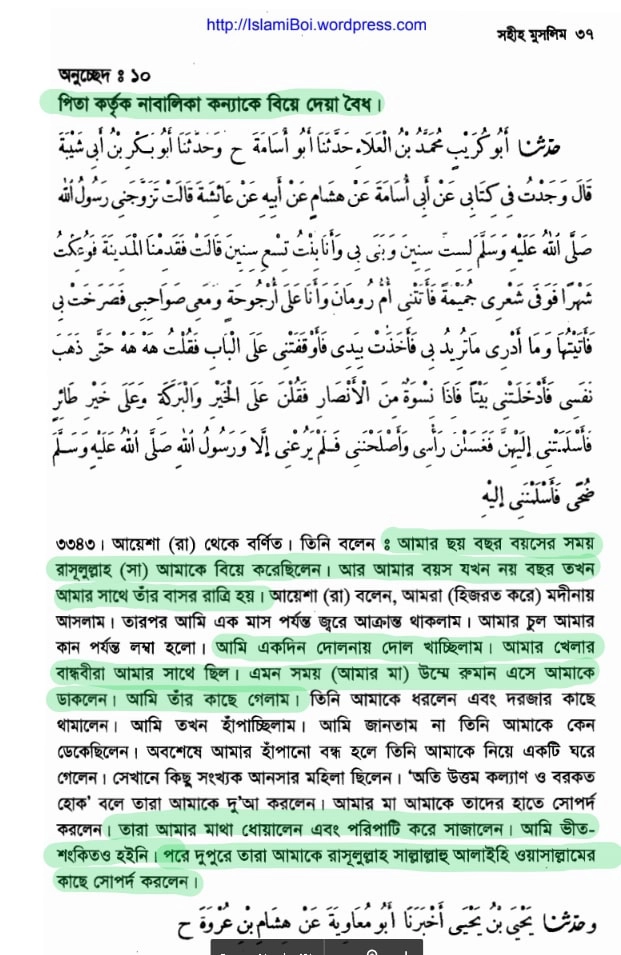
باب تَزْوِيجِ الأَبِ الْبِكْرَ الصَّغِيرَةَ
قَالَتْ تَزَوَّجَنِي رَسُولُ اللَّهِ صلى الله عليه وسلم لِسِتِّ سِنِينَ وَبَنَى بِي وَأَنَا بِنْتُ تِسْعِ سِنِينَ… فَأَتَتْنِي أُمُّ رُومَانَ وَأَنَا عَلَى أُرْجُوحَةٍ وَمَعِي صَوَاحِبِي فَصَرَخَتْ بِي فَأَتَيْتُهَا وَمَا أَدْرِي مَا تُرِيدُ بِي… فَأَسْلَمْنَنِي إِلَيْهِ.
Chapter: It is permissible for a father to arrange the marriage of a young virgin. ‘A’isha (Allah be pleased with her) reported: Allah’s Messenger (ﷺ) married me when I was six years old, and I was admitted to his house at the age of nine. She further said: We went to Medina and I had an attack of fever for a month, and my hair had come down to the earlobes. Umm Ruman (my mother) came to me and I was at that time on a swing along with my playmates. She called me loudly and I went to her and I did not know what she had wanted of me. She took hold of my hand and took me to the door, and I was saying: Ha, ha (as if I was gasping), until the agitation of my heart was over. She took me to a house, where had gathered the women of the Ansar. They all blessed me and wished me good luck and said: May you have share in good. She (my mother) entrusted me to them. They washed my head and embellished me and nothing frightened me. Allah’s Messenger (, may peace be upon him) came there in the morning, and I was entrusted to him. The Arabic wording for consummation is bana bi—consummating the marriage through sexual intercourse.
Sahih Muslim 1422a
The phrase ‘went into the bridal chamber’ in this report must be read alongside bana biha, ‘spending the wedding night’, ‘joining her husband’, and ‘intercourse’ in parallel versions of the same event. Aisha herself said that she did not know what her mother intended to do with her. The hadith gives no account of anyone asking her opinion, informing her about impending marital intercourse, or obtaining her consent. This report therefore cannot establish Aisha’s free and informed consent; later jurisprudential sources did not even make a minor daughter’s permission a condition of marriage.
The next report in Muslim repeats the information more briefly. Aisha explicitly states that Muhammad married her at six and consummated the marriage at nine [13].
Sahih Muslim (Hadith Academy)
17. Marriage
Chapter 10. A father a minor may arrange the marriage of his virgin daughter
3371-(70/…) Yahya ibn Yahya and Ibn Numayr … narrated from Aisha, who said: Allah’s Apostle (ﷺ) married me when I was six years old, and I was admitted to his house when I was nine years old. (Islamic Foundation: 3345; Islamic Centre: 3344)
Hadith grade: Sahih (authentic)
Narrator: Aisha
قَالَتْ تَزَوَّجَنِي النَّبِيُّ صلى الله عليه وسلم وَأَنَا بِنْتُ سِتِّ سِنِينَ وَبَنَى بِي وَأَنَا بِنْتُ تِسْعِ سِنِينَ.
‘A’isha (Allah be pleased with her) reported: Allah’s Apostle (ﷺ) married me when I was six years old, and I was admitted to his house when I was nine years old. The Arabic wording is bana bi—consummating the marriage through sexual intercourse.
Sahih Muslim 1422b
Muslim’s Hadith 3372 gives seven as the age at marriage, but the information that she was taken into Muhammad’s household at nine remains unchanged. It also states that Aisha’s dolls were with her. The Bengali edition’s footnote explains the difference between six and seven by saying that she had completed six years and entered her seventh: some reports count completed years and others the current year. Whether or not this explanation is accepted, both versions place consummation at nine [14].
Sahih Muslim (Hadith Academy)
17. Marriage
Chapter 10. A father a minor may arrange the marriage of his virgin daughter
3372-(71/…) Abd ibn Humayd … ‘A’isha (Allah be pleased with her) reported that Allah’s Apostle (ﷺ) married her when she was seven years old, and he was taken to his house as a bride when she was nine, and her dolls were with her; and when he (the Holy Prophet) died she was eighteen years old. (Islamic Foundation: 3346; Islamic Centre: 3345)
* She said that Allah’s Messenger married her at six. Some hadiths give Aisha’s age at marriage as six and others as seven. According to the commentators, she had completed six years and entered her seventh. Some reports disregard the additional portion of the year and count six, while others count that portion as a full year and give seven.
Hadith grade: Sahih (authentic)
Narrator: Aisha
أَنَّ النَّبِيَّ صلى الله عليه وسلم تَزَوَّجَهَا وَهْىَ بِنْتُ سَبْعِ سِنِينَ وَزُفَّتْ إِلَيْهِ وَهِيَ بِنْتُ تِسْعِ سِنِينَ وَلُعَبُهَا مَعَهَا وَمَاتَ عَنْهَا وَهِيَ بِنْتُ ثَمَانَ عَشْرَةَ.
‘A’isha (Allah be pleased with her) reported that Allah’s Apostle (ﷺ) married her when she was seven years old, and he was taken to his house as a bride when she was nine, and her dolls were with her; and when he (the Holy Prophet) died she was eighteen years old.
Sahih Muslim 1422c; Bengali edition: 3372
Another report combines marriage at six, consummation at nine, and Muhammad’s death when Aisha was eighteen. The information that Aisha’s marital and sexual life with Muhammad lasted nine years agrees with the report in al-Bukhari [15].
Sahih Muslim (Hadith Academy)
17. Marriage
Chapter 10. A father a minor may arrange the marriage of his virgin daughter
3373-(72/…) Yahya ibn Yahya, Ishaq ibn Ibrahim, Abu Bakr ibn Abi Shayba, and Abu Kurayb … narrated from Aisha. ‘A’isha (Allah be pleased with her) reported that Allah’s Apostle (ﷺ) married her when she was six years old, and he (the Holy Prophet) took her to his house when she was nine, and when he (the Holy Prophet) died she was eighteen years old (Islamic Foundation: 3347; Islamic Centre: 3346)
Hadith grade: Sahih (authentic)
Narrator: Aisha
قَالَتْ تَزَوَّجَهَا رَسُولُ اللَّهِ صلى الله عليه وسلم وَهْىَ بِنْتُ سِتٍّ وَبَنَى بِهَا وَهْىَ بِنْتُ تِسْعٍ وَمَاتَ عَنْهَا وَهْىَ بِنْتُ ثَمَانَ عَشْرَةَ.
‘A’isha (Allah be pleased with her) reported that Allah’s Apostle (ﷺ) married her when she was six years old, and he (the Holy Prophet) took her to his house when she was nine, and when he (the Holy Prophet) died she was eighteen years old. The Arabic wording for consummation is bana biha—consummating the marriage through sexual intercourse.
Sahih Muslim 1422d; Bengali edition: 3373
Sunan Abi Dawud: An Explicit Account of Intercourse at Nine
For those who use ‘spending the wedding night’ or ‘being taken into his house’ to conceal intercourse, the Bengali translation of Sunan Abi Dawud leaves no such opportunity. It explicitly states that after arriving in Medina Aisha was playing on a swing. Women took her away, adorned her, and brought her to Muhammad. Muhammad then had intercourse with her. Aisha was nine [16] [17] [16]
Sunan Abi Dawud (Islamic Foundation)
36. General Behaviour
Chapter 61. About swings.
4851. Musa ibn Ismail … narrated from Aisha, who said: When we came to Medina, the women came to me when I was playing on the swing, and my hair were up to my ears. They brought me, prepared me, and decorated me. Then they brought me to the Messenger of Allah (ﷺ) and he took up cohabitation with me, when I was nine.
Hadith grade: Sahih (authentic)
Narrator: Aisha bint Abu Bakr al-Siddiq
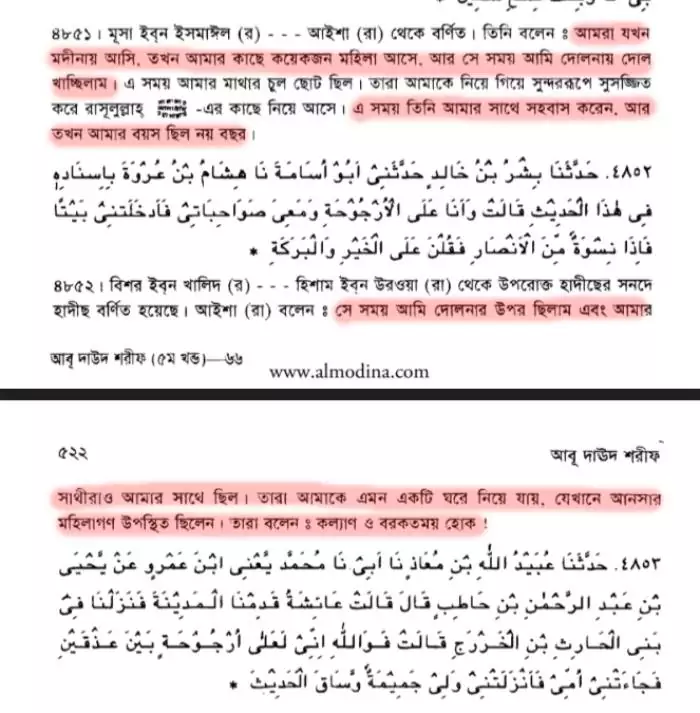
قَالَتْ إِنَّ رَسُولَ اللَّهِ صلى الله عليه وسلم تَزَوَّجَنِي وَأَنَا بِنْتُ سَبْعِ سِنِينَ… وَأَنَا عَلَى أُرْجُوحَةٍ فَذَهَبْنَ بِي وَهَيَّأْنَنِي وَصَنَعْنَنِي فَأُتِيَ بِي رَسُولُ اللَّهِ صلى الله عليه وسلم فَبَنَى بِي وَأَنَا ابْنَةُ تِسْعٍ فَوَقَفَتْ بِي عَلَى الْبَابِ فَقُلْتُ هِيهْ هِيهْ – قَالَ أَبُو دَاوُدَ أَىْ تَنَفَّسَتْ.
Narrated Aisha, Ummul Mu’minin: The Messenger of Allah (ﷺ) married me when I was seven or six. When we came to Medina, some women came. according to Bishr’s version: Umm Ruman came to me when I was swinging. They took me, made me prepared and decorated me. I was then brought to the Messenger of Allah (ﷺ), and he took up cohabitation with me when I was nine. She halted me at the door, and I burst into laughter. Abu Dawud said: That is to say: I menstruated, and I was brought in a house, and there were some women of the Ansari in it. They said: With good luck and blessing. The tradition of one of them has been included in the other. In the Arabic wording, bana bi denotes beginning marital intercourse; at the doorway Aisha says ‘hih, hih’. Abu Dawud explains: أَيْ تَنَفَّسَتْ—meaning that she was breathing or panting.
Sunan Abi Dawud, Hadith 4933
The internationally numbered version of the same report, 4933, gives six or seven as the age at marriage and nine for the beginning of marital cohabitation with Muhammad. Its Arabic uses fa-bana bi, meaning that Muhammad consummated his marriage with Aisha through intercourse. Read together, the two numbering systems make the information unmistakable: Aisha was playing on a swing, she was prepared and handed over to Muhammad, and he had sexual intercourse with her at nine [18].
Sunan an-Nasa’i: Aisha Still Played with Girls at the Time of Consummation
An-Nasa’i’s report gives six as the age at marriage and nine as the age at which Aisha joined Muhammad as his wife. The chapter heading itself is ‘Consummation of Marriage with a Girl of Nine’. It also states that Aisha played with girls at that time. The hadith tradition thus explicitly places consummation at nine and mentions Aisha’s childhood play in the same sentence [19] [20].
باب الْبِنَاءِ بِابْنَةِ تِسْعٍ
قَالَتْ تَزَوَّجَنِي رَسُولُ اللَّهِ صلى الله عليه وسلم وَأَنَا بِنْتُ سِتٍّ وَدَخَلَ عَلَىَّ وَأَنَا بِنْتُ تِسْعِ سِنِينَ وَكُنْتُ أَلْعَبُ بِالْبَنَاتِ.
Chapter: Consummation Of Marriage With A Girl Of Nine. It was narrated that ‘Aishah said: “The Messenger of Allah married me when I was six, and consummated the marriage with me when I was nine, and I used to play with dolls.”
Sunan an-Nasa’i, Hadith 3378
‘Joining her husband’ here does not mean a social visit, friendship, or merely living under the same roof. An-Nasa’i’s chapter heading, the reports of the same event in al-Bukhari and Muslim, and the explicit Bengali word ‘intercourse’ in Abu Dawud together establish the meaning. ‘Joining her husband’ is a polite rendering of sexual union. This linguistic softening cannot be used to deny that intercourse occurred.
The Combined Testimony of al-Bukhari, Muslim, Abu Dawud, and an-Nasa’i
Read together, the reports in the principal hadith collections leave no ambiguity about the event’s basic structure. Muhammad married Aisha at six; one report gives seven. At nine, she was taken from her swing and playmates, washed and adorned, and handed over to Muhammad. He had sexual intercourse with her at that age. Aisha still played with girls, and her dolls were with her. She did not even understand why her mother was taking her away.
These are not an isolated sentence from a single narrator. The event appears in al-Bukhari, Muslim, Abu Dawud, and an-Nasa’i. Some reports give the ages of six and nine directly; others place the event in the chronology of Khadija’s death and the Hijra. Some mention the swing, others dolls, preparation and transfer by women, or explicit intercourse. The accounts fill in one another’s details and construct a complete picture of the same event.
The structure established by these reports is that Muhammad, a man over fifty, contracted marriage with the six-year-old Aisha, and marital intercourse began when she was nine. In her own account, she still played on a swing and with dolls and did not understand her mother’s immediate purpose. There is no account of her permission being sought for the marriage. Classical hadith compilers and later jurists used the event as a legal precedent for marrying off a minor daughter. Modern attempts to deny either her age or the meaning of consummation therefore conflict with the classical sources’ own classification and interpretation.
Sunan Ibn Majah: ‘Marriage of Minor Girls Arranged by Their Fathers’
Reports of Aisha’s age are not limited to al-Bukhari, Muslim, Abu Dawud, and an-Nasa’i. The same event is preserved in the Book of Marriage of Sunan Ibn Majah. More importantly, Ibn Majah places it under a chapter entitled ‘Marriage of minor girls arranged by their fathers’. This heading establishes that the classical hadith compiler did not treat Aisha’s marriage as an ordinary adult woman’s marriage: it was a precedent for a father marrying off a minor girl.
باب نِكَاحِ الصِّغَارِ يُزَوِّجُهُنَّ الآبَاءُ
قَالَتْ تَزَوَّجَنِي رَسُولُ اللَّهِ صلى الله عليه وسلم وَأَنَا بِنْتُ سِتِّ سِنِينَ… وَإِنِّي لَفِي أُرْجُوحَةٍ وَمَعِي صَوَاحِبَاتٌ لِي… وَمَا أَدْرِي مَا تُرِيدُ… وَإِنِّي لأَنْهَجُ حَتَّى سَكَنَ بَعْضُ نَفَسِي… فَأَسْلَمَتْنِي إِلَيْهِ وَأَنَا يَوْمَئِذٍ بِنْتُ تِسْعِ سِنِينَ.
Chapter: Marriage of minor girls arranged by their fathers. It was narrated that: Aishah said: “The Messenger of Allah married me when I was six years old. Then we came to Al-Madinah and settled among Banu Harith bin Khazraj. I became ill and my hair fell out, then it grew back and became abundant. My mother Umm Ruman came to me while I was on an Urjuhah with some of my friends, and called for me. I went to her, and I did not know what she wanted. She took me by the hand and made me stand at the door of the house, and I was panting. When I got my breath back, she took some water and wiped my face and head, and led me into the house. There were some woman of the Ansar inside the house, and they said: ‘With blessings and good fortune (from Allah).’ (My mother) handed me over to them and they tidied me up. And suddenly I saw the Messenger of Allah in the morning. And she handed me over to him and I was at that time, nine years old.”
Sunan Ibn Majah, Hadith 1876
Ibn Majah’s report matches the detailed versions in al-Bukhari and Muslim almost word for word. Aisha’s age of six, arrival in Medina, illness, loss of hair, playing on a swing, not understanding her mother’s purpose, being prepared by women, and being handed over to Muhammad at nine are all present. The event is therefore not confined to a single sentence transmitted by Hisham ibn Urwa; several hadith collections preserve the same complete sequence [21].
Aisha’s Age Is Even Lower When Lunar Years Are Converted
Some apologists claim that because Arabs counted years differently, the six and nine years mentioned in the hadiths should be understood as older ages by modern reckoning. The truth is precisely the reverse. The Arabic Hijri year is lunar, whereas the modern Gregorian year is solar. A lunar year is approximately 354.37 days and a solar year approximately 365.24. Six lunar years are therefore shorter than six solar years, and nine lunar years shorter than nine solar years.
- Six lunar years equal approximately 5.82 solar years.
- Nine lunar years equal approximately 8.73 solar years.
The hadiths express age in whole years, and the exact birth date is unknown. It would therefore be inappropriate to specify Aisha’s age to the day. What is certain, however, is that converting lunar years into solar years does not raise her age: it slightly lowers it. Turning nine into eighteen or nineteen by arguing that ‘Arabic years were different’ is not historical calculation; it is mathematically false [22].
Aisha’s Birth and the Chronology of Events
The report in Sahih Muslim states that Aisha was eighteen when Muhammad died. Since Muhammad died in 632 CE, her birth falls approximately in 613 or 614 CE. The same report gives marriage at six, consummation at nine, and Muhammad’s death when she was eighteen. Her birth, marriage, intercourse, and age at Muhammad’s death therefore fit a consistent chronology [15].
قَالَتْ تَزَوَّجَهَا رَسُولُ اللَّهِ صلى الله عليه وسلم وَهْىَ بِنْتُ سِتٍّ وَبَنَى بِهَا وَهْىَ بِنْتُ تِسْعٍ وَمَاتَ عَنْهَا وَهْىَ بِنْتُ ثَمَانَ عَشْرَةَ.
‘A’isha (Allah be pleased with her) reported that Allah’s Apostle (ﷺ) married her when she was six years old, and he (the Holy Prophet) took her to his house when she was nine, and when he (the Holy Prophet) died she was eighteen years old. The Arabic wording for consummation is bana biha—consummating the marriage through sexual intercourse.
Sahih Muslim 1422d
Ashab-e Rasul-er Jibankatha supplies a more specific chronology of her birth and marriage. It places Aisha’s birth around July 614 CE, her marriage in 620 CE, and her entry into Muhammad’s household at nine in Shawwal of the first year after the Hijra. Conversion between calendars and months may produce slight differences in the Gregorian month, but the basic sequence remains unchanged: birth in 613 or 614, marriage in 620, and intercourse around 623 CE [23].
A brief chronology:
613–614 CE: Aisha’s birth
620 CE: Marriage to Muhammad at approximately six
622 CE: Migration to Medina
Around 623 CE: Intercourse with Muhammad at nine
632 CE: Aisha becomes a widow at eighteen
Aisha’s Marriage After Khadija’s Death: The Sources’ Chronology
Al-Bukhari 3896 states that Khadija died three years before the Hijra. In a widely used biographical chronology, most scholars place Khadija’s death in Ramadan of the tenth year of prophethood, followed by Muhammad’s marriage to Aisha in Shawwal. On that reckoning, he married the six-year-old Aisha approximately one month after Khadija’s death [24] [25] —
The conclusion reached by most researchers and supported by the majority of reliable reports is that Khadija died in Ramadan of the tenth year of prophethood, three years before the Hijra, and Allah’s Messenger married Aisha one month later in Shawwal. Aisha was six at the time. On this reckoning, her marriage took place in Shawwal of the third year before the Hijra, corresponding to May 620 CE. Ibn Abd al-Barr, the author of al-Isti’ab, supported this view. The marriage took place in the year of Khadija’s death, and the husband-and-wife relationship began three years later, when Aisha was taken into his household at nine.
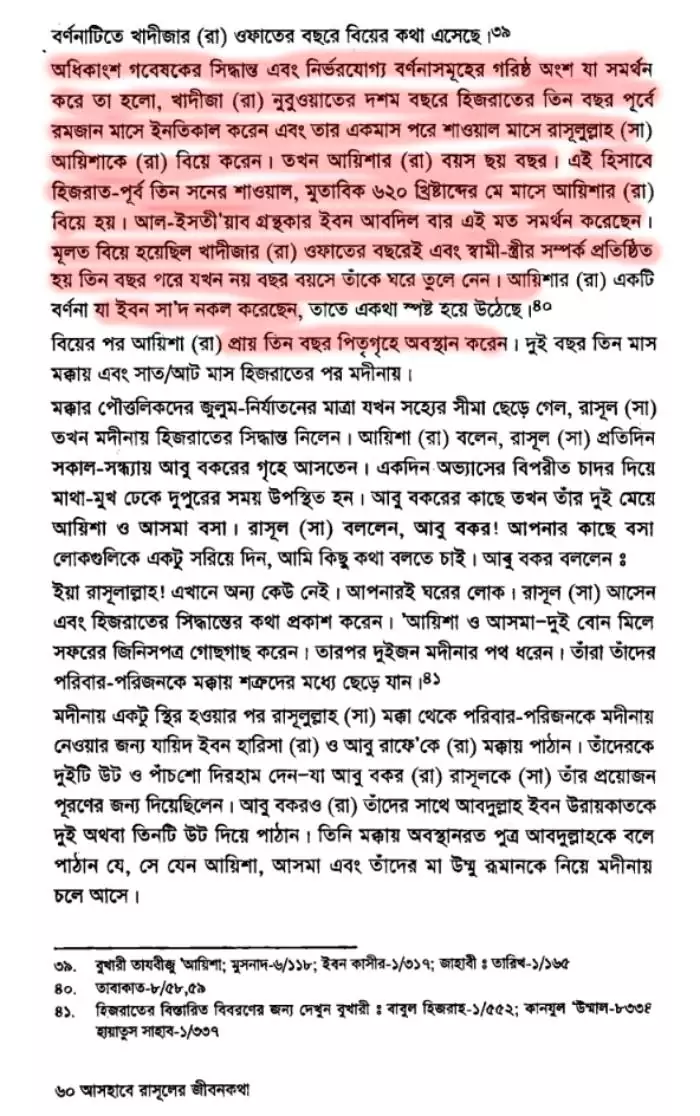
In other words, the conclusion of most researchers and the majority of reliable reports is that Khadija died in Ramadan of the tenth year of prophethood, three years before the Hijra, and Allah’s Messenger married Aisha one month later in Shawwal. Aisha was six. On this reckoning, Aisha’s marriage took place in Shawwal of the third year before the Hijra, in May 620 CE. The marriage was in the year of Khadija’s death, and the husband-and-wife relationship began three years later, when Aisha was taken into his household at nine.
The timing in al-Bukhari’s brief chronology differs from the biographical work’s month-by-month reckoning. The exact number of months between Khadija’s death and Aisha’s marriage therefore cannot be established conclusively. Both accounts nevertheless place the marriage contract in Mecca after Khadija’s death and marital intercourse after the Hijra, when Aisha was nine.
Muhammad Dreamed of the Child Aisha as His Wife
Several passages in Sahih al-Bukhari report that before the marriage Muhammad saw Aisha in dreams as his wife. In the dream, a man carried Aisha to him in silk and said, ‘This is your wife.’ Muhammad uncovered her, saw Aisha, and said that if the dream came from Allah, Allah would fulfil it. The same report appears in al-Bukhari’s Book of Marriage and Book of the Interpretation of Dreams [26] [27].
قَالَتْ قَالَ رَسُولُ اللَّهِ صلى الله عليه وسلم: «أُرِيتُكِ فِي الْمَنَامِ مَرَّتَيْنِ، إِذَا رَجُلٌ يَحْمِلُكِ فِي سَرَقَةِ حَرِيرٍ فَيَقُولُ هَذِهِ امْرَأَتُكَ، فَأَكْشِفُهَا فَإِذَا هِيَ أَنْتِ، فَأَقُولُ إِنْ يَكُنْ هَذَا مِنْ عِنْدِ اللَّهِ يُمْضِهِ».
Narrated `Aisha: Allah’s Messenger (ﷺ) said (to me), “You have been shown to me twice in (my) dreams. A man was carrying you in a silken cloth and said to me, ‘This is your wife.’ I uncovered it; and behold, it was you. I said to myself, ‘If this dream is from Allah, He will cause it to come true.’ “
Sahih al-Bukhari, Hadith 5078
The report is morally appalling. A man around fifty dreams not once but twice of a little girl—his childhood friend’s daughter—as his wife or sexual partner. He then takes those dreams seriously and shortly afterwards marries that six-year-old child. This cannot be dismissed as an innocent ‘dream’. Its subject was a child, the relationship was marriage, and subsequent events followed the same course. This is no abstract symbolic vision: a child appears as a wife in an adult man’s mental world, and the idea subsequently becomes an actual marriage.
More seriously, Muhammad did not question whether the dream was a product of his own mind. He instead said, ‘If this dream is from Allah, He will cause it to come true.’ This language pushes a personal desire directly towards religious legitimation. If imagining or desiring a child as a wife is morally objectionable, suggesting that it is ‘from Allah’ does not reduce the problem: it multiplies it. A person can then present his own wish as a divine plan rather than taking responsibility for it as his own. This is an extremely dangerous structure for removing personal desire from moral scrutiny.
Most brutally, the subsequent sequence culminated in an actual sexual relationship. Marriage at six and intercourse at nine belong to the same continuum. ‘Seeing a child as one’s wife’ was therefore no innocent fantasy here: it became a real marriage and later a sexual relationship. For a man around fifty to imagine a six-year-old child as a marriage partner and legitimise that decision in the language of divine signs is morally repugnant. Defending the event by saying ‘Allah showed her to him’ merely exposes the problem more starkly: it accords religious approval to an adult man’s marital and sexual desire centred on a child.
Abu Bakr’s Response to the Marriage Proposal
When Muhammad proposed marriage to Aisha through Abu Bakr, Abu Bakr initially said, ‘But I am your brother.’ Muhammad replied that Abu Bakr was his brother in Allah’s religion and Book, but Aisha was lawful for him. Al-Bukhari’s Arabic chapter heading is tazwij al-sighar min al-kibar, meaning the marriage of young girls to older men. This heading also shows that al-Bukhari did not regard Aisha as an adult bride of comparable age [28] [29].
باب تَزْوِيجِ الصِّغَارِ مِنَ الْكِبَارِ
أَنَّ النَّبِيَّ صلى الله عليه وسلم خَطَبَ عَائِشَةَ إِلَى أَبِي بَكْرٍ فَقَالَ لَهُ أَبُو بَكْرٍ إِنَّمَا أَنَا أَخُوكَ، فَقَالَ: «أَنْتَ أَخِي فِي دِينِ اللَّهِ وَكِتَابِهِ وَهْىَ لِي حَلاَلٌ».
Chapter: The marrying of young lady to an elderly man. Narrated ‘Urwa: The Prophet (ﷺ) asked Abu Bakr for `Aisha’s hand in marriage. Abu Bakr said “But I am your brother.” The Prophet (ﷺ) said, “You are my brother in Allah’s religion and His Book, but she (Aisha) is lawful for me to marry.”
Sahih al-Bukhari, Hadith 5081
The hadith does not explicitly state that Abu Bakr’s objection concerned Aisha’s age. His words ‘I am your brother’ should therefore not be quoted as an objection about age. The report’s placement and chapter heading nevertheless clearly identify a young girl’s marriage to an older man. At the same time, Aisha’s opinion is entirely absent. The proposal and decision take place wholly between Muhammad and Abu Bakr. The authentic hadith is reproduced here [28]
Sahih al-Bukhari (Tawhid Publications)
Chapter 67/11. The marrying of young girls to elderly men.
5081. Narrated ‘Urwa: The Prophet (ﷺ) asked Abu Bakr for `Aisha’s hand in marriage. Abu Bakr said “But I am your brother.” The Prophet (ﷺ) said, “You are my brother in Allah’s religion and His Book, but she (Aisha) is lawful for me to marry.” (Modern Publications: 4708; Islamic Foundation: 4710)
Hadith grade: Sahih (authentic)
Narrator: Urwa
(11)Chapter: The marrying of young lady to an elderly man(11)
Narrated ‘Urwa:
The Prophet (ﷺ) asked Abu Bakr for `Aisha’s hand in marriage. Abu Bakr said “But I am your brother.” The Prophet (ﷺ) said, “You are my brother in Allah’s religion and His Book, but she (Aisha) is lawful for me to marry.”
Reference : Sahih al-Bukhari 5081
In-book reference : Book 67, Hadith 19
USC-MSA web (English) reference : Vol. 7, Book 62, Hadith 18
(deprecated numbering scheme)
Let us now examine the account of the proposal in al-Bidaya wa-l-Nihaya [30] —
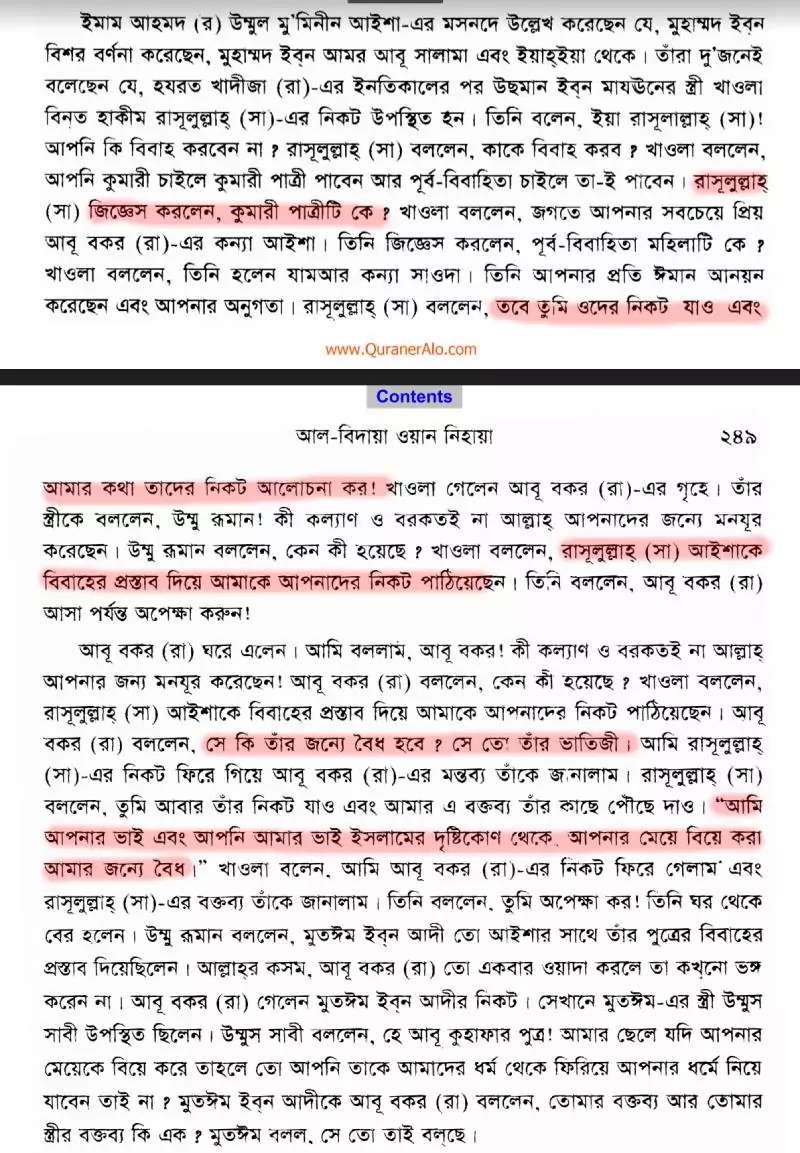
Imam Ahmad records in the Musnad of Aisha, Mother of the Believers, that Muhammad ibn Bishr narrated from Muhammad ibn Amr, from Abu Salama and Yahya. Both said that after Khadija’s death, Khawla bint Hakim, the wife of Uthman ibn Maz’un, came to Allah’s Messenger and asked, ‘Messenger of Allah, will you not marry?’ He asked, ‘Whom should I marry?’ Khawla replied, ‘If you want a virgin, there is a virgin bride; if you want a previously married woman, there is one.’ He asked, ‘Who is the virgin?’ Khawla said, ‘Aisha, the daughter of Abu Bakr, the person dearest to you in the world.’ He asked, ‘Who is the previously married woman?’ Khawla said, ‘Sawda, daughter of Zam’a. She believes in you and follows you.’ Allah’s Messenger said, ‘Then go to them and discuss my proposal.’ Khawla went to Abu Bakr’s home and told his wife, ‘Umm Ruman, what goodness and blessings Allah has ordained for you!’ Umm Ruman asked, ‘Why, what has happened?’ Khawla said, ‘Allah’s Messenger has sent me to you with a proposal to marry Aisha.’ She replied, ‘Wait until Abu Bakr arrives!’
Abu Bakr came home. I said, ‘Abu Bakr, what goodness and blessings Allah has ordained for you!’ Abu Bakr asked, ‘Why, what has happened?’ Khawla said, ‘Allah’s Messenger has sent me to you with a proposal to marry Aisha.’ Abu Bakr asked, ‘Would she be lawful for him? She is his niece.’ I returned to Allah’s Messenger and conveyed Abu Bakr’s comment. Allah’s Messenger said, ‘Go back and convey this to him: “I am your brother and you are my brother in Islam; marrying your daughter is lawful for me.”’ Khawla said: I returned to Abu Bakr and conveyed the message. He said, ‘Wait!’ and left the house. Umm Ruman said, ‘Mut’im ibn Adi had proposed marriage between his son and Aisha. By Allah, Abu Bakr never breaks a promise once he has made it.’ Abu Bakr went to Mut’im ibn Adi, whose wife Umm al-Sabi was present. She said, ‘Son of Abu Quhafa! If my son marries your daughter, will you turn him away from our religion and bring him into yours?’ Abu Bakr asked Mut’im ibn Adi, ‘Is your position the same as your wife’s?’ Mut’im replied, ‘That is what she says.’
Aisha’s Permission Was Not Sought
Muhammad proposed Aisha’s marriage to Abu Bakr, and Abu Bakr married her off. At nine, Aisha’s mother called her from the swing and handed her to women who prepared her and transferred her to Muhammad. Nowhere in this sequence is there an account of anyone asking Aisha’s opinion or obtaining her consent. Aisha herself said that she did not understand what her mother intended to do with her. The original account therefore supplies no positive evidence of consent; later jurisprudential interpretation makes clear that a minor daughter’s permission was not treated as a legal condition.
Later Islamic jurists did not regard this absence as an accident or an injustice. Based on Aisha’s case, they stated that a father may marry off his minor virgin daughter without her permission or consent. Islamweb’s Fatwa 230518 directly quotes Ibn Abd al-Barr as saying that Muhammad’s marriage to six-year-old Aisha establishes that a father may marry off his minor daughter without consulting her [31].
فقد حكى بعض العلماء الإجماع على أن للأب تزويج ابنته البكر الصغيرة بغير رضاها، ولا يشترط إذنها، ونعني بالصغيرة من ليست بالغة… ومستند هذا الإجماع أن أبا بكر زوج عائشة ـ رضي الله عنها ـ من رسول الله صلى الله عليه وسلم ولم يشاورها، قال ابن عبد البر: أجمع العلماء على أن للأب أن يزوج ابنته الصغيرة ولا يشاورها، لتزويج رسول الله صلى الله عليه وسلم عائشة وهي بنت ست سنين.
Islamweb’s fatwa states: Some scholars reported a consensus that a father may marry off his minor virgin daughter without her consent, and her permission is not a condition; ‘minor’ means someone who has not reached puberty. The fatwa further states that the basis for this reported consensus is Abu Bakr’s marrying Aisha to Muhammad without consulting her. Quoting Ibn Abd al-Barr, it says that a father may marry off his minor daughter without consulting her.
Islamweb, Fatwa 230518
This jurisprudential explanation makes the legal character of the event clear. Under the relevant classical view, the consent of a minor virgin daughter was not a condition of the marriage’s validity: her father’s decision was sufficient. ‘Aisha did not protest, therefore she consented’ is consequently an invalid argument. In a legal structure that does not even require a child’s permission, silence cannot be presented as free consent.
The Claim That Muhammad Waited Three Years for Adulthood Is False
Modern Muslim speakers often say that although Muhammad married Aisha at six, he waited three years for her to become an adult. No authentic hadith says this. No report states that he waited for her menstruation to begin, for her to attain physical maturity, or for her to acquire the capacity for free consent. Instead, an account preserved in Ibn Sa’d’s Tabaqat, Sulayman Nadwi’s Sirat Aisha, and al-Tabari’s history mentions money for the mahr as the reason for delaying intercourse.
ثُمَّ قَالَ أَبُو بَكْرٍ: يَا رَسُولَ اللَّهِ، مَا يَمْنَعُكَ أَنْ تَبْنِيَ بِأَهْلِكَ؟ قَالَ: «الصَّدَاقُ». فَأَعْطَاهُ أَبُو بَكْرٍ اثْنَتَيْ عَشْرَةَ أُوقِيَّةً وَنَشًّا، فَبَعَثَ بِهَا إِلَيْنَا، وَبَنَى بِي رَسُولُ اللَّهِ صلى الله عليه وسلم فِي بَيْتِي هَذَا.
The report states that Abu Bakr asked, ‘Messenger of Allah, what prevents you from beginning married life with your wife?’ He replied, ‘The mahr.’ Abu Bakr then gave him twelve uqiyyas and one nash; after the money was sent, Muhammad began married life with Aisha. Muhammad ibn al-Hasan ibn Zabala, who was classified as weak, appears in the chain of this lengthy report. It is therefore not evidence of the same standing as Sahih al-Bukhari or Sahih Muslim.
Ibn Sa’d, al-Tabaqat; the same report is preserved in Majma’ al-Zawa’id
Al-Tabari’s account states that Muhammad married Aisha in Shawwal of the tenth year of prophethood, three years before the Hijra. Eight months after the Hijra, in another Shawwal, he had intercourse with her at nine. After arriving in Medina, Abu Bakr asked Muhammad why he was not having intercourse with his wife. When Muhammad mentioned the mahr, Abu Bakr provided the money, and Aisha was then sent to Muhammad [32].
Al-Tabari, Tarikh al-Rusul wa-l-Muluk — Aisha’s marriage, intercourse after the Hijra, and the mahr
Arabic original:
وعائشة بنت أبي بكر، وأمها أم رومان بنت عمير بن عامر من بني دهمان بن الحارث بن غنم بن مالك بن كنانة، تزوجها رسول الله صلى الله عليه وسلم في شوال سنة عشر من النبوة قبل الهجرة بثلاث سنين، وعرس بها في شوال على رأس ثمانية أشهر من الهجرة، وكانت يوم ابتنى بها ابنة تسع سنين.
قال ابن عمر: حدثنا موسى بن محمد بن عبد الرحمن، عن ريطة، عن عمرة، عن عائشة، أنها سئلت: متى بنى بك رسول الله؟ فقالت: لما هاجر رسول الله صلى الله عليه وسلم إلى المدينة خلفنا وخلف بناته، فلما قدم المدينة بعث إلينا زيد بن حارثة، وبعث معه أبا رافع مولاه، وأعطاهما بعيرين وخمسمائة درهم، أخذها رسول الله من أبي بكر، يشتريان بها ما يحتاجان إليه من الظهر، وبعث أبو بكر معهما عبد الله بن أريقط الديلي ببعيرين أو ثلاثة، وكتب إلى عبد الله بن أبي بكر يأمره أن يحمل أهله أم رومان، وأنا وأختي أسماء امرأة الزبير، فخرجوا مصطحبين. فلما انتهوا إلى قديد، اشترى زيد بن حارثة بتلك الخمسمائة درهم ثلاثة أبعرة، ثم دخلوا مكة جميعا، وصادفوا طلحة بن عبيد الله يريد الهجرة بآل أبي بكر، فخرجنا جميعا، وخرج زيد بن حارثة وأبو رافع وفاطمة وأم كلثوم وسودة بنت زمعة، وحمل زيد أم أيمن وأسامة بن زيد، وخرج عبد الله بن أبي بكر بأم رومان وأختيه، وخرج طلحة بن عبيد الله، واصطحبوا جميعا، حتى إذا كنا بالبيض من تمنى نفر بعيري، وأنا في محفة معي فيها أمي، فجعلت أمي تقول: وا بنتاه وا عروساه! حتى أدرك بعيرنا وقد هبط من لفت، فسلم.
ثم إنا قدمنا المدينة، فنزلت مع عيال أبي بكر، ونزل آل رسول الله صلى الله عليه وسلم، ورسول الله يومئذ يبني المسجد، وأبياتنا حول المسجد، فأنزل فيها أهله، ومكثنا أياما في منزل أبي بكر، ثم قال أبو بكر: يا رسول الله، ما يمنعك أن تبني بأهلك؟ قال رسول الله: الصداق. فأعطاه أبو بكر الصداق اثنتي عشرة أوقية ونشا، فبعث رسول الله صلى الله عليه وسلم إلينا، وبنى بي رسول الله صلى الله عليه وسلم في بيتي هذا الذي أنا فيه، وهو الذي توفي فيه رسول الله صلى الله عليه وسلم.
English translation:
Aisha was Abu Bakr’s daughter. Her mother was Umm Ruman bint Umayr ibn Amir, a woman of Banu Dahman ibn al-Harith ibn Ghanm ibn Malik ibn Kinana. Allah’s Messenger married Aisha in Shawwal of the tenth year of prophethood, three years before the Hijra. In Shawwal, eight months after the Hijra, he had marital intercourse with her. Aisha was nine on the day he had marital intercourse with her.
The account then states: Musa ibn Muhammad ibn Abd al-Rahman, through Rayta and Amra, narrated from Aisha, who was asked, ‘When did Allah’s Messenger have marital intercourse with you?’ Aisha said: When Allah’s Messenger migrated to Medina, he left us and his daughters in Mecca. After arriving in Medina, he sent Zayd ibn Haritha to us, accompanied by his freedman Abu Rafi. He gave them two camels and five hundred dirhams, money he had obtained from Abu Bakr, so that they could purchase the mounts needed for the journey. Abu Bakr also sent Abdullah ibn Urayqit al-Dili with two or three camels, and wrote to his son Abdullah ibn Abi Bakr, instructing him to bring his family—Umm Ruman, Aisha, and Asma, al-Zubayr’s wife. They set out together. At Qudayd, Zayd used the five hundred dirhams to buy three camels. They all entered Mecca and found Talha ibn Ubaydullah preparing to migrate with Abu Bakr’s family. They departed together. During the journey Aisha’s camel bolted, and her mother cried, ‘Oh, my daughter! Oh, my young bride!’ The camel was eventually brought under control, and they continued safely.
Aisha continued: We arrived in Medina. I stayed with Abu Bakr’s family, and Allah’s Messenger’s family also arrived. He was building the mosque, and our houses surrounded it. He housed his family there. We stayed for a few days in Abu Bakr’s home. Abu Bakr then said, ‘Messenger of Allah, what prevents you from having marital intercourse with your wife?’ Allah’s Messenger replied, ‘The mahr.’ Abu Bakr gave him twelve uqiyyas and one nash as the mahr. Allah’s Messenger sent the money to us and then had marital intercourse with me in this very house—the house in which I am now and in which he subsequently died.
Source: Abu Ja’far Muhammad ibn Jarir al-Tabari, Tarikh al-Rusul wa-l-Muluk, the biographical section on Aisha bint Abu Bakr. [33] [34]
The relevant passage in the English translation of al-Tabari places Aisha’s transfer to Muhammad after the Hijra and the mahr in the same sequence, also mentioning marital intercourse at nine. Part of this report is preserved through al-Waqidi and is regarded as weak by hadith scholars. It is therefore not the primary evidence, but only supplementary historical material alongside the authentic reports in al-Bukhari, Muslim, Abu Dawud, and an-Nasa’i [35].
These historical accounts in Ibn Sa’d and al-Tabari are not hadiths of the same standing as Sahih al-Bukhari or Sahih Muslim. Part of al-Tabari’s quoted transmission comes through al-Waqidi, whom many hadith scholars classified as weak. Nevertheless, presenting weak, strong, and historical accounts together reveals no report supporting the claim that Muhammad waited for adulthood. The preserved historical account instead identifies money for the mahr as the immediate obstacle. Claiming that Muhammad waited for Aisha’s physical maturity is therefore not Islamic history: it is an unsupported modern invention.
Aisha Played with Dolls Even After Consummation
Even after entering Muhammad’s household, Aisha played with dolls, and girls her own age came to play with her. When Muhammad entered, the girls would hide; he would send them back to Aisha. The same account appears in Sahih al-Bukhari, Sahih Muslim, and al-Adab al-Mufrad. This is more than repetition: different collections preserve the same childhood behaviour [36] [37] [38].
قَالَتْ كُنْتُ أَلْعَبُ بِالْبَنَاتِ عِنْدَ النَّبِيِّ صلى الله عليه وسلم وَكَانَ لِي صَوَاحِبُ يَلْعَبْنَ مَعِي، فَكَانَ رَسُولُ اللَّهِ صلى الله عليه وسلم إِذَا دَخَلَ يَتَقَمَّعْنَ مِنْهُ، فَيُسَرِّبُهُنَّ إِلَىَّ فَيَلْعَبْنَ مَعِي.
Narrated `Aisha: I used to play with the dolls in the presence of the Prophet, and my girl friends also used to play with me. When Allah’s Messenger (ﷺ) used to enter (my dwelling place) they used to hide themselves, but the Prophet would call them to join and play with me. (The playing with the dolls and similar images is forbidden, but it was allowed for `Aisha at that time, as she was a little girl, not yet reached the age of puberty.) (Fath-ul-Bari page 143, Vol.13)
Sahih al-Bukhari, Hadith 6130
The original Arabic hadith does not directly state whether Aisha had begun menstruating. Classical commentators, however, used her playing with dolls as evidence that she was a minor, because toys depicting living beings were generally regarded as forbidden for adults but permitted for children. The standard English explanatory note in Sahih al-Bukhari also says that Aisha was allowed to play with dolls because she was a little girl who had not reached puberty. Although the original hadith contains no direct statement about menstruation, classical Islamic interpretation therefore used the event as testimony to Aisha’s childhood.
Another report in Sunan Abi Dawud states that on returning from the expedition to Khaybar or Tabuk, Muhammad saw Aisha’s dolls behind a curtain in her room. Among them was a cloth horse with two wings. When he questioned her about it, Aisha asked whether he had heard of Sulayman’s winged horses. Muhammad laughed at her reply [39].
قَالَتْ قَدِمَ رَسُولُ اللَّهِ صلى الله عليه وسلم مِنْ غَزْوَةِ تَبُوكَ أَوْ خَيْبَرَ… فَكَشَفَتْ نَاحِيَةَ السِّتْرِ عَنْ بَنَاتٍ لِعَائِشَةَ لُعَبٍ فَقَالَ: «مَا هَذَا يَا عَائِشَةُ؟» قَالَتْ بَنَاتِي… قَالَ: «فَرَسٌ لَهُ جَنَاحَانِ؟» قَالَتْ أَمَا سَمِعْتَ أَنَّ لِسُلَيْمَانَ خَيْلاً لَهَا أَجْنِحَةٌ؟ قَالَتْ فَضَحِكَ حَتَّى رَأَيْتُ نَوَاجِذَهُ.
Narrated Aisha, Ummul Mu’minin: When the Messenger of Allah (ﷺ) arrived after the expedition to Tabuk or Khaybar (the narrator is doubtful), the draught raised an end of a curtain which was hung in front of her store-room, revealing some dolls which belonged to her. He asked: What is this? She replied: My dolls. Among them he saw a horse with wings made of rags, and asked: What is this I see among them? She replied: A horse. He asked: What is this that it has on it? She replied: Two wings. He asked: A horse with two wings? She replied: Have you not heard that Solomon had horses with wings? She said: Thereupon the Messenger of Allah (ﷺ) laughed so heartily that I could see his molar teeth.
Sunan Abi Dawud, Hadith 4932
The narrator is unsure whether this happened after the expedition to Khaybar or to Tabuk. This hadith therefore cannot determine Aisha’s exact age or the precise onset of her menstruation. It does, however, establish that even after beginning married and sexual life with Muhammad, Aisha played with dolls and called them ‘my girls’. Being made an older man’s sexual partner did not erase childhood from her daily behaviour.
Muhammad’s Different Standard for His Own Daughter
A hadith in Sunan an-Nasa’i states that when Abu Bakr and Umar proposed marriage to Muhammad’s daughter Fatima, he replied, ‘She is young.’ When Ali, closer to her in age, proposed, Muhammad married her to him. An-Nasa’i places this report under ‘A Woman Marrying Someone Who Is Similar in Age to Her’ [40] [41].
باب تَزَوُّجِ الْمَرْأَةِ مِثْلَهَا فِي السِّنِّ
خَطَبَ أَبُو بَكْرٍ وَعُمَرُ رضى الله عنهما فَاطِمَةَ فَقَالَ رَسُولُ اللَّهِ صلى الله عليه وسلم: «إِنَّهَا صَغِيرَةٌ». فَخَطَبَهَا عَلِيٌّ فَزَوَّجَهَا مِنْهُ.
Chapter: A Woman Marrying Someone Who Is Similar In Age to Her. It was narrated from ‘Abdullah bin Buraidah that his father said: “Abu Bakr and ‘Umar, may Allah be pleased with them, proposed marriage to Fatimah but the Messenger of Allah said: ‘She is young.’ Then ‘Ali proposed marriage to her and he married her to him.”
Sunan an-Nasa’i, Hadith 3221
The hadith shows that Muhammad understood that age differences could matter in marriage. He rejected Abu Bakr and Umar as too old for his daughter Fatima, yet himself married Abu Bakr’s six-year-old daughter. Considering youth and age compatibility for one’s own daughter while abandoning those considerations for someone else’s child is no universal moral principle: it is an explicit double standard.
Two Reports Used to Claim Puberty and the Manipulation of Translation
The hadiths about Aisha’s marriage and consummation do not state that she had begun menstruating or become physically mature at nine. Modern Islamic apologists commonly present two reports to fill this uncomfortable gap. The first is a hadith in Sahih al-Bukhari in which Aisha recalls her childhood. The second is the report in Sunan Abi Dawud in which her mother takes her from a swing and prepares her to be handed over to Muhammad. In both cases, translations introduce words absent from the original Arabic.
لَمْ أَعْقِلْ أَبَوَىَّ إِلاَّ وَهُمَا يَدِينَانِ الدِّينَ، وَلَمْ يَمُرَّ عَلَيْنَا يَوْمٌ إِلاَّ يَأْتِينَا فِيهِ رَسُولُ اللَّهِ صلى الله عليه وسلم طَرَفَىِ النَّهَارِ بُكْرَةً وَعَشِيَّةً.
Narrated `Aisha: (the wife of the Prophet) I had seen my parents following Islam since I attained the age of intelligence. Not a day passed but the Prophet (ﷺ) visited us, both in the mornings and evenings. My father Abu Bakr thought of building a mosque in the courtyard of his house and he did so. He used to pray and recite the Qur’an in it. The pagan women and their children used to stand by him and look at him with surprise. Abu Bakr was a soft-hearted person and could not help weeping while reciting the Qur’an. The chiefs of the Quraish pagans became afraid of that (i.e. that their children and women might be affected by the recitation of Qur’an). Here لَمْ أَعْقِلْ concerns the acquisition of memory or understanding; it contains no word for menstruation or puberty.
Sahih al-Bukhari, Hadith 476
Aisha’s phrase here, لَمْ أَعْقِلْ أَبَوَىَّ, means ‘ever since I can remember’, ‘since I became aware’, or ‘for as long as I have known my parents’. It contains no word denoting menstruation, puberty, or sexual maturity. The original Arabic does not use بلغت, حاضت or any verb signifying puberty. Rendering the phrase as ‘since I reached puberty’ is therefore not translation: it inserts the translator’s own statement into the hadith. Aisha was describing childhood memories, not puberty. The Bengali translation correctly says ‘as far as I know’ [42].
A second and more serious distortion occurs in translations of Sunan Abi Dawud 4933. Aisha’s mother took her from the swing and prepared her to be brought to Muhammad. After playing and suddenly being led away, Aisha was panting. The sound of her panting is written as هِيهْ هِيهْ, and Abu Dawud himself explains it as أَيْ تَنَفَّسَتْ, meaning ‘she was breathing’ or ‘she was panting’.
إِنَّ رَسُولَ اللَّهِ صلى الله عليه وسلم تَزَوَّجَنِي وَأَنَا بِنْتُ سَبْعِ سِنِينَ… وَأَنَا عَلَى أُرْجُوحَةٍ فَذَهَبْنَ بِي وَهَيَّأْنَنِي وَصَنَعْنَنِي فَأُتِيَ بِي رَسُولُ اللَّهِ صلى الله عليه وسلم فَبَنَى بِي وَأَنَا ابْنَةُ تِسْعٍ فَوَقَفَتْ بِي عَلَى الْبَابِ فَقُلْتُ هِيهْ هِيهْ – قَالَ أَبُو دَاوُدَ أَىْ تَنَفَّسَتْ.
Narrated Aisha, Ummul Mu’minin: The Messenger of Allah (ﷺ) married me when I was seven or six. When we came to Medina, some women came. according to Bishr’s version: Umm Ruman came to me when I was swinging. They took me, made me prepared and decorated me. I was then brought to the Messenger of Allah (ﷺ), and he took up cohabitation with me when I was nine. She halted me at the door, and I burst into laughter. Abu Dawud said: That is to say: I menstruated, and I was brought in a house, and there were some women of the Ansari in it. They said: With good luck and blessing. The tradition of one of them has been included in the other. In the Arabic wording, bana bi denotes consummation. At the doorway Aisha says ‘hih, hih’. Abu Dawud explains: أَىْ تَنَفَّسَتْ—meaning that she was breathing or panting.
Sunan Abi Dawud, Hadith 4933
Some English translations astonishingly render أَيْ تَنَفَّسَتْ as ‘I menstruated’. Yet تَنَفَّسَتْ means breathing. The familiar word used in hadith to denote menstruation is حَاضَتْ; it is absent here. Abd al-Muhsin al-Abbad’s commentary on Sunan Abi Dawud, published on Islamweb, also explains that Aisha made the sound of breathing or panting at the doorway, which she described as ‘hih, hih’ [43]. Using this hadith as evidence of Aisha’s menstruation is therefore a direct distortion of the translation. In the parallel account in Sahih al-Bukhari, Aisha explicitly says that she was breathless when her mother held her at the doorway; she was taken inside when her breathing returned to normal.
Aisha’s Menstruation at Sarif: No Evidence About the Age of Nine
In another report in Sahih al-Bukhari, Aisha says that she began menstruating at Sarif after leaving Medina for Hajj. Seeing her cry, Muhammad asked, ‘What is wrong? Have you begun menstruating?’ When she said yes, he told her to perform the other rites of Hajj but not circumambulate the Kaaba.
قَالَتْ خَرَجْنَا لاَ نَرَى إِلاَّ الْحَجَّ، فَلَمَّا كُنَّا بِسَرِفَ حِضْتُ، فَدَخَلَ عَلَىَّ رَسُولُ اللَّهِ صلى الله عليه وسلم وَأَنَا أَبْكِي قَالَ: «مَا لَكِ أَنُفِسْتِ؟» قُلْتُ نَعَمْ. قَالَ: «إِنَّ هَذَا أَمْرٌ كَتَبَهُ اللَّهُ عَلَى بَنَاتِ آدَمَ، فَاقْضِي مَا يَقْضِي الْحَاجُّ، غَيْرَ أَنْ لاَ تَطُوفِي بِالْبَيْتِ».
Narrated Al-Qasim: `Aisha said, “We set out with the sole intention of performing Hajj and when we reached Sarif, (a place six miles from Mecca) I got my menses. Allah’s Messenger (ﷺ) came to me while I was weeping. He said ‘What is the matter with you? Have you got your menses?’ I replied, ‘Yes.’ He said, ‘This is a thing which Allah has ordained for the daughters of Adam. So do what all the pilgrims do with the exception of the Tawaf (Circumambulation) round the Ka`ba.” `Aisha added, “Allah’s Messenger (ﷺ) sacrificed cows on behalf of his wives.”
Sahih al-Bukhari, Hadith 294
This report establishes only that Aisha was menstruating at the time of the Farewell Pilgrimage. It never says that this was her first menstruation. Nor does it say that the event occurred when she was nine. The Farewell Pilgrimage took place shortly before Muhammad’s death, when the hadiths’ own reckoning places Aisha at approximately eighteen. Presenting the Sarif incident as evidence of puberty at nine is therefore chronologically impossible. The established point is that this discussion identifies no hadith stating that Aisha was menstruating at the time of intercourse at nine.
Another possible source of confusion behind presenting Sarif as Aisha’s first menstruation is al-Bukhari’s chapter heading باب كيف كان بدء الحيض—‘How menstruation began’. Its ‘beginning’, however, does not refer to Aisha’s first menstrual period. In Fath al-Bari, Ibn Hajar explicitly discusses the beginning of menstruation among women generally: whether it began among the women of the Children of Israel or earlier, with Eve and the daughters of Adam. He also mentions a report from Ibn Abbas tracing menstruation to Eve’s descent to earth. The chapter’s bad’ al-hayd, or ‘beginning of menstruation’, is thus not Aisha’s menarche but a general discussion of menstruation’s origin among human women. Turning this heading into proof of Aisha’s first period directly distorts the context [44].
There is also no need to speculate about why Aisha was crying. In al-Bukhari’s fuller account of the same event, Muhammad asks, ‘What makes you cry?’ Aisha replies, سَمِعْتُ قَوْلَكَ لأَصْحَابِكَ فَمُنِعْتُ الْعُمْرَةَ—‘I heard what you said to your companions, and I have been prevented from performing Umrah.’ Her tears were therefore caused by being unable to perform the rites of Umrah because of menstruation. The hadith nowhere states that fear, surprise, or unpreparedness at her first period made her cry [45]. Umdat al-Qari states وكان ابتداء حيضها يوم السبت…—‘her menstruation began on Saturday…’, but the same discussion supplies the chronology of when that particular period began and ended. Here ابتداء حيضها means the beginning of that menstrual episode, not her first menstruation [46]. By comparison, a report in Sunan Abi Dawud explicitly uses فَكَانَتْ أَوَّلَ حَيْضَةٍ حِضْتُهَا—‘this was my first menstruation’—when a first period really is meant. No account of Aisha at Sarif uses such language [47].
The Testimony of Fath al-Bari: Aisha Was Below Puberty
Al-Bukhari places the report of Aisha’s marriage at six and intercourse at nine under the heading باب إنكاح الرجل ولده الصغار, meaning ‘Giving one’s young children in marriage’. As evidence for this chapter, al-Bukhari cites the phrase in Surah At-Talaq 65:4, وَاللَّائِي لَمْ يَحِضْنَ, ‘and those who have not menstruated’ (Dr. Mustafa Khattab, The Clear Quran), and then presents the report about six-year-old Aisha’s marriage and her entry into Muhammad’s household at nine [48]
Fath al-Bari Sharh Sahih al-Bukhari — the chapter on marrying off minor children
Ibn Hajar al-Asqalani
Vol. 9, pp. 96–97
Arabic original:
باب إنكاح الرجل ولده الصغار لقول الله تعالى: وَاللَّائِي لَمْ يَحِضْنَ، فجعل عدتها ثلاثة أشهر قبل البلوغ
4840 حدثنا محمد بن يوسف، حدثنا سفيان، عن هشام، عن أبيه، عن عائشة رضي الله عنها: أن النبي صلى الله عليه وسلم تزوجها وهي بنت ست سنين، وأدخلت عليه وهي بنت تسع، ومكثت عنده تسعا.
الشرح:
قوله: (باب إنكاح الرجل ولده الصغار) ضبط ولده بضم الواو وسكون اللام على الجمع وهو واضح، وبفتحهما على أنه اسم جنس، وهو أعم من الذكور والإناث.
قوله: (لقول الله تعالى: وَاللَّائِي لَمْ يَحِضْنَ فجعل عدتها ثلاثة أشهر قبل البلوغ) أي: فدل على أن نكاحها قبل البلوغ جائز، وهو استنباط حسن، لكن ليس في الآية تخصيص ذلك بالوالد ولا بالبكر. ويمكن أن يقال: الأصل في الأبضاع التحريم إلا ما دل عليه الدليل، وقد ورد حديث عائشة في تزويج أبي بكر لها وهي دون البلوغ، فبقي ما عداه على الأصل، ولهذا السر أورد حديث عائشة.
قال المهلب: أجمعوا أنه يجوز للأب تزويج ابنته الصغيرة البكر ولو كانت لا يوطأ مثلها، إلا أن الطحاوي حكى عن ابن شبرمة منعه فيمن لا توطأ.
وحكى ابن حزم عن ابن شبرمة مطلقا أن الأب لا يزوج بنته البكر الصغيرة حتى تبلغ وتأذن، وزعم أن تزويج النبي صلى الله عليه وسلم عائشة وهي بنت ست سنين كان من خصائصه.
ومقابله تجويز الحسن والنخعي للأب إجبار بنته، كبيرة كانت أو صغيرة، بكرا كانت أو ثيبا.
تنبيه:
وقع في حديث عائشة من هذا الوجه إدراج يظهر من الطريق التي في الباب الذي بعده.
English translation:
Chapter: Giving one’s young children in marriage—on the basis of Allah’s statement, ‘and those who have not menstruated’ (Quran 65:4; Dr. Mustafa Khattab, The Clear Quran). Their waiting period is therefore fixed at three months before puberty.
Hadith 4840: Muhammad ibn Yusuf narrated to us; Sufyan narrated to us, from Hisham, from his father, from Aisha, who reported: that the Prophet (ﷺ) married her when she was six years old and he consummated his marriage when she was nine years old, and then she remained with him for nine years (i.e., till his death).
Ibn Hajar’s commentary:
‘Giving one’s young children in marriage’: the word waladahu can also be read in a plural sense or understood generically, in which case it includes both boys and girls.
‘Allah’s statement: “and those who have not menstruated”; their waiting period is therefore fixed at three months before puberty’ means that the verse establishes that a girl’s marriage before puberty is lawful. Ibn Hajar calls this a sound legal inference, or istinbat. The verse does not, however, restrict the ruling to fathers or virgin girls. It may be said that the default rule concerning sexual and marital relations is prohibition until evidence establishes permissibility. Aisha’s hadith states that Abu Bakr married her off before puberty. Other cases therefore remain under the original rule. This is why al-Bukhari included Aisha’s hadith here.
Al-Muhallab says: The scholars agreed that a father may marry off his minor virgin daughter, even if she is so young that intercourse with a girl like her is not considered possible or appropriate. Al-Tahawi nevertheless reports that Ibn Shubruma did not permit the marriage of a minor girl with whom intercourse could not take place.
Ibn Hazm reports Ibn Shubruma’s view more generally: a father may not marry off his minor virgin daughter until she reaches puberty and grants permission. Ibn Shubruma regarded Muhammad’s marriage to six-year-old Aisha as a ruling specific to Muhammad.
By contrast, Hasan al-Basri and Ibrahim al-Nakha’i permitted a father to compel his daughter into marriage whether she was an adult or a minor, a virgin or previously married.
Note:
Ibn Hajar says that this transmission of Aisha’s hadith contains an additional passage, as becomes apparent when compared with the chain in the following chapter.
Source: Ibn Hajar al-Asqalani, Fath al-Bari Sharh Sahih al-Bukhari, vol. 9, pp. 96–97, ‘باب إنكاح الرجل ولده الصغار’. [49]
Ibn Hajar also mentions Ibn Shubruma’s dissent at this point. Ibn Shubruma held that a father could not marry off his daughter until she reached puberty and gave permission, and that Aisha’s marriage was a ruling specific to Muhammad. Saying that ‘no Muslim scholar ever disagreed’ would therefore not be entirely accurate. The four Sunni schools, however, did not adopt Ibn Shubruma’s view. Their mainstream law retained the legality of marrying off minor daughters through fathers or designated guardians. Most importantly, Ibn Hajar himself describes Aisha at marriage as دُونَ الْبُلُوغِ, meaning below puberty.
Fath al-Bari confronts the same problem when explaining the hadith of Aisha’s dolls. Why was Aisha allowed to play with dolls depicting living beings if these were forbidden for ordinary women? Al-Khattabi explains that she had not yet reached puberty. Ibn Hajar does not regard this as an entirely certain conclusion. But given Abu Dawud’s report placing the event after Tabuk or Khaybar, he favours Khaybar and regards reconciling it with al-Khattabi’s explanation as acceptable [50]
Sahih al-Bukhari and Fath al-Bari — Aisha Playing with Dolls
Arabic original:
5779 حدثنا محمد أخبرنا أبو معاوية حدثنا هشام عن أبيه عن عائشة رضي الله عنها قالت: كنت ألعب بالبنات عند النبي صلى الله عليه وسلم وكان لي صواحب يلعبن معي، فكان رسول الله صلى الله عليه وسلم إذا دخل يتقمعن منه، فيسربهن إلي فيلعبن معي.
الشرح:
حديث عائشة: “كنت ألعب بالبنات”، ومحمد شيخه فيه هو ابن سلام.
قوله: (وكان لي صواحب يلعبن معي) أي من أقرانها.
قوله: (يتقمعن) بمثناة وتشديد الميم المفتوحة، وفي رواية الكشميهني بنون ساكنة وكسر الميم، ومعناه أنهن يتغيبن منه ويدخلن من وراء الستر، وأصله من قمع التمرة، أي يدخلن في الستر كما تدخل التمرة في قمعها.
قوله: (فيسربهن إلي) بسين مهملة ثم موحدة، أي يرسلهن. واستدل بهذا الحديث على جواز اتخاذ صور البنات واللعب من أجل لعب البنات بهن، وخص ذلك من عموم النهي عن اتخاذ الصور، وبه جزم عياض ونقله عن الجمهور، وأنهم أجازوا بيع اللعب للبنات لتدريبهن من صغرهن على أمر بيوتهن وأولادهن. قال: وذهب بعضهم إلى أنه منسوخ، وإليه مال ابن بطال، وحكى عن ابن أبي زيد عن مالك أنه كره أن يشتري الرجل لابنته الصور، ومن ثم رجح الداودي أنه منسوخ.
وقد ترجم ابن حبان: الإباحة لصغار النساء اللعب باللعب، وترجم له النسائي: إباحة الرجل لزوجته اللعب بالبنات، فلم يقيد بالصغر، وفيه نظر. قال البيهقي بعد تخريجه: ثبت النهي عن اتخاذ الصور، فيحمل على أن الرخصة لعائشة في ذلك كان قبل التحريم، وبه جزم ابن الجوزي. وقال المنذري: إن كانت اللعب كالصورة فهو قبل التحريم، وإلا فقد يسمى ما ليس بصورة لعبة. وبهذا جزم الحليمي فقال: إن كانت صورة كالوثن لم يجز، وإلا جاز.
وقيل: معنى الحديث اللعب مع البنات، أي الجواري، والباء هنا بمعنى “مع”، حكاه ابن التين عن الداودي، ورده. قلت: ويرده ما أخرجه ابن عيينة في “الجامع” من رواية سعيد بن عبد الرحمن المخزومي عنه عن هشام بن عروة في هذا الحديث: “وكن جواري يأتين فيلعبن بها معي”، وفي رواية جرير عن هشام: “كنت ألعب بالبنات وهن اللعب”، أخرجه أبو عوانة وغيره.
وأخرج أبو داود والنسائي من وجه آخر عن عائشة قالت: “قدم رسول الله صلى الله عليه وسلم من غزوة تبوك أو خيبر”، فذكر الحديث في هتكه الستر الذي نصبته على بابها، قالت: “فكشف ناحية الستر على بنات لعائشة لعب، فقال: ما هذا يا عائشة؟ قالت: بناتي. قالت: ورأى فيها فرسا مربوطا له جناحان، فقال: ما هذا؟ قلت: فرس. قال: فرس له جناحان؟ قلت: ألم تسمع أنه كان لسليمان خيل لها أجنحة؟ فضحك”. فهذا صريح في أن المراد باللعب غير الآدميات.
قال الخطابي: في هذا الحديث أن اللعب بالبنات ليس كالتلهي بسائر الصور التي جاء فيها الوعيد، وإنما أرخص لعائشة فيها لأنها إذ ذاك كانت غير بالغ.
قلت: وفي الجزم به نظر، لكنه محتمل؛ لأن عائشة كانت في غزوة خيبر بنت أربع عشرة سنة، إما أكملتها أو جاوزتها أو قاربتها. وأما في غزوة تبوك فكانت قد بلغت قطعا، فيترجح رواية من قال في خيبر، ويجمع بما قال الخطابي؛ لأن ذلك أولى من التعارض.
English translation:
Narrated Aisha: ‘I used to play with the dolls in the presence of the Prophet, and my girl friends also used to play with me. When Allah’s Messenger (ﷺ) used to enter (my dwelling place) they used to hide themselves, but the Prophet would call them to join and play with me.’
Ibn Hajar’s commentary:
Aisha’s hadith, ‘I used to play with dolls’, is discussed here. The Muhammad who is al-Bukhari’s teacher in this report is Ibn Salam.
‘I had girlfriends who played with me’ means girls of Aisha’s own age.
‘They would hide from him’ means that when Muhammad entered, they concealed themselves behind the curtain. ‘He would send them to me’ means that he allowed the girls to go back to Aisha.
This hadith is used as evidence for permitting dolls to be made and girls to play with them. It is treated as an exception to the general prohibition on representations of living beings. Qadi Iyad firmly accepted this view and attributed it to most scholars. They also permitted selling dolls for girls so that they could practise managing households and children from an early age. Some scholars, however, considered this permission subsequently abrogated. Ibn Battal leaned towards this view. Ibn Abi Zayd reported that Malik disliked a man buying images for his daughter; al-Dawudi consequently preferred the view that the permission had been abrogated.
Ibn Hibban entitled the hadith’s chapter ‘Permission for young girls to play with toys’. An-Nasa’i used ‘A man permitting his wife to play with dolls’, without restricting it to childhood. Ibn Hajar says that this leaves room for consideration. After citing the hadith, al-Bayhaqi says that since the prohibition on making images is established, Aisha’s permission to play with dolls should be understood as preceding that prohibition. Ibn al-Jawzi states the same position categorically. Al-Mundhiri says that if the toys were actual images, the event preceded the prohibition; otherwise, an object that is not an actual image may also be called a toy. Al-Halimi similarly says that a complete representation resembling an idol is impermissible, but an object that is not of that kind is permissible.
Another interpretation held that ‘playing with dolls’ actually meant ‘playing with girls’: banat would then denote living female children. Ibn al-Tin mentions this interpretation from al-Dawudi but rejects it. Ibn Hajar says that another version of the same hadith, transmitted from Hisham ibn Urwa in Ibn Uyayna’s al-Jami’, refutes it. That version says, ‘Girls would come to me and play with them alongside me.’ Jarir’s transmission from Hisham is even clearer: ‘I used to play with banat, and they were toys.’ Abu Awana and others preserved this version.
Abu Dawud and an-Nasa’i transmit another report from Aisha through a different chain. Aisha says that Muhammad returned from the expedition to Tabuk or Khaybar. When part of the curtain hanging at her door was moved, her dolls became visible. Muhammad asked, ‘Aisha, what are these?’ She replied, ‘My girls.’ Seeing a horse with two wings among them, he asked, ‘What is this?’ She said, ‘A horse.’ He asked, ‘A horse with wings?’ Aisha replied, ‘Have you not heard that Sulayman had horses with wings?’ Muhammad laughed. Ibn Hajar says that this report explicitly establishes that the ‘toys’ meant actual dolls rather than living girls.
Al-Khattabi then says: ‘This hadith shows that girls playing with dolls is not like amusement with other images against which punishment has been threatened. Aisha was allowed to play with them because she had not yet reached puberty.’
Ibn Hajar follows this statement by saying: ‘There is room for consideration in asserting this categorically, although it is possible. At the time of the expedition to Khaybar, Aisha was approximately fourteen: she had either completed fourteen, was slightly older, or was slightly younger. At Tabuk, however, she had certainly reached puberty. The version placing the event at Khaybar is therefore preferable, and reconciling it with al-Khattabi’s statement is better than assuming a contradiction.’
Source: Ibn Hajar al-Asqalani, Fath al-Bari Sharh Sahih al-Bukhari, Book of Manners; commentary on the hadith of Aisha playing with dolls.
Fath al-Bari cites no hadith stating that Aisha had reached puberty at nine. It describes her at marriage as dun al-bulugh, meaning below puberty, and in its discussion of her dolls treats the possibility that she had not reached puberty even at Khaybar as an acceptable reconciliation. The modern claim that Aisha was already a ‘mature woman’ at nine is therefore not a statement of al-Bukhari’s hadiths or Fath al-Bari.
In a report in Sahih Muslim, Aisha describes herself while watching the Abyssinians’ display as جَارِيَةً حَدِيثَةَ السِّنِّ, meaning a young girl, and asks the reader to consider how long young girls remain drawn to play. This event cannot establish her precise age on the day of consummation, but Aisha does not portray herself as a mature woman in the hadith. The picture formed by dolls, a swing, playing with girlfriends, and her description as a ‘young girl’ is the complete opposite of the fully mature nine-year-old woman imagined by modern apologists [51].
The Law of the Four Schools: Capacity to Endure Intercourse, Not Puberty
Classical jurists had no need to turn Aisha’s ninth year into the age of puberty. In their law, menstruation or puberty was not an indispensable condition for intercourse. The condition they discussed was whether a girl could physically endure intercourse. This decision did not depend on her free consent, psychological readiness, or adult judgement; it depended on the assessment of her husband and guardian [52]
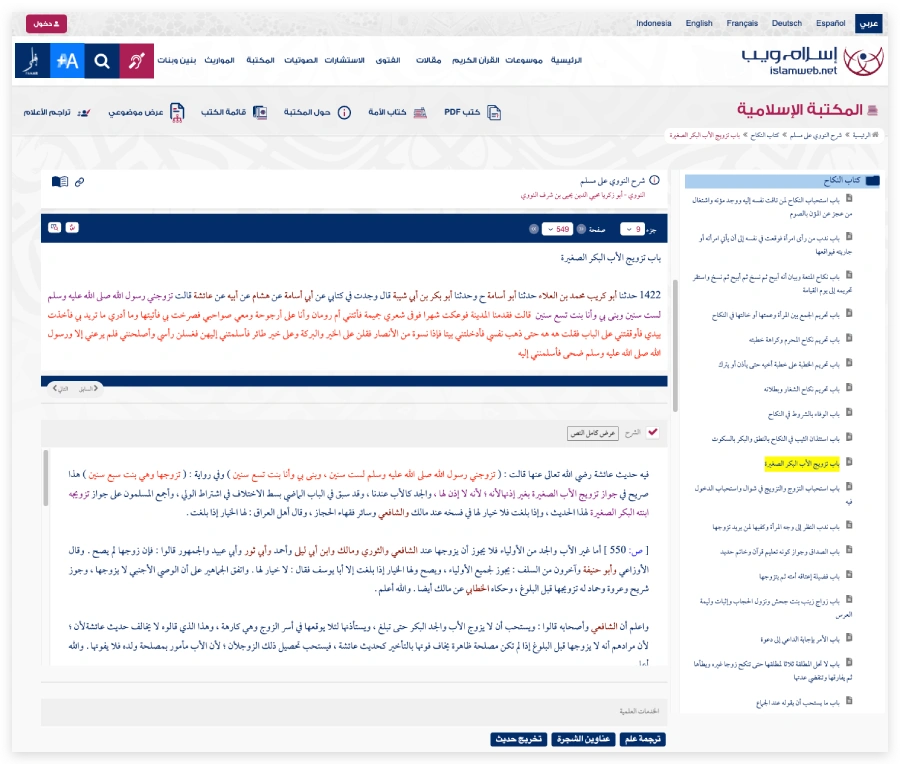
Imam al-Nawawi, Sharh Sahih Muslim
Vol. 9, pp. 549–550
Chapter: A father arranging the marriage of his minor virgin daughter
Arabic original:
باب تزويج الأب البكر الصغيرة
1422 حدثنا أبو كريب محمد بن العلاء حدثنا أبو أسامة ح وحدثنا أبو بكر بن أبي شيبة قال وجدت في كتابي عن أبي أسامة عن هشام عن أبيه عن عائشة قالت: تزوجني رسول الله صلى الله عليه وسلم لست سنين، وبنى بي وأنا بنت تسع سنين. قالت: فقدمنا المدينة فوعكت شهرا، فوفى شعري جميمة، فأتتني أم رومان وأنا على أرجوحة ومعي صواحبي، فصرخت بي فأتيتها وما أدري ما تريد بي، فأخذت بيدي فأوقفتني على الباب، فقلت: هه هه، حتى ذهب نفسي، فأدخلتني بيتا فإذا نسوة من الأنصار، فقلن: على الخير والبركة وعلى خير طائر، فأسلمتني إليهن، فغسلن رأسي وأصلحنني، فلم يرعني إلا ورسول الله صلى الله عليه وسلم ضحى، فأسلمنني إليه.
الشرح:
فيه حديث عائشة رضي الله تعالى عنها قالت: (تزوجني رسول الله صلى الله عليه وسلم لست سنين، وبنى بي وأنا بنت تسع سنين)، وفي رواية: (تزوجها وهي بنت سبع سنين). هذا صريح في جواز تزويج الأب الصغيرة بغير إذنها؛ لأنه لا إذن لها، والجد كالأب عندنا، وقد سبق في الباب الماضي بسط الاختلاف في اشتراط الولي. وأجمع المسلمون على جواز تزويجه ابنته البكر الصغيرة لهذا الحديث، وإذا بلغت فلا خيار لها في فسخه عند مالك والشافعي وسائر فقهاء الحجاز، وقال أهل العراق: لها الخيار إذا بلغت.
أما غير الأب والجد من الأولياء فلا يجوز أن يزوجها عند الشافعي والثوري ومالك وابن أبي ليلى وأحمد وأبي ثور وأبي عبيد والجمهور، قالوا: فإن زوجها لم يصح. وقال الأوزاعي وأبو حنيفة وآخرون من السلف: يجوز لجميع الأولياء، ويصح ولها الخيار إذا بلغت، إلا أبا يوسف فقال: لا خيار لها. واتفق الجماهير على أن الوصي الأجنبي لا يزوجها، وجوز شريح وعروة وحماد له تزويجها قبل البلوغ، وحكاه الخطابي عن مالك أيضا. والله أعلم.
واعلم أن الشافعي وأصحابه قالوا: ويستحب أن لا يزوج الأب والجد البكر حتى تبلغ، ويستأذنها لئلا يوقعها في أسر الزوج وهي كارهة. وهذا الذي قالوه لا يخالف حديث عائشة؛ لأن مرادهم أنه لا يزوجها قبل البلوغ إذا لم تكن مصلحة ظاهرة يخاف فوتها بالتأخير، كحديث عائشة، فيستحب تحصيل ذلك الزوج؛ لأن الأب مأمور بمصلحة ولده فلا يفوتها. والله أعلم.
English translation:
Chapter: A father arranging the marriage of his minor virgin daughter
Hadith 1422: Abu Kurayb Muhammad ibn al-Ala narrated to us; Abu Usama narrated to us. Through another route, Abu Bakr ibn Abi Shayba said: I found in my book this hadith from Abu Usama, from Hisham, from his father, from Aisha, who said: ‘Allah’s Messenger (ﷺ) married me when I was six years old, and I was admitted to his house at the age of nine.’
She further said: We went to Medina and I had an attack of fever for a month, and my hair had come down to the earlobes. Umm Ruman (my mother) came to me and I was at that time on a swing along with my playmates. She called me loudly and I went to her and I did not know what she had wanted of me. She took hold of my hand and took me to the door, and I was saying: Ha, ha (as if I was gasping), until the agitation of my heart was over. She took me to a house, where had gathered the women of the Ansar. They all blessed me and wished me good luck and said: May you have share in good. She (my mother) entrusted me to them. They washed my head and embellished me and nothing frightened me. Allah’s Messenger (, may peace be upon him) came there in the morning, and I was entrusted to him.
Imam al-Nawawi’s commentary:
This section contains Aisha’s hadith, in which she says, ‘Allah’s Messenger married me at six and had marital intercourse with me at nine.’ Another report says, ‘He married her when she was seven.’ This explicitly establishes that a father may marry off his minor daughter without her permission, because her permission has no legal effect. In our school, the grandfather has the same status as the father. The differences over requiring a guardian were discussed in detail in the preceding chapter. On the basis of this hadith, Muslim scholars agreed that a father may marry off his minor virgin daughter. When she reaches puberty, Malik, al-Shafi’i, and the other jurists of the Hijaz hold that she has no option to annul the marriage. The Iraqi jurists hold that she has the option on reaching puberty.
The view of al-Shafi’i, al-Thawri, Malik, Ibn Abi Layla, Ahmad, Abu Thawr, Abu Ubayd, and most scholars is that guardians other than the father or grandfather may not marry off a minor girl. If such a guardian does so, the marriage is invalid. Al-Awza’i, Abu Hanifa, and other early scholars held that all guardians may marry off a minor girl; the marriage is valid, but she may accept or reject it on reaching puberty. Abu Yusuf held that she has no such option. Most scholars agreed that an appointed guardian outside the father or grandfather may not marry her off. Shurayh, Urwa, and Hammad, however, permitted such a guardian to marry her off before puberty, and al-Khattabi reported the same view from Malik. Allah knows best.
Know that al-Shafi’i and his followers said: It is recommended that a father or grandfather not marry off a virgin girl until she reaches puberty, and that he then seek her permission so that she is not bound into her husband’s captivity against her wishes. This does not contradict Aisha’s hadith. Their meaning is that if there is no evident benefit that might be lost through delay, it is better not to marry her off before puberty. If a suitable husband might be lost, as in Aisha’s case, they regarded securing that husband through marriage as preferable; the father is instructed to safeguard his child’s interests and should not allow that benefit to be lost. Allah knows best.
Source: Imam Yahya ibn Sharaf al-Nawawi, Sharh Sahih Muslim, vol. 9, pp. 549–550. [53]
Another point must be made clear. Al-Nawawi writes that, in the view of al-Shafi’i and his followers, it is ‘better’ or mustahabb for a father or grandfather to wait until a girl reaches puberty before marrying her off and then seek her permission. This is not a Sharia rule prohibiting the marriage of a minor girl. Al-Nawawi cites no Quranic verse or hadith from Muhammad imposing a mandatory prohibition on marriage before puberty in support of this particular recommendation. He presents it as the jurisprudential istihbab of al-Shafi’i and his followers. In Islamic jurisprudence, mustahabb means praiseworthy but not obligatory; omitting it carries no prescribed Sharia punishment. Al-Nawawi immediately qualifies the recommendation further: where an ‘evident benefit’ might be lost, marriage may take place before puberty, and he uses Aisha’s marriage as the example of this exception. Presenting this passage as ‘Islam instructs people not to marry off girls before puberty’ is therefore wrong. The relevant Sharia law retains the legality of a minor girl’s marriage. Waiting until puberty is a non-binding jurisprudential recommendation here, not a mandatory law.
Imam al-Nawawi, Sharh Sahih Muslim — Sending a Minor Married Girl to Her Husband and Intercourse
Arabic original:
وَأَمَّا وَقْتُ زِفَافِ الصَّغِيرَةِ الْمُزَوَّجَةِ وَالدُّخُولُ بِهَا فَإِنِ اتَّفَقَ الزَّوْجُ وَالْوَلِيُّ عَلَى شَيْءٍ لَا ضَرَرَ فِيهِ عَلَى الصَّغِيرَةِ عُمِلَ بِهِ، وَإِنِ اخْتَلَفَا فَقَالَ أَحْمَدُ وَأَبُو عُبَيْدٍ: تُجْبَرُ عَلَى ذَلِكَ بِنْتُ تِسْعِ سِنِينَ دُونَ غَيْرِهَا. وَقَالَ مَالِكٌ وَالشَّافِعِيُّ وَأَبُو حَنِيفَةَ: حَدُّ ذَلِكَ أَنْ تُطِيقَ الْجِمَاعَ، وَيَخْتَلِفُ ذَلِكَ بِاخْتِلَافِهِنَّ، وَلَا يُضْبَطُ بِسِنٍّ. وَهَذَا هُوَ الصَّحِيحُ. وَلَيْسَ فِي حَدِيثِ عَائِشَةَ تَحْدِيدٌ، وَلَا الْمَنْعُ مِنْ ذَلِكَ فِيمَنْ أَطَاقَتْهُ قَبْلَ تِسْعٍ، وَلَا الْإِذْنُ فِيهِ لِمَنْ لَمْ تُطِقْهُ وَقَدْ بَلَغَتْ تِسْعًا.
English translation:
Concerning when a minor married girl is to be sent to her husband and intercourse is to take place, if the husband and guardian agree on an arrangement that does not harm her, that arrangement is followed. If they disagree, Ahmad and Abu Ubayd say that a nine-year-old girl may be compelled to do this, but not one younger than nine. Malik, al-Shafi’i, and Abu Hanifa say that the criterion is whether she can endure intercourse. This varies between girls and cannot be determined by a specific age. Al-Nawawi says that this is the correct position. Aisha’s hadith establishes no fixed age limit: it does not prohibit this for a girl below nine who can endure intercourse, nor does it permit it for a girl of nine who cannot endure it.
Source: Imam Yahya ibn Sharaf al-Nawawi, Sharh Sahih Muslim, vol. 9, pp. 550–551. [54]
This passage brings together the basic positions of the four schools. One strand of the Hanbali position permits intercourse without the girl’s consent once she is nine. The Hanafi, Maliki, and Shafi’i positions do not even fix a numerical age: if she has the supposed ‘capacity to endure intercourse’, it is not prohibited even below nine. Classical jurisprudence thus did not ask whether the child was an adult, whether she had menstruated, or whether she could give free consent. It asked whether immediate serious injury to her body would be apparent. The decision to regard a child’s body as suitable for intercourse was not left to the child.
Al-Dawudi comments that Aisha had become ‘physically capable’ at consummation. This is not Aisha’s statement or a sentence in the hadith. Aisha never said that she had menstruated, reached puberty, or consented to intercourse. Al-Dawudi’s comment is a later commentator’s inference. The school-specific law quoted by al-Nawawi in the same commentary makes clear that ‘capacity’ and ‘puberty’ are not identical: jurists permitted intercourse before menstruation.
The Saudi Permanent Fatwa Committee: Intercourse Before Puberty Is Also Permissible
Fatwa 18734 of Saudi Arabia’s Permanent Committee for Scholarly Research and Ifta directly asks whether Muhammad’s marriage to the young Aisha was a ruling specific to him or a law for the Muslim community. It also asks why a waiting period is prescribed for a girl who has not menstruated if intercourse before puberty is not permissible. The committee’s answer is not ambiguous [55]
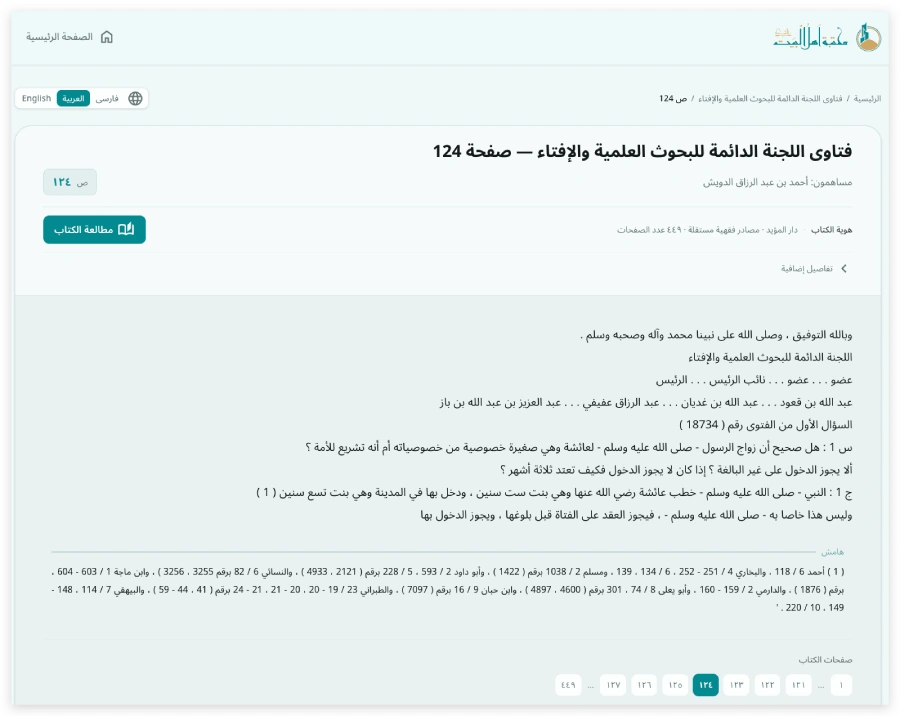
Fatawa al-Lajnah al-Daimah li-l-Buhuth al-Ilmiyyah wa-l-Ifta
Pages 124–125
Arabic original:
وبالله التوفيق، وصلى الله على نبينا محمد وآله وصحبه وسلم.
اللجنة الدائمة للبحوث العلمية والإفتاء
عضو: عبد الله بن قعود
عضو: عبد الله بن غديان
نائب الرئيس: عبد الرزاق عفيفي
الرئيس: عبد العزيز بن عبد الله بن باز
السؤال الأول من الفتوى رقم (18734)
س 1: هل صحيح أن زواج الرسول – صلى الله عليه وسلم – لعائشة وهي صغيرة خصوصية من خصوصياته أم أنه تشريع للأمة؟ ألا يجوز الدخول على غير البالغة؟ إذا كان لا يجوز الدخول فكيف تعتد ثلاثة أشهر؟
ج 1: النبي – صلى الله عليه وسلم – خطب عائشة رضي الله عنها وهي بنت ست سنين، ودخل بها في المدينة وهي بنت تسع سنين (1) وليس هذا خاصا به – صلى الله عليه وسلم -، فيجوز العقد على الفتاة قبل بلوغها، ويجوز الدخول بها ولو قبل البلوغ إذا كانت ممن يوطأ مثلها، أما عدة غير البالغة فالله سبحانه وتعالى جعل عدة الآيسة من المحيض والتي لم تحض لصغرها ثلاثة أشهر، قال تعالى: { وَاللَّائِي يَئِسْنَ مِنَ الْمَحِيضِ مِنْ نِسَائِكُمْ إِنِ ارْتَبْتُمْ فَعِدَّتُهُنَّ ثَلَاثَةُ أَشْهُرٍ وَاللَّائِي لَمْ يَحِضْنَ } أي: كذلك عدتهن ثلاثة أشهر، وغير البالغة تدخل في قوله: { وَاللَّائِي لَمْ يَحِضْنَ }.
هامش:
(1) أحمد 6 / 118، والبخاري 4 / 251 – 252، 6 / 134، 139، ومسلم 2 / 1038 برقم (1422)، وأبو داود 2 / 593، 5 / 228 برقم (2121، 4933)، والنسائي 6 / 82 برقم (3255، 3256)، وابن ماجة 1 / 603 – 604، برقم (1876)، والدارمي 2 / 159 – 160، وأبو يعلى 8 / 74، 301 برقم (4600، 4897)، وابن حبان 9 / 16 برقم (7097)، والطبراني 23 / 19 – 20، 20 – 21، 21 – 24 برقم (41، 44 – 59)، والبيهقي 7 / 114، 148 – 149، 10 / 220.
English translation:
Allah’s help is sought. May Allah’s blessings and peace be upon our prophet Muhammad, his family, and his companions.
Permanent Committee for Scholarly Research and Ifta
Member: Abdullah ibn Qu’ud
Member: Abdullah ibn Ghudayyan
Deputy chairman: Abd al-Razzaq Afifi
Chairman: Abd al-Aziz ibn Abdullah ibn Baz
First question of Fatwa 18734
Question 1: When Muhammad ﷺ married Aisha, she was young. Was this a privilege or ruling specific to the Messenger, or is it also legislation for the Muslim community? Is intercourse with a girl who has not reached puberty not permissible? If intercourse is impermissible, how can she have a waiting period of three months?
Answer 1: The Prophet ﷺ proposed marriage to Aisha when she was six, and in Medina he had marital intercourse with her when she was nine. (1) This was not specific to the Prophet ﷺ. It is therefore permissible to contract marriage with a girl before puberty, and intercourse with her before puberty is permissible if she is regarded as a girl with whom intercourse can take place. Regarding the waiting period of a minor girl, Allah has prescribed three months for a woman whose menstruation has ceased and a girl who has not menstruated because of her young age. Allah says: ‘As for your women past the age of menstruation, in case you do not know, their waiting period is three months, and those who have not menstruated as well.’ (Quran 65:4; Dr. Mustafa Khattab, The Clear Quran.) Their waiting period is likewise three months. A minor girl is included in ‘and those who have not menstruated’.
Footnote:
(1) Ahmad, 6/118; Sahih al-Bukhari, 4/251–252, 6/134, 139; Sahih Muslim, 2/1038, Hadith 1422; Sunan Abi Dawud, 2/593, 5/228, Hadiths 2121 and 4933; Sunan an-Nasa’i, 6/82, Hadiths 3255 and 3256; Sunan Ibn Majah, 1/603–604, Hadith 1876; Sunan al-Darimi, 2/159–160; Abu Ya’la, 8/74 and 301, Hadiths 4600 and 4897; Ibn Hibban, 9/16, Hadith 7097; al-Tabarani, 23/19–24, Hadiths 41 and 44–59; and al-Bayhaqi, 7/114, 148–149 and 10/220.
Source: Fatawa al-Lajnah al-Daimah, vol. 18, pp. 124–125. [56] [57]
This fatwa makes the modern apologetic argument that ‘Aisha must have been menstruating’ irrelevant. The Saudi committee does not confine Aisha’s case to a ruling specific to Muhammad. It explicitly says that intercourse may be permissible before puberty, provided the girl is regarded as someone with whom intercourse can take place. Puberty is therefore not an indispensable condition under this ruling. This statement appears on pages 124–125 of volume 18 of the printed fatwa collection [58] [57].
Qatar-Based Islamweb: A Child’s Consent Is Not Required
The title of Qatar-based Islamweb’s Fatwa 230518 is itself ‘Evidence that a father may marry off his minor daughter without her permission or consent’. Quoting Ibn Qudama’s al-Mughni, it says there is no disagreement concerning a minor virgin daughter: a father may marry her to a suitable husband. Ibn al-Mundhir reports a consensus among the scholars known to him. Quoting Ibn Abd al-Barr, the fatwa further states that Abu Bakr married six-year-old Aisha to Muhammad without consulting her; this is the evidence that a minor daughter’s consent is unnecessary [31].
فقد حكى بعض العلماء الإجماع على أن للأب تزويج ابنته البكر الصغيرة بغير رضاها، ولا يشترط إذنها، ونعني بالصغيرة من ليست بالغة. جاء في المغني لابن قدامة: «أما البكر الصغيرة: فلا خلاف فيها». قال ابن المنذر: «أجمع كل من نحفظ عنه من أهل العلم أن نكاح الأب ابنته البكر الصغيرة جائز، إذا زوجها من كفء»… ومستند هذا الإجماع أن أبا بكر زوج عائشة رضي الله عنها من رسول الله صلى الله عليه وسلم ولم يشاورها.
Islamweb’s fatwa states: Some scholars reported a consensus that a father may marry off his minor virgin daughter without her consent, and her permission is not a condition; ‘minor’ denotes someone who has not reached puberty. The fatwa supports this rule by quoting Ibn Qudama and Ibn al-Mundhir, and identifies Abu Bakr’s marrying Aisha to Muhammad without consulting her as its basis.
Deobandi Hanafi Fatwas: Forced Marriage Before Puberty
Responding to a question about the appropriate age for marriage, Darul Uloom Deoband in India states in Fatwa 788/B that Islam has fixed no particular age. More explicitly, it says that before a boy or girl reaches puberty, the father has the right to arrange and impose their marriage; after puberty, marriage may no longer be forced. Deoband’s fatwa therefore does not make eighteen years of age, psychological adulthood, or a child’s free consent prerequisites for marriage. It states very explicitly that until a boy or girl becomes mature, the father has the right to marry them off forcibly; after maturity, marriage cannot be forced.” [59]
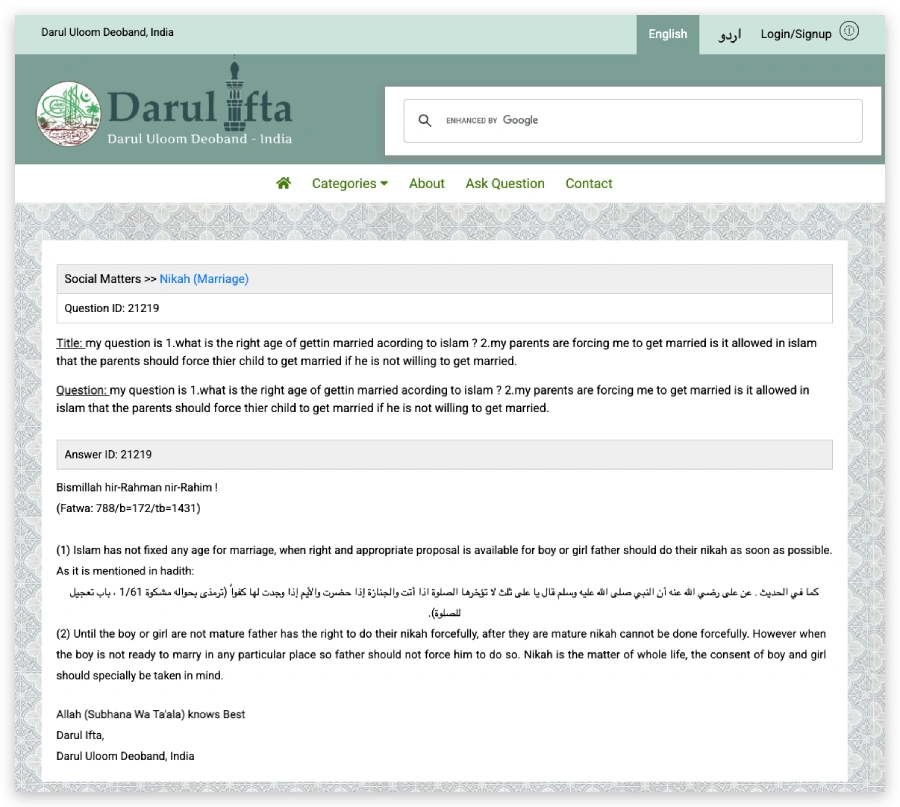
Question ID: 21219
Title: my question is 1.what is the right age of gettin married acording to islam ? 2.my parents are forcing me to get married is it allowed in islam that the parents should force thier child to get married if he is not willing to get married.
Question: my question is 1.what is the right age of gettin married acording to islam ? 2.my parents are forcing me to get married is it allowed in islam that the parents should force thier child to get married if he is not willing to get married.
Answer ID: 21219
Bismillah hir-Rahman nir-Rahim !
(Fatwa: 788/b=172/tb=1431)
(1) Islam has not fixed any age for marriage, when right and appropriate proposal is available for boy or girl father should do their nikah as soon as possible. As it is mentioned in hadith:
كما في الحديث . عن على رضي الله عنه أن النبي صلى الله عليه وسلم قال يا على ثلث لا تؤخرها الصلوة اذا أتت والجنازة إذا حضرت والأيم إذا وجدت لها كفواً (ترمذى بحواله مشكوة 1/61 ، باب تعجيل للصلوة).
(2) Until the boy or girl are not mature father has the right to do their nikah forcefully, after they are mature nikah cannot be done forcefully. However when the boy is not ready to marry in any particular place so father should not force him to do so. Nikah is the matter of whole life, the consent of boy and girl should specially be taken in mind.
Allah (Subhana Wa Ta’ala) knows Best
Darul Ifta,
Darul Uloom Deoband, India
A fatwa of Jamia Uloom Islamia Banuri Town, an institution in the Deobandi Hanafi tradition, shows the practical application of this law. A girl of seven or eight had been married to a boy of seven or eight to settle a family dispute. After reaching puberty, she rejected the marriage. The fatwa department nevertheless stated that when a father marries off his minor daughter, she generally has no right to reject that marriage on reaching puberty. An exception may apply if the father was already notoriously known for making incompetent decisions. Otherwise, the childhood marriage remains binding, and she must obtain her husband’s divorce or a Sharia-compliant khula to leave it [60].
Jamia Uloom Islamia Banuri Town, Fatwa 144412100356
‘The father and grandfather are the closest guardians. When the closest guardian marries off a minor girl, she generally has no right to annul the marriage after puberty. In the present case, because the marriage took place with the father’s consent, the marriage has been contracted and the girl retains no option to reject it after puberty. If she is unwilling to live with her husband, she may separate by obtaining a divorce from him or a Sharia-compliant khula; unilateral rejection of the marriage is insufficient.’
Another fatwa from the same institution quotes Fatawa Shami as saying that a guardian may force minor boys and girls into marriage, and that a marriage arranged by a father or grandfather becomes binding without awaiting anyone’s subsequent approval. Even if the girl rejects the marriage after puberty, that rejection alone does not end it [61].
The Claim That ‘Only Hisham ibn Urwa Reported It’ Is Also False
Another widely circulated strategy for denying Aisha’s age claims that the hadith giving six and nine was reported only by Hisham ibn Urwa, who supposedly lost his memory after moving to Iraq in old age. Examination of the full chains does not sustain this claim. Hisham did transmit from Aisha through his father Urwa, but Sahih Muslim also preserves the information through routes that do not include Hisham. One is Ma’mar → al-Zuhri → Urwa → Aisha; another is Abu Mu’awiya → al-A’mash → Ibrahim → al-Aswad → Aisha. The second route combines all three details: marriage at six, intercourse at nine, and Aisha’s age of eighteen when Muhammad died.
أَخْبَرَنَا عَبْدُ الرَّزَّاقِ، أَخْبَرَنَا مَعْمَرٌ، عَنِ الزُّهْرِيِّ، عَنْ عُرْوَةَ، عَنْ عَائِشَةَ، أَنَّ النَّبِيَّ صلى الله عليه وسلم تَزَوَّجَهَا وَهْىَ بِنْتُ سَبْعِ سِنِينَ وَزُفَّتْ إِلَيْهِ وَهِيَ بِنْتُ تِسْعِ سِنِينَ…
Reported through Abd al-Razzaq → Ma’mar → al-Zuhri → Urwa → Aisha: Muhammad married Aisha at seven, and she was sent to him at nine. This chain does not contain Hisham ibn Urwa.
حَدَّثَنَا أَبُو مُعَاوِيَةَ، عَنِ الأَعْمَشِ، عَنْ إِبْرَاهِيمَ، عَنِ الأَسْوَدِ، عَنْ عَائِشَةَ، قَالَتْ تَزَوَّجَهَا رَسُولُ اللَّهِ صلى الله عليه وسلم وَهْىَ بِنْتُ سِتٍّ وَبَنَى بِهَا وَهْىَ بِنْتُ تِسْعٍ وَمَاتَ عَنْهَا وَهْىَ بِنْتُ ثَمَانَ عَشْرَةَ.
Reported through Abu Mu’awiya → al-A’mash → Ibrahim → al-Aswad → Aisha: Muhammad married her at six, consummated the marriage through intercourse at nine, and Aisha was eighteen when he died. This chain also does not contain Hisham ibn Urwa.
Sahih Muslim 1422c; Sahih Muslim 1422d
Hisham’s own report is not merely a single transmission from his Iraqi years. The information was preserved from him through several narrators associated with Medina, Mecca, Basra, and Rayy. IslamQA’s collected isnad review mentions reports from Abu al-Zinad, Abd al-Rahman ibn Abi al-Zinad, Sufyan ibn Uyayna, Jarir ibn Abd al-Hamid, Hammad ibn Salama, Hammad ibn Zayd, and Wuhayb ibn Khalid. The claim that ‘an elderly Hisham invented the story alone in Iraq’ therefore fails on two levels: the information also appears through chains without Hisham, and Hisham’s own transmission does not depend on a single Iraqi student [62].
The uncertain historical calculation that Asma was exactly ten years older than Aisha cannot invalidate the authentic hadiths either. The report of a ten-year difference depends on a single statement by Abd al-Rahman ibn Abi al-Zinad, and Ibn Abd al-Barr’s wording is ‘ten years or thereabouts’. The narrator himself was therefore unsure of the precise number. By contrast, the information about Aisha’s ages of six and nine appears in her own name through several independent chains. Using historical conjecture to override her direct statement and multiple routes in al-Bukhari and Muslim is unacceptable even under Islamic hadith scholarship’s own rules.
The Inescapable Conclusion of This Evidence
Read together, the full testimony of the hadiths, the explanations in Fath al-Bari, the school-specific discussions in Sharh Muslim, and the decisions of Saudi, Qatari, and Deobandi fatwa institutions leave no ambiguity. Muhammad married a six-year-old child and had intercourse with her at nine. No hadith states that Aisha began menstruating at nine. The al-Bukhari report used to support that claim refers only to childhood memories, while Abu Dawud’s report describes panting and breathing, not menstruation.
Al-Bukhari places the event under the chapter on marrying off minor children. Ibn Hajar writes that Abu Bakr married Aisha off before puberty. In al-Khattabi’s interpretation, she had not reached puberty even while playing with dolls. In the school-specific law quoted by al-Nawawi, neither puberty nor the age of nine is a minimum limit for Malik, al-Shafi’i, or Abu Hanifa: intercourse is not prohibited at a younger age if the girl is judged able to endure it. According to Ahmad, a nine-year-old girl may be sent to her husband for intercourse without her consent. The Saudi committee states even more directly that intercourse before puberty is permissible and that Aisha’s case was not specific to Muhammad.
Statements such as ‘girls matured faster in Arabia then’, ‘Aisha was an adult woman at nine’, or ‘Islam prohibits intercourse before puberty’ are therefore not the statements of the hadiths or classical jurisprudence. They are modern reinterpretations inconsistent with the principal hadith sources and classical law. The original sources state that a child’s consent was not required for marriage, that puberty was not an indispensable condition for intercourse, and that later jurists made intercourse between an adult man and nine-year-old Aisha an enduring legal precedent for child marriage and intercourse with a minor wife.
Conclusion
The principal Islamic sources are not ambiguous about Aisha’s age. Multiple reports in Sahih al-Bukhari, Sahih Muslim, Sunan Abi Dawud, Sunan an-Nasa’i, and Sunan Ibn Majah give marriage at six and marital intercourse at nine. Although one report gives seven as the age at marriage, the age at intercourse remains nine. The same reports portray Aisha playing on a swing, playing with girlfriends, keeping dolls, and not understanding why her mother was taking her away. Women washed, adorned, and prepared her before handing her over to Muhammad. These accounts do not depict an independent, mature nine-year-old woman; they describe a child’s behaviour, understanding, and social position.
No hadith states that Aisha reached puberty or began menstruating at nine. Al-Bukhari’s phrase لَمْ أَعْقِلْ, used to support that claim, concerns memory and understanding, not puberty. Abu Dawud’s تَنَفَّسَتْ means breathing or panting; translating it as menstruation is linguistically wrong. Aisha’s menstruation at Sarif occurred during the Farewell Pilgrimage, when the hadiths’ own chronology places her at approximately eighteen. The claim of menstruation at nine is therefore not information supplied by the original sources but an unsupported defensive construction of a later period.
More importantly, classical Islamic law did not reject this event as exceptional or abnormal. Al-Bukhari includes Aisha’s report under his own heading concerning the marriage of minor children; the widely used heading supplied by al-Nawawi for Sahih Muslim similarly places it under the marriage of a minor virgin daughter. Ibn Hajar explicitly writes that Abu Bakr married Aisha off before puberty. Al-Nawawi’s jurisprudential discussion does not make puberty an indispensable condition of intercourse; it asks whether the girl can ‘endure’ it. The Saudi Permanent Fatwa Committee likewise explicitly states that Aisha’s case was not specific to Muhammad and that intercourse may be permissible before puberty. Islamweb and Hanafi fatwa literature similarly recognise the legality of a father marrying off a minor daughter without her consent.
The problem is therefore not merely the age of a seventh-century bride. It is a religious and legal structure in which a child’s free consent is unnecessary for marriage, puberty is not a universal prerequisite for intercourse, and later jurists used a sexual relationship between a nine-year-old child and a man over fifty as a precedent for legality. Claims such as ‘it was normal in that society’, ‘Aisha matured quickly’, or ‘Islam prohibits intercourse before puberty’ do not match the testimony of the original hadiths and classical jurisprudence.
Raising her age, inserting puberty into translations, presenting bana biha or parallel reports of intercourse as merely ‘taking her into his house’, or treating Aisha’s silence as consent in order to make the event acceptable by modern moral standards—none of these is history grounded in the sources. The event the sources preserve is much simpler and much harsher: Aisha married at six, Muhammad had intercourse with her at nine, and Islamic law turned the event into a precedent for the legality of marrying off minor daughters and having intercourse with them. Religious explanations may be altered to deny these facts; the recorded statements of hadith and jurisprudence cannot be changed.
References
- Sahih al-Bukhari, Hadith 5133 ↩︎
- Sahih al-Bukhari, Hadith 5158 1 2
- Sahih al-Bukhari, Tawhid Publications, Hadith 5133 ↩︎
- Sahih al-Bukhari, Islamic Foundation, Hadith 4757 ↩︎
- Sahih al-Bukhari, Islamic Foundation, Hadith 2485 ↩︎
- Sahih al-Bukhari, Hadith 3894 ↩︎
- Sahih al-Bukhari, Islamic Foundation, Hadith 1462 ↩︎
- Sahih al-Bukhari, Tawhid Publications, Hadith 3896 ↩︎
- Sahih al-Bukhari, international number 3896 ↩︎
- Sahih Muslim, Hadith Academy, Hadith 3370 ↩︎
- Sahih Muslim, vol. 5, Bangladesh Islamic Centre, p. 37 ↩︎
- The textual history of Sahih Muslim’s chapter headings ↩︎
- Sahih Muslim, Hadith 3371 ↩︎
- Sahih Muslim, Hadith 3372 ↩︎
- Sahih Muslim, Hadith 3373 1 2
- Sunan Abi Dawud, Islamic Foundation, Hadith 4851 1 2
- Abu Dawud Sharif, vol. 5, Islamic Foundation, pp. 521–522 ↩︎
- Sunan Abi Dawud, international number 4933 ↩︎
- Sunan an-Nasa’i, Islamic Foundation, Hadith 3381 ↩︎
- Sunan an-Nasa’i, international number 3378 ↩︎
- Sunan Ibn Majah, Hadith 1876 ↩︎
- The difference between lunar and solar years ↩︎
- Ashab-e Rasul-er Jibankatha: Ummahat al-Mu’minin, Muhammad Abdul Mabud, vol. 5, Bangladesh Islamic Centre, p. 55 ↩︎
- Sahih al-Bukhari, Hadith 3896 ↩︎
- Ashab-e Rasul-er Jibankatha, Ummahat al-Mu’minin, Muhammad Abdul Mabud, Bangladesh Islamic Centre, vol. 5, p. 39 ↩︎
- Sahih al-Bukhari, Hadith 5078 ↩︎
- Sahih al-Bukhari, Hadith 7011 ↩︎
- Sahih al-Bukhari, Tawhid Publications, Hadith 5081 1 2
- Sahih al-Bukhari, international number 5081 ↩︎
- Al-Bidaya wa-l-Nihaya, Ibn Kathir, Islamic Foundation Bangladesh, vol. 3, pp. 248–249 ↩︎
- Islamweb, Fatwa 230518 1 2
- Al-Tabari, Tarikh al-Rusul wa-l-Muluk, vol. 39, pp. 171–173 ↩︎
- Al-Tabari: marriage, intercourse eight months after the Hijra, and the report of her age as nine ↩︎
- Al-Tabari: the mahr and marital intercourse ↩︎
- Al-Tabari, Tarikh al-Rusul wa-l-Muluk, English translation, vol. 39, pp. 171–173 ↩︎
- Sahih al-Bukhari, Hadith 6130 ↩︎
- Sahih Muslim, Hadith 2440a ↩︎
- Al-Adab al-Mufrad, Hadith 368 ↩︎
- Sunan Abi Dawud, Hadith 4932 ↩︎
- Sunan an-Nasa’i, Islamic Foundation, Hadith 3224 ↩︎
- Sunan an-Nasa’i, international number 3221 ↩︎
- Sahih al-Bukhari, Bengali translation, Hadith 476 ↩︎
- Sharh Sunan Abi Dawud: the explanation of Aisha’s panting ↩︎
- Ibn Hajar, Fath al-Bari: باب كيف كان بدء الحيض ↩︎
- Al-Bukhari’s fuller report and the discussion in Fath al-Bari ↩︎
- Umdat al-Qari: the chronology of Aisha’s menstruation at Sarif ↩︎
- Sunan Abi Dawud, Hadith 313 ↩︎
- Ibn Hajar al-Asqalani, Fath al-Bari, Book of Marriage ↩︎
- Islamweb: Fath al-Bari, the chapter on marrying off minor children ↩︎
- Ibn Hajar al-Asqalani, Fath al-Bari Sharh Sahih al-Bukhari, Book of Manners; commentary on the hadith of Aisha playing with dolls. Online edition ↩︎
- Sahih Muslim, Hadith 1948 ↩︎
- Imam Yahya ibn Sharaf al-Nawawi, Sharh Sahih Muslim, vol. 9, pp. 549–550, ‘باب تزويج الأب البكر الصغيرة’. Islamweb: Sharh Sahih Muslim, vol. 9, p. 549 ↩︎
- Islamweb: Sharh Sahih Muslim, vol. 9, p. 549 ↩︎
- Islamweb: Sharh Sahih Muslim, discussion of intercourse with a minor wife ↩︎
- Fatawa al-Lajnah al-Daimah li-l-Buhuth al-Ilmiyyah wa-l-Ifta, p. 124. Original Arabic edition, p. 124 ↩︎
- Page 124 ↩︎
- Page 125 1 2
- Fatawa al-Lajnah al-Daimah, vol. 18, p. 124 ↩︎
- Darul Uloom Deoband, Question 21219 ↩︎
- Banuri Town: a minor girl’s marriage and rejection after puberty ↩︎
- Banuri Town: the marriage of a minor girl arranged by her grandfather ↩︎
- IslamQA: Aisha’s age and multiple chains of transmission ↩︎