
Introduction
The calculation that believing a claim would be beneficial is not evidence that the claim is true. Pascal’s Wager offers a practical directive in favor of religious belief: even without conclusive evidence of God’s existence, considerations of gain and loss should lead us toward belief. Whether God exists and whether trying to believe in God would benefit an individual are two separate questions. Answering the second also requires a reliable basis for claims about rewards, punishments, and the conditions of salvation. In religious advocacy, the wager is presented as a safe proposition, as though belief must necessarily be the wiser choice than disbelief even when sufficient evidence for belief is lacking. It is this claim of necessity that requires examination.
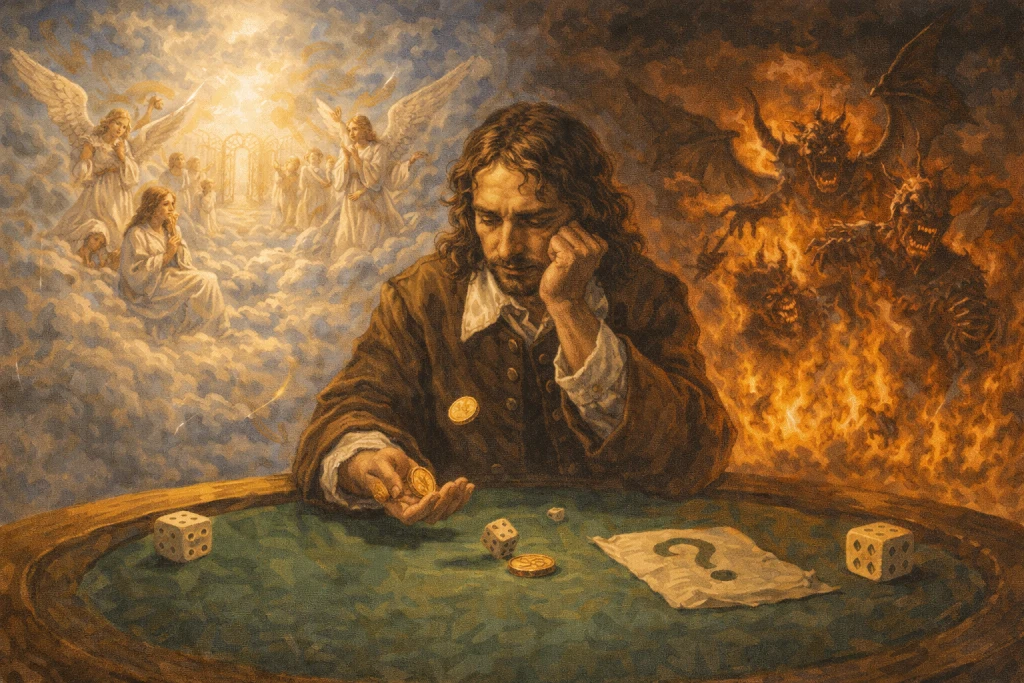
The French mathematician and philosopher Blaise Pascal’s posthumously published Pensées preserves the celebrated discussion of the wager. The work’s conventional publication history begins with the edition published in 1670; in a modern arrangement, the discussion is known as Brunschvicg fragment 233. Pascal’s central contention is that if there is a chance of gaining eternal happiness in exchange for finite sacrifices during a brief earthly life, one ought to wager in favor of that chance. A particular system of religious salvation is assumed to have some probability of being true, and its expected benefit is used to generate a directive to move toward belief. [1]
L’édition originale proprement dite est sortie en janvier 1670.
English translation: The original published edition appeared in January 1670.
In Pascal’s own words, winning means gaining everything, while losing means losing nothing. The appeal of this statement arises from placing two unequal things side by side: an individual’s actual life on one side and a religious promise of infinite happiness on the other. But for that promise to be fulfilled, much more must be true than the existence of a Creator: there must be an afterlife, a particular system of judgment must operate, and moving toward belief must be the means of salvation within that system. Merely saying that an unknown Creator could exist does not establish a reliable probability for this entire arrangement. Writing an infinite reward into a decision table is easy; why the promise of that reward and its conditions of admission should be accepted remains unresolved. [2]
si vous gagnez, vous gagnez tout, si vous perdez, vous ne perdez rien.
English translation: If you win, you win everything; if you lose, you lose nothing.
A decision-theoretic calculation requires at least four things: which states might obtain, which actions are possible, what each action would produce, and the probabilities of the relevant states. The problems with Pascal’s Wager begin with the specification of these elements. Although God’s existence is unknown, the nature of His rewards is treated as known; although the absence of evidence is acknowledged, a favorable probability is assigned; and in assessing the cost of belief, people’s time, freedom, and opportunities for inquiry are reduced to minor expenses. The following table presents the gains and losses claimed in the conventional wager. Its promises are not substitutes for verification; they are themselves claims requiring verification.
The claimed eternal reward, if a particular religion’s doctrine of salvation is true and belief is a condition of salvation.
The actual cost of religious observance in time, money, freedom, and other opportunities.
The claimed eternal punishment for disbelief, if a particular doctrine of punishment is true.
Opportunities for inquiry, ethical action, relationships, and living outside religious obligations.
The Many Gods Objection
The many gods objection does not rest simply on counting the world’s religions. Its central point is that the same wagering method can generate incompatible religious conclusions. One preacher may say that accepting his religion brings eternal salvation and rejecting it brings punishment; a preacher of another religion may make the same kind of claim for his own faith. The magnitude of the first person’s claimed benefit does not invalidate the second person’s claim. If both are permitted to offer infinite rewards instead of evidence, the calculation does not yield a uniquely compulsory choice. If the same decision procedure supports incompatible conclusions, it is insufficient for selecting a particular religion.
“God exists or does not exist” is an exhaustive logical dichotomy. The error occurs when all the claims of a particular religion are silently inserted into “God exists,” or when “this religion’s God does not exist” is passed off as “there is no supernatural system of judgment at all.” The existence of a Creator, human survival after death, the existence of heaven, admission to it through belief in the correct doctrine, and a particular religion’s accurate knowledge of that doctrine are separate claims. Accepting one does not make all the others true. The probability that God exists is therefore not the same as the probability that an entire particular doctrine of religious salvation is true.
In The Will to Believe, William James identifies precisely this religion-specific limitation of Pascal’s Wager. Advice to participate in Christian worship and take holy water influences someone who already regards those rituals as possible means of salvation. James places a structurally identical promise in the mouth of the Mahdi, showing that the method of reasoning remains the same even when the language of the claimed infinite reward changes. His example matters because the wager’s appeal depends on a prior attachment to a familiar religious framework. Mathematics itself does not turn that familiarity into truth. [3]
His logic would be that of Pascal; but he would vainly use it on us, for the hypothesis he offers us is dead.
English translation: His reasoning would be the same as Pascal’s, but it would be ineffective with us, because the hypothesis he offers is not a live possibility for us.
There is no need to assign equal probabilities to all religious doctrines here. Even without equal probabilities, the problem remains: an independent reason is needed for treating one doctrine’s reward as real and a rival doctrine’s reward as false. A person’s inherited fear of one religion’s punishment does not mathematically reduce another religion’s threat of punishment to zero. Nor do a religion’s age, number of adherents, or familiar rituals themselves make its promises about the afterlife true. Requiring evidence to determine probabilities returns us to inquiry; declaring evidence unnecessary leaves no basis for privileging a favored religion.
Practicing every religion simultaneously does not solve this problem either. Mutually contradictory requirements of worship and salvation cannot all be accepted as true. Where the worship of one exclusive God is obligatory and other worship is forbidden, safety cannot be purchased through compromise with every claimant. The wager therefore does not become a religion-neutral general safeguard; it remains dependent on accepting a particular theology in advance.
The falsity of one doctrine of salvation does not make every other supernatural system of judgment false.
Different religious claims, different interpretations within one religion, and the possibility that none of the claims is true must also be considered.
Incomplete payoff structure: Accepting one religion’s rules of reward while excluding all other claims predetermines the conclusion. The wager provides no independent evidence for choosing among rival claims.
An Example: 4,200 Fraudulent Companies and the Promise of a House
Consider a hypothetical example. A company called “Ultapalta24” claims that it will provide an enormous house after ten years in return for a small monthly payment. Its ownership, assets, and record of fulfilling promises to previous customers cannot be verified. Its representative simply emphasizes the enormous size of the future benefit.
“Pay us just 1,000 taka every month, and after ten years we will give you a luxurious 100-story house.”
Now more companies appear with similar claims. For illustration, let their number be 4,200; this is not a statistic about the world’s religions. Each company calls its own claim true and the others fraudulent. Counting the companies does not establish the probability that any particular one is honest. What is needed is evidence of their assets, their ability to fulfill their promises, and opportunities to verify the information. An unsupported promise would not have been acceptable even if there were only one company; the existence of many companies shows why the same kind of inducement cannot select a single claimant.
| Issue | Conditions in the hypothetical example |
|---|---|
| Company names | 4,200 separate claimants in the example |
| Who is the owner? | The owner’s identity and financial capacity cannot be verified |
| Government registration | No evidence of the claimed business’s registration has been provided |
| Has it previously given anyone a house? | There is no independent evidence of promises being fulfilled |
| Who receives the payments? | Representatives who ask for belief instead of providing evidence |
| Where is the house? | There is no address or evidence of an actual property |
| The argument offered to customers | The promise of an enormous future benefit in exchange for money now |
A company might be telling the truth—but that statement does not entail that one should give it money. Conceiving of an event in probabilistic language and establishing a meaningful probability for that event are separate tasks. If we adopt the rule that the larger a party’s promised reward, the more money we should give it, the biggest promisor becomes the most credible without any evidence. This rewards the size of the claim rather than honesty or actual capacity. In religious wagering, the word “infinite” receives the same advantage: however unverifiable the promise, an attempt can be made to end inquiry merely by increasing its magnitude.
The decision in this example rests on three questions:
- What independent evidence supports the promisor?
- What is the reason for choosing this claimant rather than another?
- What actual costs follow if the claim is false, and is there an opportunity to wait and gather information?
The logical basis of this comparison is the extraction of present allegiance through an unsupported promise about the future. The value of a house does not establish the company’s capacity to provide it, just as the claimed value of heaven does not establish its existence or its conditions of admission. The magnitude of a claimed outcome does not guarantee that it will actually be obtained.
Table: Pascal’s Wager and the Example of 4,200 Companies
| Issue | The religious wager’s claim | The hypothetical company’s claim |
|---|---|---|
| Claimed benefit | Salvation in the afterlife under specified conditions | A future house in exchange for payments |
| Claimed consequence of rejecting the offer | Exclusion from salvation or punishment | Not receiving the promised house |
| The question of evidence | What grounds support the truth of the afterlife and the conditions of salvation? | What grounds establish the assets and the capacity to fulfill the promise? |
| Rival claimants | Incompatible religious doctrines of salvation | Several companies making similar promises |
| Claiming to be uniquely correct | The religious claimant declares his particular path indispensable | Each company calls the others wrong |
| Evidence of a guarantee | Announcing a reward does not itself establish a guarantee | Announcing a house does not itself establish a guarantee |
| Identification of authority | How is the authority to speak in God’s name established? | How are the owner’s identity and the representative’s authority established? |
| Actual present costs | Time, money, freedom, and opportunity costs | Money paid and the opportunity costs of other investments |
Calling a promise true does not make its costs imaginary. Religious allegiance can make real demands on time, money, relationships, careers, decisions about one’s body, and freedom of expression. The costs of a particular religious system must be assessed through its specific rules and their social application. Declaring a possible reward infinite and labeling every loss in this life a “minor sacrifice” is itself a value judgment, not a mathematical theorem. Individuals also have the right to assess the value of the time and freedom of the life whose existence is certain.
It is also misleading to portray the consequences of disbelief solely as indulgence. Without accepting religious claims, people can devote their lives to the pursuit of truth, friendship, art, knowledge, and the welfare of others. Placing morality on one side of a belief-versus-disbelief table and only temporary pleasure on the other distorts people’s actual alternatives. Atheists have ethical lives; believers incur opportunity costs through religious observance. The wager’s table compresses these lives to suit its own purposes.
Mathematical Analysis: A Probabilistic Perspective
The number of religions or sects does not determine the probability that any one of them is true. Writing down 4,200 names does not turn them into 4,200 equally probable and mutually exclusive possibilities. Several doctrines may share the same claims, conflicting views may exist within a single religion, and every claim on the list may be false. Before calling the reciprocal of a number a probability, one must establish what is being counted, whether the possibilities are exhaustive, and why they should receive equal weight. Laplace likewise explicitly states the condition of equal possibility in the rule for determining probability by counting favorable cases. [4]
But that supposes the various cases equally possible.
English translation: But this assumes that the various cases are equally possible.
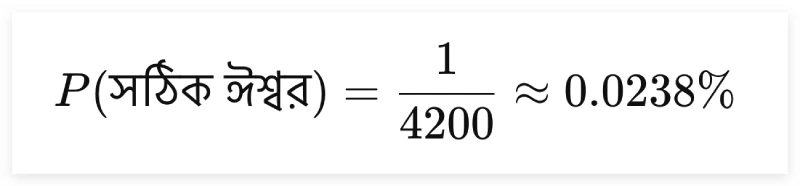
Confusing two different tests produces incorrect calculations. The first asks how much evidence supports a religious claim. The second assumes that a closed list contains exactly one correct answer and that one cell will be selected with equal chances, as in a lottery. The fraction below follows only from the rules of the second test. It is no discovery about the actual probability of religious truth.
Hypothetical model: N mutually exclusive alternatives, exactly 1 correct, selection with equal chances.
P(selecting the correct cell) = 1/N
If N = 4200: 1/4200 ≈ 0.000238095 = 0.0238095%
This number does not measure religious truth; it follows from a specified selection procedure.
After choosing a religion, disagreements within it about the conditions of salvation raise further questions. Reports concerning sects in Islam provide a specific example of this religious uncertainty. What matters here is the existence of disagreement and the claimed consequences of that disagreement in the afterlife; counting sects does not legitimately produce a percentage for an actual risk of hell.
Islam’s 73 Sects: Choosing a Religion Does Not Guarantee Salvation
Abu Dawud 4597 attributes to Muhammad a statement that the community will divide into 73 groups, with 72 going to hell and one to paradise. The account also appears in Hadith Shomvar 1528. If this statement is accepted as a criterion of salvation, merely calling oneself Muslim provides no ultimate guarantee; the question of which religious interpretation and group is correct also arises. [5] [6]
وَإِنَّ هَذِهِ الْمِلَّةَ سَتَفْتَرِقُ عَلَى ثَلاَثٍ وَسَبْعِينَ ثِنْتَانِ وَسَبْعُونَ فِي النَّارِ وَوَاحِدَةٌ فِي الْجَنَّةِ وَهِيَ الْجَمَاعَةُ
English translation: And this community will divide into 73 groups; 72 will go to the Fire and one to paradise; that is the Jama‘ah.
The number 73 in the report is a numerical religious claim, not 73 tested samples with equal probabilities. The statement provides no information establishing that every group has equal membership, equivalent doctrines, or an equal probability of being true. Which groups count as units is also a separate question. Writing the joint probability of the two relevant hypotheses requires conditional probability:
E = available evidence; Hᵢ = a particular religious doctrine of salvation is true; Sⱼ = its particular interpretation is correct.
P(Hᵢ and Sⱼ | E) = P(Hᵢ | E) × P(Sⱼ | Hᵢ, E)
Only if equal selection is assumed at both stages: 1/4200 × 1/73 = 1/306600
≈ 0.00000326158 = 0.000326158%
This assumption of equal selection does not determine actual religious probabilities.
The multiplication rule matters here because it shows that accepting a broad belief and the truth of its particular conditions of salvation are separate questions. The first probability cannot be substituted for the second. But directly inserting the reciprocals of 4,200 and 73 as those probabilities requires an additional assumption of equal selection. Calling the complement of the resulting fraction the “probability of going to hell” introduces a further error: it already assumes the truth of the afterlife, punishment, and a particular doctrine of salvation.
The wager’s weakness in the sect example is therefore not some percentage engineered to make it look frightening. Its weakness is that the religious allegiance presented as safety contains conflicting definitions of safety within itself. Knowing a claimant’s identity does not establish his authority over the afterlife. An argument that cannot identify the true religion cannot guarantee identification of the true sect either.
Accepting a Creator’s existence does not entail the truth of a particular doctrine of salvation.
The correct conditions of salvation within the chosen religion also require assessment.
The multiplication rule gives the joint value of the two stages; p and q each require their own basis.
Mathematical conclusion: A Creator, a religious doctrine of salvation, and a particular interpretation are separate claims. Accepting one does not establish the others. Determining the probability at each stage requires relevant evidence.
Logical Fallacies in Pascal’s Wager
Several distinct errors must be separated in criticizing the wager. The exclusion of alternatives occurs when every state outside one particular religion is placed in a single cell. Fear replaces evidence when the terrifying nature of punishment is used to establish the truth of the claim. The question is begged when the existence of heaven and the conditions of salvation remain unestablished but are nevertheless used as guaranteed rules of reward. A diversion occurs when a question about truth is answered by invoking belief’s psychological benefits. The same statement can perform several functions, but each error has a specific basis.
Fear is not itself irrational in every situation. The risk of being burned by putting a hand in fire is established through actual causes and observation. In a religious threat, it is precisely that causal connection that awaits evidence. “Fire is terrifying” does not entail “the hell described by this preacher is real.” However severe a threat, the reliability of its source must be assessed separately. Increasing the severity of punishment instead of providing evidence for the claim does not improve the quality of inquiry; it only increases the psychological cost of rejection.
The Use of Mathematical Probability and Decision Theory
Expected utility is obtained by multiplying the value of each possible outcome by its probability and adding the products. If A is an action and Hᵢ a relevant state, then in an ordinary finite model EU(A) = Σ P(Hᵢ | E) × U(A, Hᵢ). Here E is the available evidence and U is the individual’s valuation of the outcome. However precise the rule of addition, it does not itself generate probabilities or outcome values. If incorrect or unestablished values are entered, the calculation will precisely display the consequences of those assumptions; it will not make the assumptions true.
In a simple finite example, let the present cost of belief be C, the promised reward R, and the probability that the entire promise is true p. Assuming all other payoffs are zero and that the cost is incurred whenever one believes, the expected net payoff is pR − C. For this to be favorable, pR > C is required. Whether the same reward makes the choice worthwhile depends on all three quantities: p, R, and C. Thus, “there is a chance of gaining something” is not itself a decision. Reliable payoff specifications, probabilities, and assessments of costs are indispensable components of a decision.
The distinction also applies to comparisons between insurance and religious wagering. With actual insurance, accident data, the specificity of the contract, the capacity to pay, and the means of enforcing a claim can be assessed. That verifiability is precisely what is absent from an abstract promise about the afterlife. The fact that insurance concerns an unknown future does not make every unknown claim acceptable as insurance. Rational decision-making under uncertainty and surrender to an unsupported promise are not the same decision procedure.
Infinite Gain Versus a Limited Probability
Mathematical problem: Infinity is usable in mathematics. The problem with this wager is that different strategies receive the same value, ∞. Moreover, if a single strategy carries positive probabilities of both infinite gain and infinite loss, its expected value is undefined. The symbol ∞ alone does not establish a decision’s superiority.
The wager’s principal mathematical move is to replace R with infinity. Under the ordinary rules of the extended real numbers, if p is a positive finite number, p × ∞ = ∞. It is incorrect to object that “infinity cannot be used in mathematics.” The problem is that this particular use erases distinctions needed to compare decisions. Whether the probability is 1/2, 1/1,000, or an even smaller positive number, the result is infinite each time. Consequently, however weak the evidence for the claim’s probability of being true, accepting the other conditions of the table produces the same infinite result. The calculation does not preserve the distinctions needed for an actual decision.
Nor does happiness lasting forever automatically have infinite utility. Duration and an individual’s valuation are different concepts. In a mathematical model, if the value at each successive stage decreases, the sum of infinitely many stages can be finite: 1 + 1/2 + 1/4 + … = 2. Moving from “eternal duration” to “infinite total utility” requires an additional relationship between duration and value. That rule, too, needs justification.
Alan Hájek’s analysis identifies a more direct problem. Consider a mixed strategy with a one-half chance of taking the path of belief and a one-half chance of taking the path of disbelief, while keeping the outcomes of disbelief finite. The strategy’s expected utility is also infinite: (1/2 × ∞) + (1/2 × a finite value) = ∞. By the same rule, any strategy retaining a positive chance of taking the path of belief also receives infinite value. Infinite expected value alone therefore does not establish that immediate belief is the uniquely mandatory choice. [7]
That is, the ‘coin toss’ strategy has the same expectation as outright wagering for God.
English translation: In other words, a strategy that bases the decision on a coin toss has the same expected value as wagering directly for God.
This objection arises from within the rules used by the wager itself. Using only the symbol ∞ to compare decisions places strategies with different probabilities in the same category. Choosing between them requires a new principle of comparison. The validity of that new principle is not established merely by the earlier announcement of an infinite reward. Presenting a religious obligation as a mathematical necessity also requires justification of the additional decision rules.
Rival Doctrines of Salvation: The Problem of Multiple Infinite Outcomes
The central problem: The same action has different rewards and punishments under rival doctrines of salvation. One claim’s infinite reward does not prove another claim false.
If multiple alternatives yield infinite gains, comparison stalls; if the same alternative involves infinite gain and infinite loss, ordinary expected value is undefined.
Consider the general form of two rival, exclusive doctrines of salvation. If H₁ is true, followers of the first path are rewarded; if H₂ is true, followers of the second path are rewarded. If both paths offer infinite rewards and both hypotheses retain positive probabilities, both paths may have infinite expected gains. The rule “choose the greater expected gain” then cannot declare one path the winner. This problem arises even when the probabilities are unequal, because multiplying infinity by a positive finite probability leaves both calculations infinite.
Adding infinite punishment for taking the wrong path changes the form of the problem. If an action has a positive probability of +∞ in its favor and a positive probability of −∞ against it, its ordinary expected value is undefined. ∞ − ∞ cannot be called zero or arbitrarily declared positive. It is therefore mathematically inconsistent to admit conflicting eternal threats simultaneously and then call the wager “risk-free.” To obtain the wager’s religious conclusion, rival claims must be excluded in advance; but the wager does not supply evidence explaining why they should be excluded.
Simply choosing the largest reward does not solve the problem either. Increasing the size of a promised reward is an almost costless linguistic act; establishing the capacity to provide it is an entirely different task. Anyone can redirect a decision procedure that uses the size of a claim to conceal a lack of credibility by offering an even larger promise. Having no filter against false promises is a fundamental failure of a decision procedure.
Is Truth Simply What Is Beneficial?
The criterion of truth and the benefits of belief do not answer the same question. “This medicine will cure me” and “believing this will reduce my fear” are separate claims. The second may be true while the first is false. The comfort of belief does not establish the truth of its content. Similarly, even if accepting an idea brings social acceptance, emotional stability, or personal hope, its correspondence with reality must be assessed separately. Benefit is a psychological or social outcome; truth concerns the relationship between a claim and reality.
Removing this distinction for religious claims opens the way to applying the principle everywhere. A rumor may offer political advantage, a superstition may reduce fear, and propaganda may bring people together; none of these consequences makes the rumor or superstition true. Replacing evidence with benefits for a favored religious claim while demanding evidence for other claims is not the application of a consistent standard. Any rule adopted for the pursuit of truth must also be tested as a rule available to claimants one dislikes.
In The Ethics of Belief, William Kingdon Clifford gives the example of a shipowner who suppresses his doubts and develops a belief in safety rather than having a questionable vessel inspected. His peace of mind is no evidence of the passengers’ safety. Even if the ship happens to return safely, the method of forming a belief by evading inquiry does not become correct. Responsibility in this example concerns not only the sincerity of belief but also how it was acquired and its effects on other people’s lives. [8]
it is wrong always, everywhere, and for anyone, to believe anything upon insufficient evidence.
English translation: It is always, everywhere, and for anyone wrong to believe something on insufficient evidence.
The Reward-Giver’s Character: Power Is Not Evidence of Justice
The wager’s reward cells already contain numerous conclusions about God’s character. It is assumed that He wants belief in a particular doctrine, will reward that belief, will exclude people for mistaken belief or disbelief, and regards approaching Him for personal gain as an appropriate route to salvation. “God might exist” does not itself establish any of these conclusions. Whether a judge exists and what principles govern His judgment are separate questions. An unknown probability concerning the first cannot generate a specific answer to the second.
A being’s power and moral qualities are also separate. If a tyrant’s threat is real, strategic dealings with him may be necessary for self-preservation; the threat does not establish his justice. Similarly, accepting the power to inflict eternal punishment does not make the punishment just or its author worthy of worship. Fear can provide a possible reason for obedience; it does not confer the moral merit that deserves respect. When religious wagering uses fear to support God’s greatness, it confuses these two relationships.
In An Examination of Sir William Hamilton’s Philosophy, Chapter VII, John Stuart Mill draws this conceptual boundary in assessing divine goodness: if the meaning of “good” when applied to people is completely reversed when applied to God, “God is good” loses its familiar moral meaning. A claim to infinite power does not transform an act of cruelty into an act of goodness. If respect is demanded for a being on account of a moral quality, that quality must also be identifiable in the conduct attributed to Him. [9]
I will call no being good, who is not what I mean when I apply that epithet to my fellow-creatures
English translation: I will not call a being good unless He is good in the sense in which I apply that adjective to other human beings.
If finding a claim insufficient after honest inquiry is treated as a crime, the honesty of inquiry itself becomes punishable. Religious allegiance then replaces moral judgment. If an individual’s reason is described as valuable, the freedom to use it to examine weaknesses in religious claims must also be meaningful. Permitting freedom of thought only when it reaches a predetermined conclusion is not freedom; it is training in approved answers. Instead of answering this moral problem, Pascal’s Wager increases the claimed cost of giving the wrong answer.
Can Belief Be Chosen at Will?
Uttering a proposition, acting on its behalf, and believing it to be true are not the same thing. A person may say for a reward that the white paper in front of him is black; that decision does not produce a genuine conviction that the paper is black. Bernard Williams, in Deciding to Believe, analyzes this problem through belief’s orientation toward truth. Believing a proposition involves accepting it as true. “It seems true” and “believing it would benefit me” therefore play different psychological roles. [10]
If I could acquire a belief at will, I could acquire it whether it was true or not
English translation: If I could acquire a belief at will, I could acquire it whether it was true or not.
Pascal himself raises the objection of being unable to believe and offers the route of habit: behaving like believers, taking holy water, and participating in worship. This proposal makes the object of criticism clearer. Instead of revising belief in response to inquiry, the desired belief is fixed in advance and arrangements are made to produce that mental state. Repetition and social surroundings may strengthen a belief, but the strengthening of a belief does not test the truth of its content. Adherents of contradictory doctrines can also develop firm convictions through their own rituals and environments. The same process of psychological production therefore cannot guarantee the truth of conflicting propositions.
Sensitivity to evidence and habituating oneself to a conclusion can work in opposite directions. The first approach allows a change of conclusion even when the evidence is uncomfortable; the second aims to retain the chosen belief. Even if belief becomes sincere through habit, this problem concerning its formation does not disappear. Sincerity is a property of a mental state; truth is a property of a proposition. A person can be entirely sincere about his own error. Habit does not construct the bridge between the two that the wager demands.
If someone adopts an outward religious identity while remaining inwardly doubtful, there is also a gap between his strategy and his profession of belief. Accepting an omniscient God leaves no opportunity to conceal that gap. Which of strategic allegiance, sincere belief, and moral character will be rewarded then requires separate justification. Although the wager’s calculation does not establish this rule of reward, it operates as though approaching religion in the hope of gain were sufficient for a reward. That is its unestablished condition.
A decision is made to adopt a religious identity to obtain a reward or avoid punishment.
Rituals are begun while doubts remain, in an attempt to produce belief through habit.
Assuming an omniscient God, the distinctions between a declaration, inward conviction, and the pursuit of gain are not unknown to Him.
Logical problem: A declaration or habit is not evidence of truth. Without establishing which motives and forms of conviction will be rewarded, strategic allegiance cannot be called a guarantee of salvation.
Eternal Punishment, Proportionality, and Moral Judgment
The principal moral problem with eternal punishment for finite acts is the proportionality between responsibility and punishment. If justice involves a reasonable relationship between punishment and the offense, responsibility, intention, and harm, the degree of punishment must relate to those considerations. Assigning never-ending suffering for honest doubt, mistaken decisions, or failure to believe on insufficient evidence effectively makes the particular magnitude of the offense irrelevant to the limits of punishment. Subjecting every liability arising in a limited life to the same infinite consequence establishes an ultimate condition of obedience in place of justice.
The opportunity for reform also becomes meaningless under punishment involving eternal suffering. If the punished person can never change and become free, that punishment is not a means of rehabilitation. In a scheme where final judgment has occurred after death and punishment will never end, reform brings no improvement in the sufferer’s condition. The function of punishment then amounts to intimidation and endless retribution. Calling such a system benevolent or merciful requires a moral explanation of this unremitting cruelty; repeating the claim as “God’s right” is not an explanation.
The moral questions surrounding infinite reward and infinite punishment are not identical either. Giving someone more happiness than they deserve and subjecting someone to endless suffering are not the same kinds of act. Punishment directly raises questions of harm, coercion, and proportionality to the offense. Their moral distinction therefore cannot be erased by treating them simply as positive and negative versions of the same symbol, ∞. The wager’s table calculates an individual’s safety; it does not answer whether the table’s system of punishment is just.
Life, actions, intentions, and responsibility have specific limits; these distinctions matter in assessing punishment.
In a scheme of eternal hell, punishment has no end; even reform brings no release for the sufferer.
Moral inconsistency: Punishment must bear a just relationship to the offense, responsibility, and harm. Assigning eternal suffering for honest doubt or finite errors violates the requirements of proportionality and mercy.
The Misapplication of Probability Theory
Two possible answers do not make their probabilities one-half each. “This ticket will win the lottery or it will not” is an exhaustive dichotomy, but the ticket’s probability of winning is not 50 percent. Similarly, saying “a person has ten million taka in the bank or does not” does not give the two answers equal weight. Pascal’s discussion includes a gambling example with equal probabilities; his argument later also employs smaller positive probabilities because of the infinite gain. The calculation of infinite gain does not depend on 50 percent; any positive finite probability produces the same result. Its foundational error is the absence of an established basis for a meaningful probability of a particular doctrine of salvation and for its rules of reward.
A further problem with deriving equal probabilities from ignorance is that the calculation changes when the categories are repartitioned. If “God exists” and “God does not exist” initially receive equal weights, the first has value 1/2. If the first cell is then divided into numerous religious subcategories, and each new cell and the “does not exist” cell again receive equal weights, the total probability of God’s existence becomes entirely different. The probability has changed merely through rearranging the list, without new evidence about reality. Such a method cannot establish rational probabilities.
It is also incorrect to claim that using probabilities requires prior proof of the actual existence of every possible state. Probability is itself a method for assessing uncertain claims. But a specified number needs a rational basis. In Bayesian terms, the probability of hypothesis H after evidence E is P(H | E), which is related to the prior probability and the probability of obtaining that evidence under the hypothesis. “It has not been refuted,” “it can be imagined,” and “I have assigned a positive number” are not the same argument. An inability to refute an unsupported statement does not oblige one to accept whatever probability its speaker prefers.
Analyzing religious claims requires examining the entire hypothesis more specifically: a Creator exists, He is a personal being, He evaluates human beliefs, an afterlife exists, a particular religion has accurately conveyed His words, and wagering one’s way into that religion will bring salvation. Writing this long chain as a single letter, G, does not make its separate conditions disappear. Without assuming independence, the multiplication rule evaluates each subsequent condition conditional on the truth of those preceding it. The acceptability of a basic conception of a Creator alone does not establish the acceptability of an entire religious system.
Suspending judgment when present evidence is insufficient is a genuine position within inquiry. It does not declare every claim contrary to a particular religion certainly true. Continuing inquiry, obtaining new information, and changing one’s view when an error is discovered are also possible actions. The wager’s table excludes this dynamic alternative and confines people to two fixed identities: immediate acceptance of a doctrine or definitive disbelief. In the pursuit of truth, revisable judgments have value over premature certainty because they preserve the possibility of discovering and correcting errors.
The Motives and Ethics of Belief
Acting for a reward and acting because an action is morally right are not the same motivation. In Groundwork of the Metaphysics of Morals, Kant distinguishes the desire for an expected outcome from acting on principle. In Pascalian wagering, the explicit reason for adopting religion is personal gain; truth, justice, and the welfare of others are not the ultimate criteria of that calculation. Although a promise of gain may produce a behavior, producing it does not establish its moral worth. [11]
Thus the moral worth of an action does not lie in the effect expected from it
English translation: Thus, an action’s moral worth does not lie in the outcome expected from it.
The particular strategy under discussion makes the desire for safety and gain a reason for belief without providing evidence of truth. If someone gives to charity in the hope of an eternal reward, the donation may have actual benefits; the calculation of reward does not establish its orientation toward truth or its selflessness. Similarly, the social consequences of religious allegiance and the evidential standing of the claims used to support it remain separate.
The responsibility to examine evidence also has social value. A mental rule that exempts favored claims from evidence may weaken the capacity to assess claims in public health, politics, economics, and social relationships as well. The social dimension of Clifford’s discussion is relevant here: people do not simply keep their beliefs inside themselves; they make decisions, teach others, and create institutional rules on that basis. When the costs of belief’s comfort are imposed on others, it cannot be described as merely a personal preference.
Moral autonomy requires people to decide with an understanding of their reasons and to revise even cherished beliefs when necessary. Extracting an approved conclusion through the threat of eternal punishment places pressure on that freedom. A threat’s effectiveness demonstrates the threatener’s power to secure obedience, not the truth of his statements. When Pascal’s Wager replaces the pursuit of truth with a calculation of personal safety, it conflates belief’s evidential standing with the psychological reasons for allegiance.
Conclusion
The appeal of Pascal’s Wager lies in its promise of safety: belief may gain everything, while disbelief may lose everything. But that safety is itself unestablished. Which doctrine of salvation is true, its probability, which forms of belief will be rewarded, and the consequences of choosing the wrong religion are questions whose answers are inserted into the wager in advance. Those answers are then used to declare belief obligatory. Accepting the very claim requiring examination as a rule of the calculation cannot substitute for evidence.
The many gods objection shows that the language of infinite reward cannot uniquely select a particular religion. The problem of infinite expected gain shows that the values used by the wager can give different decisions the same result; adding conflicting infinite losses may also leave expected value undefined. Belief’s orientation toward truth shows that speaking or performing rituals for gain does not establish a proposition’s truth. Morally, a strategy of self-preservation in the face of power and respect for a just being are different relationships. These errors cannot be repaired by increasing the numbers or intensifying fear.
In the pursuit of truth, the quality of a decision depends on the strength of evidence, the validity of reasoning, and opportunities to correct errors. Accepting a religious claim as true requires relevant reasons in its favor; it cannot be accepted as true merely because the punishment for rejecting it is terrifying. Where those reasons are absent, “believe as a precaution” does not fill the evidential gap. It offers to purchase allegiance in place of inquiry. There is no epistemic obligation to surrender human reason beneath promises of infinite reward and threats of infinite punishment.
Videos: Defeating Pascal’s Wager
Finally, let us watch a video:
Another video:
References
- Critical Edition of Pensées: Publication History of the Port-Royal Editions ↩︎
- Blaise Pascal, Pensées: Original French Text of the Wager; Brunschvicg 233 ↩︎
- William James, The Will to Believe, First Essay, Section II, pp. 5–7 ↩︎
- Pierre-Simon Laplace, A Philosophical Essay on Probabilities, Chapter III, Second Principle ↩︎
- Sunan Abi Dawud 4597: The Account of 73 Groups ↩︎
- Hadith Shomvar, Hadith 1528 ↩︎
- Alan Hájek, Pascal’s Wager, Stanford Encyclopedia of Philosophy, Section 5.4: The Mixed-Strategies Objection ↩︎
- W. K. Clifford, The Ethics of Belief, 1877, Part I ↩︎
- John Stuart Mill, An Examination of Sir William Hamilton’s Philosophy, Chapter VII, Original Text p. 103 ↩︎
- Bernard Williams, Deciding to Believe, Problems of the Self, 1973, pp. 136–151; Especially p. 148 ↩︎
- Immanuel Kant, Fundamental Principles of the Metaphysic of Morals, 1785, First Section ↩︎