
Summary
In the present geopolitical climate, “Islamophobia” is a widely used and contested term. In common usage, it denotes unfounded fear, hostility, and prejudice directed at Islam or Muslims. Yet before calling a fear baseless, its causes and the accuracy of those causes must be examined. Islamic religious prescriptions, the relationship between Sharia and state power, and the documented history of violence committed in the name of religion contain concrete grounds for concern about personal safety. When evidence of danger exists, calling vigilance against that danger an irrational response by attaching a derogatory label does not make it so.
If an ideology endorses the death penalty for apostasy, severe punishment for religious insult, and legal restrictions on people of other beliefs, there are tangible grounds for fear and concern about safety under that ideology. Religious fatwas, attacks on critics of religion, and crimes committed by jihadist organizations make that concern even more concrete. The question is straightforward: How can concern about the consequences of verifiable laws, threats, and acts of violence be called baseless fear? Critical judgments about an ideology must be assessed on the relevant facts and arguments, not on labels attached to the critic.
Introduction
In psychological terminology, “phobia” denotes a kind of fear that is abnormally intense relative to the actual risk posed by an object or situation, and often out of proportion to reason and reality. One defining feature of a phobia is that a person recognizes that the danger is very small yet cannot reduce the fear voluntarily; avoidance, panic-like reactions, or disruption of everyday activities may follow. Consider aerophobia (fear of flying) or hydrophobia (fear of water). Such fears can become so intense that even when the actual chance of harm in a given situation is extremely small or nearly zero, the fearful reaction is overwhelming. This disproportion is at the heart of the notion of an “irrational” fear.
In public discourse, “Islamophobia” is used in accusations of hostility toward Islam and discrimination against Muslims. But criticizing a religion’s prescriptions and discriminating against the followers of that religion are not the same act. A Muslim must not lose civil rights on account of religious belief, just as Islamic law or scripture must not be placed beyond criticism out of concern for the feelings of its adherents. When equal human dignity is at issue, the rights of individuals are paramount; when religious claims are at issue, what matters is their truth and moral defensibility. Deliberately conflating these two questions makes it easier to stigmatize reasoned criticism of religious authority as prejudice.
Islam is not merely a collection of personal beliefs. It is also a source of ideological commitments, moral claims, and a legal framework based on Sharia. Political rhetoric that seeks to shield this framework from criticism in the name of religious sentiment grants religious authority a special privilege. In light of the evidence concerning apostasy, religious punishments, and contemporary violence, criticism of Islamic rules is directly related to the safety of individuals and society. To call such criticism baseless fear without examining the consequences of particular rules is logically incoherent.
Anyone concerned about life, safety, or freedom of expression after examining the severe provisions of Islamic Sharia and the documented history of extremist violence has grounds for concern. Where personal choices such as leaving a religion or criticizing it are punishable, fear is no longer mere imagination. The possibility of punishment itself becomes an instrument for controlling belief and speech. This social effect of religious authority makes criticism of Islam necessary.
What Is a Phobia and How Is It Defined?
In psychology, “phobia” denotes a fear of an object or situation that is abnormally intense compared with the actual risk, persistent, and often irrational or disproportionate. Here, “irrational” means that the fear loses proportion with the level of actual danger, even when the person recognizes that it is exaggerated but cannot control it. A phobia is therefore more than ordinary “fear”; it affects behavior, resulting in avoidance, panic, and disruption of daily life.
A few familiar phobias illustrate the distinction:
Whether fear is baseless depends on its actual causes. A person may exaggerate the likelihood of harm in a safe situation; another may worry about personal safety after encountering death threats, penal laws, or direct evidence of violence. There is a real difference between these situations. The rational response is to assess the evidence for a fear rather than dismiss its causes.
“Islamophobia” became especially prominent in public discourse in the late 1990s. In 1997, the British think tank Runnymede Trust defined Islamophobia in its report as unfounded hostility toward Islam, with practical consequences such as unfair discrimination against Muslim individuals and communities.
When the term Islamophobia is used to declare a concern unfounded, the first question is whether the facts behind that concern are false. The death penalty for apostasy, punishment for insulting the Prophet, and killings arising from criticism of religion are documented. To dismiss concern about them as irrational, one must refute the danger in question and its relevance. Responding to evidence of danger by attacking a critic’s character or mental state is not an answer to the argument.
Sharia Law: An Analysis of Its State and Legal Framework
To understand the concrete grounds for fear concerning Islam, Sharia must be considered not merely as a form of personal religious practice but as a system that lays claim to legal and state authority. Classical Islamic jurisprudence contains specific prescriptions concerning apostasy, religious criticism, and the rights of people who hold other beliefs. When these prescriptions become the basis for state punishment or social coercion, individuals’ beliefs, freedom of expression, and safety are directly affected. An analysis of classical restrictions on the religious preaching and construction of places of worship by non-Muslims can be found in Shongshoy’s article Religious Preaching and the Right to Build Places of Worship for Non-Muslims in a Sharia State. When religious authority becomes a legal obligation, criticizing it is not an abstract disagreement. It directly concerns human freedom and human life.
Punishment for Apostasy (Irtidad)
The four major schools of Islamic jurisprudence, Hanafi, Shafi‘i, Maliki, and Hanbali, have treated apostasy by a sane adult man as an offense punishable by death. Sahih al-Bukhari contains the injunction «مَنْ بَدَّلَ دِينَهُ فَاقْتُلُوهُ», meaning, “Whoever changes his religion, kill him.” Turning a personal decision to change one’s religion into a capital offense directly denies freedom of belief. If a belief could truly be sustained by reason and evidence, there would be no need to threaten death for abandoning it. Detailed documentation and analysis of this rule appear in Shongshoy’s article Killing Apostates in Islam: The Brutal Punishment for Leaving the Religion.
This rule has not remained confined to the pages of religious jurisprudence. In countries such as Afghanistan, Iran, Saudi Arabia, and Mauritania, the legal or Sharia-based death penalty for apostasy and the risk of its enforcement have been documented and discussed. Laws are neither worded nor enforced identically in every state; the laws and governing arrangements of a particular country matter when assessing actual danger. But wherever a death penalty is enforced or threatened, an apostate’s fear is no mere psychological fantasy. When people must plan how to protect their lives after leaving a religion, there are substantial rational grounds for fearing that religion’s punitive rules.
Punishment for Blasphemy and Religious Insult
Classical Islamic jurisprudence discusses severe capital punishment for sabb al-rasul, or insulting Muhammad. In his Al-Sarim al-Maslul ‘ala Shatim al-Rasul, Ibn Taymiyyah makes an extensive case for killing the person who commits such an insult. Making speech about a religious figure a capital offense subordinates the right to criticize to religious power. The social danger of this punitive thinking extends beyond court verdicts. The mere allegation of blasphemy can become a pretext for mob violence. On 18 December 2025, in Bhaluka, Mymensingh, Dipu Chandra Das was beaten to death over an allegation of blasphemy, and his body was set on fire. Subsequent investigations found no direct evidence supporting the allegation against him. A human life had been taken before the truth of the accusation was established. This incident brutally illustrates the insecurity created by a mentality that justifies killing in the name of religious sentiment. Shongshoy’s article Punishment for Insulting the Prophet: Islamic Justifications for Extrajudicial Killing examines the religious and legal foundations in detail.
Historical and Contemporary Violence
People do not develop fears solely from scripture or theoretical debate. Such fears often emerge from empirical experience, that is, observing events in public life, incidents of violence, and their social repercussions. Over the past few decades, numerous international incidents carried out under slogans such as “defending Islam,” “avenging religious insult,” or “jihad” have generated concern for safety among sections of the public. That concern is not merely an abstract impression. It has an observable context rooted in real events.
Salman Rushdie and the Culture of Fatwas
In 1989, Iran’s supreme leader, Ayatollah Ruhollah Khomeini, issued a fatwa calling for Salman Rushdie’s death. A writer was marked for killing because he had written a novel, and the order crossed national borders to threaten his safety. Literary expression was designated the offense; the author’s life was demanded as the punishment. The fatwa asserted religious authority as though the author’s location, the laws of the country where he lived, and his freedom of expression could offer him no protection. An order to kill someone in response to a piece of writing is not an intellectual response. It is an overt attempt to suppress criticism by spreading fear.
On 12 August 2022, Salman Rushdie was repeatedly stabbed onstage at the Chautauqua Institution in New York State, United States. He lost the sight in one eye. His attacker, Hadi Matar, was sentenced in May 2025 to 25 years in prison for attempted murder. According to information released on 29 July 2026 by the United States Department of Justice, he was also convicted of terrorism-related offenses in a separate federal case. Investigators uncovered evidence of his preparations to carry out the religious fatwa calling for Rushdie’s death. This assault on a writer more than three decades after the 1989 order demonstrates how long a call to kill in the name of religion can remain a concrete threat.
The Charlie Hebdo and Samuel Paty Murders
On 7 January 2015, twelve people were killed in an armed attack on the Paris offices of the satirical magazine Charlie Hebdo. The magazine was targeted for publishing cartoons depicting Muhammad. Killing people over cartoons sent a terrifying message to newspapers, artists, and writers: satirizing or criticizing a religious figure could cost you your life. Where people are actually murdered because of what they express, fear of comparable retaliatory violence cannot be dismissed as baseless.
On 16 October 2020, history teacher Samuel Paty was murdered and beheaded in France. During a lesson on freedom of expression, he had shown cartoons depicting Muhammad. Before the killing, social media campaigns and public agitation had been directed against him. If teachers must decide what to show, what questions to raise, and how to discuss religious criticism under the threat of murder, education and independent thought are effectively subordinated to violence. Fear here is no imaginary concern. It is a direct social consequence of an actual murder.
The cases of Rushdie, Charlie Hebdo, and Samuel Paty share an unmistakable connection. A novel, cartoons, and a classroom lesson were treated as religious insults, and writers, artists, and teachers were made targets for murder. Such killings warn others publicly that they may face attacks if they express similar views. Although the crime is committed against an individual, its chilling effect restricts the freedom of expression of many more people. When people are forced to write or teach with the likely reaction of a potential killer in mind, rather than the truth of what they are saying, violence imposes a form of unwritten censorship on society.
Jihadist Ideology and Global Terrorism
The violence of jihadist organizations such as al-Qaeda, ISIS, and Boko Haram is not merely a collection of isolated individual crimes. It has been carried out through organized structures, governing systems, military campaigns, and claims of religious legitimacy. The genocide, abduction, and sexual enslavement of Yazidi women and girls by ISIS are particularly significant. The sexual enslavement of Yazidi women was documented in a United Nations investigation in 2016. ISIS used the language of Islamic law to claim religious legitimacy for its crimes. The arguments used to declare slavery religiously permissible even in the modern era are examined in Shongshoy’s articles Islamic Justifications for Slavery in the Modern Era and Sexual Intercourse with Female Slaves and Sexual Slavery in Islam.
The significance of these events is not confined to the number of people killed or abused. When the language of religious prescriptions is used to justify enslavement, killing, or torture, it becomes an effective political and military weapon in the hands of violent organizations. The relationship between the crimes committed, the ideology invoked to justify them, and the insecurity of the victims is therefore real and open to investigation. Where there is evidence of organized atrocities committed in the name of an ideology, vigilance regarding violent interpretations of that ideology is entirely rational.
Rational Fear versus Irrational Phobia
By psychological standards, a “phobia” is a fear that is disproportionate to actual risk, exaggerated, and often beyond the person’s control even when they recognize it as excessive. The essential question, then, is not whether fear exists but whether the intensity of that fear is proportionate to the actual danger. Under this standard, the distinction between rational caution and irrational phobia becomes relatively clear.
1) The Reality of Danger (Objective Risk versus Imagined Risk)
Many ordinary fears, such as fear of darkness, harmless spiders, or particular situations, can sometimes become phobias because the actual likelihood of immediate and serious harm is often extremely low, while the reaction is unusually intense. By contrast, if a fear concerns a situation in which the risk of physical harm, death threats, or legal and social persecution is evident, it is difficult to call it “an imagined fear based on zero risk.” Such fear can instead be understood as concern grounded in objective reality, because it corresponds to an actual danger.
2) Fear versus Caution (Fear Disorder versus Precautionary Response)
Being cautious in the presence of a tiger or venomous snake is a normal response to genuine danger. Likewise, there are concrete reasons to worry about one’s safety in the face of penalties for apostasy, fatwas ordering death, or attacks against critics of religion. Such concern can help a person evaluate risk and take measures to avoid harm. There is no rational basis for branding caution against a directly documented danger as baseless.
3) The Evidentiary Basis (Evidence-Based Concern versus Unsupported Assumption)
An important factor in calling a fear “irrational” is whether it is supported by evidence and facts or instead based chiefly on assumptions, rumors, or exaggerated fantasies. If the issue is supported by primary sources, historical precedents, existing laws, or documented events, it is logically weak to call the resulting fear “irrational” in every instance. Conversely, if fear rests on false generalizations, collective blame, or unsubstantiated conspiracy theories, it may develop into a phobic or bigoted reaction.
In short: The distinction between phobia and rational fear rests on three indicators: (a) whether the risk is real, (b) the proportionality of the fear, and (c) its evidentiary basis. Before calling any response a “phobia,” one must therefore ask whether the fear arises chiefly from real risks and evidence or from exaggerated, disproportionate panic, and whether it leads to safety-conscious caution or to irrelevant avoidance and discrimination.
A phobia is generally an exaggerated and disproportionate fear in relation to actual risk. Rational fear, by contrast, is a cautious, self-protective response to real danger.
Three questions help determine whether a fear qualifies as a “phobia”: (1) How substantial is the real risk? (2) Is the fear proportionate? (3) Is there evidence or precedent?
When risks are real and recurring or documented, fear serves as a form of caution.
The potential for immediate harm is real. Fear prompts withdrawal and serves self-preservation.
When punishment or violent retaliation is documented in a particular context, concern about safety may be rational.
The danger is negligible or virtually nonexistent, yet fear becomes intense and disrupts daily life.
In most cases, the chance of harm is negligible, yet the panic is intense and disproportionate.
When fear becomes uncontrollable despite safety barriers, it exhibits features of a phobia.
Fear of the same object or situation can be rational or phobic depending on the context.
Caution in deep water is rational if you cannot swim. Intense panic at a little water or even a picture of it is phobic.
Even when risk is low, some people experience fear so intense that it produces avoidance and panic; that is phobic.
A simple rule: consider the proportion of fear to risk, the evidence behind it, and its behavioral consequences.
Low risk combined with very intense fear → possible phobia. Real or high risk combined with proportionate fear → rational.
If fear needlessly cripples daily activities, decision-making, freedom of expression, or ordinary life, its phobic element is stronger.
Assess Risk
How likely is actual harm in this situation?
Check Proportionality
Is the level of fear consistent with the situation, or excessive?
Evidence / Precedents
Are there documented precedents, legal realities, or recurring patterns behind the fear?
Behavioral Consequences
Does fear merely encourage caution, or needlessly cripple everyday life?
“Real Risk + Evidence + Proportionate Fear + Caution” → Rational Fear.
The Use of “Islamophobia” as a Political Instrument
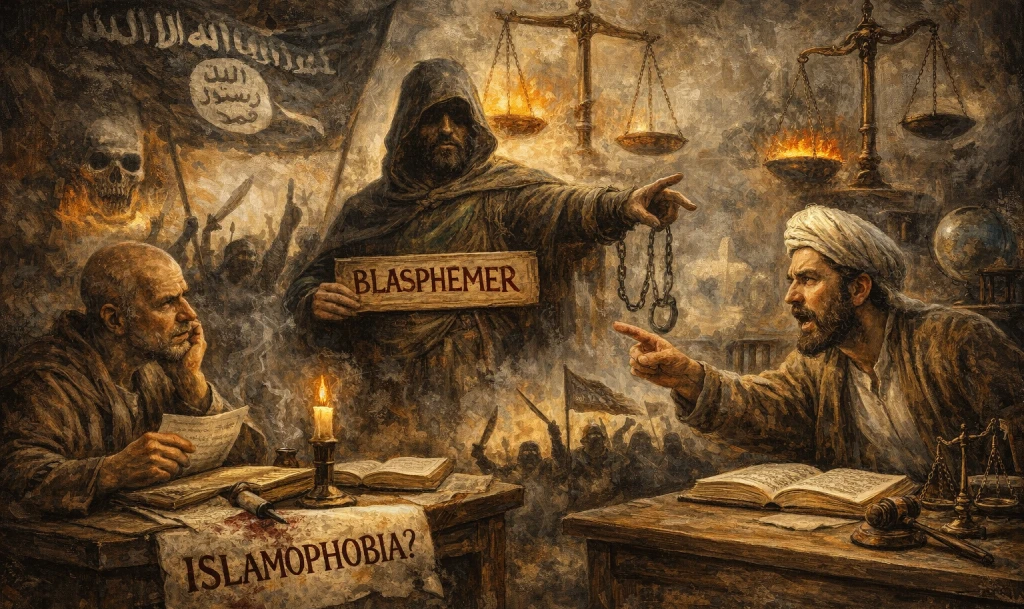
The term “Islamophobia” is sometimes used in political debate to label criticism itself immoral rather than answer questions raised about particular Islamic rules. This shifts attention away from evidence toward the identity, motives, or character of the critic. A derogatory label cannot settle whether a Sharia punishment is inhumane or whether people have been killed for criticizing religion. When critics are blamed instead of examining the truth of legal provisions and documented incidents, religious authority receives social protection without having to confront the arguments.
Criminalizing Criticism
When accusations of “Islamophobia” are used to classify evidence-based criticism of religion as prejudice or hate speech, the central question is evaded. For example, when someone discusses unequal inheritance shares for women under Sharia, the death penalty for apostasy, or punishment for religious insult, the accuracy of those claims must be determined by examining the relevant laws and religious sources. If the criticism is false, disprove it with evidence. If it is true, calling it “Islamophobia” does not make it false. The opposite approach discourages people from asking questions publicly and raises the social cost of arguing against religious provisions. Freedom of expression may formally remain in place while pressure toward self-censorship and silence develops in practice.
Reversing the Roles of Victim and Aggressor (Victimhood Strategy)
Discussions of religious violence are sometimes redirected so that the wording of the criticism becomes the principal controversy, rather than the source of the attack, the attacker’s claims, and the harm suffered by the victim. If discussion is limited to “hurt religious feelings” without addressing whether a critic received death threats, which rule or fatwa a killer cited, and whether the authorities acted to prevent violence, the underlying causes of the crime are obscured. When someone threatened with murder is blamed for the wording of their criticism, the victim’s speech rather than the perpetrator’s conduct is put on trial. Religious authority is thereby shielded, while freedom of expression and personal safety suffer.
Racism versus Ideological Criticism
When the term “Islamophobia” is used in public debate, many people present it almost automatically as equivalent to racism. But merging these concepts produces a basic analytical mistake because racism and ideological criticism do not belong to the same category and cannot be judged by identical standards.
First, racism generally rests on people’s inborn, immutable characteristics, such as skin color, ethnicity, inherited family traits, or markers of ethnic identity. A person cannot simply choose to change these characteristics. This is the central moral problem with racism: it diminishes a person’s human dignity because of an identity beyond their control. Racism is therefore not merely an opinion or argument. It is a structure of blame, degradation, and social discrimination directed at people.
Islam, by contrast, is a religious identity for its adherents, but analytically it is also a system of beliefs, a set of moral claims, and, in many settings, a legal and social framework (as in the concept of Sharia). In other words, it is not merely “personal faith.” It may encompass rules, conceptions of authority, prohibitions, penal policies, social controls, and political aspirations that shape how societies and states function. For precisely this reason, Islam, like any other religion or ideology, cannot be placed beyond criticism, interpretation, reassessment, reform, or rejection, because it affects public life and makes claims about “truth” and “obligation.”
Discrimination against people deprives them of their rights; criticism of an ideology examines the truth of its claims, its morality, and its legal consequences.
Hatred, hostility, or collective blame aimed at Muslims is socially harmful and morally objectionable. Such an attitude may amount to racism or bigotry and offers no constructive solution. Attacking an entire community indiscriminately because of its identity violates human rights and intensifies social polarization.
Criticism of Islamic texts, rules, history, legal concepts, and social effects belongs to the realm of ideological analysis. In principle, it is a legitimate intellectual practice, just as with any other ideology. Rational scrutiny of an idea or law is inseparable from freedom of expression and is a fundamental feature of a civilized society.
This raises a question: if it is legitimate in academic and political discourse to criticize Marxism, capitalism, nationalism, and Nazism, and if centuries of rigorous questioning of Catholicism, Protestantism, and religious authoritarianism in European history are recognized as an “intellectual tradition,” why should criticism of Islam’s ideological dimensions, legal practices, or socially controlling tendencies automatically be branded a “phobia”?
“Criticism of an ideology = hatred of people” is a logically false equation. It allows the moral character of the speaker to become the focus rather than the accuracy of the claim. The question then ceases to be whether the reported penalties for apostasy or unequal rights for women and men are accurate. Instead, it becomes which insulting label can be attached to the critic. Personal slander is not a response to an argument. When evidence against a religious rule is presented, that evidence must be examined. Dismissing it with a label is intellectual dishonesty.
Another consideration is the long European intellectual tradition of criticism, scholarship, and reinterpretation directed at Judeo-Christian texts and ecclesiastical power. That tradition rests on the principle that religious claims, however “sacred” they are declared, are not beyond criticism. Biblical textual criticism, historical criticism, the politics of Church power, the Inquisition, and religious law have all been subjects of extensive research, which has been regarded as part of the development of civilization. If rigorous criticism is normal academic practice in these cases, there is no rational basis for granting Islam the special privilege of being an “unquestionable exception.”
There is a fundamental distinction between hostility toward people and criticism of an ideology. Discriminating against someone on the basis of religious identity is wrong; rejecting the laws, history, or beliefs of a religion through facts and arguments is an intellectual right. Erasing this distinction and turning criticism of religion into a moral offense constricts the space for independent thought and research. Questions about whether religious ideas are true and their prescriptions just cannot be settled by invoking religious authority.
In short: When “Islamophobia” is used to blame critics instead of addressing arguments and evidence, it becomes an instrument for controlling debate and imposing social silence. If rigorous criticism of Marxism, capitalism, nationalism, or Christian religious authority is legitimate, criticism of Islamic Sharia and creed is equally legitimate. Loyalty to an ideology cannot place its errors, discriminatory rules, or violent consequences beyond criticism.
Conclusion
The central problem with the misuse of the term “Islamophobia” is that it dismisses evidence of real danger and describes fact-based concern as baseless fear. Punishments for apostasy, the death penalty for insulting the Prophet, death threats arising from religious fatwas, and documented attacks against critics of religion are not imaginary. The people whose lives, liberties, and safety are threatened by these events and provisions have concrete grounds for concern. If evidence and documented events establish that a particular Islamic rule is inhumane, discriminatory, or dangerous, the criticism cannot be dismissed by calling it “Islamophobia.” No religious ideology can place itself beyond criticism. The moment fear, social vilification, or death threats replace evidence and argument, the true nature of the suppression of human freedom in the name of religion is exposed.