

Introduction
Claiming that a scientist’s latest discovery about the universe was already written in the Quran fourteen hundred years ago is a familiar tactic in Islamic media. The long history of scientific observation, mathematical analysis and experimentation is bypassed, and a few ambiguous Arabic words are presented as the source of one groundbreaking discovery after another. Two of the most popular examples are the promotion of Quran 21:30, in Surah al-Anbiya, as the Big Bang and Quran 51:47, in Surah al-Dhariyat, as a prediction of the expansion of the universe. The basis of this claim is not merely weak; the claim that these Quranic statements describe modern cosmological theory is false. They contain no specific information about the theoretical framework of the Big Bang, the age of the universe, its initial hot and dense state, background radiation or observable expansion.
The history of modern science is reversed to promote the Quran as the source of cosmological discoveries. None of the knowledge developed through Vesto Slipher’s spectroscopic observations, Georges Lemaître’s theoretical work on an expanding universe, Edwin Hubble’s distance–redshift relationship and the discovery of the cosmic microwave background was obtained from Quranic exegesis. Ancient commentaries discuss rain, vegetation, seven heavens, the sky as a roof, capacity and abundance; modern research involves measurements, mathematical models and testable predictions. Attributing discoveries to the Quran after scientists have made them is an attempt to appropriate the credit for scientific research. [1]
The evidence of classical Islamic exegesis presents a picture contrary to this propaganda. Al-Tabari identifies rain and vegetation as the preferred meaning of 21:30; Ibn Kathir describes seven heavens, seven earths and a gap of air between them; and on 51:47, al-Tabari emphasizes Allah’s creative power and capacity. Al-Mawardi offers five interpretations of the word, including abundant provision and making the sky spacious. There is no scientific basis for equating the long literary history of ancient myths about the separation of heaven and earth with the observations and calculations of modern physics. This intellectual manipulation may bolster pride in religious identity; it produces no new knowledge about the universe.

The Separation of Heaven and Earth: Turning an Ancient Creation Story into the Big Bang
Verse 30 of Surah al-Anbiya describes the heavens and earth as previously joined or closed, and then separated or opened. Imagining heaven and earth as a pair that is subsequently divided is no modern observation; it belongs to the old creation stories of various pre-Islamic civilizations. In modern cosmological models, the Big Bang does not mean pulling apart two enormous pieces of matter. It concerns the expansion of spacetime from the universe’s primordial hot, dense state, the evolution of matter and the subsequent formation of stars and galaxies. Declaring the Quranic account of heaven–earth separation synonymous with that scientific process dresses verbal resemblance up as scientific evidence.
Pre-Islamic Sumerian, Egyptian and Greek Cosmologies
The separation of earth and heaven is an ancient mythological event in Sumerian creation literature. In the University of Oxford’s collection of Sumerian literature, The Song of the Hoe describes the god Enlil separating heaven from earth to create habitable space for humans. The idea of heaven and earth being joined at creation and subsequently separated required neither the seventh-century Quran nor modern astronomy. Such stories circulated in traditions thousands of years before the Quran. Presenting this familiar mythological motif as unique scientific information about the Big Bang in Islamic science propaganda directly distorts history. [2]
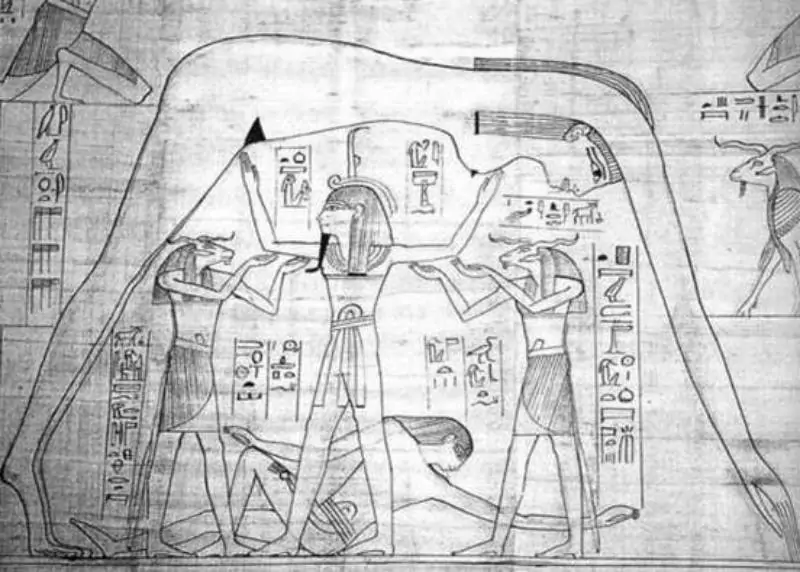
In ancient Egypt, too, the earth god Geb and the sky goddess Nut were imagined together. The air god Shu separates them and holds Nut aloft, creating habitable space between earth and sky. The description of the Shu figurine in the Metropolitan Museum’s collection explicitly mentions this act. Egyptian art depicts Geb lying below, Nut arching above and Shu between them. This is no prediction of cosmic radiation or mathematical model of spacetime; it is a creation story that treats the sky as a roof and the earth as the ground below. [3]
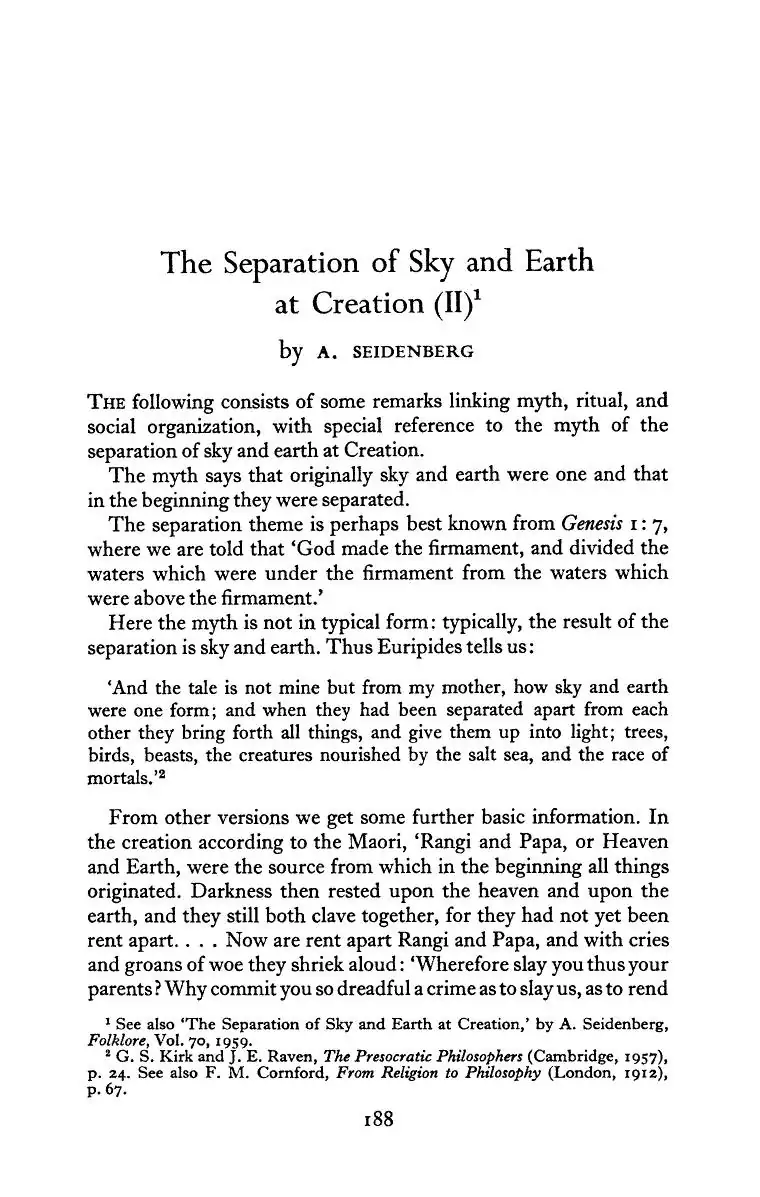
The surviving fragment 484 of the Greek playwright Euripides’ Melanippe the Wise also recounts the story that heaven and earth originally had a single form and later separated, creating the conditions for living things to emerge. The character mentions hearing this from her mother. This testimony from the Greek literary tradition long predates the Quran. The ancient circulation of such creation ideas refutes the claim to uniqueness associated with modern cosmological discovery. People imagined the separation of heaven and earth more than a millennium before the discovery of the Big Bang, yet did not discover modern cosmological physics through that imagining. [4]
Different versions of ancient creation stories repeatedly describe heaven and earth joining, separating, being raised and having space created between them for life. This repetition reveals an ancient tendency to view the sky as an overhead dome, the earth as the ground below and the visible emptiness between them as something requiring a special explanation. Modern science did not build cosmology on that familiar scene; it analyzed testable relationships among space, time, matter, energy, radiation and gravity. Here lies the most fundamental difference between ancient narratives and modern science.
The Commentaries of al-Tabari and Ibn Kathir: Rain, Vegetation and Seven Heavens
Al-Tabari collects several earlier views in his commentary on 21:30. According to one, heaven and earth were joined, and Allah separated them by placing air between them; according to another, one heaven was made into seven heavens and one earth into seven earths; according to another, the sky was closed and produced no rain, and the earth was closed and produced no vegetation. In his own conclusion, al-Tabari calls the last interpretation the most accurate. His reasoning centers on the verse’s next statement: the creation of living things from water. In other words, al-Tabari’s interpretation concerns rain from the sky and vegetation growing from the soil, rather than a primordial cosmic explosion at creation. This conclusion in one of Islam’s most important early commentaries is entirely different from modern Big Bang propaganda. [5]
قال أبو جعفر: وأولى الأقوال في ذلك بالصواب قول من قال: معنى ذلك: أولم ير الذين كفروا أن السماوات والأرض كانتا رتقا من المطر والنبات، ففتقنا السماء بالغيث والأرض بالنبات. وإنما قلنا ذلك أولى بالصواب في ذلك لدلالة قوله: (وجعلنا من الماء كل شيء حي) على ذلك، وأنه جل ثناؤه لم يعقب ذلك بوصف الماء بهذه الصفة إلا والذي تقدمه من ذكر أسبابه.
English translation: Abu Jaʿfar says: The most accurate view on this matter is that of those who say the meaning is: Do the disbelievers not see that the heavens and earth were closed with respect to rain and vegetation? We then opened the sky through rain and the earth through vegetation. We have called this the most accurate interpretation because the statement, ‘We made every living thing from water,’ indicates precisely this. The reason this characteristic of water is mentioned afterward is that the preceding statement concerned matters connected with water.
Each of the many ancient interpretations preserved by al-Tabari revolves around the creation beliefs and familiar natural world of its time. In particular, the idea of separating a joined heaven and earth by inserting air between them is no expansion of cosmic spacetime. Nor is division into seven heavens and seven earths an observation of modern cosmology. Selecting only ‘they were joined before and separated afterward’ while omitting the rain and vegetation, seven heavens or separation by air is selective reading. Those omissions are necessary to make the claim fit modern science.
This picture of creation is even clearer in Ibn Kathir’s commentary. He describes heaven and earth as initially joined, arranged in layers; he then speaks of the creation of seven heavens and seven earths, and a gap of air between the lowest heaven and earth. He links rain falling from the sky and plants growing on earth as subsequent events in the same sequence. This worldview centers on the earth, with layers of heaven above it and air in between. It bears no scientific resemblance to the Big Bang’s hot primordial universe, the origin of elementary particles or the later formation of galaxies. [6]
ألم يروا (أن السماوات والأرض كانتا رتقا) أي: كان الجميع متصلا بعضه ببعض متلاصق متراكم، بعضه فوق بعض في ابتداء الأمر، ففتق هذه من هذه. فجعل السماوات سبعا، والأرض سبعا، وفصل بين سماء الدنيا والأرض بالهواء، فأمطرت السماء وأنبتت الأرض؛ ولهذا قال: (وجعلنا من الماء كل شيء حي أفلا يؤمنون) أي: وهم يشاهدون المخلوقات تحدث شيئا فشيئا عيانا، وذلك دليل على وجود الصانع الفاعل المختار القادر على ما يشاء.
English translation: Did they not see that ‘the heavens and earth were joined’? That is, at the beginning everything was connected, pressed together and piled one above another. He then separated one from the other. He made the heavens seven and the earth seven, and created a gap of air between the lowest heaven and earth. The sky then rained and the earth produced vegetation. This is why He said, ‘We made every living thing from water; will they not then believe?’ That is, they see created things coming into existence gradually before their own eyes. This is presented as evidence for the existence of a creator who acts according to His own will and can do whatever He wishes.
In the era of these interpretations, no one knew of a 13.8-billion-year-old universe, the formation of light elements in the first few minutes or the origin of the cosmic microwave background about 380,000 years later. These concepts are therefore naturally absent from the language of the commentaries. Inserting them into old words after modern science has been established is nothing but a form of intellectual fraud. Modern interpreters themselves have introduced into ancient texts the modern information absent from them.
‘Do the Disbelievers Not See?’: Making a Transmitted Creation Story into Evidence of Truth
The verse’s opening question, أَوَلَمْ يَرَ الَّذِينَ كَفَرُوا—‘Do those who disbelieve not see?’—is not the language of modern cosmological observation. Here, disbelievers are being told to accept God’s power. The verse ends with another question: ‘Will they not then believe?’ The purpose of the entire statement is therefore to establish religious obedience, rather than explain a mathematical cosmological model. The sentence presents a religious creation account to disbelievers as though it were an established fact, but supplies no independent observation or specific scientific information in support of that account. What observation establishes the separation of heaven and earth, when it happened, what state the matter involved was in—the verse tells us none of these things. [7]
Immediately after the separation of heaven and earth come descriptions of mountains to keep the earth stable, the sky as a protected roof above it and the movement of the sun and moon. Tearing only the words ‘joined’ and ‘separated’ out of this continuous creation account and inserting the Big Bang changes the meaning of the original statement. [8]
أَوَلَمْ يَرَ الَّذِينَ كَفَرُوا أَنَّ السَّمَاوَاتِ وَالْأَرْضَ كَانَتَا رَتْقًا فَفَتَقْنَاهُمَا وَجَعَلْنَا مِنَ الْمَاءِ كُلَّ شَيْءٍ حَيٍّ أَفَلَا يُؤْمِنُونَ وَجَعَلْنَا فِي الْأَرْضِ رَوَاسِيَ أَنْ تَمِيدَ بِهِمْ وَجَعَلْنَا فِيهَا فِجَاجًا سُبُلًا لَعَلَّهُمْ يَهْتَدُونَ وَجَعَلْنَا السَّمَاءَ سَقْفًا مَحْفُوظًا وَهُمْ عَنْ آيَاتِهَا مُعْرِضُونَ وَهُوَ الَّذِي خَلَقَ اللَّيْلَ وَالنَّهَارَ وَالشَّمْسَ وَالْقَمَرَ كُلٌّ فِي فَلَكٍ يَسْبَحُونَ
English translation: Do the disbelievers not see that the heavens and earth were joined or closed, and that We then separated or opened them and made every living thing from water? Will they not then believe? And We placed firm mountains on the earth so that it would not sway with them, and made broad paths there so that they might find their way. And We made the sky a protected roof, yet they turn away from its signs. He is the one who created night and day, the sun and the moon; each swims in its own orbit.
Alongside the ordinary separation of heaven and earth in the Bengali translations, a note in one translation directly inserts the modern Big Bang. That note is no part of the ancient verse; it is an addition by a modern translator. [9]
Do the disbelievers not see that heaven and earth were joined together, then I separated the two, and created every living thing from water? Will they not then have faith?
— Taisirul Quran
Do those who disbelieve not reflect that the heavens and earth were intimately intermingled; then I separated the two and created all living things from water; will they not then believe?
— Sheikh Mujibur Rahman
Do those who disbelieve not reflect that the heavens and earth were intimately intermingled*, then I separated the two, and I created all living things from water. Will they not then have faith? * According to modern astronomers, heaven, the sun, the stars and the earth, etc., did not originally exist as separate entities; rather, everything was intimately intermingled. The universe was then a collection of countless gaseous particles. Later, the stars, the sun, the earth and the planets were created through a great explosion. This is the Big Bang or great explosion theory.
— Rawai Al-bayan
Do those who disbelieve not see [1] that the heavens and earth were intimately intermingled, then We separated the two [2] and created all living things from water [3]; will they not then have faith?
— Dr. Abu Bakr Muhammad Zakaria
A note in one Bengali translation says that the universe was a collection of gaseous particles, and that the stars, the sun and the earth were subsequently created in a great explosion. This sentence reduces the universe’s complex history over billions of years to the result of a simple explosion. The first generation of stars, the formation of heavy elements, the birth of the solar system and an interval of about 9.2 billion years are absent. This modern scientific explanation by the translator is no part of the original Arabic verse; it is an interpretive claim added after the science had been established. [10] [11]
In his commentary on verse 30 of Surah al-Anbiya, Fakhr al-Din al-Razi directly raises the logical difficulty within the religious claim. He asks: no one witnessed the initial state of heaven and earth; Quran 18:51 itself says that humans did not witness creation. And if it is merely transmitted information rather than direct observation, how can that information itself serve as evidence before people who deny its truth? Assuming the truth of a disputed religious declaration and then using that declaration to establish the truth of the religion is circular reasoning. Al-Razi’s discussion shows that the argument in this verse concerned prophethood, a creator and divine unity, rather than an unknown physical law of the universe. [12]
المسألة الثانية: لقائل أن يقول: المراد من الرؤية في قوله تعالى: (أولم ير الذين كفروا)، إما الرؤية، وإما العلم، والأول مشكل، أما أولا فلأن القوم ما رأوهما كذلك البتة، وأما ثانيا فلقوله سبحانه وتعالى: (ما أشهدتهم خلق السماوات والأرض) [الكهف: 51]، وأما العلم فمشكل؛ لأن الأجسام قابلة للفتق والرتق في أنفسها، فالحكم عليها بالرتق أولا وبالفتق ثانيا لا سبيل إليه إلا السمع، والمناظرة مع الكفار الذين ينكرون الرسالة، فكيف يجوز التمسك بمثل هذا الاستدلال؟ والجواب: المراد من الرؤية هو العلم وما ذكروه من السؤال فدفعه من وجوه: أحدها: أنا نثبت نبوة محمد صلى الله عليه وسلم بسائر المعجزات ثم نستدل بقوله: ثم نجعله دليلا على حصول النظام في العالم وانتفاء الفساد عنه وذلك يؤكد الدلالة المذكورة في التوحيد. وثانيا: أن يحمل الرتق والفتق على إمكان الرتق والفتق، والعقل يدل عليه لأن الأجسام يصح عليها الاجتماع والافتراق فاختصاصها بالاجتماع دون الافتراق أو بالعكس يستدعي مخصصا.
English translation: Second discussion: Someone may ask: In the statement ‘Do the disbelievers not see?’, seeing means either seeing with the eyes or knowing. The first meaning is problematic. First, they never saw heaven and earth in that state. Second, Allah Himself said, ‘I did not make them witnesses to the creation of the heavens and earth’ [al-Kahf: 51]. The meaning of knowing is also problematic, because matter itself can assume either a joined or a separated state. Thus, there is no way to know that they were first joined and then separated except through transmitted information. Yet the debate is with disbelievers who deny prophethood itself. How, then, can reliance on such reasoning be acceptable? The answer: Seeing here means knowing. Several answers can be given to the question raised. The first is that we establish Muhammad’s prophethood through the other miracles, then reason from his statement and use it as evidence of order in the world and the absence of disorder. This reinforces the earlier argument concerning divine unity. The second is to understand joining and separation as the possibility of joining and separation. Reason indicates that possibility, because matter can be united or separated. Thus, its particular state of union rather than separation, or the reverse, requires one who determines it.
Al-Razi’s commentary mentions an important precursor to the separation of heaven and earth. According to him, this creation story was familiar among Jews and Christians; he also mentions an older religious account in which heaven and earth were created from a primordial substance and then separated. He further states that the story was used in religious debate because the idolaters of Mecca accepted what the Jews said. Al-Razi’s discussion reveals that the Quranic verse is formulated in the language of familiar religious creation imagery, rather than reporting the science of the modern Big Bang. Al-Razi’s commentary documents the prior circulation of a religious creation story and its use in religious debate; it contains no modern observation of the universe. [13]
وثالثها: أن اليهود والنصارى كانوا عالمين بذلك فإنه جاء في التوراة أن الله تعالى خلق جوهرة، ثم نظر إليها بعين الهيبة فصارت ماء، ثم خلق السماوات والأرض منها وفتق بينها، وكان بين عبدة الأوثان وبين اليهود نوع صداقة بسبب الاشتراك في عداوة محمد صلى الله عليه وسلم فاحتج الله تعالى عليهم بهذه الحجة بناء على أنهم يقبلون قول اليهود في ذلك.
English translation: The third answer is that Jews and Christians knew of this matter. The Torah states that Allah created a jewel; then, when He looked upon it with a gaze of majesty, it turned into water. He subsequently created the heavens and earth from that water and separated them. The idolaters and Jews shared a kind of friendship because of their common hostility toward Muhammad. Allah presented this argument against them on the basis that they accepted the Jews’ statements on this matter.
The tactic of promoting the very ordinary creation story of heaven and earth first joined and then separated as the discovery of the Big Bang collapses before classical exegesis itself. Al-Tabari discusses rain and vegetation, Ibn Kathir seven heavens and seven earths, and al-Razi religious reports and old creation beliefs. Modern cosmology, however, rests on interrelated observations concerning the evolution of the primordial hot universe, the expansion of spacetime, the origin of light elements and the cosmic microwave background. Religious preachers insert this entire scientific history into two ordinary Arabic words and then announce that the science came from the Quran itself. Inserting the names of modern scientific discoveries into old religious stories is the sole method used here to manufacture the supposed miracle.
The Surrounding Quranic Verses: The Sky as a Roof, Mountains and the Moving Sun and Moon
The statements surrounding Quran 21:30 themselves render the modern Big Bang interpretation untenable. Verse 31 speaks of placing mountains to prevent the earth from swaying, verse 32 of making the sky a protected roof, and verse 33 of night and day and the movement of the sun and moon. This continuous creation account imagines earth below, a roof of sky above, rain and the conditions for life between them, and celestial bodies moving overhead. It is an explanation centered on the visible world of ancient human societies. Religious preachers break this continuity and extract only the words ‘joined’ and ‘separated’; they set aside the remaining descriptions of mountains, the sky as a roof, rain and seven heavens, and insert the names of modern space science. This is how partial quotations are used to manufacture supposed scientific miracles. [8]
In this context, many also call ‘every living thing from water’ an astonishing prediction of modern biology. The relationship between water and life is part of human agriculture, dependence on rain and everyday experience. Al-Tabari uses precisely this familiar relationship in accepting the rain-and-vegetation interpretation. The observation that water is fundamentally important to life cannot establish the chemical origin of life, the history of biological evolution or the state of the primordial universe. Promoting this familiar fact about the necessity of water as a miraculous discovery of modern biology and cosmology employs the same tactic of appropriating scientific terminology.
Linguistic Manipulation in the Name of the Sky’s Expansion: Surah al-Dhariyat 51:47
The main basis of the claim about the expansion of the universe is verse 47 of Surah al-Dhariyat: وَالسَّمَاءَ بَنَيْنَاهَا بِأَيْدٍ وَإِنَّا لَمُوسِعُونَ. Today, the meaning ‘We are expanding the universe’ is extracted from the statement about constructing the sky and being ‘la-musiʿun’. Yet the word’s range of classical meanings includes capacity, abundance, making the sky spacious, the ability to create more and increased provision. Modern cosmic expansion means the metric expansion of space on large scales, stretching the wavelength of light arriving from distant galaxies and producing redshift. No specific component of this observational and mathematical meaning appears in the wording of the verse. [14]
The verse immediately after the construction of the sky speaks of spreading out the earth, and the next verse of creating things in pairs. Turning this account of constructing the sky and spreading out the earth into specific information about galactic redshift and the expansion of spacetime requires inserting modern scientific information from outside. [15]
وَالسَّمَاءَ بَنَيْنَاهَا بِأَيْدٍ وَإِنَّا لَمُوسِعُونَ وَالْأَرْضَ فَرَشْنَاهَا فَنِعْمَ الْمَاهِدُونَ وَمِنْ كُلِّ شَيْءٍ خَلَقْنَا زَوْجَيْنِ لَعَلَّكُمْ تَذَكَّرُونَ
English translation: We built the sky with power, and surely We possess capacity or make spacious. As for the earth, We have spread it out; how excellent We are at preparing a bed. And of every thing We created pairs, so that you might take heed.
Bengali translations of the same Arabic sentence variously speak of power, being a great maker of spaciousness or being a great expander. This variation in wording cannot be turned into a specific observational prediction of the expansion of the universe. [16]
I created the heaven with My own hand, and I am certainly the great maker of spaciousness.
— Taisirul Quran
I built the sky by My power, and I am certainly the great expander,
— Sheikh Mujibur Rahman
And I built the sky with hands, and surely I am powerful.
— Rawai Al-bayan
And the heaven—We built it by Our power [1], and We are surely great expanders [2].
— Dr. Abu Bakr Muhammad Zakaria
The Arabic word لَمُوسِعُونَ is an active participle; the same root can be used in the senses of strength, capacity, abundance and spaciousness. Yet the translation ‘We are surely great expanders’ is turned into a specific scientific declaration of the continuing expansion of the modern universe. Establishing that meaning requires adding all of modern science from outside: the expansion of spacetime across immense cosmic distances, galactic redshift and the relationship between distance and the rate of recession. The next verse, 48, speaks of ‘spreading out’ the earth; this continuous language forms part of a religious worldview of constructing the sky and spreading out the earth. Promoting a possible dictionary meaning of an old word as an accurate prediction of modern physics is linguistic manipulation. [15]
Al-Tabari: ‘La-musiʿun’ Means the Capacity to Create
In his commentary on 51:47, al-Tabari first interprets the word bi-aydin as strength. He then explicitly explains ‘la-musiʿun’ as the power and capacity to create the sky and anything else as desired. To explain the meaning of the same Arabic root, he cites the instruction in Quran 2:236 to give a gift according to one’s wealth and means. Here, then, is a natural relationship between the ordinary meaning of an Arabic word and its Quranic use. This explanation has no connection with Hubble’s law. The ability to create the sky and the present increase in cosmic distances between galaxies are two entirely different statements. [17]
وقوله (وإنا لموسعون) يقول: لذو سعة بخلقها وخلق ما شئنا أن نخلقه وقدرة عليه. ومنه قوله (على الموسع قدره وعلى المقتر قدره) [البقرة: 236] يراد به القوي. وقال ابن زيد في ذلك ما حدثني يونس قال: أخبرنا ابن وهب قال: قال ابن زيد في قوله (وإنا لموسعون) قال: أوسعها جل جلاله. وقوله (والأرض فرشناها) يقول تعالى ذكره: والأرض جعلناها فراشا للخلق (فنعم الماهدون) يقول: فنعم الماهدون لهم نحن.
English translation: ‘We are certainly musiʿun’ means that We have the capacity and power to create the sky and whatever We wish to create. The same meaning appears in ‘the one of ample means according to his means, and the one of limited means according to his means’ [al-Baqarah: 236]. Here, a person with means is intended. Yunus informed me of Ibn Zayd’s statement on this matter; he said: Ibn Wahb informed us that Ibn Zayd said of ‘We are certainly musiʿun’: He made the sky spacious. ‘And the earth We spread out’ means that We made the earth a bed for created beings. ‘How excellent are the preparers of a bed’ means how excellent We are at preparing a bed for them.
Citing al-Tabari’s interpretation as evidence of modern cosmic expansion substitutes one meaning for another. Having power and the continuing physical expansion of a created thing in the present are not the same. The first is a religious declaration about a creator’s attributes; the second is a scientific claim involving distance, redshift and time. The first statement in an ancient commentary cannot be passed off as the discovery of the second.
Ibn Kathir, al-Mawardi and Shamela: The Word’s Multiple Classical Meanings
In his commentary on 51:47, Ibn Kathir calls the sky a protected, elevated roof, and explains ‘la-musiʿun’ by referring to making its edges spacious and raising it without pillars. The setting of this explanation is a constructed sky, its edges and the idea of holding it aloft. Al-Mawardi collects five meanings: abundant provision through rain, the breadth of the sky, the capacity to create on a still greater scale, the power to create another similar sky and unrestricted ability without any constraint on the desired act. These different meanings show that the word was not established in classical discussion as a single observational cosmological law. [18] [19]
Page 106 of volume 17 of the printed Bengali edition of Ibn Kathir’s commentary explains making the edges of the sky spacious and holding it high without pillars. The quotation from the printed page describes the sky as an elevated, constructed roof. Promoting this specific statement as the discovery of galactic redshift and the expansion of spacetime changes the meaning of the original commentary. [20] [21]
“Allah Most High says that He created the sky by His own power and made it protected, elevated and expanded. Certainly He is the great expander. Hazrat Ibn Abbas (may Allah be pleased with him), Hazrat Mujahid (may Allah have mercy on him), Hazrat Qatada (may Allah have mercy on him), Hazrat al-Thawri (may Allah have mercy on him) and many other commentators say that its meaning is: I created the sky by My own strength. I am the great expander. I have made its edges spacious, held it up without pillars and established it.”

Al-Mawardi’s compilation contains five interpretations, ranging from increased provision through rain to the capacity to create another similar sky. Promoting these multiple religious and linguistic interpretations as a single accurate scientific declaration of the universe’s continuing expansion distorts the source’s statement. [22]
والسماء بنيناها بأيد أي بقوة. وإنا لموسعون فيه خمسة أوجه: أحدها: لموسعون في الرزق بالمطر، قاله الحسن. الثاني: لموسعون السماء، قاله ابن زيد. الثالث: لقادرون على الاتساع بأكثر من اتساع السماء. الرابع: لموسعون بخلق سماء ملثها، قاله مجاهد. الخامس: لذوو سعة لا يضيق علينا شيء نريده.
English translation: ‘We built the sky with ayd’—that is, with strength. ‘We are certainly musiʿun’ has five interpretations. First: granting abundant provision through rain; al-Hasan said this. Second: making the sky spacious; Ibn Zayd said this. Third: being capable of an expansion greater than the sky’s breadth. Fourth: bringing about expansion by creating another similar sky; Mujahid said this. Fifth: possessing such unrestricted capacity that nothing We wish to do presents any constraint for Us.
The preserved copy of Al-Dabit al-Lughawi fi al-Tafsir al-ʿIlmi li-l-Quran al-Karim exported from Shamela lists five classical meanings through Ibn al-Jawzi. These include ‘capable’ attributed to Ibn Qutayba, ‘making the space between heaven and earth spacious’ to al-Zajjaj, abundant provision to al-Hasan and making the sky spacious to Ibn Zayd. The same work later turns to modern cosmic expansion. Thus, within a single book, the gap is visible between old linguistic interpretations and modern claims added after scientific discovery. This Shamela text directly displays the method of adding modern science after a compilation of classical interpretations. [23]
وذكر ابن الجوزي أن المفسرين ذكروا في قوله تعالى: (وإنا لموسعون) خمسة أقوال: أحدها: لموسعون الرزق بالمطر قاله الحسن. والثاني: لموسعون السماء قاله ابن زيد. والثالث: لقادرون قاله ابن قتيبة. والرابع: لموسعون ما بين السماء والأرض قاله الزجاج. والخامس: لذو سعة لا يضيق عما يريد حكاه الماوردي.
English translation: Ibn al-Jawzi mentions that commentators have given five views on the meaning of ‘We are certainly musiʿun’. First: granting abundant provision through rain; al-Hasan’s view. Second: making the sky spacious; Ibn Zayd’s view. Third: being capable; Ibn Qutayba’s view. Fourth: making the space between heaven and earth spacious; al-Zajjaj’s view. Fifth: possessing unrestricted capacity that is not too narrow for what He wishes to do; al-Mawardi relates this view.
Although making the sky spacious is among al-Mawardi’s several meanings, promoting it as the expansion of the modern universe clearly substitutes one meaning for another. In Ibn Kathir’s interpretation, the constructed sky has spacious edges and is elevated without pillars; al-Razi compares it with a vast domed structure; al-Tabari speaks of creative power and capacity. These describe a creator’s power and ancient conceptions of the sky. The cosmic expansion discovered by science is established through the relationships among observable redshift, galaxy distances, gravitational theory and the spacetime metric. Making the sky spacious and the expansion of spacetime are not the same physical event. Conflating these two meanings is the linguistic deception of miracle propaganda.
Grammar: active participle; its form alone does not determine a modern cosmological meaning.
The Same Quranic Word in the Sense of Means: Surah al-Baqarah 2:236
Quran 2:236 speaks of giving a gift upon divorce according to the financial capacity of those with ample or limited means. In that verse, the word الْمُوسِعِ means a person of financial means. Al-Tabari directly invokes that word from the verse when explaining 51:47. Thus, restricting ‘musiʿun’ to an exclusively cosmological meaning after scientists discovered expansion is inconsistent even with the Quran’s internal word usage. A word may have several dictionary meanings; selecting the desired scientific meaning without evidence cannot establish Allah’s foreknowledge. [24] [25]
The Image of Constructing the Sky versus the Expansion of the Universe
The universe is not an object stretched outward by pulling at the two edges of an enormous dome. In modern cosmology, space itself expands across large distances; evidence of that expansion appears in the lengthening of light’s wavelength. Nor is the Big Bang an explosion at a particular center. NASA’s cosmological explanation makes its centerless, expansive character clear. The Quranic imagery of ‘constructing’ the sky and ‘spreading out’ the earth contains no observational method or mathematical law of cosmic expansion. In particular, making Ibn Kathir’s notions of a roof and edges synonymous with modern expansion attempts to pass off two separate concepts under one name. [26] [27]
IslamQA’s 2023 Fatwa: An Example of Adding Science after the Discovery
IslamQA’s fatwa 471308, dated 29 November 2023, directly documents this retrospective interpretation. It begins by acknowledging disagreement among earlier scholars over the interpretation of ‘la-musiʿun’. It then quotes al-Mawardi, al-Razi, Ibn Kathir, al-Qasimi and al-Saʿdi. These statements center on strength, abundance, a spacious sky, constructing the sky as a roof and the creator’s power. The discussion then abruptly introduces the history of modern astronomy, the Doppler effect, galactic redshift and the observations of Slipher and Hubble, and announces that two Quranic words indicate this expansion. The scientific information did not emerge from the old commentaries; it was taken from modern science and attached to an old verse. [28]
وَقَوْلُهُ تَعَالَى: وَإِنَّا لَمُوسِعُونَ فِيهِ وُجُوهٌ؛ أَحَدُهَا: أَنَّهُ مِنَ السَّعَةِ، أَيْ أَوْسَعْنَاهَا بِحَيْثُ صَارَتِ الْأَرْضُ وَمَا يُحِيطُ بِهَا مِنَ الْمَاءِ وَالْهَوَاءِ، بِالنِّسْبَةِ إِلَى السَّمَاءِ وَسَعَتِهَا: كَحَلْقَةٍ فِي فَلَاةٍ. وَالْبِنَاءُ الْوَاسِعُ الْفَضَاءِ: عَجِيبٌ، فَإِنَّ الْقُبَّةَ الْوَاسِعَةَ لَا يَقْدِرُ عَلَيْهَا الْبَنَّاءُونَ، لِأَنَّهُمْ يَحْتَاجُونَ إِلَى إِقَامَةِ آلَةٍ يَصِحُّ بِهَا اسْتِدَارَتُهَا، وَيَثْبُتُ بِهَا تَمَاسُكُ أَجْزَائِهَا إِلَى أَنْ يَتَّصِلَ بَعْضُهَا بِبَعْضٍ.
English translation: There are several interpretations of ‘We are certainly musiʿun’. The first is that the word derives from spaciousness. That is, We made the sky so spacious that, compared with it and its breadth, the earth and its surrounding water and air are like a ring lying in a desert. A structure with a vast interior space is remarkable. Builders cannot construct a vast dome, because they need to erect a supporting framework to create its rounded shape and hold its parts together until they are connected to one another.
The fatwa’s second part contains another scientific misconception. It identifies the universe’s ‘weave’, or cosmic web structure, as a miraculous indication in the word ‘constructing’ the sky. Cosmic structure is understood by measuring the large-scale distribution of galaxies and invisible matter; this astrophysical information cannot be obtained simply by hearing the Arabic word ‘bana’, or construction. Ancient people imagined the sky as a constructed roof; modern astronomy measures the distribution of galaxies and the effects of gravity. Applying the same word ‘construction’ to two descriptions does not make their scientific meanings identical. [29]
Having described the modern finding that distances between galaxies are increasing, the fatwa declares it an indication contained in two Quranic words. Inserting a scientific result into a verse and then calling that verse a scientific prediction is the deception of substituting the source. [30]
وقد تبين فيما بعد أن المجرات لا تبتعد فقط عنا، بل هي تتباعد فيما بينها كذلك، وهذا يعني أن الكون يتوسع على الدوام. وهو ما تشير إليه الآية الكريمة بكلمتين: (وَإِنَّا لَمُوسِعُونَ).
English translation: It later became clear that galaxies are moving away not only from us but also from one another. This means that the universe is continuously expanding. This is what the verse indicates in two words: ‘wa-inna la-musiʿun’.
The method behind the claim is clear: an established astronomical finding is taken first; then, among the many possible meanings of the Arabic sentence, wording resembling that finding is selected; finally, the science is said to have been in the Quran all along. Yet before the scientific discovery, no prediction of the cosmic expansion rate or galactic redshift emerged from the writings of al-Tabari, al-Mawardi or Ibn Kathir. The claim of miraculous prediction collapses in this very absence.
Selected Words and Omitted Context: How a Miracle Is Manufactured
Modern Islamic science propaganda selects convenient meanings from words with multiple senses, discards the rest of the sentence’s context and then claims modern scientific discoveries as proof of the ancient statement’s truth. The interpretations of 21:30 involving rain and vegetation, seven heavens and seven earths, and air are left out of the propaganda; the older meanings of 51:47 involving capacity, provision and a constructed roof are also concealed. Even the neighboring verse’s statement about ‘spreading out’ the earth is relatively absent from the same propaganda. Foregrounding the words that can be matched with science while omitting inconvenient context is a clear example of selective reading.
No Testable Prediction Appeared before the Discovery
There is no history in classical exegesis of deriving a mathematical Big Bang model from 21:30, or the redshift of distant galaxies or the cosmic expansion rate from 51:47. Before the research of Lemaître and Hubble, religious preachers did not publish testable cosmological predictions from these verses; instead, once established scientific results became available, they attached their names to old Arabic words. A scientific prediction is a statement that can be clearly made in advance and later tested through observation. Selecting a convenient meaning from scripture’s many possible interpretations after a discovery does not meet that standard. This is not foreknowledge, but a tactic of changing the meaning of an old sentence after seeing the result.
The Ages of the Universe and Earth: A Gap of about 9.2 Billion Years
In the scientific history of the Big Bang, Earth is not a distinct object present at the beginning of the universe. The universe is about 13.8 billion years old; Earth and the solar system are about 4.54–4.6 billion years old. Thus, about 9.2 billion years separate the hot, dense phase of the early universe from Earth’s formation. This long interval includes the birth of the first stars, the formation of heavy elements within them, the evolution of different generations of stars and the later formation of the solar system. This immense cosmic history is absent from the Quran’s simple account of heaven and earth being joined and then separated. [31] [32]
During the first few minutes of the Big Bang, mainly hydrogen and helium nuclei and a small amount of lithium formed; heavier elements such as carbon, oxygen, silicon and iron, needed to form Earth’s rocks, oceans and biosphere, were produced in later stellar processes. The first generation of stars consisted mainly of hydrogen and helium. Material rich in heavy elements was produced through the birth of several generations of stars, nuclear reactions within them and various processes of stellar death; Earth formed from that material much later. There is therefore no scientific basis for imagining the modern Earth, or a similarly formed planet, as an object joined to the sky in the early universe. [33]
The Arabic verse presents ‘the heavens’ and ‘the earth’ as two distinct, familiar entities. In Ibn Kathir’s classical explanation, they are initially joined, subsequently divided into seven heavens and seven earths, and separated by air between them. At the beginning of the modern Big Bang, there was no planet named Earth, no seven layers of sky, and no event in which two objects were separated by inserting air between heaven and earth. This is a religious version of ancient heaven-and-earth imagery, rather than a modern cosmological account.
Earth’s formation was not an event in which a heavenly roof was torn away from the earth. Heavy elements produced within many generations of stars and through various processes of stellar death mixed into interstellar matter; later, the planets formed from the Sun and the protoplanetary disk around it. This process of Earth’s formation, the planet’s age and the evolution of the solar system bear no scientific resemblance to the ancient story of the separation of seven heavens and seven earths. Promoting this story in the name of the Big Bang requires concealing Earth’s actual formation process and the universe’s approximately 9.2 billion years of prior history.
The Big Bang Is No Collision or Separation of Heaven and Earth
The name ‘Big Bang’ evokes an image of an object exploding in a pre-existing void and scattering in all directions. Cosmological physics does not rest on that picture. On large scales, space itself expands; all galaxies do not fly outward from a center. Evidence for this expansion comes from interrelated observations such as cosmological redshift, radiation from the early universe and the proportions of light elements. The Quranic sentence about the separation of heaven and earth contains no account of these observations. Calling the simple statement ‘they were one before, then separated’ the Big Bang reduces cosmological physics to the language of folktales. [34] [35]
Other Quranic Creation Accounts Also Lack the Modern Timeline
Quran 41:9–12, in Surah Fussilat, describes the creation of the earth in two periods, the placing of mountains and determination of provision within it, then attention turning to the sky in a state of smoke, and finally the arrangement of the sky into seven heavens. This constructs a religious chronology of earth, mountains, provision, a smoky sky and seven heavens. It is not the scientific timeline of the universe’s 13.8-billion-year history, the birth of the first stars and the formation of Earth about 9.2 billion years later. Turning ‘smoke’ into the modern gaseous universe and ‘sky’ into spacetime as required does not make the stages of this creation account scientific. [36]
Creation Stories, Exegesis and Scientific Discovery: Two Different Methods
Ancient creation stories arrange heaven, earth, rain, mountains and stars as evidence of an almighty creator’s power. Modern cosmology, by contrast, investigates measurable relationships among gravity, spacetime, matter, energy and radiation; scientific models are revised or rejected when they fail to match observations. Galactic redshift has established cosmic expansion, background radiation the traces of a primordial hot state, and the proportions of light elements the chemical history of the early universe. Scientists did not derive these results from the Quran’s story of the separation of heaven and earth. Crediting ambiguous scriptural sentences with the achievements of human scientific research distorts the history of knowledge.
The interpretations of al-Tabari, al-Mawardi, Ibn Kathir and al-Razi were not all written in the same modern scientific language. They disagree and discuss different religious meanings. Despite these differences, one fact is clear: their commentaries contain neither the modern Big Bang model nor a law of the universe’s observable expansion. Subsequently matching modern scientific information to those words and claiming it as evidence of scripture’s miraculous truth falsifies the history of the text’s interpretation.
The greatest deception in promoting miraculous predictions is substituting the source. Information learned from modern science is first matched with a possible meaning of the Arabic text; the audience is then led to believe that this science was already present in a definite form in the Quran long before scientists’ research. The actual sequence is the reverse. Ancient exegetical testimony contained rain, vegetation, seven heavens, the sky as a roof, capacity and abundance; galaxies, redshift, spacetime and the Big Bang entered it after cosmological research. Filling unspecified statements from the past with specific present-day knowledge, then declaring that knowledge an achievement of the past, is a circular propaganda tactic.
Conclusion: The Claim of the Quran’s Supposed Cosmological Miracles Is False
The propaganda that Quran 21:30 predicts the Big Bang and Quran 51:47 foretells the modern expansion of the universe is false. Accounts of the separation of heaven and earth appeared much earlier in Sumerian, Egyptian and Greek creation literature. Al-Tabari gives rain and vegetation as the most acceptable explanation of the relevant verse; Ibn Kathir speaks of seven heavens, seven earths and air between them; al-Razi connects the matter with religious argument and earlier traditions. Al-Tabari takes ‘la-musiʿun’ to mean creative power and capacity, and al-Mawardi preserves five classical interpretations. These are not the observational science of the Big Bang or cosmic expansion.
Science has established the universe’s age at about 13.8 billion years, Earth’s age at about 4.54 billion years and the long history of the universe’s evolution from a primordial hot, dense state. This history can be tested through galactic spectra, cosmic radiation and evidence of stellar element formation. The Quranic descriptions of the sky as a roof, spreading out the earth, sending down rain and division into seven heavens contain no such information. Inserting modern meanings into these religious words after modern observational discoveries does not predict new science; it imposes present knowledge on an ancient text.
The standing of a scientific truth does not depend on the approval of any scripture. Rather, when religious preachers invoke science in support of their beliefs, they are effectively borrowing the authority of scientific discovery. Having borrowed that authority, claiming the Quran as the true source of the discovery attempts to reverse history. Selling ambiguous ancient sentences as accurate predictions of modern science is intellectual dishonesty; calling it a miracle insults evidence and reason.
References
- NASA: Cosmological Redshift and Expansion ↩︎
- Oxford: The Sumerian Song of the Hoe ↩︎
- The Metropolitan Museum: Shu and the Separation of Earth and Sky ↩︎
- The Separation of Sky and Earth at Creation (II), Research on Euripides ↩︎
- Al-Tabari, Jamiʿ al-Bayan, Surah al-Anbiya 21:30 ↩︎
- Ibn Kathir, Tafsir al-Quran al-ʿAzim, 21:30–33 ↩︎
- Quran, Surah al-Anbiya 21:30 ↩︎
- Surah al-Anbiya 21:30–33 1 2
- Surah al-Anbiya 21:30 and Common Bengali Translations ↩︎
- NASA: When the Universe and Earth Formed ↩︎
- NASA: The First Stars and Heavy Elements ↩︎
- Fakhr al-Din al-Razi, al-Tafsir al-Kabir, 21:30 ↩︎
- Al-Razi: Earlier Religious Traditions in the Commentary on 21:30 ↩︎
- Quran, Surah al-Dhariyat 51:47 ↩︎
- Surah al-Dhariyat 51:47–49 1 2
- Surah al-Dhariyat 51:47 and Common Bengali Translations ↩︎
- Al-Tabari, Jamiʿ al-Bayan, Surah al-Dhariyat 51:47–48 ↩︎
- Ibn Kathir Quoted and Classical Interpretations Collected, IslamQA 471308 ↩︎
- Al-Mawardi, al-Nukat wa-l-ʿUyun, Surah al-Dhariyat 51:47 ↩︎
- Ibn Kathir, Tafsir al-Quran al-ʿAzim, Bengali edition, Tafsir Publications Committee, vol. 17, p. 106 ↩︎
- Arabic Quotation of Ibn Kathir’s Commentary on 51:47, IslamQA ↩︎
- Al-Mawardi, al-Nukat wa-l-ʿUyun, vol. 5, pp. 373–374 ↩︎
- Shamela-Exported Book: Al-Dabit al-Lughawi, ‘وإنا لموسعون’ ↩︎
- Surah al-Baqarah 2:236 ↩︎
- Al-Tabari: Using the Word from 2:236 to Explain 51:47 ↩︎
- NASA, John Mather: The Centerless Expansion of the Big Bang ↩︎
- NASA: Cosmological Redshift ↩︎
- IslamQA, Question 471308, 29 November 2023 ↩︎
- IslamQA: Claims about the Construction of the Sky and the Cosmic Web ↩︎
- IslamQA 471308: Declaring Cosmic Expansion an Indication in the Verse ↩︎
- NASA: The Ages of the Universe and Earth ↩︎
- USGS: Earth Is 4.54 Billion Years Old ↩︎
- NASA: The First Stars and the Origin of Heavy Elements ↩︎
- NASA: What the Big Bang Actually Means ↩︎
- NASA: The Big Bang and the Early Universe ↩︎
- Surah Fussilat 41:9–12 ↩︎
