

Introduction
The first question in examining the truth of religious claims is what justifies accepting a statement as true. Books written by people in antiquity, the words of acquaintances, family teachings, declarations in sacred texts, personal feelings, and information obtained through testing do not provide the same kind of foundation. Someone may believe something deeply; the depth of that belief does not determine its truth. People can sincerely hold mistaken ideas. It is therefore essential to distinguish sincerity from truth and examine the relationship between a claim and its evidence. Blind faith fixes a conclusion in advance; evidence-based inquiry makes its conclusions depend on information and reasoning.
A simple example is someone claiming to possess a medicine that cures every disease. We would want to know what tests have been conducted, who conducted them, how many people benefited, and whether records of failures exist. The claimant’s confidence, the medicine’s antiquity, or widespread belief in it does not answer these questions. Claims about God, miracles, and religious authority also make statements about the real world. Accepting those statements requires a verifiable basis. Demanding evidence does not assess the value of someone’s feelings; it assesses whether other people have sufficient reason to accept that person’s statement as true.
Some Examples of Theistic Evidence
In contemporary epistemological discussions, atheists and agnostics often ask theists or religious believers for evidence of a creator or God. Rather than presenting objective evidence directly, theists often respond with misleading counterquestions or irrelevant examples, and sometimes with stories. For instance, they first ask: “What kind of evidence do you want?” or “What evidence would make you believe?” Although these questions initially seem neutral, they often function as a strategic trap—as though theists possess an inexhaustible stock of evidence from which they need only select according to atheists’ “preferences.” In reality, these questions are a form of deception that conceals the absence of evidence and attempts to justify blind faith in place of reasoning.
When we ask more explicitly, “If you have so much evidence, provide one piece of objective or scientific evidence supporting God’s existence,” they generally begin offering irrelevant stories or examples instead of answering directly. They might tell the story of twins conversing in the womb, or the story circulated in Imam Abu Hanifa’s name in which a theist debates an atheist and Abu Hanifa, the theist, wins. Or they ask, “What proof do you have that your father is actually your biological father?” or, “Can you prove that you actually have a brain?” They also keep asking questions such as, “How can you prove that the Earth is round?” These questions offer no evidence for God’s existence. Instead, they try to explain why we should blindly accept a claim without evidence. This is the kind of deception they resort to under the guise of providing evidence.
The function of the counterquestion is easy to identify. Once the discussion turns to identifying a biological father, the original question—what evidence supports God’s existence—temporarily disappears from view. Yet the availability of paternity testing does not make God’s existence true; nor does someone’s ignorance of their family history create new evidence for God. An evidential bridge is needed between the two claims. Without it, changing the subject may provide a debating advantage, but it does not increase the truth of the original claim.
But what kind of evidence do atheists actually want? Although the question initially seems simple, it contains a deep epistemological problem. The evidence required for any claim depends on its nature, scope, and implications. For example, an ordinary everyday claim, such as “It will rain today,” and a supernatural claim, such as “An omnipotent being created the universe”, require different evidential standards. A weather forecast may suffice for the first, but the second requires strong, verifiable evidence that withstands alternative explanations. Moreover, without a precise definition of “creator,” the question remains ambiguous, since the word means different things to different people.
Two arguments are often conflated in this discussion, which is logically improper. First, we readily accept many claims indirectly in everyday life—for example, our parents’ identities, historical events, the existence of atoms, or the presence of black holes. These are offered as examples to argue that “God” can be accepted in the same way. But this creates a false analogy. Everyday claims have objective, verifiable evidence behind them, which is absent in the case of the creator claim. These comparisons confuse evidential standards and place ordinary natural claims on the same footing as supernatural ones.
Second comes the appeal to “mystery”: the construction of the pyramids, the complexity of ancient architecture, biological intricacy, conditions before the Big Bang, the origin of consciousness, or the emergence of morality. The argument usually runs as follows: “You cannot fully explain these things, so a creator must exist.” This is a classic “argument from ignorance”—using the unknown as evidence for a supernatural being. Logically, the leap from “We do not yet know” to “A supernatural being definitely exists” is unsupported, since it excludes alternative explanations, such as those that future scientific investigation might uncover. Lightning, for example, was once called “the wrath of the gods,” but its scientific explanation—electrical discharge—has made that account unnecessary.
Inventing a story about something unknown is easy. One person may attribute the same unexplained event to jinn, another to extraterrestrials, another to a previous life, and another to God’s will. Without evidence distinguishing one of these stories from the others, there is no rational basis for choosing it. Admitting that an answer is unknown does not include the existence of any new being. Attaching a name to an unknown does not reduce what remains unknown; it merely places a label of belief over it.
The suggestion that seeing a watch brings its maker to mind is also used to establish a creator’s existence. But our knowledge that watches are human-made rests on observing their manufacture, factories, components, designs, and production histories. Comparing the universe to a watch does not establish an equivalent maker for the universe. Observations corresponding to those available for watches would have to be supplied for the universe. An analogy may raise a question; it cannot fill the place of missing evidence. Separating everyday experience, explanations of unknown events, and the claim of a universe-creator reveals which statements rest on information and which merely wear the covering of a familiar story.
Discussion Without Definitions: A Meaningless Game
If what the word “God” means is unclear, the claim of existence is also unclear. This is the fundamental question of the ignostic position associated with Sherwin Wine: on what basis can we agree or disagree about the truth of an idea whose meaning is unspecified? In debates, the same word sometimes denotes an impersonal first cause, sometimes a person who hears prayers, and sometimes the issuer of commands in a particular scripture. Accepting an argument about a first cause and then presenting it as evidence for a particular religious personality changes the meaning. This tactic of shifting definitions allows the burden of one claim to hide behind another. Even if the word remains the same, changing its associated properties changes the statement.
The burden of proof, or Onus probandi, means that whoever advances a statement must provide reasons for accepting it. “You could not refute it” supplies no evidence for the claim. In his Outlines of Pyrrhonism, the ancient skeptic Sextus Empiricus discussed the problems of beginning an argument by accepting an unproven assumption and of relying on the very claim in question for its proof. If a foundation is merely assumed, the conclusion resting on it remains dependent on that assumption. Taking “God exists” as true at the outset and explaining every subsequent event through it does not independently establish God’s existence. Securing acceptance of a conclusion through authority, without definitions, premises, and support for them, is intellectual evasion. [1]
ὁ δὲ ἐξ ὑποθέσεως ἔστιν ὅταν εἰς ἄπειρον ἐκβαλλόμενοι οἱ δογματικοὶ ἀπό τινος ἄρξωνται ὃ οὐ κατασκευάζουσιν ἀλλʼ ἁπλῶς καὶ ἀναποδείκτως κατὰ συγχώρησιν λαμβάνειν ἀξιοῦσιν.
English translation: The mode of hypothesis occurs when dogmatists, driven into an infinite regress, begin with something they do not establish, but simply demand permission to accept without proof.
Suppose one person says the universe has a first cause. A second says that cause is conscious. A third says the conscious being hears prayers. A fourth says it sent a particular book. These are four distinct statements. Even if some support is found for the first, the remaining three require separate arguments. Moving from a vague “something” to an omniscient judge, a miraculous intervener, and the author of scripture requires explanation and evidence at every step. Omitting these steps is a central gap in many religious debates.
One Blind Belief Does Not Justify Another
At the heart of the theistic argument lies an attempt to secure acceptance of blind faith. They say atheists also accept things without evidence, such as history or the existence of atoms, so a creator may be accepted too. But this is a profound mistake. First, atheists’ “so-called beliefs” may be evidence-based: the existence of atoms can be verified through electron microscopy and experiments. Second, suppose an atheist does hold a blind belief—so what? One blind belief does not make another rational. For example, blindly believing that “ghosts exist” without evidence does not prove that “witches exist.” Multiplying blind faith still produces blind faith, not reasoning.
The main tactic here is to point to someone else’s error to obtain an exemption for one’s own claim. “You also believe without evidence, so it is rational when I do it” contains no independent reason for the speaker’s belief. Supporting blind faith with blind faith leaves the evidential gap intact. Using one’s conclusion as its own foundation also creates circular reasoning. For example, “The book is true because God said so; God said so because it is written in the book” adds nothing verifiable outside the circle. Likewise, “You do not know how the pyramids were built, so building them was impossible without a creator” places God in a gap in knowledge. The existence of a supernatural builder does not follow from an unanswered question about construction techniques.
If an atheist holds a blind belief, it can be identified and corrected—but that belief does not make the creator claim rational. Popularity or prevalence does not rationalize blind faith; reasoning requires evidence.
A physician’s own smoking does not alter research findings about the harm caused by smoking. A rationalist’s inconsistent personal behavior does not become evidence for God. Separating a person’s conduct from the truth of a statement dismantles this tactic. An atheist’s mistaken belief is something to correct; invoking it offers no escape from the responsibility to provide evidence for religious claims. Increasing the number of errors does not increase the number of truths.
Defining “Creation” and “Creator”
The word “creation” commonly refers to two different kinds of event. In one sense, existing materials are arranged to produce a new object, structure, or state—a process that may be called transformation. In the other, it denotes the claimed initiation of existence without any pre-existing physical material—what may be called creation in the fundamental sense. Making a chair from wood and producing the first existence without any wood, particles, fields, or other physical material are not the same kind of event. In the first case, the materials, maker, and process of change can be investigated. The second is a claim on an entirely different level; examples of the first kind of construction do not supply the evidence it requires. Conflating the two meanings borrows support from familiar experience to present an untested supernatural conclusion.
The word “creator” also depends on this distinction. A maker who transforms existing materials and a conscious being who initiates existence without physical materials play different roles. Nor does saying that the universe has some initial cause make that cause conscious, omniscient, receptive to prayers, or the sender of a particular scripture. The existence of a cause, its consciousness, and its religious identity are separate statements. Support for one statement does not permit the remaining properties to be attached to it without evidence.
| Meaning of “Creation” | What Is Being Claimed | Familiar Example or Central Question |
|---|---|---|
| Transformation of pre-existing materials | Something new has been produced by changing the structure, arrangement, or state of existing materials or a physical system. | A chair from wood, a sweet drink from water and sugar, or new particles formed through known physical processes. The origins of the materials and processes are open to investigation. |
| Bringing existence about without pre-existing physical materials | Existence began through supernatural power, by the creator’s will, without prior materials, an energy source, or a physical system. | What independent evidence supports this event, how was the creator’s role identified, and where has the comparison with familiar construction been established? |
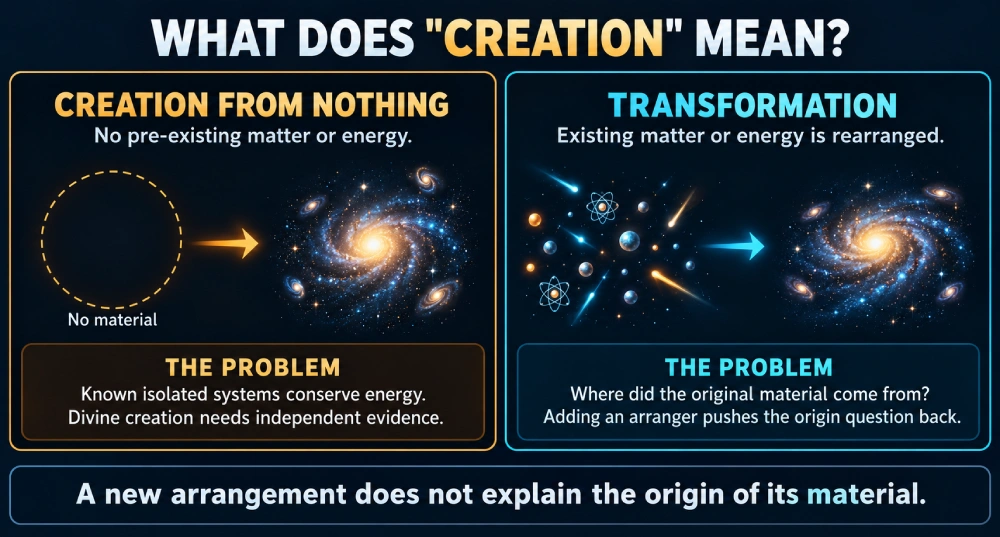
Transformation: A New Arrangement Does Not Explain the Origin of Its Materials
When a craftsperson makes a chair, a new chair results; but the craftsperson does not bring the wood into existence or produce the chemical elements of which the wood consists. Making a sweet drink produces a new mixture; the basic constituents of the water and sugar already existed before the task. Demolishing a house destroys its arrangement, but its bricks, dust, and other materials do not pass into nonexistent nothingness. In ordinary language, making new objects and breaking old ones are called creation and destruction. The physical description involves the movement of materials, chemical changes, exchanges of energy, and changes in structure. The fact that a particular shape did not exist before but exists afterward does not imply that the materials forming that shape previously did not exist at all.
When human-made houses, watches, or chairs are used to claim that “every creation has a creator,” it is this familiar experience of transformation that is being invoked. That experience is then used to conclude that all physical reality was produced without pre-existing materials. The meaning of “creation” has changed midway through the argument. The craftsperson’s example involves materials, labor, tools, and time; the theological claim of creation without materials declares those very foundations absent. An analogy cannot erase this enormous difference. Evidence of transforming materials is not evidence of creation without materials.
Creation from Nothing and the Question of Energy Conservation
When creation without pre-existing physical materials is asserted, the conventional theological claim treats God’s will as the cause that brings existence about. The questions then become what evidence supports the existence of this willing being and what establishes the emergence of physical existence from its will. In familiar testable systems, energy accounting examines where energy came from, where it went, and in what form it remains. Adding net energy to that account without a source or an equivalent expenditure conflicts with familiar conservation principles. Invoking a creator’s name supplies no experimental evidence for such an exceptional event.
Closed and isolated systems are distinct in this accounting. A closed system does not exchange matter, but may exchange energy through heat or work. A sealed container heated from outside is therefore not energetically isolated. An ideal isolated system allows neither matter nor energy to enter or leave; under the conditions in which familiar energy conservation applies, its total energy remains constant. When a battery powers a device, chemical energy becomes electricity, motion, and heat. When the device stops, the energy is not said to have “ceased to exist”; its location and form must be accounted for. Feynman’s explanation of energy conservation places precisely this emphasis on tracking energy entering and leaving a system. [2]
In order to verify the conservation of energy, we must be careful that we have not put any in or taken any out.
English translation: To verify the conservation of energy, we must ensure that we have not added any energy to the system or removed any from it.
Thus, moving from “Making a chair requires a craftsperson” to “God has been proved to be the source of existence without any pre-existing materials” leaves two missing steps. First, independent support is needed for the claim that existence began without materials. Second, support is needed for attributing that beginning to a particular conscious being. Familiar examples of energy transformation complete neither step. Declaring the event a miraculous exception creates the responsibility to provide evidence for the exception; the declaration is not itself its truth.
Mass–Energy Equivalence: What Particle Creation and Annihilation Mean
There is a relationship between the mass of matter and energy. The equation E0 = mc2 expresses the equivalence between mass m and rest energy E0. Energy is not a sack of substance that can simply be compressed into matter; it is a measurable quantity associated with a physical system. Massive particles have rest energy, while a photon has energy despite having zero rest mass. The relationship between mass and energy therefore does not mean that every form of energy is the same kind of object or the result of the same process. CERN’s ATLAS explanation specifies the energy in the equation as the energy of a particle at rest. [3]
E must be interpreted as the energy of the particle at rest
English translation: E must be understood as the energy of the particle at rest.
In particle physics, new particles can be produced, and existing particles can also be annihilated through particle–antiparticle interactions. In these cases, the initial and final physical states differ; the relevant energy, momentum, and other conserved quantities are accounted for. Experimental evidence exists for the production of electrons and positrons through interactions between photons of light. Photons, their energy, and a physical interaction are already present. Obtaining new particles does not mean producing existence without a pre-existing physical basis. [4]
the photons interact to produce electrons (matter) and positrons (antimatter).
English translation: The photons interact to produce electrons, or matter, and positrons, or antimatter.
The decisive distinction is between obtaining new particles or arrangements and obtaining existence without any pre-existing physical basis. In ordinary construction, chemical reactions, and particle production alike, the question includes which materials or state produced which outcome. Calling these events “creation” does not make them examples of creation without materials in the religious sense. Likewise, “destruction” may mean the end of a particular particle, object, or arrangement; it does not mean that every associated physical quantity becomes nonexistent.
The Entire Universe Is Not a Laboratory Container
Energy accounting for an isolated laboratory system and for the entire expanding universe does not have the same mathematical framework. In general relativity, spacetime itself changes. Although local energy–momentum rules apply, a total energy defined in the same way for the entire universe and invariant under all circumstances is not always available. As the universe expands, light’s wavelength increases and each photon’s energy decreases. The description of this change is connected to spacetime’s dynamics. Sean Carroll has explained this feature of general relativity. [5]
When the space through which particles move is changing, the total energy of those particles is not conserved.
English translation: When the space through which particles move changes, the total energy of those particles is not conserved.
Consequently, moving from experimentally established energy transformations inside a container to a conclusion about the ultimate origin of the entire universe requires the relevant cosmological model and its conditions. Nor does this account of spacetime’s dynamics establish a supernatural being with a will. Substituting “God did it” for a question in a physical theory introduces claims about a new being, its powers, and its mode of operation. Each requires support. Knowing the limits of a rule’s application and declaring one’s preferred God true beyond those limits are entirely different undertakings.
The Vacuum, Observational Limits, and Claims About Beings Outside the Universe
The vacuum of physics is not synonymous with complete nonexistence. Even when discussing a state without particles, quantum fields and a physical state remain part of the concept. CERN’s explanation defines the vacuum as the physical state with the lowest possible energy. Describing an event arising from a vacuum and claiming existence without any physical basis are therefore distinct claims. The verbal similarity of the word “nothing” cannot turn them into the same event. [6]
The vacuum is defined as the physical state with the lowest possible energy.
English translation: The vacuum is defined as the physical state with the lowest possible energy.
Nor is the boundary of the observable universe an established wall beyond which a supernatural realm automatically begins. It concerns the limit from which information can reach us. More physical universe beyond the observable portion and a conscious being outside all spacetime and nature are different ideas. NASA explains that science has no reliable estimate of the actual size of the entire universe. That undetermined size contains no evidence for the presence of a particular religious being. [7]
science has no reliable estimate of the actual size of the entire universe.
English translation: Science has no reliable estimate of the actual size of the entire universe.
The assertion that a being exists outside the universe is itself an existence claim. Unanswered questions about the universe do not establish that being’s presence. If it is placed beyond every avenue of observation, testing, and possible refutation while receiving credit for every event in the universe, there is no way to distinguish its presence from its absence. “Beyond our observation” is no substitute for evidence; it demands an explanation of how the alleged presence became known. The extent of the unknown and the extent of evidence for God are different matters.
If Materials Already Existed, What Is God’s Role?
Under the second definition, it could be said that God formed the present universe by transforming already existing energy, matter, or some initial physical state. Here, “before” or “pre-existing” treats materials as a prerequisite for construction. In this construction claim, God’s role resembles that of a craftsperson: materials are a prerequisite for his work. The promise of explaining the ultimate source of all existence is therefore unfulfilled, because the question of why those materials or that initial physical state exist remains. Naming a maker who merely changes an arrangement does not answer the question of existence’s origin.
Three possible answers to where the materials came from are distinct. Saying that God created them too returns to the first claim of creation without materials. Saying that they have always existed dispenses, at least for that underlying physical reality, with the need for a creator who brings it into existence. Saying that their origin is unknown leaves it unknown even when explained in God’s name. In all three cases, “he arranged the materials that were already there” does not by itself settle the origin of all existence.
Accepting pre-existing materials raises another question: why posit a conscious God to transform them? Processes of transformation and the formation of structures can be investigated in nature. An unanswered question about a particular process does not establish a conscious maker, his purposes, or his powers without evidence. Adding God alongside the materials and rules introduces another being into the explanation. It must be shown what additional information this being explains and what outcomes it makes more expected than its absence would. Placing a new name before the problem does not solve it; it pushes the question back.
Stopping the same reasoning at God’s existence raises the issue of special pleading. The unequal standard that underlying physical reality cannot exist without explanation but God can requires an independent basis. “He does not need to be created” is a religious declaration; it does not explain why the same kind of fundamentality should be denied to physical reality. Moreover, treating the basic materials as beginningless already narrows the sweeping claim that existence necessarily requires a conscious source. The question then concerns how particular structures form from those materials, rather than bringing all existence out of nothing.
| Answer About Pre-existing Materials | What Follows | Question That Remains |
|---|---|---|
| God created the materials too | This returns to the first claim of creation without materials. | What independent evidence supports that creation and God’s role? |
| The materials or underlying physical state are beginningless | At least for that reality, no initial giver of existence is being posited. | What supports the need for a conscious God in its transformation? |
| The origin of the materials is unknown | Ignorance about the origin of existence remains. | Which part of the unknown has adding God actually explained? |
From a Cause to a Particular Religion’s God: Separate Claims Require Separate Evidence
Even supposing an argument establishes a cause of the universe, that cause’s consciousness remains a separate question. Even supposing consciousness is established, omnipotence, omniscience, moral perfection, or the ability to answer human prayers are not thereby proved. Moving from these properties to the claim that a particular scripture was sent requires further historical and textual support. Jumping directly from a “first cause” to the religious identities of Allah, Jesus, or Vishnu skips numerous separate premises. If all of a religion’s attributes are inserted into the vague name of a cause at the outset, the conclusion becomes a declaration concealed in a definition rather than a proof.
Differences in a creator’s identity and properties therefore determine the evidential question. A being that grants existence without materials, a maker that transforms materials, a nonintervening first cause, and a religious person who hears prayers are not the same claim. Evidence for one kind cannot establish every property of another kind of being. The different kinds of support required for different claims are as follows:
| Type of Creator | Definition | Examples of Required Evidence | Challenge |
|---|---|---|---|
| Deistic creator | Creates the universe and subsequently does not intervene; everything operates through natural laws. | Cosmological arguments, such as an argument for the first cause of the Big Bang, but verifiable effects must be demonstrated. | Without effects, the claim is difficult to falsify; it is an unnecessary assumption that can be cut away with Occam’s razor. |
| Personal/theistic creator | Hears prayers, performs miracles, issues moral commands, and distributes punishments and rewards. | Repeatable miracles, such as prayer outcomes in controlled experiments, excluding alternative explanations such as placebo effects. | Personal experiences are not verifiable; different religions make mutually contradictory claims. |
| A particular religious creator | Associated with a specific scripture, prophet, historical event, or command—for example, Allah, Jesus, or Vishnu. | Historical evidence, such as archaeological testimony; fulfilled predictions that are not coincidental; and the scripture’s internal consistency. | Contradictions in scripture and historical inconsistencies, such as the lack of evidence for the biblical flood story. |
Which evidence is requested for which property of a creator is directly tied to the definition. A claim of intervention in response to prayer allows evidence of that intervention to be sought; a claim of sending a particular message allows the message’s origin and history to be examined. A claim framed so that presence and absence cannot possibly be distinguished moves away from empirical verification. Declaring oneself undetectable while claiming credit for detectable events seeks both advantages at once. If no outcome can count against a claim, the route to testing its relationship with reality is closed.
Common Theistic Questions—and Rational Answers
The force of examples commonly used in discussions of evidence depends on whether they provide a means of actual verification. Questions about biological fathers, brains, love, the beginning of the universe, and morality are not of the same kind. Some involve testing biological relationships, others observable behavior and physical changes, and others the evaluation of premises. Grouping them under “I have not seen it with my own eyes” erases these differences. The following comparison separates each question’s content, kind of evidence, and inferential gap.
| Common Question | Basis for Verification | Problem in the Reasoning | Type |
|---|---|---|---|
| “What proves that your father is your father?” | Birth certificates, family history, medical records, and, when necessary, DNA analysis provide ways to establish paternity. Interpreting test results also involves considering samples, methods, and possible alternative paternity. | Paternity involves a biological relationship and methods of verification. That example supplies no independent information supporting God’s existence [8]. | False analogy |
| “Have you seen your own brain?” | MRI, CT scans, surgery, and behavioral changes following brain injuries provide interrelated information. The case of Phineas Gage is also used in discussions of the relationship between the brain and behavior. | Seeing something personally with the naked eye and having evidence for it are different matters. Instruments and independent observations also provide evidence [9]. | Indirect evidence |
| “Love and morality cannot be seen—so how do you accept them?” | Experiences of love, behavior, relationships, and physiological changes can be investigated. Arguments about harm, consent, and fairness can be examined in moral judgments. | Mental states, abstract concepts, and a conscious being that creates the universe are different kinds of claim. Invisibility does not make a claim supernatural. | Non sequitur |
| “So did everything just happen by itself?” | Natural laws and processes such as evolution and gravitation provide ways to explain events. When information is insufficient, unresolved questions remain unresolved. | The alternatives are not merely “my God” or “no process at all.” An unknown explanation can remain unknown [10]. | False dichotomy |
| “How did people build the pyramids or other ancient monuments?” | Construction materials, workers’ settlements, tool marks, transport, and engineering evidence can be examined; various methods of construction, including ramps, are subjects of research. | Not knowing every construction detail does not provide evidence for a supernatural builder. Adding an unnecessary assumption does not fill the evidential gap [11] [12] | God of the gaps |
| “Do you know what existed before the Big Bang?” | Models of the universe’s initial state and the nature of time are evaluated. If a model includes a boundary of time, what “before” means beyond that boundary must also be examined. | The analogy of “what is north of the North Pole?” illustrates the concept of a boundary; an unknown region is not a victory for any particular supernatural being [12]. | Inference from ignorance |
| “Many people report prayer or miraculous experiences—what about those?” | Reports, expectations, memories, selectively reported events, and controlled experimental results can be examined separately. The Templeton-supported STEP study found no benefit of prayer on the specified medical outcome. | The fact that testimony describes an experience does not automatically establish the identity of a being responsible for it [13]. | Distinction between personal feeling and independent verification |
| “If God did not give us morality, where did it come from?” | Empathy, mutual cooperation, social rules, and the assessment of harm feature in discussions of morality’s emergence and justification. The Euthyphro question examines the relationship between commands and goodness. | Who issued a command and why that command is just are separate questions. Demanding obedience is no substitute for moral reasons [14]. | Euthyphro dilemma |
| “There are laws—who is the lawgiver?” | Natural laws describe regular relationships among events. State laws impose directives and penalties on human behavior. | The presence of the word “law” in both cases does not imply the same kind of personal author [15]. | Conflating different meanings of a word |
| “How can consciousness arise from matter?” | The hard problem of consciousness remains a subject of inquiry. Relationships between changes in the brain, anesthesia, and changes in experience can be examined. | Evidence of physical relationships exists; inserting a soul or God into unresolved questions requires additional evidence. | Inferring a being from an explanatory gap |
Paternity and the Brain: How Evidence Works Without Personal Sight
The central point of the paternity example is that the relationship’s consequences can be tested biologically. Beyond what anyone believes, another laboratory can collect samples and conduct its own tests. Similarly, the brain’s existence is not accepted merely because “everyone says so.” Imaging, surgery, and the effects of physical damage jointly provide evidence for the presence of a body part. Even if someone has never seen their own brain, these findings remain verifiable beyond their personal experience. This is the strength of indirect evidence: the expected effects of something not directly seen are detected through independent methods.
Love, Morality, and Consciousness: Different Subjects Under the Same Word “Invisible”
Love is a condition of experience and relationship. Caring for someone, suffering at separation, or fulfilling responsibilities over many years are its behavioral signs. Various physiological processes, including oxytocin, are studied, but a single hormone level does not constitute a complete definition of love. Abstract concepts such as numbers and language can also be reasoned about according to specific rules. None of these examples implies a conscious being outside the universe who issues commands. Likewise, a gap in the explanation of consciousness does not hand that gap over to a soul or God. The existence of an experience and its alleged supernatural origin must be established separately.
The Universe, Pyramids, and Natural Laws: Replacing Answers with Stories
Disagreement over how a stone was raised in a pyramid concerns construction methods. The existence of an invisible power is not already written into that disagreement. The same applies to the universe’s beginning: identifying a model’s limits does not make God the name of the next answer. Treating natural laws like legislation passed in a parliament and seeking a “lawgiver” turns a verbal resemblance into a resemblance between events. An equation describing planetary motion is not someone’s written command. Using its success to infer a conscious legislator requires an additional argument.
Prayer: Counting Failures Alongside Success Stories
Understanding the claim that prayer cured a disease requires more than collecting stories of people who recovered. Information is also needed about people who received treatment for the same disease, recovered naturally, or prayed without success. In Benson and colleagues’ STEP study, 1,802 cardiac bypass patients at six hospitals were divided into three groups. The two groups uncertain whether they would receive prayer had complication rates of 52 and 51 percent respectively; the group certain of receiving prayer had a rate of 59 percent. Prayer did not improve the study’s specified outcome—complication-free recovery. [16]
Intercessory prayer itself had no effect on complication-free recovery from CABG
English translation: Intercessory prayer itself had no effect on complication-free recovery following coronary artery bypass surgery.
A success takes on a different meaning when the total number of failures is omitted. If one person recovers among a thousand prayers, that person’s story may be true; but without knowing recovery rates in comparable patients without prayer, a supernatural effect cannot be determined. Remembering events that fit one’s beliefs and excluding those that do not produces confirmation bias. Direct experiences may also involve mistaken memories, incorrect causal attributions, and sometimes perceptual illusions. Establishing a cause requires testing these alternatives; the intensity of someone’s feelings does not perform that test.
Moral Commands: The Difference Between Power and Justification
The fact that a powerful being commands an action does not explain why the action is good. If receiving a command makes something just, a cruel command becomes good in exactly the same way. If reasons concerning harm, consent, or fairness support the action independently of the command, those reasons provide the basis for assessment. This problem of dependence lies at the heart of the question raised in Plato’s Euthyphro about holiness and divine approval. Invoking God’s name does not solve the question; it merely identifies the commander. [17]
The point which I should first wish to understand is whether the pious or holy is beloved by the gods because it is holy, or holy because it is beloved of the gods.
English translation: First I wish to understand whether the holy is loved by the gods because it is holy, or is holy because it is loved by the gods.
Everyday and scientific claims allow objective verification, correction of errors, and specific expectations. A claim about God seeking to take their place faces the same questions: what information exists, which properties have been established, and which results would count against it? Borrowing one claim’s verifiability to declare another true conceals a lack of support. That gap makes the demand for strong, independent evidence rational.
Evidential Standards: Why Ask for “Extra” Evidence?
A fundamental and inviolable principle of epistemology is that extraordinary claims require extraordinary evidence (extraordinary claims require extraordinary evidence, Carl Sagan). A weather forecast suffices for an ordinary everyday claim such as “It may rain today.” But a supernatural claim such as “An omnipotent, omniscient being created the entire universe, hears our prayers, determines morality, and will conduct a final judgment” reaches into the universe’s origin, life’s meaning, and the foundations of morality. Its evidence must therefore be extraordinarily strong, verifiable, and capable of withstanding alternative explanations.
Directly related to this principle is Christopher Hitchens’s razor: “What can be asserted without evidence can be dismissed without evidence.” (God Is Not Great). When theists say “God exists” but cannot provide objective evidence, this simple rule is sufficient—the claim is dismissed. Yet theists often strategically reverse the burden of proof, saying, “Then prove that God does not exist!” This is a classic logical fallacy.
Bertrand Russell gave the sharpest answer to this fallacy through his famous Russell’s teapot example. He argued that if I claim a small teapot orbits between Earth and Mars and cannot be detected by any telescope, providing evidence is my responsibility—the atheist need not prove that it is absent. In the same way, the claim of God’s existence is a supernatural, untestable claim; no reasonable obligation to prove nonexistence (negative proof) therefore falls on the atheist or agnostic. (Bertrand Russell, “Is There a God?”) [18]
Making a claim difficult to refute does not create support for it. If the invisible teapot is framed as something that cannot be seen, touched, or detected in any experiment, its claimant is protected from contrary results. But the same method can construct invisible dragons, undetectable jinn, or countless invented beings. There is then no neutral standard for exempting one while rejecting the others. The example targets precisely this lack of independent reasons for the claim.
Rationalists therefore always follow two clear paths: objective evidence and logical argument. The pyramid diagram below presents levels of evidential strength, showing how credible different kinds of evidence are:
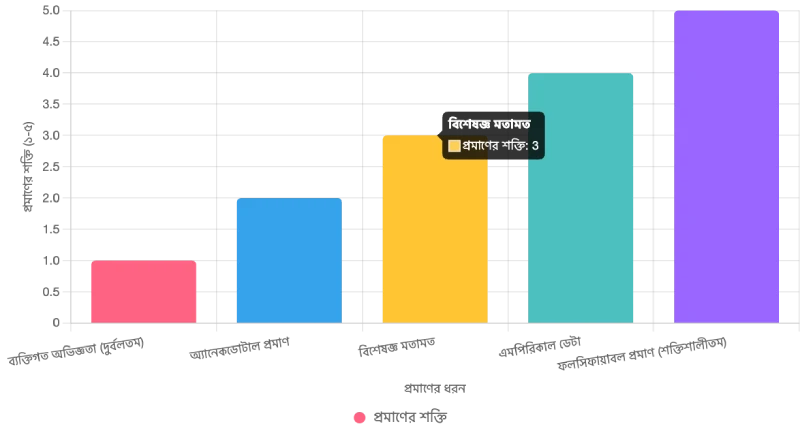
The chart’s central comparison distinguishes personal claims from systematic verification. An account of an experience may be merely one person’s statement; independent observations, experimental conditions, and opportunities to detect errors add resources for assessing its credibility. A claim does not become strong merely because it “could be disproved.” Evidential quality depends jointly on experimental results, the performance of competing explanations, and whether others can verify the same information.
Demanding strong evidence for extraordinary claims does not mean inventing arbitrary new obstacles for the claimant. If a result can readily arise from deception, measurement error, or a known natural process, it offers little support for a supernatural explanation. Conversely, results specified in advance, limited opportunities for mistaken inference, and success in independent tests can provide more information supporting a claim. Evidential standards distinguish a true claim from other possibilities. They do not exist to satisfy a critic’s personal preferences.
Definitions and Basic Logical Foundations
In classical logic, the relationship between a statement’s meaning and its negation is specified. Changing definitions during a discussion, or simultaneously maintaining contradictory conclusions in the same sense, prevents the reasoning’s connections from being tested. The principles of identity, noncontradiction, and excluded middle belong to this framework. They do not provide the information being investigated; they supply rules for assessing consistency between information and statements.
| Logical Principle | Plain Meaning | Example and Application |
|---|---|---|
| Identity | The identity of a subject or term remains specified within the same discussion: A is A. | If “creator” initially means an unconscious cause, it cannot later mean a prayer-hearing person while retaining the same meaning. Specifying identity does not mean claiming that objects never change. |
| Noncontradiction | P and its negation are not both true in the same sense, at the same time, and about the same subject: ¬(P ∧ ¬P). | Saying simultaneously that the same action has been fully performed and has not been performed, in the same sense, is inconsistent. Changing the time or meaning produces a different statement. |
| Excluded middle | In classical two-valued logic, a specified proposition P or its negation ¬P is true: P ∨ ¬P. | Whether a specified claim has a truth value and whether we know it are separate questions. Assent can be withheld when the answer is unknown. |
These logical rules provide a framework for assessing truth. Lacking information supporting a claim and containing an internal contradiction are different defects. “A being cannot be detected” does not itself violate noncontradiction; its problem is that the basis for asserting presence through detectable information remains unclear. But simultaneously maintaining “the being has no effects” and “I am presenting evidence of the being’s effects,” in the same sense, produces a contradiction. Specifying which objection applies where directs criticism toward a claim’s actual weakness.
The existence of two possibilities—true and false—does not make their probabilities equal. A lottery ticket will either win or not win; having two alternatives does not give it a 50 percent chance of winning. Likewise, “God exists or does not exist” does not imply equal weights for the two possibilities. Separate information is needed to determine how much support lies on either side. Confusing the number of logical possibilities with actual probabilities turns “it could be so” into a basis for belief without any calculation.
Objective Evidence: What Do Atheists Generally Seek?
Objective or impersonal evidence rests on information and methods that others can examine beyond personal emotions. The method’s specified standards remain the same whether a belief is sacred to one person and unfamiliar to another. Several important features operate in this kind of verification:
| Criterion | Plain Meaning | Contribution to Evidence |
|---|---|---|
| Objectivity or impersonality | The result does not depend solely on the observer’s tastes, emotions, or religious identity. | People of different beliefs can examine the same methods and information. |
| Testability | The kind of information expected if the claim is true is specified. | A route is established for comparing a claim with actual results. |
| Falsifiability | It is known which findings would count against the claim. | There is less opportunity to count successes as evidence while placing every failure beyond testing. |
| Replication and independent verification | Tests can be repeated under the same conditions and information verified by separate researchers. | Opportunities to detect accidents, bias, and methodological errors increase; the statistical nature of the results can also be examined. |
The information relevant to accepting a claim as true follows from the claim’s specific content. Claims involving actual intervention, new information, and historical identity also raise different questions of verification. Possible examples include:
| Possible Kind of Evidence | How It Would Be Verified | Connection That Must Be Established |
|---|---|---|
| A publicly announced unusual event | For a claim such as the restoration of an amputated limb at a predetermined time, the person’s prior condition, records of the event, and subsequent examinations would be independently verified. | Once the unusual outcome is established as real, its specific cause and connection to the claimed being must also be established. |
| New information specified in advance | A text’s date, original language, and specificity would be established and compared with information obtained later—for example, a specific testable claim in genetics. | Reinterpreting vague sentences using later knowledge, borrowing from contemporary sources, and coincidental matches would have to be distinguished. |
| A regular pattern of intervention | Claims about prayer’s effects would involve suitable comparison groups, bias controls, and independent replication. | The cause of any statistical difference and why it supports a particular supernatural being must be demonstrated. |
If the same event could result from different technologies, deception, misidentification, or a natural process, comparison with those alternatives is necessary. Merely fitting a religious explanation is insufficient; a connection is needed showing why it is better supported than competing explanations.
An identification step lies between concluding that a strange event occurred and concluding that a particular God caused it. Suppose a predicted event happens. Questions remain about advance information, possible deception, and whether another known or unknown technology could produce the same result. If an outcome fits many explanations, it is not a conclusive identification of just one. The more specific a claim, the more its support must reach those specific properties. The leap from “an exception occurred” to “every command in this scripture is true” leaves many steps unproven.
Logical Arguments: More Than “It Felt Right”
When direct evidence is unavailable, philosophical arguments are used—for example, the cosmological claim: “Everything has a cause, so the first cause is a creator.” The assessment criteria are:
| Criterion | Meaning | Simple Example |
|---|---|---|
| Logical validity | Whether the conclusion necessarily follows if the premises are true. | All cats are mammals; Minu is a cat; therefore Minu is a mammal. Here the conclusion follows from the premises. |
| Soundness | Whether both conditions are fulfilled: valid logical structure and true premises. | An argument built on “all birds can fly” may have a valid structure, but its false premise makes it unsound. |
| Support for empirical claims | Whether an independent basis establishes the real-world information used as a premise. | Accepting “a conscious being exists outside the universe” at the outset cannot establish that being’s existence at the end. |
“Hearing the argument gave me peace” is not a criterion of soundness. Likewise, moving from “everything has a cause” to “therefore the first cause is a conscious creator” requires additional premises. The preceding statement has not established that a cause must be first, possess personhood, or send a scripture. Declaring an exceptionless rule and then exempting only God from needing a cause also requires an independent basis for that exemption. Probabilistic predictions in quantum theory likewise raise questions about applying everyday notions of causation unchanged throughout the universe. Criticism of an argument rests on this relationship between premises and conclusion, not on an emotional declaration.
An argument’s difficult language can conceal its gaps. Names such as “first cause,” “necessary being,” or “ultimate foundation” supply no new information by themselves. Each name’s meaning and necessity must be established. Inserting a conclusion into a premise under another name does not discover it. Understanding the distinction between a conclusion validly derived from a verifiable foundation and a preferred result smuggled into a definition is the most effective way for general readers to test an argument. For a detailed discussion of the inference from a first cause to a creator, see this article [19]
Logical Fallacies and Limitations: Where Discussions Get Stuck
A conclusion can sound firm while the path from information to conclusion is faulty. Sometimes the conclusion is assumed true in advance, sometimes an exemption is made for one’s own claim, and sometimes presenting only two alternatives hides a third possibility. Separating these errors by name and example exposes a statement’s weak points:
| Fallacy | Definition | Example | Why Is It Logically Weak? |
|---|---|---|---|
| Circular reasoning | Using what is to be proved as its own proof. | “The scripture is true because the creator said so; the creator exists because the scripture says so.” | Circular—it adds no new information [20]. |
| God of the gaps | Filling an unknown with a creator. | “Evolution does not explain everything, therefore a creator.” | The creator retreats as knowledge advances; no specific conclusion follows from an unknown [21]. |
| Argument from ignorance | Something is unknown, therefore my claim is true. | “You cannot explain it, therefore a creator.” | An opponent’s weakness is not one’s own strength [12]. |
| Special pleading | A rule applies to everyone, but one’s own claim receives an exemption. | “Everything needs a cause, but the creator is uncaused.” | Unequal standards; other alternatives would also have to receive an exemption. |
| Ad hoc hypothesis | An additional claim introduced to rescue an argument. | “The creator cannot be seen because he is testing us.” | The new claim has no evidence; the theory becomes untestable [22]. |
| Loaded question | Concealing a conclusion within a question. | “If you reject a creator, is everything an accident?” | A false dichotomy; it excludes intermediate positions. |
Multiple fallacies may operate together in the same discussion. “You do not know the explanation, so my God is the cause; do not ask what caused him” combines inference from ignorance with special pleading. Identifying these means examining every connection in the statement. Once the information supplied and the additional conclusions inserted into it become clear, gaps hidden behind religious prestige are exposed.
Memorizing fallacy names is no substitute for criticism. After saying “circular,” one must show which statement has become its own foundation; after saying “argument from ignorance,” one must show which unknown has been used to draw a particular conclusion. Making that relationship clear allows general readers to identify the error too. Stopping at a label turns it into another kind of authority. An argument’s strength lies in its connections: how far a conclusion follows from particular information. Religious prestige or speaking loudly in a debate does not create that connection.
The Burden of Proof
Reversing the burden of proof is a basic tactic in religious discussion. Someone claiming that a supernatural being exists must provide reasons for accepting the statement. A listener who says “the support you have provided is insufficient” asserts no new being or event. The listener withholds assent to the proposed conclusion. Demanding evidence to refute the claim, when the claimant has not supplied evidence establishing its existence, therefore evades responsibility. Placing a statement beyond testing does not create evidence for it. It instead intensifies the question of how presence and absence can be distinguished. Imposing punishment or condemnation for disbelief without giving reasons for belief replaces reasoning with pressure.
Russell’s teapot example makes this reversal’s inconsistency clear. Suppose someone claims that a tiny porcelain teapot orbits the Sun between Earth and Mars. It is so small that even powerful telescopes cannot detect it. The listener therefore cannot easily refute the claim. Yet that inability provides no new testimony for the teapot. Russell’s 1952 Is There a God? essay presents the issue in these terms. [23]
nobody would be able to disprove my assertion
English translation: No one would be able to refute my assertion.
Using this protection from refutation to say “therefore you must believe” issues a prohibition in place of evidence. Why one should believe remains unanswered. In religion, too, declarations such as “God is hidden,” “instruments cannot detect him,” or “he is beyond evidence” are not testimony to his presence. Countless invented existence claims can be constructed through the same tactic. Closing off verification while demanding that the dissenter prove nonexistence is not reasoning; it uses ignorance to support belief. Withholding assent when evidence is absent directly rejects this tactic.
Counterclaims: God died of a stroke last night! Or Allah and Mother Kali were happily married today. What if atheists made such counterclaims and demanded that you prove them false?
These counterclaims exhibit the same problem. Someone announcing God’s death or a marriage between deities bears the burden of proof. “Prove it false” does not make the story true. If the rule used to secure acceptance of one’s preferred religious claim also requires accepting an unwelcome claim, the rule’s emptiness is exposed. Consistent standards do not change with personal preferences. Popularity, sacredness, or emotional significance creates no special evidence-free exemption for a belief.
The Problem of Evil
The problem of suffering examines the relationship between God’s declared attributes and the actual world. The old question associated with Epicurus is this: why would preventable, unnecessary suffering exist under an omniscient, omnipotent, and perfectly good being? Omniscience would mean knowing about the suffering; omnipotence would mean the capacity to prevent it; perfect goodness raises the question of permitting needless torment. The argument has two forms. Its logical form identifies an inconsistency between specified attributes and unnecessary suffering. Its evidential form asks how well suffering’s nature, extent, and distribution match what would be expected if that God existed.
A child’s prolonged suffering from cancer or the deaths of countless people in an earthquake are not merely numerical events. The harm does not correspond to the victims’ choices, culpability, or opportunities for moral learning. An important premise here is that a perfectly good being would prevent suffering when doing so would not sacrifice an equal or greater indispensable good. Such unnecessary suffering conflicts with the declared perfect goodness and capacity to prevent it. Religious explanations invoke human free will, soul-making, or the best of all possible worlds. Each explanation bears the responsibility of showing the necessary connection to the particular harm. Merely saying “there is a purpose” establishes neither that purpose’s existence nor the suffering’s necessity.
Appealing to free human decisions can propose an explanation for human wrongdoing; its connection to earthquakes, congenital diseases, or animal suffering beyond human decisions must be established separately. Invoking someone else’s freedom does not by itself explain why a child had to suffer. Soul-making explanations also face a question: whose development required the harm when a child dies before being able to learn, or an animal suffers for a long time with no observer present? “This is the best possible world” is also a claim; it requires arguments about possible alternatives and necessary constraints. Attaching an unidentified purpose to every instance of suffering allows any cruelty to be called good. Goodness then loses its practical meaning of preventing harm.
Moral Judgment for Humans—Why an Exemption for God?
If a person leaves a child in terrible pain despite being able to prevent it, that conduct receives moral judgment. When responsibility for the same event is attributed to God, closing every avenue of assessment by invoking an “unknown good” is special pleading. In the same essay, Russell uses cancer to raise the conflict between moral standards applied to humans and the immunity claimed for a creator. Greater power and status do not erase the question of responsibility. [24]
A man who willingly afflicted another with cancer would be considered a fiend.
English translation: A person who deliberately afflicted someone else with cancer would be regarded as a fiend.
Nor does a promise of compensation after death establish the harm’s necessity. Hurting someone needlessly and promising a gift afterward does not justify the initial injury. Likewise, the promise of future happiness does not explain why the present suffering could not be prevented. Present torment, its cause, and a future promise are distinct statements. Even accepting the promise as true leaves the question of cruelty unresolved when no argument establishes necessity.
Divine Hiddenness
Another profound argument against God’s existence is “divine hiddenness”, the problem of God’s concealment, developed extensively by philosopher J. L. Schellenberg. Its central idea is that if a perfectly good personal God exists, wants relationships with humans, and desires belief, he would surely make his existence known through clear evidence to all “nonresistant nonbelievers”—people who remain open but do not believe. Yet many people sincerely search without finding evidence for God, including atheists, agnostics, and adherents of other religions who think impartially. This “hiddenness” is therefore inconsistent with God’s existence.
A “nonresistant nonbeliever” is someone capable of understanding the idea of a relationship, who does not resist accepting the truth if found, yet lacks sufficient reason to believe. The issue is more than someone never having felt emotion in prayer. If they cannot reasonably accept the existence of the being with whom a relationship is proposed, the basic condition for a conscious reciprocal relationship is absent. Knowing someone’s existence does not require obeying their commands. Knowing an identity and choosing obedience are separate actions; providing evidence does not extinguish human agency.
Schellenberg’s argument highlights the conflict between an opportunity for relationship and absent belief despite sincere inquiry. A loving father who left a child wholly uncertain of his existence and then blamed the child for having no relationship would contradict the claim of love. Likewise, demanding belief without a sufficient basis for existence and announcing punishment for disbelief places the seeker in a double bind. The argument’s main steps are:
| Step | Statement | Connection |
|---|---|---|
| Premise | A perfectly loving God would not close the door to conscious relationship for people capable of relationship who remain involuntarily without belief. | The claim of love is connected to an actual opportunity for relationship. |
| Necessary condition | A conscious relationship requires the opportunity to believe that the being in question exists. | Without belief in that existence, a knowingly reciprocal relationship with the being cannot develop. |
| Observation | Many people find no basis for belief in God’s existence despite not resisting a relationship. | Assuming that this nonbelief is disobedience substitutes a new accusation for the observation. |
| Conclusion | That observation is inconsistent with a perfectly loving God open to relationship. | The objection arises from the conflict between declared attributes and observed reality. |
Schellenberg’s own discussion grounds the argument in opportunities for relationship and nonresistant nonbelief. Calling the situation a “test” or “free will” does not remove the conflict; it must be shown why withholding the opportunity to know God’s existence is necessary for relationship and freedom. [25]
No perfectly loving God exists
English translation: No perfectly loving God exists.
“Absence of Evidence” Versus “Evidence of Absence”
Questions about existence and questions about our knowledge of existence are separate. Whether a being exists concerns reality; whether we have sufficient reason to trust in its existence concerns the basis of knowledge. Evading the second question by invoking the irrefutability of the first does not resolve the problem of acceptance. In claims about God, the questions separate as follows:
| Question | Subject | Basis for an Answer |
|---|---|---|
| Does any God actually exist? | Question of existence | What is true about the being’s presence or absence. |
| Is there sufficient reason to believe in that God’s existence? | Question of epistemic justification | The information and reasoning supporting the claim, and their reliability. |
Keeping the two questions separate reveals the limits of “but he might exist.” A possibility does not have to be accepted as true merely because it has not been conclusively refuted. A closed box might contain valuable coins; valuing it solely on that possibility would turn an assumption into evidence of wealth. Acceptance requires information supporting the coins’ presence. The possibility of existence and a rational basis for believing in existence are different things.
Human knowledge of many real things developed later. The existence of molecules, atoms, or black holes did not depend on human discovery. Whether there was reason to accept a particular statement before discovery is a separate question. The list of possible undetected existences can be expanded without limit; that possibility alone cannot make every name a basis for decisions. Likewise, without supporting information, there is no basis for inserting God as an established operative cause into medicine, history, morality, or explanations of the universe. “Effectively nonexistent” applies in this decision-making sense: assuming his presence within an explanation has not been justified.
At this point theists deploy a particular shield: “Absence of evidence is not evidence of absence” (the lack of evidence does not itself establish nonexistence). Their claim is that since atheists have not conclusively proved that God does not exist, the possibility of God’s existence remains.
But physicist Victor Stenger dissected this argument: when a being, such as a personal God, is supposed to produce specific effects in the universe, yet systematic modern scientific investigation finds no trace, that “absence of evidence” actually becomes “evidence of absence” for that being [26].
Consider a simple example: suppose someone claims that a living elephant is standing in the middle of your room right now. You enter and find the furniture undisturbed, no smell, no sound, and no footprints. In other words, evidence of an elephant is absent. Here that absence of evidence establishes that the elephant is not there. A flesh-and-blood elephant would inevitably produce some effects.
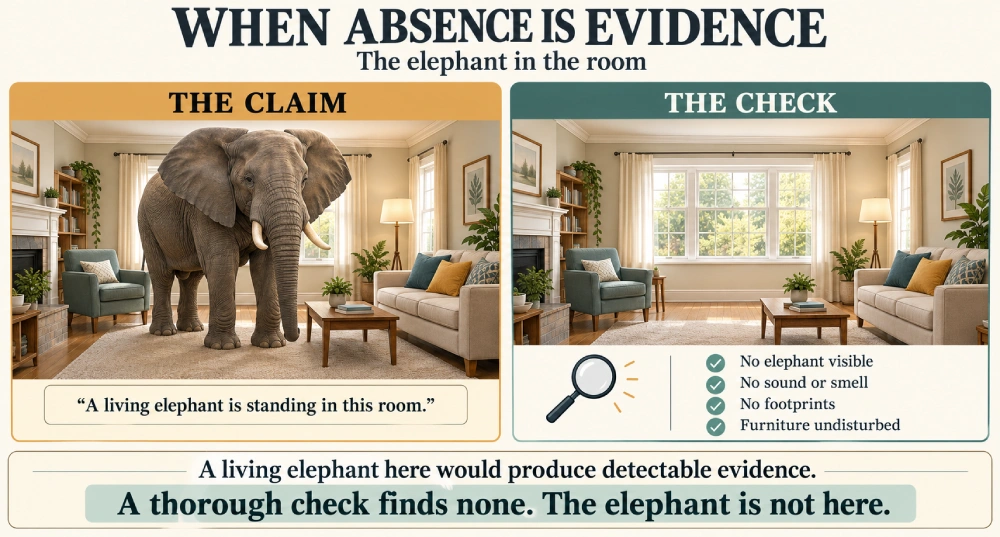
When Finding Nothing Really Is Evidence Against a Claim
If an elephant is present in a small room, the expectation of detecting its body, weight, sound, or occupation of space is very strong. Turning on the light, inspecting the empty room, and finding none of these provides evidence against the elephant claim. Briefly looking for a tiny creature in a distant sea is not a comparable test. Three factors determine the meaning of an absence: the clarity of the expected signs, the suitability of the search, and the capacity for detection. Claiming undetectability and later claiming credit for presence whenever convenient severs this testing relationship.
If a personal God is claimed to intervene in specific ways, the expected results can be tested. Particular claims of answered prayer, error-free scriptural predictions, or announced miraculous cures bear a relationship to actual outcomes. When suitable investigation finds expected results absent, the failure counts against the claim. Dismissing every contrary result with “God would do it if he wanted to, and would not if he did not” empties the earlier specific promise of content. Failing to establish supernatural causes independently in investigations of space, life’s development, and matter’s behavior also leaves the burden of proof with the claimant. The existence of unknowns does not cancel that responsibility. This relates to the discussion “Are Islamic Doctrinal Claims Metaphysical?” [27] [28]
The Fine-Tuning Argument and the Anthropic Principle
The argument modern theists most often invoke in the name of science is the “fine-tuning argument”. They claim that if the universe’s fundamental physical constants—for example, the strength of gravity, the electron’s charge, or the Big Bang’s expansion rate—were even slightly different, stars or planets would not form and life could not develop. They present this mathematical precision as evidence for a “cosmic tuner” or creator.
This argument does not establish the step from observed suitability to conscious design. We ask questions from an environment in which we can survive—that is a condition of an observer’s presence. Treating the conditions of one’s own existence as evidence of arrangements made for oneself introduces an observational selection problem. Probability also matters: which values are possible, how they are distributed, and which values a design hypothesis predicts. Without these, no calculation that “coincidence is impossible” can be established. The anthropic principle clarifies this selection constraint and challenges the direct leap from suitability to design.
Douglas Adams’s Puddle Analogy
The celebrated writer Douglas Adams explained this fallacy with a striking example. Suppose some water gathered in a hole—a puddle—suddenly became conscious and began thinking: “Wow, this hole was made perfectly for me! Every fold and corner fits my body wonderfully! Someone must have made this hole just for me with tremendous care.” The water fails to understand that the hole was not made for it; taking the shape of a hole is what water does. Likewise, we imagine that the universe has been “tuned” for us, while in reality we evolved over millions upon millions of years, adapting to this universe’s existing environment [29]. For more on this subject, see [30] [31]
The puddle’s error is reversing the direction of causation because of a match. Water fitting the hole is read as the hole having been made for the water. In humans, environmental adaptation is a long process; reading its result as a declaration that the environment was predetermined for humans makes the same kind of reversal. An organism’s survival in its present environment does not establish that the environment was built for it. A story of purpose replaces inquiry into the process that produced the fit.
The Anthropic Principle and Selection Bias
The anthropic principle states that we observe a life-friendly universe because we exist here. If the universe’s constants did not permit life, we would not be here to ask questions about it. This is an unavoidable observational condition, not a miracle.
An everyday example illustrates this selection. Interviewing fish would locate all the respondents in watery environments; that does not mean every body of water was made for the particular fish being interviewed. The conditions of interviewing have excluded fish outside water. Likewise, no observer’s report can come from a universe in which observers are impossible. That selection therefore enters the calculation when using the information that “we are here.” Evidence for design still requires information that is not explained merely by the conditions of an observer’s presence.
Victor Stenger’s The Fallacy of Fine-Tuning critiques variations in constants, relationships among different values, and the design assumption. Changing one constant while holding everything else fixed and examining possible combinations of several related values are different tasks. Fred Adams’s research examined stellar structure by varying the gravitational constant, the fine-structure constant, and a parameter governing nuclear reactions. Roughly one quarter of the range investigated in the model supplied values allowing stars to operate through sustained nuclear fusion. This provides specific model-based information against the simplistic declaration that “a slight change in one value would make stars impossible everywhere.” [32] [33]
the set of parameters necessary to support stars are not particularly rare.
English translation: The set of parameters necessary to support stars is not particularly rare.
Saying “it could have been different” is insufficient for a probability calculation. Without knowing which weights to assign to the values in a list, rarity cannot be quantified. Likewise, a design hypothesis yields no definite probability unless it specifies what kind of universe a designer would want. “He can do anything” permits every possible outcome; it does not make one particular result more expected. Placing a designer’s name beside an observed value and obtaining comparative evidence for design from that value are separate undertakings.
The Universe’s Hostility and Waste
Comparing the claim that the universe was designed exclusively for humans with its actual environment reveals an enormous gap. Humans cannot survive unaided in vast expanses of space, airless environments, lethal radiation, or temperatures beyond human tolerance. The solar system’s other planets are not habitable homes for humans either. Even on Earth, sustaining life requires suitable food, water, air, temperature, and protection from danger. Highlighting a tiny habitable location to call the entire system a perfect arrangement for humans excludes a large part of the observations. Stephen Hawking and Leonard Mlodinow’s The Grand Design argues for explanations of the universe’s origin based on natural laws. Declaring a religious purpose does not itself explain those laws or the vast hostility. [34]
The question of waste arises from within a particular design claim. If human safety and welfare are the primary goal, countless environments hostile to humans and preventable dangers raise questions about the efficiency of achieving it. “The creator had other purposes” adds a new claim of purpose; it supplies no evidence for the earlier human-centered claim. Taking favorable outcomes as evidence of design for humans and unfavorable outcomes as evidence of an unknown purpose makes every result support the same conclusion, leaving the claim without testable content.
So What Evidence Do Atheists Want? More Than a One-Line Answer
No universal secret signal or personally preferred spectacle is the sole form of evidence. The nature of a statement determines the support it needs. Intervention claims require information about intervention, philosophical claims require sound premises, and claims of a specific religious identity require an independent basis for that identity. Maintaining these distinctions reduces the opportunity to impose one claim in the name of evidence for another.
| Type of Claim | Support Required | Why It Is Required |
|---|---|---|
| A creator who actually intervenes | Measurement of specific effects, suitable comparisons, independent verification, and replication. | An intervention claim concerns actual outcomes; information about those outcomes is therefore needed. |
| A philosophically proposed creator | Clear definitions, valid logical structure, true premises, and support for the conclusion relative to alternatives. | A new name or assumption cannot take the place of established truth. |
| A particular religion’s creator | Independent verification of scriptures, prophets, historical events, predictions, and the origin of commands. | A general first-cause concept does not make every claim of a particular religion true. |
Atheism means rejecting poorly supported claims, not “knowing everything.”
Accepting a claim when support is found and revising a conclusion when contrary information appears are parts of the same method. Fixing belief first and selecting favorable events afterward does the opposite. The effective answer to “what evidence would convince you?” is therefore not a list of preferred spectacles. It is information and reasoning that support a claim’s specific properties and withstand verification. Once the relationship between what a claimant says, which outcomes they commit to, and how those outcomes can be tested is clear, discussion of evidence gains a concrete foundation.
Bayesian Probability Theory: A Mathematical Dissection of the God Claim’s Emptiness
Bayesian probability expresses how support for a claim changes in light of new information. The weight a claim had on the basis of previously known information can increase or decrease after new evidence. The question is the same for God claims: how expected is the observed information if that God exists, and how expected is it if he does not? A story does not become strong evidence merely because it fits the claim. If the same information is readily available under another explanation, invoking God adds no distinctive support. This comparison clarifies the roles of assumptions, background knowledge, and evidence, while requiring a proper basis for every value in the equation. Where blind faith fixes the conclusion at the outset, Bayesian calculation specifies the relationship between information and a conclusion’s weight.
Bayes’s Theorem and Its Mathematical Form
In the basic formula of Bayes’s theorem, H denotes a claim and E the information obtained. The vertical bar means “given.” For example, P(H|E) is the probability of H given that E has been obtained. The formula is: [35]
P(H|E) = [P(E|H) × P(H)] / P(E)
The symbols have the following meanings:
| Symbol | Meaning | Plain Explanation |
|---|---|---|
| P(H|E) | The claim’s probability after new information | How much support H receives after E is obtained; it can be updated again when further information arrives. |
| P(H) | Prior probability based on background knowledge | The weight assigned to H on the basis of background information before considering this particular new evidence. |
| P(E|H) | The probability of this information if the claim is true | How expected E is if H is true. This is not the same as the probability that H is true. |
| P(E) | The overall probability of the information | How expected E is after combining the contributions of all alternatives under consideration. |
| P(E|¬H) | The probability of the same information if the claim is false | How readily E may arise under other explanations. This value is also needed for comparative assessment. |
For two alternatives—H and not-H—the formula can be expanded:
P(H|E) = [P(E|H) × P(H)] / {[P(E|H) × P(H)] + [P(E|¬H) × P(¬H)]}
Suppose someone says an invisible object in their room produces a particular signal in tests. A test finds no signal. Comparing how likely that absence is when the object really exists with how likely it is when the object does not exist changes the claim’s weight. “You cannot prove it is absent” does not complete the calculation. Likewise, calling an event “unusual” does not establish a particular God; the comparison must include how expected the event is without positing God.
Why Is God’s Prior Probability Negligible?
A prior probability is not an uninformed preference; it evaluates a claim using relevant background knowledge before new evidence. Expecting sunrise connects to known astronomical laws and observations. A person’s history of providing accurate information affects the assessment of a new statement; repeated lying is relevant too. For miraculous claims, the question is how reliably events of the relevant kind have previously been established and what independent support exists for the proposed mechanism. Countless people repeating the same story do not create countless independent pieces of evidence. Repeatedly counting a claim spread from the same source as background knowledge artificially inflates its evidential weight.
Assigning equal weight to tested natural causes and independently unestablished supernatural causes merely because they are “two possibilities” is not rational. Information exists about the operation and limits of familiar causes; for supernatural causes, the claimant must demonstrate that foundation. Richard Carrier’s Proving History discusses organizing background knowledge, the nature of testimony, and comparisons of alternative explanations within a Bayesian framework for evaluating historical claims. Any specific probability value requires a source and rational basis. Inserting a small or large number to favor one’s conclusion cannot be called a mathematical result. When a claim’s reliable prior foundation is weak, new evidence has to do comparatively more work to increase confidence in it. [36]
Assigning a claim zero probability merely because it is unknown prevents future information from increasing its weight through the formula. Conversely, allocating a high initial probability because “it cannot be called impossible” turns ignorance into evidence. Transparent assessment discloses the basis for the values and how much changes alter the conclusion. Fixing a probability through religious allegiance and then arranging the remaining calculation dresses blind faith in arithmetic. The presence of an equation does not turn baseless numbers into information.
Richard Carrier’s Analysis: History and Supernatural Claims
In Carrier’s historical analysis, “the story exists” is insufficient to assess an event’s truth. The information must be compared with explanations of how the story could arise—a truthful account, mistaken memory, rumor, literary composition, or deception. His Understanding Bayesian History discussion addresses background knowledge, new information, and the specification of probability values. Natural explanations allow comparison with familiar events; proposing a supernatural explanation requires special support. “I do not know the natural explanation” does not supply that support. [37] [38]
BT reduces all arguments to a debate over just three numbers.
English translation: Bayes’s theorem reduces arguments to a debate over just three numbers.
This method helps identify where disagreement lies. How reliable someone considers a witness, how much probability they assign to false memory, and what information they expect if an event is true become separately visible. Merely inserting “miraculous” repeats the event’s description without evaluating its cause. Positing an additional being requires showing which information became more expected in advance. If nothing differs, adding a name increases the number of unsupported assumptions rather than the explanation’s strength.
Mathematics’ Verdict Against Blind Faith
Personal feelings can provide information about what people experience; concluding that those feelings have a supernatural source requires a separate connection. When one believer’s profound peace coexists with equally profound peace in an adherent of another religion, emotional intensity cannot determine the truth of mutually contradictory religious claims. Bayesian comparison requires assessing how expected the feeling is given a particular God’s existence and given familiar psychological and social processes. Information readily available under alternative explanations does not provide distinctive strong support for God. A demand to respect a feeling and a demand to accept its explanation as true are separate matters.
The mathematical relationship is direct: information equally likely whether H is true or false adds no further weight to H. If an outcome highly expected when H is true is repeatedly absent in suitable tests, support for H decreases. Whether the being’s name is sacred is irrelevant to this conclusion. What matters is comparing declared predictions with observed information. If a particular God claim fails to demonstrate its expected effects, appeals to faith, popularity, or irrefutability cannot erase that failure.
A Simple Numerical Example: The Effect of Missing Expected Signs
For illustration, suppose in the invisible-object example that the probability of detecting no signal in a test is 10 percent when the object exists and 90 percent when it does not. These are assumed experimental values for the example. With a prior probability of 50 percent, the calculation after finding no signal is: 0.10 × 0.50 ÷ [(0.10 × 0.50) + (0.90 × 0.50)] = 0.10. The probability of presence therefore drops from 50 percent to 10 percent. Different initial weights also produce different subsequent results:
| Prior Probability of Presence | Probability of No Signal if the Object Exists | Probability of No Signal if the Object Does Not Exist | Probability of Presence After No Signal Is Found |
|---|---|---|---|
| 10 percent | 10 percent | 90 percent | Approximately 1.22 percent |
| 50 percent | 10 percent | 90 percent | 10 percent |
| 90 percent | 10 percent | 90 percent | 50 percent |
In all three rows, the same test result reduces the weight of the presence claim. The exact decrease also depends on the initial value. This calculation clarifies why missing expected signs can be evidence against a claim. Obtaining numerical results for a God claim likewise requires first establishing the claim, effects, and comparative probabilities. Writing “close to zero” without a foundation is not a calculation. Nor does an inability to calculate a probability justify accepting an unsupported claim as true. The responsibility to support a claim remains with whoever advances it.
Summary
Reasoning and information perform related tasks. Reasoning shows whether a conclusion follows from premises; information shows how strong the foundations of the real-world premises and explanations are. A valid argument with true premises establishes its conclusion. Empirical claims require observational and experimental support to verify that truth. Arranging sentences or listing information is insufficient; the connection from information to conclusion must also be correct.
| Area of Assessment | Criterion | Meaning and Application |
|---|---|---|
| Reasoning | Validity | The conclusion follows if the premises are assumed true. |
| Reasoning | Soundness | The structure is valid and the premises are true. |
| Reasoning | Clear definitions | The being and properties being claimed remain specified in the same sense. |
| Reasoning | Fallacy-free connections | Circular reasoning, inference from ignorance, special pleading, and false dichotomies do not support the conclusion. |
| Reasoning | Distinction between premise and proof | Beginning with “X is true” does not establish X; the statement needs a foundation. |
| Reasoning | Burden of proof | The claimant provides support; someone else’s inability to refute the claim is not information establishing presence. |
| Reasoning | After-the-fact rescue hypotheses | Adding a new unproven condition after every failure does not increase support for the original claim. |
| Evidence | Opportunities for observation and testing | Statements can be compared with information through the senses, instruments, or suitable methods. |
| Evidence | Objectivity or impersonality | Personal preferences or religious identity do not determine the standards for results. |
| Evidence | Specified conditions for refutation | It is known which results would count against the claim. |
| Evidence | Replication | Repeating a test under the same conditions produces the same kind of results or the expected statistical pattern. |
| Evidence | Independent verification | Separate teams or observers can examine the original information and methods. |
| Evidence | Comparison of alternative explanations | Results are compared with natural, psychological, social, fraudulent, or technological explanations. |
| Evidence | Transparency of information and methods | How the result was obtained and where errors could occur can be examined. |
| Evidential weight | Extraordinary claims | Strong information specifically supporting the claim is needed, rather than outcomes readily obtained through alternatives. |
| Evidential weight | Feelings, dreams, and stories | An account of an experience may exist while independent evidence for its claimed cause is absent. |
| Evidential weight | Verification blocked | The opportunity to examine independent support for the claim is lost. |
| Scope of the claim | Scope of the support | Support for one event or property does not establish every scriptural command or every attribute of a being. |
Conclusion
Allegiance to unsupported declarations is no substitute for seeking truth. A claim may be sacred, ancient, or comforting to people; those properties do not determine its factual truth. An atheist’s or agnostic’s demand for evidence does not mean knowing the answer to every question. It means having sufficient reason before accepting a particular conclusion. Without that reason, assent remains withheld; inserting a familiar religious name into an unknown does not fill the gap.
The examples of biological fathers and brains offer routes to verification. Mysterious events involve competing explanations. Questions about morality and suffering concern the relationship between declared attributes and reality. Claims of prayer, prophecy, and miraculous intervention carry responsibility for expected outcomes. Evading each question by saying only “prove me wrong” does not fulfill the burden of proof. Authority, majority belief, and personal emotion cannot carry that responsibility.
The strength of an explanation offered in God’s name depends on what new information it supplies, which results it predicts, and how it differs from other possibilities. A declaration compatible with every outcome does not explain any particular outcome. Adding new invisible conditions after failed tests or blaming the questioner does not increase the claim’s evidence. Information and reasoning are the standards of truth; the prestige of belief cannot exercise authority over them.
References in Philosophy and Logic
Original philosophical works and research papers provide arguments in their own form, with their premises and information. Encyclopedias introduce subjects; question-and-answer sites and debate forums discuss different positions. An author’s reputation or the publication of an opinion on a website does not prove that opinion true. An argument’s value depends on the relationship between its foundations and conclusion.
| Original Work or Research | Subject | Link |
|---|---|---|
| Sextus Empiricus, Outlines of Pyrrhonism, I.168–169 | Unproven assumptions and circular support. | Original Greek text |
| Plato, Euthyphro | The relationship between holiness and divine approval. | Jowett’s translation |
| Bertrand Russell, Is There a God? [1952] | The burden of proof, the teapot example, and the question of suffering. | Russell’s essay |
| J. L. Schellenberg, Divine Hiddenness: Part 1 | Opportunities for relationship and nonresistant nonbelief. | The author’s research paper |
| Benson et al., STEP, 2006 | Controlled research on prayer and complications following bypass surgery. | Research abstract |
| Fred C. Adams, Stars In Other Universes, 2008 | A model of stellar formation with altered constants. | Research paper overview |
| Bertsekas and Tsitsiklis, Introduction to Probability | Bayes’s rule and conditional probability. | First chapter |
| Richard Carrier, Understanding Bayesian History, 2012 | Bayesian assessment and background knowledge in historical claims. | The author’s discussion |
| Victor Stenger, God: The Failed Hypothesis; The Fallacy of Fine-Tuning | The absence of expected evidence and claims of design. | Extended discussion of the subjects listed in the bibliography. |
| Carl Sagan, The Demon-Haunted World | Critical inquiry and evidential quality. | Extended book-length discussion of the subject. |
| Richard Carrier, Proving History; Sense and Goodness Without God | Probability, historical method, and natural explanations. | Extended discussion of the subjects listed in the bibliography. |
| Stephen Hawking and Leonard Mlodinow, The Grand Design | Discussion of the universe’s origin based on natural laws. | Extended book-length discussion of the subject. |
| Douglas Adams, The Salmon of Doubt | The puddle analogy. | Extended book-length discussion of the subject. |
| Christopher Hitchens, God Is Not Great | Criticism of unsupported claims and the burden of proof. | Extended book-length discussion of the subject. |
Supplementary Reading: Encyclopedias, Commentary, and Debate
| Reading Topic | Website or Collection | Area of Discussion |
|---|---|---|
| Divine Hiddenness Argument | Internet Encyclopedia of Philosophy | Philosophical discussion of divine hiddenness and nonresistant nonbelief. |
| Philosophers arguing against God: Nietzsche, Russell | Philosophy StackExchange | Questions, answers, and debate on Nietzsche, Russell, and philosophy opposing God’s existence. |
| Strongest arguments against God: Problem of Evil | Big Think | Popular philosophical discussion of the problem of suffering. |
| Arguments against God: Lack of empirical evidence | Reddit DebateReligion | A forum for debating the absence of empirical evidence. |
| Arguments for/against God: Cosmological, Teleological, Problem of Evil | Big Think | Introductions to arguments about a first cause, purpose, and suffering. |
| Existence of God: Arguments against by Hume, Kant | Wikipedia | An overview of Hume, Kant, and the debate over God’s existence. |
| Logical Fallacies in Religious Arguments: Common fallacies like equivocation on faith | Reddit DebateAnAtheist | Discussion of shifting meanings of belief and religious arguments. |
| Avoiding Logical Fallacies in Theology: Examples in biblical studies | The Gospel Coalition | Religious commentary on logical fallacies in theology and biblical discussion. |
| Logical Fallacies: False dichotomies, special pleading | Logically Fallacious | An introduction to logical fallacies, including false dichotomies and special pleading. |
| 25 Fallacies in Christianity: Special pleading | Gale Academic OneFile | A searchable collection of periodical readings on Christianity and logical fallacies. |
References
- Sextus Empiricus, Outlines of Pyrrhonism, Book I, 168–169 ↩︎
- Richard Feynman, The Feynman Lectures on Physics, Volume I, Chapter 4 ↩︎
- CERN ATLAS, Mass / Invariant mass ↩︎
- U.S. Department of Energy, Making Matter from Collisions of Light, 2022 ↩︎
- Sean Carroll, Energy Is Not Conserved, 2010 ↩︎
- CERN, Emma Sanders, Much ado about Nothing—exploring the vacuum with the LHC, 2012 ↩︎
- NASA, How Big is Space? We Asked a NASA Expert, 2025 ↩︎
- Is Your Father Really Your Biological Father? ↩︎
- Do Atheists Believe in Things They Cannot See? ↩︎
- Does Everything Just Happen by Itself? Theistic Accounts Versus Rationalist Causal Explanation ↩︎
- Occam’s Razor ↩︎
- Argument from Ignorance 1 2 3
- The Blind Belief That Prayer Prevents Disease and Danger ↩︎
- How Can We Learn Morality Without Religion? ↩︎
- The Lawgiver Argument: Do Laws in Nature Require a Lawgiver? ↩︎
- Benson et al., 2006, STEP: Am Heart Journal 151(4), 934–942 ↩︎
- Plato, Euthyphro, translated by Benjamin Jowett ↩︎
- Russell’s Cosmic Teapot: An Unerring Weapon Against Theism ↩︎
- The Cosmological Argument ↩︎
- Circular Reasoning ↩︎
- God of the Gaps ↩︎
- Ad Hoc Hypothesis: Maneuvers to Rescue a Fallacy ↩︎
- Bertrand Russell, Is There a God? [1952], Collected Papers, Volume 11 ↩︎
- Bertrand Russell, Is There a God? [1952], on suffering and the creator’s responsibility ↩︎
- J. L. Schellenberg, Divine Hiddenness: Part 1, Philosophy Compass, 2017 ↩︎
- Victor Stenger, God: The Failed Hypothesis: How Science Shows That God Does Not Exist ↩︎
- Carl Sagan, The Demon-Haunted World ↩︎
- Are Islamic Doctrinal Claims Metaphysical? ↩︎
- Douglas Adams, The Salmon of Doubt ↩︎
- Perfect Design Versus Evolutionary Tinkering: How Perfect Is the Human Body? ↩︎
- The Cosmic Compromises Behind Earth’s “Perfect Design” ↩︎
- Victor Stenger, The Fallacy of Fine-Tuning: Why the Universe Is Not Designed for Us ↩︎
- Fred C. Adams, 2008: Stars In Other Universes: Stellar structure with different fundamental constants ↩︎
- Stephen Hawking & Leonard Mlodinow, The Grand Design ↩︎
- Bertsekas and Tsitsiklis, Introduction to Probability, Section 1.4, Bayes’ Rule ↩︎
- Richard Carrier, Proving History: Bayes’s Theorem and the Quest for the Historical Jesus ↩︎
- Richard Carrier, Sense and Goodness Without God ↩︎
- Richard Carrier, Understanding Bayesian History, October 9, 2012 ↩︎