
Introduction
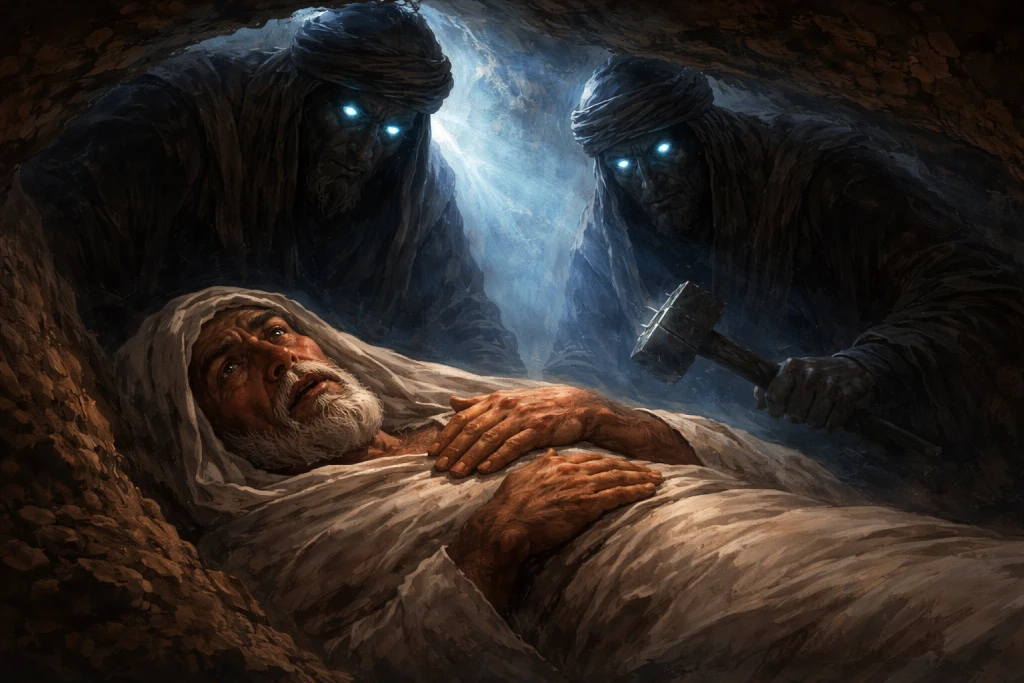
Death is the inevitable end of human life. No independently verifiable evidence has been found that consciousness, sensation, or personal experience continues after all the biological functions of the human body have ceased. Yet many religious traditions have imagined death not as the end of life but as the beginning of another form of existence. The dead are supposedly able to perceive events around them, answer questions, experience pain, and even undergo physical torture for actions committed while alive. The Islamic belief in punishment in the grave is among the most elaborate and terrifying examples of this afterlife-centered religious imagination. Hadith literature describes the dead being made to sit up in their graves and interrogated about their religious beliefs; those unable to give the prescribed answers are beaten, and the earth compresses their bodies so violently that the bones on one side press into those on the other. Some reports claim that animals and birds can hear the screams of the dead. This alleged system of punishment, beyond the observation of living human beings, has also been given an important place in everyday Muslim religious life. Instructions to seek refuge from punishment in the grave during prayer have made fear of what supposedly happens after death part of religious practice among the living.
The doctrine of punishment in the grave is particularly significant because of its historical origins. A narration from Aisha in Sahih Muslim describes a Jewish woman present in Muhammad’s household who first spoke of Muslims being tested in their graves. Muhammad was astonished by the statement and initially replied that it was the Jews who would be tested in their graves. Several nights later, he told Aisha that he had received a revelation saying Muslims, too, would be tested in the grave. Another narration in Musnad Ahmad is even more explicit. Muhammad initially rejected the idea of punishment in the grave, accused the Jews of lying, and declared that there was no punishment before the Day of Resurrection. Later, however, he publicly proclaimed that punishment in the grave was real. These accounts reveal a significant sequence: hearing an account of an unseen world from a woman of another religion, rejecting that account, and subsequently incorporating the same concept into his own religious teaching. The significance is not simply that Muhammad had previously been unaware of a particular subject. Human beings acquire new information all the time. What matters is that a religious belief heard from another person subsequently acquired the status of divine revelation.
Islam emerged in a social and religious environment in which Jews, Christians, and different Arab religious communities exchanged beliefs, practices, and stories. Numerous accounts in hadith and sira literature document Muhammad’s direct interactions with Jewish communities during his years in Medina. Nothing supernatural is required to explain such exchanges of religious knowledge. A person can learn about the beliefs of another community, initially reject them, and later adopt those ideas, giving them new meanings and authority within his own religious framework. The history of religions contains many examples of such adoption, reinterpretation, and the establishment of older ideas under new religious identities. What is particularly noteworthy about the case of punishment in the grave is that identifying the influence of the earlier religious environment does not depend solely on similarities between the narratives of two religions. Islamic hadith literature itself records the interaction, the initial reaction, and the subsequent declaration.
Another fundamental problem with this belief is epistemological. After death, a person’s body decomposes, the nervous system and brain cease functioning, and the physiological processes necessary for sensation during life no longer operate. Yet the narratives of punishment in the grave portray the deceased as a conscious being capable of hearing questions, giving answers, feeling fear, and experiencing physical pain. The religious accounts provide no testable explanation of how consciousness persists after death, how pain can be experienced without the functioning nervous system necessary for physical sensation, or how the alleged events inside a grave could be verified. Simply proclaiming the existence of an invisible realm does not resolve these questions. When observable evidence for an event is absent, using that very absence as evidence of a miracle is circular reasoning. The event is said to be invisible to human beings because it is supernatural; its invisibility is then invoked as a reason to accept it as supernatural truth.
The ethical and social implications of these accounts are equally profound. The idea that a person may suffer horrific physical torture even after death can generate a persistent fear without any observable limit. Religious authority has particular power in this context. During life, a person may examine allegations, demand evidence of wrongdoing, criticize a judge’s decision, and question the proportionality of a punishment. With invisible punishment in the grave, however, every source of accusation, judgment, testimony, and enforcement exists only within religious narratives. No independent observer can examine the alleged judicial process. An unverified concept of postmortem punishment thus becomes an effective means of regulating the behavior of the living. Especially when unbearable punishments are described for comparatively minor behavioral or religious deviations, fear itself functions as a powerful mechanism for producing obedience.
Several questions are therefore inseparable from the history of the Islamic doctrine of punishment in the grave. Why did Muhammad reject the Jewish woman’s statement when he first heard it? Why was that same idea later proclaimed true through revelation? Why do different hadith accounts describe his initial response differently? What beliefs about the suffering of the dead, interrogation in the grave, and postmortem punishment existed in earlier Jewish religious literature? How did a relatively simple religious concept develop into an elaborate system involving angels, interrogation, physical torture, compression of the grave, and supernatural hearing? Answers to these questions determine whether the doctrine can be understood as a human development in religious history. Calling a claim divine does not establish its truth; its origins, transmission, transformation, and basis in reality must be established independently.
Hadith Accounts: From the Jewish Woman’s Statement to the Declaration of Grave Punishment
One of the most important pieces of evidence concerning the origins of the doctrine of punishment in the grave appears in a hadith narrated by Aisha. The incident occurred during Muhammad’s life in Medina, many years after the beginning of his prophetic career. By then, he was the leader of a religious community, regarded by his followers as God’s messenger and their principal authority on religious law and belief. Yet a conversation with a Jewish woman in his own household introduced a concept of interrogation in the grave that astonished him and whose application to Muslims he initially rejected. Several nights later he announced that he had received a revelation concerning the matter. This sequence is significant evidence in the history of the doctrine because the same hadith records both the hearing of a belief from another religious community and its later incorporation into his own teachings. [1]
Sahih Muslim (Islamic Foundation edition)
5. Mosques and Places of Prayer
Chapter 24. Seeking refuge between the Tashahhud and the Taslim from punishment in the grave, punishment in Hell, the trials of life and death, the Antichrist, and sins
1197. Harun ibn Sa’id and Harmala ibn Yahya … narrated from Aisha, who said: One day the Messenger of Allah entered my house. A Jewish woman was sitting with me. She was saying, ‘Do you know that you will be tested in your graves?’ Aisha said, ‘The Messenger of Allah was astonished on hearing this and said, “It is the Jews who will be tested.”‘ Aisha continued: ‘Several days passed. Then one day the Messenger of Allah said, “Do you know that it has been revealed to me that you will be tested in your graves?”‘ Aisha said: ‘After that, I heard the Messenger of Allah seeking refuge from punishment in the grave.’
Hadith classification: Sahih
Narrator: Aisha bint Abu Bakr al-Siddiq
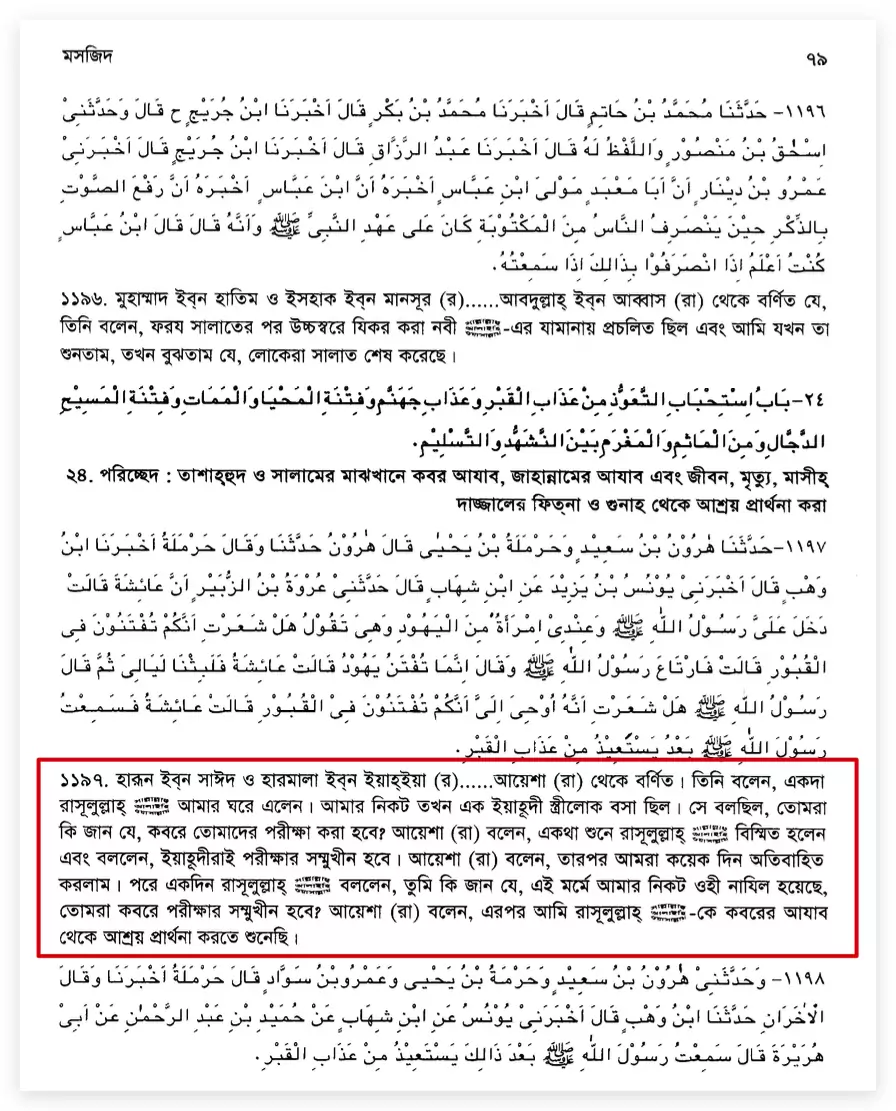
The sequence of events in Aisha’s narration is unmistakable. First, a Jewish woman says that Muslims will be tested in their graves. Second, Muhammad responds in astonishment that it is the Jews who will undergo such a test. Third, several nights pass. Fourth, Muhammad tells Aisha that he has received a revelation stating that Muslims, too, will face interrogation in the grave. Fifth, Aisha thereafter hears him seeking refuge from punishment in the grave. This is a recognizable human sequence of acquiring knowledge: hearing an idea from someone else, initially rejecting it, and adopting it several days later. What is unusual is that no new observation, argument, or independent testimony is presented as the basis for that later adoption. Instead, Muhammad claims to have received revelation. The idea advanced by the Jewish woman, initially rejected, comes within days to be treated as truth received from God.
A still more explicit account of this incident appears in the Musnad of Ahmad ibn Hanbal. There Muhammad’s initial reaction goes beyond astonishment or restricting punishment in the grave to Jews. He directly rejects the idea of punishment in the grave, calls the Jews liars, and declares that there is no punishment before the Day of Resurrection. Subsequently, the same Muhammad publicly proclaims that punishment in the grave is real. The coexistence of these two contradictory declarations within one narration is a particularly important piece of evidence concerning the development of the doctrine. [2]
Musnad Ahmad, hadith 24520
Relevant Arabic passage:
كَذَبَتْ يَهُودُ، وَهُمْ عَلَى اللَّهِ عَزَّ وَجَلَّ أَكْذَبُ، لَا عَذَابَ دُونَ يَوْمِ الْقِيَامَةِ
English translation of the full account:
Aisha narrated that a Jewish woman used to serve her. Whenever Aisha treated her kindly, the woman would say, ‘May God protect you from punishment in the grave.’ One day Muhammad came to Aisha, and she asked him, ‘Messenger of Allah, is there any punishment in the grave before the Day of Resurrection?’ Muhammad said, ‘No. Why do you ask?’ Aisha then told him what the Jewish woman had said. Muhammad replied, ‘The Jews have lied, and they tell even greater lies about God. There is no punishment before the Day of Resurrection.’ Some time passed. Then, one afternoon, Muhammad came out wrapped in his garment, his eyes red, and warned the people in a loud voice. He said, ‘People, calamities are approaching you like pieces of a dark night. If you knew what I know, you would laugh little and weep much. People, seek refuge with God from punishment in the grave, for punishment in the grave is real.’
This report in Musnad Ahmad expands upon the incident narrated in Sahih Muslim. Muhammad’s initial declaration was: There is no punishment before the Day of Resurrection. His later declaration was: Punishment in the grave is real, and people should seek God’s protection from it. These two statements about the same subject are contradictory. According to the first, punishment does not begin before the Day of Resurrection; according to the second, it begins in the grave before that day. More importantly, Muhammad did not confine his initial rejection of the Jewish woman’s statement to acknowledging a limit to his own knowledge. He accused the Jews of lying and denied the very existence of such punishment. Later, the previously rejected concept became part of his religious teaching. The central question, therefore, is not whether an ordinary human being can learn something new. It is this: What grounds exist for treating the second of two contradictory declarations by a religious authority as divine truth? A claim to have received revelation cannot itself serve as independent evidence that the revelation is genuine.
Another narration of Aisha’s encounter appears in Sahih al-Bukhari. Instead of one woman, it mentions two elderly Jewish women from Medina. Aisha initially disbelieves their claim. When she later tells Muhammad about it, he confirms that the women spoke the truth. He also adds another supernatural feature of grave punishment: animals can supposedly hear the sounds of that suffering. This report further illustrates the connection between Muhammad’s teaching about punishment in the grave and statements made by Jewish women in Medina. [3]
Sahih al-Bukhari, hadith 6366
English translation:
Aisha narrated: Two elderly Jewish women from Medina came to me and said, ‘The dead are punished in their graves.’ I considered their statement false and did not initially believe them. After they left, Muhammad entered, and I told him what the two women had said. Muhammad replied, ‘They spoke the truth. The dead are punished in their graves with a punishment whose sound all animals can hear.’ Aisha said that thereafter she saw Muhammad seeking refuge from punishment in the grave during his prayers.
Sahih al-Bukhari 1372 likewise recounts the arrival of a Jewish woman at Aisha’s home. The woman prays that Aisha be protected from punishment in the grave. When Aisha asks Muhammad about it, he immediately confirms the reality of such punishment. Thereafter she observes him seeking refuge from it in every prayer. This narration differs significantly from those in Sahih Muslim and Musnad Ahmad. Muslim and Ahmad describe an initial rejection followed by a new declaration, whereas this Bukhari account describes immediate affirmation. Yet the three reports share a significant feature: Aisha’s inquiry about grave punishment arises from what Jewish women have said, and seeking refuge from such punishment subsequently becomes an important feature of Muhammad’s religious practice. [4]
Sahih al-Bukhari, hadith 1372
English translation:
Masruq narrated from Aisha that a Jewish woman came to her and spoke about punishment in the grave, saying, ‘May God protect you from punishment in the grave.’ Aisha then asked the Messenger of Allah about punishment in the grave. He replied, ‘Yes, punishment in the grave exists.’ Aisha said that thereafter she never saw Muhammad perform a prayer without seeking God’s refuge from punishment in the grave. An additional part of the report describes grave punishment as real.
This incident is recorded not only in Bukhari and Muslim but also in an earlier hadith compilation, Imam Malik’s al-Muwatta. There a Jewish woman comes to Aisha to ask for assistance and prays that she be spared punishment in the grave. Aisha asks Muhammad about the matter. Later, during a solar eclipse, Muhammad performs a special prayer and subsequently instructs the people to seek protection from punishment in the grave. Thus another early compilation connects a private conversation with a subsequent public religious instruction. [5]
Imam Malik, al-Muwatta, Eclipse Prayer, hadith 3
English translation:
Aisha narrated that a Jewish woman came to her asking for assistance. The woman said, ‘May God protect you from punishment in the grave.’ Aisha then asked Muhammad, ‘Are people punished in their graves?’ Muhammad sought God’s protection from such punishment. One morning he went out riding an animal. When a solar eclipse occurred, he returned in the early part of the day, came past the rooms of his household, and stood in prayer. The people stood behind him. He stood for a long recitation and performed a lengthy bowing, then stood again and bowed. He completed the eclipse prayer with several periods of standing, bowing, and prostration. When the prayer ended, he addressed the people and instructed them all to seek God’s protection from punishment in the grave.
The versions preserved in these different compilations do more than repeat an otherwise identical story. They preserve differing accounts of Muhammad’s initial response. In one he denies punishment in the grave, in another he confines such interrogation to Jews, and in yet another he immediately confirms the Jewish women’s claim. These differences demonstrate that the memory of this incident was transmitted differently through distinct narrative traditions. Yet the presence of the Jewish women’s statements, and their connection with the subsequent prominence of grave punishment in Muhammad’s religious teaching, recur throughout these reports. Accepting these narratives as part of Islamic religious history also means acknowledging that a significant phase in the development of Muhammad’s teaching about punishment in the grave was directly connected to conversations with the Jewish community of Medina.
The renowned Quranic exegete Ibn Kathir also discusses these incidents in his commentary on Quran 40:46, in Surah Ghafir. Surah Ghafir is a Meccan chapter. It describes Pharaoh’s people being exposed to the Fire morning and evening, a verse later used as evidence for punishment in the intermediate state after death. But reading this Meccan verse as evidence of grave punishment creates a problem when considered alongside Muhammad’s initial rejection of the concept after hearing it from a Jewish woman in Medina. Ibn Kathir himself raises this question. He addresses it by distinguishing punishment of the soul from punishment of the body. His discussion also includes the report in Musnad Ahmad in which Muhammad denied any punishment before the Day of Resurrection. The chronological relationship between the Meccan verse and the Medinan hadith was therefore a recognized question within later Islamic exegesis itself. [6]
Tafsir Ibn Kathir, Surah Ghafir, verse 46
فَيُقَالُ: فَمَا الْجَمْعُ بَيْنَ هَذَا وَبَيْنَ كَوْنِ الْآيَةِ مَكِّيَّةً، وَفِيهَا الدَّلِيلُ عَلَى عَذَابِ الْبَرْزَخِ؟ وَالْجَوَابُ: أَنَّ الْآيَةَ دَلَّتْ عَلَى عَرْضِ الْأَرْوَاحِ إِلَى النَّارِ
English translation:
It may therefore be asked: How can these accounts be reconciled with the fact that this verse is Meccan, when the verse itself contains evidence for punishment in the intermediate state (barzakh)? The answer is that the verse indicates that souls are exposed to the Fire.
Ibn Kathir’s discussion reveals another feature of the development of religious knowledge. The Meccan verse says that Pharaoh’s people are exposed to the Fire, but it contains no account of Munkar and Nakir, interrogation in the grave, iron hammers, the crushing of bones, or the screams of the dead. Those elements occur in the more detailed hadith narratives. Treating the Quran’s brief description of the afterlife and the later hadith-based system of grave punishment as if they contained the same information obscures the historical development of the idea. The conversation with the Jewish woman is particularly significant because the report describes both the timing of the new declaration and Muhammad’s change from his earlier position.
Alongside the declaration of revelation following the Jewish woman’s statement, hadith literature attributes other extraordinary experiences concerning punishment in the grave to Muhammad. Sahih al-Bukhari relates that, as he passed two graves, Muhammad declared that their occupants were being punished and identified the alleged reason for each punishment. One had reportedly spread malicious gossip, while the other had not taken sufficient precautions concerning urine. Muhammad then broke a fresh palm branch in two, placed a piece on each grave, and expressed the hope that their punishments might be reduced until the branches dried. The same Muhammad who had previously denied the existence of punishment in the grave is subsequently portrayed as being able to identify invisible punishment within individual graves, know its causes, and take action to alleviate it. This change in purported religious knowledge made the doctrine of grave punishment increasingly elaborate and authoritative. [7]
Sahih al-Bukhari (Tawhid Publications edition)
23. Funerals
Chapter 23/88. Punishment in the grave for backbiting and negligence concerning urine.
1378. Ibn Abbas narrated: Once the Prophet passed by two graves and said, ‘These two are being punished, although they are not being punished for anything considered difficult to avoid.’ He continued, ‘Indeed, one of them used to spread gossip, while the other did not take precautions concerning his urine.’ The narrator added that Muhammad then took a fresh palm branch, broke it into two pieces, and planted one piece on each grave. He said, ‘It is hoped that their punishment will be reduced as long as these two pieces do not dry out.’ (Alternative numbering: 216; Modern Publications 1287; Islamic Foundation 1295.)
Hadith classification: Sahih
Narrator: Abdullah ibn Abbas
Two problems are particularly apparent in this hadith. First, Muhammad claims certain knowledge about the punishment of two deceased individuals, although none of those present could observe anything taking place inside the graves. Second, the idea that their punishment could be reduced until fresh palm branches dried raises a question about the moral logic of punishment. If a punishment is rationally connected to an offense, the freshness of a plant cannot measure either the seriousness of the offense or the appropriateness of the punishment. The alleged offenses remain the same, as does the judgment, yet the prospect of relief is linked to how long a branch remains fresh. The connection can be understood in terms of ritual or symbolic action, but presenting it as a system of just punishment administered by an omniscient judge exposes an ethical inconsistency within the account itself.
Later hadith literature provides even more elaborate descriptions of punishment in the grave. The accounts no longer merely announce that the dead will be tested or punished. They specify the arrival of two angels, their appearance and names, their questions and the prescribed answers, the dimensions of the grave, its illumination, sleep, pressure on the bones, and punishment continuing until the Day of Resurrection. A narration attributed to Abu Hurayra in Mishkat al-Masabih contains these details. Although the Mishkat is a later compilation, the underlying report quoted here is from al-Tirmidhi 1071. [8]
Mishkat al-Masabih
Book 1. Faith
Chapter 4, Section Two: Punishment in the Grave
130 [6]. Abu Hurayra narrated that the Messenger of Allah said: ‘When a deceased person is laid in the grave, two black angels with blue eyes come to him. One is called Munkar and the other Nakir. They ask him, referring to the Messenger, “What did you think of this man during your life?” He replies, “He is God’s servant and His messenger. I testify that there is no deity worthy of worship except God and that Muhammad is God’s servant and messenger.” The angels then say, “We already knew you would give this answer.” His grave is then widened to seventy cubits in length and breadth, and light is provided for him. He is told, “Sleep.” The occupant replies, “No, I want to return to my family and give them this good news.” The angels say, “Sleep as a bridegroom sleeps in his bridal chamber, whom no one but the person dearest to him can awaken.” He continues sleeping until the Day of Resurrection. But if the deceased is a hypocrite, he says, “I used to repeat what I heard people saying about him, but I do not know.” The angels respond, “We already knew you would say this.” Then the earth is commanded, “Compress him.” It presses upon him so forcefully that the bones on one side of his body pass into those on the other. He continues to suffer punishment in the grave until God raises him on the Day of Resurrection.’ (Al-Tirmidhi.)
Reference: Al-Tirmidhi 1071; Sahih al-Targhib 3560.
Hadith classification in the cited edition: Sahih
Narrator: Abu Hurayra
The judgment depicted here is hardly an ordinary moral examination. The question concerns what the deceased believed about Muhammad during life. Whoever affirms Muhammad as God’s messenger has his grave enlarged and sleeps peacefully. Whoever cannot provide the prescribed answer has his body distorted by the pressure of the earth. More strikingly, the angels already know in advance what answer each person will give. The examiners therefore know the outcome before conducting the examination, yet the questioning is performed as a prelude to physical torture. This is not an inquiry designed to discover the truth. It is a ritualized scene in which rewards and punishments are administered according to a predetermined religious identity. Instead of the moral character of the person’s life, conduct toward others, or actual harm and benefit, affirmation of a particular religious identity becomes the decisive criterion for punishment or reward in this account.
The Jewish woman’s statement, Muhammad’s initial denial in Musnad Ahmad, the declaration of revelation in Sahih Muslim, the instruction following the eclipse in Imam Malik’s compilation, and the more elaborate grave narratives in later hadith literature together outline an extended history of religious development. The same history shows Muhammad’s direct acquaintance with a belief current in another community, his changing statements about that belief, the introduction of new practices into his followers’ religious lives, and the expansion of accounts of an unseen world. A belief for which the Jewish woman was once called a liar subsequently became a subject on which Muslims were regularly instructed to seek divine protection. The sequence provides a direct example of how a religious idea circulating through human experience and social interaction can become established under the highest claims of divine authority.
Theoretical Ignorance versus Sudden Revelation: A Logical Contradiction
Muhammad’s changing position on punishment in the grave raises a fundamental question about the methods by which religious knowledge is acquired. An ordinary person may be ignorant of a subject, learn new information from others, and change an earlier view when shown to be wrong. That is the normal human process of acquiring knowledge. Muhammad’s case, however, presents a different problem. He did not merely acknowledge ignorance about punishment in the grave. He called the Jewish account false and denied that any punishment existed before the Day of Resurrection. Later he reversed his position, proclaimed punishment in the grave to be real, and instructed his followers to seek protection from it regularly. This was no ordinary change of personal opinion, because he based the second declaration on a revelation supposedly received from God. The change therefore raises unavoidable questions: Which of his two contradictory statements was true? What justified the first declaration? And what independent evidence establishes the second as true?
A fundamental epistemological distinction exists between not knowing something and declaring with certainty that it does not exist. If a person says that they do not know what happens after death, there is no logical inconsistency in that statement. But if the person confidently denies an event in an unseen realm and subsequently declares that same event to be real, the epistemic basis of the original assertion becomes questionable. The problem is deeper in Muhammad’s case. Punishment in the grave is not an ordinary event that living observers can readily investigate. Both the initial denial and the later affirmation therefore require independent justification. Yet Muhammad’s own claim to have received revelation is presented as the justification for the second declaration. When the statement of the very person whose claim is being examined becomes the definitive evidence for that claim, independent verification disappears.
The issue concerns not only the authenticity of revelation but also the nature of religious authority. In ordinary inquiries, when an assertion is shown to be wrong, the reliability of its author’s earlier judgment is reassessed. If a physician, judge, scientist, or historian makes two contradictory decisions about the same matter, it is natural to ask what supported the first and what new evidence justified the change. If religious authority is exempt from the same standard of accountability, virtually any subsequent claim can be declared a miraculous revelation, concealing the problem of an earlier error. In the accounts of punishment in the grave, the Jewish woman’s statement was first rejected, and the same idea was later proclaimed a religious truth. The narrations provide no new observation, experiment, or independent testimony by which the accuracy of this reversal can be assessed. A religious explanation of the change has been supplied, but not evidence that the changed claim is true.
The Quran itself articulates an epistemic principle that makes this problem more pronounced. Quran 17:36 forbids following that of which one has no knowledge. It also speaks of accountability for hearing, sight, and the heart. In the Quran’s own language, knowledge is therefore significant when deciding whether to accept a claim. Yet in the narratives of punishment in the grave, an individual’s claim to experience an unseen world becomes a compulsory religious belief for his followers, even though they have no means of independently verifying the experience. [9]
وَلَا تَقْفُ مَا لَيْسَ لَكَ بِهِ عِلْمٌ ۚ إِنَّ السَّمْعَ وَالْبَصَرَ وَالْفُؤَادَ كُلُّ أُولَٰئِكَ كَانَ عَنْهُ مَسْئُولًا
English translation: Do not follow that of which you have no knowledge. Indeed, the hearing, the sight, and the heart: each of these will be called to account.
Other incidents in early Islamic history also show how claims of revelation were related to ordinary human circumstances. Sahih al-Bukhari 2832 relates a particular event concerning Quran 4:95. Muhammad was dictating to Zayd ibn Thabit a verse about the merits of those who participated in military campaigns. At that moment the blind companion Ibn Umm Maktum arrived and explained his physical disability. Following his statement, a new revelation added an exception for persons with disabilities to the original wording. The subject matter differs from punishment in the grave, but in both incidents an identifiable human statement or problem precedes a newly proclaimed revelation. Islamic tradition itself thus portrays the appearance of religious directives as closely connected to human conversations, social circumstances, and the interventions of particular individuals. [10]
Sahih al-Bukhari, hadith 2832
عَنْ سَهْلِ بْنِ سَعْدٍ السَّاعِدِيِّ أَنَّهُ قَالَ رَأَيْتُ مَرْوَانَ بْنَ الْحَكَمِ جَالِسًا فِي الْمَسْجِدِ فَأَقْبَلْتُ حَتَّى جَلَسْتُ إِلَى جَنْبِهِ فَأَخْبَرَنَا أَنَّ زَيْدَ بْنَ ثَابِتٍ أَخْبَرَهُ أَنَّ رَسُولَ اللَّهِ صلى الله عليه وسلم أَمْلَى عَلَيْهِ لاَ يَسْتَوِي الْقَاعِدُونَ مِنَ الْمُؤْمِنِينَ وَالْمُجَاهِدُونَ فِي سَبِيلِ اللَّهِ قَالَ فَجَاءَهُ ابْنُ أُمِّ مَكْتُومٍ وَهُوَ يُمِلُّهَا عَلَيَّ فَقَالَ يَا رَسُولَ اللَّهِ لَوِ اسْتَطَعْتُ الْجِهَادَ لَجَاهَدْتُ وَكَانَ رَجُلًا أَعْمَى فَأَنْزَلَ اللَّهُ تَبَارَكَ وَتَعَالَى عَلَى رَسُولِهِ صلى الله عليه وسلم وَفَخِذُهُ عَلَى فَخِذِي فَثَقُلَتْ عَلَيَّ حَتَّى خِفْتُ أَنْ تَرُضَّ فَخِذِي ثُمَّ سُرِّيَ عَنْهُ فَأَنْزَلَ اللَّهُ عَزَّ وَجَلَّ غَيْرُ أُولِي الضَّرَرِ
English translation: Sahl ibn Sa’d al-Sa’idi related that he saw Marwan ibn al-Hakam sitting in the mosque and went to sit beside him. Marwan told him that Zayd ibn Thabit had narrated: Muhammad dictated to him the verse, ‘Not equal are those believers who remain at home and those who strive in God’s cause with their wealth and lives.’ Zayd said: ‘While Muhammad was dictating this verse to me, Ibn Umm Maktum came and said, “Messenger of Allah, if I were able to fight, I would certainly fight.” He was a blind man. Then a revelation came upon Muhammad. His thigh was resting on my thigh, and it became so heavy that I feared my thigh might break. When that condition passed, God revealed the words: “except those with disabilities.”‘
The narration depicts an initial general directive, an objection from a person whose situation the directive failed to accommodate, and finally the addition of new words modifying the instruction. The blind companion’s objection was reasonable. It is unjust to judge a person with a physical disability according to exactly the same standard as someone capable of carrying out the activity. Yet this ordinary human problem was also resolved, in the religious narrative, through a new revelation. The sequence matters: a human intervention came first and a revised religious statement followed. In the case of punishment in the grave, Muhammad’s changed position was likewise established through a claim of revelation after hearing the statement of a woman from another religious community. The parallel raises further questions about the influence of human circumstances on the formulation of religious directives. A statement that was previously absent, or an idea that had initially been rejected, acquired new religious authority after a specific human interaction.
An important epistemological distinction arises when evaluating the authenticity of such revelations. A person may claim, after an event has occurred, to have known about it beforehand through a supernatural source. Alternatively, after a conversation, a person may present a newly adopted view as knowledge received from a supernatural source. Establishing either claim requires evidence independent of the claimant’s own assertion. In the story of punishment in the grave, the human source is identifiable: the Jewish woman’s statement. The subsequent religious declaration is also identifiable: Muhammad’s claim to have received revelation. But there is no independent evidence that supernatural knowledge was transmitted between those two events. An assertion about an invisible divine channel of information has been added to a historically recognizable human exchange. The burden of demonstrating the truth of that additional assertion rests with the religious claim itself.
A familiar process in the history of religious authority involves taking beliefs, practices, or stories circulating among ordinary people and adopting them within a new religious interpretation. When an existing idea enters a new religious identity, both its meaning and its claimed source of authority may change. What was previously a customary belief in one community can become a divine command, prophetic teaching, or indispensable truth about the afterlife within another. This shift is particularly significant in the case of punishment in the grave. The Jewish woman’s assertion was initially unacceptable to Muhammad. Later he issued a new religious declaration affirming the idea. Subsequently, seeking refuge from grave punishment became a regular part of his followers’ prayers and religious observances. Once a topic arising in a conversation becomes incorporated into a community’s formal religious practices, it is no longer simply a matter of individual experience; it becomes a religious institution regulating collective behavior.
The progression of the doctrine of grave punishment establishes no independently verifiable distinction between religious knowledge and ordinary human knowledge. A statement was heard, initially rejected, subsequently accepted, and defended through a claim of revelation. The process closely resembles a human change of belief. The difference lies in its explanation, which identifies God as the source of the revised conclusion. But declaring God to be the source of a conclusion does not demonstrate the existence of such a source. Muhammad’s initial denial reveals a limit to his knowledge about grave punishment, while his subsequent declaration of revelation claims to have overcome that limit. The first is documented by the narrative sequence of the hadith; the supernatural basis of the second is not independently established. It is precisely this distinction that calls the doctrine of grave punishment into question under historical and epistemic scrutiny.
Claims of Supernatural Hearing and Their Logical Inconsistencies
A significant shift appears in later accounts of Muhammad’s statements about punishment in the grave. What initially entered the narrative as an account of an unseen realm heard from a woman of another religion was subsequently associated with Muhammad’s own claims of direct auditory experience. In the hadith, he sometimes declares that the occupants of particular graves are being punished, sometimes claims to hear their cries, and sometimes says that if living people heard the terrifying screams of the dead, they would stop burying their own deceased. This change is significant. Affirming the truth of a religious belief is not the same as claiming a firsthand sensory experience that supposedly confirms it. In the latter case, the speaker establishes himself as a direct witness to an otherwise invisible event. His private experience is then presented to followers as evidence of a truth that they themselves are unable to investigate.
Sahih Muslim 2867 gives a detailed account of this alleged supernatural hearing. According to a narration transmitted from Zayd ibn Thabit, Muhammad was riding his mule through a garden belonging to Banu al-Najjar when the animal suddenly shied and nearly threw him off. There were several graves nearby. Muhammad asked the people with him whether anyone knew those buried there. When a man identified them, Muhammad declared that they were being punished in their graves. He then said that he himself could hear the sounds of their punishment. He would not, however, pray for God to let the others hear it, because if they heard those sounds they would no longer be willing to bury their dead. [11]
Sahih Muslim, hadith 2867
عَنْ أَبِي سَعِيدٍ الْخُدْرِيِّ، عَنْ زَيْدِ بْنِ ثَابِتٍ، قَالَ أَبُو سَعِيدٍ وَلَمْ أَشْهَدْهُ مِنَ النَّبِيِّ صلى الله عليه وسلم وَلَكِنْ حَدَّثَنِيهِ زَيْدُ بْنُ ثَابِتٍ قَالَ بَيْنَمَا النَّبِيُّ صلى الله عليه وسلم فِي حَائِطٍ لِبَنِي النَّجَّارِ عَلَى بَغْلَةٍ لَهُ وَنَحْنُ مَعَهُ إِذْ حَادَتْ بِهِ فَكَادَتْ تُلْقِيهِ وَإِذَا أَقْبُرٌ سِتَّةٌ أَوْ خَمْسَةٌ أَوْ أَرْبَعَةٌ – قَالَ كَذَا كَانَ يَقُولُ الْجُرَيْرِيُّ – فَقَالَ ” مَنْ يَعْرِفُ أَصْحَابَ هَذِهِ الأَقْبُرِ ” . فَقَالَ رَجُلٌ أَنَا . قَالَ ” فَمَتَى مَاتَ هَؤُلاَءِ ” . قَالَ مَاتُوا فِي الإِشْرَاكِ . فَقَالَ ” إِنَّ هَذِهِ الأُمَّةَ تُبْتَلَى فِي قُبُورِهَا فَلَوْلاَ أَنْ لاَ تَدَافَنُوا لَدَعَوْتُ اللَّهَ أَنْ يُسْمِعَكُمْ مِنْ عَذَابِ الْقَبْرِ الَّذِي أَسْمَعُ مِنْهُ ” . ثُمَّ أَقْبَلَ عَلَيْنَا بِوَجْهِهِ فَقَالَ ” تَعَوَّذُوا بِاللَّهِ مِنْ عَذَابِ النَّارِ ” . قَالُوا نَعُوذُ بِاللَّهِ مِنْ عَذَابِ النَّارِ فَقَالَ ” تَعَوَّذُوا بِاللَّهِ مِنْ عَذَابِ الْقَبْرِ ” . قَالُوا نَعُوذُ بِاللَّهِ مِنْ عَذَابِ الْقَبْرِ . قَالَ ” تَعَوَّذُوا بِاللَّهِ مِنَ الْفِتَنِ مَا ظَهَرَ مِنْهَا وَمَا بَطَنَ ” . قَالُوا نَعُوذُ بِاللَّهِ مِنَ الْفِتَنِ مَا ظَهَرَ مِنْهَا وَمَا بَطَنَ قَالَ ” تَعَوَّذُوا بِاللَّهِ مِنْ فِتْنَةِ الدَّجَّالِ ” . قَالُوا نَعُوذُ بِاللَّهِ مِنْ فِتْنَةِ الدَّجَّالِ .
English translation: Abu Sa’id al-Khudri related that he had not witnessed the incident directly from Muhammad but had been told about it by Zayd ibn Thabit. Zayd said: ‘One day Muhammad was riding his mule through a garden of Banu al-Najjar, and we were with him. Suddenly the mule shied and almost threw him off. There were four, five, or six graves nearby. Muhammad asked, “Who knows the occupants of these graves?” A man replied, “I do.” Muhammad asked, “When did they die?” The man answered, “They died while practicing polytheism.” Muhammad said, “The people of this community are tested in their graves. Were it not for the fear that you would cease burying your dead, I would surely ask God to let you hear the punishment in the grave that I can hear.” Then he turned toward us and said, “Seek refuge in God from punishment in the Fire.” The people said, “We seek refuge in God from punishment in the Fire.” He said, “Seek refuge in God from punishment in the grave.” They said, “We seek refuge in God from punishment in the grave.” He then instructed them to seek refuge from all trials, open and hidden, and from the trial of the Antichrist. Those present repeated the corresponding invocations.’
Muhammad’s statement in this incident has two distinct levels. First, he asserts that the occupants of the graves are being punished and that he can hear their suffering. Second, he says that the others could also be made to hear the sounds, but he will not allow that to happen. The possibility of verifying the alleged event is therefore excluded within the account itself. There is no report that the people present heard the same thing with their own ears. For them, Muhammad’s statement was the only firsthand evidence offered. Nevertheless, on that basis they were instructed to seek refuge from punishment in the grave. One person claims a direct experience, while others are required to accept its truth. The reason given for withholding the opportunity to hear the sound also comes from the sole claimant of the extraordinary experience. Such testimony is exceedingly weak under standards of independent verification.
The mule’s behavior also deserves attention. The report states that the animal suddenly shied and Muhammad nearly fell. The discussion of punishment in the grave follows this incident. Animals suddenly taking fright or moving unexpectedly is a familiar occurrence. An unfamiliar noise, smell, movement, environmental stimulus, or the animal’s own behavioral response may cause such behavior. But establishing a connection between a mule’s sudden movement and invisible screams of the dead requires independent evidence. The hadith provides no evidence that the mule specifically heard punishment in the grave. What could be observed was simply the animal’s abrupt movement. Its alleged connection with an invisible punishment was established through Muhammad’s own declaration. In this method of treating an ordinary observation as evidence of a supernatural event, the underlying assumption takes the place of proof.
Another report in Sahih Muslim makes the claim of supernatural hearing even more direct. According to Abu Ayyub, Muhammad went outside after sunset and heard a sound. He then declared that Jews were being punished in their graves. What is especially noteworthy is the identification of the sound with a particular religious community. The sound is not presented merely as a noise of unknown origin; it is identified as the punishment of deceased Jews. [12]
Sahih Muslim, hadith 2869
عَنْ أَبِي أَيُّوبَ، قَالَ خَرَجَ رَسُولُ اللَّهِ صلى الله عليه وسلم بَعْدَ مَا غَرَبَتِ الشَّمْسُ فَسَمِعَ صَوْتًا فَقَالَ ” يَهُودُ تُعَذَّبُ فِي قُبُورِهَا ” .
English translation: Abu Ayyub narrated that after the sun had set, Muhammad went out and heard a sound. He said, ‘Jews are being punished in their graves.’
This narration reveals another significant connection with the origins of the doctrine. Muhammad had first heard the idea of punishment in the grave from a Jewish woman in Medina. He initially rejected her statement. Later he himself claimed to hear the punishment of deceased Jews. The religious identity of the community from which he had encountered the belief therefore reappears in his subsequent claim of supernatural experience. Once an afterlife belief originating in one community was incorporated into another religious system, it was not merely adopted: the condition of deceased members of the earlier community was also explained through it. No independent testimony or observable process is described for identifying an ordinary sound as punishment being inflicted upon dead Jews. Muhammad’s declaration supplies both the origin and the meaning of the sound.
A further feature of the auditory claims appears in Sahih al-Bukhari 1374. It states that after a person is buried, two angels come and question the deceased about religious belief. If a hypocrite or unbeliever cannot give the prescribed answer, the person is struck with an iron hammer. The victim screams so violently that everything nearby can hear the sound, except humans and jinn. Thus the narration portrays the scream as audible throughout the surrounding environment while excluding human beings, the creatures capable of analyzing what happens around them and communicating their experiences through language. [13]
Sahih al-Bukhari, hadith 1374
عَنْ أَنَسِ بْنِ مَالِكٍ ـ رضى الله عنه ـ أَنَّهُ حَدَّثَهُمْ أَنَّ رَسُولَ اللَّهِ صلى الله عليه وسلم قَالَ ” إِنَّ الْعَبْدَ إِذَا وُضِعَ فِي قَبْرِهِ، وَتَوَلَّى عَنْهُ أَصْحَابُهُ، وَإِنَّهُ لَيَسْمَعُ قَرْعَ نِعَالِهِمْ، أَتَاهُ مَلَكَانِ فَيُقْعِدَانِهِ فَيَقُولاَنِ مَا كُنْتَ تَقُولُ فِي الرَّجُلِ لِمُحَمَّدٍ صلى الله عليه وسلم. فَأَمَّا الْمُؤْمِنُ فَيَقُولُ أَشْهَدُ أَنَّهُ عَبْدُ اللَّهِ وَرَسُولُهُ. فَيُقَالُ لَهُ انْظُرْ إِلَى مَقْعَدِكَ مِنَ النَّارِ، قَدْ أَبْدَلَكَ اللَّهُ بِهِ مَقْعَدًا مِنَ الْجَنَّةِ، فَيَرَاهُمَا جَمِيعًا ”. قَالَ قَتَادَةُ وَذُكِرَ لَنَا أَنَّهُ يُفْسَحُ لَهُ فِي قَبْرِهِ. ثُمَّ رَجَعَ إِلَى حَدِيثِ أَنَسٍ قَالَ ” وَأَمَّا الْمُنَافِقُ وَالْكَافِرُ فَيُقَالُ لَهُ مَا كُنْتَ تَقُولُ فِي هَذَا الرَّجُلِ فَيَقُولُ لاَ أَدْرِي، كُنْتُ أَقُولُ مَا يَقُولُ النَّاسُ. فَيُقَالُ لاَ دَرَيْتَ وَلاَ تَلَيْتَ. وَيُضْرَبُ بِمَطَارِقَ مِنْ حَدِيدٍ ضَرْبَةً، فَيَصِيحُ صَيْحَةً يَسْمَعُهَا مَنْ يَلِيهِ، غَيْرَ الثَّقَلَيْنِ ”.
English translation: Anas ibn Malik narrated that Muhammad said: ‘When a servant is placed in his grave and his companions depart, he can still hear the sound of their sandals. Two angels come to him, make him sit up, and ask, “What did you say about this man, Muhammad?” The believer replies, “I testify that he is God’s servant and messenger.” He is told, “Look at the place in the Fire that was appointed for you. God has replaced it with a place in Paradise.” He sees both places.’ Qatada added that they had been informed that the believer’s grave would be made spacious. Returning to Anas’s narration, Muhammad continued: ‘The hypocrite or unbeliever is asked, “What did you say about this man?” He answers, “I do not know. I used to repeat what other people said.” He is told, “You neither knew nor followed the right path.” He is then struck with an iron hammer, and he cries out so loudly that everyone nearby hears him, except humans and jinn.’
Taken together, these accounts produce a peculiar arrangement of supernatural hearing. The screams of the dead are supposedly so loud that surrounding animals can hear them, but human beings cannot. Muhammad, however, claims to hear them. He also declares that others could be made to hear them, but that opportunity is withheld. People who do not claim to hear the sound are consequently denied any practical means of independently verifying punishment in the grave. The person who declares the doctrine true is himself endowed with exceptional hearing, while the inability of ordinary people to perceive anything is explained in such a way that their silence cannot count against the claim. The possibility of testing the proposition is thereby restricted by conditions supplied by the proposition itself.
Modern scientific knowledge about sound makes the problem clearer. Ordinary audible sound consists of pressure waves traveling through a medium, which are converted into neural signals by a functioning auditory system. Humans and other animals do not have identical hearing ranges; some animals can detect frequencies beyond human hearing. But saying that a sound falls outside the human hearing range is one thing, while identifying it as the screams of a deceased person under torture is quite another. Even if an animal detects a particular sound, that does not establish that its source is punishment of the dead in a grave. Identifying a sound’s origin requires a testable connection between it and a specific event. The hadith narratives provide no independent evidence for such a connection. The enormous logical gap between hearing an unusual sound and attributing it to punishment in an unseen world is bridged solely by a declaration of religious authority.
The Scottish philosopher David Hume examined the epistemological problems of such supernatural claims in Section X of his An Enquiry Concerning Human Understanding. One of his central arguments concerns the strength of testimony required to establish an extraordinary event. The further a claim departs from ordinary experience, the more compelling the evidence needed to justify accepting it. Claiming to hear punishment in the grave is not simply a claim to have heard a sound. It presupposes the continued consciousness of the dead, torture after death, an invisible system of judgment, and the exceptional auditory capacity of a particular person. Yet the only evidence offered for this entire series of supernatural propositions is private testimony preserved within religious narratives. Such testimony is insufficient to establish all of these extraordinary conclusions. [14]
A wise man, therefore, proportions his belief to the evidence.
The application of this principle to claims of supernatural hearing in the grave is straightforward. Even if it were true that a person heard a sound, that would not demonstrate that every explanation the person offered for the sound was also true. Hearing a noise and identifying it as the scream of a dead person are separate claims. Declaring that alleged scream to be punishment for a particular religious offense adds another claim. Each stage introduces new information and requires its own evidence. In Muhammad’s accounts of grave punishment, there is no independent method of verifying these successive assertions. His own declaration establishes the existence of the sound, its supposed source, the state of the deceased, and the reason for the punishment. An alleged private auditory experience is thus made the foundation for an entire invisible system of judgment, without evidence for the intervening conclusions.
The social function of these accounts of supernatural hearing is also important. People are told that terrible punishment may be occurring all around them even though they cannot see or hear it themselves. The cries of the dead are supposedly present in the surrounding world, but inaccessible to ordinary human senses. Knowledge of this invisible reality is available only through exceptional religious authority. Within this framework, the religious leader’s testimony becomes the sole source of information about the unseen. Believers cannot test the claim against their own experience; instead, the limits of their experience are used as a reason to rely on religious authority. The supernatural claim thereby restricts epistemic independence and increases dependence on religious leadership. When coupled with fear of unbearable physical torture, the doctrine becomes an even more powerful means of governing conduct and obedience.
Muhammad’s initial lack of knowledge concerning punishment in the grave, his subsequent announcement of revelation, and his later claims to hear the screams of the dead present a sequence of religious development. At first there is contact with an existing Jewish belief; then the idea becomes part of Islamic eschatology; later it is reinforced by reports of personal supernatural experiences. Each new element lends greater religious authority to the preceding idea, yet at no point is independent, verifiable evidence established for the supernatural events. Reports of hearing screams from graves, knowing the causes of particular punishments, and withholding those sounds from other listeners construct a parallel reality beyond ordinary human observation. The existence of that reality rests entirely on the religious narratives themselves. By the standards of logic and evidence, such self-referential testimony does not establish the existence of a supernatural system of punishment.
Historical Antecedents of Grave Punishment in Jewish Eschatology
What happens to a person’s soul after death, whether a deceased individual can experience pain after the body has decayed, and whether punishment begins even before the final judgment were subjects of discussion in Jewish religious literature many centuries before Islam. Ancient Jewish eschatology was not a single, unchanging body of belief. Texts composed in different periods offered differing understandings of the dead, the fate of the soul, resurrection, and judgment. Over time, one particular idea became increasingly significant: the interval between death and the final resurrection or judgment could itself be a period of reward, punishment, or suffering of the soul. This idea of intermediate punishment is particularly relevant when investigating the historical antecedents of the Islamic belief in punishment in the grave, because the system described in Islamic hadith likewise begins at death and operates before the ultimate judgment on the Day of Resurrection.
The Jewish religious work 4 Ezra, composed toward the end of the first century CE, contains an exceptionally detailed discussion of the condition of the soul after death. In its seventh chapter, Ezra asks whether people rest until the time of renewed creation after their deaths or whether they suffer immediately. The answer explains that a person’s soul separates from the body after death and that those who rejected God’s commands during life enter a state of suffering immediately. This suffering is described in seven distinct forms, including the loss of any opportunity to repent, the sight of rewards reserved for the righteous, awareness of one’s future punishment, and fear and shame before divine judgment. The punishment does not await the final day of judgment; it begins as soon as the soul departs from the body. [15]
4 Ezra, Chapter 7, verses 75–80
English translation:
75. I answered and said, ‘Lord, if I have found favor in your sight, show your servant one further matter. When each of us dies and gives up the soul, shall we remain at rest until the time when you create us anew, or must we immediately endure torment?’
76. He answered me, ‘I shall show you this also. But do not associate yourself with those who have despised me, nor count yourself among those who will suffer punishment.’
77. ‘For the treasure of your good works is stored up with the Most High, but it will not be revealed to you until the appointed end.’
78. ‘Now this is the teaching concerning death: when the final command of the Most High comes that a person shall die, the soul leaves the body and returns to the one who gave it. First, it praises the glory of the Most High.’
79–80. ‘But if the soul belongs to one of those who have despised the Most High, refused to follow his ways, scorned his law, and hated those who fear God, such souls will not enter the dwelling places of rest. Instead, they will immediately wander in sorrow and distress, suffering torment in seven ways.’
The historical importance of this passage is considerable. Several centuries before Islam emerged, Jewish religious literature already described an afterlife in which the soul begins to suffer as soon as death occurs, even though the final judgment has not yet taken place. A direct relationship is established between accepting or rejecting God’s commands during life and experiencing punishment after death. The soul remains aware of its future fate, can perceive the difference between reward and punishment, and experiences fear and suffering before the ultimate judgment. The structural relationship with the Islamic doctrine of punishment in the grave is evident. Neither system treats death as the termination of conscious existence; instead, death initiates a new state of judgment and consequence. Islamic hadith adds the grave itself, angelic interrogation, testing of religious identity, and detailed accounts of physical torture to this intermediate state.
Another significant source from Jewish religious literature is Shabbat 152 in the Babylonian Talmud. One statement attributed to Rabbi Isaac is particularly notable. He compares the suffering associated with worms eating a corpse to the pain of a needle piercing living flesh. As support, he cites Job 14:22, which refers to the suffering of the dead person’s flesh and the mourning of the soul. In the same discussion, Rav Hisda says that a person’s soul mourns for seven days after death. The subsequent passages also record differing views on how long the dead remain aware of conversations among the living. According to one opinion, awareness persists until the grave is sealed; according to another, until the body has decomposed. These discussions show that ideas of bodily decay, consciousness after death, and continued suffering were present in Jewish religious discourse before Islam. [16] [17]
Babylonian Talmud, Shabbat 152a
וְאָמַר רַבִּי יִצְחָק: קָשָׁה רִימָּה לַמֵּת כְּמַחַט בַּבָּשָׂר הַחַי, שֶׁנֶּאֱמַר: ״אַךְ בְּשָׂרוֹ עָלָיו יִכְאָב״.
English translation: Rabbi Isaac said: ‘The suffering caused by worms to the dead is like the piercing of a needle into living flesh, as it is said: “His own flesh suffers pain.”‘
These Talmudic accounts rest on a fundamental idea: physical death does not necessarily mark the end of a person’s capacity for experience. Even as the body decays, the deceased may supposedly feel the pain of that decay; the soul may remain connected with the body’s condition and continue for a time to be aware of conversations among the living. This places existence after death in an imagined state in which sensations familiar from bodily life continue in an unseen realm. Islamic reports of punishment in the grave employ a similar conceptual framework. The dead hear the footsteps of those who buried them, answer the angels’ questions, and experience suffering from the compression of the grave or from blows. The significance of the resemblance extends beyond a few shared words in the narratives of two religions. Both traditions make continued hearing, memory, personal identity, and the experience of pain central features of existence after death.
A still more terrifying expression of these beliefs appears in Jewish religious literature under the name Hibbut ha-Qever, meaning ‘the beating of the grave’ or ‘blows in the grave.’ According to these traditions, an angel appears at a deceased person’s grave, questions the dead, strikes them, and punishes them for offenses committed during life. In some accounts, the angel asks the deceased to state their own name. If they cannot answer, the soul is returned to the body so that punishment can be inflicted. Other details describe the limbs of the corpse being beaten with chains of iron and fire, then reassembled so that further punishment can be administered. The Jewish Encyclopedia documents these traditions in detail. [18]
Jewish Encyclopedia, “Ḥibbuṭ ha-Ḳeber”
English translation of the opening passage:
Hibbut ha-Qever, or ‘beating of the grave,’ also known as Din ha-Qever, ‘judgment of the grave,’ is one of seven forms of judgment or punishment imposed on human beings after death. An account of this punishment appears in the work known as Hibbut ha-Qever, also called the Midrash of Rabbi Isaac ben Parnak. According to an account given by Rabbi Eliezer to his disciples, after a person is buried the Angel of Death stands upon the grave, strikes the deceased with his hand, and asks the person’s name. When the deceased cannot state their name, the angel returns the soul to the body to subject the person to judgment. For three consecutive days the Angel of Death strikes and severs every limb of the body with a chain made half of iron and half of fire. The angel’s assistants restore the limbs to their positions so that the dead person can be struck again.
The detailed narrative of Hibbut ha-Qever bears striking similarities to Islamic reports about Munkar and Nakir. Both depict angels appearing in the grave after death, questioning the deceased, punishing failure to answer, and inflicting blows upon the body. Both also imagine restoring the dead to a conscious state in order to carry out punishment. The chronology of the surviving Jewish texts containing this particular narrative, however, is significant. According to research by Rabbi Professor David Golinkin, the best-known written forms of the elaborate Hibbut ha-Qever narrative developed mainly during the medieval period. References to punishment in the grave appear in some Jewish writings of the ninth and tenth centuries, while more extensive accounts of interrogation and beating emerged in later centuries. Thus the pre-Islamic concept of intermediate punishment and the specific elaborate narrative of Hibbut ha-Qever attested in medieval writings do not constitute evidence from the same period. Early written precedents for the former appear in 4 Ezra and Talmudic discussions, whereas the development of the latter can be traced through subsequent Jewish literature. [19]
The significance of this historical sequence is that punishment after death was neither unknown nor unprecedented when Islam emerged. Jewish literature had long contained discussions of suffering in the intermediate state, consciousness after death, the role of angels, and punishment beginning before final judgment. The Islamic account of Muhammad hearing about grave punishment from a Jewish woman in Medina identifies a specific point of direct contact with that wider religious environment. The evidence involves more than thematic similarities between two literary traditions: the hadith themselves describe the belief being communicated by a person from another community. Following that encounter, punishment in the grave became part of Muhammad’s proclaimed religious teaching, and later hadith literature expanded it into a more detailed system of interrogation and penalties.
The relationship between earlier Jewish religious literature and Islam is an important example of the human transmission of religious concepts. When people interact, their stories, beliefs, fears, and imaginings about death also pass from one community to another. Such ideas can be reconstructed under a new language, new characters, and new claims of religious authority. The earlier Jewish literature on intermediate punishment, the statement of the Jewish woman in Medina, and the detailed Islamic doctrine of grave punishment belong to the same historical setting. Where both a prior literary history and a direct route of interpersonal communication can be identified, establishing the idea as new and independent divine knowledge requires evidence beyond a declaration to that effect. The religious sources themselves document human conversation and exchange of beliefs; they do not establish the authenticity of an invisible revelation.
The Expansion of Mythology: Munkar and Nakir, Compression of the Grave, and Intimidation
The Islamic doctrine of punishment in the grave ultimately developed into an extensive system of postmortem judgment and punishment. Hadith reports describe the dead being restored to consciousness, the arrival of fearsome-looking angels, interrogation about religious identity, changes in the dimensions of the grave, special instruments of torture, and punishment continuing until the Day of Resurrection. The two angels, Munkar and Nakir, are described as having black bodies and blue eyes. Their task is to examine the deceased person’s faith and determine the subsequent treatment on the basis of the answers. This judicial process is unlike any familiar system of human justice. Rather than investigating wrongdoing, examining evidence, or evaluating the moral quality of a person’s actions, the decisive matter is the answer to a few prescribed religious questions. Whoever answers in accordance with Islamic belief receives peace and reward; whoever cannot is subjected to torture. Religious identity thus becomes the central criterion of judgment.
Alongside the account of Munkar and Nakir in al-Tirmidhi 1071, Sunan Abi Dawud 4753 contains a more elaborate narration attributed to al-Bara ibn Azib. It describes the soul being returned to the body after burial, interrogation by two angels, and the preparation of Paradise or Hell according to the answers. The questions are: Who is your Lord? What is your religion? What did you believe about the person sent among you? If a Muslim answers by naming God, Islam, and Muhammad, a bed and garments from Paradise are prepared and a door toward Paradise is opened. But if an unbeliever cannot answer, a bed and garments from Hell are assigned and a door toward Hell is opened. Its hot winds then reach the deceased, while the grave contracts until the ribs interlock. A further passage describes a blind and mute figure of punishment carrying an iron hammer so powerful that it would reduce a mountain to dust. After the blow reduces the deceased to dust, the soul is restored once again. [20]
Sunan Abi Dawud, hadith 4753
وَيُضَيَّقُ عَلَيْهِ قَبْرُهُ حَتَّى تَخْتَلِفَ فِيهِ أَضْلاَعُهُ
English translation: His grave will be constricted around him until his ribs interlock with one another.
This description of punishment has a distinctive feature. The dead person’s body is not merely struck once; after the blow destroys it, the soul is returned so the suffering can continue. Even death, then, cannot bring punishment to an end. In ordinary reality, bodily torture has a physical limit. Once the body ceases functioning, a person cannot continue to experience pain in the same way as a living human being. Here, that limit is imagined to be supernaturally overcome. A body that has been destroyed is made capable of suffering again. If punishment is intended to remedy wrongdoing, protect society, or rehabilitate an offender, none of these aims is achieved through the repeated torture of a deceased person. The dead cannot change their past actions or repair harm suffered by the living. Physical suffering itself becomes the predominant purpose of the punishment.
The moral problem with interrogation in the grave is more fundamental still. A person’s religious beliefs are usually formed through family, place of birth, language, education, social environment, available information, and personal experience. Hundreds of millions of people are born into families where they receive no instruction in Islam. Some are Christian, Hindu, Buddhist, or Jewish; others believe in no religion. These differences arise from social and historical circumstances that existed before individuals were born. A child does not choose the family, language, or initial religious education into which they are born. Yet the descriptions of interrogation in the grave provide no separate assessment of these unchosen circumstances. The questions concern the deceased person’s religion and what they believed about Muhammad. The circumstances of birth and the beliefs formed within that environment thereby become connected to the possibility of torture after death.
An important discussion in philosophy concerns the extent to which people can voluntarily control their beliefs. The subject is known as doxastic voluntarism. Its central question is whether a person can choose, simply through an act of will, to believe any proposition to be true. A person can verbally affirm a statement, adopt a religious identity under social pressure, or conceal their genuine beliefs for fear of punishment. But sincere belief is not always subject to that kind of voluntary control. A person cannot necessarily make an inadequately supported claim seem true merely by deciding to believe it in pursuit of a reward or to avoid suffering. Bernard Williams and many other philosophers have discussed the difficulty of treating belief as equivalent to voluntary action. This question directly concerns the ethics of religious punishment. If a person cannot sincerely believe a particular religious claim, what justification exists for inflicting physical torture on them for that disbelief? [21]
The punishment associated with the questions of Munkar and Nakir makes this problem more acute. If a person genuinely does not believe Muhammad was God’s messenger, requiring the prescribed answer amounts to demanding a declaration contrary to that person’s conscience and judgment. A non-Muslim may be morally upright, charitable, compassionate, and devoted to protecting the rights of others. A Muslim, conversely, may commit wrongs against others. Yet the central question in the hadith under discussion is not the overall moral character of the person’s life, but religious identity. If an omniscient and just system of judgment gives priority to the affirmation of a particular religious doctrine over actual moral conduct and sincerity in the pursuit of truth, its judgment becomes a test of religious obedience rather than morality. Not believing that a particular historical individual was a prophet is not morally equivalent to committing an offense against another human being. Nevertheless, these narratives prescribe physical torture, including the crushing of ribs, as the consequence of that disbelief.
Descriptions of the grave changing size form another important element of this religious imagery. Al-Tirmidhi 1071 says that the grave of a believer is expanded to seventy cubits in length and breadth. The length, width, and depth of an actual grave are measurable and observable. The assertion that such a space expands to seventy cubits for the dead is not an ordinary statement about a grave’s physical dimensions; it is a supernatural claim about space itself. Even an interpretation in which the physical boundaries remain unchanged while a special expansion occurs within them leaves the question of evidence unresolved. Spatial enlargement expresses an imagined form of reward. In the opposite case, the unbeliever’s grave contracts and crushes the body. The grave is thus transformed into a symbolic scene of reward and punishment. For the relevant hadith evidence and a fuller discussion, see Shongshoy’s article The Grave Expands to Seventy Cubits. The claim that animals hear the screams of the dead is discussed in Animals Can Hear Screams from the Grave.
The idea of compression in the grave is not confined to narrations about unbelievers and hypocrites. Sunan an-Nasa’i 2055 records Muhammad saying, in connection with the death of Sa’d ibn Mu’adh, that God’s Throne had shaken, the gates of heaven had opened, and seventy thousand angels had attended his funeral. Despite his exceptional religious standing, even Sa’d was squeezed once by the grave before being released. Grave compression is thus presented as an experience that can affect even someone of extraordinary religious status. Fear of the grave is consequently not limited to punishment of unbelievers; it extends to the deaths of those regarded as particularly honored in religion. [22]
Sunan an-Nasa’i, hadith 2055
هَذَا الَّذِي تَحَرَّكَ لَهُ الْعَرْشُ وَفُتِحَتْ لَهُ أَبْوَابُ السَّمَاءِ وَشَهِدَهُ سَبْعُونَ أَلْفًا مِنَ الْمَلاَئِكَةِ لَقَدْ ضُمَّ ضَمَّةً ثُمَّ فُرِّجَ عَنْهُ
English translation: This is the man for whom the Throne shook, for whom the gates of heaven were opened, and whose funeral was attended by seventy thousand angels. Even he was squeezed once by the grave, and then released.
In such reports, the grave itself becomes a terrifying place. Living people have no ability to know what happens there after death. Religious authority, however, fills that unknown state with specific descriptions of questioning, pressure, blows, terror, and the possibility of release. Natural human fear of death is thereby linked to religious obedience. Adherence to religious belief carries a promise of peace; deviation brings the prospect of suffering even after death. The account of a highly honored figure such as Sa’d ibn Mu’adh being squeezed in the grave makes the fear more pervasive. Even someone respected during life is not entirely exempt from an unknown experience in the grave. In this manner, uncertainty about the condition of the dead is transformed into a persistent religious anxiety.
The system of grave punishment raises another fundamental question. Islamic eschatology describes the final reckoning, judgment, and ultimate reward or punishment taking place on the Day of Resurrection. Yet Sahih Muslim 2866 says that immediately after death, morning and evening, each person is shown their future place in Paradise or Hell. The person’s ultimate fate is thus presented as already determined, before the final judgment has occurred. The combination of interrogation in the grave, intermediate punishment, and a subsequent final judgment creates a problem concerning the logic of adjudication. If a person’s fate has already been determined and punishment has begun accordingly, what new decision will the final judgment reach? And if the purpose of the final judgment is to establish the justice of guilt and punishment, on what moral grounds is torture inflicted before that judgment is concluded? [23]
Sahih Muslim, hadith 2866a
إِنَّ أَحَدَكُمْ إِذَا مَاتَ عُرِضَ عَلَيْهِ مَقْعَدُهُ بِالْغَدَاةِ وَالْعَشِيِّ
English translation: When one of you dies, their appointed place is shown to them morning and evening. If they are among the people of Paradise, they are shown their place in Paradise; if they are among the people of Hell, they are shown their place in Hell. They are told that this will be their place when they are raised on the Day of Resurrection.
Here the normal relationship between judgment and punishment is reversed. In a just judicial system, allegations and evidence are examined first, responsibility is then established, and only afterward is an appropriate sentence imposed. In the Islamic doctrine of grave punishment, the deceased person’s future destination is disclosed immediately, the person is interrogated, and physical punishment is imposed, although the greater judgment on the Day of Resurrection has not yet taken place. If an omniscient judge already knows the person’s offenses and eventual fate, the need for a dramatic interrogation becomes still more questionable. If the questions are not intended to discover information and the result is already determined, the examination is not a process of acquiring knowledge or administering justice. It is a demonstration of a predetermined status followed by the exercise of power on that basis. Nor do the accounts describe any meaningful opportunity for the accused to defend themselves.
The questions of Munkar and Nakir, iron hammers, compression of the grave, repeated punishment, and an already determined place in Paradise or Hell together depict a religious system of punishment centered on fear and obedience to a particular belief. The severity of torture is not proportionate to actual harm caused to other people. What someone believed and whether they could answer a particular religious question become decisive for the individual’s condition after death. In ordinary life, moral judgment of wrongdoing ought to consider actions, intentions, circumstances, the extent of harm, and responsibility. In these accounts, however, religious identity takes the central place. The presence of such a punishment in a religious narrative does not establish its moral legitimacy. The entire doctrine of punishment in the grave exemplifies a fear-based eschatology that uses human fear of death to elevate religious belief and obedience above all else.
Conclusion
The most important event in the history of the Islamic doctrine of punishment in the grave is the account of Muhammad encountering this idea through a member of another religious community at a particular stage of his life. The hadith preserve the Jewish woman’s statement in Medina, Muhammad’s initial rejection, and his subsequent announcement of revelation. Musnad Ahmad describes his initial position particularly clearly: there is no punishment before the Day of Resurrection, and the Jewish assertion is false. Later he himself proclaims punishment in the grave to be real. The sequence resembles a familiar human process of acquiring religious knowledge and changing one’s view. Hearing an idea from another person, rejecting it, and later accepting it is not a supernatural event. What is added in this case is a further claim that the newly accepted idea came through a revelation from God. The claimant’s announcement that he received a revelation, however, does not independently demonstrate the authenticity of that revelation.
The prior historical foundations of this belief can also be identified outside the Islamic religious environment. Many centuries before Islam, Jewish eschatological literature described consciousness after death, suffering beginning before the final judgment, and postmortem consequences determined by religious conduct during life. The accounts in 4 Ezra and the Talmud provide written testimony to this history. Later Jewish literature also developed elaborate stories of beating in the grave and interrogation by angels. Islamic grave doctrine joined these preexisting ideas with Muhammad’s prophethood, interrogation about Islamic belief, Munkar and Nakir, and specific forms of physical torture. This part of Islamic eschatology therefore cannot be presented as a religious concept isolated from earlier traditions. It shares substantive themes with the earlier Jewish religious world, and the encounter with the Jewish woman in Medina also documents direct social interaction.
Taken together, the hadith accounts of grave punishment construct an elaborate religious imaginary. The dead supposedly continue to hear, understand, speak, and experience physical pain much as living people do. The grave changes size supernaturally, the body is beaten, and suffering can be prolonged even after destructive blows. Muhammad claims to hear the invisible screams of the dead, while other people present have no opportunity to verify the experience for themselves. Human inability to hear the alleged sounds is explained in such a way that the absence of any audible evidence cannot be counted against the religious account. Rather than independently verifying these extraordinary claims, the system makes religious authority the sole basis for accepting them as true. The lack of independent evidence for an event does not establish its existence, and describing the event as invisible does not remedy that evidentiary deficiency.
The ethical problems are equally serious. A person’s religious beliefs are shaped by birth, education, social environment, and personal judgment. Yet interrogation in the grave places particular weight on affirmation of a prescribed religious identity and recognition of Muhammad’s prophethood. The consequences of failing to give the required answer include horrific physical torture. These narratives disregard the fundamental moral distinction between harming another human being and not believing a particular religious proposition to be true. Punishment beginning before the final judgment, a further interrogation despite a predetermined outcome, and the use of torture to enforce religious identity are also inconsistent with basic principles of justice. A punishment designed neither to rehabilitate, compensate victims, nor protect others, but rather to inflict suffering, cannot be made morally legitimate merely by declaring it to be God’s will.
The social force of this doctrine lies in human fear of death and anxiety about an unknown future. During life, people can protest unjust punishment, demand evidence, and challenge abuses of power. None of those possibilities exists within the alleged invisible punishment of the grave. Religious authority defines the offenses, the judgment, the penalties, and the conditions for release. Believers are consequently encouraged to live under the threat of a punishment for which there is no observable evidence and no independent means of testing its reality. When that fear is incorporated into daily prayer and religious practice, it becomes a persistent psychological and social feature of religious life. Punishment in the grave is therefore not merely a story about the afterlife. It becomes connected to obedience, self-regulation, and dependence on religious authority.
The history disclosed by Islamic and earlier Jewish sources is far more consistent with the human formation of belief, cultural exchange, and the establishment of religious authority than with the acquisition of supernatural knowledge. A familiar religious concept entered a new community, acquired new explanations and characters, and ultimately became part of obligatory belief and practice. Yet none of the supernatural components of this elaborate system has been established through independent, testable evidence. There is no rational basis for treating as unquestionable divine truth a system of punishment whose existence is unproven, whose descriptions contain serious ethical inconsistencies, and whose historical antecedents can be identified in human religious literature. The Islamic doctrine of punishment in the grave is a significant example of a humanly constructed, fear-based system of belief about the afterlife.
References
- Sahih Muslim, Islamic Foundation edition, hadith 1197; international numbering 584 ↩︎
- Musnad Ahmad, narration of Aisha, hadith 24520; Islamweb, Hashiyat Musnad al-Imam Ahmad, vol. 14 ↩︎
- Sahih al-Bukhari, hadith 6366, chapter on seeking refuge from punishment in the grave ↩︎
- Sahih al-Bukhari, hadith 1372, chapter on punishment in the grave ↩︎
- Al-Muwatta of Imam Malik, Book of the Eclipse Prayer, hadith 3 ↩︎
- Tafsir Ibn Kathir, Quran 40:46 ↩︎
- Sahih al-Bukhari, Tawhid Publications edition, hadith 1378 ↩︎
- Mishkat al-Masabih, hadith 130 ↩︎
- Quran 17:36, Surah al-Isra ↩︎
- Sahih al-Bukhari, hadith 2832, concerning the revelation of Quran 4:95 ↩︎
- Sahih Muslim, hadith 2867, account of punishment in the grave ↩︎
- Sahih Muslim, hadith 2869 ↩︎
- Sahih al-Bukhari, hadith 1374, chapter on punishment in the grave ↩︎
- David Hume, An Enquiry Concerning Human Understanding, Section X: Of Miracles ↩︎
- The Posen Library of Jewish Culture and Civilization, 2 Esdras (4 Ezra), 7:75–87, “Torments of the Soul after Death” ↩︎
- Babylonian Talmud, Shabbat 152a:15 ↩︎
- Babylonian Talmud, Shabbat 152b:2–3 ↩︎
- Jewish Encyclopedia, Kaufmann Kohler, “Ḥibbuṭ ha-Ḳeber” ↩︎
- Rabbi Prof. David Golinkin, “Why do Some Jews Recite a Special Verse at the End of the Amidah?”, Schechter Institute, 2010 ↩︎
- Sunan Abi Dawud, hadith 4753, interrogation and punishment in the grave ↩︎
- Stanford Encyclopedia of Philosophy, “Doxastic Voluntarism” ↩︎
- Sunan an-Nasa’i, hadith 2055, compression of the grave ↩︎
- Sahih Muslim, hadith 2866a, showing the dead their future place in Paradise or Hell ↩︎