

Introduction: Fiqh’s Fictitious Gestation Periods and the Hard Facts of Science
The biological limits of the human body do not change to suit religious ideology, legal expediency, social shame, or the need to protect a family line. How long a fetus can survive in the womb is a question of embryology, obstetrics, and human physiology. The conjectures of legal schools, folklore, local rumors, and the personal experiences of jurists cannot settle it. Yet classical Islamic jurisprudence accepted claims about the maximum duration of pregnancy that modern medicine shows to be impossible. Hanafi jurists allowed two years, Shafi‘i and Hanbali jurists four, and some opinions in the Maliki tradition accepted pregnancies of five to seven years. These views arose chiefly in response to legal problems involving a child’s lineage, birth after divorce, inheritance, accusations of adultery, and social legitimacy. Modern scholarship has likewise analyzed the disagreement as a historical development in jurisprudence tied to legal paternity and legitimacy, rather than as a direct prescription of the Quran or hadith. [1]
The “sleeping fetus” or prolonged-gestation theory was more than a piece of isolated folklore. It was a legal fiction used for centuries in Islamic jurisprudence to address real difficulties, especially the status of children born to widows or divorced women, the recognition of paternity, and the legitimacy of family lines. The solution was legally convenient and biologically false. Modern medicine classifies a pregnancy lasting 42 weeks or more as postterm. The risks to the fetus and newborn rise rapidly beyond that point, which is why induction of labor is recommended after 42 weeks. [2] [3] A viable pregnancy lasting two, four, five, or seven years is medically impossible. The claim grew out of medieval legal invention, folklore, and scientific ignorance. Classical jurisprudence, prophetic biography and biographical compendia, modern fatwas, and medical evidence show how a claim without scientific foundation acquired the force of religious law and why it cannot survive modern scrutiny.
The Classical Fiqh Claims: Four Schools and Their Conjectures About Gestation
Islamic law draws on a familiar Quranic argument to establish a minimum duration of pregnancy. One verse gives thirty months for pregnancy and weaning together, while another gives two years, or twenty-four months, for breastfeeding. Many jurists subtracted the latter from the former and accepted six months as the shortest possible pregnancy. Neither the Quran nor any authentic hadith traced directly to Muhammad sets out an explicit maximum, and classical jurists disagreed widely on the subject. Their positions rested on hearsay, experiences attributed to women, social assumptions, and the legal need to preserve lineage. They had no basis in medical observation, sustained empirical research, or testable evidence. Each school arrived at a different maximum. The divergence itself shows that these figures came from juristic conjecture rather than from a biological fact established by divine revelation.
The Hanafi school generally set the maximum duration of pregnancy at two years. The position drew chiefly on a report attributed to Aisha, according to which a child does not remain in the womb for more than two years. Classical Hanafi jurists applied that rule to questions of paternity, the waiting period after a marriage ended, and a child’s legitimacy. Modern scholarship also identifies two years as the Hanafi maximum. [6] [1] IslamWeb’s summary of the juristic disagreement likewise gives the Hanafi position as two years. [7]
I want to know what are the rulings related to pregnant ladies?
Answer
All perfect praise be to Allah, The Lord of the Worlds. I testify that there is none worthy of worship except Allah, and that Muhammad sallallaahu `alayhi wa sallam ( may Allaah exalt his mention ) is His slave and Messenger.
Rulings concerning pregnancy and pregnant women are many. Here are some of them:
Firstly, the shortest period of pregnancy before giving birth is six months according to the consensus of the Muslim scholars. However, they have different opinions concerning the maximum period of pregnancy. The Shaafi’i, and Hanbali Schools of jurisprudence, and one of the opinions of the Maaliki School state that the maximum period of a pregnancy is four years. The Hanafi School of jurisprudence is of the opinion that it is only two years. The later opinion is also one of the opinions of Imam Ahmad may Allaah have mercy upon him.
Secondly, all the Muslim scholars have agreed upon that the Iddah (waiting period) of a woman ends when she gives birth whether the Iddah is following a divorce or due to the death of her husband.
Thirdly, a pregnant woman is eligible to receive her maintenance after an irrevocable divorce if she is pregnant. Allah Says (what means): {And if they should be pregnant, then spend on them until they give birth.} [Quran 65: 6]
Fourthly, it is permitted for her to give up fasting in Ramadan if she fears any harm for herself or for her fetus. But, she has to make up those days later.
If she gives up fasting due to fear for her fetus only, she has to make up those days in addition to feeding a needy person for every missed day.
Fifthly, the Muslim scholars differ on the flow of blood of a pregnant woman. The majority of the Muslim scholars believe that a pregnant woman does not menstruate, so her bleeding that is not due to labor pain is considered a form of illness and she should continue to fast and pray even though the blood has not stopped.
Allah knows best.
Question: What rulings apply to pregnant women?
Answer: All praise belongs to Allah, Lord of the worlds. I testify that there is no true deity but Allah and that Muhammad is His servant and messenger.
Many rules concern pregnancy and pregnant women. The following are some of them:
1. Duration of pregnancy
Muslim scholars agree that the minimum interval of pregnancy before childbirth is six months. They disagree over the maximum. The Shafi‘i and Hanbali schools and one Maliki opinion put it at four years. The Hanafi school gives two years. One opinion attributed to Imam Ahmad also gives two years.
2. End of the waiting period, or iddah
Muslim scholars unanimously hold that childbirth ends a pregnant woman’s waiting period, whether that period follows a divorce or the death of her husband.
3. Maintenance after divorce
A pregnant woman is entitled to maintenance after an irrevocable divorce. Allah says, in translation:
“If they are pregnant, then maintain them until they deliver.” [8]
4. Fasting during Ramadan
A pregnant woman may refrain from fasting during Ramadan if she fears harm to herself or her unborn child. She must make up the days later.
If she refrains from fasting out of concern for her unborn child alone, she must make up the fasts and feed one needy person for every day missed.
5. Bleeding during pregnancy
Muslim scholars disagree about bleeding in pregnancy. Most hold that a pregnant woman does not menstruate. They therefore classify bleeding that occurs before labor as irregular bleeding, or istihadah, and require her to keep praying and fasting even if the bleeding continues.
Allah knows best.
The Shafi‘i and Hanbali schools generally set the maximum duration of pregnancy at four years. Their main argument was that some women had supposedly remained pregnant for that long. These stories came from an oral culture. They were unverified accounts that later became the basis for legal rulings, and they bear no resemblance to medical records in the modern sense. In Al-Mughni, Ibn Qudamah gives the four-year position in the Hanbali discussion. It also became established in the Shafi‘i tradition. [9] [10] IslamWeb also summarizes the Shafi‘i and Hanbali positions as allowing a maximum of four years. [7]. Mufti Muhammad Shafi’s Ma‘ariful Qur’an lays out these opinions in the English and Bengali editions. [11] [12]
Different views of Jurists about maximum period of pregnancy and maximum period of suckling
The great Imam Abu Hanifah holds the maximum period of pregnancy to be two years. There are different narrations from Imam Malik about the maximum period of pregnancy to be four, five or seven years, whereas Imam Shafi’i holds it to be four years, which is also the view of Imam Ahmad, according to more recognized reports from him. (Mazhari).
Jurists’ Disagreements Over the Maximum Duration of Pregnancy and Breastfeeding
Imam Abu Hanifa held that pregnancy could last at most two years. Various reports from Imam Malik give four, five, or seven years. Imam al-Shafi‘i and Imam Ahmad held that it could last four years. (Mazhari.) The maximum duration of breastfeeding also determines when breastfeeding becomes forbidden. Most jurists set the period at two years. Imam Abu Hanifa alone allowed breastfeeding for up to two and a half years. This means that if a child is weak and cannot take food other than breast milk, an extra six months of breastfeeding is permitted. The reason given is that all agree that a mother may not give her child breast milk once the two-year breastfeeding period has elapsed.


The Maliki tradition went even further. Different opinions accepted pregnancies lasting four, five, and even seven years. In his commentary on Quran 13:8, al-Qurtubi cites these juristic opinions while discussing what the wombs diminish and increase. They offer no fixed scientific limit. Instead, alleged cases circulating in society were used to widen the range of pregnancies that the law would accept. [13] [10]
Classical jurists had no infallible religious text to establish the maximum duration of pregnancy. The problem they were trying to solve linked a husband’s death or divorce to a woman’s waiting period, inheritance, and a child’s lineage. They covered over biological reality with a fiction that met their legal needs. Modern medicine rules out a viable human pregnancy of two, four, five, or seven years. The juristic positions belong to the history of medieval legal fictions devised to manage social crises, rather than to science or human physiology.
Muhammad’s Birth, Abdullah’s Death, and Hamza’s Age: The Historical Impetus for the “Sleeping Fetus”
The theory of prolonged pregnancy, or the “sleeping fetus,” in classical Islamic jurisprudence grew out of legal problems concerning divorce, waiting periods, inheritance, and legitimacy. It also had a major historical impetus in the literature of prophetic biography and biographical compendia: the problem of Muhammad’s birth, his father Abdullah’s death, and the age of his uncle Hamza ibn Abd al-Muttalib. Religious sentiment can obscure the problem, but the classical Muslim tradition itself preserves conflicting accounts. Taken together, they cannot be reconciled with the normal duration of human pregnancy.
First, a widely circulated account in the Islamic biographical tradition holds that Muhammad’s father, Abdullah ibn Abd al-Muttalib, died soon after marrying Amina bint Wahb. In many versions, Muhammad was still in the womb. The report is so prominent in Islamic biography that Muhammad is often described as having been born after his father’s death. [14] [15]. Martin Lings describes the marriages of Abd al-Muttalib and Abdullah in Muhammad: His Life Based on the Earliest Sources. [16]
Wahb had been chief of Zuhrah but had died some years previously and Aminah was now a ward of his brother Wuhayb, who had succeeded him as chief of the clan. Wuhayb himself also had a daughter of marriageable age, Halah by name, and when ‘Abd al-Muttalib had arranged that his son should marry Aminah, he asked that Halah should be given in marriage to himself. Wuhayb agreed, and all preparations were made for the double wedding to take place at the same time.
On the appointed day, ‘Abd al-Muttalib took his son by the hand, and they set off together for the dwellings of the Bani Zuhrah.’ On the way they had to pass the dwellings of the Bani Asad; and it so happened that Qutaylah, the sister of Waraqah, was standing at the entrance to her house, perhaps deliberately in order to see what could be seen, for everyone in Mecca knew of the great wedding which was about to take place. ‘Abd al-Muttalib was now over seventy years old, but he was still remarkably young for his age in every respect; and the slow approach of the two bridegrooms, their natural grace enhanced by the solemnity of the occasion, was indeed an impressive sight.

Second, the accounts above say that Abd al-Muttalib took his son Abdullah to the Banu Zuhra and arranged for Abdullah to marry Amina bint Wahb. On the same visit, Abd al-Muttalib himself married Hala bint Wuhayb, the mother of Hamza ibn Abd al-Muttalib. According to this strand of tradition, the marriages of Muhammad’s father Abdullah and Hamza’s father Abd al-Muttalib took place at the same time. [17]
Third, the same tradition places Hamza two years older than Muhammad, or four in some accounts. The age difference appears in biographical dictionaries of the Companions, including Ibn Abd al-Barr’s Al-Isti‘ab and Ibn al-Athir’s Usd al-Ghabah. Later biographical collections likewise describe Hamza as two or four years older than Muhammad. [18] [19]
The arithmetic is straightforward. If Abdullah married Amina at the same time that Abd al-Muttalib married Hala, if Abdullah died shortly after his marriage, and if Muhammad was still in the womb at Abdullah’s death and was born afterward, how could Hamza have been two or four years older? The numbers do not work with a normal human pregnancy. Prolonged gestation, or the “sleeping fetus,” offers a convenient way to reconcile the story. Once a child is assumed capable of remaining in the womb for two, three, or four years, the awkward gap between Hamza’s age, Abdullah’s death, and Muhammad’s birth can be closed on paper.
Al-Sirah al-Halabiyyah contains Nur al-Din al-Halabi’s comparison of the account of the two marriages in one gathering with the reports of Hamza’s age. In his discussion, Abdullah consummates his marriage to Amina immediately after the wedding, and she conceives at once. Taking the reports together, al-Halabi asks directly how Hamza could be two years older than Muhammad. He also considers whether the report about marriage in the same gathering might refer to the marriage proposals. [20]
وأنه دخل بها حين أملك عليها فكيف يكون حمزة أسن منه صلى الله عليه وسلم بسنتين
English translation: Abdullah consummated his marriage to Amina at the time the marriage was contracted. How, then, could Hamza be two years older than Muhammad, peace and blessings be upon him?
In theological language this may be called a “miracle.” In practice it is a patch for the story. The problem arises from the effort to maintain historical consistency. Classical writers faced an awkward gap if Muhammad’s birth was to remain a fatherless, predestined event of special standing while the traditional accounts also kept Hamza older, his uncle, and his brother through breastfeeding. The easiest way to close that gap was to deny the biological limits of the human body. The claim that a child could spend years in the womb was more than an innocent folktale. In religious biographies it became an artificial solution for incompatible genealogies and ages.
This is where the theory of prolonged pregnancy in classical jurisprudence meets the miraculous births of the sira and biographical compendia. Jurists extended gestation to preserve the legitimacy of children born to widows or divorced women. Biographers accepted the same impossible pregnancy lengths to explain the birth stories of prophets, imams, and influential religious figures. Family law and sacred biography used the same device. When the facts became inconvenient, they bent biology to save the story.
Pre-Islamic Marriage Practices, Paternity, and Muhammad’s Birth
The marriage and paternity customs of Arabia at the time help explain the chronological problem surrounding Muhammad’s birth. Islamic sources themselves describe several forms of marriage in the Jahiliyyah, the pre-Islamic period, in which a child’s paternity was not always fixed, recorded, or biologically certain in the modern sense. Aisha describes four forms of marriage. In one, several men had intercourse with the same woman. After giving birth, she could designate one of them as the child’s father. In another, paternity was assigned after birth by judging physical resemblance. [21]
Sunan Abi Dawud (Islamic Foundation edition)
7. Divorce
Chapter 176. Forms of Marriage Practiced Before Islam
2272 (Islamic Foundation: 2266). Ahmad ibn Salih … transmitted from Urwa ibn al-Zubayr, may Allah be pleased with him. He said that Aisha, the wife of the Prophet, peace and blessings be upon him, told him: There were four forms of marriage before Islam. One was like marriage today. A man would ask a woman’s male guardian for her hand, agree on a bridal payment, and then marry her after giving her that payment.
In the second form, a man would tell his wife, “Once your period is over and you are clean, go to such-and-such a man and have intercourse with him.” Her husband would keep away and would have no intercourse with her until it was clear that she had become pregnant by the other man. Once she was pregnant, her husband could have intercourse with her if he wished. This was done to obtain a child with desirable qualities. This kind of marriage was called nikah al-istibda‘.
In the third form, a group of fewer than ten men would visit the same woman and all have intercourse with her. If she became pregnant, she would summon them a few days after the birth. None could refuse to come. Once they had gathered, she would say, “You know what you did, and I have now given birth.” She would then choose one of them, address him by name, and say, “This is your child.” She would assign the child to him.
In the fourth form, many men would go to a woman and have intercourse with her. She turned away no man who came for sex. These women were prostitutes who put flags at their doors as a sign. Any man who wished could enter. If one of these women became pregnant, the men would be assembled after she gave birth, and specialists in physical resemblance would be called. They assigned the child to the man he most resembled. The child was then called his son, and the man could not refuse. When Allah sent Muhammad as His Messenger, peace and blessings be upon him, he abolished the forms of marriage practiced before Islam and kept the one Muslims practice today.
Hadith grade: Sahih (authentic)
Narrator: Urwa ibn al-Zubayr, may Allah have mercy on him
The hadith gives no direct verdict on Muhammad’s birth, and care is required in using it as evidence of his parentage. It does supply historical context. Paternity, marriage, and lineage in the society in which Muhammad was born were less firmly regulated than they are in a modern legal system. That context makes the simultaneous marriages of Abdullah and Amina and Abd al-Muttalib and Hala, Abdullah’s departure and death soon afterward, and the difference in age between Hamza and Muhammad more troubling. In Islamic accounts, this was the age of Jahiliyyah, and the social standing of a woman whose husband had died is uncertain. Islamic sources themselves portray women at the time as living with severely limited rights. The question goes beyond one man’s birth. Classical Islamic accounts produce a chronological problem that is difficult to reconcile with normal gestation. Prolonged pregnancy, or the “sleeping fetus,” became a convenient way to cover that gap.
Another hadith gives grounds for questioning the account of Muhammad’s birth. Its wording speaks for itself. [22]
Sahih al-Bukhari (Tawheed Publications edition)
65. Commentary on the Quran
Chapter 65/4/6. Untitled chapter.
(لَا يَحِلُّ لَكُمْ أَنْ تَرِثُوا النِّسَآءَ كَرْهًا ط وَلَا تَعْضُلُوْهُنَّ لِتَذْهَبُوْا بِبَعْضِ مَآ اٰتَيْتُمُوْهُنَّ) الْآيَةَ
Allah’s words: “It is not permissible for you to inherit women against their will.” (Surah An-Nisa 4:19, Mustafa Khattab, The Clear Quran)
وَيُذْكَرُ عَنْ ابْنِ عَبَّاسٍ: (لَا تَعْضُلُوْهُنَّ) لَا تَقْهَرُوْهُنَّ. (حُوْبًا): إِثْمًا. (تَعُوْلُوْا): تَمِيْلُوْا. (نِحْلَةً) النِّحْلَةُ الْمَهْرُ.
Ibn Abbas, may Allah be pleased with him, is reported as explaining لَا تَعْضُلُوْهُنَّ as “Do not coerce them,” حُوْبًا as “sin,” تَعُوْلُوْا as “incline,” and نِحْلَةً as “bridal payment.”
4579. Ibn Abbas, may Allah be pleased with him, narrated about the verse لَا يَحِلُّ لَكُمْ أَنْ تَرِثُوا النِّسَآءَ كَرْهًا ط وَلَا تَعْضُلُوْهُنَّ لِتَذْهَبُوْا بِبَعْضِ مَآ اٰتَيْتُمُوْهُنَّ:In the early days of Islam, when a man died, his relatives took control of his wife. They could marry her themselves, give her in marriage to someone else, or prevent her from marrying and keep her that way until she died. They asserted a stronger claim to her than her own family. Then this verse was revealed. [6948] (Adhunik Prokashoni: 4218, Islamic Foundation: 4221)
Hadith grade: Sahih (authentic)
Narrator: Abdullah ibn Abbas, may Allah be pleased with him
Ibn Kathir’s commentary on verse 19 of Surah An-Nisa describes the same practice. [23]
19. “Believers, you may not inherit women against their will. Do not constrain them to recover part of what you have given them unless they commit manifest adultery. Live with them honorably. If you dislike them, you may dislike something in which Allah has placed much good.”
20. “If you decide to take one wife in place of another and have given one of them a fortune, take none of it back. Would you take it through false accusation and open wrongdoing?”
21. “And how could you take it back after having enjoyed each other intimately and she has taken from you a firm commitment?”
22. “Do not marry former wives of your fathers—except what was done previously. It was indeed a shameful, despicable, and evil practice.” (Verses 21–22 translated by Mustafa Khattab, The Clear Quran.)
Commentary: Abu al-Hasan al-Sawa’i reports from Ibn Abbas concerning the words يَا أَيُّهَا الَّذِينَ آمَنُوا لاَ يَحِلُّ الكُمْ إِنْ تَرِثُوا النِّسَاءَ كَرْهًا
. Ibn Abbas, may Allah be pleased with him, explained that in pre-Islamic Arabia, when a woman’s husband died, his heirs did as they pleased with her. One of them might marry her himself, or they might marry her off to another man. Sometimes they would neither marry her themselves nor let her marry anyone else. The husband’s family considered itself more entitled to her than her own relatives. Allah revealed this verse to end that abhorrent custom of the age of ignorance:
يَا أَيُّهَا الَّذِينَ آمَنُوا لَا يَحِلُّ لَكُمْ إِنْ تَرِثُوا النِّسَاءَ كَرْهًا
That is, “Believers, you may not inherit women by force.”

Muhammad’s Parents Were Polytheists of Pre-Islamic Arabia
Authentic hadiths show that Muhammad himself declared his parents destined for hell, unbelievers, and polytheists.
Collection: Sahih Muslim (Islamic Foundation edition)
Hadith: 203 (Islamic Foundation: 394)
Book 1. Faith
Publisher: Islamic Foundation
Chapter 82. A person who dies an unbeliever will go to hell. No intercession will reach him, and kinship with a servant close to Allah will bring him no benefit.
203 (Islamic Foundation: 394). Abu Bakr ibn Abi Shayba, may Allah have mercy on him, … transmitted from Anas, may Allah be pleased with him. A man asked the Messenger of Allah, peace and blessings be upon him, “Messenger of Allah, where is my father?” He answered, “In the Fire.” The narrator said that, as the man turned away, he called him back and said: “Verily my father and your father are in the Fire.”
Hadith grade: Sahih (authentic)
Collection: Sunan Ibn Majah
Hadith: 1572
Book 6. Funerals
Publisher: Tawheed Publications
Chapter 6/48. Visiting the graves of polytheists .
1/1572. Abu Hurayra, may Allah be pleased with him, narrated: The Prophet, peace and blessings be upon him, visited his mother’s grave. He wept and moved those around him to tears. Then he said: “I asked my Lord to allow me to pray for her forgiveness, and He did not grant me permission. I asked Him to let me visit her grave, and He permitted me to do so. Visit graves, for they remind you of death.”
Muslim 976, al-Nasa’i 2034, Abu Dawud 3234, Ahmad 9395, Irwa’ al-Ghalil 772. Al-Albani’s grading: Sahih.
Hadith grade: Sahih (authentic)
Collection: Sunan al-Nasa’i (Islamic Foundation edition)
Book 21. Funerals
Hadith: 2034 (Islamic Foundation: 2038)
Publisher: Islamic Foundation
Chapter 101. Visiting the grave of a polytheist .
2034 (Islamic Foundation: 2038). Qutayba, may Allah have mercy on him, … transmitted from Abu Hurayra, may Allah be pleased with him. He said that the Messenger of Allah, peace and blessings be upon him, wept when he visited his mother’s grave, and those around him wept as well. The Messenger of Allah said: “I asked permission to seek forgiveness for my mother, but I was not permitted to do so. Then I asked to visit her grave and was given permission. So visit graves, because they remind you of death.”
(Sahih. Ibn Majah 1572, Irwa’ al-Ghalil 772)
Hadith grade: Sahih (authentic)
These hadiths make it clear that Muhammad was born into a family of unbelievers and polytheists. He grew up in a polytheist household and environment, in the culture of pre-Islamic Arabia. The prominent religious scholar known as Mufti Ibrahim discusses the subject in the sermon below.
Hamza’s Vulgar Insult
According to authentic hadiths, Muhammad’s own uncle Hamza, who had already accepted Islam and become one of his Companions, once insulted Muhammad while drunk, calling him a slave of his family. Muhammad left without a word. If Hamza meant the words literally, was he referring to Muhammad’s childhood poverty and his position in the family? When a close relative and Companion insults someone while drunk, the words can reveal an attitude ordinarily kept hidden. Was it the alcohol alone, or did the insult betray a family secret, private contempt, or some other feeling? Islamic tradition presents Hamza as a hero and a martyr, yet the episode suggests that he may not have regarded Muhammad as his own nephew, or that there was some other trouble within the family. [24] [25]
Sahih Muslim (Islamic Foundation edition)
37. Drinks
Chapter 1. The prohibition of intoxicants and the preparation of intoxicating drinks from grape juice, dates, fresh and ripening dates, raisins, and other substances
1979a (Islamic Foundation: 4964). Yahya ibn Yahya al-Tamimi, may Allah have mercy on him, … transmitted from Ali ibn Abi Talib, may Allah be pleased with him. Ali said: I received a mature she-camel from the spoils of Badr, and the Messenger of Allah, peace and blessings be upon him, gave me another from the fifth reserved from the spoils. One day I made the two camels kneel at the door of an Ansari. I intended to load them with idhkhir grass and sell it to help pay for my wedding feast with Fatima, may Allah be pleased with her. A goldsmith from the Banu Qaynuqa was with me. Hamza ibn Abd al-Muttalib, may Allah be pleased with him, was drinking in the house. A woman was singing with him. She sang: أَلاَ يَا حَمْزَ لِلشُّرُفِ النِّوَاءِ, meaning, “Hamza, go to the two fat she-camels” (and slaughter them for your guests).
Hamza rushed at both camels with his sword, cut off their humps, slit their flanks, and pulled out their livers. I asked Ibn Shihab whether the report also said he took the meat of their humps. He answered that he cut the humps off and took them away.
Ibn Shihab said that Ali, may Allah be pleased with him, continued: When I saw this terrible sight, I went to the Messenger of Allah, peace and blessings be upon him. Zayd ibn Haritha was with him. I told him everything that had happened. He went out with Zayd, and I went with them. When he reached Hamza, he rebuked him. Hamza, still drunk, looked up and said: “You are nothing but my father’s slaves.” The Messenger of Allah, peace and blessings be upon him, then backed away and left them.
1979b (Islamic Foundation: 4965). Abd ibn Humayd, may Allah have mercy on him, … transmitted a similar report from Ibn Jurayj through this chain.
Edition note: The Islamic Foundation prints the number 4964 twice in succession. The first occurrence is the last hadith in the Book of Sacrifices. The second is the report quoted here. To keep subsequent numbers aligned with the Islamic Foundation edition, HadithBD grouped the reports numbered 4964 and 4965 under 4965.
Hadith grade: Sahih (authentic)
Narrator: Ali ibn Abi Talib, may Allah be pleased with him

Were Abu Talib and Muhammad Unequal in Lineage?
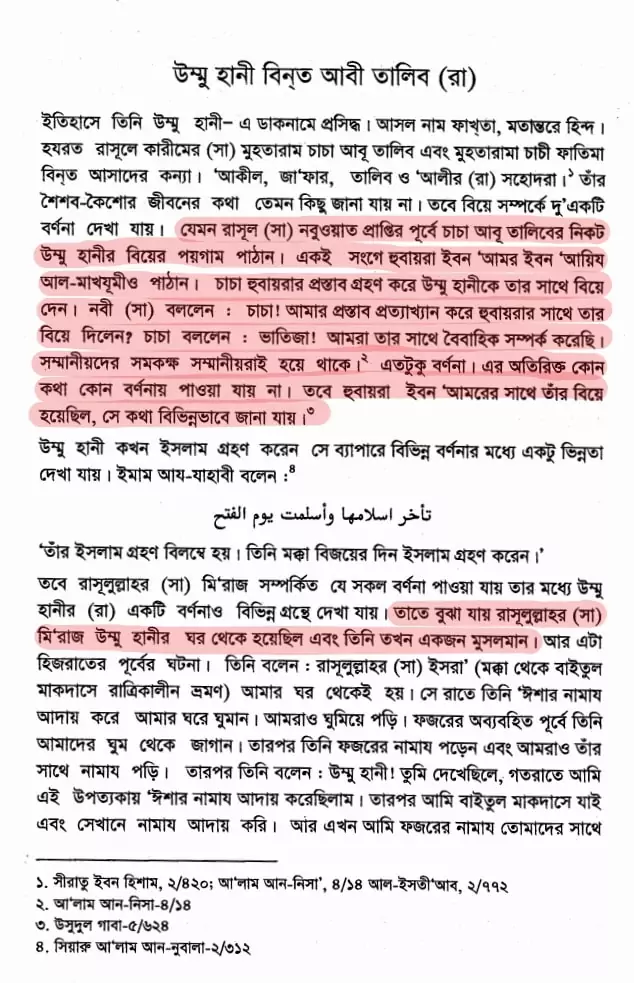
The episode of Umm Hani’s marriage raises another question about family standing. Muhammad proposed to Umm Hani, the daughter of his paternal uncle Abu Talib. Abu Talib refused the proposal, saying: “Those of honorable standing are the equals of others of honorable standing.” Yet Abu Talib and Muhammad should have been equal in lineage. Why did Abu Talib speak this way? The account appears in the Bengali work Ashabe Rasul-er Jibonkotha. [26]
Umm Hani bint Abi Talib, may Allah be pleased with her
She is known to history by the name Umm Hani. Her given name was Fata, or Hind according to another account. She was the daughter of the Messenger’s honored uncle Abu Talib and his honored aunt Fatima bint Asad, and the full sister of Aqil, Ja‘far, Talib, and Ali, may Allah be pleased with them (1). Little is known of her childhood or youth. A few accounts of her marriage have survived. Before receiving prophethood, the Messenger, peace be upon him, asked his uncle Abu Talib for Umm Hani’s hand. At the same time, Hubayra ibn Amr ibn A’idh al-Makhzumi also proposed. Abu Talib accepted Hubayra’s proposal and gave Umm Hani to him in marriage. The Prophet, peace be upon him, asked, “Uncle, did you refuse my proposal and marry her to Hubayra?” His uncle answered, “Nephew, we have formed a marriage alliance with him. People of honorable standing are the equals of others of honorable standing” (2). That is the extent of the account. No version gives further details, although several sources establish that she married Hubayra ibn Amr (3).
The accounts differ somewhat on when Umm Hani accepted Islam. Imam al-Dhahabi says (4):
تأخر اسلامها وأسلمت يوم الفتح
“She accepted Islam late, on the day Mecca was conquered.”
However, one account from Umm Hani, may Allah be pleased with her, appears in several sources among the reports of the Messenger’s ascension. It indicates that the Messenger’s ascension began at her house, that she was a Muslim at the time, and that this occurred before the Hijra. She said: “The Messenger of Allah’s night journey from Mecca to Jerusalem began at my house. That night he offered the evening prayer and went to sleep at my house. We too went to sleep. Shortly before dawn, he woke us. He then performed the dawn prayer, and we prayed with him. Afterward he said, ‘Umm Hani, you saw that I performed the evening prayer in this valley last night. Then I went to Jerusalem and prayed there. And now I have performed the dawn prayer with you
……………………
1. Sirat Ibn Hisham, 2/420, A‘lam al-Nisa’, 4/14, Al-Isti‘ab, 2/772. 2. A‘lam al-Nisa’, 4/14. 3. Usd al-Ghabah, 5/624. 4. Siyar A‘lam al-Nubala’, 2/31.
The Language of Lineage: “Son of Abd al-Muttalib” and Awkward Terms of Kinship
Several authentic hadiths concerning Muhammad identify him in his own words as the “son of Abd al-Muttalib.” In Arab society, it was not unusual to identify oneself by one’s grandfather, so the statement alone cannot establish biological paternity. In light of Abdullah’s early death, the difference between Hamza’s and Muhammad’s ages, and the simultaneous weddings, the wording merits attention. At the Battle of Hunayn, Muhammad is reported to have said,“I am the Prophet, and this is no lie. I am the son of Abd al-Muttalib.” The statement appears in both Sahih al-Bukhari and Sahih Muslim. [27] [28]
Sahih Muslim (Islamic Foundation edition)
33. Jihad and Its Rules
Chapter 28. The Battle of Hunayn
1776b (Islamic Foundation: 4465). Ahmad ibn Janab al-Missisi, may Allah have mercy on him, … transmitted from Abu Ishaq, may Allah have mercy on him. He said: A man came to al-Bara’, may Allah be pleased with him, and asked, “Did you flee on the day of Hunayn?” He answered: I testify that he did not flee. Some men who were quick to advance and wore no armor went toward the Hawazin. The Hawazin were archers, and they shot volleys of arrows at them like a swarm of locusts. The men fell back and came toward the Messenger of Allah, peace and blessings be upon him. Abu Sufyan ibn al-Harith, may Allah be pleased with him, was leading his mule. He dismounted, prayed for Allah’s help, and said, “I am indeed Allah’s Prophet, and this is no lie. I am the son of Abd al-Muttalib.” “O Allah, send down Your help!”
Al-Bara’, may Allah be pleased with him, continued: “By Allah, when the fighting grew fierce, we took cover behind him. The bravest among us was the man who dared stand in front of the Prophet, peace and blessings be upon him, in battle.”
Hadith grade: Sahih (authentic)
Narrator: Abu Ishaq, may Allah have mercy on him
Sahih al-Bukhari (Tawheed Publications edition)
56. Jihad and Conduct in War
Chapter 56/97. Rallying one’s companions in retreat, dismounting, and asking Allah for help.
2930. Al-Bara’, may Allah be pleased with him, narrated that a man asked him, “Abu Umara, did you flee on the day of Hunayn?” He answered, “No, by Allah. The Messenger of Allah, peace and blessings be upon him, did not flee. Some of his younger Companions advanced without weapons and met the skilled archers of the Banu Hawazin and Banu Nasr, whose arrows never missed. The archers sent volleys at them, missing none of their shots. The men came back to the Prophet, peace and blessings be upon him. He was riding his white mule, and his cousin Abu Sufyan ibn al-Harith ibn Abd al-Muttalib was holding its reins.” He dismounted and asked Allah for help. Then he said, “I am the Prophet, and this is no lie. I am the son of Abd al-Muttalib.” He then drew his Companions up in ranks. (2864) (Muslim, Book 32, Chapter 28, hadith 1776, Ahmad 18495) (Adhunik Prokashoni: 2715, Islamic Foundation: 2726)
Hadith grade: Sahih (authentic)
Narrator: Al-Bara’ ibn Azib, may Allah be pleased with him
Was Ali Fatima’s First Cousin on Her Father’s Side?
Another difficulty with the language of kinship arises in the report that calls Ali Fatima’s paternal cousin. The traditional genealogy makes Ali Muhammad’s paternal first cousin, placing him in her father’s generation, rather than making him Fatima’s own first cousin. Yet in Sahih al-Bukhari Muhammad asks Fatima, “Where is your cousin?” The Arabic kinship term may have been used broadly, or it may point to another inconsistency in the genealogy. The wording alone cannot settle a larger question, but it belongs alongside the earlier difficulties surrounding Muhammad’s birth and lineage. [29] [30]
Sahih al-Bukhari (Islamic Foundation edition)
8. Prayer
Chapter 299. Men sleeping in the mosque.
Islamic Foundation number: 428. International number: 441.
441 (Islamic Foundation: 428). Qutayba ibn Sa‘id, may Allah have mercy on him, … transmitted from Sahl ibn Sa‘d, may Allah be pleased with him, who said: The Messenger of Allah, peace and blessings be upon him, went to Fatima’s home and did not find Ali there. He asked Fatima, “Where is your cousin?” She said, “Something happened between us. He got angry with me and went out. He did not take his midday rest here.” The Messenger of Allah, peace and blessings be upon him, then told a man to go and find him. The man returned and said, “Messenger of Allah, he is lying down in the mosque.” The Messenger went there and found Ali lying on his side. His cloak had slipped off one side, and dust had settled on his skin. The Messenger brushed it off and said, “Get up, Abu Turab! Get up, Abu Turab!”
Hadith grade: Sahih (authentic)
Narrator: Sahl ibn Sa‘d, may Allah be pleased with him
Sahih al-Bukhari (Islamic Foundation edition)
66. Asking Permission
Chapter 2600. Taking a midday nap in the mosque.
6280 (Islamic Foundation: 5845). Qutayba ibn Sa‘id, may Allah have mercy on him, … transmitted from Sahl ibn Sa‘d, may Allah be pleased with him. Ali liked the name Abu Turab more than any other. He was delighted when people called him by it. The name came from this incident: Once the Messenger of Allah, peace and blessings be upon him, went to Fatima’s home and did not find Ali there. He asked, “Where is your cousin?” She answered, “Something happened between us. He got angry with me and went out. He did not take his midday nap here.” The Messenger of Allah told someone to find him. The man came back and said, “Messenger of Allah, he is asleep in the mosque.” When the Messenger arrived, Ali was lying on his side. His cloak had slipped off, and he was covered with dust. The Messenger began brushing the dust off him and said, “Get up, Abu Turab (father of dust)! Get up, Abu Turab!” He said it twice.
Hadith grade: Sahih (authentic)
Narrator: Sahl ibn Sa‘d, may Allah be pleased with him
No single hadith here establishes a definitive alternative account of Muhammad’s paternity. Taken together, the reports expose tensions in the language of descent, kinship, and birth, as well as contradictions in chronology within the classical Islamic sources. Faith may gloss over them. Historical inquiry cannot. Abdullah’s early death, the age gap between Hamza and Muhammad, the two weddings on the same day, Muhammad’s description of himself as the “son of Abd al-Muttalib,” and the wording about Ali and Fatima together raise a substantial historical question. The “sleeping fetus” or a pregnancy lasting years may provide a convenient answer on paper, but it fares badly against biology and a reliable chronology.
In the traditional sira, Ali was Muhammad’s first cousin on his father’s side. In the Bengali translation of Sahih al-Bukhari, however, Muhammad asks Fatima, “Where is your paternal first cousin?” Read literally, this wording puts pressure on the traditional line of descent.
In Arab tribal society, kinship terms could sometimes be applied to close relatives in a broader sense, though the point is debated. On that reading, the wording of the hadith need not be treated as a literal statement of genealogy.
Read alongside the accounts of Muhammad’s birth, Abdullah’s early death, Hamza’s age, and the phrase “son of Abd al-Muttalib,” this translation raises more than a question of wording. It becomes part of a larger question about descent.
Miraculous Birth Stories of the Imams: Distorting Biology to Glorify Individuals
Beyond the chronological problem of Muhammad’s birth, Abdullah’s death, and Hamza’s age, classical Islamic biography put prolonged gestation to another use. The births of influential religious figures could be depicted as miraculous, exceptional events that marked them out for greatness in advance. Muslim biographical compendia and accounts of merits often present imams, saints, jurists, and others with religious authority as special from birth. The technique appears outside Islamic tradition as well. Ancient and medieval religious and political biographies frequently marked the births of celebrated figures with portents or miracles. In some Islamic accounts, this language of miracles goes so far as to deny the biological realities of the human body.
Classical sources claim that Imam al-Shafi‘i spent far longer than usual in the womb. Some give two years, and others give more. Stories of prolonged gestation also circulated about Imam Malik, who in some accounts was in the womb for about three years. These claims have no foundation in medicine, embryology, or reliable historical records. They are biographical stories written or circulated to elevate religious figures to superhuman standing. [31] [32]
These stories are more than harmless devotional embellishment. To say that a child spent two, three, or four years in the womb is to make a direct claim against the biological limits of pregnancy, placental function, fetal development, and childbirth. Modern medicine refutes it. There is no credible medical evidence that a fetus can remain alive and continue to receive nutrients and oxygen and to develop in the uterus for years. Once pregnancy extends beyond its normal duration, placental function, amniotic fluid, the fetal oxygen supply, and the risks of delivery can rapidly become critical. These accounts of prolonged gestation in biographical compendia are inventions that build up religious prestige.
A clear social and psychological dynamic drives this pattern. When someone gains immense religious authority later in life, followers begin to project miraculous stories back onto their birth, childhood, family, dreams, signs, and physical traits. It becomes easier to portray the person’s very existence as exceptional, predestined, and sanctioned by God than to rest their standing on their teachings or arguments. The stories of imams spending years in the womb reflect the same impulse. The biographers’ aim was to sanctify authority. They built that sanctity on a biological falsehood.
The “sleeping fetus” was more than a peculiar opinion in jurisprudence. It was a recurring device in the sira, biographical compendia, accounts of religious merits, and sacred biography. Sometimes it served to cover up crises of lineage and law. Sometimes it made the births of prophets or imams appear miraculous. The method was the same in both cases. When the facts became inconvenient, authors distorted the limits of the human body to save the story.
Modern Medicine: Why a Pregnancy Cannot Last Two, Four, or Seven Years
Modern medicine rules out the classical juristic opinions that pregnancy can last two, four, five, or seven years. Human gestation is a finite process of fetal development. The fetus, uterus, placenta, amniotic fluid, maternal circulation, and hormones that trigger labor all play their parts within that period. Pregnancy is generally reckoned at about 40 weeks. From 41 weeks through 41 weeks and 6 days, it is classified as late-term. At 42 weeks or more, it is classified as postterm. [33]
Once pregnancy passes 42 weeks, it no longer falls within the usual range of safety. In a postterm pregnancy the placenta may gradually lose the ability to provide enough oxygen and nutrients to the fetus. The MSD Manual explains that in postmaturity the placenta may fail to maintain a healthy environment for the fetus because the pregnancy has continued too long. [34] ACOG likewise associates late-term and postterm pregnancy with higher perinatal morbidity and mortality and recommends induction after 42 weeks. [2]
The placenta is a temporary organ. It forms and functions over the course of pregnancy and is expelled after birth. There is no biological basis for the idea that it could remain equally active for years, providing oxygen and nutrients to a living fetus. Beyond 42 weeks, physicians already have to monitor placental function, amniotic fluid, fetal oxygenation, and the risks of delivery. Claims of viable pregnancies lasting two, four, or seven years reflect medieval ignorance of the human body.
The complications of postterm pregnancy make the problem plain. After 42 weeks, risks include stillbirth, neonatal death, placental dysfunction, meconium aspiration, macrosomia, and complications during delivery. ACOG’s patient guidance lists stillbirth, excessive fetal size, postmaturity syndrome, and the inhalation of meconium among the risks. [35] Stanford Children’s Health also lists stillbirth, newborn death, and placental problems as risks to fetuses and newborns in postterm pregnancy. [36]
To imagine a living fetus remaining in the uterus for two or four years, one must imagine a placenta that keeps functioning for years, amniotic fluid that never falls dangerously low, a fetus that neither grows too large nor suffers oxygen deprivation, and a uterus that never goes into labor. Both mother and fetus would have to sustain all of this outside the ordinary limits of physiology. The scenario is physiologically untenable. The only remotely comparable medical phenomenon is the retention of a dead fetus, including lithopedion, in which a dead fetus becomes calcified inside the body. It is pathological retention of a dead fetus. It does not produce a live birth years later.
The classical theory of prolonged pregnancy cannot be defended as a record of “what people observed at the time.” If the observations were sound, modern medicine would have some documented, reproducible, and testable evidence of the phenomenon. What it shows is that risks rise past 42 weeks, doctors increase monitoring, and delivery is recommended within a defined period. Pregnancy lasting two, four, or seven years is a false biological claim put forward to keep legal and religious stories intact.
Legal and Social Analysis: Why Was This Fictitious Gestation Period Needed?
Scientific ignorance alone does not explain why classical jurists accepted pregnancies of two, four, five, or seven years. A specific legal and social need lay behind the theory. Islamic family law attaches great weight to a child’s lineage, or nasab. It determines who the child belongs to, whose estate the child may inherit, whether the child is deemed legitimate, and whether the mother may be accused of adultery. When a woman gave birth after divorce or her husband’s death, recognition of the child as his could determine property rights, honor, social standing, and at times whether the woman lived or died.
This is where prolonged gestation functioned as a legal fiction, a possibility manufactured to avert social consequences. Under ordinary biological assumptions, paternity would be in question if a woman gave birth a year, two years, three years, or four years after divorce or her husband’s death. Once jurisprudence declares that a child can remain in the womb for two or four years, the law can more readily recognize the child as the former husband’s legitimate offspring. The child keeps inheritance rights, the mother retains some of her social standing, and the family or clan genealogy remains intact. Modern scholarship also links juristic disagreements about prolonged pregnancy to legal problems in determining legitimacy and paternity. [1]
Al-Mughni, issue 6337, sets out Ibn Qudamah’s explanation of how the four-year limit governed paternity and the waiting period. If a woman gave birth four years after divorce or her husband’s death, the child’s lineage was attributed to that man, provided she had not remarried or had intercourse in the interim and her waiting period had not already ended. Childbirth then ended the waiting period. The supposed gestation period determined whose child it was in law and when the woman could remarry. [37]
ولو طلقها ، أو مات عنها ، فلم تنكح حتى أتت بولد بعد طلاقه أو موته بأربع سنين ، لحقه الولد ، وانقضت عدتها به
English translation: If he divorced her or died, and she did not remarry before giving birth four years after the divorce or his death, the child is attributed to him, and her waiting period ends with the birth.
A ruling by the chief qadi of Mecca, Mustafa ibn Abd al-Qadir al-Alawi, shows the rule in practice. According to the account cited in Delfina Serrano-Ruano’s study, a woman named Khadija gave birth four years after her divorce. Her former husband initially denied paternity. The qadi ruled that the child was his legitimate offspring and required him to pay Khadija four years of maintenance. The court counted the four years during which Khadija said she had been pregnant as her waiting period. The legal recognition of a pregnancy lasting years thus imposed paternity and four years of financial obligations and barred Khadija from remarrying during that period. [38]
The fundamental failure of the jurisprudence was its invention of a biological falsehood for legal convenience. Protecting a child from social exclusion or shielding a woman from an accusation of adultery can be humane goals. Treating the claim that a human fetus can remain alive in the womb for years as true is an intellectually dishonest way to pursue them. The law can have a humane aim and still rely on a falsehood. Faced with a social crisis, religious law failed to say plainly, “Women and children must be protected from humiliation, killing, and social ruin.” It said, in effect, “Perhaps the fetus was in the womb for years.”
The fictitious gestation period mattered especially to women in societies governed by classical Islamic law, since accusations of adultery carried grave social and legal consequences. A married woman convicted of adultery faced an extremely harsh penalty. Giving birth long after a divorce or the death of a husband therefore exposed a woman to the risk of being accused of adultery. Prolonged gestation could provide a legal shield against the accusation. The theory was scientifically false, yet it could serve as a device to avert violence or punishment. Its claim to humanity is difficult to sustain when protection depends on a fiction about the body.
The Islamic legal principle of withholding hudud punishments in cases of doubt also helps explain the social use of prolonged gestation. Hadith and jurisprudence discuss dar’ al-hudud bi al-shubuhat, the principle of averting hudud punishments on grounds of doubt. Under this principle, uncertainty about when a woman became pregnant could weaken a categorical accusation of adultery. Prolonged gestation could therefore create legally significant doubt about both paternity and liability to punishment.
The ethical failure of this legal maneuver was that it did not reform society on the basis of truth. Rather than establish humane principles for women’s freedom, judgments about sexual conduct, children’s rights, inheritance, and social standing, the jurists covered reality with a fiction. Why should recognizing a child’s legitimacy require denying science? Why should saving a woman’s life require turning pregnancy into a four-year process? Historical jurisprudence tried to manage the complications of human life through contrived assumptions instead of reforming law and ethics.
From this standpoint, the “sleeping fetus” was an intellectual failure of Islamic law. Its purpose may at times have been to mitigate social harm, but its premise was unscientific. It shows how jurists sometimes imposed their own inventions on reality to preserve an existing social and religious order. A pregnancy lasting two, four, or seven years is a ludicrous medical error and an example of a legal mentality that manufactured falsehoods about the body to protect a system of lineage, honor, and punishment.
Modern Fatwas and Laws: Classical Doctrine Retreats Before Medicine
The theory of prolonged gestation remained in legal use for centuries. Modern medicine, hospital monitoring of pregnancies, ultrasound, maternal health records, and birth registration made it increasingly impossible to sustain. In the past, society had no reliable way to verify a woman’s claim that she had been pregnant for several years. Modern medicine can measure gestational age, assess fetal development and placental condition, estimate a delivery date, and evaluate obstetric risk with considerable accuracy. Two-, four-, or seven-year pregnancies can no longer pass as rare but possible events. The claim directly contradicts medicine.
The change is apparent in modern Islamic law and fatwa literature. One IslamWeb fatwa summarizes the classical disagreement. It gives four years as the maximum under the Shafi‘i and Hanbali schools and one Maliki opinion, and two years under the Hanafi school. [39] Article 15 of Egypt’s Law No. 25 of 1929 set a one-year limit for paternity suits. If a child was born more than one year after divorce or the husband’s death and paternity was denied, the court would not hear the paternity claim. [40] [41] Another IslamWeb fatwa explicitly gives nine months as the usual maximum, while accepting six months as the minimum. [42] The same fatwa publisher thus reflects a tension between classical doctrine and an outlook shaped by modern evidence.
Modern research documents this shift. Sarumi finds that classical disagreement over the maximum arose chiefly because the Quran and Sunnah gave no explicit limit and because jurists had to determine a child’s legitimacy. Modern medicine makes most classical views untenable. [1] Trigiyatno notes that legislators in many Muslim countries rejected the classical two-, four-, or five-year limits as incompatible with scientific and social realities. Most set the maximum at one year or thereabouts. [43]
Delfina Serrano-Ruano’s work on contemporary Islamic law also shows how uneasily the classical theory of gestation sits alongside medicine. Classical schools still influence some countries and courts, while many Muslim-majority states have adopted limits consistent with medical knowledge. The study notes that India and Pakistan generally did not recognize pregnancies of more than 280 days after the end of a marriage. It also documents the historical presence of the four-year limit in Saudi Arabia under Hanbali influence. [44]
Praising this change as evidence of the “flexibility of Islamic jurisprudence” obscures the problem. Classical jurisprudence gave legal force for centuries to a claim based on a demonstrably false idea about the human body. Jurists and lawmakers quietly revised those positions once modern medicine was firmly established, birth registration and medical records became common, and technology made gestational age verifiable. Had the law rested on divine knowledge, modern obstetrics would not have forced such a retreat.
Centuries of acceptance do not make a classical juristic opinion true. The standing of an imam, the tradition of a school, and a long succession of fatwas cannot turn a biological claim into science. Changes in fatwas and legislation show that medicine forced revisions in jurisprudence. Physiology, medicine, and observation supplied the knowledge, and religious law tried to adapt afterward. That reversal is the clearest evidence of the intellectual defeat of the “sleeping fetus” theory.
Conclusion: The Irrationality Behind the “Sleeping Fetus”
The classical Islamic juristic opinions that pregnancy can last two, four, five, or seven years have no basis in divine knowledge, reliable medicine, testable observation, or trustworthy historical evidence. They are legal and social inventions from a time without modern scientific methods for studying fetal development and placental function, dating a pregnancy, assessing obstetric risks, or verifying paternity. Folklore, rumors, purported personal experiences, and juristic conjecture filled the gap. Religious law stretched the limits of the human body to suit its needs.
The most serious failure of the prolonged-gestation theory is that it is both biologically impossible and intellectually dishonest. A human fetus cannot survive in the womb for years. The placenta does not supply oxygen and nutrients for years. Pregnancy already becomes medically risky after 42 weeks. Yet classical jurisprudence imagined a world in which a child could remain in the womb for two, four, or seven years and then be born alive. It was a religious and legal fiction at odds with biology.
The fiction addressed real social problems. Children born to widows or divorced women needed legal recognition, women faced accusations of adultery, children could lose their inheritance, and families sought to preserve lineage. The criticism concerns the method chosen to address those problems. Protecting women and children required fair laws, humane principles, and judgments based on evidence. There was no need to turn pregnancy into a four- or seven-year process. Jurists distorted the truth to preserve the social order.
The pattern becomes clearer in prophetic biography and biographical compendia. Put the reports of Muhammad’s birth, Abdullah’s death, the simultaneous weddings of Abd al-Muttalib and Abdullah, and the difference in age between Hamza and Muhammad together, and the chronology is difficult to reconcile with normal human pregnancy. Stories of imams spending years in the womb also circulated to make their births miraculous. Prolonged gestation served legal ends and helped construct the sanctity and prestige of religious figures. The realities of the human body were set aside to cover inconsistencies in biography, preserve genealogies, and magnify individuals.
Modern medicine has demolished the theory. In the age of obstetrics, embryology, ultrasound, birth registration, and maternal health records, claims of pregnancy lasting two, four, or seven years cannot be taken seriously. Modern Muslim fatwas and state laws have in many cases moved away from the classical views toward limits consistent with medicine. That retreat shows how little the old positions had to do with reality. Once the evidence became inescapable, the positions had to change.
The “sleeping fetus” theory records a history of dormant reason. When religious law puts authority above evidence, even false claims about the human body can acquire legal force. The traditions of schools, imams, Quran commentaries, and fatwas cannot make a claim true. Evidence, observation, testability, and consistency with reality determine its truth. By that standard, the classical Islamic theory of pregnancy lasting years fails completely. It belongs in history as a legal fiction. Science, reason, and what we know of the human body give it no standing.
References
- Isa Abdur-Razaq Sarumi, “The Maximum Period of Gestation: Legal and Medical Conundrum of Child’s Legitimacy under Islamic Law,” Journal of Islamic Thought and Civilization, Vol. 8, No. 1, 2018, pp. 72–83 1 2 3 4
- American College of Obstetricians and Gynecologists, “Management of Late-Term and Postterm Pregnancies,” Practice Bulletin No. 146, 2014 1 2
- MSD Manual Professional Edition, “Late-Term and Postterm Pregnancy,” updated 2024 ↩︎
- Sahih al-Bukhari, hadith 2652 ↩︎
- Sahih Muslim, hadith 2533 ↩︎
- Burhan al-Din al-Marghinani, Al-Hidayah fi Sharh Bidayat al-Mubtadi, Kitab al-Talaq / Bab al-‘Iddah ↩︎
- IslamWeb, “Rulings Related to Pregnant Women,” Fatwa No. 84751, 9 March 2002 1 2
- Quran 65:6, Mustafa Khattab, The Clear Quran ↩︎
- Ibn Qudamah, Al-Mughni, Kitab al-‘Iddah, discussion on maximum pregnancy ↩︎
- Isa Abdur-Razaq Sarumi, “The Maximum Period of Gestation,” pp. 72–83 1 2
- Ma’ariful Qur’an, Mufti Muhammad Shafi, vol. 7, page 797, 798 ↩︎
- Tafsir Ma‘ariful Qur’an, vol. 7, pp. 799–800 ↩︎
- Al-Qurtubi, Al-Jami‘ li-Ahkam al-Qur’an, commentary on Qur’an 13:8 ↩︎
- Ibn Sa‘d, Kitab al-Tabaqat al-Kabir, Vol. 1, section on ‘Abdullah ibn ‘Abd al-Muttalib ↩︎
- Ibn Hisham, Al-Sirah al-Nabawiyyah, section on the marriage of ‘Abdullah and Aminah and the birth of the Prophet ↩︎
- Muhammad: His Life Based on the Earliest Sources, Martin Lings ↩︎
- Al-Tabari, Tarikh al-Rusul wa al-Muluk, translated by M. V. McDonald as The History of al-Tabari, Volume VI: Muhammad at Mecca, SUNY Press, 1988, pp. 5–8 ↩︎
- Ibn ‘Abd al-Barr, Al-Isti‘ab fi Ma‘rifat al-Ashab, entry on Hamzah ibn ‘Abd al-Muttalib ↩︎
- Ibn al-Athir, Usd al-Ghabah fi Ma‘rifat al-Sahabah, entry on Hamzah ibn ‘Abd al-Muttalib ↩︎
- Nur al-Din al-Halabi, Al-Sirah al-Halabiyyah, vol. 1, p. 139 ↩︎
- Sunan Abi Dawud, Islamic Foundation ed., hadith 2266 ↩︎
- Sahih al-Bukhari, hadith 4579, Tawheed Publications ed. ↩︎
- Tafsir Ibn Kathir, Islamic Foundation ed., vol. 2, p. 776 ↩︎
- Sahih Muslim, hadith 1979a, Islamic Foundation ed. 4964 ↩︎
- Sahih Muslim, Islamic Foundation ed., vol. 5, pp. 17–18 ↩︎
- Ashabe Rasul-er Jibonkotha (Lives of the Companions of the Messenger), Women Companions, Muhammad Abdul Mabud, Bangladesh Islamic Centre, vol. 6, p. 98 ↩︎
- Sahih Muslim, hadith 1776b, Islamic Foundation ed. 4465 ↩︎
- Sahih al-Bukhari, hadith 2930, Tawheed Publications ed. ↩︎
- Sahih al-Bukhari, hadith 441, Islamic Foundation ed. 428 ↩︎
- Sahih al-Bukhari, hadith 6280, Islamic Foundation ed. 5845 ↩︎
- Al-Nawawi, Tahdhib al-Asma’ wa al-Lughat, biographical entry on al-Shafi‘i ↩︎
- Ibn Kathir, Tabaqat al-Shafi‘iyyin, biographical reports related to early jurists ↩︎
- MSD Manual Professional Edition, “Late-Term and Postterm Pregnancy,” reviewed/revised 2024 ↩︎
- MSD Manual, “Late-Term and Postterm Pregnancy,” 2024 ↩︎
- ACOG, “When Pregnancy Goes Past Your Due Date,” patient FAQ ↩︎
- Stanford Medicine Children’s Health, “Post-Term Pregnancy” ↩︎
- Ibn Qudamah, Al-Mughni, vol. 8, Book of Waiting Periods, issue 6337 ↩︎
- Delfina Serrano-Ruano, The Duration of Pregnancy in Contemporary Islamic Jurisprudence (fiqh) and Legislation, The Muslim World, 2022, citing Albar’s account ↩︎
- IslamWeb, Rulings Related to Pregnant Women, fatwa 84751 ↩︎
- Egyptian Law No. 25 of 1929, Article 15 ↩︎
- Delfina Serrano-Ruano, The Duration of Pregnancy in Contemporary Islamic Jurisprudence (fiqh) and Legislation, 2022 ↩︎
- IslamWeb, “The minimum term of pregnancy according to the Quran,” Fatwa No. 137526, 5 July 2010 ↩︎
- Ali Trigiyatno, “The Shortest and Longest Pregnancy According to Islamic Jurisprudence,” Al-‘Adalah, Vol. 19, No. 1, 2022, pp. 49–70 ↩︎
- Delfina Serrano-Ruano, “The Duration of Pregnancy in Contemporary Islamic Jurisprudence (fiqh) and Legislation: Tradition, Adaptation to Modern Medicine and (In)consequences,” The Muslim World, Vol. 112, Issue 3, 2022, pp. 367–388 ↩︎