

Introduction: Bayt al-Ma’mur and the Cosmic Coordinate System
A familiar concept in Islamic theology, particularly in hadith and Qur’anic exegesis, is Bayt al-Ma’mur—a place of worship located in heaven. The accounts of the Mi’raj in Sahih al-Bukhari and Sahih Muslim mention the seventh heaven, Abraham, and seventy thousand angels entering this house every day. Angels who enter once never return a second time. Various commentaries, including those of Ibn Kathir and al-Jalalayn, place this heavenly house directly above the Kaaba in Mecca on Earth. A statement attributed to Ali describes the house as vertically aligned with the Kaaba; a report transmitted through Qatadah in Muhammad’s name makes the more specific claim that, if the house fell, it would fall upon the Kaaba itself.
By placing one heavenly sanctuary above an earthly sanctuary, familiar human religious geography has been turned into the structure of the universe. The Kaaba below, the heavenly Kaaba above, and the Throne higher still—this arrangement makes a particular building in Mecca an axis of cosmic sanctity. Houses, walls, entry, daily arrivals, downward movement, and a specific destination for that fall all describe locations and events. If the same things were said about one building above another on Earth, understanding the claim would require geometry and dynamics. The religious status of a heavenly building does not remove the burden of evidence attached to those words.
Earth is a rotating planet. Its surface rotates at approximately 1,670 kilometres per hour at the equator, while its average orbital speed around the Sun is about 107,000 kilometres per hour. The Kaaba moves with Earth; the direction overhead in Mecca is not fixed relative to distant stars either. The claim that a physical structure remains permanently directly above the Kaaba therefore raises questions about its distance, motion, how it maintains its position, and the relationship between the two locations. On a rotating Earth, such a relationship cannot be established merely through a few words in an ancient account. A specific claim about position requires specific positional evidence.
The central problem with the religious narrative lies in its evidential foundation. A local upward direction on Earth has been declared a cosmic religious axis, yet no measurable coordinates, distance, or independent observations have been supplied for the alleged house on that axis. The commentaries themselves contain multiple accounts of the same house’s location, identity, and origin. The picture of a temple in ancient layered heavens, angels performing circumambulation, and a counterpart to the Kaaba is a cosmic extension of familiar human religious architecture. Establishing that picture as an accurate map of the actual universe requires evidence beyond the narrative.
Bayt al-Ma’mur: The Oath, the Seventh Heaven, and the Gathering of Angels
From a Brief Qur’anic Name to an Elaborate Heavenly Structure
The fourth verse of Surah al-Tur swears an oath by Bayt al-Ma’mur. The wording of the verse itself contains no description of the seventh heaven, vertical alignment with the Kaaba, seventy thousand angels each day, or the house falling upon the Kaaba. The detailed architecture appears in hadith, reports attributed to the Companions, and exegetical discussions. Placing these layers side by side reveals how an extensive heavenly arrangement of location, access, worship, and daily gatherings has developed around a brief Qur’anic name. [1]
وَالْبَيْتِ الْمَعْمُورِ
English translation: And by the inhabited house.
In a religious declaration, the language of an oath heightens the importance of a statement; it does not produce independent evidence for the house’s physical existence. Swearing by a house, describing who visits it, and determining where it actually exists are three separate things. When the religious authority of the first is used to fill the absence of measurements required by the third, belief takes the place of evidence. The more specific the claim about the heavenly house becomes, the more evidence it requires from the world outside the account.
The Mi’raj Account in Sahih al-Bukhari: A House, an Encounter, and Daily Entry
Hadith 3207 in Sahih al-Bukhari places arrival at the seventh heaven, questions about identity, the encounter with Abraham, and the presentation of Bayt al-Ma’mur in a single sequence. The house does not appear as a vague expression of praise; it is introduced as a place shown during the journey. Gabriel identifies it and explains how many worshippers attend it daily. The complete relevant episode reads as follows: [2]
فَأَتَيْنَا السَّمَاءَ السَّابِعَةَ، قِيلَ مَنْ هَذَا قِيلَ جِبْرِيلُ. قِيلَ مَنْ مَعَكَ قِيلَ مُحَمَّدٌ. قِيلَ وَقَدْ أُرْسِلَ إِلَيْهِ مَرْحَبًا بِهِ، وَنِعْمَ الْمَجِيءُ جَاءَ. فَأَتَيْتُ عَلَى إِبْرَاهِيمَ، فَسَلَّمْتُ عَلَيْهِ فَقَالَ مَرْحَبًا بِكَ مِنِ ابْنٍ وَنَبِيٍّ، فَرُفِعَ لِيَ الْبَيْتُ الْمَعْمُورُ، فَسَأَلْتُ جِبْرِيلَ فَقَالَ هَذَا الْبَيْتُ الْمَعْمُورُ يُصَلِّي فِيهِ كُلَّ يَوْمٍ سَبْعُونَ أَلْفَ مَلَكٍ، إِذَا خَرَجُوا لَمْ يَعُودُوا إِلَيْهِ آخِرَ مَا عَلَيْهِمْ
English translation: Then we came to the seventh heaven. It was asked, “Who is this?” The answer was, “Gabriel.” It was asked, “Who is with you?” The answer was, “Muhammad.” It was asked, “Has he been summoned?” He was welcomed, and it was said, “What an excellent arrival his is!” Then I came to Abraham and greeted him. He said, “Welcome to you as a son and a prophet.” Then Bayt al-Ma’mur was shown to me. I asked Gabriel about it. He said, “This is Bayt al-Ma’mur. Seventy thousand angels pray in it every day. Once they leave, they never return.”
The opening of heaven’s gate, questions about who has arrived, identification of the accompanying person, and an encounter with a familiar prophet after entry form a sequence recognisable from human experiences of entering palaces, city gates, and controlled premises. Within that arrangement, Bayt al-Ma’mur is another specific destination. The account narrated by Anas in Sahih Muslim likewise describes Abraham in the seventh heaven leaning his back against this house. Leaning one’s back against something is a spatial relationship; the presence of the house and the person’s relationship to it are described in the language of visible architecture. [3]
Seventy Thousand Each Day: Numerical Precision and the Absence of Evidence
The statement that seventy thousand angels enter each day and that the same angel never returns specifies both a daily quantity and non-return. The number thus creates a picture of an immense and continually growing gathering. Taking an ordinary period of thirty days as an example gives 2,100,000 visiting angels; 365 days gives 25,550,000. These are simple products of the stated daily figure. The account supplies no independent evidence that any observer counted these arrivals, identified the house’s entrance, or verified that angels never entered a second time.
| Illustrative period | Arrivals at seventy thousand per day | Additional condition in the account |
|---|---|---|
| One day | 70,000 | The angels arriving that day never return |
| 30 days | 2,100,000 | A new gathering every day |
| 365 days | 25,550,000 | No return by previous groups |
A large number does not turn a statement into knowledge. A specific figure may make an account feel rich in information, but the question of how that figure became known remains dependent on the narrator’s religious authority. Accepting a daily gathering at a structure in space as factual information requires evidence for the source and truth of that information. A number being stated within an ancient account and the reality of that number being established are separate matters.
Ahmadullah’s Statement (Video)
A statement by Ahmadullah on the subject:
Tafsir Zakariya
Tafsir Zakariya states explicitly that the heavenly mosque called Bayt al-Ma’mur is directly above the Kaaba on Earth. [4]
The Kaaba of the angels situated in heaven is called Bayt al-Ma’mur. It is located directly above the Kaaba on Earth. According to hadith, the Messenger of Allah, peace and blessings be upon him, was taken to Bayt al-Ma’mur on the night of the Mi’raj. Seventy thousand angels enter it every day for worship. After that, their turn to enter it again never comes. New angels take their turn every day. [Bukhari: 3207; Muslim: 162] Bayt al-Ma’mur is the Kaaba of the angels who dwell in the seventh heaven. For this reason, when the Messenger of Allah, peace and blessings be upon him, reached it on the night of the Mi’raj, he saw Abraham, peace be upon him, seated with his back leaning against the wall of Bayt al-Ma’mur. [Bukhari: 3207] He was the builder of the Kaaba on Earth. As a reward, Allah Most High established a special relationship between him and the Kaaba in heaven as well. In every heaven there is a house of worship for the angels. The house of worship in the first heaven is called “Bayt al-Izzah.” [Ibn Kathir]
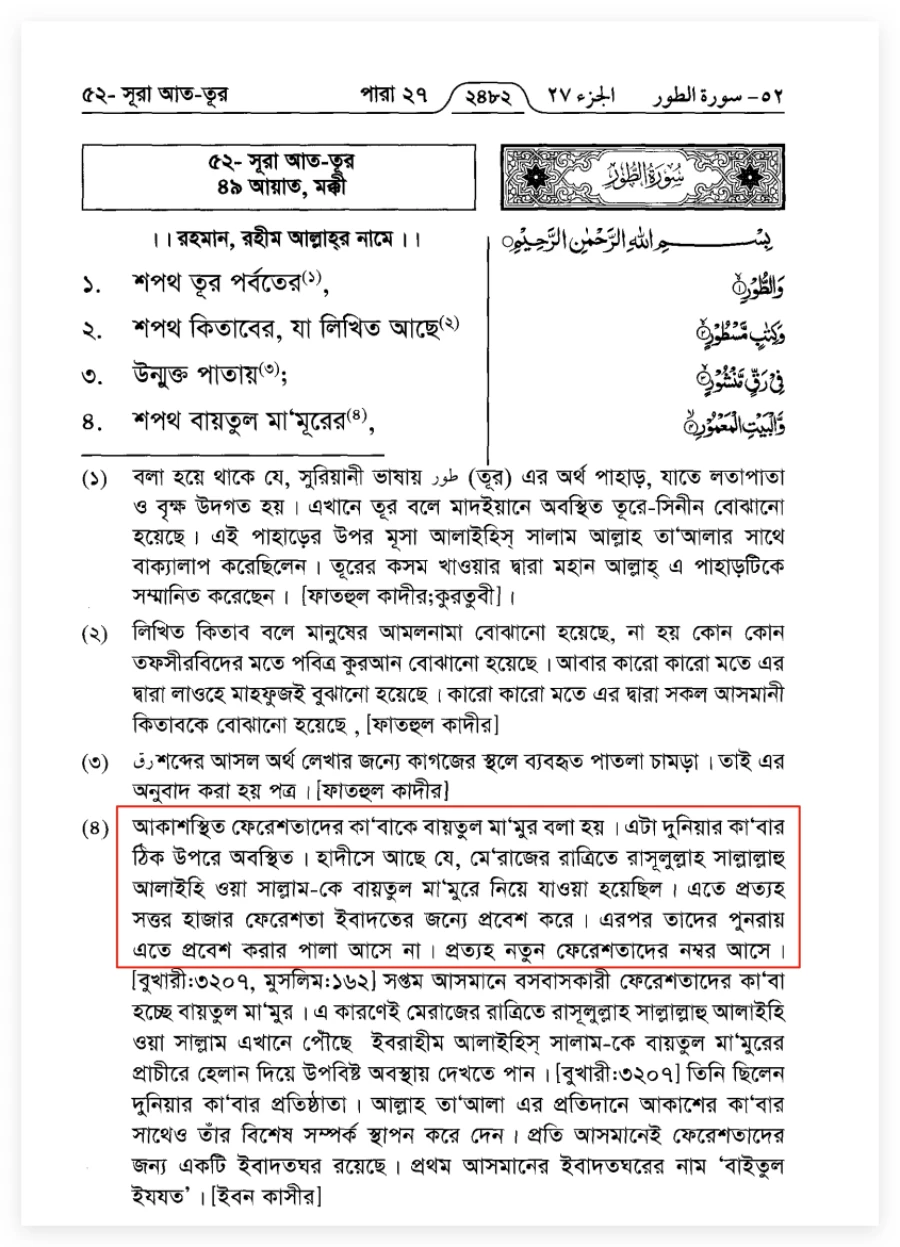
By calling Bayt al-Ma’mur the Kaaba of the angels and linking Abraham to both houses, Zakariya’s explanation constructs heavenly approval for the earthly sanctuary. The parallel—that angels in heaven worship at an elevated counterpart to the house around which people worship in Mecca—presents a human religious practice as a practice of all creation. The house in Mecca then becomes more than a place of worship established within human history; its status is tied to the arrangement of heaven itself. Abraham’s role is particularly important here. The quoted explanation describes his connection with the heavenly house as a reward for building the earthly Kaaba. An earthly construction, a divine reward, and a heavenly building thus support one another within the same story. That support is entirely internal to the narrative: the sanctity of the Kaaba gives meaning to its heavenly counterpart, while the existence of that counterpart elevates the Kaaba’s sanctity to cosmic status.
The imprint of human experience is also clear in this arrangement. Houses, walls, sitting with one’s back against a wall, arriving groups of worshippers, and a reward for construction work on Earth are all intelligible through familiar social and architectural experience. In explaining the heavenly world, the arrangements of human religious life have been extended into it. The narrative presents an established earthly practice as corresponding to a pre-existing cosmic order, thereby giving that practice a status above human choice and history. But the directly visible existence of the earthly house does not establish the existence of its heavenly counterpart. An invisible counterpart has been placed alongside a familiar building, and a religious relationship between the two has been declared; familiarity with the first building cannot serve as evidence for the second building’s existence. The story extends the authority of the Kaaba without adding independent knowledge about the heavenly house.
Tafsir al-Mazhari
Tafsir al-Mazhari describes the location of the heavenly mosque as follows: [5]
“Bayt al-Ma’mur” is a mosque located in the seventh heaven directly above the Holy Kaaba. Another name for this mosque is Sarrakh. Just as the Holy Kaaba is honoured on Earth, Bayt al-Ma’mur is honoured in the heavenly world.
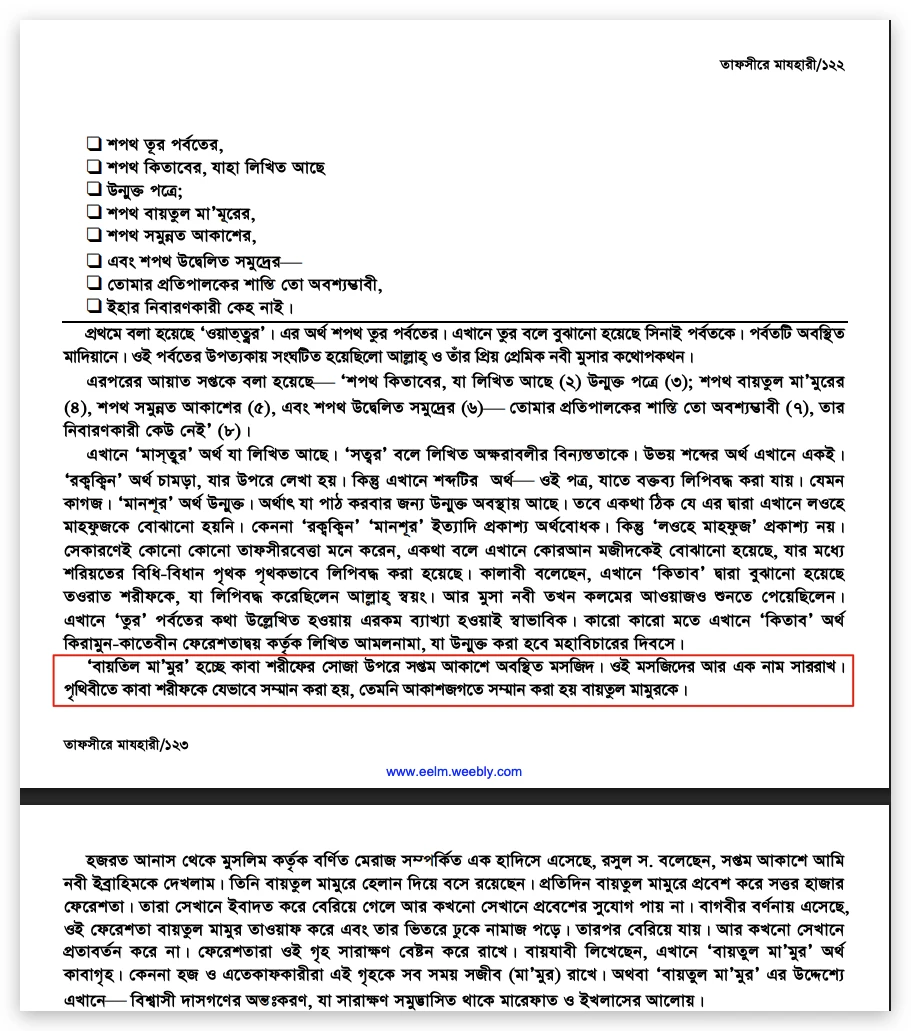
Al-Mazhari’s quotation combines three points in one statement: the house is a mosque, it is in the seventh heaven, and it is directly above the Kaaba. It also introduces the idea of corresponding honour in heaven and on Earth. A comparison of honour is an evaluation; a position directly overhead is a spatial claim. Combining the two in the same statement may make the emotion associated with the evaluation lend credibility to the spatial claim. But the degree of honour cannot determine an object’s altitude, direction, or distance.
Tafsir Ibn Kathir
Tafsir Ibn Kathir contains accounts transmitted through Ali and Qatadah: [6]
Ibn Jarir (may Allah have mercy on him) narrated from Khalid ibn Ar’arah (may Allah have mercy on him), who said: A man asked Ali (may Allah be pleased with him), “What is Bayt al-Ma’mur?” Ali replied: “A house called ‘Surah,’ situated in heaven directly above the Holy Kaaba. Its status among the inhabitants of heaven is like that of Baytullah among the inhabitants of Earth. Seventy thousand angels pray in it every day and then leave. They never enter it again.” …
Qatadah, Rabi’ ibn Anas, and al-Suddi (may Allah have mercy on them) said: It has been reported to us that the Messenger of Allah (peace and blessings be upon him) once asked his Companions, “Do you know what Bayt al-Ma’mur is?” They replied, “Allah and His Messenger know best about it.” The Messenger of Allah (peace and blessings be upon him) then said, “Bayt al-Ma’mur is a mosque situated in heaven directly in line with the Kaaba. Hypothetically, if it ever collapsed and fell, it would fall directly upon the Kaaba. Seventy thousand angels pray in it every day. Then they leave and never return.”
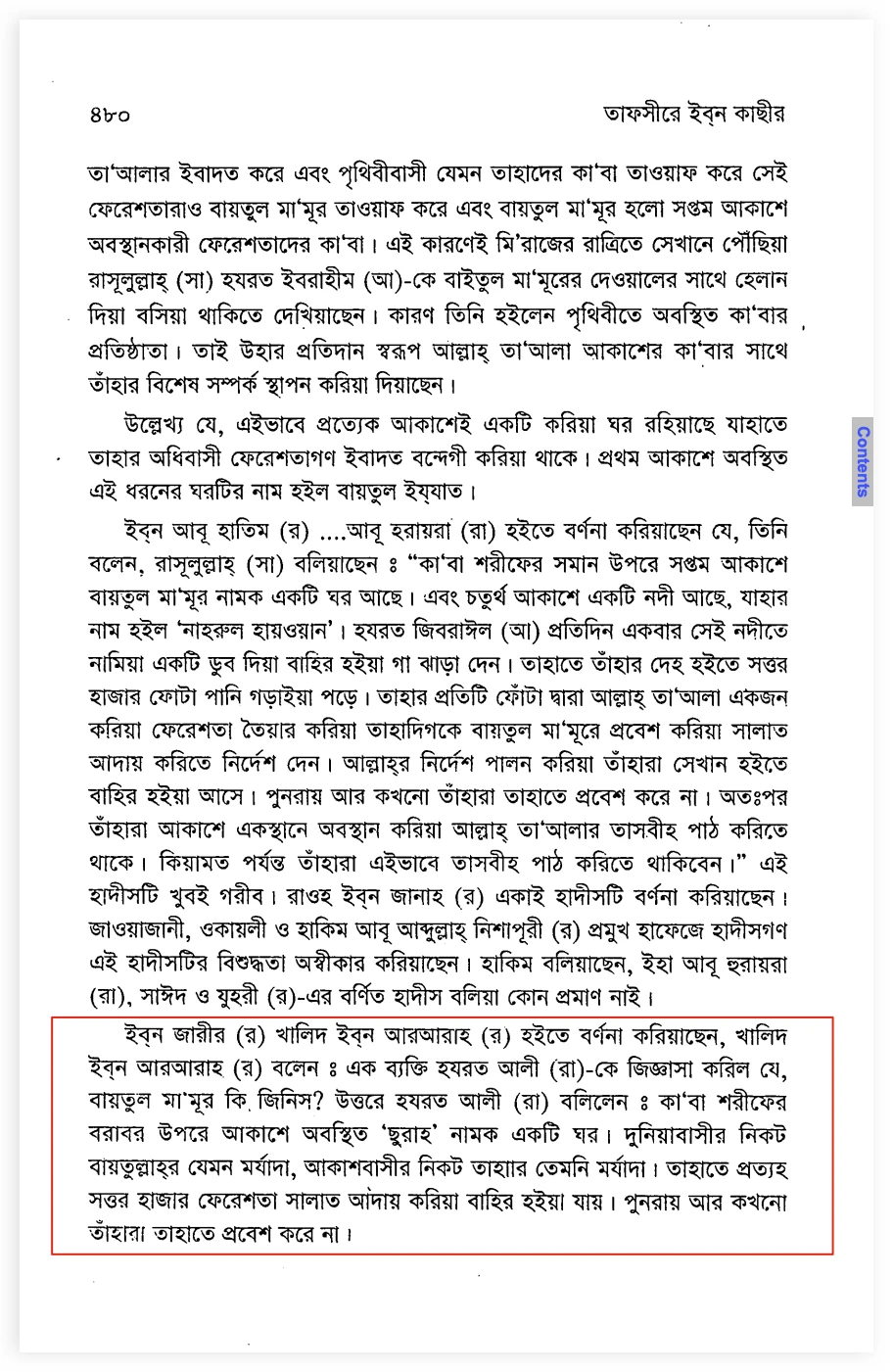
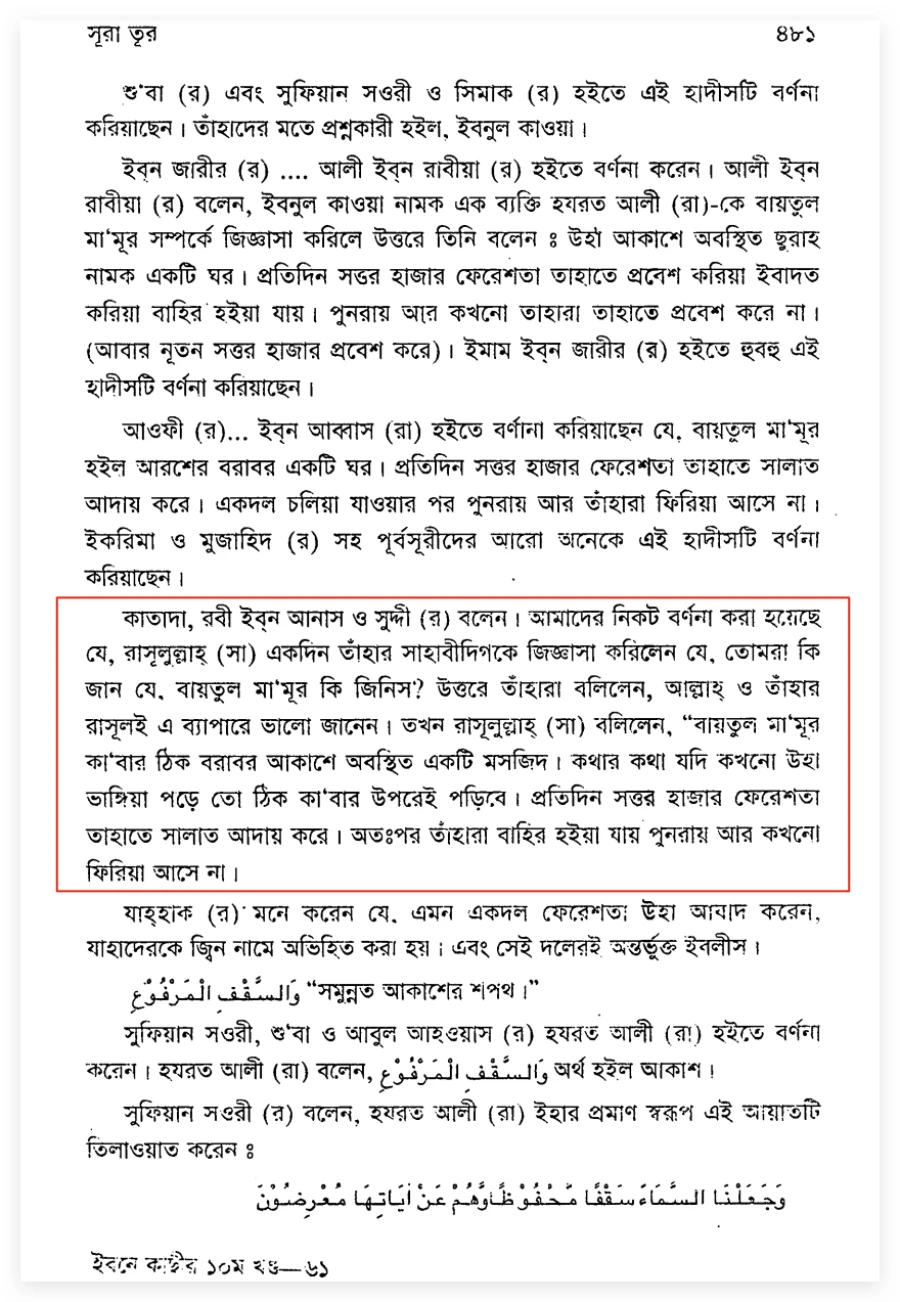
The Bengali quotation from Ibn Kathir places Ali’s statement alongside a statement circulating in Muhammad’s name through Qatadah. The first describes an alignment between the heavenly house and the Kaaba; the second adds the claim that, if it fell, it would fall upon the Kaaba. This second statement makes the location more specific: the alleged house is not merely somewhere in the sky; the destination of its potential fall is also specified. A description of heavenly status has thus been combined with a declaration about the outcome of a physical event.
A Heavenly House Aligned with the Kaaba: The Full Statements Attributed to Ali and Transmitted through Qatadah
The Account of Location and Status Attributed to Ali
Al-Tabari’s commentary on Surah al-Tur preserves a statement attributed to Ali through Khalid ibn Ar’arah. It combines the house’s name, its positional relationship with the Kaaba, its religious status, and the daily gathering of angels. Ibn Kathir later quoted this statement while explicitly naming al-Tabari. The same statement appearing in two commentaries therefore shows the history of its circulation and reception; it does not represent observations of space by two independent observers. [7]
حدثنا هناد بن السريّ, قال: ثنا أبو الأحوص عن سماك بن حرب, عن خالد بن عُرعُرة, أن رجلا قال لعليّ رضي الله عنه: ما البيت المعمور؟ قال: بيت في السماء يقال له الضراح, وهو بحيال الكعبة, من فوقها حرمته في السماء كحرمة البيت في الأرض, يصلي فيه كلّ يوم سبعون ألفا من الملائكة, ولا يعودون فيه أبدا.
English translation: Hannad ibn al-Sari narrated to us. He said: Abu al-Ahwas narrated through Simak ibn Harb, through Khalid ibn Ar’arah, that a man asked Ali, “What is Bayt al-Ma’mur?” He replied: “A house in heaven called al-Durah. It is in line with the Kaaba, above it. Its status in heaven is like the status of the Kaaba on Earth. Seventy thousand angels pray in it every day, and they never return.”
This statement constructs the relationship between the Kaaba and the heavenly house as one of both direction and status. The religious importance of the house below is reflected in the house above; the worship of angels in the upper house in turn gives the lower house’s importance a cosmic dimension. This is a familiar religious method of presenting a human sanctuary as corresponding to a heavenly order. Determining the truth of the positional claim requires information about where and how the house’s presence can be verified; equivalence of honour does not answer that question.
The Destination of the Fall in Qatadah’s Report: The Kaaba
The Arabic text of Ibn Kathir contains a complete question-and-answer episode in Qatadah’s statement. Qatadah says that this statement in Muhammad’s name had been reported to them. It then describes a heavenly mosque, its alignment with the Kaaba, and the assertion that it would fall upon the Kaaba if it fell. The same account also appears in al-Tabari’s compilation. [8]
وقال قتادة : ذكر لنا أن رسول الله – صلى الله عليه وسلم – قال يوما لأصحابه : ” هل تدرون ما البيت المعمور ؟ ” قالوا : الله ورسوله أعلم . قال : ” فإنه مسجد في السماء بحيال الكعبة لو خر لخر عليها يصلي فيه كل يوم سبعون ألف ملك ، إذا خرجوا منه لم يعودوا آخر ما عليهم ” .
English translation: Qatadah said: It has been reported to us that the Messenger of Allah once said to his Companions, “Do you know what Bayt al-Ma’mur is?” They said, “Allah and His Messenger know best.” He said, “It is a mosque in heaven aligned with the Kaaba. If it fell, it would fall upon the Kaaba itself. Seventy thousand angels pray in it every day. Once they leave, they never return.”
A mosque, its position above, and the destination of its fall together constitute a spatial description. A statement confined to the corresponding status of two sanctuaries would not require an example involving a fall. By specifying the destination of the fall, the account declares a direct vertical relationship between the heavenly house and the earthly house. By placing one sacred house above another, it extends Mecca’s religious centre into the upper world.
Qatadah was a Successor. Here he does not name a Companion who directly witnessed the event; instead, he introduces an account circulating as Muhammad’s statement with the words, “It has been reported to us.” Islamweb likewise identifies this report as mursal. Its transmission therefore contains a gap in the direct connection back to Muhammad. This identification of the source and the content of the account are two separate questions. The first tells us through whom the statement circulated; the second reveals the kind of physical relationship imagined in early Islamic literature between the Kaaba and the heavenly mosque. [9]
| Level of source | Specific statement | Type of information being claimed |
|---|---|---|
| Qur’an 52:4 | An oath by Bayt al-Ma’mur | A religious name and its status |
| The Mi’raj accounts in Sahih al-Bukhari and Sahih Muslim | The seventh heaven, Abraham, and seventy thousand angels daily | A house encountered during a journey and its daily gathering |
| The statement attributed to Ali | A heavenly house directly above and aligned with the Kaaba | Direction and relative position |
| The account transmitted through Qatadah | If it fell, it would fall upon the Kaaba | The specific destination of a possible fall |
Multiple Addresses for the Same House: Conflicting Locations in the Commentaries
The Third, Sixth, or Seventh Heaven in al-Jalalayn
While placing Bayt al-Ma’mur in line with the Kaaba, Tafsir al-Jalalayn preserves three alternatives for its heavenly location: the third, sixth, or seventh heaven. These three numbers do not convey the same information about the location of the same structure. A different answer to the question of which heaven contains the house changes the conception of its surrounding layers and its distance from Earth. The complete explanation of the verse in al-Jalalayn reads as follows: [10]
4 – { والبيت المعمور } هو في السماء الثالثة أو السادسة أو السابعة بحيال الكعبة يزوره كل يوم سبعون ألف ملك بالطواف والصلاة لا يعودون إليه أبدا
English translation: “And by Bayt al-Ma’mur”—it is situated in the third, sixth, or seventh heaven, aligned with the Kaaba. Seventy thousand angels visit it daily for circumambulation and prayer. They never return to it.
If a physical building is given an address on the “third, sixth, or seventh floor,” the three numbers indicate three different locations. Speaking confidently about the building’s existence does not resolve the uncertainty about which floor contains it. Al-Jalalayn likewise specifies alignment with the Kaaba, seventy thousand angels daily, and their non-return, while giving several alternatives for the heaven in which this activity occurs. There is a substantial gap between the specificity of the description and the reliability of the location. Precise information is claimed about how many go there and what they do, yet no fixed answer is available about where they go. The alternatives placing the same house in three separate heavens preserve a clear conflict of location. Presenting the seventh heaven as the only certain address also requires an explanation of the sources of the other alternatives and the grounds for rejecting them. Selecting an alternative and independently establishing that alternative are two separate things.
In an actual investigation, three different locations for the same structure would prompt an examination of the positional evidence: which information is direct, which was received from others, and what independent means can verify an address. Al-Jalalayn’s brief explanation preserves the alternatives without supplying observational data for selecting one. Thus, even as the number of the heaven changes, the account of the daily gathering of angels and the special relationship with the Kaaba survives. The certainty of the religious statement continues independently of certainty about the address. This feature matters: the different parts of the account do not rest on evidence of equal strength, yet together they have become established as a familiar religious fact. Collapsing the distinction between the third, sixth, and seventh heavens into the vague word “sky” conceals the conflict; it does not merge the separate locations preserved in the original source.
Different Accounts of Location, Identity, and Origin in al-Qurtubi
Al-Qurtubi’s explanation of Surah al-Tur presents accounts locating the house in the sixth and fourth heavens, the lowest heaven, and above the seven heavens side by side. It also preserves an interpretation attributed to al-Hasan identifying Bayt al-Ma’mur with the Kaaba on Earth. Another account, attributed to Rabi’ ibn Anas, places the house on Earth in Adam’s time and describes it being raised into the lowest heaven during Noah’s Flood. These preserve two different origin narratives: a house aligned in heaven and one taken from Earth into heaven. [11]
قوله تعالى : والبيت المعمور قال علي وابن عباس وغيرهما : هو بيت في السماء حيال الكعبة يدخله كل يوم سبعون ألف ملك ، ثم يخرجون منه فلا يعودون إليه . قال علي رضي الله عنه : هو بيت في السماء السادسة . وقيل : في السماء الرابعة ; روى أنس بن مالك ، عن مالك بن صعصعة ، قال : قال رسول الله صلى الله عليه وسلم : أوتي بي إلى السماء الرابعة فرفع لنا البيت المعمور فإذا هو حيال الكعبة لو خر خر عليها يدخله كل يوم سبعون ألف ملك إذا خرجوا منه لم يعودوا إليه ؛ ذكره الماوردي . وحكى القشيري عن ابن عباس أنه في السماء الدنيا . وقال أبو بكر الأنباري : سأل ابن الكواء عليا رضي الله عنه قال : فما البيت المعمور ؟ قال : بيت فوق سبع سموات تحت العرش يقال له الضراح . وكذا في ” الصحاح ” : والضراح – بالضم – بيت في السماء وهو البيت المعمور عن ابن عباس . وعمرانه كثرة غاشيته من الملائكة . وقال المهدوي عنه : حذاء العرش . والذي في صحيح مسلم عن مالك بن صعصعة عن النبي صلى الله عليه وسلم في حديث الإسراء : ثم رفع إلى البيت المعمور فقلت : يا جبريل ما هذا ؟ قال : هذا البيت المعمور يدخله كل يوم سبعون ألف ملك إذا خرجوا منه لم يعودوا إليه آخر ما عليهم وذكر الحديث . وفي حديث ثابت عن أنس بن مالك أن رسول الله صلى الله عليه وسلم قال : أتيت بالبراق . . . الحديث ; وفيه : ثم عرج بنا إلى السابعة فاستفتح جبريل عليه السلام فقيل من هذا قال جبريل قيل ومن معك قال محمد – صلى الله عليه وسلم – قيل وقد بعث إليه قال قد بعث إليه ففتح لنا فإذا أنا بإبراهيم عليه السلام مسندا ظهره إلى البيت المعمور وإذا هو يدخله كل يوم سبعون ألف ملك لا يعودون إليه . وعن ابن عباس أيضا قال : لله في السماوات والأرضين خمسة عشر بيتا ، سبعة في السماوات . وسبعة في الأرضين والكعبة ، وكلها مقابلة للكعبة . وقال الحسن : البيت المعمور هو الكعبة ، البيت الحرام الذي هو معمور من الناس ، يعمره الله كل سنة بستمائة ألف ، فإن عجز الناس عن ذلك أتمه الله بالملائكة ، وهو أول بيت وضعه الله للعبادة في الأرض . وقال الربيع بن أنس : إن البيت المعمور كان في الأرض موضع الكعبة في زمان آدم عليه السلام ، فلما كان زمان نوح عليه السلام أمرهم أن يحجوا فأبوا عليه وعصوه ، فلما طغى الماء رفع فجعل بحذائه في السماء الدنيا ، فيعمره كل يوم سبعون ألف ملك ، ثم لا يرجعون إليه حتى ينفخ في الصور ، قال : فبوأ الله جل وعز لإبراهيم مكان البيت حيث كان ; قال الله تعالى : وإذ بوأنا لإبراهيم مكان البيت أن لا تشرك بي شيئا وطهر بيتي للطائفين والقائمين والركع السجود .
English translation:
Allah’s words: “And by the inhabited house.” Ali, Ibn Abbas, and others said: It is a house in heaven aligned with the Kaaba. Seventy thousand angels enter it every day. Then they leave and never return. Ali, may Allah be pleased with him, said: It is a house in the sixth heaven. It has also been said: It is in the fourth heaven. Anas ibn Malik narrated through Malik ibn Sa’sa’ah that the Messenger of Allah, peace and blessings be upon him, said: I was taken to the fourth heaven. Bayt al-Ma’mur was then shown to us. It was aligned with the Kaaba; if it fell, it would fall upon the Kaaba itself. Seventy thousand angels enter it every day. Once they leave, they never return. Al-Mawardi mentioned this report. Al-Qushayri related from Ibn Abbas that it is situated in the lowest heaven. Abu Bakr al-Anbari said: Ibn al-Kawwa asked Ali, may Allah be pleased with him, “What is Bayt al-Ma’mur?” He replied: “A house above the seven heavens, beneath the Throne, called al-Durah.” Similarly, al-Sihah contains the following, transmitted from Ibn Abbas: Al-Durah—with a dammah on the first letter—is a house in heaven; it is Bayt al-Ma’mur. Its being inhabited means that immense numbers of angels gather there. Al-Mahdawi reported from him: It is aligned with the Throne. Sahih Muslim contains, through Malik ibn Sa’sa’ah, the following in the Prophet’s account of the Isra, peace and blessings be upon him: Then I was taken to Bayt al-Ma’mur. I said, “Gabriel, what is this?” He said, “This is Bayt al-Ma’mur. Seventy thousand angels enter it every day. After leaving, they never return; their turn to enter it never comes again.” He then mentioned the hadith. The hadith narrated by Anas ibn Malik through Thabit states that the Messenger of Allah, peace and blessings be upon him, said: “The Buraq was brought to me”—the hadith. It also contains: Then we were taken up to the seventh heaven. Gabriel, peace be upon him, requested that the gate be opened. It was asked, “Who is this?” He said, “Gabriel.” It was asked, “Who is with you?” He said, “Muhammad, peace and blessings be upon him.” It was asked, “Has he been summoned?” He said, “He has been summoned.” The gate was then opened for us. There I saw Abraham, peace be upon him, leaning his back against Bayt al-Ma’mur. Seventy thousand angels enter it every day, and they never return. It is also narrated from Ibn Abbas that he said: Allah has fifteen houses in the heavens and the earths. Seven are in the heavens, seven in the earths, and there is the Kaaba. All are aligned with the Kaaba. Al-Hasan said: Bayt al-Ma’mur is the Kaaba, the Sacred House, which is inhabited through the gathering of people. Allah keeps it inhabited by six hundred thousand every year. If people cannot complete that number, Allah completes it with angels. This is the first house that Allah established on Earth for worship. Rabi’ ibn Anas said: In the time of Adam, peace be upon him, Bayt al-Ma’mur was on Earth at the site of the Kaaba. When the time of Noah, peace be upon him, came, he ordered them to perform the pilgrimage; they refused and disobeyed him. When the waters rose mightily, the house was lifted and placed in the lowest heaven, aligned with its earthly location. Seventy thousand angels inhabit it every day; they do not return until the Trumpet is blown. He said: Allah then designated for Abraham the house’s former site. Allah said: “And when I designated for Abraham the site of the House—associate nothing with Me, and purify My House for those who circumambulate it, those who stand in worship, and those who bow and prostrate.”
Whether the house was in heaven from the beginning or was once on Earth is a difference in history. Whether the same name identifies the earthly Kaaba or a separate heavenly house is a difference in the object’s identity. The third, fourth, sixth, seventh, or lowest heaven are differences in location. Presenting these variations collectively as an accurate heavenly map conceals the actual state of the accounts. Interpretations from different generations, familiar architecture, and old stories have accumulated around a religious name; that collection of accounts has been substituted for verified coordinates.
| Subject | Preserved alternatives | Central discrepancy |
|---|---|---|
| Layer of heaven | The third, fourth, sixth, seventh, or lowest heaven | Multiple locations for the same house |
| Identity of the house | A separate heavenly house or the earthly Kaaba | The object identified by the name changes |
| Origin of the house | A heavenly sanctuary or an earthly house raised during the Flood | The history of its origin changes |
A House Raised from Earth into Heaven during the Flood
The origin narrative preserved by al-Qurtubi in the name of Rabi’ ibn Anas connects the house’s location with Adam, Noah, the Flood, and Abraham’s construction of the Kaaba. The complete account reads: [12]
وقال الربيع بن أنس : إن البيت المعمور كان في الأرض موضع الكعبة في زمان آدم عليه السلام ، فلما كان زمان نوح عليه السلام أمرهم أن يحجوا فأبوا عليه وعصوه ، فلما طغى الماء رفع فجعل بحذائه في السماء الدنيا ، فيعمره كل يوم سبعون ألف ملك ، ثم لا يرجعون إليه حتى ينفخ في الصور ، قال : فبوأ الله جل وعز لإبراهيم مكان البيت حيث كان ; قال الله تعالى : وإذ بوأنا لإبراهيم مكان البيت أن لا تشرك بي شيئا وطهر بيتي للطائفين والقائمين والركع السجود .
English translation: Rabi’ ibn Anas said: In Adam’s time, Bayt al-Ma’mur was on Earth at the site of the Kaaba. When Noah’s time came, he ordered them to perform the pilgrimage; they refused and disobeyed him. When the waters rose mightily, the house was lifted and placed in the lowest heaven, aligned with its earthly location. Seventy thousand angels inhabit it every day; they do not return until the Trumpet is blown. He said: Allah then designated for Abraham the house’s former site. Allah said: “And when I designated for Abraham the site of the House—associate nothing with Me, and purify My House for those who circumambulate it, those who stand in worship, and those who bow and prostrate.”
This story explains the origin of the heavenly house by raising a particular house from Earth. The site of the Kaaba is sacred from the outset; the Flood removes the house; Abraham is later connected with that site again. The past of a familiar earthly sanctuary and the present of heaven are thus joined within the same religious history. The quoted Qur’anic wording describes the designation of the house’s site for Abraham; the additional events of lifting the house during the Flood and transferring it to the lowest heaven belong to this report. That verse alone does not provide evidence establishing those additional events.
Fifteen Aligned Houses in the Seven Heavens and Seven Earths
Al-Qurtubi preserves another statement attributed to Ibn Abbas: there are seven houses in the seven heavens, seven in the seven earths, and fifteen altogether including the Kaaba; all are aligned with the Kaaba. The idea of alignment between two houses has thus been extended across an entire layered creation. [13]
وعن ابن عباس أيضا قال : لله في السماوات والأرضين خمسة عشر بيتا ، سبعة في السماوات . وسبعة في الأرضين والكعبة ، وكلها مقابلة للكعبة .
English translation: It is also narrated from Ibn Abbas that he said: Allah has fifteen houses in the heavens and the earths. Seven are in the heavens, seven in the earths, and there is the Kaaba. All are aligned with the Kaaba.
In this arrangement, the Kaaba is no longer confined to being a sanctuary in a city; the location of every sanctuary in the layered worlds is defined in relation to it. A local human place of worship has been made the centre of cosmic symmetry. The individual layers of the seven earths, the separate locations of the seven heavens, and the connection of the houses in both directions to the Kaaba together extend ancient religious geography. There is no independent survey of space, distance measurement, or observable counterpart supporting this arrangement.
A House in Every Heaven: From Exegetical Expansion to Religious Certainty
The statement that each heaven contains a house appears in Ibn Kathir’s discussion and is also quoted in Zakariya’s Bengali commentary. Islamweb’s Fatwa 115174 was asked about the basis of this specific claim in sahih hadith. The answer acknowledged its presence in Ibn Kathir’s explanation and stated that they had found no sahih report of it in Muhammad’s name. A statement appearing in a commentary and having a particular transmitted basis as Muhammad’s statement therefore cannot be treated as the same thing. [14]
An account of one heavenly house and an arrangement of corresponding houses in every heaven are not claims of the same scope. The second adds the existence of multiple structures throughout the heavens. Because later explanations and fatwas quote this expanded arrangement together, each part may appear to rest on the same foundation. Yet Islamweb’s answer itself raises a question about the transmitted basis of this particular extension. Exegetical interpretation, reports attributed to Muhammad, and independent historical evidence are different kinds of material. An interpretation gaining acceptance does not generate new observations in its support.
A Fatwa on Earth’s Rotation: Invoking the Immense Throne to Explain Position
The Different Subjects of Islamweb’s Question and Answer
The questioner in Islamweb’s Fatwa 14859 directly raised Earth’s rotation on its axis and its revolution around the Sun. The question concerned the alignment between the Kaaba on a moving Earth and the structure above it. The answer accepted an alignment between Bayt al-Ma’mur, the Kaaba, and the Throne, then invoked the smallness of creation compared with the Throne. [15]
ولا يُشْكل على هذا كون الأرض تدور حول نفسها، أو حول الشمس؛ إذ المخلوقات كلها في حجمها، لا تساوي شيئًا أمام العرش
English translation: Earth’s rotation around itself or around the Sun presents no difficulty here, because all creation, in terms of size, amounts to nothing before the Throne.
Islamweb’s answer introduces a comparison of size in response to a question about position. The question was how the heavenly house remains aligned with the Kaaba’s local vertical as Earth rotates; the answer states that all creation is insignificant compared with the Throne. But an object’s size and the alignment of a particular part of it with another particular object are two separate facts. Even if one building is a hundred thousand times larger than another, that ratio alone cannot tell us whether a particular room in the larger building is directly above the smaller one. Similarly, a tiny point may move within a vast circle while a line drawn outward from that point intersects different parts of the circle over time. The point’s smallness relative to the entire arrangement does not stop that change in the line. The fatwa’s comparison of immensity leaves the positions, distance, and relative motion of the Kaaba and Bayt al-Ma’mur undetermined.
A person walking in a small courtyard beneath a large roof may remain under that roof throughout. But whether the same small room in the roof remains directly above the person’s head depends on the direction of movement and the room’s location. However large the roof becomes, “being beneath a large expanse” and “being directly beneath a particular room in that expanse” are not the same relationship. The account of Bayt al-Ma’mur likewise claims a relationship between a particular house and a particular Kaaba. Introducing the still larger Throne and discussing the general smallness of creation in place of that specific relationship changes the subject of the question. Even accepting the belief that the Throne extends above all creation does not entail that Bayt al-Ma’mur occupies the Kaaba’s upward line.
The missing logical connection in this answer can therefore be identified directly: no geometrical step is supplied to move from “all creation is small compared with the Throne” to “Bayt al-Ma’mur remains aligned with the rotating Kaaba.” The second conclusion requires knowledge of the relative positions of the two houses and how those positions change over time. The first statement supplies none of that information. The language of wonder and immensity thus operates in place of an explanation. Mentioning an enormous religious object may make the question seem less important to an ordinary reader, but it does not complete the calculation of the relationship between two specific houses. Using the vastness of space as the solution to a positional problem is an invalid argument; a comparison of scale has been substituted for an explanation of motion.
Ibn Uthaymin’s Two Meanings: Physical Elevation and Parallel Worship
In Ibn Uthaymin’s 157th open meeting, preserved on Islamweb, two meanings of being in line with the Kaaba are raised. One is physical location above the Kaaba, accompanied by a reference to Allah’s power. In the other, the inhabitants of heaven maintain Bayt al-Ma’mur through worship as the inhabitants of Earth maintain the Kaaba. The relevant statement of the second interpretation, in his own words, is: [16]
أو المعنى: (بحيال الكعبة) بإزائها بمعنى: أنه كما تعمر الكعبة من أهل الأرض يعمر البيت المعمور من أهل السماء
English translation: Or “in line with the Kaaba” means corresponding to it: just as the Kaaba is maintained through worship by the inhabitants of Earth, Bayt al-Ma’mur is maintained through worship by the inhabitants of heaven.
Parallel worship and a specific vertical position are two different claims. The first describes a similarity of worship; the second establishes a direction between one house and another. The statement in Qatadah’s report that the house would fall upon the Kaaba makes the second claim more explicit. Promoting a claim in one sense and explaining it in another changes the content of the statement. Using a symbol of parallel worship as a specific address in the physical sky requires independent evidence for that address.
From the Heavenly House’s Status to Prohibitions in Everyday Life
IslamQA’s Fatwa 120126 was asked about naming an architectural consultancy Bayt al-Ma’mur. The answer instructed that the name be changed and based this on the special status of the heavenly house. The same discussion also quoted Ibn Kathir’s explanation of a heavenly house aligned with the Kaaba and a place of worship in every heaven. [17]
An account of an unverified heavenly house has here become a religious prohibition on the name of a real person’s business. The fatwa’s reasoning is revealing: the house exists in heaven, its status is exceptional, and therefore an ordinary business may not bear its name. The claims about the heavenly building’s existence and special status thus determine limits on people’s practical freedom. The prohibition is not based on evidence that the name has deceived customers, caused faults in the business’s work, or inflicted actual harm on anyone. Its basis is the religious demand to protect the dignity of a sacred name. An act of choosing a name can consequently be associated with the risk of sin without examining commercial honesty, professional competence, or treatment of other people. The status of a house whose existence lacks independent evidence gains authority over the moral evaluation of actual human conduct.
This example displays a specific sequence through which belief becomes an instrument of social control. An account of a heavenly house circulates; it is treated as established fact and made the basis of rules requiring special reverence; that reverence then determines permission to use language and names. The fatwa’s influence here takes the form of religious approval, prohibition, and judgments of sin. Even a person’s choice of a business name becomes subordinate to the dignity of an invisible structure. Religious imagination thus produces real consequences, while the question of verifying the imagined structure’s existence is treated as settled before the ruling is issued. A claim that has not established its authority through knowledge is used as the basis for imposing rules on independent human decisions.
Directly Above: The Local Vertical, the Zenith, and Earth’s Rotation
In geometry, “directly above” is a direction relative to a particular location. In a simple spherical model of Earth, a line drawn outward from Earth’s centre through the Kaaba indicates Mecca’s local upward direction. In astronomy, the point in the sky directly overhead for an observer is called the zenith. The zenith is itself a point in the sky; a line drawn upward towards it and the claim that a physical house occupies that line are not the same thing. [18]
Earth rotates on its axis from west to east. Relative to distant stars, one rotation takes approximately 23 hours, 56 minutes, and 4 seconds. The ordinary 24-hour day is defined with reference to the Sun; the slight difference is related to Earth’s annual motion. Mecca’s latitude is approximately 21.4225 degrees north. Using Earth’s mean radius of 6,371 kilometres, a spherical approximation gives the Kaaba’s rotational speed as roughly 432.5 metres per second, or 1,557 kilometres per hour. This is surface motion relative to Earth’s rotation axis, not a speed relative to an absolutely stationary centre of the universe. [19] [20]
Surface rotational speed: v = ΩR cos φ. Here Ω is Earth’s angular velocity, R is Earth’s radius, and φ is latitude. At Mecca, the distance from the rotation axis is smaller than the equatorial radius, so the surface speed is lower than at the equator. The same formula shows that Earth’s rotation changes the position of the Kaaba and its local upward direction relative to the stars over time.
Considering a fixed distant direction in the sky together with the changing upward direction at Mecca makes the conditions for alignment clear. A distant object with fixed equatorial coordinates will not remain at Mecca’s zenith throughout the day. To maintain permanent alignment with the Kaaba, the alleged structure’s motion would also have to conform to that relationship. The account supplies no measurement of that motion, nor the structure’s distance or any mechanism maintaining its position. This is the evidential gap in declaring an “overhead house,” pictured from the standpoint of familiar ground, a reality of space as a whole.
In an ancient vertical picture of the world, placing a temple below and a temple above on the same axis is an easily comprehensible religious image. But identifying that image as a physical structure in a modern coordinate system requires specific answers about its coordinates, time, distance, and speed. Saying “the seventh heaven” is no substitute for those measurements. Naming an undetermined region does not locate a physical house.

Layered Heavens versus the Structure of the Observed Universe
Heaven in the Commentary: One Separate Layer after Another
In explaining “seven heavens in layers” in the third verse of Surah al-Mulk, Ibn Kathir explicitly describes one layer after another. He also records two views on whether the layers adjoin one another or are separated by empty spaces. He considers the second view more correct and cites the Mi’raj hadith in its support. In this explanation, therefore, heaven is not merely a vague synonym for distance. There are multiple distinct regions, gaps between them, and an arrangement for moving from one region to another. [21]
ثم قال : ( الذي خلق سبع سماوات طباقا ) أي : طبقة بعد طبقة ، وهل هن متواصلات بمعنى أنهن علويات بعضهم على بعض ، أو متفاصلات بينهن خلاء ؟ فيه قولان ، أصحهما الثاني ، كما دل على ذلك حديث الإسراء وغيره .
English translation: He then says: “Who created seven heavens in layers”—that is, one layer after another. Are they adjoining, meaning situated one above another, or separate with empty space between them? There are two views on this. The second is more correct, as indicated by the hadith of the Isra and other reports.
The Mi’raj account in Sahih al-Bukhari likewise describes successive ascents through the heavens, requests to open gates, questions about identity, and entry by permission. One heaven follows the passage through the one below; particular people are encountered in each; Bayt al-Ma’mur appears towards the end. This sequence constructs a heavenly geography resembling familiar human palaces, gateways, and hierarchical administration. Bayt al-Ma’mur is a specific religious building within that arrangement. A later reader inserting modern astronomical terms does not change the meaning of the original account’s gates, entry, and separate layers. [22]
The broader religious picture of the seven heavens and seven earths is discussed in detail in Shongshoy’s article Seven Heavens and Seven Earths. Bayt al-Ma’mur’s location belongs to that same world-picture: the house is not merely described as “above”; it is assigned to a particular layer of heaven and made the counterpart of an earthly sanctuary.
Atmospheric Layers, the Cosmic Web, and Heavenly Gates Are Not the Same Thing
Earth’s atmosphere is divided into layers according to temperature and other characteristics. The Solar System has planetary orbits; galaxies contain different regions of stars, gas, and dust; on still larger scales, galaxy clusters, long filaments of matter, and vast empty regions form the cosmic web. The names and boundaries of these physical structures are determined through observation. The ability to divide something into several parts does not amount to discovering the seven heavens of the Mi’raj, their gates, or a sanctuary in the seventh heaven. Identifiable correspondence between those specific religious claims and the observed structures has to be demonstrated. [23]
Space is not an empty box entirely devoid of matter either. It contains extremely diffuse gas, radiation, magnetic fields, and various cosmic objects. The conflict between the modern universe and the old picture of the heavens concerns their specific structures: religious accounts describe layers, gatekeepers, access permissions, and sanctuaries; astronomy describes distances, spectra, gravity, and the observed distribution of matter. Declaring the two arrangements identical because both use the word “sky” substitutes wordplay for information.


Distant Observations and the Demand for Evidence
Telescopes such as James Webb analyse light from extremely distant galaxies in the universe’s past. Spectra, brightness, distance calculations, and models of cosmic evolution together establish what the information means. These observations have not identified a structure called Bayt al-Ma’mur; nor is there an observational map of heavenly temples arranged in layers above the Kaaba. The name of a house and the number of a heaven in a commentary do not identify any particular object in a telescope’s observations. [24]
The cosmic microwave background contains information about minute temperature differences and the subsequent distribution of matter. The effects of mass are also observed through gravitational lensing. But without specifying an unknown house’s mass, distance, size, and radiation characteristics, no particular lensing signal can be calculated for it. The actual weakness of the religious claim is the complete absence of a physical identification of the house that would allow an independent search to identify it. Its existence is firmly declared, while the information required to distinguish it from any other physical structure is missing.
| Account or observation | What it establishes | What the claim about Bayt al-Ma’mur requires |
|---|---|---|
| The Mi’raj and commentaries | Religious descriptions of heavenly layers, a house, and entry | Positional evidence independent of the narrative |
| Telescopes and spectra | Specific objects and the properties of their light | An identifiable location and physical characteristics for the house |
| Gravitational effects | The effects of a particular mass distribution | A specific model of the house’s mass and distance |
| Alignment with the Kaaba | A claimed relationship with a local upward direction on Earth | Calculations of both locations and motions over time |
Geostationary Orbits and the Conditions for Matching Angular Velocity
One Revolution in the Same Time: Greater Distance Requires Greater Speed
Two points drawn near the centre and at the rim of a wheel complete a revolution in the same time. But the outer point travels a greater distance. The same geometrical condition applies if an object is placed farther out along the Kaaba’s local upward line and kept rotating with that line at all times. The greater the object’s perpendicular distance from the rotation axis, the higher its linear speed must be to maintain the same angular velocity. The relationship is v = Ωρ; here ρ is the perpendicular distance from the rotation axis. Speed increases in direct proportion to distance. [25]
In a simple model of rotation with the Kaaba, at a fixed distance r from Earth’s centre and at Mecca’s latitude φ, ρ = r cos φ. Therefore, v = Ωr cos φ. Earth’s angular velocity is approximately 7.2921 × 10⁻⁵ radians per second. If a physical structure remained aligned with the Kaaba according to this model, its required rotational speed could be calculated. Because the account supplies no distance, the calculation cannot yield Bayt al-Ma’mur’s actual speed; specified distances can be used to test the conditions of the claim.
| Assumed distance from Earth’s centre | Speed required to rotate together at Mecca’s latitude | Meaning of the calculation |
|---|---|---|
| 6,371 kilometres | Approximately 432.5 metres per second | A spherical approximation for the surface at Mecca |
| 384,400 kilometres | Approximately 26.1 kilometres per second | Hypothetical co-rotation at a distance comparable to the Moon’s; not the Moon’s actual speed |
| 1 astronomical unit; approximately 150 million kilometres | Approximately 10,155 kilometres per second | The mathematical condition for the same daily rotation at this distance |
| 1 light-year | Approximately 2,142 times the speed of light | This co-rotation model is impossible for a physical structure with mass |
The One-Light-Year Example and the Speed-of-Light Limit
One light-year is the distance light travels in a year, approximately 9.46 × 10¹⁵ metres. Requiring a structure with mass at that distance to complete the same daily rotation at Mecca’s latitude relative to Earth’s centre produces a required speed of approximately 2,142 times the speed of light. According to special relativity, continuously accelerating an object with mass to the speed of light requires infinite energy; a claim involving this faster-than-light local motion does not describe a physically admissible trajectory. [26]
In the same simple model, the required speed equals the speed of light at approximately 29.52 astronomical units from Earth’s centre. This number is not a measurement of the seventh heaven; it is the limit of a specified daily co-rotation. The account gives no location for the seventh heaven in any of these units. Consequently, saying that “a distant physical house rotates in the same way with the Kaaba” entails physical conditions, and at specified large distances those conditions violate the speed-of-light limit. Substituting a name from the narrative for an unknown distance does not resolve those conditions.
Why a Geostationary Satellite Cannot Remain Directly Overhead at the Kaaba
In a geostationary orbit, a satellite remains above the same longitude relative to Earth. A circular orbit approximately 42,164 kilometres from Earth’s centre, or 35,786 kilometres above the surface, a period equal to Earth’s rotation, and a position in the equatorial plane are required together. Completing an orbit once a day alone does not make a satellite geostationary. If its orbit is inclined, its position moves up and down relative to Earth’s surface. [27] [28]
The Kaaba is not on the equator; its latitude is approximately 21.42 degrees north. A satellite in an ordinary freely orbiting geostationary orbit therefore does not occupy the Kaaba’s zenith. From Mecca it may appear at the same place in the sky, but “appearing in the same direction in the sky” and “being directly overhead at the Kaaba” are two different geometrical relationships. Merely mentioning a familiar satellite does not complete an explanation of Bayt al-Ma’mur’s alignment. Checking the satellite’s actual orbital conditions reveals the discrepancy.
This particular altitude results from a particular kind of free circular orbit. Gravity accelerates the satellite towards the centre, and this combines with its forward motion to produce the orbit. Maintaining daily rotation around the same circle at Mecca’s latitude requires additional forces beyond Earth’s centre-directed gravity. The accounts describe no such arrangement of the structure’s mass, forces, orbit, or control. The location of the religious house is declared known while the basic dynamics required to maintain that location remain unspecified. [29]
Earth’s gravity does not end at the boundary of the atmosphere or at geostationary altitude. It decreases with distance; that same gravity is one of the determinants of a satellite’s orbit. Whether a house could remain in space therefore cannot be answered simply by saying “very high up.” Its trajectory and a model of the forces are required. The religious account of Bayt al-Ma’mur omits this necessary information while declaring a permanent positional relationship with a particular building on Earth.
Celestial Coordinates: Where the Kaaba’s Zenith Is at a Given Time
The Local Sky and Star-Based Coordinates
One way to locate a celestial object is to determine its angular altitude above the local horizon and its direction relative to north. Another uses equatorial coordinates—right ascension and declination. The first is directly connected with the observer’s location; the second is used to compare the positions of celestial objects. Saying “overhead at the Kaaba” describes the first kind of local relationship. Relating that relationship to a distant house requires a transformation between local and celestial coordinates. [30] [31]
A standard formula expressing this relationship is sin a = sin φ sin δ + cos φ cos δ cos H. Here a is the celestial object’s angular altitude above the horizon, φ is the observer’s latitude, δ is the object’s declination, and H is its local hour angle. Directly overhead, a = 90°. For a distant object to meet this condition, δ = φ and H = 0. At Mecca, its declination would have to be approximately 21.42 degrees north, and the object would have to be on the local meridian. Merely naming the seventh heaven supplies no measurement of any of these conditions.
Earth’s rotation changes the hour angle of a fixed distant direction. A star with the appropriate declination may therefore cross Mecca’s zenith at one moment and then move away. A star with another declination will not cross the zenith at all. A direction having passed overhead once does not establish that a particular house remains there forever. The claim that a physical Bayt al-Ma’mur is permanently connected with the Kaaba requires that this time-dependent position be specified. The religious account does not supply that information.
Annual Motion, Changes in Perspective, and Gravity
As Earth revolves around the Sun, the observer’s position changes throughout the year. The angular displacement of a nearby star relative to the distant background is called annual parallax. The observer’s velocity also changes the apparent direction from which light arrives. Precise astronomical calculations take these effects into account alongside slow changes in Earth’s axis and other corrections. Determining the location of a physical celestial object therefore demands much more information than a declaration that it is “above such-and-such a place.” [32]
Gravity determines the downward direction for a standing person; its opposite is the local upward direction. Passing beyond the atmosphere does not abolish that relationship. Directions in space can be defined relative to distance from Earth’s centre, local gravity, and motion. Relativity likewise does not make an observer’s local directions or the relative positions of objects meaningless. The curvature of spacetime at a particular place is determined by its physical configuration; a particular kind of curvature cannot be assumed merely because a place is far away.
The absence of information necessary for the claim about Bayt al-Ma’mur becomes even clearer here. There is no definite account of whether the house moves with Earth, moves with the Sun, or follows another trajectory. Familiar language about above and below has been used to declare a permanent cosmic arrangement. That picture is easy to draw from local human experience; establishing it as a physical location in space requires independent information about the house’s existence and motion.
Light-Travel Time and Present Position
Light takes time to arrive from distant objects. Light arriving from an hour away carries information about its source as it was an hour earlier. Both source and observer may have moved during that time. Where a distant house is now and the direction from which its light is now arriving are therefore two different questions. Calculating its current position requires its trajectory, distance, and light-travel time. None of that information is supplied about the house in the narrative.
This relationship between distance and time also makes the precise meaning of “aligned” important. Geometrical alignment between two objects at the same time and alignment in the image carried by light reaching Earth are separate claims. Even if a telescope finds an object’s image at the zenith, that image alone does not establish its position at the present moment. The account of Bayt al-Ma’mur provides no observation time, light signal, or trajectory, yet confident conclusions about its position are promoted.
If It Fell, It Would Fall upon the Kaaba: From a Claim about Position to a Claim about Trajectory
The statement transmitted through Qatadah that “if it fell, it would fall upon the Kaaba” goes beyond a comparison of sanctity. It combines a house’s fall, its arrival on Earth, and a claim that it would strike a particular building. Whatever interpretation is given to alignment with the Kaaba, this sentence explicitly declares a trajectory and a destination. Saying that a large stone is now above someone’s head and saying that releasing it would make it land precisely on that person’s head require different kinds of information. The account of Bayt al-Ma’mur adds the second claim as well. [33]
An object’s previous motion does not disappear when it begins to fall. When an object near Earth’s surface is released, it and the ground below already share Earth’s rotation. For a small height and a short duration, the object may fall almost directly downward. Something released from one’s hand inside an enclosed carriage moving in a straight line at constant speed lands approximately near one’s feet: because it was already moving with the carriage, it retains that forward motion during the fall. The same principle requires Earth’s motion and the falling object’s motion to be considered together. Treating Bayt al-Ma’mur as a distant physical house and describing its fall also requires its initial motion to be determined. Its velocity relative to Earth, its position when released, and its sideways velocity at the start of the fall are all part of the subsequent trajectory. Using a simple nearby picture of falling to declare a distant structure’s specific arrival point leaves out that necessary information.
An orbiting satellite makes the distinction clear. Earth’s gravity pulls it towards the centre, yet its sideways motion keeps it continually moving past Earth. Despite being in the sky and experiencing a downward pull, it does not land on a particular building seen below. Changing its trajectory requires a change in its initial velocity or in the forces subsequently acting on it. Even placing a distant house on the Kaaba’s present upward line does not directly establish where it will eventually fall. Objects setting out from the same location with different initial velocities follow different paths; travelling for different durations also allows the destination on Earth to reach a different position. The account simply declares the final answer to a problem requiring position, velocity, and time to be considered together: it will fall upon the Kaaba itself. The data needed to derive that answer are absent. [34]
The Kaaba will continue rotating with Earth and revolving around the Sun during this fall. Where the Kaaba was when the house’s journey began and where it will be when the house arrives must be calculated separately. Any motion shared by the object and Earth must also enter the equations; the calculation must determine both Earth’s overall displacement and its relative motion with respect to the house. Yet without specifying a distance, travel time, initial velocity, or forces, the narrative guarantees that the two positions will coincide at the final moment. The basis offered for this guarantee is the religious relationship between the sacred house on Earth and the sacred house in heaven. The inconsistency lies in substituting a relationship of sanctity for a calculation of dynamics. Because the Kaaba has been imagined beneath the heavenly house, the destination of that house’s fall has also been assumed to be the Kaaba; the vertical picture drawn at the outset is itself used as proof of a physical trajectory at the end.
| Alleged relationship | Meaning of the claim | Information required to determine it |
|---|---|---|
| It is above the Kaaba | A position on the Kaaba’s local upward line at a particular time | The positions of both locations and the distance between them |
| It always remains above the Kaaba | The relationship is maintained as time changes | The trajectories of both objects and the coordination of their motions |
| If it falls, it will fall upon the Kaaba | At the end of the fall, the house’s position coincides with the Kaaba’s position | Initial velocity, the forces acting on it, travel time, and Earth’s motion during that time |
Qatadah’s account describes the religious relationship of a heavenly sanctuary above an earthly sanctuary as though something were falling from a house’s roof into the courtyard below. This familiar everyday picture has been applied to a distant heaven. Yet extending a simplification acceptable over small distances above Earth to cosmic distances introduces new conditions and calculations. The imagining of a still holier building above a holy building functions here as evidence for a physical trajectory.
The Heavenly Counterpart of an Earthly Temple: A Familiar Motif in Ancient World-Pictures
Making One’s Own Sanctuary the Axis of the Universe
The practice of imagining a sacred place on Earth as a counterpart of heaven and a junction between Earth and heaven appears in many ancient religious narratives. In the first chapter of his book The Myth of the Eternal Return, Mircea Eliade discusses the heavenly archetypes of cities and temples and the symbolism of the sacred centre. In this conception, making a temple, sacred mountain, or religious city the junction of the cosmos gives a local sanctuary the status of a special centre of all creation. The idea of symmetry between Bayt al-Ma’mur and the Kaaba displays the same kind of religious arrangement. [35]
The human Kaaba below, the angels’ Kaaba above; circumambulation on Earth, parallel worship in heaven; Abraham’s connection to the sacred structures in both worlds—these descriptions reconstruct familiar human religious life on a cosmic scale. The authority of the lower building then depends on more than human history; the claim of a heavenly counterpart extends it further. The Kaaba, geographically located in a particular city, is thus placed on the religious axis of the entire layered arrangement.
Al-Qurtubi’s account placing fifteen houses in alignment with the Kaaba offers a particularly clear example of this centring. The position of every house in the seven heavens and seven earths is determined in relation to an earthly sanctuary. The Kaaba’s location has not been derived by discovering a map of the heavens and earths; the Kaaba has first been assumed to be the sacred centre, and the religious map of the cosmos has been arranged around it. This conclusion follows from the organisation of the account: every house’s address is defined in relation to the Kaaba, but none has independent coordinates.
The Difference between Geocentric Spheres and a Flat Roof
Ancient world-pictures included both the conception of a dome above a flat Earth and arrangements of celestial spheres centred on a spherical Earth. The first book of Ptolemy’s Almagest describes Earth as spherical, central, and without translational motion. The issue in criticising his geocentrism is Earth’s stationary and central position; a flat Earth was not his claim. This specific distinction matters when assessing similarities between the vertical arrangement of heavenly temples and ancient world-pictures. [36]
The layers of heaven and their symmetry with an earthly sacred centre are explicit in the account of Bayt al-Ma’mur. These features correspond to ancient vertical religious pictures of the world. But the shared number seven alone does not identify the seven heavens as a translation of Ptolemy’s seven planetary spheres. Establishing a specific historical route of borrowing requires textual, chronological, and connective evidence. The visible similarity is the arrangement of religious architecture above a world grounded in familiar earthly experience. There is no basis for accepting that old arrangement as an observational map of modern space.
The position of one region above another in space can be determined geometrically. In the story of Bayt al-Ma’mur, a hierarchy of sanctity instead becomes a hierarchy of location: the higher the heaven, the more special the place, with a special connection to the sacred house on Earth. This religious ordering of value does not correspond to the methods used to determine planetary trajectories, stellar distances, or galactic structure. The narrative’s design is one of sanctity; the actual universe’s structure is established through observation and experiment.
The Claim of a Sacred Centre in a Dynamic, Expanding Universe
Earth revolves around the Sun, the Sun moves within the galaxy, and cosmic expansion is observed on large scales. Hubble’s 1929 research published important observations relating galactic distances to velocities along the line of sight. Modern observation and theory have advanced far beyond that work. Arranging structures in layers above a religious city cannot determine the structure of this dynamic universe. [37] [38]
Cosmic expansion is primarily a description of large scales. Locally, gravitationally bound planetary systems and objects bound by other forces do not expand at that rate. Determining whether a relationship between two locations will persist therefore requires their distances, motions, and interacting forces to be known. The absence of this information is the central problem with the claim about Bayt al-Ma’mur. Naming a feature of the modern universe does not establish the location of an undetermined religious structure. [39]
Likewise, the ideas of large-scale cosmic homogeneity and isotropy do not measure a temple’s religious superiority. The claim that the houses share a special axis centred on the Kaaba requires independent observation of that axis. A local upward line can be drawn from the Kaaba; the same can be done from any other place on Earth. This ordinary geometrical ability to draw a line does not make Mecca’s line cosmically special. The gap between declaring special status and providing evidence for it is the narrative’s fundamental weakness.
Authority in Place of Evidence: The Epistemological Crisis of a Heavenly Address
A person’s statements can tell us about that person’s beliefs. Those same statements do not establish whether a physical house exists in distant space. In the case of Bayt al-Ma’mur, hadith and commentaries show where different accounts place the house and what characteristics they assign to it. Independently establishing its existence and location requires additional evidence. Repetition of a name in religious literature does not perform the work of that additional evidence. The same account recurring in commentaries, fatwas, and sermons demonstrates the extent of its circulation; it adds no new observations of space.
Islamweb’s answer concerning rotation invokes the immensity of the Throne. The evidential work of this explanation can be examined separately: even assuming that immense size, the alignment of the two particular houses remains undetermined. Similarly, saying that Allah can bring about an event and supplying independent evidence that the event occurred are not the same thing. The truth of a particular event does not follow from a capacity to bring it about. Countless mutually conflicting events can be imagined within the capacity of an omnipotent being; which of them is real has to be established separately. [40]
Ibn Uthaymin’s statement also offers an interpretation of functional parallelism: the inhabitants of heaven maintain Bayt al-Ma’mur through worship, corresponding to the inhabitants of Earth maintaining the Kaaba. This interpretation claims symmetry in worship. It does not establish a particular cosmic axis or the destination of a fall. In contrast, specifying the Kaaba as the destination of the fall in Qatadah’s account creates a claim about a particular position and trajectory. Using similarity of worship to prove a trajectory shifts the meaning between two different statements. [41]
Describing a structure in terms of a house, entry, daily gatherings, above and below, and a particular landing point gives the claim physical content. Deriving religious authority from that description while supplying no verifiable information when evidence of its location is requested amounts to claiming special epistemic privilege. An assertion of this kind about an unknown earthly building prompts questions about its location, existence, and evidence. Substituting belief for evidence in the case of a heavenly building abandons the same evidential standard.
Promoting emphatic certainty about layers of heaven, numbers of angels, or the invisible location of a house does not give people the ability to know those things. The more detailed the specific claim, the more specific the information needed to substantiate it. The account of Bayt al-Ma’mur is rich in religious description, but its physical identity remains undetermined. Teaching it in this state as certain information about the universe places authority above evidence. Establishing repeated belief as a substitute for knowledge is the operative form of superstition here.
Conclusion: Stories of Heavenly Architecture and the Actual Universe
The account of Bayt al-Ma’mur projects familiar human religious life into heaven. The Kaaba on Earth and its counterpart in heaven; angels worshipping in parallel with human circumambulation; Abraham’s connection with the sacred house and the alignment of the houses—this arrangement is a religious framework for conferring cosmic status on an earthly sanctuary. Detailed descriptions exist, but independent observations of its distance, coordinates, and existence do not.
The classical commentaries themselves contain different heavens, identities, and origins for the same house. In one account it is a sanctuary in the seventh heaven; in another, a house on another level; elsewhere, a structure raised from Earth during the Flood; elsewhere still, the earthly Kaaba. These accounts do not produce an accurate survey of heaven. They show that different reports and interpretations have been preserved around a religious name. Selecting one version in a later sermon and expressing greater certainty about it does not change this state of the sources.
The Kaaba’s local upward direction can be determined. But the additional claims that a physical heavenly house occupies that line, that it remains there at all times, and that it would fall upon the Kaaba each require separate evidence. Mentioning geostationary satellites, the immensity of the Throne, or Allah’s power does not supply that evidence. Applying familiar geometry and dynamics exposes the unspecified conditions of the claim; it does not provide a basis for accepting the religious account as scientific information.
Stories of ancient heavenly architecture can be explained as part of human religious culture. Acquiring the status of certain knowledge about the actual universe requires observable evidence. In the case of Bayt al-Ma’mur, ancient accounts and religious authority have been put in that place. Promoting an unproven picture of heavenly worlds arranged around a local sanctuary as cosmic truth is the promotion of superstition. Observation, experiment, and evidence are the standards for knowledge about the universe; the status of a religious building is no substitute for them.
References
- Qur’an, al-Tur 52:4 ↩︎
- Sahih al-Bukhari 3207, the account of the angels ↩︎
- Sahih Muslim 162a, the Mi’raj and the prescription of prayer ↩︎
- Al-Qur’an al-Karim, Volume 2 – Dr Zakariya, p. 2482 ↩︎
- Tafsir al-Mazhari, Volume 11, p. 122 ↩︎
- Tafsir Ibn Kathir, Volume 10, Islamic Foundation, pp. 480–481 ↩︎
- Tafsir al-Tabari, al-Tur 52:4 ↩︎
- Tafsir Ibn Kathir, al-Tur 52:4; Qatadah’s report ↩︎
- Islamweb, Fatwa 14859; the source and classification of Qatadah’s report ↩︎
- Tafsir al-Jalalayn, al-Tur 52:4 ↩︎
- Tafsir al-Qurtubi, al-Tur 52:4; accounts of location and origin ↩︎
- Tafsir al-Qurtubi, al-Tur 52:4; the Flood account attributed to Rabi’ ibn Anas ↩︎
- Tafsir al-Qurtubi, al-Tur 52:4; the account of fifteen houses attributed to Ibn Abbas ↩︎
- Islamweb, Fatwa 115174; the source of the claim that every heaven contains a house aligned with the Kaaba ↩︎
- Islamweb, Fatwa 14859, 31 March 2002 ↩︎
- Ibn Uthaymin, Liqa’ al-Bab al-Maftuh 157; whether Bayt al-Ma’mur is above the Kaaba ↩︎
- IslamQA, Fatwa 120126; the ruling on naming a business Bayt al-Ma’mur ↩︎
- US Naval Observatory, the meridian, zenith, and local hour angle ↩︎
- NASA, Earth’s dimensions and rotation ↩︎
- NASA Goddard, the sidereal day and synchronous orbits ↩︎
- Tafsir Ibn Kathir, al-Mulk 67:3 ↩︎
- Sahih al-Bukhari 3887, the successive heavens and gateways in the Mi’raj ↩︎
- European Space Agency, the distribution of matter in the universe and the cosmic web ↩︎
- NASA, the extent of space and observations of distant galaxies ↩︎
- OpenStax, the relationship between angular and linear velocity ↩︎
- OpenStax, relativistic energy and the speed limit for objects with mass ↩︎
- NASA, geosynchronous and geostationary orbits ↩︎
- European Space Agency, the position and altitude of geostationary orbits ↩︎
- OpenStax, centripetal force in circular motion ↩︎
- US Naval Observatory, calculating the local altitude and direction of celestial objects ↩︎
- US Naval Observatory, the International Celestial Reference System ↩︎
- US Naval Observatory, the framework for transforming observations and celestial coordinates ↩︎
- Tafsir Ibn Kathir, al-Tur 52:4; the specified destination of the fall in Qatadah’s report ↩︎
- NASA, orbital motion and the conditions for orbiting Earth ↩︎
- Mircea Eliade, The Myth of the Eternal Return, Chapter One; heavenly archetypes and the symbolism of the centre ↩︎
- Ptolemy, Almagest, Book I, sections 2 and 4–7 ↩︎
- Edwin Hubble, A Relation between Distance and Radial Velocity among Extra-Galactic Nebulae, 1929 ↩︎
- NASA JPL, cosmic expansion and redshift ↩︎
- Fermilab, the distinction between cosmic expansion and locally bound systems ↩︎
- Islamweb, Fatwa 14859; the answer concerning Earth’s motion and Bayt al-Ma’mur’s position ↩︎
- Ibn Uthaymin, Liqa’ al-Bab al-Maftuh 157; the two meanings of alignment with the Kaaba ↩︎