
Summary
In Islamic eschatology, the principal condition for ultimate salvation is unconditional faith in the fundamental beliefs of Islam. The good deeds of people who die in disbelief become fruitless as a means of salvation in the hereafter; a believing sinner retains a path to Paradise even after punishment. The rejection of any benefit in the hereafter from Ibn Jud‘an’s charity, and Abu Talib’s punishment in Hell despite the help he gave, are specific examples of this discrimination on the basis of belief. Giving religious allegiance priority over benefits to other people, the gravity of crimes, and individual responsibility undermines the claim to universal justice.
Within this framework of judgment, the circumstances of birth and unequal access to information affect people’s opportunities to acquire faith. The explanation that those who never received the message will be tested on the Day of Resurrection contains another fundamental inconsistency: by then, they have witnessed life after death, so the conditions for a test of faith in the unseen have ended. Obeying an order to enter a fire then becomes a test of submission to manifest authority. Added to this are endless torment for disbelief during a finite life, the prohibition on seeking forgiveness for deceased polytheist relatives, and accounts presenting people of other religions as a Muslim’s ransom. These provisions assign unequal value to people’s deeds, dignity, and ultimate fate according to the boundaries of belief.
Introduction
Islam offers people an imaginary dream that the injustices, wrongdoing, and unfulfilled needs of this world will be made good in the hereafter. Although Islam never supplies any proof of this, it keeps people intoxicated with the opium of blind religious faith, dangling an invisible carrot before them. It claims to be a religion of morality and justice by promising an imaginary system of justice after death, while also describing grave injustices in that very afterlife. Islam contains many examples of this contradiction. It is therefore obvious that its imagined world of justice clashes profoundly with its own fundamental beliefs. Close examination shows that the Islamic account of justice is not justice in any real sense; it is sharply opposed to justice. In particular, the relationship between belief and deeds rests on an immoral discrimination that exposes a deep crisis in this religious system of judgment. Islamic sources prescribe eternal Hell for those who die in disbelief and polytheism, while a non-Muslim’s good deeds are insufficient for salvation in the hereafter. There are different accounts and opinions concerning children and people who never received the message; even that discussion raises questions about the relationship between belief, obedience, and individual responsibility. Conversely, however grave the wrongdoing or crime a Muslim commits, even a little faith in his heart makes him destined for Paradise.
Faith versus Deeds: A Profound Inconsistency
In Islamic eschatology, belief creates a decisive division in the value assigned to good deeds. Eternal Hell is prescribed for a person who dies in disbelief even after a lifetime of helping others. A sinner who dies with faith retains a path to eventual salvation. A Muslim may be punished for murder, rape, or another serious crime; even a little faith qualifies him to enter Paradise after that punishment. This ultimate advantage enjoyed by the sinful believer over the unbeliever who serves humanity is moral discrimination. The following hadiths announce admission to Paradise on the basis of a little faith, freedom from polytheism, and even despite adultery and theft. The hadith concerning pride is also relevant to this discussion of salvation based on belief. [1] [2] [3] [4]
Sahih Muslim
Book 1: The Book of Faith
Chapter: The prohibition of pride and definition of it
91b. It is narrated on the authority of ‘Abdullah b. Mas‘ud that the Messenger of Allah (ﷺ) observed: None shall enter the Fire (of Hell) who has in his heart the weight of a mustard seed of Iman and none shall enter Paradise who has in his heart the weight of a mustard seed of pride.
Grade: Sahih
Jami‘ at-Tirmidhi
The Book on Faith
2644. Narrated Abu Dharr: that the Messenger of Allah (ﷺ) said: “Jibril came to me and gave me glad tidings, that whoever dies without associating anything with Allah, then he will enter Paradise. I said: ‘Even if he commits adultery and theft?’ He said: ‘Yes.’”
Sahih: al-Sahihah (826); al-Bukhari and Muslim.
Abu ‘Isa said: This hadith is hasan sahih. A narration from Abu al-Darda’ also occurs on this subject.
Grade: Sahih
Sahih al-Bukhari
Book 97: Oneness, Uniqueness of Allah (Tawheed)
7509. Narrated Anas: I heard the Prophet (ﷺ) saying, “On the Day of Resurrection I will intercede and say, ‘O my Lord! Admit into Paradise (even) those who have faith equal to a mustard seed in their hearts.’ Such people will enter Paradise, and then I will say, ‘O (Allah) admit into Paradise (even) those who have the least amount of faith in their hearts.’” Anas then said: As if I were just now looking at the fingers of Allah’s Apostle.
Grade: Sahih
Sahih al-Bukhari
Book 77: Dress
Chapter: White clothes
5827. Narrated Abu Dharr: I came to the Prophet (ﷺ) while he was wearing white clothes and sleeping. Then I went back to him again after he had got up from his sleep. He said, “Nobody says: ‘None has the right to be worshipped but Allah’ and then later on he dies while believing in that, except that he will enter Paradise.” I said, “Even if he had committed illegal sexual intercourse and theft?” He said. ‘Even if he had committed illegal sexual intercourse and theft.” I said, “Even if he had committed illegal sexual intercourse and theft?” He said. ‘Even if he had committed illegal sexual intercourse and theft.” I said, ‘Even it he had committed illegal sexual intercourse and theft?’ He said, “Even if he had committed illegal sexual intercourse and theft, inspite of the Abu Dharr’s dislike.” Whenever Abu Dharr narrated this, he would repeat the expression about Abu Dharr’s dislike. Abu ‘Abdullah said, “This is at the time of death or before it if one repents and regrets and says ‘None has the right to be worshipped but Allah.’ He will be forgiven his sins.” (1237; Adhunik Prokashoni 5401; Islamic Foundation 5297)
Grade: Sahih
Another narration in al-Bukhari makes the relationship between ultimate salvation through faith and prior punishment explicit. After the inhabitants of Paradise and Hell have entered their respective places, an order is given to bring out of Hell those with faith equal to a mustard seed. Their bodies have by then been blackened by the fire. Despite this actual account of punishment, a path to restoration and eventual salvation remains open to them. [5]
يَدْخُلُ أَهْلُ الْجَنَّةِ الْجَنَّةَ، وَأَهْلُ النَّارِ النَّارَ، ثُمَّ يَقُولُ اللَّهُ تَعَالَى أَخْرِجُوا مَنْ كَانَ فِي قَلْبِهِ مِثْقَالُ حَبَّةٍ مِنْ خَرْدَلٍ مِنْ إِيمَانٍ. فَيُخْرَجُونَ مِنْهَا قَدِ اسْوَدُّوا، فَيُلْقَوْنَ فِي نَهَرِ الْحَيَا ـ أَوِ الْحَيَاةِ شَكَّ مَالِكٌ ـ فَيَنْبُتُونَ كَمَا تَنْبُتُ الْحِبَّةُ فِي جَانِبِ السَّيْلِ، أَلَمْ تَرَ أَنَّهَا تَخْرُجُ صَفْرَاءَ مُلْتَوِيَةً
English translation:
The inhabitants of Paradise will enter Paradise, and the inhabitants of the Fire will enter the Fire. Then Allah will say: Bring out whoever has in his heart faith equal to a mustard seed. They will be brought out, blackened by the fire, and cast into the river of Haya—or Hayat; Malik was uncertain about the word. They will then grow as a seed grows beside a flood channel. Have you not seen how it emerges yellow and curling?
Paradise Guaranteed through Faith: Why Did ‘Umar Stop the Good News?
Abu Hurayra’s narration in Sahih Muslim directly presents a promise of Paradise on the basis of faith. In a garden, Muhammad gave him his sandals and sent him to convey the good news of Paradise to sincere believers in divine unity whom he met outside. The stated condition was bearing witness to Allah’s oneness with firm conviction in the heart. [6]
Sahih Muslim
Book 1: The Book of Faith
Chapter: The evidence that one who dies believing in tawhid will definitely enter Paradise
International reference: 31; Islamic Foundation reference: 54
31. It is reported on the authority of Abu Huraira: We were sitting around the Messenger of Allah (may peace and blessings be upon him). Abu Bakr and Umar were also there among the audience. In the meanwhile the Messenger of Allah got up and left us, He delayed in coming back to us, which caused anxiety that he might be attacked by some enemy when we were not with him; so being alarmed we got up. I was the first to be alarmed.
I, therefore, went out to look for the Messenger of Allah (may peace and blessings be upon him) and came to a garden belonging to the Banu an-Najjar, a section of the Ansar went round it looking for a gate but failed to find one. Seeing a rabi’ (i. e. streamlet) flowing into the garden from a well outside, drew myself together, like a fox, and slinked into (the place) where God’s Messenger was. He (the Holy Prophet) said: Is it Abu Huraira? I (Abu Huraira) replied: Yes, Messenger of Allah. He (the Holy Prophet) said: What is the matter with you? replied: You were amongst us but got up and went away and delayed for a time, so fearing that you might be attacked by some enemy when we were not with you, we became alarmed. I was the first to be alarmed. So when I came to this garden, I drew myself together as a fox does, and these people are following me.
He addressed me as Abu Huraira and gave me his sandals and said: Take away these sandals of mine, and when you meet anyone outside this garden who testifies that there is no god but Allah, being assured of it in his heart, gladden him by announcing that he shall go to Paradise.
Now the first one I met was Umar. He asked: What are these sandals, Abu Huraira? I replied: These are the sandals of the Messenger of Allah with which he has sent me to gladden anyone I meet who testifies that there is no god but Allah, being assured of it in his heart, with the announcement that he would go to Paradise. Thereupon ‘Umar struck me on the breast and I fell on my back. He then said: Go back, Abu Huraira, So I returned to the Messenger of Allah (ﷺ), and was about to break into tears.
‘Umar followed me closely and there he was behind me. The Messenger of Allah (may peace and blessings be upon him) said: What is the matter with you, Abu Huraira? I said: I happened to meet ‘Umar and conveyed to him the message with which you sent me. He struck me on my breast which made me fall down upon my back and ordered me to go back. Upon this the Messenger of Allah (ﷺ) said: What prompted you to do this, ‘Umar?
He said: Messenger of Allah, my mother and father be sacrificed to thee, did you send Abu Huraira with your sandals to gladden anyone he met and who testified that there is no god but Allah, and being assured of it in his heart, with the tidings that he would go to Paradise? He said: Yes. Umar said: Please do it not, for I am afraid that people will trust in it alone; let them go on doing (good) deeds. The Messenger of Allah (ﷺ) said: Well, let them.
باب الدليل على أن من مات على التوحيد دخل الجنة قطعا
حَدَّثَنِي زُهَيْرُ بْنُ حَرْبٍ، حَدَّثَنَا عُمَرُ بْنُ يُونُسَ الْحَنَفِيُّ، حَدَّثَنَا عِكْرِمَةُ بْنُ عَمَّارٍ، قَالَ حَدَّثَنِي أَبُو كَثِيرٍ، قَالَ حَدَّثَنِي أَبُو هُرَيْرَةَ، قَالَ كُنَّا قُعُودًا حَوْلَ رَسُولِ اللَّهِ صلى الله عليه وسلم مَعَنَا أَبُو بَكْرٍ وَعُمَرُ فِي نَفَرٍ فَقَامَ رَسُولُ اللَّهِ صلى الله عليه وسلم مِنْ بَيْنِ أَظْهُرِنَا فَأَبْطَأَ عَلَيْنَا وَخَشِينَا أَنْ يُقْتَطَعَ دُونَنَا وَفَزِعْنَا فَقُمْنَا فَكُنْتُ أَوَّلَ مَنْ فَزِعَ فَخَرَجْتُ أَبْتَغِي رَسُولَ اللَّهِ صلى الله عليه وسلم حَتَّى أَتَيْتُ حَائِطًا لِلأَنْصَارِ لِبَنِي النَّجَّارِ فَدُرْتُ بِهِ هَلْ أَجِدُ لَهُ بَابًا فَلَمْ أَجِدْ فَإِذَا رَبِيعٌ يَدْخُلُ فِي جَوْفِ حَائِطٍ مِنْ بِئْرٍ خَارِجَةٍ – وَالرَّبِيعُ الْجَدْوَلُ – فَاحْتَفَزْتُ كَمَا يَحْتَفِزُ الثَّعْلَبُ فَدَخَلْتُ عَلَى رَسُولِ اللَّهِ صلى الله عليه وسلم فَقَالَ ” أَبُو هُرَيْرَةَ ” . فَقُلْتُ نَعَمْ يَا رَسُولَ اللَّهِ . قَالَ ” مَا شَأْنُكَ ” . قُلْتُ كُنْتَ بَيْنَ أَظْهُرِنَا فَقُمْتَ فَأَبْطَأْتَ عَلَيْنَا فَخَشِينَا أَنْ تُقْتَطَعَ دُونَنَا فَفَزِعْنَا فَكُنْتُ أَوَّلَ مَنْ فَزِعَ فَأَتَيْتُ هَذَا الْحَائِطَ فَاحْتَفَزْتُ كَمَا يَحْتَفِزُ الثَّعْلَبُ وَهَؤُلاَءِ النَّاسُ وَرَائِي فَقَالَ ” يَا أَبَا هُرَيْرَةَ ” . وَأَعْطَانِي نَعْلَيْهِ قَالَ ” اذْهَبْ بِنَعْلَىَّ هَاتَيْنِ فَمَنْ لَقِيتَ مِنْ وَرَاءِ هَذَا الْحَائِطِ يَشْهَدُ أَنْ لاَ إِلَهَ إِلاَّ اللَّهُ مُسْتَيْقِنًا بِهَا قَلْبُهُ فَبَشِّرْهُ بِالْجَنَّةِ ” فَكَانَ أَوَّلَ مَنْ لَقِيتُ عُمَرُ فَقَالَ مَا هَاتَانِ النَّعْلاَنِ يَا أَبَا هُرَيْرَةَ . فَقُلْتُ هَاتَانِ نَعْلاَ رَسُولِ اللَّهِ صلى الله عليه وسلم بَعَثَنِي بِهِمَا مَنْ لَقِيتُ يَشْهَدُ أَنْ لاَ إِلَهَ إِلاَّ اللَّهُ مُسْتَيْقِنًا بِهَا قَلْبُهُ بَشَّرْتُهُ بِالْجَنَّةِ . فَضَرَبَ عُمَرُ بِيَدِهِ بَيْنَ ثَدْيَىَّ فَخَرَرْتُ لاِسْتِي فَقَالَ ارْجِعْ يَا أَبَا هُرَيْرَةَ فَرَجَعْتُ إِلَى رَسُولِ اللَّهِ صلى الله عليه وسلم فَأَجْهَشْتُ بُكَاءً وَرَكِبَنِي عُمَرُ فَإِذَا هُوَ عَلَى أَثَرِي فَقَالَ لِي رَسُولُ اللَّهِ صلى الله عليه وسلم ” مَا لَكَ يَا أَبَا هُرَيْرَةَ ” . قُلْتُ لَقِيتُ عُمَرَ فَأَخْبَرْتُهُ بِالَّذِي بَعَثْتَنِي بِهِ فَضَرَبَ بَيْنَ ثَدْيَىَّ ضَرْبَةً خَرَرْتُ لاِسْتِي قَالَ ارْجِعْ . فَقَالَ لَهُ رَسُولُ اللَّهِ صلى الله عليه وسلم ” يَا عُمَرُ مَا حَمَلَكَ عَلَى مَا فَعَلْتَ ” . قَالَ يَا رَسُولَ اللَّهِ بِأَبِي أَنْتَ وَأُمِّي أَبَعَثْتَ أَبَا هُرَيْرَةَ بِنَعْلَيْكَ مَنْ لَقِيَ يَشْهَدُ أَنْ لاَ إِلَهَ إِلاَّ اللَّهُ مُسْتَيْقِنًا بِهَا قَلْبُهُ بَشَّرَهُ بِالْجَنَّةِ . قَالَ ” نَعَمْ ” . قَالَ فَلاَ تَفْعَلْ فَإِنِّي أَخْشَى أَنْ يَتَّكِلَ النَّاسُ عَلَيْهَا فَخَلِّهِمْ يَعْمَلُونَ . قَالَ رَسُولُ اللَّهِ صلى الله عليه وسلم ” فَخَلِّهِمْ ” .
حدثني زهير بن حرب، حدثنا عمر بن يونس الحنفي، حدثنا عكرمة بن عمار، قال حدثني ابو كثير، قال حدثني ابو هريرة، قال كنا قعودا حول رسول الله صلى الله عليه وسلم معنا ابو بكر وعمر في نفر فقام رسول الله صلى الله عليه وسلم من بين اظهرنا فابطا علينا وخشينا ان يقتطع دوننا وفزعنا فقمنا فكنت اول من فزع فخرجت ابتغي رسول الله صلى الله عليه وسلم حتى اتيت حاىطا للانصار لبني النجار فدرت به هل اجد له بابا فلم اجد فاذا ربيع يدخل في جوف حاىط من بىر خارجة – والربيع الجدول – فاحتفزت كما يحتفز الثعلب فدخلت على رسول الله صلى الله عليه وسلم فقال ” ابو هريرة ” . فقلت نعم يا رسول الله . قال ” ما شانك ” . قلت كنت بين اظهرنا فقمت فابطات علينا فخشينا ان تقتطع دوننا ففزعنا فكنت اول من فزع فاتيت هذا الحاىط فاحتفزت كما يحتفز الثعلب وهولاء الناس وراىي فقال ” يا ابا هريرة ” . واعطاني نعليه قال ” اذهب بنعلى هاتين فمن لقيت من وراء هذا الحاىط يشهد ان لا اله الا الله مستيقنا بها قلبه فبشره بالجنة ” فكان اول من لقيت عمر فقال ما هاتان النعلان يا ابا هريرة . فقلت هاتان نعلا رسول الله صلى الله عليه وسلم بعثني بهما من لقيت يشهد ان لا اله الا الله مستيقنا بها قلبه بشرته بالجنة . فضرب عمر بيده بين ثديى فخررت لاستي فقال ارجع يا ابا هريرة فرجعت الى رسول الله صلى الله عليه وسلم فاجهشت بكاء وركبني عمر فاذا هو على اثري فقال لي رسول الله صلى الله عليه وسلم ” ما لك يا ابا هريرة ” . قلت لقيت عمر فاخبرته بالذي بعثتني به فضرب بين ثديى ضربة خررت لاستي قال ارجع . فقال له رسول الله صلى الله عليه وسلم ” يا عمر ما حملك على ما فعلت ” . قال يا رسول الله بابي انت وامي ابعثت ابا هريرة بنعليك من لقي يشهد ان لا اله الا الله مستيقنا بها قلبه بشره بالجنة . قال ” نعم ” . قال فلا تفعل فاني اخشى ان يتكل الناس عليها فخلهم يعملون . قال رسول الله صلى الله عليه وسلم ” فخلهم ” .
Grade: Sahih
Narrator: Abu Huraira
In this hadith, the first person Abu Hurayra meets outside is ‘Umar. On hearing the good news, ‘Umar strikes him in the chest so hard that he falls. When Abu Hurayra returns to Muhammad close to tears, ‘Umar also arrives. ‘Umar expresses his fear that people will rely on this assurance and says they should be left to perform deeds. Muhammad agrees to the proposal. The stated reason for stopping the news from spreading is its possible effect on people’s behavior [7]
فَإِنِّي أَخْشَى أَنْ يَتَّكِلَ النَّاسُ عَلَيْهَا
English translation: for I am afraid that people will trust in it alone;
‘Umar’s fear makes the crisis in the relationship between faith and deeds still clearer. The possibility that the assurance of Paradise could make people complacent about deeds is voiced in the hadith’s own dialogue. After acknowledging that he had given the instruction to convey the good news, Muhammad accepts the proposal to stop its dissemination. The narration thus places side by side the promise of Paradise on the basis of faith and a restriction on spreading that promise in order to keep people performing deeds. A follower’s knowledge of religious provisions is subordinated here to the authorities’ calculations about controlling behavior. Religious statements are selected for transmission according to how people might act if they knew them. News that Muhammad himself had ordered to be conveyed ceases to circulate following ‘Umar’s intervention.
For a follower, knowing the conditions of his own salvation is immensely important. On that basis he will assess religious claims, understand the consequences of his actions, and make decisions about his life. Yet the dissemination of information relevant to his decisions is obstructed here because learning it might lead him away from the behavior expected by the authorities. An ethical relationship should be grounded in explaining responsibilities truthfully and allowing others to make informed decisions. In this incident, the good news is withheld to keep people active in performing deeds. Moreover, the messenger acting on Muhammad’s direct instruction is struck in the chest and sent back. This exercise of religious authority subordinates people’s right to know and their bodily dignity to the goal of controlling followers’ behavior.
The ethical question about judgment in the hereafter becomes deeper when this assurance for the believer is compared with the fate of an unbeliever’s good deeds. A criminal who dies with faith is assured admission to Paradise even after punishment; the good deeds of a person who serves humanity but dies in disbelief cannot secure that ultimate salvation. For one, the assurance of salvation survives his crimes; for the other, belief remains a condition of salvation despite the help he has given people. ‘Umar’s fear also exposes the behavioral problem in this assurance: people may rely on it and become lax in performing deeds. The event therefore has two ethical implications: the special advantage conferred by belief in one’s ultimate fate, and control over whether people receive news of that advantage.
Ibn Jud‘an: The Value of Service to Humanity Annulled in the Hereafter
Ibn Jud‘an, who lived before Islam, fulfilled his obligations to relatives and fed the poor. ‘A’isha directly asked Muhammad whether these good deeds would benefit him in the hereafter. Muhammad replied that they would be of no benefit because he had never asked Allah to forgive his sins on the Day of Judgment. Despite fulfilling his responsibilities to people and helping the poor, the acceptance of his good deeds in the hereafter was rejected on the condition of religious belief. [8]
حَدَّثَنِي أَبُو بَكْرِ بْنُ أَبِي شَيْبَةَ، حَدَّثَنَا حَفْصُ بْنُ غِيَاثٍ، عَنْ دَاوُدَ، عَنِ الشَّعْبِيِّ، عَنْ مَسْرُوقٍ، عَنْ عَائِشَةَ، قَالَتْ قُلْتُ يَا رَسُولَ اللَّهِ ابْنُ جُدْعَانَ كَانَ فِي الْجَاهِلِيَّةِ يَصِلُ الرَّحِمَ وَيُطْعِمُ الْمِسْكِينَ فَهَلْ ذَاكَ نَافِعُهُ قَالَ ” لاَ يَنْفَعُهُ إِنَّهُ لَمْ يَقُلْ يَوْمًا رَبِّ اغْفِرْ لِي خَطِيئَتِي يَوْمَ الدِّينِ ” .
English translation:
‘A’isha reported: I said: Messenger of Allah, the son of Jud‘an established ties of relationship, fed the poor. Would that be of any avail to him? He said: It would be of no avail to him as he did not ever say: O my Lord, pardon my sins on the Day of Resurrection.
The value of feeding a hungry person lies in satisfying that person’s hunger; the value of protecting relatives’ rights lies in fulfilling responsibilities toward them. These real benefits are meaningful independently of the helper’s religious beliefs. In Ibn Jud‘an’s case, that human value is subordinated to belief in judgment in the hereafter. Despite helping the poor, he must satisfy a religious condition for salvation. Specific beliefs about Allah and the Day of Judgment therefore take precedence over human welfare in determining the value of good deeds.
Another hadith in Sahih Muslim presents this distinction as a general rule. It says that a believer is rewarded for good deeds in both this world and the hereafter. An unbeliever receives the reward for good deeds in this world alone; on reaching the hereafter, he has no good deed left for which to be rewarded. The hadith itself calls the unbeliever’s actions good deeds, yet excludes him from their reward in the hereafter. [9]
عَنْ أَنَسِ بْنِ مَالِكٍ، قَالَ قَالَ رَسُولُ اللَّهِ صلى الله عليه وسلم ” إِنَّ اللَّهَ لاَ يَظْلِمُ مُؤْمِنًا حَسَنَةً يُعْطَى بِهَا فِي الدُّنْيَا وَيُجْزَى بِهَا فِي الآخِرَةِ وَأَمَّا الْكَافِرُ فَيُطْعَمُ بِحَسَنَاتِ مَا عَمِلَ بِهَا لِلَّهِ فِي الدُّنْيَا حَتَّى إِذَا أَفْضَى إِلَى الآخِرَةِ لَمْ تَكُنْ لَهُ حَسَنَةٌ يُجْزَى بِهَا ” .
English translation:
Anas ibn Malik reported that the Messenger of Allah said: Allah does not wrong a believer in respect of a good deed: he is given something for it in this world and rewarded for it in the hereafter. As for the unbeliever, he is given enjoyment in this world in return for the good deeds he performed for Allah. When he reaches the hereafter, he has no good deed remaining for which to be rewarded.
This rule of exhausting the reward for a non-Muslim’s good deeds in this world establishes a fundamental inequality in rewards based on belief. For a believer, reward in the hereafter is preserved alongside benefits received in this world; for the unbeliever, that route is closed. Verse 23 of Surah al-Furqan also announces that deeds will be rendered fruitless. [10]
وَقَدِمْنَآ إِلَىٰ مَا عَمِلُوا۟ مِنْ عَمَلٍۢ فَجَعَلْنَـٰهُ هَبَآءًۭ مَّنثُورًا
English translation:
And We shall turn to whatever deeds they have done and make them scattered dust.
In explaining this verse, Ibn Kathir explicitly discusses the deeds that polytheists thought would bring them salvation. He attributes their rejection to failure to satisfy the requirements of the Sharia: a lack of sincerity or conformity to Allah’s law. Authority to determine the acceptability of deeds is thus concentrated in religious provisions. [11]
فأخبر أنه لا يتحصل لهؤلاء المشركين من الأعمال – التي ظنوا أنها منجاة لهم – شيء; وذلك لأنها فقدت الشرط الشرعي ، إما الإخلاص فيها ، وإما المتابعة لشرع الله . فكل عمل لا يكون خالصا وعلى الشريعة المرضية ، فهو باطل .
English translation:
He states that these polytheists will gain nothing from the deeds they thought would save them, because those deeds lacked the condition required by the Sharia: either sincerity or conformity to Allah’s law. Every deed that is not sincere and in accordance with the approved Sharia is therefore void.
In Ibn Jud‘an’s case, the benefit in the hereafter of one particular person’s charity and fulfillment of responsibilities is rejected; another hadith confines the reward for an unbeliever’s good deeds to this world; and Ibn Kathir’s explanation establishes obedience to religious provisions as a condition for the acceptance of deeds. In this framework, the moral value of helping people is subordinate to belief. Even when a person’s charity satisfies the hunger of someone in need, that deed cannot bring salvation in the hereafter if the donor’s religious beliefs are unacceptable. Making human welfare worthless in this way on the condition of religious allegiance imposes discrimination based on belief upon moral judgment.
Declaring Polytheists ‘Impure’: A Direct Insult to Human Dignity
Islamic scripture does not regard polytheists simply as followers of another religion or holders of a different opinion; it explicitly identifies them as ‘unclean’ or ‘impure’ as well. Verse 28 of Surah al-Tawbah states that polytheists are impure and must therefore not approach al-Masjid al-Haram. This statement concerns more than ritual purity and impurity; it is a religious declaration that marks people as morally inferior, unclean, and socially excludable on the basis of their existence, identity, and beliefs.
Calling a person ‘impure’ because of his beliefs is more than a theological opinion; it is a direct assault on human dignity. A central principle of modern human rights thinking is that people possess inherent dignity, freedom, and equal rights. A person may hold mistaken beliefs, be superstitious, or believe in irrational doctrines; these can be criticized through reason. But placing the person as a human being in a category of the ‘impure,’ ‘unclean,’ or ‘untouchable’ is not a rational criticism; it goes beyond criticizing beliefs to demean the person’s very human existence.
The danger of this idea lies precisely here: ‘polytheists are impure’ does not remain an abstract religious statement; it also produces social and political consequences. Classifying a population in the language of purity and impurity weakens the basis for treating its members as equal citizens. This degrading theological mentality underlies restrictions on their access, their placement in an inferior social position, their forced acceptance of subordination through jizya, and the perception of war against them as religiously legitimate. ‘Impure’ is therefore more than a verbal insult; it is a scriptural psychological foundation for discrimination, exclusion, and the subordination of non-Muslims. Let us examine the matter in Tafsir Ibn Kathir [12].
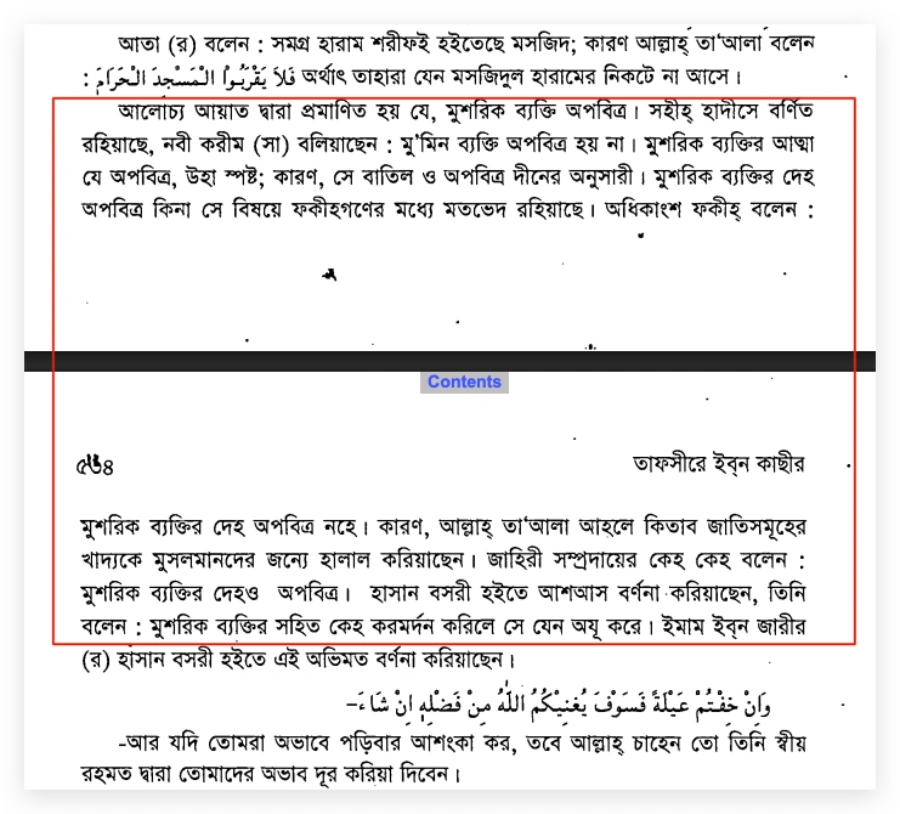
The verse under discussion establishes that a polytheist is impure. A sahih hadith relates that the noble Prophet said: A believer does not become impure. It is clear that the polytheist’s soul is impure, because he follows a false and impure religion. Jurists differ over whether the polytheist’s body is impure. Most jurists say:
The polytheist’s body is not impure, because Allah has made the food of the People of the Book lawful for Muslims. Some of the Zahiris say that the polytheist’s body is also impure. Ash‘ath narrated from Hasan al-Basri that he said: Whoever shakes hands with a polytheist should perform ablution.
Let us also consult Tafsir al-Mazhari [13].
Semen, blood, and similar substances are impure in the literal sense. The Sharia has also declared them impure. Their impurity is undoubtedly external. Believers and polytheists alike call them impure. But the polytheists are not called impure here for those reasons. Their impurity is inherent and internal. Just as freedom from external impurity is necessary, freedom from internal impurity is also indispensable. One must therefore avoid touching polytheists as well. Living together with them is unlawful. Nor is it appropriate to build homes beside their dwellings.
Abu ‘Ubayda and Dahhak said that impurity here means najasah ghalizah, or major impurity, rather than najasah khafifah, or minor impurity. Imam al-Baghawi wrote that bodily impurity is not meant here; what is meant is legal, or hukmi, impurity. Without mentioning an explanation or reason, polytheists are called ‘impure’ here solely to demean them.
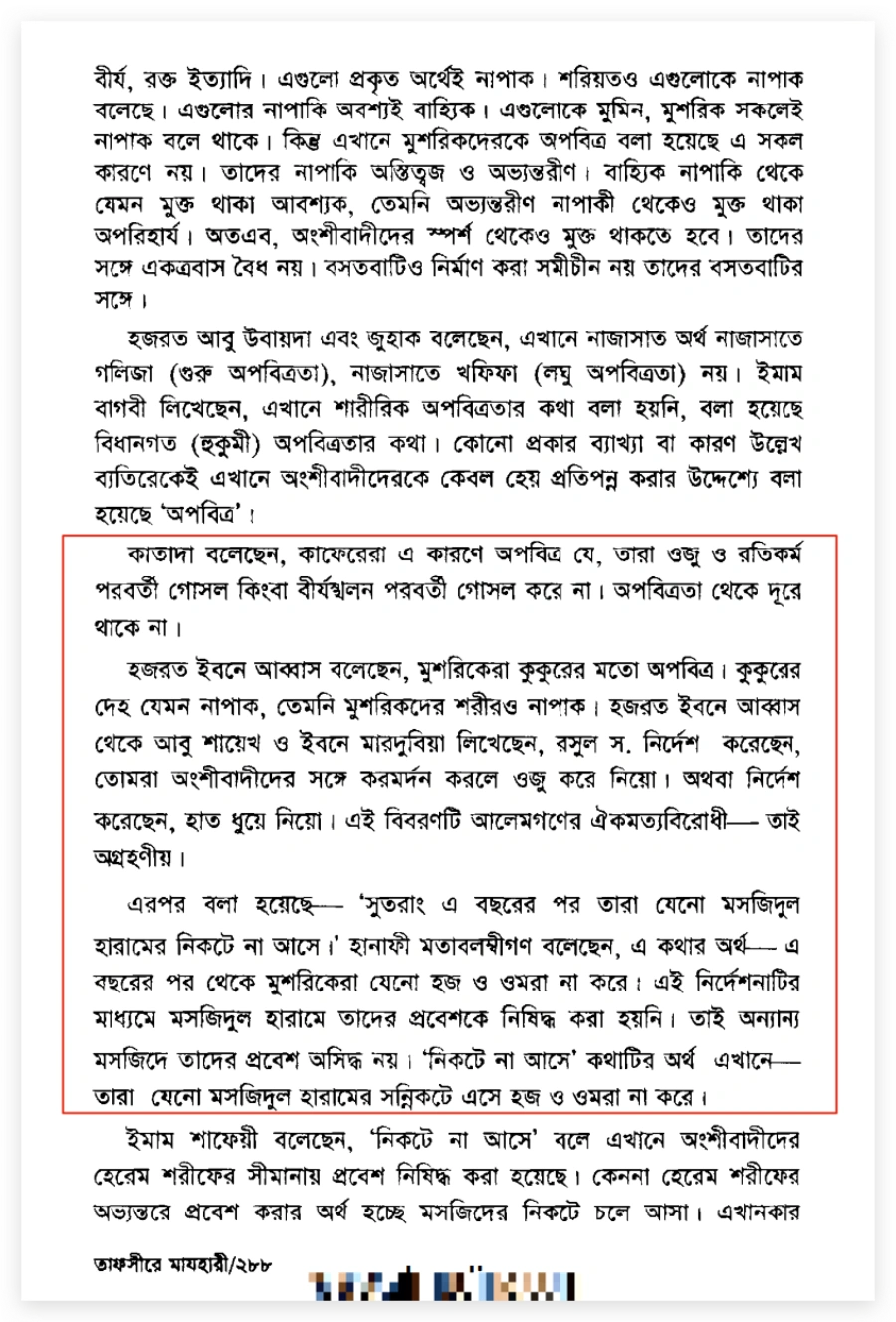
Qatadah said that unbelievers are impure because they do not perform ablution or bathe after sexual intercourse or ejaculation. They do not keep away from impurity.
Ibn ‘Abbas said that polytheists are impure like dogs. Just as a dog’s body is impure, so are the bodies of polytheists. Abu al-Shaykh and Ibn Mardawayh reported from Ibn ‘Abbas that the Messenger instructed: If you shake hands with polytheists, perform ablution. Or he instructed: Wash your hands. This report contradicts the scholars’ consensus and is therefore unacceptable.
It is then stated: ‘So after this year let them not approach al-Masjid al-Haram.’ The Hanafis said that this means polytheists must not perform Hajj or ‘Umrah after this year. This directive did not prohibit them from entering al-Masjid al-Haram. Their entry into other mosques is therefore not prohibited either. ‘Let them not approach’ means here that they must not come near al-Masjid al-Haram to perform Hajj and ‘Umrah.
Modern apologists often say that ‘impure’ here refers to impurity of creed or spirit rather than physical impurity. But that explanation also leaves the problem intact; it exposes it even more starkly. Physical cleanliness concerns an individual’s conduct, whereas impurity of creed is a lasting insult imposed on a person’s identity of belief. A person is being declared spiritually inferior and impure simply for being non-Muslim or associating partners with Allah. That declaration itself violates human dignity.
Human dignity means recognizing a human being first as human, without marking that person as inherently inferior, unclean, or fit for exclusion because of a doctrine, belief, disbelief, culture, or identity. Islamic scripture’s declaration that polytheists are ‘impure’ violates that basic principle. It is not criticism of a different opinion; it denies the dignity of the people who hold that opinion. Declaring polytheists ‘impure’ therefore cannot be brushed aside as merely religious language; it is a clear example of religious discrimination, social exclusion, and a violation of human dignity.
Non-Muslims Are Destined for Eternal Hell
Surah al-Tawbah announces the fire of Hell, a curse, and enduring punishment for hypocritical men and women and for unbelievers. Both expressions—‘they will remain forever’ and ‘lasting punishment’—make the permanence of the penalty explicit. A position of belief is placed in a category of crime whose punishment continues beyond a finite human life for eternity. This relationship between religious disbelief and endless torture directly conflicts with the principle of proportionality in justice. [14]
Allah has promised the hypocritical men and women and the unbelievers the fire of Hell, in which they will remain forever; that is sufficient for them. Allah’s curse is upon them, and theirs is a lasting punishment.
— Taisirul Quran
Allah has pledged to the hypocritical men and women and the unbelievers the fire of Hell; they will remain there forever,and that is sufficient for them. Allah has cursed them, and for them there is eternal punishment.
— Sheikh Mujibur Rahman
Allah has promised the hypocritical men and women and the unbelievers the fire of Hell. They will remain in it forever; that is sufficient for them. Allah has cursed them, and for them there is lasting punishment.
— Rawai Al-bayan
To hypocritical men, hypocritical women, and unbelievers Allah has promised the fire of Hell, where they will remain permanently; that is sufficient for them.Allah has cursed them, and theirs is a lasting punishment;
— Dr. Abu Bakr Muhammad Zakaria
Allah has promised the hypocrite men and hypocrite women andthe disbelievers the fire of Hell, wherein they will abide eternally. It is sufficient for them. And Allah has cursed them, andfor them is an enduring punishment.
— Saheeh International
In the narration quoted in Mishkat, Muhammad is asked about the fate of the minor children of believers and polytheists. In both cases, the answer is that they will follow their parents. ‘A’isha immediately asks: Without any deeds of their own? Muhammad replies by referring to Allah’s knowledge of their possible future behavior. At the center of the exchange are the absence of deeds performed by the child and the influence of parental identity. The ethical crisis lies in linking a child’s fate to family identity before the child has committed a crime. [15]
Mishkat al-Masabih
Book 1: Faith
Chapter: Belief in the Divine Decree—Section 2
111 ‘A’isha said: I asked, “Messenger of God, what happens to the offspring of believers?” He replied, “They are joined to their parents.” I asked, “Although they have done nothing, messenger of God?” [He] replied, “God knows best what they were doing.” I asked, “What happens to the offspring of polytheists?” He replied, “They are joined to their parents.” I asked, “Although they have done nothing?” He replied, “God knows best what they were doing.” Abu Dawud transmitted it. (1)
(1) Sahih: Sunan Abi Dawud 4712 (4089 in the cited Bengali reference). Shaykh al-Albani states that the hadith is narrated through two chains, one of which is sahih.
Grade: Sahih
Let us read another hadith and consider what these aspects of Islam are like [16].
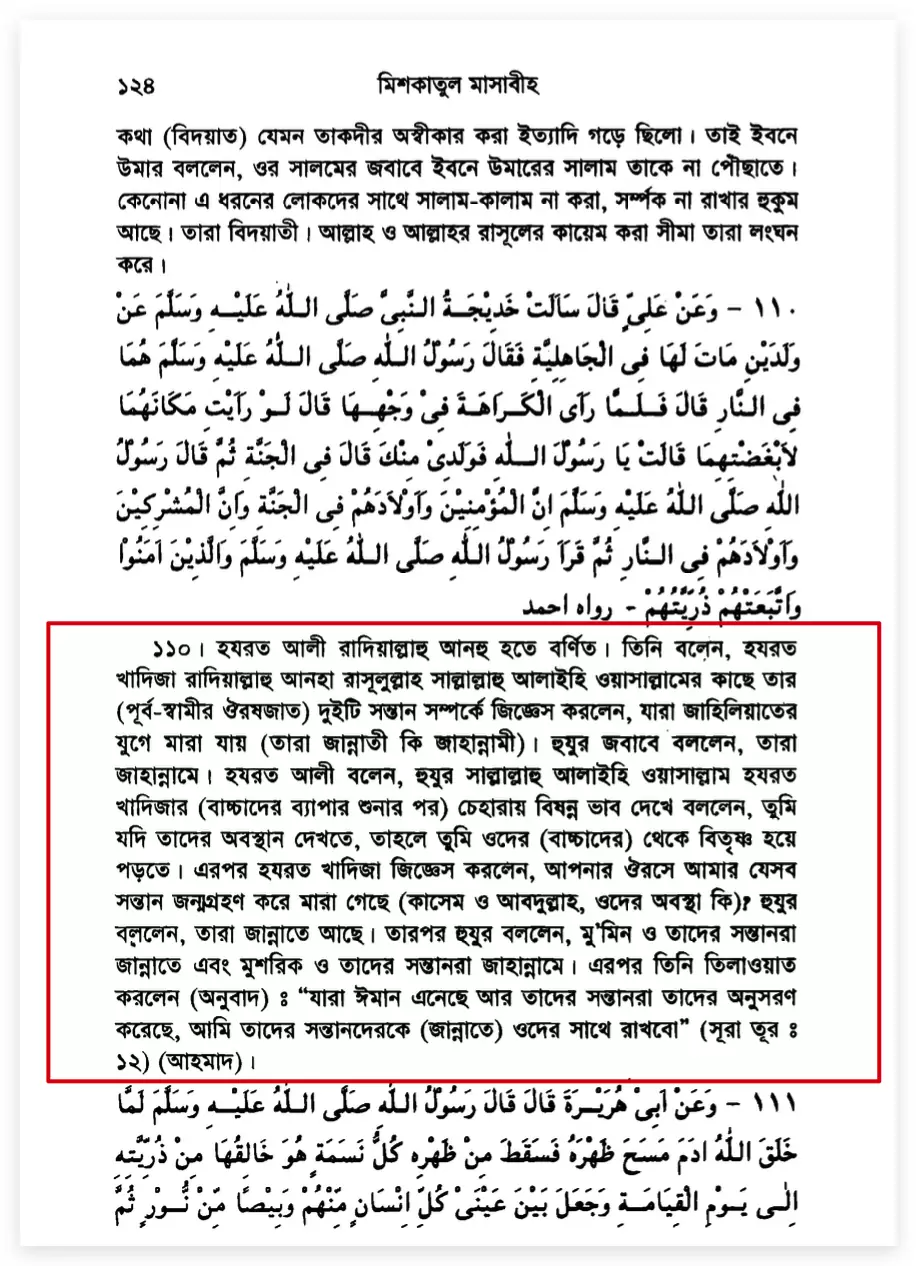
110. ‘Ali reported: Khadijah asked the Messenger of Allah about two children of hers by a previous husband who had died in the Age of Ignorance—whether they were in Paradise or Hell. He answered: They are in Hell. ‘Ali said: Seeing distress on Khadijah’s face after she heard about her children, he said: If you saw their place, you would feel aversion toward them. Khadijah then asked: What about my children born to you who died—Qasim and ‘Abdullah? He said: They are in Paradise. He then said: The believers and their children are in Paradise, and the polytheists and their children are in Hell. He then recited: ‘Those who believe and whose children follow them, We shall join their children with them [in Paradise]’ (Surah al-Tur: 12). (Ahmad)
Let us read another hadith [17].
Sunan Abi Dawud 4713 (4639 in the cited Bengali edition). ‘A’ishah, mother of the believers, said: The Prophet (May peace be upon him) was invited to the funeral of a boy who belonged to the ANSAR and I said; Messenger of Allah! This one is blessed, for he has done no evil, nor has he known it. He replied: It may be otherwise, ‘A’ishah, for Allah created Paradise and created those who will go to it, and He created it for them when they were still in their father’s loins; and he created hell and created those who will go to it, and created it for them when they were still in their father’s loins.
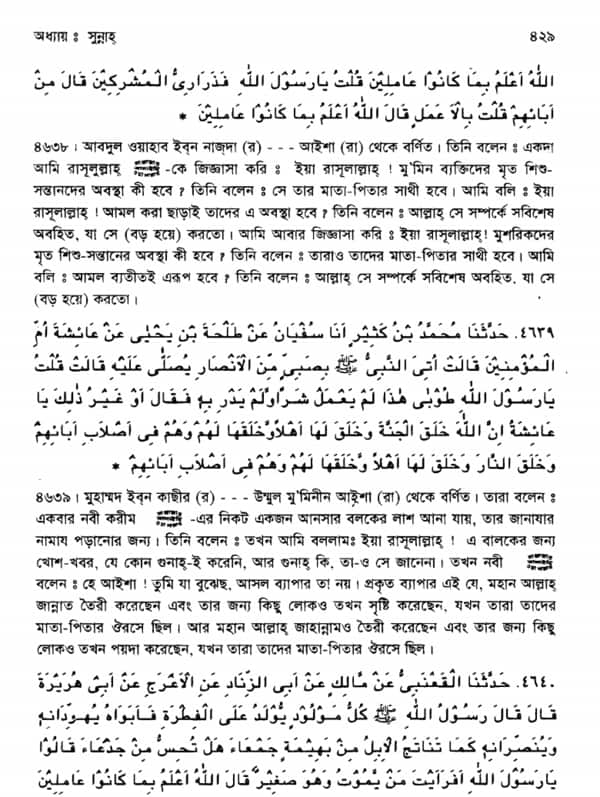
The Fate of Non-Muslim Children: Different Statements in the Hadiths
After birth, children acquire their family’s religious identity. They have not yet developed the opportunity to investigate or decide independently in choosing that identity. Punishing a child because of the parents’ religion therefore substitutes an inherited identity for personal responsibility. Islamic sources contain several statements about the fate of non-Muslim children: in some they follow their parents, in others they are with Abraham, and elsewhere their possible future deeds are left to Allah’s knowledge. These different answers to the same question expose a crisis in the principles governing children’s responsibility and judgment.
In the lengthy dream account narrated by Samurah ibn Jundub, Muhammad describes seeing a green garden, a tall man, and countless children around him. The man is later identified as Abraham. During the explanation of who the children are, the offspring of polytheists are explicitly asked about and included. The following is a continuous quotation from the explanation of that dream and the accompanying exchange. [18]
وَأَمَّا الرَّجُلُ الطَّوِيلُ الَّذِي فِي الرَّوْضَةِ فَإِنَّهُ إِبْرَاهِيمُ صلى الله عليه وسلم وَأَمَّا الْوِلْدَانُ الَّذِينَ حَوْلَهُ فَكُلُّ مَوْلُودٍ مَاتَ عَلَى الْفِطْرَةِ ”. قَالَ فَقَالَ بَعْضُ الْمُسْلِمِينَ يَا رَسُولَ اللَّهِ وَأَوْلاَدُ الْمُشْرِكِينَ فَقَالَ رَسُولُ اللَّهِ صلى الله عليه وسلم ” وَأَوْلاَدُ الْمُشْرِكِينَ.
English translation:
As for the tall man in the garden, he is Abraham. The children around him are all children who died upon the fitrah. The narrator said: Some Muslims then asked, ‘Messenger of Allah, the children of polytheists as well?’ The Messenger of Allah replied: ‘The children of polytheists as well.’
In another narration in al-Bukhari, the answer to a question about the children of polytheists is that Allah knows best what they would have done had they lived. The question of deeds performed by the child is redirected toward Allah’s knowledge of possible future behavior. [19]
أَنَّهُ سَمِعَ أَبَا هُرَيْرَةَ ـ رضى الله عنه ـ يَقُولُ سُئِلَ النَّبِيُّ صلى الله عليه وسلم عَنْ ذَرَارِيِّ الْمُشْرِكِينَ فَقَالَ ” اللَّهُ أَعْلَمُ بِمَا كَانُوا عَامِلِينَ ”.
English translation:
He heard Abu Hurayra say: The Prophet was asked about the children of polytheists, and he replied: ‘Allah knows best what they would have done.’
This answer consigns the question of the child’s fate to Allah’s unseen knowledge. In the garden account, the children are with Abraham; in another narration they follow their parents. These answers became the basis for separate views advocating admission to Paradise, admission to Hell, suspension of judgment, and a new test. Each view is grounded in different narrations within the same religious literature. The sources are divided over which of three things should determine judgment: a child’s own deeds, the identity into which the child was born, or possible future behavior.
Ibn Kathir recorded these disagreements about children’s fate. In discussing the report that Khadijah’s two earlier children were in Hell, he also raised objections concerning a narrator’s identity and a meeting between transmitters. His assessment comes immediately after the report’s closing statement and the associated verse. [20]
” إن المؤمنين وأولادهم في الجنة ، وإن المشركين وأولادهم في النار ” ثم قرأ : ( والذين آمنوا واتبعتهم ذريتهم بإيمان ألحقنا بهم ذريتهم ) [ الطور : 21 ] .
وهذا حديث غريب ؛ فإن محمد بن عثمان هذا مجهول الحال ، وشيخه زاذان لم يدرك عليا ، والله أعلم .
English translation:
‘The believers and their children are in Paradise, and the polytheists and their children are in Hell.’ He then recited: ‘Those who believe and whose descendants follow them in faith, We shall join their descendants with them’—Surah al-Tur: 21.
This is a gharib report, for the status of this Muhammad ibn ‘Uthman is unknown, and his teacher Zadhan did not meet ‘Ali. Allah knows best.
The objection concerning the chain of transmission concerns the reliability of the route by which the report reached us. Historical assessment also considers early attestation, relationships between texts, chronology, and other evidence. The idea of judging children on the basis of parental identity and possible future behavior is present in this religious literature. Its ethical consequence is direct: a child who has committed no crime has an inherited identity or hypothetical behavior made the basis of punishment. The different fates described for children and the later explanations developed to reconcile them make this crisis in assigning responsibility still clearer. [21]
A New Test on the Day of Resurrection for Non-Muslims Who Never Received the Message?
A common explanation among Islamic theologians and preachers is that people who never received Islam’s message, or lacked the capacity to hear and understand it, will be tested on the Day of Resurrection. The instruction will be to enter a fire; if they obey, that fire will become safe. Accounts of this idea appear in Musnad Ahmad, and Ibn Kathir accepted it in an attempt to reconcile different narrations. The fundamental problem concerns the timing and conditions of the test. People present at the Resurrection have already witnessed life after death. The hereafter, unseen to them in this world, has become a direct experience. In that situation, obeying an order to enter a fire is submission to manifest authority; this is substituted for a test of faith in the unseen during earthly life.
The Testimony of Sahih al-Bukhari and Muslim: A Test or Foreknowledge?
When the most authoritative Islamic hadith collections address questions about the fate of non-Muslim children—prime examples of people who never received the message—Muhammad mentions no ‘new test.’ Abu Hurayra narrates that, when asked about the children of polytheists, the Messenger said: ‘Allah knows best what they would have done [had they lived]’ [22].
‘Allah knows best what they would have done’ brings possible future behavior into the answer. The child’s life has ended; the hypothetical future deeds never took place. Making those possible deeds the basis of punishment puts punishment before the crime. Individual responsibility rests on a person’s actual actions and decisions. The question of what that person might have done also involves opportunities to choose, change course, or refrain from an action during life. Treating a possible future as a settled crime erases all those opportunities. The claim of Allah’s omniscience then takes the place of an account of actual wrongdoing.
The ‘Hadith of Four Persons’ and Weakness in Transmission
One of the principal foundations of the claim of a new test is the ‘hadith of four persons’ in Musnad Ahmad. In al-Aswad ibn Sari‘’s narration, a deaf person, a person with an intellectual disability, a very old person, and someone who died during an interval without a messenger state their excuses. Covenants of obedience are taken from them, after which they are commanded to enter the fire. Ibn Kathir also includes the report, commonly numbered 16301 in the Musnad, in his commentary on verse 15 of Surah al-Isra’. The decisive condition is explicit: obeying the command to enter the fire. Obedience to an order to leap into fire after death is presented as the solution to having lacked information about Islam or the capacity to understand it during life.
Ibn ‘Abd al-Barr called the hadiths on this subject weak and objected that the hereafter is a place of recompense: what sense does it make to impose new deeds and tests there? Ibn Kathir responded by claiming that some of the relevant reports are sahih, others hasan, and others strengthened by mutual support. Alongside this disagreement about the reports’ acceptability, the very concept of the test undergoes an explicit change. A person present at the Resurrection has learned that there is life after death. The hereafter is now a directly experienced reality. The question facing that person is whether to obey the command to enter the fire. Believing in the existence of the hereafter during earthly life and obeying an order after witnessing it are two different matters. Under the name of a ‘new test,’ the question of faith is actually replaced with a question of obedience.
The report of al-Aswad ibn Sari‘ quoted through Ahmad in Ibn Kathir’s tafsir includes the excuse of each of the four persons together with the instruction constituting the test. [23]
أربعة يحتجون يوم القيامة : رجل أصم لا يسمع شيئا ، ورجل أحمق ، ورجل هرم ، ورجل مات في فترة ، فأما الأصم فيقول : رب ، قد جاء الإسلام وما أسمع شيئا ، وأما الأحمق فيقول : رب ، قد جاء الإسلام والصبيان يحذفوني بالبعر ، وأما الهرم فيقول : رب ، لقد جاء الإسلام وما أعقل شيئا ، وأما الذي مات في الفترة فيقول : رب ، ما أتاني لك رسول .
فيأخذ مواثيقهم ليطعنه فيرسل إليهم أن ادخلوا النار ، فوالذي نفس محمد بيده لو دخلوها لكانت عليهم بردا وسلاما
English translation:
Four persons will present excuses on the Day of Resurrection: a deaf man who could hear nothing, a man with an intellectual disability, a very old man, and a man who died during an interval without a messenger. The deaf man will say: Lord, Islam came, but I could hear nothing. The man with an intellectual disability will say: Lord, Islam came while children were throwing dung at me. The very old man will say: Lord, Islam came, but I understood nothing. The man who died during the interval will say: Lord, no messenger of Yours came to me.
Covenants will then be taken from them that they will obey Him, and an instruction will be sent to them to enter the fire. By Him in whose hand is Muhammad’s soul, if they entered it, it would become cool and safe for them.
A major problem is concealed within the phrase ‘Islam’s message has reached someone’: which Islam has reached them? A narration in Abu Dawud states that Muhammad’s followers will divide into seventy-three groups, seventy-two in Hell and one in Paradise. Suppose a non-Muslim is approached by a preacher from a sect deemed misguided under this account. The person listens sincerely, accepts the explanation, and even leaves the old religion to embrace Islam. That is the religious teaching the person has encountered and recognized as true Islam. Where does responsibility lie if the person is then accused of following the wrong sect? The person has accepted the Islam that was presented. After finding the correct religion, another obstacle appears: finding the correct sect. If two preachers offer different interpretations of the same Quran and hadiths and each calls the other misguided, a newcomer must adjudicate their dispute. Yet the newcomer’s language skills, theological education, and opportunities to verify sources may be limited. Holding that person responsible simply because ‘Islam’s message was received’ places the burden of the preacher’s mistaken interpretation upon the listener. If receiving a mistaken interpretation instead makes that person eligible for a new test, judgment depends on the accuracy of the message and the opportunity to understand it. ‘The message has reached them’ must then include an account of exactly what reached them and how much they could understand. [24]
أَلاَ إِنَّ مَنْ قَبْلَكُمْ مِنْ أَهْلِ الْكِتَابِ افْتَرَقُوا عَلَى ثِنْتَيْنِ وَسَبْعِينَ مِلَّةً وَإِنَّ هَذِهِ الْمِلَّةَ سَتَفْتَرِقُ عَلَى ثَلاَثٍ وَسَبْعِينَ ثِنْتَانِ وَسَبْعُونَ فِي النَّارِ وَوَاحِدَةٌ فِي الْجَنَّةِ وَهِيَ الْجَمَاعَةُ
English translation: Beware! The People of the Book before you divided into seventy-two groups. This religious community will divide into seventy-three groups: seventy-two in Hell and one in Paradise; that is the jama‘ah.
A more fundamental question follows: how does becoming acquainted with a claim create a moral obligation to believe it? Suppose someone listens carefully to Islam’s teachings, asks questions, and examines the preacher’s arguments, yet finds insufficient reason to believe in Muhammad’s prophethood or the Quran’s divine origin. The preacher has made a claim and bears the responsibility of establishing its truth. Substituting an announcement of punishment for evidence sufficient to resolve the listener’s doubts makes fear the means of obtaining belief. A preacher of another religion may likewise claim that his religion is true and that rejection brings terrible consequences. The person must then decide between competing claims on the basis of evidence. If this honest search for sufficient reasons is treated as the crime of disbelief, the system punishes people for seeking the truth. Quran 4:165 links the purpose of sending messengers with removing people’s excuses. To carry the ethical weight of that claim, actual opportunities to understand the message’s truth, the quality of the evidence presented, and the person’s comprehension must be considered. Making mere exposure to a religious claim the basis of ultimate responsibility shifts the burden from establishing the truth to pressuring the listener into belief. [25]
رُسُلًا مُبَشِّرِينَ وَمُنْذِرِينَ لِئَلَّا يَكُونَ لِلنَّاسِ عَلَى اللَّهِ حُجَّةٌ بَعْدَ الرُّسُلِ وَكَانَ اللَّهُ عَزِيزًا حَكِيمًا
English translation: [We sent] messengers bearing good news and warnings, so that after the messengers people would have no excuse before Allah. Allah is Mighty, Wise.
The theory of a new test must therefore address not only people entirely deprived of the message, but also those who received partial information, encountered misleading interpretations, or remained doubtful after sincere investigation. One person hears nothing about Islam and receives a special opportunity after death; another listens, asks questions, and spends time investigating but finds insufficient evidence. If mere acquaintance with Islam closes that opportunity to the second person, investigation itself becomes a source of additional danger. Similarly, family, teachers, and social surroundings may play comparable roles in forming the beliefs of a Muslim taught the wrong sect and a non-Muslim taught the wrong religion. Their responsibility involves personal honesty, comprehension, freedom, and the information actually available. Dividing everyone into ‘those who heard’ and ‘those who did not hear’ erases these differences in circumstances. If responsibility instead applies only to those who had a genuine opportunity to understand, clear criteria for that opportunity are required: how much knowledge, what kind of evidence, how much freedom, and exposure to which interpretation make a person deserving of punishment? Without resolving these questions, announcing another test after death adds a new condition of obedience while leaving the inequality of opportunities in earthly life unsettled.
In the following hypothetical cases, people receive religious messages in different ways. Each requires consideration of distinct circumstances when assigning individual responsibility:
| Hypothetical case | The person’s circumstances | Question facing the theory of a new test |
|---|---|---|
| Raised with the teachings of the wrong sect | A Muslim sincerely follows the Islam learned from family and teachers since childhood; at judgment, that sect is deemed misguided. | How much opportunity did the person have to understand the correct interpretation? How much responsibility for an inherited error belongs to that person? |
| Joining the wrong sect after conversion | A non-Muslim embraces Islam in search of truth, but the sect of those who taught that person Islam is deemed misguided. | Why should a sincere effort to leave a familiar religion and embrace a new one still lead to punishment because of a mistaken preacher? |
| Conflicting religious guidance | Two preachers derive opposite conclusions from the same Quran and hadiths; the person accepts one explanation using limited knowledge. | How much responsibility can justly be imposed on an ordinary listener for settling disagreements between specialists? |
| Hearing the invitation without receiving sufficient evidence | The person understands the message and examines the arguments but finds insufficient reason to believe the claim. | How will the quality of the preacher’s evidence be assessed in determining responsibility for the person’s doubt? |
| Hearing only the name and a threat of punishment | The person hears, ‘Islam is true; accept it or face Hell,’ but receives no detailed explanation supporting the religion’s claims. | What justifies equating exposure to a claim’s name and a threat with receiving a complete message? |
| Barriers of language and translation | The person does not know the original language; available translations distort important statements. The person decides on the basis of those texts. | What becomes of individual responsibility if a translator’s mistakes are charged to the listener or reader? |
| Limited freedom to investigate | The person has heard of Islam, but family or state restrictions, threats, or controls over information severely limit independent verification. | How will judgment account for the gap between familiarity with a message and an effective opportunity to investigate it? |
| Moral objections arising from reading and investigation | The person reads religious sources but regards some provisions as unjust and therefore cannot accept them as commands from a just God. | How will conscientious objections be distinguished from hostility or dishonesty? If moral objections are answered with punishment, what is the moral foundation of the system of judgment itself? |
Theoretical Inconsistency and the Nature of the Ad Hoc Explanation
The Quran describes belief in the unseen as a characteristic of the God-fearing. In the earthly test of faith concerning the hereafter, people decide while that hereafter remains unseen. [26]
الَّذِينَ يُؤْمِنُونَ بِالْغَيْبِ وَيُقِيمُونَ الصَّلَاةَ وَمِمَّا رَزَقْنَاهُمْ يُنْفِقُونَ
English translation:
Those who believe in the unseen, establish prayer, and spend out of what We have provided for them.
Surah al-Sajdah directly describes people’s state of knowledge at the Resurrection. The wrongdoers themselves say that they have seen, heard, and become certain. The hereafter, unseen during earthly life, is now their direct experience. [27]
وَلَوْ تَرَىٰ إِذِ الْمُجْرِمُونَ نَاكِسُو رُءُوسِهِمْ عِنْدَ رَبِّهِمْ رَبَّنَا أَبْصَرْنَا وَسَمِعْنَا فَارْجِعْنَا نَعْمَلْ صَالِحًا إِنَّا مُوقِنُونَ
English translation:
If only you could see the wrongdoers hanging their heads before their Lord, saying: Our Lord, we have seen and heard; send us back and we shall do good deeds. We are now certain.
In the theory of a new test, an earthly test of faith is replaced by a test of obedience at the Resurrection. During earthly life, people are told to believe in an unseen hereafter. At the Resurrection, that hereafter is present before them. Their knowledge, experience, and conditions of decision-making change entirely between the two situations. Imposing such a test as a solution to never having received the message produces two fundamental inconsistencies:
When a person stands at the Resurrection knowing that life continues after death, the existence of the hereafter is direct knowledge. The person is already present within that reality. Testing belief in the hereafter again at that point is meaningless. The ‘hadith of four persons’ therefore effectively imposes a different condition: obeying an order to enter the fire. For someone who never received the message in earthly life or lacked the capacity to understand it, salvation is made conditional on obeying an order to leap into a fire after death. The question of acquiring knowledge of truth becomes a question of submission to authority. In the statement below, Dr. Abu Bakr Muhammad Zakaria presents belief without seeing as a characteristic of the test of faith. That characteristic ends after the hereafter is witnessed at the Resurrection; obedience to an explicit command remains.
Religious Belief and Geographical Advantage: Some Ethical Paradoxes
The family into which a person is born, the language learned, and the religious authority surrounding childhood shape the person’s earliest beliefs. For someone born into a Muslim family, accepting Islam is ordinary social learning; another person born into a different religious family accepts another religion through the same process. Yet that difference in belief becomes decisive in rewards and punishment in the hereafter. These advantages and disadvantages of birth are clear in the following situations:
People occupy unequal positions from the very beginning of acquiring belief. One is taught that a religion is true and has ready access to its language and authorities; another encounters that religion as unfamiliar, incomprehensible, or through negative information. The hadith about parental influence itself recognizes this social formation of belief. Holding an individual wholly responsible for disbelief under these conditions ignores the education, information, and opportunities for investigation that person received. In the theory of a new test, obeying an order to enter the fire in the hereafter becomes the condition for resolving this life’s inequality. Another condition of obedience then replaces an assessment of deprivation of knowledge and the value of good deeds.
Family Influence: Unequal Beginnings in Religious Identity
The influence of family on religious belief is also acknowledged in the hadith. Abu Hurayra’s narration distinguishes a child’s fitrah from the religious identity bestowed by the parents. The statement that the parents make the child Jewish, Christian, or Magian directly acknowledges the social process through which beliefs are formed. [29]
أَنَّ أَبَا هُرَيْرَةَ ـ رضى الله عنه ـ قَالَ قَالَ رَسُولُ اللَّهِ صلى الله عليه وسلم ” مَا مِنْ مَوْلُودٍ إِلاَّ يُولَدُ عَلَى الْفِطْرَةِ، فَأَبَوَاهُ يُهَوِّدَانِهِ أَوْ يُنَصِّرَانِهِ أَوْ يُمَجِّسَانِهِ، كَمَا تُنْتَجُ الْبَهِيمَةُ بَهِيمَةً جَمْعَاءَ، هَلْ تُحِسُّونَ فِيهَا مِنْ جَدْعَاءَ ”.
English translation:
Abu Hurayra said that the Messenger of Allah stated: Every child is born upon the fitrah. The parents then make the child Jewish, Christian, or Magian, just as an animal gives birth to an intact offspring—do you find any mutilation in it?
After birth, children learn the language of religion, the status of sacred texts, the authority of scholars or priests, and ideas of reward and punishment from family and society. Just as a child in a Muslim family accepts those teachings as true, a child in a Hindu, Christian, or other religious family regards the received teachings as true. The hadith explicitly mentions the parents’ role in producing a non-Muslim identity. A Muslim child’s identity also develops through the same social process. Assigning opposite values of Paradise and Hell to the outcomes of these parallel processes according to religious identity allows an advantage of birth to enter moral judgment.
Guidance for Everyone Is Possible, Yet Hell Is to Be Filled
The Quran links guidance to Allah’s will as well as to individual human effort. In Surah al-Sajdah, after the account of the wrongdoers’ plea to return, the power to guide every person appears alongside the announcement that Hell will be filled. [30]
وَلَوْ شِئْنَا لَآتَيْنَا كُلَّ نَفْسٍ هُدَاهَا وَلَكِنْ حَقَّ الْقَوْلُ مِنِّي لَأَمْلَأَنَّ جَهَنَّمَ مِنَ الْجِنَّةِ وَالنَّاسِ أَجْمَعِينَ
English translation:
Had We willed, We would have given every soul its guidance. But My declaration has become binding: I shall surely fill Hell with both jinn and human beings.
The verse declares that Allah has the power to guide every person. Alongside this appears the announcement of filling Hell with humans and jinn. Unequal access to belief is therefore part of a system controlled by the omnipotent creator. The one capable of guiding everyone is also the one who does not put that arrangement into effect for everyone; endless punishment for disbelief follows. Possessing such power over the opportunities, information, and conditions of understanding through which belief is acquired places responsibility for the inequality on the designer of the system of judgment as well. Treating the outcome of unequal circumstances He created as the individual’s sole crime distorts the concept of personal responsibility.
Infinite Punishment for an Offense Committed within a Limited Time
Eternal punishment for an act or ‘crime’ committed within a limited period directly conflicts with the basic idea of justice. One minimum condition of justice is proportionality: punishment must correspond to the gravity of the crime—at least within the same ‘scale.’ Every human act, however, occurs within a finite lifetime; its effects, intentions, and harm are all limited. Setting infinite punishment against that finitude breaks proportionality mathematically: an infinite penalty for something finite means that the ‘magnitude’ of punishment will forever exceed the ‘magnitude’ of the crime. Punishment here becomes everlasting vengeance or cruelty against which there is no defense, rather than justice.
A deeper problem concerns the purpose of punishment. Punishment is generally justified on several grounds: (a) reform or rehabilitation, (b) deterrence, (c) public protection or incapacitation, and (d) retribution. Infinite punishment is inconsistent with all four. If reform is the objective, punishment requires an ‘end’: it must allow people to learn and change. In eternal punishment, opportunities for reform become meaningless because the punishment never ends. The case for deterrence is also weak: rational deterrence requires a penalty proportionate to society and human psychology. Punishments such as ‘eternal fire’ become a supernatural exaggeration of fear rather than a realistically conceivable punishment, generating terror, rumor, and an authoritarian mentality instead of reason. Eternity is also unnecessary for public protection: even if someone is beyond reform, a minimum means of ensuring safety without ‘infinite punishment’ remains conceivable. Retribution likewise violates proportionality, since an infinite penalty for a finite crime cannot be ‘just repayment’; in principle it constitutes immeasurably excessive punishment.
Another ethical problem concerns the limits of responsibility and capacity. Human beings have limited knowledge: they make mistakes, decide emotionally, are shaped by environment, culture, and education, and change their understanding at different stages of life. Imposing ‘eternal’ punishment on such a limited being means assigning infinite responsibility within those limitations. This is a standard under which a person can never be ‘enough,’ because the price of an error will never be fully paid. In modern moral philosophy this is often regarded as the problem of cruelty: if punishment never ends, the same question arises at every moment of it—what still justifies inflicting this suffering? If punishment continues after a hundred years, a hundred thousand years, or a trillion years, it is not ‘justice’ but a cruel, despotic decision to perpetuate suffering.
Finally, the idea of eternal punishment also weakens the claim to the ‘moral supremacy’ of justice. Justice is generally restrained: it aims to reduce harm, maintain a proper measure, and avoid needless cruelty. Eternal punishment, however, creates a penal system in which forgiveness, reform, proportionality, and compassion ultimately cease to operate. Eternal punishment for a mistake or crime committed within a limited time is therefore morally inhumane and philosophically inconsistent: it does not elevate justice but dismantles it, turning it into perpetual cruelty.
Replacing the Skin: A Mechanism for Sustaining Torment
Descriptions of Hell’s punishment include both its duration and mechanisms for deliberately sustaining conscious suffering. Surah al-Nisa’ directly states the purpose of replacing skin after it burns: to keep the experience of punishment going. [31]
إِنَّ الَّذِينَ كَفَرُوا بِآيَاتِنَا سَوْفَ نُصْلِيهِمْ نَارًا كُلَّمَا نَضِجَتْ جُلُودُهُمْ بَدَّلْنَاهُمْ جُلُودًا غَيْرَهَا لِيَذُوقُوا الْعَذَابَ إِنَّ اللَّهَ كَانَ عَزِيزًا حَكِيمًا
English translation:
Those who reject My verses, We shall cast into a fire. Whenever their skins have burned away, We shall replace them with other skins so that they may taste the punishment. Allah is Mighty, Wise.
Replacing the burned skin restores the capacity to experience punishment. The purpose—‘so that they may taste the punishment’—is explicit in the verse itself. Reconstructing the body serves to sustain torment. Corrective punishment offers the possibility of release after behavior changes; here the reconstructed body becomes a vehicle of suffering once again. Repeatedly restoring the same person’s capacity to suffer makes torture a permanent feature of the system.
Two consecutive verses in Surah Fatir describe three outcomes: release through death, mitigation of punishment, and a plea to return and do good deeds. The first denies death and any reduction in punishment; the next answers the plea to return to good deeds by invoking the previous life and its warning, then ordering the sufferers to experience the punishment. [32]
وَالَّذِينَ كَفَرُوا لَهُمْ نَارُ جَهَنَّمَ لَا يُقْضَى عَلَيْهِمْ فَيَمُوتُوا وَلَا يُخَفَّفُ عَنْهُمْ مِنْ عَذَابِهَا كَذَلِكَ نَجْزِي كُلَّ كَفُورٍ وَهُمْ يَصْطَرِخُونَ فِيهَا رَبَّنَا أَخْرِجْنَا نَعْمَلْ صَالِحًا غَيْرَ الَّذِي كُنَّا نَعْمَلُ أَوَلَمْ نُعَمِّرْكُمْ مَا يَتَذَكَّرُ فِيهِ مَنْ تَذَكَّرَ وَجَاءَكُمُ النَّذِيرُ فَذُوقُوا فَمَا لِلظَّالِمِينَ مِنْ نَصِيرٍ
English translation:
For those who disbelieve there is the fire of Hell. They will neither be finished off so that they die, nor have their punishment reduced. Thus do We repay every unbeliever.
There they will cry out: Our Lord, bring us out; we shall do good deeds instead of what we used to do. Did We not give you a lifetime long enough for anyone willing to take heed to do so? And the warner came to you. So taste the punishment; the wrongdoers have no helper.
In Surah al-Zukhruf, the inhabitants of Hell address Malik and ask to be brought to an end. The response again declares that their stay will continue. [33]
وَنَادَوْا يَا مَالِكُ لِيَقْضِ عَلَيْنَا رَبُّكَ قَالَ إِنَّكُمْ مَاكِثُونَ
English translation:
They will call out: Malik, let your Lord finish us off. He will say: You will remain here.
The person being punished asks for death as release from torment and is ordered to remain. Skin will burn, new skin will be supplied, and suffering will continue; the route of death will also be closed. Punishment for a mistake of belief during a finite life thus becomes endless torture. The ethical acceptability of punishment depends on the offense, responsibility, and proportionality. Breaking all those limits to inflict suffering forever is extreme cruelty.
Even Seeking Forgiveness for Deceased Polytheist Relatives Is Prohibited
The religious division governing punishment in the hereafter also imposes restrictions on the prayers of the living. Religious identity places a boundary on love for deceased relatives, the good they did during their lives, and a bereaved person’s wish to seek forgiveness for them. Once a loved one is classified among the inhabitants of Hell, even seeking forgiveness for that person’s salvation becomes prohibited. A believer is thereby placed in conflict between affection for relatives and religious allegiance.
Verse 113 of Surah al-Tawbah makes the condition of the prohibition explicit: after it becomes clear that the polytheists concerned are inhabitants of Hell, forgiveness must not be sought for them, even if they are close relatives. The next verse connects Abraham’s request for forgiveness for his father to a previous promise and describes his subsequent disavowal. [34]
مَا كَانَ لِلنَّبِيِّ وَالَّذِينَ آمَنُوا أَنْ يَسْتَغْفِرُوا لِلْمُشْرِكِينَ وَلَوْ كَانُوا أُولِي قُرْبَى مِنْ بَعْدِ مَا تَبَيَّنَ لَهُمْ أَنَّهُمْ أَصْحَابُ الْجَحِيمِ وَمَا كَانَ اسْتِغْفَارُ إِبْرَاهِيمَ لِأَبِيهِ إِلَّا عَنْ مَوْعِدَةٍ وَعَدَهَا إِيَّاهُ فَلَمَّا تَبَيَّنَ لَهُ أَنَّهُ عَدُوٌّ لِلَّهِ تَبَرَّأَ مِنْهُ إِنَّ إِبْرَاهِيمَ لَأَوَّاهٌ حَلِيمٌ
English translation:
It is not fitting for the Prophet and the believers to seek forgiveness for polytheists, even if they are close relatives, once it has become clear to them that they are inhabitants of Hell.
Abraham’s request for forgiveness for his father was only because of a promise he had made to him. When it became clear to him that his father was an enemy of Allah, he disassociated himself from him. Abraham was tenderhearted and forbearing.
In Sahih Muslim’s account of Muhammad visiting his own mother’s grave, this boundary operates even in personal grief. He weeps and causes those around him to weep; he receives permission to visit the grave, but is refused permission to seek forgiveness for his mother. The hadith describes the separate permission and prohibition within the same event. [35]
عَنْ أَبِي هُرَيْرَةَ، قَالَ زَارَ النَّبِيُّ صلى الله عليه وسلم قَبْرَ أُمِّهِ فَبَكَى وَأَبْكَى مَنْ حَوْلَهُ فَقَالَ ” اسْتَأْذَنْتُ رَبِّي فِي أَنْ أَسْتَغْفِرَ لَهَا فَلَمْ يُؤْذَنْ لِي وَاسْتَأْذَنْتُهُ فِي أَنْ أَزُورَ قَبْرَهَا فَأُذِنَ لِي فَزُورُوا الْقُبُورَ فَإِنَّهَا تُذَكِّرُ الْمَوْتَ ” .
English translation:
Abu Hurayra said: The Prophet visited his mother’s grave, wept, and caused those around him to weep. He then said: I asked my Lord for permission to seek forgiveness for her, but permission was not granted. I asked for permission to visit her grave, and permission was granted. So visit graves, for they remind you of death.
A religious boundary is imposed even on wishing for the ultimate welfare of deceased relatives. A person may weep for his mother and visit her grave, yet receive no permission to pray for her forgiveness. The conflict between personal affection and religious allegiance is explicit in this event. The category of her belief takes precedence over the familiar life, kindness, and relationship of a close relative. In a system claiming the highest compassion and justice, religious identity prohibits even an appeal for forgiveness.
Schooling in Endless Hatred, Hostility, and Sectarianism
Believers today often cite another Quranic verse to claim that Islam supposedly places great emphasis on coexistence and friendly, loving relations between people of all religions, calling for a nonsectarian society! But are these claims actually true? Does Islam call for coexistence or friendly relations with non-Muslims? Let us begin by hearing several scholars. Here are statements by some of Bangladesh’s most prominent religious scholars:
Such statements about Hindus, Buddhists, or non-Muslims are nothing new. Religious scholars frequently proclaim these views in public at gatherings and seminars throughout Bangladesh. Let us watch a video.
Let us listen to two more sermons.
Abu Talib: Hell despite Protecting Muhammad
Abu Talib’s case directly exemplifies the acknowledgment of help alongside punishment on the basis of belief. ‘Abbas reminds Muhammad that his uncle protected him and stood up for him. Muhammad replies that Abu Talib is in a shallow part of Hell’s fire, having been spared a deeper fire because of him. The acknowledged result of that help is a reduction in suffering, while the final destination remains Hell. [36]
عَنِ الْعَبَّاسِ بْنِ عَبْدِ الْمُطَّلِبِ ـ رضى الله عنه ـ قَالَ لِلنَّبِيِّ صلى الله عليه وسلم مَا أَغْنَيْتَ عَنْ عَمِّكَ فَإِنَّهُ كَانَ يَحُوطُكَ وَيَغْضَبُ لَكَ. قَالَ ” هُوَ فِي ضَحْضَاحٍ مِنْ نَارٍ، وَلَوْلاَ أَنَا لَكَانَ فِي الدَّرَكِ الأَسْفَلِ مِنَ النَّارِ ”.
English translation:
‘Abbas ibn ‘Abd al-Muttalib said to the Prophet: What benefit have you brought your uncle? He used to protect you and become angry on your behalf. He replied: He is in a shallow part of the fire. Had it not been for me, he would be in the lowest depth of the fire.
‘Abbas asks about Abu Talib’s fate while explicitly acknowledging his role as a protector. The answer preserves punishment by fire for that benefactor. His relationship with Muhammad and intercession have reduced the severity of the punishment; Abu Talib’s own humane role has not been judged sufficient to free him from suffering. Within the same account of judgment, the benefit he provided is acknowledged, a personal intercession confers an advantage, and belief determines punishment. Such an outcome of gratitude toward a protector exposes the unequal value assigned to human responsibility and religious allegiance.
Al-Bukhari’s next hadith describes Abu Talib’s position of belief on his deathbed. Muhammad asks him to declare monotheism, while others present raise the question of abandoning his ancestral religion. According to the narration, Abu Talib’s final position is to remain in ‘Abd al-Muttalib’s religion. The same narration mentions the verse prohibiting requests for forgiveness after Muhammad promises to pray for him. [37]
أَنَّ أَبَا طَالِبٍ، لَمَّا حَضَرَتْهُ الْوَفَاةُ دَخَلَ عَلَيْهِ النَّبِيُّ صلى الله عليه وسلم وَعِنْدَهُ أَبُو جَهْلٍ فَقَالَ ” أَىْ عَمِّ، قُلْ لاَ إِلَهَ إِلاَّ اللَّهُ. كَلِمَةً أُحَاجُّ لَكَ بِهَا عِنْدَ اللَّهِ ”. فَقَالَ أَبُو جَهْلٍ وَعَبْدُ اللَّهِ بْنُ أَبِي أُمَيَّةَ يَا أَبَا طَالِبٍ، تَرْغَبُ عَنْ مِلَّةِ عَبْدِ الْمُطَّلِبِ فَلَمْ يَزَالاَ يُكَلِّمَانِهِ حَتَّى قَالَ آخِرَ شَىْءٍ كَلَّمَهُمْ بِهِ عَلَى مِلَّةِ عَبْدِ الْمُطَّلِبِ. فَقَالَ النَّبِيُّ صلى الله عليه وسلم ” لأَسْتَغْفِرَنَّ لَكَ مَا لَمْ أُنْهَ عَنْهُ ”. فَنَزَلَتْ {مَا كَانَ لِلنَّبِيِّ وَالَّذِينَ آمَنُوا أَنْ يَسْتَغْفِرُوا لِلْمُشْرِكِينَ وَلَوْ كَانُوا أُولِي قُرْبَى مِنْ بَعْدِ مَا تَبَيَّنَ لَهُمْ أَنَّهُمْ أَصْحَابُ الْجَحِيمِ} وَنَزَلَتْ {إِنَّكَ لاَ تَهْدِي مَنْ أَحْبَبْتَ}
English translation:
When Abu Talib was approaching death, the Prophet came to him, and Abu Jahl was there. He said: Uncle, say, ‘There is no deity but Allah’—a statement by which I can argue your case before Allah. Abu Jahl and ‘Abdullah ibn Abi Umayyah said: Abu Talib, will you turn away from ‘Abd al-Muttalib’s religion? They continued speaking to him until his final words to them were that he remained upon ‘Abd al-Muttalib’s religion. The Prophet said: I shall keep seeking forgiveness for you unless I am forbidden. Then it was revealed: ‘It is not fitting for the Prophet and the believers to seek forgiveness for polytheists, even if they are close relatives, after it has become clear to them that they are inhabitants of Hell.’ It was also revealed: ‘You cannot guide whomever you love.’
Even the description of Abu Talib’s lightest punishment is horrifying: the heat from the two shoes on his feet will boil his brain. Sahih Muslim describes this suffering as the least severe punishment in Hell. [38]
عَنِ ابْنِ عَبَّاسٍ، أَنَّ رَسُولَ اللَّهِ صلى الله عليه وسلم قَالَ ” أَهْوَنُ أَهْلِ النَّارِ عَذَابًا أَبُو طَالِبٍ وَهُوَ مُنْتَعِلٌ بِنَعْلَيْنِ يَغْلِي مِنْهُمَا دِمَاغُهُ ” .
English translation:
Ibn ‘Abbas reported that the Messenger of Allah said: Abu Talib has the lightest punishment among the inhabitants of the Fire. He will wear two shoes that cause his brain to boil.
Even for someone who helped preserve his life and safety, the ultimate outcome in this narration is punishment. Linking the refusal to abandon ancestral beliefs to torture that boils the brain sharply exposes the question of proportionality between offense and punishment. In assessing a refusal to accept a religion’s truth alongside the fulfillment of actual responsibilities toward people, belief takes such precedence that even an acknowledged protector is kept in torment. This limited recognition of humane assistance makes clear the position of good deeds outside religious allegiance.
Mandela and bin Laden: Who Will Enter Paradise?
Suppose Nelson Mandela, who spent his life fighting for the rights of Black people, deserves eternal punishment in Islam’s view simply for being non-Muslim. Conversely, Osama bin Laden, responsible for the murder of thousands of innocent people, will attain Paradise in the Islamic view if he repents or Allah forgives him on the Day of Resurrection. How can values of this kind be consistent with justice? Look at the two men below and tell us: which is destined for Paradise and which for Hell?
Considering Hitler and Gandhi as examples raises an important question about whether belief or deeds actually determine Paradise and Hell: can the morality of a person’s entire life, contributions to humanity, and effects of those deeds become worthless solely on the basis of whether a person holds the “correct” blind belief? From the Islamic perspective, if someone dies as a Muslim, or sincerely repents and embraces Islam before death, all previous sins are forgiven. In contrast, a moral humanist who spends a lifetime working for justice, honesty, and human welfare must face eternal punishment if that person does not accept Islam.
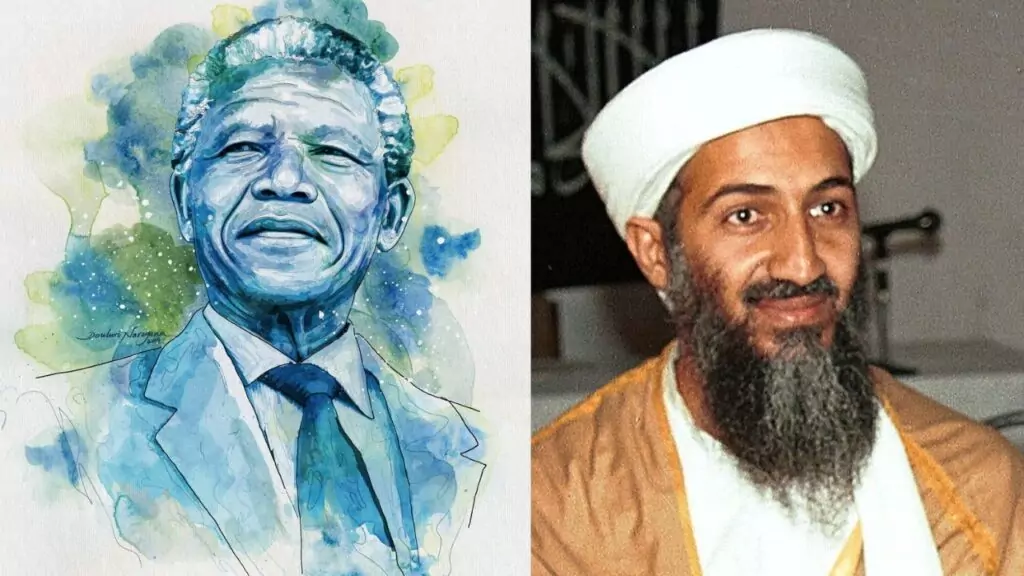
Where Will the Brutal Killers of Holey Artisan Go?
1 July 2016 will remain a dark chapter in Bangladesh’s history. That day, a horrific massacre at Holey Artisan Bakery in Dhaka’s affluent Gulshan district shook the conscience of the world. At approximately 8:45 p.m., five armed militants entered the restaurant shouting ‘Allahu akbar.’ They carried sophisticated firearms, sharp machetes, and explosives. In an instant, a cheerful setting became a scene of death. Taking guests hostage, they began a brutal slaughter.
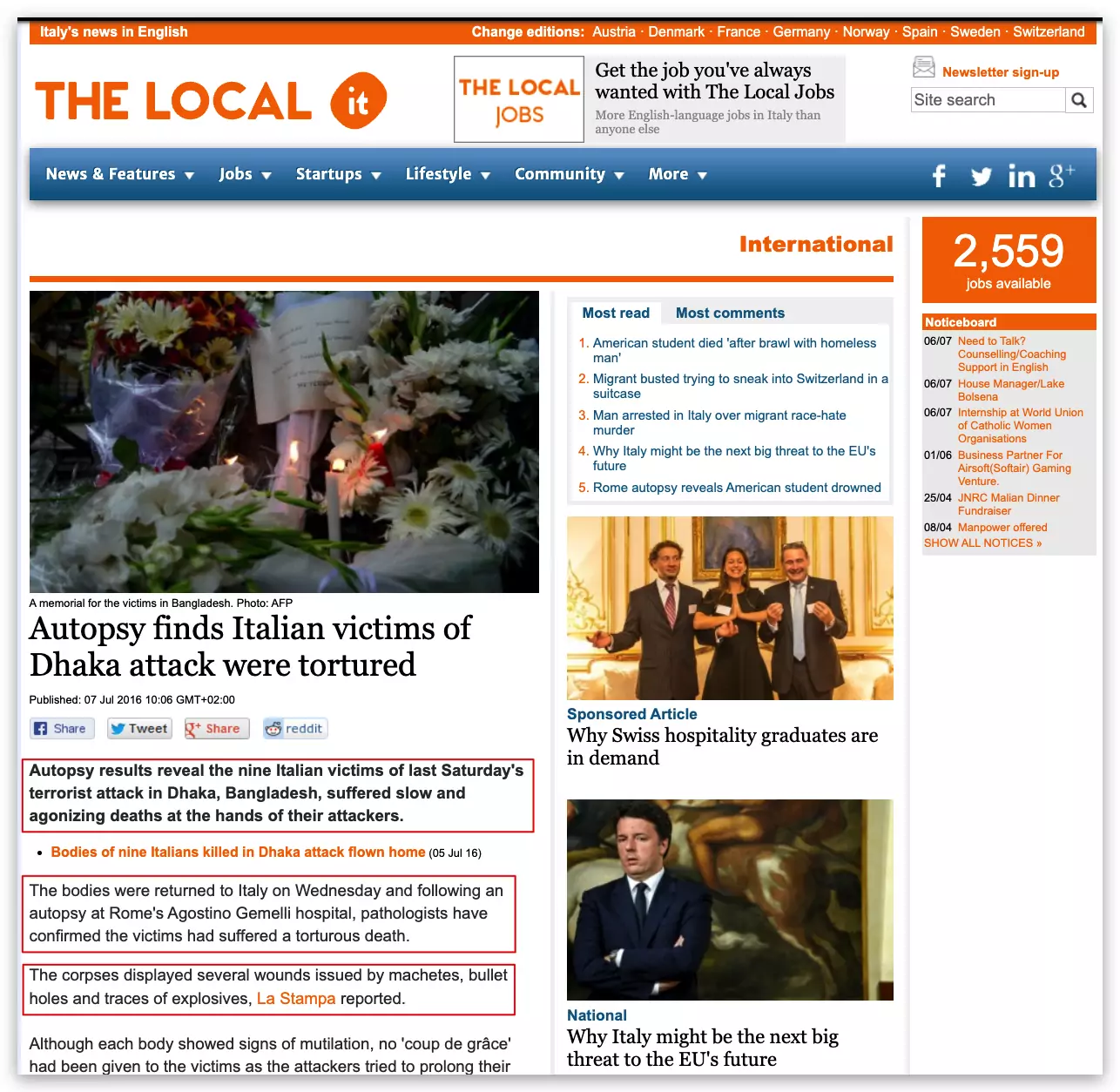
The militants took the restaurant’s guests and staff hostage. Survivors’ accounts describe religious identity checks through Quran recitation and differential treatment according to that identity. Sharp weapons and firearms were used in the killings. Autopsies in Italy found signs of torture, mutilation, sharp-force injuries, bullets, and explosives. Victims were subjected both to selection on the basis of religious identity and to brutal torture. The massacre reveals the real consequences of giving identity of belief priority over human life and dignity.
Rezaul Karim, the father of Hasnat Karim, told The Daily Star about the religious identity checks through Quran recitation on the basis of his son’s experience. The report of 2 July 2016 quotes that account. [39]
Those who could recite a verse or two were spared. The others were tortured.
English translation:
Those who could recite one or two verses were spared. The others were tortured.
The hostage crisis continued throughout the night. The next day, the army’s para-commandos brought the situation under control through Operation Thunderbolt. After the operation, the bodies of 20 hostages were recovered: nine Italians, seven Japanese, one Indian, and three people of Bangladeshi origin. Two police officers were also killed while responding to the attack. Separating hostages through religious identity checks and torturing the victims make the incident a horrifying example of sectarian violence. Reports on the Italian victims’ autopsies describe prolonged, agonizing deaths and mutilation. The ethical question for judgment in the hereafter is whether the believing killers’ crimes and the unbelieving victims’ lives will be assessed by the same standard. Eventual salvation remains available to the criminal with faith, while eternal punishment is announced for dying in disbelief. Under that rule, a victim’s identity of belief takes precedence over the moral life lived. A murderer may be freed after temporary punishment, while the penalty announced for the unbeliever is endless. [40]
The Italian news agency ANSA, citing the pathologists, reported that the nine Italian citizens killed suffered slow and agonizing deaths. The report also describes torture, wounds from sharp weapons, mutilation, and traces of bullets and explosives. [41]
The nine suffered a slow, agonising death and were not given a coup de grace, pathologists said.
English translation:
The pathologists said that the nine died slowly and in agony; they were not given a final blow to bring death swiftly and end their suffering.

These Non-Muslims, Too, Are Destined for Eternal Hell
Research in medicine and pharmaceuticals has saved tens of millions of lives. The discoveries of the scientists and physicians below are used to treat Hindus, Muslims, Jews, Christians, and unbelievers alike. These real successes in curing illness and saving lives directly contribute to human welfare. Yet Islamic eschatology regards even such good deeds as insufficient for the ultimate salvation of someone who dies in disbelief. The precedence of religious allegiance over human welfare becomes especially clear in medical science: even when a person’s work saves countless lives, a separate condition of belief is imposed for salvation in the hereafter.

Alexander Fleming: A Scottish bacteriologist who discovered penicillin in 1928, the first effective antibiotic against bacterial infections. Antibiotics are life-saving medicines. Their importance would become apparent if production and supply stopped worldwide for just one day. That day would bring a terrible disaster across the world.
Harmon Northrop Morse: An American chemist who first synthesized paracetamol, or acetaminophen, in 1877. It is used to relieve pain and fever. Knowing the scale of paracetamol production makes it clear that it is undoubtedly one of the world’s most essential medicines.

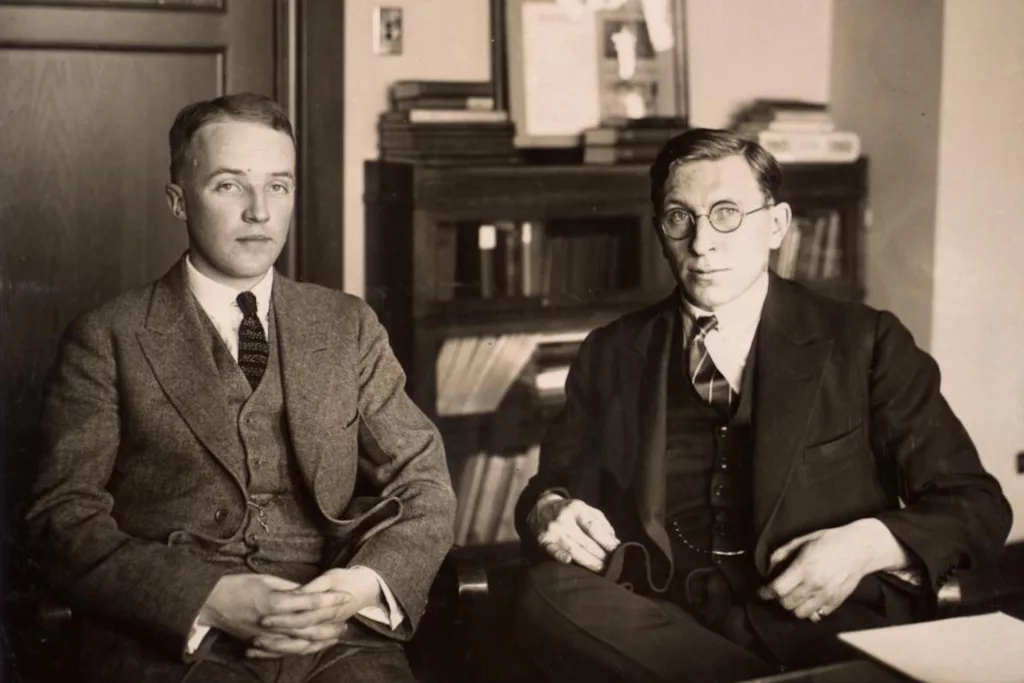
Frederick Banting and Charles Best: Canadian scientists who discovered insulin in the 1920s, providing life-saving treatment for people with diabetes. Anyone with diabetes knows what it means.
Edward Jenner: An English physician who discovered the smallpox vaccine in 1796. It subsequently saved tens of millions of lives around the world and helped eradicate this deadly disease.

Jonas Salk: An American virologist who developed a polio vaccine in 1955, helping prevent poliomyelitis. There should be no need to explain what polio is or how devastating it can be. Even this life-saving contribution is deemed insufficient for salvation in the hereafter without satisfying the condition of faith—there lies the ethical crisis in this religious principle of judgment.
Crime, Forgiveness, and Discrimination in Admission to Paradise
Suppose five Muslim men rape and murder an adult Hindu woman. She lived honestly, helped others, and remained in her own faith despite knowing about Islam. The perpetrators practice religious rituals in later life and die with faith. The crime against the woman is clear, as is the perpetrators’ responsibility. Yet another criterion enters the rules of salvation in the hereafter: the victim’s disbelief and the perpetrators’ faith. The rule of eternal punishment for dying in disbelief is applied to the woman; for the perpetrators, a path to eventual admission to Paradise remains even after punishment. Identity of belief thus outweighs the victim’s honest life and the wrong done to her in determining the final outcome. The faith that preserves the criminal’s route to salvation is precisely what the unbelieving victim lacks, making its absence the basis of her endless punishment. Placing religious allegiance above individual responsibility, help given to others, and the gravity of crime constitutes a fundamental discrimination in justice.
Justice rests on individual responsibility, the gravity of offenses, victims’ rights, and judgment by equal standards. Assessments of punishment, forgiveness, and rehabilitation are also connected to these principles. Prescribing endless punishment for one person and a path to ultimate salvation for another according to religious identity breaks a common moral standard. Assigning different final outcomes to a believing criminal and an unbelieving humanist expresses that breach. Religious allegiance creates a special advantage over people’s deeds and responsibility.
Jews and Christians as a Muslim’s Ransom
Some hadiths describing the Islamic hereafter present a Muslim’s salvation in relation to people of other religions entering Hell. They use the language of release, ransom, and substitution. Presenting a person of another religion as the means of someone’s salvation in an account of ultimate fate creates a distinct ethical problem: roles are assigned according to religious group—one person is released, and another becomes the substitute for that release.
Abu Musa’s hadith describes a Jew or Christian being handed to every Muslim and called that Muslim’s release from Hell. The original Arabic uses the word fakak, conveying the idea of release or ransom. [42]
عَنْ أَبِي مُوسَى، قَالَ قَالَ رَسُولُ اللَّهِ صلى الله عليه وسلم ” إِذَا كَانَ يَوْمُ الْقِيَامَةِ دَفَعَ اللَّهُ عَزَّ وَجَلَّ إِلَى كُلِّ مُسْلِمٍ يَهُودِيًّا أَوْ نَصْرَانِيًّا فَيَقُولُ هَذَا فَكَاكُكَ مِنَ النَّارِ ” .
English translation:
Abu Musa reported that the Messenger of Allah said: On the Day of Resurrection, Allah will hand a Jew or Christian to every Muslim and say: This is your ransom from the Fire.
In this hadith narrated through his father, Abu Burdah describes a Jew or Christian being admitted to Hell ‘in place of’ a Muslim. The accompanying account states that ‘Umar ibn ‘Abd al-‘Aziz heard the report and sought assurance about its attribution to the Prophet by requiring an oath. [43]
عَنْ أَبِيهِ، عَنِ النَّبِيِّ صلى الله عليه وسلم قَالَ ” لاَ يَمُوتُ رَجُلٌ مُسْلِمٌ إِلاَّ أَدْخَلَ اللَّهُ مَكَانَهُ النَّارَ يَهُودِيًّا أَوْ نَصْرَانِيًّا ” . قَالَ فَاسْتَحْلَفَهُ عُمَرُ بْنُ عَبْدِ الْعَزِيزِ بِاللَّهِ الَّذِي لاَ إِلَهَ إِلاَّ هُوَ ثَلاَثَ مَرَّاتٍ أَنَّ أَبَاهُ حَدَّثَهُ عَنْ رَسُولِ اللَّهِ صلى الله عليه وسلم قَالَ فَحَلَفَ لَهُ – قَالَ – فَلَمْ يُحَدِّثْنِي سَعِيدٌ أَنَّهُ اسْتَحْلَفَهُ وَلَمْ يُنْكِرْ عَلَى عَوْنٍ قَوْلَهُ .
English translation:
From his father, from the Prophet: No Muslim dies without Allah admitting a Jew or Christian to the Fire in his place. The narrator said: ‘Umar ibn ‘Abd al-‘Aziz asked him three times to swear by Allah, besides whom there is no deity, that his father had narrated this from the Messenger of Allah. He swore to him. The narrator added: Sa‘id did not tell me that he required the oath, but neither did he deny ‘Awn’s statement.
The Quran’s declaration about individual responsibility states that each person bears responsibility for his or her own deeds and that nobody will carry another’s burden of sin. The language of substituting people of another religion in the account of salvation and punishment raises a question about its relationship to this principle of individual responsibility. [44]
قُلْ أَغَيْرَ اللَّهِ أَبْغِي رَبًّا وَهُوَ رَبُّ كُلِّ شَيْءٍ وَلَا تَكْسِبُ كُلُّ نَفْسٍ إِلَّا عَلَيْهَا وَلَا تَزِرُ وَازِرَةٌ وِزْرَ أُخْرَى ثُمَّ إِلَى رَبِّكُمْ مَرْجِعُكُمْ فَيُنَبِّئُكُمْ بِمَا كُنْتُمْ فِيهِ تَخْتَلِفُونَ
English translation:
Say: Shall I seek a lord other than Allah, when He is the Lord of everything? Whatever each soul earns is its own responsibility. No bearer of burdens will bear another’s burden. Then to your Lord you will return, and He will inform you about that over which you differed.
In al-Nawawi’s explanation, the punishment of non-Muslims for their own disbelief and sins is counted as the Muslim’s ransom. He connects the Muslim’s release to the filling of Hell’s predetermined number. Unbelievers entering Hell fill that number and assume the role of the Muslims’ ransom. [45]
معنى ( فكاكك من النار ) أنك كنت معرضا لدخول النار ، وهذا فكاكك ; لأن الله تعالى قدر لها عددا يملؤها ، فإذا دخلها الكفار بكفرهم وذنوبهم صاروا في معنى الفكاك للمسلمين .
English translation:
‘Your ransom from the Fire’ means that you were exposed to the possibility of entering the Fire, and this is your release. Allah has decreed a number to fill it; when the unbelievers enter it because of their disbelief and sins, they become, in that sense, a ransom for the Muslims.
Al-Nawawi’s explanation assigns two roles according to religious group: the Muslim is released, while the non-Muslim’s punishment is counted as the means of that release. One person’s torture becomes good news of another’s salvation. Alongside the principle that individuals answer for their own deeds, people of another religion are introduced as substitutes. In this arrangement, a non-Muslim’s suffering becomes a beneficial event from the believer’s perspective. Religious identity, rather than equal human dignity, becomes the central division in the account of judgment.
Redefining Injustice through Divine Ownership
Calling a system of judgment just means assessing its decisions by standards of offense, responsibility, harm, and proportionality of punishment. Defining every decision of the judge as just in advance eliminates an independent basis for assessing the distinction between justice and injustice. In an influential presentation of Ash‘ari theology, al-Ghazali seeks to resolve the problem on the basis of Allah’s ownership of creation: inflicting suffering on created beings even without an offense or compensation is possible and permissible for Him because He acts within His own property.
The sixth principle in the Qawa‘id al-‘Aqa’id section of al-Ghazali’s Ihya’ ‘Ulum al-Din states that Allah has the right to inflict suffering on creation without a prior offense or subsequent recompense. The original text preserved in Murtada al-Zabidi’s commentary grounds this right in Allah’s ownership and a particular definition of injustice. [46]
أن لله عز وجل إيلام الخلق وتعذيبهم من غير جرم سابق ومن غير ثواب لاحق خلافا للمعتزلة لأنه متصرف في ملكه ولا يتصور أن يعدو تصرفه ملكه والظلم هو عبارة عن التصرف في ملك الغير بغير إذنه وهو محال على الله تعالى ; فإنه لا يصادف لغيره ملكا حتى يكون تصرفه فيه ظلما
English translation:
Contrary to the Mu‘tazilah, Allah has the right to cause pain and punish created beings without a prior offense or subsequent reward. He acts within His own property, and it is inconceivable that His action should go beyond His property. Injustice means disposing of another’s property without permission, which is impossible for Allah, since He encounters nothing belonging to another such that His disposal of it could constitute injustice.
In al-Ghazali’s definition, ownership becomes the determinant of justice. The victim’s suffering, innocence, proportionality of punishment, and compensation fall outside that definition. The same torture therefore becomes permissible through a claim of ownership. The power to create a conscious being is conflated with the moral right to inflict suffering on it. Under this argument, the acts of an absolute authority are authorized as just in advance; however much suffering they subsequently cause creation, they enjoy the protection of the definition. Making the judge’s power the standard of justice gives arbitrariness theological legitimacy.
Conclusion: The Monopoly of Belief and the Ethical Crisis of Justice
Faith is the decisive condition for ultimate salvation in Islamic eschatology. The good deeds of someone who dies in disbelief are annulled as a means of salvation in the hereafter, while the path to Paradise remains open to the believing sinner even after punishment. This division conflicts with individual responsibility, actual benefits to others, and judgment by equal standards. Birth circumstances and unequal access to information also create inequalities in the opportunity to acquire belief. Different accounts of children’s fate and the theory of a test by fire for those deprived of the message further expose this crisis of judgment. After the hereafter is witnessed at the Resurrection, a test of obedience to authority replaces the test of faith.
Final verdict: In Islamic judgment in the hereafter, the boundaries of belief assign unequal value to people’s deeds and ultimate fate. Faith is imposed as a condition on the good deeds of the unbelieving humanist, while eventual salvation remains available to the sinful believer. Birth circumstances and unequal access to information further distort opportunities to acquire belief. The test by fire at the Resurrection imposes obedience to manifest authority as the solution to that deprivation. Endless torment for disbelief during a finite life violates proportionality between offense and punishment. Al-Ghazali’s ownership-based definition of justice substitutes the judge’s power for justice. Within this system, equal human dignity, individual responsibility, and the independent value of humane deeds are subordinated to religious allegiance.
References
- Sahih Muslim, Islamic Foundation, hadith 168; international reference 91b ↩︎
- Jami‘ at-Tirmidhi, hadith 2644 ↩︎
- Sahih al-Bukhari, Islamic Foundation, hadith 7001; international reference 7509 ↩︎
- Sahih al-Bukhari, hadith 5827 ↩︎
- Sahih al-Bukhari, hadith 22; release from Hell through faith ↩︎
- Sahih Muslim, The Book of Faith, international reference 31; Islamic Foundation reference 54 ↩︎
- Sahih Muslim 31; the reason for ‘Umar’s objection ↩︎
- Sahih Muslim, international reference 214; Islamic Foundation reference 411 ↩︎
- Sahih Muslim, hadith 2808a ↩︎
- Surah al-Furqan 25:23 ↩︎
- Tafsir Ibn Kathir, commentary on Surah al-Furqan 25:23 ↩︎
- Tafsir Ibn Kathir, vol. 4, Islamic Foundation, pp. 563–564 ↩︎
- Tafsir al-Mazhari, vol. 5, p. 288 ↩︎
- Surah al-Tawbah, verse 68 ↩︎
- Mishkat al-Masabih, hadith 111 ↩︎
- Mishkat al-Masabih, Adhunik Prokashoni, vol. 1, p. 124 ↩︎
- Sunan Abi Dawud, vol. 5, p. 429; international reference 4713 ↩︎
- Sahih al-Bukhari, hadith 7047; Abraham and the children in the explanation of the dream ↩︎
- Sahih al-Bukhari, hadith 1384 ↩︎
- Tafsir Ibn Kathir, Surah al-Isra’ 17:15; discussion of the report concerning Khadijah’s two children ↩︎
- ‘Weak Hadith’: How Sound—or Weak—Is the Label? ↩︎
- Sahih al-Bukhari, hadith 1384; Sahih Muslim, hadith 2659 ↩︎
- Tafsir Ibn Kathir, Surah al-Isra’ 17:15; al-Aswad ibn Sari‘’s report through Ahmad ↩︎
- Sunan Abi Dawud, hadith 4597 ↩︎
- Quran, Surah al-Nisa’ 4:165 ↩︎
- Quran, Surah al-Baqarah 2:3 ↩︎
- Quran, Surah al-Sajdah 32:12 ↩︎
- Quran 17:15 ↩︎
- Sahih al-Bukhari, hadith 1359; Abu Hurayra’s narration on fitrah ↩︎
- Quran, Surah al-Sajdah 32:13 ↩︎
- Quran, Surah al-Nisa’ 4:56 ↩︎
- Quran, Surah Fatir 35:36–37 ↩︎
- Quran, Surah al-Zukhruf 43:77 ↩︎
- Quran, Surah al-Tawbah 9:113–114 ↩︎
- Sahih Muslim, hadith 976b ↩︎
- Sahih al-Bukhari, hadith 3883; the account of Abu Talib ↩︎
- Sahih al-Bukhari, hadith 3884; the deathbed conversation ↩︎
- Sahih Muslim, hadith 212 ↩︎
- The Daily Star, 2 July 2016: Those who could cite Quran were spared ↩︎
- Autopsy finds Italian victims of Dhaka attack were tortured ↩︎
- ANSA, 6 July 2016: Dhaka victims mutilated, no coup de grace ↩︎
- Sahih Muslim, hadith 2767a ↩︎
- Sahih Muslim, hadith 2767b ↩︎
- Quran, Surah al-An‘am 6:164 ↩︎
- Al-Nawawi’s Commentary on Sahih Muslim, The Book of Repentance; explanation of hadith 2767 ↩︎
- Ithaf al-Sadah al-Muttaqin, Kitab Qawa‘id al-‘Aqa’id; the original text of al-Ghazali’s sixth principle ↩︎
- Quran 3:85; 18:105 ↩︎