Miraj: The Ancient Ascension Myth, Al-Aqsa Politics, and the Breakdown of Islamic Eschatology
Published: September 29, 2026Author: Asif Mohiuddin288 min read
Share:
Summary
The story of the Miraj is regarded in Muslim theology as a very important miracle in Islam. According to the traditional account, the Prophet Muhammad traveled one night from Makkah to the Masjid al-Aqsa in Jerusalem, crossed several heavens from there, met the earlier prophets, saw scenes of Paradise and Hell, reached the presence of Allah, and finally returned with the commandment concerning prayer. For believers, this event is presented as a sign of the dignity of prophethood and the infinite power of Allah. But the fact that a religious story has long been part of a faith does not make it true by the standards of history, logic, or science.
This article will analyze the story of the Miraj not on the basis of emotion, devotion, or religious preconceptions, but in the light of comparative theology, history, archaeology, textual criticism, logic, physics, and modern astronomy. The central question will be whether the accounts of the Miraj are consistent with a real, physical, historical, and cosmic event, or whether it is more reasonable to understand them as part of ancient religious myths, journeys to the afterlife, the construction of sacred geography, and later theological interpretations.
First, we will examine how unique the story of the Islamic Miraj really is. The structural similarities between the Miraj and the Zoroastrian Arda Viraf Namag, Jewish-Christian apocryphal literature, and the ascension accounts associated with Enoch and Isaiah will be examined comparatively. We will then raise a historical question about the so-called Masjid al-Aqsa in Jerusalem: Did an Islamic mosque, or an al-Aqsa structure in the present sense, actually exist there during the lifetime of the Prophet Muhammad, and to what extent did the actual condition of the Temple Mount at that time resemble the account of the Miraj?
The article will then discuss the scientific plausibility of the Miraj. The crossing of the heavens from Earth in a single night, the limit imposed by the speed of light, the problem of the human body surviving in space, time dilation, the concept of the seven heavens, the location of Bayt al-Ma’mur, encounters with dead prophets, and the ancient image of a layered universe will all be analyzed in the light of modern science and astronomy. At the same time, we will examine what kinds of scientific problems arise when the Miraj is described as a physical event, and how the status of its historical claim changes when it is described as a dream or spiritual experience. The article will also ask how people could be seen in Paradise and Hell during the Miraj before the Day of Judgment, resurrection, and final judgment had taken place; and what meaning remains in the afterlife’s system of judgment if rewards and punishments are carried out before the Day of Judgment. Further questions will be raised: Does presenting prophets from different eras, regions, and languages in an Arabic religious dialogue in heaven document a real meeting, or is it a narrative strategy for establishing Muhammad’s prophethood as the legitimate inheritance of all earlier prophets?
In the final part, the internal consistency of the various hadith and sira accounts will be examined. These questions will be discussed in stages: How many angels came at the beginning of the Miraj? Where did the Prophet begin his journey? Did he stop in Jerusalem? Where was Buraq tethered? Where were the vessels of milk and wine offered? Which prophet was in which heaven? And what logical and documentary problems arise in the account of the reduction of the fifty daily prayers to five? The purpose will not be to take an emotional position either denying or accepting the story of the Miraj, but to subject its sources, accounts, logic, history, and scientific plausibility to rigorous examination.
Introduction: Miraj—Miraculous Claim or Religious Myth?
In Islamic belief, the story of the Miraj is regarded as one of the most important miracles in the life of the Prophet Muhammad. According to the traditional account, he traveled one night from Makkah to the distant mosque in Jerusalem, crossed the heavenly spheres from there, met the earlier prophets, saw Paradise and Hell, reached the presence of Allah, and finally returned with the commandment that made prayer obligatory. For believers, it is promoted as supernatural proof of the glory of prophethood, the power of Allah, and the truth of Islam. But promotion and proof are not the same thing. However exalted a story may be in religious emotion, it must stand before the court of history, evidence, logic, internal consistency, and natural reality. The greater the claim of the Miraj, the greater the burden of proof; and that burden cannot be discharged merely through the language of devotion, quotations from hadith, or statements such as “Allah can do it.” A claim does not become historically, scientifically, or logically true simply because it is considered religiously sacred. Before a claim can be accepted as true, its sources, narrative structure, historical context, scientific plausibility, and internal consistency must be examined.
This article will analyze the story of the Miraj not on the basis of religious emotion, but in the light of history, comparative mythology, textual criticism, logic, physics, and astronomy. The question under discussion is not whether anyone may believe in the Miraj. Freedom of personal belief is a separate matter; people may believe in dreams, visions, miracles, or myths—anything they wish. But when personal belief is presented as evidence of a historical event, cosmic reality, or prophethood, it is no longer merely personal belief; it becomes a verifiable claim. Verifiable claims cannot survive without evidence. The question is whether, when the Miraj is claimed to have been a real, material, historical, and physical event, that claim can withstand the tests of logic, evidence, and science.
The accounts of the Miraj do not merely claim a spiritual experience; they contain many specific elements, including space, time, travel, levels of heaven, fixed structures, physical motion, astronomical distances, the location of God, meetings with earlier dead prophets, scenes of Paradise and Hell, and the numerical bargaining over the prayers. In other words, the more specific the claim, the greater the opportunity to test it. And once that examination begins, the story of the Miraj appears less coherent as a historical event than as a composite form of ancient Middle Eastern religious fiction, ascension myths, journeys to the afterlife, and later Islamic theological construction.
Essay Methods and Limits of Analysis
Three methods will be followed in this discussion. First, through comparative theology and mythology, we will examine whether the story of the Miraj is truly unique, or whether similar accounts of ascension and journeys to the afterlife were already prevalent in Jewish, Christian, Zoroastrian, and other Middle Eastern traditions before Islam. Second, in its historical and archaeological context, we will examine whether the al-Aqsa or Jerusalem mosque identified as the central site of the Miraj actually existed during the lifetime of the Prophet Muhammad. Third, scientific and logical analysis will consider whether crossing the universe in a short period, the layered structure of the heavens, physical ascension, encounters with the dead, and the spatial location of God are compatible with modern physics and astronomy.
One important point needs to be clarified here. If a religious story is read as literature, simile, dream, symbolic experience, or mystical philosophy, it may have one kind of meaning. But if the same story is claimed to be a real historical fact, a journey through space, and a cosmic truth, then it must be judged by the standards of history and science. Religious sentiment does not prove a claim; public belief does not make an event historical; and the word “miracle” is not an explanation—it is a way of concealing the failure of an explanation behind sacred language. Where questions of speed, distance, the body, space, time, architecture, and history arise, calling something “miraculous” does not answer the problem; it simply declares the problem beyond question. This article rejects that declaration of unquestionability.
A common technique in religious claims is to promote a claim first as real history, and then, when questions arise, to recast it as a symbol, metaphor, dream, miracle, or something “beyond human intelligence.” In the language of logic, this is special pleading. If a claim is historical, it requires historical evidence; if it is scientific, it requires testable models; if it is a personal philosophy, it must remain within the limits of personal experience. The Miraj cannot claim all of these exemptions at once. If it is called a physical journey through space, then questions of physics will inevitably arise. If it is called a dream, then its value as material proof of prophethood collapses.
Miraj, Holy Geography and Modern Bloody Reality
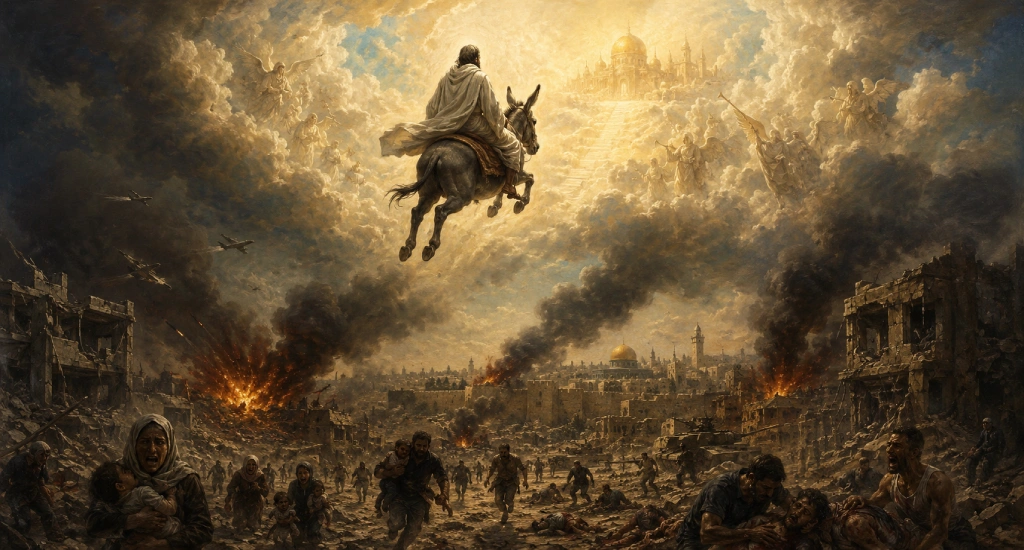
The story of the Miraj is not merely an old religious story. It is also entangled with the political reality of the modern Middle East. Al-Aqsa/Haram al-Sharif/Temple Mount in Jerusalem is one of the most explosive religious-political sites in the Israeli-Palestinian conflict. Muslims regard it as the third-holiest place in Islam; for Jews, the same area bears the highest religious significance as the site of the ancient Temple. As a result, the same land is placed at the center of two religious imaginaries, two national memories, and two political claims, each grounded in its own sacred history. This conflict does not remain confined to theology; it returns as bloody reality in the streets, at borders, through military operations, occupation, resistance, politics, and the lives of ordinary people.
The Miraj narrative stands at the center of this sacred geography. Many Muslims claim that because the Prophet Muhammad went there on the night of the Miraj, led the prophets in prayer there, tethered Buraq there, and ascended to heaven from there, the area therefore forms part of Muslim rights. But this is where the question becomes stark: Can modern territorial rights rest on a miraculous claim? If an event lacks real historical, archaeological, and documentary evidence, then using it to claim eternal religious ownership over a territory cannot withstand logical scrutiny. “The Prophet came here” may stir emotion, organize processions, and mobilize religious identity; but without evidence it is not a valid argument for establishing territorial rights.
This article does not deny Palestine’s struggle for national independence, nor does it dismiss the real questions surrounding Israeli citizens’ security and the state’s existence. Palestinian self-determination, occupation, settlement expansion, military repression, civil rights, and the refugee problem are real political and human-rights issues. Likewise, the security of Israeli citizens, the existence of the state, terrorist attacks, the hostage crisis, and regional hostility are real issues. But this article is not a treatment of the entire political conflict. Its question is narrower: Can a miraculous religious narrative be used as evidence for history, geography, and modern political rights?
The answer is straightforward: no. Territorial questions belong to discussions of international law, history, demography, civil rights, occupation policy, war, state agreements, human rights, and political justice. A prophet’s alleged nocturnal journey through the sky, an unseen flying creature called Buraq, a heavenly court, or the leading of dead prophets in prayer cannot determine the land, rights, security, or sovereignty of real people. When religious fiction becomes a weapon of geopolitics, ordinary people pay the price—Muslims, Jews, Christians, atheists, children, the elderly, refugees, and civilians alike.
That is why examining the Miraj claim in light of logic, history, and science is not merely an exercise in religious criticism; it is directly connected to modern reality. If a miraculous narrative is left unquestioned, it does not remain only on the mosque pulpit; it can become a territorial claim, a war slogan, the language of occupation, a symbol of resistance, and moral fuel for bloodshed. Examining the historicity of the Miraj therefore does not mean denying any people’s rights; it means denying religious myth the authority to dominate real politics and human life.
The position of this article is therefore clear: whether the issue is Palestinian independence or Israeli security, it must be judged on the basis of reality, rights, law, history, and human justice. But the claim “Muhammad came here during the Miraj” will not be used as evidence of territorial ownership, because there is no independent historical evidence for it; what exists is religious narration, the later construction of sacred geography, and political emotion rooted in faith. Turning an unverified miraculous night journey into a legal document in a real-world, blood-soaked conflict is intellectually unacceptable and morally dangerous. Real people’s blood, homes, land, rights, and future cannot depend on it.
The Foundational Rupture between Isra and Miraj: Qur’an versus Hadith
The greatest textual rupture in the Miraj narrative is that the Qur’an nowhere presents the complete linear journey “Makkah → Jerusalem → seven heavens → Allah’s court → bargaining over the prayers.” The first verse of Surah Bani Israel mentions only a one-night horizontal journey, from al-Masjid al-Haram to al-Masjid al-Aqsa. It contains no mention of crossing seven heavens, ascending, seeing Paradise and Hell, meeting dead prophets, Bayt al-Ma’mur, Sidrat al-Muntaha, or any divine bargaining over the number of prayers. [1]
On the other hand, the passage from Surah al-Najm presented as evidence of the ascent is not a narrative of continuous physical space travel either. It uses visionary language such as “seeing,” “drawing near,” “Sidrat al-Muntaha,” and “Jannat al-Ma’wa”; but it contains no Jerusalem, no Buraq, no stop at al-Aqsa, no leading of the prophets in prayer, no heavenly doors or guards, and no courtly bargaining over the reduction of the prayers. [2] In a direct reading of the Qur’an, Isra and Miraj do not appear as one complete epic. Rather, there are two separate religious indications that later traditions joined together.
The rupture becomes even clearer when the chronology of revelation is considered. Surah al-Najm is generally regarded as a surah from the earlier Meccan period, whereas Surah Bani Israel is generally associated with the later Meccan period. Thus, Qur’anic passages from different periods, contexts, and rhetorical settings were later woven together by hadith and sira traditions into a single physical journey through the heavens. This transformation is not a direct Qur’anic description; it is a later narrative expansion.
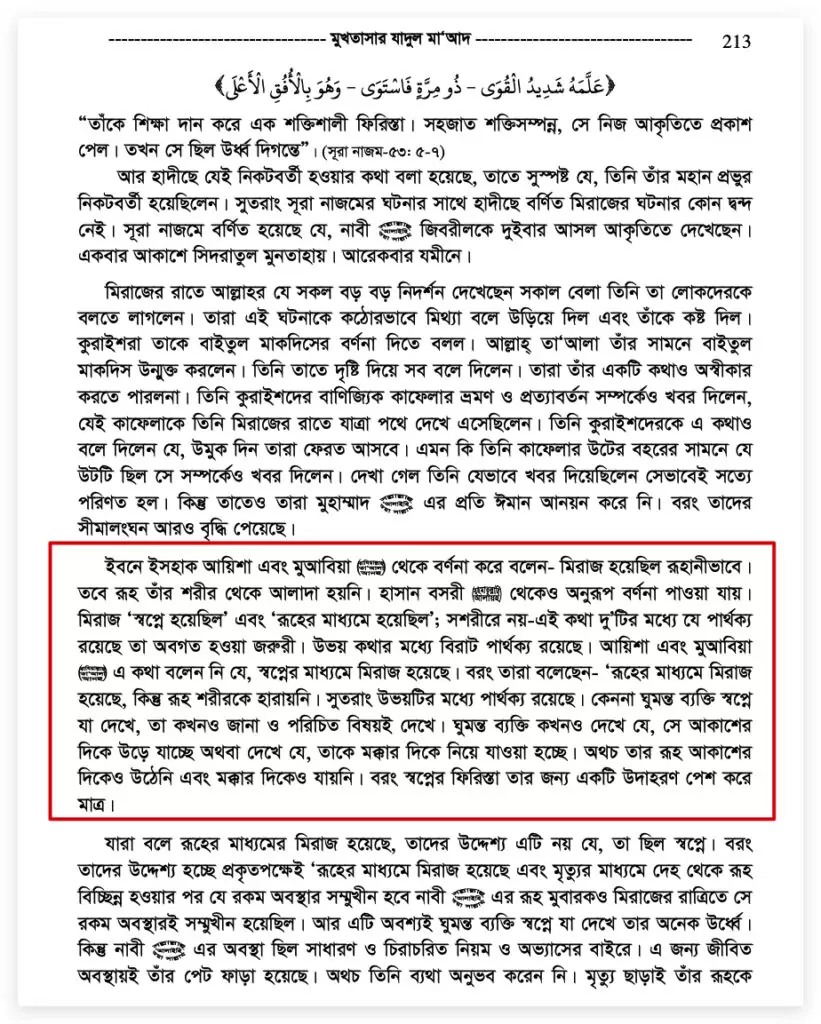
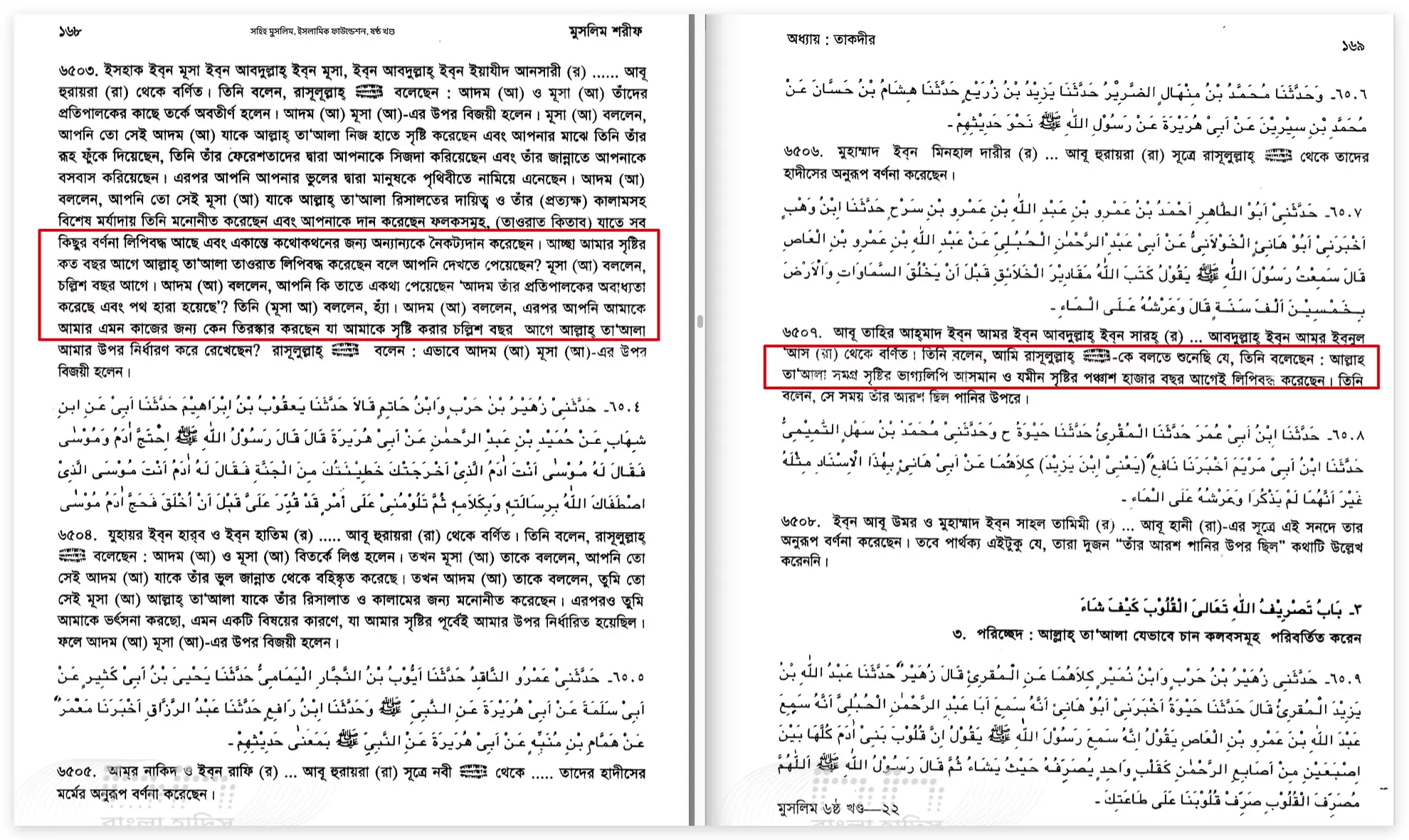
Even within the early Islamic tradition, the interpretation of this journey as a bodily event was not undisputed. Reports attributed to Aisha state that the Prophet’s body did not leave his bed on the night of the Miraj and that the event was spiritual. Reports attributed to Muawiyah describe it as a true dream or ru’ya from Allah. Later scholars tried to preserve the bodily-Miraj position by interpreting these reports, but those interpretations themselves show that the nature of the event was disputed within the early tradition. A claim that was not clear, uniform, and settled from the beginning was later established as an indivisible bodily miracle of faith through theological reconstruction.
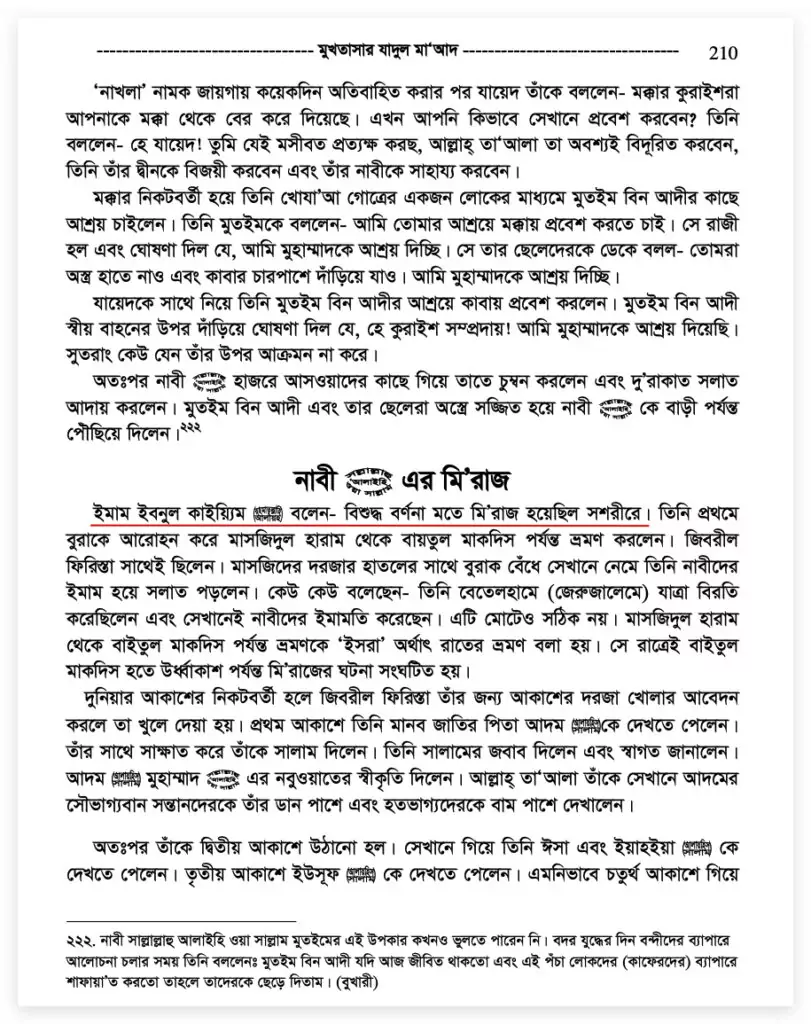
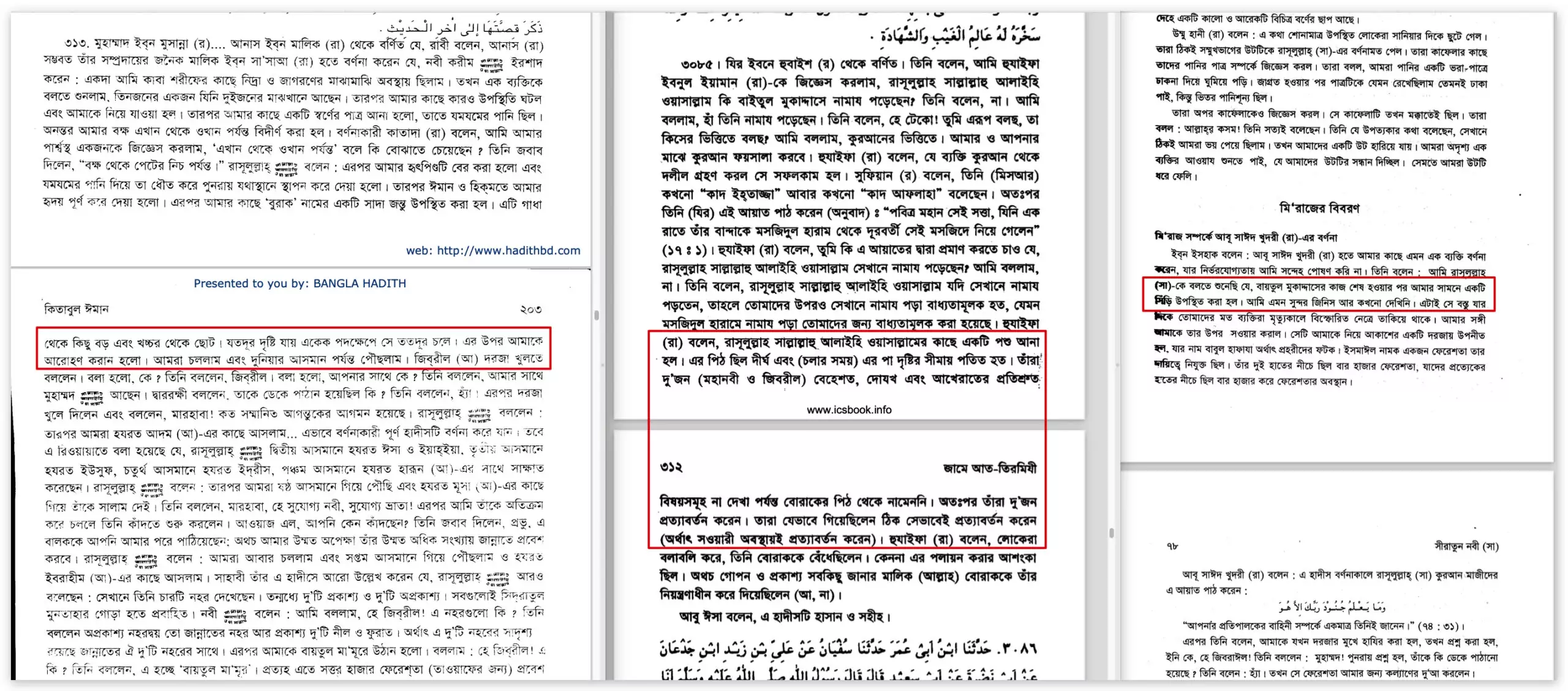
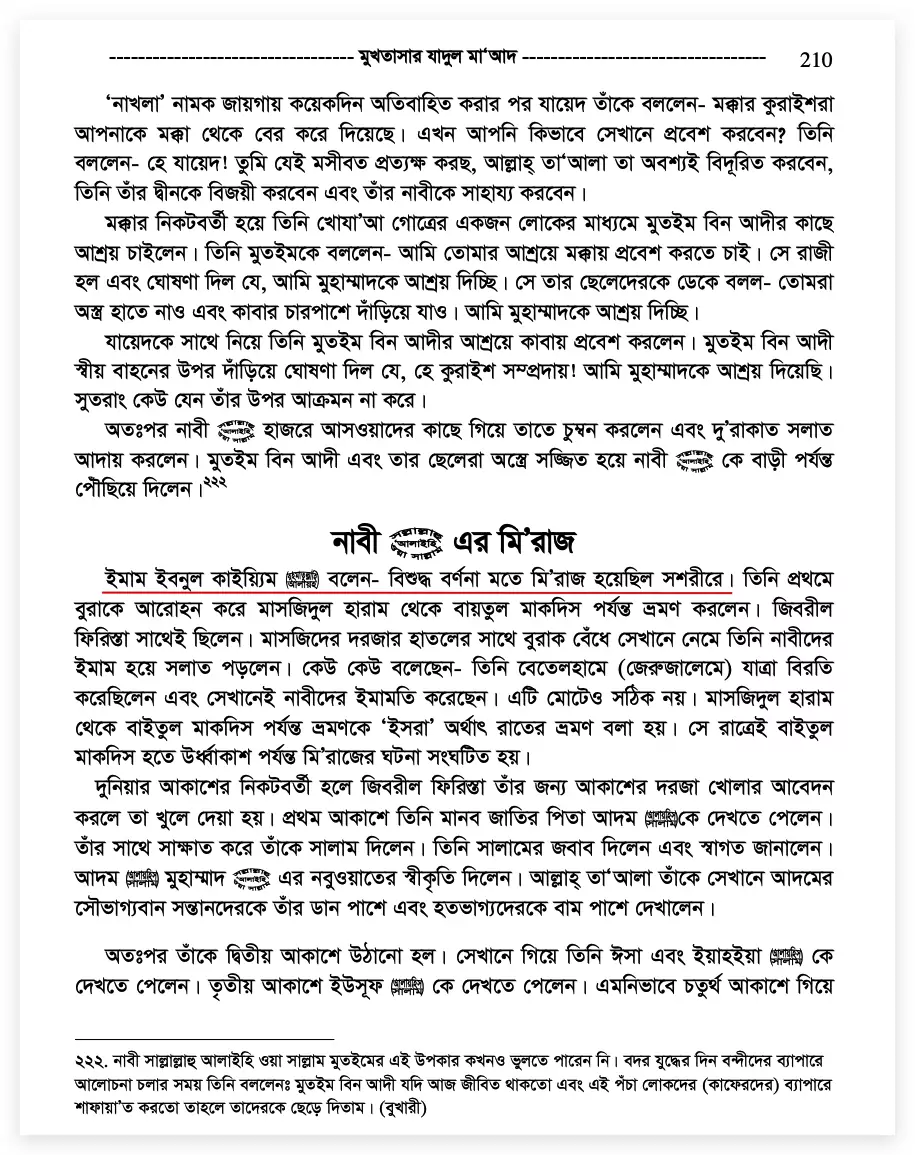
Let us first examine the conventional account used to establish the Miraj as a bodily event. The following is a statement by Imam Ibn al-Qayyim, in which the Miraj is presented as having occurred physically. [3]
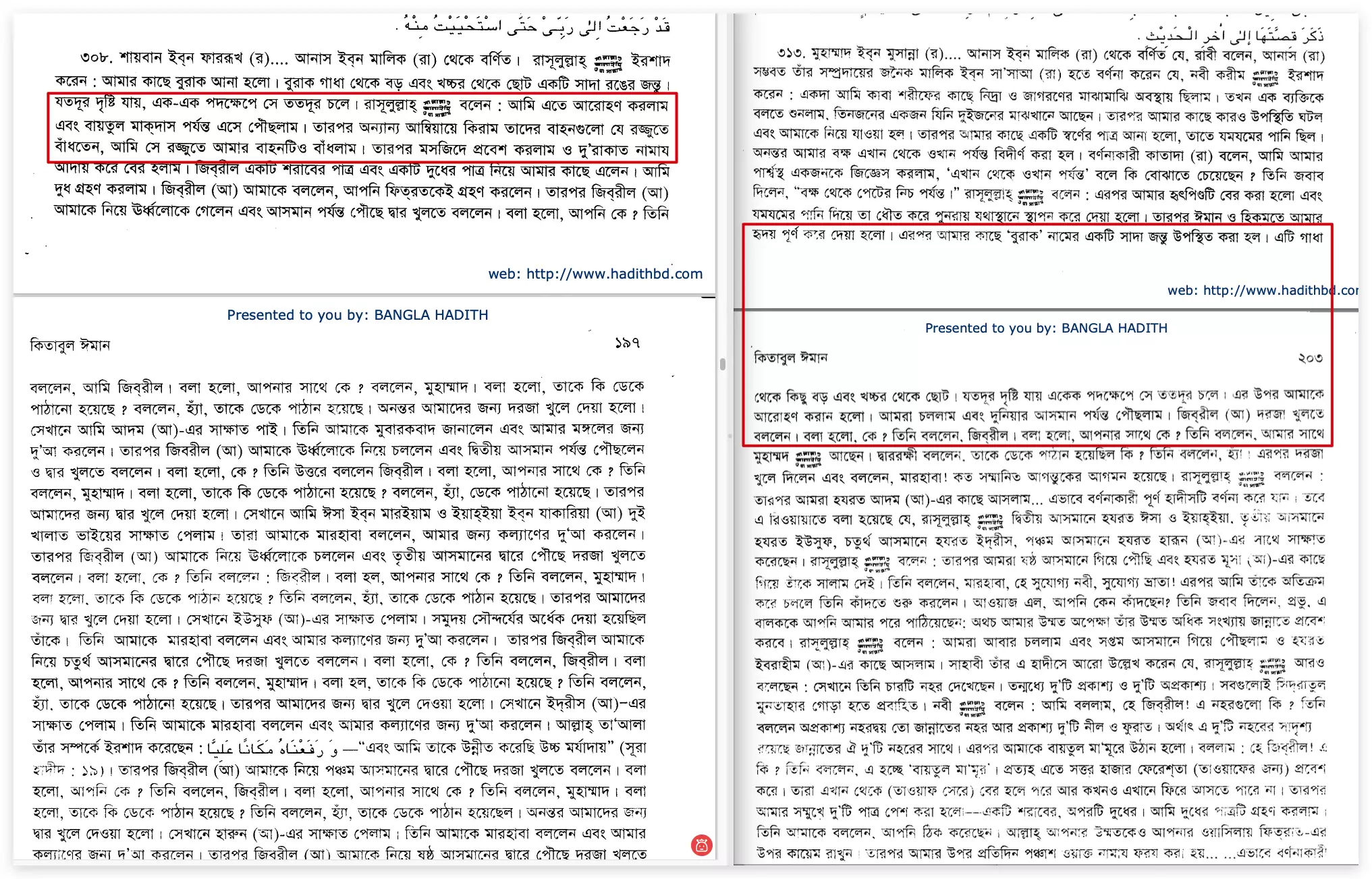
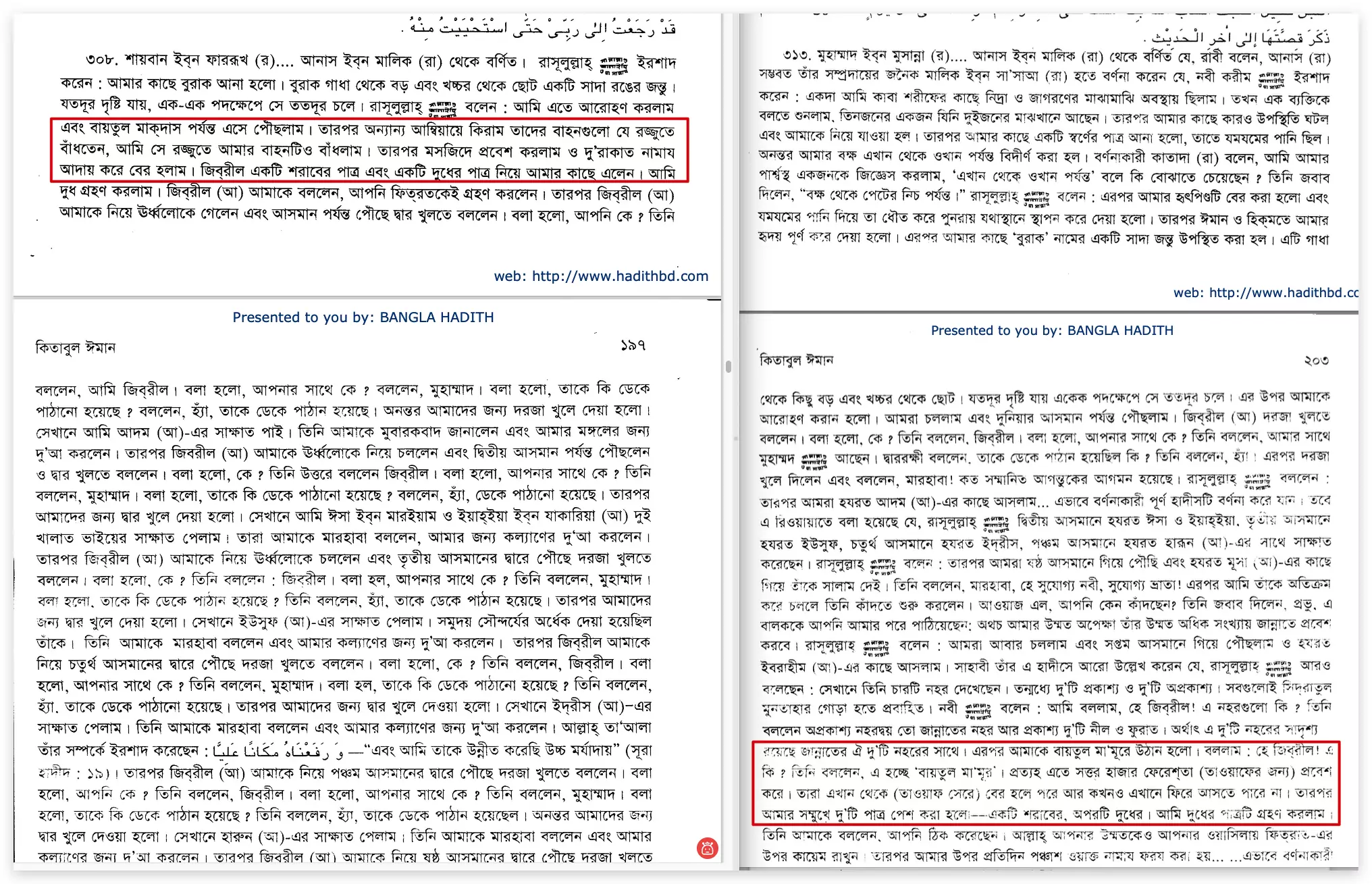
After spending a few days in a place called ‘Nakhla’, Zayd said to him – the Quraysh of Makkah have thrown you out of Makkah. Now how do you get in there? He said – O Zayed! The trouble you are witnessing, Allah will surely remove it, He will make His religion victorious and help His Prophet. Nearing Makkah, he sought refuge with Mutim bin Adi through a man from the tribe of Khoza’a. He said to Mutaim – I want to enter Makkah under your shelter. He agreed and announced that I was giving shelter to Muhammad. He called his sons and said – Take your arms and stand around the Kaaba. I am giving shelter to Muhammad. He entered the Kaaba under the shelter of Mutaim bin Adi with Zayd. Mutaim bin Adi stood on his vehicle and announced that, O people of the Quraish! I have sheltered Muhammad. So no one should attack him. Then the Prophet went to Hazrat Aswad and kissed it and offered two rakat prayers. Mutaim bin Adi and his sons armed with weapons brought the Prophet to the house. 222 The Prophet’s Miraj Imam Ibn al-Qayyim said – According to pure description, Mi’raj was done in person. He first climbed Bura and traveled from Masjid al-Haram to Bayt al-Maqdis. Gabriel was with Firista. He went down there with the handle of the door of the Masjid and went down there and prayed as the imam of the Prophets. Some say that he had a break in Betelham (Jerusalem) and led the Prophets there. This is not correct at all. The journey from Masjid al-Haram to Bayt al-Maqdis is called ‘Isra’ i.e. night travel. On that night, the incident of Mi’raj took place from Bayt al-Maqdis to the upper sky. When Gabriel was close to the heavens of the world, it was opened when Gabriel was pleading for him to open the door of the sky. In the first sky he saw Adam, the father of the human race. He met him and greeted him. He responded to the greeting and welcomed it. Adam acknowledged Muhammad’s prophethood. Allah Ta’ala showed him there the fortunate children of Adam on his right side and the wretched on the left side. Then he was raised to the second sky. There he saw Isa and Yahya J. Who saw Yusuf in the third sky. So on the fourth sky…
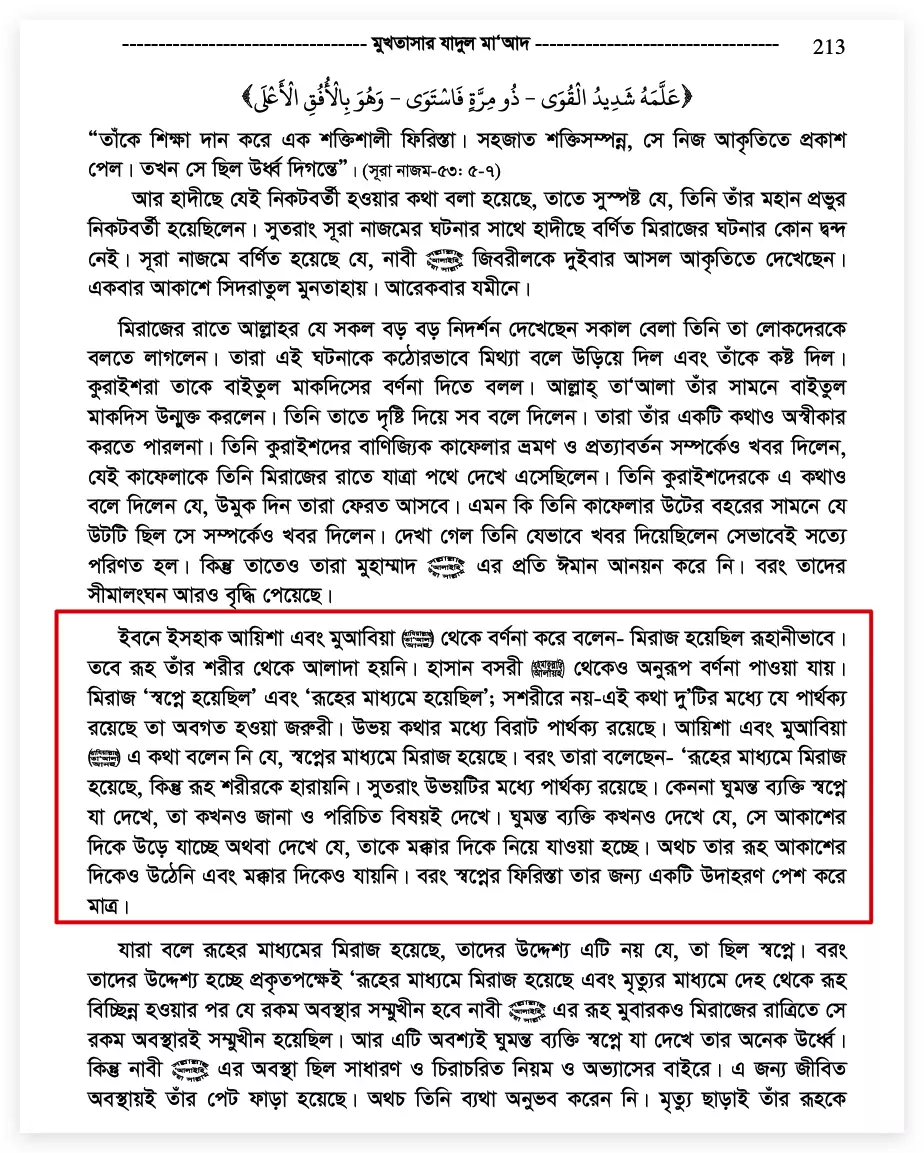
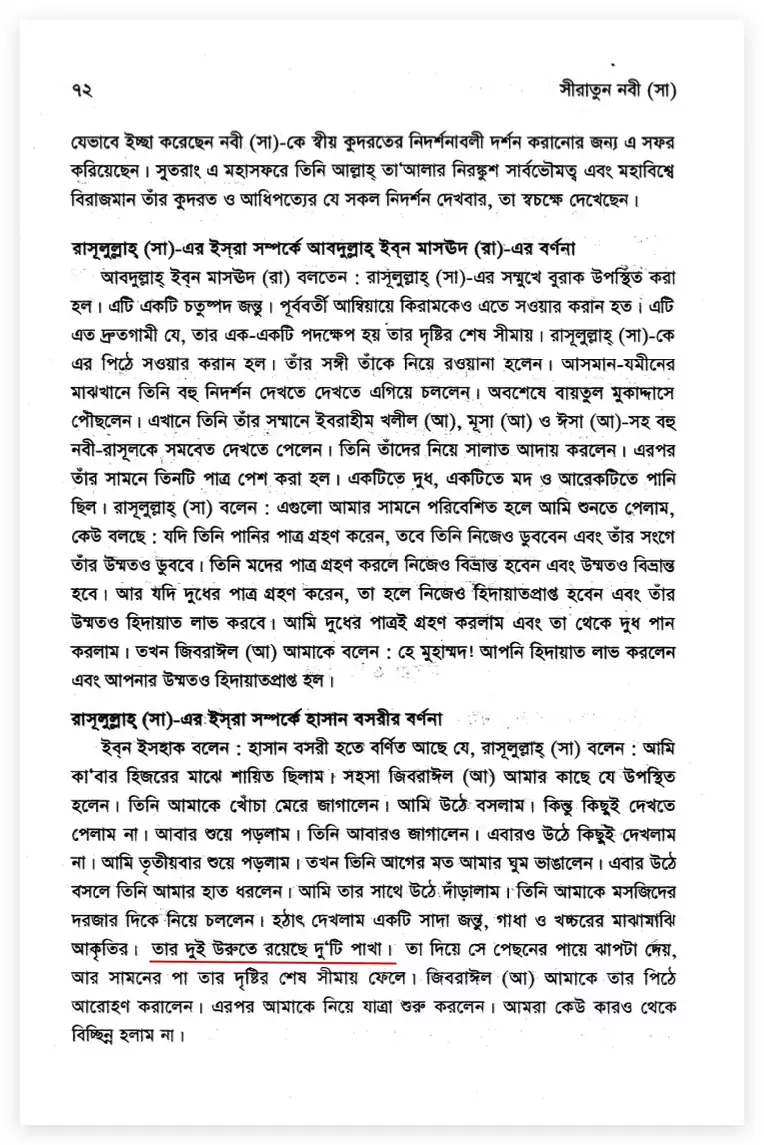
Yet the same discussion shows that a bodily Miraj was not the only undisputed position. Reports attributed to Aisha, Muawiyah, Hasan al-Basri, and Ibn Ishaq also preserve the view that the Miraj was spiritual. Elsewhere in the same book, it is stated that many Companions, including Aisha and Muawiyah, as well as Ibn Ishaq, regarded the Miraj as a dream or a spiritual event. [4]
عَلَّمَهُ شَدِيدُ الْقُوَى – ذُو مِرَّةٍ فَاسْتَوَى – وَهُوَ بِالْأُفُقِ الْأَعْلَى) 53:5 He has been taught by one ˹angel˺ of mighty power 53:6 and great perfection, who once rose to ˹his˺ true form 53:7 while on the highest point above the horizon — Dr. Mustafa Khattab, The Clear Quran (Surah An-Najm 53:5–7) And the closeness that is said in the hadith is clear that he came close to his great Lord. So Surah There is no conflict with the incident of Miraj described in the hadith with the incident of Nazm. Surah It is narrated in Najm that the Prophet saw Gabriel in his original form twice. Once in the sky Sidratul Muntaha. Once again in the land. He started telling the people in the morning that all the great signs of Allah that he saw in the night of Miraj. They dismissed the incident as harshly false and hurt him. The Quraish asked him to describe Bayt al-Maqdis. Allah Ta’ala opened Bayt al-Maqdis before him. He told everything with attention to it. They could not deny one of his words. He also informed about the travel and return of the commercial caravan of the Quraysh, the caravan he had seen on the night of the night of Miraj. He also told the Quraish that they will return on such a day. He even informed about the camel that was in front of the camel fleet of the caravan. It turned out to be true as he reported it. But even then they did not believe in Muhammad. Rather, their transgressions have increased. Ibn Ishaq Aisha And narrates from Mu’awiya and said – Miraj was spiritually. But the soul was not separated from his body. hasan A similar description is also available from Basri. Miraj ‘dreamed’ and ‘through the Spirit’; It is important to know the difference between these two words – not in person. There is a big difference between the two words. Aisha And Mu’awiya did not say that Miraj happened through dreams. Rather, they said – ‘Miraj has happened through the soul, but the soul has not lost the body. So there is a difference between the two. Because what a sleeping person sees in a dream, sometimes he sees things known and known. The sleeping person sometimes sees that he is flying towards the sky or seeing that he is being taken towards Mecca. But his soul did not rise to the sky and did not go to Mecca. Rather, the angel of the dream only presents an example for him. Those who say that the soul has become a Miraj, is not intended to be in a dream. Rather, their intention is that ‘Miraj through the soul has been mirazed and the condition of the Prophet’s soul Mubarak that will be faced after the separation of the soul from the body through death is the same situation as the Prophet’s night. And it is certainly far above what the sleeping person sees in a dream. But the Prophet’s condition was beyond common and traditional rules and habits. Because of this, his stomach has been broken while alive. But he did not feel pain. His soul without death
The importance of this quotation is clear: however strongly the bodily Miraj was later imposed as an “irrefutable” article of faith, the early tradition preserved a powerful interpretation of the event as a spiritual experience. Later writers tried to reconcile that interpretation with the bodily position without completely abandoning it. This shows that the narrative was not one-directional, fixed, or transparent from the beginning. Rather, it gradually took shape under competing views, interpretations, and theological pressures.
Consider another important hadith. At the beginning of the account, the Prophet is asleep; in the middle, it is said that his eyes sleep but his heart does not; and at the end, he wakes and finds himself in al-Masjid al-Haram. On a direct reading, this language supports an interpretation in terms of a dream, spiritual vision, or inward experience more readily than a physical journey through space. [5]
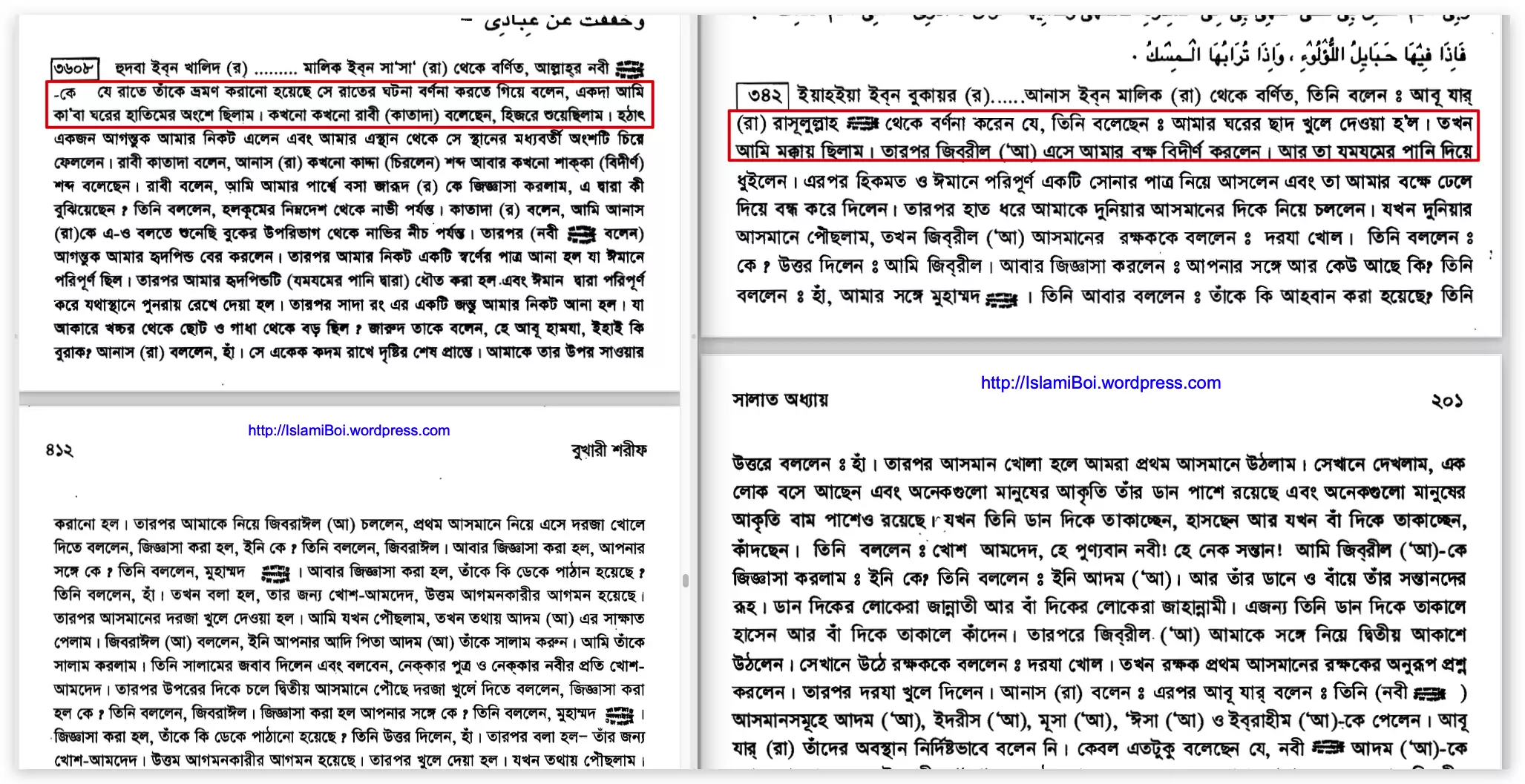
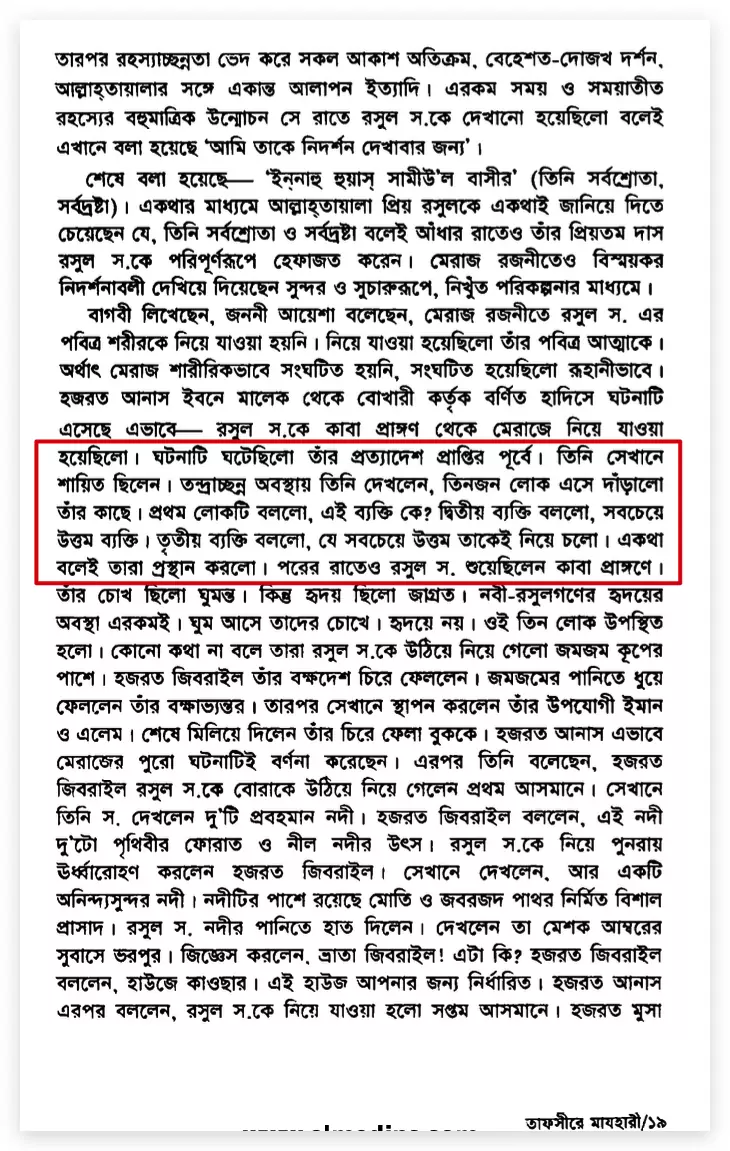
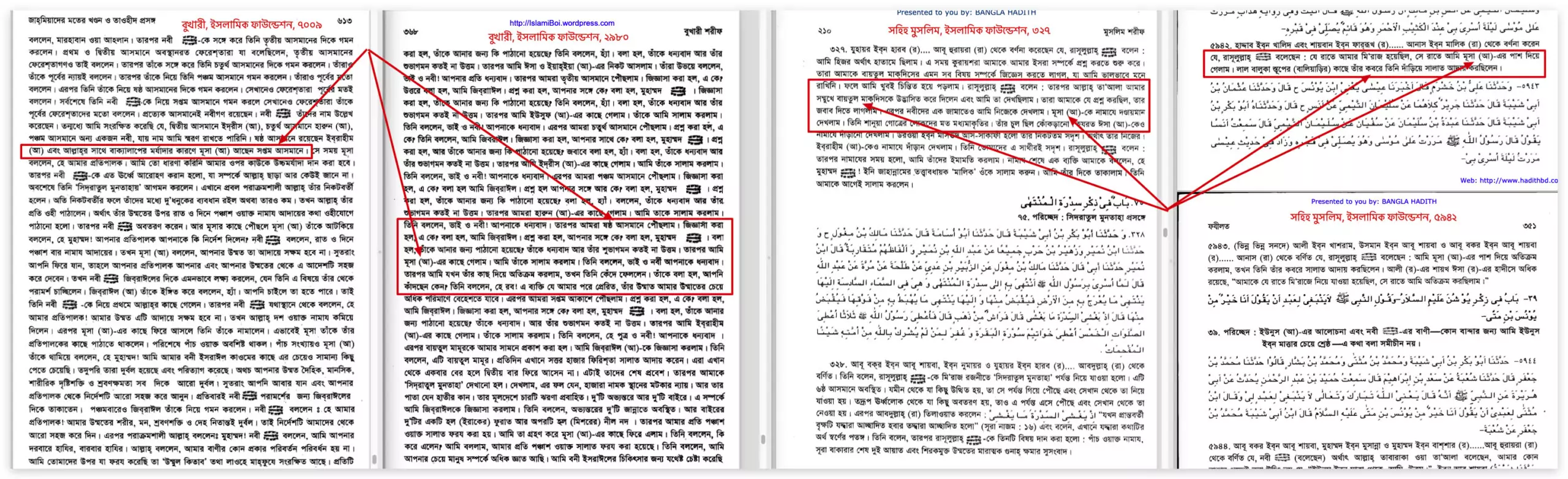
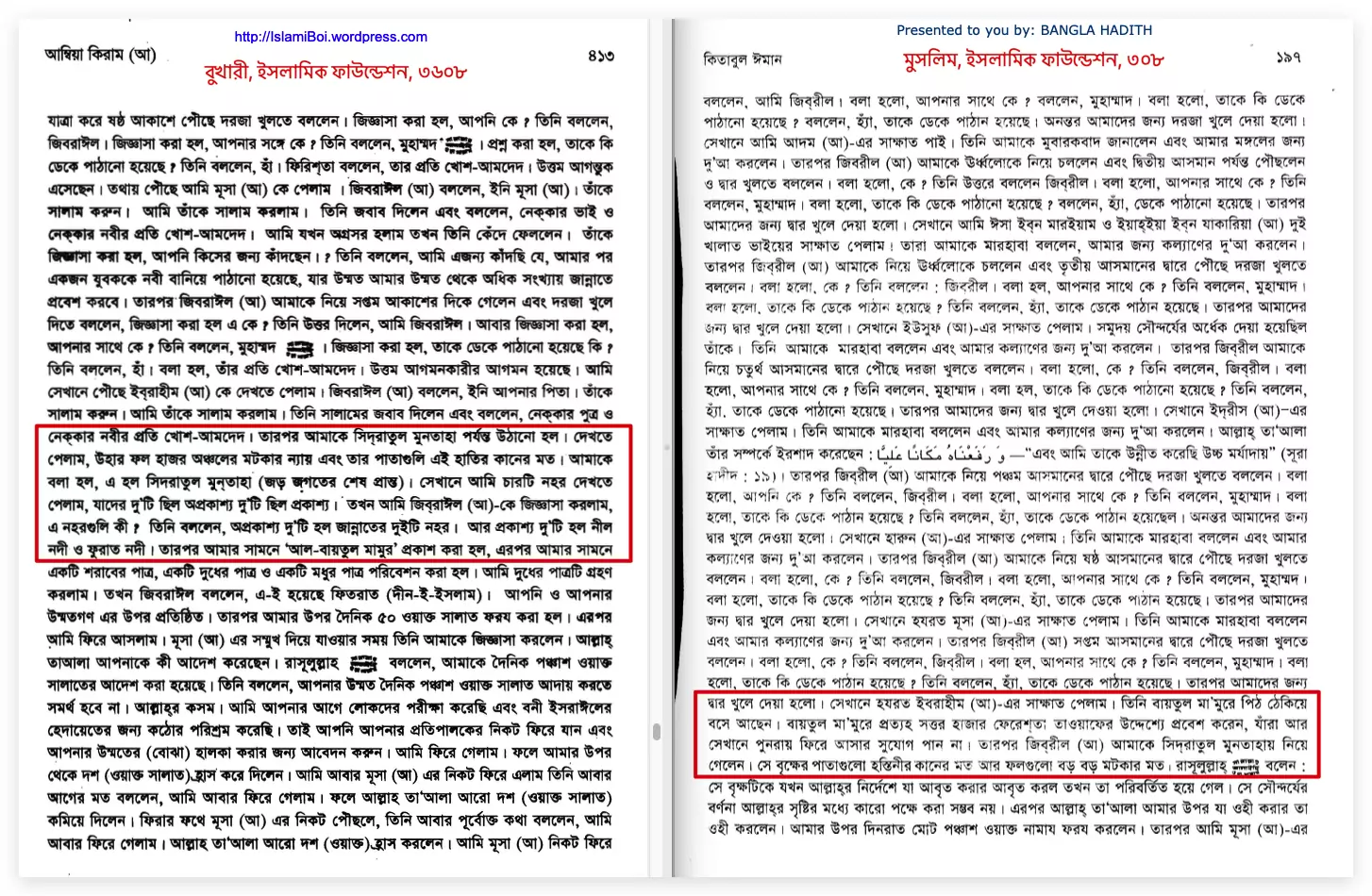
Sahih al-Bukhari (Islamic Foundation) 86/ The refutation of the opinion of Jahmiyyah and the context of Tawheed Section: 3139. The words of the Almighty Allah: and Allah spoke to Musa (AS) (4:164) Islamic Foundation Number: 7009, International Number: 7517 7009 Canonical English equivalent: Sahih al-Bukhari 7517, Book 97, Hadith 142 Narrated Anas bin Malik: The night Allah’s Messenger (ﷺ) was taken for a journey from the sacred mosque (of Mecca) Al-Ka`ba: Three persons came to him (i.e. angels) in a dream while he was sleeping in the Sacred Mosque before the Divine Inspiration was revealed to him. One of them said, “Which of them is he?” The middle (second) angel said, “He is the best of them.” The last (third) angel said, “Take the best of them.” Only that much happened on that night and he did not see them till they came on another night, i.e. after the Divine Inspiration was revealed to him. He saw them, his eyes were asleep but his heart was not—and so is the case with the prophets: their eyes sleep while their hearts do not sleep. So those angels did not talk to him till they carried him and placed him beside the well of Zamzam. From among them Gabriel took charge of him. Gabriel cut open the part of his body between his throat and the middle of his chest, took all the material out of his chest and abdomen, and washed it with Zamzam water with his own hands until he cleansed the inside of his body. Then a gold tray containing a gold bowl full of belief and wisdom was brought, and Gabriel stuffed his chest and throat blood vessels with it and then closed his chest. He then ascended with him to the heaven of the world and knocked on one of its doors. The dwellers of the Heaven asked, “Who is it?” He said, “Gabriel.” They said, “Who is accompanying you?” He said, “Muhammad.” They said, “Has he been called?” He said, “Yes.” They said, “He is welcomed.” So the dwellers of the Heaven became pleased with his arrival, and they did not know what Allah would do to the Prophet (ﷺ) on earth unless Allah informed them. The Prophet (ﷺ) met Adam over the nearest Heaven. Gabriel said to the Prophet, “He is your father; greet him.” The Prophet (ﷺ) greeted him, and Adam returned his greeting and said, “Welcome, O my son! What a good son you are!” Behold, he saw two flowing rivers while he was in the nearest sky. He asked, “What are these two rivers, O Gabriel?” Gabriel said, “These are the sources of the Nile and the Euphrates.” Then Gabriel took him around that Heaven, and behold, he saw another river at the bank of which there was a palace built of pearls and emeralds. He put his hand into the river and found its mud like musk Adhfar. He asked, “What is this, O Gabriel?” Gabriel said, “This is the Kauthar which your Lord has kept for you.” Then Gabriel ascended with him to the second Heaven, and the angels asked the same questions as those on the first Heaven: “Who is it?” Gabriel replied, “Gabriel.” They asked, “Who is accompanying you?” He said, “Muhammad.” They asked, “Has he been sent for?” He said, “Yes.” Then they said, “He is welcomed.” Then Gabriel ascended with the Prophet (ﷺ) to the third Heaven, and the angels asked the same questions as the angels of the first and second Heavens had asked. Then he ascended with him to the fourth Heaven, and they said the same; then he ascended with him to the fifth Heaven, and they said the same; then he ascended with him to the sixth Heaven, and they said the same; then he ascended with him to the seventh Heaven, and they said the same. On each Heaven there were prophets whose names he had mentioned. I remember Idris on the second Heaven, Aaron on the fourth Heaven, another prophet whose name I do not remember on the fifth Heaven, Abraham on the sixth Heaven, and Moses on the seventh Heaven because of his privilege of talking to Allah directly. Moses said, “O Lord! I thought that none would be raised up above me.” But Gabriel ascended with him (the Prophet) to a height known only to Allah, until he reached the Lote Tree beyond which none may pass. Then the Irresistible, the Lord of Honor and Majesty, approached and came closer until he was about two bow lengths or even nearer. It is said that it was Gabriel who approached and came closer to the Prophet. Among the things that Allah revealed to him was: “Fifty prayers were enjoined on his followers in a day and a night.” The Prophet (ﷺ) descended until he met Moses, and Moses stopped him and asked, “O Muhammad! What did your Lord enjoin upon you?” The Prophet (ﷺ) replied, “He enjoined upon me to perform fifty prayers in a day and a night.” Moses said, “Your followers cannot do that. Go back so that your Lord may reduce it for you and for them.” So the Prophet (ﷺ) turned to Gabriel as if he wanted to consult him about that issue. Gabriel told him, “Yes, if you wish.” So Gabriel ascended with him to the Irresistible and said, “O Lord, please lighten our burden, as my followers cannot do that.” So Allah deducted ten prayers, whereupon he returned to Moses, who stopped him again and kept sending him back to his Lord until the enjoined prayers were reduced to only five prayers. When the prayers had been reduced to five, Moses stopped him and said, “O Muhammad! By Allah, I tried to persuade my people, the Children of Israel, to do less than this, but they could not do it and gave it up. Your followers are weaker in body, heart, sight, and hearing, so return to your Lord so that He may lighten your burden.” The Prophet (ﷺ) turned to Gabriel for advice, and Gabriel did not disapprove. So he ascended with him for the fifth time. The Prophet (ﷺ) said, “O Lord, my followers are weak in their bodies, hearts, hearing, and constitution, so lighten our burden.” The Irresistible said, “O Muhammad!” The Prophet replied, “Labbaik and Sa’daik.” Allah said, “The Word that comes from Me does not change, so it will be as I enjoined on you in the Mother of the Book. Every good deed will be rewarded tenfold; thus fifty prayers are recorded in the Mother of the Book, but you are to perform only five in practice.” The Prophet (ﷺ) returned to Moses, who asked, “What have you done?” He said, “He has lightened our burden and has given us a tenfold reward for every good deed.” Moses said, “By Allah, I tried to make the Children of Israel observe less than that, but they gave it up. Go back to your Lord so that He may lighten your burden further.” Allah’s Messenger (ﷺ) said, “O Moses! By Allah, I feel shy of returning too many times to my Lord.” Moses said, “Descend in Allah’s Name.” The Prophet (ﷺ) then woke while he was in the Sacred Mosque at Mecca. Hadith grading: sahih (Sahih) Narrator: Anas bin Malik
This hadith creates further internal pressure against a bodily interpretation of the Miraj. At the beginning, the Prophet is asleep; in the middle, the event is experienced “through the heart”; and at the end, he wakes and finds himself in al-Masjid al-Haram. To turn this sequence of sleep, inward vision, and awakening into a physical journey through space, one must impose a theological reading on the plain structure of the report. On a direct reading, it resembles a spiritual, dreamlike, or visionary experience more closely.
These two separate Qur’anic indications, together with different narrative structures, were given a complete epic form by later hadith and sira traditions: first from Makkah to Jerusalem, then from Jerusalem to the heavens, then to Allah’s court, and finally into an administrative bargain that reduced the number of prayers. This entire linear structure does not come directly from the Qur’anic text; it is a later oral legend, a sira-based expansion, and a construction of hadith-based theology.
If the event were truly Islam’s central, material, historical miracle, one would expect its major texts, especially the Qur’an, to present it in a coherent structure. Instead, the Qur’an contains isolated indications, while the complete sequence is created in later accounts. This gap shows that the Miraj is not a direct, fixed Qur’anic narrative; it is an evolving construction produced from Qur’anic motifs, contemporary religious imagination, sira-based expansion, and hadith-based theology.
Old Wine in a New Bottle: Repetition of the Ancient Myth
In Islamic da’wah literature and religious preaching, the Miraj is often presented as a unique and unprecedented event in history. It is claimed that nothing comparable exists in world history: a man supposedly crossed the heavens from Earth in a single night and reached the presence of God, making the event one of the strongest proofs of Muhammad’s prophethood. The first weakness in this claim, however, is that the structure of the Miraj is not unique at all. Ascending to heaven, traveling with the help of angels, passing through a layered heaven, approaching God’s throne, seeing Hell and the punishment of sinners, and returning to warn human society were all elements found long before Islam in the religious literature of the Middle East, Persia, Jewish-Christian apocrypha, and Zoroastrianism. [6] Tisdall’s work is old and polemical, so it should not be treated as the final authority. The real question is whether the motifs of ascension, heavenly levels, an angelic guide, the afterlife, and religious authority were already active in the Near Eastern and Iranian religious environment before Islam. They were. The claim that the Miraj is unique therefore collapses at the outset. The analysis should instead proceed through Haug, Encyclopaedia Iranica, the Kirdīr inscription, and modern Iranian scholarship.
Here, “similarity” does not mean merely a vague thematic resemblance. The existence of heaven and Hell, angels, or a divine court in many cultures is one matter. The more specific narrative structure found in the Miraj is another: a chosen religious person or prophet undertakes a spiritual or cosmic journey on a special night or in a special state; an angel guides him; he passes through successive heavenly levels; he meets earlier righteous or prophetic figures; he sees Heaven and Hell and specific punishments for sinners; and he returns to establish religious authority. This complete structure is present in many pre-Islamic literatures. It is therefore methodologically more reasonable to place the Miraj within the continuity of ancient religious myths before treating it as an isolated historical miracle.
One of the most discussed parallels to the Miraj in comparative theology is found in the Zoroastrian tradition of ascension and visions of the afterlife, especially in the Ardā Wīrāz-nāmag, or “Arda Viraf Namag.” The structure of the argument must be kept clear. It is not necessary to prove that the present form of the Ardā Wīrāz-nāmag existed as a complete written document before the seventh century. The argument of this article is not that Muhammad opened a book and copied it. Rather, the claim is that the motifs of ascension, divine guidance, journeys through the afterlife, and the re-establishment of religious authority were already active in the Iranian and Near Eastern religious environment before Islam. According to Iranica, the final form of the Arda Viraf Namag was fixed around the ninth or tenth century; but the same research shows that parallel heaven-and-Hell motifs are present in the third-century Kirdīr inscription and in the Zoroastrian tradition of the Dēnkard. The central question, therefore, is not the latest date of the book’s redaction, but the pre-Islamic presence of its narrative motifs. Iranica also notes that the third-century Kirdīr inscription contains the motif of a spiritual journey through heaven and Hell. The argument is not a crude allegation of “stealing”; it is deeper and more consequential: motifs of divine ascent, divine guidance, afterlife belief, and the re-establishment of religious authority were already active in the Iranian and Near Eastern religious environment before Islam. A virtuous person is chosen for the afterlife, returns after seeing Heaven and Hell, warns human society, and re-establishes a claim to religious truth. This structure closely parallels the religious role assigned to the Miraj: the Prophet ascends to the upper world, sees Paradise and Hell, returns with divine instruction, and transforms the experience into legislative and religious authority for the Ummah. [7]
Objection: Arda Viraf Namag is the next book of Islam?
A prevailing objection of the Islamists is that the present written form of Ardā wīrāz-nāmag or Arda Viraf Namag was conclusively compiled after the emergence of Islam, approximately 9th–10th centuries; Therefore, it is time to talk about the Zoroastrian influence on Islam by showing its similarity with Miraj or is it wrong in time. The objection seems strong at first but it actually attacks the wrong target. The statement of this article is not that every sentence of the present Arda Viraf Namag was written before the seventh century, or Muhammad Opened a book and copied it directly. The statement is more specific: before Islam was active in the Iranian and Near Eastern religious environment, the motifs of the ascension of the soul, the vision of heaven and hell, the divine guide, the scene of the punishment of the sinners and the re-establishment of religious authority were active. Encyclopaedia Iranica itself says that the current form of Arda Viraf Namag is fixed in the 9th-10th centuries, but the same A parallel motif to the kind of heaven-hell philosophical spiritual journey is also found in the inscriptions of the 3rd century Zoroastrian priest Kirdīr and the tradition of Dēnkard. That is, “the current written form is post-Islamic” – this information proves that the simple claim of direct book-to-book copying should be done carefully; But it does not refute the existence of pre-Islamic Zoroastrian ascension and afterlife motifs. Rather, Miraj’s complete hadith and sira Structure too in the Qur’an Not coherently; It is also extended in later Islamic narrations. As a result, one party’s subsequent reduction is a systematic dichotomy to make the next theological expansion of the next theological expansion a simplistic history. [8]
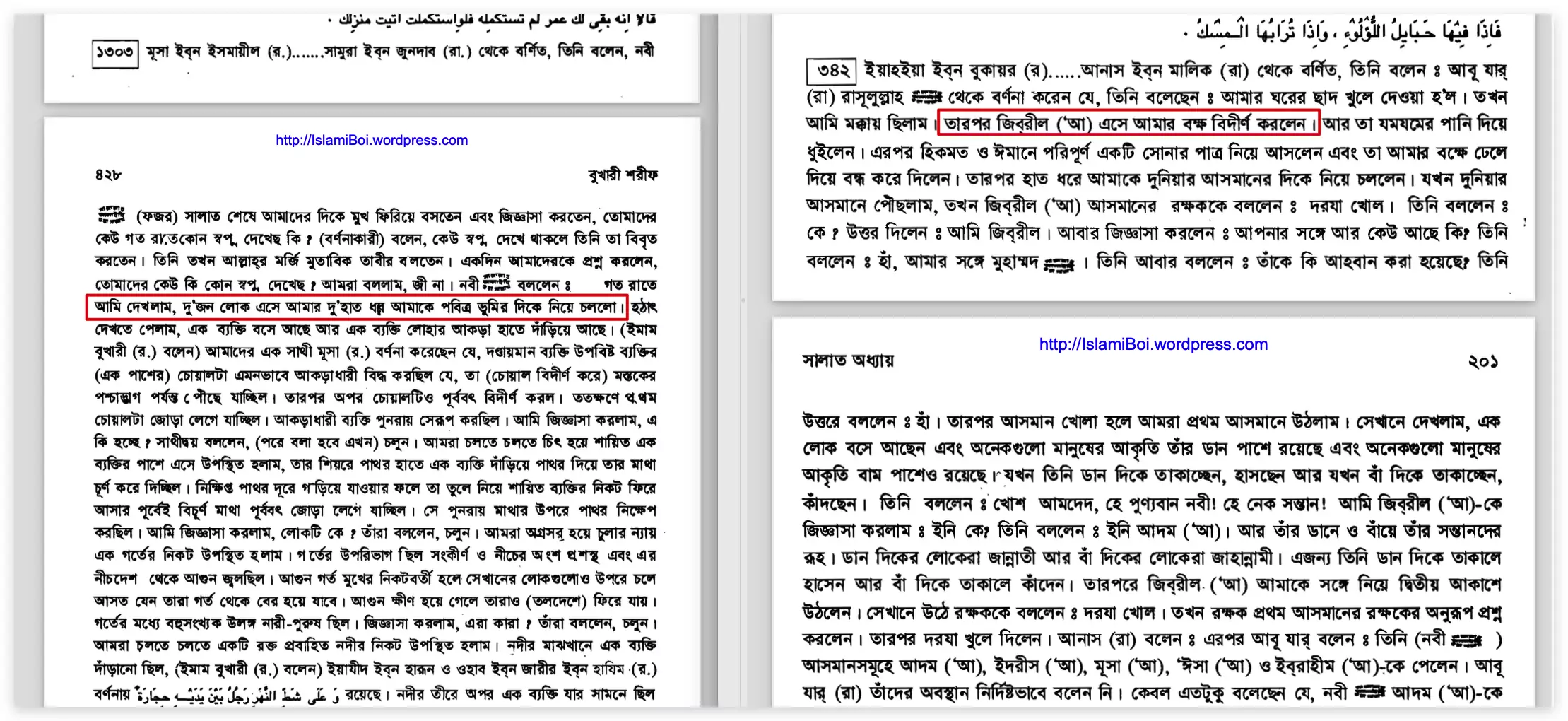
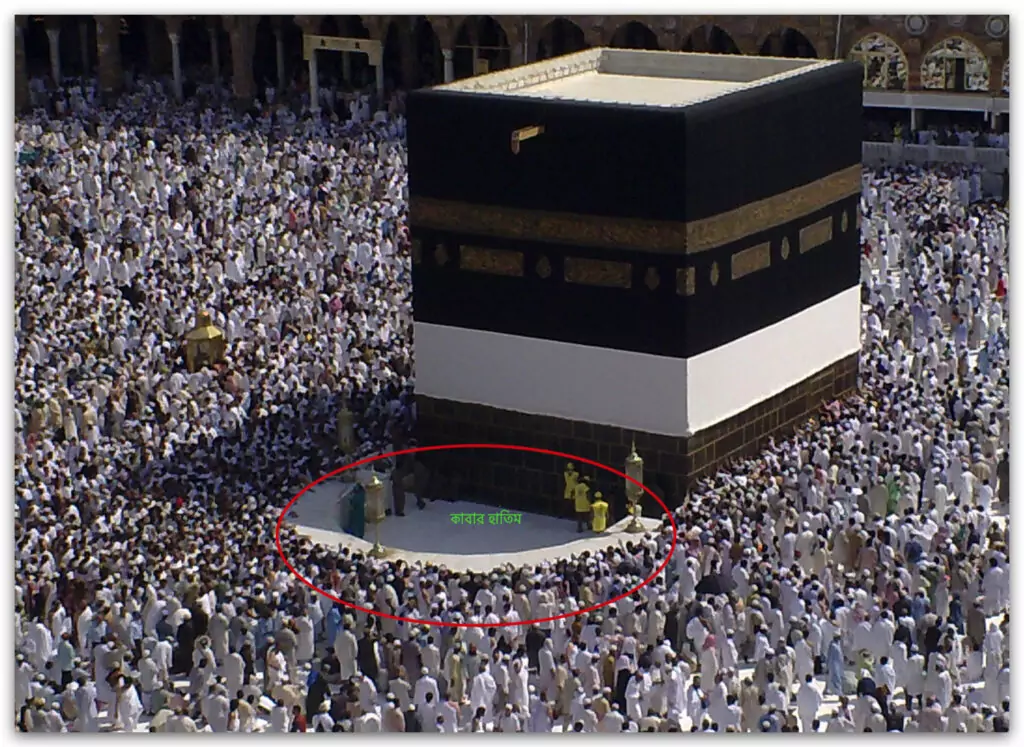
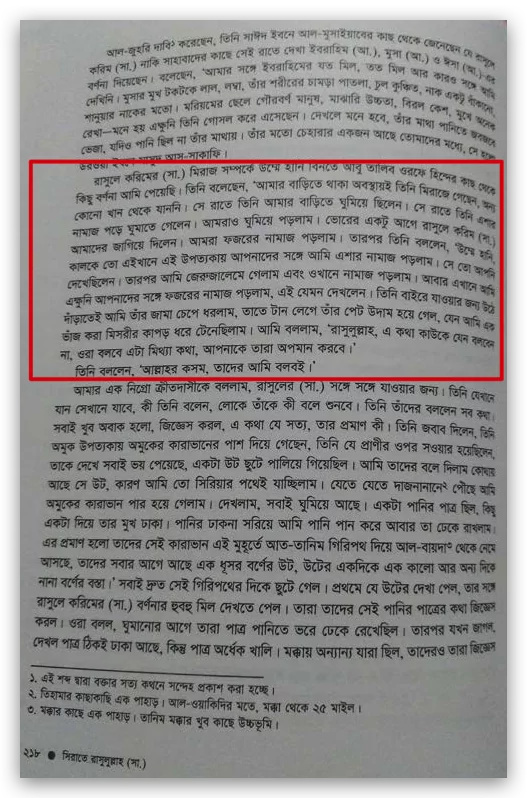
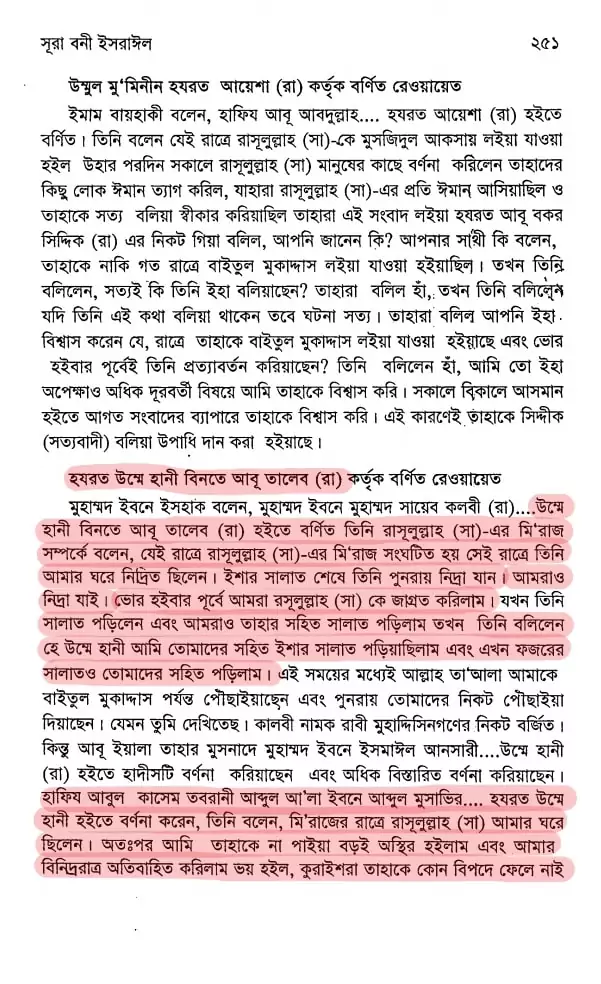
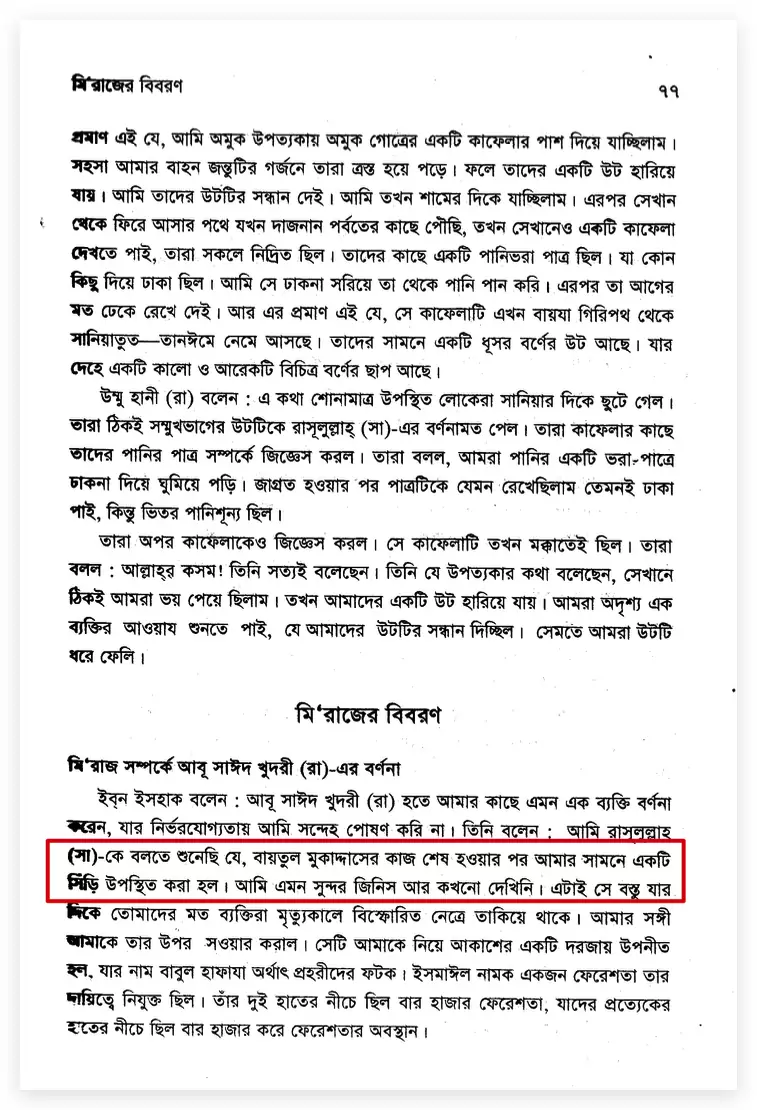
Types of travel and preparation: In the description of ‘Arda Viraf Namag’, Viraf is given a special type of drink or intoxicating substance before visiting the afterlife; He then enters a deep sleep or sleepiness, the body is frozen, but his soul goes out on a journey to heaven and hell. [9]…. In the case of Miraj, the early Islamic narrations include sleep, drowsiness, dream, spiritual travel and physical travel, the presence of these various interpretations is noticeable. In some narrations the Prophet in his own house [10] or in the Hatim square of Mecca [11] Or Umm Hani was sleeping in the house; Again in later theology the event is emphasized as a physical journey [12][13]. These different types of statements themselves are important: a spiritual vision or dream-experience can be a typical example of how material miracles can be transformed into a material miracle history in the future.
Guide or Guide: An almost permanent element of the ancient ascending narratives is that man cannot go to the upper world alone; He is taken by an angel, divine being or superhuman guide. In Viraf’s story, two divine entities named ‘Srosh’ and ‘Adar’ take him to different levels. [14]the Miraj also maintains the same structure: Gabriel made the Prophet ascended Bora, took him from Mecca to Jerusalem, then crossed the levels of heaven, introduced him at every level and led the way to Sidratul Muntaha. Here the basic structure is the same: the human-nabi or virtuous person enters the godly kingdom with the help of the aerial guide, not in his own power.
Heaven-Hell Philosophy and Judgment Bridge: Viraf witnessed the pleasures of the virtuous in his journey and the punishment of the sinners. The afterlife is shown not only as an abstract moral concept, but as a visible judicial system. The concept of ‘Chinvat Bridge’ or Judgment Bridge is particularly important in Zoroastrian tradition. This bridge is safe and spacious for the righteous, but terrible and dangerous for sinners; sinners fall from there to hell [15]the In Islam, the concept of Pulsirat of the later period also shows the same type of judgment—that is finer than the hair, sharper than the sword, over which man has to cross. [16]…. This similarity is not only linguistic; This is a similar dramatic scenario of the afterlife. The symbolic use of visible, physical, dangerous bridges to create moral fear in religious mythology is working here in both traditions.
The Jewish and Christian apocryphal literature also shows a strong presence of similar ascending narratives. ‘Testament of Abraham’, ‘Escension of Isaiah’, Inoc-literature and later Mercabah traditions of the sky, angels, the throne of God, the trial of the dead, and heavenly. The vision of the world comes back again and again [17]the So if Miraj is read in isolation it may seem miraculous and unique; But if placed next to the previous religious literatures of the same region, it is more consistent with the burden of evidence, the history of the source and the structure of the narrative—the explanation of the fact that it is known as heavenly-myth, the afterlife-traveling narrative and the Islamic rearrangement of the sacred authority.
Here apologetic objections usually come—“the similarity does not prove to be borrowed.” This objection intentionally removes the original question. It is not always necessary to prove a direct fake in the practice of history; Sometimes the previous motifs, geographical communication, religious environment and the structure of narratives give quite a strong explanation. Similarity alone cannot be proven “stealing” directly. But three things are important in analyzing the origin of a narrative in history: the existence of the previous motif, the geographical-cultural connection, and the structural similarity of the narrative. All three are present in the case of Miraj. Seventh-century Arab regions were not isolated from trade, war, religious debate, Jewish-Christian sects, Syria-Palestine, Persia and Byzantine worlds. Rather, this region was an active exchange of religious stories, folklore, prophet-stories and fear of the hereafter. Because of The story of Miraj is more historically consistent than seeing the story of Miraj from nothing as a sky-high miracle, but as a reconstruction of the traditional religious elements.
Judging innocently, the power of Miraj’s story is not at its own price, but in its imagination. It is a wonderful religious drama: the Prophet travels through the night, crosses the level of the sky, meets the previous prophets, sees paradise-hell, returns with God’s instructions and strengthens his religious authority. But literary power and historical truth are not the same thing. A narrative can influence people’s imagination, create moral fears, build political-religious authority—yet it actually happens, it needs independent evidence to come to a conclusion. In the case of Miraj, that independent evidence is missing; Rather, there is a deep structural similarity with the previous religious myth.
Before claiming the uniqueness of the Miraj, one thing needs to be clarified: “Traveling the unseen world back to the unseen world” is a very old power-building technique. A person who declares himself to be an eyewitness to heaven, hell, the court of God or the invisible world becomes a claimant of a special knowledge that is beyond the reach of the common man. The political and religious value of this claim is huge. Because no one can go to that world and verify, but in the name of that unseen world, the behavior of the people of the world can be controlled. Miraj’s narrative also does exactly this—using the unseen sky to establish authority in visible society.
Table: Arda Viraff, Jewish–Christian Apocrypha vs Miraj – a comparative image
The table below presents the main narrative elements of Zoroastrian, Judeo-Christian apocrypha and Islamic Miraj. The purpose of this comparison is to explain how unique the story of Miraj is, and how much the previous religious ascension-literature falls into the continuation of literature.
Subject/material
Zoroastrian Arda Viraf Namah (3rd–10th century)
Judeo-Christian apocrypha (2nd century AD–4th century AD)
Islamic Miraj (7th Century)
Dimensions of Match (1–10)
Comment
source of travel
Arda Viraf Namah – Sassan Persia’s spiritual night travel story
Book of Enoch, Ascension of Isaiah, Testament of Abraham, 2 Enoch
2 7 or 10 Asman in Enoch, 7 Hekallot in Hekhalot Literature
7 the sky – Meeting a Prophet in each
10/10
The layered universe is the common but important structure of ancient religious cosmology
Meeting of Prophets/Punites at every level
preceding each level suspicion, God, virtuous soul
At Enoch Adam, Abel, etc; Isaiah-At Abel, Enoch
1st: Adam, 2nd: Isa + Yahya, 3rd: Yusuf, 4th: Idris, 5th: Aaron, 6th: Moses, 7th: Abraham
10/10
The presence of the previous sacred figure in each stage of the ascension is the same narrative method
the throne of God at the highest level
Ahura Mazdathrone and court
At Enoch “Great Glory”The throne of, Isaiah “Lord of Glory”
Sidratul Muntaha → The Throne of Allah (a direct view in some descriptions)
9.5/10
The ancient religious tendency to imagine God in a spatial royal court is evident here
Heaven-Hell Scenes
certain punishment of sinners (such as feeding adulterers’ penises)
Punishment of sinners in Enoch: dark holes, fires, worms
Hook in the penis of adulterers in hell, snake in the belly of usurer
9/10
Translating moral crime into a scene of physical abuse is in three sections
purpose of travel
Eliminating religious chaos, bringing people to the right path
Warning from sin, reaching out to God’s message
Prayer is obligatory, challenges the disbelievers, warn the Ummah
10/10
Establishing religious authority at the end of spiritual travel—these function is the same
come back and describe
Wake up after 7 days and give a detailed description
Enoch/Isaiah came back and wrote
The Prophet came back and said to the disbelievers, Abu Bakr believes
10/10
A person who returns from seeing the unseen world is a religious witness Introduction accepts the
length of time
7 days body sleep, soul travels
7 days trip to ENOCH is mentioned
The whole trip in one night, the bed was not cold
8/10
Unusual compression of time is a familiar feature of the religious miracle narrative
The conclusion that emerges from this comparison is simple: Miraj is not an isolated, provable, historic space travel; Rather, it has reorganized the well-known elements of the ancient religious narrative into the Islamic language, prophethood and legislative authority. As a result, the story is miraculous to the believer, emotional to the speaker, and suitable for authority-building to the religious institutions, but to the historian or science-minded reader, it seems more reasonable to be a continuous repetition of ancient myths.
Al-Aqsa Mosque: Historical Reality versus the Miraj Fable
One of the most serious historical problems in Miraj’s story is the claim of the so-called “Masjid al-Aqsa” or “remote mosque” in Jerusalem. of the Qur’an Surah It is said in verse 1 of Bani Israel that the Prophet was made to travel from “Masjid al-Haram” to “Masjid al-Aqsa” in one night. Next hadith, sira And in the Tafsir-tradition, this “Masjid al-Aqsa” is associated with the Temple Mount of Jerusalem or the present Haram al-Sharif region. Then the story of the Prophet’s entry there is associated with the narration, the story of the tying of the Buraq, the Imamate of the previous prophets, then the story of ascending the sky from there.
The question here is so simple that the fog of religious interpretation becomes naked: during the lifetime of the Prophet Muhammad, especially the current possible period of Miraj—about 620-621 AD—an Islamic mosque at Temple Mount in Jerusalem, an effective prayer hall, door, Was there a pole, or an establishment where a person can enter, bind the borak and lead the prophets to pray?
The answer is clear in light of historical sources, Muslim historical narratives, and architectural history: no Islamic mosque in the present sense existed there. This is not merely a minor chronological inconvenience; it is a fundamental historical difficulty for the sacred geography constructed around the Miraj narrative. If that place in Jerusalem was not under Muslim control, if no Islamic architecture existed there, and if later Muslim sources describe it as covered with garbage, then reading “entering the mosque,” “tethering Buraq,” and “leading the prophets in prayer” as straightforward history is intellectually unacceptable. Rather, after the destruction of the Second Temple, the site remained for a long time in a state of political and religious change and neglect. Muslim historical sources—especially the accounts of al-Tabari and Ibn Kathir—state that the Sakhra or Temple site was covered with garbage when Umar entered Jerusalem and that he himself took part in cleaning it. This claim should not be presented as an archaeological conclusion; it should be used to show the internal tension between later Miraj-related architectural imagination and Muslim historical narratives. Thus, if “Masjid al-Aqsa” in the Miraj account is read only as a holy place or “place of prostration,” the later architectural descriptions in hadith and sira—entering, tethering Buraq, fixed doors, and fixed prayer spaces—create serious chronological inconsistencies. If it is read as a structure like the present Al-Aqsa Mosque, it directly conflicts with the historical record.
History of the Ruins: From the Fall of the Second Temple to the Byzantine Era
The second temple or second temple of the Jews was located in the territory of Jerusalem which is now called the Temple Mount or Haram al-Sharif. In 70 AD, the Roman commander Titus captured Jerusalem and destroyed the second temple during the suppression of the Jewish rebellion [18]the This event radically changed the religious geography of Jerusalem. After the destruction of the temple, the place was no longer actively used as a Jewish religious center; Rather, it also became a case of political and religious symbolism under Roman and later Byzantine power.
There was also a theological purpose to keep this ruined temple in an abandoned state during the Christian rule. The Christian tradition refers to the prophecy of Jesus where there is an indication of the destruction of the temple. As a result, the ruins of the Jewish temples without reconstruction became a symbol of religious victory for the Christian rulers, which kept them as ruins. [19]the In this context it is historically impossible to have an effective Islamic mosque there in 621 AD; Because even then Islam did not conquer Jerusalem, the Muslim architectural project did not start, and the current Al-Aqsa or Dome of the Rock did not exist.
Here a subtle but urgent difference needs to be made. The Arabic word “mosque” literally means place of prostration; So anyone can argue, of the Qur’an “Masjid al-Aqsa” does not mean brick and stone mosque, but a distant holy place. But this explanation is next hadith-Cannot retrieve the specific architectural description of Seerat. Because later Islamic narrations do not only speak of a sacred place; They talk about a place structure where one can enter, vehicles can be tied, specific doors and specific prayers can be discussed. This local-architectural language is not compatible with the actual conditions of Jerusalem at that time.
A House of Prayer or a Garbage Dump?
One of the most powerful evidences against Miraj’s historical claims comes from Muslim historical sources. At the time of the advent of Islam, Jerusalem was under the control of Byzantine Christians. According to several historical sources, the former Jewish temple in the Temple Mount was not a place of honor for the Byzantines; Rather, it was a neglected and garbage-covered region. Some sources also describe it as a city’s garbage dump or dumping ground. [20]।
This information does not stand only on the interpretation of non-Muslim historians. The narration of the Muslim historian Al-Tabari also shows that when Caliph Umar Ibn al-Khattab entered Jerusalem in 637-638 AD, a few years after the death of Prophet Muhammad, the Temple Mount or Bayt al-Maqdis’s place was covered with garbage. He went there himself and took part in cleaning the garbage [21]।
This description is very important. Because it shows, if the time of Umar—that is, many years after Miraj—that place is covered with garbage and the first cleaning and reconstruction process begins at the hands of the Muslim authorities, then the claim of having a ready mosque or an established Islamic prayer center is not credible. Rather, the more logical explanation from the point of view of history is that the concept of “Masjid al-Aqsa” gradually began to get specific architectural meanings from the need of Islamic geography after the later Muslim memory, political sanctification-building and the occupation of Jerusalem.
According to Tabari, the Muslim forces were occupying the Syrian-Palestinian region during the expansion of the Caliphate. Jerusalem, i.e. Bayt al-Maqdis, was then under the control of the Byzantines and under siege. The Christian leadership of Jerusalem, especially the Patriarch Sophronius, stipulates for the peace treaty that Khalifa Umar himself will be present. In this context, Umar went from Medina to Syria, reached the region of Al-Jabiyyah, and later entered Jerusalem.
Khalifa Umar goes to Syria from Medina
Al-Jabiyyah is ready to draft the contract
Then he entered Jerusalem
The place he saw after entering Jerusalem was not a ready, clean, effective mosque. Rather, as described, the former temple site was covered with garbage heaps. This information creates a two-way problem against the Miraj-narrative. First, there is no possibility of any Islamic establishment there during the Prophet’s lifetime. Second, later Muslim traditions admit that the place was covered in garbage during the occupation of Jerusalem and Umar himself cleaned it.
Visit the Umar Temple Mount area; In later Muslim narrations it is termed as the mosque area or the holy place of Bayt al-Maqdis.
But the most important fact is that there was no permanent Islamic mosque during the Prophet’s time.
The place was covered with a pile of garbage left by the Romans and Byzantines
The ancient temples of the Jews were also buried under the garbage, according to Muslim sources
Umar himself took part in cleaning the garbage
Then the Muslims set a new place to pray there
This narrative is not critical for Miraj’s historical claim—nearly devastating. Because it shows, the sacred geography of the Miraj may be the result of post-Islamic memories and political religious sects; But this does not stand as an architectural description of the real Jerusalem of 620/621. Because it shows, the Islamization of Temple Mount did not take place until the first generation of Islam to conquer Jerusalem. If there is no Muslim control in Jerusalem, if the place is covered with garbage heaps, if the architectural mosque is built later, then the Prophet’s description of “Enjoyed in the Mosque”, “Buraq Bandha”, “Imam of the Prophets” etc. is purer than historical events. Geography is more rationally explained.
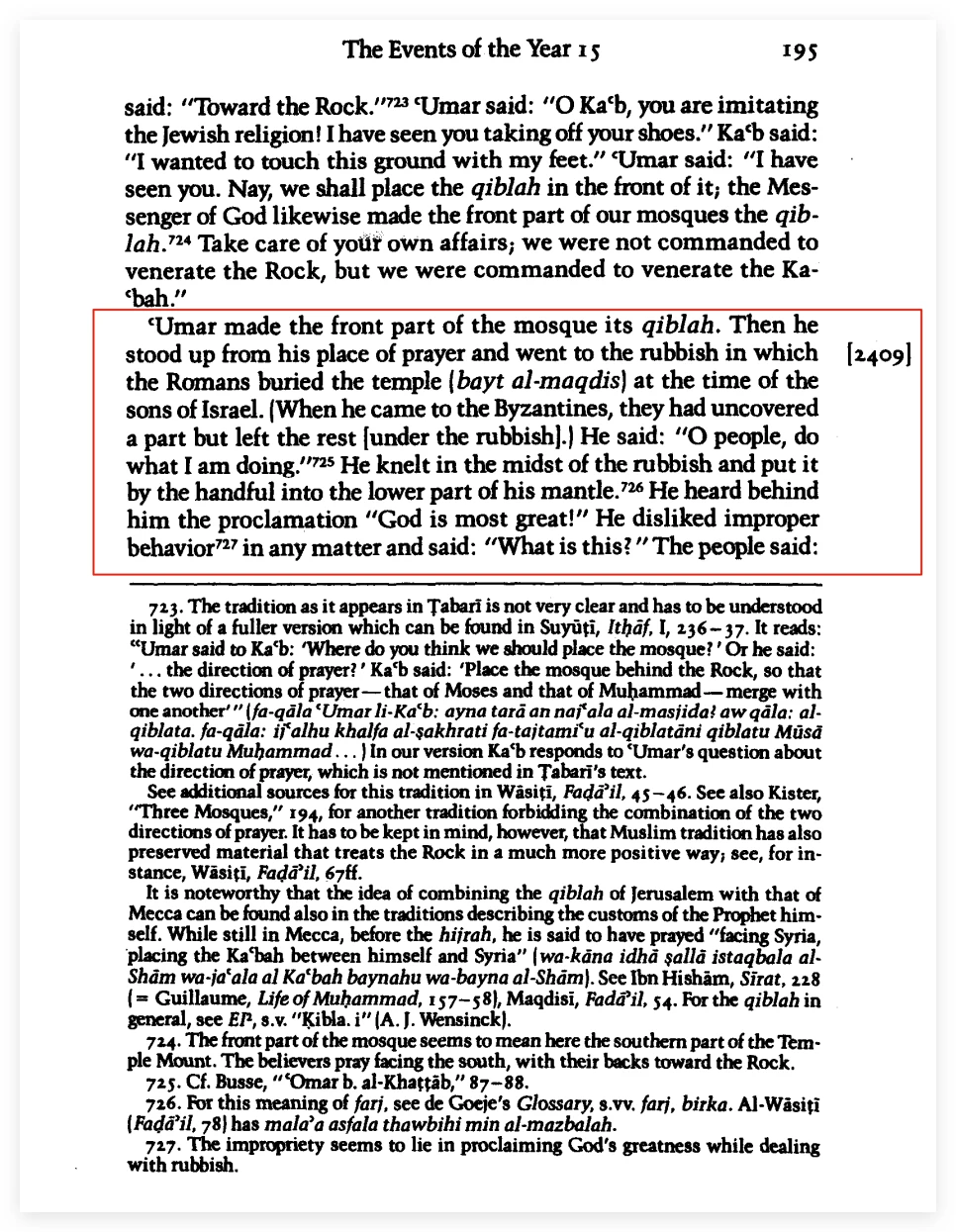
Let’s take a look at the history of Tabari:
Then he (Umar) stood up from his place of prayer and went to the rubbish in which the Romans buried the temple (bayt al-maqdis) at the time of the sons of Israel. (When he came to the Byzantines, they had uncovered a part but left the rest under the rubbish.) He said: ‘O people, do what I am doing.’ He knelt in the midst of the rubbish and put it by the handful into the lower part of his mantle.
Umar stood up from his place of prayer and went to the garbage in which the Romans buried Bayt al-Maqdis (temple). When he came to the Byzantines, they cleaned up a portion of it, but kept the rest under the trash.” “He said: ‘O people, do what I do.’ He knelt down in the middle of the trash and picked up the garbage in his fist and began to fill the bottom of his cloak.
Here the apologetic explanation usually wants to avoid the problem by saying “mosque means place of prostration”. But this answer of the Qur’an Although temporarily protecting the word hadith-Can’t protect the architectural imagination of Seerat. Because Buraq is tied, the Imamate of the Prophets, the fixed prayer place, the door or entry—these languages create the idea of an effective holy place. If the place was then actually abandoned, under non-Muslim rule, and was covered with garbage in Muslim sources, then the later Miraj-narration is not a simple history; Rather, it is more reasonable to read as an Islamic sacred geography built after the occupation of Jerusalem.
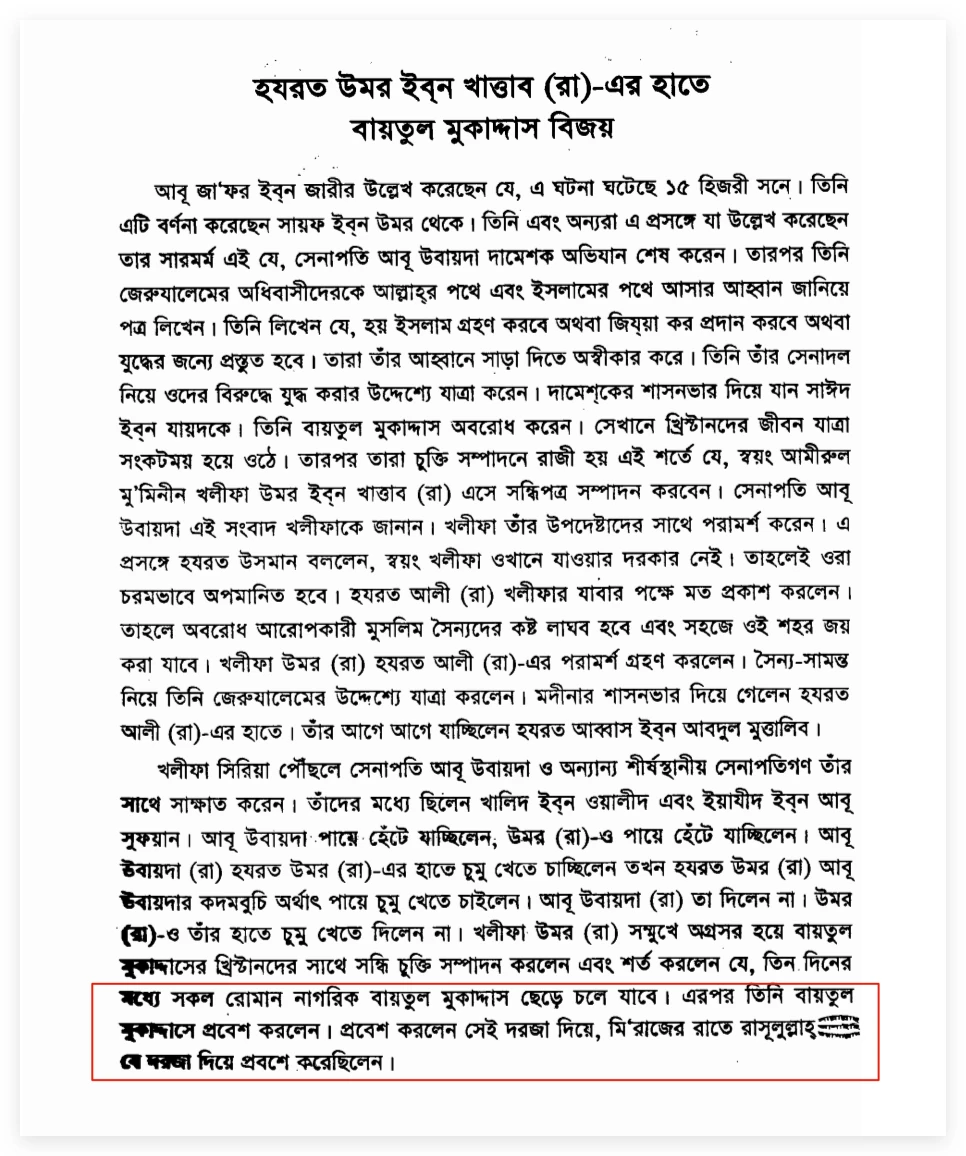
A fundamental question arises from this description of Tabari: If Caliph Umar himself went to the Temple Mount and cleaned the garbage in 637-638 AD, then the Prophet in 621 AD. Muhammad Which mosque did you enter there? If the place is still abandoned, covered in rubbish, under non-Muslim rule and without Islamic architecture, how can the specific mosque environment seen in the next Miraj-narrative be historical? Answers to this question are usually avoided in religious speeches; But the discussion of history cannot be avoided. Now let’s see from the book Al Bidaya One Nihaya, [22]
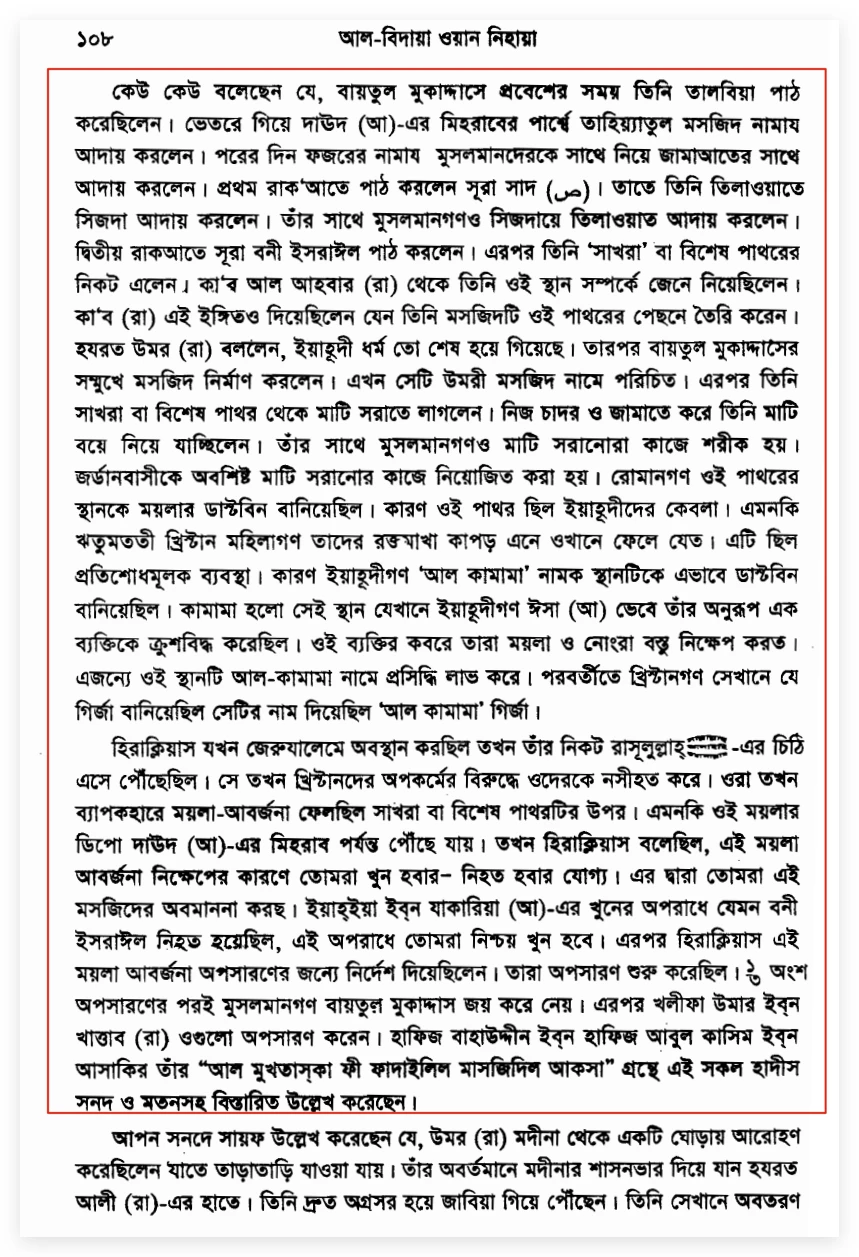
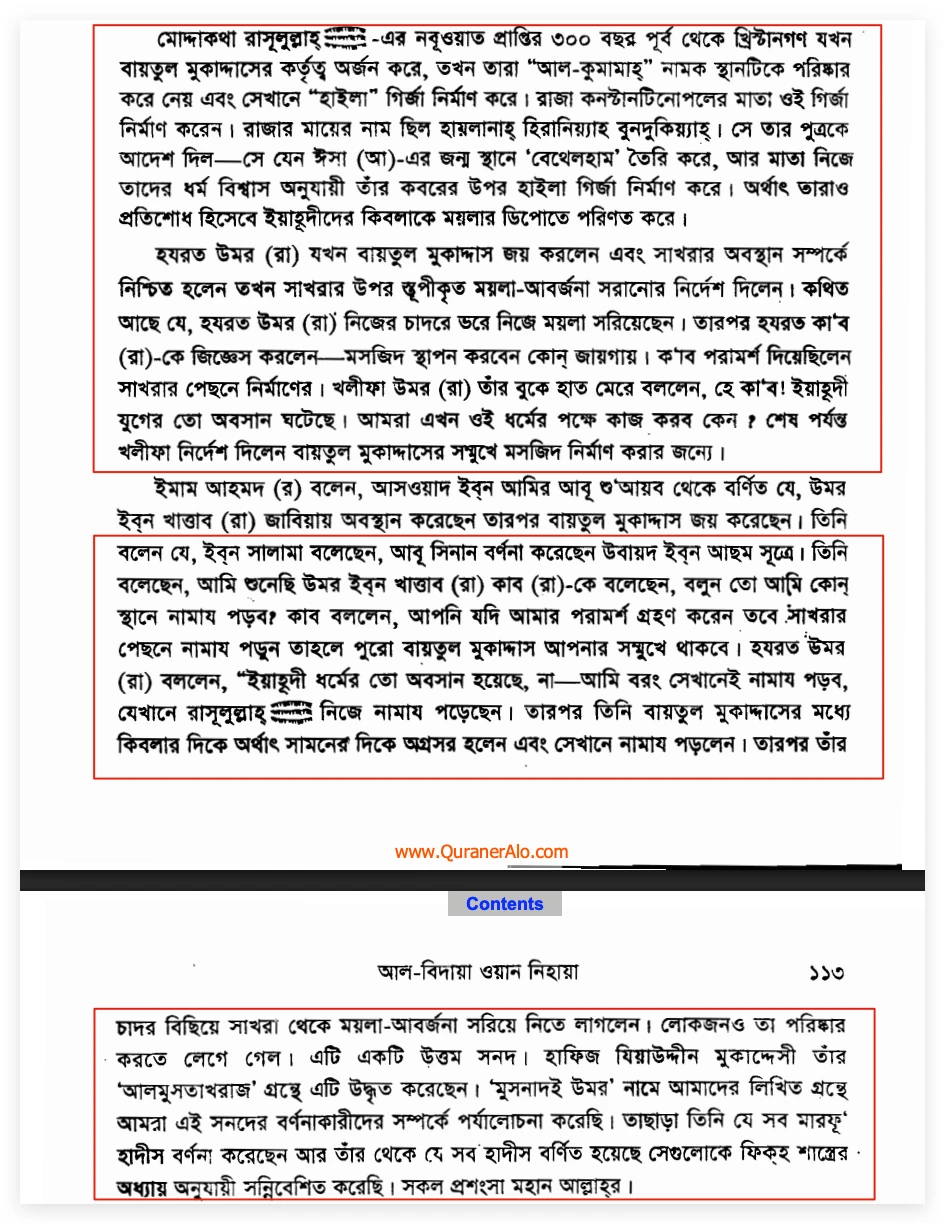
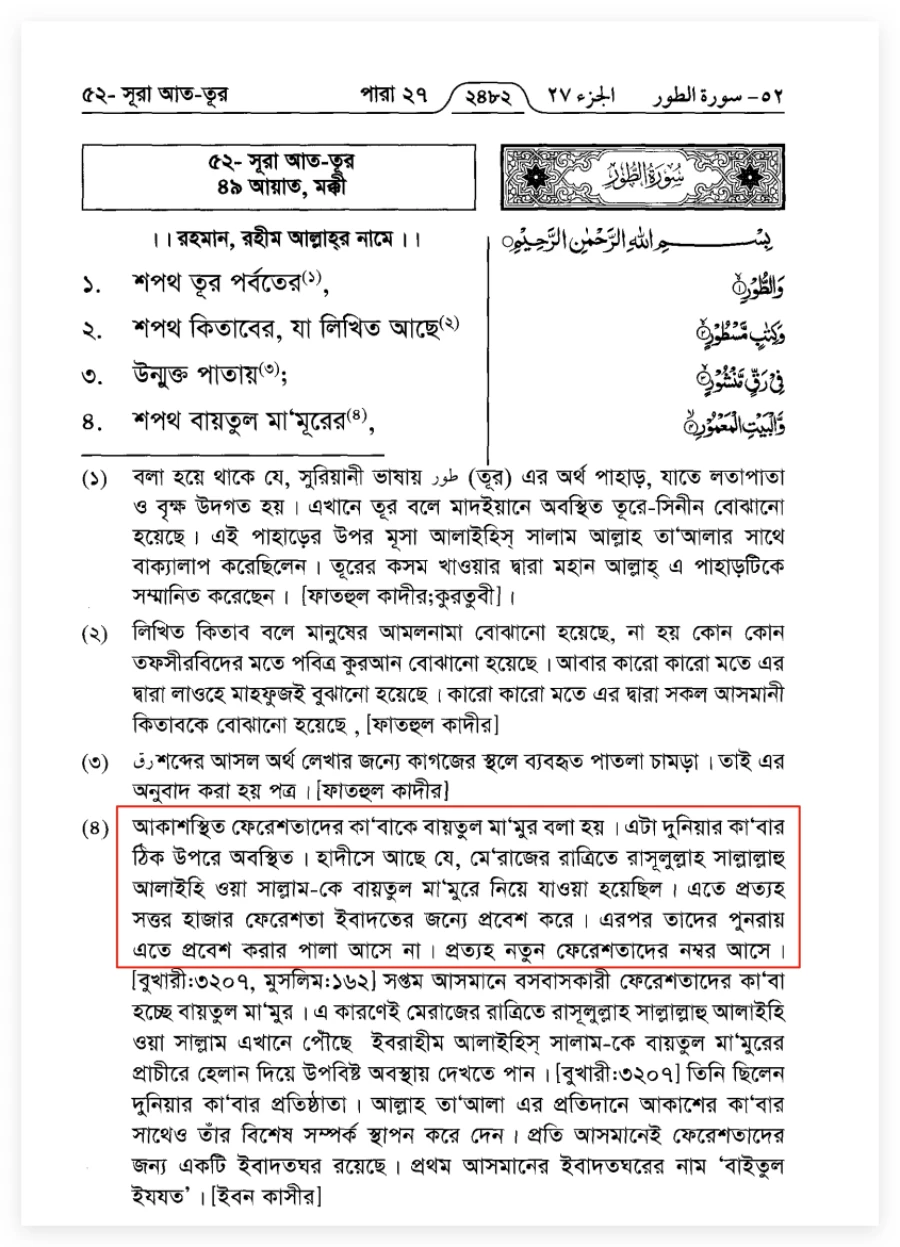
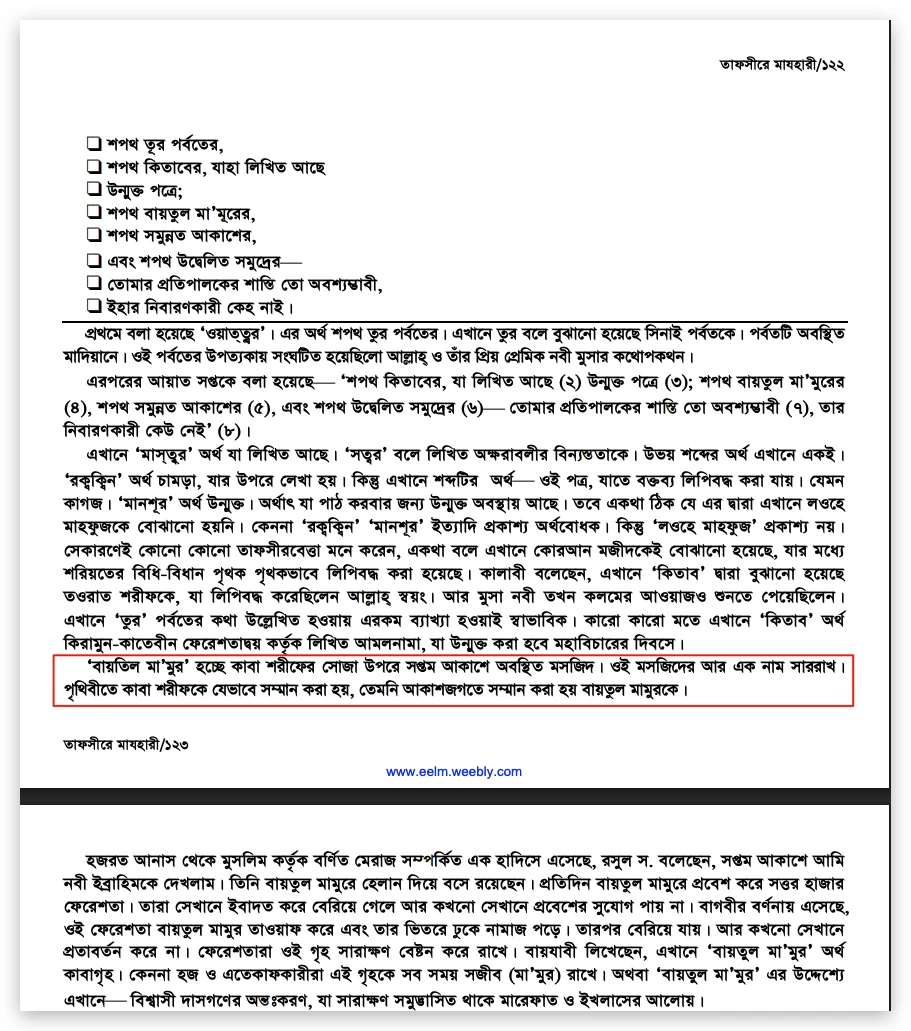
The victory of Bayt al-Maqdis at the hands of Hazrat Umar Ibn Khattab (RA) Abu Ja’far Ibn Jarir mentioned that this incident happened in 15 Hijri. He narrated it from Saif Ibn Umar. The gist of what he and others mentioned in this context is that Commander Abu Ubaydah completed the Damascus campaign. He then wrote a letter urging the inhabitants of Jerusalem to come to the path of Allah and to the path of Islam. He wrote that either he would accept Islam or Zia would pay taxes or be ready for war. They refused to respond to his call. He set out to fight against them with his army. He gave the rule of Damascus to Saeed Ibn Zayd. He besieged Bayt al-Maqdis. There the life of Christians became critical. Then they agreed to conclude the agreement on the condition that Amir al-Mu’minin Khalifa Umar Ibn Khattab (RA) himself would come and execute the treaty. General Abu Ubaydah told this news to the Khalifa. The Khalifa consulted his advisers. In this context, Hazrat Uthman said, there is no need to go there to the Caliph himself. Only then will they be extremely humiliated. Hazrat Ali (RA) expressed his opinion in favor of going to the Caliph. Then the suffering of the Muslim soldiers who impose the siege will be eased and the city can be conquered easily. Caliph Umar (RA) took the advice of Hazrat Ali (RA). He left for Jerusalem with his army and feudal lords. He handed over the administration of Madinah to Hazrat Ali (RA). Hazrat Abbas Ibn Abdul Muttalib was going before him. When the Caliph reached Syria, he was met by the commander Abu Ubaydah and other top commanders. Among them were Khalid Ibn Waleed and Yazid Ibn Abu Sufyan. Abu Ubaydah was walking; Umar (ra) was also walking. Abu Ubaydah (RA) wanted to kiss the hand of Hazrat Umar (RA) then Hazrat Umar (RA) wanted to kiss Abu Ubaydah Kadambuchi i.e. on his feet. Abu Ubaydah (RA) did not give it. Umar (Jh) did not let him kiss his hand. Caliph Umar (RA) advanced forward and made a treaty with the Christians of Bayt al-Maqdis and stipulated that all Roman citizens would leave Bayt al-Maqdis within three days. Then he entered Bayt al-Maqdis. He entered through the door, the door of Mi’raj through which the Messenger of Allah entered. Some say that he recited Talbiyah while entering Bayt al-Maqdis. He went inside and prayed Tahiyatul Mosque on the side of the mihrab of Dawood (a.s.). The next day he performed the Fajr prayer with the Muslims in congregation. Recited in the first rak’at Surah Saad (0). He performed prostration in recitation. Along with him, the Muslims also performed the recitation in Sijda. in the second rak’ah Surah Bani Israel recited. Then he came to ‘Sakhra’ or special stone. He learned about the place from Ka’b al-Ahbar (RA). Ka’b (RA) also indicated that he should build the mosque behind the stone. Hazrat Umar (RA) said, Judaism is over. Then he built a mosque in front of Bayt al-Maqdis. Now it is known as Umari Masjid. Then he started removing the soil from the sakhra or special stone. own cloak and He was carrying soil in the congregation. Along with him, Muslims also participated in the work of removing the soil. Jordanians are engaged in removing the remaining soil. The Romans made the stone dustbin a dustbin. Because that stone was the Qibla of the Jews. Even menstruating Christian women used to bring their blood-stained clothes and throw them there. It was a retaliatory system. Because the Jews made the place called ‘Al Qamama’ as dustbins. Kamama is the place where the Jews crucified a man similar to him thinking Jesus (as). They used to throw dirt and dirty things on that person’s grave. That is why the place became famous as Al-Kamama. The church that Christians later built there named it ‘Al Kamama’ church. When Heraclius was staying in Jerusalem, the Messenger of Allah came to him. He then admonished them against the misdeeds of the Christians. They were throwing garbage on the sakhra or special stone. Even the depot of that garbage reached Dawood’s mihrab. Then Heraclius said, you are worth being killed and killed because of this garbage throw. By this you are insulting this mosque. You will surely be killed for this crime as Bani Israel was killed for the murder of Yahya Ibn Zakariya (a.s.). Heraclius then ordered the removal of this garbage. They started removing. After the removal of 1 part, the Muslims conquered Bayt al-Maqdis. Then Caliph Umar Ibn Khattab (RA) removed them. Hafiz Bahauddin Ibn Hafiz Abul Qasim Ibn Asakir his “Al Mukhtaska Fi Fadailil In the book “Masjidil Aqsa” he mentioned all these hadiths in detail along with the chain of transmission and opinion. In his Sanad, Saif mentions that Umar (RA) was riding a horse from Madinah so that he could go early. In his absence, he handed over the administration of Madinah to Hazrat Ali (RA). He quickly advanced and reached Zabia. he landed there In fact, 300 years before the prophethood of the Prophet, when the Christians gained the authority of Bayt al-Maqdis, they cleaned the place called “Al-Kumamah” and built the “Haila” church there. King Constantinople’s mother built the church. The king’s mother’s name was Haylanah Hiraniyah Bundukiyah. He ordered his son to make ‘Bethleham’ at the birth place of Jesus (as), and the mother herself built a Hayla church on her grave according to their religious beliefs. That is, they also turned the Qibla of the Jews into a depot of dirt in revenge. When Hazrat Umar (RA) conquered Bayt al-Maqdis and was sure about the position of Sakhra, he ordered to remove the garbage stacked on the Sakhra. It is said that Hazrat Umar (RA) filled his own cloak and removed the dirt himself. Then he asked Hazrat Ka’b (RA) – where to establish the mosque. The poet suggested the construction behind Sakhra. Caliph Umar (RA) put his hand on his chest and said, O Ka’b! The Jewish era has come to an end. Why do we work for that religion now? Finally, the Caliph ordered to build a mosque in front of Bayt al-Maqdis. Imam Ahmad (RA) said, Aswad Ibn Amir Abu Gu’ayb narrated that Umar Ibn Khattab (RA) stayed in Zabiyyah and then conquered Bayt al-Maqdis. He said that Ibn Salama said, Abu Sinan narrated on the authority of Ubayd Ibn Acham. He said, I heard Umar Ibn Khattab (RA) said to Ka’b (RA), tell me where I will pray? Ka’b said, if you take my advice but pray behind Sakhra, then the whole Bayt al-Maqdis will be in front of you. Hazrat Umar (RA) said, “Judges are over, no – I will rather pray there, where the Prophet himself prayed, then he moved towards the Qiblah, i.e. in Bait al-Muqaddas, and prayed there. Then he spread his cloak. He started to remove the garbage from the people. a good certificate. Hafiz Ziyauddin Muqaddesi quotes this in his book ‘Almustakraj’. We have reviewed the narrators of this charter in our book called ‘Musnadai Umar’. Moreover, I have included all the Marfu’ hadiths that he narrated and all the hadiths narrated from him according to the chapter of Fiqh. All praise be to Allah the Most High.
Ibn Kasir’s narration also clarifies the same problem. It is said that after the conquest of Umar Jerusalem, remove the garbage from the place of Sakhra or stone; The Romans turned it into a dustbin; Even menstruating women were thrown there. If this description is accepted, then the common of Miraj hadith-Sirratian narration becomes weaker. Because Muslim historical sources admit that even after the death of the Prophet, the place was not a clean mosque; Rather, after the Muslim conquest, it was transformed into a new sacred geography through political-religious recapture and refinement.
Here there are generally two types of apologetic or protective interpretations. First explanation: “Mosque” does not mean a place of prostration, but a place of prostration. Second Explanation: “Al-Aqsa” does not mean the present mosque, but the entire Temple Mount or Bayt al-Maqdis region. But none of these two explanations completely solve the problem. Reason of the Qur’an Even if the words are flexible hadith-The real architectural scene created in the description of the Seerat—the door, the place of the dam, the combined prayer of the prophets, the specific mosque-space—contend with the historical reality of the time. As a result, the protective interpretations are only of the Qur’an May protect some of the vague sentences; But not the full structure of the next Miraj-Purana.
The Duality of the Word Mosque: Place of Prostration or Architecture?
The apologetic explanation usually says that “mosque” means not a brick-and-stone building but a place of prostration. This makes the Qur’anic wording somewhat more flexible, but it cannot preserve the later architectural details found in hadith and sira. The accounts do not describe merely a distant sacred place; they describe tethering Buraq, entering a mosque, performing two rak‘ahs, leading the prophets in prayer, and passing through specific doors. If masjid means only a place of prostration, the architectural reality of the later description becomes questionable. If it refers to a fixed structure, that structure conflicts with the historical conditions of Jerusalem during the Prophet’s lifetime.
Who Built Today’s Al-Aqsa?
The golden domes of the Dome of the Rock or the Al-Aqsa Mosque that can be seen in today’s Jerusalem are not the buildings of the Prophet Muhammad. They were built during the Umayyad period. Especially the khalifa Abdul Malik Ibn Marwan and his heirs Al-WalidDuring the reign of the 7th century to the beginning of the 8th century, large Islamic architecture began in Jerusalem. [23]।
This is a very strong temporal objection against the historicity of Miraj. Because the architecture that was built many years after the death of Prophet Muhammad, it is a sign that the history of the Prophet’s lifelong travelogue is the specific destination of the history. Historical methods do not prove the truth of the previous events with the subsequent installation. Rather, the more reasonable explanation is that after Jerusalem became increasingly important in Muslim political fantasy and religious geography, the story of Miraj was used as the theological basis of that purity.
The problem is therefore not merely whether a mosque existed. It is deeper. A religious story acquires new meaning when it is linked, in later centuries, to political, architectural, and pilgrimage realities. That later meaning is then projected backward and presented as though it had existed from the beginning. In historical analysis, this method is called retrojection: placing a later concept in the past. This is precisely what can be seen in the al-Aqsa narrative of the Miraj.
ie, of the Qur’an From the obscure “distant mosques” to the later hadiths, the Buraq-bound structure, then the Umayyad architecture, then the current Al-Aqsa identity—this whole process is not a simple historical line. Rather, it is a collective result of religious memorials, political needs, the construction of sacred geography and imperial architecture. If you understand this process, Miraj’s story no longer seems to be an unbiased history; Rather, it can be understood as a mutual construction of power and faith.
In this context it is not reasonable to use the Jerusalem part of Miraj as a miracle proof. Rather, it contains serious temporal inconsistencies: the structure that was built later, has been actively placed in the events of the previous life; The place which was covered with garbage even during the Muslim conquest was imagined as an effective mosque during the time of the Prophet; And the sacred geography that was built during the Muslim imperial era has been established as the inevitable reality of early seventh-century spiritual travel.
Al-Aqsa / Temple Mount – Historic Timeline
From the ruined Jewish temple to the pile of rubbish of the Romans, the construction of the mosque during the reign of Umar and later the construction of the mosque—the essence of the original turning points.
Temple Destruction / Occupation
Abandoned / Pile of garbage
Mosque / Islamic buildings
Political occupation and conversion
586 BC (approx.)
Destroying First Temple
Babylonian King Nebuchad Nasr captured Jerusalem Solomon’s Temple destroyed The Temple Mount became a complete debris for the first time.
70 AD
Second temple destroyed
Roman General Titus suppresses the Jewish rebellion Second Temple destroyed Temple Mount is once again filled with rubble and burnt infrastructure.
2nd-6th century AD
Abandoned / Pile of garbage
In the Roman and later Byzantine periods, this area was not a religious center but rather a partial ruin, partly littered place is used as. Narrated in Islamic sources (Tabari etc.) – The Romans buried Bayt al-Maqdis under the garbage.
637 AD / 15 Hijri
Umar’s arrival and clear
Caliph Umar Ibn Khattab after the occupation of Jerusalem Al-Masjid area When you enter, you will see that the whole place is covered with garbage. He himself took part in cleaning the garbage on his knees and set up a simple structure prayer hall on the south side.
691–692 AD (approx.)
Dome of the Rock
Umayyad Caliph Abdul Malik Ibn Marwan Huge dome structures on rocks in the middle of the Temple Mount Kubbatus Sakhra (Dome of the Rock) built This is the current golden dome building.
About 705 AD
Great Mosque of Aqsa
Abdul Malik’s son Khalifa Al-Walid Ibn Abdul Malik At the southern end, the predecessor of today’s “Masjid al-Aqsa” building was built and expanded by the large Jameya Mosque. There were none of these buildings during the Prophet’s time.
1099–1187 AD
Crusade & Recovery
When the Crusaders capture Jerusalem, the Al-Aqsa building is the palace and Knights TemplarThe headquarters are made. Salahuddin Ayyubi recaptured the city in 1187 and converted the structure back into a mosque.
the next centuries
renovation and renovation
The Al-Aqsa Complex has been renovated, renovated and beautified many times after the damage of earthquakes and wars in the Mamluk, Ottoman and modern times. The current structure is the result of the architectural changes of different eras.
Note: Some years are estimated (≈) and are based on the common opinion of historians. The main focus is to show continuity—first Jewish temples, then long rubbish and garbage piles, and finally the emergence of the current Islamic structures during the Umayyad period.
From this timeline the logic is more clear. The destruction of the second temple in 70 AD, followed by long Roman-Byzantine neglect and trash, the arrival and cleansing of Umar in 637-638 AD, then the construction of the Dome of the Rock and Al-Aqsa during the Umayyad period – this continuation is not consistent with the conventional description of the Miraj. During the Prophet’s lifetime, there was Al-Aqsa Mosque in the present sense – this claim does not match the course of history.
This is why the Al-Aqsa part of Miraj is historically weak, textually complex, and can be explained in terms of religious memoir-making. If one reads it as merely a symbolic or dream-experience, the intensity of historical objection is reduced. But if it is claimed that it is a real, physical, geographical and architecturally specific phenomenon—then that claim does not survive. Because the evidence says that there was no mosque reality in Jerusalem during the Prophet’s time; There was a ruined temple site, Byzantine neglect, and a political-religious territory awaiting the subsequent Muslim recapture.
Scientific Analysis of the Miraj: In the Light of Physics and Astronomy
Science is present here as a judge according to the nature of the demands of religion. If someone says “I went to the sky in a dream”, science will not test him as a space traveler. But if someone says “a man has left the earth in his body and crossed many heavens”, then the question will come: at what speed? What power? Through what? How does the body tick? How was stress, oxygen, radiation, temperature handled in space? How did space time pass? These questions are not anti-religious; The logical consequence of the claim.
If the description of Miraj is read only as a dream, spiritual experience, mystical philosophy or symbolic religious commentary, then it is mainly a matter of psychology, literary and religious fantasy. But in conventional Islamic theology, Miraj is often presented as a real, physical, spatial and cosmic travel. According to the hadith, the Prophet Muhammad traveled one night; he went from Makkah to Jerusalem, from there crossed the seven heavens, met with the previous prophets, reached Sidrat al-Muntaha, went to the presence of Allah and finally returned to the earth. [24].
No matter how strong this claim sounds in religious emotions, scientific analysis breaks it down to a bunch of inter-dependant impossible demands: superhuman motion, protection of biomolecules in space, space-time distance crossing, meeting with dead people, invisible sky levels, and almost timeless return to Earth. None of these survive by the standard of common evidence; If they are caught all together, the claim is in direct conflict with natural science. Because here is not only about “spiritual improvement” or “godly inspiration”; Here we are talking about travel, speed, distance, space, sky level, living body, meeting with the dead and returning to earth. That is, this claim involves the direct question of physics, astronomy, biology and geometry. So if this phenomenon is claimed to be a real space travel, it is tested under the laws of the real universe. must do
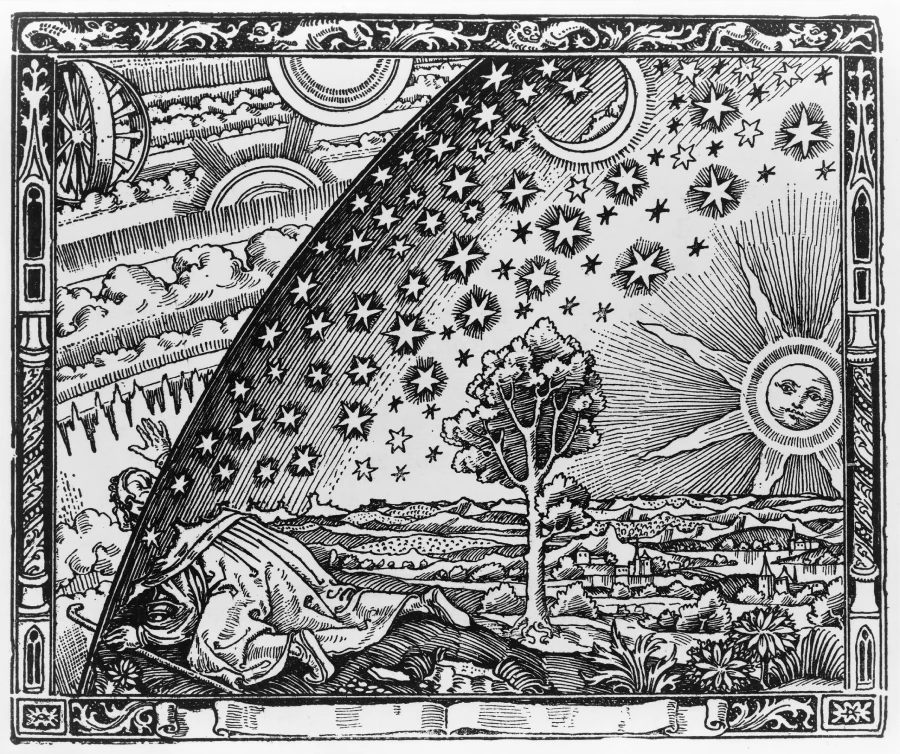
The problem is here. According to modern science, the universe is not an ancient layer based on the heavens, where there are doors, there are guards, each prophet is sitting at different levels, and at the highest level there is a spatial court. The universe is a complex reality of spacetime, galaxies, stars, planets, planets, dust, radiation, dark matter, dark energy and gravitational structures. In this reality, the claim that an organic human body, without any life support, exceeds the speed limit of light, can return in one night beyond the cosmic level – is in direct conflict with the established science.
Special Relativity and the Speed-of-Light Limit
Miraj’s narration claims that the Prophet Muhammad He crossed from Mecca to Jerusalem in a very short time and from there many layers of the sky. The land distance from Mecca to Jerusalem is itself a long journey into seventh-century Arab reality; But the cosmic part of Miraj exacerbates this problem to an infinite extent. It takes about 4.37 years for the speed of light to reach the nearest constellation Alpha Century from Earth. And the radius of the visible universe is approximately 46.5 billion light years. So if the “seven sky” refers to a real cosmic layer or the upper region of the universe, then to travel there in one night one has to assume a speed of many times more than the speed of light.
In modern physics this claim is a fundamental problem. Albert Einstein in 1905 Special Theory of Relativity showed that an object with a mass cannot achieve the speed of light. The closer an object gets to the speed of light, the more energy is needed to accelerate it; When light reaches the speed of light, the required energy is infinite [25]the If humans, animals, boraks, or any material vehicles—all are masses, it is impossible for them to achieve or exceed the speed of light within the current structure of physics.
Here, saying “Borak is a miracle vehicle” is actually a declaration of closing the door of reason. This is not an explanation; This is a special exemption in the interpretation. Science doesn’t give a claim outside of physics as a claim “has a religious character”. If Borak is a material vehicle, then its mass, speed, acceleration, energy, path and passenger’s body will need an explanation. And if there is no explanation for them, then it is not science – mythology. But this answer is not a scientific explanation; This is to put the miracle in the place of interpretation. Saying “miracles” does not solve the problem of physics; Rather then it has to be admitted that the claim is not subject to the rules of natural science, not testable, not verifiable. In that case, calling Miraj a real space travel becomes a linguistic deception. Because the word “real” is being used, but the rules of reality immediately invalid being done it is the same Also wants to take advantage of history, science and miracle—but not to take responsibility for the proof of any field. In order to make a scientific claim, the material model, energy source, speed, acceleration, body protection, space-time path and return process must be explained. There is no effective scientific explanation of these in Miraj’s description.
Many people try to explain Miraj by bringing some popular ideas of modern science, such as wormholes, Einstein-Rosen’s bridge, or space-time folds. But these are mainly complex mathematical models of theoretical physics, not proven space travel methods. Moreover, there is no real solution to whether the exotic matter is needed to keep a wormhole stable, whether the biochemical can remain intact, where the entry and exit will take place, how the spatial stability will be maintained. So calling the Miraj scientific by pronouncing the name of the wormhole is only the use of science-word ornaments; This is not a scientific explanation.
Therefore, if Buraq is an animal, it is subject to the laws of biology; if it is a material vehicle, it is subject to the laws of physics; and if it is neither, it is not a vehicle for actual travel but a mythological figure. To accept the Miraj as bodily space travel, one would first have to violate the speed limit established by special relativity. But before discarding established physics for a religious account, one would need an extraordinary level of independent evidence. That evidence is absent.
Internal Inconsistencies in Time Dilation, Return, and Description
Let’s say the prophet for the sake of debate Muhammad Somehow he traveled at a speed near the speed of light. Yet the problem does not end; Rather, new problems begin. A well-known result of special relativity is Time dilation (Time dilation)… The time of an observer traveling at high speed is passed differently than the time of the observer on Earth. This idea is in physics Twin Paradox known as [26].
If one returns to Earth after crossing the cosmic distance, the traveler’s own time and Earth’s time will not be the same. Especially if he moves near the speed of light, he may seem to have a little time in the world, but much more time can pass in the frame of the earth. As a result, the idea of “traveling the universe back in one night” creates not only speed-problems but also time-problems.
But in the conventional Miraj-narrative, it is said that the Prophet came back and saw that the bed was still warm, or the water of ablution was still rolling – that is, almost no time has passed on earth. Such descriptions do not match the scientific time-system. If the entire universe is stopped during, it is no longer a travel; Rather, all matter, energy, speed, thermodynamics and cause-care relationships are demanded to be suspended. And if Earth’s time is normal, then the relative time difference must be explained in the case of cosmic travelers. There is no coherent solution to these two problems in Miraj’s description.
Here again, one may invoke a “miracle.” But that answer returns us to the same problem. If Allah stopped time, compressed the distance, protected the body, nullified the speed-of-light limit, and suspended all the laws of space, then the event is no longer a scientific matter. It becomes an untestable belief. It is logically inconsistent to present an untestable belief as a scientific or historical fact.
The Space Environment and the Biological Limits of the Human Body
Taking Miraj as a physical journey comes another basic question: How did the human body survive in space? The description does not show the Prophet with any spacesuit, pressure-controlled vehicles, oxygen supply, radiation protection, temperature control or life support systems. He has crossed the atmosphere with an ordinary human body and ascended into the sky – such an idea is based on conventional religious fiction. But according to modern aerospace medicine it is impossible for the human body to survive in such an environment.
Armstrong line is crossed by an estimated 19 km above sea level. Atmospheric pressure in this area is so low that the fluid in the human body can start boiling at normal temperatures; This condition is called ebulism. [27]the Added to this are oxygen deficiency, intense radiation, low pressure, temperature fluctuations and the effects of vacuum. So it is scientifically impossible to travel to space with the human body without any protection.
Hypoxia: Due to lack of oxygen, the brain loses function in a very short time. Awareness, nervous system and body control are quickly broken down.
Low Pressure and Ibulism: When the pressure decreases, the normal state of body fluids is lost. Eyes, lungs, blood circulation and nervous system are at serious risk.
Cosmic Radiation: Van Allen radiation belts, solar radiation and high-energy particles can damage DNA without any protection.
Temperature and heat exchange: There is a huge difference in temperature between direct sunlight and shadow in space. Without pressure-controlled protection, the biometry cannot maintain a stable temperature.
These limitations are not an “atheist objection”; These are the biological realities of the human body. The human body has evolved into Earth’s atmosphere, pressure, temperature, oxygen and magnetic protection. If these conditions are removed, the body quickly becomes ineffective. As a result, a person’s physical going into space, crossing levels and coming back alive without any life support system is unrealistic in the light of biology and aerospace medicine.
The religious answer is the same here: “Allah protected him.” But this is not a scientific answer. Science seeks causal relationships, observable processes, and testable models. The claim that an invisible power temporarily suspended every relevant law is a statement of faith, not a scientific explanation. The Miraj therefore cannot be used as scientific proof. At most, it may be regarded as a matter of faith for the believer; if it is claimed as actual space travel, however, it conflicts with the limits of the human body.
“Seven Heavens” versus Modern Cosmology
The description of the Miraj is represented in the description of the universe as if it is an upward architecture of layers: the first heaven, the second heaven, the third heaven—that is the seventh heaven, the door, guard, questioning, questioning, permission and the position of a separate sacred figure. It is said in the hadith that when upon reaching the first heaven, Gabriel asked to open the door, the guard asked – who came, who is with him, whether he was called or not or not [28]the This description is not compatible with modern astronomy; It is an ancient earth-centered, layer-based, royal court-style cosmology language. Here the universe is imagined not as the reality of physics, but as an administrative building—there are doors, there are guards, there are permissions, there is a center of power at the upper level.
In many ancient civilizations, the universe was imagined as a layered sky. The Earth is down, on top of that, a layered universe like the moon, the sun, the planets, the constellations, then the devaloka or the godly kingdom—a layered universe of imagination is very common in religious literature. Such architectural astronauts can be seen in Ptolemaic astronomy and medieval religious universes. Miraj’s seven heavens, doors, guards and layers of uplift are deeply in harmony with the language of the ancient fantasy world.
In modern cosmology the universe is not a building where there are different doors in each layer. The universe is a space-time continuum. Stars, galaxies, galaxy clusters, nebula, black holes, cosmic microwave backgrounds—these observable astronomical reality; But nowhere is there any evidence of the seven solid heavens, the gateway, the guard angels, or the layered administrative sky. The spacecraft has gone to Earth’s orbit, humans have gone to the moon, robots have gone to Mars, various probes have crossed the edge of the solar system; But none of the observations found heavenly doors or layered heavenly architecture.
For this reason the concept of “sat heaven” is inconsistent with modern cosmology when read literally. And if it is said that the seven heavens are not material, but metaphysical or invisible layers – then again it becomes difficult to call Miraj a physical space travel. Because physical travel means migration with the body; Transition with the body means the question of space, distance, direction, speed and environment. But the idea of physically traveling to the invisible, non-spatial, metaphysical level is inconsistent in itself.
In a European woodcut in 1475, the Earth’s continuation of angels and creators, including the moon, the sun and the planets, centered around the earth. In such a model, the outermost part was imagined a firm or sky-high, on the other side of which is heaven.
According to the above kind of historical space, the sky was a visible dome or stratified world for ancient people. They had the earth at the center; The sky was above; God was higher. In this thought, “to rise” means to go to God. But in modern science “above” is not a cosmic religious aspect; This is simply a local reference to the Earth’s surface. The direction that is “above” in one region of the earth is pointed in a completely different direction. So the concept of “ascending towards Allah” is also the language of the geocentric world, not the language of the modern universe.
The question is so appropriate: Where is the door to the first heaven? At the end of Earth’s atmosphere? the moon’s orbit? After Mars? outside the solar system? Or at the border of the galaxy? If this door is real, it should have its location, nature, physical properties and observability. And if it is not observable, not spatial, not materialistic—then Miraj’s physical travelogue makes more sense only as a symbolic or dreamy experience. But then it cannot be called a real space travel.
Meeting Dead Prophets: History, Biology, and Mythology
In the Miraj narrative, Muhammad is said to have met and conversed with earlier prophets, including Adam, Yahya, Jesus, Moses, and Abraham. [29] This may seem normal from the perspective of religious belief, but from a material and practical perspective it creates another serious problem. The body of a deceased person decomposes after death; when brain function ceases, the known biological basis of personal consciousness also ends. There is no testable scientific evidence that, after death, a person’s conscious self remains somewhere, speaks, exchanges greetings, or gives advice about prayer.
The main question here is the proof. One can believe in the position of the Prophets in the soul, the afterlife, the blessings, Paradise or the sky; But personal belief cannot be called a proof of reality. If it is claimed that many centuries or millennia ago, the dead were actually in a sky level and had a conversation with the Prophet Muhammad, then independent evidence is needed for that claim. If the internal description of the hadith itself is the only source of that claim, it becomes a circular argument: “The fact is true, because it is in the hadith; hadith True, because the event is the miracle of the Prophet.” Thus history or science is not established.
Especially the description of the first meeting with Adam in the sky is problematic in cosmological and anthropological terms. If Adam is regarded as the first man of real historical, problems arise with modern biology and evolutionary human science. And if he is considered a symbolic father of human beings, then the real encounter with him in the sky cannot be taken literally. Again Jesus is in the living heaven, Moses is dead but talking in the sky, Abraham in the seventh heaven – these descriptions create a kind of religious theater, which is meaningful in the structure of ancient narratives but not compatible with scientific reality.
The famous principle of Carl Sagan is relevant here. Extraordinary claims have to be given extraordinary evidence. Meeting the dead in the sky, traveling to the level of the universe, going to God’s court—these are not common claims; These are claims to change the basic structure of reality. So they are not established only by religious beliefs, subsequent narrations or devotional literature.
The Language of the Prophets: Problems of Dialogue in the Sky
Another fundamental problem in Miraj’s description is the question of language. Prophet Muhammad It is narrated in the hadith that Adam, Moses, Jesus, Abraham, Aaron, Idris, Yahya – met the prophets of different eras, regions and languages in the sky. But these meetings are presented in such a way that everyone is speaking in the Arabian religious language, the Arabian salam, the Arabian honorary phrase and the structure of the Arabian prophet-dialogue. There is no question of linguistic distance, historical context, cultural differences or translation in this conversation of heaven. It is as if all the prophets of all ages are the characters of Arabian theology from the beginning.
This is not a simple linguistic problem; It unveils the construction method of the narrative. Moses is the character of the Hebrew tradition, Jesus is the people of the Aramaic speaking region, Abraham is the patriarchal character of the ancient Semitic sphere, Aaron and Yahya are also associated with different languages and historical cultures. And Adam does not stand as the first man in the light of modern biology, evolutionary human science and anthropology. Yet all these characters are presented in Miraj’s Heaveni Theater as if they are speaking in a single Arabian religious language conveniently to understand the audience of Arabia.
In the dialogues of the hadith, everyone gives the same religious recognition: “Welcome”, “Nek Nabi”, “Nek Bhai”, “Nek Children”—sentences like this. Musa again stood in the role of a bargain advisor with the number of prayers. In this presentation the previous prophets do not have their own historicity; All of them became Heaveni characters arranged to recognize Muhammad’s prophethood. That is, the work of the narrative is not the preservation of the linguistic and cultural diversity of history; The task is to establish Muhammad as the legitimate heirs of all previous prophets before the Arab audience.
A question of language would have been inevitable if there was a real inter-age meeting. What language did Adam speak? Did Moses speak in Hebrew, Isa is in Aramaic, is Abraham in an ancient Semitic language? How did Muhammad you understand them? Was Gabriel a translator? Hadith narrations do not answer these questions. Because these are not reports of real linguistic interviews; These are religious dramas, where all the characters have been set on the stage of Arabian prophetic politics by erasing the reality of the language.
This Arabicization is very important. When the religious narrative brings the characters of another age, another language, another geography to a central Arabian prophet-theatre, it is understood that this is not a document of the real conversation in the sky; It is a staging of Arab religious fantasy. The earlier prophets were not kept here as independent historical characters; They have been used as witnesses to validate Muhammad’s religious authority.
As a result, this dialogue-episode of Miraj becomes more clear as a story of religious power-building than historical events. By placing the previous prophets in the sky layers, recognizing Muhammad with their mouths, and making Moses the mentor of prayer-bargaining—these are much more similar to the religious drama structures created for the Arab audience than the real cosmic experiences. Here, not the sky, but the stage of Arabian religious imagination is the real scenario.
How Did People Come to Heaven and Hell Before the Day of Judgment?
Another serious temporal inconsistency in the Miraj narrative is the claim that Muhammad saw people in Paradise and Hell. In some accounts he sees the punishment of sinners, including adulterers, usurers, liars, and those who abandon the Qur’an; elsewhere, the dwelling places of ordinary believers and martyrs are mentioned. But according to Islamic eschatology, the Day of Judgment has not yet occurred, humanity has not yet been resurrected, and the final accounting, weighing of deeds, record of deeds, judgment, and verdict have not yet taken place. How, then, could people have entered Paradise and Hell before the trial was complete?
This question puts a knife in the center of the narrative. If people continue to be punished in Hell before the Day of Judgment, the judgment of the Hour becomes dramatically unnecessary. And if it is said that these were shown in the future scene, then the description “see”, “there are adulterers”, “they are usurers”, “it is the abode of the common believers”, “it is the abode of the martyrs” – the language of this practical presence is problematic. If it is a future scenario, it is not a direct real travel; prophetic philosophy. And if there is a real presence, then the trial has come into effect before the Day of Judgment.
Here the apologetic interpretation is usually “baryakh”, “the world of the soul”, “Allah has shown the future”, or “the scene of the hereafter is shown in advance” – wants to escape in this way. But these interpretations do not save the narrative; Rather, it reveals the problem more. Because Baryakh is not the final state of heaven and hell; Future-philosophy is not a real body travel; And if the punishment is shown in advance, the final trial becomes a pre-arranged drama. Then people’s judgment, deeds, testimony, mizan—all are practically the next formalities.
The problem is severe even if it looks from within theology. If Allah already knows who will go to Paradise, who will go to Hell, and Miraj shows the result to the Prophet, then where does the moral test of human life stand? What is the need for Judgment Day if the verdict is implemented before the Day of Judgment? And if the Day of Judgment is really a deciding event of the future, then the demand to see people in Paradise and Hell in Miraj is broken in time.
As a result, Miraj’s Paradise-Hell philosophy does not stand as a literal history. It is a well-known theater of ancient afterlife literature: showing terrible punishment for sinners, showing rewards to the righteous, then creating a moral fear of controlling society. It does not match the actual jurisdiction; It serves perfectly as a narrative of the creation of religious fears.
The Sound of the Living Bilal’s Footsteps in Paradise: The Problem of Rewards Before Judgment
Miraj-associated Paradise-Hellumed vision problems are made more naked by a sahih hadith… It is said that the Prophet Muhammad asked Bilal during Fajr, what he did after accepting Islam, because of which the Prophet heard the sound of Bilal’s shoes in front of himself in Paradise. Bilal replied that whenever he performed ablution, he would perform voluntary prayer according to his ability. The hadith is narrated in Bukhari and Muslim; Mishkat al-Masabih also came in the voluntary prayer chapter. [30]
Mishkat al-Masabih (Mishkat) Part 4: Prayer Section: 39. First paragraph—voluntary prayer All kinds of nafl prayers that are established from the Prophet (peace be upon him) include the prayer after ablution, Salat al-Istikhara, the prayer of repentance, Salat al-Hajah and Salat al-Tasbih. التَّطَوُّعِ term الطوع، والطاعة The meaning taken from the word is to obey, implement, accept, etc. التَّطَوُّعِ The word is mutlaq (talaq) on all nafls except fard and wajib (this word applies to all nafls) and whoever performs extra ‘amlus salih or good deeds on the obligatory or wajib (also).مُتَطَوِّعِ) is called. 1322-[1] Narrated Abu Huraira (may Allah be pleased with him): At the time of the Fajr prayer the Prophet (ﷺ) asked Bilal, “Tell me of the best deed you did after embracing Islam, for I heard your footsteps in front of me in Paradise.” Bilal replied, “I did not do anything worth mentioning except that whenever I performed ablution during the day or night, I prayed after that ablution as much as was written for me.” (Bukhari, Muslim)[1] [Canonical Sunnah.com equivalents: Sahih al-Bukhari 1149; Sahih Muslim 2458.] [1] Sahih: Bukhari 1149, Muslim 2458, Irwa 464, Sahih at Targheeb 226, Ahmad 8403, Ibn Khuzaymah 1208. Hadith grading: sahih (Sahih) Narrator: Abu Huraira
The theological problems of this hadith are very clear. Bilal was alive then. He is not dead yet. Doomsday did not take place. No resurrection. The record is not given. Mizan was not established. There was no final judgment before Allah. So how was the sound of the living Bilal’s shoes heard in Paradise?
According to the Islamic Akhirat theory, people take the test in the world, they are blessed after death, then on the Day of Resurrection, judgment is done, then the final outcome of Paradise or Hell is determined. But in this hadith, Bilal is being associated with the real presence of Paradise before the trial process is effective. This is not just a story of an emotional virtue; It clashes with the temporal structure of the Akhirat-theory.
If it is said that Bilal will go to Paradise in the future – then the Prophet’s sentence “I heard the sound of your shoes in Paradise” becomes not the language of real Paradise-philosophies, but the language of the future-philosophies or symbolic scenes. But then it cannot be called a real paradise-experience. And if it is said that the Prophet has really heard the sound of Bilal’s shoes in Paradise, then before the Day of Judgment, the paradise of a living person has been implemented. It becomes the next official drama of Judgment Day, Accounts, Mizan, Amalnama and Final Judgment.
Here the apologetic explanation will usually say – it has shown the future results to the Prophet to show the dignity of Bilal. But this interpretation does not remove the original problem; Rather, it brings narrative down from real events to symbolic or philosophical experiences. If the future is shown, it is not a real presence in Paradise. A real presence creates the problem of pre-judgment prizes. In both situations, the claim of literally paradise-darshan collapsed.
This hadith So Miraj-type heaven-philosophy brings forth a major problem in the narrative: religious narratives use paradise-hell as if they are an already moving visible space—where the sinner is punished, the virtuous reward is being rewarded, and even the sound of the future presence of living people is heard. But the same theology says again, the final judgment has not yet been done. These two ideas do not stand together.
As a result, the sound of Bilal’s feet hadith Not a story of simple virtue; This creates a direct crack in the timeline of the Akhirat-theory. If the reward of Paradise is seen effective before the trial, then the necessity of the Day of Judgment collapses. And if it is only symbolic or future-philosophies, then Miraj’s paradise-hell darshan should also be read as a religious scenario, not a real travel.
Bayt al-Ma’mur and the Geostationary Problem
Another important claim related to Miraj is that the ‘Bayt al-Ma’mur’ located in the seventh heaven is located directly above the Kaaba of the earth. In religious fantasy, this statement can be meaningful: the heavenly replica of the Kaaba of the world, the mosque in the sky above the mosque below. But if it is considered as a geometric or astronomical reality, then problems arise immediately. Because the earth is not flat; It is a rotating sphere.
The Earth rotates on its axis once in about 24 hours, the Sun orbits once a year, the Sun is again orbiting the center of the Milky Way Galaxy, and the galaxy is also moving in a larger cosmic structure. In this reality the word “just above the Kaaba” does not mean fixed. The perpendicular straight line on the Kaaba changes direction with time; Because of the Earth’s rotation and orbital motion, that line is constantly pointing to different regions of space. So how is Bayt al-Ma’mur in the seventh heaven at every moment just above the Kaaba?
If it is said that Bayt al-Ma’mur has a specific geometric position on the Kaaba, it has to be imagined as a geostationary concept related to the rotation of the earth. But the geostationary orbit is limited to an altitude of about 35,786 km above the Earth’s equator; The Kaaba in Mecca is not in the equator. Therefore, the term ‘the Kaaba in the seventh sky’ is not a real geometry, but a religious symbol based on the earth.
The underlying problem with this claim is that it assumes the world-centered fantasy world. As if the earth is stationary, the Kaaba is the center of the universe, directly above it is the heavenly Kaaba. But in modern astronomy the earth is not the center of the universe; Kaaba is also not the center of cosmic coordinates. Therefore, Bayt al-Ma’mur is more similar to the religious symbolic geography than the scientific geometry assumed just above the Kaaba.
Let’s hear a statement from Ahmadullah Sahib on this matter,
Now let’s see, Tafseer Zakaria says very clearly, the heavenly mosque called Bayt al-Ma’mur is right above the Kaaba of the world. [31]
The Ka’ba of the angels in the sky is called Bayt al-Ma’mur. It is located just above the Ka’ba of the world. It is said in the hadith that the Messenger of Allah, may God bless him and grant him peace, was taken to Bayt al-Ma’mur on the night of Me’raj. Seventy thousand angels enter every day for worship. Then it is not their turn to re-enter it. Every day the number of new angels comes. [Bukhari: 3207, Muslim: 162] The Kaaba of the angels living in the seventh heaven is Bayt al-Ma’mur. That is why the Messenger of Allah, may God bless him and grant him peace, reached here on the night of Meraj and found Ibrahim (peace be upon him) sitting leaning against the wall of Bayt al-Ma’mur. [Bukhari: 3207] He was the founder of the Kaaba of the world. Allah Ta’ala also established His special relationship with the Kaaba in the sky in return. In every heaven there is a house of worship for angels. The name of the first place of worship in the sky is ‘Baitul Yazaat’. [Ibn Kathir]
‘Batil Ma’mur’ is a mosque located in the seventh sky straight above the Kaaba. Another name of that mosque is Sarrakh. As Kaaba Sharif is respected in the world, Bayt al-Ma’mur is respected in the sky. There is a hadith related to Meraj narrated by Hazrat Anas from Hazrat Anas, Rasul s. He said, I saw Prophet Ibrahim in the seventh sky. He is sitting leaning on Bayt al-Ma’mur. Seventy thousand angels enter Bayt al-Ma’mur every day. When they go out to worship there, they never get a chance to enter there. According to Bagbir, the angel performs Tawaf of Bayt al-Ma’mur and enters it and prays inside it. Then it goes out. Never returns there. The angels surrounded the house all the time. Bayzabi wrote, Here ‘Bayt al-Ma’mur’ means Kaaba. Because the Hajj and Itikaf keep this house alive (Ma’mur) always. Or for the purpose of ‘Baytul Ma’mur’, the heart of the believing slaves here, which is always reflected in the light of Marifat and Ikhlas.
Now let’s see what is said in Tafsir Ibn Kathir, [33]
In Jarir [34]the In some narration there is a glimpse of the presence of an angel, two in some, three in some places. In some narrations there is talk of going to Jerusalem to tie the Buraq, enter the mosque, pray two rakats and then ascend the upper world; In other narrations it is said to go directly to the sky of the world. In some accounts of milk and wine are given in Jerusalem; In another narration it is given to Bayt al-Ma’mur or above. Such differences are not slight linguistic differences; These are the antagonistic inconsistencies in the narrative.
Many scholars give various explanations to solve these inconsistencies. Some say, Miraj has happened more than once; Some say, once Isra, another time Miraj; Some say, once in a dream, once in the body; Some say, if all the narrations are combined, the full incident is obtained. But the problem with such explanations is that they often do not come directly from the source, but rather as a later theological settlement. When different descriptions of the same event do not match each other, it is not a history of history to combine them with clapping; It is the apologetic method of protecting religious beliefs.
In this discussion da‘if The description will not be relied upon. Combining weak descriptions will make the list of inconsistencies longer, but it will also increase the scope of objection. So here’s basically sahih, hasan and relevantly a munkar be limited to the description. Because the important thing is that Miraj’s problems are not only in weak descriptions; sahih There is also a fundamental difference between the description considered as acceptable.
Each discrepancy will be seen separately in the discussion below. Religious sentiments are not an alternative to evidence here; The purpose of this article is to examine a supernatural claim in the light of its own source. If the descriptions are not consistent, it is not advisable to avoid that inconsistency as “mystery” or “Allah knows best”. Rather, the question must be asked – is this story really a direct historical event, or the religious legend that has changed over generations?
How Many Angels Came?
The first inconsistency in Miraj’s description is seen at the beginning of the journey. Who or who came to the Prophet? In traditional religious fiction, Gabriel is usually shown as a single pioneer. But if you keep the various descriptions of the hadith side by side, it can be seen that sometimes Gabriel is coming alone, sometimes “a stranger” is coming, and in some narrations the presence of three people is found. Such a fundamental presence-related difference in a real event is not a minor issue. Because the event begins with this arrival.
In the first narration, it can be seen that Gabriel came and opened the roof of the Prophet’s house, slit his chest, washed it with Zamzam water, filled it with faith and wisdom and then led him towards the sky. Here Gabriel is clearly present with the familiar character, name. According to this narration the Prophet knows who has come, and Gabriel is introducing himself in response to the guard’s question at the door of the heavens [35].
Sahih al-Bukhari (Islamic Foundation) 8/ Prayer Section: 242. Isra and Mi’raj: How was prayer prescribed? Islamic Foundation Number: 342, International Number: 349 Ibn ‘Abbas (may Allah be pleased with him) said: Abu Sufyan ibn Harb (may Allah be pleased with him) narrated the account of Heraclius. He also said that the Prophet (peace be upon him) instructed us to pray, to be truthful and to maintain purity of character. 342 — Narrated Abu Dhar (may Allah be pleased with him): Allah’s Messenger (ﷺ) said, “While I was at Mecca the roof of my house was opened and Gabriel descended, opened my chest, and washed it with Zamzam water. Then he brought a golden tray full of wisdom and faith and, having poured its contents into my chest, he closed it. Then he took my hand and ascended with me to the nearest heaven. When I reached the nearest heaven, Gabriel said to the gatekeeper of the heaven, ‘Open the gate.’ The gatekeeper asked, ‘Who is it?’ Gabriel answered, ‘Gabriel.’ He asked, ‘Is there anyone with you?’ Gabriel replied, ‘Yes, Muhammad is with me.’ He asked, ‘Has he been called?’ Gabriel said, ‘Yes.’ So the gate was opened and we went over the nearest heaven. There we saw a man sitting with some people on his right and some on his left. When he looked towards his right, he laughed, and when he looked towards his left, he wept. Then he said, ‘Welcome! O pious Prophet and pious son.’ I asked Gabriel, ‘Who is he?’ He replied, ‘He is Adam, and the people on his right and left are the souls of his offspring. Those on his right are the people of Paradise and those on his left are the people of Hell. When he looks towards his right he laughs, and when he looks towards his left he weeps.’ Then he ascended with me until he reached the second heaven and he (Gabriel) said to its gatekeeper, ‘Open the gate.’ The gatekeeper said to him the same as the gatekeeper of the first heaven had said, and he opened the gate. Anas said: Abu Dhar added that the Prophet (ﷺ) met Adam, Idris, Moses, Jesus and Abraham. He did not mention in which heaven they were, but he mentioned that the Prophet (ﷺ) met Adam in the nearest heaven and Abraham in the sixth heaven. Anas said: When Gabriel, along with the Prophet (ﷺ), passed by Idris, the latter said, ‘Welcome! O pious Prophet and pious brother.’ The Prophet (ﷺ) asked, ‘Who is he?’ Gabriel replied, ‘He is Idris.’ The Prophet (ﷺ) added, ‘I passed by Moses and he said, “Welcome! O pious Prophet and pious brother.” I asked Gabriel, “Who is he?” Gabriel replied, “He is Moses.” Then I passed by Jesus and he said, “Welcome! O pious brother and pious Prophet.” I asked, “Who is he?” Gabriel replied, “He is Jesus.” Then I passed by Abraham and he said, “Welcome! O pious Prophet and pious son.” I asked Gabriel, “Who is he?” Gabriel replied, “He is Abraham.” The Prophet (ﷺ) added, ‘Then Gabriel ascended with me to a place where I heard the creaking of the pens.’ Ibn Hazm and Anas ibn Malik said: The Prophet (ﷺ) said, ‘Then Allah enjoined fifty prayers on my followers. When I returned with this order from Allah, I passed by Moses, who asked me, “What has Allah enjoined on your followers?” I replied, “He has enjoined fifty prayers on them.” Moses said, “Go back to your Lord and ask Him to reduce it, for your followers will not be able to bear it.” So I went back to Allah and requested a reduction, and He reduced it to half. When I passed by Moses again and informed him of this, he said, “Go back to your Lord, for your followers will not be able to bear it.” So I returned to Allah and requested a further reduction, and half of it was reduced. I again passed by Moses and he said to me, “Return to your Lord, for your followers will not be able to bear it.” So I returned to Allah and He said, “These are five prayers, and they are all equal to fifty in reward, for My Word does not change.” I returned to Moses and he told me to go back once again. I replied, “Now I feel shy of asking my Lord again.” Then Gabriel took me until we reached Sidrat al-Muntaha, which was shrouded in colors that I cannot describe. Then I was admitted into Paradise, where I found small tents or walls made of pearls, and its earth was musk.’ [Canonical Sunnah.com source: Sahih al-Bukhari 349, Book 8, Hadith 1.] Hadith grading: sahih (Sahih) Narrator: Abu Dhar (as reported by Anas ibn Malik)
The problem with this description is that in other narrations the beginning of the event is not so simple. It is said that the Prophet was lying in the Hatim or Hijra of the Kaaba; Suddenly a stranger came in and cut off certain parts of his body [36]the If the stranger is Gabriel, the instability of narrative becomes more naked—why is the familiar angel called an unspecified “sweeper”? If the Prophet knew Gabriel in advance, then his name should come directly in the narration. And if Narrator He did not know who the stranger was, then the accuracy of the incident was questioned.
Sahih al-Bukhari (Islamic Foundation) 50/ Prophets (peace be upon them) Section: 2151. The Mi’raj Event Islamic Foundation Number: 3608, International Number: 3887 3608 — Narrated Malik ibn Sasaa (may Allah be pleased with him), as reported by Anas ibn Malik: Allah’s Messenger (ﷺ) described to them his Night Journey, saying, “While I was lying in Al-Hatim or Al-Hijr, suddenly someone came to me and cut my body open from here to here.” I asked Al-Jarud, who was by my side, “What does he mean by this?” He said, “It means from his throat to his pubic area,” or he said, “From the top of his chest.” The Prophet (ﷺ) further said, “He then took out my heart. Then a gold tray of faith was brought to me, and my heart was washed and filled with faith, then returned to its original place. Then a white animal, smaller than a mule and larger than a donkey, was brought to me. Al-Jarud asked, “Was it the Buraq, O Abu Hamza?” Anas replied in the affirmative. The Prophet (ﷺ) said, “The animal’s step was so wide that it reached the farthest point within the reach of its sight.” I was carried on it, and Gabriel set out with me until we reached the nearest heaven. When he asked for the gate to be opened, it was asked, “Who is it?” Gabriel answered, “Gabriel.” It was asked, “Who is accompanying you?” Gabriel replied, “Muhammad.” It was asked, “Has Muhammad been called?” Gabriel replied in the affirmative. Then it was said, “He is welcome. What an excellent visit his is!” The gate was opened, and when I went over the first heaven, I saw Adam there. Gabriel said to me, “This is your father, Adam; pay your greetings to him.” So I greeted him, and he returned the greeting to me and said, “You are welcome, O pious son and pious Prophet.” Then Gabriel ascended with me until we reached the second heaven. Gabriel asked for the gate to be opened. It was asked, “Who is it?” Gabriel answered, “Gabriel.” It was asked, “Who is accompanying you?” Gabriel replied, “Muhammad.” It was asked, “Has he been called?” Gabriel answered in the affirmative. Then it was said, “He is welcome. What an excellent visit his is!” The gate was opened. When I went over the second heaven, I saw Yahya (John) and Isa (Jesus), who were cousins of each other. Gabriel said to me, “These are John and Jesus; pay your greetings to them.” So I greeted them, and both returned my greetings and said, “You are welcome, O pious brother and pious Prophet.” Then Gabriel ascended with me to the third heaven and asked for its gate to be opened. It was asked, “Who is it?” Gabriel replied, “Gabriel.” It was asked, “Who is accompanying you?” Gabriel replied, “Muhammad.” It was asked, “Has he been called?” Gabriel replied in the affirmative. Then it was said, “He is welcome. What an excellent visit his is!” The gate was opened, and when I went over the third heaven, I saw Joseph. Gabriel said to me, “This is Joseph; pay your greetings to him.” So I greeted him, and he returned my greeting and said, “You are welcome, O pious brother and pious Prophet.” Then Gabriel ascended with me to the fourth heaven and asked for its gate to be opened. It was asked, “Who is it?” Gabriel replied, “Gabriel.” It was asked, “Who is accompanying you?” Gabriel replied, “Muhammad.” It was asked, “Has he been called?” Gabriel replied in the affirmative. Then it was said, “He is welcome. What an excellent visit his is!” The gate was opened, and when I went over the fourth heaven, I saw Idris. Gabriel said to me, “This is Idris; pay your greetings to him.” So I greeted him, and he returned my greeting and said, “You are welcome, O pious brother and pious Prophet.” Then Gabriel ascended with me to the fifth heaven and asked for its gate to be opened. It was asked, “Who is it?” Gabriel replied, “Gabriel.” It was asked, “Who is accompanying you?” Gabriel replied, “Muhammad.” It was asked, “Has he been called?” Gabriel replied in the affirmative. Then it was said, “He is welcome. What an excellent visit his is!” When I went over the fifth heaven, I saw Aaron. Gabriel said to me, “This is Aaron; pay your greetings to him.” I greeted him, and he returned my greeting and said, “You are welcome, O pious brother and pious Prophet.” Then Gabriel ascended with me to the sixth heaven and asked for its gate to be opened. It was asked, “Who is it?” Gabriel replied, “Gabriel.” It was asked, “Who is accompanying you?” Gabriel replied, “Muhammad.” It was asked, “Has he been called?” Gabriel replied in the affirmative. It was said, “He is welcome. What an excellent visit his is!” When I went over the sixth heaven, I saw Moses. Gabriel said to me, “This is Moses; pay your greetings to him.” So I greeted him, and he returned the greeting and said, “You are welcome, O pious brother and pious Prophet.” When I left him, he wept. Someone asked him, “What makes you weep?” Moses said, “I weep because after me there has been sent as a Prophet a young man whose followers will enter Paradise in greater numbers than my followers.” Then Gabriel ascended with me to the seventh heaven and asked for its gate to be opened. It was asked, “Who is it?” Gabriel replied, “Gabriel.” It was asked, “Who is accompanying you?” Gabriel replied, “Muhammad.” It was asked, “Has he been called?” Gabriel replied in the affirmative. Then it was said, “He is welcome. What an excellent visit his is!” When I went over the seventh heaven, I saw Abraham. Gabriel said to me, “This is your father; pay your greetings to him.” So I greeted him, and he returned the greeting and said, “You are welcome, O pious son and pious Prophet.” Then I was made to ascend to Sidrat al-Muntaha. Its fruits were like the jars of Hajar, and its leaves were as big as the ears of elephants. Gabriel said, “This is the Lote Tree of the utmost boundary.” There ran four rivers: two were hidden and two were visible. I asked, “What are these two kinds of rivers, O Gabriel?” He replied, “As for the hidden rivers, they are two rivers in Paradise; and the visible rivers are the Nile and the Euphrates.” Then al-Bayt al-Ma’mur, the Sacred House, was shown to me. A container full of wine, another full of milk and a third full of honey were brought to me. I took the milk. Gabriel remarked, “This is the Islamic religion which you and your followers are following.” Then fifty prayers a day were enjoined on me. When I returned, I passed by Moses, who asked me, “What have you been ordered to do?” I replied, “I have been ordered to offer fifty prayers a day.” Moses said, “Your followers cannot bear fifty prayers a day. By Allah, I have tested people before you and tried my level best with the Children of Israel. Go back to your Lord and ask Him to reduce the burden for your followers.” So I went back, and Allah reduced ten prayers for me. Then I came again to Moses, but he repeated the same advice. I went back to Allah, and He reduced ten more prayers. When I came back to Moses, he said the same. I went back to Allah, and He ordered me to observe ten prayers a day. When I came back to Moses, he repeated the same advice, so I went back to Allah and was ordered to observe five prayers a day. When I came back to Moses, he asked, “What have you been ordered?” I replied, “I have been ordered to observe five prayers a day.” He said, “Your followers cannot bear five prayers a day. I have experience of the people before you and have tried my level best with the Children of Israel. Go back to your Lord and ask Him to reduce the burden for your followers.” I said, “I have requested so much of my Lord that I feel ashamed, but I am satisfied now and surrender to Allah’s order.” When I left, I heard a voice saying, “I have passed My order and have lessened the burden of My worshippers.” [Canonical Sunnah.com source: Sahih al-Bukhari 3887, Book 63, Hadith 112.] Hadith grading: sahih (Sahih) Narrator: Malik ibn Sasaa (as reported by Anas ibn Malik)
Now let’s see the description of two angels. One can question this description, whether it is the case of Miraj. But if you read it carefully, you will understand that this is the case of Miraj [37] –
Sahih al-Bukhari (Islamic Foundation) 20/ funeral Section: 876. No section. Islamic Foundation Number: 1303, International Number: 1386 1303the Musa ibn Ismail (RH)… Samura ibn Jundab [38][39]
Sahih al-Bukhari (Islamic Foundation) 86/ The refutation of the opinion of Jahmiyyah and the context of Tawheed Section: 3139. The words of the Almighty Allah: and Allah spoke to Musa (AS) (4:164) Islamic Foundation Number: 7009, International Number: 7517 7009the Abdul Aziz Ibn Abdullah (RH)… Anas ibn Salik (RA described from ). He said, Rasulullah (peace be upon him) Who was taken from the Kaaba mosque one night. The description is, Prophet (peace be upon him) Before sending revelation to him in this regard, three angels came to him in a congregation. But then he was sleeping in Masjid al-Haram. The first of them said, who is he? The man said, he is their best person. The last person said, Then take their good person. That’s what happened that night. For this he did not see them again. Eventually they arrived on another night which he was watching by heart. His eyes are sleepy, his heart does not sleep. Similarly, the eyes of other prophets also sleep, the heart does not sleep. On this night, they picked him up without talking to him and placed him near the well of Yamayam. Gabriel (Alaihis Salam) is a prophet from his companions (peace be upon him) He took responsibility for it. Gabriel (Alaihis Salam) cut it from below his neck to his chest and shook everything from his chest and stomach and washed it with his own hands with the water of Yamayam. He cleaned them, then brought a tashtri there and had a golden vessel full of faith and wisdom. He filled his chest and throat veins with it. Then he placed them in the place and closed them. Then he returned to the sky with him. He shook a door from the doors of heaven. As a result, the people of heaven called him and asked, who is this? He replied: Gabriel. They asked again, who is with you? He said: Muhammad with me (peace be upon him)… He asked, has the messenger been sent to him? He said: Yes. Then they said: Marhaban wa Ahlan (Thank you, you have come among your people) The people of heaven are very happy in good luck. In fact, they cannot know what Allah Ta’ala wants to do on the earth until they tell the people of the heavens. He found Adam (peace be upon him) in the sky of the world. Gabriel (peace be upon him) pointed to him and said, He is your father, greet him. Prophet (peace be upon him) He greeted him. Adam (peace be upon him) replied to his salam. And said: Marhaban wa Alan O my son. You are my best son. Prophet (peace be upon him) He observed two flowing canals in the sky of the world. He asked, these two canals, O Gabriel! Gabriel (Alaihis Salam) said, these two are the roots of blue and furat. Then Gabriel (peace be upon him) (peace be upon him) Who took it with him and wandered in the sky. He observed another canal. A palace built by Moti and Jabarzads was placed on it. Prophet (peace be upon him) He hit the canal. It was a very high quality misc. He said: O Gabriel! What is this? Gabriel (peace be upon him) said: Howe Kawsar. which your Lord has reserved for you. Then he is a prophet (peace be upon him) Who went to the second heaven with him? What the angels who were in the first heaven said to him here too: They asked, who is he? He said: Gabriel. They said: Who is with you? He said: Muhammad (peace be upon him)… They said: Has the messenger been sent to him? He said: Yes. They said, Marhaban wa Alan. Then the Prophet (peace be upon him) He went with him to the third heaven. The angels of the third heaven said what the angels in the first and second heaven said. Then with him he went towards the fourth heaven. They also told him the same as before. Then he took him to the fifth heaven. They also said as before. Then he took him towards the sixth heaven. There the angels said as before. Finally he is a prophet (peace be upon him) When he went to the seventh heaven with whom, the angels called him like the angels of the past. There are prophets in every heaven. Prophet (peace be upon him) Mentioned their names. Among them I have preserved that Idris (Alaihis Salam) in the second heaven, Harun (Alaihis Salaam in the fourth heaven), another prophet goes to the fifth heaven I could not remember the name. Ibrahim (Alaihis Salam) is in the sixth heaven and Musa (Alaihis Salam) is in the seventh heaven because of the dignity of talking to Allah. At that time Musa said: O my Lord. I did not think that anyone would be given a high status on me. Then the Prophet (peace be upon him) Who has been made to ascend so much that no one but Allah knows. Finally he came to Sidrat al-Muntaha. Here the mighty Allah came close to him. As a result of very close, there was a gap between them or less. Then Allah sent revelation to him. In other words, the prayer of fifty times a night and a day of prayer (prayer/prayer) on his Ummah was sent under revelation. Then the Prophet (peace be upon him) landed And when he reached Moses, Musa (peace be upon him) stopped him and said, O Muhammad! What did your Lord command you? Prophet (peace be upon him) He said: Performing prayer (prayer/prayer) fifty times night and day. Then Musa (peace be upon him) said, Your ummah will not be able to perform it. So if you go back then your Lord will make this command easier for you and your ummah. Then the Prophet (peace be upon him) He looked at Gabriel as if he was asking for advice from him in this regard. Gabriel (Alaihis Salam) pointed to him and said: Yes. It can be if you want. So he is a prophet (peace be upon him) Who first went to Allah with whom. Then the Prophet (peace be upon him) He said from the right place: O my Lord! My Ummah will not be able to achieve it. Then Allah reduced the ten times prayer (prayer/prayer). Then when he returned to Musa (peace be upon him), he brought him down. Thus Moses continued to send him to his Lord. Finally five times remained. Even in five numbers, Musa (peace be upon him) stopped him and said, O Muhammad! I wanted to get a little more than this from my Bani Israel people. Moreover, they have become weak and abandoned while your ummah is physically, mentally, physically, and hearing is weaker in all aspects. So you go again and make the instruction easier from your Lord. Every time the Prophet (peace be upon him) He used to look at Gabriel for advice. For the fifth time too, Gabriel took him. Prophet (peace be upon him) He said: O my Lord. The body, mind, hearing and body of my Ummah are very weak. So make the instruction easier than ours. Then the mighty Allah said: Muhammad! Prophet (peace be upon him) He said: I am present to you, I am present again and again. Allah said: There is no change in my words. What I have made obligatory upon you is reserved in the ‘Ummul Kitab’ i.e. Laohe Mahfuz. Each good deed has ten virtues. In Ummul Kitab, prayer (prayer/prayer) is recorded fifty times. But it was made five times for you and your ummah. Then the Prophet (peace be upon him) When he returned to Moses, Musa (Alaihis Salam) asked him, “Have you come with?” Prophet (peace be upon him) He said: Allah has made it easy for us. He has given us ten rewards for every good deed. Then Musa (peace be upon him) said: By Allah! I am expecting a small thing from Bani Israel. But they didn’t get it either. You go back to your Lord, to reduce it a little more. Now the Prophet (peace be upon him) He said: O Musa, by Allah! I have been to my Lord again and again. I feel ashamed to go again, as if I was disagreeing with him. Then Musa (peace be upon him) said: You can descend in the name of Allah. At this time the Prophet (peace be upon him) He woke up and saw that he was in the mosque and the Haram. Hadith grading: sahih (Sahih) Narrator: Anas ibn Malik [40][41] –
The question of the number of angels puts a knife of logic at the beginning of the narrative. Because if a supernatural claim like Miraj is a divinely-directed real event, the description of the characters present in its introductory phase should not be so unstable. But if assumed, the story has been orally circulated, different Narrator expanded it in his own way, and then hadith-The anthology has been saved side by side with different versions—then these differences can be explained naturally.
So “how many angels came?” The question is not trivial. This is the first rift in Miraj’s narrative-formation. If the narrations do not agree at the beginning of a miracle, then the logical basis of blindly trusting the next Heaven, Nabi, Patra, Namaz, Bayt al-Ma’mur, Sidrat al-Muntaha—these more complex parts becomes weak.
Where Did the Journey Begin?
Prophet Muhammad Somewhere it is said that he was taken by tearing the roof of his house, somewhere he said it from the Kaaba Hatim. Let’s take a look at the beginning of Muhammad’s house and then take him to Miraj, where it is stated, [35]
Sahih al-Bukhari (Islamic Foundation) 8/ prayer Section: 242. Mi’raje How is prayer obligatory? Islamic Foundation Number: 342, International Number: 349 Ibn ‘Abbas [42] In the heavens Adam (peace be upon him), Eidris (a.s.), Musa (peace be upon him), ‘Isa (a.s.), and Ibrahim (a.s.) were found. Abu whose [43]
Sahih al-Bukhari (Islamic Foundation) 50/ Ambiya Kiram (peace be upon him) Section: 2151. Mi’raj’s Event Islamic Foundation Number: 3608, International Number: 3887 3608…. Hudba ibn Khalid (RH)… owner Ibn Sa’sa [44]. It was asked again, has he been summoned? He said, yes. Then it was said that for him, the good comer has come. Then the door of heaven was opened. When I approached, I met Adam (peace be upon him) there. Gabriel (peace be upon him) said, May this your first father Adam (peace be upon him) greet him. I saluted him. He responded to the salam and said, “The son of the righteous and the righteous Prophet is happy.” Then he went up and reached the second sky and asked to open the door, who was asked who? He said Gabriel. Asked who is with you? He said, Muhammad [45]. It was asked, has he been summoned? He replied, yes. Then it was said – Khosh-Amaded for him. The good comer has arrived. Then it was opened. When I reached there. Then I met Yahya and Isa (peace be upon him). They were two cousins of each other. He (Jibril) said, These are Yahya and Isa (peace be upon him). their Say hello to you. Then I greeted. They replied, then said, “Nekkar’s brother and the good Prophet are happy with the Prophet.” Then he took me to the third heaven, reached there and said, open it. Who was told to him? He replied, Gabriel. Asked who is with you? He said, Muhammad [45]. It was asked, has he been summoned? He said, yes. It was said that he was happy for him. The good comer has arrived. Then the door was opened. I reached there and saw Yusuf (Alaihis Salam). Gabriel said, This is Yusuf (peace be upon him) you greet him. I saluted him, he also replied and said, “Goodness for the good brother and the good Prophet.” Then Gabriel (Alaihis Salam) took me up and reached the fourth heaven. And asked the angel to open the door. Asked, who are you? He said, Gabriel. Asked who is with you? He said, Muhammad [45]. It was asked, has he been summoned? He replied, yes. Then it was said that he is happy with him. The good comer has arrived. Then it was opened. When I reached Idris (peace be upon him), Gabriel said, This is Idris alaihi wa sallam. Greet him. I saluted him. He also replied. Then he said, “Nekkar’s brother and the good Prophet are happy with the Prophet.” Then he (Jibril) took me up and reached the fifth heaven and asked me to open the door. Asked, who are you? He said, Gabriel. Asked, who is with you? He replied, Muhammad [45]. Asked. Has he been summoned? He replied, yes. It is said that he is happy with him. The good comer has arrived. On reaching there, I found Haroon (Alaihis Salam). Gabriel said, He is Haroon (peace be upon him) greet him. I saluted him; He also replied, and said, “The good brother and the righteous prophet are happy with the Prophet.” Then he took me and reached the sixth sky and asked me to open the door. Asked, who are you? He said, Gabriel. Asked, who is with you? He said, Muhammad [45]. The question is, has he been summoned? He said, yes. The angel said, I am happy with him. Good stranger has come. On reaching there I found Musa (peace be upon him). Gabriel (Alaihis Salam) said, May this Musa (peace be upon him) greet him. I saluted him; He replied, and said, Good brother and pleasure to the righteous prophet. He cried when I proceeded. He was asked, what are you crying for? He said, I am crying because a young man was sent as a prophet after me, whose Ummah will enter Paradise in large numbers from my Ummah. Then Gabriel (Alaihis Salam) took me to the seventh sky and asked him to open the door, asked, who is this? He replied, I am Gabriel. Asked again, who is with you? He said, Muhammad. It was asked, has he been summoned? He said, yes. It is said that he is happy with him. The good comer has arrived. I reached there and saw Ibrahim (Alaihis Salam). Gabriel (peace be upon him) said, This is your father. Greet him. I saluted him. He responded to the salam and said, “The son of the righteous and the righteous Prophet is happy.” Then I was taken up to Sidrat al-Muntaha. I saw that its fruit is like the matka of a thousand regions and its leaves are like the ears of this elephant. I was told that this is Sidrat al-Muntaha (the end of the material world). There I saw four canals, two of which were intangible, two were open. Then I asked Gabriel (Alaihis Salam), what are these canals? The two secrets are two canals of Paradise. And the two public are the Nile River and the Euphrates River. Then ‘Al-Baytul Mamur’ was revealed in front of me, then a pot of wine, a bowl of milk and a honey pot were served in front of me. I took the pot of milk. Then Gabriel said, This is Fitrat (Deen-e-Islam). You and your ummah are founded on it. Then 50 times daily salam was made obligatory on me. Then I came back. He asked me as he passed in front of Musa (Alaihis Salam). What did Allah command you? messenger (peace be upon him) He said, I have been ordered to pray fifty times a day. He said, Your Ummah will not be able to perform fifty times daily prayer (prayer/prayer). By Allah I have tested people before you and have worked hard for the guidance of Bani Israel. So you go back to your Lord and apply to lighten your Ummah’s (understanding). I went back. As a result, he reduced the prayer (prayer/prayer) from above me. I came back to Musa (Alaihis Salam) and said, I went back again. When he reached (Alaihis Salam), he said the above words again, I went back again. Allah Ta’ala reduced the ten (times). I came back to Musa (Alaihis Salam). The prayer was ordered. I came back (with it). Musa (peace be upon him) said the same thing as before. Then I returned to Musa (peace be upon him). He said, what orders have you been given? I said, five (time) prayers have been ordered daily. Musa (peace be upon him) said, Your Ummah will not be able to perform five daily prayers. I have tested people before you. I have worked hard for the guidance of Bani Israel. You go back to your Lord and appeal to your Ummah to make it easier. messenger (peace be upon him) He said, I have appealed to my Lord (many times), I am ashamed of it. And I was satisfied with it and accepted it. Then he said, When I advanced beyond Musa (peace be upon him), an announcer announced, I issued my obligatory order and lightened my servants. Hadith grading: sahih (Sahih) Narrator: Malik ibn Sa’a’a (may Allah be pleased with him)
In another narration, the incident took place from the house of Umm Hani. According to Umm Hani, not from anywhere else. In other words, Umm Hani not only gave his own statement, but also canceled the different statements of others. According to Ibn Ishaq’s Sirat Rasulullah, Miraj was from the house of Umm Hani [47][48]
I have received some narrations from Umm Hani bint Abu Talib alias Hind about the Miraj of Rasool Karim (peace be upon him). He said, ‘She went to Miraj while I was in my house, No other Khans left. He was sleeping in my house that night. That night he went to sleep after praying Isha. We also fell asleep. A little before dawn, Rasul Karim (pbuh) woke us up. We prayed Fajr. Then he said, “Umm Hani, yesterday I prayed Isha with you here in this valley. He saw you. Then I went to Jerusalem and prayed there. Again here I immediately prayed Fajr prayer with you, as you saw. As soon as he stood up to go out, I grabbed his clothes, his stomach became irritated, as if I was pulling a folded Egyptian cloth. I said, Rasulullah, tell someone about this. No, they will say it is a lie, they will insult you.’ He said, ‘By Allah, I will tell them.’
Muhammad Ibn Ishaq said: Muhammad Ibn Saib Kalbi…. Narrated Umm Hani bint Abu Talib (R.A.), he is the Messenger of Allah (ﷺAbout the Miraj of ) On the night of the Messenger of Allah (ﷺThe Miraj of ) was that night he was lying in my house. He fell asleep at the end of the Isha prayer. We also go to sleep. He woke us up a little before Fajr. He prayed and we also prayed with him (Fajr). Then he said: O Umm Hani, you have seen that I prayed Isha with you and lay down here for you. But then I went to Bayt al-Maqdis and prayed there. Now I read the Fajr prayer with you which you saw. Umm Hani said, saying this he stood up to leave. I caught the edge of his cloak. As a result, the clothes were removed from his stomach. It looks as transparent and smooth as a folded kivati cloth. I said: O Prophet of God! You will not reveal this to people. Otherwise they will call you a liar and hurt you. But he said: By Allah! I will definitely report this to them. Then I said to one of my maids; Why are you sitting, hurry up, Rasulullah (ﷺ) Go with it, listen to what He says to the people, and see what they comment.
Where Did the Prophet Meet Gabriel?
of the Qur’an This verse Notice the two. It is said here that Muhammad met the second time of Muhammad at Sidrat al-Muntaha, the first time he met at another time. [49][50]… But Miraj’s hadith It is known that Gabriel came to Mecca that night and took Muhammad. then in the Qur’an Why was it written that we met Sidrat al-Muntaha? I give an example. Suppose I met Kalimuddin at Kamalapur railway station. From there we went to the airport. Then I reached Berlin, Germany by plane. After work I came to Dhaka Airport again, then I went to Kamalapur. So, where did I describe that I met Kalimuddin? It would be right to say that I met in Berlin, would say such things, or meet him in Kamalapur? Then, that night Gabriel met Gabriel in Makkah, there should be such an account. Sidrat al-Muntaha must have been seen too, but that is an incident between the whole incident. When describing such events, people usually consider that moment as a meeting time When he first met him! The first moment is said, not the next moment. Think about it a bit, [51]
53:13 And he certainly saw that ˹angel descend˺ a second time — Dr. Mustafa Khattab, The Clear Quran
53:14 at the Lote Tree of the most extreme limit ˹in the seventh heaven˺— — Dr. Mustafa Khattab, The Clear Quran
What Vehicle Was Used for the Miraj?
Muhammad There is also a difference in the description of how, i.e., which vehicle went to Miraj by riding a vehicle or holding the hand of Gabriel or riding a elevator or stairs. Let’s see. Read the description below. It is said here that Buraq rode on the white beast and then reached the first sky, that is, Buraq was the vehicle. [52] –
Sahih Muslim (Islamic Foundation) 1/ Kitabul Iman Section: 73. Rasulullah [45] Its mi’raj and prayer is obligatory Islamic Foundation Number: 313, International Number: 164 313the Muhammad Ibn Musanna (RH)…Anas ibn Malik [53] said: Then we reached the sixth heaven and went to Musa (peace be upon him) and greeted him. He said, Marhaba, O opportune prophet, a worthy brother! After that we started crying when we crossed the stalk. The noise came, why are you crying? He replied, Lord, you have sent this boy after me; But his ummah will enter Paradise more than my ummah. Messenger of Allah (peace be upon him) Said: We went again and reached the seventh heaven and came to Ibrahim (Alaihis Salam). The Companion also mentions in his hadith that Rasulullah (peace be upon him) He also said: There he saw four canals. Among them, two are public and two are not public. All are flowing from the base of Sidrat al-Muntaha. Prophet (peace be upon him) Said: I said, O Gabriel! What are these canals? He said, “The two canals of heaven are the canals of Paradise and the open ones are blue and fiat.” That is, these two canals are similar to those two canals of Paradise. Then I was raised in Bayt al-Ma’mur. I said: O Gabriel! What is this? He said, this is ‘Bayt al-Ma’mur’. Seventy thousand angels enter it every day (for Tawaf). Once they perform Tawaf, they never get the opportunity to perform Tawaf again. Then two pots were presented before me, one of wine, the other of milk. I took the pot of milk. He said to me, you did it right. May Allah keep your ummah on your utilah with fitratat. Then fifty times prayer (prayer/prayer) is made obligatory on me… Thus the narrator narrated the hadith to the end. Hadith grading: sahih (Sahih) Narrator: Anas ibn Malik [54][55] –
Sunan At-Tirmidhi (Tahqiqi) 44/ Tafseerul Qur’an Section: 18. Surah Bani Israel 3147 On the authority of Zir Ibn Hubayth [56]
Sahih al-Bukhari (Islamic Foundation) 8/ prayer Section: 242. Mi’raje How is prayer obligatory? Islamic Foundation Number: 342, International Number: 349 Ibn ‘Abbas [58] In the heavens Adam (peace be upon him), Eidris (a.s.), Musa (peace be upon him), ‘Isa (a.s.), and Ibrahim (a.s.) were found. Abu whose [59][60][61]
Did the Prophet Stop in Jerusalem or Go Straight to Heaven?
The most famous part of the Miraj is the journey from Mecca to Jerusalem—called Isra—and then ascending to the sky from Jerusalem—called Miraj. These two parts are closely related in conventional Islamic narration. The Prophet ascended Bura, went to Bait al-Maqdis, tied Buraq, entered the mosque, offered two rakat prayers, then Gabriel took him to the upper world. [24] –
Sahih Muslim (Islamic Foundation) 1/ Kitabul Iman Section: 73. Rasulullah [45] Its mi’raj and prayer is obligatory Islamic Foundation Number: 308, International Number: 162 308the Shayban ibn Farrukh (RH)…Anas ibn Malik (RA described from ). Messenger of Allah (peace be upon him) Irshad said: Buraq was brought to me. Buraq is a white beast larger than a donkey and smaller than a mule. As far as the eye can see, it goes as far as it takes one step. Messenger of Allah (peace be upon him) said: I have climbed into it and I reached Baitul Maqdas. Then in other Ambiyae Kiram used to tie their vehicles, I also tied my vehicle on that rope. Then I entered the mosque and went out after praying two rakats (prayer/prayer). Gabriel (Alaihis Salam) came to me with a vessel of wine and a bowl of milk. I took the milk. Gabriel (peace be upon him) said to me, You have accepted the return. Then Gabriel (Alaihis Salam) took me to the upper world and asked me to open the door after reaching the sky. It was said, who are you? He said, I am Gabriel. It was said, who is with you? He said, Muhammad. It was said, have you been sent to bring him? He said, yes, it was sent. Then the door was opened for us. There I met Adam (peace be upon him) he congratulated me and prayed for my good. Then Gabriel (Alaihis Salam) took me to the upper world and reached the second heaven and asked me to open the door. It was said, who? He replied Gabriel. It was said, who is with you? He said, Muhammad. It was said, what was sent to bring him? He said, yes, he was summoned. Then the door was opened for us. There I met the two cousins of Isa Ibn Maryam and Yahya Ibn Zakaria (Alaihimus Salam). They said Marhaba to me, prayed for good for me. Then Gabriel (Alaihis Salam) took me to the upper part and asked me to reach the edge of the third heaven and open the door. It was said, who? He said: Gabriel. It was said, who is with you? He said, Muhammad…. It was said, were you sent to bring him? He said, yes, he was summoned. Then the door was opened for us. I met Yusuf (peace be upon him) there. He was given half of all the beauty. He called me Marhaba and prayed for my welfare. Then Gabriel (Alaihis Salam) took me to the edge of the fourth heaven and asked me to open the door. It was said, who? He said, Gabriel. It was said, who is with you? He said, Muhammad…. It was said, were you sent to bring him? He said, yes, he was sent. Then the door was opened for us. I met Idris (Alaihis Salam) there. He called me Marhaba and prayed for my welfare. Allah Ta’ala has said about him: وَرَفَعْنَاهُ مَكَانًا عَلِيًّا “And I raised him to a high status—” (57: 19). Then Gabriel (Alaihis Salam) took me to the edge of the fifth heaven and asked me to open the door. It was said, who are you? He said, Gabriel. It was said, who is with you? He said, Muhammad…. It was said, were you sent to bring him? He said, yes, he was summoned. Then the door was opened for us. I met Harun (peace be upon him) there. He called me Marhaba and prayed for my welfare. Then Gabriel (Alaihis Salam) took me to the edge of the sixth heaven and asked me to open the door. It was said, who? He said, Gabriel. It was said, who is with you? He said, Muhammad. It was said, were you sent to bring him? He said, yes, he was summoned. Then the door was opened for us. I met Musa (peace be upon him) there. He called me Marhaba and prayed for my welfare. Then Gabriel (Alaihis Salam) reached the door of the seventh heaven and asked him to open the door. It was said, who? He said, Gabriel. It was said, who is with you? He said, Muhammad said, were you sent to bring him? He said, yes, he was summoned. Then the door was opened for us. I met Ibrahim (peace be upon him) there. He is sitting with his back on Bayt al-Ma’mur. Seventy thousand angels enter Bayt al-Ma’mur every day for Tawaf, who do not get a chance to return there again. Then Gabriel (Alaihis Salam) took me to Sidrat al-Muntaha. The leaves of that tree are like the ears of Hastini and the fruits are like big matka. Messenger of Allah (peace be upon him) Said: When that tree covers the tree by Allah, it changes. The description of that beauty is not possible for anyone in the creation of Allah. Then Allah Ta’ala revealed what he said to me. He made a total of fifty times a day and night prayer obligatory on me. Then I returned to Musa (peace be upon him). He said to me, What your Lord has made obligatory on you. I said, fifty times prayer. He said, go back to your Lord and appeal to make it easier. Because your ummah will not be able to receive this instruction. I have tested the Bani Israel and I have experienced them. Messenger of Allah (peace be upon him) He said: Then I went back to the Lord and said, O my Lord! Make this order easy for my Ummah. Five times were reduced. Then I came back to Musa (peace be upon him) and said, Five times have been reduced from me. He said, “Your Ummah can’t do it either.” You go back and apply to make it easier. Messenger of Allah (peace be upon him) He said: Thus I continued to move between Musa (peace be upon him) and once in the midst of Allah. At the end, Allah Ta’ala said: O Muhammad! Go, the five daily prayers of the day and night are fixed. Every time of prayer is equal to ten times prayer. Thus (five times are) equal to fifty times prayer. I will write a reward for a person who wishes for a good deed and cannot shape it into action; If I shape it in work, I will write ten rewards for it. On the other hand, whoever intends to do any evil, but does not turn it into action, no sin is written for him. And if it becomes work, only one sin is written on it. Messenger of Allah (peace be upon him) Said: Then I came down to Musa (Alaihis Salam) and informed him about this. He then said, go back to the Lord and pray to make it easier. Messenger of Allah (peace be upon him) He said: I have come and gone to my Lord again and again with this marriage, now I am ashamed to go again. Hadith grading: sahih (Sahih) Narrator: Anas ibn Malik [62].
Sahih Muslim (Islamic Foundation) 1/ Kitabul Iman Section: 73. Rasulullah [45] Its mi’raj and prayer is obligatory Islamic Foundation Number: 313, International Number: 164 313the Muhammad Ibn Musanna (RH)…Anas ibn Malik [53] said: Then we reached the sixth heaven and went to Musa (peace be upon him) and greeted him. He said, Marhaba, O opportune prophet, a worthy brother! After that we started crying when we crossed the stalk. The noise came, why are you crying? He replied, Lord, you have sent this boy after me; But his ummah will enter Paradise more than my ummah. Messenger of Allah (peace be upon him) Said: We went again and reached the seventh heaven and came to Ibrahim (Alaihis Salam). The Companion also mentions in his hadith that Rasulullah (peace be upon him) He also said: There he saw four canals. Among them, two are public and two are not public. All of them flow from the base of Siduratul Muntaha. Prophet (peace be upon him) Said: I said, O Gabriel! What are these canals? He said, “The two canals of heaven are the canals of Paradise and the open ones are blue and fiat.” That is, these two canals are similar to those two canals of Paradise. Then I was raised in Bayt al-Ma’mur. I said: O Gabriel! What is this? He said, this is ‘Bayt al-Ma’mur’. Seventy thousand angels enter it every day (for Tawaf). Once they perform Tawaf, they never get the opportunity to perform Tawaf again. Then two pots were presented before me, one of wine, the other of milk. I took the pot of milk. He said to me, you did it right. May Allah keep your ummah on your utilah with fitratat. Then fifty times prayer (prayer/prayer) is made obligatory on me… Thus the narrator narrated the hadith to the end. Hadith grading: sahih (Sahih) Narrator: Anas ibn Malik [63][55].
Sunan At-Tirmidhi (Tahqiqi) 44/ Tafseerul Qur’an Section: 18. Surah Bani Israel 3147 On the authority of Zir Ibn Hubaysh [64]the That is, according to this description, the selection of milk and alcohol takes place in Jerusalem, before ascending to the sky.
Sahih Muslim (Islamic Foundation) 1/ Kitabul Iman Section: 73. Rasulullah [45] Its mi’raj and prayer is obligatory Islamic Foundation Number: 308, International Number: 162 308the Shayban ibn Farrukh (RH)…Anas ibn Malik (RA described from ). Messenger of Allah (peace be upon him) Irshad said: Buraq was brought to me. Buraq is a white beast larger than a donkey and smaller than a mule. As far as the eye can see, it goes as far as it takes one step. Messenger of Allah (peace be upon him) said: I have climbed into it and I reached Baitul Maqdas. Then in other Ambiyae Kiram used to tie their vehicles, I also tied my vehicle on that rope. Then I entered the mosque and went out after praying two rakats (prayer/prayer). Gabriel (Alaihis Salam) came to me with a vessel of wine and a bowl of milk. I took the milk. Gabriel (peace be upon him) said to me, You have accepted the return. Then Gabriel (Alaihis Salam) took me to the upper world and asked me to open the door after reaching the sky. It was said, who are you? He said, I am Gabriel. It was said, who is with you? He said, Muhammad. It was said, have you been sent to bring him? He said, yes, it was sent. Then the door was opened for us. There I met Adam (peace be upon him) he congratulated me and prayed for my good. Then Gabriel (Alaihis Salam) took me to the upper world and reached the second heaven and asked me to open the door. It was said, who? He replied Gabriel. It was said, who is with you? He said, Muhammad. It was said, what was sent to bring him? He said, yes, he was summoned. Then the door was opened for us. There I met the two cousins of Isa Ibn Maryam and Yahya Ibn Zakaria (Alaihimus Salam). They said Marhaba to me, prayed for good for me. Then Gabriel (Alaihis Salam) took me to the upper part and asked me to reach the edge of the third heaven and open the door. It was said, who? He said: Gabriel. It was said, who is with you? He said, Muhammad…. It was said, were you sent to bring him? He said, yes, he was summoned. Then the door was opened for us. I met Yusuf (peace be upon him) there. He was given half of all the beauty. He called me Marhaba and prayed for my welfare. Then Gabriel (Alaihis Salam) took me to the edge of the fourth heaven and asked me to open the door. It was said, who? He said, Gabriel. It was said, who is with you? He said, Muhammad…. It was said, were you sent to bring him? He said, yes, he was sent. Then the door was opened for us. I met Idris (Alaihis Salam) there. He called me Marhaba and prayed for my welfare. Allah Ta’ala has said about him: وَرَفَعْنَاهُ مَكَانًا عَلِيًّا “And I raised him to a high status—” (57: 19). Then Gabriel (Alaihis Salam) took me to the edge of the fifth heaven and asked me to open the door. It was said, who are you? He said, Gabriel. It was said, who is with you? He said, Muhammad…. It was said, were you sent to bring him? He said, yes, he was summoned. Then the door was opened for us. I met Harun (peace be upon him) there. He called me Marhaba and prayed for my welfare. Then Gabriel (Alaihis Salam) took me to the edge of the sixth heaven and asked me to open the door. It was said, who? He said, Gabriel. It was said, who is with you? He said, Muhammad. It was said, were you sent to bring him? He said, yes, he was summoned. Then the door was opened for us. I met Musa (peace be upon him) there. He called me Marhaba and prayed for my welfare. Then Gabriel (Alaihis Salam) reached the door of the seventh heaven and asked him to open the door. It was said, who? He said, Gabriel. It was said, who is with you? He said, Muhammad said, were you sent to bring him? He said, yes, he was summoned. Then the door was opened for us. I met Ibrahim (peace be upon him) there. He is sitting with his back on Bayt al-Ma’mur. Seventy thousand angels enter Bayt al-Ma’mur every day for Tawaf, who do not get a chance to return there again. Then Gabriel (Alaihis Salam) took me to Sidrat al-Muntaha. The leaves of that tree are like the ears of Hastini and the fruits are like big matka. Messenger of Allah (peace be upon him) Said: When that tree covers the tree by Allah, it changes. The description of that beauty is not possible for anyone in the creation of Allah. Then Allah Ta’ala revealed what he said to me. He made a total of fifty times a day and night prayer obligatory on me. Then I returned to Musa (peace be upon him). He said to me, What your Lord has made obligatory on you. I said, fifty times prayer. He said, go back to your Lord and appeal to make it easier. Because your ummah will not be able to receive this instruction. I have tested the Bani Israel and I have experienced them. Messenger of Allah (peace be upon him) He said: Then I went back to the Lord and said, O my Lord! Make this order easy for my Ummah. Five times were reduced. Then I came back to Musa (peace be upon him) and said, Five times have been reduced from me. He said, “Your Ummah can’t do it either.” You go back and apply to make it easier. Messenger of Allah (peace be upon him) He said: Thus I continued to move between Musa (peace be upon him) and once in the midst of Allah. At the end, Allah Ta’ala said: O Muhammad! Go, the five daily prayers of the day and night are fixed. Every time of prayer is equal to ten times prayer. Thus (five times are) equal to fifty times prayer. I will write a reward for a person who wishes for a good deed and cannot shape it into action; If I shape it in work, I will write ten rewards for it. On the other hand, whoever intends to do any evil, but does not turn it into action, no sin is written for him. And if it becomes work, only one sin is written on it. Messenger of Allah (peace be upon him) Said: Then I came down to Musa (Alaihis Salam) and informed him about this. He then said, go back to the Lord and pray to make it easier. Messenger of Allah (peace be upon him) He said: I have come and gone to my Lord again and again with this marriage, now I am ashamed to go again. Hadith grading: sahih (Sahih) Narrator: Anas ibn Malik [65]the In this narration, the story is different: the Prophet was in the middle of sleep and awakening near the Kaaba, he was prepared, he was brought, he was brought directly to the sky of the world, he crossed the heavens, the subject of Bayt al-Ma’mur came up, then came the container of milk and wine. That is, the same symbolic event is described in one narration in Jerusalem, in another narration at the sky level.
Sahih Muslim (Islamic Foundation) 1/ Kitabul Iman Section: 73. Rasulullah [45] Its mi’raj and prayer is obligatory Islamic Foundation Number: 313, International Number: 164 313the Muhammad Ibn Musanna (RH)…Anas ibn Malik [53] said: Then we reached the sixth heaven and went to Musa (peace be upon him) and greeted him. He said, Marhaba, O opportune prophet, a worthy brother! After that we started crying when we crossed the stalk. The noise came, why are you crying? He replied, Lord, you have sent this boy after me; But his ummah will enter Paradise more than my ummah. Messenger of Allah (peace be upon him) Said: We went again and reached the seventh heaven and came to Ibrahim (Alaihis Salam). The Companion also mentions in his hadith that Rasulullah (peace be upon him) He also said: There he saw four canals. Among them, two are public and two are not public. All of them flow from the base of Siduratul Muntaha. Prophet (peace be upon him) Said: I said, O Gabriel! What are these canals? He said, “The two canals of heaven are the canals of Paradise and the open ones are blue and fiat.” That is, these two canals are similar to those two canals of Paradise. Then I was raised in Bayt al-Ma’mur. I said: O Gabriel! What is this? He said, this is ‘Bayt al-Ma’mur’. Seventy thousand angels enter it every day (for Tawaf). Once they perform Tawaf, they never get the opportunity to perform Tawaf again. Then two pots were presented before me, one of wine, the other of milk. I took the pot of milk. He said to me, you did it right. May Allah keep your ummah on your utilah with fitratat. Then fifty times prayer (prayer/prayer) is made obligatory on me… Thus the narrator narrated the hadith to the end. Hadith grading: sahih (Sahih) Narrator: Anas ibn Malik [66][67][68] –
Sahih Muslim (Islamic Foundation) 45/ Virtues Section: 38. Virtues of Musa (peace be upon him) 5942the Haddab ibn Khalid and Shayban ibn Farrukh (RH)…Anas ibn Malik [69]
Sahih Muslim (Islamic Foundation) 1/ Kitabul Iman Section: 74. Regarding Masih Ibn Maryam (peace be upon him) and Masihud-Dajjal Islamic Foundation Number: 327, International Number: 172 327the Zuhayr ibn Harb (RH)… Abu Huraira [70]
Sahih al-Bukhari (Islamic Foundation) 49/ The beginning of creation Section: 1988. Details of the angels. Anas Ibn Malik [71]
Sahih al-Bukhari (Islamic Foundation) 86/ The refutation of the opinion of Jahmiyyah and the context of Tawheed Section: 3139. The words of the Almighty Allah: and Allah spoke to Musa (AS) (4:164) Islamic Foundation Number: 7009, International Number: 7517 7009the Abdul Aziz Ibn Abdullah (RH)… Anas ibn Salik (RA described from ). He said, Rasulullah (peace be upon him) Who was taken from the Kaaba mosque one night. The account is the Prophet (peace be upon him) Before sending revelation to him in this regard, three angels came to him in a congregation. But then he was sleeping in Masjid al-Haram. The first of them said, who is he? The man said, he is their best person. The last person said, then take their good person. That’s what happened that night. For this he did not see them again. Eventually they arrived on another night which he was watching by heart. His eyes are sleepy, his heart does not sleep. Similarly, the eyes of other prophets also sleep, the heart does not sleep. On this night, they picked him up without talking to him and placed him near the well of Yamayam. Gabriel (Alaihis Salam) is a prophet from his companions (peace be upon him) He took responsibility for it. Gabriel (Alaihis Salam) cut it from below his neck to his chest and shook everything from his chest and stomach and washed it with his own hands with the water of Yamayam. He cleaned them, then brought a tashtri there and had a golden vessel full of faith and wisdom. He filled his chest and throat veins with it. Then he placed them in the place and closed them. Then he returned to the sky with him. He shook a door from the doors of heaven. As a result, the people of heaven called him and asked, who is this? He replied: Gabriel. They asked again, who is with you? He said: Muhammad with me (peace be upon him)… He asked, has the messenger been sent to him? He said: Yes. Then they said: Marhaban wa Ahlan (Thank you, you have come among your people) The people of heaven are very happy in good luck. In fact, they cannot know what Allah Ta’ala wants to do on the earth until they tell the people of the heavens. He found Adam (peace be upon him) in the sky of the world. Gabriel (peace be upon him) pointed to him and said, He is your father, greet him. Prophet (peace be upon him) He greeted him. Adam (peace be upon him) replied to his salam. And said: Marhaban wa Alan O my son. You are my best son. Prophet (peace be upon him) He observed two flowing canals in the sky of the world. He asked, these two canals, O Gabriel! Gabriel (Alaihis Salam) said, these two are the roots of blue and furat. Then Gabriel (peace be upon him) (peace be upon him) Who took it with him and wandered in the sky. He observed another canal. A palace built by Moti and Jabarzads was placed on it. Prophet (peace be upon him) He hit the canal. It was a very high quality misc. He said: O Gabriel! What is this? Gabriel (peace be upon him) said: Howe Kawsar. which your Lord has reserved for you. Then he is a prophet (peace be upon him) Who went to the second heaven with him? What the angels who were in the first heaven said to him here too: They asked, who is he? He said: Gabriel. They said: Who is with you? He said: Muhammad (peace be upon him)… They said: Has the messenger been sent to him? He said: Yes. They said, Marhaban wa Alan. Then the Prophet (peace be upon him) He went with him to the third heaven. The angels of the third heaven said what the angels in the first and second heaven said. Then with him he went towards the fourth heaven. They also told him the same as before. Then he took him to the fifth heaven. They also said as before. Then he took him towards the sixth heaven. There the angels said as before. Finally he is a prophet (peace be upon him) When he went to the seventh heaven with whom, the angels called him like the angels of the past. There are prophets in every heaven. Prophet (peace be upon him) Mentioned their names. Among them I have preserved that Idris (Alaihis Salam) in the second heaven, Harun (Alaihis Salaam in the fourth heaven), another prophet goes to the fifth heaven I could not remember the name. In the sixth heaven is Ibrahim (Alaihis Salam) and Musa (peace be upon him) is in the seventh heaven because of the dignity of having a conversation with Allah. At that time Musa said: O my Lord. I did not think that anyone would be given a high status on me. Then the Prophet (peace be upon him) Who has been made to ascend so much that no one but Allah knows. Finally he came to Sidrat al-Muntaha. Here the mighty Allah came close to him. As a result of very close, there was a gap between them or less. Then Allah sent revelation to him. In other words, the prayer of fifty times a night and a day of prayer (prayer/prayer) on his Ummah was sent under revelation. Then the Prophet (peace be upon him) landed And when he reached Moses, Musa (peace be upon him) stopped him and said, O Muhammad! What did your Lord command you? Prophet (peace be upon him) He said: Performing prayer (prayer/prayer) fifty times night and day. Then Musa (peace be upon him) said, Your ummah will not be able to perform it. So if you go back then your Lord will make this command easier for you and your ummah. Then the Prophet (peace be upon him) He looked at Gabriel as if he was asking for advice from him in this regard. Gabriel (Alaihis Salam) pointed to him and said: Yes. It can be if you want. So he is a prophet (peace be upon him) Who first went to Allah with whom. Then the Prophet (peace be upon him) He said from the right place: O my Lord! My Ummah will not be able to achieve it. Then Allah reduced the ten times prayer (prayer/prayer). Then when he returned to Musa (peace be upon him), he brought him down. Thus Moses continued to send him to his Lord. Finally five times remained. Even in five numbers, Musa (peace be upon him) stopped him and said, O Muhammad! I wanted to get a little more than this from my Bani Israel people. Moreover, they have become weak and abandoned while your ummah is physically, mentally, physically, and hearing is weaker in all aspects. So you go again and make the instruction easier from your Lord. Every time the Prophet (peace be upon him) He used to look at Gabriel for advice. For the fifth time too, Gabriel took him. Prophet (peace be upon him) He said: O my Lord. The body, mind, hearing and body of my Ummah are very weak. So make the instruction easier than ours. Then the mighty Allah said: Muhammad! Prophet (peace be upon him) He said: I am present to you, I am present again and again. Allah said: There is no change in my words. What I have made obligatory upon you is reserved in the ‘Ummul Kitab’ i.e. Laohe Mahfuz. Each good deed has ten virtues. In Ummul Kitab, prayer (prayer/prayer) is recorded fifty times. But it was made five times for you and your ummah. Then the Prophet (peace be upon him) When he returned to Moses, Musa (Alaihis Salam) asked him, “Have you come with?” Prophet (peace be upon him) He said: Allah has made it easy for us. He has given us ten rewards for every good deed. Then Musa (peace be upon him) said: By Allah! I am expecting a small thing from Bani Israel. But they didn’t get it either. You go back to your Lord, to reduce it a little more. Now the Prophet (peace be upon him) He said: O Musa, by Allah! I have been to my Lord again and again. I feel ashamed to go again, as if I was disagreeing with him. Then Musa (peace be upon him) said: You can descend in the name of Allah. At this time the Prophet (peace be upon him) He woke up and saw that he was in the mosque and the Haram. Hadith grading: sahih (Sahih) Narrator: Anas ibn Malik [72] –
Sahih al-Bukhari (Islamic Foundation) 86/ The refutation of the opinion of Jahmiyyah and the context of Tawheed Section: 3139. The words of the Almighty Allah: and Allah spoke to Musa (AS) (4:164) Islamic Foundation Number: 7009, International Number: 7517 7009the Abdul Aziz Ibn Abdullah (RH)… Anas ibn Salik (RA described from ). He said, Rasulullah (peace be upon him) Who was taken from the Kaaba mosque one night. The account is the Prophet (peace be upon him) Before sending revelation to him in this regard, three angels came to him in a congregation. But then he was sleeping in Masjid al-Haram. The first of them said, who is he? The man said, he is their best person. The last person said, then take their good person. That’s what happened that night. For this he did not see them again. Eventually they arrived on another night which he was watching by heart. His eyes are sleepy, his heart does not sleep. Similarly, the eyes of other prophets also sleep, the heart does not sleep. On this night, they picked him up without talking to him and placed him near the well of Yamayam. Gabriel (Alaihis Salam) is a prophet from his companions (peace be upon him) He took responsibility for it. Gabriel (Alaihis Salam) cut it from below his neck to his chest and shook everything from his chest and stomach and washed it with his own hands with the water of Yamayam. He cleaned them, then brought a tashtri there and had a golden vessel full of faith and wisdom. He filled his chest and throat veins with it. Then he placed them in the place and closed them. Then he returned to the sky with him. He shook a door from the doors of heaven. As a result, the people of heaven called him and asked, who is this? He replied: Gabriel. They asked again, who is with you? He said: Muhammad with me (peace be upon him)… He asked, has the messenger been sent to him? He said: Yes. Then they said: Marhaban wa Ahlan (Thank you, you have come among your people) The people of heaven are very happy in good luck. In fact, they cannot know what Allah Ta’ala wants to do on the earth until they tell the people of the heavens. He found Adam (peace be upon him) in the sky of the world. Gabriel (peace be upon him) pointed to him and said, He is your father, greet him. Prophet (peace be upon him) He greeted him. Adam (peace be upon him) replied to his salam. And said: Marhaban wa Alan O my son. You are my best son. Prophet (peace be upon him) He observed two flowing canals in the sky of the world. He asked, these two canals, O Gabriel! Gabriel (Alaihis Salam) said, these two are the roots of blue and furat. Then Gabriel (peace be upon him) (peace be upon him) Who took it with him and wandered in the sky. He observed another canal. A palace built by Moti and Jabarzads was placed on it. Prophet (peace be upon him) He hit the canal. It was a very high quality misc. He said: O Gabriel! What is this? Gabriel (peace be upon him) said: Howe Kawsar. which your Lord has reserved for you. Then he is a prophet (peace be upon him) Who went to the second heaven with him? What the angels who were in the first heaven said to him here too: They asked, who is he? He said: Gabriel. They said: Who is with you? He said: Muhammad (peace be upon him)… They said: Has the messenger been sent to him? He said: Yes. They said, Marhaban wa Alan. Then the Prophet (peace be upon him) He went with him to the third heaven. The angels of the third heaven said what the angels in the first and second heaven said. Then with him he went towards the fourth heaven. They also told him the same as before. Then he took him to the fifth heaven. They also said as before. Then he took him towards the sixth heaven. There the angels said as before. Finally he is a prophet (peace be upon him) When he went to the seventh heaven with whom, the angels called him like the angels of the past. There are prophets in every heaven. Prophet (peace be upon him) Mentioned their names. Among them I have preserved that Idris (Alaihis Salam) in the second heaven, Harun (Alaihis Salaam in the fourth heaven), another prophet goes to the fifth heaven I could not remember the name. In the sixth heaven is Ibrahim (Alaihis Salam) And because of the dignity of talking to Allah, Musa (peace be upon him) is in the seventh heaven. At that time Musa said: O my Lord. I did not think that anyone would be given a high status on me. Then the Prophet (peace be upon him) Who has been made to ascend so much that no one but Allah knows. Finally he came to Sidrat al-Muntaha. Here the mighty Allah came close to him. As a result of very close, there was a gap between them or less. Then Allah sent revelation to him. In other words, the prayer of fifty times a night and a day of prayer (prayer/prayer) on his Ummah was sent under revelation. Then the Prophet (peace be upon him) landed And when he reached Moses, Musa (peace be upon him) stopped him and said, O Muhammad! What did your Lord command you? Prophet (peace be upon him) He said: Performing prayer (prayer/prayer) fifty times night and day. Then Musa (peace be upon him) said, Your ummah will not be able to perform it. So if you go back then your Lord will make this command easier for you and your ummah. Then the Prophet (peace be upon him) He looked at Gabriel as if he was asking for advice from him in this regard. Gabriel (Alaihis Salam) pointed to him and said: Yes. It can be if you want. So he is a prophet (peace be upon him) Who first went to Allah with whom. Then the Prophet (peace be upon him) He said from the right place: O my Lord! My Ummah will not be able to achieve it. Then Allah reduced the ten times prayer (prayer/prayer). Then when he returned to Musa (peace be upon him), he brought him down. Thus Moses continued to send him to his Lord. Finally five times remained. Even in five numbers, Musa (peace be upon him) stopped him and said, O Muhammad! I wanted to get a little more than this from my Bani Israel people. Moreover, they have become weak and abandoned while your ummah is physically, mentally, physically, and hearing is weaker in all aspects. So you go again and make the instruction easier from your Lord. Every time the Prophet (peace be upon him) He used to look at Gabriel for advice. For the fifth time too, Gabriel took him. Prophet (peace be upon him) He said: O my Lord. The body, mind, hearing and body of my Ummah are very weak. So make the instruction easier than ours. Then the mighty Allah said: Muhammad! Prophet (peace be upon him) He said: I am present to you, I am present again and again. Allah said: There is no change in my words. What I have made obligatory upon you is reserved in the ‘Ummul Kitab’ i.e. Laohe Mahfuz. Each good deed has ten virtues. In Ummul Kitab, prayer (prayer/prayer) is recorded fifty times. But it was made five times for you and your ummah. Then the Prophet (peace be upon him) When he returned to Moses, Musa (Alaihis Salam) asked him, “Have you come with?” Prophet (peace be upon him) He said: Allah has made it easy for us. He has given us ten rewards for every good deed. Then Musa (peace be upon him) said: By Allah! I am expecting a small thing from Bani Israel. But they didn’t get it either. You go back to your Lord, to reduce it a little more. Now the Prophet (peace be upon him) He said: O Musa, by Allah! I have been to my Lord again and again. I feel ashamed to go again, as if I was disagreeing with him. Then Musa (peace be upon him) said: You can descend in the name of Allah. At this time the Prophet (peace be upon him) He woke up and saw that he was in the mosque and the Haram. Hadith grading: sahih (Sahih) Narrator: Anas ibn Malik [73] –
Sahih al-Bukhari (Islamic Foundation) 49/ The beginning of creation Section: 1988. Details of the angels. Anas Ibn Malik [74] –
Sahih al-Bukhari (Islamic Foundation) 86/ The refutation of the opinion of Jahmiyyah and the context of Tawheed Section: 3139. The words of the Almighty Allah: and Allah spoke to Musa (AS) (4:164) Islamic Foundation Number: 7009, International Number: 7517 7009the Abdul Aziz Ibn Abdullah (RH)… Anas ibn Salik (RA described from ). He said, Rasulullah (peace be upon him) Who was taken from the Kaaba mosque one night. The account is the Prophet (peace be upon him) Before sending revelation to him in this regard, three angels came to him in a congregation. But then he was sleeping in Masjid al-Haram. The first of them said, who is he? The man said, he is their best person. The last person said, then take their good person. That’s what happened that night. For this he did not see them again. Eventually they arrived on another night which he was watching by heart. His eyes are sleepy, his heart does not sleep. Similarly, the eyes of other prophets also sleep, the heart does not sleep. On this night, they picked him up without talking to him and placed him near the well of Yamayam. Gabriel (Alaihis Salam) is a prophet from his companions (peace be upon him) He took responsibility for it. Gabriel (Alaihis Salam) cut it from below his neck to his chest and shook everything from his chest and stomach and washed it with his own hands with the water of Yamayam. He cleaned them, then brought a tashtri there and had a golden vessel full of faith and wisdom. He filled his chest and throat veins with it. Then he placed them in the place and closed them. Then he returned to the sky with him. He shook a door from the doors of heaven. As a result, the people of heaven called him and asked, who is this? He replied: Gabriel. They asked again, who is with you? He said: Muhammad with me (peace be upon him)… He asked, has the messenger been sent to him? He said: Yes. Then they said: Marhaban wa Ahlan (Thank you, you have come among your people) The people of heaven are very happy in good luck. In fact, they cannot know what Allah Ta’ala wants to do on the earth until they tell the people of the heavens. He found Adam (peace be upon him) in the sky of the world. Gabriel (peace be upon him) pointed to him and said, He is your father, greet him. Prophet (peace be upon him) He greeted him. Adam (peace be upon him) replied to his salam. And said: Marhaban wa Alan O my son. You are my best son. Prophet (peace be upon him) He observed two flowing canals in the sky of the world. He asked, these two canals, O Gabriel! Gabriel (Alaihis Salam) said, these two are the roots of blue and furat. Then Gabriel (peace be upon him) (peace be upon him) Who took it with him and wandered in the sky. He observed another canal. A palace built by Moti and Jabarzads was placed on it. Prophet (peace be upon him) He hit the canal. It was a very high quality misc. He said: O Gabriel! What is this? Gabriel (peace be upon him) said: Howe Kawsar. which your Lord has reserved for you. Then he is a prophet (peace be upon him) Who went to the second heaven with him? What the angels who were in the first heaven said to him here too: They asked, who is he? He said: Gabriel. They said: Who is with you? He said: Muhammad (peace be upon him)… They said: Has the messenger been sent to him? He said: Yes. They said, Marhaban wa Alan. Then the Prophet (peace be upon him) He went with him to the third heaven. The angels of the third heaven said what the angels in the first and second heaven said. Then with him he went towards the fourth heaven. They also told him the same as before. Then he took him to the fifth heaven. They also said as before. Then he took him towards the sixth heaven. There the angels said as before. Finally he is a prophet (peace be upon him) When he went to the seventh heaven with whom, the angels called him like the angels of the past. There are prophets in every heaven. Prophet (peace be upon him) Mentioned their names. Among them I have saved that Idris (peace be upon him) in the second sky. Haroon (Alaihis Salam) in the fourth heaven, I could not remember the name of another prophet who went to the fifth heaven. Ibrahim (Alaihis Salam) is in the sixth heaven and Musa (Alaihis Salam) is in the seventh heaven because of the dignity of talking to Allah. At that time Musa said: O my Lord. I did not think that anyone would be given a high status on me. Then the Prophet (peace be upon him) Who has been made to ascend so much that no one but Allah knows. Finally he came to Sidrat al-Muntaha. Here the mighty Allah came close to him. As a result of very close, there was a gap between them or less. Then Allah sent revelation to him. In other words, the prayer of fifty times a night and a day of prayer (prayer/prayer) on his Ummah was sent under revelation. Then the Prophet (peace be upon him) landed And when he reached Moses, Musa (peace be upon him) stopped him and said, O Muhammad! What did your Lord command you? Prophet (peace be upon him) He said: Performing prayer (prayer/prayer) fifty times night and day. Then Musa (peace be upon him) said, Your ummah will not be able to perform it. So if you go back then your Lord will make this command easier for you and your ummah. Then the Prophet (peace be upon him) He looked at Gabriel as if he was asking for advice from him in this regard. Gabriel (Alaihis Salam) pointed to him and said: Yes. It can be if you want. So he is a prophet (peace be upon him) Who first went to Allah with whom. Then the Prophet (peace be upon him) He said from the right place: O my Lord! My Ummah will not be able to achieve it. Then Allah reduced the ten times prayer (prayer/prayer). Then when he returned to Musa (peace be upon him), he brought him down. Thus Moses continued to send him to his Lord. Finally five times remained. Even in five numbers, Musa (peace be upon him) stopped him and said, O Muhammad! I wanted to get a little more than this from my Bani Israel people. Moreover, they have become weak and abandoned while your ummah is physically, mentally, physically, and hearing is weaker in all aspects. So you go again and make the instruction easier from your Lord. Every time the Prophet (peace be upon him) He used to look at Gabriel for advice. For the fifth time too, Gabriel took him. Prophet (peace be upon him) He said: O my Lord. The body, mind, hearing and body of my Ummah are very weak. So make the instruction easier than ours. Then the mighty Allah said: Muhammad! Prophet (peace be upon him) He said: I am present to you, I am present again and again. Allah said: There is no change in my words. What I have made obligatory upon you is reserved in the ‘Ummul Kitab’ i.e. Laohe Mahfuz. Each good deed has ten virtues. In Ummul Kitab, prayer (prayer/prayer) is recorded fifty times. But it was made five times for you and your ummah. Then the Prophet (peace be upon him) When he returned to Moses, Musa (Alaihis Salam) asked him, “Have you come with?” Prophet (peace be upon him) He said: Allah has made it easy for us. He has given us ten rewards for every good deed. Then Musa (peace be upon him) said: By Allah! I am expecting a small thing from Bani Israel. But they didn’t get it either. You go back to your Lord, to reduce it a little more. Now the Prophet (peace be upon him) He said: O Musa, by Allah! I have been to my Lord again and again. I feel ashamed to go again, as if I was disagreeing with him. Then Musa (peace be upon him) said: You can descend in the name of Allah. At this time the Prophet (peace be upon him) He woke up and saw that he was in the mosque and the Haram. Hadith grading: sahih (Sahih) Narrator: Anas ibn Malik [75] –
Sahih al-Bukhari (Islamic Foundation) 49/ The beginning of creation Section: 1988. Details of the angels. Anas Ibn Malik [76]the In another narration, Idris is again shown in the fourth heaven [77]the Putting the same person in two different heavens in the same event is not a minor linguistic difference; This is the difference in the geographical-theological structure of the description.
Sahih al-Bukhari (Islamic Foundation) 86/ The refutation of the opinion of Jahmiyyah and the context of Tawheed Section: 3139. The words of the Almighty Allah: and Allah spoke to Musa (AS) (4:164) Islamic Foundation Number: 7009, International Number: 7517 7009the Abdul Aziz Ibn Abdullah (RH)… Anas ibn Salik (RA described from ). He said, Rasulullah (peace be upon him) Who was taken from the Kaaba mosque one night. The account is the Prophet (peace be upon him) Before sending revelation to him in this regard, three angels came to him in a congregation. But then he was sleeping in Masjid al-Haram. The first of them said, who is he? The man said, he is their best person. The last person said, then take their good person. That’s what happened that night. For this he did not see them again. Eventually they arrived on another night which he was watching by heart. His eyes are sleepy, his heart does not sleep. Similarly, the eyes of other prophets also sleep, the heart does not sleep. On this night, they picked him up without talking to him and placed him near the well of Yamayam. Gabriel (Alaihis Salam) is a prophet from his companions (peace be upon him) He took responsibility for it. Gabriel (Alaihis Salam) cut it from below his neck to his chest and shook everything from his chest and stomach and washed it with his own hands with the water of Yamayam. He cleaned them, then brought a tashtri there and had a golden vessel full of faith and wisdom. He filled his chest and throat veins with it. Then he placed them in the place and closed them. Then he returned to the sky with him. He shook a door from the doors of heaven. As a result, the people of heaven called him and asked, who is this? He replied: Gabriel. They asked again, who is with you? He said: Muhammad with me (peace be upon him)… He asked, has the messenger been sent to him? He said: Yes. Then they said: Marhaban wa Ahlan (Thank you, you have come among your people) The people of heaven are very happy in good luck. In fact, they cannot know what Allah Ta’ala wants to do on the earth until they tell the people of the heavens. He found Adam (peace be upon him) in the sky of the world. Gabriel (peace be upon him) pointed to him and said, He is your father, greet him. Prophet (peace be upon him) He greeted him. Adam (peace be upon him) replied to his salam. And said: Marhaban wa Alan O my son. You are my best son. Prophet (peace be upon him) He observed two flowing canals in the sky of the world. He asked, these two canals, O Gabriel! Gabriel (Alaihis Salam) said, these two are the roots of blue and furat. Then Gabriel (peace be upon him) (peace be upon him) Who took it with him and wandered in the sky. He observed another canal. A palace built by Moti and Jabarzads was placed on it. Prophet (peace be upon him) He hit the canal. It was a very high quality misc. He said: O Gabriel! What is this? Gabriel (peace be upon him) said: Howe Kawsar. which your Lord has reserved for you. Then he is a prophet (peace be upon him) Who went to the second heaven with him? What the angels who were in the first heaven said to him here too: They asked, who is he? He said: Gabriel. They said: Who is with you? He said: Muhammad (peace be upon him)… They said: Has the messenger been sent to him? He said: Yes. They said, Marhaban wa Alan. Then the Prophet (peace be upon him) He went with him to the third heaven. The angels of the third heaven said what the angels in the first and second heaven said. Then with him he went towards the fourth heaven. They also told him the same as before. Then he took him to the fifth heaven. They also said as before. Then he took him towards the sixth heaven. There the angels said as before. Finally he is a prophet (peace be upon him) When he went to the seventh heaven with whom, the angels called him like the angels of the past. There are prophets in every heaven. Prophet (peace be upon him) Mentioned their names. Among them I have saved that Idris (peace be upon him) in the second sky. Harun (Alaihis Salam) in the fourth heaven, another prophet goes to the fifth heaven I could not remember the name. Ibrahim (Alaihis Salam) is in the sixth heaven and Musa (Alaihis Salam) is in the seventh heaven because of the dignity of talking to Allah. At that time Musa said: O my Lord. I did not think that anyone would be given a high status on me. Then the Prophet (peace be upon him) Who has been made to ascend so much that no one but Allah knows. Finally he came to Sidrat al-Muntaha. Here the mighty Allah came close to him. As a result of very close, there was a gap between them or less. Then Allah sent revelation to him. In other words, the prayer of fifty times a night and a day of prayer (prayer/prayer) on his Ummah was sent under revelation. Then the Prophet (peace be upon him) landed And when he reached Moses, Musa (peace be upon him) stopped him and said, O Muhammad! What did your Lord command you? Prophet (peace be upon him) He said: Performing prayer (prayer/prayer) fifty times night and day. Then Musa (peace be upon him) said, Your ummah will not be able to perform it. So if you go back then your Lord will make this command easier for you and your ummah. Then the Prophet (peace be upon him) He looked at Gabriel as if he was asking for advice from him in this regard. Gabriel (Alaihis Salam) pointed to him and said: Yes. It can be if you want. So he is a prophet (peace be upon him) Who first went to Allah with whom. Then the Prophet (peace be upon him) He said from the right place: O my Lord! My Ummah will not be able to achieve it. Then Allah reduced the ten times prayer (prayer/prayer). Then when he returned to Musa (peace be upon him), he brought him down. Thus Moses continued to send him to his Lord. Finally five times remained. Even in five numbers, Musa (peace be upon him) stopped him and said, O Muhammad! I wanted to get a little more than this from my Bani Israel people. Moreover, they have become weak and abandoned while your ummah is physically, mentally, physically, and hearing is weaker in all aspects. So you go again and make the instruction easier from your Lord. Every time the Prophet (peace be upon him) He used to look at Gabriel for advice. For the fifth time too, Gabriel took him. Prophet (peace be upon him) He said: O my Lord. The body, mind, hearing and body of my Ummah are very weak. So make the instruction easier than ours. Then the mighty Allah said: Muhammad! Prophet (peace be upon him) He said: I am present to you, I am present again and again. Allah said: There is no change in my words. What I have made obligatory upon you is reserved in the ‘Ummul Kitab’ i.e. Laohe Mahfuz. Each good deed has ten virtues. In Ummul Kitab, prayer (prayer/prayer) is recorded fifty times. But it was made five times for you and your ummah. Then the Prophet (peace be upon him) When he returned to Moses, Musa (Alaihis Salam) asked him, “Have you come with?” Prophet (peace be upon him) He said: Allah has made it easy for us. He has given us ten rewards for every good deed. Then Musa (peace be upon him) said: By Allah! I am expecting a small thing from Bani Israel. But they didn’t get it either. You go back to your Lord, to reduce it a little more. Now the Prophet (peace be upon him) He said: O Musa, by Allah! I have been to my Lord again and again. I feel ashamed to go again, as if I was disagreeing with him. Then Musa (peace be upon him) said: You can descend in the name of Allah. At this time the Prophet (peace be upon him) He woke up and saw that he was in the mosque and the Haram. Hadith grading: sahih (Sahih) Narrator: Anas ibn Malik [78]the In this arrangement, the second heaven is the joint location of Jesus and Yahya. But when another narration mentions Idris’ position in the second sky, Yahya’s local arrangement becomes unclear. As a result, the sky-map of the same event is available in more than one form.
Sahih al-Bukhari (Islamic Foundation) 49/ The beginning of creation Section: 1988. Details of the angels. Anas Ibn Malik [79] –
Reference : Sahih Muslim 164a In-book reference : Book 1, Hadith 321 USC-MSA web (English) reference : Book 1, Hadith 314 (deprecated numbering scheme) (74)Chapter: The night journey on which the messenger of Allah (saws) was taken up into the heavens and the prayers were enjoined(74)باب الإِسْرَاءِ بِرَسُولِ اللَّهِ صلى الله عليه وسلم إِلَى السَّمَوَاتِ وَفَرْضِ الصَّلَوَاتِ Anas b. Malik reported on the authority of Malik b. Sa-sa’, perhaps a person of his tribe, that the Prophet of Allah (ﷺ) said: I was near the House (i. e. Ka’bah) in a state between sleep and wakefulness when I heard someone say: He is the third among the two persons. Then he came to me and took me with him. Then a golden basin containing the water of Zamzam was brought to me and my heart was opened up to such and such (part). Qatada said: I asked him who was with me (i e. the narrator) and what he meant by such and such (part). He replied: (It means that it was opened) up to the lower part of his abdomen (Then the hadith continues): My heart was extracted and it was washed with the water of Zamzam and then it was restored in its original position, after which it was filled with faith and wisdom. I was then brought a white beast which is called al-Buraq, bigger than a donkey and smaller than a mule. Its stride was as long as the eye could reach. I was mounted on it, and then we went forth till we reached the lowest heaven. Gabriel asked for the (gate) to be opened, and it was said: Who is he? He replied: Gabriel. It was again said: Who is with thee? He replied: Muhammad (ﷺ). It was said: Has he been sent for? He (Gabriel) said: Yes. He (the Prophet) said: Then (the gate) was opened for us (and it was said): Welcome unto him! His is a blessed arrival. Then we came to Adam (peace be upon him). And he (the narrator) narrated the whole account of the hadith. (The Holy Prophet) observed that he met Jesus in the second heaven, Yahya (peace be on both of them) in the third heaven, Yusuf in the third, Idris in the fourth, Harun in the fifth (peace and blessings of Allah be upon them). Then we travelled on till we reached the sixth heaven and came to Moses (peace be upon him) and I greeted him and he said: Welcome unto righteous brother and righteous prophet. And when I passed (by him) he wept, and a voice was heard saying: What makes thee weep? He said: My Lord, he is a young man whom Thou hast sent after me (as a prophet) and his followers will enter Paradise in greater numbers than my followers. Then we travelled on till we reached the seventh heaven and I came to Ibrahim. He (the narrator) narrat- ed in this hadith that the Prophet of Allah (ﷺ) told that he saw four rivers which flowed from (the root of the lote-tree of the farthest limits): two manifest rivers and two hidden rivers. I said: ‘ Gabriel! what are these rivers? He replied: The two hidden rivers are the rivers of Paradise, and as regards the two manifest ones, they are the Nile and the Euphrates. Then the Bait-ul-Ma’mur was raised up to me. I said: O Gabriel! what is this? He replied: It is the Bait-ul-Ma’mur. Seventy thousand angels enter into it daily and, after they come out, they never return again. Two vessels were then brought to me. The first one contained wine and the second one contained milk, and both of them were placed before me. I chose milk. It was said: You did right. Allah will guide rightly through you your Ummah on the natural course. Then fifty prayers daily were made obligatory for me. And then he narrated the rest of the hadith to the end.
It may be objected here that it is not impossible to have more than one prophet in one sky. This statement is theoretically true; But the question is not “impossible or not”. The question is whether the descriptions are giving the same structure or not. If one narration says Isa-Yahia in the second heaven, another narration says Idris in the second heaven, and in another narration the names of some prophets are indefinite in memory, then the incident is not an accurate report of history; rather expresses the variability of the verbal description.
Such changes are very natural in religious mythology. The story has the main message, but the character’s space, order, number, side phenomena change. The same can be seen in Miraj’s narrations. The Prophet ascended to the sky—this central belief is kept intact; But there was no prophet in the sky—this memory is not a single one. As a result, the narrative weakens as a historical evidence.
Bayt al-Ma’mur and Sidrat al-Muntaha
Some sahih hadith It is known from the Prophet that Muhammad On the way to the night of Miraj, first saw Sidrat al-Muntaha, then saw Bayt al-Ma’mur or the worship of angels. [36]
Sahih al-Bukhari (Islamic Foundation) 50/ Ambiya Kiram (peace be upon him) Section: 2151. Mi’raj’s Event Islamic Foundation Number: 3608, International Number: 3887 3608…. Hudba ibn Khalid (RH)… owner Ibn Sa’sa [80]. It was asked again, has he been summoned? He said, yes. Then it was said that for him, the good comer has come. Then the door of heaven was opened. When I approached, I met Adam (peace be upon him) there. Gabriel (peace be upon him) said, May this your first father Adam (peace be upon him) greet him. I saluted him. He responded to the salam and said, “The son of the righteous and the righteous Prophet is happy.” Then he went up and reached the second sky and asked to open the door, who was asked who? He said Gabriel. Asked who is with you? He said, Muhammad [45]. It was asked, has he been summoned? He replied, yes. Then it was said – Khosh-Amaded for him. The good comer has arrived. Then it was opened. When I reached there. Then I met Yahya and Isa (peace be upon him). They were two cousins of each other. He (Jibril) said, These are Yahya and Isa (peace be upon him). their Say hello to you. Then I greeted. They replied, then said, “Nekkar’s brother and the good Prophet are happy with the Prophet.” Then he took me to the third heaven, reached there and said, open it. Who was told to him? He replied, Gabriel. Asked who is with you? He said, Muhammad [45]. It was asked, has he been summoned? He said, yes. It was said that he was happy for him. The good comer has arrived. Then the door was opened. I reached there and saw Yusuf (Alaihis Salam). Gabriel said, This is Yusuf (peace be upon him) you greet him. I saluted him, he also replied and said, “Goodness for the good brother and the good Prophet.” Then Gabriel (Alaihis Salam) took me up and reached the fourth heaven. And asked the angel to open the door. Asked, who are you? He said, Gabriel. Asked who is with you? He said, Muhammad [45]. It was asked, has he been summoned? He replied, yes. Then it was said that he is happy with him. The good comer has arrived. Then it was opened. When I reached Idris (peace be upon him), Gabriel said, This is Idris alaihi wa sallam. Greet him. I saluted him. He also replied. Then he said, “Nekkar’s brother and the good Prophet are happy with the Prophet.” Then he (Jibril) took me up and reached the fifth heaven and asked me to open the door. Asked, who are you? He said, Gabriel. Asked, who is with you? He replied, Muhammad [45]. Asked. Has he been summoned? He replied, yes. It is said that he is happy with him. The good comer has arrived. On reaching there, I found Haroon (Alaihis Salam). Gabriel said, He is Haroon (peace be upon him) greet him. I saluted him; He also replied, and said, “The good brother and the righteous prophet are happy with the Prophet.” Then he took me and reached the sixth sky and asked me to open the door. Asked, who are you? He said, Gabriel. Asked, who is with you? He said, Muhammad [45]. The question is, has he been summoned? He said, yes. The angel said, I am happy with him. Good stranger has come. On reaching there I found Musa (peace be upon him). Gabriel (Alaihis Salam) said, May this Musa (peace be upon him) greet him. I saluted him; He replied, and said, Good brother and pleasure to the righteous prophet. He cried when I proceeded. He was asked, what are you crying for? He said, I am crying because a young man was sent as a prophet after me, whose Ummah will enter Paradise in large numbers from my Ummah. Then Gabriel (Alaihis Salam) took me to the seventh sky and asked him to open the door, asked, who is this? He replied, I am Gabriel. Asked again, who is with you? He said, Muhammad. It was asked, has he been summoned? He said, yes. It is said that he is happy with him. The good comer has arrived. I reached there and saw Ibrahim (Alaihis Salam). Gabriel (peace be upon him) said, This is your father. Greet him. I saluted him. He responded to the salam and said, “The son of the righteous and the righteous Prophet is happy.” Then I was taken up to Sidrat al-Muntaha. I saw that its fruit is like the matka of a thousand regions and its leaves are like the ears of this elephant. I was told that this is Sidrat al-Muntaha (the end of the material world). There I saw four canals, two of which were intangible, two were open. Then I asked Gabriel (Alaihis Salam), what are these canals? The two secrets are two canals of Paradise. And the two public are the Nile River and the Euphrates River. Then ‘Al-Baytul Mamur’ was revealed before me, Then a pot of wine, a bowl of milk and a honey pot were served in front of me. I took the pot of milk. Then Gabriel said, This is Fitrat (Deen-e-Islam). You and your ummah are founded on it. Then 50 times daily salam was made obligatory on me. Then I came back. He asked me as he passed in front of Musa (Alaihis Salam). What did Allah command you? messenger (peace be upon him) He said, I have been ordered to pray fifty times a day. He said, Your Ummah will not be able to perform fifty times daily prayer (prayer/prayer). By Allah I have tested people before you and have worked hard for the guidance of Bani Israel. So you go back to your Lord and apply to lighten your Ummah’s (understanding). I went back. As a result, he reduced the prayer (prayer/prayer) from above me. I came back to Musa (Alaihis Salam) and said, I went back again. When he reached (Alaihis Salam), he said the above words again, I went back again. Allah Ta’ala reduced the ten (times). I came back to Musa (Alaihis Salam). The prayer was ordered. I came back (with it). Musa (peace be upon him) said the same thing as before. Then I returned to Musa (peace be upon him). He said, what orders have you been given? I said, five (time) prayers have been ordered daily. Musa (peace be upon him) said, Your Ummah will not be able to perform five daily prayers. I have tested people before you. I have worked hard for the guidance of Bani Israel. You go back to your Lord and appeal to your Ummah to make it easier. messenger (peace be upon him) He said, I have appealed to my Lord (many times), I am ashamed of it. And I was satisfied with it and accepted it. Then he said, When I advanced beyond Musa (peace be upon him), an announcer announced, I issued my obligatory order and lightened my servants. Hadith grading: sahih (Sahih) Narrator: Malik ibn Sa’a’a (may Allah be pleased with him)
again, different sahih hadith It is known that the Prophet was on his way to the night of Miraj Muhammad First saw Bayt al-Ma’mur, where Prophet Ibrahim was sitting with his back. Then he saw Sidrat al-Muntaha [24]… The question is, the prophet Muhammad See Bayt al-Ma’mur first or Sidrat al-Muntaha first? Because both types of description are available, from different people. The problem is that there are two types of descriptions sahih That is, in the eyes of Islam narrators’ There is no doubt about memory and credibility!
Sahih Muslim (Islamic Foundation) 1/ Kitabul Iman Section: 73. Rasulullah [45] of Mi’raj and it is obligatory to pray Islamic Foundation Number: 308, International Number: 162 308the Shayban ibn Farrukh (RH)…Anas ibn Malik (RA described from ). Messenger of Allah (peace be upon him) Irshad said: Buraq was brought to me. Buraq is a white beast larger than a donkey and smaller than a mule. As far as the eye can see, it goes as far as it takes one step. Messenger of Allah (peace be upon him) Said: I ascended it and reached Baitul Maqdas. Then in other Ambiyae Kiram used to tie their vehicles, I also tied my vehicle on that rope. Then I entered the mosque and went out after praying two rakats (prayer/prayer). Gabriel (Alaihis Salam) came to me with a vessel of wine and a bowl of milk. I took the milk. Gabriel (peace be upon him) said to me, You have accepted the return. Then Gabriel (Alaihis Salam) took me to the upper world and asked me to open the door after reaching the sky. It was said, who are you? He said, I am Gabriel. It was said, who is with you? He said, Muhammad. It was said, have you been sent to bring him? He said, yes, it was sent. Then the door was opened for us. There I met Adam (peace be upon him) he congratulated me and prayed for my good. Then Gabriel (Alaihis Salam) took me to the upper world and reached the second heaven and asked me to open the door. It was said, who? He replied Gabriel. It was said, who is with you? He said, Muhammad. It was said, what was sent to bring him? He said, yes, he was summoned. Then the door was opened for us. There I met the two cousins of Isa Ibn Maryam and Yahya Ibn Zakaria (Alaihimus Salam). They said Marhaba to me, prayed for good for me. Then Gabriel (Alaihis Salam) took me to the upper part and asked me to reach the edge of the third heaven and open the door. It was said, who? He said: Gabriel. It was said, who is with you? He said, Muhammad…. It was said, were you sent to bring him? He said, yes, he was summoned. Then the door was opened for us. I met Yusuf (peace be upon him) there. He was given half of all the beauty. He called me Marhaba and prayed for my welfare. Then Gabriel (Alaihis Salam) took me to the edge of the fourth heaven and asked me to open the door. It was said, who? He said, Gabriel. It was said, who is with you? He said, Muhammad…. It was said, were you sent to bring him? He said, yes, he was sent. Then the door was opened for us. I met Idris (Alaihis Salam) there. He called me Marhaba and prayed for my welfare. Allah Ta’ala has said about him: وَرَفَعْنَاهُ مَكَانًا عَلِيًّا “And I raised him to a high status—” (57: 19). Then Gabriel (Alaihis Salam) took me to the edge of the fifth heaven and asked me to open the door. It was said, who are you? He said, Gabriel. It was said, who is with you? He said, Muhammad…. It was said, were you sent to bring him? He said, yes, he was summoned. Then the door was opened for us. I met Harun (peace be upon him) there. He called me Marhaba and prayed for my welfare. Then Gabriel (Alaihis Salam) took me to the edge of the sixth heaven and asked me to open the door. It was said, who? He said, Gabriel. It was said, who is with you? He said, Muhammad. It was said, were you sent to bring him? He said, yes, he was summoned. Then the door was opened for us. I met Musa (peace be upon him) there. He called me Marhaba and prayed for my welfare. Then Gabriel (Alaihis Salam) reached the door of the seventh heaven and asked him to open the door. It was said, who? He said, Gabriel. It was said, who is with you? He said, Muhammad said, were you sent to bring him? He said, yes, he was summoned. Then the door was opened for us. I met Ibrahim (peace be upon him) there. He is sitting with his back on Bayt al-Ma’mur. Seventy thousand angels enter Bayt al-Ma’mur every day for Tawaf, who do not get a chance to return there again. Then Gabriel (Alaihis Salam) took me to Sidrat al-Muntaha. The leaves of that tree are like the ears of Hastini and the fruits are like big matka. Messenger of Allah (peace be upon him) Said: When that tree covers the tree by Allah, it changes. The description of that beauty is not possible for anyone in the creation of Allah. Then Allah Ta’ala revealed what he said to me. He made a total of fifty times a day and night prayer obligatory on me. Then I returned to Musa (peace be upon him). He said to me, What your Lord has made obligatory on you. I said, fifty times prayer. He said, go back to your Lord and appeal to make it easier. Because your ummah will not be able to receive this instruction. I have tested the Bani Israel and I have experienced them. Messenger of Allah (peace be upon him) He said: Then I went back to the Lord and said, O my Lord! Make this order easy for my Ummah. Five times were reduced. Then I came back to Musa (peace be upon him) and said, Five times have been reduced from me. He said, “Your Ummah can’t do it either.” You go back and apply to make it easier. Messenger of Allah (peace be upon him) He said: Thus I continued to move between Musa (peace be upon him) and once in the midst of Allah. At the end, Allah Ta’ala said: O Muhammad! Go, the five daily prayers of the day and night are fixed. Every time of prayer is equal to ten times prayer. Thus (five times are) equal to fifty times prayer. I will write a reward for a person who wishes for a good deed and cannot shape it into action; If I shape it in work, I will write ten rewards for it. On the other hand, whoever intends to do any evil, but does not turn it into action, no sin is written for him. And if it becomes work, only one sin is written on it. Messenger of Allah (peace be upon him) Said: Then I came down to Musa (Alaihis Salam) and informed him about this. He then said, go back to the Lord and pray to make it easier. Messenger of Allah (peace be upon him) He said: I have come and gone to my Lord again and again with this marriage, now I am ashamed to go again. Hadith grading: sahih (Sahih) Narrator: Anas ibn Malik [81] He saw Adam (peace be upon him) in the sky near the world and Ibrahim (peace be upon him) in the sixth sky. Anas [82]) He said, O good prophet and good brother! Marhaba to you (the prophet (peace be upon him) said) I asked, who is this? He (Gibreel) replied, This is Idris (peace be upon him)! Then I passed by Musa (peace be upon him). He said, Marhaba! O good prophet and good brother. Then I asked, who is this? He (Gibreel (peace be upon him))) He said, This is Musa (peace be upon him). Then I passed by ‘Isa (AS). He said, Marhaba! O good prophet and good brother. Then I asked, who is this? He (Gibreel (peace be upon him))) He said, He is Isa (peace be upon him). Then I passed by Ibrahim (peace be upon him). He said, Marhaba. O good prophet and good child! I wanted to know, who is this? He (Gibreel (peace be upon him))) He said, This is Ibrahim (peace be upon him). Ibn Shihab [83] mentioned the same thing as before. This time he (Allah) reduced it by half. Again I came to Musa (peace be upon him) and he said as before. I did that. Then Allah forgave a part of it. I again came to Musa (peace be upon him) and informed him. Then he said, go to your Lord and ask to reduce more. Because your Ummah will not be able to observe it. I went back again and appealed to my Lord to reduce it. He said, these five times of prayer are left. And it will be equal to fifty times prayer in case of reward. My words do not change. Then I returned to Musa (peace be upon him). He said again, go to your Lord and apply. I said, I am ashamed to face my Lord now. Now Gabriel (peace be upon him) went and finally took me to Sidrat al-Muntaha. I saw that it was full of beautiful colors that I could not describe. Then I was made into Paradise. I saw that its bricks are made of pearls and its soil is fragrance like misak or musk. (349) (Modern Publications: 3095, Islamic Foundation: 3103) Hadith grading: sahih (Sahih) Narrator: Anas ibn Malik [84].
Sunan At Tirmidhi (Islamic Foundation) 50/ Qur’an commentary Section: Surah Bani Israel 3131. Ishaq Ibn Mansoor (RH)… Narrated by Anas Radiyallahu Anhu. Prophet on the night of Miraj (peace be upon him) Buraq was brought to it by wearing a jinn but he was stubborn. Then Gabriel (peace be upon him) said: Muhammad (peace be upon him) Are you doing the same about it? No one has ever climbed upon you more honorable to Allah than Him. Buraqti became sweaty with shame. This hadith is hasan-Garib. Abdur Razzaq (RH) We don’t know anything about it except its narration. Sahih, Tirmidhi hadith Number: 3131 [Al Madani Publications] Hadith grading: sahih (Sahih) Narrator: Anas ibn Malik [85] The question is so simple: the Buraq language who understands the language, calms down with the threat of Gabriel, is ashamed of the status of the Prophet—what is the need to tie him like an animal again?
Sahih Muslim (Islamic Foundation) 1/ Kitabul Iman Section: 73. Rasulullah [45] Its mi’raj and prayer is obligatory Islamic Foundation Number: 308, International Number: 162 308the Shayban ibn Farrukh (RH)…Anas ibn Malik (RA described from ). Messenger of Allah (peace be upon him) Irshad said: Buraq was brought to me. Buraq is a white beast larger than a donkey and smaller than a mule. As far as the eye can see, it goes as far as it takes one step. Messenger of Allah (peace be upon him) Said: I ascended it and reached Baitul Maqdas. Then in other Ambiyae Kiram used to tie their vehicles, I also tied my vehicle on that rope. Then I entered the mosque and went out after praying two rakats (prayer/prayer). Gabriel (Alaihis Salam) came to me with a vessel of wine and a bowl of milk. I took the milk. Gabriel (peace be upon him) said to me, You have accepted the return. Then Gabriel (Alaihis Salam) took me to the upper world and asked me to open the door after reaching the sky. It was said, who are you? He said, I am Gabriel. It was said, who is with you? He said, Muhammad. It was said, have you been sent to bring him? He said, yes, it was sent. Then the door was opened for us. There I met Adam (peace be upon him) he congratulated me and prayed for my good. Then Gabriel (Alaihis Salam) took me to the upper world and reached the second heaven and asked me to open the door. It was said, who? He replied Gabriel. It was said, who is with you? He said, Muhammad. It was said, what was sent to bring him? He said, yes, he was summoned. Then the door was opened for us. There I met the two cousins of Isa Ibn Maryam and Yahya Ibn Zakaria (Alaihimus Salam). They said Marhaba to me, prayed for good for me. Then Gabriel (Alaihis Salam) took me to the upper part and asked me to reach the edge of the third heaven and open the door. It was said, who? He said: Gabriel. It was said, who is with you? He said, Muhammad…. It was said, were you sent to bring him? He said, yes, he was summoned. Then the door was opened for us. I met Yusuf (peace be upon him) there. He was given half of all the beauty. He called me Marhaba and prayed for my welfare. Then Gabriel (Alaihis Salam) took me to the edge of the fourth heaven and asked me to open the door. It was said, who? He said, Gabriel. It was said, who is with you? He said, Muhammad…. It was said, were you sent to bring him? He said, yes, he was sent. Then the door was opened for us. I met Idris (Alaihis Salam) there. He called me Marhaba and prayed for my welfare. Allah Ta’ala has said about him: وَرَفَعْنَاهُ مَكَانًا عَلِيًّا “And I raised him to a high status—” (57: 19). Then Gabriel (Alaihis Salam) took me to the edge of the fifth heaven and asked me to open the door. It was said, who are you? He said, Gabriel. It was said, who is with you? He said, Muhammad…. It was said, were you sent to bring him? He said, yes, he was summoned. Then the door was opened for us. I met Harun (peace be upon him) there. He called me Marhaba and prayed for my welfare. Then Gabriel (Alaihis Salam) took me to the edge of the sixth heaven and asked me to open the door. It was said, who? He said, Gabriel. It was said, who is with you? He said, Muhammad. It was said, were you sent to bring him? He said, yes, he was summoned. Then the door was opened for us. I met Musa (peace be upon him) there. He called me Marhaba and prayed for my welfare. Then Gabriel (Alaihis Salam) reached the door of the seventh heaven and asked him to open the door. It was said, who? He said, Gabriel. It was said, who is with you? He said, Muhammad said, were you sent to bring him? He said, yes, he was summoned. Then the door was opened for us. I met Ibrahim (peace be upon him) there. He is sitting with his back on Bayt al-Ma’mur. Seventy thousand angels enter Bayt al-Ma’mur every day for Tawaf, who do not get a chance to return there again. Then Gabriel (Alaihis Salam) took me to Sidrat al-Muntaha. The leaves of that tree are like the ears of Hastini and the fruits are like big matka. Messenger of Allah (peace be upon him) Said: When that tree covers the tree by Allah, it changes. The description of that beauty is not possible for anyone in the creation of Allah. Then Allah Ta’ala revealed what he said to me. He made a total of fifty times a day and night prayer obligatory on me. Then I returned to Musa (peace be upon him). He said to me, What your Lord has made obligatory on you. I said, fifty times prayer. He said, go back to your Lord and appeal to make it easier. Because your ummah will not be able to receive this instruction. I have tested the Bani Israel and I have experienced them. Messenger of Allah (peace be upon him) He said: Then I went back to the Lord and said, O my Lord! Make this order easy for my Ummah. Five times were reduced. Then I came back to Musa (peace be upon him) and said, Five times have been reduced from me. He said, “Your Ummah can’t do it either.” You go back and apply to make it easier. Messenger of Allah (peace be upon him) He said: Thus I continued to move between Musa (peace be upon him) and once in the midst of Allah. At the end, Allah Ta’ala said: O Muhammad! Go, the five daily prayers of the day and night are fixed. Every time of prayer is equal to ten times prayer. Thus (five times are) equal to fifty times prayer. I will write a reward for a person who wishes for a good deed and cannot shape it into action; If I shape it in work, I will write ten rewards for it. On the other hand, whoever intends to do any evil, but does not turn it into action, no sin is written for him. And if it becomes work, only one sin is written on it. Messenger of Allah (peace be upon him) Said: Then I came down to Musa (Alaihis Salam) and informed him about this. He then said, go back to the Lord and pray to make it easier. Messenger of Allah (peace be upon him) He said: I have come and gone to my Lord again and again with this marriage, now I am ashamed to go again. Hadith grading: sahih (Sahih) Narrator: Anas ibn Malik [86][87].
Sahih al-Bukhari (Tawheed Publication) 82/ Taqdeer Section: 82/2. Allah’s knowledge-mutabiq (after writing) pen has dried up. Allah’s words: “Have you seen ˹O Prophet˺ those who have taken their own desires as their god? ˹And so˺ Allah left them to stray knowingly, sealed their hearing and hearts, and placed a cover on their sight. Who then can guide them after Allah? Will you ˹all˺ not then be mindful?” — (Surah al-Jathiyah 45:23; Dr. Mustafa Khattab, The Clear Quran) Abu Hurairah (may Allah be pleased with him) said, the Prophet (peace be upon him) He said to me: The pen has dried up after writing what you will face (whatever happens to you). Ibnu ‘Abbas [88] He saw Adam (peace be upon him) in the sky near the world and Ibrahim (peace be upon him) in the sixth sky. Anas [82]) He said, O good prophet and good brother! Marhaba to you (the prophet (peace be upon him) said) I asked, who is this? He (Gibreel) replied, This is Idris (peace be upon him)! Then I passed by Musa (peace be upon him). He said, Marhaba! O good prophet and good brother. Then I asked, who is this? He (Gibreel (peace be upon him))) He said, This is Musa (peace be upon him). Then I passed by ‘Isa (AS). He said, Marhaba! O good prophet and good brother. Then I asked, who is this? He (Gibreel (peace be upon him))) He said, He is Isa (peace be upon him). Then I passed by Ibrahim (peace be upon him). He said, Marhaba. O good prophet and good child! I wanted to know, who is this? He (Gibreel (peace be upon him))) He said, This is Ibrahim (peace be upon him). Ibn Shihab [89] mentioned the same thing as before. This time he (Allah) reduced it by half. Again I am with Moses (peace be upon him) Aslam and he said as before. I did that. Then Allah forgave a part of it. I again came to Musa (peace be upon him) and informed him. Then he said, go to your Lord and ask to reduce more. Because your Ummah will not be able to observe it. I went back again and appealed to my Lord to reduce it. He said, these five times of prayer are left. And it will be equal to fifty times prayer in case of reward. My words do not change. Then I returned to Musa (peace be upon him). He said again, go to your Lord and apply. I said, I am ashamed to face my Lord now. Now Gabriel (peace be upon him) went and finally took me to Sidrat al-Muntaha. I saw that it was full of beautiful colors that I could not describe. Then I was made into Paradise. I saw it It is made of bricks and its soil is fragrant like misak or musk. (349) (Modern Publications: 3095, Islamic Foundation: 3103) Hadith grading: sahih (Sahih) Narrator: Anas ibn Malik [90][91]
Sahih Muslim (Islamic Foundation) 48/ Taqdeer Section: 2. Adam (A.S) and Musa (AS) Debate 6503. Ishaq ibn Musa ibn Abdullah ibn Musa, ibn Abdullah ibn Yazid Ansari (RH)… Abu Huraira (RA described from ). He said, Rasulullah (peace be upon him) Said: Adam (Alaihis Salam) and Musa (Alaihis Salam) descended into an argument with their Lord. Adam (peace be upon him) was victorious over Musa (peace be upon him). Musa (peace be upon him) said, “You are the Adam (alayhis salam) whom Allah created with His hands and He has breathed His Spirit in you, He made you prostrate by His angels and allowed you to live in his Paradise.” Then you brought people down to earth by your mistakes. Adam (peace be upon him) said, “You are the Musa (peace be upon him) whom Allah Ta’ala has chosen with special status including His words and His words, and has given you plaques (the Book of the Torah), in which all the descriptions of everything are recorded and for the conversation in private.” He gave closeness to others. Well, how many years before my creation did you see that Allah Ta’ala recorded the Torah? Musa (peace be upon him) said, Forty years ago. Adam (peace be upon him) said, “Have you found that Adam disobeyed the command of his Lord and lost his way.” He said, yes. Adam (peace be upon him) said, “Then why are you reproaching me for my actions that Allah Ta’ala has determined on me forty years before I was created?” Messenger of Allah (peace be upon him) Said: Then Adam (alayhis salam) was victorious over Musa (peace be upon him). Hadith grading: sahih (Sahih) Narrator: Abu Huraira [92] –
In a Dream, Spiritually, or Bodily?
One of the most basic questions about the Miraj is whether it occurred bodily, in a dream, in a spiritual state, or as a spiritual vision. This question was not invented by modern skeptics; there is disagreement about it within the Islamic tradition itself. Most later scholars sought to establish the Miraj as a bodily event, but important sources associated with Aisha, Muawiyah, and Ibn Ishaq tend to understand it as a spiritual or dreamlike experience. [3][4]
Nabi’s Mi’raj Imam Ibn al-Qayyim (A said, Mi’raj was in person according to the pure description. He first climbed Bura from Masjid al-Haram to Bayt al-Maqdis. He went down there with the Buraq tied up and prayed as the Imam of the Prophets. ‘Isra’ is called a night travel. That night, Mi’raj took place from Bayt al-Maqdis to the upper sky. When Gabriel was close to the heavens of the world, it was opened when Gabriel was pleading for him to open the door of the sky. In the first sky he saw Adam, the father of the human race. He met him and greeted him. He responded to the greeting and welcomed it. Adam acknowledged Muhammad’s prophethood. Allah Ta’ala showed him there the fortunate children of Adam on his right side and the wretched on the left side.
Ibn Ishaq Aisha And narrates from Mu’awiya and said – Miraj was spiritually. But the soul was not separated from his body. hasan A similar description is also available from Basri. Miraj ‘dreamed’ and ‘through the Spirit’; It is important to know the difference between these two words – not in person. There is a big difference between the two words. Aisha And Mu’awiya did not say that Miraj happened through dreams. Rather, they said – ‘Miraj has happened through the soul, but the soul has not lost the body. So there is a difference between the two. Because what a sleeping person sees in a dream, sometimes he sees things known and known. The sleeping person sometimes sees that he is flying towards the sky or seeing that he is being taken towards Mecca. But his soul did not rise to the sky and did not go to Mecca. Rather, the angel of the dream only presents an example for him.
These differences create explosive problems at the center of the Miraj-narrative. If the Miraj of the body is called science, space, the speed of light, the human body – all the questions come. Dreams or Rouhani Miraj can be dismissed as scientific objections, but then Miraj no longer has material history; It comes down to personal religious philosophy. Both sides cannot be taken together. Because if Miraj is considered a dream or spiritual experience, then physics, human body, space-distance, light speed, atmosphere, Borak’s real motion—these are not directly applicable. But then Miraj can no longer be called a physical space travel, a real geographical journey or a scientifically surprising event. It is then a religious person’s dream, vision or spiritual experience—the reality of which is only a personal claim.
On the other hand, if Miraj is called a physical phenomenon, then the dream/tear/sleep descriptions create problems. In a narration of Sahih al-Bukhari, the Prophet was sleeping at the beginning of the account, his eyes sleeping but his heart was not sleeping; At the end he woke up and saw that he was in Masjid al-Haram [93]the Such descriptions are more consistent with the language of dreams or philosophy. If someone says, “The eyes of the prophets sleep, the heart does not sleep” – yet the question is: is this a physical journey or an inner vision?
Sahih al-Bukhari (Islamic Foundation) 86/ The refutation of the opinion of Jahmiyyah and the context of Tawheed Section: 3139. The words of the Almighty Allah: and Allah spoke to Musa (AS) (4:164) Islamic Foundation Number: 7009, International Number: 7517 7009the Abdul Aziz Ibn Abdullah (RH)… Anas ibn Salik (RA described from ). He said, Rasulullah (peace be upon him) Who was taken from the Kaaba mosque one night. The description is, Prophet (peace be upon him) Before sending revelation to him in this regard, three angels came to him in a congregation. But then he was sleeping in Masjid al-Haram. The first of them said, who is he? The man said, he is their best person. The last person said, then take their good person. That’s what happened that night. For this he did not see them again. Eventually they arrived on another night which he was watching by heart. His eyes are sleepy, his heart does not sleep. Similarly, the eyes of other prophets also sleep, the heart does not sleep. On this night, they picked him up without talking to him and placed him near the well of Yamayam. Gabriel (Alaihis Salam) is a prophet from his companions (peace be upon him) He took responsibility for it. Gabriel (Alaihis Salam) cut it from below his neck to his chest and shook everything from his chest and stomach and washed it with his own hands with the water of Yamayam. He cleaned them, then brought a tashtri there and had a golden vessel full of faith and wisdom. He filled his chest and throat veins with it. Then he placed them in the place and closed them. Then he returned to the sky with him. He shook a door from the doors of heaven. As a result, the people of heaven called him and asked, who is this? He replied: Gabriel. They asked again, who is with you? He said: Muhammad with me (peace be upon him)… He asked, has the messenger been sent to him? He said: Yes. Then they said: Marhaban wa Ahlan (Thank you, you have come among your people) The people of heaven are very happy in good luck. In fact, they cannot know what Allah Ta’ala wants to do on the earth until they tell the people of the heavens. He found Adam (peace be upon him) in the sky of the world. Gabriel (peace be upon him) pointed to him and said, He is your father, greet him. Prophet (peace be upon him) He greeted him. Adam (peace be upon him) replied to his salam. And said: Marhaban wa Alan O my son. You are my best son. Prophet (peace be upon him) He observed two flowing canals in the sky of the world. He asked, these two canals, O Gabriel! Gabriel (Alaihis Salam) said, these two are the roots of blue and furat. Then Gabriel (peace be upon him) (peace be upon him) Who took it with him and wandered in the sky. He observed another canal. A palace built by Moti and Jabarzads was placed on it. Prophet (peace be upon him) He hit the canal. It was a very high quality misc. He said: O Gabriel! What is this? Gabriel (peace be upon him) said: Howe Kawsar. which your Lord has reserved for you. Then he is a prophet (peace be upon him) Who went to the second heaven with him? What the angels who were in the first heaven said to him here too: They asked, who is he? He said: Gabriel. They said: Who is with you? He said: Muhammad (peace be upon him)… They said: Has the messenger been sent to him? He said: Yes. They said, Marhaban wa Alan. Then the Prophet (peace be upon him) He went with him to the third heaven. The angels of the third heaven said what the angels in the first and second heaven said. Then with him he went towards the fourth heaven. They also told him the same as before. Then he took him to the fifth heaven. They also said as before. Then he took him towards the sixth heaven. There the angels said as before. Finally he is a prophet (peace be upon him) When he went to the seventh heaven with whom, the angels called him like the angels of the past. There are prophets in every heaven. Prophet (peace be upon him) Mentioned their names. Among them I have preserved that Idris (Alaihis Salam) in the second heaven, Harun (Alaihis Salaam in the fourth heaven), another prophet goes to the fifth heaven I could not remember the name. Ibrahim (Alaihis Salam) is in the sixth heaven and Musa (Alaihis Salam) is in the seventh heaven because of the dignity of talking to Allah. At that time Musa said: O my Lord. I did not think that anyone would be given a high status on me. Then the Prophet (peace be upon him) Who has been made to ascend so much that no one but Allah knows. Finally he came to Sidrat al-Muntaha. Here the mighty Allah came close to him. As a result of very close, there was a gap between them or less. Then Allah sent revelation to him. In other words, the prayer of fifty times a night and a day of prayer (prayer/prayer) on his Ummah was sent under revelation. Then the Prophet (peace be upon him) landed And when he reached Moses, Musa (peace be upon him) stopped him and said, O Muhammad! What did your Lord command you? Prophet (peace be upon him) He said: Performing prayer (prayer/prayer) fifty times night and day. Then Musa (peace be upon him) said, Your ummah will not be able to perform it. So if you go back then your Lord will make this command easier for you and your ummah. Then the Prophet (peace be upon him) He looked at Gabriel as if he was asking for advice from him in this regard. Gabriel (Alaihis Salam) pointed to him and said: Yes. It can be if you want. So he is a prophet (peace be upon him) Who first went to Allah with whom. Then the Prophet (peace be upon him) He said from the right place: O my Lord! My Ummah will not be able to achieve it. Then Allah reduced the ten times prayer (prayer/prayer). Then when he returned to Musa (peace be upon him), he brought him down. Thus Moses continued to send him to his Lord. Finally five times remained. Even in five numbers, Musa (peace be upon him) stopped him and said, O Muhammad! I wanted to get a little more than this from my Bani Israel people. Moreover, they have become weak and abandoned while your ummah is physically, mentally, physically, and hearing is weaker in all aspects. So you go again and make the instruction easier from your Lord. Every time the Prophet (peace be upon him) He used to look at Gabriel for advice. For the fifth time too, Gabriel took him. Prophet (peace be upon him) He said: O my Lord. The body, mind, hearing and body of my Ummah are very weak. So make the instruction easier than ours. Then the mighty Allah said: Muhammad! Prophet (peace be upon him) He said: I am present to you, I am present again and again. Allah said: There is no change in my words. What I have made obligatory upon you is reserved in the ‘Ummul Kitab’ i.e. Laohe Mahfuz. Each good deed has ten virtues. In Ummul Kitab, prayer (prayer/prayer) is recorded fifty times. But it was made five times for you and your ummah. Then the Prophet (peace be upon him) When he returned to Moses, Musa (Alaihis Salam) asked him, “Have you come with?” Prophet (peace be upon him) He said: Allah has made it easy for us. He has given us ten rewards for every good deed. Then Musa (peace be upon him) said: By Allah! I am expecting a small thing from Bani Israel. But they didn’t get it either. You go back to your Lord, to reduce it a little more. Now the Prophet (peace be upon him) He said: O Musa, by Allah! I have been to my Lord again and again. I feel ashamed to go again, as if I was disagreeing with him. Then Musa (peace be upon him) said: You can descend in the name of Allah. At this time the Prophet (peace be upon him) He woke up and saw that he was in the mosque and the Haram. Hadith grading: sahih (Sahih) Narrator: Anas ibn Malik [94][95]
Mishkat al-Masabih (Mishkat) Part 13: Wedding Section: 10. The second paragraph – treating the wives well and each of them (husband-wife’s) mutual rights and rights 3265-[28]’Aisha [96] asked, O Aisha! What are these? ‘Aisha [97] Seeing the two-winged horse of the cloth between the toys, he said, what is what I see between them? ‘Aisha [98] said, what are the two above them? I said, two wings. he [45] (surprised) said, do horses have two wings again? ‘Aisha [99] laughed so much that I could see even his gums. (Abu Dawud)[1] [1] Sahih: Abu Dawud 4932, Sahih Ibnu Hibban 5864. Hadith grading: sahih (Sahih) Narrator: Aisha Binat Abu Bakr Siddique [100]
About the Isra of Rasulullah (SAW) hasan Basri’s description Ibn Ishaq says: hasan It is narrated from Basri that the Messenger of Allah (peace be upon him) said: I am I was lying in the midst of the Hijr of Kaaba. Suddenly Gabriel (peace be upon him) appeared to me. He poked me and woke me up. I sat up. But I didn’t see anything. I slept again. He woke up again. This time I didn’t see anything. I slept for the third time. Then he woke me up like before. When he sat up, he held my hand. I stood up with him. He led me to the door of the mosque. Suddenly I saw a white beast, a donkey and a mule. He has two wings on his thighs. With it he flaps his back legs, and his front legs are at the end of his gaze. Gabriel (peace be upon him) made me climb on his back. Then he started the journey with me. We are not separated from anyone.
Now let’s read from a book by one of the leading scholars of Saudi Arabia [101]
Documentary Review of the Miraj
After the above discussion, a clear pattern is seen when the main sources related to the Miraj are combined. Different inconsistencies can be tried to be covered with apologetic explanations; But putting all of them together is no longer a problem—it’s a structural breakdown. There may be little difference in the multifaceted description of a historical event; But space, beginning, medium, order, character, arrangement of heavens, place of drink, borak, dream-physique—if change is seen everywhere, it is not a fixed history, but a sign of ongoing religious story-formation. Number of angels, beginning of journey, place of meeting of Gabriel, vehicle, stopping in Jerusalem, place of serving of drinks, position of Prophets, Sidrat al-Muntaha and Bayt al-Ma’mur, order of Adam-Musa, debate, Buraq Bandh, Heaveni Watchers, Mathematical Problems of Prayer, Sound of the Pen, Body vs. Dream—All in all Miraj’s narrative is a static historical Does not stand as a report.
The main anomalies are put together in the table below. Its purpose is to show the reader—miraj’s problem does not depend on a single weak description; Rather, there are multiple levels of conflict between acceptable, conventional and influential Islamic sources.
Topic
Document 1
Document 2
Document 3
Number of Angels
Gabriel alone [35] or 1 stranger i.e. stranger [36]
The omniscient God, the omniscient Moses, understands what Allah does not understand [110]
Wonder to see the doll with wings
Riding the wings of the wings in the night of Miraj [101]
The Prophet’s Surprise and Disbelief Smile at the Winged Horse Doll [112][95]
physically or in a dream or spiritually
Aisha, Muawiyah, according to Ibn Ishaq, Miraj was spiritually or spiritually or in a dream. [4][93]
According to most scholars, miraj was physically or physically [3]
This table leads to an important methodological conclusion. Verifying a religious claim requires more than selecting one convenient account; all relevant accounts must be considered together. When the narratives are placed side by side, the Miraj story is not internally stable. There are several competing versions: in one, the Prophet is in his house; in another, in the Hatim; in another, in the house of Umm Hani. In one, Buraq is the vehicle; in another, stairs; in another, Gabriel’s hand. In one, the journey stops in Jerusalem; in another, it goes directly to heaven. In one, the Prophet travels bodily; in another, he is asleep and experiences an inward vision. In one, Idris is in the second heaven; in another, in the fourth. These are not merely “beauties of description”; they are signs of instability in the narrative’s origins.
In historiography, such a situation usually points to three possibilities: one, there was an initial event but it has changed drastically in later oral narratives; Two, a dream/philosophical experience later expanded as a miraculous narrative of the body; Three, the entire story is a religious myth created for the establishment of previous religious motifs, political sanctity and legislative authority. The second and third explanations for Miraj are stronger than the first, because the literal phenomenon does not survive in three levels—historical, scientific and documentary.
One thing is clear here: “Many people believe” — this is not a proof. Any claim may have been prevalent for centuries; It does not prove its truth. Many stories of human civilization, fables, myths, miracles, gods-narratives, heaven-hell travel, angel meetings, talking to the dead—all have been a matter of faith for a long time. The work of history is not the age of faith to count; Judging the quality of evidence. In the case of Miraj, the quality of evidence is low, and the amount of conflict is devastating.
Conclusion: The Miraj—A Story of Faith, Not History
The story of Miraj is influential as a religious literature and is great in the history of Islamic spirituality Introduction kept narrative. But importance and truth are not the same thing. A story is big in building religious identities Introduction Can keep, create social emotions, can be the basis of rituals, can be used to establish political sanctification—yet it does not become real history or scientific fact. In the case of Miraj, this difference should be clearly understood.
First, in the light of comparative theology, Miraj’s story is not unique. Long before Islam, Zoroastrian, Jewish, Christian and Middle Eastern religious literature has had narratives of ascension, skyward, angelic guidance, God’s throne, hereafter, punishment of sinners, and warning of people. Miraj is an Islamic version of that extensive myth-tradition.
Secondly, the historical claims related to Al-Aqsa or Bayt al-Maqdis are in serious trouble. Al-Aqsa Mosque did not exist in the present sense during the lifetime of Prophet Muhammad. The temple mount was destroyed, neglected, and was covered in garbage during the Muslim conquest, according to Muslim historical sources. Later in the Umayyad period, large Islamic architecture was built in Jerusalem. As a result, it is not history to project the next Al-Aqsa reality behind the Prophet’s Miraj-rajni.
Thirdly, modern science does not support the literal physical travel of the Miraj. The seven heaven-door-watcher-tiered universe is not acceptable in the light of the speed limit of light, cosmic distance, time expansion, human body space-inability, atmosphere limit, radiation, vacuum, temperature, and modern cosmology. The use of the word “miracle” can protect faith, but not scientific explanation.
Fourthly, the internal narrations of the hadith and sira are not fixed. In one account there is one angel; in another, two; in another, three. In one, the journey begins in a house; in another, in the Hatim; in another, in Umm Hani’s house. In one, the journey stops in Jerusalem; in another, it proceeds directly to heaven. In one, milk and wine are offered in Jerusalem; in another, in heaven. In one, Idris is in the second heaven; in another, in the fourth. In one, Moses is in the sixth heaven; in another, in the seventh. In one, the event is described in the language of sleep or inward vision; in another, as a bodily journey. This variety is not simply “multidimensionality”; it reflects a lack of historical stability.
Fifthly, the story of reducing prayers from 50 to 5 times is uncomfortablely inconsistent with the idea of the omniscient God. If Allah is All-Knowing, He should already know the ability of man. Repeatedly going back to Musa’s advice, reducing the law, finally counting the five as equal to fifty can be understood as literary and religious drama, but it is self-contradictory as a perfect godly law.
So Miraj can be personal belief, spiritual symbol, religious fantasy or literary myth; But it does not prove its historical authenticity. But if Miraj is claimed as a real, physical, historical, scientifically possible event, then that claim collapses. Historical evidence is weak, the scientific basis is absent, the documentary description is inconsistent, and the narrative structure is deeply similar to the ancient Middle East ascending myth.
Therefore, in the light of logic and evidence, Miraj is not the proof of prophethood; It is a powerful narrative of religious myths, ancient cosmology, fear of the hereafter, the construction of sacred geography and the establishment of Islamic legislative authority. In the eyes of faith it is glorious; But in the eyes of history, the religious myth is based on time, unrealistic in the eyes of the source-criticism, unrealistic in the eyes of science, and on special escape in the eyes of logic. And in the eyes of source-criticism, this is a complex reconstruction of later religious discourses.
The main statement of this essay is so simple: it is one thing to read the story of Miraj as religious literature; It is another thing to claim it as a proof of real history, astronomy or prophethood. The first is the right to trust; The second is the claim of proof. As this article will show, the second claim fails to bear the burden of proof. And to verify the truth, there is no need to surrender logic to religious emotions. The bigger a claim, the greater the burden of proof. Miraj cannot bear that burden.
Sahih Bukhari, Islamic Foundation, Hadith: 7009 ↩︎
St. Clair Tisdall, The Sources of Islam, T. & T. Clark, 1901, pp. 74-81 ↩︎
Haug, Martin. The Book of Arda Viraf. Bombay: Government Central Book Depot, 1872, Introduction ↩︎
Encyclopaedia Iranica, “ARDĀ WĪRĀZ”; Encyclopaedia Iranica, “MIDDLE PERSIAN i. PAHLAVI LITERATURE”; Mary Boyce, Zoroastrians: Their Religious Beliefs and Practices, 1979; Shaul Shaked, From Zoroastrian Iran to Islam, 1995 ↩︎
Tafsir Ibn Kathir, Part 10, Islamic Foundation, pp. 480-481 ↩︎
may Allah be pleased with him) on the authority of Khalid Ibn Arrah ((may Allah be pleased with him), Khalid Inn Arrah ((may Allah be pleased with him) said: A person asked Hazrat Ali ((may Allah be pleased with him) that Bayt al-Ma’mur is a thing? In reply, Hazrat Ali ((may Allah be pleased with him) said: A house called ‘Shurah’ is located in the sky above the Ka’ba Sharif. Baitullah is like a dignity for the people of the world, so is his dignity to the people of the sky. Seventy thousand angels pray and go out every day. Again and never his. does not enter it.
Qatada, Rabi Ibn Anas and Suddi ((may Allah be pleased with him) said. It has been narrated to us that the Messenger of Allah (peace be upon him) one day asked his companions, “Do you know what Bayt al-Ma’mur is?” In reply they said, Allah and His Messenger know best about this. Then the Messenger of Allah (peace be upon him) said, “Bayt al-Ma’mur is a mosque located in the sky right next to the Ka’ba. If the words ever break down, it will fall right on the Ka’ba. Seventy thousand angels pray on it every day. Then they go out again. Never comes back.
As can be seen from the above discussion, the scientific problem of Miraj is not limited to a single question. The limit of speed of light, relative time, human body’s space-incompetence, the ancient cosmology of the sky, the conversation with the dead, and the position of a mosque in the seventh heaven right above the Kaaba—each claim is individually problematic; Together they make Miraj unacceptable as a real spaceship.
Of course, a believer can say, “It’s miraculous, so the rules of science don’t apply here.” But if he takes this position, he has to honestly admit that Mirajs are not the subject of science, not the discussion of evidence-based history, but only a claim of faith. One can accept it as a claim of faith; But to establish it as a scientific, logical or historical claim, it will require free, testable, extraordinary evidence. That proof is not in the case of Miraj. Rather, the narratives obtained are much more consistent with ancient religious fantasy, dream/philosophical experiences and later theological miracles.
Structural Breakdown in the Description of the Miraj
Consistency of narration is very important in verifying the authenticity of an event. If an event is real, direct and clear, then its basic structure—where the event started, who was present, what happened, what way to go, where did you stop, who we met, and how we finally came back—there should be at least basic consistency between these things. Minor linguistic differences are normal; But if the central elements of the same event are one description in one description, another in another description, then it is more acceptable as a sign of later oral legend, religious expansion or narrative evolution than historical events.
A common method in law, testimony and history is to examine multiple descriptions of the same event. Eyewitnesses can speak in different languages, but if the basic information changes again and again, the question arises. Who came? Where has it come? How many have come? Where did the journey start? Where did it stop in the middle? Is the prayer in a certain place? Where is the milk and liquor pot given? Which prophet was in which sky? These questions are not the outward rhetoric of the event; These are the central structures of the Miraj-narrative.
Miraj’s description shows exactly such serious inconsistencies. According to some narrations, the Prophet was in his house in Makkah, in some narrations he was sleeping in the Kaaba Hatim or Hijr, while in the Sirat-like narration, Miraj begins from the house of his childhood lover Umm Hani. (( Umm Hani- Muhammad’s secret love↩︎
Sahih al-Bukhari, Islamic Foundation, Hadith: 342 123456
Sahih al-Bukhari, Islamic Foundation, Hadith: 3608 123456
Sahih al-Bukhari, Islamic Foundation, Hadith: 1303 12
may Allah be pleased with him) narrates from, he said, the Prophet (peace be upon him) (Fajr) At the end of prayer (prayer/prayer) he would sit towards us and ask, did any of you have a dream last night? (Narrator) said, if someone had dreamed, he would have stated it. He used to say ta’beer according to the will of Allah. One day he asked us, have any of you seen a dream? We said, no. Prophet (peace be upon him) He said: Last night I saw two men came and took me by both hands and took me towards the holy land. Suddenly I saw a person sitting and a person standing in an iron hand. (Imam Bukhari said) One of our companions is Musa (Musa).RH) narrates that the standing person was piercing the jaw (one side) of the person sitting in such a way that it was reaching the back of the head (with jaw splitting). Then the other jaw was also splitting. I asked, what is going on? mate He said, (speak later now) Let’s go. As we walked, we came next to a man lying down, a man standing with a stone in his head was crushing his head with a stone. As the thrown stone rolled away, it was lifted and the crooked head was getting together before it came back to the lying person. He was throwing stones over his head again. I asked, who is the man? They said, let’s go. We I advanced and came to a hole like a stove. The surface of the hole was narrow and the lower part was wide and the fire was burning from its bottom. If the fire pit was close to the mouth, the people there would also come upwards as if they would get out of the hole. when the fire is weakened They also go back (to the bottom). in the hole There were a large number of naked men and women. I asked, who are they? they He said, let’s go. As we walked we came to a river of blood. A man was standing in the middle of the river, (Imam Bukhari said) Yazid Ibn Haroon and Wahhab ibn Jaril Ibn Hazim (Rah)RH) in the description وعلى شط النهر رجل بين يديه حجارة there is Another person on the bank of the river was in front of whom there was a stone. As soon as the man in the middle of the river came out of the river to come out of the river, the man standing on the bank would throw stones at the man’s face, which would return him to his original place. In this way, every time he tries to come up to the shore, he throws stones at his face and forces him to go back to his place. I wanted to know, what is the reason for this incident? They said, keep going. We arrived in a green garden on the way. It had a large tree. At the base of the tree was an old man and several boys and girls. Suddenly I saw that a person near the tree was setting fire in front of it and was burning it. The companions took me and entered a house that I had never seen before. There were a large number of old men, young men, women and boys in the house. Then they took me out from there and climbed up the tree and brought me into another house. It is more beautiful and beautiful than before. Some old people and young people were staying in the house. I said, tonight you made me travel (far). Now tell me, what is the significance of what I saw? they He said, Yes, the person you saw the sight of the jaw-breaking is a liar; He used to tell lies, his described false narratives were constantly described and reached far and wide. They will be used with it until the Day of Judgment. The one whose head you saw was crushing, the person whom Allah has of the Qur’an taught, but at night Qur’an sleep and sleep during the day Qur’an Did not act accordingly. It will be done with him till the Day of Judgment. Those whom you saw in the pit are adulterers. (Blood flowing) The one you see in the river is a usurer. The old man at the base of the tree was Ibrahim (Alaihis Salam) and the boys and girls around him were the children of man. The one who lit the fire was, The angel named Malik is the Khazin of Hell. The first house you entered was the abode of the common believers. And this house is The abode of the martyrs. I (I am) Gabriel and this is Mikael. (Then Gabriel said to me) Lift your head up. I got up and saw something like a cloud. They said, This is your residence. I said, let me go and I enter my abode. They said, there is still some time left for your life which has not been completed. When the remaining time is complete, you will definitely come to your residence. Hadith grading: sahih (Sahih) Narrator: Samurah ibn Jundub ((may Allah be pleased with him)
Now let’s read another account, which describes three angels that a total of three angels arrived on the night of the Prophet’s Miraj. (( Sahih al-Bukhari, Islamic Foundation, Hadith: 7009 ↩︎
Let’s talk about the hadith hadith Read the two side by side so that it can be well understood (( Sahih al-Bukhari, Islamic Foundation, Volume 2, Page 428, Hadith: 1303 ↩︎
may Allah be pleased with him) said: To me Abu Sufyan Ibn Harb ((may Allah be pleased with him) Narrated in the hadith of Heracle. He also said that the Prophet (peace be upon him) He instructed us to pray, truthfulness and purity of character. 342the Yahya ibn Bukair (RH)…Anas ibn Malik (RA Narrated from ), he said:(may Allah be pleased with him) Rasulullah (peace be upon him) describes from that, He said: The roof of my house has been opened. I was in Mecca then. Then Gabriel (peace be upon him) came and tore my chest. And washed it with the water of Yamam. Then he brought a golden vessel full of wisdom and faith and poured it on my chest and closed it. Then he took me by the hand and led me towards the sky of the world. When I reached the heavens of the world, Gabriel (peace be upon him) He said to the guardian of the sky: Open the door. He said: Who? Answered: I am Gabriel, asked again: Do you have anyone else with you? He said: Yes, with me Muhammad the He said again: Has he been called? He replied: Yes. Then when the sky was opened we first ascended to the sky. There I saw a man sitting and many human shapes on his right side and many human shapes on his left side. When he looks to the right, laughs and when he looks to the left, crying. He said: Happy Amded, O virtuous Prophet! O good child! I asked Gabriel (peace be upon him): Who is this? He said: This is Adam (peace be upon him). And on his right and left is the soul of his children. The people on the right are Jannati and the people on the other side are from Hell. That’s why he smiles when he looks to the right and cries when he looks to the left. Then Gabriel (peace be upon him) took me with me and ascended to the second sky. He got up there and said to the protector: Open the door. Then the protector asked the same question as the guardian of the first heaven. Then he opened the door. Anas ((may Allah be pleased with him) said: Then Abu Dhar said: He (the Prophet) (peace be upon him ↩︎
may Allah be pleased with him) did not state their position in a specific way. He only said that the Prophet (peace be upon him) Adam (peace be upon him) was first found in the heaven and Ibrahim (peace be upon him) in the sixth heaven. Anas ((may Allah be pleased with him) said: When Gabriel (peace be upon him) is the Prophet (peace be upon him) When Idris (peace be upon him) was being taken by the side, then Eidris (a.s.) said: Khosh Amded! Virtuous prophet and good brother! I asked who is this? Gabriel (peace be upon him) said: This is Eidris (peace be upon him). Then I was passing by Musa (peace be upon him). He said: Khosh Amded! A virtuous Prophet and a good brother. I said who is this? Gabriel (peace be upon him) said: Musa (peace be upon him). Then I was passing to Jesus (AS). He said: Khosh Amded! Virtuous Prophet and Goodness brother I asked who is this? Gabriel (peace be upon him) said: This is Jesus (AS). Then I was passing by Ibrahim (peace be upon him). He said: Khosh Amded! A virtuous prophet and a virtuous child. I asked who is this? Gabriel (peace be upon him) said: This is Ibrahim (peace be upon him). Ibn Shihab (RH) said that Ibnu Hazam informed me that Ibn Abbas and Abu Habba Ansari ((may Allah be pleased with him) Both said: Prophet (peace be upon him) Said: Then I was raised higher, I reached a flat place from which I could hear the writing of the pen. Ibn Hazm (RH) and Anas ibn Malik ((may Allah be pleased with him) said: Prophet (peace be upon him) He said: Then Allah Ta’ala made fifty times prayer (prayer/prayer) obligatory on my Ummah. When I was passing by Musa (a.s.) when I returned with this, Musa (a.s.) said: Did Allah make it obligatory on your Ummah? I said: He has made fifty times prayer obligatory. He said: You are with your Lord go back Because your Ummah will not be able to fulfill it. I went back. Allah reduced some parts. I went to Musa (peace be upon him) again and said: He has reduced some parts. He said: You go to your Lord again. Because your ummah will not be able to perform this either. I went back. Then some more parts were reduced. Again I went to Musa (peace be upon him), this time he said: You go to your Lord again. Because your ummah will not be able to perform this either. Then I went again, then Allah said: These five (in terms of reward) fifty (will be counted). There is no change in my words. When I came to Musa (peace be upon him) again, he said to me again: Go to your Lord again. I said: I am ashamed to go to my Lord again. Then Gabriel (peace be upon him) took me to Sidrat al-Muntaha. And then it was covered in different colors, the significance of which I did not know. Then I was taken to Paradise. I I saw that there was a rate of pearls and his clay musk. Hadith grading: sahih (Sahih) Narrator: Anas ibn Malik ((may Allah be pleased with him)
In another account, the Prophet was taken from the Kaaba Hatim or Hijr to the Miraj, which is inconsistent with the previous statement. It should be noted that there is no roof in Hatim of Kaaba. Below is a picture of the Kaaba Hatim, for the purpose of comprehension (( Sahih al-Bukhari, Islamic Foundation, Hadith: 3608 ↩︎
may Allah be pleased with him) Narrated from the Prophet of Allah (peace be upon him) Narrating the events of the night he was made to travel, he said: Once I was in the Hatim part of the Kaaba. sometime narrator (Qatada) said, I slept in Hijra. Suddenly a stranger came to me and cut the middle part of it from my place. narrator Katada said, Anas ((may Allah be pleased with him) Sometimes the word Qadda (chirlen) is said and sometimes the word shakka (split). narrator Said, I am Jarud sitting on my side (RH) Who asked, what did you mean by this? He said, from the lower country of Holakum to the navel. Katada (RH) said, I am Anas ((may Allah be pleased with him) I heard who said this from the top of the chest to the bottom of the navel. Then (the Prophet (peace be upon him) Said) The stranger took out my heart. Then a gold vessel was brought to me which was full of faith. Then my heart was washed (with the water of Yamazam) and filled with faith and placed again in its proper place. Then a white beast was brought to me. Which was smaller than a mule in size and bigger than a donkey? Jarud said to him, O Abu Hamza, is this Buraq? Anas ((may Allah be pleased with him) said, yes. He takes one step at the end of his vision. I was made to ride on him. Then Gabriel (Alaihis Salam) took me to the sky and asked him to open the door, he was asked, who is this? He said Gabriel. Asked again, who is with you? He said, Muhammad ((peace be upon him ↩︎
Sahih al-Bukhari, Islamic Foundation, Hadith: 313 12
may Allah be pleased with him) from the stated that, narrator said, Anas ((may Allah be pleased with him) Probably one of the owners of his community, Ibn Sa’aa ((may Allah be pleased with him) narrates that the Prophet (peace be upon him) Ershad said: Once I was in the middle of sleep and awakening near Kaaba Sharif. Then I heard one of the three people talking. However he came to me and took me. Then a gold vessel was brought to me, which contained the water of Yamayam. Then he cut my chest from here to there. Narrator Katada ((may Allah be pleased with him) said, I asked someone next to me, from here to there – what do you mean? He replied, “From the chest to the bottom of the abdomen”. Messenger of Allah (peace be upon him) Said: Then my heart was taken out and it was washed with water of Yamam and placed again in the right place. My heart has been filled with faith and wisdom. Then a white beast named ‘Buraq’ was brought to me. It is something bigger than the donkey and smaller than the mule. As far as the eye can see, he goes as far as he can. I was made to climb on it. We went and reached the heavens of the world. Gabriel (Alaihis Salam) asked to open the door. It was said, who? He said, Gabriel. It was said, who is with you? He said, Muhammad is with me. The guard said, was he sent to him? He said, yes. Then he opened the door and said, Marhaba! How many honored visitors have arrived. Messenger of Allah (peace be upon him) He said: Then we came to Adam (peace be upon him)… Narrator Narrated the full hadith. However, it is said in this tradition that Rasulullah (peace be upon him) Jesus and Yahya in the second heaven, Yusuf in the third heaven, Idris in the fourth heaven, Harun (Alaihimus Salam) in the fifth heaven. Rasulullah ((peace be upon him 123
may Allah be pleased with him)
Another hadith Read, from which it can be understood, Muhammad After riding Bura, Jannat did not get off that Buraq before traveling to Hell. That is, Buraq was the vehicle of Muhammad. (( Sunan At-Tirmidhi (Tahqiqi), Hadith: 3147 ↩︎
Sunan At Tirmidhi, Islamic Center, Hadith: 3085 1234
may Allah be pleased with him), he said, I asked Huzaifa Ibn al-Yaman ((may Allah be pleased with him), the Messenger of Allah, the Messenger of Allah, (peace be upon him) Did you pray in Bayt al-Maqdis? He said, no. I said, yes, he has prayed. He said, O Teko! What do you say on the basis of what you are saying? I said, of the Qur’an on the basis. Qur’an Will make a fuss between me and you. Huzaifa (ra) said: Qur’an The person who accepted the evidence has been successful. Sufyan ((may Allah be pleased with him) said, He (Missr) sometimes said “Qad Ihtazza” and sometimes “Qad Falaza”. Then he (Jer) verse He recited: “The Holy Great is the One who took his servant from Masjid al-Haram to a distant mosque in one night” (Surah Bani Israel 1). Huzaifah ((may Allah be pleased with him) said, “Do you want to prove that through this verse, the Messenger of Allah, the Messenger of Allah, (peace be upon him) Did you pray there? I said no. He said, “If there is a Messenger of Allah, (peace be upon him) If he used to pray, then it would have been obligatory for you to pray there, as it was made obligatory for you to pray in Masjid al-Haram. Huzaifah (R.A.) said: messenger (peace be upon him) An animal was brought to him. Its back was long and (while walking) its legs fell to the limit of sight. They did not get down from Borak until they saw the promised things of Paradise, Hell and the Hereafter (Mahanabi and Gabriel). Then they both returned. They came back in the same way as they went (i.e. returned while riding). Huzaifah ((may Allah be pleased with him) said, People say, He tied Borak. Why would it run away from him? But the owner (Allah Ta’ala) to know everything secret and open was brought to Borak under his control. Warrant hasan the Abu Isa said, this hadith hasan Sahih Hadith grading: hasan (Hasan) Narrator: Jer Ibn Hubaysh (RH)
Another account states that the Prophet went to the seven heavens on a ladder from Bait al-Maqdis, (( Seeratun Nabi (peace be upon him), Ibn Hisham, Islamic Foundation, Volume 2, Page 77 ↩︎
may Allah be pleased with him) narration of Mi’raj Ibn Ishaq Said: A person who narrated to me from Abu Saeed Khudri ((may Allah be pleased with him) I do not doubt the reliability of this. He said: I heard Rasallah (peace be upon him) saying that after the completion of Bayt al-Maqdis, a staircase was presented in front of me. I have never seen such a beautiful thing. That is the thing that People like you look on with exploded eyes at the time of death. My partner made me ride on him. It took me to a door in the sky, which is called Babul Hafaza i.e. the gate of the guards. An angel named Ismail was in charge of him. Under his two hands were twelve thousand angels, each of whom had twelve thousand angels.
According to another account, Gabriel took him by the hand, (( Sahih al-Bukhari, Islamic Foundation, Hadith: 342 ↩︎
may Allah be pleased with him) said: To me Abu Sufyan Ibn Harb ((may Allah be pleased with him) Narrated in the hadith of Heracle. He also said that the Prophet (peace be upon him) He instructed us to pray, truthfulness and purity of character. 342the Yahya ibn Bukair (RH)…Anas ibn Malik (RA Narrated from ), he said:(may Allah be pleased with him) Rasulullah (peace be upon him) Narrated that he said: The roof of my house has been opened. I was in Mecca then. Then Gabriel (peace be upon him) came and tore my chest. And washed it with the water of Yamam. Then he brought a golden vessel full of wisdom and faith and poured it on my chest and closed it. Then he took me by the hand and led me towards the sky of the world. When I reached the heavens of the world, Gabriel (peace be upon him) said to the protector of the sky: Open the door. He said: Who? Answered: I am Gabriel, asked again: Do you have anyone else with you? He said: Yes, with me Muhammad… He said again: Has he been called? He replied: Yes. Then when the sky was opened we first ascended to the sky. There I saw a man sitting and many human shapes on his right side and many human shapes on his left side. When he looks to the right, laughs and when he looks to the left, crying. He said: Happy Amded, O virtuous Prophet! O good child! I asked Gabriel (peace be upon him): Who is this? He said: This is Adam (peace be upon him). And on his right and left is the soul of his children. The people on the right are Jannati and the people on the other side are from Hell. That’s why he smiles when he looks to the right and cries when he looks to the left. Then Gabriel (peace be upon him) took me with me and ascended to the second sky. He got up there and said to the protector: Open the door. Then the protector asked the same question as the guardian of the first heaven. Then he opened the door. Anas ((may Allah be pleased with him) said: Then Abu Dhar said: He (the Prophet) (peace be upon him ↩︎
may Allah be pleased with him) did not state their position in a specific way. He only said that the Prophet (peace be upon him) Adam (peace be upon him) was first found in the heaven and Ibrahim (peace be upon him) in the sixth heaven. Anas ((may Allah be pleased with him) said: When Gabriel (peace be upon him) is the Prophet (peace be upon him) When Idris (peace be upon him) was being taken by the side, then Eidris (a.s.) said: Khosh Amded! Virtuous prophet and good brother! I asked who is this? Gabriel (peace be upon him) said: This is Eidris (peace be upon him). Then I was passing by Musa (peace be upon him). He said: Khosh Amded! A virtuous Prophet and a good brother. I said who is this? Gabriel (peace be upon him) said: Musa (peace be upon him). Then I was passing to Jesus (AS). He said: Khosh Amded! Virtuous Prophet and Goodness brother I asked who is this? Gabriel (peace be upon him) said: This is Jesus (AS). Then I was passing by Ibrahim (peace be upon him). He said: Khosh Amded! A virtuous prophet and a virtuous child. I asked who is this? Gabriel (peace be upon him) said: This is Ibrahim (peace be upon him). Ibn Shihab (RH) said that Ibnu Hazam informed me that Ibn Abbas and Abu Habba Ansari ((may Allah be pleased with him) Both said: Prophet (peace be upon him) Said: Then I was raised higher, I reached a flat place from which I could hear the writing of the pen. Ibn Hazm (RH) and Anas ibn Malik ((may Allah be pleased with him) said: Prophet (peace be upon him) He said: Then Allah Ta’ala made fifty times prayer (prayer/prayer) obligatory on my Ummah. When I was passing by Musa (a.s.) when I returned with this, Musa (a.s.) said: Did Allah make it obligatory on your Ummah? I said: He has made fifty times prayer obligatory. He said: You are with your Lord go back Because your Ummah will not be able to fulfill it. I went back. Allah reduced some parts. I went to Musa (peace be upon him) again and said: He has reduced some parts. He said: You go to your Lord again. Because your ummah will not be able to perform this either. I went back. Then some more parts were reduced. Again I went to Musa (peace be upon him), this time he said: You go to your Lord again. Because your ummah will not be able to perform this either. Then I went again, then Allah said: These five (in terms of reward) fifty (will be counted). There is no change in my words. When I came to Musa (peace be upon him) again, he said to me again: Go to your Lord again. I said: I am ashamed to go to my Lord again. Then Gabriel (peace be upon him) took me to Sidrat al-Muntaha. And then it was covered in different colors, the significance of which I did not know. Then I was taken to Paradise. I I saw that there was a rate of pearls and his clay musk. Hadith grading: sahih (Sahih) Narrator: Anas ibn Malik ((may Allah be pleased with him)
Let’s look at the hadiths together. (( Sahih Muslim, Islamic Foundation, Volume I, Page 202, 203, hadith 313 ↩︎
Sunan At Tirmidhi, Islamic Center, Volume V, Page 311, 312, Hadith: 3085 ↩︎
Seeratun Nabi (peace be upon him), Ibn Hisham, Islamic Foundation, Volume 2, Page 77 12
may Allah be pleased with him)
But sahih Another narration of the Muslim shows that after the ascension of Bura, it is said to directly reach the sky of the world; No mention of stopping in Jerusalem, damming Buraq, entering the mosque, or praying (( Sahih Muslim, Islamic Foundation, Hadith: 313 ↩︎
may Allah be pleased with him)
This difference is very significant. Because stopping in Jerusalem is not a side-element of the Miraj-narrative; It of the Qur’an Surah The central connection of the later Islamic interpretation with the first verse of the Bani Israel. If one narration is supposed to stop in Jerusalem, and in another narration it is absent, the question arises: is the Jerusalem-part of the event an early part of the event, or has it become important to add later religious-political memories?
This suspicion is further exacerbated by a narration of Tirmidhi. There, there is a direct disagreement about whether the Messenger of Allah had prayed in Bayt al-Maqdis with Huzaifa Ibnul Yaman and Jir Ibn Hubaysh. Huzaifa said, he did not pray there. Rather, he argued that if the Prophet had prayed there, it would have become especially obligatory or legally dignified for Muslims to pray there, as in Masjid al-Haram, prayer has the status of prayer. (( Sunan At-Tirmidhi (Tahqiqi), Hadith: 3147 ↩︎
may Allah be pleased with him), he said, I asked Huzaifa Ibn al-Yaman ((may Allah be pleased with him), the Messenger of Allah, the Messenger of Allah, (peace be upon him) Did you pray in Bayt al-Maqdis? He said, no. I said, yes, he has prayed. He said, O Teko! What do you say on the basis of what you are saying? I said, of the Qur’an on the basis. Qur’an Will make a fuss between me and you. Huzaifa (ra) said: Qur’an The person who accepted the evidence has been successful. Sufyan ((may Allah be pleased with him) said, He (Missr) sometimes said “Qad Ihtazza” and sometimes “Qad Falaza”. Then he (Jer) verse He recited: “The Holy Great is the One who took his servant from Masjid al-Haram to a distant mosque in one night” (Surah Bani Israel 1). Huzaifah ((may Allah be pleased with him) said, “Do you want to prove that through this verse, the Messenger of Allah, the Messenger of Allah, (peace be upon him) Did you pray there? I said no. He said, “If there is a Messenger of Allah, (peace be upon him) If he used to pray, then it would have been obligatory for you to pray there, as it was made obligatory for you to pray in Masjid al-Haram. Huzaifah (R.A.) said: messenger (peace be upon him) An animal was brought to him. Its back was long and (while walking) its legs fell to the limit of sight. They did not get down from Borak until they saw the promised things of Paradise, Hell and the Hereafter (Mahanabi and Gabriel). Then they both returned. They came back in the same way as they went (i.e. returned while riding). Huzaifah ((may Allah be pleased with him) said, People say, He tied Borak. Why would it run away from him? But the owner (Allah Ta’ala) to know everything secret and open was brought to Borak under his control. Warrant hasan the Abu Isa said, this hadith hasan Sahih Hadith grading: hasan (Hasan) Narrator: Jer Ibn Hubaysh (RH)
This description is important, because it shows that the Prophet’s prayer in Jerusalem was not unanimous in early Muslim memories. somebody of the Qur’an verse Taking the idea of traveling from Bayt al-Maqdis; But Huzaifa is raising the question – is there talk of praying in the verse? This question is still relevant today. of the Qur’an verse Only talks about a one night trip; Next hadith he sira Buraq is tied up on that trip, prayers, imamates of the prophets, architectural mosques—these details add up.
So here it is necessary to separate the two separate layers. First Level: Quranic Isra—Taking away from Masjid al-Haram to a distant mosque. Level 2: Next hadith-sira-based Miraj – Buraq, prayer in Jerusalem, Imamate of Prophets, Door to Heaven, Sidrat al-Muntaha, Prayer Bargain. As can be seen in the historical text, the second level is much more extensive, dramatically and descriptively variable. As a result, it is a compulsory decision under the burden of reading it as an increasing expansion of religious narratives rather than a simple account of the early historical events.
come on hadith Read two side by side,
From this comparison the key issue is clear. One narration contains a full view of stopping in Jerusalem, damming Buraq, entering the mosque and offering prayers. In other narrations there is a scene of reaching the heavens directly after the ascending of Bura. Again, in the narration of Tirmidhi, a person of the level of Companions is denying the claim of praying in Bayt al-Maqdis. If an event is real and central, such a fundamental difference deserves an explanation.
Here are the common apologetic techniques: “All descriptions must be read together.” But if all the descriptions are combined, if the missing part of one description is added from another description, it is not an independent historical testimony; It is the next theological collection. Descriptions of history can be read only when they complement each other; But when they differ in basic matters of events, place, stop/non-stop, pray/not read, then making a single narrative is systematically weak.
Where Were Milk and Wine Offered?
Another significant inconsistency of Miraj is where milk and wine pots were given. In Islamic narration, milk consumption is shown as a symbol of fitrat or a normal path. This part is religiously important, because the Prophet’s choice has been made a symbol of the right path of the Ummah. But the problem is that this phenomenon is not the same in various descriptions.
A Sahih Muslim It can be seen in the narration that the Prophet reached Bayt al-Maqdis, tied Buraq, entered the mosque, prayed two rakats, then when he came out, Gabriel brought a vessel of wine and a bowl of milk in front of him. The Prophet took milk; Gabriel said, he accepted Fitrat. Then Gabriel took him to the upper world (( Sahih Muslim, Islamic Foundation, Hadith: 308 ↩︎
may Allah be pleased with him)
But in another narration, it can be seen that the phenomenon of milk and wine vessels comes in the context of Bayt al-Ma’mur or Heaveni range. (( Sahih Muslim, Islamic Foundation, Hadith: 313 ↩︎
may Allah be pleased with him)
The question here is: If the selection of milk and liquor really happened, where did it happen? In Jerusalem? In the sky? To Bayt al-Ma’mur? Before Sidrat al-Muntaha? Or is this phenomenon a symbolic religious motif, which is different Narrator Placed in different places? The last explanation in historical analysis is more reasonable. Because in religious stories the symbolic elements are often transferred—sometimes at the beginning of the journey, sometimes in the middle, sometimes at the ultimate spiritual level. come on hadith Read two side by side,
This inconsistency is more significant, because the milk-drinking is not just a food event. It religiously creates the moral symbol of “fitrat vs confusion”, “the right path vs perversion”. If the place of such an important symbolic moment changes as described, it is understood that the narrative is not a static eyewitness-report; Rather, the changing story-structure used to teach religious education.
Where Did the Prophet Meet Moses?
Some sahih hadith It is known that the night of the Miraj Muhammad Moses was seen passing by the grave of Moses. Musa was praying at the grave (( Sahih Muslim, Islamic Foundation, Hadith: 5942 ↩︎
may Allah be pleased with him) from the description, Messenger of Allah (peace be upon him) Said: On the night that I had Mi’raj, I passed by Musa (peace be upon him). He was standing in his grave near the red sand pile and praying. Hadith grading: sahih (Sahih) Narrator: Anas ibn Malik ((may Allah be pleased with him)
Sahih ibn Hibban (Hadithbd) 3. kibo Isra [O Me’raj] Section: Messenger of Allah (peace be upon him) A description of the place where he saw Moses (a.s.) praying in his grave: 50. On the authority of Anas Ibn Malik ((may Allah be pleased with him), he said, Rasulullah (peace be upon him) says: I was passing by Musa (a.s.) on the night that I had Mi’raj. He was standing in his grave near the red sand pile and praying.[1] [1] al-Albani: Sahih. Arnautva: Sahih according to the conditions of a Muslim. Takhreez: Muslim 2375; Nasa’i 3/215; Ahmad 3/148, 248; Ibn Abi Shaiba, Al Musannaf 14/307, 308. Hadith grading: sahih (Sahih) Narrator: Anas ibn Malik ((may Allah be pleased with him)
Sahih ibn Hibban (Hadithbd) 3. Kitabul Isra [O Me’raj] Section: 49. Anas ibn al-Malik (may Allah be pleased with him) narrates that Rasulullah (peace be upon him) says: I was passing by Musa (a.s.) on the night that I had Mi’raj. He was praying at his grave.[2] [1] prayer is not intended to say prayer here for reward as a Muqalif of Shariah. Rather, here the life of the prophets is more special than others, as the martyrs have a special life in the life of the martyrs than the ordinary dead. Besides, this prayer is not like the prayer of the world, but it is like the tasbeeh of the angels or the tasbeeh of the people of Paradise. (See details, Majmu’ Fatwa, Ibnu Taymiyyah 4/330; al-Albani, Tawassul, p: 60.) [2] al-Albani: Sahih. Arnaut: Sahih according to Bukhari’s terms. Takhreez: Muslim 2375; Nasa’i 3/216; Ahmad 3/120. Hadith grading: sahih (Sahih) Narrator: Anas ibn Malik ((may Allah be pleased with him)
Another hadith It is known from the Prophet that Muhammad Musa was seen praying along with other prophets in Bayt al-Maqdis. How did Musa go to Bayt al-Maqdis when he prayed at his grave? (( Sahih Muslim, Islamic Foundation, Hadith: 327 ↩︎
may Allah be pleased with him) narrates that the Messenger of Allah (peace be upon him) Said: I was in Hijr i.e. Hatam. At this time the Quraysh started asking me about my Isra. They started asking me about Bayt al-Maqdis about things that I didn’t remember well. As a result I became very worried. Messenger of Allah (peace be upon him) He said: Then Allah came before me Baitul exposed Maqdis and I was watching it. I started answering the questions they were asking me. Then I saw myself in a congregation of prophets. I saw Musa (peace be upon him) standing in prayer (prayer/prayer) that he was medium in size like the people of the Shanua tribe. His hair was curly. I saw Jesus (peace be upon him) standing in prayer. Urwa ibn Mas’ud Abu Saqafi is his closest person. I saw Ibrahim (peace be upon him) standing in prayer. He is like this of your companion. Messenger of Allah (peace be upon him) Said: Then it was time for prayer, I led them. At the end of the prayer, a person said to me, O Muhammad! He is the caretaker of hell, salute him. I looked at him. He greeted me earlier. Hadith grading: sahih (Sahih) Narrator: Abu Huraira ((may Allah be pleased with him)
Another hadith It is known from the Prophet that Muhammad He saw Musa in the sixth heaven. At the same time, how was Musa in the grave, Bayt al-Maqdis and the sixth heaven? How many people are Moses? (( Sahih al-Bukhari, Islamic Foundation, Hadith: 2980 ↩︎
may Allah be pleased with him) said, Abdullah Ibn Salam ((may Allah be pleased with him) said to the Prophet (peace be upon him), Gabriel (pbuh) among the angels is the enemy of the Jews. And Ibn Abbas ((may Allah be pleased with him) said لَنَحْنُ الصَّافُّونَ This is the saying of the angels. Islamic Foundation Number: 2980, International Number: 3207 2980the Hudba ibn Khalid and Khalifah (Ibnu Khayt)RH)… Malik ibn Sa’a’a (may Allah be pleased with him) narrates from, he said, the Prophet (peace be upon him) He said, I was in a state between sleep and awakening near the Kaaba. After that he mentioned another person i.e. his own condition between two people and said, I was brought to me with a gold mattress – which was full of wisdom and faith. The heat was torn from my chest to the bottom of my stomach. Then my stomach was washed with water. Then wisdom and faith were fulfilled and white four-legged animals were brought to me, which is smaller than a mule and bigger than a donkey, i.e. Buraq. After that I climbed it and reached the nearest heaven on earth while walking with Gabriel (Alaihis Salam). Asked, who is this? The answer said, Gabriel. Asked, who else with you? The answer has been given Muhammad (peace be upon him)… The question is whether he has been sent to bring him? He said, yes. It was said, thanks to him, how good his blessings are. Then I went to Adam (peace be upon him). I saluted him. He said, Son and Prophet! Thank you to you. Then we went to the second sky. Asked, who is this? He said, I am Gabriel. Asked, who is with you? He said, Muhammad (peace be upon him)…. The question is whether he has been sent to bring him? He said, yes. It was said to thank him and how good his blessings are. Then I came to Isa and Yahya (Alaihimus Salam). They both said, brother and prophet! Thank you to you. Then we reached the third heaven. Asked, who is this? He said, I am Gabriel. Asked, who is with you? He said, Muhammad (peace be upon him)… The question is whether he has been sent to bring him? He said, yes. It was said to thank him and how good his blessings are. Then I went to Yusuf (Alaihis Salam). I salute you. He said, brother and prophet! thank you Then we reached the fourth heaven. Asked, who is this? He said, I am Gabriel. Asked, who is with you? He said, Muhammad (peace be upon him)… The question is whether he has been sent to bring him? He said, yes. It was said to thank him and how good his blessings are. Then I went to Idris (Alaihis Salam). I saluted him. He said, brother and prophet! thank you Then we reached the fifth heaven. Asked, who is this? He said, I am Gabriel. Asked, who is with you? He said, Muhammad (peace be upon him)… The question is whether he has been sent to bring him? He said, yes. It was said to thank him and how good his blessings are. Then we went to Harun (Alaihis Salam). I saluted him. He said, brother and prophet! thank you Then I reached the sixth heaven. Asked, who is this? He said, I am Gabriel. Asked, who is with you? He said, Muhammad (peace be upon him)…. The question is whether he has been sent to bring him? He said, yes. It was said to thank him and how good his blessings are. Then I went to Musa (peace be upon him). I saluted him. He said, Brother and Prophet, thank you. Then when I was passing by him, he cried. He was told, why are you crying? He said, O Lord! This person who is sent after me, his ummah will go to heaven more than my ummah. Then we reached the seventh sky. Asked, who is this? He said, I am Gabriel. Asked, who is with you? He said, Muhammad (peace be upon him)…. The question is whether he has been sent to bring him? He said, yes. It was said to thank him and how good his blessings are. Then I went to Ibrahim (Alaihis Salam). I saluted him. He said, O son and prophet! thank you Then Bayt al-Ma’mur was revealed in front of me. I asked Gabriel (Alaihis Salam). He said, this is Bayt al-Ma’mur. Seventy thousand angels offer prayer (prayer/prayer) here every day. They do not come back once they come out of it. This is their last entry. Then I was shown Sidrat al-Muntaha. I saw that its fruit is like the matka of a place called a thousand. And its leaves are like the ears of an elephant. There are four fountains flowing in his country of origin.’ Two inside and two outside. I asked Gabriel about this. He said, inside two are located in Paradise. And one of the two outer ones is the Euprat (Iraq) and the other is the Nile of (Egypt). Then I make fifty times of prayer (prayer/prayer) obligatory. I accepted it and returned to Musa (peace be upon him). He said, how did you come? I said, Fifty times of prayer (prayer/prayer) has been made obligatory for me. He said, I am more knowledgeable about people than you. I have tried hard enough for the treatment of Bani Israel and your Ummah will not be able to do so (prayer/prayer) so much. So go back to your Lord and request to reduce it. I went back and appealed to him. He offered prayer (prayer/prayer) forty times. A similar happened again. And prayer (prayer/prayer) was also given thirty times. If the same happens again, he offered the prayer (prayer/prayer) twenty times. Again it is similar. He made prayer (prayer/prayer) ten times. Then I came to Musa (peace be upon him). He said as before, this time Allah made prayer (prayer/prayer) obligatory five times. I came to Moses. He said, how did you come? I said, Allah has made five times obligatory. This time he said as before, I said, I have accepted it. Then the voice came, I have issued my duty. And made it lighter than my servants. And I will give ten times the reward for every virtue. And Hammam about Bayt al-Ma’mur (RH)… Abu Huraira ((may Allah be pleased with him) the prophet in the formula (peace be upon him) described from. Hadith grading: sahih (Sahih) Narrator: Malik ibn Sa’a’a (may Allah be pleased with him)
Another hadith It is known from the Prophet that Muhammad He saw Musa in the seventh heaven. Absolutely bad! (( Sahih al-Bukhari, Islamic Foundation, Hadith: 7009 ↩︎
may Allah be pleased with him)
Let’s look at all the details together. all of them sahih hadith And there is no doubt about the rabbis. So the question is, how many people are Moses?
In Which Heaven Was Abraham?
According to one narration, Prophet Ibrahim was in the sixth heaven of the seven heavens (( Sahih al-Bukhari, Islamic Foundation, Hadith: 7009 ↩︎
may Allah be pleased with him)
In another account, Muhammad met Prophet Ibrahim in the seventh heaven (( Sahih al-Bukhari, Islamic Foundation, Hadith: 2980 ↩︎
may Allah be pleased with him) said, Abdullah Ibn Salam ((may Allah be pleased with him) said to the Prophet (peace be upon him), Gabriel (pbuh) among the angels is the enemy of the Jews. And Ibn Abbas ((may Allah be pleased with him) said لَنَحْنُ الصَّافُّونَ This is the saying of the angels. Islamic Foundation Number: 2980, International Number: 3207 2980the Hudba ibn Khalid and Khalifah (Ibnu Khayt)RH)… Malik ibn Sa’a’a (may Allah be pleased with him) narrates from, he said, the Prophet (peace be upon him) He said, I was in a state between sleep and awakening near the Kaaba. After that he mentioned another person i.e. his own condition between two people and said, I was brought to me with a gold mattress – which was full of wisdom and faith. The heat was torn from my chest to the bottom of my stomach. Then my stomach was washed with water. Then wisdom and faith were fulfilled and white four-legged animals were brought to me, which is smaller than a mule and bigger than a donkey, i.e. Buraq. After that I climbed it and reached the nearest heaven on earth while walking with Gabriel (Alaihis Salam). Asked, who is this? The answer said, Gabriel. Asked, who else with you? The answer has been given Muhammad (peace be upon him)… The question is whether he has been sent to bring him? He said, yes. It was said, thanks to him, how good his blessings are. Then I went to Adam (peace be upon him). I saluted him. He said, Son and Prophet! Thank you to you. Then we went to the second sky. Asked, who is this? He said, I am Gabriel. Asked, who is with you? He said, Muhammad (peace be upon him)…. The question is whether he has been sent to bring him? He said, yes. It was said to thank him and how good his blessings are. Then I came to Isa and Yahya (Alaihimus Salam). They both said, brother and prophet! Thank you to you. Then we reached the third heaven. Asked, who is this? He said, I am Gabriel. Asked, who is with you? He said, Muhammad (peace be upon him)… The question is whether he has been sent to bring him? He said, yes. It was said to thank him and how good his blessings are. Then I went to Yusuf (Alaihis Salam). I salute you. He said, brother and prophet! thank you Then we reached the fourth heaven. Asked, who is this? He said, I am Gabriel. Asked, who is with you? He said, Muhammad (peace be upon him)… The question is whether he has been sent to bring him? He said, yes. It was said to thank him and how good his blessings are. Then I went to Idris (Alaihis Salam). I saluted him. He said, brother and prophet! thank you Then we reached the fifth heaven. Asked, who is this? He said, I am Gabriel. Asked, who is with you? He said, Muhammad (peace be upon him)… The question is whether he has been sent to bring him? He said, yes. It was said to thank him and how good his blessings are. Then we went to Harun (Alaihis Salam). I saluted him. He said, brother and prophet! thank you Then I reached the sixth heaven. Asked, who is this? He said, I am Gabriel. Asked, who is with you? He said, Muhammad (peace be upon him)…. The question is whether he has been sent to bring him? He said, yes. It was said to thank him and how good his blessings are. Then I went to Musa (peace be upon him). I saluted him. He said, Brother and Prophet, thank you. Then when I was passing by him, he cried. He was told, why are you crying? He said, O Lord! This person who is sent after me, his ummah will go to heaven more than my ummah. Then we reached the seventh sky. Asked, who is this? He said, I am Gabriel. Asked, who is with you? He said, Muhammad (peace be upon him)… The question is whether he has been sent to bring him? He said, yes. It was said to thank him and how good his blessings are. Then I went to Ibrahim (Alaihis Salam). I saluted him. He said, O son and prophet! thank you Then Bayt al-Ma’mur was revealed in front of me. I asked Gabriel (Alaihis Salam). He said, this is Bayt al-Ma’mur. Seventy thousand angels offer prayer (prayer/prayer) here every day. They do not come back once they come out of it. This is their last entry. Then I was shown Sidrat al-Muntaha. I saw that its fruit is like the matka of a place called a thousand. And its leaves are like the ears of an elephant. There are four fountains flowing in his country of origin.’ Two inside and two outside. I asked Gabriel about this. He said, inside two are located in Paradise. And one of the two outer ones is the Euprat (Iraq) and the other is the Nile of (Egypt). Then I make fifty times of prayer (prayer/prayer) obligatory. I accepted it and returned to Musa (peace be upon him). He said, how did you come? I said, Fifty times of prayer (prayer/prayer) has been made obligatory for me. He said, I am more knowledgeable about people than you. I have tried hard enough for the treatment of Bani Israel and your Ummah will not be able to do so (prayer/prayer) so much. So go back to your Lord and request to reduce it. I went back and appealed to him. He offered prayer (prayer/prayer) forty times. A similar happened again. And prayer (prayer/prayer) was also given thirty times. If the same happens again, he offered the prayer (prayer/prayer) twenty times. Again it is similar. He made prayer (prayer/prayer) ten times. Then I came to Musa (peace be upon him). He said as before, this time Allah made prayer (prayer/prayer) obligatory five times. I came to Moses. He said, how did you come? I said, Allah has made five times obligatory. This time he said as before, I said, I have accepted it. Then the voice came, I have issued my duty. And made it lighter than my servants. And I will give ten times the reward for every virtue. And Hammam about Bayt al-Ma’mur (RH)… Abu Huraira ((may Allah be pleased with him) the prophet in the formula (peace be upon him) described from. Hadith grading: sahih (Sahih) Narrator: Malik ibn Sa’a’a (may Allah be pleased with him)
In Which Heaven Was Aaron?
According to one account, Aaron met in the fourth heaven (( Sahih al-Bukhari, Islamic Foundation, Hadith: 7009 ↩︎
may Allah be pleased with him)
According to another account, Aaron was in the fifth heaven (( Sahih al-Bukhari, Islamic Foundation, Hadith: 2980 ↩︎
may Allah be pleased with him) said, Abdullah Ibn Salam ((may Allah be pleased with him) said to the Prophet (peace be upon him), Gabriel (pbuh) among the angels is the enemy of the Jews. And Ibn Abbas ((may Allah be pleased with him) said لَنَحْنُ الصَّافُّونَ This is the saying of the angels. Islamic Foundation Number: 2980, International Number: 3207 2980the Hudba ibn Khalid and Khalifah (Ibnu Khayt)RH)… Malik ibn Sa’a’a (may Allah be pleased with him) narrates from, he said, the Prophet (peace be upon him) He said, I was in a state between sleep and awakening near the Kaaba. After that he mentioned another person i.e. his own condition between two people and said, I was brought to me with a gold mattress – which was full of wisdom and faith. The heat was torn from my chest to the bottom of my stomach. Then my stomach was washed with water. Then wisdom and faith were fulfilled and white four-legged animals were brought to me, which is smaller than a mule and bigger than a donkey, i.e. Buraq. After that I climbed it and reached the nearest heaven on earth while walking with Gabriel (Alaihis Salam). Asked, who is this? The answer said, Gabriel. Asked, who else with you? The answer has been given Muhammad (peace be upon him)… The question is whether he has been sent to bring him? He said, yes. It was said, thanks to him, how good his blessings are. Then I went to Adam (peace be upon him). I saluted him. He said, Son and Prophet! Thank you to you. Then we went to the second sky. Asked, who is this? He said, I am Gabriel. Asked, who is with you? He said, Muhammad (peace be upon him)…. The question is whether he has been sent to bring him? He said, yes. It was said to thank him and how good his blessings are. Then I came to Isa and Yahya (Alaihimus Salam). They both said, brother and prophet! Thank you to you. Then we reached the third heaven. Asked, who is this? He said, I am Gabriel. Asked, who is with you? He said, Muhammad (peace be upon him)… The question is whether he has been sent to bring him? He said, yes. It was said to thank him and how good his blessings are. Then I went to Yusuf (Alaihis Salam). I salute you. He said, brother and prophet! thank you Then we reached the fourth heaven. Asked, who is this? He said, I am Gabriel. Asked, who is with you? He said, Muhammad (peace be upon him)… The question is whether he has been sent to bring him? He said, yes. It was said to thank him and how good his blessings are. Then I went to Idris (Alaihis Salam). I saluted him. He said, brother and prophet! thank you Then we reached the fifth heaven. Asked, who is this? He said, I am Gabriel. Asked, who is with you? He said, Muhammad (peace be upon him)… The question is whether he has been sent to bring him? He said, yes. It was said to thank him and how good his blessings are. Then we went to Harun (Alaihis Salam). I saluted him. He said, brother and prophet! thank you Then I reached the sixth heaven. Asked, who is this? He said, I am Gabriel. Asked, who is with you? He said, Muhammad (peace be upon him)…. The question is whether he has been sent to bring him? He said, yes. It was said to thank him and how good his blessings are. Then I went to Musa (peace be upon him). I saluted him. He said, Brother and Prophet, thank you. Then when I was passing by him, he cried. He was told, why are you crying? He said, O Lord! This person who is sent after me, his ummah will go to heaven more than my ummah. Then we reached the seventh sky. Asked, who is this? He said, I am Gabriel. Asked, who is with you? He said, Muhammad (peace be upon him)…. The question is whether he has been sent to bring him? He said, yes. It was said to thank him and how good his blessings are. Then I went to Ibrahim (Alaihis Salam). I saluted him. He said, O son and prophet! thank you Then Bayt al-Ma’mur was revealed in front of me. I asked Gabriel (Alaihis Salam). He said, this is Bayt al-Ma’mur. Seventy thousand angels offer prayer (prayer/prayer) here every day. They do not come back once they come out of it. This is their last entry. Then I was shown Sidrat al-Muntaha. I saw that its fruit is like the matka of a place called a thousand. And its leaves are like the ears of an elephant. There are four fountains flowing in his country of origin.’ Two inside and two outside. I asked Gabriel about this. He said, inside two are located in Paradise. And one of the two outer ones is the Euprat (Iraq) and the other is the Nile of (Egypt). Then I make fifty times of prayer (prayer/prayer) obligatory. I accepted it and returned to Musa (peace be upon him). He said, how did you come? I said, Fifty times of prayer (prayer/prayer) has been made obligatory for me. He said, I am more knowledgeable about people than you. I have tried hard enough for the treatment of Bani Israel and your Ummah will not be able to do so (prayer/prayer) so much. So go back to your Lord and request to reduce it. I went back and appealed to him. He offered prayer (prayer/prayer) forty times. A similar happened again. And prayer (prayer/prayer) was also given thirty times. If the same happens again, he offered the prayer (prayer/prayer) twenty times. Again it is similar. He made prayer (prayer/prayer) ten times. Then I came to Musa (peace be upon him). He said as before, this time Allah made prayer (prayer/prayer) obligatory five times. I came to Moses. He said, how did you come? I said, Allah has made five times obligatory. This time he said as before, I said, I have accepted it. Then the voice came, I have issued my duty. And made it lighter than my servants. And I will give ten times the reward for every virtue. And Hammam about Bayt al-Ma’mur (RH)… Abu Huraira ((may Allah be pleased with him) the prophet in the formula (peace be upon him) described from. Hadith grading: sahih (Sahih) Narrator: Malik ibn Sa’a’a (may Allah be pleased with him)
In Which Heaven Was Idris?
Another important inconsistency in the description of Miraj is with the position of various prophets. According to the traditional Islamic statement, the prophet Muhammad While crossing the seven heavens, he met some previous prophet in every heaven. This section is one of the dramatic centers of the Miraj-narrative. Because through this Muhammad is presented as the heir and last prophet of the previous prophetic tradition. As a result, which prophet was in the sky—it is not just a side-information; It is part of the theological arrangement of the narrative.
But different hadith It can be seen that this format is not fixed. In one narration, Hazrat Idris is found in the second heaven (( Sahih al-Bukhari, Islamic Foundation, Hadith: 7009 ↩︎
Sahih al-Bukhari, Islamic Foundation, Hadith: 2980 123456
may Allah be pleased with him)
In the above description Idris is placed in the second heaven. But in other descriptions the scenario changes. There is Adam in the first sky, Jesus in the second heaven, Yusuf in the third heaven, Idris in the fourth heaven – this order can be seen. That is, Idris’ position has changed in the same level-based journey of the same Miraj-events.
Sahih al-Bukhari (Islamic Foundation) 49/ The beginning of creation Section: 1988. Details of the angels. Anas Ibn Malik ((may Allah be pleased with him) said, Abdullah Ibn Salam ((may Allah be pleased with him) said to the Prophet (peace be upon him), Gabriel (pbuh) among the angels is the enemy of the Jews. And Ibn Abbas ((may Allah be pleased with him) said لَنَحْنُ الصَّافُّونَ This is the saying of the angels. Islamic Foundation Number: 2980, International Number: 3207 2980the Hudba ibn Khalid and Khalifah (Ibnu Khayt)RH)… Malik ibn Sa’a’a (may Allah be pleased with him) narrates from, he said, the Prophet (peace be upon him) He said, I was in a state between sleep and awakening near the Kaaba. After that he mentioned another person i.e. his own condition between two people and said, I was brought to me with a gold mattress – which was full of wisdom and faith. The heat was torn from my chest to the bottom of my stomach. Then my stomach was washed with water. Then wisdom and faith were fulfilled and white four-legged animals were brought to me, which is smaller than a mule and bigger than a donkey, i.e. Buraq. After that I climbed it and reached the nearest heaven on earth while walking with Gabriel (Alaihis Salam). Asked, who is this? The answer said, Gabriel. Asked, who else with you? The answer has been given Muhammad (peace be upon him)… The question is whether he has been sent to bring him? He said, yes. It was said, thanks to him, how good his blessings are. Then I went to Adam (peace be upon him). I saluted him. He said, Son and Prophet! Thank you to you. Then we went to the second sky. Asked, who is this? He said, I am Gabriel. Asked, who is with you? He said, Muhammad (peace be upon him)…. The question is whether he has been sent to bring him? He said, yes. It was said to thank him and how good his blessings are. Then I came to Isa and Yahya (Alaihimus Salam). They both said, brother and prophet! Thank you to you. Then we reached the third heaven. Asked, who is this? He said, I am Gabriel. Asked, who is with you? He said, Muhammad (peace be upon him)… The question is whether he has been sent to bring him? He said, yes. It was said to thank him and how good his blessings are. Then I went to Yusuf (Alaihis Salam). I salute you. He said, brother and prophet! thank you Then we reached the fourth heaven. Asked, who is this? He said, I am Gabriel. Asked, who is with you? He said, Muhammad (peace be upon him)… The question is whether he has been sent to bring him? He said, yes. It was said to thank him and how good his blessings are. Then I went to Idris (Alaihis Salam). I saluted him. He said, brother and prophet! thank you Then we reached the fifth heaven. Asked, who is this? He said, I am Gabriel. Asked, who is with you? He said, Muhammad (peace be upon him)… The question is whether he has been sent to bring him? He said, yes. It was said to thank him and how good his blessings are. Then we went to Harun (Alaihis Salam). I saluted him. He said, brother and prophet! thank you Then I reached the sixth heaven. Asked, who is this? He said, I am Gabriel. Asked, who is with you? He said, Muhammad (peace be upon him)…. The question is whether he has been sent to bring him? He said, yes. It was said to thank him and how good his blessings are. Then I went to Musa (peace be upon him). I saluted him. He said, Brother and Prophet, thank you. Then when I was passing by him, he cried. He was told, why are you crying? He said, O Lord! This person who is sent after me, his ummah will go to heaven more than my ummah. Then we reached the seventh sky. Asked, who is this? He said, I am Gabriel. Asked, who is with you? He said, Muhammad (peace be upon him)…. The question is whether he has been sent to bring him? He said, yes. It was said to thank him and how good his blessings are. Then I went to Ibrahim (Alaihis Salam). I saluted him. He said, O son and prophet! thank you Then Bayt al-Ma’mur was revealed in front of me. I asked Gabriel (Alaihis Salam). He said, this is Bayt al-Ma’mur. Seventy thousand angels offer prayer (prayer/prayer) here every day. They do not come back once they come out of it. This is their last entry. Then I was shown Sidrat al-Muntaha. I saw that its fruit is like the matka of a place called a thousand. And its leaves are like the ears of an elephant. There are four fountains flowing in his country of origin.’ Two inside and two outside. I asked Gabriel about this. He said, inside two are located in Paradise. And one of the two outer ones is the Euprat (Iraq) and the other is the Nile of (Egypt). Then I make fifty times of prayer (prayer/prayer) obligatory. I accepted it and returned to Musa (peace be upon him). He said, how did you come? I said, Fifty times of prayer (prayer/prayer) has been made obligatory for me. He said, I am more knowledgeable about people than you. I have tried hard enough for the treatment of Bani Israel and your Ummah will not be able to do so (prayer/prayer) so much. So go back to your Lord and request to reduce it. I went back and appealed to him. He offered prayer (prayer/prayer) forty times. A similar happened again. And prayer (prayer/prayer) was also given thirty times. If the same happens again, he offered the prayer (prayer/prayer) twenty times. Again it is similar. He made prayer (prayer/prayer) ten times. Then I came to Musa (peace be upon him). He said as before, this time Allah made prayer (prayer/prayer) obligatory five times. I came to Moses. He said, how did you come? I said, Allah has made five times obligatory. This time he said as before, I said, I have accepted it. Then the voice came, I have issued my duty. And made it lighter than my servants. And I will give ten times the reward for every virtue. And Hammam about Bayt al-Ma’mur (RH)… Abu Huraira ((may Allah be pleased with him) the prophet in the formula (peace be upon him) described from. Hadith grading: sahih (Sahih) Narrator: Malik ibn Sa’a’a (may Allah be pleased with him)
Apologetic could be explained here—maybe the Prophet went to the Miraj more than once, or Idris could have been in more than one heaven. But these interpretations do not come directly from the text; These are attempts to match the next inconsistency. If new invisible assumptions are to be placed in each dispute, any inconsistency can be artificially reconciled. But history is not like this. The main question in history is: what are the sources saying, and how consistent are they with each other?
Idris’ position-contradiction is therefore important. It shows that the arrangement of prophets in the seven heavens is not an exact memory of a single, direct, unchanged event; Rather, it is a changing religious theater developed in different descriptions. The religious purpose of the story is fixed—putting Muhammad in the continuation of the prophets; But the stage has changed from one description to another.
In Which Heaven Was John?
A similar problem is seen with the position of Hazrat Yahya. According to one description, Yahya is staying with Jesus in the second heaven (( Sahih al-Bukhari, Islamic Foundation, Hadith: 2980 ↩︎
may Allah be pleased with him) said, Abdullah Ibn Salam ((may Allah be pleased with him) said to the Prophet (peace be upon him), Gabriel (pbuh) among the angels is the enemy of the Jews. And Ibn Abbas ((may Allah be pleased with him) said لَنَحْنُ الصَّافُّونَ This is the saying of the angels. Islamic Foundation Number: 2980, International Number: 3207 2980the Hudba ibn Khalid and Khalifah (Ibnu Khayt)RH)… Malik ibn Sa’a’a (may Allah be pleased with him) narrates from, he said, the Prophet (peace be upon him) He said, I was in a state between sleep and awakening near the Kaaba. After that he mentioned another person i.e. his own condition between two people and said, I was brought to me with a gold mattress – which was full of wisdom and faith. The heat was torn from my chest to the bottom of my stomach. Then my stomach was washed with water. Then wisdom and faith were fulfilled and white four-legged animals were brought to me, which is smaller than a mule and bigger than a donkey, i.e. Buraq. After that I climbed it and reached the nearest heaven on earth while walking with Gabriel (Alaihis Salam). Asked, who is this? The answer said, Gabriel. Asked, who else with you? The answer has been given Muhammad (peace be upon him)… The question is whether he has been sent to bring him? He said, yes. It was said, thanks to him, how good his blessings are. Then I went to Adam (peace be upon him). I saluted him. He said, Son and Prophet! Thank you to you. Next we are in the second sky I went Asked, who is this? He said, I am Gabriel. Asked, who is with you? He said, Muhammad (peace be upon him)… The question is whether he has been sent to bring him? He said, yes. It was said to thank him and how good his blessings are. Then I Jesus and Yahya (alayhimus salam) I came to it. They both said, brother and prophet! Thank you to you. Then we reached the third heaven. Asked, who is this? He said, I am Gabriel. Asked, who is with you? He said, Muhammad (peace be upon him)… The question is whether he has been sent to bring him? He said, yes. It was said to thank him and how good his blessings are. Then I went to Yusuf (Alaihis Salam). I salute you. He said, brother and prophet! thank you Then we reached the fourth heaven. Asked, who is this? He said, I am Gabriel. Asked, who is with you? He said, Muhammad (peace be upon him)… The question is whether he has been sent to bring him? He said, yes. It was said to thank him and how good his blessings are. Then I went to Idris (Alaihis Salam). I saluted him. He said, brother and prophet! thank you Then we reached the fifth heaven. Asked, who is this? He said, I am Gabriel. Asked, who is with you? He said, Muhammad (peace be upon him)… The question is whether he has been sent to bring him? He said, yes. It was said to thank him and how good his blessings are. Then we went to Harun (Alaihis Salam). I saluted him. He said, brother and prophet! thank you Then I reached the sixth heaven. Asked, who is this? He said, I am Gabriel. Asked, who is with you? He said, Muhammad (peace be upon him)…. The question is whether he has been sent to bring him? He said, yes. It was said to thank him and how good his blessings are. Then I went to Musa (peace be upon him). I saluted him. He said, Brother and Prophet, thank you. Then when I was passing by him, he cried. He was told, why are you crying? He said, O Lord! This person who is sent after me, his ummah will go to heaven more than my ummah. Then we reached the seventh sky. Asked, who is this? He said, I am Gabriel. Asked, who is with you? He said, Muhammad (peace be upon him)…. The question is whether he has been sent to bring him? He said, yes. It was said to thank him and how good his blessings are. Then I went to Ibrahim (Alaihis Salam). I saluted him. He said, O son and prophet! thank you Then Bayt al-Ma’mur was revealed in front of me. I asked Gabriel (Alaihis Salam). He said, this is Bayt al-Ma’mur. Seventy thousand angels offer prayer (prayer/prayer) here every day. They do not come back once they come out of it. This is their last entry. Then I was shown Sidrat al-Muntaha. I saw that its fruit is like the matka of a place called a thousand. And its leaves are like the ears of an elephant. There are four fountains flowing in his country of origin.’ Two inside and two outside. I asked Gabriel about this. He said, inside two are located in Paradise. And one of the two outer ones is the Euprat (Iraq) and the other is the Nile of (Egypt). Then I make fifty times of prayer (prayer/prayer) obligatory. I accepted it and returned to Musa (peace be upon him). He said, how did you come? I said, Fifty times of prayer (prayer/prayer) has been made obligatory for me. He said, I am more knowledgeable about people than you. I have tried hard enough for the treatment of Bani Israel and your Ummah will not be able to do so (prayer/prayer) so much. So go back to your Lord and request to reduce it. I went back and appealed to him. He offered prayer (prayer/prayer) forty times. A similar happened again. And prayer (prayer/prayer) was also given thirty times. If the same happens again, he offered the prayer (prayer/prayer) twenty times. Again it is similar. He made prayer (prayer/prayer) ten times. Then I came to Musa (peace be upon him). He said as before, this time Allah made prayer (prayer/prayer) obligatory five times. I came to Moses. He said, how did you come? I said, Allah has made five times obligatory. This time he said as before, I said, I have accepted it. Then the voice came, I have issued my duty. And made it lighter than my servants. And I will give ten times the reward for every virtue. And Hammam about Bayt al-Ma’mur (RH)… Abu Huraira ((may Allah be pleased with him) the prophet in the formula (peace be upon him) described from. Hadith grading: sahih (Sahih) Narrator: Malik ibn Sa’a’a (may Allah be pleased with him)
Another hadith It is known that Yahya was in the third heaven. The Bengali translation of this hadith has been mistranslated or deliberately interpreted, for this reason I am giving an English translation, (( Sahih Muslim 164a, In-book reference : Book 1, Hadith 321, USC-MSA web (English) reference : Book 1, Hadith 314 ↩︎
may Allah be pleased with him) Narrated from the Prophet of Allah (peace be upon him) Narrating the night of the night he was made to travel, he said, “Once I was in the Hatim part of the Ka’ba house.” sometime narrator (Qatada) said, I slept in Hijra. Suddenly a stranger came to me and cut the middle part of it from my place. narrator Katada said, Anas ((may Allah be pleased with him) Sometimes the word Qadda (chirlen) is said and sometimes the word shakka (split). narrator Said, I am Jarud sitting on my side (RH) Who asked, what did you mean by this? He said, from the lower country of Holakum to the navel. Katada (RH) said, I am Anas ((may Allah be pleased with him) I heard who said this from the top of the chest to the bottom of the navel. Then (the Prophet (peace be upon him) Said) The stranger took out my heart. then one to me A vessel of gold was brought which was full of faith. Then my heart was washed (with the water of Yamazam) and filled with faith and placed again in its proper place. Then a white beast was brought to me. Which was smaller than a mule in size and bigger than a donkey? Jarud said to him, O Abu Hamza, is this Buraq? Anas ((may Allah be pleased with him) said, yes. He takes one step at the end of his vision. I was made to ride on him. Then Gabriel (Alaihis Salam) took me to the sky and asked him to open the door, he was asked, who is this? He said Gabriel. Asked again, who is with you? He said, Muhammad ((peace be upon him ↩︎
may Allah be pleased with him)
come on hadith Read two side by side,
From Fifty Prayers to Five: Divine Law or Courtly Bargaining?
The most famous and religiously most important part of Miraj is the story of prayer being obligatory. According to the traditional narration, Allah is the first Muhammad He made fifty times prayer obligatory on his Ummah. On the way back, Musa asked the Prophet Muhammad, what provisions have been given. Muhammad He said, fifty times prayer. Musa said, Your Ummah cannot do this; You go back and apply for a reduction. then Muhammad Go back to Allah again and again, the prayers are reduced, and finally come to five times and settle down. In many narrations, it is said that even if you pay five times, you will have the reward of fifty times.
Sahih al-Bukhari (Tawheed) 60/ Ambiya Kiram (‘as) Section: 60/5. Description of Idris (peace be upon him). 60/4. Chapter: (The words of Almighty Allah) And surely Elijah was also one of the Messengers. Remember, he said to his people, will you not be careful?………….. I have remembered it by the latter. (Assafat: 123-129) Ibn ‘Abbas ((may Allah be pleased with him) said, (The words of Ilyas) are mentioned with dignity. Greetings to Ilyas. This is how I reward the righteous. Undoubtedly, he was one of my believing servants – (Assaffat 130-132) And he was the grandfather of Noah’s father. The words of Almighty Allah: And I have raised him (Idris) to a high status. (Maryam 57) 3342. Anas ibn Malik ((may Allah be pleased with him) described from. He said, Abu whose ((may Allah be pleased with him) used to narrate the hadith that the Messenger of Allah, may God bless him and grant him peace, said, (In Lailatul Mi’raj) the roof of my house was opened. I was in Mecca then. Then Gabriel (peace be upon him) descended and tore my chest. Then he washed it with the water of Yamama. Then he brought a golden dock full of wisdom and faith (knowledge and faith) and poured it on my chest. Then he made my chest look like before. Now he took my hand and lifted me up to the sky. Then when he reached the sky near the world, Gabriel (peace be upon him) said to the gatekeeper of the sky, Open the door. He asked, who? He replied, I am Gabriel. The doorman said, is there anyone else with you? He said, Muhammad with me (peace be upon him) there are The gatekeeper asked, has he been called? He said, yes. Then the door opened. When we ascended the sky, suddenly I saw a man on the right and a group of people on his left. He smiles when he looks to his right side and cries when he looks to his left. (He saw me) said, Marahaba! A good prophet and a good child. I asked, O Gabriel! Who is this? He replied, This is Adam (peace be upon him) and these people from his right and left are his children. Among them, the people on the right are Jannat and the people on the left are in Hell. So he smiles when he looks to the right and cries when he looks to the left. Then Gabriel (peace be upon him) took me higher. He even came to the door of the second sky. Then he said to the gatekeeper of the sky, open the door! The gatekeeper said to him as the first gatekeeper of the sky told him. hence he He opened the door. Anas ((may Allah be pleased with him) said, then Abu Ja ((may Allah be pleased with him) noted that the Prophet (peace be upon him) Idris, Moses, ‘Isa and Ibrahim (peace be upon him) met in the sky. He did not describe to me in which sky their position was. However, he mentioned that he is a prophet (peace be upon him ↩︎
may Allah be pleased with him) said, Gabriel (peace be upon him) when the Prophet (peace be upon him) With) passed by Idris (peace be upon him), then he (Idris 12
may Allah be pleased with him) said, Ibnu Hazm ((may Allah be pleased with him) told me that Ibn ‘Abbas and Abu Yahya Ansari ((may Allah be pleased with him) said, the Prophet (peace be upon him) said, Then Gabriel took me upwards. Finally I reached a flat place. From there I heard the rustling of the pens. Ibn Hazm ((may Allah be pleased with him) and Anas Ibn Malik ((may Allah be pleased with him) described. Prophet (peace be upon him) said, Then God is on me Fifty times prayer is obligatory did Then I came back with this order. When I was passing by Musa (a.s.), he asked, What has your Lord made obligatory on your Ummah? I said, fifty times prayer has been made obligatory on them. He said, return to your Lord again. Because your ummah cannot afford it. Then I went back and appealed to my Lord to reduce it. He reduced it in half. I came back to Musa (peace be upon him). He said, “Go to your Lord and ask for it to be reduced again.” and he (the prophet (peace be upon him ↩︎
may Allah be pleased with him)
The mathematical aspect of this story is problematic. According to the narration, first fifty times prayer is obligatory, then it is reduced by half, then again it is reduced by half. Simple half of 50 is 25, and half of 25 is 12.5. But at the end of the narrative, it came to five times. The scholars are different narration You can explain it together, but that is the main problem—a later explainer needs to be clapped to understand the phenomenon of a godly law. If the event was really clearly, direct and divinely determined, then its numerical structure should not be so opaque.
This story is popular in religious emotions, but in the eyes of logic it undermines the concept of godly omniscience. Here Allah gives a provision in the beginning which is ineffective for man; Moses meant reality; Muhammad go back again and again; The provisions are decreasing. In religious terms it is mercy, but in the language of logic it is not the law-making of the omniscient God—a bargaining administrative story. Because here Allah is not as omniscient, omnipotent, full of knowledge of human power and limitations; Rather, it is shown as a ruler who first makes extra provisions unreasonably, then changes the decision due to the realist objection of a previous prophet. If Allah is omniscient, He knew from the beginning that it would not be possible for people to pray fifty times. So what does it mean to make fifty times obligatory first?
The question becomes more difficult when we see that the reduction is not initiated by Allah Himself; Moses proposes it. Within the narrative, Moses appears as a character with a more practical understanding of human capacity than God. This is not a minor problem; it strikes at the theological core of the story. If the omniscient being already knows human capacity, why is there a drama of reducing the command from fifty prayers to five? And if the scene is educational, then it is a religious drama rather than a historical account of divine legislation. Moses repeatedly says that the community will not be able to comply and urges Muhammad to return. In other words, Moses functions as an administrative adviser within the narrative, while Muhammad repeatedly appeals to Allah. This structure is uncomfortably inconsistent with divine omniscience.
Here are a few possible explanations. First explanation: Allah was testing. But what is the need to test the omniscient being? He already knows who is able to do what. Second Explanation: Allah has reduced the Ummah by showing kindness. But to show kindness, why did you need to start with fifty unreasonably? Third explanation: This story is to show the reward of five times equal to fifty times. But if that is the story, the story is a religious incentive; Not a real bargain.
Another important issue is the structure of legislative decisions. If any moral or religious provision comes from the omniscient God, the first version of it should be reasonable, useful and realistic. But here it is seen that the provision is being amended again and again. First fifty, then less than five. This structure is more consistent with the story of man’s administrative bargaining, appeal to the royal court, waiver of taxes or the grace of the ruler; Not with the perfect law of the omniscient God.
There is another logical problem here. If the reward of fifty times is given in five times of prayer, then what was the real meaning of the initial fard of fifty times? People will work five, but the calculation will be fifty—that sounds religiously liberal but logically unclear. Because then the real relationship between the law and the reward is broken. If the purpose was to make the five obligatory, then why fifty in the beginning? And if it was really intended to make fifty obligatory, then what is the reason for the moral calculation to give the reward of fifty down to five later?
If this story of reducing prayer is read as a religious drama, then its meaning is easy to understand. Here is an experienced representative of Prophethood before Musa; Muhammad leader of the new Ummah; Allah is the center of the royal court; And the decrease in the number of prayers is a dramatic manifestation of God’s kindness. This structure is useful in the literature. But if it is regarded as a real godly policy-making event, the concept of omniscience, justice, logic, administrative skills and statute of statutes is undermined.
Another problem is that the stages of reducing the prayers differ across the narrations. In some accounts the number is reduced by ten at a time; in others it is reduced by half or by some other amount. There is also a hadith classified as munkar stating that Allah had determined fifty prayers from the time of the creation of the heavens and the earth, while the final five are counted as equivalent to fifty. These variations show that the story of the bargaining over prayer is not preserved in a single fixed form; it too exists in different versions.
Sunan An-Nasa’i (Islamic Foundation) 5/ Regarding prayer Section: 1/ The obligations of prayer and Anas Ibn Malik ((may Allah be pleased with him) The differences in the use of words and words regarding the chain of narrators of the hadith narrated by them. 451…. Amr ibn Hisham (RH)…Anas ibn Malik (RA It is narrated that the Messenger of Allah (peace be upon him) Said: I have brought an animal before me that is bigger than the donkey and smaller than the mule and whose steps are at the end of the sight. I climbed onto it. Gabriel (Alaihis Salam) was with me. We traveled (until Madinah). Gabriel (Alaihis Salam) said, You should pray down. I prayed. Gabriel (Alaihis Salam) said, Do you know where you prayed? You have prayed in Tayba. You will migrate to this city. Again Gabriel (Alaihis Salam) said, you should descend and pray. I then went down and prayed. Gabriel (Alaihis Salam) said, Do you know where you prayed? You have prayed at a place called ‘Ture Saina’. Where Allah spoke to Musa (peace be upon him). Then he went to a place again and said, Gabriel (Alaihis Salam) said, descend and pray. I did that. Gabriel (Alaihis Salam) said, Do you know where you prayed? You prayed at a place called ‘Bayt Laham’. Where Hazrat Isa (Alaihis Salam) was born. Then I entered the ‘Bayt al-Maqdis’ and all the Prophets were brought together to me and Gabriel (Alaihis Salam) led me forward and I led everyone. Then he took me to the first sky. I met Adam (peace be upon him) there. Later he took me to the second sky. There I met the two cousins Isa (Alaihis Salam) and Yahya (Alaihis Salam). Then he took me to the third heaven and there he met Yusuf (Alaihis Salam). Then he took me to the fourth heaven and there he met Harun (Alaihis Salam). Then he took me to the fifth heaven where I met Idris (Alaihis Salam). Then he took me to the sixth heaven. There he met Musa (peace be upon him). Then he took me to the seventh heaven and there I met Ibrahim (peace be upon him). Then he took me up to the seventh heaven. Then we reached Sidrat al-Muntaha. There a piece of smoke overwhelmed me and I prostrated. Then I was told – The day I created this heaven and the earth, I made fifty times prayer obligatory on you and your Ummah. So you and your Ummah should establish this prayer. Then I returned to Ibrahim (peace be upon him). He didn’t ask me anything. Later I came to Musa (peace be upon him). He asked me, what has Allah made obligatory on you and your Ummah? I said that you have made fifty times prayer obligatory. Then Musa (peace be upon him) said, “Surely you and your Ummah will not be able to perform the fifty times prayer properly.” You go back to your Lord and ask for a reduction. I went back to the Lord. He reduced me ten times from me. Then I came to Musa (peace be upon him) again. He asked me to go back. I went back. Then he reduced it by ten more times. Then after coming to Musa (peace be upon him) he asked me to go back again, I went back again. He reduced it to ten times. Then the last prayer was turned into five times. Musa (peace be upon him) said, Go back to the Lord and ask for a further reduction in the prayer. Because Allah made only two times of prayer obligatory on Bani Israel. They did not pay these two times. Then I went back to Allah and asked to reduce the prayer. Then he said, “Surely the day I created this heaven and earth, I made fifty times prayer obligatory on you and your Ummah.” And these five times will be considered equal to fifty times. You and your Ummah should pay it. Then I realized that this five-time prayer is obligatory on the side of Allah. Then I returned to Musa (peace be upon him). This time he asked me to go back. But I realized that the five times, of course, are final from Allah decision So I didn’t go back. Hadith grading: munkar (Contrary to Sahih Hadith) Narrator: Anas ibn Malik ((may Allah be pleased with him)
This munkar The description does not need to be taken as the original evidence; Rather, its importance is elsewhere. It shows how the legislative narrative of Miraj has been circulated in different forms. sahih The logical problem of the story also remains in the narrative; munkar The description makes the magnitude of that variability more clear. So the objection is not dependent on weak description; are at the center of objection sahih The strange structure of bargaining is found in the description.
If the law of the All-Knowing God changes repeatedly on the advice of Moses, the question arises—Was the first decision made considering the ability of man? If yes, then Moses’ objection is unnecessary. If not, then the claim of omniscience is weak. Again, if it is said that the whole incident is a pre-ordained drama form of Allah, then it is not a real bargain, but an educational story. Even then the literal historicity of Miraj weakens.
So the story of prayer being 50 to 5 is not a perfect history of miraculous provisions; It is a religious drama of court bargaining. This is a powerful example of ancient religious royalty-imagination: God is on the throne, at the Prophet’s court, another prophet’s counselor, law is decreasing through bargaining, and finally mercy is proclaimed. It is interesting as a story; But with the idea of the omniscient, omnipotent, perfect legislator it is logically weak and theologically uncomfortable.
At this stage, a clear picture is created by collecting the Mirajs’ narrative problems. The commencement of the journey, the confusion about stopping in Jerusalem, the confusion about where the milk and wine containers were given, the confusion about the position of the prophets, and the logical discomfort of reducing the rules of prayer—all in all, it is impossible to accept Miraj as a coherent direct history. Rather, it is more logically explained as a narrative of various religious motifs, oral narratives, previous prophetic-traditions, the afterlife-travel myths and the creation of legislative authority.
Why Tether Buraq? Was the Miraculous Mount Afraid of Running Away?
Buraq is a strange entity in the description of Miraj. It is not an ordinary horse, not an ordinary mule, nor an ordinary donkey; Rather, it is a supernatural vehicle whose each step reaches the limit of sight. In some narrations, Buraq is not only a fast-moving animal, but also understands the language, reacts to Gabriel’s words, and is even sweaty. That is, the description itself presents Buraq as a conscious or at least linguistic entity that distinguishes it from an ordinary animal. (( Sunan At Tirmidhi, Islamic Foundation, Hadith: 3131 ↩︎
may Allah be pleased with him)
Putting another description side by side with this description creates problems. In the narration of Sahih Muslim, the Prophet said, He reached Bayt al-Maqdis and tied Buraq on the rope where other prophets also tied their own vehicles. (( Sahih Muslim, Islamic Foundation, Hadith: 308 ↩︎
may Allah be pleased with him)
The logic of tying the common vehicle is clear. Horses or donkeys do not stand by understanding human language; They can be afraid, run away, get lost. So people tie them up. But if Miraj’s Buraq has superhuman motion and partial awareness, if he understands Gabriel’s statement, if he realizes the status of the Prophet, then it is a narrative peculiarity tied to a rope. It collides two layers of the story: on the one hand Buraq is miraculous and sensible; On the other hand he has to be controlled like an ordinary animal.
The point here is not merely humorous; it is a structural problem in the narrative. Religious miracle stories often incorporate motifs from older travel stories. “Tethering the vehicle” is a common travel motif: people set out on a journey, tie up their vehicle, and then enter a building. But when this motif is attached to the supernatural Buraq, it does not fit the story’s internal logic. Such inconsistency suggests that the Miraj is not a single, perfectly planned, direct account of an event; rather, it is a religious fiction assembled from elements of different older narratives.
What is more noteworthy is that even at the Sahabi level, there is a source of surprise or question about Buraq-bandha. That is, this question is not an artificial objection created by the modern skeptic; There is such discomfort in the narrations, which are bound to raise questions in the mind of the listener. If Buraq is the vehicle of the prophets, the miraculous creatures sent by Allah, the beings who understand language and shame, he will run away—this idea that the glory of the narrative itself is weakened. And if he can escape like an ordinary animal, how much is his miraculous status?
What Was the Sound of the Pen?
Another documentary and theological problem of Miraj is the “crisp word of the pen”. It is said in the context of Taqdeer in the hadith, Allah has already decided the fate of creation; Some of the narrations even use the language “the pen has dried up”. It means that what is written has been written, destined, causal and consequence fixed in the framework of prejudice or prejudice. But in the description of Miraj, the Prophet is said to have risen to the upper world and heard the “crisp words of the pens” (( Sahih al-Bukhari, Tawheed Publication, Hadith: 6596 ↩︎
Sahih al-Bukhari, Tawheed Publication, Hadith: 3342 12
may Allah be pleased with him) said, (لَهَا سَابِقُوْنَ) virtue dominates them. 6596. Imran ibn Husayn ((may Allah be pleased with him) described from. He said, a person said, O Messenger of Allah! Can the people of Hell be known from the people of Hell? He said: Yes. He said, ‘Then why should the acts act? He said: Every man does the deeds for which he was created. or which has been made easy for him. [7551; Muslim 38/1, Hah 2649] (Modern Publications- 6136, Islamic Foundation- 6144) Hadith grading: sahih (Sahih) Narrator: Imran ibn Husayn ((may Allah be pleased with him)
Sahih al-Bukhari (Tawheed) 60/ Ambiya Kiram (‘as) Section: 60/5. Description of Idris (peace be upon him). 60/4. Chapter: (The words of Almighty Allah) And surely Elijah was also one of the Messengers. Remember, he said to his people, will you not be careful?………….. I have remembered it by the latter. (Assafat: 123-129) Ibn ‘Abbas ((may Allah be pleased with him) said, (The words of Ilyas) are mentioned with dignity. Greetings to Ilyas. This is how I reward the righteous. Undoubtedly, he was one of my believing servants – (Assaffat 130-132) And he was the grandfather of Noah’s father. The words of Almighty Allah: And I have raised him (Idris) to a high status. (Maryam 57) 3342. Anas ibn Malik ((may Allah be pleased with him) described from. He said, Abu whose ((may Allah be pleased with him) used to narrate the hadith that the Messenger of Allah, may God bless him and grant him peace, said, (In Lailatul Mi’raj) the roof of my house was opened. I was in Mecca then. Then Gabriel (peace be upon him) descended and tore my chest. Then he washed it with the water of Yamama. Then he brought a golden dock full of wisdom and faith (knowledge and faith) and poured it on my chest. Then he made my chest look like before. Now he took my hand and lifted me up to the sky. Then when he reached the sky near the world, Gabriel (peace be upon him) said to the gatekeeper of the sky, Open the door. He asked, who? He replied, I am Gabriel. The doorman said, is there anyone else with you? He said, Muhammad with me (peace be upon him) there are The gatekeeper asked, has he been called? He said, yes. Then the door opened. When we ascended the sky, suddenly I saw a man on the right and a group of people on his left. He smiles when he looks to his right side and cries when he looks to his left. (He saw me) said, Marahaba! A good prophet and a good child. I asked, O Gabriel! Who is this? He replied, This is Adam (peace be upon him) and these people from his right and left are his children. Among them, the people on the right are Jannat and the people on the left are in Hell. So he smiles when he looks to the right and cries when he looks to the left. Then Gabriel (peace be upon him) took me higher. He even came to the door of the second sky. Then he said to the gatekeeper of the sky, open the door! The gatekeeper said to him as the first gatekeeper of the sky told him. hence he He opened the door. Anas ((may Allah be pleased with him) said, then Abu Ja ((may Allah be pleased with him) noted that the Prophet (peace be upon him) Idris, Moses, ‘Isa and Ibrahim (peace be upon him) met in the sky. He did not describe to me in which sky their position was. However, he mentioned that he is a prophet (peace be upon him ↩︎
may Allah be pleased with him) said, Ibnu Hazm ((may Allah be pleased with him) told me that Ibn ‘Abbas and Abu Yahya Ansari ((may Allah be pleased with him) said, the Prophet (peace be upon him) He said, then Gabriel took me higher. Finally I reached a flat place. From there I heard the rustling of the pens. Ibn Hazm ((may Allah be pleased with him) and Anas Ibn Malik ((may Allah be pleased with him) described. Prophet (peace be upon him) He said, then Allah made fifty times prayer obligatory on me. Then I came back with this order. When I was passing by Musa (a.s.), he asked, What has your Lord made obligatory on your Ummah? I said, fifty times prayer has been made obligatory on them. He said, return to your Lord again. Because your ummah cannot afford it. Then I went back and appealed to my Lord to reduce it. He reduced it in half. I came back to Musa (peace be upon him). He said, Go to your Lord and ask for a reduction and he (the Prophet) (peace be upon him ↩︎
may Allah be pleased with him)
Here the question arises: Is this pen the pen of destiny? If that is the case, why is the sound of writing again after the pen has dried? And if it was a different pen, what was being written? Is fate predetermined, or is it being written in a hurry? If everything is written in advance, then what does the “Khaskhs word” heard by the Prophet in Miraj mean? And if the writing continues, the concept of predetermined destiny is weakened.
This problem is not merely verbal; It is associated with the internal tension of Islamic Taqdeer. On the one hand, it is said, all predetermined; On the other hand, prayer, provision, reduction of prayers, ongoing writing of the pen—these descriptions make Godly decisions look like an ongoing administrative process. In the story of Miraj, the court of God, the door of angels, the guard’s question, the word of the pen, the advice of Moses – all in all, the godly reality is imagined like an imperial office or a royal office. This narrative is literaryly understandable, but philosophically problematic.
If one says, “the pen is dry” is a metaphor, and “the word of the pen” is also a metaphor – then the problem is reduced, but then the literal reality of the entire Miraj becomes weaker. Because one part of the same description is literal, the other part is metaphorical, the other part is invisible, the other part is historical – thus selecting it is systematically weak. In the narration that the heavens, the door, the Borak, the Prophet, the pen, the prayer all come together, which part of that description is real, which part is metaphor – should be shown its neutral criteria. It is not an act of logic to just call the inconvenient part a metaphor; That is a believing explanation.
Forty Thousand or Fifty Thousand Years Ago?
It is stated in the hadith that the Prophet Muhammad On the night of Miraj, Adam and Moses saw a debate. Adam was victorious over Moses in that debate. The problem is that some of the debates hadith It is known that the Torah was written forty years before Adam’s creation, where Adam’s fate was determined. Another sahih hadith It is known that Adam’s destiny was determined fifty thousand years before the creation of Adam. Both statements cannot be correct at the same time. So there is a problem in this regard too. come on hadith Let’s read two. (( Sahih Muslim, Islamic Foundation, Hadith: 6503 ↩︎
Sahih Muslim (Islamic Foundation) 48/ Taqdeer Section: 2. Adam (A.S) and Musa (AS) Debate 6507. Abu Tahir Ahmad ibn Amr ibn Abdullah ibn Sarh (RH)… Abdullah ibn Amr ibn al-Aas (RA described from ). He said, I am the Messenger of Allah. (peace be upon him) Who has heard to say that He said: Allah Ta’ala has recorded the fate of the entire creation fifty thousand years before the creation of the heavens and the earth. He said, at that time the throne of Allah was above the water. Hadith grading: sahih (Sahih) Narrator: Abdullah ibn Amr ibn al-As ((may Allah be pleased with him)
come on hadith Read two side by side, (( Sahih Muslim, Islamic Foundation, Vol. 6, Pages 168, 169 ↩︎
Sahih al-Bukhari, Islamic Foundation, Hadith: 7009 1234567
may Allah be pleased with him)
Here the two types of explanation cannot be put together. If it is said that the Prophet went into space with a real body, then the meaning of “sleep”, “seeing in the heart”, “wake up” – these languages must be clarified. And if it is said that these are the languages of spiritual philosophy, then Borak, Bandha, Door, Guard, Sky Level, Bayt al-Maqdis, Imamate of the Prophets – these cannot be claimed as literal history.
Religious apologetics often use these two positions conveniently. When it comes to scientific objection, it is said that it is unseen, spiritual, beyond human intelligence. If you want to show the proof of miracles again, it is said that it is a real phenomenon of the body. This dual technique is not logically acceptable. If a claim is real and testable, it must be judged by the standard of reality; And if the claim is untested, it cannot be used as evidence.
This is why the physical vs. Rouhani/Dreaming debate is the central weakness of Miraj. If the event is literal, it collapses in science and history; If the event is a metaphorical/dream, it breaks down as an outward proof of prophethood. Choose any one of the two positions; Both cannot be used as needed.
Heavenly Guards, Doors, and Administrative Deities
In the description of Miraj, there is a guard at the door of every heaven, Gabriel opens the door, asks the guard – who? Who with? Has he been called? Then the permission matches. This scene is dramatic in religious fantasy, but philosophically strange. For in the heavens of the All-Knowing God, the guards do not know who is coming; Gabriel has to be introduced; It is being verified whether Muhammad has been called or not. It is not the universe of omniscient, omnipresent, non-spatial God; Rather, like the palace, the administrative sky is the door-watcher-permissive sky.
Before entering the royal court in ancient politics and imperial culture, the doorman, question and answer, permission, office, court—these things were normal. In religious fantasy, the kingdom of God is also often imagined by people with a known political structure. Miraj’s heavenly door and guard are more understandable as a reflection of that mentality. But if it is taken as real space or real godly management, it collides with the idea of omniscience. Why is the ignorance of the guard in the administration of the omniscient God? Why should Gabriel be introduced? Why do you have to ask whether it has been called or not?
This is another noticeable feature of Miraj: the narrative has projected the political world of man’s veteran into the sky. Doors, guards, ropes, vehicles, thrones, courts, appeals, laws are reduced—all are the administrative languages of human society. Therefore the narrative is religiously-cultically meaningful but weak as a description of the real cosmic phenomena.
Do Horses Have Wings Again?
sahih hadith It is known that once the Prophet saw a doll with a wings in Aisha’s house Muhammad Surprised in surprise, he asked how the horse could have its wings again! hearing this question Aisha Answered, Do you not know, Sulaiman Prophet had the wings of the horse? Hearing this, the Prophet Muhammad He kept laughing. This hadith is a sharp document against the wing-fantasia of the post-Miraj wings. Because Ayesha’s family life with the Prophet has become Miraj long before her life. If the Danawala Borak-Kalpana is considered literal, this wonder of the Prophet himself raises questions against that later imagination. (( Mishkat al-Masabih (Mishkat), Hadith: 3265 ↩︎
Sunan Abu Dawud, Islamic Foundation, Hadith: 4850 12
may Allah be pleased with him) described from. He said, the Messenger of Allah (peace be upon him) When Tabuk or Hunayan returned from the battle, he saw the curtain hanging in his house (at the time of entry), and the curtain was swaying in the air from the other side of the curtain.Aisha ((may Allah be pleased with him)’s toys are visible. he ((peace be upon him ↩︎
may Allah be pleased with him) said, My daughters (toys). here-after he ((peace be upon him ↩︎
may Allah be pleased with him) said, horse. he ((peace be upon him ↩︎
may Allah be pleased with him) said, Have you not heard that Sulaiman (peace be upon him) had many wings of the horse. ‘Aisha ((may Allah be pleased with him) said, he heard this ((peace be upon him ↩︎
may Allah be pleased with him)
Sunan Abu Dawud (Islamic Foundation) 36/ Adab Section: 60. About the wife of the cloth playing with dolls. 4850. Muhammad Ibn Awf (RH)….. Aisha (RA described from ). He said: The Messenger of Allah (peace be upon him) Tabuk or Khaybar returned from the battle, and at this time there was a curtain hanging in my room. As a corner of the curtain was opened due to the wind, my toy dolls, which were on a shelf, became visible. Then he said: O Aisha! What are these? He said: These are my dolls. then Prophet (peace be upon him) He saw a horse in it, with two wings made of cloth. Then the Prophet (peace be upon him) asks: What is it that I see? He said: It is a horse. Prophet (peace be upon him) said: What is it on? He said: Two horses with wings? Aisha ((may Allah be pleased with him) said: Did you not hear that Sulaiman (peace be upon him) was a horse with wings? Aisha ((may Allah be pleased with him) said: The Messenger of Allah, upon hearing my (peace be upon him) He laughed, making me see his front teeth clearly. Hadith grading: sahih (Sahih) Narrator: Aisha Binat Abu Bakr Siddique ((may Allah be pleased with him)
However, in Miraj’s popular and Sirat-based description, Borak is shown as a supernatural vehicle in the shape of a donkey and a mule; Its winged form is also common in later or expanded descriptions. come on sira Let’s take a look from the book, (( Seeratun Nabi (peace be upon him), Volume II, Ibn Hisham, Islamic Foundation Bangladesh, page 72 ↩︎
Muhammad ‘Alawi al-Maliki. The Prophet’s Night Journey and Heavenly Ascent., translated by Gibril Fouad Haddad, chapter 2 12
This article critically examines the Islamic narrative of Isra and Mi'raj through the standards of history, textual consistency, comparative religion, archaeology, physics, cosmology, and logical coherence.
Its purpose is not devotional interpretation, miracle protection, or theological harmonization. The article asks whether the Mi'raj narrative can stand as a real, bodily, historical, and cosmic event—or whether it is better understood as a later religious construction shaped by older ascension myths, sacred geography, political memory, and theological storytelling.
This article does not treat “Allah can do anything” as an explanation. When a claim involves physical travel, time, distance, the human body, celestial layers, Jerusalem, dead prophets, paradise, hell, and divine negotiation, it becomes subject to historical, scientific, and logical scrutiny.
Modern apologetic attempts to shift the narrative between bodily journey, dream, spiritual vision, metaphor, miracle, and mystery are not accepted by default. If a claim is presented as history, it must face historical evidence; if it is presented as physical travel, it must face physical reality; if it is presented as spiritual vision, it cannot also be used as a hard proof of cosmic geography.
Special attention is given to the separation between Quranic hints and later hadith expansions, the historical problem of al-Aqsa in Muhammad's lifetime, structural parallels with earlier Zoroastrian and Judeo-Christian ascension traditions, and the scientific problems of a one-night journey through layered heavens.
Strong criticism in this article should not be mistaken for bias. If a sacred narrative is used to prove prophethood, establish religious authority, or support claims over geography and political memory, then that narrative deserves stricter scrutiny—not immunity from criticism.
This article should be evaluated through source transparency, historical plausibility, textual consistency, scientific accuracy, comparative analysis, and logical rigor—not through theological sensitivity, inherited reverence, apologetic expectation, or demands that miraculous claims be exempt from ordinary standards of evidence.
The hadith account of Muhammad’s bewitchment raises serious philosophical, scientific, and epistemological questions concerning Allah’s omnipotence, prophetic ‘ismah, the reliability of revelation, and the internal consistency of the…
Introduction: A Dangerous Account In Islamic history, the incident of the “Ifk” (slander) is described most fully in a lengthy narration in Sahih al-Bukhari. In this account, Aisha…
A critical examination of Muhammad’s reported statements about the nearness of the Hour, showing how failed apocalyptic expectations were later reinterpreted through ad hoc explanations, semantic narrowing, and…