Introduction
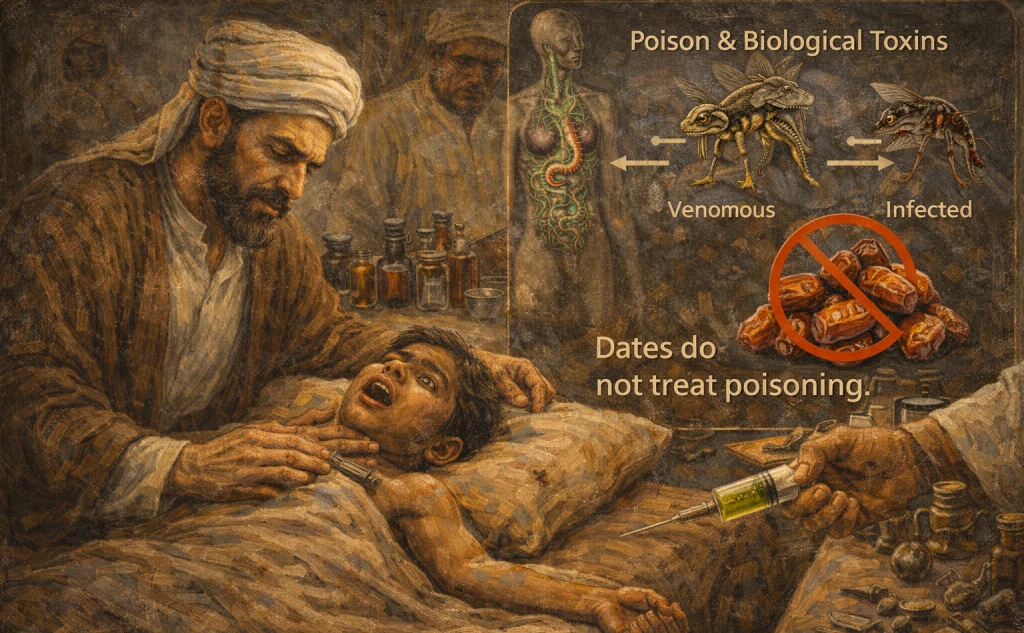
The most reliable way to determine whether a claim about human life and health is true is through observation, experimentation, and verifiable scientific evidence. A food’s nutritional value and its capacity to prevent life-threatening poisoning are entirely different matters. The presence of sugars, minerals, vitamins, or antioxidants in a fruit does not demonstrate that it can neutralize toxic chemicals entering the human body. Yet Islamic hadith literature contains a specific medical claim: Muhammad declared that anyone who eats seven Ajwa dates in the morning will not be harmed by poison or magic on that day. This is not ordinary advice about nutrition or well-being. It is an explicit claim that a particular food confers protection against poisoning.
The religious source of this claim adds to its significance. The promise of protection against poison through Ajwa dates is preserved in Sahih al-Bukhari and Sahih Muslim, two collections regarded as holding the highest authority in Sunni hadith scholarship. Within Islamic theology, Muhammad’s words are accorded an exceptional status for truth and reliability. A report in Abu Dawud attributes to him the assertion that everything coming from his mouth is true. When this religious authority is attached to a claim about a measurable therapeutic effect, two separate issues—the possible medical properties of an ordinary fruit and the declaration of an infallible prophet—are treated as having the same standing. But preservation in a sahih hadith does not establish the scientific effectiveness of a medical claim. Acceptance of a chain of transmission is not experimental proof that a food counteracts poison.
Islamic reports about Ajwa are not limited to protection from poison and magic after eating seven dates. Another sahih narration attributed to Aisha explicitly calls Ajwa dates from the al-Aliyah region an antidote. A report concerning Sa’d ibn Abi Waqqas describes instructions to crush seven Ajwa dates together with their pits and use them in medical treatment. Early hadith literature also preserves a claim that consuming seven Ajwa dates daily offers benefit against leprosy. These accounts differ in historical reliability and hadith grading, but together they show that Ajwa’s special medicinal reputation in Islamic tradition extended beyond protection from poison. The tendency to present one food as a remedy for illness, an antidote, and a treatment requiring a prescribed number of units appears in early Islamic literature itself.
The relationship between these medical claims and modern scientific research is equally important. Some studies have identified bioactive compounds in Ajwa and observed antioxidant or organ-protective effects under specific experimental conditions. But reductions in selected markers of chemically induced injury in a rat’s liver or another organ do not establish that eating seven Ajwa dates protects human beings from every kind of poison throughout the day. Where the choice of research question, the calculated dose, or even the declared aims of an investigation are tied to religious interest in establishing the scientific miracles of Prophetic medicine, the difference between experimentally supported findings and a religious assertion assumed true from the outset becomes especially important. To present a limited biological effect as proof of a supernatural antidote is to claim far more than the science establishes.
This problem did not arise for the first time with the advent of modern medicine. Medieval Muslim scholars themselves debated how Ajwa’s alleged power worked, why exactly seven dates were needed, why this particular variety was specified, and whether its efficacy continued across all historical periods. Some explained it as a miraculous blessing arising from Muhammad’s supplication, some as a property limited to his own lifetime, and others suggested that the hadith referred to a particular palm in Medina no longer identifiable. Uncertainty about Ajwa’s medicinal efficacy and its scope is thus documented within the Islamic tradition. An unknown mechanism, a conjectured time limit, or the attribution of the property to an unidentified palm, however, provides no independent proof that the original medical claim is true.
These questions directly concern human safety. Poisoning is a biological and chemical reality whose effects depend on the toxin, its dose, the route of exposure, and appropriate medical intervention. Relying on a religious statement rather than evidence-based treatment to prevent or manage poisoning may be dangerous. In particular, anyone promising sweeping protection from poison through a food must substantiate that promise with adequate evidence. Religious prestige, appearance in an ancient book, or subsequent theological interpretation cannot substitute for proof of clinical efficacy. The claim that seven Ajwa dates neutralize poison is subject to precisely the same testable standards as any other medical claim.
Islamic Doctrine Concerning Hadith
In Islamic theology or aqidah, accepting every word and action of Muhammad as ultimately true is an integral principle. Under this understanding of orthodox Islamic belief, every word that proceeds from the Prophet’s mouth is under divine supervision and beyond error. The belief rests on the proposition that Muhammad did not make false statements out of personal emotion, anger, or pleasure. Consequently, when a sahih hadith makes a claim about the observable world, science, or the cosmos, a devout believer may treat that statement as more authoritative than empirical scientific findings. [1]
Sunan Abu Dawud (Islamic Foundation edition)
19 / Knowledge and Education
Chapter 417: Writing Down Knowledge
3607. Musaddad narrated … from Abdullah ibn Amr, who said: I used to write down everything I heard from the Messenger of Allah. I wanted to preserve all of it, but the Quraysh forbade me, saying: ‘You write down everything you hear, even though the Messenger of Allah is a human being who speaks when he is angry as well as when he is pleased.’ So I stopped writing and informed the Messenger of Allah about it. He then pointed to his mouth with his finger and said: ‘Keep writing. By the One in whose hand is my life, nothing comes out of this mouth except the truth.’
Hadith grade: Sahih
Narrator: Abdullah ibn Amr ibn al-As
Religious Context and the Hadith Reports
The theological basis of this claim lies in several hadiths classified as sahih (sound or authentic) within Islamic hadith scholarship. They unequivocally attribute to Ajwa dates the power to protect against poison. [2] [3] [4]
Sahih al-Bukhari (Tawhid Publications edition)
76 / Medicine
Chapter 76/52: Treating Magic with Ajwa Dates
5769. Narrated from Sa’d, who said: I heard the Messenger of Allah say: ‘Whoever eats seven Ajwa dates (a prized variety grown in Medina) in the morning will not be harmed by any poison or magic on that day.’ [5445] (Adhunik Prakashani 5348; Islamic Foundation 5244)
Hadith grade: Sahih
Narrator: Sa’d ibn Abi Waqqas
Sahih al-Bukhari (Tawhid Publications edition)
70 / Food
Chapter 70/43: Ajwa Dates
5445. Narrated by Sa’d from his father: The Messenger of Allah said: ‘Whoever eats seven Ajwa dates every morning will not be harmed by poison or magic that day.’ [5768, 5769, 5779] (Adhunik Prakashani 5042; Islamic Foundation 4938)
Hadith grade: Sahih
Narrator: Sa’d ibn Abi Waqqas
Jami’ al-Tirmidhi (Islamic Foundation edition)
31 / Medicine
Chapter: Mushrooms and Ajwa Dates
2072. Abu Ubaydah ibn Abi Safar and Mahmud ibn Ghaylan narrated … from Abu Hurayrah, who said: The Messenger of Allah said: ‘Ajwa dates are from Paradise. They contain an antidote to poison. The mushroom is part of manna, and its water is a remedy for eye disease.’
Hasan sahih; Tahqiq Mishkat Thani 4235; Tirmidhi 2066 (al-Madani edition).
Abu Isa said: Reports on this subject also come from Sa’id ibn Zayd, Abu Sa’id, and Jabir. In this chain the hadith is hasan gharib. We know of no narration of it from Muhammad ibn Amr except through Sa’id ibn Amir.
Hadith grade: Hasan
Narrator: Abu Hurayrah
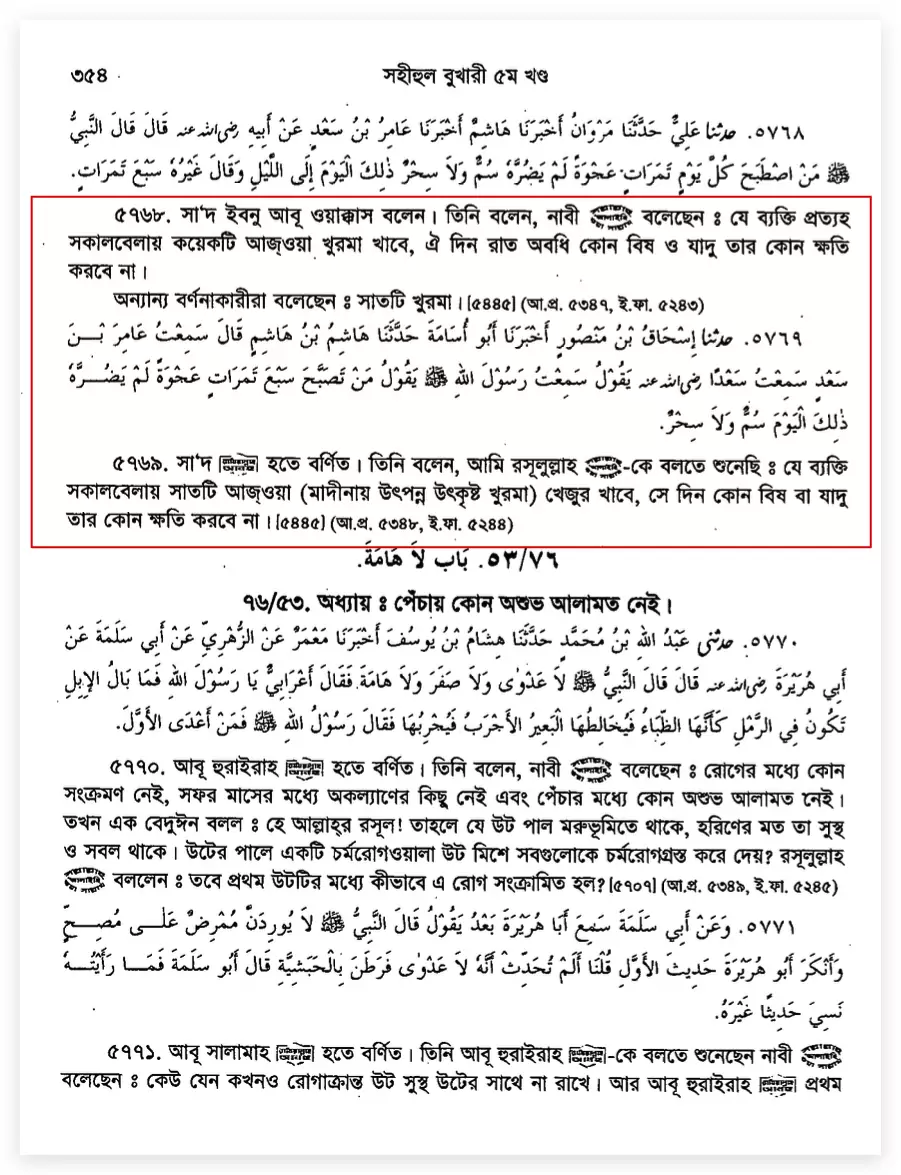
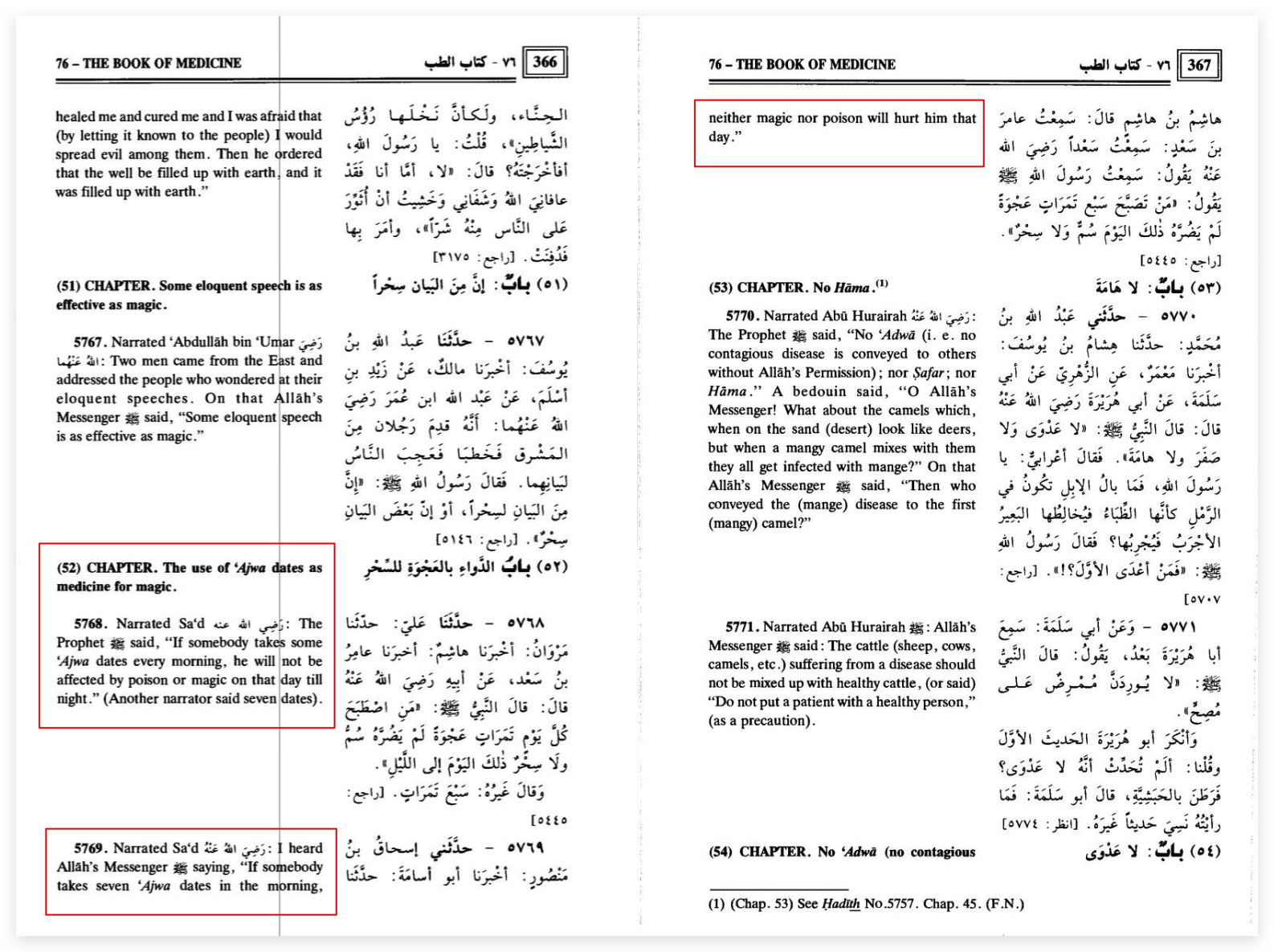
The following are English renderings of the hadith as preserved in several collections: [5]
muslim:2047b – Abū Bakr b. Abū Shaybah > Abū Usāmah > Hāshim b. Hāshim > ʿĀmir b. Saʿd b. Abū Waqqāṣ > Saʿd
He who ate seven ‘ajwa’ dates in the morning, poison and magic will not harm him on that day.
– Sound (Muslim)
bukhari:5445 – Jumʿah b. ʿAbdullāh > Marwān > Hāshim b. Hāshim > ʿĀmir b. Saʿd from his father
Messenger of Allah ﷺ said, “He who eats seven ‘Ajwa dates every morning, will not be affected by poison or magic on the day he eats them.”
– Sound (Bukhārī)
bukhari:5779 – Muḥammad > Aḥmad b. Bashīr Abū Bakr > Hāshim b. Hāshim > ʿĀmir b. Saʿd from my father
I heard Messenger of Allah ﷺ saying, “Whoever takes seven ‘Ajwa dates in the morning will not be effected by magic or poison on that day.”
– Sound (Bukhārī)
bukhari:5768 – ʿAlī > Marwān > Hāshim > ʿĀmir b. Saʿd from his father
The Prophet ﷺ said, “If somebody takes some ʿAjwa dates every morning, he will not be affected by poison or magic on that day till night.” (Another narrator said seven dates).
– Sound (Bukhārī)
bukhari:5769 – Isḥāq b. Manṣūr > Abū Usāmah > Hāshim b. Hāshim > ʿĀmir b. Saʿd > Saʿd
I heard Messenger of Allah ﷺ saying, “If someone takes seven ʿajwah dates in the morning, neither magic nor poison will hurt him that day.”
– Agreed Upon (Luʿluʿ wa-al-Marjān)
Dangerous Statements by Religious Scholars
The following video presents a religious scholar discussing the subject.
In the next video, Ahmadullah explains what Ajwa dates are and where they can be obtained.
Ajwa Dates as an Antidote and Medical Treatment in Reports Transmitted by the Companions
The claim that Ajwa dates protect against poisoning is not confined to the hadith about eating seven dates in the morning. Separate reports transmitted in the names of Aisha and Sa’d ibn Abi Waqqas make more specific assertions about their medicinal properties. In one report, Ajwa is explicitly called an antidote to poison; another describes instructions to crush seven Ajwa dates with their pits and administer them to a sick patient. These reports matter because Ajwa’s special power is presented not merely as a symbolic blessing but as a substance with practical healing and therapeutic uses.
In Sahih Muslim, Muhammad is reported on Aisha’s authority to have described Ajwa dates from the al-Aliyah area of Medina as healing or as an antidote to poison. The Arabic word تِرْيَاقٌ (tiryaq) denotes an antidote. This is therefore not merely a description of nutritional value, but a claim that a particular food possesses a special medicinal effect. [6]
وَحَدَّثَنَا يَحْيَى بْنُ يَحْيَى، وَيَحْيَى بْنُ أَيُّوبَ، وَابْنُ حُجْرٍ قَالَ يَحْيَى بْنُ يَحْيَى أَخْبَرَنَا وَقَالَ الآخَرَانِ، حَدَّثَنَا إِسْمَاعِيلُ، – وَهُوَ ابْنُ جَعْفَرٍ – عَنْ شَرِيكٍ، – وَهُوَ ابْنُ أَبِي نَمِرٍ – عَنْ عَبْدِ اللَّهِ بْنِ أَبِي عَتِيقٍ، عَنْ عَائِشَةَ، أَنَّ رَسُولَ اللَّهِ صلى الله عليه وسلم قَالَ ” إِنَّ فِي عَجْوَةِ الْعَالِيَةِ شِفَاءً أَوْ إِنَّهَا تِرْيَاقٌ أَوَّلَ الْبُكْرَةِ ” .
English translation: Yahya ibn Yahya, Yahya ibn Ayyub, and Ibn Hujr narrated to us. Yahya ibn Yahya said that Isma’il ibn Ja’far informed them, while the other two said that he narrated to them. Isma’il ibn Ja’far reported through Sharik ibn Abi Namir, Abdullah ibn Abi Atiq, and Aisha that the Messenger of Allah said: ‘Ajwa dates from al-Aliyah contain healing, or they serve as an antidote in the early morning.’
The report uses ‘or’ between ‘healing’ and ‘an antidote to poison’, preserving uncertainty over the exact wording in the transmission. Yet both alternatives assert a medicinal effect. The term tiryaq is specifically therapeutic: it refers to a substance intended to prevent or counteract the harmful effects of poison after it enters the body. The report attributed to Aisha therefore presents Ajwa’s antitoxic capacity as a real medical property. It does not, however, say that Aisha personally tested this property or cured a poisoned patient using Ajwa.
A further account of Ajwa being used directly in treatment appears in Sunan Abu Dawud. When Sa’d ibn Abi Waqqas fell ill, Muhammad is described as visiting him, placing a hand on his chest, and identifying an ailment affecting his heart or chest. He then directed Sa’d to the physician al-Harith ibn Kaladah and specified seven Ajwa dates from Medina as an ingredient in the remedy. The instructions called for the dates to be crushed together with their pits and administered through one side of the patient’s mouth. Rather than general advice to eat Ajwa, this account names a particular patient and physician and specifies the ingredient, quantity, preparation, and method of administration. [7]
حَدَّثَنَا إِسْحَاقُ بْنُ إِسْمَاعِيلَ، حَدَّثَنَا سُفْيَانُ، عَنِ ابْنِ أَبِي نَجِيحٍ، عَنْ مُجَاهِدٍ، عَنْ سَعْدٍ، قَالَ مَرِضْتُ مَرَضًا أَتَانِي رَسُولُ اللَّهِ صلى الله عليه وسلم يَعُودُنِي فَوَضَعَ يَدَهُ بَيْنَ ثَدْيَىَّ حَتَّى وَجَدْتُ بَرْدَهَا عَلَى فُؤَادِي فَقَالَ ” إِنَّكَ رَجُلٌ مَفْئُودٌ ائْتِ الْحَارِثَ بْنَ كَلَدَةَ أَخَا ثَقِيفٍ فَإِنَّهُ رَجْلٌ يَتَطَبَّبُ فَلْيَأْخُذْ سَبْعَ تَمَرَاتٍ مِنْ عَجْوَةِ الْمَدِينَةِ فَلْيَجَأْهُنَّ بِنَوَاهُنَّ ثُمَّ لِيَلُدَّكَ بِهِنَّ ” .
English translation: Ishaq ibn Isma’il narrated to us from Sufyan, from Ibn Abi Najih, from Mujahid, from Sa’d. Sa’d said: I became ill, and the Messenger of Allah came to visit me. He placed his hand between my breasts, so that I felt its coolness near my heart. He said: ‘You are a man suffering from an ailment of the heart or chest. Go to al-Harith ibn Kaladah, the man from Thaqif, for he practices medicine. Let him take seven Ajwa dates from Medina, crush them with their pits, and administer the mixture through one side of your mouth.’
Al-Albani classified this second report as weak. Its chain also raises the question of whether Mujahid directly heard it from Sa’d. The narration therefore does not establish that Sa’d actually underwent this treatment and recovered because of it. Its historical significance lies elsewhere: Abu Dawud’s collection preserves a detailed description of Ajwa used in treatment for a particular illness, with seven functioning not simply as a sacred number but as a specified quantity in preparing a remedy. It is significant evidence of how Ajwa was represented in early Islamic medical narratives.
Read together, Aisha’s report and the account of Sa’d’s illness reveal two aspects of the belief in Ajwa’s special power. The first explicitly asserts that it works as an antidote to poison; the second describes preparing medicine from a specific number of dates and administering it to a patient. The Bukhari hadith promising protection against poison and magic for the entire day after eating seven dates goes further still. But naming a food as an antidote, describing how to prepare it, or prescribing a fixed number does not constitute scientific proof of effectiveness. Such proof requires measurable results against the relevant poison or illness, appropriate controls, and reproducible findings. Religious reports establish the status attributed to Ajwa within the tradition; whether it actually neutralizes poison must be decided by independently verifiable medical evidence.
Seven Days of Ajwa Dates Against Leprosy: Another Medical Claim in Early Hadith
Claims about Ajwa’s extraordinary medical properties did not stop at protection from poison and magic. Early Islamic hadith literature also preserves claims that these dates could prevent or alleviate leprosy. A narration attributed to Aisha says that taking seven Ajwa dates from Medina every day for seven days provides benefit against leprosy. Leprosy, or Hansen’s disease, is a chronic bacterial infection that can affect the skin and peripheral nerves and may cause permanent disability if untreated. The report thus goes beyond the nutritional qualities of a food: it attributes an effect against a specific disease to a specific product taken in a specified quantity over a specified period.
Ibn Adi quoted this report in al-Kamil fi Du’afa al-Rijal while discussing the narrations of Muhammad ibn Abd al-Rahman al-Tafawi. Its chain runs from Muhammad ibn Abd al-Rahman through Hisham ibn Urwah, Hisham’s father Urwah, and then Aisha. After citing the report, Ibn Adi explicitly states that he knows of no one besides al-Tafawi who narrated this hadith through Hisham ibn Urwah. [8]
أخبرنا عبد الله بن محمد بن ياسين، قال: ثنا محمد بن يحيى القطعي، ثنا محمد بن عبد الرحمن، أخبرنا هشام بن عروة، عن أبيه، عن عائشة قالت: قال رسول الله صلى الله عليه وسلم: ينفع من الجذام أن تأخذ سبع تمرات من عجوة المدينة كل يوم، تفعل ذلك سبعة أيام.
قَالَ الشَّيْخُ: ولا أعلم رواه بهذا الإسناد، عن هشام بن عروة غير الطفاوي.
English translation: Abdullah ibn Muhammad ibn Yasin informed us; he said that Muhammad ibn Yahya al-Qatta’i narrated to us, who said that Muhammad ibn Abd al-Rahman narrated to us. He reported from Hisham ibn Urwah, from his father, from Aisha, who said that the Messenger of Allah said: ‘It is beneficial against leprosy to take seven Ajwa dates from Medina every day, doing so for seven days.’
Ibn Adi said: ‘I do not know of anyone other than al-Tafawi who narrated this hadith from Hisham ibn Urwah through this chain.’
The same report is also preserved in Abu Nu’aym al-Isfahani’s al-Tibb al-Nabawi, but with a noteworthy textual variation. Ibn Adi’s version prescribes seven days, while Abu Nu’aym’s specifies seven Ajwa dates daily without an explicit seven-day endpoint. Both versions assert a beneficial effect against leprosy. More importantly, both share the same underlying line of transmission through Muhammad ibn Abd al-Rahman al-Tafawi, Hisham ibn Urwah, Urwah, and Aisha. Its appearance in two separate books therefore does not create two independent lines of evidence. [9]
حدثنا أحمد بن محمد بن موسى قال: حدثنا أبو حنيفة محمد بن حنيفة الواسطي قال: حدثنا محمد بن يحيى القطعي قال: حدثنا محمد بن عبد الرحمن الطفاوي قال: حدثنا هشام بن عروة، عن أبيه، عن عائشة قالت: قال رسول الله صلى الله عليه وسلم: ينفع من الجذام أن يأكل أحدكم سبع تمرات كل يوم من عجوة المدينة يفعل ذلك كل يوم.
English translation: Ahmad ibn Muhammad ibn Musa narrated to us; he said that Abu Hanifah Muhammad ibn Hanifah al-Wasiti narrated to us; he said that Muhammad ibn Yahya al-Qatta’i narrated to us; he said that Muhammad ibn Abd al-Rahman al-Tafawi narrated to us from Hisham ibn Urwah, from his father, from Aisha. Aisha said that the Messenger of Allah said: ‘It is beneficial against leprosy for one of you to eat seven Ajwa dates from Medina each day and to continue doing so every day.’
The later commentator Badr al-Din al-Ayni mentioned this leprosy report in his Umdat al-Qari while discussing the virtues of Ajwa. His citation uses يمنع من الجذام, meaning ‘prevents leprosy’, whereas Ibn Adi’s preserved wording is ينفع من الجذام, meaning ‘is beneficial against leprosy’. The distinction matters: preventing a disease and providing some benefit against it are not identical medical claims. Al-Ayni also records Yahya ibn Ma’in’s assessment of al-Tafawi as salih and Abu Hatim’s assessment as saduq. [10]
روى ابن عدي من حديث الطفاوي عن هشام، عن أبيه، عن عائشة مرفوعا: “يمنع من الجذام أن يأخذ سبع تمرات من عجوة المدينة كل يوم يفعل ذلك سبعة أيام” ثم قال: لا أعلم رواه بهذا الإسناد غير الطفاوي، وله غرائب وإفرادات وكلها يحتمل، ولم أر للمتقدمين فيه كلاما، قلت: قال ابن معين فيه: صالح، وقال أبو حاتم: صدوق.
English translation: Ibn Adi narrated through al-Tafawi, from Hisham, from his father, from Aisha, as a report attributed to the Prophet: ‘Leprosy can be prevented by taking seven Ajwa dates from Medina every day and continuing for seven days.’ Ibn Adi then said: ‘I know of no one other than al-Tafawi who narrated it through this chain. He has some unusual and solitary reports, but all are within the bounds of possible acceptance. I have not found comments about him from the earlier critics.’ I [al-Ayni] say: ‘Ibn Ma’in called him salih, and Abu Hatim called him saduq.’
Ibn Adi’s comments on the chain and subsequent hadith criticism demonstrate limitations in how this report was transmitted. But a solitary transmission or weakness in the chain does not, by itself, establish that the alleged event never happened. Nor does preservation in an old collection, or the assessment of a narrator as saduq, establish the medical claim. Two questions must be distinguished: whether Muhammad actually prescribed this treatment, and whether eating seven Ajwa dates daily genuinely provides protection or benefit against leprosy. The first concerns historical attestation and transmission; the second concerns testable medical evidence.
According to the World Health Organization, leprosy is caused principally by the bacterium Mycobacterium leprae. Transmission may occur through prolonged close contact with an untreated infected person. It does not readily spread through ordinary handshakes, sitting together, or sharing a meal. Effective treatment uses multidrug therapy with dapsone, rifampicin, and clofazimine. Recommended preventive measures include finding and treating cases, examining close contacts, and giving preventive medication where appropriate. Ajwa dates have no recognized role in this established treatment regimen. [11]
Leprosy is a curable disease. The currently recommended treatment regimen consists of three medicines (dapsone, rifampicin and clofazimine).
To test the seven-dates-for-seven-days claim scientifically, one would need to determine whether consumption reduces the probability of infection with the leprosy bacterium, changes the course of illness in an infected patient, or produces any specific benefit compared with a suitable control group or other food. Preventing infection and treating existing disease are different outcomes; the distinction between Ibn Adi’s wording ‘beneficial’ and al-Ayni’s ‘prevents’ makes this particularly important. Observing that someone who ate Ajwa did not subsequently develop leprosy would not suffice: even among people in close contact with an infected individual, most do not contract the disease. The asserted special significance of seven dates or seven days also requires separate experimental evidence.
Viewed together, the claims of protection from poison and benefit against leprosy demonstrate a pattern in early Islamic medical literature of attributing special powers against different diseases to one particular fruit. The Bukhari report about poison and magic and the leprosy reports preserved by Ibn Adi and Abu Nu’aym do not have the same standing within hadith transmission criticism; nevertheless, each makes a medical claim whose validity must be tested against reality. Particularly with leprosy, Islamic hadith literature contains three distinct positions: denial of disease transmission, instructions to keep away from a person with leprosy, and a report that Ajwa dates provide protection against the disease. The contradictory directions concerning contagion and avoidance are discussed in detail in Islamic Claims About Contagion and Scientific Reality. Giving a food sacred status is not the same as proving that it prevents a particular disease. The early narrations attest to the former; the latter requires independent medical evidence.
Scientific Analysis: Dates Versus Toxic Chemistry
Dates are a nutritious food. They contain fructose, glucose, fiber, and substantial amounts of potassium and magnesium. They can provide readily available energy and help relieve constipation. Bioactive components of Ajwa may have antioxidant effects, but no reliable clinical evidence has established Ajwa dates as an effective antidote to poisoning.
How poisons act at the cellular level: A dangerous poison such as potassium cyanide (KCN), once absorbed into the body, inhibits the mitochondrial enzyme cytochrome c oxidase. Cells can no longer use available oxygen properly, rapidly disrupting cellular energy production and potentially causing fatal poisoning. The presence of a few dates in the stomach has no demonstrated biological ability to stop this complex chemical process.
No universal antidote: Medicine has specific antidotes for certain poisons, while many other poisons have no specific antidote and require primarily supportive care. No scientific explanation has shown how the sugars or fiber in an ordinary fruit could protect against every poison in the world, including snake venoms, chemical poisons, and arsenic. If such protection truly existed, emergency departments and toxicology units would be distributing dates in place of medicines.
The Nature of Poisoning According to Toxicology
Modern toxicology shows that poisoning involves identifiable biochemical processes. Different toxic substances target different biological systems. Potassium cyanide, for example, inhibits cytochrome c oxidase in mitochondria, disrupting cellular energy production and potentially causing rapid death. Arsenic interacts with cellular enzyme systems and interferes with metabolism, while botulinum toxin disrupts nerve signaling and causes paralysis. [12] [13]
To counter such poisoning, medical practice uses specific antidotes where they exist, such as hydroxocobalamin or sodium thiosulfate for cyanide poisoning. No compound in dates has been shown to neutralize these toxins. Although dates are nutritious, modern medicine has not found scientific evidence that their constituents act as effective antidotes to poisoning. Thus, the claim that eating seven dates can prevent poisoning conflicts with fundamental principles of toxicology.
Research Designed to Validate a Hadith: Confirmation Bias in the Name of Science
A particular line of research is frequently invoked to defend this unscientific claim about Ajwa dates. In such studies, investigators inflict organ injury on rats or rabbits using particular chemicals, then administer Ajwa extract and present improvements in selected biochemical markers as though they supported Muhammad’s assertion that ‘poison will not harm’ someone who eats seven Ajwa dates. Yet a close reading shows that these studies did not actually test the claim made in the hadith. They tested an entirely different, much weaker proposition and placed its results beside the religious statement.
One especially stark example is the 2014 study ‘Ajwa Dates as a Protective Agent Against Liver Toxicity in Rat’. Its lead author, Bassem Y. Sheikh, was identified as director of the Al-Moalim MA Bin Ladin (MABL) Chair for Scientific Miracles of Prophetic Medicine at Taibah University in Saudi Arabia. More tellingly, the authors acknowledged that the research was funded by that same MABL Chair for Scientific Miracles of Prophetic Medicine, under grant SMPM1434/A0106. [14]
The name warrants attention: ‘Scientific Miracles of Prophetic Medicine’. This was not a neutral toxicology laboratory that happened upon an unusual property of Ajwa dates. The funding chair’s declared research agenda concerned ‘Prophetic medicine’ and its ‘scientific miracles’. In another study from the same research environment, the authors expressly characterized their work as part of their ‘research on Prophetic medicine’; that study too was funded by the MABL Chair. [15]
The problem goes beyond the source of funding. Research financed by a religious institution does not automatically become false. The more fundamental issue is the serious risk that the direction of scientific inquiry has been reversed. Science does not begin by declaring a proposition true and searching only for confirmation; it designs tests capable of exposing a false hypothesis. But a program explicitly devoted to discovering ‘scientific miracles of Prophetic medicine’ has already granted religious statements a privileged status. The question is no longer only ‘What biological effects does Ajwa have?’ It becomes ‘Where can scientific confirmation of the Prophet’s statement be found?’ This creates substantial room for confirmation bias.
It is simply wrong to describe the 2014 experiment as a test of Muhammad’s claim. Researchers induced liver injury in rats with carbon tetrachloride (CCl₄) and assessed whether Ajwa date extract could reduce certain biochemical and histological markers of damage. In other words, their question was approximately this: Can a plant extract rich in antioxidants partially reduce CCl₄-induced oxidative liver injury? [16]
But what does the hadith actually claim?
Eating seven Ajwa dates in the morning means that poison will not harm a person that day.
There is no scientific basis for treating these as the same proposition. One concerns several markers of oxidative liver injury caused by a specific chemical in an animal; the other is a broad, effectively unrestricted promise that ‘poison will not harm him’ throughout the day. A positive result for the first proposition does not establish the second. Rather than testing the hadith, the researchers tested a convenient surrogate claim in place of it.
The distinction becomes clearer in the 2018 study ‘Ameliorative Influence of Ajwa Dates on Ochratoxin A-Induced Testis Toxicity’. Rats were exposed to ochratoxin A to produce testicular damage. Most notably, the researcher wrote in the Methods section that the administered dose of Ajwa was ‘equivalent to Prophet Mohammed recommendation’—the experimental dose had been calculated by reference to Muhammad’s prescription of seven dates. [17]
The religious narration was therefore not a decorative reference in the introduction: it entered the experimental design itself. The number ‘seven’ was not discovered through a dose-response experiment. It was already present in a religious text and then translated into an animal-study dose. Using a historical claim to formulate a hypothesis is not, in itself, scientifically invalid. But the resulting investigation must then subject that actual claim to a genuinely stringent attempt at falsification. That did not occur here.
The irony is that even this study failed to establish that ‘seven Ajwa dates prevent poison from causing harm’. It examined changes in testicular tissue injury in rats exposed to one particular mycotoxin. It did not give human participants seven whole Ajwa dates in the morning, expose humans to poison, measure protection over an entire day, or test protection against multiple types of poison. Even if its limited results hold up, nearly all of the hadith’s sweeping claim remains untested. [18]
The religious framing is even more explicit in a 2019 paper published in the Journal of Taibah University Medical Sciences, ‘Protective effects of Ajwa date extract against tissue damage induced by acute diclofenac toxicity’. Its abstract describes Ajwa as ‘a Prophetic medicinal remedy’. Researchers gave rats an excessive dose of diclofenac to produce liver and lung tissue damage, then administered Ajwa Date Extract four hours later. [19]
The Discussion section invokes the familiar hadith promising that seven Ajwa dates in the morning will protect against ‘poison or magic’. The authors then discuss Ajwa as superior to other date varieties and even recommend Ajwa Date Extract for treatment of acute diclofenac toxicity. [20]
This is an enormous leap in scientific inference. Finding less tissue damage in rat histology is not clinical evidence justifying a recommendation to treat acute diclofenac poisoning in humans. There was no human clinical trial, no established therapeutic dose, no comparison with standard treatment, and no evidence on mortality or other clinically meaningful outcomes. Moreover, the extract was administered four hours after the diclofenac—not before exposure, as required by Muhammad’s promise that eating seven dates beforehand would prevent poison from causing harm for the rest of the day. Nevertheless, the hadith was introduced into the paper’s discussion. Presenting this result as scientific verification of the hadith would grossly exaggerate the evidence. The authors did report that this particular study received no external financial support. [21]
The fundamental pattern across this line of research is therefore clear:
The hadith’s actual claim:
Seven Ajwa dates in the morning → poison will cause no harm throughout the day.
What the research tests:
Concentrated Ajwa extract → rats or rabbits → one particular toxic chemical → one particular organ → whether several markers of oxidative damage are reduced to some degree.
The result of the second proposition is then presented as ‘scientific evidence’ for the first.
These are not the same hypothesis. This is claim substitution: replacing the original assertion with a weaker one.
Suppose hundreds of rigorous future studies conclusively established that Ajwa polyphenols, flavonoids, or other antioxidants reduce some oxidative injuries caused by CCl₄, diclofenac, or ochratoxin. That would still not establish the hadith’s miraculous promise. Antioxidant activity is not the same as antidote activity. Vitamin C, berries, grapes, green tea, and countless other fruits and plants contain antioxidant compounds. They do not therefore keep people unharmed throughout the day by cyanide, arsenic, snake venom, botulinum toxin, or any other poison.
If the hadith were to be tested scientifically, the central research question would have to be:
Does eating seven Ajwa dates in the morning reliably prevent clinically significant harm from poison exposure in humans?
If ‘poison’ is supposed to refer only to a particular toxin, that restriction must be specified in advance. The research would then need to determine which toxin, at what dose, through what pharmacological mechanism, how long the protection lasts, what the dose-response relationship is, whether six or eight dates yield different results, whether Ajwa is uniquely effective compared with other date varieties, and how its efficacy compares with conventional antidotes. No evidence to date has established the hadith’s stated claim.
One comparative study produced results that were particularly inconvenient for the assertion of religious uniqueness. Researchers compared the neuropharmacological and analgesic effects of three date varieties—Ajwah, Safawy, and Sukkari—and observed activity in all three. Ajwah performed somewhat more strongly in some respects, but its effects were weaker than those of the positive-control drug. The authors themselves described the work as part of their Prophetic medicine research, funded by the MABL Chair for Scientific Miracles of Prophetic Medicine. Even when a religiously privileged fruit was made the research target, the results disclosed ordinary phytochemistry and differences in the degree of biological activity, not any miraculous boundary between the varieties. [22]
There are further examples of substantial Saudi research funding for studies on Ajwa. A 2016 PLOS ONE paper examining Ajwa extract in breast-cancer cells received postgraduate grant AT-34-237 from the King Abdulaziz City for Science and Technology (KACST). It was an in-vitro cancer-cell study, not an experiment testing the poisoning hadith; it would therefore be wrong to classify it as evidence offered to prove that hadith. It does, however, show that Saudi institutions have directly funded research into Ajwa’s possible medicinal properties. [23]
The criticism is not the simplistic claim that ‘Muslim researchers conducted the study, so the research must be rejected’. Quite the opposite: one can accept everything the results genuinely establish and still reject the religious claim. Ajwa may contain antioxidants, may reduce tissue injury in particular experimental toxicity models, and may eventually yield pharmacologically useful compounds. None of this proves that Muhammad miraculously knew that eating seven Ajwa dates in the morning would prevent any poison from harming a person that day.
What some of these studies clearly show is that religious statements influence the selection of research questions; in one case, the religious number ‘seven’ even enters the determination of an experimental dose. A Saudi research chair openly designated its mission ‘Scientific Miracles of Prophetic Medicine’. Presenting limited changes in a rat’s oxidative stress markers alongside the sweeping promise in the hadith does not turn such findings into proof of a miracle.
Science is not a device for demonstrating that a religious text must be true. Science is a method that allows even our most cherished beliefs to be disproved. When the stated goal of an investigation is to discover ‘scientific miracles of Prophetic medicine’, its positive findings demand especially careful scrutiny. The central fact in the Ajwa-poison question remains unchanged: after all these studies, rats, extracts, biochemical markers, and religious enthusiasm, nobody has demonstrated the hadith’s actual assertion—that eating seven Ajwa dates in the morning prevents poison from harming a person that day.
Prophetic Medicine Versus Evidence-Based Medicine
Islamic tradition contains a body of ideas known as Tibb al-Nabawi, or Prophetic medicine, which accords special significance to Muhammad’s food practices, use of herbs, and medical advice. Historians and scholars of medical history have shown that this tradition developed within medieval Islamic societies, incorporating medical knowledge from Arab, Persian, and Greek contexts. Modern medicine follows a fundamentally different evidentiary procedure. For a treatment or drug to gain medical acceptance, its effectiveness must be evaluated through appropriate laboratory work, animal studies where relevant, clinical trials, and statistical assessment. Evidence-based medicine does not accept a claim merely because it is authoritative or has not been rigorously tested. [24] [25]
In this context, the claim that eating seven dates prevents poisoning can persist as a religious tradition or belief, but it is not an established or accepted method of treatment under scientific medical standards.
The Poisoning at Khaybar and a Historical Question
Islamic historical sources recount a well-known incident during the Khaybar campaign in which a Jewish woman offered Muhammad meat that had been poisoned. According to these reports, he tasted the food and experienced the effects of the poison; years later, during his final illness, he also referred to the lingering effects of that poisoning. [26]
The incident raises an important logical question. If eating seven dates in the morning truly provides protection against poisoning, why was Muhammad himself harmed by poisoning when he knew of the alleged antidote? Hadith accounts describe his attempts at treatment without complete success. At least two possibilities arise. First, the hadith’s claim may reflect an exaggerated belief born of ignorance about actual biochemical processes. Second, such reports may have circulated later within the religious tradition to portray Muhammad as possessing miraculous knowledge or powers, in which case their historical reliability requires scrutiny.
Such tensions are not unusual in the history of religious traditions. Later generations may reshape accounts of historical events through devotional belief, miraculous attribution, or exaggeration, creating discrepancies between earlier events and their subsequent religious representation.
A Logical Challenge: Belief Versus Reality
An interesting observation is that none of the Muslim preachers or adherents who proclaim the hadith infallibly true has, to the author’s knowledge, dared to swallow poison publicly after eating seven dates. Were these hadiths really true in the claimed sense, believers could demonstrate that alleged protection day after day at debates, sermons, and public gatherings as a means of inviting people to Islam. There would then be no need for aggressive jihad or forced conversion; Islamic rule could spread across the world without resistance.
Cognitive Dissonance: Although they verbally affirm the hadith, their reasoning and subconscious minds recognize that dates cannot protect them in a life-or-death encounter with poison. They would never agree to test what they call the Prophet’s teaching against a lethal toxin such as potassium cyanide.
Defeat of Reason: If a believer insists that the effect applies only to Ajwa dates, one must ask why a supernatural property was attributed exclusively to that variety when other date varieties have broadly comparable nutritional properties. This is an unsuccessful attempt to dress a religious myth in scientific language.
The “Extinct Ajwa Date” Theory: Classical Islamic Interpretations, Historical Evidence, and Scientific Reality
Muhammad’s statement that eating seven Ajwa dates in the morning prevents harm from poison or magic that day makes a claim about the actual efficacy of a specific food. Ajwa dates are available today, their chemical constituents have been studied, and animal experiments have examined some of their possible effects on chemically induced injuries. None of this research, however, has established that eating seven Ajwa dates in the morning guarantees protection against poisoning in humans throughout the day. One explanation proposed for this difficulty is that the Ajwa Muhammad referred to was not today’s Ajwa but the fruit of a particular date palm in Medina that is now unknown or extinct. Crucially, this explanation did not originate exclusively in modern Islamic apologetics; it also appears in medieval Islamic hadith commentary.
The early hadith commentator Ibn al-Tin (d. 611 AH) raised the possibility that Muhammad’s claim about protection from poison and magic referred to a particular kind of palm in Medina no longer known in Ibn al-Tin’s own time. Ibn Hajar al-Asqalani quoted this view in Fath al-Bari. The same discussion preserves a different explanation from al-Khattabi: according to him, Ajwa’s efficacy against poison and magic comes not from the dates’ natural chemical or physical properties but from the blessing of Muhammad’s earlier supplication for the dates of Medina. One explanation thus invokes an unusual but no longer identifiable palm; the other attributes the effect to supernatural blessing rather than any intrinsic property of the fruit. [27]
قال الخطابي : كون العجوة تنفع من السم والسحر إنما هو ببركة دعوة النبي صلى الله عليه وسلم لتمر المدينة لا لخاصية في التمر . وقال ابن التين : يحتمل أن يكون المراد نخلا خاصا بالمدينة لا يعرف الآن . وقال بعض شراح ” المصابيح ” نحوه وإنه ذلك لخاصية فيه ، قال : ويحتمل أن يكون ذلك خاصا بزمانه صلى الله عليه وسلم ، وهذا يبعده وصف عائشة لذلك بعده صلى الله عليه وسلم .
English translation: Al-Khattabi said: ‘Ajwa benefits against poison and magic only because of the blessing of the Prophet’s supplication for the dates of Medina, not because of any property inherent in the dates.’ Ibn al-Tin said: ‘It may refer to a particular date palm in Medina that is no longer known.’ Some commentators on al-Masabih made a similar suggestion, attributing the effect to a special property in it. It was also suggested that this might have applied only during the Prophet’s lifetime, but Aisha’s description of its effect after his death makes this restriction less likely.
The precise Arabic of Ibn al-Tin’s statement matters: يحتمل أن يكون المراد نخلا خاصا بالمدينة لا يعرف الآن—’It may refer to a particular palm in Medina that is no longer known.’ The term يحتمل expresses a possibility, not a verified historical fact. Likewise, لا يعرف الآن means ‘not known now’; it does not establish that the palm definitely became extinct. The loss of a plant’s identification, the disappearance of a particular tree or grove, and the extinction of an entire cultivar are three distinct events. Ibn al-Tin identifies no specific palm, garden, or cultivar, gives no botanical description or date of extinction, and reports no experiment demonstrating an antidotal effect. His remark is a historical conjecture, not an established botanical discovery.
Alongside this explanation, early Islamic commentators debated whether Ajwa’s special power was confined to Muhammad’s own lifetime. Al-Maziri acknowledged that medical science could not explain why exactly seven dates should be required or why Ajwa alone was selected rather than another variety. He also noted that the claimed healing effect had not been established as generally continuing among people of his own time. He therefore raised the possibility that it had applied especially to Muhammad’s contemporaries. Ibn Hajar also preserved this discussion. [28]
وقال المازري : هذا مما لا يعقل معناه في طريق علم الطب ، ولو صح أن يخرج لمنفعة التمر في السم وجه من جهة الطب لم يقدر على إظهار وجه الاقتصار على هذا العدد الذي هو السبع ، ولا على الاقتصار على هذا الجنس الذي هو العجوة ، ولعل ذلك كان لأهل زمانه صلى الله عليه وسلم خاصة أو لأكثرهم ، إذ لم يثبت استمرار وقوع الشفاء في زماننا غالبا ، وإن وجد ذلك في الأكثر حمل على أنه أراد وصف غالب الحال .
English translation: Al-Maziri said: ‘This is something whose meaning cannot be understood through the methods of medicine. Even if medicine could provide an explanation for the benefit of dates against poison, it would be unable to explain why the number is restricted to seven, or why this particular variety, Ajwa, is singled out. Perhaps this applied especially to the people of the Prophet’s time, or to most of them, since the continuation of this healing effect as a general occurrence in our own time has not been established. And if it is found in most cases, the statement may be taken as describing what generally happens.’
Al-Maziri’s remarks show that the problem of defining the scope of Ajwa’s miraculous power was already being discussed in the medieval period. His account offers no empirically established answer to why the number should be seven, why the variety should be Ajwa, or why the effect should continue in every era. A proposed limitation to one historical period avoids one difficulty only by creating another: where does Muhammad’s instruction to eat seven Ajwa dates every morning say that the rule applies only to a specific generation? Restricting a treatment’s period of effectiveness after the fact does not establish the truth of the original medical claim.
These older interpretations also appear in modern Islamic question-and-answer literature. Question 195581 on IslamQA explicitly asks whether eating seven Ajwa dates in the morning would protect against a poison such as cyanide. The response cites Ibn al-Tin’s conjecture about a now-unknown palm and al-Khattabi’s explanation based on the blessing of supplication, then states that under these two views one cannot generalize protection from every kind of poison to eating dates today. In other words, although the hadith broadly promises that poison will not cause harm, conjectures from medieval commentators are used to limit the claim’s applicability. [29]
فقد قال ابن التين بأن المراد نخل خاص لا يعرف الآن ، وقال الخطابي رحمه الله ليس ذلك خاصية من خواص التمر ، وإنما هي بركة دعاء النبي صلى الله عليه وسلم لعجوة معينة . ينظر ” فتح الباري ” (10/239) ، وبناء على هذين القولين لا يمكن تعميم وقاية التصبح بالتمر اليوم من جميع أنواع السموم .
English translation: Ibn al-Tin said that what was intended was a particular palm that is no longer known. Al-Khattabi said that it was not a property intrinsic to dates, but the blessing of the Prophet’s supplication for a particular Ajwa. See Fath al-Bari (10/239). On the basis of these two views, protection from every type of poison cannot be generalized to eating dates in the morning today.
This is the central difficulty. In Sahih al-Bukhari, Muhammad’s statement was that eating seven Ajwa dates in the morning would prevent harm from poison and magic that day. It mentioned no extinct palm, particular garden, or expiry of the effect after several centuries. Ibn al-Tin’s statement is not the original wording of the hadith; it is the interpretation of a commentator who lived centuries later. IslamQA offers no new independent historical evidence establishing that interpretation; it reproduces an older conjecture. Repetition of the same supposition across several books and websites does not turn it into independent corroboration.
Ibn Hajar’s discussion contains another important point. Addressing an attempt to narrow the general term ‘poison’ to a particular kind, he notes that the phrasing of the report implies generality. In Arabic grammar, an indefinite noun used in a negative construction can convey comprehensive negation. He also asks what becomes of the claim concerning magic even if a narrow meaning for poison is conceded. Thus the wording of the hadith itself obstructs these later restrictive interpretations. [30]
وفي كلامه إشارة إلى أن المراد نوع خاص من السم وهو ما ينشأ عن الديدان التي في البطن لا كل السموم ، لكن سياق الخبر يقتضي التعميم لأنه نكرة في سياق النفي ، وعلى تقدير التسليم في السم فماذا يصنع في السحر .
English translation: His remarks indicate that a particular kind of poison may have been intended, namely that which arises from worms in the stomach, rather than all poisons. But the wording of the report requires generality, because it uses an indefinite noun in a negative context. And even if that interpretation is conceded in the case of poison, what is to be done about magic?
Ibn Hajar’s observation is significant. If a sentence states in general terms that ‘poison will not harm’ someone, a later commentator cannot arbitrarily restrict its meaning to one particular toxin without independent evidence for the restriction. Likewise, a claim that ‘Ajwa’ refers only to a particular, now-lost tree requires specific historical support. The original words of a hadith and an interpretation proposed centuries afterward do not have the same evidentiary status.
From a botanical perspective, the dates known today as Ajwa constitute a real, identifiable cultivated variety. Genetic characteristics of this cultivar of Phoenix dactylifera have been studied. A 2011 study analyzed chloroplast DNA from eight date varieties, including Ajwa, collected from markets in Saudi Arabia. Another study published in 2023 examined Ajwa and several other varieties sampled from different orchards in Medina. Present-day Ajwa is thus not merely a religious trade name: it is a defined subject of botanical research. [31] [32]
Date palm fruits and juvenile leaflets were sampled from three orchards in Al-Madinah Al-Munawarah (Al’Awali, Sayyid Ash Shuhada, and Valley of Thalamah village) of the KSA; they encompassed 12 female cultivars. These cultivars were Ajwah, Anbarah, Baydh, Hilwah, Jebeli, Khalas, Labana, Rabiah, Rothanah, Safawi, Shalaby, and Sukkary.
The existence of an identifiable Ajwa cultivar today does not establish that every tree called Ajwa fourteen centuries ago had exactly the same genetic identity. Nor is there any need to deny the ordinary possibility that a particular palm or local cultivar in Medina disappeared over time. But the possibility that a tree became extinct and the assertion that its fruit miraculously prevented harm from every kind of poison are entirely separate propositions. Establishing the latter would require independent evidence identifying the historical palm, distinguishing it from other dates, and demonstrating its efficacy against poison. Ibn al-Tin’s conjecture provides none of this.
Three questions expose the problems in the explanation based on a ‘special but now unknown date palm’:
No established historical identity: Ibn al-Tin did not identify a specific extinct cultivar. He mentioned only the possibility of a special palm that was no longer known. He provided no information about which tree or orchard it was, what distinguished it, or when it disappeared. Independent historical and botanical evidence is needed to establish a distinction between today’s Ajwa and the allegedly lost variety.
Conditions added to the hadith: Muhammad’s statement promises protection from poison and magic after eating seven Ajwa dates; it does not say that the instruction will cease to work if a particular palm disappears in the future. Adding the condition ‘only the lost dates were meant’ after the fact allows the claim to evade testing with today’s Ajwa. It does not prove that the hypothetical dates ever possessed the promised miraculous power.
Speculation in place of evidence: To establish that a food neutralizes poison, one needs to identify the food, its effective constituents, the type of poison, and the results of testing. Instead, assigning the miraculous antidote to an unidentified and unavailable palm makes the claim impossible to verify in practice. This is not evidence of past efficacy; it is a shift from a testable assertion toward an unsupported possibility.
Accepting the lost-palm explanation raises another serious question. If Muhammad’s instruction applied only to a specific tree that ceased to be identifiable within a few centuries of his death, how could people living today follow that instruction and obtain the same protection? If today’s Ajwa is not the special fruit in question, the promised protection would, under that interpretation, not apply to today’s Ajwa either. If today’s Ajwa is the fruit referred to in the hadith, its efficacy against poison must be demonstrated by testing. These two positions cannot consistently be maintained together: presenting today’s Ajwa as religiously privileged while asserting, whenever its efficacy is questioned, that the real Ajwa vanished long ago.
Even if a particular date palm really did disappear, its disappearance would not attest to any miraculous property. Many local plant varieties, orchards, and cultivation practices have vanished throughout history. Nothing in that fact entails that some lost fruit could neutralize cyanide, arsenic, snake venom, or every other poison. Assigning extraordinary properties to an unidentified extinct fruit may make the assertion harder to disprove, but difficulty of disproof bears no logical relationship to truth. The absence of testable evidence is not evidence in favor of a supernatural effect.
Ibn al-Tin’s historical importance need not be denied. His remarks, together with differing explanations from al-Khattabi, al-Maziri, and other commentators, show that Muslim scholars themselves faced uncertainty over the scope of Ajwa’s alleged powers. Some invoked blessing, others a special palm, a particular time period, or a particular kind of poison. None of these explanations supplies independent experimental proof of the hadith’s medical claim. Deciding which, if any, is correct requires historical and scientific evidence, not religious authority alone.
The central defect of the ‘lost Ajwa’ theory is therefore not whether it originated in antiquity or modern times, but its lack of evidence. Ibn al-Tin raised the possibility of an unidentified palm in Medina; he did not discover an extinct miraculous antidote. Ibn Hajar preserved that view; he did not establish its historical truth. IslamQA uses this older interpretation to argue that eating dates today cannot generally be assumed to protect against all poisons; this does not prove that a fruit with miraculous antidotal properties existed in the past. Transferring a medical claim that needs empirical evidence to an unidentified and unavailable fruit is no substitute for proof. Whether seven Ajwa dates prevent poison from causing harm still depends on their actual medical efficacy, not on speculation about an extinct palm.
Conclusion: Religious Promises, Medical Reality, and the Standard of Evidence
Muhammad’s statement that eating seven Ajwa dates in the morning prevents harm from poison or magic that day is preserved in Islamic hadith literature as an unequivocal promise. The reports in Sahih al-Bukhari and Sahih Muslim retain the same fundamental claim: consuming a specified number of dates affords protection against the harmful effects of poison. Another sahih report attributed to Aisha explicitly describes Ajwa as an antidote. Further early medical reports concern the use of Ajwa in treatment and its alleged effectiveness against leprosy. The idea of Ajwa’s special power is therefore not the isolated invention of a modern preacher; it has a well-established historical presence in Islamic religious and medical literature. But the longevity of a belief is no proof that it is true. A medical claim transmitted since antiquity can be false, just as a new scientific discovery may be established through testing. The decisive consideration is evidence, not the age of a claim or its religious prestige.
From the perspective of modern toxicology, the proposed antidotal power of Ajwa faces a fundamental problem. Cyanide, arsenic, botulinum toxin, animal venoms, and poisoning caused by drug overdoses do not act on the human body through the same mechanism. Their molecular targets, chemical interactions, effective doses, and treatments differ. The presence of antioxidants in a food provides no basis for inferring universal protection against these different poisons. Although animal studies of Ajwa extract have found changes in selected markers of organ injury caused by specific chemicals, they have not established that eating seven whole Ajwa dates in the morning protects human beings from poisoning throughout the day. Ignoring the essential difference between a possible antioxidant benefit and an effective antidote, then promoting limited laboratory findings as confirmation of the hadith, is a misuse of scientific evidence.
More importantly, the influence of religious commitments can be identified directly in some Ajwa research. Some studies were financed by an institution devoted to finding the ‘scientific miracles of Prophetic medicine’; in another, the religious number of seven dates was incorporated into the calculation of an experimental dose. Elsewhere, researchers caused organ injury in rats with a particular chemical and linked the results of administering Ajwa extract to Muhammad’s general statement about poison. But when the objective, methodology, and results of an experiment do not correspond to the original religious claim, positive findings cannot verify that claim. Partially reducing damage in an animal organ is not the same as completely preventing poisoning in a human being. Any result should be accepted for the scientific value it actually demonstrates; adding a miraculous conclusion unsupported by those results makes the claim exceed the evidence.
Disagreements among medieval Muslim scholars about Ajwa’s alleged properties make the problem even clearer. Al-Khattabi ascribed its effect to the blessing of Muhammad’s supplication rather than to a property of the dates themselves. Al-Maziri acknowledged that medicine could not explain the special significance of seven or the exclusive selection of Ajwa, and that the general continuation of the claimed healing effect had not been established in his own time. Ibn al-Tin speculated about a particular palm in Medina that had become unknown by his era. Ibn Hajar recorded these explanations while also highlighting the difficulty of narrowing the general meaning of ‘poison’ in the hadith. These disagreements are historically important because they show that uncertainty over Ajwa’s efficacy, its duration, and the identity of the fruit existed within the Islamic tradition itself. The existence of multiple proposed explanations, however, is not equivalent to multiple pieces of supporting evidence.
The theory of a ‘lost Ajwa’ cannot resolve the original claim’s evidentiary weakness. If someone argues that a particular palm existed during Muhammad’s lifetime whose fruit protected against all kinds of poison, but that the palm is now unknown, the burden is first to establish its existence, identity, and antitoxic properties. Ibn al-Tin’s conjecture establishes none of these. If, on the other hand, the Ajwa now available in markets is the same kind referred to in the hadith, its alleged effectiveness can be tested. It is inconsistent to promote contemporary Ajwa as a special component of Prophetic medicine while claiming, when evidence of its effects is requested, that the real miraculous date vanished long ago. An unverifiable hypothesis about something no longer available does not substantiate a medical assertion about the real world.
This history exposes a fundamental distinction between religious faith and testable knowledge. Classifying a hadith as sahih represents a judgment about its transmission within Islamic hadith scholarship. Whether the medical assertion contained in that hadith is true is an entirely separate question. No matter how highly a chain is rated, it cannot determine the chemical constituents of a fruit, how a toxin acts, or whether a treatment works. Nor is it rational to retain a medical claim as true merely because of religious authority when it conflicts with empirical findings. For poisoning, the consequences of error are not confined to abstract debate. Someone convinced that eating seven dates has made them immune to poison could be influenced by that belief into making a dangerous decision. Relying on such an unproven remedy instead of effective treatment for poisoning can endanger life.
Ajwa dates are a food. They have nutritional value, and their bioactive compounds merit scientific investigation. But nutritional benefit is no rational basis for assigning miraculous powers to a fruit. Reliable clinical evidence has not substantiated the sweeping hadith promise that seven Ajwa dates provide complete protection from poison for the entire day. Modern toxicology instead shows that preventing and treating poisoning depend on the particular toxin, its mechanism, its dose, and effective medical intervention. Religious belief may declare a food sacred or specially privileged, but the declaration does not make that food an antidote in the physical world. The historical preservation of Muhammad’s statement and its scientific truth are separate matters. For the claim that seven Ajwa dates neutralize poison, the decisive standard remains independently verifiable evidence—not religious authority.
References
- Sunan Abu Dawud, Islamic Foundation edition, hadith 3607 ↩︎
- Sahih al-Bukhari, Tawhid Publications edition, hadith 5445 ↩︎
- Jami’ al-Tirmidhi, Islamic Foundation edition, hadith 2072 ↩︎
- Sahih al-Bukhari, Tawhid Publications edition, volume 5, p. 354 ↩︎
- Sahih-al-bukhari, English, Vol-7 ↩︎
- Sahih Muslim, hadith 2048, chapter on the virtues of Medina dates ↩︎
- Sunan Abu Dawud, hadith 3875, Book of Medicine, chapter on Ajwa dates ↩︎
- Ibn Adi, al-Kamil fi Du’afa al-Rijal, 7/407; biography of Muhammad ibn Abd al-Rahman al-Tafawi ↩︎
- Abu Nu’aym al-Isfahani, al-Tibb al-Nabawi, 2/759, hadith 899; Arabic text and source ↩︎
- Badr al-Din al-Ayni, Umdat al-Qari Sharh Sahih al-Bukhari, chapter on Ajwa, 21/106 ↩︎
- World Health Organization, Leprosy, Fact Sheet, 23 January 2026 ↩︎
- Agency for Toxic Substances and Disease Registry, Cyanide Toxicity ↩︎
- Casarett & Doull’s Toxicology: The Basic Science of Poisons ↩︎
- Sheikh et al., Ajwa Dates as a Protective Agent Against Liver Toxicity in Rat, European Scientific Journal, 2014 ↩︎
- Sheikh et al., Comparative study of neuropharmacological, analgesic properties and phenolic profile of Ajwah, Safawy and Sukkari cultivars of date palm, 2016 ↩︎
- Original research paper ↩︎
- Abdu, Ameliorative Influence of Ajwa Dates on Ochratoxin A-Induced Testis Toxicity, Journal of Microscopy and Ultrastructure, 2018 ↩︎
- Full research paper ↩︎
- Aljuhani et al., Protective effects of Ajwa date extract against tissue damage induced by acute diclofenac toxicity, 2019 ↩︎
- Full text of the same study ↩︎
- Source of funding—Aljuhani et al., 2019 ↩︎
- Sheikh et al., 2016 ↩︎
- Khan et al., Ajwa Date Extract Inhibits Human Breast Adenocarcinoma (MCF7) Cells In Vitro, PLOS ONE, 2016 ↩︎
- Manfred Ullmann, Islamic Medicine ↩︎
- David Sackett, Evidence-Based Medicine ↩︎
- The Painful Death of Prophet Muhammad ↩︎
- Ibn Hajar al-Asqalani, Fath al-Bari, 10/249–251, chapter on treating magic with Ajwa; views of al-Khattabi and Ibn al-Tin ↩︎
- Ibn Hajar, Fath al-Bari, 10/250; al-Maziri’s commentary ↩︎
- IslamQA, question 195581: Does eating seven dates in the morning protect against every kind of poison? ↩︎
- Ibn Hajar, Fath al-Bari, 10/251; generality of the term poison and the question of magic ↩︎
- Assessing Molecular Signature for Some Potential Date Cultivars from Saudi Arabia, International Journal of Molecular Sciences, 2011 ↩︎
- Molecular insights into the VIRESCENS amino acid sequence and its implication in anthocyanin production in date palm cultivars, 2023 ↩︎