

Summary
A common argument offered in response to criticism of Aisha’s marriage to Muhammad and the beginning of their marital life at an early age is that Aisha herself never complained against Muhammad, and therefore did not regard the relationship as unjust or abusive. This reasoning is logically flawed. A woman’s silence while living under the authority of a powerful man cannot establish her free consent, especially when she has grown up within the same social and religious order since childhood, her father is a close follower of that man, and the surrounding society places him at the summit of religious and political authority.
Aisha’s circumstances make the problem particularly clear. Her husband was more than the head of a household: within Muslim society he was the Messenger of Allah, the source of religious law, and a political leader. Her father, Abu Bakr, was among Muhammad’s closest followers and later became the first caliph. Hadith accounts describe Abu Bakr physically striking Aisha in incidents involving Muhammad’s displeasure. The same religious tradition contains precedents for treating insults or abuse directed at the Prophet as crimes punishable by death. Given this structure of power, presenting the claim that “Aisha never complained” as proof of free consent turns the historical social reality upside down.
The central questions are whether Aisha possessed the social, familial, and religious freedom to make a complaint independently, and whether it is reasonable to infer consent from her silence. The accounts preserved in sahih hadith about her family circumstances, Abu Bakr’s authority, Muhammad’s religious and political position, and Aisha’s own words provide important evidence for examining these questions.
Introduction
“She never complained.” This is an exceptionally weak argument in defense of abuse, coercive relationships, child marriage, or relationships marked by unequal power. A victim’s failure to protest, failure to complain even years later, or expression of affection toward the relationship does not establish that it began with free and equal consent. People’s decisions are shaped by their social environment, families, religious beliefs, financial dependence, fear, loyalty, and long-established habits. The greater the imbalance of power, the less reasonable it is to treat silence as evidence of free consent.
In Aisha’s case, the imbalance was extraordinary. According to the traditional sahih Islamic accounts, she was married as a child and entered Muhammad’s household at the age of nine. Her husband was not an ordinary man against whom she could seek redress from relatives, a court, or a separate social authority in the event of a family dispute. Muhammad himself was the Prophet, the highest human authority in religious law, the political leader of Muslim society, and the focus of his followers’ allegiance. A complaint against Muhammad could therefore become more than a complaint against a husband: it could also amount to challenging the Prophet, the religious leader, and the political authority of the community.
Nor did Aisha’s paternal family offer an independent refuge outside that power structure. Abu Bakr was Muhammad’s close follower, father-in-law, and later political successor. Preserved hadith accounts describe Abu Bakr striking his daughter Aisha because he believed she had caused Muhammad displeasure; striking her neck in Muhammad’s presence after she asked for financial support; and hitting her forcefully when a lost necklace delayed the traveling party. These accounts do not portray a family environment in which her father could be assumed to act as an impartial protector of her right to complain against her husband. Instead, they reveal Abu Bakr’s loyalty to Muhammad.
A further constraint came from the system of religious punishment. In a substantial part of the Islamic tradition, insulting, abusing, or dishonoring the Prophet Muhammad is treated as an offense punishable by death. Later Islamic jurisprudence developed sabb al-rasul, or insulting the Messenger, into a distinct matter of criminal law. Thus, before claiming that Aisha could simply have complained once she grew older, one must ask to whom she could have complained, whose support she could have expected, and how a serious public accusation about Muhammad’s character or conduct would have been received in that society.
Most fundamentally, the absence of a complaint by a child cannot establish consent. A child is not in the same position as an adult to evaluate the moral, sexual, and social implications of a relationship imposed upon them. If a person grows up in a social system where a particular practice is taught as normal, religiously legitimate, and the right of an authority figure, their later silence cannot be turned into retrospective proof of free consent. This is a clear argument from silence. The relevant questions concern what happened, the person’s age, the relationship of power, and whether a genuine opportunity for free consent existed. “She did not complain” refutes none of them.
Silence Is Not Evidence of Consent
Aisha did not publicly accuse Muhammad in later life over her childhood marriage or their sexual relationship. From this fact alone, it is frequently concluded that she must have been satisfied with the relationship and that nothing wrong was done to her. This is a textbook argument from silence. When an abused, powerless, or dependent person does not complain, it does not follow that no abuse occurred or that the relationship rested on free consent. A substantial proportion of real-world violence and abuse never reaches the stage of a formal complaint. According to UN Women, only about 40 percent of women who experience violence seek any kind of help, and only about 10 percent report to the police. Fear, possible retaliation, shame, social stigma, financial costs, and not knowing where to seek assistance are significant barriers to reporting. [1]
Silence is even more understandable in an unequal relationship of power. Whether a wife complains against a socially powerful husband depends not only on what happened but also on what she stands to lose by speaking out. Fear of losing social standing, isolation from family and community, economic dependence, possible retaliation, and doubts that her account will be believed can all encourage silence. The WHO also identifies power imbalances and inequality as important structural factors in sexual abuse and exploitation, and recognizes how difficult it can be for survivors to disclose abuse. [2] [3]
These pressures were especially pronounced in Aisha’s circumstances. Her husband was the religious leader and political ruler of his society and, in Muslim belief, Allah’s appointed Messenger. Her father was among his closest followers. In later life, her social identity was permanently bound to her status as Muhammad’s wife, Umm al-Mu’minin, or “Mother of the Believers.” A serious allegation against Muhammad would thus have involved more than accusing a deceased husband: it could also have meant confronting her father, her own social position, the Prophet’s religious authority, and a central symbol of the expanding Muslim political order. In such an unequal power structure, the absence of an accusation is not evidence of free consent.
Economic and social dependence matter as well. In conservative, patriarchal societies, where a woman’s access to education, employment, property, and independent social networks is limited, a dispute with her husband or paternal family can carry an enormous cost. Emotional attachment may compound these difficulties. A person subjected to abuse can love the abuser, feel loyalty toward them, accept the relationship as their fate, or grow up believing that the treatment they received is normal. UN Women’s handbook on gender-responsive police services identifies fear, social isolation, economic dependence, stigma, emotional dependence, and damaged self-esteem among the familiar reasons people struggle to leave abusive relationships. Thus, even if Aisha later expressed love or loyalty toward Muhammad, that does not settle the morality of initiating a marital relationship with a nine-year-old child. [4]
Another fundamental error is to substitute a child’s later response for their capacity to consent in childhood. What a nine-year-old says about a relationship several decades later may have historical significance. But whether, at nine, she could understand the nature, risks, and long-term consequences of sexual relations with an adult man and give free and informed consent is a different question. The limits of a child’s capacity to consent cannot be erased retrospectively by their later feelings. If someone is placed in a relationship without free consent, their acceptance of that relationship years or decades later does not transform its beginning into an act of free consent. Consequently, the claim that “Aisha never complained” provides no moral defense of her childhood marriage to Muhammad.
Aisha Did Not Give Free and Informed Consent to Her Marriage
According to Sahih al-Bukhari, Aisha was only six years old when Muhammad married her. At nine, she was taken to his household and their married life began. Several reports in Bukhari use the expression bana biha (بَنَى بِهَا), an established expression for consummating a marriage through sexual intercourse. Thus the event did not end with a marriage contract at the age of six: her sexual marital life began when she was nine. Yet these hadiths contain no account of Aisha being consulted about the marriage or of her informed consent being obtained before she entered married life at nine. Adults made the decisions about her childhood marriage and sexual relationship with an adult man. Ignoring this fact and treating her failure to complain later as proof of free consent is indefensible. [5] [6] [7] [8]
Sahih al-Bukhari (Tawhid Publications)
67 / Marriage
Chapter 67/39: To whom may young girls be given in marriage?
لِقَوْلِهِ تَعَالَى: وَاللاَّئِي لَمْ يَحِضْنَ) فَجَعَلَ عِدَّتَهَا ثَلاَثَةَ أَشْهُرٍ قَبْلَ الْبُلُوغِ
Citing Allah’s words, “And those who have not menstruated” (Surat at-Talaq 65:4), the waiting period for a girl before puberty is established as three months.
5133. Narrated Aisha: The Prophet married her when she was six years old and consummated the marriage with her when she was nine years old. She remained with him for nine years. (3894; Modern Publications 4754; Islamic Foundation 4757)
Hadith classification: Sahih
Narrator: Aisha.
Hadith 5158 of Sahih al-Bukhari presents the same information in even more explicit legal terminology. Its chapter heading concerns consummating a marriage with a wife who is nine years old. Bukhari did not present this report merely as a marriage contract or the transfer of a girl to her husband’s home. He placed the consummation of marriage at nine, expressed through bana biha, under a separate chapter. [6]
باب مَنْ بَنَى بِامْرَأَةٍ وَهْىَ بِنْتُ تِسْعِ سِنِينَ
تَزَوَّجَ النَّبِيُّ صلى الله عليه وسلم عَائِشَةَ وَهْىَ ابْنَةُ سِتٍّ وَبَنَى بِهَا وَهْىَ ابْنَةُ تِسْعٍ وَمَكَثَتْ عِنْدَهُ تِسْعًا.
English translation: Chapter: A man who consummates marriage with a woman who is nine years old. Narrated from Urwa: The Prophet married Aisha when she was six and consummated the marriage with her, bana biha, when she was nine. She remained with him for nine years.
Sahih al-Bukhari, Hadith 5158
More important to the question of consent than the numerical ages is Aisha’s own account in Bukhari 3894. It does not portray the nine-year-old making a conscious decision about marriage or sexual relations. She was playing on a swing with girls of her own age. Her mother, Umm Ruman, called her and took her away, and Aisha explicitly said that she did not know what her mother wanted with her. Her mother and a group of Ansari women then washed and prepared her and handed her over to Muhammad. Throughout the account, Aisha is not the decision-maker. The arrangements and decisions lie entirely in the hands of adults. [9] [10] [11]
قَالَتْ تَزَوَّجَنِي النَّبِيُّ صلى الله عليه وسلم وَأَنَا بِنْتُ سِتِّ سِنِينَ، فَقَدِمْنَا الْمَدِينَةَ فَنَزَلْنَا فِي بَنِي الْحَارِثِ بْنِ خَزْرَجٍ، فَوُعِكْتُ فَتَمَرَّقَ شَعَرِي فَوَفَى جُمَيْمَةً، فَأَتَتْنِي أُمِّي أُمُّ رُومَانَ وَإِنِّي لَفِي أُرْجُوحَةٍ وَمَعِي صَوَاحِبُ لِي، فَصَرَخَتْ بِي فَأَتَيْتُهَا لاَ أَدْرِي مَا تُرِيدُ بِي فَأَخَذَتْ بِيَدِي حَتَّى أَوْقَفَتْنِي عَلَى بَابِ الدَّارِ، وَإِنِّي لأَنْهَجُ، حَتَّى سَكَنَ بَعْضُ نَفَسِي… فَأَسْلَمَتْنِي إِلَيْهِ، وَأَنَا يَوْمَئِذٍ بِنْتُ تِسْعِ سِنِينَ.
English translation: Aisha said: “The Prophet married me when I was six years old. After we came to Medina, I fell ill, and later my hair grew back. My mother, Umm Ruman, came to me while I was playing on a swing with my friends. She called me and I went to her, not knowing what she intended to do with me. She took my hand and stood me at the door of the house while I was out of breath. Then I was taken to the women of the house, who prepared me. In the morning the Messenger of Allah came, and I was handed over to him. At the time I was nine years old.”
Sahih al-Bukhari, Hadith 3894
The wording of this account is crucial to the question of consent. Aisha did not know why she was being called away from her play. She was not deciding where she would be taken or why she was being prepared. Others summoned her, prepared her, and delivered her to Muhammad. The hadith contains no episode in which her permission to marry was sought, her opinion about entering married life was requested, or she was informed about the sexual relationship that lay ahead. It offers no picture of free, informed, and competent consent. Instead, it describes a nine-year-old child being prepared for married life and handed over to her husband under decisions made by adults.
Aisha and members of her household also described her youth in accounts of later events. In the story of the accusation against her, the incident of al-ifk, Aisha explained the light weight of her body by saying she was still a young girl. Her servant Barira likewise said that Aisha was so young that she would fall asleep while kneading dough, allowing a goat to come and eat it. These subsequent accounts do not transform the nine-year-old of the marriage reports into a fully mature adult woman. [9] [11]
Sahih al-Bukhari (Islamic Foundation)
44 / Testimony
Chapter 1656: A woman’s testimony concerning the honesty of another woman
2485. Abu Rabi Sulayman ibn Dawud … narrated from Aisha, the wife of the Prophet: When the slanderers spread their accusations against her, and Allah declared her innocence, the narrators reported Aisha as saying: Whenever the Messenger of Allah intended to travel, he drew lots among his wives to determine who would accompany him…
I would be lifted onto the mount while seated inside the howdah, and lowered while still inside it. We traveled in this manner. After the Messenger of Allah had concluded that campaign and we were returning toward Medina, he announced one night that the caravan would set out. On hearing this, I got up and went beyond the soldiers to relieve myself. When I returned to the howdah, I felt my chest and discovered that my necklace of black-and-white stones from Zafar had broken. I went back to search for it, and that search delayed me. Meanwhile, the men responsible for carrying my howdah lifted it and placed it on the back of the camel I rode, assuming that I was inside. Women in those days were slender, not heavy, for they ate little. Therefore, when they lifted the howdah, its weight did not seem unusual to them.
Moreover, I was a young girl at the time, so they lifted the howdah and drove the camel away. After the army had departed, I found my necklace. I came back to where they had been, but nobody remained. I decided to stay in my place…
The Messenger of Allah then called Barira, the servant girl, and asked: “Barira, have you seen anything suspicious in her conduct?” Barira replied: “By Him who sent you with the truth, I have seen nothing of that sort, except that she is a young girl who sometimes falls asleep while kneading dough, and a goat comes and eats it.” That same day the Messenger of Allah stood to address the mosque and asked who would defend him against the conspiracy of Abdullah ibn Ubayy ibn Salul. He said: “Who will defend me against a man who has troubled me concerning my family? By Allah, I know nothing but good of my wife. They have implicated a man of whom I also know nothing but good, and he never entered my house except in my company…”
“I was a young girl and had not read much of the Quran. Nevertheless I said: ‘By Allah, I know that you have heard what people are saying, and that it has settled in your minds until you believed it. If I tell you that I am innocent, and Allah knows that I am innocent, you will not believe me. If I confess to something, although Allah knows that I am innocent, you will believe me. By Allah, I can find no example for you except the father of Joseph, when he said: “Patience is most fitting, and Allah alone is the One whose help is sought against what you describe.”’”
Abu Rabi … narrated similarly from Aisha and Abdullah ibn al-Zubayr. Fulayh … also narrated from al-Qasim ibn Muhammad ibn Abu Bakr.
Hadith classification: Sahih
Narrator: Aisha bint Abu Bakr.
Sahih al-Bukhari (Islamic Foundation)
44 / Testimony
Chapter 1643: When someone testifies to another’s good character by saying, “I know only good of this person.”
1462. Chapter: The female slave must provide proof.
Allah’s words: “O believers, when you contract a debt with one another for a fixed term, write it down…” (2:282). And Allah’s words: “O believers, stand firmly for justice, as witnesses to Allah, even if it is against yourselves, your parents, or your relatives … Allah is fully aware of what you do” (4:135).
2461. Hajjaj … narrated from Ibn Shihab, who said: Urwa, Ibn al-Musayyab, Alqama ibn Waqqas and Ubaydullah related to me reports about the incident involving Aisha. Each report supported part of the others concerning the slander spread against her. Revelation was delayed, so the Messenger of Allah summoned Ali and Usama to consult them about separating from his wife. Usama said: “We know nothing but good of your wife.” Barira said: “There is only one thing I know about her: because she is young, she falls asleep while kneading dough for her family, and a goat comes and eats it.” The Messenger of Allah then asked: “Who will help me against that man whose harassment has hurt me in matters concerning my family? By Allah, I know nothing but good of my wife, and they have accused a man about whom I know nothing but good.”
Hadith classification: Sahih
Narrator: Ibn Shihab al-Zuhri.
Sahih al-Bukhari 3896 likewise confirms the same chronology. Following Khadija’s death, Muhammad married Aisha at six and consummated the marriage with her at nine, using the expression bana biha. The ages of six and nine therefore do not rest on a single isolated report; the same ages and sequence of marriage and consummation recur in several chapters of Bukhari. [12] [13]
تُوُفِّيَتْ خَدِيجَةُ قَبْلَ مَخْرَجِ النَّبِيِّ صلى الله عليه وسلم إِلَى الْمَدِينَةِ بِثَلاَثِ سِنِينَ، فَلَبِثَ سَنَتَيْنِ أَوْ قَرِيبًا مِنْ ذَلِكَ، وَنَكَحَ عَائِشَةَ وَهْىَ بِنْتُ سِتِّ سِنِينَ، ثُمَّ بَنَى بِهَا وَهْىَ بِنْتُ تِسْعِ سِنِينَ.
English translation: Narrated from Hisham’s father: “Khadija died three years before the Prophet’s migration to Medina. He remained for two years, or approximately that long, then married Aisha when she was six years old and consummated the marriage with her, bana biha, when she was nine.”
Sahih al-Bukhari, Hadith 3896
Taken together, these reports present a consistent sequence. Aisha was married at six. At nine she was still playing on a swing with her friends. She did not know why she had been called away. Adult women prepared her and then handed her over to Muhammad, and the marriage was consummated at that same age. There is no account of her independent participation in the decision to marry or of informed consent to consummation. In Bukhari’s own narrative, adults control the decisions while Aisha is the person subjected to them. Her later failure to complain cannot erase this fundamental point: according to the preserved accounts, the relationship did not begin on the basis of her free and informed consent.
Abu Bakr and Aisha: Another Layer of Paternal Authority, Not a Refuge for Complaints
“Aisha could have complained to her father if she wanted.” This notion does not fit the preserved Islamic accounts. Abu Bakr was Muhammad’s close follower, companion, father-in-law, and later political successor. Reports in Sahih al-Bukhari and Sahih Muslim describe Abu Bakr physically striking his daughter Aisha in incidents connected to Muhammad. When her lost necklace delayed the caravan, he struck her in the side; on another occasion, he struck her neck because she had asked Muhammad for financial support. [14] [15]
These accounts do not present Abu Bakr as an impartial refuge for a potential complaint by Aisha against Muhammad. In disputes involving Muhammad, he instead took a position against his own daughter. The incident is discussed in the same way in contemporary popular Islamic preaching in Bangladesh. In the video below, Mizanur Rahman Azhari describes Abu Bakr disciplining and striking Aisha.
The Religious Cost of Accusing the Prophet: Death for Insulting Him
Islamic accounts dating to Aisha’s lifetime already distinguish the Prophet’s standing from that of ordinary people. In a report involving Abu Bakr in Sunan al-Nasa’i, a special right to kill someone who insults the Prophet is indicated. Later Islamic jurisprudence consolidated this principle into the death penalty for sabb al-rasul, or insulting the Messenger. Numerous jurists, including Ibn Taymiyyah and Ibn al-Mundhir, supported this position. A serious moral accusation against Muhammad within such a religious order cannot be equated with an accusation made in a modern environment of freedom of expression. [16]
An important early source for this rule concerns Abu Bakr. The chapter in Sunan al-Nasa’i is itself entitled “The ruling concerning a person who insults the Prophet.” Abu Barza al-Aslami relates that a man spoke harshly and insultingly to Abu Bakr. Abu Barza asked permission to kill the man. Abu Bakr reprimanded him and said that this special privilege belonged to no one after Muhammad. The report is preserved in the IslamWeb edition of Sunan al-Nasa’i. [17]
سُنَنُ النَّسَائِيِّ — الحكم فيمن سب النبي صلى الله عليه وسلم
عَنْ أَبِي بَرْزَةَ الْأَسْلَمِيِّ قَالَ: أَغْلَظَ رَجُلٌ لِأَبِي بَكْرٍ الصِّدِّيقِ، فَقُلْتُ: أَقْتُلُهُ؟ فَانْتَهَرَنِي وَقَالَ: لَيْسَ هَذَا لِأَحَدٍ بَعْدَ رَسُولِ اللَّهِ صَلَّى اللَّهُ عَلَيْهِ وَسَلَّمَ.
English translation: Abu Barza al-Aslami said: “A man spoke harshly to Abu Bakr al-Siddiq, and I asked, ‘Shall I kill him?’ Abu Bakr rebuked me and said: ‘This right belongs to no one after the Messenger of Allah.’”
Later jurists used this report to support capital punishment for insulting the Prophet. In Imam al-Shawkani’s Nayl al-Awtar, the discussion of this incident explicitly cites Ibn al-Mundhir as reporting a consensus among scholars concerning the execution of a person who directly insults the Prophet. Abu Bakr’s statement is also employed there as evidence of the Prophet’s special status. [18]
Ibn Taymiyyah develops this rule at length in his well-known al-Sarim al-Maslul ala Shatim al-Rasul. The passage quoted by IslamWeb reads: “Whoever insults the Prophet, whether Muslim or unbeliever, must be killed; this is the position of the majority of scholars.” The same source cites Ibn al-Mundhir to the effect that scholars generally agreed that insulting the Prophet is punishable by death. IslamQA takes the same position. Quoting Ibn Uthaymin, its fatwa says that a Muslim who insults the Prophet falls into unbelief and that, under Ibn Taymiyyah’s preferred view, even repentance does not cancel the worldly death penalty. [19] [20]
قال شيخ الإسلام ابن تيمية في الصارم المسلول:
English introduction: Ibn Taymiyyah wrote in al-Sarim al-Maslul:
إن من سب النبي صلى الله عليه وسلم من مسلم أو كافر فإنه يجب قتله، هذا مذهب عامة أهل العلم.
English translation: “Whoever insults the Prophet, whether Muslim or unbeliever, must be killed. This is the position of the majority of scholars.”
Another report, attributed to Ali and cited in Ahkam Ahl al-Dhimmah, states: “Whoever insults a prophet shall be killed, and whoever insults my Companions shall be flogged.” Ibn al-Qayyim himself, however, expressed reservations about its chain of transmission and characterized the relevant narrator as weak. This particular report therefore does not carry the evidentiary standing of a sahih hadith. [21]
مَنْ سَبَّ نَبِيًّا قُتِلَ، وَمَنْ سَبَّ أَصْحَابَهُ جُلِدَ.
English translation: “Whoever insults a prophet shall be killed, and whoever insults his Companions shall be flogged.”
Ibn al-Qayyim then expressed doubt about its chain of transmission:
وَفِي الْقَلْبِ مِنْهُ شَيْءٌ … وَالْمُحَدِّثُ بِهِ عَنْ أَهْلِ الْبَيْتِ ضَعِيفٌ.
English translation: He had reservations about this particular chain and described the transmitter of the report from the Prophet’s family as weak.
The weakness of this one report does not, however, undo the broader juristic position. Another IslamQA fatwa describes insulting or maligning the Prophet by a Muslim as unbelief and presents the permissibility of shedding that person’s blood as a matter of consensus. Ibn Taymiyyah’s Majmu al-Fatawa likewise states: “اتفق الأئمة على أن من سب نبيا قتل”, meaning, “The imams agreed that anyone who insults a prophet is to be killed.” [22] [23]
Islamic accounts contain precedents for a special authorization to kill people who insult Muhammad, and later jurisprudence established capital punishment for insulting the Prophet. Aisha’s husband held the highest religious and political authority in his community, where affronts to his status were treated as serious offenses. Making a grave public moral accusation against such a person involved substantial social and religious risks. Aisha’s own father was a devoted follower of Muhammad who had physically struck his daughter in incidents involving him. Under these conditions, Aisha’s failure to make a public accusation is no evidence of either the moral legitimacy of her childhood marriage or her free consent.
Abu Bakr and Umar Striking Aisha and Hafsa: How Much Room Was There for Complaint?
One of the clearest accounts of paternal authority exercised against Aisha appears in Sahih Muslim. Muhammad’s wives were asking him for financial support. Umar first entertained Muhammad by recounting how he had struck his own wife for asking him for money. Muhammad then said that his wives, too, were surrounding him and asking for support. Abu Bakr immediately approached Aisha and Umar approached Hafsa, and both men struck their daughters on the neck. The full incident is recorded in the IslamWeb edition of Sahih Muslim. [15]
Sahih Muslim
كتاب الطلاق
… فَقَامَ أَبُو بَكْرٍ إِلَى عَائِشَةَ يَجَأُ عُنُقَهَا، فَقَامَ عُمَرُ إِلَى حَفْصَةَ يَجَأُ عُنُقَهَا، كِلَاهُمَا يَقُولُ: تَسْأَلْنَ رَسُولَ اللَّهِ مَا لَيْسَ عِنْدَهُ …
English translation: Abu Bakr got up and struck Aisha on the neck, while Umar got up and struck Hafsa on the neck. Both said: “Are you asking the Messenger of Allah for something he does not have?”
Aisha and Hafsa had not rebelled against Muhammad. They had asked for money. Yet their fathers responded to that financial demand with physical blows, right in Muhammad’s presence. Imam al-Nawawi’s Commentary on Sahih Muslim discusses the same account without removing these details. What basis is there for assuming that Abu Bakr would naturally have taken his daughter’s side if she had brought him a complaint against her husband? [24]
Another incident appears in Sahih al-Bukhari. Aisha lost her necklace, delaying the caravan in a place where water was unavailable. Abu Bakr came, rebuked her, and repeatedly struck her in the side with his hand. Aisha herself said she could not move because Muhammad’s head was resting on her thigh. Bukhari placed this report under a chapter specifically entitled “A man striking his daughter in the side while rebuking her.” [25]
Sahih al-Bukhari
باب طعن الرجل ابنته في الخاصرة عند العتاب
قَالَتْ عَائِشَةُ: عَاتَبَنِي أَبُو بَكْرٍ وَجَعَلَ يَطْعُنُنِي بِيَدِهِ فِي خَاصِرَتِي، فَلَا يَمْنَعُنِي مِنَ التَّحَرُّكِ إِلَّا مَكَانُ رَسُولِ اللَّهِ صَلَّى اللَّهُ عَلَيْهِ وَسَلَّمَ وَرَأْسُهُ عَلَى فَخِذِي.
English translation: Aisha said: “Abu Bakr rebuked me and began striking me in the side with his hand. Nothing prevented me from moving except that the Messenger of Allah was lying there with his head on my thigh.”
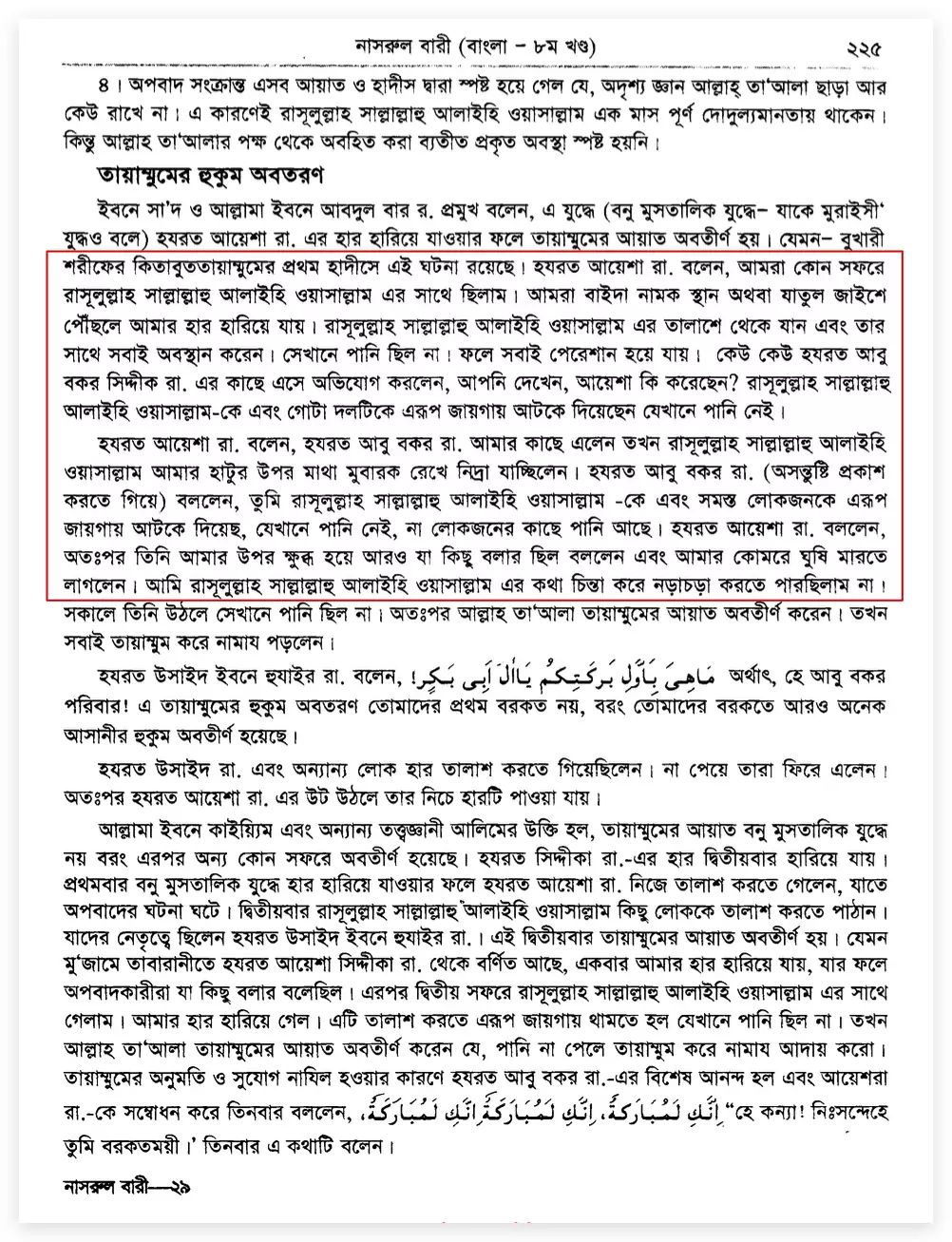
The following passage comes from Nasr al-Bari, Commentary on Sahih al-Bukhari, volume 8, page 225. [26]
Ibn Sad, Allama Ibn Abd al-Barr and others say that during this campaign, the expedition against Banu Mustaliq, also called the Battle of Muraysi, the verse concerning tayammum was revealed after Aisha lost her necklace. This incident is related in the first hadith of the Book of Tayammum in Sahih al-Bukhari.
Aisha said: “We were on a journey with the Messenger of Allah. When we reached a place called Bayda or Dhat al-Jaysh, I lost my necklace. The Messenger of Allah remained there to search for it, and all the people stayed with him. There was no water at the place, so everyone became anxious. Some approached Abu Bakr al-Siddiq and complained, ‘Look what Aisha has done! She has detained the Messenger of Allah and the whole party at a place where there is no water, and the people have none with them.’
“Abu Bakr came to me while the Messenger of Allah was sleeping with his blessed head resting on my knees. Abu Bakr, expressing his displeasure, said, ‘You have detained the Messenger of Allah and all the people in a place where there is no water and where the people have none.’ Aisha said: He became angry and said whatever else he wanted to say, and began punching me in the side. I could not move out of consideration for the Messenger of Allah.
“When he awoke in the morning, there was still no water. Then Allah revealed the verse of tayammum, and everyone performed tayammum and prayed.”
Another version of the same necklace incident uses even stronger wording. Aisha says Abu Bakr struck her so forcefully that she was in pain, but she could not move because Muhammad’s head was resting on her. Another narration in Sahih al-Bukhari uses “لكزني لكزة شديدة”, describing a forceful punch or blow. The Bengali translation of Bukhari 6845 refers to the same incident:
“Once Abu Bakr came and punched me very hard. He said, ‘You have detained the people over a necklace.’ I could not move because of the position of the Messenger of Allah, even though the blow caused me great pain.”
Taken together, these accounts are unambiguous. Aisha’s father was a devoted follower of Muhammad, and in conflicts involving Muhammad he physically disciplined his own daughter. She asked for financial support and was struck; a delayed caravan also resulted in her being struck. To ask, against this background, “Why didn’t Aisha go to her father and complain about Muhammad?” is to reverse the actual relationship of power. The preserved Islamic sources provide no basis for imagining Abu Bakr as an independent and impartial refuge for Aisha against Muhammad.
“Aisha Chose Muhammad”: What Does This Incident Prove?
An incident from Aisha’s later life is often invoked to justify her childhood marriage and the beginning of her marital life. After Quran 33:28–29 was revealed, Muhammad presented his wives with two alternatives: they could choose worldly life and its comforts and part from him, or choose “Allah, His Messenger and the Hereafter” and remain his wives. According to Sahih al-Bukhari and Sahih Muslim, Muhammad offered this choice to Aisha first and advised her not to decide hastily without consulting her parents. Aisha chose to remain with Muhammad. The account is used to argue that if she had been unhappy in the relationship, she could have left him then. [27]
عَنْ عَائِشَةَ زَوْجِ النَّبِيِّ صَلَّى اللَّهُ عَلَيْهِ وَسَلَّمَ، قَالَتْ: لَمَّا أُمِرَ رَسُولُ اللَّهِ صَلَّى اللَّهُ عَلَيْهِ وَسَلَّمَ بِتَخْيِيرِ أَزْوَاجِهِ بَدَأَ بِي، فَقَالَ: إِنِّي ذَاكِرٌ لَكِ أَمْرًا فَلَا عَلَيْكِ أَنْ لَا تَعْجَلِي حَتَّى تَسْتَأْمِرِي أَبَوَيْكِ.
قَالَتْ: وَقَدْ عَلِمَ أَنَّ أَبَوَيَّ لَمْ يَكُونَا يَأْمُرَانِي بِفِرَاقِهِ.
English translation: Aisha, the Prophet’s wife, said: “When the Messenger of Allah was instructed to offer his wives a choice, he began with me, saying, ‘I will mention something to you, and there is no need to hurry until you have consulted your parents.’” She added: “He knew that my parents would never advise me to separate from him.”
Aisha herself said that Muhammad knew her parents would not advise her to separate from him. Her own words therefore show that advice to leave Muhammad was not something she could expect from her parents. This is consistent with other hadith reports about Abu Bakr’s loyalty to Muhammad and his conduct toward Aisha. [28]
More importantly, the choice presented to her was not framed as an ordinary decision about divorce. The alternatives were “the life of this world and its adornment” on the one hand, and “Allah, His Messenger and the Hereafter” on the other. For a Muslim believer, the second choice was not simply about remaining with a husband; it explicitly linked the marriage to Allah and the afterlife. Under this religious framing, leaving Muhammad was not equivalent to leaving an unhappy marriage. The decision was also presented in terms of reward in the afterlife, obedience to Allah, and one’s relationship with the Prophet.
According to the sahih reports, Aisha chose to remain with Muhammad in later life. But that decision does not establish the morality of entering married life with her at nine. A grown woman may subsequently accept, love, or decide not to leave a relationship. None of those facts retroactively establishes that she could give competent consent to entering it as a child years earlier. Later consent cannot remedy the absence of competent consent in childhood.
Indeed, this hadith reinforces an important point from the preceding discussion. Aisha herself knew that her parents would not advise her to leave Muhammad. The argument that “she had a family and could have left whenever she wanted” therefore contradicts the Islamic account itself. Her family did not constitute an independent alternative; it was part of the same religious and social structure of power.
Aisha Became Angry with Muhammad, but Anger Was Not the Same as Freedom to Accuse Him
Sahih hadiths describe Aisha becoming angry with Muhammad, disagreeing with him, showing jealousy, and voicing dissatisfaction. She was neither voiceless nor devoid of personality. But the ability to be angry with one’s husband is not the same as the freedom to accuse him publicly of sexual or moral abuse, especially when that husband is simultaneously regarded as Allah’s Messenger, the source of religious law, and the political ruler. A woman may criticize her husband within the household or object to some of his conduct without having the freedom to challenge the religious and political authority on which his position rests. Aisha’s expressions of everyday dissatisfaction do not establish that she could make a serious public accusation against Muhammad without constraint.
A well-known report in Sahih al-Bukhari and Sahih Muslim describes Muhammad telling Aisha that he could tell when she was pleased with him and when she was angry. She asked how he knew. He explained that when she was pleased, she swore “by the Lord of Muhammad,” but when angry, she said “by the Lord of Abraham.” Aisha replied that, when angry, she merely avoided mentioning Muhammad’s name. IslamWeb cites the report as muttafaqun alayh, meaning agreed upon by Bukhari and Muslim, and preserves the full Arabic text in its Islamic library. [29] [30]
قَالَ لِي رَسُولُ اللَّهِ صَلَّى اللَّهُ عَلَيْهِ وَسَلَّمَ:
إِنِّي لَأَعْلَمُ إِذَا كُنْتِ عَنِّي رَاضِيَةً، وَإِذَا كُنْتِ عَلَيَّ غَضْبَى.
قَالَتْ: فَقُلْتُ: مِنْ أَيْنَ تَعْرِفُ ذَلِكَ؟
قَالَ: إِذَا كُنْتِ عَنِّي رَاضِيَةً فَإِنَّكِ تَقُولِينَ: لَا وَرَبِّ مُحَمَّدٍ، وَإِذَا كُنْتِ غَضْبَى قُلْتِ: لَا وَرَبِّ إِبْرَاهِيمَ.
قَالَتْ: قُلْتُ: أَجَلْ، وَاللَّهِ مَا أَهْجُرُ إِلَّا اسْمَكَ.
English translation: The Messenger of Allah said to me: “I know when you are pleased with me and when you are angry with me.” I asked, “How do you know?” He replied: “When you are pleased with me, you say, ‘No, by the Lord of Muhammad,’ and when you are angry, you say, ‘No, by the Lord of Abraham.’” Aisha said: “Yes, by Allah, I only avoid your name.”
This account shows that Aisha had a distinct personality and that she expressed anger and dissatisfaction with Muhammad. It does not establish that she could therefore have accused him publicly of child marriage or sexual abuse. A wife may become angry over ordinary domestic matters, withdraw from conversation, or show jealousy, while challenging her husband’s fundamental religious and political authority remains an entirely different undertaking, particularly when that husband is also regarded as Allah’s Messenger.
The less powerful person in an unequal relationship is not necessarily silent about everything. They may disagree, feel hurt, express jealousy, or negotiate over particular matters without being able to reject the relationship’s underlying authority. Aisha expressed anger toward Muhammad; yet the same body of sources describes her father striking her in incidents involving Muhammad, and Aisha herself said her parents would not advise her to leave him. Her ability to express displeasure in everyday married life therefore cannot be taken as evidence of freedom to accuse Muhammad publicly in a way that challenged his religious and political authority.
Nor does Aisha’s love for Muhammad, or her later loyalty, make the relationship in childhood morally acceptable. IslamQA discusses Muhammad’s affection for Aisha at length and invokes the wives’ choice of “Allah, the Messenger and the Hereafter” as evidence of their loyalty. These later emotions and decisions matter as historical details, but the moral question of child marriage is different: can a nine-year-old child meaningfully consent to a sexual marital relationship with a man over fifty? The answer cannot be determined by whether she came to love her husband years afterward. [31]
Aisha demonstrated intelligence, determination, and the ability to express her opinions in later life. She became angry with Muhammad, voiced dissatisfaction with some of his conduct, and at times made pointed remarks. But a person’s adult character tells us nothing about their capacity to consent as a child. The same Aisha who later expressed her views had been married off at six and brought into a sexual marital relationship with a man over fifty at nine. Her strength and assertiveness in later years could not retrospectively give her the capacity for free and informed consent at nine. Treating what happened to her as a child and how she conducted herself as an adult as interchangeable evidence is a logical error when used to justify child marriage.
Multiple Accounts of the Same Incident: How Explicit Is the Language Describing Abu Bakr’s Blows?
The account of Abu Bakr striking Aisha when her lost necklace delayed the caravan appears in several places in Sahih al-Bukhari with somewhat different wording. Reports numbered 4253/4608, 6844, and 6845 are not accounts of separate beatings. They are different transmissions of the same lost-necklace incident associated with the revelation of the verse about tayammum. IslamQA likewise presents the reports of Bukhari and Muslim as accounts of that same event. [32]
The fact that these narrations describe the same event does not diminish the evidence that Aisha was struck. Instead, comparing their wording clarifies the nature of the blows. In one version, Aisha says Abu Bakr rebuked her and “وجعل يطعنني بيده في خاصرتي”, “began striking me in the side with his hand.” Another reads “فلكزني لكزة شديدة”, meaning that he delivered a forceful blow. Ibn Hajar preserves the latter wording in Fath al-Bari and explains that the Arabic verbs لكز (lakaza) and وكز (wakaza) are close in meaning. [33]
قالت عائشة:
أَقْبَلَ أَبُو بَكْرٍ فَلَكَزَنِي لَكْزَةً شَدِيدَةً، وَقَالَ: حَبَسْتِ النَّاسَ فِي قِلَادَةٍ، فَبِيَ الْمَوْتُ لِمَكَانِ رَسُولِ اللَّهِ صَلَّى اللَّهُ عَلَيْهِ وَسَلَّمَ، وَقَدْ أَوْجَعَنِي.
English translation: Aisha said: “Abu Bakr came and struck me hard, saying, ‘You have delayed the people over a necklace.’ I was in great pain, but I could not move because of the position of the Messenger of Allah.”
Islamic commentators did not dismiss the incident as mere “gentle admonition.” Sharh al-Sunnah cites the same hadith and states that it provides evidence for a man’s right to discipline members of his household and his children: “وفي الحديث دليل على تأديب الرجل أهله وولده”. In other words, this later Islamic commentator treated Abu Bakr’s striking Aisha in the side as a precedent for physical discipline within the family. IslamQA likewise cites Abu Bakr’s striking of Aisha in a juristic discussion of whether a father may beat his adult child. [34] [35]
Bengali editions employ somewhat different expressions for the blow: some render it as “striking her in the side,” others as “a hard slap,” and still others as “a powerful punch.” The Arabic reports clearly describe physical violence, and Aisha herself said that she was hurt and could not move because of Muhammad’s position. The Bengali commentary reproduced above also translates the event as Abu Bakr “repeatedly punching her in the side.”
The several transmissions establish the same essential event: in an incident involving Muhammad, Abu Bakr physically struck his daughter Aisha, who herself described the pain he caused. They provide no basis for portraying Abu Bakr as a free and impartial refuge for Aisha if she had wanted to accuse Muhammad.
Aisha Was Not a Free Widow Even After Muhammad’s Death
“After Muhammad died, Aisha was free, so why did she not complain then?” This question leaves out a major feature of her later religious and social status. Unlike an ordinary widow, Aisha was not allowed to choose another husband after Muhammad’s death. The Quran assigned Muhammad’s wives a special religious identity: “وأزواجه أمهاتهم”, “his wives are their mothers” (33:6). Verse 33:53 of the same surah permanently forbade Muslim men to marry Muhammad’s wives after his death: “ولا أن تنكحوا أزواجه من بعده أبدا”. His death did not therefore release them from their marital identity in the way it would for ordinary widows. Religious law made that identity permanent.
النَّبِيُّ أَوْلَى بِالْمُؤْمِنِينَ مِنْ أَنْفُسِهِمْ وَأَزْوَاجُهُ أُمَّهَاتُهُمْ
— الأحزاب ٣٣:٦
وَمَا كَانَ لَكُمْ أَنْ تُؤْذُوا رَسُولَ اللَّهِ وَلَا أَنْ تَنْكِحُوا أَزْوَاجَهُ مِنْ بَعْدِهِ أَبَدًا إِنَّ ذَلِكُمْ كَانَ عِنْدَ اللَّهِ عَظِيمًا
— الأحزاب ٣٣:٥٣
English translation: “The Prophet has a greater claim over the believers than they have over themselves, and his wives are their mothers.” (Quran 33:6)
“You must not offend the Messenger of Allah, nor ever marry his wives after him. That would be a grave matter in the sight of Allah.” (Quran 33:53)
Classical and modern Islamic exegesis leaves little ambiguity about the legal effect of this rule. In al-Tahrir wa-l-Tanwir, preserved on IslamWeb, the prohibition in 33:53 against ever marrying Muhammad’s wives after his death is explained as a legal consequence of their status as “Mothers of the Believers” in 33:6. The text treats marriage to the Prophet’s widows as a grave sin because Allah has placed them in the position of mothers to the believers. [36]
The Shafi’i juristic work al-Hawi al-Kabir by al-Mawardi makes the point still more directly. It identifies as one of Muhammad’s special privileges Allah’s designation of his wives as “Mothers of the Believers” and the prohibition against anyone else marrying them after his death. It explains that special rules associated with Muhammad’s marital relationship continued to apply to them after his death. In al-Bayhaqi’s al-Sunan al-Kubra, an entire chapter is devoted to the Prophet’s wives being the Mothers of the Believers and to the prohibition against their marriage to anyone else in the Muslim community after his death. [37] [38]
Some commentaries describe the relationship in even more permanent terms. The Tafsir al-Sadi preserved by IslamWeb states that Muhammad’s wives retain a special marital bond with him after death and are his wives both in this world and in the Hereafter; for this reason, marriage to anyone else is forbidden to them. Under this interpretation, Aisha’s subsequent life remained even more firmly bound to her identity as Muhammad’s wife. [39]
An ordinary widow may marry again and build a new family after her husband’s death. That possibility was permanently closed to Aisha by religious law. She retained the identities of “Muhammad’s wife” and “Mother of the Believers” after his death, and the Quran barred Muslim men from marrying her. Her social and religious identity thus remained permanently tied to her deceased husband.
Aisha did not return to the position of an ordinary widow after Muhammad died. Islamic law prohibited her remarriage and made her identity as a “Mother of the Believers” permanent. Accordingly, the claim that she was completely free after Muhammad’s death and could have complained at that time ignores a crucial part of her religious and social circumstances.
Aisha Was Not Entirely Silent: Her Sarcastic Remarks About Muhammad’s Privileges Concerning Women
The claim that “Aisha never said anything against Muhammad” runs into a further problem: Islamic sources themselves record her expressing jealousy, dissatisfaction, and pointed criticism concerning Muhammad’s privileges involving women. The historical Aisha cannot reasonably be portrayed as a silent wife who accepted every decision Muhammad made without objection. The best-known example concerns Quran 33:51. That verse grants Muhammad special discretion to defer whichever wives he wishes, bring close whichever he wishes, and take back any whom he had deferred. In response, Aisha remarked: “By Allah, I see that your Lord hastens to fulfill your desires.” The report is preserved in both Sahih al-Bukhari and Sahih Muslim, and IslamWeb quotes the full account while acknowledging its authenticity. [40]
قالت عائشة رضي الله عنها:
كُنْتُ أَغَارُ عَلَى اللَّاتِي وَهَبْنَ أَنْفُسَهُنَّ لِرَسُولِ اللَّهِ صَلَّى اللَّهُ عَلَيْهِ وَسَلَّمَ، وَأَقُولُ: أَتَهَبُ الْمَرْأَةُ نَفْسَهَا؟ … فَلَمَّا أَنْزَلَ اللَّهُ: تُرْجِي مَنْ تَشَاءُ مِنْهُنَّ وَتُؤْوِي إِلَيْكَ مَنْ تَشَاءُ … قُلْتُ: وَاللَّهِ مَا أَرَى رَبَّكَ إِلَّا يُسَارِعُ فِي هَوَاكَ.
English translation: Aisha said: “I used to feel jealous of the women who offered themselves to the Messenger of Allah, and I would ask, ‘Does a woman offer herself like that?’ … When Allah revealed, ‘You may defer whom you wish among them and receive whom you wish …,’ I said: ‘By Allah, I see that your Lord hastens to fulfill your desires.’”
IslamWeb does not deny that Aisha made this remark. Instead, it presents an apologetic interpretation quoting Ibn Hajar, according to whom hawa here means Muhammad’s “preference” or “satisfaction,” and Aisha’s phrasing is excusable because it arose from jealousy. Another IslamWeb fatwa cites al-Qurtubi’s explanation that she spoke out of jealousy and her words should not be taken literally. These explanations do not erase the central fact: Aisha made a remark about Muhammad’s special privileges involving women whose natural meaning is that Allah was extraordinarily quick to issue rulings aligned with Muhammad’s personal wishes. [41]
Aisha’s remark is striking. Watching revelations grant Muhammad special privileges in matters involving women, she said outright: “I see that your Lord hastens to fulfill your desires.” The words carry unmistakable sarcasm. Aisha had noticed the remarkable correspondence between Muhammad’s personal wishes and the divine instructions governing his marital privileges. Islamic commentators may explain the remark as an expression of jealousy, but their explanations cannot erase what Aisha actually said. In the face of such direct evidence of dissatisfaction with Muhammad’s privileges and conduct toward women, the assertion that “Aisha never objected to anything” is false.
Two other articles explore this subject in detail. Did the Prophet Have No Desire for Women? examines Quran 33:50–52, women who offered themselves to the Prophet, Aisha’s remark about her Lord hastening to fulfill Muhammad’s desires, and other sahih reports about his dealings with women. Aisha’s Statements on the Prophet’s Sexual Conduct collects accounts of Muhammad’s privileges concerning women, Aisha’s apprehension on seeing Juwayriya, and her remark about Muhammad spending the night with another wife after her death, alongside other relevant narrations.
The significance of these accounts for the present question is precise. It is false that Aisha never expressed any dissatisfaction. She did. The fact that she could speak about certain matters does not establish that she possessed the social and religious freedom to make a public accusation about the morality of the sexual relationship that began when she was nine. Her preserved sarcastic comments show that dissatisfaction could exist and find limited expression within married life without necessarily challenging the fundamental religious authority underlying the relationship.
Jealousy, Sarcasm and Apprehension: Further Evidence Against the Claim That “She Never Objected”
Aisha’s dissatisfaction with Muhammad’s conduct toward women was not confined to one incident. Islamic literature preserves several accounts of her jealousy, apprehension, irritation, and sarcasm concerning his other wives and women. At times she worried that Muhammad would be attracted to another woman’s beauty; at others she mocked his special marital privileges, and she even joked bitterly that he would spend the night with another wife after her death. These accounts reveal a woman who did not accept everything Muhammad did without protest. Denying her documented dissatisfaction and presenting her later silence as moral approval of all his marital and sexual conduct distorts the historical record.
Aisha’s reaction in the case of Juwayriya bint al-Harith is particularly revealing. After the battle against Banu Mustaliq, Juwayriya was taken captive and came to Muhammad seeking help in obtaining the money for her release. According to the report in Abu Dawud, Aisha said that Juwayriya was extremely beautiful. Aisha disliked seeing her at the doorway because she realized that Muhammad would notice her beauty too. Muhammad subsequently arranged for Juwayriya’s ransom and proposed marriage to her. Aisha’s statement reveals her awareness that her husband might be attracted by another woman’s beauty. The incident and its hadith text are discussed in the article Aisha’s Statements on the Prophet’s Sexual Conduct.
Another report concerns Muhammad’s final illness. When Aisha complained of a headache, Muhammad said that if she were to die before him, he would wash her body, shroud her, perform her funeral prayer, and bury her. Aisha replied that she could almost picture what would happen: he would bury her, return home, and spend the night with one of his other wives in her very room. Muhammad laughed at her remark. The account appears in Sahih al-Bukhari and is also preserved in Ibn Hajar’s Fath al-Bari, Ibn Kathir’s al-Bidaya wa-l-Nihaya, and Ibn Hisham’s Sira. [42] [43] [44]
قالت عائشة:
وَاللَّهِ لَكَأَنِّي بِكَ لَوْ قَدْ فَعَلْتَ ذَلِكَ لَقَدْ رَجَعْتَ إِلَى بَيْتِي فَأَعْرَسْتَ فِيهِ بِبَعْضِ نِسَائِكَ.
English translation: Aisha said: “By Allah, I can almost see you doing just that: you would return to my house after burying me and spend the night there with one of your other wives.”
Aisha’s remark expresses both jealousy and sharp sarcasm about Muhammad’s conduct toward women. Her suggestion that he would spend the night with another wife after her own death reflects her feelings about his polygamy and sexual life. It is consistent with the other accounts. At various times Aisha became angry with Muhammad, expressed jealousy, and made cutting remarks about his behavior. The assertion that she had no dissatisfaction or objection of any kind is plainly wrong. Yet the fact that she could express such feelings does not establish that she had the freedom to challenge Muhammad’s religious and political authority publicly.
The accounts of Aisha’s jealousy, anger, and sarcasm show that she was not always satisfied with Muhammad’s conduct toward women. Islamic sources preserve several expressions of that dissatisfaction. Although no explicit complaint about her childhood marriage is preserved, her silence on that particular matter cannot establish consent. The absence of a statement is not proof of approval. What the available accounts do show is that Aisha became angry with Muhammad, criticized his special privileges regarding women, worried about his attraction to other women, and mocked the thought of his returning to another wife after her own death. The claim that Aisha never expressed dissatisfaction contradicts the Islamic sources themselves.
Thus the question “Why did Aisha never protest?” is partly based on a false premise. Islamic sources do preserve instances of her dissatisfaction and protest. What they do not preserve is a formal complaint against Muhammad describing the beginning of her marital life at nine in the modern language of child sexual abuse. The absence of a complaint couched in such modern language in a seventh-century religious and social environment cannot prove that the underlying conduct was morally acceptable. Her age, upbringing, family loyalty, the Prophet’s religious authority, the possible costs of an accusation, and her limited but real expressions of dissatisfaction all bear on the meaning of that silence.
Conclusion
Aisha’s silence in later life is repeatedly invoked to justify her childhood marriage. But a relationship does not become just because a woman did not complain about the marriage of her childhood decades afterward. Sahih hadiths relate that Muhammad began a sexual marital relationship with Aisha when she was nine, while he was a man over fifty. The decisive moral question concerns her capacity for free and informed consent at that age. Her subsequent love for Muhammad, loyalty to him, or failure to complain cannot change the moral nature of what happened in childhood.
In Aisha’s circumstances, the power imbalance was severe. Her husband was at once a religious leader, a political authority, and, in the eyes of Muslims, Allah’s Messenger. Her father was one of his closest followers, and preserved hadiths describe him physically striking Aisha in incidents involving Muhammad. Even after Muhammad’s death, Aisha did not enjoy the freedom of an ordinary widow; her identity was permanently defined by her status as a “Mother of the Believers” and Muhammad’s wife.
Nevertheless, Aisha sometimes became angry, displayed jealousy, used sarcasm, and made pointed remarks about Muhammad’s special privileges concerning women. It is therefore false to portray her as someone who never protested at all. Nor can the absence of a statement in which she described her childhood marriage as abuse in modern terms make sexual relations with a nine-year-old child morally acceptable.
Marrying a child to an adult man and bringing her into a sexual marital relationship without her free decision is morally unacceptable. Even if that child grows up to love her husband, remains loyal to him, or never makes a complaint, none of those later developments changes her lack of capacity to consent in childhood. The same moral standard applies to Aisha. Muhammad’s religious standing, Abu Bakr’s loyalty, and Aisha’s conduct in later life cannot substitute for a nine-year-old child’s free and informed consent. A child’s silence is no evidence that child marriage is legitimate; treating that silence as moral authorization for sexual intercourse violates the very principles of children’s rights and consent.
References
- UN Women: Essential services for women and girls who experience violence ↩︎
- WHO: Preventing and responding to sexual misconduct ↩︎
- WHO: Survivors of sexual and physical abuse need support ↩︎
- UN Women: Handbook on gender-responsive police services ↩︎
- Sahih al-Bukhari, Hadith 5133 ↩︎
- Sahih al-Bukhari, Hadith 5158 1 2
- Sahih al-Bukhari, Tawhid Publications, Hadith 5133 ↩︎
- Sahih al-Bukhari, Islamic Foundation, Hadith 4757 ↩︎
- Sahih al-Bukhari, Islamic Foundation, Hadith 2485 1 2
- Sahih al-Bukhari, Hadith 3894 ↩︎
- Sahih al-Bukhari, Islamic Foundation, Hadith 1462 1 2
- Sahih al-Bukhari, Tawhid Publications, Hadith 3896 ↩︎
- Sahih al-Bukhari, international no. 3896 ↩︎
- IslamWeb — صحيح البخاري: باب طعن الرجل ابنته في الخاصرة عند العتاب ↩︎
- IslamWeb — صحيح مسلم، كتاب الطلاق 1 2
- Punishment for Insulting the Prophet: The Islamic Legitimization of Extrajudicial Killing ↩︎
- IslamWeb — سنن النسائي: الحكم فيمن سب النبي ↩︎
- IslamWeb — نيل الأوطار: باب قتل من صرح بسب النبي ↩︎
- IslamWeb — الصارم المسلول: حكم ساب النبي ↩︎
- IslamQA — حكم من سب النبي ثم تاب ↩︎
- IslamWeb — أحكام أهل الذمة: فصل سب النبي أو الأصحاب ↩︎
- IslamQA — لماذا لم يقم النبي الحد على المنافقين؟ ↩︎
- IslamWeb — مجموع فتاوى ابن تيمية 35/123 ↩︎
- IslamWeb — شرح النووي على صحيح مسلم ↩︎
- IslamWeb — صحيح البخاري: باب طعن الرجل ابنته في الخاصرة ↩︎
- Nasr al-Bari, Commentary on Sahih al-Bukhari, vol. 8, p. 225 ↩︎
- IslamQA — تخيير زوجات النبي صلى الله عليه وسلم ↩︎
- IslamQA — حديث تخيير عائشة وزوجات النبي ↩︎
- IslamWeb — حديث معرفة النبي غضب عائشة ورضاها ↩︎
- IslamWeb — كتاب الشريعة: محبة الرسول لعائشة وملاعبته إياها ↩︎
- IslamQA — ما سبب حب النبي صلى الله عليه وسلم لعائشة؟ ↩︎
- IslamQA — قصة عقد عائشة الذي انقطع ونزول آية التيمم ↩︎
- IslamWeb — فتح الباري: أقبل أبو بكر فلكزني لكزة شديدة ↩︎
- IslamWeb — شرح السنة: قصة عقد عائشة وتأديب الأهل والولد ↩︎
- IslamQA — ضوابط ضرب الأب للابن البالغ ↩︎
- IslamWeb — التحرير والتنوير: ولا أن تنكحوا أزواجه من بعده أبدا ↩︎
- IslamWeb — الحاوي الكبير: أزواجه أمهات المؤمنين وتحريم نكاحهن بعده ↩︎
- IslamWeb — السنن الكبرى للبيهقي: تحريم نكاح أزواج النبي من بعده ↩︎
- IslamWeb — تفسير السعدي: أزواج النبي في الدنيا والآخرة ↩︎
- IslamWeb — معنى قول عائشة: ما أرى ربك إلا يسارع في هواك ↩︎
- IslamWeb — شرح حديث عائشة: ما أرى ربك إلا يسارع في هواك ↩︎
- IslamWeb — فتح الباري: لكأني بك لو قد فعلت ذلك لقد رجعت إلى بيتي فأعرست ببعض نسائك ↩︎
- IslamWeb — البداية والنهاية: مرض النبي وذكر عائشة ↩︎
- IslamWeb — السيرة النبوية لابن هشام: ابتداء شكوى رسول الله ↩︎