

Introduction: The Limits of Decency and Abu Bakr’s Obscene Insult
Islamic religious preaching presents Muhammad as “the one who perfected noble character” and his followers as exemplars of moral conduct. Islamic hadith literature also contains explicit instructions on courtesy, restraint in speech, refraining from insults, and avoiding obscenity. Yet that same literature preserves an extremely vulgar, sexually explicit insult uttered by Abu Bakr, one of Muhammad’s closest companions, against a representative of another religion in Muhammad’s presence. This was not merely an expression of anger or a harsh rebuke. Abu Bakr told the man to suck the genitals of al-Lat, the goddess worshipped by his opponents. The incident is recorded in Sahih al-Bukhari’s account of the Treaty of Hudaybiyyah. More importantly, later Islamic jurists did not merely document this indecent episode; they treated it as evidence that obscene expressions may be religiously permissible in certain circumstances.
In 628 CE, during the negotiations that led to the Treaty of Hudaybiyyah, ‘Urwah ibn Mas‘ud visited Muhammad as a representative of the Quraysh. During their exchange, ‘Urwah questioned the political and military loyalty of Muhammad’s followers. He suggested that, if conflict broke out with the Quraysh, some of those followers might abandon Muhammad and flee. Angered by this remark, Abu Bakr attacked ‘Urwah’s religious beliefs with an obscene reference to the genitals of his goddess. ‘Urwah wanted to respond to the insult but refrained because of a favor Abu Bakr had previously done for him. The narration places Muhammad’s presence, ‘Urwah’s words, Abu Bakr’s insult, and ‘Urwah’s response in one continuous sequence. Sexual humiliation was thus used as an expression of political loyalty against a representative engaged in peace negotiations.
There is no ambiguity about the sexual meaning of Abu Bakr’s insult. The Arabic expression is امصص بظر اللات. The imperative امصص means “suck”; بظر denotes the clitoris, a part of the female genitalia; and اللات is the name of the goddess al-Lat. In Fath al-Bari, Ibn Hajar al-‘Asqalani explains the linguistic meaning of these words. He notes that Arabs used a similar insult referring to a person’s mother’s genitals. Abu Bakr substituted ‘Urwah’s goddess for his mother, thereby making the goddess herself the object of sexual humiliation. The insult was designed not only to degrade ‘Urwah personally but also to demean the deity he worshipped. Ibn Hajar’s commentary explicitly describes both the deliberate intensity of the insult and its religious target.
The most serious aspect of the episode is Muhammad’s presence and the subsequent religious interpretation of his silence. Sahih al-Bukhari records no rebuke from Muhammad to Abu Bakr for the insult. In Islamic jurisprudence, an act done with Muhammad’s knowledge and without his objection can, under specified conditions, be treated as tacit approval, or taqrir. Islamweb Fatwa 59816 explicitly treats this particular incident as conduct approved by Muhammad. According to that fatwa, Muhammad would have forbidden Abu Bakr’s words if they had been wrong; instead, he let them pass and thereby approved them. Citing Ibn al-Qayyim, the fatwa also establishes the permissibility of explicitly naming genitalia under certain circumstances. The religious significance of this incident therefore extends beyond one companion’s personal obscenity: later Islamic authorities turned his conduct into a precedent for language they considered permissible under Islamic law.
In this religious framework, obscenity is condemned as a general rule but permitted when political or religious opponents are deemed to deserve humiliation. That double standard undermines the moral basis of Islam’s proclaimed rules of decorum. An opponent’s claim can be challenged through evidence and argument; insulting the genitals of the deity he worships does not refute his claim. Instead, it degrades the opponent, disparages his religious identity, and legitimizes humiliation as a tactic during negotiations. The explanations given by Ibn Hajar, Ibn al-Qayyim, and Islamweb reveal a direct ethical conflict between the stated prohibition of obscene speech and the conduct they authorize as a means of intimidating an adversary.
Qur’an 6:108 contains a prohibition against insulting the deities worshipped by others. Its wording and implications are examined separately in Insulting the Deities of Other Religions. Abu Bakr’s conduct provides a particularly revealing historical case for examining that prohibition and the exceptions later jurists constructed around it.
The Hadith Account: Al-Lat’s Genitals and Abu Bakr’s Verbal Attack
During the negotiations at Hudaybiyyah, Muhammad was speaking with representatives of the Quraysh. ‘Urwah ibn Mas‘ud approached him on their behalf and questioned the loyalty of Muhammad’s followers. ‘Urwah warned that he saw men from different groups around Muhammad who might abandon him if war broke out. Rather than answer the argument, Abu Bakr responded with a sexually explicit insult. Al-Bukhari’s account presents ‘Urwah’s earlier advice to the Quraysh, his remarks to Muhammad, Abu Bakr’s outburst, and ‘Urwah’s reply in a single narrative. Both the immediate context and the intended target of the insult are therefore clear. [1] [2]
Sahih al-Bukhari, the Treaty of Hudaybiyyah.
فقال له أبو بكر: امصص ببظر اللات، أنحن نفر عنه وندعه؟ فقال: من ذا؟ قالوا: أبو بكر.
English account of the incident and translation of the quoted Arabic: ‘Urwah ibn Mas‘ud told the Quraysh that Muhammad had put forward a reasonable proposal for a settlement and that they should accept it. He asked permission to speak with Muhammad himself. With the Quraysh’s approval, he visited Muhammad and began negotiating. Muhammad repeated the substance of the proposal he had given the earlier envoy, Budayl. ‘Urwah then asked Muhammad whether the Arabs knew of a precedent for a man utterly destroying his own people. If the fighting went against him, ‘Urwah added, he could see among Muhammad’s followers men of different tribes who might desert him.
Abu Bakr responded: “Suck al-Lat’s clitoris! Are we going to flee and abandon him?” ‘Urwah asked who had spoken. He was told it was Abu Bakr. ‘Urwah replied that Abu Bakr had once done him a favor he had not yet repaid; otherwise, he would have answered the insult. ‘Urwah then resumed his discussion with Muhammad. As he spoke, he repeatedly reached for Muhammad’s beard. Al-Mughirah ibn Shu‘bah, standing beside Muhammad with a sword, struck or pushed ‘Urwah’s hand away with the sword’s handle and told him to keep his hand off Muhammad’s beard. When ‘Urwah asked who he was, he was identified as al-Mughirah, whose earlier act of treachery ‘Urwah then brought up.
Sahih al-Bukhari (Islamic Foundation edition)
Book 46: Conditions
Chapter 1701: Stipulations concerning jihad and treaties with hostile non-Muslims, and the recording of verbal agreements
Islamic Foundation no. 2547; international numbering: 2731–2733
2547. …
Then Abu Bakr said to him, “Go and lick the private parts of the goddess al-Lat! Would we flee and abandon him?”
…
Hadith classification: Sahih
Narrator: Marwan ibn al-Hakam (may Allah have mercy on him)
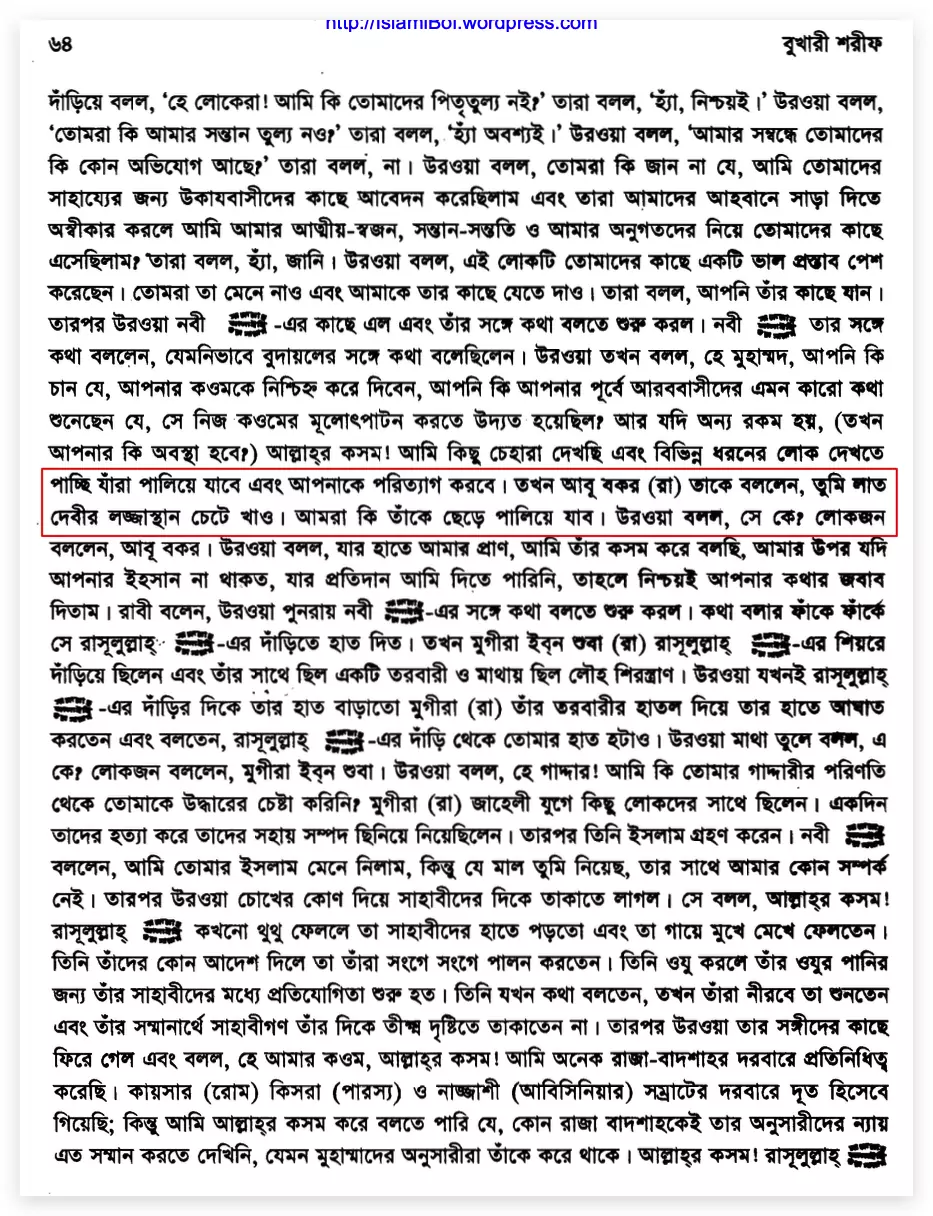
‘Urwah’s remark concerned the political and military situation. He questioned the loyalty of Muhammad’s forces. His fears might have been unfounded, his assessment calculated, or his words an attempt to pressure Muhammad. Abu Bakr’s response, however, was entirely different in kind. He did not assess or refute the reasoning behind ‘Urwah’s claim; he made the deity worshipped by his opponent the target of a genital insult. In diplomatic negotiations, such language demonstrates no strength of argument. It turns personal and religious humiliation into a weapon of debate.
‘Urwah’s response is equally revealing. He did not treat Abu Bakr’s words as an ordinary part of the conversation. He said that he was withholding a reply only because of a favor Abu Bakr had previously done for him. That exchange leaves no doubt that an insult had been delivered and recognized as such by the person receiving it. Abu Bakr intended to demean ‘Urwah, and ‘Urwah regarded the remark as an insult that warranted a response. Ibn Hajar’s commentary likewise identifies Abu Bakr’s intention as intensifying ‘Urwah’s humiliation.
Muhammad was the central figure in the negotiations. He was speaking with ‘Urwah when Abu Bakr interjected with the insult. The narrative then continues with Muhammad and ‘Urwah’s discussion; it records no correction or rebuke from Muhammad directed at Abu Bakr. Islamweb’s fatwa explicitly treats this silence as approval. Read together, al-Bukhari’s account and the later legal interpretation raise a serious ethical question: is sexually humiliating an opponent’s deity a prohibited obscenity, or is it permissible when invoked in defense of religious interests?
Commentaries on the Hadith: An Exceptionally Offensive Insult
The commentary Sahaj Nasrul Bari, vol. 8, p. 252, explains the incident as follows: [3]—
‘Urwah’s remark displeased Hazrat Abu Bakr al-Siddiq (may Allah be pleased with him). In anger he said, امصص بَظَرَ اللَاتِ أَنْفر — that is, “Go on, man! Lick the private parts of your al-Lat! Do you know how deeply we love the Messenger of Allah (peace and blessings be upon him)? Would we abandon the Messenger of Allah (peace and blessings be upon him) and run away? Impossible!”
Al-Lat was the name of an idol worshipped by the tribe of Thaqif. Among the Arabs, this expression (“lick al-Lat’s private parts”) was an exceptionally severe insult. ‘Urwah was deeply offended and asked, “Who is that?” The Prophet (peace and blessings be upon him) replied, “Abu Bakr.” ‘Urwah said, “You have done me a favor that we have not yet repaid. Otherwise, I would have answered your insult.”
… Al-Mughirah would strike ‘Urwah’s hand with the sword’s handle and say, “Keep your hand away from the Messenger of Allah’s (peace and blessings be upon him) beard.” ‘Urwah lifted his head and asked, “Who is that?” The Messenger of Allah (peace and blessings be upon him) said, “That is your nephew, al-Mughirah ibn Shu‘bah.”
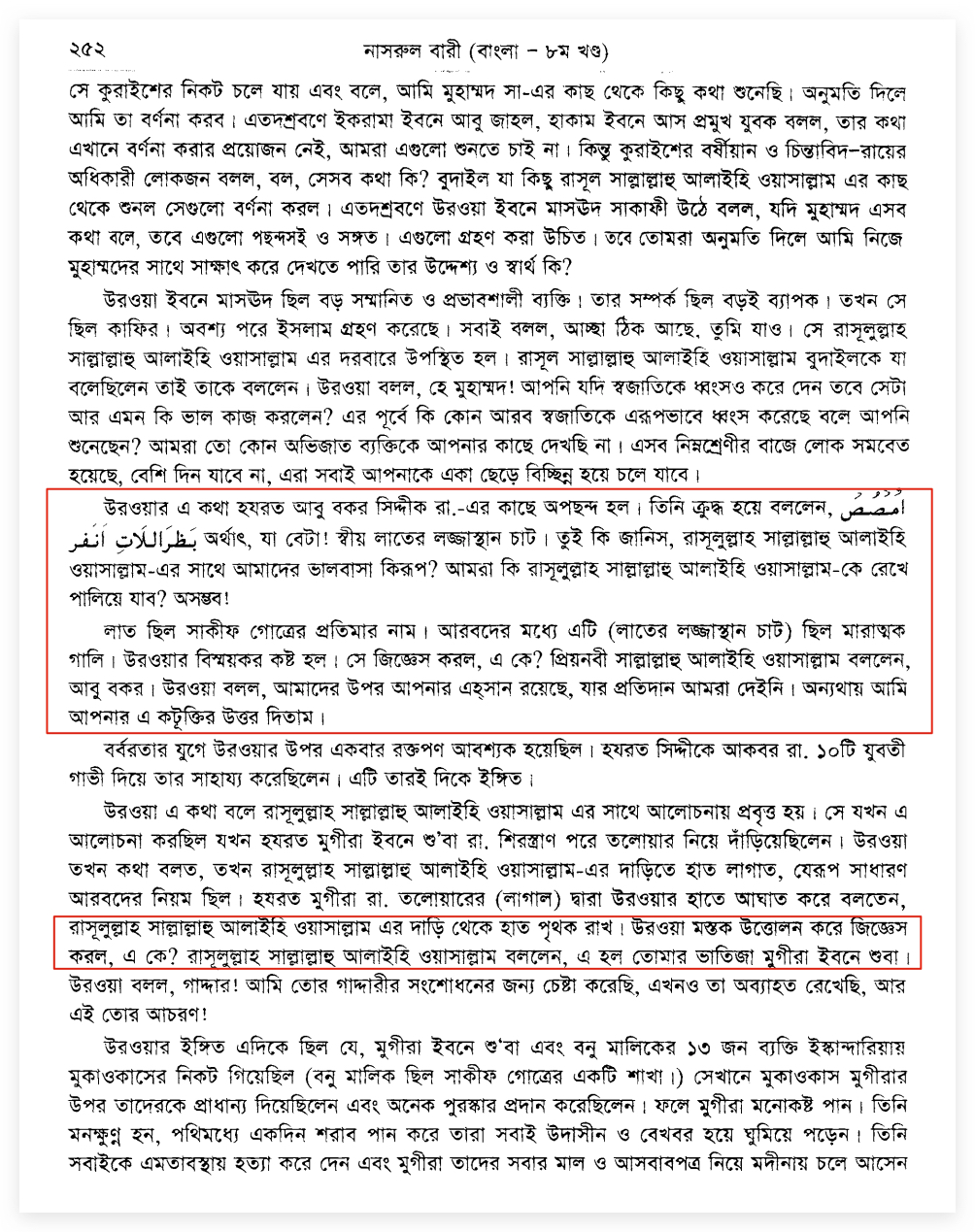
Abu Bakr did more than express anger. He chose a particularly degrading sexual insult directed at the very object of his opponent’s religious devotion. Another significant religious conflict arises from Abu Bakr’s state of ihram. On the journey to Hudaybiyyah, the companions had entered ihram with the intention of performing ‘umrah. The Qur’an’s injunction states:
The pilgrimage takes place during specified months. Whoever undertakes Hajj during those months must abstain from sexual relations, wrongdoing, and quarreling during Hajj. Whatever good you do, Allah knows it. Take provisions for the journey, but the best provision is piety. People of understanding, remain conscious of Me.
— Taisirul Quran
The months of Hajj are well known. Whoever resolves to perform Hajj during those months must refrain from sexual intercourse, misconduct, and disputes during Hajj. Whatever good you do, Allah knows it. Take provisions with you; indeed, the best provision is God-consciousness or self-restraint. Therefore, people of understanding, fear Me.
— Sheikh Mujibur Rahman
Hajj is to be performed in the appointed months. Whoever undertakes it during those months must abstain during Hajj from obscenity, sinful acts, and quarreling. Allah knows whatever good you do. Take provisions, for the best provision is piety. People of understanding, fear Me.
— Rawai Al-bayan
Hajj takes place in well-known months [1]. Whoever commits to performing Hajj during them must abstain from sexual relations [2], wrongdoing [3], and quarreling [4] during Hajj. Whatever good you do, Allah knows it [5]. Take provisions [6], for the best provision is piety. People of understanding, be mindful of Me [7].
— Dr. Abu Bakr Muhammad Zakaria
During the Hudaybiyyah expedition, the Muslims had entered ihram intending to perform ‘umrah. Abu Bakr’s sexually explicit insult in that state creates a serious conflict with Islam’s own prescriptions for speech and conduct. Qur’an 2:197 forbids rafath, fusuq, and jidal during Hajj. Explanations of rafath include sexual intercourse, sexual allusions, and obscene sexual speech; fusuq is discussed in terms of wrongdoing and abusive speech, while jidal concerns disputes and quarrels. Abu Bakr’s words were not a neutral description of human anatomy. They were a direct sexual insult aimed at a deity worshipped by the other party. The conflict with the religious ideal of restraint and the prohibition of abusive language is unmistakable.
The classical Hanbali jurist Ibn Qudamah, in al-Mughni, quotes Qur’an 2:197 while discussing prohibited conduct in the state of ihram. Alongside sexual intercourse as a principal meaning of rafath, he records interpretations concerning sexual allusions and obscene expressions. In the same discussion, he also identifies abusive speech as a meaning of fusuq. Thus the restrictions associated with ihram concern not only abstention from sexual intercourse, but also restraint in language and conduct. Ibn Qudamah writes [4]—
وَالْفُسُوقُ هُوَ السِّبَابُ لِقَوْلِ النَّبِيِّ صَلَّى اللَّهُ عَلَيْهِ وَسَلَّمَ سِبَابُ الْمُسْلِمِ فُسُوقٌ
English translation: “Fusuq means verbal abuse, in accordance with Muhammad’s statement: ‘Insulting a Muslim is an act of sinful disobedience.’”
Ibn Qudamah’s discussion clearly places abusive speech within the category of wrongdoing. Abu Bakr’s remark was unmistakably abusive. Ibn Hajar himself explains that Abu Bakr invoked the genitals of ‘Urwah’s goddess to humiliate him as severely as possible. No further conjecture is needed to identify the act: it was a deliberate insult directed at both a person and his religious devotion. The question is why language condemned under general moral and religious standards was treated as permissible when deployed in a particular political or religious confrontation.
A further inconsistency appears in how the religious rules are applied. The Qur’an instructs pilgrims to refrain from sexual activity, wrongdoing, and quarrels. That injunction establishes an ideal of self-restraint and disciplined conduct. Yet the explanations defending Abu Bakr’s words make the perceived need to silence a religious adversary a justification for obscene speech. An exception is therefore constructed between the professed ideal of decorum and the authorized method of humiliating an opponent. The decisive ethical issue is whether a political remark about loyalty justified a sexual insult against the speaker’s deity. No such insult was necessary to answer ‘Urwah’s arguments during the negotiations at Hudaybiyyah.
In Zad al-Ma‘ad and Islamweb Fatwa 59816, Ibn al-Qayyim and the fatwa’s authors justify the incident by appealing to situational necessity, perceived benefit, and the need to rebuke an opponent forcefully. The ethical conflict is therefore broader than the technical application of any single rule of ihram. Obscenity is condemned under Islam’s general rules of propriety, yet the same language is specially permitted against religious opponents. Speech regarded as offensive in ordinary circumstances becomes acceptable when used against an adversary. This makes the limits of propriety dependent on circumstance and the identity of the target rather than on a consistent ethical standard.
Taqrir, or Tacit Approval: Muhammad’s Moral Position
Under Islamic jurisprudence, Muhammad’s statements, actions, and tacit approvals are treated as sources of religious law. Had Abu Bakr’s conduct been prohibited or indecent under Islam, Muhammad would have been expected to rebuke him immediately. He did not. Ibn Hajar al-‘Asqalani, author of Fath al-Bari, is cited in connection with Muhammad’s failure to rebuke Abu Bakr. His commentary on the incident reads [5]—
لَأُقَاتِلَنَّهُمْ.
قَوْلُهُ: (اجْتَاحَ) بِجِيمٍ ثُمَّ مُهْمَلَةٍ أَيْ أَهْلَكَ أَصْلُهُ بِالْكُلِّيَّةِ، وَحَذَفَ الْجَزَاءَ مِنْ قَوْلِهِ: وَإِنْ تَكُنِ الْأُخْرَى تَأَدُّبًا مَعَ النَّبِيِّ ﷺ وَالْمَعْنَى وَإِنْ تَكُنِ الْغَلَبَةُ لِقُرَيْشٍ لَا آمَنُهُمْ عَلَيْكَ مَثَلًا. وَقَوْلُهُ: (فَإِنِّي وَاللَّهِ لَا أَرَى وُجُوهًا إِلَخْ) كَالتَّعْلِيلِ لِهَذَا الْقَدْرِ الْمَحْذُوفِ، وَالْحَاصِلُ أَنَّ عُرْوَةَ رَدَّدَ الْأَمْرَ بَيْنَ شَيْئَيْنِ غَيْرِ مُسْتَحْسَنَيْنِ عَادَةً وَهُوَ هَلَاكُ قَوْمِهِ إِنْ غَلَبَ، وَذَهَابُ أَصْحَابِهِ إِنْ غُلِبَ، لَكِنْ كُلٌّ مِنَ الْأَمْرَيْنِ مُسْتَحْسَنٌ شَرْعًا كَمَا قَالَ تَعَالَى: ﴿قُلْ هَلْ تَرَبَّصُونَ بِنَا إِلا إِحْدَى الْحُسْنَيَيْنِ﴾
قَوْلُهُ: (أَشْوَابًا) بِتَقْدِيمِ الْمُعْجَمَةِ عَلَى الْوَاوِ كَذَا لِلْأَكْثَرِ وَعَلَيْهَا اقْتَصَرَ صَاحِبُ الْمَشَارِقِ، وَوَقَعَ لِأَبِي ذَرٍّ، عَنِ الْكُشْمِيهَنِيِّ أَوْشَابًا بِتَقْدِيمِ الْوَاوِ، وَالْأَشْوَابُ الْأَخْلَاطُ مِنْ أَنْوَاعٍ شَتَّى، وَالْأَوْبَاشُ (١) الْأَخْلَاطُ مِنَ السَّفَلَةِ، فَالْأَوْبَاشُ أَخَصُّ مِنَ الْأَشْوَابِ.
قَوْلُهُ: (خَلِيقًا) بِالْخَاءِ الْمُعْجَمَةِ وَالْقَافِ أَيْ حَقِيقًا وَزْنًا وَمَعْنًى، وَيُقَالُ خَلِيقٌ لِلْوَاحِدِ وَالْجَمْعِ وَلِذَلِكَ وَقَعَ صِفَةً لِأَشْوَابٍ.
قَوْلُهُ: (وَيَدَعُوكَ) بِفَتْحِ الدَّالِ أَيْ يَتْرُكُوكَ، فِي رِوَايَةِ أَبِي الْمَلِيحِ، عَنِ الزُّهْرِيِّ عِنْدَ مَنْ سَمَّيْتُهُ وَكَأَنّي بِهِمْ لَوْ قَدْ لَقِيتَ قُرَيْشًا قَدْ أَسْلَمُوكَ فَتُؤْخَذُ أَسِيرًا فَأَيُّ شَيْءٍ أَشَدُّ عَلَيْكَ مِنْ هَذَا وَفِيهِ أَنَّ الْعَادَةَ جَرَتْ أَنَّ الْجُيُوشَ الْمُجَمَّعَةَ لَا يُؤْمَنُ عَلَيْهَا الْفِرَارُ بِخِلَافِ مَنْ كَانَ مِنْ قَبِيلَةٍ وَاحِدَةٍ فَإِنَّهُمْ يَأْنَفُونَ الْفِرَارَ فِي الْعَادَةِ. وَمَا دَرَى عُرْوَةُ أَنَّ مَوَدَّةَ الْإِسْلَامِ أَعْظَمُ مِنْ مَوَدَّةِ الْقَرَابَةِ، وَقَدْ ظَهَرَ لَهُ ذَلِكَ مِنْ مُبَالَغَةِ الْمُسْلِمِينَ فِي تَعْظِيمِ النَّبِيِّ ﷺ كَمَا سَيَأْتِي.
قَوْلُهُ: (فَقَالَ لَهُ أَبُو بَكْرٍ الصِّدِّيقُ) زَادَ ابْنُ إِسْحَاقَ وَأَبُو بَكْرٍ الصِّدِّيقُ خَلْفَ رَسُولِ اللَّهِ ﷺ قَاعِدٌ فَقَالَ.
قَوْلُهُ: (امْصَصْ بَظْرَ اللَّاتِ) زَادَ ابْنُ عَائِذٍ مِنْ وَجْهٍ آخَرَ عَنِ الزُّهْرِيِّ وَهِيَ – أَيِ اللَّاتُ – طَاغِيَتُهُ الَّتِي يَعْبُدُ أَيْ طَاغِيَةُ عُرْوَةَ. وَقَوْلُهُ امْصَصْ بِأَلِفِ وَصْلٍ وَمُهْمَلَتَيْنِ الْأُولَى مَفْتُوحَةٌ بِصِيغَةِ الْأَمْرِ، وَحَكَى ابْنُ التِّينِ عَنْ رِوَايَةِ الْقَابِسِيِّ ضَمَّ الصَّادِ الْأُولَى وَخَطَّأَهَا، وَالْبَظْرُ بِفَتْحِ الْمُوَحَّدَةِ وَسُكُونِ الْمُعْجَمَةِ قِطْعَةٌ تَبْقَى بَعْدَ الْخِتَانِ فِي فَرْجِ الْمَرْأَةِ، وَاللَّاتُ اسْمُ أَحَدِ الْأَصْنَامِ الَّتِي كَانَتْ قُرَيْشٌ وَثَقِيفٌ يَعْبُدُونَهَا، وَكَانَتْ عَادَةُ الْعَرَبِ الشَّتْمُ بِذَلِكَ لَكِنْ بِلَفْظِ الْأُمِّ فَأَرَادَ أَبُو بَكْرٍ الْمُبَالَغَةَ فِي سَبِّ عُرْوَةَ بِإِقَامَةِ مَنْ كَانَ يَعْبُدُ مَقَامَ أُمِّهِ، وَحَمَلَهُ عَلَى ذَلِكَ مَا أَغْضَبَهُ بِهِ مِنْ نِسْبَةِ الْمُسْلِمِينَ إِلَى الْفِرَارِ، وَفِيهِ جَوَازُ النُّطْقُ بِمَا يُسْتَبْشَعُ مِنَ الْأَلْفَاظِ لِإِرَادَةِ زَجْرِ مَنْ بَدَا مِنْهُ مَا يَسْتَحِقُّ بِهِ ذَلِكَ. وَقَالَ ابْنُ الْمُنِيرِ: فِي قَوْلِ أَبِي بَكْرٍ تَخْسِيسٌ لِلْعَدُوِّ وَتَكْذِيبُهُمْ وَتَعْرِيضٌ بِإِلْزَامِهِمْ مِنْ قَوْلِهِمْ إِنَّ اللَّاتَ بِنْتُ اللَّهِ، تَعَالَى اللَّهُ عَنْ ذَلِكَ عُلُوًّا كَبِيرًا، بِأَنَّهَا لَوْ كَانَتْ بِنْتًا لَكَانَ لَهَا مَا يَكُونُ لِلْإِنَاثِ.
قَوْلُهُ: (أَنَحْنُ نَفِرُّ) اسْتِفْهَامُ إِنْكَارٍ.
قَوْلُهُ: (مَنْ ذَا؟ قَالُوا: أَبُو بَكْرٍ) فِي رِوَايَةِ ابْنِ إِسْحَاقَ فَقَالَ: مَنْ هَذَا يَا مُحَمَّدُ؟ قَالَ: هَذَا ابْنُ أَبِي قُحَافَةَ.
قَوْلُهُ: (أَمَا) هُوَ حَرْفُ اسْتِفْتَاحٍ، وَقَوْلُهُ: وَالَّذِي نَفْسِي بِيَدِهِ يَدُلُّ عَلَى أَنَّ الْقَسَمَ بِذَلِكَ كَانَ عَادَةً لِلْعَرَبِ.
قَوْلُهُ: (لَوْلَا يَدٌ) أَيْ نِعْمَةٌ، وَقَوْلُهُ: (لَمْ أَجْزِكَ بِهَا) أَيْ لَمْ أُكَافِئْكَ بِهَا، زَادَ ابْنُ إِسْحَاقَ وَلَكِنَّ هَذِهِ بِهَا أَيْ جَازَاهُ بِعَدَمِ إِجَابَتِهِ عَنْ شَتْمِهِ بِيَدِهِ الَّتِي كَانَ أَحْسَنَ إِلَيْهِ بِهَا، وَبَيَّنَ عَبْدُ الْعَزِيزِ الْإِمَامِيُّ، عَنِ الزُّهْرِيِّ فِي هَذَا الْحَدِيثِ أَنَّ الْيَدَ الْمَذْكُورَةَ أَنَّ عُرْوَةَ كَانَ تَحَمَّلَ بِدِيَةٍ فَأَعَانَهُ أَبُو بَكْرٍ فِيهَا بِعَوْنٍ حَسَنٍ، وَفِي رِوَايَةِ الْوَاقِدِيِّ عَشْرِ قَلَائِصَ.
قَوْلُهُ: (قَائِمٌ عَلَى رَأْسِ النَّبِيِّ ﷺ بِالسَّيْفِ) فِيهِ جَوَازُ الْقِيَامُ عَلَى رَأْسِ الْأَمِيرِ بِالسَّيْفِ بِقَصْدِ الْحِرَاسَةِ وَنَحْوِهَا مِنْ تَرْهِيبِ الْعَدُوِّ، وَلَا يُعَارِضُهُ النَّهْيُ عَنِ الْقِيَامِ عَلَى رَأْسِ الْجَالِسِ لِأَنَّ مَحَلَّهُ مَا إِذَا كَانَ عَلَى وَجْهِ الْعَظَمَةِ وَالْكِبْرِ.
قَوْلُهُ: (فَكُلَّمَا تَكَلَّمَ) فِي رِوَايَةِ السَّرَخْسِيِّ، وَالْكُشْمِيهَنِيِّ فَكُلَّمَا كَلَّمَهُ أَخَذَ بِلِحْيَتِهِ وَفِي رِوَايَةِ ابْنِ إِسْحَاقَ فَجَعَلَ يَتَنَاوَلُ لِحْيَةَ النَّبِيِّ ﷺ وَهُوَ يُكَلِّمُهُ.
This passage from Ibn Hajar al-‘Asqalani’s Fath al-Bari, reproduced from al-Maktabah al-Shamilah, discusses the negotiations at Hudaybiyyah between ‘Urwah ibn Mas‘ud, the Quraysh representative, and Abu Bakr. It explains the incident’s language and draws legal conclusions from it.
The following is an English translation of the commentary:
Fath al-Bari: Book of Conditions, negotiations and treaties—explanatory passage.
1. The possible destruction of the Quraysh and ‘Urwah’s statement:
Ibn Hajar explains that the Arabic word “ijtaha” (اجتاح) means to destroy something completely, down to its roots. When ‘Urwah said that Muhammad might destroy his own people if victorious, he left the consequence of the opposite outcome unstated out of courtesy toward Muhammad. His meaning was that if the Quraysh prevailed, Muhammad could face grave danger, but ‘Urwah did not spell this out directly.
When ‘Urwah then said, “By Allah, I see faces with you who may flee,” he was giving a reason for the implication he had left unspoken. He presented two outcomes conventionally regarded as undesirable: the destruction of his own people if Muhammad won, or the desertion of Muhammad by his followers if he lost. Ibn Hajar adds that under the religious perspective reflected in Qur’an 9:52, either outcome could be regarded as one of “the two good things,” quoting: “Say: Do you await for us anything other than one of the two best outcomes?”
2. The words “ashwab” and “awbāsh,” meaning a mixed gathering:
The word used by ‘Urwah for Muhammad’s companions was “ashwab” (أشوابا) in most transmissions. It means people assembled from different backgrounds or groups. Another transmission uses “awbāsh” (أوباش), a term for a mixture of people of low social status. “Awbāsh” is therefore more disparaging and more specific than “ashwab.”
‘Urwah was suggesting that Muhammad’s followers might desert him when danger came. In Abu al-Malih’s transmission from al-Zuhri, his point was more explicit: “I can imagine that when you face the Quraysh, they will surrender you to them and run away, leaving you to be taken prisoner.” Ibn Hajar notes the conventional assumption that armies gathered from several tribes were more liable to desert than armies from a single tribe, whose members would be restrained by kinship loyalty and shame. He then comments, from his own Islamic perspective, that ‘Urwah did not understand that attachment through Islam was stronger than ties of blood, as ‘Urwah would later observe from the followers’ extraordinary reverence for Muhammad.
3. Abu Bakr’s obscene insult and its meaning:
In response to ‘Urwah’s remark, Abu Bakr al-Siddiq, who according to Ibn Ishaq’s additional report was sitting behind Muhammad, exclaimed: “امصص بظر اللات” — “Suck al-Lat’s clitoris!”
According to an additional transmission from al-Zuhri reported by Ibn ‘A’idh, al-Lat was the idol worshipped by ‘Urwah. The word “imṣaṣ” (امصص) is an imperative meaning “suck.” The word “baẓr” (بظر) refers to the piece of tissue remaining in the female genital region after circumcision—the clitoral area. Al-Lat was an idol worshipped by Quraysh and Thaqif.
Arabs were accustomed to uttering this kind of insult by invoking the addressee’s mother. Abu Bakr substituted ‘Urwah’s object of worship for his mother in order to intensify the insult. He had been angered by ‘Urwah’s suggestion that the Muslims would flee and abandon Muhammad.
4. The permissibility of using offensive words:
Ibn Hajar draws the following legal inference: “This indicates the permissibility of uttering expressions ordinarily regarded as repugnant when the purpose is to rebuke someone whose conduct warrants such a rebuke.”
Ibn al-Munayyir adds that Abu Bakr’s words degraded the enemy, rejected their claims, and turned against them their belief that al-Lat was a daughter of God (God forbid): if she were a daughter, the insult implied, she would possess the bodily parts associated with females.
5. ‘Urwah’s response and the favor he owed Abu Bakr:
When ‘Urwah asked, “Who is that, Muhammad?” he was told that the speaker was Abu Bakr, son of Abu Quhafah. ‘Urwah swore that if Abu Bakr had not previously done him a favor he had yet to repay, he would have answered the insult. An additional report attributed to Ibn Ishaq says that ‘Urwah regarded his silence as repayment for that favor.
‘Abd al-‘Aziz al-Imami’s transmission from al-Zuhri explains that ‘Urwah had once assumed responsibility for a blood-money payment and that Abu Bakr had given him substantial assistance. Al-Waqidi’s version specifies ten young she-camels.
6. Al-Mughirah ibn Shu‘bah and the armed guard:
Al-Mughirah ibn Shu‘bah stood beside Muhammad with a sword as a guard. Ibn Hajar considers this permissible for protecting a leader and intimidating an enemy, distinguishing it from standing beside a seated person merely to display arrogance or grandeur. While speaking, ‘Urwah repeatedly reached toward Muhammad’s beard, and al-Mughirah struck his hand away with the sword’s handle. Another account identifies al-Mughirah to ‘Urwah as his nephew.
In Fath al-Bari, Ibn Hajar al-‘Asqalani explains the linguistic and social meaning of Abu Bakr’s insult. In Arab usage, comparable abuse ordinarily referred to a person’s mother’s genitals. In ‘Urwah’s case, Abu Bakr substituted the goddess al-Lat for his mother to make the insult more offensive. Ibn Hajar explicitly says that Abu Bakr intended to intensify the insult because he was angered by ‘Urwah’s claim that the Muslims might desert Muhammad. Ibn Hajar then draws a legal conclusion from the episode: ordinarily offensive or repugnant words may be used to rebuke a person whose conduct, in the jurist’s judgment, warrants such treatment. He therefore does more than record an historical insult. He recognizes its use as permissible in specified circumstances.
The ethical problem with this ruling is plain. ‘Urwah had made a political observation about the loyalty of Muhammad’s followers. That observation could have been challenged with facts and arguments. Abu Bakr instead invoked the genitals of a deity worshipped by ‘Urwah as a means of humiliating him. Ibn Hajar describes the purpose as intensified humiliation and relates it to the permissibility of using offensive expressions. Sexual degradation of a religious opponent is thus given legal approval as a means of rebuke. Language that is plainly obscene and insulting under ordinary moral standards is declared permissible on the basis of a claimed religious or situational need.
Ibn al-Qayyim: Explicit References to Genitals Permitted for a Perceived Benefit
In Zad al-Ma‘ad, Ibn al-Qayyim discusses various legal lessons drawn from the Treaty of Hudaybiyyah. He uses Abu Bakr’s insult as evidence for a distinct legal ruling: the names of sexual organs may be spoken explicitly when circumstances require them for a perceived benefit. In the same discussion, he invokes another instruction attributed to Muhammad, directing that a person boasting of pre-Islamic lineage be told to bite his father’s penis. Ibn al-Qayyim thus relies on a second sexually explicit insult attributed to Muhammad to justify Abu Bakr’s language. He writes [6]—
وَفِي قَوْلِ الصِّدِّيقِ لِعُرْوَةَ: امْصُصْ بَظْرَ اللَّاتِ، دَلِيلٌ عَلَى جَوَازِ التَّصْرِيحِ بِاسْمِ الْعَوْرَةِ إِذَا كَانَ فِيهِ مَصْلَحَةٌ تَقْتَضِيهَا تِلْكَ الْحَالُ.
English translation: “Abu Bakr’s statement to ‘Urwah, ‘Suck al-Lat’s clitoris,’ is evidence that explicitly naming the private parts is permissible when there is a benefit that the circumstances call for.”
The term maslahah in Ibn al-Qayyim’s statement is crucial. It refers to welfare, benefit, or a perceived interest arising from the situation. He makes that interest a central reason for allowing Abu Bakr’s abusive language. Yet having an interest in a political dispute and possessing the moral right to sexually insult an adversary in pursuit of that interest are entirely different matters. An act does not become just because it is useful to one side. Humiliating an opponent might serve to demonstrate one’s supporters’ loyalty, but that purpose does not make the humiliation morally defensible. In Ibn al-Qayyim’s argument, perceived expediency becomes the basis for permitting obscene speech.
This position creates an even deeper conflict with Islam’s proclaimed standards of decorum. If a religious moral ideal is truly universal, it must apply to one’s own followers and to one’s opponents alike. Yet in defending Abu Bakr’s insult, the opponent’s words are treated as sufficient grounds for humiliation. ‘Urwah’s goddess was made the object of a sexual insult, and later legal commentary declared the language permissible. The operative moral standard thus becomes dependent not on the person’s dignity or the intrinsic character of the act, but on perceived advantage and the intention to subdue an adversary.
Islamweb Fatwa 59816: Declaring Muhammad’s Silence an Explicit Approval
Islamweb Fatwa 59816, issued on 10 March 2005, addresses the authenticity and legal status of Abu Bakr’s specific insult. The questioner asked whether the words “Suck al-Lat’s clitoris” appeared in reliable reports, how Islamic scholars explained them, and whether they conflicted with statements attributed to Muhammad prohibiting obscenity and abusive speech. The response cites reports from al-Bukhari and Ahmad. It then refers to Ibn Hajar’s commentary, Ibn al-Qayyim’s reasoning about maslahah, and an opinion of Ibn Taymiyyah to justify Abu Bakr’s conduct.
The fatwa’s most important claim concerns Muhammad’s silence. It argues that Muhammad would have prohibited Abu Bakr’s insult if it had been wrong. Since Muhammad did not forbid it, the fatwa concludes that he approved it. The incident is therefore not treated simply as Abu Bakr’s personal outburst: Muhammad’s silence is presented as proof of religious authorization. The fatwa states [7]—
وأيضاً لو كان فيه مخالفة لنهاه النبي عن ذلك بل أقره وهو صلى الله عليه وسلم لا يقر على باطل.
English translation: “Moreover, if it had involved a violation, the Prophet would have forbidden him from doing so. Instead, he approved it; and the Prophet does not approve falsehood or wrongdoing.”
The fatwa could hardly be clearer about the religious legitimacy it assigns to Abu Bakr’s behavior. Muhammad was present during the encounter, the negotiations continued after the insult, and the narration records no rebuke from him. Islamweb treats that silence as approval. The justification for obscene language therefore draws not only on later statements by Ibn Hajar or Ibn al-Qayyim, but also on Muhammad’s presence and his failure to object. Those circumstances are made the legal basis for authorization.
The ethical implications of Islamweb’s interpretation are serious. A religious leader did not protest when his follower delivered a sexually explicit insult in his presence. Later authorities declared that silence an approval. As a result, the obscene humiliation of an opponent’s deity becomes a precedent for religiously permissible conduct. Including such a genital insult among the behaviors sanctioned by a religious ideal presented as a model of superior character directly contradicts that ideal’s moral claims.
The fatwa further argues that there is no objection to such language when circumstances call for it in pursuit of a benefit or to avert harm. This reasoning gives the speaker’s perceived needs priority over the dignity of the person being insulted. Abu Bakr was angered by ‘Urwah’s remark, but anger does not establish a moral right to sexually insult another person’s deity. By declaring the insult permissible, the religious authorities subordinate the demand for respectful treatment of an opponent to a situational exception.
A Later Islamweb Fatwa: Continuing Legal Approval of Obscene Language
Islamweb reiterated the position taken in Fatwa 59816 in a later ruling. Fatwa 342196, published on 21 December 2016, is entitled جواز التكلم بالألفاظ الفاحشة للمصلحة الراجحة, meaning “The permissibility of using obscene expressions for an overriding benefit.” The questioner asked how Abu Bakr’s insult and the instruction to tell someone boasting of pre-Islamic lineage to bite his father’s penis could be reconciled with hadiths condemning obscenity. The answer says that although Islam generally demands decent speech, an exception may be made when that general rule conflicts with an overriding interest. [8]
This ruling shows that the approval of Abu Bakr’s obscene remark was not an isolated or marginal comment. Later Islamic fatwas continued to defend the incident and to authorize sexually explicit insults on religious grounds. They upheld the general prohibition of obscenity while declaring the same kind of language acceptable in certain circumstances. The crucial issue is therefore not whether the words are obscene, but which circumstances religious authorities regard as sufficient to justify them, and why the perceived benefit is allowed to override the dignity of the person being insulted.
Genital Insults on Muhammad’s Own Instructions: The Account of Ubayy ibn Ka‘b
Alongside Abu Bakr’s obscene insult, Islamic hadith literature also preserves an account of genital insults issued on Muhammad’s own instructions. In al-Adab al-Mufrad, Hadith 963, al-Bukhari records an incident involving Ubayy ibn Ka‘b. A man had identified himself in terms of the tribal pride associated with the pre-Islamic period of ignorance (jahiliyyah). Ubayy told him to bite his father’s penis and did not conceal the words behind a euphemism. Those present were astonished by his language. Seeing their reaction, Ubayy declared that he feared no one over the matter and cited a statement of Muhammad instructing that those invoking pre-Islamic tribal pride be insulted in precisely this fashion.
The significance of this hadith is that no inference from Muhammad’s silence is needed to establish the reported authorization of a genital insult. The narration quotes a direct instruction attributed to Muhammad. It also describes a companion carrying out that instruction and citing Muhammad’s words when the bystanders reacted with surprise. The relevant statement is [9]—
إِنِّي سَمِعْتُ النَّبِيَّ صَلَّى اللَّهُ عَلَيْهِ وَسَلَّمَ يَقُولُ: مَنْ تَعَزَّى بِعَزَاءِ الْجَاهِلِيَّةِ فَأَعِضُّوهُ وَلَا تَكْنُوهُ.
English translation: “I heard Muhammad say: ‘Whoever invokes the tribal pride of the age of ignorance, tell him to bite his father’s penis, and do not soften the words with a euphemism.’”
Ubayy ibn Ka‘b’s words and the reactions of those present are central to this narration. He was not merely delivering a stern reprimand. He used a sexually explicit insult that astonished the people around him. In response, he cited Muhammad’s instruction. Rather than treating the indecent words as an uncontrolled expression of personal anger, he presented them as the execution of a religious command. The episode creates a serious conflict with Islamic claims about proper speech: language considered obscene and degrading in ordinary conversation is presented, in a report attributed to Muhammad, as something to be used in response to a particular religious or social offense.
Abu Bakr’s insult and Ubayy ibn Ka‘b’s episode were separate incidents. In the first, a religious opponent’s goddess was sexually insulted. In the second, the father’s penis was invoked to humiliate a person boasting of pre-Islamic ancestry. The language and moral function of the insults nevertheless share an important feature: in both cases sexual humiliation was used to degrade or rebuke another person. Abu Bakr spoke in Muhammad’s presence, and later jurists treated Muhammad’s silence as approval. In Ubayy’s case, a comparable insult was justified by an explicit instruction attributed to Muhammad.
In Zad al-Ma‘ad, Ibn al-Qayyim also cites Muhammad’s instruction concerning people boasting of pre-Islamic ancestry while explaining why Abu Bakr’s obscene remark was permissible. He treats both reports as precedents authorizing explicit references to sexual organs in particular circumstances. The issue therefore extends beyond two unrelated historical episodes. Later Islamic jurisprudence uses them to support the same rule. Insulting the deity of a religious opponent and directing a genital insult at a person invoking pre-Islamic identity are both presented as permissible speech under specified conditions.
The Hadith Prohibiting Obscenity and the Authorization of Genital Insults
Islamic sources also contain an explicit injunction to use decent language. In Sunan al-Tirmidhi, Hadith 1977, Muhammad describes a believer’s character by rejecting abusive slander, cursing, obscenity, and foul language. The statement sets out a general moral rule: a believer should not speak in a degrading, obscene, or abusive manner. Yet placing it alongside the authorization of Abu Bakr’s insult and the instruction concerning those boasting of pre-Islamic lineage exposes conflicting rules of conduct within the same religious tradition. Obscenity is condemned as incompatible with the character of a believer, while sexually explicit insults are permitted under particular circumstances. Muhammad’s statement, narrated from ‘Abd Allah ibn Mas‘ud, reads [10]—
لَيْسَ الْمُؤْمِنُ بِالطَّعَّانِ وَلَا اللَّعَّانِ وَلَا الْفَاحِشِ وَلَا الْبَذِيءِ.
English translation: “The believer is not one who attacks others with insults, curses them, uses obscene language, or speaks foully.”
The clash between this hadith and Abu Bakr’s words is direct. Abu Bakr told his opponent to lick the genitals of the goddess he worshipped. That is an unmistakable example of obscene and offensive speech. Ibn Hajar also places the expression among words ordinarily regarded as repugnant. Ibn al-Qayyim invokes situational necessity as grounds for permitting such language, and an Islamweb fatwa declares Muhammad’s silence an approval. Thus the same religious tradition establishes both a general prohibition of obscenity and permission to use that obscenity in specified circumstances.
The moral conflict between the two positions cannot be erased merely by pointing to a difference in circumstances. Context can matter when evaluating conduct, but a morally defensible distinction requires a reason. A diplomatic representative’s doubts about the loyalty of Muhammad’s followers did not justify sexually insulting the goddess he worshipped. Likewise, even if boasting of pre-Islamic ancestry is regarded as objectionable, telling someone to bite his father’s penis was not necessary to condemn that behavior. In either situation, the offending words could have been met with a direct objection, a reasoned rebuttal, or even a severe but non-obscene rebuke. Yet the hadith reports and later juristic interpretations treat sexually explicit humiliation as acceptable under certain conditions.
This position becomes particularly serious when the conduct of religious leaders and their followers is presented as a model of moral behavior. An ordinary person’s offensive language can be criticized as a personal failing. But when religious authority declares that same conduct permissible, it ceases to be merely an individual lapse; it becomes a precedent for acceptable behavior. Ibn al-Qayyim
References
- Sahih al-Bukhari, Hadith 2731–2732, the Treaty of Hudaybiyyah ↩︎
- Sahih al-Bukhari, Islamic Foundation edition, Hadith 2547 ↩︎
- Sahaj Nasrul Bari, vol. 8, p. 252 ↩︎
- Ibn Qudamah, al-Mughni, vol. 3, discussion of prohibited conduct in ihram ↩︎
- Fath al-Bari, Book of Conditions, Chapter on Stipulations in Jihad, Reconciliation with Hostile Parties, and Written Agreements ↩︎
- Ibn al-Qayyim, Zad al-Ma‘ad, vol. 3, legal lessons from Hudaybiyyah ↩︎
- Islamweb, Fatwa 59816, “Defending al-Siddiq,” 10 March 2005 ↩︎
- Islamweb, Fatwa 342196, “The Permissibility of Using Obscene Expressions for an Overriding Benefit,” 21 December 2016 ↩︎
- Al-Bukhari, al-Adab al-Mufrad, Hadith 963, كتاب الحركات ↩︎
- Jami‘ al-Tirmidhi, Hadith 1977, كتاب البر والصلة ↩︎