
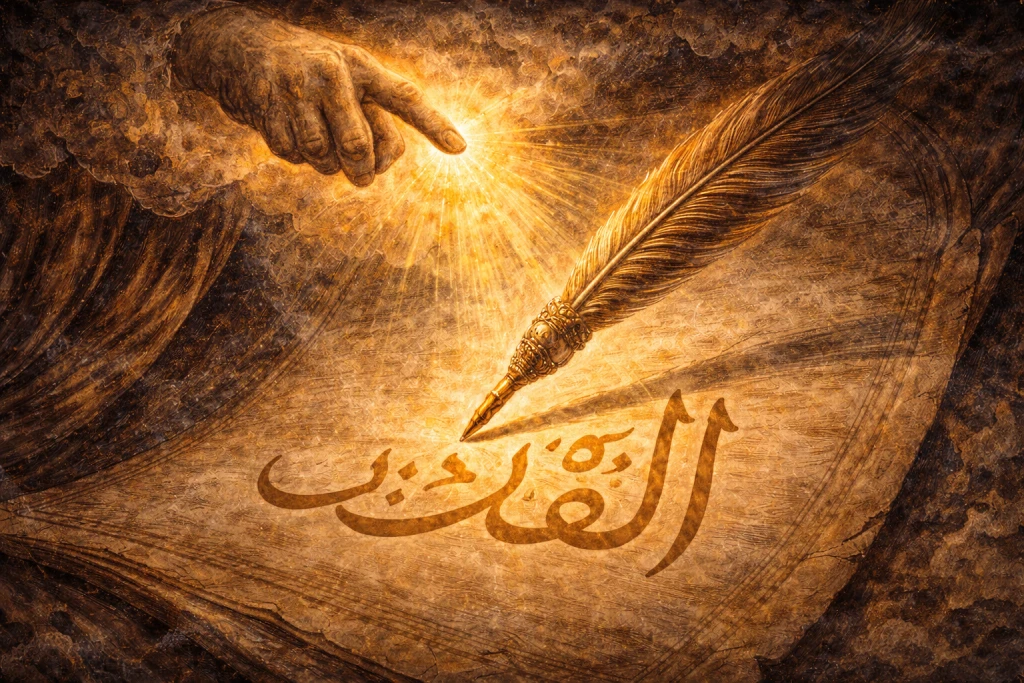
Introduction
A fundamental claim of Islamic doctrine is that knowledge of the unseen is an attribute exclusive to Allah. The Quran does more than state that Allah knows the unseen. Surah al-Anam 6:59 makes the stronger declaration that the keys to the unseen are with Him and that no one knows them except Him. Knowledge of the unseen is thus presented as an exclusive attribute that distinguishes Allah from every other being. [1]
وَعِنْدَهُ مَفَاتِحُ الْغَيْبِ لَا يَعْلَمُهَا إِلَّا هُوَ.
English translation:
With Him are the keys to the unseen; no one knows them except Him.
Surah al-Jinn 72:26–27 also specifies an exception to this exclusivity: Allah does not disclose His unseen to anyone, except a messenger whom He has chosen. The Quran’s own wording therefore specifies the category of exception: a chosen messenger. No pen is mentioned there as an exception. [2]
عَالِمُ الْغَيْبِ فَلَا يُظْهِرُ عَلَىٰ غَيْبِهِ أَحَدًا إِلَّا مَنِ ارْتَضَىٰ مِنْ رَسُولٍ.
English translation:
He is the Knower of the unseen; He does not disclose His unseen to anyone except a messenger whom He has chosen.
Yet the hadith describe a created Pen commanded to write “the decrees of everything” until the Day of Resurrection. This is not a case of disclosing the outcome of a battle, a prophecy, or a few limited items of unseen information to a messenger. Here, the entire future history of the universe—every event, every person’s actions, life, death, and ultimate fate—is written in advance through a created Pen. In Sunan Abi Dawud 4700, the Pen itself asks what it should write and is told to write the decrees of everything until the Day of Resurrection. Al-Albani classified the narration as sahih. [3]
إِنَّ أَوَّلَ مَا خَلَقَ اللَّهُ الْقَلَمَ فَقَالَ لَهُ اكْتُبْ قَالَ رَبِّ وَمَاذَا أَكْتُبُ قَالَ اكْتُبْ مَقَادِيرَ كُلِّ شَىْءٍ حَتَّى تَقُومَ السَّاعَةُ.
English translation:
The first thing Allah created was the pen. He said to it: Write. It asked: What should I write, my Lord? He said: Write what was decreed about everything till the Last Hour comes.
A fundamental conflict thus arises within the Islamic texts themselves. On one side, the Quran claims that no one knows the keys to the unseen except Allah, and that the stated exception to His disclosure of the unseen is a chosen messenger. On the other, the Pen is not a messenger, yet it is entrusted with writing the complete future record of everything until the Day of Resurrection, rather than a few isolated facts about the future. If the Pen is described as an instrument without information, the account of its asking a question and understanding the answer becomes meaningless. If it understands the command and writes the entire future, that unseen information was available to it. Saying that Allah supplied the information does not make its presence with the Pen disappear.
If the Quran’s exclusive claim is taken as strictly true, the logical consequence is straightforward: if complete knowledge of the unseen belongs only to Allah, and the Pen also knows the entire unseen future, that exclusive attribute no longer belongs to Allah alone. Reasoning through the contrary consequence exposes the inconsistency: if exclusive knowledge of the unseen identifies divinity, the Pen must also be said to possess that attribute reserved for Allah. Yet Islamic doctrine identifies the Pen as a creation, rather than Allah. The two claims therefore cannot both be true in the same sense.
Two further problems accompany this one. Although the Pen is described as a real, corporeal creation, it is placed in a sequence of events preceding the creation of the heavens and the earth. The same Pen is also said to have written all future human actions in advance, with those actions subsequently occurring under Allah’s will and creative power. The issue therefore extends beyond a strange story about a mythical pen: it challenges several fundamental claims of Islamic theology at once—knowledge of the unseen, creation, space and time, predestination, and moral responsibility.
The Pen as the First Creation and Allah’s Command
The Quran states very clearly that no one except Allah knows unseen matters [4].
Say: Of those in the heavens and the earth, none has knowledge of the unseen except Allah; and they do not know when they will be raised to life.
— Taisirul Quran
Say: No one in the heavens and the earth has knowledge of the unseen except Allah, and they do not know when they will be resurrected.
— Sheikh Mujibur Rahman
Say: ‘Those in the heavens and the earth do not know the unseen except Allah, and they cannot perceive when they will be resurrected.’
— Rawai Al-bayan
Say: ‘No one in the heavens and the earth knows the unseen except Allah [1], and they do not even perceive when they will be raised [2].’
— Dr. Abu Bakr Muhammad Zakaria
Now let us see that Allah has recorded everything in the Book [5].
No calamity befalls the earth or yourselves without My having recorded it in the Book before I bring it about. That is very easy for Allah.
— Taisirul Quran
Whatever disaster befalls the earth or you personally is recorded before I bring it about; that is very easy for Allah.
— Sheikh Mujibur Rahman
No calamity occurs on earth or among yourselves that I have not recorded in the Book before bringing it about. Surely this is very easy for Allah.
— Rawai Al-bayan
On earth or in your own lives, We have recorded every calamity that befalls you in the Book before it occurs [1]. Surely this is very easy for Allah.
— Dr. Abu Bakr Muhammad Zakaria
Now let us examine how these things were actually recorded in that Book. The hadith states [6]:
Sunan al-Tirmidhi (Islamic Foundation edition)
Chapter 35: Divine Decree (al-Qadar)
Section: No title given.
2158. Yahya ibn Musa (may Allah have mercy on him) … Abdul-Wahid bin Sulaim (may Allah be pleased with him) narrated: I arrived in Makkah and met Ata bin Abi Rabah (may Allah have mercy on him). I said to him: “O Abu Muhammad! The people of Al-Basrah speak about Al-Qadar.” He said: “O my son! Do you recite the Quran?” I said: “Yes.” He said: “Then recite Az-Zukhruf to me.” So I recited:
Ha Mim. By the manifest Book. Verily, We have made it a Qur’an in Arabic that you may be able to understand. And verily, it is in the Mother of Book with Us, indeed exalted, full of wisdom. (43:1–4)
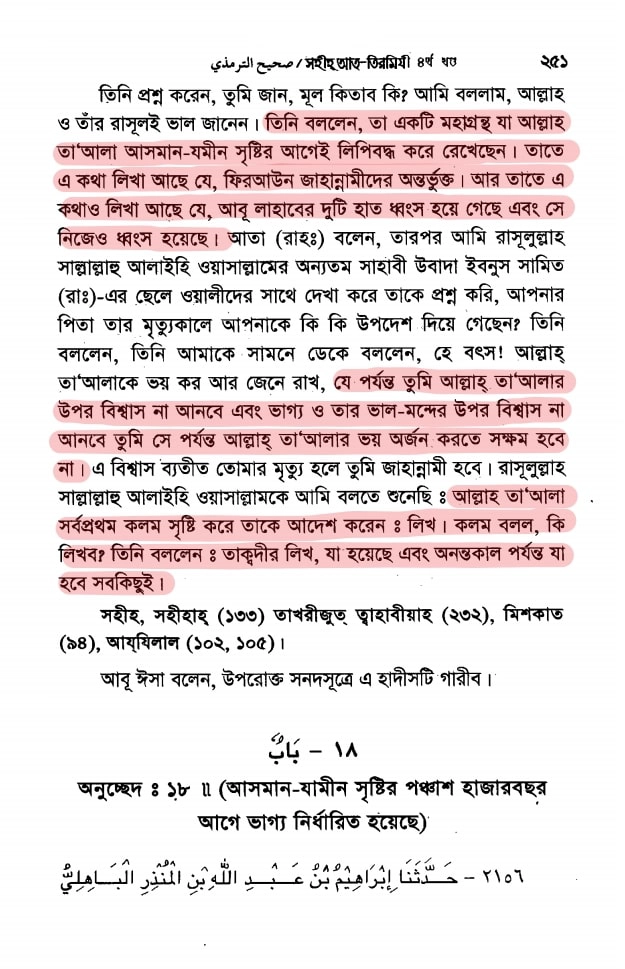
Then he said: “Do you know what Mother of Books is?” I said: “Allah and His Messenger know better.” He said: “It is a book that Allah wrote before He created the Heavens, and before He created the earth. In it, it is (written): Fir’awn is among the inhabitants of the Fire, and in it is: Perish the two hands of Abu Lahab, and perish he!” (تَبَّتْ يَدَا أَبِي لَهَبٍ وَتَبَّ)
Ata (may Allah have mercy on him) said: I met al-Walid, the son of Ubadah bin al-Samit (may Allah be pleased with him), the Companion of the Messenger of Allah (peace and blessings be upon him), and asked him: ‘What was your father’s admonition when he died?’
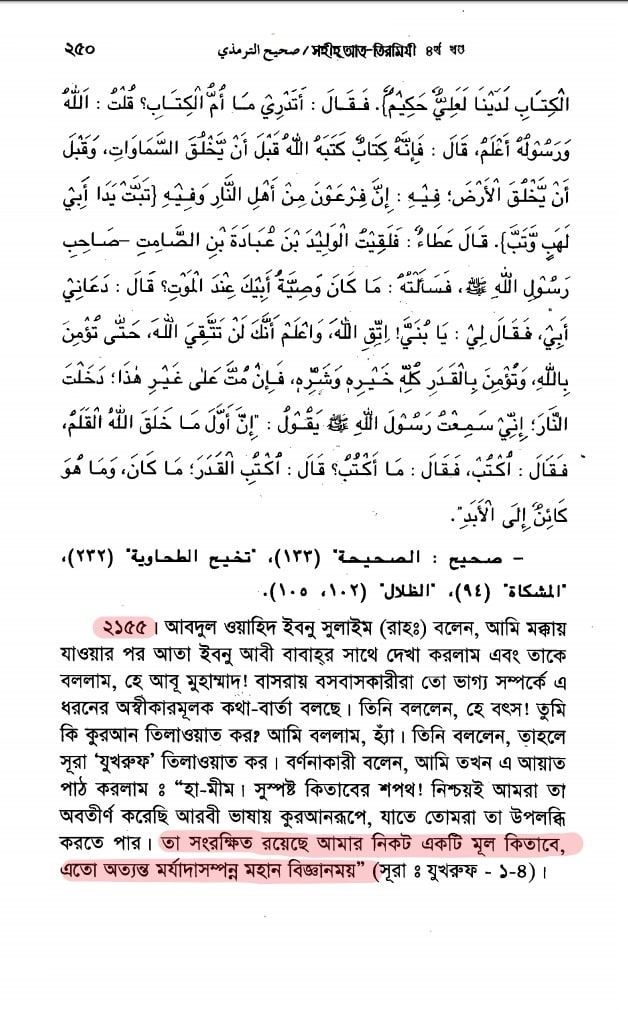
He replied: My father called me and said: “O my son! Have Taqwa of Allah, and know that you will never have Taqwa of Allah until you believe in Allah, and you believe in Al-Qadar—all of it—its good and its bad. If you die upon other than this you shall enter the Fire. Indeed I heard the Messenger of Allah (peace and blessings be upon him) saying: ‘Verily the first of what Allah created was the Pen. So He said: “Write.” It said: “What shall I write?” He said: “Write Al-Qadar: what has been and what will be for all eternity.”’” Sahih; al-Sahihah 133; Takhrij al-Tahawiyyah 232; Mishkat 94; al-Zilal 102, 105; Tirmidhi hadith no. 2155 (Al-Madani Publications).
Abu Isa said: This hadith is gharib through this route.
Hadith grading: Sahih
Let us also consult the book Sahih al-Tirmidhi directly [7]:
The Pen Is Not a Metaphor: A Real, Corporeal Creation
The Pen of divine decree is not described as merely a symbol or a literary expression of ‘Allah’s knowledge’. Answer no. 179685 on the nature of the Pen calls it a “real pen” and explicitly states that it has a jirm—a body or physical substance. The same discussion quotes Salih al-Fawzan in affirming that both the Pen and the Tablet are things created by Allah. Here, therefore, ‘the Pen’ is not a name for abstract knowledge; it is an actual created entity or object. [8]
فَالْقَلَمُ الَّذِي كَتَبَ الْمَقَادِيرَ شَأْنُهُ عَظِيمٌ بِلَا شَكٍّ، وَهُوَ قَلَمٌ حَقِيقِيٌّ، كَالَّذِي يَفْهَمُ النَّاسُ مِنْ مَعَانِي الْقَلَمِ، وَلَهُ جِرْمٌ أَيْضًا، لَكِنْ لَا يُقَدَّرُ قَدْرُهُ.
English translation:
The Pen that wrote the decrees is undoubtedly of immense significance. It is a real pen, in the sense people understand by the word ‘pen’; it also has a body or physical substance. Its actual dimensions, however, cannot be determined by human beings.
In other words, it is not an abstract concept but a real, created, corporeal entity or object. The next question is therefore directly ontological: where and when did this corporeal creation exist? According to the chronology in the hadith, the decrees were written long before the creation of the heavens and the earth. Commenting on Sahih Muslim 2653, al-Nawawi explains that this specifies the time of writing in the Preserved Tablet, rather than the beginning of the eternal decree itself. He also explains that ‘His Throne was upon water’ refers to the state before the creation of the heavens and the earth. [9]
كَتَبَ اللَّهُ مَقَادِيرَ الْخَلَائِقِ قَبْلَ أَنْ يَخْلُقَ السَّمَاوَاتِ وَالْأَرْضَ بِخَمْسِينَ أَلْفَ سَنَةٍ، وَعَرْشُهُ عَلَى الْمَاءِ. قَالَ الْعُلَمَاءُ: الْمُرَادُ تَحْدِيدُ وَقْتِ الْكِتَابَةِ فِي اللَّوْحِ الْمَحْفُوظِ.
English translation:
‘Allah wrote the decrees of creation fifty thousand years before He created the heavens and the earth, and His Throne was upon water.’ The scholars said: the intention here is to specify the time of writing in the Preserved Tablet, rather than to establish when the decree itself began.
A Corporeal Pen Before the Heavens and the Earth: Where Did It Exist?
The problem of space arises directly here. Alongside the statement that the Pen has a body, or jirm, Ibn Taymiyyah states in al-Risala al-Arshiyya that the Throne was upon water before the creation of the heavens and the earth, and that the decrees were determined after the Throne existed, fifty thousand years before the creation of the heavens and the earth. In other words, multiple created objects and their relative positions already existed before the creation of our cosmic world of heavens and earth. [10]
أَخْبَرَ اللَّهُ تَعَالَى أَنَّ عَرْشَهُ كَانَ عَلَى الْمَاءِ قَبْلَ أَنْ يَخْلُقَ السَّمَوَاتِ وَالْأَرْضَ.
English translation:
Ibn Taymiyyah says: Allah has stated that His Throne was upon water before He created the heavens and the earth.
A corporeal creation is meaningless without spatial extension. More specifically, if the Throne is ‘upon water’, a spatial relationship already exists between two created objects: one is above the other. If the Pen is a real, corporeal creation that writes on the Tablet, there must also be an actual relationship between the writing instrument and the tablet on which it writes. Saying that ‘no spatial arrangement existed’ before the creation of the heavens and the earth is therefore incompatible with this account. The account instead posits a created world preceding the universe, in which objects, positions, and mutual spatial relationships exist before our visible universe.
Ibn Abi al-Izz’s Sharh al-Aqida al-Tahawiyya preserves scholarly disagreement over this order of creation. He explicitly states that the dispute concerned which was created first: the Pen or the Throne. Referring to Abu al-Ala al-Hamadhani, he accepts the view that the Throne preceded the Pen as the more correct of the two. [11]
وَاخْتَلَفَ الْعُلَمَاءُ: هَلِ الْقَلَمُ أَوَّلُ الْمَخْلُوقَاتِ، أَوِ الْعَرْشُ؟ عَلَى قَوْلَيْنِ، ذَكَرَهُمَا الْحَافِظُ أَبُو الْعَلَاءِ الْهَمَذَانِيُّ، أَصَحُّهُمَا: أَنَّ الْعَرْشَ قَبْلَ الْقَلَمِ.
English translation:
The scholars disagreed: was the Pen the first creation, or was it the Throne? There are two views, both mentioned by al-Hafiz Abu al-Ala al-Hamadhani. The more correct of the two is that the Throne preceded the Pen.
50,000 Years Before the Heavens and the Earth: ‘Years’ Before the Creation of Time
Alongside the problem of space, time presents an even more difficult problem. Sahih Muslim states that the decrees were written fifty thousand years before the creation of the heavens and the earth. Abu al-Abbas al-Qurtubi does not evade the difficulty of this wording in al-Mufhim. He treats the ‘fifty thousand years’ as an estimated duration rather than actual celestial years. In his own explanation, time in the sense of our years, days, and nights does not have an established actual existence before the creation of the heavens. [12]
وَهَذِهِ الْخَمْسُونَ أَلْفَ سَنَةٍ سِنُونَ تَقْدِيرِيَّةٌ؛ إِذْ قَبْلَ خَلْقِ السَّمَاوَاتِ لَا يَتَحَقَّقُ وُجُودُ الزَّمَانِ، فَإِنَّ الزَّمَانَ الَّذِي يُعَبَّرُ عَنْهُ بِالسِّنِينَ وَالْأَيَّامِ وَاللَّيَالِي.
English translation:
These fifty thousand years are estimated years, because time has no established actual existence before the creation of the heavens. Time expressed in years, days, and nights is connected with the celestial system.
But the problem does not end there. The same account of events before the universe contains a continuous sequence: one creation exists earlier and another later; the Pen is created; it is commanded; it asks a question; Allah answers; then it writes. ‘Before’, ‘after’, the state preceding the question, the state following the answer, and the beginning of writing all involve temporal order. If time does not exist at all, this sequence is meaningless. If some earlier time makes this sequence possible, a different temporal framework must be acknowledged before the heavens and the earth.
Ibn Taymiyyah offers a direct explanation of this problem. According to him, the six days in which the heavens and the earth were created were not days based on the movements of the present sun and moon. Instead, that duration was measured through the motion of other created bodies that existed before the heavens and the earth. His solution therefore does not eliminate time; it acknowledges a different temporal system preceding the heavens and the earth. [13]
وَتِلْكَ الْأَيَّامُ مُقَدَّرَةٌ بِحَرَكَةِ أَجْسَامٍ مَوْجُودَةٍ قَبْلَ خَلْقِ السَّمَوَاتِ وَالْأَرْضِ.
English translation:
Ibn Taymiyyah says: Those days were measured by the motion of bodies that existed before the creation of the heavens and the earth.
The account therefore faces a straightforward dilemma. If time did not exist before the creation of the heavens and the earth, neither ‘fifty thousand years before’ nor the sequence creation → command → question → answer → writing can have occurred literally. If these are actual successive events, a temporal system existed before the universe. Likewise, if the corporeal Pen, water, and the Throne ‘upon’ the water are real, spatial relationships also existed before the universe. Thus, if the heavens and the earth are treated as the beginning of space and time, the chronology of hadith cosmology itself produces space and time preceding that beginning.
The Need for a Written Record: Memory, Error, and the Limits of Knowledge
Written records are fundamentally a technology for beings with limited knowledge. People forget, testimony is lost, information is distorted, instructions must reach future generations, and documents must be produced in disputes. In Islamic doctrine, however, Allah’s knowledge is the complete opposite of these limitations: eternal, all-encompassing, and free from error and forgetfulness. In Sharh al-Aqida al-Wasitiyya, Muhammad Khalil Harras explains the sequence as Allah’s eternal and all-encompassing knowledge first, followed by the recording of what He knows in the Preserved Tablet. Writing therefore supplies Allah with no new information; His knowledge is already complete before anything is written. [14]
فَكُلُّ مَا يُوجَدُ مِنْ أَعْيَانٍ وَأَوْصَافٍ وَيَقَعُ مِنْ أَفْعَالٍ وَأَحْدَاثٍ فَهُوَ مُطَابِقٌ لِمَا عَلِمَهُ اللَّهُ عَزَّ وَجَلَّ أَزَلًا.
English translation:
Muhammad Khalil Harras says: All entities and attributes that come into existence, and all actions and events that occur, correspond to what Allah has known from eternity.
The explanation that ‘Allah wrote in order to remember the future’ is therefore not what the Islamic sources themselves state. Yet this makes another question more pressing: why would an omniscient being, whose knowledge requires no external record, create a real Pen, a real Preserved Tablet, and a system for preserving the entire history of the cosmos in advance? In human administrative systems, the need for kings, decrees, scribes, documents, and registers is clear. The need for a cosmic version of the same structure is not self-evident in the case of an omniscient and omnipotent God.
Nor is this writing limited to a few selected events. In the hadith quoted earlier, the Pen is told to write the decrees of everything until the Day of Resurrection. The Preserved Tablet therefore cannot be described as merely a memory aid; it is part of the structure of divine decree. Acknowledging that an omniscient God has no need to store information does not erase the Pen and Tablet’s resemblance to human administration. It makes clearer that the existence of this cosmic record system does not arise from any need in Allah’s knowledge.
Is the Pen Merely an Instrument, or a Responsive Creation with Knowledge of the Unseen?
The hadith does not portray the Pen as merely an unconscious writing instrument. It is addressed, asks a question, receives an answer, and then writes the decrees of everything. In the narration from Ubadah ibn al-Samit, when the Pen is told to ‘write’, it asks what it should write, then records what will happen until the Day of Resurrection. This account forms the basis of later explanations of divine decree. [15]
فَإِنَّ الْقَلَمَ كَتَبَ مَقَادِيرَ الْأَشْيَاءِ، كَمَا يَدُلُّ لَهُ الْحَدِيثُ: إِنَّ أَوَّلَ مَا خَلَقَ اللَّهُ الْقَلَمَ فَقَالَ لَهُ اكْتُبْ، فَجَرَى بِمَا هُوَ كَائِنٌ إِلَى الْأَبَدِ.
English translation:
The Pen wrote the decrees of all things. This is indicated by the hadith: Allah first created the Pen and said to it, ‘Write’; the Pen then wrote everything that would occur for all eternity.
A straightforward question about knowledge arises here: a being entirely ignorant of some information cannot record that information accurately unless it is merely an externally controlled instrument. Yet the hadith presents the Pen as a being that asks questions and receives instructions. It does not describe Allah dictating each word separately and making the Pen write mechanically. Instead, the Pen is commanded to write the decrees of everything, and it does so. The universe’s complete future information was therefore available to it at the time of writing.
This is where the Quran’s claim of exclusive knowledge of the unseen encounters a problem. ‘Only Allah knows the unseen’ and ‘a creation has produced a complete written record of the entire future’ cannot be maintained together in the same sense. Where the knowledge came from is a question about its source; whether that unseen information was available to the Pen is a question about possession of knowledge. Even if Allah is assumed to have supplied the information, its presence with the Pen at the time of writing cannot be denied.
More strictly, if the Quranic phrase `لا يعلمها إلا هو`—’no one knows them except Him’—is a universal declaration of exclusivity, a created Pen’s complete knowledge of the future is a direct exception to that declaration. Either new qualifications must then be added to the Quran’s exclusive claim, or the complete future information available to the Pen in the hadith must be denied. The inconsistency cannot be avoided while preserving both claims unchanged in the same sense.
Whoever Knows the Unseen Is Allah: The Pen Against the Quran’s Exclusive Claim
The problem becomes clearer when the Quran’s statements are expressed as simple logical propositions. Al-Anam 6:59 says: no one knows the keys to the unseen except Allah. Al-Jinn 72:26–27 says that Allah does not disclose His unseen, making an exception only for a chosen messenger. The Pen is not Allah, nor is it a messenger; in Islamic doctrine it is a created being. Yet this same Pen is commanded to write the complete decrees of everything until the Day of Resurrection.
The scope of this writing is even more explicit in Abd al-Rahman al-Sadi’s tafsir. In his explanation, the Preserved Tablet records not merely a few major historical events but every object and event, great and small, as it actually is. Subsequent events occur in accordance with what the Pen wrote. [16]
بَلْ جَمِيعُ الْأَشْيَاءِ، صَغِيرُهَا وَكَبِيرُهَا، مُثْبَتَةٌ فِي اللَّوْحِ الْمَحْفُوظِ، عَلَى مَا هِيَ عَلَيْهِ، فَتَقَعُ جَمِيعُ الْحَوَادِثِ طِبْقَ مَا جَرَى بِهِ الْقَلَمُ.
English translation:
Rather, all things, small and great, are recorded in the Preserved Tablet as they actually are; all events therefore occur exactly in accordance with what the Pen wrote.
These are not a few isolated pieces of unseen information. When a person will be born, what they will do, how long they will live, what sins and good deeds they will commit, and what their ultimate fate will be—everything that will actually occur in the universe until the Day of Resurrection is written in advance. The information available to the Pen therefore encompasses, in effect, the entire history of the future.
If the Quran’s claim is now maintained in the same strict sense, the argument is as follows:
First premise: Knowledge of the unseen is an attribute exclusive to Allah: ‘No one knows it except Him.’
Second premise: The created Pen wrote the decrees of all events until the Day of Resurrection; that complete information about the future was therefore available to it.
Conclusion: Either knowledge of the unseen is not, in fact, an attribute exclusive to Allah, or the Pen must also be acknowledged as possessing that attribute reserved exclusively for Allah. Accepting the latter makes the created Pen a participant in an attribute reserved for Allah.
Inconsistency: ‘Only Allah knows’ and ‘a created Pen that is not Allah also knows the entire future’ cannot both be true in the same sense.
Allah’s being the source of information and that information’s being present with a created being are two separate matters. The Quran makes this knowledge exclusive by saying that ‘no one knows it except Him’; in the account of the Pen, that unseen information is available to a created being and recorded through it. Exclusivity then ceases to concern possession of knowledge and becomes limited to its source. Yet the Quranic sentence does not say, ‘No one knows independently except Him.’ It says ‘No one knows except Him’. The distinction between ‘independent knowledge’ and ‘bestowed knowledge’ is therefore absent from the verse’s direct wording; it is a later interpretive addition intended to reconcile the two sources.
Islamic Doctrine: Creator and Creation Are Distinct
The central claim of Islamic tawhid is that the Creator, Allah, and His creation are completely distinct and not identical. Surah al-Ikhlas (112:1–4) in the Quran explicitly states: ‘Say: He is Allah, One, Unique. He neither begets nor is begotten, and no one is equal to Him.’ The third branch of tawhid—tawhid al-asma wa-al-sifat—further emphasizes that Allah’s names and attributes are inseparable from His essence, but that no created object or being can possess those attributes. Creation is entirely distinct from Allah’s essence, rather than a part or manifestation of it. This claim lies at the centre of Islamic doctrine, which completely rejects any such identity or sharing.
In Hinduism or pantheistic philosophy, creation and creator merge: Brahman is everything, and everything is part of or a manifestation of Brahman. In Advaita Vedanta, Atman and Brahman are identical. Islam stands opposed to this, claiming that creation can never be part of the Creator or a manifestation of His essence. Similarly, Christianity regards Jesus as God incarnate or as part of the Trinity, with God assuming human form through incarnation. Islamic tawhid rejects this concept as shirk: Allah’s essence cannot enter or become incarnate in any creation. Islamic scholars explain this distinction through tanzih, keeping God entirely above creation.
But applying this principle to the concept of the Pen, al-Qalam, reveals a clear inconsistency. According to the hadith, Allah first creates the Pen, which then writes the entire future. This account presents the Pen as a created being capable of speaking independently and endowed with complete knowledge of the future, or the unseen. Yet the Quran, Surah al-Naml 27:65, says: ‘No one in the heavens and the earth knows the unseen except Allah.’
According to Islamic doctrine, the Pen is a makhluq—a created being—rather than one of Allah’s attributes. Sunni orthodoxy regards the Quran as uncreated, as Allah’s eternal speech. The question of whether the Quran was created led to the religious persecution known as the Mihna, which began in 833 CE under Caliph al-Mamun. Scholars were imprisoned and beaten, and the policy was withdrawn in 848 CE under al-Mutawakkil. This historical dispute shows that the boundary between the Creator’s attributes and the characteristics of created beings was no trivial question in Islamic doctrine.
The logical problem is this: if the Pen is created and completely distinct from Allah’s essence, yet possesses the information needed to know every future event until the Day of Resurrection, the Quran’s claim of exclusive knowledge of the unseen no longer remains intact in its straightforward sense. The hadith places the Pen in possession of knowledge that the Quran’s wording reserves exclusively for Allah. Adding a distinction between ‘bestowed knowledge’ and ‘independent knowledge’ explains the source of the information, but no longer preserves the straightforward exclusivity of ‘no one knows except Him’. A created being then shares in an attribute declared to be reserved for Allah.
The Problem with Symbolic or Metaphorical Interpretations
Metaphorical interpretation requires a consistent criterion. If an account is treated as metaphorical whenever its literal meaning encounters a problem, the same method can be applied to the Miraj, Buraq, the houris of Paradise, angels, Satan, and other supernatural accounts. Without independent textual evidence for treating the account of the Pen as metaphorical, abandoning the literal meaning at this one problematic point becomes selective interpretation. The basis for a metaphorical reading is weaker still when the same Sunni sources describe the Pen as a real creation, even as corporeal.
Different Perspectives in Comparative Theology and the Ancient Sources of Islamic Narratives
An examination of ancient religious narratives shows that human fate or destiny has often been represented as a ‘written document’ or a ‘woven thread’, controlled by gods and directly influencing human life. These ancient myths bear strong similarities to the Islamic concepts of divine decree, the Preserved Tablet, and the Pen. Similarity alone does not establish direct borrowing; presenting the concepts as wholly unprecedented divine ideas detached from history is also incorrect. Ancient West Asian and Mediterranean religions contain much earlier examples of written fate, divine scribes, and predetermined destiny.
While destiny in ancient mythology may be changeable, or at least open to dispute among the gods, Islamic taqdir or qadar is presented as a system of fate written once, final and utterly unalterable [17]. According to mainstream Islamic doctrine, it was written once in the Preserved Tablet by Allah’s command and cannot be changed in any way.
This rigid, linear destiny creates not only theological inconsistency but a profound philosophical void. If everything happens according to a predetermined and unalterable script, individual freedom, moral responsibility, and human dignity cease to exist. If human choices have no effective value, subjecting people to punishment on the Day of Judgment is, logically, a grave injustice. This comparative analysis makes it as clear as daylight that the Islamic concept of fate or destiny is not a perfect supernatural truth but an unrefined and inflexible adaptation of ancient Mesopotamian and other myths, readily refuted through reason.
A Humanized God and the Crisis of Free Will and Justice
The idea of writing destiny with a pen is a clear form of humanizing God. Ancient kings had clerks and scribes record and preserve decrees, laws, and history. Islamic accounts likewise contain the structure of an omniscient ruler, a Pen, a Preserved Tablet, and a cosmic document written in advance. Descriptions in the Quran of Allah’s hands, face, feet, and so on have also been the subject of long debate in Islamic theology [17]. The problem of the Pen and Tablet is more specific: an omniscient and omnipotent being has no need to preserve His knowledge, prevent error, or remember the future. Yet theology makes a real writing instrument and a Preserved Tablet fundamental parts of the cosmic system. This creates a deep resemblance to human systems of administrative documentation.
The problem of free will goes beyond the future’s having been ‘known’ or ‘written’ in advance. Mere foreknowledge may not itself cause an action. But the Sunni doctrine of divine decree does not stop at foreknowledge and writing. In al-Aqida al-Wasitiyya, Ibn Taymiyyah places Allah’s eternal knowledge and writing in the Tablet at the first level of divine decree, and His effective will and all-encompassing creative power at the second. Muhammad Khalil Harras’s commentary explains the same structure. Human actions are therefore not merely known and written in advance; they belong to a system in which no event occurs outside Allah’s will, and Allah is the creator of all creation. [18]
فَالْدَرَجَةُ الْأُولَى: الْإِيمَانُ بِأَنَّ اللَّهَ تَعَالَى عَلِيمٌ بِالْخَلْقِ، وَهُمْ عَامِلُونَ بِعِلْمِهِ الْقَدِيمِ الَّذِي هُوَ مَوْصُوفٌ بِهِ أَزَلًا وَأَبَدًا.
English translation:
Ibn Taymiyyah says that the first level of divine decree is: Allah knows creation, and the actions of creation fall within His eternal knowledge, with which He has been characterized from eternity and forever.
Muhammad Khalil Harras further clarifies the scope of Allah’s will in Sharh al-Aqida al-Wasitiyya. In his explanation, no motion or stillness in the heavens and the earth falls outside Allah’s will; nothing He does not will occurs in His dominion. His servants’ acts of obedience and disobedience are also included in this all-encompassing will. [19]
وَأَنَّهُ لَا يَقَعُ فِي مُلْكِهِ مَا لَا يُرِيدُ، وَأَنَّ أَفْعَالَ الْعِبَادِ مِنَ الطَّاعَاتِ وَالْمَعَاصِي وَاقِعَةٌ بِتِلْكَ الْمَشِيئَةِ الْعَامَّةِ الَّتِي لَا يَخْرُجُ عَنْهَا كَائِنٌ.
English translation:
Nothing occurs in His dominion that He does not will. The actions of His servants, whether obedience or sin, occur under that all-encompassing will, beyond which no created event can pass.
Ibn Uthaymin also explicitly states that human actions are created by Allah. In his words, all the actions of Allah’s servants, including obedience and sin, are Allah’s creation. He then invokes human will and ability to explain human responsibility. Within the Sunni framework, human actions are thus described simultaneously as acts acquired by human beings and as Allah’s creation. [20]
أَفْعَالُ الْعِبَادِ كُلُّهَا مِنْ طَاعَاتٍ وَمَعَاصٍ كُلُّهَا مَخْلُوقَةٌ لِلَّهِ.
English translation:
Ibn Uthaymin says: All the actions of Allah’s servants, both obedience and sin, are created by Allah.
Here the ethical problem takes its sharpest form. The judge has known from eternity the action for which a person will be judged; He has written it before the person is born; no contrary outcome can occur outside His effective will; and the action’s very existence is included in His creation. The same person is then told that they bear full responsibility for the action and may face eternal punishment for disbelief or particular sins. In a system where the judge possesses foreknowledge of the outcome, records it in advance, wills it effectively, and creates its existence, placing all moral responsibility solely on the creation being judged does not establish a claim to justice; that justice requires separate demonstration.
The Quran also makes human will subject to Allah’s will: ‘You will not will unless Allah wills’. If human beings cannot bring about an alternative outcome outside Allah’s effective will, if their actions are also Allah’s creation, and if their ultimate fate has already been written, the actual possibility necessary for free will in the sense of choosing genuine alternatives no longer remains.
Conclusion: The Emptiness of Islamic Theology
The account of the Pen and the Preserved Tablet is not an isolated, peculiar hadith; it forms part of the central structure of the Islamic doctrine of divine decree. The Quran identifies knowledge of the unseen as an attribute exclusive to Allah and names a chosen messenger as the specific exception to its disclosure. Yet in the hadith, a real, corporeal, created Pen—neither Allah nor a messenger—is entrusted with writing the decrees of everything until the Day of Resurrection. In the words of Islamic commentary itself, every event, great and small, is contained in that record, and events occur in accordance with what the Pen wrote. This is not fragmentary news of the future; it is the complete future history of creation.
The same account also creates problems of space and time. Before the creation of the heavens and the earth, there is water, the Throne upon it, a real, corporeal Pen, and writing on the Tablet. That writing is also placed ‘fifty thousand years before the creation of the heavens and the earth’. Classical commentators themselves acknowledged that time as we know it did not exist before the creation of the heavens. Either the ‘fifty thousand years’ and the sequence of creation, command, question, answer, and writing must therefore be removed from literal time, or a different temporal system must be acknowledged before our universe. Likewise, ‘the Throne upon water’ and the corporeal Pen’s writing require spatial relationships preceding the universe.
The problem of predestination runs deeper still. In mainstream Sunni doctrine, Allah does more than know the human future: it is written in advance, subject to His effective will, and everything, including human actions, is His creation. The judge thus controls foreknowledge of the actions of the person being judged, their prior recording, the effective will for their occurrence, and their existence. Nevertheless, all moral responsibility is placed on the created being, who is then subjected to eternal punishment. Calling such a system just may be a declaration, but the declaration is not a rational foundation for justice.
The story of the Pen therefore brings several fundamental claims of Islamic theology into collision at a single point: Allah’s exclusive knowledge of the unseen versus the created Pen’s complete recording of the future; corporeal creations and relationships resembling space and time before the heavens and the earth; a cosmic system of writing and preservation alongside an omniscient being; and full human moral responsibility for actions subject to Allah’s knowledge, recording, will, and creation. The words ‘the unseen’, ‘mystery’, or ‘Allah knows best’ do not establish the logical compatibility of contradictory claims. A theology that accepts all these contradictory ontological claims as true bears the burden of demonstrating their consistency.
References
- Quran, al-Anam 6:59 ↩︎
- Quran, al-Jinn 72:26–27 ↩︎
- Sunan Abi Dawud, hadith 4700 ↩︎
- Quran 27:65 ↩︎
- Quran 57:22 ↩︎
- Sunan al-Tirmidhi, Islamic Foundation edition, hadith 2158; international no. 2155 ↩︎
- Sahih al-Tirmidhi, Volume 4, authenticated by Muhammad Nasir al-Din al-Albani, Hossain Al-Madani Publications, pp. 250–252 ↩︎
- The nature of the Pen of divine decree, including a quotation from Salih al-Fawzan; answer 179685 ↩︎
- Al-Nawawi, al-Minhaj Sharh Sahih Muslim, Book of Divine Decree ↩︎
- Ibn Taymiyyah, al-Risala al-Arshiyya, quoted in fatwa 470458 ↩︎
- Ibn Abi al-Izz, Sharh al-Aqida al-Tahawiyya, vol. 2, p. 345 ↩︎
- Abu al-Abbas al-Qurtubi, al-Mufhim, Book of Divine Decree ↩︎
- Ibn Taymiyyah, Majmu al-Fatawa, vol. 18, p. 235, quoted in answer 240599 ↩︎
- Muhammad Khalil Harras, Sharh al-Aqida al-Wasitiyya, the first level of divine decree ↩︎
- Hadith narrated by Ubadah ibn al-Samit; Ahmad, Abu Dawud, and al-Tirmidhi ↩︎
- Abd al-Rahman al-Sadi, Tafsir: the recording of everything in the Preserved Tablet, quoted in answer 346371 ↩︎
- On Divine Decree, One of the Foundations of Islam 1 2
- Ibn Taymiyyah, al-Aqida al-Wasitiyya, with Muhammad Khalil Harras’s commentary on the levels of divine decree ↩︎
- Muhammad Khalil Harras, Sharh al-Aqida al-Wasitiyya, the second level of divine decree ↩︎
- Ibn Uthaymin, Majmu Fatawa wa-Rasail, vol. 5, p. 46, quoted in answer 376302 ↩︎