

Introduction: Ghazwa-e-Hind, the Promise of Religious War, and the Invasion of India
Long before the emergence of Islam, the Indian subcontinent maintained commercial ties with the Arabian Peninsula. Indian spices, perfumes, medicinal substances, textiles, and other valuable commodities reached West Asian markets through trade routes across the Indian Ocean and the Persian Gulf. Arab merchants’ participation in these networks fostered economic and cultural connections with different regions of the subcontinent. Indian products were familiar in seventh-century Arabia, and some are explicitly mentioned in Islamic hadith literature. Commercial exchange, however, is not the same as military invasion. Using a region’s products, knowing about its medical traditions, or recognizing its economic prosperity does not confer any right to impose military control over it. The coexistence of commercial relations with India and religious promises associated with an invasion of India in Islamic narratives therefore raises an important historical and ethical question.
In Islamic hadith literature, this military expedition is commonly known as Ghazwa-e-Hind, or the Campaign against India. In a narration preserved in Sunan al-Nasa’i, Muhammad promised deliverance from Hellfire to those who would take part in a campaign against India. Another report attributed to Abu Hurayrah expresses his wish to devote his life and wealth to such an expedition, to attain the rank of the best martyrs if killed, and to be freed from Hellfire if he returned alive. The campaign is thus represented not merely as a political or military confrontation, but as a religious war associated with rewards in the afterlife. These narrations do not describe any military attack on Medina originating from Indian territory. Yet they announce exceptional religious merit and rewards for participating in a campaign against India. The idea of making war against a distant population a means of religious merit and salvation carries particular significance for the history of Islamic military expansionism.
The historical meaning of the term Hind is also important. In ancient and medieval Arabic literature, al-Hind did not refer to a modern nation-state confined within the present political borders of India. At different times, it designated a broader geographical conception encompassing the Indian subcontinent, its various regions, and commercial networks bordering the Indian Ocean. Later Arab military expeditions and the conquest of Sindh also belong to this wider geographical setting. Rather than identifying the Ghazwa-e-Hind narratives exclusively with the borders of the modern Indian state, their historical geography, religious promises, and subsequent military history must be examined together. Narratives attributed to Muhammad about an expedition to India, actual Indian campaigns undertaken by Muslim rulers, and the modern use of these narratives by extremists are related subjects, but their dates and historical evidence are distinct.
The ethical problem of linking a military expedition against the Indian subcontinent with religious rewards is clear. The fact that a people follow another religion, live under a different political authority, or remain outside Muslim rule provides no legitimate justification for military aggression against them. When a religious narration promises invaders of a territory deliverance from Hellfire or the status of martyrs, it creates a religious incentive for warfare. The political and social significance of Ghazwa-e-Hind emerges through the history of how that promise was interpreted in later periods, how it became associated with actual military campaigns, and how modern religious extremists have used it.
Al-Harith ibn Kaladah: Medical Education in Persia and the Transmission of Foreign Knowledge into Arabia
Arab society before Islam and during the early Islamic period was not entirely isolated from the medical knowledge of neighboring civilizations. Alongside trade and travel involving Persia, Syria, and other regions, medical practices and practical knowledge circulated across these networks. One well-known example of this contact is the Arab physician al-Harith ibn Kaladah al-Thaqafi, whose name is preserved in medieval Islamic biographical works on physicians. He belonged to the Thaqif tribe of Ta’if. Traditional historical accounts of his medical training mention not India, but Persia and the physicians of Jundishapur. Jundishapur was a recognized center of medicine and learning in Sasanian Persia. No reliable historical evidence establishes that al-Harith traveled to India to study medicine.
In the seventh chapter of his ‘Uyun al-Anba’ fi Tabaqat al-Atibba’, the physician and biographer Ibn Abi Usaybi’ah described the life and medical education of al-Harith ibn Kaladah. The account mentions his travels from Ta’if to various regions, his study of medicine in Persia, his acquisition of knowledge from the physicians of Jundishapur, and his experience with illnesses and their treatments. This material appears in the Arabic text and in the modern scholarly edition published by Brill. [1]
وكان الحارث من الطائف وسافر البلاد وتعلم الطب بناحية فارس ومن أهل جنديسابور وتمرن هناك وعرف الداء والدواء
English translation: Al-Harith was from Ta’if. He traveled through various lands and studied medicine in the region of Persia and among the people of Jundishapur. He practiced medicine there and acquired knowledge of diseases and their remedies.
Ibn Abi Usaybi’ah also reports that al-Harith practiced medicine in Persia and subsequently returned to Ta’if, where he became renowned as a physician among the Arabs. According to the same account, his knowledge and experience attracted numerous patients. This testimony is important for understanding the relationship between Arab medical practice and Persian medical traditions. Ibn Abi Usaybi’ah, however, was not a contemporary of al-Harith; he compiled his biographical work many centuries later. Editors of its modern scholarly edition have also identified contradictory and legendary elements in al-Harith’s biography. His education in Persia is therefore a tradition preserved in a later biography, not an event independently confirmed by contemporary documentation. Even with that historical limitation, the account associates Arab physicians with Persian medical knowledge; it does not establish any direct educational connection between al-Harith and India.
Various medical sayings attributed to al-Harith ibn Kaladah also circulate in Islamic literature. One widely repeated statement about dietary restraint and diseases of the stomach has sometimes been quoted as a hadith of Muhammad. Hadith scholars, however, have identified it not as an established statement of Muhammad but as a saying attributed to al-Harith ibn Kaladah. A question-and-answer entry in the Bengali periodical Al-Kawsar explicitly makes this distinction. [2]
2199. Question:
I heard a religious scholar mention the following as a hadith while discussing the importance of maintaining good health:
المعدة بيت الداء، والحمية رأس الدواء، وأعط كل بدن ما عودته
Meaning: The stomach is the home of all disease, and dietary restraint is the greatest remedy. Give each body what it has become accustomed to. I would like to know whether this is a hadith and, if so, in which hadith collection it appears.
Answer:
Although this saying is sometimes cited as a hadith, hadith specialists have stated that it has not been established as a hadith of the Messenger of Allah; rather, it is a saying of the renowned Arab physician al-Harith ibn Kaladah.
It must therefore not be narrated as a hadith.
References: Al-Maqasid al-Hasanah, p. 611; Kashf al-Khafa’, 2/93; al-Durar al-Muntathirah, p. 168; al-La’ali al-Manthurah, p. 145; al-Fawa’id al-Majmu’ah, p. 166; Zad al-Masir, 3/188; Ruh al-Ma’ani, 5/110; Tafsir al-Qurtubi, 7/192.
The account of al-Harith’s medical education in Persia establishes at least one point: contemporary Arab medical practice was not isolated from external centers of learning. His reputation as a physician became sufficiently established that later Islamic narratives even preserved an account in which Muhammad reportedly directed an ill companion to consult him. According to a report about the illness of Sa’d ibn Abi Waqqas, Muhammad said, “Go to al-Harith ibn Kaladah; he is a physician.” Hadith specialists have classified the relevant report as weak. Nevertheless, the tradition remembering al-Harith as a recognized physician, together with his biographical association with Persian medical education, demonstrates that the transmission of external medical knowledge into pre-Islamic and early Islamic Arabia was not unusual.
Mishkat al-Masabih (Mishkat)
Book 21: Food
Section: The Second Section
4224-[66]. Narrated by Sa’d: I once became seriously ill, and the Prophet came to visit me. He placed his hand between my breasts, upon my chest, and I felt its coolness in my heart. He then said: “You are suffering from a heart condition. Go to al-Harith ibn Kaladah of the Thaqif tribe. He is a physician.” He further instructed that seven ‘ajwah dates from Medina be crushed together with their pits and administered to me. (Abu Dawud)
[1] Weak: Abu Dawud 3875; Da’if al-Jami’ al-Saghir 2033; al-Mu’jam al-Kabir by al-Tabarani 5346; Da’if al-Jami’ 2033.
The hadith is considered weak because Mujahid’s narration from Sa’d is disconnected (mursal). Abu Zur’ah al-Razi gave this assessment. See ‘Awn al-Ma’bud, 10/255, hadith 3875.
Grade: Da’if (weak).
Narrator: Sa’d ibn Abi Waqqas.
Sunan Abu Dawud (Islamic Foundation edition)
Book 22: Medicine
Chapter 12: Concerning ‘Ajwah Dates
3835. Ishaq ibn Isma’il … narrated from Sa’d: Once, when I fell ill, the Messenger of Allah came to visit me. He placed his hand on my chest, and I felt its coolness in my heart. He then said, “You are suffering from a heart ailment. Go to al-Harith ibn Kaladah of the Thaqif tribe, for he is an experienced physician.” He should take seven ‘ajwah dates from Medina, crush them together with their pits, and make seven pills for you.
Grade: Da’if (weak).
Narrator: Sa’d ibn Abi Waqqas.
Medical sayings attributed to al-Harith became so widespread that a statement along the lines of “the stomach is the home of disease” subsequently circulated even as a hadith of Muhammad. Hadith scholars, however, identified it as a saying of al-Harith, not a Prophetic hadith. This establishes at least that medical ideas attributed to an Arab physician could also enter later religious narratives.
Indian Qust and Medicinal Products: Indian Remedies in Early Islamic Arabia
An important indication of commercial ties between Arabia and the Indian subcontinent appears in Islamic hadiths concerning medicine. These reports describe the use of medicinal substances associated with India and methods for administering them against particular ailments. One such substance is specifically called al-‘ud al-hindi (العود الهندي), or “Indian ‘ud,” which Muhammad recommended for treating various conditions. Bengali translations have sometimes rendered this expression as “Indian sandalwood.” In the relevant hadith, however, the substance is identified as qust, or qust al-hindi (القسط الهندي). It is not ordinary sandalwood. Although the Arabic word ‘ud literally means wood, Abu Dawud’s own explanation is particularly important for identifying the medicinal substance in this narration. He explicitly states that “‘ud” here means “qust.” Thus “sandalwood” in the Bengali translation does not accurately identify the original substance.
In Sunan Abu Dawud and Sahih al-Bukhari, Umm Qays bint Mihsan reports that she brought her sick child to Muhammad. She had used a customary procedure involving pressure applied to the child’s throat. Muhammad criticized this practice and recommended Indian qust instead. The same narration claims that the substance contains remedies for seven ailments. Two conditions mentioned specifically are a throat ailment and dhat al-janb, a condition affecting the membrane surrounding the lungs. The hadith also describes two different methods of administration: applying the substance through the nose for a throat condition, and administering it through one side of the mouth for dhat al-janb. The Bengali translation identifies the latter condition as “pneumonia,” but the established medical meaning of the Arabic term ذات الجنب is pleurisy, or inflammation of the pleura. Pneumonia and pleurisy are not the same disease.
First, consider the published Bengali translation of Sunan Abu Dawud. The words translated as “sandalwood” and “pneumonia” in the quotation below are retained as they appear in that Bengali edition, although the Arabic original indicates otherwise.
Sunan Abu Dawud (Islamic Foundation, Bengali edition)
Book 22: Medicine
Chapter 13: On Pressing the Throat with a Finger
3837. Musaddad and Hamid ibn Yahya … narrated from Umm Qays bint Mihsan: She said, “Once I brought one of my sons to the Messenger of Allah. I had rubbed his throat because of an illness.” He asked, “Why do you rub your children’s throats when they suffer from throat ailments? Instead, you should use Indian sandalwood for this ailment, for it remedies seven types of disease, including pneumonia. For swelling of the throat, administer it through the nostrils; for pneumonia, make it into pills and take it.”
Imam Abu Dawud said: “Sandalwood” means that it should be ground and made into pills for consumption.
Hadith grade: Sahih.
Narrator: Umm Qays bint Mihsan.
[English translation of the cited Bengali edition, including its terminology; not a corrected translation of the Arabic original.]
There are two important discrepancies between this Bengali translation and the Arabic original. First, the medicinal substance is misidentified: Abu Dawud’s explanation in the original Arabic explicitly uses the word الْقُسْطَ, meaning qust. Second, the illness is misidentified: ذات الجنب, or dhat al-janb, should not be translated as pneumonia; it refers to pleurisy. The Bengali version also differs from the Arabic concerning how the medicine is administered. The Arabic describes application through the nose for a throat condition and administration through one side of the mouth for pleurisy, not a general instruction to prepare pills for swallowing. Abu Dawud’s own Arabic explanation makes the identification of qust explicit. [3]
قَالَ أَبُو دَاوُدَ يَعْنِي بِالْعُودِ الْقُسْطَ
English translation: Abu Dawud said: By “‘ud,” he meant qust.
The same medical treatment is described in several reports in Sahih al-Bukhari. In particular, hadiths 5692–5693, 5713, and 5715 mention Indian ‘ud or qust, the claim that it remedies seven ailments, and its use for conditions of the throat and for pleurisy. The Arabic wording of Bukhari 5715 explicitly uses the word qust to explain the identity of “Indian ‘ud.” In the same narration, Umm Qays had used a customary treatment for her child’s throat ailment, and Muhammad directed her to use the Indian medicinal substance instead. [4]
عَلَيْكُمْ بِهَذَا الْعُودِ الْهِنْدِيِّ، فَإِنَّ فِيهِ سَبْعَةَ أَشْفِيَةٍ مِنْهَا ذَاتُ الْجَنْبِ
English translation: Use this Indian ‘ud, for it contains remedies for seven ailments, one of which is pleurisy, or inflammation of the membrane surrounding the lungs.
Several historically significant points emerge from these hadiths. First, medicinal substances identified with India were known in seventh-century Arabian medical practice. Second, the recommendation of Indian qust became part of the medical instructions attributed to Muhammad. Third, Indian products were known not merely as commercial commodities but also as materials used in medicine and everyday healthcare. The mention of the same substance in al-Bukhari and Abu Dawud demonstrates that later hadith collections preserved the use of Indian medicine as a recognized tradition. The repetition of a report across several hadith collections, however, does not constitute evidence of multiple independent scientific tests of its medicinal effectiveness.
The historical significance of these medical narrations and the scientific validity of their therapeutic claims are separate questions. That Muhammad declared a particular substance capable of curing seven ailments is what the hadith reports. Whether it actually cures seven diseases must be established by medical research. Its description as a treatment for pleurisy does not justify accepting qust as an effective alternative to modern medical care. Nor does the use of Indian qust by itself establish that Arab society depended on the entire Indian medical system, or prove any particular conclusion about India’s political or military significance. These reports do, however, document an important historical connection: products associated with the Indian subcontinent were known in Arabian medical practice and were mentioned in religious narratives.
Alongside these commercial and medical contacts, Islamic hadith literature identifies India as the destination of a military campaign. Recommendations to use Indian medicine and promises of rewards in the afterlife for participating in a campaign against India are preserved within the same body of religious literature. There is an important ethical contrast between adopting a region’s products and knowledge and associating warfare against that region with religious rewards. Trade and intellectual exchange are forms of human cooperation; military invasion involves the coercive exercise of force over people’s freedom, security, and political autonomy. The presence of these two distinct relationships in Islamic sources further illuminates the military and religious significance of Ghazwa-e-Hind.
Ghazwa-e-Hind: Promises of Deliverance from Hellfire and Martyrdom for an Indian Campaign
One of the principal sources describing a campaign against the Indian subcontinent in Islamic hadith literature is the chapter on jihad in Sunan al-Nasa’i. The collection contains a separate chapter explicitly titled باب غَزْوَةِ الْهِنْدِ, meaning “The Campaign against India.” It preserves narrations promising deliverance from Hellfire to those who undertake an expedition against India and the rank of the best martyrs to those killed in such a campaign. These accounts do not describe an attack on Medina by any named Indian ruler or population. Their central subject is the promise of a military campaign in India and the religious rewards attached to participating in it. Associating war against a distant territory with salvation in the afterlife makes these narrations important in the history of offensive jihad.
Consider first the narration transmitted through Muhammad’s companion Thawban. Muhammad states that Allah will protect two groups among his followers from the Fire of Hell: one group will undertake a military campaign against India, and the other will be with Jesus son of Mary. The promised reward for the group campaigning against India is explicitly connected to warfare, not to an act of private devotion, commerce, medicine, or religious preaching. In the widely used international numbering of Sunan al-Nasa’i, this is hadith 3175; in the Bengali edition published by the Islamic Foundation, it is numbered 3178. [5]
سُنَنُ النَّسَائِي، كِتَابُ الْجِهَادِ، بَابُ غَزْوَةِ الْهِنْدِ
عَنْ ثَوْبَانَ، مَوْلَى رَسُولِ اللَّهِ صلى الله عليه وسلم قَالَ قَالَ رَسُولُ اللَّهِ صلى الله عليه وسلم “ عِصَابَتَانِ مِنْ أُمَّتِي أَحْرَزَهُمَا اللَّهُ مِنَ النَّارِ عِصَابَةٌ تَغْزُو الْهِنْدَ وَعِصَابَةٌ تَكُونُ مَعَ عِيسَى ابْنِ مَرْيَمَ عَلَيْهِمَا السَّلاَمُ ” .
English translation: Thawban, the freedman of Muhammad, narrated that Muhammad said: “Allah will protect two groups of my community from the Fire of Hell: a group that undertakes a military campaign against India, and a group that will be with Jesus son of Mary.”
The Bengali edition of this same hadith, published by the Islamic Foundation, is reproduced below in English translation. The edition’s wording and its own hadith number have been preserved.
Sunan al-Nasa’i (Islamic Foundation, Bengali edition)
Book 25: Jihad
Chapter 41: Jihad against India
3178. Muhammad ibn ‘Abd Allah ibn ‘Abd al-Rahim … narrated from Thawban, the freedman of the Messenger of Allah: He said the Messenger of Allah stated: “Allah will deliver two groups of my community from the Fire of Hell. One group consists of those who will wage jihad against India, and the other of those who will be with Jesus son of Mary.”
Verification: Sahih; al-Sahihah 1934; Sahih al-Jami’ al-Saghir 4012.
Hadith grade: Sahih.
Narrator: Thawban.
A significant narration concerning a campaign against India is also transmitted through Abu Hurayrah. He relates that Muhammad promised his followers an expedition against India. Abu Hurayrah expressed his desire to devote his life and wealth to it if the opportunity arose. He also expressed the hope of being counted among the best martyrs if killed, or of being considered freed from Hellfire if he returned alive. In Thawban’s narration, the reward for the combatants appears directly in Muhammad’s words. In Abu Hurayrah’s report, Muhammad’s promise of an expedition is followed by Abu Hurayrah’s own hopes. This distinction matters, but both accounts clearly associate an Indian campaign with exceptional status in the afterlife. [6]
سُنَنُ النَّسَائِي، كِتَابُ الْجِهَادِ، بَابُ غَزْوَةِ الْهِنْدِ
عَنْ أَبِي هُرَيْرَةَ، قَالَ وَعَدَنَا رَسُولُ اللَّهِ صلى الله عليه وسلم غَزْوَةَ الْهِنْدِ فَإِنْ أَدْرَكْتُهَا أُنْفِقْ فِيهَا نَفْسِي وَمَالِي فَإِنْ أُقْتَلْ كُنْتُ مِنْ أَفْضَلِ الشُّهَدَاءِ وَإِنْ أَرْجِعْ فَأَنَا أَبُو هُرَيْرَةَ الْمُحَرَّرُ .
English translation: Abu Hurayrah said: “The Messenger of Allah promised us a campaign against India. If I live to see it, I will devote my life and wealth to it. If I am killed, I shall be among the best martyrs; and if I return, I shall be Abu Hurayrah, the one set free”—that is, released from the Fire of Hell.
Hadith 3174 in Sunan al-Nasa’i preserves another transmission of Abu Hurayrah’s statement through a different chain. It likewise mentions the promise of a campaign against India, the commitment of life and wealth, the status of the best martyrs if killed, and liberation if one returns alive. Despite minor differences in wording, the substance of the two accounts is the same. They cannot therefore be treated as reports of two entirely separate historical events; rather, they are different transmitted versions of the same statement. [7]
سُنَنُ النَّسَائِي، كِتَابُ الْجِهَادِ، بَابُ غَزْوَةِ الْهِنْدِ
عَنْ أَبِي هُرَيْرَةَ، قَالَ وَعَدَنَا رَسُولُ اللَّهِ صلى الله عليه وسلم غَزْوَةَ الْهِنْدِ فَإِنْ أَدْرَكْتُهَا أُنْفِقْ فِيهَا نَفْسِي وَمَالِي وَإِنْ قُتِلْتُ كُنْتُ أَفْضَلَ الشُّهَدَاءِ وَإِنْ رَجَعْتُ فَأَنَا أَبُو هُرَيْرَةَ الْمُحَرَّرُ .
English translation: Abu Hurayrah said: “The Messenger of Allah promised us a campaign against India. If I live to see it, I will devote my life and wealth to it. If I am killed, I shall be the best of martyrs; and if I return, I shall be Abu Hurayrah, the one set free.”
Hadith scholars have not assessed the transmission chains of these accounts uniformly. Al-Albani classified Thawban’s report, hadith 3175, as sahih, while the Darussalam edition grades it hasan. By contrast, the Darussalam edition classifies Abu Hurayrah’s narrations, numbered 3173 and 3174, as weak. Assessments by al-Albani and commentators on Musnad Ahmad have also identified weaknesses in the chains of Abu Hurayrah’s reports. IslamQA’s answer no. 148529 expressly acknowledges this distinction: it treats Thawban’s report as established and Abu Hurayrah’s narration as weak. [8]
The categories sahih and weak belong primarily to the internal methodology of Islamic hadith criticism. They do not, by themselves, provide final and independent historical proof that the attributed statements were spoken exactly as transmitted. Conversely, weakness in a transmission chain does not erase a narration’s ideas, wording, or subsequent social influence from the historical record. In the case of Ghazwa-e-Hind, the essential point is that the idea of special religious rewards for those who invade India was preserved in Islamic hadith literature and subsequently employed in religious interpretation and preaching. Thawban’s narration supplies its strongest basis within traditional hadith classification, while the reports through Abu Hurayrah demonstrate the wider circulation of the same idea.
The wording of these hadiths does not designate the Indian campaign as a particular defensive war. They describe no Indian ruler attacking Medina and no Muslim expedition to India undertaken to repel such an attack. Instead, they promise rewards in the afterlife for participation in a military campaign against a distant region. Although the cause and precise timing of the war are not specified, the religious reward for fighting is explicitly present. This is what gives the narrations their offensive significance. The association of an expedition against India with deliverance from Hellfire confers a religious status on war in which military participation itself is presented as a means of attaining special merit.
Later Islamic historians and commentators also preserved reports about an expedition against India. Ibn Kathir’s al-Bidayah wa’l-Nihayah contains a passage concerning an Indian campaign in its Bengali edition. A screenshot of page 333 of volume 6, published by the Islamic Foundation and included in the original article, is preserved below. [9]

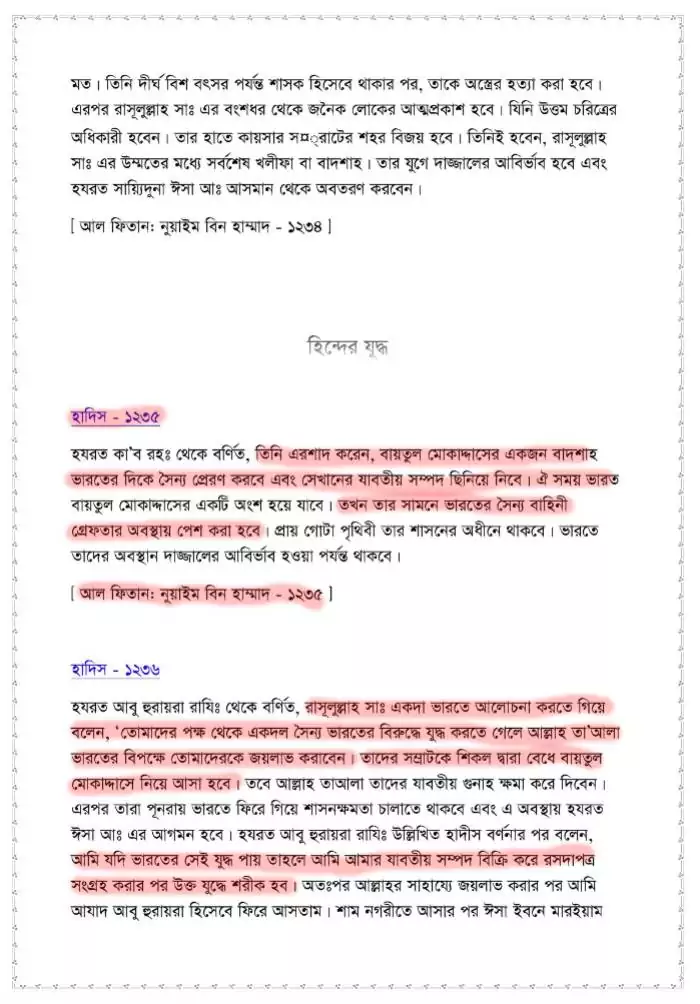
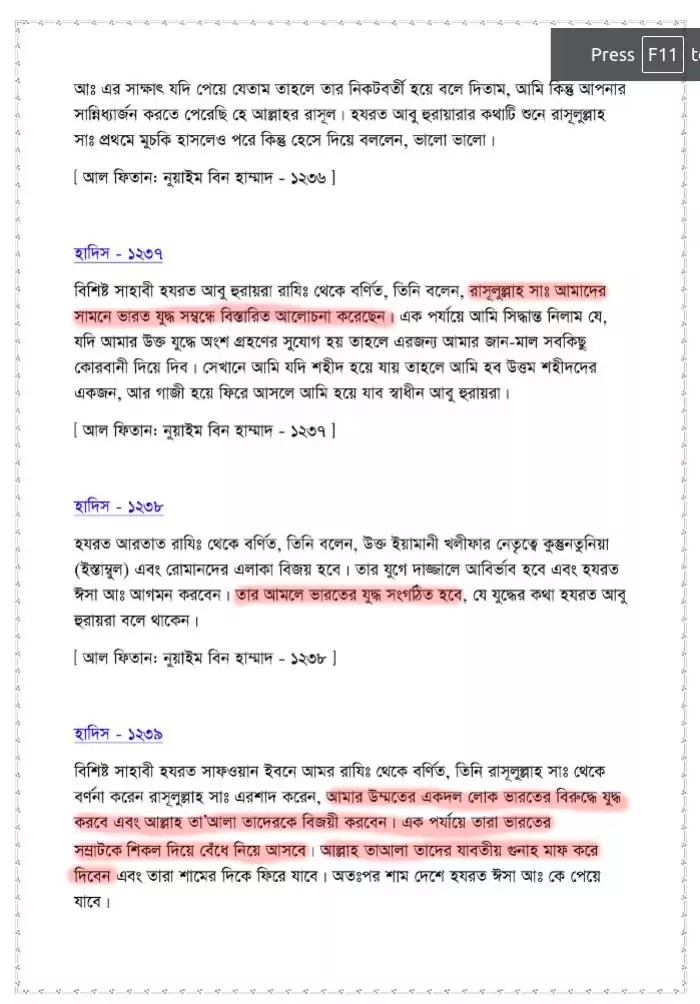
Nu’aym ibn Hammad’s Kitab al-Fitan also preserves narrations concerning a campaign against India. This collection contains weak and disputed reports; a particular narration does not become authentic merely because similar wording appears elsewhere. The appearance of comparable ideas in multiple Islamic compilations remains significant, however, for understanding the circulation of the narrative and its position in later religious imagination. The two screenshots from Kitab al-Fitan contained in the original article are preserved below. [10]
One further point is important: Thawban’s hadith does not say that the campaign against India must take place at the end of the world. Although those who campaign against India and those who accompany Jesus are mentioned in a single sentence, the narration does not state that both events will occur at the same time. IslamQA’s answer no. 148529 likewise explains that the hadith does not guarantee a new Indian campaign in the end times; instead, it relates the narration to historical Muslim campaigns against India. Thus, although a religious promise concerning an Indian campaign is preserved in Islamic literature, not every modern claim of an inevitable future apocalyptic war is explicitly stated in that hadith.
The ethical problem of presenting an Indian military campaign as a means of deliverance from Hellfire does not depend on a particular assessment of the chain of transmission or the timing of a prophecy. The territory of a people who are not under Muslim rule is made the target of a military campaign associated with rewards in the afterlife. The lives, security, and political rights of an independent population are thereby exposed to the potential harms of war, while the invading combatant’s religious salvation becomes central. The narrative focuses on the participant’s promised reward, not on the consent or rights of the affected population. This religious incentive for warfare is the most consequential aspect of the Ghazwa-e-Hind tradition.
Muslim Military Campaigns in the Indian Subcontinent: From Makran to the Conquest of Sindh
Alongside the religious narratives of Ghazwa-e-Hind, the history of actual Muslim military expeditions into the Indian subcontinent is equally important. Following Muhammad’s death, Arab military expansion under the caliphs crossed Persia and reached the western frontiers of the subcontinent. Accounts of Arab military expeditions toward Makran, Sindh, and western India date back to the middle of the seventh century. Military reconnaissance and frontier operations in this direction began under the caliphs Umar and Uthman and expanded under the subsequent Umayyad administration. These campaigns are described in the chapter on the conquest of Sindh (Futuh al-Sind) in Futuh al-Buldan by the ninth-century Muslim historian Ahmad ibn Yahya al-Baladhuri. The same work also records Muslim conquests in Persia, Khurasan, Kabul, and other territories. [11]
The most significant event in this phase of expansion was the invasion of Sindh under Muhammad ibn Qasim in 711–712 CE. During the reign of the Umayyad caliph al-Walid ibn Abd al-Malik, the governor of Iraq, al-Hajjaj ibn Yusuf, placed Muhammad ibn Qasim in command of the campaign. A force of six thousand troops from Syria was mobilized, together with other military support. The army advanced from Shiraz through Makran toward Sindh. Weapons and military equipment were also sent by sea to support the land forces. Al-Baladhuri describes the organization of the campaign, its military preparations, troop strength, supply arrangements, and successive seizures of cities. These are not accounts of an accidental frontier confrontation but of an organized campaign of conquest undertaken by a state.
Al-Baladhuri explicitly states that al-Hajjaj appointed Muhammad ibn Qasim to command the Sindh frontier and furnished him with six thousand Syrian troops and the equipment he required. His account describes the preparations and the march as follows: [12]
ثم ولى الحجاج محمد بن القاسم بن محمد بن الحكم بن أبى عقيل فى أيام الوليد بن عبد الملك فغزا السند ، وكان محمد بفارس وقد أمره أن يسير إلى الري وعلى مقدمته أبو الأسود جهم بن زحر الجعفي فرده إليه وعقد له على ثغر السند وضم إليه ستة آلاف من جند أهل الشام وخلقا من غيرهم وجهزه بكل ما احتاج إليه حتى الخيوط والمال ، وأمره أن يقيم بشيراز حتى يتتام إليه أصحابه ويوافيه ما عدله
English translation: During the reign of al-Walid ibn Abd al-Malik, al-Hajjaj appointed Muhammad ibn al-Qasim ibn Muhammad ibn al-Hakam ibn Abi Aqil. He undertook a campaign against Sindh. Muhammad was then in Persia and had originally been ordered to proceed to Rayy, with Abu al-Aswad Jahm ibn Zahr al-Ju’fi commanding his vanguard. Al-Hajjaj recalled him and assigned him command over the Sindh frontier. He attached to him six thousand troops from Syria and many others, equipping him with everything he needed, down to thread and money. He ordered him to remain at Shiraz until his men had assembled and the prepared supplies had reached him.
This description establishes the state-directed and military character of the invasion of Sindh. A particular commander was appointed, the number of troops was specified, forces from outside the region were mobilized, and arms and supplies were arranged. The entry of Arab military power into the Indian subcontinent was therefore an organized process of establishing political control. Muhammad ibn Qasim first crossed Makran and conducted campaigns in the regions of Qannazbur and Armail. His army then attacked the important Sindhi port city of Debal. Debal was an important urban center connected to Indian Ocean trade. Al-Baladhuri describes a large place of worship there, with a tall staff supporting a red flag. According to his account, the Muslim army used a siege engine to strike this structure.
The Assault on Debal: Destruction of a Place of Worship and Mass Killings
The account of Debal’s conquest describes not only military assault but also an attack on a religious structure and killings following the city’s capture. Al-Baladhuri writes that Muhammad ibn Qasim besieged Debal and installed a large manjaniq, or stone-throwing siege engine. He ordered it aimed at the tall staff and red flag above the city’s place of worship. When the staff fell, fear spread among the inhabitants. The Muslim army then assaulted the city and scaled its walls. Al-Baladhuri describes three days of killing after the capture, including the killing of the temple’s guards. He also reports the subsequent construction of a mosque and the stationing of four thousand soldiers there. [13]
After the capture of Debal, Muhammad ibn Qasim’s army advanced farther north. Dahir, the ruler of Sindh, assembled his forces to confront the invaders. Al-Baladhuri describes Dahir fighting from the back of an elephant, being killed after fierce combat, and the defeat of his army. Accounts then follow of the capture of Aror, Brahmanabad, and other cities. These campaigns brought much of Sindh under the political authority of the Umayyad Caliphate. Administrative arrangements, taxation, and military control were imposed on conquered territory. Some towns were taken by force, while others entered into agreements involving surrender and payment of taxes. In either case, the political independence of the local population gave way to the authority of the victorious army.
The Killings at Brahmanabad and Military Rule over the Population of Sindh
The events at Brahmanabad are especially significant in the history of the conquest of Sindh. Al-Baladhuri records fighting against the remnants of Raja Dahir’s forces and reports a large number of people killed after the city was taken. He gives two alternative figures for the dead: eight thousand and twenty-six thousand. These figures are not confirmed by independent contemporary records; they are alternative accounts preserved by a medieval historian. Nevertheless, the source explicitly describes the seizure of the city, suppression of military resistance, and large-scale killing. The same narrative mentions terms of surrender imposed on local inhabitants, requirements to supply the victorious forces with food and guides, and the imposition of taxes. [14]
قالوا وفتح محمد بن القاسم راور عنوة وكانت بها امرأة لداهر فخافت أن تؤخذ فأحرقت نفسها وجواريها وجميع مالها ، ثم أتى محمد بن القاسم بزهمناباذ العتيقة وهي على رأس فرسخين من المنصورة ، ولم تكن المنصورة يومئذ إنما كان موضعا غيضة ، وكان فل داهر ببرهمناباذ هذه فقاتلوه ففتحها محمد عنوة وقتل بها ثمانية آلاف وقيل ستة وعشرين ألفا وخلف فيها عامله وهي اليوم خراب
English translation: They said: Muhammad ibn Qasim captured Rawar by force. A woman belonging to Dahir was there; fearing that she would be taken captive, she burned herself, her female servants, and all her property. Muhammad ibn Qasim then proceeded to ancient Brahmanabad, situated two farsakhs from the site of the later city of Mansura. Mansura did not yet exist; the place was then a thicket. The remnants of Dahir’s forces were at Brahmanabad and fought against him. Muhammad captured the city by force and killed eight thousand people there; another account gives the number as twenty-six thousand. He appointed his governor there. Today the city lies in ruins.
Several points are explicitly present in this narrative. First, cities of Sindh were attacked and political control was established over them. Second, the capture of cities involved accounts of extensive killing. Third, captivity was a real prospect feared by the defeated population. Fourth, following military conquest, new governors were installed in the occupied territory. These are direct historical characteristics of military aggression, the forcible transfer of power, and the establishment of authority over a conquered people. Uncertainty about the precise number of those killed does not obscure the political and military nature of the account.
Mahmud of Ghazni’s Indian Campaigns: Plunder and Destruction of Religious Sites
Several centuries after the Umayyad conquest of Sindh, the Ghaznavid ruler Mahmud conducted major military campaigns in the Indian subcontinent. Accounts describe several invasions between approximately 1000 and 1025 CE. His forces attacked important cities across northwestern India, Punjab, and northern India. Among the best-known episodes are the attacks on Kannauj, Mathura, Thanesar, and the Somnath temple in Gujarat. The campaigns of Mahmud’s army are associated with the destruction of cities, large-scale plunder, and attacks on religious places of worship. Historical resources on South Asia published by the University of California, Los Angeles, likewise describe Mahmud’s campaigns as exceptionally bloody military expeditions involving the seizure of enormous wealth. [15]
Among Mahmud’s campaigns, the attack on Somnath in 1025 CE has attracted particular attention. Somnath was an important center of worship dedicated to Shiva. Medieval Muslim historical narratives describe an armed assault, the destruction of an idol, and the seizure of considerable wealth. Different texts make large numerical claims about the number of dead and the value of the spoils; those figures cannot simply be treated as verified modern statistical totals. Mahmud’s military campaigns, the attack on Somnath, and the destruction of a religious structure are nevertheless well established in historical discussion. Alongside the acquisition of political and economic resources, his narratives of victory also attach religious prestige to destroying the religious centers of idol worshippers.
The history of these campaigns establishes a broader historical connection with the Ghazwa-e-Hind narratives. On the one hand, the hadiths announce exceptional rewards in the afterlife for those participating in an Indian campaign. On the other, the actual expeditions of subsequent Muslim rulers involved conquest, territorial occupation, seizure of wealth, captivity, and destruction of places of worship. Together, the promise of religious rewards and the historical accounts of conquest reveal a religious and political tradition surrounding campaigns against India. This evidence does not, however, directly establish that every military decision made by Muhammad ibn Qasim or Mahmud was taken specifically in obedience to a particular Ghazwa-e-Hind hadith. The relationship between actual campaigns and their later religious interpretation must be determined from the relevant sources.
IslamQA’s answer no. 148529 illustrates this relationship. It accepts the narration through Thawban concerning a campaign against India as authentic and connects the campaigns of Muhammad ibn Qasim and Mahmud of Ghazni with its historical fulfillment. The answer also quotes Ibn Kathir’s al-Bidayah wa’l-Nihayah on Indian conquests, spoils of war, and the destruction of idols. At the same time, it explains that the wording of the hadith does not establish that a new campaign against India must occur in the end times. In other words, within the Islamic interpretive tradition itself, the hadith about India has been connected to military conquests carried out by Muslim rulers in history. [16]
The ethical significance of this history of conquest in the Indian subcontinent is equally clear. Calling the imposition of military authority over a territory, seizure of the defeated population’s property, destruction of religious sites, and captivity of human beings mere “victory” or futuhat does not alter the violent character of those acts. What appears to a conquering ruler as military success and religious glory can mean killing, dispossession, political subjugation, and violations of religious freedom for the affected population. Read together, the Ghazwa-e-Hind narratives and the history of Muslim military campaigns in the subcontinent reveal a long historical relationship between assigning religious prestige to war against distant territories and the actual expansion of imperial power.
Contemporary Context: Ghazwa-e-Hind and Religious Extremism
The political use of hadiths concerning campaigns against India did not end with medieval military history. In modern South Asia, various Islamist extremist organizations and preachers have used the concept of Ghazwa-e-Hind to establish religious legitimacy for renewed warfare. In particular, Pakistani-based jihadist propaganda has connected military struggle against India with religious duty, historical vengeance, and promises of reward in the afterlife. Ghazwa-e-Hind is represented in this propaganda variously as an inevitable future war, a promise of Islam’s victory, or a religious ideal of establishing Muslim political authority over the subcontinent. Even where these claims depart from the actual wording of the early hadiths, the special status promised to participants in an Indian campaign provides a religious basis for such propaganda.
The ideas of war booty and sexual access to captive women have also become associated with this propaganda in the statements of certain religious preachers. Such statements can be examined in relation to the historical legal framework of ghanimah, captivity, and slavery in Islamic warfare. Depriving women of their freedom through conquest and placing their sexual availability under the authority of victorious men directly violates human rights and personal autonomy. The following video preserves statements by a religious speaker about the use of captive women.
Ghazwa-e-Hind in the Propaganda of Modern Jihadist Organizations
The concept of Ghazwa-e-Hind is not confined to religious sermons or medieval history. Several armed Islamist groups in South Asia have used it directly in political propaganda, recruitment, and attempts to legitimize terrorist violence on religious grounds. Jaish-e-Mohammed, based in Pakistan, is a significant example. Hudson Institute research analyzing statements by the organization’s founder, Masood Azhar, describes how he linked the Ghazwa-e-Hind hadith with jihadist struggle centered on Kashmir and India. His propaganda presented Muslim military struggle in the subcontinent as part of a broader religious war. In such discourse, war against India is no longer simply a dispute over political territory: it is framed as a religious duty, fulfillment of prophecy, and route to rewards in the afterlife. [17]
A 2019 study by the Observer Research Foundation also describes the use of Ghazwa-e-Hind by Pakistan-based jihadist organizations. In particular, it discusses efforts by Jaish-e-Mohammed to recruit members, raise funds, and portray attacks against India as a religious war. The study also mentions a video featuring Pakistani political commentator Zaid Hamid, in which he declares Ghazwa-e-Hind to be a war foretold by Muhammad. The political significance of this propaganda lies in recasting contemporary state and regional conflicts as part of a religious prophecy, thereby creating additional religious authority and emotional support for warfare. [18]
Pakistan-based terror groups have been using Ghazwa-e-Hind as a Hadith to recruit, fund and justify its audacious terror strikes as a religious holy war against India.
English translation of the Bengali rendering: Pakistan-based terrorist organizations have used the hadith of Ghazwa-e-Hind to recruit members, raise funds, and attempt to justify their terrorist attacks against India as a religious holy war.
The same concept appears in the propaganda of al-Qaeda in the Indian Subcontinent (AQIS). Since emerging publicly in 2014, the organization has used various online publications to publicize its ideological and military objectives in South Asia. One especially significant publication is the Urdu-language Nawa-e-Ghazwa-e-Hind. In a study published in the Pakistan Journal of Terrorism Research in 2020, Ammad Malik analyzes this publication as a means of increasing al-Qaeda’s regional support and advancing its jihadist objectives. Ghazwa-e-Hind is thus not merely an isolated theme in religious sermons; it has also served as the name of a publication and an ideological identity within organized jihadist propaganda. [19]
This kind of propaganda has continued amid recent conflict in South Asia. A 2025 study by Singapore’s S. Rajaratnam School of International Studies discusses jihadist exploitation of the idea of Ghazwa-e-Hind against the background of India-Pakistan tensions. It identifies efforts by organizations such as al-Qaeda and Islamic State to recast political conflict in the language of religious war. In this process, contemporary geopolitical disputes become associated with salvation in the afterlife, religious superiority, and prophecy, providing incentives for recruitment and extremist violence. [20]
War Booty, Female Captives, and the Religious Legacy of Sexual Slavery
The connection between anti-Indian militant extremism, war booty, and the sexual enslavement of women has a recognizable historical and religious basis. In classical Islamic law of war, ghanimah refers to war booty, while sabāyā refers to women captured in war. The enslavement of female captives and sexual access based on ownership were recognized within the Qur’an, hadith literature, and classical Islamic jurisprudence. Qur’an 4:24 and the report in Sahih Muslim concerning women captured at Awtas are particularly relevant to this framework. The forcible deprivation of women’s liberty during war, their enslavement, and the establishment of sexual rights over them by victorious men constitute a system of sexual slavery and sexual abuse when evaluated under modern human rights principles.
The Ghazwa-e-Hind hadiths do not contain any specific instruction to enslave Indian women sexually. Nevertheless, the promise of rewards for campaigns against India and the general Islamic provisions concerning female captives and slavery belong to a wider military-religious framework. When a modern preacher invokes that framework to claim Indian women as the future property of conquerors, he expresses more than personal sexual desire: he also invokes the idea of acquiring control over women’s liberty and bodies through religious warfare. Women are treated not as persons but as property passing into the hands of the victorious army. Imagining a woman as a reward of war while disregarding her wishes, consent, autonomy, and human dignity directly expresses a mentality of sexual violence.
An example of this mentality appears in a video circulated in connection with the prospect of war between India and Pakistan. It features talk of obtaining the Indian film actress Madhuri Dixit as a future female captive or item of “war booty.” Claiming a particular woman as an object of one’s sexual entitlement after a hypothetical war reflects the idea that captive women can be treated as property. Turning the deprivation of women’s liberty through warfare into a personal sexual reward is not a moral right; it expresses a desire for aggression and sexual slavery.
Discussions by various Islamic preachers in Bangladesh also address the Sharia provisions concerning female slaves, women captured in war, and masters’ sexual rights. The videos below preserve examples of such statements. They demonstrate that the rules concerning captive women’s enslavement and sexual access remain subjects of contemporary religious discourse rather than merely obsolete chapters of history. There is a fundamental conflict between these classical Sharia provisions and contemporary principles of women’s freedom, consent, and equal human dignity. A religious law’s recognition of ownership over women does not make that ownership morally legitimate. Where captivity and slavery effectively deny a woman the right to freely consent to sex, the system is sexual slavery.
Offensive Jihad: Authentic Hadiths, Classical Sharia, and Modern Fatwas
The Ghazwa-e-Hind narrations promise rewards in the afterlife to participants in campaigns against India. But understanding the military provisions of Islam does not require reliance solely on the hadiths about India. The Qur’an, authentic hadiths, and classical jurisprudence explicitly contain provisions concerning warfare against non-Muslim populations, inviting them to embrace Islam, collecting jizyah, and establishing political subordination. In particular, Sahih Muslim 1731 records detailed instructions that Muhammad reportedly gave military commanders. It describes presenting non-Muslim opponents with the options of embracing Islam, paying jizyah, or facing war. Accordingly, the claim that Islamic warfare was limited exclusively to repelling attacks on Muslim territory is inconsistent with these sources.
According to the narration transmitted by Buraydah in Sahih Muslim 1731, whenever Muhammad appointed a commander, he instructed him to fight in Allah’s name and against those who disbelieved in Allah. He prohibited stealing from the spoils before their distribution, treachery, mutilation of the dead, and the killing of children. He then directed commanders to invite their opponents to embrace Islam. If they accepted Islam, fighting was to cease. If they rejected Islam, the commander was instructed to demand jizyah. If they agreed to pay it, he was to refrain from fighting them; if they refused, he was to fight them. In this sequence of instructions, the religious and political freedom of non-Muslim populations becomes conditional on the power of the Muslim military. [21]
فَإِنْ هُمْ أَبَوْا فَسَلْهُمُ الْجِزْيَةَ فَإِنْ هُمْ أَجَابُوكَ فَاقْبَلْ مِنْهُمْ وَكُفَّ عَنْهُمْ فَإِنْ هُمْ أَبَوْا فَاسْتَعِنْ بِاللَّهِ وَقَاتِلْهُمْ
English translation: If they refuse to embrace Islam, ask them to pay the jizyah. If they agree, accept it from them and refrain from fighting them. If they refuse, seek Allah’s help and fight them.
The significance of these instructions is considerable. They do not specify an attack on Muslim territory as a prerequisite for fighting the opposing side. Rather, in the context of an armed encounter, the non-Muslim adversary is offered conversion to Islam or payment of jizyah. Refusal to pay jizyah is followed by the instruction to fight. Thus, the hadith contains provisions for establishing religious and political authority through military force. Offering an opponent conversion or payment of jizyah does not recognize their equal political independence, because payment entails acknowledging subordination to Muslim rule. Military power and religious authority are directly linked within this system.
Compulsion to Accept Islam and the Fatwa of Ibn Baz
A modern Salafi fatwa also provides an important example of strict rulings on offensive jihad and the religious freedom of non-Muslims. IslamQA’s answer no. 34770, published on 12 December 2002, concerns whether conversion to Islam may be compelled in light of Qur’an 10:99 and 2:256. The response reproduces an explanation from a collection of fatwas by Ibn Baz. It discusses allowing certain categories of non-Muslims to choose between embracing Islam and paying jizyah, while prescribing forced conversion for others. The original source is Majmu’ Fatawa wa Maqalat Mutanawwi’ah li’l-Shaykh Ibn Baz, volume 6, page 219. It is therefore not a fatwa published on behalf of Saudi Arabia’s highest Sharia board; it is a statement by Ibn Baz republished on the IslamQA website. [22]
The fatwa presents two explanations concerning religious compulsion. Under the first, Jews, Christians, and Magians may be given a choice between conversion to Islam and payment of jizyah. The second holds that verses prohibiting compulsion in religion were abrogated by later commands to fight. It then discusses fighting non-Muslims who refuse to embrace Islam once Muslims have the military capacity to do so. Those from whom jizyah may not be accepted are to be compelled to embrace Islam. The fatwa presents this compulsion as a means of securing the subjects’ welfare in this life and the next. It even invokes the possibility of imprisonment or beating to enforce a person’s duties as an analogy for justifying religious coercion.
The fundamental flaw in this reasoning is that it uses one religious tradition’s own assertions about truth and salvation in the afterlife to justify the use of force against others. A religious authority does not acquire the moral right to force others to accept its beliefs merely by declaring those beliefs uniquely true. Limiting people to conversion or acknowledgment of political subordination through the payment of jizyah does not constitute genuine religious freedom. The prescribed alternatives are an even more direct denial of religious liberty for groups to whom the option of jizyah is not extended: conversion or war.
The full original English text of this fatwa, followed by an English rendering of the Bengali translation preserved in the original article, appears below. It discusses Qur’anic verses, interpretations by different scholars, compulsory conversion, and the instruction to fight those who refuse to pay jizyah.
There is no compulsion to accept Islam
08/Shawwal/1423 , 12/December/2002
Question 34770
Some friends say that whoever does not enter Islam, that is his choice and he should not be forced to become Muslim, quoting as evidence the verses in which Allah says (interpretation of the meaning):
“And had your Lord willed, those on earth would have believed, all of them together. So, will you (O Muhammad) then compel mankind, until they become believers”
[Yoonus 10:99]
“There is no compulsion in religion”
[al-Baqarah 2:256]
What is your opinion concerning that?.
Answer
Praise be to Allah, and blessings and peace be upon the Messenger of Allah:
The scholars explained that these two verses, and other similar verses, have to do with those from whom the jizyah may be taken, such as Jews, Christians and Magians (Zoroastrians). They are not to be forced, rather they are to be given the choice between becoming Muslim or paying the jizyah.
Other scholars said that this applied in the beginning, but was subsequently abrogated by Allah’s command to fight and wage jihad. So whoever refuses to enter Islam should be fought when the Muslims are able to fight, until they either enter Islam or pay the jizyah if they are among the people who may pay jizyah. The kuffaar should be compelled to enter Islam if they are not people from whom the jizyah may be taken, because that will lead to their happiness and salvation in this world and in the Hereafter. Obliging a person to adhere to the truth in which is guidance and happiness is better for him than falsehood. Just as a person may be forced to do the duty that he owes to other people even if that is by means of imprisonment or beating, so forcing the kaafirs to believe in Allah alone and enter into the religion of Islam is more important and more essential, because this will lead to their happiness in this world and in the Hereafter. This applies unless they are People of the Book, i.e., Jews and Christians, or Magians, because Islam says that these three groups may be given the choice: they may enter Islam or they may pay the jizyah and feel themselves subdued.
Some of the scholars are of the view that others may also be given the choice between Islam and jizyah, but the most correct view is that no others should be given this choice, rather these three groups are the only ones who may be given the choice, because the Prophet (peace and blessings of Allah be upon him) fought the kuffaar in the Arabian Peninsula and he only accepted their becoming Muslim. And Allah says (interpretation of the meaning):
“But if they repent [by rejecting Shirk (polytheism) and accept Islamic Monotheism] and perform As-Salaah (Iqaamat-as-Salaah), and give Zakaah, then leave their way free. Verily, Allah is Oft-Forgiving, Most Merciful”
[al-Tawbah 9:5]
He did not say, “if they pay the jizyah”. The Jews, Christians and Magians are to be asked to enter Islam; if they refuse then they should be asked to pay the jizyah. If they refuse to pay the jizyah then the Muslims must fight them if they are able to do so. Allah says (interpretation of the meaning):
“Fight against those who (1) believe not in Allah, (2) nor in the Last Day, (3) nor forbid that which has been forbidden by Allah and His Messenger (Muhammad), (4) and those who acknowledge not the religion of truth (i.e. Islam) among the people of the Scripture (Jews and Christians), until they pay the Jizyah with willing submission, and feel themselves subdued”
[al-Tawbah 9:29]
And it was proven that the Prophet (peace and blessings of Allah be upon him) accepted the jizyah from the Magians, but it was not proven that the Prophet (peace and blessings of Allah be upon him) or his companions (may Allah be pleased with them) accepted the jizyah from anyone except the three groups mentioned above.
The basic principle concerning that is the words of Allah (interpretation of the meaning):
“And fight them until there is no more Fitnah (disbelief and polytheism, i.e. worshipping others besides Allah), and the religion (worship) will all be for Allah Alone [in the whole of the world]”
[al-Anfaal 8:39]
“Then when the Sacred Months (the 1st, 7th, 11th, and 12th months of the Islamic calendar) have passed, then kill the Mushrikoon (see V.2:105) wherever you find them, and capture them and besiege them, and lie in wait for them in each and every ambush. But if they repent [by rejecting Shirk (polytheism) and accept Islamic Monotheism] and perform As-Salaah (Iqaamat-as-Salaah), and give Zakaah, then leave their way free. Verily, Allah is Oft-Forgiving, Most Merciful”
[al-Tawbah 9:5]
This verse is known as Ayat al-Sayf (the verse of the sword).
These and similar verses abrogate the verses which say that there is no compulsion to become Muslim.
And Allah is the Source of strength.
Consider another well-known fatwa on this subject: [23]
Was Islam spread by the sword?
02/Jumada al-thani/1424 , 31/July/2003
178,102
Question 43087
Was Islam spread by the sword?.
Answer
Praise be to Allah, and blessings and peace be upon the Messenger of Allah:
We have already stated in question no. 34830 that jihad is of two types: taking the initiative in fighting and jihad in self-defence.
Undoubtedly taking the initiative in fighting has a great effect in spreading Islam and bringing people into the religion of Allaah in crowds. Hence the hearts of the enemies of Islam are filled with fear of jihad.
In the English-language Muslim World Magazine it says: There should be some kind of fear in the western world, one of the causes of which is that since the time it first appeared in Makkah, Islam has never decreased in numbers, rather it has always continued to increase and spread. Moreover Islam is not only a religion, rather one of its pillars is jihad.
Robert Bean says: The Muslims conquered the entire world before and they could do it again.
The Orientalists wanted to slander Islam by claiming that it was spread by the sword.
The orientalist Thomas Arnold wrote his book The Preaching of Islam with the aim of killing off the spirit of jihad among the Muslims and proving that Islam was not spread by the sword, rather that it spread by means of peaceful preaching, free from any use of force.
The Muslims fell into the trap that was set up for them. When they heard the orientalists’ accusations that Islam was spread by the sword, they said: You are mistaken, listen to a refutation from one of your own people, this Thomas says such and such.
The defeatists among the Muslims come out to defend Islam, and they want to disavow Islam of this so-called lie, so they deny that Islam was spread by the sword, and they say that jihad is not prescribed in Islam, except in the case of self-defence. There is no such thing in Islam as taking the initiative in fighting in their view. This goes against what the Muslim scholars have stated, let alone the fact that it goes against the Qur’aan and Sunnah.
Shaykh al-Islam Ibn Taymiyah said in Majmoo’ al-Fataawa, 28/263.
The purpose is that all religion should be for Allaah alone, and that the word of Allaah should be supreme. The word of Allaah is a comprehensive phrase that refers to His words that are contained in His Book. Hence Allaah says (interpretation of the meaning):
“Indeed We have sent Our Messengers with clear proofs, and revealed with them the Scripture and the Balance (justice) that mankind may keep up justice”
[al-Hadeed 57:25]
The purpose behind sending the Messengers and revealing the Books was so that mankind might keep up justice with regard to the rights of Allaah and the rights of His creation. Then Allaah says (interpretation of the meaning):
“And We brought forth iron wherein is mighty power (in matters of war), as well as many benefits for mankind, that Allaah may test who it is that will help Him (His religion) and His Messengers in the unseen”
[al-Hadeed 57:25]
So whoever deviates from the Book is to be brought back with iron, i.e. by force. Hence the soundness of the religion is based on the Qur’aan and the Sword. It was narrated that Jaabir ibn ‘Abd-Allaah (may Allaah be pleased with him) said: The Messenger of Allaah (peace and blessings of Allaah be upon him) commanded us to strike with this, meaning the sword, whoever turns away from this, meaning the Qur’aan.
Ibn al-Qayyim (may Allaah have mercy on him) said in al-Faroosiyyah (p.18):
Allaah sent him – meaning the Prophet (peace and blessings of Allaah be upon him) – with the guiding Book and the conquering sword, ahead of the Hour, so that Allaah alone would be worshipped with no partner or associate, and his provision was placed beneath the shade of his sword and spear. Allaah has established the religion of Islam with proof and evidence, and with the sword and spear, both together and inseparable.
This is some of the evidence from the Qur’aan and Sunnah. The evidence clearly indicates that the sword is one of the most important means that led to the spread of Islam.
1 – Allaah says (interpretation of the meaning):
“For had it not been that Allaah checks one set of people by means of another, monasteries, churches, synagogues, and mosques, wherein the Name of Allaah is mentioned much would surely, have been pulled down. Verily, Allaah will help those who help His (Cause). Truly, Allaah is All-Strong, All-Mighty”
[al-Hajj 22:40]
“And if Allaah did not check one set of people by means of another, the earth would indeed be full of mischief. But Allaah is full of bounty to the ‘Aalameen (mankind, jinn and all that exists)”
[al-Baqarah 2:251]
2 – Allaah has commanded us to prepare the means of fighting against the kuffaar and frightening them. He says (interpretation of the meaning):
“And make ready against them all you can of power, including steeds of war (tanks, planes, missiles, artillery) to threaten the enemy of Allaah and your enemy, and others besides whom, you may not know but whom Allaah does know”
[al-Anfaal 8:60]
If Islam was only spread by peaceful means, what would the kuffaar have to be afraid of? Of mere words spoken on the tongue? In al-Saheehayn it is narrated that the Prophet (peace and blessings of Allaah be upon him) said: “I have been supported with fear as far as a month’s journey.” Would the kuffaar be afraid of being told, “become Muslim, but if you do not then you are free to believe and do whatever you want”? or were they afraid of jihad and the imposition of the jizyah and being humiliated? That may make them enter Islam so that they may be spared this humiliation.
3 – When the Messenger called people to Islam, his call was accompanied by the sword, and he commanded his leaders to do likewise, so that when the people saw the serious of the Muslims in calling people to their religion, that dispelled any confusion.
Al-Bukhaari (3009) and Muslim (2406) narrated that Sahl ibn Sa’d (may Allaah be pleased with him) said: The Prophet (peace and blessings of Allaah be upon him) said on the day of Khaybar: “Tomorrow I will give the banner to a man at whose hands victory will come, one who loves Allaah and His Messenger, and Allaah and His Messenger love him.” The people spent that night wondering which of them would be given the banner and all of them were hoping for it. Then he (the Prophet (peace and blessings of Allaah be upon him) ) said, “Where is ‘Ali?” It was said, “His eye is hurting.” So he spat in his eyes and made du’aa’ for him, and he was healed, as if there had not been anything wrong with him. Then he gave him the flag and he [‘Ali] said: “Shall I fight them so that they will be like us?” He said: “Go ahead, until you reach their encampment, then call them to Islam and tell them what they are obliged to do, for by Allaah if Allaah were to guide a man at your hands that would be better for you than having red camels [the best kind].”
So this call to Islam was accompanied by the force of arms.
Muslim (3261) narrated that Buraydah said: When the Messenger of Allaah (peace and blessings of Allaah be upon him) appointed a commander to lead an army or a raiding party, he would advise him to fear Allaah with regard to himself and the Muslims with him, then he said: “Fight in the name of Allaah and for the sake of Allaah. Fight those who disbelieve in Allaah, fight but do not steal from the war booty (before it is shared out), betray, or mutilate. Do not kill children. If you meet your enemy of the mushrikeen, call them to three things, and whichever one of them they respond to, accept that from them and leave them alone. Then call them to Islam and if they respond, accept that from them and leave them alone. If they refuse but they pay the jizyah, then they have responded to you, so accept that from them and leave them alone. If they refuse then seek the help of Allaah and fight them…”
So the Messenger of Allaah (peace and blessings of Allaah be upon him) told his commanders to call the kuffaar to Islam whilst wielding their swords over their heads. If they refused to become Muslim then they should pay the jizyah with humility. If they refused then there was nothing left for them but the sword – “If they refuse then seek the help of Allaah and fight them”
4 – The Prophet (peace and blessings of Allaah be upon him) said: “I have been sent ahead of the Hour with the sword so that Allaah will be worshipped alone, and my provision has been placed in the shade of my spear, and humiliation has been decreed for those who go against my command, and whoever imitates a people is one of them.” Narrated by Ahmad, 4869; Saheeh al-Jaami’, 2831.
The fact that the sword and power were means of spreading Islam is not a sources of shame for Islam, rather it is one of its strengths and virtues, because that makes people adhere to that which will benefit them in this world and in the Hereafter. Many people are foolish and lacking in wisdom and knowledge, and if they are left to their own devices they will remain blinded to the truth, indulging in their whims and desires. So Allaah has prescribed jihad in order to bring them back to the truth and to that which will benefit them. Undoubtedly wisdom dictates that the fool should be prevented from doing that which will harm him, and should be forced to do that which will benefit him.
Al-Bukhaari (4557) narrated that Abu Hurayrah (may Allaah be pleased with him) said: “ ‘You (true believers in Islamic Monotheism, and real followers of Prophet Muhammad and his Sunnah) are the best of peoples ever raised up for mankind’ [Aal- Imraan 3:110 – interpretation of the meaning].” He said: “You are the best (i.e., the most beneficial) of people for mankind, you bring them in the chains that are around their necks until they enter Islam.” Can people be brought in chains except in the case of jihad??
This is something for which Islam deserves to be praised, not condemned. The defeatists should fear Allaah lest they distort this religion and cause it to become weak on the basis of the claim that it is a religion of peace. Yes, it is the religion of peace but in the sense of saving all of mankind from worshipping anything other than Allaah and submitting all of mankind to the rule of Allaah. This is the religion of Allaah, not the ideas of any person or the product of human thought, so that those who promote it should feel ashamed to state its ultimate goal, which is that all religion (worship) should be for Allaah alone. When the ideas that people follow are all produced by human beings and the systems and laws that control their lives are all made up by human beings, then in this case each idea and each system has the right to live safely within its own borders so long as it does not transgress the borders of others, so the various ideas and laws can co-exist and not try to destroy one another. But when there is a divine system and law, and alongside it there are human systems and laws, then the matter is fundamentally different, and the divine law has the right to remove the barriers and free people from enslavement to human beings…
Fiqh al-Da’wah by Sayyid Qutb, 217-222.
It says in Fataawa al-Lajnah al-Daa’imah (12/14):
Islam spread by means of proof and evidence to those who listened to the message and responded to it, and it spread by means of force and the sword to those who were stubborn and arrogant, until they were overwhelmed and became no longer stubborn, and submitted to that reality.
And Allaah knows best.
Another relevant fatwa published on IslamQA addresses The Obligation to Destroy Idols: [24]
The Obligation to Destroy Idols
Question:
Is it obligatory in Islam to destroy statues and images, even when they form part of humanity’s cultural and civilizational heritage? When the Companions conquered different lands, why did they not destroy the images and statues they encountered?
Answer:
All praise is due to Allah.
The evidence of Sharia indicates that destroying idols is obligatory. Among that evidence are the following:
1. Abu al-Hayyaj al-Asadi narrated that Ali ibn Abi Talib said to him: “Shall I not send you on the same mission on which the Messenger of Allah sent me? Do not leave any image without destroying it, and do not leave any raised grave without leveling it.” (Sahih Muslim 969).
2. Amr ibn Abasah narrated that he asked the Prophet: “With what have you been sent?” He replied: “I have been sent to maintain ties of kinship, to destroy idols, and to establish the worship of Allah alone, without associating anything with Him.” (Sahih Muslim 832).
The obligation to destroy idols is even more emphatic when they are worshipped instead of Allah.
3. Jarir ibn Abdullah al-Bajali narrated that the Messenger of Allah said to him: “O Jarir, will you not relieve me of Dhu al-Khalasah?” (It was a sanctuary of the Khath’am tribe known as the Yemeni Kaaba.) Jarir said: “I prepared a force of one hundred and fifty horsemen. I could not remain steady on my horse, so I told the Messenger of Allah.” The Prophet struck his chest with his hand and said: اللهم ثبته واجعله هاديا مهديا (“O Allah, make him steadfast and make him a guide who is rightly guided.”) Jarir then set out and burned that sanctuary. One of their men, whose kunyah was Abu Artah, was sent to give the Messenger of Allah the good news. He told Muhammad: “We left that shrine looking like a diseased camel covered in black tar.” Muhammad then invoked blessings five times upon the horsemen and warriors of Ahmas. (Sahih al-Bukhari 3020; Sahih Muslim 2476.)
Ibn Hajar stated that this hadith shows it is prescribed to remove whatever causes people to fall into religious wrongdoing, whether a building or something else, such as a human figure, an animal figure, or an inanimate object.
4. Muhammad sent Khalid ibn al-Walid to destroy the idol al-Uzza.
5. He sent Sa’d ibn Zayd al-Ashhali to destroy the idol Manat.
6. He sent Amr ibn al-As to destroy the idol Suwa’. All these expeditions took place after the conquest of Mecca.
(Al-Bidayah wa’l-Nihayah, 4/712, 776, 5/83; and Dr. Ali al-Sallabi, al-Sirah al-Nabawiyyah, 2/1186.)
In his commentary on Sahih Muslim, Imam al-Nawawi discussed taswir (تصوير) (creating images and representations) and said: “The scholars have reached consensus that making images that cast shadows [three-dimensional figures] is prohibited and that it is obligatory to alter them.” Thus, the images referred to include figures with physical bodies, such as these statues.
As for the claim that the Companions left statues intact in conquered lands, this is merely an unfounded assumption. The Companions of Muhammad were not the sort of people who would leave idols and statues intact, especially when they were worshipped at that time.
If someone asks why the Companions left standing the statues of the Pharaohs, the Phoenicians, or other ancient peoples, the answer is that there are three possibilities:
First: The statues may have stood in such distant locations that the Companions never reached them. For instance, conquering Egypt does not mean that the Companions reached every part of Egypt.
Second: The statues might not have been visible, but were inside the houses of the Pharaohs and other peoples. Muhammad’s practice when passing places inhabited by those who had been punished was to move swiftly, and there are narrations forbidding entering such places. Sahih al-Bukhari and Sahih Muslim report that he said: “When you enter the dwelling places of those who were punished, enter them only while weeping, lest what befell them befall you.” He said this while passing through the dwellings at al-Hijr of the people of Thamud. Another narration says: “If you cannot weep, do not enter their homes, lest what befell them befall you.”
Accordingly, it may be assumed that even if the Companions had seen those temples or houses, they would not have entered them and would not have seen the contents of their interiors.
This answers the objection that they did not destroy the pyramids and their contents. It is also possible that entrances to the pyramids were covered by heaps of sand at the time.
Third: The statues now visible may then have been buried in sand or otherwise hidden, may have been discovered only later, or may have been brought from distant places that the Companions never reached.
The historian al-Zirikli was asked whether the Companions who entered Egypt had seen the pyramids, the Sphinx, and similar monuments. He replied that most of these monuments had been covered by sand, particularly the Sphinx. (Shibh Jazirat al-Arab, 4/1188.)
Even if one assumes that a particular statue was visible and not buried in sand, it would still need to be established that the Companions actually saw that statue and were capable of destroying it.
The reality is that the Companions were unable to destroy certain statues. Some monuments have taken twenty days to demolish even with modern machinery, tools, explosives, and labor, none of which were available in their time.
Evidence of this inability is also said to appear in Ibn Khaldun’s Muqaddimah (p. 383). The caliph al-Rashid once decided to demolish the palace of a Persian king. He assembled workers and axes, heated the palace with fire, and poured vinegar over it, but eventually failed. Caliph al-Ma’mun is likewise said to have assembled elephants in an attempt to demolish the pyramids of Egypt, without success.
As for claiming that statues should not be destroyed because they are part of humanity’s cultural heritage, that consideration carries no weight. The idols al-Lat, al-Uzza, Hubal, Manat, and others were also part of the cultural heritage of the Quraysh and other inhabitants of Arabia who worshipped them.
They were indeed heritage, but forbidden heritage that must be destroyed. When the command of Allah and His Messenger comes, a believer obeys immediately and does not reject their commands with such weak arguments. Allah says: “The only statement of the believers when they are called to Allah and His Messenger to judge between them is that they say, ‘We hear and obey.’ And it is they who are successful.” (Surah al-Nur, 24:51.)
We ask Allah to enable all Muslims to do what He loves and what pleases Him.
Allah knows best.
Islamweb’s Fatwa: Destruction of Non-Muslim Idols and Restrictions on Building Places of Worship
A significant example of Islamic rulings concerning the destruction of idols and the religious places of worship of non-Muslims appears in fatwa no. 190575 on Islamweb. Published on 18 November 2012, it is titled Demolishing idols in a non-Muslim country. The questioner asked whether Muslims living in a Hindu-majority country are obliged to destroy Hindu idols, given that the Qur’an describes Abraham destroying idols and instructs Muslims to follow his religion. The question also asked whether such destruction would provoke religious hatred and communal violence, and whether Hindu temples may be constructed in a Muslim-ruled country. In response, Islamweb cited Islamic evidence in support of destroying idols and statues and rejected permission for non-Muslims to build new places of worship in Muslim countries. [25]
The fatwa grounds its position in two narrations preserved in Sahih Muslim. In the first, Amr ibn Abasah asks Muhammad about the purpose of his mission, and Muhammad mentions maintaining family ties, destroying idols, and establishing the worship of Allah alone. In the second, Ali ibn Abi Talib instructs Abu al-Hayyaj al-Asadi to carry out the same task that Muhammad had assigned to him: leave no image intact and level every raised grave. This second instruction is preserved in Sahih Muslim 969. The requirement to destroy images and idols is therefore not simply a personal opinion of a modern preacher. Islamweb directly invokes statements attributed to Muhammad and the conduct of his companions as its religious foundation. [26]
The next part of the fatwa sets out two conditions for carrying out the destruction of idols: Muslims must possess the ability to do so, and they must be secure against the prospect of causing a greater harm. To illustrate these conditions, it invokes Muhammad’s life in Mecca. Although numerous idols stood around the Kaaba, the Muslims did not destroy them before gaining political and military strength. After the conquest of Mecca had broken the political authority of the Quraysh, Muhammad destroyed the idols around the Kaaba. Islamweb does not present this incident as an abandonment of the obligation to destroy idols, but as an example of implementing it after obtaining power and favorable circumstances. The account of Abraham breaking idols is also used to establish this reasoning: Abraham acted when the idol worshippers were absent because his attempt would not have succeeded in their presence. The moral legitimacy of destroying idols is not questioned in this interpretation; the issue is when and under what circumstances it can be carried out.
The final part of the fatwa places a still more explicit restriction on the religious freedom of non-Muslims. It states that allowing non-Muslims to establish their own places of worship in a Muslim country is impermissible, and that construction of such a place by the Muslim state itself is likewise unacceptable. In support, it cites a reported agreement imposing conditions on non-Muslims under Umar, including a prohibition on erecting new churches. Such a rule establishes a fundamental religious inequality. Muslims may build their places of worship and practice their religion, while non-Muslim residents of the same state are denied an equal right to establish their own. Allocating the right to construct places of worship on the basis of religious identity directly conflicts with modern religious freedom and equal citizenship.
Destroying idols, demolishing temples, and prohibiting new places of worship are three related but distinct issues. The command to remove images in Sahih Muslim and the Islamweb discussion of destroying idols directly concern images and idol worship. The account of the destruction of Dhu al-Khalasah provides an example of an assault on, and burning of, an entire place of worship. The final part of the Islamweb fatwa, meanwhile, denies non-Muslims the right to establish new places of worship in Muslim-ruled territory. Taken together, these sources demonstrate recognized rulings and historical precedents for exercising religious control over the worship, religious buildings, and symbols of non-Muslims under Islamic authority. In particular, treating the destruction of non-Muslim religious symbols as a duty and forbidding the construction of their new places of worship deny equal religious rights.
The fundamental ethical question is whether followers of one religion acquire the right to control other people’s deities, images, and places of worship merely because they regard their own religion as true. A statue may symbolize shirk or impermissible worship from the perspective of a particular religion, but that religious judgment does not cancel the rights of its owner or worshippers. Considering another person’s beliefs mistaken is entirely different from destroying the objects used in their worship by force. Islamweb’s fatwa discusses the duty to destroy idols and the practical ability to carry it out, but it does not give the non-Muslim individual’s religious freedom priority over that destruction. This claim to regulate other people’s property and freedom of worship on religious grounds is the fatwa’s fundamental human-rights violation.
The full original English text of the relevant Islamweb fatwa, followed by an English rendering of the previously published Bengali translation, is preserved below.
Demolishing idols in a non-Muslim country
Fatwa No: 190575
Fatwa Date:18-11-2012 – Muharram 5, 1434Email Print
Rating:
Question
Assalamu Alaikum, In the Quran, Allah says that Abraham destroyed the idols to teach the people that idols don’t have any power. In another place, Quran asks to follow the religion of Abraham. Is it required for a muslim living in a hindu country to destroy the idols. Will this not cause religious hatred and communal violence? Is it allowed to construct hindu temple in an islamic country?
Answer
All perfect praise be to Allaah, The Lord of the Worlds. I testify that there is none worthy of worship except Allaah, and that Muhammad sallallaahu `alayhi wa sallam ( may Allaah exalt his mention ) is His slave and Messenger.
There is Islamic evidence that it is an obligation to demolish idols and statues, among which is the Hadeeth narrated by ‘Amr ibn ‘Abasah may Allaah be pleased with him that he asked the Prophet sallallaahu `alayhi wa sallam ( may Allaah exalt his mention ): ”What did Allaah send you with?” He sallallaahu `alayhi wa sallam ( may Allaah exalt his mention ) said: “He sent me to keep ties with kinship and demolish idols, and that Allaah Alone should be worshipped without associating anything with Him.” (Muslim)
Also, Abu Al-Hayyaaj Al-Asadi may Allaah be pleased with him said: “ ‘Ali ibn Abi Taalib may Allaah be pleased with him said to me: “Shall I send you for a mission once the Prophet sallallaahu `alayhi wa sallam ( may Allaah exalt his mention ) had sent me for: Do not leave an idol unless it is destroyed, nor you leave an up leveled grave unless you level it down to ground.” (Muslim)
However, this is restricted to the ability of the Muslims in doing so and them being safe from causing a greater harm. Our best example is that of the Prophet sallallaahu `alayhi wa sallam ( may Allaah exalt his mention ) as he used to go to the House of Allaah and perform Tawaaf (circumambulation around the Ka‘bah) while there were 360 idols around it but he did not cause harm to any of them until after the conquest of Makkah and after the Muslims became strong and the polytheists were no longer ruling over Makkah; it was then that the Prophet sallallaahu `alayhi wa sallam ( may Allaah exalt his mention ) destroyed the idols. He sallallaahu `alayhi wa sallam ( may Allaah exalt his mention ) prodded the idols with a bow while saying: “The truth has come and falsehood has vanished.” The story is narrated in Saheeh Al-Bukhari and Saheeh Muslim.
The Prophet sallallaahu `alayhi wa sallam ( may Allaah exalt his mention ) used to take into consideration the prevailing circumstances and leave that which could lead to a greater evil despite the fact that it was permissible in principle. The evidence about this is the Hadeeth of ‘Aa’ishah may Allaah be pleased with her who said: “I asked the Prophet sallallaahu `alayhi wa sallam ( may Allaah exalt his mention ) about Al-Hijr (the area adjacent to the Ka’bah enclosed by a low semi-circular wall), is it from the House (of Allaah)? He sallallaahu `alayhi wa sallam ( may Allaah exalt his mention ) said: ’Yes.’ I said, ‘Why did they not include it in the House?’ He sallallaahu `alayhi wa sallam ( may Allaah exalt his mention ) said: ’Your people did not have enough resources to spend on it.’ I said: ’Why is the level of its door raised high?’ He sallallaahu `alayhi wa sallam ( may Allaah exalt his mention ) said: ’Your people did so, so that they would let whomever they want to enter it and prevent whomever they want from entering it. Your people are close to the Pre-Islamic Period of Ignorance; so I fear that they would reject if I included the Hijr in the House and make its door at a level with the ground.’ ” (Al-Bukhari and Muslim)
Besides, what the Prophet Ibraaheem (Abraham) may Allaah exalt his mention did does not contradict what we have stated, as he did not do that matter until he was capable of doing it and being secure from being harmed. Ibn ‘Aashoor may Allaah have mercy upon him said while interpreting the verse (which means): {And (I swear) by Allaah, I will surely plan against your idols after you have turned and gone away.} (Quran 21:57): “He conditioned that his plan (agaist their idols) be after they depart in order to indicate that he will inflict harm on the idols as soon as he will be able to do so. This proves his strong determination to change evil, because taking the initiative to change evil although it is by hand (physically), is a rank of strong determination, but he would not be able to do so in the presence of idolaters. So, if he were to try to demolish it in their presence, then his act will be in vain. What is meant from changing evil: is to remove it as much as possible, so removing it by hand can only be done with the existence of the ability to do so.”
Finally, it should be noted that it is not permissible for the Muslims to allow non-Muslims to establish one of their temples in a Muslim country, let alone the Muslim country establishing it itself. The conditions that ‘Umar may Allaah be pleased with him put on the non-Muslims living safely in a Muslim country under Muslim rule included: “….that we will not erect in our city any church….”
Allaah Knows best.
An English rendering of the Bengali adaptation of the above fatwa follows (Bengali translator: Qayes Ali):
Question:
Assalamu alaikum. The Qur’an says that Abraham broke the idols to show people that idols possess no power. Elsewhere, the Qur’an instructs people to follow the religion of Abraham. Is a Muslim living in a Hindu country therefore obliged to destroy the idols? Would this not spread religious hatred and provoke communal violence? Is it permissible to establish a Hindu temple in an Islamic country?
Answer:
Among the evidence concerning the Islamic instruction to destroy idols is a hadith narrated by Amr ibn Abasah. He asked the Prophet, “With what instructions has Allah sent you?” The Prophet replied, “He has sent me to preserve ties of kinship and to destroy idols, so that nothing may be associated as an equal with Allah.” (Muslim)
Another narration comes from Abu al-Hayyaj al-Asadi, who said: “Ali ibn Abi Talib said, ‘Shall I not send you on the same mission on which the Prophet sent me? Leave no idol intact until it is reduced to ruins. Do not leave any idol undestroyed, and do not leave any raised grave unleveled.’” (Muslim)
Nevertheless, this has now been limited for Muslims so that they can avoid greater danger. The best example is that the Prophet regularly visited the House of Allah and performed circumambulation. There were 360 idols around the Kaaba, but he did not damage any of them before the conquest of Mecca. When the Muslims became powerful and the polytheists were weakened, the Prophet destroyed the idols at once and declared: “Truth has appeared and falsehood has vanished.” This is narrated in Sahih al-Bukhari and Sahih Muslim.
The Prophet observed his surroundings before making decisions and gave greater priority to the possibility of harm resulting from an action than to implementing it immediately as a matter of principle. A hadith narrated by Aisha reports: “I asked the Prophet, ‘Is al-Hijr [the semicircular enclosure adjacent to the Kaaba] part of the House of Allah?’ He replied, ‘Yes.’ I asked, ‘Then why did they not incorporate it into the House?’ He replied, ‘Your people did not have sufficient resources.’ I asked, ‘Why is the threshold of the door so high?’ He replied, ‘Your people made it that way so that they could allow some people to enter and prevent others. Your people were still close to the ignorance of the pre-Islamic period. I feared that if I incorporated al-Hijr into the Kaaba and lowered its door to ground level, they would reject me.'”
What Abraham did does not contradict this view. He acted only once he had the ability to do so and was safe from harm. Ibn Ashur explained: “By Allah, after you have turned your backs and gone away, I shall devise a plan against your idols.”
He stipulated that the idols would be destroyed only when the ability to do so was available.
This demonstrated the Prophet’s firm resolve to remove what he considered evil, for his initiative to break the idols with his own hands showed the strength of his determination. He could not, however, have done so in the presence of the idol worshippers, because the attempt might have failed. Removing evil means eliminating it to the extent possible, including by one’s own hand. That becomes possible only when one has sufficient ability.
Finally, it is not permissible for Muslims to accept the construction of non-Muslim temples in a Muslim country, or to allow a Muslim state itself to build them. Under the conditions imposed upon non-Muslims living under Umar’s Islamic rule in exchange for security, it was stipulated: ‘We will not construct any church in our city.’
Conclusion: Ghazwa-e-Hind, Military Aggression, and the Legacy of Religious Authority
The history of relations between the ancient Arabian Peninsula and the Indian subcontinent includes trade, medicine, and cultural exchange, but also military expeditions and the imposition of political control. Biographical reports that the Arab physician al-Harith ibn Kaladah studied medicine in Persia, together with Muhammad’s recommendation of Indian qust, attest to the familiarity of Arab society with medical knowledge and products from outside Arabia. In contrast, the Ghazwa-e-Hind narration in Sunan al-Nasa’i promises deliverance from Hellfire to those who take part in a military campaign against India. These two bodies of material reveal very different dimensions of Arabia’s relations with the wider world. One involves the exchange of human knowledge, medicines, and commodities; the other attaches religious merit and salvation in the afterlife to conducting war in a distant territory. The use of Indian products does not establish the motive for an invasion of India, but the presence of a promise of religious rewards for military participation in the hadith cannot be denied.
The most significant feature of the Ghazwa-e-Hind narrations is that they promise religious rewards for a campaign against India without describing any attack on Medina or initiation of hostilities by an Indian population. In the report transmitted through Thawban, Muhammad promises the group that campaigns against India deliverance from Hellfire. In reports attributed to Abu Hurayrah, the possibility of devoting one’s life and wealth to the expedition is associated with the hope of becoming one of the best martyrs if killed. Warfare is thus represented as a religious undertaking through which a combatant hopes to secure personal welfare in the afterlife. Questions concerning the liberty, security, and political rights of the inhabitants of the targeted region are absent. Under this religious framework, a military expedition against another population becomes a potential means of acquiring religious merit. Encouraging warfare against another territory through promises of religious reward conflicts with modern principles of human rights, self-determination, and the ethical rejection of military aggression.
Subsequent Muslim military expansion provides detailed historical accounts of actual invasions of the Indian subcontinent. Arab advances along the Makran frontier, the conquest of Sindh under Muhammad ibn Qasim, and the successive Indian campaigns of Mahmud of Ghazni are important chapters in this history. Al-Baladhuri recounts the assault on Debal, an attack on a place of worship, killings at Brahmanabad, and the appointment of new governors over conquered territories. The history of the Ghaznavid expeditions preserves accounts of temple destruction, plunder, and the establishment of military rule. In Islamic historical and religious literature, these conquests were at different times celebrated as military successes and acts of religious glory. Later Muslim interpreters also connected the hadith about the Indian campaign to these historical conquests. Ghazwa-e-Hind consequently came to function not only as a religious narration but also as an idea used to explain and legitimize the history of Muslim military conquest.
The legal and religious foundations of this military expansion are also present in the principal sources of Islam. Sahih Muslim 1731 instructs commanders to invite non-Muslim opponents to embrace Islam or pay jizyah and to fight them if they reject both options. IslamQA fatwa no. 43087 recognizes offensive jihad as an effective means of spreading Islam. IslamQA and Islamweb fatwas likewise discuss rulings requiring the destruction of idols and restricting the construction of new non-Muslim places of worship. A common political and religious feature emerges from these provisions: priority is assigned to Muslim authority, while the religious freedom and political position of non-Muslims are made conditional upon that authority. Imposing taxes on people of other religions, restricting their right to build places of worship, and treating the destruction of their religious symbols as a sacred duty are incompatible with a society founded on equal rights. Establishing one community’s authority over another on religious grounds is not justice; it institutionalizes political and social inequality through religious supremacism.
The influence of this history remains visible in extremist propaganda in modern South Asia. Pakistan-based Jaish-e-Mohammed and al-Qaeda in the Indian Subcontinent have used Ghazwa-e-Hind to claim religious legitimacy for military struggle against India. By presenting contemporary conflicts between states as a war foretold by Muhammad, such propaganda links political confrontation with religious obligation and rewards in the afterlife. Discussions by some religious speakers also introduce the ideas of war booty and the sexual enslavement of captive women. Because historical Islamic law of war recognized booty, slavery, and ownership-based sexual access to female captives, the legal and religious background of such claims can be identified. The desire to occupy other people’s territory, plunder their property, or enslave women sexually in the name of religion is no sacred duty. These are attacks on human freedom, dignity, and fundamental rights.
The central problem with Ghazwa-e-Hind is not merely whether a prophecy concerning an Indian invasion has been fulfilled. It is the presentation of military action against another population as a means of religious merit and salvation in the afterlife. A population’s adherence to another religion, a state’s independence from Muslim rule, or people’s continued practice of a different faith provides no moral grounds for military aggression, deprivation of rights, or religious coercion. In a religious system that treats imposing control over others through warfare as a meritorious act, while subordinating the freedom of the affected population to that authority, faith becomes a means of legitimizing political domination. The idea of religious authority joined to military aggression runs through the Ghazwa-e-Hind narrations, the history of Muslim campaigns in India, and modern jihadist propaganda. Judged by the principles of equal human rights, religious liberty, and self-determination, that idea is unacceptable.
References
- Ibn Abi Usaybi'ah, Uyun al-Anba' fi Tabaqat al-Atibba', chapter 7, biography of al-Harith ibn Kaladah; scholarly Arabic edition published by Brill ↩︎
- Al-Kawsar, question 2199: A saying of the renowned Arab physician al-Harith ibn Kaladah ↩︎
- Sunan Abu Dawud 3877, Arabic text and Abu Dawud's explanatory note ↩︎
- Sahih al-Bukhari 5715, the use of Indian qust ↩︎
- Sunan al-Nasa'i 3175, campaign against India, Arabic and English ↩︎
- Sunan al-Nasa'i 3173, narration of Abu Hurayrah about the Indian campaign ↩︎
- Sunan al-Nasa'i 3174, second narration of Abu Hurayrah ↩︎
- IslamQA, question 148529: What is narrated in the Sunnah about the invasion of India ↩︎
- al-Bidayah wa’l-Nihayah, Ibn Kathir, Islamic Foundation Bengali edition, vol. 6, p. 333 ↩︎
- Nu'aym ibn Hammad, Kitab al-Fitan, narrations about the invasion of India ↩︎
- Al-Baladhuri, Futuh al-Buldan, conquest of Sindh, p. 420 ↩︎
- Al-Baladhuri, Futuh al-Buldan, Futuh al-Sind, p. 420 ↩︎
- Al-Baladhuri, Futuh al-Buldan, account of the conquest of Debal ↩︎
- Al-Baladhuri, Futuh al-Buldan, p. 422, conquest of Brahmanabad ↩︎
- UCLA, South Asia: Mahmud of Ghazni ↩︎
- IslamQA, question 148529, hadiths about the Indian campaign and historical conquests ↩︎
- Hudson Institute, The Next Decade of Jihadism in Pakistan ↩︎
- Observer Research Foundation, The Complex Narratives of Ghazwa-e-Hind, 2019 ↩︎
- Ammad Malik, The Resurgent Jihadist Threat: A Thematic Analysis of Contemporary AQIS Propaganda, Pakistan Journal of Terrorism Research, 2020 ↩︎
- RSIS, How the Recent Indo-Pakistani Clash Sparked a Battle of Narratives Across Borders, June 3, 2025 ↩︎
- Sahih Muslim 1731, instructions to military commanders ↩︎
- IslamQA, question 34770, There Is No Compulsion to Accept Islam; Ibn Baz, Majmu' Fatawa, 6/219 ↩︎
- Was Islam Spread by the Sword? IslamQA, question 43087 ↩︎
- The Obligation to Destroy Idols, IslamQA, question 20894 ↩︎
- Islamweb, fatwa 190575, Demolishing Idols in a Non-Muslim Country, November 18, 2012 ↩︎
- Sahih Muslim 969, instruction to remove images and level raised graves ↩︎