
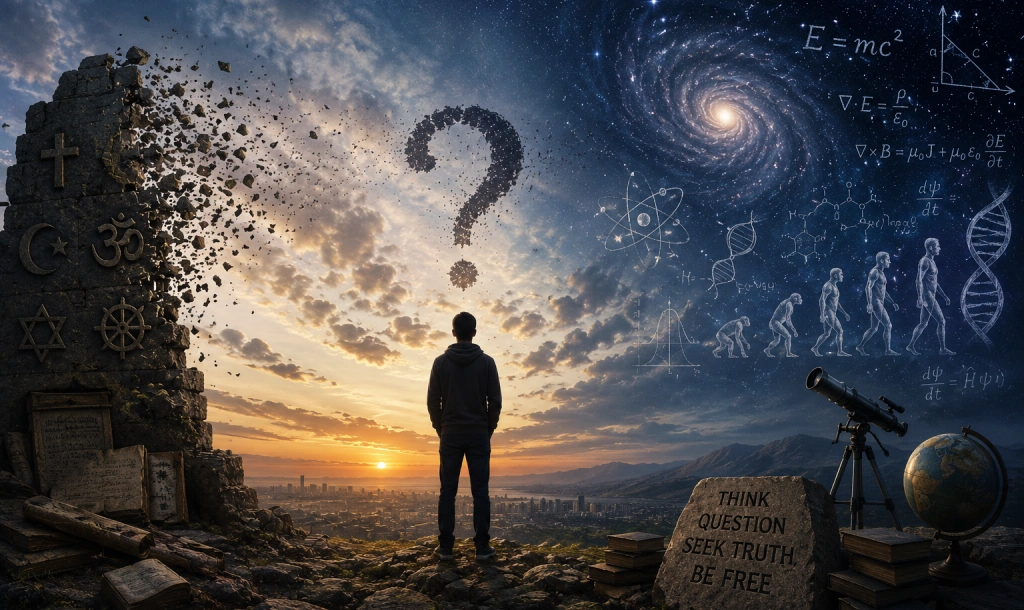
Philosophy of Religion – Volume 1: Religion, God, Divine Nature, and the Question of God’s Existence
Introduction
Philosophy of Religion is not a vehicle for promoting spiritual beliefs; it is a rigorous rational inquiry into the fundamental concepts, claims, and implications of religion. Although religion has been an influential element of human civilization in historical and social contexts, religious narratives enjoy no special privilege of divine authority in philosophy. Instead, philosophy treats religion as a subject of academic investigation and scrutinizes its central propositions through epistemology, ontology, and logic. Whereas conventional theology begins by presupposing the infallibility of a particular scripture or the reality of supernatural revelation, philosophy of religion takes the opposite approach. Its central task is to assess the logical foundations of religion, the concept of God, and the validity of claims concerning supernatural beings without preconceptions.
The foremost question in the intellectual evaluation of religious belief concerns the existence of God and the conceptual coherence of that idea. Philosophical inquiry examines both naturalistic explanations of religion—which investigate the biological and social origins of religious feelings from sociological, psychological, and anthropological perspectives—and the foundational claims of classical and modern theism. When religion is explained as an expression of human alienation, a projection of unconscious desires, or a manifestation of primordial fear, the basis of the supernatural truth of religious beliefs faces a direct challenge. From a philosophical perspective, it is essential to determine whether the conventional divine attributes—such as omnipotence, omniscience, and perfect goodness—generate contradictions when attributed to a single being.
Throughout history, theologians and philosophers have advanced various philosophical arguments intended to demonstrate God’s existence. Modern analytic philosophy has subjected their effectiveness and limitations to rigorous criticism. Identifying the logical defects and hidden assumptions within these arguments—from those associated with Anselm and Descartes to contemporary probability-based models—is one of the central aims of philosophy of religion. In particular, rational analysis must clarify the epistemological gap between empirical reality and transcendent explanations. Philosophy of religion is therefore not a refuge for blind faith, but a theoretical field in which every claim supporting belief in God is examined dispassionately, with conceptual clarity and intellectual objectivity.
Nature, Scope and Methods of Philosophy of Religion: Establishing Religion as an Object of Philosophical Inquiry and Examining Its Relationship with Related Disciplines
Introduction to Philosophy of Religion: Definition, Nature, Subject Matter, Types, Methods and John Hick’s Perspective
Concept and Conceptual Scope of Philosophy of Religion
Some questions in human thought do not easily disappear. Since ancient times, people have contemplated their own existence, the visible world around them, and whether an unseen maker stands behind that world. These reflections eventually gave rise to various religious beliefs and practices. When a person belongs to a particular religious community, that person interprets everything from within its framework of belief. We call this first-order religious practice. But when a thinker steps outside that framework and asks how sound the reasoning behind those beliefs actually is, or whether religion’s claims can withstand rational scrutiny, philosophy of religion begins. Philosophy of religion does not exist to defend a particular religious doctrine, nor does it exist merely to destroy it. It is a dispassionate, impartial, and logical analysis of religious propositions, beliefs, claims, and feelings.
In philosophical thought, philosophy of religion is understood as a second-order reflection. This means that it does not itself issue supernatural commands; rather, it rigorously analyzes religious ideas that have already been formulated. The philosopher Brian Davies has shown in his work that philosophy of religion examines the logical coherence of theological claims (Davies, 2004). When a scripture declares that God is omnipotent or perfectly merciful, philosophy of religion does not accept these statements as unquestionable truths. Instead, it asks: Can both attributes coexist? Is such perfect mercy compatible with suffering in the actual world? The concern of this discipline is not blind obedience but logical consistency and conceptual clarity.
This is where a major distinction arises between philosophy of religion and religious doctrines or theology. Religious adherents generally formulate arguments while maintaining unwavering confidence in their sacred texts, a practice of apologetic defense. The philosopher William P. Alston showed that sociology and anthropology examine religious behavior and cultural patterns, whereas philosophy of religion does not confine itself to descriptions of human conduct (Alston, 1967). It investigates the epistemological foundations of religion. Do religious claims refer to some objective standard of truth, or are they merely products of human imagination and language games? The philosopher Kai Nielsen emphasized that a fundamental responsibility of philosophy of religion is to refuse to accept metaphysical or supernatural concepts without examination (Nielsen, 1982). This discipline accordingly subjects every religious concept to intellectual scrutiny.
Nature and Epistemological Foundations of Philosophy of Religion
From an epistemological perspective, the nature of philosophy of religion is both complex and intriguing. In ordinary scientific inquiry, claims require empirical and observational evidence. Religious claims, however, are often presented as matters not of reason but of heartfelt faith. This produces a philosophical conflict. The nineteenth-century mathematician and philosopher W. K. Clifford declared in his famous essay that believing something without sufficient evidence is not merely mistaken but also morally wrong (Clifford, 1877). Clifford’s position is known in philosophy as evidentialism. The argument is straightforward: a rational person should accord a claim precisely the degree of confidence warranted by the evidence supporting it, and no more.
This rigorous evidentialist argument strikes at the foundations of religion, because direct or sensory evidence supporting a supernatural being cannot be produced. In the twentieth century, the philosopher Alvin Plantinga offered a new philosophical strategy for defending religious belief. His approach is known as Reformed Epistemology (Plantinga, 1983). Plantinga argues that belief in God need not be established through evidence; it may itself be a properly basic belief. Just as people believe that their memories are reliable or that they are not dreaming, an awareness of God may be accepted as a foundational belief without further proof. Impartial analysts have shown, however, that such reasoning brings about a terrifying epistemological anarchy. If belief in God can be declared basic without evidence, anyone could similarly proclaim any fantasy or superstition to be a basic belief.
Philosophy of religion therefore exempts no authoritative pronouncement from scrutiny. When people claim to have encountered an ultimate reality through meditation or a special transcendental experience, philosophers investigate the truth value of that experience. The philosopher Richard Swinburne attempted to use probability theory to present religious experience as evidence for God’s existence (Swinburne, 1979). Yet rigorous epistemological analysis shows that an internal psychological experience cannot constitute conclusive proof that something exists in the external world. However intense an experience may be, it may also result from a particular neurological or psychological response in the brain. Philosophy of religion thus separates the emotional force of belief from its rational justification and demands that supernatural claims be assessed according to ordinary scientific and logical standards.
Core Subject Matter and Rational Problems
The central subject matter of philosophy of religion consists of certain fundamental concepts and their internal contradictions. Foremost among these is the logical examination of the God conceived by monotheistic religions. Classical theism holds that the creator simultaneously possesses omnipotence, omniscience, and omnibenevolence. From a philosophical perspective, however, these three attributes together produce severe self-contradiction. An old philosophical puzzle asks: Can God create a stone so heavy that he himself cannot lift it? If he can, he is not omnipotent because he cannot lift it; if he cannot, he is still not omnipotent because he cannot create it. This is more than a verbal trick. It demonstrates that if omnipotence is understood to include the violation of logical laws, the concept itself becomes meaningless.
Similarly, the concept of omniscience does not fit with human free will. If God knows everything perfectly, then millions of years ago he already knew exactly what a particular person would do tomorrow morning. If that knowledge is infallible, it is impossible for the person to act differently. This means that there is in fact no human freedom of choice; everything is predetermined. If people have no free will, punishing them for wrongdoing or rewarding them for virtue becomes morally unjust. Religious beliefs thus create a conflict between the moral framework they seek to establish and their own metaphysical commitments.
Philosophy of religion also addresses a famous debate about the foundations of morality, known as the Euthyphro Dilemma. The ancient Greek philosopher Plato raised this question in his dialogue (Plato, 1997): Does God command an action because it is good, or is an action good because God commands it? If the first answer is accepted, then a standard of good and evil exists independently of God, making God subject to that standard rather than the ultimate source of morality. If the second answer is accepted, morality becomes arbitrary: if God commands someone today to kill an innocent living being, the act must be regarded as good. This dilemma proves that no universal rational foundation for morality can be constructed upon religious belief.
Alongside these problems stands the world’s most immediate crisis, the problem of evil. The unspeakable suffering, disease, natural disasters, and cruelty that occur continually in the world are completely incompatible with the idea of an omnipotent and benevolent God. The philosopher J. L. Mackie formulated this problem as a logical argument and showed that the actual existence of suffering proves a logical defect in the conventional concept of God (Mackie, 1955). The philosopher William L. Rowe developed a more concrete version of the argument by considering a helpless fawn burned to death in a forest fire, an event for which no greater moral purpose can be identified (Rowe, 1979). Such pointless evil provides an exceptionally powerful rational basis for challenging belief in God.
Typologies and Methodological Approaches in Philosophy of Religion
The history of inquiry into religion contains various intellectual approaches. Their differences have given rise to distinct strands within philosophy of religion. Natural theology was prominent in ancient and medieval philosophy. Thinkers working in this tradition sought to establish God’s existence without appealing to supernatural revelation, using only the apparent order and causality of the natural world. The underlying analogy was simple: just as a watch implies a watchmaker, nature suggests a creator. The development of modern science—especially evolutionary theory and modern physics—has demonstrated that the cause of natural order is not a supernatural being but the interaction of blind natural laws. Consequently, the influence of traditional natural theology has gradually diminished within modern philosophy.
In the twentieth century, analytic philosophy of religion moved to the center of philosophical discussion. Rather than engaging in dramatic speculation about grand supernatural claims, this approach examines the grammar, meaning, and logical validity of individual statements. Analytic philosophers identify the unreasonable assumptions hidden within religious propositions. For example, they examine the misuse of the principle of causation in the statement “God is the cause of all creation.” In contrast, continental philosophy of religion developed in Europe. This tradition emphasizes existential crises, loneliness, symbols, and the meanings embedded in religious language more than detailed formal logical analysis. Paul Ricoeur represents this approach through his work on religious metaphor and textual interpretation (Ricoeur, 1974).
Alongside these traditions, naturalistic and critical perspectives have become highly influential in contemporary philosophy. Thinkers in this tradition do not grant a place to supernatural beings in their explanations. They understand religion as a complex product of human societies, psychology, and relations of power. The philosopher Paul Kurtz and modern skeptics have argued that religion should receive no special exemption from scrutiny; it must be analyzed objectively like other fallible human activities (Kurtz, 1986). This perspective refuses to assign divine grandeur to belief and instead studies religion as a particular chapter of human history, with emancipation from its influence and intellectual blindness presented as the principal objective of modern thought.
Methods of Inquiry and the Meaningfulness of Religious Language
The most important turning point in modern philosophy of religion came when philosophers began questioning whether religious statements have any meaning at all. Logical positivism, associated with the Vienna Circle of the 1930s, transformed the philosophical landscape. In his influential book Language, Truth and Logic, A. J. Ayer advanced the verification principle (Ayer, 1936). His argument was that a statement is meaningful only if it is true by definition or logic, or if it can be tested by sensory experience. Ayer argued that concepts such as God, the soul, and the afterlife cannot be verified through the senses. He therefore concluded that statements about God are not even candidates for truth or falsity; they are merely meaningless ravings.
Before the impact of logical positivism had subsided, the philosopher Antony Flew advanced another powerful criticism, associated with the principle of falsification (Flew, 1955). Flew used a striking parable adapted from John Wisdom. Two people enter a forest and find a patch of beautiful flowers. One says that a gardener must tend them; the other denies that any gardener exists. They set a watch, but no gardener appears. The believer then says that the gardener is invisible. They bring hunting dogs, but the dogs detect no scent. The believer replies that the gardener is odorless and intangible as well. Finally, the other person asks in frustration: What difference remains between this invisible, undetectable, untouchable gardener and no gardener at all? Flew’s central point is that, for a claim to have factual significance, there must be some possible event whose occurrence would count against it. Religious believers, however, can qualify claims about God’s mercy or presence so extensively that no disaster could ever challenge them. In Flew’s famous formulation, religious assertions can suffer “death by a thousand qualifications.”
Faced with such criticism, some thinkers attempted to reinterpret religious language. In Philosophical Investigations, the philosopher Ludwig Wittgenstein introduced a different understanding of language (Wittgenstein, 1953). He argued that language does not merely picture the world; people use it in diverse ways for different purposes, within what he called “language games.” Some of his followers maintained that religious language does not convey facts in the manner of scientific discourse; instead, it expresses participation in prayer or a particular form of life. Rationalist philosophers have strongly challenged this approach. When an ordinary believer says that God has heard a prayer, the believer is not merely playing a poetic language game but making a claim about an actual event. Calling such statements language games therefore cannot evade the question of their objective truth.
John Hick’s Perspective on Philosophy of Religion
Among the philosophers who sought to offer a comprehensive account of philosophy of religion in the second half of the twentieth century was the British philosopher John Hick. When Hick began his work, he encountered both the uncompromising logic of analytic philosophy and the conflicts among the world’s religions. In his extensive book An Interpretation of Religion, Hick attempted to resolve these problems (Hick, 1989). He proposed his influential account of religious pluralism, arguing that the world’s major religions are different culturally conditioned human responses to the same infinite ultimate reality.
Hick’s thinking drew upon the epistemology of Immanuel Kant. Just as Kant maintained that we do not know the world as it is in itself but only as it appears through our senses and minds, Hick argued that “the Real in itself” lies beyond human knowledge. People experience it only through their own cultural frameworks. Hick called this process “experiencing-as.” Someone raised in a Middle Eastern setting conceives ultimate reality as a personal God, while someone raised in an Eastern setting might understand it as an impersonal reality. Atheist and impartial philosophers, however, have characterized Hick’s pluralism as an exercise in obscuring real contradictions. Different religions make mutually incompatible claims: what one declares true, another directly denies. Folding these contradictory propositions into an invisible ultimate reality does not constitute a logically satisfactory solution.
Hick also advanced an elaborate response to the problem of evil in his well-known book Evil and the God of Love, proposing a soul-making theodicy (Hick, 1966). He argued that God did not create the world as a perfect and comfortable paradise for human beings. Rather, he created it as an environment in which people could develop spiritually by confronting hardship and suffering. Hick further proposed that God remains somewhat hidden so that human freedom is preserved, calling this epistemic distance. He also introduced the idea of eschatological verification as a way of assessing religious truth (Hick, 1960): if consciousness survives death, people will then discover whether God exists. These ideas have faced severe criticism in contemporary objective philosophy. Deferring verification of a claim to an unknown world after death is a weak attempt to evade the present absence of evidence. Even if the world is called a workshop for developing souls, no moral development occurs when millions of innocent children die of disease or animals experience unbearable suffering. Such events instead exhibit the blind cruelty of nature.
Philosophy of Religion and Theology: Differences in Rational Inquiry, Revelation, Authority and the Foundations of Belief
Epistemic Starting Points and Methodological Divergence
In the history of epistemology, the questions of how something can be known and what constitutes the initial foundation for that knowledge determine the essential character of a discipline. Theology and philosophy of religion may appear to address the same subjects—God, the soul, creation, and the source of morality—but they begin from fundamentally opposed positions. Theology begins by accepting a firm presupposition or predetermined truth. It assumes that ultimate truth or a divine message has already been revealed to humankind and is infallible. The medieval theologian Anselm of Canterbury used a famous Latin formulation to describe the character of theology: “faith seeking understanding” (Anselm, 1998). In other words, a theologian first accepts faith as the foundation and then attempts to explain or defend that faith by intellectual means.
Philosophy of religion operates from the opposite standpoint. Philosophy does not begin with a predetermined belief or conclusion; it begins with doubt, impartial questioning, and intellectual honesty. It does not assume in advance that any religious narrative is true. The method of systematic doubt advocated by the modern philosopher René Descartes is applied to the fundamental concepts of religion (Descartes, 1996). For a philosopher, a statement in scripture or tradition enjoys no special privilege; it is treated as an ordinary proposition. The question is then whether any independent, generally applicable, and unbiased reasoning supports that proposition. From this perspective, faith cannot substitute for evidence. Rather, faith must justify its own acceptance under rational examination.
The methodological frameworks of these two disciplines also differ fundamentally. Theology works within the boundaries of an established faith; it is an internal discussion. The influential twentieth-century Protestant theologian Karl Barth explicitly maintained in his extensive Church Dogmatics that humans cannot apprehend the truth of God through ordinary human reasoning alone (Barth, 1975). For Barth, the task of theology was not to establish a neutral philosophical debate but to consolidate the church’s own beliefs and dogmas. By contrast, the philosopher Immanuel Kant argued in his classic Religion within the Boundaries of Mere Reason that religious ideas must establish their validity within the limits of universal human reason (Kant, 1998). Philosophy of religion consequently submits to no particular religious framework. Its commitment is to noncontradiction and conceptual coherence.
The philosopher Anthony Kenny has clarified this methodological conflict further (Kenny, 2004). In Kenny’s account, whereas the theologian speaks as someone claiming possession of the truth, the philosopher of religion raises impartial questions as someone searching for it. The theologian’s reasoning commonly begins with the aim of preserving a specified conclusion, whereas the philosopher remains prepared to follow an argument wherever it leads. Thus theology seeks to protect faith, while philosophy of religion subjects the rationality of faith to open debate. Because of this fundamental difference, theological discussion ultimately becomes a form of apologetics, while philosophy of religion functions as a rigorously critical discipline.
Revelation versus the Autonomy of Reason
The most important pillar of the theological framework is revelation. According to religious belief, revelation is a special message directly conveyed by God, beyond the reach of ordinary human observation or the scientific method. Theologians claim that limited human reason cannot penetrate the deepest mysteries of ultimate reality and that humanity therefore requires supernatural guidance. The influential medieval theologian Thomas Aquinas divided knowledge into two levels in his monumental Summa Theologiae (Aquinas, 1948). According to Aquinas, some knowledge can be acquired through ordinary reasoning and the senses, while ultimate truths such as the Trinity or the beginning of creation require reliance upon revelation. Theology therefore places revelation above reason as an authoritative source of knowledge.
Philosophically, this claim concerning revelation creates a profound epistemological problem. The fundamental question is: How can anyone verify that a particular text or message actually originated with a supernatural creator? After receiving a message, people must ultimately rely upon their own minds and reasoning to understand and assess it. The British empiricist philosopher John Locke advanced a powerful argument on this subject in An Essay Concerning Human Understanding (Locke, 1975). Locke argued that people have no supernatural means by which to determine whether a claim is genuinely a revelation. They must use their ordinary powers of reason to decide whether it is credible. If reason is the final judge of the truth of revelation, revelation cannot stand above or independent of reason.
At this point, philosophy of religion establishes the autonomy of reason. Philosophy holds that reason operates according to fundamental principles, including causality and the law of noncontradiction. Such principles cannot simply be set aside by appealing to a supposed divine statement. When theology declares, “It is true because God said it,” philosophy of religion asks, “Does a statement become true merely because someone says or claims it?” This theological position produces serious circular reasoning: God exists because scripture says so, and scripture is true because it is God’s word. Philosophy of religion assigns no epistemic value to this kind of circular argument and demands independent evidence external to the very claim whose truth is being established.
The contemporary philosopher Richard Dawkins and other analytic thinkers have also clarified the philosophical challenge to reliance on revelation (Dawkins, 2006). When different religions present completely incompatible claims of revelation—one saying exactly the opposite of another—revelation itself becomes a claim incapable of proof. Since there is no divine standard available to determine which revelation is correct, people must return to impartial human reasoning. Philosophy of religion therefore does not accept a claim of revelation as a self-sufficient source of evidence. Instead, it treats it as an expression of human historical and cultural imagination.
Institutional Authority and Critical Skepticism
The foundations of theology do not rest on abstract belief alone. Historically, theology has also rested upon institutional authority and the protection of dogma. Institutional religions have priestly classes, councils, or bodies of scholars that determine officially approved interpretations of religious texts. Ordinary individuals are not permitted to depart from those interpretations simply by exercising their own reason. The concept of orthodoxy develops to protect such arrangements; departures are classified as heresy or deviation from established belief. The early Church Father Tertullian made a strange statement expressing this blind form of faith in its most extreme form: “I believe because it is absurd” (Tertullian, 1954). Institutional theology has consistently sought to silence human reasoning and enforce unconditional obedience to authority.
By contrast, the central driving force of philosophy of religion is critical skepticism. No person, scripture, or institution may claim inviolable authority in philosophy. The identity of the speaker—whether an ancient saint, powerful priest, or influential prophet—is irrelevant to the logical validity of a statement. In his celebrated essay The Fixation of Belief, the American philosopher Charles Sanders Peirce showed that imposing beliefs on people through authority is the blindest method of suppressing thought (Peirce, 1877). Peirce instead stressed fallibilism, the recognition that any item of human knowledge or any belief may turn out to be mistaken. The pursuit of truth therefore requires that every belief remain open to criticism.
The Scottish philosopher David Hume mounted a powerful rational challenge to institutional authority and supernatural claims in An Enquiry Concerning Human Understanding (Hume, 1975). Hume argued that when a religious authority testifies to a miracle, a rational person should consider which explanation is more credible: that an established law of nature was genuinely violated, or that the witness lied, was mistaken, or was deceived. Compared with the unchanging laws of nature over billions of years, the possibility of human error or deception is always greater according to the laws of mathematics. Philosophy of religion thus strips institutional authority and miraculous claims of their protective mystique and insists upon objective evidence.
The conflict between theology and philosophy is therefore, at its core, a conflict between blind authority and free human thought. Theology seeks to confine people within a particular framework of thought so that institutional power and inherited religious narratives remain unquestioned. Philosophy of religion, by contrast, encourages the courage to question everything. Neither the power of an institution nor the antiquity of a tradition automatically makes an argument correct. Philosophy of religion does not seek institutional certification for a claim; it examines whether the claim contains logical gaps or inconsistencies.
Text, Hermeneutics, and the Crisis of Invariance
Theological practice revolves around interpreting a particular text or scripture, an activity called theological hermeneutics. Theologians assume that scriptural words are immutable and communicate the eternal intentions of an omniscient creator. As eras change and human knowledge and moral understanding develop, theologians consequently must engage in elaborate efforts to reconcile ancient texts artificially with modern thought. The German thinker Friedrich Schleiermacher helped establish modern hermeneutics by emphasizing that every text is bound to the language and culture of its historical context (Schleiermacher, 1998). Theology, however, denies these historical limits when it presents ancient writings as timeless truths transcending place and time, thereby producing numerous contradictions.
From a philosophical perspective, the claim of immutability faces a profound epistemological challenge. How is the meaning of an ancient text determined? In his philosophy of the text, the twentieth-century French philosopher Paul Ricoeur argued that once a text has been written, it becomes detached from its author’s original mental intentions and opens itself to new interpretations (Ricoeur, 1976). When theologians therefore claim to have discovered a scripture’s “true divine meaning,” they are in fact projecting their contemporary biases and needs onto it. A text cannot automatically supply a fixed truth; meaning emerges through the way readers interpret it. The meaning of religious texts consequently depends entirely on human interpretation, and no interpretation can be proclaimed final or immutable.
Likewise, the postmodern philosopher Jacques Derrida deconstructed the internal structures of language to show how texts contain multiple and potentially contradictory meanings, associated with his concept of différance (Derrida, 1976). Derrida’s method of reading shatters theology’s fixed foundations. Words in an ancient text cannot convey the same meanings thousands of years later. What theology offers in the name of unchanging eternal truth is therefore a complex pattern of historically shifting interpretations. Philosophy of religion exposes the fact that no written text can be the ultimate repository of absolute knowledge: every text is nothing more than a limited document from a particular period of human history.
A major problem thus arises when theologians try to derive changing modern social and legal norms from an immutable ancient text. Practices such as slavery, patriarchy, and social inequality, treated as normal in ancient religious scriptures, have been rejected as immoral by modern rational ethics. Theology then either attempts to recast such ancient rules as metaphors or openly defends them in a rigidly orthodox manner. Philosophy of religion examines this tension not as an expression of religious glory but as an inevitable problem of language and history. The attempt to impose a permanently fixed text upon the moral development of human society is logically bound to fail.
The Grounds of Morality: Divine Command versus Moral Autonomy
Another major theological claim is that morality depends directly on God’s commands. In philosophy this is called Divine Command Theory. The contemporary Christian theologian and philosopher Robert Merrihew Adams, an advocate of this theory, has argued that the rightness or wrongness of an action is determined by God’s commands (Adams, 1987). The theological argument holds that without a cosmic lawgiver there can be no objective basis for right or wrong, leaving people free to do whatever they wish. God is understood as the supreme moral legislator, and obedience to his commands is regarded as humanity’s fundamental duty.
In philosophy of religion, this position faces a profound moral and logical problem, rooted in the Euthyphro Dilemma discussed by the ancient Greek philosopher Plato (Plato, 1997). The question is whether God commands an action because it is good or whether it is good because God commands it. If the first alternative is correct, goodness must be independent of divine will and God must acknowledge a moral standard that he did not create. God is therefore not the ultimate source of morality. If the second alternative is correct, morality becomes entirely arbitrary. Should God command cruelty tomorrow and declare it good, that cruelty would have to be considered good. Morality would then possess no independent rational or human value.
Against this dependence on divine authority, the German philosopher Immanuel Kant developed the idea of moral autonomy in his celebrated Groundwork of the Metaphysics of Morals (Kant, 1997). Kant argued that morality cannot consist merely of action motivated by fear of an external power or hope of reward. Someone who performs a good deed solely to avoid hell or obtain paradise is not acting out of genuine morality but engaging in self-interested calculation. For Kant, genuine morality consists in respect for universal duties determined by reason. Human practical reason itself legislates moral principles. Whereas theology seeks to turn people into eternally blind and obedient subjects, philosophy of religion recognizes them as independent and responsible agents of their own moral decisions.
The contemporary philosopher James Rachels developed this point further, arguing that Divine Command Theory severely diminishes human intellectual and moral dignity (Rachels, 1971). On Rachels’s reasoning, blindly obeying God requires people to surrender their own judgment about right and wrong. Acting merely because one has been ordered to do so, without independently understanding why the action is right, expresses a servile mindset. Philosophy of religion thus does not regard morality as a miraculous command descending from heaven; it examines morality in terms of the development of human empathy, compassion, social relations, and rational reflection.
The Logical Incompatibility of Divine Sovereignty and Human Freedom
One of theology’s principal concepts is God’s absolute and limitless divine sovereignty. In theologies of the Abrahamic religions in particular, it is claimed that everything in the world, down to the smallest particle, is governed by God’s perfect control and predetermined plan. The influential sixteenth-century theologian John Calvin presented an uncompromising doctrine of predestination in his major work Institutes of the Christian Religion (Calvin, 1960). According to Calvin, God had finally decided even before creation who would be saved and who would burn eternally in hell. Human beings possess no independent power to alter this destiny, because human intervention cannot override divine sovereignty.
From the standpoint of philosophy of religion, this absolute sovereignty is incompatible with human freedom and moral responsibility. Philosophers ask: If everything occurs according to a plan predetermined by God, can human beings possess any libertarian free will at all? If a criminal’s decision to commit a crime was already certain in God’s foreknowledge millions of years beforehand, and not even a leaf can move outside God’s will, then holding that person morally responsible for the crime cannot be justified by any reasoning. Punishing someone for an action over which that person had no genuine control is a grave injustice.
To resolve this logical difficulty, the medieval Jesuit theologian Luis de Molina proposed an intermediate theory known as Molinism, or the doctrine of God’s middle knowledge (Molina, 1988). Molina maintained that God knows in advance what a person would freely choose in any particular circumstance and governs the world accordingly. But the contemporary analytic philosopher J. L. Mackie showed that such strategies are nothing but verbal trickery (Mackie, 1982). If God has perfectly created both human nature and every circumstance in advance, people ultimately become puppets in a predetermined framework. Their actions unfold according to a script authored by God.
The impartial inquiry of philosophy of religion therefore concludes that infinite divine control and genuine human freedom cannot both be true at the same time. Theology seeks simultaneously to praise God as the possessor of absolute power and to place responsibility for human sin exclusively upon humans. These two claims destroy each other. Philosophy of religion reveals within the religious conception of God a deep logical conflict that cannot be resolved merely by citing authoritative pronouncements.
Philosophy of Religion and the Sciences of Religion: Its Relationship with the Psychology, Sociology, Anthropology and Comparative Study of Religion
Normative Philosophy versus Descriptive Science: Epistemic Boundaries
In epistemological inquiry, the approach taken to a subject depends upon the kind of questions the investigator asks. When people attempt to understand a multidimensional phenomenon such as religion, two distinct methodological approaches emerge. One is the descriptive approach, foundational to the modern sciences of religion (Religionswissenschaft). The other is the evaluative and rational approach distinctive to philosophy of religion. The various sciences of religion—including sociology, anthropology, and psychology—examine religion as part of human behavior, social structures, and biopsychological processes. They use evidence to describe how religion functions, how it spreads through society, and what effects it has upon the human mind. Their aim is not to determine the truth of supernatural beings. Their methods instead rely upon methodological agnosticism or objective distance.
Philosophy of religion, by contrast, occupies a different position. It is not satisfied merely with describing events; it is a normative discipline. When a sociologist reports that people in a certain region believe prayer can cure illness, the philosopher of religion asks whether there is any rational justification for that belief. Can a necessary causal connection between prayer and recovery actually be established? In his celebrated The Sacred Canopy, the sociologist Peter L. Berger described religion as a human effort to endow the social world with sacred meaning (Berger, 1967). This sociological reading situates religion within human construction. Philosophy of religion, however, evaluates the epistemic status of the truth claims underlying that construction. Science gathers and analyzes evidence; philosophy critically examines the logical grounds of the claims made about it.
In clarifying this relationship between philosophy of religion and the sciences of religion, Ninian Smart, a leading scholar of the phenomenology of religion, showed how religion’s many features—ritual, myth, doctrine, and experience—can be studied as cultural expressions (Smart, 1973). When philosophy takes up these features, it asks how coherent the relevant doctrines are. As the philosopher Paul Kurtz observed, the survival of a social practice for thousands of years does not guarantee its metaphysical truth (Kurtz, 1986). Philosophy of religion therefore draws upon observational evidence supplied by the sciences but subjects that evidence to critical reasoning rather than conferring supernatural significance upon it. Combining scientific description with philosophical assessment provides an integrated academic approach to understanding religion.
Psychology of Religion and the Truth-Value of Experience: The Genetic Fallacy Debate
Psychological investigation of religious belief opens an extensive field of discussion for philosophy of religion. When people claim that they have felt supreme peace during meditation or sensed an invisible power during prayer, the psychology of religion examines these experiences in terms of neurological processes, unconscious desires, and complex emotional reactions. In his landmark The Varieties of Religious Experience, the American philosopher and psychologist William James classified such subjective experiences in detail (James, 1902). Although James treated religious experience as a genuine psychological phenomenon, this raises a fundamental philosophical question: Can an internal mental experience prove the existence of an external supernatural being?
This brings forward an important epistemological controversy, the genetic fallacy. When psychology identifies a biological or neurochemical cause of a religious feeling—for example, stimulation of the temporal lobe—some critics argue that the existence of a completely natural cause directly disproves a divine being. The philosopher Robert Audi, however, cautioned in his epistemological work that identifying the psychological origins of a belief does not automatically establish that the belief is false (Audi, 2011). Just as stimulation of the optic nerve produces the experience of seeing red, the question of how an experience arises is distinct from the question of whether the red object exists outside the observer.
Contemporary cognitive science of religion, however, has posed a stronger challenge to claims of transcendental experience. In his influential Religion Explained, the anthropologist and cognitive scientist Pascal Boyer described how the human brain evolved to infer the presence of intentional agents even from limited cues (Boyer, 2001). This propensity, developed in response to pressures for survival, functions as a mechanism of agency detection. Cognitive science makes clear that no supernatural being is communicating with people; rather, the human brain imagines invisible agencies around it for evolutionary advantage. Philosophy of religion uses these scientific findings to argue that experiences arising from biological fallibility or evolutionary misperception provide no rational basis for inferring an ultimate supernatural reality.
Sociology of Religion and Ultimate Reality: Social Construction versus Realism
From a sociological perspective, religion is not a miraculous system of law descending from heaven but a complex product of collective human life. The French sociologist Émile Durkheim advanced a revolutionary interpretation in his classic The Elementary Forms of the Religious Life (Durkheim, 1995). According to Durkheim, when people worship God they are actually worshipping the collective power and authority of their own society. Religion is a symbolic system through which society declares itself sacred and maintains its control over individuals. Durkheim defined society through the sacred-profane dichotomy: the sacred is not an object but a symbol of particular values imposed by society.
In a different sociological analysis, Max Weber showed in his famous The Protestant Ethic and the Spirit of Capitalism how religious ideas can influence people’s economic conduct and broader social change (Weber, 2002). Weber understood religion as one of the social forces driving the human search for meaning. Such sociological analyses also raise a profound metaphysical problem for philosophy of religion. If the idea of God and the commands associated with religion are merely symbolic instruments of social cohesion or forms of social construction, the perennial philosophical question “Does God actually exist?” is rendered entirely meaningless.
At this point, an intense dispute emerges between religious realism and religious non-realism. Realists maintain that God’s existence is independent of human belief or society: God would exist even if humans did not. But sociological evidence demolishes that realist position. The British philosopher Don Cupitt, drawing upon sociological insights, argued that God has no independently existing being and consists instead of human moral values and linguistic practices (Cupitt, 1980). Cupitt’s non-realist perspective illustrates how sociology removes religion from an otherworldly realm and situates it within human culture. In its engagement with sociology, philosophy of religion thus finds religious claims to be nothing but expressions of historical power structures and collective psychology.
Anthropological Horizons and Primitive Beliefs: Symbolism versus Logical Coherence
Anthropological research makes it possible to examine the origins and transformations of religion within a historical setting. In Primitive Culture, the nineteenth-century British anthropologist Edward Burnett Tylor argued that early humans, unable to explain dreams, shadows, and death, imagined invisible spirits inhabiting objects (Tylor, 1871). He called this belief animism. Similarly, in his extensive The Golden Bough, the anthropologist James George Frazer described a progression of human thought from magic to religion and then to modern science (Frazer, 1922). According to Frazer, magical beliefs among early humans were a mistaken kind of science intended to control nature. When those efforts failed, people turned to prayer addressed to gods.
These anthropological accounts raise a major question for philosophy of religion: Were early human beliefs simply products of ignorance, or did they constitute rational explanations within their own worlds? In The Interpretation of Cultures, the twentieth-century cultural anthropologist Clifford Geertz defined religion as a system of symbols that establishes powerful, pervasive, and long-lasting moods and motivations (Geertz, 1973). The philosophical problem is whether a symbolic system, however rich, can establish truths about the actual world. Discussing beliefs about witchcraft among the Azande of Africa, the philosopher Peter Winch advanced a relativist approach and argued that the reasoning of a traditional culture cannot simply be measured by the standards of Western science; its reasoning is correct within its own language games (Winch, 1964).
The philosopher Alasdair MacIntyre strongly objected to Winch’s relativism (MacIntyre, 1970). MacIntyre argued that beliefs in any society can contain contradictions that are recognizable across cultures. If a community claims that a particular ritual will unfailingly produce rain, scientific evidence showing that the rain does not occur cannot be dismissed by invoking cultural relativism. Philosophy of religion therefore uses anthropological research to investigate religion’s early roots. It argues that supernatural concepts in modern monotheistic religions are, in practice, refined transformations of ancient fears, misconceptions, and beliefs born of ignorance. Neither the age of a belief nor its symbolic depth provides it with logical validity.
Comparative Religion and the Crisis of Epistemic Exclusivity
There is not one religion in the world but hundreds of different religious traditions. The historical and comparative examination of this diversity is the aim of comparative religion. The orientalist and pioneer of comparative religious study Max Müller made a celebrated observation in Introduction to the Science of Religion: “He who knows one, knows none” (Müller, 1873). Müller showed that comparing the languages and metaphors of different cultures helps explain how religious concepts developed and traveled between geographical regions. The historian of religion Mircea Eliade described in The Sacred and the Profane how religions around the world employ mythological patterns of sacred space and sacred time (Eliade, 1959).
This historical perspective creates a serious epistemological difficulty for philosophy of religion, namely incompatible truth claims. Semitic religions assert that there is one personal creator God; many strands of Hinduism understand the divine as manifesting in multiple forms or as identical with the entire cosmos; early Buddhism rejects the idea of an ultimate creator. Which of these mutually contradictory claims is correct? A believer who insists that only one religion is true and all the others false adopts a position of epistemic arrogance or exclusivism. Comparative religious studies, however, reveal that followers of different traditions express similar levels of certainty and advance similar supernatural claims.
The philosopher David Christensen has examined peer disagreement in contemporary epistemology (Christensen, 2007). According to Christensen, when two people of comparable intelligence and access to evidence hold conflicting beliefs, neither is justified in simply clinging to the certainty that their own position alone must be correct. Observing this plurality through comparative religion, philosophy of religion concludes that religious truth claims do not rest upon universal evidence. They are merely the outcomes of the geographical and cultural accidents of birth. A person who regards a belief as absolute truth when born in Saudi Arabia would have regarded a different belief as absolute truth if born in India or Japan. This geographical relativity completely invalidates religion’s claims to supposed divine universality.
Naturalism, Coherence, and the Philosophical Synthesis of Sciences of Religion
When the different sciences of religion explain religion in human terms through psychology, social structures, anthropological development, and comparative history, philosophy must evaluate their findings within a comprehensive theoretical framework. The strongest philosophical position for this evaluation is philosophical naturalism. Naturalism maintains that natural laws and worldly causal processes suffice to understand events in the universe; invoking the intervention of a miraculous, supernatural, or divine being is unnecessary.
Recent research in cognitive science and evolutionary biology has further developed this naturalistic framework. In Faces in the Clouds: A Theory of Religion, the anthropologist Stewart Elliott Guthrie explained how people project human personality onto impersonal natural forces, much as they discern human faces in clouds (Guthrie, 1993). For Guthrie, religion is a universal form of anthropomorphism. In dangerous ancient environments, interpreting an unfamiliar sound as a predator or hidden enemy could help people survive. The same inclination to attribute agency led people to imagine that flashes of lightning were weapons thrown by an angry deity. The researcher Justin L. Barrett described this cognitive tendency in terms of a hyperactive agency detection device (Barrett, 2004).
When philosophy of religion brings these scientific findings together, it removes religion’s claim to divine grandeur. The God whom medieval thinkers regarded as an indispensable explanation of the universe is, through developments in science and philosophy, revealed as an evolutionary residue or by-product of the human mind. As scientific inquiry explains religious beliefs, rituals, and feelings through hormones, neuronal activity, and relations of social power, Ockham’s razor makes invoking the imaginary existence of an invisible creator a mere waste of reasoning. Philosophy of religion therefore organizes the evidence provided by the sciences of religion through rational inquiry rather than searching for an imaginary afterlife. It presents religion not as supernatural truth but as a historical record of human fears, hopes, ignorance, and social evolution.
Nature and Dimensions of Religion: Belief, Ritual, Experience, Morality, Community and the Concept of Ultimate Reality
Belief and the Doctrinal Dimension: Epistemic Foundations and Rational Crises
The most visible and frequently discussed aspect of religious life is its world of beliefs, known in philosophical discussion as the doctrinal dimension. Every institutional religion rests upon certain fundamental ideas, such as the afterlife, the soul, sin and virtue, and an unseen judge. When an ordinary believer accepts a doctrine as true, epistemologists call it a propositional belief: the person holds that a particular proposition accurately describes reality. The philosopher Louis P. Pojman examined two psychological processes involved in the formation of beliefs: beliefs that arise involuntarily from evidence and attempts to believe through the exercise of the will, known as doxastic voluntarism (Pojman, 1986). Religions particularly encourage the latter tendency by presenting belief as a major virtue even when sufficient evidence is absent.
From a philosophical standpoint, such belief raises serious questions of rational justification. Accepting a claim as true requires appropriate evidence. Religious beliefs, however, lack any objective foundation, and elaborate networks of arguments are developed to protect them. The philosopher Robert Audi maintained that rational knowledge must rest on sources such as perception, reason, or memory through which a claim can be assessed independently (Audi, 2003). Yet when religion declares a doctrine unchangeable, it obstructs the ordinary course of reasoning. Belief is no longer the outcome of inquiry but becomes a form of intellectual surrender, in which the absence of evidence itself is treated as proof of devotion.
Another weakness of the doctrinal framework is the contradiction among religious beliefs. What one religion proclaims as the ultimate truth and the only path to salvation, another condemns as a grave error deserving punishment. Although the philosopher John Hick attempted to overcome these differences by treating the religions as distinct expressions of the same truth, this solution does not withstand rigorous philosophical scrutiny (Hick, 1989). Two completely contradictory propositions cannot both be true. If one conception of God insists that God is indivisibly one and has no partners, while another holds that divinity takes multiple forms, then under the law of noncontradiction at least one of the incompatible propositions must be false, or both may be products of human imagination. Philosophy of religion therefore approaches the doctrinal dimension not as an otherworldly truth but as a framework of abstract concepts shaped by human history and culture.
Ritual and Efficacy: Symbolism and Performative Action
Another indispensable feature of religious life is its rites and ceremonies, the ritual dimension. Praying, making sacrifices, facing in a specified direction, or sprinkling holy water to purify a place are not merely physical gestures. Believers attribute deep supernatural efficacy to such acts. In her well-known Ritual Theory, Ritual Practice, the scholar Catherine Bell argued that rituals are symbolic arrangements of society and power that accustom the body and mind to particular forms of discipline (Bell, 1992). Through ritual, society embeds its own rules in the unconscious mind, making them appear normal and eternally true.
From the standpoint of the philosophy of language, the alleged effectiveness of religious ritual raises an intriguing question. The British philosopher J. L. Austin showed in How to Do Things with Words that language not only conveys information but can also perform acts; he called such speech a performative utterance (Austin, 1962). When a judge says “You are hereby found guilty,” the pronouncement itself changes the person’s legal position. In religious ceremonies, priests and believers believe that uttering particular phrases or incantations changes objective reality: ordinary water becomes holy water, or a curse comes true. Philosophical analysis, however, makes clear that there is no connection between social rules and natural reality. A judge’s pronouncement has legal force because the state recognizes it; merely uttering an incantation does not alter the physical laws of nature.
The anthropologist and philosopher Roy A. Rappaport observed in his important Ritual and Religion in the Making of Humanity that participating in a ritual effectively commits individuals to accepting without question the social prescriptions embodied in it (Rappaport, 1999). Ritual is an effective instrument for occupying people’s attention and securing their obedience. Repeatedly performing the same rites creates psychological dependence that leaves people no opportunity to consider the irrationality behind those rites. Philosophy of religion exposes these psychological and symbolic dimensions and argues that the supposedly supernatural efficacy of ritual is merely a symbolic consolation for human wishes.
Religious Experience and Numinous Perception: The Numinous versus Psychological Projection
It is sometimes claimed that the essence of religion lies not in dry doctrines or rituals but in individuals’ immediate feelings, its experiential dimension. A combination of overwhelming dread and intense attraction arising in a solitary moment is considered a source of religious feeling. In his celebrated The Idea of the Holy, the German theologian and philosopher Rudolf Otto called such feeling the numinous (Otto, 1923). For Otto, numinous experience involves an overwhelming sense of supernatural fear and awe, described in Latin as mysterium tremendum et fascinans, a terrifying and fascinating mystery. Believers often present such experiences as irrefutable proof of God’s presence.
From an epistemological perspective, however, such subjective experiences have little evidential force. In Mysticism and Philosophy, the philosopher W. T. Stace sought to identify recurring features in mystical experiences across cultures (Stace, 1960). Although Stace argued that there was a form of universality among these experiences, their emotional intensity cannot establish an objective truth about the external world. If a person in a state of severe psychological excitement perceives a ghostly figure, the perception is a mental event occurring within that person’s mind; it does not demonstrate that a disembodied being actually exists outside it.
In his substantial Atheism: A Philosophical Justification, the contemporary philosopher Michael Martin rigorously refuted these claims of mystical experience (Martin, 1990). Martin argued that ordinary perceptual mistakes can be corrected through other people’s observations or scientific instruments, whereas religious experience has no comparable universal and objective procedure for verification. Moreover, people who do not believe in supernatural beings experience the same natural scenes simply as aesthetic pleasure without perceiving God at all. So-called numinous experience is therefore not an expression of independent divine truth, but a combined projection of complex neural stimulation and culturally conditioned beliefs already embedded in the mind.
The Ethical Dimension and Autonomy: Religious Commandments versus Rational Morality
One of religion’s most influential aspects consists of its moral rules, known as the ethical dimension. Religions have long claimed to be the sole guardians of morality. Among ordinary people, too, the belief is widespread that without God there would be no standard of right and wrong. Yet this claim is among the most heavily challenged in philosophy. In his classic Morality: An Introduction to Ethics, the contemporary British philosopher Bernard Williams showed that religious morality rests primarily upon fear and reward (Williams, 1972). Rather than doing an action because it is good, the central motivation becomes avoiding punishment for failing to do it. Williams argued that such compulsion is not genuine morality but obedience motivated by self-preservation.
Dependence upon religion for morality curtails freedom of thought. In Ethics: Inventing Right and Wrong, the Australian philosopher J. L. Mackie argued that moral values are not divine rules descending from heaven but arise from the collective arrangements people develop to survive as social beings (Mackie, 1977). Rules develop out of empathy, cooperation, and the need for social order. If people refuse to formulate moral judgments through their own reasoning and depend exclusively on the commands of ancient scriptures, moral progress becomes impossible as society changes. History shows that practices such as slavery and the subordination of women were once sanctioned as morally permissible in various religious scriptures, although modern rational ethics regards them as grave crimes.
The philosopher and novelist Iris Murdoch argued in her reflective book The Sovereignty of Good that the idea of goodness does not need to be tied to a supernatural God (Murdoch, 1970). For Murdoch, goodness develops through attentive moral awareness and clear, dispassionate perception of reality. When religion claims a monopoly over goodness, it reduces morality to blind obedience. Philosophy of religion highlights moral autonomy and argues that people need neither the hope of paradise nor the fear of hell to act morally. Human reason and compassionate concern for others provide the strongest foundation for ethical conduct.
Community and Social Reality: Rational Conformity versus Collective Authority
Religion never remains confined to an individual’s solitary thoughts. It always takes the form of an organized group or institution, its social and institutional dimension. A religious community is more than a gathering of people; it is a powerful structure that shapes and controls its members’ beliefs, practices, and way of life. In Economy and Society, the sociologist and philosopher Max Weber examined how an individual’s personal charisma or influence can gradually become institutionalized and develop into a priestly order (Weber, 1978). According to Weber, the principal aim of institutionalization is to make power lasting and establish durable authority over followers.
In analyzing religious communities from the perspective of modern social ontology, the American philosopher John Searle introduced the concept of institutional facts in The Construction of Social Reality (Searle, 1995). Searle showed that just as a piece of paper counts as money because of collective human acceptance, a religious community can confer the roles of priest or spiritual teacher upon particular individuals through collective imagination and grant them special status. Such authority does not descend from a supernatural source; it arises through collective human ignorance and social agreement. The problem is that once this social structure is established, it begins rigorously suppressing the individual’s independent thought.
The French philosopher Michel Foucault, in his theory of power, examined how religious institutions extend surveillance and discipline over the thoughts and bodies of individuals, associated with what he called pastoral power (Foucault, 1982). Religious communities construct artificial group identities that lead members to begin regarding outsiders as enemies or misguided people. Belonging to such an institutional community provides a sense of psychological security, but demands the sacrifice of rational independence in return. Philosophy of religion exposes these politics of institutional power and argues that religion’s social strength rests not upon divine law but upon group loyalty and psychological fear.
The Concept of Ultimate Reality: Metaphysical Realism versus the Limits of Meaning
The ultimate foundation of religious life rests upon a particular metaphysical concept, ultimate reality. In monotheistic religions, this ultimate reality is conceived as a personal God who thinks, commands, loves, and becomes angry. By contrast, some philosophical or nondual traditions understand the ultimate not as a person but as impersonal consciousness or the fundamental basis of existence. In his extensive Systematic Theology, the prominent twentieth-century theologian and philosopher Paul Tillich characterized God not as a distinct existent entity but as the “ground of being” (Tillich, 1951). For Tillich, God is not one being alongside the other things in the universe; God is the deepest ground that sustains all existence.
Such abstract metaphysical concepts, however, face a serious challenge of meaning. When God becomes so abstract that no definite form, quality, or characteristic can be attributed to him, it becomes impossible to distinguish the concept from nonexistent nothingness. In his famous The Age of Reason, the eighteenth-century rationalist Thomas Paine fiercely criticized such metaphysical confusion (Paine, 1794). Paine argued that appeals to obscure and mysterious ultimate beings, which circumvent ordinary human reason, pave the way for deception and blind belief. What is presented as ultimate reality is essentially nothing more than elaborate terminology used to conceal human ignorance.
The German critical philosopher Hans Albert, in his important Treatise on Critical Reason, challenged claims to ultimate truth or absolute foundations through his famous Münchhausen Trilemma (Albert, 1985). Albert argued that any attempt to establish an ultimate foundation confronts one of three logical traps: an infinite regress in which every justification requires another; circular reasoning; or an arbitrary decision to halt justification and declare “This is ultimate.” The religious idea of an ultimate being, always falls into this third trap. Philosophy of religion strips away the mysterious cover from claims of ultimate reality and shows that no supernatural being exists as the ultimate; limited human experience and epistemic obscurity have instead been elevated under the name of ultimate reality.
Defining Religion and the Conceptual Boundaries of Religion: Essentialism, Family Resemblance, Functional Definitions and the Demarcation of Religion from Non-Religion
Epistemological Difficulties and Conceptual Crises in Defining Religion
The seemingly simple question “What is religion?” generates a complex problem within analytic philosophy. In everyday social experience, religion may appear so familiar and self-evident that no further explanation seems necessary. But when epistemology and philosophy of language attempt to define the concept within a clear logical framework, its precise boundaries prove almost impossible to establish. A classical definition requires the specification of necessary and sufficient conditions. With religion, no such common condition can be found that applies equally to all systems of belief throughout the world.
The history of the philosophy of language distinguishes two main approaches to definition: real and nominal. A real definition seeks to identify the underlying essence of a thing, while a nominal definition clarifies the conventional meaning of a word in linguistic practice. Scholars long attempted to formulate a universal real definition of religion, but cultural and historical diversity has frustrated those attempts. In his influential Imagining Religion, the theologian and philosopher Jonathan Z. Smith argued that religion has no independent ontological existence (Smith, 1982). In his view, religion is an epistemological category created by researchers for comparative purposes. There is no ready-made object called religion lying in the world, waiting to be picked up and defined perfectly.
The difficulty becomes clearer from an etymological and historical perspective. The modern English word religion derives from the Latin religio. In ancient Roman culture, the term was not confined to a system of metaphysical belief; it also denoted social obligations, ritual observance, and conscientious devotion to civic duty. In modern Europe, especially after the Protestant Reformation, religion came to be defined more narrowly in terms of private belief, particular conceptions of God, and confidence in scripture. This historical change in language shows that religion is not an eternal, unchanging concept but has acquired different meanings in different eras (Asad, 1993).
This epistemological inconsistency becomes especially apparent when non-Western traditions are forced into Western categories. Asian concepts such as dharma in Indian philosophy or Dao in Chinese philosophy are not simple equivalents of the Western word religion. The Sanskrit term dharma derives from the root dhṛ, meaning to sustain or uphold, including the maintenance of cosmic order. The Chinese Dao refers to the way or the workings of the universe. These ideas do not require a personal creator, a single central revelation, or an institutional church of the kind familiar in Western monotheism. Western definitions therefore struggle to describe the richness of Asian traditions of life and thought. Epistemologically, it is more reasonable to treat religion as a social and linguistic construction than as a natural kind.
Essentialism: The Search for the Inherent Essence of Religion and Its Limits
Essentialism, or substantive definition, is a familiar philosophical approach that identifies an inherent feature without which a thing cannot retain its identity. It holds that every religion has some single fundamental characteristic or essence. Essentialist thinkers stress the formal and ontological constituents of religion and seek to establish a particular metaphysical center that distinguishes religion from all other human experiences.
A particularly clear use of essentialist reasoning in classical anthropology appears in the work of Edward Burnett Tylor. In his foundational Primitive Culture, published in 1871, he defined the minimum essence of religion as “belief in spiritual beings” (Tylor, 1871). Tylor considered belief in souls, deities, or unseen powers indispensable to a religious system. He used this definition to interpret animism, or the belief that all things have souls, in early societies. From the standpoint of analytic philosophy, however, the definition is excessively narrow.
Tylor’s simplification creates a major philosophical problem because it excludes some of the world’s most important traditions from the category of religion. Consider early Buddhism. Early Theravada Buddhist philosophy rejects the idea of an eternal creator God and the existence of a permanent self; anatta, or non-self, is its central principle. Likewise, ancient Jainism and Indian Samkhya philosophy do not require belief in a personal creator. If Tylor’s condition is accepted, Buddhism would have to be removed from the category of religion and treated merely as a philosophy or ethical doctrine. A definition that denies the historical reality of traditions followed by hundreds of millions of people loses its epistemological usefulness.
The German philosopher of religion Rudolf Otto proposed another, more psychological and experiential form of essentialism. In The Idea of the Holy, first published in 1917, he rejected purely intellectual definitions of religion and emphasized experience (Otto, 1923). Otto argued that religion is grounded in a distinctive non-rational experience that he called the numinous. This experience involves a compelling combination of awe and overwhelming fear, expressed by the Latin formula mysterium tremendum et fascinans. For Otto, the essence of religion is the experience of confronting a sacred presence beyond ordinary worldly explanation.
Similarly, the historian Mircea Eliade argued in The Sacred and the Profane that human experience is fundamentally divided into the sacred and the profane (Eliade, 1957). Religion makes existence meaningful through manifestations of the sacred, or hierophanies. From a philosophical perspective, however, these theoretical positions suffer from problems of unverifiability and circular definition. To understand what is sacred, one must appeal to religion; to understand religion, one must appeal to sacredness. Furthermore, subjective feelings cannot serve as a universal objective criterion. Essentialism therefore fails to provide a comprehensive and coherent definition of religion.
Functionalism: Demarcating Religion by Social and Psychological Roles
As a response to the limitations of essentialism, functional definitions became influential in sociology and philosophy of religion during the twentieth century. Functional theorists are not concerned with religion’s inherent truth, God’s existence, or metaphysical beliefs. Their principal question concerns what religion does rather than its essence. They define religion by examining its psychological effects on individuals, its functions in collective social life, and the ways it helps people face existential crises.
Émile Durkheim, known as the father of sociology, offered a systematic sociological and functional account of religion in his groundbreaking 1912 work The Elementary Forms of the Religious Life (Durkheim, 1912). For Durkheim, religion consists of a unified system of beliefs and practices concerning sacred things that unites all adherents into a single moral community, or church. Religion does not fundamentally consist of worshipping a deity; in symbolic form, society worships its own collective power. Here, religion’s identity is determined by in its capacity to generate social solidarity and preserve a collective conscience.
The cultural anthropologist Clifford Geertz described religion’s function through a symbolic and cognitive framework. For Geertz, religion is a system of symbols that establishes powerful, enduring moods and motivations in human beings (Geertz, 1973). It offers a comprehensive conception of cosmic existence and invests that conception with an aura of factuality. Geertz showed that people cannot endure meaninglessness, inexplicable suffering, and the experience of injustice. Religion offers a meaningful map of the cosmos that helps them confront the disorder of life.
The existential theologian Paul Tillich constructed a functional account of religion based on psychological and existential depth. In Dynamics of Faith, he described religion in terms of a person’s ultimate concern (Tillich, 1957). Whatever an individual regards as supreme and is prepared to sacrifice everything for is that person’s religion. The serious weakness of such functional definitions is their excessive breadth. Under Tillich’s formulation, wealth, scientific inquiry, art, or a political ideal must also be recognized as a religion if someone treats it as the ultimate concern of life.
This vagueness broadens the boundaries of philosophy of religion so extensively that the distinction between religion and ordinary social ideologies disappears. If creating social unity is the only criterion, then extreme nationalism, fanatical football supporters, and political parties must also be counted as religions. Functional definitions may explain remarkably well how religions operate, but they fail to establish a distinct and precise epistemological identity for religion. They make the mistake of defining the cause by its effects.
Wittgenstein’s Family Resemblance and the Pluralistic Framework of Religion
Moving beyond both the excessive narrowness of essentialism and the confusing breadth of functional definitions, the Austrian-born British philosopher Ludwig Wittgenstein offered a different solution. In his posthumously published Philosophical Investigations, he challenged the traditional philosophical assumption that every ordinary word must correspond to a definite essence or universal characteristic (Wittgenstein, 1953). He proposed the idea of family resemblance, or Familienähnlichkeit in German.
Wittgenstein illustrated his argument through the word “game.” Consider chess, football, card games, Olympic races, and children throwing balls to one another. No single characteristic is common to all of them. Some games have winners and losers, while others do not; some involve physical exertion, while others involve intellectual strategy. Yet we call them all games because they are connected by an intricate network of overlapping and crisscrossing similarities. Members of a family likewise may share a particular shape of eyes, a similar voice, or a way of walking, without there being one physical feature shared by every member.
This theory opens a new approach to defining religion. There is no need to identify one common essence, such as belief in God or an afterlife. Instead, religions around the world display complex family resemblances involving doctrines, rituals, moral rules, spiritual or mystical experiences, sacred places, and community solidarity. One religion may emphasize belief in God and communal membership while having no tradition of mystical meditation. Another may emphasize meditation and ethics but recognize no God. Their overlapping features may nevertheless place both within the larger family of religions.
In An Interpretation of Religion, the philosopher John Hick applied this Wittgensteinian approach to the philosophical evaluation of world religions (Hick, 1989). Hick argued that the model enables religious diversity to be discussed without forcing every tradition into a preconceived framework. Similarly, the contemporary scholar Ninian Smart outlined seven dimensions of religion rather than offering a single fixed definition: ritual, experiential, mythic, doctrinal, ethical, social, and material dimensions (Smart, 1996). Family resemblance provides a philosophical foundation for such multidimensional models.
Nevertheless, analytic philosophy has also criticized family resemblance theory. The central objection is that it makes the boundaries of religion excessively vague or open-ended. If membership in a category depends only upon some loosely overlapping similarities, the category cannot be clearly delimited. Almost any secular cultural practice might then be described as a remote member of the religious family by pointing to a few resemblances. This weakens an initial purpose of epistemological definition: distinguishing what falls within a category from what does not. Even so, family resemblance is widely regarded in contemporary philosophy of religion as the most flexible and acceptable approach.
Demarcation Between Religion and Non-Religion: Secular Ideologies and the Problem of Quasi-Religions
Just as the demarcation problem in philosophy of science concerns the distinction between science and pseudoscience, the boundary between religion and non-religion is a central question in philosophy of religion. Alongside the institutional influence of conventional religions, the twentieth century witnessed the rise of political and social ideologies whose structures and behavior closely resemble those of religions. Sociologists and philosophers have used expressions such as quasi-religion and implicit religion to describe such phenomena.
In the socialist systems of the Soviet Union or China, and in the extreme nationalism of Nazi Germany, organizational features can be found that closely resemble religion. Within socialism, figures such as Karl Marx and Lenin were treated as infallible masters or prophets, and their writings acquired the authority of “sacred” texts. Ideological deviation was treated as heresy deserving severe punishment. These movements also developed vast processions, parades, and monuments that functioned as alternatives to religious ceremonies and pilgrimage sites. How, then, can philosophy distinguish such ideologies from religion?
The distinction depends chiefly upon the relevant epistemological claims and ontological frameworks. Secular political ideologies ultimately seek justification in the observable material world, economics, human societies, and history. Their principal goals concern worldly political power and the redistribution of economic resources. Conventional religions, by contrast, always invoke a transcendent or cosmic framework that is not confined to human social or physical existence. They appeal to a supernatural reality, liberation of the soul, or a supreme power beyond ordinary worldly laws (Smart, 1996).
For law and political science, this demarcation is not merely an intellectual luxury but a practical issue affecting fundamental rights. When modern states grant religious freedom or tax exemptions, courts must decide which systems of belief qualify as religions. The recognition of Scientology and various contemporary self-improvement cults as religions has produced extensive legal disputes in different countries. If the boundary remains unclear, religious freedom may be misused, while unconventional but legitimate systems of belief may also face state persecution. Defining religion thus has philosophical and political significance.
The Politics of Definition and Deconstruction: Post-Colonial Debates in Contemporary Philosophy of Religion
The emergence of postmodern and postcolonial philosophy has posed a new theoretical challenge to definitions of religion. Contemporary critics have argued that no definition is entirely innocent or neutral; definitions are shaped by power relations and political interests. In Genealogies of Religion, the anthropologist Talal Asad advanced a forceful argument against the possibility of any universally valid and timeless definition of religion (Asad, 1993). Asad showed that the idea of separating religion from politics, the state, and science and confining it to a private sphere of belief is itself a historical construction of modern Western secularism.
During European colonial expansion across Asia, Africa, and Latin America, colonial powers began reshaping local systems of knowledge according to their own categories. They placed the plural and socially embedded practices of non-Western cultures into an artificial Western category labeled religion. The scholar Tomoko Masuzawa documented the history of this process in The Invention of World Religions (Masuzawa, 2005). She argued that the invention of the category of “world religions” functioned as a subtle intellectual strategy for perpetuating European Christian superiority under the appearance of pluralism.
The prominent scholar of religion Wilfred Cantwell Smith offered a more fundamental proposal in The Meaning and End of Religion (Smith, 1962). He recommended abandoning the rigid institutional use of the word religion in discussions of religious life. Smith argued that the early founders of major traditions did not think of themselves as belonging to fixed “isms” or religions. Individuals gradually develop their own inward faith, while societies build up a cumulative tradition. Confusion arises when these two distinct phenomena are fused into an inflexible object called religion.
Contemporary analytic philosophy of religion gives serious consideration to these deconstructionist and postcolonial criticisms. Rather than insist upon a rigid or final definition, philosophers increasingly employ polythetic classification, which uses multiple overlapping characteristics. Religion is no longer confined within a single definitional framework but approached as a changing, multidimensional form of human culture. Its boundaries are not fixed; they are repeatedly reconstructed through historical development and changes in human intellectual inquiry. This awareness moves philosophy of religion away from rigid dogmatism and toward more objective, critical, and realistic investigation.
Origins and Naturalistic Explanations of Religion: Investigating the Psychological, Social, Anthropological, and Philosophical Sources of Religious Belief
Classical Theories of the Origin of Religion: Animism, Naturism, Totemism, and Explanations of Primitive Religion
Animism and Primitive Intellectualism: Edward Tylor’s Dream Theory and Dualism
At the dawn of human history, when people attempted to understand the natural world around them, their thinking was not grounded in a systematic science comparable to what exists today. Early humans assumed that some conscious will must be operating behind natural events. To explain this psychological disposition, the nineteenth-century British anthropologist Edward Burnett Tylor developed the theory of animism in his landmark work Primitive Culture (Tylor, 1871). According to Tylor, religion did not originate in a heavenly revelation; rather, it emerged from an early and immature attempt at rational inquiry by prehistoric humans. They confronted two fundamental biological puzzles: What is the difference between sleeping and waking, and what distinguishes a living body from a dead one?
Tylor explained that sleeping people dreamed of traveling to distant places, hunting, or conversing with dead ancestors, although on waking they found themselves in the same place where they had fallen asleep. From this experience, early thinkers arrived at a simple philosophical inference: perhaps the human body contains another invisible or subtle form that can leave it during sleep and depart from it permanently at death. This was the basis of belief in a dual self or soul (Dual Soul/Anima). Early humans imagined such souls not only within human beings but also in trees, rivers, mountains, and the wind. Tylor’s approach is called primitive intellectualism: religion is understood not as a mental illness but as a sincere, though mistaken, attempt to explain causes and effects in an age of limited knowledge.
In a related explanation, the sociologist and philosopher Herbert Spencer identified ancestor worship, or the ghost theory, as the ultimate origin of religion in The Principles of Sociology (Spencer, 1876). Spencer argued that early humans feared the spirits of the dead and believed that such spirits could bring disease or good fortune to the living. Offerings of food and gifts intended to appease a deceased leader or formidable hunter gradually developed into religious rituals, altars, and priesthoods. From an epistemological perspective, Tylor’s and Spencer’s analyses make clear that concepts of God and souls are not manifestations of transcendent truths but early human conjectures arising from biological and psychological misunderstandings of the world.
Naturism and the Disease of Language: Max Müller’s Metaphors and the Emergence of Deities
Alongside the psychological explanation offered by animism, another influential nineteenth-century theory of religious origins emerged from comparative linguistics. It is known as naturism. The Orientalist and pioneer of comparative philology Max Müller argued in Natural Religion that the earliest awakening of religious consciousness arose from the terrifying and awe-inspiring manifestations of nature (Müller, 1889). Confronted with sunrise, lightning, thunder, or the powerful current of a river, early humans sensed the presence of immense power. For Müller, however, the decisive transformation was caused not by a weakness of thought but by the limitations of language.
Müller explained this transformation through the striking concept he called the disease of language. In ancient times, people lacked sufficiently abstract vocabulary to describe natural forces, so they relied on metaphorical or poetic expressions. For instance, they might describe the sun as “one who walks across the sky” or “one who shoots arrows of burning light.” Over time, the original metaphorical meanings were forgotten, and the figures of speech came to be understood literally. The “power walking across the sky” then became a god of flesh and blood, eventually worshipped as a solar deity. Müller argued that the gods of Indo-European mythology were essentially products of misreadings and excessive personification of terms originally naming natural forces.
The German philosopher Ernst Cassirer gave Müller’s insights a more developed philosophical interpretation in Language and Myth (Cassirer, 1946). Cassirer examined how early human consciousness, when experiencing something, did not assign names through logical reasoning but became emotionally absorbed in the object itself. This was a mode of figurative thought. According to Cassirer, religious deities are misleading manifestations of human linguistic creations: human beings produced them and subsequently bowed before them. Naturism thus presents gods not as independently existing supernatural beings but as historical imaginary figures generated when metaphor and figurative language lost their original meanings.
Totemism and the Divinization of the Collective: Durkheim’s Sociological Account of Primitive Religion
Moving beyond psychological and linguistic accounts of religious origins, the French sociologist Émile Durkheim offered a powerful explanation grounded in society itself. In The Elementary Forms of the Religious Life, he proposed that the most elementary form of religion was totemism (Durkheim, 1912). Studying Aboriginal Australian societies, Durkheim observed that clans adopted particular animals or plants as their totems. These totems were not treated as ordinary animals or plants; they represented something supremely sacred and inviolable to the clan.
Durkheim’s central philosophical question was why people would regard an ordinary lizard or kangaroo as sacred and bow before it. He located the answer in the power of society. The force on which individuals depend, which teaches them moral rules and can punish disobedience, is ultimately their own society. Society is a real power existing beyond any particular individual. Early humans, however, could not directly grasp the abstract concept of “society”. They therefore selected a visible external symbol of their group and its unity: the totem. Durkheim’s celebrated conclusion was that the totem represents the clan itself, and religion amounts to society worshipping itself, or elevating its own collective consciousness to sacred status.
The French anthropologist Claude Lévi-Strauss later reconsidered this sociological explanation in Totemism (Lévi-Strauss, 1962). He argued that early humans did not select animals merely as objects of worship; they used distinctions in the natural world to classify relations within human society. In his famous formulation, animals are not merely good to eat but “good to think with.” Totemism was thus also a form of intellectual and structural classification. The sociological and structural analyses of Durkheim and Lévi-Strauss strike directly at claims of religion’s divine origin. They locate the sense of sacredness in symbolic forms imposed upon human social relationships rather than in a transcendent heaven.
Magic, Religion, and Science: James Frazer’s Causal Fallacy
The Scottish anthropologist James George Frazer offered the most detailed account of the relationship between magic and religion in the development of human consciousness. In his extensive work The Golden Bough, Frazer divided the evolution of human thought into three stages: magic, religion, and science (Frazer, 1890). In his account, the earliest method was magic. The magician assumed that performing rituals according to prescribed rules would automatically compel nature to obey. Frazer regarded magic as a confused system founded on erroneous notions of natural causation, which he described as “a bastard science.”
Frazer identified two fundamental principles underlying magical thinking: imitative magic and contagious magic. The principle of imitative magic is that “like produces like.” Early humans produced smoke resembling clouds and believed that this would bring rain, or struck a clay effigy of an enemy and believed that the enemy would thereby be injured. Contagious magic rests on the assumption that things once in contact continue to affect one another after separation—for instance, attempting to control someone through their hair or fingernails. Frazer argued that, after thousands of years of discovering that such practices did not work and nature would not submit to their commands, humans experienced a profound intellectual disappointment. From this failure arose religion. Instead of imagining that nature obeyed mechanical magical rules, people began supposing that unseen, capricious beings governed it. They then turned from magical compulsion to prayer, seeking to appease the gods.
Alongside Frazer’s account, the French philosopher and sociologist Lucien Lévy-Bruhl proposed the concept of a pre-logical mentality in his book How Natives Think, distinguishing early human thought from modern scientific thinking (Lévi-Bruhl, 1926). According to Lévy-Bruhl, early humans did not understand scientific causation in the actual world but experienced everything through a form of mystical participation. Frazer’s overall analysis makes clear that the age of religion was an intermediate phase following the failure of humanity’s misguided magic. Modern science emerged when people subsequently realized that crying out to the gods was of no use and that nature operated according to fixed physical laws. Religion therefore offers no alternative truth to science; it is merely a historical phase of ignorance preceding science.
The Primitive Monotheism Debate: Examining Wilhelm Schmidt’s Theory of Urmonotheismus
When nineteenth-century evolutionary anthropology argued that religion began in animism and the worship of multiple deities, with monotheism emerging much later, conservative theological circles reacted strongly. In response, the Austrian anthropologist and Roman Catholic priest Wilhelm Schmidt developed a contrary theory in his multivolume work The Origin and Growth of Religion. Known as primitive monotheism, or Urmonotheismus, it maintained that the earliest human religion was not animistic or polytheistic: people originally believed in a single supreme, moral sky-god (Schmidt, 1931).
Schmidt’s theory relied upon a degeneration theory. He contended that humanity initially possessed a true belief in one supreme creator but that sin, ignorance, and primordial fear gradually corrupted this original monotheism into animism, totemism, and polytheism. Before Schmidt, the Scottish writer Andrew Lang had drawn attention to beliefs in “high gods” among Aboriginal Australian and African societies in The Making of Religion (Lang, 1898). Lang pointed to societies whose traditions included an ancient deity who was not represented by an idol and who supervised moral conduct. Schmidt used such observations to argue that humans were originally monotheists, as he believed the Bible and other scriptures implied.
The rigorous examination of modern anthropology and science has shown Schmidt’s religiously motivated theory to be entirely groundless. In Primitive Religion, the American anthropologist Robert Lowie showed that Schmidt deliberately selected evidence favorable to his own Catholic belief and ignored all contrary evidence (Lowie, 1924). So-called “high gods” were not omnipotent monotheistic gods; they were merely elder figures among the countless mythological characters created by early humans, without regular worship or ritual. Anthropological evidence does not establish that humanity began with a perfect monotheism and subsequently degenerated. The natural course of historical development instead shows monotheism emerging over time from a diverse world of deities through political and social centralization.
Epistemological Evaluation of Classical Theories and Modern Synthesis
Considered together, these classical theories raise a fundamental epistemological question: does identifying the psychological or historical origin of a belief automatically establish that the belief is false? In philosophy, this question is addressed through naturalistic debunking arguments. The philosopher Guy Kahane has argued that when a belief can be shown to arise through processes disconnected from the truth—such as evolutionary error, linguistic confusion, or social pressure—no rational reason remains to trust that belief (Kahane, 2011).
Modern philosophers and scientists have drawn these classical approaches together in new ways. In Breaking the Spell: Religion as a Natural Phenomenon, the American philosopher Daniel Dennett showed that religion is not a supernatural illumination but a bio-evolutionary meme in human culture that has taken possession of people’s minds to ensure its own survival (Dennett, 2006). Just as early human animism was an attempt at self-protection against the uncertainties of nature, modern institutional religions are essentially commercial and social transformations of that same psychological security. Evolutionary biology has made clear that humans are a species whose brains readily imagine a tiger at the slightest rustling sound, because this vigilance helped them survive. That same excessive vigilance gave rise to belief in an unseen God.
All the investigations of classical anthropology and sociology ultimately converge on a common truth: every branch of religion is a human creation. Tylor’s animism has shown how people turned their own shadows into souls; Müller’s naturism has shown how metaphorical language created gods; and Durkheim’s totemism has exposed how society itself took God’s place. Once all these scientific and historical explanations are available, maintaining a claim to the existence of a supernatural creator becomes completely irrational.
Feuerbach and the Projection Theory of Religion: God, Human Nature, and Self-Alienation
From Hegelian Idealism to Materialist Inversion: Feuerbach’s Early Intellectual Context
Nineteenth-century German philosophy was dominated by absolute idealism. In his monumental Phenomenology of Spirit, the philosopher Georg Wilhelm Friedrich Hegel constructed an expansive metaphysical system in which everything in the world was explained as part of the self-development of absolute consciousness (Hegel, 1807). For Hegel, human history was the process through which Absolute Spirit came to recognize itself, while religion represented an initial form of expressing ultimate truth through feeling. Hegelian philosophy elevated religious belief as an integral part of reason and Absolute Spirit. After Hegel’s death, however, a sharp intellectual division arose among his younger followers. The dissidents became known as the Young Hegelians, or Left Hegelians, whose principal aim was to crush religion’s blind authority through reason.
The German materialist philosopher Ludwig Feuerbach emerged as a leading figure among the Young Hegelians. He soon concluded that Hegel’s absolute idealism was little more than traditional theology clothed in philosophical arguments. Where Hegel claimed that the material world originated from abstract thought or consciousness, Feuerbach argued for the exact reverse in Towards a Critique of the Hegelian Philosophy (Feuerbach, 1839). His position was straightforward: human beings are not creations of an abstract spirit; they are real, natural, embodied beings with senses. The basis of all thought is material human existence and experience. Ideas do not produce matter; thought and abstract concepts arise in the human brain through engagement with the material world.
Feuerbach’s reversal brought philosophy down from heaven and placed it on the ground of concrete reality. He turned Hegelian philosophy from its upside-down position and set it the right way up. Around the same time, the young thinker Max Stirner was questioning abstract concepts from his distinctive anarchistic position (Stirner, 1844). Feuerbach’s importance, however, lay in placing actual human social and psychological existence at the center of his inquiry to uproot religion’s deepest roots, rather than retreating into abstract anarchy. He contended that ideas of an Absolute Being, divine purpose, or a heavenly world lacked an objective foundation and were all abstract delusions generated by human consciousness. On this initial materialist foundation, he developed the most provocative critical framework in the history of religion.
The Mechanism of Projection Theory: The Illusion of Self-Realization and the Divine Form
Feuerbach’s most revolutionary and central contribution appeared in The Essence of Christianity (Feuerbach, 1841). There he offered a radically different way of understanding religion, known as projection theory. Feuerbach argued that when humans worship an invisible God in heaven, they are not really worshipping an independent being external to themselves. Rather, they separate their finest qualities, limitless possibilities, and deepest aspirations from themselves and attribute them to an imaginary entity. Just as a film projector enlarges an image upon a distant screen, the human mind projects its own essence into infinity and constructs the figure of God. God is an enlarged and perfected reflection of humanity.
To explain this projection, Feuerbach introduced the concept of species-essence (Gattungswesen). An individual human being may be limited, mortal, and weak, but in Feuerbach’s account the consciousness, love, and will of humanity considered collectively are boundless. The three central qualities of the human essence are reason, free will, and love. When individuals fail to recognize the full possibilities of these qualities within themselves, they become confused. They assume that such supreme attributes cannot belong to human beings and must therefore be qualities of some otherworldly cosmic entity. Humanity consequently alienates itself from its own inner essence, names that essence “God,” and then stands before that God with outstretched hands like a beggar.
In Feuerbach and the Interpretation of Religion, the scholar Van A. Harvey examined Feuerbach’s exposure of a striking epistemological inversion within religion (Harvey, 1995). Religion claims that God created human beings in his own image, whereas Feuerbach proved that the truth is the exact reverse: human beings created God in their own image, according to the workings of their minds. In historical research on Jesus, the philosopher David Friedrich Strauss, in his influential The Life of Jesus, had likewise shown how ordinary historical events were cloaked in myth and given miraculous divine significance (Strauss, 1835). Feuerbach drew together the psychological truths behind these myths and imaginings, showing that God is merely an extremely misleading expression of human self-realization.
The Reversal of Subject and Predicate: The Anthropological Deconstruction of Theology
To explain how theological language reverses the proper order of reasoning, Feuerbach developed a precise analysis known as the inversion of subject and predicate. Conventional theology takes God to be the subject or primary entity of a proposition and treats justice, mercy, knowledge, and love as divine predicates or qualities. Religion declares: “God is perfectly loving,” “God is all-knowing,” or “God is just.” Such propositions presuppose that an independent entity called God already exists and that love and knowledge are merely attributes belonging to that entity.
Feuerbach shattered this sentence structure and showed that it was an outright logical fallacy. Why, he asked, do people love or worship God? Because God is thought to be just, loving, and wise. If a god were imagined as unjust, cruel, and ignorant, no one would worship him. The qualities that matter and are worthy of admiration are therefore justice, mercy, and love—not an abstract subject called God. Feuerbach maintained that theology had turned the relationship upside down. Love, justice, and knowledge are the genuine contents of the proposition; God is an artificial, empty subject imposed upon those qualities. The correct formulations should therefore be “Love is divine” and “Justice is the supreme truth.”
The philosopher and historian Karl Löwith described Feuerbach’s transformation as a philosophical revolution in From Hegel to Nietzsche (Löwith, 1964). Feuerbach’s analysis destroys the very foundation of theology. Feuerbach famously maintained that the concealed truth of theology was anthropology. When people speak about the God of heaven, they are unconsciously speaking about admired human qualities and human social existence. The theorist Eugene Kamenka has argued that Feuerbach’s intention was not simply to preach atheism, but to dispel the illusion of an abstract, human-made deity and redirect attention toward the actual welfare of human beings (Kamenka, 1970). Transforming theology into anthropology was therefore the culminating project of his philosophy.
Alienation and Religious Impoverishment: The Self-Estrangement of Humanity
Projection theory is not merely an abstract philosophical hypothesis; it exposes a profound psychological tragedy of human existence, which Feuerbach called self-estrangement, or alienation. He portrays religion as a zero-sum relation in which God becomes richer at the cost of humanity’s extreme impoverishment. The more people imagine God to be great, omnipotent, holy, and perfect, the more they come to regard themselves as inferior, sinful, weak, and worthless. By elevating God to an infinite height, human beings diminish their own actual dignity and power.
This form of alienation becomes very clear in the doctrines of historical Christianity and other monotheistic religions. The doctrines of sin advanced by early Church Fathers, including Augustinian teachings, portray human beings as intrinsically sinful and incapable of attaining goodness through their own efforts. Without God’s grace, human beings are nothing but worms of hell. Feuerbach exposed the destructive psychological consequences of these doctrines: people have deposited their own positive qualities in God’s treasury and retained only guilt, inferiority, and self-reproach for themselves. When a person kneels before a creation of the human imagination and begs forgiveness for their own destruction, there can be no being more pitiable and alienated than a human being.
The philosopher Hans-Martin Sass examined the psychological and sociological dimensions of Feuerbach’s concept of alienation, showing that this religious illusion makes people passive (Sass, 1978). When people believe that God is the source of everything good and humans possess no power of their own, they abandon practical efforts to overcome suffering and injustice and begin relying upon supernatural prayer. In The Disenchantment of the World, the French thinker Marcel Gauchet described how religion placed the imagined authority of another world over the societies human beings themselves had created (Gauchet, 1997). Feuerbach’s philosophy calls upon people to break the chains of self-estrangement and reclaim their own capacities.
Love of Humanity versus Love of God: The Renewal of Secular Morality
Religion often claims to generate love and fraternity among human beings. Feuerbach, however, argued that religious love conceals the seeds of division and blind hatred. He identified a fundamental conflict between two elements of religion: faith and love. Faith demands unconditional allegiance to particular doctrines or dogmas. It therefore draws a boundary: those who accept the prescribed doctrines are righteous, while dissenters are branded unbelievers, heretics, or accursed. Faith divides people and destroys tolerance.
Love, by contrast, is an impulse toward universality and human solidarity. Once religion takes control of love, however, it makes love conditional. A person is no longer loved simply as a human being but because they worship the same god or are regarded as God’s creation. Feuerbach said that this kind of love is not genuine; it is ideological love. This blind faith was the root cause of the bloody Crusades, religious wars, and the burning of innocent people in the name of religion throughout history. For believers, imagined love of God had become more important than love for people’s actual lives, leading them to kill their fellow human beings without hesitation.
Feuerbach therefore called for the establishment of a genuinely secular humanism beyond religion. He declared that the days of love of God were over and the time had come to establish love between real human beings. His new philosophical maxim was “Man is a god to man” (Homo homini Deus est). It does not demand the worship of any human being. Rather, it places human happiness, suffering, dignity, and well-being at the highest level of ethical concern. Human relations should rest upon direct sympathy and love, without mediation by an invisible third being—an idea associated with an early form of the I–Thou relationship.
The philosopher Martin Buber subsequently developed the I–Thou relationship in a religious direction in his famous I and Thou, whereas Feuerbach’s own concern remained worldly and human-centered (Buber, 1923). The Canadian philosopher Charles Taylor, in A Secular Age, also considered Feuerbach’s contribution important to the development of modern secular ethics (Taylor, 2007). Feuerbach’s central lesson was that morality requires neither a promised heavenly reward nor an unthinking fear of hell; compassion for other human beings and human solidarity are its sole and sufficient foundation.
Epistemological Evaluation, Limitations, and Legacy of Feuerbachian Philosophy
Feuerbach’s projection theory permanently altered the course of modern philosophy. He did not stop at criticizing religion: he offered a psychological explanation of why religion emerges and why human beings remain captivated by its illusions over long periods. His work opened new intellectual possibilities for major thinkers of later generations. Yet Feuerbach’s philosophy also contained limitations that became apparent in contemporary and subsequent criticism.
Among Feuerbach’s most influential and severe critics was his younger successor, Karl Marx. In the celebrated Theses on Feuerbach, Marx acknowledged Feuerbach’s contribution while identifying substantial weaknesses (Marx, 1845). Feuerbach had brilliantly described religion as a form of psychological self-estrangement, but, according to Marx, he had not adequately explained why human beings became alienated in this way in the first place. Marx argued that people did not invent gods merely through errors in thought. They were driven toward the imagined liberation of heaven by actual economic exploitation, class conflict, and oppressive social conditions. Philosophical criticism alone therefore could not make religion disappear. That required transforming the exploitative economic and social relations of this world.
In Main Currents of Marxism, the philosopher and political theorist Leszek Kołakowski traced how Feuerbach’s materialism helped establish the foundations of Marxian philosophy (Kołakowski, 1978). Feuerbach’s influence extended beyond Marx. Freud’s psychological interpretation of religion, which treats God as an unconscious projection of a father figure, is a direct clinical extension of Feuerbach’s thought. Nietzsche’s proclamation of the death of God and humanity’s recovery of its own power likewise bears the imprint of Feuerbach’s anthropological reversal.
From an epistemological standpoint, Feuerbach’s projection theory demolishes all the metaphysical foundations of religion by interpreting God not as a cosmic being but as a psychological mirror of human nature. Feuerbach’s philosophy demonstrates that, when the fog of belief is removed and reality is confronted, no miraculous heaven remains before humanity—only this world and human beings of flesh and blood. The human task is not to await an imaginary afterlife, but to make the earthly world habitable through reason and human compassion.
Marx’s Critique of Religion: Alienation, Ideology, Class Society, and the Social Functions of Religion
Transcending Feuerbachian Anthropology and Historical Materialism
The Young Hegelians played an exceptional role in bringing the criticism of religion down from idealist abstraction to material reality. Ludwig Feuerbach had sought to expose the mystery of religion by arguing that God was the sum of qualities projected by human beings. The German thinker Karl Marx, however, quickly recognized that Feuerbach’s anthropological explanation, while important, was incomplete. In the sixth of his famous Theses on Feuerbach, Marx made a pivotal observation (Marx, 1845). Feuerbach had dissolved the religious essence into the human essence, but had treated human beings as abstract, isolated individuals, detached from society. Marx maintained that there is no predetermined, abstract human nature outside history: human existence is constituted by the ensemble of social relations.
This theoretical insight supplied the foundations of historical materialism in Marxian philosophy. Marx insisted that religion was not simply an imaginary construction of the mind or a psychological mistake. To discover why human beings project their powers into heaven and submit to God, one must not look toward the sky but examine the actual socioeconomic structures of the earth. Human consciousness does not descend from heaven to earth; it rises from the material conditions of earthly life. Systems of production, class exploitation, and the practical conditions of human existence determine the kinds of religious beliefs people develop.
Marx’s close collaborator Friedrich Engels argued in Ludwig Feuerbach and the End of Classical German Philosophy that Feuerbach’s materialism was passive and detached from society (Engels, 1886). Feuerbach believed his task completed once he had identified religion as human self-alienation, yet he failed to grasp the roots of that alienation within relations of production. The contemporary French philosopher Étienne Balibar, in The Philosophy of Marx, explained that Marx did not regard the critique of religion as an endpoint; he transformed it into an instrument for changing actual society (Balibar, 1995). Philosophy was no longer merely to interpret the world, but to help bring about its fundamental transformation.
Reflection of an Inverted Consciousness: Critique of Hegel’s Philosophy of Right
Marx’s most influential account of the social and psychological character of religion appears in his celebrated 1844 essay A Contribution to the Critique of Hegel’s Philosophy of Right (Marx, 1844). There he wrote: “Religious distress is at the same time the expression of real distress and the protest against real distress. Religion is the sigh of the oppressed creature, the heart of a heartless world, just as it is the spirit of spiritless conditions. It is the opium of the people.” This often-quoted passage is frequently mistaken for a simple insult against religion. Read in its entirety, however, it contains a profound philosophical analysis of religion’s dual character.
Just as opium can temporarily relieve acute physical suffering and produce numbness without treating the underlying disease, Marx argued that religion offers psychological relief from real social suffering without eliminating its causes. When people encounter exploitation, poverty, and deprivation and cannot find liberation in the world around them, they construct an imagined realm of freedom in heaven. Religion is an expression of their actual distress. Yet it also contains an implicit protest. When individuals appeal to God for justice, they are expressing an unconscious grievance against injustice in this world. Because that protest is redirected toward an afterlife, however, it cannot produce any earthly revolution and instead lulls people into passive contentment.
Marx characterized this condition as an inverted world-consciousness. A world in which those who labor remain destitute while those who do not labor possess wealth is itself organized through inverted and unjust relations; its ideas therefore reflect this inversion. In Marxism and Religion, the British scholar David McLellan observed that Marx did not view religion as a conspiracy. Rather, he saw it as a psychological mirror reflecting profound human suffering within society (McLellan, 1987). The sociologist Michael Löwy likewise explored how this dual character helps explain why people have repeatedly sought refuge in religion throughout history (Löwy, 1996). Criticism of religion is therefore fundamentally not a war against heaven but a preliminary condition for transforming an oppressive earthly reality.
Base and Superstructure: Religion as an Ideological Superstructure
A central concern of Marxian social philosophy is the structure of society. Marx distinguished two broad levels: the economic base and the superstructure. The economic base comprises the productive forces and relations of production. Institutions such as law, politics, culture, and religion stand upon that base. In their collaborative work The German Ideology, Marx and Engels maintained that the ideas of a society’s ruling class are its principal and dominant ideas (Marx & Engels, 1932). Because the ruling class controls the means of material production, it also establishes exclusive control over intellectual and religious production.
Within this superstructure, religion functions as an exceptionally powerful ideology. Marx employed the metaphor of the camera obscura to explain ideology: just as an optical device can display an inverted image of the visible world, ideology inverts and distorts people’s understanding of their actual social relations. Religion depicts inequality between rich and poor not as the outcome of human-made systems of exploitation but as the predetermined arrangement of an eternal God. Slaves are told to obey their masters because they will attain greater rewards in the afterlife. The poor are instructed to endure hardship patiently because suffering in this world is meritorious. In these ways, religion wraps the real economic exploitation of society in a covering of supernatural sanctity.
This ideological process creates a form of false consciousness, in which people fail to understand their actual economic position or the sources of their exploitation. The French Marxist philosopher Louis Althusser identified religion as a major ideological state apparatus (Althusser, 1971). In his account, states do not govern only through repressive institutions such as the police and armed forces; they control people most effectively through ideological institutions such as religion. In Ideology: An Introduction, the critic Terry Eagleton showed how religion shapes people’s thinking so that the exploited themselves accept their subordination as natural and inevitable (Eagleton, 1991). Viewed through this framework, religious doctrines are not neutral expressions of absolute truth but as an elaborate intellectual defense of particular power relations and class interests.
Economic Alienation and Spiritual Exile: Commodity Fetishism and God
A unique and profound philosophical dimension of Marx’s critique of religion is its comparative analysis of economic alienation and religious illusion. In his unpublished but famous manuscript Economic and Philosophic Manuscripts of 1844, written in 1844, Marx shows how the worker under capitalism becomes alienated from the product of their own labor (Marx, 1959). The very commodity the worker produces eventually becomes more powerful than the worker and begins to control them. What people have made with their own hands comes to dominate them. Marx says that precisely the same thing happens in religion. The God whom people have created through their own minds and imaginations rules over them as an absolute master, and people bow their heads to the dust before him and beg forgiveness.
Marx later developed a related insight in the first volume of Das Kapital under the concept of commodity fetishism (Marx, 1867). Just as people in some earlier societies attributed supernatural life to idols made of wood or clay and worshipped them, people in capitalist societies attribute a mysterious, independent power to the value of commodities. They forget that the source of all commodity value is actual human labor involving blood and sweat. When a commodity seems to possess an independent life and obscures the human relationships responsible for its production, there is no longer any fundamental difference between this and theology’s imaginary God.
The Hungarian Marxist philosopher György Lukács developed this account further in History and Class Consciousness through the concept of reification (Lukács, 1971). He argued that when consciousness becomes habituated to understanding social life through the forms of commodities and things, human relationships appear as impersonal forces of fate. The philosopher István Mészáros, in Marx’s Theory of Alienation, showed that religious and economic alienation are two sides of the same coin in Marx’s thought (Mészáros, 1970). So long as people cannot exercise real control over their products and social relations, they will remain compelled to exile their spirit to some imaginary heavenly power.
Class Interests and Heavenly Legitimation: Religion as an Instrument of Social Control
By examining different historical forms of social and economic organization, Marx and Engels showed how religion has always adopted forms suited to protecting the dominant class interests of its time. In slave societies, gods were created as symbols of absolute tyranny and power to legitimize the rule of slave masters. In feudal Europe, monarchies were defended through claims of “divine command” or “divine right.” Feudal lords used the Church to suppress peasant resistance. Religious authorities taught peasants that hard work on the land and the payment of dues to landlords were paths toward heavenly salvation. In every historical era, religion has thus stamped an inviolable heavenly seal upon the political authority of the exploiting class.
Marxist theorists did not offer merely a one-sided, mechanical analysis of religion’s social role; they also took its historical diversity seriously. In The Peasant War in Germany, Friedrich Engels analyzed the revolutionary role of Thomas Müntzer, a leader of the sixteenth-century German peasant uprising (Engels, 1850). Engels described how Müntzer drew upon biblical language to call for armed struggle against feudal lords and for a kingdom of heaven on earth, conceived as a society without exploitation. In On the History of Early Christianity, Engels similarly interpreted early Christianity as a protest movement associated with the slaves, poor, and dispossessed of the Roman Empire (Engels, 1894). Once such a movement became allied with state power, however, it became a conventional institutional religion serving the ruling class’s repression.
The twentieth-century Italian Marxist thinker Antonio Gramsci explored religion’s multiple dimensions with particular subtlety in Selections from the Prison Notebooks (Gramsci, 1971). Gramsci argued that ruling classes govern not merely through direct coercion but also by securing people’s spontaneous consent—what he called cultural hegemony. Religion is the principal means of sustaining that hegemony. Yet he also recognized that popular religion among working people often contains elements of popular resistance. Religion therefore does not operate in only one direction. Nevertheless, institutional religion has always primarily protected the established social order and the exploitative interests of dominant classes.
The Abolition of Religion versus Real Transformation: Philosophical Evaluation of Marx’s Critique
Marx expressed the central conclusion of his criticism in another famous formulation: “The abolition of religion as the illusory happiness of the people is the demand for their real happiness.” Marx insisted that merely attacking religious beliefs was insufficient. Preaching atheism or forcibly closing places of worship would not make religion disappear from human consciousness because religion was rooted in real social suffering. Just as destroying a tree requires dealing with its roots rather than merely cutting its branches, abolishing religion requires destroying the exploitative, impoverishing, and unequal structures of the world that force people to turn to religion.
Later philosophers raised important questions concerning this project. The German Marxist philosopher Ernst Bloch, in his three-volume The Principle of Hope, argued that religion contains not only ideological opium but also a persistent human longing for liberation, or utopian consciousness (Bloch, 1959). Human beings continually aspire to transcend the limitations of their present circumstances. The Christian theologian and philosopher Paul Tillich, in History of Christian Thought, suggested that Marxism itself had, in a sense, taken on the character of a secular doctrine of salvation, with the proletariat assuming the role of the agent of liberation (Tillich, 1968).
The Polish philosopher Leszek Kołakowski identified profound limitations in Marx’s optimism in the three-volume Main Currents of Marxism (Kołakowski, 1978). He argued that overcoming economic exploitation and establishing a classless society would not automatically resolve every problem of human existence. The fear of death, separation from loved ones, aging, and the apparent meaninglessness of life are fundamental existential questions that economic transformation cannot entirely eliminate. Confronted with these limits, people are compelled to seek some form of consolation.
Taken together, Marx’s critique of religion has taught philosophy that the truth cannot be known by treating religion as an otherworldly, supernatural realm. Religion is a complex social reflection of the real struggles over power in human society, economic exploitation, and people’s psychological self-defense. Marx’s philosophy shows that human attention must turn from heaven’s false consolation toward the real ground of this earth. People will achieve genuine intellectual and social emancipation when they learn to reconstruct their world through their own reason and collective power rather than surrendering their fate to a supernatural God.
Freud’s Psychoanalytic Interpretation of Religion: Desire, the Father-Figure God, Illusion, and Civilization
Psychoanalysis and the Discovery of the Unconscious: Outlining the Psychological Roots of Religion
The Austrian neurologist Sigmund Freud brought about a great revolution in intellectual life by bringing to light the dark and repressed desires hidden in the depths of the human mind. The new discipline he founded is known in the history of philosophy as psychoanalysis. Freud showed that the human mind is no simple, transparent glass chamber; what people experience through conscious thought constitutes only a small part of their minds. In his famous book The Ego and the Id, Freud analyzed the structure of the human mind in three layers: the id, the repository of biological instincts and primitive desires; the ego, the conscious self that negotiates with reality; and the conscience, or superego, formed through the discipline imposed by society and the family (Freud, 1923).
When religion is placed within Freud’s psychological framework, a startling truth emerges. Freud claims that religion has no otherworldly or supernatural foundation; it is a complex expression of repressed biological impulses and guilt within the human mind. In particular, people project into the external cosmos the internal psychological force of the superego, which continually compels them to obey moral rules and afflicts them with guilt when they disobey, and give it the form of God. God is a cosmic, gigantic version of the ruler within the human mind. People become frightened of the rules created by their own unconscious and struggle throughout their lives to win the favor of that imaginary being.
The French philosopher Paul Ricoeur described Freud in his authoritative work Freud and Philosophy: An Essay on Interpretation, alongside Marx and Nietzsche, as one of the “masters of suspicion” (Ricoeur, 1970). Ricoeur shows that Freud exposed the unconscious interests and fears concealed beneath religion’s apparently sacred and spiritual language. Similarly, the prominent psychoanalyst and social philosopher Erich Fromm examines in Psychoanalysis and Religion how authoritarian religions weaken the human ego and trap people in perpetual subjugation (Fromm, 1950). Freud’s analysis proves that people’s attraction to religion is not a reasoned decision; it is a profound psychological crisis within the human unconscious.
The Primal Horde Myth and the Oedipus Complex: The Historical Origin of Religion in Totem and Taboo
Seeking the historical and anthropological roots of religious belief, Freud published one of his most controversial and influential works, Totem and Taboo, in 1913 (Freud, 1913). In this book, he combined an early hypothesis of Charles Darwin with his own psychological theory. Freud introduced an imaginary prehistoric scene, which he called the primal horde. In this primitive group, a cruel and powerful father maintained exclusive control over all women and resources, driving the young sons out of the group or severely repressing them.
Here Freud applies his famous theory of the Oedipus complex to the primordial origins of human history. The Oedipus complex is a child’s ambivalent feeling toward the father: fear and hatred on one side, respect and love on the other. One day, the exiled brothers unite, kill the tyrannical father, and eat his flesh. But immediately after the killing, the love and respect dormant in their unconscious awaken, and they are overcome by an intense sense of guilt. To free themselves from this guilt, they introduce two fundamental prohibitions, or taboos: first, no totem animal symbolizing the father may be killed; second, sexual relations with women within the group are forbidden.
Freud shows that religion arose from this remorse and fear. After death, the murdered father returns a hundred times more powerful than the living father. Over time, that father becomes the clan’s totem animal, and over thousands of years of development, the totem takes the form of the father-figure God of the Semitic religions. The Swiss psychologist Carl Gustav Jung later criticized Freud’s literal historical story in Psychology and Religion, attempting to interpret it as a symbol of the collective unconscious (Jung, 1938). But the anthropologist Robin Fox noted in his research that, even if Freud’s story is not literally historical, it is an unparalleled philosophical metaphor for illuminating the human collective unconscious and the central role of guilt in the birth of religion (Fox, 1980). This tension between fear of and love for the murdered father is the fundamental driving force behind religion’s enduring rituals.
Religion as Illusion and Unconscious Wish-Fulfillment: ‘The Future of an Illusion’
Freud’s most direct philosophical attack on religion’s epistemological foundations and its future in civilization came in his classic book The Future of an Illusion, published in 1927 (Freud, 1927). Rather than regarding religious beliefs as established truths, Freud defines them as profound psychological illusions. Philosophically, he draws a subtle distinction here between illusion and delusion. A delusion is a belief that directly contradicts reality, whereas an illusion is a belief whose primary driving force is intense human wish-fulfillment.
According to Freud’s analysis, just as someone in extreme danger wants somebody to come and save them, humanity feels profoundly helpless before the merciless forces of nature. Disease, earthquakes, floods, and above all the cold hand of inevitable death continually remind people how weak and insignificant they are. Faced with this unbearable reality, people choose a path of psychological self-defense. Just as their fathers protected them from every danger in childhood, adults unconsciously imagine a cosmic father who will protect them from nature’s blind cruelty, grant them eternal life after death, and deliver heavenly judgment on earthly injustice. This wish is so intense that, without any evidence, people cling to this imaginary father as the ultimate truth.
The renowned theologian and thinker Hans Küng acknowledged in his extensive work Freud and the Problem of God the depth of Freud’s argument and showed that the psychological role of wish-fulfillment behind belief in God cannot be denied (Küng, 1979). Meanwhile, Freud’s daughter, the distinguished psychoanalyst Anna Freud, analyzed in The Ego and the Mechanisms of Defence how the human mind builds unconscious defenses to escape the severe blows of reality (Freud, 1936). Sigmund Freud makes clear that this religious illusion is a sign of humanity’s infantile psychological immaturity. As long as people rely on these illusory assurances, they cannot attain the full psychological maturity needed to master the real world through scientific means.
Obsessional Neurosis and Religious Rituals: The Psychological Parallels of Rites
Another major aspect of religious life is its prescribed and rigid rituals. Religions strictly determine how many times a formula must be recited, how hands and feet must be washed, or which direction worshippers must face during prayer. In his groundbreaking 1907 essay Obsessive Actions and Religious Practices, Freud discovered a remarkable similarity between these religious rituals and the behavior of psychiatric patients (Freud, 1907). He described religion as a form of universal obsessional neurosis.
In his clinical experience, Freud observed that patients with obsessional neurosis were compelled to repeat meaningless actions, such as repeatedly washing their hands, walking according to a particular rule, or checking door locks again and again. The patients themselves do not know why they perform these actions, yet failure to complete them correctly produces unbearable terror and a sense of sin. Freud shows that these patients perform such defensive rituals to suppress a forbidden and repressed unconscious wish. Religious rituals operate through precisely the same process. In trying to control their unconscious sexual drives and aggressive desires, religious people construct a defensive cage of strict rules and regulations.
The philosopher of science Adolf Grünbaum analyzed the causal logic of Freud’s method in his celebrated book The Foundations of Psychoanalysis (Grünbaum, 1984). Grünbaum shows that Freud’s comparison exposes the irrationality of religious ritual. Religious ritual is no means of divine communication; it is personal or collective psychological magic intended to soothe an intense unconscious sense of sin. The psychoanalyst W. W. Meissner noted in Psychoanalysis and Religious Experience that religious disciplines essentially institutionalize people’s unconscious fears and compel them to submit to society (Meissner, 1984). Religious ritual is therefore no spiritual purification, but an artificial psychological consolation constructed against repressed biological desires.
The Oceanic Feeling and the Crisis of Civilization: ‘Civilization and Its Discontents’
In describing the depth of religious feeling, many people speak of a particular transcendent experience in which they feel at one with the universe. In a letter to Freud, the French writer and Nobel laureate Romain Rolland claimed that religion’s true origin lay neither in doctrine nor in fear of a father figure, but in an unlimited, unrestrained feeling that he called the oceanic feeling (Rolland, 1929). According to Rolland, this feeling is a peaceful spiritual bliss in which one’s existence merges completely with some infinite and eternal being.
At the beginning of his enduring 1930 work Civilization and Its Discontents, Freud offers a meticulous psychological dissection of Rolland’s claim (Freud, 1930). Freud acknowledges that people may experience this feeling, but that it has no otherworldly or cosmic truth. He finds its roots in the newborn infant’s earliest psychological condition. When a child is born, it cannot distinguish between its own body and the outside world; the mother, the breast, and the entire surroundings seem to be parts of itself. In psychology, this is called primary narcissism. Later, as the child grows and learns through painful experiences that it is separate from the world, its ego, or distinct sense of self, develops. The oceanic feeling is an unconscious psychological regression of the adult mind to that primitive, boundaryless state of infancy.
Freud further shows that human civilization rests on the ruthless repression of natural desires and destructive instincts. To sustain civilization, people must control their sexual instincts and aggression. This repression produces enduring discontent and guilt within the human mind. The prominent Frankfurt School philosopher Herbert Marcuse reanalyzed Freud’s theory in his famous book Eros and Civilization, showing how civilization imposes additional repression on human beings (Marcuse, 1955). Religion is a temporary medicine for soothing this inherent anguish of civilization. But this medicine does not heal people; it traps them in permanent psychological dependence.
Epistemological Evaluation, Controversies, and the Legacy of Freud’s Interpretation of Religion
Freud’s psychoanalytic theory of religion has placed belief in God in a profound epistemological crisis within philosophy. He showed that human psychology must be examined before the truth of religious claims is tested. His explanation has, however, also faced theoretical objections by epistemological standards. The greatest objection is this: does identifying a belief’s psychological cause or its desire for wish-fulfillment directly prove that belief false? For example, a thirsty person’s desire for water in a desert does not disprove the actual existence of water there. Freud’s real strength, however, lies in showing that there is no objective external evidence for religious belief; when evidence is entirely absent, psychological wish-fulfillment emerges as the only possible cause of that belief.
Among Freud’s successors, the French psychoanalyst and philosopher Jacques Lacan gave Freud’s father figure a new philosophical dimension through his celebrated linguistic psychoanalysis (Lacan, 1966). Lacan shows that the father is no flesh-and-blood individual; the father is a symbolic structure of the world of language and social rules, which he calls the Name-of-the-Father, or Nom-du-Père. Religion is a linguistic technique for giving the authority of this symbolic father a sacred form. The critic Richard Webster, in Why Freud Was Wrong, pointed to the lack of scientific evidence for some of Freud’s assumptions, yet could not dismiss Freud’s influence on the psychological dissection of religion (Webster, 1995). Similarly, the American psychologist Paul C. Vitz attempted in his controversial book Faith of the Fatherless to reverse Freud’s theory and argue that resentment toward fathers also operates among atheists (Vitz, 1999). But these counterarguments failed to weaken Freud’s fundamental position.
Freud’s psychoanalysis has dragged religion down from the throne of the universe and confined it within the tangled darkness of the human unconscious. He made clear that the God of heaven is no real external being; he is a psychological refuge constructed from humanity’s primordial fear of the father, extreme terror of death, and desire to escape helplessness. Freud called on humanity to leave this circle of infantile illusion and courageously accept the harshness of the real world. People must put an end to walking hand in hand with God and shape their own destinies through reason and the light of science: this is the ultimate philosophical message of Freud’s critique of religion.
Concept of God and the Divine Nature: Religious and Philosophical Conceptions of God, Unity, Multiplicity, and an Analysis of Divine Attributes
Philosophical History of the Concept of God: From the Ancient Ultimate Reality to Classical Theism
Pre-Socratic Arche and Ultimate Unity: Xenophanes and Parmenides
At the dawn of thought in human civilization, the idea of God did not rest upon any coherent philosophical system. In the poetry of ancient Greek writers such as Homer and Hesiod, the gods were personal beings resembling human beings in their desires, anger, greed, and jealousy. These gods of Mount Olympus ate as humans did, fought one another, and played with human destinies. But in the sixth century BCE, the emergence of the Pre-Socratic philosophers in the Greek region of Ionia marked a decisive turn. Moving beyond supernatural mythology, they began searching for a real and rational first principle underlying the universe. In philosophy, this original principle is called the arche (first principle). Early thinkers such as Thales, Anaximander, and Heraclitus sought explanations of the cosmos in natural elements such as water or in principles governing change. An impersonal cosmic principle thus began to displace the mythical gods.
One of the first explicit philosophical attacks on the gods’ human likeness came from the philosopher and poet Xenophanes of Colophon. Xenophanes sharply observed that human beings imagine gods in their own image. In a famous surviving fragment, he wrote that Ethiopians imagine their gods as dark-skinned and flat-nosed, while Thracians picture theirs as blue-eyed and red-haired. He went a step further: “If cattle, lions, or horses had hands and could draw pictures as human beings do, horses would depict their gods as horses, and cattle would give their gods the bodies of cattle.” Through this penetrating criticism, Xenophanes proposed an abstract conception of divinity: a deity unlike any flesh-and-blood human, wholly seeing and wholly thinking, who governs the cosmos through thought alone.
After Xenophanes, the Greek philosopher Parmenides of Elea carried this abstract line of thought to an extreme. In his celebrated philosophical poem On Nature, he constructed a rigorous account of existence that became foundational for subsequent metaphysics (Parmenides, 1984). According to Parmenides, what truly exists is eternal, ungenerated, indestructible, indivisible, and entirely unchanging. Nothing can arise from nothing, and what exists cannot pass into nonexistence. Consequently, plurality and change are grand illusions produced by the senses; genuine reality is one indivisible Being (To Eon). The distinguished historian of Greek philosophy G. S. Kirk explains in The Presocratic Philosophers that this conception of immutable being later became the foremost foundation for classical philosophical accounts of God (Kirk et al., 1983). The philosophical move toward viewing God not as a changing person but as a solid, static being beyond space and time began in this Pre-Socratic era.
Plato’s Form of the Good and the Demiurge: Theory of Forms and the Cosmic Craftsman
In the classical period of Greek philosophy, the great philosopher Plato gave the concept of the divine a profound metaphysical form. In his celebrated Republic, he described the changing world accessible to the senses as a realm of shadows and contrasted it with an eternal realm of intelligible realities, an account known as the Theory of Forms (Plato, 1997a). All beautiful objects in the physical world may perish, but the eternal Form of Beauty does not. At the summit of Plato’s world of Forms stands the Form of the Good (Agathon). For Plato, this supreme Good is the ultimate source of knowledge and existence, just as the sun illuminates visible things and makes them perceptible. It was not a personal deity listening to human prayers but a pure, flawless, impersonal moral absolute.
When explaining the formation of the universe in another famous dialogue, Timaeus, Plato introduced a different figure, the Demiurge, or cosmic craftsman (Plato, 1997b). The Demiurge did not create the world from nothing as in the Semitic religions. In Plato’s account, material and disorder already existed. The Demiurge arranged this disordered matter in imitation of the eternal mathematical and geometrical patterns of the Forms, producing the ordered, visible cosmos. Like a skilled sculptor shaping an elegant statue out of existing raw material, the Demiurge imposed order rather than generating matter itself.
The renowned scholar Gregory Vlastos examined Plato’s cosmology in detail in Plato’s Universe (Vlastos, 1975). Vlastos showed that Plato’s deity was not omnipotent: he was constrained by the inherent resistance of matter and by blind necessity. The distinguished scholar Francis M. Cornford likewise explained in his classical commentary Plato’s Cosmology that this divine power was principally a capacity to establish rational order (Cornford, 1937). The Demiurge could give matter form but could not simply overthrow natural necessity at supernatural whim. Plato’s deity was therefore not an all-powerful sovereign lord but a figurative cosmic craftsman embodying rational intelligence and natural order.
Aristotle’s Unmoved Mover: Pure Actuality and Cosmic Teleology
Plato’s accomplished student Aristotle brought his concept of absolute Forms into the domain of actual cosmic causation. In Book XII of his renowned Metaphysics, he developed a philosophical definition of divinity that dominated all medieval theology (Aristotle, 1924). Aristotle explained change through two fundamental notions: potentiality and actuality (dynamis and energeia). A piece of wood has the potential to become a chair; when a carpenter works upon it, that potential becomes actual. Everything in the world, Aristotle argued, moves from one state into another. But this chain of change cannot extend infinitely backward; somewhere there must be an original cause that does not itself move but sets everything else in motion.
Aristotle called this first principle the Prime Unmoved Mover. What kind of being is it? Because it undergoes no change, it cannot contain any deficiency or unrealized potential. He is pure actuality (actus purus). He is not part of space or any material body; he is entirely incorporeal and infinite. Most strikingly, this God does not move the universe by pushing it or exerting a physical force. Instead, the Mover functions as the ultimate object of attraction or desire, a final cause (telos). Just as a beautiful object may attract someone toward it, every particle of the universe maintains its own motion through attraction to the perfect form of Aristotle’s God.
The scholar of Aristotle W. D. Ross analyzed this conception of God in Aristotle’s Metaphysics (Ross, 1924). Ross explained that the activity of Aristotle’s God is singular: eternal contemplation of himself. Since God is the most perfect reality, contemplation of any inferior, perishable object would compromise the perfection of that activity. God is therefore “thought thinking itself” (noesis noeseos). The distinguished thinker Jonathan Lear observed in Aristotle: The Desire to Understand that Aristotle’s God knows nothing of human existence (Lear, 1988). He does not show mercy, has not created the universe, and does not listen to human prayers. Aristotle’s God was merely an abstract logical solution devised by human beings to explain cosmic dynamics.
Neoplatonism and the Absolute One: Plotinus’s Theory of Emanation
During the third century CE, in the later history of Greek philosophy, Plotinus developed Plato’s thought into an intensely transcendent and mystical system known as Neoplatonism. In the Enneads, compiled by his student Porphyry, Plotinus described an ultimate principle exceeding human language, thought, and all existence (Plotinus, 1969). He named it the One (To Hen). The One possesses no determinate qualities. It is neither good nor evil, neither existent nor nonexistent, because to attach any conventional predicate to it would be to impose a limitation upon it.
Plotinus did not understand the origin of the universe as the deliberate project of a personal creator. He instead proposed the famous theory of emanation (proodos). Just as the sun radiates light continuously without a conscious decision and without losing any of its own substance, the universe emanates spontaneously from the inexhaustible abundance of the One. The first stage of this emanation gives rise to cosmic Intellect, or Nous; the second to the World Soul, or Psyche; and the final and weakest stage to the visible, gross material world. Matter lies at the dimmest extremity of this procession, where the presence of ultimate truth falls almost to zero.
In his influential studies, the scholar A. H. Armstrong noted that Plotinus places ultimate reality at a level before which reason can only fall silent (Armstrong, 1967). This approach is called apophatic theology (via negativa): one cannot say what God is, only what God is not. The philosopher Richard Sorabji, in Time, Creation and the Continuum, examined how such accounts of emanation subsequently exerted a profound influence on the rational foundations of Christian and Islamic philosophy (Sorabji, 1983).
The Synthesis of Classical Theism: Augustine and Aquinas’s Metaphysical Integration
The greatest event in the history of philosophy occurred in the Middle Ages, when the personal God of the Semitic religions was artificially fused with the abstract metaphysics of Greek philosophy. The God of the Bible was an emotional, wrathful, personal figure who spoke to human beings and governed history. By contrast, the God of Greek philosophy was an impassive, unchanging, and flawless principle. Medieval thinkers brought these opposing conceptions into a single framework known as classical theism. The Church Father Augustine of Hippo, in The City of God (De Civitate Dei), drew upon Plato and Neoplatonism to present the Christian God as an eternal source of illumination transcending space and time (Augustine, 1950).
The final and most coherent form of classical theism was developed by the greatest medieval Scholastic philosopher Thomas Aquinas. In his monumental Summa Theologiae, Aquinas used Aristotelian philosophy to specify a rigorous set of divine attributes (Aquinas, 1948). The principal attributes were:
- Divine Simplicity: God has no parts or internal divisions. His essence and existence are identical.
- Timelessness and Eternity: God does not live within time. Past, present, and future are present to him in an eternal now.
- Immutability and Impassibility: God cannot undergo change and cannot experience emotion or suffering.
- Aseity or Self-Existence: God depends upon nothing for his existence, while all other things are wholly dependent upon him.
An impartial philosophical analysis, however, reveals that classical theism is riddled with grave internal contradictions. The contemporary Aquinas scholar Eleonore Stump discussed the complexities of this framework in her detailed study Aquinas (Stump, 2003). The problem is straightforward: how can a God who never changes and experiences no emotion love people in their suffering or respond to their prayers by performing miracles? Loving or responding to prayer means creating a new state and accepting change. Yet if the classical God cannot change in any respect, the compassionate and responsive God of religious devotion becomes a solid, stony abstraction. This union of Greek reason and religious emotion was effectively nothing more than an impossible exercise in forcibly holding together two contradictory concepts.
Internal Crises of Classical Theism and Modern Philosophical Rupture
At the beginning of the modern period, this artificial fortress of classical theism began to collapse under the merciless blows of philosophical reason. The seventeenth-century Dutch-Jewish philosopher Baruch Spinoza, in his landmark Ethics, advanced a revolutionary argument that shook theological assumptions (Spinoza, 1677). Pursuing the implications of classical theism’s claims concerning infinity and self-existence, Spinoza argued that if a being is genuinely infinite and self-subsisting, nothing can exist independently outside it. If even a single grain of dust existed separately beyond God, God’s infinity would be limited by it. Spinoza famously identified “God or Nature” (Deus sive Natura). This position is known as pantheism. On this view, there is no creator standing outside the universe: this universe and its blind physical laws are God himself. Spinoza thus stripped God of a separate supernatural throne and made the divine synonymous with nature.
In the eighteenth century, David Hume and Immanuel Kant subsequently destroyed every intellectual claim to prove the existence of the classical God. Contemporary analytic philosophy has also discussed the untenability of this classical conception in depth. The Oxford philosopher Anthony Kenny, in The God of the Philosophers, demonstrated through irrefutable arguments that the attributes of God in classical theism are logically impossible (Kenny, 1979). Kenny proves that omniscience, omnipotence, and absolute immutability existing together in a single being is logically self-contradictory.
Even the contemporary theistic philosopher Alvin Plantinga, in Does God Have a Nature?, was compelled to sharply criticize Aquinas’s doctrine of divine simplicity (Plantinga, 1980). Modern philosophers recognized that, in trying to defend God, classical theism had taken him to such a strange position that he was no different from nonexistent nothingness. Accordingly, some contemporary thinkers developed compromise theories such as process theism and theistic personalism, in which they are compelled to acknowledge God as changeable and limited. Taken together, the philosophical history of the concept of God shows that God is no unchanging divine truth; from wonder at nature in ancient Greece through medieval Scholastic contortions to modern pantheism, God is a continuous historical product of the complex confusions of human thought, social evolution, and metaphysical self-deception.
Judeo-Christian Concept of God: The Personal God, Creator, Lord, Father, and Conceptual Layers of Divine Attributes
From National Deity to Cosmic Creator: The Evolution of Yahwism and the Rise of the Personal God
The history of Western philosophy of religion is deeply bound up with Jewish and Christian conceptions of God. This God is no abstract mathematical formula or indifferent law of nature; he is a highly active, sensitive personal God possessing will and feelings. But this conception of a personal God did not descend from heaven in a single day or through a single supernatural revelation. Modern archaeological and historical readings have revealed that Israel’s own deity, Yahweh, gradually emerged from the polytheistic environment of ancient Canaan. In antiquity, Yahweh was essentially a local god of storms, the desert, and war, worshipped by nomadic Hebrew communities.
The renowned historian of religion Mark S. Smith showed in his groundbreaking work The Early History of God that ancient Israel was not initially monotheistic (Smith, 2002). It practiced a form of henotheism or monolatry, meaning loyalty to one’s own tribe’s national deity while acknowledging the existence of other gods. Alongside Yahweh, worship of the Canaanite supreme father El, the fertility goddess Asherah, and the god Baal was also prevalent. But during the devastating historical catastrophe of the Babylonian exile in the sixth century BCE, Jewish priests and thinkers, driven by the need to preserve their existence, reconstructed Yahweh not merely as their national deity but as the sole and supreme creator of the entire universe. The image of an omnipotent cosmic creator was devised to conceal ancient hostilities and the shame of defeat.
Philosophically, the concept of a personal God contains a profound epistemological difficulty. Calling a being a “person” inevitably attributes human qualities to that being, such as anger, regret, partiality, and desire. The Hebrew Bible depicts God becoming angry at human conduct, cursing Adam and Eve in disappointment at their disobedience, and inwardly regretting having created humanity. The Jewish philosopher Martin Buber claimed in his enduring work I and Thou that humanity’s relationship with this personal God is not a relationship with an object but one of eternal dialogue (Buber, 1937). Yet philosophically, this God filled with human emotions directly contradicts classical philosophy’s conception of an absolute, impassive, and immutable ultimate being. The renowned biblical scholar John Day showed in his work how the Hebrew God constructed his exclusively royal image by absorbing ancient Canaanite mythological metaphors (Day, 2002). The Judeo-Christian personal God is therefore no otherworldly truth; he is a historical, anthropological figure who evolved through a particular geographical and political crisis.
Creation Ex Nihilo and Supreme Craftsmanship: The Metaphysical Crisis of Ex Nihilo
One of the principal pillars of Judeo-Christian theology is the belief that God created this universe entirely from nothing, without any pre-existing material. Philosophically, this doctrine is called creation from nothing (creatio ex nihilo). Whereas Greek philosophy held that matter was eternal and God merely gave it a beautiful form, Christian theologians claimed that God’s sovereignty was so absolute that he brought matter itself into existence by his own will. To confront Gnostic doctrines in the second and third centuries and the materialist challenge of Greek philosophy, the Church Fathers established this concept as an indispensable religious dogma.
The historian of theology Gerhard May showed in his famous research work Creatio Ex Nihilo that the earliest biblical texts contained no explicit philosophical claim of creation from nothing (May, 1994). The opening chapter of Genesis stated that God cast light upon waters and darkness, suggesting the presence of chaotic primordial matter. But later, the theory of creation from nothing was artificially invented to demonstrate God’s greater power in the face of Greek philosophy. Philosophically, this theory encounters an enormous metaphysical obstacle. Parmenides’ ancient principle— “nothing can come from nothing”—is completely violated here. If at some time the universe did not exist and God existed alone, at what moment and why did the desire to create arise in God’s mind?
This question creates a conflict between timeless being and causation. The contemporary philosopher of religion Richard Swinburne attempted in The Coherence of Theism to prove God’s ability to create within a logical framework (Swinburne, 1993). But contemporary cosmology and analytic philosophy raise the question: if God is a necessary being, why must the world he creates be an accidental or contingent creation? Although the Christian philosopher William Lane Craig attempted in his much-discussed book The Kalam Cosmological Argument to prove a creator’s will from the universe’s starting point, modern physics shows that the universe’s origin can be explained through quantum fluctuations and natural laws (Craig, 1979). The concept of creation from nothing therefore offers no logical solution; it is merely the use of a supernatural phrase to conceal an inability to explain causation.
Covenant, Lordship, and Divine Sovereignty: The Political and Philosophical Foundations of God as Lord
Throughout the Hebrew Bible, God is presented as an absolute and exclusive sovereign Lord (Adonai). This conception of lordship is not merely religious; it developed in direct imitation of the political and social structures of the ancient Near East. Judaism defines the relationship between God and humanity through a sacred covenant (berith). In antiquity, when a powerful emperor made a treaty with a weaker kingdom, that feudal treaty was recorded in precisely the same legal and political language used to construct the account of the covenant between God and the people of Israel at Mount Sinai.
The scholar of ancient history George E. Mendenhall demonstrated these parallels in political structure in detail in his authoritative work Law and Covenant in Israel and the Ancient Near East (Mendenhall, 1955). Under this covenant, God is king and master, and human beings are his obedient subjects or slaves. If people obey every divine command and prohibition to the letter, God will grant them worldly prosperity and protection; if they show the slightest disobedience, God will destroy them by imposing pestilence, war, and famine. This conception of lordship turns morality into extreme, blind obedience. Good and evil are not determined by an action’s own rational value; good is whatever the master commands, and evil is whatever the master forbids.
The renowned Old Testament scholar Walter Brueggemann showed in his extensive Theology of the Old Testament that the Hebrew God’s sovereignty was extremely harsh and sometimes tyrannical (Brueggemann, 1997). The philosopher Paul Tillich identified this kind of God as a threat to human existence in his monumental Systematic Theology (Tillich, 1951). According to Tillich, an external lord who issues commands from heaven like a dictator destroys human moral freedom and autonomy. Philosophy of religion thus reveals that the glorification of God as lord in the Judeo-Christian tradition is essentially nothing more than a divine ideology for perpetuating the psychology of ancient monarchy and feudal slavery.
The Father Metaphor and Psychological Patriarchy: Divine Projection of the Family Structure
With the emergence of Christianity, a new emotional dimension was added to the concept of God: imagining him as the Heavenly Father (Abba). Alongside the Old Testament’s stern judge and fearsome lord, God becomes an affectionate and forgiving parent in Jesus’ teachings in the New Testament. This father waits for his disobedient child to return and atones for humanity’s sins by sacrificing his only son on the cross. Although this metaphor initially seems deeply loving and reassuring, philosophical and sociological analysis has exposed the profound patriarchal and psychological difficulties concealed within it.
The feminist philosopher and theologian Mary Daly dealt a devastating blow to the patriarchal form of the Judeo-Christian conception of God in her sharply critical work Beyond God the Father (Daly, 1973). Her famous philosophical statement was: “If God is male, then the male is God.” She shows that constantly presenting God as a male father has made society’s patriarchal power structure sacred and inviolable. When God is the father, fathers within families and male rulers in society gain a share in that divine power and religious authorization to keep women subordinate. This father metaphor is a cosmic extension of familial domination in human society.
The scholar of philosophy of language Janet Martin Soskice analyzed in her influential book Metaphor and Religious Language how religious metaphors govern human reality (Soskice, 1985). The renowned feminist thinker Rosemary Radford Ruether showed in Sexism and God-Talk that the father metaphor keeps people psychologically immature and dependent forever (Ruether, 1983). Instead of regarding themselves as self-sufficient moral beings, people sit with folded hands hoping to please an invisible father. Philosophy of religion thus pulls the roots of patriarchal domination and psychological weakness out from behind the gentle veil of the father metaphor.
Trinitarianism and the Logical Puzzle: The Conceptual Conflict Between Unity and Multiplicity
The most complex, controversial, and philosophically confusing doctrine in the Christian conception of God is the Trinity. According to this doctrine, God is one and unique, yet simultaneously exists as three distinct persons: Father, Son, and Holy Spirit. Although these three beings are distinct persons, they are not three separate gods; they share the same indivisible divine being. Since this doctrine was proclaimed a definitive dogma at the Council of Nicaea in the fourth century, it has generated an endless labyrinth in the history of logic and philosophy.
In analytic philosophy of religion, this crisis is called the logical problem of the Trinity. An axiomatic rule of logic is the transitivity of identity: if A = C and B = C, then A must equal B. But the Trinitarian equation is peculiar: the Father is God (A = C), the Son is God (B = C), yet the Father is not the Son (A ≠ B). Under the rules of logic, this is a clear contradiction. To escape this logical trap, the American analytic philosopher Peter van Inwagen introduced in God, Knowledge, and Mystery a complex theory of relative identity (van Inwagen, 1995). Van Inwagen attempted to claim that the unity of these three cannot be measured by ordinary logic.
The Oxford philosopher Richard Swinburne, in attempting to defend the Trinity in The Christian God, proposed social Trinitarianism, claiming that these three beings are three separate persons united in a bond of perfect love (Swinburne, 1994). But the contemporary philosopher Michael C. Rea showed in the collection he edited, Oxford Readings in Philosophical Theology, that this explanation of social Trinitarianism is effectively nothing more than disguised polytheism (Rea, 2009). Christianity seeks to claim strict monotheism like Judaism while falling into the trap of plurality in making Jesus God. Trinitarianism is a desperate religious exercise in patching together two contradictory ideas, one that cannot become meaningful by any purely logical standard.
The Stratification of Divine Attributes and Internal Incoherence
When Judeo-Christian theology attempts to construct a complete account of God, it heaps a series of ultimate attributes upon him. God is called omnipotent, omniscient, omnipresent, and omnibenevolent. But the foremost task of philosophy of religion is to examine whether these attributes can actually coexist in a single being or whether they negate one another. Meticulous philosophical analysis shows that the conception of God constructed from this combination of attributes collapses within itself.
The first crisis arises between omniscience and immutability. The renowned philosopher Norman Kretzmann exposed a grave logical conflict in his groundbreaking article Omniscience and Immutability (Kretzmann, 1966). Kretzmann shows that if God knows everything, he also knows what is happening now in the flow of time. For example, God must know what time the clock currently shows. But this change in God’s knowledge as time changes proves that God himself changes with time. If God’s knowledge changes, he can no longer be immutable. Conversely, if he remains fixed and unchanging, he cannot know the changing events of time and therefore ceases to be omniscient.
The second and greatest crisis is the moral contradiction between perfect goodness and eternal punishment. The Judeo-Christian God claims to be the embodiment of love while threatening to burn disobedient human beings in hellfire for eternity. The philosopher J. L. Mackie showed in his authoritative work The Miracle of Theism that inflicting infinite suffering on someone forever for a finite offense cannot be a sign of justice or love (Mackie, 1982). The British philosopher Anthony Kenny, exposing the logical untenability of all these attributes in The God of the Philosophers, concludes that the existence of a real being with such contradictory attributes is impossible under the rules of logic (Kenny, 1979). The Judeo-Christian God is therefore no real cosmic truth; he is a historical human invention constructed from an ancient war god, a monarchical lord, a patriarchal guardian, and the contradictory attributes of Greek metaphysics.
Monotheism and Polytheism: Religious and Philosophical Foundations of Divine Unity and Multiplicity
The Metaphysical Problem of the One and the Many and Ontology
One fundamental question recurs throughout the history of philosophical inquiry: does a single reality lie behind the universe’s visible diversity, or does the world operate through the interaction of numerous independent beings? This perennial debate in metaphysics is known as the problem of the One and the Many. Attempts to settle it within religious philosophy have given rise to the theoretical frameworks of monotheism and polytheism. Monotheism holds that all existence has a single ultimate, self-existent, and unique source. Polytheism, by contrast, proposes that it is more reasonable to view the varied forms of cosmic experience and natural processes as manifestations of several distinct and limited divine powers than to explain them under one being.
From the standpoint of ontology, divine unity is not merely a matter of counting gods; it is a claim about the ultimate foundation of existence. In Parmenides’ vision of indivisible Being, genuine plurality had no place. Later monotheistic metaphysics developed related ideas by defining God as a necessary being, whose existence depends upon nothing else (Kenny, 1979). If God is necessary and absolute, the existence of multiple such beings is metaphysically contradictory. Two or more absolute beings would require distinguishing features or boundaries between them. Once one divine being is differentiated from another, its completeness or infinity is compromised; neither can retain the status of an unrestricted absolute.
Polytheism, on the other hand, views the cosmos through a pluralistic framework. The world is not an indivisible empire governed by a single center but a complex network of interacting powers. Divine beings in polytheistic systems are generally not absolute or omnipotent; they preside over particular domains of the cosmic order. In interpreting the diversity of religious experience, John Hick argued that historical and cultural settings shape how human beings perceive ultimate reality as one or many (Hick, 1989). The metaphysical foundation of polytheism is that acknowledging reality’s diversity and mutual conflicts is reasonable; there is no need to force them into an artificial theoretical unity.
Philosophical analysis therefore asks whether unity and plurality are merely categories of human thought or reflect an independent, objective reality. Monotheists argue that if a universal consistency or cosmic order is evident in the laws of nature, the explanation behind that order should also be singular. Polytheistic thinkers respond that disorder, natural catastrophes, and ceaseless conflicts actually prove that the universe’s driving forces are not governed by a single will. The metaphysical contest between the One and the Many turns the seemingly simple question of how many gods exist into a deeper theoretical dispute.
Epistemic and Causal Foundations of Polytheism
Reducing polytheism to a collection of ancient myths and folktales obscures its philosophical dimensions. It has identifiable epistemological and causal assumptions. Early people confronting the natural world observed that its different components operated according to entirely different rules. Fire burns, water cools, and storms destroy. Imagining separate conscious powers or gods behind these contrasting forces seemed more consistent with their observations and everyday intuitions than positing a single will responsible for everything (Hume, 1757).
From an epistemological viewpoint, polytheism emerges from direct experience and a conception of causal pluralism. The Scottish philosopher David Hume argued in The Natural History of Religion that religion’s earliest form was not sophisticated monotheism but polytheism. Primitive human experience did not lead directly to an abstract, singular creator; people instead imagined many divine agencies behind the diverse causes of happiness, misfortune, fear, and hope in their daily lives. In Hume’s account, the source of polytheism was not systematic philosophical reasoning but human emotion and the need to make sense of an unpredictable natural environment.
Polytheism also encounters a particular causal difficulty, which can be described as causal overdetermination. If the power of one god is sufficient to bring about a particular event, the involvement of multiple gods creates unnecessary causal redundancy. Suppose a sea god is responsible for a storm at sea. If a god of wind and a god of the sky also intervene, determining exactly how much influence each power exerts becomes impossible. Polytheistic cosmologies address this issue by imagining a division of responsibilities among their gods. In Greek and Vedic traditions, particular gods presided over particular domains, producing multilayered explanations of causal relationships in the universe.
An important argument in favor of polytheism is its ability to accommodate the diversity of human experience. Human life is at times peaceful, at times devastated by warfare, sometimes creative, and sometimes profoundly destructive. A polytheistic framework can assign distinct divine archetypes to these different conditions. It does not have to attribute every opposing influence to one and the same divine being. The conflict between perfect goodness and worldly evil can therefore easily be avoided in polytheism: the limitations and rivalries of the gods can explain the world’s imperfections and inconsistencies (Ward, 1998).
Rational Justification of Monotheism and Ockham’s Razor
Monotheism’s greatest strength in philosophical debate is its logical simplicity and methodological order. The medieval philosopher William of Ockham proposed the famous epistemological principle known as Ockham’s Razor, or the principle of parsimony. Its central idea is that one should not needlessly multiply entities or explanatory assumptions. In science and philosophy, an explanation that accounts for more phenomena through the fewest assumptions is considered more acceptable.
Monotheists use this principle against polytheism. If the existence, order, and persistence of the universe can be explained by a single omnipotent and omniscient creator, positing many gods is epistemologically excessive and unnecessary (Swinburne, 1993). The British philosopher of religion Richard Swinburne has used probability-based arguments to claim that divine unity is more plausible than divine plurality. In his account, positing one infinite being is simpler and more coherent; imagining the coexistence of several finite or infinite beings is far more complicated and mathematically improbable.
Monotheism also offers a clean solution from the standpoint of the cosmological argument. If every existing object in the world depends on or is contingent upon another object, a first cause or uncaused cause is needed to break this endless chain of dependence. Thomas Aquinas argued that there cannot be a plurality of ultimate first causes. If there were several, further questions would arise about the basis of their relationships and distinctions. On this reasoning, a complete causal explanation ultimately points to one unique original being (Rowe, 1998).
Monotheistic arguments also appeal to the universality of natural laws. Modern scientific observation shows that the laws of physics and chemistry operate identically from one end of a galaxy to the other. These uniform natural laws indicate that a single coordinated plan operates behind the world, rather than a chaotic competition among conflicting powers. Monotheism accordingly supplies a picture of cosmic unity that draws philosophical explanation toward one ultimate source.
Divine Sovereignty, Authority, and the Euthyphro Dilemma
A central problem in philosophy of religion is the origin and authority of morality. Here monotheism and polytheism differ significantly in their theoretical implications. The famous Euthyphro dilemma, originating in a dialogue by Plato, provides a classical statement of the issue. In it, Socrates asks whether an action is good because the gods approve of it, or whether they approve of it because it is independently good (Plato, 2002). In a polytheistic setting, the question creates an acute crisis: if several gods exist and disagree in their moral judgments, whose preferences determine universal moral obligation?
In polytheistic narratives, one god may regard an action as virtuous while another treats it as sinful or offensive. During the Trojan War, for example, factions of the Greek gods supported opposing sides, one group siding with Troy and the other with Sparta. In such circumstances, moral obligation has no universal foundation; it depends on the gods’ relative power and preferences. In polytheism, morality therefore often takes the form of a political compromise or balance of power, failing to establish any indisputable moral realism.
Within monotheism, the Euthyphro dilemma takes a different form. Moral authority is attributed to the one and unchanging will of God. Monotheistic philosophers argue that moral values are neither standards imposed on God from outside nor arbitrary products of divine whim; instead, morality reflects God’s inherently perfect and immutable nature. In his modified divine command theory, the philosopher of religion Robert Merrihew Adams argues that divine commands generate moral obligations because God is not merely omnipotent but essentially good (Adams, 1999).
Even so, the monotheistic model intensifies the conflict between divine sovereignty and human moral freedom. If one omnipotent ruler governs everything in the universe, how much genuine moral autonomy or responsibility remains for human beings? When ultimate authority is concentrated in a single being, it becomes difficult to avoid God’s indirect responsibility for human sin and disobedience. Polytheism can attribute suffering to hostile divine agents; monotheism ultimately traces the causal structure of all events back to one sovereign source.
Henotheism and the Evolutionary and Structural Transformation of Monotheism
The historical transition from polytheism to exclusive monotheism was not a single sudden event. It involved a long, complicated, and multidimensional intellectual transformation. To account for intermediate stages, historians of religion and anthropologists developed several important concepts, especially henotheism and monolatry. These terms describe ways in which a culture may move from recognizing several gods toward worshipping one particular god exclusively.
The Indologist and comparative philologist Max Müller first used the term henotheism when analyzing Vedic hymns (Müller, 1878). He observed that, when a particular god—whether Indra, Agni, or Varuna—is praised in a hymn, that god is addressed for the moment as the supreme and principal God of the universe. Such worship is neither straightforward polytheism nor fully developed monotheism; it temporarily elevates one deity above others according to the situation and act of devotion. Monolatry, by contrast, refers to the exclusive worship of a particular communal or national deity without denying that other gods exist.
Philosophically, this transformation illustrates how human thought moved from fragmented explanations toward an increasingly universal framework. The religious development of ancient Israel is one example. Early Israelites treated their own god as more powerful than those of neighboring communities, which was a form of monolatry. In later prophetic traditions, this position developed into a pure cosmic monotheism, explicitly denying the reality of rival gods and treating them as human inventions (Smith, 2002).
This transition substantially changed the underlying metaphysics. God was no longer restricted to a particular territory, mountain, or nation, but conceived as an ultimate reality transcending space and time. The philosopher Karl Jaspers, in his influential theory of the Axial Age, argued that a profound intellectual and spiritual revolution occurred at roughly the same time in ancient Greece, India, China, and the Middle East during the first millennium BCE (Jaspers, 1953). Thinkers increasingly moved beyond the mythology of local tribal gods toward universal principles, unity, and ultimate reality. Monotheism consequently became not merely a religious doctrine but a philosophical model of cosmic unity.
The Problem of Evil and Polytheism versus Monotheism
One of the most difficult and persistent questions in philosophy of religion is the problem of evil. Why does the world contain so much suffering, injustice, disease, and natural catastrophe? Monotheism and polytheism offer radically different conceptual approaches to this question. The presence of evil challenges the logical foundation of an all-powerful and perfectly good single God more directly than it challenges systems that recognize several limited divine beings.
For strict monotheism, the problem creates a logical triangle commonly associated with the Greek philosopher Epicurus and subsequently reformulated by J. L. Mackie (Mackie, 1955). The argument runs as follows: if God is omnipotent, he is capable of eliminating evil; if God is perfectly good, he would want to eliminate evil; nevertheless, evil undeniably exists in the world. Accordingly, God must either lack unlimited power or fail to be perfectly good. To escape this difficulty, monotheistic philosophy develops intricate theodicies intended to defend divine justice, including the free will defense.
In polytheism, by contrast, the logical problem scarcely arises in the same form. No single deity is claimed to be both omnipotent and perfectly good. Gods have limited powers, and conflicts of interest exist even among them. The presence of evil can therefore be explained by the activity of a malicious or destructive god, or by the temporary inability of benevolent powers to repel hostile ones. David Hume suggested that, as an account of the realities of suffering and conflict, polytheistic mythology can maintain a more straightforward causal correspondence than the abstract metaphysics of monotheism (Hume, 1779).
Although polytheism can explain evil, it pays another major philosophical price. It offers no decisive foundation for universal security or ultimate reassurance. If the gods themselves have limited power and remain subject to fate, there can be no guarantee of final cosmic justice or the eventual triumph of goodness. Monotheism may struggle to explain evil in the present world, but it sustains the hope of eventual universal justice under one supreme and coherent divine authority. The problem of evil thus produces epistemological complexity for monotheism and existential uncertainty for polytheism.
Philosophy of Divine Attributes: Omnipotence, Omniscience, Omnibenevolence, Eternity, and Immutability
Logical Limits of Omnipotence and the Paradox of Omnipotence
In ordinary religious belief, God’s omnipotence is understood as a power without limits. Yet the moment this seemingly simple notion becomes an object of philosophical investigation, it turns into a remarkably complicated puzzle. Can God do absolutely anything? In answering this question, philosophers encounter the famous Paradox of the Stone. The question is straightforward: Can God create a stone so heavy that he himself cannot lift it? If he can create the stone but cannot lift it, his power to lift things is limited. If he cannot create such a stone, his power to create things is likewise limited.
In attempts to resolve this paradox, philosophers have sought to redefine omnipotence. The French philosopher René Descartes believed that divine power cannot be imprisoned within the limits of human logic. In his view, God could create a square circle or even a reality in which two plus two equals five (Descartes, 1984). This Cartesian position is called Universal Possibilism. Most philosophers of religion, however, have not accepted this account. If divine power extends to acts that contradict logic, then every meaningful discussion about God’s existence itself becomes meaningless.
The medieval philosopher Thomas Aquinas developed an influential logical account of omnipotence. According to him, God can do everything that is logically possible. Logically contradictory ‘tasks’—such as creating a married bachelor or making the same object both red and not red at the same time—are not really tasks at all. They are merely collections of meaningless words. Aquinas argued that God’s inability to produce a logical contradiction is not a deficiency in divine power, but a consequence of the intrinsic impossibility of what is being described (Aquinas, 1920).
The twentieth-century philosopher Peter Geach later mounted a more rigorous criticism of the conventional concept of omnipotence. Rather than defining divine power as the ability to perform every possible task, he argued that it is more coherent to describe God’s attribute as almightiness (Geach, 1973). For Geach, God is not an abstract aggregate of powers capable of acting irrationally against his own nature; he is a power capable of overcoming any opposing force in the universe. The modern philosopher Harry Frankfurt, meanwhile, argued that the paradox of the stone exposes limitations in the grammar of human language rather than limits to divine power (Frankfurt, 1964). Omnipotence therefore does not signify unrestricted arbitrariness but supreme causal power within the structure of logical consistency.
Omniscience, Future Contingents, and Indexical Knowledge
In classical philosophy of religion, omniscience means that God knows every true proposition and does not believe any false proposition to be true. When this definition is confronted with the realities of the universe and human life, however, it too encounters serious philosophical problems. In particular, it becomes extremely difficult to establish how divine knowledge relates to human free will and the passage of time. If God knew with certainty in the past what an individual would do tomorrow, does that individual have any real freedom to act otherwise? If not, the foundation of human moral responsibility collapses.
Alongside this difficulty, modern analytic philosophy discusses another problem, known as the Problem of Indexical Knowledge. Philosophers Arthur Prior and Norman Kretzmann have shown that certain kinds of knowledge depend on a particular place or moment in time (Kretzmann, 1966). Suppose that a person looks at a clock at exactly noon and consciously knows, ‘It is twelve o’clock now.’ If God transcends time and is timeless, can he know that fleeting fact exactly as it is known at that very moment? If God cannot know what is happening ‘now’ as it happens, there is a definite gap in his knowledge. If, on the other hand, he possesses knowledge that continually changes with every moment, then the divine mind must also change over time, threatening the doctrine of divine immutability.
In the sixteenth century, the Spanish Jesuit theologian Luis de Molina proposed a distinctive account of God’s knowledge of future free events, or future contingents. Known as Middle Knowledge or Molinism, the theory divides divine knowledge into three categories (Molina, 1988):
- Natural Knowledge, through which God knows all logical possibilities;
- Free Knowledge, through which God knows what will occur after creating the universe;
- Middle Knowledge, through which God knows exactly what a person would freely choose in a particular set of circumstances.
Molina’s theory claims that God can know every future situation with perfect accuracy without diminishing human freedom of choice.
Contemporary advocates of Open Theism disagree with Molina’s proposed solution. The philosopher William Hasker argues that, because the future has not yet occurred, future free decisions do not exist as determinate true propositions (Hasker, 1989). On this view, failing to know what does not yet exist is not a deficiency in God’s knowledge. Rather, God knows reality exactly as it is: the past as past, the present as present, and the future as an open field of multiple possibilities. This entails a major philosophical departure from the traditional structure of omniscience.
Omnibenevolence, Moral Standards, and Gratuitous Evil
God’s supreme goodness, or omnibenevolence, is regarded as one of the foremost divine attributes. It means not merely that God approves of good actions, but that he himself is the ultimate source and standard of everything good. Philosophical examination of this attribute, however, brings out the conflict between the autonomy of morality and divine authority. To escape the Euthyphro dilemma, some argue that good and evil depend not on God’s commands but on God’s nature. Yet if God is good by necessity of his nature, is there any moral achievement or act of choice involved in his goodness?
The American philosopher William Alston addresses this difficulty by arguing that God should not be regarded as a follower of moral rules (Alston, 1990). For human beings, morality involves duties and obligations because they can choose to do wrong. God, however, is not subject to any external rule; he is the ultimate embodiment of goodness. According to Alston, divine action is called good not because God obeys some unwritten moral constitution, but because his free will and his nature are perfectly united. There is no psychological or ontological possibility of God committing evil.
Omnibenevolence nevertheless confronts its most severe challenge when it is compared with the unspeakable pain and suffering present in the world. Philosophy calls this the Problem of Gratuitous Evil. The philosopher Marilyn McCord Adams examines forms of devastating suffering that cannot be accepted even through explanations invoking noble lessons or spiritual development (Adams, 1999). The agony of an innocent child with an incurable illness, or a wild animal burning to death in a forest fire, cannot be presented as parts of some cosmic good.
The contemporary philosopher of religion J. L. Schellenberg also questions the moral coherence of omnibenevolence. He argues that, if a perfectly loving God really existed, he would not conceal himself in a way that leaves even honest and sincerely searching people without religious belief (Schellenberg, 1993). According to Schellenberg, the existence of what he calls Reasonable Nonbelief directly proves that there is a deep fracture between the traditional claim of divine perfect goodness and earthly reality. The notion of perfect benevolence thus remains an abstract theological aspiration which, when confronted with the empirical world, develops into a moral paradox.
Eternity: Timelessness versus Everlastingness
For centuries, philosophers of religion have debated how God exists in relation to space and time. The dispute revolves chiefly around two different ideas: divine timelessness and divine everlastingness. The first view holds that God has no past, present, or future; he exists altogether outside the flow of time in an eternal, timeless present. The second view holds that God has neither beginning nor end, but exists continuously within time.
In classical theology, the finest formulation of timeless eternity was given by the sixth-century Roman philosopher Boethius. He defined eternity as the simultaneous, perfect, and complete possession of endless life (Boethius, 1999). In his image, time resembles a moving line while God occupies a stationary vantage point high above it, seeing the entire line in a single view. Aquinas in the Middle Ages, and later Eleonore Stump and Norman Kretzmann, defended a related idea through the theory of Eternal-Temporal Simultaneity (ET-Simultaneity) (Stump & Kretzmann, 1981). On this account, God’s timeless eternal present can be simultaneous with each of the changing moments of human time.
Contemporary analytic philosophers have raised strong objections to this theory of timelessness. The American philosopher Nicholas Wolterstorff argues that a timeless God can in no way be the biblical or personal God (Wolterstorff, 1975). Actions such as responding, creating, and forgiving are fundamentally temporal. How could a being existing outside time answer someone’s prayer at a particular moment? If there is no state ‘before’ an action and a different state ‘after’ it, no actual action can take place.
The philosopher Nelson Pike showed in his important book God and Timelessness that timelessness and the characteristics of personhood contradict one another (Pike, 1970). Conscious personhood requires some temporal sequence of thought and decision. If all of God’s thoughts are concentrated in one unchanging instant, he cannot maintain a living relationship with a changing world. Many modern philosophers therefore prefer to interpret God as everlasting rather than timeless: a being with neither birth nor death, who nevertheless endures through time along with the universe.
Immutability and Impassibility: The Problem of Divine Action and Emotion
Two central features of the classical concept of God are Divine Immutability and Divine Impassibility. Immutability means that no alteration can take place in God’s nature, will, or knowledge. Because God is already absolutely perfect, change would be impossible: it would mean either becoming more perfect, implying previous imperfection, or becoming worse, contradicting his perfection. Impassibility means that no external being can affect God or cause his emotional condition to increase, diminish, or change.
Both attributes have faced extensive criticism in modern philosophy. The British philosopher Paul Helm, defending the classical position, argues that without immutability there can be no philosophical guarantee of divine reliability (Helm, 1988). If God’s disposition changes, or human actions can affect him emotionally, he would no longer be an absolute ground of reality, but would become a relative being dependent upon the world.
Advocates of Process Philosophy offer a radically different account. The philosopher Charles Hartshorne argues that the classical immutable God resembles a lifeless, merciless stone idol (Hartshorne, 1984). For Hartshorne, a living God must be capable of feeling. God participates in the joys and sorrows of every creature. Hartshorne therefore proposes the idea of a Dipolar God: God has an abstract dimension that is eternal and unchanging, but also a concrete dimension that changes and is enriched by every transformation within the universe.
The philosophers’ central objection is this: how can a being that cannot be affected in any way be described as ‘loving’ or ‘compassionate’? Love and compassion involve suffering with those who suffer and rejoicing with those who rejoice. If God has no capacity for any mental or spiritual response, his compassion becomes merely a passive theoretical condition. In trying to preserve immutability, classical theology consequently calls God’s personal character into question.
Divine Simplicity and the Problem of Attribute Harmony
The most complex and abstract development in the analysis of divine attributes is the Doctrine of Divine Simplicity. Developed through Augustine and Aquinas, this classical theory holds that God’s being is not composed of parts. God is not a being to whom power, knowledge, and compassion are attached as separate properties. Rather, God’s essence and his existence are wholly identical. In stronger terms, God is his power, God is his knowledge, and God is his goodness. All the divine attributes are merely different human expressions of one indivisible, ultimate being.
Although this theory initially appears highly coherent, it has been subjected to severe logical criticism in analytic philosophy. The American philosopher Alvin Plantinga criticized the doctrine of divine simplicity as almost meaningless in Does God Have a Nature? (Plantinga, 1980). Plantinga’s argument is direct: if God’s attributes and his existence are identical, God ceases to be a person and instead becomes an abstract property. But a property cannot create the universe, hear anyone’s words, or make a conscious decision.
The harmony of divine attributes raises further difficulties. Are divine justice and divine mercy really the same thing? Justice demands that an offender receive punishment, whereas mercy seeks to forgive or remit punishment. If, according to the doctrine of simplicity, God’s justice and mercy are one and the same, the attempt to merge these opposed concepts creates logical ambiguity. The philosopher Brian Leftow has attempted a philosophical defense of the theory but has not completely resolved the problem (Leftow, 1990).
Taken together, these discussions of divine attributes are not merely matters of theological belief. They constitute a profound field of inquiry into the meaningfulness of language, ontological coherence, and the limits of human reason. Whenever omnipotence, omniscience, perfect goodness, timelessness, and simplicity are combined within a single being, tensions within each attribute subject the resulting conception to continuing philosophical scrutiny.
Divine Foreknowledge and Human Freedom: The Problems of Omniscience, Free Will, and Moral Responsibility
Theological Fatalism and the Logical Structure of Foreknowledge
Suppose someone is uncertain whether to drink tea or coffee after waking up tomorrow morning. Ordinarily, it seems that this decision is entirely theirs to make. But if an omniscient God knew infallibly millions of years ago that the person would drink coffee, could that person choose tea instead? This apparently simple question lies at the heart of one of philosophy’s oldest and most difficult controversies. The problem is called Theological Fatalism. If God’s foreknowledge cannot be mistaken and is already an established fact about the past, does that make future human behavior predetermined?
The American philosopher Nelson Pike presented an influential formal treatment of this argument in 1965 (Pike, 1965). In simplified form, Pike’s reasoning is as follows: if God knew yesterday that John would perform a particular action tomorrow, and divine knowledge is infallible, then John cannot refrain from performing that action. Refraining would mean either making God wrong about the past or changing a past event. But human beings cannot travel into the past and turn an established truth into a falsehood. Past events are immutable and necessary. John, therefore, has no alternative course of action open to him. Pike argued that the traditional notion of omniscience conflicts with human freedom of choice.
The roots of this problem lie in the idea that people have no control over what has already happened: the Necessity of the Past, or necessitas praeteriti. The eighteenth-century philosopher and theologian Jonathan Edwards used precisely this argument in Freedom of the Will to reject the idea of fully free human will (Edwards, 1754). According to Edwards, if the truth of a future event is already certain in God’s mind, the event is one hundred percent inevitable. Reconsidering the problem in contemporary analytic philosophy, Linda Zagzebski showed that theological fatalism is not simply a psychological anxiety but a deep structure of modal logic, or the logic of possibility (Zagzebski, 1991). To preserve human freedom, one must therefore revise either the traditional definition of omniscience or the way the past itself is understood.
Ockhamism and the Distinction Between Hard and Soft Facts
To escape the formidable trap of theological fatalism, the fourteenth-century philosopher William of Ockham offered a subtle argument now called Ockhamism. Ockham distinguished different kinds of truths about the past. Some are confined entirely to the past and are called hard facts. Examples include ‘It rained yesterday’ or ‘Caesar was assassinated in 44 BCE.’ Such facts cannot be altered and do not depend on anything occurring now or in the future.
Ockham also held that some truths about the past depend for their truth on future events. These are called soft facts, or relative facts. For example, ‘Columbus’s ancestor was born three hundred years before Columbus discovered America.’ Although this statement refers to a past birth, its truth depends on Columbus’s later voyage to America. According to Ockhamists, ‘God knew in the past that John would drink coffee tomorrow’ is not a hard fact but a soft fact (Fischer, 1989). What God knew in the past depends on the choice John will freely make tomorrow.
The contemporary philosopher Alfred Freddoso has defended this Ockhamist approach in terms of modern logic (Freddoso, 1988). He argues that divine foreknowledge is not the cause of a person’s future action; rather, the future human action is the cause of God’s past knowledge. God knew John would drink coffee because John would drink it; John is not forced to drink coffee because God knew it. The direction of causation is thereby reversed, running from a free future choice toward the content of past divine knowledge. On this account, John’s freedom remains intact.
The philosopher John Martin Fischer, however, has exposed weaknesses in this Ockhamist solution (Fischer, 1989). For Fischer, a divine mental state or belief cannot simply be an abstract soft fact. If God really held a particular belief at a definite moment in the past, that belief would be a genuine historical fact—a hard fact. To claim that a human being could influence or change a belief held by God in the past is to claim an impossible power over the past. Distinguishing hard and soft facts, therefore, does not fully resolve the problem of free will.
Molinism, Counterfactuals of Creaturely Freedom, and the Function of Middle Knowledge
The most elegant yet complex theoretical framework in the history of attempts to reconcile human freedom and divine foreknowledge was devised by the Jesuit philosopher Luis de Molina. His system is known as Molinism. Molina wanted to preserve both unrestricted human freedom of choice and God’s complete cosmic control and knowledge of the future. To achieve this, he proposed a special category of divine cognition: Middle Knowledge, or scientia media.
Molinism depends on what analytic philosophy calls Counterfactuals of Creaturely Freedom (CCFs). These are conditional statements specifying what an individual would freely choose if placed in a particular situation. Suppose Pontius Pilate had been assigned an administrative role other than presiding over the trial of Jesus. What would he have done? According to Molina, before creating the world God already knew with perfect accuracy the free choices that every possible person would make in every possible situation (Flint, 1998). In creating the universe, God selected a reality in which these free decisions would align with his cosmic plan.
The philosopher William Lane Craig is a contemporary defender of Molinism (Craig, 1991). On Craig’s account, the theory allows God to govern without directly forcing a person’s actions. People make their own decisions freely, but God already knows what each person would choose under any set of circumstances. He can therefore arrange the universe so that human freedom is retained while his ultimate purposes are achieved. This portrays God not as a despotic puppet master but as a supremely skillful planner.
The greatest philosophical blow against Molinism has come from the Grounding Objection. The philosopher Robert Adams asks how these counterfactual propositions could have been true before the universe was created, when no human beings yet existed (Adams, 1991). For a proposition to be true, it must have some basis or truth-maker in reality. If people did not yet exist and their free choices had not yet been made, the claim that a person would do a particular thing in a particular situation cannot have any basis in reality. The truth of nonexistent people’s free decisions cannot simply float independently of any reality. For this reason, many philosophers regard Molinism as an attractive mathematical framework that is nevertheless groundless in reality.
Frankfurt-Style Cases and the Principle of Alternate Possibilities
For a long time, debate about whether divine foreknowledge destroys human freedom centered on the Principle of Alternate Possibilities (PAP). Its basic claim is simple: a person can be morally responsible for an action only if they had a real opportunity to do otherwise. If God’s foreknowledge leaves human beings no alternative course, then on the traditional understanding neither moral responsibility nor genuine guilt and merit can exist.
In 1969, the American philosopher Harry Frankfurt challenged this principle through a celebrated thought experiment (Frankfurt, 1969). His hypothetical scenarios are now called Frankfurt-Style Cases. Imagine that a skilled neurosurgeon named Black secretly implants a device into Jones’s brain, allowing Black to control Jones’s decisions. Black wants Jones to vote for Smith in the coming election. If Jones independently decides to vote for Smith, the device will remain inactive. If Jones starts to choose someone else, however, the device will activate and manipulate Jones’s brain, compelling him to vote for Smith.
On election day, Jones votes for Smith entirely of his own accord, without hesitation. Frankfurt asks whether Jones is morally responsible for his action. At first sight the answer seems to be yes: Jones acted on his own wishes, and Black’s device never needed to operate. Yet Jones had no actual possibility of voting for anyone else. Frankfurt uses the example to argue that moral responsibility does not require alternative possibilities; what matters is whether the action arose from the agent’s own internal motivations and intentions.
The philosopher Peter van Inwagen nevertheless regards alternative possibilities as indispensable to genuine human freedom, defending a rigorous form of incompatibilism (van Inwagen, 1983). Philosophers such as Derk Pereboom hold that no genuine free will or moral responsibility can survive without alternative possibilities (Pereboom, 2001). Frankfurt’s argument brought considerable relief to theists concerning divine foreknowledge. It allows them to claim that, even if God’s foreknowledge closes off alternative paths, people bear moral responsibility for their sins or virtues when they act from their own internal motivations.
Open Theism and the Epistemology of Dynamic Omniscience
A theological and philosophical movement that emerged in the late twentieth century, known as Open Theism, approaches the age-old conflict between divine foreknowledge and human freedom from a different direction. Rather than relying on intricate theoretical maneuvers, its proponents argue directly that God does not know future free human decisions as already fixed outcomes. They do not present this as a limitation of divine power; they regard the future itself as inherently open and undetermined.
The philosopher and theologian Clark Pinnock and his coauthors defended this approach forcefully in The Openness of God (Pinnock et al., 1994). They argued that classical theology had been heavily influenced by the static, impassible, and immutable God of Greek philosophy. But if God is to be understood as a dynamic being engaged in living relationships with human beings, the future of the universe must be regarded as open. God knows every logical possibility and everything that might happen; which possibility a person actually chooses, however, becomes reality only when the choice is made.
Another major advocate of Open Theism, Gregory Boyd, calls this account Dynamic Omniscience (Boyd, 2000). God knows everything that is true. A future free choice, however, is not presently a determinate true proposition; it is still a possibility. God therefore knows the future as a range of possibilities. If God knew an uncertain event as already certain, his knowledge would be mistaken. On this view, God is not a cosmic observer protected from all risks, but a being who accepts genuine risk in the universe for the sake of human freedom.
The philosopher Richard Rice argues that this approach also offers relief from the problem of evil (Rice, 1994). If God does not know every particular future sin or crime as a certainty, the direct burden of responsibility for allowing such crimes is less severe. Classical monotheistic thinkers have nevertheless strongly criticized Open Theism. They argue that without definite knowledge of the future, divine cosmic sovereignty and the reliability of prophecy collapse severely. Critics thus maintain that the attempt to make God’s knowledge dynamic diminishes the traditional conception of divine majesty.
Foreordination, Moral Responsibility, and Cosmic Justice
When the discussion moves beyond foreknowledge to theological determinism or foreordination, the problem of moral responsibility and cosmic justice becomes even more acute. Knowing an event in advance and determining it in advance are theoretically distinct, yet a major stream of theological history has treated them as almost identical. In particular, foreordination reached its ultimate form in the philosophy of religion of the sixteenth-century reformer John Calvin.
According to Calvin, divine sovereignty is so absolute that everything—from the fall of each particle of dust to the question of who enters heaven and who is consigned to hell—was fixed irrevocably at the beginning of creation (Calvin, 1960). The position is called Double Predestination. Human free will has no effective role in this arrangement. Everything people do implements God’s predetermined plan. The Calvinist model therefore faces a disturbing moral question: if God has determined all events beforehand, how could punishing people for their sins and rewarding them for their virtues be just?
Against this severe position, the Dutch theologian Jacobus Arminius proposed an alternative account, known as Arminianism (Arminius, 1956). Arminius argued that divine predestination is not a decision imposed upon human free will by force. Rather, through his timeless knowledge, God foresees who will freely place their faith in him and who will not, and distributes grace in light of this foreknowledge. In this account, human free choice precedes God’s will rather than being subordinate to it.
The philosopher Paul Helm nevertheless argues that a form of coherent morality is possible even under strict predestination, an approach that may be called theological compatibilism (Helm, 1993). The argument, however, is difficult to sustain under contemporary analytic scrutiny. If an omnipotent being programs or creates someone in such a way that they must commit a particular wrong, only to subject that person to eternal punishment for the very act that was predetermined, ordinary human conceptions of cosmic justice become meaningless. The resulting three-way conflict between divine foreknowledge, human autonomy, and moral accountability remains a complex philosophical problem for which no universally accepted or perfectly coherent solution has yet emerged.
God and the World: Theism, Deism, Pantheism, Panentheism, Creation, and Divine Causation
Classical Theism and Creatio Ex Nihilo
What is the relationship between God and the actual universe? The most influential response in the philosophy of religion has been classical theism. Its foundation is a specific doctrine of creation, known in Latin as creatio ex nihilo, or creation out of nothing. Greek philosophy regarded matter as eternal and the creator as an agent who gave order and form to pre-existing, chaotic material. Classical theism rejects this account altogether. It holds that before the creation of the universe there was neither pre-existing matter nor even an empty space. God, through his own free will, brought space, time, and matter into existence out of nothing.
This doctrine has profound philosophical implications. Creation out of nothing means that the universe is in no way equal to God or eternal. It depends entirely on God for its existence at every moment. The fourth-century philosopher Augustine stated in his famous work Confessions that God did not create the world at a particular moment within time; rather, he created time itself together with the world (Augustine, 1991). The universe therefore has an ultimate beginning, and the relationship between God and creation involves a fundamental ontological distinction. God is not dissolved into the world but exists beyond it, a characteristic called transcendence. At the same time, he is held to be present throughout the existence of the world, a feature designated immanence.
Yet the simultaneous assertion of transcendence and immanence creates a deep philosophical tension within classical theism. To explain this duality, the twentieth-century theologian Paul Tillich described God not as one particular “being,” but as the Ground of Being (Tillich, 1951). If God is wholly distinct from the world, how can he act upon a material universe? The contemporary philosopher David Burrell, meanwhile, has argued that creation out of nothing implies a radical divine independence in relation to creation: God is under no natural compulsion to create (Burrell, 1993). Creation is therefore not a biological extension of God but the product of a free divine decision, giving the universe an ontological identity distinct from its creator.
Deism and the Cosmic Watchmaker Model
During the European Enlightenment of the seventeenth and eighteenth centuries, extraordinary advances in science prompted a new understanding of the relationship between God and the world. As Sir Isaac Newton’s mechanics demonstrated that the universe operates according to specific, mathematical, and unchanging laws of nature, an alternative philosophy called deism, or rational theism, emerged. Its central metaphor was the Cosmic Watchmaker. Once a watchmaker constructs and winds a watch, it continues to run according to the mechanisms of its gears and springs without requiring the watchmaker to intervene repeatedly. Deists regarded the universe as a similarly self-operating mechanism.
The central philosophical premise of deism is the complete autonomy of the natural world and the self-sufficiency of its causal order. In his influential book, the British thinker Matthew Tindal argued that the laws of nature are so perfect that any subsequent need for miraculous divine intervention would reveal a defect in God’s original design (Tindal, 1730). Thus deism accepts that God created the universe and established its laws, but holds that after creation he withdrew completely from the cosmic stage. Miracles and supernatural interventions have no place in this model; prayer cannot alter the laws of nature.
The American thinker Thomas Paine declared in his polemical work The Age of Reason that observing the laws of nature was the only genuine way to discover divine revelation (Paine, 1794). Human reason is the only reliable means of understanding the divine will. Deism accordingly removes God from the world’s internal affairs and transforms him into a detached, indifferent, and utterly distant being.
Philosophically, deism effectively accepts the causal closure of the physical world. This creates a further problem for the philosophy of religion: if God never participates in any worldly event, is there any real difference between affirming and denying the existence of such an inactive being? In defending an original act of creation, deism entirely sacrifices the idea of an actively present God.
Pantheism and Spinoza’s Monistic Ontology
While deism pushed God to an immeasurable distance from the universe, the Dutch philosopher Baruch Spinoza developed an opposing philosophy that eliminated the division between God and the world. This view is called pantheism. Its central proposition is straightforward: God is everything, and everything is God. There is no duality of creator and creation; the entire universe and God constitute one and the same reality.
In his monumental work Ethics, Spinoza developed a rigorous monistic ontology using a geometrical method (Spinoza, 1985). His celebrated expression was Deus sive Natura—God or Nature. According to Spinoza, there can be only one ultimate substance in the universe, possessing infinitely many attributes. This single ultimate reality is God. What we call matter or the world, and what we call mind or consciousness, are actually only two forms or modes among God’s infinite attributes. Spinoza distinguished two aspects of nature:
- Productive Nature (Natura naturans), the intrinsic, productive, creative activity of nature; and
- Produced Nature (Natura naturata), nature as expressed in the forms of the visible material world.
In a contemporary analysis of pantheism, the philosopher Michael Levine has shown that the God of this framework is not a personal being with intentions, emotions, or purposes (Levine, 1994). Spinoza’s God does not answer prayers, love individuals, or become angry with anyone. Everything that happens follows from a system of logical necessity. Good and evil are not absolute standards independent of human interests; we attach moral evaluations to things in terms of their effects upon us.
Pantheism’s principal philosophical advantage is that it immediately dissolves the problem of causal interaction between God and the world. If the world is not something external to God, there is no need for an external bridge through which the two might interact. But this resolution comes at a considerable price. Human free will becomes an illusion, and all existence is imprisoned in the chains of rigid determinism.
Panentheism and the World as God’s Body
Between the radical transcendence of theism and the complete identity asserted by pantheism, panentheism attempts to establish a philosophical bridge. Etymologically the term means “everything in God.” On this view, the whole universe exists within God, yet God is not exhausted by the universe. Although God encompasses the cosmos, he remains an infinite being beyond the universe.
The prominent twentieth-century philosopher Alfred North Whitehead developed, through Process and Reality, process philosophy, furnishing a major philosophical foundation for panentheism (Whitehead, 1929). For Whitehead, the universe is not a fixed collection of objects but an ongoing process of change. God is not an immutable sovereign who stands outside this process; God’s own experience is enriched through the universe’s development. God has an eternal aspect that encompasses all possibilities and an actual aspect that connects with the feelings of every creature in the world.
The feminist theologian and philosopher Sallie McFague gave this view a vivid expression through her model of the world as God’s body (McFague, 1993). In this metaphor, the universe is God’s visible embodiment, while God is the life or soul of the cosmic body. Just as our soul can feel the suffering and joy of every cell in our body, the existence of every creature in the world becomes part of God’s experience. The philosopher Philip Clayton has shown that this framework fits remarkably well with contemporary science’s theory of emergence (Clayton, 2004).
Panentheism rejects deism’s cold separation by proposing an intimate relationship between God and the world, without identifying God entirely with material laws as pantheism does. Its critics, however, argue that this arrangement makes God directly vulnerable to the world’s imperfections and evils. If the universe is filled with suffering and wrongdoing, those conditions would also affect the divine reality itself, undermining the traditional concept of divine perfection.
Occasionalism versus Continuous Creation
When one event follows another in the world—when wood burns in a fire or clouds bring rain—what role does God play in the causal relationship? This question generated a major dispute in seventeenth-century philosophy of religion. On one side stood continuous creation, or creatio continua; on the other stood occasionalism.
According to classical continuous creation, God did not bring the universe into existence once and then leave it on its own. Rather, the world needs God’s uninterrupted sustaining activity at every moment to remain in existence. Existence is not a self-sufficient property of created things. Were God to cease sustaining the universe for even an instant, everything would immediately lapse into nonexistence. Nonetheless, physical objects retain their own powers of secondary causation under this account. Fire, for instance, genuinely possesses a natural power to burn, operating through laws established by God.
The French philosopher Nicolas Malebranche rejected secondary causal powers altogether, presenting an uncompromising framework of occasionalism (Malebranche, 1997). According to him, natural objects have no causal power of their own. The real cause of wood burning is not fire but God. Contact between fire and wood is merely an occasion at which God himself performs the act of reducing the wood to ashes. In his historical analysis, Walter Ott has examined how this transformation in the understanding of causality developed in early modern philosophy (Ott, 2009).
Centuries earlier, the medieval Muslim thinker al-Ghazali had presented a powerful form of this occasionalist argument in Tahafut al-Falasifa (The Incoherence of the Philosophers) (Al-Ghazali, 2000). For al-Ghazali, there is no logically necessary connection between the contact of cotton with fire and the cotton’s burning. Because we regularly observe one event following the other, we become accustomed to thinking that fire causes combustion. In this account, however, God is the sole direct agent of each transformation.
In seeking to elevate divine sovereignty to an absolute level, occasionalism destabilizes the very foundation of natural science. If things in nature have no causal powers of their own, nothing remains of natural laws; everything becomes God’s regular habit.
Divine Action and the Problem of the Causal Joint
The most complex center of the conflict between science and philosophy in modern philosophy of religion is the question of divine action and the problem of the causal joint. The difficulty is clear: according to physics, this physical world is a closed and causally complete system. How, then, could a nonphysical, spaceless, invisible divine being influence an atom or molecule within that system? If God exerts a force at some point in the material world, exactly where and how could this occur without violating the conservation of energy?
To overcome this complex impasse, contemporary scientifically minded philosophers of religion have turned to quantum mechanics and complexity theory. The philosopher and biochemist Arthur Peacocke proposed a model of top-down causation, or holistic causation (Peacocke, 1993). In his view, God does not act by physically pushing individual molecules. Instead, God influences the boundary conditions of the overall cosmic system, enabling the organization of the whole to guide lower-level physical events toward particular outcomes. In this model, no direct violation of natural law is required.
The British physicist and theologian John Polkinghorne, meanwhile, sought a place for divine action in the uncertainty of quantum theory and the flexibility of chaos theory (Polkinghorne, 1998). His argument is that nature is not completely mechanical or predetermined: at the subatomic level, there is a fundamental openness or indeterminacy. God can operate among these quantum possibilities and impart active information to the world’s processes without exerting force.
The American scholar Robert John Russell developed this line of thought through the concept of non-interventionist special divine action at the quantum level (Russell, 2008). In Russell’s account, God does not break quantum laws but shapes the universe’s development through the determination of particular outcomes among quantum possibilities.
But analytic philosophers have sharply criticized these modern theories. Making quantum uncertainty the domain of divine action portrays God merely as a being hiding in the gaps of probability, or a “God of the gaps”. Moreover, if God actually intervenes at the quantum level to determine outcomes, those outcomes cease to be genuinely random or indeterminate and become a form of concealed determinism. Contemporary philosophy and science have not reached a generally accepted account of how a nonphysical God could enter into a causal relationship with the physical universe. This remains the greatest mysterious frontier in the relationship between God and the world.
Coherence of the Concept of God and Conflicts among Divine Attributes: The Paradox of Omnipotence, Omniscience, Immutability, Timelessness, and the Conceptual Problems of a Personal God
Logical Coherence of the Divine Concept and the Crisis of Classical Theism
The central question in philosophical discussions of God is to determine whether the concept of such a being is intelligible before asking whether that being actually exists. According to a fundamental principle of analytic philosophy, a being’s existence is possible only when its conceptual structure is free from self-contradiction or internal conflict. If a concept contains a logical inconsistency, its existence in the real world is impossible. For example, a “round square” is a philosophically impossible entity because its very definition contains a contradiction. For theism, the question is whether all the attributes ascribed to God in traditional theology can coexist.
Classical theism conceives of God as an absolute being and ascribes a collection of ultimate attributes to him. Chief among these are omnipotence, omniscience, omnibenevolence, immutability, and timelessness or eternity. These attributes have served as the foundations of theology for centuries. But from the standpoint of analytic philosophy, each is individually questionable, while their coexistence generates an even greater philosophical crisis. This is called the problem of the compossibility of attributes in the concept of God.
The philosopher Antony Flew showed in his theoretical analysis that, when theistic theology encounters an inconsistency, it changes the meanings of the attributes so extensively that the concept of God ultimately loses all its real meaning (Flew, 1955). Flew called this process “death by a thousand qualifications”. The philosopher J. L. Mackie noted in his famous book The Miracle of Theism that the attributes described in classical theism are arranged so that one logically negates the existence of another (Mackie, 1982).
The root cause of this crisis is the artificial combination of two different philosophical traditions. On one side is the Platonic and Aristotelian tradition of ancient Greek philosophy, in which the absolute being is viewed as a motionless, unchanging, emotionless pure Form. On the other is the tradition of the Abrahamic scriptures, in which God is a person who answers human prayers, becomes angry, expresses love, and brings about events in history. When medieval theology attempts to unite these completely opposing conceptions, conceptual incoherence becomes inevitable. Philosophy of religion has discussed in detail how these conflicts drive the conception of God toward irrationality.
The Concept of Omnipotence and Unresolved Paradoxes
Although omnipotence initially seems extremely simple, it is one of philosophy’s most confusing concepts. An omnipotent being is generally understood to be capable of doing anything. But what is the scope of “anything”? The French philosopher René Descartes held that God’s power is entirely unconditional (Descartes, 1641/1984). According to Descartes, God could, if he wished, create a world in which two plus two equals five, or make a circle with three corners. But modern analytic philosophy has rejected Descartes’ position because a logical contradiction is no real task; it is merely a collection of meaningless words.
The medieval philosopher of religion Thomas Aquinas offered a restricted and logical account of omnipotence. In Summa Theologiae, he states that divine omnipotence means the ability to do everything that is logically possible (Aquinas, 1274/1920). Anything that produces a logical contradiction is not actually a task at all. God’s inability to perform a contradictory task therefore does not diminish his omnipotence. But even this argument of Aquinas could not eliminate omnipotence’s most famous dilemma, known in philosophy as the Paradox of the Stone.
The Paradox of the Stone raises a fundamental question: can God create a stone that he himself cannot lift? Faced with this question, theism encounters an acute dilemma. If the answer is “yes,” meaning that God can create such a stone, then he is unable to lift it. His inability to lift the stone therefore undermines his omnipotence. If the answer is “no,” meaning that God cannot create such a stone at all, he loses his omnipotence at the outset through his inability to create it. In either case, there is a task that God cannot perform.
The philosophers C. Wade Savage and George Mavrodes attempted to present this paradox as a pseudo-problem (Mavrodes, 1963; Savage, 1967). Their argument was that the demand to create a stone that an infinitely powerful being cannot lift is itself a logical contradiction. But critics of this explanation show that God’s inability cannot be concealed behind the excuse of contradiction. The philosopher Harry G. Frankfurt subsequently pushed the issue into a deeper crisis. He remarked that, if God really is omnipotent, he would also be capable of contradictory tasks and could remain omnipotent while making a stone he could not lift (Frankfurt, 1964). Frankfurt’s ironic argument actually shows that the concept of omnipotence cannot retain any meaningful form within the bounds of human logic.
Omniscience versus Human Free Will: Epistemic Conflicts
The traditional definition of omniscience is a state of knowledge in which a being knows every true proposition and believes no false proposition to be true. In other words, everything that has happened, is happening, and will happen in the future is already visible to God with certainty. But this comprehensive divine foreknowledge directly enters into an intense conflict with human free will. If human beings have no free will, the religious ideas of moral responsibility, judgment of sin and virtue, and reward or punishment in the afterlife become meaningless.
The philosopher Nelson Pike presented in his influential paper Divine Omniscience and Voluntary Action an irrefutable logical structure for this conflict (Pike, 1965). Pike’s reasoning can be summarized as follows: suppose that yesterday God knew with certainty that a person would eat rice at noon today. At noon today, does the person have any real opportunity not to eat rice? If the person does not eat rice, God’s knowledge yesterday is proved wrong, contradicting omniscience. If the person is compelled to eat rice, no free will remains.
Pike showed that accepting God’s foreknowledge as true makes future events as inevitable as past events, a condition known in philosophy as accidental necessity or the necessity of the past. Since human beings cannot change the past, they cannot falsify God’s past knowledge either. Every human action therefore becomes predetermined. To solve this problem, the sixteenth-century Jesuit theologian Luis de Molina proposed an intermediate position known as Molinism or middle knowledge (scientia media) (Molina, 1588/1988). According to Molina, before creation God knows what a person would freely decide in a particular situation.
But contemporary analytic philosophy has raised the grounding objection against Molinism. Philosophers argue that what a person will do in a particular future situation cannot be true before that person makes the decision. Having certain knowledge of an event before it comes into existence is epistemologically impossible. To escape this crisis, some contemporary theologians, such as William Hasker, have proposed so-called open theism (Hasker, 1989). According to them, God does not know the future because the future has not yet happened. But accepting this claim requires directly abandoning classical omniscience, destroying the fundamental foundation of traditional theism.
Immutability and Timelessness versus the Concept of a Personal God
Another major claim of classical theism is that God is immutable and exists beyond time, or is timeless or eternal. According to this theory, derived from Greek philosophy, a completely perfect being cannot change. Change means either becoming better from a worse state or becoming worse from a better state; since God has no imperfections, any transformation or change in him is impossible. He also exists outside the flow of time, where there is no past, present, or future. But combining this immutable and timeless conception with that of a personal God creates a profound conflict.
Being a person requires certain specific psychological and behavioral characteristics. A person thinks, forms intentions, changes decisions, responds to events, and feels love or sorrow. All these mental processes are changeable and dependent on time. If a being remains motionless outside time, it cannot respond to human prayer at a particular moment. To relate to the created world, God must enter time, because creation is a temporal event with a “before” and an “after” (Wolterstorff, 1982).
The philosopher Norman Kretzmann showed that God’s omniscience also conflicts with immutability (Kretzmann, 1966). To know the temporal truth of what is happening in the world at this moment, or what time it is “now,” God must be connected to the flow of time. If time continually changes, the content of God’s knowledge must also change with it. If God is immutable, he will lack dynamic knowledge of the changing world. He must therefore abandon either immutability or omniscience.
The renowned contemporary philosopher of religion Richard Swinburne examined this problem in detail in The Coherence of Theism (Swinburne, 1977/2016). Swinburne explicitly argues that classical timelessness is completely unrealistic. To preserve God’s existence as a conscious person, he must be regarded as a being who exists within time, or is temporal. According to Swinburne, someone who forms loving relationships and responds to human actions cannot possibly be immutable. Philosophical analysis thus shows that the motionless supreme being of Greek philosophy and the personal God worshipped in religion can never coexist coherently within a single being.
Omnibenevolence and the Reality of Evil: Cross-Attribute Incompatibilities
The oldest and most discussed conflict among divine attributes appears in the problem of evil. This is not a question of any single attribute, but a three-way conflict between omnipotence, omniscience, and omnibenevolence. The ancient Greek philosopher Epicurus outlined this problem, which the Scottish philosopher David Hume revived in the eighteenth century in Dialogues Concerning Natural Religion (Hume, 1779/1947).
In Hume’s formulation, the question is simple but sharp: does God want to eliminate evil but lack the ability? Then he is powerless, or not omnipotent. Is he able to eliminate it but unwilling? Then he is jealous or malevolent. If he is both able and willing, where does all the evil and suffering in the world come from? The twentieth-century analytic philosopher J. L. Mackie presented this conceptual crisis as the logical problem of evil (Mackie, 1955). Mackie claims that the following three propositions cannot all be true:
1. God is omnipotent.
2. God is omnibenevolent.
3. Evil or wrongdoing exists in the world.
According to Mackie’s argument, an omnibenevolent being would always want to eliminate all evil within his power, and an omnipotent being would have the absolute power to eliminate it. Since evil clearly exists in the world, one must acknowledge either that God’s power is deficient or that he is not perfectly good. To save classical theism from this logical trap, the philosopher Alvin Plantinga developed his famous Free Will Defense (Plantinga, 1974). Using modal logic, Plantinga shows that, if God created human beings with genuine free will, it was not logically possible even for God to eliminate entirely the possibility of their committing wrong or evil actions.
Although Plantinga’s defense offers some explanation of human wrongdoing, it fails completely to explain natural evil. When innocent animals and children suffer boundless agony in earthquakes, tsunamis, or epidemics, human free will cannot be blamed. In his evidential argument from evil, the philosopher William L. Rowe shows that the world contains much unnecessary and intense suffering that was not required for any greater good (Rowe, 1979). The existence of such suffering proves that God cannot simultaneously be omniscient, omnipotent, and perfectly merciful. The simultaneous presence of these three attributes creates a profound epistemological inconsistency with experience of the real world.
The Doctrine of Divine Simplicity and the Crisis in Contemporary Analytic Philosophy of Religion
To cover up all the internal contradictions of classical theism, medieval theology invented a final doctrine called divine simplicity or actus purus. Augustine, Anselm, and Thomas Aquinas were its principal supporters. Its basic claim is that God contains no parts or divisions. God does not “possess” attributes; God himself is his attributes. In other words, God’s knowledge, power, goodness, and existence are not separate attributes; they are all identical and constitute a single being.
But contemporary analytic philosophy regards this doctrine of divine simplicity as the most incoherent and self-defeating doctrine. The renowned contemporary philosopher Alvin Plantinga proved its logical untenability in Does God Have a Nature? (Plantinga, 1980). Plantinga argues that, if God’s power and knowledge are the same thing, the fundamental semantic distinction between “knowing” and “doing” disappears. More importantly, if God himself is the sum of all his attributes or a universal property, he is no longer a person or conscious agent; he becomes merely an abstract property or theory. An abstract property cannot create a world or hear anyone’s words.
Similarly, the philosopher Nicholas Wolterstorff showed that divine simplicity turns God into a meaningless being entirely beyond human thought (Wolterstorff, 1991). If God’s will and knowledge are immutably identical, God cannot be an agent making free decisions. When an agent acts, that agent has the freedom to choose one action instead of another. But if, according to divine simplicity, everything in God is a predetermined and self-evident absolute state, even God himself has no free will left.
These extended debates in analytic philosophy of religion reach a definite conclusion. Defending any one of the traditional theistic attributes—omnipotence, omniscience, immutability, timelessness, and personhood—requires abandoning the others. Whenever an attempt is made to combine all of them in an all-encompassing absolute being, the entire concept collapses under intense internal logical conflict and contradiction. Although the God of religion survives in believers’ world of devotion, establishing his conceptual coherence by the standards of reason has remained impossible to this day.
John Hick’s Philosophy of Religion: An Integrated Philosophical Account of Belief in God, Religious Experience, Evil, and Religious Reality
The Structure of John Hick’s Philosophy of Religion: Religious Belief, Experience, and the Philosophical Project of Ultimate Reality
Religious Pluralism and the Kantian Epistemological Framework
In the modern history of the philosophy of religion, the British philosopher John Hick proposed an innovative theoretical framework that profoundly challenged the foundations of classical theology. Hick observed that the world’s major religions each claim that their own path alone is true and that all the others are mistaken. Yet geographical and historical realities reveal that a person’s religious identity depends to a considerable extent on where and into which family that person was born. By placing this social reality at the centre of philosophical inquiry, Hick advanced his famous religious pluralistic hypothesis. He called for a kind of Copernican revolution in theology: just as the sun occupies the centre of the solar system and the planets revolve around it, so no particular religion should occupy the centre. Instead, ultimate reality (the Real) should be central, with the historical religions understood as different forms revolving around that centre (Hick, 1973).
To give this pluralistic project a firm philosophical foundation, Hick turned to the epistemology of the German philosopher Immanuel Kant. In his renowned Critique of Pure Reason, Kant distinguished between things as they exist in themselves, or noumena, and things as they appear through human senses and the categories of the mind, or phenomena (Kant, 1998). Hick applied this Kantian distinction to the philosophy of religion. He argued that the finite human mind cannot directly know what the one ultimate reality is like in itself. He called it the Real in itself. What people encounter within different religious traditions, filtered through culture, language, and history, is the Real as conceived and experienced.
Hick’s interpretation attempts to provide a philosophical resolution of the apparently contradictory claims of different religions. In Islam, Judaism, and Christianity, ultimate reality is understood as a personal God, one of its personal forms (personae), called God or Allah. By contrast, in Advaita Vedanta or Buddhism, that same ultimate reality is approached as an impersonal truth, one of its impersonal forms (impersonae), such as Brahman or emptiness. Evaluating Hick’s model, the American theologian Paul Knitter noted that it permits incompatible religious conceptions of God to be regarded as different cultural translations of a single cosmic truth (Knitter, 2002). On this account, no particular historical religion can claim exclusive possession of ultimate truth.
Experiencing-as and Religious Perception
To explain how human beings perceive the world and how religious meaning emerges in that perception, John Hick drew on an important idea from the philosophy of language. The Austrian philosopher Ludwig Wittgenstein, in his Philosophical Investigations, discussed a well-known illustration of seeing-as (Wittgenstein, 1953). A person looking at an ambiguous picture may see a duck, while another person sees a rabbit in precisely the same lines. The drawing remains unchanged; only the form of seeing changes when the observer’s mental framework changes.
Hick extended Wittgenstein’s account of perception to formulate his theory of experiencing-as within the philosophy of religion. According to Hick, every conscious human experience involves some form of interpretation. When we see a red object on a table, we do not merely register disconnected waves of light; through language and previous experience, we perceive that object ‘as an apple’. Hick maintained that religious experience operates in essentially the same way (Hick, 1993). A believer and an unbeliever observe the same universe, stars, and natural phenomena. But the believer experiences that reality ‘as God’s creation’, while the naturalist or atheist experiences it ‘as a wholly automatic and blind material world’.
Discussing the depth of Hick’s account of perception, the American philosopher William Wainwright observed that religious faith is not an isolated conjecture. Rather, it is a way of interpreting the whole of existence within a comprehensive framework of significance (Wainwright, 1995). Hick showed that religious experience does not descend from the sky by magical means. The human mind assigns spiritual meaning to the perceptible world through frameworks supplied by its own beliefs, culture, and environment. Religious faith consequently functions as an alternative epistemological framework rather than blind superstition for interpreting reality.
Yet this account also has a clear atheistic or critical implication. If every religious perception depends solely on the mind’s capacity for ‘experiencing-as’, an independently existing God need not stand behind the experience. It may instead be a powerful mental projection or interpretation. Hick resisted reducing the experience entirely to imagination, but his framework demonstrates that experience never furnishes any neutral or direct evidence. Experience is itself dependent on interpretation.
The Religious Ambiguity of the Universe and Interpretive Freedom
A major pillar of John Hick’s philosophy of religion is his theory of the religious ambiguity of the universe. Why is the universe not such that God’s existence is as obvious as daylight? Equally, why is the universe not such that God’s absence can be conclusively established? Hick answered that our universe is inherently ambiguous in epistemological terms. It contains features that point towards a supremely intelligent creator, such as nature’s striking mathematical order, the fine-tuning of physical constants, and human moral consciousness. At the same time, it contains realities that forcefully refute the conception of a supreme creator, including indescribable natural disasters, disease, the intense suffering of innocent creatures, and cosmic silence.
The Canadian philosopher Terence Penelhum, in discussing religious skepticism, supported Hick’s conception of ambiguity (Penelhum, 1983). According to Penelhum, because evidence appears to point in these two directions, someone attempting to decide exclusively through reason cannot arrive at a definitive conclusion. A wholly rational person may carefully examine the evidence of the universe and become an atheist, while another equally rational person may adopt theism. The universe does not compel anyone to reach a particular conclusion.
From a naturalistic standpoint, the philosopher Kai Nielsen strongly criticized this ambiguity, arguing that when the case for and against an entity is equally strong, according to Ockham’s razor, rejecting the existence of the additional entity is the normal scientific procedure (Nielsen, 1982). Hick, however, maintained that the ambiguity is not a cosmic accident but a condition essential for independent human existence. If God’s existence were as self-evident as a scientific fact, religious belief would have no moral value. The universe’s ambiguity permits human beings to interpret the world through their own freedom and spiritual inclinations.
This theory shifts the terms of the traditional dispute in the philosophy of religion. Conventional cosmological or teleological arguments for the existence of God cannot decisively defeat their opponents. The universe itself is presented as a puzzle that supplies grounds for both theistic and atheistic interpretations to persist with equal strength.
Epistemic Distance and Moral Autonomy
If the universe is religiously ambiguous, what role might God play in maintaining that ambiguity? In answering this question, Hick developed one of the most influential concepts in the philosophy of religion: epistemic distance. The theory proposes that God deliberately conceals himself at a safe distance from direct human knowledge and perception. The distance is neither spatial nor geographical; it is a distance of knowledge and awareness.
Hick argued that if God were constantly disclosed to human beings in his full glory, infinite power, and omnipresence, genuine freedom of will would become impossible. Imagine an ordinary citizen who knows that the head of state is standing over him continuously with a camera, observing every movement. Could the citizen act freely? He might commit no crime, but his good conduct would no longer arise from an independent moral choice; it would merely reflect fear and compulsion. In this connection, the philosopher Michael Peterson and his co-authors observed that developing into a genuinely moral person requires an environment in which God is not directly visible (Peterson et al., 1991).
The philosopher C. Stephen Evans likewise treated epistemic distance as a prerequisite of human autonomy (Evans, 2010). According to Evans, a relationship of love can be genuine only when the other party has a real opportunity to reject it. If God overwhelmed human consciousness with an unmistakable presence, people would submit out of compulsion rather than love him through a free commitment.
Thus, within Hick’s framework, divine hiddenness is not a defect. It is an indispensable feature of the cosmic design required for human moral freedom and character formation. Epistemic distance enables people to inhabit a neutral world in which good and evil actions have real consequences. By remaining concealed, God gives human beings the opportunity to inhabit an independent moral world.
The Real and the Theory of Mythological Truth
A central challenge in Hick’s philosophy of religion was determining the meaning of religious language. If the various religious conceptions of God are Kantian phenomena, how should we understand the claims made in sacred scriptures? Are Jesus’s resurrection, Krishna’s incarnation, and the Qur’an as divine revelation literally true? To address this problem, Hick developed his theory of mythological truth. He explicitly argued that religious language is not primarily a scientific or historical description of facts; rather, it is metaphor or mythology.
Hick did not use the word ‘myth’ to mean an invented or false story. In his account, a mythological statement is a narrative that, even when not literally true, can produce an appropriate and beneficial orientation towards ultimate reality (Hick, 1993). For example, the statement that ‘God lives in heaven and is a father’ supplies no information about astronomy. Its function is to foster in human beings a relationship of dependence and trust towards ultimate reality. The British philosopher Peter Byrne criticized Hick’s mythological realism on the grounds that it severely weakens the traditional meaning of religious language (Byrne, 1995). Ordinary believers regard their doctrines as literal historical truths, whereas Hick reduces them to metaphorical stories.
Analysing the function of religious imagination, the philosopher Garrett Green explored Hick’s position in further detail (Green, 1989). According to Green, human language develops from experience of this finite earthly world. It therefore cannot describe an infinite, timeless reality exactly through finite words. Human beings must consequently rely on metaphor, analogy, and symbols.
Hick’s theory treats conflicting statements in different religions as alternative metaphorical translations of the Real. When Hinduism claims that God becomes incarnate on earth while Islam maintains that God assumes no incarnation, the two assertions are profoundly incompatible if taken literally. At a metaphorical level, however, they present two different psychological forms of the same truth. According to his critics, accepting Hick’s theory leaves no real value in religion’s distinctive theology and historical claims.
Transformation from Self-Centredness to Reality-Centredness: Soteriology and the Moral Criterion
The ultimate destination of John Hick’s philosophy of religion is not abstract logic but the practical moral and spiritual transformation of human beings. Hick asked how the truth or falsity of a religion should be assessed. Because intellectual arguments cannot conclusively establish the superiority of one religion, he proposed a pragmatic standard: salvation or spiritual transformation (soteriological transformation). In Hick’s influential formulation, the central purpose of every authentic religion is to bring about a transformation from self-centredness to Reality-centredness (Hick, 1989).
Hick observed that each major world religion describes the current human condition as defective or troubled in some way. Christianity speaks of bondage to sin, Buddhism of suffering or craving, and Hinduism of illusion or bondage. Each religion likewise provides a path beyond that condition—a way of transcending narrow egoism, selfishness, and greed, and learning to live in accordance with ultimate reality. The underlying religious goal is achieved, on this account, when people can move beyond the limitations of the self and act towards others with love, compassion, and nonviolence. Hick regarded this as the ethical or practical evidence of religion.
Many modern philosophers of religion have sharply objected to this approach. The American philosopher Philip Quinn argued that Hick minimizes the profound theological differences among religions by forcing them into a common ethical framework (Quinn, 1997). Are Buddhist nirvana and Christian union with God genuinely the same psychological condition? Religious goals are not restricted to making people morally good; each is embedded within a distinctive worldview. The British theologian Gavin D’Costa criticized Hick’s pluralism by arguing that, in the name of pluralism, he had effectively produced a new authoritarian philosophy: one that forces all religions into a Kantian structure of his own making while denying their fundamental claims to truth (D’Costa, 2000).
Taken together, John Hick’s philosophy of religion constitutes an extraordinary intellectual monument. On the one hand, it attempts to challenge religious intolerance and dogmatism through philosophical argument. On the other, it seeks to develop a universal, secular framework for understanding religion by combining epistemology, cosmic ambiguity, and moral transformation. Although this framework does not establish the truth of religion’s spiritual claims, it offers an indispensable theoretical basis for understanding religion’s multidimensional character in the light of modern philosophy.
Hick on Faith and Epistemology: Faith, Interpretation, Ambiguity, and the Rationality of Religious Knowledge
The Nature of Faith: Propositional Assent versus Interpretive Awareness
What is the nature of religious faith? When someone says that they believe in God or some ultimate being, what epistemological process is taking place in that person’s mind? A widely used answer throughout the history of classical theology, particularly medieval Catholic philosophy, regarded faith as the mental assent by which a person unreservedly accepts a set of definite propositions or dogmas as true. The church or scripture presents supernatural propositions, and the believer is expected to accept them intellectually as infallible, even without evidence. The British philosopher of religion John Hick, in his groundbreaking 1957 book Faith and Knowledge, completely rejected this propositional model of faith (Hick, 1957). According to Hick, faith does not consist simply of memorizing abstract statements or theories and agreeing with them. Genuine religious faith is a profound human capacity to perceive the whole universe and human life in the light of a particular meaning.
To define faith, Hick introduced the concept of interpretive awareness. He argued that the five human senses never receive so-called neutral or meaningless signals. When our eyes or ears encounter the external world, the mind immediately recognizes and organizes those signals within a particular framework of meaning. The British epistemologist H. H. Price, in his discussion of belief, distinguished fundamentally between believing a proposition and placing deep trust in a person or entity (Price, 1969). Hick applied this understanding to the philosophy of religion. He argued that belief in God does not operate like a scientific hypothesis, whose truth one establishes by calculations in a laboratory before concluding that ‘God exists’. Faith is instead a human response through which people discover a sense of an ultimate presence or meaning throughout the reality surrounding them.
The Scottish theologian John Baillie played a major role in shaping Hick’s thought (Baillie, 1939). Baillie argued that the knowledge of God is not the result of a complicated intellectual inference but an awareness intimately connected with every experience of human existence. Hick extended this notion by claiming that faith expresses a special human freedom: the freedom to interpret the world as a divine environment rather than merely a collection of blind material objects. Just as the British philosopher F. R. Tennant emphasized the role of an initial hypothesis in scientific inquiry, Hick viewed faith as an active and creative approach to reality (Tennant, 1928). Human free will is central to this account. Were God to compel human reason and will through an unmistakable sign, faith would have neither moral nor spiritual significance. Faith is therefore presented not as blind obedience but as an uncoerced epistemological interpretation by human consciousness.
Philosophically, this nonpropositional model of faith marked a major change in theology. Religious knowledge was no longer conceived as an archive of supernatural information but as a living interpretation of human experience as a whole. When believers encounter natural beauty or a profound moral crisis, they do not perceive the situation as a merely physical event. Through faith, they discern an infinite significance underlying the experience. Hick’s framework depicts faith as a level of cognition that does not discard experience but transforms each element of it into a perception of ultimate meaning.
Critical Realism and the Three Levels of Perception
To explain how religious knowledge is formed and whether it relates to objective reality, John Hick grounded his philosophy in the epistemological position called critical realism. Naive realism holds that the world exists externally exactly as it appears before our eyes, an excessively simplistic view. Radical idealism, at the other extreme, claims that the entire world is merely a product of the mind’s imagination. Critical realism adopts a powerful position between these extremes. The American philosopher Roy Wood Sellars explained that an objective world does indeed exist independently of us, but human beings do not apprehend that world exactly as it is. They encounter it through experiences processed by their nervous systems, language, and psychological frameworks (Sellars, 1922).
Hick precisely applied this conception of Sellars’s to religious knowledge. According to Hick, conscious human experience operates on three distinct levels, each of which discloses a new kind of meaning in reality:
- Physical Level: This is the most basic level for human survival. At this level, people perceive material objects around them through the senses. When we encounter a stone, tree, or water, we identify it through physical characteristics such as shape, weight, and colour. Science and ordinary observation explain this level.
- Moral/Social Level: This level builds upon the physical. Here, human beings perceive not only material objects or the bodily appearance of other living creatures but also the presence of other people and their moral responsibilities towards them. When a friend is in danger, we see more than movements of muscles: we confront an intangible moral reality called the ‘obligation to help’.
- Religious Level: This is the highest and deepest level of human consciousness. At this level, people understand the totality of their physical and moral experiences against the background of an ultimate or infinite reality. The universe ceases to be merely a dance of atoms and becomes a profoundly meaningful divine realm.
Hick emphasized that each of these three levels rests on the level beneath it without distorting or negating that underlying level (Hick, 1957). When someone watches a beautiful sunset, the physical level involves the refraction of light in the atmosphere and the effects of airborne particles. For a person looking solely through the lens of science, this explanation is entirely true and sufficient. Someone who is also receptive to the religious level may discern the glory of an ultimate beauty in the very same sunset. The natural level remains intact, but an additional spiritual significance is superimposed upon it.
This three-level model of perception is highly significant for the philosophy of religion. It portrays religious experience not as an unreal hallucination or fantasy that denies the physical world, but as a comprehensive and deeper interpretation of physical and moral experience. Yet from an atheistic or skeptical philosophical perspective, the model has an evident weakness. If each higher level depends on the human mind’s interpretation, the religious level may also be a psychological superimposition or projection produced by the human brain. Hick did not accept that it was merely an invention of the mind, but his theory makes clear that claims to religious knowledge can never be imposed on an opponent through any neutral external evidence.
The Crisis of Evidentialism and the Epistemic Rights of Religious Belief
In the late nineteenth century, the British mathematician and philosopher W. K. Clifford made an extreme epistemological assertion in his celebrated essay The Ethics of Belief, provoking intense controversy in theological circles. Clifford’s statement was uncompromising: ‘It is wrong always, everywhere, and for anyone, to believe anything upon insufficient evidence’ (Clifford, 1877). He illustrated the issue through the example of a shipowner who, although his vessel required repairs, sent it to sea in blind reliance on God. The ship eventually sank, killing many people. Clifford argued that believing without adequate evidence was not simply an epistemological mistake but a moral wrong. This demanding position is known in philosophy as evidentialism.
John Hick regarded Clifford’s extreme evidentialist position as a serious philosophical error. Hick argued that in everyday life people make countless indispensable decisions without possessing conclusive evidence. Responding to Clifford, the American pragmatist philosopher William James maintained that human life would become unworkable if people waited for proof before entering relationships of love, friendship, and mutual trust or before committing themselves to moral purposes (James, 1897). James argued that some truths become accessible only after an initial act of belief. Hick closely connected James’s argument with his own epistemological account of religious faith.
Hick maintained that ordinary human knowledge relies upon a familiar principle: we provisionally accept the testimony of our senses and our immediate experiences as rational and reliable until decisive counterevidence appears. As we walk along a road, we take the road ahead to be real and the houses behind us not to be imaginary. Were someone to demand laboratory verification for every step on the grounds that the entire world might be a dream, no one could advance a single step. Hick argued that the same reasoning applies to religious experience. If someone feels God’s presence in the depths of their existence, they have an epistemic right to accept that experience as true (Hick, 1985).
From the standpoint of philosophical analysis, Hick’s position is extremely forceful. Hick shows that believers do not have to carry the burden of supplying scientific or mathematical proof for every feeling they have. As long as science or reason cannot demonstrate that their religious experience is a neurological illness or a delusion, people retain the full right to trust their own experience. This makes it possible to free religious belief from the labels of irrationality or mental instability. At the same time, Hick acknowledges that this personal right cannot compel anyone else to believe. For someone who has not had such an experience, remaining without religious belief is equally rational. Hick thus breaks through the blind barrier of evidentialism and restores the epistemological standing of personal experience.
Cosmic Ambiguity and the Epistemology of Peer Disagreement
One of the most fundamental and influential ideas in John Hick’s philosophy of religion is the religious ambiguity of the universe. Why is the universe not arranged so that the existence of God would be as clear as moonlight? Conversely, why does the universe not establish atheism with absolute certainty? Hick answered that the world has an intrinsically ambiguous character. Looking at it, one can identify impressive arguments in favor of a supreme creator. Equally strong arguments can also be found for the conception of a blind, purposeless material universe.
Hick impartially presented the arguments offered by both sides side by side. On one side are the coherent mathematical laws of nature, the delicate balance of the laws of physics, and the depth of human moral consciousness—features that may lead a reflective person towards a theistic interpretation. On the other side are merciless natural disasters, pointless diseases, the intense suffering of innocent children, and the bloody evolution of living organisms over tens of millions of years—which indicate with equal force that the universe is not the work of a benevolent creator but the product of blind natural forces. Discussing epistemological disagreement, the American philosopher Richard Feldman argued that disputes are not easily resolved when two rational people hold the same evidence yet reach opposing conclusions (Feldman, 2006).
In contemporary analytic philosophy, this problem is called epistemic peer disagreement. The philosopher David Christensen has examined in depth how two equally intelligent and equally sincere people can persist in holding opposed rational conclusions on the basis of the same evidence (Christensen, 2007). Hick applied this problem to the philosophy of religion. In his view, a highly educated, honest atheist and an equally educated, honest theist are epistemic peers. Neither is stupid or blind. Because of the universe’s ambiguity, the atheist interprets its natural disorder in atheistic terms, while the theist interprets its cosmic order through faith.
Hick maintained that the universe’s epistemological ambiguity is neither an accident nor God’s inability. If the universe lost all its mystery and became wholly transparent, he argued, genuine freedom of will would disappear. Just as a person standing beside a blazing fire cannot avoid feeling the heat, human beings confronted with the direct presence of God would be compelled to behave well. Such compelled goodness would possess no moral dignity. Because the universe is ambiguous, people can choose how to interpret it in accordance with their own moral outlook. Thus, in Hick’s philosophy, the debate between religion and atheism ceases to be a hostile struggle and becomes two different yet equally profound interpretations of the mystery of existence.
Epistemic Non-Violence and Pluralistic Rationality
According to Hick, when members of a religion insist that only their sacred text is perfectly true and that adherents of all other faiths are misguided and destined for hell, the result is not only religious dogmatism but a serious epistemological injustice. For centuries, tens of millions of people across the world have sought ultimate truth through different languages and symbols. To dismiss all these experiences as bogus in a moment is a form of intellectual arrogance. As an alternative to such exclusivism, Hick offered a liberal model of epistemic non-violence and pluralistic rationality.
The American philosopher Paul Griffiths, examining differences among religions, argued that their fundamental beliefs contain deep philosophical conflicts that cannot readily be disregarded (Griffiths, 2001). The Christian doctrine of the Trinity, for instance, directly contradicts the strict monotheism of Islam. Hick maintained, however, that these conflicts become bloody only when people mistake the metaphorical and symbolic language of scripture for literal scientific or historical truth. Under Hick’s Kantian interpretation, no religion can know ultimate reality as it is in itself. Each religion encounters only an expression of that reality shaped by a particular history and culture (Hick, 1985).
The theologian S. Mark Heim approached Hick’s pluralism from another critical angle (Heim, 1995). Heim argued that, rather than reconciling all religions within a single centre, it may be more realistic to recognize their genuinely distinct religious goals and forms of salvation. Hick nonetheless insisted that ultimate truth transcends boundaries of geography, time, and language; no particular culture can fully capture that infinite reality in its own vocabulary. Thus, when an Indian nondualist speaks of nirvana and a Middle Eastern Sufi speaks of divine love, Hick regards them as looking upon the light of the same cosmic truth through different cultural windows.
This pluralistic rationality renders struggles over religious superiority pointless. It shows that remaining devoted to one’s own religion while respecting the depth of other faiths equally is entirely rational. No person’s religious beliefs descend directly from heaven; they develop within particular languages, societies, and traditions. The ideal of epistemic non-violence teaches that truth may be expressed in multiple forms and that one can continue one’s own pursuit of truth without rejecting the beliefs of others.
The Limitations of Hick’s Epistemology and the Risk of Relativism
Although John Hick’s multifaceted account of faith and knowledge transformed the philosophy of religion, it faces serious questions under the scrutiny of rigorous analytic philosophy. The sharpest objection concerns his Kantian concept of the Real in itself. The American philosopher of religion George Mavrodes raised a basic question: if, as Hick maintains, human beings have no way of knowing what ultimate reality is like in itself—whether it is good or evil, conscious or unconscious, one or many—does the notion of such an unknowable entity have any meaningful content? (Mavrodes, 1970). According to this criticism, an entity to which no positive feature can be attributed is philosophically indistinguishable from an entirely empty concept.
A second major problem is the risk of extreme epistemic relativism. The American philosopher Keith Yandell showed in his research that accepting Hick’s framework erases the objective boundary between truth and falsehood (Yandell, 1993). If every religious claim is only a cultural metaphor without literal truth, there is no longer any epistemological standard by which to expose dangerous religious convictions or the false experiences of extremist groups. Suppose someone declares that a religious experience commands them to commit violence against other people. Hick’s metaphorical pluralism makes it extremely difficult to refute that claim on its own terms.
There is also a sociological and psychological reality: ordinary religious believers never understand their commitments merely as Kantian phenomena or cultural symbols. For a devout Muslim or Christian, religious belief is not a relative metaphor but a precise and immutable historical truth. In seeking to reconcile all religions, Hick constructed an elaborate abstract philosophy that does not fully correspond to the central convictions of any traditional religious community.
Despite these philosophical limitations, John Hick’s contribution remains unique. He brought religious faith out of the shell of blind dogmatism and redefined it in terms of epistemology, perception, and human existential choice. His work illustrates how people facing the profound ambiguity of the universe seek ultimate meaning through faith and remains an enduring intellectual document in the modern history of the philosophy of religion.
Hick’s Eschatological Verification: Religious Statements, Verification, and the Possibility of Establishing Truth after Death
Logical Positivism and the Historical Background of Verificationism
During the first half of the twentieth century, a powerful intellectual storm swept through Western philosophy. At its centre stood logical positivism, developed by the philosophers of the Vienna Circle. These thinkers sought to remove the obscure concepts of metaphysics, theology, and ethics from philosophical discussion altogether. Their principal weapon was an epistemological criterion known as the verification principle. Its central claim was straightforward: a sentence or proposition can be meaningful, or cognitively significant, only if it is either a self-evident logical truth, such as a proposition of mathematics or logic, or something that can be tested as true or false through sensory experience (Schlick, 1936).
The British philosopher A. J. Ayer popularized this doctrine in the English-speaking world through his influential book Language, Truth and Logic (Ayer, 1936). Ayer declared unequivocally that religious statements such as “God is benevolent,” “the spirit of God governs the universe,” or “the human soul survives death” are neither true nor false; they are nonsense, or cognitively meaningless. There is no empirical test by which a person can establish whether these assertions are true or false. If a religious assertion has no connection to any identifiable experience in the observable world, it cannot express a factual claim about reality.
Traditional philosophy of religion consequently faced a profound existential crisis. Theologians saw centuries of abstract religious discussion being dismissed by modern logical analysis as meaningless collections of words. Against this background, the British philosopher of religion John Hick published his famous essay Theology and Verification in 1960 (Hick, 1960). Rather than entering a direct dispute with the logical positivists, Hick accepted the rules of verification they had established. He sought to demonstrate that religious language was not meaningless and that it could be verified through experience. The setting for such verification, however, would not be this earthly life but the life after death.
Hick’s proposal became known in the history of philosophy as eschatological verification. In theological terminology, eschatology concerns ultimate events, final destiny, and the afterlife. Hick argued that a believer who speaks of God’s existence or an afterlife makes a claim about an actual state of affairs. Whether that claim is true or false will, on his account, become ascertainable through experience after death. Religious statements should therefore count as cognitively meaningful even by the positivists’ own criterion.
The Concept of Eschatological Verification and the Parable of the Celestial City
John Hick explained how the verification of religious assertions works through a memorable analogy: the parable of the Celestial City (Hick, 1960). Imagine two travellers walking along a long, unfamiliar road. One firmly believes that the road ultimately leads to a beautiful and secure “Celestial City.” The other believes that the road has no destination; it is merely an endless, purposeless path that eventually disappears into a profound void.
Throughout the journey, the two travellers undergo the same experiences. Sometimes they encounter beautiful scenery and delicious fruit, which bring them pleasure; sometimes they face steep mountains, storms, and attacks by robbers, which cause them great suffering. Their daily experiences do not differ. But the first traveller interprets every obstacle as a necessary test on the way to the destination and every pleasure as encouragement for the journey. For the second traveller, none of these incidents carries any further meaning: he enjoys pleasant events and curses his misfortunes. During the journey neither can establish whether the city really exists at the end of the road. When they finally reach that end, however, one traveller’s expectation will be confirmed and the other’s belief will be shown to be mistaken.
Through this parable, Hick responded to questions raised by thinkers such as the British philosophers Antony Flew and Ian Crombie (Flew, 1950; Crombie, 1953). Flew argued that religious believers refuse to allow any conceivable circumstances to count against their assertions, leaving those assertions without observable consequences in this world. Hick replied that believers and unbelievers, like the two travellers, may encounter exactly the same natural events during earthly life yet possess fundamentally different expectations about the ultimate outcome of existence. If conscious experience genuinely continues after death, it will be determined at that very moment that the traveller’s religious expectation was correct.
Philosophically, the parable presents religious belief as more than psychological consolation. It is a definite hypothesis about the ultimate future of reality. Just as scientific hypotheses can be examined by means of particular future experiments, the decisive test of a religious hypothesis is, in Hick’s account, located beyond death. Consequently, even if God’s existence cannot be demonstrated in an earthly laboratory, Hick maintains that statements about God cannot simply be dismissed as meaningless nonsense.
Asymmetrical Verification and the Problem of Falsification
One of the most striking and controversial features of Hick’s eschatological verification is its one-sided character, known as asymmetrical verification. In ordinary scientific testing, there is an equal opportunity to establish a proposition as true or to refute it as false. In the case of verification after death, however, this relationship operates in only one direction.
Hick examined this difficulty closely (Hick, 1960). Suppose there really is a life after death, and an omnipotent God reveals himself to believers there. In that case the conscious selves of believers and unbelievers alike would encounter the reality in question, and the theistic claim would be verified. But what if the opposite were true? Suppose there were no life after death, no God, and human consciousness ceased altogether. In that case no person would remain alive to experience that emptiness. Once a person dies and ceases to exist, no knowing subject survives who could experience the truth of the proposition “there is no God” or “there is no afterlife.”
Where the philosopher R. B. Braithwaite had sought to interpret religious language merely as a commitment to a moral way of life, Hick insisted that it also possessed genuine cognitive content and was subject to truth and falsehood (Braithwaite, 1955). The American philosopher Paul Dietl, examining Hick’s asymmetrical framework, observed that although verification is possible, falsification can never be possible (Dietl, 1968). A person can never consciously undergo the experience “I am now dead and do not exist.” Nonexistence cannot itself be experienced.
This one-sided verification raises a critical question: can a claim that can never be shown false count as a factual assertion in a rational sense? According to Karl Popper’s philosophy of science, a theory that cannot be falsified does not qualify as a scientific theory. Hick acknowledged that his proposed verification is not demonstrable in the scientific sense. It is an existential form of verification. It shows that it is at least logically possible to imagine a realistic setting in which the truth of religious claims could be determined, largely rendering the logical positivists’ attack ineffective.
Post-Mortem Continuity, Resurrection, and the Replica Theory
For eschatological verification to succeed, a fundamental metaphysical condition must be satisfied: human beings must somehow survive death as conscious persons. If the personality of a human being is wholly destroyed at death, verification cannot occur. Yet in the age of modern materialism, serious philosophical doubts surround the survival of any immaterial soul after the death of the body and brain. How, then, could personal existence continue after death? To address this problem, Hick introduced the famous thought experiment known as the Replica Theory (Hick, 1960).
Hick arranged this thought experiment in three stages:
- In the first stage, Hick imagines a man called “John Smith” speaking at a public meeting in London and suddenly vanishing before everyone’s eyes. At that very moment, someone appears in New York who looks exactly like Smith and possesses all Smith’s memories, thoughts, and physical characteristics. Medical examinations show this person to be identical to Smith in every respect. Hick argues that we would acknowledge him as the continuation of John Smith.
- In the second stage, suppose John Smith suddenly dies in London and his corpse remains there on the ground. At the same moment, a living person appears in New York possessing exactly Smith’s memories and habits. In this case, too, we would be compelled to describe the new person as a perfect replica or revived form of the deceased Smith.
- In the third stage, Hick proposes that John Smith dies and his earthly body is cremated. Immediately after death, however, God creates a perfect new body in a wholly different cosmic realm or world of resurrection, complete with Smith’s psychological memories and physical characteristics. Hick claims that this newly created person would be the genuine continuation of the earlier John Smith, able to experience his own existence and the presence of God in an afterlife.
The British philosopher Bernard Williams, discussing the problem of personal identity, raised a forceful objection to Hick’s replica theory (Williams, 1973). If God can produce one replica, God can produce ten identical replicas of Smith simultaneously. If ten Smiths are resurrected together, which one is the original Smith? All ten cannot literally be one and the same person. A replica therefore cannot be identical with the original person; at best, it can be a clone or a duplicate.
Similarly, the modern philosopher Derek Parfit challenged the conception of personal identity as an indivisible unity in his influential Reasons and Persons (Parfit, 1984). According to Parfit, personal identity is not an indivisible substance but a pattern of psychological continuity. Hick nevertheless argued that divine omnipotence could preserve a unique continuity that allowed a person to enter into a new mode of experience after death. His replica theory was intended to furnish the theoretical basis for the survival of the experiencing subject required by eschatological verification.
Epistemic Vacuity versus the Conditions of Meaningfulness
Although Hick’s afterlife-centred solution offered a provisional answer to a major problem in the philosophy of religion, analytic philosophers have criticized it as a form of epistemological trickery or an attempt to evade responsibility. The central criticism is that verification postponed until after death creates epistemic vacuity for present earthly life. If a decision must be made today, how can a hypothetical test in an afterlife guide our present reasoning?
The American philosopher Michael Martin sharply criticized this proposal in his influential book Atheism: A Philosophical Justification (Martin, 1990). Martin’s argument is direct: theoretical conceivability of verification is insufficient unless the alleged test makes a meaningful difference to present epistemic conduct. Suppose someone claims that an invisible and odourless dragon inhabits a particular box but will become visible only after death. Just as that claim is meaningless for present life, an afterlife-directed claim about God’s existence is equally inert. Eschatological verification functions as a sophisticated theoretical veil over the lack of present evidence.
The philosopher Robert Mesle, drawing attention to the limitations of Hick’s conception of God, argued that ordinary religious longing is not an experiment designed to establish future truth (Mesle, 1991). People believe in God because they seek immediate meaning and refuge amid the suffering of their present lives. By turning religion into a project of eventual verification, Hick substantially diminishes that living human dimension. The British philosopher W. D. Hudson raised an additional question: even if someone awakens in a different world after death, how could that person know for certain that the being encountered is the ultimate creator of the universe (Hudson, 1974)? A further epistemological doubt could remain: might this powerful being instead be a cosmic deceiver of some higher order?
Hick replied that his theory was not intended to prove God’s existence directly. His sole purpose was to shatter the arrogant logical positivist claim that religious language is grammatically meaningless. Hick showed that religious statements are not empty nonsense: they possess definite cognitive content that could be shown true or false under specified circumstances. That the relevant evidence is unavailable in the present life does not, in his view, deprive the assertions of logical meaningfulness.
Philosophical Evaluation and Contemporary Relevance of the Eschatological Framework
John Hick’s theory of eschatological verification represents a landmark intellectual confrontation in the history of the philosophy of religion. It attempted to defend the cognitive standing of religious language at a time when positivism had pushed theological statements towards the margins of respectable philosophical discussion. The principal strength of Hick’s intervention was that he did not confine religion to blind sentiment or supernatural credulity. Instead, he sought to establish its rational legitimacy in the language of modern analytic philosophy.
The philosopher Stuart Brown, analysing the philosophy of religion, argued that Hick’s project successfully preserved the realist character of religious assertions (Brown, 1970). Many modern theologians had sought to escape positivist criticism by claiming that religious language did not assert factual truths but merely expressed human feelings. Hick firmly rejected that weak, compromising retreat. He made clear that if religion made no claim about what actually exists, its practices would have no profound value. Through eschatological verification, he revived that existential significance of religious language.
The weaknesses of this project are also extremely clear in contemporary philosophy. First, it depends on a highly controversial and weak psychophysical metaphysics such as the replica theory. Second, it operates by the strange rule of one-sided verification, which leaves no avenue for proving it false. Third, it cannot directly refute an atheistic or nontheistic worldview; it can only say that the final settlement of the debate between atheist and theist will come beyond death.
Taken as a whole, John Hick’s eschatological framework provides extraordinary food for thought for readers of the philosophy of religion. It teaches us that the limits of language, meaning, and knowledge are not forever confined to our present sensory experience. What the ultimate truth of the universe is—whether the blind silence of stark materialism or the revelation of a divine Celestial City—remains unresolved at the table of contemporary philosophy. Yet Hick’s theory has left an exceptionally incisive, courageous, and elegant philosophical map of that endless journey.
Hick’s Soul-Making Theodicy: Evil, Human Development, Freedom, and the Purpose of God
Classical Theodicies versus the Irenaean Turn
One of the most painful and unresolved questions in the philosophy of religion concerns the existence of evil. If God is omnipotent and perfectly benevolent, why does this beautiful world contain so much bloodshed, epidemic disease, suffering, and injustice? Philosophical attempts by theologians to explain this problem are known as theodicies. For centuries, the exclusively dominant theodicy in Western philosophy of religion was Saint Augustine’s model of the Fall and redemption. In the Augustinian view, God originally created the universe and the first human beings in a perfect, sinless condition. Humanity then misused its free will and committed the original sin, or the Fall, disturbing the cosmic order and introducing evil and suffering into the world.
The British philosopher of religion John Hick, in his groundbreaking 1966 book Evil and the God of Love, mounted a fierce challenge to this traditional Augustinian model (Hick, 1966). Hick argued that the discoveries of modern science, particularly Darwinian evolution and geology, had made the doctrine of a historical fall from original perfection untenable. Humanity did not descend from a perfect heavenly garden. Human beings emerged, rather, through tens of millions of years of complex biological evolution, developing gradually from a wild, violent, and imperfect condition towards higher levels of consciousness. Moreover, the suggestion that an absolutely perfect creator’s perfect creation could spontaneously deteriorate through entirely free action gives rise to a further metaphysical contradiction.
Breaking away from the Augustinian paradigm, Hick revived the ideas of the second-century early Church Father Irenaeus. According to Irenaeus, human beings were not created as morally complete or perfect beings from the beginning. Instead, they were created in an immature, unfinished, childlike condition (Snyder, 2011). Irenaeus distinguished two specific stages of human development:
- The first stage is the image of God (Imago Dei), in which humanity is created as a biological and intellectual kind of being;
- The second stage is the likeness of God (Similitudo Dei), in which human beings must attain ultimate spiritual perfection through prolonged moral struggle, free choice, and experience.
The British theologian Brian Hebblethwaite evaluated Hick’s reformulation as a significant and revolutionary development in theology (Hebblethwaite, 1976). Hick recast this Irenaean outlook in the language of contemporary philosophy, developing his famous soul-making theodicy. On Hick’s account, evil is neither a divine curse nor a cosmic accident that occurred unexpectedly. It is a deliberately arranged and indispensable challenge through which human souls can develop from immaturity towards perfection.
The Vale of Soul-Making and the Purpose of the Cosmic Environment
What is the fundamental purpose of our earthly world? Did God create the universe as a luxurious holiday resort for human beings, a garden devoted to comfort and enjoyment? John Hick rejected that picture. In a letter written in 1819, the English Romantic poet John Keats used a striking expression to describe the world, which Hick adopted as the title of his philosophical account. Keats wrote of the world not as a prison of sorrow but as the Vale of Soul-Making (Hick, 1966).
Hick argues that if God had made this world a hedonistic paradise, without pain, danger, disease, or injury from nature, it might have been extremely comfortable, but the development of human moral character would have been impossible. Imagine a hypothetical world in which fire does not burn the hand placed into it, a person who falls from a high mountain is gently carried down by the air, and an act of cruelty towards another person instantly turns into flowers. Could qualities such as honesty, courage, self-sacrifice, forgiveness, or compassion exist in such a world?
The American writer and thinker Harold Kushner, examining crises in human life, argued that moral greatness cannot emerge without exposure to danger (Kushner, 1981). If there is no danger, “courage” becomes an empty word. If there is no suffering, there is no occasion for the exercise of compassion. If human beings have no real capacity to harm others, “nonviolence” ceases to be a moral achievement and becomes merely a biological incapacity.
Hick describes our universe as arranged to function as an appropriate moral gymnasium. The natural world operates according to harsh laws of its own; it contains scarcity, struggle, and uncertainty. By confronting this adverse environment, human beings have an opportunity to rise beyond their animal impulses and develop into responsible, compassionate, and self-aware persons. On this account, suffering is not an act of God’s cruelty but a demanding cosmic school required for the maturation of the human soul.
Epistemic Distance, Human Freedom, and Moral Growth
One precondition is indispensable if this entire project of soul-making is to succeed. It is also one of the main foundations of John Hick’s philosophy of religion: epistemic distance. Hick asks why God does not reveal himself visibly as a vast, unmistakable presence above the clouds. Why has God not left some conclusive sign that would make every human being constantly aware that an omnipotent judge is standing over them?
According to Hick, if God were fully disclosed to human consciousness, human freedom of will would immediately disappear. The American philosopher David Basinger, discussing libertarian free will, argued that a psychological environment in which genuine alternatives remain available is essential to free moral choice (Basinger, 1996). A person standing before the drawn swords of royal guards does not demonstrate moral virtue by deciding not to steal; the decision is merely a response compelled by fear for personal survival. The immediate and overwhelming presence of God, Hick maintains, would dominate human consciousness so completely that no psychological space would remain for ignoring God or loving God freely.
The philosopher Stanley Kane, analysing Hick’s model of epistemic distance, observed that human imperfection is not a defect but a safeguard of human autonomy (Kane, 1975). Because God remains hidden behind nature, the world can function as a neutral arena. People are able either to believe in God or to reject God’s existence on atheistic grounds. It is precisely because this epistemic freedom exists that human love acquires real value.
Hick maintains that only by inhabiting an incomplete, uncertain world marked by epistemic distance can human beings freely choose goodness rather than being compelled to act well. Unlike animals governed exclusively by innate instincts, human beings must transform their own character. The moral risk and freedom required for that spiritual transformation are, in Hick’s view, created by the universe’s epistemological ambiguity and distance.
Natural Law and the Necessity of Ethical Indifference
Why do natural evils such as earthquakes, tsunamis, droughts, and wildfires occur? Could God not intervene to stop a particular disaster and thereby save the life of an innocent person? John Hick’s answer to this question is closely related to the laws described by the natural sciences. He argues that, for moral growth to be possible, the natural world must operate according to regular, consistent, and ethically indifferent natural laws.
The American philosopher of religion Bruce Reichenbach, in his book Evil and a Good God, argued that without reliable natural laws people could not plan deliberate actions (Reichenbach, 1982). Suppose gravity changed from one day or hour to the next, or God maintained gravity only for sinners while suspending it for the virtuous. Under such conditions, human society could develop neither science nor technology nor ethics. People would be unable to predict what consequences would follow from an action.
Hick argues that the same water which quenches thirst and nourishes crops can, when it floods, sweep away people’s homes. The same fire that cooks food and provides warmth can burn the human body to ashes if mishandled. Nature does not alter its workings in accordance with an individual’s moral standing; it follows its own physical causal laws. Harsh and merciless though this regularity may appear, it is precisely because natural laws remain consistent that human beings can learn to understand them and develop intelligence and collective cooperation to protect themselves and their societies against natural dangers.
If God intervened miraculously at every moment to prevent every accident, the causal order of the universe would collapse. Human beings would never learn responsibility, because they would expect that even their mistakes would produce no harm: God would always arrive at the right moment to rescue them. Such a magical world could not produce a mature human society. It would produce a collection of idle creatures remaining forever immature. The strict regularity of natural law, though it appears to bring disaster, is consequently an indispensable condition of humanity’s intellectual and moral existence.
Dysteleological Evil, Extreme Suffering, and the Mystery of Inequity
Although John Hick’s soul-making theory maintains an elegant theoretical balance, it encounters a profound philosophical crisis when confronted with the extreme and horrific suffering of the actual world. The difficulty concerns dysteleological evil—evil that serves no purpose. Many kinds of suffering produce no spiritual improvement at all. Instead, it inflicts severe psychological injury, crushes a person’s soul, and casts that person into an ultimate void. The murder of hundreds of thousands of innocent children in the gas chambers of Nazi concentration camps, the unbearable pain of prolonged incurable disease, and the destruction of entire communities by natural disasters: what kind of soul-making do these events achieve?
The philosophers Edward Madden and Peter Hare mounted a sharp criticism of Hick’s theodicy in their joint book Evil and the Concept of God (Madden & Hare, 1968). They argued that even if a measure of suffering were necessary for moral development, the enormous quantity and intensity of unnecessary and excessive devastation in this world cannot be justified. A capable teacher may set demanding examinations to educate students, but does not kill them. If God really were a compassionate teacher, suffering would be restricted to a level that could correct the human soul without destroying it.
Hick did not evade this difficult challenge. With great honesty, he acknowledged that the world contains forms of evil for which it is impossible to identify any clear or visible higher purpose. He described this as the mystery of iniquity. Hick nevertheless advanced a subtle and controversial reply: if human beings could understand the precise reason behind every instance of suffering—if they knew exactly what spiritual benefit each painful experience would produce—then the suffering would no longer be experienced as suffering in its full and authentic sense.
In Hick’s view, if suffering were fully calculable and predetermined, people could not offer entirely disinterested compassion to a victim. They might think, “This person is suffering because it is good for the development of their soul.” It is precisely because evil seems groundless, arbitrary, and unjust that people develop the moral resolve to resist it and stand beside those who are afflicted. Critics, however, have regarded Hick’s response as a desperate theoretical strategy, one that attempts to conceal the horror of actual suffering behind an abstract philosophical construction.
Universal Reconciliation and the Philosophical Limits of Hick’s Theodicy
John Hick’s soul-making theodicy leads to an indispensable logical consequence that unsettles a major foundation of classical theology. Hick recognized that if the process of soul-making ends with earthly life, his theodicy becomes an overwhelming failure. In reality, hundreds of thousands of people die in childhood without having undergone any moral development. Others spend their lives enduring extreme oppression and die psychologically devastated; still others die as hardened and brutal criminals. If their existence ends with earthly life, God, as creator, would have failed to fulfil the purpose for which these persons were made.
This logical pressure led Hick to adopt universalism, or apokatastasis, within his eschatology (Hick, 1966). Hick argued that soul-making does not end with earthly existence. The process continues after death for eternity through different cosmic realms. Through God’s limitless love and wisdom, every single soul in the universe, however grave its sins, will ultimately be purified, attain the full likeness of God, and experience final salvation. God will not consign anyone to eternal hellfire. Endless punishment forms no soul; it would reveal only divine vindictiveness, a disposition fundamentally incompatible with the character of a loving God.
The British philosopher and theologian Kenneth Surin, assessing Hick’s theodicy, argued that the attempt to justify every evil by subordinating it to an ultimately happy outcome inflicts a kind of philosophical injustice upon the victims of suffering (Surin, 1986). Can any future eternal heaven erase the tears of a child tortured in the past? The American philosopher Stephen T. Davis raised a different logical problem: if the salvation of every person is ultimately inevitable and guaranteed, what becomes of the final significance of human free will (Davis, 1981)? If I know that I must eventually enter heaven regardless of what sins I commit, the importance of my present moral choices is substantially diminished.
Under philosophical scrutiny, John Hick’s soul-making theodicy emerges as an extraordinary intellectual attempt to account for the problem of evil through a dynamic, evolutionary, and modern framework. It moves beyond the blind medieval sense of sin and seeks to attribute a positive significance to human struggle and suffering. Yet it cannot fully justify the merciless reality of extreme suffering on earth, and in the end must rely upon an imaginary optimism about the afterlife to conceal its logical gaps. The theory therefore offers a powerful model in theistic philosophy of religion, but not a self-sufficient or unquestionable defence against the problem of evil.
Critiques of John Hick’s Philosophy of Religion: Problems of Epistemology, Eschatological Verification, Epistemic Distance, Soul-Making, and Religious Reality
Hick’s Pluralistic Epistemology and the Incoherence of the Kantian Shift
In twentieth-century philosophy of religion, John Hick attempted a revolutionary transformation through his theory of religious pluralism. He argued that all the major religions of the world are different cultural and human responses to the same ultimate reality. To establish an epistemological foundation for this theory, Hick turned to the epistemology of the German philosopher Immanuel Kant. He directly applied to the philosophy of religion Kant’s distinction between the Real in itself, or the noumenon, and the Real as experienced, or the phenomenon (Hick, 1989). According to Hick, God or ultimate reality in itself is entirely unknowable and beyond human concepts; but when human beings apprehend it through their respective historical and cultural frameworks, it appears in different religions as God, Allah, Brahma, or nirvana.
From the standpoint of analytic philosophy, however, Hick’s Kantian transformation produces a profound and self-defeating contradiction. The philosopher Alvin Plantinga sharply criticized this epistemological framework in his book Warranted Christian Belief (Plantinga, 2000). Plantinga showed that if Hick maintains that no human concept or category—such as unity, plurality, personality, impersonality, goodness, or evil—can be applied to ‘the Real in itself’, how can Hick himself be certain that such a reality exists at all? If literally nothing can be said about ultimate reality, then it becomes logically impossible to describe it as the source or foundation of all religious experience.
The theologian Paul J. Griffiths characterized Hick’s position as a form of epistemological impoverishment (Griffiths, 2001). Griffiths argued that Hick effectively renders the distinctive truth claims of actual religions insignificant. When a committed theist or monotheist believes that God is loving and speaks to human beings within history, that believer is not describing a cultural metaphor but making a claim about a real state of affairs. When Hick declares that all such attributes are merely projections of the human mind or phenomena, he effectively denies the metaphysical foundations of traditional religious beliefs.
The philosopher Keith Ward further pointed out that Kant’s philosophy was intended to establish the epistemological limits of knowledge of the sensible physical world, not to construct a transcendent theology (Ward, 1994). Kant himself had shown that human reason inevitably becomes entangled in confusion when it attempts to construct arguments concerning a pure ultimate reality beyond the senses. Hick disregarded this warning and sought to build a universal theological edifice upon precisely that transcendent reality. His epistemology therefore ultimately becomes an empty agnosticism which, instead of defending the truth of religion, weakens it conceptually.
Eschatological Verification and the Epistemic Fragility of Meaningfulness
In the middle of the twentieth century, when logical positivism was challenging religious statements as meaningless by applying the criterion of verifiability, Hick introduced his theory of eschatological verification, or verification in the afterlife, to defend the meaningfulness of religious language (Hick, 1960). The logical positivists claimed that a statement which cannot be shown to be true or false through experience is meaningless. Hick employed a parable in which two travellers take the same road. One believes that a Celestial City lies at its end; the other believes that the journey has no purpose and will end only in emptiness. Hick argued that even if no evidence is available during the journey, the believer’s claim could be verified through experience after death, when the destination is reached.
The analytic philosopher Kai Nielsen, however, mounted the strongest objection to this eschatological verification. In his book Contemporary Critiques of Religion, he identified a serious asymmetry in Hick’s theory of verification (Nielsen, 1971). If there is life after death, that possibility may be verified; but if there is no life after death, no observer will remain alive to verify that negative fact. In other words, Hick’s theory provides no opportunity to establish the falsity of the claim. According to the philosophy of science, a proposition which cannot, even in principle, be falsified or rejected cannot count as a meaningful factual proposition.
The philosopher Antony Flew made the weakness of this theory explicit, arguing that Hick had merely deferred the epistemological crisis of the present life to an uncertain future horizon (Flew, 1976). The appeal to experience after death is simply a logical manoeuvre to cover the inability to provide empirical evidence for God’s existence here and now. This future-oriented verification cannot answer the question of whether religious language is meaningful within the circumstances of the present world.
The philosopher Terence Penelhum raised a further difficulty for Hick’s project by questioning the continuity of personal identity in his book Survival and Disembodied Existence (Penelhum, 1970). How could it be established epistemologically that the being who undergoes a supposedly heavenly experience after death is the very same flesh-and-blood person who lives now? If a completely new spiritual or resurrected being is created after the death of the body, the experiences of that being cannot verify the claims made during the previous earthly life. Eschatological verification therefore fails to provide a satisfactory answer to logical positivism.
Epistemic Distance and the Philosophical Problem of Divine Hiddenness
Another important foundation of John Hick’s philosophy is the concept of epistemic distance. Hick maintains that God deliberately remains obscure and imperceptible to human beings (Hick, 1966). If God were visibly present before human eyes in all his glory and power, people would have no way to deny his existence. They would consequently obey God out of compulsion, destroying genuine human moral and spiritual freedom. The universe has therefore been created in such a way that it seems to have no need of God, precisely in order to allow human beings complete freedom of will.
This theory has come under intense criticism in contemporary analytic philosophy. The Canadian philosopher J. L. Schellenberg, in his influential book Divine Hiddenness and Human Reason, argued that Hick’s reasoning is completely flawed (Schellenberg, 1993). Advancing the argument from nonresistant nonbelief, Schellenberg pointed out that many rational people harbor no hostility toward God, yet sincerely cannot believe because they find no real evidence of God’s existence. If a genuinely loving God existed, that God would not remain hidden, at least from people who were willing to enter into a relationship with him.
Schellenberg further demonstrated that certain knowledge of someone’s existence does not deprive a person of moral freedom. A child who knows with certainty that their parents are in the house still remains free to obey or disobey them. Likewise, even if God’s existence were clearly perceptible, human beings could retain their full freedom to violate God’s moral commands. Hick’s attempt to justify God’s complete absence by appealing to free will is consequently little more than a weak theoretical manoeuvre.
The philosopher Michael Martin, in his Atheism: A Philosophical Justification, described Hick’s epistemic distance as an ad hoc assumption (Martin, 1990). Because there is no acceptable scientific or experiential evidence of God’s presence in the world, theologians have devised theories of this kind of distance. According to Martin, if a being conceals itself so completely that its presence is indistinguishable from its nonexistence, no epistemological justification remains for treating that being as real.
The Soul-Making Theodicy and the Gratuitousness of Natural Evil
To address the problem of evil, Hick developed his influential soul-making theodicy on the basis of ideas associated with the second-century theologian Saint Irenaeus (Hick, 1966). Hick rejected Augustine’s traditional theory of original sin and humanity’s fall. He argued that human beings were not created perfect or sinless, but as immature creatures. The world is not a pleasure garden; it is a vale of soul-making in which people acquire moral and spiritual maturity. Without encountering grief, suffering, and danger, qualities such as courage, patience, sacrifice, and compassion could never have developed in human beings.
The sharpest moral and philosophical attack on Hick’s theory came from the Wittgensteinian philosopher of religion D. Z. Phillips. In The Problem of Evil and the Problem of God, Phillips argued that Hick’s theory reduces human beings to mere instruments for the sake of an ultimate outcome (Phillips, 2004). Phillips indignantly pointed out that when the agonizing death of a child from incurable cancer, or a horrific genocide such as the Holocaust, is interpreted as a useful contribution to future ‘character formation’, the resulting philosophy becomes profoundly cruel and immoral. Imposing such extreme suffering upon innocent beings for the sake of some great end cannot be the action of a perfectly benevolent being.
In his well-known evidential argument from evil, the philosopher William L. Rowe showed that Hick’s soul-making theodicy fails completely to account for gratuitous evil (Rowe, 1979). The suffering of a young deer that burns in a forest fire and dies after days of agony contributes nothing to anyone’s character formation. This kind of natural suffering has no moral or spiritual utility. Hick claims that unless apparently meaningless suffering existed in the world, people could not develop disinterested faith; but Rowe’s argument reveals that this reasoning attributes an unjustifiable cruelty to God.
The philosophers Edward H. Madden and Peter H. Hare demonstrated in their research that Hick’s theodicy contains a clear fallacy (Madden & Hare, 1968). They showed that suffering does not invariably produce better character. In the real world, extreme poverty, illness, and prolonged oppression completely destroy many people’s humanity, self-respect, and psychological stability. It is therefore divorced from reality to portray a world that more often crushes souls than develops them as a benevolent workshop for the making of souls.
Universal Reconciliation and the Collapse of Libertarian Free Will
In taking the soul-making theodicy toward a logical conclusion, Hick completely rejected the traditional doctrine of eternal punishment in hell. He proposed a theory of universal reconciliation, or universalism (Hick, 1976). Hick maintained that, over a long course of history and through different stages of experience after death, all human beings would eventually be purified and surrender to God’s supreme love. No soul would be lost or destroyed forever; every conscious being would ultimately attain union with ultimate reality.
Although this doctrine may initially appear liberal and humane, it creates a profound contradiction within the epistemological framework of the philosophy of religion. The British philosopher Richard Swinburne, in his book Responsibility and Atonement, showed that Hick’s universal salvation completely destroys the concept of libertarian free will (Swinburne, 1989). Swinburne maintained that genuine freedom of will includes the possibility of definitively rejecting something. If a human being cannot reject God for eternity, however many thousands of years they may wish to do so, and must eventually fall in love with God, that choice is not free. It amounts to a subtle form of divine coercion.
The philosopher Robert Merrihew Adams, exploring the philosophical dimensions of this problem, argued that Hick makes two mutually conflicting claims at the same time (Adams, 1993). On the one hand, Hick says that human beings make decisions by exercising their own free will; on the other, he guarantees that the final outcome has been predetermined—that everyone will be saved. But if the future is already settled in such a way that everyone reaches the same destination, freedom to choose the intermediate path becomes no more than an artificial illusion.
Another serious weakness of the theory is that it undermines the sense of moral responsibility. If, in the final outcome, genocidal killers such as Hitler and self-sacrificing individuals such as Mother Teresa arrive at the same destiny, and everyone is certain to enter heaven or attain ultimate salvation, no ultimate rational incentive for moral struggle remains in earthly life. Existentialist philosophers have therefore criticized Hick’s doctrine as an unrealistic optimism that trivializes the genuine tragedy of human life and the gravity of moral decisions.
The Reduction of Religious Reality and the Erasure of Doctrinal Specificity
John Hick’s pluralistic project reaches its ultimate expression in the transformation of the central ontological claims of religious traditions into metaphorical or mythological language. In his influential book The Metaphor of God Incarnate, Hick argued that the claim that Jesus Christ was literally God incarnate is not a historical or ontological truth, but a profound mythological metaphor (Hick, 1993). Likewise, he urged that particular doctrines such as rebirth in Hinduism or tawhid in Islam should be understood not as ultimate truths, but as different symbols of cultural expression.
This interpretation severely damages the distinctive philosophical foundations of the world’s religions. The theologian Gavin D’Costa, in his The Impossibility of Religious Pluralism, showed that Hick’s pluralism is not pluralism at all, but a disguised form of Western domination or secular ideology (D’Costa, 2000). D’Costa maintained that although Hick claims to be neutral, he forcibly places every religion within an artificial framework of his own making, shaped by modern liberalism. To refuse religions the right to hold their own beliefs, and instead dismiss their assertions as ‘metaphors’, constitutes profound disrespect toward those religions.
The scholar of religion S. Mark Heim raised an even deeper point in Salvations: Truth, Plurality, and Religious Pluralism (Heim, 1995). Heim demonstrated that the world’s religions are not different paths up the same mountain; they seek to reach the summits of entirely different mountains. When a Buddhist seeks ‘nirvana’ or the cessation of existence, while a Christian or Muslim seeks to live eternally in conscious personal communion with God in ‘heaven’, the two goals are not identical. They represent two fundamentally different destinations. By collapsing all such goals into one, Hick erased the essential depth and richness of religious diversity.
John Hick’s philosophy of religion is therefore regarded in contemporary philosophy as a failed project of philosophical reconciliation. In seeking to defend theism and religious pluralism, he constructed theoretical frameworks—epistemic distance, soul-making, eschatological verification, and metaphorical incarnation—each of which has been shown, against the touchstone of analytic philosophy, to be internally conflicting and incompatible with reality. The attempt to make religion rational ultimately demonstrates that it is impossible to build a coherent universal philosophical system while preserving the mutually contradictory claims of different religions.
Arguments for the Existence of God: Rational Defences of Belief in God from Existence, Causation, Design, Morality, and Experience
Ontological Argument: Anselm, Descartes, Kant’s Critique, and Modern Modal Versions
St. Anselm and the A Priori Foundation in Proslogion
Among the many methods devised throughout the history of philosophical inquiry to establish God’s existence, the most unusual and intellectually provocative is the Ontological Argument. More conventional arguments—such as seeking a cause from the creation of the universe or inferring a designer from nature’s perfect design—rely on experience of the external, perceptible world. Philosophy calls this experience-dependent approach the a posteriori method. In the eleventh century, however, the Archbishop of Canterbury, St. Anselm, proposed an entirely different path. He claimed that understanding God’s existence did not require looking out at this transient universe. If someone sat alone in a dark room and calmly analyzed the inherent meaning of the word “God,” pure reasoning alone could establish with certainty that God actually exists. This approach, independent of prior experience, is known as the a priori method.
Around 1077–1078, Anselm composed his celebrated work Proslogion at the monastery of Bec in France (Anselm, 1998). In its second chapter, he presented the argument in the extraordinary form of a prayer. Rather than offering an ordinary description, Anselm formulated one of the most powerful definitions in the history of philosophy: “God is that than which nothing greater can be conceived” (in Latin, aliquid quo nihil maius cogitari possit). Anselm then invoked the familiar figure from the biblical Psalms whom he called the “fool.” This person says in his heart that God does not exist. Anselm argued that even the fool, upon hearing the phrase “that than which nothing greater can be conceived,” understands what the phrase means. And whatever is understood must at least exist in a person’s understanding or thought.
Here Anselm introduced his argument’s most striking move, bringing to the foreground the distinction between conceptual and actual existence. He distinguished something existing only in the mind or understanding from something existing both in the understanding and in external reality. He used the example of a painter. When an artist plans a new painting, a complete conception of it exists solely in the artist’s mind; the painting does not yet exist in reality. Once the artist has completed it on canvas, however, it exists not merely as an idea but also as an object visible in the external world. Anselm then asked which of these conditions is greater. Of course, something that exists both in the mind and in reality is more perfect and greater than something existing only in thought.
In the final stage, Anselm confronted the fool’s position with a severe contradiction. Suppose the supreme being, than which nothing greater can be conceived, exists only as a mental concept and has no existence in the external world. We could then imagine another being identical in every respect except that this other being also exists in reality. By definition, the being existing in reality would be greater than the being confined to thought. This creates a serious logical problem: we have conceived something greater than the very being we initially defined as unsurpassably great. That is a contradiction. Anselm concluded that the being defined as “that than which nothing greater can be conceived” cannot exist solely in our understanding; by the irrefutable rules of logic, it must also exist in the external world.
The influential twentieth-century analytic philosopher of religion Norman Malcolm identified an important distinction when he reexamined Anselm’s argument (Malcolm, 1960). Malcolm noted that the familiar argument in Chapter II of Proslogion treats existence as an ordinary property, a move that subsequently provoked extensive criticism. But in Chapter III, Anselm offered a further argument that emphasizes God’s necessary existence rather than mere existence. According to Malcolm, God would have to be a being whose destruction or nonexistence is logically impossible. The British philosopher Jonathan Barnes analyzed the logical grammar of Anselm’s reasoning, showing how he tried to move directly from the meaningful structures of language to claims about reality (Barnes, 1972). Thus Anselm’s invention passed beyond medieval philosophy and became an enduring subject of investigation in modern logic.
The central argument of Chapter II of Proslogion becomes easier to follow when presented step by step:
Step 1: What do we mean by God in the first place?
Anselm defines God approximately as follows: “That than which nothing greater can be conceived.”
Here “greater” does not mean larger in physical size. It means the greatest possible being in terms of excellence or perfection.
Let us call this being G.
Step 2: Even an atheist can understand this concept
Someone may say, “There is no God.”
But to say this, that person must at least understand what is meant by “God.”
Anselm therefore says that God exists at least in the person’s understanding or mind (in intellectu).
This does not yet prove that God also exists in reality. For example, I may understand the idea of “a perfect imaginary palace” even though no such palace actually exists.
Step 3: Distinguish two kinds of existence
Anselm now makes a distinction:
(a) Existence only in the mind
(b) Existence both in the mind and in reality
Suppose two things are identical in every respect, except that one exists only in imagination, while the other exists in reality as well.
In Anselm’s argument, the second is greater or more perfect than the first.
This is one of the argument’s most important and controversial steps.
Step 4: Now assume that God does not exist in reality
Anselm temporarily assumes the opposite of his conclusion: God exists only in our minds, not in reality.
That is, G has merely conceptual existence.
Step 5: We could then conceive of an even greater being
If G exists only in the mind, we can imagine another being, G*, that has:
All the same attributes as G + existence in reality.
Since existing in reality is greater than existing only in the mind, therefore:
G > G*
In other words, we have conceived something greater than G.
Step 6: But this contradicts the definition
How did we define G at the outset?
That than which nothing greater can be conceived.
Yet now we find:
A G greater than G can be conceived.*
Both claims cannot be true simultaneously.
That is:
G = that than which nothing greater can be conceived.
But if we assume that “G does not exist in reality”:
There is a G for which G > G.
In other words, it is possible to conceive a G greater than G.
That directly contradicts the definition.
Step 7: Therefore the initial assumption must be wrong
Where did the contradiction come from?
We assumed that God exists only in the mind, not in reality.
Anselm says that this assumption must therefore be impossible.
Consequently, that than which nothing greater can be conceived must exist in reality as well.
In other words, God exists.
Gaunilo’s Perfect Island and the Early Parody Objections
When Anselm confidently declared that no rational person could any longer doubt God’s existence, the first philosophical challenge emerged from within the Church itself. Gaunilo of Marmoutiers, a Benedictine monk at the abbey of Marmoutier in France, mounted a sharp yet measured intellectual protest against this leap from concept to reality. Although a believing Christian, Gaunilo considered Anselm’s argument seriously defective and weak as philosophy. He responded with the famous work On Behalf of the Fool, a philosophical defense of the very “fool” whom Anselm had criticized (Gaunilo, 1998).
Gaunilo’s main objection was clear and practical: the rules governing thought in the human mind have no automatic, direct connection to the laws of external material reality. With a fertile imagination, human beings can form perfect concepts of unreal, fantastical and impossible things. The mere ability to conceive an object clearly or perfectly cannot bring it into existence in the real world. To claim otherwise is a peculiar misuse of logic. Gaunilo argued that if Anselm’s reasoning were accepted, the same method could establish the actual existence of any imaginary or extraordinary object.
To make this objection unmistakable, Gaunilo proposed the famous parody that has survived in philosophy as the Lost Island Argument. Imagine, he said, a lost island somewhere beyond the known horizon of the ocean. Nowhere on Earth is there an island more beautiful, prosperous or splendid. It is, in short, “an island so perfect that no better or greater island can be imagined.” Someone could then borrow Anselm’s reasoning and tell us:
- You can understand the description of this perfect island in your mind; therefore the island exists in your understanding.
- If this most perfect island exists only in your mind and not in the real ocean, any ordinary island that actually exists in the ocean would be better than it.
- Since it is by definition the most perfect island and nothing better can exist, logic requires that this island must exist somewhere in the real ocean.
Gaunilo argued that a reasonable person hearing such a demonstration would be unable to decide who was the greater fool: the person who believed in the island or the person who thought its existence had been proved by that argument. Adding the word “most perfect” to a definition in the mind cannot cause an island of solid earth to materialize in the ocean. Mental concepts remain concepts; bringing such claims into the domain of factual existence requires visual evidence.
Anselm did not retreat in the face of Gaunilo’s challenge. He wrote an extensive response to Gaunilo’s work (Anselm, 1998), arguing that his critic had failed to grasp the essence of the argument. Anselm maintained that his ontological reasoning applied exclusively to God and could not meaningfully be applied to any finite object. However beautiful an island might be, it is finite: it has geographical boundaries, can come into being and perish, and depends upon countless natural conditions. Its existence is contingent existence. God, by contrast, is not a contingent object like an island or mountain; the very definition of God is of an infinite being whose nonexistence is logically impossible.
The contemporary Australian analytic philosopher Graham Oppy examined this historical dispute between Gaunilo and Anselm in considerable detail in Ontological Arguments and Belief in God (Oppy, 1995). Oppy’s analysis shows why Gaunilo’s parody remains a severe fundamental blow to Anselm’s argument. If Anselm insists that a “perfect island” is not a legitimate concept whereas a “perfect being” is, he must first establish that the concept of an “absolutely perfect being” contains no internal contradiction. Gaunilo’s criticism was intended to show that using conceptual definitions to decide questions of actual existence creates an intellectual labyrinth.
René Descartes and the Metaphysics of Geometric Perfection
As medieval philosophy gave way to the emergence of modern philosophy in the seventeenth century, the French rationalist philosopher René Descartes recast the ontological argument in a new mathematical and metaphysical form. Moving away from the complexities of medieval scholasticism, Descartes grounded the argument in the pure intellectual clarity of the human mind. In the Fifth Meditation of his celebrated Meditations on First Philosophy, he presented his own version of the proof of God’s existence (Descartes, 1996).
A central principle in Descartes’s philosophy was clear and distinct perception. He maintained that when our mind perceives something with complete clarity, without obscurity, it must be true. In developing the ontological argument, Descartes drew directly on geometry. When we think of a geometrical triangle, for example, we clearly understand that the sum of its three interior angles must equal two right angles, or 180 degrees. To think of a triangle whose angles do not total 180 degrees would, on this account, be contradictory, just as imagining a mountain without an adjoining valley would be inconceivable. As a valley is inseparable from the concept of a mountain, the sum of two right angles is inseparable from the concept of a triangle.
Descartes then connected this geometrical necessity with the concept of God. He held that we possess a clear and distinct idea of God as a supremely perfect being, possessing every positive perfection to an infinite degree. Could a being that does not exist be “supremely perfect”? Descartes answered no: nonexistence would constitute a grave deficiency or imperfection. A nonexistent thing cannot possess complete perfection. Existence itself, he argued, is inseparable from perfection. Thus the notion of a supremely perfect being necessarily includes “actual existence.” To think of God as nonexistent is, on this view, as contradictory as thinking of a triangle without three angles.
The German rationalist philosopher and co-inventor of calculus Gottfried Wilhelm Leibniz greatly admired Descartes’s argument but identified an important gap in it (Leibniz, 1989). For the argument to succeed, a prior condition must be met. Descartes assumed that the concept of a supremely perfect being is coherent. Leibniz pointed out that we must first establish that it contains no logical contradiction. Someone might speak of “the fastest possible speed,” for example; the phrase may appear to describe a perfect concept, even though the rules of mathematics always permit the conception of a still greater speed, making such a notion self-defeating. Leibniz argued that because God’s perfections—such as infinite knowledge, infinite power and infinite goodness—are wholly positive and absolute, they do not conflict with one another. Therefore the concept of God is logically possible; and if God’s existence is possible, the Cartesian line of reasoning takes this to entail God’s actual existence.
Yet one of the early critics of Descartes was his contemporary, the theologian Johannes Caterus (Descartes, 1996). Caterus exposed a central weakness in the geometrical analogy. When I say that the interior angles of a triangle sum to 180 degrees, I mean only that if a triangle exists, its interior angles will sum to 180 degrees. Nothing about this proposition establishes whether an actual triangle exists anywhere in the physical universe. Similarly, if existence is conceived as inseparable from the idea of a supremely perfect being, the result is conditional: if that being exists, it exists with the perfection attributed to it. This does not establish that such a being exists, even for a moment, outside the mind. Descartes’s geometrical analogy therefore fails to bridge the gap between the realm of concepts and the realm of reality.
Immanuel Kant and the Critique That Existence Is Not a Predicate
The greatest philosophical upheaval in the history of the ontological argument came from the eighteenth-century German philosopher Immanuel Kant. In the “Transcendental Dialectic” of his monumental Critique of Pure Reason, Kant attacked the argument in a way that permanently altered the course of modern philosophy (Kant, 1929). His criticism targeted the foundational assumption shared by Anselm and Descartes: that “existence” is a special quality or attribute that can be added to, or subtracted from, a concept.
Kant articulated a famous principle: “Existence is not a real predicate” (in German, Sein ist offenbar kein reales Prädikat). In logic and grammar, a predicate is a term that says something about its subject, providing new information about the subject or enriching its concept. If we say of an apple that “the apple is red, sweet and round,” the terms “red,” “sweet” and “round” are genuine predicates: they add attributes to our conception of the apple. If, however, we add that “the apple exists,” the word “exists” contributes no further intrinsic characteristic to the apple. It tells us instead that our conception of the apple corresponds to something in the external world.
To make this demanding point accessible, Kant employed his famous Hundred Thalers Argument. The thaler was a silver coin used in Prussia in his time. Suppose I have a complete concept of “one hundred thalers” in my mind. One hundred real coins in my pocket contain exactly the same number of thalers as the imagined hundred; their reality adds not a single extra coin. The conceptual content of an imagined hundred thalers does not differ qualitatively from that of a real hundred thalers. The difference is simply that the coins in my pocket exist, while the imagined coins exist only in thought. Thus existence is not a property that increases an object’s value.
Kant’s criticism prompted the world of logic to reconsider its assumptions. Later, the father of modern mathematical logic, Gottlob Frege, and the British philosopher Bertrand Russell expressed Kant’s insight in rigorous logical symbols (Frege, 1980; Russell, 1905). In his celebrated theory of descriptions, Russell showed that existence is not a property of a particular object; it is a second-order logical property or quantifier, represented in philosophy by the symbol \(\exists x\). When we say “God exists,” its actual logical meaning is: “There is a real being whose attributes match the concept of the divine.”
Kant thereby demonstrated that the statement “God exists” cannot be an analytic proposition whose predicate can be extracted simply by analyzing its subject. It is a synthetic proposition; its truth cannot be established solely through a mental definition but requires empirical evidence to establish its truth. Following Kant’s criticism, the ontological argument increasingly came to be regarded in philosophy as obsolete or effectively dead.
Modal Logic and Plantinga’s Possible-Worlds Formulation
After Kant’s devastating criticism, the intellectual world widely assumed for nearly two centuries that the ontological argument could never recover. Yet in the latter half of the twentieth century, advances in modern logic—particularly the development of modal logic and the concept of possible worlds—brought about a striking revival. The American analytic philosopher of religion Alvin Plantinga presented a powerful modal version of the ontological argument in his 1974 work The Nature of Necessity, reigniting philosophical debate (Plantinga, 1974).
Plantinga employed the formal rules of the S5 system of modal logic. In possible-worlds philosophy, a “possible world” denotes a logically possible way reality could be. To avoid Kant’s criticism, Plantinga introduced two key concepts:
- The first is maximal excellence, meaning that a being possesses omnipotence, omniscience and perfect goodness in a particular possible world.
- The second is maximal greatness, meaning that a being possesses maximal excellence not merely in one or two possible worlds but in every possible world.
Plantinga’s modal ontological argument can be set out in the following steps:
- It is logically possible that a being possessing “maximal greatness” exists (that is, the concept is not self-contradictory).
- If such a being can possibly exist, then there is at least one possible world in which that being exists.
- But by definition, maximal greatness requires that the being possess maximal excellence “in every possible world.”
- Since our actual world is one of the possible worlds, the being must possess maximal excellence in this actual world as well.
- Therefore an omnipotent, omniscient and perfectly good God actually exists in our world.
In Plantinga’s era, the renowned mathematical logician Kurt Gödel developed an exceptionally intricate formal mathematical version of the ontological argument, published posthumously in 1995 (Gödel, 1995). Gödel used axioms concerning positive properties to attempt to prove that God’s existence is logically necessary. Meanwhile, the Canadian philosopher J. Howard Sobel subjected the modal arguments of Gödel and Plantinga to stringent logical analysis in Logic and Theism (Sobel, 2004). Sobel shows that Plantinga’s argument contains no grammatical or formal error under the rules of logic: every step proceeds from one to the next according to logical principles.
But the entire structure of Plantinga’s argument rests on its first premise: “It is possible that a being with maximal greatness exists.” An atheist or skeptic can simply reject that premise. The fact that something appears possible does not guarantee its genuine logical possibility. The very concept of maximal greatness may conceal a contradiction, leaving no genuine possibility for such a being. Plantinga himself acknowledged with great honesty that his modal argument does not supply an indisputable proof of God’s existence; it merely shows that belief in God’s necessary existence is not irrational or self-contradictory.
Philosophy of Language, the Meaning of Existence, and Contemporary Evaluation
What, then, is the actual value of the ontological argument when measured against modern philosophy of language and epistemology? Why has it continued to fascinate philosophers across the centuries? The chief reason is that it concerns more than theology: it poses a fundamental puzzle about the relationship between language, the meanings of our thoughts and objective reality. How do the words we utter acquire reference to things in the external material world? The ontological argument reaches directly into that delicate boundary.
The American philosopher Willard Van Orman Quine stressed the need for caution in the use of language through his influential theory of ontological commitment (Russell, 1905). According to Quine, the structure of a language or the presence of a name does not prove that its supposed referent exists in reality. We can use words such as “unicorn,” “Pegasus” or “golden mountain” quite meaningfully; their grammatical function does not establish the existence of a winged horse in the sky. Commitments about what exists must answer to the overall success of our empirical science and observational theories, rather than a clever definition.
The British philosopher Peter Millican, in his modern analysis of the ontological argument, identified a deep problem of conceptual circularity, or petitio principii, in all ontological arguments, from Anselm to modern Plantinga (Barnes, 1972). According to Millican, these arguments secretly conceal within their definitions the very conclusion they seek to establish. When Anselm defines God in terms that already incorporate actual existence, he actually assumes God’s existence at the beginning of the reasoning. Such an argument discovers no new truth; it merely finds its desired conclusion reflected in a definition of its own construction.
The Australian philosopher Graham Oppy offered an incisive observation in evaluating the argument’s contemporary standing (Oppy, 1995). Ontological arguments can be intellectually inspiring to someone who already believes, but they fail to persuade an unbeliever or neutral observer to change position. Formal validity and psychological persuasiveness are not identical. To an atheist, the effort to create the reality of theism out of nothing through a definition appears to be nothing more than a linguistic illusion.
In conclusion, although the ontological argument has not succeeded as a means of proving God’s actual existence, its intellectual significance in the history of philosophy remains immense. It represents an extraordinary exploration of the limits of pure reason. The human mind once dreamed of mastering reality through definitions alone; the disputes among Anselm, Descartes, Kant and Plantinga remain a striking and enduring testament to that perennial philosophical aspiration.
Cosmological Argument: First Cause, Contingency, Necessary Being, and the Existence of the Universe
Aristotelian Motion and Aquinas’s First Three Ways
Why does the universe exist? Why is there something rather than nothing? These fundamental questions gave rise to one of philosophy’s oldest and most influential debates: the cosmological argument. Its roots lie in ancient Greek philosophy, particularly the natural philosophy and metaphysics of Aristotle (Aristotle, 1984). Aristotle observed that everything in the physical world around us is in motion or undergoing change. In philosophical terms, he explained this change as a transition from potentiality (potentia) to actuality (actus). For example, a piece of raw wood has the latent potential to become hot; but for that potential to be realized as actual fire, it must come into contact with an already existing external fire. Nothing can actualize its own latent potential entirely by itself.
In the thirteenth century, the Italian philosopher and theologian Thomas Aquinas adopted Aristotle’s ideas and presented five philosophical arguments for God’s existence in his celebrated Summa Theologiae. These became known as the Five Ways (Quinque Viae) (Aquinas, 1920). The first three directly establish the classical framework of the cosmological argument:
- First Way: Argument from Motion: Whatever moves or changes in the universe is moved by some external force. This chain of motion cannot regress indefinitely; an original moving source, or Unmoved Mover, must therefore be acknowledged, imparting the first motion to everything while itself remaining unmoved.
- Second Way: Argument from Efficient Cause: Every event in the observable world has an efficient cause. Nothing can be the cause of its own existence, because it would then have to exist before its own creation, an obvious contradiction. Explaining the chain of causation therefore requires a First Cause that is not itself produced by another cause.
- Third Way: Argument from Contingency and Necessity: Everything in the world is contingent: it can exist, but it can also perish or fail to exist. If every being in the universe were contingent in this way, then at some point in the infinite past everything would have passed into nonexistence, and nothing could subsequently have arisen from it. To account for present existence, we must therefore acknowledge a being whose existence is not contingent: a Necessary Being.
In analyzing Aquinas’s arguments, the contemporary American philosopher Edward Feser emphasizes a particularly subtle distinction (Feser, 2017). Feser explains that Aquinas was not discussing an infinite temporal chain extending backward into the past. His principal concern was a hierarchical, or per se, causal series. Suppose a hand moves a stick, and the stick moves a stone. The real source of the stone’s motion is not an independent power belonging to the stick, but the hand’s presently active power. If the hand stops, the motion of the stick and stone immediately stops as well. Aquinas’s argument is that sustaining the universe in existence at the present moment requires a self-sufficient ultimate being that maintains the continuous supply of existence without depending on any other power.
Serious philosophical objections have been raised against this argument. Why could a causal chain not extend backward indefinitely? Just as negative numbers have no end in mathematics, the universe’s causal chain could also extend infinitely into the past. Furthermore, even if a first cause is conceded, the argument cannot directly provide logical proof that this cause must be the omniscient, omnipotent, and benevolent God described by religion. At most, it points toward an original natural source.
The Kalam Cosmological Argument and the Temporal Beginning of the Universe
Another version of the cosmological argument developed among thinkers in the kalam tradition of medieval Muslim philosophy and has returned with renewed force in modern times. In the ninth century, the Baghdad philosopher Al-Kindi, followed by thinkers such as Al-Ghazali, argued that the universe’s past could not be infinite: the universe had a definite temporal beginning (Al-Kindi, 1974). In the late twentieth century, the American philosopher William Lane Craig reconstructed this argument in light of modern physics and logic in his well-known book The Kalām Cosmological Argument (Craig, 1979).
The basic structure of the kalam argument is exceptionally brief and seemingly straightforward:
- Whatever begins to exist has a cause.
- The universe had a definite beginning to its existence.
- Therefore, the universe has a cause of its existence.
Craig appeals to pure mathematics and theoretical logic to establish the second premise: that the universe had a beginning. He claims that an actually infinite collection of things is logically impossible in the real world. The German mathematician David Hilbert’s famous Hilbert’s Hotel thought experiment is relevant here. If a hotel has infinitely many rooms, all occupied, a new guest can still be accommodated by moving the guest in room one to room two, the guest in room two to room three, and so on. Even after infinitely many guests leave, the hotel can remain full. Craig argues that although infinity works elegantly in abstract mathematics, traversing an infinite collection of past days to reach the present moment is impossible in the actual physical world. If the past were infinite, the present moment could never have arrived.
Second, Craig appeals to contemporary Big Bang cosmology and the second law of thermodynamics. In his analysis of the universe’s thermodynamic evolution, the British physicist Paul Davies explained that the universe continually moves toward greater entropy, or disorder (Davies, 1983). If the universe had existed forever, all its usable energy would already have been exhausted, leaving a cold, dead emptiness—a state known as heat death. Since the universe still contains active stars and energy, it clearly had a definite beginning.
Craig argues that this first cause of the universe must exist beyond space, time, and matter. The creator of space and time cannot itself be located within space or subject to time. If this spaceless, timeless, immensely powerful, and immaterial cause were mechanical and blind, its effect—the universe—would also have existed eternally. Since creation instead had a definite beginning, Craig claims that the cause must possess free will (personal agency), creating this universe of space and time from a timeless state through an act of will. Atheist critics object that quantum mechanics exhibits the emergence of subatomic particles without a cause, calling the first premise entirely into question.
The Leibnizian Principle of Sufficient Reason and the Structure of Contingency
Moving beyond the temporal dispute over whether the universe began in time, the seventeenth-century German rationalist philosopher Gottfried Wilhelm Leibniz gave the cosmological argument a definitive formulation. Rather than relying on a Big Bang or the beginning of time, Leibniz introduced a profound metaphysical principle: the Principle of Sufficient Reason (PSR) (Leibniz, 1714/1898). His famous formulation held that no event can occur and nothing can exist without a sufficient reason: every truth must have a rational explanation of why things are as they are rather than otherwise.
In his celebrated essays, Leibniz posed philosophy’s most fundamental question: “Why is there something rather than nothing?” In Latin, Cur aliquid potius quam nihil? He asked us to imagine a geometry book copied from an earlier book, which was itself copied from another earlier book. Even if this sequence of copies continued forever, it would still fail to explain the book as a whole. Why was a geometry book written rather than a book of poetry? An infinite chain describes one thing after another, but supplies no sufficient reason for the existence of the entire chain.
In the early eighteenth century, the British philosopher and theologian Samuel Clarke refined Leibniz’s argument by grounding it in contingency (Clarke, 1705). Clarke maintained that every object in the universe is contingent: the nonexistence of the Moon, the Sun, atoms, or galaxies involves no logical impossibility. A collection of contingent things is itself nothing more than a vast contingent system. Seeking the explanation of a contingent thing in another contingent thing merely pushes the question further back. There must therefore be a being beyond all contingency whose existence depends on nothing else and is necessary by its own nature.
The American analytic philosopher Alexander Pruss offers a contemporary defense of Leibniz’s principle in his authoritative book The Principle of Sufficient Reason: A Reassessment (Pruss, 2006). Pruss argues that rejecting the principle of sufficient reason entirely undermines the foundations of science and ordinary reasoning. Science operates on the expectation that a cause can be found behind every event. If something could simply occur from nothing without a cause, scientific inquiry would lose its rational assurance.
The Leibnizian argument, however, faces a major metaphysical difficulty. If God’s decisions must also have sufficient reasons, why did God choose to create this particular universe? If some prior reason determines God’s will, divine freedom is compromised and all events become strictly determined. If God’s will has no reason behind it, then God’s own willing becomes an event or accident without a sufficient reason, undermining Leibniz’s central principle.
David Hume’s Skepticism and the Limits of Causality
The Scottish skeptical philosopher David Hume subjected the cosmological argument’s confidence to one of the most merciless challenges in the history of philosophy. In his celebrated Dialogues Concerning Natural Religion and An Enquiry Concerning Human Understanding, Hume launched a devastating attack on causal relations and cosmological inference (Hume, 1779).
Hume’s first argument concerned human knowledge of causation. He argued that the cause-and-effect relation we imagine between two events is not a logical necessity. What we observe is one event occurring, followed by another. Repeatedly observing them together produces a psychological habit that leads us to regard the first as the cause of the second. Logic, however, cannot establish any causal relation with a priori certainty. Moreover, human beings have observed only interactions among small objects within the universe. They have never experienced the creation of an entire universe. Imposing a rule on the creation of the universe as a whole on the basis of experience of rules operating within it involves an enormous epistemological leap.
Second, Hume exposed a subtle logical error known in modern philosophy as the fallacy of composition. Suppose a room contains twenty particles or objects. If we explain how the first arrived, how the second arrived, and so on until the separate existence of all twenty has been explained, do we need an additional explanation for the collection of all twenty beyond those individual explanations? Certainly not. Once the parts are individually explained, the whole is automatically explained. Hume argues that if every particular event in the universe has a preceding natural cause, positing an additional creator outside this infinite chain to explain the universe as a whole is logically superfluous.
Reexamining Hume’s criticism, the American philosopher Richard Gale shows how the cosmological argument generates a contradiction within the concept of a necessary being (Gale, 1991). Hume argued that any being we can conceive as existing can also be conceived as nonexistent. Denying something’s existence involves no logical contradiction: saying that a triangle has four sides is contradictory, but saying that God does not exist is not. The expression “necessary existence” is therefore itself meaningless. Hume asks: if a necessary being must exist, why could the observable material universe itself not be that eternal, self-existent being? Hume’s philosophy dismantles the supposed logical requirement to posit an invisible God beyond the universe.
The Russell–Copleston Debate and the Universe as a Brute Fact
The most famous and dramatic twentieth-century philosophical confrontation over the cosmological argument took place on BBC radio in 1948. On one side stood the Jesuit theologian and renowned historian of philosophy Frederick Copleston; on the other, Bertrand Russell, one of the century’s foremost mathematicians and atheist philosophers (Copleston & Russell, 1948). Their debate brought the cosmological argument’s central conflict into exceptionally sharp focus.
Copleston began with Leibniz’s argument from contingency. His position was straightforward: the universe is a collection of contingent things. No contingent thing contains within itself the complete reason for its existence. To obtain an ultimate and comprehensive explanation of the universe’s existence, we must therefore acknowledge a being whose existence is grounded in itself and depends on nothing else. Copleston argued that accepting the principle of sufficient reason leaves no alternative to accepting God.
Bertrand Russell responded with a groundbreaking philosophical position. He told Copleston directly that he did not accept Leibniz’s principle of sufficient reason. His famous statement was: “I would say that the universe is just there, and that’s all.” In English, the universe is just there, and that’s all. In philosophical terminology, Russell’s position treats the universe as a brute fact. Searching for causes of particular things may be useful in science, he argued, but the claim that the universe as a whole must have one single cause is unreasonable.
To illustrate the fallacy of composition, Russell offered a memorable analogy during the radio debate: “Every human being on Earth has a mother, but it does not follow that the whole human race has a single mother.” Just as each member of a family having a mother does not establish that humanity has a collective mother, each part of the universe having a cause does not establish a single original father or cause of the entire universe.
The American philosopher William Rowe evaluates the Russell–Copleston debate in depth in his celebrated book The Cosmological Argument (Rowe, 1975). Rowe shows that the dispute is not fundamentally a contest over evidence but a conflict between two very different philosophical temperaments. A theist believes that every particle in the universe must have an ultimate intellectual explanation or meaning; a naturalist or atheist calmly accepts that the universe is a basic original reality that may have no original purpose or ultimate cause. Russell’s account of brute fact thus places a formidable epistemological barrier before the cosmological argument.
Quantum Physics, Nothingness, and Contemporary Cosmological Explanations
In the twenty-first century, debate over the cosmological argument is no longer confined to philosophy classrooms: it directly confronts modern theoretical physics and quantum cosmology. Contemporary science has shown that the reality of the quantum world is far more complex and surprising than ancient philosophers’ conceptions of the universe’s origin.
Modern quantum field theory shows that a vacuum is not completely empty space. At the quantum level, fluctuations of energy—quantum fluctuations—continually occur within the apparent emptiness of spacetime. Virtual particles arise spontaneously without a prior cause and disappear immediately afterward. The American theoretical physicist Lawrence Krauss, in his widely discussed book A Universe from Nothing, claims that these physical laws make the emergence of an entire universe from nothing scientifically possible, without requiring intervention by a supernatural God (Krauss, 2012).
Similarly, the British scientist Stephen Hawking, in his famous book A Brief History of Time, presented the no-boundary proposal, or a model of a universe without a boundary (Hawking, 1988). Hawking explained that under quantum gravity, space and time at the beginning of the Big Bang did not form a sharp point, but were instead smoothly curved like a sphere. If the universe has no beginning or outer boundary, no place remains for a creator to act. Hawking asked: “If the universe is completely self-contained, what place, then, for a creator?”
Philosophers have also raised crucial questions about these claims by modern physicists. In a sharp criticism of Krauss’s book, the American philosopher and physicist David Albert argued that what physicists call “nothing” is not nothingness in the philosophical sense (Albert, 2012). A quantum vacuum is a complex physical system containing energy, fields, and specific physical laws. Absolute nothingness means the absence of matter, energy, and even laws. Science cannot answer the philosophical questions of where quantum fields came from or why the laws of physics take the form they do.
The cosmological argument confronts human beings with an ultimate mystery of existence. Although science provides increasingly profound explanations of the universe’s origin and evolution, no universally accepted scientific or philosophical solution has yet been found to the more fundamental metaphysical question: why is there anything at all rather than nothing? Theists seek to resolve this mystery by positing God, while critics accept the universe itself as a self-sufficient original reality. Although the cosmological argument does not become an irrefutable mathematical proof, it remains an enduring question in human thought that keeps philosophy’s boundaries alive and open.
Teleological Argument: Design, Order, Paley, Hume’s Critique, and Fine-Tuning
The Concept of Teleology and Nature’s Apparent Purposeful Order
Looking at the natural world around us naturally inspires profound wonder. The regular rhythm of the seasons, the precise orbits of planets and stars, the intricate structure of a bird’s wing, and even an ordinary eye’s extraordinary ability to receive light all seem to suggest that everything operates according to a definite plan and purpose. In philosophy, thinking in terms of purposes, goals, or final outcomes is called teleology, from the Greek word telos, meaning purpose or end. This purposeful order gave rise to one of philosophy’s most popular arguments: the teleological argument, or argument from design.
The initial framework of this idea emerged in ancient Greek philosophy. Among the four causes that Aristotle identified behind changes in the material world was the final cause. In the thirteenth century, Saint Thomas Aquinas placed the teleological argument at the center of theology in the fifth of his famous Five Ways. Aquinas argued that unconscious or inanimate objects, such as arrows or stones, cannot direct themselves toward a goal: an arrow travels toward its target only when an archer shoots it. Similarly, the regular, orderly movement of nature’s unconscious elements toward definite outcomes indicates that an intelligent being or cosmic guide stands behind nature.
At the emergence of modern science in the seventeenth century, a group of naturalists and scientists gave this conception of purposeful natural order a more systematic form. The British chemist Robert Boyle argued that every physical and chemical process in nature clearly bears the imprint of a divine craftsman (Boyle, 1688). In the same period, the English naturalist John Ray described the anatomy of plants and animals in detail in his celebrated The Wisdom of God Manifested in the Works of the Creation, claiming that such extraordinary biological harmony could not arise through blind or random forces (Ray, 1691). The teleological argument thus became more than an abstract philosophical theory: it became a joint intellectual project of contemporary science and theology.
Whether an actual intelligent being lies behind this apparently purposeful order, or whether it is an illusion of the human mind, became the central question in this philosophical debate. Human beings naturally seek purposes or psychological agency in complex structures. Seeing human faces in clouds or detecting messages in the sound of the wind reflects a common evolutionary tendency of the brain. The argument thus opens a complex inquiry into whether nature’s apparent order really results from design or is a blind by-product of natural laws.
William Paley’s Watchmaker Analogy and Biological Complexity
The most popular and widely read version of the teleological argument was presented by the British theologian and philosopher William Paley. In the opening chapter of his celebrated Natural Theology, published in 1802, he introduced the unforgettable watchmaker analogy (Paley, 1802). Paley’s metaphor was so vivid that it deeply impressed ordinary readers and learned philosophers alike.
Paley asks us to imagine someone walking across a deserted heath or field. The person suddenly strikes a foot against a stone. Asked how the stone came to be there, the walker might readily answer that it had perhaps lain there forever. Its simple, unstructured appearance calls for no particular explanation. But could the same answer be given upon finding a modern mechanical pocket watch on the ground? Certainly not. Examining a watch reveals numerous finely toothed wheels, springs, a metal frame, and a glass cover. Each component is joined to the others with exceptional precision to fulfill a common purpose: telling the time. If a single wheel were slightly bent or made from a different material, the watch would cease to function.
From this observation, Paley concludes that the watch could not have formed naturally by itself. Its intricate arrangement conclusively proves that a skilled craftsman or watchmaker constructed it according to a prior plan. Paley then makes his crucial philosophical leap: biological organs such as human eyes and ears or birds’ wings exhibit a complexity thousands of times more precise and astonishing than that of an ordinary mechanical watch. The coordinated arrangement of the lens, retina, and blood vessels in the human eye performs the task of sight more perfectly than any human-made optical instrument. If an ordinary watch provides evidence of a watchmaker, Paley argues, these complex living organs in the human body and nature certainly testify to the existence of a supreme cosmic craftsman, or God.
In modern times, the American biochemist Michael Behe attempted to give Paley’s idea a new form. In his widely discussed book Darwin’s Black Box, Behe proposed the concept of irreducible complexity to explain complexity at the molecular level (Behe, 1996). According to Behe, molecular motors such as the bacterial flagellum consist of complex combinations of proteins, and removing a single component renders the entire system inoperative. He claims that such complex systems cannot develop through gradual natural evolution: they require conscious design.
The contemporary biologist and philosopher Richard Dawkins, however, completely refuted Paley’s argument in his celebrated book The Blind Watchmaker (Dawkins, 1986). Dawkins shows that nature’s complexity does not result from a conscious designer. Natural selection is the blind craftsman that has produced the living world’s astonishing complexity over millions upon millions of years without foresight or purpose. Although initially attractive, Paley’s watchmaker analogy therefore emerges, in the light of modern biology, as a profound metaphorical confusion.
David Hume’s Devastating Critique and the Problem of Faulty Analogy
Several decades before Paley’s book appeared, the Scottish skeptical philosopher David Hume subjected the foundations of the teleological argument to a devastating philosophical dissection. His enduring Dialogues Concerning Natural Religion, published posthumously in 1779, exposed the emptiness of the design argument (Gaskin, 1988). Through a conversation among three fictional characters—Cleanthes, Philo, and Demea—Hume revealed the argument’s numerous gaps.
Hume’s principal criticism concerned the weakness of the analogy, known philosophically as the problem of faulty analogy. The design argument assumes a profound resemblance between human-made artifacts such as watches or houses and the universe as a whole. Hume argues that comparing a house or watch with a living universe is highly unreasonable. The universe is not a metal machine: it behaves far more like a living plant or animal. Just as a tree develops from a seed without a carpenter or craftsman, the universe could take shape through its own internal natural laws. Imposing our experience of finite human-made machines on an infinite universe is nothing more than extreme anthropocentric arrogance.
In evaluating Hume’s criticism, the American philosopher of science Elliott Sober explains that analogical reasoning can succeed only when we have observed many direct instances of causes and their effects (Sober, 2003). We know that houses and watches have makers because we have seen hundreds of them being made. But have we ever seen a universe being made? We inhabit only one universe and have no opportunity to observe beyond it. Drawing such a general conclusion about a unique, single universe is therefore entirely epistemologically invalid.
Second, Hume astutely demonstrates that even if the design argument is accepted for the sake of discussion, it cannot establish a single, omnipotent, and perfectly good God. Hume asks:
- Just as building a large ship requires the combined efforts of many workers, could the universe not be the joint creation of a group of gods?
- Do the universe’s countless defects, imperfections, diseases, and natural evils not show that its creator might be an unskilled or apprentice deity who fled in embarrassment after making it?
- Furthermore, if producing a material design requires a physically embodied human being, why should the universe’s creator not also be conceived as a bodily being of flesh and blood?
These merciless questions demonstrate that the teleological argument cannot establish the God of any particular religion. At most, it can point toward an indistinct cosmic power; it cannot connect that power with an absolutely holy or loving God. Hume thus lays bare the design argument’s internal contradictions.
Darwinian Evolution and Purposeless Natural Selection
A groundbreaking scientific discovery in the nineteenth century drove the final nail into the teleological argument’s coffin. In 1859, the British naturalist Charles Darwin published his revolutionary On the Origin of Species (Darwin, 1859). This single discovery shattered the centuries-old philosophical conviction that explaining biological complexity requires a supernatural intelligent designer.
Darwin identified an entirely physical, natural process capable of producing perfect design without conscious will or purpose: natural selection. The logic of Darwinian evolution is simple yet extraordinarily powerful:
- Organisms within every species exhibit small genetic or physical variations.
- Organisms continually struggle with their environment for resources and survival.
- Organisms whose variations give them even a slight advantage in surviving and reproducing in their environment live longer and pass their traits to subsequent generations.
- Over millions upon millions of years, this blind, continuous process produces complex, useful organs that appear to have been crafted with the greatest care by a supreme engineer.
The American philosopher Daniel Dennett, in Darwin’s Dangerous Idea, describes Darwin’s idea as a universal acid that dissolves traditional creationist arrogance (Dennett, 1995). Dennett explains that Darwin demonstrated how a purposeless algorithmic process can produce the illusion of design without any prior plan or mind. In philosophical terminology, this is teleonomy: apparent purposiveness without an actual purpose or consciousness behind it.
The distinguished evolutionary biologist Francisco Ayala argues that Darwin’s theory relieved God of the responsibility for design and made it possible to understand nature through natural laws (Ayala, 2007). Ayala notes that many biological organs contain serious design defects. For example, the human optic nerve passes in front of the retina, creating a blind spot that no competent engineer would design. Octopus eyes have a more rational structure because they have no such blind spot. The human spine is suited to a four-legged animal, leaving human beings to suffer lifelong back pain. These defects do not indicate a perfect God’s design: they show evolution working by modifying inherited structures without a prior plan. After Darwin, the teleological argument permanently lost its scientific relevance in biology.
Cosmic Fine-Tuning and the Contemporary Revival of Teleology
After being expelled from biology, the design argument was reborn in the late twentieth century in an entirely unexpected domain: modern theoretical physics and cosmology. Physicists observed that our universe and its fundamental physical constants depend on an extraordinarily delicate balance. Even slight changes would make the existence of stars, planets, or life impossible. Philosophers call this the cosmic fine-tuning argument, a refined form of the argument from design.
The American philosopher of religion Robin Collins has given this argument a particularly powerful probabilistic formulation in contemporary analytic philosophy (Collins, 2009). Collins argues that the universe’s fundamental laws contain numbers that are not determined by any physical law, yet have exceptionally precise values. For example:
- Gravitational constant: If gravity were slightly stronger than its present value, the entire universe would have collapsed into a black hole at the beginning of creation. If it were slightly weaker, gas clouds could not condense to form stars or galaxies.
- Cosmological constant: The value of this constant governing the expansion of spacetime is so precise that, according to theoretical physics, it is tuned to one part in \(10^{120}\).
- Strong nuclear force: If this force were just two percent stronger, all hydrogen in the universe would have been converted into helium, preventing the formation of water or long-lived stars.
The British astronomer Martin Rees, in his celebrated Just Six Numbers, argues that the entire universe’s capacity to support life depends on just six fundamental numbers (Rees, 1999). The Canadian philosopher John Leslie illustrates this extreme precision with a striking analogy (Leslie, 1989). Imagine a prisoner standing before a firing squad of fifty expert marksmen. They all fire together, but astonishingly every shot misses and the prisoner survives unharmed. Should the prisoner say, “There is nothing surprising about everyone missing by accident, because I can observe this only because I survived”? Certainly not. The prisoner would reasonably suspect some hidden plan or agreement behind the event.
According to Collins and Leslie, fine-tuning is just such a case. Dismissing the extraordinary precision of the physical constants as mere blind luck or coincidence is profoundly unreasonable. Theists claim that the simplest and most probable explanation is that a supremely intelligent being set the universe’s physical parameters with precision for the purpose of creating life. The teleological argument thus abandons biology and reappears with renewed force, borrowing the language of modern physics.
The Multiverse Hypothesis, Anthropic Self-Selection, and Alternatives to Design
Faced with this powerful challenge from fine-tuning, modern science and atheist philosophy have proposed entirely natural and mathematical explanations without appealing to a supernatural God. Their principal alternatives are the multiverse hypothesis and the anthropic principle.
In 1974, the physicist Brandon Carter, a principal proponent of the anthropic principle, explained that our own existence acts as an unavoidable filter on our observations of the universe (Carter, 1974). The Swedish philosopher Nick Bostrom gives a detailed epistemological analysis of this observational bias in his authoritative Anthropic Bias (Bostrom, 2002). According to Bostrom, if the universe’s physical constants were incompatible with life, no scientist or human being would have arisen there to ask the question. Since we exist and ask it, we necessarily observe a universe whose constants permit life. Treating this as supernatural design is a kind of epistemological optical illusion.
Modern theoretical physics, through inflationary cosmology and string theory, has shown that our observable universe is not the only universe. Infinitely many universes—a multiverse—continually emerge like countless cosmic bubbles. Each has entirely different, random physical constants. While calculating the extraordinary precision of the universe’s initial entropy, the British mathematician and physicist Roger Penrose also discusses the possibility of multiverse models in detail (Penrose, 2004). If there are infinitely many universes, probability makes it entirely natural for the physical constants in at least one to happen to favor life. Life has developed here because we inhabit precisely that lottery-winning universe. When millions upon millions of people buy lottery tickets, someone will win the first prize. Although the winner may find it astonishing, nothing supernatural has occurred within the system as a whole.
Philosophically, the design argument has always sought a home in the gaps of human ignorance. When biological complexity was unexplained, Paley placed God there; after Darwin removed that ignorance, the argument took refuge in the precision of cosmic constants. As science advances, the need for supernatural intervention behind nature’s mysterious order continues to diminish.
The teleological argument represents a distinctive chapter in human intellectual history, expressing wonder at the universe’s profound beauty, order, and complexity. Whether that order bears the conscious touch of a supreme cosmic craftsman or spontaneously expresses nature’s inexhaustible laws remains a philosophical conflict. As modern science advances, the balance has increasingly shifted toward nature’s own creative power rather than a divine designer.
Moral and Religious Experience Arguments: Moral Reality, Religious Experience, and the Cumulative Basis of Belief in God
Kant’s Moral Argument and the Postulates of Practical Reason
When the eighteenth-century German philosopher Immanuel Kant declared all traditional a priori and a posteriori arguments for God’s existence ineffective within his theoretical philosophy, many thought he had brought theology to an end. Yet in his celebrated Critique of Practical Reason, published in 1788, Kant revived the necessity of God from an entirely different direction (Kant, 1788/1997). He showed that although theoretical or pure reason cannot prove God, human moral life and the demands of practical conscience provide an indispensable basis for belief in God. This approach is known in philosophy as the moral argument.
At the center of Kant’s argument stands an inviolable inner feeling that he called the categorical imperative. Conscience obliges people to act justly and fulfill their duties without self-interest or hope of reward. Kant then raises a profound philosophical difficulty: the ultimate goal of moral life is the attainment of the highest good (summum bonum). This highest good contains two elements:
- The first is complete moral virtue, or a perfectly good character;
- The second is the attainment of happiness proportionate to that virtue.
In the actual world, virtue and happiness have no direct natural correspondence. Extremely dishonest and corrupt people often live in great worldly happiness, while exceptionally honest and self-sacrificing people spend their lives slowly dying amid poverty, deprivation, and oppression. Because nature operates through blind physical laws, it never automatically rewards the virtuous.
Kant argues that to overcome this clear moral discrepancy and establish cosmic justice, practical reason must acknowledge three concepts as fundamental conditions, or postulates of practical reason:
- Human freedom: Without free will, moral duty has no meaning;
- Immortality of the soul: Since perfect virtue cannot be attained within a finite human life, the soul must have the opportunity for unending progress after death;
- The existence of God: A supremely moral and omnipotent ruler is necessary to ensure a perfectly proportionate balance between the soul’s virtue and happiness after death.
Analyzing the significance of Kant’s moral theology, the American Kant scholar Allen Wood notes that Kant did not seek to establish God as a theoretical fact (Wood, 1970). His purpose was to show that anyone wishing to remain committed to morality and justice in practical life must unconsciously trust in a cosmic moral order. The British moral philosopher Henry Sidgwick, in his celebrated The Methods of Ethics, identifies this conflict as the dualism of practical reason (Sidgwick, 1874/1907). Sidgwick shows that rationally reconciling selfish self-love with selfless duty makes conceiving of a divine moral order psychologically unavoidable. The Kantian moral argument therefore presents God as an indispensable condition of everyday moral responsibility rather than a figure in a heavenly fairy tale.
Objective Moral Reality and C. S. Lewis’s Argument
In the twentieth century, the British writer and thinker C. S. Lewis presented another popular and influential form of the moral argument. In his celebrated Mere Christianity, he argues that certain fundamental moral rules transcend particular places and times (Lewis, 1952). When people quarrel, they commonly say, “You have treated me unfairly,” or “I would not have done that in your position.” Lewis shows that these complaints demonstrate an underlying belief in a universal moral law, or objective standard of justice. People expect others to know this rule and to be obliged to follow it.
Lewis questions the nature of this moral rule. Is it merely a biological instinct? Instinct, he argues, is the blind impulse to flee danger or eat when hungry. Moral law, however, is the judge that tells us which instinct to follow when two conflict—for example, directing us to suppress self-preservation and rescue a drowning child. Nor can moral law be merely a social contract or cultural convention. If morality consisted only of rules invented by society, we could not call one society’s morality superior or inferior to another’s; universally condemning Nazi Germany’s racist laws would become meaningless. Lewis concludes that objective moral values indicate a supreme moral mind or lawgiving power behind the universe.
From the standpoint of analytic philosophy, however, the Australian philosopher J. L. Mackie sharply attacks this moral realism in his celebrated Ethics: Inventing Right and Wrong (Mackie, 1977). In his famous argument from queerness, Mackie argues that if objective moral values existed independently in the external world, they would be utterly strange entities unlike every physical component of the universe. We have eyes to see what objects are like, but no sense organ for perceiving whether an action is good or evil. Mackie proposes error theory: when people claim that morality is an absolute objective truth, they make a systematic mistake. Morality is merely a psychological projection of human emotions and social needs.
Similarly, the British-American philosopher of biology Michael Ruse has shown that morality is a biological strategy produced by Darwinian evolution rather than a divine gift (Ruse, 1986). According to Ruse, cooperation, affection, and guilt evolved to enable group survival and the preservation of genes. To make people follow these rules, evolution created an illusion in the brain that presents morality as an absolute command descending from heaven. In the light of sociology and evolutionary theory, Lewis’s moral argument therefore loses its theistic foundation, and morality emerges clearly as a natural outcome of the brain’s biological and social adaptation.
Religious Experience and Otto’s Numinous Consciousness
Beyond argument and debate, religion’s most immediate and personal dimension is individual spiritual experience. For centuries, people have claimed to encounter an ultimate presence in prayer, meditation, or solitude that completely transforms their lives. The most influential and profound psychological and philosophical analysis of religious experience was developed by the German theologian and philosopher Rudolf Otto. In his enduring The Idea of the Holy, published in 1917, Otto identified a fundamental, nonrational religious feeling that cannot be contained within ethics or logic (Otto, 1917/1923).
Otto coined a new term for this distinctive feeling: numinous experience. In such an experience, a person perceives themselves as a helpless, insignificant, dustlike creature before an overwhelmingly powerful and unfamiliar reality. Otto described its nature in Latin as mysterium tremendum et fascinans. It has three principal aspects:
- Mysterium: An ultimate mystery entirely beyond ordinary knowledge and language, which Otto calls the Wholly Other (Ganz Andere);
- Tremendum: It produces profound fear, cosmic awe, and a trembling sense of self-annihilation;
- Fascinans: At the same time, the mysterious being draws people powerfully toward itself through an indescribable sense of beauty, attraction, love, and joy.
Before Otto, the early nineteenth-century German theologian Friedrich Schleiermacher prioritized feeling over intellectual doctrine in his definition of religion (Schleiermacher, 1799/1988). Schleiermacher claimed that religion’s essence is a feeling of absolute dependence. When people recognize that neither they nor the universe are self-sufficient, they feel a profound unity with reality as a whole.
The British philosopher W. T. Stace, in his authoritative Mysticism and Philosophy, identifies a remarkable universal resemblance among the experiences of mystics across the world’s religions (Stace, 1960). Hindu nondualist practitioners, Buddhist meditators, Sufi mystics, and Christian contemplatives all describe, in their deepest experiences, the dissolution of sensory multiplicity and union with an undivided ultimate being.
The central claim of the argument from religious experience is that, if people did not possess a definite extrasensory faculty or spiritual sensitivity rather than mere fantasy or delusion, such similarly intense experiences could not recur across geographical boundaries over thousands of years. These experiences therefore serve as living, inward testimony to the existence of ultimate reality.
Self-Evidence, Veridicality, and the Principle of Credulity
A major epistemological challenge is whether someone’s private religious experience can provide evidence of God’s actual existence for others, or even for the person experiencing it. In response, the British philosopher of religion Richard Swinburne proposed a celebrated epistemological rule known as the principle of credulity (Swinburne, 1993). The rule is simple: if someone seems to perceive X, we should initially assume that X is actually present unless a clear reason emerges to establish otherwise.
Swinburne argues that religious experience deserves the same epistemological generosity that we extend to sight and hearing in everyday life. When we see a chair or table, we do not immediately suspect a visual illusion: we naturally believe the object is there. When someone sincerely senses God’s presence, accepting the experience as true is therefore entirely reasonable unless there is a specific reason to reject it, such as intoxication or serious brain disease. Swinburne adds the principle of testimony: ordinary reasoning requires us to trust people’s honest accounts of their experiences unless we have particular grounds for suspicion.
The American philosopher William Alston places this idea on a more rigorous analytic foundation in his celebrated Perceiving God (Alston, 1991). Alston shows that our epistemological world rests on various belief-forming systems, or doxastic practices, such as sensory perception, trust in memory, and logical reasoning. No practice can establish its own validity completely from outside itself. Religious or mystical experience, he argues, constitutes another socially recognized, legitimate doxastic practice. Within religious communities, such experiences possess an established language and discipline. People therefore have every right to regard religious feeling as direct perception of reality, just as they trust sensory perception.
The American philosopher Michael Martin offers a devastating objection to Alston and Swinburne’s framework: the negative principle of credulity (Martin, 1990). Martin argues that when millions of honest, rational people pray or meditate with deep concentration yet completely fail to sense God’s presence and instead encounter profound emptiness, Swinburne’s own rule requires us to assume that God is absent. If sensing a presence is evidence of God’s existence, sensing absence after an intense search is equally powerful evidence of God’s nonexistence. Martin shows that an objective epistemological foundation cannot be built on private feelings, because they are entirely subjective and unverifiable.
Naturalistic and Psychological Deconstruction of Religious Experience
Twenty-first-century neuroscience and psychology present an enormous naturalistic challenge to every supernatural claim associated with religious experience. Science shows that what people describe as union with God or a vision of ultimate light can be the natural result of specific neural and chemical processes in the brain. This field of research is called neurotheology.
The Canadian neuroscientist Michael Persinger conducted a groundbreaking laboratory experiment that provoked intense philosophical debate (Persinger, 1987). He developed a special device known as the God Helmet. It applies weak magnetic fields to the temporal lobes, near the temples, to stimulate the brain artificially. In experiments on ordinary people, more than eighty percent reported a powerful sense of an invisible presence nearby; many experienced floating in space or flashes of ultimate light. Persinger showed that hyperactivity in the temporal lobes, or mild epileptic-like states in that region, could give rise to all religious and supernatural visions.
The American science writer Matthew Alper, in The “God” Part of the Brain, argues that spiritual feeling is a genetically programmed biological circuit in the brain rather than heavenly communication (Alper, 2001). Humans are the only animals aware of the inevitability of their own death. To protect the brain from this intense existential fear and psychological pressure, evolution produced a neural network capable of artificially generating feelings of supreme comfort and divine presence in moments of danger or solitude.
The cognitive science of religion researcher Justin Barrett identifies another primitive evolutionary mechanism in the brain: the Hyperactive Agency Detection Device (HADD) (Barrett, 2004). In an ancient forest, someone who interpreted leaves rustling in the wind as a hidden tiger would become alert and survive. Someone who assumed it was merely the wind when a tiger was actually there would die. Evolution thus implanted a tendency to imagine an invisible conscious being, or agent, behind natural or unexplained events.
Furthermore, sharp contradictions among religious experiences weaken the argument’s factual basis. A Christian mystic sees Jesus, a Hindu practitioner sees Kali, and a Buddhist monk encounters ultimate emptiness. These experiences cannot all be objectively true at the same time. Sociological and neuroscientific analysis therefore indicates that religious experience is a fascinating biological expression of the interaction between cultural language and the brain’s neural processes, rather than a window onto a supernatural world.
The Cumulative Case and the Collective Foundation for Theistic Belief
In contemporary philosophy of religion, theistic philosophers have agreed on one point: no single argument for God’s existence—cosmological, teleological, ontological, or moral—can independently provide a completely irrefutable proof. Each has its own philosophical limitations and gaps. Acknowledging this reality, the British philosopher of religion Basil Mitchell proposed a new integrated approach in the second half of the twentieth century: the cumulative case argument (Mitchell, 1973).
Mitchell explains the argument through a vivid analogy. Evidence for God’s existence is not an iron chain rendered useless when a single link breaks. It resembles a strong rope twisted from several strands. An individual strand may be weak and break under slight tension. But when the cosmological argument concerning the universe’s existence, the teleological argument concerning fine-tuning, the moral argument concerning our sense of justice, and the argument from religious experience are woven together, the resulting rope acquires extraordinary strength.
Richard Swinburne formulates this cumulative basis through mathematical Bayesian probability theory (Swinburne, 1993). According to Swinburne, each argument may increase the probability of God’s existence incrementally. The universe’s beginning raises it somewhat; the fine-tuning of physical constants raises it further; human moral conscience and consciousness advance it another step; and religious experience strengthens it further still. Combining all these independent pieces of evidence makes the overall case for belief in God far more rational and explanatorily powerful than an atheistic or blind materialist explanation.
The American philosopher Paul Draper, however, exposes deep logical defects in this cumulative model (Draper, 1989). As Draper shows, collecting weak arguments does not automatically make their combination strong. If every argument contains groundless assumptions and explanatory errors, adding zero to zero still produces zero. Draper also argues that theists weave into their evidential rope only the facts that favor them, such as cosmic order or beautiful religious feelings. They fail to give equal weight to negative evidence: the universe’s enormous quantities of unnecessary suffering, bodily defects, moral failures, and the unanswered silent prayers of countless people.
Arguments from morality and religious experience confront human beings with a profound mystery of their own inward consciousness beyond the material world. Why people sacrifice their lives for justice, or find an ultimate refuge in solitude, retains existential force despite sociological and psychological explanations. Cumulative arguments may fail to establish God with the certainty of an irrefutable laboratory demonstration, but they clearly reveal philosophy of religion as an inseparable intellectual map of humanity’s endless journey in search of the meaning of existence.
Probabilistic and Cumulative Arguments for God’s Existence: Bayesian Reasoning, Swinburne, Explanatory Power, and the Cumulative Case from Multiple Lines of Evidence
The Rise of Probabilistic Theism and the Crisis of Deductive Arguments
For centuries, philosophers used deductive arguments to prove God’s existence. The ontological argument of Saint Anselm and the cosmological arguments of René Descartes and Gottfried Wilhelm Leibniz employed deductive structures in which the conclusion was claimed to follow necessarily if the premises were true. After Kant’s critique, however, and with the twentieth-century development of analytic philosophy, this rigid foundation of deductive proof became unstable. Philosophers observed that the premises of deductive arguments rest on complex ontological assumptions that cannot be established beyond all doubt. Constructing a flawless, indisputable deductive proof consequently became almost impossible.
This philosophical crisis brought a major epistemological shift in philosophy of religion in the second half of the twentieth century. Analytic philosophers began abandoning claims to ultimate deductive certainty and turning toward inductive arguments and probabilistic frameworks. This approach does not seek a proof with one hundred percent certainty. Instead, it seeks to show that, given the available evidence, the hypothesis of God’s existence is more probable or reasonable than any competing hypothesis. Theism is treated as an explanatory project comparable to a modern scientific theory, whose truth depends on its explanatory power.
The philosopher Charles Sanders Peirce’s account of inference to the best explanation (IBE) plays a central role in this approach (Peirce, 1931). Just as science accepts the simplest, most coherent hypothesis with the greatest explanatory power to account for a complex natural phenomenon, probabilistic theism applies the same method. Theists began claiming that God provides a single, coherent hypothesis explaining the universe’s beginning, the precise order of natural laws, human moral consciousness, and mystical experiences.
Atheist and naturalist philosophers raise strong objections to this probabilistic turn. They show that comparing a scientific hypothesis with metaphysical theism is itself a major epistemological error. Science can test its hypotheses through sensory experiments and predictive success, whereas theism permits no such direct testing. In attempting to overcome the weaknesses of deductive arguments, probabilistic theism therefore enters a theoretical domain in which the very standard of probability becomes intensely subjective and disputed.
Bayes’ Theorem and Evaluating the Probability of Theism
The most sophisticated and mathematically complex form of probabilistic theism employs Bayes’ theorem. Developed by the eighteenth-century mathematician and clergyman Thomas Bayes, this formula determines how the probability of a hypothesis being true changes or is updated when new information or evidence becomes available. Contemporary philosophy of religion expresses the question of God’s existence as a mathematical equation within this framework:
$$P(h \mid e) = \frac{P(h) \times P(e \mid h)}{P(e)}$$
Here \(h\) is the theistic hypothesis; \(e\) is all the information or evidence available from the observable world; \(P(h)\) is the prior probability of God’s existence before any evidence has been obtained; \(P(e \mid h)\) is the likelihood of the world being as it is if God exists; and \(P(e)\) is the overall probability of the evidence occurring. The equation’s central purpose is to determine \(P(h \mid e)\), the final probability of God’s existence given all the evidence.
The central dispute in this mathematical framework concerns the value assigned to \(P(h)\), the prior probability. Analytic philosophy distinguishes subjective Bayesianism from objective Bayesianism. Subjective Bayesianism holds that prior probabilities depend on individuals’ own beliefs. If a theist begins with a high prior probability for God, the final probability will also be high. If an atheist begins with a value close to zero, the final result will remain negligible. Applying Bayes’ theorem therefore cannot produce universal agreement (Salmon, 1990).
The philosopher J. L. Mackie shows in his research that the prior probability of a supernatural or disembodied being must already be extremely low (Mackie, 1982). Mackie argues that all our actual experience concerns the material and natural world. The claim that a disembodied mind created the entire universe from nothing through willpower alone has a much lower initial probability than any naturalistic claim. Disagreement between theists and atheists over the equation’s numerator and denominator thus becomes a conflict between metaphysical assumptions rather than a mathematical solution.
The philosopher Wesley Salmon further shows that applying probability theory to the universe as a whole makes it impossible to determine $P(e)$, the universe’s overall probability (Salmon, 1967). We have experience of only one universe and no sample of other possible universes. Without a comparative statistical basis, assigning a probability to a single universe is epistemologically nothing more than blind conjecture. Although Bayes’ theorem appears exceptionally precise and scientific, its application in philosophy of religion ultimately becomes misleading.
Richard Swinburne’s Inductive Theism and the Criterion of Simplicity
The most influential proponent of probabilistic theism in contemporary analytic philosophy is the Oxford philosopher of religion Richard Swinburne. In his classic The Existence of God, he constructs an extensive inductive defense of God’s existence through a Bayesian framework (Swinburne, 1979/2004). Swinburne distinguishes two kinds of argument: a C-inductive argument, which increases a hypothesis’s probability above its prior level, and a P-inductive argument, which raises that probability above one half, or fifty percent ($P > 0.5$).
Swinburne carefully acknowledges that neither the cosmological, teleological, nor moral argument can independently establish God’s existence with certainty. Each is merely C-inductive evidence that slightly increases God’s probability. But how should the prior probability $P(h)$ be determined? In response, Swinburne introduces his most controversial theory: the criterion of simplicity. He claims that the history of science shows that the simplest hypothesis always has a higher prior probability.
According to Swinburne, the concept of God is supremely simple. God is an infinite being whose power, knowledge, and free will have no limits. A being of infinite power is conceptually much simpler than one with a definite or limited power, because a limit raises the question of why the power extends precisely that far rather than further or less far. Infinity is the absence of a particular boundary, making it conceptually as simple as zero. Swinburne argues that explaining the universe through a single omnipotent, willing being is far simpler and more economical than invoking numerous complex natural laws and the chaotic presence of countless particles.
Analytic philosophy, however, has firmly rejected Swinburne’s conception of simplicity. The philosopher J. J. C. Smart argues that a disembodied, omnipresent, omniscient mind cannot possibly be simple (Smart, 1984). A conscious mind contains a complex arrangement of countless thoughts, memories, and decisions. If God knows and controls everything in the entire universe at once, his ontological complexity is infinite. Covering something complex with the word “infinite” does not make it simple by definition. Swinburne mistakes linguistic simplicity for simplicity of being, misusing William of Ockham’s celebrated principle of Ockham’s razor.
The Cumulative Case Framework: Aggregation versus Integration
Another principal feature of probabilistic theism is the construction of a cumulative case argument. Its proponents claim that searching for a single conclusive proof of God’s existence is mistaken; instead, the combined weight of different kinds of evidence must be considered. This framework includes the universe’s existence, the coherence of natural laws, the precise adjustment of cosmic constants to permit life, the sense of moral obligation, the prevalence of religious experience, and historical claims of miracles. They believe that combining these facts makes the probability of theism strongest.
The philosopher Basil Mitchell, in his celebrated The Justification of Religious Belief, compares the cumulative argument to a trial in a court of law (Mitchell, 1973). Even without a single eyewitness, numerous small pieces of circumstantial evidence—fingerprints, presence at the scene, or financial motives—can collectively establish guilt beyond reasonable doubt. God’s existence similarly becomes acceptable through the combined force of multiple independent lines of evidence. Mitchell compares this to a strong rope: although each strand is weak, twisting many strands together produces an unbreakable rope.
The most famous philosophical objection to this cumulative framework was raised by Antony Flew. In his theoretical writing, Flew calls it the leaky bucket fallacy (Flew, 1966). His vivid analogy is that if ten buckets each have a large hole in the bottom, placing all ten inside one another will still not retain a single drop of water. Arguments that individually lack logical force and contain fundamental defects cannot suddenly become an irrefutable proof merely by increasing their number.
The contemporary philosopher Graham Oppy offers a deeper epistemological analysis of this argument (Oppy, 2006). Oppy shows that proponents of cumulative arguments often wrongly assume that their evidence is entirely independent. In reality, the weaknesses of evidence such as the cosmological and fine-tuning arguments arise from similar metaphysical errors, including misapplication of causality and disregard for naturalistic alternatives. Combining arguments that share fundamental problems merely enlarges the scope of error without increasing the probability of truth.
Explanatory Power and Competition from Naturalistic Alternatives
The final contest for probabilistic theism takes place over explanatory power. A successful hypothesis must do more than describe events: it must possess broad explanatory scope, strong explanatory consistency, and freedom from additional speculative assumptions. Theists claim that their proposal is exceptionally powerful because it offers a unified answer to all fundamental questions of existence. Why God created the world, why the world follows laws, and why people possess a sense of good and evil all receive a single purposive answer within theism.
In modern analytic philosophy, however, the strongest alternative to this claim is naturalism, or an objective worldview. The philosopher Adolf Grünbaum demonstrates that God cannot constitute a genuine explanation in any scientific sense (Grünbaum, 1990). A real explanation reveals the specific mechanisms and laws through which an event occurred. Saying that God created the universe through his will supplies no causal account of the process of creation. It merely covers the absence of an explanation with a name for an even greater ignorance.
Naturalism’s strength lies in its ability to explain the universe’s behavior without appealing to disembodied or unknown beings. Modern theoretical physics and quantum mechanics show that particles can arise from a vacuum and that the universe can begin through entirely natural laws without supernatural intervention. Similarly, Charles Darwin’s theory of evolution shows how the living world’s extraordinary complexity and adaptations can develop through wholly natural selection without a conscious designer. Human morality and social consciousness can also be explained through evolutionary anthropology and sociology.
The philosopher Michael Martin, in Atheism: A Philosophical Justification, shows that naturalism far surpasses theism in a comparative assessment of explanatory power (Martin, 1990). Naturalism accepts only components whose existence is real and empirically established, such as matter, energy, and natural laws. Theism, by contrast, must posit a being without spatial or temporal limits, inaccessible to the senses, and whose actions follow no definite rules. By the standards of philosophy of science, theism therefore becomes a weak and unnecessary hypothesis.
Epistemological Evaluation and Deconstruction of Probabilistic Theism
Evaluating probabilistic and cumulative theism as a whole reveals a deep epistemological tension. First, this probabilistic approach conflicts sharply with theology and the actual experience of religious life. A believer praying or observing religious rules does not regard God’s existence as a hypothesis with a sixty percent probability. Religion rests on firm devotion and sincere trust. The philosopher Søren Kierkegaard argued long ago that turning God into an object of objective proof destroys faith’s spiritual depth. Probabilistic theism is therefore incompatible with religion’s own internal psychology.
Another influential epistemological approach is Alvin Plantinga’s Reformed Epistemology (Plantinga, 1983). Directly opposing evidentialists such as Swinburne, Plantinga argues that belief in God requires no inductive or probabilistic evidence. He seeks to establish it as a properly basic belief. Dogmatic theologians such as Plantinga regard reliance on inductive evidence as placing faith on the uncertain, unstable footing of scientific opinion, where any new evidence could bring it down.
Finally, Clark Glymour’s problem of old evidence in philosophy of science decisively weakens probabilistic theism’s Bayesian foundations (Glymour, 1980). Under Bayes’ rule, evidence can increase a hypothesis’s probability only when it is entirely new and unexpected to the investigator. Yet humanity has known about cosmic order, human existence, and morality for thousands of years. Reusing facts already included in our knowledge as new evidence for God to increase the probability constitutes a serious computational error in logical reasoning.
Although probabilistic and cumulative arguments symbolize theists’ intense intellectual struggle within analytic philosophy, they ultimately fail to surpass naturalism’s coherent foundations. Combining fragile arguments cannot produce solid proof. Measured against logic, theism has failed to establish itself as a highly probable scientific hypothesis. Modern philosophy of religion makes clear that presenting belief unsupported by irrefutable evidence in the language of probability is merely a modern philosophical defense.
Conclusion
The philosophical analysis of religious transcendence and the existence of God is not an attempt to arrive blindly at a single absolute conclusion; it is a precise epistemic assessment of the strength of evidence and the coherence of reasoning. The discussion as a whole makes clear that religion is not a fixed system founded upon self-evident truths; every one of its foundations is subject to philosophical and scientific scrutiny. A thorough analysis of the arguments advanced over the centuries in support of belief in God demonstrates that establishing the existence of a supernatural being through flawless logical proof is almost impossible. The criticisms of skeptical philosophers such as Kant and Hume have made clear that any attempt to prove conclusively the existence of a being beyond experience through empirical or purely logical frameworks inevitably ends in logical fallacies and conceptual conflicts.
Any attempt to conceive of God as a coherent being reveals multiple instances of conceptual incoherence within his very definition. The serious philosophical problem created by the idea of an omnipotent and perfectly benevolent God in the face of actual suffering in the world cannot be resolved by any mysterious explanation. Likewise, modern naturalism and scientific advances have progressively narrowed the space for supernatural explanations. Where the origins and development of religious experience can be explained through the natural laws governing society, the brain, and evolution, assuming an additional supernatural cause contradicts fundamental philosophical principles such as Occam’s razor.
The ultimate achievement of philosophy of religion therefore lies not in blindly protecting a belief, but in identifying the irrationality and limitations of belief while maintaining intellectual integrity. When religion and conceptions of God are stripped of every supernatural aura and subjected to objective examination, it becomes clear that supernatural claims are historical and psychological creations of human thought itself. Such academic inquiry helps thoughtful people develop critical thinking and a rational worldview in place of blind obedience, which is the fundamental and ultimate goal of any philosophical inquiry.
References
- Adams, M. M. (1999). Horrendous Evils and the Goodness of God. Cornell University Press.
- Adams, R. M. (1977). Middle knowledge and the problem of evil. American Philosophical Quarterly, 14(2), 109–117.
- Adams, R. M. (1987). The Virtue of Faith and Other Essays in Philosophical Theology. Oxford University Press.
- Adams, R. M. (1991). An Ockhamist approach to God’s foreknowledge. In J. M. Fischer (Ed.), God, Foreknowledge, and Freedom (pp. 177–194). Stanford University Press.
- Adams, R. M. (1993). The problem of evil: A review of John Hick’s Evil and the God of Love. The Philosophical Review, 102(2), 254–256.
- Adams, R. M. (1999). Finite and Infinite Goods: A Framework for Ethics. Oxford University Press.
- al-Ghazali, A. H. (2000). The Incoherence of the Philosophers (M. E. Marmura, Trans.; 2nd ed.). Brigham Young University Press.
- Al-Kindi. (1974). Al-Kindi’s Metaphysics: A Translation of Ya’qub ibn Ishaq al-Kindi’s Treatise “On First Philosophy” (A. L. Ivry, Trans.). State University of New York Press.
- Albert, D. (2012). On the origin of everything. The New York Times, March 23.
- Albert, H. (1985). Treatise on Critical Reason (M. V. Rorty, Trans.). Princeton University Press.
- Alper, M. (2001). The “God” Part of the Brain: A Scientific Interpretation of Human Spirituality and God. Rogue Press.
- Alston, W. P. (1967). Religion. In P. Edwards (Ed.), The Encyclopedia of Philosophy (Vol. 7, pp. 140–145). Macmillan.
- Alston, W. P. (1988). The deontological conception of epistemic justification. Philosophical Perspectives, 2, 257–299.
- Alston, W. P. (1990). Some suggestions for divine command theorists. In M. D. Beaty (Ed.), Christian Philosophy (pp. 303–326). University of Notre Dame Press.
- Alston, W. P. (1991). Perceiving God: The Epistemology of Religious Experience. Cornell University Press.
- Althusser, L. (1971). Lenin and Philosophy and Other Essays (B. Brewster, Trans.). New Left Books.
- Anscombe, G. E. M. (1959). An Introduction to Wittgenstein’s Tractatus. Hutchinson.
- Anselm. (1998). Anselm of Canterbury: The Major Works (B. Davies & G. R. Evans, Eds. & Trans.). Oxford University Press.
- Aquinas, T. (1920). The Summa Theologiae of St. Thomas Aquinas (Fathers of the English Dominican Province, Trans.; 2nd ed.). Burns, Oates & Washbourne.
- Aquinas, T. (1948). Summa Theologiae (Fathers of the English Dominican Province, Trans.). Benziger Brothers.
- Aquinas, T. (1975). Summa Contra Gentiles: Book One: God (A. C. Pegis, Trans.). University of Notre Dame Press.
- Aristotle. (1924). Aristotle’s Metaphysics (W. D. Ross, Ed. & Trans.; 2 vols.). Clarendon Press.
- Aristotle. (1984). The Complete Works of Aristotle (J. Barnes, Ed.; Vol. 1). Princeton University Press.
- Arminius, J. (1956). The Writings of James Arminius (J. Nichols & W. R. Bagnall, Trans.; Vol. 1). Baker Book House.
- Armstrong, A. H. (Ed.). (1967). The Cambridge History of Later Greek and Early Medieval Philosophy. Cambridge University Press.
- Asad, T. (1993). Genealogies of Religion: Discipline and Reasons of Power in Christianity and Islam. Johns Hopkins University Press.
- Audi, R. (2003). Epistemology: A Contemporary Introduction to the Theory of Knowledge (2nd ed.). Routledge.
- Audi, R. (2011). Epistemology: A Contemporary Introduction to the Theory of Knowledge (3rd ed.). Routledge.
- Audi, R. (2011). Rationality and Religious Commitment. Oxford University Press.
- Augustine. (1950). The City of God (M. Dods, Trans.). Modern Library.
- Augustine. (1955). Enchiridion on Faith, Hope and Love (A. C. Outler, Ed. & Trans.). Westminster Press.
- Augustine. (1984). Concerning the City of God against the Pagans (H. Bettenson, Trans.). Penguin Books.
- Augustine. (1990). Tractates on the Gospel of John 11–27 (J. W. Rettig, Trans.). Catholic University of America Press.
- Augustine. (1991). Confessions (H. Chadwick, Trans.). Oxford University Press.
- Austin, J. L. (1962). How to Do Things with Words. Oxford University Press.
- Ayala, F. J. (2007). Darwin’s Gift to Science and Religion. Joseph Henry Press.
- Ayer, A. J. (1936). Language, Truth and Logic. Victor Gollancz.
- Ayer, A. J. (1946). Language, Truth and Logic (2nd ed.). Victor Gollancz.
- Baillie, J. (1939). Our Knowledge of God. Charles Scribner’s Sons.
- Balibar, É. (1995). The Philosophy of Marx (C. Turner, Trans.). Verso.
- Barbour, I. G. (1974). Myths, Models, and Paradigms: A Comparative Study in Science and Religion. Harper & Row.
- Barnes, J. (1972). The Ontological Argument. Macmillan.
- Barr, J. (1977). Fundamentalism. SCM Press.
- Barrett, J. L. (2004). Why Would Anyone Believe in God? AltaMira Press.
- Barth, K. (1936). Church Dogmatics: The Doctrine of the Word of God (Vol. 1, Part 1; G. T. Thomson, Trans.). T&T Clark.
- Barth, K. (1975). Church Dogmatics: The Doctrine of the Word of God (Vol. 1, Pt. 1; G. T. Thomson, Trans.). T&T Clark.
- Basinger, D. (1991). Plantinga’s free will defence: The problem of natural evil. Religious Studies, 27(1), 11–20.
- Basinger, D. (1996). The Case for Freewill Theism: A Philosophical Assessment. InterVarsity Press.
- Baxter, A. (1989). The Problem of Evil: The Irenaean Response. T&T Clark.
- Bayle, P. (1991). Historical and Critical Dictionary: Selections (R. H. Popkin, Trans.). Hackett Publishing.
- Behe, M. J. (1996). Darwin’s Black Box: The Biochemical Challenge to Evolution. Free Press.
- Bell, C. (1992). Ritual Theory, Ritual Practice. Oxford University Press.
- Benton, M. A. (2018). God and interpersonal knowledge: Hiddenness and the problem of nonresistant nonbelief. Philosophical Issues, 28(1), 74–91.
- Berger, P. L. (1967). The Sacred Canopy: Elements of a Sociological Theory of Religion. Doubleday.
- Bergmann, M. (2001). Skeptical theism and Rowe’s new evidential argument from evil. Noûs, 35(2), 278–296.
- Berlin, I. (1939). Verification. Proceedings of the Aristotelian Society, 39, 225–248.
- Bishop, J. (2007). Believing by Faith: An Essay in the Epistemology and Ethics of Religious Belief. Oxford University Press.
- Black, M. (1962). Models and Metaphors: Studies in Language and Philosophy. Cornell University Press.
- Bloch, E. (1959). Das Prinzip Hoffnung (3 vols.). Suhrkamp Verlag.
- Boethius. (1999). The Consolation of Philosophy (P. G. Walsh, Trans.). Oxford University Press.
- Bostrom, N. (2002). Anthropic Bias: Observation Selection Effects in Science and Philosophy. Routledge.
- Boyd, G. A. (2000). God of the Possible: A Biblical Introduction to the Open View of God. Baker Books.
- Boyer, P. (2001). Religion Explained: The Evolutionary Origins of Religious Thought. Basic Books.
- Boyle, R. (1688). A Disquisition about the Final Causes of Natural Things. John Taylor.
- Braithwaite, R. B. (1955). An Empiricist’s View of the Nature of Religious Belief. Cambridge University Press.
- Brown, D. (1985). Choices: Modernizing Christian Theodicies. Blackwell.
- Brown, S. C. (1970). Do Religious Claims Make Sense? SCM Press.
- Brueggemann, W. (1997). Theology of the Old Testament: Testimony, Dispute, Advocacy. Fortress Press.
- Buber, M. (1923). Ich und Du. Insel Verlag.
- Buber, M. (1937). I and Thou (R. G. Smith, Trans.). T&T Clark.
- Buber, M. (1952). Eclipse of God: Studies in the Relation Between Religion and Philosophy. Harper & Brothers.
- Bultmann, R. (1984). New Testament and mythology. In S. M. Ogden (Ed. & Trans.), New Testament and Mythology and Other Basic Writings (pp. 1–44). Fortress Press.
- Burrell, D. B. (1993). Freedom and Creation in Three Traditions. University of Notre Dame Press.
- Byrne, P. (1995). Prolegomena to Religious Pluralism: Reference and Realism in Religion. Macmillan.
- Byrne, P. (1999). The Philosophical Approach to Religion. POINTERS / Centre for Philosophy of Religion.
- Calvin, J. (1960). Institutes of the Christian Religion (J. T. McNeill, Ed.; F. L. Battles, Trans.). Westminster Press.
- Carnap, R. (1959). The elimination of metaphysics through logical analysis of language (A. Pap, Trans.). In A. J. Ayer (Ed.), Logical Positivism (pp. 60–81). Free Press.
- Carter, B. (1974). Large number coincidences and the anthropic principle in cosmology. IAU Symposium, 63, 291–298.
- Cassirer, E. (1946). Language and Myth (S. K. Langer, Trans.). Harper & Brothers.
- Cassirer, E. (1955). The Philosophy of Symbolic Forms: Vol. 2. Mythical Thought (R. Manheim, Trans.). Yale University Press.
- Christensen, D. (2007). Epistemology of disagreement: The good news. The Philosophical Review, 116(2), 187–217.
- Churchland, P. M. (1989). A Neurocomputational Perspective: The Nature of Mind and the Structure of Science. MIT Press.
- Clarke, S. (1705). A Demonstration of the Being and Attributes of God. Will. Botham.
- Clayton, P. (2004). Mind and Emergence: From Quantum to Consciousness. Oxford University Press.
- Clifford, W. K. (1877). The ethics of belief. Contemporary Review, 29, 289–309.
- Coakley, S. (2002). Powers and Submissions: Spirituality, Philosophy and Gender. Blackwell.
- Collins, R. (2009). The teleological argument: An exploration of the fine-tuning of the universe. In W. L. Craig & J. P. Moreland (Eds.), The Blackwell Companion to Natural Theology (pp. 202–281). Wiley-Blackwell.
- Conee, E., & Feldman, R. (2004). Evidentialism: Essays in Epistemology. Oxford University Press.
- Copleston, F. C., & Russell, B. (1948). A debate on the existence of God. In BBC Radio Broadcast (Reprinted in J. Hick, Ed., 1964, The Existence of God, pp. 167–191, Macmillan).
- Cornford, F. M. (1937). Plato’s Cosmology: The Timaeus of Plato Translated with a Running Commentary. Kegan Paul, Trench, Trubner & Co.
- Craig, W. L. (1979). The Kalām Cosmological Argument. Macmillan.
- Craig, W. L. (1991). Divine Foreknowledge and Human Freedom: The Coherence of Theism: Omniscience. Brill.
- Crombie, I. M. (1953). The possibility of theological statements. In B. Mitchell (Ed.), Faith and Logic (pp. 31–83). Allen & Unwin.
- Cupitt, D. (1980). Taking Leave of God. SCM Press.
- D’Costa, G. (2000). The Impossibility of Religious Pluralism. Continuum.
- D’Costa, G. (2000). The Meeting of Religions and the Trinity. Orbis Books.
- Daly, M. (1973). Beyond God the Father: Toward a Philosophy of Women’s Liberation. Beacon Press.
- Darwin, C. (1859). On the Origin of Species by Means of Natural Selection. John Murray.
- Davies, B. (2004). An Introduction to the Philosophy of Religion (3rd ed.). Oxford University Press.
- Davies, P. (1983). God and the New Physics. Simon & Schuster.
- Davis, S. T. (1981). Logic and the Nature of God. Macmillan.
- Dawkins, R. (1986). The Blind Watchmaker: Why the Evidence of Evolution Reveals a Universe without Design. W. W. Norton & Company.
- Dawkins, R. (2006). The God Delusion. Bantam Books.
- Day, J. (2002). Yahweh and the Gods and Goddesses of Canaan. Sheffield Academic Press.
- Dennett, D. C. (1995). Darwin’s Dangerous Idea: Evolution and the Meanings of Life. Simon & Schuster.
- Dennett, D. C. (2006). Breaking the Spell: Religion as a Natural Phenomenon. Viking Penguin.
- Derrida, J. (1976). Of Grammatology (G. C. Spivak, Trans.). Johns Hopkins University Press.
- Descartes, R. (1984). The Philosophical Writings of Descartes (J. Cottingham, R. Stoothoff, & D. Murdoch, Trans.; Vol. 2). Cambridge University Press.
- Descartes, R. (1996). Meditations on First Philosophy: With Selections from the Objections and Replies (J. Cottingham, Ed. & Trans.). Cambridge University Press.
- Diderot, D. (1916). Diderot’s Early Philosophical Works (M. Jourdain, Trans. & Ed.). Open Court.
- Dietl, P. (1968). On Hick’s eschatological verification. Religious Studies, 4(1), 119–122.
- Dostoevsky, F. (1990). The Brothers Karamazov (R. Pevear & L. Volokhonsky, Trans.). Farrar, Straus and Giroux.
- Draper, P. (1989). Pain and pleasure: An evidential problem for theists. Noûs, 23(3), 331–350.
- Duff, A. (1986). Pascal’s wager and infinite utility. Analysis, 46(2), 107–109.
- Dulles, A. (1983). Models of Revelation. Doubleday & Company.
- Dummett, M. (1978). Truth and Other Enigmas. Harvard University Press.
- Durkheim, É. (1912). Les formes élémentaires de la vie religieuse: Le système totémique en Australie. Félix Alcan.
- Durkheim, É. (1912). The Elementary Forms of the Religious Life (J. W. Swain, Trans.). George Allen & Unwin.
- Durkheim, É. (1995). The Elementary Forms of the Religious Life (K. E. Fields, Trans.). Free Press.
- Eagleton, T. (1991). Ideology: An Introduction. Verso.
- Edwards, J. (1754). A Careful and Strict Enquiry into the Modern Prevailing Notions of that Freedom of Will, which is Supposed to be Essential to Moral Agency, Vertue and Vice, Reward and Punishment, Praise and Blame. S. Kneeland.
- Eliade, M. (1957). The Sacred and the Profane: The Nature of Religion (W. R. Trask, Trans.). Harcourt, Brace & World.
- Eliade, M. (1959). The Sacred and the Profane: The Nature of Religion (W. R. Trask, Trans.). Harcourt, Brace & World.
- Eliade, M. (1963). Myth and Reality (W. R. Trask, Trans.). Harper & Row.
- Engels, F. (1850). Der deutsche Bauernkrieg. Neue Rheinische Zeitung. Politisch-ökonomische Revue.
- Engels, F. (1886). Ludwig Feuerbach und der Ausgang der klassischen deutschen Philosophie. Verlag von J. H. W. Dietz.
- Engels, F. (1894). Zur Geschichte des Urchristentums. Die Neue Zeit, 13(1), 4–13, 36–43.
- Eriugena, J. S. (1987). Periphyseon: On the Division of Nature (I.-P. Sheldon-Williams, Trans.; J. J. O’Meara, Rev.). Bellarmin.
- Evans, C. S. (2006). Can love be commanded? Kierkegaard on the possibility of a command to love. Faith and Philosophy, 23(4), 387–402.
- Evans, C. S. (2010). Natural Signs and Knowledge of God: A New Look at Theistic Arguments. Oxford University Press.
- Feldman, R. (2003). Epistemology. Prentice Hall.
- Feldman, R. (2006). Epistemological puzzles about disagreement. In S. Hetherington (Ed.), Epistemology Futures (pp. 216–236). Oxford University Press.
- Feser, E. (2017). Five Proofs of the Existence of God. Ignatius Press.
- Feuerbach, L. (1839). Zur Kritik der Hegelschen Philosophie. Hallische Jahrbücher für deutsche Wissenschaft und Kunst, 207–214.
- Feuerbach, L. (1841). Das Wesen des Christenthums. Otto Wigand.
- Fischer, J. M. (Ed.). (1989). God, Foreknowledge, and Freedom. Stanford University Press.
- Flew, A. (1950). Theology and falsification. University, 1(1), 8–10.
- Flew, A. (1955). Divine omnipotence and human freedom. In A. Flew & A. MacIntyre (Eds.), New Essays in Philosophical Theology (pp. 144–169). SCM Press.
- Flew, A. (1955). Theology and falsification. In A. Flew & A. MacIntyre (Eds.), New Essays in Philosophical Theology (pp. 96–99). SCM Press.
- Flew, A. (1966). God and Philosophy. Hutchinson.
- Flew, A. (1976). The Presumption of Atheism and Other Philosophical Essays on God, Freedom and Immortality. Barnes & Noble Books.
- Flint, T. P. (1991). Middle knowledge and the free will defence. Philosophical Studies, 64(2), 173–195.
- Flint, T. P. (1998). Divine Providence: The Molinist Account. Cornell University Press.
- Foley, R. (1987). The Theory of Epistemic Rationality. Harvard University Press.
- Foot, P. (2001). Natural Goodness. Oxford University Press.
- Foucault, M. (1982). The subject and power. Critical Inquiry, 8(4), 777–795.
- Fox, R. (1980). The Red Lamp of Incest: An Enquiry into the Origins of Mind and Society. E. P. Dutton.
- Frankfurt, H. G. (1964). The logic of omnipotence. The Philosophical Review, 73(2), 262–263.
- Frankfurt, H. G. (1969). Alternate possibilities and moral responsibility. The Journal of Philosophy, 66(23), 829–839.
- Frazer, J. G. (1890). The Golden Bough: A Study in Comparative Religion (Vols. 1–2). Macmillan and Co.
- Frazer, J. G. (1922). The Golden Bough: A Study in Magic and Religion (Abridged ed.). Macmillan.
- Freddoso, A. J. (1988). Introduction. In L. de Molina, On Divine Foreknowledge: Part IV of the Concordia (A. J. Freddoso, Trans., pp. 1–81). Cornell University Press.
- Frege, G. (1980). The Foundations of Arithmetic: A Logico-Mathematical Enquiry into the Concept of Number (J. L. Austin, Trans.; 2nd rev. ed.). Northwestern University Press.
- Freud, A. (1936). Das Ich und die Abwehrmechanismen. Internationaler Psychoanalytischer Verlag.
- Freud, S. (1907). Zwangshandlungen und Religionsübungen. Zeitschrift für Religionspsychologie, 1(1), 4–12.
- Freud, S. (1913). Totem und Tabu: Einige Übereinstimmungen im Seelenleben der Wilden und der Neurotiker. H. Heller.
- Freud, S. (1923). Das Ich und das Es. Internationaler Psychoanalytischer Verlag.
- Freud, S. (1927). Die Zukunft einer Illusion. Internationaler Psychoanalytischer Verlag.
- Freud, S. (1930). Das Unbehagen in der Kultur. Internationaler Psychoanalytischer Verlag.
- Fromm, E. (1950). Psychoanalysis and Religion. Yale University Press.
- Gadamer, H.-G. (1989). Truth and Method (J. Weinsheimer & D. G. Marshall, Trans.; 2nd rev. ed.). Continuum.
- Gale, R. M. (1991). On the Nature and Existence of God. Cambridge University Press.
- Gaskin, J. C. A. (1988). Hume’s Philosophy of Religion (2nd ed.). Macmillan.
- Gauchet, M. (1997). The Disenchantment of the World: A Political History of Religion (O. Burge, Trans.). Princeton University Press.
- Gaunilo. (1998). Pro Insipiente: On behalf of the fool. In B. Davies & G. Evans (Eds. & Trans.), Anselm of Canterbury: The Major Works (pp. 105–110). Oxford University Press.
- Geach, P. T. (1973). Omnipotence. Philosophy, 48(183), 7–20.
- Geertz, C. (1973). The Interpretation of Cultures: Selected Essays. Basic Books.
- Gettier, E. L. (1963). Is justified true belief knowledge? Analysis, 23(6), 121–123.
- Gilson, É. (1960). The Christian Philosophy of Saint Augustine (L. E. M. Lynch, Trans.). Random House.
- Glymour, C. (1980). Theory and Evidence. Princeton University Press.
- Gödel, K. (1995). Ontological proof. In S. Feferman et al. (Eds.), Kurt Gödel: Collected Works (Vol. 3, pp. 403–404). Oxford University Press.
- Gramsci, A. (1971). Selections from the Prison Notebooks (Q. Hoare & G. N. Smith, Eds. & Trans.). International Publishers.
- Green, G. (1989). Imagining God: Theology and the Religious Imagination. Harper & Row.
- Griffin, D. R. (1976). God, Power, and Evil: A Process Theodicy. Westminster Press.
- Griffiths, P. J. (2001). Problems of Religious Diversity. Blackwell Publishers.
- Grünbaum, A. (1984). The Foundations of Psychoanalysis: A Philosophical Critique. University of California Press.
- Grünbaum, A. (1990). Pseudo-creation of the big bang. Nature, 344(6269), 821–822.
- Guthrie, S. E. (1993). Faces in the Clouds: A Theory of Religion. Oxford University Press.
- Hacking, I. (1972). The logic of Pascal’s wager. American Philosophical Quarterly, 9(2), 186–192.
- Hájek, A. (2003). Waging war on Pascal’s wager. The Philosophical Review, 112(1), 27–56.
- Hare, R. M. (1950). Theology and falsification: The symposium. University, 1(1), 15–17.
- Hartshorne, C. (1984). Omnipotence and Other Theological Mistakes. State University of New York Press.
- Harvey, V. A. (1995). Feuerbach and the Interpretation of Religion. Cambridge University Press.
- Hasker, W. (1989). God, Time, and Knowledge. Cornell University Press.
- Hawking, S. (1988). A Brief History of Time. Bantam Books.
- Hebblethwaite, B. (1976). Evil, Suffering and Christian Grace. SCM Press.
- Hegel, G. W. F. (1807). Phänomenologie des Geistes. Joseph Anton Goebhardt.
- Heim, S. M. (1995). Salvations: Truth and Difference in Religion. Orbis Books.
- Heim, S. M. (1995). Salvations: Truth, Plurality, and Religious Pluralism. Orbis Books.
- Helm, P. (1988). Eternal God: A Study of God without Time. Oxford University Press.
- Helm, P. (1993). The Providence of God. InterVarsity Press.
- Helm, P. (1997). Faith and Understanding. Edinburgh University Press.
- Hempel, C. G. (1950). Problems and changes in the empiricist criterion of meaning. Revue Internationale de Philosophie, 4(11), 41–63.
- Hick, J. (1957). Faith and Knowledge: A Modern Introduction to the Problem of Religious Knowledge. Cornell University Press.
- Hick, J. (1960). Theology and verification. Theology Today, 17(1), 12–31.
- Hick, J. (1966). Evil and the God of Love. Harper & Row.
- Hick, J. (1966). Evil and the God of Love. Macmillan.
- Hick, J. (1973). God and the Universe of Faiths. Macmillan.
- Hick, J. (1976). Death and Eternal Life. Harper & Row.
- Hick, J. (1985). Problems of Religious Pluralism. Macmillan.
- Hick, J. (1989). An Interpretation of Religion: Human Responses to the Transcendent. Yale University Press.
- Hick, J. (1990). Philosophy of Religion (4th ed.). Prentice Hall.
- Hick, J. (1993). Disputed Questions in Theology and the Philosophy of Religion. Yale University Press.
- Hick, J. (1993). The Metaphor of God Incarnate: Christology in a Pluralistic Age. Westminster John Knox Press.
- Howard-Snyder, D. (Ed.). (1996). The Evidential Argument from Evil. Indiana University Press.
- Hudson, W. D. (1968). Ludwig Wittgenstein: The Bearing of His Philosophy on Religious Belief. John Knox Press.
- Hudson, W. D. (1974). A Philosophical Approach to Religion. Macmillan.
- Hume, D. (1757). The Natural History of Religion. A. and A. Millar.
- Hume, D. (1779). Dialogues Concerning Natural Religion. Privately Published.
- Hume, D. (1947). Dialogues Concerning Natural Religion (N. Kemp Smith, Ed.; 2nd ed.). Thomas Nelson and Sons.
- Hume, D. (1975). Enquiries Concerning Human Understanding and Concerning the Principles of Morals (L. A. Selby-Bigge & P. H. Nidditch, Eds.; 3rd ed.). Clarendon Press.
- Irenaeus. (1885). Against Heresies (A. Roberts & W. H. Rambaut, Trans.). In The Ante-Nicene Fathers (Vol. 1, pp. 309–567). Christian Literature Publishing Company.
- James, W. (1897). The Will to Believe and Other Essays in Popular Philosophy. Longmans, Green, and Co.
- James, W. (1902). The Varieties of Religious Experience: A Study in Human Nature. Longmans, Green, & Co.
- Jaspers, K. (1953). The Origin and Goal of History (M. Bullock, Trans.). Yale University Press.
- Jung, C. G. (1938). Psychology and Religion. Yale University Press.
- Kahane, G. (2011). Evolutionary debunking arguments. Noûs, 45(1), 103–125.
- Kamenka, E. (1970). The Philosophy of Ludwig Feuerbach. Routledge & Kegan Paul.
- Kane, S. L. (1975). The failure of soul-making theodicy. International Journal for Philosophy of Religion, 6(1), 1–22.
- Kant, I. (1929). Critique of Pure Reason (N. K. Smith, Trans.). Macmillan.
- Kant, I. (1997). Critique of Practical Reason (M. Gregor, Trans.). Cambridge University Press.
- Kant, I. (1997). Groundwork of the Metaphysics of Morals (M. Gregor, Trans.). Cambridge University Press.
- Kant, I. (1998). Critique of Pure Reason (P. Guyer & A. W. Wood, Eds. & Trans.). Cambridge University Press.
- Kant, I. (1998). Religion within the Boundaries of Mere Reason (A. Wood & G. di Giovanni, Trans.). Cambridge University Press.
- Keller, C. (2003). Face of the Deep: A Theology of Becoming. Routledge.
- Kenny, A. (1979). The God of the Philosophers. Clarendon Press.
- Kenny, A. (1992). What is Faith? Essays in the Philosophy of Religion. Oxford University Press.
- Kenny, A. (2004). The Unknown God: Agnostic Essays. Continuum.
- Kierkegaard, S. (1985). Philosophical Fragments (H. V. Hong & E. H. Hong, Eds. & Trans.). Princeton University Press.
- Kierkegaard, S. (1992). Concluding Unscientific Postscript to Philosophical Fragments (H. V. Hong & E. H. Hong, Trans.). Princeton University Press.
- Kirk, G. S., Raven, J. E., & Schofield, M. (1983). The Presocratic Philosophers: A Critical History with a Selection of Texts (2nd ed.). Cambridge University Press.
- Knitter, P. F. (2002). Introducing Theologies of Religions. Orbis Books.
- Kołakowski, L. (1978). Main Currents of Marxism: Its Rise, Growth, and Dissolution (P. S. Falla, Trans.; Vol. 1). Clarendon Press.
- Krauss, L. M. (2012). A Universe from Nothing: Why There Is Something Rather Nothing. Free Press.
- Kretzmann, N. (1966). Omniscience and immutability. The Journal of Philosophy, 63(14), 409–421.
- Küng, H. (1979). Freud and the Problem of God (E. Quinn, Trans.). Yale University Press.
- Kurtz, P. (1986). The Transcendental Temptation: A Critique of Religion and the Paranormal. Prometheus Books.
- Kushner, H. S. (1981). When Bad Things Happen to Good People. Schocken Books.
- Lacan, J. (1966). Écrits. Éditions du Seuil.
- Lang, A. (1898). The Making of Religion. Longmans, Green, and Co.
- Lear, J. (1988). Aristotle: The Desire to Understand. Cambridge University Press.
- Leftow, B. (1990). Is God an abstract object? Nous, 24(4), 581–598.
- Leibniz, G. W. (1898). The Monadology and Other Philosophical Writings (R. Latta, Trans.). Oxford University Press.
- Leibniz, G. W. (1989). Philosophical Essays (R. Ariew & D. Garber, Eds. & Trans.). Hackett Publishing Company.
- Leslie, J. (1989). Universes. Routledge.
- Lessing, G. E. (1956). On the proof of the spirit and of power. In H. Chadwick (Ed. & Trans.), Lessing’s Theological Writings (pp. 51–56). Stanford University Press.
- Lévi-Bruhl, L. (1926). How Natives Think (L. A. Clare, Trans.). George Allen & Unwin.
- Levinas, E. (1988). Useless suffering. In R. Bernasconi & D. Wood (Eds.), The Provocation of Levinas (pp. 156–167). Routledge.
- Levine, M. P. (1994). Pantheism: A Non-Theistic Concept of Deity. Routledge.
- Lévi-Strauss, C. (1962). Le totémisme aujourd’hui. Presses Universitaires de France.
- Lewis, C. S. (1952). Mere Christianity. Geoffrey Bles.
- Locke, J. (1975). An Essay Concerning Human Understanding (P. H. Nidditch, Ed.). Clarendon Press.
- Löwith, K. (1964). From Hegel to Nietzsche: The Revolution in Nineteenth-Century Thought (D. E. Green, Trans.). Holt, Rinehart and Winston.
- Lowie, R. H. (1924). Primitive Religion. Boni & Liveright.
- Löwy, M. (1996). The War of Gods: Religion and Politics in Latin America. Verso.
- Lukács, G. (1971). History and Class Consciousness: Studies in Marxist Dialectics (R. Livingstone, Trans.). Merlin Press.
- Mach, E. (1914). The Analysis of Sensations and the Relation of the Physical to the Psychical (C. M. Williams & S. Waterlow, Trans.). Open Court.
- MacIntyre, A. (1970). The idea of a social science. In B. R. Wilson (Ed.), Rationality (pp. 112–130). Basil Blackwell.
- Mackie, J. L. (1955). Evil and omnipotence. Mind, 64(254), 200–212.
- Mackie, J. L. (1977). Ethics: Inventing Right and Wrong. Penguin Books.
- Mackie, J. L. (1982). The Miracle of Theism: Arguments for and against the Existence of God. Oxford University Press.
- Madden, E. H., & Hare, P. H. (1968). Evil and the Concept of God. Charles C Thomas.
- Madden, E. H., & Hare, P. H. (1968). Evil and the Morality of God. Charles C. Thomas Publisher.
- Maimonides, M. (1956). The Guide for the Perplexed (M. Friedländer, Trans.; 2nd ed.). Dover Publications.
- Malcolm, N. (1960). Anselm’s ontological arguments. The Philosophical Review, 69(1), 41–62.
- Malcolm, N. (1977). Thought and Knowledge. Cornell University Press.
- Malebranche, N. (1997). The Search After Truth (T. M. Lennon & P. J. Olscamp, Trans.). Cambridge University Press.
- Marcuse, H. (1955). Eros and Civilization: A Philosophical Inquiry into Freud. Beacon Press.
- Martin, M. (1990). Atheism: A Philosophical Justification. Temple University Press.
- Marx, K. (1844). Zur Kritik der Hegelschen Rechtsphilosophie. Einleitung. Deutsch-Französische Jahrbücher, 71–85.
- Marx, K. (1845). Thesen über Feuerbach. In K. Marx & F. Engels, Marx-Engels-Werke (Vol. 3, pp. 5–7). Dietz Verlag.
- Marx, K. (1867). Das Kapital: Kritik der politischen Oekonomie (Vol. 1). Verlag von Otto Meissner.
- Marx, K. (1959). Economic and Philosophic Manuscripts of 1844 (M. Milligan, Trans.). Foreign Languages Publishing House.
- Marx, K., & Engels, F. (1932). Die deutsche Ideologie. In Marx-Engels-Gesamtausgabe (Abt. 1, Bd. 5). Marx-Engels-Verlag.
- Mascall, E. L. (1949). Existence and Analogy: A Sequel to “He who is”. Longmans, Green and Co.
- Masuzawa, T. (2005). The Invention of World Religions: Or, How European Universalism Was Preserved in the Language of Pluralism. University of Chicago Press.
- Mavrodes, G. I. (1963). Some puzzles concerning omnipotence. The Philosophical Review, 72(2), 221–223.
- Mavrodes, G. I. (1970). Belief in God: A Study in the Epistemology of Religion. Random House.
- May, G. (1994). Creatio Ex Nihilo: The Doctrine of ‘Creation out of Nothing’ in Early Christian Thought (A. S. Worrall, Trans.). T&T Clark.
- McCloskey, H. J. (1960). God and evil. The Philosophical Quarterly, 10(39), 97–114.
- McFague, S. (1993). The Body of God: An Ecological Theology. Fortress Press.
- McLellan, D. (1987). Marxism and Religion: A Description and Assessment of the Marxist Critique of Christianity. Macmillan.
- Meissner, W. W. (1984). Psychoanalysis and Religious Experience. Yale University Press.
- Mendenhall, G. E. (1955). Law and Covenant in Israel and the Ancient Near East. The Biblical Colloquium.
- Mesle, C. R. (1991). John Hick’s Theodicy: A Process Defense and Critique. Palgrave Macmillan.
- Mészáros, I. (1970). Marx’s Theory of Alienation. Merlin Press.
- Midgley, M. (1984). Wickedness: A Philosophical Essay. Routledge & Kegan Paul.
- Mill, J. S. (1874). Three Essays on Religion. Longmans, Green, Reader, and Dyer.
- Mitchell, B. (1950). Theology and falsification: The symposium. University, 1(1), 17–19.
- Mitchell, B. (1973). The Justification of Religious Belief. Macmillan.
- Molina, L. (1988). On Divine Foreknowledge: Part IV of the Concordia (A. J. Freddoso, Trans.). Cornell University Press.
- Moser, P. K. (2008). The Elusive God: Reorienting Religious Epistemology. Cambridge University Press.
- Müller, F. M. (1873). Introduction to the Science of Religion. Longmans, Green, and Co.
- Müller, F. M. (1878). Lectures on the Origin and Growth of Religion as Illustrated by the Religions of India. Longmans, Green, and Co.
- Müller, F. M. (1889). Natural Religion: The Gifford Lectures Delivered before the University of Glasgow in 1888. Longmans, Green, and Co.
- Murdoch, I. (1970). The Sovereignty of Good. Routledge & Kegan Paul.
- Murray, M. J. (1993). Coercion and the hiddenness of God. Philosophic Exchange, 24(1), 43–60.
- Nagel, T. (1997). The Last Word. Oxford University Press.
- Nagel, T. (2012). Mind and Cosmos: Why the Materialist Neo-Darwinian Conception of Nature is Almost Certainly False. Oxford University Press.
- Neurath, O. (1973). Physicalism: The philosophy of the Viennese Circle. In M. Neurath & R. S. Cohen (Eds.), Empiricism and Sociology (pp. 52–57). D. Reidel.
- Newman, J. H. (1870). An Essay in Aid of a Grammar of Assent. Burns, Oates, & Co.
- Nielsen, K. (1967). Wittgensteinian fideism. Philosophy, 42(161), 191–209.
- Nielsen, K. (1971). Contemporary Critiques of Religion. Macmillan.
- Nielsen, K. (1982). An Introduction to the Philosophy of Religion. St. Martin’s Press.
- Nielsen, K. (1990). Ethics Without God (Rev. ed.). Prometheus Books.
- O’Connor, D. (1998). God and Inscrutable Evil: In Defense of Theism and Atheism. Rowman & Littlefield.
- Ockham, W. (1990). Opera Theologica (Vol. 4). St. Bonaventure University.
- Oppy, G. (1995). Ontological Arguments and Belief in God. Cambridge University Press.
- Oppy, G. (2006). Arguing about Gods. Cambridge University Press.
- Ott, W. (2009). Causation and Laws of Nature in Early Modern Philosophy. Oxford University Press.
- Otto, R. (1923). The Idea of the Holy: An Inquiry into the Non-Rational Factor in the Idea of the Divine and its Relation to the Rational (J. W. Harvey, Trans.). Oxford University Press.
- Paine, T. (1794). The Age of Reason: Being an Investigation of True and Fabulous Theology. D. I. Eaton.
- Paley, W. (1802). Natural Theology: or, Evidences of the Existence and Attributes of the Deity, Collected from the Appearances of Nature. J. Faulder.
- Pannenberg, W. (Ed.). (1968). Revelation as History (D. Granskou, Trans.). Macmillan.
- Pap, A. (1949). Elements of Analytic Philosophy. Macmillan.
- Parfit, D. (1984). Reasons and Persons. Oxford University Press.
- Parmenides. (1984). Parmenides of Elea: Fragments (D. Gallop, Ed. & Trans.). University of Toronto Press.
- Pascal, B. (1995). Pensées (A. J. Krailsheimer, Trans.). Penguin Books.
- Peacocke, A. (1993). Theology for a Scientific Age: Being and Becoming – Natural, Divine and Human (Enlarged ed.). SCM Press.
- Peirce, C. S. (1877). The fixation of belief. Popular Science Monthly, 12, 1–15.
- Peirce, C. S. (1931). Collected Papers of Charles Sanders Peirce (C. Hartshorne & P. Weiss, Eds.; Vol. 1). Harvard University Press.
- Penelhum, T. (1970). Survival and Disembodied Existence. Routledge & Kegan Paul.
- Penelhum, T. (1983). God and Skepticism: A Study in Skepticism and Fideism. D. Reidel Publishing Company.
- Penrose, R. (2004). The Road to Reality: A Complete Guide to the Laws of the Universe. Jonathan Cape.
- Pereboom, D. (2001). Living Without Free Will. Cambridge University Press.
- Persinger, M. A. (1987). Neuropsychological Bases of God Beliefs. Praeger.
- Peterson, M., Hasker, W., Reichenbach, B., & Basinger, D. (1991). Reason and Religious Belief: An Introduction to the Philosophy of Religion. Oxford University Press.
- Peterson, M., Hasker, W., Reichenbach, B., & Basinger, D. (2014). Reason and Religious Belief: An Introduction to the Philosophy of Religion (5th ed.). Oxford University Press.
- Phillips, D. Z. (1965). The Concept of Prayer. Routledge & Kegan Paul.
- Phillips, D. Z. (1970). Faith and Philosophical Enquiry. Routledge & Kegan Paul.
- Phillips, D. Z. (2004). The Problem of Evil and the Problem of God. Fortress Press.
- Phillips, D. Z. (2004). The Problem of Evil and the Problem of God. SCM Press.
- Pike, N. (1965). Divine omniscience and voluntary action. The Philosophical Review, 74(1), 27–46.
- Pike, N. (1970). God and Timelessness. Routledge & Kegan Paul.
- Pinnock, C. H., Rice, R., Sanders, J., Hasker, W., & Basinger, D. (1994). The Openness of God: A Biblical Challenge to the Traditional Understanding of God. InterVarsity Press.
- Plantinga, A. (1967). God and Other Minds: A Study of the Rational Justification of Belief in God. Cornell University Press.
- Plantinga, A. (1974). God, Freedom, and Evil. Harper & Row.
- Plantinga, A. (1974). The Nature of Necessity. Clarendon Press.
- Plantinga, A. (1974). The Nature of Necessity. Oxford University Press.
- Plantinga, A. (1980). Does God Have a Nature? Marquette University Press.
- Plantinga, A. (1983). Reason and belief in God. In A. Plantinga & N. Wolterstorff (Eds.), Faith and Rationality: Reason and Belief in God (pp. 16–93). University of Notre Dame Press.
- Plantinga, A. (1993). Warrant and Proper Function. Oxford University Press.
- Plantinga, A. (2000). Warranted Christian Belief. Oxford University Press.
- Plato. (1997). Plato: Complete Works (J. M. Cooper & D. S. Hutchinson, Eds.). Hackett Publishing.
- Plato. (2002). Five Dialogues: Euthyphro, Apology, Crito, Meno, Phaedo (G. M. A. Grube, Trans.; 2nd ed. revised by J. M. Cooper). Hackett Publishing.
- Plotinus. (1969). Plotinus: The Enneads (S. MacKenna, Trans.; 4th ed. revised by B. S. Page). Faber and Faber.
- Plotinus. (1991). The Enneads (S. MacKenna, Trans.; J. Dillon, Ed.). Penguin Books.
- Pojman, L. P. (1986). Religious Belief and the Will. Routledge & Kegan Paul.
- Polkinghorne, J. (1998). Belief in God in an Age of Science. Yale University Press.
- Pollock, J. L. (1986). Contemporary Theories of Knowledge. Rowman & Littlefield.
- Popper, K. (1959). The Logic of Scientific Discovery. Hutchinson.
- Price, H. H. (1969). Belief. George Allen & Unwin.
- Pruss, A. R. (2006). The Principle of Sufficient Reason: A Reassessment. Cambridge University Press.
- Pseudo-Dionysius. (1987). Pseudo-Dionysius: The Complete Works (C. Luibheid, Trans.). Paulist Press.
- Putnam, H. (1992). Renewing Philosophy. Harvard University Press.
- Quine, W. V. O. (1951). Two dogmas of empiricism. The Philosophical Review, 60(1), 20–43.
- Quinn, P. L. (1985). In search of the foundations of theism. Faith and Philosophy, 2(4), 468–486.
- Quinn, P. L. (1993). The foundations of theism again: A warrant for Christian belief? In J. L. Kvanvig (Ed.), Warrant in Contemporary Epistemology: Essays in Honor of Plantinga’s Theory of Knowledge (pp. 269–295). Rowman & Littlefield.
- Quinn, P. L. (1997). Toward thinner theologies: Hick and Alston on religious diversity. In P. L. Quinn & K. Meeker (Eds.), The Philosophical Challenge of Religious Diversity (pp. 226–243). Oxford University Press.
- Rachels, J. (1971). God and human attitudes. Religious Studies, 7(4), 325–337.
- Rahman, F. (1982). Islam and Modernity: Transformation of an Intellectual Tradition. University of Chicago Press.
- Ramsey, I. T. (1957). Religious Language: An Empirical Placing of Theological Phrases. SCM Press.
- Randall, J. H., Jr. (1958). The Role of Knowledge in Western Religion. Beacon Press.
- Rappaport, R. A. (1999). Ritual and Religion in the Making of Humanity. Cambridge University Press.
- Ray, J. (1691). The Wisdom of God Manifested in the Works of the Creation. Samuel Smith.
- Rea, M. C. (2018). The Hiddenness of God. Oxford University Press.
- Rea, M. C. (Ed.). (2009). Oxford Readings in Philosophical Theology: Volume 1: Trinity, Incarnation, and Atonement. Oxford University Press.
- Rees, M. (1999). Just Six Numbers: The Deep Forces That Shape the Universe. Basic Books.
- Reichenbach, B. R. (1982). Evil and a Good God. Fordham University Press.
- Reichenbach, H. (1938). Experience and Prediction: An Analysis of the Foundations and the Structure of Knowledge. University of Chicago Press.
- Rice, R. (1994). Biblical support for a new perspective. In C. H. Pinnock (Ed.), The Openness of God (pp. 11–58). InterVarsity Press.
- Ricoeur, P. (1967). The Symbolism of Evil (E. Buchanan, Trans.). Harper & Row.
- Ricoeur, P. (1970). Freud and Philosophy: An Essay on Interpretation (D. Savage, Trans.). Yale University Press.
- Ricoeur, P. (1974). The Conflict of Interpretations: Essays in Hermeneutics. Northwestern University Press.
- Ricoeur, P. (1975). The Rule of Metaphor: Multi-disciplinary Studies of the Creation of Meaning in Language (R. Czerny, K. McLaughlin, & J. Costello, Trans.). University of Toronto Press.
- Ricoeur, P. (1976). Interpretation Theory: Discourse and the Surplus of Meaning. Texas Christian University Press.
- Ricoeur, P. (1981). Hermeneutics and the Human Sciences: Essays on Language, Action and Interpretation (J. B. Thompson, Ed. & Trans.). Cambridge University Press.
- Rolland, R. (1929). Letters to Sigmund Freud (1923–1936). Bibliothèque Nationale de France.
- Ross, W. D. (1924). Aristotle. Methuen & Co.
- Roth, J. K. (1982). A theodicy of protest. In S. T. Davis (Ed.), Encountering Evil: Live Options in Theodicy (pp. 7–22). John Knox Press.
- Rowe, W. L. (1975). The Cosmological Argument. Princeton University Press.
- Rowe, W. L. (1979). The problem of evil and some varieties of atheism. American Philosophical Quarterly, 16(4), 335–341.
- Rowe, W. L. (1996). The evidential argument from evil: A second look. In D. Howard-Snyder (Ed.), The Evidential Argument from Evil (pp. 262–285). Indiana University Press.
- Rowe, W. L. (1998). The Cosmological Argument. Fordham University Press.
- Ruether, R. R. (1983). Sexism and God-Talk: Toward a Feminist Theology. Beacon Press.
- Ruse, M. (1986). Taking Darwin Seriously: A Naturalistic Approach to Philosophy. Basil Blackwell.
- Russell, B. (1905). On denoting. Mind, 14(56), 479–493.
- Russell, B. (1957). Why I Am Not a Christian and Other Essays on Religion and Related Subjects. George Allen & Unwin.
- Russell, R. J. (2008). Cosmology: From Alpha to Omega: The Creative Mutual Interaction of Theology and Science. Fortress Press.
- Salmon, W. C. (1967). The Foundations of Scientific Inference. University of Pittsburgh Press.
- Salmon, W. C. (1990). Rationality and Objectivity in Science, or: Tom Kuhn Meets Tom Bayes. University of Minnesota Press.
- Sass, H.-M. (1978). Ludwig Feuerbach. Rowohlt.
- Savage, C. W. (1967). The paradox of the stone. The Philosophical Review, 76(1), 74–79.
- Schellenberg, J. L. (1993). Divine Hiddenness and Human Reason. Cornell University Press.
- Schellenberg, J. L. (2005). Prolegomena to a Philosophy of Religion. Cornell University Press.
- Schellenberg, J. L. (2015). The Hiddenness Argument: Philosophy’s New Challenge to Belief in God. Oxford University Press.
- Schleiermacher, F. (1988). On Religion: Speeches to its Cultured Despisers (R. Crouter, Trans.). Cambridge University Press.
- Schleiermacher, F. (1998). Hermeneutics and Criticism and Other Writings (A. Bowie, Trans.). Cambridge University Press.
- Schlick, M. (1936). Meaning and verification. The Philosophical Review, 45(4), 339–369.
- Schmidt, W. (1931). The Origin and Growth of Religion: Facts and Theories (H. J. Rose, Trans.). Methuen & Co.
- Scotus, J. D. (1999). Ordinatio (A. B. Wolter, Trans. & Ed.). The Catholic University of America Press.
- Searle, J. R. (1995). The Construction of Social Reality. Free Press.
- Sellars, R. W. (1922). Evolutionary Naturalism. Open Court Publishing Company.
- Sherry, P. (1977). Religion, Truth and Language-Games. Macmillan.
- Shestov, L. (1966). Athens and Jerusalem (B. Martin, Trans.). Ohio University Press.
- Sidgwick, H. (1907). The Methods of Ethics (7th ed.). Macmillan.
- Smart, J. J. C. (1984). Ethics, Persuasion and Truth. Routledge & Kegan Paul.
- Smart, N. (1973). The Science of Religion and the Sociology of Knowledge: Some Methodological Questions. Princeton University Press.
- Smart, N. (1996). Dimensions of the Sacred: An Anatomy of the World’s Beliefs. University of California Press.
- Smith, J. Z. (1982). Imagining Religion: From Babylon to Jonestown. University of Chicago Press.
- Smith, M. S. (2002). The Early History of God: Yahweh and the Other Deities in Ancient Israel (2nd ed.). William B. Eerdmans Publishing Company.
- Smith, W. C. (1962). The Meaning and End of Religion: A New Approach to the Religious Traditions of Mankind. Macmillan.
- Smith, W. C. (1979). Faith and Belief. Princeton University Press.
- Snyder, H. A. (2011). Salvation Means Creation Healed: The Ecology of Sin and Grace. Cascade Books.
- Sobel, J. H. (2004). Logic and Theism: Arguments for and Against Beliefs in God. Cambridge University Press.
- Sober, E. (2003). The design argument. In N. A. Manson (Ed.), God and Design: The Teleological Argument and Modern Science (pp. 25–53). Routledge.
- Sollereder, B. N. (2019). God, Evolution, and Animal Suffering: Theodicy without a Fall. Routledge.
- Sorabji, R. (1983). Time, Creation and the Continuum: Theories in Antiquity and the Early Middle Ages. Duckworth.
- Sosa, E. (1991). Knowledge in Perspective: Selected Essays in Epistemology. Cambridge University Press.
- Soskice, J. M. (1985). Metaphor and Religious Language. Clarendon Press.
- Spencer, H. (1876). The Principles of Sociology (Vol. 1). Williams and Norgate.
- Spinoza, B. (1677). Ethica Ordine Geometrico Demonstrata. In Opera Posthuma. Jan Rieuwertsz.
- Spinoza, B. (1985). The Collected Works of Spinoza (E. Curley, Ed. & Trans.; Vol. 1). Princeton University Press.
- Stace, W. T. (1960). Mysticism and Philosophy. J. B. Lippincott Company.
- Stevenson, C. L. (1944). Ethics and Language. Yale University Press.
- Stirner, M. (1844). Der Einzige und sein Eigenthum. Otto Wigand.
- Strauss, D. F. (1835). Das Leben Jesu, kritisch bearbeitet (2 vols.). C. F. Osiander.
- Stump, E. (2003). Aquinas. Routledge.
- Stump, E., & Kretzmann, N. (1981). Eternity. The Journal of Philosophy, 78(8), 429–458.
- Surin, K. (1986). Theology and the Problem of Evil. Basil Blackwell.
- Swinburne, R. (1977). The Coherence of Theism. Clarendon Press.
- Swinburne, R. (1979). The Existence of God. Clarendon Press.
- Swinburne, R. (1989). Responsibility and Atonement. Oxford University Press.
- Swinburne, R. (1992). Revelation: From Metaphor to Analogy. Oxford University Press.
- Swinburne, R. (1993). The Coherence of Theism (Rev. ed.). Oxford University Press.
- Swinburne, R. (1993). The Existence of God (Rev. ed.). Oxford University Press.
- Swinburne, R. (1994). The Christian God. Clarendon Press.
- Swinburne, R. (2004). The Existence of God (2nd ed.). Oxford University Press.
- Swinburne, R. (2005). Faith and Reason (2nd ed.). Oxford University Press.
- Swinburne, R. (2016). The Coherence of Theism (2nd ed.). Oxford University Press.
- Taylor, C. (2007). A Secular Age. The Belknap Press of Harvard University Press.
- Tennant, F. R. (1928). Philosophical Theology (Vol. 1). Cambridge University Press.
- Tertullian. (1954). De Carne Christi (E. Evans, Ed. & Trans.). SPCK.
- Tertullian. (1954). The Prescript Against Heretics (S. L. Greenslade, Trans.). Westminster Press.
- Tillich, P. (1951). Systematic Theology (Vol. 1). University of Chicago Press.
- Tillich, P. (1957). Dynamics of Faith. Harper & Row.
- Tillich, P. (1968). A History of Christian Thought: From Its Judaic and Hellenistic Origins to Existentialism (C. E. Braaten, Ed.). Simon and Schuster.
- Tindal, M. (1730). Christianity as Old as the Creation: Or, the Gospel, a Republication of the Religion of Nature. Privately Published.
- Tooley, M. (1991). The atheological argument from evil. Philosophical Perspectives, 5, 89–134.
- Trigg, R. (1980). Reality at Risk: A Defence of Realism in Philosophy and the Sciences. Harvester Press.
- Trigg, R. (2007). Religion in Public Life: Must Faith be Privatized? Oxford University Press.
- Troeltsch, E. (1922). Der Historismus und seine Probleme. J. C. B. Mohr.
- Tylor, E. B. (1871). Primitive Culture: Researches into the Development of Mythology, Philosophy, Religion, Art, and Custom (2 vols.). John Murray.
- van Inwagen, P. (1983). An Essay on Free Will. Oxford University Press.
- van Inwagen, P. (1995). God, Knowledge, and Mystery: Essays in Philosophical Theology. Cornell University Press.
- van Inwagen, P. (2006). The Problem of Evil. Oxford University Press.
- Vitz, P. C. (1999). Faith of the Fatherless: The Psychology of Atheism. Spence Publishing.
- Vlastos, G. (1975). Plato’s Universe. University of Washington Press.
- Wainwright, W. J. (1995). Reason and the Heart: A Prolegomenon to a Critique of Passional Reason. Cornell University Press.
- Ward, K. (1994). Religion and Revelation: A Theory of Christian Revelation. Oxford University Press.
- Ward, K. (1998). Concepts of God: Images of the Divine in the Five World Religions. Oneworld Publications.
- Warfield, B. B. (1948). The Inspiration and Authority of the Bible. Presbyterian and Reformed Publishing Company.
- Weber, M. (1978). Economy and Society: An Outline of Interpretive Sociology (G. Roth & C. Wittich, Eds.). University of California Press.
- Weber, M. (2002). The Protestant Ethic and the “Spirit” of Capitalism and Other Writings (P. Baehr & G. C. Wells, Eds. & Trans.). Penguin Books.
- Webster, R. (1995). Why Freud Was Wrong: Sin, Science and Psychoanalysis. HarperCollins.
- Whitehead, A. N. (1929). Process and Reality: An Essay in Cosmology. Macmillan.
- Williams, B. (1972). Morality: An Introduction to Ethics. Cambridge University Press.
- Williams, B. (1973). Problems of the Self: Philosophical Papers 1956–1972. Cambridge University Press.
- Winch, P. (1958). The Idea of a Social Science and Its Relation to Philosophy. Routledge & Kegan Paul.
- Winch, P. (1964). Understanding a primitive society. American Philosophical Quarterly, 1(4), 307–324.
- Wisdom, J. (1944). Gods. Proceedings of the Aristotelian Society, 45, 185–206.
- Wittgenstein, L. (1922). Tractatus Logico-Philosophicus (C. K. Ogden, Trans.). Kegan Paul, Trench, Trubner & Co.
- Wittgenstein, L. (1953). Philosophical Investigations (G. E. M. Anscombe, Trans.). Blackwell.
- Wittgenstein, L. (1969). On Certainty (G. E. M. Anscombe & G. H. von Wright, Eds.; D. Paul & G. E. M. Anscombe, Trans.). Blackwell.
- Wolterstorff, N. (1975). God everlasting. In C. J. Orlebeke & L. B. Smedes (Eds.), God and the Good: Essays in Honour of Henry Stob (pp. 181–203). William B. Eerdmans Publishing Company.
- Wolterstorff, N. (1976). Reason within the Bounds of Religion. William B. Eerdmans Publishing Company.
- Wolterstorff, N. (1982). God everlasting. In S. M. Cahn & D. Shatz (Eds.), Contemporary Philosophy of Religion (pp. 77–98). Oxford University Press.
- Wolterstorff, N. (1991). Divine simplicity. Philosophical Perspectives, 5, 531–552.
- Wood, A. W. (1970). Kant’s Moral Religion. Cornell University Press.
- Wykstra, S. J. (1984). The Humean obstacle to evidential arguments from evil: On avoiding the epistemic fallacy of ‘nosum’. International Journal for Philosophy of Religion, 16(2), 73–93.
- Yandell, K. E. (1993). The Epistemology of Religious Experience. Cambridge University Press.
- Zagzebski, L. T. (1991). The Dilemma of Freedom and Foreknowledge. Oxford University Press.
About This Article
Genre: Philosophy of Religion Overview, God-Concept Analysis, Theology-versus-Philosophy Critique, Naturalistic Explanation of Religion, Divine-Attribute Assessment, and Arguments-for-God Review
Epistemic Position: Secular Humanism, Philosophical Naturalism, Evidentialism, Analytical Philosophy, Critical Skepticism, Conceptual Analysis, Anti-Apologetic Reasoning, and Rationalist Critique of Supernatural Claims
This article examines philosophy of religion as a rational inquiry into religious belief, the concept of God, revelation, theology, religious language, morality, free will, evil, religious experience, and the classical arguments for God's existence.
The central argument is that religious and supernatural claims do not receive any special epistemic privilege merely because they are attached to sacred texts, theology, tradition, mystical experience, or institutional authority; they must be tested through logic, evidence, conceptual coherence, and independent philosophical scrutiny.
The article also discusses the nature and scope of philosophy of religion, theology, revelation, autonomy of reason, institutional authority, hermeneutics, divine command theory, moral autonomy, divine sovereignty, human freedom, psychology of religion, sociology of religion, anthropology of religion, comparative religion, naturalistic accounts of religious belief, Feuerbach, Freud, Marx, Durkheim, Frazer, Hume, Kant, John Hick, religious pluralism, soul-making theodicy, eschatological verification, omnipotence, omniscience, omnibenevolence, the problem of evil, religious language, verification, falsification, Wittgensteinian language-games, ontological arguments, cosmological arguments, teleological arguments, moral arguments, religious experience, and the limits of using philosophical arguments to prove a supernatural deity.
This article should be evaluated through epistemology, ontology, logic, analytic philosophy, philosophy of language, moral philosophy, philosophy of science, anthropology of religion, sociology of religion, psychology of religion, and naturalistic explanation—not through theological immunity, scriptural authority, faith-based exemption, mystical assertion, circular reasoning, clerical authority, apologetic harmonization, or the demand that supernatural claims be protected from ordinary standards of evidence and rational criticism.