Blasphemy, Sectarianism, and the Sunnah of Destroying Idols
Introduction
I was young when the Babri Mosque in India was demolished. Although I was a child, I remember that period quite clearly, because the wave of rioting also reached Bangladesh. My parents had told me that I was a Muslim’s son. I had not yet learned to examine things dispassionately and impartially. In retaliation for the demolition of the Babri Mosque, idols in temples in Bangladesh also began to be smashed. Whenever we heard that Hindu idols were being destroyed somewhere, my friends and I would celebrate. Laughing, we would say, “If the malauns’ idols are so powerful, why don’t they protect themselves?” It never occurred to me then that Allah, too, had remained silent when the Babri Mosque was demolished! Hundreds of mosques are demolished around the world, and Allah is nowhere to be found then either. Even the Kaaba has been attacked several times and reduced to rubble on several occasions. Allah could not protect the Kaaba then either! None of this crossed my mind at the time. I thought only that, if the Hindu gods and goddesses had any power, surely they could protect their temples! In other words, these arguments occurred to me only in relation to other religions; when it came to my own, I reassured myself that these things were Allah’s tests.
At the time, anger and resentment toward Hindus made my skin crawl. I wanted to grab every Hindu living in Bangladesh by the neck and send them to India, to avenge the demolition of the Babri Mosque. Everyone said that Islam was our state religion. I could not understand how Hindus dared to live in this country. My friends and I would talk about how bad, sectarian, and vile Hindus were, and how terribly they were persecuting Muslims in India! Meanwhile, how good and noble we were! Hindus in our country were practically living like kings—these were the things we said. As we talked like this, we stopped letting the Hindu boy next door play with us. They needed to be taught a lesson. We would say, “The bastards are allowed to live in our country—that is more than enough. Why should we let them play with us as well? They can live here only because we Muslims are so good, noble, and free of sectarian prejudice! If we were sectarian like the Hindus of India, we would round up the Hindus here and slaughter them!” An older boy in our neighborhood would say, “A malaun’s child is never good. Even the good one is a pig’s child.”
At that time, I read columns by various intellectuals in newspapers and magazines. Secular intellectuals wrote that Islam did not support such destruction at all. Islam respected and honored every religion and granted others the right to practice theirs. They wrote that the Prophet supposedly respected people of other religions and their right to worship idols. After reading these things, I tried to become somewhat less sectarian. But when I attended religious sermons, I heard the opposite again. The preachers said that smashing idols was the Prophet’s Sunnah, and therefore every idol in the world had to be destroyed. Allah’s exclusive and absolute dominion had to be established throughout the world. Hearing this left me confused. Which of these claims was actually true?
Does Islam really respect the right of people of other religions to worship idols? Does Islam encourage the destruction of idols? Is destroying the revered idols and temples of polytheists really the Prophet’s Sunnah? This article examines those questions.
Charlie Hebdo versus the Destruction of Idols
Muslims often demand that everyone honor and respect their Prophet. If anyone draws a cartoon or makes an image of Muhammad, members of the Muslim ummah slit their throats in a frenzy. Some Muslim terrorists killed twelve cartoonists at the French satirical magazine Charlie Hebdo on the accusation of insulting Islam. Just a few days ago, a teacher in France showed some Charlie Hebdo cartoons in his classroom while teaching freedom of expression. A Chechen Muslim killed him as a result. In response, France began displaying these cartoons on walls with official state support. At that time, Charlie Hebdo cartoons adorned walls throughout France. They spare neither the Prophet nor the Pope, Hitler, Trump, or even the president of France. The Muslim world is currently in uproar over this. Muslims demand respect for their religion’s Prophet. Yet do they remember this principle when they destroy the idols of other religions?
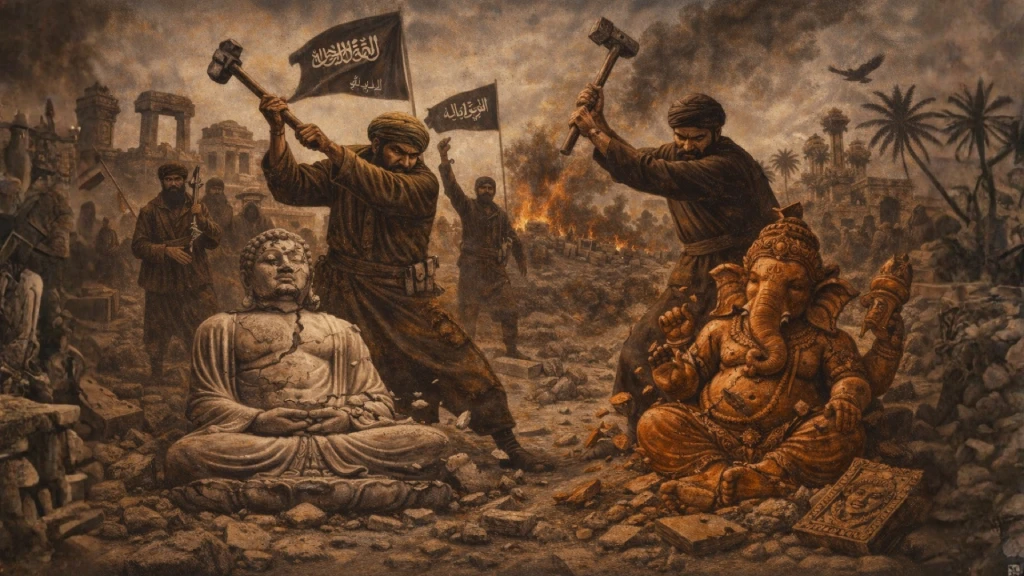
It should be noted that, in almost every country they have conquered, they have utterly destroyed ancient idols and temples. Incidents like the Taliban’s destruction of Afghanistan’s 2,000-year-old Buddhist statues have occurred countless times [1]; ISIS has hardly lagged behind [2]. In Bangladesh, the destruction of idols and temples is a monthly occurrence. But does Islam sanction such destruction?
To a Hindu, an image of Durga, Shiva, or Kali is also revered and sacred. Idols are smashed in temples across Bangladesh almost every week. Religious preachers incite the destruction of idols in their sermons almost every week. Yet the Islamic rule is that, if someone makes even the slightest criticism of Muhammad, any Muslim may go and slaughter that person without a trial. No judicial proceedings are required to impose the punishment for insulting the Messenger in Islam. This means that Muslims may insult other religions, while no one else may say anything about Islam. Mocking other religions is supposedly their religious right! Let us watch a few videos openly inciting the destruction of idols revered by non-Muslims. There are hundreds of thousands of sermons of this kind; only a few are shown here as examples.
Abraham’s Destruction of the Idols
Abraham is one of Islam’s most important prophets. He was born into a polytheist family, and his father was an idol worshipper. From childhood, he would secretly destroy the polytheists’ idols. Numerous stories of his destruction of idols are presented in Islamic works as exceptionally noble and heroic deeds. Accounts of how Abraham smashed idol worshippers’ images and then mocked them, humiliated people of other religions, and insulted their religion appear in various places in the Quran and hadith.
Islamic sources tell us that Abraham’s community worshipped gods and goddesses. One day, he resolved to go to the central temple and destroy its idols. His community held a festival on a particular day each year. Abraham cleverly excused himself from attending by claiming to be ill. He planned to use the opportunity to enter the temple and smash the idols to pieces. Once everyone had left, he entered and struck the gods and goddesses forcefully with an axe, reducing them all to fragments. He left the largest idol untouched, however. When the people returned from the festival and entered the temple, they were stunned by the condition of their images. They realized that Abraham had done it. Abraham then began saying that the largest idol had done the deed. He also asked why, if the idols had any power, they had not protected themselves. How could idols incapable of protecting themselves protect human beings? These statements may be logical, but they undoubtedly insult a religion. The same reasoning can also be applied to demolishing mosques or burning the Quran.
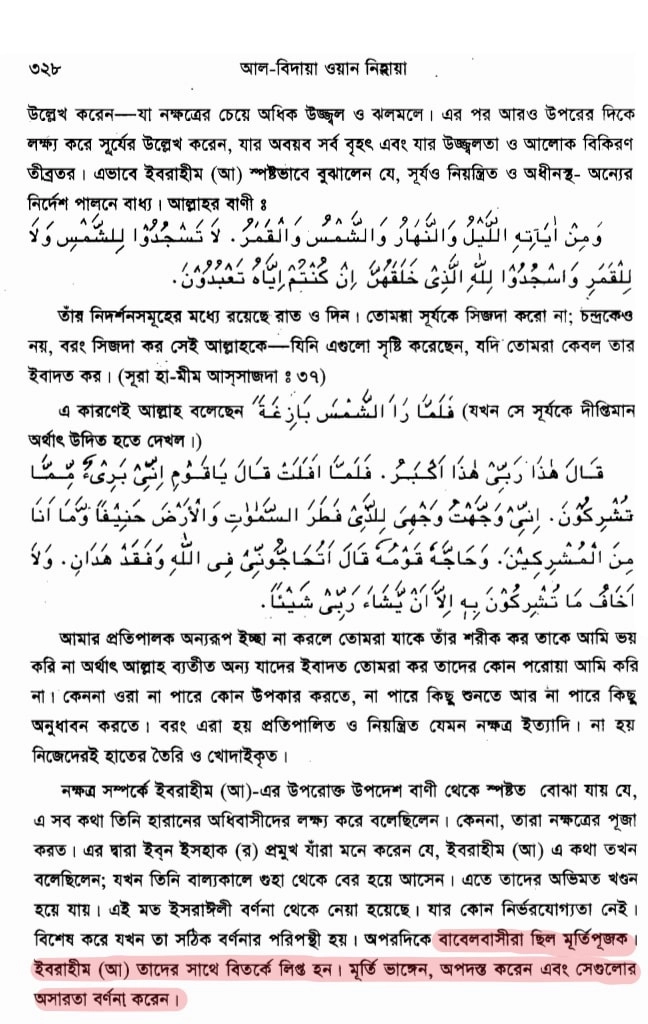
Let us read the account in Ibn Kathir’s celebrated work Al-Bidaya wa al-Nihaya [3]:
“I am not afraid of whatever ˹idols˺ you associate with Him—˹none can harm me,˺ unless my Lord so wills.” In other words, I pay no heed to those you worship besides Allah, for they can neither benefit anyone nor hear or understand anything. Rather, they are either governed and controlled, like the stars, or made and carved by your own hands.
Abraham’s preceding admonition concerning the stars clearly shows that he addressed these words to the people of Harran, who worshipped the stars. This refutes the view of Ibn Ishaq and others that Abraham said this when he emerged from the cave as a child. That opinion derives from Israelite reports, which have no reliability, particularly when they contradict sound accounts. The people of Babylon, on the other hand, worshipped idols.
Abraham argued with them, broke their idols, humiliated them, and explained their worthlessness.
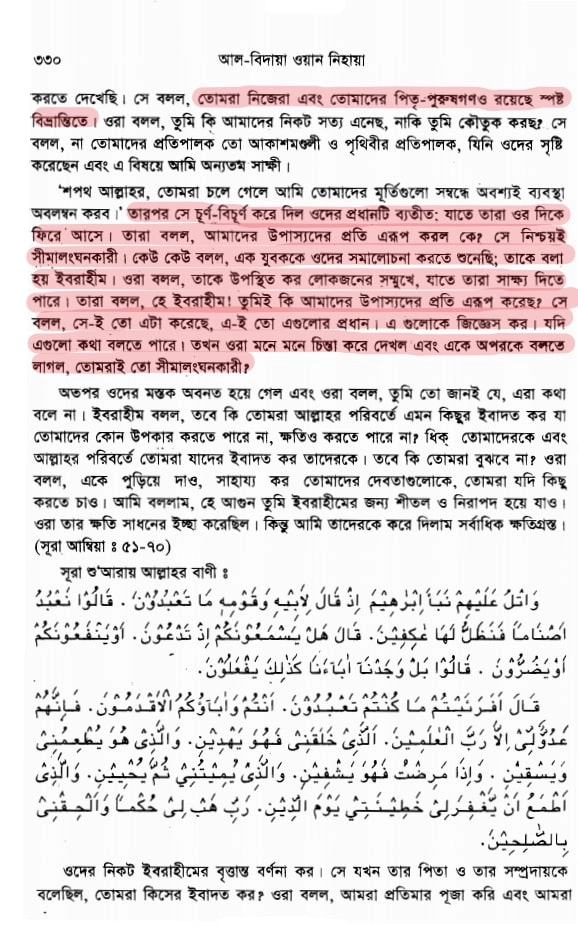
They replied, “We found our forefathers worshipping them.” He responded, “Indeed, you and your forefathers have been clearly astray.” They asked, “Have you come to us with the truth, or is this a joke?” He replied, “In fact, your Lord is the Lord of the heavens and the earth, Who created them ˹both˺. And to that I bear witness.”
˹Then he said to himself,˺ “By Allah! I will surely plot against your idols
after you have turned your backs and gone away.” So he smashed them into pieces, except the biggest of them, so they might turn to it ˹for answers˺. They protested, “Who dared do this to our gods? It must be an evildoer!” Some said, “We heard a young man, called Abraham, speaking ˹ill˺ of them.” They demanded, “Bring him before the eyes of the people, so that they may witness ˹his trial˺.” They asked, “Was it you who did this to our gods, O Abraham?” He replied ˹sarcastically˺, “No, this one—the biggest of them—did it! So ask them, if they can talk!” So they came back to their senses, saying ˹to one another˺, “You yourselves are truly the wrongdoers!”
Then they ˹quickly˺ regressed to their ˹original˺ mind-set, ˹arguing,˺ “You already know that those ˹idols˺ cannot talk.” He rebuked ˹them˺, “Do you then worship—instead of Allah—what can neither benefit nor harm you in any way? Shame on you and whatever you worship instead of Allah! Do you not have any sense?” They concluded, “Burn him up to avenge your gods, if you must act.” We ordered, “O fire! Be cool and safe for Abraham!” They had sought to harm him, but We made them the worst losers.
(Surah Al-Anbiya, 21:51–70. English Quran quotations: Dr. Mustafa Khattab, The Clear Quran.)
Allah says in Surah Ash-Shu‘ara:
وَٱتۡلُ عَلَيۡهِمۡ نَبَأَ إِبۡرَٰهِيمَ إِذۡ قَالَ لِأَبِيهِ وَقَوۡمِهِۦ مَا تَعۡبُدُونَ قَالُواْ نَعۡبُدُ أَصۡنَامٗا فَنَظَلُّ لَهَا عَٰكِفِينَ قَالَ هَلۡ يَسۡمَعُونَكُمۡ إِذۡ تَدۡعُونَ أَوۡ يَنفَعُونَكُمۡ أَوۡ يَضُرُّونَ قَالُواْ بَلۡ وَجَدۡنَآ ءَابَآءَنَا كَذَٰلِكَ يَفۡعَلُونَ
قَالَ أَفَرَءَيۡتُم مَّا كُنتُمۡ تَعۡبُدُونَ أَنتُمۡ وَءَابَآؤُكُمُ ٱلۡأَقۡدَمُونَ فَإِنَّهُمۡ عَدُوّٞ لِّيٓ إِلَّا رَبَّ ٱلۡعَٰلَمِينَ ٱلَّذِي خَلَقَنِي فَهُوَ يَهۡدِينِ وَٱلَّذِي هُوَ يُطۡعِمُنِي وَيَسۡقِينِ وَإِذَا مَرِضۡتُ فَهُوَ يَشۡفِينِ وَٱلَّذِي يُمِيتُنِي ثُمَّ يُحۡيِينِ وَٱلَّذِيٓ أَطۡمَعُ أَن يَغۡفِرَ لِي خَطِيٓـَٔتِي يَوۡمَ ٱلدِّينِ رَبِّ هَبۡ لِي حُكۡمٗا وَأَلۡحِقۡنِي بِٱلصَّٰلِحِينَ
Relate to them ˹O Prophet˺ the story of Abraham, when he questioned his father and his people, “What is that you worship ˹besides Allah˺?” They replied, “We worship idols, to which we are fully devoted.” Abraham asked, “Can they hear you when you call upon them? Or can they benefit or harm you?” They replied, “No! But we found our forefathers doing the same.” Abraham responded, “Have you ˹really˺ considered what you have been worshipping— you and your ancestors? They are ˹all˺ enemies to me, except the Lord of all worlds. ˹He is˺ the One Who created me, and He ˹alone˺ guides me. ˹He is˺ the One Who provides me with food and drink. And He ˹alone˺ heals me when I am sick. And He ˹is the One Who˺ will cause me to die, and then bring me back to life. And He is ˹the One˺ Who, I hope, will forgive my flaws on Judgment Day.” “My Lord! Grant me wisdom, and join me with the righteous. (Surah Ash-Shu‘ara, 26:69–83)
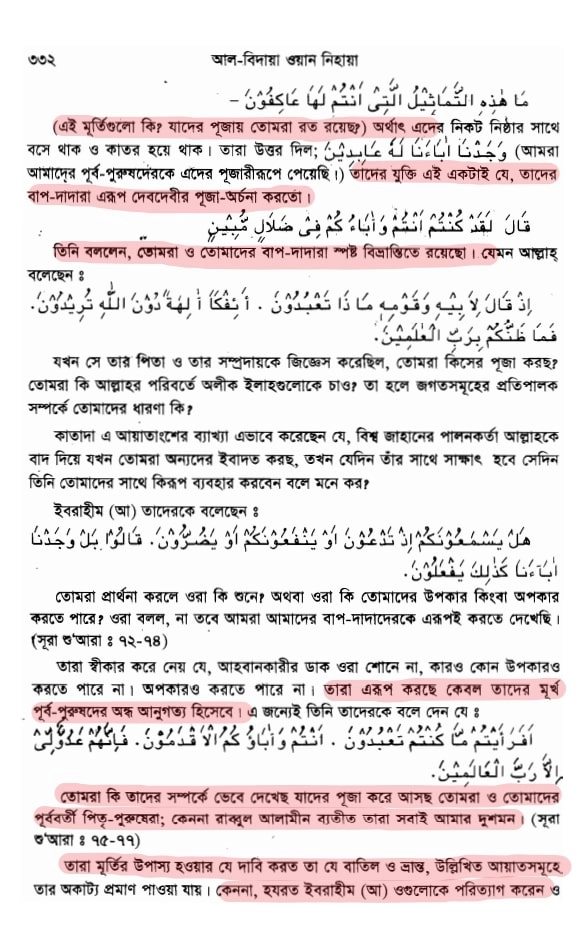
مَا هَـٰذِهِ ٱلتَّمَاثِيلُ ٱلَّتِىٓ أَنتُمْ لَهَا عَـٰكِفُونَ
(What are these statues to which you are so devoted?”) That is, you sit devotedly before them and implore them. They answered: وَجَدۡنَآ ءَابَآءَنَا لَهَا عَٰبِدِينَThey replied, “We found our forefathers worshipping them.” Their only argument was that their fathers and forefathers had worshipped such gods.
قَالَ لَقَدْ كُنتُمْ أَنتُمْ وَءَابَآؤُكُمْ فِى ضَلَـٰلٍۢ مُّبِينٍۢ
He responded, “Indeed, you and your forefathers have been clearly astray.” As Allah says:
إِذۡ قَالَ لِأَبِيهِ وَقَوۡمِهِۦ مَاذَا تَعۡبُدُونَ أَئِفۡكًا ءَالِهَةٗ دُونَ ٱللَّهِ تُرِيدُونَ فَمَا ظَنُّكُم بِرَبِّ ٱلۡعَٰلَمِينَ
and said to his father and his people, “What are you worshipping? Is it false gods that you desire instead of Allah? What then do you expect from the Lord of all worlds?”
Qatada explained this passage as follows: when you worship others instead of Allah, the Lord of the universe, how do you think He will treat you on the day you meet Him?
Abraham said to them:
هَلۡ يَسۡمَعُونَكُمۡ إِذۡ تَدۡعُونَ أَوۡ يَنفَعُونَكُمۡ أَوۡ يَضُرُّونَ قَالُواْ بَلۡ وَجَدۡنَآ ءَابَآءَنَا كَذَٰلِكَ يَفۡعَلُونَ
Abraham asked, “Can they hear you when you call upon them? Or can they benefit or harm you?” They replied, “No! But we found our forefathers doing the same.” (Surah Ash-Shu‘ara, 26:72–74)
They admitted that these beings did not hear those calling upon them and could neither benefit nor harm anyone. They did this solely in blind imitation of their ignorant ancestors. He therefore told them:
أَفَرَءَيۡتُم مَّا كُنتُمۡ تَعۡبُدُونَ أَنتُمۡ وَءَابَآؤُكُمُ ٱلۡأَقۡدَمُونَ فَإِنَّهُمۡ عَدُوّٞ لِّيٓ
إِلَّا رَبَّ ٱلۡعَٰلَمِينَ
Abraham responded, “Have you ˹really˺ considered what you have been worshipping— you and your ancestors? They are ˹all˺ enemies to me, except the Lord of all worlds. (Surah Ash-Shu‘ara, 26:75–77)
These verses provide conclusive evidence that their claim that the idols were deities was false and baseless. Abraham abandoned and disparaged them. Had they possessed the power to harm him, they would certainly have done so; had they possessed any influence at all, they would have exercised it upon him.قَالُوٓا۟ أَجِئْتَنَا بِٱلْحَقِّ أَمْ أَنتَ مِنَ ٱللَّـٰعِبِينَ
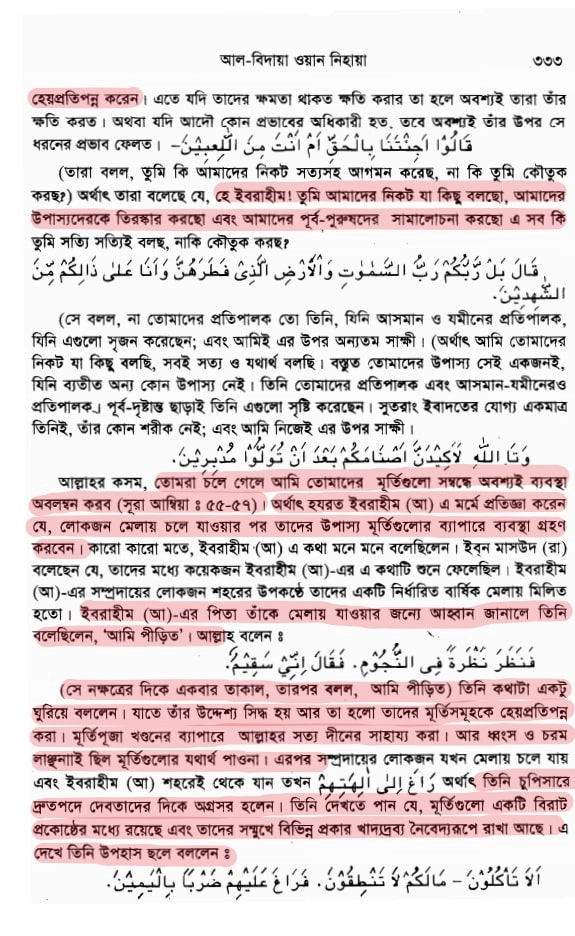
(They asked, “Have you come to us with the truth, or is this a joke?”) In other words, they said: Abraham, are you serious about what you are telling us, rebuking our gods and criticizing our ancestors, or are you joking?
قَالَ بَل رَّبُّكُمْ رَبُّ ٱلسَّمَـٰوَٰتِ وَٱلْأَرْضِ ٱلَّذِى فَطَرَهُنَّ وَأَنَا۠ عَلَىٰ ذَٰلِكُم مِّنَ ٱلشَّـٰهِدِينَ
(He replied, “In fact, your Lord is the Lord of the heavens and the earth, Who created them ˹both˺. And to that I bear witness.”) That is, everything I am telling you is true and correct. Your deity is the One besides Whom there is no deity. He is your Lord and the Lord of the heavens and the earth. He created them without any prior model. He alone therefore deserves worship, without any partner, and I myself bear witness to this.
وَتَٱللَّهِ لَأَكِيدَنَّ أَصْنَـٰمَكُم بَعْدَ أَن تُوَلُّوا۟ مُدْبِرِينَ
˹Then he said to himself,˺ “By Allah! I will surely plot against your idols after you have turned your backs and gone away.” (Surah Al-Anbiya, 21:55–57). Abraham thus vowed that he would deal with their idols after the people had gone to the festival. Some say that he said this to himself. Ibn Mas‘ud said that some of them overheard these words. Abraham’s people gathered at a particular annual festival on the outskirts of their town. When his father invited him to the festival, he said, “I am sick.” Allah says:
فَنَظَرَ نَظۡرَةٗ فِي ٱلنُّجُومِ فَقَالَ إِنِّي سَقِيمٞ
(He later looked up to the stars ˹in contemplation˺, then said, “I am really sick.”) He expressed himself indirectly to accomplish his purpose: to humiliate their idols and support Allah’s true religion by refuting idol worship. Destruction and utter humiliation were precisely what the idols deserved. After the people had departed for the festival and Abraham had remained in town, فَرَاغَ إِلَىٰٓ ءَالِهَتِهِمۡthat is, he secretly and swiftly approached the gods. He saw the idols in a large chamber, with various foods placed before them as offerings. Mockingly, he said:
أَلَا تَأۡكُلُونَ مَا لَكُمۡ لَا تَنطِقُونَ فَرَاغَ عَلَيۡهِمۡ ضَرۡبَۢا بِٱلۡيَمِينِ
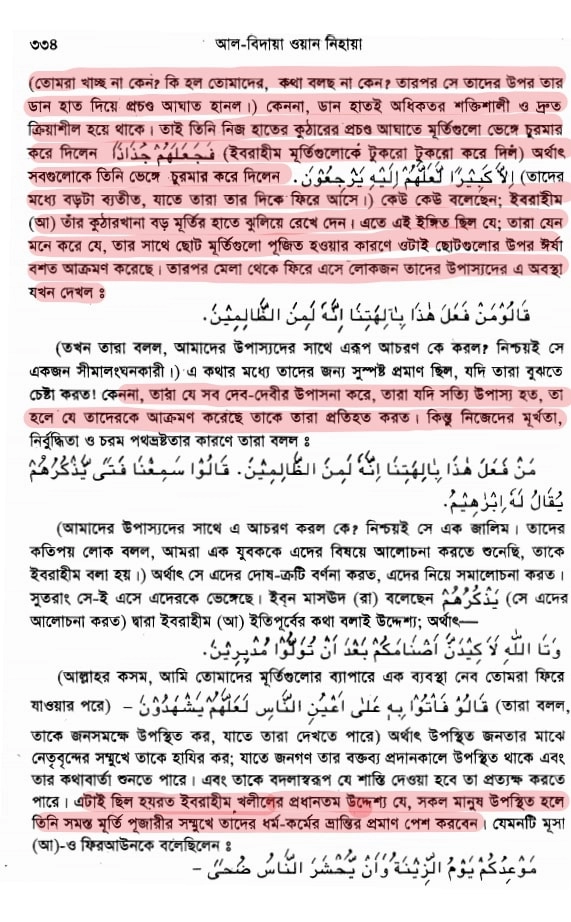
(Will you not eat ˹your offerings˺? What is wrong with you that you cannot speak?” Then he swiftly turned on them, striking ˹them˺ with his right hand.) The right hand is stronger and acts more swiftly. With powerful blows from the axe in his own hand, he therefore smashed the idols to pieces.فَجَعَلَهُمۡ جُذَٰذًا“So he smashed them into pieces,” that is, إِلَّا كَبِيرٗا لَّهُمۡ لَعَلَّهُمۡ إِلَيۡهِ يَرۡجِعُونَ“except the biggest of them, so they might turn to it ˹for answers˺.” Some have said that Abraham hung his axe on the largest idol’s hand. The suggestion was that they should imagine that this idol had attacked the smaller ones out of jealousy because they were worshipped alongside it. When the people returned from the festival and saw their gods in this state:
قَالُواْ مَن فَعَلَ هَٰذَا بِـَٔالِهَتِنَآ إِنَّهُۥ لَمِنَ ٱلظَّٰلِمِينَ
(They protested, “Who dared do this to our gods? It must be an evildoer!”) There was clear evidence in this for them, had they tried to understand! If the gods they worshipped had truly been deities, they would have repelled the person who attacked them. But in their ignorance, foolishness, and extreme misguidance, they said:
مَن فَعَلَ هَٰذَا بِـَٔالِهَتِنَآ إِنَّهُۥ لَمِنَ ٱلظَّٰلِمِينَ قَالُواْ سَمِعۡنَا فَتٗى يَذۡكُرُهُمۡ يُقَالُ لَهُۥٓ إِبۡرَٰهِيمُ
(They protested, “Who dared do this to our gods? It must be an evildoer!” Some said, “We heard a young man, called Abraham, speaking ˹ill˺ of them.”) That is, he used to describe their faults and criticize them. He must therefore have come and broken them. Ibn Mas‘ud said that يَذۡكُرُهُمۡ“speaking ˹ill˺ of them” refers to Abraham’s earlier statement, namely: وَتَٱللَّهِ لَأَكِيدَنَّ أَصْنَـٰمَكُم بَعْدَ أَن تُوَلُّوا۟ مُدْبِرِينَ
(˹Then he said to himself,˺ “By Allah! I will surely plot against your idols after you have turned your backs and gone away.”) قَالُواْ فَأۡتُواْ بِهِۦ عَلَىٰٓ أَعۡيُنِ ٱلنَّاسِ لَعَلَّهُمۡ يَشۡهَدُونَThey said,
They demanded, “Bring him before the eyes of the people, so that they may witness ˹his trial˺.” That is, produce him before the assembled leaders so that the people may be present when he gives his statement, hear what he says, and witness the punishment imposed upon him in retaliation. This was Abraham the Friend’s principal aim: once everyone had gathered, he could present evidence of the falsity of their religious practices before all the idol worshippers. Similarly, Moses said to Pharaoh:
مَوۡعِدُكُمۡ يَوۡمُ ٱلزِّينَةِ وَأَن يُحۡشَرَ ٱلنَّاسُ ضُحٗى
(Moses said, “Your appointment is on the Day of the Festival, and let the people be gathered mid-morning.”) (Surah Taha, 20:59). When the people had assembled and Abraham had been brought there, they said:
ءَأَنتَ فَعَلۡتَ هَٰذَا بِـَٔالِهَتِنَا يَٰٓإِبۡرَٰهِيمُ قَالَ بَلۡ فَعَلَهُۥ كَبِيرُهُمۡ هَٰذَا
(They asked, “Was it you who did this to our gods, O Abraham?” He replied ˹sarcastically˺, “No, this one—the biggest of them—did it!) Some interpret this verse to mean: this one prompted me to break them. He expressed the point indirectly. So ask them, if they can talk!”فَسۡـَٔلُوهُمۡ إِن كَانُواْ يَنطِقُونَAbraham intended them to admit at once that these idols could not speak. They would thus acknowledge that, like other inanimate objects, they were incapable of speech. فَرَجَعُوٓاْ إِلَىٰٓ أَنفُسِهِمۡ فَقَالُوٓاْ إِنَّكُمۡ أَنتُمُ ٱلظَّٰلِمُونَ(So they came back to their senses, saying ˹to one another˺, “You yourselves are truly the wrongdoers!”) That is, they reproached and condemned themselves, saying: you yourselves are the wrongdoers; you left them here without leaving any guard or protector. ثُمَّ نُكِسُواْ عَلَىٰ
رُءُوسِهِمۡ“Then they ˹quickly˺ regressed to their ˹original˺ mind-set.” Al-Suddi interpreted this as their returning to disorder and strife. On that reading, the preceding words “You yourselves are truly the wrongdoers” إِنَّكُمۡ أَنتُمُ ٱلظَّٰلِمُونَmean that you are wrongdoers because you worship them. Qatada said that Abraham’s words caused them great distress, so their heads hung down. They then said, لَقَدۡ عَلِمۡتَ مَا هَٰٓؤُلَآءِ يَنطِقُونَ“You already know that those ˹idols˺ cannot talk.” That is: Abraham, you know that they do not speak; why, then, do you tell us to ask them? At this point Abraham the Friend said to them: أَفَتَعۡبُدُونَ مِن دُونِ ٱللَّهِ مَا لَا يَنفَعُكُمۡ شَيۡـٔٗا وَلَا يَضُرُّكُمۡ أُفّٖ لَّكُمۡ وَلِمَا تَعۡبُدُونَ مِن دُونِ ٱللَّهِۚ أَفَلَا تَعۡقِلُونَ
(He rebuked ˹them˺, “Do you then worship—instead of Allah—what can neither benefit nor harm you in any way? Shame on you and whatever you worship instead of Allah! Do you not have any sense?”) فَأَقۡبَلُوٓاْ إِلَيۡهِ يَزِفُّونَLater, his people came rushing towards him ˹furiously˺. Mujahid said that يزف means يسرعون )rushing swiftly forward. أَتَعۡبُدُونَ مَا تَنۡحِتُونَHe argued, “How can you worship what you carve ˹with your own hands˺, That is, how can you worship idols you make with your own hands, carving wood or stone and shaping them as you please? وَٱللَّهُ خَلَقَكُمۡ وَمَا تَعۡمَلُونَwhen it is Allah Who created you and whatever you do?” The particle مصدريه may be one type, or موصولهanother.
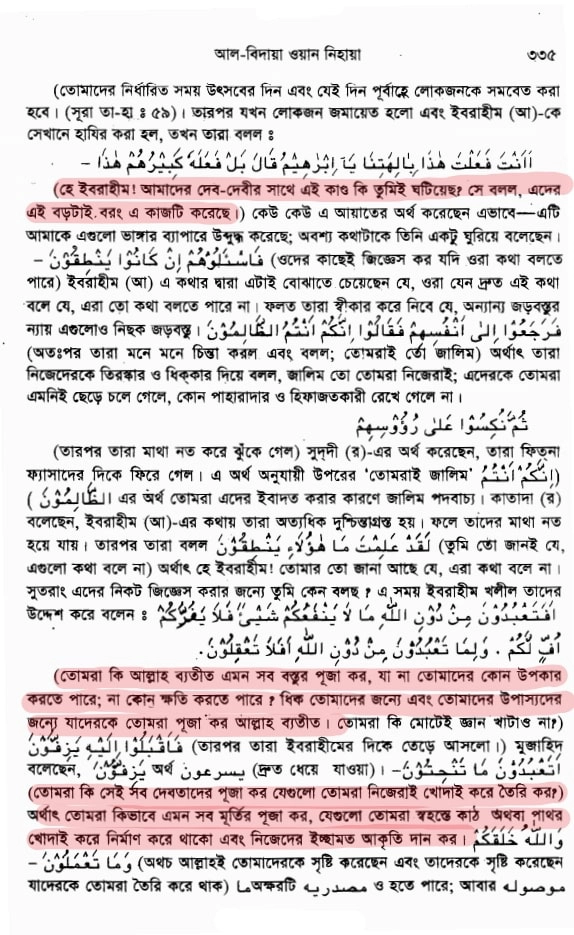
In other words, an exceptionally important prophet of Islam himself engaged in extreme mockery, derision, and insults directed at his ancestors’ religion and his community’s culture and beliefs. But is it possible to subject Islam to the same kind of derision, disparagement, and criticism?
The Prophet Muhammad’s Insults to Religion
Islamic sources clearly show that Muhammad, Islam’s principal prophet, made insulting and disparaging remarks about the polytheists’ gods and goddesses and their ancestral religion. In Mecca, he was accused of religious transgression: the charge was that he had disrespected and insulted the established religion. He was repeatedly warned for criticizing a religion practiced in the society for centuries, insulting and disparaging the faith of their forefathers, and speaking offensively about their gods. Yet he never stopped insulting their religion. It should be noted that he was not attacked from the outset; he was the one who first began denouncing the polytheists’ religion.
One claim is constantly heard from Muslim believers: the pagan unbelievers supposedly offered Muhammad beautiful women and offered to make him king if he would stop preaching Islam. Yet here, too, there is a colossal falsehood. All the unbelievers wanted was for Muhammad to stop abusing their religions and live peacefully alongside them. They wanted all religions to remain in Mecca, everyone to practice their own, and no conflict over religion. Let us hear this from Dr. Abu Bakr Zakaria himself.
Now let us read Sirat Ibn Hisham [4]:
…Waqqas then struck one of the polytheists with great force, using the jawbone of a dead camel, and split his head open. This was the first bloodshed for Islam.
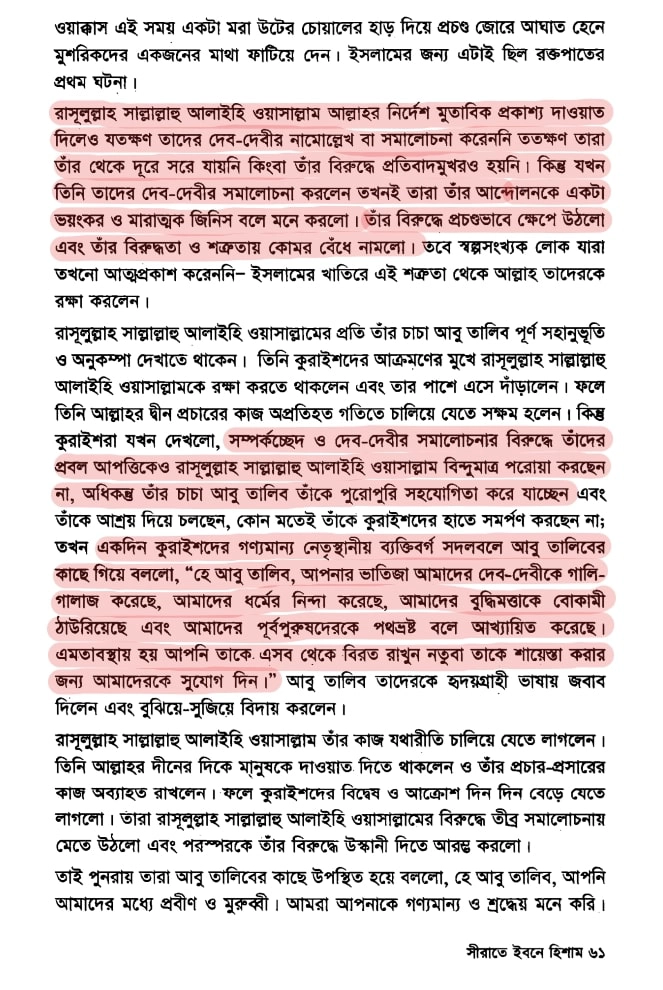
Although the Messenger of Allah (peace and blessings be upon him) preached openly in accordance with Allah’s command, the people neither withdrew from him nor protested against him so long as he did not mention or criticize their gods. When he criticized their gods, however, they regarded his movement as something dangerous and grave. They became furious with him and committed themselves to opposing him with hostility. Allah protected a small number of people, who had not yet declared themselves openly, from this hostility for the sake of Islam.
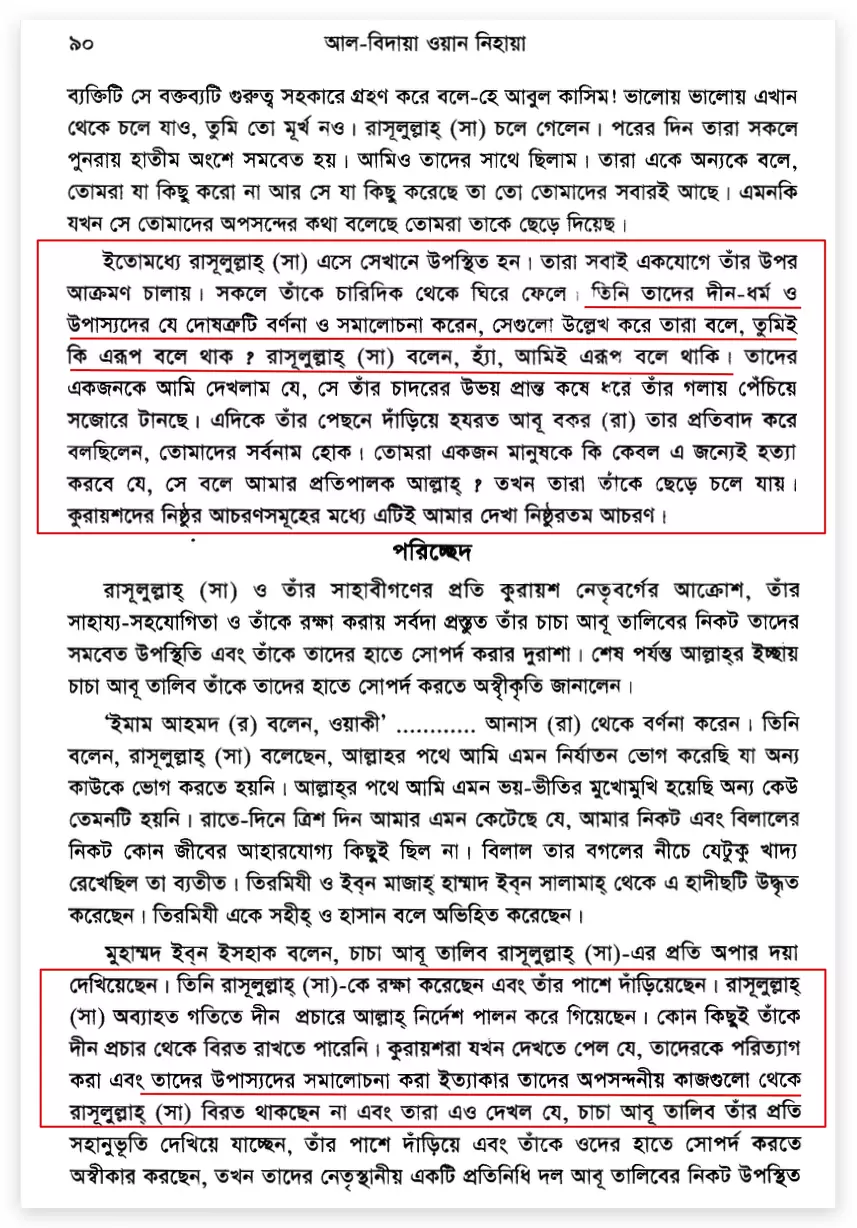
His uncle Abu Talib continued to show the Messenger of Allah complete sympathy and compassion. He protected him against the attacks of Quraysh and stood beside him. This enabled him to continue preaching Allah’s religion without interruption. But when Quraysh saw that the Messenger paid no attention to their severing relations or their vehement objections to his criticism of their gods, and that his uncle Abu Talib continued to support and shelter him fully and would under no circumstances surrender him to them, their prominent leaders came together to Abu Talib one day and said: “Abu Talib, your nephew has abused our gods, denounced our religion, dismissed our intelligence as foolishness, and declared our forefathers misguided. Either restrain him from these things or give us the opportunity to deal with him.” Abu Talib answered them in gracious language and persuaded them to leave.
The Messenger of Allah continued his work as before. He invited people to Allah’s religion and continued spreading it. Quraysh’s resentment and anger consequently increased day by day. They fiercely criticized him and began inciting one another against him.
They therefore came to Abu Talib again and said: “Abu Talib, you are an elder and senior among us. We regard you as distinguished and worthy of respect.”
“We told you to restrain your nephew, but you did not do so.
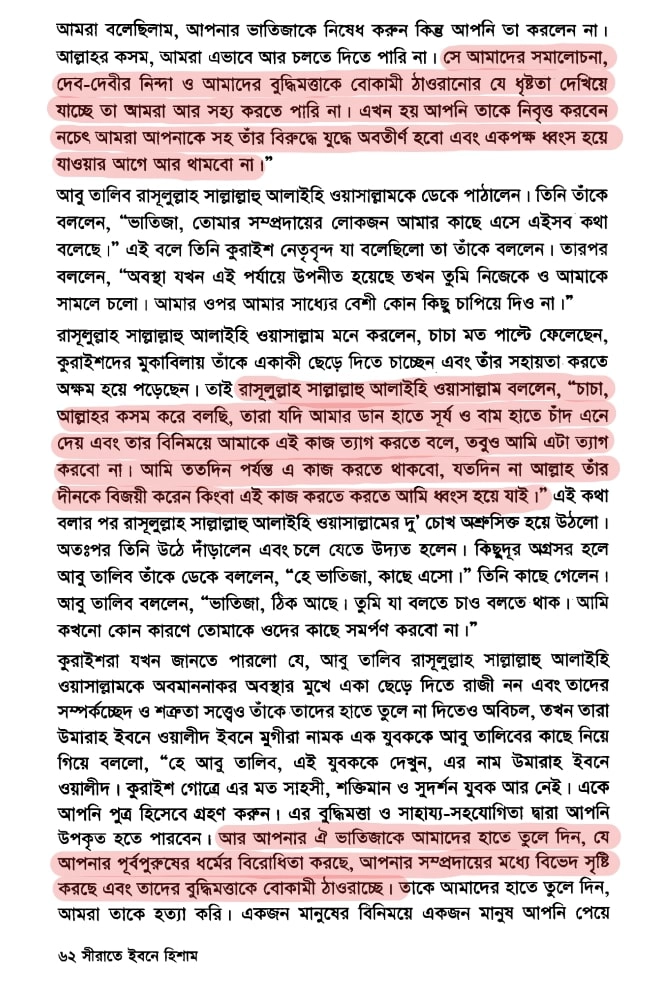
By Allah, we cannot allow this to continue. We can no longer tolerate his audacity in criticizing us, denouncing our gods, and treating our intelligence as foolishness. Either restrain him now, or we will fight both him and you and will not stop until one side has been destroyed.”
Abu Talib sent for the Messenger of Allah (peace and blessings be upon him). He told him: “Nephew, your people came to me and said these things.” He then related what the Quraysh leaders had said, adding: “Now that matters have reached this point, take care of yourself and me. Do not burden me beyond my capacity.”
The Messenger of Allah thought that his uncle had changed his mind, intended to leave him alone against Quraysh, and was no longer able to help him. He therefore said: “Uncle, by Allah, even if they placed the sun in my right hand and the moon in my left and demanded that I abandon this work in exchange, I would not abandon it. I will continue until Allah makes His religion victorious or I perish in the undertaking.” His eyes filled with tears as he said this. He then rose and began to leave. When he had gone a short distance, Abu Talib called him back: “Nephew, come here.” He returned, and Abu Talib said: “Very well, nephew. Continue saying what you wish. I will never, for any reason, surrender you to them.”
When Quraysh learned that Abu Talib would not abandon the Messenger to humiliation and remained determined not to surrender him despite their estrangement and hostility, they brought a young man named ‘Umara ibn al-Walid ibn al-Mughira to him and said: “Abu Talib, look at this young man. His name is ‘Umara ibn al-Walid. There is no young man in Quraysh as brave, strong, and handsome as he is. Adopt him as your son. You can benefit from his intelligence, assistance, and support. In return, surrender that nephew of yours who opposes your ancestors’ religion, divides your people,
and dismisses their intelligence as foolishness. Hand him over to us so that we may kill him. In exchange for one man, you receive another…”
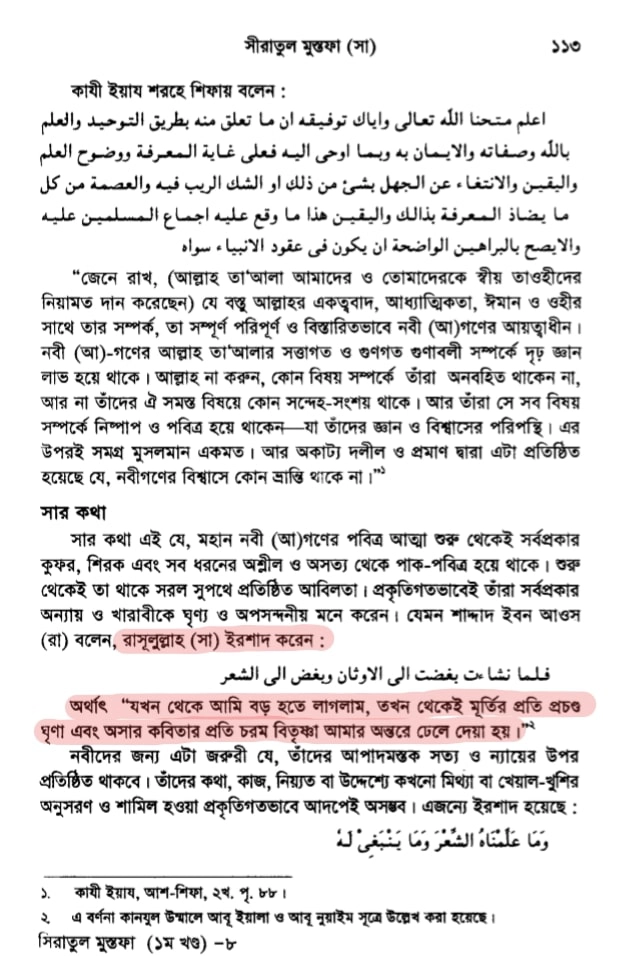
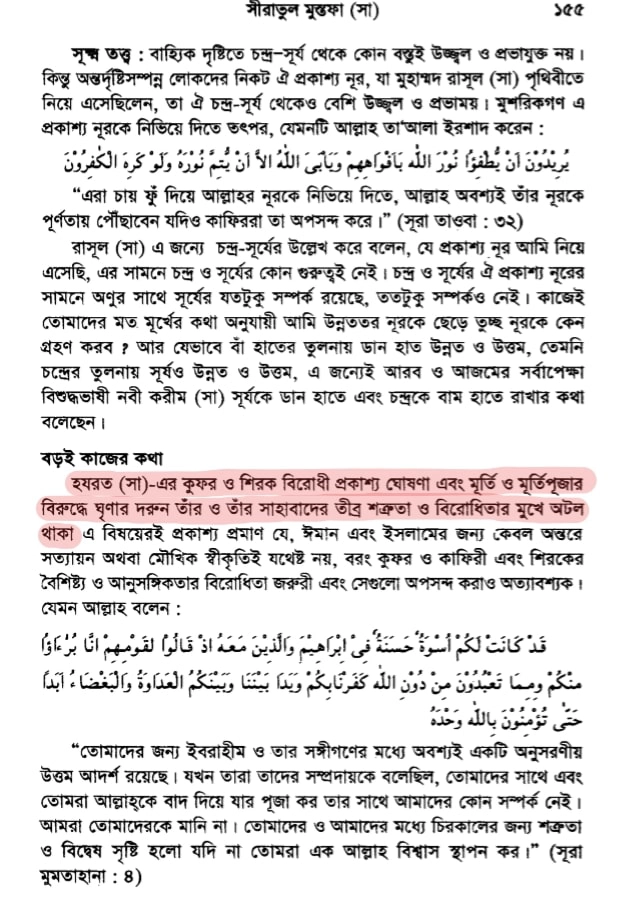
Further information appears in Sirat al-Mustafa. Muhammad himself said that he intensely hated idols [5]:
The Essential Point
The essential point is that the pure souls of the great prophets are free from every form of disbelief, polytheism, obscenity, and falsehood from the very beginning. From the outset they are established upon the straight path, free of impurity. By their very nature they regard every injustice and evil as hateful and objectionable. Shaddad ibn Aws
related that the Messenger of Allah said:
فلما نشاءت بغضت الى الاوثان وبغض الى الشعر
That is: “From the time I began to grow up, intense hatred of idols and profound aversion to worthless poetry were instilled in my heart.”اس
It is essential that the prophets be established upon truth and justice in every respect. It is inherently impossible for falsehood or the pursuit of whims to enter their words, deeds, intentions, or purposes. It has therefore been said:
وَمَا عَلَّمۡنَٰهُ ٱلشِّعۡرَ وَمَا يَنۢبَغِي لَهُۥٓۚ
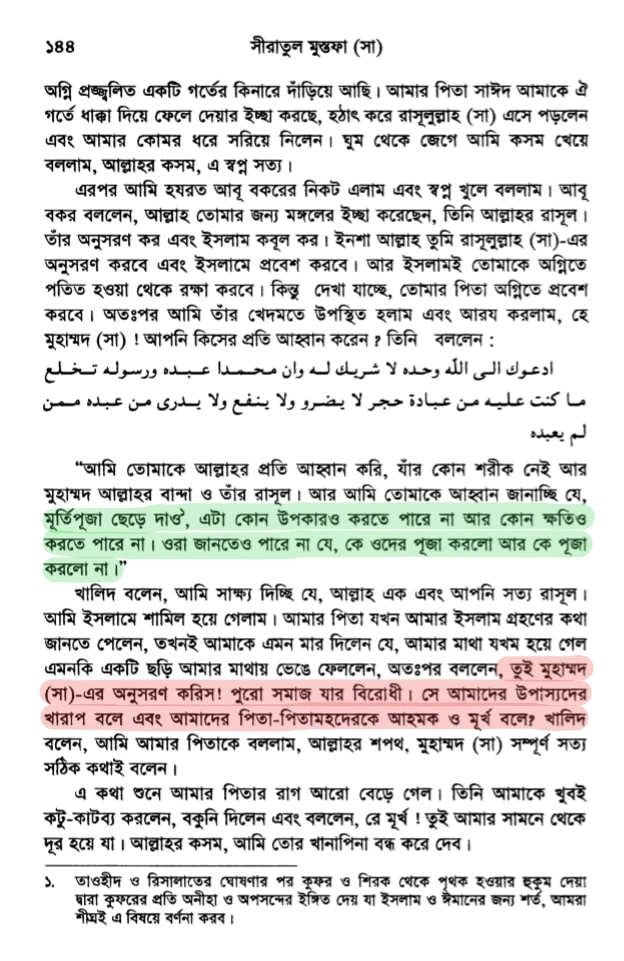
“…I was standing at the edge of a pit ablaze with fire. My father Sa‘id intended to push me into it. Suddenly the Messenger of Allah appeared, took hold of my waist, and drew me away. When I woke, I swore: ‘By Allah, this dream is true.’
I then went to Abu Bakr and told him the dream in full. Abu Bakr said: ‘Allah intends good for you. He is Allah’s Messenger. Follow him and embrace Islam. Allah willing, you will follow the Messenger of Allah and enter Islam. Islam will save you from falling into the fire. But it appears that your father will enter it.’ I then went to him and asked: ‘Muhammad, what do you call people to?’ He said:
ادعوك الى الله وحده لا شريك له وأن محمدا عبده ورسوله تخلع ما كنت عليه من عبادة حجر لا يضرو ولا ينفع ولا يدرى من عبده ممن لم يعبده
‘I call you to Allah, Who has no partner, and to the fact that Muhammad is Allah’s servant and Messenger. I call you to abandon idol worship. An idol can neither benefit nor harm anyone. It does not even know who worships it and who does not.’
Khalid said: ‘I testify that Allah is One and that you are the true Messenger.’ I entered Islam. When my father learned that I had embraced Islam, he beat me so severely that my head was wounded; he even broke a stick over my head. He then said: ‘You follow Muhammad, whom the whole community opposes? He disparages our gods and calls our fathers and forefathers fools and ignoramuses!’ Khalid said: ‘I told my father: By Allah, everything Muhammad says is true and correct.’
Hearing this made my father even angrier. He abused and scolded me harshly and said: ‘You fool! Get out of my sight. By Allah, I will stop providing your food and drink.’”
The Conversion of ‘Ammar and Suhayb
‘Ammar ibn Yasir said: “I met Suhayb ibn Sinan at the door of al-Arqam’s house, while the Messenger of Allah was inside. I asked Suhayb why he had come. He asked me the same question: ‘What do you intend?’ I said: ‘I intend to go in and hear what he says.’ We both went to him. He invited us to Islam, and we were blessed with embracing it.”
The Conversion of ‘Amr ibn ‘Abasa
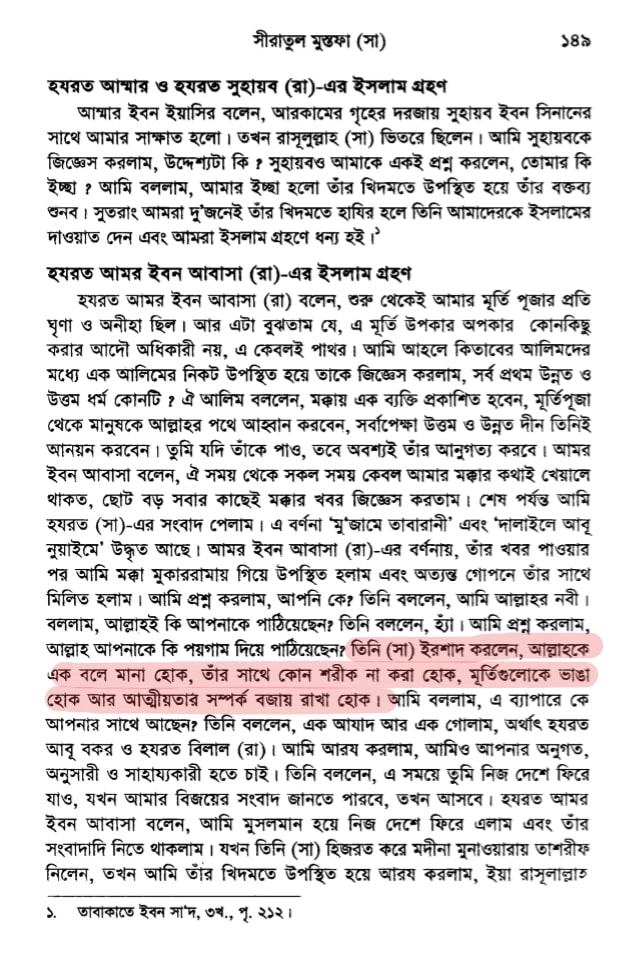
‘Amr ibn ‘Abasa said: “From the beginning, I felt hatred and aversion toward idol worship. I understood that these idols had no power to benefit or harm anyone; they were merely stones. I went to a scholar from among the People of the Book and asked him which religion was foremost and best. The scholar said: ‘A man will appear in Mecca who will call people away from idol worship to Allah’s path. He will bring the best and most exalted religion. If you meet him, be sure to follow him.’” ‘Amr ibn ‘Abasa said: “From then on, Mecca was constantly on my mind. I asked everyone, young and old, for news of it. Eventually I heard about the Prophet.” This account is quoted in al-Tabarani’s Mu‘jam and Abu Nu‘aym’s Dala’il. ‘Amr ibn ‘Abasa related: “After hearing of him, I went to Mecca and met him in great secrecy. I asked: ‘Who are you?’ He said: ‘I am Allah’s Prophet.’ I asked: ‘Has Allah sent you?’ He said: ‘Yes.’ I asked: ‘With what message has Allah sent you?’ He said: ‘That Allah should be acknowledged as One, with no partner associated with Him, that idols should be broken, and that ties of kinship should be maintained.’ I asked: ‘Who is with you in this?’ He said: ‘A free man and a slave,’ meaning Abu Bakr and Bilal. I said: ‘I, too, wish to be your follower and supporter.’ He said: ‘Return to your own land for now. Come when you hear of my victory.’” ‘Amr ibn ‘Abasa said: “I returned to my land as a Muslim and continued seeking news of him. When he migrated to Medina, I went to him and said: ‘Messenger of Allah…’”
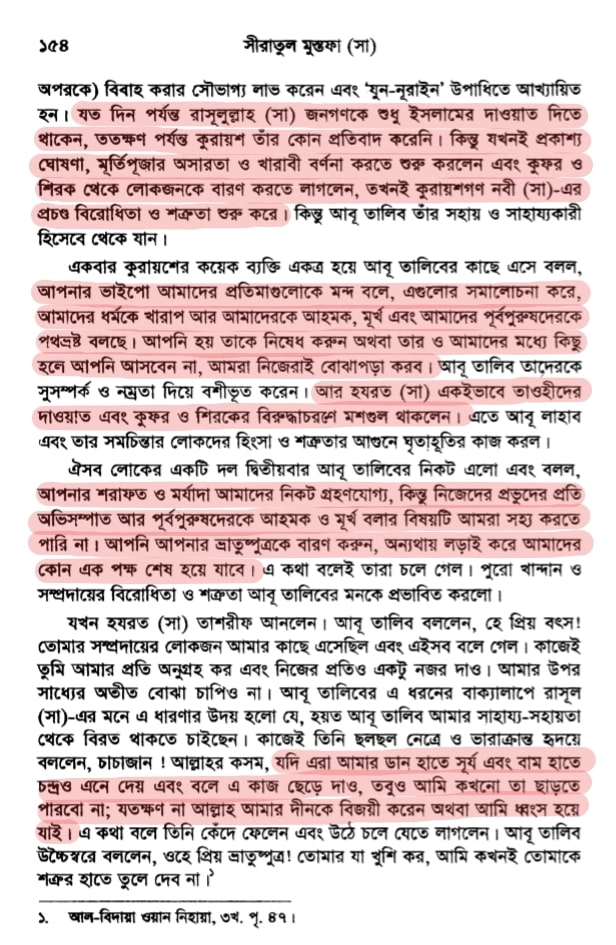
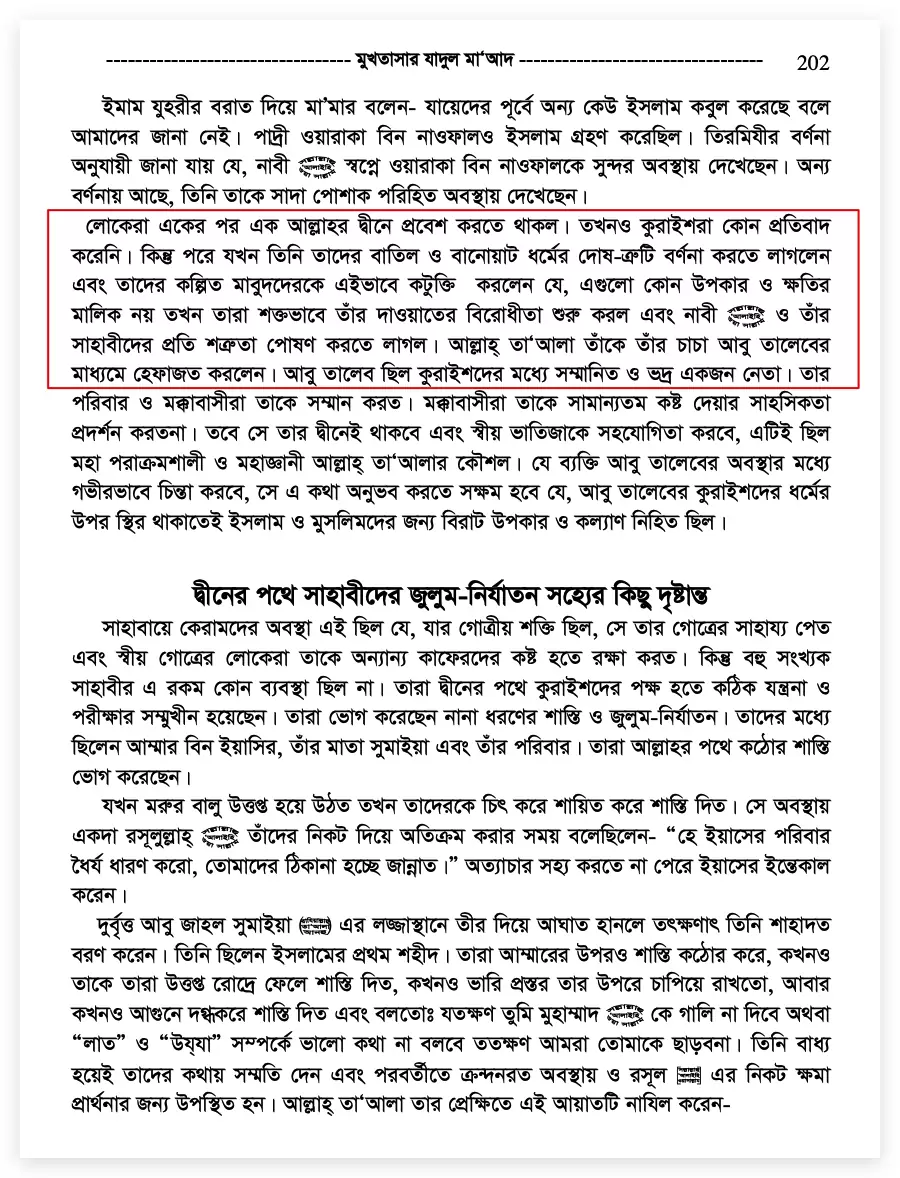
…he was fortunate enough to marry the other daughter and received the title Dhu al-Nurayn. As long as the Messenger of Allah merely invited people to Islam, Quraysh did not oppose him. But as soon as he began declaring openly that idol worship was worthless and evil and forbidding people from disbelief and polytheism, Quraysh began to oppose him fiercely and treat him with hostility. Abu Talib, however, remained his supporter and helper.
On one occasion, several men of Quraysh came together to Abu Talib and said:
“Your nephew disparages and criticizes our idols, denounces our religion, calls us fools and ignoramuses, and declares our ancestors misguided. Either restrain him or stay out of whatever happens between him and us; we will settle the matter ourselves.” Abu Talib pacified them with goodwill and gentleness. The Prophet continued calling people to monotheism and opposing disbelief and polytheism as before. This added fuel to the flames of envy and hostility in Abu Lahab and those who thought like him.
A group of these men came to Abu Talib a second time and said: “We acknowledge your nobility and standing, but we cannot tolerate the cursing of our gods and the description of our ancestors as fools and ignoramuses. Restrain your nephew, or we will fight until one side is finished.” They then left. The opposition and hostility of his entire family and community weighed upon Abu Talib.
When the Prophet arrived, Abu Talib said: “My dear son, your people came to me and said these things. Have consideration for me and for yourself. Do not burden me beyond my capacity.” Hearing his uncle speak this way, the Messenger thought that Abu Talib might wish to withdraw his assistance. With tearful eyes and a heavy heart, he said: “Uncle, by Allah, even if they brought the sun to my right hand and the moon to my left and told me to abandon this work, I could never abandon it until Allah makes my religion victorious or I perish.” He then wept, rose, and began to leave. Abu Talib called out: “My dear nephew, do as you wish. I will never surrender you to the enemy.”
A Subtle Point: Outwardly, nothing is brighter or more radiant than the sun and the moon.
But to those endowed with inward perception, the manifest light that Muhammad the Messenger brought into the world is brighter and more radiant than either. The polytheists strive to extinguish this manifest light, as Allah says:
يُرِيدُونَ أَن يُطۡفِـُٔواْ نُورَ ٱللَّهِ بِأَفۡوَٰهِهِمۡ وَيَأۡبَى ٱللَّهُ إِلَّآ أَن يُتِمَّ نُورَهُۥ وَلَوۡ كَرِهَ ٱلۡكَٰفِرُونَ
“They wish to extinguish Allah’s light with their mouths, but Allah will only allow His light to be perfected, even to the dismay of the disbelievers.” (Surah At-Tawbah, 9:32)
The Messenger therefore mentioned the sun and moon to say: the sun and moon have no significance beside the manifest light I have brought. Their relation to this manifest light is not even that of a particle to the sun. Why, then, should I abandon the higher light for an insignificant light at the urging of fools like you? Just as the right hand is superior to the left, the sun is superior to the moon. For this reason, the noble Prophet, the most eloquent of Arabs and non-Arabs, spoke of placing the sun in his right hand and the moon in his left.
A Most Useful Point
The Prophet’s open declaration against disbelief and polytheism, his hatred of idols and idol worship, and the steadfastness of him and his Companions in the face of fierce hostility and opposition clearly demonstrate that inward affirmation or verbal acknowledgment alone is insufficient for faith and Islam. It is also necessary to oppose the features and manifestations of disbelief and polytheism and to regard them with disapproval. As Allah says:
قَدۡ كَانَتۡ لَكُمۡ أُسۡوَةٌ حَسَنَةٞ فِيٓ إِبۡرَٰهِيمَ وَٱلَّذِينَ مَعَهُۥٓ إِذۡ قَالُواْ لِقَوۡمِهِمۡ إِنَّا بُرَءَٰٓؤُاْ مِنكُمۡ وَمِمَّا تَعۡبُدُونَ مِن دُونِ ٱللَّهِ كَفَرۡنَا بِكُمۡ وَبَدَا بَيۡنَنَا وَبَيۡنَكُمُ ٱلۡعَدَٰوَةُ وَٱلۡبَغۡضَآءُ أَبَدًا حَتَّىٰ تُؤۡمِنُواْ بِٱللَّهِ وَحۡدَهُۥٓ
“You already have an excellent example in Abraham and those with him, when they said to their people, ‘We totally dissociate ourselves from you and ˹shun˺ whatever ˹idols˺ you worship besides Allah. We reject you. The enmity and hatred that has arisen between us and you will last until you believe in Allah alone.’” (Surah Al-Mumtahanah, 60:4; Dr. Mustafa Khattab, The Clear Quran)
Now let us examine the same subject in Mukhtasar Zad al-Ma‘ad, by Imam Ibn al-Qayyim [6].
People began entering Allah’s religion one after another. Quraysh still did not protest. Later, however, when he began describing the faults of their false and fabricated religion and disparaging their imagined deities by saying that they had no power to benefit or harm anyone, they firmly opposed his preaching and became hostile toward the Prophet and his Companions. Allah protected him through his uncle Abu Talib, who was a respected and noble leader among Quraysh. His…
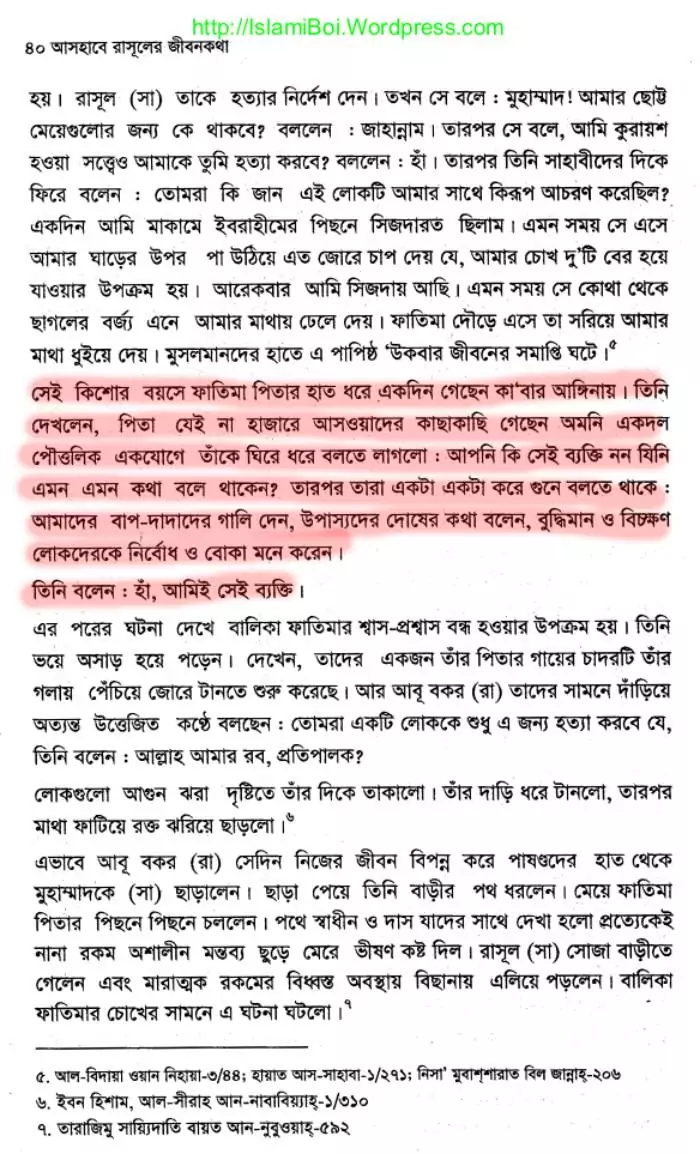
Now let us read evidence from Ibn Hisham’s Al-Sira al-Nabawiyya as quoted in Ashab-e Rasul-er Jibankatha (Lives of the Messenger’s Companions). Notice that some polytheists came and asked the Prophet: are you the person who abuses the polytheists’ forefathers, speaks of the faults of their gods, and regards their discerning and intelligent people as foolish and ignorant? The Prophet replied, “Yes, I am that person.” In other words, he himself engaged in all these acts [7]:
…The Messenger ordered him killed. He said: “Muhammad, who will look after my little daughters?” He answered: “Hell.” He then asked: “Will you kill me even though I belong to Quraysh?” He replied: “Yes.” Turning to his Companions, he said: “Do you know how this man treated me? One day I was prostrating behind the Station of Abraham when he came, placed his foot on my neck, and pressed so hard that my eyes nearly bulged out. On another occasion, while I was prostrating, he brought goat entrails from somewhere and dumped them on my head. Fatima rushed over, removed them, and washed my head.” Thus the life of the wicked ‘Uqba ended at the Muslims’ hands.
One day, while still a young girl, Fatima went with her father, holding his hand, to the courtyard of the Kaaba. She saw that, as soon as her father approached the Black Stone, a group of idol worshippers surrounded him and said: “Are you not the man who says such-and-such?” They then enumerated their accusations: “You abuse our fathers and forefathers, describe the faults of our gods, and consider intelligent and discerning people foolish and ignorant.”
He said: “Yes, I am that man.”
What happened next almost took the young Fatima’s breath away. She was paralyzed with fear. She saw one of them wrap her father’s cloak around his neck and pull it tightly. Abu Bakr stood before them and exclaimed in great agitation: “Will you kill a man simply because he says: Allah is my Lord and Sustainer?”
The men glared at him fiercely, pulled his beard, and then split his head open until it bled.
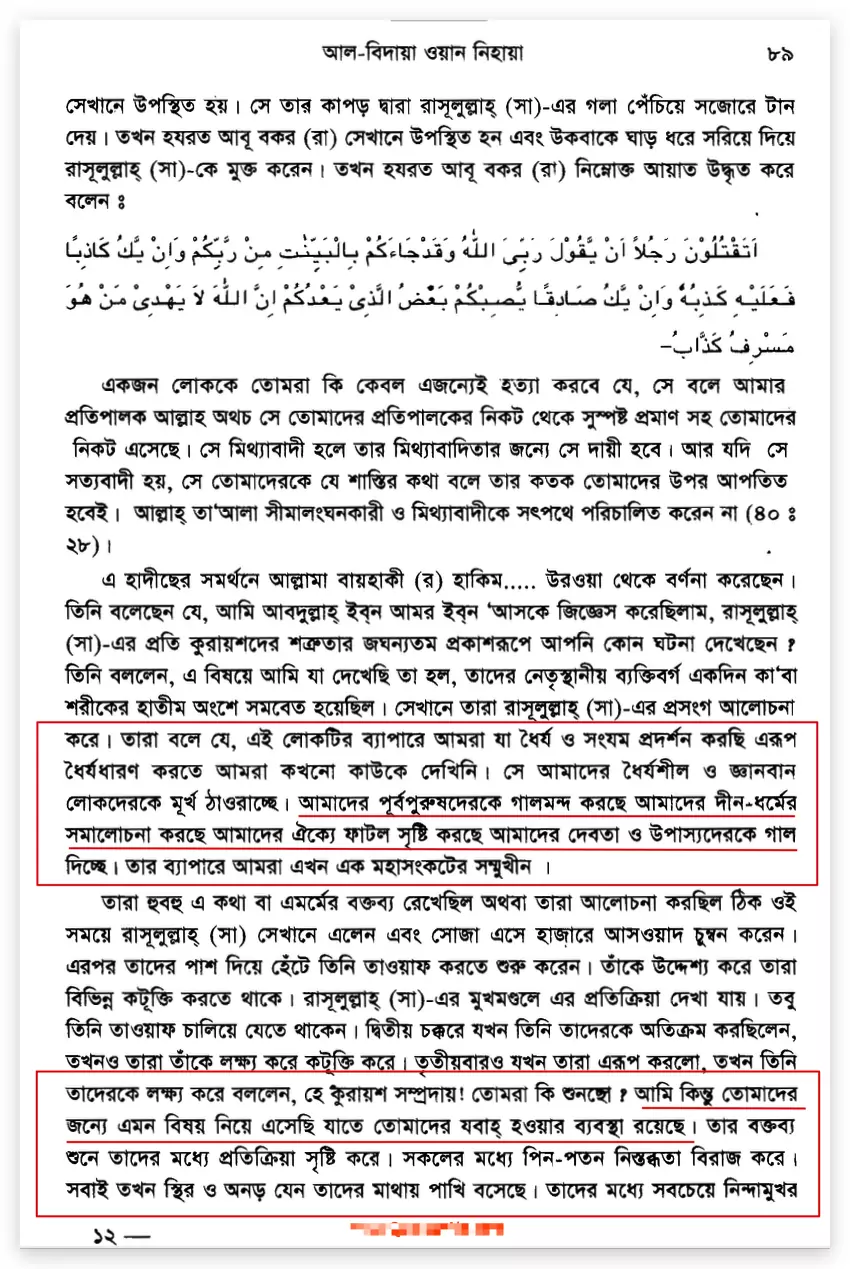
Now let us read a few pages of Al-Bidaya wa al-Nihaya and see whether Muhammad himself began abusing and denouncing the religion of the polytheist Quraysh [8]:
“Will you kill a man ˹only˺ for saying: ‘My Lord is Allah,’ while he has in fact come to you with clear proofs from your Lord? If he is a liar, it will be to his own loss. But if he is truthful, then you will be afflicted with some of what he is threatening you with. Surely Allah does not guide whoever is a transgressor, a total liar.” (40:28; Dr. Mustafa Khattab, The Clear Quran)
In support of this report, al-Bayhaqi narrated through al-Hakim … from ‘Urwa, who said: “I asked ‘Abdullah ibn ‘Amr ibn al-‘As: ‘What was the worst manifestation of Quraysh’s hostility toward the Messenger of Allah that you witnessed?’ He answered: ‘What I witnessed was this: one day their leaders assembled in the Hatim of the Kaaba and discussed the Messenger of Allah.
They said: We have never seen anyone endure as patiently as we have endured this man. He calls our forbearing and knowledgeable men ignorant, abuses our ancestors, criticizes our religion, divides our unity, and insults our gods and deities. We now face a grave crisis because of him.
They said these words, or something to this effect. While they were discussing the matter, the Messenger of Allah arrived, came straight to the Black Stone, and kissed it. He then began circumambulating the Kaaba, walking past them. They directed various insulting remarks at him. Their effect showed on his face, but he continued his circumambulation. They again insulted him as he passed them on the second circuit. When they did the same a third time, he addressed them: People of Quraysh, do you hear? I have come to you with slaughter. His words had a profound effect upon them. A silence fell in which a pin could have been heard dropping.
Everyone stood still, as though birds were perched on their heads. The most abusive among them…
…took his words seriously and said: “Abu al-Qasim, leave peacefully. You are no fool.” The Messenger of Allah left. The next day they assembled again in the Hatim, and I was with them. They said to one another: “You all know what you have done and what he has done. Yet when he said what you disliked, you let him go.”
Meanwhile the Messenger of Allah arrived. They attacked him together and surrounded him on all sides. Referring to his descriptions and criticisms of the faults of their religion and gods, they asked: “Are you the one who says these things?” He replied: “Yes, I say them.” I saw one man seize both ends of his cloak, wrap it around his neck, and pull forcefully. Abu Bakr stood behind him and protested: “Woe to you! Will you kill a man simply because he says: My Lord is Allah?” They then left him and withdrew. This was the cruelest of Quraysh’s acts that I witnessed.
Section
The anger of the leaders of Quraysh toward the Messenger of Allah and his Companions; their collective visit to his uncle Abu Talib, who was always ready to help and protect him; and their vain hope that he would surrender him to them. Ultimately, by Allah’s will, Abu Talib refused to hand him over.
Imam Ahmad said: Waki‘ narrated … from Anas, who said that the Messenger of Allah said: “Indeed I have feared for the sake of Allah, such that no one has feared, and I have been harmed for the sake of Allah, such that no one has been harmed. Thirty days and nights have passed over me, and there was no food with Bilal and me that a living creature could eat, except what Bilal could conceal under his armpit.” Al-Tirmidhi and Ibn Majah transmitted this report through Hammad ibn Salama. Al-Tirmidhi described it as sahih and hasan.
Muhammad ibn Ishaq said: His uncle Abu Talib showed the Messenger of Allah immense kindness. He protected him and stood beside him. The Messenger continued carrying out Allah’s command to preach the religion without interruption. Nothing could turn him away from preaching. When Quraysh saw that he would not desist from the things they disliked—abandoning them and criticizing their gods—and that Abu Talib continued to show him sympathy, stand beside him, and refuse to surrender him, a delegation of their leaders came to Abu Talib…
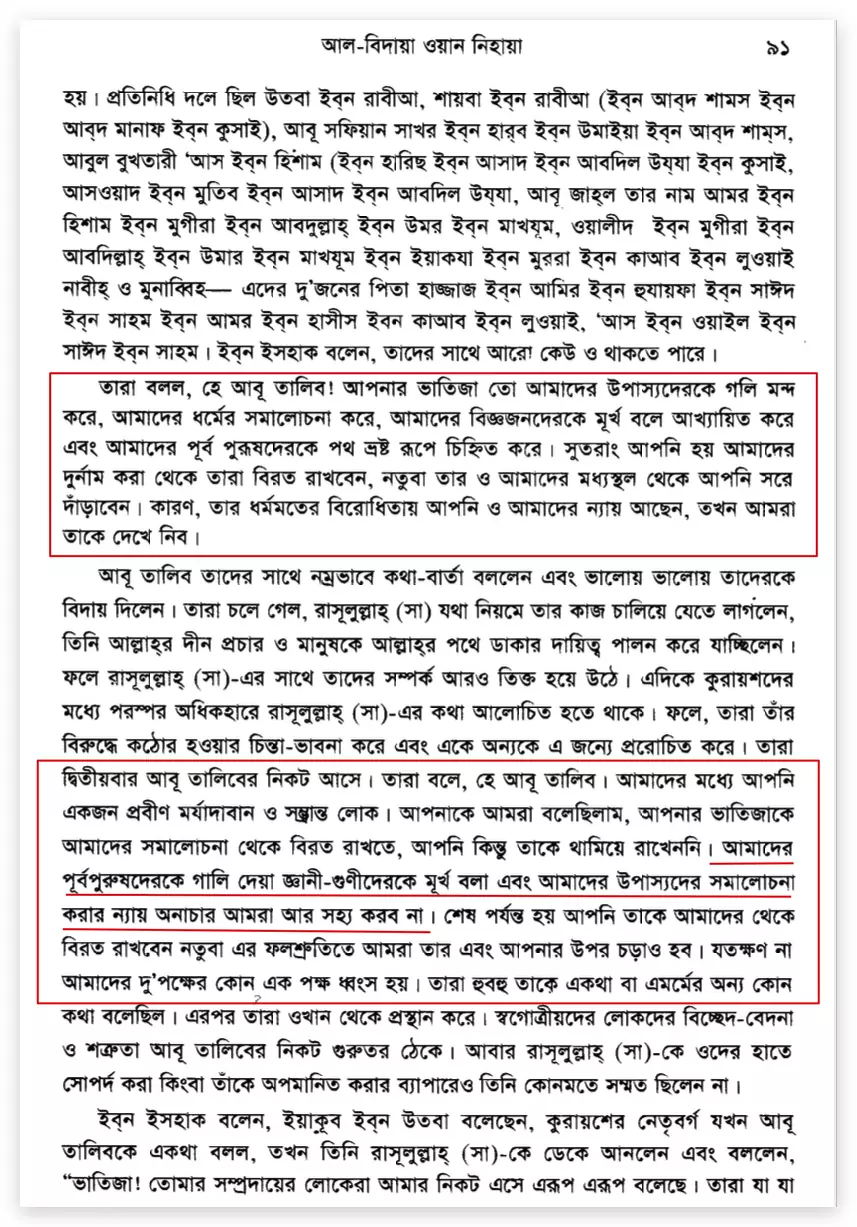
…The delegation included ‘Utba ibn Rabi‘a; Shayba ibn Rabi‘a ibn ‘Abd Shams ibn ‘Abd Manaf ibn Qusayy; Abu Sufyan Sakhr ibn Harb ibn Umayya ibn ‘Abd Shams; Abu al-Bakhtari al-‘As ibn Hisham ibn al-Harith ibn Asad ibn ‘Abd al-‘Uzza ibn Qusayy; al-Aswad ibn al-Muttalib ibn Asad ibn ‘Abd al-‘Uzza; Abu Jahl, whose name was ‘Amr ibn Hisham ibn al-Mughira ibn ‘Abdullah ibn ‘Umar ibn Makhzum; al-Walid ibn al-Mughira ibn ‘Abdullah ibn ‘Umar ibn Makhzum ibn Yaqaza ibn Murra ibn Ka‘b ibn Lu’ayy; Nabih and Munabbih, both sons of al-Hajjaj ibn ‘Amir ibn Hudhayfa ibn Sa‘id ibn Sahm ibn ‘Amr ibn Husays ibn Ka‘b ibn Lu’ayy; and al-‘As ibn Wa’il ibn Sa‘id ibn Sahm. Ibn Ishaq said that others may also have been with them.
They said: “Abu Talib, your nephew abuses our gods, criticizes our religion, calls our learned men ignorant, and identifies our ancestors as misguided. Either restrain him from disparaging us or stand aside between him and us. You oppose his religion just as we do; we will then deal with him ourselves.”
Abu Talib spoke gently to them and sent them away amicably. They left, while the Messenger of Allah continued his work as before, preaching Allah’s religion and calling people to Allah’s path. His relations with them consequently became even more bitter. Meanwhile, discussion of the Messenger intensified among Quraysh. They considered taking a harder line against him and urged one another to do so. They
came to Abu Talib a second time and said: “Abu Talib, you are an elder of distinction and nobility among us. We told you to restrain your nephew from criticizing us, but you have not stopped him. We will no longer tolerate the wrongdoing of abusing our ancestors, calling our learned and accomplished men ignorant, and
criticizing
our gods. Either restrain him from us once and for all,
or we will attack both him and you until one of our two sides has been destroyed.” They said precisely these words or something
to this effect, then departed. The estrangement and hostility of his own people weighed heavily upon Abu Talib. Yet he was also entirely unwilling to surrender the Messenger of Allah to them or allow him to be humiliated.
Ibn Ishaq said that Ya‘qub ibn ‘Utba related: When the Quraysh leaders said this to Abu Talib, he summoned the Messenger of Allah and said: “Nephew, your people came to me and said such-and-such.” Whatever they had said…
“…like those ˹prophets˺ sent before.” (21:5). In fact, they were confused about what to say concerning the Messenger of Allah. Whatever they tried to say was exposed as false and untrue, for whoever abandons the path of truth is mistaken in everything he says. Allah says:
ٱنظُرۡ كَيۡفَ ضَرَبُواْ لَكَ ٱلۡأَمۡثَالَ فَضَلُّواْ فَلَا يَسۡتَطِيعُونَ سَبِيلٗا
See how they call you names ˹O Prophet˺! So they have gone so ˹far˺ astray that they cannot find the ˹Right˺ Way. (17:48; Dr. Mustafa Khattab, The Clear Quran).
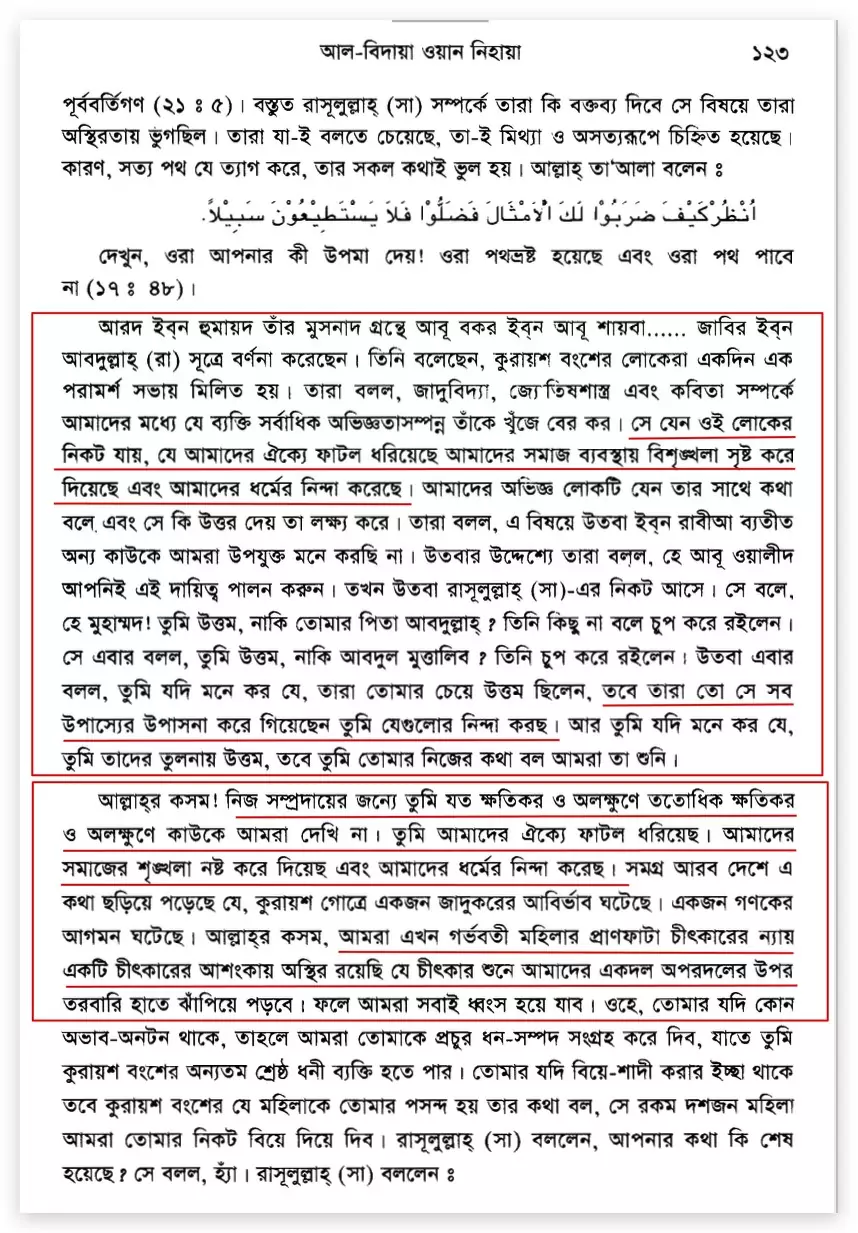
‘Abd ibn Humayd narrated in his Musnad through Abu Bakr ibn Abi Shayba … from Jabir ibn ‘Abdullah, who said: The people of Quraysh once met for consultation. They said: “Find the person among us with the greatest expertise in magic, astrology, and poetry. Let him go to the man who has divided our unity, disrupted
our social order, and denounced our religion. Let our experienced man speak
to him and observe his answer.” They said: “We consider no one but ‘Utba ibn Rabi‘a suitable for this.” Addressing ‘Utba, they said: “Abu al-Walid, undertake this task.” ‘Utba then went to the Messenger of Allah and said: “Muhammad, are you better, or is your father ‘Abdullah?” He remained silent. ‘Utba then asked: “Are you better, or is ‘Abd al-Muttalib?” Again he remained silent. ‘Utba continued: “If you think they were better than you, they worshipped the very deities you denounce. If you think you are better than they were, speak for yourself and we will listen.
By Allah, we have seen no one more harmful and ill-omened for his own people than you. You have divided our unity, disrupted our social order, and denounced our religion. Word has spread throughout Arabia that a magician has appeared among Quraysh, that a soothsayer has come. By Allah, we anxiously fear a cry like the agonized scream of a woman in labor, at which one group among us will fall upon another with swords and we will all perish. If you are in need, we will collect abundant wealth for you so that you may become one of Quraysh’s richest men. If you wish to marry, name whichever women of Quraysh please you, and we will marry ten such women to you.” The Messenger of Allah asked: “Have you finished?” He said: “Yes.” The Messenger of Allah said: …
Muhammad said that he had been sent with instructions to break idols. This statement is also recorded in authentic hadith [9] [10].
Sahih Muslim (Islamic Foundation edition)
7. The Virtues of the Quran
Section 17. Times When Prayer Is Forbidden
1803. Ahmad ibn Ja‘far al-Ma‘qiri … ‘Ikrima said that he had met Shaddad, Abu Umama, and Wathila, and had accompanied Anas during his travels in Syria; he praised him and spoke of his excellence. Abu Umama related: ‘Amr b. ‘Abasa Sulami reported: In the state of the Ignorance (before embracing Islam), I used to think that the people were in error and they were not on anything (which may be called the right path) and worshipped the idols. Meanwhile, I heard of a man in Mecca who was giving news (on the basis of his prophetic knowledge) ; so I sat on my ride and went to him. The Messenger of Allah (ﷺ) was at that time hiding as his people had made life hard for him. I adopted a friendly attitude (towards the Meccans and thus managed) to enter Mecca and go to him (the Holy Prophet) and I said to him: Who are you?
He said: I am a Prophet (of Allah). I again said: Who is a Prophet? He said: (I am a Prophet in the sense that) I have been sent by Allah. I said: What is that which you have been sent with? He said: I have been sent to join ties of relationship (with kindness and affection), to break the Idols, and to proclaim the oneness of Allah (in a manner that) nothing is to be associated with Him. I said: Who is with you in this (in these beliefs and practices)? He said: A free man and a slave. He (the narrator) said: Abu Bakr and Bilal were there with him among those who had embraced Islam by that time. I said: I intend to follow you. He said: During these days you would not be able to do so. Don’t you see the (hard) condition under which I and (my) people are living? You better go back to your people and when you hear that I have been granted victory, you come to me.
So I went to my family. I was in my home when the Messenger of Allah (ﷺ) came to Medina. I was among my people and used to seek news and ask people when he arrived in Medina. Then a group of people belonging to Yathrib (Medina) came. I said (to them): How is that person getting on who has come to Medina? They said: The people are hastening to him, while his people (the polytheists of Mecca) planned to kill him, but they could not do so. I (on hearing it) came to Medina and went to him and said: Messenger of Allah, do you recognise me? He said: Yes, you are the same man who met me at Mecca.
I said: It is so. I again said: Prophet of Allah, tell me that which Allah has taught you and which I do not know, tell me about the prayer. He said: Observe the dawn prayer, then stop praying when the sun is rising till it is fully up, for when it rises it comes up between the horns of Satan, and the unbelievers prostrate themselves to it at that time. Then pray, for the prayer is witnessed and attended (by angels) till the shadow becomes about the length of a lance; then cease prayer, for at that time Hell is heated up. Then when the shadow moves forward, pray, for the prayer is witnessed and attended by angels, till you pray the afternoon prayer, then cease prayer till the sun sets, for it sets between the horns of devil, and at that time the unbelievers prostrate themselves before it.
I said: Apostle of Allah, tell me about ablution also. He said: None of you who uses water for ablution and rinses his mouth, snuffs up water and blows it, but the sins of his face, and his mouth and his nostrils fall out. When he washes his face, as Allah has commanded him, the sins of his face fall out from the end of his beard with water. Then (when) he washes his forearms up to the elbows, the sins of his arms fall out along with water from his finger-tips. And when he wipes his head, the sins of his head fall out from the points of his hair along with water. And (when) he washes his feet up to the ankles, the sins of his feet fall out from his toes along with water. And if he stands to pray and praises Allah, lauds Him and glorifies Him with what becomes Him and shows wholehearted devotion to Allah, his sins would depart leaving him (as innocent) as he was on the day his mother bore him.
‘Amr b. ‘Abasa narrated this hadith to Abu Umama, a Companion of the Messenger of Allah (ﷺ), and Abu Umama said to him: ‘Amr b. ‘Abasa, think what you are saying that such (a great reward) is given to a man at one place (only in the act of ablution and prayer). Upon this ‘Amr said: Abu Umama, I have grown old and my bones have become weak and I am at the door of death; what impetus is there for me to attribute a lie to Allah and the Messenger of Allah (ﷺ)? Had I heard it from the Messenger of Allah (ﷺ) once, twice, or three times (even seven times), I would have never narrated it, but I have heard it from him on occasions more than these.
Hadith grade: Sahih. Canonical reference: Sahih Muslim 832, Book 6, Hadith 358; Sunnah.com.
Narrator in the quoted chain: ‘Ikrima.
Riyad al-Salihin
1. Miscellaneous
Section 51. The Importance of Hope in Allah’s Mercy
27/443. Abu Najih ‘Amr bin ‘Abasah (May Allah be pleased with him) reported: In the Pre-Islamic Period of Ignorance, I used to think that people who used to worship idols, were deviated and did not adhere to the true religion. Then I heard of a man in Makkah who was preaching a message. So I mounted my camel and went to him. I found that (this man who was) Messenger of Allah (ﷺ) remained hidden because of the persecution by his people. I had entered Makkah stealthily and when I met him I asked him, “Who are you?” He (ﷺ) said, “I am a Prophet.”
I asked; “What is a Prophet?” He said, “Allah has sent me (with a message)”. I asked, “With what has He sent you?” He said, “He sent me to strengthen the ties of kinship, to destroy idols so that Allah alone should be worshipped and nothing should be associated with Him”. I asked, “Who has followed you in this?” He said, “A freeman and a slave”. (At that time only Abu Bakr and Bilal (May Allah be pleased with her) were with him). I said, “I shall follow you”. He said, “You can not do that now. Do you not see my situation and that of the people? Go to your people, and when you hear that my cause has prevailed, come to me”.
So I went back to my people, and while I was with my people, Messenger of Allah (ﷺ) emigrated to Al-Madinah. I continued to ask people about him till some of my people visited Al- Madinah. On their return, I asked them, “How is that man who has arrived in Al-Madinah faring?” They said, “People are hastening to him. His own people had planned to kill him but did not succeed.”
Then I went to Al-Madinah and came to him and said, “O Messenger of Allah, do you recognize me?” He (ﷺ) said, “Yes, you are the one who met me in Makkah.” I said, “O Messenger of Allah, tell me of that which Allah has taught you and of which I am unaware. Tell me about Salat first.” He (ﷺ) replied, “Perform the Fajr (morning) Salat, then stop Salat until the sun has risen up to the height of a lance, for when it rises, it rises up between the horns of the devil, and the infidels prostrate themselves before it at that time.
Then perform Salat, for Salat is witnessed and angels attend it, until the shadow becomes equal to the length of its object; then stop Salat, for at that time Jahannam (Hell) is heated up. Then pray when the shadow becomes longer, for the prayer is witnessed and angels attend it, until you perform ‘Asr prayer; then stop Salat till sun sets, for it sets between the horns of a devil. At that time the infidels prostrate themselves before it.”
I then asked the Messenger of Allah to tell me about Wudu’, and he (ﷺ) said, “When a person begins the Wudu’ and washes his mouth and nose, the sins committed by his face, mouth and nostrils are washed out. Then when he washes his face as commanded by Allah, the sins of his face are washed out with the water from the sides of his beard. Then when he washes his hands up to elbows, the sins of his hands are washed out through his fingers with water.
Then he passes his wet hands over his head and the sins of the head are washed out through the ends of his hair with water. Then he washes his feet up to the ankles, the sins of his feet are washed out through his toes with water. Then, if he stands up for Salat and praises Allah, glorifies Him, proclaims His Greatness as He deserves and devotes his heart wholly to Allah, he emerges sin free as the day he was born”.
When ‘Amr bin ‘Abasah (May Allah be pleased with him) narrated this Hadith to Abu Umamah (May Allah be pleased with him) a Companion of the Prophet (ﷺ), the latter said to him, “Watch what you are saying. O ‘Amr bin ‘Abasah, a man will be getting all of this in one shot?” ‘Amr (May Allah be pleased with him) replied, “O Abu Umamah, I have attained old age, my bones have become dry, my death is approaching and there is no need for me to tell lies concerning Allah and His Messenger (ﷺ).
Had I not heard this from the Messenger of Allah only once, twice, thrice (and he counted up to seven) I would never have reported it. Indeed I have heard this frequently”. [Muslim]. (1)
(1) Muslim 832; al-Nasa’i 147, 572, 584; Ibn Majah 283, 1251, 1354; Ahmad 16566, 16571, 16578, 16580, 18940.
Hadith grade: Sahih. Canonical reference: Riyad al-Salihin 438, Chapter 52; Sahih Muslim 832; Sunnah.com.
Moreover, on the day of the conquest of Mecca, Muhammad destroyed all the ancient idols at the Kaaba—idols that polytheists had reverently worshipped for hundreds of years. He did not order them relocated elsewhere; he simply smashed them to pieces [11] [12].
Sahih al-Bukhari (Tawhid Publications)
46. Oppression, Retaliation, and Plunder
Section 46/32. May earthenware vessels of wine be broken or wineskins pierced? What is the ruling if someone uses a staff to break an idol, cross, drum, or other useless object?
2478. Narrated `Abdullah bin Mas`ud: The Prophet (ﷺ) entered Mecca and (at that time) there were three hundred-and-sixty idols around the Ka`ba. He started stabbing the idols with a stick he had in his hand and reciting: “Truth (Islam) has come and Falsehood (disbelief) has vanished.” (Surah Al-Isra, 17:81; Quran wording in the published hadith translation by Muhammad Muhsin Khan.) (4287, 4720) (Modern Publications: 2299; Islamic Foundation: 2316)
Hadith grade: Sahih. Canonical reference: Sahih al-Bukhari 2478, Book 46, Hadith 39.
Narrator: ‘Abdullah ibn Mas‘ud.
Sahih al-Bukhari (Islamic Foundation edition)
22. Hajj
Section 1014. Saying Takbir at the Corners inside the Kaaba
1506. Abu Ma‘mar … Narrated Ibn `Abbas: When Allah’s Messenger (ﷺ) came to Mecca, he refused to enter the Ka`ba with idols in it. He ordered (idols to be taken out). So they were taken out. The people took out the pictures of Abraham and Ishmael holding Azlams in their hands. Allah’s Messenger (ﷺ) said, “May Allah curse these people. By Allah, both Abraham and Ishmael never did the game of chance with Azlams.” Then he entered the Ka`ba and said Takbir at its corners but did not offer the prayer in it.
Hadith grade: Sahih. Canonical reference: Sahih al-Bukhari 1601, Book 25, Hadith 87.
Narrator: ‘Abdullah ibn ‘Abbas.
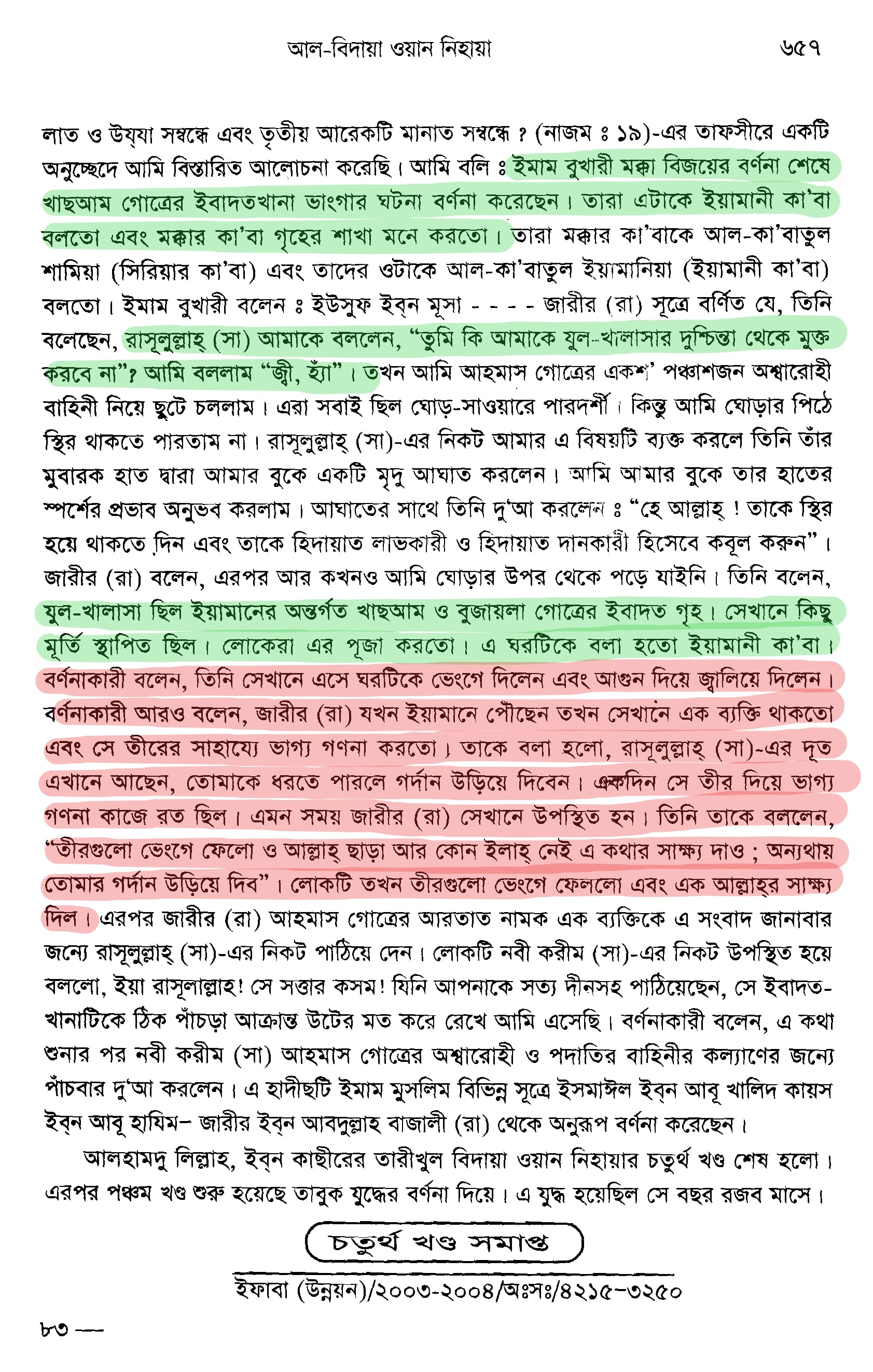
Nor were these actions limited to criticism. When the Prophet had little power, he preached Islam. Whenever he acquired power and assembled jihadist forces, the Muslims destroyed polytheists’ idols and temples. At a place in Yemen stood a polytheist sanctuary called Dhu al-Khalasa. He ordered troops sent to destroy it. There are numerous incidents of this kind. The renowned scholar Ibn Kathir’s Al-Bidaya wa al-Nihaya states that Muhammad ordered this sanctuary destroyed [13]:
“…Al-Lât and Al-‘Uzza, and the third one, Manât…” (An-Najm, 53:19–20). I have discussed this in detail in a section of the commentary on these verses. I say: after narrating the conquest of Mecca, Imam al-Bukhari related the destruction of the sanctuary of Khath‘am. They called it the Yemeni Kaaba and regarded it as a counterpart of the Kaaba in Mecca. They called the Meccan Kaaba al-Ka‘ba al-Shamiyya, the Syrian Kaaba, and their own sanctuary al-Ka‘ba al-Yamaniyya, the Yemeni Kaaba. Imam al-Bukhari said: Yusuf ibn Musa narrated … from Jarir, who said: Narrated Qais: Jarir said “Allah’s Messenger (ﷺ) said to me, “Won’t you relieve me from Dhul-Khalasa?” I replied, “Yes, (I will relieve you).” So I proceeded along with one-hundred and fifty cavalry from Ahmas tribe who were skillful in riding horses. I used not to sit firm over horses, so I informed the Prophet (ﷺ) of that, and he stroke my chest with his hand till I saw the marks of his hand over my chest and he said, O Allah! Make him firm and one who guides others and is guided (on the right path).’ Since then I have never fallen from a horse. Dhul-l–Khulasa was a house in Yemen belonging to the tribe of Khatham and Bajaila, and in it there were idols which were worshipped, and it was called Al-Ka`ba.” Jarir went there, burnt it with fire and dismantled it. When Jarir reached Yemen, there was a man who used to foretell and give good omens by casting arrows of divination. Someone said to him. “The messenger of Allah’s Messenger (ﷺ) is present here and if he should get hold of you, he would chop off your neck.” One day while he was using them (i.e. arrows of divination), Jarir stopped there and said to him, “Break them (i.e. the arrows) and testify that None has the right to be worshipped except Allah, or else I will chop off your neck.” So the man broke those arrows and testified that none has the right to be worshipped except Allah. Then Jarir sent a man called Abu Artata from the tribe of Ahmas to the Prophet to convey the good news (of destroying Dhu-l-Khalasa). So when the messenger reached the Prophet, he said, “O Allah’s Messenger (ﷺ)! By Him Who sent you with the Truth, I did not leave it till it was like a scabby camel.” Then the Prophet (ﷺ) blessed the horses of Ahmas and their men five times. Imam Muslim transmitted a similar report through several chains from Isma‘il ibn Abi Khalid, from Qays ibn Abi Hazim, from Jarir ibn ‘Abdullah al-Bajali.
Praise be to Allah, the fourth volume of Ibn Kathir’s Tarikh al-Bidaya wa al-Nihaya is complete. The fifth volume begins with the account of the expedition to Tabuk, which took place in Rajab of that year.
The truth of these accounts becomes clear from Sahih al-Bukhari [14] [15] [16] [17] [18]:
Sahih al-Bukhari (Islamic Foundation edition)
48. Jihad
Section 1895. Burning Houses and Date-Palm Groves
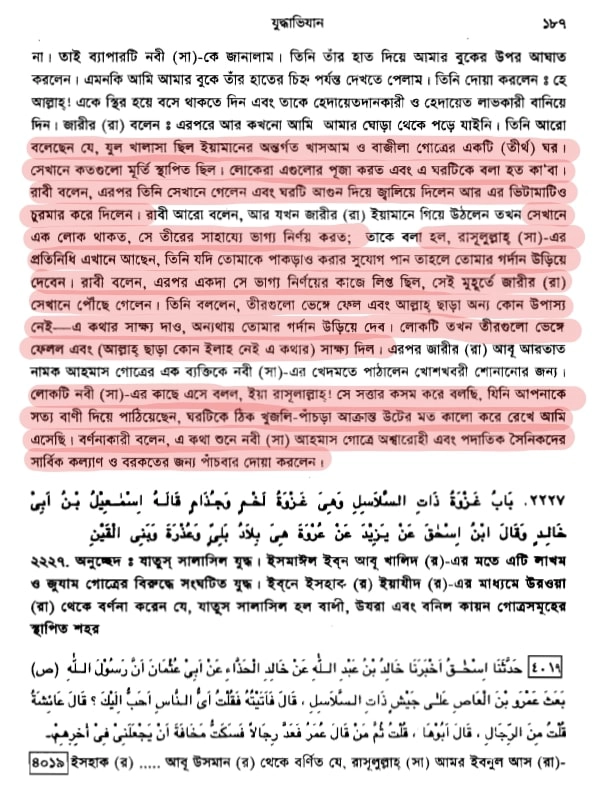
2811. Musaddad … Narrated Jarir: Allah’s Messenger (ﷺ) said to me, “Will you relieve me from Dhul-Khalasa? Dhul-Khalasa was a house (of an idol) belonging to the tribe of Khath’am called Al-Ka`ba Al-Yama-niya. So, I proceeded with one hundred and fifty cavalry men from the tribe of Ahmas, who were excellent knights. It happened that I could not sit firm on horses, so the Prophet (ﷺ) , stroke me over my chest till I saw his finger-marks over my chest, he said, ‘O Allah! Make him firm and make him a guiding and rightly guided man.’ ”
Jarir proceeded towards that house, and dismantled and burnt it. Then he sent a messenger to Allah’s Apostle informing him of that. Jarir’s messenger said, “By Him Who has sent you with the Truth, I did not come to you till I had left it like an emaciated or scabby camel (i.e. completely marred and spoilt).” Jarir added, “The Prophet (ﷺ) asked for Allah’s Blessings for the horses and the men of Ahmas five times.”
Hadith grade: Sahih. Canonical reference: Sahih al-Bukhari 3020, Book 56, Hadith 229.
Narrator: Jarir ibn ‘Abdullah al-Bajali.
Sahih al-Bukhari (Islamic Foundation edition)
50. The Prophets
Section 2131. Jarir ibn ‘Abdullah al-Bajali
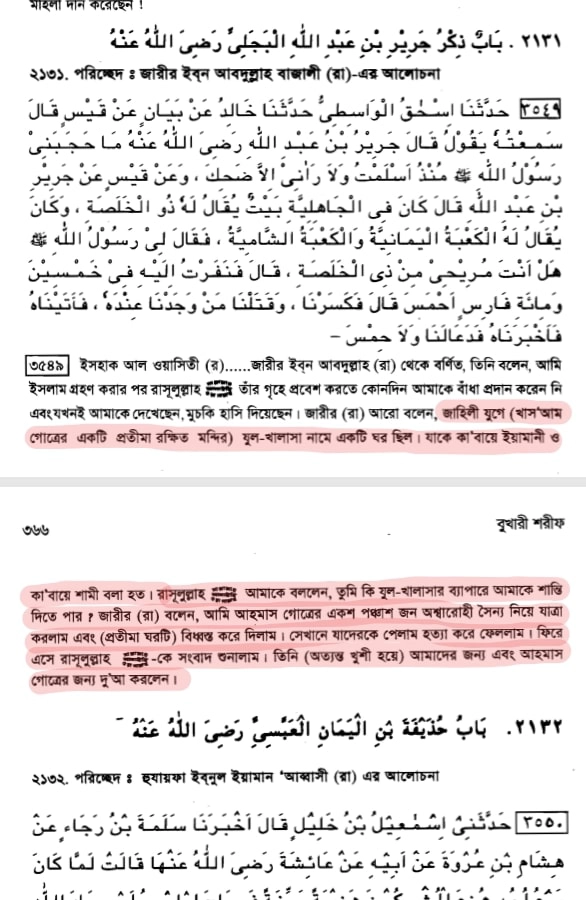
3549. Ishaq al-Wasiti … Narrated Jarir bin ‘Abdullah: Allah’s Messenger (ﷺ) has never refused to admit me since I embraced Islam, and whenever he saw me, he would smile. Jarir also related: Jarir bin ‘Abdullah narrated: There was a house called Dhul-Khalasa in the Pre-lslamic Period and it was also called Al-Ka’ba Al-Yamaniya or Al-Ka’ba Ash-Shamiya. Allah’s Messenger (ﷺ) said to me, “Will you relieve me from Dhul-Khalasa?” So I left for it with 150 cavalrymen from the tribe of Ahmas and then we destroyed it and killed whoever we found there. Then we came to the Prophet (ﷺ) and informed him about it. He invoked good upon us and upon the tribe of Ahmas.
Hadith grade: Sahih. Canonical references: Sahih al-Bukhari 3822 and 3823, Book 63, Hadiths 47–48.
Sahih al-Bukhari (Islamic Foundation edition)
51. Military Expeditions
Section 2226. The Expedition to Dhu al-Khalasa
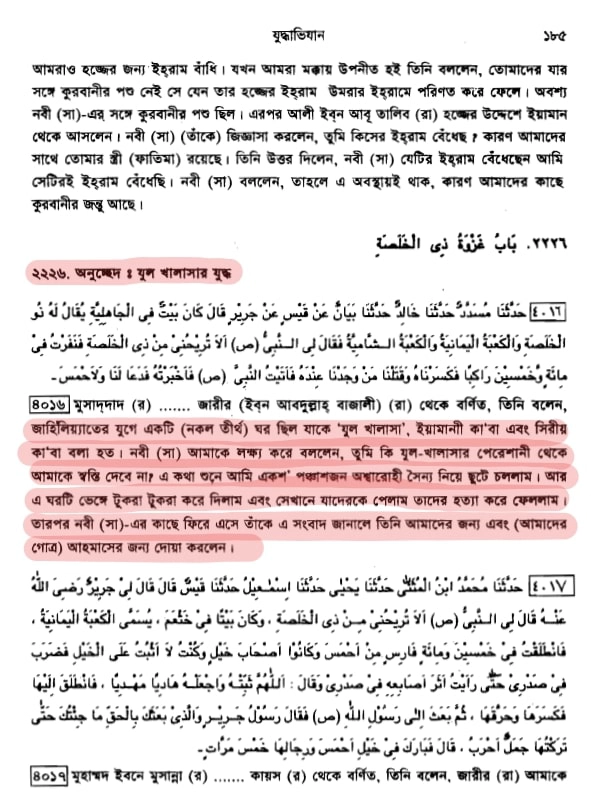
4018. Yusuf ibn Musa … Narrated Qais: Jarir said “Allah’s Messenger (ﷺ) said to me, “Won’t you relieve me from Dhul-Khalasa?” I replied, “Yes, (I will relieve you).” So I proceeded along with one-hundred and fifty cavalry from Ahmas tribe who were skillful in riding horses. I used not to sit firm over horses, so I informed the Prophet (ﷺ) of that, and he stroke my chest with his hand
till I saw the marks of his hand over my chest and he said, O Allah! Make him firm and one who guides others and is guided (on the right path).’ Since then I have never fallen from a horse. Dhul-l–Khulasa was a house in Yemen belonging to the tribe of Khatham and Bajaila, and in it there were idols which were worshipped, and it was called Al-Ka`ba.”
Jarir went there, burnt it with fire and dismantled it. When Jarir reached Yemen, there was a man who used to foretell and give good omens by casting arrows of divination. Someone said to him. “The messenger of Allah’s Messenger (ﷺ) is present here and if he should get hold of you, he would chop off your neck.”
One day while he was using them (i.e. arrows of divination), Jarir stopped there and said to him, “Break them (i.e. the arrows) and testify that None has the right to be worshipped except Allah, or else I will chop off your neck.” So the man broke those arrows and testified that none has the right to be worshipped except Allah. Then Jarir sent a man called Abu Artata from the tribe of Ahmas to the Prophet to convey the good news (of destroying Dhu-l-Khalasa). So when the messenger reached the Prophet, he said, “O Allah’s Messenger (ﷺ)! By Him Who sent you with the Truth, I did not leave it till it was like a scabby camel.” Then the Prophet (ﷺ) blessed the horses of Ahmas and their men five times.
Hadith grade: Sahih. Canonical reference: Sahih al-Bukhari 4357, Book 64, Hadith 383.
Sahih al-Bukhari (Islamic Foundation edition)
51. Military Expeditions
Section 2226. The Expedition to Dhu al-Khalasa
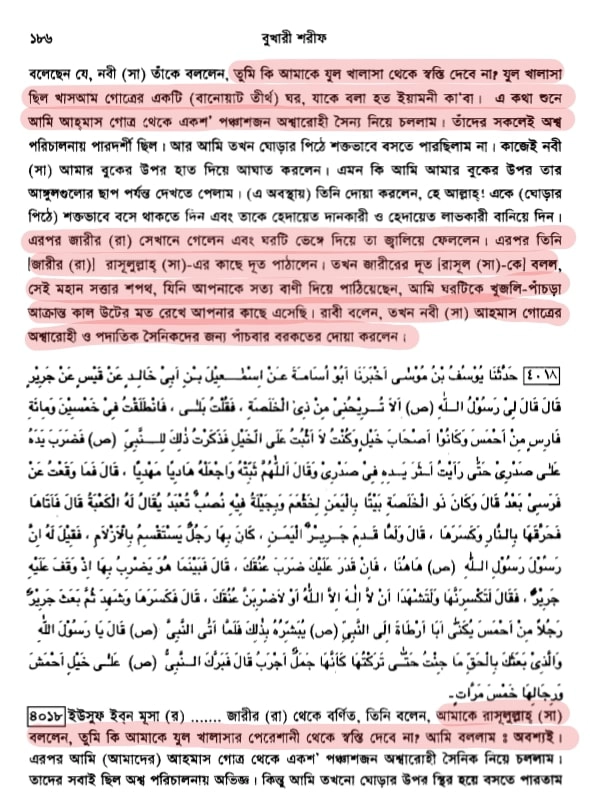
4017. Muhammad ibn al-Muthanna … Narrated Qais: Jarir said to me, The Prophet (ﷺ) said to me, “Won’t you relieve me from Dhu-l-Khalasa?” And that was a house (in Yemem belonging to the tribe of) Khatham called Al-Ka`ba Al Yamaniya. I proceeded with one-hundred and-fifty cavalry from Ahmas (tribe) who were horse riders. I used not to sit firm on horses, so the Prophet (ﷺ) stroke me over my chest till I saw the mark of his fingers over my chest,
and then he said, ‘O Allah! Make him (i.e. Jarir) firm and one who guides others and is guided on the right path.” So Jarir proceeded to it dismantled and burnt it, and then sent a messenger to Allah’s Messenger (ﷺ). The messenger of Jarir said (to the Prophet), “By Him Who sent you with the Truth, I did not leave that place till it was like a scabby camel.” The Prophet (ﷺ) blessed the horses of Ahmas and their men five times.
Hadith grade: Sahih. Canonical reference: Sahih al-Bukhari 4356, Book 64, Hadith 382.
Sahih al-Bukhari (Tawhid Publications)
Book 64. Military Expeditions
Section 64/63. The Expedition to Dhu al-Khalasa
4356. Narrated Qais: Jarir said to me, The Prophet (ﷺ) said to me, “Won’t you relieve me from Dhu-l-Khalasa?” And that was a house (in Yemem belonging to the tribe of) Khatham called Al-Ka`ba Al Yamaniya. I proceeded with one-hundred and-fifty cavalry from Ahmas (tribe) who were horse riders. I used not to sit firm on horses, so the Prophet (ﷺ) stroke me over my chest till I saw the mark of his fingers over my chest, and then he said, ‘O Allah! Make him (i.e. Jarir) firm and one who guides others and is guided on the right path.” So Jarir proceeded to it dismantled and burnt it, and then sent a messenger to Allah’s Messenger (ﷺ). The messenger of Jarir said (to the Prophet), “By Him Who sent you with the Truth, I did not leave that place till it was like a scabby camel.” The Prophet (ﷺ) blessed the horses of Ahmas and their men five times. (3020) (Modern Publications: 4010; Islamic Foundation: 4014)
Hadith grade: Sahih. Canonical reference: Sahih al-Bukhari 4356, Book 64, Hadith 382.
Insulting Religion in the Prophet’s Presence
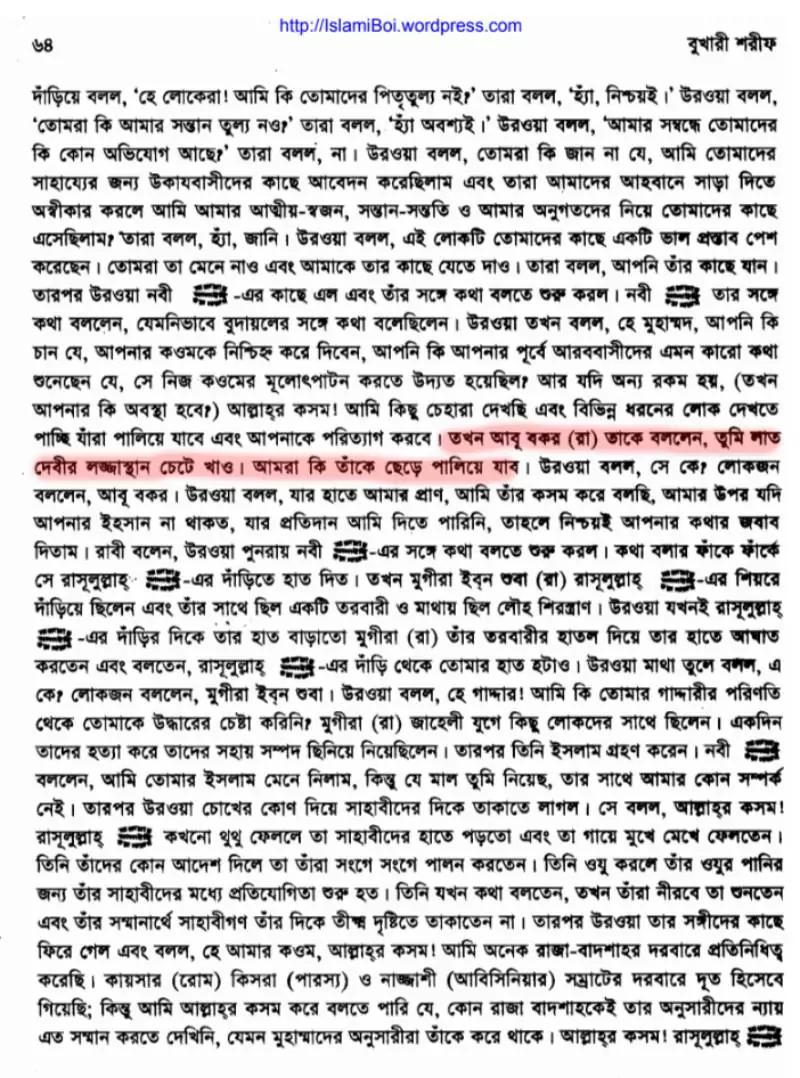
Authentic hadith show that Abu Bakr used extremely obscene and vulgar language about the unbelievers’ gods in Muhammad’s presence. The Prophet also gave his tacit approval; otherwise, he would have stopped Abu Bakr immediately. Ibn Hajar al-Asqalani, the author of Fath al-Bari, says in his commentary on this hadith that the Prophet tacitly approved Abu Bakr’s action at that time [19]. Since this hadith is very long, only an extract is reproduced here; interested readers may consult the original book for the remainder. However intense the hostility or warfare with unbelievers, how could any civilized person make such insulting, filthy, and vulgar remarks about their gods or religion? [20] [21]:
Sahih al-Bukhari (Islamic Foundation edition)
46. Conditions
Section 1701. Conditions Concerning Jihad and Peace Treaties with Belligerent Unbelievers, and Recording Verbal Agreements
Islamic Foundation number: 2547; canonical international reference: 2731–2732
2547. …
Abu Bakr then said to him:“Suck al-Lat’s clitoris!Do you say we would run and leave the Prophet (ﷺ) alone?”
…
Hadith grade: Sahih.
Narrator: Marwan ibn al-Hakam; the canonical report is narrated jointly by al-Miswar ibn Makhrama and Marwan.
Is Insulting Other Gods Forbidden?
Many believers claim that a Quranic verse [22] prohibits insulting the gods of other religions. What these dishonest believers conceal, however, is the context in which the verse was revealed [23]. Muhammad himself took the initiative in abusing the unbelievers’ gods; in response, Mecca’s unbelievers threatened to abuse Muhammad’s Allah if he continued. Frightened, Muhammad revealed this verse solely to protect his own Allah from abuse, as the commentaries state very clearly. He did not act of his own accord; he acted after receiving a counter-threat. It was not that he respected the unbelievers’ religions or beliefs and voluntarily refrained from abusing their gods! Because he was weak in power and numbers, the verse served to protect his imaginary Allah from the unbelievers’ insults. What Muhammad later did to those gods’ idols and temples after gaining power will be discussed below. For now, let us examine the context in Tafsir al-Mazhari by Allama Thana Allah Panipati, known as Shaykh al-Mufassirin and Faqih al-Umma [24]:
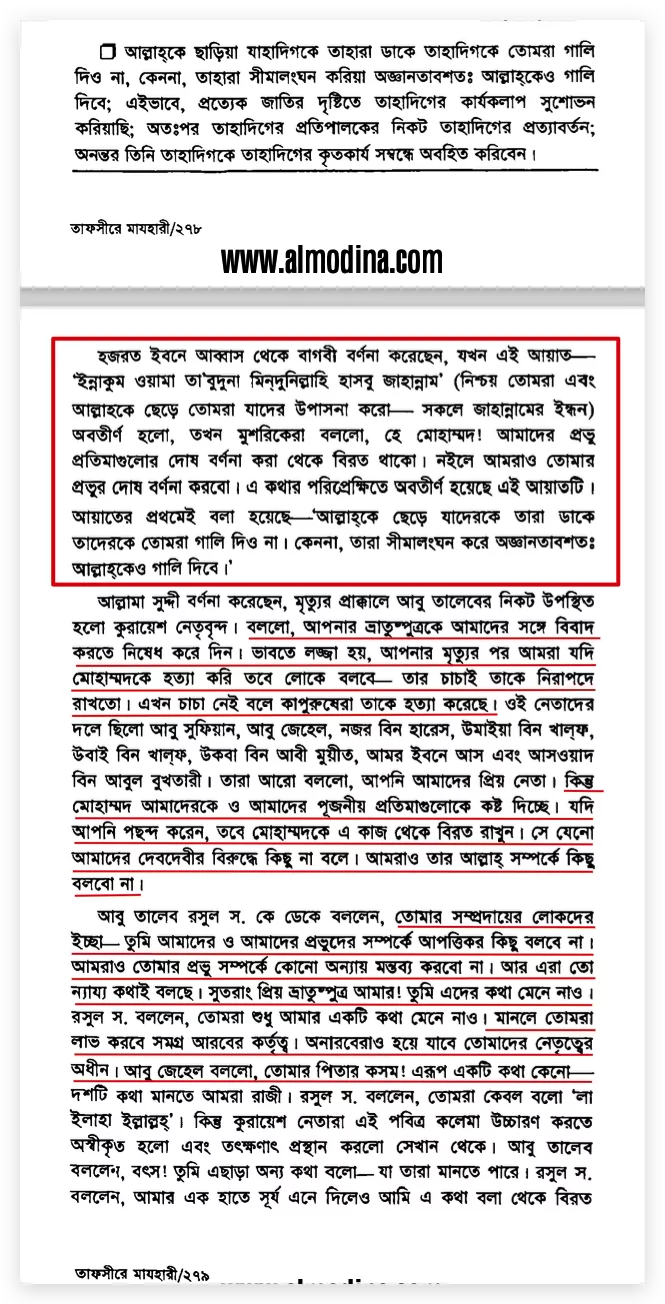
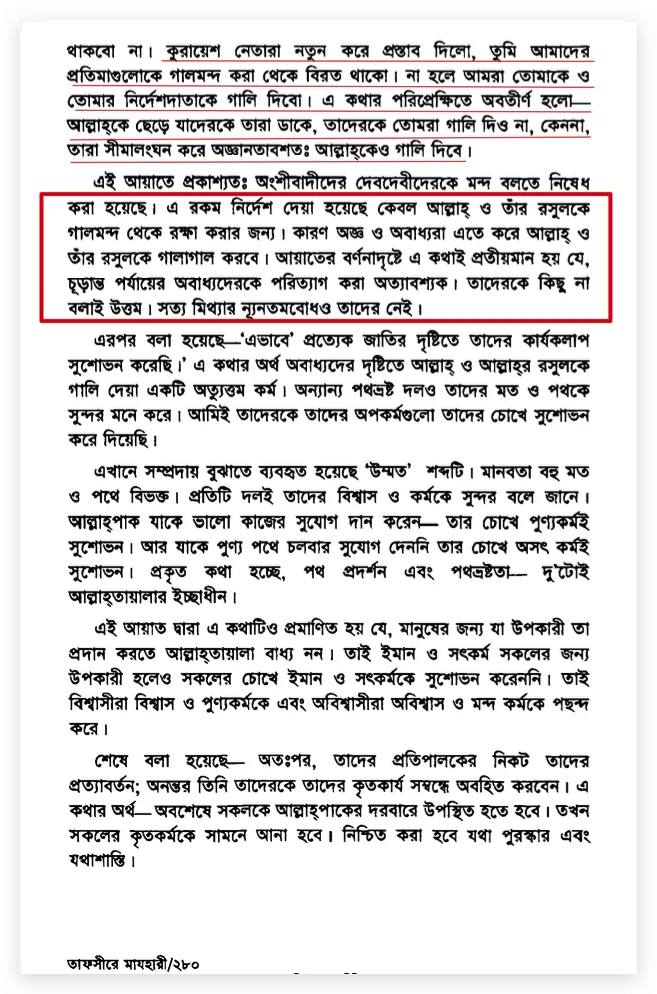
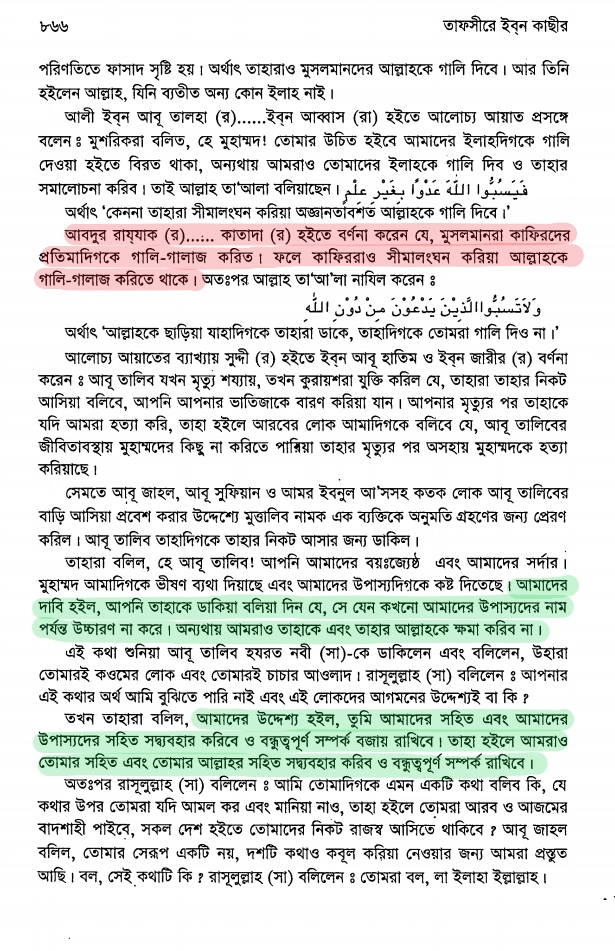
Now let us examine Ibn Kathir’s commentary on this verse [25]. Ibn Kathir’s commentary also tells us that the Muslims were the first to abuse the polytheists’ idols. The polytheist Quraysh were then compelled to complain to Muhammad’s uncle Abu Talib and demand that he stop insulting their gods. They also threatened to abuse Muhammad’s Allah if he abused their gods. Only then, under compulsion, was a verse revealed requiring Muslims to refrain from insulting the unbelievers’ idols—“despite the benefit,” in the commentary’s words—because the Muslims were then a minority!
To Each Their Own Religion?
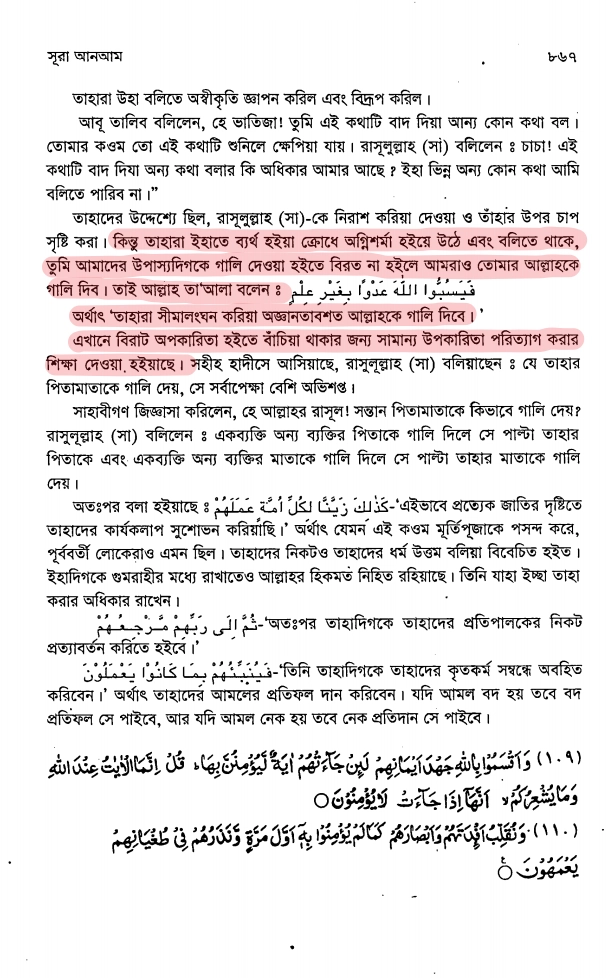
The foregoing discussion makes it fairly clear that Islam actually encourages the destruction of non-Muslims’ temples and idols. In discussions of whether such destruction is right, some moderate Muslims begin claiming that the Quran says, “To each their own religion!” Using this and a few other verses, they try to prove that Islam is a very peaceful religion, grants people of other religions extensive rights, or is free of sectarianism. Yet none of them reads the commentary on this verse [26] [27]. Others do read the commentaries but lie to protect Islam’s reputation. Let us discuss this verse and examine what the renowned classical commentaries say about it. First, the verse itself [28]:
You have your way, and I have my Way.
(Surah Al-Kafirun, 109:6; Dr. Mustafa Khattab, The Clear Quran)
Now let us read the explanation of this Quranic verse directly from the commentaries [29]:
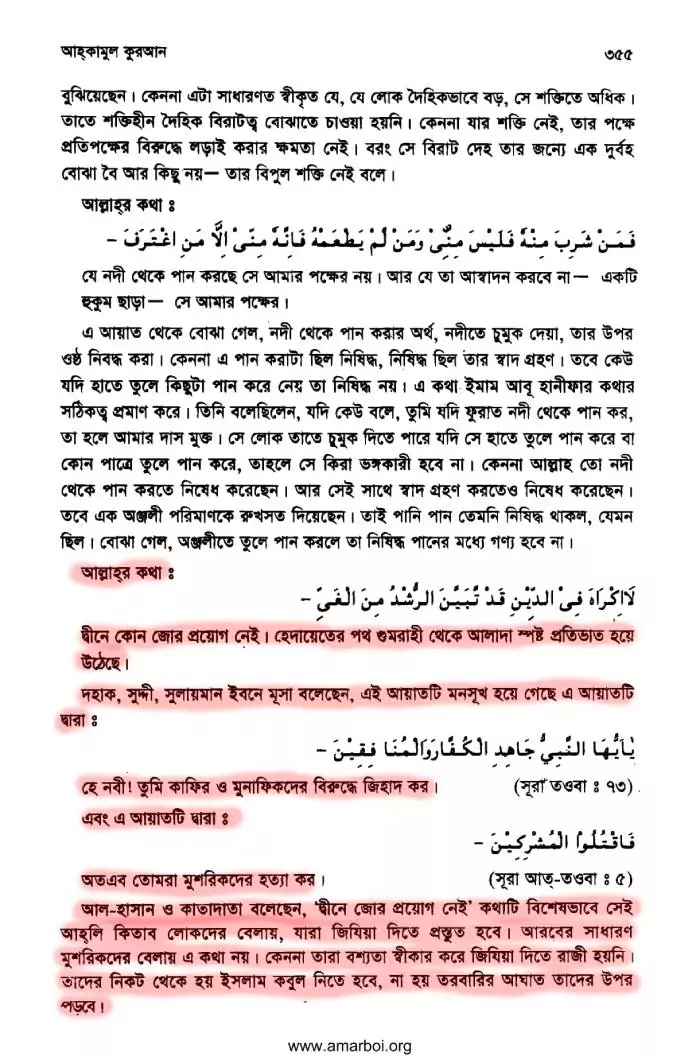
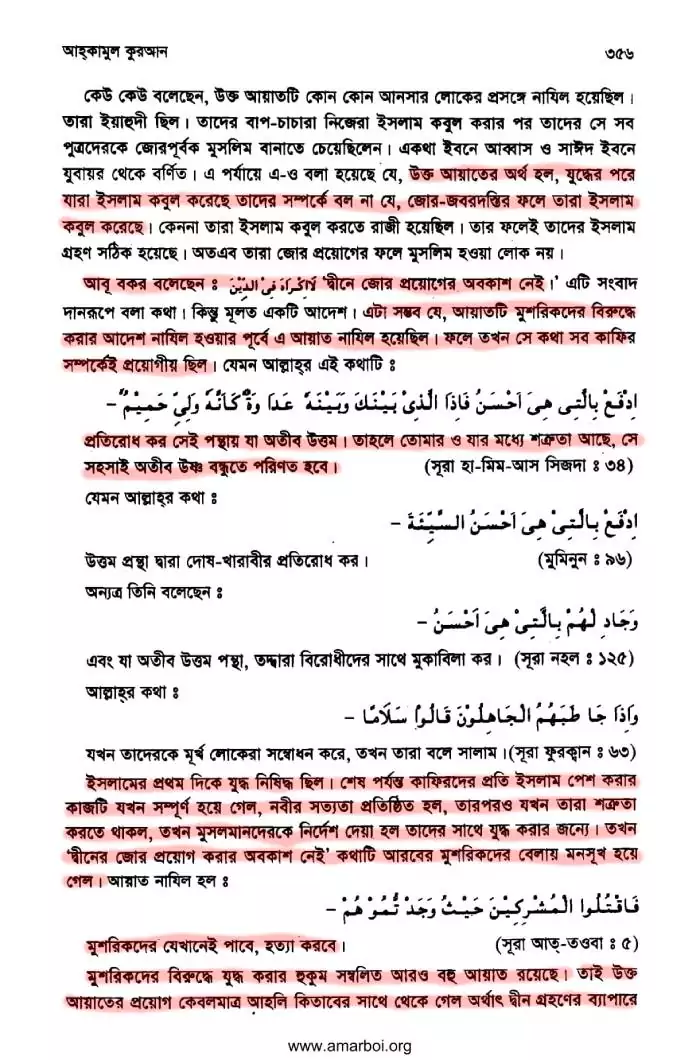
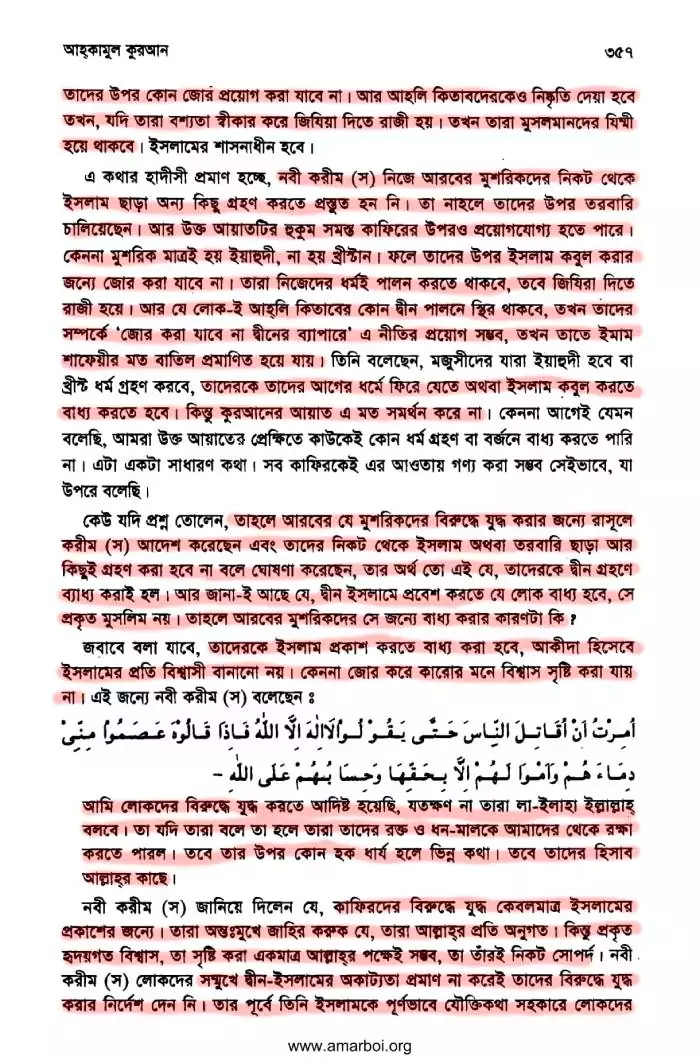
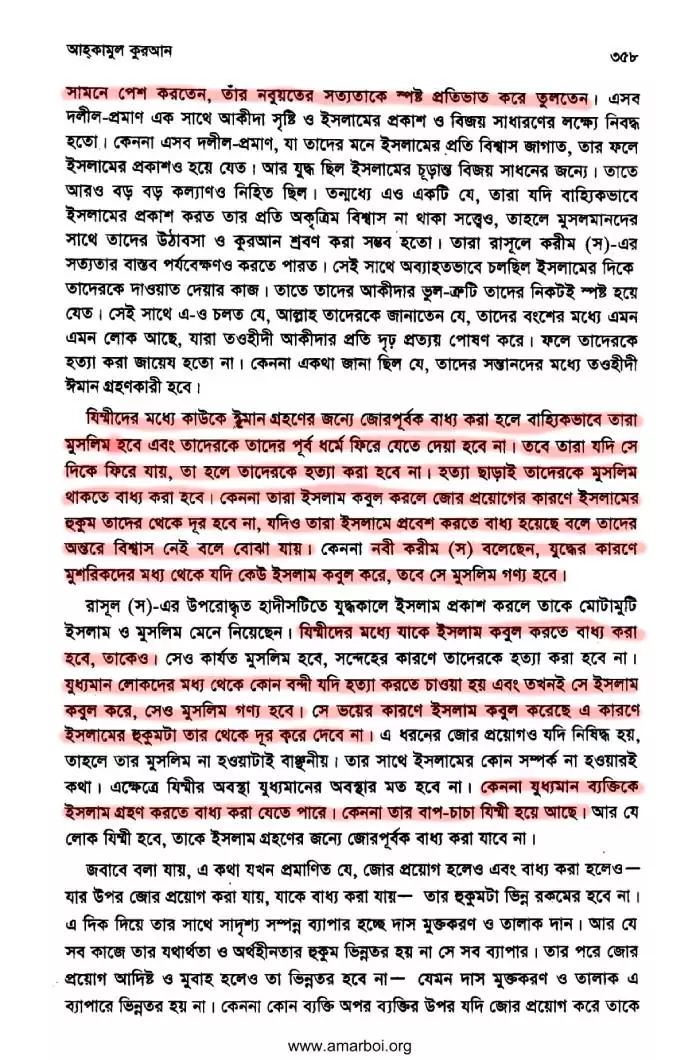
The sources above make clear that Islam does not believe in “to each their own religion” at all. Rather, it compels people to convert by force. Although this verse was revealed as a strategy when Muslims had little power, as soon as their power increased, the verse was abrogated and verses commanding attack were revealed. Rules prescribing forced conversion were also revealed.
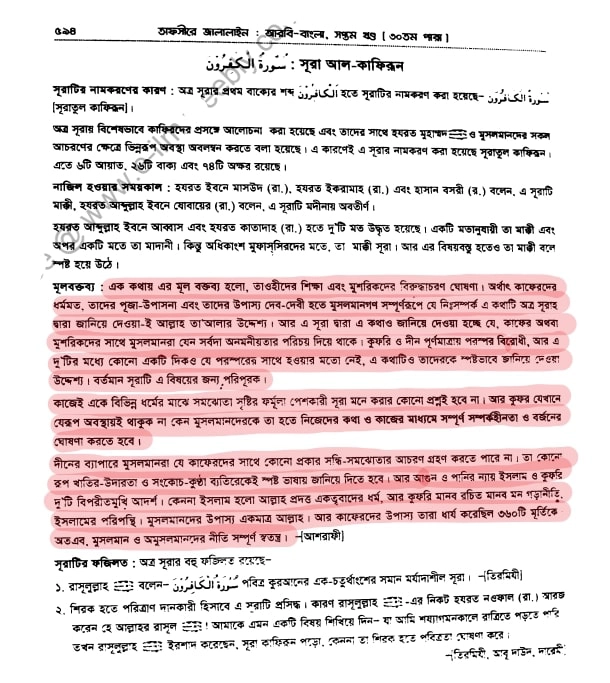
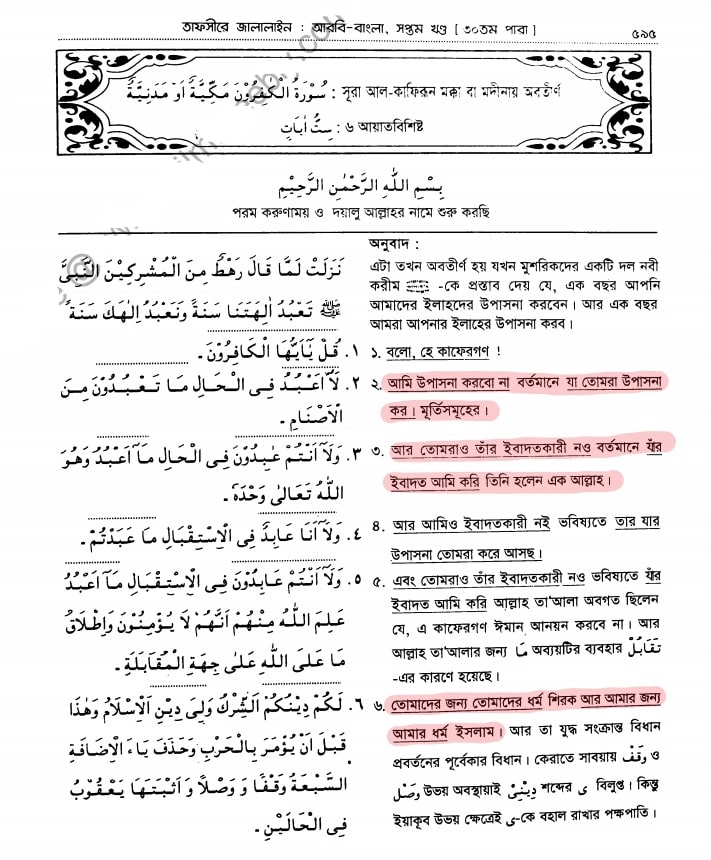
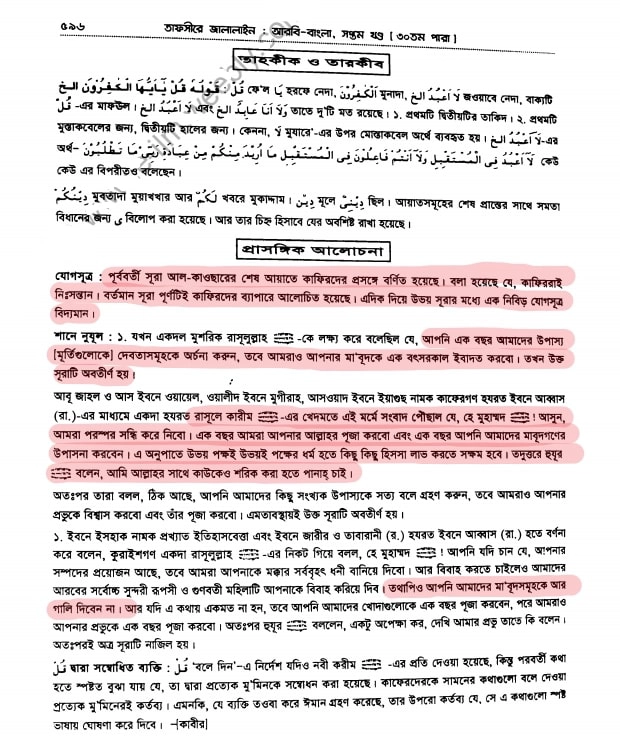
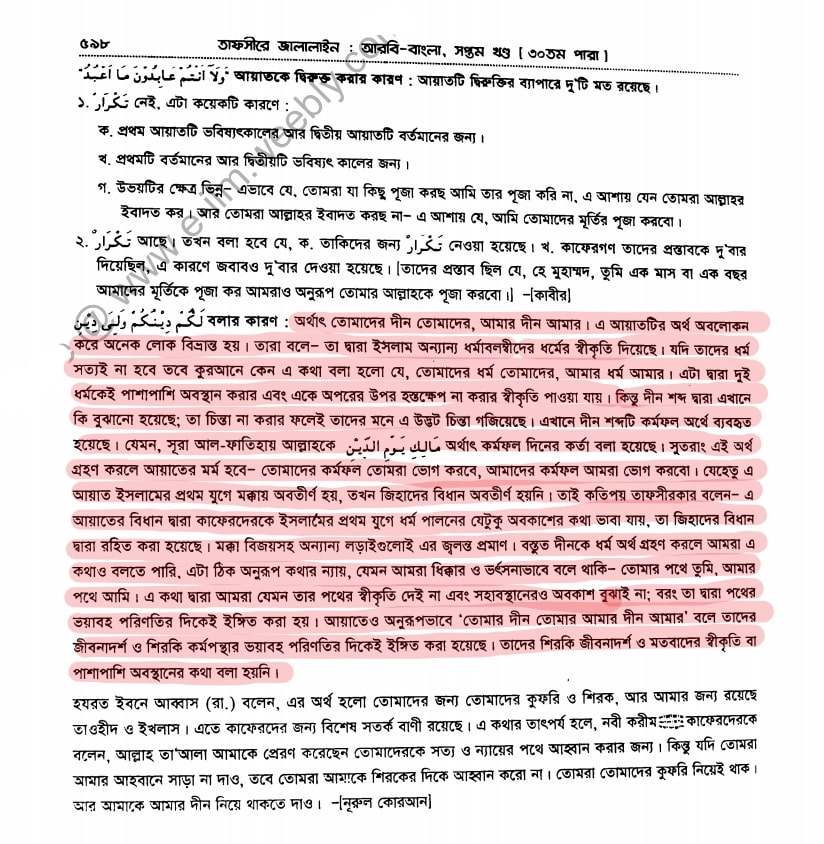
Now let us turn to Tafsir al-Jalalayn to examine the circumstances of this verse’s revelation and its meaning. Does it advocate coexistence, with each person practicing their own religion, or was it a temporary strategy against unbelievers because Muslims did not yet possess much power? The commentary explicitly states that Muslims were then a weak minority, so the verse was revealed out of fear that Allah might be abused. Later, when Muslims became strong, they destroyed every idol throughout the Arabian Peninsula [30]:
The Main Point: In a word, its main point is the teaching of monotheism and the declaration of opposition to the polytheists. Allah’s purpose in this surah is to announce that Muslims are entirely dissociated from the unbelievers’ doctrines, their worship, and their gods. The surah also instructs Muslims always to remain uncompromising toward unbelievers and polytheists. It aims to make clear that disbelief and the religion are wholly opposed to one another and have no aspect in common. This surah completes that declaration.
There can therefore be no question of treating it as a surah offering a formula for accommodation between different religions. Wherever disbelief exists, and whatever its circumstances, Muslims must declare through their words and deeds their complete dissociation from and rejection of it.
They must state plainly, without deference, generosity, embarrassment, or hesitation, that Muslims cannot adopt any policy of compromise or accommodation with unbelievers in matters of religion. Islam and disbelief are two opposing principles, like fire and water. Islam is the religion of monotheism given by Allah, whereas disbelief consists of humanly devised principles fashioned by the human mind in opposition to Islam. Muslims worship Allah alone, while the unbelievers designated 360 idols as their objects of worship.
The principles of Muslims and non-Muslims are therefore entirely distinct. —Ashrafi.
Connection: The last verse of the preceding surah, Al-Kawthar, discusses the unbelievers, saying that it is they who are cut off from posterity. This entire surah concerns the unbelievers. In this respect, the two surahs are closely connected.
Occasion of Revelation: 1. When a group of polytheists said to the Messenger of Allah, “Worship our deities—our idols and gods—for one year, and we will worship your God for one year,” this surah was revealed.
The unbelievers Abu Jahl, al-‘As ibn Wa’il, al-Walid ibn al-Mughira, and al-Aswad ibn Yaghuth once conveyed the following message to the noble Messenger through Ibn ‘Abbas: “Muhammad, let us reach a mutual agreement. For one year we will worship your Allah, and for one year you will worship our gods. In this way each side will obtain a share of the other’s religion.” He replied: “I seek refuge from associating anyone with Allah.”
They then said: “Very well, acknowledge some of our gods as true, and we will believe in your Lord and worship Him.” It was in these circumstances that the surah was revealed.
1. The renowned historian Ibn Ishaq, as well as Ibn Jarir and al-Tabarani, narrated from Ibn ‘Abbas that Quraysh once came to the Messenger of Allah and said: “Muhammad, if you need wealth, we will make you the richest man in Mecca. If you wish to marry, we will marry you to the most beautiful and accomplished woman in Arabia. Only stop abusing our gods. If you do not agree to this, worship our gods for one year, and afterward we will worship your Lord for one year.” The Prophet said: “Wait a little; let me see what my Lord says about it.” This surah was then revealed.
لَكُمْ دِينَكُمْ وَلَى دَيْنِ Why This Was Said: That is, “You have your way, and I have my Way.” Many people are confused by
this verse’s meaning. They say that Islam thereby acknowledges the religions of other communities. If their religions were not true, why would the Quran say, “You have your way, and I have my Way”? They take it as recognition that the two religions may exist alongside one another without interfering in each other’s affairs. This strange notion arises because they do not consider what the word din means here. In this passage, din means recompense for one’s deeds. Thus in Surah Al-Fatiha Allah is called مالك يوم الدين “Master of the Day of Judgment.” Taking this meaning, the verse signifies: you will experience the consequences of your deeds, and we will experience the consequences of ours. Since this verse was revealed in Mecca during Islam’s earliest period, the rules of jihad had not yet been revealed. Some commentators therefore say that whatever latitude this verse might appear to grant unbelievers to practice their religion in Islam’s earliest period was abrogated by the rules of jihad. The conquest of Mecca and the other battles are vivid proof of this. Even if din is understood to mean religion, we may say that it resembles the reproachful, condemning expression: “You go your way; I will go mine.” Such words neither acknowledge the validity of the other person’s path nor imply room for coexistence; they point instead to that path’s terrible consequences. Similarly, by saying “You have your way, and I have my Way,” the verse points to the terrible consequences of their way of life and polytheistic practices. It does not recognize their polytheistic ideology and doctrines or propose coexistence alongside them.
The Prophet’s Instructions to Destroy Idols
The order to send troops to Dhu al-Khalasa and destroy non-Muslims’ sanctuary and revered idols has been discussed above. There are numerous similar examples. Let us read Al-Rahiq al-Makhtum. It shows the Prophet sending troops to various places to annihilate idols, places of worship, and the people who worshipped those idols. Even women were not spared. Matters became so bad that the Prophet himself grew displeased with Khalid ibn al-Walid over the scale of the killing [31]:
Various Expeditions and Delegations (السَّرَايَا وَالْبُعُوْثِ):
1. After completing all the tasks connected with the conquest of Mecca and finding some respite, on 25 Ramadan, 8 AH,he sent a small force under Khalid ibn al-Walid to destroy the idol called al-‘Uzza. Its temple stood at Nakhla. When Khalid returned after demolishing it, the Messenger of Allah asked him, (هَلْ رَأَيْتَ شَيْئًا؟) “Did you see anything?” Khalid said: “No.” The Messenger said, (فَإِنَّكَ لَمْ تَهْدِمْهَا فَارْجِعْ إِلَيْهَا فَاهْدِمْهَا) “Then you have not really destroyed it.Go back and destroy it.”The enraged Khalidreturned with his sword drawn. This time a woman with disheveled hair came out toward them. The temple’s guardian shouted to her. Khalid struck her so forcefully with his sword that her body was cut in two.When he reported this to the Messenger of Allah, the latter said, (نَعَمْ، تِلْكَ الْعُزّٰى، وَقَدْ أَيِسَتْ أَنْ تَعْبُدَ فِيْ بِلَادِكُمْ أَبَدًا)“Yes, that was al-‘Uzza.She has now despaired of being worshipped in your land,” meaning that she would never be worshipped there again.
2. In that same month the noble Prophetsent ‘Amr ibn al-‘As to destroy the idol Suwa‘. This was an idol of Banu Hudhayl at Ruhat, three miles from Mecca. When ‘Amr arrived, the guardian asked: “What do you want?” He answered:“Allah’s Prophet has ordered us to destroy this idol.”
The guardian said: “You will not be able to destroy it.”
‘Amr asked: “Why?”
He answered: “You will be prevented by its natural power.”
‘Amr said: “Are you still following falsehood? Woe to you! Does this idol see or hear?”
He thenapproached the idol and destroyed it,ordering his companions to break open the treasury.They found nothing in it.He then asked the guardian: “What do you say now?”
He answered: “I embrace Allah’s religion, Islam.”
3. In the same month,he sent twenty cavalrymen under Sa‘d ibn Zayd al-Ashhali to destroy the idol Manat. This idol, worshipped by Aws, Khazraj, Ghassan, and other tribes, stood at al-Mushallal near Qudayd. When Sa‘d’s force arrived, the temple’s guardian asked: “What do you want?”
They answered:“We have come to destroy the idol Manat.”
He said: “That is between you and your undertaking.”
As Sa‘d approached the idol,he saw a naked black woman with disheveled hair emerge, beating her chest and crying: “Alas!”
The guardian called to her: “Manat, destroy these rebels!”
ButSa‘d killed her with a stroke of his sword.He then smashed the idol to pieces.No wealth was found in the treasury.
4. After Khalid ibn al-Walid returned from destroying al-‘Uzza, the Messenger of Allah sent him to Banu Jadhima in Shawwal, 8 AH. His purpose was to preach Islam, without attacking them. Khalid went with350 menfrom the Emigrants, the Helpers, and Banu Sulaym and invited Banu Jadhima to Islam. Instead of saying “We have accepted Islam,” they said, “We have abandoned our religion; we have abandoned our religion.”For this reason, Khalid ordered them killed and taken captive.He handed one captive to each of his companions and ordered:“Each man must kill the captive entrusted to him.”Ibn ‘Umar and his companions, however, refused to carry out this order. When they came before the noble Prophet, they discussed the matter. He raised both hands and said twice, (اللهم إِنِّيْ أَبْرَأُ إِلَيْكَ مِمَّا صَنَعَ خَالِدًا) ‘) “O Allah! I am free from what Khalid bin Al-Walid has done.” (1)
Only the men of Banu Sulaym killed their captives in these circumstances; the Helpers and Emigrants did not. The Messenger sent ‘Ali to pay blood money and compensation for those who had been killed. This incident led to heated words and strained relations between Khalid and ‘Abd al-Rahman ibn ‘Awf. When the Messenger heard of this, he said,
(مَهَلًّا يَا خَالِدُ، دَعْ عَنْكَ أَصْحَابِيْ، فَوَاللهِ لَوْ كَانَ أَحَدٌ ذَهَبًا، ثُمَّ أَنْفَقَتْهُ فِيْ سَبِيْلِ اللهِ مَا أَدْرَكَتْ غُدْوَةَ رَجُلٍ مِّنْ أَصْحَابِيْ وَلَا رَوْحَتَهُ)
“Khalid, stop. Refrain from speaking against my Companions. By Allah, even if Mount Uhud became gold and you spent all of it in Allah’s cause, you could not attain the reward of even one morning or evening of worship by any one of my Companions.” (2)
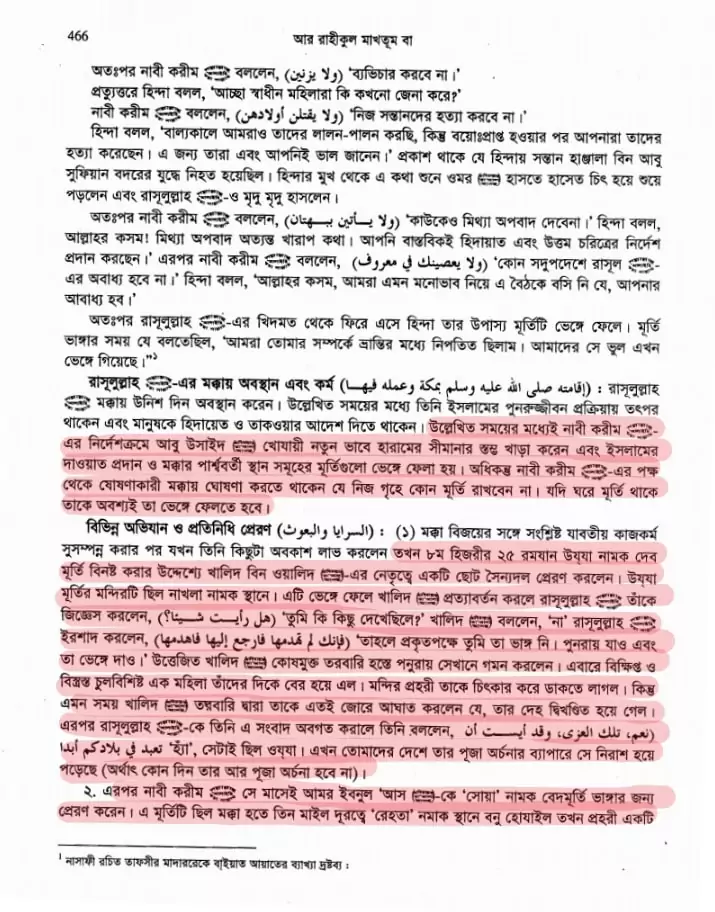
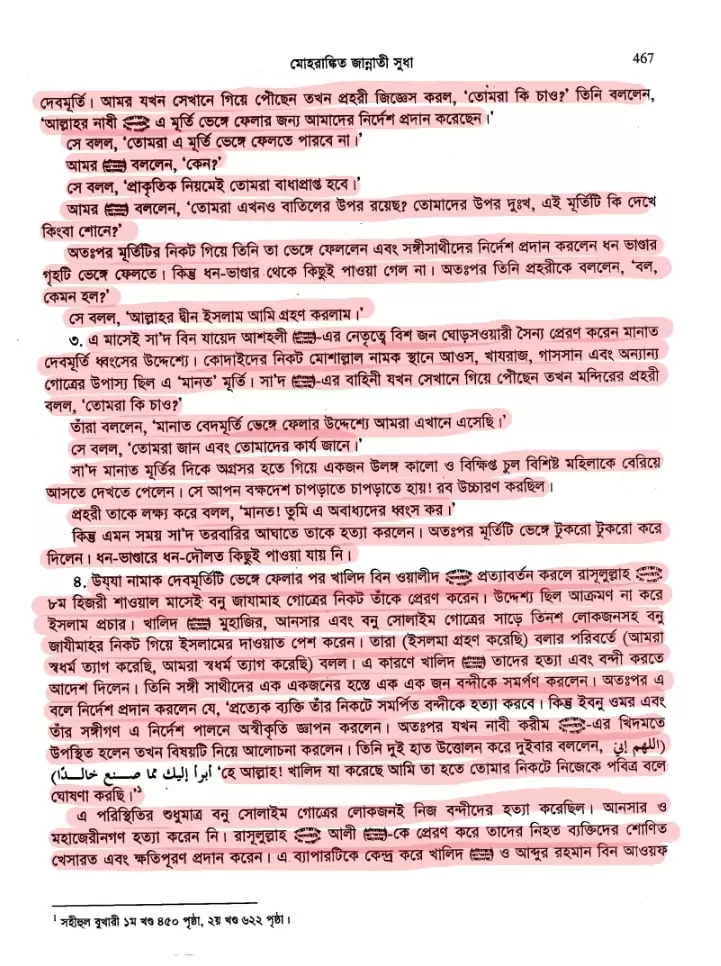
That is not all. Let us also examine the Prophet’s instructions to Ali and those who came afterward [32]:
Jami‘ al-Tirmidhi (Islamic Foundation edition)
10. Funeral Rites
Section: Leveling Graves
1049.Muhammad ibn Bashshar … narrated from Abu Wa’il:“Ali said to Abu Al-Hayyaj Al-Asadi: ‘I am dispatching you with what the Prophet dispatched me:That you not leave an elevated grave without leveling it, nor an image without erasing it.’”—Al-Ahkam, 207; Irwa’, 759; Tahdhir al-Sajid, 130; Muslim; al-Tirmidhi, hadith 1049 [Al-Madani Publications].
A report on this subject has also been narrated from Jabir. Imam Abu ‘Isa said that ‘Ali’s hadith is hasan. Some scholars acted upon it and regarded raising graves above ground level as objectionable. Imam al-Shafi‘i said: “I do not like a grave to be raised higher than is necessary to identify it as a grave. Some elevation is needed as a marker so that it will not be trampled upon or sat on.”
Hadith grade: Sahih (Darussalam); al-Tirmidhi’s assessment: Hasan.
Narrator: Abu Wa’il.
Now let us read further accounts of the destruction of idols and places of worship in Tafsir Ibn Kathir [33]:
Ibn Ishaq mentioned in his Sira that the Arabs had established several other sanctuaries alongside the Kaaba. They covered them with cloth, revered them like the Kaaba, sent sacrificial animals to them, slaughtered animals near them, and circumambulated them as they circumambulated the Kaaba. Nevertheless, they acknowledged the Kaaba’s superiority and rank and respected it as the mosque built by Abraham. Ibn Ishaq also said that Quraysh and Banu Kinana worshipped al-‘Uzza at Nakhla. Banu Shayban, a branch of the tribe of Sulaym, maintained it. After the conquest of Mecca, the Messenger of Allah sent Khalid ibn al-Walid to destroy this idol. As Khalid smashed it to pieces, he said: انی رایت اللَّهَ قَدَاهَائِكَ That is: “Al-‘Uzza, I do not glorify you; I reject you. I believe that Allah has humiliated you.”يا عزى كَفَرَأَنَّكَ سُبْحَانَكَ
Imam al-Nasa’i narrated … from Abu al-Tufayl, who said: After the conquest of Mecca, the Messenger sent Khalid ibn al-Walid to Nakhla to put an end to al-‘Uzza. The idol was established at three acacia trees. Khalid cut down the trees and leveled the building. He then returned and informed the noble Prophet. On hearing this, the Messenger said: “Go back, for you have not yet accomplished the real task.” Khalid therefore returned to Nakhla. When its guardians saw him, they raised cries of “O ‘Uzza! O ‘Uzza!” Coming closer, Khalid saw a naked woman with rough, disheveled hair throwing dust on her head. At once he cut her in two with a stroke of his sword. He returned and told the Messenger, who said: “That was al-‘Uzza.”
Ibn Ishaq said that the idol of Thaqif was called al-Lat and stood in Ta’if. Banu Mu‘attib maintained and guarded it. The Messenger of Allah sent al-Mughira ibn Shu‘ba and Abu Sufyan Sakhr ibn Harb to put an end to it. The two went to Ta’if, smashed the idol, leveled the site, and established a mosque there.
Manat was worshipped by Aws, Khazraj, and those who shared their beliefs. It stood by the sea at Qudayd, on the way to al-Mushallal. On the Messenger’s orders, Abu Sufyan smashed this idol to pieces as well. Some hold that ‘Ali destroyed the site. Dhu al-Khalasa was the sanctuary of Daws, Khath‘am, and Bajila. Ibn Kathir said that they called this sanctuary, situated at Tabala, the Yemeni Kaaba, while they called the Meccan Kaaba the Syrian Kaaba. On the Messenger’s orders, Jarir ibn ‘Abdullah al-Bajali destroyed it.
The idol shrine called al-Fuls belonged to the tribe of Tayy and neighboring Arabs. It stood in the mountains of Tayy, between Salma and Aja. Ibn Hisham said that ‘Ali ibn Abi Talib destroyed it on the Messenger’s orders and recovered two swords, Rasub and Mikhdham. The Messenger gave both swords to ‘Ali.
Ibn Ishaq said: The idol shrine called Ri’am, at Sana‘a, was a sanctuary of Himyar and the people of Yemen. It is said that a black dog was there. Two Himyari chiefs who came with Tubba‘ killed the dog and destroyed the shrine.
Ibn Ishaq said: Rida was the sanctuary of Banu Rabi‘a ibn Ka‘b ibn Sa‘d. Al-Mustawghir ibn Rabi‘a ibn Sa‘d destroyed it after embracing Islam. Ibn Hisham noted that this man lived for 330 years. 1
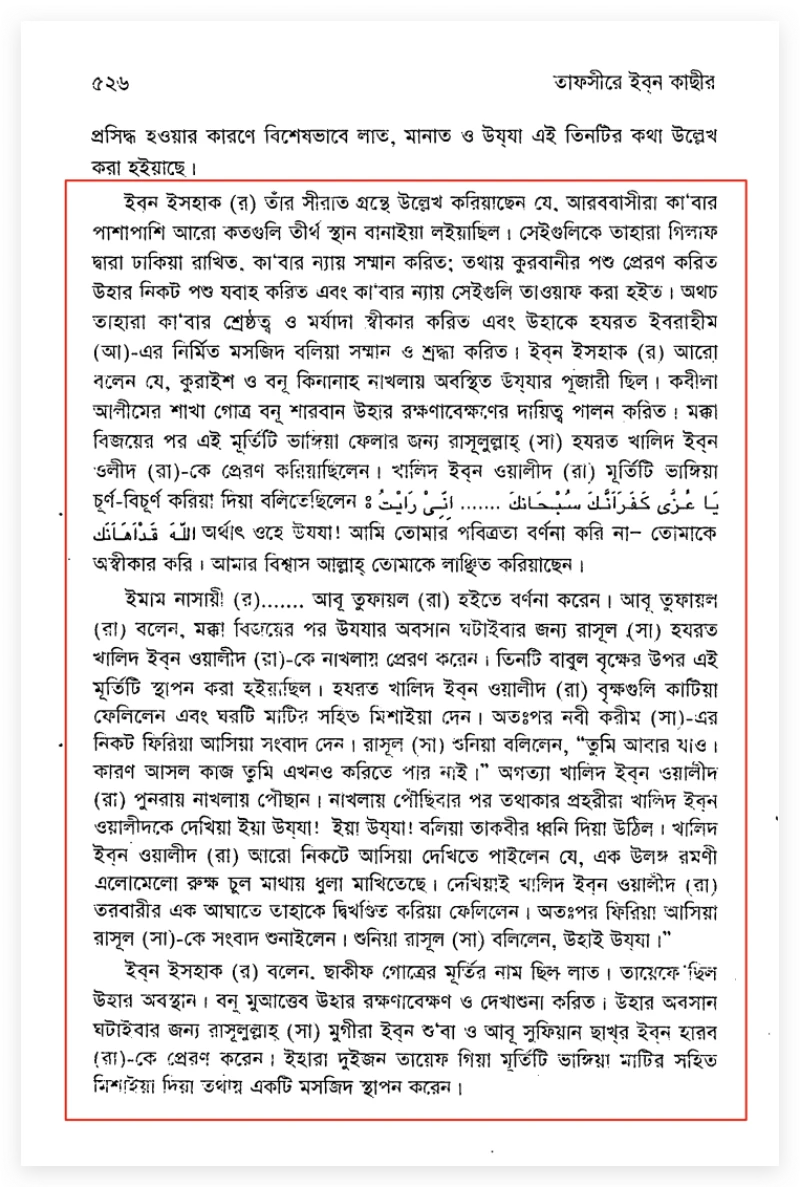
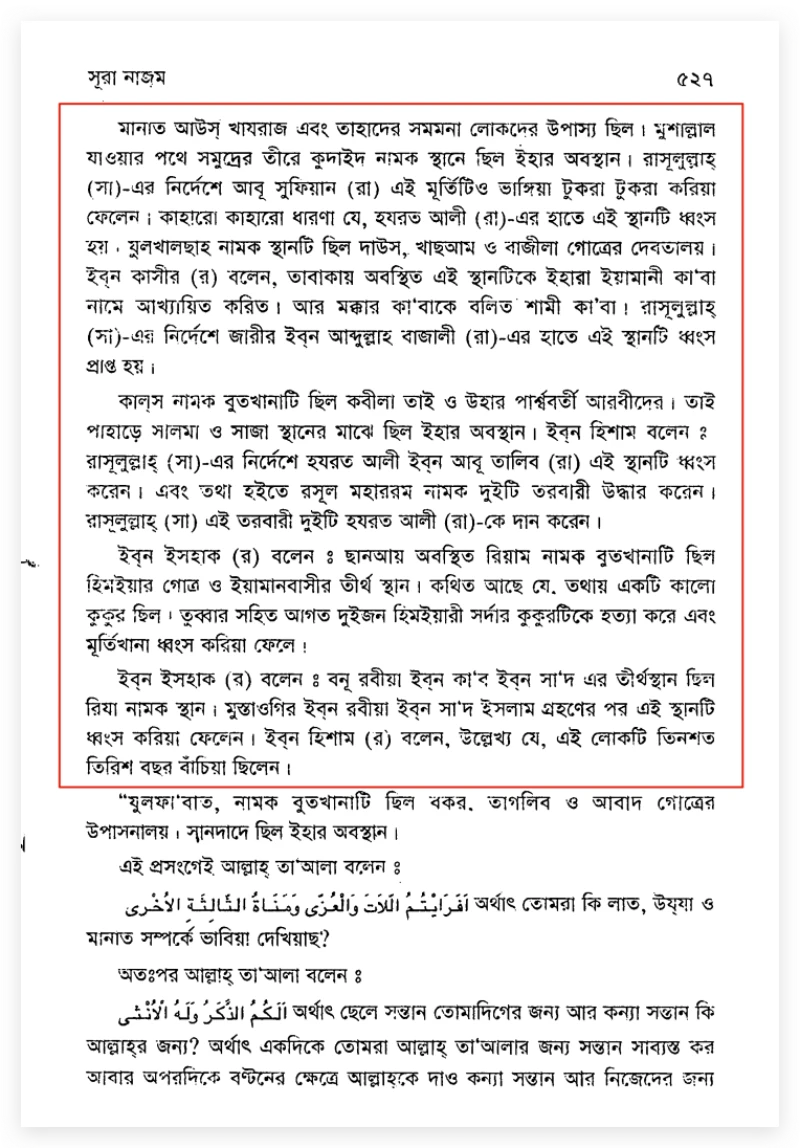
The Destruction of Idols and Places of Worship: Further Evidence
Even a Request to Delay al-Lat’s Destruction by One Month Was Rejected
During negotiations over their conversion to Islam, the delegation of Thaqif asked permission to keep al-Lat’s sanctuary intact for a while. They first requested three years, then progressively shorter periods, and finally just one month after returning home; even that was refused. The biographical account compiled by Ibn al-Qayyim also records their reasoning: sudden destruction might frighten their women, children, and other people. Muhammad rejected the request to postpone the destruction. The only concession was that they would not have to break the idol with their own hands [34].
وقد كان فيما سألوا رسول الله – صلى الله عليه وسلم – أن يدع لهم الطاغية ، وهي اللات لا يهدمها ثلاث سنين ، فأبى رسول الله – صلى الله عليه وسلم – عليهم ، فما برحوا يسألونه سنة سنة ويأبى عليهم ، حتى سألوه شهرا واحدا بعد قدومهم ، فأبى عليهم أن يدعها شيئا مسمى ، وإنما يريدون بذلك فيما يظهرون أن يسلموا بتركها من سفهائهم ونسائهم وذراريهم ، ويكرهون أن يروعوا قومهم بهدمها ، حتى يدخلهم الإسلام ، فأبى رسول الله – صلى الله عليه وسلم – إلا أن يبعث أبا سفيان بن حرب والمغيرة بن شعبة يهدمانها ، وقد كانوا يسألونه مع ترك الطاغية أن يعفيهم من الصلاة ، وأن لا يكسروا أوثانهم بأيديهم .
فقال رسول الله – صلى الله عليه وسلم – : ( أما كسر أوثانكم بأيديكم فسنعفيكم منه ، وأما الصلاة فلا خير في دين لا صلاة فيه ) .
Translation:
Among the things they requested from the Messenger of Allah was that he leave their taghiya—that is, al-Lat—in place for three years without destroying it. The Messenger rejected their request. They continued asking for a year at a time, and he continued refusing. Finally, they asked for only one month after returning home, but he refused to leave it for any specified period. Their stated purpose in asking that it remain was to keep themselves safe from their foolish people, women, and children. They were unwilling to frighten their people by destroying the idol before Islam had spread among them. The Messenger, however, would agree to nothing other than sending Abu Sufyan ibn Harb and al-Mughira ibn Shu‘ba to destroy it. Along with retaining the idol, they requested exemption from prayer and permission not to destroy it with their own hands.
The Messenger of Allah said: “We will exempt you from destroying your idols with your own hands. As for prayer, there is no good in a religion without prayer.”
The decision to destroy the idol was excluded from negotiation. The concession ultimately obtained did not protect al-Lat’s right to exist; it merely allowed others to carry out the destruction. Even the converts’ concerns about their own people’s reaction were insufficient to secure a month’s delay.
The Delegation of Talq ibn Ali: Demolishing a Church to Build a Mosque
In Talq ibn Ali’s report, a delegation arriving to embrace Islam mentions a church in its locality. Muhammad instructs them to demolish that church and turn the site into a mosque. The account preserves all three events: the instruction, its execution, and the departure of the Christian monk who was there [35].
عَنْ طَلْقِ بْنِ عَلِيٍّ قَالَ خَرَجْنَا وَفْدًا إِلَى النَّبِيِّ صلى الله عليه وسلم فَبَايَعْنَاهُ وَصَلَّيْنَا مَعَهُ وَأَخْبَرْنَاهُ أَنَّ بِأَرْضِنَا بِيعَةً لَنَا فَاسْتَوْهَبْنَاهُ مِنْ فَضْلِ طَهُورِهِ فَدَعَا بِمَاءٍ فَتَوَضَّأَ وَتَمَضْمَضَ ثُمَّ صَبَّهُ فِي إِدَاوَةٍ وَأَمَرَنَا فَقَالَ “ اخْرُجُوا فَإِذَا أَتَيْتُمْ أَرْضَكُمْ فَاكْسِرُوا بِيعَتَكُمْ وَانْضَحُوا مَكَانَهَا بِهَذَا الْمَاءِ وَاتَّخِذُوهَا مَسْجِدًا ” . قُلْنَا إِنَّ الْبَلَدَ بَعِيدٌ وَالْحَرَّ شَدِيدٌ وَالْمَاءَ يَنْشَفُ . فَقَالَ ” مُدُّوهُ مِنَ الْمَاءِ فَإِنَّهُ لاَ يَزِيدُهُ إِلاَّ طِيبًا ” . فَخَرَجْنَا حَتَّى قَدِمْنَا بَلَدَنَا فَكَسَرْنَا بِيعَتَنَا ثُمَّ نَضَحْنَا مَكَانَهَا وَاتَّخَذْنَاهَا مَسْجِدًا فَنَادَيْنَا فِيهِ بِالأَذَانِ . قَالَ وَالرَّاهِبُ رَجُلٌ مِنْ طَيِّئٍ فَلَمَّا سَمِعَ الأَذَانَ قَالَ دَعْوَةُ حَقٍّ . ثُمَّ اسْتَقْبَلَ تَلْعَةً مِنْ تِلاَعِنَا فَلَمْ نَرَهُ بَعْدُ .
Translation:
It was narrated that Talq bin ‘Ali said: “We went out as a delegation to the Prophet (ﷺ); we gave him our oath of allegiance and prayed with him. We told him that in our land there was a church that belonged to us. We asked him to give us the leftovers of his purification (Wudu’ water). So he called for water, performed Wudu’ and rinsed out his mouth, then he poured it into a vessel and said to us: ‘Leave, and when you return to your land, demolish your church, and sprinkle this water on that place, and take it as a Masjid.’ We said: ‘Our land is far away and it is very hot; the water will dry up.’ He said: ‘Add more water to it, for that will only make it better.’ So we left and when we came to our land we demolished our church, then we sprinkled the water on that place and took it as a Masjid, and we called the Adhan in it. The monk was a man from Tayy’, and when he heard the Adhan, he said: ‘It is a true call.’ Then he headed toward one of the hills and we never saw him again.”
The delegation that embraced Islam carried out the instruction to demolish its former place of worship. Establishing a mosque on the church’s site and calling the adhan there also changed the site’s religious identity.
Does Islam Permit Sculpture?
Recently, many moderate Muslims have claimed that, although Islam permits the destruction of worshipped idols, it places no restriction on making sculptures! Yet when Muhammad conquered Mecca, there was a wooden statue of a pigeon in the Kaaba. He broke it with his own hands. It was not an object of worship; it was merely decorative. In other words, once Islamic rule is established, all idols and sculptures must be destroyed [36].
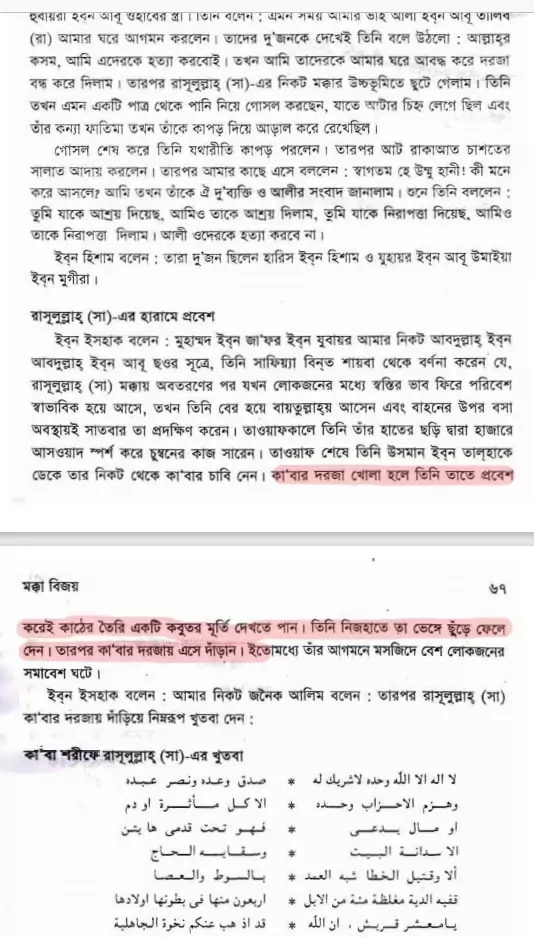
The Views of Prominent Scholars
The opinion of the most prominent Islamic scholars today is that, once Muslims gain power, all non-Muslims’ idols and temples must be destroyed. Islam’s leading scholars have reached this conclusion after studying the Quran and hadith. An explicit fatwa on the subject is reproduced here, taken from the well-known fatwa website Islamweb [37].
Demolishing idols in a non-Muslim country
Fatwa No: 190575
Fatwa Date:18-11-2012 – Muharram 5, 1434; Email | Print
Rating:
Question
Assalamu Alaikum, In the Quran, Allah says that Abraham destroyed the idols to teach the people that idols don’t have any power. In another place, Quran asks to follow the religion of Abraham. Is it required for a muslim living in a hindu country to destroy the idols. Will this not cause religious hatred and communal violence? Is it allowed to construct hindu temple in an islamic country?
Answer
All perfect praise be to Allaah, The Lord of the Worlds. I testify that there is none worthy of worship except Allaah, and that Muhammad sallallaahu `alayhi wa sallam ( may Allaah exalt his mention ) is His slave and Messenger.
There is Islamic evidence that it is an obligation to demolish idols and statues, among which is the Hadeeth narrated by ‘Amr ibn ‘Abasah may Allaah be pleased with him that he asked the Prophet sallallaahu `alayhi wa sallam ( may Allaah exalt his mention ): ”What did Allaah send you with?” He sallallaahu `alayhi wa sallam ( may Allaah exalt his mention ) said: “He sent me to keep ties with kinship and demolish idols, and that Allaah Alone should be worshipped without associating anything with Him.” (Muslim)
Also, Abu Al-Hayyaaj Al-Asadi may Allaah be pleased with him said: “ ‘Ali ibn Abi Taalib may Allaah be pleased with him said to me: “Shall I send you for a mission once the Prophet sallallaahu `alayhi wa sallam ( may Allaah exalt his mention ) had sent me for: Do not leave an idol unless it is destroyed, nor you leave an up leveled grave unless you level it down to ground.” (Muslim)
However, this is restricted to the ability of the Muslims in doing so and them being safe from causing a greater harm. Our best example is that of the Prophet sallallaahu `alayhi wa sallam ( may Allaah exalt his mention ) as he used to go to the House of Allaah and perform Tawaaf (circumambulation around the Ka‘bah) while there were 360 idols around it but he did not cause harm to any of them until after the conquest of Makkah and after the Muslims became strong and the polytheists were no longer ruling over Makkah; it was then that the Prophet sallallaahu `alayhi wa sallam ( may Allaah exalt his mention ) destroyed the idols. He sallallaahu `alayhi wa sallam ( may Allaah exalt his mention ) prodded the idols with a bow while saying: “The truth has come and falsehood has vanished.” The story is narrated in Saheeh Al-Bukhari and Saheeh Muslim.
The Prophet sallallaahu `alayhi wa sallam ( may Allaah exalt his mention ) used to take into consideration the prevailing circumstances and leave that which could lead to a greater evil despite the fact that it was permissible in principle. The evidence about this is the Hadeeth of ‘Aa’ishah may Allaah be pleased with her who said: “I asked the Prophet sallallaahu `alayhi wa sallam ( may Allaah exalt his mention ) about Al-Hijr (the area adjacent to the Ka’bah enclosed by a low semi-circular wall), is it from the House (of Allaah)? He sallallaahu `alayhi wa sallam ( may Allaah exalt his mention ) said: ’Yes.’ I said, ‘Why did they not include it in the House?’ He sallallaahu `alayhi wa sallam ( may Allaah exalt his mention ) said: ’Your people did not have enough resources to spend on it.’ I said: ’Why is the level of its door raised high?’ He sallallaahu `alayhi wa sallam ( may Allaah exalt his mention ) said: ’Your people did so, so that they would let whomever they want to enter it and prevent whomever they want from entering it. Your people are close to the Pre-Islamic Period of Ignorance; so I fear that they would reject if I included the Hijr in the House and make its door at a level with the ground.’ ” (Al-Bukhari and Muslim)
Besides, what the Prophet Ibraaheem (Abraham) may Allaah exalt his mention did does not contradict what we have stated, as he did not do that matter until he was capable of doing it and being secure from being harmed. Ibn ‘Aashoor may Allaah have mercy upon him said while interpreting the verse (which means): {And (I swear) by Allaah, I will surely plan against your idols after you have turned and gone away.} (Quran 21:57): “He conditioned that his plan (against their idols) be after they depart in order to indicate that he will inflict harm on the idols as soon as he will be able to do so. This proves his strong determination to change evil, because taking the initiative to change evil although it is by hand (physically), is a rank of strong determination, but he would not be able to do so in the presence of idolaters. So, if he were to try to demolish it in their presence, then his act will be in vain. What is meant from changing evil: is to remove it as much as possible, so removing it by hand can only be done with the existence of the ability to do so.”
Finally, it should be noted that it is not permissible for the Muslims to allow non-Muslims to establish one of their temples in a Muslim country, let alone the Muslim country establishing it itself. The conditions that ‘Umar may Allaah be pleased with him put on the non-Muslims living safely in a Muslim country under Muslim rule included: “….that we will not erect in our city any church….”
Allaah Knows best.
An interpretive translation of the preceding fatwa follows (translator: Koyes Ali):
Question:
Assalamu alaikum. In the Quran, Allah says that Abraham broke the idols to show people that idols have no power. Elsewhere the Quran commands people to follow Abraham’s religion.Is a Muslim living in a Hindu country therefore required to destroy idols? Would this not spread religious hatred and sectarian violence? Is establishing a Hindu temple in an Islamic country permissible?
Answer:
Among the evidence concerning Islam’s command to destroy idolsis the hadith of ‘Amr ibn ‘Abasa, who asked the Prophet what Allah had sent him with. He answered: “I have been sent to join ties of relationship (with kindness and affection),to break the Idols, and to proclaim the oneness of Allah (in a manner that) nothing is to be associated with Him.” (Muslim)
Also,Abu al-Hayyaj al-Asadi related that ‘Ali ibn Abi Talib said to him: “Should I not send you on the same mission as Allah’s Messenger (ﷺ) sent me? Do not leave an image without obliterating it, or a high grave without levelling It.” (Muslim)
However, this is restricted by Muslims’ ability to carry it out and their safety from causing a greater harm. The best example is the Prophet, who used to visit Allah’s House and circumambulate it while 360 idols stood around it. He did not harm them before the conquest of Mecca. When the Muslims became strong and the polytheists no longer ruled Mecca, he destroyed the idols, prodding them with a bow and saying: “Truth (Islam) has come and Falsehood (disbelief) has vanished.” The account is narrated in Sahih al-Bukhari and Sahih Muslim.
The Prophet took prevailing circumstances into account and refrained from actions that could lead to greater evil, even when they were permissible in principle. ‘A’isha’s hadith provides the evidence: “I asked the Prophet (ﷺ) whether the round wall (near Ka`ba) was part of the Ka`ba. The Prophet (ﷺ) replied in the affirmative. I further said, ‘What is wrong with them, why have they not included it in the building of the Ka`ba?’ He said, ‘Don’t you see that your people (Quraish) ran short of money (so they could not include it inside the building of Ka`ba)?’ I asked, ‘What about its gate? Why is it so high?’ He replied, ‘Your people did this so as to admit into it whomever they liked and prevent whomever they liked. Were your people not close to the Pre-Islamic Period of ignorance (i.e. they have recently embraced Islam) and were I not afraid that they would dislike it, surely I would have included the (area of the) wall inside the building of the Ka`ba and I would have lowered its gate to the level of the ground.’”
What Abraham did does not contradict our position, forhe acted only after he had the ability to do soand was safe from harm.Ibn ‘Ashur explained the verse: “˹Then he said to himself,˺ “By Allah! I will surely plot against your idols after you have turned your backs and gone away.””
He made it a condition thatthe plan against the idols be carried out after their departure, indicating that he would harm the idols as soon as he had the ability to do so.
This demonstrates his firm determination to change wrongdoing, since taking the initiative to change it by hand is a manifestation of strong resolve. But he could not do so in the idol worshippers’ presence; an attempt to demolish the idols in front of them would have been futile. Changing wrongdoing means removing it as far as possible, and removing it by hand requires the ability to do so.
Finally, Muslims may not allow non-Muslims to establish a temple in a Muslim country, much less allow the Muslim state itself to establish it. The conditions ‘Umar imposed upon non-Muslims living safely under Muslim rule included: “…we will not erect in our city any church…”
As readers will know, Muhammad Salih al-Munajjid is among today’s most prominent authorities on Islamic Sharia. He is a Saudi Salafi scholar known for founding IslamQA.info, which answers questions in accordance with the Salafi approach. His explanations are used as references in numerous places, including by Al Jazeera and the Saudi government. Let us first examine what his website says on this subject [38].
Obligation to destroy idols
Question
Is it obligatory to destroy statues in Islam, even if they are part of the legacy of human civilization? Why is it that when the Sahaabah conquered other lands and saw statues there they did not destroy them?.
Answer
Praise be to Allah.
The evidence of sharee’ah indicates that it is obligatory to destroy idols, for example:
1 – Muslim (969) narrated that Abu’l-Hayaaj al-Asadi said: ‘Ali ibn Abi Taalib said to me: “Shall I not send you with the same instructions as the Messenger of Allaah (peace and blessings of Allaah be upon him) sent me? ‘Do not leave any image without defacing it or any built-up grave without leveling it.’”
2 – Muslim (832) narrated from ‘Amr ibn ‘Abasah that he said to the Prophet (peace and blessings of Allaah be upon him): “With what were you sent?” He said, “I was sent to uphold the ties of kinship, to break the idols, and so that Allaah would be worshipped alone with no partner or associate.”
The obligation to destroy them is even stronger if they are worshipped instead of Allaah.
3 – al-Bukhaari (3020) and Muslim (2476) narrated that Jareer ibn ‘Abd-Allaah al-Bajali said: The Messenger of Allaah (peace and blessings of Allaah be upon him) said to me: “O Jareer, will you not relieve me of Dhu’l-Khalsah?” That was a house (in Yemen) belonging to the (tribe of) Khath’am, which was called Ka’bat al-Yamaaniyyah. I set out with one hundred and fifty horsemen. I used not to sit firm on horses and I mentioned that to the Messenger of Allaah (peace and blessings of Allaah be upon him). He struck me on my chest with his hand and said, ‘O Allaah! Make him firm and make him one who guides others and is guided on the right path.’ ” So Jareer went and burned it with fire, then Jareer sent a man called Abu Artaat to the Messenger of Allaah (peace and blessings of Allaah be upon him). He said, “I did not come to you until we had left it like a scabby camel.” Then the Messenger of Allaah (peace and blessings of Allaah be upon him) blessed the horses of (the tribe of) Ahmas and their men five times.
Al-Haafiz Ibn Hajar said:
This hadeeth indicates that it is prescribed to remove things that may tempt or confuse the people, whether they are buildings, people, animals or inanimate objects.
4 – The Prophet (peace and blessings of Allaah be upon him) sent Khaalid ibn al-Waleed (may Allaah be pleased with him) on a campaign to destroy al-‘Uzza.
5 – and he sent Sa’d ibn Zayd al-Ashhali (may Allaah be pleased with him) on a campaign to destroy Manaat.
6 – And he sent ‘Amr ibn al-‘Aas (may Allaah be pleased with him) on a campaign to destroy Suwaa’. All of that happened after the Conquest of Makkah.
Al-Bidaayah wa’l-Nihaayah, 4/712. 776. 5/83; al-Seerah al-Nabawiyyah by Dr. ‘Ali al-Salaabi, 2/1186.
Al-Nawawi said in Sharh Muslim when discussing the issue of image-making:
They were unanimously agreed that whatever casts a shadow is not allowed and must be changed.
Images that cast a shadow are three-dimensional images like these statues.
With regard to what is said about the Sahaabah (may Allaah be pleased with them) not destroying idols in the conquered lands, this is merely conjecture. The companions of the Prophet (peace and blessings of Allaah be upon him) would not have left idols and statues alone, especially since they were worshipped at that time.
If it is asked, how come the Sahaabah left alone the ancient idols of the Pharaohs and Phoenicians? The answer is that these idols fall into one of three categories:
1 – These idols may have been in remote places that the Sahaabah did not reach; when the Sahaabah conquered Egypt, for example, that does not mean that they reached every part of the land.
2 – These idols may not have been visible, rather they may have been inside Pharaonic buildings etc. The Prophet (peace and blessings of Allaah be upon him) told us to hasten when passing through the abodes of the wrongdoers and those who had been punished, and he forbade entering such places. In al-Saheehayn it is says: “Do not enter upon those who have been punished unless you are weeping, lest there befall you something like that which befall them.” He (peace and blessings of Allaah be upon him) said that when he passed by ashaab al-hijr (the dwellers of the rocky tract – see al-Hijr 15:80), in the land of Thamood, the people of Saalih (peace be upon him).
According to another report narrated in al-Saheehayn, “If you are not weeping, then do not enter upon them, lest there befall you something like that which befall them.”
What we think is that if the companions of the Prophet (peace and blessings of Allaah be upon him) saw a temple or building belonging of these people, they did not enter it or even look at what was inside it.
This will dispel any confusion about why the Sahaabah did not see the Pyramids or what is inside them. There is also the possibility that their doors and entrances were covered with sand at that time.
3 – Many of these idols that are visible nowadays were covered and hidden, and have only been discovered recently, or they have been brought from remote places that the companions of the Prophet (peace and blessings of Allaah be upon him) did not reach.
Al-Zarkali was asked about the Pyramids and the Sphinx etc: Did the Sahaabah who entered Egypt see them?
He said: They were mostly covered with sand, especially the Sphinx.
Shibh Jazeerat al-‘Arab, 4/1188
Then even if we assume that there was a statue that was visible and not hidden, then we still have to prove that the Sahaabah saw it and were able to destroy it.
The fact of the matter is that the Sahaabah (may Allaah be pleased with them) would not have been able to destroy some of these statues. It took twenty days to destroy some of these statues even with tools, equipment, and explosives etc that were not available to the Sahaabah at all.
This is indicated by what Ibn Khuldoon said in al-Muqaddimah (p. 383), that the caliph al-Rasheed was unable to destroy the estrade of Chosroes. He started to do that, and he gathered men and tools, and burned it with fire, and poured vinegar on it, but he was unable to do it. And the caliph al-Ma’moon wanted to destroy the Pyramids in Egypt and he gathered workers but he could not do it.
With regard to the excuse that these statues are part of the legacy of mankind, no attention should be paid to such words. Al-Laat, al-‘Uzaa, Hubal, Manaat and other idols were also a legacy for those who worshipped them among Quraysh and the Arabs.
This is a legacy, but it is a haraam legacy which should be uprooted. When the command comes from Allaah and His Messenger, then the believer must hasten to obey, and the command of Allaah and His Messenger cannot be rejected on the grounds of this flimsy excuse. Allaah says (interpretation of the meaning):
“The only saying of the faithful believers, when they are called to Allaah (His Words, the Qur’aan) and His Messenger, to judge between them, is that they say: “We hear and we obey.” And such are the successful (who will live forever in Paradise)”
(al-Noor 24:51)
We ask Allaah to help the Muslims to do that which He loves and which pleased Him.
And Allaah knows best.
The website also provides a Bengali translation [39].
The Obligation to Destroy Idols
Question
Is destroying statues obligatory in Islam, even if they form part of humanity’s cultural and civilizational heritage? Why did the Companions not destroy the statues they saw in the territories they conquered?
Answer
Praise be to Allah.
The evidence of shariaestablishes the obligation to destroy idols.Such evidence includes:
1. Abu al-Hayyaj al-Asadi related that ‘Ali ibn Abi Talib said to him: “Should I not send you on the same mission as Allah’s Messenger (ﷺ) sent me?Do not leave an image without obliterating it,or a high grave without levelling It.” (Sahih Muslim, 969)
2. ‘Amr ibn ‘Abasa asked the Prophet: “What is that which you have been sent with?” He said: “I have been sent to join ties of relationship (with kindness and affection),to break the Idols,and to proclaim the oneness of Allah(in a manner that) nothing is to be associated with Him.” (Sahih Muslim, 832)
The obligation to destroy idols is even stronger when they are worshipped instead of Allah.
3. Jarir ibn ‘Abdullah al-Bajali related that the Messenger of Allah said to him: “O Jareer, will you not relieve me of Dhu’l-Khalsah?” This was a house belonging to Khath‘am, called the Yemeni Kaaba. He said: “I set out with one hundred and fifty horsemen. I used not to sit firm on horses and I mentioned that to the Messenger of Allah. He struck me on my chest with his hand and said:اللهم ثبته واجعله هاديا مهديا (‘O Allaah! Make him firm and make him one who guides others and is guided on the right path.’” The narrator said that Jarir went and burned it with fire. He then sent a man from among them, whose kunya was Abu Arta’, to bring the Messenger good news. The man came and said:“I did not come to you until we had left it like a scabby camel.”The Messenger then blessed the horses of Ahmas and their men five times. (Sahih al-Bukhari, 3020; Sahih Muslim, 2476)
Ibn Hajar said:
“This hadeeth indicates that it is prescribed to remove things that may tempt or confuse the people, whether they are buildings, people, animals or inanimate objects.”
4. The Prophet sent an expedition under Khalid ibn al-Walid to destroy the idol al-‘Uzza.
5. He sent an expedition under Sa‘d ibn Zayd al-Ashhali to destroy the idol Manat.
6. He sent an expedition under ‘Amr ibn al-‘As to destroy the idol Suwa‘. All these expeditions took place after the conquest of Mecca.
(Al-Bidaya wa al-Nihaya, 4/712, 776, 5/83; Al-Sira al-Nabawiyya by Dr. ‘Ali al-Sallabi, 2/1186)
Discussing image-making in Sharh Muslim, Imam al-Nawawiتصوير (said: “They were unanimously agreed that whatever casts a shadow is not allowed and must be changed.”
Images that cast a shadow are three-dimensional figures, like these statues.
The claim that the Companions did not destroy idols in conquered territories is merely unfounded conjecture. The Prophet’s Companions would not have left idols and statues intact, particularly when they were worshipped at the time.
If it is asked how the conquering Companions could have left the statues of the Pharaohs, Phoenicians, and others,
the answer is that there are three possibilities:
First, the statues may have stood in remote places the Companions did not reach. Their conquest of Egypt, for example, does not mean that they reached every part of it.
Second, the statues may not have been visible but instead stood inside Pharaonic or other buildings. The Prophet’s practice was to pass quickly through the dwellings of wrongdoers and those who had been punished; entering such places was prohibited. Sahih al-Bukhari and Sahih Muslim report: “Do not enter the ruined dwellings of those who were unjust to themselves unless (you enter) weeping, lest you should suffer the same punishment as was inflicted upon them.” The Prophet said this when passing al-Hijr, the dwelling place of Thamud, the people of Salih.
Another narration in Sahih al-Bukhari and Sahih Muslim states: “Do not enter (the dwelling places) of these people unless you enter weeping, but if you weep not, then do not enter upon them, lest you be afflicted with what they were afflicted with.”
What we should assume concerning the Companions is that, even if they saw these people’s temples or houses, they neither entered them nor saw their contents.
This answers the objection concerning the Companions’ failure to destroy the Pyramids and their contents. It is also possible that their entrances were covered by accumulated sand at the time.
Third, the statues visible today may then have been covered by sand and concealed, may have been discovered only recently, or may have been brought from remote places the Companions never reached.
The historian al-Zirikli was asked whether the Companions who entered Egypt had seen the Pyramids, the Sphinx, and similar monuments. He answered: “They were mostly covered with sand, especially the Sphinx.” (Shibh Jazirat al-‘Arab, 4/1188)
Even if we assume that a statue was visible and not covered by sand, it must still be established that the Companions saw it and were capable of destroying it.
The fact is that the Companions were unable to destroy some of these statues. Some took twenty days to demolish even with machinery, equipment, explosives, and manpower that were unavailable to the Companions.
Evidence of their inability is what Ibn Khaldun mentioned in Al-Muqaddima, p. 383: the caliph al-Rashid once decided to destroy the palace of the Persian king. He began demolition, gathered men and tools, heated the structure with fire, and poured vinegar over it, but ultimately failed. The caliph al-Ma’mun likewise gathered workers to destroy the Egyptian Pyramids, but was unable to do so.
The excuse that these statues form part of humanity’s heritage deserves no consideration. Al-Lat, al-‘Uzza, Hubal, Manat, and the other idols were also a heritage for the people of Quraysh and the Arabian Peninsula who worshipped them.
It is indeed a heritage, but a forbidden heritage whose destruction is obligatory.When Allah and His Messenger issue a command, a believer hastens to obey it rather than rejecting it on the basis of these flimsy arguments.Allah says: “The only response of the ˹true˺ believers, when they are called to Allah and His Messenger so he may judge between them, is to say, “We hear and obey.” It is they who will ˹truly˺ succeed.” (Surah An-Nur, 24:51; Dr. Mustafa Khattab, The Clear Quran)
We ask Allah to enable all Muslims to do what He loves and approves.
Allah knows best.
In this context, it is relevant to read an answer from IslamQA.info, a website run by prominent Salafi scholars [40].
The Ruling on Greeting Non-Muslims on Their Festivals
Question
What is the ruling on greeting non-Muslims on the occasion of their festivals?
Answer
Praise be to Allah.
Greeting unbelievers at Christmas or on other non-Muslim religious festivals is forbidden by scholarly consensus.Ibn al-Qayyim mentioned this ruling in Ahkam Ahl al-Dhimma, saying: “Congratulating the non-Muslims on the rituals that belong only to them is prohibited by consensus, as is congratulating them on their festivals and fasts by saying ‘A happy festival to you’ or ‘May you enjoy your festival,’ and so on. If the one who says this has been saved from [falling into] disbelief, it is still forbidden. It is like congratulating someone for prostrating to the cross, or even worse than that. It is as great a sin as congratulating someone for drinking wine, or murdering someone, or having illicit sexual relations, and so on. Many of those who have no respect for their religion fall into this error; they do not realise the offensiveness of their actions. Whoever congratulates a person for his disobedience or bid‘ah or disbelief exposes himself to the wrath and anger of Allah.”
Greeting unbelievers on their festivals is forbidden and so grave a sin, as Ibn al-Qayyim describes, because it implies acceptance of their rituals of disbelief and approval of the disbelief practiced by another person, even if one would not accept those things for oneself. A Muslim must not approve of such rituals or congratulate anyone for them, because Allah does not approve of disbelief. He says: “If you disbelieve, then ˹know that˺ Allah is truly not in need of you, nor does He approve of disbelief from His servants. But if you become grateful ˹through faith˺, He will appreciate that from you.” (Surah Az-Zumar, 39:7). Allah also says: “Today I have perfected your faith for you, completed My favour upon you, and chosen Islam as your way.” (Surah Al-Ma’idah, 5:3). Greeting non-Muslims on such festivals is therefore forbidden, whether they are colleagues or anyone else.
If non-Muslims greet us on the occasion of their festivals, we must not respond, because these are not our festivals and Allah does not approve of them. Whether they are unauthorized innovations in the relevant religion or were once prescribed, they have all been abrogated by Islam, the religion with which Allah sent Muhammad to all humanity. Allah says: “Whoever seeks a way other than Islam, it will never be accepted from them, and in the Hereafter they will be among the losers.” (Surah Ali ‘Imran, 3:85; Quran quotations: Dr. Mustafa Khattab, The Clear Quran).
It is forbidden for a Muslim to accept an invitation to such a festival. This is worse than offering greetings, because it involves participating with them in the celebration.
Similarly, holding celebrations like the unbelievers on these occasions, exchanging gifts, distributing sweets, exchanging food, taking time off work, and so forthare forbidden for Muslims.The Prophet said: “He who copies any people is one of them.” Shaykh al-Islam Ibn Taymiyya said in Iqtida’ al-Sirat al-Mustaqim: “Imitating them in some of their festivals implies that one is pleased with their false beliefs and practices, and gives them the hope that they may have the opportunity to humiliate and mislead the weak [Muslims].”End of quotation.
Anyone who participates in any such activities commits a sin, whether out of courtesy, friendliness, embarrassment, or any other reason, because this amounts to compromise in Allah’s religion and strengthens non-Muslims’ morale and pride in their religion.
We ask Allah to strengthen Muslims in their religion, keep them steadfast upon it, and grant them victory over their enemies. He is indeed the Strong and Almighty. (Majmu‘ Fatawa wa Rasa’il al-Shaykh Ibn ‘Uthaymin, 3/369)
Source: Shaykh Muhammad Salih al-Munajjid.
The book A Review of Shirk, Bid‘a, and Superstitions Prevalent in Bangladesh, written by Md. Abdul Qader and published under the editorship of the renowned Bangladeshi scholar and authority on Islamic jurisprudence Dr. Abu Bakr Muhammad Zakaria, clearly states that shirk is an offense punishable by death. The blood of those who commit shirk is lawful for Muslims to shed [41].
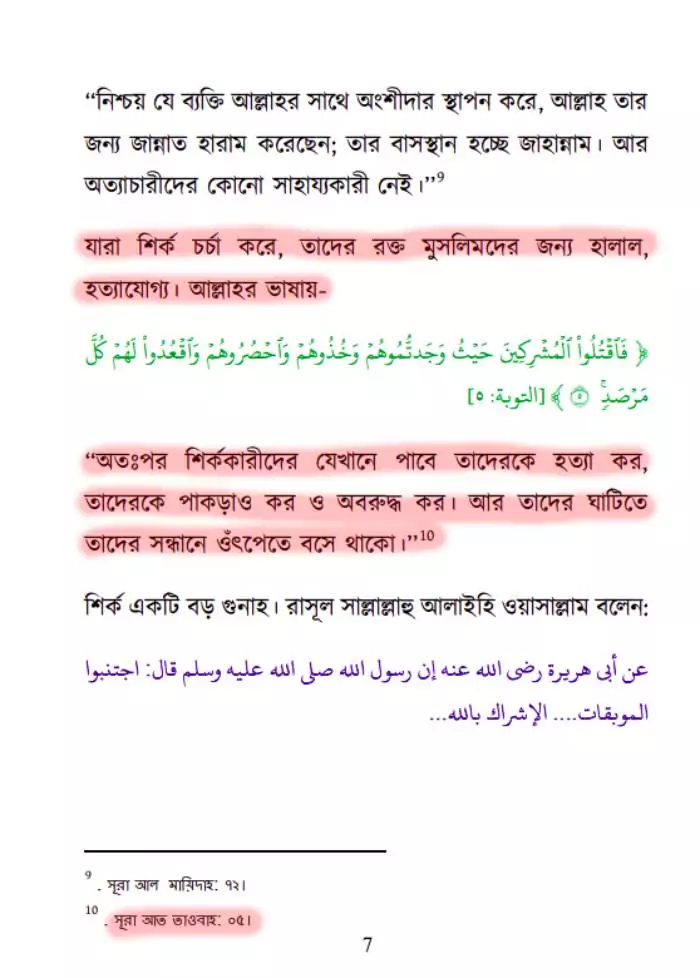
Statements of the Companions, Successors, and Scholars: A Compilation
Military expeditions to destroy idols, prohibitions on making images of living beings, the use of cloth bearing images, and the distribution of conquered property are addressed in distinct statements within Islamic sources. The Companions’ accounts record the Prophet’s instructions and their own actions; the Successors’ reports discuss rules for images according to their use; later jurists derive general rules from these materials.
| Person | Identity | Subject | Summary of Statement or Action | Evidence in Context |
|---|---|---|---|---|
| ‘Ali ibn Abi Talib | Companion | Images and Elevated Graves | Delegated to another person the Prophet’s mission of obliterating images and leveling elevated graves. | Original Report and Translation |
| Jarir ibn ‘Abdullah | Companion | The Expedition against Dhu al-Khalasa | His own account of destroying Dhu al-Khalasa with 150 cavalrymen and killing the people found there. | Original Report and Translation |
| ‘Abdullah ibn ‘Abbas | Companion | The Occupation of an Image-Maker | Related a warning of Hell for image-makers; advised drawing trees and inanimate objects if the occupation was continued. | Original Report and Translation |
| Talq ibn ‘Ali | Companion | From Church to Mosque | An account of carrying out the order to demolish the church in their locality and build a mosque. | Original Report and Translation |
| ‘Ata’ ibn Abi Rabah | Successor | Images Laid Out and Images Set Up | No objection to images laid out or trodden upon; disliked images set up for display. | Original Report and Translation |
| Muhammad ibn Shihab al-Zuhri | Successor | Images Set Up and Laid Out | Disliked both images set up for display and images laid out. | Original Report and Translation |
| ‘Ikrima | Successor | The Head of an Image | No objection to an image once its head has been cut off. | Original Report and Translation |
| Malik ibn Anas | Follower of the Successors | Structures, Cloth, and Rings Bearing Images | Objected to displayed images and rings bearing images; a separate ruling applied to bedding and pillows subjected to degrading use. | Original Report and Translation |
| Sufyan al-Thawri | Follower of the Successors | Images on Pillows | No objection to images on pillows because they are trodden upon and sat on—a statement quoted by al-‘Ayni. | Original Report and Translation |
| Shams al-A’imma al-Sarakhsi | Later Hanafi Jurist | Crosses and Idols Taken as War Booty | Gold and silver crosses and idols are to be broken down into metal; an exception applies to coins bearing images used in transactions. | Original Report and Translation |
| Yahya al-Nawawi | Later Shafi‘i Jurist | Making and Using Images of Living Creatures | Making them is strictly forbidden; their use is distinguished according to whether images are hung up or appear on cloth that is trodden upon. | Original Report and Translation |
| Ibn al-Qayyim | Later Hanbali Scholar | Places of Worship, Structures around Graves, and Funds | Once capable, one may not leave a site of polytheism standing for even one day; its funds are to be spent on soldiers and Muslim interests. | Original Report and Translation |
| Ibn Hajar al-‘Asqalani | Later Shafi‘i Scholar | Commentary on the Hadith of Dhu al-Khalasa | The lesson of removing structures or objects that lead people into temptation and of inflicting severe harm upon the enemy. | Original Report and Translation |
‘Ali: The Mission to Obliterate Images and Level Elevated Graves
‘Ali ibn Abi Talib sent Abu al-Hayyaj al-Asadi on the same mission on which Muhammad had sent him. In this account of a Companion subsequently putting the Prophet’s command into effect again, obliterating images and leveling elevated graves appear as two tasks within the same mission. [42]
حَدَّثَنَا يَحْيَى بْنُ يَحْيَى وَأَبُو بَكْرِ بْنُ أَبِي شَيْبَةَ وَزُهَيْرُ بْنُ حَرْبٍ قَالَ يَحْيَى أَخْبَرَنَا وَقَالَ الآخَرَانِ حَدَّثَنَا وَكِيعٌ عَنْ سُفْيَانَ عَنْ حَبِيبِ بْنِ أَبِي ثَابِتٍ عَنْ أَبِي وَائِلٍ عَنْ أَبِي الْهَيَّاجِ الأَسَدِيِّ قَالَ قَالَ لِي عَلِيُّ بْنُ أَبِي طَالِبٍ أَلاَّ أَبْعَثُكَ عَلَى مَا بَعَثَنِي عَلَيْهِ رَسُولُ اللَّهِ صلى الله عليه وسلم أَنْ لاَ تَدَعَ تِمْثَالاً إِلاَّ طَمَسْتَهُ وَلاَ قَبْرًا مُشْرِفًا إِلاَّ سَوَّيْتَهُ .
Translation:
Yahya ibn Yahya, Abu Bakr ibn Abi Shayba, and Zuhayr ibn Harb narrated to us. Yahya said “informed us,” while the other two said “narrated to us”: Waki‘, from Sufyan, from Habib ibn Abi Thabit, from Abu Wa’il, from Abu al-Hayyaj al-Asadi. Abu’l-Hayyaj al-Asadi told that ‘Ali (b. Abu Talib) said to him: Should I not send you on the same mission as Allah’s Messenger (ﷺ) sent me? Do not leave an image without obliterating it, or a high grave without levelling It.
Jarir: An Account of Direct Participation in an Expedition of Destruction and Killing
In the account of the destruction of Dhu al-Khalasa, Jarir ibn ‘Abdullah describes his own expedition. Alongside destroying the idol or sanctuary, he mentions killing those found there. The account also describes the expedition’s return to inform Muhammad and his invocation of blessings upon its participants. [43]
وَعَنْ قَيْسٍ، عَنْ جَرِيرِ بْنِ عَبْدِ اللَّهِ ـ رضى الله عنه ـ قَالَ كَانَ فِي الْجَاهِلِيَّةِ بَيْتٌ يُقَالُ لَهُ ذُو الْخَلَصَةِ، وَكَانَ يُقَالُ لَهُ الْكَعْبَةُ الْيَمَانِيَةُ، أَوِ الْكَعْبَةُ الشَّأْمِيَةُ، فَقَالَ لِي رَسُولُ اللَّهِ صلى الله عليه وسلم ” هَلْ أَنْتَ مُرِيحِي مِنْ ذِي الْخَلَصَةِ ”. قَالَ فَنَفَرْتُ إِلَيْهِ فِي خَمْسِينَ وَمِائَةِ فَارِسٍ مِنْ أَحْمَسَ ـ قَالَ ـ فَكَسَرْنَا وَقَتَلْنَا مَنْ وَجَدْنَا عِنْدَهُ، فَأَتَيْنَاهُ فَأَخْبَرْنَاهُ فَدَعَا لَنَا وَلأَحْمَسَ.
Translation:
Qays narrated from Jarir ibn ‘Abdullah: Jarir bin ‘Abdullah narrated: There was a house called Dhul-Khalasa in the Pre-lslamic Period and it was also called Al-Ka’ba Al-Yamaniya or Al-Ka’ba Ash-Shamiya. Allah’s Messenger (ﷺ) said to me, “Will you relieve me from Dhul-Khalasa?” So I left for it with 150 cavalrymen from the tribe of Ahmas and then we destroyed it and killed whoever we found there. Then we came to the Prophet (ﷺ) and informed him about it. He invoked good upon us and upon the tribe of Ahmas.
Ibn ‘Abbas: The Image-Maker’s Livelihood and Advice to Depict Inanimate Subjects
When an image-maker came to ask about the ruling on his occupation, Ibn ‘Abbas called him closer, placed a hand on his head, and related the Prophet’s warning. He then advised him to depict trees and inanimate subjects if he had to continue the work. The warning of Hell is the Prophet’s statement as narrated by Ibn ‘Abbas; the advice to draw trees is Ibn ‘Abbas’s own practical instruction. [44]
قَالَ مُسْلِمٌ قَرَأْتُ عَلَى نَصْرِ بْنِ عَلِيٍّ الْجَهْضَمِيِّ عَنْ عَبْدِ الأَعْلَى بْنِ عَبْدِ الأَعْلَى حَدَّثَنَا يَحْيَى بْنُ أَبِي إِسْحَاقَ عَنْ سَعِيدِ بْنِ أَبِي الْحَسَنِ قَالَ جَاءَ رَجُلٌ إِلَى ابْنِ عَبَّاسٍ فَقَالَ إِنِّي رَجُلٌ أُصَوِّرُ هَذِهِ الصُّوَرَ فَأَفْتِنِي فِيهَا . فَقَالَ لَهُ ادْنُ مِنِّي . فَدَنَا مِنْهُ ثُمَّ قَالَ ادْنُ مِنِّي . فَدَنَا حَتَّى وَضَعَ يَدَهُ عَلَى رَأْسِهِ قَالَ أُنَبِّئُكَ بِمَا سَمِعْتُ مِنْ رَسُولِ اللَّهِ صلى الله عليه وسلم سَمِعْتُ رَسُولَ اللَّهِ صلى الله عليه وسلم يَقُولُ ” كُلُّ مُصَوِّرٍ فِي النَّارِ يَجْعَلُ لَهُ بِكُلِّ صُورَةٍ صَوَّرَهَا نَفْسًا فَتُعَذِّبُهُ فِي جَهَنَّمَ ” . وَقَالَ إِنْ كُنْتَ لاَ بُدَّ فَاعِلاً فَاصْنَعِ الشَّجَرَ وَمَا لاَ نَفْسَ لَهُ . فَأَقَرَّ بِهِ نَصْرُ بْنُ عَلِيٍّ .
Translation:
Muslim said: I read to Nasr ibn ‘Ali al-Jahdami, from ‘Abd al-A‘la ibn ‘Abd al-A‘la, who said: Yahya ibn Abi Ishaq narrated to us from Sa‘id ibn Abi al-Hasan, that a person came to Ibn ‘Abbas and said: I am the person who paints pictures; give me a religious verdict about them. He (Ibn ‘Abbas) said to him: Come near me. He came nearer, and he again said: Come near me (still further). He came near him so much so that he placed his hand upon his head and said: I am going to narrate to you what I heard from Allah’s Messenger (ﷺ). I heard him say: All the painters who make pictures would be in the fire of Hell. The soul will be breathed in every picture prepared by him and it shall punish him in the Hell, and he (Ibn ‘Abbas) said: If you have to do it at all, then paint the pictures of trees and lifeless things; and Nasr b. ‘Ali confirmed it.
‘Ata’, al-Zuhri, and ‘Ikrima: The Position of Images and the Removal of Their Heads
In Ibn Abi Shayba’s Musannaf, three consecutive reports in the discussion of objects bearing images preserve the views of ‘Ata’, al-Zuhri, and ‘Ikrima. ‘Ata’ distinguished images trodden upon or laid out from images set up for display; al-Zuhri disliked both kinds; ‘Ikrima said there was no objection once the head was cut off. [45]
(12) حدثنا أبو بكر قال حدثنا عبد الرحيم بن سليمان عن عبد الملك عن عطاء في التماثيل ، ما كان مبسوطا يوطأ ويبسط فلا بأس به ، وما كان ينصب فإني أكرهه .
(13) حدثنا أبو بكر قال حدثنا عبد الأعلى عن معمر عن الزهري أنه كان يكره التصاوير ما نصب منها وما بسط .
(14) حدثنا أبو بكر قال حدثنا ابن علية عن أيوب عن عكرمة قال : إنما الصورة الرأس ، فإذا قطع فلا بأس .
Translation:
(12) Abu Bakr narrated to us, saying: ‘Abd al-Rahim ibn Sulayman narrated to us, from ‘Abd al-Malik, from ‘Ata’. Concerning images, ‘Ata’ said: “There is no objection to what is spread out, trodden upon, and used as a covering. What is set up for display, however, I dislike.”
(13) Abu Bakr narrated to us, saying: ‘Abd al-A‘la narrated to us, from Ma‘mar, from al-Zuhri: al-Zuhri disliked both images set up for display and images laid out.
(14) Abu Bakr narrated to us, saying: Ibn ‘Ulayya narrated to us, from Ayyub, from ‘Ikrima. ‘Ikrima said: “The essential part of an image is its head; once that is cut off, there is no objection.”
Malik: Displayed Images, Cloth in Use, and Rings Bearing Images
In Al-Mudawwana, Malik’s statements transmitted through Ibn al-Qasim give importance to the position and use of images. Images on beds, domes, and similar places are disliked; objects subjected to degrading use, such as bedding and pillows, are discussed separately. He also prohibits wearing a ring bearing an image and praying while wearing it. [46]
قلت : أكان مالك يكره أن يصلي الرجل إلى قبلة فيها تماثيل ؟ قال : كره الكنائس لموضع التماثيل فهذا عنده لا شك أشد من ذلك .
قال ابن القاسم : وسألت مالكا عن التماثيل وتكون في الأسرة والقباب والمنار وما أشبهها ؟
قال : هذا مكروه وقال لأن هذه خلقت خلقا ، قال : وما كان من الثياب والبسط والوسائد فإن هذا يمتهن ، قال : وقد كان أبو سلمة بن عبد الرحمن يقول ما كان يمتهن فلا بأس به وأرجو أن يكون خفيفا ومن تركه غير محرم له فهو أحب إلي .
قال : وسألنا مالكا عن الخاتم يكون فيه التماثيل أيلبس ويصلى به ؟
قال : لا يلبس ولا يصلى به .
Translation:
I asked: “Did Malik dislike praying toward images when they were in the direction of the qibla?” He answered: “He disliked churches because of the presence of images, so this was undoubtedly even more serious in his view.”
Ibn al-Qasim said: “I asked Malik about images on beds, domes, minarets, and similar places.
He answered: ‘This is objectionable because these have been made in imitation of creation.’ He said: ‘As for cloth, bedding, and pillows, these are subjected to degrading use.’ He also said: ‘Abu Salama ibn ‘Abd al-Rahman used to say that there is no objection to what is subjected to degrading use. I hope that the matter is less serious; but abstaining from it without declaring it forbidden is preferable to me.’”
He said: “We asked Malik about a ring bearing an image: could it be worn, and could one pray while wearing it?
He answered: ‘It should neither be worn nor worn during prayer.’”
Sufyan al-Thawri: Images on Pillows versus Hanging Images
While compiling the opinions of different jurists, Badr al-Din al-‘Ayni quoted Sufyan al-Thawri’s statement that there is no objection to images on pillows because they are trodden upon and sat on. The same passage discusses the prohibition of images on hanging cloth and curtains and the allowance for images on objects spread out for use. Sufyan’s statement is quoted through al-‘Ayni’s later compilation. [47]
وخالف الآخرون هؤلاء المذكورين ، وهم النخعي ، والثوري ، وأبو حنيفة ، ومالك ، والشافعي ، وأحمد في رواية ، وقالوا : إذا كانت الصور على البسط والفرش التي توطأ بالأقدام ، فلا بأس بها ، وأما إذا كانت على الثياب والستائر ونحوها فإنها تحرم ، وقال أبو عمر : ذكر ابن القاسم قال : كان مالك يكره التماثيل في الأسرة والقباب ، وأما البسط والوسائد والثياب ، فلا بأس به وكره أن يصلي إلى قبة فيها تماثيل ، وقال الثوري : لا بأس بالصور في الوسائد ؛ لأنها توطأ ويجلس عليها ، وكان أبو حنيفة وأصحابه يكرهون التصاوير في البيوت بتمثال ، ولا يكرهون ذلك فيما يبسط ، ولم يختلفوا أن التصاوير في الستور المعلقة مكروهة ، وكذلك عندهم ما كان خرطا أو نقشا في البناء .
Translation:
Others disagreed with the aforementioned people. They included al-Nakha‘i, al-Thawri, Abu Hanifa, Malik, al-Shafi‘i, and, according to one report, Ahmad. They said: if the images are on bedding or furnishings that are trodden upon, there is no objection; but if they are on cloth, curtains, or similar objects, they are forbidden. Abu ‘Umar said: Ibn al-Qasim mentioned that Malik disliked images on beds and domes, but had no objection to them on bedding, pillows, and cloth. He disliked praying toward a dome bearing images. Al-Thawri said: “There is no objection to images on pillows, because they are trodden upon and sat on.” Abu Hanifa and his followers disliked images in the house, but did not dislike those on objects spread out for use. They did not disagree that images on hanging curtains were objectionable. In their view, the same ruling applied to images carved or drawn on buildings.
Al-Sarakhsi: Breaking Crosses and Idols Taken as Booty and Distributing Their Metal
The Hanafi jurist al-Sarakhsi rules that gold and silver crosses and idols taken as war booty must be broken down into metal rather than distributed or sold intact. His stated reason is that, if distributed intact, a polytheist might purchase them at a higher price and restore their religious use. In the same discussion, he distinguishes coins bearing images that are used in transactions. [48]
ولو وجدوا في الغنائم صليباً من ذهب أو فضة وتماثيل أو دراهم أو دنانير فيها التماثيل فإنه ينبغي للإمام أن يكسر ذلك ويجعله تبراً لأنه لو قسمه أو باعه كذلك ربما يبيعه من يقع سهمه من بعض المشركين بأن يزيدوا له في ثمنه رغبة منهم في لباسه أو في أن يعيدوه فليتحرز عن ذلك بكسر الصليب والتماثيل.
والذي يروى أن معاوية بعث بها لتباع بأرض الهند فقد استعظم ذلك مسروق على ما ذكر محمد في كتاب الإكراه ثم بينا ذلك الحديث في شرح المختصر.
فأما الدراهم والدنانير فلا بأس بقسمتها وبيعها قبل أن تكسر لأن هذا مما لا يلبس ولكنه يتبدل في المعاملات.
ألا ترى أن المسلمين يتبايعون بدراهم الأعاجم فيها التماثيل بالتيجان ولا يمتنع أحد عن المعاملة بذلك وإنما يكره هذا فيما يلبس أو يعبد من دون الله من الصليب ونحوها
Translation:
If gold or silver crosses, idols, or dirhams and dinars bearing images are found among the spoils of war, the imam should break them down into unworked metal. If they are distributed or sold as they are, the recipient might sell them to a polytheist, and polytheists might pay a higher price because they wish to wear them or restore them to their former condition. Crosses and idols must therefore be broken to prevent this possibility.
Concerning the report that Mu‘awiya sent them to India to be sold, Masruq regarded this as a very grave matter, according to what Muhammad mentioned in the Book of Coercion. We have explained that report in Sharh al-Mukhtasar.
There is no objection, however, to distributing and selling dirhams and dinars before breaking them, because they are not worn but pass from hand to hand in transactions.
Do you not see that Muslims buy and sell with non-Arab coins bearing crowned figures and that no one abstains from transactions with them? The objection concerning crosses and similar objects applies to things that are worn or used in worshipping someone other than Allah.
Under this ruling, the metal’s economic value remains usable, while the continued intact existence and reuse of another religion’s symbol are prevented. Once ownership of the booty passes to the Muslim ruler, destruction of its religious form becomes a prerequisite for distribution. The exception for coins bearing images derives from their use in transactions.
Al-Nawawi: Making Images and Using Objects Bearing Images Are Distinct Questions
In his commentary on Sahih Muslim, al-Nawawi describes making images of living creatures as strictly forbidden and a major sin. In his discussion, the prohibition on making an image remains even if it will subsequently be used in a degrading manner. He answers separately the questions of making an image and using an object that already bears one. [49]
قال أصحابنا وغيرهم من العلماء : تصوير صورة الحيوان حرام شديد التحريم ، وهو من الكبائر ؛ لأنه متوعد عليه بهذا الوعيد الشديد المذكور في الأحاديث ، وسواء صنعه بما يمتهن أو بغيره ، فصنعته حرام بكل حال ؛ لأن فيه مضاهاة لخلق الله تعالى ، وسواء ما كان في ثوب أو بساط أو درهم أو دينار أو فلس أو إناء أو حائط أو غيرها .
وأما تصوير صورة الشجر ورحال الإبل وغير ذلك مما ليس فيه صورة حيوان فليس بحرام . هذا حكم نفس التصوير .
وأما اتخاذ المصور فيه صورة حيوان فإن كان معلقا على حائط أو ثوبا ملبوسا أو عمامة ونحو ذلك مما لا يعد ممتهنا فهو حرام ، وإن كان في بساط يداس ومخدة ووسادة ونحوها مما يمتهن فليس بحرام . ولكن هل يمنع دخول ملائكة الرحمة ذلك البيت ؟ فيه كلام نذكره قريبا إن شاء الله ، ولا فرق في هذا كله بين ما له ظل وما لا ظل له .
هذا تلخيص مذهبنا في المسألة ، وبمعناه قال جماهير العلماء من الصحابة والتابعين ومن بعدهم ، وهو مذهب الثوري ومالك وأبي حنيفة وغيرهم .
Translation:
Our scholars and others have said: making images of living creatures is forbidden—strictly forbidden—and is a major sin, because the hadith contain this severe warning of punishment for it. Whether the image is made on something intended for degrading use or on something else, making it is forbidden in every circumstance, because it imitates the creation of Almighty Allah. The ruling is the same whether it is made on cloth, bedding, dirhams, dinars, copper coins, vessels, walls, or anything else.
Making pictures of trees, camel saddles, and other subjects that contain no image of a living creature is not forbidden. This is the ruling on the making of images itself.
As for keeping an object bearing an image of a living creature: if it is hung on a wall, appears on clothing or a turban, or is on anything else not regarded as subjected to degrading use, it is forbidden. If it is on bedding that is trodden upon, a head pillow, a cushion for reclining, or something similar subjected to degrading use, it is not forbidden. But does it prevent the angels of mercy from entering that house? There is a discussion of this, which I will mention shortly, Allah willing. In all these cases, there is no distinction between images that cast a shadow and those that do not.
This is a brief account of our school’s position on this matter. Most scholars among the Companions, the Successors, and those after them expressed views to the same effect. It is the position of al-Thawri, Malik, Abu Hanifa, and others.
The prohibition described by al-Nawawi extends to images of living creatures on ordinary objects such as cloth, vessels, walls, and coins. In his explanation, the distinction between three-dimensional figures and flat images does not remove the prohibition. Permission to use an object bearing an image depends on whether it is hung up or placed in an honored position, or instead trodden upon or subjected to similar use.
Ibn al-Qayyim: Once Capable, One May Not Leave a Site of Polytheism Standing for Even One Day
From the destruction of al-Lat, Ibn al-Qayyim draws a general rule: once the ability to destroy a site of polytheism has been acquired, leaving it standing for even one day is unlawful. His statement is not limited to ancient Arabia’s al-Lat, al-‘Uzza, and Manat. He applies the same rule to structures and stones erected over graves and, in his words, treated as objects of worship. [50]
ومنها: أنه لا يجوز إبقاء مواضع الشرك والطواغيت بعد القدرة على هدمها وإبطالها يوما واحدا، فإنها شعائر الكفر والشرك، وهي أعظم المنكرات، فلا يجوز الإقرار عليها مع القدرة البتة، وهذا حكم المشاهد التي بنيت على القبور التي اتخذت أوثانا وطواغيت تعبد من دون الله، والأحجار التي تقصد للتعظيم والتبرك والنذر والتقبيل لا يجوز إبقاء شيء منها على وجه الأرض مع القدرة على إزالته، وكثير منها بمنزلة اللات والعزى، ومناة الثالثة الأخرى، أو أعظم شركا عندها، وبها، والله المستعان.
Translation:
One of its lessons is that, once the power to destroy and abolish sites of polytheism and objects of false worship has been acquired, it is unlawful to leave them standing for even one day. They are symbols of disbelief and polytheism and among the gravest wrongs. Leaving them in place when one has the power to remove them is unlawful under any circumstances. The same ruling applies to shrines built over graves that have been turned into idols and objects of false worship besides Allah. None of the stones to which people go for veneration, blessings, vows, or kissing may be left anywhere on earth if one has the ability to remove them. Many of these are on a level with al-Lat, al-‘Uzza, and the third, Manat—or the polytheism practiced at them and through them is even greater. Allah is the One Whose help is sought.
The logic of Ibn al-Qayyim’s ruling is that the obligation to destroy takes effect as soon as the power to do so is acquired. He turns a particular incident in the Prophet’s biography—the destruction of al-Lat—into a rule requiring the destruction of similar sites in the future. By applying the rule to structures around graves as well, he extends its targets beyond non-Muslim places of worship.
Ibn al-Qayyim: The Wealth of Places of Worship, Soldiers, and Muslim Interests
Ibn al-Qayyim also prescribes rules for the economic resources of religious sites he identifies as subject to destruction. In his view, the ruler’s seizure of funds donated there is not merely lawful but obligatory; the money must be spent on soldiers, fighters, and the interests of Islam. The same discussion addresses demolishing buildings, allocating land or structures to fighters, using the proceeds of sales, and invalidating the associated endowments. [51]
ومنها : جواز صرف الإمام الأموال التي تصير إلى هذه المشاهد والطواغيت في الجهاد ومصالح المسلمين ، فيجوز للإمام بل يجب عليه أن يأخذ أموال هذه الطواغيت التي تساق إليها كلها ، ويصرفها على الجند والمقاتلة ، ومصالح الإسلام ، كما أخذ النبي – صلى الله عليه وسلم – أموال اللات ، وأعطاها لأبي سفيان يتألفه بها ، وقضى منها دين عروة والأسود ، وكذلك يجب عليه أن يهدم هذه المشاهد التي بنيت على القبور التي اتخذت أوثانا ، وله أن يقطعها للمقاتلة ، أو يبيعها ويستعين بأثمانها على مصالح المسلمين ، وكذلك الحكم في أوقافها ، فإن وقفها فالوقف عليها باطل ، وهو مال ضائع ، فيصرف في مصالح المسلمين ، فإن الوقف لا يصح إلا في قربة وطاعة لله ورسوله ، فلا يصح الوقف على مشهد ولا قبر يسرج عليه ، ويعظم وينذر له ، ويحج إليه ، ويعبد من دون الله ، ويتخذ وثنا من دونه ، وهذا مما لا يخالف فيه أحد من أئمة الإسلام ، ومن اتبع سبيلهم .
Translation:
One of its lessons is that the ruler may use the money brought to these shrines and objects of false worship for jihad and Muslim interests. The ruler may seize all the wealth brought to these objects of false worship; indeed, he is obliged to do so. He must spend it on soldiers, fighters, and the interests of Islam, just as the Prophet took al-Lat’s wealth, gave it to Abu Sufyan to win him over, and used it to repay the debts of ‘Urwa and al-Aswad. Likewise, he is obliged to demolish these shrines built over graves that have been adopted as idols. He may allocate them to fighters or sell them and use their proceeds for Muslim interests. The same ruling applies to their endowments. If someone has established an endowment for such a site, the endowment is invalid; the wealth has been wasted and is therefore to be used for Muslim interests. An endowment is valid only for acts of devotion and obedience to Allah and His Messenger. An endowment for a shrine or grave at which lamps are lit, veneration is offered, vows are made, pilgrimage is performed, worship is directed to someone other than Allah, and the site is made into an idol is invalid. None of the imams of Islam or those who follow their path disagrees on this.
The relationship between religious authority and the transfer of wealth is explicit here. Once a site’s religious legitimacy is denied, its previous administration’s rights over the buildings, donations, and endowments are also annulled. Those resources are then authorized for use by the soldiers and in the interests of the victorious religious and political power. The claim in the final sentence that there is no disagreement is Ibn al-Qayyim’s own claim.
Ibn Hajar: A General Rule of Removal Derived from Dhu al-Khalasa
Commenting on the hadith of Dhu al-Khalasa, Ibn Hajar mentions the ruling of removing structures and other objects regarded as leading people into temptation. In the same passage, he also identifies severity in harming the enemy as a lesson of the hadith. [52]
وفي الحديث مشروعية إزالة ما يفتتن به الناس من بناء وغيره سواء كان إنسانا أو حيوانا أو جمادا ، وفيه استمالة نفوس القوم بتأمير من هو منهم ، والاستمالة بالدعاء والثناء والبشارة في الفتوح ، وفضل ركوب الخيل في الحرب ، وقبول خبر الواحد ، والمبالغة في نكاية العدو ، ومناقب لجرير ولقومه ، وبركة يد النبي – صلى الله عليه وسلم – ودعائه ، وأنه كان يدعو وترا وقد يجاوز الثلاث .
وفيه تخصيص لعموم قول أنس : ” كان إذا دعا دعا ثلاثا ” فيحمل على الغالب ، وكأن الزيادة لمعنى اقتضى ذلك ، وهو ظاهر في أحمس لما اعتمدوه من دحض الكفر ونصر الإسلام ولا سيما مع القوم الذين هم منهم .
Translation:
This hadith establishes the lawfulness of removing structures or other things that lead people into temptation, whether human, animal, or inanimate. It also teaches winning a people’s hearts by appointing one of their own as leader; winning hearts at the time of victory through supplication, praise, and good tidings; the merit of riding horses in warfare; accepting the report of a single person; severity in harming the enemy; the merit of Jarir and his tribe; the blessing of the Prophet’s hand and supplication; and the fact that he made supplications an odd number of times and sometimes more than three times.
This qualifies Anas’s general statement that “when he supplicated, he did so three times”; it must therefore be understood as describing his usual practice. There seems to have been a reason for the additional supplications. In the case of Ahmas, that reason is clear: they had defeated disbelief and supported Islam, especially against their own people.
Religious Symbols and Rights over Places of Worship in Contemporary Fatwas
The Previous Owner’s Cross: Returning the Metal’s Value, Preserving No Intact Symbol
In IslamQA fatwa 330207, published on 20 July 2020, the questioner had bought a car and found a cross left inside by its previous owner. The answer says that the cross must be broken if this can be done without fear of harm to oneself. If the broken object retains value as gold or a similar material, it must be returned to its owner; if it has no value, it must be destroyed, with no obligation to compensate the owner. The fatwa acknowledges financial ownership of the cross’s material but does not acknowledge a right to preserve its religious form intact. Its reasoning draws on Kashshaf al-Qina‘, Ibn al-Jawzi, al-‘Ayni, and al-Shawkani. [53]In IslamQA fatwa 330207, published on 20 July 2020, the questioner had bought a car and found a cross left inside by its previous owner. The answer says that the cross must be broken if this can be done without fear of harm to oneself. If the broken object retains value as gold or a similar material, it must be returned to its owner; if it has no value, it must be destroyed, with no obligation to compensate the owner. The fatwa acknowledges financial ownership of the cross’s material but does not acknowledge a right to preserve its religious form intact. Its reasoning draws on Kashshaf al-Qina‘, Ibn al-Jawzi, al-‘Ayni, and al-Shawkani. [53]
In al-Shawkani’s original discussion cited by the fatwa, the hadith about erasing the sign of the cross in a house is used to authorize changing wrongdoing by hand without the owner’s permission. After explaining the breaking or alteration of the cross’s form, he invokes the destruction of the idols in Mecca in support of this ruling. [54]
In al-Shawkani’s original discussion cited by the fatwa, the hadith about erasing the sign of the cross in a house is used to authorize changing wrongdoing by hand without the owner’s permission. After explaining the breaking or alteration of the cross’s form, he invokes the destruction of the idols in Mecca in support of this ruling. [54]
الحديث أخرجه أيضا النسائي .
قوله : ( لم يكن يترك في بيته شيئا ) يشمل الملبوس والستور والبسط والآلات وغير ذلك .
قوله : ( فيه تصاليب ) أي صورة صليب من نقش ثوب أو غيره ، والصليب فيه صورة عيسى عليه السلام تعبده النصارى .
قوله : ( نقضه ) بفتح النون والقاف والضاد المعجمة : أي كسره وأبطله وغير صورة الصليب . وفي رواية أبي داود ” قضبه ” بالقاف المفتوحة والضاد المعجمة والباء الموحدة : أي قطع موضع التصليب منه دون غيره ، والقضب : القطع كذا قال ابن رسلان .
والحديث يدل على عدم جواز اتخاذ الثياب والستور والبسط وغيرها التي فيها تصاوير ، وعلى جواز تغيير المنكر باليد من غير استئذان مالكه ، زوجة كانت أو غيرها ، لما ثبت عنه صلى الله عليه وسلم { يوم فتح مكة أنه كان يهوي بالقضيب الذي في يده إلى كل صنم فيخر لوجهه ويقول : جاء الحق وزهق الباطل حتى مر على ثلاثمائة وستين صنما } .
Translation:
Al-Nasa’i also transmitted this hadith.
The words “he would not leave anything in his house” include clothing, curtains, bedding, equipment, and other objects.
“Bearing the sign of the cross” means the form of a cross in the pattern of cloth or elsewhere. The cross bears an image of Jesus, whom the Christians worship.
Naqadahu—with a fatha on the nun, qaf, and dad—means that he broke it, annulled it, and changed the cross’s form. In Abu Dawud’s narration, the word is qadabahu—with a fatha on the qaf, followed by dad and the single-dotted ba’—meaning that he cut out only the place containing the cross, without cutting the rest. Qadb means cutting, as Ibn Raslan explained.
The hadith indicates that keeping cloth, curtains, bedding, and other objects bearing images is unlawful. It also indicates the lawfulness of changing wrongdoing by hand without obtaining the owner’s permission, whether the owner is one’s wife or someone else. It is established concerning him that, on the day of the conquest of Mecca, he lowered the staff in his hand toward each idol, whereupon it fell on its face, while he said, “Truth has come and falsehood has vanished,” proceeding in this way past 360 idols.
This authorizes the destruction of a religious symbol in a specific case involving private property. Returning the value of the raw material to the owner is not the same as returning the cross in its former condition. A follower of another religion is authorized here to destroy the symbol’s form without the consent of the person to whom it belongs.
Separate Moral Standards for Churches and Mosques
IslamQA fatwa 304408, published on 17 October 2023, compares the conversion of the Mosque of Cordoba into a church with the conversion of churches into mosques. The answer distinguishes three situations: purchasing property with the owner’s consent in a non-Muslim country, agreements in territories acquired by treaty, and territories conquered through warfare. In the last case, it claims that places of worship are Muslim property and subject to the ruler’s discretion. Ibn Qudama’s discussion, quoted in the same answer, includes both the view favoring the destruction of existing churches and the view favoring their retention; it also recognizes rights according to treaty conditions. The fatwa’s own conclusion assigns different moral values to outwardly similar acts by assuming that the Muslims’ religion is true and other religions are false. [55]IslamQA fatwa 304408, published on 17 October 2023, compares the conversion of the Mosque of Cordoba into a church with the conversion of churches into mosques. The answer distinguishes three situations: purchasing property with the owner’s consent in a non-Muslim country, agreements in territories acquired by treaty, and territories conquered through warfare. In the last case, it claims that places of worship are Muslim property and subject to the ruler’s discretion. Ibn Qudama’s discussion, quoted in the same answer, includes both the view favoring the destruction of existing churches and the view favoring their retention; it also recognizes rights according to treaty conditions. The fatwa’s own conclusion assigns different moral values to outwardly similar acts by assuming that the Muslims’ religion is true and other religions are false. [55]
Ibn Qudama’s original work, quoted by IslamQA, discusses in detail both views concerning churches in territories conquered by force: destroying them and retaining existing churches. It then addresses territories acquired by treaty. The view favoring the preservation of existing places of worship is part of his own discussion. The rules governing authority over religious buildings are linked there to the manner of conquest and the treaty’s conditions. [56]
Ibn Qudama’s original work, quoted by IslamQA, discusses in detail both views concerning churches in territories conquered by force: destroying them and retaining existing churches. It then addresses territories acquired by treaty. The view favoring the preservation of existing places of worship is part of his own discussion. The rules governing authority over religious buildings are linked there to the manner of conquest and the treaty’s conditions. [56]
القسم الثاني ، ما فتحه المسلمون عنوة ، فلا يجوز إحداث شيء من ذلك فيه ؛ لأنها صارت ملكا للمسلمين ، وما كان فيه من ذلك ففيه وجهان ؛ أحدهما ، يجب هدمه ، وتحرم تبقيته ؛ لأنها بلاد مملوكة للمسلمين ، فلم يجز أن تكون فيها بيعة ، كالبلاد التي اختطها المسلمون .
والثاني يجوز ؛ لأن في حديث ابن عباس : أيما مصر مصرته العجم ، ففتحه الله على العرب ، فنزلوه ، فإن للعجم ما في عهدهم . ولأن الصحابة ، رضي الله عنهم ، فتحوا كثيرا من البلاد عنوة ، فلم يهدموا شيئا من الكنائس . ويشهد لصحة هذا ، وجود الكنائس والبيع في البلاد التي فتحت عنوة ، ومعلوم أنها ما أحدثت ، فيلزم أن تكون موجودة فأبقيت .
وقد كتب عمر بن عبد العزيز ، رضي الله عنه إلى عماله ، أن لا يهدموا بيعة ولا كنيسة ولا بيت نار . ولأن الإجماع قد حصل على ذلك ، فإنها موجودة في بلاد المسلمين من غير نكير .
القسم الثالث ما فتح صلحا ، وهو نوعان ؛ أحدهما ، أن يصالحهم على أن الأرض لهم ، ولنا الخراج عنها ، فلهم إحداث ما يحتاجون فيها ؛ لأن الدار لهم والثاني ، أن يصالحهم على أن الدار للمسلمين ، ويؤدون الجزية إلينا ، فالحكم في البيع والكنائس على ما يقع عليه الصلح معهم ، من إحداث ذلك ، وعمارته ؛ لأنه إذا جاز أن يقع الصلح معهم على أن الكل لهم ، جاز أن يصالحوا على أن يكون بعض البلد لهم ، ويكون موضع الكنائس والبيع معينا والأولى أن يصالحهم على ما صالحهم عليه عمر رضي الله عنه ويشترط عليهم الشروط المذكورة في كتاب عبد الرحمن بن غنم ، أن لا يحدثوا بيعة ، ولا كنيسة ، ولا صومعة راهب ، ولا قلاية .
Translation:
The second category comprises territories conquered by Muslims through force. None of these institutions may be newly established there, because the territory has become Muslim property. There are two views concerning those already present. The first is that they must be destroyed and that retaining them is forbidden. Since the territory belongs to Muslims, churches are unlawful there, just as they are in settlements founded by Muslims.
The second view is that retaining them is lawful. Ibn ‘Abbas’s report states that, in settlements founded by non-Arabs and subsequently conquered by Arabs through Allah’s grant of victory and inhabited by them, the non-Arabs retain their rights under the covenant. Moreover, the Companions conquered many territories by force without destroying any churches. The existence of churches and places of worship in territories conquered by force testifies to this. It is known that they were not newly established; they must therefore have existed previously and been retained.
‘Umar ibn ‘Abd al-‘Aziz wrote to his officials that they must not destroy any monastery, church, or fire temple. There is consensus on this, since these institutions exist in Muslim lands without objection.
The third category comprises territories acquired by treaty, of which there are two kinds. The first is an agreement that the land remains theirs while we receive its land tax. In that case, they may establish the buildings they need, because the country is theirs. The second is an agreement that the country belongs to Muslims and that they pay us jizya. In that case, the rules governing the establishment and maintenance of monasteries and churches depend on the treaty’s conditions. Since an agreement leaving everything to them is lawful, an agreement leaving part of the territory to them and reserving sites for churches and places of worship is also lawful. It is preferable to agree to the same conditions as ‘Umar and impose those mentioned in ‘Abd al-Rahman ibn Ghanm’s document: they shall not establish a new monastery, church, monk’s tower, or cell.
In IslamQA’s own conclusion, the assessment of protecting one’s own place of worship and exercising authority over another’s depends on religious identity. The argument for restricting another person’s religious rights rests on the prior assumption that one’s own religion is true. Its basis is not an equal right for all people to protect their places of worship; it is the religious affiliation of the person carrying out the act.
What Does Islamic Sharia Say?
Under Islamic sharia, people of other religions in an Islamic state are completely prohibited from publicly practicing or propagating their religion, building temples or churches, wearing religious symbols such as cross pendants, keeping images of Ganesh or Krishna in their cars, or inviting Muslims to their own faith. In other words, although Muslims living in non-Muslim countries demand the right to practice and propagate their religion, build mosques, call the adhan, deliver religious sermons, and pray publicly, a person of another religion will receive none of these privileges in an Islamic country. This is the rule of Islamic sharia.
Islamic sharia explicitly declares that non-Muslims wishing to live under Islamic rule must pay jizya as a sign of their humiliation. Tafsir al-Jalalayn states that jizya is a tax collected in exchange for the unbelievers’ lives. The commentary also states thatunbelievers are actually offenders deserving the death penalty,but, by taking jizya, they are not killed! They are given the opportunity to remain alive! [57]
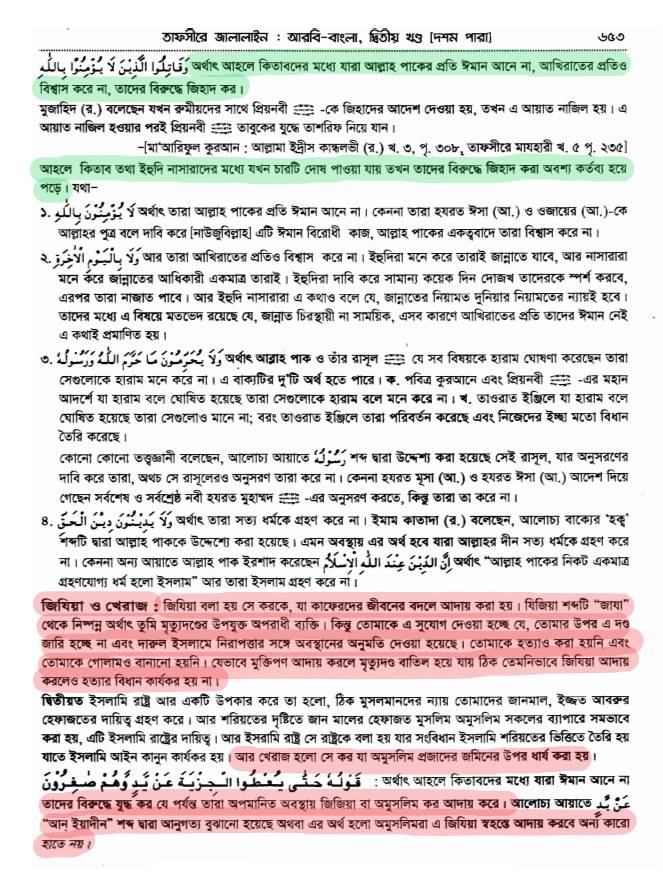
Tafsir al-Mazhari states on this subject: [58]
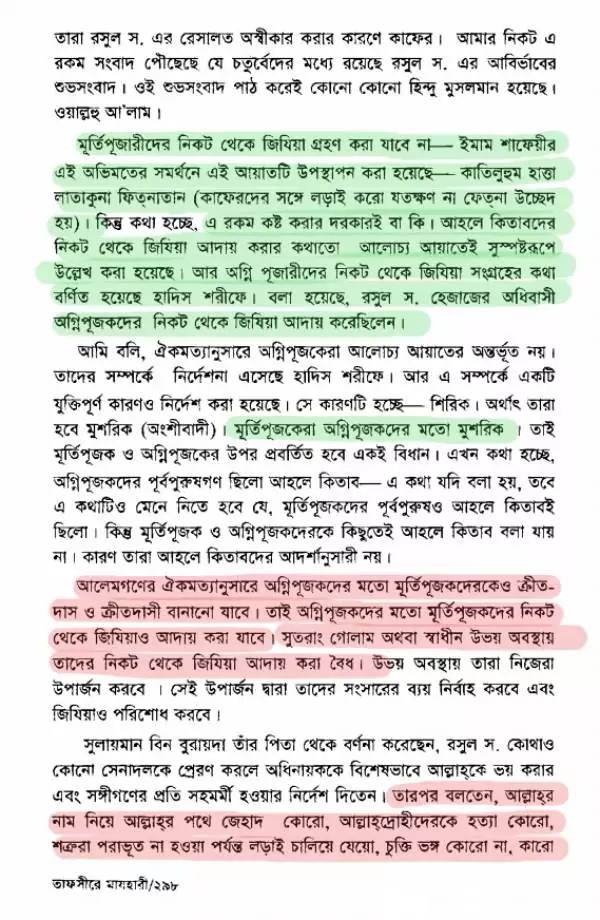
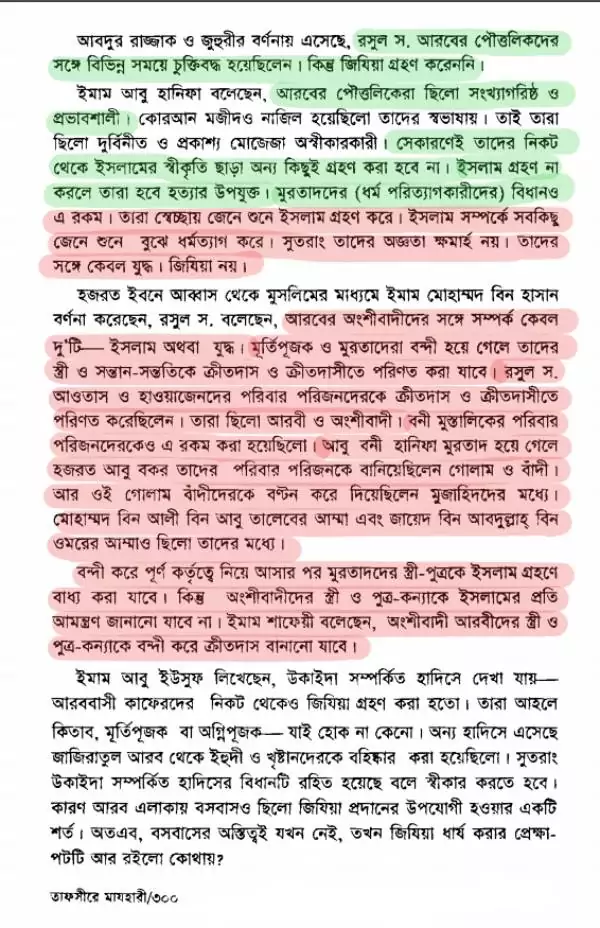
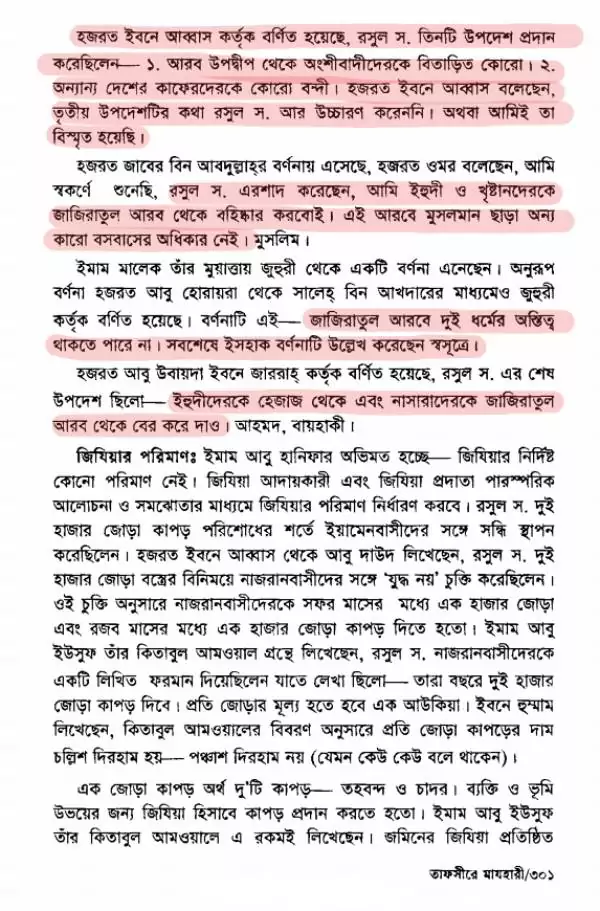
Let us also hear the explanation offered by the renowned Islamic preacher Zakir Naik:
Further Sectarianism in the Quran
Islam’s sacred scripture, the Quran, repeatedly criticizes, mocks, abuses, and insults non-Muslims. Let us examine a few Quranic verses:
Indeed, those who disbelieve from the People of the Book and the polytheists will be in the Fire of Hell, to stay there forever. They are the worst of ˹all˺ beings.
Quran 98:6 (Dr. Mustafa Khattab, The Clear Quran)
Indeed, the worst of all beings in the sight of Allah are those who persist in disbelief, never to have faith—
Quran 8:55 (Dr. Mustafa Khattab, The Clear Quran)
Surely those who disbelieve and die as disbelievers are condemned by Allah, the angels, and all of humanity.
Quran 2:161 (Dr. Mustafa Khattab, The Clear Quran)
The example of the disbelievers ˹not responding to the Messenger’s warning˺ is like a flock not comprehending the calls and cries of the shepherd. ˹They are wilfully˺ deaf, dumb and blind so they have no understanding.
Quran 2:171 (Dr. Mustafa Khattab, The Clear Quran)
˹O Prophet!˺ Tell the disbelievers, “Soon you will be overpowered and driven to Hell—what an evil place to rest!”
Quran 3:12 (Dr. Mustafa Khattab, The Clear Quran)
Say, ˹O Prophet,˺ “Obey Allah and His Messenger.” If they still turn away, then truly Allah does not like the disbelievers.
Quran 3:32 (Dr. Mustafa Khattab, The Clear Quran)
Indeed, We have destined many jinn and humans for Hell. They have hearts they do not understand with, eyes they do not see with, and ears they do not hear with. They are like cattle. In fact, they are even less guided! Such ˹people˺ are ˹entirely˺ heedless.
Quran 7:179 (Dr. Mustafa Khattab, The Clear Quran)
As for those who disbelieve, I will subject them to a severe punishment in this life and the Hereafter, and they will have no helpers.
Quran 3:56 (Dr. Mustafa Khattab, The Clear Quran)
to destroy a group of the disbelievers and humble the rest, causing them to withdraw in disappointment.
Quran 3:127 (Dr. Mustafa Khattab, The Clear Quran)
We will cast horror into the hearts of the disbelievers for associating ˹false gods˺ with Allah—a practice He has never authorized. The Fire will be their home—what an evil place for the wrongdoers to stay!
Quran 3:151 (Dr. Mustafa Khattab, The Clear Quran)
Let us read the commentaries on two verses and see whether these sectarian verses are really sectarian or whether we have simply misunderstood them! Let us see what the most widely accepted commentaries say. Presented here are Ibn Kathir’s commentary [59] and al-Jalalayn’s commentary [60] on Surah Al-Anfal, verse 55, and Surah Al-Bayyinah, verse 6, respectively:
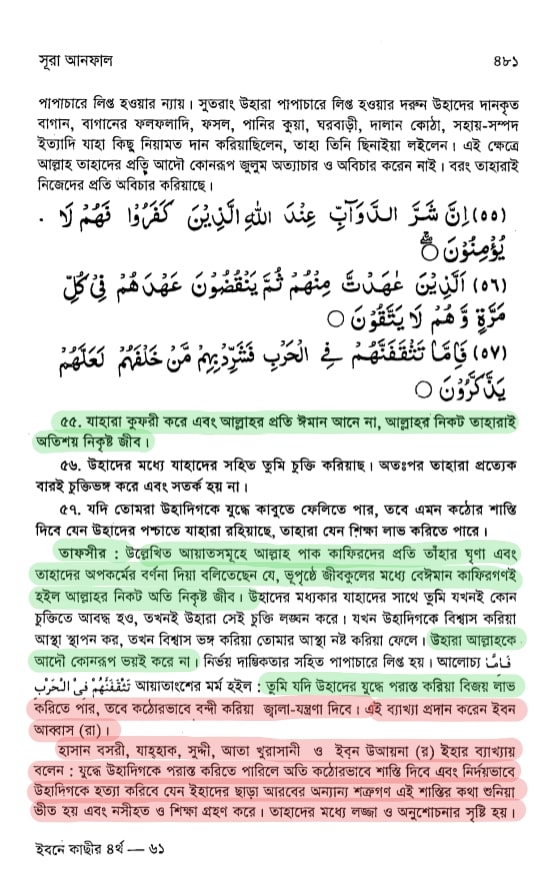
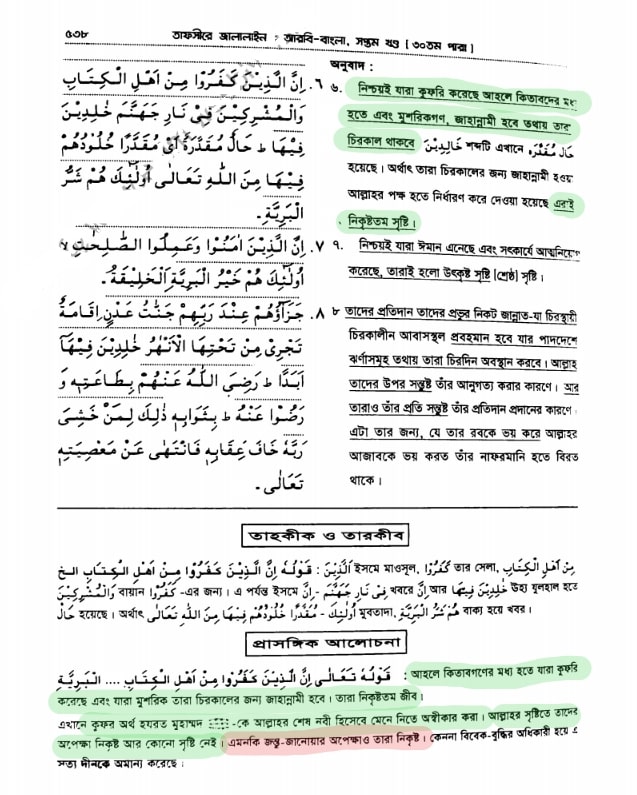
Conclusion
The foregoing discussion makes it possible to say with certainty that, whenever Muslims acquire power, destroying the idols revered by non-Muslims is the Sunnah of all their prophets and messengers. Following, emulating, and practicing it is every Muslim’s sacred religious duty. The question is what would happen if this prophetic Sunnah were practiced today: the entire world would be filled with sectarian riots. Divisions and warfare would arise among people. Hatred, hostility, and sectarianism toward other religions would increase, leaving our world in turmoil. Everyone has the right to support or oppose any religion. Everyone has the right to praise or criticize a religion. Everyone has the right to believe or disbelieve in a religion. But this right applies to everyone. The law cannot grant special consideration to any particular religion or prophet. Either everyone has these rights or no one does. If Muslims wish to stop criticism of their Prophet, they should first erase all the offensive statements about non-Muslims from the Quran and hadith. Islam fundamentally regards peaceful coexistence with other religions as forbidden.
If worshipping Allah in non-Muslim countries is a right, and building mosques, calling the adhan, and wearing the burqa are their rights, then non-Muslims must also have the right to worship idols in Muslim countries. They must also have the right to practice their religion publicly and openly celebrate their own religion and culture. Yet Muslims are never willing to grant non-Muslims equal religious freedom in Saudi Arabia or other countries governed by Islamic sharia, while eagerly claiming the full measure of their own religious rights in non-Muslim countries. They want the right to criticize, mock, and insult other religions, while no one may say anything about theirs! They live within this double standard. In fact, Islam has been like this from the very beginning. Countless Muslims support these things, knowingly or unknowingly, because it is their forefathers’ religion! This is why an authentic hadith describes the believer as a camel with a rope through its nose [61]:
Sunan Ibn Majah
Book: Introduction
Section 6. Following the Sunnah of the Rightly Guided Caliphs
2/43. It was narrated from ‘Abdur-Rahman bin ‘Amr As-Sulami that: He heard Al-‘Irbad bin Sariyah say: “The Messenger of Allah (ﷺ) delivered a moving speech to us which made our eyes flow with tears and made our hearts melt. We said: ‘O Messenger of Allah. This is a speech of farewell. What did you enjoin upon us?’ He said: ‘I am leaving you upon a (path of) brightness whose night is like its day. No one will deviate from it after I am gone but one who is doomed.
Whoever among you lives will see great conflict. I urge you to adhere to what you know of my Sunnah and the path of the Rightly-Guided Caliphs, and cling stubbornly to it. And you must obey, even if (your leader is) an Abyssinian leader. For the true believer is like a camel with a ring in its nose; wherever it is driven, it complies.”
Al-Albani’s assessment: Sahih.
Al-Albani’s source reference: Al-Silsila al-Sahiha, 937.
Hadith grade: Sahih. Canonical reference: Sunan Ibn Majah 43, Introduction, Hadith 43.
Narrator: al-‘Irbad ibn Sariya.
References
- Taliban blow apart 2,000 years of Buddhist history ↩︎
- Here Are the Ancient Sites ISIS Has Damaged and Destroyed ↩︎
- Al-Bidaya wa al-Nihaya, Islamic Foundation Bangladesh, vol. 1, pp. 328, 330, 331, 332, 333, 334, 335 ↩︎
- Sirat Ibn Hisham: A Biography of the Prophet Muhammad, Akram Faruq, pp. 61–62 ↩︎
- Sirat al-Mustafa, author: Allama Idris Kandhlawi; publisher: Islamic Foundation Bangladesh; vol. 1, pp. 113, 144, 149, 154, 155 ↩︎
- Mukhtasar Zad al-Ma‘ad, Imam Ibn al-Qayyim, Wahidiya Islamiya Library, p. 202 ↩︎
- Ashab-e Rasul-er Jibankatha, vol. 6, p. 40 ↩︎
- Al-Bidaya wa al-Nihaya, vol. 3, Islamic Foundation, pp. 89, 90, 91 ↩︎
- Sahih Muslim, Islamic Foundation edition, hadith 1803 ↩︎
- Riyad al-Salihin, hadith 443 ↩︎
- Sahih al-Bukhari, Tawhid Publications, hadith 2478 ↩︎
- Sahih al-Bukhari, Islamic Foundation edition, hadith 1506 ↩︎
- Al-Bidaya wa al-Nihaya, Islamic Foundation Bangladesh, vol. 4, p. 657 ↩︎
- Sahih al-Bukhari, Islamic Foundation edition, hadith 2811 ↩︎
- Sahih al-Bukhari, Islamic Foundation edition, hadith 3549 ↩︎
- Sahih al-Bukhari, Islamic Foundation edition, hadith 4018 ↩︎
- Sahih al-Bukhari, Islamic Foundation edition, hadith 4017 ↩︎
- Sahih al-Bukhari, Tawhid Publications, hadith 4356 ↩︎
- Fath Al Bari 5/340 ↩︎
- Sahih al-Bukhari, Islamic Foundation edition, hadith 2547 ↩︎
- Sahih al-Bukhari, Islamic Foundation edition, vol. 5, p. 64, hadith 2547 ↩︎
- Surah Al-An‘am, verse 108 ↩︎
- Does Islam Really Prohibit Insulting Other Gods? ↩︎
- Tafsir al-Mazhari, Hakimabad Khanqah-e Mujaddidiya Publications, vol. 4, pp. 278, 279, 280 ↩︎
- Tafsir Ibn Kathir, Islamic Foundation, vol. 3, pp. 866–867 ↩︎
- Lakum Dinukum wa Liya Din: Your Religion for You, Our Religion for Us? ↩︎
- La Ikraha fi al-Din: Is There Really No Compulsion in Islam? ↩︎
- Surah Al-Kafirun, verse 6 ↩︎
- Ahkam al-Quran, Khairun Publications, vol. 2, pp. 355–358 ↩︎
- Tafsir al-Jalalayn, Islamiya Kutubkhana Publications, vol. 7, pp. 594, 595, 596, 598 ↩︎
- Al-Rahiq al-Makhtum, Allama Safi al-Rahman al-Mubarakpuri, Tawhid Publications, pp. 466–467 ↩︎
- Sunan al-Tirmidhi, Islamic Foundation edition, hadith 1049 ↩︎
- Tafsir Ibn Kathir, vol. 10, Islamic Foundation Bangladesh, pp. 526–527 ↩︎
- Ibn al-Qayyim, Zad al-Ma‘ad, vol. 3, pp. 437–438; the arrival of the Thaqif delegation, Islamweb ↩︎
- Sunan an-Nasa’i, Book of Mosques, chapter on converting a church into a mosque, hadith 701; Sunnah.com ↩︎
- Sirat Ibn Hisham, Islamic Foundation Bangladesh, vol. 4, pp. 66–67 ↩︎
- Demolishing idols in a non-Muslim country ↩︎
- Obligation to destroy idols ↩︎
- Obligation to Destroy Idols ↩︎
- Ruling on Congratulating Non-Muslims on Their Festivals ↩︎
- A Review of Shirk, Bid‘a, and Superstitions Prevalent in Bangladesh, 2. The Consequences of Shirk ↩︎
- Sahih Muslim, Book of Funerals, chapter on the command to level graves, hadith 969a; Sunnah.com ↩︎
- Sahih al-Bukhari, Book of the Merits of the Helpers, hadith 3823; Sunnah.com ↩︎
- Sahih Muslim, Book of Clothing and Adornment, chapter prohibiting images of living creatures, hadith 2110a; Sunnah.com ↩︎
- Ibn Abi Shayba, Al-Musannaf, vol. 6, pp. 84–85, chapter on reclining on cushions bearing images, reports 12–14; Islamweb ↩︎
- Al-Mudawwana, vol. 1, pp. 182–183, places in which prayer is disliked; Islamweb ↩︎
- Badr al-Din al-‘Ayni, ‘Umdat al-Qari, vol. 12, pp. 39–40, chapter on selling images of inanimate subjects; Islamweb ↩︎
- Shams al-A’imma al-Sarakhsi, Sharh al-Siyar al-Kabir, chapter on transporting fay’ and using mounts; Al-Eman Library ↩︎
- Yahya al-Nawawi, Al-Minhaj Sharh Sahih Muslim, vol. 14, pp. 267–268, chapter prohibiting images of living creatures; Islamweb ↩︎
- Ibn al-Qayyim, Zad al-Ma‘ad, Mu’assasat al-Risala edition, vol. 3, p. 443, section prohibiting the retention of sites of polytheism once capable of destroying them; Maktabat al-Shamila ↩︎
- Ibn al-Qayyim, Zad al-Ma‘ad, vol. 3, pp. 443–444, using the funds of sites of polytheism for Muslim interests; Islamweb; the same text appears in al-Shamila, pp. 443–444 ↩︎
- Ibn Hajar al-‘Asqalani, Fath al-Bari, Book of Military Expeditions, commentary on the expedition to Dhu al-Khalasa; Islamweb ↩︎
- IslamQA, fatwa 330207: ruling on returning a cross left in a car by its previous owner, 20 July 2020 1 2
- Muhammad al-Shawkani, Nayl al-Awtar, vol. 2, p. 119, chapter on cloth, bedding, and curtains bearing images and the prohibition of making images; Islamweb 1 2
- IslamQA, fatwa 304408: comparing the Mosque of Cordoba with the conversion of churches into mosques, 17 October 2023 1 2
- Ibn Qudama, Al-Mughni, vol. 9, p. 284, Book of Jizya, section on the three categories of Muslim territory; Islamweb 1 2
- Tafsir al-Jalalayn, Islamiya Kutubkhana Publications, vol. 2, p. 653 ↩︎
- Tafsir al-Mazhari, Hakimabad Khanqah-e Mujaddidiya Publications, vol. 5, pp. 298, 300, 301 ↩︎
- Tafsir Ibn Kathir, Islamic Foundation edition, vol. 4, p. 481 ↩︎
- Tafsir al-Jalalayn, Islamiya Kutubkhana Publications, vol. 7, p. 538 ↩︎
- Sunan Ibn Majah, hadith 43 ↩︎
About This Article
Genre: Source-Based Critical Analysis of Iconoclasm, Blasphemy Politics, Religious Supremacism, and Islamic Intolerance
Epistemic Position: Secular Humanism, Freedom of Expression, Religious Equality, Historical Criticism, Anti-Communal Ethics, and Source-Internal Islamic Critique
This article examines whether Islam truly respects other religions, or whether Islamic sources and prophetic precedents normalize contempt for rival gods, destruction of idols, and suppression of religious plurality.
Its scope includes the Babri Masjid aftermath, communal double standards, Charlie Hebdo, Islamic outrage over Muhammad cartoons, Ibrahim's idol-breaking narrative, Muhammad's criticism of pagan religion, the destruction of Kaaba idols, the campaign against Dhu al-Khalasa, anti-idol hadith reports, sculpture prohibition, and classical scholarly support for iconoclasm.
The article is written in Shongshoy's tradition of sharp, evidence-based, non-apologetic criticism. It does not soften the issue by treating idol-breaking as harmless symbolism, spiritual reform, or abstract monotheistic purity. It examines the doctrine as a concrete attack on other communities' sacred objects, religious dignity, cultural heritage, and freedom of worship.
The central argument is that a tradition cannot coherently demand absolute reverence for Muhammad while legitimizing the humiliation, mockery, destruction, or legal suppression of other religions' symbols, temples, idols, and devotional practices.
This article should be evaluated through source accuracy, moral consistency, historical evidence, freedom-of-expression principles, minority-rights reasoning, anti-communal ethics, and equal respect for all communities' civil rights—not through religious sensitivity, apologetic expectation, inherited reverence, prophet-protection reflex, or the demand that Islamic iconoclasm be excused while criticism of Islam is criminalized.