
Inhuman Slavery in Islam
Abstract
Slavery is one of the darkest and most inhumane institutions in the history of human civilisation. It existed in almost every civilisation of the ancient world. Through a long struggle, however, modern civilisation has recognised individual liberty, human dignity and each person’s right to control their own body. Slavery, the slave trade and sexual slavery are now regarded as direct violations of international law and human rights [1] [2]. This article first examines slavery in the ancient world, its sanction in the Bible, and its place in Arab society before and after the advent of Islam. It then analyses the nature of Islamic slavery through the Quran, authentic hadith, Quranic commentaries, prophetic biographies and the classical jurisprudence of the four Sunni schools. The following articles are also relevant to understanding offensive jihad, warfare, territorial expansion and the military ideology directed against non-Muslims in Islam: [3] [4] [5].
This discussion demonstrates that Islam itself contains a firm imperial legal basis for enslaving non-believing tribes through offensive jihad conducted in the name of religion. Islam did not prohibit slavery; instead, it established an organised legal framework for enslaving women and children captured in war, buying and selling slaves, inheriting ownership, and having sexual relations with enslaved women on the basis of ownership [6] [7] [8]. In particular, the previous marriages of women captured in war could be annulled after captivity, and their owners were deemed legally entitled to have sexual intercourse with them after completion of istibra. The basis of this entitlement was war, captivity and ownership, rather than the woman’s freely given consent [9] [10] [11]. To understand this framework of warfare and spoils, see [12] and [13].
Classical jurisprudence did not recognise an enslaved woman’s right to refuse sexual intercourse as a full legal right comparable to that of a free woman. She remained subject to her owner’s sexual entitlement, property rights and control [14] [15] [16] [17]. This system also prescribed rules for the sale, gifting and exchange of enslaved women, sexual intercourse with them, and their legal status after childbirth. For detailed discussions, see [18] and [19].
It is true that Islam encouraged manumission in certain circumstances, instructed owners to treat slaves well, and prescribed manumission as expiation for particular offences. Yet treating manumission as meritorious is different from declaring slavery morally prohibited. At the same time, Islam established a comprehensive framework that never eradicates slavery and instead helps perpetuate it indefinitely. Within the same religious framework that praised manumission, permission remained in force to own slaves, sexually use enslaved women, buy and sell them, and enslave female prisoners of war [20] [21].
The article’s principal conclusion is that slavery was abolished in modern Muslim societies through modern state legislation, international agreements, human-rights consciousness and political circumstances. The prevailing interpretations of the Quran, hadith and classical jurisprudence did not declare slavery prohibited; instead, they established mechanisms for sustaining it. Presenting Islamic slavery merely as a ‘plan for gradual abolition’ therefore conceals the historical and theological reality. In defence of human freedom and dignity, this article removes that veil and analyses the actual character of Islamic slavery.
Index of Terms
| Word / Term | Meaning and Relevance within the Article |
|---|---|
| Slavery (Slavery) | Treating a person as another person’s property and establishing the owner’s control over their labour, movement, marriage, body and life. |
| Slave / Ghulam (ʿAbd / Ghulām) | An owned male person whose freedom is restricted and whose labour and obedience are subject to his owner. |
| Female Slave / Bondwoman / Amah (Amah) | An owned woman. In classical Islamic jurisprudence, her labour and her owner’s sexual entitlement both form part of her subordinate status. |
| Riq (Riqّ) | The institutional legal condition of slavery in Islamic jurisprudence. Its rules are discussed in separate jurisprudential chapters entitled Kitab al-Riq. |
| Ma Malakat Aymanukum (Mā Malakat Aymānukum) | ‘Those whom your right hands possess’: a Quranic expression understood in classical Quranic commentary and jurisprudence primarily to refer to owned male and female slaves. |
| Milk al-Yamin (Milk al-Yamīn) | Possession by the right hand, or ownership of male and female slaves. It is the principal jurisprudential basis for permitting intercourse with an enslaved woman without marriage. |
| Saby (Saby) | Capturing women and children after a war and reducing them to slavery. |
| Sabiyya (Sabiyya) | A female prisoner of war who, under classical Islamic rules, could be distributed, sold, given as a gift or used sexually as an enslaved woman. |
| Asir (Asīr) | A prisoner of war. Jurisprudence contains various provisions for executing, releasing, ransoming or enslaving male prisoners of war. |
| Harbi (Ḥarbī) | A non-Muslim individual or population with whom the Muslim state has no peace treaty and who is regarded as an enemy in war. |
| Dar al-Harb (Dār al-Ḥarb) | In classical Islamic political theory, territory outside Islamic rule and in a state of war with the Muslim state. |
| Dar al-Islam (Dār al-Islām) | Territory under Islamic rule and Sharia authority. |
| Dhimmi (Dhimmi) | A non-Muslim living in an Islamic state who receives limited protection in exchange for paying jizya and accepting political subordination. |
| Musta’min (Mustaʾmin) | A non-Muslim person granted temporary protection or permission for safe entry. |
| Jihad (Jihād) | Literally, struggle. In classical jurisprudence, one important meaning is armed warfare against non-Muslims for the expansion of Islam and the suppression of enemies. |
| Qital (Qitāl) | Armed warfare or direct fighting on the battlefield. |
| Ghanimah (Ghanīmah) | Property seized through warfare. In classical jurisprudence, this can include weapons, animals, money, women and children. |
| Fay’ (Fayʾ) | Property, land or people acquired from non-Muslims by a Muslim ruler without fighting. |
| Khums (Khums) | One-fifth of the spoils of war, allocated to specified categories of recipients according to the Quran. |
| Tasarrī (Tasarrī) | Sexual intercourse with an owned enslaved woman, or keeping her as a concubine. |
| Wat’ / Sexual Intercourse (Waṭʾ) | The jurisprudential term for sexual intercourse. With an enslaved woman, it was also deemed lawful on the basis of ownership rather than marriage. |
| Sexual Slavery (Sexual Slavery) | Compelling a person to engage in sexual intercourse under conditions of ownership, captivity, fear or coercion. The term is used in the modern ethical analysis of the enslavement of female prisoners of war. |
| Consent (Consent) | Freely given agreement to sexual intercourse without fear, pressure, deception or abuse of authority. Where an enslaved woman lacks the freedom to say ‘no’, consent becomes a fundamental issue. |
| Istibra (Istibrāʾ) | Usually, waiting for one menstrual period to ascertain whether a newly acquired enslaved woman or female prisoner of war is pregnant by her previous owner. |
| ‘Azl (ʿAzl) | Withdrawal of the penis before ejaculation during intercourse, followed by ejaculation outside the body. This was connected to preventing an enslaved woman from becoming pregnant and preserving the possibility of selling her later. |
| Umm al-Walad (Umm al-Walad) | An enslaved woman who bears her owner’s child. Classical jurisprudence generally provides for her manumission upon his death, but she remains enslaved throughout his lifetime. |
| Mukatab (Mukātab) | An enslaved person who has entered into a written agreement with their owner for manumission in exchange for a specified payment. |
| Mukataba (Mukātabah) | An agreement between an enslaved person and their owner for payment in exchange for manumission. The legal condition of slavery continues until the agreement has been fulfilled. |
| Tadbir (Tadbīr) | A declaration or arrangement that a male or female slave will become free upon the owner’s death. |
| Itq / Ataq (ʿItq) | Manumission. Islamic jurisprudence provides for voluntary manumission, manumission as expiation, and manumission by contract. |
| Wala’ (Walāʾ) | The legal relationship between a freed person and the person who manumitted them. It can give the former owner inheritance rights or special claims over the freed person’s property. |
| Qinn (Qinn) | A wholly owned male or female slave whose condition of slavery has not been modified by a contract or partial manumission. |
| Mudabbar (Mudabbar) | A slave whom the owner has declared will be manumitted upon the owner’s death. |
| Muba’ad / Jointly Owned Slave | A male or female slave jointly owned by more than one owner. Jurisprudence prescribes separate rules concerning the allocation of their labour, value, children and sexual rights. |
| Saleable Enslaved Woman | An enslaved woman whom an owner can sell, buy, gift or exchange in the market as property. Pregnancy could affect her market value and saleability. |
| Satr / ‘Awrah (ʿAwrah) | The parts of the body that religious rules require to be covered. Classical jurisprudence distinguishes the rules for free women from those for enslaved women. |
| Nikah (Nikāḥ) | A marriage contract. Although nikah is required for sexual relations with a free woman, ownership is treated as a separate basis of sexual lawfulness in the case of an owned enslaved woman. |
| Faskh (Faskh) | Annulment or dissolution of marriage. Jurisprudence discusses the effects of a change in ownership, or an owner’s decision to dissolve the marriage, where an enslaved woman is married to another man. |
| Jizya (Jizyah) | A tax imposed on adult non-Muslim men, collected in exchange for protection and subordination within the Islamic political order. |
| Forced Conversion / Compulsion to Accept Islam | A policy under which refusal to accept Islam can entail warfare, jizya, political subordination or punishment. |
| Ownership (Ownership) | The owner’s legal control over an enslaved person’s labour, movement, marriage, property, children and, in many cases, body. |
| Human dignity (Human Dignity) | The fundamental moral principle of modern human rights that every person is free and equal and cannot be the property of another person. |
| Bodily Autonomy (Bodily Autonomy) | The right to make decisions about one’s own body, sexuality, reproduction and medical treatment. Slavery directly denies this right. |
| War Crimes (War Crime) | Killing, rape, torture, enslavement or other serious crimes against civilians or prisoners of war during warfare. |
| Sexual violence (Sexual Violence) | Sexual acts committed through force, fear, captivity, abuse of authority or the absence of consent. |
| Genocide (Genocide) | A series of killings, rapes, measures to prevent births or other offences committed with the intention of destroying, in whole or in part, a people, religious group or population. |
| Modern Slavery (Modern Slavery) | Control over people resembling slavery through trafficking, forced labour, debt bondage, child labour and sexual exploitation, despite the legal abolition of slavery. |
Introduction
The most fundamental and essential human right is the right to live as a free person. Every child is born free and possessed of dignity. A person’s freedom cannot be taken away as though they were a caged bird or an animal in a zoo. This fundamental right is expressed in Article 1 of the Universal Declaration of Human Rights [1] –
Article 1
All human beings are born free and equal in dignity and rights. They are endowed with reason and conscience and should act towards one another in a spirit of brotherhood.
When this right is taken away, however, humanity suffers its gravest humiliation. This is why slavery constitutes one of the most horrific crimes committed by human beings and one of the darkest chapters in human history. From antiquity through the Middle Ages, and even into the modern era, many societies sanctioned slavery socially and legally. Under this system, people were formally bought and sold in markets, and those purchased were compelled to serve as the buyer’s personal property. They possessed neither freedom of choice nor personal liberty. Slavery existed under almost every ancient and medieval system of government. Markets were established for human beings just as for livestock, and people were openly bought and sold. Captives were brought there in chains, assigned prices, bargained over and inspected like cattle and sheep, after which their ownership was transferred.
Today, such practices may seem almost impossible to imagine, yet they were widespread at the time. Slavery was recognised not only in legal codes and administrative texts but also in religions. Many religions claiming to embody humanity failed to abolish it and, in numerous instances, instead conferred legitimacy upon it.
As human civilisation emerged from those dark periods of antiquity and the Middle Ages into the modern era, slavery came to be regarded as prohibited throughout the world. This is stated clearly in Article 4 of the Universal Declaration of Human Rights [1] –
Article 4
No one shall be held in slavery or servitude; slavery and the slave trade shall be prohibited in all their forms.
Under this provision, slavery is now prohibited throughout the world, and enslaving anyone, buying or selling slaves, or participating directly or indirectly in the slave trade is considered a punishable offence under any circumstances. As people living in the modern world, we never wish to see slavery return under any circumstances. Although slavery persists in various forms in different parts of the world in defiance of international law, anyone possessing a sense of humanity can recognise the horror of this institution.
The historical record shows the beginnings of a formal prohibition of slavery in medieval Europe in the early fifteenth century. Slavery was first prohibited in 1416 in Ragusa, also known as Dubrovnik, then an independent city-state in the southern Mediterranean region and now part of Croatia. In the modern era, Norway and Denmark were the first to end the slave trade, in 1802. Slavery was subsequently prohibited across Europe and the Americas.
To enact the law abolishing slavery in the United States, the American president Abraham Lincoln had to wage war directly against other white Americans. Known as the American Civil War, this conflict began in 1861 and continued until 1865. Only after victory in that war could Lincoln enforce the prohibition of slavery throughout the United States. Mauritania was among the last countries to sign the international convention prohibiting slavery. In 1962, Saudi Arabia and Yemen agreed to prohibit slavery under direct pressure from Great Britain; similarly, in 1970, Oman abolished slavery under sustained British pressure [22].
While reading this article, it is essential to remember that ‘it was customary at the time’ is no moral defence. We must distinguish here between a ‘crime’ and a ‘wrong’: a crime is defined by the prevailing law, regulations or judicial system, whereas a wrong is identified through the harm, coercion, exploitation, loss of rights and suffering imposed upon another person. An act may be morally wrong even when contemporary law did not classify it as a crime. This can be stated unequivocally in cases of slavery, violations of sexual autonomy, forced subordination and cruelty. ‘It was legal then’ describes only a legal status; it establishes no moral legitimacy and does not diminish the victim’s suffering in the slightest. Arguments such as ‘everyone did it then’ often serve instead to reduce the moral discomfort, guilt or cognitive dissonance of those defending the wrong. The psychological benefit thus accrues to the person seeking to regard the injustice as justified or tolerable, rather than to its victim.
What Is Slavery?
‘Slavery’ denotes a barbaric institution in which a human being is treated as movable property, deprived of freedom and compelled to labour without remuneration. An owner may sell an enslaved person at any time and decide what work that person must perform. The enslaved person’s opinions and wishes carry no weight. In antiquity and the Middle Ages, people were enslaved against their will. Enslavement could result from capture by an enemy, birth into slavery or purchase. The exchange of slaves as gifts was also widespread during the Middle Ages.
There is a definite distinction between the working conditions of an ordinary worker and those of an enslaved person. A worker has the full right to leave a workplace or employer voluntarily, refuse to work and receive wages for their labour. Under international labour law, ordinary workers are entitled to specified working hours and leave. The Bangladesh Labour Act, 2006, stipulates how many hours a worker may work per day and per week, the number of annual leave days, and the leave available for illness and festivals [25]. The distinction is that an enslaved person has no right to leave their workplace or owner, refuse work or receive wages for their labour. Islam recognises slavery; since Islamic rulings remain applicable until the Day of Judgement, slavery will continue to exist for as long as Islam exists.
Sexual Intercourse with Female Prisoners of War or Enslaved Women Is ‘Rape’
The definition of rape establishes that:
Rape generally refers to sexual intercourse or any other form of sexual penetration involving a person without their consent. Rape may be perpetrated through physical force, other forms of coercion or abuse of authority. Sexual intercourse with someone incapable of giving consent—for example, a person who is unconscious, physically disabled, intellectually disabled or underage—also falls within the definition of rape [26] [27] [28]. Rape during conflict or war between opposing parties, including the use of prisoners of war as sexual slaves, has also been classified as a crime against humanity and a war crime. Such rape is also recognised as a constituent act of genocide.
An enslaved woman or a woman captured in war never possesses the right to give consent to sexual activity, because she lacks the freedom to say no. The absence of that freedom constitutes a violation of consent. For this reason, throughout the civilised world, any sexual act involving a person held captive or bound in slavery is regarded as rape and a war crime. For a female prisoner whose father, brothers and other relatives have been killed by enemy soldiers, voluntarily engaging in sexual activity with those soldiers is an utterly unrealistic proposition.
If this is difficult to understand, I ask readers to put themselves in the position of the non-believer: if Indian soldiers killed you and took your mother and sister prisoner, would your mother and sister willingly warm those soldiers’ beds? Applying the scenario to oneself makes its horror easier to grasp. Under the conditions faced by someone captured in war, freely choosing a sexual partner without fear or coercion is simply impossible. The victorious soldiers wield authority, and their commands must be obeyed. A person can give consent only when they are an adult, are free and will face no pressure if they refuse.
Even if she acquiesces under such circumstances, the act must still be recognised as rape. What option did she have other than acquiescence? This is why sexual activity with a person deprived of liberty or held as a prisoner of war is identified throughout the civilised world as rape.
During the Liberation War of 1971, countless Bengali women were captured and raped by Pakistani soldiers. The purported consent of a captive has no value. Any sexual act involving them is therefore, by definition, rape and a war crime; it is also a constituent act of genocide. People captured in war or sold in markets have no opportunity to select or choose a sexual partner. Whoever buys or owns them, they are compelled to have sexual intercourse with that person. Such an act is, by definition, rape. On that basis, the Islamic permission for owners to have intercourse with enslaved women or female prisoners of war falls squarely within the definition of rape.
Was Slavery Moral in the Ancient World?
In every era, period and culture, slavery was among the crimes and immoral acts committed by human beings. War, slavery and rape were immoral in every period and civilisation. Whenever a person is captured, sold in a market and compelled to labour like an animal, that person suffers in the same way and their rights are violated in the same way. Ancient people, however, possessed comparatively limited moral understanding and knowledge; they either failed to recognise this or, despite recognising it, maintained slavery out of one form of greed or another. Since society and law sanctioned these practices, we may be unable to classify their actions as crimes, but we can certainly identify them as wrongs.
The easiest way to understand a moral question is to imagine oneself in the victim’s position. Suppose that, 2,000 years ago, a king enslaved you and made your daughter his sexual slave. Would you have considered this moral? Would you have suffered less because it happened 2,000 years ago? If slavery were reintroduced today and received legal and state recognition, would it then appear moral to you? Would you cease to regard it as an injustice? In my view, the decisive consideration in morality is whether human rights are being violated, rather than the time, place or people involved.
The distinction between a wrong and a crime is that right and wrong concern morality, whereas crime concerns law and the judicial system. We therefore cannot classify the actions of people in that era as crimes and punish them when no law prohibited those actions at the time. Morally, however, the practice is unquestionably unethical and wrong in any society or culture. Personally, I regard morality as absolute, and consider the moral absolutism supported by Immanuel Kant and later philosophers [29] an appropriate basis for developing a conception of morality. I therefore believe that a wrong remains a wrong in every society and culture. As human knowledge grows, humanity gradually approaches that ideal condition. These are extensive questions that can be discussed another day.
What Was Slavery Like in Different Civilisations?
The inhumane treatment of enslaved people in antiquity and the Middle Ages defies description. Millions remained bound in slavery generation after generation, with no means of escape. Owners could subject them to brutal abuse or even kill them. These facts are true; it is equally true, however, that certain civilisations also granted enslaved people particular rights.
Slavery existed in various ancient civilisations. Among the legal codes or constitutions surviving from human history, the Code of Ur-Nammu is one of the earliest. Ur-Nammu was an ancient Sumerian king. Fragments of the regulations he introduced were discovered in a part of present-day Iraq, inscribed on stone. These ancient Sumerian tablets, dating from approximately 2100–2050 BCE and constituting the world’s oldest surviving legal tablets, contain laws concerning slavery [30].
Evidence of slavery also appears in the legal code introduced by the renowned king Hammurabi in ancient Babylonian civilisation, which emerged roughly 300 years later. Several civilisations legally prohibited enslaving someone for debt, or debt bondage. In 594 BCE, Solon of Athens abolished debt bondage entirely [31].
Enslaved people are also known to have worked in agriculture in ancient Mesopotamia. Slavery existed in Persia and ancient Egypt as well. In Egypt, enslaved people were employed in constructing monumental buildings and pyramids. Slavery reached its greatest scale in ancient Rome, whose economy became fundamentally dependent upon it. Under some rulers of the Roman Empire, enslaved people also acquired property rights: they could earn money, purchase property and spend it for their own benefit [32]. Those with particular skills could even use them to earn enough money to buy their freedom [33] [34].
Seneca was a Roman philosopher, statesman and playwright, born in 4 BCE and deceased in 65 CE. In his letters, he urged readers to maintain friendly relations with their slaves. Do not call them slaves, he wrote; call them human beings and friends [35] –
I am glad to learn, through those who come from you, that you live on friendly terms with your slaves. This befits a sensible and well-educated man like yourself. “They are slaves,” people declare. Nay, rather they are men. “Slaves!” No, comrades. “Slaves!” No, they are unpretentious friends. “Slaves!” No, they are our fellow-slaves, if one reflects that Fortune has equal rights over slaves and free men alike.
Seneca also wrote that owners should treat their slaves kindly and gently. All human beings are equal in birth and subject to fortune. A person’s true worth depends upon their actions. Whether enslaved or free, all possess an equal right to inner freedom. An enslaved person can therefore develop a moral character equal to that of their master. Although Seneca said nothing about abolishing slavery, his statements were considerably favourable to enslaved people in the context of his time.
No discussion of slavery could omit Spartacus, the warrior of extraordinary courage who led a slave revolt against ancient Rome and shook the foundations of the empire. By launching a revolt of such magnitude, he became a living terror to slave owners and traders. Countless films, plays and songs have commemorated his rebellion, and more will continue to do so. Throughout history, slave revolts of this kind compelled owners to treat enslaved people more kindly and cease treating them like animals. The desire for freedom is the birthright of every human being in every age. Those revolts were therefore entirely moral and played an important part in securing certain rights for enslaved people.
Slavery also existed in India. It is mentioned in Kautilya’s Arthashastra and in accounts of Ashoka’s reign. Historians believe that it continued during the Kushan and Gupta periods. The Arthashastra also describes several rights held by enslaved people, including the following:
Employing a slave to carry a corpse, sweep away urine or clear leftover food; stripping a slave naked; beating or verbally abusing them; or violating an enslaved woman’s chastity without her consent results in forfeiture of the price paid for the person. Violation of their chastity also brings immediate emancipation [36].
When an owner has sexual intercourse with an enslaved woman against her will, he is to be punished for it. When a man rapes an enslaved woman pledged to him as security, or assists someone else in raping her, he not only forfeits her purchase price but must also pay her a specified sum and pay the government a fine of twice that amount [36].
More significantly, the Indian emperor Ashoka abolished the slave trade or slave markets and encouraged the population to treat enslaved people well [37]. These rights persisted for a considerable period under the Mauryan Empire.
These ancient civilisations can be held responsible for perpetuating slavery. Yet evidence also shows that enslaved people possessed certain rights in many civilisations. Such provisions were certainly commendable in their historical context, although none of these societies managed to prohibit slavery outright. That required a wait of many, many years. At the same time, it must be stated that Moses, Jesus and Muhammad—respectively presented as the messenger, son or final prophet of an infinitely merciful God—not only failed to prohibit slavery but encouraged the enslavement of non-believers’ women and children through offensive jihad. Throughout history, human beings have devised laws far better and more humane than those they prescribed.
The modern Universal Declaration of Human Rights was likewise created by human beings. The civilised world no longer waits upon divine or heavenly morality. We have ourselves devised better laws, under which enslaving prisoners of war or using them for sexual purposes is regarded unequivocally as a war crime and a constituent act of genocide.
Biblical Support for and Legalisation of Slavery
Christianity remains the world’s most influential religion, and its scripture is the Bible. The Bible consists of two parts: the Old Testament and the New Testament. According to Jewish belief, the Old Testament was revealed by God to Moses; according to Christian belief, the New Testament contains the words of Jesus, the Son of God and God himself. Jews, in accordance with their beliefs, reject Jesus and the New Testament. In numerous passages, the Bible presents statements by God supporting slavery. God endorsed slavery and also commanded that people be enslaved.
The Book of Exodus in the Old Testament states [38] –
If a man strikes his male or female slave with a rod so that the slave dies immediately, that man is to be punished. But if the slave survives for a day or two, the man is not to be punished, because the slave is his property.
The Epistle to Titus in the New Testament states [39] –
Teach slaves the following: they should always obey their masters, do their utmost to please them and refrain from contradicting them. They should not steal anything from their masters and should prove trustworthy. Through all their conduct, they will thus show that the teaching of God our Saviour is good.
The Gospel of Luke in the New Testament states [40] –
The slave who knew his master’s will but neither prepared himself nor acted accordingly will receive severe punishment. But the slave who did not know what his master wanted, and through that ignorance did something deserving punishment, will receive less punishment. Much will be expected from the person to whom much has been given, and people will demand more from the person entrusted with greater responsibility.’
Deuteronomy in the Old Testament states that believers may bring back female prisoners of war as spoils. The woman must be allowed one month to mourn her dead relatives, after which she may be married. If the man is unhappy with the marriage, however, she must be allowed to go wherever she wishes. She may not be sold in the market or treated as a slave.
Needless to say, this biblical provision is also profoundly uncivilised and barbaric. Yet it is comparatively better than the Islamic provision. The Bible requires female prisoners of war to be given one month to mourn their dead family members. After that month, the man is instructed to marry her if he wishes and, if he is unhappy with her, to let her go free. In Islam, by contrast, he may have intercourse with her without marriage once she has menstruated, practise withdrawal to prevent pregnancy and sell her later; if she bears a child, he may continue using her sexually until his death. We will discuss the Islamic provision later. For now, let us examine the biblical provision [41] –
10 When you go to war against your enemies, the Lord your God may help you defeat them, and you may bring back your enemies as captives.
11 Among the captives, you may see a beautiful woman who attracts you, and desire her as your wife.
12 Then bring her into your home. She must shave her head and trim her nails.
13 She must remove the clothes identifying her as a prisoner of war. She must remain in your home for a full month and mourn the loss of her father and mother. Afterwards, you may go to her and become her husband. She will be your wife.
14 If you are unhappy with her, you must release her and let her go free. You may not sell her. You must never treat her as a slave, because you have had sexual relations with her.
Slavery in Pre-Islamic Arab Society
Slavery was widespread in pre-Islamic Arabia, and people from different regions were captured and sold as slaves. Regular slave markets operated there, where wealthy people could buy male and female slaves according to their needs and financial means. Some owners treated their slaves with extreme cruelty, subjecting them to physical and psychological abuse. Others, however, are known to have treated them kindly and humanely. Manumission was also considered a noble act in that society, and some owners freed slaves on special occasions or upon receiving good news.
In this social setting, manumission was recognised as an important and praiseworthy act. Even before the advent of Islam, a wealthy man in Mecca who later became a close Companion of the Prophet Muhammad is reported to have freed approximately 100 slaves while still a pagan. This demonstrates that Arab society regarded manumission positively for humanitarian and social reasons as well as religious ones. [42] —
Sahih Muslim (Islamic Foundation)
1/ The Book of Faith
Section: 55. The Reward for Good Deeds Performed before Embracing Islam
226. Abu Bakr ibn Abu Shayba … Hisham b. Urwa narrated it on the authority of his father: Hakim b. Hizam freed one hundred slave and donated one hundred camels (for the sake of Allah) during the state of ignorance. Then he freed one hundred slaves and donated one hundred camel (for the sake of Allah) after) he had embraced Islam. He subsequently came to the Apostle (ﷺ). The rest of the hadith is the same as narrated above.
Hadith grade: Sahih (authentic)
Narrator: Urwa ibn al-Zubayr (may Allah have mercy on him)
Abu Lahab, known as one of the Prophet Muhammad’s fiercest enemies and cursed in a Quranic surah, also performed a particular humanitarian act at the time of the Prophet’s birth. Hearing the good news of Muhammad’s birth, Abu Lahab was so delighted that he freed his enslaved woman Thuwayba. The event occurred when the infant Muhammad held his finger, which made Abu Lahab exceedingly happy. As an expression of that joy, he freed Thuwayba so that she could breastfeed Muhammad. Thuwayba was Muhammad’s wet nurse and subsequently carried out that role. This episode expresses Abu Lahab’s emotion at that moment and also suggests that manumission was considered important and praiseworthy in pre-Islamic Arab society: even Islam’s fiercest opponents participated in such humanitarian acts.
On the day the Prophet (peace be upon him) was born, Thuwayba rushed to her master Abu Lahab in joy and said, “Have you heard?! Aminah has just given birth to a son, for your brother Abdullah!” As was the custom of Arabs to show generosity at receiving good news, and since this was the newborn son (peace be upon him) of his recently deceased brother, Abu Lahab gestured with his thumb and forefinger, saying to Thuwayba, “Go, for you are free.” For this, his punishment in the Hereafter is lessened by a small sip of water equal to what could be held in the small curve of flesh at the base of the thumb till the forefinger (‘Abdur-Razzaq, Mussanaf).
The episode is also mentioned in the prophetic biography Ar-Raheeq Al-Makhtum [43] —
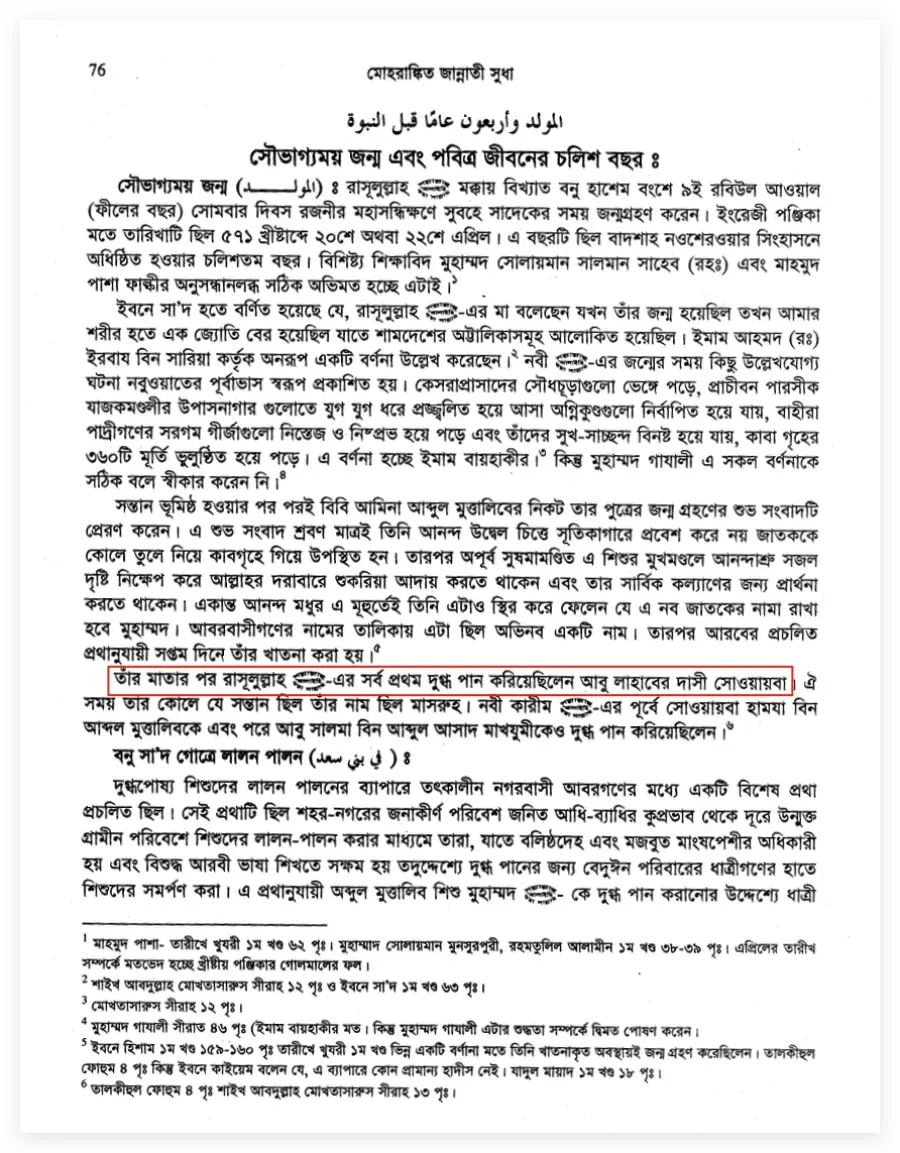
Let us also examine the authentic hadith concerning Thuwayba [44] —
Sahih al-Bukhari (Tawhid)
Book: 69/ Supporting the Family
Section: 69/16. Freed Female Slaves or Other Women as Wet Nurses.
5372. Narrated Um Habiba: (the wife of the Prophet) I said, “O Allah’s Messenger (ﷺ)! Will you marry my sister, the daughter of Abu Sufyan.” The Prophet (ﷺ) said, “Do you like that?” I said, “Yes, for I am not your only wife, and the person I like most to share the good with me, is my sister.” He said, “That is not lawful for me.” I said, “O Allah’s Messenger (ﷺ)! We have heard that you want to marry Durra, the daughter of Abu Salama.” He said, “You mean the daughter of Um Salama?” I said, “Yes.” He said, “Even if she were not my stepdaughter, she is unlawful for me, for she is my foster niece. Thuwaiba suckled me and Abu Salama. So you should not present to me your daughters and sisters.”(1)
Shu’ayb narrated from al-Zuhri: Narrated ‘Urwa: Thuwaiba had been a slave girl whom Abu Lahab had emancipated. (5101; Adhunik Prakashani: 4972, Islamic Foundation: 4868)
(1) Relationships which prohibit marriage through blood also prohibit it through breastfeeding. Just as marriage to a blood sister, daughter, brother’s daughter or sister’s daughter is prohibited, marriage to the corresponding foster relatives is also prohibited. Two conditions establish rada’ah, or a foster relationship through breastfeeding: 1. Age: the nursing child must be less than two years old. 2. Feeding sufficient to satisfy hunger must be established, even on one occasion; the hadith describe more than two and up to five feedings. Muslim, Abu Dawud, al-Tirmidhi, al-Nasa’i, Ibn Majah and others report this. Fiqh al-Sunnah, Volume 2, pp. 106–107.)
Hadith grade: Sahih (authentic)
Narrator: Umm Habiba (may Allah be pleased with her)
Let us examine another hadith [45] —
Sahih al-Bukhari (Tawhid)
Book: 67/ Marriage
Section: 67/21. Allah Says: “your foster-mothers who gave you suck” (Surah An-Nisa 4:23).
5101. Narrated Um Habiba: (daughter of Abu Sufyan) I said, “O Allah’s Messenger (ﷺ)! Marry my sister. the daughter of Abu Sufyan.” The Prophet (ﷺ) said, “Do you like that?” I replied, “Yes, for even now I am not your only wife and I like that my sister should share the good with me.” The Prophet (ﷺ) said, “But that is not lawful for me.” I said, We have heard that you want to marry the daughter of Abu Salama.” He said, “(You mean) the daughter of Um Salama?” I said, “Yes.” He said, “Even if she were not my step-daughter, she would be unlawful for me to marry as she is my foster niece.
I and Abu Salama were suckled by Thuwaiba. So you should not present to me your daughters or your sisters (in marriage).” Narrated ‘Urwa: Thuwaiba was the freed slave girl of Abu Lahb whom he had manumitted, and then she suckled the Prophet. When Abu Lahb died, one of his relatives saw him in a dream in a very bad state and asked him, “What have you encountered?” Abu Lahb said, “I have not found any rest since I left you, except that I have been given water to drink in this (the space between his thumb and other fingers) and that is because of my manumitting Thuwaiba.” (5106, 5107, 5123, 5372; Muslim 17/4, Hadith: 1449; Ahmad: 27482) (Adhunik Prakashani: 4728, Islamic Foundation: 4730)
Hadith grade: Sahih (authentic)
Narrator: Umm Habiba (may Allah be pleased with her)
Islamic Support for and Legalisation of Slavery
Throughout Islamic history, slavery appears repeatedly in the Quran, in numerous commentaries written by classical scholars and in hadith collections, where it receives recognition. This article will examine those verses and hadith in detail. The Quran states that Allah has favoured some people over others: in other words, Allah has made some people slaves and others owners. At the same time, Allah asks reproachfully: ‘Do you make your slaves partners in your wealth or provisions? If you do not, why should Allah concede any share of His right to be worshipped?’ Let us examine this verse and its explanation in Ma’ariful Quran in detail [46] [47],
And Allah has favoured some of you over others in provision. But those who have been much favoured would not share their wealth with those ˹bondspeople˺ in their possession, making them their equals. Do they then deny Allah’s favours?
— Sheikh Mujibur Rahman (Bengali source; English quotation: Dr. Mustafa Khattab, The Clear Quran)
And Allah has favoured some of you over others in provision. But those who have been much favoured would not share their wealth with those ˹bondspeople˺ in their possession, making them their equals. Do they then deny Allah’s favours?
— Rawai Al-bayan (Bengali source; English quotation: Dr. Mustafa Khattab, The Clear Quran)
And Allah has favoured some of you over others in provision. But those who have been much favoured would not share their wealth with those ˹bondspeople˺ in their possession, making them their equals. Do they then deny Allah’s favours? [1] [2]
— Dr. Abu Bakr Muhammad Zakaria (Bengali source; English quotation: Dr. Mustafa Khattab, The Clear Quran)
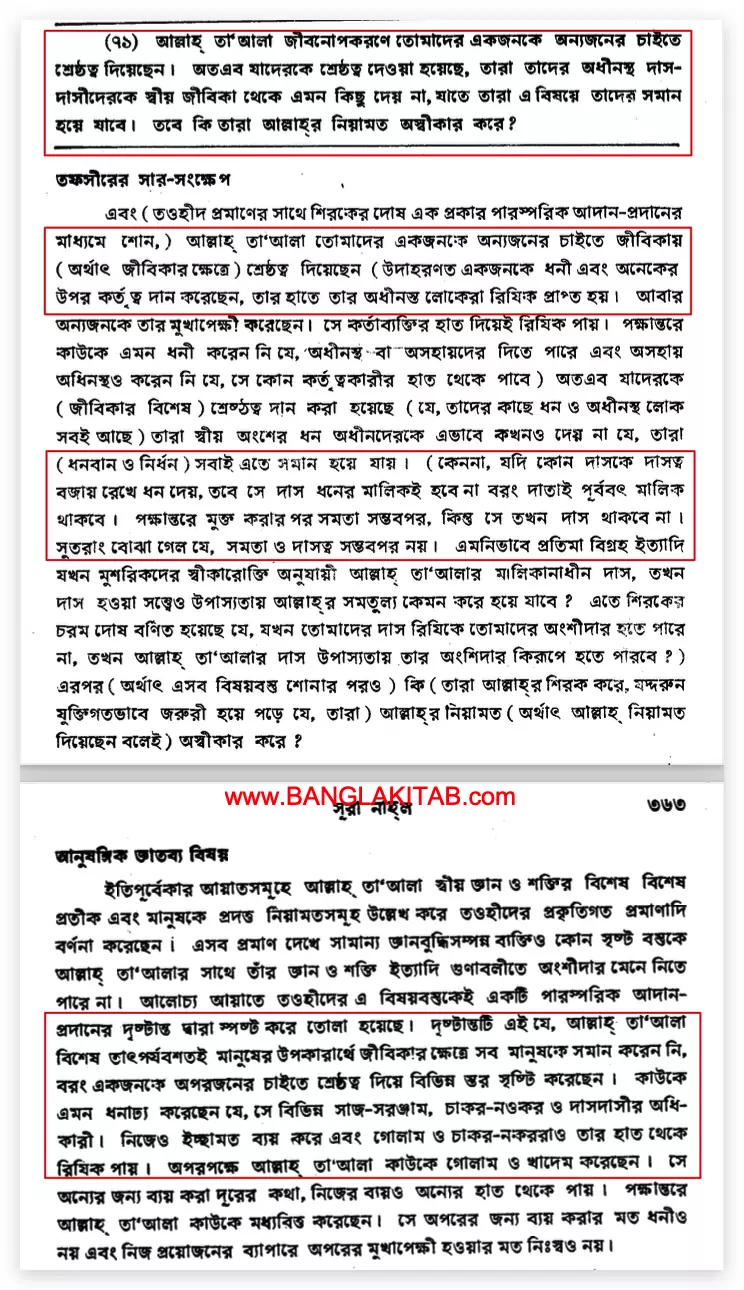
(71) And Allah has favoured some of you over others in provision. But those who have been much favoured would not share their wealth with those ˹bondspeople˺ in their possession, making them their equals. Do they then deny Allah’s favours?
Summary of the Commentary
And, to demonstrate divine oneness and the fault of associating partners with Allah through an analogy drawn from mutual dealings,
listen: Allah has favoured some of you over others in livelihood. For example, He has made one person wealthy and given him authority over many others; those under him receive their sustenance through his hands. He has made
another person dependent upon him, receiving sustenance through the hands of that person in authority. Elsewhere, He has made a person neither so wealthy that he can provide for dependants and the helpless, nor so helpless and subordinate that he must receive his livelihood from another’s hands. Those granted special advantages in livelihood—possessing both wealth and dependants—never distribute their share of wealth among those dependants so that
all, rich and poor alike, become equal. For if someone gives wealth to a slave while maintaining the person’s enslavement, the slave does not become its owner; the donor remains its owner as before. Equality becomes possible after emancipation, but the person is then no longer a slave. Thus equality and slavery cannot coexist. Similarly, when idols and images,
by the polytheists’ own admission, are slaves owned by Allah, how can they be His equals in worship while remaining slaves? This exposes the grave fault of shirk: if your slaves cannot share your livelihood as partners, how can Allah’s slaves share His right to be worshipped? Even after hearing these arguments, do they still associate partners with Allah, thereby necessarily implying a denial of His favours—that is, denial of the fact that Allah bestowed those favours?
Further Points of Explanation
In the preceding verses, Allah described particular manifestations of His knowledge and power, together with the favours He has bestowed upon humanity, to present natural proofs of divine oneness. After considering these proofs, even someone of limited intelligence cannot regard a created thing as sharing Allah’s knowledge, power or other attributes. The present verse clarifies this same principle through an analogy drawn from mutual
dealings. The analogy is that, for a particular purpose and for humanity’s benefit, Allah has not made all people equal in livelihood. Rather, He has favoured some over others and created different levels. He has made some so wealthy that they own various possessions, servants and slaves. They spend as they please, while their slaves and servants receive sustenance from their hands. Conversely, Allah has made some people slaves and servants:
far from providing for anyone else, they receive even their own subsistence from another person’s hands. He has also made some people middle-class: neither wealthy enough to provide for others nor so destitute that they depend upon others for their own needs.
Let us now watch some videos:
The Comparative Jurisprudential Framework of the Four Sunni Schools
Islamic slavery was not an isolated social custom; the Quran, hadith and classical jurisprudence gave it a comprehensive legal framework. Although the four Sunni schools differed on certain details, their positions did not diverge fundamentally on the basic permissibility of slave ownership, the enslavement of prisoners of war, the purchase and sale of slaves, and sexual relations with owned enslaved women [48] [49].
| Issue | Hanafi School | Maliki School | Shafi’i School | Hanbali School |
|---|---|---|---|---|
| Principal Sources of Slavery | Capturing and enslaving non-Muslims engaged in warfare is regarded as lawful. | Prisoners of war and saby constitute the principal sources of slavery. | The enslavement of women and children captured in war is recognised. | Enslaving non-Muslim prisoners of war is lawful; state authority is important in this matter. |
| Principal References | [50] [51] | |||
| Female and Child Prisoners of War | After a war, the imam or state authority may decide whether women and children are to be killed, released, ransomed or enslaved. | |||
| Ghanimah and Saby | Classical jurisprudence discusses the distribution or ownership of women and children captured in war as part of the spoils [52] [53] | |||
| Purchase and Sale of Slaves | Lawfully acquired male and female slaves may be transferred through purchase, sale, gifts, donations or inheritance. | |||
| Principal References | [54] [55] | |||
| Sexual Relations with Owned Enslaved Women | Sexual intercourse with an enslaved woman under one’s complete ownership is regarded as lawful without nikah. Its basis is ownership rather than a marriage contract [56] [57]. | |||
| The Enslaved Woman’s Consent | The enslaved woman’s freely given consent is generally not stipulated as a separate condition of the owner’s sexual entitlement. | Ownership constitutes the basis of sexual lawfulness; the question of consent is treated differently from that of a free woman. | The owner’s rights are emphasised; the enslaved woman’s consent is not an indispensable condition. | Sexual relations with an owned enslaved woman are regarded as the owner’s lawful right. |
| Principal References | [58] [59] [60] | |||
| Sexual Refusal by an Enslaved Woman | Classical jurisprudence does not regard refusal of an owner’s sexual demands as a fully autonomous right comparable to that of a free woman; various works discuss it as disobedience or sin [61]. | |||
| Marriage to One’s Own Enslaved Woman | A man cannot directly marry an enslaved woman he owns; he must first free her and may then contract a nikah [62]. | |||
| Marriage to Another Owner’s Enslaved Woman | Marriage to another owner’s enslaved woman is permissible under specified conditions; the owner’s permission and the woman’s legal status are relevant. | |||
| Annulment of an Enslaved Woman’s Marriage | Jurisprudence discusses the annulment or dissolution of an enslaved woman’s previous marriage through a change of ownership or the exercise of the owner’s authority [63]. | |||
| Istibra | Before sexual relations with a newly acquired enslaved woman or female prisoner of war, one must generally wait for one menstrual period; if she is pregnant, intercourse is prohibited until she gives birth [64]. | |||
| ‘Azl | Withdrawal was practised to prevent an enslaved woman becoming pregnant. Classical discussions distinguish between wives and enslaved women on whether the woman’s permission is required [65] [66] | |||
| Polytheist Enslaved Women | A strict position is taken on sexual relations with a polytheist enslaved woman. | Opinions differ: some scholars permit it, while others prohibit it. | Different positions exist concerning polytheist enslaved women and enslaved women from the People of the Book. | Although the lawfulness of intercourse with polytheist enslaved women is disputed, the basic framework concerning female prisoners of war is recognised. |
| Principal References | [67] [68] | |||
| Umm al-Walad | An enslaved woman who bears her owner’s child is called an umm al-walad. She remains enslaved during his lifetime; the prevailing rule provides for her freedom upon his death [69]. | |||
| Satr or ‘Awrah of an Enslaved Woman | Rules concerning bodily covering or ‘awrah distinguish between free and enslaved women; various jurisprudential works permit enslaved women to leave more of their bodies exposed [70]. | |||
| An Enslaved Person’s Property and Earnings | The owner is recognised as having extensive rights over a slave’s labour, earnings and property; independent property rights are limited. | |||
| An Enslaved Person’s Testimony | An enslaved person’s testimony does not enjoy the same full standing as that of a free person; in various matters it is restricted or subject to conditions. | |||
| A Slave’s Escape | Escape from an owner is regarded as a grave offence; sheltering or concealing an escaped slave is also discussed as prohibited. | |||
| Beating a Slave | Although gratuitous abuse is condemned, the owner’s right to discipline, punish and control slaves was recognised. A complete prohibition on beating slaves is not the general position of classical jurisprudence [71]. | |||
| Mukataba | A slave may seek freedom through a contract requiring payment of a specified sum; the legal condition of slavery continues until the contract is fulfilled. | |||
| Manumission | Manumission is encouraged as a righteous deed, an expiation and a means of earning religious merit, but enslavement and slave ownership are not entirely prohibited [72]. | |||
| Wala’ after Manumission | A relationship of wala’ arises between the freed person and the person who emancipated them; it can confer particular rights over inheritance or property upon the latter. | |||
| State Authority | Enslaving prisoners of war, distributing spoils and releasing captives are treated as matters under the imam’s or state’s authority, rather than matters of individual choice. | |||
The Prophet Muhammad’s Slave Trading
Authentic hadith show that the Prophet Muhammad himself participated in buying and selling slaves—in other words, in the slave trade. This is not merely a historical fact but a glaring example of the moral degradation of Islamic rulings. Despite claiming to be a prophet, Muhammad directly participated in this barbaric institution instead of abolishing it. Turning prisoners of war into slaves and selling or gifting them cannot be morally acceptable under any circumstances.
Muhammad himself also employed slaves, engaged in sexual acts with enslaved women and bought and sold slaves. His conduct legitimised slavery and helped establish and perpetuate it in Islamic society. Let us examine the references concerning his purchase and sale of slaves [73] [74]
Sunan Ibn Majah
12/ Business Transactions
Section: 12/47. Buying Slaves
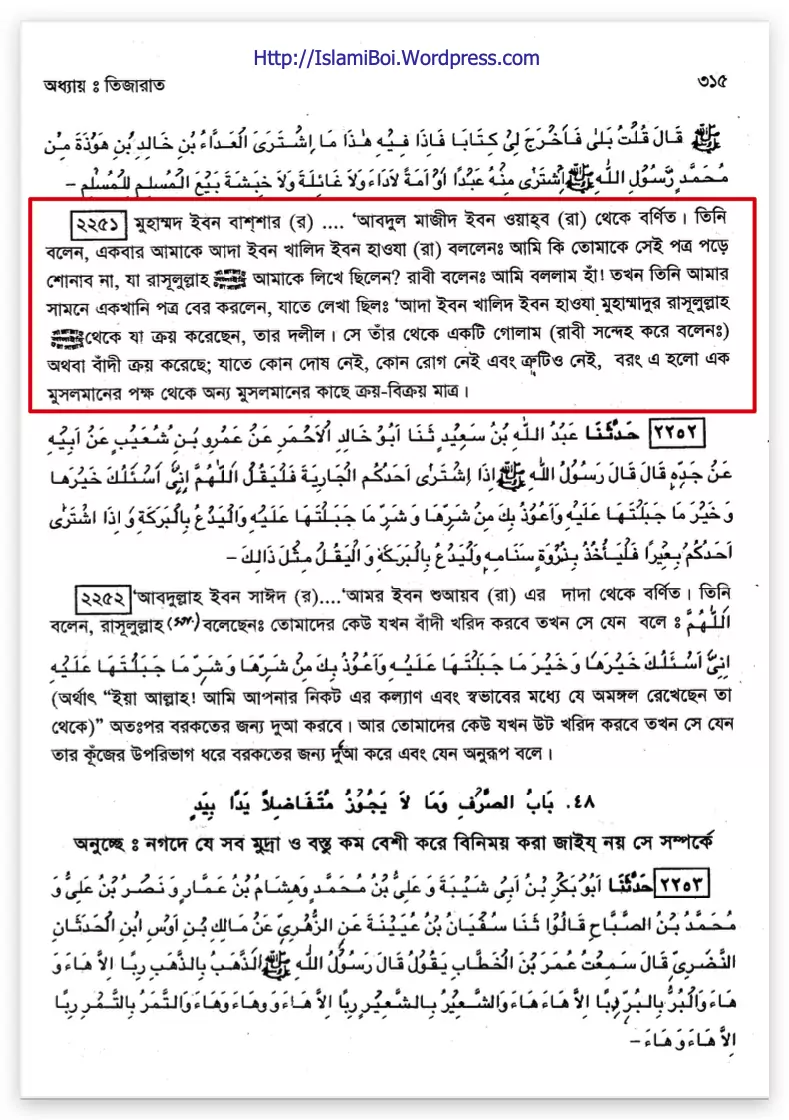
1/2251. It was narrated that ‘Abdul-Majid bin Wahb said: “Adda’ bin Khalid bin Hawdhah said to me: ‘Shall I not read to you a letter that the Messenger of Allah (ﷺ), wrote to me?’ I said: ‘Yes.’ So he took out a letter. In it was: ‘This is what ‘Adda’ bin Khalid bin Hawdhah bought [from] Muhammad the Messenger of Allah (ﷺ) He bought from him a slave’ or ‘a female slave, having no ailments, nor being a runaway, not having any malicious behavior. Sold by a Muslim to a Muslim.'”
Al-Tirmidhi 1216; al-Albani’s assessment: Hasan. Concerning the narrator Abbad ibn Layth, Abu Ja’far al-Uqayli states that his narrations should not be followed. Ahmad ibn Shu’ayb al-Nasa’i states that he is not reliable. Ibn Hajar al-Asqalani states that he is truthful but makes errors in narrating hadith. The author of Tahrir Taqrib al-Tahdhib describes him as weak. (Tahdhib al-Kamal: narrator no. 3092, 14/154.)
Hadith grade: Hasan (Darussalam)
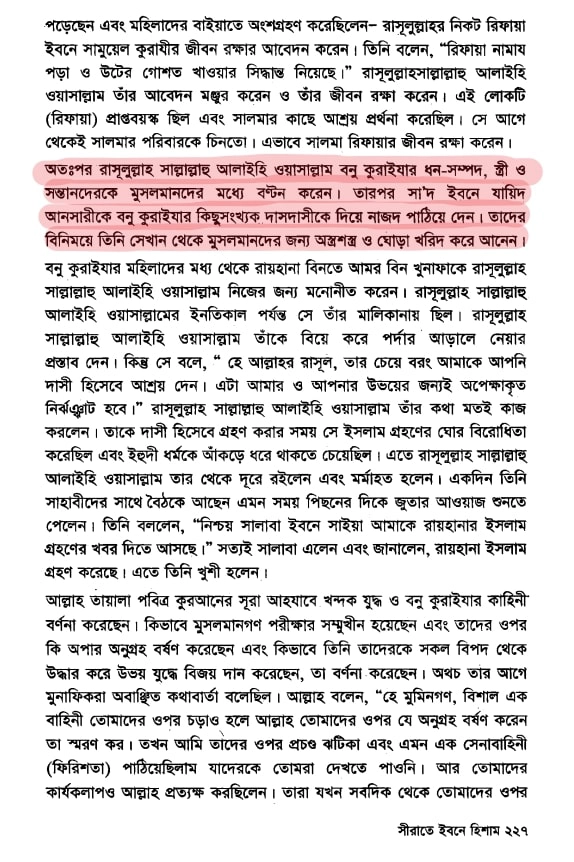
After the massacre of the Banu Qurayza, the Prophet Muhammad also decided that the tribe’s women and children would be enslaved. What subsequently happened to those slaves? On Muhammad’s orders, some were sold, and his followers used the proceeds to purchase weapons and horses [75] —
The Messenger of Allah then distributed the Banu Qurayza’s wealth, wives and children among the Muslims. He sent Sa’d ibn Zayd al-Ansari to Najd with a number of their male and female slaves, in exchange for whom he purchased weapons and horses for the Muslims.
Islamic Rulings Remain Unchanged until the Day of Judgement
One of Islam’s fundamental teachings is that true faith consists in accepting the Prophet Muhammad’s decisions completely, without the slightest hesitation or reservation, and submitting oneself to them. The translation of Surah An-Nisa, verse 65, makes clear that obedience to his commands and judgements is obligatory and that they may not be disobeyed. During his lifetime, Muhammad received revelation—divine messages conveying Allah’s commands to the Muslim community. After his death, however, the channel of revelation closed permanently. Consequently, any alteration or revision of Islam’s fundamental rulings and Sharia laws is regarded as entirely prohibited and haram. According to Islamic belief, no one has the authority to alter a prophetic judgement or command, because revelation and the Prophet’s decisions are instructions sent directly by Allah, recognised as unchanging and eternal truths [76] –
But no! By your Lord, they will never be ˹true˺ believers until they accept you ˹O Prophet˺ as the judge in their disputes, and find no resistance within themselves against your decision and submit wholeheartedly.
— Taisirul Quran (Bengali source; English quotation: Dr. Mustafa Khattab, The Clear Quran)
But no! By your Lord, they will never be ˹true˺ believers until they accept you ˹O Prophet˺ as the judge in their disputes, and find no resistance within themselves against your decision and submit wholeheartedly.
— Sheikh Mujibur Rahman (Bengali source; English quotation: Dr. Mustafa Khattab, The Clear Quran)
But no! By your Lord, they will never be ˹true˺ believers until they accept you ˹O Prophet˺ as the judge in their disputes, and find no resistance within themselves against your decision and submit wholeheartedly.
— Rawai Al-bayan (Bengali source; English quotation: Dr. Mustafa Khattab, The Clear Quran)
But no! By your Lord, they will never be ˹true˺ believers until they accept you ˹O Prophet˺ as the judge in their disputes, and find no resistance within themselves against your decision and submit wholeheartedly. [1] [2] [3]
— Dr. Abu Bakr Muhammad Zakaria (Bengali source; English quotation: Dr. Mustafa Khattab, The Clear Quran)
Another immutable Islamic principle is that an act which the Prophet Muhammad did not prohibit or declare haram cannot subsequently be prohibited by a Muslim or scholar. His decisions and rulings constitute Islam’s final standards, and no one possesses the authority to prohibit what he approved or made lawful. Equally, no one may subsequently declare lawful what he prohibited. In Islam, this is an unchanging rule that remains intact after the Prophet’s death. Since his decisions and instructions are received directly from Allah, no individual or institution has the right to alter these rulings or introduce new ones. Disregarding the boundaries he established between halal and haram, lawful and unlawful, is considered contrary to Islam’s fundamental beliefs. Let us examine a hadith from Sahih al-Bukhari on this matter [77] [78] —
Sahih al-Bukhari (Islamic Foundation)
85/ Holding Fast to the Quran and Sunnah
Section: 3097. The Prophet’s failure to disapprove of something is evidence of its permissibility. Another person’s failure to disapprove is not evidence of permissibility
6853. Hammad ibn Humayd … Narrated Muhammad bin Al-Munkadir: I saw Jabir bin `Abdullah swearing by Allah that Ibn Sayyad was the Dajjal. I said to Jabir, “How can you swear by Allah?” Jabir said, “I have heard `Umar swearing by Allah regarding this matter in the presence of the Prophet (ﷺ) and the Prophet (ﷺ) did not disapprove of it.”
Hadith grade: Sahih (authentic)
Narrator: Muhammad ibn al-Munkadir (may Allah have mercy on him)
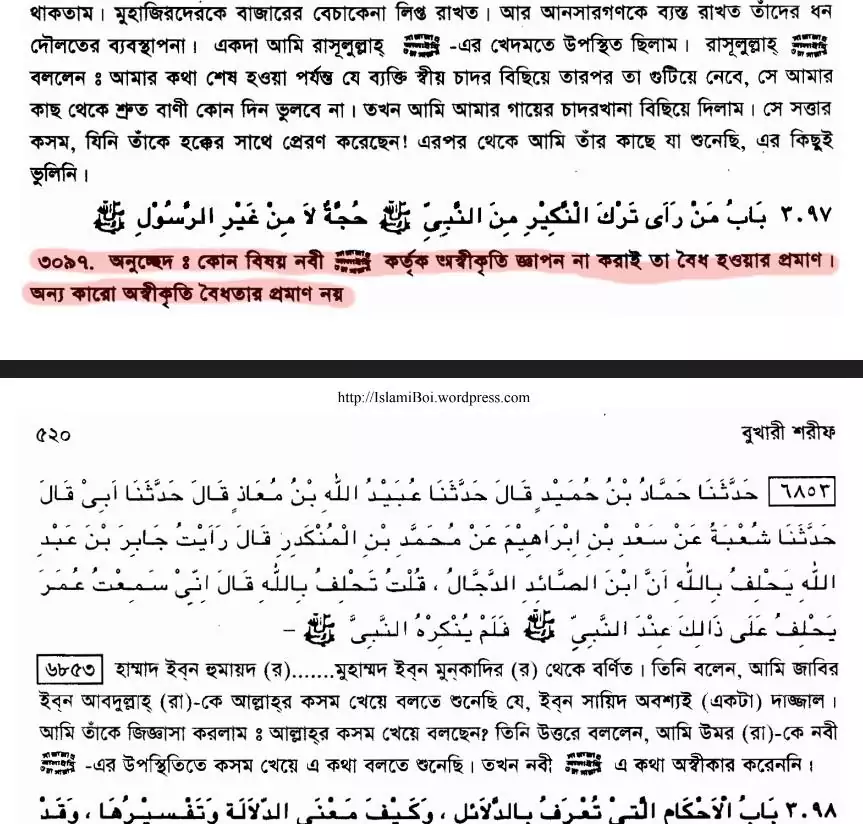
Let us now read the explanation of this hadith in Nasrul Bari [79] —
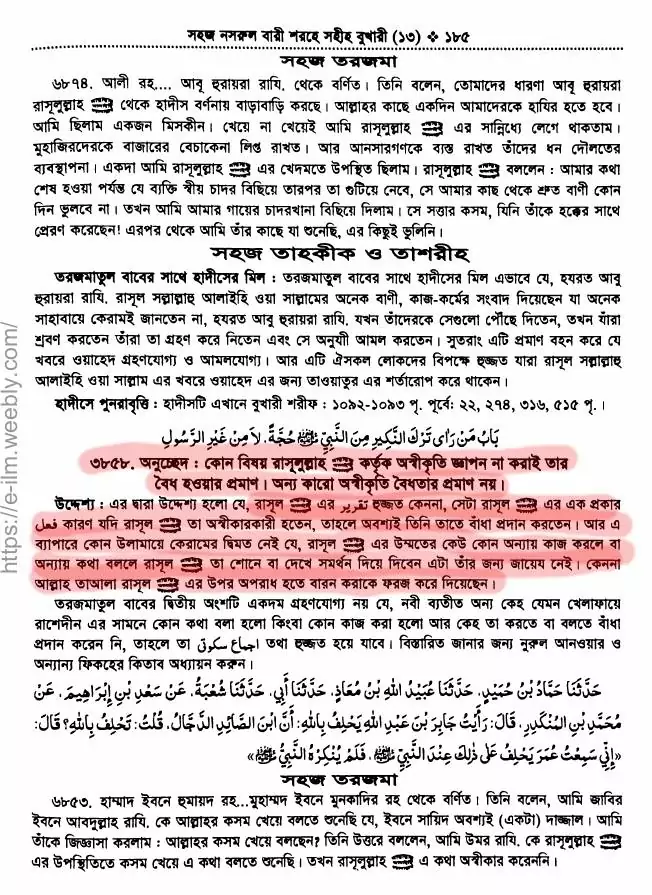
This hadith makes clear that, however eminent a later Islamic scholar may be, he has no authority to prohibit what the Prophet made lawful, or even what he did not prohibit or disapprove. If Islam makes slavery lawful, no subsequent Muslim can declare it haram, unethical or illegal.
Support for and Legalisation of Slavery in the Modern Era
The prominent Saudi Islamic scholar Shaykh Salih al-Fawzan is a member of Saudi Arabia’s highest religious body, the Council of Senior Scholars, which advises the king on religious matters. The Permanent Committee for Scholarly Research and Fatwa, associated with the Council of Senior Scholars, is an internationally recognised Islamic institution. Its senior theologians formulate rulings and research papers on Islamic law or fiqh. Translated into English, his statement reads [80] –
“Slavery is a part of Islam. Slavery is part of jihad, and jihad will remain as long there is Islam.”
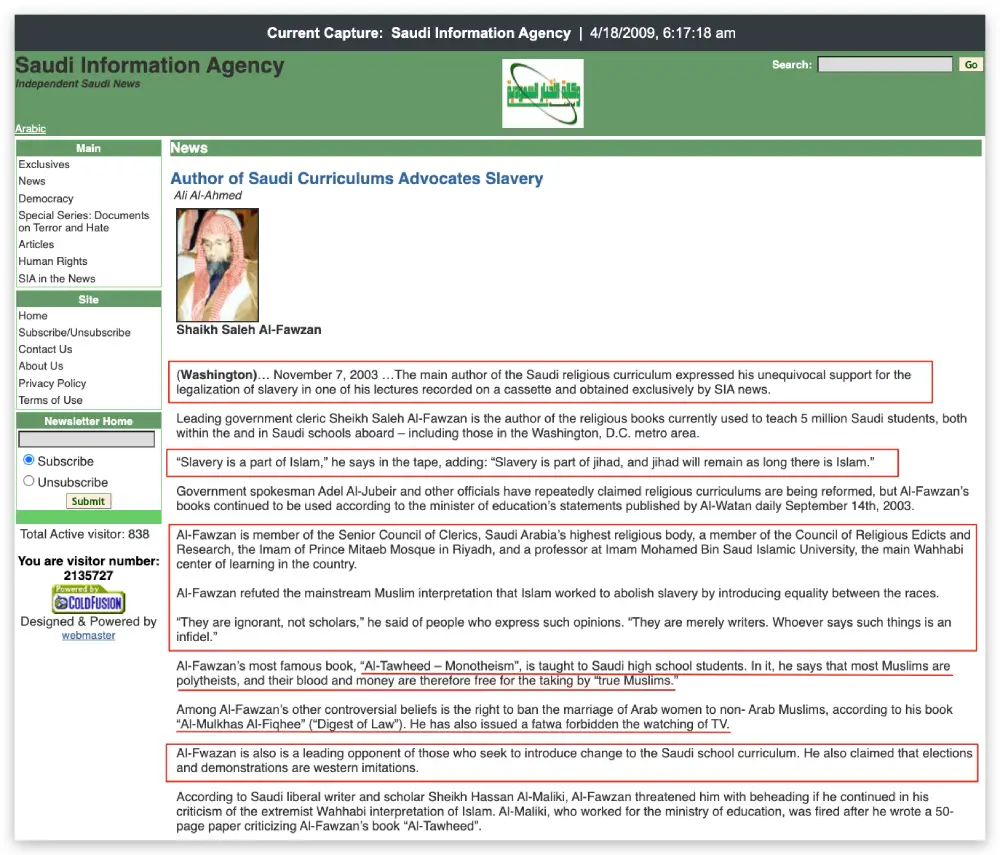
Translated from English into Bengali, Shaykh Salih al-Fawzan’s statement reads:
Slavery is a part of Islam. Slavery is part of jihad, and jihad will remain as long as there is Islam.
Because this issue is particularly important and sensitive, Shaykh Salih al-Fawzan’s live video statement is provided here for interested viewers, listeners and readers:
let us now listen to Bangladeshi scholars discussing slavery and enslaved people:
Offensive Jihad: An Integral Part of Islam
Offensive jihad, known in Arabic as ‘jihad al-talab’ or ‘jihad at-talab’ (جهاد الطلب), means ‘the declaration of jihad’ and concerns the process of inviting non-Muslims to accept Islam. One of the responsibilities of an Islamic state or its caliph is to call non-Muslim states to Islam and threaten them with attack if they refuse. Classical Islamic sources prescribe offensive jihad against dar al-harb—the territory of war or non-Muslim lands—until Allah’s rule is established in every household on earth. This form of jihad is regarded as an obligatory duty for Muslims and may be carried out in various ways.
Furthermore, this warfare must be comprehensive and aggressive, and may proceed without adherence to rules of war. Muhammad stated that ‘War is deceit’, meaning that deception and trickery against non-believers in war are lawful in Islam. Consequently, breaking agreements, oaths and promises, together with other forms of deception, is treated as permissible in jihad undertaken to secure Allah’s pleasure.
The most important scholars of the early period, as well as the most prominent scholars of the present, generally agree that jihad remains a permanent duty until ‘religion is for Allah alone’. They differ, however, on whether jihad may lawfully be conducted without a caliph or leader of the believers. This disagreement is a major point of contention between Salafi jihadists and conservative, quietist Salafis. Most contemporary jihadists believe that a caliph’s presence is unnecessary, or that they may select a caliph themselves and conduct jihad under him. Conservative Salafis, however, regard this jihad as unlawful without a caliph and therefore consider present-day jihad to lack legitimacy. Once a caliph is chosen, all these activities become lawful. Thus both groups agree on jihad’s methods and procedures; their disagreement concerns whether its initiation must come from a caliph or may occur without one.
A substantial proportion of modernist Islamic scholars educated in Europe and America argue that classical Islamic interpretations are largely mistaken and unnecessary under present social conditions. They maintain that offensive jihad, invading other countries, compelling conversion and imposing jizya are no longer required in interpreting the Quran, and that peaceful coexistence among people of all religions should now be the global objective. Those seeking to follow the lives of the early Companions and Successors of the Successors, however, regard jihad as an obligatory duty until the Day of Judgement—and, at the same time, as one of the shortest routes to Paradise.
Although contemporary perspectives differ over when jihad may be conducted—with a caliph, without one or under a caliph chosen by the participants—Islamic scholars generally agree that jihad fi sabilillah, meaning jihad in Allah’s cause against non-Muslims, is a duty for every capable Muslim man, particularly when Muslim lands are threatened. It is a duty to be fulfilled by an Islamic group with the objective of extending Islamic dominance and expanding its empire.
The Permissibility of Offensive Jihad
Numerous Quranic and hadith passages instruct Muslims to invite non-Muslim territories to Islam. If the inhabitants refuse, they are to submit and pay the humiliating jizya tax as the price of their lives; if they refuse that too, they are to be attacked and killed. Muslims may also take the women and children of those territories as slaves and sell them. We will demonstrate this directly through the sources. To begin, let us listen to several sermons:
Let us listen to another sermon, whose supporting evidence will be presented later in the article:
One might ask why the Prophet did not wage offensive jihad while living in Mecca. The reason is that his power and resources were then extremely limited. When numerically weak, he preached coexistence with other religions, proselytisation and the verse affirming that each group has its own religion. Once strength increased, the teaching became offensive jihad. The verses of Surah At-Tawbah are drawn from the Prophet’s own life. Let us hear what scholars say about this:
Quranic Permission for Offensive Jihad
Many Muslims today shamelessly cite Surah Al-Baqarah, verse 190, to claim that Islam never commands the initiation of an attack, and that Islamic warfare is supposedly defensive only. Even a little reading makes clear that these are blatant falsehoods. Most of Muhammad’s wars were offensive. The Banu Qurayza [81] were attacked and eliminated in a single day. Between 600 and 900 living human beings were slaughtered that day: an entirely offensive operation, or a brutal massacre. Muhammad also sent Khalid ibn al-Walid and others to attack several tribes around Mecca [82]. Moreover, the context of the revelation of Surah At-Tawbah shows that no war was then in progress. The non-believers were already subject to Muslim authority and governed by Muslims. Nevertheless, the first 40 verses of At-Tawbah were revealed, commanding that non-believers be killed wherever they were found. During Abu Bakr’s caliphate, he also waged jihad against apostates and those refusing to pay zakat, initiating attacks against those tribes. To deny offensive jihad would therefore require treating Muhammad and all his Companions as non-believers and opponents of this Quranic verse. These matters will be discussed progressively. Before proceeding, let us listen to a cleric’s statement:
Let us listen to another Arab scholar speaking in English:
Let us now read Surah Al-Baqarah, verse 190, and its commentary [83]. Reading the commentary makes everything clear. Readers should note the circumstances in which the verse was revealed. After the migration, the Prophet travelled to Mecca to perform the pilgrimage. Naturally, he proclaimed a message of peace at this point, because entering Mecca was necessary and the Quraysh pagans remained powerful there. Although Muhammad had insulted Mecca’s deities and criticised their religion, the pagan Meccans nevertheless showed considerable courtesy: the following year, they evacuated the entire city and allowed him to perform umrah. Later, once Muhammad had conquered Mecca and Muslims had become powerful, Surah At-Tawbah was revealed, commanding that polytheists be killed wherever they were found!
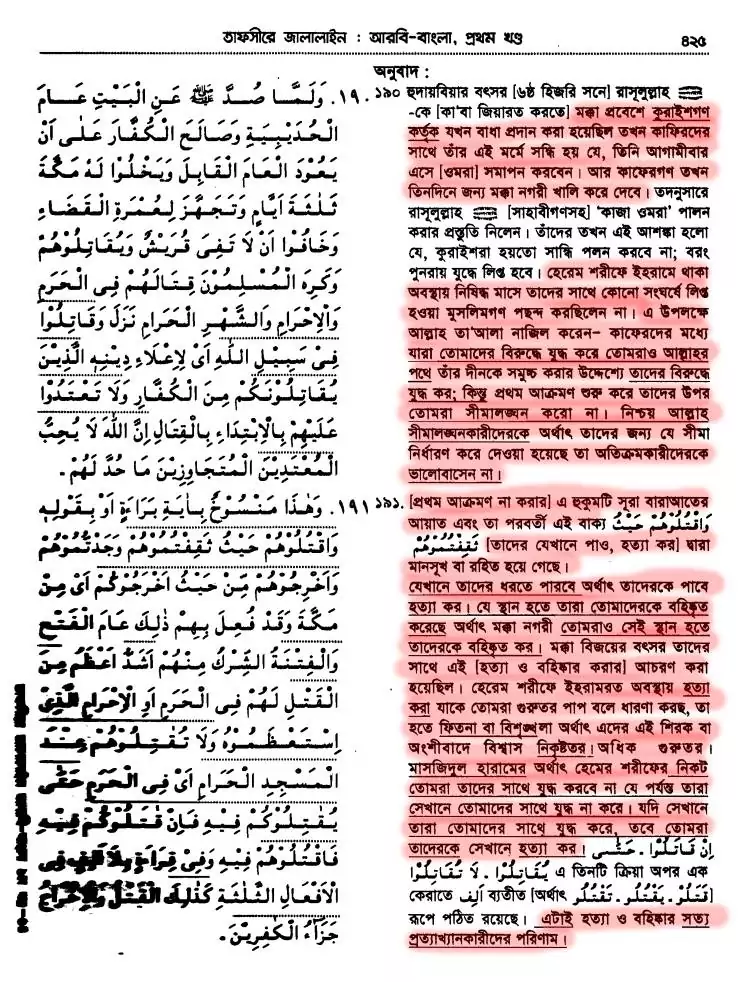
Islam fully permits offensive jihad against non-Muslim states to spread the religion and compel non-Muslims to embrace Islam by the sword. The Quran contains explicit provisions on this matter. Let us read the relevant verses together [84] [85] [86] [87] [88] [89] –
But once the Sacred Months have passed, kill the polytheists ˹who violated their treaties˺ wherever you find them, capture them, besiege them, and lie in wait for them on every way. But if they repent, perform prayers, and pay alms-tax, then set them free. Indeed, Allah is All-Forgiving, Most Merciful.
— Taisirul Quran (Bengali source; English quotation: Dr. Mustafa Khattab, The Clear Quran)
But once the Sacred Months have passed, kill the polytheists ˹who violated their treaties˺ wherever you find them, capture them, besiege them, and lie in wait for them on every way. But if they repent, perform prayers, and pay alms-tax, then set them free. Indeed, Allah is All-Forgiving, Most Merciful.
— Sheikh Mujibur Rahman (Bengali source; English quotation: Dr. Mustafa Khattab, The Clear Quran)
But once the Sacred Months have passed, kill the polytheists ˹who violated their treaties˺ wherever you find them, capture them, besiege them, and lie in wait for them on every way. But if they repent, perform prayers, and pay alms-tax, then set them free. Indeed, Allah is All-Forgiving, Most Merciful.
— Rawai Al-bayan (Bengali source; English quotation: Dr. Mustafa Khattab, The Clear Quran)
But once the Sacred Months have passed, kill the polytheists ˹who violated their treaties˺ wherever you find them, capture them, besiege them, and lie in wait for them on every way. But if they repent, perform prayers, and pay alms-tax, then set them free. Indeed, Allah is All-Forgiving, Most Merciful. [1] [2] [3] [4] [5] [6]
— Dr. Abu Bakr Muhammad Zakaria (Bengali source; English quotation: Dr. Mustafa Khattab, The Clear Quran)
Fight against them until there is no more persecution—and ˹your˺ devotion will be entirely to Allah. But if they desist, then surely Allah is All-Seeing of what they do.
— Taisirul Quran (Bengali source; English quotation: Dr. Mustafa Khattab, The Clear Quran)
Fight against them until there is no more persecution—and ˹your˺ devotion will be entirely to Allah. But if they desist, then surely Allah is All-Seeing of what they do.
— Sheikh Mujibur Rahman (Bengali source; English quotation: Dr. Mustafa Khattab, The Clear Quran)
Fight against them until there is no more persecution—and ˹your˺ devotion will be entirely to Allah. But if they desist, then surely Allah is All-Seeing of what they do.
— Rawai Al-bayan (Bengali source; English quotation: Dr. Mustafa Khattab, The Clear Quran)
Fight against them until there is no more persecution—and ˹your˺ devotion will be entirely to Allah. But if they desist, then surely Allah is All-Seeing of what they do. [1]
— Dr. Abu Bakr Muhammad Zakaria (Bengali source; English quotation: Dr. Mustafa Khattab, The Clear Quran)
Fight against them ˹if they persecute you˺ until there is no more persecution, and ˹your˺ devotion will be to Allah ˹alone˺. If they stop ˹persecuting you˺, let there be no hostility except against the aggressors.
— Taisirul Quran (Bengali source; English quotation: Dr. Mustafa Khattab, The Clear Quran)
Fight against them ˹if they persecute you˺ until there is no more persecution, and ˹your˺ devotion will be to Allah ˹alone˺. If they stop ˹persecuting you˺, let there be no hostility except against the aggressors.
— Sheikh Mujibur Rahman (Bengali source; English quotation: Dr. Mustafa Khattab, The Clear Quran)
Fight against them ˹if they persecute you˺ until there is no more persecution, and ˹your˺ devotion will be to Allah ˹alone˺. If they stop ˹persecuting you˺, let there be no hostility except against the aggressors.
— Rawai Al-bayan (Bengali source; English quotation: Dr. Mustafa Khattab, The Clear Quran)
Fight against them ˹if they persecute you˺ until there is no more persecution, and ˹your˺ devotion will be to Allah ˹alone˺. If they stop ˹persecuting you˺, let there be no hostility except against the aggressors. [1] [2]
— Dr. Abu Bakr Muhammad Zakaria (Bengali source; English quotation: Dr. Mustafa Khattab, The Clear Quran)
Fight those who do not believe in Allah and the Last Day, nor comply with what Allah and His Messenger have forbidden, nor embrace the religion of truth from among those who were given the Scripture, until they pay the tax, willingly submitting, fully humbled.
– MUHIUDDIN KHAN (Bengali source; English quotation: Dr. Mustafa Khattab, The Clear Quran)
Fight those who do not believe in Allah and the Last Day, nor comply with what Allah and His Messenger have forbidden, nor embrace the religion of truth from among those who were given the Scripture, until they pay the tax, willingly submitting, fully humbled.
— Taisirul Quran (Bengali source; English quotation: Dr. Mustafa Khattab, The Clear Quran)
Fight those who do not believe in Allah and the Last Day, nor comply with what Allah and His Messenger have forbidden, nor embrace the religion of truth from among those who were given the Scripture, until they pay the tax, willingly submitting, fully humbled.
— Sheikh Mujibur Rahman (Bengali source; English quotation: Dr. Mustafa Khattab, The Clear Quran)
Fight those who do not believe in Allah and the Last Day, nor comply with what Allah and His Messenger have forbidden, nor embrace the religion of truth from among those who were given the Scripture, until they pay the tax, willingly submitting, fully humbled.
— Rawai Al-bayan (Bengali source; English quotation: Dr. Mustafa Khattab, The Clear Quran)
Fight those who do not believe in Allah and the Last Day, nor comply with what Allah and His Messenger have forbidden, nor embrace the religion of truth from among those who were given the Scripture, until they pay the tax, willingly submitting, fully humbled. [1] [2] [3] [4]
— Dr. Abu Bakr Muhammad Zakaria (Bengali source; English quotation: Dr. Mustafa Khattab, The Clear Quran)
SAHIH INTERNATIONAL
Fight those who do not believe in Allah or in the Last Day and who do not consider unlawful what Allah and His Messenger have made unlawful and who do not adopt the religion of truth from those who were given the Scripture – (fight) until they give the jizyah willingly while they are humbled.
Allah has indeed purchased from the believers their lives and wealth in exchange for Paradise. They fight in the cause of Allah and kill or are killed. This is a true promise binding on Him in the Torah, the Gospel, and the Quran. And whose promise is truer than Allah’s? So rejoice in the exchange you have made with Him. That is ˹truly˺ the ultimate triumph.
— Taisirul Quran (Bengali source; English quotation: Dr. Mustafa Khattab, The Clear Quran)
Allah has indeed purchased from the believers their lives and wealth in exchange for Paradise. They fight in the cause of Allah and kill or are killed. This is a true promise binding on Him in the Torah, the Gospel, and the Quran. And whose promise is truer than Allah’s? So rejoice in the exchange you have made with Him. That is ˹truly˺ the ultimate triumph.
— Sheikh Mujibur Rahman (Bengali source; English quotation: Dr. Mustafa Khattab, The Clear Quran)
Allah has indeed purchased from the believers their lives and wealth in exchange for Paradise. They fight in the cause of Allah and kill or are killed. This is a true promise binding on Him in the Torah, the Gospel, and the Quran. And whose promise is truer than Allah’s? So rejoice in the exchange you have made with Him. That is ˹truly˺ the ultimate triumph.
— Rawai Al-bayan (Bengali source; English quotation: Dr. Mustafa Khattab, The Clear Quran)
Allah has indeed purchased from the believers their lives and wealth in exchange for Paradise. They fight in the cause of Allah and kill or are killed. This is a true promise binding on Him in the Torah, the Gospel, and the Quran. And whose promise is truer than Allah’s? So rejoice in the exchange you have made with Him. That is ˹truly˺ the ultimate triumph. [1]
— Dr. Abu Bakr Muhammad Zakaria (Bengali source; English quotation: Dr. Mustafa Khattab, The Clear Quran)
O believers! Fight the disbelievers around you and let them find firmness in you. And know that Allah is with those mindful ˹of Him˺.
— Taisirul Quran (Bengali source; English quotation: Dr. Mustafa Khattab, The Clear Quran)
O believers! Fight the disbelievers around you and let them find firmness in you. And know that Allah is with those mindful ˹of Him˺.
— Sheikh Mujibur Rahman (Bengali source; English quotation: Dr. Mustafa Khattab, The Clear Quran)
O believers! Fight the disbelievers around you and let them find firmness in you. And know that Allah is with those mindful ˹of Him˺.
— Rawai Al-bayan (Bengali source; English quotation: Dr. Mustafa Khattab, The Clear Quran)
O believers! Fight the disbelievers around you and let them find firmness in you. And know that Allah is with those mindful ˹of Him˺. [1] [2]
— Dr. Abu Bakr Muhammad Zakaria (Bengali source; English quotation: Dr. Mustafa Khattab, The Clear Quran)
Permission for Offensive Jihad in Quranic Commentary
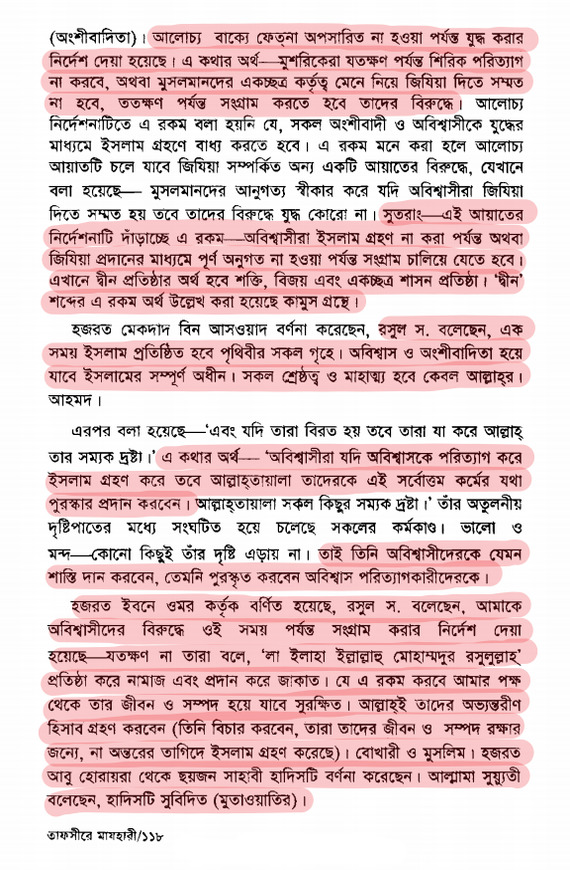
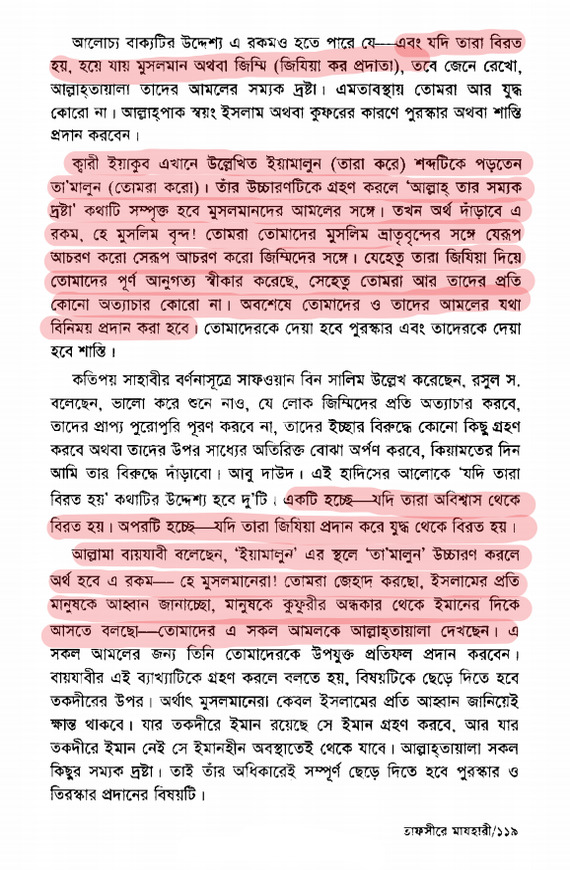
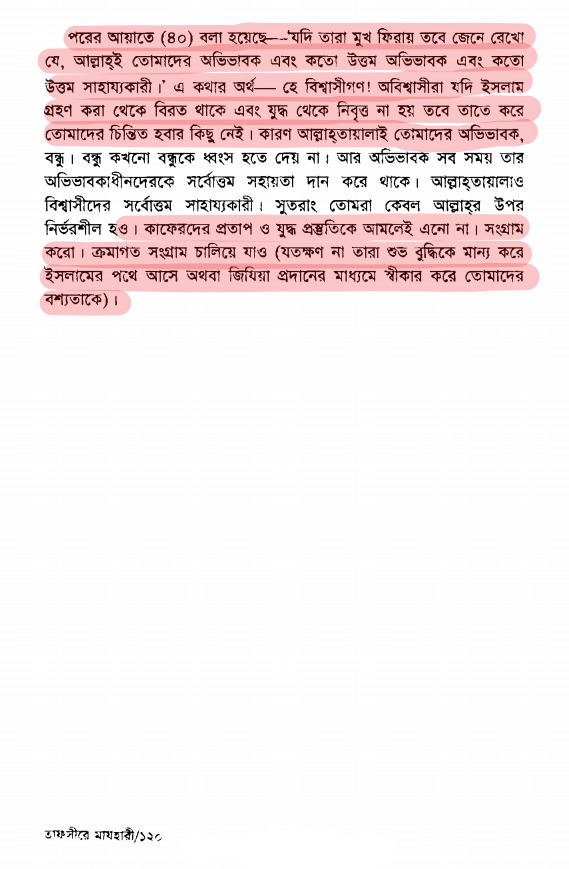
To understand Islam’s underlying conception of jihad, let us first read the commentary on Surah Al-Anfal, verse 39. This appears in Volume 5 of Tafsir al-Mazhari. Written by the world-renowned Sunni scholar and committed follower of the Hanafi school, Allama Qadi Thanaullah Panipati, this commentary is highly important for understanding the Quran correctly [90] —
Fight against them until there is no more persecution—and ˹your˺ devotion will be entirely to Allah. But if they desist, then surely Allah is All-Seeing of what they do.
And if they do not comply, then know that Allah is your Protector. What an excellent Protector, and what an excellent Helper!
(Surah Al-Anfal 8:39–40; English quotation: Dr. Mustafa Khattab, The Clear Quran)
The opening instruction is to continue fighting them until fitna has been removed and Allah’s religion established in its entirety. Fitna means disorder. The greatest disorder in the world is shirk, or associating partners with Allah. The passage commands fighting until fitna is removed. This means continuing to fight polytheists until they abandon shirk or accept the Muslims’ exclusive authority and agree to pay jizya. The instruction does not say that all polytheists and unbelievers must be compelled through warfare to embrace Islam. Such a reading would conflict with the injunction: do not fight them if they agree to pay jizya. The instruction therefore means that fighting must continue until unbelievers either accept Islam or become fully subordinate through payment of jizya. Establishing religion here means establishing power, victory and exclusive rule. This meaning of the word din appears in the Qamus.
Miqdad ibn al-Aswad narrated that Miqdad reported that he heard God’s messenger say, “There will not remain on the face of the earth a mud-brick house or a camel’s hair tent which God will not cause the confession of Islam to enter bringing both mighty honour and abject abasement. God will either honour the occupants and put them among its adherents, or will humiliate them and they will be subject to it.” Miqdad said, “God will then receive complete obedience.” Ahmad transmitted it.All supremacy and greatness will belong to Allah alone.
Ibn Umar narrated that Allah’s Messenger (ﷺ) said: “I have been ordered (by Allah) to fight against the people until they testify that none has the right to be worshipped but Allah and that Muhammad is Allah’s Messenger (ﷺ), and offer the prayers perfectly and give the obligatory charity, so if they perform that, then they save their lives and property from me except for Islamic laws and then their reckoning (accounts) will be done by Allah.” (He will judge whether they accepted Islam to protect their lives and property or from an inward conviction.) Al-Bukhari and Muslim. Six Companions narrated this hadith from Abu Hurayra. Allama al-Suyuti described it as widely transmitted (mutawatir).
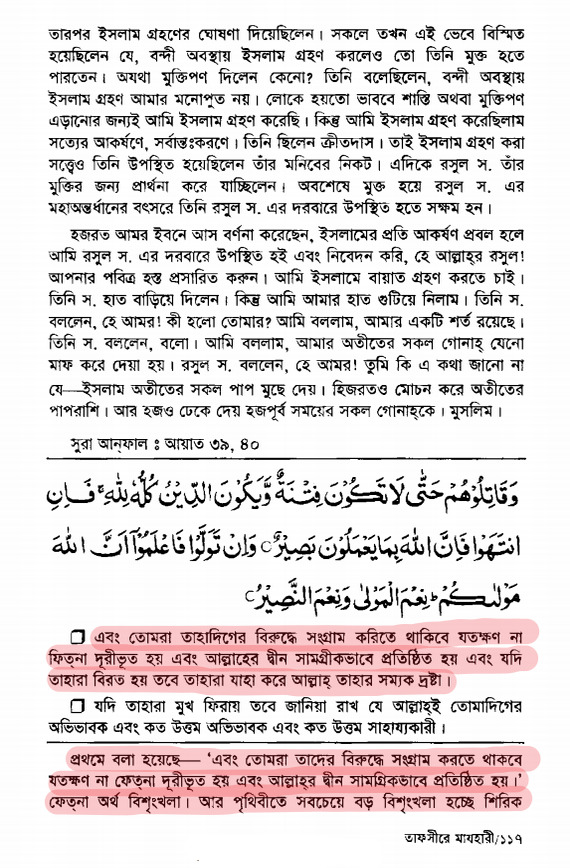
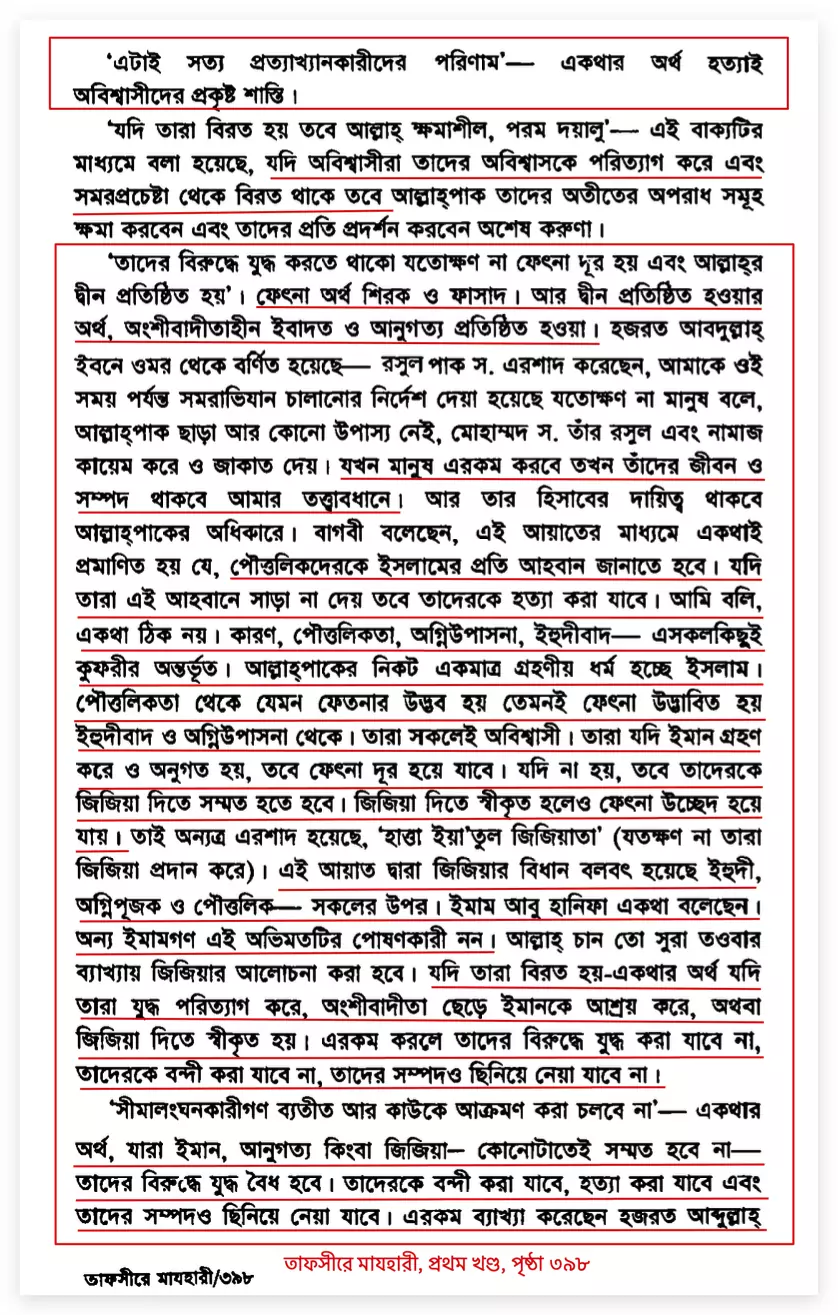
Let us now read a page from the commentary on Surah Al-Baqarah, verse 193 [91] —
‘That is the recompense of those who reject the truth’ means that killing is the appropriate punishment of unbelievers.
The statement ‘if they desist, Allah is forgiving and merciful’ means that, if unbelievers abandon unbelief and cease their war efforts, Allah will forgive their past offences and show them boundless mercy.
The initial instruction is to fight them until fitna is removed and Allah’s religion established. Fitna means shirk and disorder; establishing religion means establishing worship and obedience free of association of partners with Allah. Abdullah ibn Umar narrated that Allah’s Messenger (ﷺ) said: “I have been ordered (by Allah) to fight against the people until they testify that none has the right to be worshipped but Allah and that Muhammad is Allah’s Messenger (ﷺ), and offer the prayers perfectly and give the obligatory charity, so if they perform that, then they save their lives and property from me except for Islamic laws and then their reckoning (accounts) will be done by Allah.” Al-Baghawi states that this verse establishes that idolaters must be invited to Islam and may be killed if they reject the invitation. I say that this is incorrect, because idolatry, fire-worship and Judaism all fall within unbelief. The only religion acceptable to Allah is Islam. Just as idolatry produces fitna, so too do Judaism and fire-worship. All their adherents are unbelievers. If they accept faith and submit, fitna is removed. Otherwise, they must agree to pay jizya; agreeing to pay it also removes fitna. Thus another passage states, ‘hatta yu’tu al-jizyata’—until they pay jizya. This verse imposes jizya upon Jews, fire-worshippers and idolaters alike. Imam Abu Hanifa holds this position; the other imams do not. Allah willing, jizya will be discussed in the commentary on Surah At-Tawbah. ‘If they desist’ means that, if they abandon warfare, relinquish association of partners with Allah and embrace faith, or agree to pay jizya, they may not be fought or captured, nor may their property be seized.
‘No one may be attacked except the transgressors’ means that fighting is lawful against those who accept neither faith, obedience nor jizya. They may be captured or killed, and their property may be seized. This was the explanation given by Abdullah.
Permission for Offensive Jihad in Hadith
Muhammad’s statement that ‘Paradise is under the shades of swords’ is a particularly significant narration in Islamic history and discussions of jihad. It reveals an integral aspect of Islam in which religion is directly associated with warfare, physical force and weapons—and not merely for self-defence. The statement readily conveys an explicit encouragement of comprehensive jihad.
By establishing a direct relationship between Paradise and warfare, the statement cultivates a martial mentality or aggressive disposition among believers. It can consequently be understood as authorising offensive jihad as well as encouraging defensive jihad. Since attaining Paradise is every believer’s ultimate goal, warfare is presented as an especially effective means of reaching it. Such statements strengthen Muslim warriors’ confidence while making violence and aggression towards enemies praiseworthy.
Depicting Paradise as lying ‘under the shades of swords’ makes clear that warfare and courage in battle are among the means of attaining it. Warfare is thus presented as a religious and moral duty, as well as a military necessity. This can foster a profoundly harmful outlook among Muslims, undermining peaceful coexistence and tolerance of different views [92] [93] —
Sahih al-Bukhari (Tawhid)
Book: 56/ Jihad and Conduct during Warfare
Section: 56/22. Paradise is under the blades of swords.
Narrated Al-Mughira bin Shu’ba: Our Prophet told us about the message of our Lord that “Whoever amongst us is killed will go to Paradise.”
Umar asked the Prophet, “Is it not true that our men who are killed will go to Paradise and their’s (i.e. those of the Pagan’s) will go to the (Hell) fire?” The Prophet said, “Yes.”
2818. Narrated `Abdullah bin Abi `Aufa, in a letter to Salim Abu al-Nadr, the freed slave and secretary of Umar ibn Ubaydullah: Allah’s Messenger (ﷺ) said, “Know that Paradise is under the shades of swords.”
Al-Uwaysi followed the narration of Mu’awiya ibn Amr from Abu Ishaq through Musa ibn Uqba, transmitting it through Ibn Abi al-Zinad from Musa ibn Uqba. (2833, 2966, 3024, 7237; Muslim 32/6, Hadith: 1742; Ahmad: 19136; Adhunik Prakashani: 2608, Islamic Foundation: 2620)
Hadith grade: Sahih (authentic)
Hadith Sambhar
20/ Jihad in Allah’s Cause
Section: The Obligation of Jihad and the Merit of Setting Out Morning and Evening
(1900) Narrated by Ibn Umar (may Allah be pleased with him): The Messenger of Allah said: “I have been sent ahead of the Hour with the sword so that Allaah will be worshipped alone, and my provision has been placed in the shade of my spear, and humiliation has been decreed for those who go against my command, and whoever imitates a people is one of them.”
(Ahmad 5114–5115, 5667; Shu’ab al-Iman 98; Sahih al-Jami’ 2831)
Hadith grade: Sahih (authentic)
Narrator: Abdullah ibn Umar (may Allah be pleased with him)
At the same time, Muhammad’s statement that “the Prophet was made victorious through fear or terror” must be regarded as profoundly alarming. In translating the original Arabic term, translators in Bengali and other languages have resorted to various explanations and evasions that shift the meaning away from the hadith’s actual statement. Such alterations attempt to soften its harsh and aggressive tone, so that Islam’s ugly aspects do not become readily apparent. Yet the statement explicitly presents victory through fear, terror, and coercion, which is incompatible with the moral and humanitarian ideals of a civilized society. Let us read this hadith first in Bengali and then in English [94] —
Sahih al-Bukhari (Tawhid Publications)
56/ Jihad and Conduct during Warfare
Section: 56/122. The Statement of Allah’s Messenger:“I have been made victorious with terror for a distance of one month’s journey.”
وَقَوْلِهِ جَلَّ وَعَزَّ )سَنُلْقِيْ فِيْ قُلُوْبِ الَّذِيْنَ كَفَرُوا الرُّعْبَ بِمَآ أَشْرَكُوْا بِاللهِ ( قَالَهُ جَابِرٌ عَنْ النَّبِيِّ صلى الله عليه وسلم
Allah Most High’s words: “We will cast horror into the hearts of the disbelievers for associating ˹false gods˺ with Allah” … (Excerpt from Ali Imran 3:151; English: Dr. Mustafa Khattab, The Clear Quran).
This was narrated by Jabir from the Prophet (ﷺ).
2977. Narrated Abu Huraira: Allah’s Messenger (ﷺ) said, “I have been sent with the shortest expressions bearing the widest meanings, and I have been made victorious with awe (cast in the hearts of the enemy), and while I was sleeping, the keys of the treasures of the world were brought to me and put in my hand.” Abu Huraira added: Allah’s Messenger (ﷺ) has left the world and now you, people, are bringing out those treasures (i.e. the Prophet (ﷺ) did not benefit by them). (6998, 7013, 7273; Muslim 5/5, Hadith: 523; Ahmad: 7758; Adhunik Prakashani: 2756, Islamic Foundation: 2766)
Hadith grade: Sahih (authentic)
Narrator: Abu Hurayra (may Allah be pleased with him)
Let us now examine the English translation of this hadith. Here the Prophet says: I have been made victorious with terror. The correct Bengali translation is ‘I have been made victorious through terror’. Yet look at how the passage was translated above!
Narrated Abu Huraira:
Allah’s Messenger (ﷺ) said, “I have been sent with the shortest expressions bearing the widest meanings, and I have been made victorious with terror (cast in the hearts of the enemy), and while I was sleeping, the keys of the treasures of the world were brought to me and put in my hand.” Abu Huraira added: Allah’s Messenger (ﷺ) has left the world and now you, people, are bringing out those treasures (i.e. the Prophet did not benefit by them).
Readers can judge how truthful it is to claim that Islam admits no coercion, or that it has no offensive jihad and permits only defensive jihad. We will now examine further hadith. The following is authentic and has been critically graded as authentic [95] —
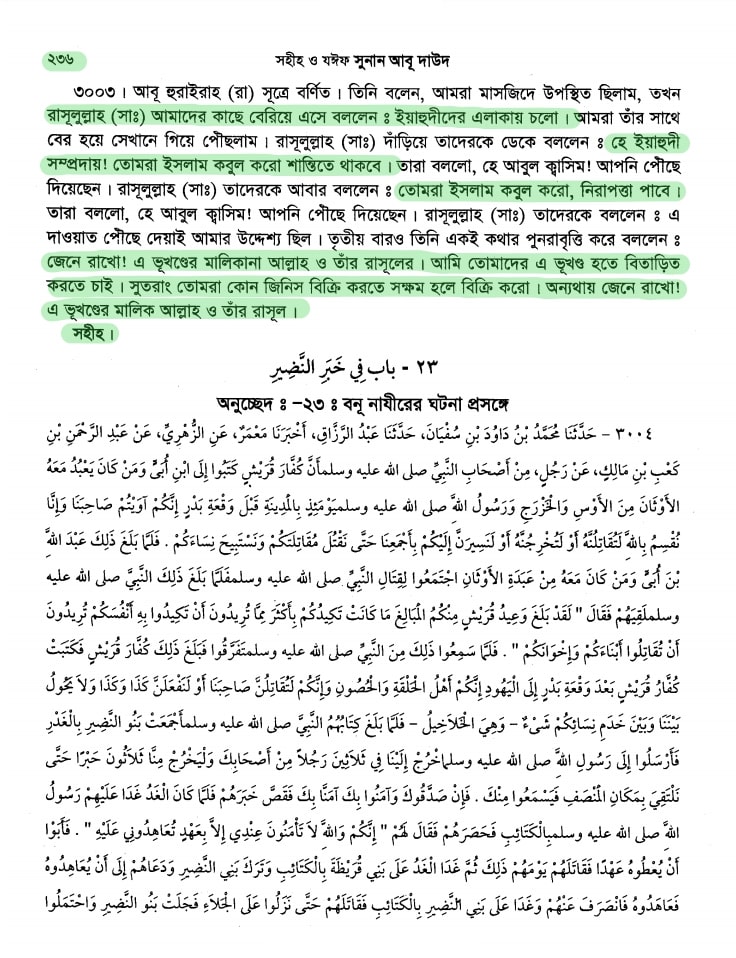
Sunan Abi Dawud (Critically Verified Edition)
Publisher: Allama Albani Academy
Book: 14/ Taxation, Fay’ and Administration
3003. Abu Hurairah said, While we were in the mosque, the Apostle of Allaah(ﷺ) came out and said “Come on to the Jews. So we went out with him and came to them”. The Apostle of Allaah(ﷺ) stood up, called them and said “If you, the community of Jews accept Islam you will be safe”. They said “You have given the message Abu Al Qasim”. The Apostle of Allaah(ﷺ) said “Accept Islam you will be safe”. They said “You have given the message Abu Al Qasim”. The Apostle of Allaah(ﷺ) said “that I intended”. He then said the third time “Know that the land belongs to Allaah and His Apostle and I intend to deport you from this land. So, if any of you has property (he cannot take it away), he must sell it, otherwise know that the land belongs to Allaah and His Apostle (ﷺ).”
Hadith grade: Sahih (Al-Albani)
The hadith above makes it easy to see how absurd and self-contradictory the claim that Islam permits no coercion is. Muhammad himself visited Jewish communities and threatened to expel them from their own land unless they accepted Islam! A believing reader may wonder whether they had committed some wrong and were therefore being punished. Yet if one Jew or several Jews had acted wrongly, action could easily have been taken against those individuals. How could an entire tribe be guilty—including the elderly, children and women? How is that possible?
If an entire tribe must be punished for the wrongdoing of one or several Jews, then the persecution of Rohingya Muslims and their expulsion from their homes would also become justified. Would it not? Likewise, blaming all Muslims for the bombings or militancy of extremists such as al-Qaeda and ISIS would be unjust, would it not? Responsibility belongs solely to whoever committed the offence, not to others. How, then, was the entire Jewish tribe held responsible? If someone still claims that Islam permits no coercion, what could be more absurd?
Hadith report that the Prophet stated he had been commanded to engage in qital, or armed warfare, against people until they acknowledged that there is no lord except Allah—in other words, until they became Muslims. The armed warfare described in this statement can be regarded as a clear violation of international human rights, because it directs military action to impose religious belief.
Under the international human-rights framework, every person possesses religious freedom and the right to hold their own opinions. Imposing religious belief or attempting forced conversion through intimidation or abuse of power violates fundamental rights and freedoms. Such thinking provides fertile ground for sectarianism, division and conflict in civilised society. When a community seeks to impose its religion upon others, it produces religious and social discrimination and creates conditions for war. This outlook destroys coexistence and mutual respect, obstructing a peaceful and progressive society. Any society governed consistently with this hadith would therefore contradict the United Nations’ human-rights framework and modern democratic values [96] [97] [98] [99] [100] —
Jami’ at-Tirmidhi (Critically Verified Edition)
38/ Faith
Section: 1. “I Have Been Ordered to Fight the People until They Say La Ilaha Illallah”
2607. Narrated Abu Hurairah: said: “When the Messenger of Allah (ﷺ) died and Abu Bakr became the Khalifah after him, whoever disbelieved from the Arabs disbelieved, so Umar bin Al-Khattab said to Abu Bakr: ‘How will you fight the people while the Messenger of Allah has said: ‘I have been ordered to fight the people until they say La Ilaha Illallah, and if they say that, then their blood and wealth will be protected from me, except what it makes obligatory upon them, and their reckoning is with Allah?’
So Abu Bakr said: ‘By Allah I will fight whoever differentiates between Salat and Zakat. For indeed, Zakat is the right due upon wealth. And by Allah! If they withhold even (camel) tethers which they used to give to the Messenger of Allah (ﷺ) I will fight them for withholding it.’ So Umar bin Al-Khattab said: ‘By Allah! I saw that Allah had opened Abu Bakr’s chest to fighting, so I knew that it was correct.'”
Sahih: al-Sahihah 407; Sahih Abi Dawud 1391–1393; al-Bukhari and Muslim.
Abu Isa states: this hadith is Hasan Sahih. Shu’ayb ibn Abi Hamza similarly narrated it from al-Zuhri, from Ubaydullah ibn Abdullah, from Abu Hurayra. Imran al-Qattan narrated it from Ma’mar, from al-Zuhri, from Anas, from Abu Bakr. That narration is erroneous, and Imran’s narration from Ma’mar has been contradicted.
Hadith grade: Sahih (Darussalam)
Narrator: Abu Hurayra (may Allah be pleased with him)
Jami’ at-Tirmidhi (Critically Verified Edition)
38/ Faith
Section: 2. “I Have Been Ordered to Fight the People until They Say La Ilaha Illallah and Establish Prayer”
2608.Narrated Anas bin Malik: that the Messenger of Allah (ﷺ) said: “I have been ordered to fight the people until they bear witness to La Ilaha Illallah, and that Muhammad is His servant and Messenger, and they face our Qiblah, eat our slaughtered (meat), and perform our Salat. And if they do that, then their blood and wealth will be unlawful to us, except with its due right. For them shall be whatever is for the Muslims, and they shall be obliged with that which the Muslims are obliged.”
Sahih: al-Sahihah 303 and 1/152; Sahih Abi Dawud 2374; al-Bukhari reports a similar narration.
Hadith on this topic are also narrated from Mu’adh ibn Jabal and Abu Hurayra. Abu Isa states that this hadith is Hasan Sahih and gharib through the chain above. Yahya similarly narrated it from Humayd, from Anas.
Hadith grade: Sahih (Darussalam)
Sunan an-Nasa’i (Islamic Foundation)
Book: 38/ The Prohibition of Bloodshed
Section: 1. The Prohibition of Killing a Muslim
3979. Ishaq ibn Ibrahim … It was narrated that Abu Hurairah said: “The Messenger of Allah [SAW] said: ‘I have been commanded to fight the people until they say La ilaha illallah. If they say it, then their blood and wealth are prohibited for me, except for a right that is due, and their reckoning will be with Allah.'”
Critical assessment: Sahih.
Hadith grade: Sahih (Darussalam)
Sahih Muslim (Hadith Academy)
Book: 1. Faith (Belief)
Section: 8. The command to fight people until they acknowledge that there is no deity but Allah and that Muhammad is His Messenger, establish prayer, pay zakat and believe in the Sharia he brought. Whoever does so gains protection for life and property, except on grounds recognised by Sharia; what lies in their hearts is known to Allah. The imam is instructed to fight those who refuse zakat or other Islamic rulings and to establish Islam’s distinctive ordinances.
35–(35/…) Abu Bakr ibn Abu Shayba … reported from Jabir and, through Abu Salih, from Abu Hurayra:“I have been commanded that I should fight against people.”The remaining narration is equivalent to the account Ibn al-Musayyab narrated from Abu Hurayra.
Abu Bakr ibn Abu Shayba and Muhammad ibn al-Muthanna … It is narrated on the authority of Jabir that the Messenger of Allah said: I have been commanded that I should fight against people till they declare that there is no god but Allah, and when they profess it that there is no god but Allah, their blood and riches are guaranteed protection on my behalf except where it is justified by law, and their affairs rest with Allah, and then he (the Holy Prophet) recited (this verse of the Holy Qur’an):” Thou art not over them a warden” (lxxxviii, 22). (Islamic Foundation: 35; Islamic Centre: 35–36) [The Quran passage quoted in the Bengali source, Al-Ghashiyah 88:21–22: “So, ˹continue to˺ remind ˹all, O Prophet˺, for your duty is only to remind. You are not ˹there˺ to compel them ˹to believe˺.” English: Dr. Mustafa Khattab, The Clear Quran.]
Hadith grade: Sahih (authentic)
Sunan Ibn Majah
Publisher: Tawhid Publications
Book: 30/ Tribulations
Section: 30/1. Refraining from Harming One Who Says La Ilaha Illallah
3/3929. ‘Amr bin Aws narrated that his father, Aws, told him: “We were sitting with the Prophet (ﷺ) and he was narrating to us and reminding us, when a man came and spoke privately to him. He said: ‘Take him away and kill him.’ When the man turned away, the Messenger of Allah (ﷺ) called him back and said: ‘Do you bear witness that none has the right to be worshiped but Allah?’ He said, ‘Yes.’ He said: ‘Then go and let him go, for I have been commanded to fight the people until they say: La ilaha illallah, then if they do that, their blood and wealth are forbidden to me.’”
Al-Nasa’i 3979, 3982, 3983; Ahmad 15727; al-Darimi 2446. Al-Albani’s assessment: Sahih.
Hadith grade: Sahih (Darussalam)
Let us examine how Muhammad’s Companions attacked the territories of non-believers and what they said while doing so [101] [102]
Sahih al-Bukhari (Tawhid Publications)
58/ Jizya and Treaties
Section: 58/1. Taking Jizya from the Dhimmi and Making Treaties with the People of War
3159. Narrated Jubair bin Haiya: `Umar sent the Muslims to the great countries to fight the pagans. When Al-Hurmuzan embraced Islam, `Umar said to him. “I would like to consult you regarding these countries which I intend to invade.” Al-Hurmuzan said, “Yes, the example of these countries and their inhabitants who are the enemies. of the Muslims, is like a bird with a head, two wings and two legs; If one of its wings got broken, it would get up over its two legs, with one wing and the head; and if the other wing got broken, it would get up with two legs and a head, but if its head got destroyed, then the two legs, two wings and the head would become useless. The head stands for Khosrau, and one wing stands for Caesar and the other wing stands for Faris. So, order the Muslims to go towards Khosrau.”
Bakr and Ziyad both reported from Jubair ibn Hayya: So, `Umar sent us (to Khosrau) appointing An-Nu`man bin Muqrin as our commander. When we reached the land of the enemy, the representative of Khosrau came out with forty-thousand warriors, and an interpreter got up saying, “Let one of you talk to me!” Al-Mughira replied, “Ask whatever you wish.” The other asked, “Who are you?” Al-Mughira replied, “We are some people from the Arabs; we led a hard, miserable, disastrous life: we used to suck the hides and the date stones from hunger; we used to wear clothes made up of fur of camels and hair of goats, and to worship trees and stones. While we were in this state, the Lord of the Heavens and the Earths, Elevated is His Remembrance and Majestic is His Highness, sent to us from among ourselves a Prophet whose father and mother are known to us. Our Prophet, the Messenger of our Lord, has ordered us to fight you till you worship Allah Alone or give Jizya (i.e. tribute); and our Prophet has informed us that our Lord says:– “Whoever amongst us is killed (i.e. martyred), shall go to Paradise to lead such a luxurious life as he has never seen, and whoever amongst us remain alive, shall become your master.” (7530; Islamic Foundation: 2934)
Hadith grade: Sahih (authentic)
Narrator: Jubayr ibn Hayya (may Allah have mercy on him)
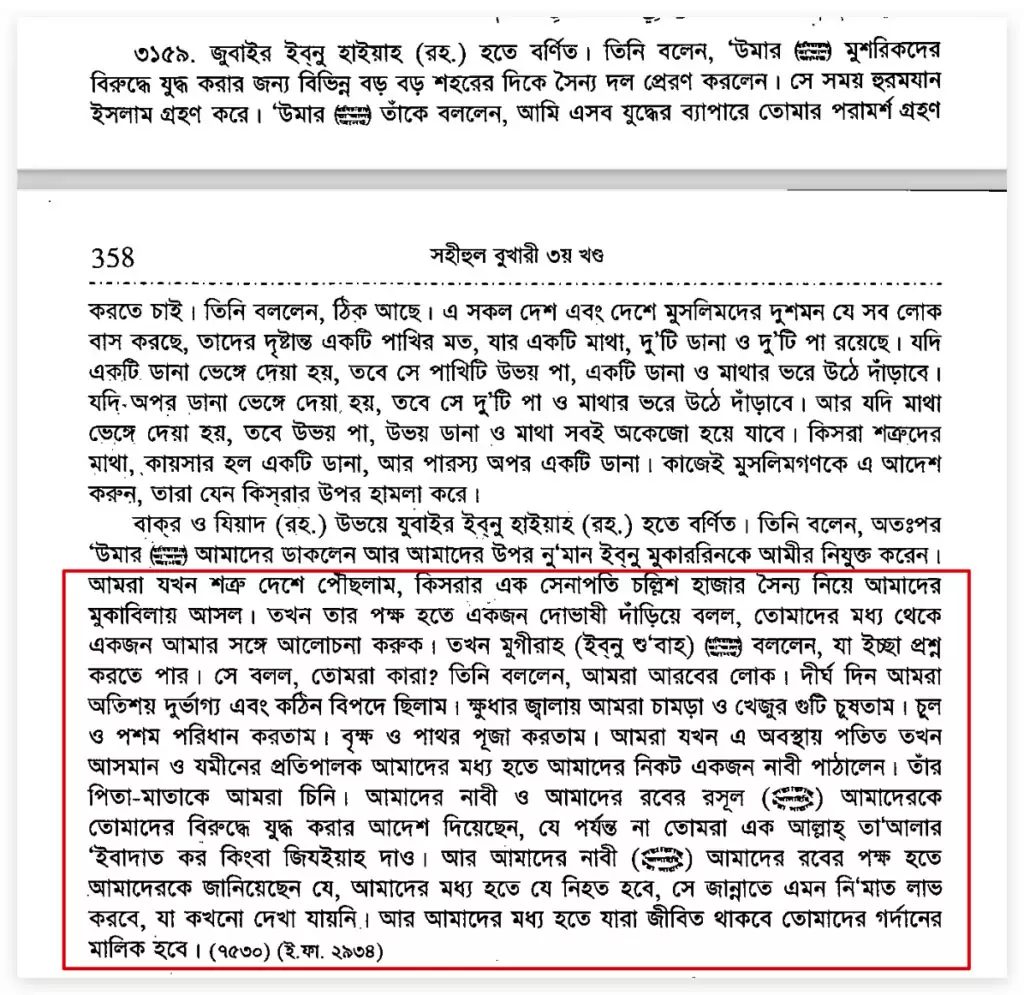
Read the following hadith carefully. Islam fully permits surprise attacks upon non-believers’ settlements and the capture of their women and children. These are explicit Islamic rulings, although clerics in our country never utter these hadith in their sermons, because doing so would expose them to imprisonment and fines for militancy. The hadith clearly mentions the permissibility of surprise attacks against non-believing populations under cover of night and the capture of women and children, in direct opposition to humanitarian principles and international rules of war [103] [104] —
Sahih Muslim (Islamic Foundation)
Book: 33/ Jihad and Its Principles
Section: 1. The Permissibility of Raiding Non-Believers Who Have Received the Invitation to Islam without Prior Warning
4370. Yahya ibn Yahya al-Tamimi … Ibn ‘Aun reported:I wrote to Nafi’ inquiring from him whether it was necessary to extend (to the disbelievers) an invitation to accept (Islam) before meeting them in fight. He wrote (in reply) to me that it was necessary in the early days of Islam. The Messenger of Allah (ﷺ) made a raid upon Banu Mustaliq while they were unaware and their cattle were having a drink at the water. He killed those who fought and imprisoned others. On that very day, he captured Juwairiya bint al-Harith. Nafi’ said that this tradition was related to him by Abdullah b. Umar who (himself) was among the raiding troops.
Hadith grade: Sahih (authentic)
Narrator: Ibn Awn (may Allah have mercy on him)
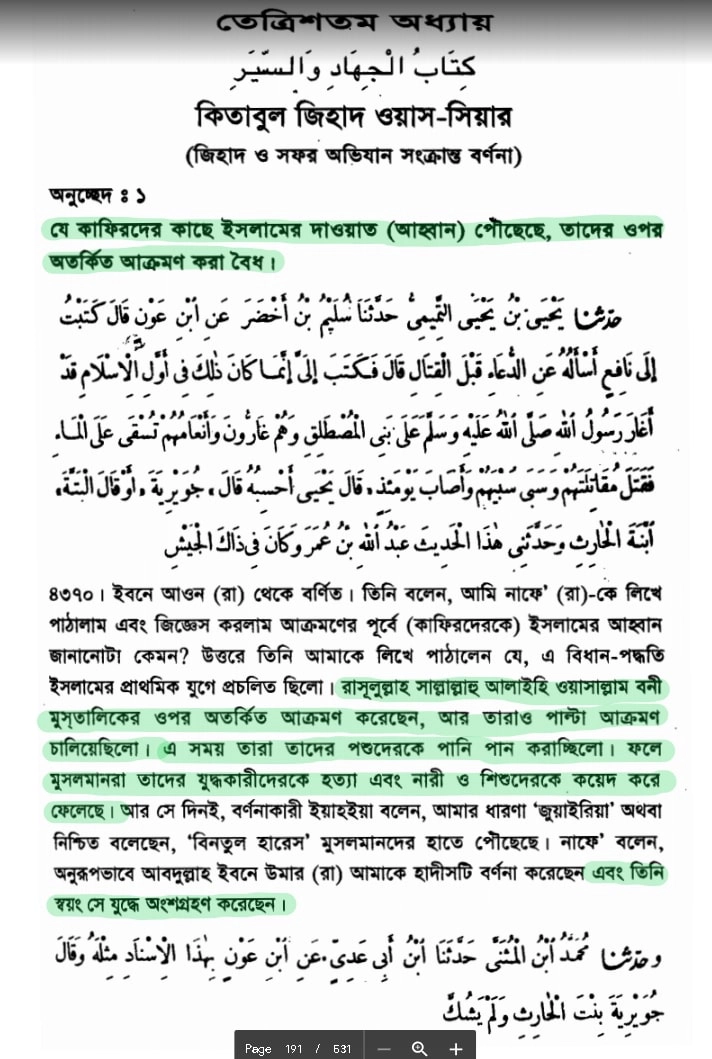
Let us now read a hadith from Tahawi Sharif. It indicates that, since the invitation to Islam has now reached everyone, there is no particular need to issue that invitation again: offensive jihad or a surprise attack is entirely permissible [105] —
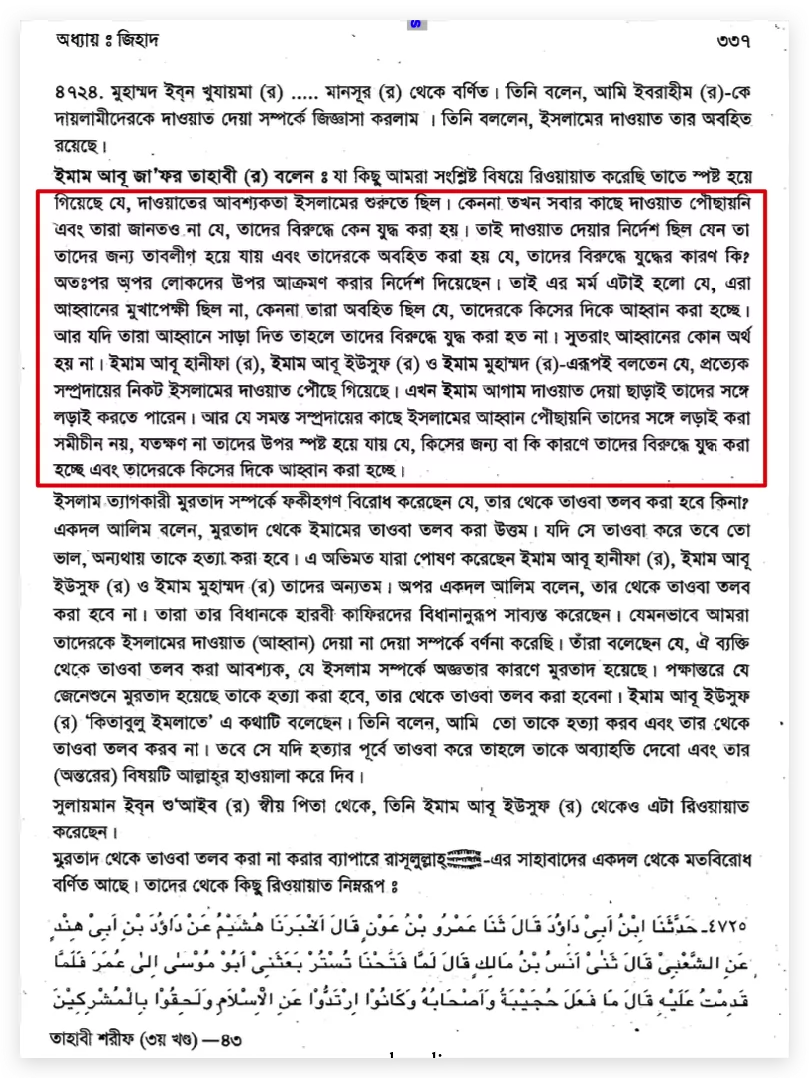
Permission for Offensive Jihad in Jurisprudence
Al-Hidaya is a foundational work of Islamic jurisprudence, particularly within the Hanafi school. It may aptly be described as an encyclopaedia of Hanafi jurisprudence. Let us read an excerpt from its chapter on jihad [106] —
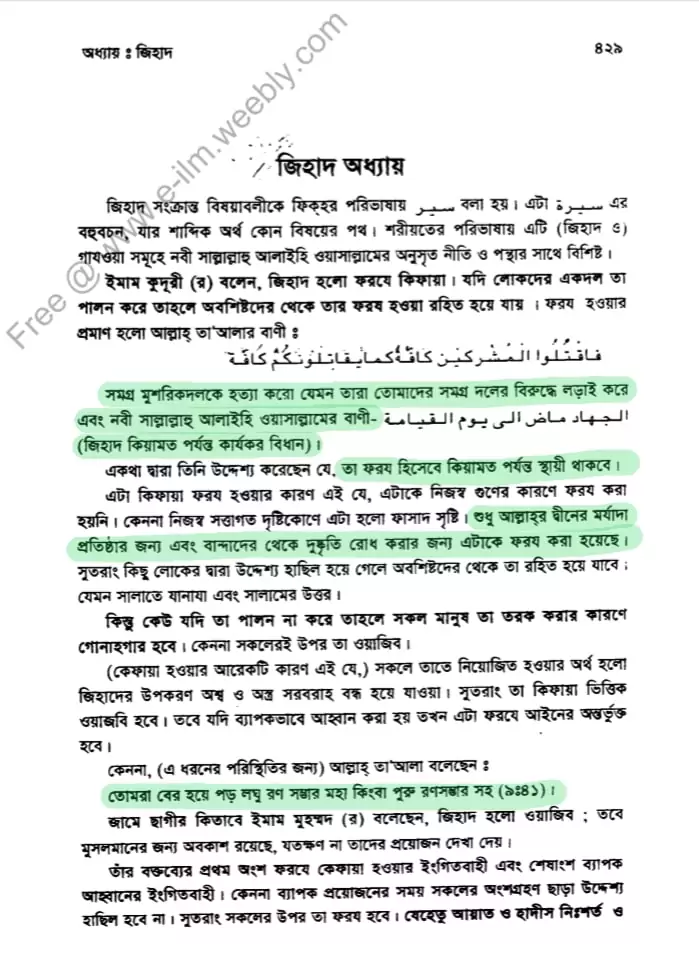
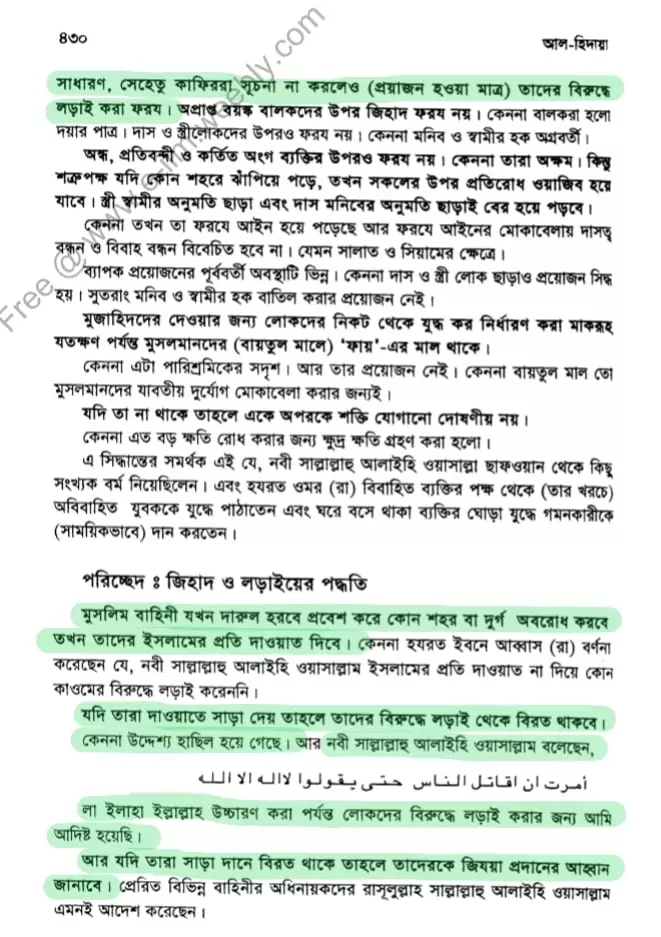
Muslim rulers subsequently forced non-Muslims to convert or pay the humiliating jizya tax. If they refused these alternatives, killing or enslavement followed—procedures explicitly prescribed in Islam. Discussing the humiliating jizya tax here would make this article too long, so that discussion is omitted. Interested readers may consult this article [107].
Permission for Offensive Jihad in the Commentary on Sahih Muslim
One of Islam’s particularly important provisions is jihad al-talab, or offensive jihad. This provision applies when Muslims possess a strong army. With an army and weapons, they are to wage jihad against non-believers, because unbelief constitutes the greatest fitna in Islam’s view. The commentary on Sahih Muslim also gives a clear account of this. Non-believers from the People of the Book may survive only by accepting Islam or paying jizya in a state of humiliation and submission. From polytheists, nothing other than Islam will be accepted; the supporting references have already been provided [108] —
Fourth Stage: Initiate jihad against non-believers of all religions and peoples, even if they have not begun fighting Muslims, until they accept Islam or pay jizya, the tax imposed upon non-Muslims in an Islamic state. Its purpose is to raise Allah’s word, confer supremacy upon Islam and destroy the dominance of unbelief. This stage was announced in 9 AH through Abu Bakr al-Siddiq. Allah describes it in detail in Surah At-Tawbah, stating:But once the Sacred Months have passed, kill the polytheists ˹who violated their treaties˺ wherever you find them, capture them, besiege them, and lie in wait for them on every way. But if they repent, perform prayers, and pay alms-tax, then set them free. Indeed, Allah is All-Forgiving, Most Merciful. — Surah At-Tawbah 9:5; Dr. Mustafa Khattab, The Clear Quran.
In another verse of Surah At-Tawbah, Allah says: “Fight those who do not believe in Allah and the Last Day, nor comply with what Allah and His Messenger have forbidden, nor embrace the religion of truth from among those who were given the Scripture, until they pay the tax, willingly submitting, fully humbled.” — Surah At-Tawbah 9:29; Dr. Mustafa Khattab, The Clear Quran.
In Surah Al-Anfal, Allah states:Fight against them until there is no more persecution—and ˹your˺ devotion will be entirely to Allah. But if they desist, then surely Allah is All-Seeing of what they do. (Surah Al-Anfal 8:39; Dr. Mustafa Khattab, The Clear Quran.) — (Surah Al-Anfal 39)
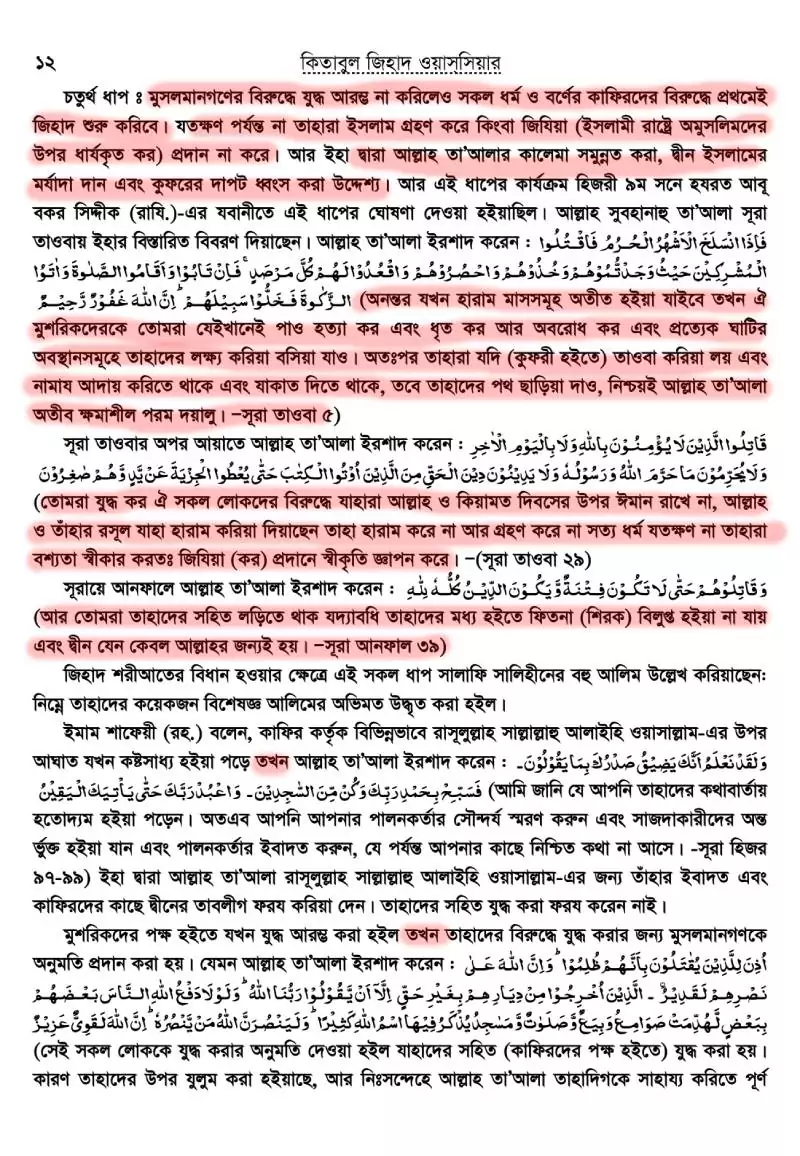
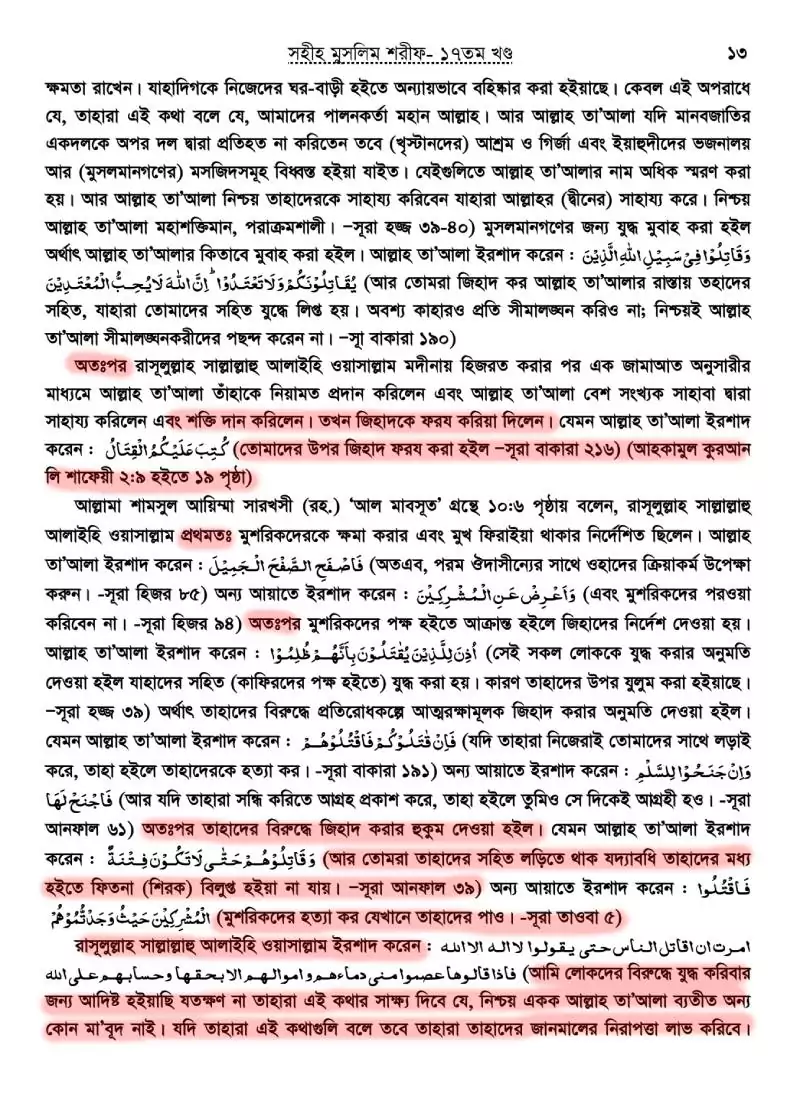
A Leading Modern Fatwa: Offensive Jihad
Let us now examine a fatwa issued by Saudi Arabia’s highest Islamic Sharia board and read its Bengali translation. It was published on the well-known fatwa website islamqa.info, directly administered by the prominent contemporary Salafi scholar Shaykh Salih al-Munajjid [109]
There is no compulsion to accept Islam
08/Shawwal/1423 , 12/December/2002
Question 34770
Some friends say that whoever does not enter Islam, that is his choice and he should not be forced to become Muslim, quoting as evidence the verses in which Allah says (interpretation of the meaning):
“And had your Lord willed, those on earth would have believed, all of them together. So, will you (O Muhammad) then compel mankind, until they become believers”
[Yoonus 10:99]
“There is no compulsion in religion”
[al-Baqarah 2:256]
What is your opinion concerning that?.
Answer
Praise be to Allah, and blessings and peace be upon the Messenger of Allah:
The scholars explained that these two verses, and other similar verses, have to do with those from whom the jizyah may be taken, such as Jews, Christians and Magians (Zoroastrians). They are not to be forced, rather they are to be given the choice between becoming Muslim or paying the jizyah.
Other scholars said that this applied in the beginning, but was subsequently abrogated by Allah’s command to fight and wage jihad. So whoever refuses to enter Islam should be fought when the Muslims are able to fight, until they either enter Islam or pay the jizyah if they are among the people who may pay jizyah. The kuffaar should be compelled to enter Islam if they are not people from whom the jizyah may be taken, because that will lead to their happiness and salvation in this world and in the Hereafter. Obliging a person to adhere to the truth in which is guidance and happiness is better for him than falsehood. Just as a person may be forced to do the duty that he owes to other people even if that is by means of imprisonment or beating, so forcing the kaafirs to believe in Allah alone and enter into the religion of Islam is more important and more essential, because this will lead to their happiness in this world and in the Hereafter. This applies unless they are People of the Book, i.e., Jews and Christians, or Magians, because Islam says that these three groups may be given the choice: they may enter Islam or they may pay the jizyah and feel themselves subdued.
Some of the scholars are of the view that others may also be given the choice between Islam and jizyah, but the most correct view is that no others should be given this choice, rather these three groups are the only ones who may be given the choice, because the Prophet (peace and blessings of Allah be upon him) fought the kuffaar in the Arabian Peninsula and he only accepted their becoming Muslim. And Allah says (interpretation of the meaning):
“But if they repent [by rejecting Shirk (polytheism) and accept Islamic Monotheism] and perform As-Salaah (Iqaamat-as-Salaah), and give Zakaah, then leave their way free. Verily, Allah is Oft-Forgiving, Most Merciful”
[al-Tawbah 9:5]
He did not say, “if they pay the jizyah”. The Jews, Christians and Magians are to be asked to enter Islam; if they refuse then they should be asked to pay the jizyah. If they refuse to pay the jizyah then the Muslims must fight them if they are able to do so. Allah says (interpretation of the meaning):
“Fight against those who (1) believe not in Allah, (2) nor in the Last Day, (3) nor forbid that which has been forbidden by Allah and His Messenger (Muhammad), (4) and those who acknowledge not the religion of truth (i.e. Islam) among the people of the Scripture (Jews and Christians), until they pay the Jizyah with willing submission, and feel themselves subdued”
[al-Tawbah 9:29]
And it was proven that the Prophet (peace and blessings of Allah be upon him) accepted the jizyah from the Magians, but it was not proven that the Prophet (peace and blessings of Allah be upon him) or his companions (may Allah be pleased with them) accepted the jizyah from anyone except the three groups mentioned above.
The basic principle concerning that is the words of Allah (interpretation of the meaning):
“And fight them until there is no more Fitnah (disbelief and polytheism, i.e. worshipping others besides Allah), and the religion (worship) will all be for Allah Alone [in the whole of the world]”
[al-Anfaal 8:39]
“Then when the Sacred Months (the 1st, 7th, 11th, and 12th months of the Islamic calendar) have passed, then kill the Mushrikoon (see V.2:105) wherever you find them, and capture them and besiege them, and lie in wait for them in each and every ambush. But if they repent [by rejecting Shirk (polytheism) and accept Islamic Monotheism] and perform As-Salaah (Iqaamat-as-Salaah), and give Zakaah, then leave their way free. Verily, Allah is Oft-Forgiving, Most Merciful”
[al-Tawbah 9:5]
This verse is known as Ayat al-Sayf (the verse of the sword).
These and similar verses abrogate the verses which say that there is no compulsion to become Muslim.
And Allah is the Source of strength.
Translation: Question 34770
Some friends say that whoever does not enter Islam, that is his choice and he should not be forced to become Muslim, quoting as evidence the verses in which Allah says (interpretation of the meaning):
“And had your Lord willed, those on earth would have believed, all of them together. So, will you (O Muhammad) then compel mankind, until they become believers” [110]
“There is no compulsion in religion” [111]
What is your opinion on this matter?
Answer
Praise be to Allah, and blessings and peace be upon the Messenger of Allah:
The scholars explained that these two verses, and other similar verses, have to do with those from whom the jizyah may be taken, such as Jews, Christians and Magians (Zoroastrians). They are not to be forced, rather they are to be given the choice between becoming Muslim or paying the jizyah.
Other scholars said that this applied in the beginning, but was subsequently abrogated by Allah’s command to fight and wage jihad. So whoever refuses to enter Islam should be fought when the Muslims are able to fight, until they either enter Islam or pay the jizyah if they are among the people who may pay jizyah. The kuffaar should be compelled to enter Islam if they are not people from whom the jizyah may be taken, because that will lead to their happiness and salvation in this world and in the Hereafter.
Obliging a person to adhere to the truth in which is guidance and happiness is better for him than falsehood. Just as a person may be forced to do the duty that he owes to other people even if that is by means of imprisonment or beating, so forcing the kaafirs to believe in Allah alone and enter into the religion of Islam is more important and more essential, because this will lead to their happiness in this world and in the Hereafter. This applies unless they are People of the Book, i.e., Jews and Christians, or Magians, because Islam says that these three groups may be given the choice: they may enter Islam or they may pay the jizyah and feel themselves subdued.
Some of the scholars are of the view that others may also be given the choice between Islam and jizyah, but the most correct view is that no others should be given this choice, rather these three groups are the only ones who may be given the choice, because the Prophet (peace and blessings of Allah be upon him) fought the kuffaar in the Arabian Peninsula and he only accepted their becoming Muslim. And Allah says (interpretation of the meaning):
“But if they repent [by rejecting Shirk (polytheism) and accept Islamic Monotheism] and perform As-Salaah (Iqaamat-as-Salaah), and give Zakaah, then leave their way free. Verily, Allah is Oft-Forgiving, Most Merciful” [112]
He did not say,“if they pay the jizyah”. The Jews, Christians and Magians are to be asked to enter Islam; if they refuse then they should be asked to pay the jizyah. If they refuse to pay the jizyah then the Muslims must fight them if they are able to do so. Allah says (interpretation of the meaning):
“Fight against those who (1) believe not in Allah, (2) nor in the Last Day, (3) nor forbid that which has been forbidden by Allah and His Messenger (Muhammad), (4) and those who acknowledge not the religion of truth (i.e. Islam) among the people of the Scripture (Jews and Christians), until they pay the Jizyah with willing submission, and feel themselves subdued” [113]
And it wasproven that the Prophet (peace and blessings of Allah be upon him) accepted the jizyah from the Magians, but it was not proven that the Prophet (peace and blessings of Allah be upon him) or his companions (may Allah be pleased with them) accepted the jizyah from anyone except the three groups mentioned above.
The basic principle concerning that is the words of Allah (interpretation of the meaning):
“And fight them until there is no more Fitnah (disbelief and polytheism, i.e. worshipping others besides Allah), and the religion (worship) will all be for Allah Alone [in the whole of the world]” [114]
“Then when the Sacred Months (the 1st, 7th, 11th, and 12th months of the Islamic calendar) have passed, then kill the Mushrikoon (see V.2:105) wherever you find them, and capture them and besiege them, and lie in wait for them in each and every ambush. But if they repent [by rejecting Shirk (polytheism) and accept Islamic Monotheism] and perform As-Salaah (Iqaamat-as-Salaah), and give Zakaah, then leave their way free. Verily, Allah is Oft-Forgiving, Most Merciful” [112]
This verse is known as Ayat al-Sayf (the verse of the sword). These and similar verses abrogate the verses which say that there is no compulsion to become Muslim.
And Allah is the Source of strength.
Let us read another well-known fatwa [115]
Was Islam spread by the sword?
02/Jumada al-thani/1424 , 31/July/2003
178,102
Question 43087
Was Islam spread by the sword?.
Answer
Praise be to Allah, and blessings and peace be upon the Messenger of Allah:
We have already stated in question no. 34830 that jihad is of two types: taking the initiative in fighting and jihad in self-defence.
Undoubtedly taking the initiative in fighting has a great effect in spreading Islam and bringing people into the religion of Allaah in crowds. Hence the hearts of the enemies of Islam are filled with fear of jihad.
In the English-language Muslim World Magazine it says: There should be some kind of fear in the western world, one of the causes of which is that since the time it first appeared in Makkah, Islam has never decreased in numbers, rather it has always continued to increase and spread. Moreover Islam is not only a religion, rather one of its pillars is jihad.
Robert Bean says: The Muslims conquered the entire world before and they could do it again.
The Orientalists wanted to slander Islam by claiming that it was spread by the sword.
The orientalist Thomas Arnold wrote his book The Preaching of Islam with the aim of killing off the spirit of jihad among the Muslims and proving that Islam was not spread by the sword, rather that it spread by means of peaceful preaching, free from any use of force.
The Muslims fell into the trap that was set up for them. When they heard the orientalists’ accusations that Islam was spread by the sword, they said: You are mistaken, listen to a refutation from one of your own people, this Thomas says such and such.
The defeatists among the Muslims come out to defend Islam, and they want to disavow Islam of this so-called lie, so they deny that Islam was spread by the sword, and they say that jihad is not prescribed in Islam, except in the case of self-defence. There is no such thing in Islam as taking the initiative in fighting in their view. This goes against what the Muslim scholars have stated, let alone the fact that it goes against the Qur’aan and Sunnah.
Shaykh al-Islam Ibn Taymiyah said in Majmoo’ al-Fataawa, 28/263.
The purpose is that all religion should be for Allaah alone, and that the word of Allaah should be supreme. The word of Allaah is a comprehensive phrase that refers to His words that are contained in His Book. Hence Allaah says (interpretation of the meaning):
“Indeed We have sent Our Messengers with clear proofs, and revealed with them the Scripture and the Balance (justice) that mankind may keep up justice”
[al-Hadeed 57:25]
The purpose behind sending the Messengers and revealing the Books was so that mankind might keep up justice with regard to the rights of Allaah and the rights of His creation. Then Allaah says (interpretation of the meaning):
“And We brought forth iron wherein is mighty power (in matters of war), as well as many benefits for mankind, that Allaah may test who it is that will help Him (His religion) and His Messengers in the unseen”
[al-Hadeed 57:25]
So whoever deviates from the Book is to be brought back with iron, i.e. by force. Hence the soundness of the religion is based on the Qur’aan and the Sword. It was narrated that Jaabir ibn ‘Abd-Allaah (may Allaah be pleased with him) said: The Messenger of Allaah (peace and blessings of Allaah be upon him) commanded us to strike with this, meaning the sword, whoever turns away from this, meaning the Qur’aan.
Ibn al-Qayyim (may Allaah have mercy on him) said in al-Faroosiyyah (p.18):
Allaah sent him – meaning the Prophet (peace and blessings of Allaah be upon him) – with the guiding Book and the conquering sword, ahead of the Hour, so that Allaah alone would be worshipped with no partner or associate, and his provision was placed beneath the shade of his sword and spear. Allaah has established the religion of Islam with proof and evidence, and with the sword and spear, both together and inseparable.
This is some of the evidence from the Qur’aan and Sunnah. The evidence clearly indicates that the sword is one of the most important means that led to the spread of Islam.
1 – Allaah says (interpretation of the meaning):
“For had it not been that Allaah checks one set of people by means of another, monasteries, churches, synagogues, and mosques, wherein the Name of Allaah is mentioned much would surely, have been pulled down. Verily, Allaah will help those who help His (Cause). Truly, Allaah is All-Strong, All-Mighty”
[al-Hajj 22:40]
“And if Allaah did not check one set of people by means of another, the earth would indeed be full of mischief. But Allaah is full of bounty to the ‘Aalameen (mankind, jinn and all that exists)”
[al-Baqarah 2:251]
2 – Allaah has commanded us to prepare the means of fighting against the kuffaar and frightening them. He says (interpretation of the meaning):
“And make ready against them all you can of power, including steeds of war (tanks, planes, missiles, artillery) to threaten the enemy of Allaah and your enemy, and others besides whom, you may not know but whom Allaah does know”
[al-Anfaal 8:60]
If Islam was only spread by peaceful means, what would the kuffaar have to be afraid of? Of mere words spoken on the tongue? In al-Saheehayn it is narrated that the Prophet (peace and blessings of Allaah be upon him) said: “I have been supported with fear as far as a month’s journey.” Would the kuffaar be afraid of being told, “become Muslim, but if you do not then you are free to believe and do whatever you want”? or were they afraid of jihad and the imposition of the jizyah and being humiliated? That may make them enter Islam so that they may be spared this humiliation.
3 – When the Messenger called people to Islam, his call was accompanied by the sword, and he commanded his leaders to do likewise, so that when the people saw the serious of the Muslims in calling people to their religion, that dispelled any confusion.
Al-Bukhaari (3009) and Muslim (2406) narrated that Sahl ibn Sa’d (may Allaah be pleased with him) said: The Prophet (peace and blessings of Allaah be upon him) said on the day of Khaybar: “Tomorrow I will give the banner to a man at whose hands victory will come, one who loves Allaah and His Messenger, and Allaah and His Messenger love him.” The people spent that night wondering which of them would be given the banner and all of them were hoping for it. Then he (the Prophet (peace and blessings of Allaah be upon him) ) said, “Where is ‘Ali?” It was said, “His eye is hurting.” So he spat in his eyes and made du’aa’ for him, and he was healed, as if there had not been anything wrong with him. Then he gave him the flag and he [‘Ali] said: “Shall I fight them so that they will be like us?” He said: “Go ahead, until you reach their encampment, then call them to Islam and tell them what they are obliged to do, for by Allaah if Allaah were to guide a man at your hands that would be better for you than having red camels [the best kind].”
So this call to Islam was accompanied by the force of arms.
Muslim (3261) narrated that Buraydah said: When the Messenger of Allaah (peace and blessings of Allaah be upon him) appointed a commander to lead an army or a raiding party, he would advise him to fear Allaah with regard to himself and the Muslims with him, then he said: “Fight in the name of Allaah and for the sake of Allaah. Fight those who disbelieve in Allaah, fight but do not steal from the war booty (before it is shared out), betray, or mutilate. Do not kill children. If you meet your enemy of the mushrikeen, call them to three things, and whichever one of them they respond to, accept that from them and leave them alone. Then call them to Islam and if they respond, accept that from them and leave them alone. If they refuse but they pay the jizyah, then they have responded to you, so accept that from them and leave them alone. If they refuse then seek the help of Allaah and fight them…”
So the Messenger of Allaah (peace and blessings of Allaah be upon him) told his commanders to call the kuffaar to Islam whilst wielding their swords over their heads. If they refused to become Muslim then they should pay the jizyah with humility. If they refused then there was nothing left for them but the sword – “If they refuse then seek the help of Allaah and fight them”
4 – The Prophet (peace and blessings of Allaah be upon him) said: “I have been sent ahead of the Hour with the sword so that Allaah will be worshipped alone, and my provision has been placed in the shade of my spear, and humiliation has been decreed for those who go against my command, and whoever imitates a people is one of them.” Narrated by Ahmad, 4869; Saheeh al-Jaami’, 2831.
The fact that the sword and power were means of spreading Islam is not a sources of shame for Islam, rather it is one of its strengths and virtues, because that makes people adhere to that which will benefit them in this world and in the Hereafter. Many people are foolish and lacking in wisdom and knowledge, and if they are left to their own devices they will remain blinded to the truth, indulging in their whims and desires. So Allaah has prescribed jihad in order to bring them back to the truth and to that which will benefit them. Undoubtedly wisdom dictates that the fool should be prevented from doing that which will harm him, and should be forced to do that which will benefit him.
Al-Bukhaari (4557) narrated that Abu Hurayrah (may Allaah be pleased with him) said: “ ‘You (true believers in Islamic Monotheism, and real followers of Prophet Muhammad and his Sunnah) are the best of peoples ever raised up for mankind’ [Aal- Imraan 3:110 – interpretation of the meaning].” He said: “You are the best (i.e., the most beneficial) of people for mankind, you bring them in the chains that are around their necks until they enter Islam.” Can people be brought in chains except in the case of jihad??
This is something for which Islam deserves to be praised, not condemned. The defeatists should fear Allaah lest they distort this religion and cause it to become weak on the basis of the claim that it is a religion of peace. Yes, it is the religion of peace but in the sense of saving all of mankind from worshipping anything other than Allaah and submitting all of mankind to the rule of Allaah. This is the religion of Allaah, not the ideas of any person or the product of human thought, so that those who promote it should feel ashamed to state its ultimate goal, which is that all religion (worship) should be for Allaah alone. When the ideas that people follow are all produced by human beings and the systems and laws that control their lives are all made up by human beings, then in this case each idea and each system has the right to live safely within its own borders so long as it does not transgress the borders of others, so the various ideas and laws can co-exist and not try to destroy one another. But when there is a divine system and law, and alongside it there are human systems and laws, then the matter is fundamentally different, and the divine law has the right to remove the barriers and free people from enslavement to human beings…
Fiqh al-Da’wah by Sayyid Qutb, 217-222.
It says in Fataawa al-Lajnah al-Daa’imah (12/14):
Islam spread by means of proof and evidence to those who listened to the message and responded to it, and it spread by means of force and the sword to those who were stubborn and arrogant, until they were overwhelmed and became no longer stubborn, and submitted to that reality.
And Allaah knows best.
Question Number: 43087
Question
Was Islam Spread by the Sword?
Answer
Praise be to Allah, and blessings and peace be upon the Messenger of Allah:
We have already stated in question no. 34830 that jihad is of two types: taking the initiative in fighting and jihad in self-defence.
Undoubtedly taking the initiative in fighting has a great effect in spreading Islam and bringing people into the religion of Allaah in crowds. Hence the hearts of the enemies of Islam are filled with fear of jihad.
In the English-language Muslim World Magazine it says:
There should be some kind of fear in the western world, one of the causes of which is that since the time it first appeared in Makkah, Islam has never decreased in numbers, rather it has always continued to increase and spread. Moreover Islam is not only a religion, rather one of its pillars is jihad.
Robert Bean says:
The Muslims conquered the entire world before and they could do it again.
The Orientalists wanted to slander Islam by claiming that it was spread by the sword. The orientalist Thomas Arnold wrote his book The Preaching of Islam with the aim of killing off the spirit of jihad among the Muslims and proving that Islam was not spread by the sword, rather that it spread by means of peaceful preaching, free from any use of force.
The Muslims fell into the trap that was set up for them. When they heard the orientalists’ accusations that Islam was spread by the sword, they said: You are mistaken, listen to a refutation from one of your own people, this Thomas says such and such.
The defeatists among the Muslims come out to defend Islam, and they want to disavow Islam of this so-called lie, so they deny that Islam was spread by the sword, and they say that jihad is not prescribed in Islam, except in the case of self-defence. There is no such thing in Islam as taking the initiative in fighting in their view. This goes against what the Muslim scholars have stated, let alone the fact that it goes against the Qur’aan and Sunnah.
Shaykh al-Islam Ibn Taymiyah said in Majmoo’ al-Fataawa, 28/263.
The purpose is that all religion should be for Allaah alone, and that the word of Allaah should be supreme. The word of Allaah is a comprehensive phrase that refers to His words that are contained in His Book. Hence Allaah says (interpretation of the meaning):
“Indeed We have sent Our Messengers with clear proofs, and revealed with them the Scripture and the Balance (justice) that mankind may keep up justice” [Al-Hadid 57:25].
The purpose behind sending the Messengers and revealing the Books was so that mankind might keep up justice with regard to the rights of Allaah and the rights of His creation. Then Allaah says (interpretation of the meaning):
“And We brought forth iron wherein is mighty power (in matters of war), as well as many benefits for mankind, that Allaah may test who it is that will help Him (His religion) and His Messengers in the unseen” [Al-Hadid 57:25].
So whoever deviates from the Book is to be brought back with iron, i.e. by force. Hence the soundness of the religion is based on the Qur’aan and the Sword. It was narrated that Jaabir ibn ‘Abd-Allaah (may Allaah be pleased with him) said: The Messenger of Allaah (peace and blessings of Allaah be upon him) commanded us to strike with this, meaning the sword, whoever turns away from this, meaning the Qur’aan.
Ibn al-Qayyim (may Allaah have mercy on him) said in al-Faroosiyyah (p.18):
Allaah sent him – meaning the Prophet (peace and blessings of Allaah be upon him) – with the guiding Book and the conquering sword, ahead of the Hour, so that Allaah alone would be worshipped with no partner or associate, and his provision was placed beneath the shade of his sword and spear. Allaah has established the religion of Islam with proof and evidence, and with the sword and spear, both together and inseparable.
The following evidence from the Qur’an and Sunnah further demonstrates that the sword was a central means of spreading Islam:
1. Allah says:
“For had it not been that Allaah checks one set of people by means of another, monasteries, churches, synagogues, and mosques, wherein the Name of Allaah is mentioned much would surely, have been pulled down. Verily, Allaah will help those who help His (Cause). Truly, Allaah is All-Strong, All-Mighty” [Al-Hajj 22:40].
“And if Allaah did not check one set of people by means of another, the earth would indeed be full of mischief. But Allaah is full of bounty to the ‘Aalameen (mankind, jinn and all that exists)” [Al-Baqarah 2:251].
2 – Allaah has commanded us to prepare the means of fighting against the kuffaar and frightening them. He says (interpretation of the meaning):
“And make ready against them all you can of power, including steeds of war (tanks, planes, missiles, artillery) to threaten the enemy of Allaah and your enemy, and others besides whom, you may not know but whom Allaah does know” [Al-Anfal 8:60].
If Islam was only spread by peaceful means, what would the kuffaar have to be afraid of? Of mere words spoken on the tongue? In al-Saheehayn it is narrated that the Prophet (peace and blessings of Allaah be upon him) said: “I have been supported with fear as far as a month’s journey.” Would the kuffaar be afraid of being told, “become Muslim, but if you do not then you are free to believe and do whatever you want”? or were they afraid of jihad and the imposition of the jizyah and being humiliated? That may make them enter Islam so that they may be spared this humiliation.
3. When the Messenger (peace and blessings of Allaah be upon him) invited people to Islam, that invitation was accompanied by the sword. He gave the same instructions to his commanders. When people saw how serious the Muslims were about inviting them to their religion, all their doubts were dispelled.
Al-Bukhari (3009) and Muslim (2406) narrated from Sahl ibn Sa’d: On the day (of the battle) of Khaibar the Prophet (ﷺ) said, “Tomorrow I will give the flag to somebody who will be given victory (by Allah) and who loves Allah and His Apostle and is loved by Allah and His Apostle.” So, the people wondered all that night as to who would receive the flag and in the morning everyone hoped that he would be that person.Allah’s Messenger (ﷺ) asked, “Where is `Ali?” He was told that `Ali was suffering from eye-trouble, so he applied saliva to his eyes and invoked Allah to cure him. He at once got cured as if he had no ailment. The Prophet (ﷺ) gave him the flag. `Ali said, “Should I fight them till they become like us (i.e. Muslim)?” The Prophet (ﷺ) said, “Go to them patiently and calmly till you enter the land. Then, invite them to Islam, and inform them what is enjoined upon them, for, by Allah, if Allah gives guidance to somebody through you, it is better for you than possessing red camels.”
Muslim (3261) narrated from Buraydah:It has been reported from Sulaiman b. Buraida through his father that when the Messenger of Allah (ﷺ) appointed anyone as leader of an army or detachment he would especially exhort him to fear Allah and to be good to the Muslims who were with him. He would say: “Fight in the name of Allah and in the way of Allah. Fight against those who disbelieve in Allah. Make a holy war, do not embezzle the spoils; do not break your pledge; and do not mutilate (the dead) bodies; do not kill the children. When you meet your enemies who are polytheists, invite them to three courses of action. If they respond to any one of these, you also accept it and withhold yourself from doing them any harm. Invite them to (accept) Islam; if they respond to you, accept it from them and desist from fighting against them. Then invite them to migrate from their lands to the land of the Muhajireen and inform them that, if they do so, they shall have all the privileges and obligations of the Muhajireen. If they refuse to migrate, tell them that they will have the status of Bedouin Muslims and will be subjected to the Commands of Allah like other Muslims, but they will not get any share from the spoils of war or Fai’ except when they actually fight with the Muslims (against the disbelievers). If they refuse to accept Islam, demand from them the Jizya. If they agree to pay, accept it from them and hold off your hands. If they refuse to pay the tax, seek Allah’s help and fight them. When you lay siege to a fort and the besieged appeal to you for protection in the name of Allah and His Prophet, do not accord to them the guarantee of Allah and His Prophet, but accord to them your own guarantee and the guarantee of your companions for it is a lesser sin that the security given by you or your companions be disregarded than that the security granted in the name of Allah and His Prophet be violated. When you besiege a fort and the besieged want you to let them out in accordance with Allah’s Command, do not let them come out in accordance with His Command, but do so at your (own) command, for you do not know whether or not you will be able to carry out Allah’s behest with regard to them.”
So the Messenger of Allaah (peace and blessings of Allaah be upon him) told his commanders to call the kuffaar to Islam whilst wielding their swords over their heads. If they refused to become Muslim then they should pay the jizyah with humility. If they refused then there was nothing left for them but the sword – “If they refuse then seek the help of Allaah and fight them”
4 – The Prophet (peace and blessings of Allaah be upon him) said: “I have been sent ahead of the Hour with the sword so that Allaah will be worshipped alone, and my provision has been placed in the shade of my spear, and humiliation has been decreed for those who go against my command, and whoever imitates a people is one of them.” Narrated by Ahmad, 4869; Saheeh al-Jaami’, 2831.
The fact that the sword and power were means of spreading Islam is not a sources of shame for Islam, rather it is one of its strengths and virtues, because that makes people adhere to that which will benefit them in this world and in the Hereafter. Many people are foolish and lacking in wisdom and knowledge, and if they are left to their own devices they will remain blinded to the truth, indulging in their whims and desires. So Allaah has prescribed jihad in order to bring them back to the truth and to that which will benefit them. Undoubtedly wisdom dictates that the fool should be prevented from doing that which will harm him, and should be forced to do that which will benefit him.
Sahih al-Bukhari (4557) narrated from Abu Huraira: The Verse:–“You (true Muslims) are the best of peoples ever raised up for mankind.” [Al-Imran 3:110] means, the best of peoples for the people, as you bring them with chains on their necks till they embrace Islam. Can people be brought in chains except through jihad?
This is something for which Islam deserves praise, not condemnation. Muslims with a defeatist mentality should fear Allah lest, under the pretext of proving it a “religion of peace,” they distort and weaken this religion. Yes, it is a religion of peace in the sense of saving all humanity from worship of anyone other than Allah and establishing true peace by bringing it under His rule. This is Allah’s religion, no product of a human mind that its advocates should be ashamed to state its ultimate goal. Human ideologies and laws have a right to live safely so long as they do not cross the boundaries of others. But when divine law confronts human laws, it has the right to remove every obstacle and free people from enslavement to human beings.
[Fiqh al-Da’wah: Sayyid Qutb, pp. 217–2222]
It says in Fataawa al-Lajnah al-Daa’imah (12/14):
Islam spread by means of proof and evidence to those who listened to the message and responded to it, and it spread by means of force and the sword to those who were stubborn and arrogant, until they were overwhelmed and became no longer stubborn, and submitted to that reality.
And Allah knows best.
Let us read another relevant fatwa published on islamqa.info [116]
The Obligation to Destroy Idols
Question
Is it obligatory in Islam to destroy statues, even if they form part of humanity’s heritage and the heritage of civilisation? When the Companions conquered different countries, why did they not destroy the statues they saw there?
Answer
Praise be to Allah.
The evidence of Sharia establishes that destroying idols is obligatory.This evidence includes:
1. Abu’l-Hayyaj al-Asadi told that ‘Ali (b. Abu Talib) said to him: “Should I not send you on the same mission as Allah’s Messenger (ﷺ) sent me? Do not leave an image without obliterating it, or a high grave without levelling It.” (Sahih Muslim 969)
2. ‘Amr b. ‘Abasa Sulami reported: “I said: What is that which you have been sent with? He said: I have been sent to join ties of relationship (with kindness and affection), to break the Idols, and to proclaim the oneness of Allah (in a manner that) nothing is to be associated with Him.” (Sahih Muslim 832)
The obligation to destroy idols becomes still more emphatic when those idols are worshipped instead of Allah.
3. Jarir b. ‘Abdullah al-Bajali said: Allah’s Messenger (ﷺ) said to me: Can’t on rid me of Dhu’I-Khalasah, the idol-house of Khath’am, and this idol-house was called the Yamanite Ka’ba. So I went along with 150 horsemen and I could not sit with steadfastness upon the horse. I made the mention of it to Allah’s Messenger (ﷺ) and he struck his hand on my chest and said: اللهم ثبته واجعله هاديا مهديا (O Allah, grant him steadfastness and make him the guide of righteousness and the rightly-guided one.) So he went away and he set fire to it. Then Jarir sent some person to Allah’s Messenger (ﷺ) whose Kunya was Abu Arta to give him the happy news about that. He came to Allah’s Messenger (ﷺ) and said: I have not come to you (but with the news) that we have left Dhu’l-Khalasah as a scabed camel. Thereupon Allah’s Messenger (ﷺ) blessed the horses of Ahmas and the men of their tribe five times. (Sahih al-Bukhari 3020 and Sahih Muslim 2476)
Ibn Hajar states:
This hadith establishes that removing anything which leads people into temptation is prescribed by Sharia, whether a building or anything else: a person, an animal or an inanimate object. (End quote.)
4. The Prophet sent an expedition led by Khalid ibn al-Walid to destroy the idol al-Uzza.
5. He sent an expedition led by Sa’d ibn Zayd al-Ashhali to destroy the idol Manat.
6. He sent an expedition led by Amr ibn al-As to destroy the idol Suwa’. All these expeditions occurred after the conquest of Mecca.
(Al-Bidaya wa’l-Nihaya, 4/712, 776 and 5/83; and Dr Ali al-Sallabi’s Al-Sirah al-Nabawiyyah, 2/1186.)
Discussing تصوير (making images, drawing or constructing representations) in Sharh Muslim, Imam al-Nawawi states: ‘The scholars unanimously agree that creating an image which casts a shadow is prohibited and that it must be defaced.’ (End quote.)
Images that cast shadows are three-dimensional representations like these statues.
The claim that the Companions did not destroy statues in conquered territories is merely an unfounded assumption. The Prophet’s Companions would not have left idols and statues intact, especially since they were worshipped at the time.
If it is asked: how, then, did the conquering Companions leave the statues of the Pharaohs, the Phoenicians and others?
The answer is that there are three possibilities:
First, the statues may have been in such remote locations that the Companions never reached them. Their conquest of Egypt, for example, does not mean that they reached every part of Egypt.
Second, the statues may not have been visible, but situated inside the houses of the Pharaohs and others. The Prophet’s practice was to pass swiftly through the dwellings of oppressors and those who had been punished. Indeed, entering such places was prohibited. Sahih al-Bukhari and Sahih Muslim report: “Do not enter but weepingly (the habitations) of these people who had been punished by (Allah), and in case you do not feel inclined to weep, then do not enter (these habitations) that you may not meet the same calamity as had fallen to their lot.” The Prophet said this when passing through the territory of the people of al-Hijr, which was the dwelling place of Thamud, the people of Hud (peace be upon him).
Another report in Sahih al-Bukhari and Sahih Muslim states: “If you do not weep, do not enter (the places of these people) because Allah’s curse and punishment which fell upon them may fall upon you.”
The reasonable assumption is that, even if the Companions saw their temples or houses, they did not enter them and did not see what lay inside.
This answers the objection concerning their failure to destroy the pyramids and their contents. It is also possible that, at the time, the pyramids’ entrances were covered by heaps of sand.
Third, the statues visible today may then have been buried in sand or otherwise hidden, or they may be recent discoveries or have been brought from remote places which the Companions never reached.
The historian al-Zirikli was asked whether the Companions who entered Egypt saw the pyramids, the Sphinx and similar monuments. He replied that most of the statues, particularly the Sphinx, were covered by sand. (Shibh Jazirat al-Arab, 4/1188.)
Even supposing that a statue was visible and not buried in sand, it would still be necessary to establish that the Companions saw it and were capable of destroying it.
In fact, the Companions were unable to destroy certain statues. Some such monuments have taken twenty days to demolish even with machinery, tools, explosives and manpower unavailable in the Companions’ time.
Evidence of their inability appears in Ibn Khaldun’s Muqaddimah, p. 383. Caliph al-Rashid once decided to demolish the Persian king’s palace. He began the work, assembled workers and axes, heated the palace with fire and poured vinegar over it, but ultimately failed. Caliph al-Ma’mun similarly assembled elephants to demolish Egypt’s pyramids but was unable to do so.
The argument that these statues should remain because they form part of humanity’s heritage merits no consideration. Al-Lat, al-Uzza, Hubal, Manat and the other idols were also part of the human heritage of the Quraysh and other inhabitants of the Arabian Peninsula who worshipped them.
They are indeed heritage, but prohibited heritage that must be destroyed. When Allah and His Messenger issue a command, a believer obeys without delay and does not reject it through such weak arguments. Allah Most High says: ‘The only response of the ˹true˺ believers, when they are called to Allah and His Messenger so he may judge between them, is to say, “We hear and obey.” It is they who will ˹truly˺ succeed.’ (Surah An-Nur 24:51; English: Dr. Mustafa Khattab, The Clear Quran).
We ask Allah to enable all Muslims to do what He loves and approves.
Allah knows best.
The opinion of the most prominent contemporary Islamic scholars is that, once Muslims possess power, all non-Muslim idols and temples must be destroyed. Leading scholars have reached this conclusion through their study of the Quran and hadith. An explicit fatwa exists on the matter, reproduced here from the well-known website Islamweb [117]
Demolishing idols in a non-Muslim country
Fatwa No: 190575
Fatwa Date:18-11-2012 – Muharram 5, 1434Email Print
Rating:
Question
Assalamu Alaikum, In the Quran, Allah says that Abraham destroyed the idols to teach the people that idols don’t have any power. In another place, Quran asks to follow the religion of Abraham. Is it required for a muslim living in a hindu country to destroy the idols. Will this not cause religious hatred and communal violence? Is it allowed to construct hindu temple in an islamic country?
Answer
All perfect praise be to Allaah, The Lord of the Worlds. I testify that there is none worthy of worship except Allaah, and that Muhammad sallallaahu `alayhi wa sallam ( may Allaah exalt his mention ) is His slave and Messenger.
There is Islamic evidence that it is an obligation to demolish idols and statues, among which is the Hadeeth narrated by ‘Amr ibn ‘Abasah may Allaah be pleased with him that he asked the Prophet sallallaahu `alayhi wa sallam ( may Allaah exalt his mention ): ”What did Allaah send you with?” He sallallaahu `alayhi wa sallam ( may Allaah exalt his mention ) said: “He sent me to keep ties with kinship and demolish idols, and that Allaah Alone should be worshipped without associating anything with Him.” (Muslim)
Also, Abu Al-Hayyaaj Al-Asadi may Allaah be pleased with him said: “ ‘Ali ibn Abi Taalib may Allaah be pleased with him said to me: “Shall I send you for a mission once the Prophet sallallaahu `alayhi wa sallam ( may Allaah exalt his mention ) had sent me for: Do not leave an idol unless it is destroyed, nor you leave an up leveled grave unless you level it down to ground.” (Muslim)
However, this is restricted to the ability of the Muslims in doing so and them being safe from causing a greater harm. Our best example is that of the Prophet sallallaahu `alayhi wa sallam ( may Allaah exalt his mention ) as he used to go to the House of Allaah and perform Tawaaf (circumambulation around the Ka‘bah) while there were 360 idols around it but he did not cause harm to any of them until after the conquest of Makkah and after the Muslims became strong and the polytheists were no longer ruling over Makkah; it was then that the Prophet sallallaahu `alayhi wa sallam ( may Allaah exalt his mention ) destroyed the idols. He sallallaahu `alayhi wa sallam ( may Allaah exalt his mention ) prodded the idols with a bow while saying: “The truth has come and falsehood has vanished.” The story is narrated in Saheeh Al-Bukhari and Saheeh Muslim.
The Prophet sallallaahu `alayhi wa sallam ( may Allaah exalt his mention ) used to take into consideration the prevailing circumstances and leave that which could lead to a greater evil despite the fact that it was permissible in principle. The evidence about this is the Hadeeth of ‘Aa’ishah may Allaah be pleased with her who said: “I asked the Prophet sallallaahu `alayhi wa sallam ( may Allaah exalt his mention ) about Al-Hijr (the area adjacent to the Ka’bah enclosed by a low semi-circular wall), is it from the House (of Allaah)? He sallallaahu `alayhi wa sallam ( may Allaah exalt his mention ) said: ’Yes.’ I said, ‘Why did they not include it in the House?’ He sallallaahu `alayhi wa sallam ( may Allaah exalt his mention ) said: ’Your people did not have enough resources to spend on it.’ I said: ’Why is the level of its door raised high?’ He sallallaahu `alayhi wa sallam ( may Allaah exalt his mention ) said: ’Your people did so, so that they would let whomever they want to enter it and prevent whomever they want from entering it. Your people are close to the Pre-Islamic Period of Ignorance; so I fear that they would reject if I included the Hijr in the House and make its door at a level with the ground.’ ” (Al-Bukhari and Muslim)
Besides, what the Prophet Ibraaheem (Abraham) may Allaah exalt his mention did does not contradict what we have stated, as he did not do that matter until he was capable of doing it and being secure from being harmed. Ibn ‘Aashoor may Allaah have mercy upon him said while interpreting the verse (which means): {And (I swear) by Allaah, I will surely plan against your idols after you have turned and gone away.} (Quran 21:57): “He conditioned that his plan (agaist their idols) be after they depart in order to indicate that he will inflict harm on the idols as soon as he will be able to do so. This proves his strong determination to change evil, because taking the initiative to change evil although it is by hand (physically), is a rank of strong determination, but he would not be able to do so in the presence of idolaters. So, if he were to try to demolish it in their presence, then his act will be in vain. What is meant from changing evil: is to remove it as much as possible, so removing it by hand can only be done with the existence of the ability to do so.”
Finally, it should be noted that it is not permissible for the Muslims to allow non-Muslims to establish one of their temples in a Muslim country, let alone the Muslim country establishing it itself. The conditions that ‘Umar may Allaah be pleased with him put on the non-Muslims living safely in a Muslim country under Muslim rule included: “….that we will not erect in our city any church….”
Allaah Knows best.
A paraphrased translation of the fatwa above follows (translator: Qayes Ali):
Question:
Assalamu Alaikum. The Quran states that Abraham destroyed the idols to show people that idols possess no power. Another Quranic passage commands people to follow Abraham’s religion. Is it therefore obligatory for Muslims living in a Hindu country to destroy idols? Would this not spread religious hatred and communal violence? Is establishing a Hindu temple in an Islamic country permissible?
Answer:
Among the evidence for the Islamic command to destroy idols is a hadith reported by Amr ibn Abasa: “I said: What is that which you have been sent with? He said: I have been sent to join ties of relationship (with kindness and affection), to break the Idols, and to proclaim the oneness of Allah (in a manner that) nothing is to be associated with Him.” (Muslim)
Also, Abu’l-Hayyaj al-Asadi told that ‘Ali (b. Abu Talib) said to him: “Should I not send you on the same mission as Allah’s Messenger (ﷺ) sent me? Do not leave an image without obliterating it, or a high grave without levelling It.”(Muslim)
However, this is restricted by Muslims’ ability to carry it out without causing greater harm. The best example is the Prophet, who regularly visited Allah’s House and performed tawaf. Although 360 idols surrounded it, he harmed none before the conquest of Mecca. Once Muslims became powerful and the polytheists lost control of Mecca, he destroyed the idols and declared: ‘Truth has come, and falsehood has vanished.’ The episode is narrated in Sahih al-Bukhari and Sahih Muslim.
The Prophet observed his surroundings before deciding and gave greater weight to the potential harm of an action than to ideological considerations. Narrated `Aisha: I asked the Prophet (ﷺ) whether the round wall (near Ka`ba) was part of the Ka`ba. The Prophet (ﷺ) replied in the affirmative. I further said, “What is wrong with them, why have they not included it in the building of the Ka`ba?” He said, “Don’t you see that your people (Quraish) ran short of money (so they could not include it inside the building of Ka`ba)?” I asked, “What about its gate? Why is it so high?” He replied, “Your people did this so as to admit into it whomever they liked and prevent whomever they liked. Were your people not close to the Pre-Islamic Period of ignorance (i.e. they have recently embraced Islam) and were I not afraid that they would dislike it, surely I would have included the (area of the) wall inside the building of the Ka`ba and I would have lowered its gate to the level of the ground.”
What the Prophet Abraham did does not contradict our position, because he acted only after gaining the ability to do so and being secure from harm. Ibn Ashur relates: “By Allah! I will surely plot against your idols after you have turned your backs and gone away.” (Al-Anbiya 21:57; English Quran quotation: Dr. Mustafa Khattab, The Clear Quran).
He stipulated that the destruction of idols must occur when one has the ability to do so.
This demonstrates the Prophet’s firm resolve to change evil: taking the initiative to destroy idols with his own hands confirms that determination. He could not, however, do so in the idolaters’ presence, because the attempt might then fail. Changing evil means removing it as far as possible; changing it with one’s hands is possible only when one possesses the ability to do so.
Finally, Muslims may not permit non-Muslims to establish a temple in a Muslim country, much less allow the Muslim state itself to build one. Among the conditions Umar imposed upon non-Muslims living under the protection of Islamic rule was: ‘We will not erect any church in our city.’
Causes and Context of Offensive Jihad
An analysis of Islamic military doctrine makes it clear that the rhetoric of supposedly “defensive” warfare in the Qur’an’s Meccan and early Medinan periods later developed into outright imperial ambition. To understand why the same group that initially invoked self-defence began attacking and conquering other peoples and tribes without provocation once it acquired sufficient strength, we must examine the context of Surah al-Tawbah. There was, in essence, no moral or spiritual nobility behind this so-called offensive jihad; its real driving forces were thoroughly material and political ambitions: imperial expansion, the plunder of other states, and the forcible imposition of religion [118].
Ibn Mardawayh cites Ibn ‘Abbas, Ibn Abi Shaybah and Ibn al-Mundhir cite Mujahid’s opinion, and Ibn Jarir cites Sa‘id ibn Jubayr’s account as follows: When pilgrimage was prohibited for the unbelievers, the Quraysh said, “Our trade is now finished. People used to come from distant lands with various goods and conduct transactions with us. Now they will no longer come. How, then, will our trade continue?” In response to such discussions, Allah commanded warfare against the People of the Book, stating that it must continue until they became Muslims or agreed to pay jizya with bowed heads. The relevant verse is: wa-in khiftum ‘aylatan fa-sawfa yughnikumu Allahu min fadlihi—“If you fear poverty, Allah will enrich you out of His bounty, if He wills” (Qur’an 9:28; Dr Mustafa Khattab, The Clear Quran). Another verse states: ya ayyuhalladhina amanu qatilu alladhina yalunakum mina al-kuffari wa-l-yajidu fikum ghilzatan—“O believers! Fight the disbelievers around you and let them find firmness in you” (Qur’an 9:123; Dr Mustafa Khattab, The Clear Quran). Thereafter, the Messenger firmly resolved to fight the Romans. Their province of Syria was the Roman territory closest to the Arabian Peninsula, and, as the nearest neighbours, the Syrians had the greatest claim to receive Islam.
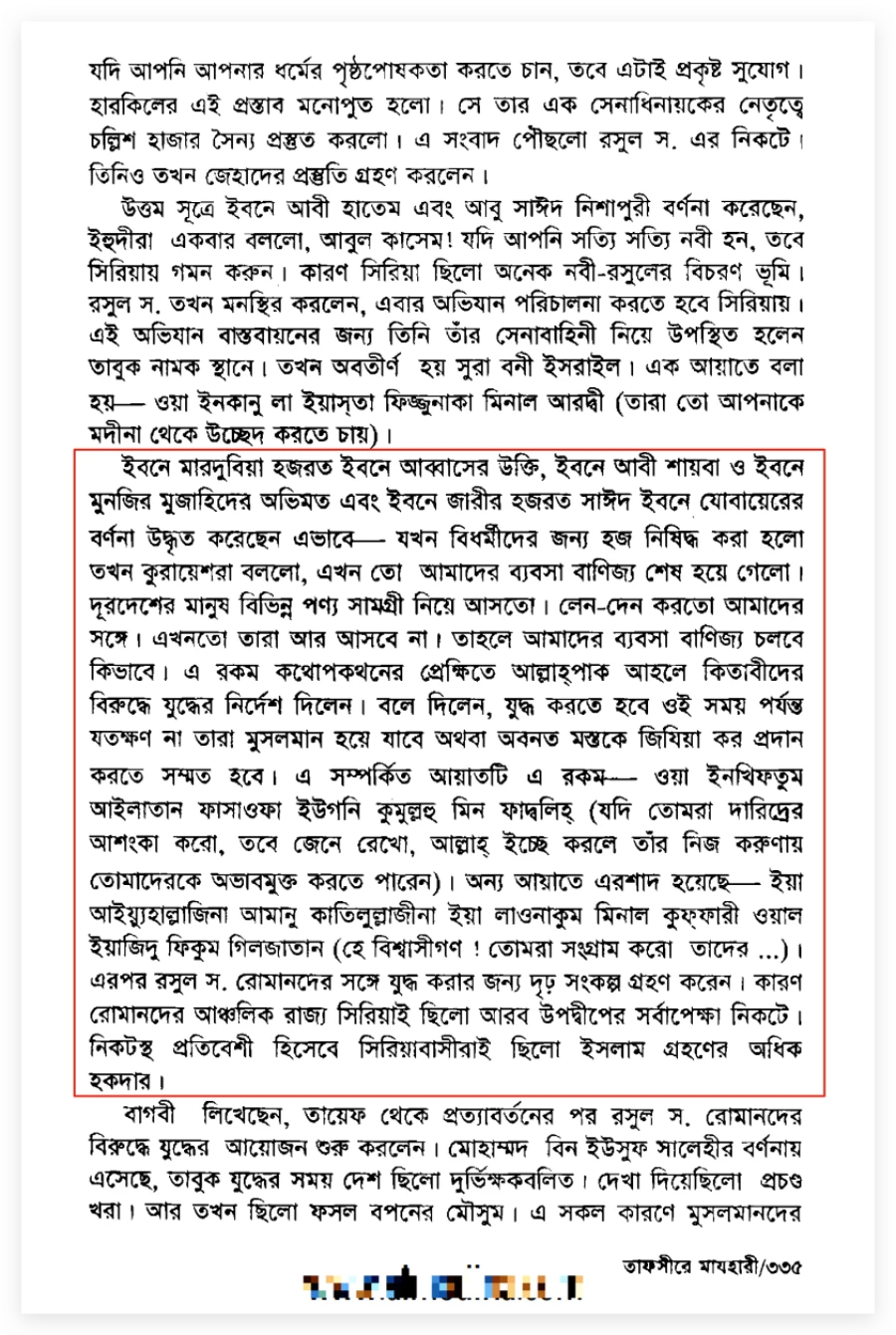
The Purpose of Jihad: Accumulating Wealth through Jizya
When religious explanations are foregrounded in discussions of offensive jihad, its principal objectives appear to be proselytisation, the establishment of tawhid, the suppression of unbelief, and the authority of Sharia. Yet the Qur’an and its commentaries themselves reveal a clear economic dimension to this military expansion. Reading verses 28 and 29 of Surah al-Tawbah together shows that prohibiting polytheists from entering al-Masjid al-Haram created fears of economic loss within the Muslim community: Mecca’s economy, markets, commerce, and pilgrimage transactions had long depended on the presence of Arab polytheists from elsewhere. In response to these fears, the Qur’an states that if they fear poverty, Allah will enrich them through His favour.
The matter does not end there. The very next verse commands warfare against the People of the Book until they pay jizya and acknowledge their subordination. The sequence is therefore highly significant: first, the potential economic losses caused by excluding the polytheists; then, a system of revenue based on jizya as an alternative source of income. Ibn Kathir explicitly explains that severing relations with the polytheists was expected to close markets, damage commerce, and reduce earnings, and that Allah compensated the Muslims for these losses through jizya collected from the protected non-Muslim population, the ahl al-dhimma [119].
The body of a polytheist is not impure, for Allah has made the food of the People of the Book lawful for Muslims. Some adherents of the Zahiri school maintain that a polytheist’s body is also impure. Ash‘ath related from Hasan al-Basri that anyone who shakes hands with a polytheist should perform ablution. Imam Ibn Jarir related this opinion from Hasan al-Basri.
وَإِنْ خِفْتُمْ عَيْلَةً فَسَوْفَ يُغْنِيْكُمُ اللَّهُ مِنْ فَضْلِهِ إِنْ شَاءَ
—If you fear poverty, Allah will enrich you out of His bounty, if He wills.
Muhammad ibn Ishaq states: After the polytheists were prohibited from entering al-Masjid al-Haram, a group of Muslims said, “This will bring our markets to a standstill, put an end to our trade and commerce, and deprive us of the income we earn by trading with the polytheists. Poverty and financial hardship will consequently descend upon us.” Allah then revealed the following verse:
وَإِنْ خِفْتُمْ عَيْلَةً فَسَوْفَ يُغْنِيكُمُ اللهُ مِنْ فَضْلِهِ إِنْ شَاءَ إِنَّ اللَّهَ عَلِيمٌ حَكِيمٌ، قَاتِلُوا الَّذِينَ لا يُؤْمِنُونَ بالله
That is: “If you fear poverty, Allah will enrich you out of His bounty, if He wills. Surely, Allah is All-Knowing, All-Wise” (Qur’an 9:28; Dr Mustafa Khattab, The Clear Quran). He may remove your poverty through another means by His mercy. He possesses wisdom and subtle knowledge, knowing fully when and how to establish particular rules concerning particular people. “Fight those who do not believe in Allah and the Last Day, nor comply with what Allah and His Messenger have forbidden, nor embrace the religion of truth from among those who were given the Scripture, until they pay the tax, willingly submitting, fully humbled” (Qur’an 9:29; Dr Mustafa Khattab, The Clear Quran).
In the first verse, Allah prohibited the believers from allowing polytheists to enter al-Masjid al-Haram. This created fears that their trade would suffer and that
poverty would consequently befall them. In the second verse, Allah dispelled those fears by commanding the believers to collect jizya from the People of the Book. Similar interpretations have been transmitted from Ibn ‘Abbas, Mujahid, ‘Ikrima, Sa‘id ibn Jubayr, Qatadah, al-Dahhak, and other commentators.
إِنَّ اللَّهَ عَلَيْمٌ حَكِيمٌ means that Allah knows fully which actions will reform you. He is therefore wise in determining which actions to command and which to prohibit. He is supremely skilful and accomplished in His actions and words, and supremely just towards His creation and in His guidance to them. Thus, He rewarded their jihad with victory and with the jizya collected from the conquered dhimmis.
قالُوا الَّذِيْنَ لَا يُؤْمِنُونَ بِالله means that the peoples possessing scriptures claim to believe in the earlier prophets. In reality, they believe in none of them. They lack commitment to truth and a thirst for it. Had they possessed these qualities, they would certainly have believed in Allah’s Messenger, His greatest Messenger, Muhammad. Their claim to believe in the earlier prophets is entirely false. Had they truly believed in those prophets, they would also have believed in Muhammad Mustafa, the foremost of the prophets, for all the earlier prophets foretold his coming. They were accordingly commanded to believe in Muhammad Mustafa. In fact, if the People of the Book observe any part of the laws of earlier prophets, this is not because they truly believe in the prophet concerned, but because doing so serves their inherited traditions or some comparable worldly advantage or interest. Such observance does not demonstrate faith and will therefore be of no benefit to them.
A group of jurists adduces this verse as evidence that jizya may be collected only from the People of the Book and comparable communities, such as fire-worshippers. Jizya may be collected from fire-worshippers because an authentic hadith states that the Prophet collected it from the fire-worshippers of the region called Hajar )هج(. Imam al-Shafi‘i and, according to the well-known report, Imam Ahmad expressed this opinion. Imam Abu Hanifah states that jizya is to be collected from every non-Arab unbeliever, whether belonging to the People of the Book, the polytheists, or any other community. Among Arabs, however, it is to be collected only from the People of the Book. Imam Malik states that it may be collected from any unbeliever, whether belonging to the People of the Book, the fire-worshippers, the idolaters, or any other community.
This is not the place to discuss the evidence for and against these opinions, so it has not been included here. Allah knows best.
حَتَّى يُعْطُوا الْجِزْيَةَ عَنْ يُدِ وَهُمْ صَاغَرُونَ—“until they pay the tax, willingly submitting, fully humbled” (Qur’an 9:29; Dr Mustafa Khattab, The Clear Quran). That is, if they do not embrace Islam, until they pay jizya with their own hands while the Muslims are victorious and they themselves are humiliated, dishonoured, and subdued…. For this reason, Muslims are forbidden to honour any dhimmi or place one above a Muslim in any way. They must always remain degraded and humiliated. Sahih Muslim relates from Abu Hurayrah: Abu Huraira reported Allah’s Messenger (ﷺ) as saying: Do not greet the Jews and the Christians before they greet you and when you meet any one of them on the roads force him to go to the narrowest part of it.
For the same reason, ‘Umar included conditions humiliating to the Christians in the treaty concluded with the Christians of al-Sham, present-day Syria and the surrounding regions. Several imams who were hadith memorisers transmitted from ‘Abd al-Rahman ibn Ghanam al-Ash‘ari that he said: When ‘Umar decided to conclude a treaty with the Christians of al-Sham, I drew up the following agreement on his behalf:
In the name of Allah, the Most Compassionate, the Most Merciful.
These are the written undertakings presented to Allah’s servant ‘Umar, Commander of the Faithful, by the inhabitants of such-and-such cities of al-Sham: “When you came to us, we requested security from you for ourselves, our children, our property, and all the people of our religion. In return for that security, we undertake that we shall not build any new church or place of worship in our cities or their surroundings; repair any old church or place of worship; or restore to use as churches or places of worship any that have already become Muslim property. We shall not prevent any Muslim from staying in our churches by night or by day, and shall keep their doors open to wayfarers and travellers. We shall host and provide hospitality for three days to any Muslim traveller passing near our dwellings. We shall not shelter spies in our churches or homes, or act deceitfully towards Muslims. We shall not teach our children the Qur’an, publicly express anything involving shirk, or invite anyone to shirk. We shall not prevent a relative who wishes to embrace Islam from doing so. We shall show respect to Muslims, and if a Muslim wishes to sit in one of our gatherings, we shall move aside to make room for him. We shall not wear clothing resembling Muslim attire, wear caps, use turbans, wear shoes, or part our hair. We shall not use language resembling theirs or adopt similar honorific names. We shall not use padded saddles on horses or other mounts, carry swords suspended from our necks, possess weapons of any kind, or carry any weapons. We shall not engrave anything in Arabic on our rings or trade in wine. We shall cut the hair at the front of our heads, retain a tuft wherever we are and at all times, and wear a sacred cord on our bodies. We shall not display crosses in public areas of churches or display crosses or our religious books on Muslim roads or in their markets. We shall not ring church bells loudly or read our religious books aloud in churches in the presence of Muslims. We shall not hold processions for religious festivals, wail loudly when carrying the dead, or carry the dead through Muslim roads or markets. We shall not employ a slave employed by a Muslim. We shall give directions to Muslim travellers when they require them, and shall not peep into Muslim homes.” ‘Abd al-Rahman ibn Ghanam al-Ash‘ari states: When I brought this undertaking to ‘Umar, he added the following words: “And we shall not strike any Muslim.” We obtained security by accepting these conditions. If we violate any of them, you Muslims shall no longer bear responsibility for our security. In that event,
it shall become lawful and permissible for you to treat us as enemies.”
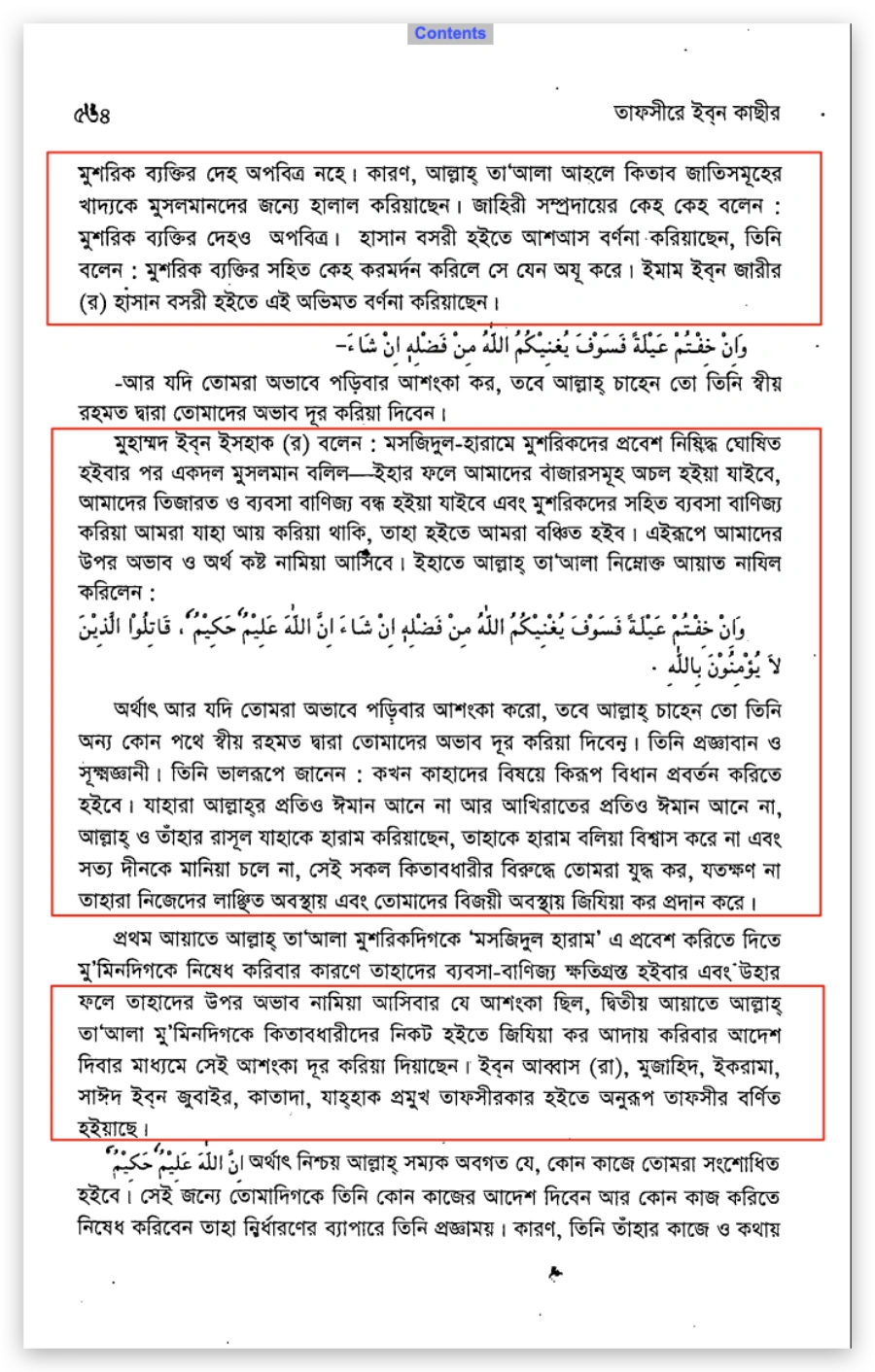
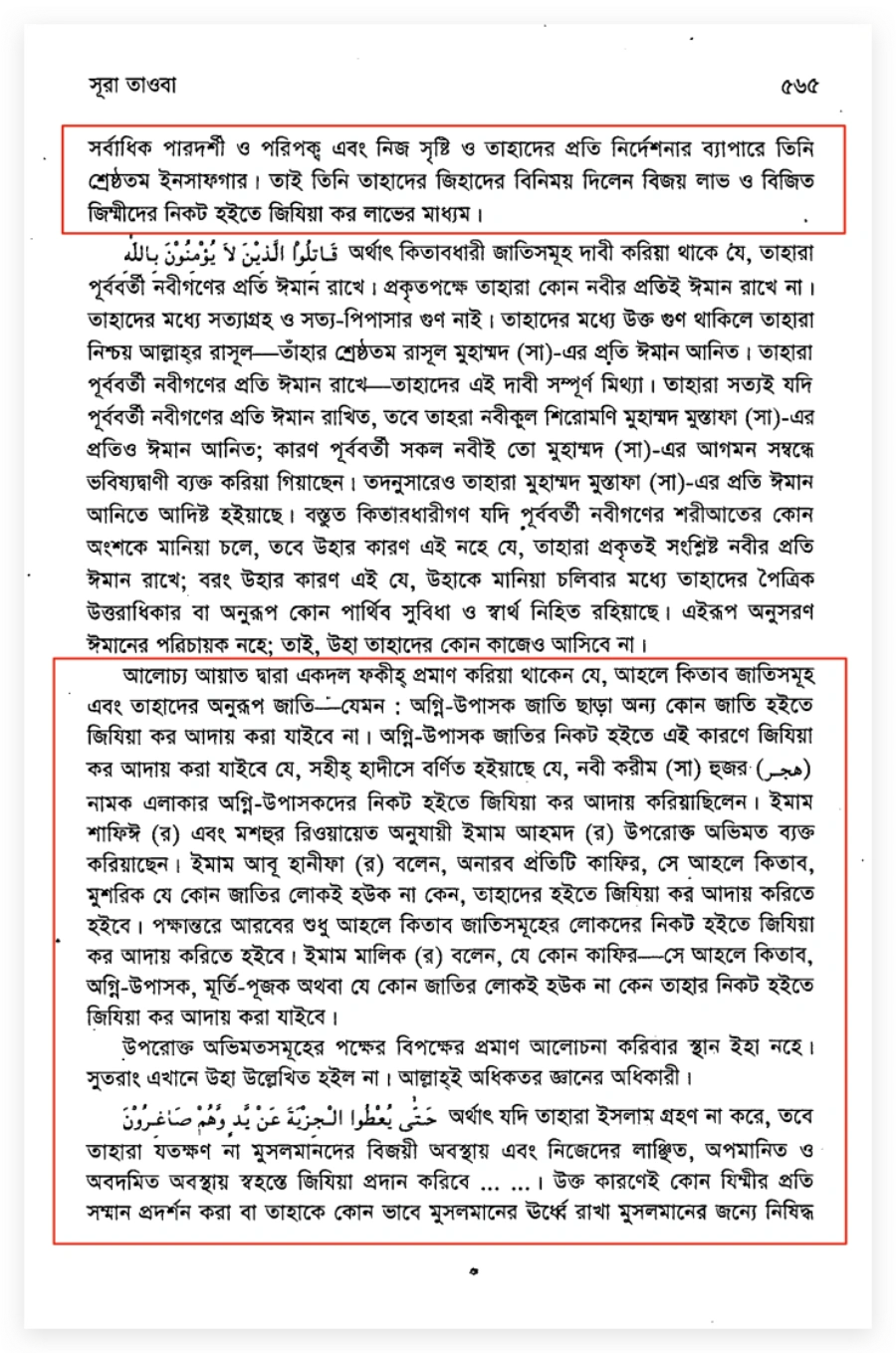
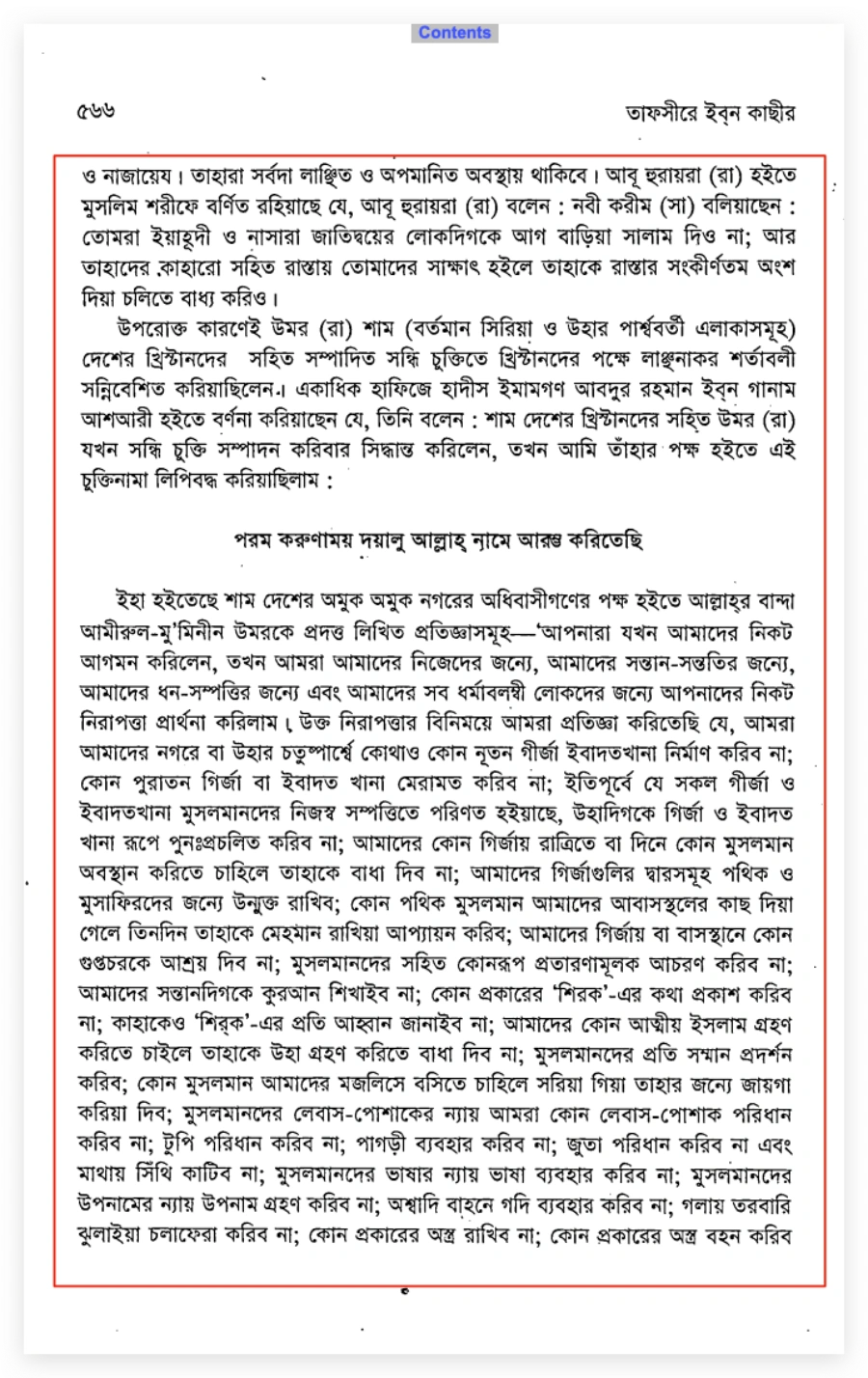
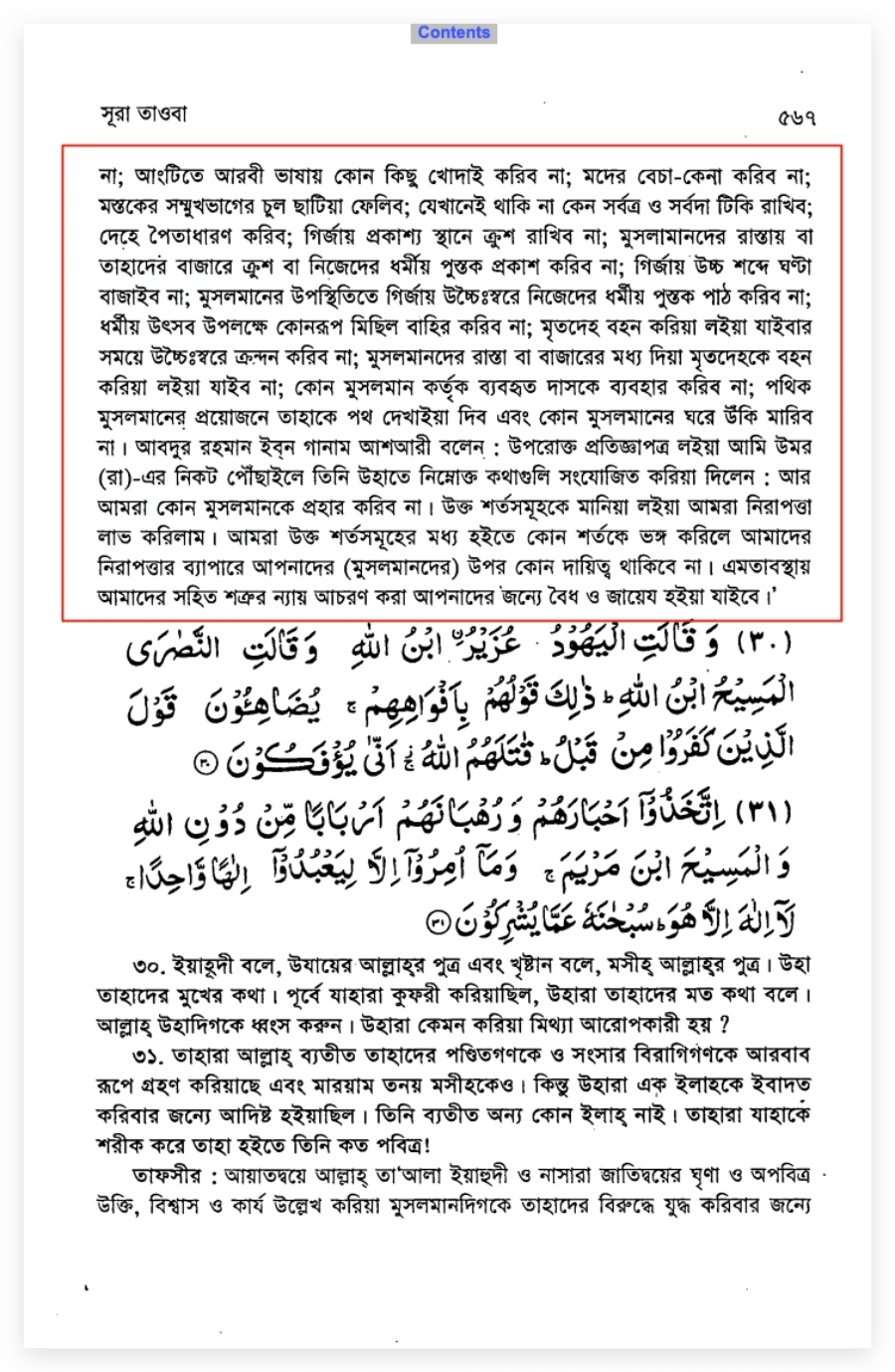
This interpretation leaves no room to regard offensive jihad solely as an abstract religious obligation. Jihad, jizya, and the state economy form part of a single structure. Non-Muslim political communities are offered three alternatives: conversion to Islam, acceptance of subordination to Islamic rule through payment of jizya, or war. Jizya was therefore more than a tax associated with religious tolerance: it constituted regular state revenue extracted from defeated and subordinate non-Muslim populations. Offensive jihad consequently also functioned as an economic engine of Islamic imperialism.
This point is crucial because modern apologists often describe jizya in softened language as a “state security tax” or a “tax in lieu of military service.” Yet the sequence of Surah al-Tawbah and the discussions in classical Qur’anic commentary expose its economic character more starkly. The proposed solution to the concern that excluding the polytheists would damage Muslim commerce is to wage war against the People of the Book and collect jizya from them. Here, jizya is therefore more than an administrative tax: it is a doctrinally sanctioned method of conquest, subordination, and wealth extraction.
Tafsir al-Mazhari offers a similar interpretation: the promise to dispel Muslims’ fear of poverty following the exclusion of the polytheists is connected with jizya and the spoils of war. This makes it still clearer that offensive jihad was more than a project for spreading religious doctrine. It was also a project of economic redistribution, revenue collection, extraction of wealth from subject populations, and consolidation of the victorious Muslim state. Let us examine this evidence from Tafsir al-Mazhari as well [120].
Al-Dahhak and Qatadah stated that the words “He may relieve you of want” indicate that abundant jizya would soon arrive from conquered territories. That is what happened: jizya began to arrive in great quantities, and Muslims became wealthy through their shares of it.
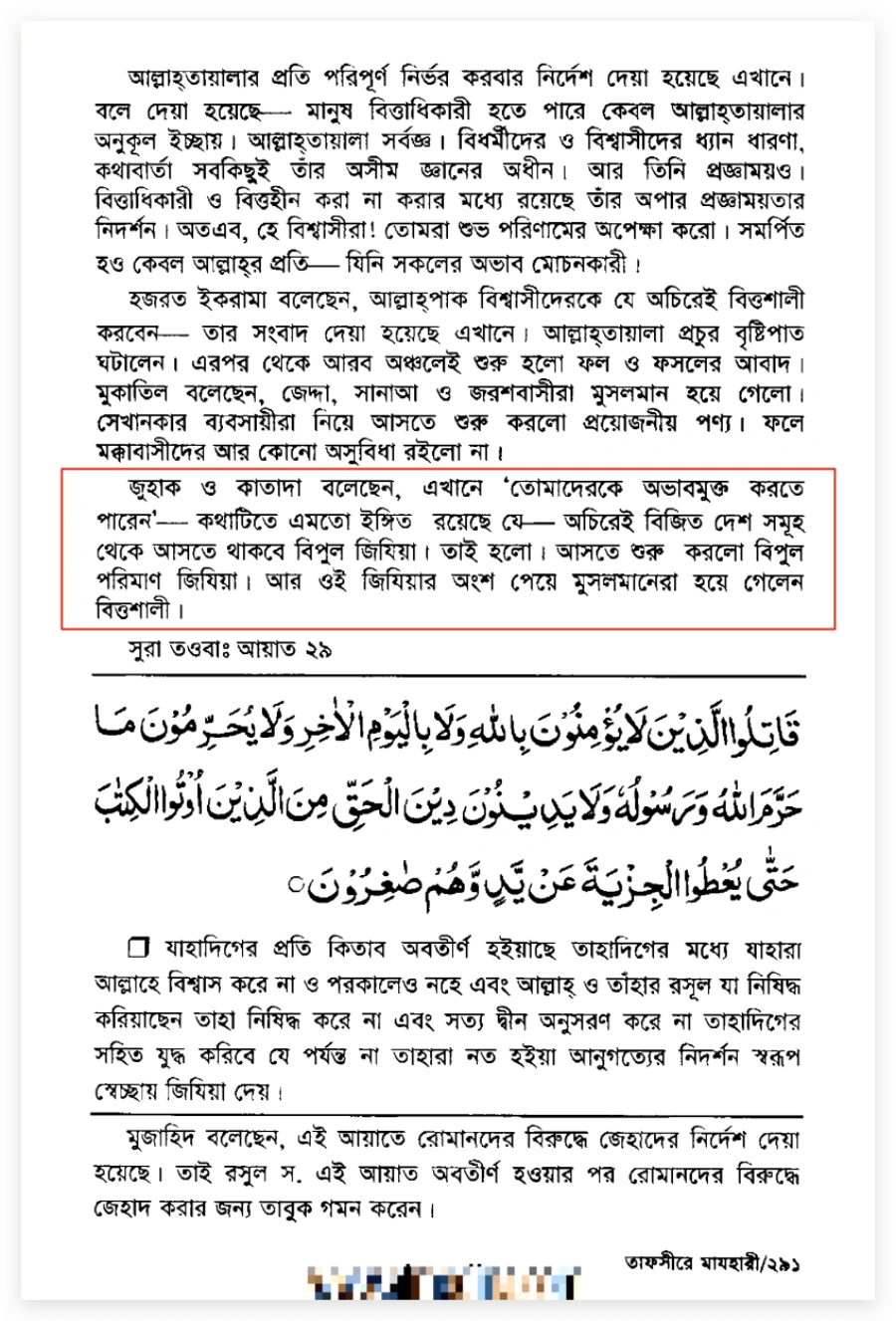
Reading Surah al-Tawbah 9:28–29 together thus reveals that, despite the language of “proselytisation” or “establishing the true religion,” the practical structure of offensive jihad clearly incorporated economic interests based on jizya. The alternative source of income offered to dispel the fear that losing the polytheists’ commercial presence would impoverish Muslim society was warfare against non-Muslims, their political subordination, and enrichment of the Muslim state through jizya collection. Offensive jihad must therefore be assessed as an integrated system of military conquest and economic exploitation, as well as a matter of religious ideology.
Rules on Coercion in Conversion to Islam
A widely held belief among ordinary Muslims is that “there is no compulsion in religion,” as stated in verse 256 of Surah al-Baqarah. This verse is frequently presented as evidence of Islamic tolerance. Many believe that Islam does not compel religious observance and that everyone has the right to follow their own beliefs. A close analysis of Islamic commentaries, however, shows that the verse’s meaning and application within Islamic religious law are entirely different. Ahkam al-Qur’an and other prominent commentaries state that later Qur’anic verses calling for warfare abrogated this verse, particularly with respect to polytheists. Surah al-Tawbah 9:5 and 9:73, which directly call for jihad and command warfare against non-Muslims, effectively negate this conception of tolerance.
This dual position directly violates fundamental principles of human rights. International human rights instruments expressly recognise each individual’s freedom to practise their religion and their right not to convert. Yet Islamic history and the works of classical scholars show that this tolerance is essentially confined to Muslims and does not operate in practice. Under Islamic law, a Muslim who leaves Islam faces the death penalty. This severe punishment of apostates and the historical evidence of coerced conversion through offensive jihad clearly show the absence of religious freedom in Islam: conversion is compelled, and leaving the religion entails punishment. The jizya imposed on non-Muslims is also a discriminatory institution that consigns them to second-class citizenship and subjects them to social and religious degradation, disrespect, and humiliation.
The explanation of “there is no compulsion in religion” appears in Islamic Qur’anic commentaries. The verse is understood principally as a rule revealed in Islam’s early period, when Muslims lacked power, and subsequently abrogated for polytheists by the sword verse, or Surah al-Tawbah. Under Islamic rules, a person cannot leave Islam after embracing it, while the People of the Book—Jews and Christians—have only the alternatives of conversion, warfare, or payment of jizya. Polytheists or idol-worshippers, meanwhile, have only two alternatives: accept Islam or be killed. This constrains non-Muslims’ religious and social freedom under an Islamic state rather than establishing peaceful coexistence. Such rules clearly violate the freedoms of religion and expression recognised by international human rights instruments as the birthright of every person.
Although Islamists often invoke this verse in support of coexistence, their conduct and Islamic history demonstrate something else. Following the conquest of Mecca, numerous wars were fought to spread Islam, in which non-Muslim idolaters had no alternative to conversion if they wished to survive. These are clear examples of forced conversion. A famous hadith states that the Prophet was commanded to fight people until they acknowledged that “there is no deity but Allah.” This clearly indicates that Islam leaves no place for tolerance and instead calls for the eradication of other religions and ideologies to establish Islam. Thus, although “there is no compulsion in religion” is used as a symbol of tolerance, Islamic religious law and actual practice entirely contradict it. Let us examine directly from Qur’anic commentaries what Islamic rules concerning this verse actually entail. Reading its occasion of revelation and detailed interpretation is essential for this reason. The verse stating that there is no compulsion in Islam is Surah al-Baqarah 2:256. The prominent commentary Ahkam al-Qur’an states that it was abrogated by Surah al-Tawbah 9:5 and 9:73—that is, the verses of jihad—revealed towards the end of the Qur’an’s revelation. To understand precisely what is meant here, we must also examine the commentary carefully [121]—
Allah’s words:
Let there be no compulsion in religion, for the truth stands out clearly from falsehood.
( Surah al-Baqarah: 256 )
Al-Dahhak, al-Suddi, and Sulayman ibn Musa stated that this verse has been abrogatedby the following verse:
O Prophet! Struggle against the disbelievers and the hypocrites (Surah At-Tawbah 9:73).
and by this verse:
kill the polytheists (Surah At-Tawbah 9:5).
Al-Hasan and Qatadah stated that “there is no compulsion in religion” applies specifically to those People of the Book who are prepared to pay jizya, and not to the Arab polytheists generally. The latter did not agree to submit and pay jizya. They must therefore either be made to accept Islam or be struck with the sword.
It has also been stated here that the verse means: do not say of those who accepted Islam after warfare that they did so as a result of force or coercion.
Abu Bakr stated: The statement that there is no room for coercion in religion is expressed as a declaration, but is in substance a command. It is possible that this verse was revealed before the command to wage war against polytheists, and therefore applied at that time to all unbelievers. Compare Allah’s words:
Respond ˹to evil˺ with what is best, then the one you are in a feud with will be like a close friend.
( Surah Ha-Mim al-Sajdah: 34 )
and Allah’s words:
and only debate with them in the best manner.
( Surah al-Nahl: 125 )
Allah’s words: “and when the foolish address them ˹improperly˺, they only respond with peace.”
( Surah al-Furqan: 63 )
Warfare was prohibited in Islam’s early period. Eventually, once Islam had been presented to the unbelievers and the Prophet’s truthfulness established, yet they continued their hostility, Muslims were commanded to fight them. At that point, “there is no room for compulsion in religion” was abrogated with respect to the Arab polytheists.The following verse was revealed:
kill the polytheists ˹who violated their treaties˺ wherever you find them (Surah At-Tawbah 9:5).
Many other verses also command warfare against the polytheists. The application of the aforementioned verse was therefore confined to the People of the Book: they could not be compelled to embrace the religion. Even the People of the Book would be spared only if they agreed to submit and pay jizya. They would then remain as Muslim-protected dhimmis, under Islamic rule.
The evidence from hadith is that the Prophet himself was not prepared to accept anything from the Arab polytheists other than Islam; otherwise, he put them to the sword.
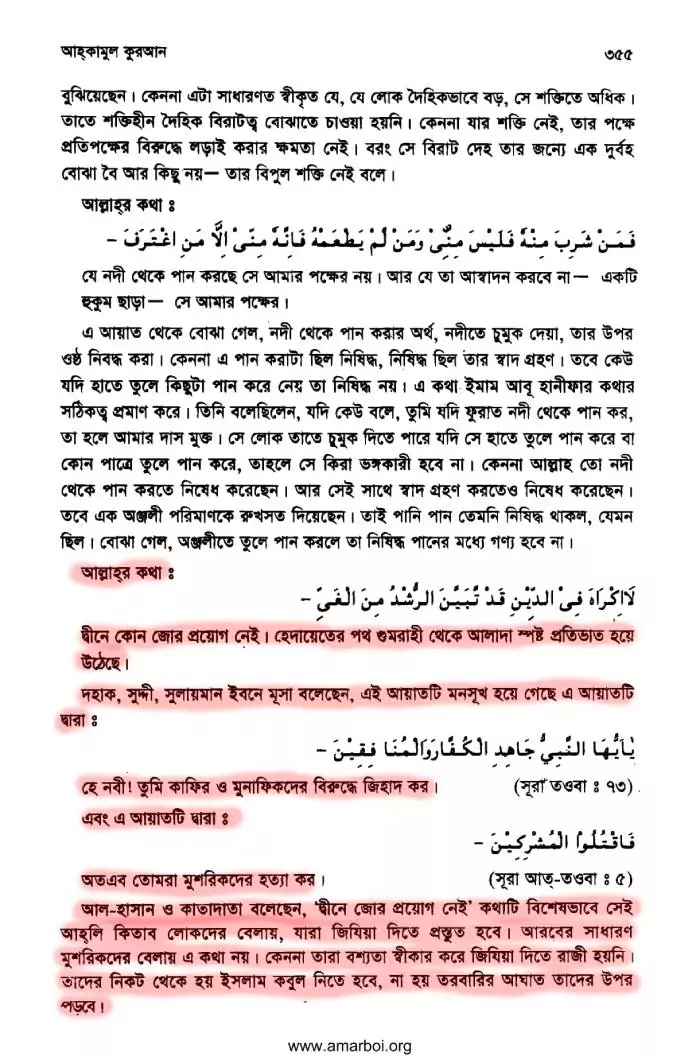
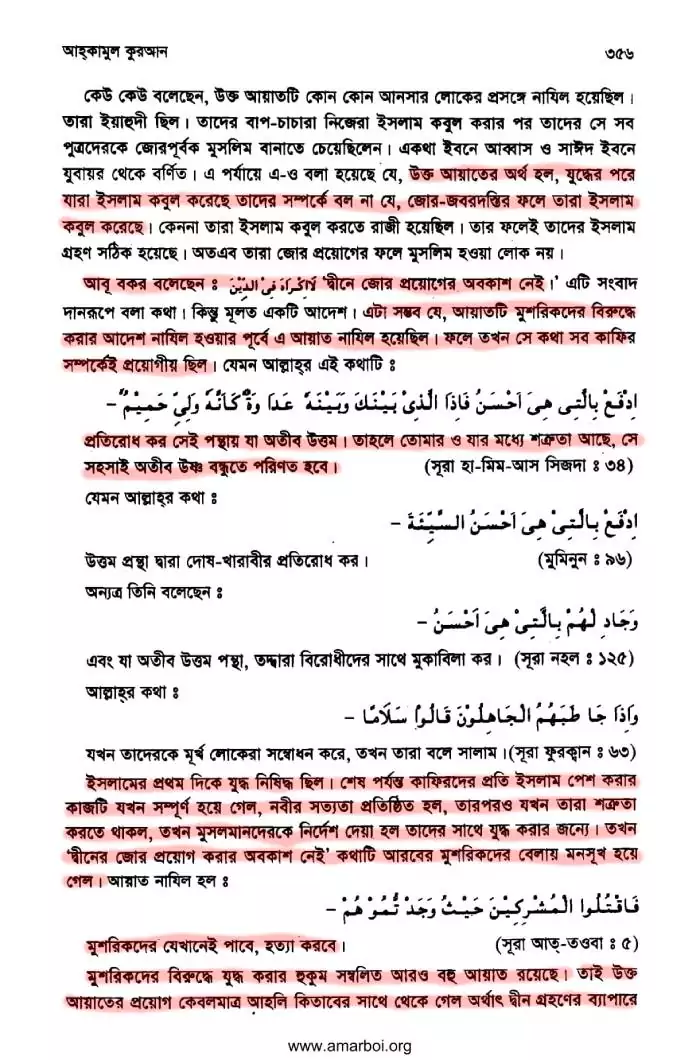
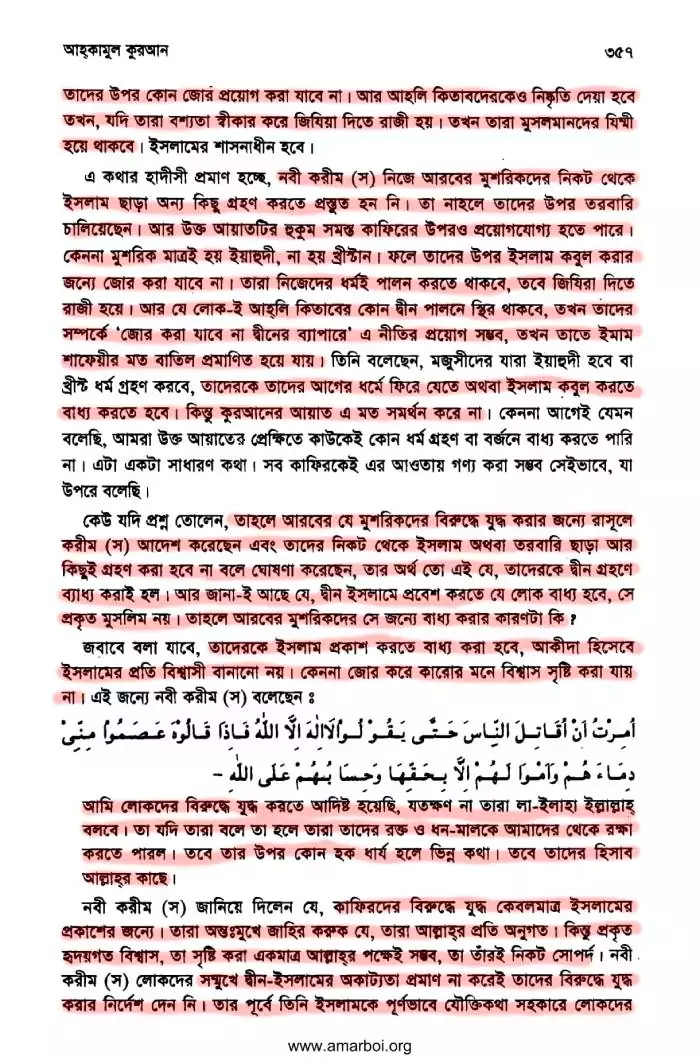
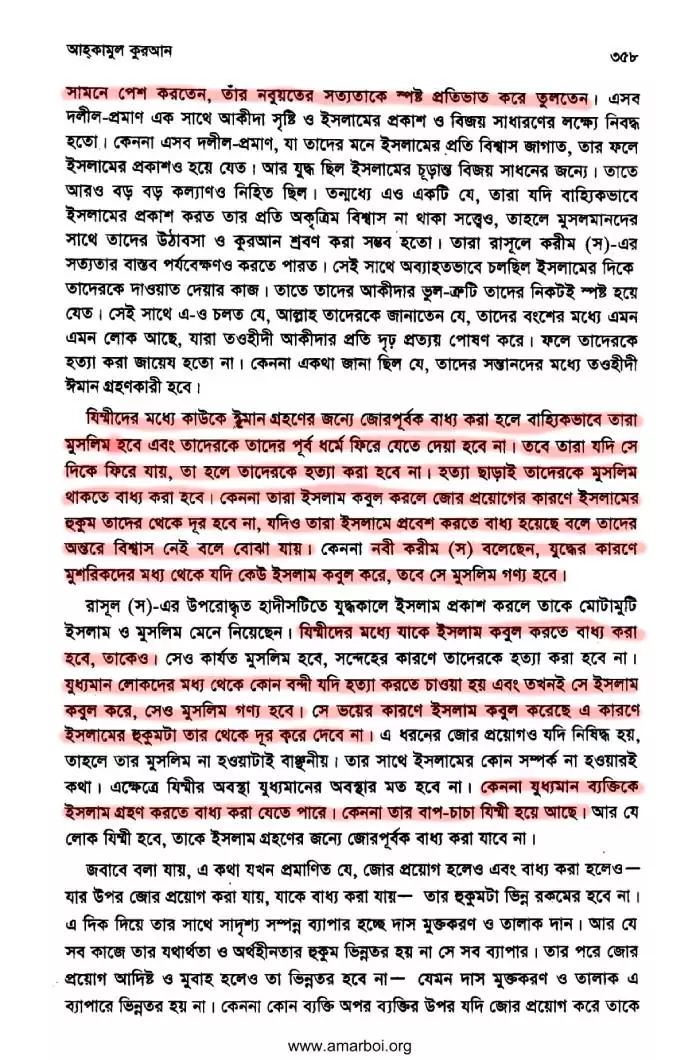
Some Muslims also invoke a verse from Surah al-Kafirun to claim that Islam teaches coexistence with people of other religions and harmonious relations with followers of every faith. Yet this claim, too, is an outright falsehood. Islam never teaches acceptance of every ideology, path, and religion through coexistence and harmony with people of other faiths. Instead, it commands the elimination of every other ideology and religion through armed jihad. Let us read the verse and its commentaries [122] [123] [124]—
You have your way, and I have my Way.” (Original Bengali translator’s parenthetical gloss: You must bear the consequences of following your own path; as for the path of truth Allah has instructed me to follow, I am utterly unwilling to abandon it for another.)
— Taisirul Quran (Bengali source; English quotation: Dr. Mustafa Khattab, The Clear Quran)
You have your way, and I have my Way.”
— Sheikh Mujibur Rahman (Bengali source; English quotation: Dr. Mustafa Khattab, The Clear Quran)
You have your way, and I have my Way.”
— Rawai Al-bayan (Bengali source; English quotation: Dr. Mustafa Khattab, The Clear Quran)
You have your way, and I have my Way.” [1]
— Dr. Abu Bakr Muhammad Zakaria (Bengali source; English quotation: Dr. Mustafa Khattab, The Clear Quran)
Reason for the statement: “You have your way, and I have my Way” (Qur’an 109:6; Dr Mustafa Khattab, The Clear Quran).Many people misunderstand the meaning of this verse. They say that it recognises the religions of other religious communities: if those religions were not true, why would the Qur’an say, “You have your religion, and I have mine”? They take this as recognition that the two religions may coexist without interference in one another. This strange idea arises because they fail to consider what the word din means here. It is used here to mean recompense for one’s deeds, just as Surah al-Fatihah describes Allah as the Master of the Day of Recompense. On this reading, the verse means: you will receive the recompense for your deeds, and we shall receive the recompense for ours. Because the verse was revealed in Mecca during Islam’s early period, the rules of jihad had not yet been revealed. Some commentators therefore state that whatever opportunity this verse might appear to have afforded unbelievers to practise their religion in Islam’s early period was abrogated by the rules of jihad. The conquest of Mecca and the other battles provide vivid evidence of this. Even if din is understood as religion, we may say that the statement resembles the reproachful expression, “You go your way, and I shall go mine.” By saying this, we neither recognise the other person’s path nor imply the possibility of coexistence; instead, we indicate the terrible consequences of that path. Likewise, the verse’s statement, “You have your religion, and I have mine,” points to the terrible consequences of their way of life and their practices of shirk. It does not recognise their polytheistic way of life or doctrines, or endorse coexistence with them.
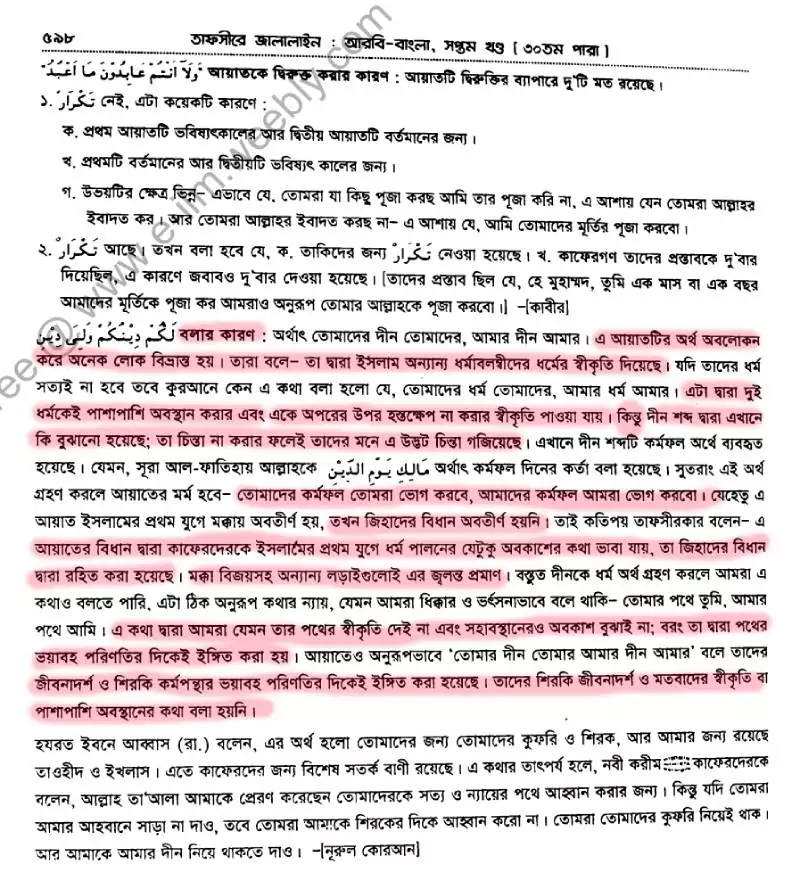
The concluding verse (6) states: “You have your way, and I have my Way” (Dr Mustafa Khattab, The Clear Quran). Both clauses of this verse are declarative. There is, however, no basis for supposing that the statement “You have your religion” grants approval to the unbelievers’ unbelief or forbids Muslims to wage jihad. Rather, the verse may be understood as expressing the significance and consequences of the preceding statements. It is therefore impossible to suppose that it abrogated the verses of jihad. Since unbelief is not beneficial, it is likewise inappropriate to imagine that a compromise is being offered here, instructing believers and unbelievers to remain in their respective positions. We accordingly find that the Messenger continued repeatedly to call the unbelieving Quraysh to faith and Islam. They subjected him and his beloved companions to various forms of torment. The appropriate understanding of the verse is therefore: you will receive the recompense for your deeds, and I shall receive the recompense for mine.
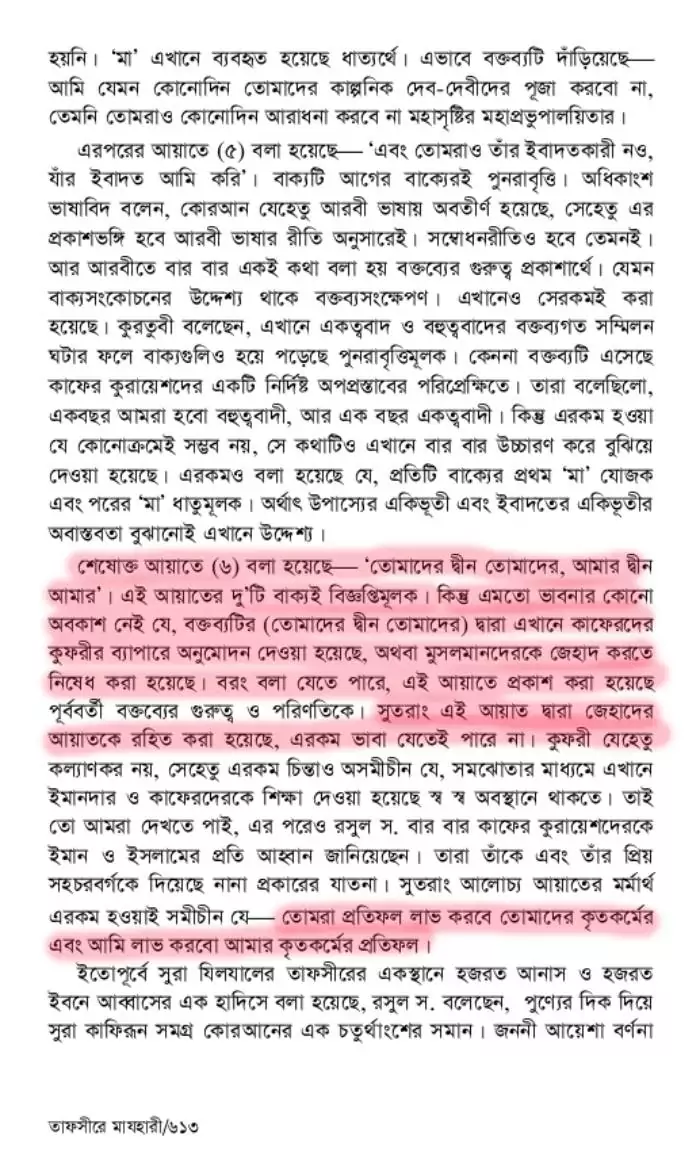
Forced Conversion to Islam and Islamic Creed
Let us now consult a well-known work on Islamic creed to establish the actual Islamic rules and provisions on this issue [125]
She pointed to the Prophet (ﷺ) and to the heaven, that is to say: You are the Messenger of Allah. He then said: Set her free, she is a believer. (Hadith no. 11)
Statements and actions that only a Muslim would make or perform, and that clearly demonstrate that the person has entered Islam, are considered evidence of conversion to Islam. Examples include performing the ritual prayer in the Muslim manner and undertaking the pilgrimage. If, however, it is established that these actions do not represent the abandonment of false beliefs and entry into pure Islam, but are performed while the person remains an unbeliever according to their religious beliefs—as with present-day Qadianis—or in mockery, they are not considered conversion. Such a person will not be regarded as Muslim until they use words indicating that they have abandoned their beliefs and returned to the correct religious creed propagated by the Messenger of Allah and followed by his Companions.
The Ruling on Compelling Conversion to Islam
Compelling someone to accept Islam is an important question of jurisprudence. All scholars agree that, if unbelievers who have no treaty with Muslims (harbis), or who are not jizya-paying dhimmis, are compelled to embrace Islam through threats of death or other means, their conversion is valid. In other words, if they subsequently seek to leave the religion, they are to be declared apostates and sentenced to death. The evidence is the Messenger of Allah’s statement:
“I have been ordered to fight with the people till they say, ‘None has the right to be worshipped but Allah.’” (Al-Bukhari and Muslim)
Once they say this, their lives and property are considered protected. A lengthy hadith in Sahih Muslim states that, when sending a commander on an expedition, the Messenger of Allah would advise him: “invite them to three courses of action. If they respond to any one of these, you also accept it and withhold yourself from doing them any harm.” These three alternatives are:
a. Acceptance of Islam
b. Payment of jizya
c. Warfare
Those compelled to embrace Islam through warfare are therefore regarded as Muslims for the purposes of worldly judgment. The incident involving Usamah ibn Zayd establishes the same point. The unbeliever whom Usamah was about to kill suddenly pronounced the declaration of faith. Usamah believed that he had accepted Islam out of fear of the sword and that his conversion was therefore invalid. The Messenger of Allah nevertheless rebuked him severely. The clear implication is that, if a person whom it is lawful to kill is threatened with death and enters Islam out of fear, that conversion is valid. If they subsequently abandon Islam, they will be regarded as an apostate. (Hadith nos. 12 and 13)
Differences of Opinion Concerning Harbis and Dhimmis
The commentary on Kanz al-Daqa’iq states: “There is consensus that, if an unbeliever without a treaty (a harbi) is compelled to embrace Islam, the conversion is valid.” (Tabyin al-Haqa’iq)
There is consensus within the Muslim community that it is unlawful to compel conversion among those who have treaties with Muslims, such as dhimmis (hadith no. 14), musta’mans (hadith no. 15), or mu‘ahids (hadith no. 16). If, nevertheless, someone compels them and they accept Islam, scholars disagree on whether that conversion is valid:
Hanbali and Shafi‘i schools: They hold that this does not count as conversion until the person voluntarily remains Muslim after the coercion ends. (Hadith no. 17; al-Mughni)
Hanafi school: According to the accepted opinion, this is considered conversion, and the person will not be permitted to return to unbelief. (Tabyin al-Haqa’iq)
The first opinion, that of the Shafi‘i and Hanbali schools, appears more correct here.
Muslim Status through Descent and Circumstance
A person may also be regarded as Muslim in the following ways:
1. Through Muslim parents:
All scholars agree that a child born to Muslim parents is regarded as Muslim. Likewise, if an unbelieving couple embraces Islam, their minor children also become Muslim. If one parent is Muslim, the child is regarded as Muslim. (Al-Bukhari; Fath al-Bari, 3/220.) The evidence cited is the Messenger of Allah’s statement: “Islam is always superior and should never be surpassed.” (Hadith no. 18; al-Daraqutni)
2. In the case of a child captured in war:
When a child is regarded as Muslim because they were captured in warfare, the child’s wishes have no significance. This, too, is a compulsory method.
Interpretation of “There Is No Compulsion in Religion”
Many contemporary thinkers maintain that Islam permits no coercion. They cite Surah al-Baqarah 2:256 (“Let there be no compulsion in religion”) or Surah Yunus 10:99. According to the scholars, however, these verses must be understood in conjunction with other evidence and the Messenger of Allah’s practice.
The verse “Let there be no compulsion in religion” applies only to unbelievers who have agreed to pay jizya. For those who refuse to pay jizya or have become apostates, the rule permitting coercion applies. The Messenger of Allah said: “If somebody (a Muslim) discards his religion, kill him.” (Al-Bukhari.) Each verse must therefore be applied in its proper context; coercion has not been prohibited indiscriminately in every situation. (Hadith no. 29)
Footnotes:
(11) Imam Abu Dawud transmitted this hadith and did not describe its chain as weak, meaning that he considered it acceptable. Al-Haythami stated in Majma‘ al-Zawa’id: “The narrators of this hadith are trustworthy.” Shaykh al-Albani, however, graded it weak.
(12) Sahih al-Bukhari and Muslim; the hadith was mentioned previously.
(13) Ibn al-‘Arabi states: “When a Muslim encounters an unbeliever with whom there is no treaty, it is lawful for him to kill that person.” (Ahkam al-Qur’an.) Mulla ‘Ali al-Qari al-Hanafi relates from Imam al-Khattabi: “The basic principle concerning the blood of unbelievers is permissibility (ibahah).” (Mirqat al-Mafatih.) That is, in the absence of a treaty, their blood is not inviolable.
(14) Unbelievers who live in an Islamic state and pay the tax of submission, jizya.
(15) Unbelievers who take temporary refuge in an Islamic state, with the authorities’ permission, to learn about Islam or conduct business.
(16) Unbelievers who conclude a truce with Muslims while remaining in their own territories.
(17) If a dhimmi or musta’man is coerced, their conversion does not count until they remain Muslim voluntarily. (Al-Mughni.)
(18) Al-Daraqutni; Bulugh al-Maram. Imam al-Bukhari mentioned the hadith as a suspended Companion report, without its chain. Ibn Hajar al-‘Asqalani and Shaykh al-Albani graded it hasan. (Fath al-Bari, 3/220; Irwa’ al-Ghalil, no. 1268.)
(28) This issue will be discussed in detail in the following chapter, Allah willing.
(29) The Commander of the Faithful, ‘Umar ibn al-Khattab, and other Companions stipulated that non-Muslims could not publicly celebrate their religious festivals in an Islamic state. (Majmu‘ al-Fatawa; Tafsir Ibn Kathir.)
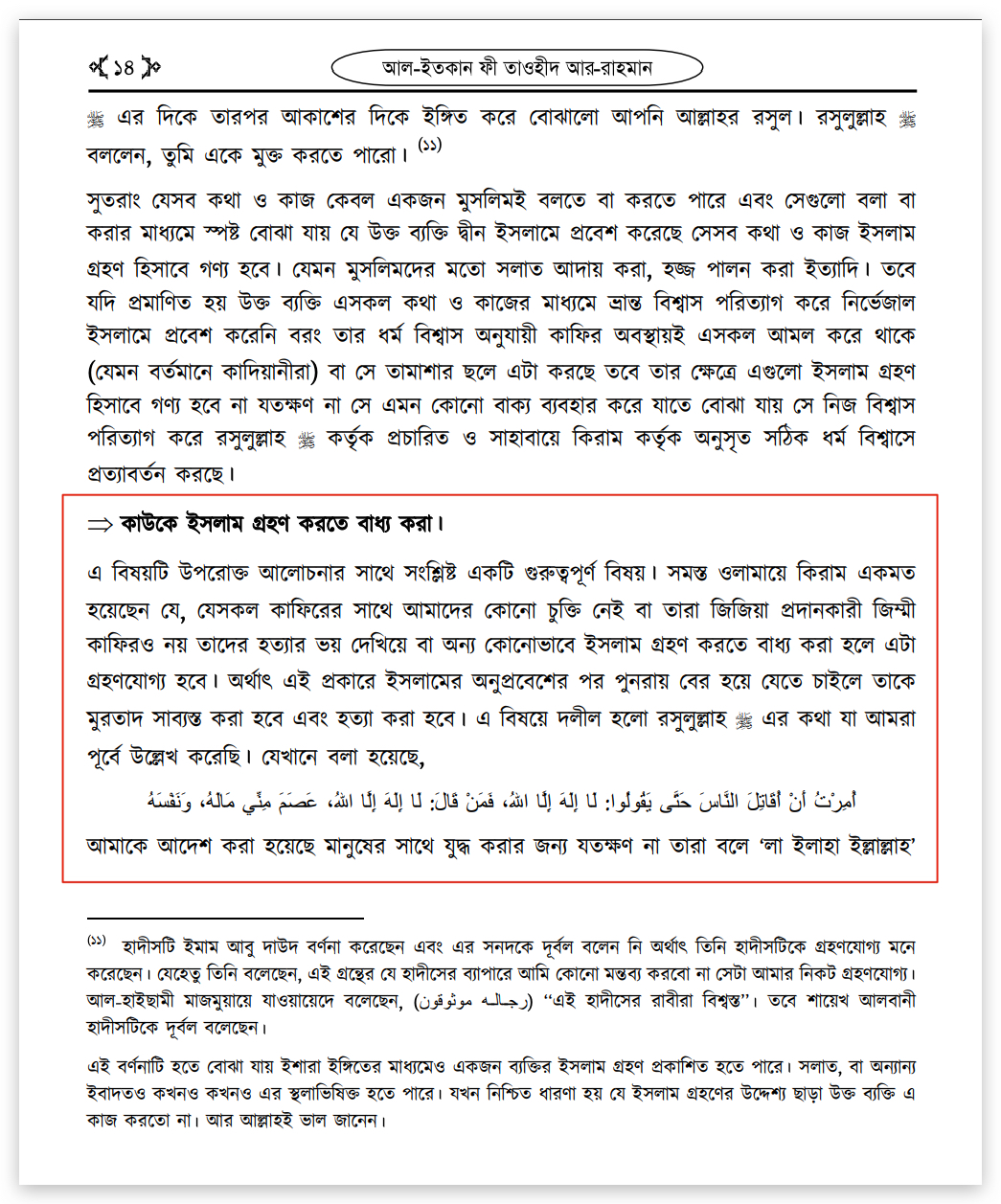
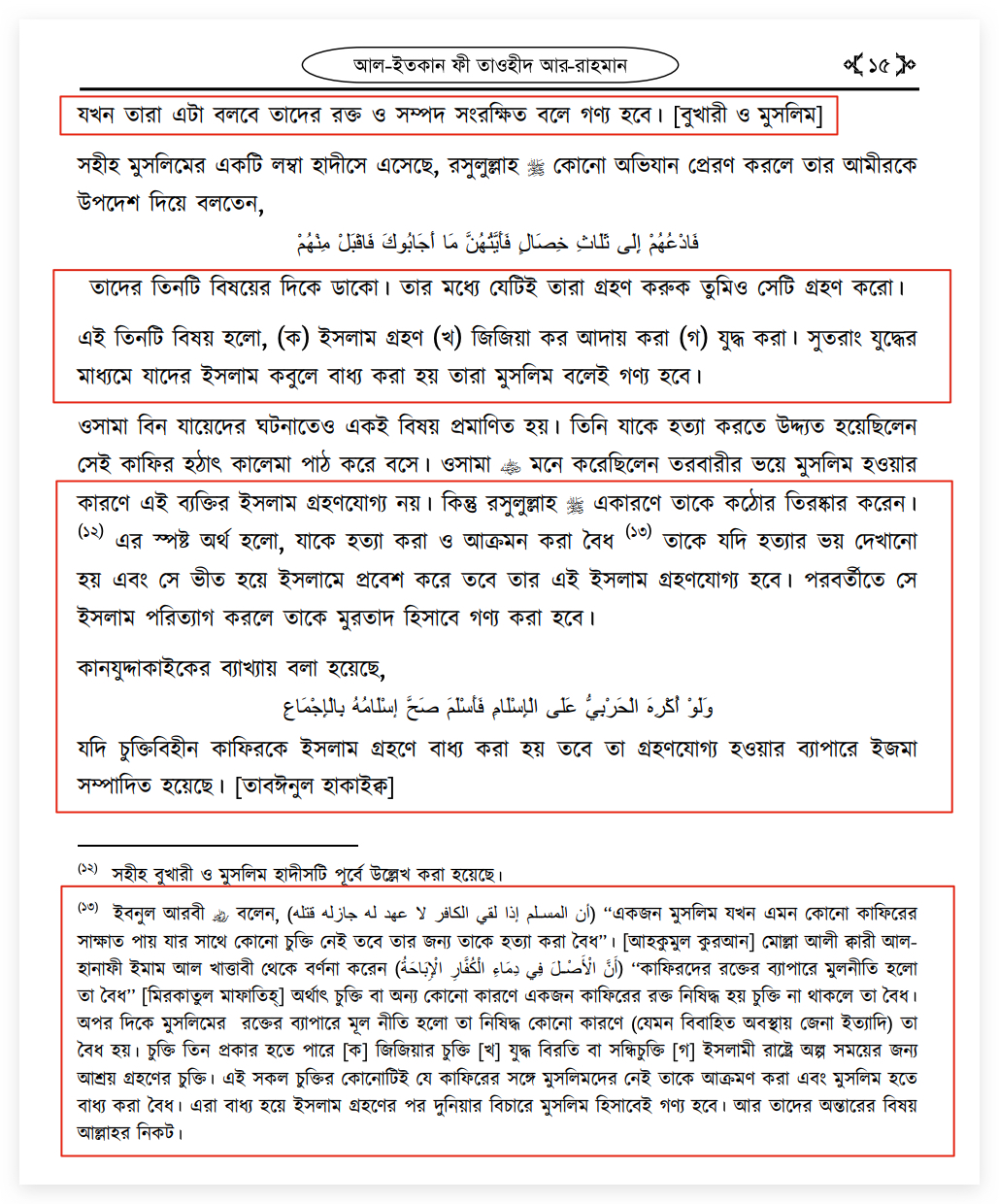
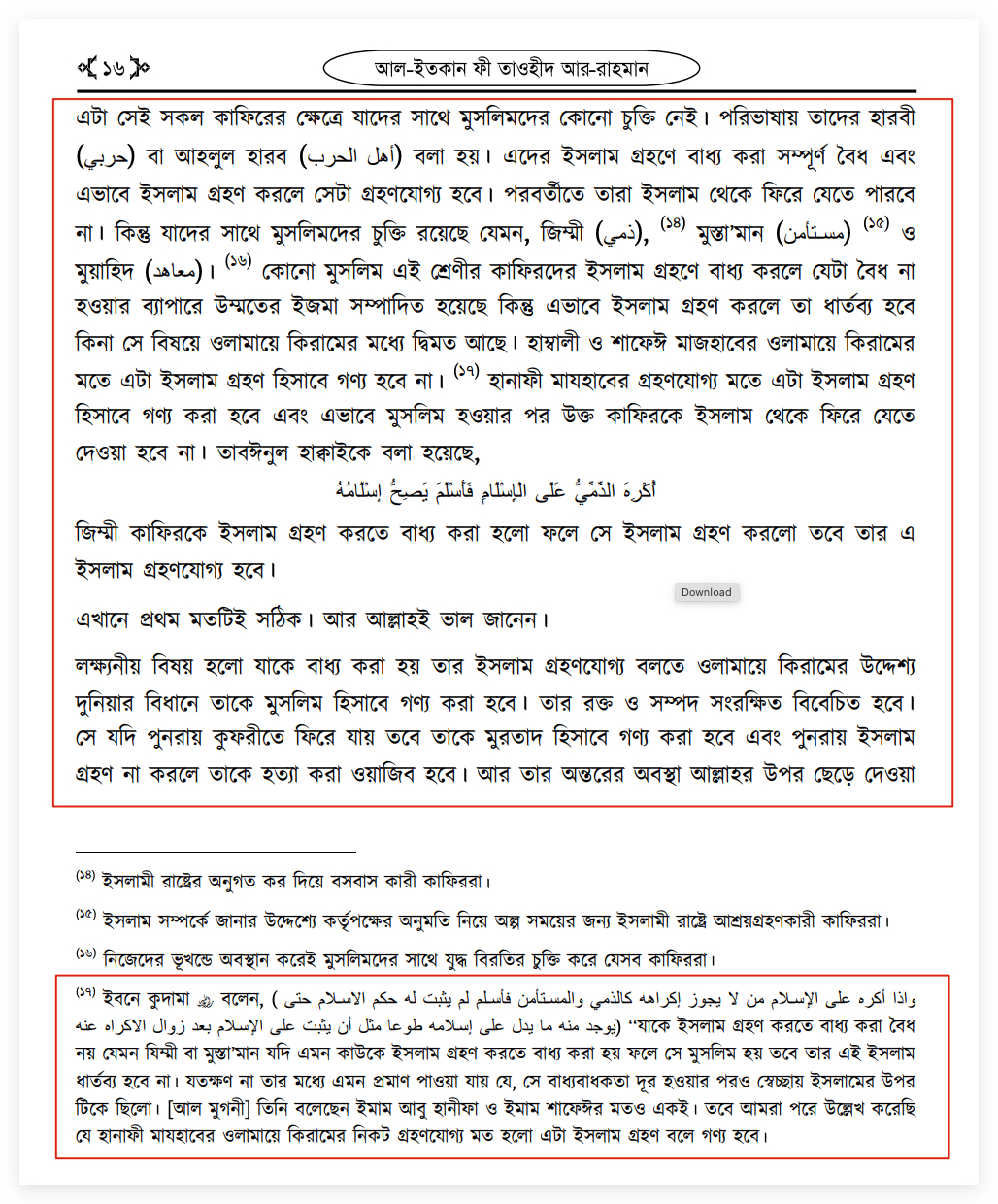
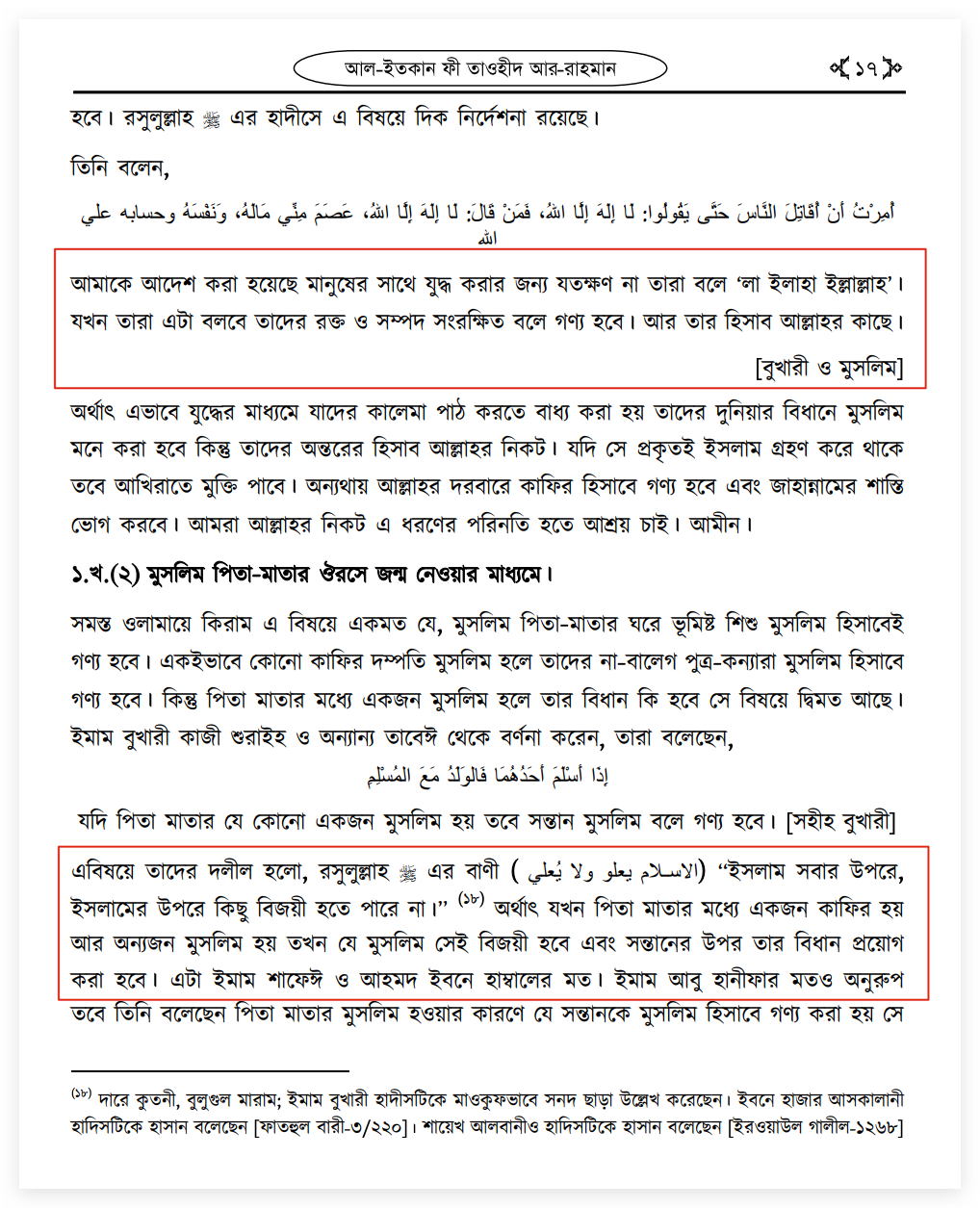
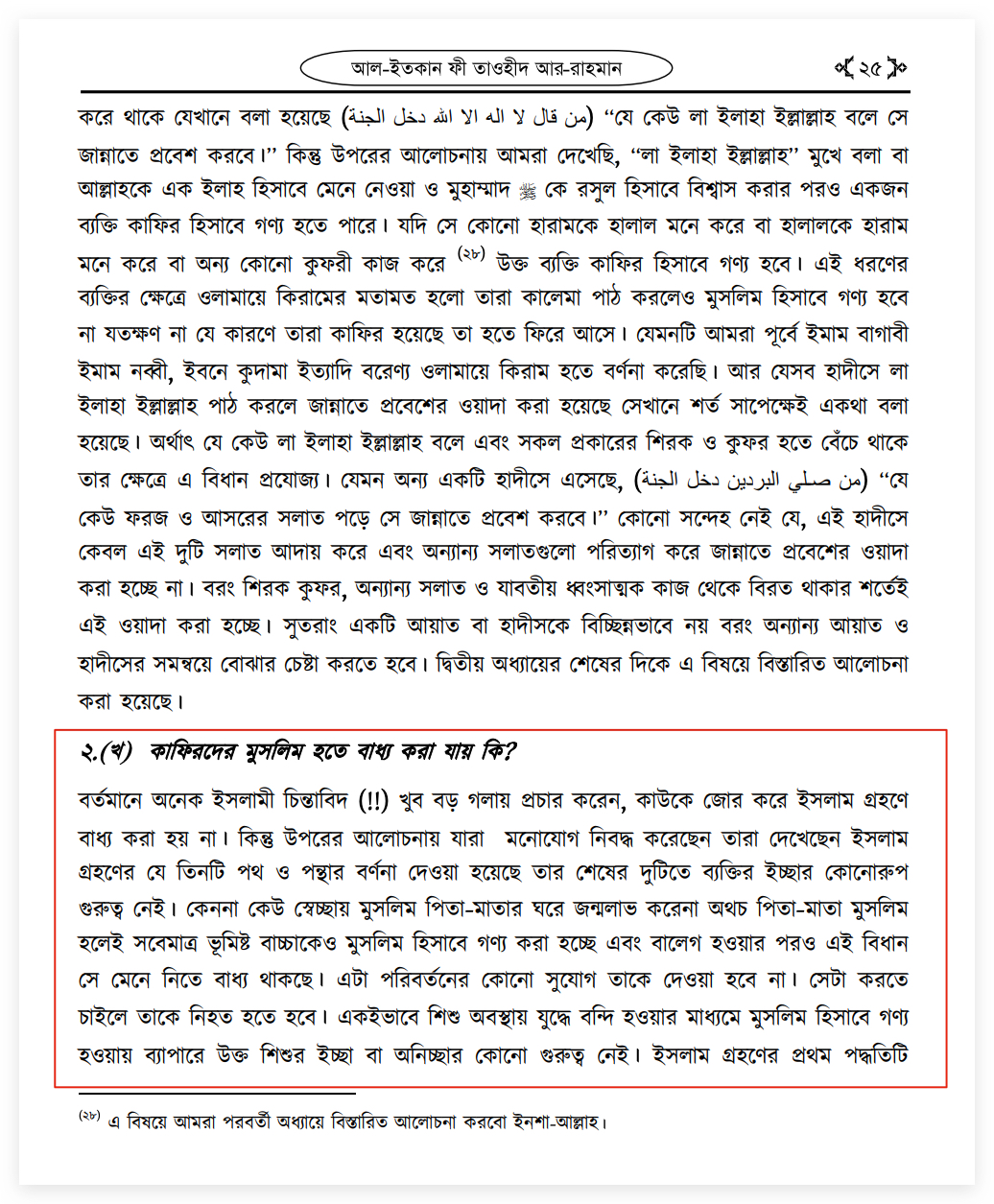
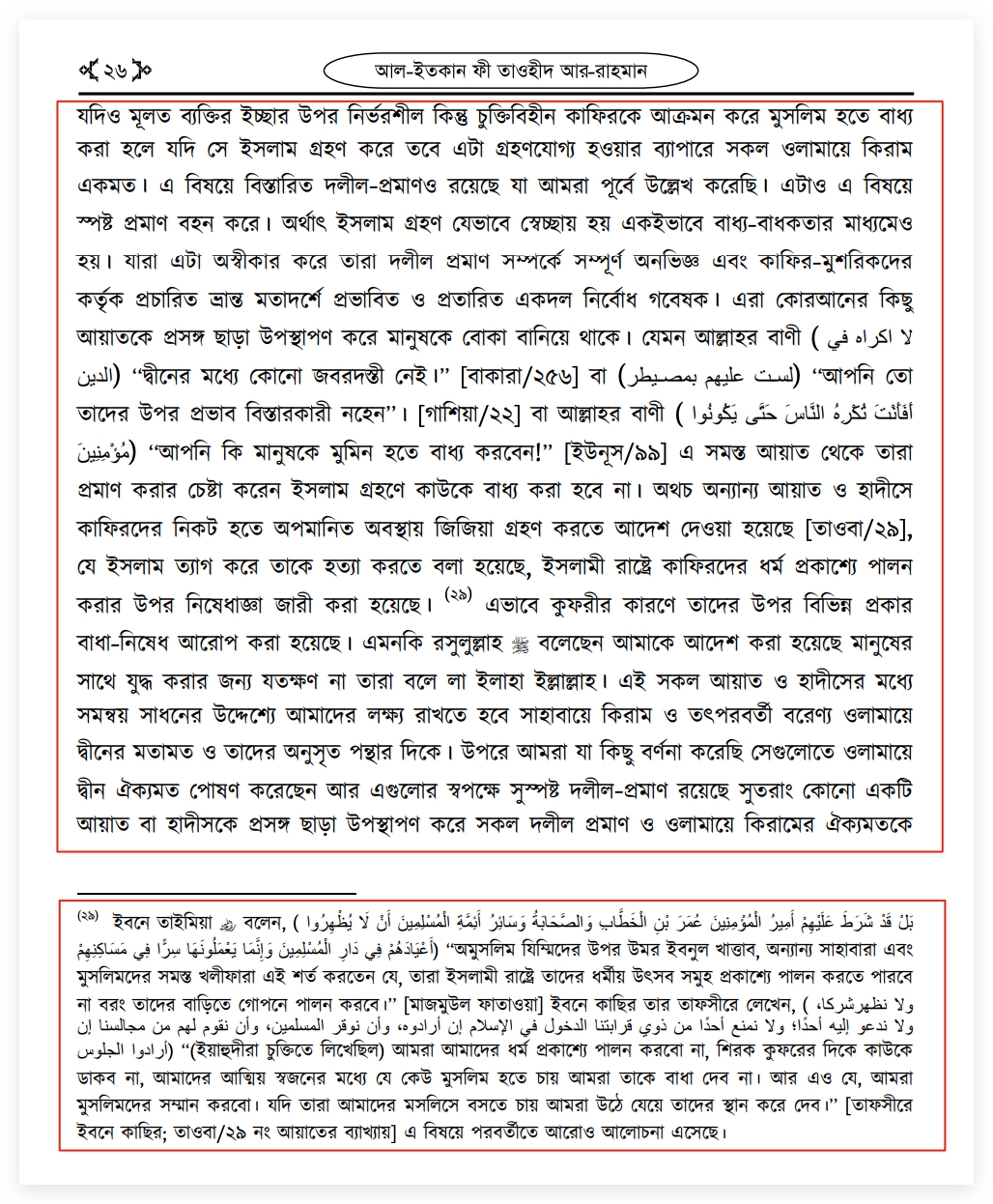
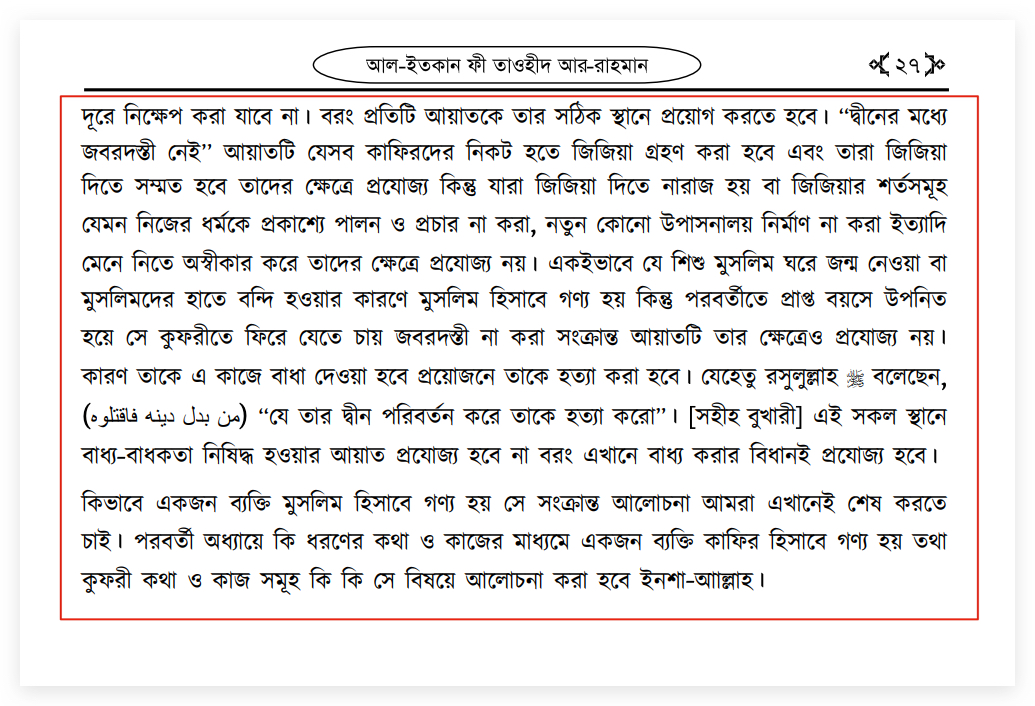
Muhammad’s Letters Threatening Rulers to Accept Islam
During his lifetime, the Prophet Muhammad wrote to rulers of several regions with whom he had never had any hostility, directly threatening them to embrace Islam. In these letters he also stated that, if they refused, he would attack their territories with his followers and kill their rulers. Consider how it would be received if, today, India’s Prime Minister Narendra Modi wrote to Bangladesh’s Hasina demanding that she embrace Hinduism and threatening an invasion if she refused. Is this civilised conduct, or the direct establishment of gangster rule in the manner of mafia bosses? Let us read one of the Prophet Muhammad’s letters to Oman and examine its language [126]—
“… From Muhammad, son of ‘Abdullah, to Jayfar and ‘Abd, the two sons of Julanda al-Azdi. Peace be upon whoever follows guidance. To proceed: I invite you both to Islam. Accept Islam and remain safe. I have been sent as Allah’s Messenger to all humanity, to warn the living and establish the charge against the unbelievers. If you accept Islam, I shall appoint you as governors. If, however, you refuse to accept Islam, your kingdom will come to an end. My cavalry will enter your territory, and my prophethood will prevail over your kingdom.”
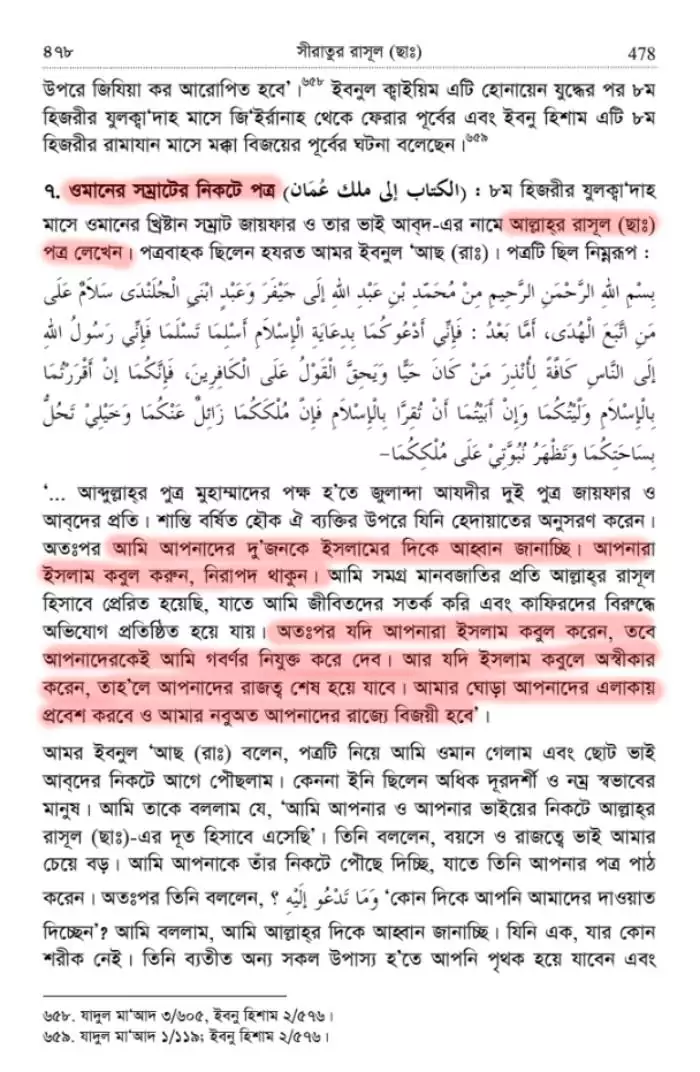
Death or Enslavement for Leaving Islam and Returning to One’s Former Religion
The Prophet and his Companions forced many people to embrace Islam through intimidation and terror. Many of them abandoned Islam and returned to their former religions as soon as the opportunity arose. Such people were attacked again and killed, while their children were enslaved and sold. Although this hadith speaks of freeing the children, read it carefully: you will see that ‘Ali actually sold them to Masqalah ibn Hubayrah al-Shaybani after receiving the full amount in cash, rather than freeing them. Imagine the present-day value of one hundred thousand coins from that period [127]—
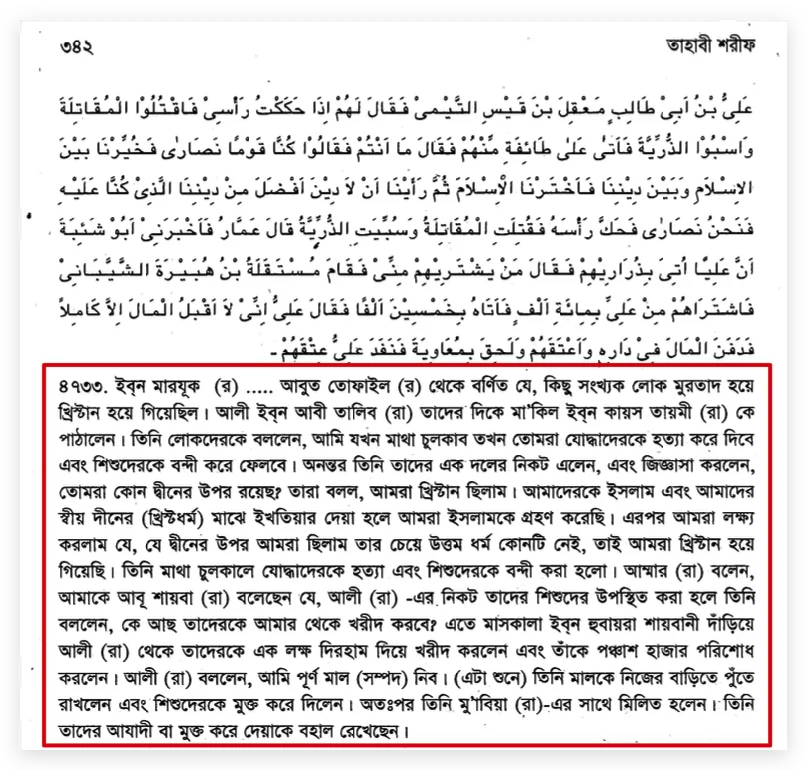
Those Who Commit Shirk May Be Killed under Islam
The book by Muhammad ‘Abd al-Qadir, published under the editorship of Dr Abu Bakr Muhammad Zakaria, a prominent Bangladeshi scholar and specialist in Islamic jurisprudence, A Review of Shirk, Bid‘ah, and Superstitions Prevalent in Bangladesh, expressly states that shirk is an offence punishable by death. The blood of those who commit shirk is lawful for Muslims to shed [128]-
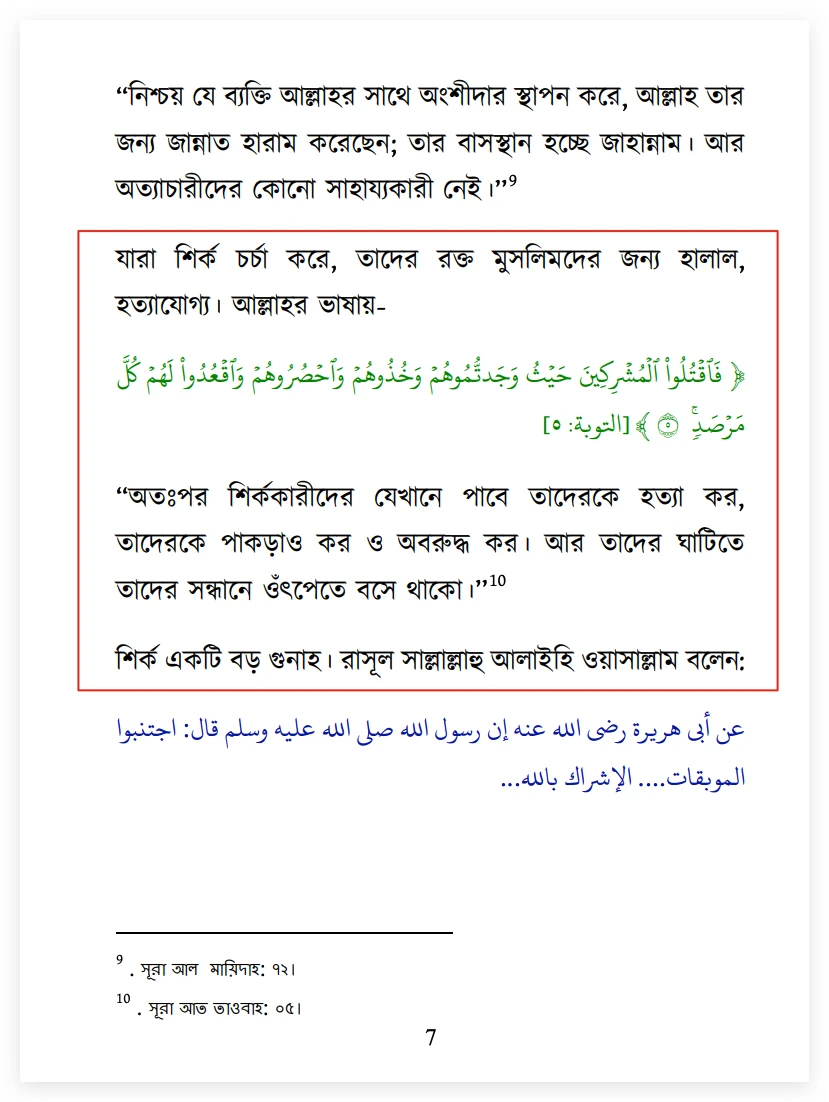
Inflicting Extensive Bloodshed on Prisoners of War
Let us now read Ibn Kathir’s account of how Muslims should treat non-Muslim prisoners of war after Islamic jihad [129]—
Commentary: In the aforementioned verses, Allah expresses His hatred of the unbelievers and describes their misdeeds, stating that among living creatures on earth, faithless unbelievers are the most contemptible in His sight. Whenever you conclude a treaty with those among them, they violate it. Whenever you trust them, they break that trust and destroy your confidence. They have no fear of Allah whatsoever and engage in wrongdoing with fearless arrogance. The meaning of the verse under discussion is: if you defeat them in battle and achieve victory, bind them severely and subject them to suffering. Ibn ‘Abbas supplied this interpretation.
Hasan al-Basri, al-Dahhak, al-Suddi, ‘Ata’ al-Khurasani, and Ibn ‘Uyaynah state in their interpretation: if you defeat them in battle, punish them most severely and kill them mercilessly, so that the other enemies in Arabia hear of this punishment, become afraid, and receive admonition and instruction. This should instil shame and remorse in them.
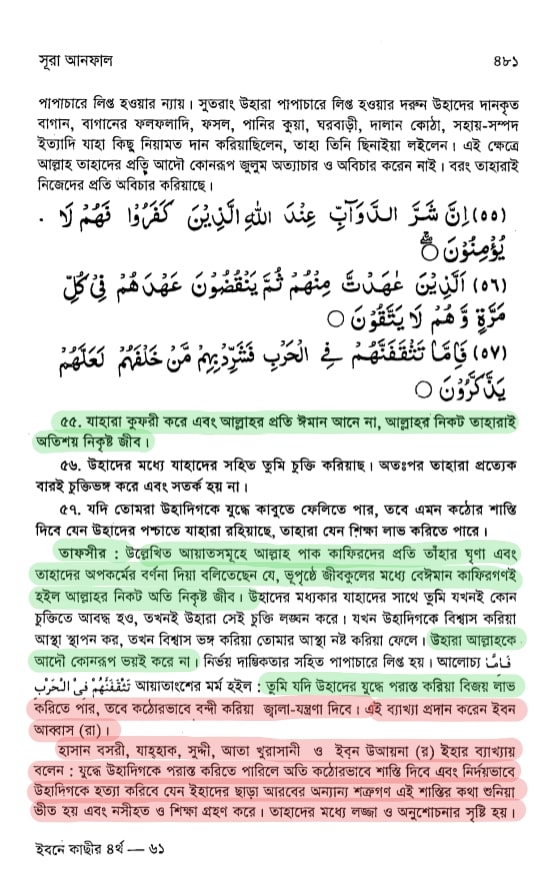
Another important Qur’anic verse must also be discussed here. During the Battle of Badr, a verse was revealed in which Allah very clearly declared that it was not permissible for the Prophet to retain unbelieving prisoners of war for ransom until sufficient killing and bloodshed had been inflicted upon them after the battle. In other words, Allah explicitly commands that sufficient blood be shed among the unbelievers defeated and captured in warfare [130].
It is not proper for a prophet to retain captives until, among the unbelievers fighting him, he has inflicted extensive killing and thoroughly subdued them, so that fear enters their hearts and they do not come to fight him a second time. O believers, you chiefly wish to capture the unbelievers of Badr and take ransom from them. Allah, however, desires the Hereafter, which can be attained through the religion’s victory and ascendancy. Allah is unrivalled in His being, attributes, and power; none can defeat Him. Likewise, He is supremely wise in legislating His Sharia and determining destiny.
— Bengali Mokhtasar
It is not fit for a prophet that he should take captives until he has thoroughly subdued the land. You ˹believers˺ settled with the fleeting gains of this world, while Allah’s aim ˹for you˺ is the Hereafter. Allah is Almighty, All-Wise.
— Taisirul Quran (Bengali source; English quotation: Dr. Mustafa Khattab, The Clear Quran)
It is not fit for a prophet that he should take captives until he has thoroughly subdued the land. You ˹believers˺ settled with the fleeting gains of this world, while Allah’s aim ˹for you˺ is the Hereafter. Allah is Almighty, All-Wise.
— Sheikh Mujibur Rahman (Bengali source; English quotation: Dr. Mustafa Khattab, The Clear Quran)
It is not fit for a prophet that he should take captives until he has thoroughly subdued the land. You ˹believers˺ settled with the fleeting gains of this world, while Allah’s aim ˹for you˺ is the Hereafter. Allah is Almighty, All-Wise.
— Rawai Al-bayan (Bengali source; English quotation: Dr. Mustafa Khattab, The Clear Quran)
It is not fit for a prophet that he should take captives until he has thoroughly subdued the land. You ˹believers˺ settled with the fleeting gains of this world, while Allah’s aim ˹for you˺ is the Hereafter. Allah is Almighty, All-Wise. [1] [2] [3]
— Dr. Abu Bakr Muhammad Zakaria (Bengali source; English quotation: Dr. Mustafa Khattab, The Clear Quran)
Let us read the translation of this verse from Tafsir al-Jalalayn [131]—
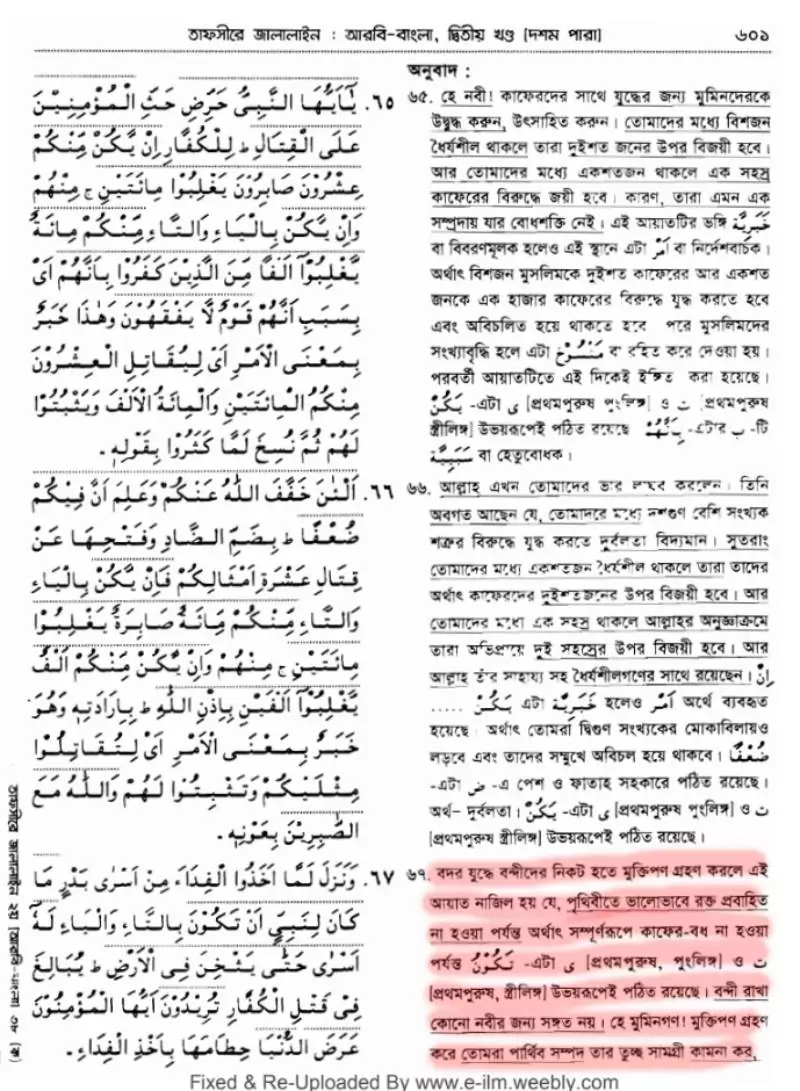
Let us now examine its explanation in Tafsir al-Mazhari [132]—
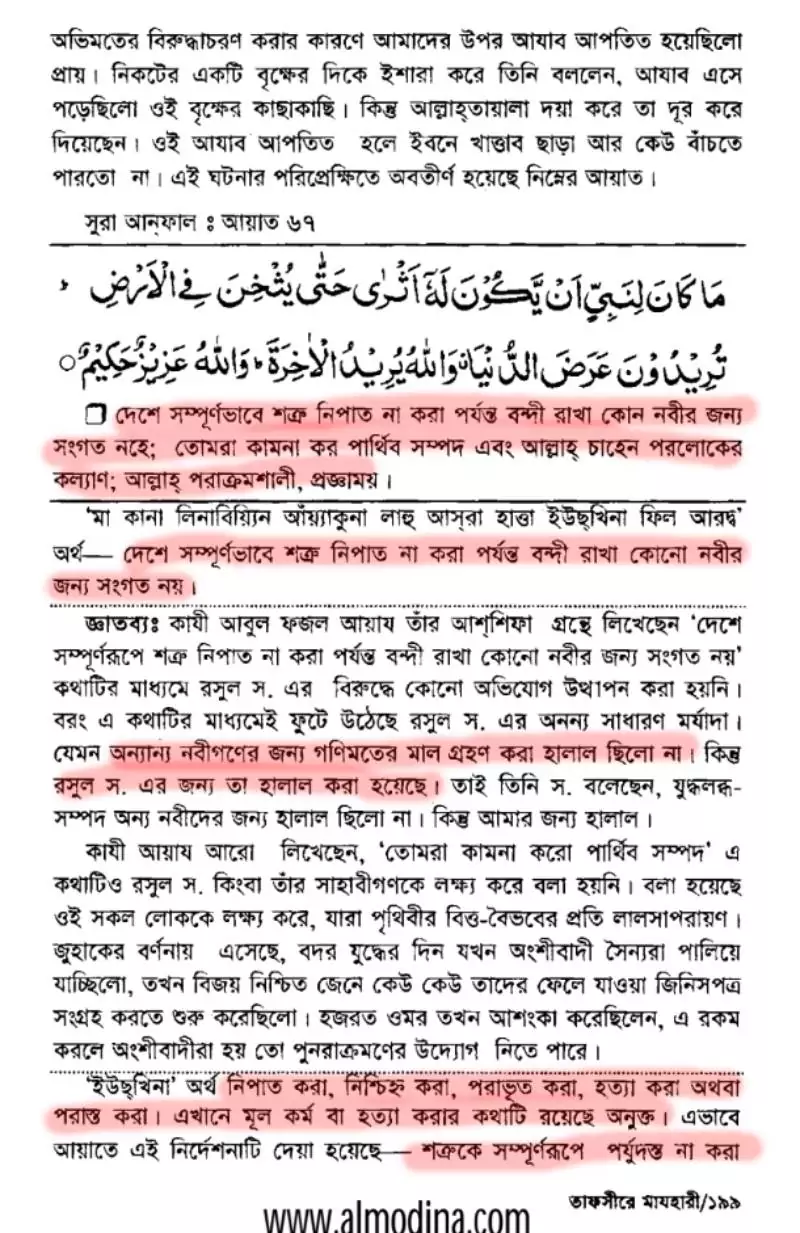
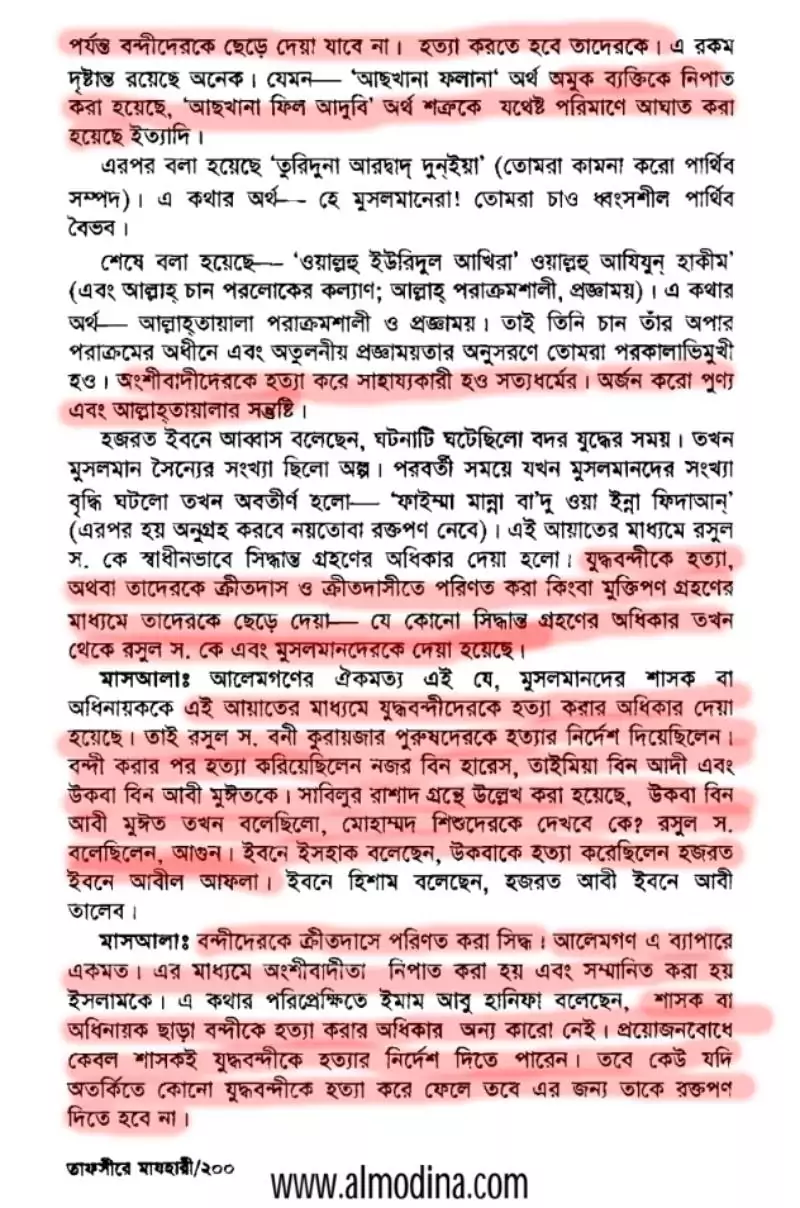
Let us now examine whether, according to Islamic rules, killing prisoners of war or releasing them for ransom is the more meritorious act [133]—
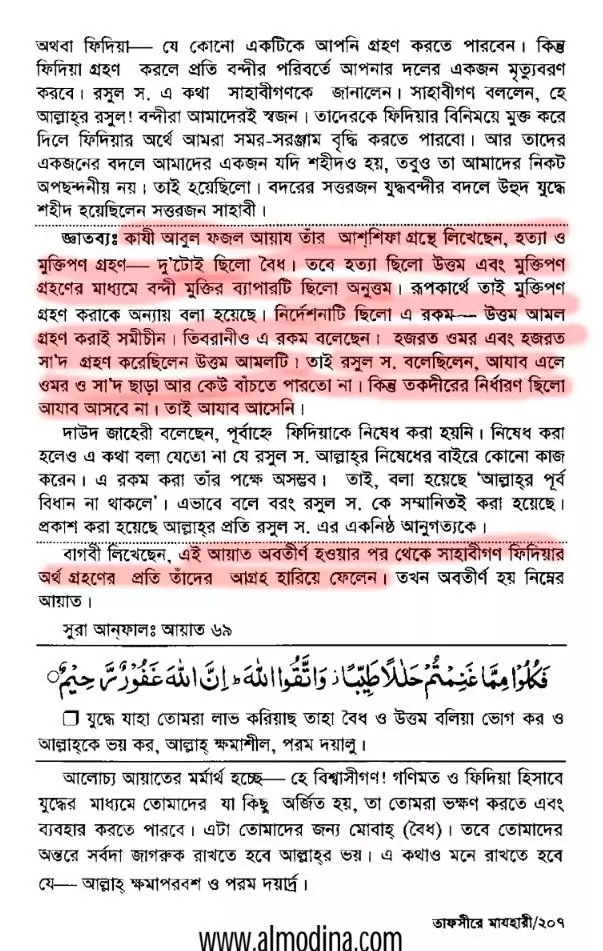
Guerrilla Warfare or Surprise Raids?
On the night of 25 March 1971, Pakistani forces attacked the sleeping, unarmed Bengali population. They attacked under circumstances that gave none of us any opportunity to prepare. Attacking unsuspecting people in their sleep violates every standard of morality; when the killing of women and children is added, such acts constitute direct war crimes.
We call those who attack secretly in the darkness without warning robbers. The same pattern can be observed in the Prophet Muhammad’s forces. Many believers compare these operations with guerrilla warfare, pointing out that our freedom fighters also conducted surprise attacks during the Liberation War. What they conceal in making this comparison, however, is that our liberation struggle strictly sought to ensure that no Pakistani civilian, woman, or child was injured or killed.
Guerrilla attacks are a recognised military tactic in various countries. Even this recognised tactic, however, must observe ethical limits. Its legitimacy does not mean that anyone may enter with weapons under cover of darkness and kill sleeping, unarmed people at will. Guerrilla warfare generally takes place between two belligerent forces and seeks to avoid injury or death among civilians. Since such attacks occur suddenly and leave no time for preparation, safeguarding the lives and property of women, children, and civilians is obligatory.
In most guerrilla wars, the foremost obligation during a surprise attack is to ensure that the targets are military personnel alone. If civilians are injured or killed, the attack ceases to be justifiable. To distinguish guerrilla warfare from mere robbery and abuse of sleeping, unarmed people, it is enough to ask whether civilians are killed, injured, or placed under threat: if so, it is robbery or an unjust attack. A guerrilla attack directed solely against armed combatants while excluding civilians is ethical and cannot then be called robbery. These Islamic attacks, however, harmed innocent women and children. Like robbers’ operations, these clandestine surprise raids were extraordinarily brutal. In the darkness, men armed with swords descended upon unbelievers’ homes; sleeping, unarmed people, women, and children were spared no protection. They even asked the Prophet whether women and children could be killed in such reckless night raids. He stated that there was no blame if they were killed unintentionally in the darkness without being seen. Women and children found alive after the fighting were captured and enslaved, which likewise constitutes a clear war crime under international law [134] [135] [136] [137] [138]!
Sahih Muslim (Islamic Foundation)
Book: 33 / Jihad and Its Rules
Section: 1. Permissibility of raiding the Kuffar, who have been reached with the call of Islam, without giving prior warning
4370. Source chain: Yahya ibn Yahya al-Tamimi … Ibn ‘Awn. Ibn ‘Aun reported:I wrote to Nafi’ inquiring from him whether it was necessary to extend (to the disbelievers) an invitation to accept (Islam) before meeting them in fight. He wrote (in reply) to me that it was necessary in the early days of Islam. The Messenger of Allah (ﷺ) made a raid upon Banu Mustaliq while they were unaware and their cattle were having a drink at the water. He killed those who fought and imprisoned others. On that very day, he captured Juwairiya bint al-Harith. Nafi’ said that this tradition was related to him by Abdullah b. Umar who (himself) was among the raiding troops. [Source-edition detail: Yahya said, “I think he said Juwairiyah,” or he definitely said “the daughter of al-Harith.”]
Hadith grade: Sahih
Narrator: Ibn ‘Awn
Sahih Muslim (Islamic Foundation)
Book: 33 / Jihad and Its Rules
Section: 9. Permissibility of killing women and children in night raids, so long as it is not done deliberately
4399. Source chain: Yahya ibn Yahya, Sa‘id ibn Mansur, and ‘Amr al-Naqid … Sa‘b ibn Jaththamah. It is reported on the authority of Sa’b b. Jaththama that the Prophet of Allah (ﷺ), when asked about the women and children of the polytheists being killed during the night raid, said:They are from them.
Hadith grade: Sahih
Sahih Muslim (Hadith Academy)
Book: 33 / Jihad and Expeditions
Section: 9. Permissibility of killing women and children in night raids, so long as it is not done deliberately
4442—(27/…) Source chain: ‘Abd ibn Humayd … Sa‘b ibn Jaththamah. It is narrated by Sa’b b. Jaththama that he said (to the Holy Prophet): Messenger of Allah, we kill the children of the polytheists during the night raids. He said: They are from them. (Islamic Foundation 4400; Islamic Centre 4400)
Hadith grade: Sahih
Sunan Ibn Majah
Tawhid Publications
Book: 18 / Jihad
1/2839. It was narrated that Ibn ‘Abbas said: “Sa’b bin Jaththamah said: ‘The Prophet (ﷺ) was asked about the polytheists who are attacked at night, and their women and children are killed.’ He said: ‘They are from among them..
Hadith grade: Sahih
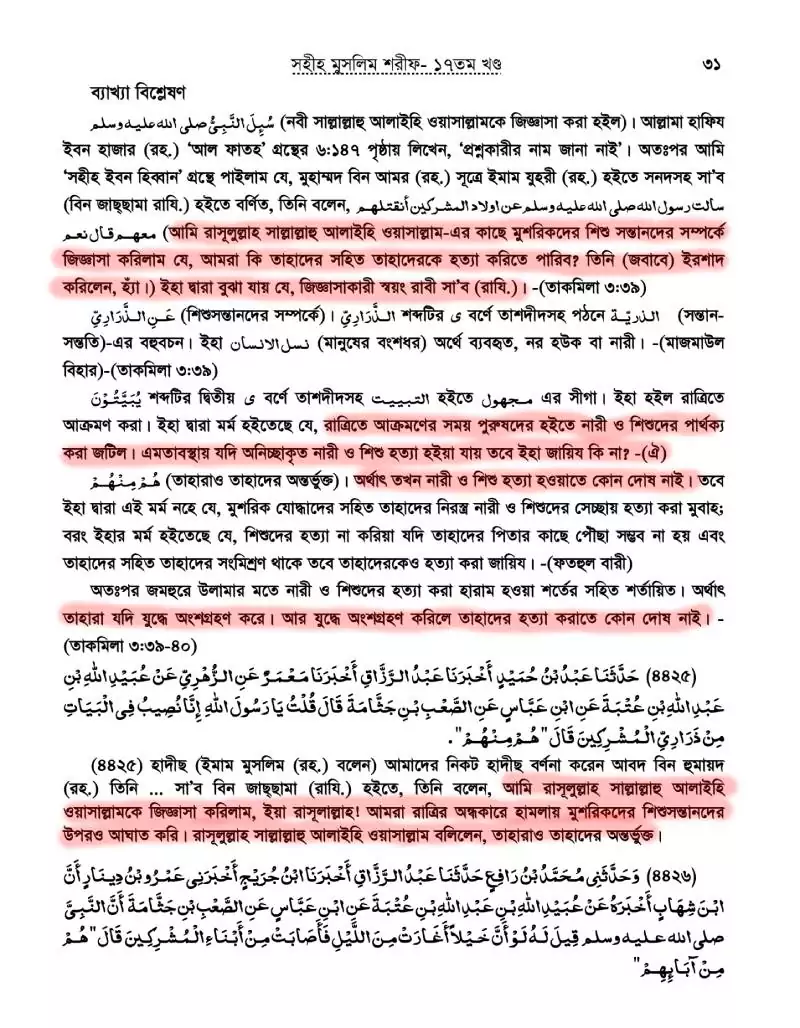
Examples of the Prophet’s Offensive Jihad
When the Prophet Muhammad had little power, weaponry, or manpower, he invited people to Islam. Once he acquired power and gathered enough men to wage war and kill, Muslims destroyed pagan idols and temples at his command. He ordered the killing even of people with whom he had neither warfare nor hostility, without any reason beyond terrorising them and treating their worship of idols as an offence.
In a place within Yemen, the pagans had a sanctuary called Dhul-Khalasa. The Prophet sent warriors and commanded its destruction. There are many such incidents. The prominent scholar Ibn Kathir’s al-Bidayah wa-l-Nihayah states that Muhammad ordered the destruction of this sanctuary [139]—
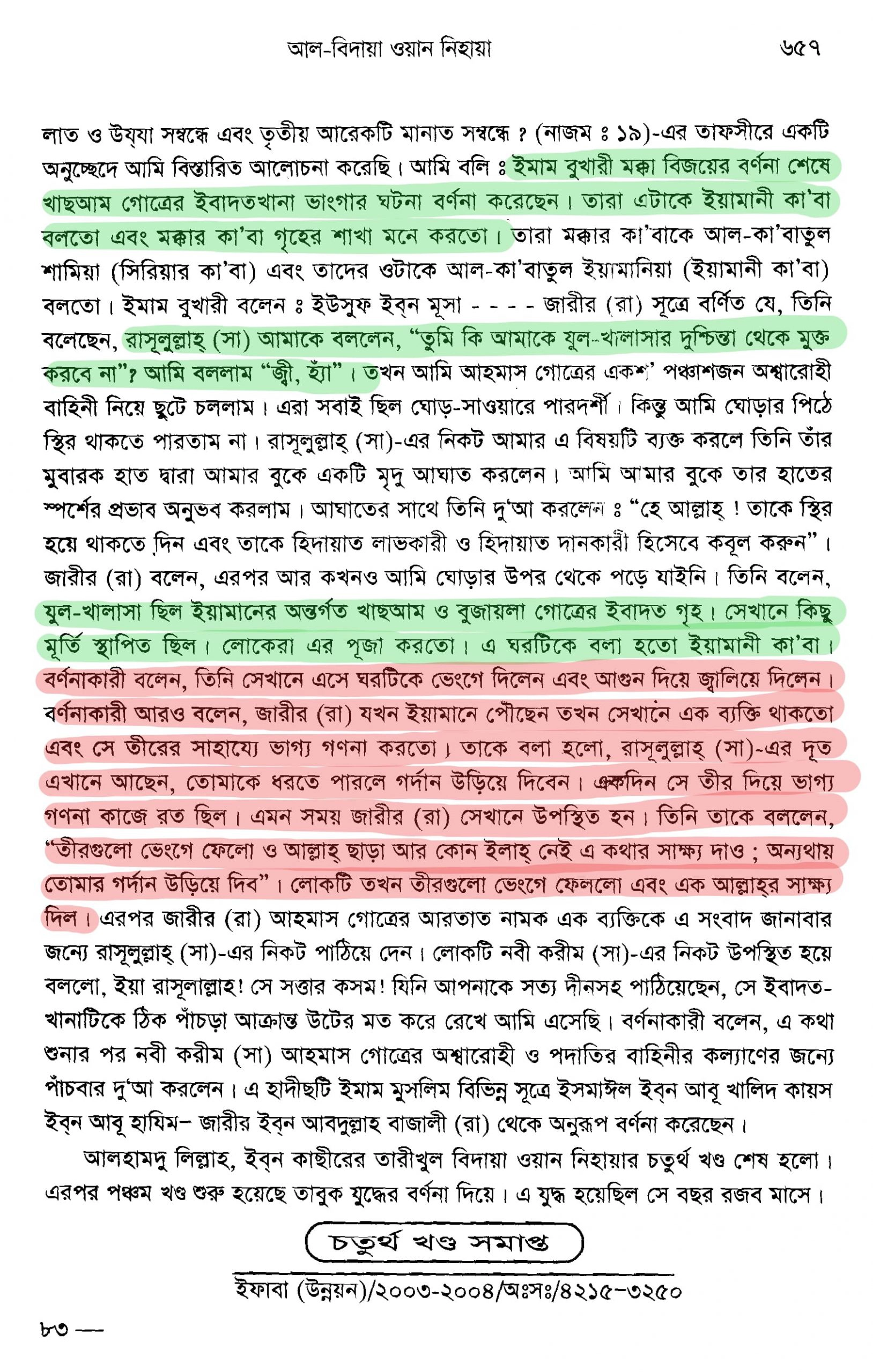
It should be noted that, in the places to which the Prophet sent men with orders to destroy temples and kill people, the inhabitants had no hostility with the Muslims. Comprehensive warfare began after the revelation of the verses of offensive jihad. Whoever would not accept Islam or pay jizya was to be killed. As already stated, nothing other than Islam would be accepted from polytheists. The account of the attack on the Dhul-Khalasa community is clearly established by Sahih al-Bukhari [140] [141] [142] [143] [144] [145] [146]—
Sahih al-Bukhari (Islamic Foundation)
48 / Jihad
Section: 1895. The burning of houses and date-palms
2811. Source chain: Musaddad … Jarir. Narrated Jarir: Allah’s Messenger (ﷺ)s said to me, “Will you relieve me from Dhul-Khalasa? Dhul-Khalasa was a house (of an idol) belonging to the tribe of Khath’am called Al-Ka`ba Al-Yama-niya. So, I proceeded with one hundred and fifty cavalry men from the tribe of Ahmas, who were excellent knights. It happened that I could not sit firm on horses, so the Prophet (ﷺ) , stroke me over my chest till I saw his finger-marks over my chest, he said, ‘O Allah! Make him firm and make him a guiding and rightly guided man.’ ”
Jarir proceeded towards that house, and dismantled and burnt it. Then he sent a messenger to Allah’s Apostle informing him of that. Jarir’s messenger said, “By Him Who has sent you with the Truth, I did not come to you till I had left it like an emancipated or gabby camel (i.e. completely marred and spoilt).” Jarir added, “The Prophet (ﷺ) asked for Allah’s Blessings for the horses and the men of Ahmas five times.”
Hadith grade: Sahih
Narrator: Jarir ibn ‘Abdullah al-Bajali
Sahih al-Bukhari (Islamic Foundation)
Book: 50 / The Prophets
Section: 2131. About Jarir ibn ‘Abdullah al-Bajali
3549. Source chain: Ishaq al-Wasiti … Jarir ibn ‘Abdullah. Narrated Jarir bin ‘Abdullah: Allah’s Messenger (ﷺ) has never refused to admit me since I embraced Islam, and whenever he saw me, he would smile. Jarir bin ‘Abdullah narrated: There was a house called Dhul-Khalasa in the Pre-lslamic Period and it was also called Al-Ka’ba Al-Yamaniya or Al-Ka’ba Ash-Shamiya. Allah’s Messenger (ﷺ) said to me, “Will you relieve me from Dhul-Khalasa?” So I left for it with 150 cavalrymen from the tribe of Ahmas and then we destroyed it and killed whoever we found there. Then we came to the Prophet (ﷺ) and informed him about it. He invoked good upon us and upon the tribe of Ahmas.
Hadith grade: Sahih
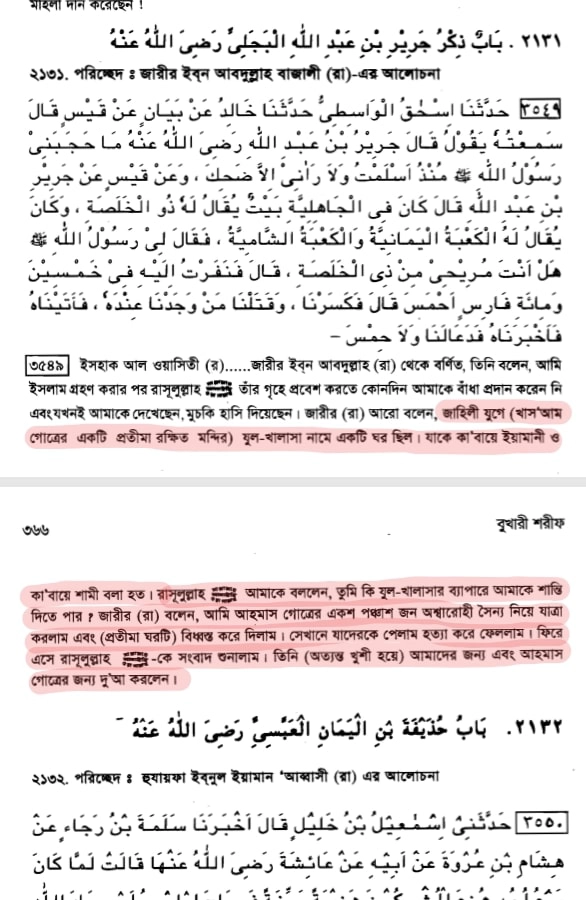
Sahih al-Bukhari (Islamic Foundation)
Book: 51 / Military Expeditions
Section: 2226. The Expedition against Dhul-Khalasa
4018. Source chain: Yusuf ibn Musa … Jarir. Narrated Qais: Jarir said “Allah’s Messenger (ﷺ) said to me, “Won’t you relieve me from Dhul-Khalasa?” I replied, “Yes, (I will relieve you).” So I proceeded along with one-hundred and fifty cavalry from Ahmas tribe who were skillful in riding horses. I used not to sit firm over horses, so I informed the Prophet (ﷺ) of that, and he stroke my chest with his hand
till I saw the marks of his hand over my chest and he said, O Allah! Make him firm and one who guides others and is guided (on the right path).’ Since then I have never fallen from a horse. Dhul-l–Khulasa was a house in Yemen belonging to the tribe of Khatham and Bajaila, and in it there were idols which were worshipped, and it was called Al-Ka`ba.”
Jarir went there, burnt it with fire and dismantled it. When Jarir reached Yemen, there was a man who used to foretell and give good omens by casting arrows of divination. Someone said to him. “The messenger of Allah’s Messenger (ﷺ) is present here and if he should get hold of you, he would chop off your neck.”
One day while he was using them (i.e. arrows of divination), Jarir stopped there and said to him, “Break them (i.e. the arrows) and testify that None has the right to be worshipped except Allah, or else I will chop off your neck.” So the man broke those arrows and testified that none has the right to be worshipped except Allah. Then Jarir sent a man called Abu Artata from the tribe of Ahmas to the Prophet to convey the good news (of destroying Dhu-l-Khalasa). So when the messenger reached the Prophet, he said, “O Allah’s Messenger (ﷺ)! By Him Who sent you with the Truth, I did not leave it till it was like a scabby camel.” Then the Prophet (ﷺ) blessed the horses of Ahmas and their men five times.
Hadith grade: Sahih
Sahih al-Bukhari (Islamic Foundation)
Book: 51 / Military Expeditions
Section: 2226. The Expedition against Dhul-Khalasa
4017. Source chain: Muhammad ibn al-Muthanna … Qays. Narrated Qais: Jarir said to me, The Prophet (ﷺ) said to me, “Won’t you relieve me from Dhu-l-Khalasa?” And that was a house (in Yemem belonging to the tribe of) Khatham called Al-Ka`ba Al Yamaniya. I proceeded with one-hundred and-fifty cavalry from Ahmas (tribe) who were horse riders. I used not to sit firm on horses, so the Prophet (ﷺ) stroke me over my chest till I saw the mark of his fingers over my chest,
and then he said, ‘O Allah! Make him (i.e. Jarir) firm and one who guides others and is guided on the right path.” So Jarir proceeded to it dismantled and burnt it, and then sent a messenger to Allah’s Messenger (ﷺ). The messenger of Jarir said (to the Prophet), “By Him Who sent you with the Truth, I did not leave that place till it was like a scabby camel.” The Prophet (ﷺ) blessed the horses of Ahmas and their men five times.
Hadith grade: Sahih
Sahih al-Bukhari (Tawhid Publications)
Book: 64 / Military Expeditions
Section: 64/63. The Expedition against Dhul-Khalasa.
4356. Narrated Qais: Jarir said to me, The Prophet (ﷺ) said to me, “Won’t you relieve me from Dhu-l-Khalasa?” And that was a house (in Yemem belonging to the tribe of) Khatham called Al-Ka`ba Al Yamaniya. I proceeded with one-hundred and-fifty cavalry from Ahmas (tribe) who were horse riders. I used not to sit firm on horses, so the Prophet (ﷺ) stroke me over my chest till I saw the mark of his fingers over my chest, and then he said, ‘O Allah! Make him (i.e. Jarir) firm and one who guides others and is guided on the right path.” So Jarir proceeded to it dismantled and burnt it, and then sent a messenger to Allah’s Messenger (ﷺ). The messenger of Jarir said (to the Prophet), “By Him Who sent you with the Truth, I did not leave that place till it was like a scabby camel.” The Prophet (ﷺ) blessed the horses of Ahmas and their men five times. (3020) (Adhunik Publications: 4010; Islamic Foundation: 4014)
Hadith grade: Sahih
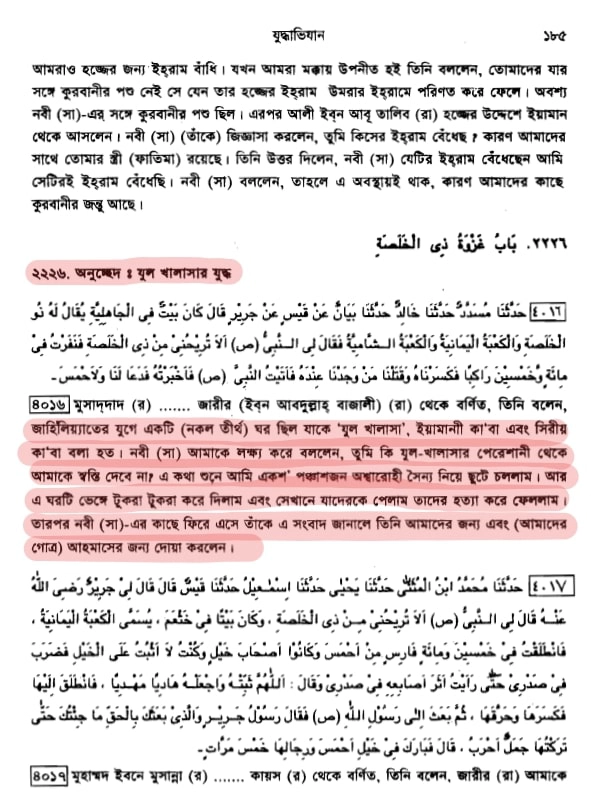
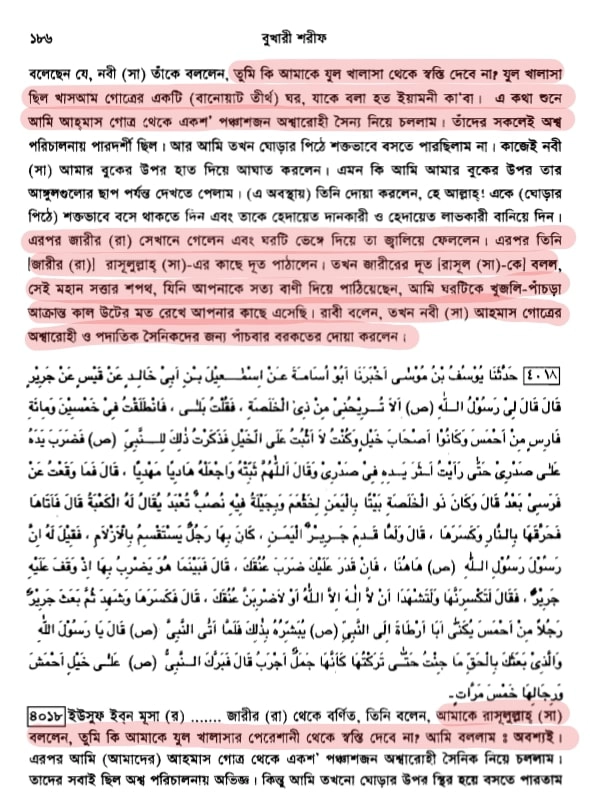
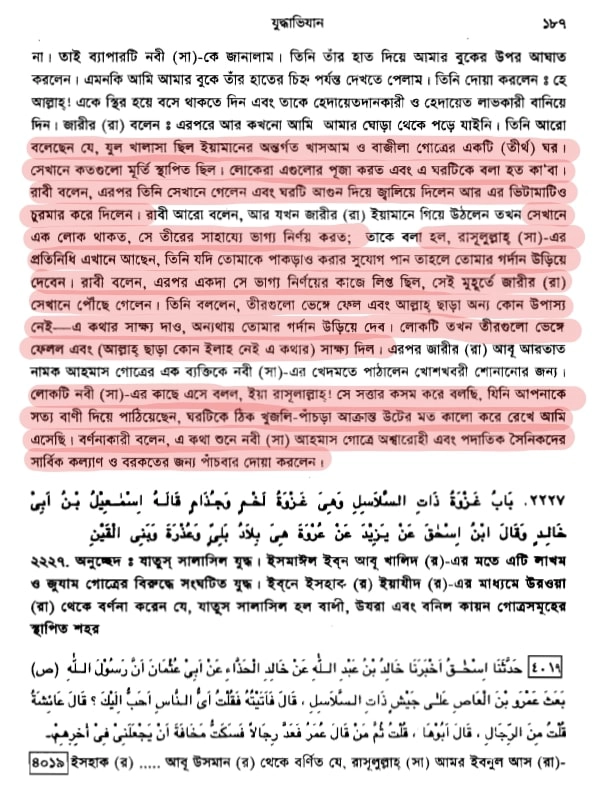
The passages above describe the command to send soldiers to Dhul-Khalasa and destroy non-Muslims’ place of worship and revered idols. Many similar examples exist. Let us read al-Rahiq al-Makhtum, which shows that the Prophet sent soldiers to various places to eradicate idols, places of worship, and their worshippers. Even women were not spared. The situation became so severe that the Prophet himself grew displeased with Khalid ibn al-Walid upon seeing the extent of the killings [147]—
The Dispatch of Expeditions and Delegations:
1. After completing all matters connected with the conquest of Mecca, and finding some time available, on 25 Ramadan, 8 AH, he sent a small force under Khalid ibn al-Walid to destroy the idol al-‘Uzza. Its temple stood at Nakhlah. When Khalid returned after demolishing it, the Messenger of Allah asked him, (هَلْ رَأَيْتَ شَيْئًا؟) “Did you see anything?” Khalid replied, “No.” The Messenger of Allah said, (فَإِنَّكَ لَمْ تَهْدِمْهَا فَارْجِعْ إِلَيْهَا فَاهْدِمْهَا) “Then you have not actually destroyed it. Return and destroy it.” An agitated Khalid returned with his sword drawn. This time, a woman with dishevelled hair emerged towards them, and the temple’s keeper began calling to her loudly. Khalid then struck her with his sword so forcefully that her body was severed in two. When he reported this to the Messenger of Allah, the latter said, (نَعَمْ، تِلْكَ الْعُزّٰى، وَقَدْ أَيِسَتْ أَنْ تَعْبُدَ فِيْ بِلَادِكُمْ أَبَدًا) “Yes, that was al-‘Uzza. She now despairs of being worshipped in your country”—that is, she would never again be worshipped there.
2. The Prophet then, in the same month, sent ‘Amr ibn al-‘As to destroy the idol Suwa‘, which belonged to Banu Hudhayl at Ruhat, three miles from Mecca. When ‘Amr arrived, its keeper asked, “What do you want?” He replied, “Allah’s Prophet has commanded us to destroy this idol.”
He said, “You will not be able to destroy it.”
‘Amr asked, “Why?”
He replied, “You will be prevented by the natural order.”
‘Amr said, “Are you still adhering to falsehood? Woe to you! Does this idol see or hear?”
He then approached the idol and destroyed it, and ordered his companions to demolish the treasury building. They found nothing inside. He then asked the keeper, “Tell me, how did it turn out?”
The keeper replied, “I accept Islam, Allah’s religion.”
3. During the same month, he sent twenty horsemen under Sa‘d ibn Zayd al-Ashhali to destroy the idol Manat. This idol stood at al-Mushallal near Qudayd and was worshipped by Aws, Khazraj, Ghassan, and other tribes. When Sa‘d’s force arrived, the temple’s keeper asked, “What do you want?”
They replied, “We have come to destroy Manat.”
He said, “That is your affair.”
As Sa‘d advanced towards the idol, he saw a naked black woman with dishevelled hair emerge, beating her breast and crying out in distress.
The keeper addressed her: “Manat! Destroy these disobedient men.”
But Sa‘d then struck her dead with his sword. He subsequently smashed the idol to pieces. No wealth or valuables were found in its treasury.
4. After Khalid ibn al-Walid returned from destroying al-‘Uzza, the Messenger of Allah sent him to Banu Jadhimah in Shawwal, 8 AH. The purpose was to preach Islam, rather than attack. Khalid went to Banu Jadhimah with 350 men drawn from the Emigrants, the Helpers, and Banu Sulaym, and invited them to Islam. Instead of saying, “We have accepted Islam,” they said, “We have abandoned our former religion; we have abandoned our former religion.” Khalid consequently ordered their killing and capture. He entrusted one prisoner to each of his companions and then commanded, “Each man shall kill the prisoner entrusted to him.” Ibn ‘Umar and his companions refused to obey. When they later appeared before the Prophet, they discussed the matter. He raised both hands and said twice, (اللهم إِنِّيْ أَبْرَأُ إِلَيْكَ مِمَّا صَنَعَ خَالِدًا) “O Allah, I declare myself innocent before You of what Khalid has done.”(1)
Only the men of Banu Sulaym killed their prisoners; the Helpers and Emigrants did not. The Messenger of Allah sent ‘Ali to pay blood money and compensation for those killed. The incident led to heated exchanges and a deterioration of relations between Khalid and ‘Abd al-Rahman ibn ‘Awf. Upon hearing of this, the Messenger of Allah said:
(مَهَلًّا يَا خَالِدُ، دَعْ عَنْكَ أَصْحَابِيْ، فَوَاللهِ لَوْ كَانَ أَحَدٌ ذَهَبًا، ثُمَّ أَنْفَقَتْهُ فِيْ سَبِيْلِ اللهِ مَا أَدْرَكَتْ غُدْوَةَ رَجُلٍ مِّنْ أَصْحَابِيْ وَلَا رَوْحَتَهُ)
“খালিদ থেমে যাও, আমার সহচরদের কিছু বলা হতে বিরত থাক। আল্লাহর কসম! যদি উহুদ পাহাড় সোনা হয়ে যায় এবং তার সমস্তই তোমরা আল্লাহর পথে খরচ করে দাও তবুও আমার সাহাবাদের মধ্য হতে কোনো এক জনেরও এক সকাল কিংবা এক সন্ধ্যার ইবাদতের নেকী অর্জন করতে পারবে না।”(2)
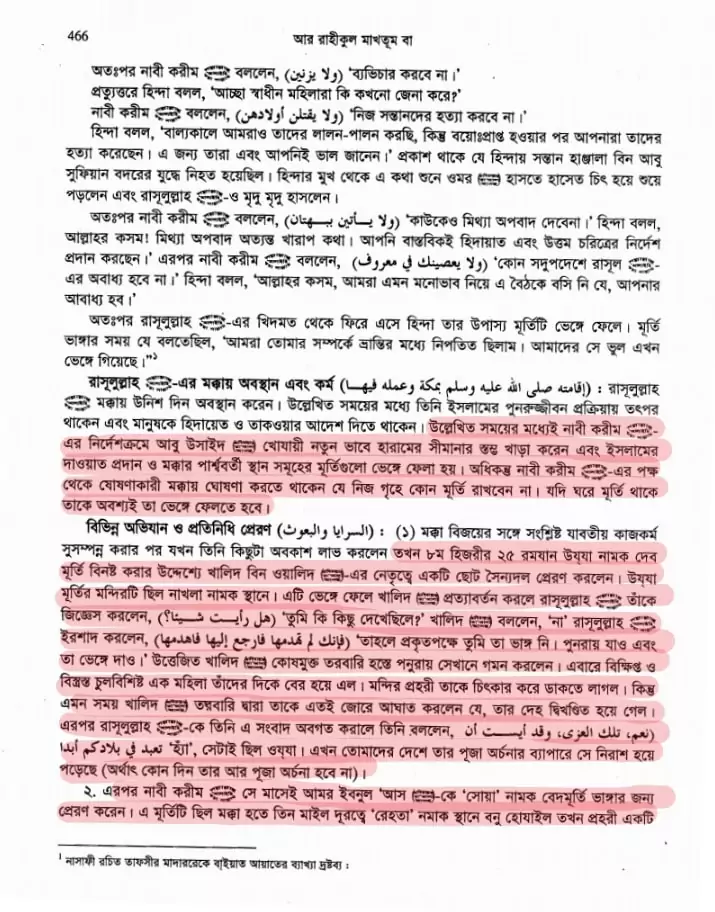
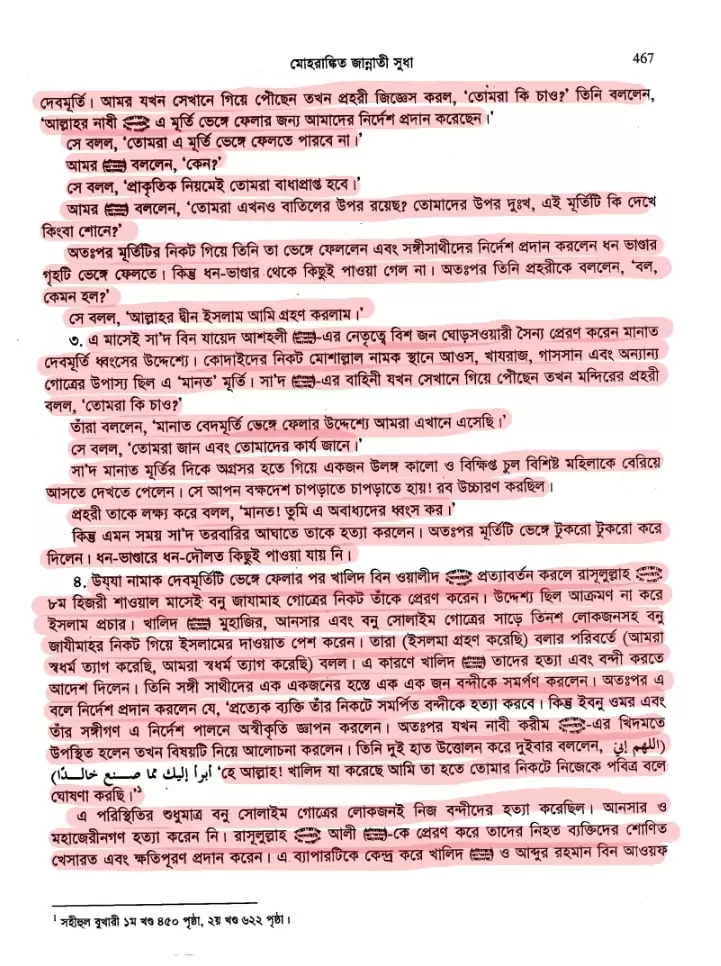
These incidents are not the end of the matter. Let us also examine the Prophet’s instructions to ‘Ali and to those who came after him [148]—
Jami‘ al-Tirmidhi (Islamic Foundation)
10 / Funerals
Section: Levelling Graves.
1049. Source chain: Muhammad ibn Bashshar … Abu Wa’il. Abu Wa’il narrated:“Ali said to Abu Al-Hayyaj Al-Asadi: ‘I am dispatching you with what the Prophet dispatched me: “That you not leave an elevated grave without leveling it, nor an image without erasing it.”—Al-Ahkam 207; Irwa’ 759; Tahdhir al-Sajid 130; Muslim; al-Tirmidhi, hadith 1049 [Al-Madani Publications]
A hadith on this subject has also been transmitted from Jabir. Imam Abu ‘Isa stated that ‘Ali’s hadith is hasan. Some scholars have acted accordingly, regarding it as undesirable to raise graves above the ground. Imam al-Shafi‘i stated: “I dislike raising a grave beyond the height necessary for it to be recognised as a grave.” Some elevation is needed as a marker so that it is neither trodden on nor used as a seat.
Hadith grade: Sahih
Narrator: Abu Wa’il
Let us now read further accounts of the destruction of idols and places of worship from Tafsir Ibn Kathir [149]—
Ibn Ishaq records in his Sirah that the Arabs had established several sanctuaries alongside the Ka‘bah. They covered them with cloth, venerated them as they did the Ka‘bah, sent sacrificial animals there, slaughtered animals nearby, and circumambulated them in the same way. Nevertheless, they acknowledged the Ka‘bah’s superiority and honour, respecting it as the mosque built by Abraham. Ibn Ishaq further states that Quraysh and Banu Kinanah worshipped al-‘Uzza at Nakhlah, whose upkeep was entrusted to Banu Shayban, a branch of the tribe of Sulaym. After the conquest of Mecca, the Messenger of Allah sent Khalid ibn al-Walid to destroy this idol. While smashing it to pieces, Khalid said: انی رایت اللَّهَ قَدَاهَائِكَ meaning, “O al-‘Uzza, I do not glorify you; I reject you. I believe Allah has humiliated you.” يا عزى كَفَرَأَنَّكَ سُبْحَانَكَ
An-Nasa’i recorded that Abu At-Tufayl said, “When the Messenger of Allah ﷺ conquered Makkah, he sent Khalid bin Al-Walid to the area of Nakhlah, where the idol of Al-`Uzza was erected on three trees of a forest. Khalid cut the three trees and approached the house built around it and destroyed it. When he went back to the Prophet and informed him of the story, the Prophet said to him, (Go back and finish your mission, for you have not finished it.) Khalid went back and when the custodians who were also its servants of Al-`Uzza saw him, they started invoking by calling Al-`Uzza! When Khalid approached it, he found a naked woman whose hair was untidy and who was throwing sand on her head. Khalid killed her with the sword and went back to the Messenger of Allah ﷺ, who said to him, (That was Al-`Uzza!)” (Published English: Ibn Kathir, Abridged, Darussalam, commentary on An-Najm 53:19, Quran.com. Source-edition addition retained separately: Khalid cut her in two with a single blow.)
Ibn Ishaq states that the idol of Thaqif was called al-Lat and stood in Ta’if. Banu Mu‘attib maintained and looked after it. The Messenger of Allah sent al-Mughirah ibn Shu‘bah and Abu Sufyan ibn Harb to destroy it. They went to Ta’if, demolished it, levelled it to the ground, and established a mosque there.
Manat was the deity of Aws, Khazraj, and those who shared their beliefs. It stood at Qudayd on the seashore, on the road to al-Mushallal. At the Messenger of Allah’s command, Abu Sufyan smashed this idol too. Some believe that ‘Ali destroyed the site. The place called Dhul-Khalasa was the sanctuary of Daws, Khath‘am, and Bajilah. Ibn Kathir states that this place, situated at Tabalah, was called the Yemeni Ka‘bah, while the Ka‘bah in Mecca was called the Syrian Ka‘bah. Jarir ibn ‘Abdullah al-Bajali destroyed it at the Messenger of Allah’s command.
The idol-house called al-Fuls belonged to the tribe of Tayy and the neighbouring Arabs. It stood in the mountains of Tayy, between Salma and Aja’. Ibn Hisham states that ‘Ali ibn Abi Talib destroyed it at the Messenger of Allah’s command and recovered two swords called Rasub and Mikhdham. The Messenger of Allah gave these swords to ‘Ali.
Ibn Ishaq states that the idol-house called Ri’am in Sana‘a was a sanctuary of Himyar and the Yemenis. It is said that a black dog was there. Two Himyarite leaders accompanying Tubba‘ killed the dog and destroyed the idol-house.
Ibn Ishaq states that Rida was the sanctuary of Banu Rabi‘ah ibn Ka‘b ibn Sa‘d. Al-Mustawghir ibn Rabi‘ah ibn Sa‘d destroyed it after embracing Islam. Ibn Hisham notes that this man lived for 330 years. 1
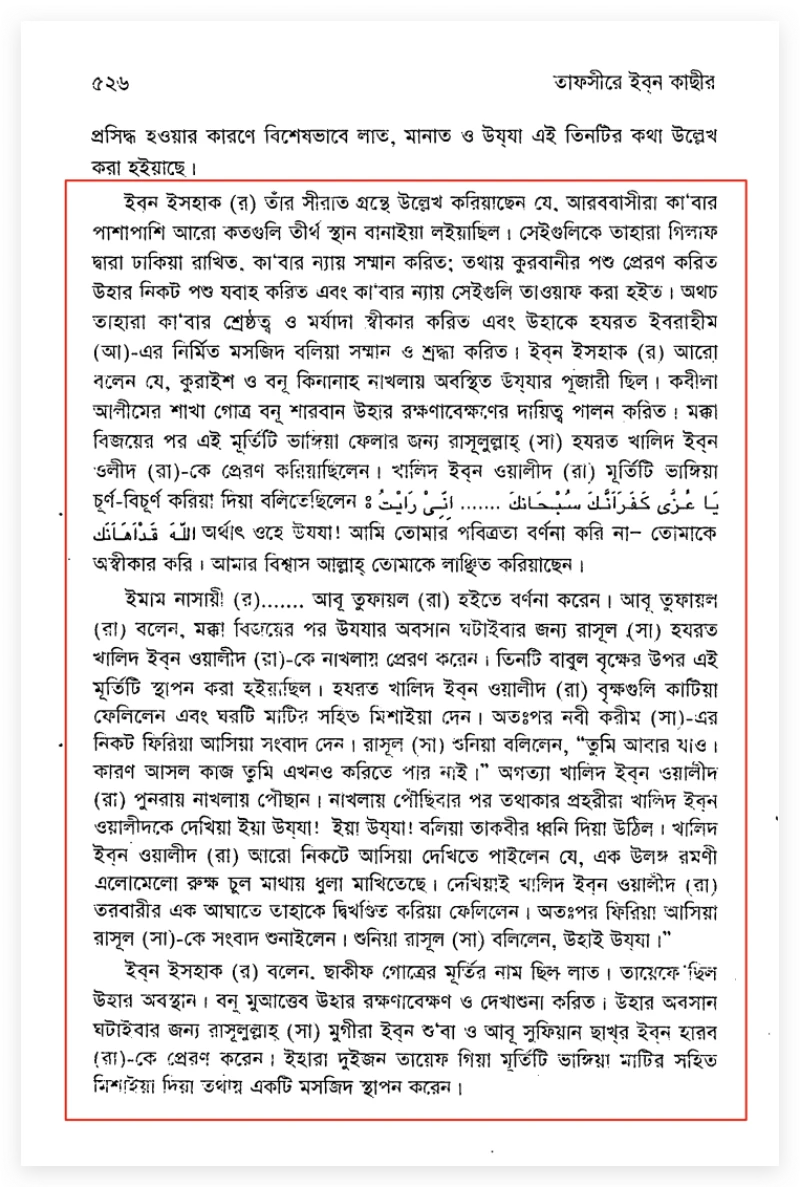
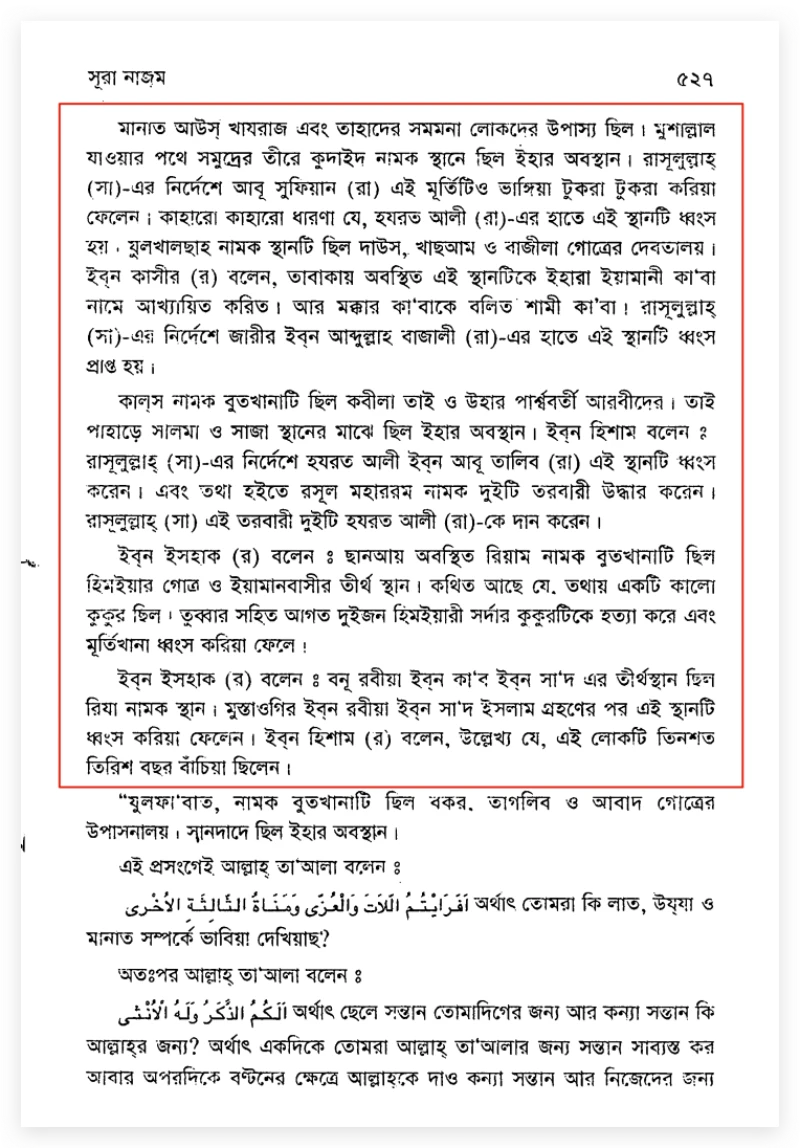
Spoils Acquired through Jihad
To illustrate the scale of the wealth the Prophet Muhammad plundered from unbelievers as war booty, I present the following calculation. Readers should consider how much booty could be obtained from a single battle. The Prophet conducted many such battles [150].
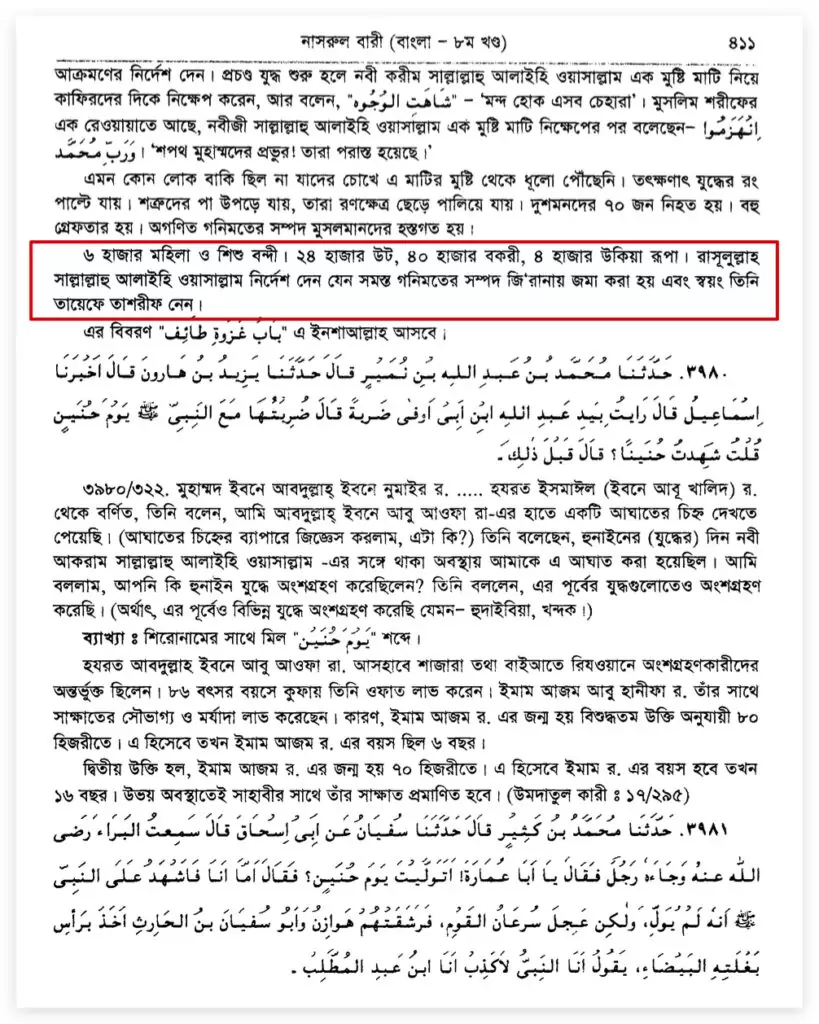
There is a compilation of Islamic law known as Fatawa-i ‘Alamgiri, al-Fatawa al-‘Alamgiriyyah, or al-Fatawa al-Hindiyyah. It was prepared at the command of the Mughal emperor Aurangzeb. Acclaimed as “the greatest monument of Muslim law produced in India,” the compilation has been widely regarded as one of the most systematic works of Islamic jurisprudence. It compiles Sharia rules on the basis of the Sunni Hanafi school. Many scholars contributed to its preparation, drawing evidence from the Qur’an, Sahih al-Bukhari, Sahih Muslim, Sunan Abi Dawud, and Jami‘ al-Tirmidhi.
Aurangzeb appointed 500 scholars of jurisprudence to prepare Fatawa-i ‘Alamgiri: 300 from South Asia, 100 from Iraq, and 100 from the Hijaz. Shaykh Nizam Burhanpuri led the compilation team in Delhi and Lahore. Their work over several years produced the collection. It records laws and legal directions governing various possible circumstances in personal and family life, slavery, warfare, property, interreligious relations, exchange, taxation, economics, and other matters. Let us consult it to learn the rules of jihad and the Islamic procedures for acquiring war booty [151]—
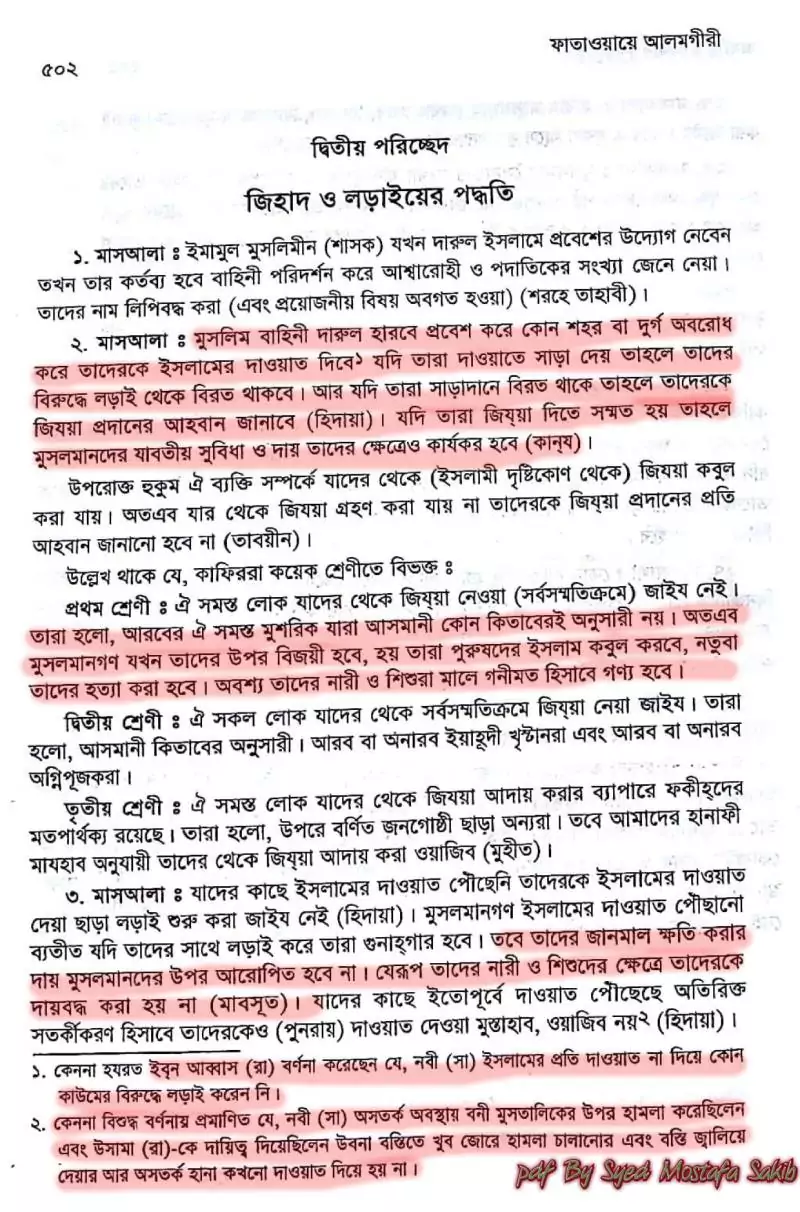
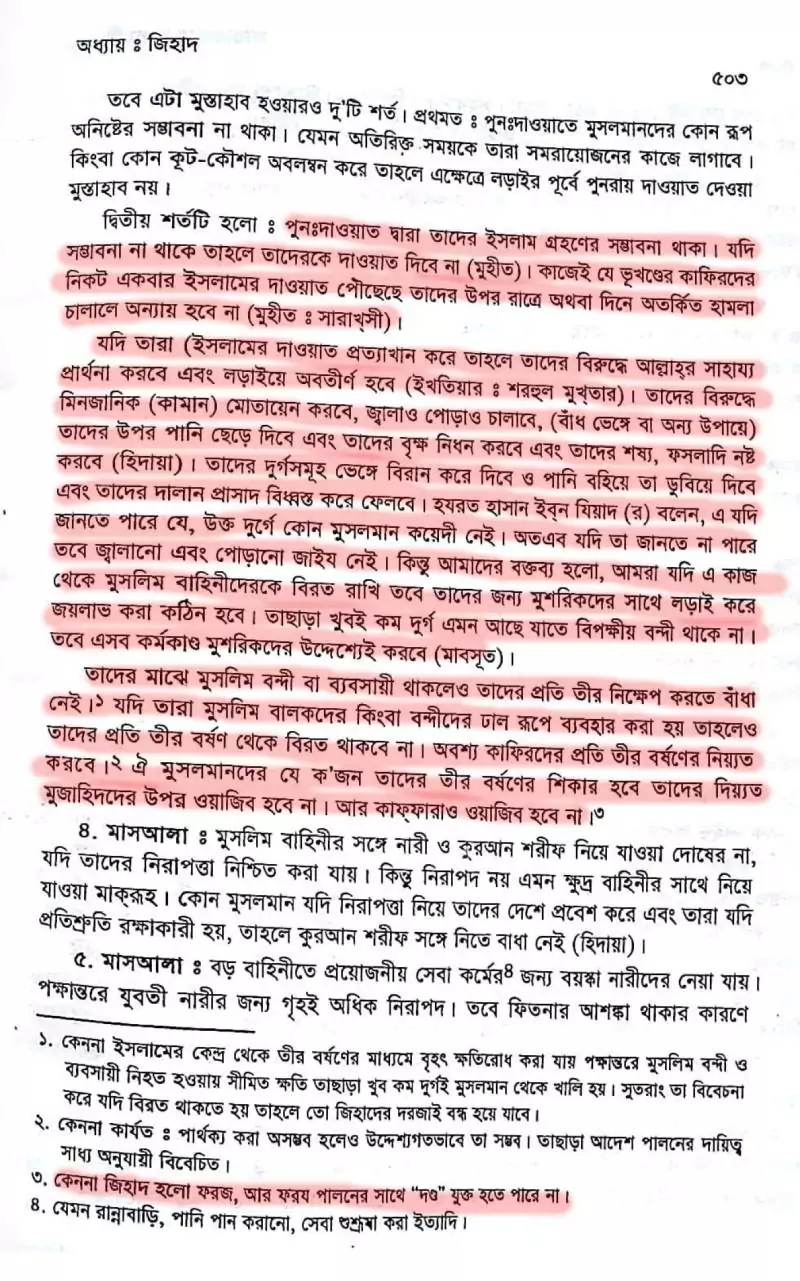
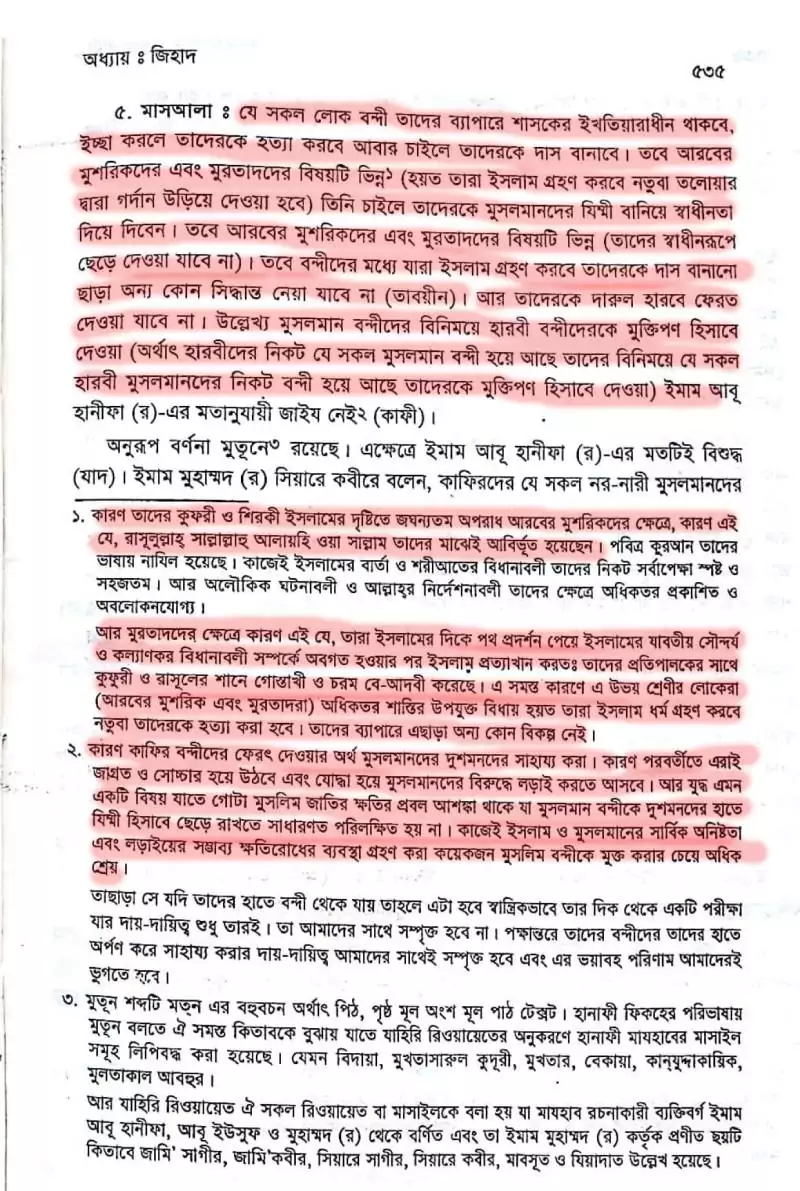
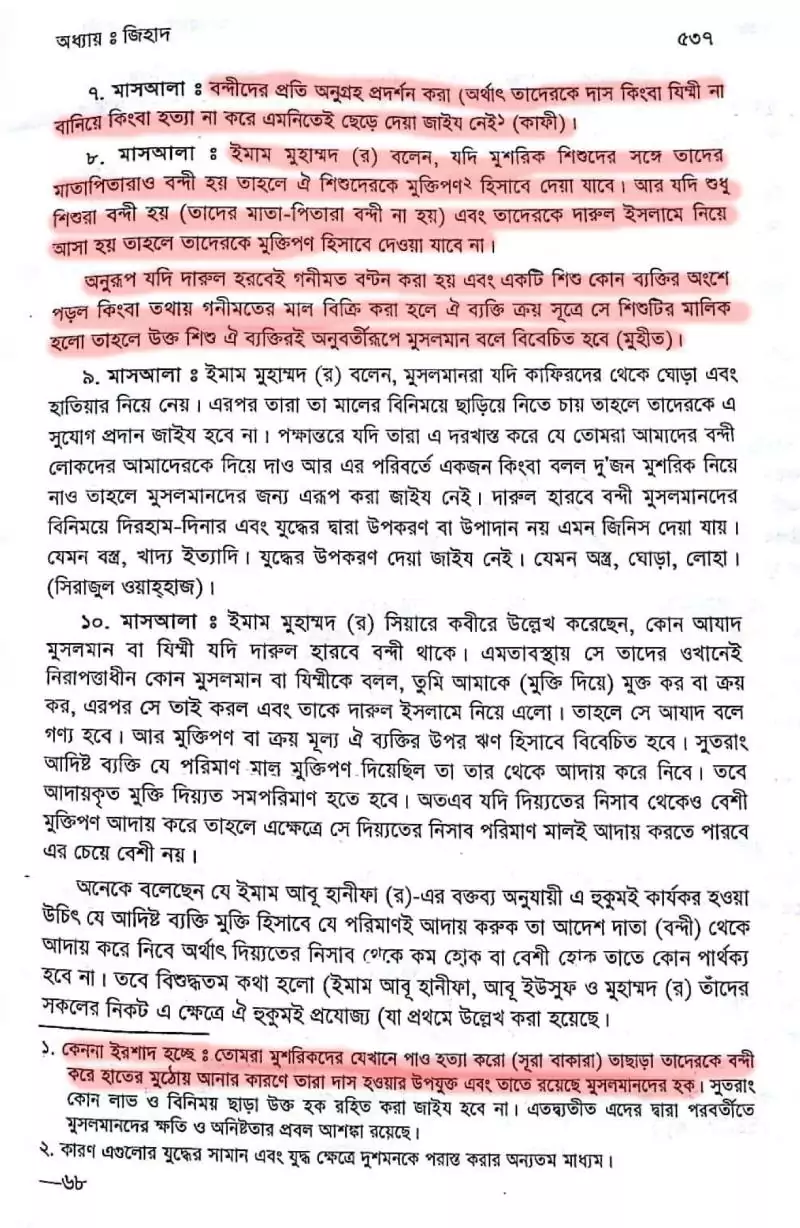
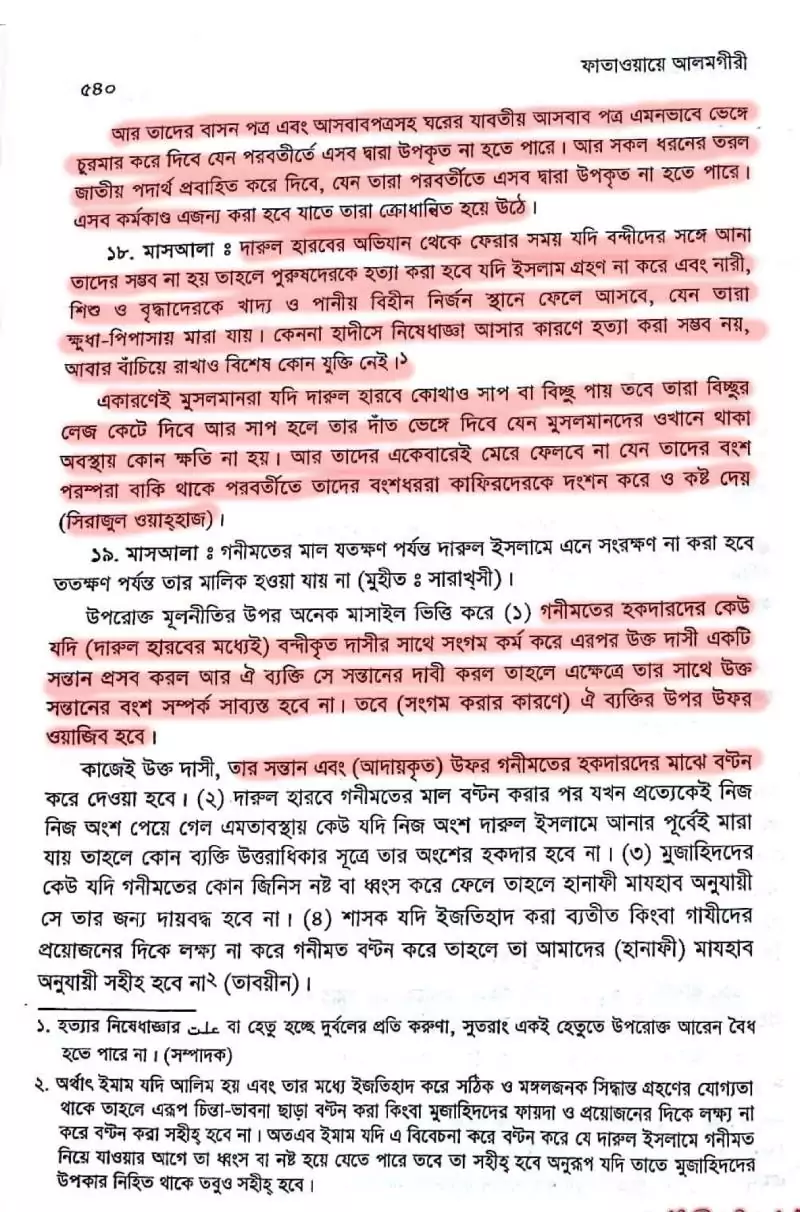
Sexual Intercourse with Female Captives
The Prophet Muhammad expressly permitted sexual intercourse with women captured in war after they had completed their menstrual period. This permission makes two matters clear at once. Just as Islam permits depriving a woman on the defeated side of her liberty and enslaving her, it also permits the victorious Muslim combatant to engage in sexual intercourse with her without her consent, which, by definition, is rape. Yet both practices directly conflict with the Geneva Conventions governing conduct in warfare in our modern, civilised world. Numerous hadiths provide evidence of this. I quote several here [152] [153] [154] [155] [156] [157]—
Sunan Abi Dawud (Islamic Foundation)
6 / Marriage
Section: 139. Intercourse with Female Captives.
2152. Source chain: ‘Ubaydullah ibn ‘Umar ibn Maysarah … Abu Sa‘id al-Khudri. Abu Sa’id Al Khudri said “The Apostle of Allaah(ﷺ) sent a military expedition to Awtas on the occasion of the battle of Hunain. They met their enemy and fought with them. They defeated them and took them captives. Some of the Companions of Apostle of Allaah (ﷺ) were reluctant to have relations with the female captives because of their pagan husbands. So, Allaah the exalted sent down the Qur’anic verse “And all married women (are forbidden) unto you save those (captives) whom your right hand posses.” This is to say that they are lawful for them when they complete their waiting period.
Hadith grade: Sahih (al-Albani)
Narrator: Abu Sa‘id al-Khudri
Sunan Abi Dawud (Islamic Foundation)
6 / Marriage
Section: 139. Intercourse with Female Captives .
154. Source chain: ‘Amr ibn ‘Awn … Abu Sa‘id al-Khudri. Abu Sa’id Al Khudri traced to Prophet (ﷺ) the following statement regarding the captives taken at Atwas. There must be no intercourse with pregnant woman till she gives birth to her child or with the one who is not pregnant till she has had one menstrual period.
Hadith grade: Sahih (al-Albani)
Narrator: Abu Sa‘id al-Khudri
Sahih Muslim (Hadith Academy)
17 / Marriage
Section: 22. The Ruling on Coitus Interruptus
Hadith Academy number: 3436;
international number: 1438
3436—(125/1438) Source chain: Yahya ibn Ayyub, Qutaybah ibn Sa‘id, and ‘Ali ibn Hujr … Ibn Muhayriz, who said that he and Abu Sirmah went to Abu Sa‘id al-Khudri. Abu Sirma said to Abu Sa’id al Khadri (Allah he pleased with him): 0 Abu Sa’id, did you hear Allah’s Messenger (ﷺ) mentioning al-‘azl? He said: Yes, and added: We went out with Allah’s Messenger (ﷺ) on the expedition to the Bi’l-Mustaliq and took captive some excellent Arab women; and we desired them, for we were suffering from the absence of our wives, (but at the same time) we also desired ransom for them. So we decided to have sexual intercourse with them but by observing ‘azl (Withdrawing the male sexual organ before emission of semen to avoid-conception). But we said: We are doing an act whereas Allah’s Messenger is amongst us; why not ask him? So we asked Allah’s Mes- senger (ﷺ), and he said: It does not matter if you do not do it, for every soul that is to be born up to the Day of Resurrection will be born. (Islamic Foundation 3409; Islamic Centre 3408)
Hadith grade: Sahih
Narrator: Ibn Muhayriz
Sahih al-Bukhari (Tawhid Publications)
64 / Military Expeditions
Section: 64/32. The Expedition of Dhat al-Riqa‘.
قَالَ ابْنُ إِسْحَاقَ وَذَلِكَ سَنَةَ سِتٍّ وَقَالَ مُوْسَى بْنُ عُقْبَةَ سَنَةَ أَرْبَعٍ وَقَالَ النُّعْمَانُ بْنُ رَاشِدٍ عَنْ الزُّهْرِيِّ كَانَ حَدِيْثُ الإِفْكِ فِيْ غَزْوَةِ الْمُرَيْسِيْعِ
Ibn Ishaq stated that this expedition took place in 6 AH. Musa ibn ‘Uqbah stated that it took place in 4 AH. Nu‘man ibn Rashid transmitted from al-Zuhri that the incident of the slander occurred during the expedition of al-Muraysi‘.
4138. Narrated Ibn Muhairiz: I entered the Mosque and saw Abu Sa`id Al-Khudri and sat beside him and asked him about Al-Azl (i.e. coitus interruptus). Abu Sa`id said, “We went out with Allah’s Messenger (ﷺ) for the Ghazwa of Banu Al-Mustaliq and we received captives from among the Arab captives and we desired women and celibacy became hard on us and we loved to do coitus interruptus. So when we intended to do coitus interrupt us, we said, ‘How can we do coitus interruptus before asking Allah’s Messenger (ﷺ) who is present among us?” We asked (him) about it and he said, ‘It is better for you not to do so, for if any soul (till the Day of Resurrection) is predestined to exist, it will exist.” [2229; Muslim, Divorce/21, hadith 1438; Ahmad 11839] (Adhunik Publications: 3826; Islamic Foundation: 3829)
Hadith grade: Sahih
Narrator: Ibn Muhayriz
Sahih Muslim (Hadith Academy)
17 / Marriage
Section: 22. The Ruling on Coitus Interruptus
Hadith Academy number: 3451; international number: 1440
3451—(136/1440) Source chain: Abu Bakr ibn Abi Shaybah and Ishaq ibn Ibrahim … Jabir. Jabir (Allah be pleased with him) reported:We used to practise ‘azl while the Qur’an was revealed (during the days when the Prophet was alive). Ishaq added that Sufyan stated: If it had been something prohibited, the Qur’an would have prohibited it. (Islamic Foundation 3424; Islamic Centre 3423)
Hadith grade: Sahih
Narrator: Jabir ibn ‘Abdullah al-Ansari
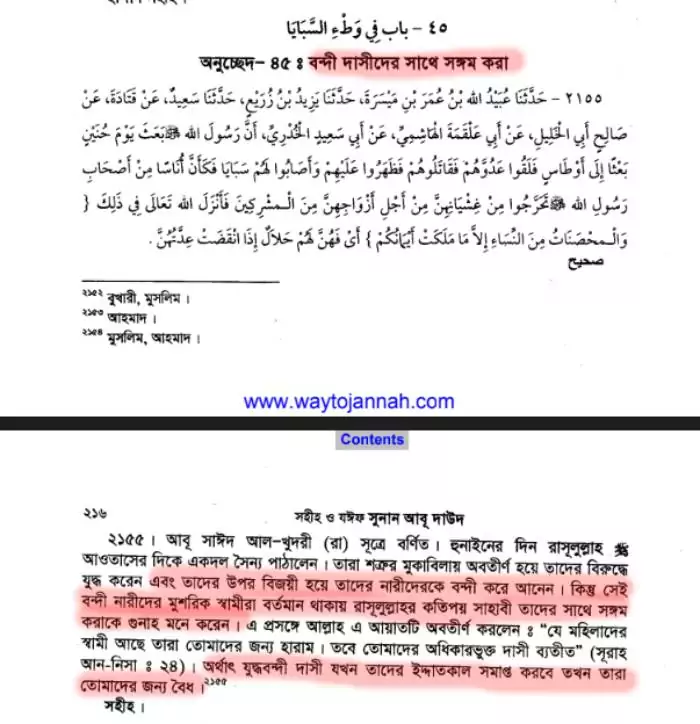
The Enslavement of Minor Children
There is no reckoning how many hundreds of thousands of children have fallen victim to Islamic brutality over the past fourteen centuries. This brutality is beyond comparison. A child understands nothing of war or its opposing sides and happens to be born into an unbelieving family. Suddenly, Islamic soldiers arrive, kill the father, turn the mother into a sex slave, and enslave the children. The horror of such rules is scarcely imaginable. Whenever Muhammad or his Companions needed money, these children were sold in markets like cattle, goats, or sheep. There is no limit to this horror. When an Islam that spares not even a child claims to be a complete system of life and a religion of peace and humanity, it makes one want to tear one’s hair out. Let us examine what happened to those children [158]—
Sahih al-Bukhari (Tawhid Publications)
49 / Manumission of Slaves
Section: 49/13. The ruling on an Arab who owns a male or female slave and gives, sells, has intercourse with, or ransoms them, or takes children captive.
2541. Narrated Ibn `Aun: I wrote a letter to Nafi` and Nafi` wrote in reply to my letter that the Prophet (ﷺ) had suddenly attacked Bani Mustaliq without warning while they were heedless and their cattle were being watered at the places of water. Their fighting men were killed and their women and children were taken as captives; the Prophet (ﷺ) got Juwairiya on that day. Nafi` said that Ibn `Umar had told him the above narration and that Ibn `Umar was in that army. (Adhunik Publications: 2356; Islamic Foundation: 2373)
Hadith grade: Sahih
Narrator: Ibn ‘Awn; transmitted from Ibn ‘Umar [the supplied source incorrectly names Ka‘b ibn ‘Ujrah]
After attacking Banu Qurayzah and besieging them for twenty-five days, the Prophet’s army decided, when the entire community surrendered, to kill all adult men and enslave the women and children. The boys’ genitals were inspected to determine whether they had reached puberty. Those whose pubic hair had grown were killed; those without it were enslaved. What befell the minor children of Banu Qurayzah? At Muhammad’s command, some were sold, and his followers used the proceeds to purchase weapons and horses [159] [160] –
The Messenger of Allah then distributed Banu Qurayzah’s wealth, women, and children among the Muslims. He subsequently sent Sa‘d ibn Zayd al-Ansari to Najd with a number of their male and female slaves. In exchange for them, he purchased weapons and horses there for the Muslims.
The Legality of Sexual Intercourse with Female Slaves
Islam’s sacred scripture, the Qur’an, explicitly makes sexual relations with owned or possessed female slaves lawful. Buying and selling slaves and taking female war captives as slaves are all entirely lawful in Islam [161] [162] [163] [164]. Several translations of these verses from Quran.com [165] are reproduced below—
Qur’anic Verses and Relevant Commentaries
Surah al-Mu’minun, verses 5–6
those who guard their chastity.
Taisirul Quran (Bengali source; English quotation: Dr. Mustafa Khattab, The Clear Quran)
those who guard their chastity
Sheikh Mujibur Rahman (Bengali source; English quotation: Dr. Mustafa Khattab, The Clear Quran)
those who guard their chastity.
Rawai Al-bayan (Bengali source; English quotation: Dr. Mustafa Khattab, The Clear Quran)
those who guard their chastity [1]
Dr. Abu Bakr Muhammad Zakaria (Bengali source; English quotation: Dr. Mustafa Khattab, The Clear Quran)
except with their wives or those ˹bondwomen˺ in their possession, for then they are free from blame,
Taisirul Quran (Bengali source; English quotation: Dr. Mustafa Khattab, The Clear Quran)
except with their wives or those ˹bondwomen˺ in their possession, for then they are free from blame,
Sheikh Mujibur Rahman (Bengali source; English quotation: Dr. Mustafa Khattab, The Clear Quran)
except with their wives or those ˹bondwomen˺ in their possession, for then they are free from blame,
Rawai Al-bayan (Bengali source; English quotation: Dr. Mustafa Khattab, The Clear Quran)
except with their wives or those ˹bondwomen˺ in their possession, for then they are free from blame, [1]
Dr. Abu Bakr Muhammad Zakaria (Bengali source; English quotation: Dr. Mustafa Khattab, The Clear Quran)
Let us read a hadith concerning this issue [166]—
Jami‘ al-Tirmidhi (Verified Edition)
41 / Manners
Section: 22. Protecting the Private Parts
2769. Narrated Bahz bin Hakim: “My father narrated to me from my grandfather, who said: ‘I said: “O Messenger of Allah! Regarding our ‘Awrah, what of it must we cover and what of it may we leave?” He said: “Protect your ‘Awrah except from your wife or what your right hand possesses.”‘ He said: “What about a man with another man?” He said: “If you are able to not let anyone see it, then do so.” I said: “What about a man when he is alone?” He said: “Allah is most deserving of being shy from Him.”
Hasan: Ibn Majah (1920)
Abu ‘Isa stated: This hadith is hasan. Bahz’s grandfather was Mu‘awiyah ibn Haydah al-Qushayri. Al-Jurayri also transmitted it from Hakim ibn Mu‘awiyah, Bahz’s father.
Hadith grade: Hasan (Darussalam)
Narrator: Bahz ibn Hakim
Let us also read its commentary in Tafsir Ibn Kathir [167]—
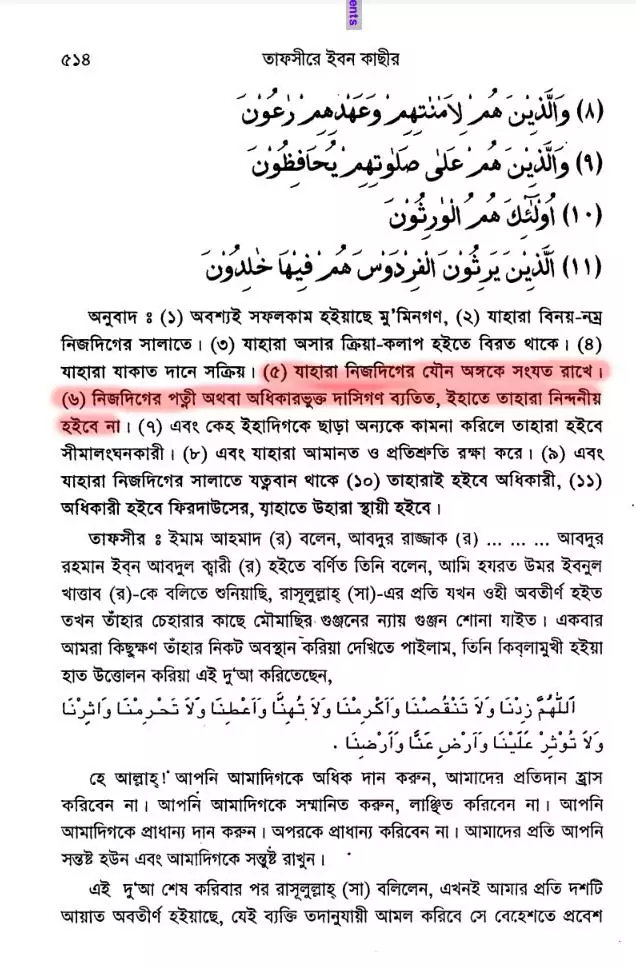
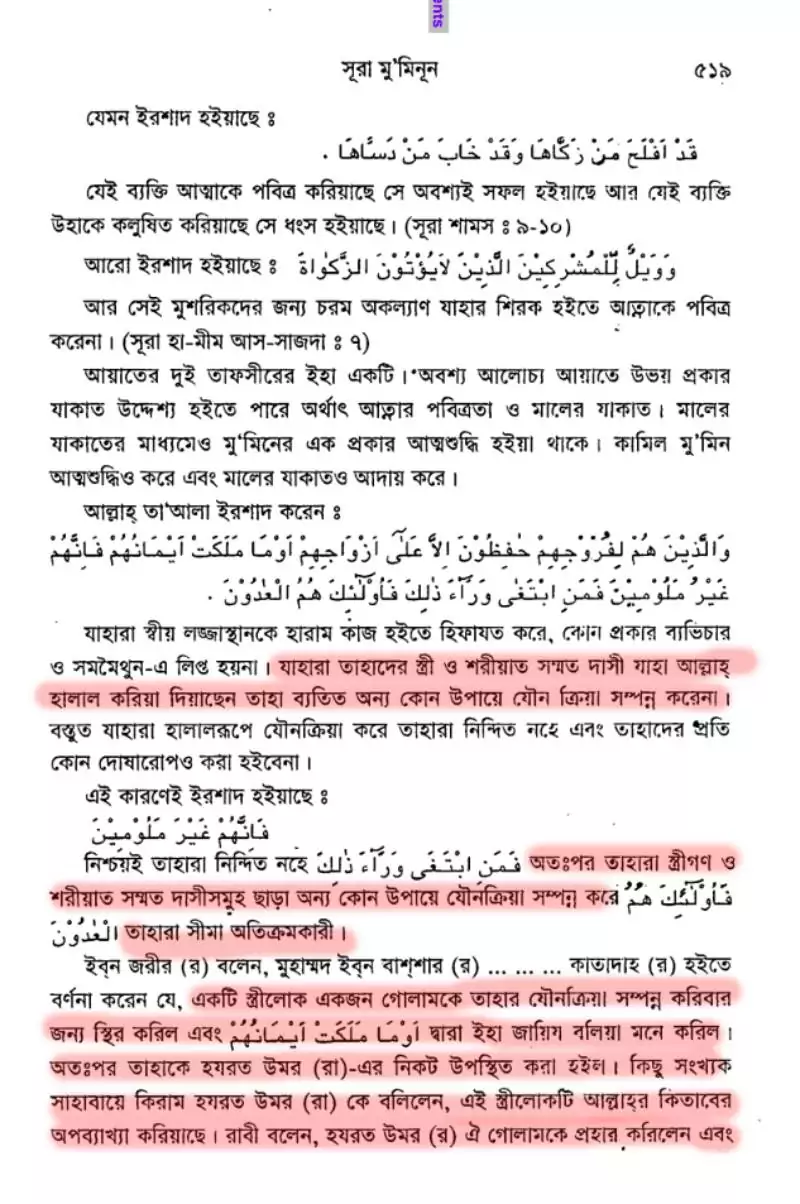
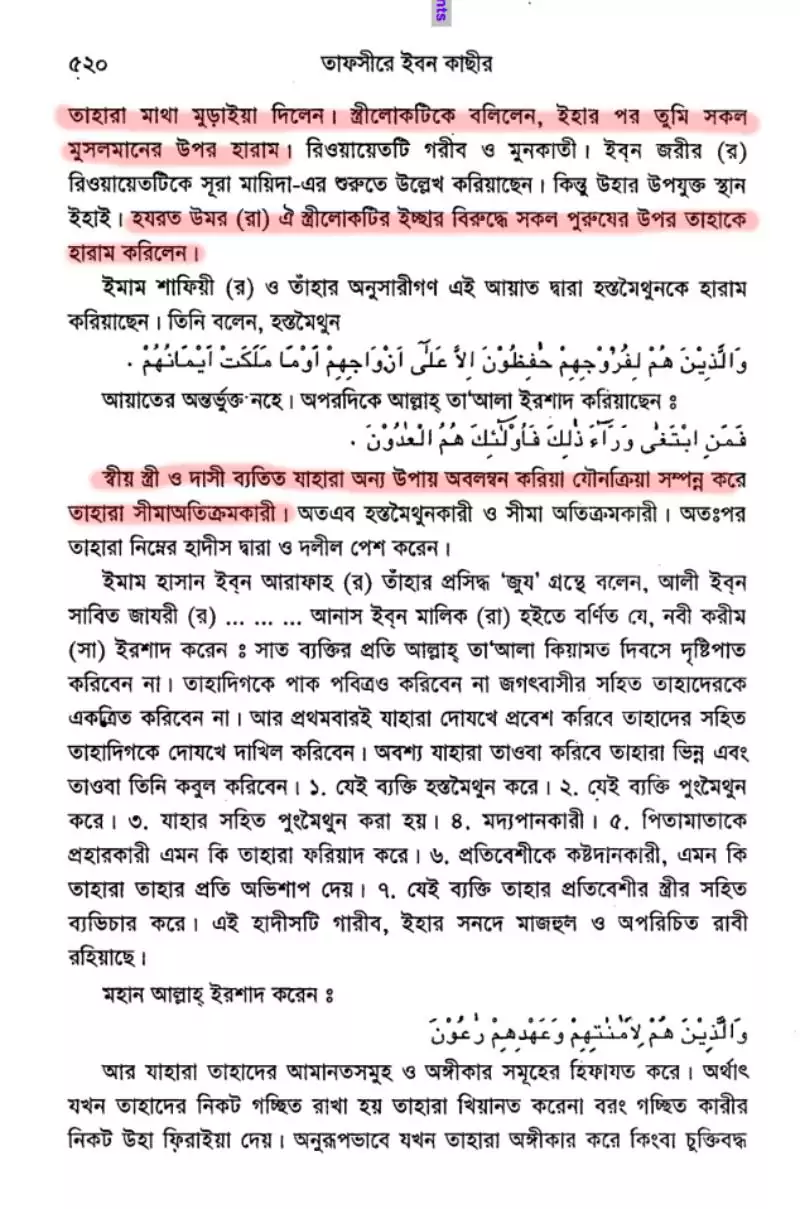
Surah al-Ma‘arij, verses 29–30
and those who guard their chastity
Taisirul Quran (Bengali source; English quotation: Dr. Mustafa Khattab, The Clear Quran)
and those who guard their chastity
Sheikh Mujibur Rahman (Bengali source; English quotation: Dr. Mustafa Khattab, The Clear Quran)
and those who guard their chastity
Rawai Al-bayan (Bengali source; English quotation: Dr. Mustafa Khattab, The Clear Quran)
and those who guard their chastity [1]
Dr. Abu Bakr Muhammad Zakaria (Bengali source; English quotation: Dr. Mustafa Khattab, The Clear Quran)
except with their wives or those ˹bondwomen˺ in their possession, for then they are free from blame,
Taisirul Quran (Bengali source; English quotation: Dr. Mustafa Khattab, The Clear Quran)
except with their wives or those ˹bondwomen˺ in their possession, for then they are free from blame,
Sheikh Mujibur Rahman (Bengali source; English quotation: Dr. Mustafa Khattab, The Clear Quran)
except with their wives or those ˹bondwomen˺ in their possession, for then they are free from blame,
Rawai Al-bayan (Bengali source; English quotation: Dr. Mustafa Khattab, The Clear Quran)
except with their wives or those ˹bondwomen˺ in their possession, for then they are free from blame,
Dr. Abu Bakr Muhammad Zakaria (Bengali source; English quotation: Dr. Mustafa Khattab, The Clear Quran)
Surah al-Ahzab, verse 50
O Prophet! We have made lawful for you your wives to whom you have paid their ˹full˺ dowries as well as those ˹bondwomen˺ in your possession, whom Allah has granted you. And ˹you are allowed to marry˺ the daughters of your paternal uncles and aunts, and the daughters of your maternal uncles and aunts, who have emigrated like you. Also ˹allowed for marriage is˺ a believing woman who offers herself to the Prophet ˹without dowry˺ if he is interested in marrying her—˹this is˺ exclusively for you, not for the rest of the believers. We know well what ˹rulings˺ We have ordained for the believers in relation to their wives and those ˹bondwomen˺ in their possession. As such, there would be no blame on you. And Allah is All-Forgiving, Most Merciful.
Taisirul Quran (Bengali source; English quotation: Dr. Mustafa Khattab, The Clear Quran)
O Prophet! We have made lawful for you your wives to whom you have paid their ˹full˺ dowries as well as those ˹bondwomen˺ in your possession, whom Allah has granted you. And ˹you are allowed to marry˺ the daughters of your paternal uncles and aunts, and the daughters of your maternal uncles and aunts, who have emigrated like you. Also ˹allowed for marriage is˺ a believing woman who offers herself to the Prophet ˹without dowry˺ if he is interested in marrying her—˹this is˺ exclusively for you, not for the rest of the believers. We know well what ˹rulings˺ We have ordained for the believers in relation to their wives and those ˹bondwomen˺ in their possession. As such, there would be no blame on you. And Allah is All-Forgiving, Most Merciful.
Sheikh Mujibur Rahman (Bengali source; English quotation: Dr. Mustafa Khattab, The Clear Quran)
O Prophet! We have made lawful for you your wives to whom you have paid their ˹full˺ dowries as well as those ˹bondwomen˺ in your possession, whom Allah has granted you. And ˹you are allowed to marry˺ the daughters of your paternal uncles and aunts, and the daughters of your maternal uncles and aunts, who have emigrated like you. Also ˹allowed for marriage is˺ a believing woman who offers herself to the Prophet ˹without dowry˺ if he is interested in marrying her—˹this is˺ exclusively for you, not for the rest of the believers. We know well what ˹rulings˺ We have ordained for the believers in relation to their wives and those ˹bondwomen˺ in their possession. As such, there would be no blame on you. And Allah is All-Forgiving, Most Merciful. Source-edition gloss: *Fay’ means the property of non-believers acquired without fighting.
Rawai Al-bayan (Bengali source; English quotation: Dr. Mustafa Khattab, The Clear Quran)
O Prophet! We have made lawful for you your wives to whom you have paid their ˹full˺ dowries as well as those ˹bondwomen˺ in your possession, whom Allah has granted you. And ˹you are allowed to marry˺ the daughters of your paternal uncles and aunts, and the daughters of your maternal uncles and aunts, who have emigrated like you. Also ˹allowed for marriage is˺ a believing woman who offers herself to the Prophet ˹without dowry˺ if he is interested in marrying her—˹this is˺ exclusively for you, not for the rest of the believers. We know well what ˹rulings˺ We have ordained for the believers in relation to their wives and those ˹bondwomen˺ in their possession. As such, there would be no blame on you. And Allah is All-Forgiving, Most Merciful. [1]
Dr. Abu Bakr Muhammad Zakaria (Bengali source; English quotation: Dr. Mustafa Khattab, The Clear Quran)
Surah al-Nisa’, verse 24
Also ˹forbidden are˺ married women—except ˹female˺ captives in your possession. This is Allah’s commandment to you. Lawful to you are all beyond these—as long as you seek them with your wealth in a legal marriage, not in fornication. Give those you have consummated marriage with their due dowries. It is permissible to be mutually gracious regarding the set dowry. Surely Allah is All-Knowing, All-Wise.
Taisirul Quran (Bengali source; English quotation: Dr. Mustafa Khattab, The Clear Quran)
Also ˹forbidden are˺ married women—except ˹female˺ captives in your possession. This is Allah’s commandment to you. Lawful to you are all beyond these—as long as you seek them with your wealth in a legal marriage, not in fornication. Give those you have consummated marriage with their due dowries. It is permissible to be mutually gracious regarding the set dowry. Surely Allah is All-Knowing, All-Wise.
Sheikh Mujibur Rahman (Bengali source; English quotation: Dr. Mustafa Khattab, The Clear Quran)
Also ˹forbidden are˺ married women—except ˹female˺ captives in your possession. This is Allah’s commandment to you. Lawful to you are all beyond these—as long as you seek them with your wealth in a legal marriage, not in fornication. Give those you have consummated marriage with their due dowries. It is permissible to be mutually gracious regarding the set dowry. Surely Allah is All-Knowing, All-Wise.
Rawai Al-bayan (Bengali source; English quotation: Dr. Mustafa Khattab, The Clear Quran)
Also ˹forbidden are˺ married women—except ˹female˺ captives in your possession. This is Allah’s commandment to you. Lawful to you are all beyond these—as long as you seek them with your wealth in a legal marriage, not in fornication. Give those you have consummated marriage with their due dowries. It is permissible to be mutually gracious regarding the set dowry. Surely Allah is All-Knowing, All-Wise. [1] [2] [3]
Dr. Abu Bakr Muhammad Zakaria (Bengali source; English quotation: Dr. Mustafa Khattab, The Clear Quran)
There should surely be no need to explain what “the right hand” or “those possessed” means. The right hand signifies acquisition through force; its symbolism as strength or the sword should be familiar. Recent Bengali translations of the Qur’an have begun subtly altering these verses, as careful examination will show. The commentaries, however, discuss the matter quite openly.
Explaining this verse, the two authors of Tafsir al-Jalalayn, Jalal al-Din al-Suyuti and his teacher Jalal al-Din al-Mahalli, state: “That is, intercourse with women captured on the battlefield is lawful for them, even if those women’s husbands remain alive in dar al-harb.” Dar al-harb means a non-Muslim state or country. Thus, even a female captive whose husband is alive may be subjected to rape.
Possession by the right hand means male or female slaves acquired by Muslims as war captives or purchased in a market. However a female slave comes into Muslim possession, sexual relations with her are lawful. Even today, if a country of unbelievers comes under Muslim control, applying this rule is lawful—entirely halal. The Qur’an will remain as it is until the Day of Resurrection, and no one has been authorised to alter any verse or revise it to accommodate changing circumstances. Let us read the commentary on Surah al-Nisa’ 4:24 in Tafsir al-Jalalayn [168]. –
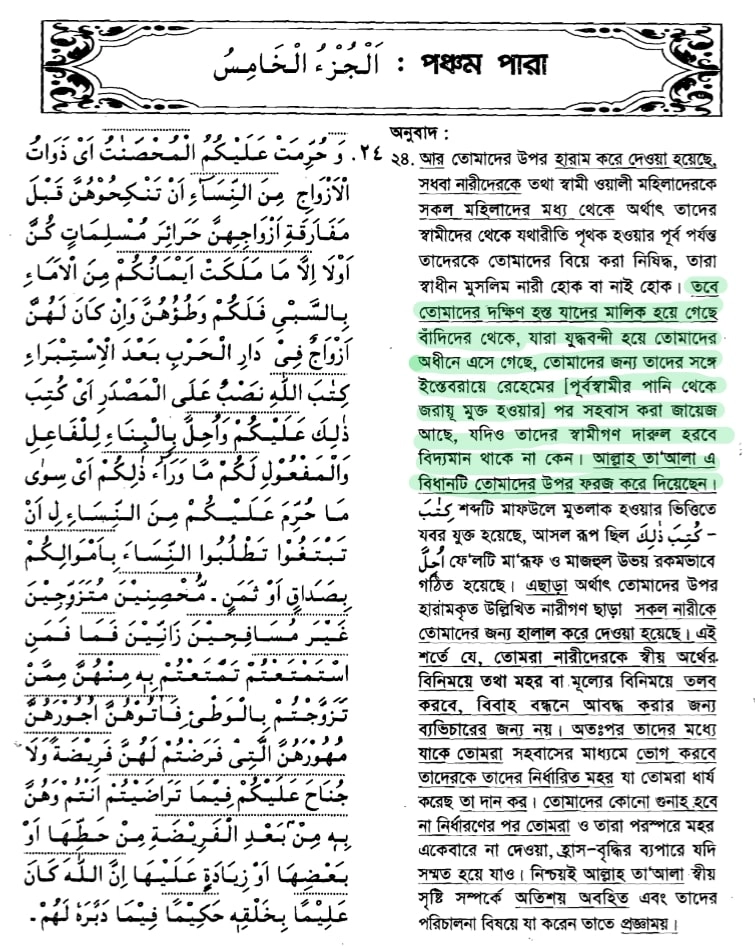
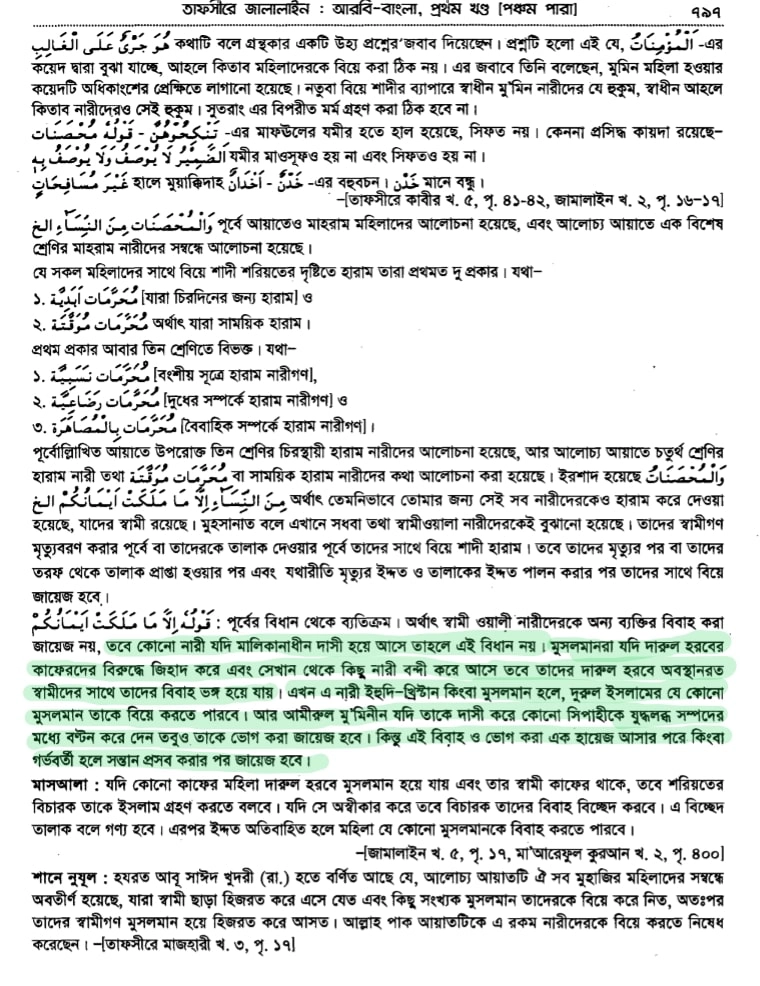
We may also read the explanation of this verse in Ibn Kathir’s renowned commentary [169]—
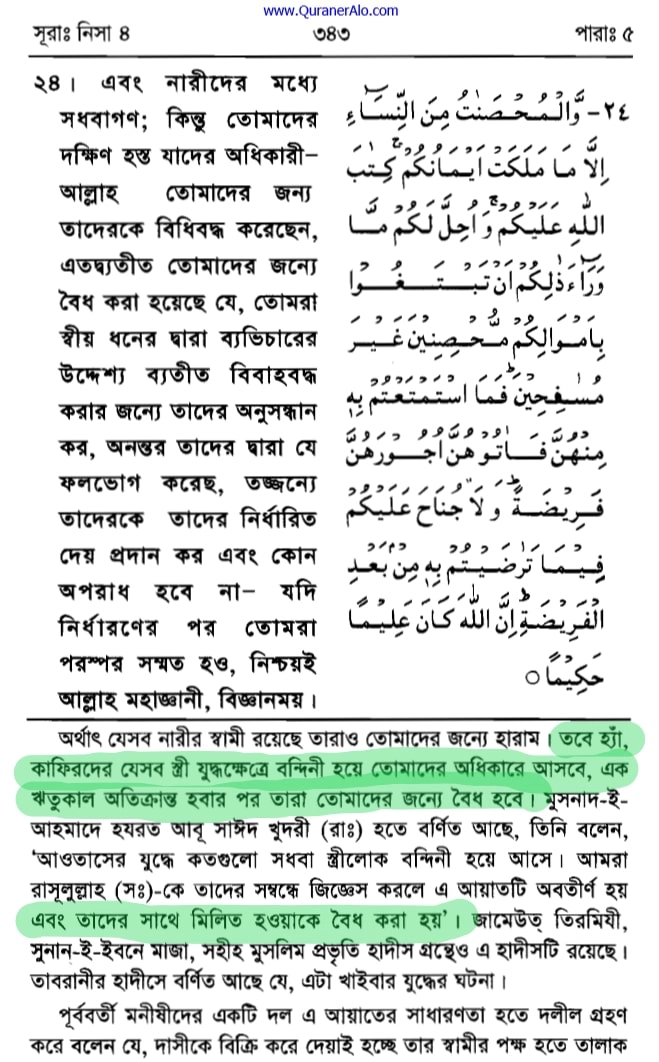
Let us now read part of the explanation of Surah al-Nisa’ 4:24 in Tafsir al-Mazhari [170]—
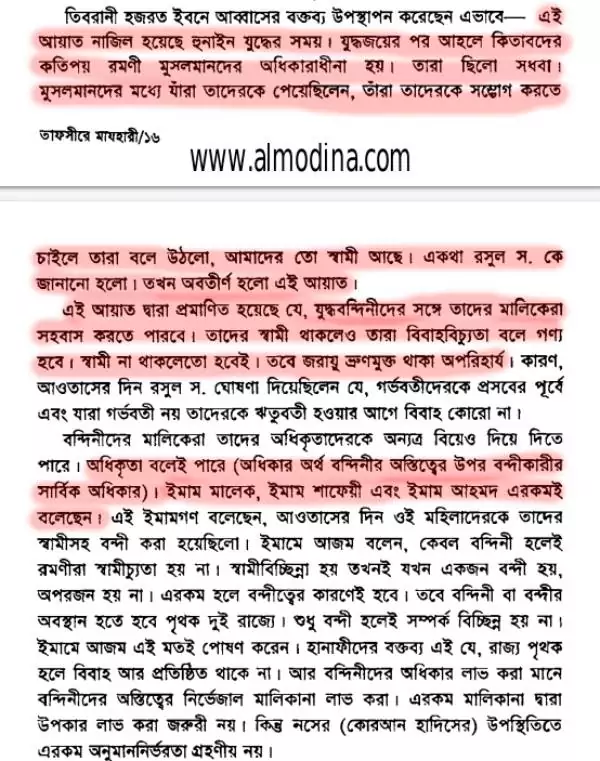
Further explanation appears in the hadiths below. For now, let us examine another hadith [171]—
Sahih al-Bukhari (Tawhid Publications)
67 / Marriage
Section: 67/25. Women Whom It Is Lawful or Unlawful to Marry.
وَقَوْلِهِ تَعَالَى: (حُرِّمَتْ عَلَيْكُمْ أُمَّهَاتُكُمْ وَبَنَاتُكُمْ وَأَخَوَاتُكُمْ وَعَمَّاتُكُمْ وَخَالاَتُكُمْ وَبَنَاتُ الأَخِ وَبَنَاتُ الأُخْتِ) إِلَى آخِرِ الآيَتَيْنِ إِلَى قَوْلِهِ: (إِنَّ اللَّهَ كَانَ عَلِيمًا حَكِيمًا).
Allah Most High says: “˹Also˺ forbidden to you for marriage are your mothers, your daughters, your sisters, your paternal and maternal aunts, your brother’s daughters, your sister’s daughters, your foster-mothers, your foster-sisters, your mothers-in-law, your stepdaughters under your guardianship if you have consummated marriage with their mothers … Surely Allah is All-Knowing, All-Wise.” (English Quran excerpts: Dr. Mustafa Khattab, The Clear Quran; Surah al-Nisa’ 4:23–24)
وَقَالَ أَنَسٌ: (وَالْمُحْصَنَاتُ مِنَ النِّسَاءِ) ذَوَاتُ الأَزْوَاجِ الْحَرَائِرُ حَرَامٌ إِلاَّ مَا مَلَكَتْ أَيْمَانُكُمْ لاَ يَرَى بَأْسًا أَنْ يَنْزِعَ الرَّجُلُ جَارِيَتَهُ مِنْ عَبْدِهِ.
وَقَالَ: (وَلاَ تَنْكِحُوا الْمُشْرِكَاتِ حَتَّى يُؤْمِنَّ).
وَقَالَ ابْنُ عَبَّاسٍ مَا زَادَ عَلَى أَرْبَعٍ فَهْوَ حَرَامٌ، كَأُمِّهِ وَابْنَتِهِ وَأُخْتِهِ.
Anas states, (وَالْمُحْصَنَاتُ مِنَ النِّسَاءِ) this means that marriage to free women who are already married is forbidden, but sexual use of a female slave is not forbidden. If a man takes his female slave from her husband and subsequently has intercourse with her, there is no blame. Concerning this, Allah says: “Do not marry polytheistic women until they believe” (Al-Baqarah 2:221; English: Dr. Mustafa Khattab, The Clear Quran). Ibn Abbas said that marrying more than four women is unlawful, just as marrying one’s mother, daughter or sister is unlawful.
5105. Ibn ‘Abbas further said, “Seven types of marriages are unlawful because of blood relations, and seven because of marriage relations.” Then Ibn ‘Abbas recited the Verse: “Forbidden for you (for marriages) are your mothers…” (4:23).
‘Abdullah bin Ja’far married the daughter and wife of ‘Ali at the same time (they were step-daughter and mother).[1] Ibn Sirin said, “There is no harm in that.” But Al-Hasan Al-Basri disapproved of it at first, but then said that there was no harm in it. Al-Hasan bin Al-Hasan bin ‘Ali married two of his cousins in one night. Ja’far bin Zaid disapproved of that because of it would bring hatred (between the two cousins), but it is not unlawful, as Allah said, “Lawful to you are all others [beyond those (mentioned)]. (4:24). Ibn ‘Abbas said: “If somebody commits illegal sexual intercourse with his wife’s sister, his wife does not become unlawful for him.”
And narrated Abu Ja’far, “If a person commits homosexuality with a boy, then the mother of that boy is unlawful for him to marry.” Narrated Ibn ‘Abbas, “If one commits illegal sexual intercourse with his mother in law, then his married relation to his wife does not become unlawful.” Abu Nasr reported to have said that Ibn ‘Abbas in the above case, regarded his marital relation to his wife unlawful, but Abu Nasr is not known well for hearing Hadith from Ibn ‘Abbas. Imran bin Hussain, Jabir b. Zaid, Al-Hasan and some other Iraqi’s, are reported to have judged that his marital relations to his wife would be unlawful. In the above case Abu Hurairah said, “The marital relation to one’s wife does not become unlawful except if one as had sexual intercourse (with her mother).” Ibn Al-Musaiyab, ‘Urwa, and Az-Zuhri allows such person to keep his wife. ‘Ali said, “His marital relations to his wife does not become unlawful.” [Source-edition note: Al-Zuhri’s report from ‘Ali is mursal; he did not hear it directly from ‘Ali.] (Adhunik Publications: chapter material; Islamic Foundation: chapter material)
[1] ‘Ali married no other woman during Fatimah’s lifetime. He married again afterwards.
Hadith grade: Sahih
Narrator: ‘Abdullah ibn ‘Abbas
The Prophet’s and Caliphs’ Sexual Relations with Female Slaves
Religious Reward for Intercourse with a Female Slave
Some may argue that Islam mentions sexual intercourse with female slaves but does not make it obligatory: a person may choose to engage in it or refrain. Yet is intercourse with a female slave merely optional, or is it actively encouraged? Let us consult hadith to determine whether sexual use of a female slave is regarded in Islam as a sacred or meritorious act. The Prophet’s own hadith makes it clear that he encouraged sex with female slaves and that it is considered an act earning religious reward [172].
Mishkat al-Masabih
Part 6: Zakat
Section: 6. First Subsection—The Merit of Charity
1898—[11] Aba Dharr reported God’s messenger as saying, “In every ascription of glory to God, every declaration of His greatness, every utterance of praise to Him, every declaration that He is the only God, in enjoining what is reputable, in forbidding what is objectionable, and in a man’s sexual intercourse [source-edition gloss: with his wife or female slave] there is sadaqa.” On being asked whether a reward would be given for satisfying one’s passion, he said, “Tell me; if he were to devote it to something forbidden, would it not be a sin on his part? Similarly, if he were to devote it to something lawful, [source-edition gloss: with his wife or female slave] he would have a reward.” Muslim transmitted it.[1]
[1] Sahih: Muslim 1006; Ahmad 21482; al-Sunan al-Kubra by al-Bayhaqi 7823; Silsilat al-Ahadith al-Sahihah 454; Sahih al-Targhib 1556; Sahih al-Jami‘ al-Saghir 2588.
The Prophet’s Sexual Relations with Female Slaves
An important question, however, is whether Muhammad himself had sexual intercourse with female slaves. The following hadiths should be read to address this question [173] [174]
Sunan al-Nasa’i (Islamic Foundation)
Book: 37 / Treatment of Wives
3961. Source chain: Ibrahim ibn Yunus ibn Muhammad al-Harami … Anas. It was narrated from Anas, that the Messenger of Allah had a female slave with whom he had intercourse, but ‘Aishah and Hafsah would not leave him alone until he said that she was forbidden for him. Then Allah, the Mighty and Sublime, revealed: (يَا أَيُّهَا النَّبِيُّ لِمَ تُحَرِّمُ مَا أَحَلَّ اللَّهُ لَكَ) “O Prophet! Why do you forbid (for yourself) that which Allah has allowed to you.’ until the end of the Verse. (Surah al-Tahrim: 1)
Hadith grade: Sahih (Darussalam)
Verification: Sahih.
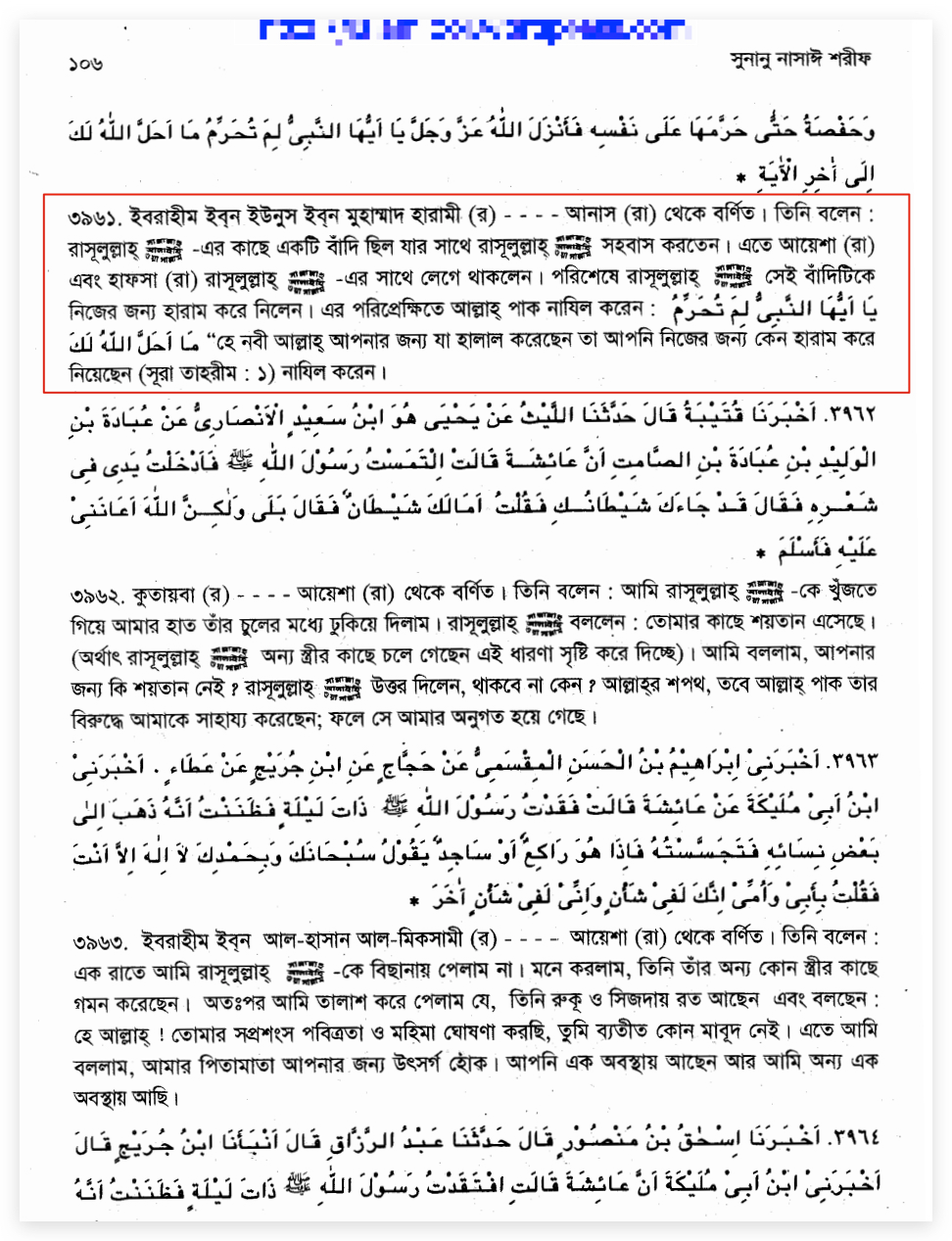
This female slave was Mariyah al-Qibtiyyah, who also bore Muhammad a child. She is also reported to have been a war captive. Further details can be found in this article [175].
Many Muslim debaters online make futile and absurd attempts to conceal the sexual relationship between Mariyah al-Qibtiyyah and the Prophet Muhammad. To do so, they portray it as an ordinary, non-sexual relationship resembling that between an employer and employee in an office or household. The following hadith in Sahih Muslim, however, indicates that their relationship was not of that nature and involved something more. Let us read it directly [176] [177]
Sahih Muslim (Islamic Foundation)
Book: 51 / Repentance
Section: 11. Exoneration of the Prophet’s (ﷺ) Concubine from Suspicion
6766. Source chain: Zuhayr ibn Harb … Anas. Anas reported that a person was charged with fornication with the slavegirl of Allah’s Messenger (ﷺ). Thereupon Allah’s Messenger (ﷺ) said to ‘Ali: Go and strike his neck. ‘Ali came to him and he found him in a well making his body cool. ‘Ali said to him: Come out, and as he took hold of his hand and brought him out, he found that his sexual organ had been cut. Hadrat ‘Ali refrained from striking his neck. He came to Allah’s Apostle (ﷺ) and said: Allah’s Messenger, he has not even the sexual organ with him.
Hadith grade: Sahih
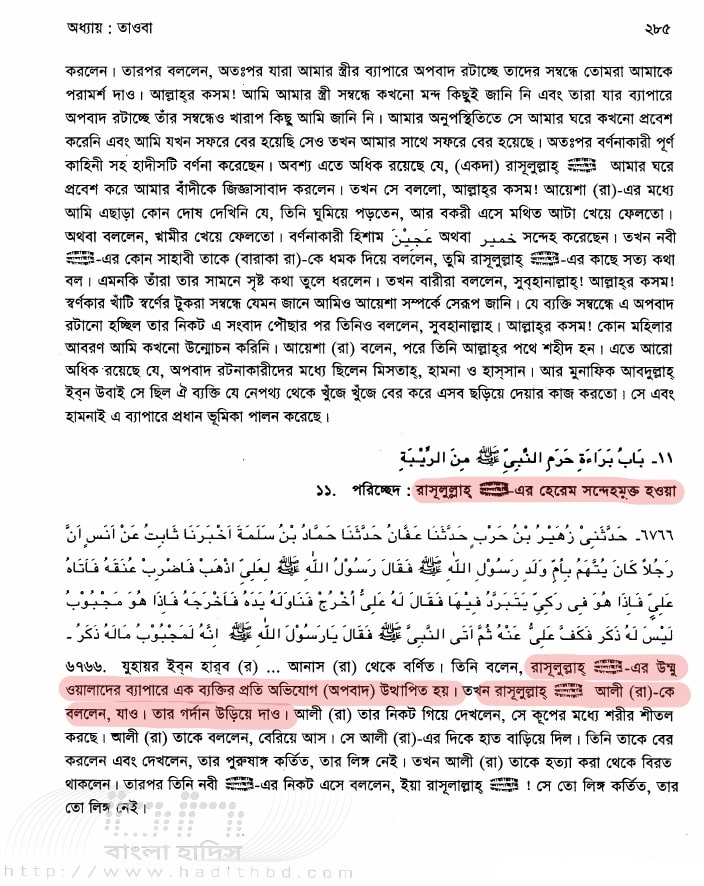
If Muhammad had no intimate sexual relationship with Mariyah al-Qibtiyyah, he would scarcely have become so enraged and suspicious through sexual jealousy as to order this man’s killing. Taken together with the explicit statement in the preceding hadith from Sunan al-Nasa’i, this should leave no doubt that Muhammad regularly maintained sexual relations with Mariyah. Evidence also indicates that he had several other sex slaves [178]—
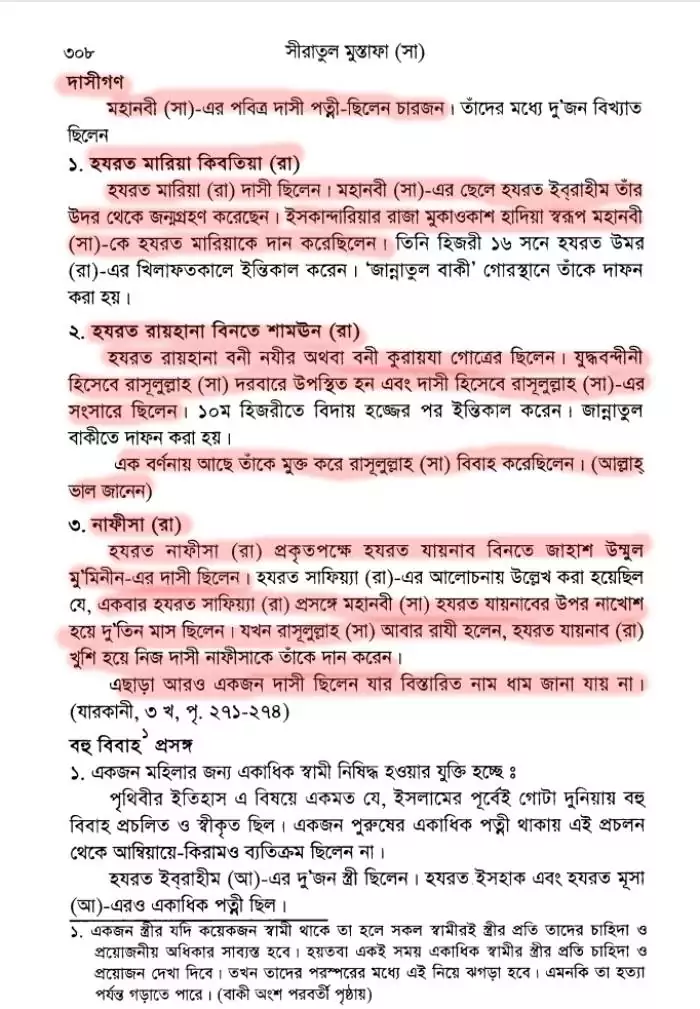
‘Umar’s Sexual Relations with Female Slaves
Hadith also shows that Caliph ‘Umar had sexual intercourse with female slaves. When giving a female slave to his son, he would say, “I have had intercourse with her, so do not do so yourself” [179].
Muwatta Malik
28. Marriage
Section: 15. Prohibition of Intercourse with One’s Father’s Female Slave
Report 36. Yahya related to me from Malik that he had heard that Umar ibn al-Khattab gave his son a slave-girl and said, “Do not touch her, for I have uncovered her.”
Yahya related to me from Malik that Abd arRahman ibn al-Mujabbir said that Salim ibn Abdullah gave his son a slave-girl and said, “Do not go near her, for I wanted her, and did not act towards her.”
[1] Al-Mujabbar: his name was also ‘Abd al-Rahman. His lineage was ‘Abd al-Rahman ibn ‘Abd al-Rahman ibn ‘Abd al-Rahman ibn ‘Umar ibn al-Khattab.
Hadith grade: awaiting verification
Narrator: Malik ibn Anas
Let us now examine how many umm walads ‘Umar had [180].
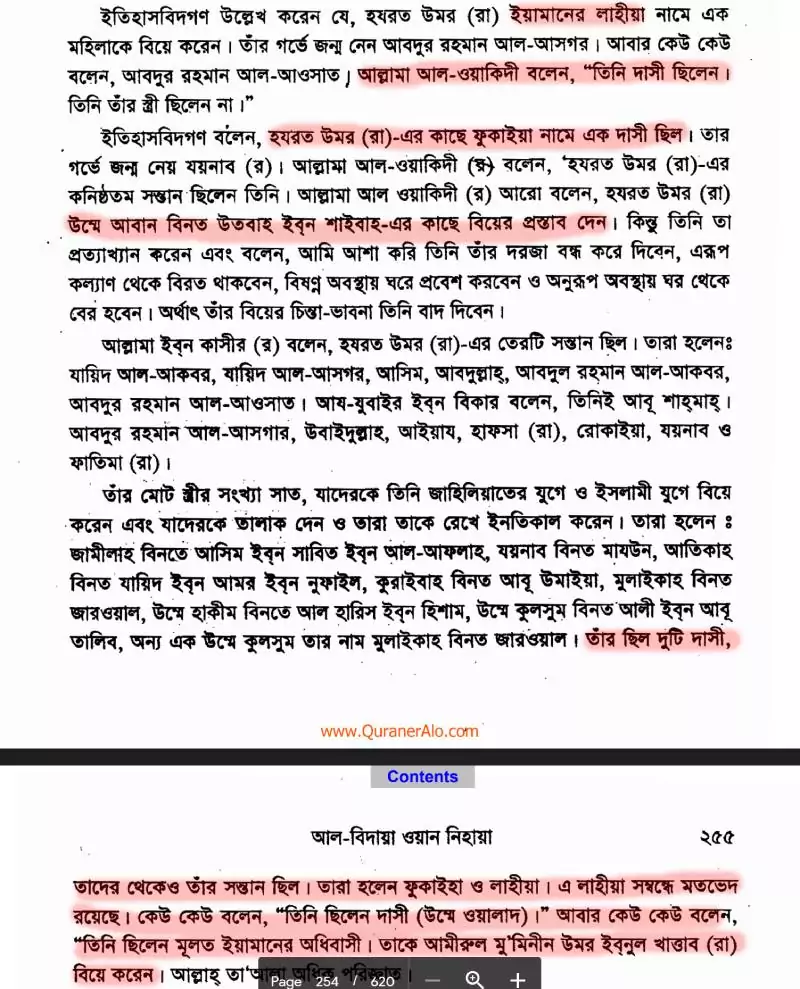
‘Ali’s Sexual Relations with Female Slaves
The Prophet’s cousin and son-in-law, the fourth caliph ‘Ali, raped a minor female war captive; this will be discussed later. For now, it is necessary to examine how many other female slaves ‘Ali had with whom he maintained sexual relations. Let us see how many female slaves and umm walads he possessed [181]—
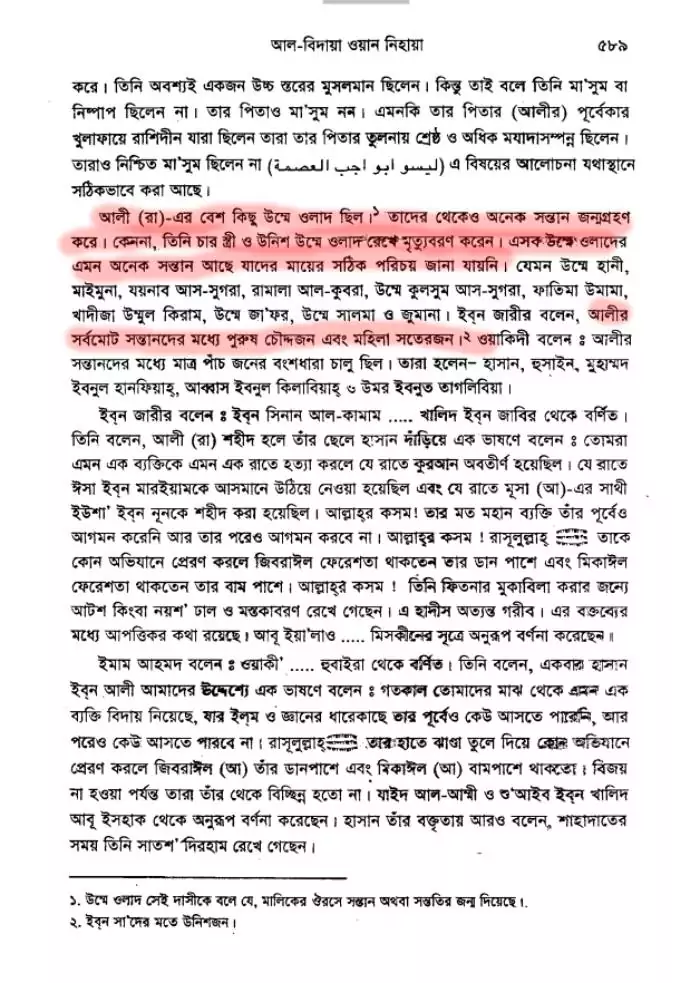
The Caliphs’ Obscene Cruelty
According to al-Bidayah wa-l-Nihayah, female slaves were presented naked in the court of Mu‘awiyah, one of Islamic history’s most important figures. Pointing at their genitals with a staff, he would say, “If only this sexual organ were mine!” Consider the women’s state of mind at such moments.
In discussing the biography of Khadij, the eunuch whom Mu‘awiyah had freed, Ibn ‘Asakir cites his account:
(Once) Mu‘awiyah purchased a beautiful, fair-skinned female slave, and I presented her naked before him. He was holding a staff and pointed with it towards her private parts, saying, “If only this sexual organ were mine! Take her to Yazid ibn Mu‘awiyah.”
… When the narrator met him, he said, “This female slavewas brought naked before me, and I saw her intimate parts. I now wish to send her to Yazid.” He replied, “No, Commander of the Faithful! Do not do that, for she will no longer be lawful for him.” Mu‘awiyah said, “You have given an excellent opinion.”
The narrator states that he then gave the female slaveto ‘Abdullah ibn Mas‘adah al-Fazari, Fatimah’s freed slave. As he was black, Mu‘awiyah said to him, “Make your children fair-skinned through her.” This incident demonstrates Mu‘awiyah’s religious discernment and concern to investigate the matter. Since he had looked lustfully at the female slavebut considered himself incapable of taking her and refrained from doing so, he also refrained, on account of the following verse, from giving the female slaveto his son Yazid.
Let us examine this passage directly from the book [182].
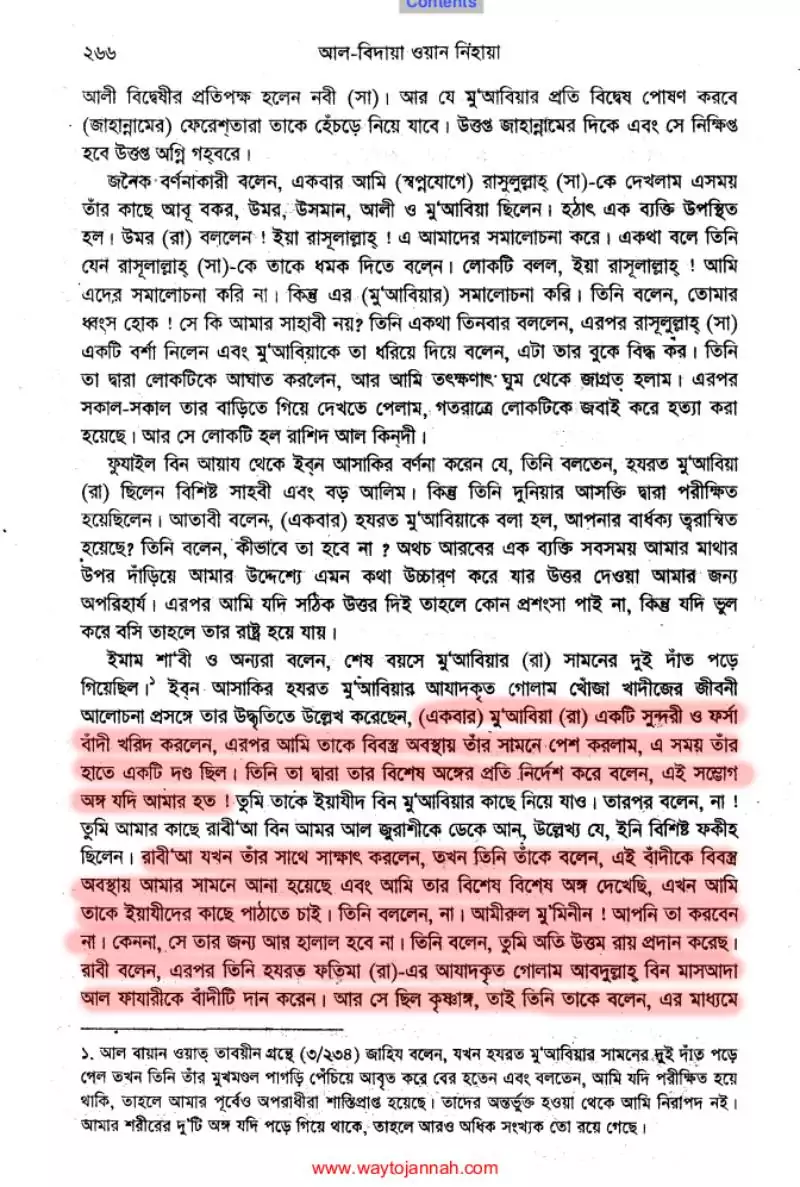
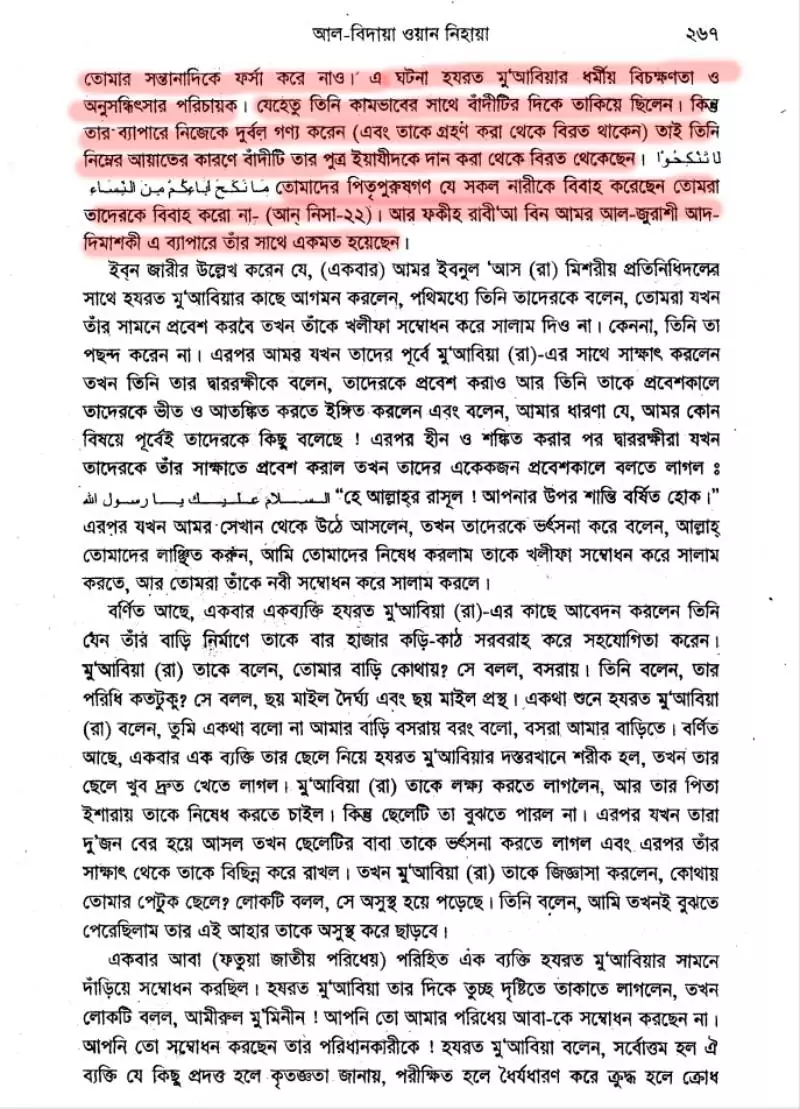
Islamic Rules Concerning Sex Slaves
What Is an Umm Walad?
Under Islamic rules, an umm walad is a female slave who bears her master’s child. Thus, if a female slave becomes pregnant through intercourse with her master, she is an umm walad, or mother of a child. She gains freedom upon her master’s death. Authentic hadith nevertheless establishes that selling umm walads was lawful during the Prophet’s lifetime, and the Companions did so. When ‘Umar came to power, he prohibited it. Let us examine the matter directly from hadith [183]—
Sunan Abi Dawud (Verified Edition)
24 / Manumission
Section: 8. Manumission of Umm Walads
3954. Narrated Jabir ibn Abdullah:We sold slave-mothers during the time of the Messenger of Allah (ﷺ) and of AbuBakr. When Umar was in power, he forbade us and we stopped.[1]
Sahih.
[1] Al-Bayhaqi; al-Hakim. Imam al-Hakim states that this hadith meets Muslim’s criteria.
Hadith grade: Sahih (al-Albani)
Narrator: Jabir ibn ‘Abdullah al-Ansari
Sunan Ibn Majah
13 / Judgments and Rules
Section: 13/95. Umm Walads
3/2517. Jabir bin `Abdullah was heard to say:“We used to sell our slave women and the mothers of our children (Umahat Awaldina) when the Prophet (ﷺ) was still living among us, and we did not see anything wrong with that.”
Abu Dawud 3954; Silsilat al-Ahadith al-Sahihah 2417.
Al-Albani’s verification: Sahih.
Hadith grade: Sahih (Darussalam)
Narrator: Jabir ibn ‘Abdullah al-Ansari
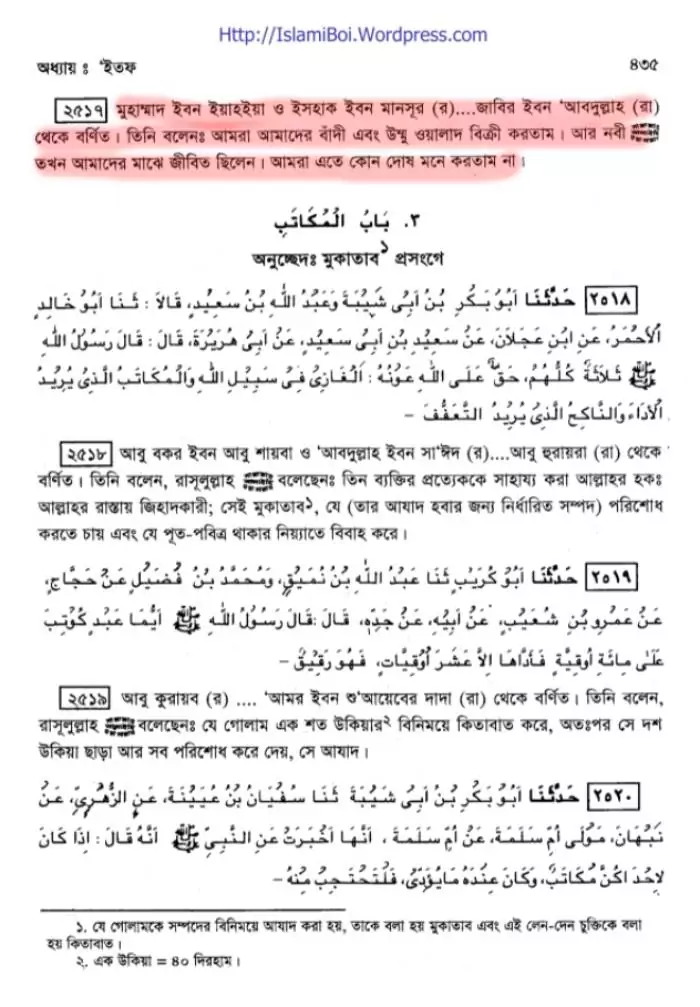
Under ‘Umar’s ruling, such a female slave becomes free upon her master’s death. During his lifetime, however, he may continue to have sexual use of her as a slave and earn income through her labour. Let us examine a ruling on this issue in Fatawa-i ‘Alamgiri [184].
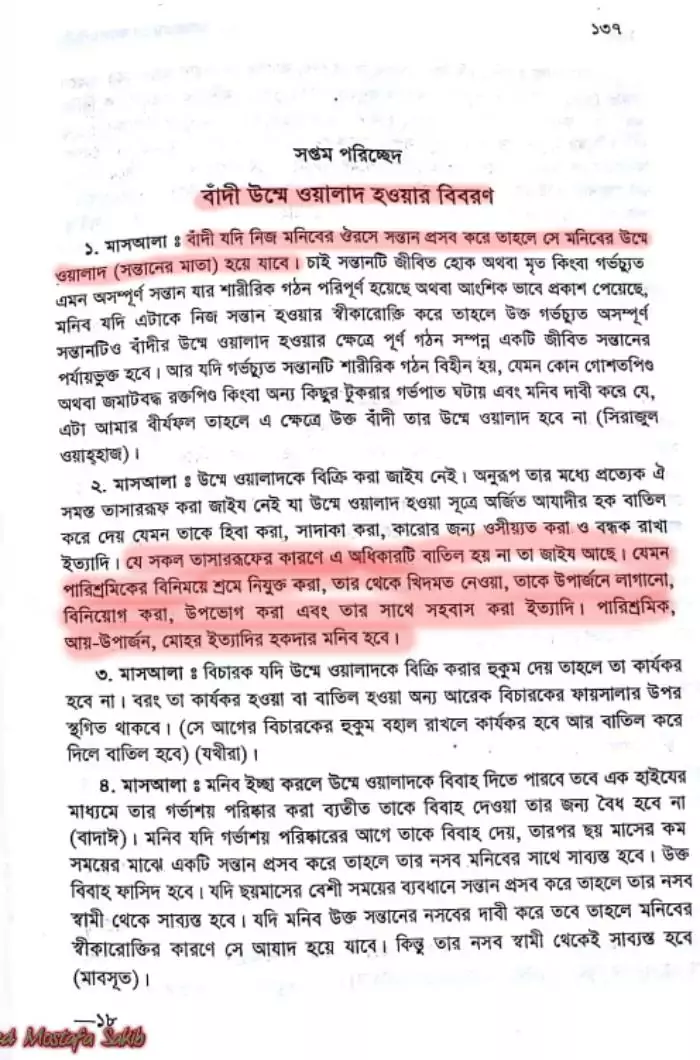
Another caliph, ‘Ali, expressed an opinion contrary to ‘Umar’s ruling. Let us examine that as well [185]—
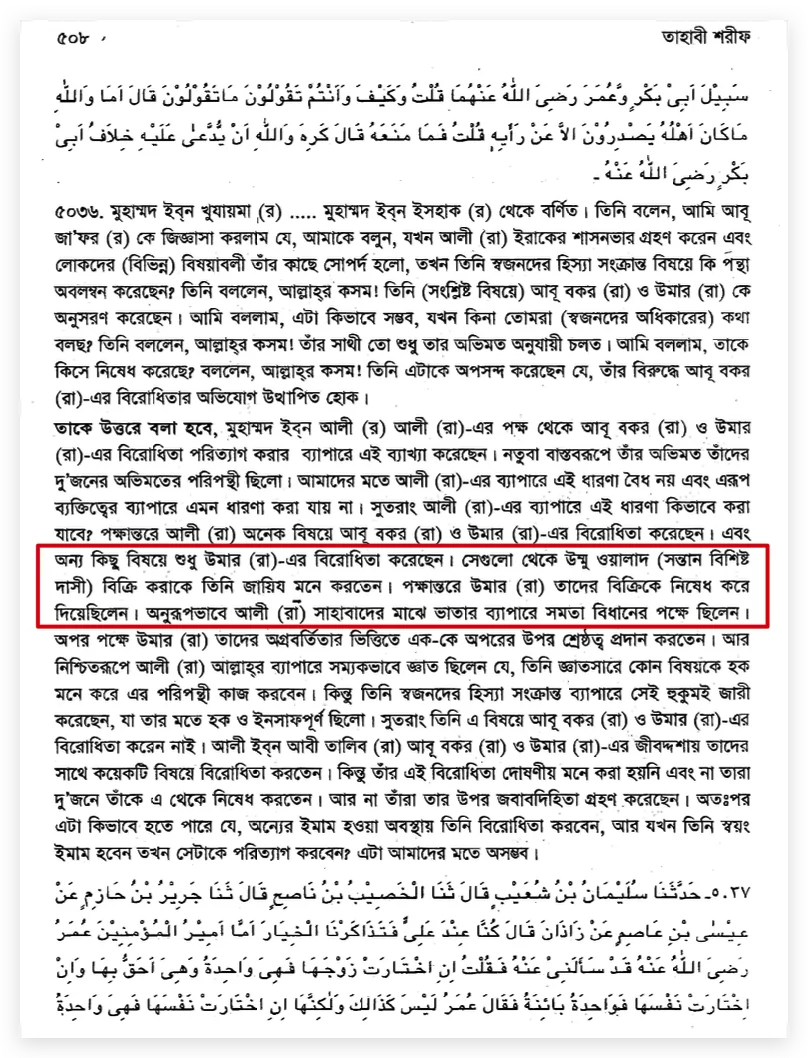
How Many Sex Slaves May a Believer Possess?
Islamic rules permit a man to have at most four wives simultaneously. No limit, however, is prescribed for the number of female slaves he may possess for sexual intercourse. A Muslim man may therefore buy thousands of female slaves and engage in sexual acts with them if he wishes. Islamic Sharia permits this. Let us consult Fatawa-i ‘Alamgiri on the matter [186]—
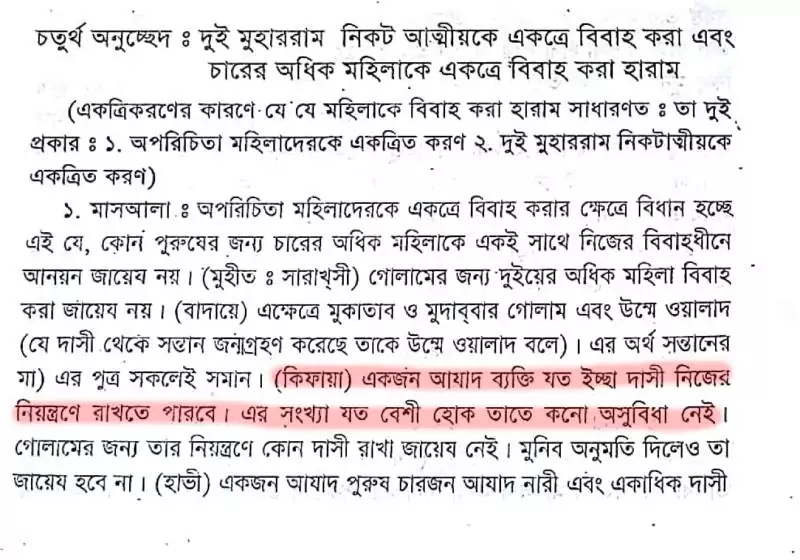
A Female Slave’s ‘Awrah Extends from the Navel to the Knee
In Islam, a female slave’s satr or ‘awrah—the portion of her body that must be covered—extends from the navel to the knee. For further details, see this article [187]. Let us read the rule in Ashraf al-Hidayah [188]—
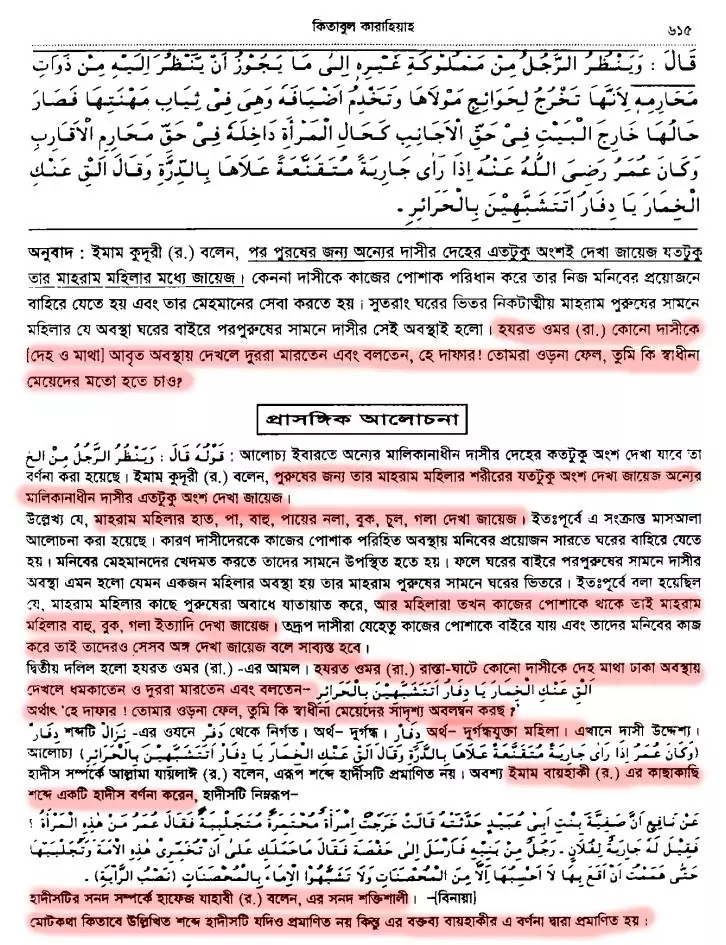
Also listen to the prominent Islamic scholars ‘Abdullah ibn ‘Abd al-Razzaq and Mufti Ibrahim discussing the rules governing female slaves’ covering—
Sexual Intercourse with Minor Female Slaves Is Entirely Lawful in Islam
One horrifying Islamic rule, enough to drive one to despair, is that sexual activity with minor female slaves is also entirely lawful. Muslims may obtain little girls as war captives or buy them in markets and then engage in lawful sexual acts with them. I do not know what could be more shamelessly cruel. This rule offers paedophiles a golden opportunity: they may satisfy their sexual desire for children at will while observing it. It is deeply painful to think of the minor girls who, subjected to this inhumane Islamic rule, were raped day after day. Let us first read the hadiths [189] [190] [191]—
Sunan al-Darimi (HadithBD)
1. Purification
Section: 120. Istibra’ of a Female Slave
1212. আওযাঈ হতে বর্ণিত, তিনি বলেন, আমি যুহরী রাহি. কে জিজ্ঞাসা করলাম যে, একটি লোক একটি দাসী ক্রয় করলো যে এখনো হায়েযে উপনীত হয়নি আর গর্ভধারণের মতো (বয়সও তার) হয়নি। এমতাবস্থায় সেই লোকটি কতদিন তার থেকে সম্পর্কহীন থাকবে? তিনি বললেনঃ তিন মাস।[1]
[1] Verification: its chain is sahih.
Source identification: previously cited as no. 956 (no. 951 in the translation).
Hadith grade: Sahih
Narrator: al-Awza‘i
Sunan al-Darimi (HadithBD)
1. Purification
Section: 120. Istibra’ of a Female Slave
1213. এবং ইয়াহইয়া ইবনু আবী কাছীর বলেন, পঁয়তাল্লিশ দিন।[1]
[1] Verification: its chain is sahih.
Source identification: previously cited as no. 957 (no. 952 in the translation).
Hadith grade: Sahih
Narrator: Yahya ibn Abi Kathir
Sunan al-Darimi (HadithBD)
1. Purification
Section: 120. Istibra’ of a Female Slave
1214. ইয়াহইয়া ইবনু বাশার হতে বর্ণিত, ইকরিমাহ বলেন, এক মাস।[1]আব্দুল্লাহ কে জিজ্ঞেস করা হলো: এতদুভয়ের মধ্যে আপনার মত কোনটি? তিনি বললেন: তিনমাসই অধিকতর শক্তিশালী মত। আর এক মাস যথেষ্ট।
[1] Verification: the narrators are reliable.
Hadith grade: Sahih
‘Ali, Muhammad’s son-in-law and first cousin, was also a man of colourful character. While sexually enjoying numerous wives and female slaves himself, Muhammad was equally generous in providing his sons-in-law with female captives. He allotted ‘Ali a generous share of the khumus taken from the spoils. The Prophet himself took one-fifth of the booty; this fifth is called khumus. The spoils included women and children [192]. The following hadith shows how Fatimah’s husband, the Prophet’s son-in-law ‘Ali, the “Lion of God,” had sex with a young female captive given to him by his father-in-law.
How great is our merciful Prophet Mustafa! Even a modern father would tremble at the prospect of giving his daughter’s husband a female war captive for intercourse, yet our merciful Prophet demonstrated it long ago [193] [194]—
Sahih al-Bukhari (Tawhid Publications)
Book: 64 / Military Expeditions
Section: 64/62. Sending ‘Ali ibn Abi Talib and Khalid ibn al-Walid to Yemen before the Farewell Pilgrimage.
4350. Narrated Buraida: The Prophet (ﷺ) sent `Ali to Khalid to bring the Khumus (of the booty) and I hated `Ali, and `Ali had taken a bath (after a sexual act with a slave-girl from the Khumus). I said to Khalid, “Don’t you see this (i.e. `Ali)?” When we reached the Prophet (ﷺ) I mentioned that to him. He said, “O Buraida! Do you hate `Ali?” I said, “Yes.” He said, “Do you hate him, for he deserves more than that from the Khumlus.” (Islamic Foundation: 4012)
Narrated Buraida: The Prophet (ﷺ) sent `Ali to Khalid to bring the Khumus (of the booty) and I hated `Ali, and `Ali had taken a bath (after a sexual act with a slave-girl from the Khumus). I said to Khalid, “Don’t you see this (i.e. `Ali)?” When we reached the Prophet (ﷺ) I mentioned that to him. He said, “O Buraida! Do you hate `Ali?” I said, “Yes.” He said, “Do you hate him, for he deserves more than that from the Khumlus.”
Hadith grade: Sahih
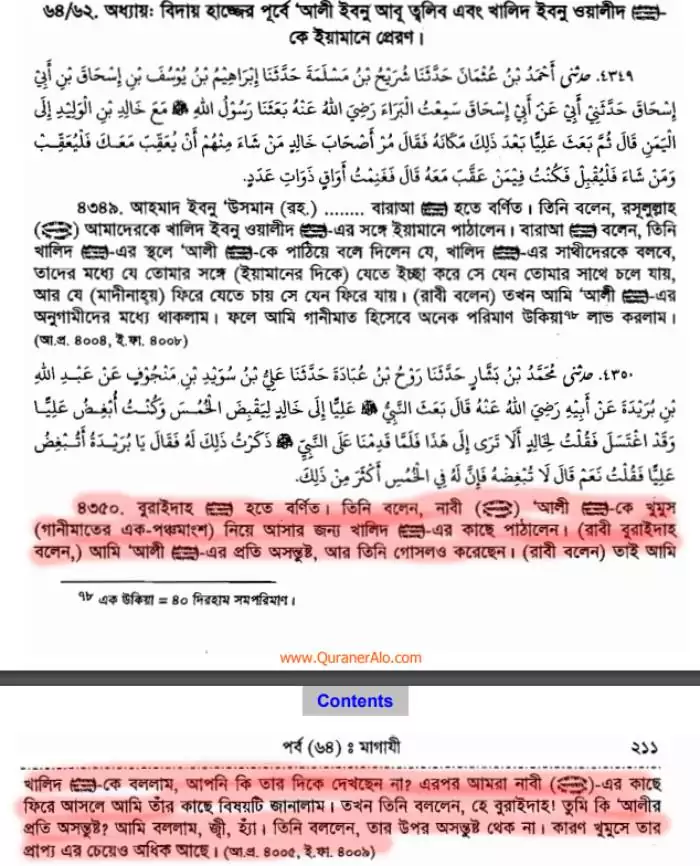
Readers should note that the Bengali translation mentions merely a bath, omitting its connection with intercourse with a female war captive. This conceals the fact that the Prophet’s son-in-law ‘Ali had sex with female captives. The attempt to protect his character is carefully contrived. The English translation of the same hadith, however, includes the detail and is reproduced below.
Sahih al-Bukhari: Vol. 5, Book 59, Hadith 637:
Narrated Buraida:
The Prophet (ﷺ) sent `Ali to Khalid to bring the Khumus (of the booty) and I hated `Ali, and `Ali had taken a bath (after a sexual act with a slave-girl from the Khumus). I said to Khalid, “Don’t you see this (i.e. `Ali)?” When we reached the Prophet (ﷺ) I mentioned that to him. He said, “O Buraida! Do you hate `Ali?” I said, “Yes.” He said, “Do you hate him, for he deserves more than that from the Khumlus.”
Al-Bidayah wa-l-Nihayah supplies further details of this account [195]—
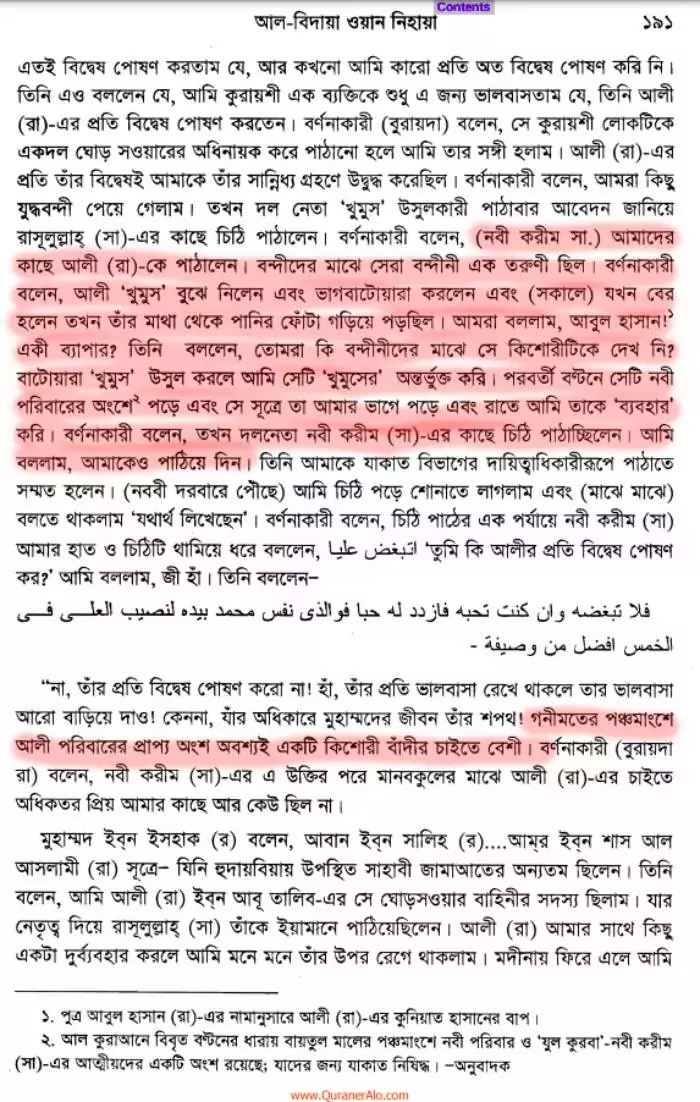
The explanation of this hadith in Sahaj In‘am al-Bari, a commentary on Sahih al-Bukhari, is shocking. ‘Ali actually had intercourse with an underage female captive who had not even begun menstruating [196]—
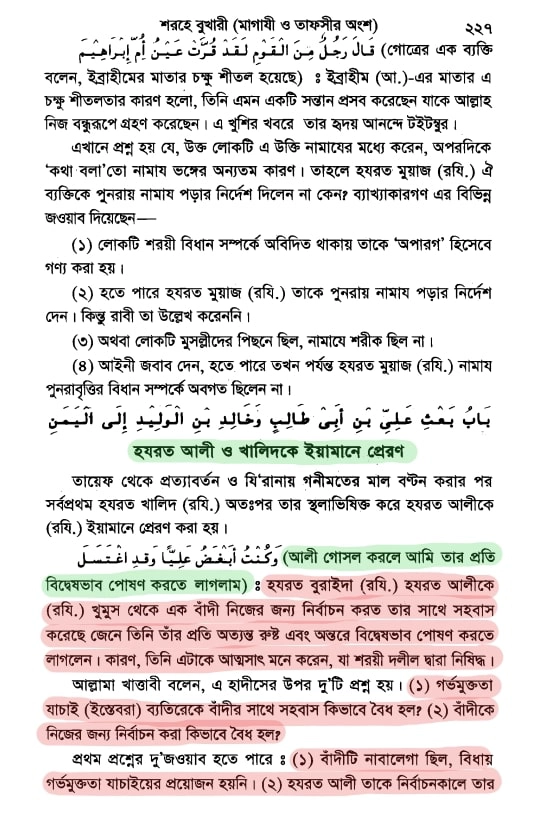
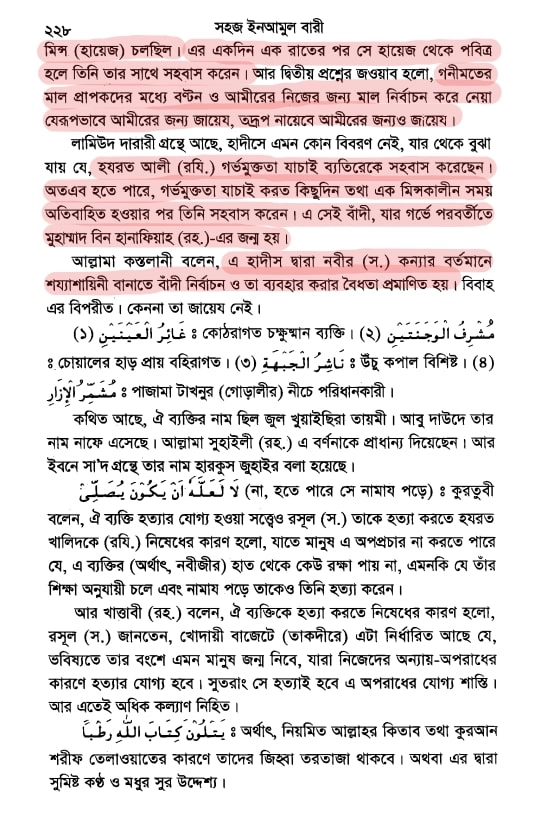
If a female war captive or slave is a minor, the complete legality of intercourse with that minor child is also stated in a juridical ruling in Fatawa-i ‘Alamgiri. Some hold that intercourse with a minor female captive is permissible without distributing the spoils or observing the waiting period prescribed to establish that her womb is empty, as ‘Ali did. Other scholars state that intercourse with the minor child becomes lawful after a wait of one and a half months. Let us read Fatawa-i ‘Alamgiri [197]—
( Ghayat al-Bayan ) If a minor female slave, after intercourse, is divorced, her waiting period is one and a half months.
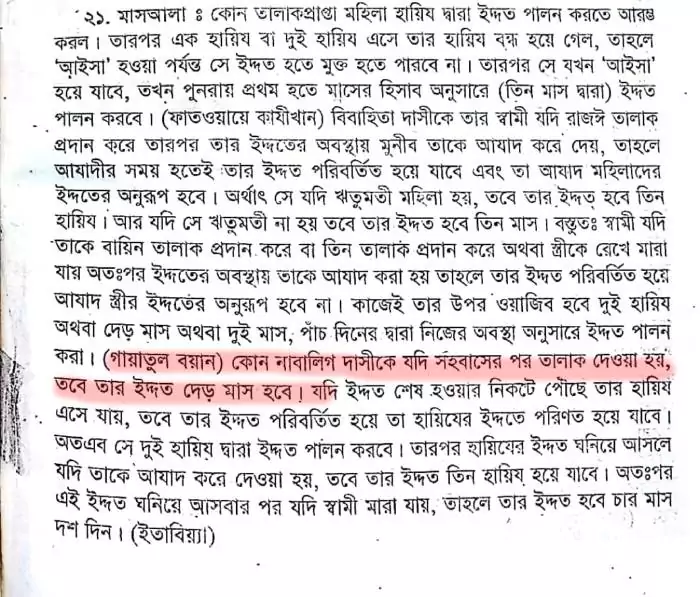
Evidence permitting intercourse with an underage female slave incapable of intercourse after istibra’, that is, after establishing that her womb is empty, also appears in Ashraf al-Hidayah [198].
Istibra’ is obligatory for the purchaser, not the seller. Its underlying reason is the intention to have intercourse with the female slave, an intention attributable to the purchaser rather than the seller. Therefore, istibra’, establishing that the womb is empty, is obligatory for the purchaser. Since the intention to have intercourse is concealed, however, the rule governing istibra’ depends on its outward indicator. That indicator is the lawful authority to have intercourse, established through ownership and possession. This authority has therefore been designated the operative cause, or sabab, and for ease of application the rule follows that authority. Thus, the cause of istibra’ is ownership of the female slave’s person, consolidated through possession. This rule extends to other grounds of ownership, such as purchase, gift, bequest, inheritance, khul‘, and a manumission contract. Likewise, istibra’ is obligatory if the purchaser buys the female slave from a child’s property, a woman’s property, a slave authorised to trade, or a person for whom intercourse with her was unlawful. Similarly, even if the purchased female slave is a virgin incapable of intercourse, istibra’ remains obligatory, because its operative cause is present. Rules depend on their operative causes rather than their underlying rationale, or hikmah, since the latter is concealed. Therefore, even if the possibility of semen being present in the womb is slight, the operative cause is regarded as established.
The author states: For female slaves whose waiting period is calculated in months, namely those who have not yet begun menstruating because of their young age or whose menstruation has ceased because of advanced age, the womb is deemed clear once one month has passed after they come into someone’s possession. In the case of such women, one month substitutes for one menstrual period, and three months substitute for three periods.
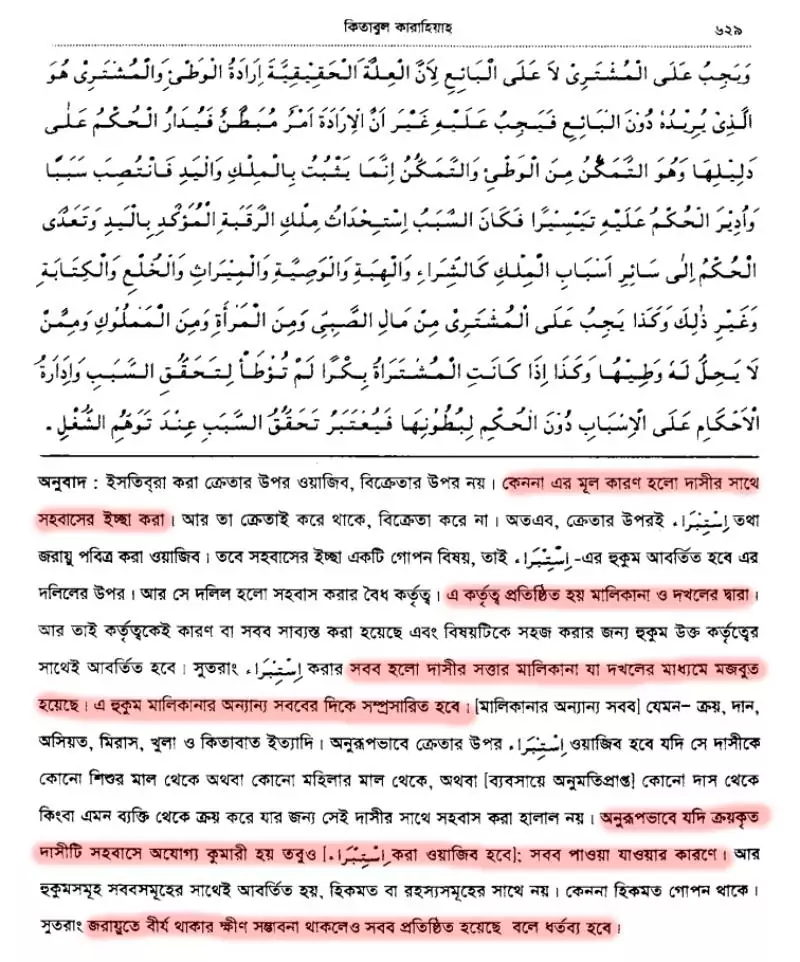
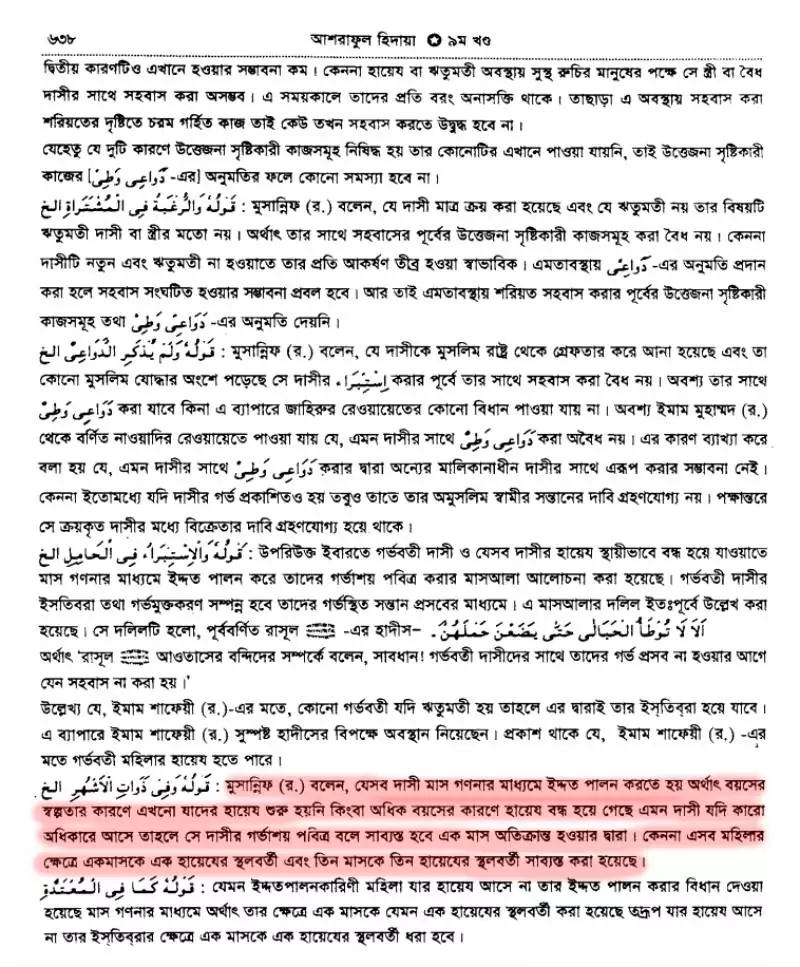
Even the Companions Hesitated to Rape!
When Muhammad’s Companions killed unbelievers and captured their mothers, sisters, daughters, and other women, many hesitated to sexually use another man’s wife in this way. In some cases, the women’s husbands were also captured. Many Companions felt reluctant to rape their wives in front of them, so they went to the Prophet to ask about it. He immediately brought down a verse from Allah legalising the act and removed their misgivings!
How great and merciful Allah and His Prophet were! Without spending even a moment in reflection, a verse was immediately revealed so that the Companions could properly rape those unbelievers’ wives in front of their husbands! The mercy of Allah and His Prophet truly knew no bounds! These accounts suggest that many Companions possessed a more advanced and civilised humanitarian sensibility than the Prophet and Allah [199] [152] [157]—
Sahih Muslim (Islamic Foundation)
18 / Suckling
Section: 1. It is permissible to have intercourse with a female captive after it is established that she is not pregnant, and if she has a husband, then her marriage is annulled when she is captured
3477. Source chain: ‘Ubaydullah ibn ‘Umar ibn Maysarah al-Qawariri … Abu Sa‘id al-Khudri. Abu Sa’id al-Khudri (Allah her pleased with him) reported that at the Battle of Hanain Allah’s Messenger (ﷺ) sent an army to Autas and encountered the enemy and fought with them. Having overcome them and taken them captives, the Companions of Allah’s Messenger (may peace te upon him) seemed to refrain from having intercourse with captive women because of their husbands being polytheists. Then Allah, Most High, sent down regarding that: ” And women already married, except those whom your right hands possess (iv. 24)” (i. e. they were lawful for them when their ‘Idda period came to an end).
[Istibra’ means waiting until childbirth if the woman is pregnant, and otherwise until one menstrual period has passed.]
Hadith grade: Sahih
Narrator: Abu Sa‘id al-Khudri
Sunan Abi Dawud (Islamic Foundation)
6 / Marriage
Section: 139. Intercourse with Female Captives.
2152. Source chain: ‘Ubaydullah ibn ‘Umar ibn Maysarah … Abu Sa‘id al-Khudri. Abu Sa’id Al Khudri said “The Apostle of Allaah(ﷺ) sent a military expedition to Awtas on the occasion of the battle of Hunain. They met their enemy and fought with them. They defeated them and took them captives. Some of the Companions of Apostle of Allaah (ﷺ) were reluctant to have relations with the female captives because of their pagan husbands. So, Allaah the exalted sent down the Qur’anic verse “And all married women (are forbidden) unto you save those (captives) whom your right hand posses.” This is to say that they are lawful for them when they complete their waiting period.
Hadith grade: Sahih (al-Albani)
Narrator: Abu Sa‘id al-Khudri
Coitus Interruptus with Female Slaves
Muhammad’s astute Companions realised that, after indulging in great orgies of sexual intercourse with female war captives or, at other times, female slaves, the women quickly became pregnant. Pregnancy made it more difficult to return them to their fathers, brothers, or husbands for ransom, sell them in markets, or have the jihadist believers mount them. They therefore adopted a method called ‘azl. ‘Azl means withdrawing the penis immediately before ejaculation during intercourse and ejaculating outside the woman’s body. This method allowed a woman to be sexually used for a long period and, once her owner tired of her, taken to the market and sold for a high price.
They also asked the Prophet about it, and he imposed no prohibition. The crucial point is that a female slave’s consent is not required for coitus interruptus. A free wife’s consent is required. Let us read directly from al-Bukhari [200]—
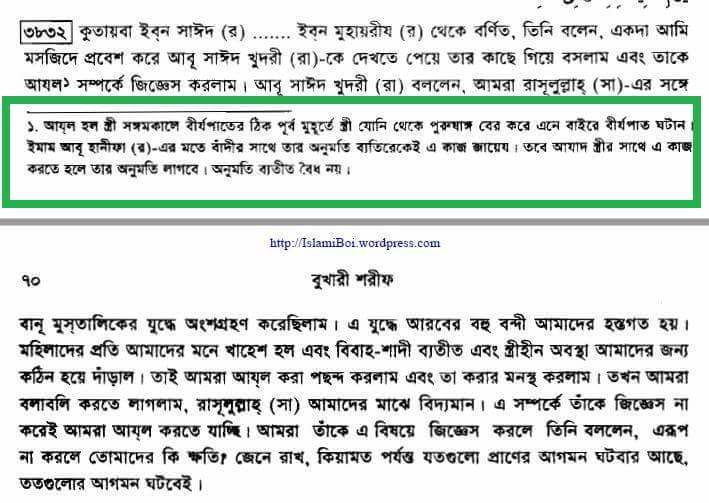
Let us examine this issue more closely in the jurisprudential work Ashraf al-Hidayah [201]—
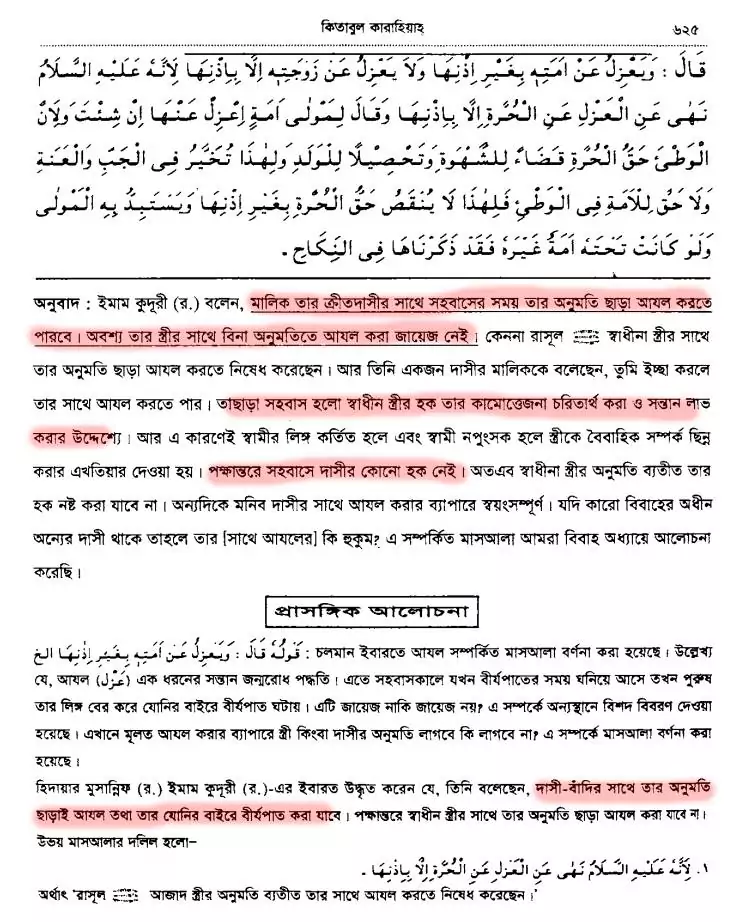
According to Imam al-Shafi‘i, permission is not required even for coitus interruptus with a free wife [202]—
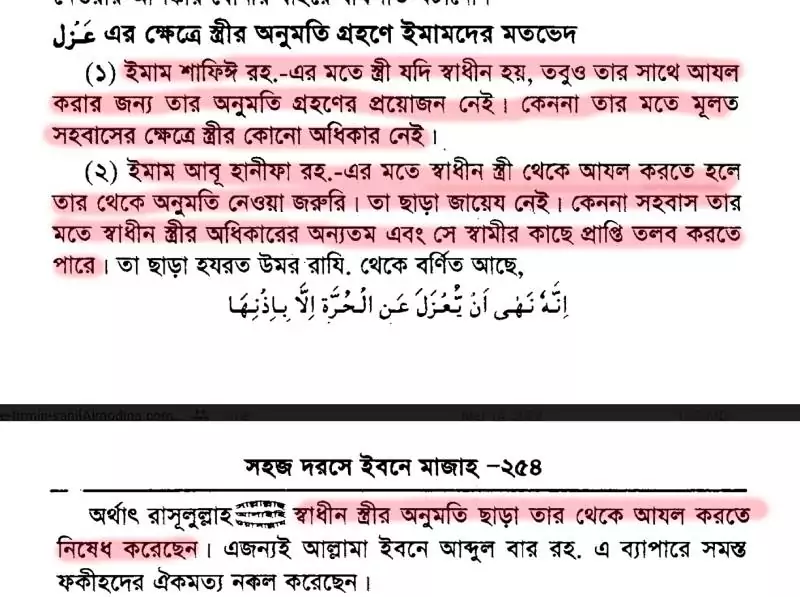
Let us watch a debate with believers on this issue,
Reasons for Coitus Interruptus with Female Slaves
Nowadays, many Muslims with modern educations attempt to conceal these barbaric misdeeds by claiming that the merciful Prophet had no alternative but to capture and enslave helpless women without families, allowing his Companions to sexually use them, because they had nowhere to go and nothing to do. They express no hesitation in making such shameless statements. Hadith, however, indicates that intercourse with female captives was the principal objective of the Prophet’s followers. The following report makes this clear. Read carefully how casually this Companion tells the Prophet that he has not “disrobed” her [203]—
Sahih Muslim (Islamic Foundation)
Book: 33 / Jihad and Its Rules
Section: 14. Additional rewards and ransoming Muslims in exchange for prisoners
4421. Source chain: Zuhayr ibn Harb … Iyas ibn Salamah, reporting from his father. It has been narrated on the authority of Salama (b. al-Akwa’) who said:We fought against the Fazara, and Abu Bakr was the commander over us. He had been appointed by the Messenger of Allah (ﷺ). When we were only at an hour’s distance from the water of the enemy, Abu Bakr ordered us to attack. We made a halt during the last part of the night to rest and then we attacked from all sides and reached their watering-place where a battle was fought. Some of the enemies were killed and some were taken prisoners.
I saw a group of persons that consisted of women and children. I was afraid lest they should reach the mountain before me, so I shot an arrow between them and the mountain. When they saw the arrow, they stopped. So I brought them, driving them along. Among them was a woman from Banu Fazara. She was wearing a leather coat. With her was her daughter who was one of the prettiest girls in Arabia. I drove them along until I brought them to Abu Bakr who bestowed that girl upon me as a prize.
So we arrived in Medina. I had not yet disrobed her when the Messenger of Allah (ﷺ) met me in the street and said: Give me that girl, O Salama. I said: Messenger of Allah, she has fascinated me. I had not yet disrobed her. When on the next day the Messenger of Allah (ﷺ) again met me in the street, he said: O Salama, give me that girl, may God bless your father. I said: She is for you, Messenger of Allah! By Allah. I have not yet disrobed her. The Messenger of Allah (ﷺ) sent her to the people of Mecca, and surrendered her as ransom for a number of Muslims who had been kept as prisoners at Mecca.
Hadith grade: Sahih
Narrator: Iyas ibn Salamah ibn al-Akwa‘
What would happen if a female captive became pregnant as a result of the jihadists’ frenzied rape? Many jihadists did not want their sex machine to conceive quickly, so they practised coitus interruptus. Muhammad’s position on the practice was unclear: sometimes he spoke against it, while at other times he appeared neutral. Nowhere, however, do we find him ordering the immediate release of the female captive. Whether she was subjected to sex with or without withdrawal mattered so much to the great Muhammad, yet the captive herself did not matter at all? Would it be expecting too much of a great man to hope that, upon hearing this, he would arrange the combatant’s trial and immediately free the captive?
Let us read the following hadith. It shows that Safiyyah had been allotted to another Companion before the Prophet took her for himself because she pleased him. The remainder of the report describes the reason for coitus interruptus [204]!
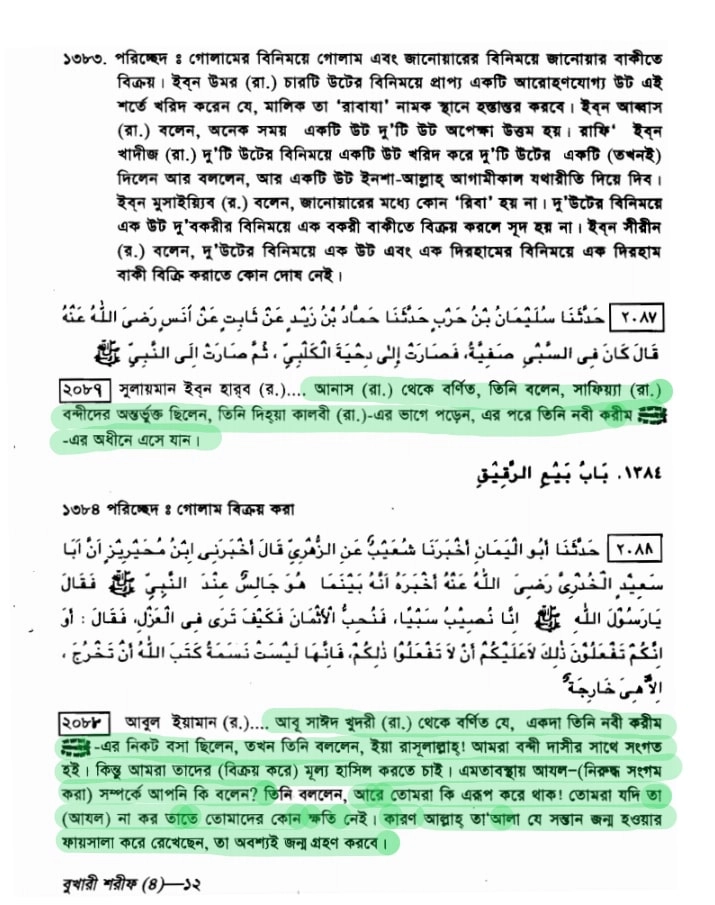
Muhammad’s jihadist soldiers were highly attentive to ensuring that female captives did not become pregnant quickly. Read the following hadith [205]—
Sahih al-Bukhari (Tawhid Publications)
Book: 97 / Tawhid
Section: 97/18. Allah’s words: “He is Allah, the Creator, the Inventor of all things, the Bestower of forms…” (Surah al-Hashr 59:24)
7409. Narrated Abu Sa`id Al-Khudri: That during the battle with Bani Al-Mustaliq they (Muslims) captured some females and intended to have sexual relation with them without impregnating them. So they asked the Prophet (ﷺ) about coitus interrupt us. The Prophet (ﷺ) said, “It is better that you should not do it, for Allah has written whom He is going to create till the Day of Resurrection.” Qaza’a said, “I heard Abu Sa`id saying that the Prophet (ﷺ) said, ‘No soul is ordained to be created but Allah will create it.” [Source-edition chain detail: Mujahid related this from Qaza‘ah.] (2229) (Adhunik Publications: 6993; Islamic Foundation: 6905)
Hadith grade: Sahih
Let us also consult the report directly in the book [206]—
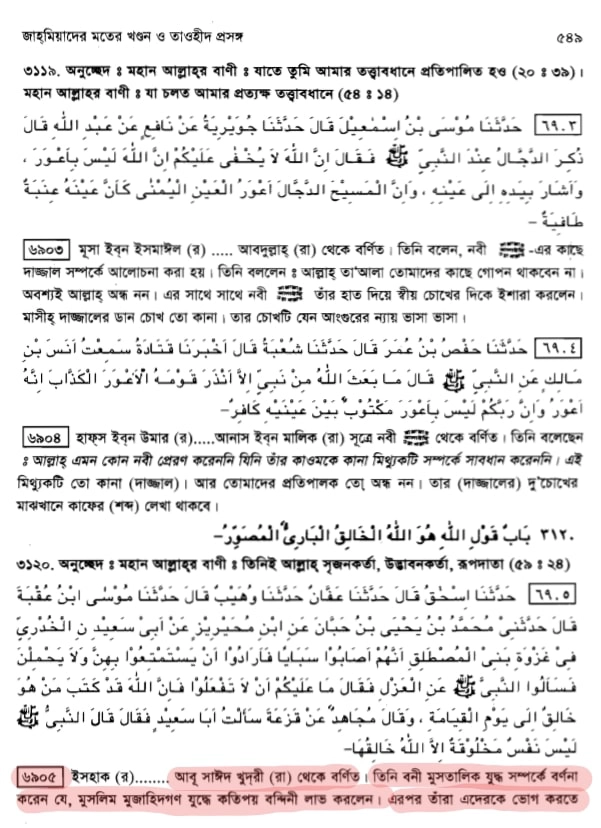
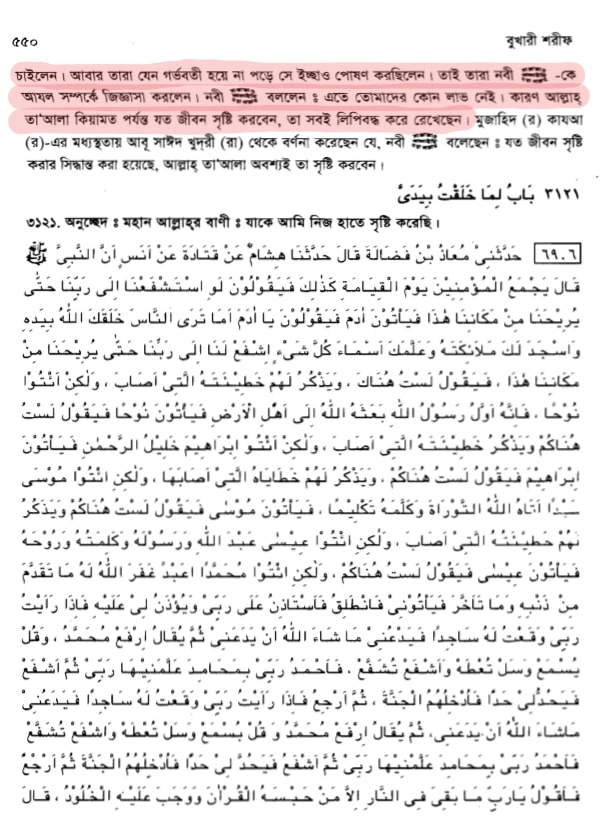
That is, after victory in battle, Allah’s Messenger killed all the adults and took all their women and children captive. Let us now read the explanation of this hadith in Sahaj Nasr al-Bari [207]—
That is, if we do not practise coitus interruptus with the female slave, there is a risk that the female slave will become an umm walad. Yet we love our property. We wish to sell her and benefit from her price, but if she becomes an umm walad, we shall not be able to sell her. We therefore wish to practise coitus interruptus with the female slaveso that the female slavedoes not become pregnant. What, then, do you say about this matter?
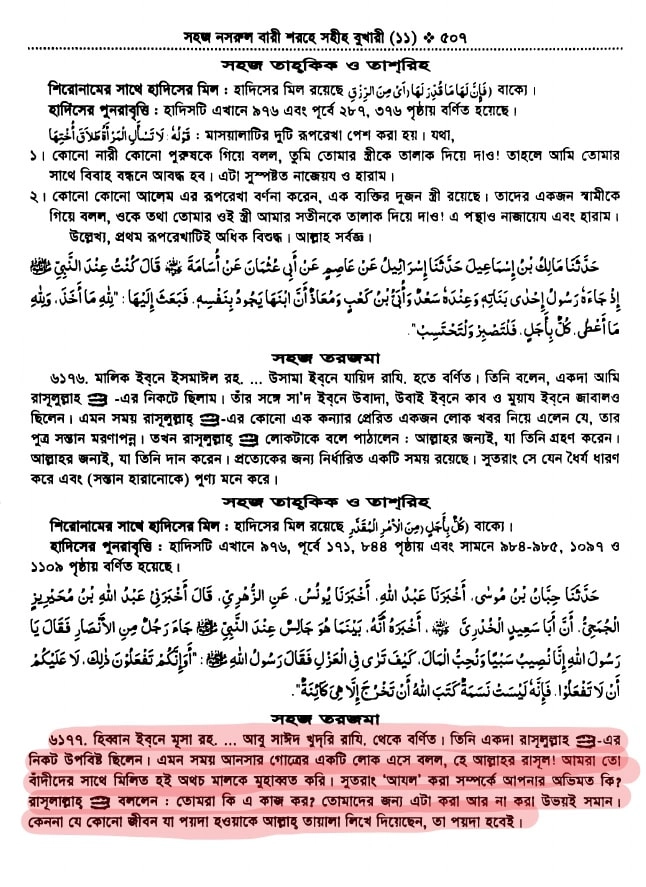
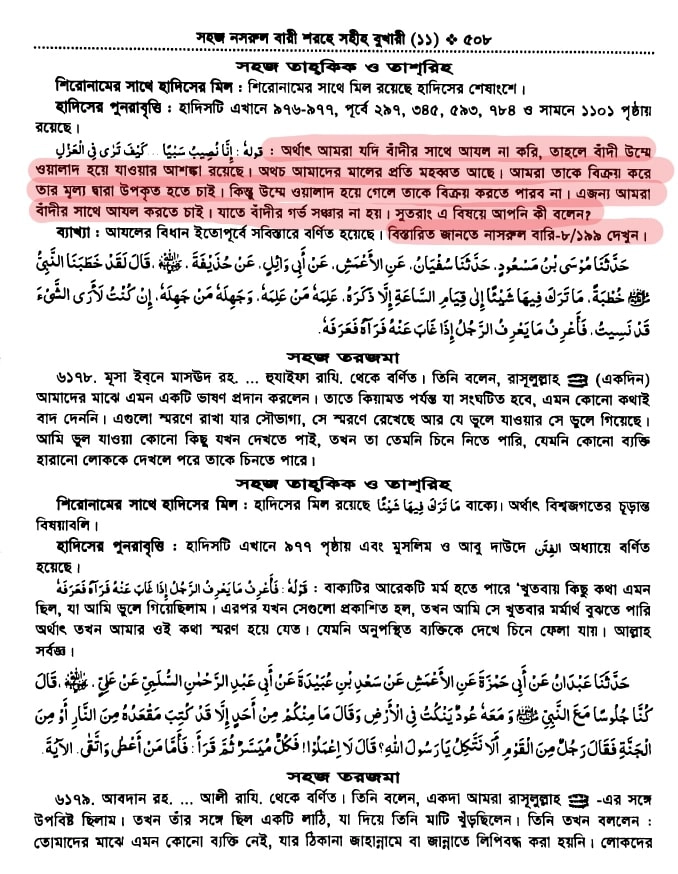
Let us now listen to the prominent scholar Dr Abu Bakr Zakaria,
The Slave Trade: Buying and Selling Slaves
An important question is whether the Prophet himself and his Companions participated in buying and selling slaves or in the slave trade. Several hadiths show that the Prophet and many of his Companions were involved in these transactions [208] [209] [210] —
Jami at-Tirmidhi (Islamic Foundation)
14/ Business Transactions
Section: Recording the Conditions.
1219. Muhammad ibn Bashshar (may Allah have mercy on him) … Narrated ‘Abbad bin Laith Al-Karabisi [Al-Basri]: “Abdul Majid bin Wahb narrated to us, he said: ‘Al-‘Adda’ bin Khalid bin Hawdhah said to me: “Shall I not read to you a letter that was written for me from the Messenger of Allah (ﷺ) ?”‘ He said: ‘I said: “Of course.” So he took out a letter for me: “This is what Al-‘Adda’ bin Khalid bin Hawdhah purchased from Muhammad, the Messenger of Allah (ﷺ): He purchased from him a slave’ – or – ‘a female slave, having no ailments, nor being a runaway, nor having any malicious behavior. Sold by a Muslim to a Muslim. — Ibn Majah 2251; Tirmidhi Hadith: 1216 [Al-Madani Publications]
[Abu ‘Eisa said:] This Hadith is Hasan Gharib, we do not know of it except from ‘Abbad bin Laith. More than one of the people of Hadith have reported this Hadith from him.
Hadith grade: Hasan
Jami at-Tirmidhi (Islamic Foundation)
14/ Business Transactions
Section: The Sale of a Mudabbar.
1222. Ibn Abi Umar (may Allah have mercy on him) … Narrated Jabir: “A man among the Ansar decided to free a slave of his after his death. He died but he left no wealth behind beside the slave. So the Prophet (ﷺ) sold him. and Nu’aim [bin ‘Abdullah] bin An-Nah-ham bought him.” Jabir said: “He was Coptic slave who died during the first year of the leadership of Ibn Az-Zubair.” — Irwa 1288; Bukhari; Muslim; Tirmidhi Hadith: 1219 [Al-Madani Publications]
[Abu ‘Eisa said:] This Hadith is Hasan Sahih and it has been reported through more than one route from Jabir bin ‘Abdullah. This Hadith is acted upon according to some of the people of knowledge among the Companions of the Prophet (ﷺ) and others. They did not see any harm in the sale of Mudabbar. This is the view of Ash-Shafi’i, Ahmad and Ishaq. There are those among people of knowledge, among the Companions of the Prophet (ﷺ) and others, who disliked selling the Mudabbar. This is the view of Sufyan Ath-Thawri, Malik and Al-Awza’i.
Mudabbar: a slave whose manumission is conditional upon the owner’s death. For example, if an owner says, “You will be free when I die,” the slave subject to this arrangement is called a mudabbar.
Hadith grade: Sahih
Narrator: Jabir ibn Abdullah al-Ansari (may Allah be pleased with him)
Sunan Abi Dawud (Islamic Foundation)
17/ Sales and Commerce
Section: 366. When the buyer and seller disagree while the item sold remains present.
3475. Muhammad ibn Yahya (may Allah have mercy on him) … Narrated Abdullah ibn Mas’ud: Muhammad ibn al-Ash’ath said: Al-Ash’ath bought slaves of booty from Abdullah ibn Mas’ud for twenty thousand (dirhams. Abdullah asked him for payment of their price. He said: I bought them for ten thousand (dirhams). Abdullah said: Appoint a man who may adjudicate between me and you. Al-Ash’ath said: (I appoint) you between me and yourself. Abdullah said: I heard the Messenger of Allah (ﷺ) say: If both parties in a business transaction differ (on the price of an article), and they have witness between them, the statement of the owner of the article will be accepted (as correct) or they may annul the transaction.
Hadith grade: Sahih
Let us also revisit the information presented earlier. After the Banu Qurayza were attacked and besieged for 25 days, all the tribe’s men and women surrendered. The Prophet’s army then decided to kill every adult male and enslave the women and children. The boys’ genitals were examined to determine whether they had reached puberty. Those who had grown pubic hair were killed; those who had not were enslaved. What happened to the minor children of the Banu Qurayza? At Prophet Muhammad’s instruction, his followers sold some of them and used the proceeds to buy weapons and horses [211] [81]
Buying and Selling Female Slaves in the Marketplace
Many of Prophet Muhammad’s Companions participated in buying and selling slaves. The Prophet himself also bought and sold them. To understand these slave markets in detail, several references deserve close attention. The relevant legal rulings in Ashraful Hidaya provide an indication of what these markets were like. Read them and imagine your own daughter in that position: the inhumanity of the practices will become clear [212] —
Imam al-Quduri (may Allah have mercy on him) states in his Mukhtasar al-Quduri: If someone intends to purchase a female slave, he may touch those parts of her body that he is permitted to see, even if touching her arouses his sexual desire.
The author (may Allah have mercy on him) states that Imam Muhammad (may Allah have mercy on him) presents the ruling in this form in his al-Jami al-Saghir. Its wording is: “Imam Muhammad and Abu Yusuf (may Allah have mercy on them) both relate from Imam Abu Hanifa (may Allah have mercy on him) that there is no harm or fault in a prospective buyer touching a female slave’s shins, chest, and hands, nor in viewing these parts uncovered.” “Touching remains permissible even if it arouses sexual desire.”
“Touching is permissible even if there is a fear that it will arouse sexual desire. In their view, looking at a female slave with the intention of buying her is permissible even where it may cause arousal.”
“The earlier imams permitted touching female slaves when purchasing them in order to assess their skin, because people in that period were generally pious.”
“Later scholars permitted touching only in the absence of sexual desire. This is the ruling on which the current fatwa is based.”
“Once an adolescent female slave has menstruated for the first time, she may not be brought to market for sale and displayed wearing only a single garment covering her lower body. Menstruation means that she has reached puberty. As explained earlier, the abdomen and back of a female slave who has reached puberty form part of her awrah. If she wears only a lower garment, her chest and back will remain exposed; she must therefore wear a qamis, or upper garment. An izar is a garment that covers only the area below the navel.”
“This discussion establishes that there is no objection to bringing younger female slaves to market with their chests and backs uncovered”.
“An adolescent female slave who has reached the age at which she can arouse sexual desire (that is, is considered suitable for intercourse; no particular age of seven or nine is stipulated) may not be presented for sale wearing only one garment.”
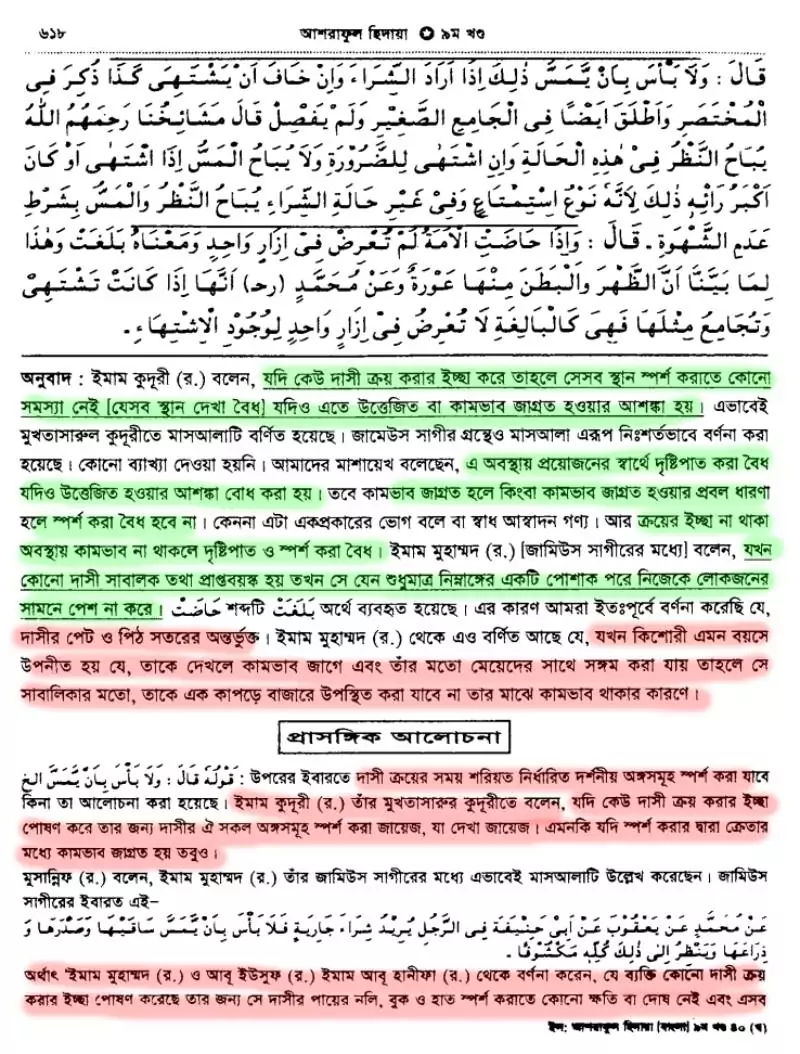
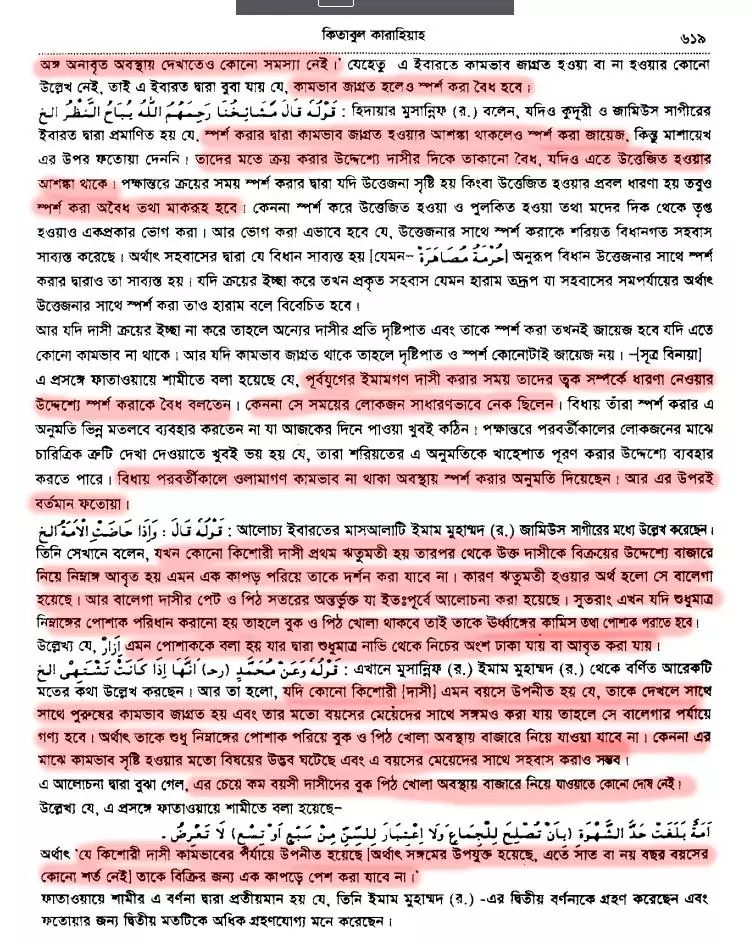
Purchasing a Sex Slave for Intercourse
Islam provides for purchasing a female slave for sexual intercourse without any pretence of shame or concealment. Imam al-Quduri states in his work that if a female slave purchased for sexual enjoyment has an offensive smell in her armpits or mouth, the buyer may return her. The text also states that a female slave is a commodity and that an offensive smell constitutes a defect [213] —
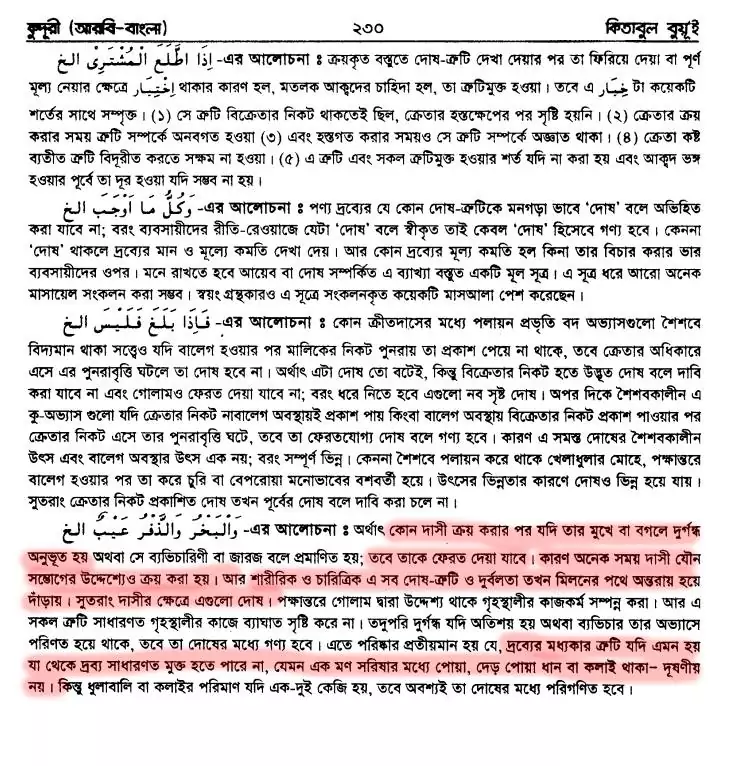
Examining a Female Slave’s Vagina at Purchase
The Companions of Prophet Muhammad, the supposed guide of all humanity, purchased beautiful virgin female slaves from the slave market for sexual enjoyment. Virgin slaves also commanded higher prices. Sometimes, however, a purchased slave turned out not to be a virgin. Since Muhammad’s Companions were particularly fond of virgin vaginas (Allah himself entices believers with virgin houris in Paradise), they became angry if, after taking a slave to bed, they did not see sufficient bleeding from a ruptured hymen, or if intercourse failed to give them the pleasure they expected because her vagina was not sufficiently tight. After all, they had paid for a virgin girl! They thought their money had been wasted. Consider how supposedly noble and humane these practices were! How would you feel if the same happened to your sister or daughter? The relevant ruling in Ashraful Hidaya permits an owner, in such a situation, to examine the slave’s private parts or vagina to investigate the matter [214] —
6. Similarly, if a man purchases a female slave as a virgin and subsequently discovers that her virginity has been lost, but the seller denies this, then, for the purpose of investigating the matter, it becomes permissible at a certain stage to look at the slave’s private parts for examination.
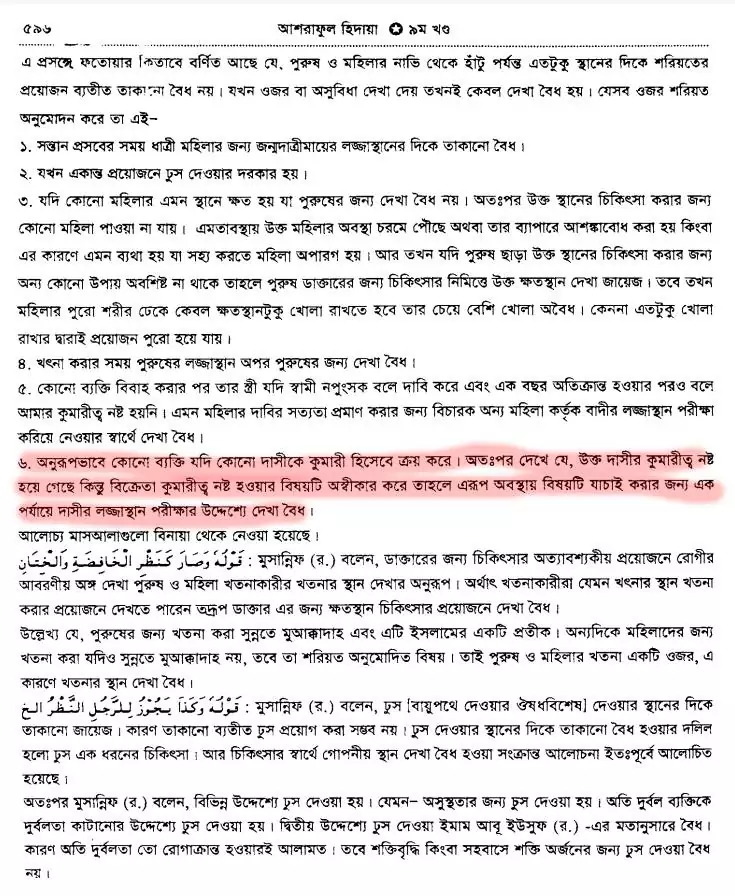
Exchanging Female Slaves for Sexual Use
Since Islam fully permits selling female slaves or giving them as gifts, and also permits sexual use of slaves acquired through purchase or gift, it is entirely natural that Prophet Muhammad’s Companions would exchange them. Suppose one Companion receives a female slave as a war captive and uses her sexually as he wishes for some time. His friend also receives a woman as war booty and uses her sexually.
Under Islamic rules, the two then give their female slaves to one another as gifts, or sell them to one another for equivalent prices. They subsequently use the newly acquired slaves sexually as they please. Although the rule permitting the sale or gift of female slaves may initially seem unremarkable, it conceals a far uglier reality. By applying it, all the Companions could use a girl taken as war booty sexually, passing her among themselves through exchanges. In other words, a girl captured by a Muslim army would have no escape until they had all used her. A seemingly simple rule conceals something grotesque. Consider the following hadith [215] —
Sahih al-Bukhari (Tawhid Publication)
51/ Gifts and Their Virtues
Section: 51/36. In its customary meaning, if someone says, “I give this female slave to you for your service”, this is permissible.
وَقَالَ بَعْضُ النَّاسِ هَذِهِ عَارِيَّةٌ وَإِنْ قَالَ كَسَوْتُكَ هَذَا الثَّوْبَ فَهُوَ هِبَةٌ
Some jurists say that this constitutes a loan for use (ariyah). If someone says, “I give you this garment to wear,” however, it constitutes a gift (hibah).
2635. Narrated Abu Huraira: Allah’s Messenger (ﷺ) said, “The Prophet (ﷺ) Abraham migrated with Sarah. The people (of the town where they migrated) gave her Ajar (i.e. Hajar). Sarah returned and said to Abraham, “Do you know that Allah has humiliated that pagan and he has given a slave-girl for my service?”
Ibn Sirin (may Allah have mercy on him) relates from Abu Hurayrah (may Allah be pleased with him), from the Prophet (ﷺ): “Then he gave her Hajar for her service.” (2217) (Adhunik Publications: 2443; Islamic Foundation: 2459)
بَابُ إِذَا قَالَ أَخْدَمْتُكَ هَذِهِ الْجَارِيَةَ عَلَى مَا يَتَعَارَفُ النَّاسُ فَهُوَ جَائِزٌ
حَدَّثَنَا أَبُو الْيَمَانِ أَخْبَرَنَا شُعَيْبٌ حَدَّثَنَا أَبُو الزِّنَادِ عَنْ الأَعْرَجِ عَنْ أَبِيْ هُرَيْرَةَ أَنَّ رَسُوْلَ اللهِ صلى الله عليه وسلم قَالَ هَاجَرَ إِبْرَاهِيْمُ بِسَارَةَ فَأَعْطَوْهَا آجَرَ فَرَجَعَتْ فَقَالَتْ أَشَعَرْتَ أَنَّ اللهَ كَبَتَ الْكَافِرَ وَأَخْدَمَ وَلِيْدَةً وَقَالَ ابْنُ سِيْرِيْنَ عَنْ أَبِيْ هُرَيْرَةَ عَنْ النَّبِيِّ صلى الله عليه وسلم فَأَخْدَمَهَا هَاجَرَ.
Hadith grade: Sahih
Narrator: Abu Hurayrah (may Allah be pleased with him)
Now consider the relevant evidence in Tafsir al-Mazhari [216] —
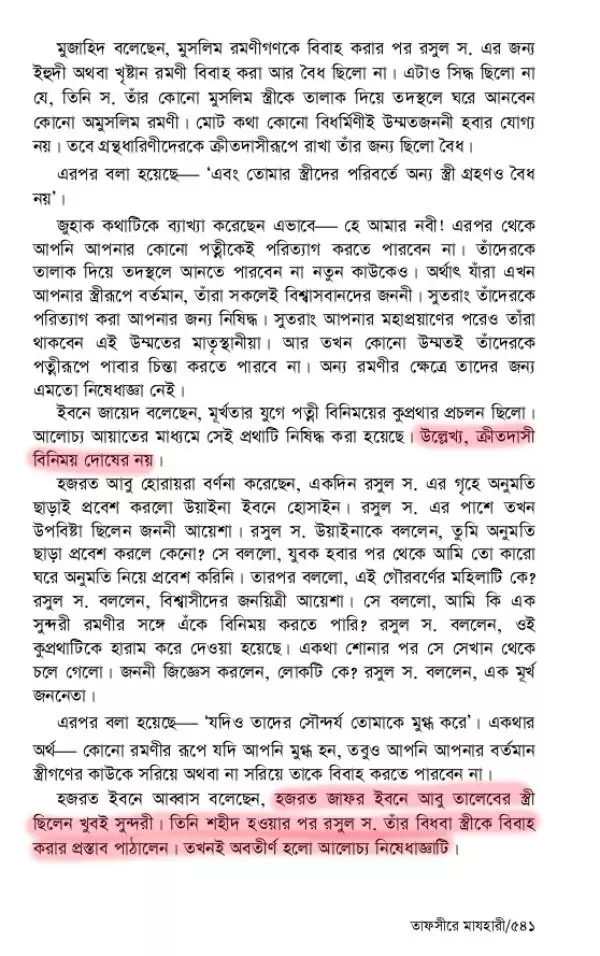
Intercourse with an Enslaved Mother and Daughter
According to Fiqh Uthman, the jurisprudential work concerning the second caliph, Uthman, if a single owner possesses both a mother and her daughter, he may have intercourse with both. Uthman did not favour declaring this forbidden [217]. Umar and several other imams, however, declared it forbidden. Thus evidence is cited both in favour of the practice and against it.
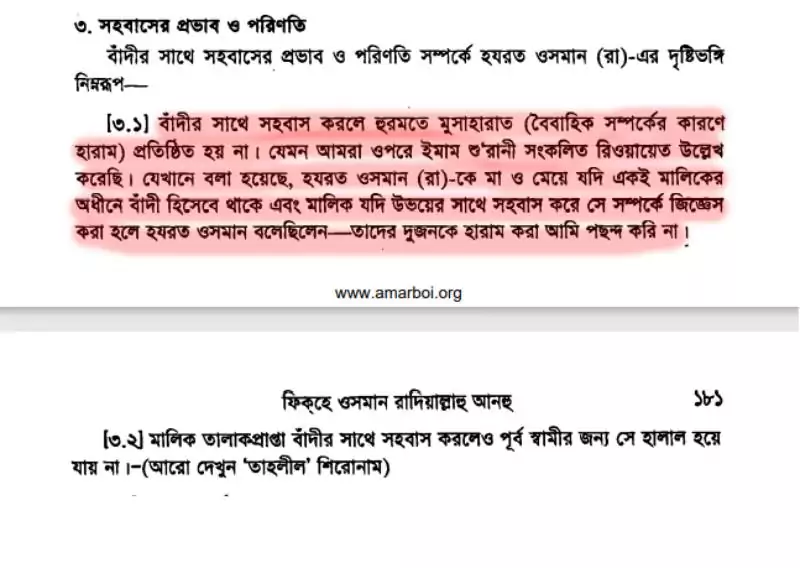
A Son, Father, and Grandfather Sharing a Female Slave Sexually
Under Islamic rules, intercourse with a purchased female slave is permissible. Detailed legal rulings in Fatawa Alamgiri discuss who is to be recognised as the father if a son, father, and grandfather in the same family have intercourse with that slave and a child is born. Consider the relevant passages [218] —
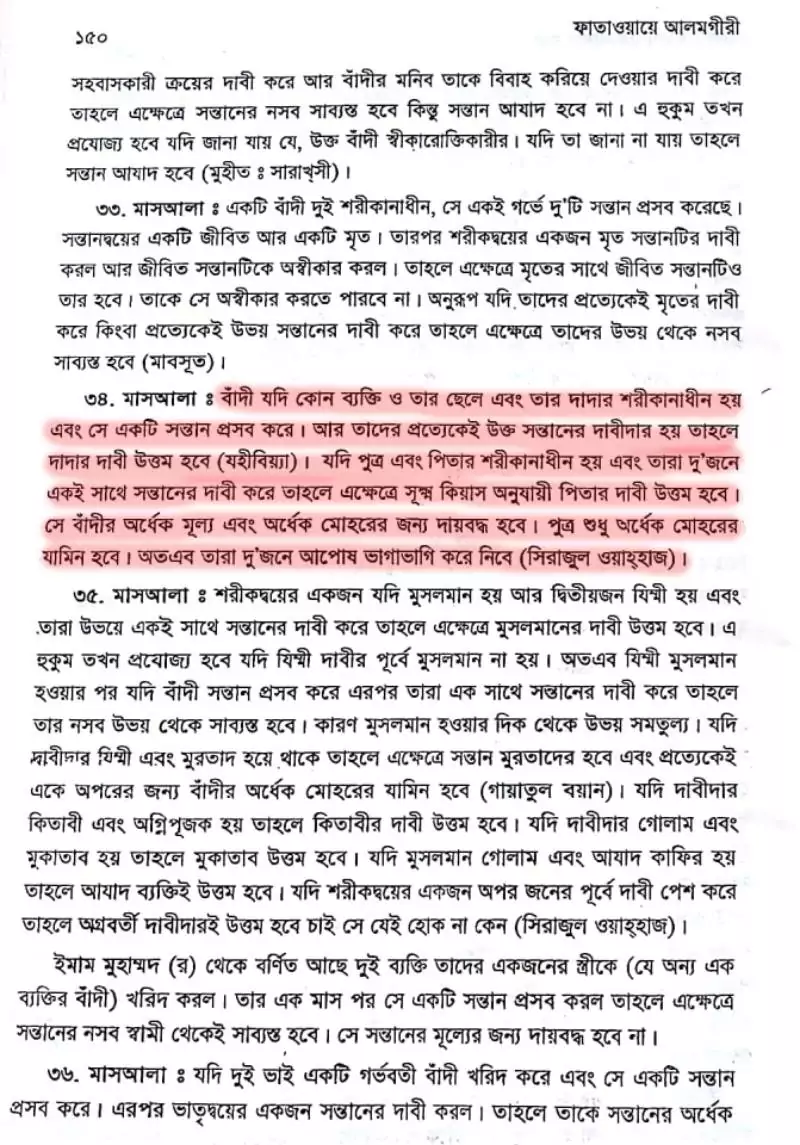
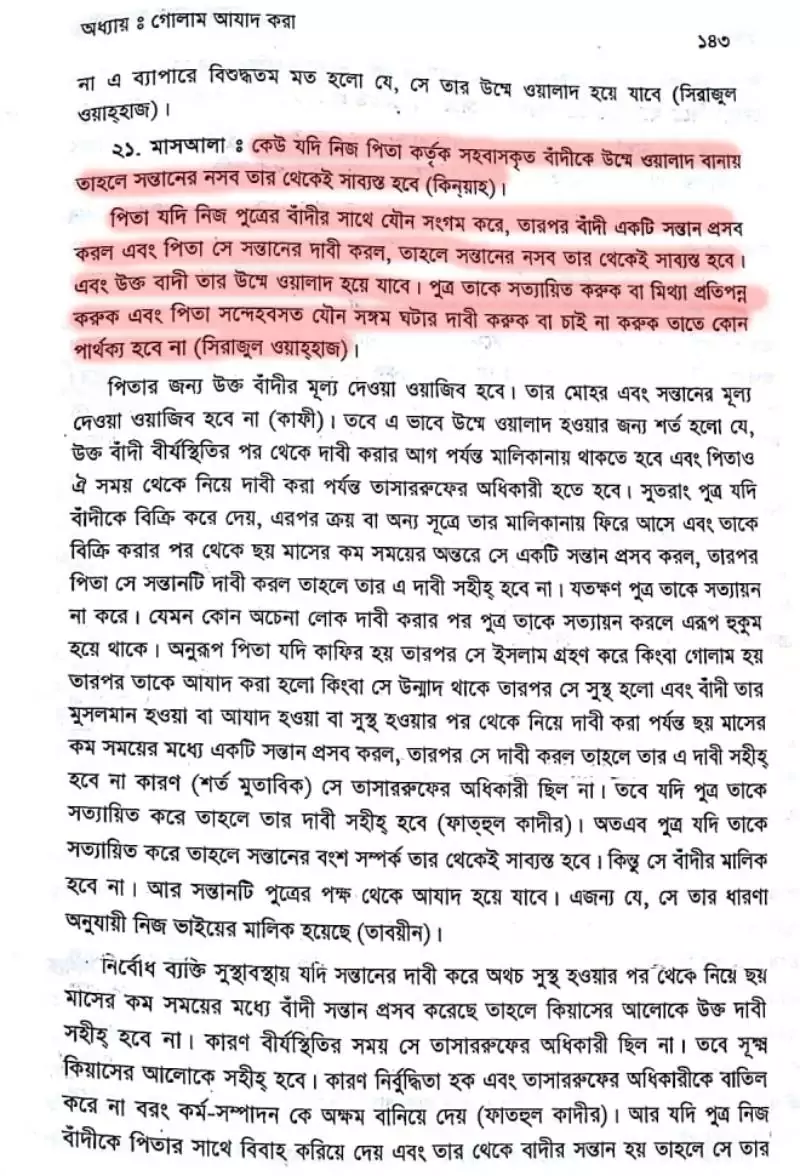
The Right to Choose Whom to Marry
In Islam, a male or female slave cannot choose a spouse according to personal preference. A slave must marry the person selected by the owner. Marriage and sexual relations therefore remain entirely subject to the owner’s wishes; the slave has no independent choice. This can be seen from the events involving a female slave named Barirah.
Barirah was a slave of Utbah ibn Abi Lahab, the son of Abu Lahab. Utbah was Muhammad’s son-in-law and initially a pagan, but embraced Islam during the attack on Mecca in January 630. He distinguished himself on Muhammad’s side at the Battle of Hunayn. Al-Tabari’s account establishes that he was one of Muhammad’s Companions.
After his death, his children became Barirah’s owners. It follows, naturally, that all of Utbah’s children were Muslims, because Islam explicitly rules that a Muslim’s heir cannot be an unbeliever. The hadith is not reproduced here; interested readers may consult it [219]. Nor may a Muslim inherit from an unbeliever. Since Utbah’s sons inherited Barirah [220], they must have been Muslims.
Sahih al-Bukhari (Islamic Foundation)
42/ Contractual Manumission
Section: 1606. If a mukatab asks someone to buy and manumit him, and that person buys him for that purpose.
Islamic Foundation number: 2395; international number: 2565
2395. Abu Nuaym (may Allah have mercy on him) … Narrated `Abdul Wahid bin Aiman: I went to `Aisha and said, “I was the slave of `Utba bin Abu Lahab. “Utba died and his sons became my masters who sold me to Ibn Abu `Amr who manumitted me. The sons of `Utba stipulated that my Wala’ should be for them.” `Aisha said, “Barirah came to me and she was given the writing of emancipation by her masters and she asked me to buy and manumit her. I agreed to it, but Barirah told me that her masters would not sell her unless her Wala’ was for them.” `Aisha said, “I am not in need of that.” When the Prophet (ﷺ) heard that, or he was told about it, he asked `Aisha about it. `Aisha mentioned what Barirah had told her. The Prophet (ﷺ) said, “Buy and manumit (free) her and let them stipulate whatever they like.” So, `Aisha bought and manumitted her and her masters stipulated that her Wala’ should be for them.” The Prophet;, said, “The Wala’ will be for the liberator even if they stipulated a hundred conditions.”
Hadith grade: Sahih
Narrator: Ayman (may Allah have mercy on him)
Barirah had been married against her wishes to a male slave whom she never liked. While enslaved, she could not leave her husband or annul the marriage, because it reflected her owner’s wishes. As soon as she became free, she left him. In Islam, a woman’s right to dissolve a marriage arises when the marriage was contracted against her wishes. The slave wandered about in tears, and Muhammad asked her to take him back, but Barirah refused [221] [222]. This means that, while enslaved, people cannot simply divorce a spouse selected by their owner. The owner’s command determines who their husband or wife will be. Only after becoming free do they acquire the right to marry or divorce according to their own preference. The owner’s power to annul slaves’ marriages will be discussed further below. For now, consider these hadiths —
Sahih al-Bukhari (Islamic Foundation)
55/ Divorce
Section: 2053. Selling a female slave does not divorce her.
Islamic Foundation number: 4899; international number: 5279
4899. Ismail ibn Abdullah (may Allah have mercy on him) … Narrated `Aisha: (the wife of the Prophet) Three traditions were established concerning situations in which Barra was involved: When she was manumitted, she was given the option to keep her husband or leave him; Allah’s Messenger (ﷺ) said, “The wala is for the one who manumits, Once Allah’s Messenger (ﷺ) entered the house while some meat was being cooked in a pot, but only bread and some soup of the house were placed before, him. He said, “Don’t I see the pot containing meat?” They said, “Yes, but that meat was given to Barira in charity (by someone), and you do not eat what it given in charity.”The Prophet (ﷺ) said “That meat is alms for her, but for us it is a present.”
Hadith grade: Sahih
Narrator: Aisha bint Abu Bakr al-Siddiq (may Allah be pleased with her)
Sahih al-Bukhari (Islamic Foundation)
55/ Divorce
Section: 2054. A female slave who has been manumitted may choose whether to remain with her enslaved husband.
Islamic Foundation number: 4901; international number: 5281
4901. Abd al-Ala ibn Hammad (may Allah have mercy on him) … Narrated Ibn `Abbas: That was Mughith, the slave of Bani so-and-so, i.e., Barira’s husband as if I am now looking at him following her (Barira) along the streets of Medina.
Hadith grade: Sahih
Narrator: Abdullah ibn Abbas (may Allah be pleased with him)
Sexual Use of a Married, Pregnant Female Slave
Another repugnant provision in Islam is that someone who acquires a pregnant woman as a slave may satisfy his sexual desires using parts of her body other than her genitals, with anal intercourse also excluded. He may therefore use her breasts, mouth, and other body parts for sexual gratification. Moreover, if a female slave is married to another man and becomes pregnant, her owner may still use other parts of her body for sexual pleasure, excluding her genitals. These details appear in Sahih al-Bukhari [223] [224] —
Sahih al-Bukhari (Islamic Foundation)
26/ Sales and Trade
Section: 1386. Travelling with a female slave before istibra, that is, establishing whether her womb is free of pregnancy. Hasan al-Basri (may Allah have mercy on him) saw no objection to kissing her or engaging in intimate contact with her. Ibn Umar (may Allah be pleased with him) said that if a female slave with whom intercourse has taken place is given away, sold, or manumitted, one menstrual period must be observed to establish whether her womb is free of pregnancy. Istibra is not required for a virgin. Ata (may Allah have mercy on him) said: One may enjoy one’s female slave who is pregnant by another man, apart from her genitals.Allah Most High’s words: “except with their wives or those ˹bondwomen˺ in their possession, for then they are free from blame,” … (23:6; English: Dr. Mustafa Khattab, The Clear Quran).
Islamic Foundation number: 2093; international number: 2235
2093. …
Hadith grade: Sahih
Narrator: Anas ibn Malik (may Allah be pleased with him)
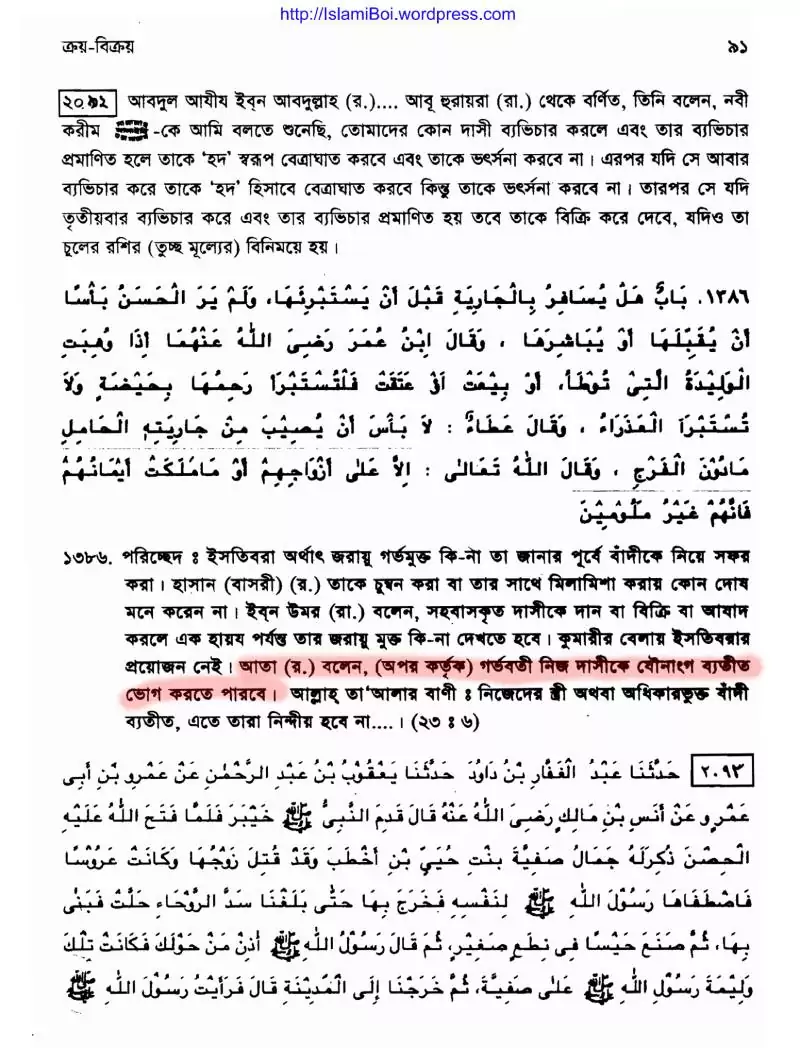
The Owner’s Power to Annul a Marriage
An even more objectionable provision in Islam allows an owner to annul a female slave’s marriage and use her sexually, even if she has a husband. Suppose an owner has a female slave married to another slave. If he wishes, he may annul her marriage and use her sexually. Consider the following hadith [225] [226] —
Sahih al-Bukhari (Tawhid Publication)
67/ Marriage
Section: 67/25. Which women are lawful to marry and which are forbidden.
Allah Most High says: “˹Also˺ forbidden to you for marriage are your mothers, your daughters, your sisters, your paternal and maternal aunts, your brother’s daughters, your sister’s daughters, your foster-mothers, your foster-sisters, your mothers-in-law, your stepdaughters under your guardianship if you have consummated marriage with their mothers … Surely Allah is All-Knowing, All-Wise.” (Excerpts from Surah An-Nisa 4:23–24; English: Dr. Mustafa Khattab, The Clear Quran).
وَقَالَ أَنَسٌ: (وَالْمُحْصَنَاتُ مِنَ النِّسَاءِ) ذَوَاتُ الأَزْوَاجِ الْحَرَائِرُ حَرَامٌ إِلاَّ مَا مَلَكَتْ أَيْمَانُكُمْ لاَ يَرَى بَأْسًا أَنْ يَنْزِعَ الرَّجُلُ جَارِيَتَهُ مِنْ عَبْدِهِ.
وَقَالَ: (وَلاَ تَنْكِحُوا الْمُشْرِكَاتِ حَتَّى يُؤْمِنَّ).
وَقَالَ ابْنُ عَبَّاسٍ مَا زَادَ عَلَى أَرْبَعٍ فَهْوَ حَرَامٌ، كَأُمِّهِ وَابْنَتِهِ وَأُخْتِهِ.
Anas (may Allah be pleased with him) said that (وَالْمُحْصَنَاتُ مِنَ النِّسَاءِ) means that married free women are forbidden in marriage, whereas sexual use of an owned female slave is not forbidden. If a man removes his female slave from her husband and subsequently uses her sexually, there is no objection. Concerning this, Allah says: “Do not marry polytheistic women until they believe” (Al-Baqarah 2:221; English: Dr. Mustafa Khattab, The Clear Quran). Ibn Abbas said that marrying more than four women is unlawful, just as marrying one’s mother, daughter or sister is unlawful.
5105. …
[1] Ali (may Allah be pleased with him) did not marry anyone else during Fatimah’s lifetime; he married subsequently.
Hadith grade: Sahih
Narrator: Abdullah ibn Abbas (may Allah be pleased with him)
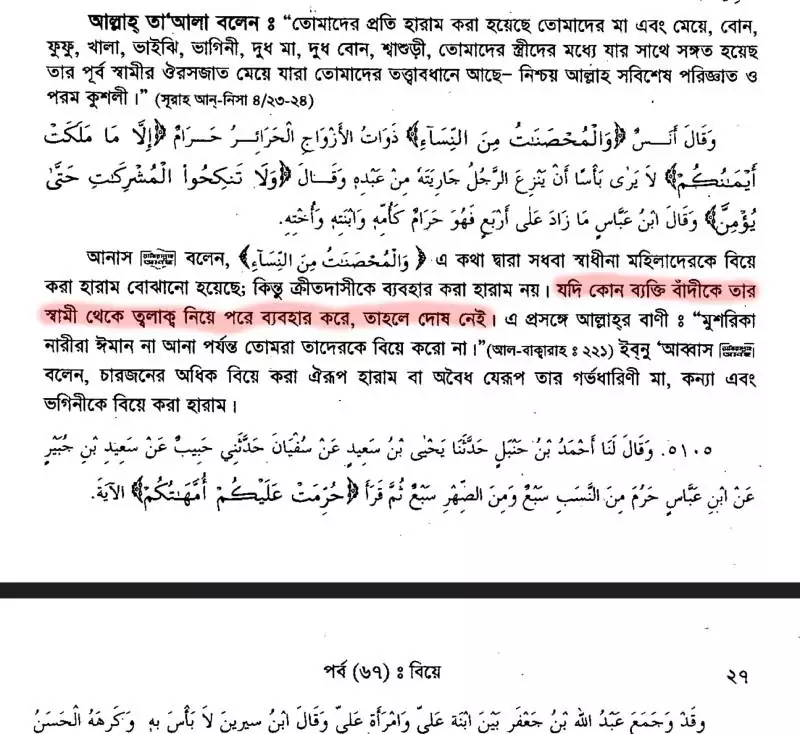
Even where a female slave has two owners, if one owner marries her to someone, the other may come and annul that marriage [227].
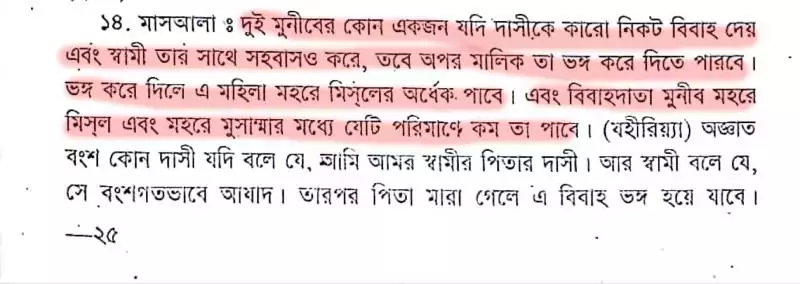
Slavery by Birth
In our country, people who raise cattle or goats often bring in a bull or male goat of a superior breed to mate with their own animals. They hope for offspring of a better breed that can be sold at a profit or put to productive work. Islam fully permits an equivalent practice with slaves.
An owned female slave can be married to another slave or to a free man and made pregnant in the hope that she will bear a strong male child who can be put to work or sold. Alternatively, if she bears a beautiful girl, the owner can use that girl sexually and subsequently take her to market and sell her. Such inhuman and cruel rules operated even in the medieval period. If a female slave marries someone other than her owner and bears a child, ownership of that child belongs to the mother’s owner. The infant is treated as his slave.
Under Islamic sharia, unless an owner has designated a female slave as a mudabbar, declaring that she will be freed after his death, any child she bears to someone other than the owner is regarded as the owner’s slave [228]. Can you imagine an infant becoming a slave at the very moment of birth?
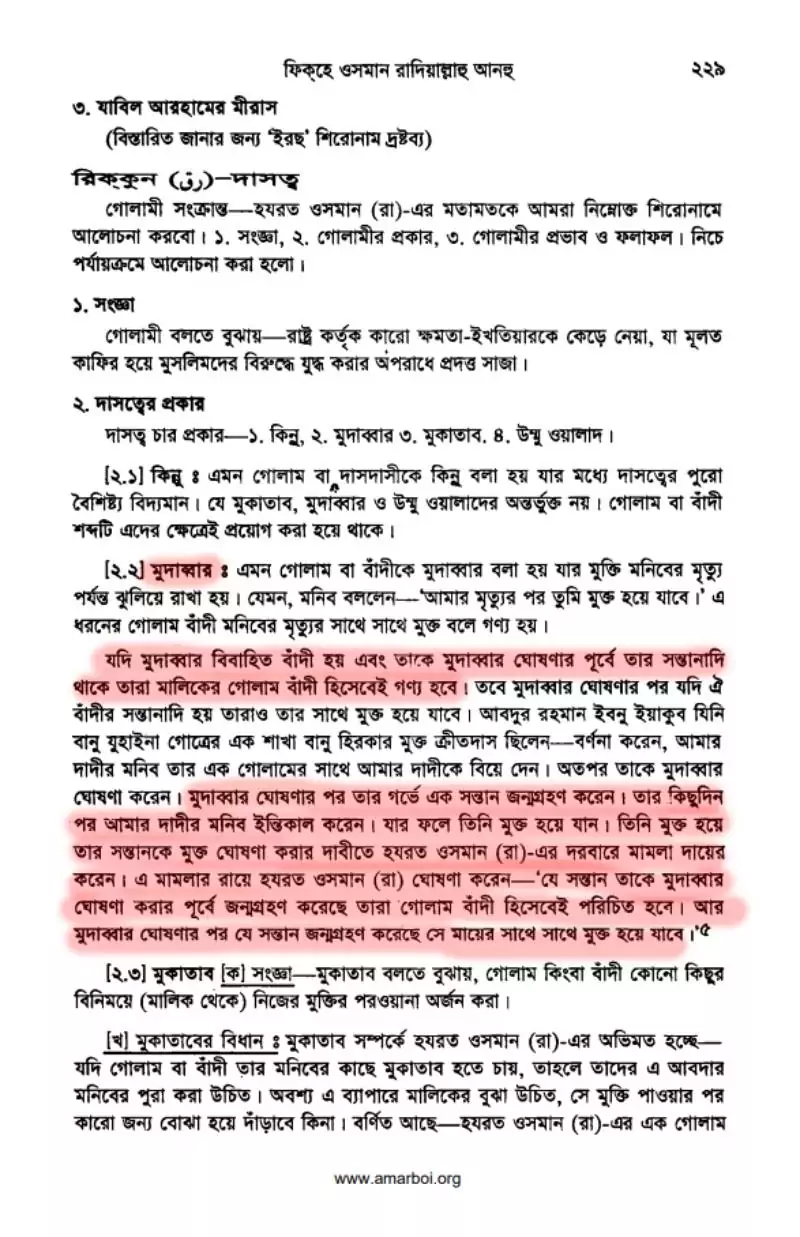
Let us also read Fiqh al-Sunnah on the rule that a child born to a female slave by someone other than her owner is enslaved from birth [229] —
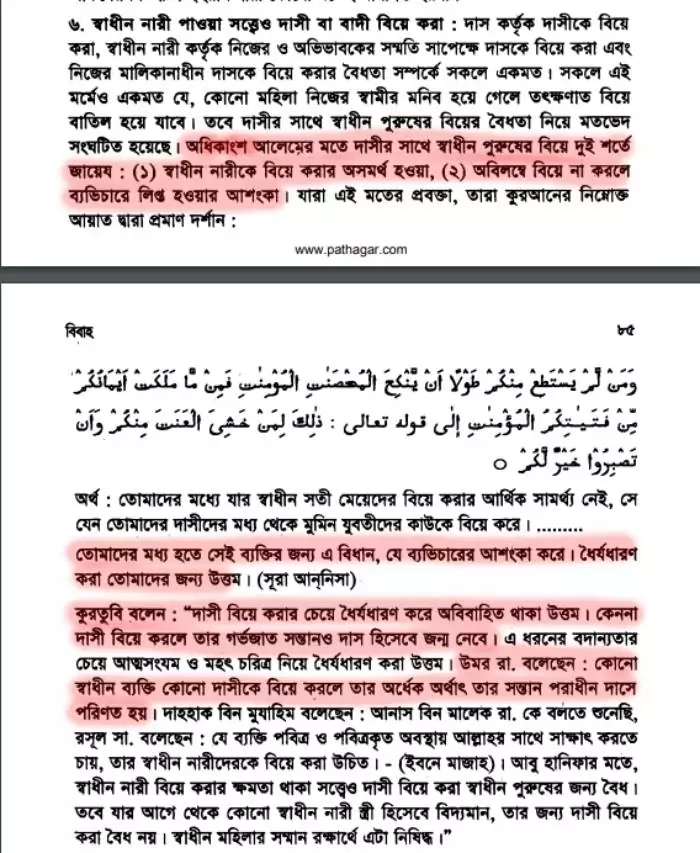
The same rule appears in the renowned jurisprudential work al-Hidaya [230] —
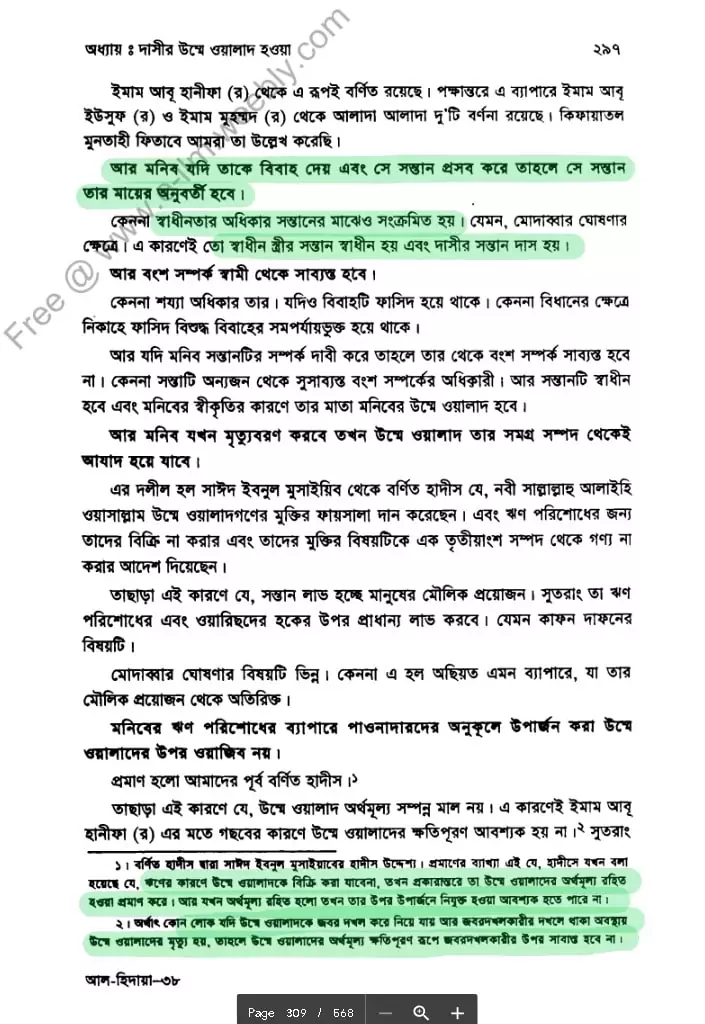
Now consider Tafsir Maariful Quran on the rule that a female slave’s child is regarded as the owner’s slave [231] —
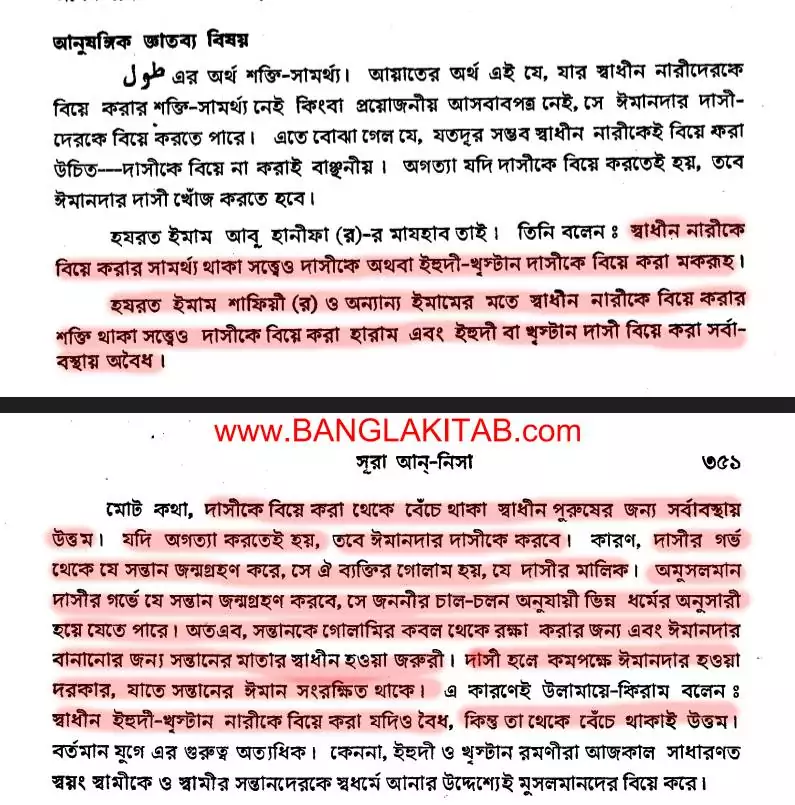
Consider Tafsir al-Jalalayn as well [232].
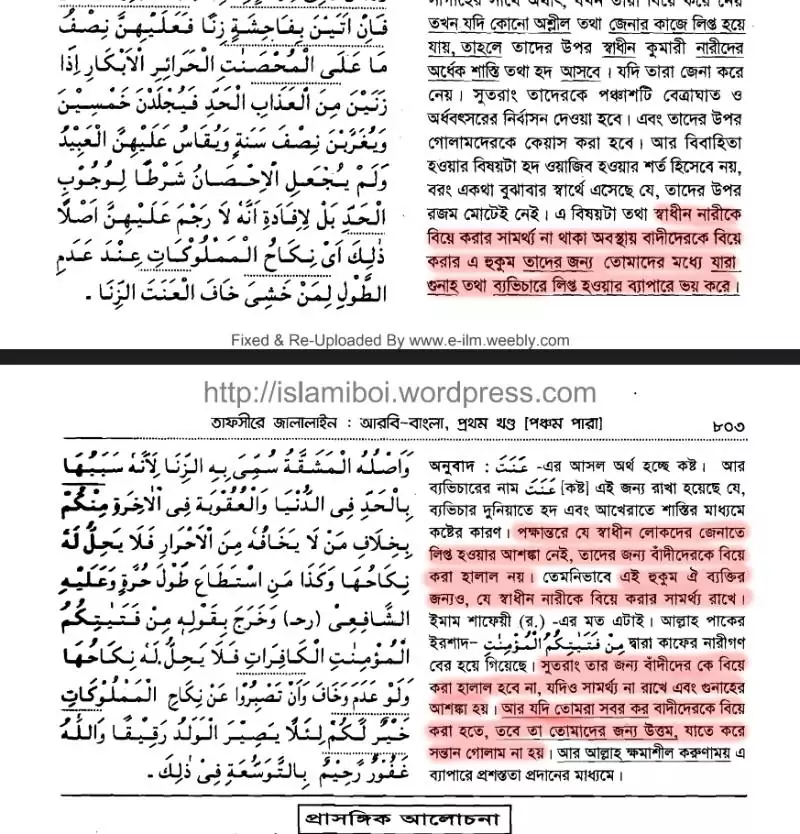
The Lesser Value Assigned to a Slave’s Life
During his rule, Abu Bakr maintained the provision, following Muhammad’s sharia, that an owner would not be sentenced to death for killing his slaves. This Islamic rule concerning the killing of slaves entails a particularly appalling discrimination. Fiqh Abu Bakr also states that slaves in Islam have the value and status of quadruped animals. On that basis, qisas cannot apply between a human and an animal: this is how the Islamic ruling is presented. Let us read directly from Fiqh Abu Bakr (may Allah be pleased with him) [233]. Caliph Umar subsequently maintained the same provision.
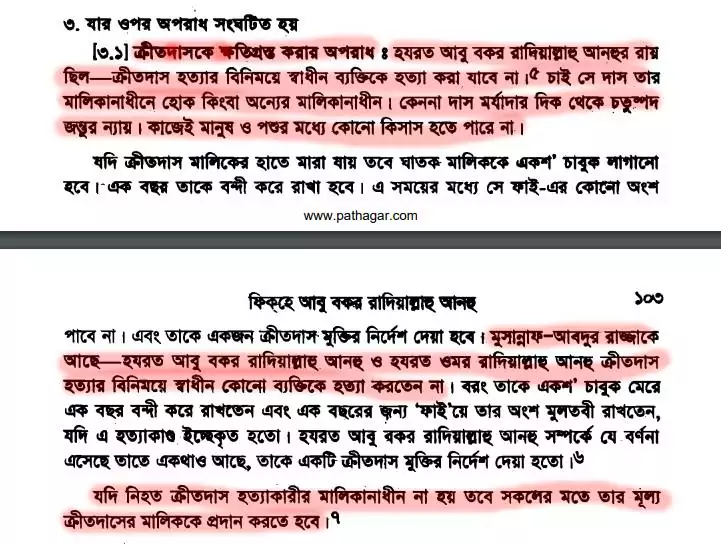
The same position is stated in Ahkam al-Quran [234].
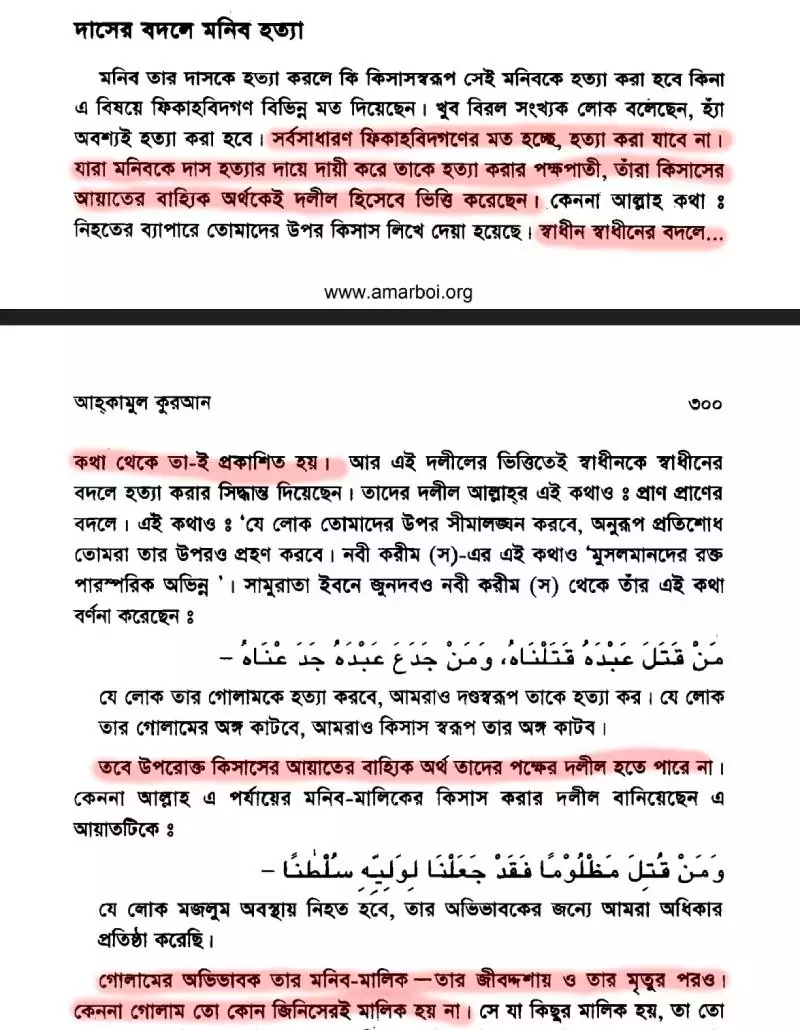
Slaves Are Like Livestock
Fiqh Abu Bakr and many other works state that slaves have the value and status of quadruped animals in Islam. The supporting passage has already been presented, but it is worth considering once more. Let us read directly from Fiqh Abu Bakr (may Allah be pleased with him) [233] —
Let us also carefully read a hadith commentary. Observe how it openly explains the exchange or sale of slaves by drawing an analogy with the exchange or sale of animals, specifically livestock. Since slaves are assigned a value comparable to livestock in Islam, the analogy likewise compares them with livestock. Notice that this hadith is used as evidence for a ruling concerning livestock [235] —
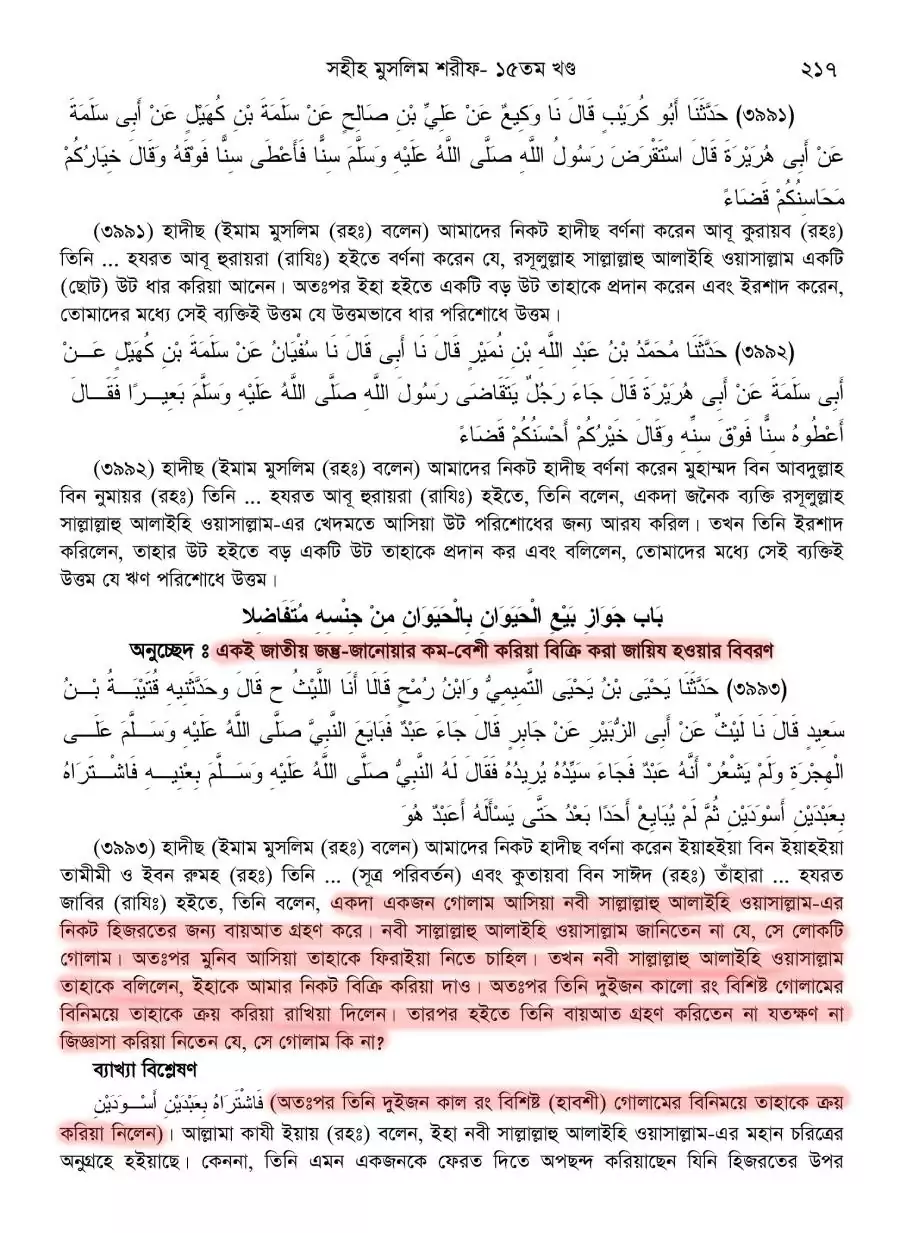
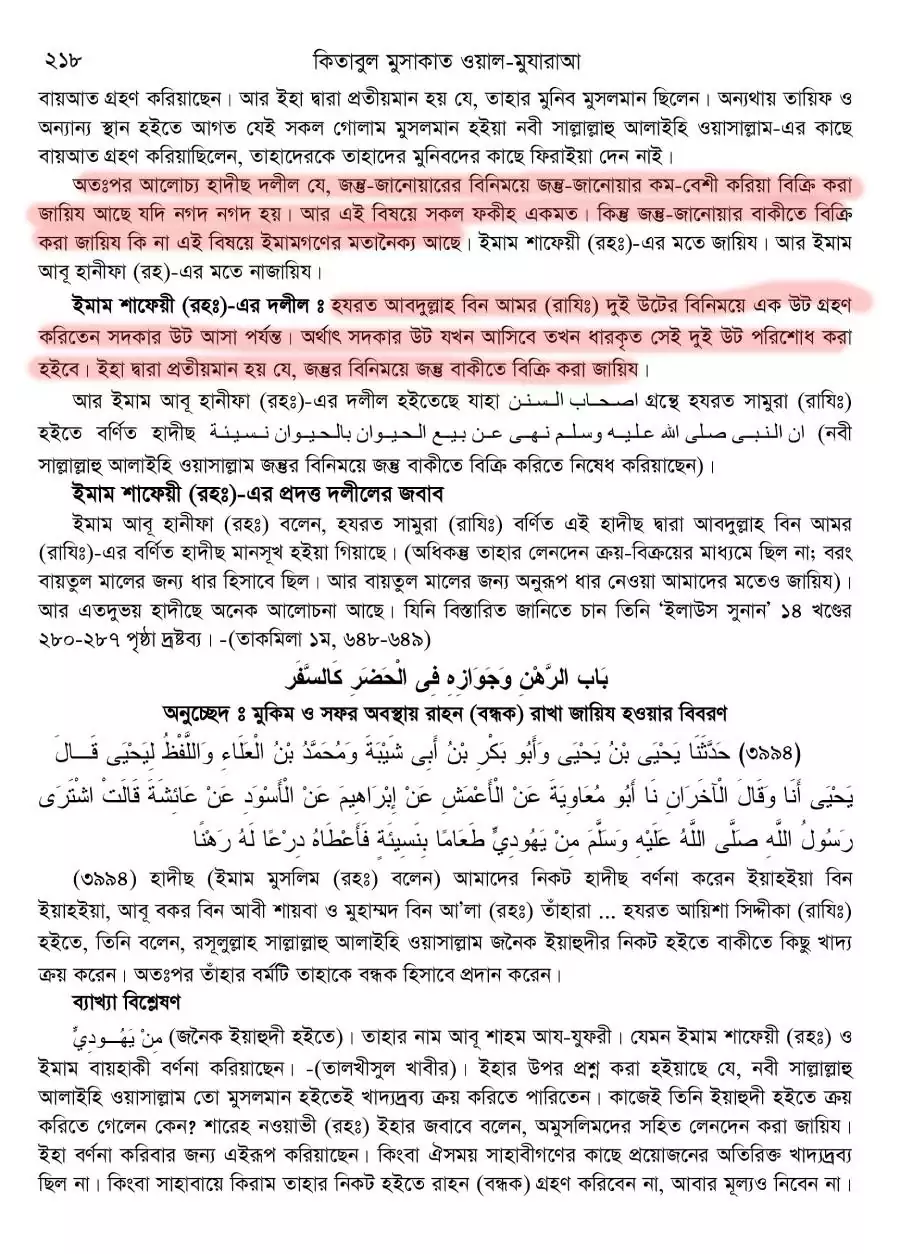
Slaves’ Capacity to Give Testimony
Slaves cannot give testimony in court. Since Islam does not regard them as fully human, they have no right to testify. The matter is also described in Fatawa Qadikhan [236] —
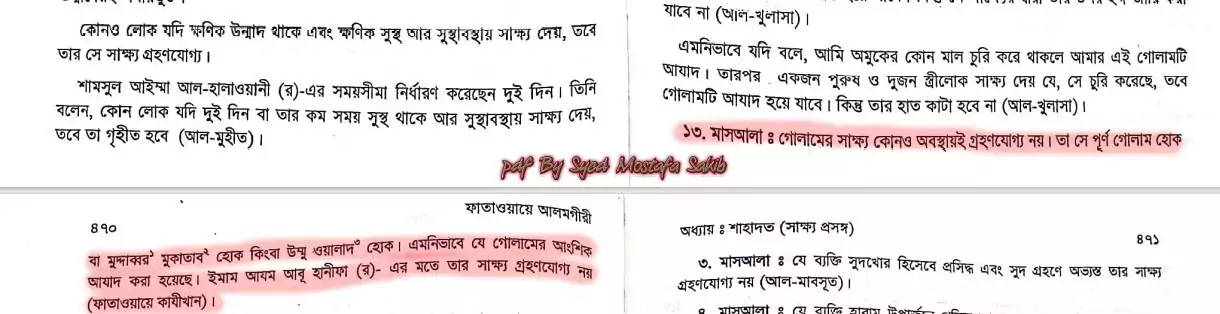
The marriage chapter of the same work also states that a slave cannot act as a witness to a marriage [237] —
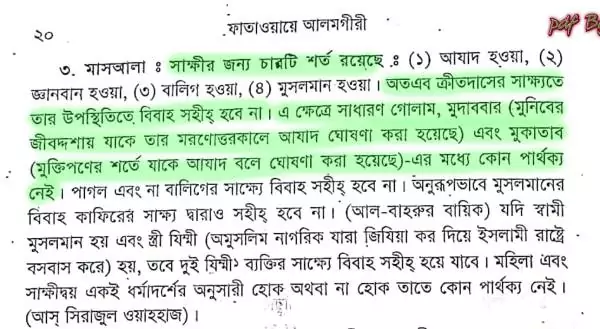
No Zakat Is Due on Slaves
A significant Islamic provision is that no zakat is payable on slaves. This matters because avoiding tax is a persistent human tendency: people generally want to pay as little tax as possible, in every period and under every system. If owning purchased slaves does not incur zakat, such a rule will encourage slave purchases and strengthen the slave market. Slave trading and transactions will increase.
This provision will never abolish the slave trade; instead, it makes it profitable. A business exempt from tax invariably attracts interest. Consider the relevant Islamic rules [238] [239] —
Sahih Muslim (Hadith Academy)
13/ Zakat
Section: 2. No zakat is due on a Muslim’s slave or horse
Hadith Academy number: 2163; international number: 982
2163-(8/982) Yahya ibn Yahya al-Tamimi (may Allah have mercy on him) … Abu Huraira reported Allah’s Messsenger (ﷺ) as saying: No Sadaqa is due from a Muslim on his slave or horse. (Islamic Foundation: 2142; Islamic Centre: 2145)
Hadith grade: Sahih
Narrator: Abu Hurayrah (may Allah be pleased with him)
Jami at-Tirmidhi (Islamic Foundation)
7/ Zakat
Section: No Zakat Is Due on Horses or Slaves.
626. Abu Kurayb Muhammad ibn al-Ala and Mahmud ibn Ghaylan (may Allah have mercy on them) … Abu Hurairah narrated that the Messenger of Allah said: “There is no charity due from a Muslim for his horse nor his slave.” — Ibn Majah 1812; Daifah 4014; Bukhari and Muslim; Tirmidhi Hadith: 628 [Al-Madani Publications]
Hadiths on this subject are also reported from Abdullah ibn Amr and Ali (may Allah be pleased with them). Imam Abu Isa (may Allah have mercy on him) says that Abu Hurayrah’s hadith is hasan sahih. Scholars follow this hadith: no zakat is due on freely grazing horses or slaves kept for service. If they are held for trade, however, zakat is due on their value after one year.
Hadith grade: Sahih
Narrator: Abu Hurayrah (may Allah be pleased with him)
A Slave’s Escape Is Kufr
In Islam, a slave’s escape is regarded as one of the gravest offences. Just as associating partners with Allah is the greatest offence, fleeing one’s owner is counted among the most serious crimes. According to a sahih hadith, a slave who runs away from his master commits kufr. Thus, just as associating partners with Allah is kufr, escaping one’s master is also kufr, an unforgivable offence in Islam.
When slavery was practised, many slaves fled, or at least tried to flee, because they could no longer bear an enslaved life. Islam, however, classified their escape as a supreme offence and thereby arranged to keep slaves bound in chains in their owners’ interests. Imam Abu Bakr Ahmad ibn al-Husayn ibn Ali al-Bayhaqi’s Shuab al-Iman states this with reference to sahih hadiths [240]. The same account appears in several hadiths [241] [242] [243] [244] —
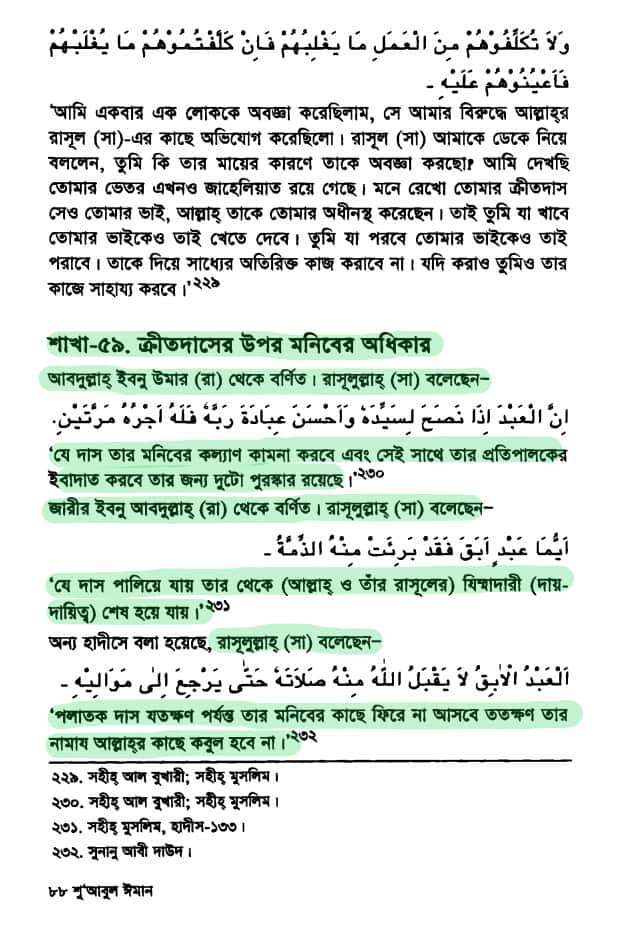
Sahih Muslim (Islamic Foundation)
1/ The Book of Faith
Section: 31. Calling a Runaway Slave an Unbeliever
132. Ali ibn Hujr al-Sadi (may Allah have mercy on him) … It is narrated on the authority of Jarir that he heard (the Holy Prophet) saying, The slave who fled from his master committed an act of infidelity as long as he would not return to him. Mansur observed: By God, this hadith was narrated from the Apostle (may peace and blessings be upon him), but I do not like that this should be narrated on my authority here in Basra.*
* Because many Kharijites and Mutazilites lived there and understood it as unbelief in the literal sense.
Hadith grade: Sahih
Narrator: al-Shabi (may Allah have mercy on him)
Sahih Muslim (Islamic Foundation)
1/ The Book of Faith
Section: 31. Calling a runaway slave an unbeliever
133. Abu Bakr ibn Abi Shaybah (may Allah have mercy on him) … It is narrated on the authority of Jarir that the Messenger of Allah (may peace and blessings be upon him) observed: The slave who fled from his master, responsibility with regard to him was absolved.
Hadith grade: Sahih
Narrator: Jarir ibn Abdullah al-Bajali (may Allah be pleased with him)
Sahih Muslim (Islamic Foundation)
1/ The Book of Faith
Section: 31. Calling a Runaway Slave an Unbeliever
134. Yahya ibn Yahya (may Allah have mercy on him) … Jarir b. Abdullah reported it from the Holy Prophet: When the slave runs away from his master, his prayer is not accepted.
Hadith grade: Sahih
Narrator: Jarir ibn Abdullah al-Bajali (may Allah be pleased with him)
Hadith Sambhar
21/ Slaves
Section: A slave’s escape from his master’s household is forbidden
(2028) Reported by the same narrator (may Allah be pleased with him), from the Prophet: When the slave runs away from his master, his prayer is not accepted.
(Muslim 239) Another report states: “The slave who fled from his master committed an act of infidelity as long as he would not return to him.” (Ibid. 237)
Hadith grade: Sahih
Narrator: Jarir ibn Abdullah al-Bajali (may Allah be pleased with him)
Giving Shelter to a Runaway Slave Is Also Forbidden
Under Islamic rules, no Muslim may shelter a slave who escapes, whether because of oppression and humiliation, a desire to break the chains of slavery, or any other reason. Nor may the slave act against his master’s wishes. Consider the hadith in Sahih al-Bukhari [245] —
Sahih al-Bukhari (Islamic Foundation)
73/ Inheritance
Section: 2810. The sin of a slave who acts against his masters’ wishes
Islamic Foundation number: 6299; international number: 6755
6299. Qutaybah ibn Said (may Allah have mercy on him) … Narrated `Ali: We have no Book to recite except the Book of Allah (Qur’an) and this paper. Then `Ali took out the paper, and behold ! There was written in it, legal verdicts about the retaliation for wounds, the ages of the camels (to be paid as Zakat or as blood money). In it was also written: ‘Medina is a sanctuary from Air (mountain) to Thaur (mountain). So whoever innovates in it an heresy (something new in religion) or commits a crime in it or gives shelter to such an innovator, will incur the curse of Allah, the angels and all the people, and none of his compulsory or optional good deeds will be accepted on the Day of Resurrection. And whoever (a freed slave) takes as his master (i.e. be-friends) some people other than hi real masters without the permission of his real masters, will incur the curse of Allah, the angels and all the people, and none of his compulsory, or optional good deeds will be accepted on the Day of Resurrection. And the asylum granted by any Muslim is to be secured by all the Muslims, even if it is granted by one of the lowest social status among them; and whoever betrays a Muslim, in this respect will incur the curse of Allah, the angels, and all the people, and none of his Compulsory or optional good deeds will be accepted on the Day of Resurrection.”
Hadith grade: Sahih
Narrator: Ibrahim al-Taymi (may Allah have mercy on him)
Giving a Slave Away Is Better than Manumission
Prophet Muhammad said that giving slaves to family members was better and earned greater religious reward than freeing them. Anyone considering manumission could therefore readily be discouraged by this hadith. Since giving the slave away is counted as the more meritorious act, the owner would choose that course. Ending the slave’s enslaved life would consequently become very difficult [246] —
Sahih al-Bukhari (Tawhid)
Chapter: 51/ Gifts and Their Virtues
Section: 51/15. A married woman may give gifts to someone other than her husband or manumit a slave if she is of sound judgement; if she is not, this is invalid.
2592. Narrated Kuraib: the freed slave of Ibn `Abbas, that Maimuna bint Al-Harith told him that she manumitted a slave-girl without taking the permission of the Prophet. On the day when it was her turn to be with the Prophet, she said, “Do you know, O Allah’s Messenger (ﷺ), that I have manumitted my slave-girl?” He said, “Have you really?” She replied in the affirmative. He said, “You would have got more reward if you had given her (i.e. the slave-girl) to one of your maternal uncles.” (2594)
Through another chain, Bakr ibn Mudar (may Allah have mercy on him) … Kurayb (may Allah have mercy on him) reports that Maymunah manumitted a slave. (Muslim 12/14, Hadith: 999; Ahmad 26886) (Adhunik Publications: 2404; Islamic Foundation: 2421)
Hadith grade: Sahih
Narrator: Maymunah (may Allah be pleased with her)
Sectarianism Even in Manumission
Islam, an intensely sectarian religion, and Muhammad, its sectarian Prophet, incorporated sectarianism even into the good act of manumission, thereby compromising it [247] [248] —
Sahih Muslim (Islamic Foundation)
Chapter: 21/ Manumission
Section: 4. The Virtue of Manumission
3655. Qutaybah ibn Said (may Allah have mercy on him) … Abu Huraira (Allah be pleased with him) reported: I heard Allah’s Messenger (ﷺ) as saying: He who emancipates a believing slave. Allah will set free from Fire his every limb for every limb of his (slave’s), even his private parts for his.
Hadith grade: Sahih
Narrator: Abu Hurayrah (may Allah be pleased with him)
Let us hear the statement on this subject by the prominent Bangladeshi scholar Dr Abu Bakr Muhammad Zakaria.
Still Enslaved after Paying Most of the Price
Under Islamic rules, if a slave seeks freedom by paying the owner an amount equivalent to his market value, he may, with the owner’s agreement, pay in instalments. If he cannot pay the remainder before completing those instalments, or becomes unable to earn any more, he remains a slave even after paying most of the price. He will not be freed. Consider the relevant hadith [248] —
Mishkat al-Masabih (Mishkat)
Book 14: Manumission of Slaves
Section: 1. Second Subsection — Manumitting a Jointly Owned Slave, Purchasing a Close Relative, and Manumitting a Slave during Illness
3401-[14] ‘Amr b. Shu’aib, on his father’s authority, told that his grandfather reported God’s Messenger as saying, “If anyone has agreed to let his slave buy his freedom for a hundred uqiyas and he pays them all but ten (or he said, ten dinars), and he is then unable to complete the amount, he remains a slave.” Tirmidhi, Abu Dawud and Ibn Majah transmitted it.[1]
[1] Hasan: Abu Dawud 3927; Tirmidhi 1260; Ibn Majah 2519; Ahmad 6666; Sahih al-Jami 6478. An uqiyah is equivalent to forty dirhams.
Hadith grade: Hasan
Narrator: Amr ibn Shuayb (may Allah have mercy on him)
Re-enslaving Freed Slaves
During his lifetime, Prophet Muhammad revoked the freedom of several slaves and returned them to slavery. These hadiths provide sharia evidence that even where an owner frees slaves at death, a head of state or caliph may revoke their manumission and maintain them in slavery. Consider the following hadiths [249] [250] —
Sahih al-Bukhari (Islamic Foundation)
Chapter: 41/ Manumission of Slaves
Section: 1590. Selling a Mudabbar.
2367. Adam ibn Abi Iyas (may Allah have mercy on him) … Narrated Jabir bin `Abdullah: A man amongst us declared that his slave would be freed after his death. The Prophet (ﷺ) called for that slave and sold him. The slave died the same year.
Hadith grade: Sahih
Narrator: Jabir ibn Abdullah al-Ansari (may Allah be pleased with him)
Narrated Jabir bin `Abdullah:
A man amongst us declared that his slave would be freed after his death. The Prophet (ﷺ) called for that slave and sold him. The slave died the same year.
Collection: Sunan Abi Dawud (Islamic Foundation)
Chapter: 24/ Manumission
Section: 10. A Person Who Manumits Slaves Exceeding One-third of His Property.
3920. Musaddad (may Allah have mercy on him) … ‘Imran b. Husain said: A man emancipated six slaved at the time of his death and he had no other property. The Prophet (ﷺ) was informed about it. He cast lots among them, emancipated two and retained four in slavery.
Hadith grade: Sahih
Narrator: Imran ibn Husayn (may Allah be pleased with him)
A Slave’s Property Belongs to the Owner
Under Islamic rules, if a slave possesses a particular skill and earns money by using it in his free time after completing his owner’s work, or if someone gives him money or property, that wealth belongs to his owner. Any property the slave has therefore belongs to the owner [251] —
Mishkat al-Masabih (Mishkat)
Book 14: Manumission of Slaves
Section: 1. Second Subsection — Manumitting a Jointly Owned Slave, Purchasing a Close Relative, and Manumitting a Slave during Illness
3396-[9] Ibn ‘Umar reported God’s Messenger as saying, “If anyone emancipates a slave who owns property he gets the slave’s property, unless the master stipulates otherwise.” Abu Dawud and Ibn Majah transmitted it.[1]
[1] Sahih: Abu Dawud 3962; Ibn Majah 2529; Irwa 1749; Sahih al-Jami 6054.
Hadith grade: Sahih
Narrator: Abdullah ibn Umar (may Allah be pleased with him)
The Owner Also Inherits from the Freed Slave
The freedom or manumission discussed in Islam is not unconditional; even release is subject to a condition. That condition is that, after a male or female slave dies, the former owner inherits all the freed person’s property. Islam thus places a provision within manumission that prevents it from being called freedom, for the Prophet said that the right of wala belongs to the person who manumits.
Islamists frequently cite a hadith concerning Aisha’s female slave Barirah. Many believers use it to claim that the Prophet’s wives spent their own money to free slaves. Yet a close reading reveals the actual situation. In that hadith, Aisha wanted to free Barirah in order to acquire her wala. She explicitly offered to pay the remainder of Barirah’s manumission price only if the right of wala would belong to her [252] [253] [254] —
Sahih Muslim (Islamic Foundation)
21/ Manumission
Section: 1. Patronage over the freed slave belongs to the manumitter
3638. Abu Kurayb Muhammad ibn al-Ala al-Hamdani (may Allah have mercy on him) … Abu Usamah, from Hisham ibn Urwah, from his father … ‘A’isha (Allah be pleased with her) reported: Barira came to me and said: My family (owners) have made contract with me (for granting freedom) for nine ‘uqiyas (of silver) payable in nine years, one ‘uqiya every year. Help me (in making this payment). I said to her: If your family so desires, I am prepared to make them the full payment in one instalment, and thus secure freedom for you, but the right of inheritance will vest in me, if I do so.
She (Barira) made a mention of that to her family, but they refused (except) on the condition that the right of inheritance would vest in them. She came to me and made mention of if She (‘A’isha) said: I scolded her. She (Barira) said: By Allah, it is not possible (they will never agree to it). And as she was saying it, Allah’s messenger (ﷺ) heard, and he asked me, I informed him and he said: Buy her and emancipate her, and let the right of inherit- ance vest in them, for they cannot claim it (rightfully) since the right of inherritance vests with one who emancipates (the slave; therefore, these people have no right to lay such false claims). And I did so.
She (‘A’isha) said: Then Allah’s Messenger (ﷺ) delivered a sermon in the evening. He extolled Allah and praised Him with what He deserves, and then said afterwards,: What has happened to the people that they lay down conditions which are not found in the Book of Allah? And the condition which is not found in the Book of Allah is invalid, even if its number is one hundred. The Book of Allah is more true (than any other deed) and the condition laid down by Allah is more binding (than any other condition). What has happened to the people among you that someone among you says:” Emancipate so and so, but the right of inheritance vests in me”? Verily, the right of inheritance vests in one who emancipates.
Hadith grade: Sahih
Narrator: Aisha bint Abu Bakr al-Siddiq (may Allah be pleased with her)
Sahih al-Bukhari (Islamic Foundation)
26/ Sales and Trade
Section: 1349. Imposing Unlawful Conditions in a Sale
Islamic Foundation number: 2034; international number: 2168
2034. Abdullah ibn Yusuf (may Allah have mercy on him) … Narrated `Urwa: Aisha said, “Barira came to me and said, ‘I have agreed with my masters to pay them nine Uqiyas (of gold) (in installments) one Uqiya per year; please help me.’ I said, ‘I am ready to pay the whole amount now provided your masters agree that your Wala’ will be for me.’ So, Barira went to her masters and told them about that offer but they refused to accept it. She returned, and at that time, Allah’s Messenger (ﷺ) was sitting (present). Barira said, ‘I told them of the offer but they did not accept it and insisted on having the Wala’.’
The Prophet (ﷺ) heard that.” `Aisha narrated the whole story to the Prophet. He said to her, “Buy her and stipulate that her Wala’ would be yours as the Wala’ is for the manumitter.” `Aisha did so. Then Allah’s Messenger (ﷺ) stood up in front of the people, and after glorifying Allah he said,
“Amma Ba`du (i.e. then after)! What about the people who impose conditions which are not in Allah’s Book (Laws)? Any condition that is not in Allah’s Book (Laws) is invalid even if they were one hundred conditions, for Allah’s decisions are the right ones and His conditions are the strong ones (firmer) and the Wala’ will be for the manumitter.”
* Mukatabah is an agreement to manumit one’s slave in exchange for a payment.
* One uqiyah is equivalent to 40 dirhams.
Hadith grade: Sahih
Narrator: Aisha bint Abu Bakr al-Siddiq (may Allah be pleased with her)
The hadith also reports that Barirah told Aisha her owners would not relinquish the condition concerning wala. On hearing this, Aisha no longer wished to buy her. This means that Aisha was more interested in obtaining the slave’s wala than in freeing her. It is not difficult to infer that the Prophet and his Companions manumitted slaves out of this desire. The following hadith provides evidence [255] [256] —
Sahih al-Bukhari (Islamic Foundation)
46/ Conditions
Section: 1696. Which Conditions Are Permissible When a Mukatab Agrees to Be Sold on Condition of Manumission
Islamic Foundation number: 2542; international number: 2726
2542. Khallad ibn Yahya (may Allah have mercy on him) … Narrated Aiman Al-Makki: When I visited Aisha she said, “Barirah who had a written contract for her emancipation for a certain amount came to me and said, “O mother of the believers! Buy me and manumit me, as my masters will sell me.” Aisha agreed to it. Barirah said, ‘My masters will sell me on the condition that my Wala will go to them.” Aisha said to her, ‘Then I am not in need of you.‘ The Prophet (ﷺ) heard of that or was told about it and so he asked Aisha, ‘What is the problem of Barirah?’ He said, ‘Buy her and manumit her, no matter what they stipulate.’ Aisha added, ‘I bought and manumitted her, though her masters had stipulated that her Wala would be for them.’ The Prophet (ﷺ) said, The Wala is for the liberator, even if the other stipulated a hundred conditions.”
Hadith grade: Sahih
Narrator: Aisha bint Abu Bakr al-Siddiq (may Allah be pleased with her)
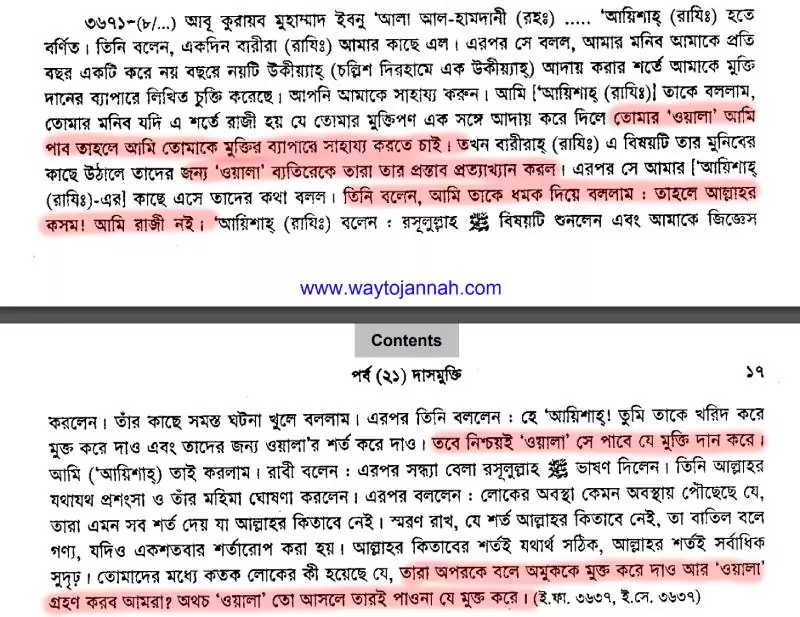
Let us now examine what this right of wala, or patronage, actually entails [254] —
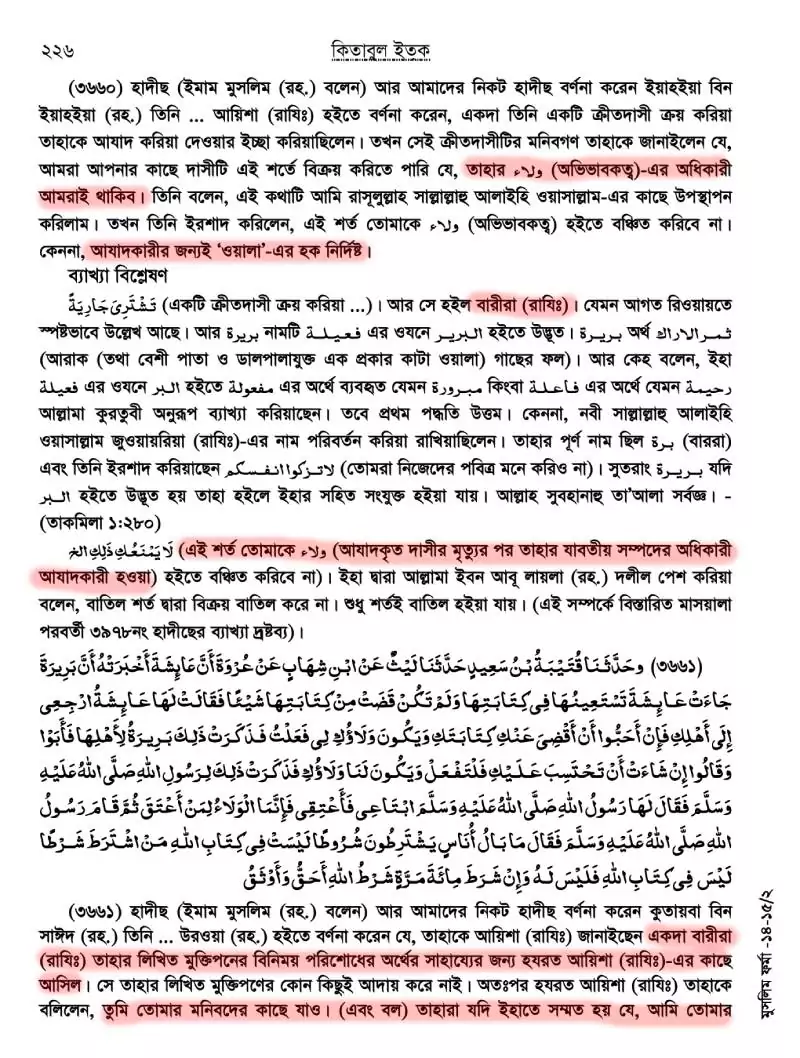
This hadith is particularly significant because it shows that Barirah’s owners told Aisha they would agree if she wished to purchase and free Barirah solely for religious reward, but not if she sought the right of wala. Aisha did not accept that offer; instead, the Prophet himself ruled that wala belonged to the manumitter [257] [258] —
Sahih Muslim (Hadith Academy)
21/ Manumission
Section: 2. In fact, the manumitter receives the freed slave’s wala, the right to inherit the property left behind
Hadith Academy number: 3669; international number: 1504
3669-(6/…) Qutaybah ibn Said (may Allah have mercy on him) … ‘A’isha (Allah be pjeased with her) reported that Barira came to her in order to seek her help in securing freedom, but she had (so far) paid nothing out of that sum stipulated in the contract. ‘A’isba said to her. Go to your family (who owns you), and if they like that I should pay the amount (of the contract) on your behalf (for purchasing your freedom), then I shall have the right in your inheritance. (If they accepted it) I am prepared (to make this payment). Barira made a mention of that to the (members of) her family, but they refused and said: If she (Hadrat ‘A’isha) wants to do good to You for the sake of Allah, she may do it, but the right of inheritance will be ours. She (Hadrat ‘A’isha) made a mention of that to Allah’s Messenger (ﷺ), and he said to her: Buy her, and emancipate her, for the right of inheritance vests with one who emancipates (the slave). Allah’s Messenger, may peace be upon him) then stood up and said: What has happened to the people that they lay down conditions which are not (found) in the Book of Allah? And he who laid down a condition not found in the Book of Allah, that is not valid. even if it is laid down hundred times. The condition laid down by Allah is the most weighty and the most valid. (Islamic Foundation: 3635; Islamic Centre: 3635)
Hadith grade: Sahih
Narrator: Aisha bint Abu Bakr al-Siddiq (may Allah be pleased with her)
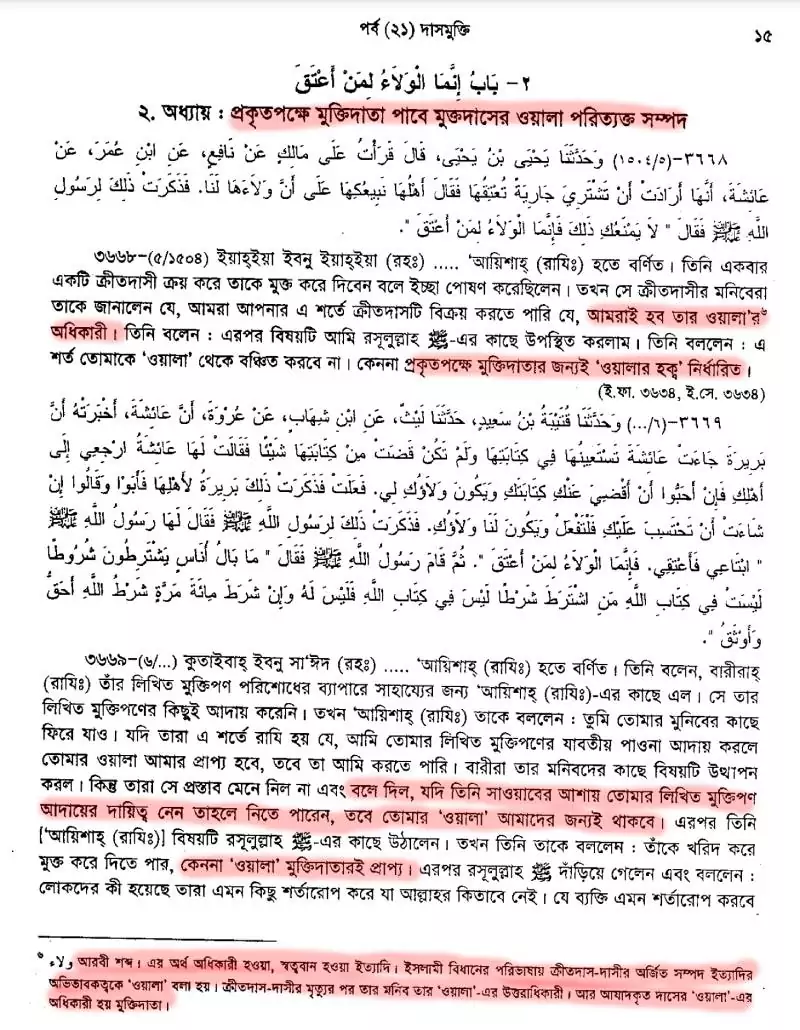
Now consider the explanation of wala and the Islamic rules governing it after manumission in Al-Misbah al-Nuri Sharh Mukhtasar al-Quduri, a commentary on the work of the prominent Imam al-Quduri [259] —
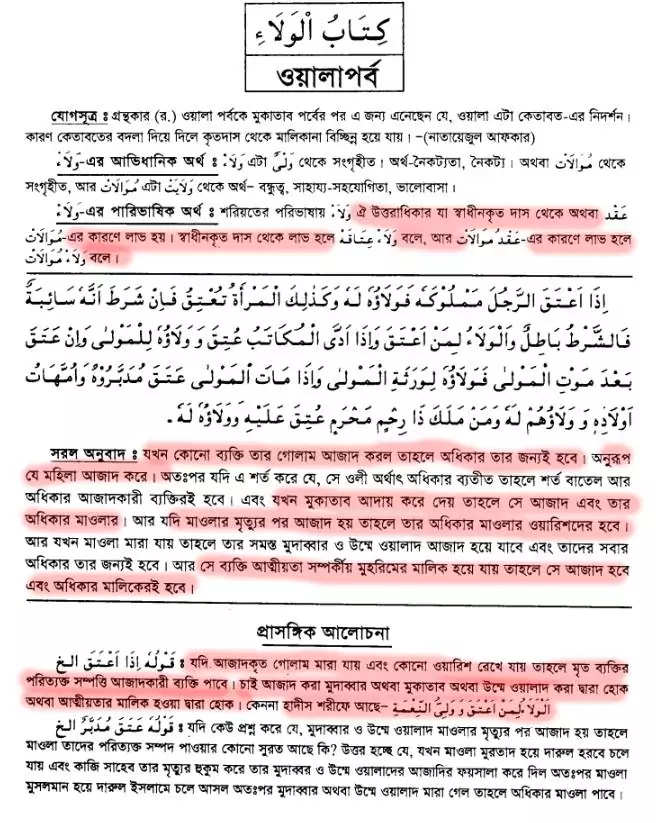
A further provision demonstrates that, under Islamic sharia, even a freed slave is not entirely free. His owner remains his owner for life, because he cannot choose someone else to inherit from him or hold his wala [260] [261] —
Sahih Muslim (Hadith Academy)
21/ Manumission
Section: 4. It is forbidden for a freed slave to make anyone other than the manumitter the holder of his wala
Hadith Academy number: 3683; international number: 1508
3683-(18/1508) Qutaybah ibn Said (may Allah have mercy on him) … Abu Huraira (Allah be pleased with him) reported that Allah’s Messenger (ﷺ) said: He who takes anyone as his ally without the consent of his previous master, there will be the curse of Allah and that of His angels upon him, and neither, any obligatory act of his nor the supererogatory one will be accepted (by Allah). (Islamic Foundation: 3649; Islamic Centre: 3649)
Hadith grade: Sahih
Narrator: Abu Hurayrah (may Allah be pleased with him)
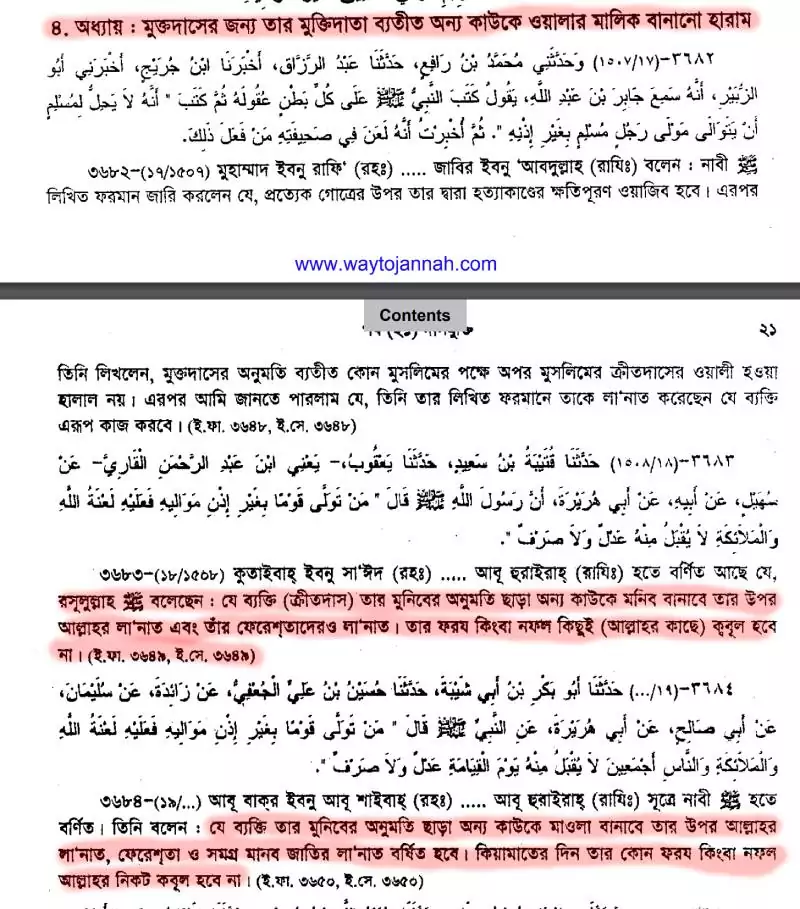
Slaves Acquired through Other Means
Apart from female war captives, Islam permits acquiring slaves through purchase in the market, gifts or donations, and joint purchases, among other means. If several people jointly buy a female slave, both owners may have intercourse with her on the basis of ownership. Evidence for this appears in Fatawa Alamgiri [262] —
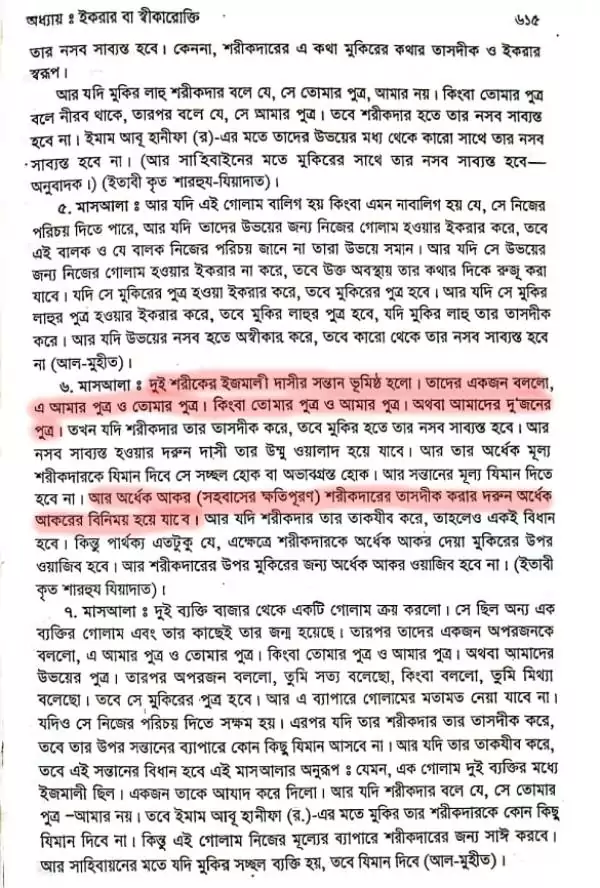
Let us examine in greater detail how Islam prescribes arrangements for sharing female slaves sexually. Reading these provisions would be enough to unsettle any person of sound mind [263] —
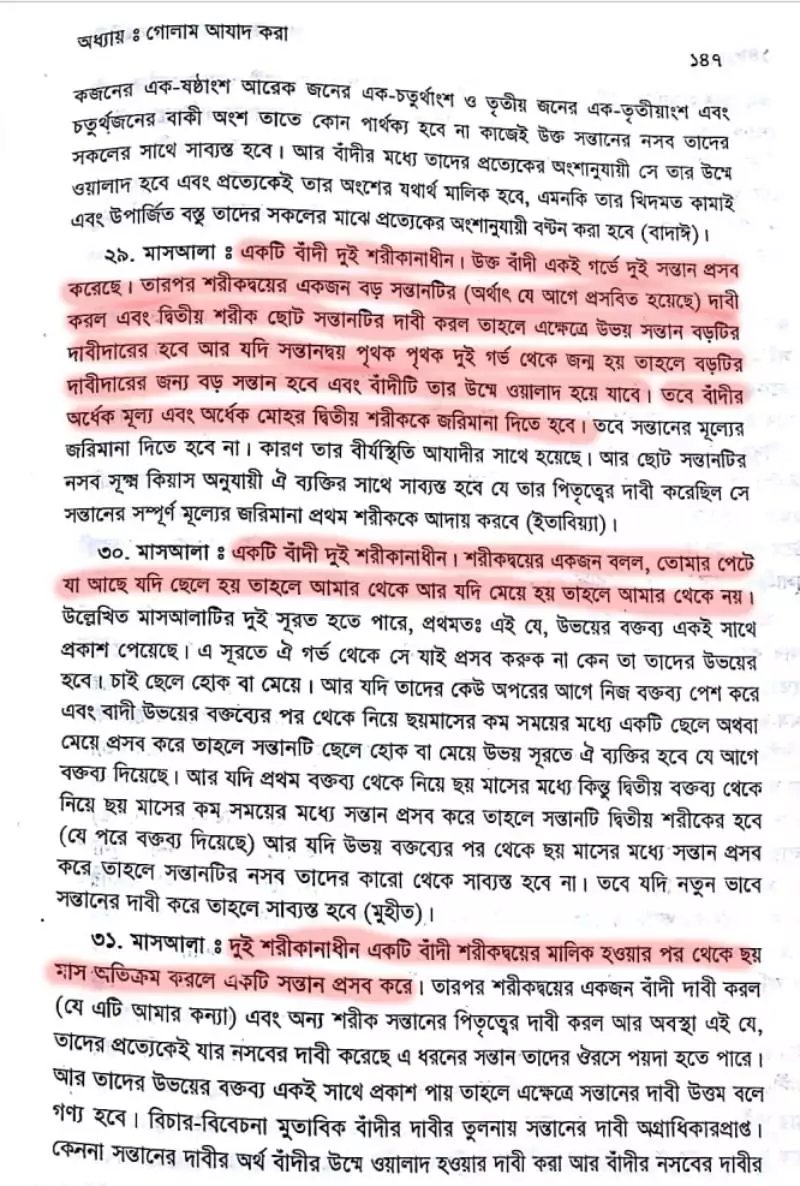
Falsehoods Offered by Embarrassed Muslims
When asked why Islam maintained a barbaric and uncivilised institution such as slavery, many embarrassed Muslims resort to various falsehoods. They regularly make claims so ridiculous that no Islamic scholar has ever advanced anything of the kind. Some even assert that Islam prohibited slavery, or that there is no such thing as a slave in Islam. Such statements invite ridicule, but our purpose is also to refute them with the relevant evidence. We therefore examine several widely circulated false claims.
False Claims about the Meaning of Malakat
Disregarding all shame, many Muslims claim that malakat in the Quran means guardianship, comparable to a father’s role. Yet virtually all Quran translations render the word as referring to slaves. Ownership through the right hand, or becoming someone’s owner by exercising power, is precisely what slavery means. Let us hear two statements made by believers online.
Did Islam Prohibit Slavery?
Many uninformed Muslims today abruptly claim, without evidence, that Islam prohibited slavery. They point to the absence of slaves today as supposed proof. Yet if Islamic sharia retains provisions for slavery, why are slaves no longer found? To answer this question, consider a response in Fatawa Faqih al-Millat, where a prominent mufti addresses it from an Islamic perspective [264] —
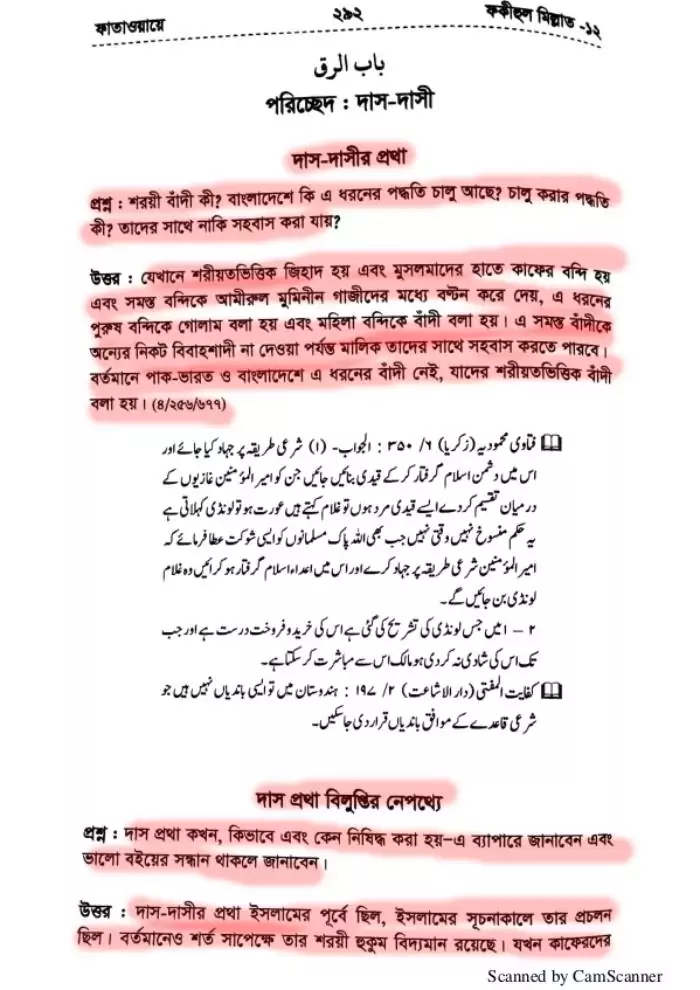
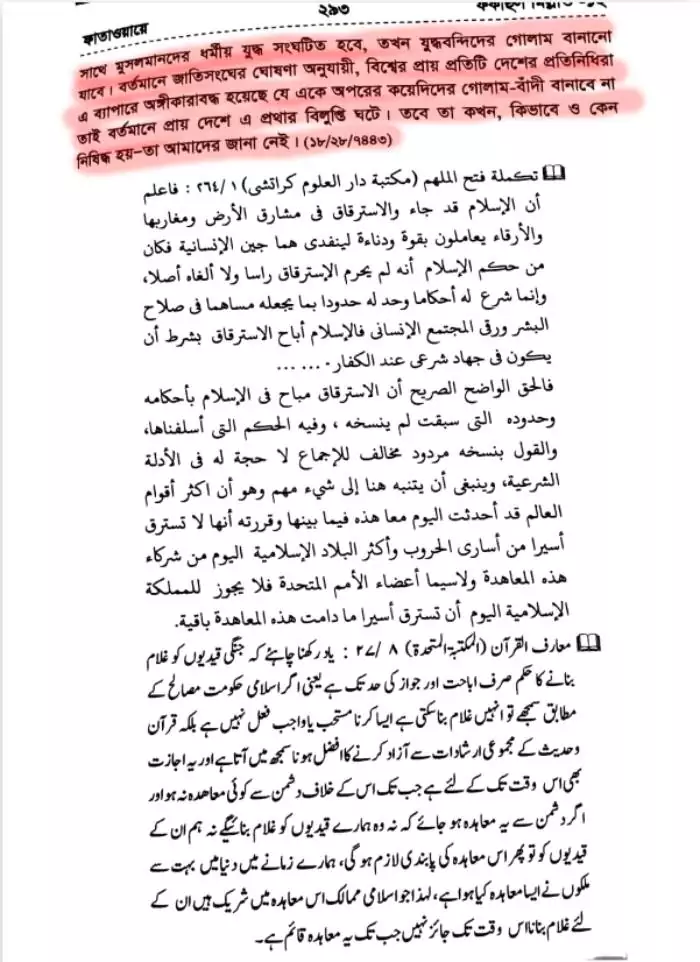
Other Muslims cite a verse of Surah Muhammad in an attempt to prove that Islam prohibited enslavement. Let us read the commentary on Surah Muhammad in Maariful Quran [265] —
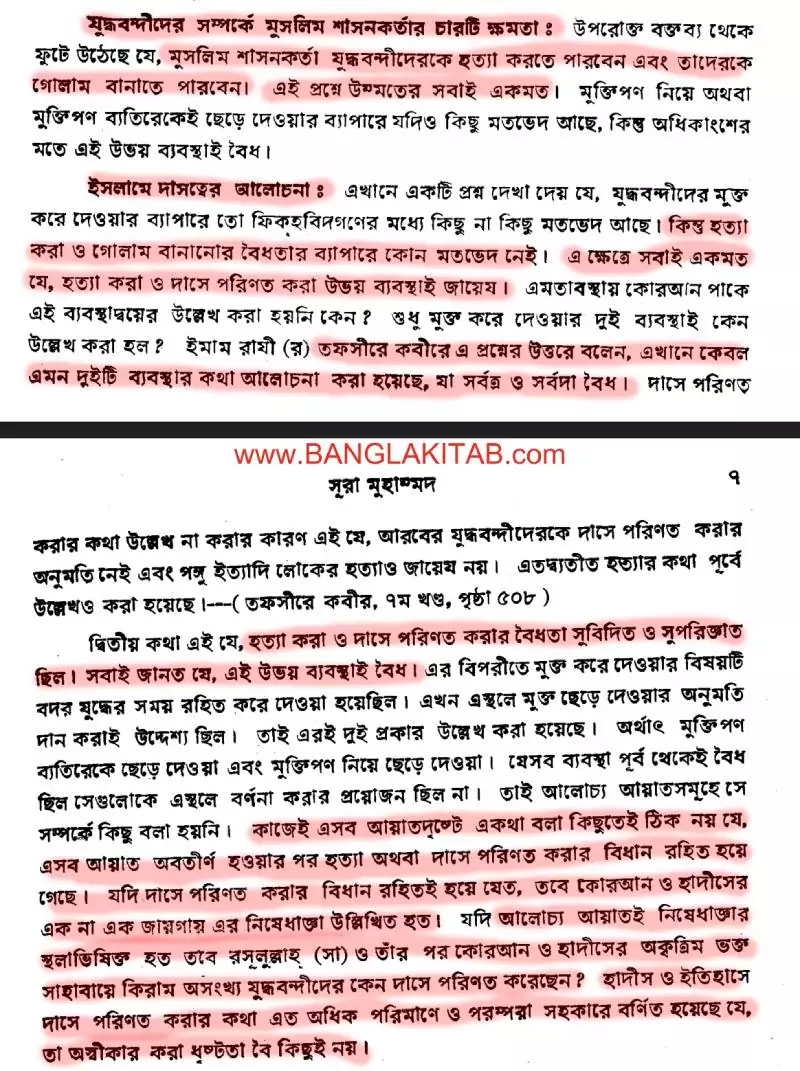
Let us hear what Bangladeshi Islamic scholars say on this subject.
Slavery Already Existed!
When slavery in Islam is questioned, the first defence commonly offered by Muslims is that slavery already existed. The implication seems to be that a pre-existing practice ceases to be immoral. Suppose a rapist said, “Rape already existed in our society.” How would that argument sound? Would any court forgive him on that basis? Or suppose Myanmar passed a new law providing that killing Muslims would no longer be punished, and justified it by saying that Muslims had already been killed before. How would such an argument sound? Would Muslims accept it? Would it not be absurd?
Or suppose France enacted a law requiring that any woman seen wearing a burqa have it forcibly removed, and justified this by saying that the practice already existed. Would Muslims accept such a ridiculous argument? Does the prior existence of a practice make participation in it morally right? Whether it existed before is irrelevant: an injustice remains an injustice.
Moreover, according to Islam’s own claims, slavery had already existed within Islam. How? Islam regards Adam, Moses, David, and Solomon as its own prophets. We all know that Prophet Abraham received Hajar as a female slave for service [266]. The number of female slaves held by Prophet Solomon is also described in al-Bidaya wa-l-Nihaya [267] —
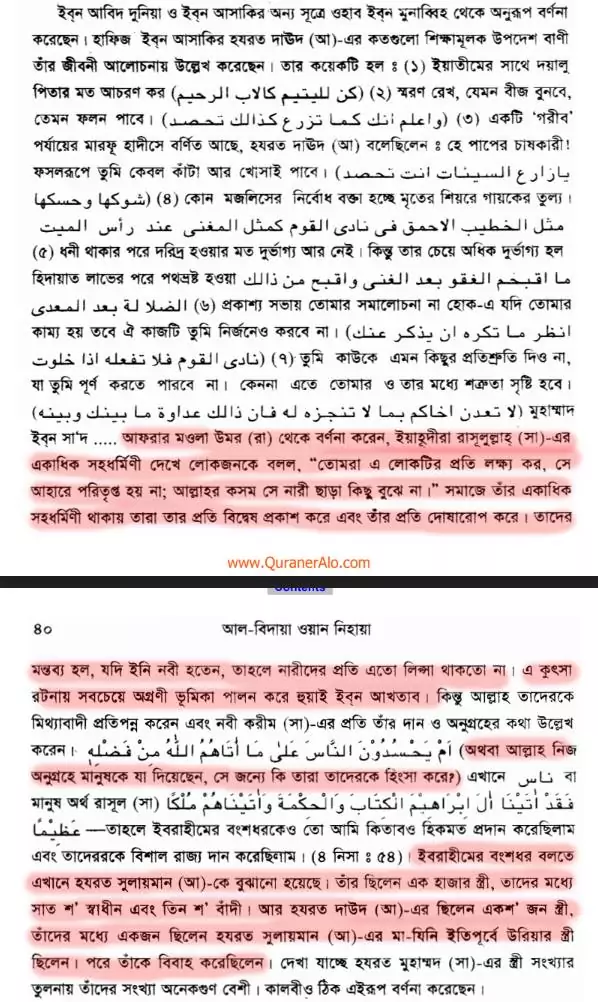
This means that slavery existed in the eras of Islam’s prophets. None called for its abolition or prohibited it. Paganism, idolatry, drinking alcohol, usury, and numerous other practices also predated Islam. Society was immersed in them, and countless people’s livelihoods depended on usury, alcohol, or idol worship. Muhammad prohibited those practices, yet could not bring forth even a single verse prohibiting slavery.
After the conquest of Mecca, he also declared that all the corrupt practices of the age of ignorance had now been buried beneath his feet. Yet he continued to keep slaves, and his caliphs likewise kept them during their rule. If slavery was a practice of paganism or the age of ignorance, how could the Prophet and his Companions retain slaves after abolishing all its corrupt customs? How true, then, is the claim that slavery was a pagan or pre-Islamic practice? Was it instead a practice of the prophets throughout the ages, an inseparable part of Islam itself?
Is Calling Someone a Slave Forbidden in Islam?
Many Muslims embarrassed by slavery claim that Islam even forbids calling anyone a slave. Yet no such position appears in the explanations of established Islamic scholars. A hadith discourages saying “my male slave” or “my female slave,” but this is not forbidden. Scholars classify it as makruh tanzihi, meaning disliked, rather than haram. Several caliphs themselves addressed slaves as slaves.
The title of this hadith’s section itself describes saying “my male slave” or “my female slave” as makruh, not haram. This is because the word abd is associated with worship: a servant worships his master. Since Islam commands worship of Allah alone, calling a person one’s own abd is disliked. This does not mean it is forbidden. Consider the hadith and its explanation in Sharh Muslim [268] [269] [270] —
Sahih al-Bukhari (Tawhid Publication)
49/ Manumission of Slaves
Section: 49/17. Beating slaves and saying “my male slave” or “my female slave” are makruh.
2552. Narrated Abu Huraira: The Prophet (ﷺ) said, “You should not say, ‘Feed your lord (Rabbaka), help your lord in performing ablution, or give water to your lord, but should say, ‘my master (e.g. Feed your master instead of lord etc.) (Saiyidi), or my guardian (Maulai), and one should not say, my slave (Abdi), or my girl-slave (Amati), but should say, my lad (Fatai), my lass (Fatati), and ‘my boy (Ghulami). (Adhunik Publications: 2367; Islamic Foundation: 2384)
Hadith grade: Sahih
Narrator: Abu Hurayrah (may Allah be pleased with him)
Sunan Abi Dawud (Verified Edition)
36/ Etiquette
Section: 83. A slave or servant must not call the owner “my Lord”
4975. Narrated AbuHurayrah: The Prophet (ﷺ) said: None of you must say: “My slave” (abdi) and “My slave-woman” (amati), and a slave must not say: “My lord” (rabbi or rabbati). The master (of a slave) should say: “My young man” (fataya) and “My young woman” (fatati), and a slave should say “My master” (sayyidi) and “My mistress” (sayyidati), for you are all (Allah’s slave and the Lord is Allah, Most High.[1]
Sahih.
[1] Bukhari’s al-Adab al-Mufrad; Ahmad.
Hadith grade: Sahih
Narrator: Abu Hurayrah (may Allah be pleased with him)
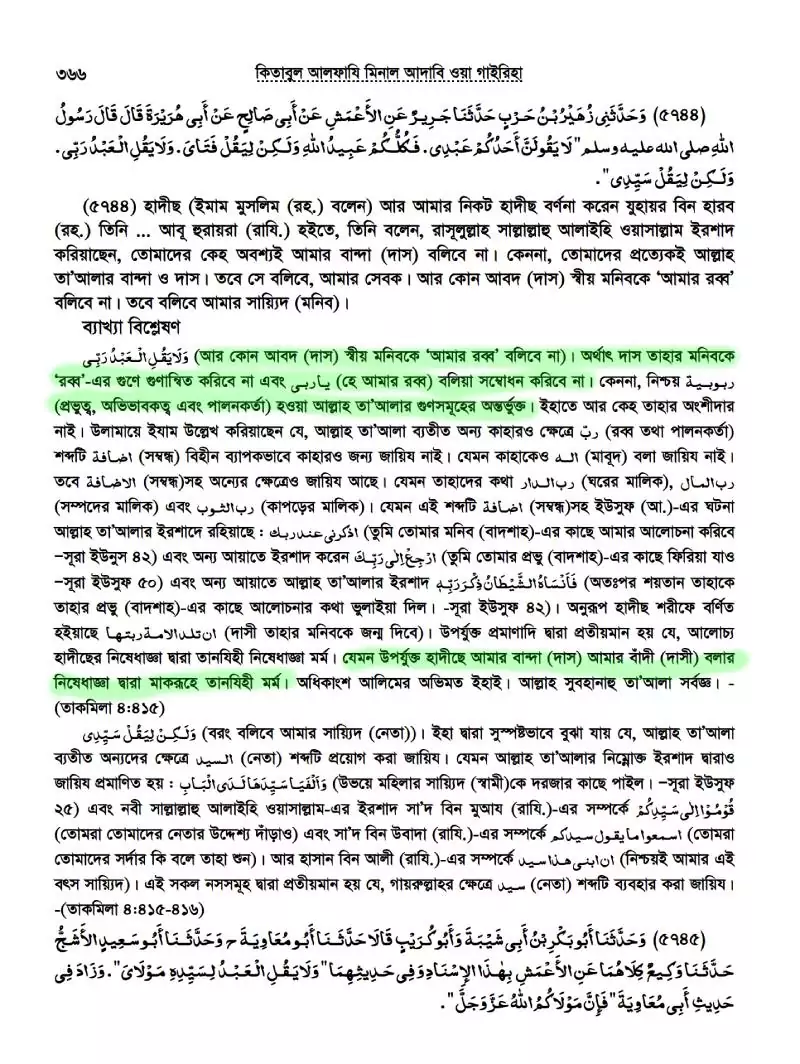
Is Marriage to a Female Slave Compulsory?
The question may arise: to whom does the reference to marrying female slaves in Surah al-Nisa, verse 25, apply [271]? Many moderate Muslims interpret this verse to mean that intercourse with a female slave is permissible only after marrying her. Yet no Companion, Successor, or later scholar interpreted it that way. Let us consult Maariful Quran on whether marrying a female slave before intercourse is compulsory, or whether this provision applies only to people unable to marry a free woman [231] —
Now consider Tafsir al-Jalalayn [232] —
Let us also read the explanation in Fiqh al-Sunnah [229]. It means that marrying a female slave owned by someone else is permitted only for people unable to afford marriage to a free woman, where they fear committing unlawful intercourse.
Do Wives and Female Slaves Have Equal Status?
Many Islamists now claim, without shame and simply to win an argument, that female slaves and wives have equal status in Islam. It is difficult to tell whether this elevates slaves or demeans wives. They fail to recognise that equating a wife with a slave simultaneously insults the wife. Tafsir al-Jalalayn, however, states something entirely different: the rights and honour of female slaves and wives differ under Islamic rules [272] [187] [273] –
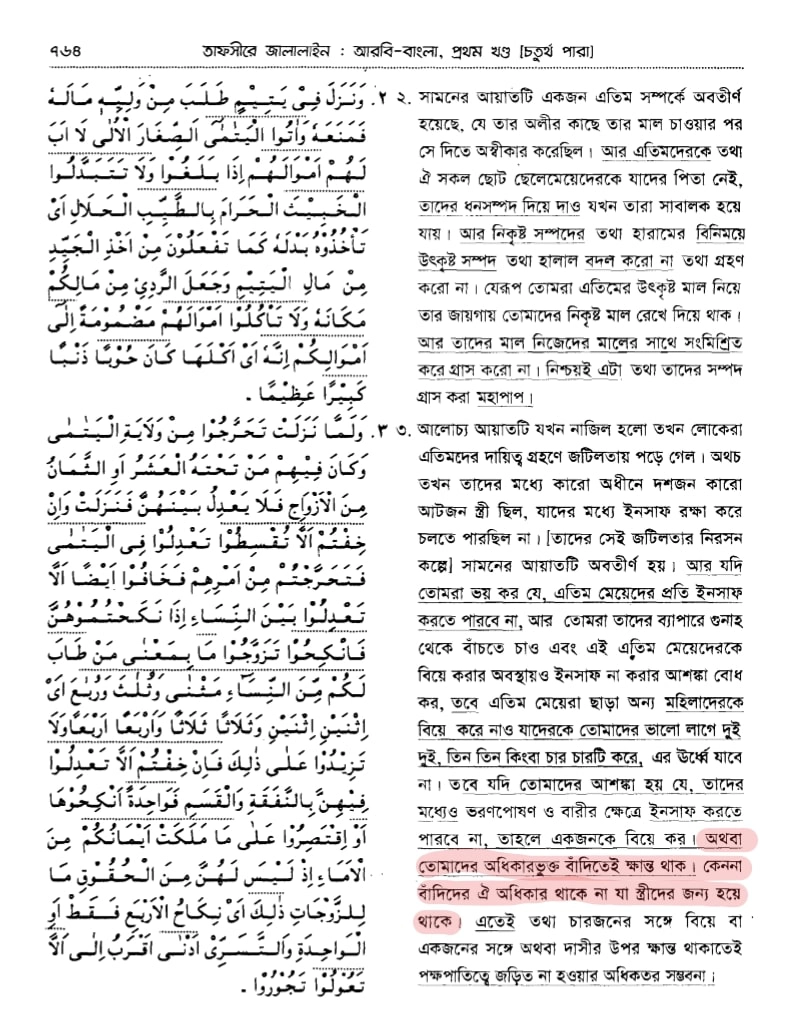
Was the Purpose to Shelter Women Who Had Lost Their Husbands?
Many Muslims shamelessly claim that the compassionate Prophet’s heart ached for helpless female war captives whose husbands had fled or been killed, and that he therefore permitted his Companions to have intercourse with them solely for humanitarian reasons, so that they could find a new home. These claims are entirely false. At the time, even the husbands of many women were taken captive. The compassionate Prophet’s jihadist Companions took their wives away and raped them in front of their husbands. Consider the following hadith [274] —
Sunan Abi Dawud (Islamic Foundation)
6/ Marriage
Section: 139. Intercourse with Female Captives.
2152. Ubaydullah ibn Umar ibn Maysarah … Abu Sa’id Al Khudri said “The Apostle of Allaah(ﷺ) sent a military expedition to Awtas on the occasion of the battle of Hunain. They met their enemy and fought with them. They defeated them and took them captives. Some of the Companions of Apostle of Allaah (ﷺ) were reluctant to have relations with the female captives because of their pagan husbands.So, Allaah the exalted sent down the Qur’anic verse “And all married women (are forbidden) unto you save those (captives) whom your right hand posses.” This is to say that they are lawful for them when they complete their waiting period.
Hadith grade: Sahih
Narrator: Abu Said al-Khudri (may Allah be pleased with him)
The actual reason behind this rule permitting sexual use of unbelieving women becomes clear from the following sermon.
Were They Kindly Told to Wait through the Iddah?
Many believers argue that the compassionate Prophet, the guide of all humanity, required his Companions to wait through an iddah before mounting female war captives. Listening to this claim, one might think that he had performed an extraordinary humanitarian act. They claim that this interval allowed the captives to overcome grief at the loss of loved ones and prepare psychologically for intercourse with their masters.
The iddah, or waiting period to establish whether the womb is free of pregnancy, can range from one day to a month; for a pregnant woman it may extend to nine months. Thus some female captives would have to overcome the grief of losing relatives in war and prepare for intercourse with their Muslim owner within a day. Others might receive a few weeks, or, if fortunate, a month. In reality, Islam requires waiting for menstruation or childbirth so that any child conceived through subsequent intercourse can be identified as the owner’s.
Let us examine the evidence that once a captive woman had menstruated, intercourse became lawful for the Prophet’s Companions [275] [276] [277]. Her menstrual period could end on the very day of capture. This therefore fails to substantiate the claim that the interval was provided for mourning. Rather, it demonstrates concern that another man’s child should not be counted as a Muslim owner’s child. A child fathered by another man would, moreover, be regarded as a slave.
Mishkat al-Masabih (Mishkat)
Book 13: Marriage
Section: 16. Second Subsection — Establishing That the Womb Is Free of Pregnancy
3338-[2] Abu Sa’id al-Khurdi traced to the Prophet the following statement regarding the captives taken at Autas, “There must be no intercourse with a pregnant woman till she gives birth to her child, or with one who is not pregnant till she has had one menstrual period.” Ahmad, Abu Dawud and Darimi transmitted it.[1]
[1] Sahih: Abu Dawud 2157; Ahmad 11228; Darimi 2341; Irwa 187; Sahih al-Jami 7479.
Hadith grade: Sahih
Narrator: Abu Said al-Khudri (may Allah be pleased with him)
Mishkat al-Masabih (Mishkat)
Book 13: Marriage
Section: 16. Third Subsection — Establishing That the Womb Is Free of Pregnancy
3341-[5] Ibn ‘Umar said that when a girl with whom intercourse might be had was given as a present, or sold, or set free, it was necessary to wait till she had had a menstrual period, but that this was unnecessary in the case of a virgin. Razin transmitted.[1]
[1] Sahih: not found in Razin; Imam al-Bukhari (may Allah have mercy on him) instead cites it without a chain before Hadith 2235.
Hadith grade: Sahih
Narrator: Abdullah ibn Umar (may Allah be pleased with him)
Sahih Muslim (Islamic Foundation)
18/ Suckling
Section: 1. After istibra, intercourse with a female war captive is permissible, and any existing marriage is annulled
3477. Abu Sa’id al-Khudri (Allah her pleased with him) reported that at the Battle of Hanain Allah’s Messenger (ﷺ) sent an army to Autas and encountered the enemy and fought with them. Having overcome them and taken them captives, the Companions of Allah’s Messenger (may peace te upon him) seemed to refrain from having intercourse with captive women because of their husbands being polytheists. Then Allah, Most High, sent down regarding that: ” And women already married, except those whom your right hands possess (iv. 24)” (i. e. they were lawful for them when their ‘Idda period came to an end).
[For a pregnant woman, istibra lasts until delivery; otherwise, one menstrual period constitutes istibra.]
Hadith grade: Sahih
Narrator: Abu Said al-Khudri (may Allah be pleased with him)
Did Female War Captives Willingly Have Intercourse?
This is an exceptionally crude falsehood that surpasses every limit of shamelessness. Some Muslims issue a ridiculous challenge to atheists to prove that intercourse with female war captives occurred against the women’s wishes. They demand that atheists produce Islamic evidence that these captives did not consent. Such demands raise serious questions about the reasoning abilities of those who make them. First, let us hear a sermon.
It is a matter of common sense that Islamic sources—the Quran, hadith, tafsir, and sira—record the words of the Prophet, the Companions, and Muslims, and are filled with their praise. They do not record what enslaved female war captives said or did not say. Listening to these claims, one would think the captured women had themselves confessed: “After watching the Companions brutally kill our fathers, brothers, or husbands, we were so impressed by the Prophet’s heroic Companions that we could no longer resist having intercourse with them! We were so captivated that we eagerly sought sex with them of our own accord! As soon as our fathers, brothers, husbands, and sons were slaughtered, we danced into the Companions’ laps!”
It is entirely natural that these women would not willingly agree to intercourse with men who had killed their relatives, taken them captive, deprived them of freedom, turned them from free people into slaves, and destroyed the households painstakingly built with their children, husbands, siblings, and parents. If the opposite is alleged—if someone claims that nothing was forced upon her—her own testimony is required to establish that she willingly agreed. Sexual activity with a captive already demonstrates that captivity affected the circumstances. Voluntary intercourse requires release from captivity and the ability to give consent freely.
The Islamists claiming that female war captives agreed to intercourse with the Companions must produce the women’s own testimony that they consented voluntarily. They must also establish that these statements were not produced through fear or terror, and that the women were no longer in chains. A captive naturally fears that threats, power, physical force, or authority might be used to extract apparent consent.
Conversely, several hadiths clearly describe female war captives being gathered as booty, from whom the Companions selected slaves for intercourse. The slaves were certainly not asked which man they wished to accompany or with whom they wished to have intercourse. Nowhere is there an account of these women freely choosing individual Companions and happily going to bed with them. Captives and slaves have no opportunity to express their preferences. Consider the following hadith [278] [279] —
Sunan Abi Dawud (Verified Edition)
14/ Taxation, Fai, and Administration
Section: 21. The Commander’s Share of War Booty
2998. Anas said “Captives were gathered at Khaibar. Dihyah came out and said “Apostle of Allaah(ﷺ) give me a slave girl from the captives.” He said “Go and take a slave girl. He took Safiyyah daughter of Huyayy. A man then came to the Prophet (ﷺ) and said “You gave Safiyyah daughter of Huyayy, chief lady of Quraizah and Al Nadir to Dihyah? This is according to the version of Ya’qub. Then the agreed version goes “she is worthy of you.” He said “call him along with her. When the Prophet (ﷺ) looked at her, he said to him “take another slave girl from the captives. The Prophet (ﷺ) then set her free and married her.[1]
[1] Sahih.
Hadith grade: Sahih
Narrator: Anas ibn Malik (may Allah be pleased with him)
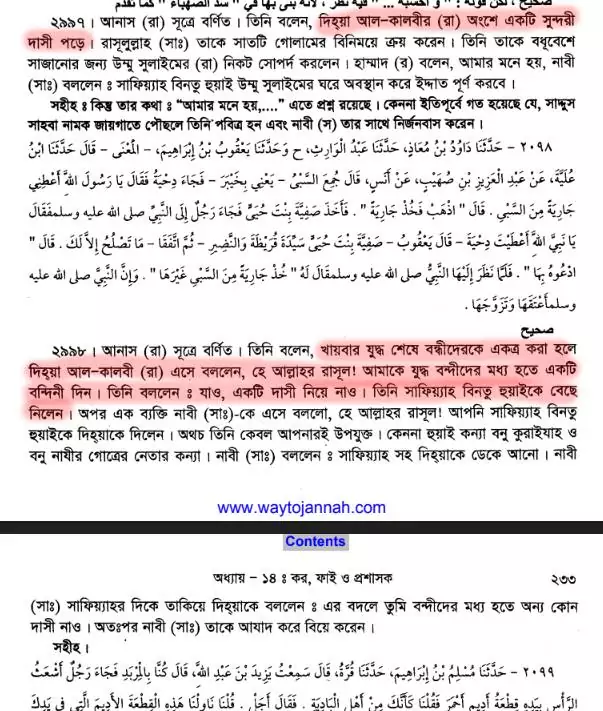
Let us now consider further evidence showing that Islam contains no concept of obtaining consent: even a wife’s consent is not required for sexual activity. The notion that sexual activity requires the other person’s consent is absent from Islam. Under its rules, a wife must comply whenever her husband wishes; the status assigned to a female slave is already being demonstrated in this article.
Slavery and the Sexual Rights of Female War Captives
The Quran repeatedly uses the expression “ملک اليمين” (malakat aymanukum, “what your right hands possess”) for female war captives or slaves purchased in the marketplace. Another article discusses this in detail and may be consulted by interested readers [280]. Wives, with whom a contract and consent exist, and female slaves, with whom there is no contract or consent, are both designated lawful sexual partners.
In Surah al-Nahl, verse 75 [281], a slave is compared to someone who “has no power over anything.” This perspective forms the basis of Islamic jurisprudence: a male or female slave is denied independent will and consent, and the master holds rights over the slave’s body, labour, and sexuality.
Allah sets forth a parable: a slave who lacks all means, compared to a ˹free˺ man to whom We granted a good provision, of which he donates ˹freely,˺ openly and secretly. Are they equal? Praise be to Allah. In fact, most of them do not know.
— Taisirul Quran (Bengali source; English quotation: Dr. Mustafa Khattab, The Clear Quran)
Allah sets forth a parable: a slave who lacks all means, compared to a ˹free˺ man to whom We granted a good provision, of which he donates ˹freely,˺ openly and secretly. Are they equal? Praise be to Allah. In fact, most of them do not know.
— Sheikh Mujibur Rahman (Bengali source; English quotation: Dr. Mustafa Khattab, The Clear Quran)
Allah sets forth a parable: a slave who lacks all means, compared to a ˹free˺ man to whom We granted a good provision, of which he donates ˹freely,˺ openly and secretly. Are they equal? Praise be to Allah. In fact, most of them do not know.
— Rawai Al-bayan (Bengali source; English quotation: Dr. Mustafa Khattab, The Clear Quran)
Allah sets forth a parable: a slave who lacks all means, compared to a ˹free˺ man to whom We granted a good provision, of which he donates ˹freely,˺ openly and secretly. Are they equal? Praise be to Allah. In fact, most of them do not know. [1] [2] [3] [4]
— Dr. Abu Bakr Muhammad Zakaria (Bengali source; English quotation: Dr. Mustafa Khattab, The Clear Quran)
The matter becomes even clearer in this video. Shaykh Mustafa al-Adawi, a prominent contemporary hadith scholar, was asked whether forcing one’s female slave to have intercourse is permissible. Visibly irritated, he replied: what consent do slaves have? They are slaves! Let us watch the video.
The Sexual Duties of Female Slaves in Hadith and Jurisprudence
The relevant evidence is presented below, one item at a time.
Rawdat al-Talibin: Rules Concerning Female Slaves
In the history of Islamic jurisprudence, Rawdat al-Talibin wa-Umdat al-Muftin is a highly important foundational work and an authoritative text of the Shafii school. It was written by the renowned hadith scholar and jurist Imam Muhyi al-Din Abu Zakariya Yahya ibn Sharaf al-Nawawi (may Allah have mercy on him) (d. 676 AH). He systematically examines the finer points of worship, transactions, and family law. The work is treated as a definitive standard within the Shafii tradition, particularly for issuing fatwas.
Original Arabic Text (Selected Passage) — The original passage on female slaves and the associated legal ruling is reproduced below [282]
ويحرم على الزوجة والأمة تحريما غليظا أن تمتنع إذا طلبها للاستمتاع الجائز
It is strongly forbidden for a wife or slave concubine to refuse when her husband or master seeks permissible sexual intimacy from her.
— Rawdat at-Taalibeen
Translation: “…It is strictly forbidden for a wife or female slave to refuse an invitation to permissible sexual enjoyment from her husband or owner.”
Summary of the Translation: In this passage, Imam al-Nawawi clarifies an important legal point concerning female slaves: Under Islamic sharia, a female slave owned by a particular master was obliged to respond to his lawful sexual demands. Preventing this without a valid reason was regarded as a major sin, or haram. This sharia rule shows that, in Islamic law governing female slaves and ownership, the owner’s will was treated as law, and the slave’s consent was unnecessary.
Let us consult the book directly.
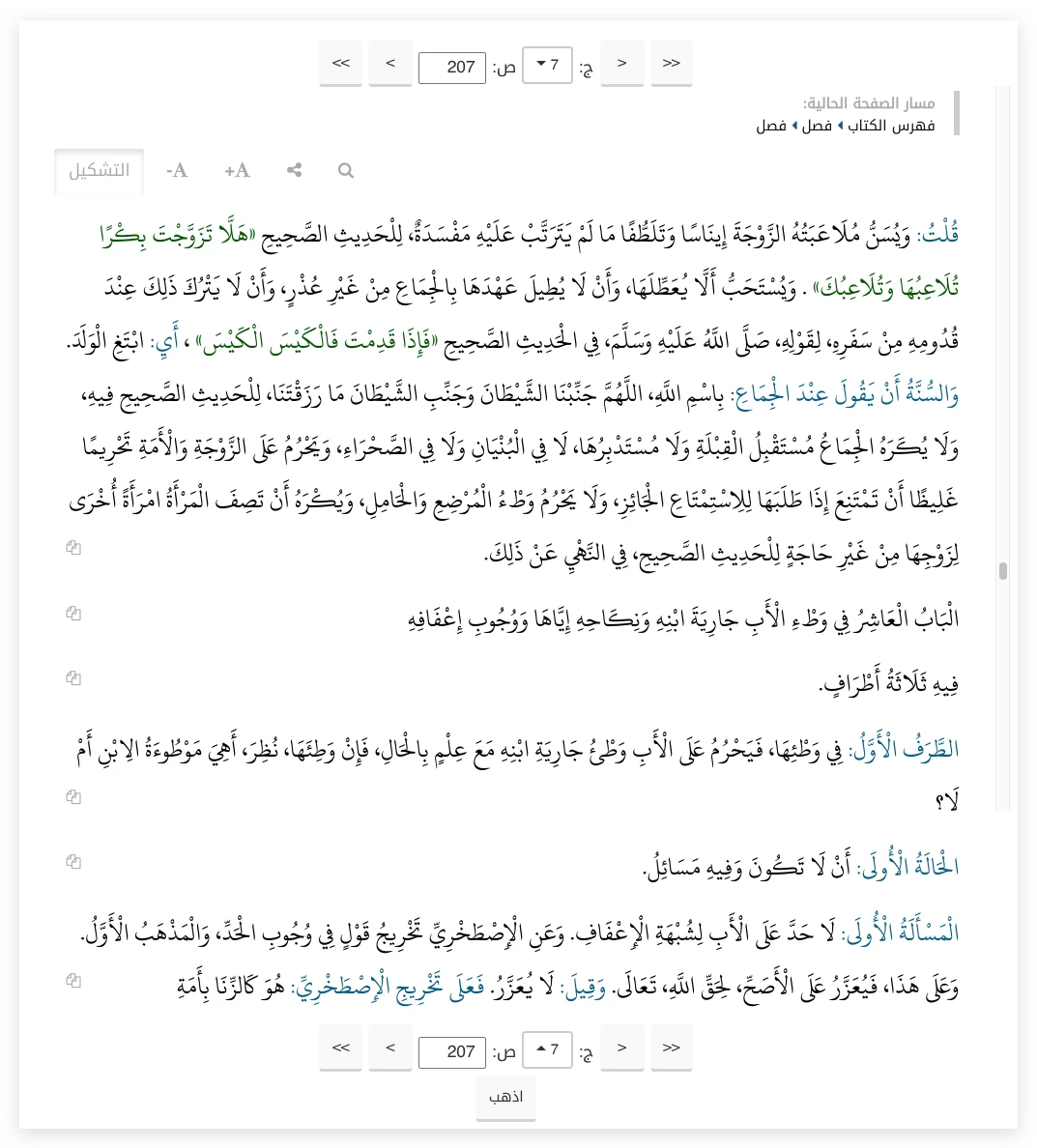
Al-Mawsuah al-Fiqhiyyah (Encyclopedia of Islamic Jurisprudence)
Al-Mawsuah al-Fiqhiyyah, or the Encyclopedia of Islamic Jurisprudence, is a distinctive and extensive undertaking in the history of Islamic law. It is not the work of a single author, but a modern jurisprudential encyclopedia compiled under state supervision. An expert panel of scholars prepared it under Kuwait’s Ministry of Awqaf and Islamic Affairs. Mawsoo’ah al-Fiqhiyyah states [283]
كَضَرْبِ أُمَيَّتِكَ (١) وَقَوْلِهِ: لاَ يَجْلِدُ أَحَدُكُمُ امْرَأَتَهُ جَلْدَ الْعَبْدِ ثُمَّ يُجَامِعُهَا فِي آخِرِ الْيَوْمِ (٢) . وَلِلسَّيِّدِ أَنْ يُقَيِّدَ عَبْدَهُ إِذَا خَافَ عَلَيْهِ الإِْبَاقَ (٣) .
١٩ – سَابِعًا: لِلسَّيِّدِ حَقُّ وَطْءِ مَمْلُوكَتِهِ مَا لَمْ يَمْنَعْ مِنْ ذَلِكَ مَانِعٌ شَرْعِيٌّ، كَأَنْ تَكُونَ حَائِضًا أَوْ نُفَسَاءَ أَوْ مُزَوَّجَةً، أَوْ كَافِرَةً غَيْرَ كِتَابِيَّةٍ، أَوْ تَكُونَ مُرْتَدَّةً أَوْ غَيْرَ ذَلِكَ، أَوْ فِيهَا شِرْكٌ لِغَيْرِهِ، فَإِذَا وُطِئَتْ تَكُونُ سَرِيَّةً، إِلاَّ أَنَّهَا إِنْ كَانَتْ مُزَوَّجَةً ثُمَّ مُلِكَتْ بِالسَّبْيِ جَازَ لِمَالِكِهَا فَسْخُ نِكَاحِهَا ثُمَّ وَطْؤُهَا بَعْدَ الاِسْتِبْرَاءِ. وَلِلاِسْتِمْتَاعِ بِالإِْمَاءِ أَحْكَامٌ وَضَوَابِطُ شَرْعِيَّةٌ تُنْظَرُ فِي مَوْضِعِهَا مِمَّا يَلِي. وَفِي مُصْطَلَحِ: (تَسَرِّي) . وَيَجِبُ عَلَى الْمَمْلُوكَةِ أَنْ تُمَكِّنَ سَيِّدَهَا مِنْ نَفْسِهَا لِلاِسْتِمْتَاعِ، وَيَحْرُمُ عَلَيْهَا الاِمْتِنَاعُ مِنْ ذَلِكَ لأَِنَّهُ مَنْعُ حَقٍّ، مَا لَمْ تَكُنْ مُحَرَّمَةً عَلَيْهِ، أَوْ
19. An owner has the right to use his female slave sexually, whether acquired through capture or purchase, provided no impediment recognised by sharia prevents it. For example:
— if she is menstruating,
— if she is experiencing bleeding after childbirth,
— if she is married,
— if she is a non-Muslim who is not one of the People of the Book (Jewish or Christian),
— if she has abandoned Islam and become an apostate,
— or if someone else has a share in her ownership.
Intercourse is not lawful in these circumstances.
If, however, she is married and comes into an owner’s possession as a war captive, the owner has the right to annul her previous marriage (faskh al-nikah) and, after istibra—waiting one menstrual period to establish whether she is pregnant—to use her sexually.
The term tasarri (تَسَرِّي): sexual enjoyment or intercourse with female slaves is governed by particular sharia rules and regulations in Islam. It is known as tasarri.
The Female Slave’s Duty
A female slave must allow her owner to enjoy her body. Refusal is prohibited because this is regarded as the owner’s right. If, however, she is in a condition that makes intercourse forbidden to him—such as menstruation, postnatal bleeding, or another impediment recognised by sharia—she may prevent it.
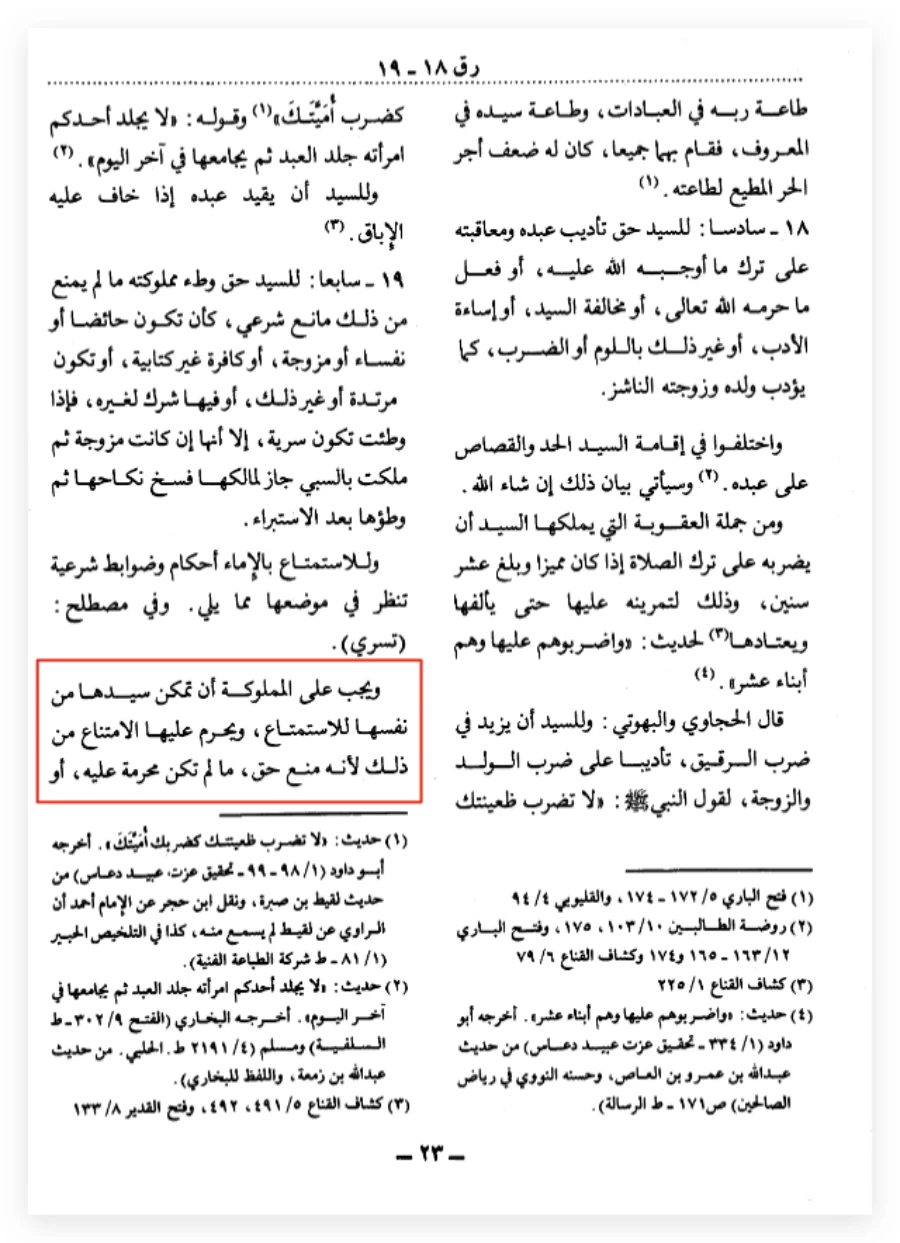
In other words, the female slave’s consent has no value. Her duty is to keep her owner pleased and satisfied and to provide sexual gratification whenever he wishes, unless a reason recognised by sharia, such as serious illness, prevents it.
Al-Muhalla bi-l-Athar
“Al-Muhalla bi-l-Athar“ is a celebrated work of jurisprudence by Imam Ibn Hazm al-Andalusi (may Allah have mercy on him) and a principal authority of the Zahiri school. Ibn Hazm bases his explanation of Islamic law on the direct wording of the Quran and Sunnah, prioritising textual evidence over analogical reasoning (qiyas). For understanding comparative jurisprudence, or ikhtilaf al-fuqaha (disagreements among jurists), it is regarded as one of the foremost historical works. It states the following concerning the consent of wives and female slaves and their assigned duties:
[مَسْأَلَةٌ فَرْضُ الْأَمَةِ وَالْأَمَةِ وَالْحُرَّةِ أَنْ لَا يَمْنَعَا السَّيِّدَ وَالزَّوْجَ الْجِمَاعَ مَتَى دَعَاهُمَا]
Translation: Both a free wife and a female slave are obliged not to prevent the husband or owner from having intercourse whenever he calls them.
“…مَسْأَلَةٌ: وَفَرْضُ الْأَمَةِ وَالْحُرَّةِ أَنْ لَا يَمْنَعَا السَّيِّدَ وَالزَّوْجَ الْجِمَاعَ مَتَى دَعَاهُمَا، مَا لَمْ تَكُنْ الْمَدْعُوَّةُ حَائِضًا، أَوْ مَرِيضَةً تَتَأَذَّى بِالْجِمَاعِ، أَوْ صَائِمَةَ فَرْضٍ، فَإِنْ امْتَنَعَتْ لِغَيْرِ عُذْرٍ، فَهِيَ مَلْعُونَةٌ…”
Translation: “A female slave and a free wife are obliged not to prevent the owner or husband from having intercourse whenever he calls them, unless the woman is menstruating, is ill in a way that makes intercourse painful, or is observing an obligatory fast. If she refuses without a valid excuse, she is accursed.”
“…عَنْ النَّبِيِّ – صَلَّى اللَّهُ عَلَيْهِ وَآلِهِ وَسَلَّمَ – قَالَ: «إذَا بَاتَتْ الْمَرْأَةُ مُهَاجِرَةً إلَى زَوْجِهَا أَوْ فِرَاشِ زَوْجِهَا لَعَنَتْهَا الْمَلَائِكَةُ حَتَّى تَرْجِعَ»…”
Translation: The Prophet (ﷺ) said, “If a woman spends the night deserting her husband’s bed (does not sleep with him), then the angels send their curses on her till she comes back (to her husband).
“…قَالَ رَسُولُ اللَّهِ – صَلَّى اللَّهُ عَلَيْهِ وَآلِهِ وَسَلَّمَ -: «إذَا دَعَا الرَّجُلُ زَوْجَتَهُ لِحَاجَتِهِ فَلْتَأْتِهِ وَإِنْ كَانَتْ عَلَى التَّنُّورِ»…”
Translation: The Messenger of Allah said: “When a man calls his wife to fulfill his need, then let her come, even if she is at the oven.”
Let us consult the work [284]
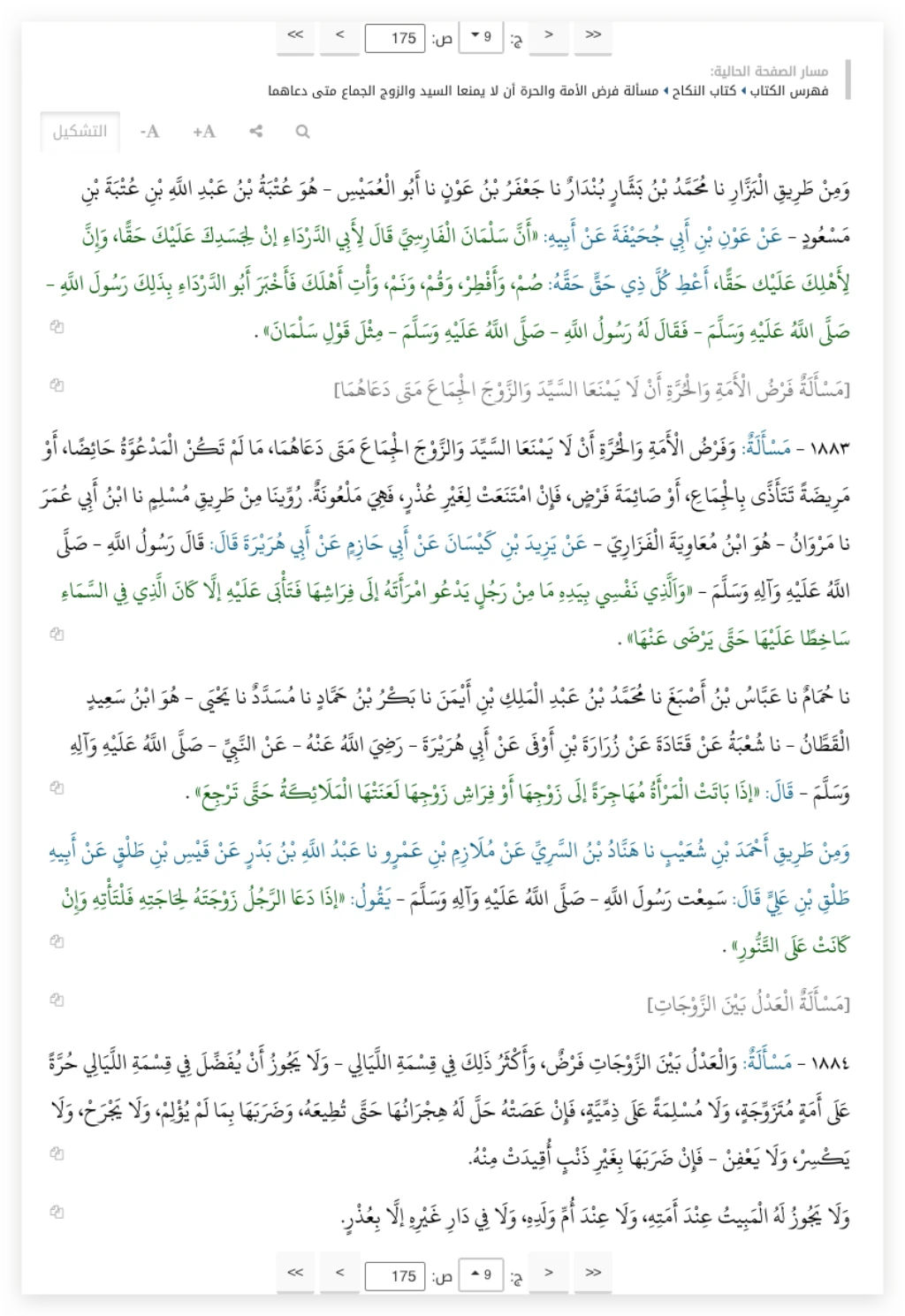
Salih al-Munajjid (islamqa.info)
Fatwa No. 33597 on IslamQA, another highly authoritative Islamic fatwa website, states [285] –
إجبار الزوج زوجته على الجماع
السؤال: 33597
هل يجوز للرجل أن يُجبر زوجته أو أمته على الجماع إذا رفضت ؟.
الجواب
الحمد لله والصلاة والسلام على رسول الله، وبعد:
ليس للمرأة أن تمنع نفسها من زوجها ، بل يجب عليها أن تلبي طلبه كلما دعاها ما لم يضرها أو يشغلها عن واجب .
روى البخاري (3237) ومسلم (1436) عن أبي هريرة رضي الله عنه قال : قال رسول الله صلى الله عليه وسلم : ( إذا دعا الرجل امرأته إلى فراشه فأبت فبات غضبان عليها لعنتها الملائكة حتى تصبح ) .
فإن امتنعت من غير عذر كانت عاصية ناشزا ، تسقط نفقتها وكسوتها .
وعلى الزوج أن يعظها ويخوفها من عقاب الله ، ويهجرها في المضجع ، وله أن يضربها ضرباً غير مُبَرِّح، قال الله تعالى :
( وَاللاتِي تَخَافُونَ نُشُوزَهُنَّ فَعِظُوهُنَّ وَاهْجُرُوهُنَّ فِي الْمَضَاجِعِ وَاضْرِبُوهُنَّ فَإِنْ أَطَعْنَكُمْ فَلا تَبْغُوا عَلَيْهِنَّ سَبِيلًا إِنَّ اللَّهَ كَانَ عَلِيًّا كَبِيرًا ) النساء/34 .
وسئل شيخ الإسلام ابن تيمية رحمه الله عما يجب على الزوج إذا منعته من نفسها إذا طلبها ؟ فأجاب : ( لا يحل لها النشوز عنه ، ولا تمنع نفسها منه ، بل إذا امتنعت منه وأصرت على ذلك فله أن يضربها ضربا غير مبرح ، ولا تستحق نفقة ولا قسما ) مجموع الفتاوى 32/279 .
وسئل عن رجل له زوجة وهي ناشز تمنعه نفسها فهل تسقط نفقتها وكسوتها وما يجب عليها ؟
فأجاب : ( تسقط نفقتها وكسوتها إذا لم تمكنه من نفسها ، وله أن يضربها إذا أصرت على النشوز . ولا يحل لها أن تمتنع من ذلك إذا طالبها به ، بل هي عاصية لله ورسوله ، وفي الصحيح : ” إذا طلب الرجل المرأة إلى فراشه فأبت عليه كان الذي في السماء ساخطا عليها حتى تصبح ” )
انتهى من مجوع الفتاوى 32/278 ، والحديث رواه مسلم (1736) .
فينبغي وعظ الزوجة أولا ، وتحذيرها من النشوز وغضب الله عليها ولعنة الملائكة لها ، فإن لم تستجب هجرها الزوج في الفراش ، فإن لم تستجب ضربها ضربا غير مبرح ، فإن لم ينفع معها ذلك ، منع عنها النفقة والكسوة ، وله أن يطلقها أو يخالعها لتفتدي منه بمالها .
وكذلك الأمة ليس لها أن تمتنع من تلبية رغبة سيدها إلا من عذر ، فإن فعلت كانت عاصية ، وله أن يؤدبها بما يراه مناسباً وأذن الشرع به .
والله أعلم .
Question No. 33597
Question:
May a man force his wife or female slave to have intercourse if she refuses?
Answer
Praise be to Allah, and blessings and peace upon the Messenger ﷺ:
A woman may not withhold herself from her husband. Rather, she should respond whenever he calls her, unless harm or a valid excuse legally permits her to refrain.
Sahih al-Bukhari (Hadith 3237) and Sahih Muslim (Hadith 1436) report from Abu Hurayrah (may Allah be pleased with him):
Allah’s Messenger (ﷺ) said:
“If a husband calls his wife to his bed (i.e. to have sexual relation) and she refuses and causes him to sleep in anger, the angels will curse her till morning.”
If a woman refuses without a reason, she is therefore regarded as disobedient and loses her entitlement to maintenance and clothing.
The husband must advise her and warn her to fear Allah. If she does not listen, he should separate from her in bed; if that also fails, he may beat her lightly, without causing injury or wounds. Allah says:
“And if you sense ill-conduct from your women, advise them ˹first˺, ˹if they persist,˺ do not share their beds, ˹but if they still persist,˺ then discipline them ˹gently˺. But if they change their ways, do not be unjust to them. Surely Allah is Most High, All-Great.” (Surah An-Nisa 4:34; English: Dr. Mustafa Khattab, The Clear Quran).
Shaykh al-Islam Ibn Taymiyyah (may Allah have mercy on him) said:
A wife may not withhold herself from her husband. Rather, she must respond whenever he calls her, unless a reason recognised by sharia permits her to refrain. (Majmu al-Fatawa 32/279)
Question:
What happens if a man provides maintenance and clothing for his wife but she refuses to make herself available to him for intercourse?
Answer:
If she refuses to make herself available to her husband without a valid excuse, she loses her entitlement to maintenance and clothing. Beating her is permissible, provided it does not cause serious harm.
If her refusal rests on a reason recognised by sharia, however, she is not sinful. Rather, the husband is sinful if he nevertheless uses force.
Conclusion
A wife may not refuse her husband’s invitation without a valid reason.
Refusing without a valid reason exposes her to the angels’ curse and forfeits her entitlement to maintenance and clothing.
The husband should first advise her, then separate from her in bed, and, if necessary, may beat her lightly.
Where a reason recognised by sharia exists, the wife may refuse, and responsibility then rests with the husband.
The quotation from Ibn Taymiyyah’s Majmu al-Fatawa ends here (32/278). The hadith is reported in Sahih Muslim (1736).
Therefore, the husband should first advise his wife, warn her about disobedience (nushuz) and Allah’s punishment, and remind her of the angels’ curse. If she still does not respond, he should leave her bed and remain apart from her. If she still refuses, he may beat her in a way that is painful but not harmful. If that does not help, he may stop providing maintenance and clothing; he may also divorce her or separate from her and marry another woman.
The same applies to a female slave: she may not refrain from satisfying her owner’s sexual desire without an excuse. If she does, she is sinful, and her owner may punish her and take whatever action he deems appropriate within the limits permitted by sharia.
Allah knows best.
Qatar’s Supreme Fatwa Committee (islamweb.net)
A fatwa on Islamweb, another prominent fatwa website, repeats the same position [286]
معلومات الكتاب
المحلى بالآثار
ابن حزم الأندلسي – علي بن أحمد بن سعيد بن حزم
إظهار / إخفاء التشكيل بحث في الكتاب
1883 – مسألة : وفرض الأمة والحرة أن لا يمنعا السيد والزوج الجماع متى دعاهما ، ما لم تكن المدعوة حائضا ، أو مريضة تتأذى بالجماع ، أو صائمة فرض ، فإن امتنعت لغير عذر ، فهي ملعونة . روينا من طريق مسلم نا ابن أبي عمر نا مروان – هو ابن معاوية الفزاري – عن يزيد بن كيسان عن أبي حازم عن أبي هريرة قال : قال رسول الله صلى الله عليه وآله وسلم { والذي نفسي بيده ما من رجل يدعو امرأته إلى فراشها فتأبى عليه إلا كان الذي في السماء ساخطا عليها حتى يرضى عنها } .
نا حمام نا عباس بن أصبغ نا محمد بن عبد الملك بن أيمن نا بكر بن حماد نا مسدد نا يحيى – هو ابن سعيد القطان – نا شعبة عن قتادة عن زرارة بن أوفى عن أبي هريرة رضي الله عنه عن النبي صلى الله عليه وآله وسلم قال : { إذا باتت المرأة مهاجرة إلى زوجها أو فراش زوجها لعنتها الملائكة حتى ترجع } .
ومن طريق أحمد بن شعيب نا هناد بن السري عن ملازم بن عمرو نا عبد الله بن بدر عن قيس بن طلق عن أبيه طلق بن علي قال : سمعت رسول الله صلى الله عليه وآله وسلم يقول : { إذا دعا الرجل زوجته لحاجته فلتأته وإن كانت على التنور } .
Let us now examine the translation of the fatwa (original Bengali translation produced by AI).
Fatwa No. 1883
Both a female slave and a wife must comply when the owner or husband calls them for sexual relations.
If the wife is not menstruating, experiencing postnatal bleeding, or ill, and refuses without another valid excuse, she is regarded as sinful and disobedient (ناشزة/nashizah).
The report from Muslim is transmitted through Ibn Abi Umar, Marwan ibn Muawiyah al-Fazari, Yazid ibn Kaysan, Abu Hazim, and Abu Hurayrah (may Allah be pleased with him).
Allah’s Messenger (ﷺ) said:
By Him in Whose Hand is my life, when a man calls his wife to his bed, and she does not respond, the One Who is in the heaven is displeased with her until he (her husband) is pleased with her.
(A sahih hadith; related by Bukhari and Muslim.)
Another chain runs through Hammam, Abbas ibn Asbagh, Muhammad ibn Abd al-Malik ibn Ayman, Bakr ibn Hammad, Musaddad, Yahya ibn Said al-Qattan, Shubah, Qatadah, Zurarah ibn Awfa, and Abu Hurayrah (may Allah be pleased with him).
Abu Hurayrah (may Allah be pleased with him) reports from the Prophet (ﷺ):
“If a woman spends the night deserting her husband’s bed (does not sleep with him), then the angels send their curses on her till she comes back (to her husband).
Through another chain, Talq ibn Ali said: I heard the Messenger of Allah (ﷺ) say:
“When a man calls his wife to fulfill his need, then let her come, even if she is at the oven.”
Summary:
Neither a wife nor a female slave may refuse the husband’s or owner’s sexual invitation without a valid excuse recognised by sharia.
Refusal without an excuse exposes her to the angels’ curse and Allah’s wrath.
Jurists use these hadiths as evidence for the obligatory nature of a husband’s sexual rights over his wife.
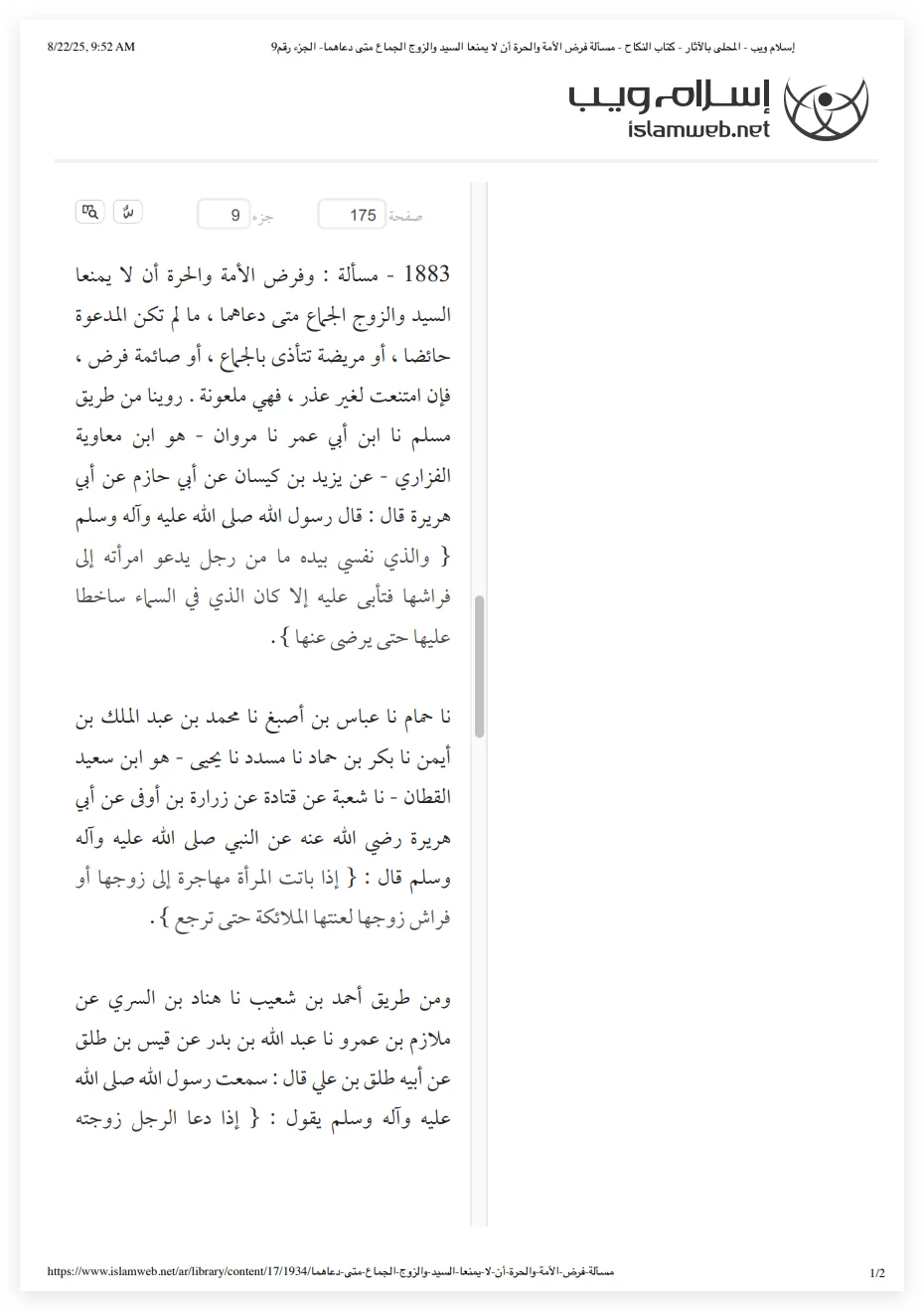
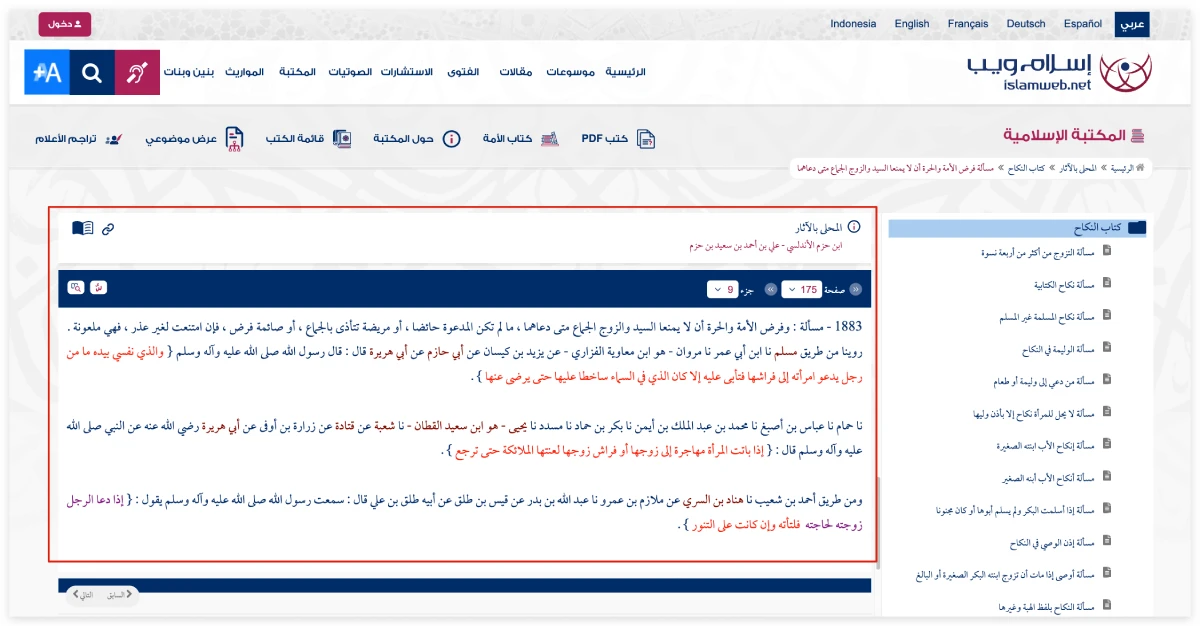
This establishes that Islamic sharia denies the consent of female war captives and declares sexual relations to be the master’s legal right.
Scholars’ Views: A Wife or Female Slave Must Submit to Intercourse in Islam
In modern civilised society, women enjoy rights equal to those of men. They participate equally in education, employment, leadership, and social service. There are, however, countless cases in which a husband forces sexual relations on his wife without her wishes or consent. Modern civilised society regards this as rape, whereas Islamic countries legitimise such rape by husbands. Islam imposes a rule obliging a wife to engage in sexual activity whenever her husband demands it, thereby contributing to the grave and terrifying phenomenon of marital rape. Let us hear the statement of Harun Izhar, an important leader of Hefazat-e-Islam.
Now consider whether a husband or owner may use force against a wife or female slave.
Let us now watch a debate with believers on this subject.
The Absence of Consent and Sexual Exploitation
In the modern civilised world, rape means sexual relations with a person without that person’s consent. Islamic law permits precisely this in the case of female war captives and slaves. Their consent is irrelevant because they are treated as objects owned by a master.
For a free woman, marriage is a contract in which consent has a limited role, unless the wife is a minor. Islam requires obtaining an adult woman’s consent before marriage, but it does not require that consent for subsequent sexual relations. For a female slave, neither a contract nor personal willingness is necessary: sexual access follows solely from ownership. This appalling provision gravely violates the human rights of female war captives and dishonours humanity itself.
Islam has not merely permitted sexual rights over female slaves; it has preserved them institutionally. Rather than abolishing slavery, Islamic law imposed a new religious legitimacy upon it. Female war captives were established as objects for male sexual enjoyment.
Was the Purpose to Satisfy Female War Captives’ Sexual Desires?
To present intercourse with—or rape of—female war captives in an attractive guise, many Muslims claim that the Prophet, that ocean of compassion, established the provision to satisfy the women’s sexual needs. The Prophet was supposedly such a good man that his heart ached for the captives! This prophet of humanity therefore remained especially attentive to ensuring that they could have satisfactory sex. For this reason, he supposedly undertook the task himself, reluctantly and against his own wishes, and had the Companions do likewise. None of them actually wanted to do it. None cared about worldly pleasure or luxury: they spent all their time imagining flying through Paradise as its birds. Where would they find time to think about earthly sensual pleasure? Yet immediately after the captives’ fathers, brothers, and husbands were killed, the women’s sexual desires supposedly became so intense that the Companions were obliged to satisfy them. How difficult this must have been for the Prophet and his Companions! Pleasing so many women is hardly a trivial undertaking!
The actual reason behind this provision permitting sexual use of unbelieving women becomes clear from the following sermon.
Another rule shows that the captives’ sexual needs carried no significance at all. Both men and women were taken captive, yet female Companions could not satisfy the sexual needs of male war captives or slaves. One woman encountered trouble when she attempted to do so.
In his commentary on Surah al-Muminun, verses 5 and 6, Allama Ibn Kathir raises a relevant and important issue: the Islamic prohibition on a woman using a male slave to satisfy her sexual needs. This gender discrimination fits entirely with Islam’s misogyny and the notion that a man is, in effect, a woman’s owner. Reading the phrase ma malakat aymanuhum, one woman thought that since a man could satisfy his sexual needs with a female slave he owned, she too might have the right to satisfy her needs with her own male slave. When the matter reached the court of Umar, Islam’s second caliph, it became clear that Islamic scripture was unwilling to grant women even this limited equality. Umar punished both the woman and her male slave. The slave was physically abused, and the woman was deprived of the basic right to future sexual relations with another man through marriage. Read the passages marked in red on the following two pages. They demonstrate that satisfying slaves’ sexual needs was by no means the central concern [287] —
Is a Manumission Contract Obligatory or Recommended?
Some visibly embarrassed Muslims defend Islamic slavery by citing a Quranic verse and claiming that Islam was the first system in human history to establish mukatabah, a contract allowing a slave to purchase freedom. This is entirely false. Such contracts existed in different parts of the world before Muhammad. Ancient Rome practised arrangements of this kind almost a thousand years before him. In other words, slaves who could earn money through a particular skill became free people and citizens if they could pay their owner an amount equivalent to, or close to, their market value. This was not, in reality, an expression of the slave owner’s compassion or generosity. Slaves generally had to purchase their freedom by paying more than their market value. Contractual purchase of freedom through instalments had existed since antiquity. Consider the relevant Roman provision [288]
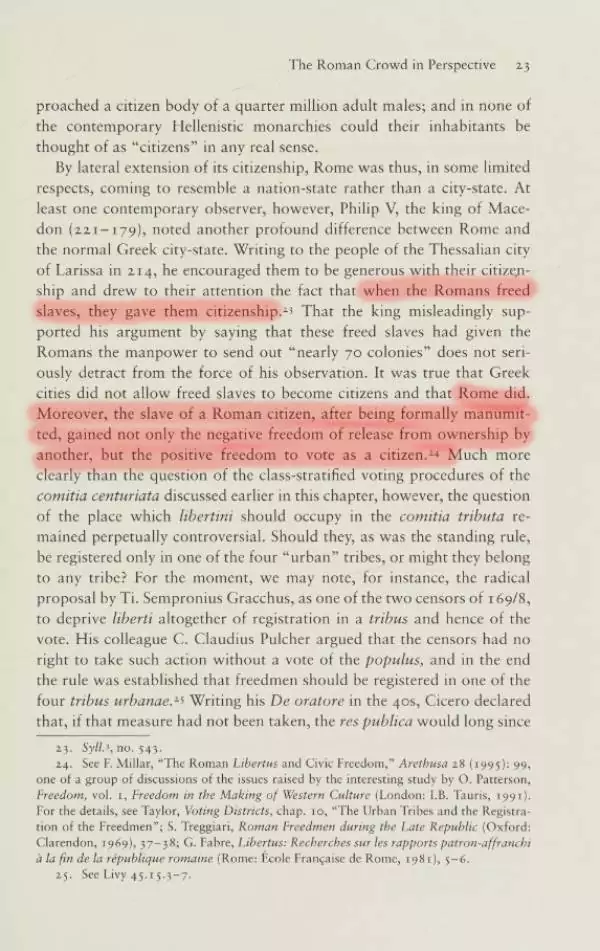
Another false claim frequently advanced by believers is that in Islam, entering a mukatabah contract is compulsory—indeed, obligatory—whenever a slave requests it. They often cite a report concerning Umar to argue that it is mandatory. Yet all the scholars agree that it is permissive rather than compulsory. Let us read the verse and its commentary in Tafsir al-Mazhari [289] [290] —
And if any of those ˹bondspeople˺ in your possession desires a contract ˹to buy their own freedom˺, make it possible for them, if you find goodness in them.
— Taisirul Quran (Bengali source; English quotation: Dr. Mustafa Khattab, The Clear Quran)
And if any of those ˹bondspeople˺ in your possession desires a contract ˹to buy their own freedom˺, make it possible for them, if you find goodness in them.
— Sheikh Mujibur Rahman (Bengali source; English quotation: Dr. Mustafa Khattab, The Clear Quran)
And if any of those ˹bondspeople˺ in your possession desires a contract ˹to buy their own freedom˺, make it possible for them, if you find goodness in them.
— Rawai Al-bayan (Bengali source; English quotation: Dr. Mustafa Khattab, The Clear Quran)
And if any of those ˹bondspeople˺ in your possession desires a contract ˹to buy their own freedom˺, make it possible for them, if you find goodness in them.
— Dr. Abu Bakr Muhammad Zakaria (Bengali source; English quotation: Dr. Mustafa Khattab, The Clear Quran)
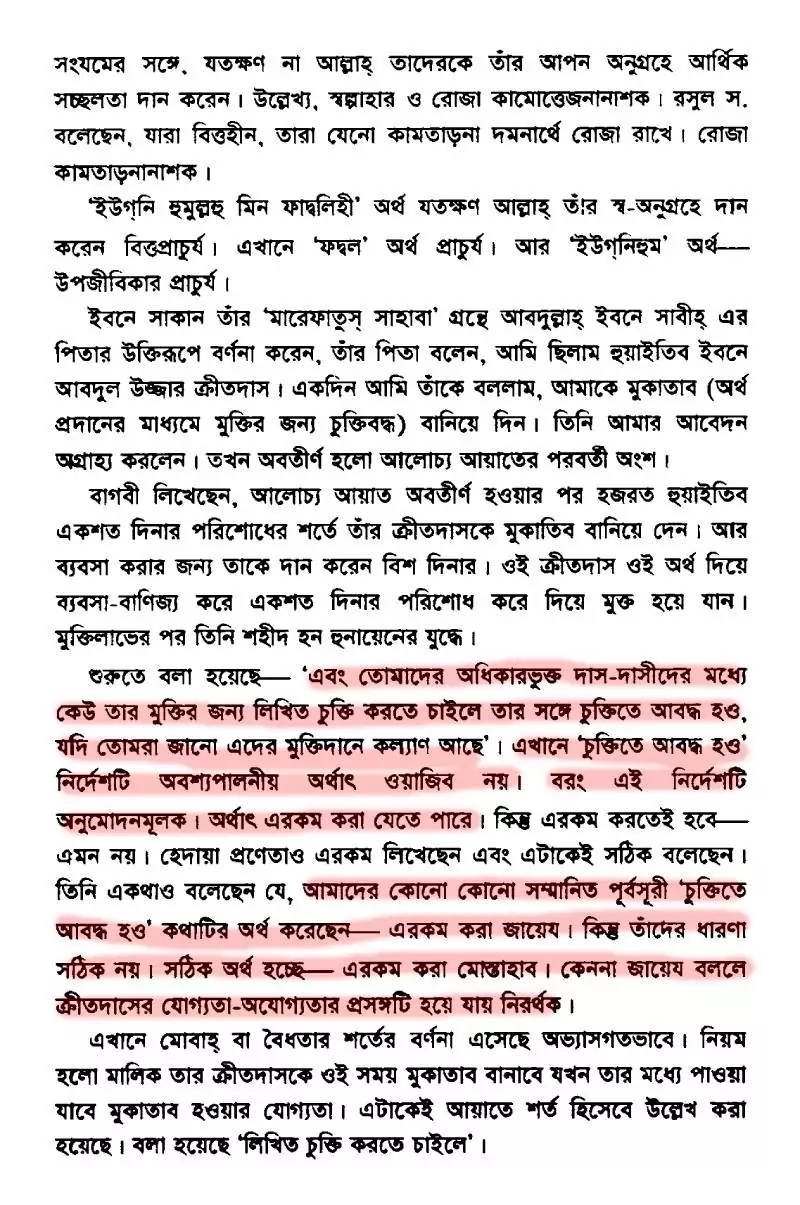
The same position appears in the renowned commentary Maariful Quran [291] —
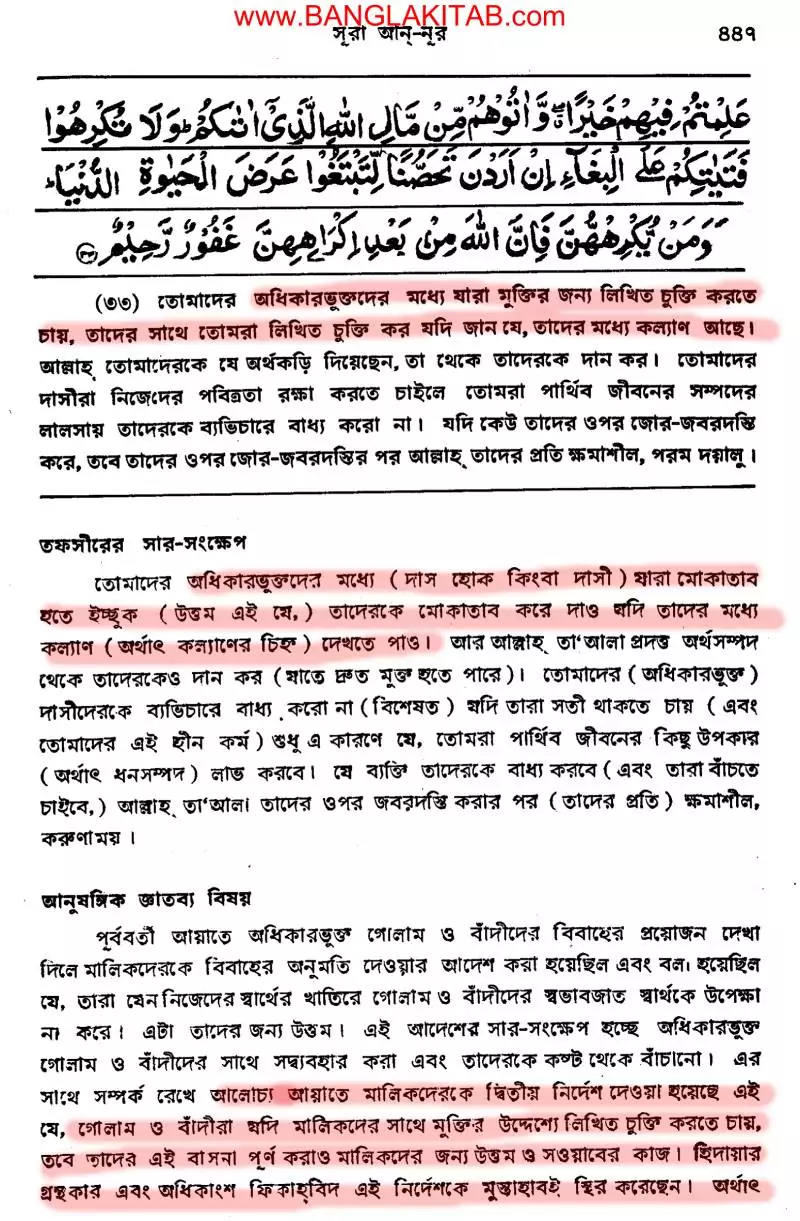
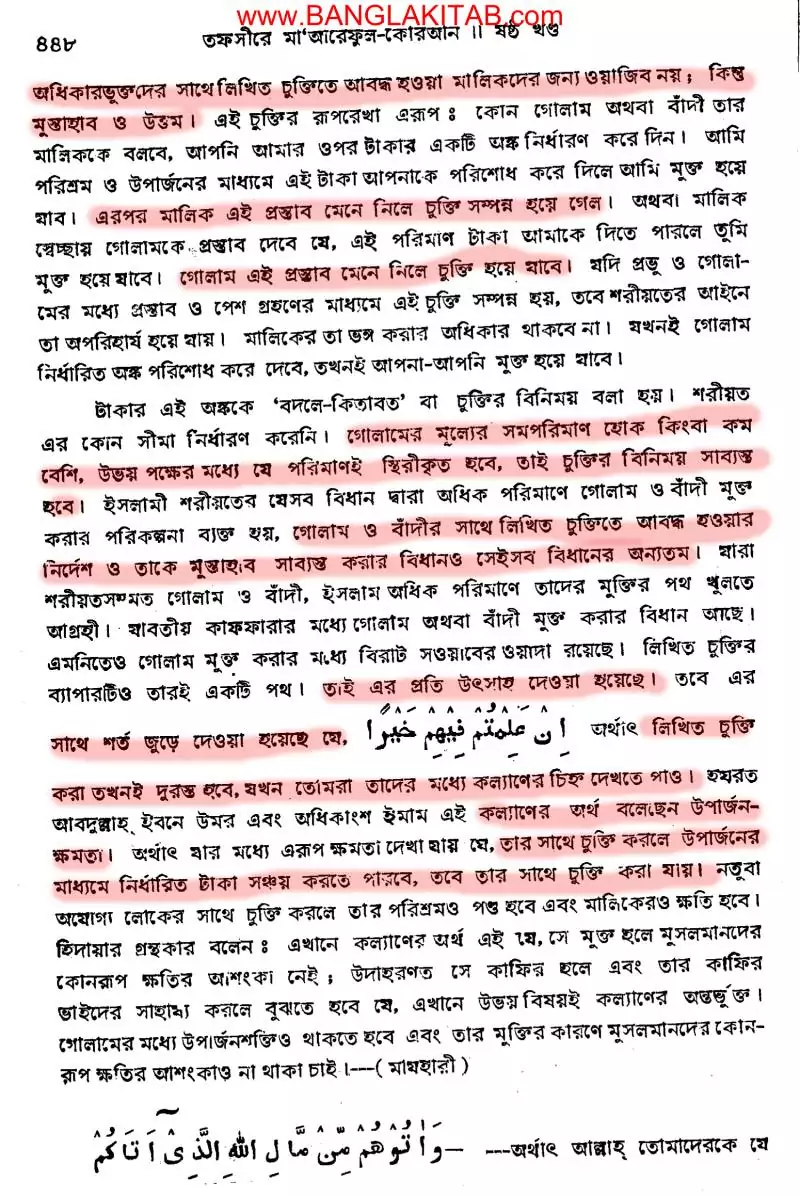
Is Freeing Slaves or Captives Obligatory?
Many Islamic apologists claim that a hadith strongly emphasises freeing captives, and that this supposedly allowed many unbelievers taken as war booty to become free. In fact, the captives referred to in that hadith are Muslim captives. Muslims are required to secure the release of Muslims captured and held by unbelievers. Here, freeing captives means releasing Muslims held by unbelievers, rather than freeing captives held by Muslims. The way Islamic apologists distort this is remarkable [292] —
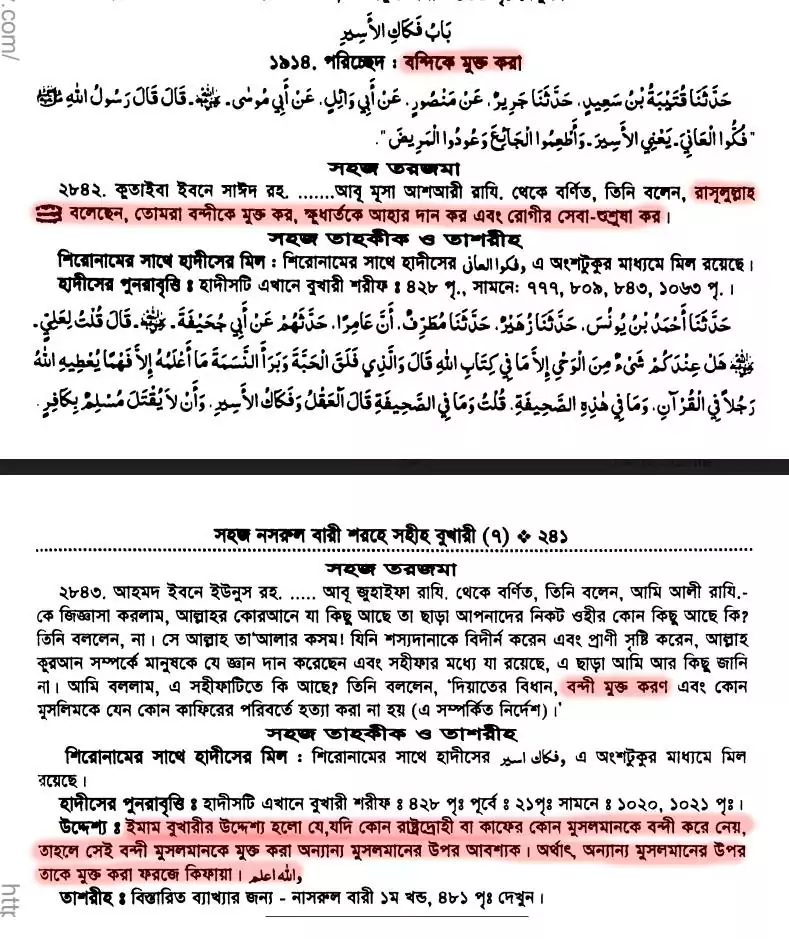
Is Beating Slaves Forbidden?
To portray Islam as deeply humane, many Muslims claim that even slightly beating a slave is entirely forbidden, and that the slightest blow makes manumission compulsory. Yet no such obligation exists in Islam. Sahih al-Bukhari says not to strike a slave in the face when beating him. This clearly indicates that beating a slave is permissible in Islam. Sahih al-Bukhari also explicitly describes beating slaves as makruh—disliked, rather than prohibited—yet many believers persistently make false claims about this [268] —
Sahih al-Bukhari (Tawhid Publication)
49/ Manumission of Slaves
Section: 49/17. Beating slaves and saying “my male slave” or “my female slave” are makruh.
2552. Narrated Abu Huraira: The Prophet (ﷺ) said, “You should not say, ‘Feed your lord (Rabbaka), help your lord in performing ablution, or give water to your lord, but should say, ‘my master (e.g. Feed your master instead of lord etc.) (Saiyidi), or my guardian (Maulai), and one should not say, my slave (Abdi), or my girl-slave (Amati), but should say, my lad (Fatai), my lass (Fatati), and ‘my boy (Ghulami). (Adhunik Publications: 2367; Islamic Foundation: 2384)
Hadith grade: Sahih
Narrator: Abu Hurayrah (may Allah be pleased with him)
Although beating one’s own wife is a recognised and lawful act in Islam, believers feel no shame in making the absurd claim that beating slaves is forbidden. This article discusses the issue in detail [293]. Here we cite only the hadith that forbids beating a wife as one beats a female slave. If beating female slaves was itself prohibited, why would the Prophet forbid beating wives in that manner? [294] —
Mishkat al-Masabih (Mishkat)
Book 13: Marriage
Section: 10. First Subsection — Good Treatment of Wives and the Mutual Rights of Husband and Wife
3242-[5] ‘Abdallah b. Zam’a reported God’s Messenger as saying, “None of you must whip his wife as a slave is whipped and then have intercourse with her at the end of the day.”
A version has, “One of you has recourse to whipping his wife as a slave is whipped and perhaps he lies with her at the end of the day.” He then gave them an exhortation about laughing when someone breaks wind, saying, “Why does one of you laugh at what he does himself?” (Bukhari and Muslim.)[1]
[1] Sahih: Bukhari 4942; Muslim 1470.
Hadith grade: Sahih
Narrator: Abdullah ibn Zamah (may Allah be pleased with him)
Let us consider a hadith in the Darussalam edition of Sahih al-Bukhari [295] –
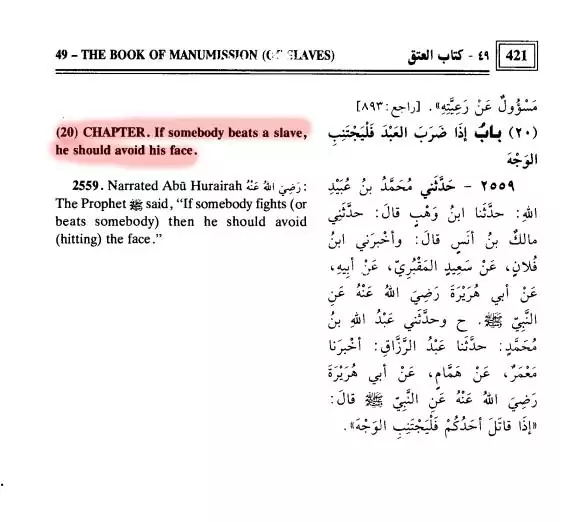
Consider another relevant hadith. Observe that it forbids beating wives in the manner of a slave. If beating slaves were prohibited, why would it be necessary to forbid beating wives in that manner? [296]
Bulugh al-Maram
Book 8: Marriage
Section: 5. Apportioning Wives’ Rights — Excessive Beating of a Wife Is Forbidden
1064. Narrated ‘Abdullah bin Zam’ah (RA): Allah’s Messenger (ﷺ) said: “None of you should whip his wife like the whipping of a slave.” [Reported by al-Bukhari].[1]
[1] Bukhari 5204, 3377, 5942, 6042; Muslim 2855; Tirmidhi 3343; Ibn Majah 1983; Ahmad 15788; Darimi 2220. The complete hadith states that the Prophet (ﷺ) said: لا يجلد أحدكم امرأته جلد العبد ثم يجامعها في آخر اليوم The Prophet (ﷺ) said, “None of you should flog his wife as he flogs a slave and then have sexual intercourse with her in the last part of the day.” Imam al-Haythami states in Majma al-Zawaid 5/7 that its narrators include Hajjaj ibn Artah, who is a mudallis.
Hadith grade: Sahih
Narrator: Abdullah ibn Zamah (may Allah be pleased with him)
Let us now consider the matter in Idah al-Muslim [297] —
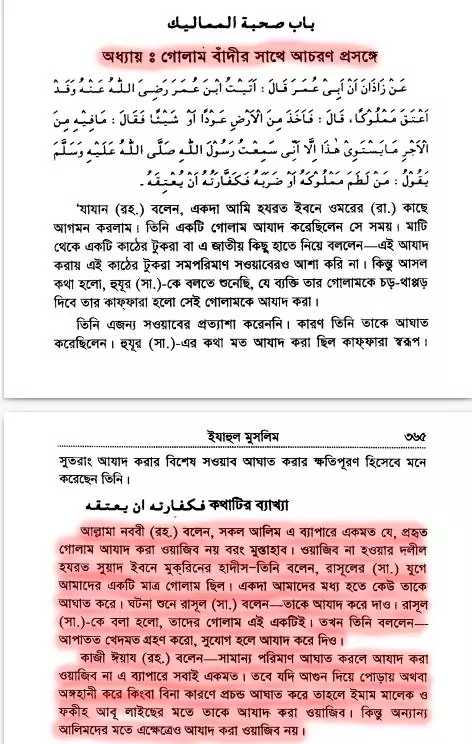
The same position is stated in a commentary on Sahih Muslim [298] —
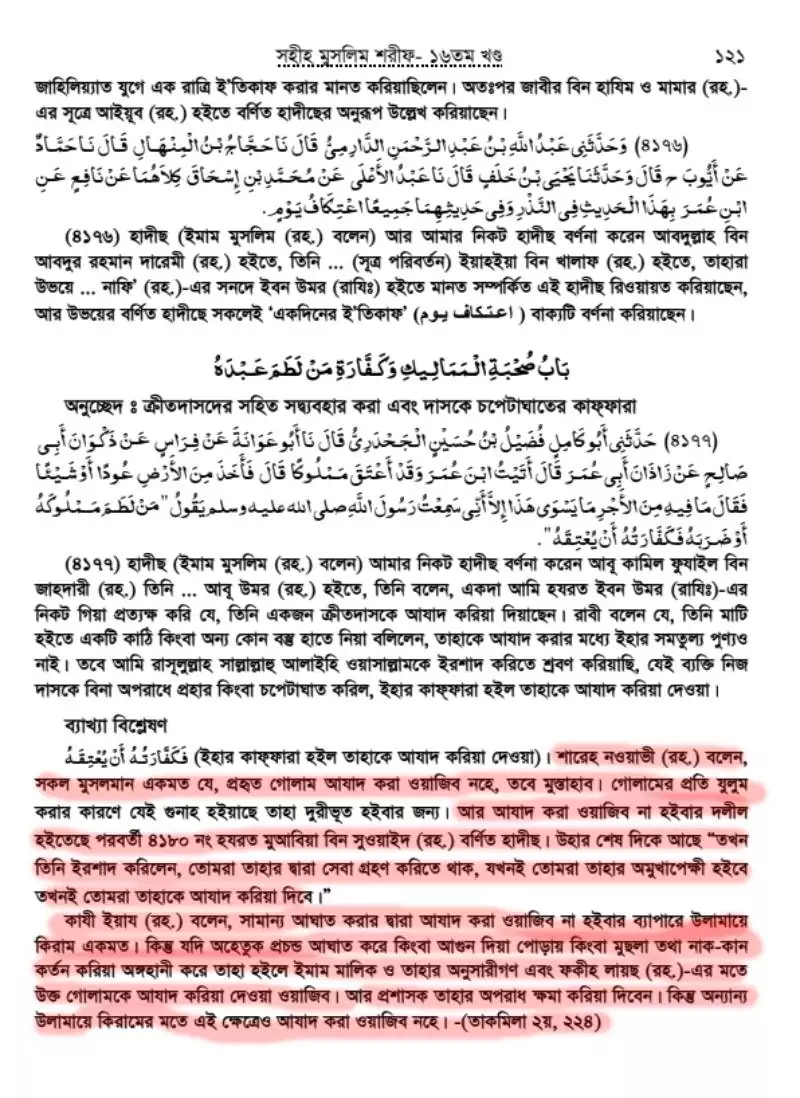
Hadith literature records that Abu Bakr, an important figure in Islam and caliph of the Islamic empire after Muhammad, beat a slave for losing a camel, while Prophet Muhammad watched and smiled [299] [300]. This means that, when the slave was beaten, the Prophet did not object and instead encouraged it. There is therefore no basis for saying that beating slaves is forbidden in Islam.
First, this shows that Prophet Muhammad remained a silent spectator while a slave was beaten and responded humorously rather than discouraging it. This provides no evidence of personal sympathy for slaves. The incident clarifies Islam’s position on the morality of beating them. Second, if someone infers from this hadith that Muhammad’s silence or laughter legitimised cruel treatment of slaves, there is no basis for calling that inference wrong. A religious leader’s silence during a beating is inconsistent with claims of compassion for slaves. Third, the hadith shows that harsh treatment, including physical abuse, was accepted in the Prophet’s presence during his lifetime and was not contrary to Islamic principles or teachings. Finally, in light of this hadith, Muhammad’s silence or laughter at an inhuman act such as beating a slave may be called an expression of the supposed humanity of his character. It makes Islam’s position on slavery clear and identifies the religion as legitimising slavery and cruelty towards slaves. Calling slave beating haram, or prohibited, is therefore entirely at odds with Islamic belief.
Sunan Abi Dawud (Islamic Foundation)
5/ Hajj
Section: 28. A Person in Ihram Who Beats His Slave.
1818. Ahmad ibn Hanbal (may Allah have mercy on him) … Narrated Asma’ bint AbuBakr: We came out for performing hajj along with the Messenger of Allah (ﷺ). When we reached al-Araj, the Messenger of Allah (ﷺ) alighted and we also alighted. Aisha sat beside the Messenger of Allah (ﷺ) and I sat beside my father (AbuBakr). The equipment and personal effects of AbuBakr and of the Messenger of Allah (ﷺ) were placed with AbuBakr’s slave on a camel.
AbuBakr was sitting and waiting for his arrival. He arrived but he had no camel with him. He asked: Where is your camel? He replied: I lost it last night. AbuBakr said: There was only one camel, even that you have lost. He then began to beat him while the Messenger of Allah (ﷺ) was smiling and saying: Look at this man who is in the sacred state (putting on ihram), what is he doing? Ibn AbuRizmah said: The Messenger of Allah (ﷺ) spoke nothing except the words: Look at this man who is in the sacred state (wearing ihram), what is he doing? He was smiling (when he uttered these words).
Hadith grade: Hasan
Narrator: Asma bint Abu Bakr (may Allah be pleased with her)
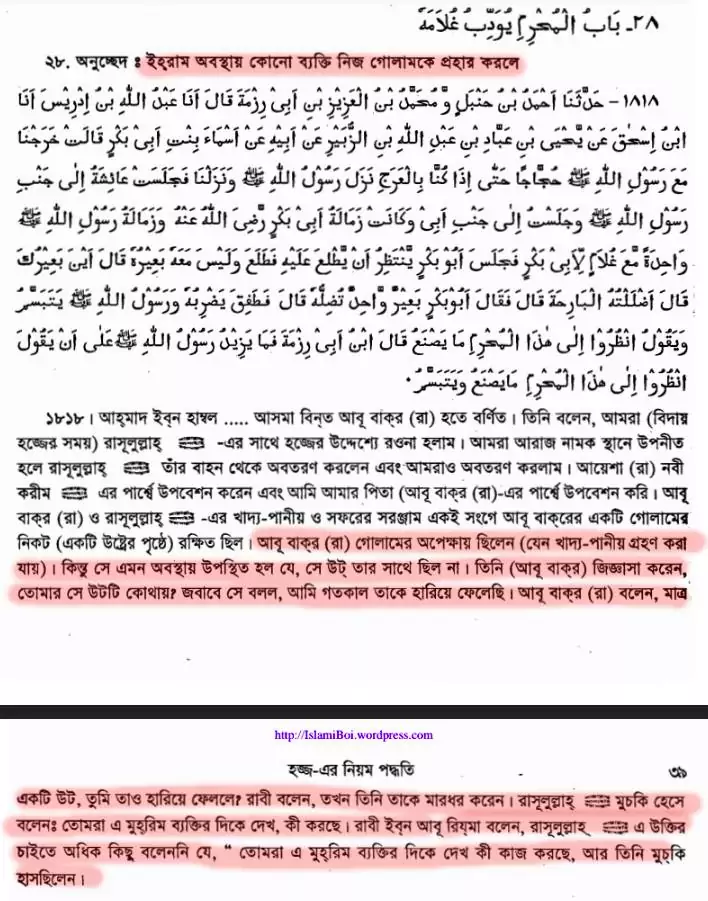
Ibn Hisham’s Sirat al-Nabi relates that, when a rumour of Aisha’s adultery arose, Ali seized one of her female slaves and beat her severely to extract the truth [301]. Prophet Muhammad was present and did not intervene. The claim that beating slaves is forbidden is therefore nothing more than a shameless falsehood.
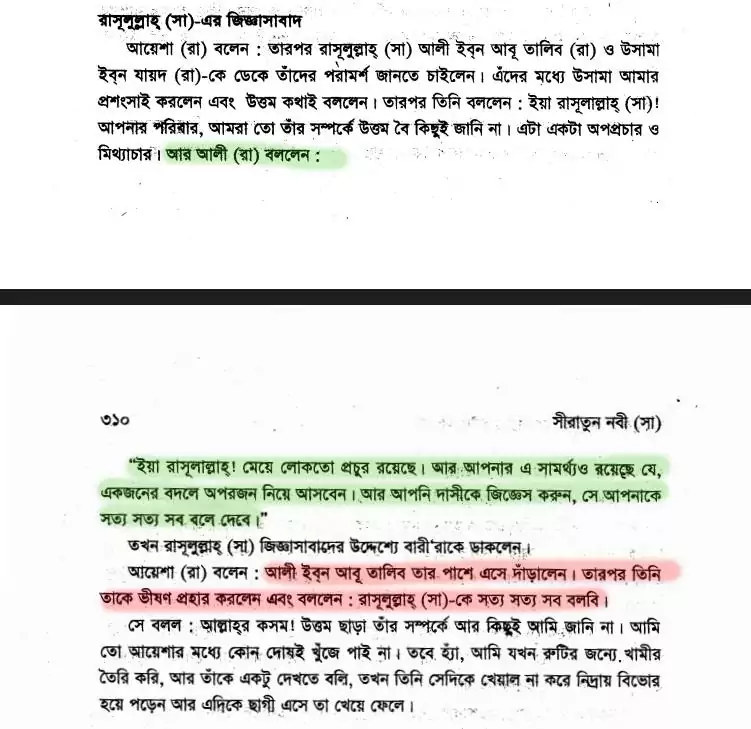
Is Intercourse with Polytheist Women Forbidden?
Citing Surah al-Baqarah, verse 221, many Muslims argue that Islam prohibits sexual intercourse with polytheist women. How, then, could believers have sex with polytheist female war captives? They use this to claim that Islam prohibits intercourse with female war captives. Let us read the verse [302]
Do not marry polytheistic women until they believe; for a believing slave-woman is better than a free polytheist, even though she may look pleasant to you.
— Rawai Al-bayan (Bengali source; English quotation: Dr. Mustafa Khattab, The Clear Quran)
Readers will notice that this verse concerns marriage and says nothing about sexual intercourse with a woman kept as a slave. Some scholars do, however, hold that the word used in the verse actually refers to intercourse, and therefore regard all intercourse with polytheist women as forbidden. Others maintain that intercourse with polytheist female war captives is lawful, because Hadith 2152 in Abu Dawud describes the Companions having intercourse with polytheist women [274] —
Sunan Abi Dawud (Islamic Foundation)
6/ Marriage
Section: 139. Intercourse with Female Captives.
2152. Ubaydullah ibn Umar ibn Maysarah … Abu Sa’id Al Khudri said “The Apostle of Allaah(ﷺ) sent a military expedition to Awtas on the occasion of the battle of Hunain. They met their enemy and fought with them. They defeated them and took them captives. Some of the Companions of Apostle of Allaah (ﷺ) were reluctant to have relations with the female captives because of their pagan husbands. So, Allaah the exalted sent down the Qur’anic verse “And all married women (are forbidden) unto you save those (captives) whom your right hand posses.” This is to say that they are lawful for them when they complete their waiting period.
Hadith grade: Sahih
Narrator: Abu Said al-Khudri (may Allah be pleased with him)
This entire manoeuvre is a form of Islamic deception. Islamists introduce these poor arguments to conceal the issue of sexual activity with female slaves. Even if their claims were correct, using Jewish and Christian women sexually as war booty would still be permitted, because they are not classified as polytheists. Does excluding pagan women somehow make raping Jewish and Christian women right? The claim that Islam prohibits raping polytheist women is a peculiar argument: it does not make raping Jewish and Christian women a good act.
Moreover, with this argument, Islamists invalidate the very justifications they have long offered for permitting the rape of female war captives and slaves. They previously claimed that the Prophet and his Companions reluctantly took slaves to bed for the noble purpose of satisfying the women’s sexual desires. What great hearts our Companions supposedly had! What humanity! If that was their argument, why did they not satisfy polytheist women’s sexual needs? Do polytheist women have no such needs? They also claimed that the Companions took helpless captives to bed to provide them with new husbands and homes. If polytheist women were excluded, would they not lose the chance of a handsome Companion, like Shah Rukh Khan, as a sexual partner? According to these arguments, the captive women were so impressed by the Companions’ heroism that, overcome with desire, they voluntarily rushed over the bodies of their fathers, brothers, and husbands to have sex with them. Why, then, withhold that sexual pleasure from polytheist women? Why may Jewish and Christian women be raped as booty, while compassion suddenly overflows for polytheist women? The truth is that these are all deceptions intended to legitimise Islamic barbarity.
We have already shown that the Prophet ordered coercive conversion of polytheists through offensive jihad. He offered them two choices: Islam or death by the sword. What option, then, remained for polytheist female captives except conversion? Let us read that page again [303] —
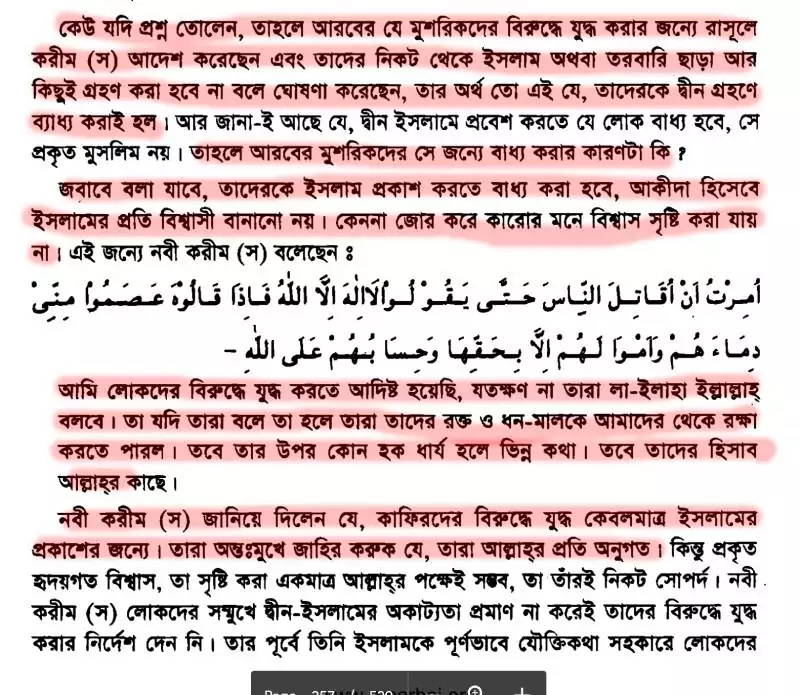
Their own prominent Islamic scholars answered these arguments long ago. Consider what Zad al-Maad, by the Muslim scholar Ibn Qayyim al-Jawziyyah, says on the subject [304] —
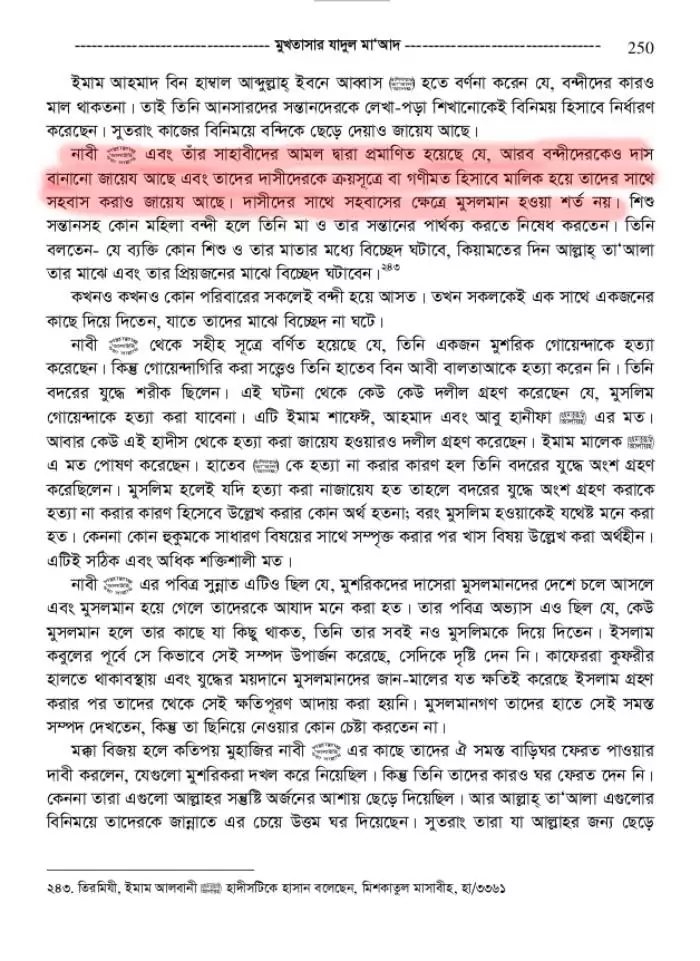
Now consider the account in Tafsir Zakaria. First, let us examine how authoritative Abu Bakr Zakaria’s commentary is [305].
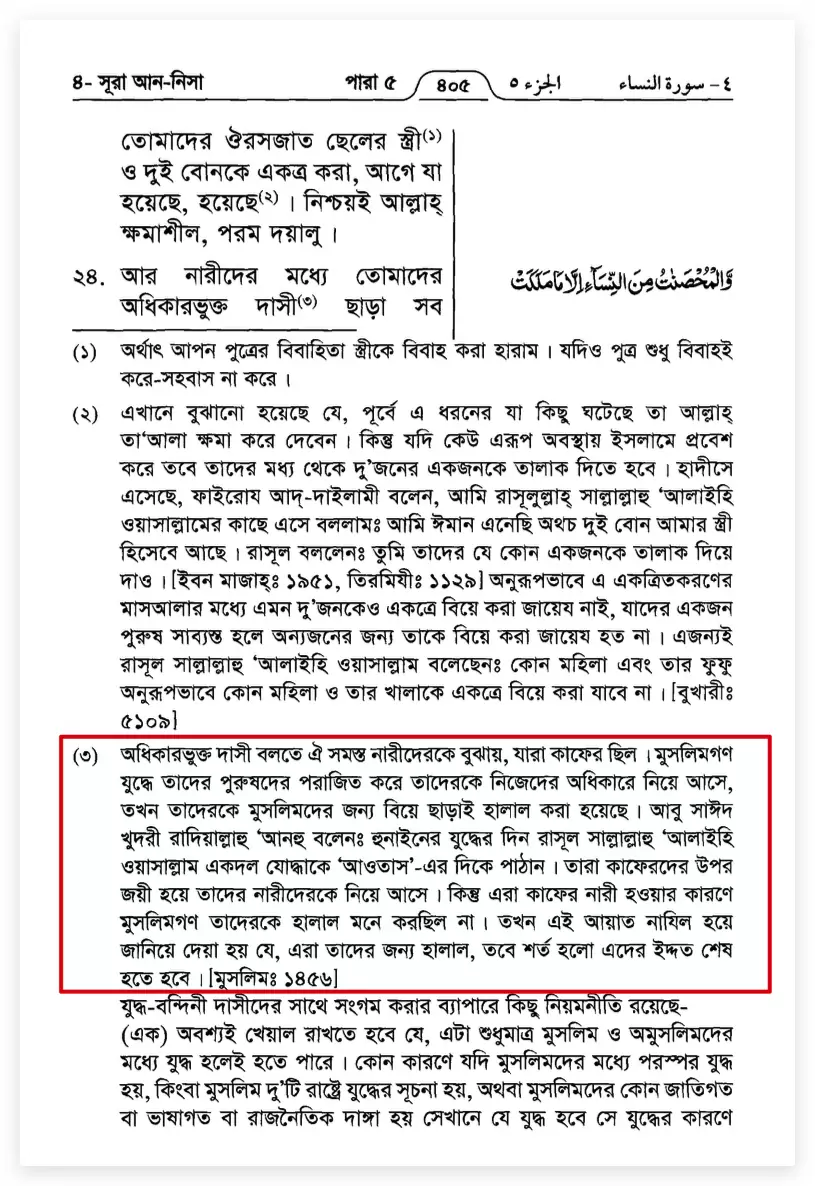
Did Umar Punish Someone for Intercourse with a Female Slave?
Many speakers defending Islam shamelessly mislead people with another false claim. They cite a hadith to assert that intercourse with female slaves is entirely forbidden. The report describes Umar severely punishing someone for having sex with a female slave. There is a major flaw in this presentation. Let us first read the hadith [306].
Sahih al-Bukhari (Islamic Foundation)
78/ Coercion
Chapter 2912: When a woman is forced into illicit sexual intercourse, no hadd punishment is imposed on her. For Allah says: “And if someone coerces them, then after such a coercion Allah is certainly All-Forgiving, Most Merciful ˹to them˺.” (24:33; English Quran quotation: Dr. Mustafa Khattab, The Clear Quran).
Islamic Foundation number: 6480; international numbers: 6949–6950
Al-Layth (may Allah have mercy on him) narrates from Nafi (may Allah have mercy on him), whom Safiyyah bint Abu Ubayd informed: “A governmental male-slave tried to seduce a slave-girl from the Khumus of the war booty till he deflowered her by force against her will; therefore ‘Umar flogged him according to the law, and exiled him, but he did not flog the female slave because the male-slave had committed illegal sexual intercourse by force, against her will.” Az-Zuhri said regarding a virgin slave-girl raped by a free man: The judge has to fine the adulterer as much money as is equal to the price of the female slave and the adulterer has to be flogged (according to the Islamic Law); but if the slave woman is a matron, then, according to the verdict of the Imam, the adulterer is not fined but he has to receive the legal punishment (according to the Islamic Law).
6480. Abu al-Yaman (may Allah have mercy on him) … Narrated Abu Huraira: Allah’s Messenger (ﷺ) said, “(The Prophet) Abraham migrated with his wife Sarah till he reached a town where there was a king or a tyrant who sent a message, to Abraham, ordering him to send Sarah to him. So when Abraham had sent Sarah, the tyrant got up, intending to do evil with her, but she got up and performed ablution and prayed and said, ‘O Allah ! If I have believed in You and in Your Apostle, then do not empower this oppressor over me.’ So he (the king) had an epileptic fit and started moving his legs violently. “
Hadith grade: Sahih
Narrator: Abu Hurayrah (may Allah be pleased with him)
The striking point is that the report itself identifies the man as a slave under governmental ownership. Umar punished him for raping a female slave belonging to the khumus, the fifth of war booty designated for the Prophet. He was not punished for intercourse with a slave he himself owned, but for raping a slave included in the fifth of the booty. There are thousands of such examples of Islamist misrepresentation.
Slavery Will Return if Islamic Rule Is Established
Almost all Islamic scholars acknowledge that slavery will return if Islamic rule is established throughout the world. Before the Day of Judgement, our believing brothers will be able to kill unbelievers and polytheists, enslave their mothers and sisters, and have sex with them. They say this openly, without shame, and write it directly in their books. I do not know how these scholars can write such things! Do they feel no hesitation? I do not know how they look at the mothers and sisters of our Hindu, Buddhist, and Christian brothers. Surely the thought occurs to them that, before the Day of Judgement, believers will be able to use all these women sexually as war booty. What a grotesque thought! [307]
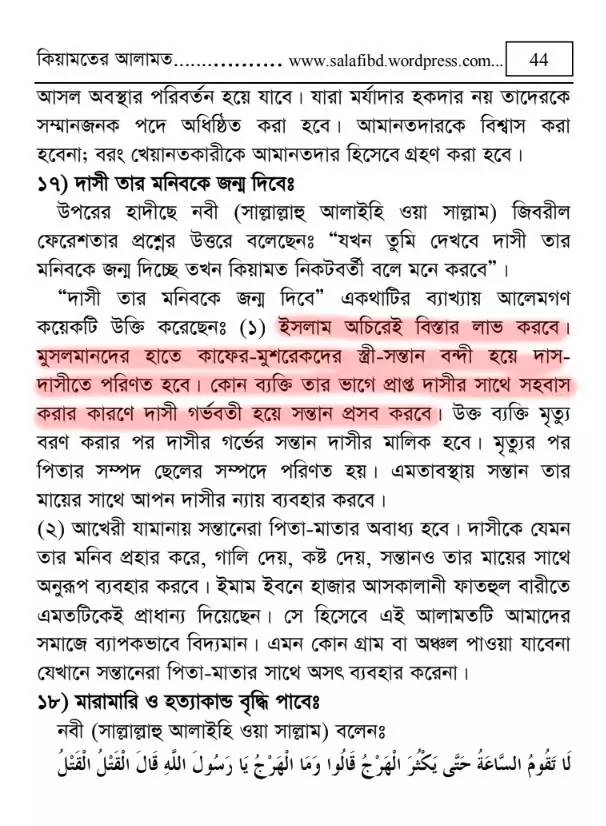
Let us hear the prominent Bangladeshi scholar Mizanur Rahman Azhari explain whether slavery is lawful in Islam and whether there is an Islamic plan to restore it. He naturally explains the matter gently, but the substance remains horrifying. Jihadist Muslims still dream of enslaving Jews and Christians, turning their mothers and sisters into war booty, and using them as sex slaves.
Now let us hear a Pakistani Muslim make an advance claim to the Indian actress Madhuri as his share of war booty should India and Pakistan go to war.
Conclusion
The preceding discussion shows that slavery is an established institution in Islam and will remain an inseparable part of it until the Day of Judgement. No Muslim can subsequently prohibit what Allah or Prophet Muhammad did not prohibit. Where the Prophet himself had intercourse with female slaves, a Muslim cannot regard the provision as wrong or immoral. Islamic rules here directly conflict with the United Nations and the Universal Declaration of Human Rights, as well as with the values of the modern civilised world. Prohibiting slavery through state law and declaring it immoral also contradicts Islamic rules.
Many Muslims claim that Islam laid the groundwork for ending slavery, but these claims are entirely false. Revelation ended with the Prophet, and these rules will remain in force until the Day of Judgement. If Muhammad wished to prohibit slavery, he would have done so, just as he prohibited alcohol and usury. Since he did not, claiming that he intended to prohibit it contradicts Islam’s fundamental beliefs. Why would Allah or the Prophet hesitate to command insignificant human beings to prohibit slavery? Nor can one suppose that Muhammad merely initiated abolition in the expectation that a later prophet would prohibit slavery: that too conflicts with Islam’s fundamental beliefs.
Furthermore, many civilisations had rules far more humane than Islam’s provisions for treating slaves well long before Islam emerged. Its limited encouragement of decent treatment and manumission therefore constitutes no original Islamic contribution. It is entirely justified to indict Islam for supporting and perpetuating a repugnant, barbaric institution such as slavery. A civilised and complete way of life cannot support slavery.
References
- Universal Declaration of Human Rights, 1948 1 2 3
- Geneva Convention ↩︎
- La Ikraha fi al-Din: Is There Really No Compulsion in Islam? ↩︎
- Lakum Dinukum wa-Liya Din ↩︎
- Offensive Jihad until Shirk Has Been Eradicated ↩︎
- The Complete Knowledge Base on Questions Concerning Slavery ↩︎
- Intercourse with Enslaved Women in Islam: An Examination of ‘Ma Malakat Aymanukum’ and Sexual Slavery ↩︎
- The Islamic Legality of Slavery in the Modern Era ↩︎
- The Legality of Raping Female Prisoners of War or Enslaved Women in Islam: Is the Enslaved Woman’s Consent Necessary? ↩︎
- The Fate of Civilian Women and Children in War: Spoils of War ↩︎
- Annulment of an Enslaved Woman’s Marriage for Sexual Use ↩︎
- The Will of Allah, the Infinitely Merciful: Let the Blood of Non-Believing Prisoners of War Flow Abundantly! ↩︎
- The Prophet Muhammad’s Offensive Jihad ↩︎
- Coitus Interruptus with Enslaved Women without Their Consent ↩︎
- A Legal Licence for Paedophilia under Islamic Sharia: The Permissibility of Intercourse with Underage Enslaved Girls ↩︎
- The Final Nail in Humanity’s Coffin: Islamic Slave Markets and the Public Auction of Women’s Bodies ↩︎
- What Is an Umm al-Walad? ↩︎
- Exchanging Enslaved Women for Sexual Use ↩︎
- What Is the Maximum Number of Sexual Slaves a Man May Keep? ↩︎
- Did Islam Prohibit Slavery? ↩︎
- Muhammad Himself Was a Slave Trader ↩︎
- Martin A. Klein (2002), Historical Dictionary of Slavery and Abolition, p. xxii, ISBN 0810841029 ↩︎
- Sahih al-Bukhari, Hadith: 2652 ↩︎
- Sahih Muslim, Hadith: 2533 ↩︎
- Bangladesh Labour Act, 2006 ↩︎
- “Sexual violence chapter 6” (PDF). World Health Organization. 2002. Retrieved 5 December 2015 ↩︎
- “Rape”. dictionary.reference.com. 15 April 2011 ↩︎
- “Rape”. legal-dictionary.thefreedictionary.com. 15 April 2011 ↩︎
- Moral absolutism ↩︎
- Code of Ur-Nammu ↩︎
- Solonian Constitution ↩︎
- Gamauf, Richard (2009). “Slaves Doing Business: The role of Roman Law in the Economy of a Roman Household”. European Review of History. 16 (3): 331–346. doi:10.1080/13507480902916837 ↩︎
- Kehoe, Dennis P. (2011). “Law and Social Function in the Roman Empire”. The Oxford Handbook of Social Relations in the Roman World. Oxford University Press. pp. 147–8 ↩︎
- Bradley (1994), pp. 2–3 ↩︎
- Moral letters to Lucilius/Letter 47 ↩︎
- Kautilya’s Arthashastra, page 261 1 2
- Siddharth Kara (10 October 2017). Modern Slavery: A Global Perspective. Columbia University Press. p. 18. ISBN 978-0-231-52802-3.
Ashoka outlawed the slave trade in the Mauryan Empire
↩︎ - Exodus 21:20–21 ↩︎
- Titus 2:9, 2:10 ↩︎
- Luke 12:47-48 ↩︎
- Old Testament, Deuteronomy 21:10–14 ↩︎
- Sahih Muslim, Islamic Foundation, Hadith: 226 ↩︎
- Ar-Raheeq Al-Makhtum, Allama Safiur Rahman Mubarakpuri, Tawhid Publications, p. 76 ↩︎
- Sahih al-Bukhari, Tawhid Publications, Hadith: 5372 ↩︎
- Sahih al-Bukhari, Tawhid Publications, Hadith: 5101 ↩︎
- Surah An-Nahl, verse 71 ↩︎
- Ma’ariful Quran, Mufti Muhammad Shafi Usmani, translated by Maulana Muhiuddin Khan, Islamic Foundation Bangladesh, Volume 5, pp. 362–363 ↩︎
- Shongshoy’s Complete Knowledge Base on Slavery ↩︎
- IslamQA: Slavery in Islam ↩︎
- IslamQA: Captivity in War as a Source of Slavery ↩︎
- IslamWeb: The Classical Framework of Slave Ownership ↩︎
- IslamWeb: Female Prisoners of War and Milk al-Yamin ↩︎
- Shongshoy: Women and Children as Spoils of War ↩︎
- IslamQA: The Purchase, Sale and Ownership of Enslaved Women ↩︎
- Ibn Qudamah: Al-Mughni, Shamela ↩︎
- IslamQA: Sexual Relations with Enslaved Women ↩︎
- IslamQA: Intercourse with an Enslaved Woman Is Not Classified as Zina ↩︎
- Shongshoy: Is an Enslaved Woman’s Consent Necessary for Intercourse? ↩︎
- Shafi’i Jurisprudence: Rawdat al-Talibin, Shamela ↩︎
- Al-Mawsu’ah al-Fiqhiyyah, Shamela ↩︎
- IslamWeb: Al-Muhalla ↩︎
- IslamQA: Does Marriage to an Enslaved Woman Free Her? ↩︎
- IslamQA: Intercourse with a Married Enslaved Woman ↩︎
- IslamQA: Istibra and Enslaved Women ↩︎
- IslamQA: Withdrawal and Enslaved Women ↩︎
- Shongshoy: Withdrawal without Consent ↩︎
- IslamWeb: Sexual Relations with a Polytheist Enslaved Woman ↩︎
- Shongshoy: Sexual Intercourse with a Polytheist Enslaved Woman ↩︎
- Shongshoy: What Is an Umm al-Walad? ↩︎
- Shongshoy: An Enslaved Woman’s ‘Awrah Extends from Navel to Knee ↩︎
- Shongshoy: Is Beating Slaves Haram? ↩︎
- IslamQA: The Rulings on Manumission and Slavery ↩︎
- Sunan Ibn Majah, Hadith: 2251 ↩︎
- Sunan Ibn Majah, Islamic Foundation, Volume 2, p. 315 ↩︎
- Sirat Ibn Hisham, original author: Ibn Hisham; translated by Akram Faruq, Bangladesh Islamic Centre, p. 227 ↩︎
- Surah An-Nisa, verse 65 ↩︎
- Sahih al-Bukhari, Islamic Foundation, Hadith: 6853 ↩︎
- Sahih al-Bukhari, Islamic Foundation, Volume 10, pp. 519–520, Hadith: 6853 ↩︎
- Sahaj Nasrul Bari Sharh Bukhari, Volume 13, p. 185 ↩︎
- Author of Saudi Curriculums Advocates Slavery ↩︎
- The Massacre of the Banu Qurayza 1 2
- The Sunnah of Religious Insult, Sectarianism and Idol Destruction ↩︎
- Tafsir al-Jalalayn, Volume 1, Islamiya Kutubkhana Publications, p. 425 ↩︎
- Surah At-Tawbah, verse 5 ↩︎
- Surah Al-Anfal, verse 39 ↩︎
- Surah Al-Baqarah, verse 193 ↩︎
- Surah At-Tawbah, verse 29 ↩︎
- Surah At-Tawbah, verse 111 ↩︎
- Surah At-Tawbah, verse 123 ↩︎
- Tafsir al-Mazhari, Hakimabad Khanqah-e-Mujaddediya Publications, Volume 5, pp. 117–120 ↩︎
- Tafsir al-Mazhari, Volume 1, Hakimabad Khanqah-e-Mujaddediya Publications, p. 398 ↩︎
- Sahih al-Bukhari, Tawhid Publications, Hadith: 2818 ↩︎
- Hadith Sambhar, Hadith: 1900 ↩︎
- Sahih al-Bukhari, Tawhid Publication, Hadith: 2977 ↩︎
- Sunan Abi Dawud, critically verified edition, Allama Albani Academy, Volume 4, Hadith: 3003 ↩︎
- Jami’ at-Tirmidhi, critically verified edition, Hadith: 2607 ↩︎
- Jami’ at-Tirmidhi, critically verified edition, Hadith: 2608 ↩︎
- Sunan an-Nasa’i, Islamic Foundation, Hadith: 3979 ↩︎
- Sahih Muslim, Hadith Academy, Hadith: 35 ↩︎
- Sunan Ibn Majah, Tawhid Publications, Hadith: 3929 ↩︎
- Sahih al-Bukhari, Tawhid Publications, Hadith: 3159 ↩︎
- Sahih al-Bukhari, Tawhid Publications, Volume 3, pp. 357–358 ↩︎
- Sahih Muslim, Islamic Foundation, Hadith: 4370 ↩︎
- Sahih Muslim, Bangladesh Islamic Centre, Volume 6, p. 181, Hadith: 4370 ↩︎
- Tahawi Sharif, Islamic Foundation, Volume 3, p. 337 ↩︎
- Al-Hidaya, Islamic Foundation Bangladesh, Volume 2, p. 461 ↩︎
- The Rights of Non-Muslims in an Islamic Sharia State ↩︎
- Sahih Muslim Sharif, Bengali translation with necessary commentary, Al-Hadith Publications, Volumes 17–18, pp. 12–13 ↩︎
- There is no compulsion to accept Islam, Question 34770 ↩︎
- Yunus 10:99 ↩︎
- Al-Baqarah 2:256 ↩︎
- At-Tawbah 9:5 1 2
- At-Tawbah 9:29 ↩︎
- Al-Anfal 8:39 ↩︎
- Was Islam spread by the sword?, Question 43087 ↩︎
- The Obligation to Destroy Idols ↩︎
- Demolishing idols in a non-Muslim country ↩︎
- Tafsir al-Mazhari, vol. 5, p. 335 ↩︎
- Tafsir Ibn Kathir, vol. 4, Islamic Foundation, pp. 564–567 ↩︎
- Tafsir al-Mazhari, vol. 5, p. 291 ↩︎
- Ahkam al-Qur’an, Khayrun Publications, vol. 2, pp. 355–358 ↩︎
- Surah al-Kafirun, verse 6 ↩︎
- Tafsir al-Jalalayn, vol. 7, p. 598 ↩︎
- Tafsir al-Mazhari, vol. 12, p. 613 ↩︎
- Al-Itqan fi Tawhid al-Rahman, Shaykh ‘Abdullah al-Munir, pp. 14–17, 25–27 ↩︎
- Stories of the Prophets–3, Sirat al-Rasul, Muhammad Asadullah al-Ghalib, Hadith Foundation Bangladesh, p. 478 ↩︎
- Tahawi Sharif, Islamic Foundation, vol. 3, p. 337 ↩︎
- A Review of Shirk, Bid‘ah, and Superstitions Prevalent in Bangladesh 2. The Consequences of Shirk ↩︎
- Tafsir Ibn Kathir, Islamic Foundation, vol. 4, p. 481 ↩︎
- Qur’an, Surah al-Anfal, verse 67 ↩︎
- Tafsir al-Jalalayn, vol. 2, p. 601 ↩︎
- Tafsir al-Mazhari, vol. 5, pp. 199–200 ↩︎
- Tafsir al-Mazhari, vol. 5, p. 207 ↩︎
- Sahih Muslim, Islamic Foundation, hadith 4370 ↩︎
- Sahih Muslim, Islamic Foundation, hadith 4399 ↩︎
- Sahih Muslim, Hadith Academy, hadith 4442 ↩︎
- Sunan Ibn Majah, Tawhid Publications, hadith 2839 ↩︎
- Sahih Muslim Sharif: Bengali Translation with Necessary Explanations, Al-Hadith Publications, vols. 17 and 18, p. 31 ↩︎
- Al-Bidayah wa-l-Nihayah, Islamic Foundation Bangladesh, vol. 4, p. 657 ↩︎
- Sahih al-Bukhari, Islamic Foundation, hadith 2811 ↩︎
- Sahih al-Bukhari, Islamic Foundation, hadith 3549 ↩︎
- Sahih al-Bukhari, vol. 6, Islamic Foundation, pp. 365–366, hadith 3549 ↩︎
- Sahih al-Bukhari, Islamic Foundation, hadith 4018 ↩︎
- Sahih al-Bukhari, Islamic Foundation, hadith 4017 ↩︎
- Sahih al-Bukhari, Tawhid Publications, hadith 4356 ↩︎
- Sahih al-Bukhari, Islamic Foundation, vol. 7, pp. 185–187 ↩︎
- Al-Rahiq al-Makhtum, Safi al-Rahman al-Mubarakpuri, Tawhid Publications, pp. 466–467 ↩︎
- Jami‘ al-Tirmidhi, Islamic Foundation, hadith 1049 ↩︎
- Tafsir Ibn Kathir, vol. 10, Islamic Foundation Bangladesh, pp. 526–527 ↩︎
- Sahaj Nasr al-Bari, Commentary on Sahih al-Bukhari, vol. 8, Arabic–Bengali, Accessible Translation and Detailed Explanation and Analysis, Maulana Muhammad ‘Uthman Ghani, Al-Kawthar Publications, p. 411 ↩︎
- Fatawa-i ‘Alamgiri, Islamic Foundation Bangladesh, vol. 3, pp. 502, 503, 535, 537, 540 ↩︎
- Sunan Abi Dawud, Islamic Foundation, hadith 2152 1 2
- Sunan Abi Dawud, Islamic Foundation, hadith 154 ↩︎
- Sahih Muslim, Hadith Academy, hadith 3436 ↩︎
- Sahih al-Bukhari, Tawhid Publications, hadith 4138 ↩︎
- Sahih Muslim, Hadith Academy, hadith 3451 ↩︎
- Sunan Abi Dawud, verified by Nasir al-Din al-Albani, Allama Albani Academy, vol. 3, pp. 215–216, hadith 2155 1 2
- Sahih al-Bukhari, Tawhid Publications, hadith 2541 ↩︎
- Sirat Ibn Hisham, original: Ibn Hisham; translation: Akram Faruq, Bangladesh Islamic Centre, p. 227 ↩︎
- The Massacre of Banu Qurayzah ↩︎
- Surah al-Mu’minun, verses 5–6 ↩︎
- Surah al-Ma‘arij, verses 29–30 ↩︎
- Surah al-Ahzab, verse 50 ↩︎
- Surah al-Nisa’, verse 24 ↩︎
- quran.com ↩︎
- Jami‘ al-Tirmidhi, verified edition, hadith 2769 ↩︎
- Tafsir Ibn Kathir, Islamic Foundation, vol. 7, pp. 514, 519, 520 ↩︎
- Tafsir al-Jalalayn, Islamiya Kutubkhana Publications, vol. 1, pp. 795, 797 ↩︎
- Tafsir Ibn Kathir, Tafsir Publications Committee, vols. 4/5/6/7, p. 343 ↩︎
- Tafsir al-Mazhari, vol. 3, pp. 16–17 ↩︎
- Sahih al-Bukhari, Tawhid Publications, hadith 5105 ↩︎
- Mishkat al-Masabih, Adhunik Publications, vol. 3, p. 183 ↩︎
- Sunan al-Nasa’i Sharif, Islamic Foundation, hadith 3961 ↩︎
- Sunan al-Nasa’i Sharif, Islamic Foundation, vol. 4, p. 106 ↩︎
- Mariyah al-Qibtiyyah | The Concubine and Wife Affair! ↩︎
- Sahih Muslim, Islamic Foundation, hadith 6766 ↩︎
- Sahih Muslim, Islamic Foundation, vol. 6, p. 285 ↩︎
- Sirat al-Mustafa, Idris Kandhlawi, vol. 3, Islamic Foundation Bangladesh, p. 308 ↩︎
- Muwatta Malik, Book 28, hadith 36 ↩︎
- Al-Bidayah wa-l-Nihayah, Islamic Foundation, vol. 7, pp. 254–255 ↩︎
- Al-Bidayah wa-l-Nihayah, Islamic Foundation, vol. 7, p. 589 ↩︎
- Al-Bidayah wa-l-Nihayah, Ibn Kathir, vol. 8, pp. 266–267 ↩︎
- Sunan Ibn Majah, Islamic Foundation, vol. 2, p. 435 ↩︎
- Fatawa-i ‘Alamgiri, Islamic Foundation Bangladesh, vol. 3, p. 137 ↩︎
- Tahawi Sharif, Islamic Foundation, vol. 3, p. 508 ↩︎
- Fatawa-i ‘Alamgiri, Islamic Foundation Bangladesh, vol. 2, p. 44 ↩︎
- Veiling in Islam: Distinguishing Free Women from Female Slaves 1 2
- Ashraf al-Hidayah, Islamiya Kutubkhana, vol. 9, p. 615 ↩︎
- Sunan al-Darimi, HadithBD, hadith 1212 ↩︎
- Sunan al-Darimi, HadithBD, hadith 1213 ↩︎
- Sunan al-Darimi, HadithBD, hadith 1214 ↩︎
- Islam, War Booty, and Our Humanity ↩︎
- Sahih al-Bukhari, Tawhid Publications, hadith 4350 ↩︎
- Sahih al-Bukhari, Tawhid Publications, vol. 4, p. 210, hadith 4350 ↩︎
- Al-Bidayah wa-l-Nihayah, Islamic Foundation Bangladesh, vol. 5, p. 191 ↩︎
- Sahaj In‘am al-Bari, Commentary on al-Bukhari: Military Expeditions and Qur’anic Commentary, translated and edited by Maulana Muhammad ‘Alamgir Husayn, Maktabah Imdadiyah Publications, pp. 227–228 ↩︎
- Fatawa-i ‘Alamgiri, Islamic Foundation Bangladesh, vol. 2, p. 639 ↩︎
- Ashraf al-Hidayah, Islamiya Kutubkhana, vol. 9, pp. 615, 638 ↩︎
- Sahih Muslim, Islamic Foundation, hadith 3477 ↩︎
- Sahih al-Bukhari, Islamic Foundation, vol. 7, p. 69, hadith 3832 ↩︎
- Ashraf al-Hidayah, Islamiya Kutubkhana, vol. 9, p. 625 ↩︎
- Sahaj Dars Ibn Majah, p. 253 ↩︎
- Sahih Muslim, Islamic Foundation, hadith 4421 ↩︎
- Bukhari Sharif, Islamic Foundation, vol. 4, p. 89, hadith 2088 ↩︎
- Sahih al-Bukhari, Tawhid Publications, hadith 7409 ↩︎
- Bukhari Sharif, Islamic Foundation, vol. 10, p. 549, hadith 6905 ↩︎
- Sahaj Nasr al-Bari, Commentary on Sahih al-Bukhari, vol. 11, Arabic–Bengali, Accessible Translation and Detailed Explanation and Analysis, Maulana Muhammad ‘Uthman Ghani, Al-Kawthar Publications, pp. 507–508 ↩︎
- Jami at-Tirmidhi, Islamic Foundation, Hadith: 1219 ↩︎
- Jami at-Tirmidhi, Islamic Foundation, Hadith: 1222 ↩︎
- Sunan Abi Dawud, Islamic Foundation, Hadith: 3475 ↩︎
- Sirat Ibn Hisham, original: Ibn Hisham, translation: Akram Faruq, Bangladesh Islamic Centre, p. 227 ↩︎
- Ashraful Hidaya, Islamia Kutubkhana, vol. 9, pp. 618, 619 ↩︎
- Al-Misbah al-Nuri Sharh Mukhtasar al-Quduri, vol. 1, Islamia Kutubkhana, p. 230 ↩︎
- Ashraful Hidaya, Islamia Kutubkhana, vol. 9, p. 596 ↩︎
- Sahih al-Bukhari, Tawhid Publication, Hadith: 2635 ↩︎
- Tafsir al-Mazhari, Qadi Thanaullah Panipati, vol. 9, p. 541 ↩︎
- Fiqh Uthman (may Allah be pleased with him), Adhunik Publications, pp. 180, 181 ↩︎
- Fatawa Alamgiri, Islamic Foundation Bangladesh, vol. 3, pp. 150, 143 ↩︎
- Sahih al-Bukhari, Tawhid Publications, Hadith: 6764 ↩︎
- Sahih al-Bukhari, Islamic Foundation, Hadith: 2395 ↩︎
- Sahih al-Bukhari, Islamic Foundation, Hadith: 4899 ↩︎
- Sahih al-Bukhari, Islamic Foundation, Hadith: 4901 ↩︎
- Sahih al-Bukhari, Islamic Foundation, Hadith: 2093 ↩︎
- Sahih al-Bukhari, Islamic Foundation, vol. 4, p. 91 ↩︎
- Sahih al-Bukhari, Tawhid Publication, Hadith: 5105 ↩︎
- Sahih al-Bukhari, Tawhid Publications, p. 26 ↩︎
- Fatawa Alamgiri, Islamic Foundation Bangladesh, vol. 2, p. 193 ↩︎
- Fiqh Uthman, may Allah be pleased with him, Dr Muhammad Rawwas Qalaji, translated and edited by Muhammad Khalilur Rahman Mumin, Adhunik Publications, p. 229 ↩︎
- Fiqh al-Sunnah, vol. 2, Sayyid Sabiq, Shatabdi Publications, pp. 84, 85 1 2
- Al-Hidaya, Islamic Foundation Bangladesh, vol. 2, p. 297 ↩︎
- Tafsir Maariful Quran, Mufti Muhammad Shafi Usmani, translation: Mawlana Muhiuddin Khan, Islamic Foundation Bangladesh, vol. 2, pp. 350, 351 1 2
- Tafsir al-Jalalayn, vol. 1, pp. 802–803 1 2
- Fiqh Abu Bakr (may Allah be pleased with him), Dr Muhammad Rawwas Qalaji, Adhunik Publications, pp. 102–103 1 2
- Ahkam al-Quran, vol. 1, Allama Abu Bakr Ahmad al-Jassas, may Allah have mercy on him, Khayrun Publications, pp. 299, 300 ↩︎
- Sahih Muslim Sharif, Bengali Translation with Necessary Commentary, Al-Hadith Publications, vol. 15, pp. 217–218 ↩︎
- Fatawa Alamgiri, Islamic Foundation Bangladesh, vol. 5, pp. 469, 470 ↩︎
- Fatawa Alamgiri, Islamic Foundation Bangladesh, vol. 2, p. 20 ↩︎
- Sahih Muslim, Hadith Academy, Hadith: 2163 ↩︎
- Jami at-Tirmidhi, Islamic Foundation, Hadith: 626 ↩︎
- Shuab al-Iman, p. 88 ↩︎
- Sahih Muslim, Islamic Foundation, Hadith: 132 ↩︎
- Sahih Muslim, Islamic Foundation, Hadith: 133 ↩︎
- Sahih Muslim, Islamic Foundation, Hadith: 134 ↩︎
- Hadith Sambhar, Hadith: 2028 ↩︎
- Sahih al-Bukhari, Islamic Foundation, Hadith: 6299 ↩︎
- Sahih al-Bukhari, Tawhid Publications, Hadith: 2592 ↩︎
- Sahih Muslim, Islamic Foundation, Hadith: 3655 ↩︎
- Mishkat al-Masabih, Hadith: 3401 1 2
- Sahih al-Bukhari, Islamic Foundation, Hadith: 2367 ↩︎
- Sunan Abi Dawud, Islamic Foundation, Hadith: 3920 ↩︎
- Mishkat al-Masabih, Hadith: 3396 ↩︎
- Sahih Muslim, Islamic Foundation, Hadith: 3638 ↩︎
- Sahih al-Bukhari, Islamic Foundation, Hadith: 2034 ↩︎
- Sahih Muslim Sharif, Bengali Translation with Necessary Commentary, Maktabat al-Hadith Publications, vol. 14, p. 226 1 2
- Sahih al-Bukhari, Islamic Foundation, Hadith: 2542 ↩︎
- Sahih Muslim, vol. 4, Hadith Academy, pp. 16–17, Hadith: 3671 ↩︎
- Sahih Muslim, vol. 4, Hadith Academy, Hadith: 3669 ↩︎
- Sahih Muslim, vol. 4, Hadith Academy, p. 15 ↩︎
- Al-Misbah al-Nuri Sharh Mukhtasar al-Quduri, vol. 2, Islamia Kutubkhana, p. 164 ↩︎
- Sahih Muslim, Hadith Academy, Hadith: 3683 ↩︎
- Sahih Muslim, Hadith Academy, vol. 4, pp. 20–21, Hadith: 3671 ↩︎
- Fatawa Alamgiri, Islamic Foundation Bangladesh, vol. 6, p. 615 ↩︎
- Fatawa Alamgiri, Islamic Foundation Bangladesh, vol. 3, p. 147 ↩︎
- Fatawa Faqih al-Millat, vol. 12, Faqih al-Millat Foundation, Faqih al-Millat Mufti Abdur Rahman, pp. 292, 293 ↩︎
- Tafsir Maariful Quran, Mufti Muhammad Shafi Usmani, translation: Mawlana Muhiuddin Khan, Islamic Foundation Bangladesh, vol. 8, pp. 6, 7 ↩︎
- Sahih al-Bukhari, Islamic Foundation, Hadith: 4713 ↩︎
- Al-Bidaya wa-l-Nihaya, vol. 2, Islamic Foundation Bangladesh, pp. 39, 40 ↩︎
- Sahih al-Bukhari, Tawhid Publication, Hadith: 2552 1 2
- Sunan Abi Dawud, Verified Edition, Hadith: 4975 ↩︎
- Sahih Muslim Sharif, Bengali Translation with Necessary Commentary, Maktabat al-Hadith Publications, vols. 19 and 20, p. 366 ↩︎
- Surah al-Nisa, verse 25 ↩︎
- Tafsir al-Jalalayn, vol. 1, p. 764 ↩︎
- On the Treatment of Female Slaves in Islam ↩︎
- Sunan Abi Dawud, Islamic Foundation, Hadith: 2152 1 2
- Mishkat al-Masabih, Hadith: 3338 ↩︎
- Mishkat al-Masabih, Hadith: 3341 ↩︎
- Sahih Muslim, Islamic Foundation, Hadith: 3477 ↩︎
- Sunan Abi Dawud, Verified Edition, Hadith: 2998 ↩︎
- Sunan Abi Dawud, Verified Edition, Husayn al-Madani Publications, vol. 5, pp. 232–233, Hadith: 2998 ↩︎
- Inhuman Slavery in Islam ↩︎
- Quran 16:75 ↩︎
- ويحرم على الزوجة والأمة تحريما غليظا أن تمتنع إذا طلبها للاستمتاع الجائز ↩︎
- Mawsoo’ah al-Fiqhiyyah, Vol. 31, p. 44 ↩︎
- مسألة فرض الأمة والحرة أن لا يمنعا السيد والزوج الجماع متى دعاهما ↩︎
- IslamQA, Fatwa No. 33597 ↩︎
- مسألة فرض الأمة والحرة أن لا يمنعا السيد والزوج الجماع متى دعاهما ↩︎
- Tafsir Ibn Kathir, Islamic Foundation, vol. 7, pp. 519, 520 ↩︎
- The Crowd in Rome in the Late Republic (University of Michigan, 1998, 2002), Fergus Millar, pp. 23 ↩︎
- Surah al-Nur, verse 33 ↩︎
- Tafsir al-Mazhari, Qadi Thanaullah Panipati, vol. 8, Hakimabad Khanqah Mujaddidiyah Publications, p. 412 ↩︎
- Tafsir Maariful Quran, Mufti Muhammad Shafi Usmani, vol. 6, translation: Mawlana Muhiuddin Khan, Islamic Foundation Bangladesh, vol. 6, p. 447 ↩︎
- Sahaj Nasr al-Bari Sharh Bukhari, vol. 7, pp. 240–241 ↩︎
- Islam and Women: The Highest Honour and Loftiest Status! ↩︎
- Mishkat al-Masabih, Hadith: 3242 ↩︎
- Sahih Al-bukhari, Vol-3, Page 421, Dr. Muhammad Muhsin khan, Darus salam Publications, Saudi Arabia ↩︎
- Bulugh al-Maram, Hadith: 1064 ↩︎
- Idah al-Muslim, Mufti Hifzur Rahman, Darul Ulum Library, pp. 364, 365 ↩︎
- Sahih Muslim Sharif, Bengali Translation with Necessary Commentary, Al-Hadith Publications, vol. 16, p. 121 ↩︎
- Sunan Abi Dawud, Islamic Foundation, Hadith: 1818 ↩︎
- Abu Dawud Sharif, Islamic Foundation, vol. 3, pp. 38, 39 ↩︎
- Sirat al-Nabi, peace and blessings be upon him, Ibn Hisham, vol. 3, pp. 309–310 ↩︎
- Surah al-Baqarah, verse 221 ↩︎
- Ahkam al-Quran, Khayrun Publications, vol. 2, p. 357 ↩︎
- Mukhtasar Zad al-Maad, Allama Imam Ibn Qayyim al-Jawziyyah, Wahidiyah Islamia Library, p. 250 ↩︎
- Tafsir Zakaria, Dr Abu Bakr Muhammad Zakaria, published by the Saudi government, vol. 1, p. 405 ↩︎
- Sahih al-Bukhari, Islamic Foundation, Hadith: 6480 ↩︎
- Signs of the Day of Judgement, Abdullah Shahed al-Madani, p. 44 ↩︎
About This Article
Genre: Semi-Academic Historical, Ethical, Legal, and Human Rights Critique
Epistemic Position: Secular Humanist Ethics, Historical Criticism, Human Rights Reasoning, and Anti-Apologetic Source Analysis
This article critically examines slavery, slave trade, war captivity, sexual slavery, ownership of human beings, and the treatment of enslaved people in religious and historical traditions, with special attention to Islamic sources, classical fiqh, and the doctrine of ma malakat aymanukum.
Its purpose is not devotional interpretation, theological damage control, or apologetic rehabilitation of slavery. The article evaluates whether any system that permits human ownership, forced labor, captive concubinage, sale of human beings, or sexual access to enslaved women can be morally defended under the standards of human dignity, bodily autonomy, consent, and universal human rights.
This article does not treat “it was normal at that time” as a moral defense. Historical context may explain how slavery existed, but it does not turn ownership of human beings into justice, nor does it erase the suffering of enslaved men, women, and children.
Modern apologetic claims that Islam “abolished slavery gradually” or “gave slaves rights” are not accepted by default. Such claims must be tested against Quranic verses, hadith reports, classical tafsir, fiqh rulings, the conduct of Muhammad, the practice of the Sahaba, and the continued legal permissibility of slavery in traditional Islamic jurisprudence.
The article treats sexual access to captive women and enslaved women as a question of coercion and consent. A person who is captured, owned, sold, inherited, or placed under the authority of a master cannot meaningfully give free sexual consent in the ordinary moral sense.
Strong criticism in this article should not be mistaken for bias or hostility. If religious texts and classical legal systems permit slavery, concubinage, or ownership-based sexual access, then the moral burden lies on those doctrines and their defenders—not on the critic who exposes their implications.
This article should be evaluated through source transparency, historical accuracy, consistency in source criticism, moral clarity, human rights reasoning, and attention to victims of slavery—not through theological sensitivity, inherited reverence, apologetic harmonization, cultural relativism, or demands that criticism of sacred law must remain rhetorically soft.