
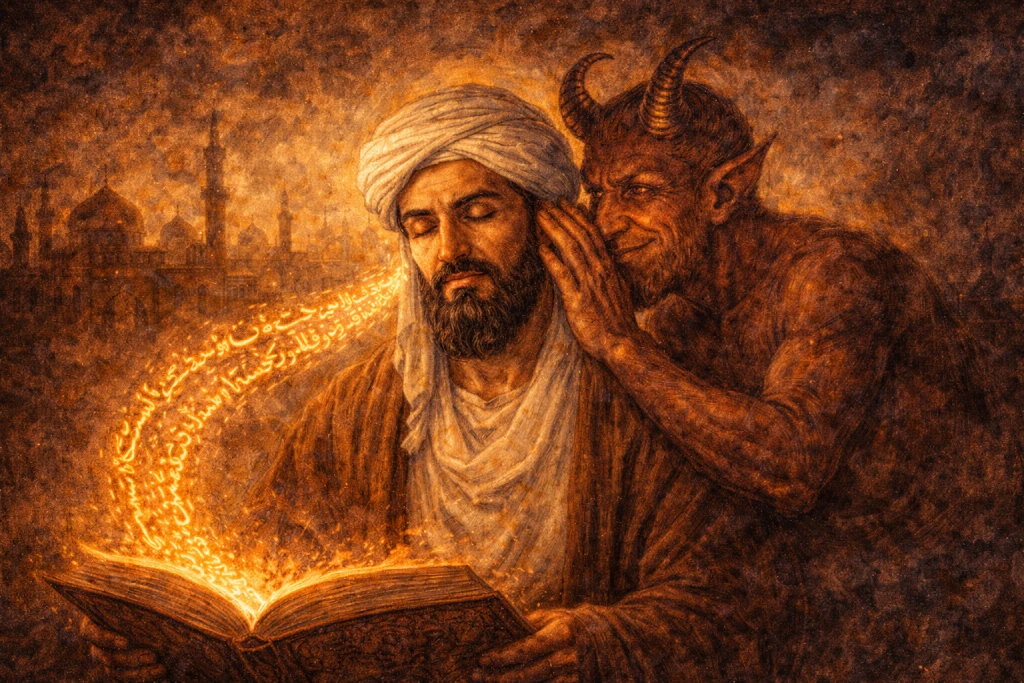
The Satanic Verses
Summary
This article examines the historical basis and theological implications of one of the most controversial episodes in early Islamic history: the ‘Satanic Verses’, also known as the Gharaniq episode. Its central concern is the claim that, while reciting Surah al-Najm during the Meccan period, Prophet Muhammad uttered words praising the pagan goddesses al-Lat, al-Uzza and Manat. This account raises serious questions about the purity of revelation and prophetic infallibility (ismah). The article shows that the episode is not a modern Western invention: it is described in detail in some of Islam’s earliest and classical sources. The early biographer Ibn Ishaq and the historian Ibn Sa‘d record that, as the Prophet sought reconciliation with the Quraysh, Satan inserted into his recitation words intended to appease the idolaters. According to these accounts, Mecca’s polytheists consequently prostrated alongside the Muslims, an event presented in the historical records as a significant turning point.
The analysis also shows that many later Qur’anic commentators acknowledged the episode in their explanations of verse 52 of Surah al-Hajj, which describes Satan’s attempts to interfere with the reception of revelation by earlier prophets. A substantial number of medieval and modern Islamic scholars, however, have tended to dismiss these historical reports as ‘fabricated’ or ‘baseless’ in an effort to preserve prophetic infallibility or established doctrine.
The conclusion stresses the need to examine these records, because the episode’s early sources are exceptionally strong by historical standards. An objective and rational analysis, conducted independently of religious sentiment, reveals a complex intersection between claims of supernatural revelation and the human processes through which its material was collected. It demonstrates that the historical picture emerging from the earliest stages of the collection and dissemination of revelation is more complex and multifaceted than the systematic religious doctrines developed in later periods.
Introduction
The publication of Salman Rushdie’s widely discussed novel The Satanic Verses provoked an intense international controversy. It generated substantial reactions not only in the West but also across Muslim countries, particularly Iran, Saudi Arabia and Bangladesh. Iran’s supreme religious leader, Ayatollah Khomeini, issued a fatwa calling for Rushdie’s death, which remains in force. This article examines the veracity of the historical accounts concerning the Satanic Verses, their acceptance from different perspectives, and the controversy surrounding them in the Islamic world.
The Satanic Verses is primarily a work of literature. Although it does not directly attack religion as such, particular passages aroused anger among Muslims. Its treatment of the historical episode known as the Satanic Verses was especially central to the controversy. The underlying reason is that almost 99% of ordinary Muslims are entirely ignorant about Islam: they neither know Arabic nor have ever read its religious scriptures. This ignorance triggered the widespread reaction. Anyone familiar with Islam should readily understand that Rushdie did not invent the matter: Islamic historical sources describe it quite explicitly. Although the novel is fictional, Muslim society regarded it as blasphemous because some of its material relates to early Islamic history. The Satanic Verses refer to a controversial episode in Muhammad’s life. According to the account, while suffering persecution by Mecca’s idol-worshipping leaders, he added verses to the Qur’an to appease them; Gabriel subsequently corrected them. The episode appears in the writings of Muslim historians including Ibn Ishaq, al-Tabari, Ibn Sa‘d and al-Waqidi. Although many later scholars called it baseless or fabricated, it has remained a subject of Islamic scholarship for a long time. Accounts of the Satanic Verses occur principally in early Islamic historical works, whose authors recorded them as credible reports. Some later Islamic scholars rejected the episode, but they could not entirely deny the historical sources in which it appears.
Many Muslim thinkers claim that the episode is propaganda created by opponents of Islam. This raises an obvious question: if it is merely malicious propaganda, how did accounts of it enter some of Islam’s earliest and most prominent books? Examining this question reveals that Islamic historiography incorporated different doctrines and interpretations, which later commentators analysed in various ways. Many contemporary Islamic scholars reject the Satanic Verses episode outright and describe it as fictional. Yet the importance of the historical sources and the explanations given by early Muslim historians cannot simply be disregarded. The controversy over the Satanic Verses remains a significant topic in research on Islamic history and Muhammad’s life. Doctrinal disagreements within the Muslim world do not make the historical documents disappear. Salman Rushdie’s The Satanic Verses brought the controversy back onto the world stage, connecting history, religion and literature. Readers can examine the sources presented in this article, and the subject calls for further research.
The Satanic Verses: The Original Episode
Muhammad had begun preaching Islam in Mecca. One day, he was sitting in the precincts of the Kaaba, addressing Muslims who had recently converted. Other members of the pagan Quraysh were also present. Relations between the pagans and Muslims were intensely hostile at the time. Muhammad then uttered certain verses as newly revealed material. He presented several verses of Surah al-Najm as revelation. They were as follows:
Have you considered al-Lat and al-Uzza?
And the other goddess, Manat?
They are exalted, powerful goddesses.
Their assistance may also be sought.
(Verses influenced by Satan)
In another translation:
Have you considered al-Lat and al-Uzza?
And the other goddess, Manat?
These are the soaring cranes.
Their intercession may therefore be hoped for.
As soon as these verses were uttered, the Quraysh’s persecution ceased and friendly relations with Muhammad were restored. The Quraysh at the time had no objection to Muhammad’s new religion in itself. Their principal dispute with him concerned why Muhammad and his followers were insulting their gods and goddesses. Muhammad subsequently realised his mistake: under pressure, he had praised the pagan deities al-Lat, Manat and al-Uzza, thereby undermining his claim to be a prophet of a monotheistic Abrahamic religion. He then instructed his followers to remove the final two verses and presented corrective verses as revelation. The remaining verses of the surah were also revealed.
Have you considered al-Lat and al-Uzza,
And Manat, the third, the other?
Are male children for you and female children for Allah?
That would indeed be an unjust division.
These are nothing but names that you and your forefathers have given them. Allah has revealed no authority in their support. They follow only conjecture and their own desires, although guidance from their Lord has already reached them.
(Corrected verses)
He explained that those had not actually been verses sent by Allah. Satan had deceived him and made him utter them. He supplied other verses in their place and declared the verses praising the goddesses invalid. The claims presented so far will be substantiated below using Islamic texts themselves.
The three principal goddesses worshipped by Arabia’s pagans at the time were al-Lat, al-Uzza and Manat. They were also regarded as Allah’s three daughters. The pagans repeatedly appealed to Muhammad: if he accepted their deities, they would accept his Allah. They strongly resented his continual disparagement, insults and criticism of their gods and goddesses. Despite repeated attempts to reason with him, he did not refrain from sacrilegious remarks or insulting their deities. Even complaints to his uncle Abu Talib achieved nothing.
Under these circumstances, hearing Muhammad utter those two verses concerning their goddesses delighted Mecca’s polytheists. They thought that he would now stop insulting their deities and would instead praise them. Muhammad had accepted their gods, and they would accept his Allah. Their longstanding conflict had ended. People of all religions could now coexist, without anyone insulting another’s deities or God. Consequently, on that day, Mecca’s polytheists prostrated together with Muhammad and the other Muslims in the precincts of Mecca.
Muhammad later claimed, however, that those two verses were Satan’s deception. He would acknowledge no deity other than Allah and instructed his followers to remove them. The conflict between the two groups then resumed. Let us now examine the sources.
Islam’s Implicit Recognition of Multiple Supernatural Beings
Islam presents itself as a strictly monotheistic religion whose central foundation is ‘La ilaha illa Allah’: there is no deity other than Allah, or no one except Allah is worthy of worship. This belief is fundamental to Islam and central to its theology, emphasising Allah’s exclusive authority and status as the sole object of worship. Yet a close examination of certain Qur’anic verses and their classical interpretations reveals functional or ontological recognition of other divine beings in early Islam, even while maintaining that there is ‘no deity worthy of worship’ apart from Allah. This article examines Qur’anic statements that proclaim monotheism while implicitly accepting the existence of multiple divine beings through descriptions of their punishment, judgement and characteristics. The language of verses such as Surah al-Mu’minun 23:14, which calls Allah ‘the best of creators’, creates a clear impression of multiple divine or supernatural beings, contrary to Islam’s strict monotheistic account. We will examine the linguistic and theological contradictions in these verses, the influence of pagan society on Muhammad’s theological development during the Meccan period, the historical context of the ‘Satanic Verses’, and changes in the character of ‘Allah’ between the Meccan and Medinan periods. Finally, the article will bring these elements together to show how they challenge the foundations and infallibility of Islamic theology.
Contradictions in the Qur’an: ‘The Best of Creators’ versus Exclusive Oneness
Although the Qur’an claims to be a complete and internally consistent book, some of its verses appear fundamentally incompatible with others. One of the most striking examples is Surah al-Mu’minun 23:14, which states:
“فَتَبَارَكَ اللَّهُ أَحْسَنُ الْخَالِقِينَ” ‘So blessed is Allah, the best of creators.’ [1]
In another translation:
“فَتَبَارَكَ اللَّهُ أَحْسَنُ الْخَالِقِينَ”
‘So blessed is Allah, the greatest among creators.’
—Surah al-Mu’minun 23:14 [1]
Two Arabic words in this verse are particularly significant: ‘الخالقين’ (al-khaliqin), a plural form meaning ‘creators’, and ‘أحسن’ (ahsanu), a comparative adjective meaning ‘the best’ or ‘the greatest’. This construction is logical only if multiple creators exist and one is described as the best among them. Yet it directly conflicts with several other Qur’anic verses in which Allah claims to be the only creator:
- ‘Allah is the Creator of all things.’ —Surah al-Zumar 39:62
- ‘Is there any creator other than Allah?’ —Surah Fatir 35:3
- ‘They cannot create anything; rather, **they themselves are created**.’ —Surah al-Nahl 16:20
If Allah is the only creator and no other creator or deity exists, the expression ‘the best of creators’ has no meaning: there is no basis for comparison. This contradiction calls into question the foundations of Islamic theology’s claim to monotheism. Many Islamic commentators try to explain the verse as a mere rhetorical device or stylistic embellishment. But if such rhetoric creates fundamental theological confusion, it cannot be described as God’s ‘supreme, flawless and transparent language’, particularly when the Qur’an itself claims: ‘The verses of this Book have been clearly explained and revealed in wise and clear language.’ [2]. Can a divine message genuinely be called ‘clear’ if understanding it requires the assistance of hundreds of commentators across many centuries? Is such linguistic ambiguity desirable in a message from God?
Is Allah a Better Creator than Humans and Jinn?
Classical commentators, particularly al-Tabari and al-Qurtubi, have tried to broaden the meaning of khaliq in interpreting the Qur’anic expression ahsan al-khaliqin, ‘the best of creators’. According to their explanation, being a ‘creator’ is not exclusive to Allah: humans may also fall within the category because they create or construct things, such as sculptures and houses. They accordingly argue that Allah is superior to them because his creation is perfect, whereas human creation is limited. This interpretation attempts to explain the comparative character of ‘the best of creators’ by relating it to creative beings such as humans.
This explanation, however, weakens both the Qur’an’s linguistic presentation and the theological foundations of monotheism. Calling human-made objects ‘creation’ is fundamentally a misuse of the term. Human activity is not original or ontological creation of the kind attributed to Allah; human ‘construction’ gives existing natural materials a new form. What is called human creation is therefore not creation in the fundamental sense, but transformation at most. Comparing it with Allah’s creation is entirely irrelevant. The Qur’an, Hadith and Islamic doctrine also maintain that nothing is comparable to Allah. If so, how can Allah compare himself with humans or jinn and claim to be the greatest creator? Why would an omnipotent Allah contradict his own position by introducing a comparison that measures his superiority against humans or other beings? This conflicts with the Qur’an’s claim to divine oneness and its conception of Allah as a self-existent being.
Punishing and Judging Objects of Worship: An Implicit Acknowledgement of Their Existence
Some Qur’anic verses speak of punishing beings worshipped instead of Allah, creating a theological question about their actual existence. Surah al-Anbiya 21:98–100 states:
You disbelievers and what you worship instead of Allah are fuel for Hell. You will enter it.
—Taisirul Quran
You and what you worship in place of Allah are indeed fuel for Hell; you will all enter it.
—Sheikh Mujibur Rahman
Indeed, you and what you worship apart from Allah are fuel for Hell. You will enter it.
—Rawai Al-bayan
Indeed, you and what you worship instead of Allah are indeed fuel for Hell; you will all enter it.
—Dr Abu Bakr Muhammad Zakaria
If they were gods, they would not enter it; all of them will remain there forever.
—Taisirul Quran
If they were deities, they would not enter Hell; all of them will remain there forever.
—Sheikh Mujibur Rahman
If they were gods, they would not enter Hell. And all of them will remain there forever.
—Rawai Al-bayan
If they were gods, they would not enter Hell; and all of them will remain there forever.
—Dr Abu Bakr Muhammad Zakaria
There they will sob, and there they will hear nothing.
—Taisirul Quran
There they will cry out in anguish, and there they will hear nothing.
—Sheikh Mujibur Rahman
There they will cry out in anguish, and there they will be unable to hear.
—Rawai Al-bayan
There they will gasp for breath [1], and there they will hear nothing.
—Dr Abu Bakr Muhammad Zakaria
Traditional commentators understand these ‘objects of worship’ to mean beings such as al-Lat, Manat, al-Uzza and Hubal, whom people took as deities instead of Allah. But the fundamental question is this: if these deities are merely imaginary figures or inanimate statues, how can they be sent to Hell? Being punished establishes a being’s existence and consciousness. A nonexistent entity or a merely imaginary idol cannot be subject to punishment. [3]
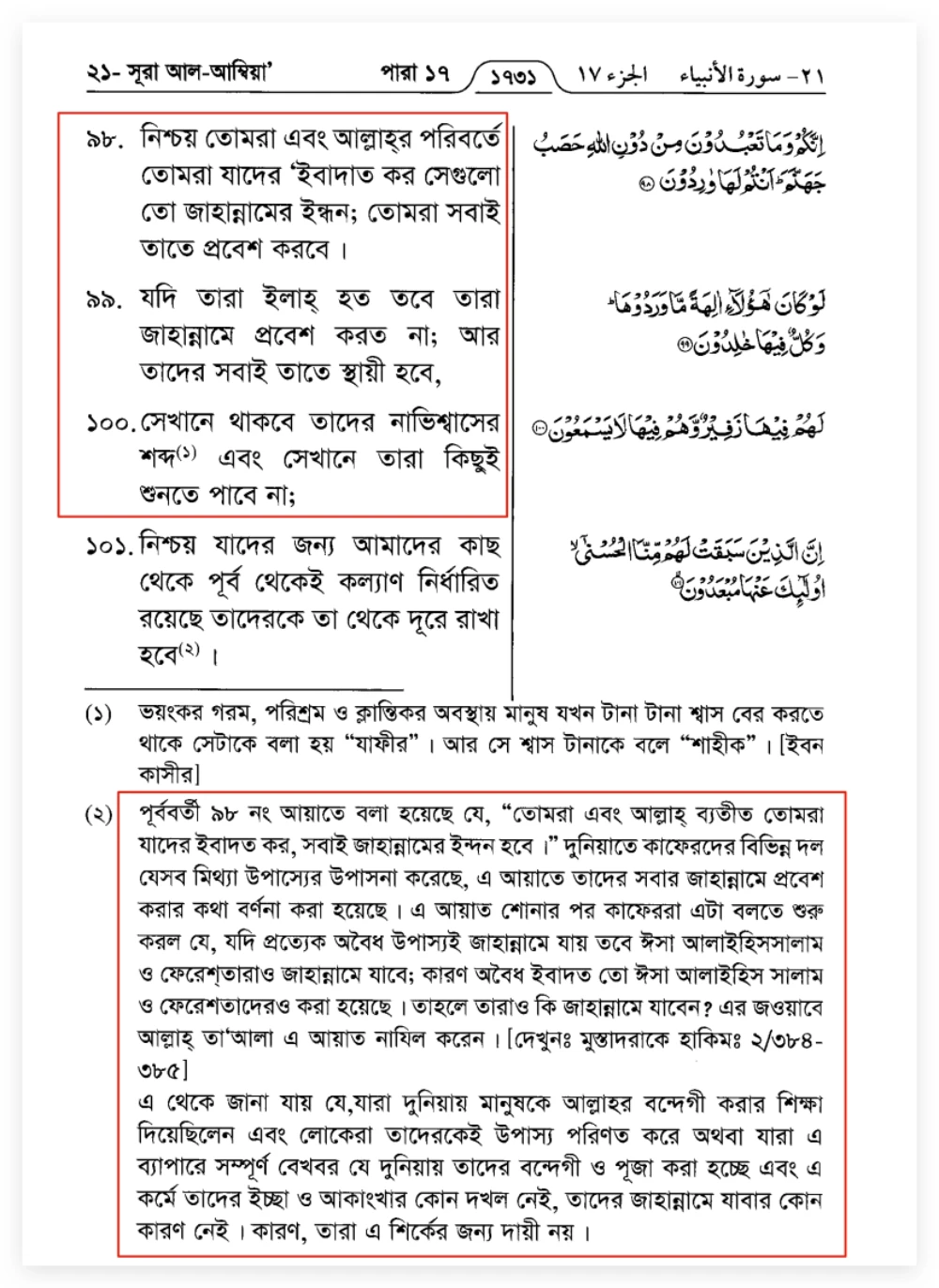
This statement directly attributes consciousness, moral responsibility and agency to the ‘false deities’. It means that these objects of worship were conscious, morally accountable beings with wills of their own, suggesting an actual existence beyond mere imagination.
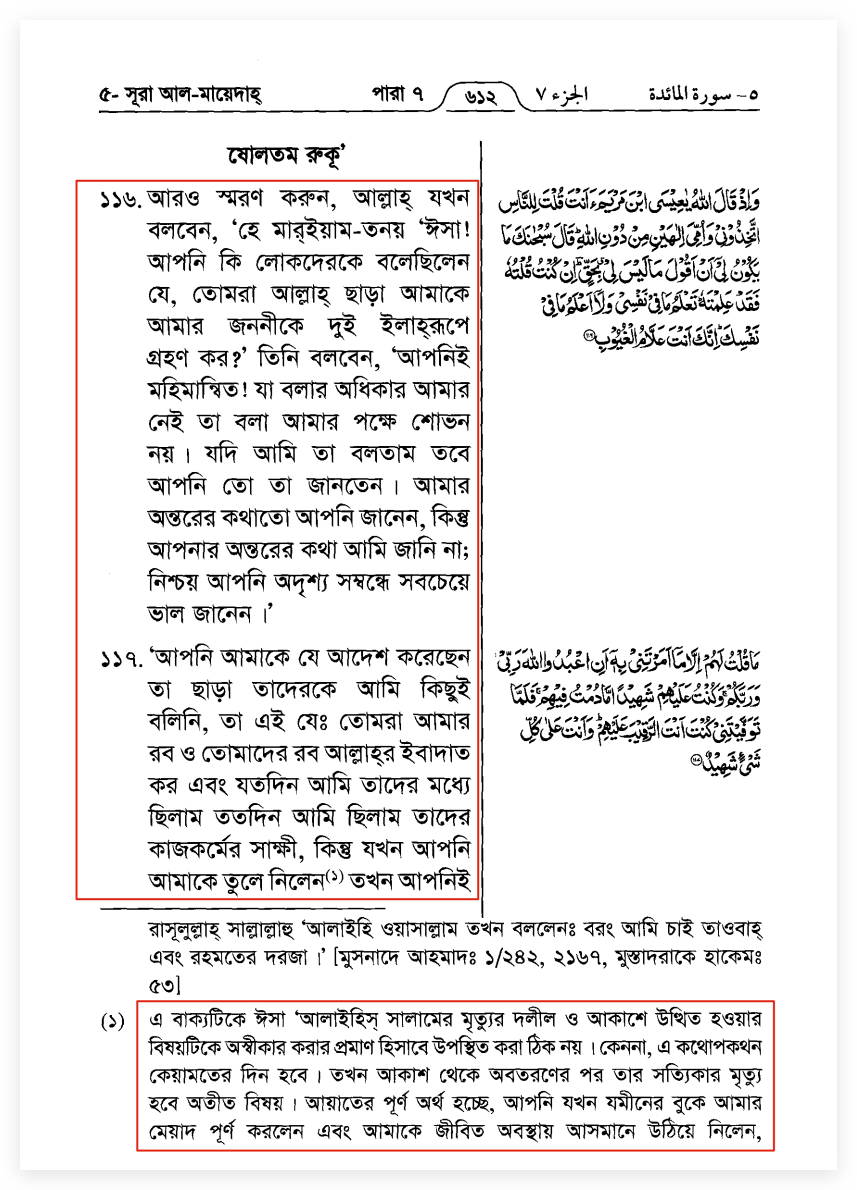
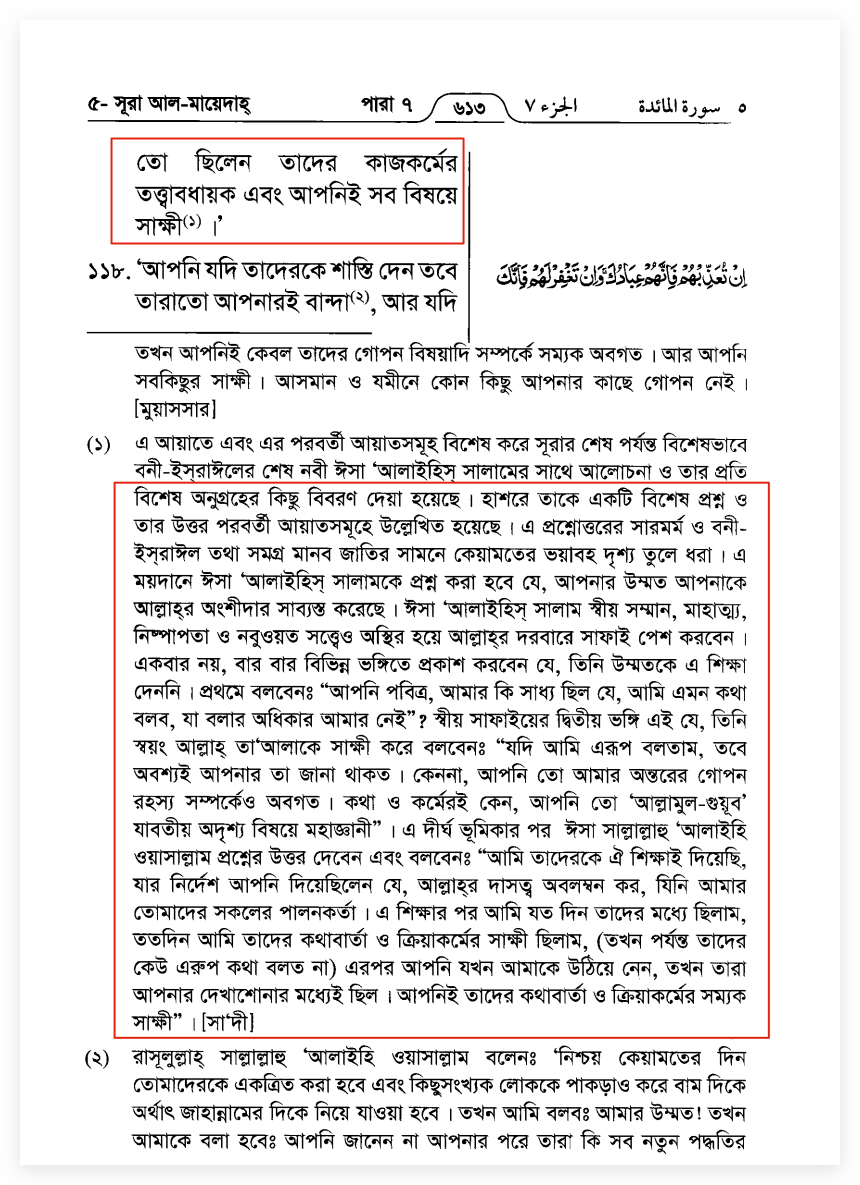
The same reasoning is reflected in Surah al-Ma’idah 5:116–117, where Allah asks Isa (Jesus): ‘O Jesus, did you tell people to worship you instead of Allah?’ Jesus will deny it: ‘No, I never said such a thing!’ Let us read the verses:
Remember when Allah said to Jesus, son of Mary: ‘Did you tell the people to take me and my mother as gods instead of Allah?’ He replied: ‘Glory be to you! It would not be proper for me to say what I have no right to say. Had I said it, you would certainly have known. You know what is within me, but I do not know what is within you. You are certainly fully aware of all hidden matters.’
—Taisirul Quran
And when Allah will say: ‘O Jesus, son of Mary! Did you tell people to worship me and my mother alongside Allah?’ Jesus will answer: ‘You are holy! It would never have been proper for me to say something I had no right to say. If I had said it, you would surely know. You know what is within me, whereas I do not know what is within your knowledge. You alone know all unseen matters.’
—Sheikh Mujibur Rahman
And when Allah will say: ‘O Jesus, son of Mary, did you tell people to take me and my mother as gods apart from Allah?’ He will say: ‘Glory be to you! I cannot say what I have no right to say. If I had said it, you would certainly have known. You know what is within me, but I do not know what is within you. You are indeed all-knowing concerning unseen matters.’
—Rawai Al-bayan
Also remember when Allah will say: ‘O Jesus, son of Mary! Did you tell people to take me and my mother as two gods apart from Allah?’ He will say: ‘Glory be to you! It would not be proper for me to say what I have no right to say. If I had said it, you would certainly know. You know what is within me, but I do not know what is within you. You certainly know the unseen best.’
—Dr Abu Bakr Muhammad Zakaria
I told them nothing except what you commanded me: worship Allah, my Lord and your Lord. I was a witness to their deeds as long as I remained among them. Then, when you took me up, you alone watched over their actions; you are a witness to everything.
—Taisirul Quran
I told them nothing except what you commanded me: worship Allah, who is my Lord and your Lord. I was aware of them as long as I remained among them. When you took me up, you alone were their guardian. Indeed, you are fully informed about everything.
—Sheikh Mujibur Rahman
‘I told them only what you commanded me: worship Allah, my Lord and your Lord. I was a witness over them as long as I remained among them. Then, when you took me up, you were their watcher. You are a witness over all things.’
—Rawai Al-bayan
‘I told them nothing except what you commanded me: worship Allah, my Lord and your Lord. I was a witness to their deeds as long as I remained among them. But when you took me up [1], you alone watched over their deeds, and you are a witness to all things [2].’
—Dr Abu Bakr Muhammad Zakaria
This verse indicates that, from an Islamic perspective, Jesus is innocent because he did not seek to establish himself as an object of worship. The source of responsibility is therefore not merely being regarded as a deity, but accepting that claim or status. The converse implication is that only those deities who agreed to receive worship or claimed it for themselves are guilty. Islam thus treats the false deities it considers ‘deserving of Hell’ as conscious beings with wills of their own, rather than merely imaginary idols, implicitly acknowledging their existence.[4]
Does Something Called al-Uzza Exist in the Real World?
Historical accounts state that, after the conquest of Mecca, Muhammad sent his companion Khalid ibn al-Walid to destroy the famous idol of the goddess al-Uzza. She was the largest and most important deity of the Quraysh and Banu Kinanah. When Khalid returned after destroying the idol on his first visit, Muhammad asked him: ‘Did you see anything?’ Khalid answered no. Muhammad then said: ‘In that case, you have not destroyed the idol. Go again.’ On his second visit, Khalid approached the shrine and saw a naked black woman with dishevelled hair coming towards them. When the shrine’s local custodian began shouting at her appearance, Khalid killed the woman with a single blow. On returning and describing the incident to Muhammad, he was told: ‘Yes, that woman was al-Uzza. She has forever lost hope of being worshipped in your land.’
This account exposes a fundamental ideological problem within Islamic monotheism. From an Islamic perspective, al-Uzza was a false goddess, merely a stone idol incapable of doing either good or harm. According to Muhammad’s statement, however, she was not merely a statue: she was a real, physical, conscious being who had lost hope of being worshipped by the people of Mecca. Here al-Uzza is presented not as an imaginary figure but as a conscious supernatural being who appeared in the form of a woman.
Did these beings seek worship for themselves? Is their desire to be worshipped the reason they will become fuel for Hell?
The question therefore arises: was al-Uzza merely an idol imagined by humans, or a being with an actual existence? According to Muhammad’s statement, al-Uzza was an entity with a desire and expectation to receive worship, and that worship would have continued had she not been killed. This presents a theological problem: Islam claims, on the one hand, that the deities are imaginary, while, on the other, it speaks of their existence, agency and physical forms—things that are not merely imaginary. The account of al-Uzza’s physical form and killing exposes a concealed reality of engagement with multiple deities within Islam, conflicting with the conception of Islamic monotheism. [5]
Dispatching Military Expeditions and Delegations
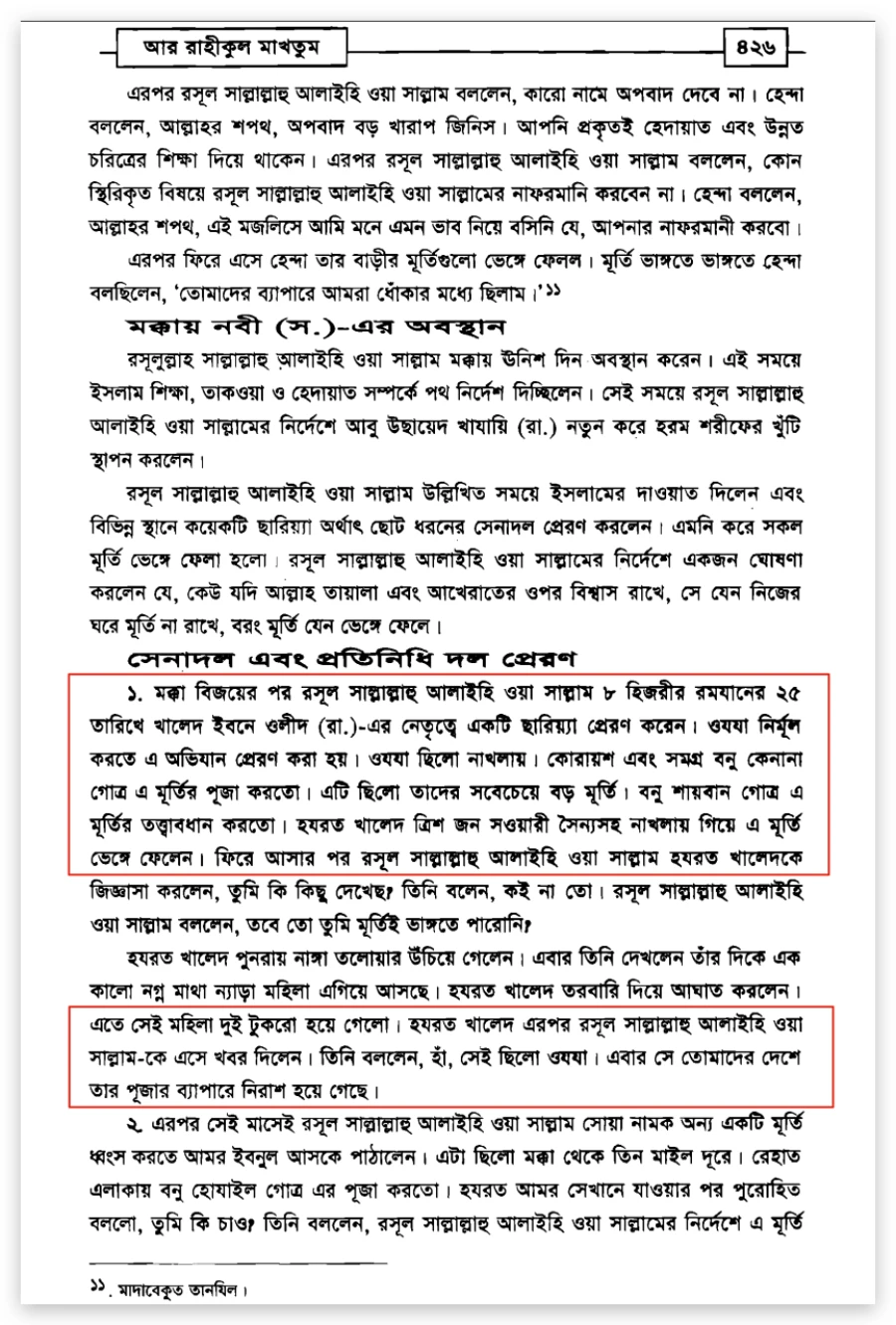
1. After the conquest of Mecca, on 25 Ramadan, 8 AH, the Messenger of Allah (peace and blessings be upon him) sent a military detachment led by Khalid ibn al-Walid (ra). This expedition was sent to eradicate al-Uzza. Al-Uzza was at Nakhlah. The Quraysh and the entire Banu Kinanah tribe worshipped this idol, which was their greatest idol. Banu Shayban maintained it. Khalid went to Nakhlah with thirty mounted soldiers and destroyed it. When he returned, the Messenger of Allah (peace and blessings be upon him)
asked Khalid: ‘Did you see anything?’ He answered: ‘No, I did not.’ The Messenger of Allah (peace and blessings be upon him) said: ‘Then you have not destroyed the idol.’
Khalid went again with his unsheathed sword raised. This time he saw a black, naked, bald-headed woman approaching him. Khalid struck her with his sword.
The woman was cut in two. Khalid then returned and informed the Messenger of Allah (peace and blessings be upon him). He said: ‘Yes, that was al-Uzza. Now she has lost hope of being worshipped in your land.’
2. Later that same month, the Messenger of Allah (peace and blessings be upon him) sent Amr ibn al-As to destroy another idol called Suwa. It was three miles from Mecca, in the Ruhat area, where Banu Hudhayl worshipped it. When Amr arrived, the priest asked: ‘What do you want?’ He replied: ‘At the command of the Messenger of Allah (peace and blessings be upon him), this idol’
Satan’s Successful Influence over and Deception of Prophets
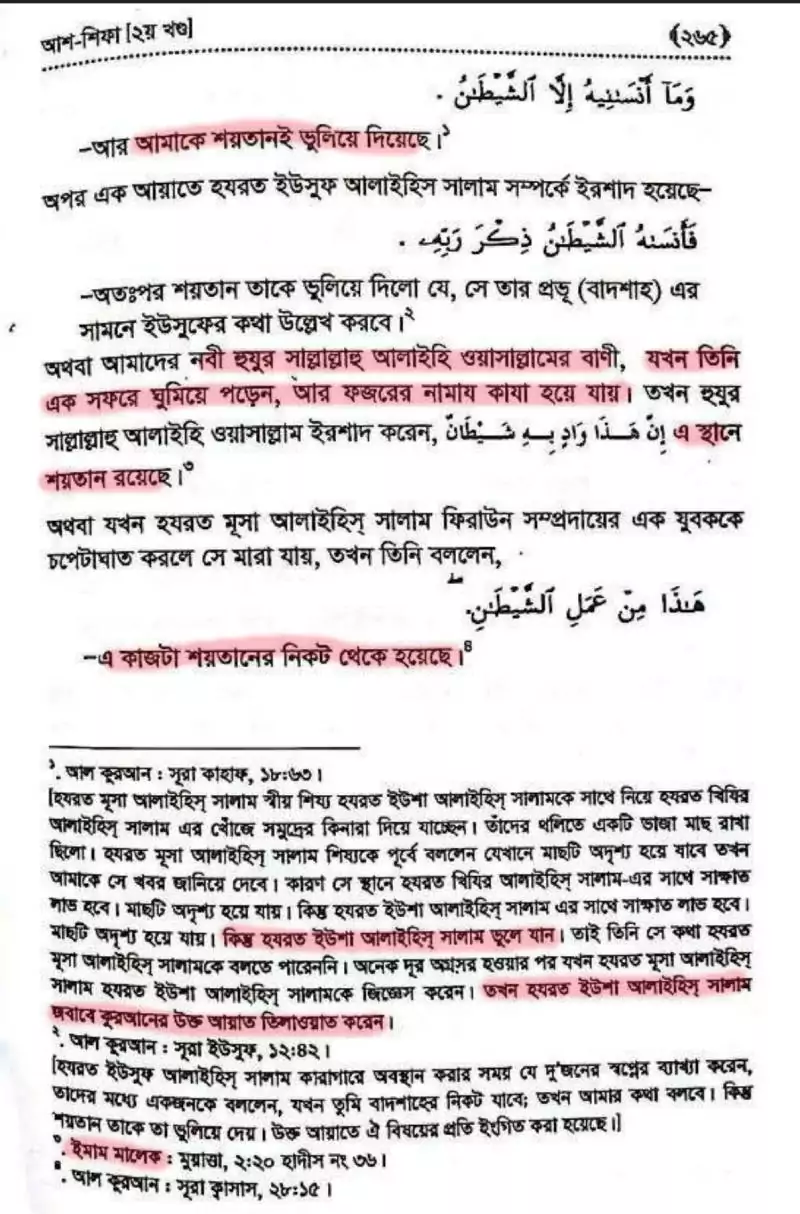
A fundamental question is whether prophets are completely immune to Satan’s influence and deception. Whatever the conventional religious claim may be, an analysis of authoritative Islamic sources shows that Satan repeatedly influenced prophets and succeeded in misleading or deceiving them. One example is Joshua, a prophet of the Children of Israel, who forgot his duty under Satan’s influence. Major Islamic prophets such as Joseph and Moses likewise succumbed to Satan’s tactics. The account in al-Shifa is particularly significant in this regard: [6]
Al-Shifa [Volume 2], p. 265
وَمَا أَنْسَانِيهُ إِلَّا الشَّيْطَانُ
—‘It was Satan who made me forget.’
In another verse concerning Joseph (peace be upon him), it is stated:
فَأَنسَنهُ الشَّيْطَانُ ذِكْرَ رَبِّهِ .
—Then Satan made him forget to mention Joseph before his master, the king.
Or consider the statement of our Prophet (peace and blessings be upon him), when he fell asleep during a journey and missed the dawn prayer. He then said: إِنَّ هَذَا وَادٍ بِهِ شَيْطَانُ ‘Satan is present in this place.’
Or when Moses (peace be upon him) struck a young man belonging to Pharaoh’s people and the man died, Moses said:
هَذَا مِنْ عَمَلِ الشَّيْطَانِ.
—‘This deed is from Satan.’
Satan’s influence was not limited to earlier prophets: Muhammad, Islam’s final prophet, also fell under his deception and influence. He himself acknowledged that Satan’s presence caused him and his companions to fail to perform their worship—the dawn prayer—on time. This authentic hadith shows that Satan was able to establish control over Muhammad’s physical and mental condition: [7]
Sunan al-Nasa’i (verified edition)
Part 6: The Times of Prayer
Chapter 55: How Should a Missed Prayer Be Made Up?
Hadith Academy number: 623; international number: 624
623. Ya‘qub ibn Ibrahim (rh) ….. narrated from Abu Hurayrah (ra), who said: After travelling throughout the night with the Messenger of Allah (peace be upon him), we stopped somewhere towards the end of the night and fell asleep. None of us awoke until the sun had risen. Then the Messenger of Allah (peace be upon him) said: ‘Each of you should take hold of his mount’s reins and leave this place, because Satan has come to us here.’ Abu Hurayrah (ra) said: We did so. After travelling some distance, the Messenger of Allah (peace be upon him) had water brought and performed ablution. He then offered the voluntary dawn prayer. After the iqamah was pronounced, he offered the obligatory dawn prayer.
Authentic: Muslim 680; Irwa al-Ghalil 264.
Hadith grading: Sahih (authentic).
Narrator: Abu Hurayrah (ra).
The Prophet’s Insults, Disparagement and Criticism
Muhammad is reported to have made derogatory remarks about the pagans’ deities and their ancestral religion. He was accused of sacrilege. He was repeatedly warned because he criticised a religion that had prevailed in society for centuries, disparaged the faith of people’s forefathers, and made insulting remarks about their gods and goddesses [8]:
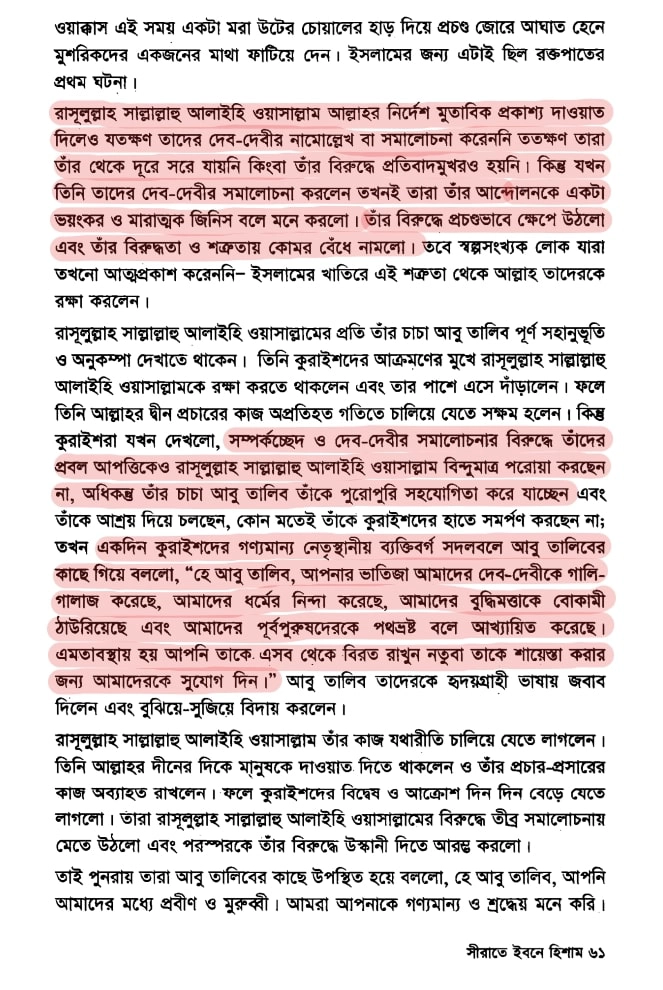
At this point, Waqqas struck one of the polytheists forcefully with the jawbone of a dead camel and split his head open. This was the first instance of bloodshed for Islam.
Although the Messenger of Allah (peace and blessings be upon him) preached openly at Allah’s command, they neither withdrew from him nor protested against him as long as he did not mention or criticise their deities. When he did criticise their gods, however, they regarded his movement as something dangerous and grave. They became intensely angry and committed themselves to opposing him with hostility. Allah protected a small number of people, who had not yet declared themselves openly, from this hostility for the sake of Islam.
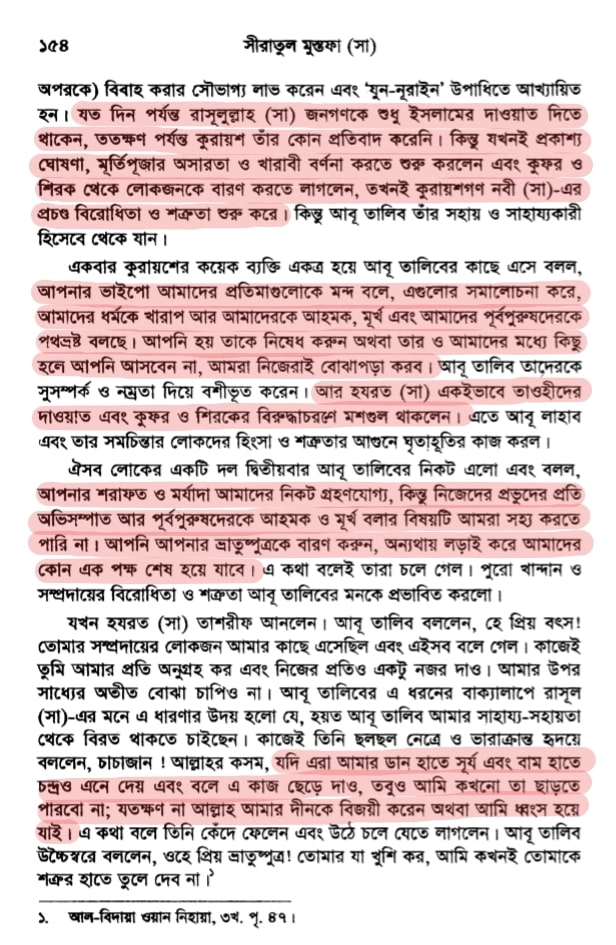
His uncle Abu Talib continued to show the Messenger of Allah (peace and blessings be upon him) full sympathy and compassion. He protected him against attacks from the Quraysh and stood beside him, enabling him to continue preaching Allah’s religion without interruption. The Quraysh saw, however, that the Messenger of Allah (peace and blessings be upon him) paid no attention to their severing of relations or their strong objections to criticism of their deities. His uncle Abu Talib was also supporting and sheltering him completely, refusing under any circumstances to surrender him to them. One day, a group of prominent Quraysh leaders therefore went to Abu Talib and said: ‘O Abu Talib, your nephew has insulted our gods, condemned our religion, treated our intelligence as foolishness and called our forefathers misguided. Either restrain him from these things or allow us to deal with him.’ Abu Talib answered them in conciliatory language, reasoned with them and sent them away.
The Messenger of Allah (peace and blessings be upon him) continued his work as before, inviting people to Allah’s religion and carrying on its propagation. The Quraysh’s hostility and anger consequently increased day by day. They fiercely criticised him and began inciting one another against him.
They returned to Abu Talib and said: ‘O Abu Talib, you are an elder and respected senior among us. We regard you as a distinguished and honourable man.
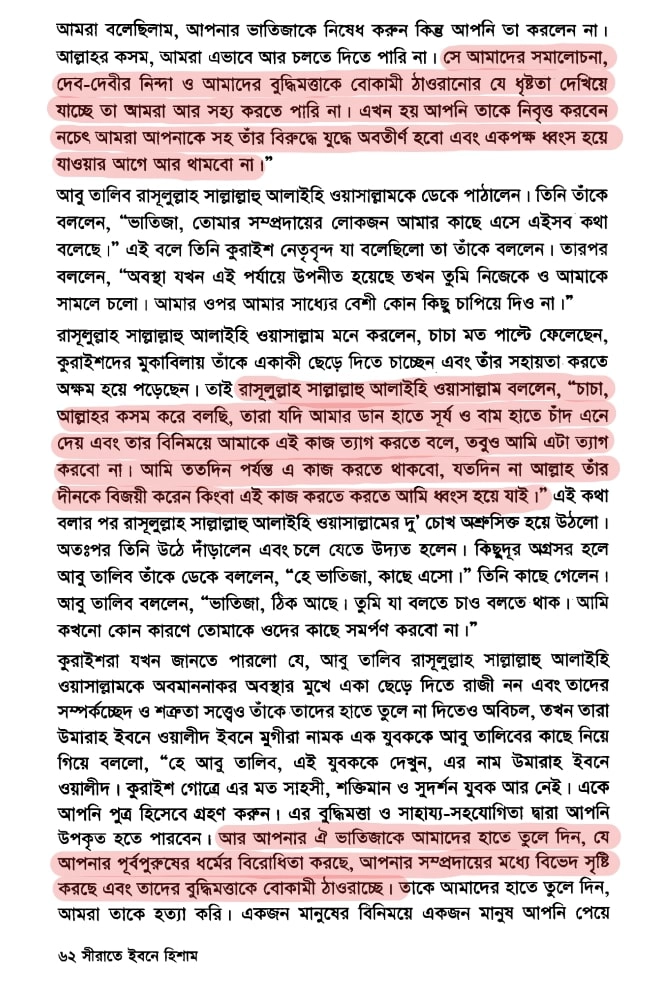
We asked you to restrain your nephew, but you did not.
By Allah, we cannot allow this to continue. We can no longer tolerate his audacity in criticising us, condemning our gods and treating our intelligence as foolishness. Either restrain him now, or we shall fight him and you together, and we will not stop until one side has been destroyed.’
Abu Talib summoned the Messenger of Allah (peace and blessings be upon him) and said: ‘Nephew, your people came to me and said these things.’ He repeated what the Quraysh leaders had said, then added: ‘Now that matters have reached this point, take care of yourself and me. Do not impose on me more than I can bear.’
The Messenger of Allah (peace and blessings be upon him) thought his uncle had changed his mind, intended to leave him alone against the Quraysh, and could no longer help him. He therefore said: ‘Uncle, I swear by Allah: even if they placed the sun in my right hand and the moon in my left and asked me to abandon this work in exchange, I would not abandon it. I shall continue until Allah makes his religion victorious or I perish in the effort.’ After saying this, his eyes filled with tears. He stood up and began to leave. When he had gone a short distance, Abu Talib called him: ‘Nephew, come here.’ He approached, and Abu Talib said: ‘Very well, nephew. Continue saying whatever you wish. I will never surrender you to them for any reason.’
When the Quraysh learned that Abu Talib would not leave the Messenger of Allah (peace and blessings be upon him) alone to face humiliation, and remained determined not to hand him over despite their hostility and severing of relations, they brought a young man named Umarah ibn al-Walid ibn al-Mughirah to Abu Talib and said: ‘O Abu Talib, look at this young man. His name is Umarah ibn al-Walid. No young man in the Quraysh is braver, stronger or more handsome. Adopt him as your son. You will benefit from his intelligence and assistance. In return, surrender your nephew, who opposes your forefathers’ religion, divides your people and treats their intelligence as foolishness. Give him to us so that we may kill him. You will receive one man in exchange for another’
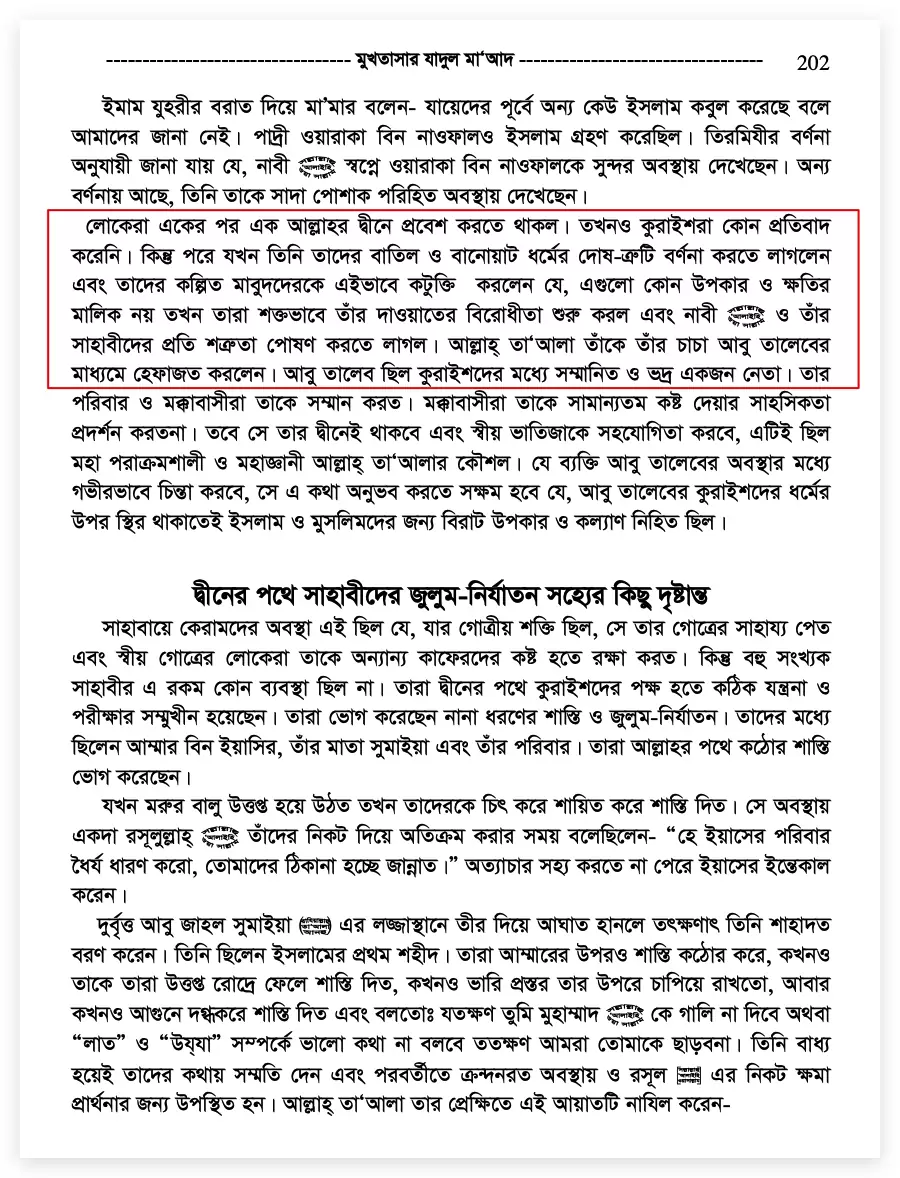
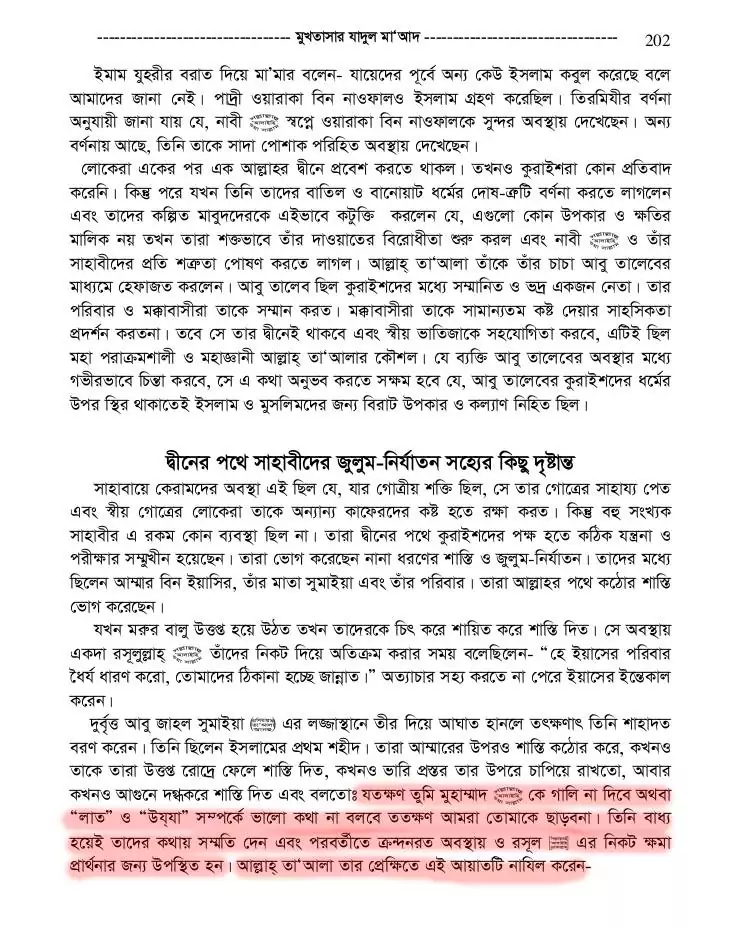
Let us now examine the same matter in Mukhtasar Zad al-Ma‘ad, by Imam Ibn al-Qayyim [9].
Ma‘mar, citing Imam al-Zuhri, says: We know of no one who accepted Islam before Zayd. The priest Waraqah ibn Nawfal also accepted Islam. According to al-Tirmidhi’s report, the Prophet saw Waraqah ibn Nawfal in a dream in a favourable condition. Another report states that he saw him wearing white clothes.
People continued entering Allah’s religion one after another. Even then, the Quraysh did not object. Later, however, when he began describing the flaws in their false and fabricated religion and disparaging their imaginary objects of worship by saying that they could neither benefit nor harm anyone, they began strongly opposing his preaching and became hostile towards the Prophet and his companions. Allah protected him through his uncle Abu Talib, an honourable and distinguished leader of the Quraysh. His
family and the people of Mecca respected him. The Meccans did not dare cause him even the slightest harm. Yet he would remain in his own religion while supporting his nephew: this was the design of Allah, the Almighty and All-Wise. Anyone who reflects deeply on Abu Talib’s situation will understand that his remaining in the Quraysh’s religion brought substantial benefit and welfare to Islam and the Muslims.
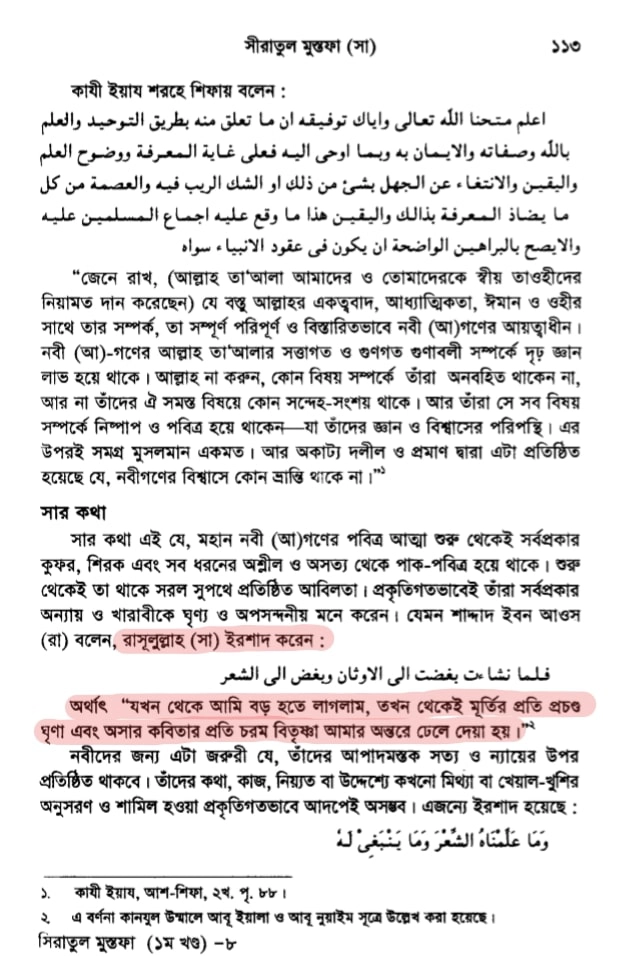
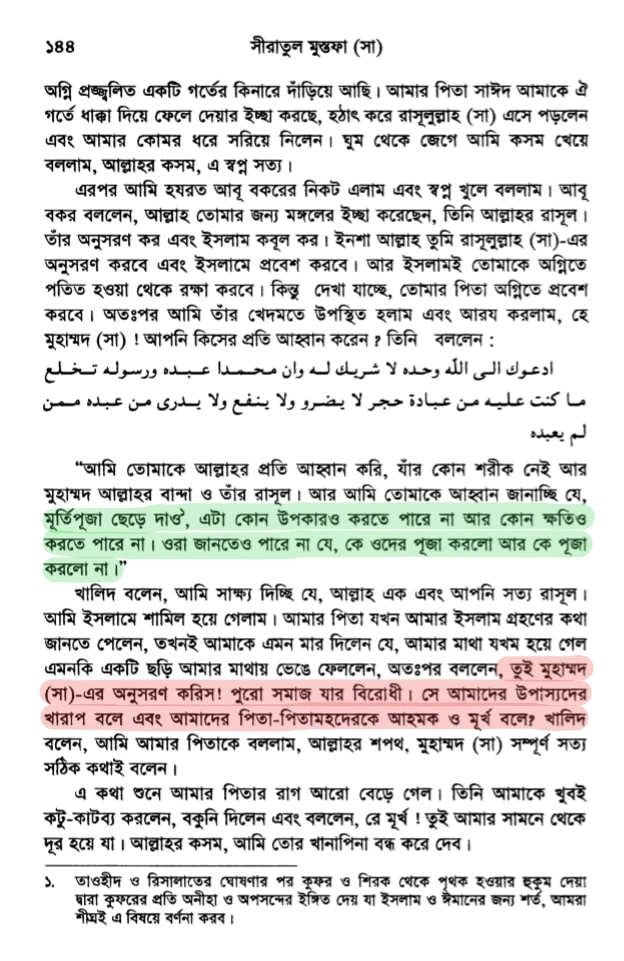
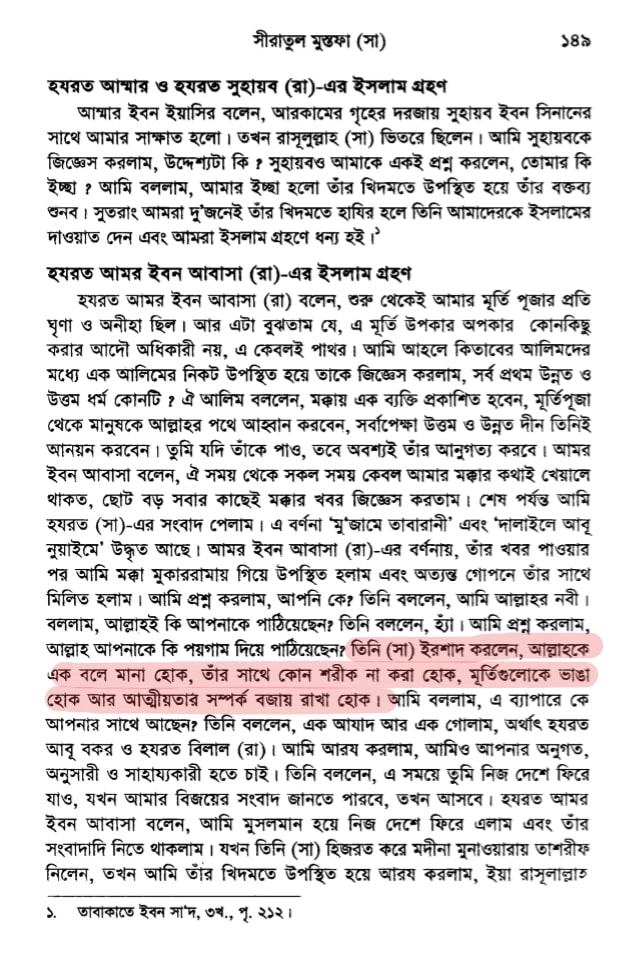
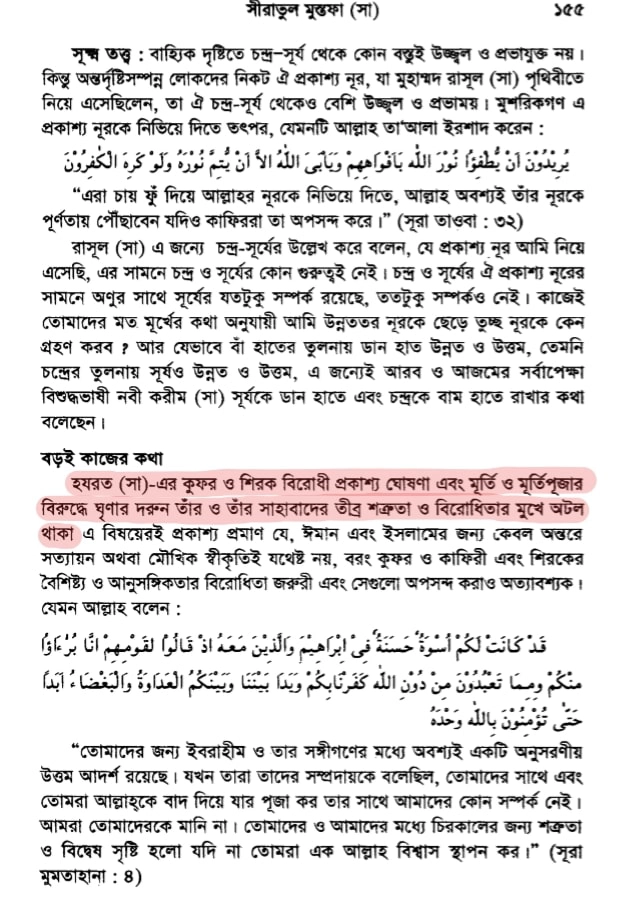
Let us now read from Sirat al-Mustafa [10]:
The Migrants’ Return to Mecca
When Muhammad was harshly criticising the Quraysh’s established religion and deities, the situation in Mecca became extremely tense. Meccan society and its leaders accused him of insulting their religion and intensified their persecution of Muslims. In the fifth year of his prophethood, a group of Muslims migrated to Abyssinia to escape this severe persecution. Soon after arriving, however, they received startling news and returned to Mecca: the longstanding conflict between the Quraysh and the Muslims had ended, and the two sides were now coexisting peacefully.
A reasonable question arises: why did Mecca’s uncompromising pagans suddenly become peaceful? Why did the Muslims in Abyssinia become convinced that Mecca was safe? The answer lies in the ‘Satanic Verses’. Historical accounts indicate that Muhammad himself was then inclined towards compromise or reconciliation with the Quraysh. Unable to bear the intense pressure any longer, he presented verses praising al-Lat, Manat and al-Uzza. The Quraysh consequently erupted in delight and prostrated together with the Muslims. This news of ‘reconciliation with the pagan Quraysh’ reached Abyssinia as a report that the whole of Mecca had accepted Islam.
The depth of this crisis emerges clearly from Imam Ibn al-Qayyim al-Jawziyyah’s famous work Zad al-Ma‘ad. It shows that the social and psychological pressures of the time overwhelmed not only ordinary Muslims but the Prophet himself. The Quraysh demanded that Muhammad praise al-Lat and al-Uzza, in which case their hostility towards the Muslims would end. This extreme pressure created a situation that calls the Prophet’s claim to ‘infallibility’ into question [11]:
Examples of the Companions’ Endurance of Oppression and Persecution for Their Religion
The companions’ circumstances were as follows: anyone with tribal support received his tribe’s assistance, and his tribesmen protected him from harm at the hands of other disbelievers. Many companions, however, had no such protection. They faced severe suffering and trials at the hands of the Quraysh for their religion, enduring various punishments, oppression and persecution. Among them were Ammar ibn Yasir, his mother Sumayyah and his family, who suffered severe punishment in Allah’s cause.
When the desert sand became hot, they were laid on their backs and tortured. Once, while passing them in this condition, the Messenger of Allah said: ‘O family of Yasir, be patient. Your destination is Paradise.’ Unable to endure the torture, Yasir died.
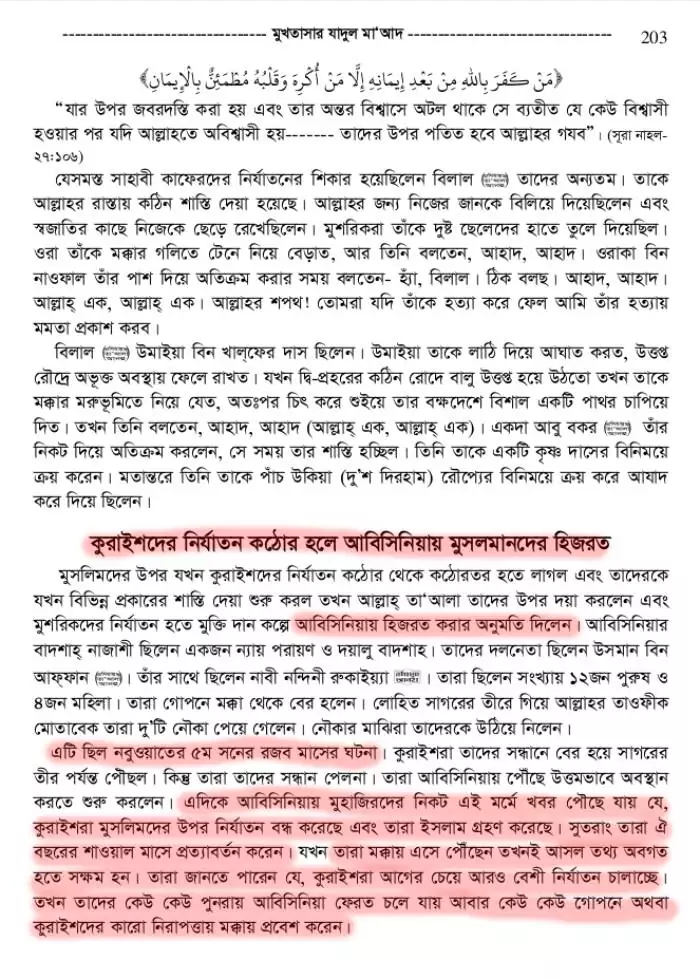
The villain Abu Jahl struck Sumayyah (A) in her private parts with an arrow, and she immediately became a martyr. She was Islam’s first martyr. They also intensified Ammar’s punishment, sometimes leaving him in the scorching sun, sometimes weighing him down with a heavy stone, and sometimes burning him with fire. They said: ‘We will not release you until you insult Muhammad or speak favourably of al-Lat and al-Uzza.’ Compelled to comply, he accepted their demand and later came to the Messenger of Allah weeping and seeking forgiveness. In response, Allah revealed this verse:
مَنْ كَفَرَ بِاللَّهِ مِنْ بَعْدِ إِيمَانِهِ إِلَّا مَنْ أُكْرِهَ وَقَلْبُهُ مُطْمَئِنَّ بِالْإِيمَانِ)
‘Whoever disbelieves in Allah after having believed will incur Allah’s wrath, except one who is compelled while his heart remains firm in faith.’ (Surah al-Nahl 27:106)
Bilal was among the companions persecuted by the disbelievers. He suffered severe punishment in Allah’s cause, devoted his life to Allah and left himself at the mercy of his people. The polytheists handed him over to unruly boys, who dragged him through Mecca’s streets while he said: ‘Ahad, Ahad—One, One.’ Passing him, Waraqah ibn Nawfal would say: ‘Yes, Bilal, you are right: One, One. Allah is One, Allah is One. By Allah, if you kill him, I will mourn his killing.’
The Muslims’ Migration to Abyssinia as Quraysh Persecution Intensified
When the Quraysh’s persecution of Muslims became increasingly severe and they began subjecting them to different forms of punishment, Allah had mercy on them and permitted them to migrate to Abyssinia to escape the polytheists’ oppression. Abyssinia’s ruler, the Negus, was a just and compassionate king. Their leader was Uthman ibn Affan, accompanied by the Prophet’s daughter Ruqayyah. They numbered twelve men and four women. They left Mecca secretly. On reaching the Red Sea coast, Allah enabled them to find two boats, whose boatmen took them aboard.
This occurred in Rajab of the fifth year of prophethood. The Quraysh pursued them as far as the coast but could not find them. They reached Abyssinia and began living there comfortably. Meanwhile, the migrants in Abyssinia received news that the Quraysh had stopped persecuting Muslims and had accepted Islam. They therefore returned in Shawwal of that year. Only on reaching Mecca did they discover the truth: the Quraysh were persecuting Muslims more severely than before. Some returned to Abyssinia, while others entered Mecca secretly or under the protection of individual Quraysh members.
This account shows that the so-called ‘Satanic Verses’ were not a supernatural occurrence but Muhammad’s deliberate strategic decision within Mecca’s social and political circumstances. The migrants’ return from Abyssinia was no miraculous sign; it was the direct consequence of a pragmatic political reconciliation between Muhammad and the Quraysh of Mecca.
To stop the inhuman persecution of his followers and resolve the prolonged conflict with the Quraysh, Muhammad acknowledged and glorified Mecca’s deities, even if only temporarily. Later, when this political compromise appeared to threaten Islam’s fundamental monotheistic structure, the verses were identified as ‘Satanic interpolations’ and abrogated. The term ‘Satan’ functions here as a theological device or religious strategy, separating and concealing Muhammad’s failed political decision from the sanctity of revelation. When the migrants returned to find the situation unchanged and the reconciliation revoked, it became clear that the nature of revelation changed in step with Muhammad’s political position at the time.
Muslims and Polytheists Prostrating Together
The episode includes the remarkable occurrence of disbelievers, polytheists and Muslims all prostrating together. We know that relations between the disbelievers and Muslims were deeply antagonistic over religion at the time. In this situation, the disbelievers repeatedly asked Muhammad to accept their gods, promising that they would then accept his Allah. They could coexist peacefully and each practise their own religion. Muhammad initially refused. Later, this verse of Surah al-Najm was revealed, and at its revelation the disbelievers and Muslims all prostrated together. Readers can readily understand the significance [12] [13] [14]:
Sahih al-Bukhari (Tawhid edition)
Book 65: Commentary on the Qur’an
Chapter 65/53/7: Allah’s statement: So prostrate to Allah and worship him. (Surah al-Najm 53:62)
4862. Narrated Ibn Abbas (ra): The Prophet (peace and blessings be upon him) prostrated during Surah al-Najm, and along with him the Muslims, polytheists, jinn and humans all prostrated. Ibrahim ibn Tahman (rh) followed the above narration through Ayyub (rh). Ibn Ulayyah (rh), however, did not mention Ibn Abbas (ra) in his narration through Ayyub (rh). (1071) (Modern Publications: 4495; Islamic Foundation: 4498)
Hadith grading: Sahih (authentic).
Sunan al-Tirmidhi (verified edition)
Book 4: The Book of Friday Prayer
Publisher: Husain al-Madani
Chapter 51: Prostration in Surah al-Najm
575. Ibn Abbas (ra) narrated: The Messenger of Allah (peace and blessings be upon him) prostrated during Surah al-Najm. The Muslims, polytheists, jinn and humans all prostrated with him.—Authentic. Al-Bukhari; Qissat al-Gharaniq, pp. 18, 25 and 31; al-Bukhari.
Abu Isa says: This hadith is hasan sahih. Reports on this subject are also narrated from Ibn Mas‘ud and Abu Hurayrah (ra). Some scholars hold that Surah al-Najm contains a prostration. Some companions and successors hold that the mufassal surahs contain no prostration. Malik ibn Anas supports this opinion. The first group’s view, however, is more correct. Sufyan al-Thawri, Ibn al-Mubarak, al-Shafi‘i and Ahmad support the first opinion—that there is prostration in the mufassal surahs.
Hadith grading: Sahih (authentic).
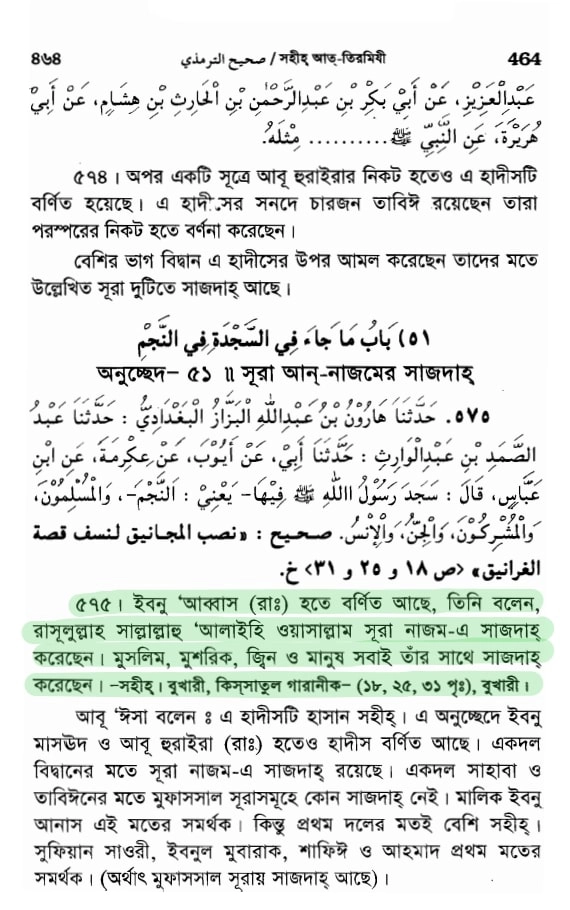
The hadith above tells us that, after the recitation of Surah al-Najm, not only Muslims but polytheists also followed Muhammad in prostration. Yet at the time, Muhammad and the polytheists were in intense conflict and hostility. What happened that caused Muhammad, his followers and the polytheists to prostrate together to Allah during the recitation of a Qur’anic surah? What had changed? This was not what one would expect. Let us examine several further hadiths. They show that, when the Prophet recited Surah al-Najm in Mecca, even an elderly disbeliever performed the gesture of prostration by raising earth to his forehead. The old man was later killed as a disbeliever, meaning that he had also prostrated while a disbeliever. Why would a disbeliever raise earth to his forehead in prostration on hearing Surah al-Najm? [15] [16]
Sahih al-Bukhari (Islamic Foundation edition)
Book 17: Prostration During Qur’anic Recitation
Chapter 683: Prostration During Qur’anic Recitation and Its Method
Islamic Foundation number: 1006; international number: 1067
1006. Muhammad ibn Bashshar (rh) … narrated from Abdullah ibn Mas‘ud (ra), who said: The Prophet (peace and blessings be upon him) recited Surah al-Najm in Mecca. He then prostrated, and, apart from an elderly man, everyone with him prostrated. The old man took a handful of pebbles or earth and raised it to his forehead, saying: ‘This is enough for me.’ I later saw that he was killed as a disbeliever.
Hadith grading: Sahih (authentic).
Narrator: Abdullah ibn Mas‘ud (ra).
Sahih al-Bukhari (Islamic Foundation edition)
Book 17: Prostration During Qur’anic Recitation
Chapter 686: Prostration in Surah al-Najm
Islamic Foundation number: 1009; international number: 1070
قَالَهُ ابْنُ عَبَّاسٍ رَضِيَ اللَّهُ عَنْهُمَا عَنِ النَّبِيِّ صَلَّى اللَّهُ عَلَيْهِ وَسَلَّمَ
Ibn Abbas (ra) narrated from the Prophet (peace and blessings be upon him) on this subject.
1009. Hafs ibn Umar (rh) … narrated from Abdullah ibn Mas‘ud (ra) that the Prophet (peace and blessings be upon him) once recited Surah al-Najm and then prostrated. Among those present, not a single person remained who did not prostrate with him. One man, however, took a handful of pebbles or earth and raised it to his forehead, saying: ‘This is enough for me.’ Abdullah (ra) said: I later saw that this man was killed as a disbeliever.
Hadith grading: Sahih (authentic).
Narrator: Abdullah ibn Abbas (ra).
Consider how such an extraordinary event could occur. To understand it, we must turn to several works of prophetic biography and Qur’anic commentary.
Summary of the Original Episode
From Tafsir al-Mazhari
Here is a summary of the entire episode from Tafsir al-Mazhari. Verses 73 and 74 of Surah Bani Isra’il are relevant to this discussion [17] [18].
73
They spared no effort to make you depart from what I revealed to you, so that you would fabricate something different about me; then they would certainly have taken you as a friend.
—Taisirul Quran
They made every effort to make you depart from what I revealed to you, so that you would invent something false about me. Had they succeeded, they would certainly have accepted you as a friend.
—Sheikh Mujibur Rahman
Their situation was such that they almost tempted you away from what I revealed to you, so that you would fabricate something contrary to it in my name; then they would certainly have accepted you as a friend.
—Rawai Al-bayan
They had almost completed their attempt to make you depart from what we revealed to you, so that you would fabricate something contrary to it against us [1]; then they would certainly have accepted you as a friend.
—Dr Abu Bakr Muhammad Zakaria
74
Had I not kept you firmly established, you would have inclined towards them to some extent.
—Taisirul Quran
Had I not kept you steadfast, you would almost have inclined towards them a little.
—Sheikh Mujibur Rahman
Had I not kept you steadfast, you would certainly have inclined towards them somewhat.
—Rawai Al-bayan
Had we not kept you steadfast, you would certainly have almost inclined towards them a little [1].
—Dr Abu Bakr Muhammad Zakaria
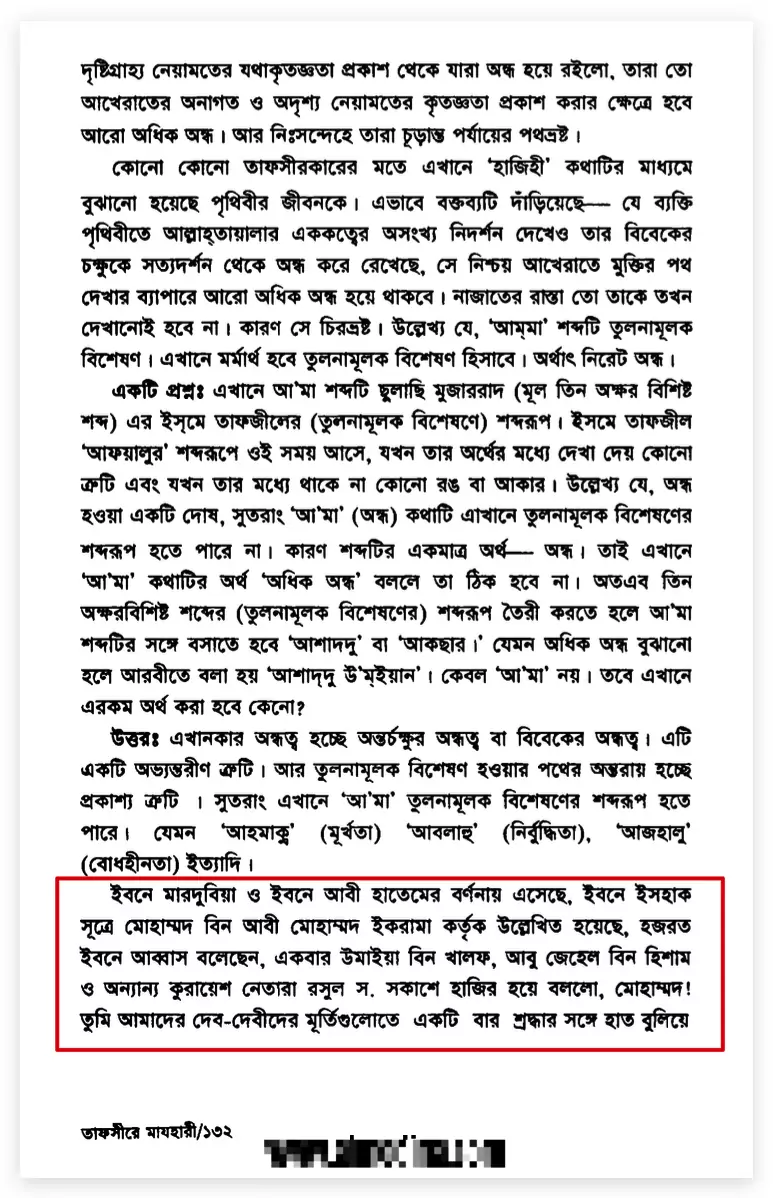
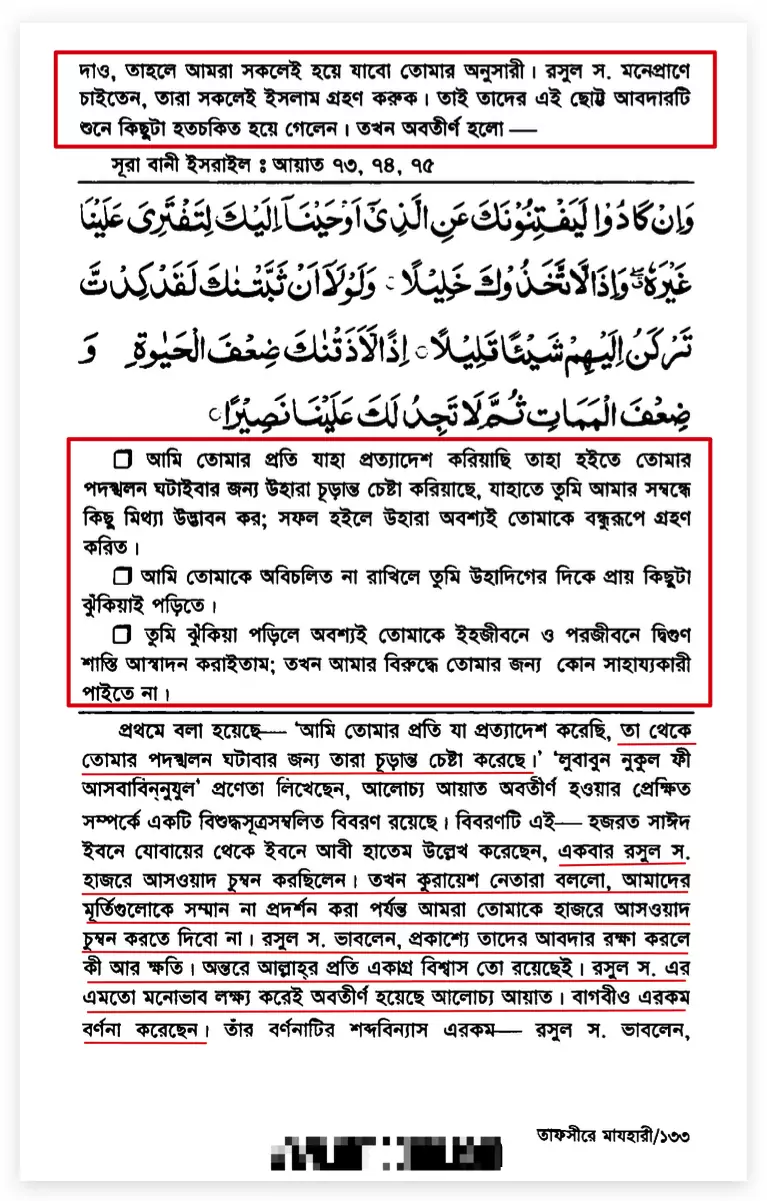
Ibn Mardawayh and Ibn Abi Hatim report, through Ibn Ishaq, Muhammad ibn Abi Muhammad and Ikrimah, that Ibn Abbas said: Once, Umayyah ibn Khalaf, Abu Jahl ibn Hisham and other Quraysh leaders approached the Messenger (peace be upon him) and said: ‘Muhammad, respectfully touch the images of our deities just once, and we will all become your followers.’ The Messenger sincerely wanted them all to accept Islam, and their seemingly small request left him somewhat unsettled. Then the following was revealed:
Surah Bani Isra’il, verses 73, 74 and 75
وَإِنْ كَادُوا لَيَفْتِنُونَكَ عَنِ الَّذِي أَوْحَيْنَا إِلَيْكَ لِتَفْتَرِيَ عَلَيْنَا غيرَةً وَإِذَا لَا تَّخَذُوكَ خَلِيلًا ، وَلَوْلَا أَنْ تَبَّتْنَكَ لَقَدْ كِدَتَ تَرْكَنُ إِلَيْهِمْ شَيْئًا قَلِيلًا إِنَّ الْأَذَتُنَكَ ضِعُفَ الْحَيُوةِ وَ ضِعُفَ الْمَمَاتِ ثُمَّ لَا تَجِدُ لَكَ عَلَيْنَا نَصِيرًا
They made every effort to make you depart from what I revealed to you, so that you would invent something false about me. Had they succeeded, they would certainly have accepted you as a friend.
Had I not kept you steadfast, you would almost have inclined towards them somewhat.
Had you inclined towards them, I would certainly have made you taste double punishment in this life and the next; then you would have found no helper against me.
The first statement is: ‘They made every effort to make you depart from what I revealed to you.’ The author of Lubab al-Nuqul fi Asbab al-Nuzul writes that a report with an authentic chain concerns the circumstances of this verse’s revelation. Ibn Abi Hatim relates from Sa‘id ibn Jubayr that the Messenger was once kissing the Black Stone. The Quraysh leaders said: ‘We will not let you kiss the Black Stone until you show respect to our idols.’ The Messenger thought: What harm would it do to comply outwardly? His heart remained devoted to Allah. The verse was revealed in response to this disposition. Al-Baghawi gives a similar account, worded as follows: the Messenger thought,
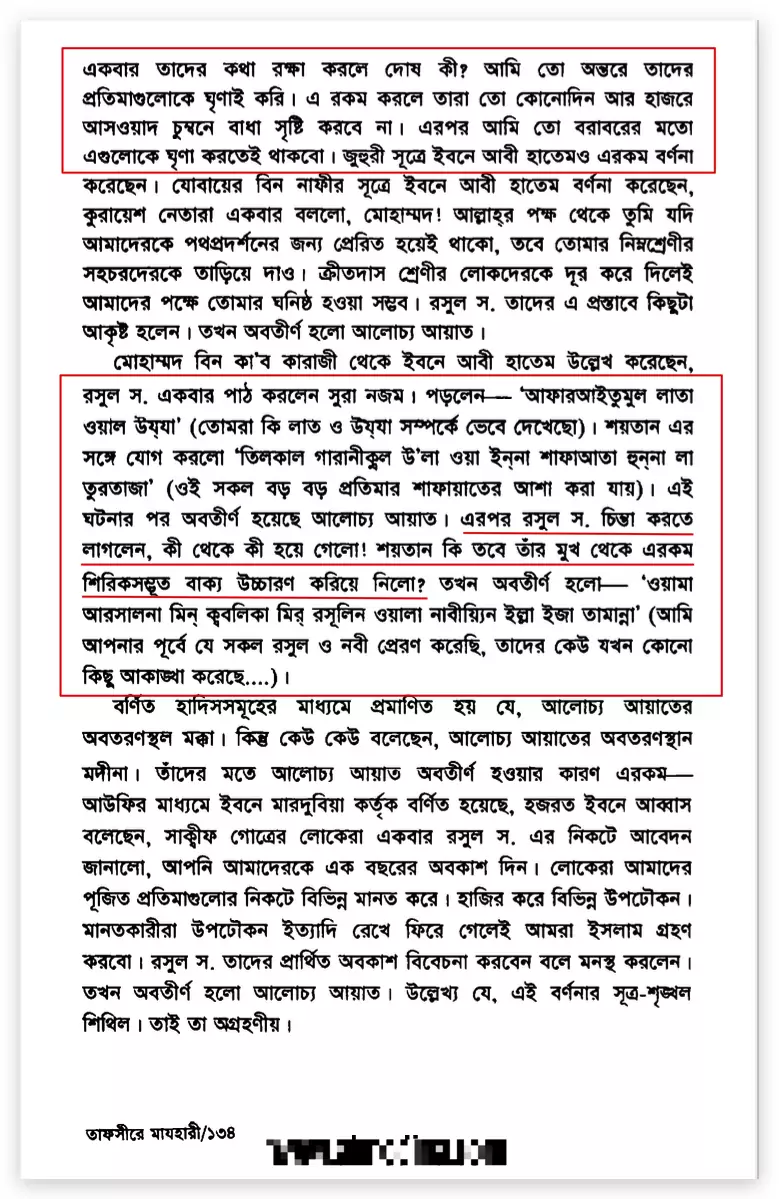
What is wrong with complying with their request once? In my heart I detest their idols. If I do this, they will never again stop me from kissing the Black Stone. Afterwards I will continue detesting the idols as before. Ibn Abi Hatim also narrates a similar account through al-Zuhri.
Through Jubayr ibn Nufayr, Ibn Abi Hatim relates that the Quraysh leaders once said: ‘Muhammad, if Allah really sent you to guide us, then dismiss your lower-class companions. Once you remove these slaves, we will be able to associate closely with you.’ The Messenger was somewhat drawn to their proposal. The verse was then revealed.
Ibn Abi Hatim relates from Muhammad ibn Ka‘b al-Qurazi that
the Messenger once recited Surah al-Najm. He read ‘A-fa-ra’aytum al-Lata wa-l-Uzza’—‘Have you considered al-Lat and al-Uzza?’ Satan added: ‘Tilka al-gharaniq al-ula wa-inna shafa‘atahunna la-turtaja’—‘The intercession of those great idols may be hoped for.’ The verse under discussion was revealed after this event. The Messenger began wondering what had happened: had Satan made him utter
such words of polytheism? Then there was revealed: ‘Wa-ma
arsalna min qablika min rasulin wa-la nabiyyin illa idha tamanna’—‘We sent no messenger or prophet before you who, whenever he desired something….’
The reported hadiths establish that the verse under discussion was revealed in Mecca. Some, however, say it was revealed in Medina. According to them, its occasion of revelation was as follows: Ibn Mardawayh narrates through al-Awfi that Ibn Abbas said: The people of Thaqif once appealed to the Messenger: ‘Give us one year’s respite. People make various vows at our idols and bring offerings. Once those who made vows have left their offerings and returned home, we will accept Islam.’ The Messenger decided to consider their requested respite, and the verse was then revealed. It should be noted that this report has a weak chain and is therefore unacceptable.
The Life of the Messenger of Allah—Ibn Ishaq
The earliest and most important work of prophetic biography in Islamic history is that of Muhammad ibn Ishaq ibn Yasar ibn Khiyar. The book is so important that, without it, it might have been impossible to know anything about the Prophet. It contains this account in direct and explicit terms [19].
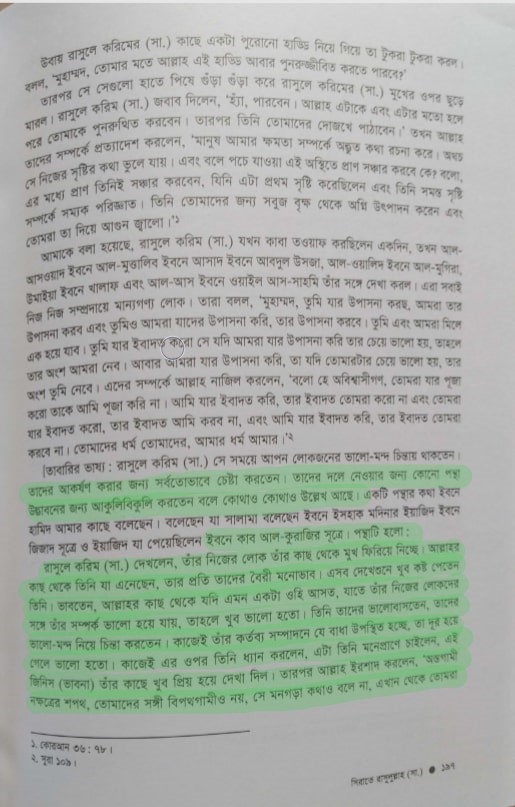
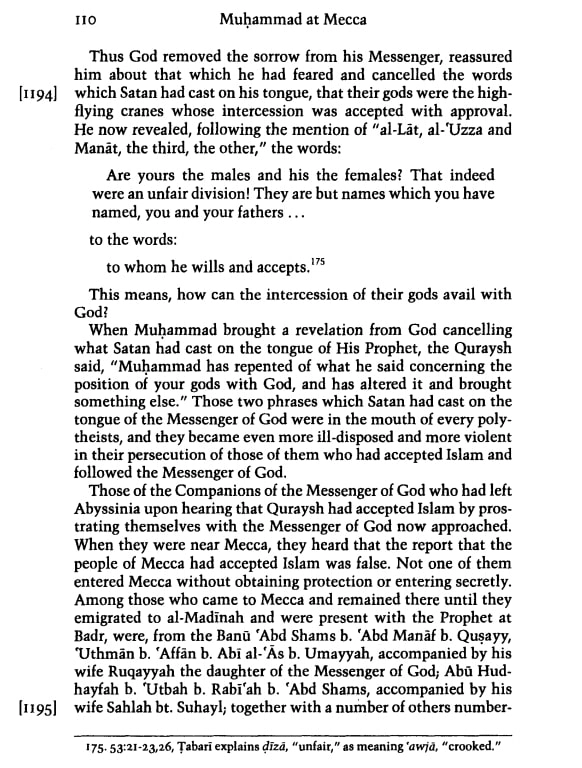
From here: Have you considered ‘al-Lat’ and ‘al-Uzza’, and the third, ‘Manat’? When Allah’s words reached this point, Satan, who did not favour his [the Messenger’s] contemplation and reconciliation with his people, inserted onto his tongue: ‘These are the exalted gharaniq, whose intercession is approved.’
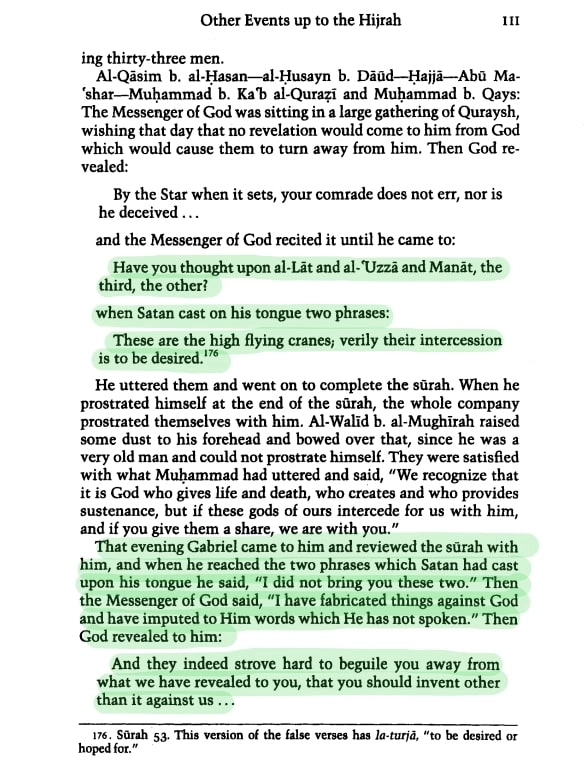
The Quraysh were delighted to hear this. Such praise of their deities pleased them greatly, and they became attentive to his words. The believers suspected nothing: whatever their Messenger brought from Allah was true. It could contain no error, defect or false desire. At the place of prostration at the end of the surah, the Messenger prostrated. They did likewise, because obeying him was their duty. The polytheistic Quraysh and the others present also prostrated, because the Messenger had mentioned their gods. Thus everyone inside the mosque, believer and unbeliever alike, bowed in prostration. Al-Walid ibn al-Mughirah was very old and could not bend down to prostrate. He therefore took a handful of dust and touched his head to it. Everyone then went their separate ways. The Quraysh were overjoyed. They said that Muhammad had spoken beautifully about their gods. In his recitation, he had described their gods as gharaniq whose intercession was approved.
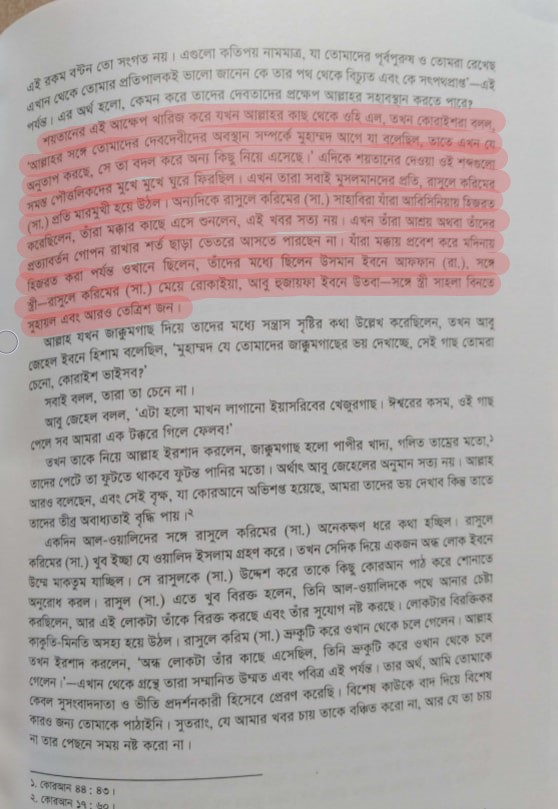
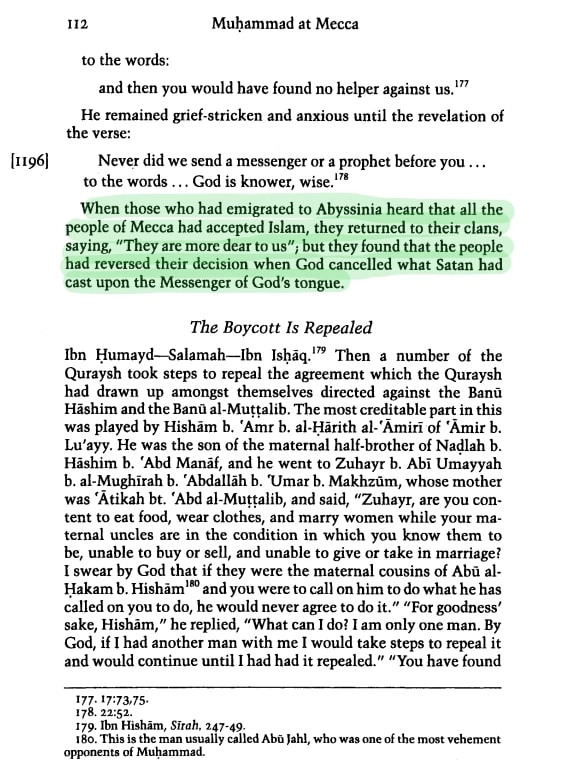
The Messenger’s companions in Abyssinia heard the news. They heard that all the Quraysh had become Muslims. Some immediately set out, while others stayed behind.
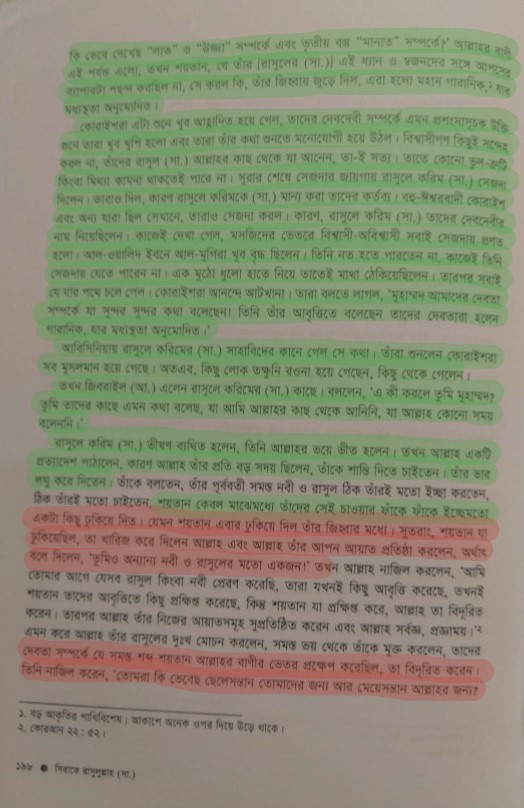
Then Gabriel came to the Messenger and said: ‘What have you done, Muhammad? You told them something I did not bring from Allah, something Allah never said.’
The Messenger was deeply distressed and feared Allah. Allah then sent a revelation, because he was very kind to him and wished to console him and lighten his burden. He told him that all earlier prophets and messengers had desired and wished just as he did, and that Satan occasionally inserted something of his own into the gaps in their desires, just as he had now inserted words onto his tongue. Allah therefore annulled what Satan had inserted and established his own verses, saying in effect: ‘You are a prophet and messenger like the others!’ Allah then revealed: ‘Of the messengers or prophets I sent before you, Satan inserted something into their recitation; but Allah removes what Satan inserts. Then Allah firmly establishes his own verses, and Allah is all-knowing and wise.’ In this way, Allah relieved his Messenger’s sorrow and freed him from every fear. He removed the words Satan had inserted into Allah’s speech about their gods and revealed: ‘Have you considered that male children are for you and female children for Allah?’
1. A kind of large bird that flies high in the sky.
2. Qur’an 22:52.
Page 198 ● The Life of the Messenger of Allah
When revelation came from Allah annulling this interpolation by Satan, the Quraysh said that Muhammad regretted what he had previously said about the status of their gods alongside Allah and had replaced it with something else. Meanwhile, the words supplied by Satan circulated among all the pagans. They now became aggressive towards the Muslims and the Messenger.
Page 199 ● The Life of the Messenger of Allah
Al-Tabaqat al-Kabir—Ibn Sa‘d
The same account appears in Kitab al-Tabaqat al-Kabir [20]:
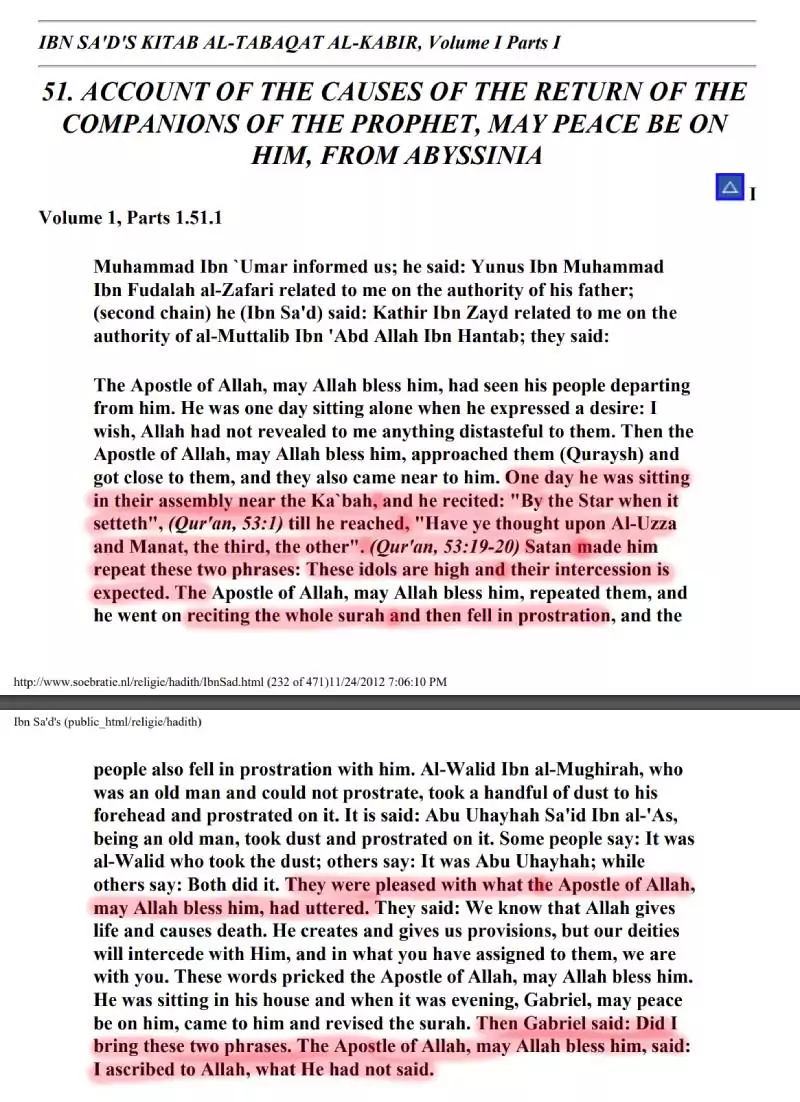
The Apostle of Allah, may Allah bless him, had seen his people departing from him. He was one day sitting alone when he expressed a desire: I wish, Allah had not revealed to me anything distasteful to them. Then the Apostle of Allah, may Allah bless him, approached them (Quraysh) and got close to them, and they also came near to him. One day he was sitting in their assembly near the Ka`bah, and he recited: “By the Star when it setteth”, (Qur’an, 53:1) till he reached, “Have ye thought upon Al-Uzza and Manat, the third, the other”. (Qur’an, 53:19 20) Satan made him repeat these two phrases: These idols are high and their intercession is expected. The Apostle of Allah, may Allah bless him, repeated them, and he went on reciting the whole surah and then fell in prostration, and the people also fell in prostration with him. Al-Walid Ibn al-Mughirah, who was an old man and could not prostrate, took a handful of dust to his forehead and prostrated on it. It is said: Abu Uhayhah Sa’id Ibn al-‘As, being an old man, took dust and prostrated on it. Some people say: It was al-Walid who took the dust; others say: It was Abu Uhayhah; while others say: Both did it. They were pleased with what the Apostle of Allah, may Allah bless him, had uttered. They said: We know that Allah gives life and causes death. He creates and gives us provisions, but our deities will intercede with Him, and in what you have assigned to them, we are with you. These words pricked the Apostle of Allah, may Allah bless him. He was sitting in his house and when it was evening, Gabriel, may peace be on him, came to him and revised the surah. Then Gabriel said: Did I bring these two phrases. The Apostle of Allah, may Allah bless him, said: I ascribed to Allah, what He had not said.
From al-Tabari’s History
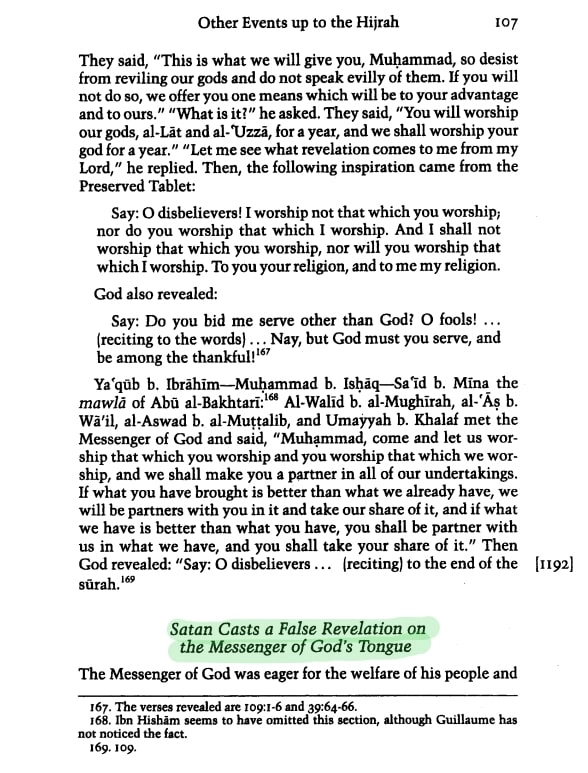
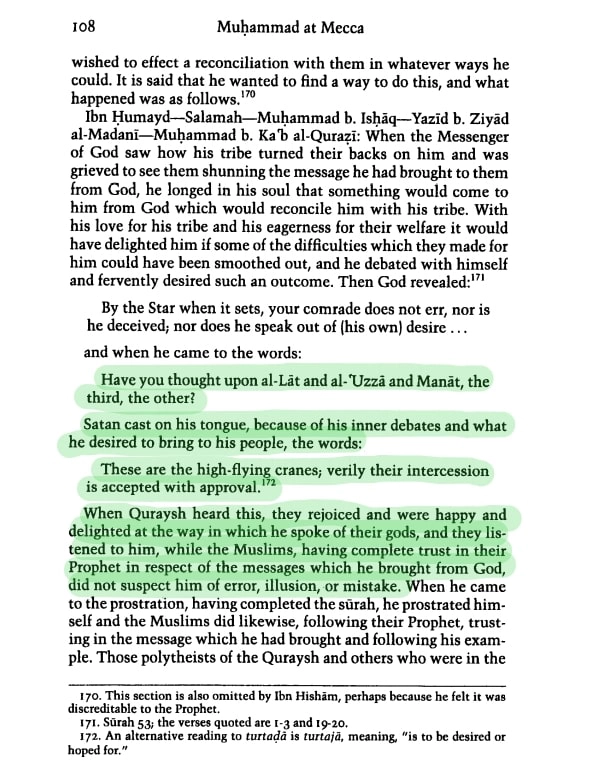
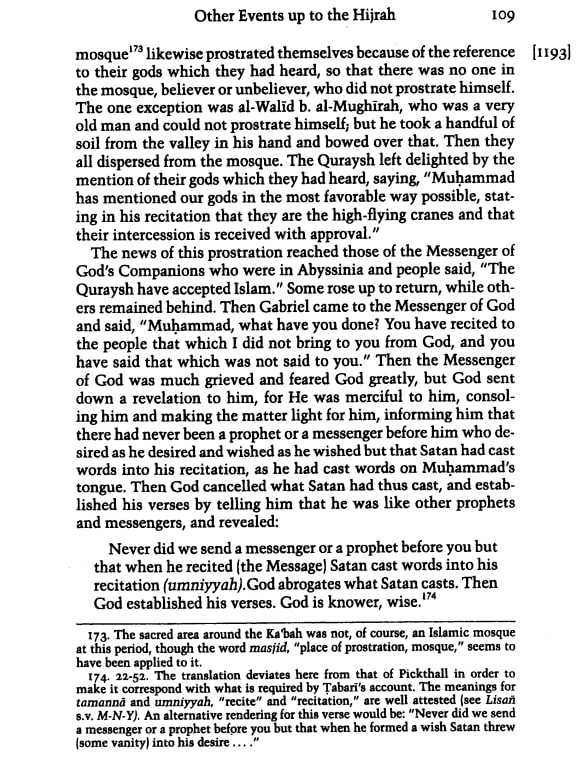
Let us now examine the account of al-Tabari, a historian of exceptional importance in Islamic history [21]:
The Gharaniq in al-Tabari’s Commentary: From Historical Narrative to Qur’anic Interpretation
We have already seen that al-Tabari’s historical work contains the account of the Satanic Verses. Examining his history alone, however, does not fully explain his position. He also uses the episode in his famous commentary Jami‘ al-Bayan to interpret verses 52 and 53 of Surah al-Hajj. Compiling a report in a historical work and adopting that episode as a basis for explaining a Qur’anic verse are different activities. The question here is how early Muslim commentators knew the episode and connected it with the Qur’an. Reading al-Tabari’s own interpretation shows that, for him, the Gharaniq account was not merely a story he had heard from others and recorded without comment.
In his commentary on Surah al-Hajj 22:52, al-Tabari first states the reported occasion of the verse’s revelation, then gives a complete narrative through Muhammad ibn Ka‘b al-Qurazi and Muhammad ibn Qays. The desire to reduce tensions with the Quraysh, praise of the goddesses, collective prostration, Gabriel’s objection and the return of the Muslims from Abyssinia all appear within the same account [22].
Original Arabic Text
قيل: إن السبب الذي من أجله أنـزلت هذه الآية على رسول الله صلى الله عليه وسلم, أن الشيطان كان ألقي على لسانه في بعض ما يتلوه مما أنـزل الله عليه من القرآن ما لم ينـزله الله عليه, فاشتدّ ذلك على رسول الله صلى الله عليه وسلم واغتمَّ به, فسلاه الله مما به من ذلك بهذه الآيات.
*ذكر من قال ذلك:حدثنا القاسم, قال: ثنا الحسين, قال: ثنا حجاج, عن أبي معشر, عن محمد بن كعب القرظي ومحمد بن قيس قالا جلس رسول الله صلى الله عليه وسلم في ناد من أندية قريش كثير أهله, فتمنى يومئذ أن لا يأتيه من الله شيء فينفروا عنه, فأنـزل الله عليه: وَالنَّجْمِ إِذَا هَوَى * مَا ضَلَّ صَاحِبُكُمْ وَمَا غَوَى فقرأها رسول الله صلى الله عليه وسلم, حتى إذا بلغ: أَفَرَأَيْتُمُ اللاتَ وَالْعُزَّى * وَمَنَاةَ الثَّالِثَةَ الأُخْرَى ألقى عليه الشيطان كلمتين: تلك الغرانقة العلى, وإن شفاعتهنّ لترجى, فتكلم بها.
ثم مضى فقرأ السورة كلها. فسجد في آخر السورة, وسجد القوم جميعا معه, ورفع الوليد بن المغيرة ترابا إلى جبهته فسجد عليه, وكان شيخا كبيرا لا يقدر على السجود.
فرضوا بما تكلم به وقالوا: قد عرفنا أن الله يحيي ويميت، وهو الذي يخلق ويرزق, ولكن آلهتنا هذه تشفع لنا عنده, إذ جعلت لها نصيبا, فنحن معك، قالا فلما أمسى أتاه جبرائيل عليه السلام، فعرض عليه السورة; فلما بلغ الكلمتين اللتين ألقى الشيطان عليه قال: ما جئتك بهاتين، فقال رسول الله صلى الله عليه وسلم: افْتَرَيْتُ عَلى الله، وَقُلْتُ عَلى الله ما لَمْ يَقُلْ، فأوحى الله إليه: وَإِنْ كَادُوا لَيَفْتِنُونَكَ عَنِ الَّذِي أَوْحَيْنَا إِلَيْكَ لِتَفْتَرِيَ عَلَيْنَا غَيْرَهُ …
إلى قوله: ثُمَّ لا تَجِدُ لَكَ عَلَيْنَا نَصِيرًا . فما زال مغموما مهموما حتى نـزلت عليه: ( وَمَا أَرْسَلْنَا مِنْ قَبْلِكَ مِنْ رَسُولٍ وَلا نَبِيٍّ إِلا إِذَا تَمَنَّى أَلْقَى الشَّيْطَانُ فِي أُمْنِيَّتِهِ فَيَنْسَخُ اللَّهُ مَا يُلْقِي الشَّيْطَانُ ثُمَّ يُحْكِمُ اللَّهُ آيَاتِهِ وَاللَّهُ عَلِيمٌ حَكِيمٌ ). قال: فسمع من كان من المهاجرين بأرض الحبشة أن أهل مكة قد أسلموا كلهم, فرجعوا إلى عشائرهم وقالوا: هم أحبّ إلينا، فوجدوا القوم قد ارتكسوا حين نسخ الله ما ألقى الشيطان.
English Translation
It is said that the reason this verse was revealed to the Messenger of Allah was that, while he recited part of the Qur’an that Allah had revealed to him, Satan placed upon his tongue something Allah had not revealed. This caused the Messenger great distress and sorrow. Allah then consoled him through these verses.
Reports from those who said this: Al-Qasim narrated to us, saying: Al-Husayn narrated to us, saying: Hajjaj narrated to us, from Abu Ma‘shar, from Muhammad ibn Ka‘b al-Qurazi and Muhammad ibn Qays. They said: The Messenger of Allah was sitting in a large gathering of the Quraysh. That day, he wished that nothing would come to him from Allah that would drive them away. Allah then revealed to him: ‘By the star when it descends; your companion has neither strayed nor gone astray.’ The Messenger continued reciting. When he reached ‘Have you considered al-Lat and al-Uzza, and Manat, the third, the other?’, Satan cast two statements upon him: ‘These are the exalted gharaniq, and their intercession is certainly to be hoped for.’ He then uttered those words.
He continued and recited the entire surah. At its conclusion he prostrated, and everyone present prostrated with him. Al-Walid ibn al-Mughirah raised earth to his forehead and prostrated upon it, because he was very old and unable to prostrate.
They were pleased with what he had said and declared: ‘We know that Allah gives life and death, creates and provides sustenance. But these gods of ours intercede with him for us. Since you have acknowledged a share for them, we are with you.’ The two narrators said: In the evening, Gabriel came to him. He recited the surah to Gabriel. When he reached the two statements Satan had cast upon him, Gabriel said: ‘I did not bring you those two statements.’ The Messenger said: ‘I have falsely attributed words to Allah and said in Allah’s name what he did not say.’ Allah then revealed to him the passage beginning ‘They almost turned you away from what I revealed to you, so that you would invent something else in my name’ and ending ‘Then you would find no helper against me.’
He remained distressed and anxious until the following was revealed: ‘We sent no messenger or prophet before you who, whenever he engaged in tamanna, did not have Satan cast something into his tamanna. Allah then removes what Satan casts, and firmly establishes his verses. Allah is all-knowing and wise.’ The narrator said: The migrants in Abyssinia heard that all the people of Mecca had accepted Islam. They returned to their families, saying: ‘They are dearer to us.’ On arrival, however, they found that the people had reverted to their former position after Allah removed what Satan had cast.
The wording of this report deserves attention. It does not merely say that the polytheists misheard something: it says, ‘He then uttered those words.’ After Gabriel’s objection, it also places on Muhammad’s lips an admission that he attributed to Allah something Allah had not said. These are the statements of this specific report compiled by al-Tabari. If later interpretations transfer responsibility for the utterance entirely to the listeners’ ears or Satan’s voice, those interpretations differ from the report’s wording. Concealing this difference prevents readers from understanding what the early source actually says and how it was subsequently reinterpreted.
The commentary on the next verse is even more significant. In explaining Surah al-Hajj 22:53, al-Tabari uses the statement ‘These are the exalted gharaniq, and their intercession is certainly to be hoped for’ in his own explanatory discussion as an example of words uttered by the Prophet. He then cites Qatadah’s report and other commentators’ statements. The complete commentary on the verse follows [23].
Original Arabic Text
يقول تعالى ذكره: فينسخ الله ما يلقي الشيطان, ثُم يُحكم الله آياته, كي يجعل ما يلقي الشيطان في أمنية نبيه من الباطل, كقول النبيّ صلى الله عليه وسلم: تلك الغرانيق العلى, وإن شفاعتهن لترتجى فتنة يقول: اختبارا يختبر به الذين في قلوبهم مرض من النفاق، وذلك الشكّ في صدق رسول الله صلى الله عليه وسلم وحقيقة ما يخبرهم به.
وبنحو الذي قلنا في ذلك قال أهل التأويل.
*ذكر من قال ذلك:حدثنا ابن عبد الأعلى, قال: ثنا ابن ثور, عن معمر, عن قَتادة: أن النبيّ صلى الله عليه وسلم كان يتمنى أن لا يعيب الله آلهة المشركين, فألقى الشيطان في أمنيته, فقال: إن الآلهة التي تدعي أن شفاعتها لترتجى وإنها للغرانيق العلى. فنسخ الله ذلك, وأحكم الله آياته: أَفَرَأَيْتُمُ اللاتَ وَالْعُزَّى حتى بلغ مِنْ سُلْطَانٍ قال قتادة: لما ألقى الشيطان ما ألقى, قال المشركون: قد ذكر الله آلهتهم بخير، ففرحوا بذلك, فذكر قوله: ( لِيَجْعَلَ مَا يُلْقِي الشَّيْطَانُ فِتْنَةً لِلَّذِينَ فِي قُلُوبِهِمْ مَرَضٌ ).
حدثنا الحسن, قال: أخبرنا عبد الرزاق, قال: أخبرنا معمر, عن قتادة, بنحوه.
حدثنا القاسم, قال: ثنا الحسين, قال: ثني حجاج, عن ابن جُرَيج, في قوله: ( لِيَجْعَلَ مَا يُلْقِي الشَّيْطَانُ فِتْنَةً لِلَّذِينَ فِي قُلُوبِهِمْ مَرَضٌ ) يقول: وللذين قست (1) قلوبهم عن الإيمان بالله, فلا تلين ولا ترعوي, وهم المشركون بالله.
وبنحو الذي قلنا في ذلك قال أهل التأويل.
*ذكر من قال ذلك: حدثنا القاسم, قال: ثنا الحسين, قال: ثني حجاج, عن ابن جُرَيج: ( وَالْقَاسِيَةِ قُلُوبُهُمْ ) قال: المشركون.
وقوله: ( وَإِنَّ الظَّالِمِينَ لَفِي شِقَاقٍ بَعِيدٍ ) يقول تعالى ذكره: وإن مشركي قومك يا محمد لفي خلاف الله في أمره, بعيد من الحق.
الهوامش: (1) قوله: “وللذين قست”: عطف على مفهوم من السياق، أي للذين في قلوبهم مرض، والذين قست قلوبهم.
English Translation
The meaning of Allah’s statement is this: Allah removes what Satan casts, then firmly establishes his verses, so that the falsehood Satan casts into his Prophet’s tamanna—such as the Prophet’s words, ‘These are the exalted gharaniq, and their intercession is certainly to be hoped for’—may become a trial. He thereby tests those whose hearts contain the disease of hypocrisy: doubt about the Messenger’s truthfulness and the truth of what he tells them.
The interpreters have said similar things to what we have stated concerning this matter.
Reports from those who said this: Ibn Abd al-A‘la narrated to us, saying: Ibn Thawr narrated to us, from Ma‘mar, from Qatadah: The Prophet wished that Allah would not disparage the polytheists’ gods. Satan then cast something into his tamanna, and he said: ‘The gods whose intercession you claim is to be hoped for are the exalted gharaniq.’ Allah then removed it and firmly established his verses, from ‘Have you considered al-Lat and al-Uzza’ to ‘any authority’. Qatadah said: When Satan cast what he cast, the polytheists said: ‘Allah has spoken favourably of their gods.’ They were delighted. He then cited: ‘So that what Satan casts may become a trial for those in whose hearts is disease.’
Al-Hasan narrated to us, saying: Abd al-Razzaq informed us, saying: Ma‘mar informed us, from Qatadah, with a similar account.
Al-Qasim narrated to us, saying: Al-Husayn narrated to us, saying: Hajjaj narrated to me, from Ibn Jurayj. In explaining ‘So that what Satan casts may become a trial for those in whose hearts is disease’, he said: And also for those whose hearts have hardened against belief in Allah, neither softening nor desisting. They are those who associate partners with Allah.
The interpreters have said similar things to what we have stated concerning this matter.
Reports from those who said this: Al-Qasim narrated to us, saying: Al-Husayn narrated to us, saying: Hajjaj narrated to me, from Ibn Jurayj. He explained ‘those whose hearts are hardened’ as the polytheists.
The meaning of ‘The wrongdoers are certainly in far-reaching opposition’ is: O Muhammad, the polytheists among your people oppose Allah’s command and are far from the truth.
Editor’s note: ‘And those whose hearts have hardened’ is linked to the meaning understood from the context: those whose hearts contain disease and those whose hearts have hardened.
Here al-Tabari himself cites the Prophet’s Gharaniq statement as an example of the ‘falsehood’ cast by Satan. The episode is therefore not confined to a list of quotations in his commentary: it forms part of his explanation of what the verse in Surah al-Hajj means. Reading his history and commentary together shows that the Gharaniq account occupied a place in both early Muslim historiography and Qur’anic interpretation. Al-Tabari uses this narrative to explain why Surah al-Hajj speaks of Satan’s intervention and its removal. The question of Satan’s words entering a religious message is therefore not a modern question imposed upon his commentary from outside; recognition of the problem is already present within his explanation of the verse.
Does Satan Insert Verses into the Prophet’s Speech?
First, let us read verses 19, 20 and 21 of Surah al-Najm in the Qur’an available today [24] [25].
Have you considered al-Lat and al-Uzza?
—Taisirul Quran
Have you considered al-Lat and al-Uzza?
—Sheikh Mujibur Rahman
‘Tell me about al-Lat and al-Uzza.’
—Rawai Al-bayan
Then tell me about al-Lat and al-Uzza.
—Dr Abu Bakr Muhammad Zakaria
And Manat, the third, the other? (How reasonable is it to worship these powerless, speechless idols, incapable of movement?)
—Taisirul Quran
And Manat, the third, the other?
—Sheikh Mujibur Rahman
And Manat, who is the third, the other?
—Rawai Al-bayan
And Manat, the third, the other [1]?
—Dr Abu Bakr Muhammad Zakaria
Another verse follows, stating the complete opposite of what was revealed in those verses. It says that the disbelievers regard the goddesses al-Lat, Manat and al-Uzza as Allah’s daughters, but Allah will not take female children for himself. At the time, having sons was a source of pride, while having daughters was considered shameful. Like people of that period, Allah proudly asks in this verse: would Allah give the disbelievers sons while taking daughters for himself? Reading it makes clear that Allah, too, regards having daughters as degrading and having sons as honourable. Let us examine the verse and see whether Allah differentiates between the status of daughters and sons [26].
What! Sons for you and daughters for Allah?
—Taisirul Quran
Then are male children for you and female children for Allah?
—Sheikh Mujibur Rahman
Are sons for you and daughters for Allah?
—Rawai Al-bayan
Are male children for you and female children for Allah?
—Dr Abu Bakr Muhammad Zakaria
Exactly the same statement appears again in verse 16 of Surah al-Zukhruf [27]:
What!Has he taken daughters from his own creation and selected sons for you?
—Taisirul Quran
Has he taken daughters for himself from his creation and favoured you with sons?
—Sheikh Mujibur Rahman
Has he taken daughters from what he created and favoured you with sons?
—Rawai Al-bayan
Or has he taken daughters from what he created and favoured you with sons?
—Dr Abu Bakr Muhammad Zakaria
Surah al-Hajj explicitly states that Satan can insert words into the revelations of prophets and messengers. It then says that these serve to test the believers’ faith. Let us first read the verses [28]:
52
We sent no messenger or prophet before you who, whenever he desired something, did not have Satan cast obstacles, doubts or misgivings into his desire. But Allah removes what Satan casts, then firmly establishes his signs. Allah is all-knowing and supreme in wisdom.
—Taisirul Quran
We sent no messenger or prophet before you who, whenever he desired something, did not have Satan insert something into his desire. Allah, however, removes what Satan inserts, then firmly establishes his verses. Allah is all-knowing and wise.
—Sheikh Mujibur Rahman
And we sent no messenger or prophet before you who, whenever he recited the revealed message, did not have Satan cast something into his recitation. Allah removes what Satan casts, then makes his verses firm. Allah is all-knowing and most wise.
—Rawai Al-bayan
And we sent no messenger or prophet before you [1] who, whenever he recited some revelation [2], did not have Satan cast something into his recitation. But Allah removes what Satan casts [3]. Allah then firmly establishes his verses, and Allah is all-knowing and wise.
—Dr Abu Bakr Muhammad Zakaria
53
He allows this so that he may use what Satan has mixed in to test those whose hearts contain the disease of hypocrisy and those whose hearts are hardened. The wrongdoers are in extreme disagreement.
—Taisirul Quran
This is so that he makes what Satan inserts a trial for those whose hearts contain disease and whose hearts are hardened. The wrongdoers are certainly in far-reaching disagreement.
—Sheikh Mujibur Rahman
This is so that he may make what Satan casts a means of testing those whose hearts contain disease and whose hearts are hardened. The wrongdoers are certainly in far-reaching disagreement.
—Rawai Al-bayan
This is so that he makes what Satan inserts a trial for those whose hearts contain disease and those who are hard-hearted [1]. The wrongdoers are certainly in far-reaching opposition.
—Dr Abu Bakr Muhammad Zakaria
From Tafsir al-Jalalayn
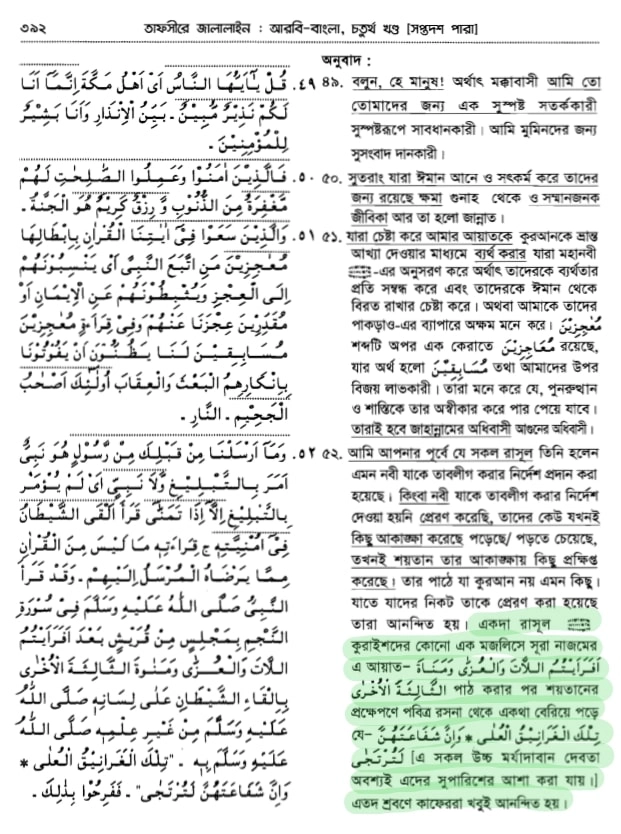
The world-famous commentary Tafsir al-Jalalayn describes the Satanic Verses episode. Let us read its commentary on verses 52 and 53 of Surah al-Hajj [29]:
52.
We sent no messenger—a prophet commanded to convey the message—or prophet—one not commanded to convey it—before you who, whenever he desired, recited or wished to recite, did not have Satan insert something into his desire: something not belonging to the Qur’an into his recitation, so that the people to whom he was sent would be pleased. Once, in a gathering of the Quraysh, after the Messenger recited أفرام اللات والعزى ومناة – RTS الثَّالِئَةَ الأخرى from Surah al-Najm, Satan’s interpolation caused these words to emerge from his tongue: تلك الْغَرَانِينُ الْعُلَى * وَإِنَّ شَفَاعَتَهُنَّ -لترتجى )‘These are the exalted deities; their intercession is certainly to be hoped for.’ Hearing this, the disbelievers were very pleased.
Gabriel (peace be upon him) subsequently informed him that Satan had made him utter these words without his knowledge. He became deeply distressed. He was then consoled by the following verse so that he might find peace. Allah removes, or abrogates, what Satan inserts. He then firmly establishes and strengthens his verses. Allah is all-knowing concerning the aforementioned interpolation by Satan, and wise in granting Satan this power from himself. He does whatever he wills.
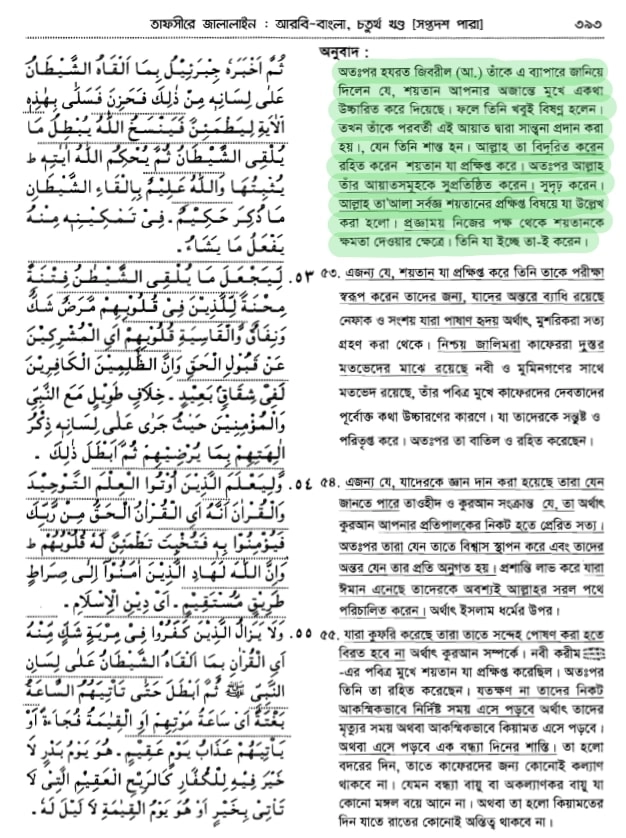
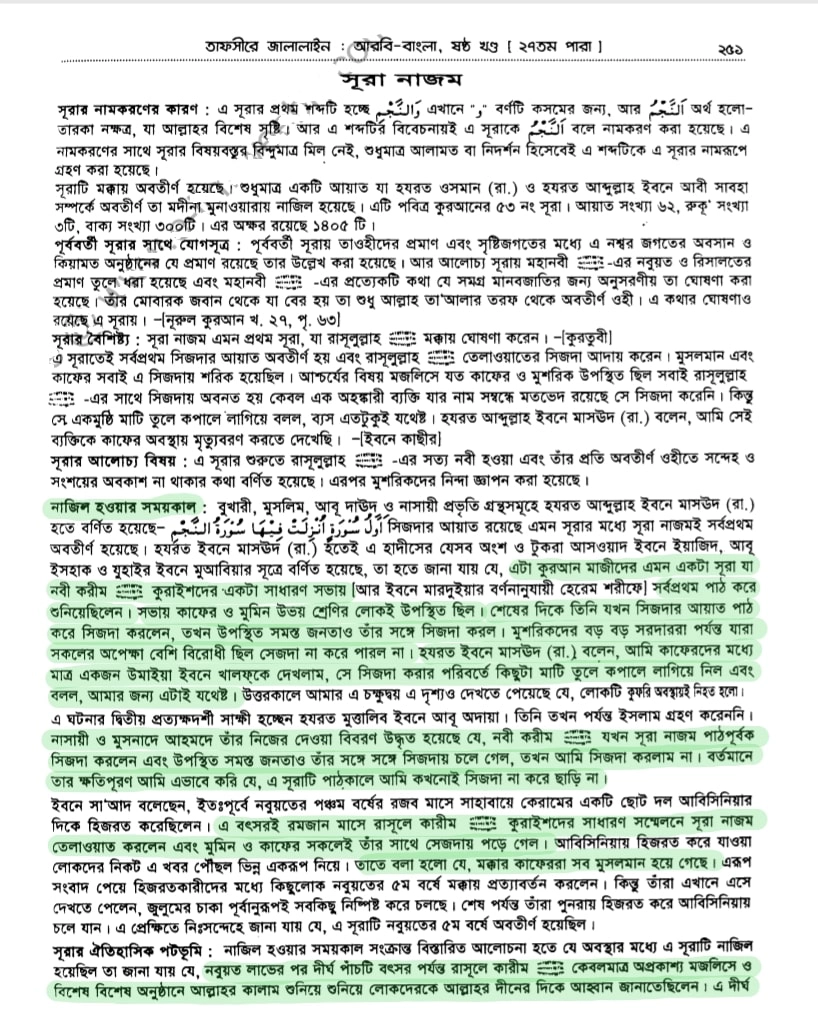
Let us also read Tafsir al-Jalalayn’s account of the circumstances in which Surah al-Najm was revealed. Here, the revelation of verses under Satan’s influence is again skilfully avoided [30].
Date of Revelation: Al-Bukhari, Muslim, Abu Dawud, al-Nasa’i and other works report from Abdullah ibn Mas‘ud (ra) that أُولُ سُورَة أُنْزِلَتْ فِيهَا سُوْرَةُ النجم Surah al-Najm was the first surah containing a verse of prostration
to be revealed. Portions of this hadith narrated from Ibn Mas‘ud through al-Aswad ibn Yazid, Abu Ishaq and Zuhayr ibn Mu‘awiyah show that it was a Qur’anic surah the Prophet first recited before a general gathering of the Quraysh—or, according to Ibn Mardawayh’s report, in the Sacred Precinct. Both disbelievers and believers were present. Towards the end, when he recited the verse of prostration and prostrated, the entire gathering prostrated with him. Even the leading polytheists, who were more hostile than anyone else, could not refrain from prostrating. Ibn Mas‘ud (ra) says: ‘I saw only one disbeliever, Umayyah ibn Khalaf, who, instead of prostrating, lifted some earth to his forehead and said: “This is enough for me.” Later, these same eyes saw him killed while still a disbeliever.’
A second eyewitness was al-Muttalib ibn Abi Wada‘ah, who had not yet accepted Islam.
Al-Nasa’i and Musnad Ahmad quote his own account: ‘When the Prophet recited Surah al-Najm and prostrated, and all those present prostrated with him, I did not prostrate. I now compensate for this by never failing to prostrate when reciting this surah.’
Ibn Sa‘d states that, earlier, in Rajab of the fifth year of prophethood, a small group of companions had migrated
to Abyssinia. In Ramadan of the same year, the Messenger recited Surah al-Najm at a general gathering of the Quraysh, and believers and disbelievers alike prostrated with him. News of this reached the migrants in Abyssinia in a different form: it was said that all Mecca’s disbelievers had become Muslims. On hearing this, some migrants returned to Mecca in the fifth year of prophethood. On arrival, however, they found that the machinery of oppression was crushing everything as before. They ultimately migrated to Abyssinia again. This establishes beyond doubt that the surah was revealed in the fifth year of prophethood.
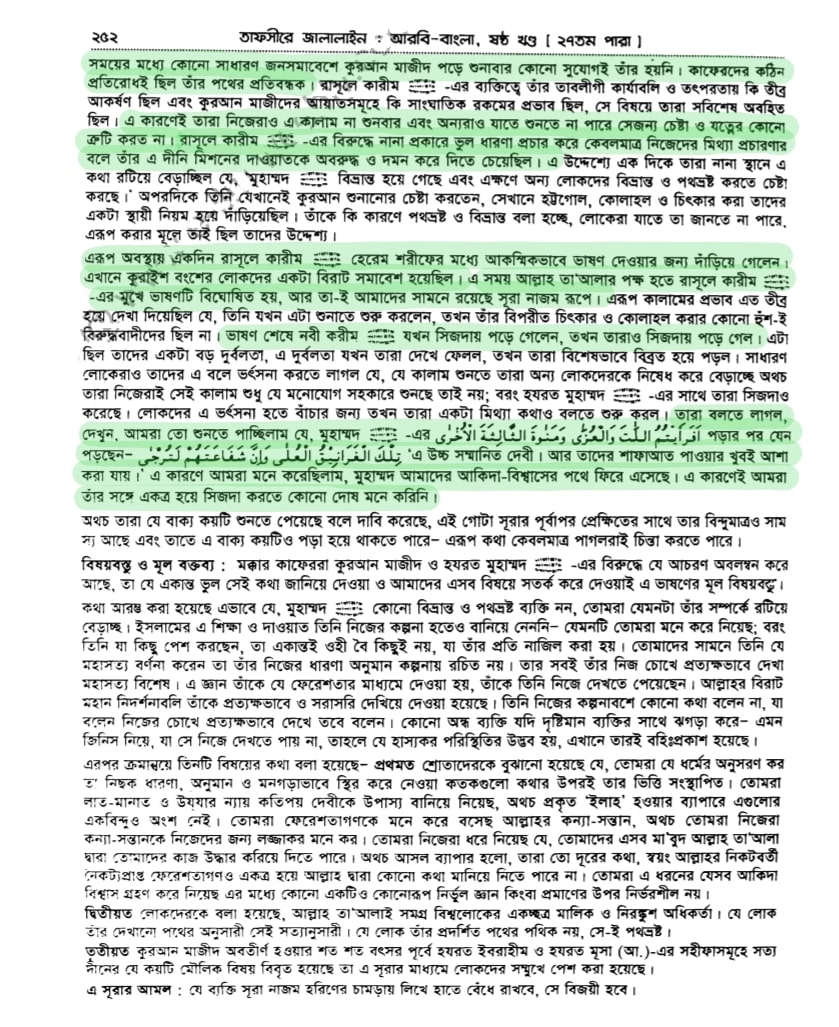
Historical Background of the Surah: The detailed discussion of its date of revelation reveals the circumstances in which it appeared. For five years after receiving prophethood, the Messenger had invited people to Allah’s religion by reciting Allah’s words only in private gatherings and particular settings. Throughout that period, he had no opportunity to recite the Qur’an before a general public assembly. The disbelievers’ fierce resistance blocked his path. They knew the powerful appeal of his personality and missionary activities, and the remarkable influence of the Qur’anic verses. They therefore spared no effort to avoid listening themselves and to prevent others from listening. By spreading various misconceptions about the Messenger, they sought to obstruct and suppress his religious mission through false propaganda alone. For this purpose, they circulated the claim that ‘Muhammad has become confused and is now trying to confuse and mislead others.’ Whenever he tried to recite the Qur’an, they habitually created commotion, noise and shouting. Their purpose was to stop people from finding out why they called him misguided and confused.
In these circumstances, one day the Messenger unexpectedly stood up to address a large gathering of the Quraysh in the Sacred Precinct. At that moment, a discourse from Allah was proclaimed through the Messenger’s
mouth, and that discourse stands before us as Surah al-Najm. Its influence was so powerful that, when he began reciting, his opponents lost all awareness of shouting and creating commotion against him. At the conclusion, when the Prophet prostrated, they also prostrated. This was a major weakness on their part, and recognising it left them deeply embarrassed. Ordinary people began reproaching them: they not only listened attentively to the words they had forbidden others to hear, but even prostrated alongside Muhammad. To escape this reproach, they began telling a lie. They said: ‘Look, we heard Muhammad, after reciting أَفَرَأَيْتُمُ اللَّتَ وَالْعُزَّى وَمَنُوةَ الثَّالِثَةَ الْأُخرى , apparently continue with كَ الْغَرَائِيقُ الْعُلَى وَإِنَّ شَفَاعْتَهُمْ لَتُرْحِى “These are the highly honoured goddesses, and their intercession is greatly to be hoped for.” We therefore thought Muhammad had returned to our beliefs. That is why we saw nothing wrong with prostrating together with him.’
From Tafsir Ibn Kathir
Let us now read Tafsir Ibn Kathir’s commentary on verses 52 and 53 of Surah al-Hajj [31]:
Ibn Abi Hatim (rh) reports through Yunus ibn Habib (rh) from Sa‘id ibn Jubayr (ra), who said: While the Messenger of Allah (peace be upon him) was in Mecca, he once recited Surah al-Najm. When he reached the following passage (Surah al-Najm 19–20):
أَفَرَأَيْتُمُ اللتَ وَالْعُزَّى وَمَنُوةَ الثَّالِثَةَ الْأُخْرَى
Satan caused him to utter:
تِلْكَ الْغَرَائِيقَ الْأُولَى وَإِنَّ شَفَاعَتُهُنَّ لَتُرْجِى
Hearing this, the polytheists said: ‘Muhammad has never praised our objects of worship before, but today he has praised them.’ When the Messenger prostrated, they therefore prostrated with him. Allah then revealed this verse:
وَمَا أَرْسَلْنَا مِنْ قَبْلِكَ مِنْ رَّسُولٍ وَلَا نَبِيَّ إِلَّا إِذَا تَمَنَّى أَلْقَى الشَّيْطَنُ فِي أَمْنِيَّتِهِ فَيَنْسَخُ اللَّهُ مَا يُلْقِي الشَّيْطَنَ ثُمَّ يُحْكُمُ اللَّهُ أَيْتِهِ وَاللَّهُ عَلِيمٌ حكيم.
The report is narrated through Shu‘bah (rh), although
Ibn Jarir’s narration is mursal. In his Musnad, al-Bazzar (rh) narrates through Yusuf ibn Hammad (rh) that the Prophet once recited Surah al-Najm in Mecca, and relates أفَرَأَيْتُمُ اللتَ وَالْعُزَّى الخ . Al-Bazzar then says: We know of no connected narration of this report through any chain other than this one. Only Umayyah ibn Khalid (rh) narrated it with a connected chain, and he is a well-known, trustworthy narrator. It is narrated through al-Kalbi (rh), through Abu Salih (rh), from Ibn Abbas (ra).
Abu Hatim (rh) then narrates the hadith in mursal form from Abu al-Aliyah and al-Suddi (rh). Ibn Jarir similarly narrates it in mursal form from Muhammad ibn Ka‘b al-Qurazi and Muhammad ibn Qays (rh).
Qatadah (rh) says: The Prophet was praying near the Station of Abraham. He became drowsy during the prayer, and at that time Satan caused him to utter وان شفاعتهن لترجى . The polytheists heard it, memorised it and circulated the claim that the Messenger had uttered it. Then this verse was revealed:
201 وَمَا أَرْسَلْنَا مِنْ قَبْلِكَ مِنْ رَسُولٍ وَلَا نَبِيِّ الخ Ibn Abi Hatim (rh) reports from Musa ibn Abi Musa al-Krishni (rh), through Ibn Shihab, that when Surah al-Najm was revealed, the polytheists said: ‘If this man, Muhammad, spoke a little more favourably about our gods, we would accept him and his companions. But he insults our gods more than the Jews, Christians and all the others who oppose his religion.’ The polytheists were severely persecuting and oppressing the Messenger and his companions. Their disbelief and polytheism deeply distressed the Messenger, who wished that they would be guided. Surah al-Najm was then revealed, and he recited
أفرأيتُمُ الله وَالْعُزَّى وَمَنْوة الثالثة الأُخْرَى أَلَكُمُ الذَّكَرُ وَلَهُ الْأُنْثَى
. When the polytheists’ deities were mentioned, Satan inserted certain words, and the following was uttered:
وَأَنَّهُنَّ لَهُنَّ الْفَرَانِيقُ الْعُلَى وَإِنَّ شَفَاعَتْهُنَّ لَتُرْجَى
These were rhythmic words from Satan’s mouth. They became firmly lodged in the hearts of every Meccan polytheist, and each memorised them. They said: ‘Muhammad has returned to his former religion.’ When the Messenger prostrated at the end of Surah al-Najm, all the Muslims and polytheists present prostrated. Al-Walid ibn al-Mughirah, however, was too old to prostrate, so he took a handful of earth and touched it to his head. The Muslims were astonished that the polytheists prostrated with the Messenger. Since they had not accepted Islam, the Muslims’ amazement knew no bounds. The words Satan had put into the polytheists’ ears were not heard by the believers. The polytheists, however, heard them and were delighted. Satan also told them that the Messenger had recited these words as part of the surah, so they all prostrated in honour of their gods. The news spread among others and reached distant Abyssinia, where the Muslims learned of it. Uthman ibn Maz‘un (ra) and his companions heard that Mecca’s polytheists had accepted Islam, that they had all prayed with the Messenger, and that al-Walid ibn al-Mughirah had lifted earth to his head. They understood that Mecca’s Muslims were now safe and returned to Mecca with great joy. By then, however, circumstances had changed. Allah had removed the falsehood Satan had mixed with the truth and made his verses firmer.
It was declared:
وَمَا أَرْسَلْنَا مِنْ قَبْلِكَ مِنْ رَّسُولٍ وَلَا نَبِيَّ إِلَّا إِذَا تَمَنَّى الْقَى الشَّيْطَنُ فِي أَمْنِيَّتِهِ فَيَنْسِخُ اللَّهُ مَا يُلْقِي الشَّيْطَنُ ثُمَّ يُحْكِمُ اللَّهُ أَيْتِهِ وَاللَّهُ عَلِيمٌ حَكِيمٌ ، ليَجْعَلَ مَا يُلْقِي الشَّيْطَنُ فِتْنَةً لِلَّذِينَ فِي قُلُوبِهِمْ مَّرَضٌ والْقَاسِيَةَ قُلُوبُهُمْ وَإِنْ يَظْلِمِينَ لَفِي شِقَاقَ بَعِيدٍ .
After the verse was revealed, it became clear that those rhythmic
words were not the Messenger’s words: Satan had inserted them into his Qur’anic recitation. The polytheists then opposed the Muslims with renewed intensity and treated them more harshly. This report is mursal. Ibn Jarir narrates a similar account from al-Zuhri, from Abu Bakr ibn Abd al-Rahman ibn al-Harith ibn Hisham (rh). Hafiz Abu Bakr al-Bayhaqi (rh) includes the report in Dala’il al-Nubuwwah, narrated from Abu Ishaq (rh). I, Ibn Kathir, say: Muhammad ibn Ishaq also relates a similar report in his Sirah. All the reports, however, are mursal or munqati‘. In his commentary, al-Baghawi (rh) relates all these reports as statements of Ibn Abbas (ra) and Muhammad ibn Ka‘b al-Qurazi. Al-Baghawi then raises the question himself: if Allah is the Messenger’s guardian and protector, how could such an event occur? He cites several answers. The best answer is that Satan himself uttered تِلْكَ الْغُرَائِيقَ الْعُلَى الخ and put it into the polytheists’ ears. They therefore imagined that the Messenger had uttered it, although this was contrary to reality. It came from Satan, not from the Messenger.
Accepting the event as true, the theologians have offered several answers to this question. Qadi Iyad (rh) discusses it in his book al-Shifa.
Allah’s statement: A RICOR AT الا اذا تَمَنَّى الْقَى الشَّيْطَنُ فِي أَمْنِيَّتِهِ (consoles the Prophet (peace be upon him): this happened before you. Whenever a prophet expressed a hope or desire and spoke, Satan mixed something into his words. Allah, however, removed what Satan had cast and mixed in. Therefore, O Prophet, do not be anxious or distressed. Imam al-Bukhari (rh) says that Ibn Abbas (ra) interpreted الثَّ إِذَا تَمَنِّى أَلْقَى الشَّيْطَنُ في أمنيته as follows: whenever a prophet spoke, Satan inserted some falsehood into his words, but Allah removed that falsehood. ثُمَّ يُحْكُمُ اللَّهِ أَيْتِهِ Then Allah made his verses firmer. Ali ibn Abi Talhah (rh) interprets إِذَا تَمَنِّى أَلْقِيَ الشَّيْطَنُ فِي أُمْنِيَّتِهِ as meaning that, whenever a prophet spoke, Satan inserted falsehood into his words. Mujahid (rh) says that تمنى means قال , and امنيته is also explained as قراته . Al-Baghawi (rh) says that most commentators interpret the verse as follows: ‘Whenever a prophet or messenger recited Allah’s Book, Satan mixed something else into his recitation.’
When Uthman (ra) was killed, a poet praised him: تمنى كتاب الله اول ليلة . واخرها لاقي حمام المقادر
He recited Allah’s Book at the beginning of the night, but at its end encountered his appointed death. In this poem, تمنى also means recitation, ر ق . Al-Dahhak (rh) says that اذا تمنى means ذا تلا. Ibn Jarir (rh) says that accepting this meaning of تمنى is the best way to explain the passage.
Allah’s statement:
فَيَنْسَخُ اللَّهُ مَا يُلْقِي الشَّيْطَنُ
Then Allah removes what Satan has mixed in. ن النسخ means removal or abrogation. Ali ibn Abi Talhah (rh), narrating from Ibn Abbas (ra), explains it as Allah invalidating what Satan has mixed in. Al-Dahhak (rh) says: At Allah’s command, Gabriel (peace be upon him) removed what Satan had mixed in and strengthened Allah’s verses.
وَاللَّهُ عَلَيْمٍ حَكِيمٌ Allah knows everything that has occurred; nothing is unknown to him. He knows the reasons behind the creation of every thing, and none of those reasons is unknown to him. For this reason it is stated:
لِيَجْعَلَ مَا يُلْقِي الشَّيْطَنَ فِتْنَةٌ لِلَّذِينَ فِي قُلُوبِهِمْ مَرَضٌ
So that what Satan has mixed in may become a test for those whose hearts contain disease, doubt, disbelief, polytheism or hypocrisy. When the polytheists first heard the statement تلك الْفَرَائِيق , they were exceedingly pleased and supposed that it was true and revealed by Allah, although it had been mixed in by Satan.
Ibn Jurayj (rh) says that الذينَ فِي قُلُوبِهِمْ مَرَضٌ refers to the hypocrites, and وَالْقَاسِيةُ قُلُوبهمْ to the polytheists. Muqatil ibn Hayyan (rh) says that the Jews are meant. وَإِنَّ الظَّلِمِينَ لَّفِي شَقَاق بعيد The wrongdoers are immersed in misguidance, far from truth and what is right.
Allah’s statement:
وَلَيَعْلَمَ الَّذِينَ أُوتُوا الْعِلْمَ أَنَّهُ الْحَقُّ مِنْ رَبِّكَ فَيُؤْمِنُوا بِهِ Those granted knowledge believe that the pure message from your Lord is the truth, so that they may believe in it.
It is stated: لا يَأْتِيهِ الْبَاطِلَ مِنْ بَيْنِ يَدَيْهِ وَلَا مِنْ خَلْفِهِ الخ Falsehood cannot approach it from before or behind; it is revealed by the All-Wise, Praiseworthy One.
Allah’s statement: فَيُؤْمِنُوا بِهِ
means that they will believe more firmly. نتخْبِتَ لَهُ قُلُوبُهُمْ Then their hearts will incline more deeply towards it.
It is further stated:
وَإِنَّ اللَّهَ لِهَادِ الَّذِينَ آمَنُوا إِلَى صِرَاطٍ مُّسْتَقِيمٍ
Allah will certainly guide the believers on the right path in this world and the next. In this world, he will show them the path of truth and enable them to follow it and oppose falsehood. In the hereafter, he will bring them to the different levels of Paradise and keep them away from the punishment of Hell.
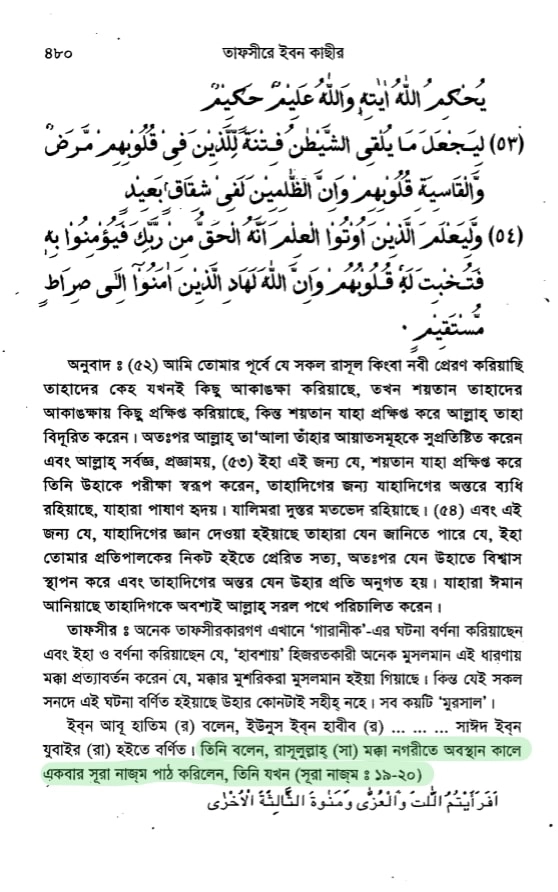
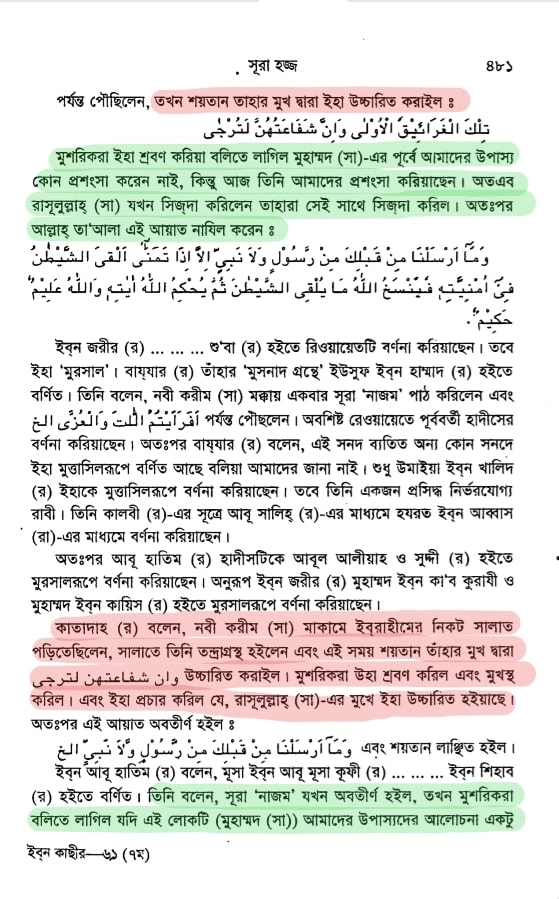
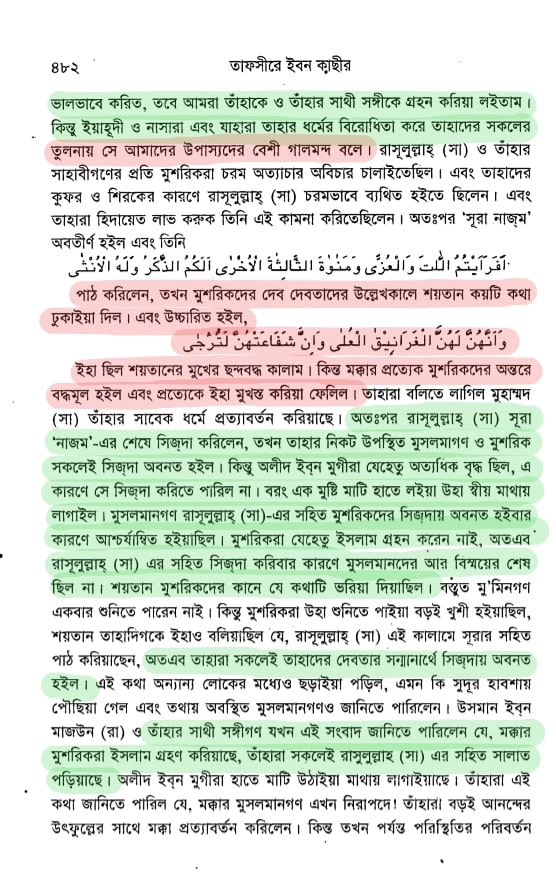
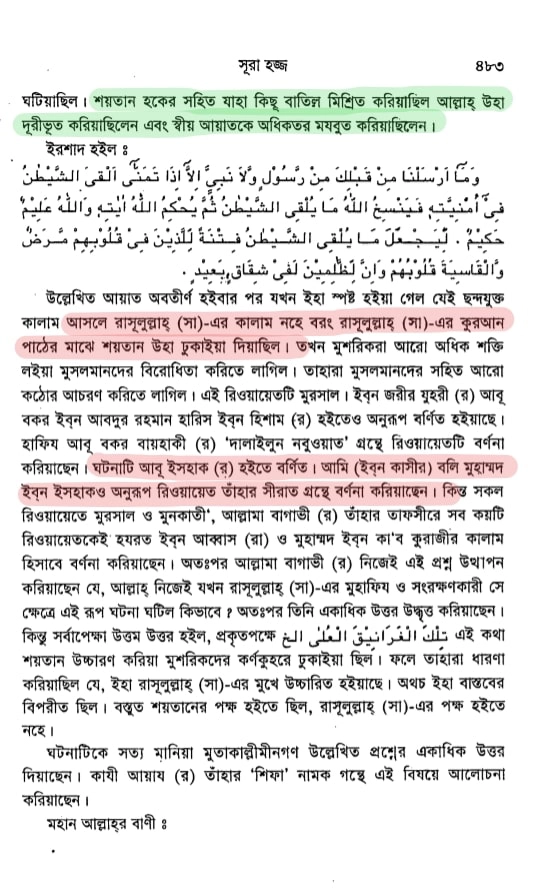
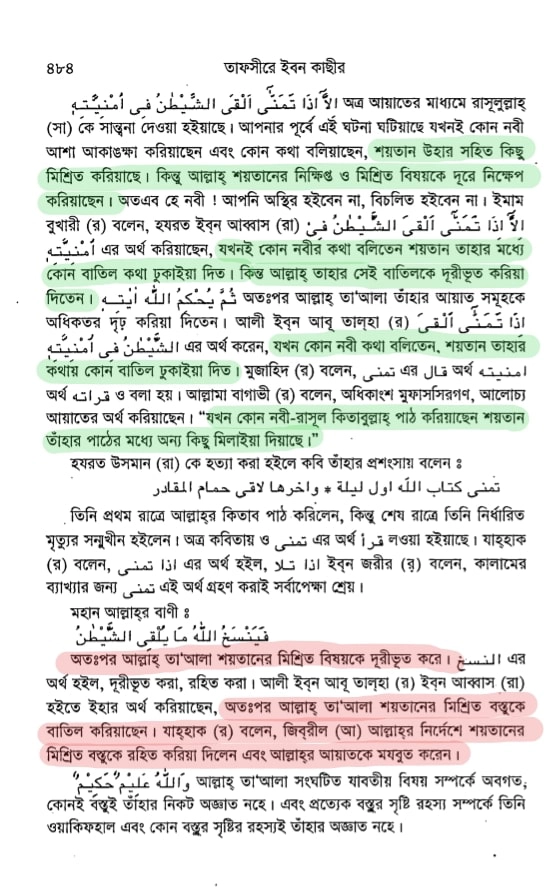
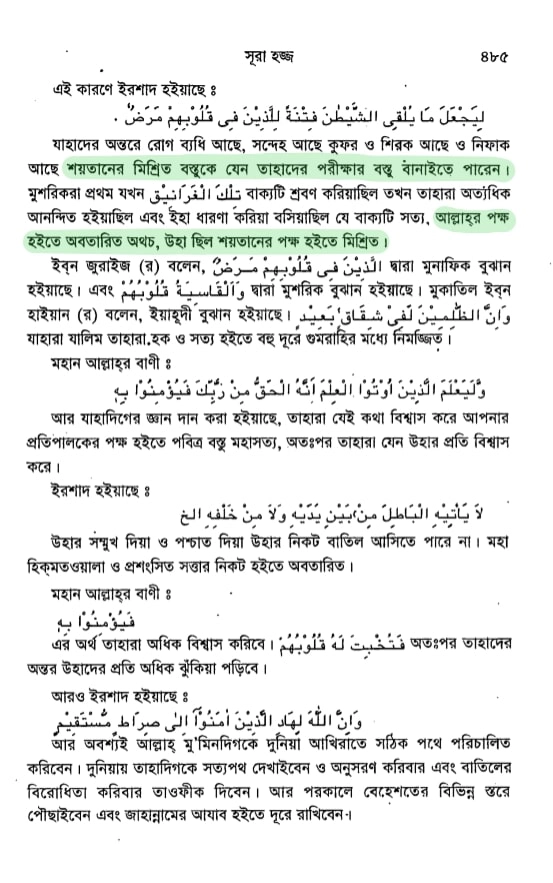
From Tafsir al-Mazhari
Let us now read the commentary on this verse in Tafsir al-Mazhari [32]:
Surah al-Hajj, Verse 52
وَمَا أَرْسَلْنَا مِنْ قَبْلِكَ مِنْ رَسُولٍ وَلَا نَبِي إِلَّا إِذَا تَمَنَّى الْقَى الشَّيْطَنُ فِي أُمْنِيَّتِهِ فَيَنْسَخُ اللَّهُ مَا يُلْقِي الشَّيْطَنُ ثُمَّ يُحْكِمُ اللهُ ايْتِهِ وَ اللهُ عَلِيمٌ حَكِيمٌ
We sent no messenger or prophet before you who, whenever he recited, did not have Satan insert something into his recitation. Allah, however, removes what Satan inserts, then firmly establishes his verses. Allah is all-knowing and wise.
The beginning of the verse states: ‘We sent no messenger or prophet before you who, whenever he recited, did not have Satan insert something into his recitation.’ Its meaning is: O my beloved Messenger, do not be anxious. Such an event is not new; it also occurred to messengers before you. When, out of their intense desire for their communities’ guidance, they recited a verse from Allah’s speech, Satan inserted his own words into it. Some commentators explain idha tamanna here as ‘whenever he sincerely desired’. In this context, however, its meaning is ‘whenever he recited something’, as rendered in the Bengali translation. Most commentators say that tamanna means reading or reciting, and umniyyah likewise means recitation. For example, after Uthman’s martyrdom, a poet composed the following verse:
Alqa al-shaytanu means that Satan cast an evil suggestion. In other words, when prophets recite Allah’s words with an intense desire for their communities to be guided, Satan inserts something. Al-Baydawi writes that Satan casts a subtle error corresponding to the prophets’ desires, causing them to fall into a temporary error.
It is then stated: ‘But Allah removes what Satan inserts.’ This means that Allah removes the interpolation arising from Satan’s suggestion and frustrates his malicious attempt, thereby keeping his beloved prophets innocent and safe.
Finally, it is stated: ‘Then Allah firmly establishes his verses.’ This means that, by protecting the prophets in this way, Allah keeps his words pure and firm. The prophets are consequently freed from temporary error, and their prophethood and sinlessness remain secure and certain.
A Serious Difficulty: Like other prophets, the Messenger was sinless, and the Qur’an is the fundamental basis of religious instruction. How, then, can error in his Qur’anic recitation be accepted? Moreover, Allah explicitly guarantees its protection: ‘La ya’tihi al-batilu min bayni yadayhi wa-la min khalfihi’—‘Satan cannot approach it, either from before or behind.’ The commentator al-Baydawi therefore disregarded the account of the circumstances in which this verse was revealed. The theologians likewise consider this account of its occasion of revelation incorrect. Jalal al-Din al-Suyuti, however, says that al-Bazzar, Ibn Mardawayh and al-Tabarani presented the account through Sa‘id ibn Jubayr from Ibn Abbas.
I say: Al-Bazzar’s account comes through a connected chain. No other chain of it is connected in this way. Umayyah ibn Khalid, included in this connected chain, is a well-known and strong narrator.
Ibn Abi Hatim, Ibn Jarir and Ibn al-Mundhir narrate through an incomplete chain from Sa‘id ibn Jubayr: The Messenger was then in Mecca. Surah al-Najm was revealed, and he recited it before a gathering. When he read ‘A-fa-ra’aytum al-Lata wa-l-Uzza wa-Manata al-thalithata al-ukhra’, Satan attached to his utterance ‘Tilka al-gharaniq al-ula wa-inna
shafa‘atahunna la-turtaja’. Hearing this, the polytheists were delighted and said: ‘Muhammad has never before spoken so favourably about our objects of worship.’ When the recitation ended, the Messenger prostrated to Allah, and the polytheists prostrated with him. The verse under discussion was then revealed. Al-Nahhas connects the account to Ibn Abbas through a connected chain, but al-Waqidi, a narrator in it, is rejected. Ibn Mardawayh also links the account to Ibn Abbas through al-Kalbi, through Abu Salih. Al-Kalbi, however, is also unacceptable.
The account is also recorded by Ibn Jarir through al-Awfi from Ibn Abbas; by Muhammad ibn Ishaq from Muhammad ibn Ka‘b; by Ibn Shihab in al-Maghazi; by Ibn Jarir through Muhammad ibn Ka‘b and Muhammad ibn Qays; and by Ibn Abi Hatim on al-Suddi’s authority. These accounts have the same meaning, and all their chains are either weak or disconnected. The report of al-Bazzar, Ibn Mardawayh and al-Tabarani through Sa‘id ibn Jubayr from Ibn Abbas, however, is connected and strong; it was recorded at the beginning of this discussion.
Hafiz Ibn Hajar writes that, because the account is narrated through numerous routes, one can at least infer that it is certainly not without foundation. Two of its earlier incomplete chains are acceptable even according to the conditions of al-Bukhari and Muslim. One chain given by al-Tabarani is: Yunus ibn Yazid, Ibn Shihab al-Zuhri, Abd al-Rahman ibn Abi Bakr. Another of his chains comes through Ibn al-Harith ibn Hisham. Al-Tabarani narrates the episode through a further chain of this kind: Muqim ibn Sulayman, Hammad ibn Salman, Dawud Abu Hind, Abu al-Aliyah.
The scholars have tried to remove the resulting doubts in various ways. They say that the Messenger did not utter the statement inserted by Satan, nor did the companions present hear it from his mouth. Satan himself attached the inserted words to his recitation and carried them to the polytheists’ ears. They imagined that the Messenger himself had uttered them.
Qatadah says that the Messenger was in a semi-conscious state at the time, and Satan took advantage of this to make his words emerge involuntarily from the Prophet’s tongue
for a moment. Immediately afterwards, however, Allah alerted his beloved Messenger. Another report states that a devil called Abyad, the White Devil, employed a trick and succeeded, even if momentarily. This was also a test from Allah for his servants. It should not cause anyone to wonder whether the Qur’an contains words inserted by Satan. Allah himself removes this doubt in the following statement: ‘But Allah removes what Satan inserts.’ He thus removes doubts arising from Satan’s suggestions and reveals that the inserted words belong to Satan. In this way, he keeps the Qur’an’s true message pure, certain and firmly established. The entire Qur’an is therefore trustworthy. Otherwise, how could the verse ‘But Allah removes what Satan inserts’ itself be trustworthy? In response to such doubt, it may be said that knowledge and evidence require this conclusion: when Allah sends someone as a prophet, he also protects him from error in conveying the Qur’an and other scriptures that form the basis of religion. It is therefore self-evident that prophets are sinless and protected. Scholars with pure hearts consequently know the scriptures they convey to be true and wholeheartedly accept them as the absolute truth revealed by Allah. Their hearts remain free and pure from doubt.
Note: In al-Shifa, Qadi Iyad writes that scholars have not mentioned this episode in any authentic connected report, and it is not established through any authentic connected chain. Historians and commentators merely recorded various accounts in their books without properly distinguishing truth from falsehood. This caused the misunderstanding. Qadi Abu Bakr al-Maliki says that some people turn to certain commentators who are innovators influenced by their desires. Before them, narrators become unsettled; their chains break and their wording becomes confused. Heretics then proclaim these statements loudly. There are also differences among their accounts. Some say that the event occurred during prayer. Others
say it happened while Surah al-Najm was being recited. Others say that the inserted words arose spontaneously in the Messenger’s mind and that the entire matter was inadvertent. Still others say that, imitating the Messenger’s pronunciation,
Satan himself uttered those words. On hearing them, the Messenger immediately said: ‘By Allah, Allah has not revealed such verses.’ Some say that Satan made him utter those offensive words. Hearing them, Gabriel said: ‘I did not recite these to you.’ Furthermore, the episode is linked only to the successors, with no direct connection to a companion. Most of its chains are weak and unsound. Only one chain reaches Ibn Abbas through Sa‘id ibn Jubayr at a sufficiently developed level. Even this chain, however, is not beyond doubt, because it is unclear where the Prophet was at the time: in the Kaaba’s precincts, at a Quraysh gathering elsewhere, or in Mina.
Abu Bakr al-Bazzar says: I know of no connected chain for this matter reaching the Messenger that may permissibly be narrated. Umayyah ibn Khalid and others attribute it in incomplete form only to Sa‘id ibn Jubayr; its connection with Ibn Abbas is not established. Only al-Kalbi, on Abu Salih’s authority, carries it back to Ibn Abbas. Al-Bazzar adds: Apart from this single chain, it cannot be narrated through any other. It is also known that presenting al-Kalbi’s narration is impermissible, because it is extremely weak and rejected.
Finally, it is stated: ‘Allah is all-knowing and wise.’ This means that, being all-knowing and wise, Allah knows very well who has a pure heart and deserves guidance, and who does not. He therefore grants guidance to those who deserve it and leads astray those who deserve misguidance. No one has the right or ability to obstruct such a decision, arising from his infinite knowledge and wisdom. The statement may also mean that Allah certainly knows the revelation he sends to his messengers and whatever he wishes to do, because he is all-knowing. If Satan inserts anything contrary to his intention, Allah removes and frustrates it. In this way, he establishes his beginningless and endless speech forever, because his wisdom is infinite and eternal.
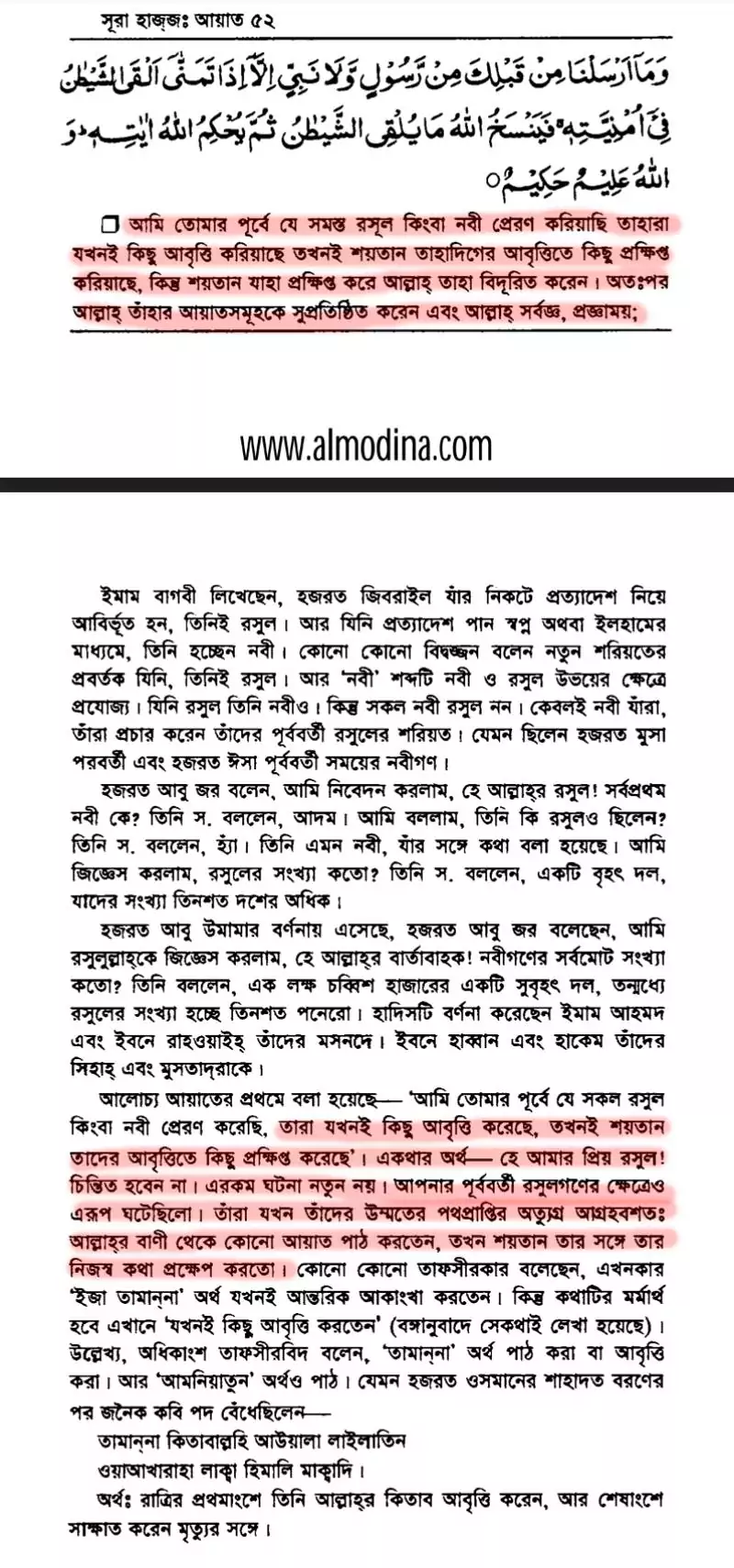
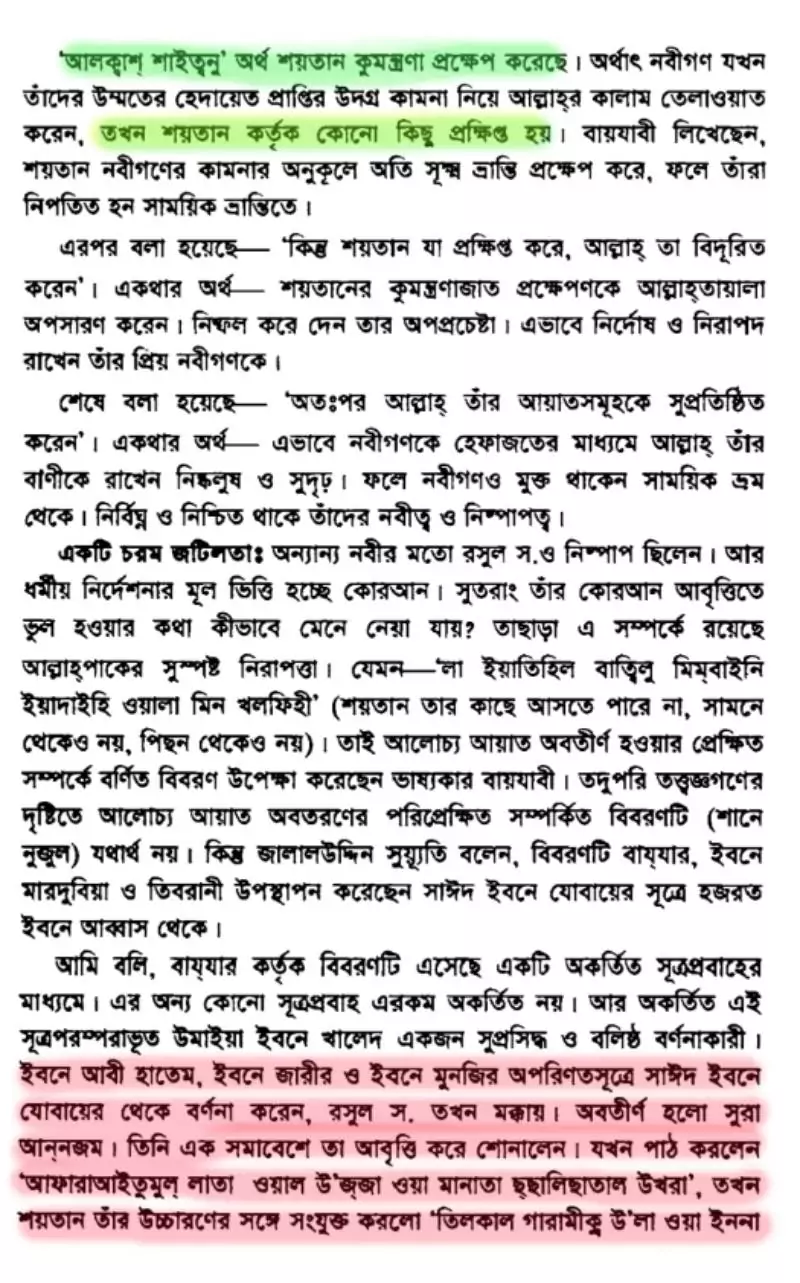
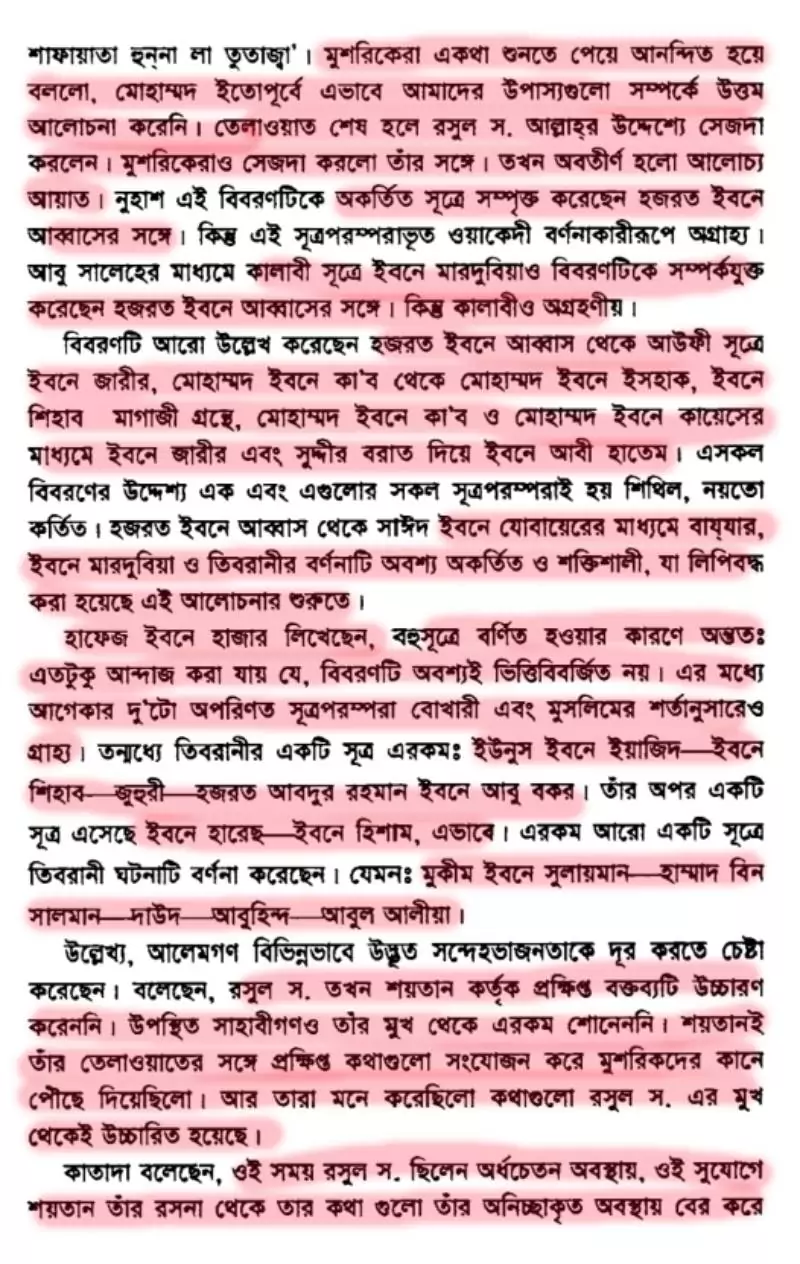
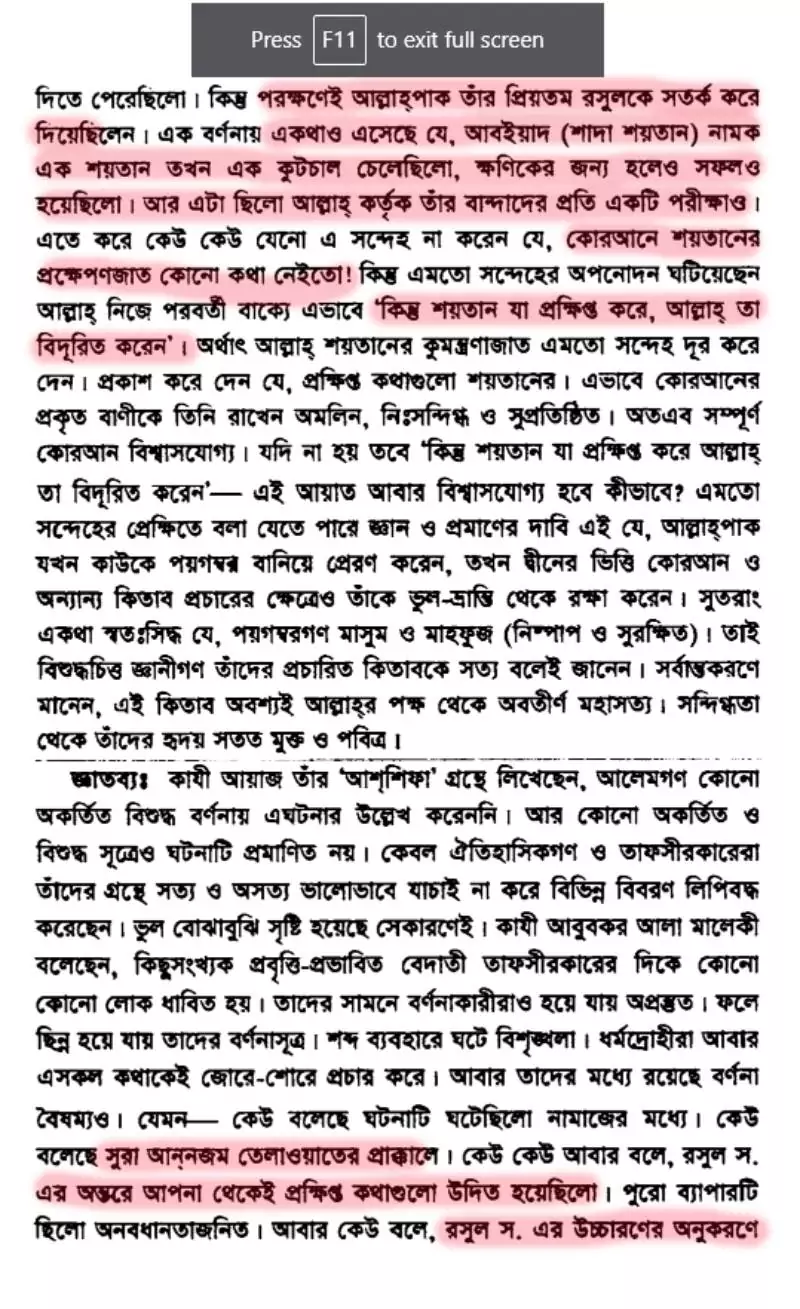
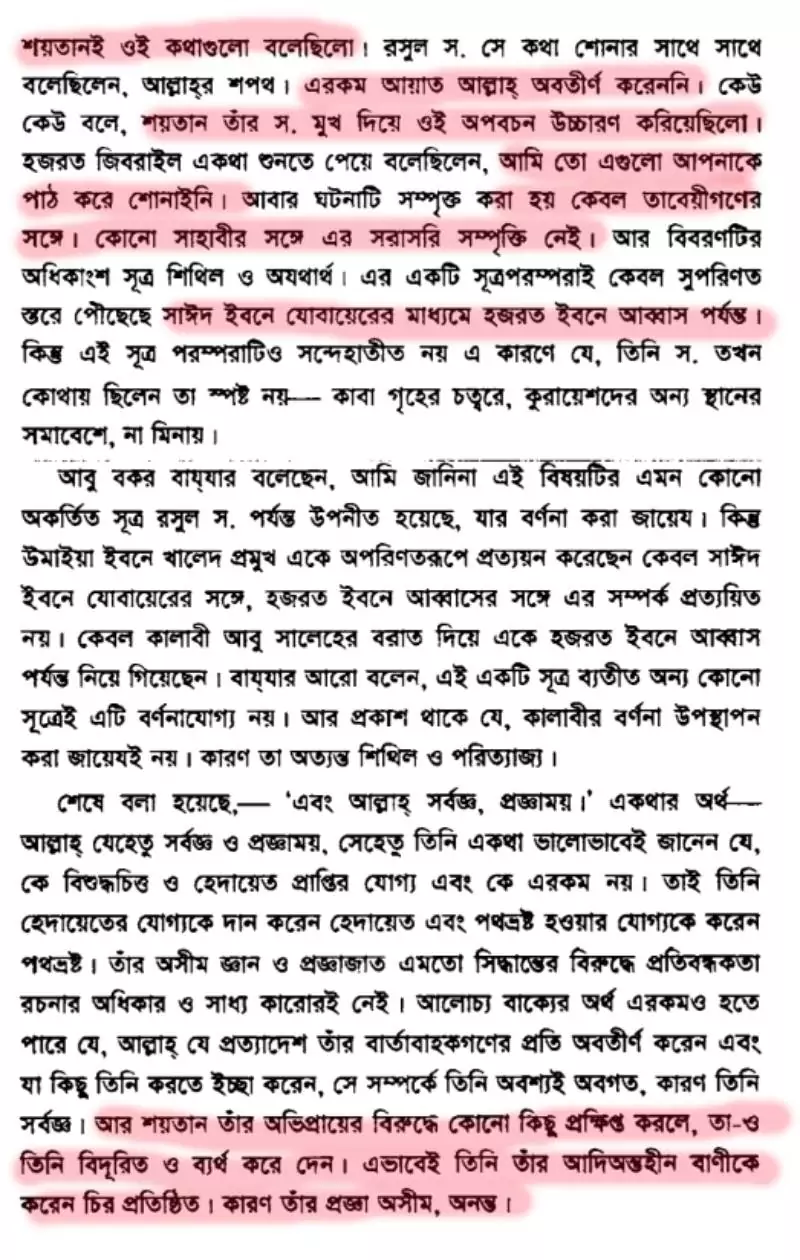
Concealing the Issue
A hadith makes clear that Muslim scholars were embarrassed by these Satanic Verses. An authentic hadith reports that Ibn Abbas interpreted the word al-Lat in the Qur’anic verse as a person. It claims that the verse refers not to the goddess al-Lat but to a man who mixed barley meal for pilgrims. Yet it is readily apparent what al-Lat and al-Uzza refer to here.
Sahih al-Bukhari (Tawhid edition)
Book 65: Commentary on the Qur’an
Chapter 65/53/5: Allah’s statement: Have you considered al-Lat and al-Uzza? (Surah al-Najm 53:19)
4859. Narrated Ibn Abbas (ra): In explaining Allah’s words اللَّاتَ وَالْعُزَّى , he said: Here, ‘al-Lat’ refers to the man who mixed barley meal for pilgrims. (Modern Publications: 4492; Islamic Foundation: 4495)
Hadith grading: Sahih (authentic).
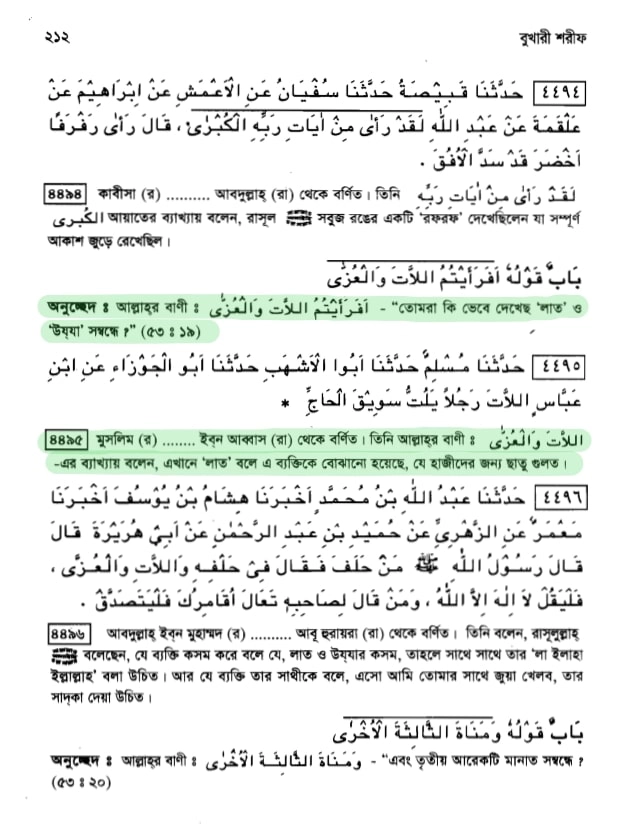
Statements of Classical Scholars
First, let us see what Shaykh al-Islam Imam Ibn Taymiyyah, one of the greatest Islamic scholars of all time, said about the Satanic Verses [33]:
The early predecessors collectively accepted the verses of the cranes as connected with the Qur’an. Those later scholars who followed the early scholars’ position say that these historical accounts were recorded through authentic transmission, that denying them is impossible, and that the Qur’an itself testifies to them.
Although much of Ibn Ishaq’s Sirah, the earliest biography of Muhammad, has been lost, the material he collected survives principally through two sources: Ibn Hisham and al-Tabari. The introduction of the Satanic Verses is explicitly described in al-Tabari, as quoted above. He obtained the account from Ibn Ishaq. Ibn Hisham’s Sirah, however, does not record the episode. In this connection, he acknowledges that it was omitted because it ‘might make certain people uncomfortable’ [34]:
Things which it is disgraceful to discuss; matters which would distress certain people; and such reports as I have been told are not to be accepted as trustworthy all these things have I omitted.
Matters that are shameful to discuss; matters whose mention causes certain people distress; and reports I have been told should not be accepted as trustworthy—I have omitted all such things.
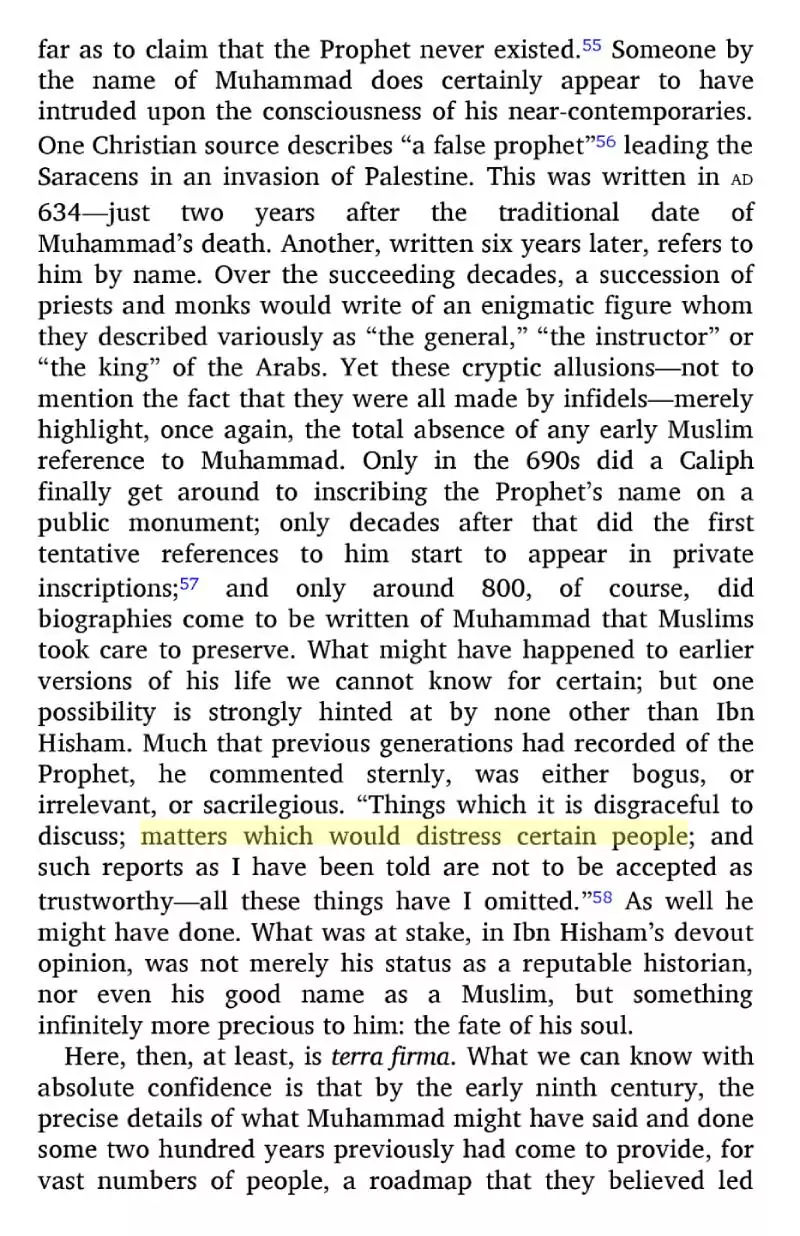
Ibn Hajar: Acknowledging the Episode’s Basis, Then Reinterpreting It to Preserve Infallibility
Ibn Hajar al-Asqalani’s Fath al-Bari is one of the principal commentaries on Sahih al-Bukhari. His discussion of the Gharaniq account is especially important because he did not simply dismiss it as ‘baseless’. Reviewing Ibn al-Arabi’s and Qadi Iyad’s arguments for rejecting it, he instead concluded that its multiple transmission routes indicate that the account has a foundation. A separate question follows: having accepted prophetic infallibility in advance, how does he explain the report’s description of a direct utterance? The lengthy quotation below presents both his recognition of the narrative’s basis and his subsequent theological reinterpretation [35].
Original Arabic Text
وعلى تأويل ابن عباس هذا يحمل ما جاء عن سعيد بن جبير ، وقد أخرج ابن أبي حاتم والطبري وابن المنذر من طرق عن شعبة عن أبي بشر عنه قال : ” قرأ رسول الله – صلى الله عليه وسلم – بمكة والنجم ، فلما بلغ أفرأيتم اللات والعزى ومناة الثالثة الأخرى ألقى الشيطان على لسانه : تلك الغرانيق العلى وإن شفاعتهن لترتجى ، فقال المشركون : ما ذكر آلهتنا بخير قبل اليوم ، فسجد وسجدوا ، فنزلت هذه الآية ” وأخرجه البزار وابن مردويه من طريق أمية بن خالد عن شعبة فقال في إسناده : ” عن سعيد بن جبير عن ابن عباس ” فيما أحسب ، ثم ساق الحديث ، وقال البزار : لا يروى متصلا إلا بهذا الإسناد ، تفرد بوصله أمية بن خالد وهو ثقة مشهور ، قال : وإنما يروى هذا من طريق الكلبي عن أبي صالح عن ابن عباس انتهى .
والكلبي متروك ولا يعتمد عليه ، وكذا أخرجه النحاس بسند آخر فيه الواقدي ، وذكره ابن إسحاق في السيرة مطولا وأسندها عن محمد بن كعب ، وكذلك موسى بن عقبة في المغازي عن ابن شهاب الزهري ، وكذا ذكره أبو معشر في السيرة له عن محمد بن كعب القرظي ومحمد بن قيس وأورده من طريقه الطبري ، وأورده ابن أبي حاتم من طريق أسباط عن السدي ; ورواه ابن مردويه من طريق عباد بن صهيب عن يحيى بن كثير عن الكلبي عن أبي صالح وعن أبي بكر الهذلي وأيوب عن عكرمة وسليمان التيمي عمن حدثه ثلاثتهم عن ابن عباس ، وأوردها الطبري أيضا من طريق العوفي عن ابن عباس ، ومعناهم كلهم في ذلك واحد ، وكلها سوى طريق سعيد بن جبير إما ضعيف وإلا منقطع ، لكن كثرة الطرق تدل على أن للقصة أصلا ، مع أن لها طريقين آخرين مرسلين رجالهما على شرط الصحيحين أحدهما ما أخرجه الطبري من طريق يونس بن يزيد عن ابن شهاب حدثني أبو بكر بن عبد الرحمن بن الحارث بن هشام فذكر نحوه ، والثاني ما أخرجه أيضا من طريق المعتمر بن سليمان وحماد بن سلمة فرقهما عن داود بن أبي هند عن أبي العالية ، وقد تجرأ أبو بكر بن العربي كعادته فقال : ذكر الطبري في ذلك روايات كثيرة باطلة لا أصل لها ، وهو إطلاق مردود عليه .
وكذا قول عياض هذا الحديث لم يخرجه أحد من أهل الصحة ولا رواه ثقة بسند سليم متصل مع ضعف نقلته واضطراب رواياته وانقطاع إسناده ، وكذا قوله : ومن حملت عنه هذه القصة من التابعين والمفسرين لم يسندها أحد منهم ولا رفعها إلى صاحب ، وأكثر الطرق عنهم في ذلك ضعيفة واهية ، قال وقد بين البزار أنه لا يعرف من طريق يجوز ذكره إلا طريق أبي بشر عن سعيد بن جبير مع الشك الذي وقع في وصله ، وأما الكلبي فلا تجوز الرواية عنه لقوة ضعفه .
ثم رده من طريق النظر بأن ذلك لو وقع لارتد كثير ممن أسلم ، قال : ولم ينقل ذلك انتهى ، وجميع ذلك لا يتمشى على القواعد ، فإن الطرق إذا كثرت وتباينت مخارجها دل ذلك على أن لها أصلا ، وقد ذكرت أن ثلاثة أسانيد منها على شرط الصحيح وهي مراسيل يحتج بمثلها من يحتج بالمرسل وكذا من لا يحتج به لاعتضاد بعضها ببعض ، وإذا تقرر ذلك تعين تأويل ما وقع فيها مما يستنكر وهو قوله : ” ألقى الشيطان على لسانه : تلك الغرانيق العلى وإن شفاعتهن لترتجى ” فإن ذلك لا يجوز حمله على ظاهره لأنه يستحيل عليه – صلى الله عليه وسلم – أن يزيد في القرآن عمدا ما ليس منه ، وكذا سهوا إذا كان مغايرا لما جاء به من التوحيد لمكان عصمته – وقد سلك العلماء في ذلك مسالك ، فقيل جرى ذلك على لسانه حين أصابته سنة وهو لا يشعر ، فلما علم بذلك أحكم الله آياته .
وهذا أخرجه الطبري عن قتادة ، ورده عياض بأنه لا يصح لكونه لا يجوز على النبي – صلى الله عليه وسلم – ذلك ولا ولاية للشيطان عليه في النوم ، وقيل إن الشيطان ألجأه إلى أن قال ذلك بغير اختياره ، ورده ابن العربي بقوله تعالى حكاية عن الشيطان : وما كان لي عليكم من سلطان الآية قال : فلو كان للشيطان قوة على ذلك لما بقي لأحد قوة في طاعة .
وقيل : إن المشركين كانوا إذا ذكروا آلهتهم وصفوهم بذلك ، فعلق ذلك بحفظه – صلى الله عليه وسلم – فجرى على لسانه لما ذكرهم سهوا . وقد رد ذلك عياض فأجاد . وقيل لعله قالها توبيخا للكفار ، قال عياض . وهذا جائز إذا كانت هناك قرينة تدل على المراد . ولا سيما وقد كان الكلام في ذلك الوقت في الصلاة جائزا – وإلى هذا نحا الباقلاني .
وقيل إنه لما وصل إلى قوله : ومناة الثالثة الأخرى خشي المشركون أن يأتي بعدها بشيء يذم آلهتهم به فبادروا إلى ذلك الكلام فخلطوه في تلاوة النبي – صلى الله عليه وسلم – على عادتهم في قولهم .
لا تسمعوا لهذا القرآن والغوا فيه ونسب ذلك للشيطان لكونه الحامل لهم على ذلك ، أو المراد بالشيطان شيطان الإنس ، وقيل : المراد بالغرانيق العلى الملائكة وكان الكفار يقولون : الملائكة بنات الله ويعبدونها ، فسيق ذكر الكل ليرد عليهم بقوله تعالى : ألكم الذكر وله الأنثى فلما سمعه المشركون حملوه على الجميع وقالوا : قد عظم آلهتنا ، ورضوا بذلك ، فنسخ الله تلك الكلمتين وأحكم آياته .
وقيل : كان النبي – صلى الله عليه وسلم – يرتل القرآن فارتصده الشيطان في سكتة من السكتات ونطق بتلك الكلمات محاكيا نغمته بحيث سمعه من دنا إليه فظنها من قوله وأشاعها . قال : وهذا أحسن الوجوه . ويؤيده ما تقدم في صدر الكلام عن ابن عباس من تفسير ( تمنى ) بتلا .
وكذا استحسن ابن العربي هذا التأويل وقال قبله : إن هذه الآية نص في مذهبنا في ، براءة النبي – صلى الله عليه وسلم – مما نسب إليه – قال : ومعنى قوله : في أمنيته أي في تلاوته ، فأخبر تعالى في هذه الآية أن سنته في رسله إذا قالوا قولا زاد الشيطان فيه من قبل نفسه ، فهذا نص في أن الشيطان زاده في قول النبي – صلى الله عليه وسلم – لا أن النبي – صلى الله عليه وسلم – قاله قال : وقد سبق إلى ذلك الطبري لجلالة قدره وسعة علمه وشدة ساعده في النظر فصوب على هذا المعنى وحوم عليه .
( تنبيه ) : هذه القصة وقعت بمكة قبل الهجرة اتفاقا فتمسك بذلك من قال إن سورة الحج مكية ، لكن تعقب بأن فيها أيضا ما يدل على أنها مدنية كما في حديث علي وأبي ذر في هذان خصمان فإنها نزلت في أهل بدر ، وكذا قوله أذن للذين يقاتلون الآية وبعدها الذين أخرجوا من ديارهم بغير حق فإنها نزلت في الذين هاجروا من مكة إلى المدينة فالذي يظهر أن أصلها مكي ونزل منها آيات بالمدينة ولها نظائر ، والله أعلم .
English Translation
The report transmitted from Sa‘id ibn Jubayr must be understood in light of this explanation by Ibn ‘Abbas. Ibn Abi Hatim, al-Tabari and Ibn al-Mundhir transmitted it through various routes from Shu‘ba, from Abu Bishr, from Sa‘id ibn Jubayr. He said: ‘The Messenger of Allah recited Surat al-Najm in Mecca. When he reached “Have you considered al-Lat and al-‘Uzza, and Manat, the third, the other?”, Satan cast upon his tongue: “These are the exalted gharaniq, and their intercession is certainly to be hoped for.” The polytheists said: “Before today, he had never spoken favourably of our gods.” He then prostrated, and they prostrated too. This verse was subsequently revealed.’ Al-Bazzar and Ibn Mardawayh transmitted it from Shu‘ba through Umayya ibn Khalid. His chain states: ‘From Sa‘id ibn Jubayr, from Ibn ‘Abbas’—as I believe. He then related the hadith. Al-Bazzar said: ‘It has not been transmitted with a connected chain except through this chain. Umayya ibn Khalid alone connected it; he is well known and trustworthy.’ He also said: ‘Otherwise, it is transmitted through al-Kalbi, from Abu Salih, from Ibn ‘Abbas.’ His statement ends here.
Al-Kalbi is a rejected transmitter and cannot be relied upon. Al-Nahhas transmitted it through another chain that includes al-Waqidi. Ibn Ishaq mentioned the episode at length in his Sirah and transmitted it from Muhammad ibn Ka‘b. Musa ibn ‘Uqba also transmitted it in his Maghazi from Ibn Shihab al-Zuhri. Abu Ma‘shar mentioned it in his Sirah from Muhammad ibn Ka‘b al-Qurazi and Muhammad ibn Qays; al-Tabari also included it through him. Ibn Abi Hatim transmitted it through Asbat from al-Suddi. Ibn Mardawayh transmitted it through ‘Abbad ibn Suhayb, from Yahya ibn Kathir, from al-Kalbi, from Abu Salih; through Abu Bakr al-Hudhali and Ayyub from ‘Ikrima; and through Sulayman al-Taymi from a person who narrated it to him—all three transmit from Ibn ‘Abbas. Al-Tabari also included it from Ibn ‘Abbas through al-‘Awfi. The substance of all their reports is the same. Apart from the route through Sa‘id ibn Jubayr, the others are either weak or disconnected. But the multiplicity of transmission routes indicates that the story has a basis. It has two further mursal routes whose transmitters meet the conditions of Sahih al-Bukhari and Sahih Muslim. One is al-Tabari’s report from Yunus ibn Yazid, through Ibn Shihab, who said: “Abu Bakr ibn ‘Abd al-Rahman ibn al-Harith ibn Hisham narrated to me”—after which he related a similar episode. The second is a separate report from al-Tabari, through Mu‘tamir ibn Sulayman and Hammad ibn Salama, from Dawud ibn Abi Hind, from Abu al-‘Aliya. Abu Bakr ibn al-‘Arabi, with his customary boldness, said: ‘Al-Tabari has mentioned numerous false reports on this matter that have no basis.’ This indiscriminate judgment of his is rejected.
Qadi ‘Iyad’s statement is similar: ‘No compiler of authoritative hadith collections included this hadith; no trustworthy person transmitted it through a sound, connected chain. Its transmitters are weak, its reports contain inconsistencies, and its chains are disconnected.’ He also said: ‘None of the Successors or Qur’anic commentators from whom this story was taken traced it through a chain to a Companion. Most of their routes are weak and frail.’ He said: ‘Al-Bazzar showed that no significant route is known apart from the route from Abu Bishr through Sa‘id ibn Jubayr; even there, the connectedness of the chain is uncertain. As for al-Kalbi, reports cannot be taken from him because of his severe weakness.’
He then rejected it on rational grounds as well: had the episode occurred, many of those who had embraced Islam would have abandoned the religion. He said: ‘Nothing of the sort has been reported.’ His statement ends here. But these statements do not accord with the rules. When transmission routes are numerous and their sources differ, this indicates that the episode has a basis. I have mentioned that three of its chains meet the conditions of the Sahih collections. They are mursal; those who accept mursal reports as evidence accept reports of this kind. Even those who do not ordinarily accept mursal reports accept these because they reinforce one another. Once this is established, the objectionable part of the report must be interpreted. That part is: ‘Satan cast upon his tongue: these are the exalted gharaniq, and their intercession is certainly to be hoped for.’ These words cannot be accepted in their literal sense. For it is impossible for the Prophet deliberately to add something to the Qur’an that is not part of it; and if such an addition, even by mistake, contradicts the monotheism he brought, it is impossible because of his infallibility. Scholars have taken various approaches to this. It has been said that, while he was drowsy, the words passed onto his tongue without his awareness. Later, when the matter became known, Allah made His verses firm.
Al-Tabari transmitted this explanation from Qatada. ‘Iyad rejected it, saying that it is incorrect, since this cannot happen to the Prophet and Satan has no authority over him even during sleep. It has been said that Satan compelled him, so that he spoke the words against his own will. Ibn al-‘Arabi rejected this by citing Allah’s verse concerning Satan’s statement: ‘I had no authority over you.’ He said: ‘If Satan possessed such power, no one would retain the ability to obey.’
It has been said that this was how the polytheists described their gods when mentioning them. The words remained in the Prophet’s memory and inadvertently passed onto his tongue when he mentioned them. ‘Iyad rejected this explanation, and rightly so. It has also been said that perhaps he spoke the words to rebuke the unbelievers. ‘Iyad said: ‘This is acceptable if there was some indication making the intention clear, especially since speaking during prayer was permitted at that time.’ Al-Baqillani inclined towards this explanation.
It has also been said that, when he reached ‘and Manat, the third, the other’, the polytheists feared that their gods would be condemned in what followed. They therefore hurriedly uttered those words and mixed them into the Prophet’s recitation, following their practice referred to in this verse: ‘Do not listen to this Qur’an, and make noise during its recitation.’ The words were attributed to Satan because he incited them to do this; alternatively, ‘Satan’ refers to a human devil. It has also been said that the exalted gharaniq referred to the angels. The unbelievers said that the angels were Allah’s daughters and worshipped them. All of them were therefore mentioned so that they could be answered by this verse: ‘Are sons for you, and daughters for Him?’ But when the polytheists heard the words, they took them to apply to all and said: ‘He has honoured our gods.’ They were pleased by this. Allah then erased the two statements and made His verses firm.
It has also been said that the Prophet was reciting the Qur’an slowly. Satan waited for an opportunity during one of his pauses and uttered those statements while imitating his voice. Those near him heard them, believed them to be his words, and circulated them. He said: ‘This is the best of the explanations.’ The interpretation transmitted from Ibn ‘Abbas at the beginning of the discussion, explaining tamanna as recitation, supports this view.
Ibn al-‘Arabi also favoured this explanation. Before it, he said: ‘This verse is clear evidence for our position—that the Prophet is innocent of what has been attributed to him.’ He said: ‘“Into his umniyya” means into his recitation. In this verse, Allah has stated that His practice concerning His messengers is this: when they say something, Satan adds something of his own to it. This is clear evidence that Satan added it to the Prophet’s words; the Prophet himself did not say it.’ He also said: ‘Al-Tabari, owing to his high standing, extensive knowledge and sound judgment, had already inclined towards this meaning, and his interpretation revolved around it.’
Note: there is agreement that this episode occurred in Mecca before the Hijra. Those who regard Surat al-Hajj as having been revealed in Mecca have used it as evidence. But the objection has been raised that the surah also contains passages indicating revelation in Medina, such as the hadiths of ‘Ali and Abu Dharr concerning the verse ‘These two opposing parties disputed about their Lord’. It was revealed concerning the combatants at Badr. Similarly, ‘Permission has been granted to those against whom war is waged’ and the following verse, ‘Those who were unjustly expelled from their homes’, were revealed concerning those who migrated from Mecca to Medina. What appears, therefore, is that the main part of the surah was revealed in Mecca and some of its verses were revealed in Medina. There are other examples of this. Allah knows best.
Two conclusions in Ibn Hajar’s discussion need to be distinguished. First, he did not accept the indiscriminate rejection that ‘the episode has no basis’. Second, even after acknowledging that basis, he did not accept the literal meaning of the account in which Muhammad uttered words praising the goddesses. As the reason for this second conclusion, he invoked belief in the Prophet’s infallibility. In other words, his interpretation determines in advance that the Prophet cannot utter anything contrary to monotheism as part of the Qur’an; the report is then interpreted to fit that belief. It is precisely this method that is open to question when examining history. If the belief that the Prophet cannot make mistakes is assumed to be true from the outset, the freedom to investigate accounts of his mistakes is restricted at the very beginning.
The number of alternatives he mentions is also significant: drowsiness, involuntary speech, a pagan phrase retained in memory, a rebuke to the unbelievers, the voices of the polytheists, a human devil, a reference to angels, or an imitation of the Prophet’s voice. These are not synonymous repetitions of the same account; they offer different answers to the questions of who spoke, how the words were spoken, and what the audience heard. This extended discussion directly documents how many explanations were devised to remove the theological discomfort after accepting the report. The claim that ‘Ibn Hajar declared the entire episode baseless’ does not accord with his own words; nor can his writing support the claim that ‘he literally accepted every detail of the Prophet’s utterance’. His entire argument must be read to understand his actual position.
Ibn Taymiyya: Defending Infallibility While Accepting Satan’s Insertion
In Ibn Taymiyya’s discussion, the question becomes still more direct. He did not define infallibility solely as ‘no error can ever occur’; instead, he advanced the meaning that no error in conveying revelation would ultimately remain in force. On the basis of this distinction, he explains the relationship between the Gharaniq report and the verse of Surat al-Hajj. This does not deny the possibility that words cast by Satan could temporarily appear before the public; rather, the reliability of prophethood is defended through the claim that Allah subsequently removed them. The relevant extended passage from the discussion of infallibility through to the conclusion of the argument concerning the Gharaniq in Majmu‘ al-Fatawa is provided below [36]. A lengthy reproduction of the same central argument also appears in IslamQA’s discussion no. 103304 [37].
Original Arabic Text
وهذه العصمة الثابتة للأنبياء هي التي يحصل بها مقصود النبوة والرسالة، فإن النبي هو المنبئ عن الله، والرسول هو الذي أرسله الله تعالى، وكل رسول نبي، وليس كل نبي رسولا، والعصمة فيما يبلغونه عن الله ثابتة، فلا يستقر في ذلك خطأ باتفاق المسلمين.
ولكن هل يصدر ما يستدركه الله، فينسخ ما يلقي الشيطان، ويحكم الله آياته؟ هذا فيه قولان، والمأثور عن السلف يوافق القرآن بذلك، والذين منعوا ذلك من المتأخرين طعنوا فيما ينقل من الزيادة في سورة النجم بقوله: (تلك الغرانيق العلى، وإن شفاعتهن لترتجى) وقالوا: إن هذا لم يثبت، ومن علم أنه ثبت قال: هذا ألقاه الشيطان في مسامعهم ولم يلفظ به الرسول صلى الله عليه وسلم، ولكن السؤال وارد على هذا التقدير أيضا، وقالوا في قوله: (إلا إذا تمنى ألقى الشيطان في أمنيته) هو حديث النفس.
وأما الذين قرروا ما نقل عن السلف، فقالوا: هذا منقول نقلا ثابتا لا يمكن القدح فيه، والقرآن يدل عليه بقوله: (وما أرسلنا من قبلك من رسول ولا نبي إلا إذا تمنى ألقى الشيطان في أمنيته فينسخ الله ما يلقي الشيطان ثم يحكم الله آياته والله عليم حكيم. ليجعل ما يلقي الشيطان فتنة للذين في قلوبهم مرض والقاسية قلوبهم وإن الظالمين لفي شقاق بعيد. وليعلم الذين أوتوا العلم أنه الحق من ربك فيؤمنوا به فتخبت له قلوبهم وإن الله لهاد الذين آمنوا إلى صراط مستقيم) [الحج: 52–54]، فقالوا: الآثار في تفسير هذه الآية معروفة ثابتة في كتب التفسير والحديث، والقرآن يوافق ذلك، فإن نسخ الله لما يلقي الشيطان، وإحكامه آياته، إنما يكون لرفع ما وقع في آياته، وتمييز الحق من الباطل، حتى لا تختلط آياته بغيرها. وجعل ما ألقى الشيطان فتنة للذين في قلوبهم مرض، والقاسية قلوبهم، إنما يكون إذا كان ذلك ظاهرا يسمعه الناس، لا باطنا في النفس. والفتنة التي تحصل بهذا النوع من النسخ من جنس الفتنة التي تحصل بالنوع الآخر من النسخ.
وهذا النوع أدل على صدق الرسول صلى الله عليه وسلم، وبعده عن الهوى من ذلك النوع، فإنه إذا كان يأمر بأمر ثم يأمر بخلافه وكلاهما من عند الله، وهو مصدق في ذلك، فإذا قال عن نفسه إن الثاني هو الذي من عند الله، وهو الناسخ، وإن ذلك المرفوع الذي نسخه الله، ليس كذلك كان أدل على اعتماده للصدق، وقوله الحق، وهذا كما قالت عائشة رضي الله عنها: لو كان محمد كاتما شيئا من الوحي لكتم هذه الآية: (وتخفي في نفسك ما الله مبديه وتخشى الناس والله أحق أن تخشاه) [الأحزاب: 37]، ألا ترى أن الذي يعظم نفسه بالباطل يريد أن ينصر كل ما قاله، ولو كان خطأ، فبيان الرسول صلى الله عليه وسلم أن الله أحكم آياته، ونسخ ما ألقاه الشيطان، هو أدل على تحريه للصدق وبراءته من الكذب، وهذا هو المقصود بالرسالة فإنه الصادق المصدوق صلى الله عليه وسلم تسليما؛ ولهذا كان تكذيبه كفرا محضا بلا ريب.
English Translation
It is through this infallibility established for the prophets that the purpose of prophethood and messengership is fulfilled. For a prophet is one who conveys information about Allah, while a messenger is one whom Allah has sent. Every messenger is a prophet, but not every prophet is a messenger. Infallibility is established concerning what they convey on Allah’s behalf. Thus, by the consensus of Muslims, no error remains permanently in force in that regard.
But can something emerge from them that Allah subsequently corrects—that is, by erasing what Satan casts and making His own verses firm? There are two views on this. The view transmitted from the earlier scholars accords with the Qur’an on this matter. Those among the later scholars who denied it objected to the report of the words described as an addition to Surat al-Najm—‘These are the exalted gharaniq, and their intercession is certainly to be hoped for’—and said that it had not been established. Those who knew that it had been established said that Satan cast the words into their ears; the Messenger himself did not utter them. But the question remains under this explanation as well. They explained ‘Whenever he performs tamanna, Satan casts something into his tamanna’ as a conversation within the mind.
Those who accepted the statement transmitted from the earlier scholars said: it has come through established reports and cannot be challenged. The Qur’an also indicates this: ‘We did not send any messenger or prophet before you without Satan casting something into his tamanna whenever he performed tamanna. Then Allah erases what Satan casts; then Allah makes His verses firm. Allah is All-Knowing, All-Wise. So that what Satan casts may become a trial for those in whose hearts there is sickness and whose hearts are hardened. Surely the wrongdoers are in far-reaching opposition. And so that those who have been given knowledge may know that it is the truth from your Lord, believe in it, and have their hearts humbled before it. Surely Allah guides the believers to a straight path.’ They say: the accounts transmitted in explanation of this verse are known and established in works of Qur’anic commentary and hadith; the Qur’an also accords with them. For Allah’s erasure of what Satan cast, and His making His verses firm, mean precisely removing what has entered the verses and distinguishing truth from falsehood, so that nothing else remains mixed with His verses. What Satan cast can become a trial for those with sickness in their hearts and hardened hearts only when it is public and people can hear it, not when it remains concealed within the mind. The trial arising from this kind of abrogation is similar to the trial arising from other kinds of abrogation.
This kind of abrogation provides even stronger evidence of the Messenger’s truthfulness and his distance from personal desire. For when he gives an instruction and later gives the opposite instruction, declaring both to be from Allah, he is accepted as truthful in that regard. But when he says of himself that the second is from Allah and is the abrogating instruction, while the earlier thing that Allah removed was not from Allah, this provides still stronger evidence of his adherence to the truth and his truthfulness. This resembles ‘A’isha’s statement: ‘If Muhammad had concealed anything of the revelation, he would have concealed this verse: “You conceal within yourself something that Allah will disclose; you fear people, although Allah is more deserving of being feared.”’ Do you not see that someone who seeks to exalt himself through falsehood wishes to uphold everything he has said, even when it is mistaken? Thus, the Messenger’s explanation that Allah has made His verses firm and erased what Satan cast provides still stronger evidence of his pursuit of truth and his freedom from lying. This is the purpose of messengership, for he is truthful and one to whom truthful information has been given. For this reason, declaring him a liar is undoubtedly outright unbelief.
In this statement, Ibn Taymiyya draws a distinction between a public utterance and a thought occurring solely within the mind. According to the argument he presents, for the matter to become a trial for people, they must hear it; a private thought would not create that public trial. This is where the explanation that ‘Satan merely inserted something into the mind and nothing happened outwardly’ encounters difficulty. He also presents the correction of an error as evidence of truthfulness. But a human being’s revised statement and the claim of an infallible message from an omniscient being cannot be judged by the same standard. A person’s admission of error may provide evidence of honesty; it does not prove that the earlier statement was supernaturally protected.
The same position appears in still more explicit language in his Minhaj al-Sunna. There, he describes the utterance of the Gharaniq words upon the Prophet’s tongue as a view current among earlier and later scholars. He then explains that, in his view, infallibility means not allowing an error in conveying the message to remain in force. The consecutive passage containing the relevant argument is provided below [38].
Original Arabic Text
وما جرى في سورة ” النجم ” من قوله : تلك الغرانيق العلى ، وإن شفاعتها لترتجى ، على المشهور عند السلف والخلف من أن ذلك جرى على لسانه ، ثم نسخه الله وأبطله ، هو من أعظم المفتريات على قول هؤلاء ، ولهذا كان كثير من الناس يكذب هذا وإن كان مجوزا عليهم غيره : إما قبل النبوة وإما بعدها ، لظنه أن في ذلك خطأ في التبليغ ، وهو معصوم في التبليغ بالاتفاق .
والعصمة المتفق عليها أنه لا يقر على خطأ في التبليغ بالإجماع ، ومن هذا فلم يعلم أحد من المشركين نفر برجوعه عن هذا ، وقوله : إن هذا مما ألقاه الشيطان ، ولكن روى أنهم نفروا لما رجع إلى ذم آلهتهم بعد ظنهم أنه مدحها ، فكان رجوعهم لدوامه على ذمها ، لا لأنه قال شيئا ثم قال : إن الشيطان ألقاه . وإذا كان هذا لم ينفر فغيره أولى أن لا ينفر .
وأيضا ، فقد ثبت أن النسخ نفر طائفة كما قال : ( سيقول السفهاء من الناس ما ولاهم عن قبلتهم التي كانوا عليها ) [ سورة البقرة : 142 ] ، وقوله : ( وإذا بدلنا آية مكان آية والله أعلم بما ينزل قالوا إنما أنت مفتر بل أكثرهم لا يعلمون قل نزله روح القدس من ربك بالحق ليثبت الذين آمنوا ) [ سورة النحل : 101 – 102 ] ، فالتبديل الذي صرحوا بأنه منفر ونفروا به عنه لم يكن مما يجب نفيه عنه ، فكيف بالرجوع إلى الحق الذي لم يعلم أنهم نفروا منه ، وهو أقل تنفيرا ؟ ! لأن النسخ فيه رجوع عن الحق إلى حق ، وهذا رجوع إلى حق من غير حق .
ومعلوم أن الإنسان يحمد على ترك الباطل إلى الحق ما لا يحمد على ترك ما لم يزل يقول إنه حق . . وإذا كان جائزا فهذا أولى ، وإذا كان في ذلك مصلحة ففي هذا أيضا مصالح عظيمة ، ولولا أن فيها وفي العلم بها مصالح لعباده لم يقصها في غير موضع من كتابه .
وهو سبحانه – وله الحمد – لم يذكر عن نبي من الأنبياء ذنبا إلا ذكر معه توبته لينزهه عن النقص والعيب ، ويبين أنه ارتفعت منزلته وعظمت درجته وعظمت حسناته وقربه إليه بما أنعم الله عليه من التوبة والاستغفار والأعمال الصالحة التي فعلها بعد ذلك ، وليكون ذلك أسوة لمن يتبع الأنبياء ويقتدي بهم إلى يوم القيامة .
English Translation
As for what occurred concerning his words in Surat al-Najm—‘These are the exalted gharaniq, and their intercession is certainly to be hoped for’—according to the view current among earlier and later scholars, the words were uttered upon his tongue, after which Allah abrogated and annulled them. According to these people, this is one of the greatest false imputations. For this reason, many people deny the episode, even though they accept the possibility of other things happening to prophets, whether before or after prophethood. For they believe that this involved an error in conveying the message, a matter in which he is infallible by universal agreement.
But the infallibility on which there is agreement is this: he is not allowed to remain in error when conveying the message. In this episode, too, it is not known that any polytheist became alienated from him because he retracted that statement and said, ‘This is something cast by Satan.’ Rather, it is reported that they became alienated when he resumed condemning their gods, although they had previously thought that he had praised them. Thus, their turning away was caused by his persistence in condemning their gods; it was not caused by his saying something and subsequently calling it something cast by Satan. If this did not alienate people, other matters would alienate them still less.
It has also been established that a group of people became alienated because of abrogation. As it is said: ‘The foolish among the people will say: What has turned them away from the qibla they formerly faced?’ And: ‘When We replace one verse with another—and Allah knows best what He reveals—they say: You are merely a fabricator. Rather, most of them do not know. Say: the Holy Spirit has brought it down in truth from your Lord, to make the believers firm.’ Even the change that they described as a cause of alienation, and because of which they became alienated, did not have to be denied in his case. How, then, must a return to the truth be denied when it is not known that they became alienated because of it? There is even less cause for alienation in this. For abrogation involves returning from one truth to another, whereas here the return is from something untrue to the truth.
It is well known that a person receives praise for abandoning falsehood and returning to the truth that he does not receive for abandoning something he had consistently presented as true. If the latter is possible, the former is still more possible. If the latter contains a benefit, this contains far greater benefits. If there were no benefit for His servants in these events and in knowing about them, He would not have related them in various places in His Book.
Whenever Allah—all praise belongs to Him—has mentioned a sin of a prophet, He has also mentioned his repentance, to clear him of fault and blame and to show that, through the grace of repentance, seeking forgiveness, and subsequent good deeds, his rank has risen, his standing has improved, his good deeds have increased, and his closeness to Allah has grown. This is also so that it may serve as an example for those who follow and emulate the prophets until the Day of Resurrection.
The phrase ‘according to these people’ in the first paragraph of this quotation refers to the opposing view raised in his discussion; it cannot be isolated and turned into Ibn Taymiyya’s own final conclusion. His subsequent argument is clear: the possibility of an error occurring and the possibility of an error remaining in force are not the same. By denying the latter, he reconciles the former with the religious concept of infallibility. But this reconciliation leaves an ordinary follower facing a serious question: if a statement first heard from the Prophet as a religious message is later withdrawn as something cast by Satan, what was the standard for distinguishing truth from falsehood at the moment it was first heard? ‘It will be corrected later’ does not establish a statement’s initial supernatural guarantee. And if the claim of correction also depends on a subsequent statement by the same person, how can the listener independently determine which words belong to Allah and which to Satan?
Ibn Hisham’s Editorial Policy: Declaring the Omission of Uncomfortable Accounts
To understand the relationship between Ibn Ishaq’s work and Ibn Hisham’s Sirah, it is necessary to read the latter’s own editorial policy. Ibn Hisham did not promise to preserve every account from Ibn Ishaq verbatim. Instead, at the beginning of the book, he specified the kinds of material he would omit. That list includes material omitted for brevity, but also material whose discussion was considered offensive or objectionable, or whose mention caused distress to certain people. This declaration matters for the preservation of history: the book in our hands is a selected and edited form of an earlier work. His complete statement from the introduction is given below [39].
Original Arabic Text
[ نهج ابن هشام في هذا الكتاب ] قال ابن هشام : وأنا إن شاء الله مبتدئ هذا الكتاب بذكر إسماعيل بن إبراهيم ، ومن ولد رسول الله صلى الله عليه وآله وسلم من ولده ، وأولادهم لأصلابهم الأول فالأول ، من إسماعيل إلى رسول الله صلى الله عليه وآله وسلم ، وما يعرض من حديثهم ، وتارك ذكر غيرهم من ولد إسماعيل ، على هذه الجهة للاختصار ، إلى حديث سيرة رسول الله صلى الله عليه وسلم ، وتارك بعض ما ذكره ابن إسحاق في هذا الكتاب ، مما ليس لرسول الله صلى الله عليه وآله وسلم فيه ذكر ، ولا نزل فيه من القرآن شيء ، وليس سببا لشيء من هذا الكتاب ، ولا تفسيرا له ، ولا شاهدا عليه ، لما ذكرت من الاختصار ، وأشعارا ذكرها لم أر أحدا من أهل العلم بالشعر يعرفها ، وأشياء بعضها ، يشنع الحديث به ، وبعض يسوء بعض الناس ذكره ، وبعض لم يقر لنا البكائي بروايته ومستقص إن شاء الله تعالى ما سوى ذلك منه بمبلغ الرواية له ، والعلم به .
English Translation
Ibn Hisham’s method in this book. Ibn Hisham says: Allah willing, I shall begin this book with a discussion of Isma‘il, the son of Ibrahim. I shall mention, in succession, those of his descendants in whose lineage the Messenger of Allah was born, and their direct offspring—from Isma‘il to the Messenger of Allah—and include the relevant accounts concerning them. I shall omit discussion of Isma‘il’s other descendants outside this line, so as to arrive briefly at the biography of the Messenger of Allah. Ibn Ishaq mentioned certain matters in this book in which the Messenger of Allah is not mentioned, concerning which nothing in the Qur’an was revealed, and which are neither the cause of any event in this book nor its explanation or supporting evidence. I shall omit some of these for the sake of the brevity I have mentioned. He also included some poems that I have not found anyone knowledgeable about poetry to recognise; I shall omit those as well. I shall also omit certain matters, some of which are objectionable to discuss, some of which cause distress to certain people when mentioned, and some of which al-Bakka’i did not acknowledge having narrated to us. Allah willing, apart from these, I shall present the remainder of his work in full, to the extent of the reports and knowledge that have reached me.
In this statement, ‘causing distress to certain people’ appears directly as an editorial reason.
The Bell Is Satan’s Flute
A hadith of Prophet Muhammad tells us that he said revelation came to him like the ringing of a bell [40]—
Sahih al-Bukhari (Islamic Foundation)
1 / The Beginning of Revelation
Chapter: 1 / How Revelation Began to Come to the Messenger of Allah (ﷺ)
2. ‘Abdullah ibn Yusuf (rh.) … Narrated from ‘A’isha (ra.): al-Harith ibn Hisham (ra.) asked the Messenger of Allah, peace and blessings be upon him: ‘O Messenger of Allah! How does revelation come to you?’ The Messenger of Allah, peace and blessings be upon him, said: ‘At times it comes like the ringing of a bell to me. This is the most difficult form for me, and when it ends, I have memorised what the angel says. At other times, the angel speaks to me in human form. I memorise what he says.’ ‘A’isha (ra.) said: I saw him receiving revelation on a severely cold day. When the revelation ended, sweat would drip from his forehead.
Verification: Marfu‘ hadith.
Source references: (Bukhari: Tawhid Publications 2, 3215; Tirmidhi: 3994; Nasa’i: 942; Ahmad: 26952; Muwatta’: 479. Muslim 43/23, hadith: 2333; Ahmad 25307 (Adhunik Prakashani 2, Islamic Foundation 2)
Hadith grading: Sahih (Authentic)
Narrator: ‘A’isha bint Abu Bakr al-Siddiq (ra.)
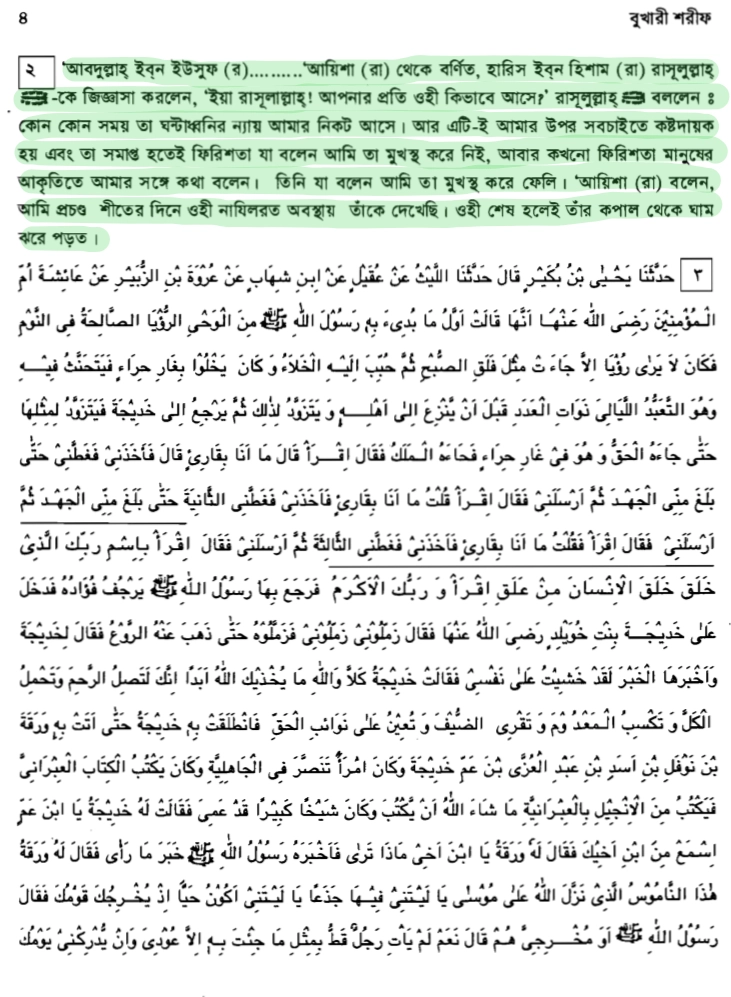
At the same time, he also said the following [41]—
Sahih Muslim (Islamic Foundation)
Book: 38 / Clothing and Adornment
Chapter: 22. Keeping Dogs and Bells During a Journey Is Disliked
5366. Yahya ibn Ayyub, Qutayba and Ibn Hujr (rh.) … Narrated from Abu Hurayra (ra.) that the Messenger of Allah, peace and blessings be upon him, said: ‘The bell is Satan’s flute.’
Hadith grading: Sahih (Authentic)
Thus, we see that when revelation came to the Prophet, there was the sound of a ringing bell. Yet the statement that the bell is Satan’s flute is also the Prophet’s own. Now consider for yourself what the truth actually is!
Even so, let us assume, for the sake of argument, that what came to the Prophet was indeed Allah’s revelation. But can it be accepted that Satan, a mere created being, was distorting and inserting errors into the revelation of Allah, the all-powerful ruler of the universe? Was Allah’s security system really so weak?
Conclusion
If verses were revealed under Satan’s influence, the most important question that arises is whether Prophet Muhammad could distinguish between Allah’s angel and Satan. It is also possible that the being who appeared as Gabriel on that first day was actually Satan. The entire Qur’an might in fact consist of Satan’s verses. In between, the real Allah managed to reveal two correct surahs. But later, Satan revised those two verses again.
In other words, what I mean is this: how can we be completely certain that the Allah whom Muslims have worshipped for fourteen and a half centuries is not actually Satan, and that the one they consider Satan is not actually Allah? How can we know with certainty that this did not happen? When Prophet Muhammad himself was deceived, how can we be sure that the deception was not even greater, or that it did not work in reverse?
At the same time, another point must be mentioned. Since there is ample reason to doubt the level of intelligence of most of our believing brothers, many of them may read this article and think that atheists have accepted the existence of Allah and Satan. That is not the case at all. They may think this because many of them lack the IQ required to grasp the central point of this article. The wit of our believing brothers is indeed hard to match. Atheists have found no evidence for the existence of either Allah or Satan, and therefore accept neither. The central point of this article is that the episode makes it entirely clear how Prophet Muhammad would reveal verses to suit his own convenience as circumstances changed. When he needed it, with conflict with the polytheists becoming inevitable, he revealed verses praising al-Lat, Manat and al-‘Uzza. Then, when he saw that this was adversely affecting his followers and obstructing his central purpose, he changed the verses again. Having changed them, he placed all the blame on poor Satan. After all, no one could verify whether Satan had actually done anything of the sort. In our country, even when madrasa clerics are caught by the police for raping students, you will see them trying to escape by placing all the blame on Satan. They say that Satan made them do these things. You will also sometimes see women whose husbands have been abroad for a long time become pregnant and place all the blame on poor jinn. Supposedly, the jinn came at night, did their work, and left. No one is going to go and ask the jinn whether any of them actually did such a thing. It is therefore very safe to shift responsibility onto them, and it is easy to use these claims to fool uneducated, ignorant people bound by blind belief. In this connection, a hadith of ‘A’isha must be mentioned [42]—
Sahih al-Bukhari (Islamic Foundation)
Book: 52 / Qur’anic Commentary
Chapter: Allah Most High’s Words: ترجئ من تشاء منهن وتؤوي إليك من تشاء ومن ابتغيت ممن عزلت فلا جناح عليك ‘You may keep whichever of them you wish away from you and give a place near you to whichever you wish. And if you desire one whom you have kept away, there is no blame upon you.’ Ibn ‘Abbas (ra.) says: ترجئ you may keep away. أرجئه Keep her away; grant a respite.
4425. Zakariyya ibn Yahya (rh.) … Narrated from ‘A’isha (ra.). She said: I disliked the women who offered themselves as gifts to the Messenger, peace and blessings be upon him. I would say to myself: can women offer themselves? Then, when Allah Most High revealed this verse: ‘You may keep whichever of them you wish away from you and give a place near you to whichever you wish. And if you desire one whom you have kept away, there is no blame upon you’, I said: ‘I see that your Lord fulfils whatever you desire.’
Hadith grading: Sahih (Authentic)
Narrator: ‘A’isha (ra.)
References
- Qur’an 23:14 1 2
- Surah Hud 11:1 ↩︎
- Al-Qur’an al-Karim, Volume 2—Dr Zakaria, p. 1731 ↩︎
- Al-Qur’an al-Karim, Volume 1—Dr Zakaria, p. 612 ↩︎
- Ar-Rahiq al-Makhtum, Al Quran Academy, p. 426 ↩︎
- Al-Shifa, Imam Qadi Iyad al-Andalusi, Sanjari Publications, Volume 2, p. 265 ↩︎
- Sunan al-Nasa’i, verified edition, hadith no. 623 ↩︎
- Sirat Ibn Hisham: A Biography of Muhammad, Akram Faruq, pp. 61–62 ↩︎
- Mukhtasar Zad al-Ma‘ad, Imam Ibn al-Qayyim, Wahidia Islamia Library, p. 202 ↩︎
- Sirat al-Mustafa, Allamah Idris Kandhlawi (rh), Islamic Foundation Bangladesh, Volume 1, pp. 113, 144, 149, 154 and 155 ↩︎
- Mukhtasar Zad al-Ma‘ad, Imam Ibn al-Qayyim al-Jawziyyah, Wahidia Islamia Library, pp. 202–203 ↩︎
- Sahih al-Bukhari, Tawhid edition, hadith no. 4862 ↩︎
- Sunan al-Tirmidhi, verified edition, hadith no. 575 ↩︎
- Sahih al-Tirmidhi, Volume 1, Husain al-Madani Publications, p. 464 ↩︎
- Sahih al-Bukhari, Islamic Foundation edition, hadith no. 1006 ↩︎
- Sahih al-Bukhari, Islamic Foundation edition, hadith no. 1009 ↩︎
- Surah Bani Isra’il, verses 73 and 74 ↩︎
- Tafsir al-Mazhari, Volume 7, pp. 132–134 ↩︎
- Sirat Rasul Allah: The Prophet’s First Detailed Biography, Ibn Ishaq, translated by Shahid Akhand, Prothoma Publications, pp. 197–199; download link ↩︎
- KITAB AL-TABAQAT AL-KABIR—Ibn Sa‘d, p. 232 ↩︎
- The History of al-Tabari, Volume 6, pp. 107–112 ↩︎
- Al-Tabari, Jami‘ al-Bayan, commentary on Surah al-Hajj 22:52; the report of Muhammad ibn Ka‘b al-Qurazi and Muhammad ibn Qays ↩︎
- Al-Tabari, Jami‘ al-Bayan, complete commentary on Surah al-Hajj 22:53 ↩︎
- Surah al-Najm, verse 19 ↩︎
- Surah al-Najm, verse 20 ↩︎
- Surah al-Najm, verse 21 ↩︎
- Surah 43, verse 16 ↩︎
- Surah al-Hajj, verses 52 and 53 ↩︎
- Tafsir al-Jalalayn, Volume 4, Islamia Kutubkhana, pp. 392–393 ↩︎
- Tafsir al-Jalalayn, Volume 6, Islamia Kutubkhana, pp. 251–252 ↩︎
- Tafsir Ibn Kathir, Volume 7, Islamic Foundation Bangladesh, pp. 480–485 ↩︎
- Tafsir al-Mazhari, Volume 8 ↩︎
- Ibn Taymiyyah. Majmu‘ al-Fatawa. Archived on 13 June 2018 from the original . Retrieved 8 July 2020 ↩︎
- Holland, Tom (2012), In the Shadow of the Sword. Doubleday, p. 42 ↩︎
- Ibn Hajar al-Asqalani, Fath al-Bari, Book of Qur’anic Commentary, discussion of Surah al-Hajj; commonly cited as 8/439; pp. 293–294 in the linked online edition ↩︎
- Ibn Taymiyya, Majmu‘ al-Fatawa, the relevant discussion in vol. 10, pp. 289–292; page indices 106–107 in the linked PDF of the complete volume ↩︎
- IslamQA, answer 103304; quotation from Majmu‘ al-Fatawa 10/290 ↩︎
- Ibn Taymiyya, Minhaj al-Sunna al-Nabawiyya, discussion of the objection ‘This undermines credibility and alienates people’; vol. 2, pp. 409–411 in the linked edition ↩︎
- Ibn Hisham, al-Sirah al-Nabawiyya, ‘Nahj Ibn Hisham fi hadha al-kitab’—Ibn Hisham’s method in this book ↩︎
- Sahih al-Bukhari, Islamic Foundation, hadith no. 2 ↩︎
- Sahih Muslim, Islamic Foundation, hadith 5366 ↩︎
- Sahih al-Bukhari, Islamic Foundation, hadith 4425 ↩︎
About This Article
Genre: Historical, textual and philosophical criticism of Islamic revelation and prophetic infallibility.
Epistemic Position: Secular rationalism and historical inquiry. Claims of divine authorship, supernatural protection and prophetic authority are examined through evidence and logical consistency.
This article investigates the Satanic Verses, also known as the Gharaniq episode, through early Islamic biographies, historical narratives, hadith collections and classical Qur’anic commentaries. It examines the reported praise of al-Lat, al-Uzza and Manat during Muhammad’s recitation of Surah al-Najm, the ensuing prostration of Muslims and polytheists, and the news that prompted some Muslim migrants to return from Abyssinia.
The discussion draws on Ibn Ishaq, Ibn Sa‘d, al-Tabari, Ibn Kathir and other commentators, alongside the arguments of Ibn Hajar and Ibn Taymiyya. Their accounts and interpretations are presented through extended quotations, with Arabic passages and translations where provided. Ibn Hisham’s stated editorial policy is also examined as evidence of the selection and omission involved in transmitting early Islamic biography.
The central question concerns the reliability of revelation: if a message initially presented as divine could subsequently be identified as Satan’s insertion, what means did its first listeners possess to distinguish the two? The article examines whether later correction establishes earlier reliability, and whether interpreting historical reports through a prior commitment to prophetic infallibility allows those reports to be independently assessed.
